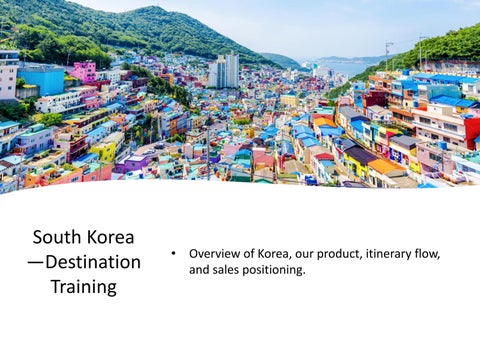
South Korea —Destination Training
• Overview of Korea, our product, itinerary flow, and sales positioning.
Why Korea, Why Now?
• • • • • •
•
Fast-growing destination Safe, clean, modern Excellent infrastructure High interest from K-culture and movies Compact country with huge diversity in a short travel time Outstanding food culture and street-life experiences Ideal for both first-time Asia travellers and Japan repeaters
South Korea at a Glance • • • •
Capital: Seoul Population: 52M Language: Korean Currency: KRW = Korean Won approx. 1 USD = 1,400 KRW
•
Religion: Buddhism, Christianity & Confucian influence
• •
Airports: ICN, GMP, PUS, CJU Geography: 70% mountains
•
with an extensive coastline Travel times: Seoul – Busan: ~2.5 hours by KTX high-speed train Seoul – Jeju: ~1 hour flight
Climate & Best Time to Travel • Spring (Apr–May): Mild temperatures and beautiful cherry blossom season • Summer (Jun–Aug): Hot and humid, lively festivals and coastal travel
• Autumn (Sep–Nov): Best overall season with clear skies and “Indian summer” colours • Winter (Dec–Mar): Cold and crisp, ideal for cities and ski resorts
Domestic Flights & Airports • • •
•
Incheon International Airport (ICN): Main gateway for long-haul international flights Gimpo Airport (GMP): Preferred for regional flights to Japan, Taiwan and China Gimpo advantage: Much closer to central Seoul and faster to reach than Incheon Domestic flights: Mainly serve Busan and Jeju Island due to Korea’s compact size Did you know? The Seoul–Jeju route is the world’s busiest air route, carrying over ~13 million passengers a year — fuelled by weekend escapes, domestic tourism and a steady flow of Korean honeymooners heading to their “Hawai‘i of Korea.”
Transport & Infrastructure • World-class airports with fast immigration and excellent city connections • KTX high-speed trains linking major cities quickly, comfortably and on time • Modern metro systems with very frequent services and clear English signage • Extensive bus & highway network connecting cities, regions and airports • Very affordable public transport compared to most long-haul destinations • T-money / Korea travel card easily available and usable nationwide (metro, bus, taxi)
Hotel Quality & Accommodation • Hotels in Korea are generally modern, very clean and reliable • In major cities like Seoul and Busan, many international hotel chains are present (e.g. Accor, Holiday Inn, Marriott) • Alongside global brands, Korea has a wide range of strong local hotel brands • Rooms tend to be compact but well designed, similar to Japan
• Facilities such as excellent Wi-Fi, efficient service and good breakfast standards are common • Traditional Hanok stays offer a cultural alternative, especially in historic towns • Many Korean hotels place a strong emphasis on functionality over size, meaning smaller rooms are often compensated by smart layouts, high-tech amenities and excellent public areas.
Cost & Spending • Overall costs: Generally 15–30% lower than Japan, but Korea is not a lowbudget destination • Hotels: • Good 4★–5★ hotels can be expensive, especially in Seoul and Busan • Prices often comparable to European city standards • Transport: • Public transport is very affordable and efficient
• Private transfers and guided tours can be costly, close to European pricing • Meals: • Local Korean food offers excellent value • International and Western dining can be relatively expensive • Entrance fees: • Temples and palaces are often free or very inexpensive
• Typical entrance around 3,000 KRW (approx. USD 2–2.50) • Same pricing for locals and tourists •Did you know? Korea is becoming increasingly cashless, with many restaurants using self-ordering kiosks or tablets at the table. Card and mobile payments are widely accepted and often preferred, and in some places cash is no longer used at all. It’s also not unusual to be served by a robot waiter, especially in cafés and casual restaurants, reflecting Korea’s strong embrace of technology in everyday life.
Korean Food Culture (Eating Together) • Food is central to Korean daily life and social culture • Korean BBQ: grilled at the table, shared dishes, interactive dining • Meals are designed to be shared, creating a social experience
• Side dishes (banchan) served with every meal, adding variety and colour
Street Food & Market Culture
• Lively street food scenes in cities and local neighbourhoods • Popular snacks: tteokbokki, hotteok, kimbap, skewers • Night markets and food streets are clean, safe and vibrant • Markets are an easy way to experience local life and flavours
Markets & Everyday Food Culture • Every city in Korea has lively local markets at the heart of daily life • Markets combine fresh produce, street food, small eateries and local shops • Ideal places to see how Koreans eat, shop and socialise • Food stalls offer quick, affordable meals alongside traditional snacks • Markets are clean, well organised and easy to explore for visitors • Visiting a market is one of the best ways to experience Korean culture firsthand
Seafood Markets & Coastal Cuisine • Korea’s long coastline results in an extraordinary variety of seafood
• Seafood markets display live fish, shellfish, octopus, crab and seasonal catches • Visitors can buy seafood on the spot and have it prepared immediately • Markets often include upstairs or nearby restaurants serving ultra-fresh dishes
• Major seafood market highlights in Busan, Yeosu, Tongyeong and coastal towns • A unique, authentic experience combining food, culture and local life
Shopping & Urban Lifestyle • Shopping is a major part of everyday life in Korea • Traditional markets like Namdaemun offer souvenirs, fashion, snacks and local goods • Myeongdong is famous for cosmetics, skincare, fashion and street shopping • Large department stores such as Lotte and Shinsegae combine shopping, food halls and entertainment • Districts like Hongdae showcase youthful fashion, independent brands and creative trends • Korea is a trendsetter in fashion, beauty and design, influencing global markets
Did You Know? – K-Pop Street Culture In many major city areas, especially around Hongdae, Myeongdong and busy squares, young performers regularly stage live K-pop dance and music performances. These informal street shows attract locals and visitors alike and offer a fun, spontaneous glimpse into modern Korean pop culture. Watching or stumbling upon a performance is an easy, authentic way to experience Korea’s contemporary youth scene without attending a concert.
Religion & Spiritual Life in Korea • Buddhism plays a visible role in Korean culture, landscape and daily life • Buddhist temples are found throughout the country, often in scenic mountain settings • Temples are places of worship, meditation and cultural heritage • Christianity is also widespread, with churches common in cities and towns • Overall, religion coexists peacefully and rarely dominates public life or travel experiences
Did You Know? – Temple Stay Experiences Many Buddhist temples in Korea offer Temple Stay programs, allowing visitors to stay overnight or longer inside a working monastery. Guests experience daily temple life, including early morning bell ceremonies, meditation sessions and traditional vegetarian temple meals. Temple stays are usually located in peaceful mountain settings, far from cities and crowds. The experience is simple, respectful and deeply calming, offering a rare insight into Korean spiritual traditions. Participation is optional and flexible, making it suitable even for first-time visitors seeking a unique cultural experience
Palaces, Gardens & Royal Traditions • Historic palaces can be found in many Korean cities, especially in Seoul • Palaces are surrounded by spacious gardens, courtyards and traditional architecture • Regular Royal Guard Changing Ceremonies bring history to life with music and colourful uniforms • Palaces are centrally located and easy to visit as part of city sightseeing • They offer a calm contrast to Korea’s modern cityscapes and skyscrapers
Did You Know? – Wearing a Hanbok Renting a Hanbok, Korea’s traditional dress, has become a popular and fun experience Visitors can dress in colourful traditional costumes and walk through palace grounds and old quarters Many palaces allow free or discounted entry when wearing a Hanbok It’s a favourite activity for Instagram, photos and cultural immersion An easy, light-hearted way to engage with Korean tradition without any prior knowledge
Nature, Parks & Walking Culture • Despite its modern cities and high-rise skylines, Korea offers easy access to nature • Seoul is dotted with large parks, riverside paths and green spaces ideal for long walks • Mountains and forested areas are often directly connected to urban centres • Across the country, numerous national parks offer scenic trails and panoramic viewpoints • Korea is a paradise for walkers and trekkers, with well-marked paths and good facilities • Nature experiences range from gentle strolls to full-day hikes, suitable for all fitness levels
Tour Overview — Highlights of South Korea 12 days / Balanced / UNESCO sites / Markets / Coast / Culture
Seoul (Days 1–3) •Gyeongbokgung Palace with Royal Guard Changing Ceremony •Bukchon Hanok Village, traditional houses in the heart of the city •N Seoul Tower for panoramic city views •DMZ Tour, including tunnels and observation points
•Gwangjang Market, Seoul’s most famous street food market
Optional: Nami Island & Seoraksan National Park
•Easy nature escape from Seoul within one day
•Nami Island: Famous filming location for Korean soap operas, with treelined avenues and lakeside scenery •Seoraksan National Park: Dramatic mountain landscapes and walking trails •Cable car option offering panoramic views without strenuous hiking
Jeonju (Day 4)
•Jeonju Hanok Village, the bestpreserved traditional village in Korea •Gyeonggijeon Shrine, an important royal heritage site •Hanbok experience, wearing traditional dress in historic surroundings •Known as the birthplace of Bibimbap, one of Korea’s most famous dishes
Yeosu & Tongyeong (Days 5–7) •Odongdo Island, scenic coastal walks and ocean views •Dongpirang Village, colourful murals and hillside scenery •Mt. Mireuksan Cable Car, panoramic views over the coastline and islands •Tongyeong, often referred to as the “Naples of Korea” for its harbour setting and island-dotted seascape
Busan (Days 7–9)
•Haedong Yonggungsa Temple, dramatically set on the rocky coastline •Jagalchi Market, Korea’s largest seafood market •UN Memorial Cemetery, a unique and moving historical site •Gamcheon Culture Village, colourful hillside neighbourhood often called the “Machu Picchu of Korea” Beaches of Busan, including Haeundae or Gwangalli for seaside atmosphere •Evening drone show, lighting up the beach skyline
•Seokguram Grotto, UNESCO-listed mountain sanctuary with a stone Buddha
Gyeongju (Days 9–11)
•Bulguksa Temple, one of Korea’s most important Buddhist temples •Tumuli Park, ancient royal burial mounds of the Silla Kingdom •Wolji Pond (Donggung Palace & Wolji Pond), beautifully illuminated at night •Woljeonggyo Bridge, especially atmospheric in the evening
KTX Return to Seoul (Days 11–12) •High-speed KTX train, approx. 2–2.5 hours from Gyeongju to Seoul •Comfortable, modern and punctual travel experience •Scenic countryside views along the way •Free time in Seoul for lastminute shopping, food exploration or personal discovery •Smooth and relaxed end to the journey before departure
Why This Tour Sells Well •Balanced pacing, combining cities, culture, coast and nature •Wide regional coverage, showcasing different faces of Korea •Authentic experiences, from markets and temples to local neighbourhoods •Good overall value, with strong inclusions and manageable daily costs •Strong storytelling, linking history, modern life and cultural traditions
Korea vs Japan – How to Position It • • • • • •
• •
Similarities Very safe, clean and well organised Strong cultural heritage Excellent food and transport infrastructure Key Differences Korea feels more vibrant, dynamic and expressive Japan tends to be more formal and structured Korea is generally more affordable for comparable experiences
Regional Combinations – How to Position them • Korea + Japan: Short flights (1.5–2 hours) and a strong contrast between two cultures Recommended order: Korea first, Japan second → Korea is more relaxed and easier at the beginning, while Japan works best as a structured, high-impact finale • Korea + Taiwan: Ideal for food lovers and urban culture, with different regional flavours • Shared seasons: Similar best travel periods make combinations easy to plan • Easy logistics: Strong air connections and smooth regional travel
Just for Fun – Korea Pop Culture Facts • Squid Game prize money: The final winning amount was 45.6 billion KRW (approx. USD 33–35 million) • Gangnam Style: First YouTube video ever to reach 1 billion views • K-Pop as a global export: Korean pop music, fashion and beauty have become major global cultural exports • Everyday reality: Korea is one of the safest countries in the world — it’s common to see people leave phones or laptops unattended in cafés
Key Takeaways for Sales •Korea is safe, modern and easy to sell, even for first-time Asia travellers •Strong mix of culture, food, nature and vibrant cities in one compact country •Excellent infrastructure allows smooth touring and logical routing •Offers high-quality experiences with good overall value •Works perfectly on its own or combined with Japan or Taiwan
감사합니다 (Gamsahamnida – Thank you) Thank you for your time – let’s start selling Korea