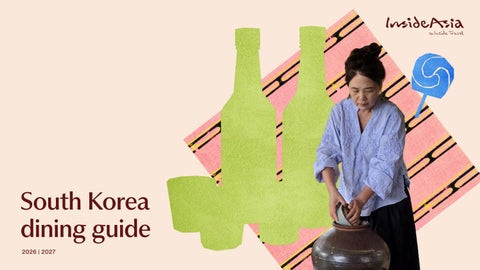
South Korea dining guide 2026 | 2027
Contents
Guide to eating out in South Korea Introduction to Korean drinking & dining culture
3
Must-try Korean dishes
4
Etiquette do’s & don’ts
5-8
Dining in practice Managing dietary requirements
info@insideasiatours.com | www.insideasiatours.com
9 10-17
Glossary
17
How to use Korean chopsticks
18
2
Introduction to Korean drinking & dining culture Food is a huge part of travel – and it’s a powerful way to understand other cultures, people, and places. Nowhere is this truer than in South Korea, where food is synonymous with history, tradition, and a sense of jeong – or connection – with others. Dining is a communal experience in Korea, and meals typically include shared dishes. Usually, you’ll find one big, main meal on the table, surrounded by several side dishes. You’ll portion hot main dishes or steaming soups out onto your ap-jeop-shi (small personal dish), while diving into vibrant sides like kimchi or spicy pickles directly from the plates. To help you truly get under the skin of South Korean culture – and to understand what makes it so special – we’ve put together a complete guide to drinking and dining, from etiquette do’s and don’ts to what your K-BBQ table might look like. We’ve teamed up with Meggie, one of our team on the ground, to bring you everything you need to know to dive straight in.
“Hi! I’m Meggie, and I’m a tour guide, researcher, award-winning author, and mother based in South Korea. I’m originally from the US, but have spent the past five years crafting history and culture tours – using storytelling to inform and delight travelers from all over the world.” Meggie South Korea specialist
info@insideasiatours.com | www.insideasiatours.com
33
● MUST-TRY KOREAN DISHES
Must-try Korean dishes
There are lots of dishes that are synonymous with the Korean food scene – but here are some of our absolute must-try dishes.
Korean BBQ
Korean fried chicken and beer
Bibimbap
Right up there with the top Korean dishes, KBBQ is all about grilling delicious cuts of marinated meat on charcoal or gas stoves right at your dining table (more on this later!)
Think buttermilk fried chicken, but smothered in gochujang sauce, sesame seeds, and spring onions. Perfectly paired with a cold beer (read our guide to breweries in Korea for suggestions).
One of the most well known Korean dishes, this rice bowl comes topped with seasoned veggies, marinated meat, a fried egg, and a dollop of spicy-sweet sauce, ready to be mixed together just before eating.
Budae jjigae (army stew)
Samgyetang
Bingsu
A uniquely fusion dish invented by resourceful Koreans putting American soldiers’ leftovers to good use, budae jjigae is made with canned or processed ingredients like sausage, Spam, baked beans, kimchi, instant noodles, gochujang and American cheese.
Korea’s version of chicken soup for the soul! Made with a small chicken stuffed with gingseng, garlic, and rice. Tosokchon Samgyetang restaurant in Seoul is particularly famous for this dish.
Sometimes written as bingsoo, this delicious, shaved ice dessert comes with sweet toppings like condensed milk, fresh fruit, and syrups. The most popular variety is patbingsu – red bean shaved ice.
info@insideasiatours.com | www.insideasiatours.com
4
● ETIQUETTE DO’S & DON’TS
● DO
● DON’T
Be aware of age
Pour or refill your own drink
Allow the oldest person to pick their seat first and take the first bite, while the youngest person (or your guide) passes out bowls and napkins.
Instead, keep an eye on others’ and top them up (only when empty). Don’t finish your drink unless you’d like a top up, too!
● DO
● DON’T
Use two hands
Raise your bowl to your mouth
When giving and receiving dishes or pouring drinks.
Unlike Japanese people, Koreans don’t raise their bowl off the table to eat. They use both chopsticks and spoons to eat which makes this easier.
● DO
Be accepting
Etiquette do’s & don’ts Koreans are typically very understanding of tourists’ cultural differences. Although restaurants are generally delighted to host you and happy to help, it’s useful to understand local customs.
Of soju cups, makgeolli bowls, or beer glasses. Even if you don’t want to drink, you’ll need these to cheers at the beginning of the meal. People may also raise a glass when you say something they agree with; you don’t have to drink, but don’t miss clinking cups!
● DON’T
Hold a spoon in one hand... ...and chopstick in another, or leave your chopsticks sticking out of the rice. ● DON’T
● DO
Share Dining is communal and dishes are for the whole table to enjoy (see ‘dining in practice on pg.9’).
Ask for the check When you’re finished eating, simply stand up and walk to the cash register to signal that you want to pay and leave.
Here are some things to know.
info@insideasiatours.com | www.insideasiatours.com
5
● ETIQUETTE DO’S & DON’TS
Etiquette explained There are some key tenets to Korean culture that can help tourists understand the significance of dining etiquette. Here’s a quick overview.
info@insideasiatours.com | www.insideasiatours.com
6
● ETIQUETTE DO’S & DON’TS
2
Using two hands Offering and receiving things with two hands shows respect in Korea. Whether you’re pouring or receiving a drink, using two hands shows you respect the person you’re interacting with. This doesn’t stop at the dinner table – you’ll notice it in shops and hotels, too.
1
Yielding to the older person Korean people show respect to those who are older (even just a year!) or more senior than them. That means the older person gets the best seat (usually far from the kitchen or entrance, and somewhere they can get peoples’ attention) and takes the first bite of food, while the younger person distributes utensils, personal plates, and cups, pouring water along with the first round of alcohol. The rules aren’t as strict in less formal settings, so don’t stress too much!
info@insideasiatours.com | www.insideasiatours.com
3
Utensil placement In Korea, it’s considered rude to put your dining utensils on your plate in between uses. Use the chopstick and spoon rest, or just place them directly on the table. Don’t leave them in your food, either, and never place them straight up sticking out of your rice, as it resembles incense sticks at a funeral or memorial table. It’s also the placement that’s used in offerings. Although many younger Koreans aren’t bothered by this, the older generation still get a chill!
7
● ETIQUETTE DO’S & DON’TS
4
6
Enthusiastic eating
Saying cheers
Lots of Koreans eat food as soon as it’s brought to the table, but if it’s too hot for you, place some on your personal plate and wait for it to cool down. While eating noises aren’t considered rude necessarily (you’ll find some older Koreans slurp away at noodles quite happily!) eating loudly is becoming less common in younger generations.
Unlike in the west, ‘cheers’ isn’t just for the beginning of the meal: Koreans often clink glasses anytime something was well-said, impressive, or quite funny. It’s a continuous action to bring the table together over something – whether it’s a hilarious joke, an impressive story, or something you heartily agree with. You can initiate this by saying jjahn (to pronounce this perfectly think of an American accent saying the name John). For more celebratory, less conversational cheers, it’s geon-bae.
And don’t blow your nose loudly – no matter how spicy the food...
5
Drinking alcohol Koreans have been drinking alcohol with meals since the Three Kingdoms period in 18BC, and they say you can’t truly enjoy jeon (Korean pancakes) without makgeolli (rice wine). You’ll find soju cups on every table at a BBQ restaurant, and anju refers to the food that pairs best with a particular beverage. When glasses are being passed out, accept one even if you’d rather not drink – it allows your tablemates to show respect by pouring a drink for you. You can simply leave it full on the table (raising it for cheersing) and, as it’s considered rude to refill a glass before it’s empty, leave it at that. It’s rude to pour for yourself, so make sure you keep an eye on your party’s glasses. Typically, the person opposite is responsible for filling up the opposite’s cup, but anyone who notices might offer.
info@insideasiatours.com | www.insideasiatours.com
8
● DINING IN PRACTICE
Your table layout
From left to right, you’ll usually find rice, soup, spoon, chopsticks (if you can’t find cutlery, it may be in a drawer under the table). Your small dishes with dips or sauces will go above the rice, with the kimchi usually close by. The shared side dishes will line up in the middle of the
Dining in practice There are a couple of key differences between Korea and the west when it comes to dining out. Firstly, dining is generally a communal experience – and it’s standard to order and share lots of dishes (think tapas, but Korean!) Secondly, the concept of service from a waiter or waitress is very different, as is gratuity (don’t tip!) Finally, dietary requirements require more pre-planning than they may do at home.
info@insideasiatours.com | www.insideasiatours.com
You probably won’t be setting many tables during your visit, but it’s handy to know how the table is set and where to find things during a meal.
table (in arm’s reach) and the shared main will be in the centre. If a restaurant’s busy, they might be in a hurry and just place things down where there’s space – that’s perfectly normal, too. It’s very rare to hear the phrase ‘please pass the...’ in Korea – because it’s 100% okay to reach over dishes to reach what you want. Mind your sleeves, and go for it!
Service and getting attention
Unlike in the west, Korean waiters wait for you to call them – rather than proactively checking if you need anything. You’ll do this using a button on the table. When you press it, you’ll hear a melodic ding-dong sound that’ll summon the staff directly to your table. When you’re ready to order, want to order more, or can’t find a fork, simply press the button and they’ll come.
If you’re in an older restaurant, or something very ’mom and pop’, there might not be a button and you’ll need to call out sa-jahng nim loudly (it’s not rude!) to get their attention. You may hear some Korean diners shout “joh-gi-yo!” which means “you there!” and is less polite.
Paying and tipping
In Korea, you don’t pay at the table in a restaurant. Head to the cash register or desk (usually near the door) to pay. Most places take card, aside from markets or very small, local restaurants. If there’s a bill on the table, bring it with you. If not, they’ll likely already have your information ready. If there’s no-one there, give them a moment to notice you or shout sa-jahngnim to let them know you’re waiting.
Do not leave a tip – or risk offending! Korean restaurant employees earn minimum wage or more, and older Koreans see tips as an insult, implying they can’t earn enough on their own. To show gratitude for outstanding food, you can say jal muk-us-sum-ni-da, meaning ‘I ate well’.
9
● MANAGING DIETARY REQUIREMENTS
Managing dietary requirements If you’ve got special dietary requirements, travelling to Korea will take some planning. In a post-war, recently industrialised country where food allergies are uncommon, the idea of special dietary needs is incredibly foreign for most Koreans. But, armed with information and a little preparation, it’s possible for vegetarians, vegans, coeliacs and others with specific requirements to eat well in Korea.
Tip
info@insideasiatours.com | www.insideasiatours.com
The Vegetarian by Han Kang illustrates Korea’s complicated relationship with deviation from the norm!
10
● MANAGING DIETARY REQUIREMENTS
If you’re traveling to smaller, more rural areas, options will be more limited and it would be wise to find snacks and safe foods to supplement between mealtimes. Most convenience stores have simple breads, fresh veggies and fruits, as well as various meal replacement bars.
Here are some Korean foods which are usually vegetarian/vegan friendly:
Where to eat Like any country, you’re more likely to find restaurants catering to dietary requirements in the bigger cities. Western food has become quite popular in Korea, so cities like Seoul and Busan have plenty of options – sometimes offering both Korean and western options that meet dietary requirements. We always recommend using apps like Happy Cow, to find good options, too. If you’ve found somewhere and want to make a reservation in English, use Catch Table. Korean temple food is also vegan, and usually free of sugar. For vegans, temple food is one of the safest and most culturally aligned options available, and you’ll find restaurants in Seoul and Busan, as well as at temple stays.
info@insideasiatours.com | www.insideasiatours.com
Gungogugma
Vegetable kimbap
Pajeon
Roasted sweet potato
This one is vegetarian friendly but usually has egg. Sometimes they throw in an artificial crab stick, but these are made from fish meat, so make sure to ask them to leave that out.
Usually just spring onions and flour but sometimes people add squid. Check first.
Hotteok Hotteok is a dough of wheat flour and glutinous rice flour, filled with sugar and nuts, then pressed into a flat, round shape and cooked on a griddle.
Tornado potato sticks Spiral sliced potatos on sticks! Usually salted.
Tteok rice cake Rice cake made with rice flour and water. There are many types of tteok with different toppings and fillings. Some varieties may contain honey, so please check first if you are vegan.
Sanche bibimbap Vegetarian bibimbap, still often comes with a fried egg, but otherwise vegan friendly.
Hobak jook Sweet pumpkin porridge, vegan friendly and excellent in winter.
Joomok bap Korean rice balls mixed with pickled radish and seaweed, with no additional fillings.
Kalguksu Kalguksu is a noodle dish made with wheat flour noodles. The broth can vary, with common versions including anchovy, seafood, chicken, or bone broth. Since many versions use animal-based broths, it may not always be suitable for vegetarians or vegans.
Kongguksu Cold bean noodles, usually served with a boiled egg on top, but you can ask them not to add that.
Patbingsu Redbean and rice cake shaved ice. Sometimes condensed milk is poured over it but can requested to be left out.
11
● MANAGING DIETARY REQUIREMENTS
Watch out for Some things may look vegetarian but have been made with ingredients like beef stock or fish paste, so it’s always best to ask. For example, Naengmyeon, the popular cold buckwheat noodles, are served without meat – but made with beef stock and served with a boiled egg. Kimchi is also often made with tiny shrimp, fermented brined shrimp, or fish sauce – especially if it’s homemade or very traditional. For coeliac or gluten-free people, sauces are sometimes made with barley or wheat as a thickener, but sticking to unseasoned meat and rice with various vegetables is usually a safe bet. You’ll also find several gluten-free bakeries and restaurants in Seoul (we recommend Sunny Bread and LePause). The amount you’ll be able to substitute ingredients depends on the dish – soups or dishes made in large pots will be difficult to adapt, but if you’re ordering jeon (Korean pancakes/fritters), you can ask for things to be left out, as they’re always made fresh to order. Most Korean restaurants are willing to try to help, but the restaurant might decide they’re unable to accommodate you – not as a personal slight, but because they’re not sure they can meet your needs and don’t want to bring harm or conflict. Remember, flexibility and patience are a must when navigating a country that’s not used to special dietary requirements.
info@insideasiatours.com | www.insideasiatours.com
Checking labels By Korean law, the eleven major food allergens (for Koreans) must be included on product labels: poultry, eggs, milk, buckwheat, peanuts, soybean, wheat, mackerel, crab, pork, peaches, and tomatoes. If you need to check the labels on food before you buy, you can use a translation app (Google works quite well). To overcome the language barrier, carrying a food passport is useful. This is a small card or digital document giving details of your dietary needs in Korean. InsideAsia can provide you with one of these - just ask!
12
● MANAGING DIETARY REQUIREMENTS
TRAVELLING WITH DIETARY REQUIREMENTS IN KOREA:
Convenience store hacks Korean convenience stores are a whole world of their own – with hot food stands, seating, cheap alcohol – and even mix your own drinks (read more about South Korean convenience stores in our previous blog). But they’re also a brilliant way for people with dietary requirements (like being vegan or gluten-free) to hack the system and access the parts of Korean culture that could be tricky otherwise in a famously meat-heavy cuisine. From buying plant milks to take to your breakfast buffet, to stocking up on tasty snacks to go hiking with, there are lots of cheap and easy alternatives – provided you know what you’re looking for. We’ve put together a quick guide to working your way around Korean convenience stores if you’ve got dietary requirements. For those with food restrictions, eating in South Korea can seem like a daunting and limited experience. Choosing snacks or meals at the always clean and trust-worthy convenience stores is one way to stay certain about what you’re consuming – it just takes a little knowledge and know-how to navigate!
info@insideasiatours.com | www.insideasiatours.com
13
● MANAGING DIETARY REQUIREMENTS
2
Open refrigerator section Starting with that open refrigerator, let’s assume you’re looking for a quick, safe meal.
1
Convenience store layouts While no two convenience stores are organized precisely the same way, there are a few standards you can expect. The milk, juices, and ready-to-eat meals will always be in an open refrigerator against one wall. There will always be a shelf dedicated to baked goods and bready snacks. The crisps will be plentiful and so will the cup noodles. There will be a microwave somewhere in the building, ready to zap your meal to perfection. The chewing gum will always be near the cash register. Several items will have deals like 1+1 (buy one get one free) or 2+1 (buy two get one free) and the worker nine times out of ten will not let you miss out on your freebie, even if you don’t want it!
info@insideasiatours.com | www.insideasiatours.com
You’ll notice there’s very little English on these sandwiches – but there is a picture of the main ingredients, description of the contents, and calorie count. Using translation apps to read labels is the quickest and easiest way to know what you’re getting. At the top of the packet, there’s a picture of coffee – which means you’ll get a discount on a coffee with this sandwich. This is really common. Anything that needs microwaving will have a picture of a microwave, and the cooking time. The symbols to look out for are 분 for minute and 초 for seconds.
Another snack that’s handy to grab is the samkak kimbap, which means three corners kimbap. From the pictures, you can see this is rice and a filling wrapped in seaweed. The labels follow the same pattern as sandwiches – if there’s meat, there’ll be a picture of the animal. There’s a special way to open these (there’s a plastic barrier between the seaweed and rice to keep it crispy!), so follow the numbered steps to peel the plastic off.
Standard roll-style kimbap and salads are also available with descriptive labels and pictures.
14
● MANAGING DIETARY REQUIREMENTS
If you’re on the hunt for protein, you’ll usually find fully-cooked and microwavable meats, fish, and tofu in the fridge section, too. You can microwave these or eat them cold. As with all the other foods, the small print at the bottom of the packaging tells you the full ingredients, plus cook time if needed.
4
Non-fridge snacks that are ready to eat
Usually below these packaged meals are smaller options like fresh, washed, ready-to-eat fruits and smoked, steamed, or baked eggs. 3
Milks, juices, and meal replacements
For other pre-packaged meals that don’t require refrigeration, you’ll usually find them on their own shelf, often with a dedicated aisle in the shop. The cup noodle options are abundant but almost all of them contain meat or meat products. The ingredients are all listed and some do have pictures as well. Thankfully, they also have a nutrition label which clearly shows in bold lettering the common allergens contained in each product. Careful shoppers can easily and quickly check for their sensitive ingredient before buying.
Also typically located in the open refrigerator, you’ll find various ready-to-drink or single-serving beverages. For milk drinkers, there is a wide variety of flavored and non-flavored cow milk. Baskin Robbins Korea has become particularly creative with its flavours, but they’re dessert-level sweet! These drinks will always have pictures of their flavour, so even without the ability to read Korean, you can easily tell which milk is strawberry and which is chocolate. If you don’t drink cow milk, there’s a decent selection of almond, oat, and soy milks available in most convenience stores. The picture below shows a few of the options and again the easy to read/identify labels. The milk alternatives often have much more English on them.
info@insideasiatours.com | www.insideasiatours.com
15
● MANAGING DIETARY REQUIREMENTS
If you’re fed up with noodles, there’s a safe rice porridge that you can get in any convenience store in any part of the country. It’s cheap, delicious, and ready in minutes.
While not every shop carries them, there are a few vegan options for noodles. The most common being vegetable ramen or potato noodles. If the shop carries it, you’ll see it called 야채라면 for veggie ramen or 감자 라면 for the potato noodles, and the packaging usually has the word “vegan” or “vegetarian” somewhere on it. For example the packaging above says 채식 (vegetarian) in Korean and vegan in English. It’s important to check that nutrition label, however, because not every veggie or potato noodle is completely safe. Some have chicken or beef or pork stock in them despite the absence of any meat. Nongshim brand has an award winning vegan option and the packaging looks like the green packet above. You might even be able to find a vegan version of black noodles on the shelves of convenience stores in the tourist heavy parts of Seoul.
info@insideasiatours.com | www.insideasiatours.com
Don’t forget to check out the extremely plentiful varieties of flavored almonds! A great snack anytime.
5
A safety note It cannot be stressed enough, the importance of checking the nutrition label for those common allergen words. Many things which seem like they’ll be fine, really are not. For example, this squid snack picture above. Seemingly great for pescatarians, flip it over you will find that it contains pork!
16
● MANAGING DIETARY REQUIREMENTS
Similarly, this addictive honey and apple snack, Surprisingly contains dairy! While existing in South Korea as a person with food restrictions is not as easy as one without, it is possible. With a little extra knowledge and some good tips, you can enjoy the land of the morning calm on a full belly!
Glossary Here are a list of common allergies, phrases and foods in Korean that you can use if you get stuck: 저는 _____ 알레르기가 있어요. Jeoneun _____ allereugiga isseoyo. I’m allergic to _____. 저는 비건이에요. Jeoneun bigeonieyo. I’m vegan. 저는 채식주의자에요. Jeoneun chaesikjuuijayeyo. I’m vegetarian.
난류 - Nallyu Eggs 유제품 - Yujepum Dairy products 메밀 - Memil Buckwheats 대두 - Daedu Soybean 밀 - Mil Wheat 고등어 - Godeungeo Mackerel
고기 - Gogi Meat
게 - Ge Crab
조개 - Jogae Shellfish
돼지고기 - Dwaejigogi Pork
갑각류 - Gapgangnyu Crustacean
복숭아 - Boksunga Peaches
우유 - Ooyou Milk
토마토 - Tomato Tomatoes
땅콩 - Ttangkong Peanuts
글루텐 - Gluten Gluten
Tip
info@insideasiatours.com | www.insideasiatours.com
가금류 - Gageumnyu Poultry
Download a translator app (like Google Translate) before you go and you can use your smart phone to quickly and easily read menus, food packages, and everything else while travelling in Korea.
17
● HOW TO USE KOREAN CHOPSTICKS
How to use Korean chopsticks Although many Asian countries use chopsticks, they don’t all use them the same way – and the sticks are different, too. Chinese chopsticks tend to be longer for better reach into shared dishes, while Japanese chopsticks are short and sharp, useful for deboning a fish on your personal, non-shared plate. Korean food consists of both shared and personal dishes, so Korean chopsticks are somewhere in the middle. Some chopsticks are round, while others are flat – useful for cutting out bite-sized pieces of a shared dish like jeon or dubu kimchi (tofu blocks with cooked kimchi). In restaurants, you’ll usually find metal chopsticks; since Korean meals nearly always include a soup or broth alongside pickled side dishes, it makes sense to have chopsticks that won’t swell, stain, or splinter. Metal chopsticks are also a status symbol – the upper class and royals used to use them as a reliable arsenic detector! First time users might find certain dishes difficult to eat with Korean chopsticks, but we promise it’s possible. The key to success is all about the grip. Here’s how.
info@insideasiatours.com | www.insideasiatours.com
18
● HOW TO USE KOREAN CHOPSTICKS
1
Fold the first stick in the crook of your thumb, using your thumb to press it into your hand firmly.
If you see your chopsticks crossing, this is guaranteed to result in dropped food and unyielding noodles. Use the forgiving tissue to practice keeping your sticks parallel with a not-toostrong grip.
6
You may also note that many round chopsticks, meant for noodles and soups, have little ridges on them which will enhance your hold on slippery things. When selecting which set of sticks to go with, just keep in mind what you will be eating. Chances are that the restaurant you’re in will already have the appropriate tools.
5
2
It might feel awkward at first, but holding your chopstick near the end gives the most stability. Next, stabilise it further by resting it on your ring finger and pressing down firmly with your thumb. The stick should never move from this position!
3
Next, position the second stick on the first knuckle of your middle finger. Use the end of your thumb and index finger to pinch it and provide dexterity. You should be able to move the second stick up and down without the first stick moving. The thumb is only moving slightly at the end to accommodate the movement of the index and middle finger. Now it’s time to practice!
info@insideasiatours.com | www.insideasiatours.com
There you have it! 4
With a little practice, anyone can be a great chopstick user.
Take a folded tissue (like one you’d use to blow your nose) and try to pick it up. Try flipping it over, flattening it out, and manipulating it in different ways. Pay attention to your grip strength. Keep your chopsticks parallel with a gently firm grip. Anything stronger will result in dropped food.
DISCLAIMER Many Korean people do not hold their chopsticks this way, due to regional differences and individual upbringing. You may see many members of the older generation using almost a fist-like grip. While the positioning shown in this guide is one that is considered “proper”, don’t judge others for their grip, especially if it is still effective!
19
● GLOSSARY
Looking for help planning a trip to Korea? info@insideasiatours.com | www.insideasiatours.com
If you’re hungry to turn inspiration into action and start diving into Korea’s buzzing food scene, let’s talk. We’re ready and waiting to help you craft your perfect trip.
Take me to Korea
20
www.insideasiatours.com
A family of travel brands for cultural adventure travellers UK edition © 2026 Inside Travel Group Ltd InsideAsia Tours and InsideJapan Tours are registered trademarks of Inside Travel Group Ltd.