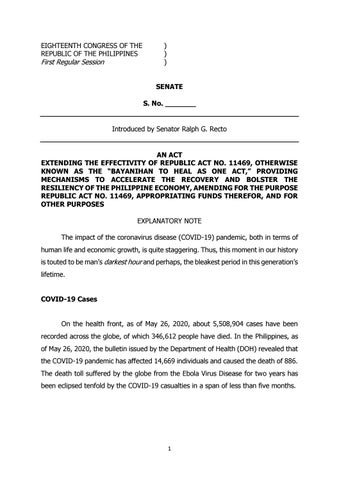
EIGHTEENTH CONGRESS OF THE REPUBLIC OF THE PHILIPPINES
First Regular Session
) ) )
May 27 2020
06:59 pm SENATE
1561 S. No. _______ Introduced by Senator Ralph G. Recto
AN ACT EXTENDING THE EFFECTIVITY OF REPUBLIC ACT NO. 11469, OTHERWISE KNOWN AS THE “BAYANIHAN TO HEAL AS ONE ACT,” PROVIDING MECHANISMS TO ACCELERATE THE RECOVERY AND BOLSTER THE RESILIENCY OF THE PHILIPPINE ECONOMY, AMENDING FOR THE PURPOSE REPUBLIC ACT NO. 11469, APPROPRIATING FUNDS THEREFOR, AND FOR OTHER PURPOSES EXPLANATORY NOTE The impact of the coronavirus disease (COVID-19) pandemic, both in terms of human life and economic growth, is quite staggering. Thus, this moment in our history is touted to be man’s darkest hour and perhaps, the bleakest period in this generation’s lifetime. COVID-19 Cases On the health front, as of May 26, 2020, about 5,508,904 cases have been recorded across the globe, of which 346,612 people have died. In the Philippines, as of May 26, 2020, the bulletin issued by the Department of Health (DOH) revealed that the COVID-19 pandemic has affected 14,669 individuals and caused the death of 886. The death toll suffered by the globe from the Ebola Virus Disease for two years has been eclipsed tenfold by the COVID-19 casualties in a span of less than five months.
1
The Economic Impact On the economic front, individual and collective efforts to mitigate the transmission of the virus and to reduce the number of casualties have likewise caused the stagnation of global economic activity, in a magnitude unknown since the depression of 1936. Just recently, an updated World Economic Outlook of the International Monetary Fund (IMF) has projected the contraction of the global economy by three percent (3%) in 2020, much worse than the economic recession suffered during the 2008-2009 Global Financial Crisis. The International Labor Organization predicted that global unemployment figures will reach 25 million for Fiscal Year (FY) 2020, with loss of labor income amounting to as much as $3.4 Trillion. Estimates from the Philippine Institute of Development Studies (PIDS) show that the Philippines could suffer a 12.9% contraction of its economy. The Problem of Uncertainty and Lack of Confidence While short-term survival and mitigation of COVID-19 fatalities are paramount, the Philippines would eventually need to address another challenge posed by the pandemic: the problem of uncertainty and lack of business confidence. Global uncertainty during the COVID-19 pandemic, according to the World Uncertainty Index, is the highest in six decades, exceeding the global uncertainty caused by the US-China trade conflict, the European debt crisis, and the US-Iraq War. Uncertainty in times of pandemic affects the minds of policymakers, business owners, and ordinary citizens alike. The dramatic and unexpected impact on the economy has dampened the confidence of business in its ability to survive and eventually turnaround. This is aggravated by consumers whose fears of the sustainability of future incomes lead them to cut expenditures to the barest minimum and therefore creating problems in industries considered non-essential but nevertheless account for a substantial production in the economy.
2
The effect can be as trivial as small businesses imposing a moratorium on hiring new personnel; but it could also be as critical and complicated as losing billions of dollars’ worth of foreign direct investments from capital flight, or potential depleting of foreign currency reserves due to displacement of migrant workers abroad. For consumers, it could mean postponing travel, cutting on the purchase of personal effects like clothes, shoes, bags and the like or avoiding restaurants and curtailing entertainment. If and when the disease is brought under control, the government has to take the lead in the Aegean task of reducing socioeconomic uncertainty towards creating confidence in the economy. Objectives of the Recovery Program Such return to normalcy would require the realization of two objectives. First, it will mean the reactivation of disrupted economic activities, reopening of shuttered industries and enterprises, and reemployment of displaced workforces. Second, and most importantly, return to normalcy must come with the development of stronger mechanisms to prevent and control disease outbreaks and epidemics like COVID-19 in the future. Extension of Validity of Bayanihan Act The bill seeks to extend the validity of Republic Act No. 11469, otherwise known as the “Bayanihan to Heal as One Act� up to September 30, 2020. This will allow the government to pursue aggressively its efforts to contain the transmission of COVID 19 as well as to provide stimulus as the economy starts to open up. Hence, the President shall continue to have the power to realign appropriations provided under the FYs 2019 and 2020 General Appropriations Act (GAA) to programs and projects that will mitigate the impact of the COVID-19 pandemic, among other necessary emergency powers.
3
The bill also grants the President the following additional powers: 1. Provide wage subsidies equivalent to one hundred percent (100%) of the applicable minimum wage rate for a maximum of two (2) months to critically-impacted displaced workers, freelancers, the self-employed and repatriated Overseas Filipino Workers (OFWs) in industries that are directly impacted by the COVID-19 pandemic and those that support priority programs of the government; 2. Extend education subsidies to students and teaching and non-teaching personnel in private educational institutions who are facing financial difficulties brought about by the community quarantine as follows: a) Tuition subsidy amounting to PHP 8,000 each for qualified students in Private Higher Education who are neither part of the Listahanan of the Department of Social Welfare and Development (DSWD) nor covered under the Tertiary Education Subsidy (TES); b) Tuition subsidy in the amount of PHP 3,000 each for students in private elementary, and junior high school, who are not current recipients of Education Service Contracting (ESC) under Republic Act No. 8545, and students in private Senior High Schools who are not current recipients of the Senior High School Voucher Program (SHS VP) under Republic Act No. 10533; c) Provide a one-time cash assistance of PHP 5,000 to PHP 8,000 to affected and displaced teaching and non-teaching personnel in private basic education schools and HEIs and part-time faculty members in State Universities and Colleges (SUCs) due to the deferred opening or reduced offering of classes during the community quarantine; 3. Direct all banks, and other financial institutions including the Government Service Insurance System, Social Security System and Pag-ibig Fund, and utility companies, to implement a payment scheme to persons with multiple loans, such that after the grant of a minimum of thirty (30)-day grace period, settlement of unpaid loans shall be deferred to the end of the loan term without incurring interests, penalties, fees or other charges, in effect 4
extending the maturity of the loan to a period equal to the period of quarantine. Moreover, unpaid credit card and utility bills shall be settled on an installment basis without interest and penalties until December 31, 2020; 4. Direct the Department of Agriculture to extend assistance to qualified agrifishery enterprises, farmers, fisherfolk, and other agricultural workers; and 5. Direct the Department of Information and Communications Technology (DICT) to accelerate the deployment of critical ICT infrastructure, equipment, software, and wireless technologies throughout the country to address the need for digital connectivity, internet speed and stability, and cybersecurity
in
e-commerce,
e-government,
online
learning,
and
telecommuting during the COVID-19 pandemic; Reserve Appropriations for Economic Recovery and Resiliency The bill grants the President a standby spending authority of PHP 600,000,000,000 the release of which, shall be subject to the collection of increased revenues, new tax or non-tax revenues, or available proceeds for approved borrowings, as follows: Emergency Subsidy to Workers
PHP 30,000,000,000
The bill will protect the incomes of workers as it grants wage subsidies to industries that are directly impacted by the COVID-19 pandemic and those that support priority programs of the government. Cash for Work Program
PHP 20,000,000,000
This employment intervention will provide temporary jobs to those who have been displaced by the closure of businesses as a result of the economic downturn. The jobs may include the temporary hiring of contact tracers, data
5
encoders and other personnel needed in the response to the COVID-19 pandemic. Prevention and Control of Other Diseases
PHP 20,000,000,000
The bill will enhance the capacity of the Department of Health to provide better health services for Filipinos by implementing programs and projects that will enhance the capacity of public health care institutions to provide safe and quality health care services and to eliminate, prevent and control other diseases
including
Measles, Tuberculosis, Malaria, Hepatitis, Sexually
Transmitted Diseases, and other non-communicable diseases, among others. With the present priority given to COVID-19, interventions for these other diseases have been neglected while deserving attention as these too have dreadful effects on the health and life of the people. Large-Scale COVID-19 Testing
PHP 10,000,000,000
The bill sustains and scales up diagnostic testing efforts under the TraceTest-Treat (T3) Manage System adopted under the National Action Plan Against COVID-19 by providing resources to procure testing kits, supplies, materials and reagents necessary to conduct large-scale testing in the country. Capital Infusion to Government Banks
PHP 70,000,000,000
This bill provides for standby appropriation of PHP 70 Billion, of which PHP 20 Billion is for an expanded guarantee program through the Philippine Guarantee Corporation (PGC) such as increased maximum loan guarantee; reduced eligibility requirements and guarantee fees. On the other hand, the amount of PHP 35 Billion and PHP 15 Billion is allocated to the LBP and DBP, respectively, to support the grant of low-interest loans for MSMEs, agri-fishery enterprises, primary tourism enterprises, export 6
and import industries, and Enhanced Community Quarantine (ECQ) nonessential businesses and other affected sectors. Support Programs for Impacted Sectors
PHP 80,000,000,000
The amount of PHP 80 Billion shall be utilized for programs and projects intended for health workers, displaced Overseas Filipino Workers (OFW), displaced employees and workers in the formal and informal economy, displaced teaching and non-teaching personnel employed; employees and workers in the public transport industry; and other critically-impacted sectors. Support to the Agricultural Sector
PHP 20,000,000,000
The amount of PHP 20 billion shall be used to provide assistance to qualified agri-fishery enterprises and farmers and fisherfolk registered under the Registry System for Basic Sectors in Agriculture (RSBSA) to ensure food security and continuous productivity of the agricultural sector. Funding for Realigned Programs and Projects
PHP 350,000,000,000
Under the Bayanihan Heal as One Act, the amount of PHP 350 Billion was made available for programs and projects in response to the COVID-19 pandemic. This amount was financed by appropriations under the FYs 2019 and 2020 General Appropriations Act that were deemed discontinued, abandoned, reprogrammed, reallocated, or realigned. Under this bill, said programs and projects are again funded in order that the original priorities of the government will not be derailed.
7
Ultimately, the bill seeks to save lives and protect incomes as well as strengthen the resilience of our socioeconomic institutions in dealing with the pandemic. These interventions are being sought to soften the impact of a projected economic downturn, and to accelerate the socioeconomic recovery of the country. In light of the foregoing, immediate passage of the bill is earnestly sought.
RALPH G. RECTO
/mcp/ezl/aim/jiao/mjma/mksbc/ejcv/mdg
8