InPark Magazine (ISSN 15531767) is published by Martin Chronicles Publishing, LLC. 2349 E Ohio Ave. Milwaukee, WI 53207, USA. Shipping address: 2349 E Ohio Ave. Milwaukee, WI 53207, USA. Phone: +1-262-4127107. Printing by ZX CHINA INDUSTRIAL LIMITED.
Postmaster: Send address changes to InPark Magazine 2349 E Ohio Ave. Milwaukee, WI 53207, USA. Subscriptions are available annually on our website ($35 USA / $50 international). Opinions expressed in editorial matter are not necessarily those of InPark Magazine or its publishers, Martin Chronicles Publishing, LLC.
THE COVER
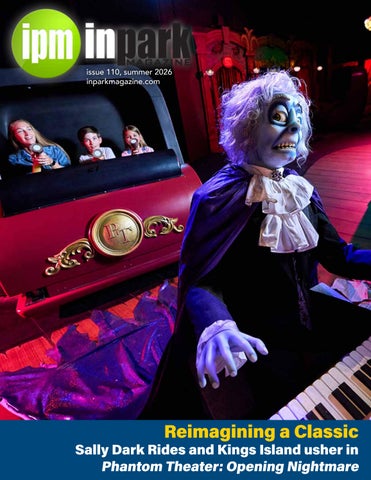
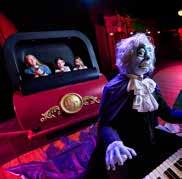
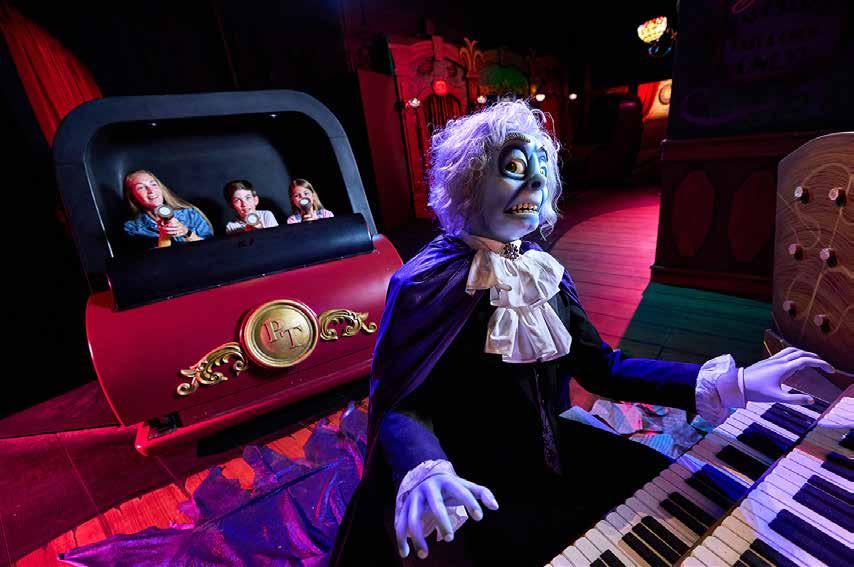
Phantom Theater: Opening Nightmare blends the latest in technology and design with the charm of the original Phantom Theater attraction at Kings Island.
Page 18
7 Inspiration and connection in Orlando by Martin Palicki
TEA’s INSPIRE Week and Thea Awards Gala
Positioning entertainment for the future by Jim Ogul Updates from the world of World’s Fairs 15 ISE 2026 by Martin Palicki
A look at news from the trade show floor in Barcelona
18 A legacy reimagined by Martin Palicki
The development of Phantom Theater: Opening Nightmare at Kings Island
23 The future we’re fighting for by Simone Bonnejonne
What an inclusive LBE industry feels like in five years 26 A higher calling by Becci Knowles THG Creative helps redefine the visitor experience at Temple Square 32 Sliding into summer by Joe Kleiman
New ProSlide attractions bring chills and thrills to North American parks
36 Building themed environments guests return to interview by Martin Palicki Bacho founder Nikolai Tolstykh on the importance of placemaking
Reimagining
Hope in dark times
MARTIN PALICKI, PUBLISHER
Oneyear ago, Universal Epic Universe opened in Orlando – a project years in the making and one that immediately raised the bar for immersive storytelling, technology, placemaking, and guest experience. Just a few weeks ago, I found myself back in Orlando for the annual TEA Thea Awards Gala, where four honors were presented to projects connected to Epic Universe. The applause in the room was not just for Epic; it was for the thousands of people whose talent, persistence, creativity, and hard work brought the park and its experiences to life.
What struck me most throughout the week was the sense of shared ownership. Epic Universe may carry the Universal name, but its success reflects on an entire industry. Designers, fabricators, writers, engineers, artists, programmers, producers, technicians, architects, interns and craftspeople from companies around the world contributed pieces of themselves to this massive undertaking. The recognition at the Thea Awards became, in many ways, a celebration of the power of themed entertainment.
That spirit feels especially important right now.
As this issue goes to press, the ongoing (and foolish) war in Iran continues to create uncertainty across the globe, including disruptions to our own industry. In times like these, it can become easy to focus solely on instability, division,
JOE KLEIMAN, SENIOR CORRESPONDENT
and unpredictability. Yet our industry has always thrived by doing the opposite. We create places designed to bring people together. We build environments rooted in wonder, curiosity, optimism, and shared experience.
That does not mean ignoring the realities of the world around us. It means recognizing the value of what themed entertainment contributes during difficult moments. A great attraction, museum, cruise experience, dark ride, or themed land can provide joy, connection, and inspiration at a time when people may need those things most. In fact, this issue highlights a few of these kinds of projects.
One year after Epic Universe opened its gates, perhaps that is part of its greatest legacy so far: not only the groundbreaking attractions themselves, but also the reminder of what can happen when an industry comes together to create something hopeful.
Martin founded InPark Magazine in 2004, combining years of experience working in themed entertainment with a passion for writing and design.
Raised in San Diego on theme parks, zoos, and IMAX films, Joe Kleiman would expand his childhood loves into two decades as a projectionist and theater director within the giant screen industry. In addition to his work in commercial and museum operations, Joe has volunteered his time to animal husbandry at leading facilities in California and Texas and has played a leading management role for a number of performing arts companies. Joe served as news editor at InPark Magazine starting in 2011, becoming the publication’s senior correspondent in 2021. His blog ThemedReality.com takes an unconventional look at the attractions industry. Follow Joe on Instagram @JalekAvant
team & contributors
PUBLISHER
Martin Palicki
EDITORIAL ADVISOR
Judith Rubin
SENIOR CORRESPONDENT
Joe Kleiman
NEWS EDITOR
Jordan Zauha
CONTRIBUTORS
Simone Bonnejonne
Becci Knowles
Jim Ogul
DESIGN
Martin Palicki
EDITORIAL ASSISTANCE
Jordan Zauha
Inspiration and connection in Orlando
by Martin Palicki
INPARK RECAPS THE THEMED ENTERTAINMENT ASSOCIATION’S INSPIRE WEEK EVENTS AND THE THEA AWARDS GALA .
The2026 Themed Entertainment Association INSPIRE conference and Thea Awards Gala marked a notable shift for the events, relocating to Orlando, Florida, for the first time. Long associated with Southern California, the move underscored Orlando’s continued rise as a center for parks, vendors and the industry at large. Held at the JW Marriott Orlando Grande Lakes, the week’s schedule remained relatively the same as in recent years but brought a slightly different energy, perhaps due to its proximity to many of the projects and teams shaping the industry today.
A forum for where the industry is headed
TEA INSPIRE started with the dual tracked Leadership Forum and Spotlight Sessions. The Leadership Forum focused on practical innovation over abstract futurism as well as how creative, technical, and operational teams must collaborate earlier and more fluidly to meet rising guest expectations. Spotlight Sessions offered case studies from the TEA Recognition of Merit recipients as well as insights on trends shaping the future of themed entertainment.
The INSPIRE Day 1 and Day 2 events centered almost exclusively around the 2026 Thea Award Case Studies, with each one given time to share how the project was created along with highlights and insight into the details of why it received a Thea Award. Most recipients also participated in breakout sessions where attendees could ask questions and enjoy additional access to the speakers.
A special INSPIRE the Night event took place at Universal Epic Universe, with nearly 1,000 guests enjoying exclusive access to select areas within the park, panel discussions from Universal Destinations & Experiences leaders, and an assortment of complimentary food and beverages. The event showcased the reasons why the park - along with several of its lands and attractions - received an impressive four Thea Awards.
Thea Awards Gala celebrates excellence
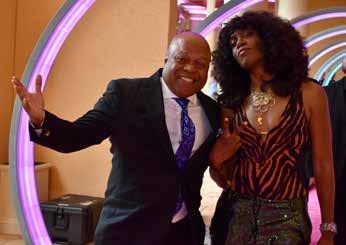
The Thea Awards Gala also hosted nearly 1,000 guests in an elaborately decorated ballroom at the hotel. A pink carpet led guests from a pre-dinner cocktail party past custom Thea-themed statues and through a pulsating portal into the main event.
The show was well produced and professionally recognized all of this year’s Thea awardees. From destination-scale attractions to more intimate, storydriven experiences, the slate of recipients
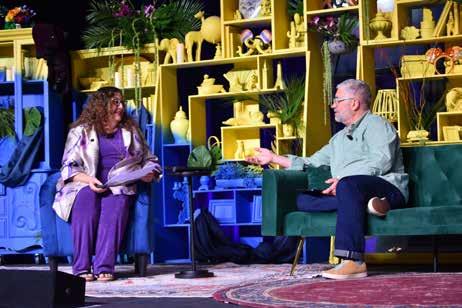
Lisa Passamonte Green (Visual Terrain) interviews Buzz Price Lifetime Achievement Award recipient Dale Mason (Universal Creative - Retired) during TEA’s INSPIRE Week.
underscored how the definition of “themed entertainment” continues to expand. Many recognized projects demonstrated not only technical or creative achievement but also cultural relevance and emotional resonance. Whether through immersive storytelling, thoughtful use of IP, or original narratives, the work celebrated on stage
A week that reinforces community
Beyond the formal programming, the value of the week continued in the connections it fostered.
16-19 17-20
by Jim Ogul
Global
Expo activity is accelerating with Specialized Expo 2027
Belgrade entering full construction, Expo 2030 Riyadh awarding major infrastructure contracts, Expo 2027 Yokohama refining its nature tech agenda and Minnesota moving to host America’s first A1 International Horticultural Exposition. Meanwhile, Expo 2025 Osaka Kansai — months after closing — has emerged as a surprisingly influential force, exporting both physical and digital legacy assets to the next generation of Expos.
Belgrade 2027: Participation surges
Nearly 140 countries have committed to participate in Expo 2027 Belgrade, with 137 having formally signed participation agreements as of this writing. Expo 2027 Belgrade is planned for May 15–August 15, 2027, on a 25-hectare site in Surčin,
Positioning entertainment for the future
with more than 6 million visitors and over 8,000 special events anticipated.
Expo 2027 Belgrade is being framed not merely as an international event, but as a transformational moment for its host nation and a renewed platform for global collaboration. “This Expo is something that is changing our country… I think this will be another game-changer - for investment, travel, and our political
position,” said Serbian President Aleksandar Vučić, underscoring the scale of Serbia’s ambitions.
From an international perspective, Dimitri S. Kerkentzes, Secretary General of the Bureau International des Expositions (BIE), has emphasized the Expo’s broader mission, noting that it will serve as a platform for countries to collaborate on future-focused solutions while engaging younger generations. Together, these perspectives position Belgrade 2027 at the intersection of national development and the enduring global purpose of World’s Fairs.
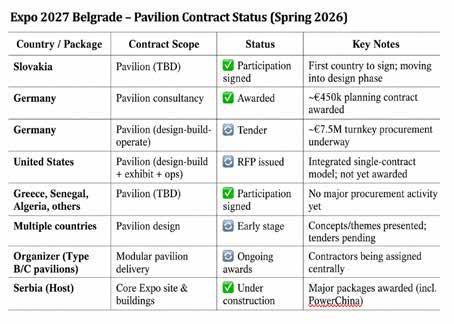
Progress on the Expo site is reflected in the opposite table.
INPARK WORLD’S FAIR EDITOR JAMES OGUL SHARES INSIGHTS ON UPCOMING EVENTS AND THE LEGACY OF EXPO 2025 OSAKA .
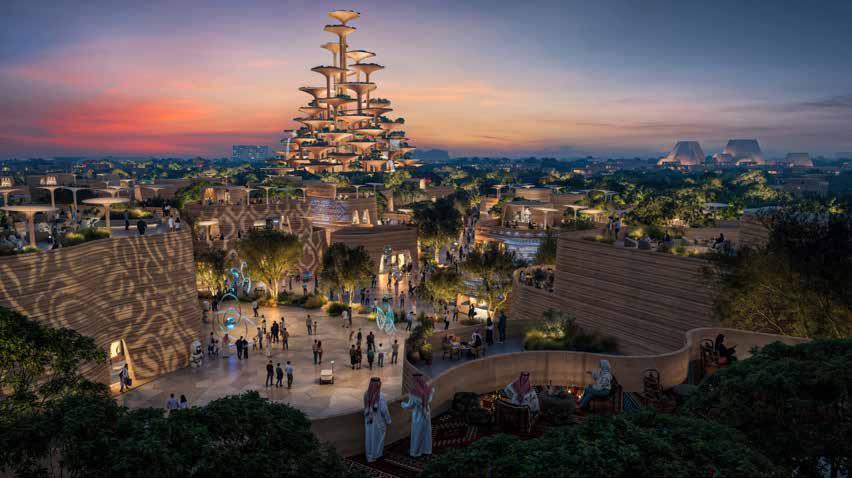
A rendering of the Expo 2030 Riyadh site. Image courtesy of Expo 2030 Riyadh
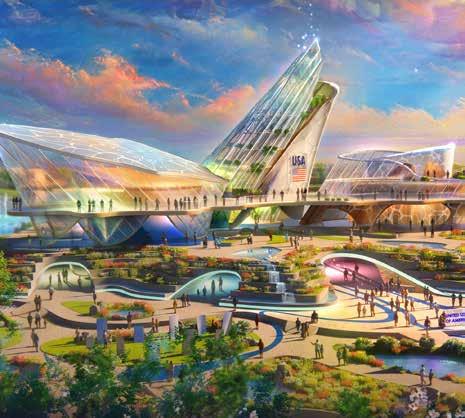
The United States at Belgrade
The U.S. confirmed participation in Expo 2027 on May 11th. According to U.S. government procurement documents, the United States will build a temporary, single-story pavilion of approximately 972 square meters, designed to accommodate up to 5,000 visitors per day.
The concept centers on a dynamic, nonpolitical visitor experience aligned with the Expo’s theme: Play for Humanity – Sport and Music for All. The pavilion will integrate immersive exhibition spaces, live performance and event areas, VIP and meeting facilities, along with dining and retail components.
Osaka 2025: A living legacy takes shape
Months after closing, Osaka 2025 continues to influence the global Expo ecosystem. Japan marked the first anniversary of the Expo’s opening on April 13 with Expo 2025 Futures, a traveling exhibition across six cities and a permanent display at Yumeshima Station in Osaka (the rail station built for Expo 2025). These programs highlight the Expo’s 29 million visitors and its theme, Designing Future Society for Our Lives.
In a symbolic gesture of continuity, six trees from the Osaka Expo site were transported to Serbia for integration into Expo 2027 Belgrade, reinforcing the growing practice of ecological legacy exchange between Expos.
certification as the largest VR Expo environment ever created.
Japan’s Future Creation Council continues to coordinate post-Expo collaborations among universities, industry, and local governments, embedding Expo-born technologies into national innovation policy.
Riyadh 2030: Infrastructure contracts and Vision 2030 alignment
The Expo 2030 Riyadh Company (ERC) has awarded its second major site development contract, covering mobility networks, utilities, and foundational infrastructure for the 6-million-squaremeter site.
The goal is to present American innovation, culture, and values through engaging, high throughput experiences rather than static displays. Total project costs are estimated at $10–14 million, covering design, construction, exhibits, operations support, and eventual dismantling.
Progress on the Expo site is reflected in the following table.
Japan’s Ministry of Land, Infrastructure, Transport and Tourism released a 3D digital twin of the Osaka Expo site as a public archive for researchers and designers. Meanwhile, the Virtual Expo Yumeshima Islands in the Sky project received a Guinness World Records™
The United States at Belgrade
According to U.S. government procurement documents, the United States will build a temporary, single -story pavilion of approximately 972 square meters, designed
Saudi Arabia maintains its $7.8 billion Expo allocation, while projecting a $50–70 billion economic impact tied to tourism, innovation, and Vision 2030 diversification goals. Pavilion cluster design competitions are underway, emphasizing green mobility, digital transformation, and future city prototypes.
Yokohama 2027: Nature × Technology
Japan’s next major Expo — the International Horticultural Expo 2027 Yokohama — is positioning itself as a global hub for climate responsive design and nature-inspired technology. Organizers confirmed that several Osaka 2025 sustainability exhibits will be repurposed for Yokohama’s Green Innovation Hub, strengthening continuity between the two Japanese Expos.
Table courtesy of the author
Minnesota’s aspirational hopes and legacy in the Expo movement
Minnesota played a prominent role in the bidding process for Expo 2027, having submitted a strong U.S. bid to host the event in Bloomington (adjacent to the Mall of America). Their proposed theme, “Healthy People, Healthy Planet: Wellness and Well-Being for All,” aimed to spotlight Minnesota’s strengths in healthcare, sustainability, innovation, and natural beauty. The bid envisioned up to 13–14 million visitors and significant economic impact.
Although Belgrade was selected, Minnesota’s effort strengthened U.S. ties with the BIE and international partners. The state has since pivoted to a new opportunity.
Now Expo 2031 Minnesota USA [a 501(c)(3) Nonprofit Corporation] is advancing Expo 2031 Minnesota — planned as America’s first A1 International Horticultural Exposition in Dakota County, scheduled for May–October 2031. The event has secured provisional approval from the AIPH (International Association of Horticultural Producers) and formal U.S. federal approval (from the Departments of Commerce and State).
Wendy Meadley, CEO, Expo 2031
Minnesota USA states: “What excites me most is the breadth of support forming around this project. We are seeing interest from government, business, horticulture, technology, tourism, education, and community partners who all understand that Expo 2031 can become a once-in-a-generation platform for Minnesota and the United States.”
Under the theme “Human/Nature: Where Humanity and Horticulture Meet,” the expo will feature sustainable agriculture, climate-smart innovation, horticulture, and future living districts. It projects over 4 million visitors from up to 80 countries and over $2-billion in regional economic impact. The master plan includes ecological zones, biodomes, global pavilions, and a legacy “Future Living District” designed as a permanent, sustainable community postevent.
This initiative reflects Minnesota’s enduring commitment to hosting worldclass expos that promote innovation, sustainability, and long-term legacy development.
A more interconnected Expo era
Across Belgrade, Riyadh, Yokohama and Minnesota, a clear pattern is emerging: Expos are no longer isolated events but interlinked innovation ecosystems. Osaka’s living exhibits, digital archives, and VR environments are now feeding directly into future Expos, while Riyadh’s Vision 2030 alignment signals a shift toward long-term, cross-Expo collaboration.
The result is a new model of the World’s Fair — one where each event contributes enduring assets, knowledge, and ecological value to the next. •
Since retiring from the US State Department in 2011 after a 30+ year career in World Expos, Jim Ogul (jogul@comcast.net) has remained on the scene in an advisory and consulting role. He writes regularly for InPark Magazine about World’s Fairs. See his free online book, Tales From the Expo.
Turn your park into the ultimate family destination and bring families closer with unforgettable adventures! Vekoma specializes in designing and delivering attractions that delight kids, excite teens, and engage parents and grandparents. From groundbreaking family coasters to adrenaline-fueled rides, we create experiences that keep guests coming back. Elevate your park’s reputation and partner with us to create signature attractions that drive guest loyalty and long-term success. Together, we’ll turn your vision into reality! We look forward to meeting you at IAAPA EXPO ASIA!
WWW.VEKOMA.COM
ISE 2026 sets new benchmarks for immersive technology and experience design
by Martin Palicki
Integrated Systems Europe (ISE) 2026 closed its Barcelona run in February with record-breaking momentum, underscoring the growing convergence between pro AV, live events and themed entertainment. The show welcomed 92,170 unique visitors and 1,751 exhibitors across 101,000 square meters – the largest edition in its history. Beyond the numbers, the message was clear: the tools used to create immersive environments are becoming more intelligent, more connected and more accessible to a wider range of venues. Initiatives like the new Spark creative hub brought together technologists and storytellers from broadcast, gaming, design and live entertainment, while the launch of the ISE Foundation reinforced the show’s long-term commitment to industry growth and talent development. For themed entertainment professionals unable to make the event, here are some highlights from the show floor:
Barco
Barco’s new native-4K RGB QDX projector platform combines Rec. 2020 color with a modular design that allows key components to be swapped without removing the unit, a critical advantage for attractions running long daily operating hours.
A motorized rigging system enables precise physical alignment for stacked projection, while the DuraOptix optical engine is engineered to maintain image quality over high-hour use. For parks managing multiple attractions across large properties – or multiple properties across regions – Barco’s cloudconnected fleet management tools allow remote monitoring, diagnostics and performance optimization from a single location.
Christie
Christie’s booth demonstrated why projection remains indispensable despite the rapid rise of LED. Image mapping across a large, sculptured elephant highlighted the flexibility and cost-perpixel advantages that continue to make projection the preferred solution for many large scenic applications.
The new Korus Series projectors bring 4K resolution into a price range traditionally associated with HD systems, using a compact form and shared lens compatibility to simplify integration. For museums, small to medium-sized attractions and preshows, and mid-scale immersive environments, that combination of performance and affordability opens new deployment possibilities.
HIGHLIGHTS FROM THE SHOW FLOOR AT INTEGRATED SYSTEMS EUROPE ’S 2026 SHOW IN BARCELONA, SPAIN.
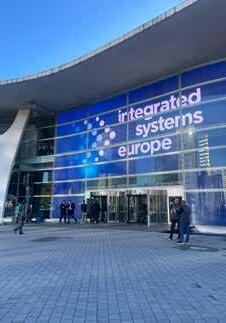
The entrance of ISE at the Fira de Barcelona Gran Via
Christie MicroTiles® LED and a technology preview of the new XP Series LED video wall solution were also showcased. XP series LED maintains visual integrity from very low to high brightness to deliver precise colors, ensuring content looks exactly as intended. Both solutions are powered by Christie VividLife™, the company’s advanced LED video processing platform.
Disguise
Disguise displayed the creative possibilities of a fully integrated media ecosystem. Its latest tools point toward a future where real-time content generation, LED, projection and interactive systems are part of a unified workflow. Ride creators understand that real-time content engines enable more interactivity within visitor experiences; an audience member’s choice can now translate into a new narrative path, allowing the person to be an active participant in the attraction’s story.
Disguise showcased several software features, including Ask AId3n, the company’s optional AI-powered workflow plugin for Designer, designed to reduce technical programming time and allow users to focus on creative output. The company also highlighted Mapping Matter, a browser-based projection mapping tool that enables users to previsualize and evaluate projector set-ups before arriving on site, helping reduce installation time.
The demonstrations also reflected broader trends in themed entertainment. Interactive dark rides, projectionmapped architecture and video continuity across entire sites are moving from flagship installations to
standard practice. Disguise systems are already powering immersive tunnels, sports floors that track player movement and large-scale destination environments where retail, attractions and public spaces share a common visual language. For experience designers, the significance is notable: media systems are evolving from show control elements into the backbone of the guest journey. For more information, check out Disguise’s new magazine, launched at ISE.
Modulo Pi
Modulo Pi’s launch of Modulo Kinetic Version 7 addressed one of the most persistent challenges in immersive environments – recalibration and maintenance. Its expanded autocalibration system can now align multiprojector arrays on complex 3D surfaces in minutes rather than overnight, delivering greater accuracy while reducing labor demands.
The platform’s redesigned interface allows operators to configure complex scenes across multiple displays and workstations, reflecting the reality that media servers must serve both creative teams and on-site technical staff. Integrated LiDAR support enables responsive environments in which projections react to guest movement, turning passive video mapping into interactive experiences.
Recent and upcoming installations in venues like Futuroscope demonstrate how these tools are being deployed for permanent attractions, children’s immersive environments and largescale architectural mapping – all with an emphasis on repeatability and ease of operation.
Philips
Philips’ Wave platform illustrated how digital signage is evolving into a central operational tool. From ride queue messaging to retail promotions and wayfinding, a single system can manage thousands of screens across a property, automate content changes based on time of day or environmental conditions and monitor hardware status in real time.
For large parks and resorts, the implications extend beyond communications. Dynamic content can influence guest flow, drive in-park spending and personalize experiences, while energy-efficient displays and recyclable materials address sustainability goals.
Interactive retail demonstrations and AI-enabled touchpoints further emphasized the shift toward responsive environments, where screens are not simply informational but participatory. •
A legacy reimagined
by Martin Palicki
WhenPhantom Theater opened in 1992, no one could have predicted how it would capture the hearts of Kings Island guests. It was a regional park dark ride: charming, theatrical, spooky, and unique. But over the decade that followed, it evolved into a memorable classic in a way few attractions can. When the ride closed in 2002, the spirit (and spirits) of Phantom Theater stayed behind – if only, perhaps, in the memories of guests. Now, in 2026, the ghosts of the past have been given a new (after)life in the park.
With Phantom Theater: Opening Nightmare, Kings Island has built upon the legacy of the original attraction.
While there are many homages to the original, the ride is truly a reimagining. It leans heavily on nostalgia while also introducing interactivity, modern design and technology. The project is the result of a close collaboration between Kings Island, Six Flags creative leadership, and Sally Dark Rides, and it offers a compelling case study in how legacy attractions can evolve without losing their soul.
Listening to the audience
The return of Phantom Theater began with guests. “At every park, there are attractions that guests say: We’d love to
have that back,” says Ken Parks, Vice President of Creative Development for Six Flags. “At Kings Island, Phantom Theater was on the top of that list.”
The team at the park (just outside Cincinnati, Ohio) knew that information based on years of guest surveys, feedback and awareness of social media. But it took a creative spark to move from nostalgia to action. It came during a blue-sky development process that Parks and his team explored over the course of a year. The idea was simple but provocative: what would Phantom Theater look like if it were created today?
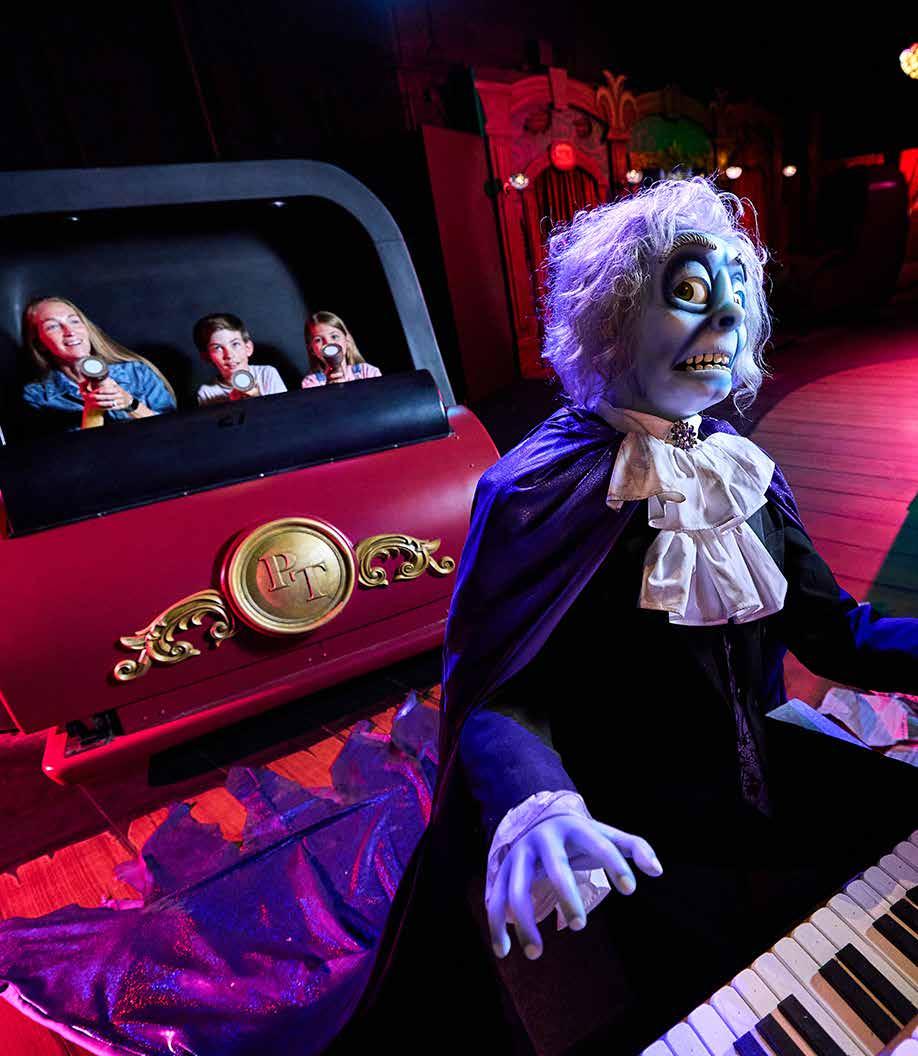
Top: Maestro plays the organ in Phantom Theater: Opening Nightmare while riders use special flashlights to capture escaped “ghost notes.” All photos courtesy Six Flags / Kings Island
SALLY DARK RIDES AND SIX FLAGS BRING PHANTOM THEATER BACK TO KINGS ISLAND FOR 2026
Before committing to a full-scale attraction, the team tested the concept through a live production, Phantom Theater Encore, during the park’s 50th anniversary season in 2022. The show reintroduced the characters and basic storyline to audiences while serving as a proof of concept. Perhaps unsurprisingly, it worked. The response was strong enough to validate what many frontline park employees had long known: Phantom Theater still had cultural currency with the park’s audience.
At the same time, Kings Island was evaluating the future of Boo Blasters, the interactive dark ride that had occupied the former Phantom Theater for 15 years. “We asked ourselves: What does this building want to be?” says Kings Island Park President Tony Carovillano. “The light bulbs just started going off. Phantom Theater is such an iconic brand for us. It just made sense.”
Owning the story
With many theme park projects now driven by licensed intellectual property, Phantom Theater represents something increasingly rare: a proprietary attraction with deep local and generational value. “It’s part of Kings Island’s identity,” Carovillano says. “Guests feel like they own it.” That ownership is both emotional and generational. “We have guests who rode it in 1992 coming back with their kids,” he continues. “Now those kids get to experience something their parents loved. That’s powerful!”
Parks sees that as both an opportunity and a responsibility. “Nostalgia is part of the DNA of theme parks,” he says. “But it has to be handled carefully. The goal isn’t to recreate something exactly as it was. It’s to capture the emotional essence and
build something that stands on its own.” That balance became the central creative challenge of the project.
A full-circle collaboration
With an idea firmly in place and a location secured, the Six Flags and Kings Island team turned to industry veterans Sally Dark Rides to help advance and finalize the project. “Sally had a history of working on dark rides in this building, and they certainly understood the medium,” says Parks. “There was a clear cohesiveness there that made them the right partner.”
For the Sally Dark Rides team, the project was a chance to create a new dark ride practically from the ground up. The company was tasked with translating the original Phantom Theater into a fully realized modern attraction, from concept through installation. “We were involved from the earliest conversations about what this ride could be,” says Drew Hunter, Vice President of Creative Design at Sally Dark Rides. “From there, we developed the story, designed
every scene, created the characters, and ultimately built and installed the experience.”
Sally led the full creative pipeline, including storyboarding, scenic design, character fabrication for over 30 figures, animation and on-site installation, while coordinating with key partners for interactivity, media, and lighting. The result is a cohesive experience in which narrative, technology, and physical environments are tightly integrated. “We were involved in every step of the process, from the first idea to what guests experience today,” Hunter says.
The collaborative dynamic with Six Flags and Kings Island throughout the process was key to the project’s success. According to Hunter, the clarity of vision and responsiveness from the park allowed the project to move efficiently while still evolving creatively. “It was a great marriage,” he says. “They knew what they wanted, but they were also open to ideas. That kind of collaboration makes a huge difference.”
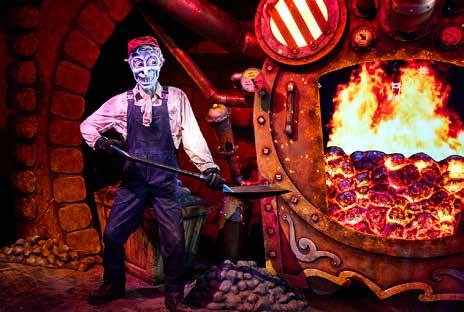
Sally Dark Rides reimagined classic elements from the original Phantom Theater attraction, such as the creepy boiler room scene.
Within that broader partnership, the project also benefited from a meaningful connection to its origins. Rick Bastrup, President of R&R Creative Amusement Designs Inc., (who built the original 1992 Phantom Theater) returned as a contributing creative voice. “There’s an authenticity that comes from that,” Parks says. “You can feel that connection.” Bastrup also appears in a ghostly cameo within the ride, a subtle nod to the original creative team and the legacy they established.
Designing a new narrative
“The biggest challenge was capturing the feeling of the old ride,” says Hunter. “There are people who loved that attraction deeply. You want to honor that while still creating something new.” Rather than attempt a scene-by-scene recreation, the team developed an entirely new storyline built around the concept of “ghost notes” escaping into the theater.
“We started with the understanding that the original ride was passive,” Hunter explains. “You sat and watched. This time, the park wanted interactivity. That meant we needed a narrative to support that.” Hunter created detailed storyboards for all 26 scenes, ensuring that every moment could be both visually compelling and physically buildable.
Tone was critical. “The park didn’t want it to be too scary,” he adds. “It’s spooky, it’s whimsical, but it’s accessible and fun. They’re funny phantoms, not frightening ones.” This is reinforced right from the start in the new preshow queue where the main characters Maestro and NoLegs Larry banter with each other in a dialogue rife with puns. They explain that the original performers (and a couple of new ones too!) are back for another performance in the theater. Shortly before showtime, the theater is struck by a bolt of lightning, and all
the musical ghost notes escape from Maestro’s organ. Guests are recruited as ushers and asked to use their special flashlights to illuminate ghost notes when they see them, sending them back into the organ so the show can go on!
The attraction utilizes the same original Omnimover-style ride system and track layout. Ride vehicles were renovated to become “enchanted opera boxes” and reconfigured to travel in pairs with additional time between sets to allow for scenic reset. While the floorplan remained roughly the same as the previous attraction, everything else was gutted. New sets, scenescapes and animatronics were designed and produced by Sally Dark Rides. The 6.5-minute ride provides a nice long experience but goes by quickly with the interactive gaming and richly decorated scenes.
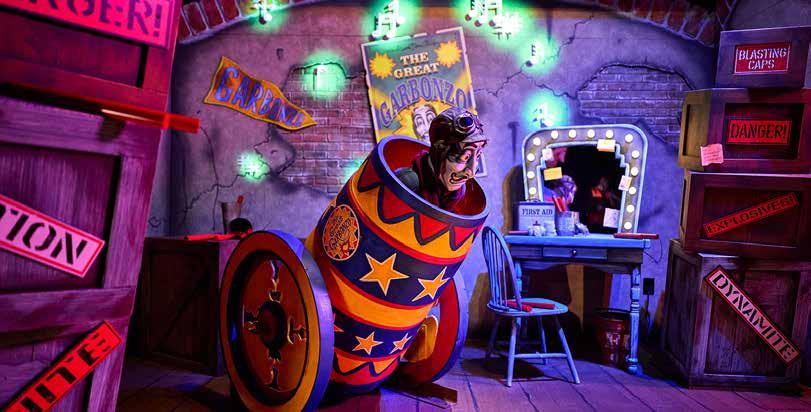
The Great Garbonzo prepares for his act; escaped “ghost notes” float overhead, ready to be sent back to the organ by helpful guests / ushers.
Classic elements returned to Phantom Theater: Opening Nightmare but often in reimagined forms. The boiler room, a fan favorite from the original, is still present, though in a new location. Character spaces like Hilda’s dressing room and Houdelini’s performance area have been updated to reflect new storytelling beats using modern technology. “We didn’t go too far afield,” Hunter says. “We wanted people to recognize those spaces. But we also wanted to surprise them.”
Adding to the experience
Sally Dark Rides worked closely with partners including Alterface, TechniLux, and Pure Imagination, along with composer John Citrone who wrote and recorded a custom musical score that references and ties the experience back to the original attraction.
One of the most significant changes from the original Phantom Theater is the addition of interactive gameplay using handheld “flashlights” from Alterface. Throughout the ride, moving ghost notes are projected directly onto the scenery and sets. “It was important for us to not have distinct screens in the attraction,” explains Hunter. “The projectors put the ghost notes directly onto the walls and
scenic elements, appearing to make the gameplay area endless.”
Each flashlight is color coded, and guests see their colored circle of light appear in the projection wherever their flashlight is pointed. The devices are lightweight, provide haptic feedback for when ghost notes are zapped, and intuitive to use. Together, the projection system and interactive devices bring elements of competition and re-rideability. But for both Parks and Hunter, the key is restraint. “The interactivity had to add to the story, not take it over,” Parks says. “The targets are part of the environment,” he explains. “You could ride through and not even realize it’s a game.”
Hunter echoes that approach. “Even if you don’t pick up a flashlight, you have a complete ride,” he says. “But if you do engage with it, it encourages you to come back and experience it again.”
The role of dark rides today
Phantom Theater: Opening Nightmare highlights the evolving role of dark rides in regional parks. “I think every park should have an indoor immersive attraction,” Carovillano says. “It
diversifies what you offer and can expand your audience.”
Parks echoes that sentiment, calling dark rides part of a larger programming strategy. “You want something for everyone,” he says. “Dark rides are a big part of that.” Phantom Theater: Opening Nightmare is certainly a major part of Kings Island’s strategy, and a demonstration of how legacy attractions can evolve to meet contemporary expectations while still honoring the past.
By combining nostalgia, interactivity, and collaborative design, Sally Dark Rides, Kings Island, and Six Flags have created an experience that celebrates Phantom Theater while embracing new generations of guests. For an industry often focused on what’s next, Phantom Theater: Opening Nightmare offers a reminder that sometimes the most powerful ideas might be the ones that never really left. •
Tony Carovillano Kings Island
Ken Parks Six Flags
Drew Hunter Sally Dark Rides
DREAM DESIGN BEYOND
Temple
Theme Parks
Museums & Exhibits
Branded Attractions
Cultural Attractions
Hospitality and Resorts
Location Based Experiences
Immersive Retail & Dining
Iconic Landmarks
The future we’re fighting for What an inclusive LBE industry feels like in five years
by Simone Bonnejonne, Development Director, Big Break Foundation
Theme parks are at their strongest when they’re for everyone.
As a born-and-raised Floridian, I’ve always treasured my time in one of the many Location Based Experiences (LBEs) my region has to offer. The joy and awe I felt as a child has transitioned into nostalgia and comfort, and parks across the country continue to draw me back repeatedly. But occasionally, I’ll have an experience that snaps me out of the fantasy and makes me wonder whether everyone else around me is really feeling the magic, too.
A few months ago, I stopped to take a call outside of a popular ride at one of my favorite parks. I was sitting on a bench next to another woman, and it wasn’t until I finished my call that I realized there were tears rolling down her cheeks.
“Hey, are you okay,” I asked. “Can I get someone for you?”
“No, that’s okay,” she said. “I’m here with my family for my birthday.”
“Well, happy birthday!” I replied. “Are you waiting for them to get off the ride?”
“I am,” she said, “but not by my choice.”
She went on to explain the bittersweet conflict she always feels when coming to the parks. She’s also a life-long fan of themed attractions – the characters, the atmosphere, the magic. But she went on to share how even though she’s focusing on her health, she often faces the embarrassing moment of trying to board a ride and realizing she just won’t fit. Sometimes she can try a tester seat before she gets in line, but some rides don’t have that option and she doesn’t want to risk feeling ashamed in a place where she should only feel happiness.
“I want to do everything here just like everyone does,” she said. “It’s
embarrassing. A lot of times, I feel like I literally don’t fit in.”
As a member of this industry, I know themed entertainment has made great strides in addressing accessibility and inclusion in theme park experiences. I’m always proud to see ride vehicles that can accommodate wheelchair users readily available on some of the most iconic attractions. Every June, I look forward to the reappearance of rainbows throughout our parks, welcoming LGBTQIA+ guests and their families. And I feel so reassured that whether I’m visiting with my husband who has a nut allergy, or my friends who keep Kosher, everyone will find something delicious to snack on in the parks.
But I also know there’s so much more we can do. After all, everyone deserves some magic in their lives.
Simone Bonnejonne, Big Break Foundation
In my vision for the future of theme parks, our industry intentionally builds experiences to be more accessible and inclusive. Attraction queues –even those of legacy attractions – are designed with gentle inclines and room for mobility devices to move freely alongside everyone else. In this version of the future, ride vehicles are designed to accommodate diverse body shapes and mobility aids. Guests who need additional support face fewer barriers, and employees are knowledgeable about the types of support available. Inclusion is part of the blueprint, and not just an afterthought.
Wayfinding of the future is multimodal, and tools like tactile maps allow all guests to experience everything an attraction has to offer. Guests can decompress in low-sensory spaces that are intentionally placed throughout a park or experience. Naptimes and bathroom breaks feel less like chores thanks to covered rest areas and family restrooms. Sensory-friendly hours are a regular offering rather than a rare opportunity.
And while there are cool, new technology integrations to experience, not everything requires a smartphone. In the future, inclusive design recognizes that not everyone wants to feel plugged in constantly, and that smart technology isn’t fully accessible for all.
The stories feel different, too.
In this future, the creative teams behind themed experiences reflect their audiences. That’s not a coincidence; it’s an intentional practice. Diverse voices and perspectives aren’t brought in at the
end to check a box. Instead, they have a seat at the table from the beginning to share their lived experiences. Team members are empowered to tell stories that are accurate and culturally resonant. Characters expand beyond stereotypes, and stories aren’t filtered through a single culturally dominant lens.
When guests see themselves reflected in a themed space as the protagonist, their experiences shift. Suddenly, the story isn’t just something they’re observing, but rather something that belongs to them. They become the hero and can fully lean into immersion.
That sense of belonging extends to the workforce, too. In our future industry, employees in all roles show up to work knowing they can authentically be themselves. Their creativity isn’t constrained by the need to suppress their identities or shrink to take up less space. They are collaborating with team members that reflect the world they live in.
This future is built on the premise that inclusion is not an add-on. Instead, it’s a core component in the creative process.
When we design with and for underrepresented communities first, we build something more engaging for everyone. This is not a new idea; universal design has always benefited the larger society. But in the LBE industry, where so much effort goes into crafting emotional resonance and transporting guests to another world, the stakes feel particularly high.
Because what’s the point of building a world some people can’t enter? Why
bother telling a story in which some guests feel invisible? We can’t risk losing some guests or audience members simply because we didn’t include them in our plans.
There’s so much we’re getting right in theme parks right now. That being said, we can always do even more to make sure all guests can forget their cares when they enter our attractions. If we want to foster belonging, we need to start with inclusion. Small intentional choices today can lead to much larger ripples in our LBE industry in five years. The future starts now. •
Simone Bonnejonne is a community-minded nonprofit professional with over a decade of experience in fundraising strategy, donor cultivation and stewardship, and network engagement. She is the Development Director at Big Break Foundation, a 501(c)(3) nonprofit dedicated to making the Location-Based Experience industry more inclusive and welcoming to all.
A higher calling THG Creative helps redefine the visitor experience at Temple Square
by Becci Knowles
Temple Square Visitors’ Center is located adjacent to The Church of Jesus Christ of Latter-day Saints’ iconic Salt Lake Temple, currently in the midst of a once-in-a-generation renovation. Construction at the temple began in 2019, with the lengthy project focused on making the structure less susceptible to earthquake damage. Work is expected to be finished by the end of 2026, and a public open house is scheduled for six months in 2027. With the campus impacted by the extensive temple construction, Church leadership decided to use the time to also refresh and renew their visitors’ center, focusing on creating an experience that allows nonmembers to understand what happens inside the
temple, which is typically not accessible to the general public.
At the heart of Temple Square, the refreshed visitors’ center sits within one of the most visited religious destinations in the United States. As the global headquarters of The Church of Jesus Christ of Latter-day Saints, the site carries both symbolic and practical
weight, welcoming millions of visitors each year, many of whom arrive with limited context for what they are seeing. This new experience - which opened in May 2026 - is designed to address that gap.
“What we really wanted was to create an experience that would be relatable to all guests,” explains Senior Director in
AT TEMPLE SQUARE IN SALT LAKE CITY, UTAHTHE GLOBAL HEADQUARTERS OF THE CHURCH OF JESUS CHRIST OF LATTER-DAY SAINTS - A NEWLY REIMAGINED VISITORS’ CENTER IS RESHAPING HOW A COMPLEX AND OFTEN MISUNDERSTOOD SET OF BELIEFS IS INTRODUCED TO THE PUBLIC.
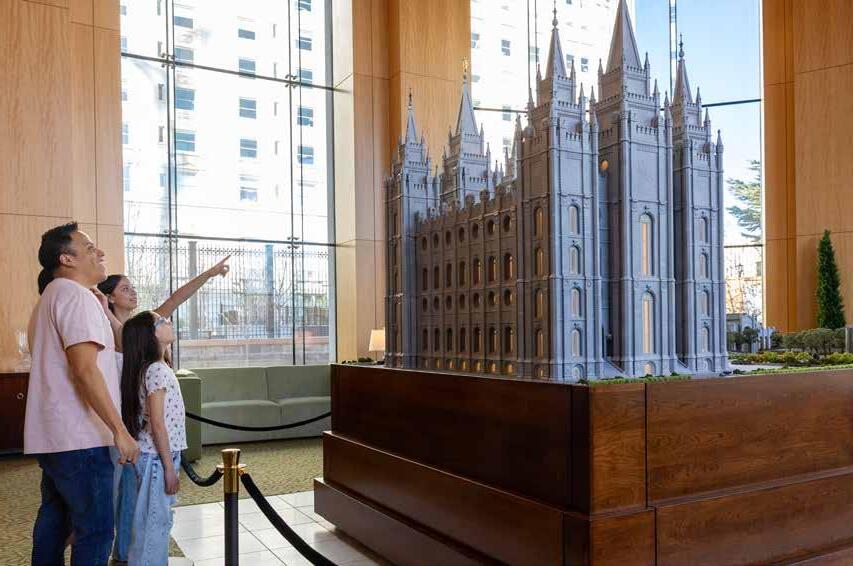
A highly detailed architectural model of the Salt Lake Temple forms the starting point of the experience, establishing both scale and context for visitors. All photos courtesy of The Church of Jesus Christ of Latter-day Saints
the Temple Department Richard Sutton. “Sometimes, when you tell your own story, you use language that’s familiar to you but not to others. This was the opportunity to share our story in an accessible way and provide insight into the temple for all our visitors,” Sutton adds.
Choosing the path of themed entertainment
Rather than developing the project internally, the Church sought out a themed entertainment studio for help.
That decision reflects a wider shift in how cultural and religious organizations are approaching storytelling - looking beyond traditional exhibition design toward more experiential, narrative-led approaches. Following a competitive selection process, THG Creative was chosen for its ability to quickly grasp both the emotional and conceptual core of the subject matter and translate it for a global audience. “THG were able to understand what we were trying to communicate quickly and present it in a way that anyone could understand,”
Sutton says. THG’s “outsider” perspective was key; the Church needed a different kind of thinking - one informed by architecture, narrative, and experience design.
Understanding the mission Temple Square Visitors’ Center resists easy categorization. It sits somewhere between cultural exhibition, immersive environment and narrative experience - but its goals are explicit. “As part of a multi-year transformation, the Church approached us to help address misconceptions about what goes on inside the temple,” THG Founder Phil Hettema explains. “The main objective was to create a place where everyone would feel welcome, where people could come with questions or maybe something they didn’t understand, and walk away with that information without feeling like they had been preached at.”
For THG, the starting point was not technology or layout, but translation. The Church had already made the decision to build full-scale replicas of key rooms within the temple but lacked a clear framework for how to present them to a global audience unfamiliar with the context. To help provide that perspective, THG engaged Donna Lawrence
Richard Sutton Temple Square Visitors’ Center
Phil Hettema THG Creative
Jared Peter THG Creative
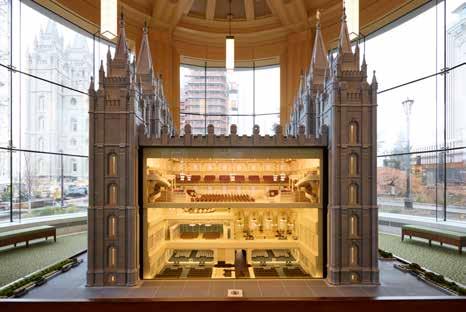
At key moments, the model’s exterior walls lower through a coordinated sequence of automation, lighting, and media cues, revealing interior spaces typically inaccessible to the public.
Productions to help conduct interviews with over 300 Church members around the world.
From those conversations, common threads began to emerge. “Every word within this journey originates from those interviews,” Hettema says. “It feels personal and from the heart.” The result is an experience shaped by shared perspective rather than didactic messaging.
Exploring the center
Since many visitors might not arrive with much knowledge of the Church, THG wanted to first provide a birds-eye view – literally – before diving deeper, so the journey through the center is designed to support that. Guests first encounter a highly detailed architectural scale model of the Temple. Jared Peter, Senior Producer at THG, describes the model as “one of the most technically complicated elements of the project.” The model cycles through a show where the exterior walls lower through a coordinated
sequence of automation, lighting, and media cues, revealing the interior spaces of the Temple within.
“Anytime you’re dealing with automation at that level, it becomes incredibly complex,” Peter explains. “You’re working with very small tolerances, and everything has to line up perfectly.” The reveal moments function as both literal and metaphorical openings, establishing the core concept of the center for guests.
“We wanted guests to see inside of the temple, while also setting the tone of openness, sharing and transparency for the rest of the experience,” says Peter.
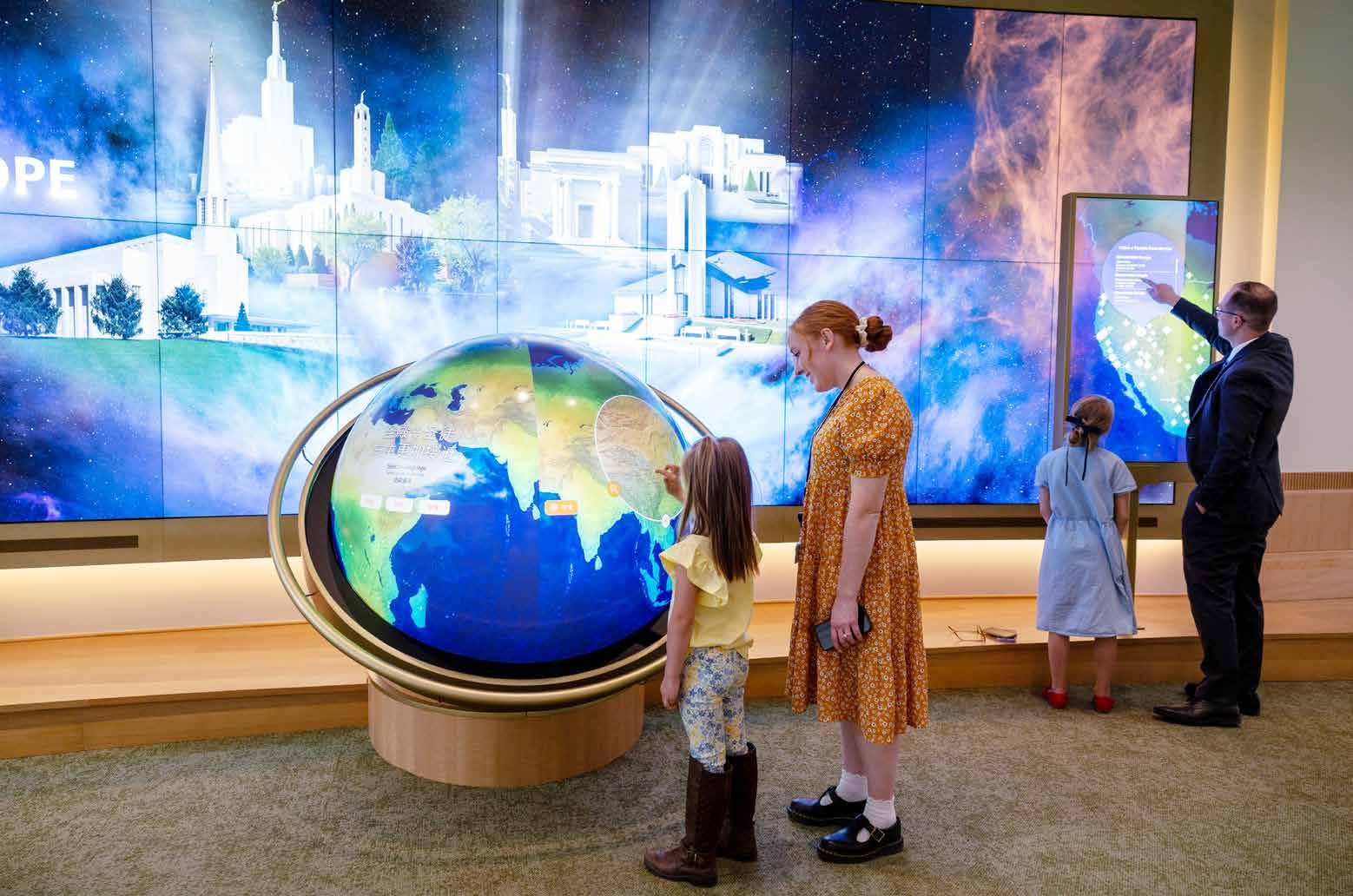
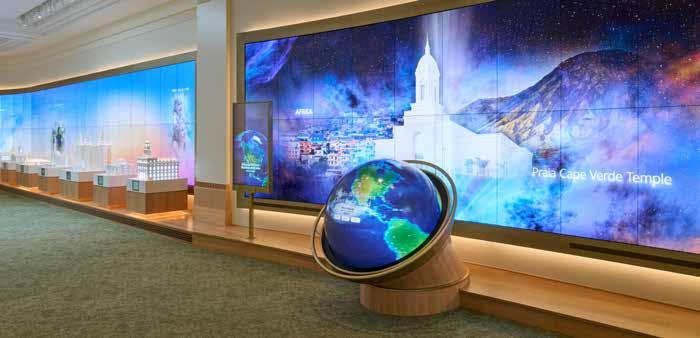
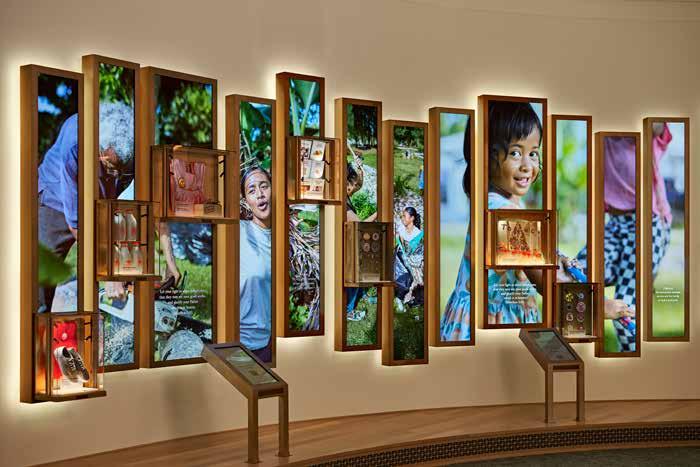
From there, guests travel downstairs into several galleries open for exploration. Large screens on the walls share footage captured around the world, showing both temples and the lives of Church members. Physical models highlight the architectural diversity of 11 temples, while a touch-responsive digital globe allows visitors to explore their locations and context in more detail. Visitors also
see a large quilt composed of individual panels crafted by Church members across the world. “We created this space because we really wanted to reinforce that even though you’re here at Temple Square - the headquarters - the Church is worldwide,” explains Hettema.
When they are ready, guests can explore the “Inside a Temple Tour” in small groups. “This part of the Center is a linear experience with a carefully orchestrated narrative that we’ve created,” reveals Hettema.
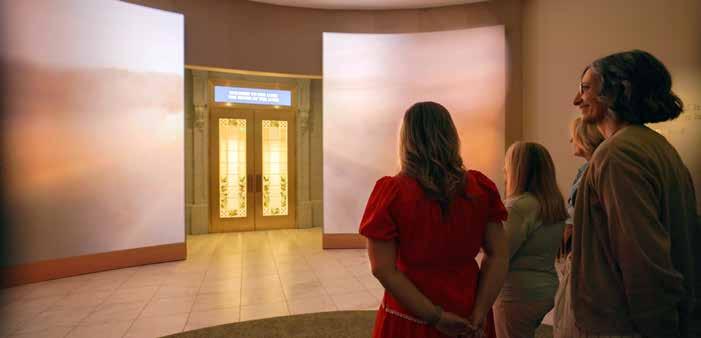
Visitors begin in a preshow room, where a large, curved wall functions as a screen for an introductory film that explains the significance of the temple room replicas guests are about to step into. At just the right moment, the walls slide open, revealing the entrance to the first replica room. The reveal is simple but moving – reflecting the importance the Church places on what goes on in the temple.
A touch-responsive digital globe allows visitors to explore temples around the world, reinforcing the Church’s international presence through interactive media.
“Creating the temple replica rooms was probably the most interesting part of the whole project, because the Church has very traditional ways of talking about what goes on in these rooms,” says Hettema, referring to the baptistry, the instruction rooms, the celestial room and the sealing room. “The language and terminology may be unfamiliar to most people so we had to think of other ways to present this information.”
The solution came from the Church member interviews conducted at the start of the project. “What better way to communicate with regular visitors than with the voices of regular Church members,” says Hettema. Guests hear these stories and interview clips that help provide background for the rooms they are walking through. The result is an experience that privileges personal voice, allowing guests to forge their own connections.
The journey concludes in the celestial room, designed to give visitors time
to consider what they have seen and experienced. “This room is very important to the Church, so we chose to make it a quiet and reflective space, much as it is in the actual Temple,” explains Hettema.
Challenges, risk and delivery
“There were two critical aspects for me in this project,” shares Peter. “One was the media work - making sure we were telling their story accurately. The other was production, making sure there was smooth collaboration between media partners and technical vendors.”
The team addressed these challenges by engaging regularly with Church leadership. “It became this seamless back and forth,” says Hettema. “Every bit of text was reviewed by the Church several times.” Each side enjoyed the collaboration and learned a lot from it. “There was no sense of struggling for authority,” Peter says. “It was all focused on what was going to give us the best outcome.”
Peter acknowledges that while THG’s outsider perspective was the reason the Church chose them for the project, “There were moments where it felt like we might be pushing them too far: like building the audio guide around the voices of regular Church members, telling the story in their own words, and the big cinematic reveal as the doors open into the replica rooms. But they’ve told us these are among their favorite parts of the experience.”
The subject matter also brought inherent challenges. Technology, scale, and theatricality had to be balanced against sensitivity and authenticity, ensuring that the experience remained inviting rather than overwhelming. “The aim was not to try to persuade anyone,” Hettema says. “It was about trying to welcome people and begin a conversation.”
This approach also required careful calibration and alignment among the larger team. In addition to Donna Lawrence Productions, THG worked
Visitors are introduced to the replica rooms through a cinematic preshow before doors open to reveal full-scale interior environments.
with a multidisciplinary group of partners including Cortina Productions, Midwest Studios, Electrosonic and 4Wall. “Integration, in this context, is not just about systems working together, but about teams aligning around a shared objective,” says Peter.
A higher calling
The project marks the continued growth of the themed entertainment industry into new markets and verticals. As experience design expands beyond traditional attractions into cultural, educational, and institutional spaces, projects such as Temple Square Visitors’ Center demonstrate how those tools can be applied with sensitivity and purpose. Here, the focus is not solely on spectacle, but also on clarity, accessibility and connection.
“We use some gentle theatrics throughout to lead you from one element to the next, but we were very careful, always making sure the project was keyed correctly for the audience and the message we were trying to communicate,” says Hettema.
In this sense, immersive design operates not to change minds, but to invite understanding and encourage meaningful discussion across a diverse global audience. It’s why the Church approached Hettema’s team in the first place.
“Working with THG has been phenomenal,” says Sutton. “We pushed each other and grew together. They brought clarity to our message and
creativity to our goals. With this new experience our guests will be leaving with a greater understanding of who we are, what we do and what is important to us. By that metric alone, this project is already an astounding success.” •
Becci Knowles is a U.K.-based writer and editor with 20 years’ experience in trade and consumer press. Becci’s first taste of the themed attractions industry came in 2015 with a visit to Gothenberg, Sweden, for IAAPA to support the Park World and Global Amusements & Play team. She went on to edit Park World from 20182022 before deciding to go freelance, making the move into travel and lifestyle before returning to the visitor attractions industry for InPark.
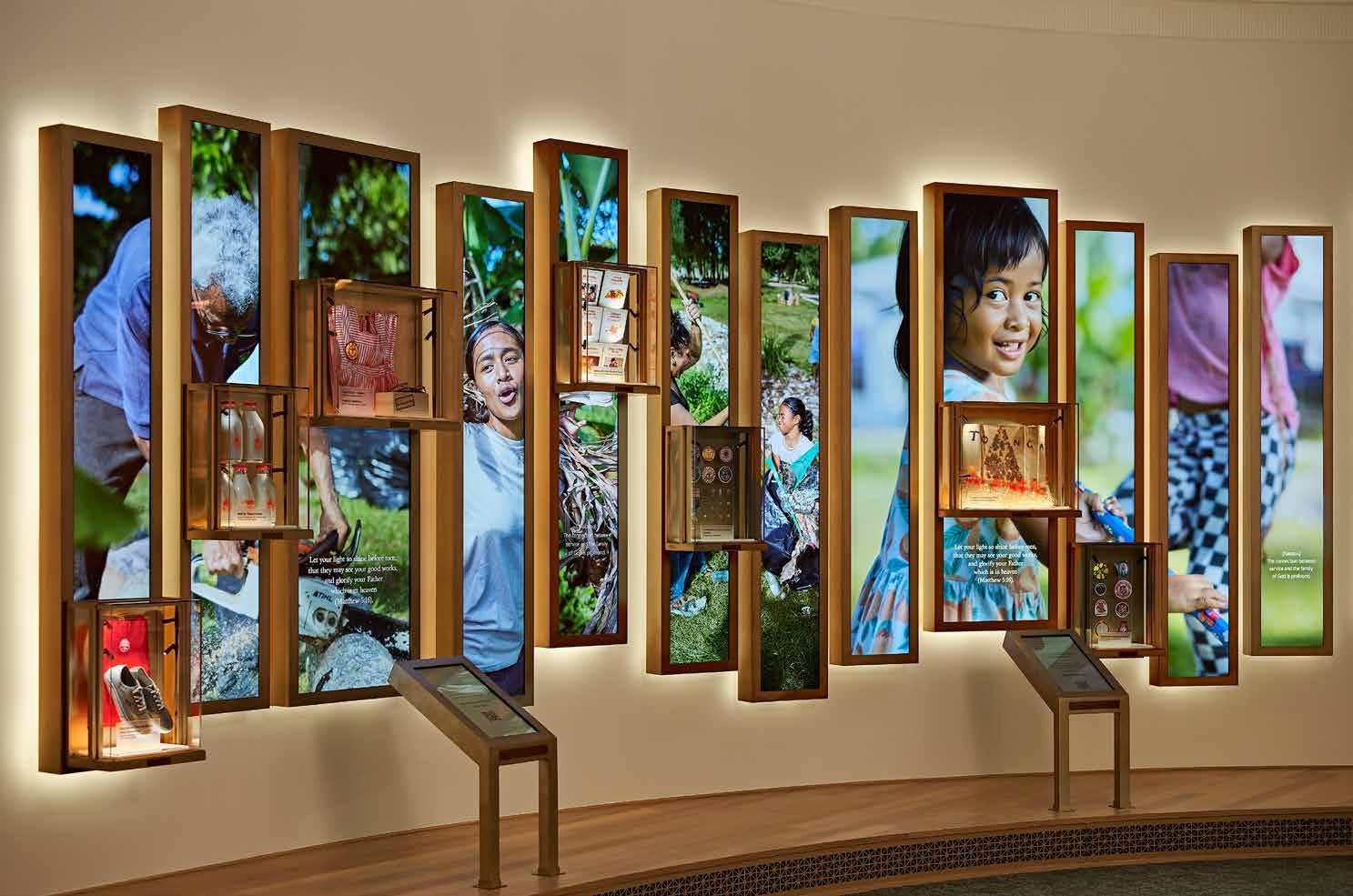
Large-format media installations present stories, footage and artifacts from around the world, connecting the Church with the lived experiences of its members.
UNLEASH THE WONDER
The Leisure Industry’s Premier Event in Europe
A new generation of attractions is coming to the UK – and it’s going to be extraordinary. Meet the dream makers, plus learn from a world-class education programme, gain exclusive behind-the-scenes insights on EDUTours, and explore the latest innovations on a record-breaking show floor. London is calling. See you there!
Sliding into summer
by Joe Kleiman
Founded in 1986 by former Canadian Alpine Ski Team member Rick Hunter, Canadian waterpark pioneer ProSlide began designing water slides inspired by the smooth curves and high speeds of downhill ski racing. Nearly four decades later, the company’s offerings span everything from water coasters and speed slides to immersive rafting experiences and family attractions designed for parks of all sizes.
Today, ProSlide has evolved beyond water rides into a long-term partner for parks, resorts, and destinations around the world, helping operators create experiences tailored to their audiences, operational goals, and available space.
This season, several new North American openings showcase how waterparks continue to evolve from compact family thrill attractions to major resort expansions and multi-generational experiences designed to drive repeat visitation.
NEW PROSLIDE ATTRACTIONS BRING CHILLS AND THRILLS TO NORTH AMERICAN PARKS
Water World: A park within the park
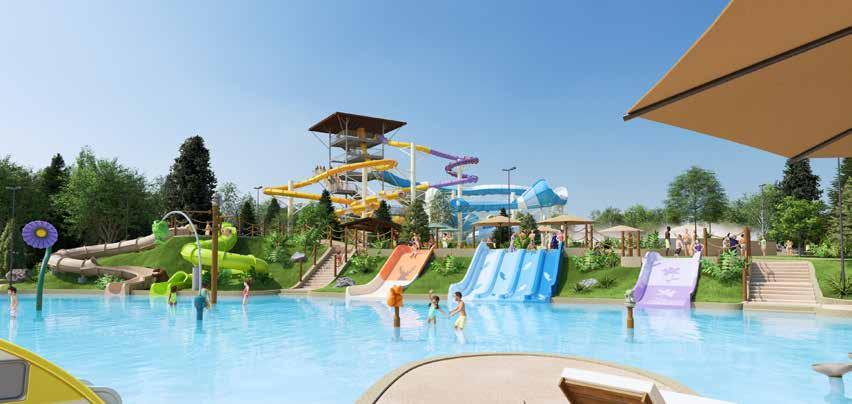
In the Denver, Colorado, suburb of Federal Heights, Hyland Hills Parks & Recreation is preparing to open one of the largest expansions to its Water World waterpark to date: Summit Canyon. The new area is designed as a mini-park within the existing larger park and can be explored as part of park admission or on its own at a discounted price point. Within Summit Canyon are four thrilling ProSlide waterslides, a children’s play area with child-sized slides, challenge courses, and a relaxing pool area where visitors can lounge and enjoy mocktails.
Development of Summit Canyon took two years. “The 2.5-acre area that was there previously was really kind of a legacy area in our park,” says Kellie Flowers Rowan, Community Relations Manager at Hyland Hills Parks & Recreation. “The attractions there were
originally built in the ‘80s. There had been some upgrades and renovations over the years, but they had served our guests well for several decades. As they were reaching the end-of-life phase, it became time for us to start looking at how we might be able to redevelop this area.”
ProSlide, a long-term partner of Water World, provided four thrill slides emanating from a single tower for the new themed area, along with child-sized slides as part of the company’s KIDZ Zone package. Each attraction was selected to deliver a distinct experience while maximizing the flexibility of a compact footprint and shared tower. Proslide’s TWISTER model provides twisting thrills for the Columbine Cascade body slide, while Aspen Falls features the faster TurboTWISTER speed slide and ProSlide’s SkyBOX, Colorado’s only drop capsule launch. There are also
Top: The Summit Canyon expansion at Hyland Hills’ Water World covers 2.5 acres and includes a tower with four ProSlide thrill slides as well as a kids play area with smaller slides. Photo courtesy of Hyland Hills Parks & Recreation
two raft rides: Runoff Rapids, which uses ProSlide’s SwitchBACK to quickly reverse course on an embanked ramp, and Marmot Mayhem, which houses one of ProSlide’s newest product offerings, the HIVE 20, sending riders descending through a tight downward helix.
Opened in 1979 with just two waterslides, Water World has grown into one of the largest waterpark operations in the State of Colorado. “The park was really developed in order to generate income for the district,” shares Flowers Rowan. “This way we ensure that the profits from Water World stay in our local community. We use those to take care of our public parks and to provide public recreation programs like youth and adult sports. We really do it for the community.”
Bromont: Summer thrills at a ski resort
Bromont is a family ski resort located an hour east of Montreal, Quebec, Canada. According to Claude Péloquin, the Resort’s Vice President and General Manager, “This resort opened in 1964 with the first year of operation of the ski area. Skiing is our main business, but we have become a resort operating during all four seasons, with our first summer of operating the waterpark being in 1985.”
In the late 2000s, the resort began investing heavily in new attractions. “Our guests have already experienced our existing slides when they were kids,” says Péloquin, “They were looking at other types of activities.” Like many regional destination resorts, Bromont has focused on evolving its offerings to encourage repeat visitation across generations while strengthening its position as a year-round destination.
In 2018, a new attraction from ProSlide called The Barracuda opened at the resort. “Our challenge was that our waterpark was designed around families with young children. We wanted something that adults could enjoy together with their children as they became older.” The Barracuda is built around ProSlide’s FlyingSAUCER, which produces tight turns on a course that mimics the feeling of a slalom ski race –a throwback to ProSlide’s founder Rick Hunter and his career as a competitive skier.
Prior to the COVID-19 pandemic, the resort’s management visited the IAAPA Expo and toured Universal Volcano Bay, home to a plethora of ProSlide products. “We looked at the different features that were at the Universal park,” Péloquin adds. “We wanted something new. You don’t want to repeat the same thing at a waterpark; you want to attract both new clientele and encourage others to return.” The expansion reflects an industrywide shift toward signature attractions
that deliver strong visual impact while offering experiences families can enjoy together.
As always, budget was a factor in determining attractions for the new expansion with the resort deciding that three slides provided the magic number. The design and construction process took two years, with the construction calendar limited by the ski season, as the new slides are located between two existing ski runs.
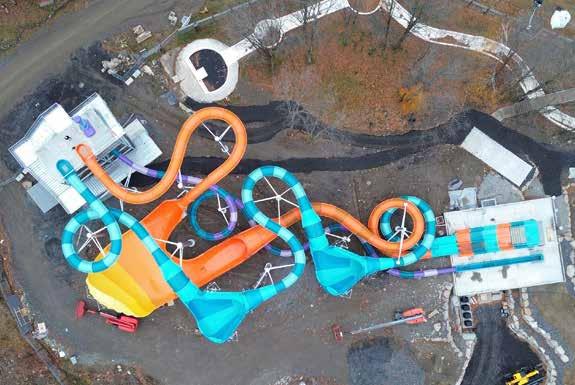
At an investment of 10.8 million Canadian dollars, the new slides form the centerpiece of a new themed land, Gigantico. In addition to a capsulelaunched free fall slide, the new themed area features a TORNADO 24, where riders sweep back and forth through a massive funnel with fast oscillations and moments of near weightlessness. Guests also experience the TornadoWAVE 60, sending rafts high across a towering curved wall with zero-Gs before diving back into the ride path.
Bromont ski resort added three new slides from ProSlide as part of its plan to expand its waterpark offerings with the new Gigantico area. Photo courtesy of Bromont, montagne d’expériences
“Skiing remains the foundation of our business,” Péloquin points out, “but our waterpark has become an important part of how we operate as a true four-season resort. It’s not built on flat land with high structures. Our waterpark is built on a mountain, and it looks like it fits organically. During the summer, there are slides and other water experiences. In the winter, skiers don’t even realize that they were skiing across a waterpark.”
Seabreeze: Race like the fish
On the shore of Lake Ontario near Rochester, New York, sits historic Seabreeze Amusement Park, founded as a trolley park in 1879. One of the oldest amusement parks in the United States, the park has been owned and managed by multiple generations of the Long family, who are famous for their historic carousels since the 1940s.
According to Genevieve Norris-Brown, Chief Operating Officer and General Manager of Seabreeze, and a member of the sixth generation of the Long family to operate the park, “We brought the waterpark into the fold in 1986. We started out really small with only a couple of body slides. We got together with ProSlide in 1988. We’ve been
working with them ever since and they are our primary supplier and installer here at Seabreeze.” That decades-long relationship has allowed the park to continuously evolve its water rides while working within the physical limitations of a historic property.
According to Norris-Brown, an advantage of having a waterpark included with theme park admission is that the weather tends to vary along the shores of Lake Ontario, one of the Great Lakes straddling the border between the United States and Canada. “When it’s cold,” she points out, “people tend to hang around the amusement park side. When it’s warm, they crowd the waterpark. For an upstate New York park, it’s helpful to have the waterpark on those super hot days.”
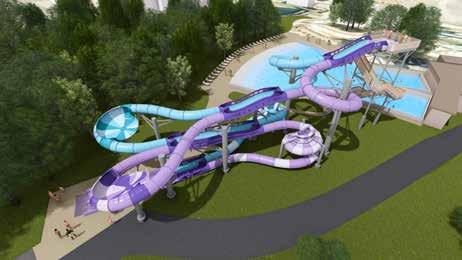
This year, the park is opening Reef Runner, its newest ProSlide experience. “This is a dueling waterslide,” shares Norris-Brown. “There will be two dueling double rafts or single rafts, and you’ll be racing against another set of two people. You’ll be going through figure eights, zooming through different bends and twists. It also includes a FlyingSAUCER on each side and
ProSlide’s HIVE. Ours is themed like a shell.”
Seabreeze wanted to create a familyfriendly attraction that had, according to Norris-Brown, “a bit of an edge.” Working closely with ProSlide, they were able to create a dueling thrill attraction in a limited space. “Typically, when we bring in a new attraction, it has to replace something because of our limited space,” she adds. “But working with ProSlide, we were able to shoehorn in the new slides with all their elements right next to our wave pool without having to remove anything. It’s a new addition for us and we’re really proud of it.” Compact, high-impact installations have become increasingly important for mature regional parks looking to introduce new headline experiences without major expansion footprints.
Evolving with the community
As ProSlide nears four decades of innovation, the new attractions at Water World, Bromont and Seabreeze demonstrate how waterparks continue to evolve alongside the families they serve. Whether creating compact thrill experiences, expanding seasonal resort offerings, or finding new ways to bring generations together, each project reflects a broader industry focus on fun and thrilling shared experiences. For ProSlide, that collaborative approach – combining innovation with operatorspecific solutions – has remained central to the company’s role in the industry.
From mountain resorts to community parks and historic amusement destinations, the next wave of water attractions is focused on creating lasting memories that keep generations of guests returning year after year. •
Reef Runner is a dueling waterslide from ProSlide, currently being built at Seabreeze Amusement Park. Image courtesy of Seabreeze Amusement Park
YOUR VISION DESERVES SOMETHING EXTRAORDINARY
Together, your passion for unforgettable experiences and our drive for innovative excellence
unlock limitless possibilities.
Discover projection and LED solutions engineered for brilliance — delivering extraordinary performance thrill after thrill, day after day, year after year.
Building themed environments guests return to
interview by Martin Palicki
Bacho initially specialized in creating durable all-season topiary sculptures and landscape elements before expanding into custom-built themed park environments. In other words, they are designing spaces that do more than merely decorate a site. Custombuilt themed environments shape how people move through a space, spend time there, and remember it afterward. For theme parks, amusement parks, municipal parks, resorts, promenades, and mixed-use public destinations, these environments can become long-term assets rather than short-term visual features.
We asked Bacho founder Nikolai Tolstykh about how he approaches this type of custom development - from long-term project planning, concept and design work to fabrication and installation.
What value do custom-built themed zones create versus standalone decorative elements?
A standalone object can catch the eye. But it usually does not change how people experience the whole place. A well-themed park zone can. It shapes the route, creates places where people stop,
take photos, spend time, and remember the visit later. It gives the site more than a visual accent, it gives it a stronger identity.
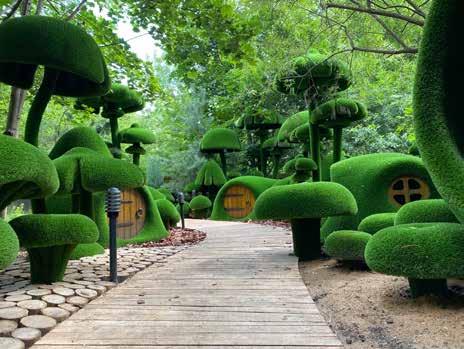
We saw that clearly in Aiva Park, a roughly 1,200-square-meter themed park space within a larger existing amusement park in Moscow that opened in 2020. What worked there was not one object, but the environment as a whole: the paths, the atmosphere, the family focus, and the way one visual scene led into another. The project received very positive visitor feedback and repeatedly appeared among recommended places to visit. That told us something important: people respond not only to individual pieces, but to the feeling of a complete park environment.
What does Bacho provide to a client, and what does the process of working with your team typically look like?
We are often perceived first as a manufacturer, and of course production is a big part of what we do. But in projects like this, manufacturing is only one piece of the work.
Very often, the first thing a client wants to discuss is the sculptural elements. But the real conversation needs to be about the place itself: who it is for, how people move through it, what kind of atmosphere it needs, and how it should function over time. From there we move into concept development, design adaptation, engineering, production, and installation support.
In Aiva Park, for example, we handled the project turnkey: concept, spatial design, production of the sculptural pieces, implementation, and launch preparation.
One interesting element was the entrance area. We created several versions and
BACHO FOUNDER NIKOLAI TOLSTYKH ON HOW CUSTOM-BUILT THEMED ZONES AS A FORM OF PLACEMAKING CREATE LONG-TERM GUEST VALUE FOR THEME PARKS, AMUSEMENT PARKS, MUNICIPAL PARKS, RESORTS, PROMENADES, AND MIXED-USE PUBLIC DESTINATIONS.
Nikolai Tolstykh Bacho
test-marketed them, asking people which one they liked visually. We also wanted to find out which one felt most intriguing. Was the park idea clear? Did it make people want to enter? The version we ultimately built was the one that got the strongest response across all these questions. That matters because the result is usually stronger when design decisions are tested against real human reaction, not just internal opinion.
Why are more parks and public destinations investing in permanent physical environments alongside temporary or seasonal activations?
Temporary formats are good at creating attention, but not always good at creating attachment. A seasonal event, a light show, or a temporary activation can absolutely work. But it works better when the place already has character. A permanent physical environment gives that character. It works in both day and night. It is there between campaigns. It gives people something stable to return to.
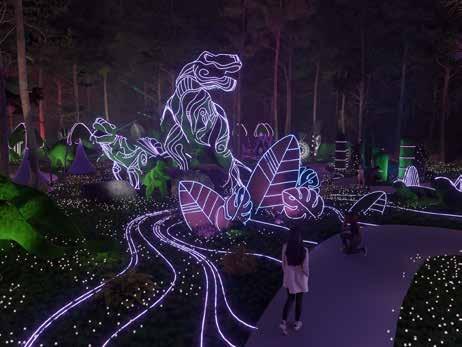
We think of it as the difference between a moment and a setting. The moment may bring people in, but the setting is what makes the destination feel real. Lumia is a good example of how we think about that today. Lumia is a concept we created and plan to open in Vietnam next year. It is designed as one physical environment with two different operating modes. By day, visitors enjoy the spatial composition, themed zones, sculptural focal points, rest areas, and the overall walking route. At night, the same route is restructured through layered lighting and sound, which shifts the emotional tone of the space without changing the underlying environment.
In a sense this permanent environment functions as a temporary activation in that it encourages people to return back to the same space again for a different experience.
What makes a themed zone successful from both a guest-experience and client perspective?
For the guest, the intent must feel clear. People should quickly understand the mood of the space, where to go, where to pause, and what makes the place memorable.
For the client, the test is more practical. Does the zone still work after the opening excitement is gone? Is it safe? Is it durable? Is it manageable over time? Those questions matter even more in outdoor projects, especially when the environment is subject to extreme weather, constant public use, and yearround exposure. In our park projects,
we design not only for visual impact, but also for constant public interaction and long-term outdoor use. That means durability, safety, and maintenance are built into the concept from the start.
That is why success is never only visual. The best zones are the ones that create a strong impression and still hold up in real conditions. If a place looks great on day one but becomes difficult to operate after that, it was not created properly in the first place.
What are the most common mistakes clients make when trying to create themed zones or visual attractions?
The most common mistake is thinking in objects instead of thinking in space. A client may focus on a few individual pieces and expect them to create a strong result by themselves. Sometimes they do look good on paper. But once they are placed on site, it becomes obvious that
Aiva Park, launched in Moscow in 2020, showed how a complete themed environment can work as a family-oriented park space rather than a collection of standalone objects. Photo courtesy of Bacho
there is no real route, no rhythm, no reason for the visitor to move naturally through the space.
Another common issue is underestimating operations. A concept may look impressive in renderings, but if you do not think early enough about materials, maintenance, climate, and public use, the visual idea starts losing strength soon after it is built.
For us, the first question is never “What objects should go here?” It is “What should this place feel like, and how should people move through it?” That usually leads to much better decisions.
How do you balance creative ambition with budget, durability, and long-term maintenance?
By being honest very early in the process. Not every beautiful idea should be built exactly as it first appears in a sketch.
Sometimes one part of a zone carries the emotional impact, while the rest needs to be quieter, tougher, and easier to maintain. That is not a compromise in a negative sense - it is part of making the concept work in real life.
For us, durability is not an abstract point. Our structures are designed for longterm outdoor use in conditions ranging from -58°F to +122°F, and their service life can exceed 10 years. So when we talk about balancing creativity with budget and maintenance, we are really talking about making sure the original idea still works after years of use and weather.
As Bacho’s U.S. model evolves, what should potential partners understand about how the company works in this market today?
The way we work in the U.S. is evolving. At an earlier stage, we worked with finished inventory in the U.S. That is
now being phased out. The direction we are moving toward is much more project-based: custom-built zones, site-specific work, and longer-term collaboration around a particular destination.
That does not mean individual custom pieces are no longer possible. In some cases, they still are. But we increasingly see our role in the U.S. not as a stock supplier, but as a company that comes in to help shape a place around a specific concept and a specific site.
Beyond theme and amusement parks, where else do custom-built park zones make sense today?
They are ideal for many more places than people first assume. Yes, theme parks and amusement parks are the obvious category. But the same logic can work in municipal parks, resorts, promenades, mixed-use leisure developments, and other public destinations. The need is often the same: create stronger identity, make the space more memorable, and give visitors more reason to stay.
What changes is the tone. In a resort, the emphasis may be more atmospheric. In a municipal park, it may be about longterm public use and visual character. In a promenade, it may be about adding a destination quality without overwhelming the site. But the principle is similar across all of them. A custombuilt themed zone can help turn a space from “pleasant” into “worth visiting again and again.” •
The Lumia concept is designed as a day-and-night park experience, with lighting, transitions, and spatial rhythm built into the route. Image courtesy of Bacho