

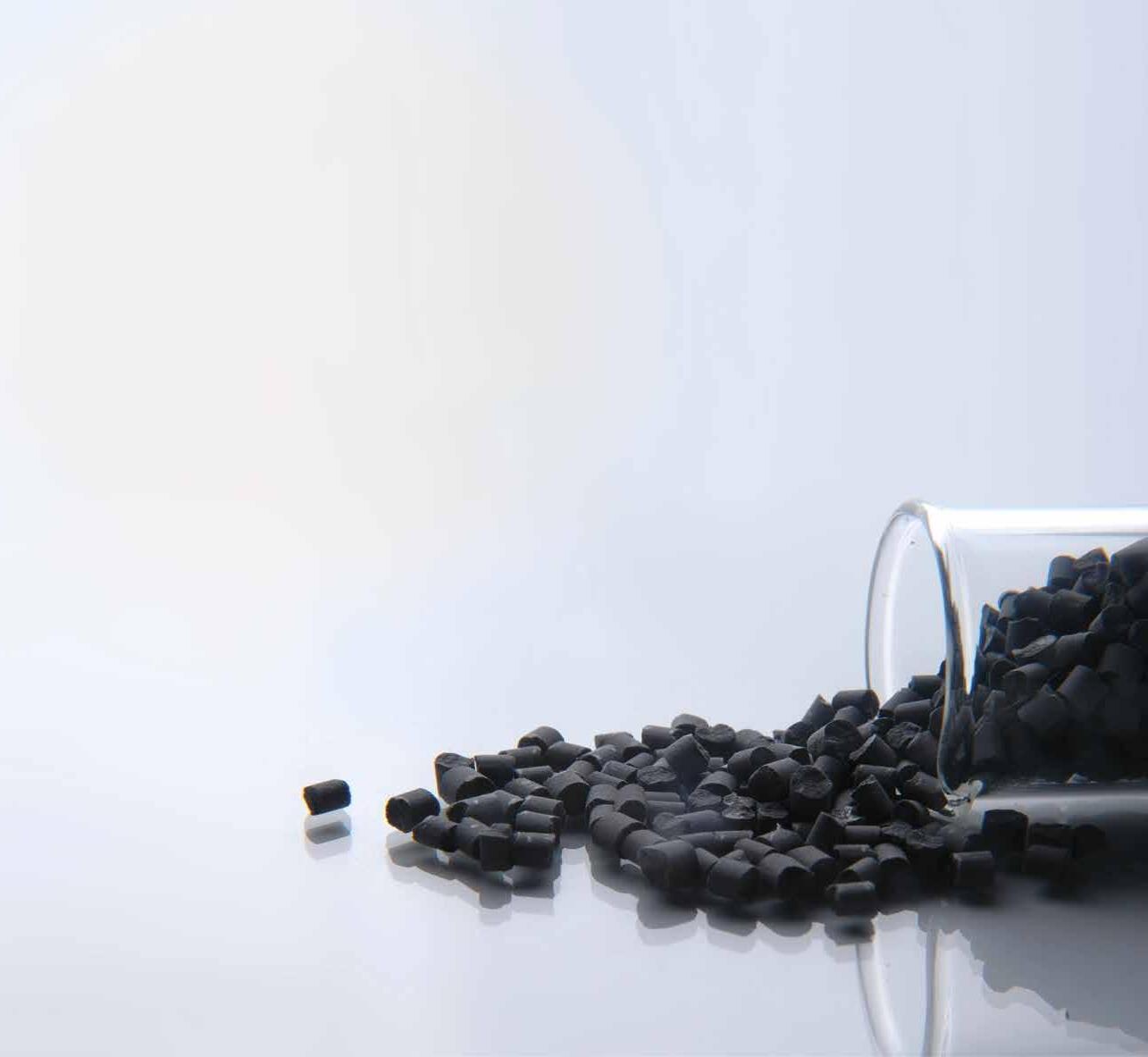
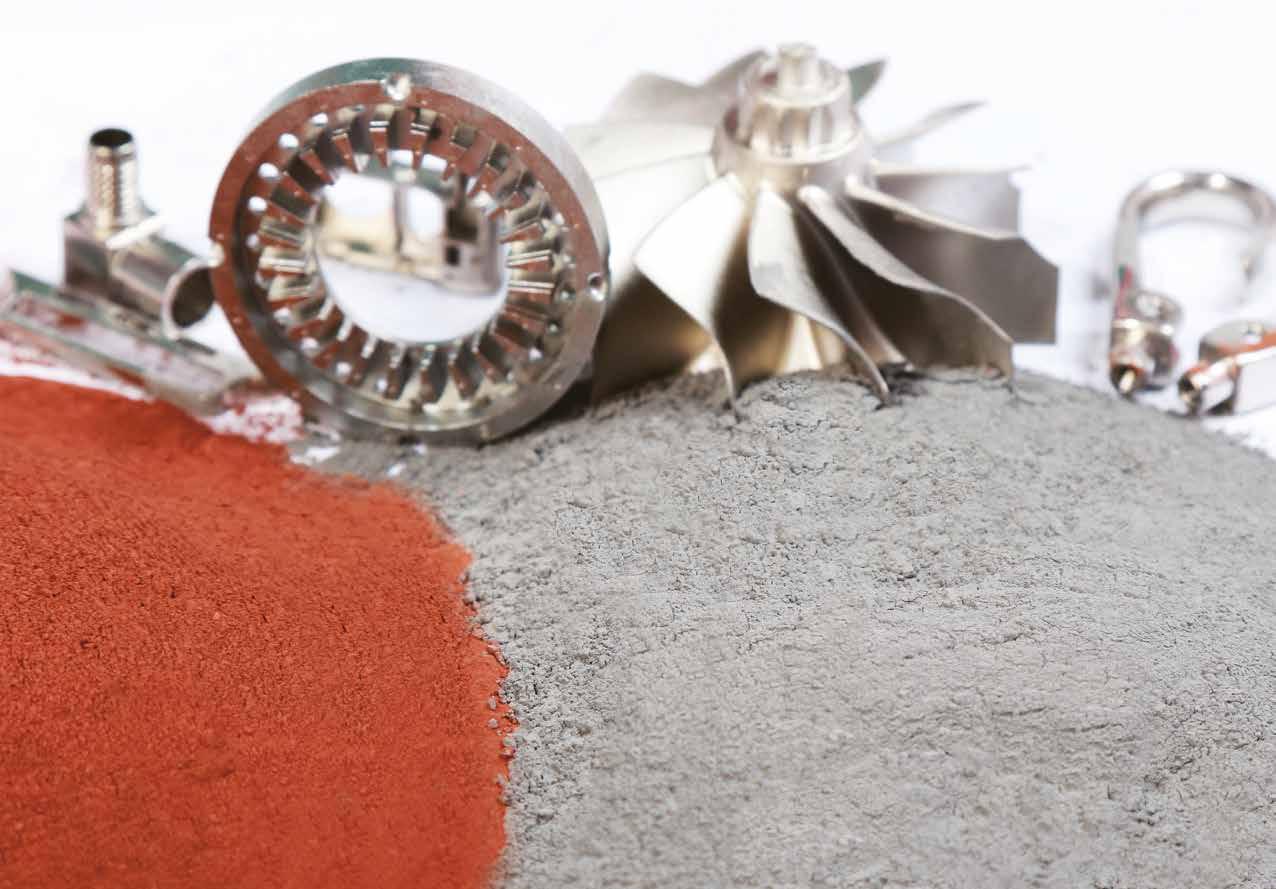
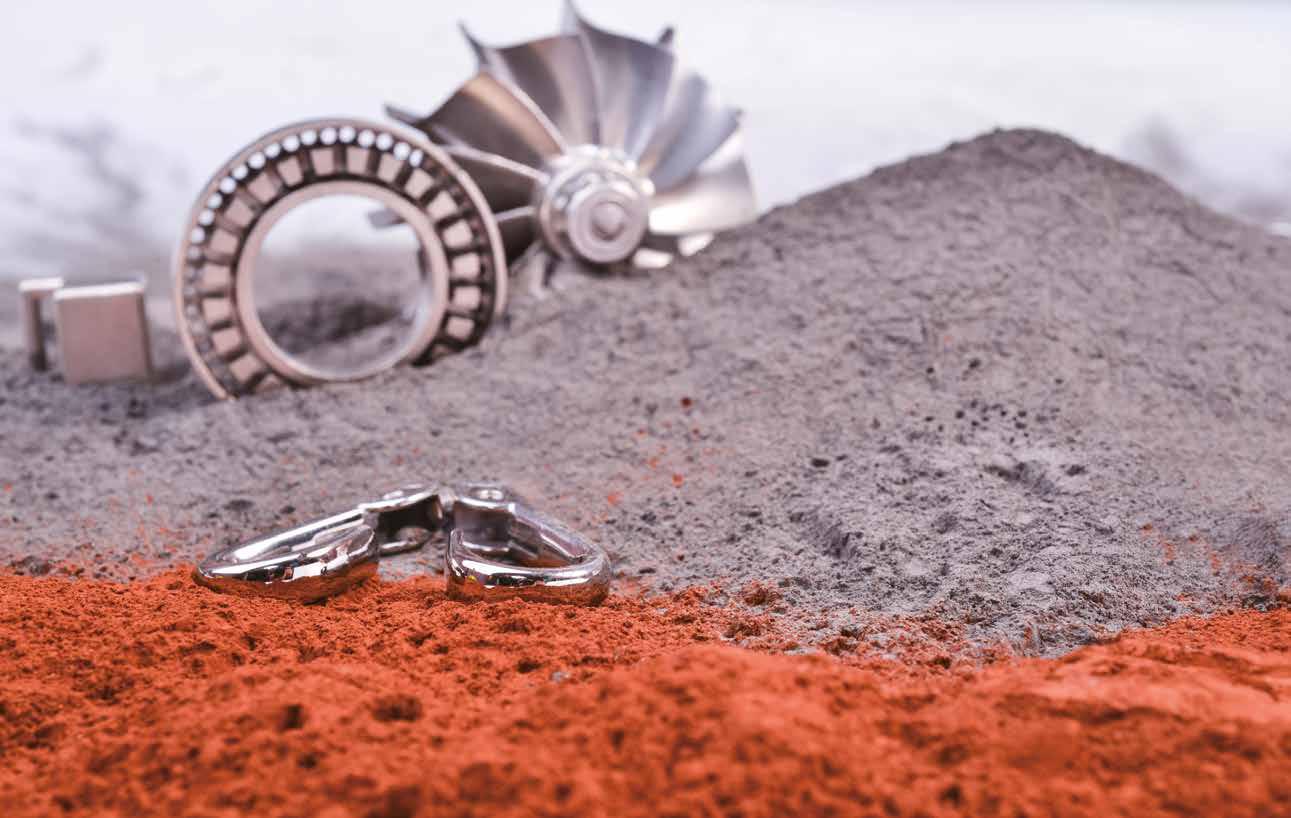
• At RYER, all our feedstocks are manufactured to the highest level of quality, with excellent batch-to-batch repeatability.
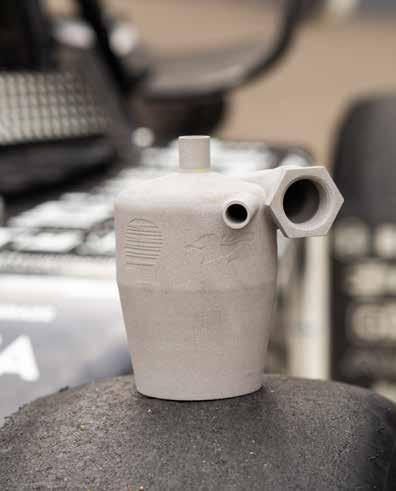
• RYER is the ONLY commercially available feedstock manufacturer to offer all five debind methods.
• RYER offers the largest material selections of any commercially available feedstock manufacturer.
• RYER offers technical support for feedstock selection, injection molding, debinding and sintering.
• A direct replacement for all current commercially available catalytic debind feedstocks
• Improved flow
• Stronger green and brown parts
• More materials available and better surface finish
• Custom scale-up factors available
• Faster cycle times
• 65°C / 150°F mold temperature
• Water Debind
• Custom scale-up factors available
• Large selection of available materials
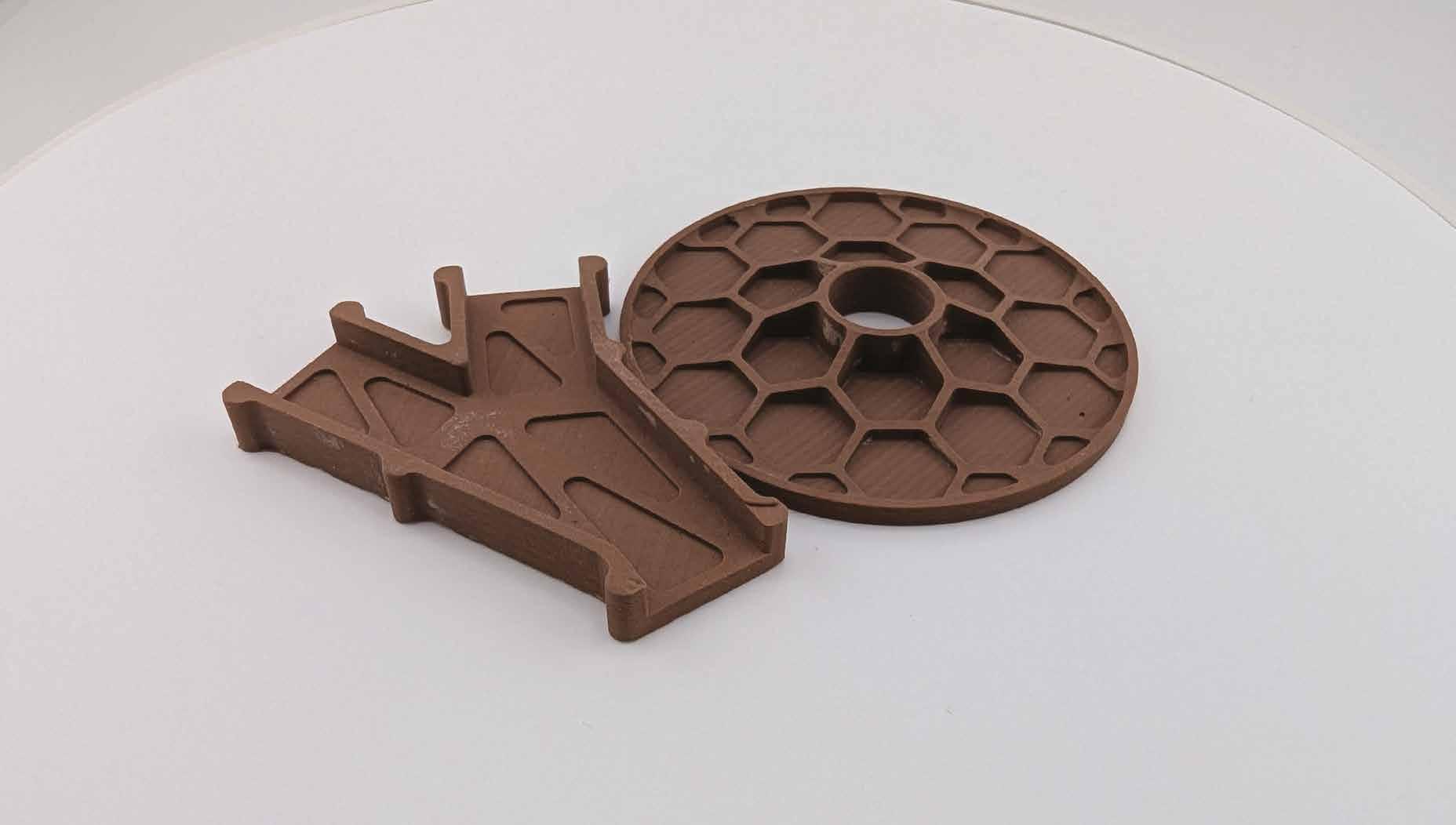
• Solvent, Super Critical Fluid Extraction (SFE) or Thermal Debind methods
• Hundreds of materials available
• Custom scale-up factors available
Publisher & Editorial Offices
Inovar Communications Ltd
11 Park Plaza
Battlefield Enterprise Park
Shrewsbury SY1 3AF
United Kingdom
Tel: +44 (0)1743 469909 www.pim-international.com
Managing Director & Editor
Nick Williams, nick@inovar-communications.com
Group News Editor & Director
Paul Whittaker, paul@inovar-communications.com
Advertising Sales Director
Jon Craxford
Tel: +44 (0)207 1939 749 jon@inovar-communications.com
Features Editor
Emma Lawn, emma@inovar-communications.com
News Editor
Amelia Gregory, amelia@inovar-communications.com Charlie Hopson-VandenBos charlie@inovar-communications.com
Marketing Lead Mulltisa Moung, mulltisa@inovar-communications.com
Production Manager
Hugo Ribeiro, hugo@inovar-communications.com
Operations & Partnerships Manager Merryl Le Roux, merryl@inovar-communications.com
Office & Accounts Manager
Jo Sheffield, jo@inovar-communications.com
Technical Consultant
Dr Martin McMahon
Consulting Editors
Prof Randall M German
Former Professor of Mechanical Engineering, San Diego State University, USA
Dr Yoshiyuki Kato
Kato Professional Engineer Office, Yokohama, Japan
Professor Dr Frank Petzoldt Ingenieurbüro Dr. Petzoldt, Geestland, Germany
Dr David Whittaker
DWA Consulting, Wolverhampton, UK
Bernard Williams Consultant, Shrewsbury, UK
Subscriptions
PIM International is published on a quarterly basis as either a free digital publication or via a paid print subscription. The annual print subscription charge for four issues is £150 including shipping.
Accuracy of contents
Whilst every effort has been made to ensure the accuracy of the information in this publication, the publisher accepts no responsibility for errors or omissions or for any consequences arising there from. Inovar Communications Ltd cannot be held responsible for views or claims expressed by contributors or advertisers, which are not necessarily those of the publisher.
Advertisements
Although all advertising material is expected to conform to ethical standards, inclusion in this publication does not constitute a guarantee or endorsement of the quality or value of such product or of the claims made by its manufacturer.
Reproduction, storage and usage
Single photocopies of articles may be made for personal use in accordance with national copyright laws. All rights reserved. Except as outlined above, no part of this publication may be reproduced or transmitted in any form or by any means, electronic, photocopying or otherwise, without prior permission of the publisher and copyright owner.
Design and production
Inovar Communications Ltd.
ISSN: 1753-1497 (PRINT)
ISSN: 2055-6667 (ONLINE) © 2026 Inovar Communications Ltd.



For years, the Metal Injection Moulding industry in Greater China – encompassing mainland China and Taiwan – has accounted for more than 50% of global sales. Yet, as our lead article explores, this success has not come without disruption. The loss of key applications such as Apple’s Lightning connector forced Greater China’s MIM producers to diversify beyond their core consumer electronics markets.
Today, the region’s MIM industry is no longer simply a story of scale, cost and consumer electronics. It has become a highly integrated precision-manufacturing ecosystem serving a far broader customer base, and one whose future is increasingly bound up with metal Additive Manufacturing.
Metal AM is increasingly converging with MIM in terms of materials, applications and post-processing. Whilst it can support MIM through prototyping, tooling and bridge production, it is also becoming a direct competitor in high-value applications conventionally served by MIM, casting or machining.
Buyers across the region no longer treat MIM and AM as separate worlds. From consumer electronics and robotics to AI servers and data-centre hardware, customers want the fastest, most reliable route to complex, high-performance metal components. The powder and post-processing requirements may be similar, but the application-dependent choice of forming process is where the battle is won or lost.
Nick Williams Managing Editor

Cover image
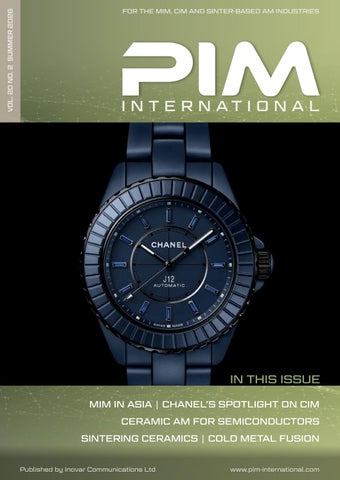
Chanel’s J12 Bleu watch uses Ceramic Injection Moulding for the case and bracelet links (Courtesy Chanel)




55 Metal Injection Moulding in Asia: Scale, supply chains, and growing overlap with metal Additive Manufacturing
Asia’s Metal Injection Moulding industry – led overwhelmingly by Greater China –has evolved into a vast, highly integrated manufacturing ecosystem underpinning global production of small, complex metal components. Driven by consumer electronics, expanding powder supply chains, and growing overlap with metal Additive Manufacturing, the region is reshaping precision manufacturing at industrial scale.
Dr Yau-Hung, Chiou (Dr Q), Dr Yu-Deh, Chao (Dr James) of You Need Technology Consulting Co, Ltd, and Emma Lawn and Nick Williams of PIM International examine these developments. >>>
71 Chanel’s J12: How Ceramic Injection Moulding became part of the luxury narrative
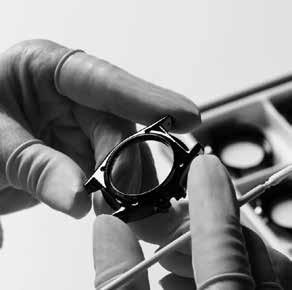
Chanel’s J12 has long been one of luxury watchmaking’s most recognisable ceramic watches. Now, through a series of videos shared across its social media channels, Chanel is giving rare visibility to the Ceramic Injection Moulding (CIM) process behind the collection. By presenting powder processing, moulding, sintering and finishing as integral to the J12’s identity, the brand is framing CIM as a source of luxury value in itself.
Emma Lawn explores how Chanel is integrating advanced ceramic manufacturing into the language of luxury. >>>

One of AM’s most demanding copper alloys—produced with unsurpassed cradle-to-gate traceability. Engineered for qualification without disruption: every raw material, melt parameter and atomization condition is controlled and documented under an AS9100-certified system. Delivering predictable performance helping you avoid delays, requalification or surprises—across critical, high-performance applications.
Explore how traceability keeps your qualification moving—without disruption.
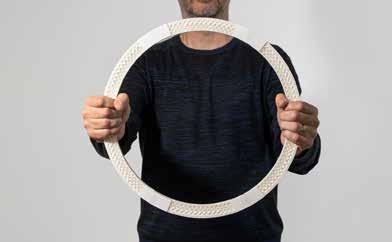
81 Ceramic AM enables 500 mm dualchannel gas distribution ring for highspeed PEALD and ALE in the same chamber
As semiconductor manufacturers move towards larger substrates and faster atomic-scale processes, the components inside wafer production tools must scale up without compromising precision. PlaswayTechnologies, Alumina Systems and Lithoz have developed a 500 mm dual-channel alumina gas distribution ring for PlaswayTechnologies’ FAST Atomic Layering Process (FALP) platform.
Produced using Lithoz’s ceramic Additive Manufacturing, the ring enables high-speed Plasma Enhanced Atomic Layer Deposition (PEALD) and Atomic Layer Etching (ALE) in the same chamber, while maintaining highly uniform gas distribution across large wafer substrates. >>>

93 From hypersonics to EVs: Sintering non-oxide ceramics for nextgeneration technologies
Growing interest in advanced non-oxide ceramics for hypersonics, semiconductors, armour, electronics and other demanding applications is bringing renewed attention to the sintering science that determines final part performance.
Ceramic Injection Moulding (CIM) and sinter-based Additive Manufacturing (AM), particularly Binder Jetting (BJT), are expanding the shaping potential of carbides, nitrides, borides and ultra-high-temperature ceramics.
In this article, Scott Robinson, Centorr Vacuum Industries, reviews the key considerations in debinding, furnace design, atmosphere control and sintering. >>>
The PIM International newsletter is sent to several thousand industry professionals worldwide. Register today to ensure you benefit from reading the latest industry news and advances in Metal Injection Moulding, Ceramic Injection Moulding and sinter-based AM technologies.
www.pim-international.com/e-newsletter

In this feature, Marcel Strobel, Chief Product Officer at Headmade Materials, outlines what makes ColdMetalFusion different, how the process works, and where it fits within today’s industrial manufacturing landscape.
Combining polymer PBF-LB with established sintering technology, the process uses a feedstock in which the laser melts only the polymer binder rather than the metal itself, offering an alternative route to industrial metal Additive Manufacturing with lower thermal loads, simplified feedstock handling, and compatibility with existing manufacturing infrastructure.


> nick@inovar-communications.com
• Be visible: Ask about advertising opportunities > jon@inovar-communications.com
• Stay connected: Follow us on LinkedIn
> www.linkedin.com/company/ piminternationalmagazine


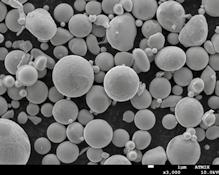
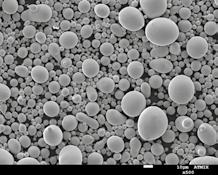


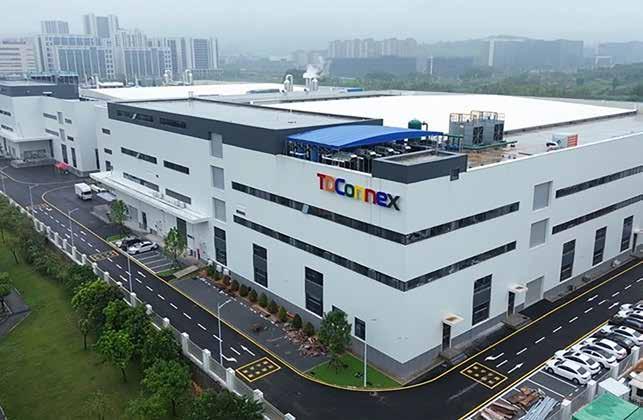
TDConnex, headquartered in Singapore, has announced the opening of its sixth manufacturing facility at a purpose-built campus in Xiamen, China. The new site includes a significant expansion of its Metal Injection Moulding production capacity and is expected to boost MIM output by over one billion parts per year.
The 74,300 m² (800,000 ft²) facility, known as Xiamen 6, forms part of the company’s wider strategy to strengthen manufacturing capacity across its global operations.
Incorporating state-of-the-art automation, it is intended to support the growing demand for high-precision components used in advanced technology applications.
TDConnex began MIM production in 2020, and currently lists fiftythree injection moulding machines from Fanuc and Nissei, with six continuous furnace lines and various post-processing equipment. The number of additional MIM machines required for the new facility was not stated.
The Xiamen 6 facility is located adjacent to TDConnex’s existing campus in Haicang District, Xiamen. The proximity of the two sites is intended to enable the sharing of manufacturing resources, engineering expertise and operational infrastructure, supporting faster production ramp-up and improved coordination across operations.
According to TDConnex, the facility was constructed in four months and has already entered production to support existing customer programmes.
“Xiamen 6 reflects what TDConnex is built to do – meet the speed and precision the world’s most innovative technology customers require,” stated Thanga Venkatachalam, Chief Executive Officer of TDConnex. “As electronics become thinner, lighter and more intelligent, demand for advanced micro-precision components – and particularly high-strength miniaturised metal components enabled by MIM tech -
nology – continues to accelerate. We are deeply grateful to our customers for their partnership and look forward to continuing to expand our capabilities globally.”
The company acknowledged the support of Haitou Group, as well as municipal and provincial authorities in Xiamen and Fujian, respectively, in the development of the facility. At full production capacity, TDConnex stated that the site is expected to support between 3,000 and 4,000 direct and indirect jobs across the region.
The company operates manufacturing facilities in China, Singapore and India, offering more than fifty manufacturing processes integrated within an automated production network.
www.tdconnex.com
Swedish global investment firm Mimir, headquartered in Stockholm, has signed an agreement to acquire Sandvik’s Osprey metal powder business. Osprey offers a wide range of metal powders used in Additive Manufacturing, Metal Injection Moulding, Hot Isostatic Pressing (HIP) and Cold Spray technologies.
With more than fifty years of experience in metal powder atomisation, Osprey offers the broadest product range in the market, with a catalogue of more than 2,000 alloy variations and over 400 different metal powders available at any one time. According to Mimir, the
acquisition is expected to establish Osprey as a standalone global platform in gas-atomised metal powders, supplying growing end-use markets including defence, space, medical technology and energy.
”Osprey is precisely the kind of company we look for,” stated Joakim Notö, Managing Partner at Mimir. “It combines deep materials science, a world-class alloy library and decades-long customer relationships in markets with strong underlying growth. That combination creates barriers to entry that are very hard to build and even harder to copy - and that is where

Sandvik AB will sell its Osprey metal powder business to Swedish global investment firm Mimir (Courtesy Sandvik AB)
The Indian Institute of Technology Madras (IIT Madras) has announced plans to sell around half of its total shareholding in Metal Injection Moulding component manufacturer INDO-MIM Ltd, through the company’s forthcoming initial public offering (IPO).
INDO-MIM was established in 1996 and is headquartered in Bengaluru, India. The company’s founder and
IIT Madras alumnus, Dr Krishna Chivukula, gifted a stake in the company to IIT Madras in recognition of its role in helping shape INDO-MIM into one of the world’s largest manufacturers of precision engineering components. In addition to Metal Injection Moulding, INDO-MIM also offers Ceramic Injection Moulding, investment casting and metal Additive Manufacturing.
we see the potential to accelerate value creation.”
Mimir confirmed that it intends to intensify Osprey’s investment in product development, new alloys and international market expansion - with particular focus on Additive Manufacturing and other advanced manufacturing processes where demand is growing fastest.
Commenting on the news, Stefan Widing, President and CEO of Sandvik, added, “This divestment is intended to better position the Additive Manufacturing business for its next growth phase, and we believe the new owner will provide the platform and dedicated focus needed to further develop the business towards its full potential.”
In connection with the transaction, Mats Gunnarsson, founder of MonteCap, will join Osprey as Chairman of the Board.
”Osprey has an unusually strong foundation to build on,” added Gunnarsson. “As an independent company, the business can direct its full focus towards customers, technology development and the segments where growth is strongest. I look forward to working with management and Mimir to step up the company’s next phase.”
The transaction is expected to close in the third quarter of 2026, subject to customary regulatory approvals.
www.home.sandvik
www.mimirinvest.com
IIT Madras is reported to hold 4,615,385 equity shares, with an estimated value of around INR ₹ 140 crore (approx $15 million) at the expected IPO valuation. IIT Madras is proposing to sell up to 2,307,700 shares, reported to account for around 1% of the total equity capital of INDO-MIM.
In September 2024, Dr Chivukula made one of the largest single donations of ₹ 228 crore (approx $24 million) to IIT Madras. www.iitm.ac.in www.indo-mim.com
Not when you have the right expertise behind you. With the right knowledge, it becomes a controlled, reliable, and repeatable process. At DSH Technologies, we turn process complexity into production capability.
Reduce Scrap Rate & Variability
Improve Yield & Consistency
Emergency Troubleshooting
Toll Debinding & Sintering

STOP GUESSING, START IMPROVING WITH DSH TECHNOLOGIES.

CNPC Powder, a global supplier of metal powders headquartered in Vancouver, Canada, has begun construction of a new production and R&D facility in California, USA. The company plans to produce powders in a range of particle size distributions for applications including Laser Beam Powder Bed Fusion (PBF-LB), Directed Energy Deposition (DED), Metal Injection Moulding, thermal spray, and Hot Isostatic Pressing (HIP).
The California facility has been designed to address the needs of manufacturers placing greater emphasis on domestic supply chains, shorter qualification cycles, and improved process traceability. It will provide US customers with faster access to its alloy portfolio, local technical support, and greater supply chain control for applications in aerospace, automotive, consumer electronics, medical, energy, and industrial sectors.
The company expects the facility to reduce delivery times for many North American customers from several weeks to a matter of days, whilst also enabling closer engineering collaboration and on-site implementation support.
The 5,500 m² facility will house up to six fully automated atomisation production lines for aluminium
powders, titanium alloys, nickelbased superalloys, stainless steels, and other speciality alloys. Initial production is expected to begin in the first quarter of 2027.
Advanced atomisation technologies
The California facility will deploy CNPC Powder’s portfolio of atomisation and powder-processing technologies to produce spherical, low-oxygen powders for demanding applications.
Core production technologies will include:
Vacuum Induction Gas Atomisation (VIGA) : for highpurity nickel alloys, steels, and speciality alloys
• Electrode Induction Gas Atomisation (EIGA): for reactive materials such as titanium alloys
• Plasma Rotating Electrode Process (PREP): for aerospace and medical-grade powders
• Plasma Spheroidisation (PS): to enhance powder flowability and particle uniformity
• AMP Platform (Advanced Metallurgy Powder) : the company’s proprietary production platform, incorporates real-time monitoring, closed-loop process control, and quality management

According to the company, these technologies enable control of particle size distribution (PSD), sphericity, satellite formation, oxygen content, and powder flow characteristics, all of which influence build consistency, density, surface finish, and mechanical properties.
Closed-loop powder recycling
The new site will incorporate a closed-loop recycling system intended to convert production scrap, used components, and waste powder into recycled titanium and aluminium powders. The company stated that these materials will be supplied with SCS carbon certification.
Material portfolio
The facility will initially focus on materials widely used in industrial AM applications, including:
• Aluminium alloys, including Scalmalloy
Titanium alloys, including Ti-6Al-4V
• Nickel-based superalloys, including Inconel 718, Inconel 625, and Hastelloy-series materials
Steel alloys
Copper alloys
Custom alloy development services will also be offered for customers requiring enhanced weight reduction or heat, corrosion and wear resistance.
Alloy development and certification centre
Alongside production operations, the California facility will include an alloy development and rapid certification centre staffed by application engineers and materials specialists. CNPC Powder currently supplies customers in the aerospace, automotive, medical, electronics, and industrial sectors and holds certifications including ISO 9001, IATF 16949, ISO 13485, and SCS recycled content certification. www.cnpcpowder.com
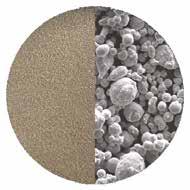
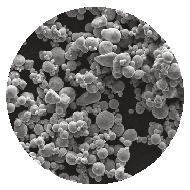




With partner Novamet, Ultra Fine’s high quality powders can be further enhanced through coating or other post-atomization treatments.
Nano Dimension, headquartered in Waltham, Massachusetts, USA, has entered into a definitive agreement to sell Markforged, Inc, a wholly owned subsidiary also based in Waltham, to Stratasys of Minnetonka, Minnesota, in an all-cash transaction valued at $42.5 million. Nano Dimension said it will, however, retain the Markforged metal Binder Jetting product line.
The transaction is reported to represent a further step in Nano Dimension’s three-phase strategic plan. Phase 1 of the plan focuses on operational efficiencies and reducing cash burn through cost management initiatives. Phase 2 centres on monetising selected product lines to strengthen the company’s balance sheet, whilst Phase 3 involves evaluating strategic alternatives to maximise shareholder value.
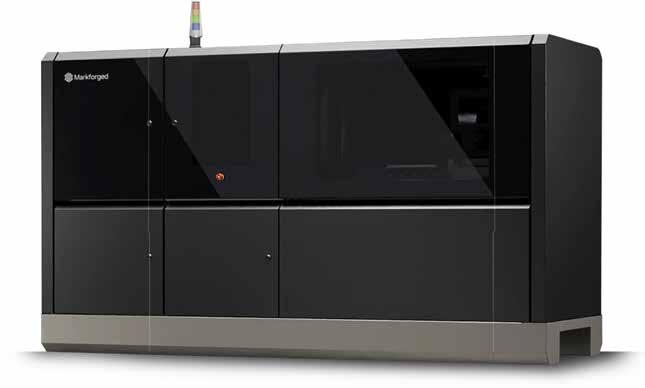
Nano Dimension will retain the Markforged metal Binder Jetting product line, including the PX100 above (Courtesy Markforged)
Metalysis Ltd, based in Rotherham, UK, has been awarded near €1 million in funding from the European Space Agency (ESA) to develop a continuous or quasi-continuous process for titanium production using its FFC (Fray-Farthing-Chen) molten salt electrolysis technology. The twentyfour-month project aims to scale Metalysis’ FFC process to support more sustainable bulk titanium production and strengthen Western supply chains for critical metals.
Metalysis will lead a consortium including the UK’s Lucideon Ltd,
TTP plc and NCHG Ltd, along with Austria’s RHP-Technology GmbH. Covering key unit operations associated with the FFC process, the partners bring experience in ceramics processing, materials science, electrochemistry, process development and Powder Metallurgy.
“The near €1 million from ESA to our consortium, led by Metalysis, reflects the strategic need across the space, aerospace, defence, hypersonics and wider advanced manufacturing sectors for industrialscale production of critical metals
According to Nano Dimension, the sale of Markforged forms part of Phase 2 of the strategy, and is expected to reduce annualised cash burn by approximately $15 million through direct and indirect operating cost savings, including certain costs not solely attributable to Markforged.
David Stehlin, Chief Executive Officer of Nano Dimension, stated, “We are pleased to have reached an agreement with Stratasys that we believe positions Markforged for continued growth and success under its ownership. This transaction represents a deliberate step in advancing Nano Dimension’s three-phase strategic plan and accelerating Phase 3 execution.”
“We have made meaningful progress across Phase 1 and Phase 2, including cost reductions, operational streamlining and multiple product line monetisation actions. As Phase 3 continues to accelerate, we have recently advanced discussions with a focused set of strategic opportunities and potential partners aimed at maximising long-term shareholder value,” he concluded.
The transaction is expected to close during the second half of 2026, subject to customary closing conditions and regulatory approvals. www.stratasys.com www.nano-di.com www.markforged.com
such as titanium,” stated Nitesh Shah, CEO of Metalysis. “Scaling our technology to continuous or semi-continuous production will help strengthen Western supply of sustainable titanium, as the Metalysis FFC process is leaner, greener and cleaner than traditional manufacturing routes.”
“Titanium is essential for space exploration and satellite manufacturing, and establishing a secure, environmentally responsible supply chain is vital for the long-term competitiveness of our space sector,” explained Matthew Cook, Head of Space Exploration at the UK Space Agency.
www.metalysis.com

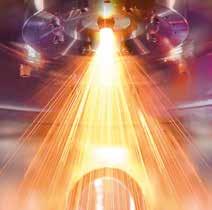
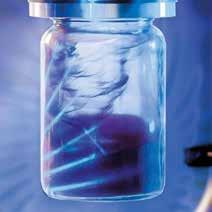
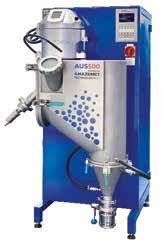
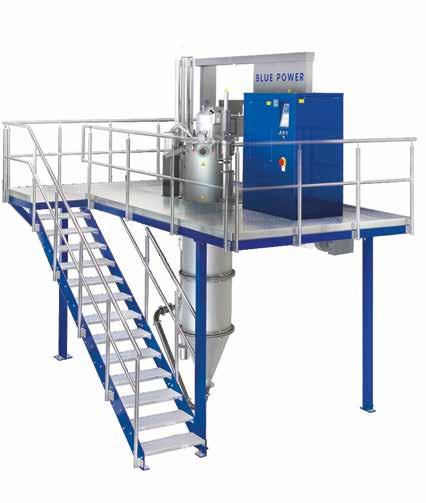
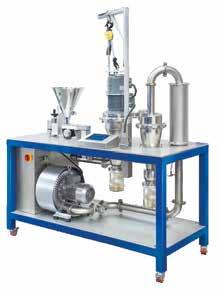
● GAS AND ULTRASONIC ATOMIZERS FOR SPHERICAL POWDERS WITHOUT ANY SATELLITES for LPBF, MIM, Binder Jetting and other Additive Manufacturing applications. High purity, sphericity and wide range of reproducible particle size distribution.
● WATER ATOMIZERS FOR MORE IRREGULAR POWDERS ideal for recycling/refining process, press & sinter process and others.
● AIR CLASSIFIERS FOR THE PRECISE SEPARATION OF METAL POWDERS into fine and coarse powder fractions especially in the range < 25 µm

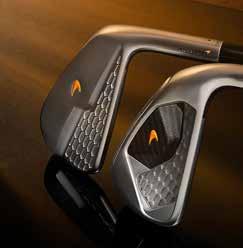
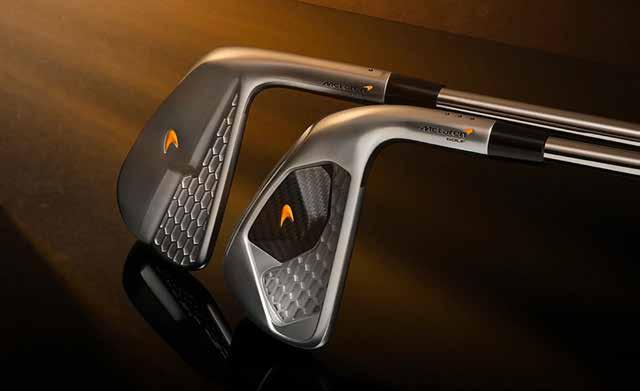
Ahead of the Miami Formula One Grand Prix, F1 world champions McLaren have officially launched McLaren Golf, marking the company’s entry into the golf sector with its first products: the Series 1 and Series 3 irons, manufactured using Metal Injection Moulding.
“Miami provides the perfect stage for the launch of McLaren Golf, bringing the worlds of racing and elite golf together, at a defining moment for our brand,” stated Nick Martin, Co-Chief Commercial Officer, McLaren Racing. “A powerful extension of who we are, McLaren Golf broadens our reach, deepens our relevance with fans, and reinforces
our commitment to driving success at the highest level of global sport.”
Supported by 8AM Golf, the new venture extends McLaren’s engineering capabilities into the golf industry, applying materials expertise and precision manufacturing techniques to the design and production of performance equipment. Central to this approach is the use of Metal Injection Moulding, which underpins the design of the irons and enables the production of near-net-shape components with optimised internal structures and material efficiency.
The honeycomb design, achieved through the MIM process, is also utilised in McLaren supercar designs.
The Wittmann Group has announced a restructuring of its management. The business division’s Injection Moulding Machines – Wittmann Battenfeld GmbH, based in Kottingbrunn, and Automation and Auxiliary Equipment – Wittmann Technology GmbH, based in Vienna, will be consolidated under dual leadership effective May 1, 2026. This leadership will consist of the two owners, Michael Wittmann and Dr Werner Wittmann. Rainer Weingraber
will leave the group of companies at the end of April.
“With this new structure, we are consistently implementing the “It’s all Wittmann” strategy - launched in 2022 - all the way up to the executive management level,” said Michael Wittmann. “Our high level of expertise in providing comprehensive solutions from a single source is a strong competitive advantage that we will expand even more
This approach is reported to maintain rigidity and face strength whilst removing mass from non-critical areas. Using the clubhead’s internal tungsten weighting system allows the centre of gravity to be precisely controlled along the vertical and horizontal axes. Each clubhead can therefore be uniquely calibrated based on loft, mass and performance objectives.
“We’ve been working toward this moment for some time, and there’s a real sense of anticipation in seeing it all come to life,” added Neil Howie, Chief Executive Officer, McLaren Golf. “Behind the scenes, we challenged every part of the process, from materials to construction, to uphold the exacting standards and constant pursuit of excellence that define McLaren. To now introduce these irons to the world and see them in the hands of golfers is incredibly exciting.”
The company also announced an initial group of athlete investors and ambassadors, including professional golfers Justin Rose, Michelle Wie West and Ian Poulter. Rose has been involved in product development for approximately two years, including prototype testing and design input, and is expected to begin using the Series 1 irons during the PGA Tour’s Miami event.
The Series 1 and Series 3 irons are priced at $375 per club, with a full set (3-PW) starting at $3,000 in a standard configuration.
www.mclarengolf.com
intensively worldwide through this consolidation.”
Rainer Weingraber joined the group in 2019 as CEO of Wittmann Battenfeld GmbH.
“Mr Weingraber has steered the injection moulding machine division through challenging times and played a key role in driving the integration of all business units,” emphasises Michael Wittmann. “We thank Mr Weingraber for his dedication and achievements over the past seven years and wish him all the best for the future.”
www.wittmann-group.com
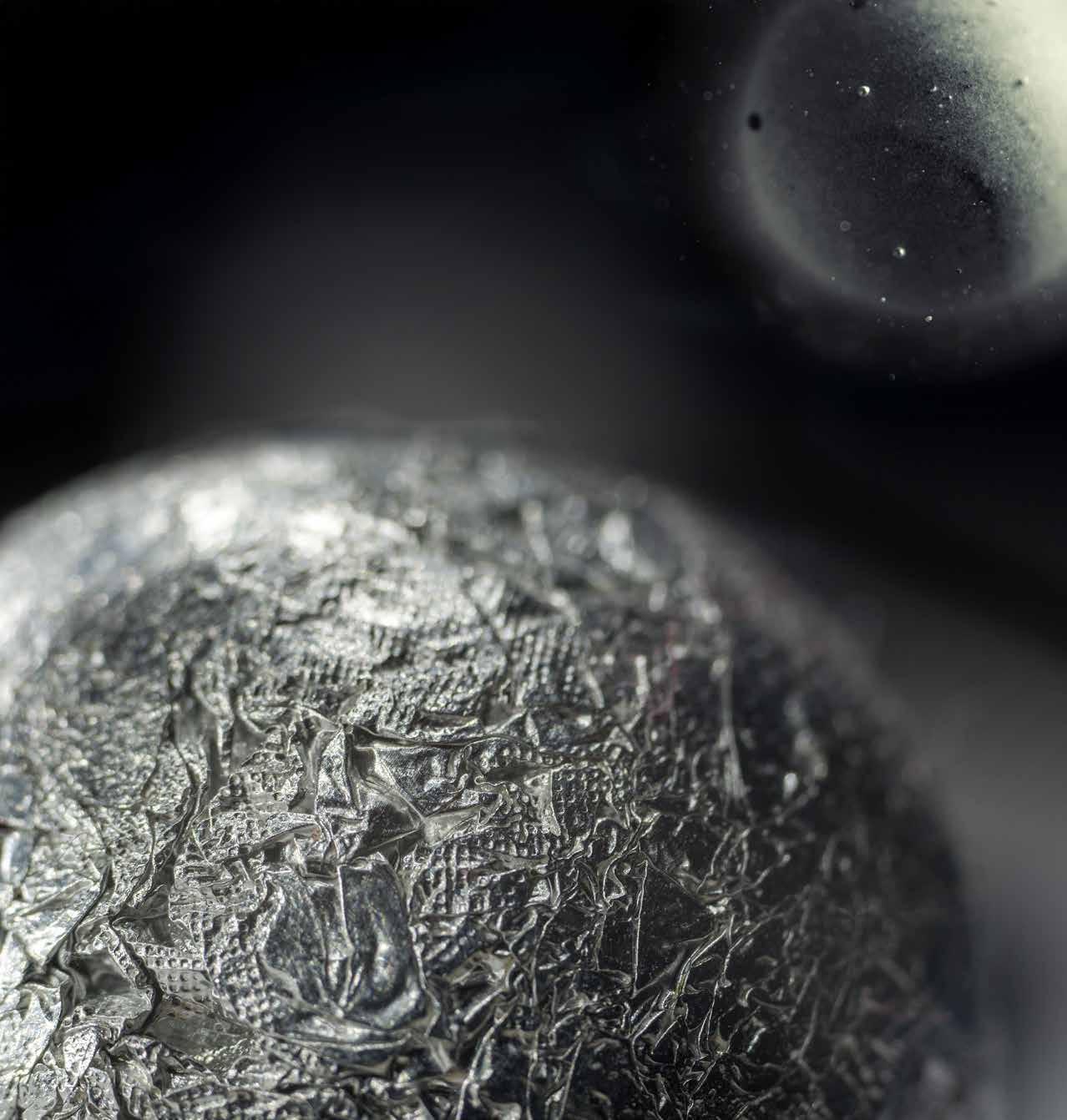

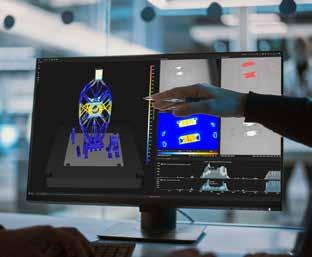
Interspectral, based in Norrköping, Sweden, has announced that it has been selected as a key partner in TRUSTAM (Trusted Federated Intelligence for Additive Manufacturing), a €679,000 research initiative awarded by Vinnova, Sweden’s national innovation agency. Alongside consortium partners Saab, AMEXCI, and Scaleout Systems, Interspectral will help develop the next generation of secure, AI-driven quality assurance for AM in aerospace, defence, and other safety-critical industries.
For AM to fulfil its potential in mission-critical production, quality must be embedded, traceable, and provable in real time across facilities, machines, and highly sensitive environments. That conviction has driven Interspectral’s product development for years, and it is what made TRUSTAM a natural partnership to pursue.
“We entered this collaboration because the challenge it addresses is one we encounter with our customers every day,” said Isabelle Hachette, CEO of Interspectral. “How do you scale AI-driven quality assurance across multiple production sites and different machine environments without ever compromising data security or IP ownership? That question demands a collaborative answer, and this consortium is uniquely positioned to deliver it.”
TRUSTAM applies federated learning to quality assurance in AM, a framework where AI models improve collectively across production environments, without raw data ever leaving the site where it was generated. Only model updates are exchanged, enabling shared intelligence whilst preserving full data confidentiality. Within this framework, Interspectral takes a central technical role: leading the development
of the local AI model, the on-site intelligence that learns from each machine’s unique process data as well as the workflow design that connects monitoring, analysis, and decision-making into a seamless operational experience. This builds directly on Interspectral’s AM Explorer platform, which the company states is already integrated across more than 60% of the metal AM machine landscape and deployed with customers including GKN Aerospace and Volum-E.
The outcomes expected from TRUSTAM include on-premises AI models that are fine-tuned to specific machines and production conditions, a validated framework for secure cross-site AI collaboration, and real-world demonstrators proving the technology in live aerospace and defence environments. For Interspectral, the project will also directly accelerate planned capabilities in the AM Explorer platform, including on-premise AI training and multimodal process analysis.
“Being trusted with the technical core of this project reflects the confidence our partners have in our platform and our competence,” Hachette added.
TRUSTAM runs from April 2026–April 2028, culminating in a demonstrator phase and full dissemination of results to the broader AM community.
www.interspectral.com
Sunrock Ceramics LLC, based in Broadview, Illinois, USA, a manufacturer of high purity refractory ceramics, has been acquired by Powder Processing and Technology, LLC (PPT GROUP), based in Valparaiso, Indiana, a wholly owned business of EJ-Vestco Industries. It was stated that the company will continue to operate under the Sunrock Ceramics name and will maintain its existing management leadership.
Sunrock Ceramics, founded in 2005, is a supplier of highperformance ceramic consumables and other specialised refractory for demanding thermal processing applications in industries such as the sintering of technical ceramics and Powder Metallurgy components (including magnets), investment
casting, powder processing, glass melting and foundries. Under the new ownership the company plans to invest in manufacturing capacity and process improvements, as well as boost technical resources to support new product and market opportunities.
“This transaction provides Sunrock Ceramics with the capital and strategic support needed to continue scaling the business,” said Doug Thurman, president of Sunrock Ceramics. “I am very excited about working together with EJ-Vestco Industries and PPT to build our team, expand our product offerings, increase our production capacity and enter new markets.”
EJ-Vestco Industries focuses on building value through long-term ownership of specialised manu -
facturing businesses. Its existing portfolio companies operate in related industrial chemicals, materials, as well as specialised engineering equipment and related services and segments, creating opportunities for operational synergies, shared technical expertise, and coordinated growth initiatives.
John Kaziow, the General Managing Operating Partner at EJ-Vestco Industries, stated,
“Sunrock Ceramics has a strong foundation, differentiated capabilities, and is a trusted partner with its customers. We believe the company is well-positioned for growth, and we plan to support that growth through targeted capital investment, operational excellence initiatives, and strategic add-on opportunities. Investment in new production equipment is already underway.”
www.sunrockceramics.com www.pptechnology.com






These two binder systems have excellent characteristics during the production process and combine attractive prices with worldwide availability
High performance as well for the 3D-Printing process based on the water soluble binder system



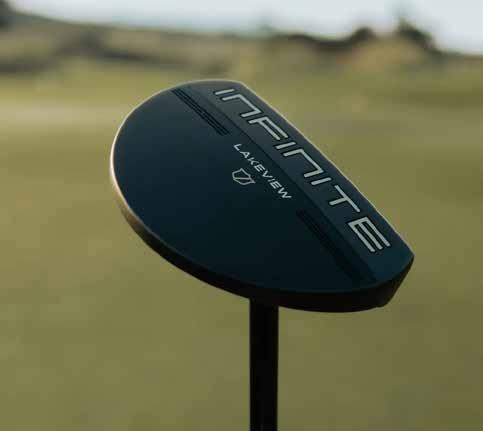
Wilson Golf has announced the expansion of its Infinite putter range with the introduction of two new zero-torque mallet models, the 606 and Lakeview, both produced using Metal Injection Moulding.
The new designs are engineered to maintain a square putter face relative to the target for longer during the stroke in an effort to reduce rotational movement and support improved alignment consistency. The models combine tour-inspired geometries with engineering features aimed at enhancing stability, whilst being offered at a lower price point than many premium alternatives.
Central to the designs is a zerotorque configuration, in which the centre of gravity is aligned with the shaft axis. This arrangement is intended to minimise torque trans -
ferred to the hands during the stroke, thereby reducing face rotation and improving accuracy. Both putters also incorporate 1° of forward shaft lean to promote consistent hand positioning and assist in returning the face square at impact.
The use of Metal Injection Moulding is reported to enable the production of the intricate geometries required for the zero-torque design, whilst allowing precise control over weight distribution.
Performance features include a double-milled face pattern designed to provide a consistent striking surface and promote uniform ball roll. Wilson states that this surface treatment also supports improved distance control, including on offcentre strikes.
The putters feature a two-tone physical vapour deposition (PVD)

anti-glare finish, intended to reduce reflections at address and improve visual focus.
“The new Zero Torque range represents a huge step in our popular Infinite putter lineup, giving golfers confidence and performance on every putt,” stated Scott James, CAD Engineer at Wilson Golf. “By integrating zero torque technology with advanced MIM construction and a doublemilled face, we’ve created mallet designs that not only look great at address but also deliver a remarkably consistent roll.”
The 606 model adopts a compact winged-mallet design, incorporating multiple alignment aids, including dual lines and a central dot, to support visual setup. In contrast, the Lakeview features a half-moon mallet profile with a single alignment line, offering a simplified visual appearance whilst retaining stability characteristics. www.wilson.com




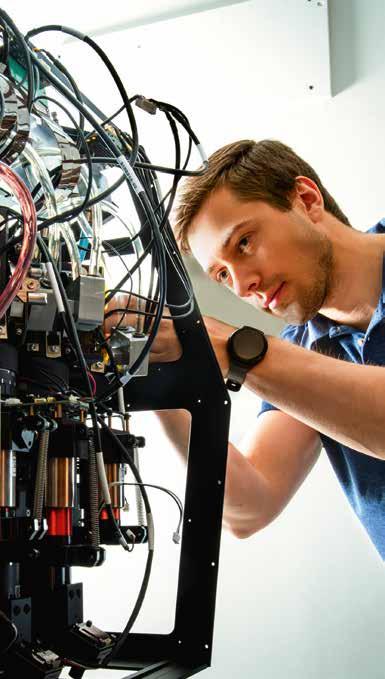
Partner with the leader in industrial DLP Sub-Systems
The UV imaging copilot for your next breakthrough
Co-engineering from day one
Support from prototype to industrial-scale systems
Custom, tailor-made optics with own production
From small-batch to mass production - high repeatability
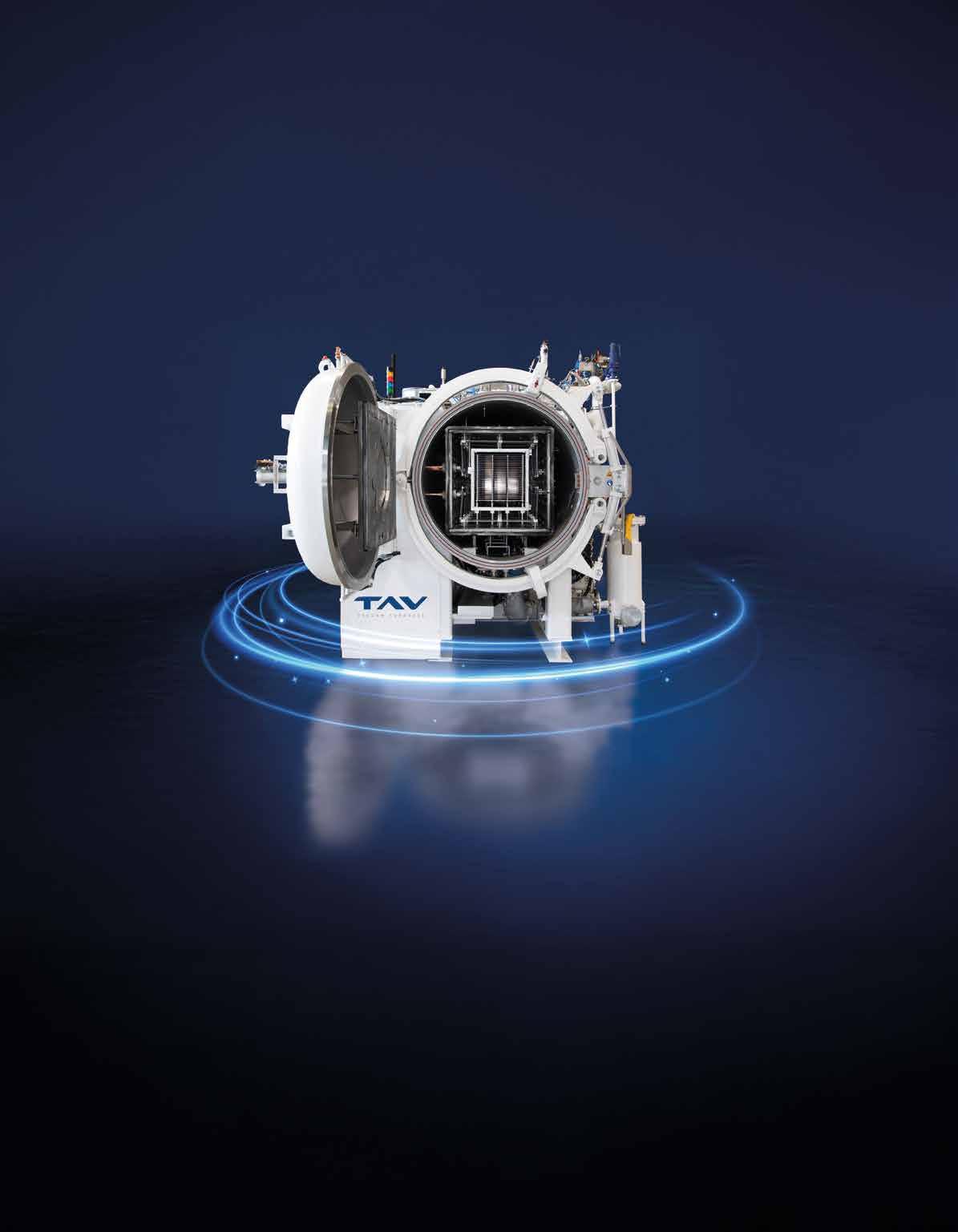
Ipsen USA’s Vacuum Technology Excellence Center, located in Cherry Valley, Illinois, USA, has announced the shipment of fourteen new vacuum furnaces between February 26 and March 31, 2026. This record achievement comes as Ipsen reports a strong first quarter for new orders, with Q1 bookings for vacuum furnaces and related services exceeding $52 million.
“Orders in 2026 have been exceptional for Ipsen, both in volume and in the diversity of customers we are supporting,” said Matt Clinite, Vice President of Sales. “We have made substantial investments in our facilities, equipment, and people, and we are seeing those investments pay off in our ability to serve customers effectively.”
Recent shipments demonstrate broad demand across key markets, including aerospace, energy, and commercial heat treating. The furnaces shipped included a mix of Ipsen’s TITAN platform, MetalMaster, TurboTreater, and vacuum aluminium brazing technologies. During the first quarter, Ipsen shipped furnaces across North America, Latin America and Asia, supporting a wide range of industrial applications.
“Across industries, customers continue to rely on Ipsen for highperformance equipment backed by responsive, dependable service,” said Clinite. “Strong bookings for both new furnace systems and aftermarket support are a testament to that trust.”
Ipsen stated that continued investment in engineering, service and manufacturing capabilities will support demand. Ipsen expects ongoing demand in the energy and aerospace markets to carry this momentum through the remainder of 2026.
www.ipsenglobal.com
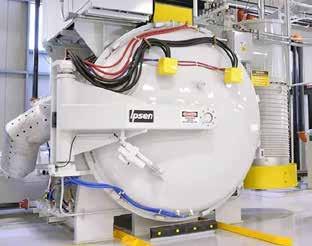
Ipsen USA’s Vacuum Technology Excellence Center shipped 14 new vacuum furnaces between February 26 and March 31, 2026 (Courtesy Ipsen)
The European Additive Manufacturing Defence Network (AMDefNet) has officially launched. The organisation aims to support the development of a coordinated European strategy for Additive Manufacturing in defence and security.
creating images – together
The association seeks to address what it describes as a fragmented landscape of AM initiatives across Europe. Whilst numerous organisations are active in the field, these are typically industry-focused and limited to national or regional efforts. AMDefNet aims to consolidate these activities at a European level and
promote broader collaboration between stakeholders.
“We must ensure that we work together more effectively in Europe,” it was stated. “There are many strong initiatives to make Additive Manufacturing available to the armed forces, but these are often limited to national efforts rather than coordinated European action.”
AMDefNet’s goal is to enable Europe to leverage AM to strengthen technological sovereignty, resilience, and operational capability within the defence and security sectors.
www.amdefnet.eu
Gevorkyan as, headquartered in Vlkanová, Slovakia, has announced the successful completion of an Accelerated Book-Build (ABB) share offering. Through the ABB, the company obtained capital to develop its production capacities and technologies, as well as to strengthen its position in the international market.
In line with these objectives, the funds raised will be allocated, in part, to fund the recently completed acquisition in Italy. At the same time, through the ABB, the company reportedly increased its free float on the Prague Stock Exchange, which had been recommended by advisors as a necessary condition to increase liquidity.
“We consider an ABB to be a logical step for a company that is already listed on the stock exchange,
with the aim of supporting business development and thereby increasing value for investors,” stated Dipl-Ing Artur Gevorkyan, Chairman of the Gevorkyan Board of Directors. “Once a company decides to enter the stock market through an IPO, it is logical that over time it will also carry out a secondary offering.”
“In our case,” he continued, “we did not want to take such a significant step before an opportunity for a strategic acquisition arose. We had already announced the acquisition of a factory in Bologna, with the key difference compared to previous acquisitions in Sweden and Poland being the preservation of production and the expansion of business in Italy, including projects for the local defence industry. Work on this acquisition lasted almost two years, until

Gevorkyan has raised funds through an Accelerated Book-Build share offering (Courtesy Gevorkyan as)
an agreement was reached among all parties involved in the process.”
Informing potential customers about the expansion of operations in the Italian market has reportedly helped Gevorkyan win new projects. Within these are multinational companies looking to localise their supplier networks and transfer projects from their Italian factories to Gevorkyan. www.gevorkyan.eu


Tethon 3D, based in Omaha, Nebraska, USA, has acquired a portfolio of intellectual property assets that are intended to expand the company’s capabilities in advanced materials and technical ceramics.
The portfolio includes patents and enabling technologies originally developed by Fortify, a venture-backed materials company focused on high-performance composite and dielectric materials.
Tethon and Fortify previously collaborated as industry partners exploring advanced materials and next-generation manufacturing technologies.
The acquired technologies include innovations in anisotropic composite structures and advanced material processing methods that enable high-performance RF, microwave, and mmWave components. These materials support the precision fabrication of dielectric structures used in demanding applications, including radar systems, satellite
Prodways Group, a Groupe Gorgé company headquartered in Paris, France, has signed a sale agreement
Prodways Group has signed a sale agreement for its Software business AvenAo (Courtesy Prodways Group)
communications, advanced electronics, and next-generation wireless infrastructure.
“This acquisition is part of a broader strategy to build the leading advanced materials platform in our industry,” said Trent Allen, CEO of Tethon 3D. “We are focused on identifying and integrating technologies that enhance our ability to develop and scale high-performance ceramic materials for real production environments.”
“Fortify developed compelling technologies around high-performance composite materials,” Allen added. “Having collaborated with their team previously, we see significant opportunity to build on this work and integrate these innovations into Tethon’s advanced technical ceramics capabilities.”
Tethon states that it will continue to invest in proprietary materials, process development, and manufacturing capability with a focus on applications where technical performance and reliability matter most. By adding these technologies, the company is further expanding its technical foundation in highperformance ceramics and advanced materials systems.
www.tethon3d.com
for its Software business, led by its subsidiary AvenAo. The company stated that the transaction is fully in line with the strategy announced in 2025 to divest the activities of the Systems division. The identity of the buyer has not yet been named.
AvenAo supports industrial companies in their digital transformation by offering solutions tailored to each stage of the product lifecycle. In 2025, AvenAo contributed €13.5 million in revenue and €3.9 million in recurring EBITDA to Prodways Group.
The sale agreement values the shares in the Software business at €35 million. This transaction, reportedly completed at a valuation exceeding Prodways Group’s market capitalisation at the last closing price, reflects the valuation of this
additively manufactured ceramic GRIN lens produced on the FLUX CORE machine with High Purity Alumina (99.8%) (HP-A 98) resin (Courtesy Tethon 3D)
device produced by Fortify (Courtesy Tethon 3D)
activity for Prodways Group shareholders, states the company.
The final completion of the transaction remains subject to the lifting of several conditions precedent, including obtaining the agreement of a strategic business partner, as well as the approval of the sale by the General Meeting of Shareholders of Prodways Group, which will be convened shortly. Subject to the fulfilment of these conditions, the transaction could be completed in the coming months.
Subject to approval of the transaction, the company intends to distribute a significant portion of the disposal proceeds to its shareholders. The precise terms of this redistribution, as well as the amount concerned, will be determined by the Board of Directors. www.prodways-group.com
Discover high-precision metal components for aerospace applications, manufactured using Metal Injection Molding (MIM).
MIM enables complex geometries, weight reduction, and outstanding material consistency − making it ideal for aircraft interiors, actuation systems, housings, and functional components.
Our solutions deliver tight tolerances, consistent quality, and scalable production, meeting the demanding requirements of aviation environments.

VISIT US AT: Farnborough International AirShow 2026, July 20-24 | Farnborough, UK Booth 340 | Hall 0
SCHUNK SINTERMETALLTECHNIK GMBH
� Roßtrappenstraße 62 06502 Thale | Germany
� +49 3947 7 1560
At thorsten.klein@schunk-group.com � schunk-mobility.com
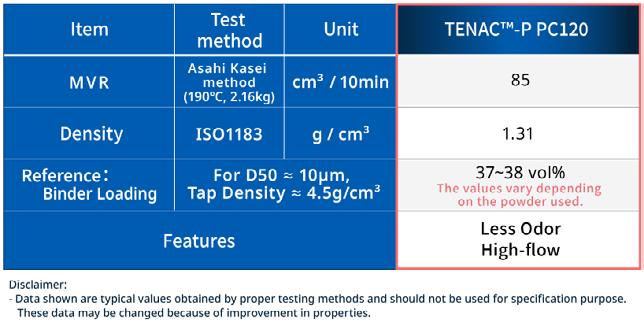
Asahi Kasei Corporation, headquartered in Tokyo, Japan, has introduced a new grade of its TENAC polyacetal (POM) material developed for use as an all-in-one binder in Powder Injection Moulding applications.
The new grade, TENAC-P PC120, is designed for catalytic debinding and is reported to offer outstanding
flowability, whilst maintaining the inherent mechanical properties of POM. This is said to make it ideal for moulding complex components, and is particularly effective for thin-walled, small, or multi-cavity moulded parts.
According to the company, feedstock is prepared by mixing metal powder with TENAC-P PC120,
LÖMI GmbH, based in Grossostheim, Germany, is marking thirty-five years supplying Powder Injection Moulding and metal Additive Manufacturing debinding systems. Since it was founded in 1991, the company has developed its activities in solvent handling technologies,
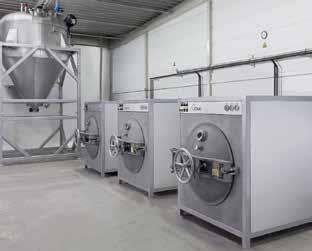
LÖMI is marking thirty-five years supplying PIM and metal AM industries (Courtesy LÖMI GmbH)
with a focus on systems designed for industrial processing environments. Today, LÖMI focuses on ATEXcertified equipment for the safe handling and recovery of solvents, supporting applications where regulatory compliance and process control are required.
Its technology is used in industries including Additive Manufacturing and Powder Injection Moulding technologies such as Metal Injection Moulding and Ceramic Injection Moulding, where solvent debinding is a key stage in component production.
The company offers the following ranges:
Powder Injection Moulding
• EDA – for small series; combines debinding, vacuum drying and solvent recovery
resulting in simplified compounding and ensuring excellent handling characteristics. It is also stated to offer low odour during the injection moulding process.
Asahi Kasei is a global polymer materials provider with more than 50,000 employees. The company provides solutions through its three core business sectors of Health Care, Homes, and Material. In addition to TENAC-P PC120, it offers TENAC-P PT120 suitable for thermal debinding processes.
www.asahi-kasei-plastics.com
• EBA/MDA – for medium-tolarge series; EBA models alongside MDA solvent recovery systems
• EBA-E – debinding systems with special process chamber geometry and adapted loading trays, compatible with Elnik Systems’ MIM 3000 sinter furnace series
• EBA-W – debinding systems with a water extraction process for special feedstocks; they feature a horizontal vessel in a compact housing
• EDA-AM – solvent debinding for industrial Additive Manufacturing
LÖMI attributes its long-term development to collaboration with customers and industry partners, and indicates it will continue to focus on process engineering solutions for solvent-based applications. www.loemi.com

Regardless of the complexity of your custom application and formulation, it remains standard for us with our quality systems, technical support, and two proprietary binding systems.
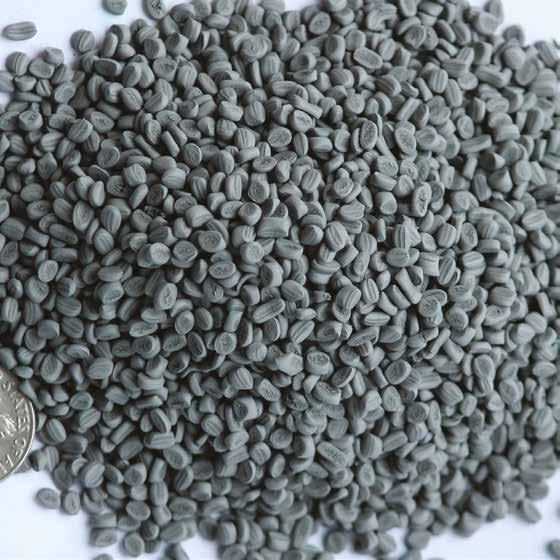
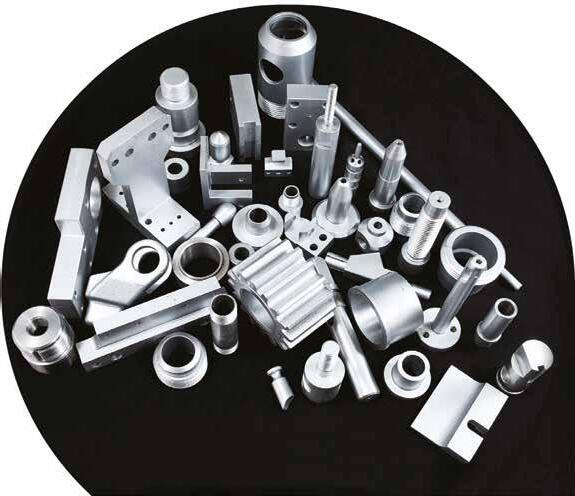
We ensure 100% batch-to-batch consistency, a wide range of alloys, and 36 years of supplying MIM feedstocks for mission-critical parts.
Advanced Metalworking Practices (AMP) manufactures and supplies a wide range of both standard and custom-configured MIM feedstocks for your application. Contact Chris Chapman at cchapman@ampmim.com or 724-396-3663.
Scan the QR code or click here to view our current list of alloys www.ampmim.com/resources




LightForce Orthodontics, based in Wilmington, Massachusetts, USA, has launched its LightBracket Metal, an additively manufactured patientspecific metal bracket for use in the company’s Generative Braces range.
According to LightForce, its Generative Braces are a new category of orthodontic care in which every appliance is generated from the individual treatment plan. Rather than relying on standardised appliances, each bracket is custom-generated and manufactured for a specific patient and tooth.
“For more than a century, orthodontics relied on a stock bracket for patients who were never stock. LightBracket Metal changes the order of things. We’re giving doctors the most exact instrument they’ve ever had for the work they were born to do,” stated Alfred Griffin, founder and CEO of LightForce Orthodontics.
LightBracket Metal is produced using a proprietary metal AM process. Each bracket is custom -
ised across multiple parameters, including base geometry, slot height, slot prescription, bracket position, tie wings and hooks. The bracket base is designed to conform to the morphology of the individual tooth. The company states that a lower-profile design, combined with patient-specific tie-wing and hook features, is intended to improve comfort and reduce debond rates.
Algorithmically generated indirect bonding trays are also used to support delegated clinical workflows.
“In my practice, I care deeply about providing individualised care for my patients. With LightBracket Metal, I am now able to provide that level of care with a patient-specific metal bracket system that is generated from my digital treatment plan,” stated Dr Jacquee Schieck at Schieck Orthodontics.
LightForce’s earlier ceramic bracket system is reported to have resulted in up to 60% fewer appointments and 43% shorter treatment
HP Additive Manufacturing and AMES, Barcelona, Spain, have announced that they have strengthened their collaboration following a recent visit to AMES’ facilities, where both parties reviewed their joint business roadmap and ongoing development activities.
The visit comes as AMES, a specialist in Powder Metallurgy components, has invested in a new batch sintering furnace designed specifically for Binder Jetting (BJT) Additive Manufacturing parts. The addition is expected to expand the company’s production capacity and support further adoption of HP’s Metal Jet technology.
With the new furnace in place, AMES aims to increase throughput
of metal Additive Manufacturing components and support serial production applications. The company is positioning itself as a contract manufacturer for HP Metal Jet technology within the region.
“With this added capacity, AMES and HP are pushing forward scalable Additive Manufacturing, delivering production-ready parts, and enabling new industrial applications across multiple sectors,” stated Alejandra de la Hija, Applications Engineer – 3D Metal Printing, HP.
The partnership between HP and AMES is also expected to explore new applications enabled by BJT Additive Manufacturing,
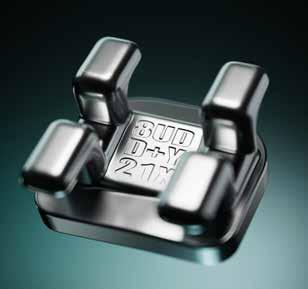
LightForce has introduced the additively manufactured LightBracket Metal (Courtesy LightForce Orthodontics)
times than conventional braces. With the introduction of LightBracket Metal, the company aims to extend these benefits to a wider segment of the $4.7 billion market that chooses metal.
James Lawton, LightForce Orthodontics President, added, “For decades, every patient got the same bracket. That ends now. We are accelerating toward a future where the very idea of a universal, one-size-fitsall bracket is unthinkable.”
www.lf.co
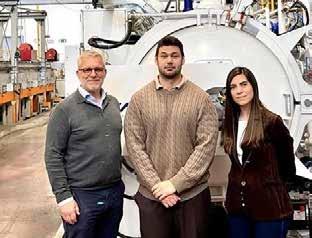
HP’s Alexandre Tartas, Global Head of Sales and GTM Metal 3D Printing (left) and Alejandra de la Hija, Applications Engineer 3D Metal Printing (right) with AMES’ Diego Torres, New Product Development Project Manager (centre) at the AMES facility (Courtesy Alejandra de la Hija)
particularly where high-volume production is required. www.ames-sintering.com www.hp.com
PTI Tech, headquartered in Clifton, New Jersey, USA, has received a Gold Tier Award from BAE Systems’ Partner 2 Win programme. The award recognises PTI Tech’s contributions to BAE Systems’ Electronic Systems sector supply chain in 2025.
Michael Wiseman, Business Development Manager, PTI Tech, shared, “Receiving this recognition from BAE Systems is a testament to our team’s focus on precision, performance, and reliability in support of mission-critical defence applications. We are proud to play a role in strengthening the supply chain that supports our warfighters.”
BAE Systems’ Partner 2 Win programme aims to improve operational efficiency and reduce
inefficiencies in its supply chain by raising the bar of performance expectations to meet the demands of current and future customers. As part of the programme, BAE Systems meets regularly with its suppliers to transfer best practices and ensure the components and materials that make up its products meet the highest quality standards.
Jennica Dearborn, Vice President of Operations for BAE Systems’ Electronic Systems sector, stated, “Without the demonstrated commitment to operational excellence from our supplier partners, we would not be able to deliver for our customers. Their collaborative support and dedication has been critical to overcoming chal -
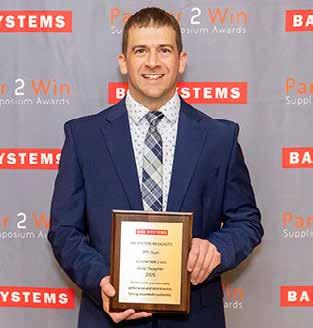
Mike Wiseman, PTI Tech’s Business Development Manager, accepted the BAE Systems Gold Tier supplier award (Courtesy PTI Tech)
lenges and achieving new levels of performance, scale, quality, and innovation for our customers. We look forward to continued partnership.” www.pti.tech www.baesystems.com
Max Power Life Sciences GmbH, based in Friesenheim, Germany, has showcased its Additive Manufacturing of pliers handles, produced for Hartmann using metal Binder Jetting. The handles are manufactured from 17-4PH stainless steel, which offers tensile strength of over 1,200 N/mm 2
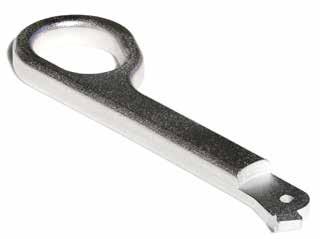
Handle of a Hartmann pair of pliers produced using metal Binder Jetting. Approximately 40% weight reduction was achieved. (Courtesy Max Power Life Sciences GmbH)
The process enables the handle to be hollow whilst maintaining mechanical strength.
The reduced weight of the Hartmann pliers results in better ergonomics for users. The company states that this is especially beneficial in surgical environments, where precision and handling are crucial. Metal Binder Jetting opens up new opportunities for optimised instruments.
Max Power Life Sciences GmbH uses metal Binder Jetting to develop and manufacture metal components for the life sciences industry. It specialises in the production of medical components made from stainless steel grades, specifically 1.4542 (17-4PH) and 1.4404 (316L).
Many surgical instruments have complex geometries that are difficult to manufacture using conventional
Ceratizit, part of the Plansee Group and headquartered in Mamer, Luxembourg, reports that its tungsten supply chain, based predominantly on recycled feedstock, gives the company control over key manufacturing steps and reduces reliance on short-term market fluctuations.
Ceratizit manages a fully integrated value chain, from tungsten powder to finished tools. A key factor is said to be a material feedstock that is independent of a single main source, such as China. The company operates a circular economy approach, and stated that it achieved a 91% recycling rate for tungsten in the 2024/25 fiscal year. This not only reduces the company’s dependence on primary raw materials, but also its carbon footprint.
Recycling and repurchase play a central role, Ceratizit states, because tungsten can be recycled
repeatedly when the right infrastructure is in place. The company systematically collects tungsten scrap and processes it using advanced recycling technologies at Global Tungsten & Powders (GTP) (a Ceratizit Group entity) in the USA and Finland. Processing tungsten scrap at GTP in the US also yields a cobalt- containing sludge that is further refined and used in GTP’s tungsten carbide powder production. The company states that this closedloop approach eliminates reliance on external supply. Stadler Raw Materials, a tungsten scrap collector belonging to the Ceratizit Group, is also integral to this process. In addition to recycling, long - term offtake agreements in mining projects and strategic investments reportedly secure access to some of the largest tungsten resources outside China, for example the Plansee Group is the largest single
methods. Additive Manufacturing allows components to be designed with optimised function, for example, with integrated structures for weight reduction or improved ergonomics. AM enables the integration of multiple functions into a single component. This allows for the reduction of assemblies, minimised assembly effort, and the development of new instrument concepts.
Metal Binder Jetting is ideally suited for the early stages of product development. Prototypes can be quickly produced and iteratively improved without the need for expensive tooling. For specialised surgical instruments or innovative product concepts, demand is often too low for traditional mass production. The company states that metal Binder Jetting enables cost-effective production for small- to medium-sized batch volumes, reportedly up to 100,000 units per year depending on component size.
www.maxpowerls.com
shareholder in Almonty, which operates the Sangdong mine in South Korea. All concentrates received from the mine are then processed into tungsten powder at GTP.
Andreas Lackner, Member of the Ceratizit Group Executive Board, shared, “Our integrated and recycling-driven supply chain gives customers long-term security in an unpredictable world. By combining strategic investments with one of the industry’s highest tungsten recycling rates, we ensure reliable access to critical raw material supply that is conflict-free and not dependent on supply from China, whilst reducing our environmental impact.”
Ceratizit provides product carbon footprints (PCF) in accordance with VDMA 35111 and ISO 14067. Furthermore, the company states that it is committed to clear decarbonisation targets, validated by the Science Based Targets initiative (SBTi).
www.globaltungsten.com www.ceratizit.com
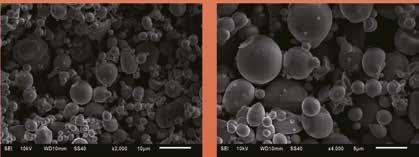
Seco/Warwick, headquartered in Świebodzin, Poland, is celebrating 35 years as a supplier of heat treatment and vacuum metallurgy technology. The company traces its origins to 1991, when Seco/ Warwick Ltd was established through a partnership between Polish engineers associated with Lubuskie Termotechnical Works Elterma and the US-based Seco/ Warwick.
Prior to the formation of Seco/ Warwick Ltd, engineers who had previously worked at Elterma established Trans-Vac, where the first vacuum furnace was reportedly built in an adapted stable in Wilkowo. Contact with representatives of the US-based Seco/ Warwick organisation led to the establishment of the joint company on June 1, 1991.
“In the beginning, we primarily had expertise, courage, and tremendous determination,” stated Andrzej Zawistowski, founder of Seco/ Warwick. “We operated in a Poland that was beginning to learn a new economic system, and yet we managed to build technology that attracted a partner from the United States. That was a turning point, but what happened later is even more remarkable. This story didn’t end with cooperation with America. We reached a point where it was the Poles who bought the American company. It sounds symbolic, but it best reflects the scale of the journey we’ve made.”
Seco/Warwick combines US industrial heritage, originating from the Sunbeam Equipment Corporation and Warwick Furnace Company in Meadville,
Pennsylvania, with Polish engineering expertise developed through Elterma. Elterma formally joined the Group in 2003, adding capabilities in atmosphere and aluminium heat treatment technologies.
Over the past three decades, the group has expanded through organic growth and acquisitions in Poland, the USA, Germany, China and India. Among its notable acquisitions was the purchase of CAMLAW Ltd’s intellectual property, including Continuous Aluminium Brazing (CAB) technology, in 2002. The acquisition of Retech further expanded the Group’s presence in vacuum metallurgy and titanium melting technologies.
The company reports that it has delivered more than 5,000 systems worldwide and employs over 900 people. Seco/Warwick has been listed on the Warsaw Stock Exchange since 2007.
www.secowarwick.com

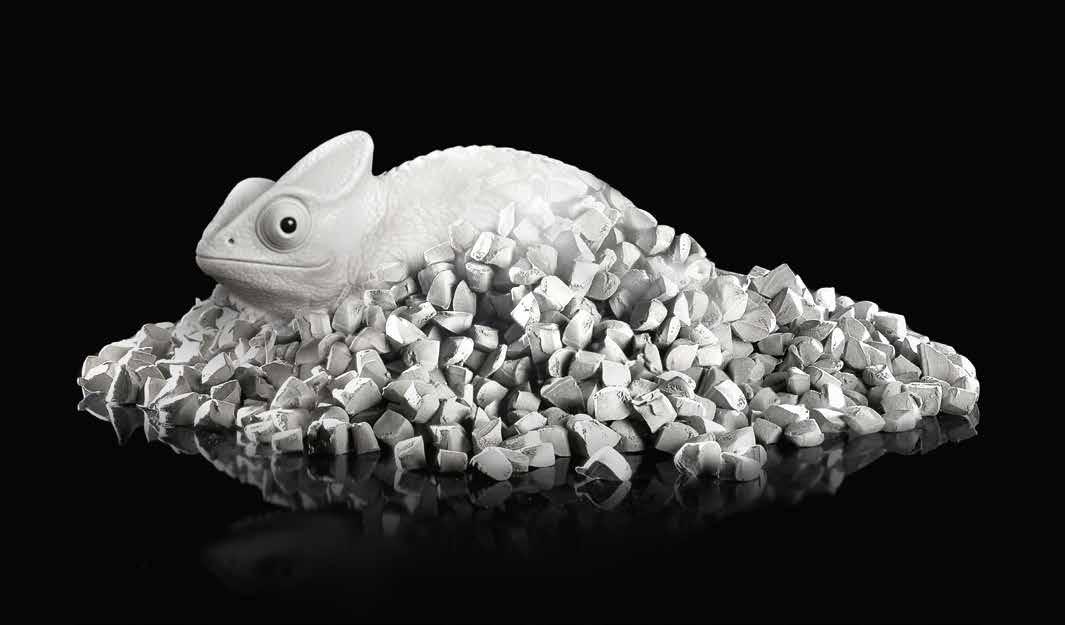
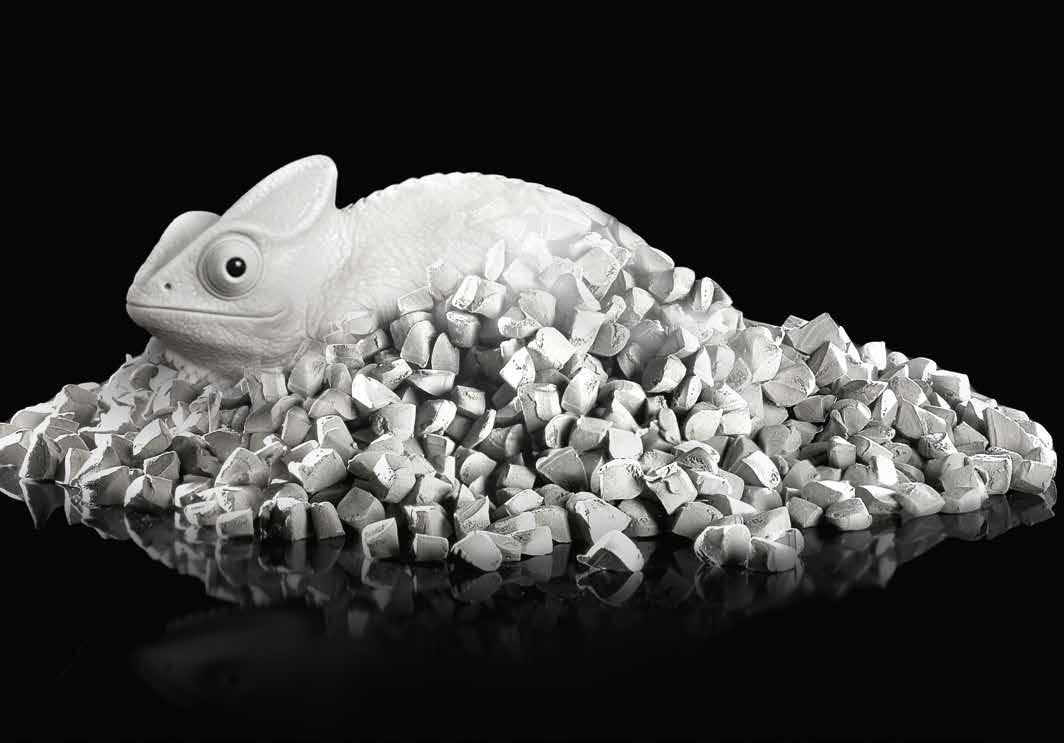
ExOne Global Holdings has announced that it has begun manufacturing Spectra Mono-Z printheads for its Binder Jetting (BJT) Additive Manufacturing machines near Detroit in Canton, Michigan, USA.
According to the company, this decision is the first step in a longerterm programme to bring additional major subsystems into US production. According to ExOne, the move supports supply-chain resilience and aims to reduce reliance on international component sourcing for customers in the defence, aerospace, automotive, energy, and foundry sectors. Customers using legacy Polaris printhead systems will continue to receive support, with a defined migration path available.
Alongside domestic printhead production, the spring 2026 updates include:
• A Detroit-based parts inventory, sized to current demand and designed to scale with the installed base, intended to reduce lead times for spare parts and consumables
• A transparent annual price list, inclusive of applicable tariffs and freight to Detroit, providing more predictable total cost of ownership
• A refreshed three-tier maintenance programme (Essentials, Recommended, and Enterprise), designed to support both singlemachine users and larger fleet operators; the Recommended tier has been repriced lower year-on-year, with custom pricing available for fleet customers
• Free 24/7 live phone support for all ExOne customers, complementing free remote support introduced following the company’s change of ownership in 2025
“These updates are a direct response to recent customer feedback around domestic supply, expedited parts access, predictable pricing, and support they can
count on,” stated Mike Dougherty, Managing Director of Americas, ExOne Global Holdings. “Initiating printhead production in Detroit is the first step in our broader US manufacturing buildout, and it reflects the long-term commitment we’re making to our customers and to American industrial infrastructure.”
www.exone.com
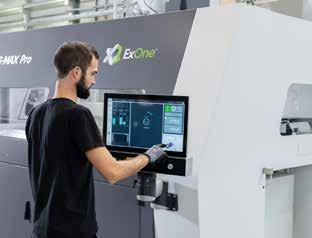
ExOne has begun manufacturing Spectra Mono-Z printheads for its Binder Jetting Additive Manufacturing machines near Detroit (Courtesy ExOne)
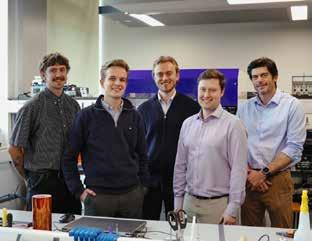
Hydra Manufacturing, based in Leeds, UK, has raised £320,000 in funding led by SFC Capital to accelerate the commercialisation of its advanced ceramic Additive Manufacturing technology.
A University of Leeds spin-out, Hydra Manufacturing was founded in 2024 by a team of engineers with more than 35 years’ combined experience in digital fabrication and advanced manufacturing. The company specialises in productiongrade ceramic manufacturing using conventional ceramic feedstocks. Its technology is reportedly intended to bridge the gap between prototyping and scalable part production, enabling manufacturers to integrate advanced ceramic capability directly into their facilities.
The investment will support continued technology development, commercial deployment and team expansion as Hydra grows its presence in high-performance engineering sectors.
The latest equity investment follows earlier grant support from Innovate UK through the Advanced Machinery & Productivity Institute (AMPI), bringing total funding secured to approximately £577,000.
Louis Masters, CEO of Hydra Manufacturing, shared, “This funding marks an important step for Hydra. We have developed a process that enables production-grade ceramic manufacturing in a way that is more commercially viable and accessible. With SFC Capital’s backing, we are accelerating our next phase of growth and expanding our reach
across advanced engineering
Adam Beveridge, Principal at SFC Capital, stated, “Advanced ceramics are critical to highperformance engineering, but scaling production has always been the bottleneck. Louis and the Hydra team have built a system that moves ceramics from prototyping into real manufacturing. We are proud to back them.”

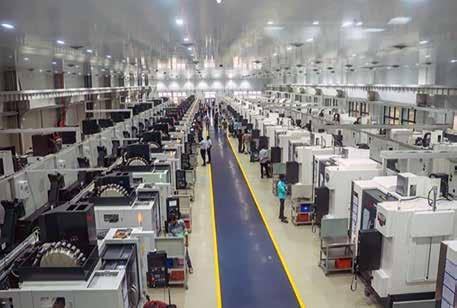
INDO-MIM, headquartered in Bengaluru, India, has opened its Advanced Machining Division, located within a 16 - acre manufacturing campus at SIPCOT Industrial Park, Vallam Kandigai, Tamil Nadu, India. The new facility marks an expansion of the company’s manufacturing capacity, designed to enhance control, scalability, and responsiveness for its global customers.
Advanced processes, such as Metal Injection Moulding, have transformed the production of complex, high - volume components. However, certain applications demand capabilities beyond moulding, particularly where ultra - tight tolerances, superior surface finishes, flexible production volumes, or extensive post- processing are required.
The new machining division has been established with the intention of meeting these needs. Rather than operating in isolation, it complements INDO - MIM’s existing capabilities, enabling customers to access end - to - end manufacturing solutions under one roof, from rapid prototyping to serial production.
Equipped with advanced multi - axis CNC machining centres, the facility supports precision milling and turning across a wide range of geometries and materials. The scale of the campus allows for optimised workflows, segregation of critical processes, and future capacity expansion.
The machining division includes sub - assembly capabilities, such as brazing, laser welding, riveting, and other joining processes, allowing delivery of ready - to - use assemblies rather than individual parts.
Advanced finishing services, such as plastic and silicone over - moulding, laser marking, and pad printing, further address both functional and aesthetic requirements, particularly in regulated or customer - facing applications.
www.indo-mim.com
its

Researchers from the National Taiwan University, Taipei, have published research in Additive Manufacturing focused on the development of a flowable suspension for ceramic Additive Manufacturing that reportedly produces components with low shrinkage and near-full density.
Whilst Vat Photopolymerisation (VPP) Additive Manufacturing may expand the use of ceramics in manufacturing, the resultant properties are often not suitable for highprecision components due to high shrinkage during sintering and insufficient density.
In ‘Ultralow-shrinkage ceramic fabrication via three-dimensional printing of high-solid-loading suspensions’, the researchers formulated ultrahigh-solid-loading suspensions containing silica up to 83.0 vol % with superior flowability (<50 Pa.s).
A systematic optimisation of suspen -
sion composition was established, integrating Hansen solubility parameters (HSP), a viscosity model, and the Scott equation. HSP guides the enhancement of particle-resin compatibility to maximise solid loading, whilst the viscosity model predicts optimal particle size distribution for minimised viscosity at 83.0 vol % loading.
Despite the extremely limited resin matrix, the researchers stated that TMPTA reinforcement effectively increased the tensile strength of green parts beyond the viscous peel stress. The critical issue of negative curing width and excessive curing depth in ultrahigh-solid-loading suspensions was mitigated by introducing 1.60 wt% UV-absorber, which reduced curing depth at the widthcritical energy dose and enabled fine-feature Additive Manufacturing with low dimensional deviation (<6 %).
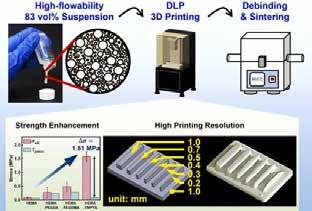
The study highlights a VPP process to produce sintered ceramics that show ultralow isotropic shrinkage (<6.5%) and 100% density (Courtesy https://doi.org/10.1016/j. addma.2025.105051)
The optimised 83 vol % suspension was noted to have achieved the sintered ceramics with ultralow isotropic volumetric shrinkage (<6.5 %) and nearly full densification (~100% relative density). The resulting ceramic air penetrator reportedly retained intricate architectures with high fidelity and dense microstructures. www.ntu.edu.tw
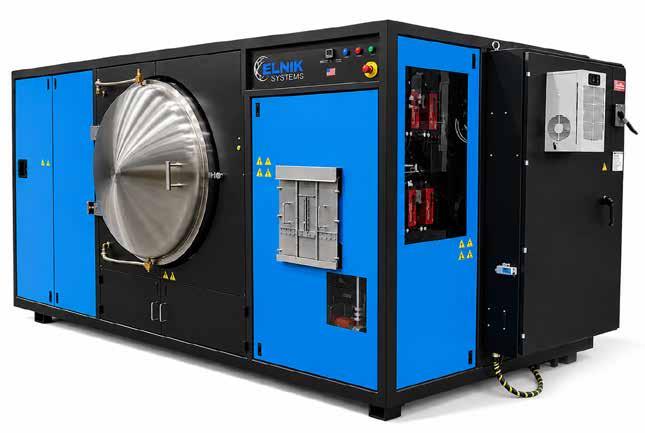
Elnik Systems, LLC, Pineville, North Carolina, USA, has shared a case study detailing how Nichols Portland Inc (NPI), headquartered in St Mary’s, Pennsylvania, is utilising sintering technology from Elnik and DSH Technologies, Cedar Grove, New Jersey, to overcome fabrication challenges.
Softer metals, such as copper, are typically sintered at 750–1,000°C, whilst harder metals such as titanium and stainless-steel sinter between 1,150–1,400°C. The range matters, especially when it comes to design, shrinkage, and component intention. These factors present a challenge requiring a solution that is simple, scalable and reliable.
NPI Director of Engineering, David Smith, shared, “Each metal - whether MIM or AM - could require unique sintering recipes for densification, plus an industrial furnace capable of handling varying temperatures and atmospheric controls. I’ve worked with several furnace types and encountered failures due to capacity constraints or temperature nonuniformity.”
NPI currently operates four industrial furnaces and several catalytic debind units at its St Mary’s location. Each furnace is equipped with a gas plenum retort for superior gas distribution, AccuTemp + Offset Manager and either a graphite or allmetal hot zones and retorts. NPI also partners with DSH Technologies for troubleshooting, recipe development, training, and research.
“As a contract manufacturer, we are introduced to new engineering challenges every day and are asked to push the limits on behalf of our customers. We thrive on this pressure, but we also acknowledge how valuable it is to have reliable partners that can fill the knowledge gaps,” Smith shares the unique challenges that come with scaling the business. “We lean on Elnik
Systems and DSH Technologies with confidence to support our toughest metallurgy, process control, and sintering challenges.”
With Elnik’s full debind and sinter portfolio, NPI advances its sintered metals division for high-volume production of complex shapes that would otherwise require costly machining and added resources. Compared to alternative metalworking technologies, sintered metals reportedly achieve superior tolerances with surface finishes that the automotive, agricultural, and commercial markets have come to expect and rely on. This includes applications such as cylinder liners, camshaft assemblies, gears, rotors, and other high-volume components in industrial equipment.
NPI continues to scale its business using Elnik equipment and the confidence that comes with reliable, repeatable technology. “To keep costs manageable for clients, NPI must be highly attentive to every stage of the process - and incorrect sintering can have a significant impact on the bottom line,” Smith shared. “Sintering is a major cost consideration, and
if we experience furnace issues, we are at risk of losing an entire batch. The benefit of Elnik Systems’ molybdenum furnace is a clean, controlled, and monitored environment that steadily produces when we need it most.”
DSH Technologies reportedly enables NPI to reduce the time required for new project investigations and uncover new applications in untapped markets. Most notably, meeting AMS 2750 standards for aerospace alloys or advancing opportunities in the medical device or implant markets.
DSH Technologies, led by Chief Metallurgist Bryan Sherman, also remains a steady partner for education and training for NPI’s engineering staff and for external customer engagements.
Smith added, “Regardless of the metallurgy resources available on staff, there is a lot of tribal knowledge and information that can be taken for granted. Bryan at DSH Technologies was excellent at reducing the learning curve for us and instrumental in developing new recipes and troubleshooting existing ones. There is a strong relationship between NPI and DSH - we consider them an extension of our business.” www.elnik.com www.dshtech.com www.nicholsportlandinc.com
The WiAssist app from the Wittmann Group now includes a module that calculates the material’s dwell time inside the plasticising unit, aimed at simplifying the selection of the screw size and optimising injection moulding machine settings.
The WiAssist app is intended to support machine setters and process engineers working with its injection moulding systems, reducing the need for manual calculations. WiAssist provides a material database which allows users to input material type, shot weight and cycle time. Based on these inputs, the app calculates key process parameters such as cooling time, internal mould pressure, injection pressure and screw speed.
At the core of the update is a new function that calculates the material’s dwell time inside the plasticising unit. According to Wittmann, this enables users to determine suitable machine

settings and screw configurations in less than one minute. This calculation is intended to support the selection of an appropriate injection moulding machine, particularly in environments where multiple machines with different screw sizes are available.
The plasticising module is designed for use with three-zone screws from the Wittmann Group. It provides recommendations on screw diameter and metering stroke, alongside a visual display indicating whether selected parameters fall within optimal, partially suitable or unsuitable ranges.
Correct sizing of the plasticising unit is important, as screw dimensions directly influence both part quality and processing efficiency. A screw that is too small can result in insufficient melting due to reduced dwell time, whilst an oversized screw may increase dwell time and risk

WiAssist will has added a plasticising module as part of its latest update (Courtesy Wittmann Group)
thermal degradation of the material. In addition to the new module, the WiAssist app includes functions for querying material properties, calculating process parameters, assisting with machine selection and setup, troubleshooting, and contacting Wittmann.
The troubleshooting feature provides a database of common injection moulding defects, along with possible causes and suggested solutions. Users can also contact Wittmann directly via email or telephone through the app.
www.wittmann-group.com










Researchers from the Air Force Research Laboratory, Dayton, Ohio, USA, have published research in npj Advanced Manufacturing focused on the effect of carbon-fibre reinforcement and sintering temperature on the component properties of additively manufactured components.
In the research, two aqueous zirconium diboride (ZrB2) inks, one monolithic and one reinforced with 11 vol % milled carbon fibre, were developed for use with Material Extrusion (MEX) Additive Manufacturing.
According to researchers, both materials exhibited nearly identical shear-thinning, yield-stress rheological profiles, allowing for consistent printing parameters.
Three pressureless sintering temperatures (1,850°C, 1,950°C, and 2,150°C) were investigated to understand their effect on density, mechanical properties, and thermooxidative performance (thermal shock and oxidation resistance). Increasing sintering temperature generally increased the density of both monolithic and carbon fibre-reinforced components, though the latter consistently reported lower densities.
As reported in the paper, mechanical testing revealed that at lower tested sintering temperatures, monolithic samples had higher flexural strengths due to greater density, whilst carbon fibre reinforcement improved Weibull modulus, indicating enhanced reliability. At 2,150°C, both material types showed high Weibull moduli and similar flexural strengths, attributed by the researchers to microstructural changes such as carbon fibre degradation.
Carbon fibre reinforcement was said to have significantly improved thermal shock resistance during oxyacetylene torch testing to simulate a representative extreme environment. The 1,850°C carbon fibre-reinforced build survived the test whilst the monolithic counterpart cracked instantly. Additionally, the carbon fibre-reinforced samples maintained
oxide scale adherence, unlike the monolithic ZrB2 which experienced severe oxide scale cracking and spallation. This improved oxidative performance was attributed to fibre-like pores formed by carbon fibre oxidation within the oxide scale, accommodating volume contraction of zirconia (ZrO 2).
The paper, ‘Effect of carbon fibre reinforcement and sintering
temperature on mechanical properties, thermal shock resistance, and oxidation behaviour of zirconium diboride formed via material extrusion Additive Manufacturing,’ aims to present a rapid, low-cost method for developing near-net shapes of carbon fibre-reinforced ZrB 2 with survivability in extreme environments, whilst offering insights into how carbon fibre incorporation and sintering temperature affect the resulting ceramic properties.
www.afrl.af.mil

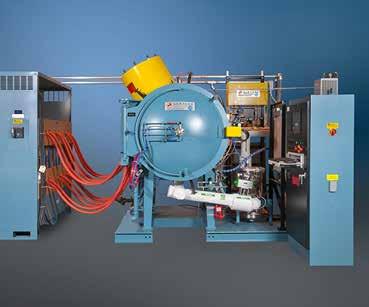
Over 6,500 production and laboratory furnaces manufactured since 1954
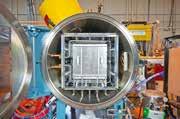
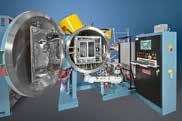
• Metal or graphite hot zones
• Processes all binders and feedstocks
• Sizes from 8.5 to 340 liters (0.3–12 cu ft.)
• Pressures from 10-6 torr to 750 torr
• Vacuum, Ar, N2 and H2
• Max possible temperature 3,500°C (6,332°F)
• Worldwide field service, rebuilds and parts for all makes
Dou Yee Technologies (DYT), based in Singapore, has advanced its micro-Metal Injection Moulding (µMIM) capability in collaboration with the Singapore Institute of Manufacturing Technology (SIMTech), enabling scalable production of ultra-small, complex parts that can be difficult to achieve using conventional methods.
Micro-MIM is an extension of traditional Metal Injection Moulding, designed to produce very small parts, often weighing less than 0.1 g, with fine features measured in microns. Compared to machining or other microfabrication methods, µMIM offers a more efficient route for high-volume production, especially for parts with intricate geometries.
A key highlight of DYT’s capability is reportedly the production of micro medical probes and other precision components with feature radii of 0.03–0.06 mm and linear
tolerance control up to ±0.005 mm. At this scale, conventional machining often results in burrs and requires additional finishing. In contrast, µMIM produces clean, near-net-shape parts directly after sintering, reportedly eliminating the need for secondary processing.
The process has been optimised to ensure stable production, good dimensional control, and consistent quality across batches. This makes µMIM well-suited to industries that require both precision and scalability.
The company states that the ability to produce burr-free, highprecision micro metal parts opens new opportunities across several industries. In electronics and telecommunications, µMIM supports continued miniaturisation of devices by enabling compact mechanical components.
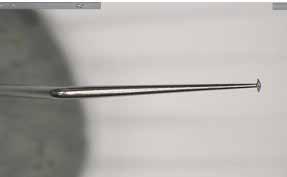
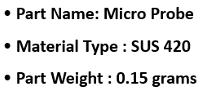
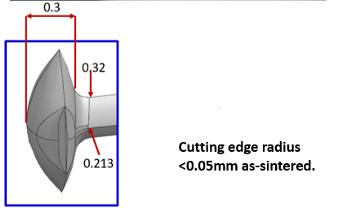
Micro probes for minimally invasive surgical instruments, demonstrating fine features and burr-free cutting edges enabled by µMIM (Courtesy Dou Yee Technologies)
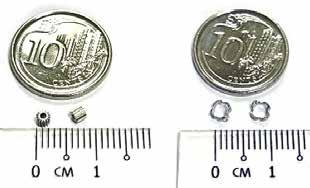
Stainless steel micro-MIM precision planet gears (0.05 g) and hinge captures (0.03 g) with fine features and high surface quality (Courtesy Dou Yee Technologies)
In the medical field, µMIM is especially promising for minimally invasive surgical instruments. These applications require extremely small, smooth, and reliable components to ensure patient safety and performance.
DYT has demonstrated the production of micro medical probes and similar components used in minimally invasive procedures. These parts benefit from the µMIM process by achieving very fine features, smooth surfaces, and consistent quality without additional machining.
The company states that with these advancements µMIM is emerging as a practical manufacturing solution for next-generation micro devices. DYT’s development highlights how the technology can bridge the gap between precision engineering and cost-effective mass production.
Key process capabilities (DYT µMIM) include:
Minimum feature radius: 0.03–0.06 mm
• Dimensional tolerance: up to ±5–10 µm
• Part weight: down to ~0.01 g
• Materials: SUS316L, 17-4PH, 420 stainless steel (expandable to other alloys)
• Surface finish: near-net shape, burr-free
• Production: scalable for mass manufacturing
www.douyeetech.com

A research team from the Technical University of Denmark (DTU), Kongens Lyngby, Denmark, led by Prof Vincenzo Esposito of the Department of Energy Conversion and Storage (DTU Energy), has demonstrated a novel architectural approach to SOFC design. The work is intended to support efforts to improve fuel cell efficiency for transport applications.
The project was carried out in collaboration with researchers from DTU Construct, with Associate Professor Venkata Karthik Nadimpalli contributing expertise in mechanical behaviour and the structural optimisation of architected ceramic materials. The collaboration helped assess the structural stability of the thin-walled gyroid architecture under thermal and operational conditions.
Defining the power-to-weight ratio as the key parameter for SOFCs to improve performance and range of hydrogen-powered transportation to the next level, the team developed monolithic SOFCs with nature-inspired, thin-walled
gyroid geometries made from yttria-stabilised zirconia (8YSZ) and manufactured on the recently acquired Lithoz CeraFab ceramic Additive Manufacturing machine.
At the device level, the architecture demonstrates power-to-weight ratios around 1 W g -1, compared to around 0.2 W g -1 for conventional planar SOFC architectures. “This innovation is a real paradigm shift from planar stacking to monolithic architectures,” Prof Esposito explained.
This departure from stacking planar items could reportedly significantly affect the search for further power-density potentials in hydrogen propulsion, as the combination of thin inner walls with the elimination of interconnects and sealants results in significant weight, thermal mismatch and mechanical stress reduction, whilst improving the utilisation of the available volume. The team states that the compact, lightweight SOFCs created could enable new design approaches of both long-range and ultra-compact hydrogen engine
designs for transportation on water, on land, and particularly in the air.
Prof Esposito shared, “Our motto, ‘Escaping Flatland,’ sounds like a logical step, but it has long been impossible to achieve. The particular arrangement of materials and microstructures requires a significantly elevated level of complexity – but until recently, we simply lacked the tool to make this concept a reality. 8YSZ remains one of the most widely used and technologically mature electrolyte materials for SOFCs. With its mature precision and scalability, Lithoz LCM technology has demonstrated the highest repeatability for these bio-inspired TPMS geometries with the thinnest possible inner walls, which inherently meet the gas supply requirements. The monolithic concept could only be achieved by precisely replicating those gyroid units and adding a sealed shell frame to maintain gastight conditions.”
Johannes Homa, Lithoz CEO added, “By realising 8YSZ monolithic fuel cells with intricate gyroid geometries on their Lithoz CeraFab printer, DTU was able to reduce the dependence on conventional interconnect and sealing architectures inherent to stacked flat items. These elements have traditionally been the Achilles’ heel in the search for better power density in commercial planar SOFC stacks and, therefore, the traditional focus of attention in the quest for a more advantageous power-to-weight ratio. With their revolutionary monolithic concept, these elements eliminate the need to gradually optimise exit points, paving the way for a complete rethinking of fuel cell design. Of course, we are extremely excited about the impact this will have on the worldwide hydrogen-based industry.”
As the design and test phase at DTU Energy has now concluded, the team around Professor Esposito plans to scale up the project for industrial application.
www.dtu.dk
www.lithoz.com
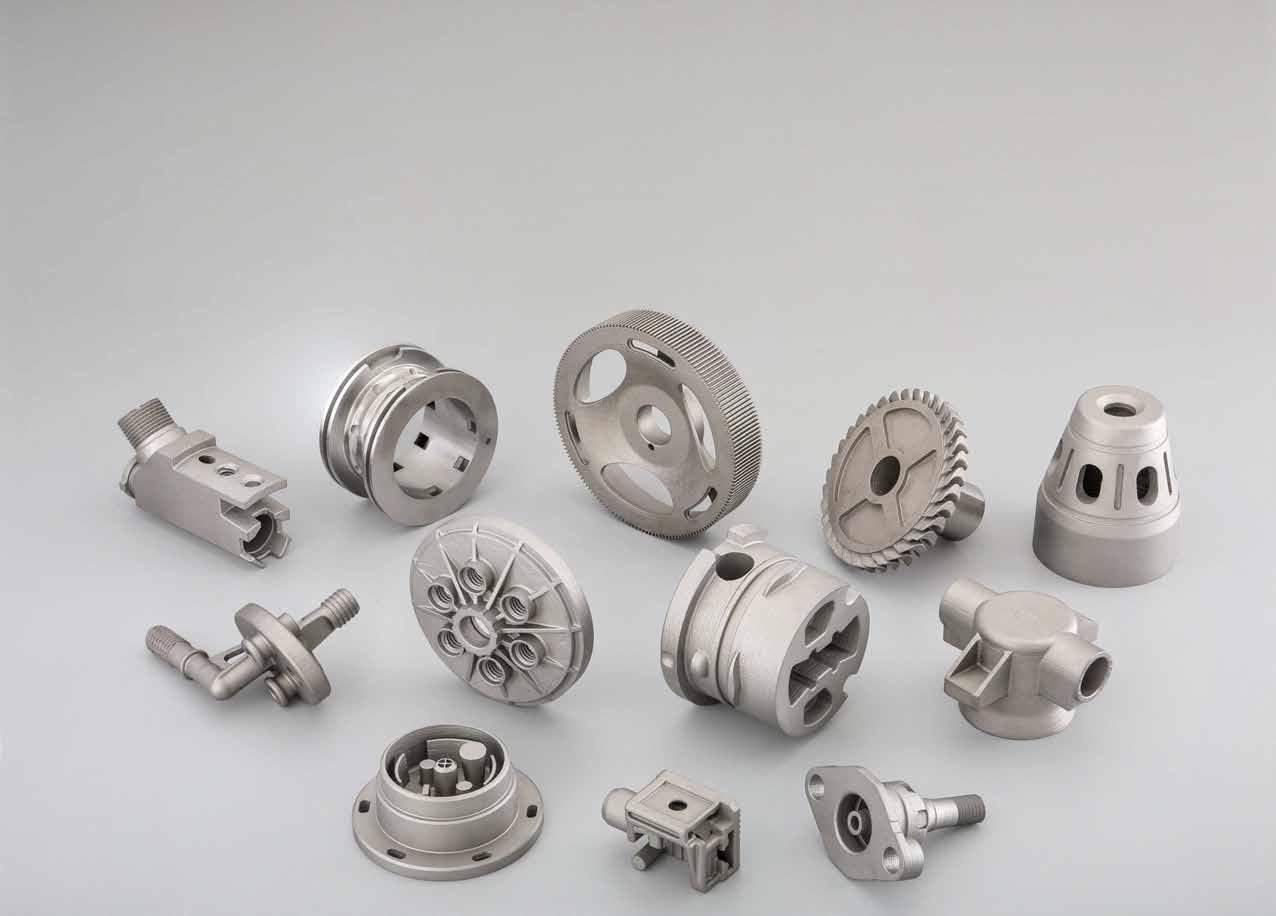
Material Options (Metal)
Material Options (Ceramics)
Build Envelope
Quantity
Tolerance capability
CONTACT FOR MORE DETAILS
17-4PH, SS 316, Tool Steel M2 & S-7, Inconel 625, 4140
Alumina 99.5%, Zirconia
~ 300 grams max, Footprint equivalent of baseball size or less, 0.02” (0.50 mm) wall thickness minimum
10~50 samples based on footprint. Larger quantities up to 1,000 pcs welcome depending on the part size.
Within 2% of the feature size, 2~3 Ra Surface finish, Option of finishing to closer tolerances available.
NORTH AMERICA Email: Mukund.N@indo-mim.com Ph: +1 (210) 557-1594
EUROPE Email: InfoEU@indo-mim.com Ph: +49 1732656067
ASIA Email: InfoHQ@indo-mim.com Ph: +9198459 47783 / +91 98450 75320
ISO 9001:2015 / IATF 16949:2016 / AS
Researchers from the Chinese Academy of Sciences have published research in Light: Advanced Manufacturing focusing on the production of high-performance silicon carbide optical mirrors via Binder Jetting (BJT) Additive Manufacturing.
Silicon carbide (SiC) is widely regarded as a leading material for high-performance space optical mirrors due to its high specific stiffness, low coefficient of thermal expansion, and high thermal conductivity. However, as optical systems increasingly demand lightweight and complex geometries – including triply periodic minimal surface (TPMS), topology-optimised, and lattice structures – conventional manufacturing methods such as pressure moulding and slip casting have struggled to realise these designs.
Additive Manufacturing may offer a route to producing complex ceramic structures without the need for tooling or extensive machining. For SiC mirrors, this typically involves producing a porous preform that is subsequently densified through reactive melt infiltration (RMI), resulting in Si/SiC composites.
Among Additive Manufacturing technologies explored for this application – including Vat Photopolymerisation, Powder Bed Fusion (PBF), Material Extrusion (MEX), and Binder Jetting –each presents trade-offs. Vat Photopolymerisation enables high precision, but requires improved material performance; PBF can introduce deformation due to rapid thermal cycling. MEX offers good material properties but is limited in geometric complexity. BJT, by contrast, provides high efficiency and design freedom, but challenges remain around high porosity and residual silicon content after infiltration, which can degrade mechanical performance.
To address these limitations, the researchers investigated composite powder optimisation strategies to improve the properties of BJT Si/SiC.
A key focus was reducing residual silicon by enhancing carbon content within the preform. Whilst carbon precursor infiltration and pyrolysis (CPIP) has previously been used to achieve this, large pore sizes in BJT parts can lead to incomplete reactions and residual carbon, negatively impacting optical performance.
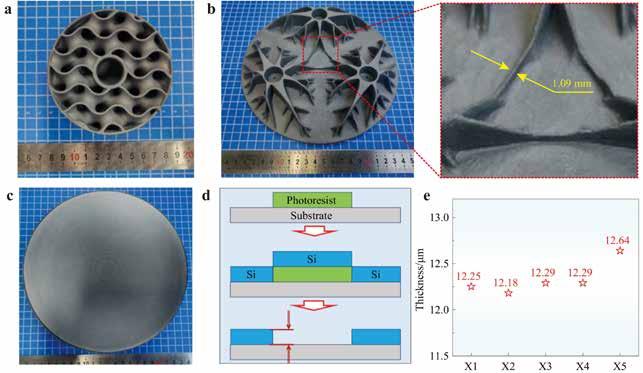
Si/SiC mirrors fabricated via Additive Manufacturing. a) Si/SiC mirror with TPMS structure. b) Si/SiC mirror with topological structure. c) after grinding. d) schematic diagram of film thickness measurement. e) measurement results for film thickness (Courtesy https://doi.org/10.37188/lam.2026.025)
In ‘Binder jetting Additive
Manufacturing of high-performance silicon carbide optical mirrors via graphite addition method’, the researchers introduced a graphite addition approach, incorporating various forms of graphite – including nanoscale, microscale, flake, and fibre – into the SiC powder feedstock. Graphite served a dual role: improving powder flowability during the BJT Additive Manufacturing process and acting as a carbon source to promote conversion of residual silicon into secondary SiC during RMI.
Among the graphite types evaluated, flake graphite proved most effective, reportedly reducing the Carr index of the powder from 39.14% to 31.29% and increasing preform density from 1.24 g/cm 3 to 1.34 g/ cm 3. This improved homogeneity and enabled more complete reactions during infiltration. As a result, residual silicon content decreased by 18.18%, whilst overall density increased by nearly 6%.
Mechanical and thermal properties also improved, with flexural strength reaching a reported 268 MPa, elastic modulus 330 GPa, and thermal conductivity 127 W/(m·K). Optical testing of fabricated mirrors with complex geometries demonstrated surface roughness of 0.772 nm RMS and shape accuracy of 12.05 nm RMS following finishing, indicating suitability for high-performance optical applications.
According to the researchers, this study further demonstrated that the Binder Jetting and RMI process chain offers strong dimensional control, with deviations below 0.5% and consistent porosity levels across samples. The paper concluded that the approach represents a viable near-net-shape manufacturing route for Si/SiC optical mirrors, combining geometric flexibility with improved material performance for advanced optical systems.
‘Binder jetting additive manufacturing of high-performance silicon carbide optical mirrors via graphite addition method’ is available online.
www.cas.cn
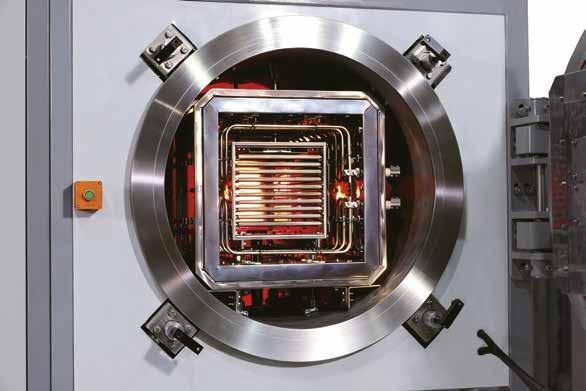
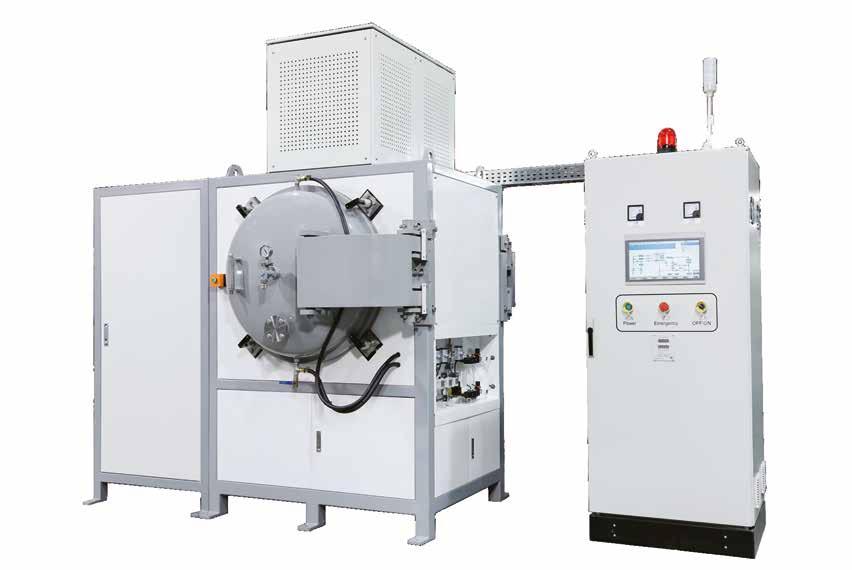
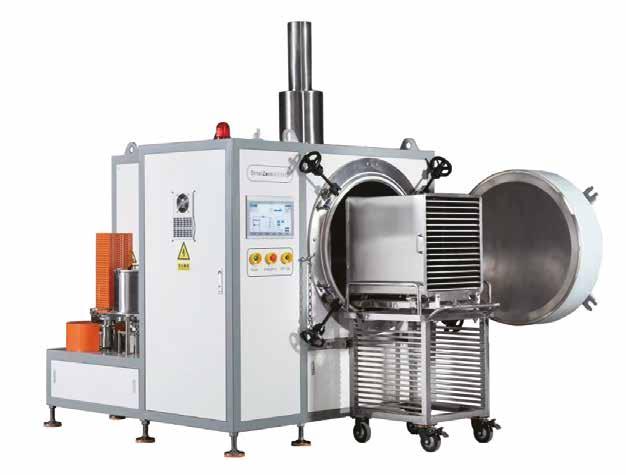
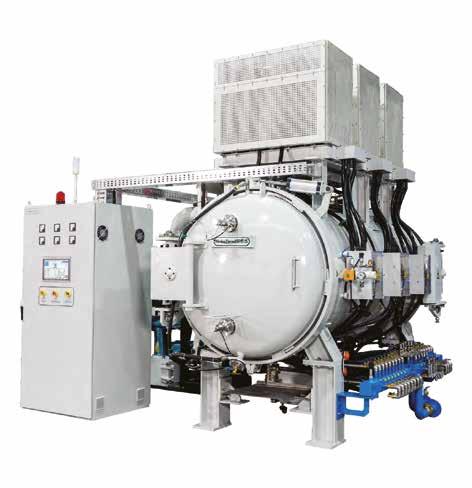

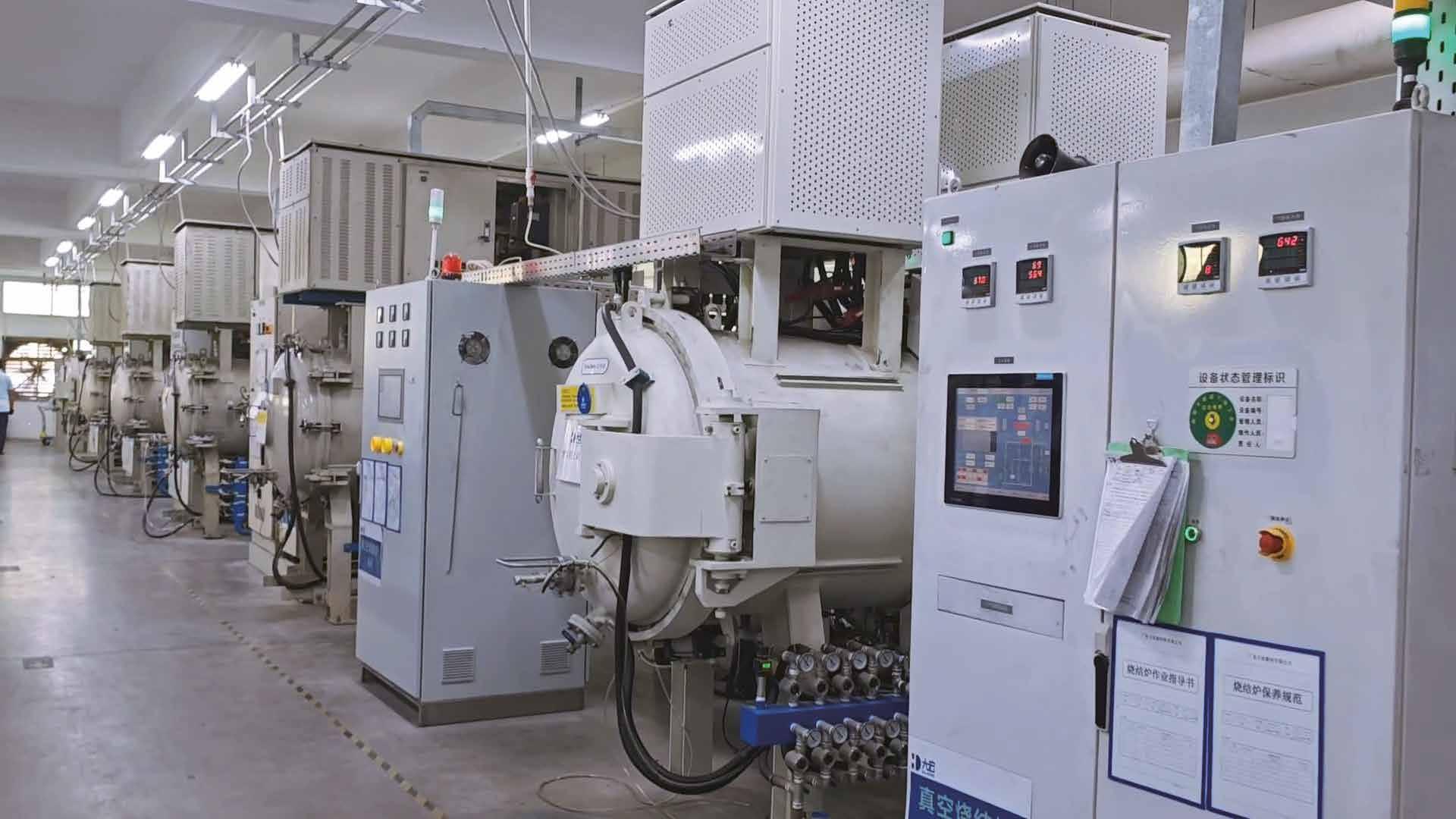
Oxford Instruments, based in High Wycombe, UK, has announced the release of AZtecCrystal 4.0, the latest generation of its electron backscatter diffraction (EBSD) analysis software. AZtecCrystal 4.0 introduces two features – Crystal Batch and Crystal Compare – intended to improve researchers’ ability to evaluate and visualise EBSD experiments. The software enables users to synchronise EBSD metrics with external experimental parameters and analyse full
stacks of datasets within a single workflow.
Crystal Batch allows users to link external parameters across multiple datasets so that key metrics can be measured and reported for an entire batch. This capability is suited to multi-site and multi-sample workflows, including three-dimensional focused ion beam (FIB) slice analysis and in-situ experiments. In such cases, users can track changes in parameters such as grain size or
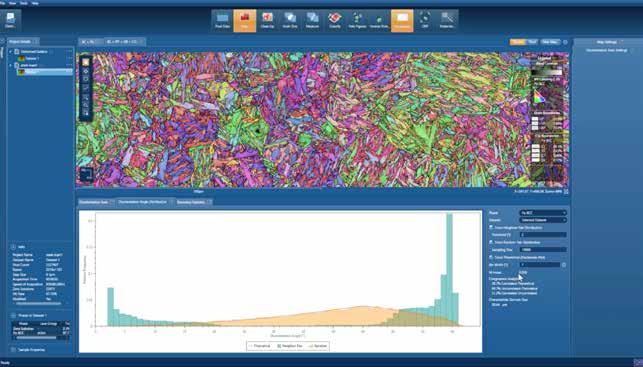
Nabertherm GmbH, headquartered in Lilienthal, Germany, and Ivoclar Vivadent AG, headquartered in Schaan, Liechtenstein, have announced that following extensive testing, validated sintering programs have been developed for the Nabertherm’s high-temperature sintering furnace. As part of this collaboration, the Nabertherm LHT 02/17 LB Speed has been specifically matched to Ivoclar’s zirconium oxide materials.
The sintering programs validated by Ivoclar for the zirconium oxides IPS e.max ZirCAD Prime and IPS
e.max ZirCAD Prime Esthetic are available free of charge via the Nabertherm sintering program download portal. Users can download the programs within seconds using a USB stick and import them directly into their LHT 02/17 LB Speed.
phase proportion during processes including heat treatment. Crystal Compare provides tools for visualising changes across datasets. Users can switch between analysis and reporting modes, compare data stacks, and generate time-lapse imagery.
“The visual representation of the data in graphs is a great way to quickly view the results to assess the quality and investigate the critical events in the timeline of an in-situ experiment,” stated Jack Donoghue, Senior Technical Specialist at The University of Manchester. According to Oxford Instruments, AZtecCrystal 4.0 is suited to core facility use, structural materials research, and quality control and failure analysis environments where speed, reproducibility and detailed reporting are required. “Through integration and automation, AZtecCrystal 4.0 reduces manual data handling and keeps the focus on interpreting microstructural change, which offers immediate and enduring value to researchers,” added Mark Coleman, AZtecCrystal Product Manager. “With this next-generation EBSD processing software, we reaffirm our commitment to delivering tools that enable scientists to gain insights more quickly and precisely.”
www.oxinst.com
The Nabertherm LHT 02/17 LB Speed high-temperature sintering furnace has been specifically matched to Ivoclar’s zirconium oxide materials (Courtesy Nabertherm)
“We at Nabertherm are very pleased about this collaboration –through the cooperation between Ivoclar and Nabertherm, two leading experts in the fields of dental materials and furnace technology are coming together,” explained Timm Grotheer, Managing Director of Nabertherm. “Our cooperation enables users to make their sintering processes even more efficient and reliable.”
www.nabertherm.com www.ivoclar.com
Registration is now open for the Euro PM2026 Congress and Exhibition. Organised by the European Powder Metallurgy Association (EPMA), the annual event is scheduled to take place in Budapest, Hungary, from October 11–14, 2026.
Over 200 oral and poster presentations will highlight the latest developments in Powder Metallurgy throughout three full days of plenary sessions, keynote lectures, and specialised seminars. The programme will cover the full spectrum of PM, including:
• Powders: Production, characterisation, properties, and other powderrelated topics.
• Consolidation technologies: Compaction and sintering, Metal Injection Moulding, Hot Isostatic
Pressing, FAST, metal Additive Manufacturing, powder deposition, and other processes.
• Materials: Ferrous, non-ferrous, light, high-temperature, functional, hardmetals, cermets, ultrahard, and other PM materials.
• Applications: Biomedical, aerospace, automotive, energy, tooling, and further industrial applications.
• Tools for Advancing PM: Testing and evaluation, secondary operations, design and modelling, sustainability and life cycle analysis, health and safety, digitalisation, and other enabling technologies.
The 2,500 m² exhibition, open from Monday to Wednesday, will showcase

Euro PM2026 will take place in Budapest, Hungary (Courtesy EPMA)
the entire PM supply chain. Exhibitors include raw material suppliers, furnace and equipment manufacturers, tooling specialists, and many others, all available to discuss current and future business opportunities.
Alongside the technical sessions and exhibition, Euro PM2026 will include a welcome reception, gala dinner, and other social activities, each providing excellent opportunities for networking.
The early-bird rate is available for bookings made before September 9, 2026.
www.powdermetallurgycongress.com
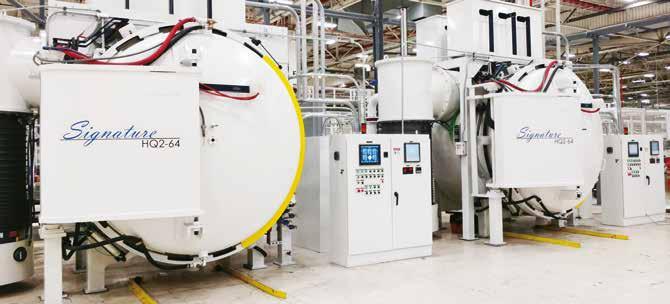
Our experienced team is ready to solve your toughest thermal processing challenges and will design, manufacture, install and maintain the Best Sintering Furnace you’ll ever own.
FEATURES
• Metal or Graphite Hot Zones
• Metal and Graphite Retorts
• Debinding & Sintering
• Trapping Systems to Suit The Best Thermal Processing Solution for the Powder Industry
APPLICATIONS
• Additive Manufacturing
• Metal Injection Moulding
• Ceramic Injection Moulding
• Powder Metallurgy
Exentis Group AG, based in Stetten, Switzerland, reports it has successfully brought another one of its large-scale Additive Manufacturing machines into operation in Japan. Sintokogio Ltd, based in Nagoya, Japan, is expanding its Additive Manufacturing operations in Toyokawa, and is using Exentis technology for the production of
components across multiple material classes.
The recently delivered machine entered industrial operation at Sintokogio after successfully passing the site acceptance test.
“The rapid expansion of production capacity again confirms the industrial maturity and reliability of our technology platform,” stated Ralf Brammer, Chairman of the
Emery Oleochemicals, headquartered in Cincinnati, Ohio, USA, has appointed Chris Hart as Chief Operations Officer. Hart is reported to bring more than 30 years of global leadership experience across complex, asset-intensive manufacturing organisations.
Hart’s background includes senior operational and transformation leadership roles with SD Guthrie Berhad and other international companies, where he led large, multi-site operations across Europe and Asia and drove execution at scale.
In his role as Chief Operations Officer, Hart is responsible for
PTI Tech, headquartered in Clifton, New Jersey, USA, has announced that it has become a member of America Makes, Youngstown, Ohio, USA. As part of the Manufacturing USA initiative, America Makes brings together industry, academia, and government to accelerate the adoption of Additive Manufacturing
Emery’s global end-to-end operations, including planning, procurement, manufacturing, logistics, customer service and continuous improvement. He will play a key role in strengthening alignment, enhancing execution, and driving performance across the organisation.
Since joining Emery in 2025, Hart has already contributed to operational performance and global operating discipline, states the company. “Chris is a proven operational leader with deep global experience,” said Min Chong, Chief Executive Officer. “His leadership will
technologies across critical sectors such as defence, aerospace, and medical.
By joining America Makes, PTI Tech will collaborate with leading organisations to support innovation in advanced materials, process development, and scalable production solutions.
“Joining America Makes aligns directly with our mission to deliver cutting-edge manufacturing solutions while supporting a resilient, US-based supply chain,” stated Michael Wiseman, Business
Board of Directors of Exentis Group AG. “Sintokogio is now in a position to manufacture sophisticated industrial components in high volumes efficiently and at consistently high quality, without the need for post-processing.”
Exentis reports continued strong demand in the Asian market and said it plans to deliver additional large-scale Additive Manufacturing machines to Sintokogio.
www.exentis-group.com
www.sinto.co.jp

Chris Hart has been appointed as Chief Operations Officer at Emery Oleochemicals (Courtesy Emery Oleochemicals)
be important as we continue strengthening our operational capabilities and delivering for our customers.”
www.emeryoleo.com
Development Manager at PTI Tech. “We see tremendous opportunity to integrate Additive Manufacturing with our core capabilities to accelerate product development and transition programs efficiently into full-scale production.”
In addition to its metal and polymer injection moulding capabilities, PTI Tech offers prototyping and sinter-based metal Additive Manufacturing at its facility in Clifton.
www.pti.tech
www.americamakes.us
Metamorphic AM, based in Nottingham, UK, has launched Rapid Geometry Review, a new service aimed at making Design for Additive Manufacturing (DfAM) expertise more commercially accessible.
Rapid Geometry Review is intended to provide organisations with a structured, expert-led evaluation of Additive Manufacturing designs before committing to production builds, helping reduce risk, accelerate development, and improve return on investment.
Since its founding, Metamorphic has been associated with advanced technology development programmes across quantum technologies, fusion energy, advanced telecommunications, and bioprocessing applications. Whilst these intensive R&D collaborations will remain central to the company’s strategy, it has decided to begin expanding access to its DfAM experience.
“We’ve seen too many projects failing to add value to a product or process because design intent wasn’t fully interrogated early enough,” stated co-founder Manolis Papastavrou. “Rapid Geometry Review brings the same engineering scrutiny we apply in major innovation programmes to a format that is faster, commercially accessible, and immediately actionable.”
The service assesses structural logic, suitability for Additive Manufacturing, material suitability, manufacturability, and missed geometric opportunity. Rather than relying exclusively on automation, Rapid Geometry Review combines simulation insight with applied engineering judgement.
“We are not moving away from frontier innovation. That remains our foundation,” says co-founder Laurence Coles. “What we are doing is extending our perspective to a broader audience. If Additive
Manufacturing is to mature as an industrial technology, worldclass DfAM thinking cannot remain confined to flagship projects.”
Metamorphic stated that, by lowering the entry barrier to DfAM expertise, the wider Additive
Manufacturing industry may be able to reduce expensive test manufacturing cycles and enable greater commercial viability.
“The difference between ‘printable’ and ‘engineered’ is where value is created,” added Papastavrou. “Rapid Geometry Review helps organisations close that gap.”
Rapid Geometry Review is now available.
www.metamorphic.am




Arburg GmbH, Lossburg, Germany, reported that approximately 3,750 visitors from forty-four countries attended its Technology Days, held March 11–13, 2026. The event highlighted injection moulding technologies, with a focus on applications relevant to Powder Injection Moulding, automation, and digital manufacturing.
More than forty machine exhibits were presented, including processintegrated and turnkey solutions applicable to high-volume, precision component production. Particular emphasis was placed on medical manufacturing, micro-moulding, and materials processing.
The electric Allrounder Trend series was a central feature, offering simplified operation and rapid set-up across clamping forces from 500–2,000 kN. The new Gestica lite control system was also intro -
duced, designed to reduce operator complexity.
Application examples included high-cavitation Liquid Silicone Rubber (LSR) moulding, achieving outputs of up to 9,200 parts per hour, as well as micro-moulding processes producing components with shot weights as low as 0.016 g – both relevant to medical and technical PIM applications.
Automation and turnkey systems were a key theme, with integrated production cells demonstrating injection moulding combined with in-mold decoration and robotic handling. Arburg emphasised its capability to support customers across the full process chain, from concept through to series production.
A dedicated Medical Corner showcased cleanroom-compatible manufacturing, including ISO Class
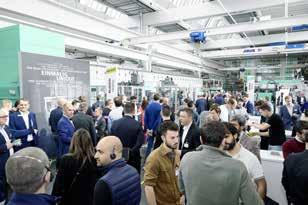
Arburg welcomed over 3,500 visitors to its headquarters for its Technology Days event (Courtesy Arburg)
7 production, high-output needle cap moulding (up to 60,000 parts per hour), and a turnkey system for injector pen components developed with industry partners. These solutions highlight scalable approaches to quality-critical PIM applications. Digital tools, including Arburg’s ALS manufacturing execution system and arburgXworld portal, were also presented, supporting process optimisation, traceability, and cost control across the production chain. www.arburg.com
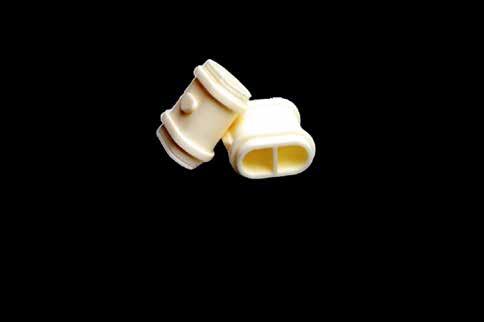

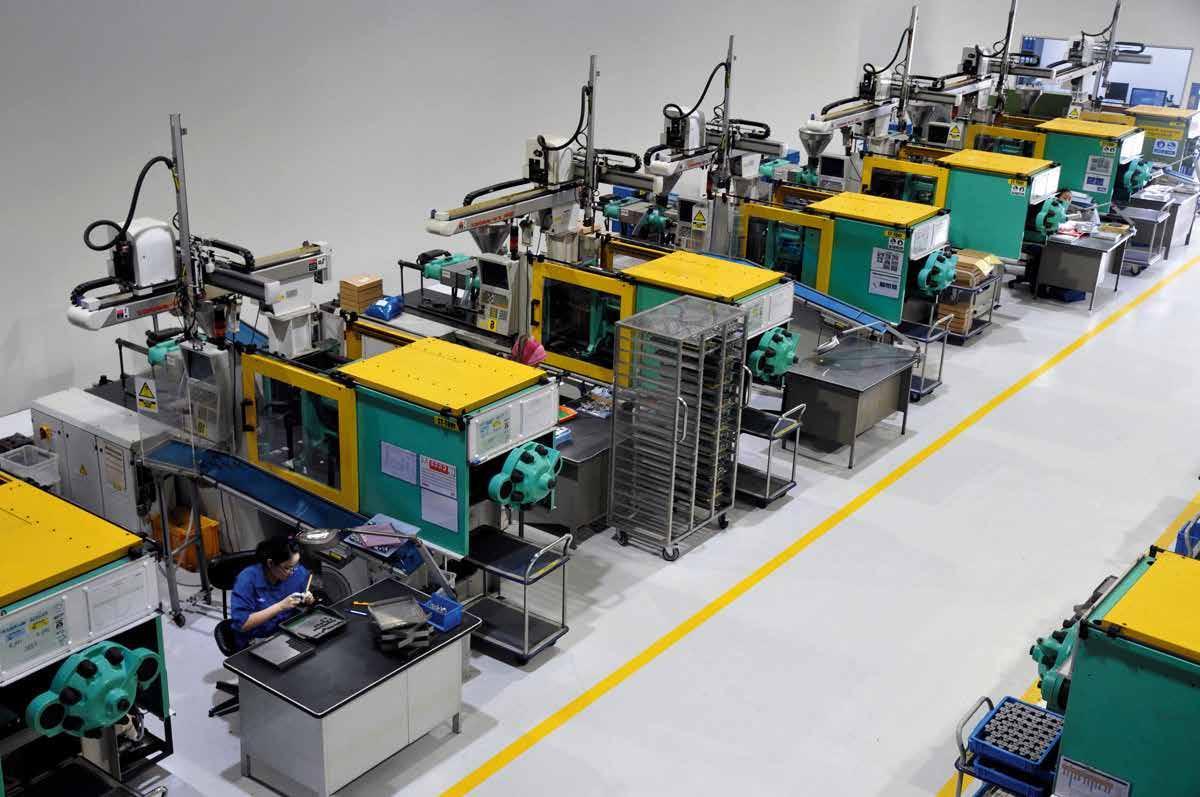
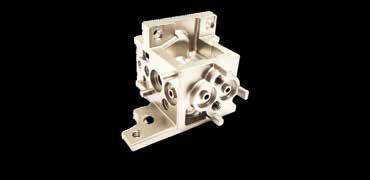
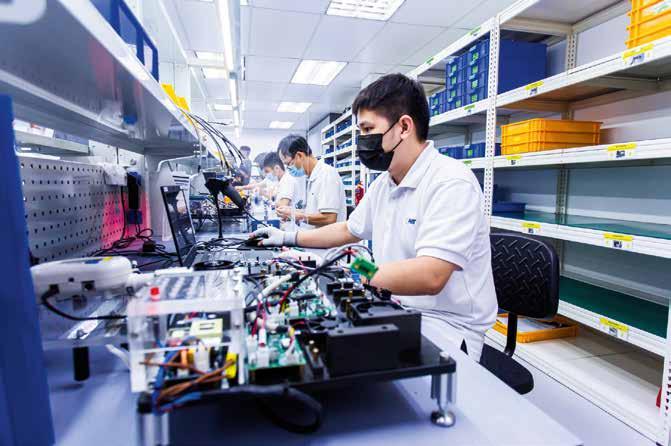
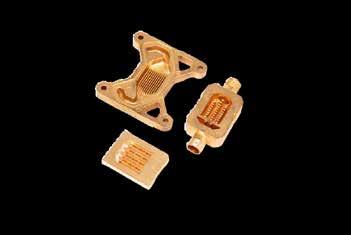


GKN Powder Metallurgy, a subsidiary of Dauch Corporation, is expanding its US-based Binder Jetting capacity with the addition of HP’s Metal Jet technology at its Auburn Hills, Michigan, site.
“After building strong serial production capability in Europe, bringing MBJ closer to our US customers is a natural next step,” stated Uemit Aydin, GKN Additive’s Senior Director, Global Business Development and Commercial on LinkedIn. “With established serial production exceeding 500,000 metal additive parts per year, this investment strengthens our global footprint and supports growing demand across
automotive, thermal management, defence, and industrial applications.”
According to Aydin, the company has advanced the use of pure copper with the HP Metal Jet and is unlocking high - performance applications where conductivity and metallurgical integrity are required.
This copper-focused collaboration was first reported at Formnext 2025, where the companies announced plans to expand production of advanced copper components for cloud computing, electrification, and thermal management. By pairing HP’s AM machines with GKN’s material and production
Authentise, based in Philadelphia, Pennsylvania, USA, has announced the launch of Whisper, a new AI platform designed to capture, understand, and act on engineering intent across the entire idea-to-part lifecycle. Authentise describes Whisper as an “agentic AI backbone” intended to connect fragmented engineering knowledge and turn it into governed, real-time action inside existing enterprise systems.
“Engineering intent is the missing layer in digital transformation,” said Andre Wegner, CEO of Authentise. “We’ve spent 14 years helping companies digitise workflows. Whisper is the next step. It doesn’t ask engineers to change how they work. It listens, understands, and acts.”
Whilst the long-term value comes from capturing engineering intent, Authentise states that Whisper can deliver immediate gains in compliance, coordination and execution.
Rob Weighill, Group Systems Architect at Prototal Group, stated, “As part of the steering committee, we pushed hard on one thing: this had to work in the real world, not just in theory.”
“In a high-throughput environment, the challenge is keeping projects moving across teams. Seeing Whisper come together has been genuinely exciting because it doesn’t just surface insights, it takes action directly in the tools our teams already use,” Weighill continued.
Whisper captures engineering activity as it happens across tools like Slack or Teams, email, meetings, and enterprise systems. It structures that data, applies context and permissions, and acts on it directly within existing workflows. This reportedly results in earlier risk detection, real-time compliance checks, automated updates across ERP, PLM, and QMS systems, and full provenance and audit trails tied to parts and projects.
Authentise built Whisper after encountering resistance to new tools, even when they delivered value. The company reportedly found that the problem is not capability; it is inertia. Wegner added, “Everyone already has tools. No one wants another interface.” Whisper is not a single application but a foundation for building intel -
capabilities in the US and Europe, the companies expect to drive measurable efficiency gains and operational savings at end-user data centres, projected in the millions over the next five years.
www.gknpm.com
www.hp.com
GKN Powder Metallurgy is expanding its US-based Binder Jetting with a focus on pure copper using HP Metal Jet AM technology (Courtesy HP)
ligent engineering workflows with the intention of enabling real-time compliance monitoring, project health detection, and automatic updates across enterprise systems, all driven by configurable agents operating in the background.
Example use cases include:
• Automated compliance monitoring against internal and external standards
• Live project health detection and alerts
• Real-time generation of technical documentation
• Updating task lists, PLM records, and ERP data automatically
• Detecting IP leakage or duplication through digital fingerprinting
Many of these already exist; others can be built by end-users or their partners. Authentise also states that each of these is powered by configurable “effectors” that act on insights generated by Whisper’s AI core.
Authentise states that Whisper is released as source-available and that initial access requires a low upfront commitment, with full costs incurred only once value has been proven.
www.authentise.com

Expo & Convention Industry Insights Industry Events
We are the central platform for production professionals around the globe and offer you industry information, networking, exchange and access to the latest AM solutions all year round.
Find AM AM Directory
Read AM Fon Mag print & online
Watch AM Formnext.TV
AM updates Newsroom
AM regularly AM4U newsletter
Experience AM AM event calendar
Explore AM Formnext white papers
Discuss AM Formnext Technology Talks

Understand AM AM Field Guide
Discover AM Seminars & webinars
AM around the globe Formnext events worldwide
Shaping AM AM Jobs

Want AM insights direct to your inbox? formnext.com/getindustryinsights
Asia’s Metal Injection Moulding industry – led overwhelmingly by Greater China – has evolved into a vast, highly integrated manufacturing ecosystem underpinning global production of small, complex metal components. Driven by consumer electronics, expanding powder supply chains, and growing overlap with metal Additive Manufacturing, the region is reshaping precision manufacturing at industrial scale. Dr Yau-Hung, Chiou (Dr Q), Dr Yu-Deh, Chao (Dr James) of You Need Technology Consulting Co, Ltd, and Emma Lawn and Nick Williams of PIM International examine these developments. applications, as well as growing use in industrial hardware, automotive components, and emerging sectors such as data-centre hardware and robotics.
The manufacturing industry for small metal components is undergoing a significant transformation, driven by Metal Injection Moulding and metal Additive Manufacturing. Although MIM has existed for around fifty years, the process has been commercially mature and widely adopted in high-volume manufacturing for more than three decades. By contrast, metal AM’s emergence as a viable production technology for selected serial applications has accelerated only in recent years. Together, these processes are becoming increasingly intertwined, reshaping precision manufacturing and enabling new competitors to challenge conventional methods such as casting and machining.
In Asia – particularly China – MIM has developed into a mature, highvolume production technology for small, complex metal components. The Asia-Pacific region accounts for the largest share of global MIM production, driven primarily by strong demand from consumer electronics and Information and Communications Technology (ICT)
The region’s advantage increasingly lies not only in manufacturing scale, but also in the co-location of powder production, feedstock
preparation, tooling, sintering infrastructure, and high-volume consumer-electronics supply chains.
Building on earlier analysis of feedstock competition and localisation trends in Asia [1], this article examines two closely linked developments shaping the region’s powder-based manufacturing
Fig. 1 MIM and metal Additive Manufacturing are increasingly overlapping in advanced ICT applications such as hinge mechanisms (Courtesy Apple)
Fig. 2 Estimated global MIM sales by region, 2010–2025. The development of the MIM industry in Asia can be divided into four phases: (1) incubation, before 2010; (2) rapid expansion, 2010–2015; (3) moderate growth, 2015–2020; and (4) renewed growth, since 2020 (Courtesy Dr Q)
industry: the continued expansion of MIM as a large-scale precision manufacturing technology, and its increasing overlap with metal Additive Manufacturing in materials, supply chains, and selected applications.
* Indo-MIM, widely regarded as the world’s largest MIM company
Table 1 Distribution of Asian MIM manufacturing facilities by region and country. Asia hosts the majority of global MIM factories, with a strong concentration in mainland China and Taiwan, represented by entries 1–6. ▲ indicates imminent or recently added capacity (Courtesy Dr Q)
The global MIM market has grown steadily over the past decade, with Greater China – defined here as mainland China and Taiwan – emerging as the dominant contributor to overall growth. The development of Asia’s MIM industry can be understood in four phases: an initial incubation period before 2010; rapid expansion from 2010 to 2015; a phase of more moderate growth from 2015 to 2020; and renewed growth since 2020 (Fig. 2).
There are now more than 550 MIM manufacturing facilities worldwide, over 350 of which are located in Asia, concentrated primarily in China’s southern and eastern coastal manufacturing regions (Table 1). The region’s MIM industry has expanded rapidly, growing from fewer than fifty factories in the early 2000s to around eighty by 2014, and to approximately 250 by 2020. Between 2023 and 2025, substantial new MIM capacity was added or planned in East China and Vietnam, reflecting continued expansion in China as well as Vietnam’s growing role in regional supply chains, supported by multi-country investment.
This most recent phase reflects both external pressures and application-driven growth. While geopolitical factors – including the Sino-US trade conflict, the RussiaUkraine war, and the effects of COVID-19 – have introduced volatility, overall demand has remained
Table 2 Global distribution of MIM manufacturing plants and application areas (total >550) (Courtesy Dr Q)
resilient. Growth has been supported by continued demand from advanced consumer electronics, increasing industrial automation, and the emergence of higher-performance application requirements.
Well-established regional differences in application focus remain evident. In Asia, MIM production is closely associated with ICT and hardware components, whereas in Europe and North America there is a greater emphasis on automotive, defence, and medical applications (Table 2).
Consumer electronics remains the dominant application sector for MIM, providing the production scale needed to sustain continued industrial growth (Table 3). In mainland China and Taiwan, ICT applications accounted for approximately 80% of total MIM sales in 2025, with Apple-related products alone representing around 40% of overall MIM consumption. Other ICT applications contributed a further share,
Table 3 Application breakdown of selected MIM part categories in the Greater China region, 2025. ICT accounts for the majority
at approximately 80%, driven by consumer
are not included (Courtesy Dr Q)
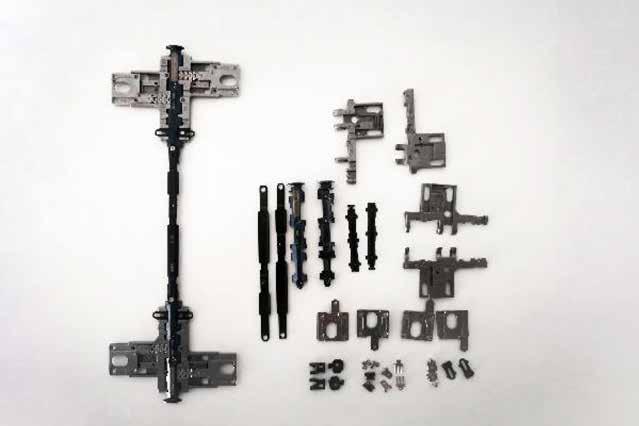
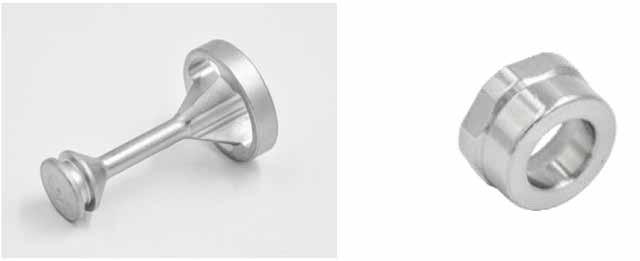
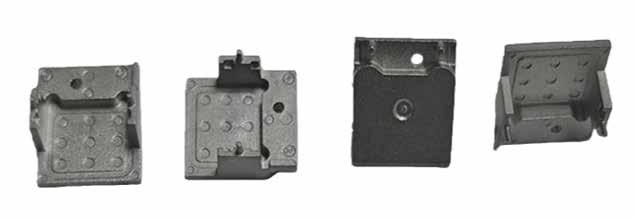
“MIM adoption remains comparatively limited but is gradually diversifying into medical, robotics, unmanned aerial vehicles (UAVs), automotive, and hardware applications.”
including approximately 20% from non-Apple consumer-electronics applications and around 10% from server-related demand.
Increasing product complexity within consumer electronics is driving demand for high-precision MIM components, particularly in foldable smartphones, where hinge and pivot mechanisms require tight tolerances and repeatability at scale (Fig. 3). Reflecting this trend, NBTM New Materials Group Co, Ltd, one of China’s largest MIM producers, reported 2025 MIM platform revenue of approximately RMB 2.5 billion (~$345 million) up around 29% year on year, driven larg ely by consumer electronics and emerging high-value applications [2].
AI-related hardware is also becoming an increasingly important target area. NBTM stated that its MIM activities in AI hardware focused on high-speed connector structures, optical-module thermalmanagement components, and liquid-cooling hardware for server applications (Fig. 4). In 2025, the company reported development of GB300 high-speed connector MIM parts, more than forty additional high-speed connector models, and 800G/1600G optical-module thermal-management components [2]. Jiangsu Gian Technology, another large Chinese MIM producer, reported expansion into data-centre applications, where increasing transmission speeds are driving demand for metal components with improved strength, precision, and thermal performance [3].
Beyond ICT, MIM adoption remains comparatively limited but is gradually diversifying into medical, robotics, unmanned aerial vehicles (UAVs), automotive, and hardware applications. NBTM reported approximately RMB 102 million (~$14 million) in 2025 sales from surgical robots and MIM structural components for minimally invasive surgical electric staplers, alongside early commercialisation of titanium-alloy MIM components for wearable devices such as smart-
glasses hinges. The company also identified robotics-related micro gears and connection structures as potential future MIM applications [2]. Jiangsu Gian Technology similarly reported growth in automotive components, alongside wearable-device products and consumer-electronics applications [3].
The application profile suggests that future MIM growth in the region will continue to be shaped primarily by advanced consumer electronics and ICT infrastructure, even as suppliers gradually diversify into medical, automotive, and industrial applications.
Emerging hardware applications demonstrate how MIM is expanding beyond its conventional markets, particularly into pipe and valve components (Fig. 5). In these applications, MIM is increasingly displacing investment casting for high-volume, small-format stainless steel parts, driven by the limitations of casting complex geometries and the machining requirements that often follow. In Yuhuan, Zhejiang, China, a key manufacturing hub for such components, this shift has reportedly supported rapid MIM capacity expansion and contributed to an estimated increase in demand for 304 stainless steel powder of around 10,000 tonnes per year.
More broadly, expansion into new applications is being enabled by increasing part size and improved process capability. While MIM is often associated with small components, typically below 30 g in ICT applications, there is clear evidence of a shift towards larger part geometries. MIM manufacturers in China are increasingly producing components from 50 g up to 1,000 g in selected cases, opening opportunities in new application areas. These larger components can be economically viable in selected cases at batch sizes as low as around 1,000 units, through reducing material waste and minimising multiple tooling and repositioning steps compared with conventional manufacturing routes.
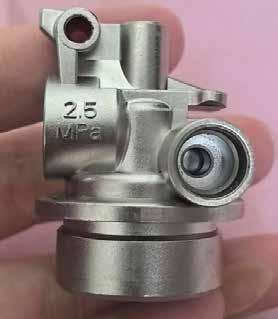
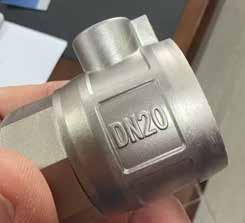
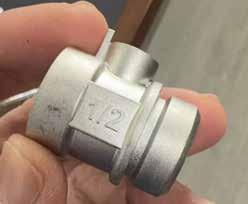
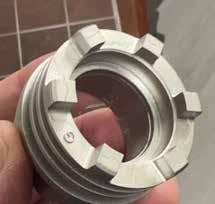
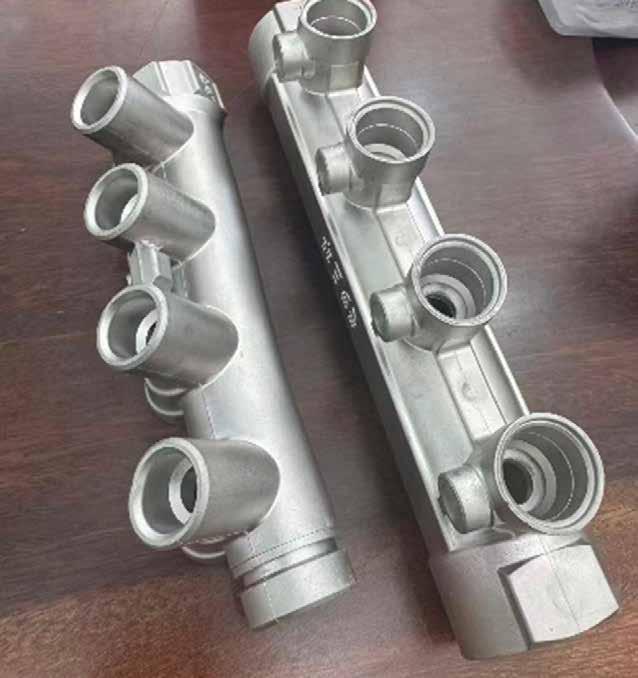
Fig. 5 Examples of MIM-produced pipe and valve components: (a) fire extinguisher valve, (b) water pipe valve, (c) water pipe tee valve, (d) retaining nut and (e) multi-port manifold. Components are typically small (<0.5 in), although parts of up to ~500 g are reported in selected applications. These are increasingly produced in stainless steel, where MIM can offer advantages over investment casting in high-volume production (Courtesy Dr Q)
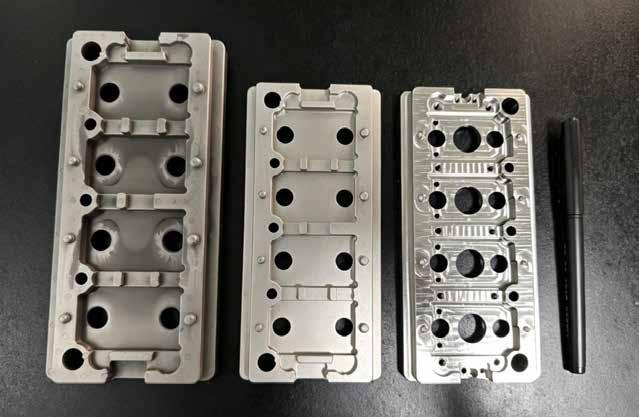
Fig. 6 A large 17-4PH stainless steel MIM component at different stages of processing (left to right), from as-moulded condition to sintered and CNC-machined. A 980 g injection shot (including runner and feedstock) yields a ~790 g green part, which reduces to ~720 g after debinding and sintering, before final machining to ~590 g (Courtesy Kunshan DanFu Precision Technology, China)
For example, as shown in Fig. 6, MIM processing of a 17-4PH stainless steel component demonstrates significantly reduced machiningstage waste, at approximately 130 g, compared with conventional machining, which would generate around 910 g of scrap from approximately 1,500 g of stock. This improvement in material efficiency is enabling MIM to compete more effectively with casting and machining in selected hardware applications, supporting its gradual repositioning from a niche precision process to a broader manufacturing solution.
The expansion of Asia’s MIM industry has been accompanied by rapid growth in the regional powder and feedstock supply base. The number of powder producers using gas and water atomisation has increased from fewer than five in 2005 to approximately thirty in 2026 (Table 4). Feedstock suppliers have followed a comparable trajectory, growing from fewer than five before 2014 to an estimated thirty-five by 2026. The expiration of BASF’s Catamold patent protections for catalytically
debindable feedstock in 2014 marked a significant turning point, lowering barriers to entry and enabling broader participation in feedstock production.
Increased production capacity and supplier competition have reduced the cost of 304 stainless steel powder, supporting its wider adoption in cost-sensitive applications. This reflects a shift away from copper and brass, as well as the limitations of investment casting for complex stainless steel components. Stricter environmental controls in parts of China are also contributing to this trend, favouring cleaner and more controlled production routes such as MIM.
Materials development is becoming an increasingly important differentiator as Chinese MIM suppliers move beyond standard stainless-steel feedstocks towards higher-performance alloys for premium consumer electronics, wearables, servers, and robotics. Jiangsu Gian Technology, for example, reported development of ultra-highstrength steels, titanium alloys, and copper alloys for MIM applications, with wear-resistant steels already supporting foldable-phone hinge components [3].
A key trend is the continued shift towards finer powder fractions. MIM processes in Asia typically rely on powders below 40 µ m, with increasing emphasis on fractions below 20 µ m and, more recently, below 10 µ m. This reflects both performance requirements and
* The first high-speed rail line opened in China | ** Expiry of BASF’s CATAMOLD® patent protection | *** Growth in Additive Manufacturing activity, including the expansion of industry exhibitions since 2015
Table 4 Growth in the number of MIM manufacturing plants, feedstock suppliers, and powder producers in China, 20052026 (powder producers may serve both MIM and AM markets) (Courtesy Dr Q)
ongoing efforts to improve surface quality and densification behaviour. These trends are increasingly shaped by parallel developments in Additive Manufacturing, where demand for fine and tightly controlled powder fractions is reinforcing the overlap between MIM and AM supply chains.
Iron-based alloys and stainless steels remain dominant in MIM production, reflecting their favourable cost-performance balance and broad applicability. As shown in Fig. 7, stainless steel, iron-nickel alloys, and low-alloy systems together account for ~ 80% of material usage. Non-ferrous materials, including titanium, copper, and cobalt alloys, account for a smaller share and are typically used in more specialised or high-performance applications.
The expansion into larger components and higher-volume applications is being supported by corresponding developments in production systems
Fig. 7 Distribution of materials in MIM production in China; stainless steel, iron-nickel alloys, and low-alloy systems account for over ~80% of total material usage (Courtesy Dr Q) and equipment. MIM production increasingly relies on vertically integrated, ‘one-stop’ in-house manufacturing practices, in which feedstock preparation, moulding, debinding, sintering, and post-processing are consolidated within a single facility. This model enables the rapid manufacture of complex metal parts across a wide range of production volumes.
/
/ Inconel 713 / A286
F75 / F429
/ 6063 / others
Table 5 Material classification of powders used for MIM parts globally (%). Iron-based alloys dominate (~80%), particularly stainless steels and Fe-Ni systems, with smaller contributions from non-ferrous alloys such as tungsten, titanium, and copper-based systems (Courtesy Dr Q)
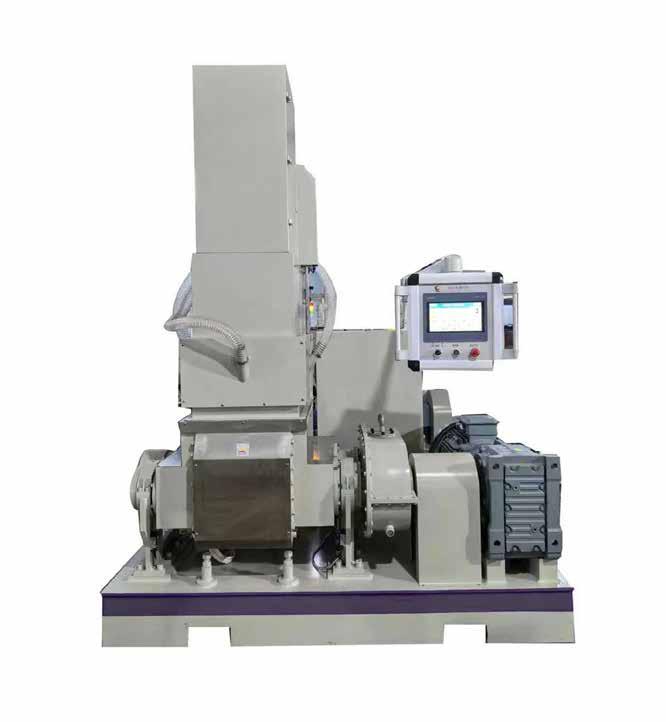
High-capacity feedstock mixing machine for MIM production, capable of processing approximately 200 kg of SUS 304 feedstock per batch, with mixing completed within ~1 hour (Courtesy Dongguan Changfeng Machinery (C-Fine) Technology Co, Ltd)
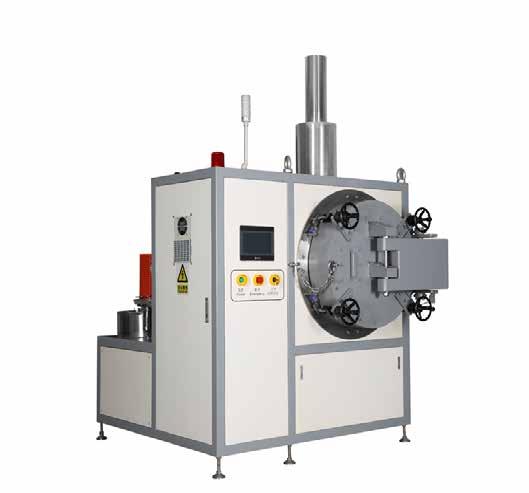
Fig. 9 Large-volume acid catalytic debinding furnace (>1,000 L capacity) with a dual acid injection system, enabling the use of two acids for debinding (Courtesy Guangdong SinterZone Technology)
The approach is supported by the mature plastic injection moulding ecosystem in regions such as the Pearl River Delta and Yangtze River Delta, which provides both technical expertise and established infrastructure for high-volume production. Feedstock mixing machines are now capable of processing approximately 200 kg/h (Fig. 8), with future systems targeting significantly higher capacities of up to around 1 tonne/h. Debinding systems are also evolving, with large-volume acid catalytic furnaces exceeding 1,000 L capacity and enabling higher throughput (Fig. 9).
Batch-type furnaces are gaining prominence, with ultra-large-volume vacuum furnaces in the 1,500–3,000 L range introduced to support growing part sizes and production volumes. Major equipment manufacturers, including HIPER Vacuum and SinterZone, have introduced such systems (Fig. 10), with future furnaces targeting capacities of up to around 5,000 L.
Compared with continuous furnaces offering similar output capacity, batch systems provide a smaller footprint, lower energy and gas consumption, and simpler operation. As a result, they are becoming the dominant sintering technology in MIM production. These shifts in powder processing, thermal technology, and vertically integrated manufacturing are also increasing the overlap between the MIM industry and emerging metal Additive Manufacturing supply chains. The broader shift away from continuous furnace systems has, in some cases, challenged established suppliers of continuous sintering technology.
The manufacture of small metal components is increasingly shifting from multi-part assemblies towards complex, highly integrated singlepiece designs. Both Metal Injection Moulding and Additive Manufacturing are well-suited to this trend, enabling features such as internal geometries,
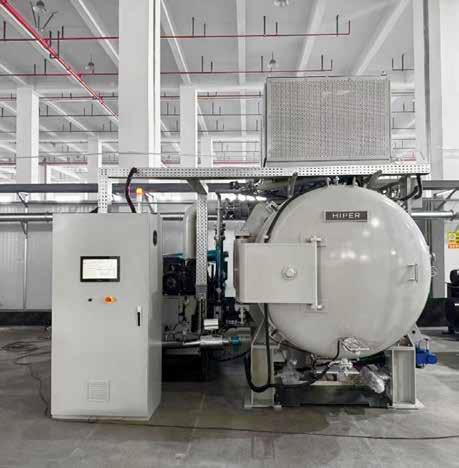
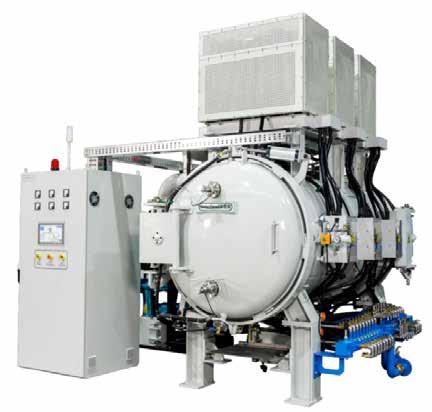
non-circular holes, fine surface structures, and integrated functional elements that are difficult or uneconomical to achieve by conventional machining or casting. As a result, the two technologies are increasingly addressing similar design challenges and application opportunities, even where their production economics and process routes remain distinct.
The relationship between MIM and AM extends beyond part capability into production strategy. MIM remains best-suited to high-volume manufacturing, with established advantages in throughput and scalability. Although it typically requires five to six process steps, it can support production rates ranging from thousands to millions of parts per day. AM avoids tooling and can shorten the route to prototype parts, but production still requires processspecific downstream steps such as depowdering, heat treatment, support removal, machining, finishing, inspection, and, for sinter-based AM, debinding and sintering.
However, its output in serial production is generally far lower than MIM for small components, particularly in laser-based AM, and may range from tens to hundreds of parts per day per machine, depending on
“The two technologies are increasingly addressing similar design challenges and application opportunities, even where their production economics and process routes remain distinct.”
part size, machine configuration, and process route. This complementary relationship supports rapid design iteration and the production of lowervolume, high-complexity components.
Additive Manufacturing is also increasingly used to produce prototypes, fixtures, tooling aids, and, in selected cases, mould inserts for MIM, allowing multiple design iterations to be evaluated in parallel and reducing lead times before mass production. The two technologies also share significant downstream infrastructure, including heat treatment, machining, and finishing. In the case of sinter-based AM processes such as Binder Jetting, debinding and sintering expertise also becomes a
major factor, allowing existing MIM post-processing capability to support AM components.
Leading Chinese MIM suppliers are increasingly broadening their capabilities beyond MIM alone. For example, Tonglian Precision’s 2025 annual report illustrates a shift from a primarily MIM-focused supplier towards an integrated precision-manufacturing platform combining MIM, CNC machining, laser processing, wire cutting, semi-solid die casting, and Additive Manufacturing. While its MIM product revenue declined in 2025 amid customer demand and productmix changes, revenue from other metal-process and plastic products
Primary process stages to produce an as-built/as-sintered rough blank
First sample
Design iteration time (redesign and resampling, days)
Mass production rate (parts/day per machine)
Ability to produce multiple samples simultaneously Difficult Easy
Ability to scale production rapidly (eg. x100 capacity) Easy (30-40 days) Difficult
Table 6 Comparison of processing characteristics for MIM and Powder Bed Fusion (PBF) Additive Manufacturing, based on a 100 g 316L component. MIM supports higher production rates and easier scaling, while PBF enables faster prototyping and design iteration (as-sintered/as-built, unprocessed rough blanks) (Courtesy Dr Q)
increased, reflecting broader diversification into applications such as AI glasses, humanoid robots, and satellite communications [4].
In this sense, AM functions as a complementary technology for rapid prototyping, design iteration, and low-volume, high-complexity production – areas where tooling constraints can limit MIM. Yet the boundary between complementarity and competition is not fixed. As AM
“Titanium Apple Watch cases provide a clear example: PBF-LB is beginning to penetrate high-value ICT applications, including structural and precision components that overlap with the broader small-component space served by MIM...”
production scales and costs fall, the two technologies are increasingly competing for the same component categories, particularly in highvalue ICT applications such as smartwatch cases.
Titanium Apple Watch cases provide a clear example: Laser Beam Powder Bed Fusion (PBF-LB) is beginning to penetrate high-value ICT applications, including structural and precision components that overlap with the broader smallcomponent space served by MIM, machining, casting, and other precision-manufacturing routes. Tables 6 and 7 compare selected processing capabilities and material characteristics of MIM and PBF-LB.
At the materials level, overlap between MIM and Additive Manufacturing is increasingly evident in powder specification and supply chains. Conventional MIM has long relied on relatively fine powder fractions, commonly below ~20-25 µ m for many highperformance applications, while micro-MIM may use substantially finer powders, often below 10-15 µ m, to improve feature resolution, surface finish, and sintering behaviour.
High-resolution Additive Manufacturing processes, including fine-feature Binder Jetting and selected microscale Powder Bed
Abnormal microstructure Rarely Layered and directional
Table 7 Comparison of density, porosity distribution, and surface condition in MIM and AM components (Courtesy Dr Q)
Fusion approaches, are now drawing on similar fine-powder supply chains and particle-size distributions. The strongest overlap therefore occurs in the sub-20 µ m region, particularly between advanced MIM feedstocks, micro-MIM, fine-feature Binder Jetting, and selected highresolution AM processes.
Broader overlap also exists between conventional MIM, Binder Jetting, and some Powder Bed Fusion processes using coarser powder distributions, although the preferred particle-size ranges and processing requirements remain significantly different between technologies.
Another notable shift is the improved utilisation of atomised powders. Fine fractions that are less suitable for some manufacturing routes are increasingly being redirected to MIM. For Ti-6Al-4V, often referred to as TC4 in China, the conventional usable yield is typically around 55%, based on preferred particlesize distributions. By integrating powder utilisation across multiple processes, including MIM, total yield can increase to around 75%. This improves both material efficiency and the economic viability of powder production, reflecting broader changes in feedstock supply and utilisation. Despite these shifts, the overall distribution of material types in MIM production remains relatively stable, as shown in Table 5.
This overlap is also influencing powder supply and processing routes. Powders and fine powder fractions originally developed for MIM are becoming increasingly relevant to Additive Manufacturing, while demand from both sectors is driving expansion in atomisation capacity and the development of lower-cost production routes, including hybrid or combined gaswater atomisation. For the MIM industry, this brings downstream benefits through greater availability of fine powder fractions suitable for feedstock production.
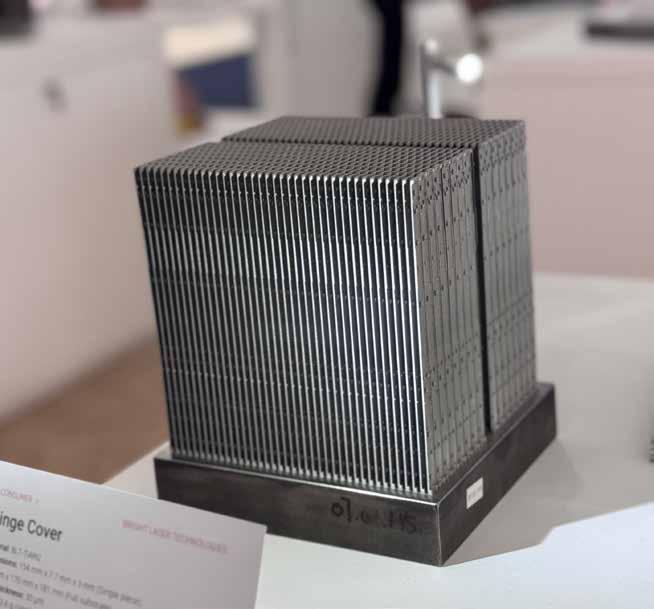
Smartphone hinge plates on a PBF-LB build plate, manufactured by China’s BLT. With its high-capacity contract part manufacturing operation, in-house powder production and AM machine development, BLT is one of the pace-setters in the drive to expand AM in consumer electronics (Courtesy Nick Williams)
OPPO’s Find N6 foldable smartphone has long battled a persistent problem: the display crease that undermines flatness and hinge durability. The company collaborated with PBF-LB AM machine manufacturer BLT to redesign the wing plate – the component bearing most of the folding stress. Conventionally, this was manufactured as an assembly of thirteen separate machined parts. BLT consolidated the design into a single additively manufactured
titanium structure with complex internal lattice geometries that would be impossible to achieve through conventional CNC machining. The result was a 50% improvement in surface flatness and verified durability at 600,000 folding cycles.
While MIM and Binder Jetting can compete with PBF-LB on many ICT parts, very long parts such as these present challenges in relation to tolerances as a result of shrinkage.
Binder Jetting and Material Extrusion (MEX) remain particularly closely aligned with MIM in terms of feedstock format, debinding and sintering requirements, and overall process knowledge. At the same time, the metal AM industry has gained access to a broader range of alloys and material systems originally developed for MIM, helping to expand application opportunities across both technologies. This overlap in materials and powder technology is enabling MIM and metal Additive Manufacturing to address an increasingly broad range of applications conventionally served by processes such as casting, investment casting, die casting, machining, and sheet metal fabrication. As mate -
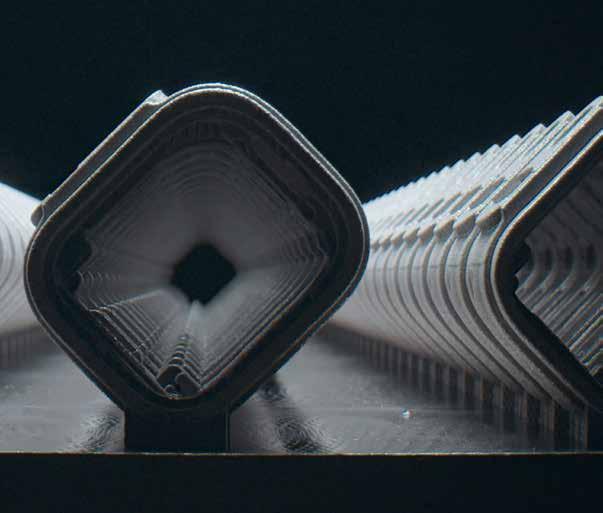
Apple officially confirmed in 2025 that it had scaled Laser Beam Powder Bed Fusion to produce commercial volumes of Apple Watch Ultra 3 and titanium Series 11 cases. The shift marked a significant moment: Additive Manufacturing moved from prototyping into mass production for high-volume consumer electronics. All cases are produced by PBF-LB from 100% recycled titanium powder. The design flexibility offered by AM also enabled innovations that conventional machining
could not: textured surfaces on antenna housings for improved plastic-metal bonding, and an ultrathin yet durable USB-C port on the new iPhone Air.
Apple estimated that more than 400 t of raw titanium was saved in 2025 alone through the new process, which uses roughly half the raw material compared to previous generations produced through traditional machining. Whilst these parts are all PBF-LB, Apple’s job postings at the time also pointed to the adoption of sinter-based AM processes.
“While PBF-LB has attracted significant attention through its success in highvalue consumer electronics applications, Binder Jetting represents a more direct point of overlap between MIM and metal Additive Manufacturing.”
rial development and powder supply chains continue to evolve, the technological interdependence between MIM and metal AM is expected to strengthen further.
Recent industrial initiatives in consumer electronics include collaborations between major device manufacturers and Additive Manufacturing machine suppliers such as BLT and Farsoon, with rapidly expanding installed bases of PBF-LB systems focused on the additive manufacture of structural components in materials such as titanium alloys and ultra-high-strength steels.
While PBF-LB has attracted significant attention through its success in high-value consumer electronics applications, Binder Jetting represents a more direct point of overlap between MIM and metal Additive Manufacturing. Unlike PBF-LB, which relies on localised melting and solidification, Binder Jetting is a sinter-based process and therefore shares important downstream requirements with MIM, including binder removal, controlled densification, shrinkage management, and post-sintering finishing. As a result, established MIM expertise in debinding, sintering atmospheres, furnace loading, dimensional control, and finishing can be transferred to Binder Jetting without requiring a wholesale reinvention of process knowledge or infrastructure.
This alignment is particularly important in Asia, where large-scale MIM manufacturers already operate mature debinding and sintering infrastructure. Binder Jetting therefore occupies a position between PBF-LB and MIM, offering greater geometric freedom and tooling flexibility than conventional MIM, while potentially providing higher scalability and lower production cost than laser-based AM for suitable applications.
Evidence of this transition is already visible in consumer
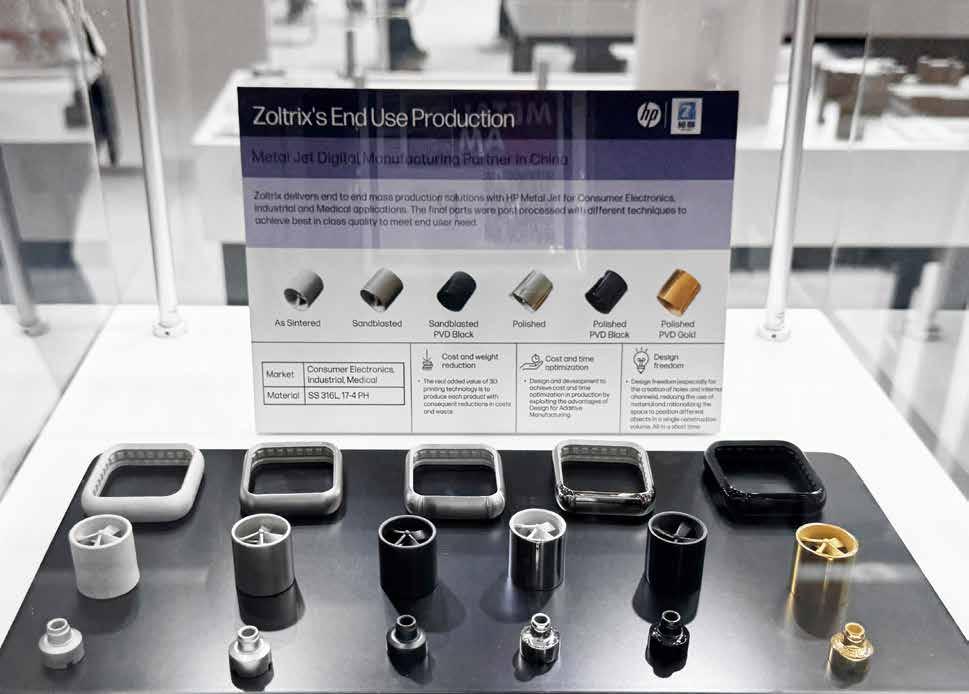
Consumer electronics components
(Courtesy PIM International)
electronics. Zoltrix Material International, one of China’s leading MIM companies, reportedly uses HP Metal Jet Binder Jetting to additively manufacture hundreds of thousands of metal components for consumer electronics applications [5]. Parts displayed by HP at Formnext 2024 (Fig. 11) included end-use 316L and 17-4PH stainless steel components, including smartwatch cases post-processed to high cosmetic standards. Zoltrix reportedly began using HP Metal Jet technology in 2019.
The significance of this example extends beyond Binder Jetting itself. Zoltrix is owned by CN Innovations Holdings Limited (CNI), a major Hong Kong-headquartered manufacturing group with extensive mainland China operations and a history of appearing on Apple’s Supplier List. This suggests that established consumer-electronics MIM suppliers
are already industrialising Binder Jetting as an adjacent production route.
Although Apple’s current titanium watch-case production has been confirmed as PBF-LB, the company’s job listings point to strong interest in sinter-based AM processes, citing binder systems and debind-sinterHIP workflows – terminology closely aligned with Binder Jetting and related sintering-based AM routes [6].
The opportunities for MIM producers are significant. Binder Jetting offers a route into tool-free production without abandoning the metallurgical and thermal-processing expertise that underpins MIM. It can support prototype development, bridge production, customised components, and medium-volume applications where tooling cost or lead time would otherwise limit MIM adoption.
The overlap between MIM and metal AM should therefore not be viewed solely through the lens of PBF-LB. While laser-based AM currently provides the most visible examples of mass production in consumer electronics, Binder Jetting may prove equally important in shaping the next phase of industrial integration through its reliance on shared powders, thermal-processing infrastructure, and metallurgical knowledge.
Despite increasing overlap in applications, materials, and supply chains, important differences remain in the characteristics of components produced by MIM and metal Additive
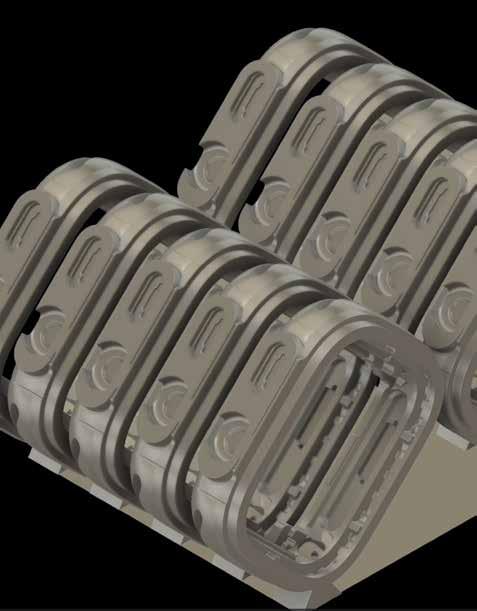
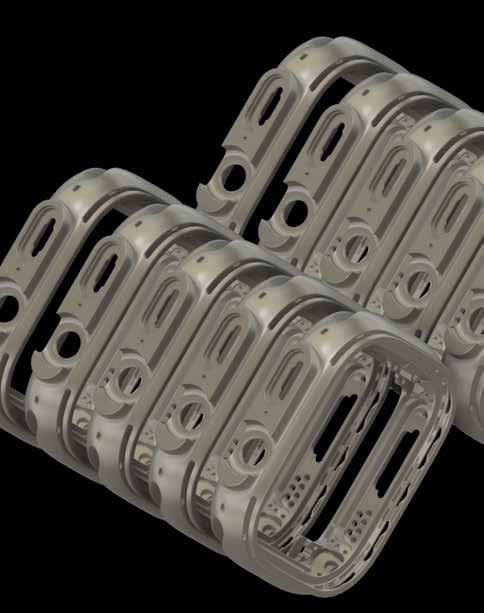
Manufacturing (Table 7). Both processes can achieve high relative density, but the distribution and morphology of residual porosity differ. In well-controlled MIM, residual porosity is often relatively fine and distributed through the sintered structure, although powderbinder separation or green-density variation can produce local density
differences. In PBF processes, porosity may arise from lack of fusion, keyholing, gas entrapment, or near-surface effects, and can show greater localisation depending on process parameters.
Surface condition and microstructure also reflect fundamental differences in processing. MIM components tend to exhibit more
“Metal Additive Manufacturing imposes a different set of constraints. While it offers fast prototyping and greater geometric freedom, mass-production efficiency remains limited in many applications.”
isotropic microstructures, while PBF parts are characterised by layered, directional features associated with the build process. These differences can influence mechanical performance, surface finish, and post-processing requirements.
Although post-processing techniques such as Hot Isostatic Pressing (HIP) can improve or achieve nearfull densification, they introduce additional cost and, depending on pore distribution and part geometry, may contribute to dimensional change, surface depressions, or distortion. As a result, trade-offs persist among density, surface quality, dimensional control, and process efficiency, reinforcing the distinction between the two manufacturing routes.
MIM remains sensitive to processing conditions, particularly powder distribution, injection, debinding, and sintering, all of which can be sources of variability. Thermal parameters, including barrel and mould temperatures, must also be
tightly controlled to avoid defects. In addition, tooling requirements limit flexibility, particularly in lowervolume production, where mould costs must be spread across smaller batch sizes. Highly complex geometries, including hollow and undercut features, can also remain difficult to achieve.
Metal Additive Manufacturing imposes a different set of constraints. While it offers fast prototyping and greater geometric freedom, massproduction efficiency remains limited in many applications. Output per machine is typically far lower than for MIM, and scaling production requires significant investment in equipment, powder handling, process monitoring, and safety controls. Fine metal powders also require dedicated industrial environments, increasing operational and infrastructure costs.
Both technologies share broader challenges. Recruiting and retaining skilled technical personnel remains difficult, reflecting the metallurgical and process knowledge required.
Process discipline is critical, particularly in raw material handling, equipment maintenance, and quality control. Both MIM and metal AM also rely on specialised equipment subject to rapid iteration and upgrading, increasing capital intensity.
The relationship between MIM and metal AM is therefore not one of simple substitution. Their growing overlap is real, particularly in materials, supply chains, and selected applications, but each process retains distinct strengths and limitations. Understanding these trade-offs will be central to determining where the two technologies complement one another, and where they compete directly with established routes such as casting, machining, and die casting.
Metal Injection Moulding has developed over more than fifty years into a mature, high-volume manufacturing technology. Metal Additive Manufacturing has followed a compa -
rable but less linear path, with wider industrial adoption constrained by powder requirements, process economics, and production scalability.
In Asia, the next phase of development will be shaped by continued expansion in manufacturing scale, deeper integration across powder and feedstock supply chains, and growing overlap between MIM and metal AM. MIM will remain the dominant route for high-volume production of small, complex metal parts, but its future competitiveness will increasingly depend on how effectively manufacturers use Additive Manufacturing to support prototyping, tooling, bridge production, materials innovation, and entry into higher-value applications.
Rather than replacing one another, MIM and metal AM are likely to develop as complementary technologies within a broader precision-manufacturing ecosystem. Their shared reliance on powder metallurgy, sintering knowledge, post-processing infrastructure, and advanced materials development will continue to create new opportunities, particularly in consumer electronics, ICT infrastructure, medical devices, robotics, and other high-performance applications.
Sustained progress will depend on continued investment in process knowledge, engineering skills, and cross-disciplinary expertise across both MIM and metal AM.
[1] Yau-Hung, Chiou, ‘MIM feedstock trends in Asia: Competition, innovation, and market shifts,’ PIM International , Vol. 19, No. 1, Spring 2025, available at: https:// www.pim-international.com/articles/ mim-feedstock-trends-in-asiacompetition-innovation-and-marketshifts/
[2] NBTM New Materials Group Co, Ltd (Dongmu), 2025 Annual Report, 东睦股份 2025 年年度报告 , CNINFO/ 巨潮资讯网 , April 2026, available at:
https://money.finance.sina.com.cn/ corp/view/vCB_AllBulletinDetail. php?id=12119505&stockid=600114
[3] Jiangsu GIAN Technology Co, Ltd, 2025 Annual Report, 江 苏精研科技股份有限公司 2025 年年度报告 , CNINFO / 巨潮资讯 网 , April 2026, available at: https://static.cninfo.com.cn/ finalpage/2026-04-27/1225193234. PDF
[4] Tonglian Precision
Manufacturing Co, Ltd, 2025 Annual Report , April 2026, available at: https://static.cninfo.com.cn/ finalpage/2026-04-29/1225249358. PDF
[5] ‘China’s Zoltrix using HP Metal Jet Binder Jetting to produce hundreds of thousands of consumer electronics parts,’ PIM International , available at: https://www.pim-international. com/chinas-zoltrix-using-hp-metaljet-binder-jetting-to-producehundreds-of-thousands-ofconsumer-electronics-parts/
[6] ‘Metal Additive Manufacturing comes of age in Apple’s flagship products,’ Metal AM , September 2025, available at: https://www. metal-am.com/metal-additivemanufacturing-comes-of-age-inapples-flagship-products/
Authors
Dr Yau-Hung, Chiou (Dr Q) and Dr Yu-Deh, Chao (Dr James) You Need Technology Consulting Co, Ltd chiou55631966@163.com
Emma Lawn and Nick Williams, PIM International
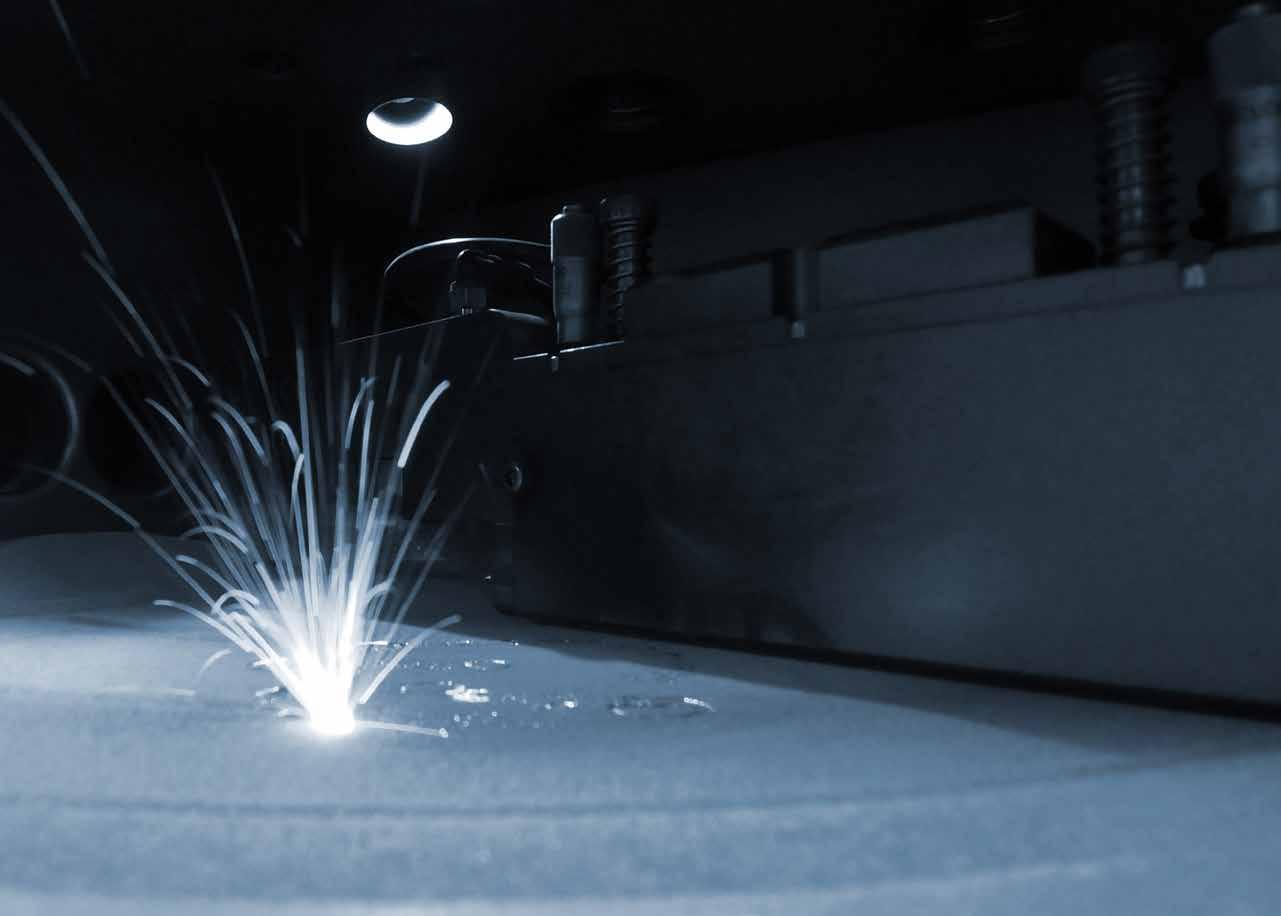
We Convene...
The most brilliant minds from industry and academia
We Coordinate... Transformative technical and workforce data
America Makes is the leading collaborative partner for additive manufacturing and 3D printing technology research, discovery, and innovation in the U.S.
Structured as a public-private partnership, we innovate and accelerate AM/3DP to increase global manufacturing competitiveness.
Focused on additive manufacturing, America Makes is the first institute of the Manufacturing USA® network.
We Catalyze... High-value, high-impact collaborative projects
® REGISTER TODAY! Members Meeting & Exchange (MMX) August 4-5, 2026 Youngstown, OH

Learn more at AmericaMakes.us
Chanel’s J12 has long been one of luxury watchmaking’s most recognisable ceramic watches. Now, through a series of videos shared across its social media channels, Chanel is giving rare visibility to the Ceramic Injection Moulding (CIM) process behind the collection. By presenting powder processing, moulding, sintering and finishing as integral to the J12’s identity, the brand is framing CIM as a source of luxury value in itself. Emma Lawn explores how Chanel is integrating advanced ceramic manufacturing into the language of luxury.
One of luxury watchmaking’s most recognisable designs, Chanel’s J12, is made using a process its maker has rarely placed at the centre of the product narrative: Ceramic Injection Moulding (CIM). Through fashion-led branding, celebrity campaigns and the visibility of the J12 to millions of consumers within global luxury culture, Chanel helped elevate ceramic watches from a specialist technical niche into a widely recognised symbol of contemporary luxury.
Yet the manufacturing processes behind the watch have historically remained largely outside the public spotlight. That changed recently when Chanel’s social media channels featured a series of carefully produced films showing ceramic manufacturing in unusual detail [1]. The videos show powder preparation, moulding, sintering and finishing across Chanel’s production operations, although the company rarely uses explicitly industrial terminology such as Ceramic Injection Moulding in its consumer-facing communications.


“In the course of twenty-five years, Chanel has elevated ceramic to the level of a precious material. The art of ceramic is undeniably Chanel watchmaking and our outstanding savoir-faire.”
Instead, Chanel describes the J12 as the result of an “avant-garde approach” to watchmaking and positions ceramic as one of the “emblematic materials” of Chanel Watchmaking, framing the manufacturing process through the language of luxury, creativity and savoir-faire [2].
In many ways, this recalls Apple’s recent emphasis on metal Additive Manufacturing for its premium titanium watch cases. Like Chanel, Apple foregrounded the complete production cycle – from raw material to finished product – positioning advanced manufacturing itself as part of the product’s premium appeal.
The renewed emphasis on ceramic manufacturing coincides with the J12’s twenty-fifth anniversary in 2025, marked by the launch of the new J12 BLEU collection. Arnaud Chastaingt, Director of the Chanel Watchmaking Creation Studio, describes ceramic as central to Chanel’s watchmaking identity: “In the course of twentyfive years, Chanel has elevated ceramic to the level of a precious material. The art of ceramic is undeniably Chanel watchmaking and our outstanding savoirfaire: it is an inspiring material that, thanks to the genius of our engineers, offers a vast creative playing field” [3].
Chanel’s treatment of Ceramic Injection Moulding reflects a broader shift in how advanced manufacturing technologies are presented within premium consumer markets. Luxury watch brands have historically emphasised design heritage, artisanal finishing and mechanical craftsmanship, while industrial production processes remained largely invisible to consumers. Increasingly, however, manufacturing precision and engineering control are themselves becoming part of the product narrative, particularly in categories where advanced materials and specialised production techniques contribute directly to brand identity.
During the late stages of the ‘quartz crisis’ in the 1970s and 1980s, Swiss watchmakers were under pressure to rethink both materials and manufacturing. Conventional precious-metal dress watches were losing ground to increasingly affordable, technologically advanced quartz models that offered greater accuracy and industrial scalability than traditional mechanical movements. In response, some brands began exploring alternative materials [4].
Unlike conventionally processed metals including gold, CIM parts shrink significantly during debinding and sintering, requiring products and tooling geometries to compensate precisely for dimensional change. Achieving the tolerances required for a wristwatch case demanded a level of dimensional precision that was highly unusual in the industry at the time. The result, however, was a material with exceptional scratch resistance and a distinctive surface character that conventional metals could not replicate.
IWC emerged as an early pioneer in ceramic watchmaking. In 1986, the company introduced a black zirconium oxide ceramic version of the Da Vinci Perpetual Calendar, widely regarded as the first wristwatch to use the material for its case. At the time, ceramic was still considered an unusually advanced choice for watchmaking, more commonly associated with high-temperature industrial applications [5].
Rado would play a different but equally important role in the development of ceramic watchmaking. Also in 1986, Rado introduced the Integral, becoming the first watchmaker to produce high-tech ceramic watches in series, which the company marks as an important shift from technical experimentation toward sustained industrial production [6].
Where IWC demonstrated ceramic’s potential within highend watchmaking, Rado showed that ceramic watches could be manufactured consistently and

3 Arnaud Chastaingt, Director of the Chanel Watchmaking Creation Studio, describes ceramic as central to Chanel’s watchmaking identity (Courtesy Chanel)
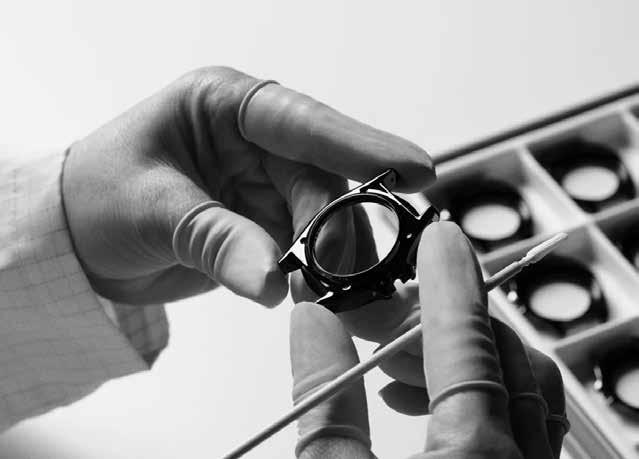
Fig. 4 Luxury watch brands have historically foregrounded design heritage, artisanal finishing and mechanical craftsmanship, while industrial production processes remained largely invisible to consumers (Courtesy Chanel)
commercialised as an enduring product category rather than as isolated technical showcases.
By the time Chanel launched the J12 in 2000, ceramic had already established itself within Swiss watchmaking. However, prior to the J12, ceramic in watchmaking was more often limited to components such as bezels, rather than fully integrated case-and-bracelet
constructions. Notably, the J12 helped bring ceramic into mainstream luxury watchmaking. In a 2025 interview with the Financial Times , Paul Boutros, deputy chair and head of watches for the Americas at Phillips, stated: “It wasn’t until the year 2000 that ceramic became really cool and that was because of Chanel with the J12” [7].

“More than twenty-five years after its introduction, the J12 remains central to Chanel’s watchmaking business. [...] Grangié stated that the collection represents approximately 50% of Chanel’s watch sales...”
The first J12 was released in 2000 by Jacques Helleu, then artistic director of Chanel, after seven years of development [8]. The watch was designed as a fully ceramic model, with the case, bracelet, bezel ring, and crown detailing all executed in the same material and finished to a consistent standard across all components.
Said to be inspired by racing yachts, the watch was conceived as a unisex sports watch and launched initially in black ceramic, followed by a white ceramic version in 2003. According to Frédéric Grangié, President of Chanel Watches & Fine Jewellery, these early iterations established the J12’s global identity and iconic status [9].
In 2019, the collection underwent a substantial redesign led by
Chastaingt, with Chanel stating that approximately 80% of the watch was modified while preserving its recognisable visual identity. The redesign introduced the Kenissi Manufacture Calibre 12.1 movement [9]. The fourth major stage in the collection’s development arrived in 2025 with the launch of the J12 BLEU series, developed around a new blue ceramic formulation requiring several years of research and development.
More than twenty-five years after its introduction, the J12 remains central to Chanel’s watchmaking business. In a 2025 interview with Vogue , Grangié stated that the collection represents approximately 50% of Chanel’s watch sales [10].
Today, Chanel has extended its ceramic manufacturing capabilities beyond its own products, supplying other luxury brands while simultaneously maintaining proprietary
innovation within its own collection. In doing so, the company has developed an unusually high level of vertical integration across ceramic watch production, from materials development through to finished component manufacture.
In 1993, Chanel acquired G&F Châtelain in La Chaux-de-Fonds, Switzerland, integrating the industrial capabilities that would later form a central part of the Chanel Watch Manufacture’s ceramic watch production. Few luxury brands pursue this level of industrial integration; fewer still develop such extensive in-house capability in ceramic component manufacturing.
In a 2024 interview with the Financial Times , Grangié described Châtelain as “a real industrial company” acquired to secure process control and manufacturing quality. “Today we control 100% of that production chain, from the pellets to the final product.” He added that, to his knowledge, only three groups in Switzerland maintain comparable in-house ceramic manufacturing capability [11].
Chanel’s vertical integration strategy extends beyond component manufacturing into raw material supply. In 2012, the company acquired a 10% stake in INMATEC Technologies GmbH, Rheinbach, Germany, a developer of CIM feedstocks and binder materials, securing access to high-quality ceramic systems for long-term production requirements. Chanel increased this investment to majority ownership in 2021, further strengthening its control over materials development and feedstock supply.
During a 2024 visit to INMATEC Technologies by PIM International, founder and Managing Director Dr Moritz von Witzleben explained that the acquisition reflected INMATEC’s growing strategic importance within the CIM sector and increasing
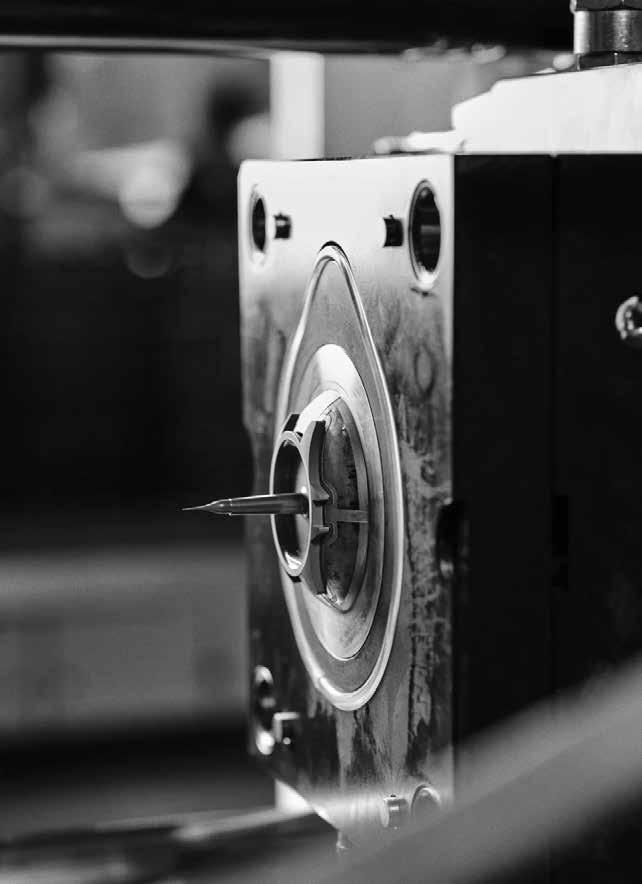



“Chanel’s recent social media campaign publicly outlined the ceramic manufacturing sequence used for the watch, including powder selection and compounding, injection moulding, binder removal, high-temperature sintering, precision machining, and final polishing.”
external acquisition interest. Von Witzleben also noted that Chanel allowed INMATEC to continue supplying external customers while further developing its ceramic materials portfolio [12].
The investment also reflects the unusually demanding material and process requirements associated with luxury ceramic watch production. As reported during the visit, feedstocks developed for watch cases and bracelet components must satisfy not only mechanical performance requirements, but also high aesthetic standards relating to surface finish, dimensional consistency, and colour control.
Each J12 is developed and assembled at the CHANEL Manufacture in La Chaux-de-Fonds, Switzerland. Chanel’s recent social media campaign publicly outlined the ceramic manufacturing sequence used for the watch, including powder selection and compounding, injection moulding, binder removal, hightemperature sintering, precision machining, and final polishing. Bracelet links are assembled individually, while hour markers and luminescent elements are manually positioned and fixed during final assembly.
In fully ceramic watches, multiple components – from bracelet links and bezel sections to crown details and monobloc case elements – must be manufactured to an extremely consistent standard despite their differing geometries. This requires careful control over feedstock composition, shrinkage during sintering, machining tolerances, and final surface finishing.
Colour matching is a further challenge; pigment systems must remain stable at sintering temperatures that typically exceed 1,300°C. Variations in thermal cycles or material dispersion can produce visible differences between adjoining components.
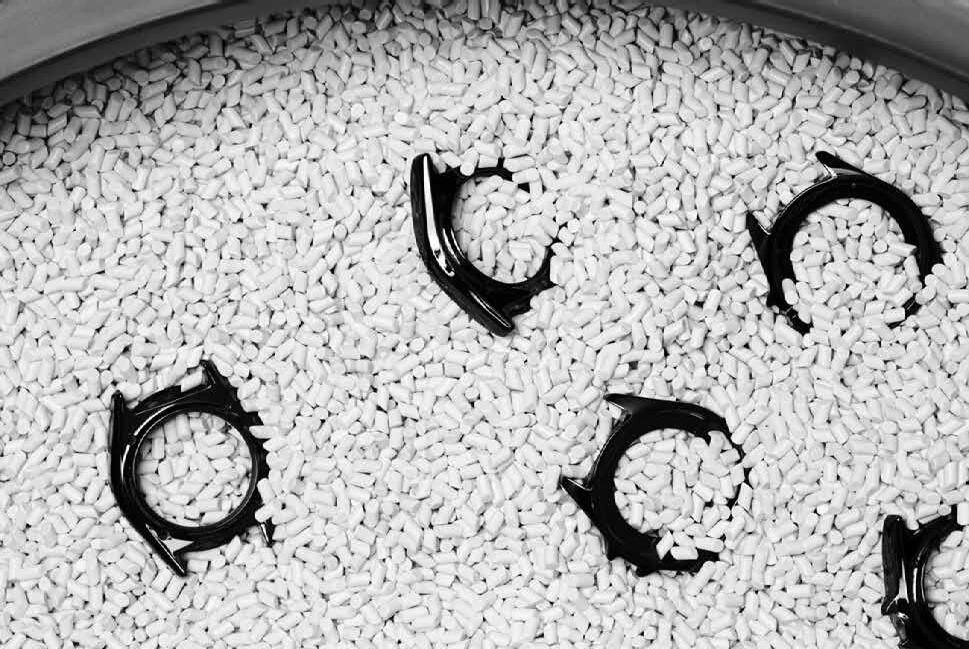
Discussing the development of the J12 BLEU in Chanel’s Watches & Wonders 2025 materials, Chastaingt stated: “ Developing the perfect blue as we intended [...] made us realise that we had the ability to create other colours we didn’t originally have in mind. In the end, it was frankly the best exercise because, whether in terms of ceramic finishing or colours, I think we’ve reached a new level in terms of mastering the material” [3].
The development of the J12 BLEU illustrates the challenges associated with coloured ceramic production. According to Chanel, the blue ceramic formulation required five years of development, reflecting the difficulty of achieving stable and repeatable colour at high sintering temperatures.
Producing a consistent shade across multiple ceramic components requires precise control over pigment formulation, dispersion, and thermal cycles during sintering. Even
“The development of the J12 BLEU illustrates the challenges associated with coloured ceramic
production.
According to Chanel, the blue ceramic formulation required five years of development, reflecting the difficulty of achieving stable and repeatable colour...”
minor process variations can alter the final colour or surface appearance of adjoining components such as bracelet links, bezel sections, and case elements.
Ceramic’s advantages in watchmaking are closely tied to its hardness and scratch resistance
– properties Chanel describes as making the material significantly more resistant to surface wear than metallic materials. Those same characteristics, however, also introduce engineering challenges.
Unlike metals, advanced ceramics are comparatively brittle under impact loading, meaning case structures, interfaces, and assembly tolerances must be engineered carefully to withstand shock and
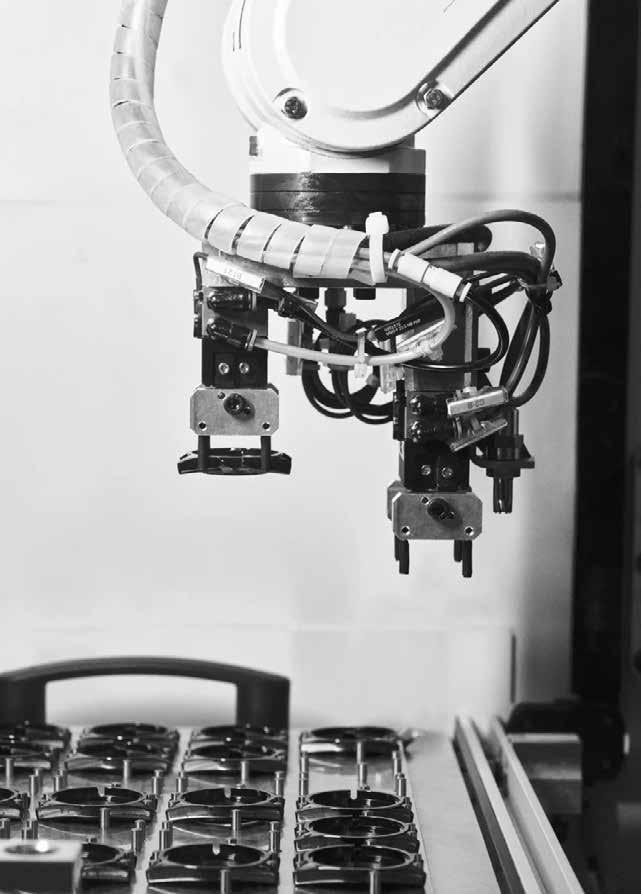
“For the Ceramic Injection Moulding sector, the J12 therefore represents more than a successful luxury watch: it demonstrates how advanced ceramic manufacturing can evolve from a hidden enabling technology into a defining element of brand value.”
long-term mechanical stress. Chanel’s testing procedures include impact-resistance trials reproducing accelerations of up to 5,000 g, alongside durability testing of crown and winding components [13].
Chanel’s recent emphasis on ceramic manufacturing also reflects changing attitudes within luxury watchmaking, where advanced materials and production technologies are increasingly discussed more openly as part of product development and brand identity.
Discussing the J12 BLEU collection with the Financial Times , Grangié stated that “it’s important for us to celebrate our manufacturing capabilities with these creations,” explicitly linking ceramic engineering and production capability to the identity of the collection [7].
Chanel also continues expanding the J12 collection through larger 42 mm variants such as the J12 Superleggera and J12 Golden Black, extending the watch beyond its original unisex positioning into larger sports-watch formats [14].
For the Ceramic Injection Moulding sector, the J12 therefore represents more than a successful luxury watch: it demonstrates how advanced ceramic manufacturing can evolve from a hidden enabling technology into a defining element of brand value.
Author Emma Lawn PIM International
References
[1] CHANEL, “J12. The triumph of ceramic — CHANEL Watches,” YouTube , published 2026. Available at: https://www.youtube.com/watch ?v=qbPAlxMJl18&list=PL5A56BB28 D8EA760D&index=2
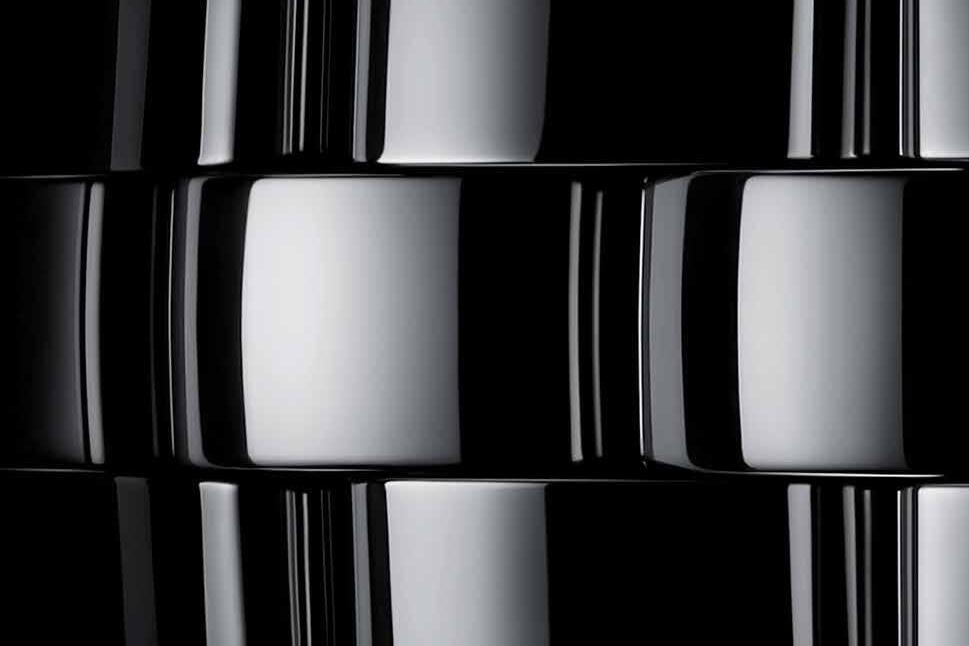
[2] CHANEL, Ceramic: Watch Manufacture. Available at: https:// www.chanel.com/gb/watches/ watch-manufacture/ceramic/
[3] CHANEL, J12 BLEU, Watches & Wonders 2025 . Available at: https://pr-watch.chanel.com/ watchesandwonders2025/j12-bleu
[4] Pynson, T., “The Quartz Crisis and the Transformation of Swiss Watchmaking,” NAWCC Bulletin , 2024. Available at: https:// www.nawcc.org/wp-content/ uploads/2024/03/PynsonPt1_ Bulletin-MarApr24-468-web.pdf
[5] Watch Brothers London, “The IWC Da Vinci Perpetual Calendar Chronograph Through Time.” Available at: https://www.watchbrotherslondon.com/articles/ the-iwc-da-vinci-perpetualcalendar-chronograph-throughtime
[6] Rado, 40 Years of High-Tech Ceramic. Available at: https:// www.rado.com/40-years-hightech-ceramic.html
[7] Swithinbank, R., “Ceramic watches gain momentum at Watches & Wonders,” Financial Times , 2025. Available at: https://www.ft.com/ content/1ea3b878-7cef-4959-ac4ec4688430e22d
[8] CHANEL, J12 Savoir Faire. Available at: https://www. chanel.com/bh-en/watches/ j12-savoir-faire/
[9] WorldTempus, “Interview: Frédéric Grangié, President Chanel Watches & Fine Jewellery.” Available at: https://en.worldtempus.com/ article/watch-knowledge/ interview-frederic-grangie-president-chanel-watches-and-fine-jewellery-chanel-79599.html
[10] Friedman, V., “Inside Chanel’s Watch Strategy,” Vogue , 2025. Available at: https:// www.vogue.com/article/ inside-chanels-watch-strategy
[11] Swithinbank, R., “How Chanel became a serious Swiss watchmaker,” Financial Times , 2024.
Available at: https://www.ft.com/ content/53d66a8d-7616-46b6-9c03230032c96ddc
[12] Schlieper, G., “INMATEC Technologies: Celebrating 25 years as a driving force behind Ceramic Injection Moulding,” PIM International , Vol. 18 No. 1, Spring 2024. Available at: https://www. pim-international.com/articles/ inmatec-technologies-celebrating-25-years-as-a-driving-forcebehind-ceramic-injection-molding/
[13] CHANEL, Resistance & Durability. Available at: https://www.chanel.com/gb/ watches/watch-manufacture/ resistance-durability/
[14] Bilger, A., “The Return Of The Men’s Chanel Watches: 2026’s New 42mm J12 Golden Black Superleggera,” aBlogtoWatch , 2025. Available at: https://www.ablogtowatch.com/ the-return-of-the-mens-chanelwatches-2026s-new-42mm-j12golden-black-superleggera/

As semiconductor manufacturers move towards larger substrates and faster atomic-scale processes, the components inside wafer production tools must scale up without compromising precision. Plasway-Technologies, Alumina Systems and Lithoz have developed a 500 mm dual-channel alumina gas distribution ring for Plasway-Technologies’ FAST Atomic Layering Process (FALP) platform. Produced using Lithoz’s ceramic Additive Manufacturing, the ring enables high-speed Plasma Enhanced Atomic Layer Deposition (PEALD) and Atomic Layer Etching (ALE) in the same chamber, while maintaining highly uniform gas distribution across large wafer substrates.
The semiconductor industry’s relentless pursuit of faster, more uniform Atomic Layer Deposition (ALD) and Atomic Layer Etching (ALE) processes has driven demand for gas distribution components that conventional ceramic-forming technologies cannot produce. For Stephan Wege, CEO and owner of Germany-based PlaswayTechnologies, which he founded in 2016, improving wafer production efficiency has always depended on two factors: speed and precision.
Wege’s objective was to develop a machine capable of combining Plasma Enhanced Atomic Layer Deposition (PEALD) and ALE within the same chamber: a machine that would exchange gases at high speed to significantly improve throughput while at the same time achieving perfect uniformity in gas distribution. This led to the development of the FAST Atomic Layering Process (FALP) concept.
At the centre of this architecture is a 500 mm dual-channel alumina gas distribution ring produced using ceramic Additive Manufacturing. The ring forms the technological centrepiece of the FALP platform. It
enables high-speed PEALD and ALE processing within the same chamber while delivering perfectly controlled gas flow dynamics across the wafer surface.
“The limiting factors in making these processes faster are clear,” explains Wege. “You need to bring
the gases in efficiently, distribute them fast and uniformly across the wafer surface, and then remove them quickly again.”
According to Wege, flow dynamics simulations revealed that the small dead volumes between the gas inlet and the showerhead acted as
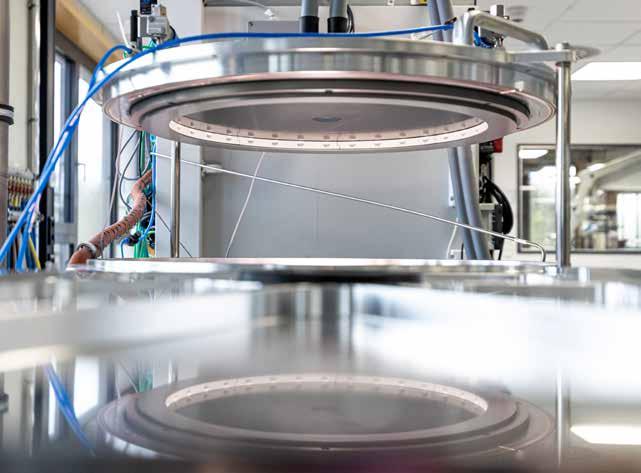
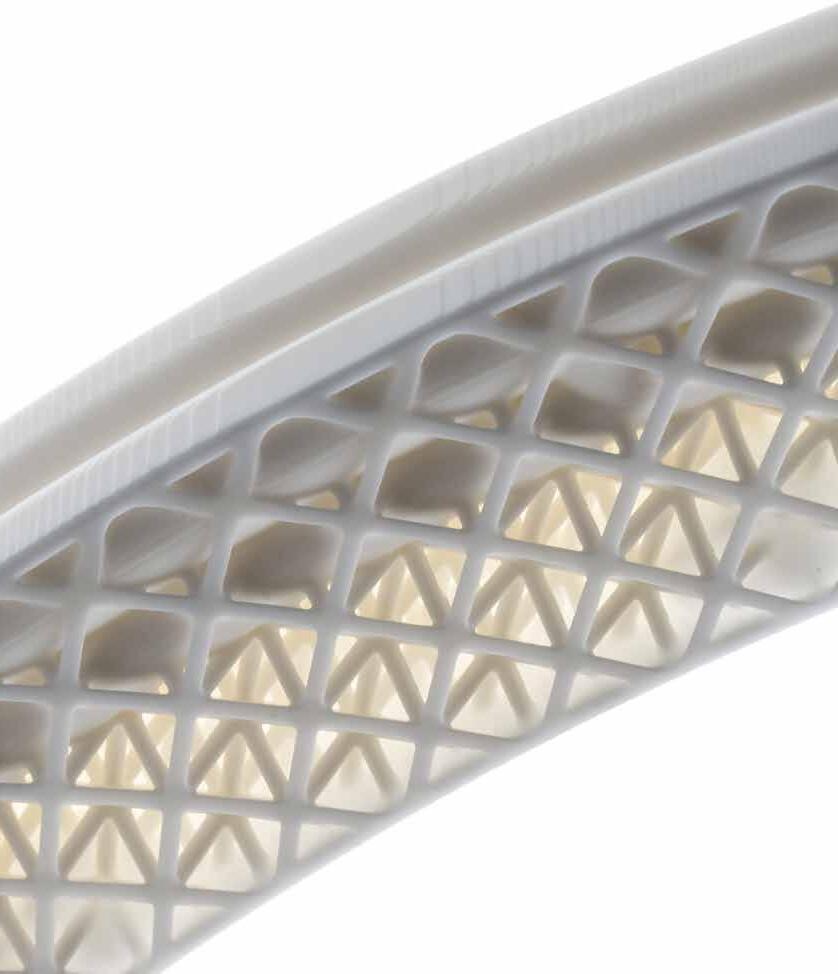
Fig. 2 Close-up of the lightweight lattice structure used to reduce mass and minimise deformation during thermal processing (Courtesy Lithoz)
a roadblock to fast and uniform gas distribution. “But that is exactly what the traditional showerhead principle cannot perform. If you can’t create the perfect showerhead, no laminar flow will occur in the lower region of the reaction chamber. And on top of that, precursors cannot be separated quickly and sharply enough, which brings them into contact with each other. A different principle had to be found.”
Atomic Layer Deposition is a twohalf-cycle process relying on sequential, self-limiting surface reac -
tions. It is crucial for the creation of ever-smaller high-performance chips. Ultra-thin dielectric or metallic coatings are applied to the substrate to protect the wafer’s complex architectures, which feature extremely delicate, high-aspectratio trenches and pores. First, a volatile, thermally stable and above all highly reactive precursor is injected onto the substrate. After the reaction, the precursor has to be pumped off to purge the substrate before injecting a co-reactant during the ALD process’ second half-cycle, which ends with a second purging step.
“Our objective was to speed up the entire ALD sequence and to make the process more precise at
the same time,” Wege states. “The dual channel distribution ring was just a logical consequence to guarantee the strictly independent and perfectly uniform tangential flow of precursor and co-reactant into the same chamber at the highest possible speed, while still establishing a perfectly symmetrical laminar flow across the wafer
The gases never interact before entering the chamber, eliminating the need to clean intermediate interaction volumes between pulses and enabling significantly faster gas exchange. To ensure complete acceleration, Plasway-Technologies installs a turbomolecular pump with a throughput of 3,600 L/s, positioned centrally beneath the substrate to symmetrically purge the wafer at equal speed.
But according to Wege, the well-established ALD process is becoming an innovation bottleneck for wafer production: “ALD was developed some decades ago, but each step brings only one layer onto
This is where the plasmaenhanced variant comes into play: “Unlike the thermal-based ALD process, where the typical co-reactants for oxidation are water or ozone, PEALD is characterised by the use of a plasma, in this radicals. The plasma facilitates the deposition of precursors such as metallic films by significantly decreasing the deposition temperature. This effect is a result of the plasma’s high reactivity on the substrate surface.”
Atomic Layer Etching can be seen as an inverted ALD process. While the first protects the substrate with coatings, ALE removes material in single atomic layers, offering complete control over feature depth, uniformity, and surface smoothness.
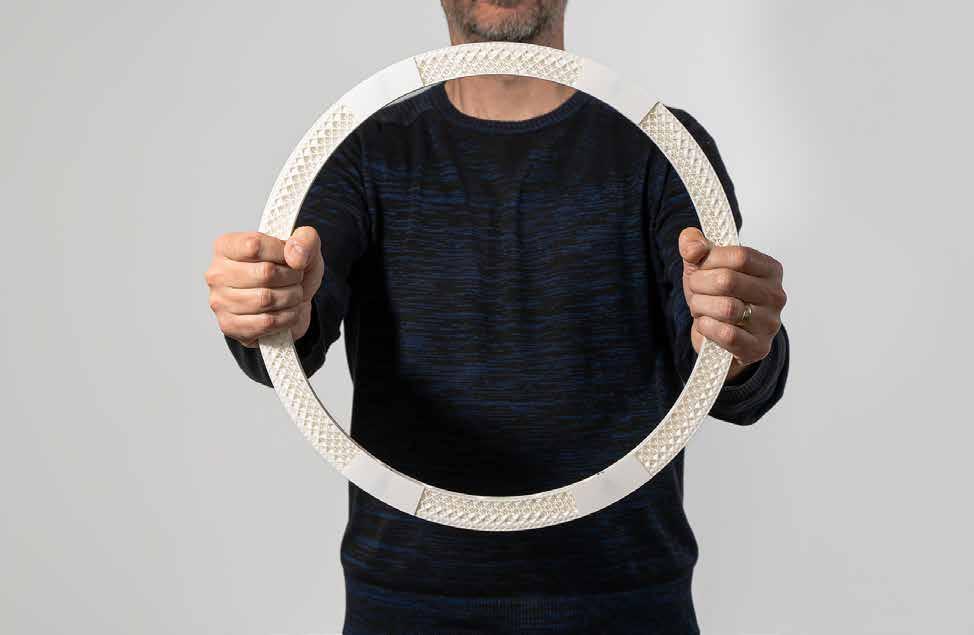
Additively manufactured at scale: a large alumina gas distribution ring developed for high-speed PEALD and ALE processing in the FALP platform. Segment joint cover plates are visible on the assembled ring (Courtesy Lithoz)
Wege explains the basic principles and challenges of ALE:
“When you etch silicon, you need a chlorine plasma to bond with the surface in order to modify the top layer. At normal temperatures, this plasma will not yet react with silicon, and no etching occurs.
Above this narrow window, standard sputter etching will take place. So, the challenge here is controlling ion energy. After a purge step to get the remaining chlorine out of the chamber, the surface is etched by argon ions that must again be perfectly balanced in order to be able to just break the top bonds of silicon.”
Thanks to the ring’s dualchannel construction and appropriate RF frequency selection, FALP independently controls plasma density and ion energy to deliver this exact balance and the best possible performance.
Wege concludes: “Both processes have their individual
challenges in precursor behaviour but in both cases it is key to control the gases uniformly and quickly. A low residence time of species with the fastest possible gas exchange is the key to improving performance. Maximum speed has always been the main driver, so the objective was to bring these opposing processes together into the same chamber.
To make this possible, we needed fast atomic layer processing; this gas ring is the key component in achieving that speed.”
The requirement for two intricate, non-intersecting channel systems embedded within a single ceramic structure, combined with complex Laval-type nozzle geometries optimised through computational
fluid dynamics, defined a design far beyond the reach of conventional ceramic forming methods such as slip casting, Ceramic Injection Moulding, or dry pressing. Wege soon realised that building the envisioned ring design would require a mature Additive Manufacturing process.
Alumina Systems GmbH, Redwitz, Germany, was involved from the very beginning of the development. Technical ceramics soon emerged as the material class of choice, as Steffen Walter, Head of Product and Process Development at Alumina Systems, explains: “Due to plasma corrosion in contact with the extremely aggressive substances inside the FALP chamber, the lifespan of an equivalent metal ring would be significantly shorter. We identified Al 2O 3 as the best compromise for plasma processes; because of the intense contact with corrosive gases, it was decided to use alumina with a 99.9% purity.”
Gas inlet for two precursor gases
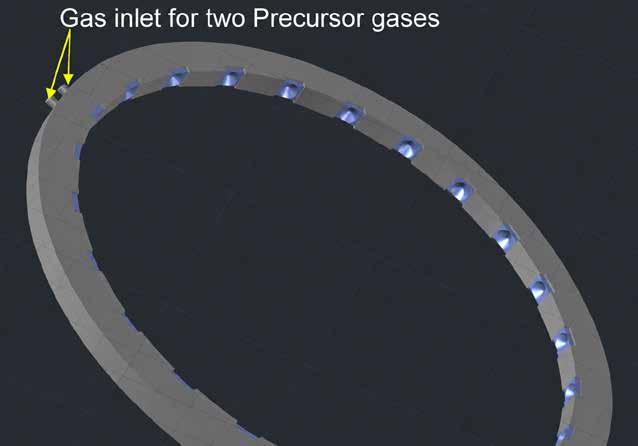
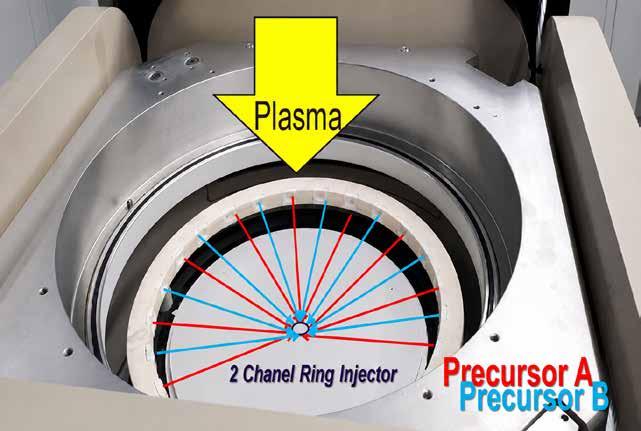
Fig. 4 First-generation 380 mm FALP ring with additively manufactured nozzles and dual-channel precursor gas injection, shown as a CAD model (top) and installed in the plasma chamber (bottom) (Courtesy Plasway-Technologies)
four innovation
Since the first prototypes were built in 2018, the ring has undergone four major design evolution stages:
• Stage 1 – Monolithic ceramic ring with AM nozzles (380 mm diameter)
• Stage 2 – First entirely additively manufactured ring
• Stage 3 – Segmented Additive Manufacturing of the ring
• Stage 4 – Segmented ring with a diameter of 500 mm
Stage 1: from monolithic ring to optimised segments
With the ring diameter set at 380 mm (15”), the first prototype produced in 2018 used a monolithic slip-cast core structure, while only the nozzles were manufactured additively using Lithoz AM machines. In the same year, the first FALP demonstrator prototype was transferred to the Fraunhofer Institute for Ceramic
Technologies and Systems (IKTS), Dresden, where it was thoroughly tested in a clean-room environment. Plasway-Technologies examined its fast-gas-pulsing concept in a twofrequency CCP reactor.
In this first stage, the main focus was on uniformity control through gas inlet design and temperature control. As a consequence, the innovative elements were the nozzles with dynamic-valve characteristics and two independent gas distribution channels.
Already at this first stage, rapid gas-switching capability and good uniformity data were evident. Thanks to fast precursor purging enabled by high pumping speed and low gas emission after pulse end, PlaswayTechnologies successfully achieved rapid gas exchange and uniform gas distribution.
The ring’s dual-channel layout proved critical to increasing process speed. Testing demonstrated that the strictly separated nozzles for both precursors eliminated the need to clean and pump out specific interaction channels.
Two factors drove the transition to a second development stage. “In the pre-version of the FALP, the turbo pump was located asymmetrically, so when gases were turned off, the desired distribution could not be achieved,” Wege explains. Walter adds a second reason: “This first hybrid approach perfectly demonstrated the concept’s feasibility but naturally proved quite inefficient for possible production. So soon the decision was taken to go for an entirely 3D-printed version.”
Stage 2: first entirely additively manufactured ring
In the next major design evolution, the entire ring – not just the nozzles – was additively manufactured. This first fully additively manufactured version was built as a single piece using Vat Photopolymerisation (VPP) based ceramic AM. The redesign significantly improved flow performance while reducing material consumption, resulting in a lighter structure.
The main achievement in this phase was the substantial optimisation of flow paths through the fully integrated nozzles. The channel outlets could now be aligned precisely with the position, angle and geometry of the nozzles. Eliminating joints between the ring and nozzles reduced possible distribution bias arising from this section.
The new design, however, introduced several practical manufacturing challenges due to the component’s size. Extracting the large part from the slurry created a potential point of failure, while the risk of warping during sintering became a major concern. The component’s dimensions also complicated handling during cleaning, debinding and sintering, and raised additional questions regarding storage efficiency.
Stage 3: segmentation of the 380 mm ring
The next development stage focused on overcoming the handling and warping risks associated with the monolithic ring design. “The ring was really performing well, but we wanted to overcome handling and warping risks. The final breakthrough came when Lithoz proposed to divide the 380 mm ring into six identical segments that would be bonded only after sintering,” Walter explains.
Alumina Systems, which specialises in vacuum-tight brazing, glueing, glass soldering and other ceramic-to-metal joining technologies, quickly developed a suitable glazing solution for bonding the six segments of the 380 mm ALD ring after sintering.
Wege details the functional improvements: “As the six segments per ring did not pose a size limitation for Lithoz LCM technology, the complexity of the channels and nozzles could be further optimised to capitalise on the precision of this printer system even more,” he adds.
Segmenting the ring significantly reduced manufacturing risks while also improving production efficiency and reducing costs:
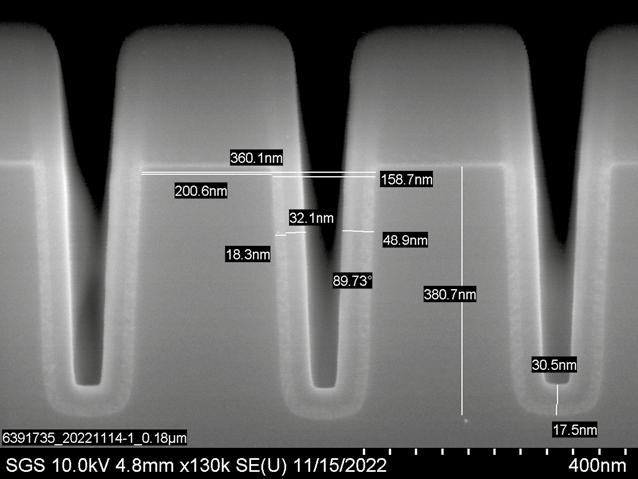
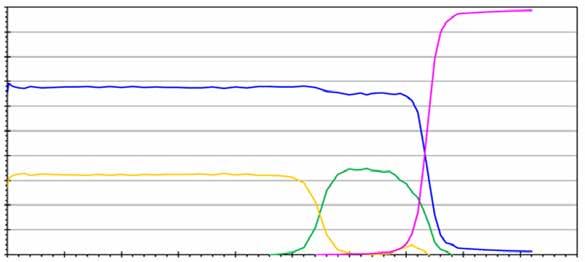
Fig. 6 X-ray Photoelectron Spectroscopy (XPS) data illustrating the PEALD stoichiometry, showing a stable SiOx phase with a constant siliconto-oxygen ratio of 0.48 and a clean transition towards Al 2O 3 (Courtesy Plasway-Technologies)
• Easier handling and storage –compact segments instead of a large ring
• Minimised warpage and deformation risk – lattice-type stiffening structures support thin walls against deformation and prevent warpage during thermal processing
• Accelerated debinding –reduced wall thicknesses and ceramic volume
• Reduced material cost – lightweight lattice structure and thinner walls
• Reduced scrap risk – write off a segment instead of the entire ring
• Production efficiency gain –segments for up to three rings per build
Wege adds a functional improvement: “Thanks to the precise work of the CeraFab printing system, the
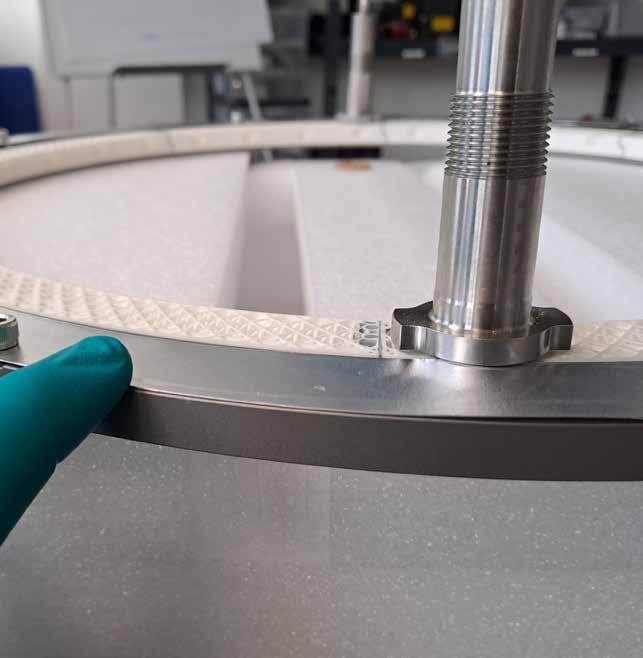
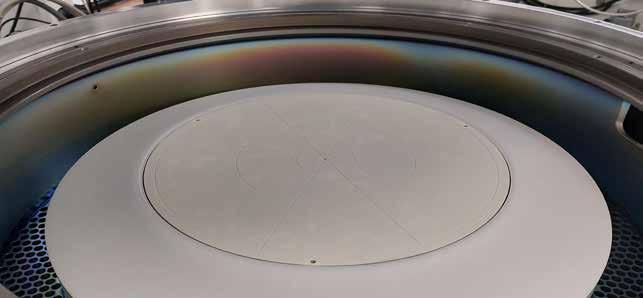
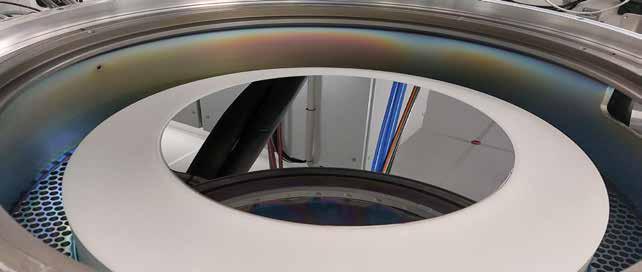
Fig. 8 Bipolar electrostatic chuck (ESC) developed for 300 mm wafer substrates: (a) ESC showing the wafer underlay, enabling precise wafer temperature control within the FALP chamber; (b) ESC with wafer in position (Courtesy Plasway-Technologies)
internal surfaces of the gas channels could be further smoothed, which resulted in a significant optimisation of the flow paths. Compared to a conventionally produced metal ring, at the end of this development process, the tested uptime increased from one to nine months while production output tripled.”
On the Shallow Trench Isolation (STI) wafer structure shown in Fig. 5, the uniformity of the ALD deposition can be observed. X-ray
Photoelectron Spectroscopy (XPS) data (Fig. 6) illustrating the PEALD stoichiometry shows a 15 nm Al 2O 3 layer deposited on a 100 nm SiO 2 film. The SiOx phase remained stable over time, maintaining a constant silicon-to-oxygen ratio of 0.48 and demonstrating a sharp and clean transition towards Al 2O 3
Stage 4: segmented ring with a diameter of 500 mm
The segmented ring design and its improved manufacturing efficiency were not the final stage of development. The next successful extension of the part’s potential was about size. “The industry is moving really fast, and there is a strong push to increase the size of the substrates. Two years ago, we received the support of a company interested in a 500 mm diameter version of our patented ring, to adopt our FALP chamber for 430 mm substrates,” Wege explains.
“While we maintained the basic principle of bringing in the gases through two separated channels, the number of segments had to be changed from six to eight.” Thanks to several years of experience with that component, the partners were able to build on their established development workflow, and the division of labour remained unchanged. Wege adds: “The Lithoz team proved to be a great support for adapting the design elements to the new diameter. We were impressed by how well they controlled the shrinkage parameters of their alumina slurry. Our partner Alumina Systems again took care of all the other steps, from debinding and sintering to glueing.”
To accommodate the larger ring diameter, the FALP machine was equipped with an adjustable mounting mechanism for rings of various sizes (Fig. 7). Alumina Systems also integrated the two stainless steel gas inlets into the ceramic ring structure, drawing on its expertise in joining ceramic and metal components.
For the treatment of 300 mm wafer substrates in the FALP chamber, Plasway-Technologies also developed its own bipolar electrostatic chuck (ESC), shown in Fig. 8. Combined with the turbomolecular pump, the system enables precise control of wafer temperature. Wege says: “Uniformity data shows the proof of concept that we have developed the first PEALD tool with ESC for better and tighter temperature control. We can proudly say that we independently control plasma density, ion energy and wafer temperature.”
Hand in hand with the development of the larger-diameter ring and the increased number of segments required, the nesting strategy for the segments on the CeraFab platform was also optimised in close collaboration with the Lithoz application team. “Three years ago, we started with just four segments per batch on an S65 platform. Today, one CeraFab S320 fits fourteen segments, which results in almost two entire rings of 500 mm diameter produced in one single print job,” Walter explains (Fig. 9).
Alumina Systems uses glazing as a glass-bonding technique for assembling the segments. A specially formulated glass is applied to the sintered ring segments before the component undergoes a second firing step, during which the glass melts and bonds the segments into a complete structure.
The glass melts, wets the ceramic surfaces, and upon cooling forms a hermetic bond that joins the
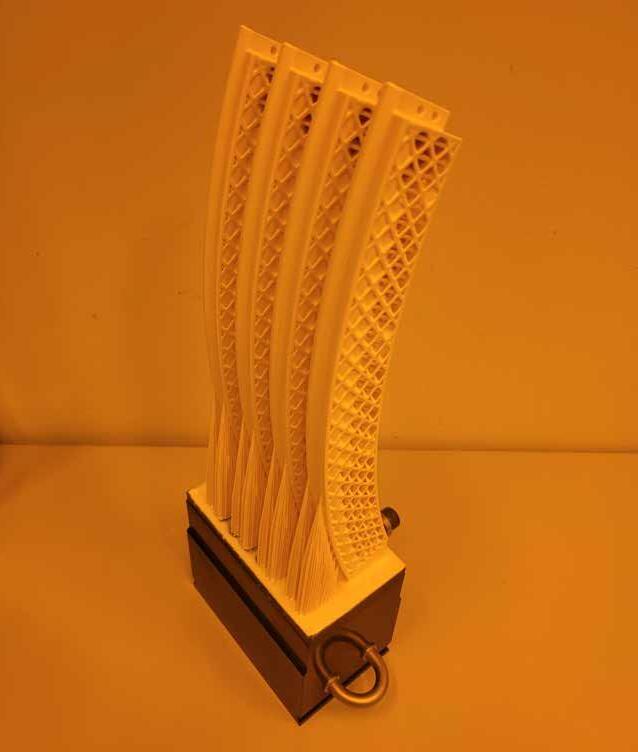
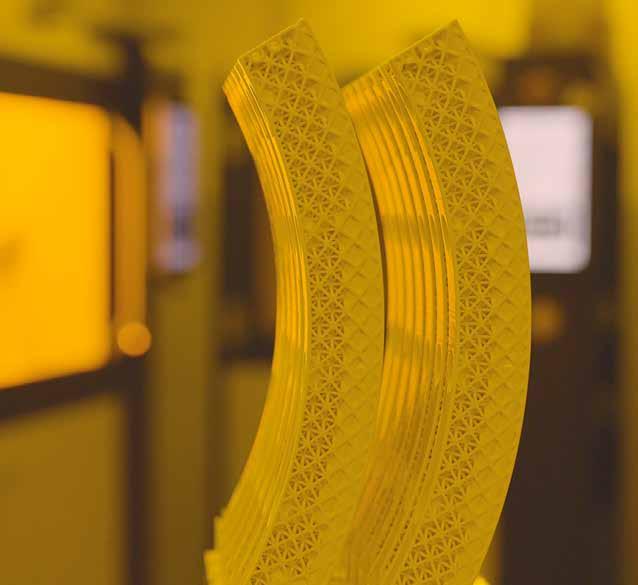
Optimisation of segment nesting on Lithoz CeraFab platforms: (a) four ring segments built on a CeraFab S65 platform in 2022; (b) fourteen ring segments built on a single CeraFab S320 platform, increasing production efficiency for 500 mm ring manufacturing (Courtesy Alumina Systems)
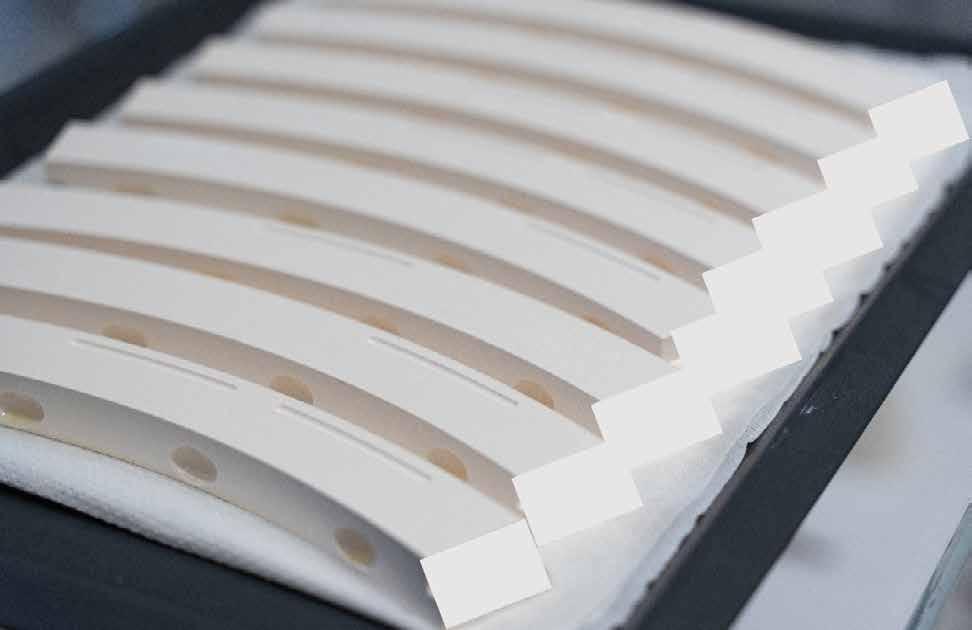
segments into a unified structure while maintaining the independence of the two internal gas channels. To stabilise the entire component before it goes into operation, cover plates are put over the joint gap tops.
Plasway-Technologies and Alumina Systems scrutinise each segment for both functionality and structural integrity before it is mounted in the
“Compared to a conventionally produced metal ring, at the end of this development process, the tested uptime increased from one to nine months while production output tripled.”
FALP chamber. Walter explains: “It was clearly visible that the first ring tested in the machine showed uneven deposition from the nozzles positioned between 06 and 09 o’clock after plasma ignition. This is why today, even at QC level, we perfectly benefit from the segmentation, as each segment is inspected separately on our customised test facility before six of them are bonded together to form a new ring. That secures correct gas flow for each finished component delivered to customers.”
Testing can even be performed prior to debinding and sintering, enabling early-stage rejection of defective builds. Reports produced show a uniformity map of gas distribution. If any segment does not meet the required uniformity, it will be replaced with a new segment before the ring is glazed. To illustrate the progress achieved, Fig. 11 compares the first ring tested in the FALP chamber by Alumina Systems in 2022 with a more recent example.
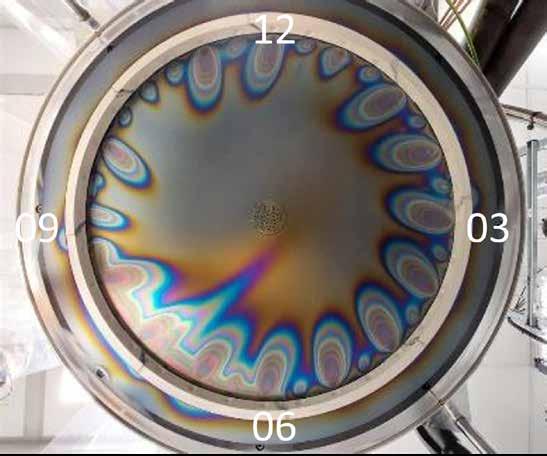
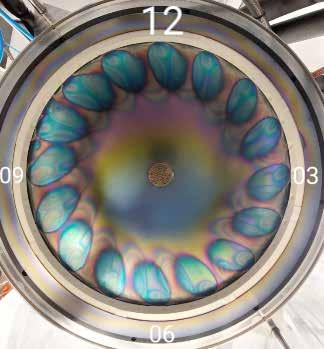
Fig. 11 Comparison of ALD deposition uniformity in the FALP chamber: (a) early ring design showing uneven deposition following plasma ignition; (b) improved ring design showing uniform gas flow and even deposition across the full ring area (Courtesy Plasway-Technologies)
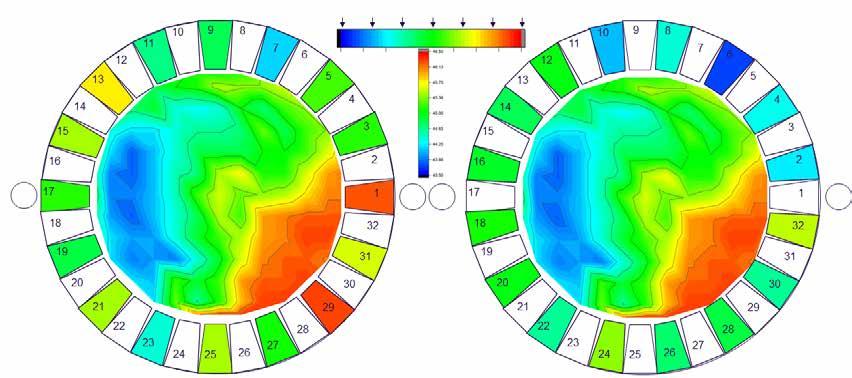
Uniformity pattern fits to Nozzle 1.29 high flows on ring 1 precursor inlet
In total <3% non-uniformity
Fig. 12 Gas-flow uniformity testing of the 18-inch ALD ring, demonstrating overall SiO 2 deposition non-uniformity below 3% across 17-inch substrates (Courtesy Plasway-Technologies)
Alumina Systems also performs crack-infiltration testing and scans each finished segment for defects under UV light. This second examination reveals even the smallest defects invisible to the naked eye. “Segments with detected defects are rejected outright. There is no repair pathway for crack-damaged technical ceramics,” Walter summarises.
Wege adds: “At PlaswayTechnologies, both flow channels of the finished rings are measured independently, and every nozzle is monitored again. This analysis of flow dynamics within a reaction chamber is our core competence. Overall, SiO 2 deposition non-uniformity achieved with the 18-inch ALD ring across 17-inch substrates reaches approximately 3%” (Fig. 12).
The system’s ability to perform both PEALD and ALE in a single chamber opens up new possibilities in process sequences. Plasway-Technologies has already experimented with combined ALD/ALE processing within the FALP system.
In one demonstration, native oxide was first removed from a silicon
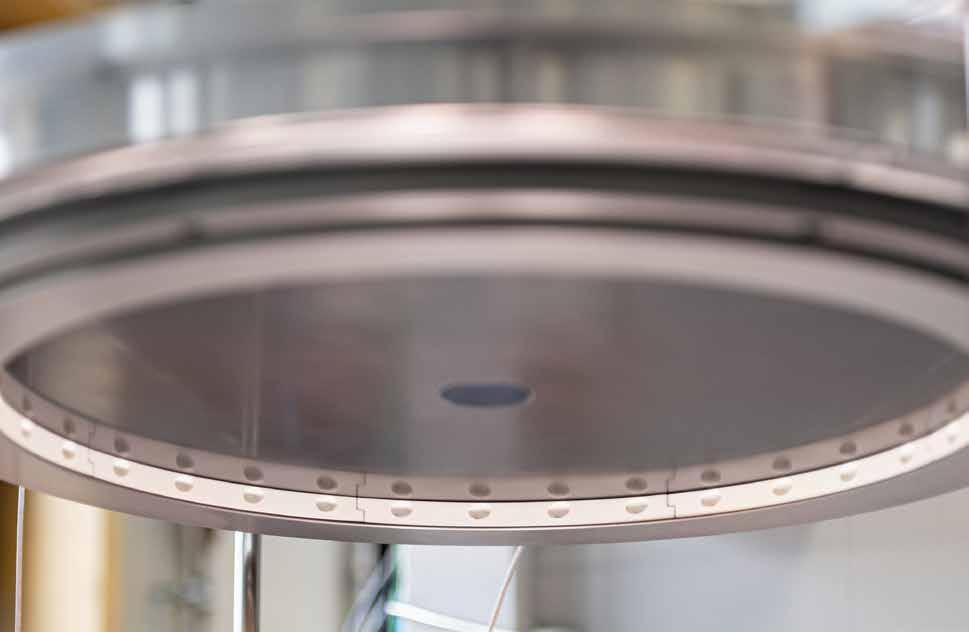
wafer via ALE, followed by deposition of a 10 nm Al 2O 3 insulating layer, a 14 nm conductive TiN layer, a 10 nm non-conductive SiO 2 layer, and finally a second 14 nm conductive nitride layer. “In that way, a complete capacitor stack was fabricated in a single chamber without a vacuum break, and completed in just fifteen minutes,” Wege reports.
By carefully controlling ion energy during Al 2O 3 PEALD and ion energy support, it is possible to create a polycrystalline film instead of an amorphous film. Together with the IFW Leibniz Institute in Dresden, Plasway-Technologies has initiated a project to investigate the reproducibility of this process and to control the resulting polycrystalline structure.
“In that way, a complete capacitor stack was fabricated in a single chamber without a vacuum break, and completed in just fifteen minutes.”
In another project, trenches with an aspect ratio of 25-30 are filled with a sandwich-like interface of titanium nitride film alternated in various ratios. “Many people believe that PEALD cannot fill such high aspect ratio (AR) features. With FALP, we were able to show that it is possible. As we can etch in situ, we can well manage the nitrogen to titanium ratio, so the film can vary from a titanium-rich mixture with good conductivity to a barrier film,” Wege states.
The machine also performs isotropic critical dimension (CD) trimming, where resist structures with initial critical dimensions of 200-700 nm can be trimmed step-bystep down to approximately 200 nm, as shown in Fig. 14.
Following CD trimming, alumina can be deposited directly onto the resist at temperatures as low as 20°C in a second step, a process called “double patterning”. After removing
the horizontal oxide layers and stripping the resist, aluminium oxide hard-mask structures on the order of 50 nm remain. Importantly, FALP performs the entire sequence within the same chamber.
Regarding the use of other technical ceramics, Wege reflects: “We see a possibility to move to ceramics offering even lower sputter rates. The key function will always remain the machine’s highly controlled flow dynamics, but interaction with the plasma is of course important in connection with the ring’s lifetime.”
On the hardware side, FALP will soon be scaled up to multiply its many unique qualities. Starting in Q4 2026, Plasway-Technologies will transfer the ring’s performance into a four-chamber machine for one of its customers, which will consequently quadruple today’s single-chamber performance.
Wege concludes: “This dualchannel gas distribution ring opens up so many fascinating possibilities. The FALP machine has packed two key processes in wafer production into the same chamber. It offers perfect flow dynamics at high speed and delivers proof of concept for high-speed ALD processing. Let’s see where its limits really are. We are eager to see how many visions it will make a reality.”
Author Norbert Gall
Lithoz GmbH
Mollardgasse 85A, 1060 Vienna Austria www.lithoz.com
Further information
Plasway-Technologies GmbH
Heinrich-Heine-Strasse 2b 01728 Bannewitz Germany
www.plasway-technologies.com
Stephan Wege founded PlaswayTechnologies GmbH, based in
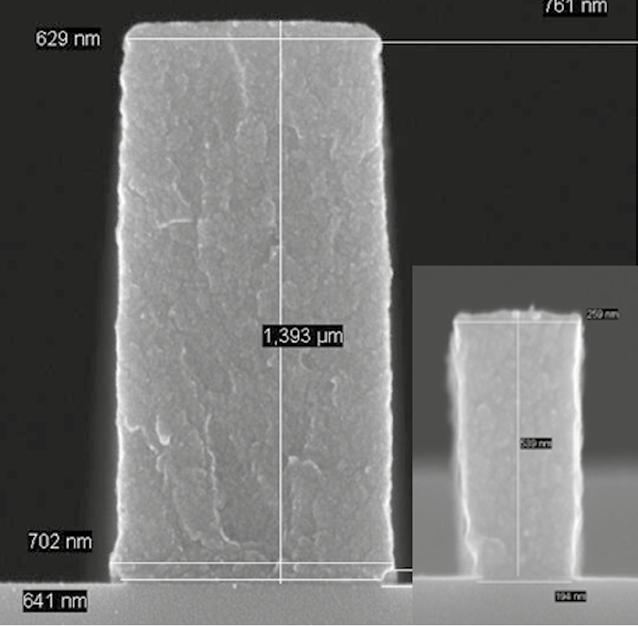
“This dual-channel gas distribution ring opens up so many fascinating possibilities. The FALP machine has packed two key processes in wafer production into the same chamber.”
Dresden, Germany, in 2016. Apart from producing FALP machines for the semiconductor industry, Plasway specialises in contract coating, analytics services, consulting and contract manufacturing of spare parts, for example, bipolar electrostatic chucks, zirconia and alumina lift pins and cover rings.
Alumina Systems GmbH
Bahnhofstrasse 43
96257 Redwitz an der Rodach Germany www.alumina.systems
Alumina Systems, based in Redwitz, Germany, was founded in 1950 by Siemens. In addition to its business units for battery production and metal and copper processing, the company also serves as a global contract manufacturer of ceramic components. Its core competencies include vacuumtight brazing, bonding, glass soldering and other methods for joining metal and ceramic components. Alumina Systems was also an early adopter of ceramic AM, operating its first Lithoz CeraFab AM machine since 2014 and adding the LIS-based CeraMax V900 in 2022.
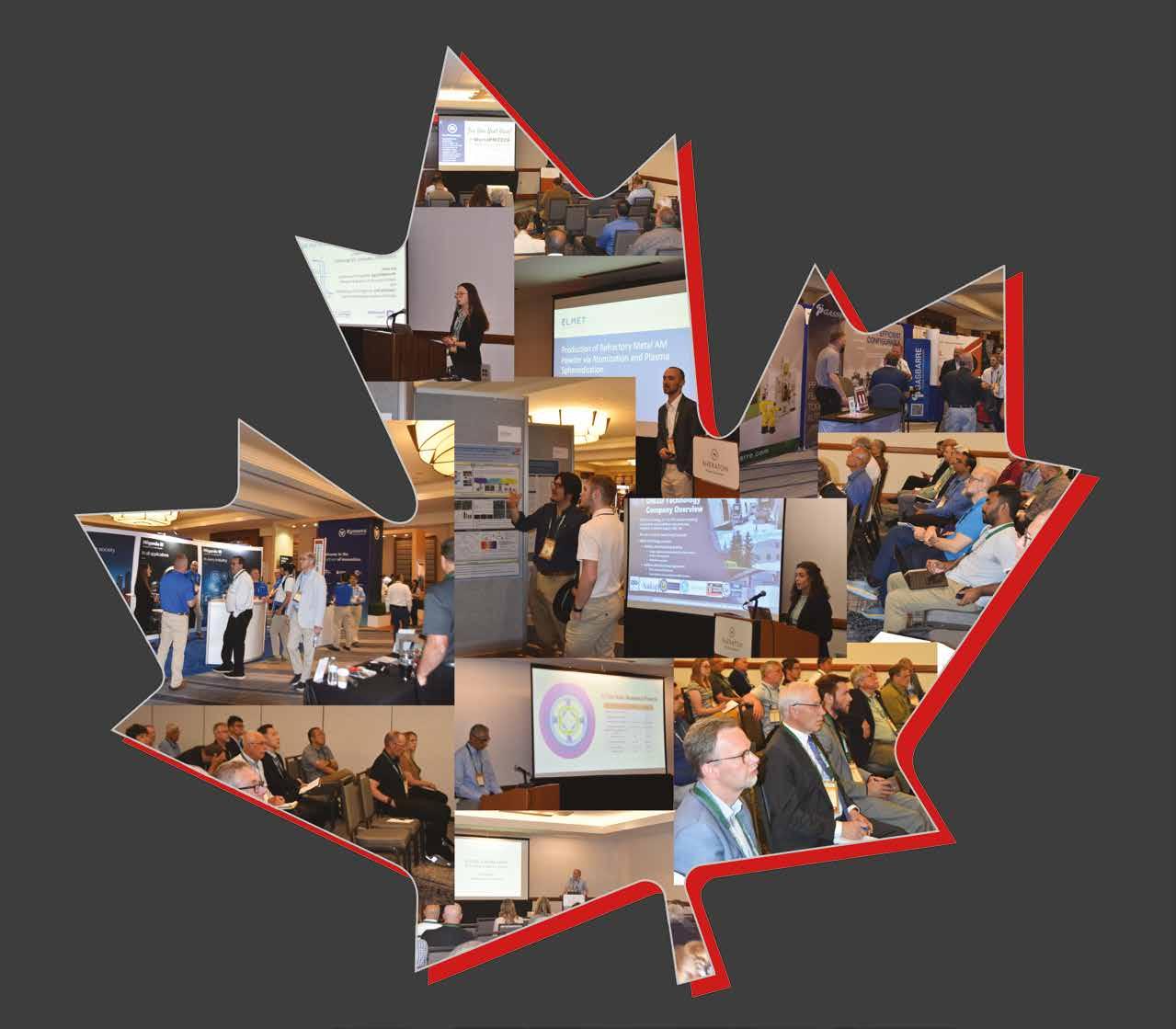
Sintering non-oxide ceramics
Growing interest in advanced non-oxide ceramics for hypersonics, semiconductors, armour, electronics and other demanding applications is bringing renewed attention to the sintering science that determines final part performance. Ceramic Injection Moulding (CIM) and sinter-based Additive Manufacturing (AM), particularly Binder Jetting (BJT), are expanding the shaping potential of carbides, nitrides, borides and ultra-high-temperature ceramics. In this article, Scott Robinson, Centorr Vacuum Industries, reviews the key considerations in debinding, furnace design, atmosphere control and sintering.
Sintering is the consolidation of a material through thermal processing. In ceramics, this generally requires significantly higher temperatures than most metal sintering processes, but temperature is only one of the factors that distinguishes advanced ceramic processing from conventional metal Powder Metallurgy.
Ceramics are broadly defined as inorganic, non-metallic materials formed by shaping and subsequent firing at elevated temperatures.
Traditional ceramics, derived from clay, earth matter, binders and water, include familiar products such as glass, tiles, bricks and sanitaryware. Advanced ceramics, by contrast, are engineered for demanding applications in cutting tools, armour, electrical substrates, semiconductors, aerospace and hypersonic systems.
This article examines the sintering of advanced non-oxide ceramics used in Ceramic Injection Moulding and sinter-based ceramic Additive Manufacturing processes, including Binder Jetting. It considers sintering mechanisms,
processing routes, furnace technologies, debinding strategies, and the differences between batch and continuous processing, with a focus on where these approaches diverge from conventional metal sintering and require specialised equipment.
Typical non-oxide ceramics include carbides, nitrides, and borides such as AlN, BN, B 4C, SiAlON, Si 3N4, SiC, TiB 2, and WC, along with ultra-high-temperature ceramics (UHTCs) including ZrB 2, ZrC, HfC, and TaC.
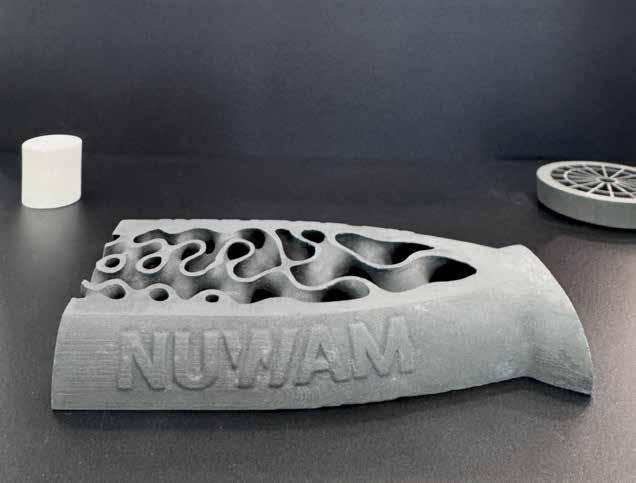
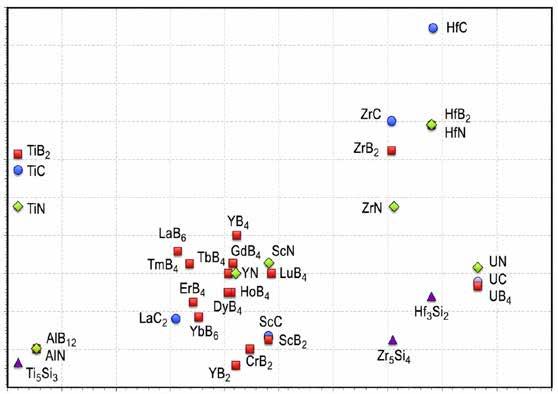
fication at temperatures below the melting point. Initial bonding forms at particle contact points (necks), which subsequently merge, creating an interconnected pore network. Finally, the pores close or minimise, becoming spherical and isolated. Where necessary, sintering aids (such as Y 2O 3, MgO, Al 2O 3, CaO, and B 4C) are used to reduce activation energy, promote liquid phase formation, and scavenge surface oxides.
In liquid phase sintering, a small amount of an additive is introduced into the powder; alternatively, partial melting may occur if the sintering temperature is sufficiently high. The additive reacts at lower temperatures and melts, facilitating the movement, rearrangement, and/or solution/reprecipitation of the larger grains of primary material, thereby reducing porosity.
“Unlike metal AM processes, most ceramic AM parts cannot be directly laser sintered or laser melted due to the high melting points and thermal behaviour of ceramics.”
Temperature remains a primary distinction between non-oxide ceramic sintering and metal (or oxide ceramic) processing. Non-oxide systems, particularly UHTCs, require very high processing temperatures due to their carbide, boride, and nitride chemistries. Silicon carbide (SiC) and zirconium diboride (ZrB 2) are leading candidates for aerospace and hypersonic applications, in part because of their low density values and comparatively lower raw material costs. These materials can be combined with graphite or SiC fibre matrices to form advanced ceramic composites, and ZrB 2 can also be blended with SiC to improve oxidation resistance. Other UHTC candidate materials are shown in Fig. 2.
The processing of hypersonic materials relies on vacuum and controlled-atmosphere furnace technology. Conventional refractory-lined ceramic furnaces, operating either in air or in reducing gases, are typically limited to temperatures below ~2,200°C when using zirconia brick and tungsten heating elements.
When reviewing the sintering of non-oxide ceramics, two main mechanisms predominate: solid state sintering and liquid phase sintering.
Solid state sintering
In solid state sintering, powder consolidation occurs through densi -
Unlike most metal AM processes, most ceramic AM parts cannot be directly laser sintered or laser melted due to the high melting points and thermal behaviour of ceramics. Most AM ceramic parts are formed from a powder, so a binder or glue is needed to hold them together. Typical forming processes for ceramics include: Extrusion, Ceramic Injection Moulding, Isostatic Pressing, Slip Casting, Tape Casting, Die Pressing, and, of course, Additive Manufacturing.
Binders are typically used at volumes ranging from 2-20+ vol.% and can be easy or difficult to remove, with the difficulty directly related to the molecular weight of the organic compound used. Some newer ultraviolet light-cured materials feature particularly tenacious binder systems that can be difficult to remove from the base material, especially in carbide-free formulations such as AlN and Si 3N 4
Vacuum can be used with some binder systems (in particular paraffin wax), while positive pressure flow-
Binder name
Acrawax ‘C’
C19H38NO; Ethylene bisstearamide
Butvar PVB Polyvinylbutyral
Camphor
C10H16O, Heptanone
Caoutchouc glue Natural rubber (before vulcanising)
Hoechst Wachs C Bis-Stearylethylene Diamide
Lonza Group PM lubricant
Monsanto Ceramic binder; Tape Casting
Atmospheric thermal debind or Sweepgas™
Atmospheric N 2 or H 2 thermal debind; Sweepgas™
Burnoff tower
Burnoff tower; BRS™ system
Acros Organic, JT Baker Tantalum Capac.; WC binder Vacuum delube / Sweepgas™ Sweepgas™ condenser; LN 2 cold trap
Atmospheric thermal debind; Sweepgas™; BRS™ system
Hoechst GmbH PM lubricant
Atmospheric N 2 thermal debind; Hydrogen debind at positive pressure
Burnoff tower; BRS™ system; G-10503A w/binder pot
Methylcellulose Rivers Process Sweepgas™ BRS™ System
Paraffin wax Normal alkane CnH 2n+2 All Oil Companies
LatiTiWC Binder; PM lubricant; MIM 1st stage binder WC Sweepgas™ Sweepgas™ Wax condenser; BRS™ system
PEG (Carbowax) Polyethylene glycol; polyethene oxide Union Carbide WC lubricant
PVA Polyvinyl acetate (Latex Rubber)
Polyethene/ polypropylene (C 2H 4)n; (C 3H 6)n
Phenolic resin C 8H 6O 2
Ceramic binder
Atmospheric H 2 thermal debind Burnoff tower
Atmospheric thermal debind; Sweepgas™
Burnoff tower; BRS™ system; incinerator/griff valve
Several MIM 2nd stage binder (1-5 wt.%) MIM Sweepgas™ (10-750 torr) T/P binder trap; BRS™ system
Several
Ceramic binder for extrusion, CIP, and isostatic pressing
Atmospheric thermal debind; positive pressure Argon
Burnoff tower; BRS™ system; incinerator/griff valve
Table 1 Typical ceramic binder systems used in CIM and sinter-based ceramic AM, with associated removal and offgas collection methods (Courtesy Centorr Vacuum Industries)
through is appropriate for heavier molecular weight ceramic binders. Some binder systems are intentionally only partially removed in inert (non-oxidising) atmospheres, so as to act as a carbon source later on in the process, as is desirable with SiC materials.
A list of common ceramic binder systems and their recommended mode of removal is shown in Table 1.
“Some newer ultraviolet light-cured materials feature particularly tenacious binder systems that can be difficult to remove from the base material, especially in carbide-free formulations such as AlN and Si3N4.”
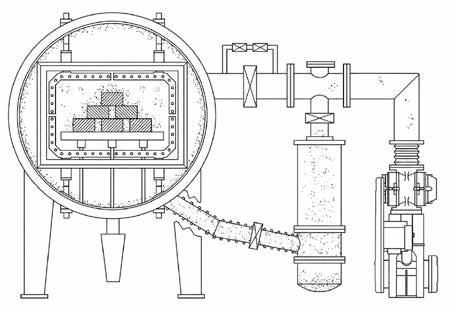
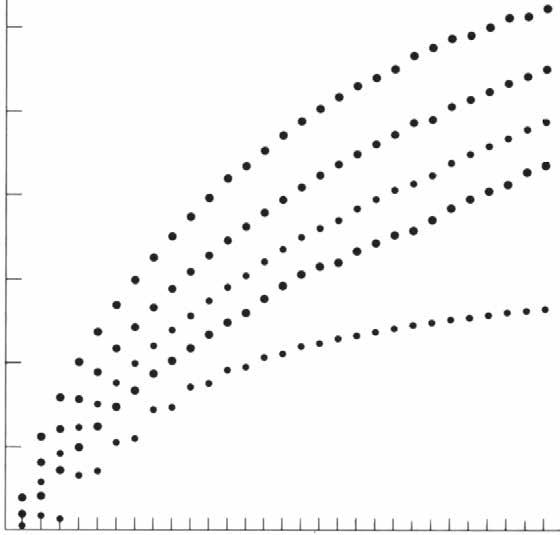
(Courtesy Centorr
There are five primary methods for the debinding of ceramics in vacuum and controlled atmosphere furnaces:
• Vacuum dewax process
• Sweep gas process (hardmetals)
• Positive pressure flow-through (inert gas/hydrogen)
• Positive pressure (incinerator)
• Solvent debinding
In the vacuum dewax process (primarily for WC hardmetals), vacuum levels of 10 -1 mbar are used to remove low temperature paraffinbased waxes, leveraging the vapour pressure of the low molecular weight binder (Fig. 3).
Fig. 4 depicts the melting behaviour of waxes at different partial pressures. As partial pressure decreases, the melting temperature is reduced, enabling more controlled binder removal and minimising stress on the components.
A key disadvantage of this method is the accumulation of residual binder on the cold walls of the furnace. Early designs addressed this by introducing an internal graphite retort and a secondary gas circuit, in which an inert sweep gas is directed through the chamber to enhance binder removal. This approach improves chamber cleanliness and enables faster, more complete debinding, and is commonly referred to as the Sweepgas™ process (Fig. 5).
However, for most non-oxide ceramic systems, higher molecular weight binders such as phenolic resins are typically used. These systems exhibit minimal vapour pressure response, and are therefore more effectively removed using positive pressure flow-through processes (Fig. 6). In this process, relatively high flow rates of inert gas (typically 50-200 slpm) are used to sweep binder offgassing from the component surface as it is driven out during heating, primarily via capillary action.
A variation of the positivepressure flow-through design incorporates a thermal oxidiser (Fig. 7), which is used when the binder offgassing is too viscous for effective removal via conventional trapping systems. In this case, the offgassing is fed directly into an oxidiser operating at approximately 900°C in air, resulting in near-complete oxidation of offgas species such as CO and various hydrocarbons, while converting nitrogen-containing species to NOx
The last binder removal concept uses a stainless solvent tank for chemical removal of CIM and AM binder systems, such as those manufactured by LÖMI GmbH (Fig. 8). In this process, organic solvents can be used to dissolve the binder in the parts. This method is known for its low energy consumption and cost savings, achieved through the recovery of the debinding medium.
An important decision when performing the debinding process is whether to debind in a separate process or in an integrated debind and sinter furnace.
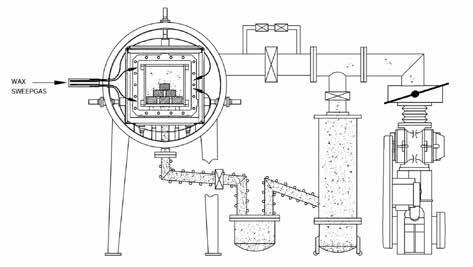
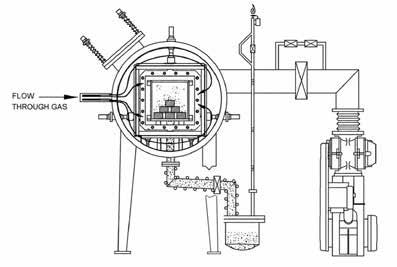
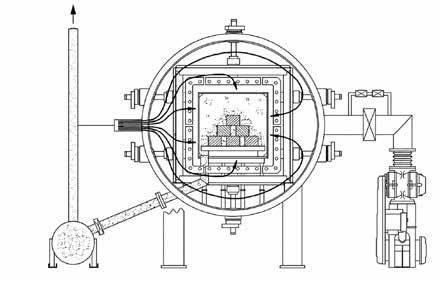
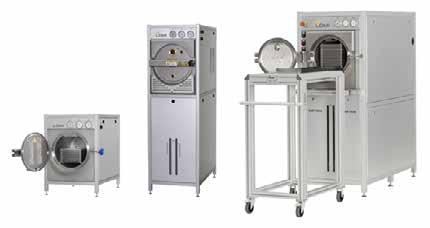
Debinding: separate vs integrated With separate debinding ovens, a range of atmospheres can be used, including air, argon (Ar), nitrogen (N 2) and hydrogen (H 2). The use of air enables more effective carbon removal than inert atmospheres. This approach also allows multiple lowercost debinding units to support each sintering furnace, accommodating long debinding cycles without occupying higher-value sintering equipment. In addition, conventional metal retort or hot-wall furnaces are generally less affected by tar-forming binders.
The disadvantages are the length of two independent heat-up and cool-down cycles, the possibility of forming an oxide coating on the ceramic grains (which must subsequently be removed during the subsequent sintering process and may require higher temperatures), and the larger overall footprint, additional equipment cost, and higher utility consumption of two separate systems.
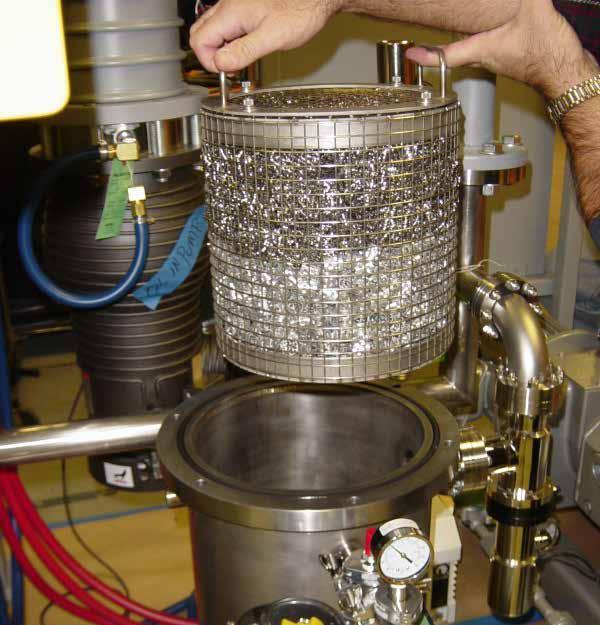
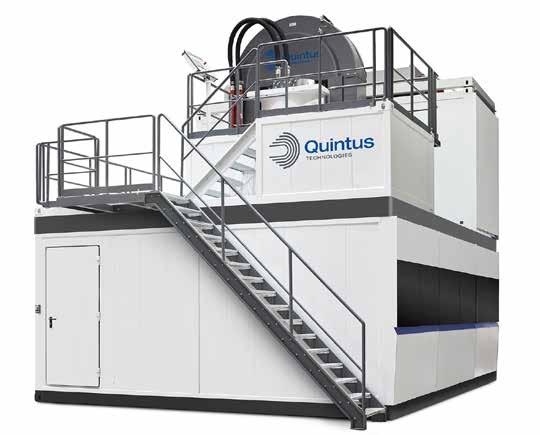
Fig. 10 Quintus Technologies Hot Isostatic Press (HIP) (Courtesy Quintus Technologies)
In integrated debinding and sintering systems, the process is typically limited to inert atmospheres such as argon and nitrogen, or process gases such as hydrogen. The advantages include shorter overall cycle times (typically 16-40 hours, depending on load size) and the elimination of part handling between debinding and sintering stages, avoiding transfer onto different trays.
The disadvantages include the cost of fuels such as natural gas or propane, commonly used
for thermal incineration; the more rapid deterioration of graphite hot zone components (which can offset the higher expense of two dedicated furnaces); and less efficient carbon removal in argon or nitrogen, which may leave residual carbon entering the sintering stage and can be detrimental to non-oxide ceramics such as AlN or Si 3N 4
Once parts have been debound, attention turns to the sintering parameters, which can vary significantly between non-oxide ceramic formulations.
In addition to conventional sintering, advanced non-oxide ceramics can be processed using a range of related thermal consolidation and deposition routes. Conventional approaches typically use vacuum batch furnaces operating under vacuum, partial pressure or positive-pressure inert gas atmospheres such as argon or nitrogen. However, several alternative or more specialised methods are also used, including CVD, CVI, graphitisation, vacuum hot pressing, Sinter-HIP and HIP, as summarised in Table 2.
These processes fulfil different roles within non-oxide ceramic manufacturing. Vapour-phase routes such as Chemical Vapour Deposition (CVD) are primarily used for coating applications, while Chemical Vapour Infiltration (CVI) densifies porous preforms, particularly in fibrereinforced systems. Graphitisation, although not a shaping process, converts amorphous carbon into crystalline graphite at very high temperatures. Vacuum hot pressing is typically carried out under vacuum or inert gas, applying pressures of 17-51 MPa (2,500-7,500 psi), using presses with capacities of 100-300 tonnes.
Chemical Vapour Deposition (CVD)
pyrolytic BN on graphite
Chemical Vapour Infiltration (CVI) carbon fibre-reinforced (CFC) composites, resinimpregnated systems
Graphitisation
Vacuum hot pressing Carbides, nitrides Vacuum or inert gas Applicationdependent
Sinter-HIP
ceramics Ar, N 2 –6-10 MPa (900-1,500 psi)
Hot Isostatic Pressing (HIP) Si 3N 4, SiAlON Ar, N 2 1,600-2,000°C up to 350 MPa (50,000 psi)
Table 2 Common thermal processing routes for advanced non-oxide ceramics, including typical atmospheres, temperatures and pressure ranges (Courtesy Centorr Vacuum Industries)
Of these, Hot Isostatic Pressing (HIP) is one of the most effective methods for consolidating components. In this process, the furnace applies isostatic (equal in all directions) gas pressure of argon or nitrogen over a wide range from approximately 10-350 MPa (1,450-50,000 psi), while heating to 1,600-2,000°C. The uniform pressure application (unlike uniaxial hot pressing) enables the elimination of residual porosity without distorting the component geometry, thereby improving mechanical properties, particularly in high-stress applications.
HIP is primarily used for Si 3N 4 and SiAlON, and may be used either as a primary firing method or as a post-densification step following initial sintering. The process can also incorporate rapid cooling under pressure, functioning as a quench step.
However, HIP processing may require encapsulation (‘canning’) of components in glass or refractory metal containers to protect the parts from gas flow, unless they have been pre-sintered to a sufficiently high density (at least ~94% theoretical density) to ensure closure of all surface porosity.
To better understand the design of furnace equipment for non-oxide ceramic sintering, a breakdown of the main components is provided below.
Chamber
The chamber is typically a double-wall, water-cooled vessel constructed from stainless or mild steel.
Hot zone insulation
Insulation is commonly provided by rigid graphite board rather than felt or carbon fibre-reinforced rigidised felt, although tungsten or molybdenum refractory metals may be used for some applications.
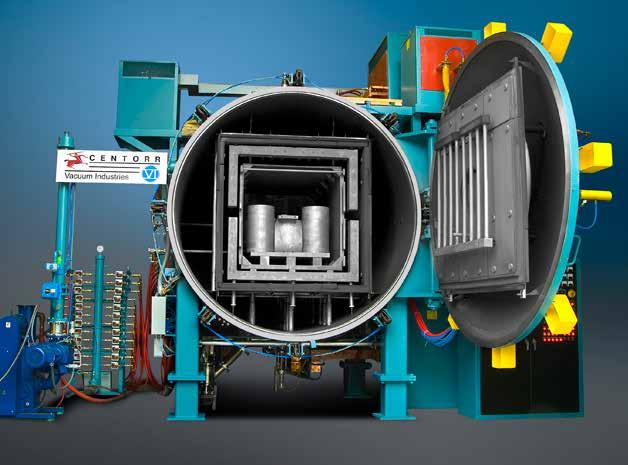
“HIP is primarily used for Si3N4 and SiAlON, and may be used either as a primary firing method or as a post-densification step following initial sintering.”
Hot zone heating elements
Heating is achieved using graphite tube or solid-rod designs, or, alternatively, refractory metal elements in rod or mesh configurations.
Hot zone retort
The retort is designed to tightly compartmentalise offgassing and is typically fabricated from graphite or refractory metals. A secondary gas circuit is incorporated within the retort to provide a sweeping action.
Vacuum pumping system
Rotary piston pumps are generally preferred over rotary vane or dry pumps, often supplemented by an additional vacuum blower to improve pump-down times.
Binder/offgas trapping system
A polyethylene glycol (PEG) or ‘knock-down’ pot is used to remove residual binder and process offgassing prior to discharge from the furnace exhaust.
Vacuum furnace designs are available in a range of configurations, including horizontal front-loading and vertical top- or bottom-loading systems. Each configuration offers advantages in terms of floor space requirements and ease of loading and unloading. For ceramic powder processing, rotary furnaces are used, in which material is processed within
Parameter
Sintering temperature
~573°C (Al) to ~1,350°C (stainless steels)
Relative to melting point –
Heating profile
Temperature control
Properties
Heat transfer
Atmosphere
Generally faster cycles
Thermocouples
Ductile, malleable, electrically conductive
Conduction dominant at most temperatures
Vacuum or hydrogen (PM processing)
~1,800-2,500°C
~67-86% of their melting temperature
Slower ramp rates with intermediate soaks and ≥3 hours at temperature for large loads (heat sinks to the centre of non-conductive materials)
Optical pyrometers (sometimes)
Hard and brittle; often thermally and electrically insulating
Radiation dominant at high temperatures; conduction/ convection at lower temperatures
Partial pressure, slight positive pressure, or 900-1,500 psig overpressure of Ar or N 2; inert (Ar), reactive (N 2), or reducing (H 2) gases
Table 3 Comparison of key processing differences between metal and non-oxide ceramic sintering (Courtesy Centorr Vacuum Industries)
Hot zone construction
Internal retorts
Cooling approach
Thermal sensitivity
Cooling duration
Exhaust treatment
Process by-products
Typically refractory metal hot zones
Not typically required
Faster cooling and quenching often possible
Generally tolerant to thermal gradients
Typically shorter
Less complex (application dependent)
Typically less hazardous
Primarily graphite hot zones; refractory metal hot zones also used for AlN and some Si 3N 4 processes
Graphite retorts used for offgas compartmentalisation and temperature uniformity
Controlled cooling required; typically ‘free fall’ cooling to ~1,000°C, then fan cooling to ~100°C
Susceptible to thermal shock
6-12 hours for ~500-1,000 kg production loads
May require thermal incineration (debinding) or chemical scrubbing (e.g. CVD exhausts)
Possible formation of cyanamides, CN, HCN, in high-temperature N 2 graphite systems
Table 4 Comparison of furnace design and operational differences between metal and non-oxide ceramic sintering systems (Courtesy Centorr Vacuum Industries)
a rotating graphite drum, enabling semi-continuous operation at temperatures exceeding 2,000°C.
Vacuum hot presses represent a further category, allowing either powder compaction within a graphite die or planar compression of ceramic and metal composites. These systems enable diffusion bonding of dissimilar materials at elevated temperatures.
Processing differences between sintering metals and non-oxide ceramics
The processing differences between metal and non-oxide ceramic
sintering are significant, particularly in terms of temperature, atmosphere and thermal management. As shown in Table 3, non-oxide ceramics are typically processed at substantially higher temperatures than metals, often requiring more controlled heating profiles and extended time at temperature to ensure uniform densification.
In addition, the non-conductive nature of ceramic materials influences both heat transfer and temperature measurement, with radiation becoming dominant at elevated temperatures and optical pyrometers
often required for process control. Slower heating rates are therefore necessary to allow heat to penetrate into the centre of these non-conductive materials and ensure uniform temperature distribution. Atmosphere selection also differs, with non-oxide ceramics commonly processed under controlled partial or positive pressures of inert or reactive gases, depending on the material system.
Furnace differences: sintering metals and non-oxide ceramics
The differences in furnace design between metal and non-oxide ceramic
processing reflect the higher temperatures, material sensitivities, and offgas characteristics associated with ceramic systems.
As shown in Table 4, ceramic sintering furnaces typically require graphite hot zones and internal retorts for offgas compartmentalisation and temperature uniformity, along with controlled cooling strategies to avoid thermal shock.
During debinding, applications may require thermal incineration of offgas products, while CVD processes typically require chemical scrubbing of acidic exhaust gases prior to release. At elevated temperatures (e.g. 2,600°C), graphite furnaces operating in nitrogen can also generate reactive species such as cyanamides, CN, and HCN, which must be appropriately managed.
Ceramic sintering furnaces are available in both batch and continuous configurations, each offering distinct advantages depending on production requirements. Batch furnaces provide greater flexibility, allowing variable cycle times for debinding, carbothermal reduction and cooling, and can be better optimised for R&D and processing larger components. However, batch furnaces typically require higher power input, greater utilities consumption and a higher level of operator intervention.
Continuous furnaces, used primarily for materials such as AlN, SiC and Si 3N 4, offer significantly shorter cycle times for small crosssection loads, with reductions of up to 4x (e.g. from ~24 to ~5 hours door-to-door). They also tend to have lower overall utility requirements (except for inert gas).
The primary limitations of continuous systems are reduced process flexibility, with cycle times fixed by furnace zone lengths, and their suitability is mainly for smaller components produced in high volumes, where process control is largely governed by push speed.
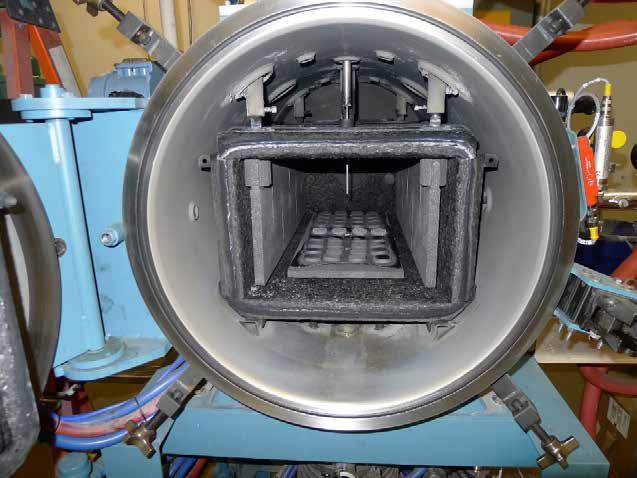
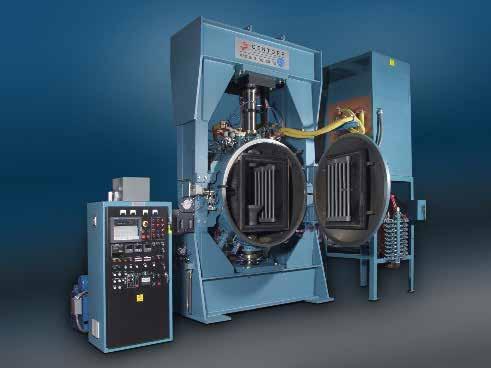
“Slower heating rates are therefore necessary to allow heat to penetrate into the centre of these non-conductive materials and ensure uniform temperature distribution.”
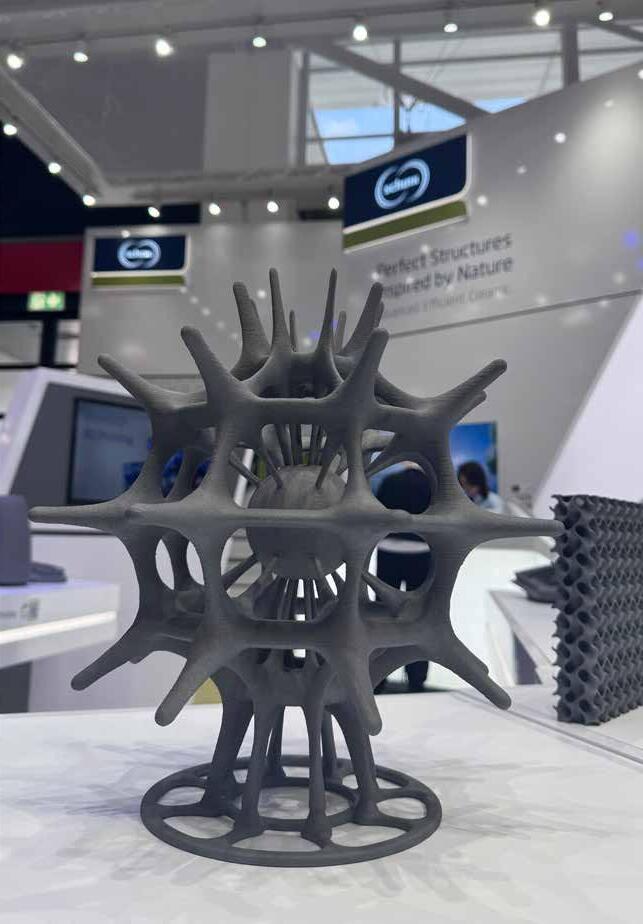
Fig. 14 Schunk showcased this large non-oxide ceramic diatom structure at Ceramitec 2026, made with its silicon carbide IntrinSiC® material/process, highlighting the potential of Additive Manufacturing for complex, natureinspired ceramic components (Courtesy Nick Williams/PIM International)
Sintering parameters for non-oxide ceramics
Silicon carbide (SiC)
Silicon Carbide (SiC), also known as carborundum, is a synthetic crystalline compound of silicon and carbon characterised by high hardness, refractoriness, and thermal stability. It can be used up to 1,650°C in air and up to 2,000°C in vacuum or inert atmospheres. The material is typically dark grey to black in colour, with a density of 3.15-3.21 g/cm 3 and
a sublimation point of 2,700°C. Phenolic resin binders may be removed either in a separate debinding step or within an integrated cycle in argon. In some cases, debinding is intentionally incomplete, leaving residual carbon that is utilised during the carbothermal reduction stage. During this stage, surface oxides on SiC particles are reduced at temperatures approaching 1,600°C, generating CO and CO 2 offgassing, which is removed via the furnace exhaust.
SiC materials are typically sintered under partial or positive argon pressures using B 4C or Al 2O 3 as sintering aids. Sintering in nitrogen at temperatures above 1,800°C can alter the electrical resistivity due to Si 3N 4 formation. Slow heating rates of 1-3°C/min are commonly applied during both debinding (~450°C) and carbothermal reduction (~1,600°C) to control stress development and gas evolution.
• Pressureless sintered ( α -SiC) at 2,150°C in partial or positive pressure argon (solid-state sintering)
Reaction-bonded SiC at 1,4501,600°C in partial or positive pressure argon (liquid-phase Si infiltration)
• Nitride-bonded SiC at 1,400°C in flowing nitrogen (box furnaces, no vacuum)
• Recrystallised SiC at 2,380°C in positive pressure argon (evaporation-condensation sintering)
Applications include armour, abrasives, wear parts and seals, kiln furniture, SiC power electronics (Fig. 15), and LED technologies.
Boron carbide (B 4C)
Boron carbide (B 4C) is an extremely hard ceramic material composed of boron and carbon, characterised by low density, high-temperature resistance, and strong neutron absorption capability. It can be used up to 1,600°C in air and up to 2,000°C in vacuum or inert atmospheres. The material is dark grey or black in colour, with a density of 2.52 g/cm³ and a melting point of 2,445°C.
Debinding may be carried out as a separate step or integrated within the sintering cycle in argon. Excess residual carbon is retained for the carbothermal reduction step. B 4C pressureless sinters in positive pressure argon, but is more difficult to densify than many ceramics due to strong covalent bonding, low self-diffusion coefficient, and thermodynamic stability. With a sintering
Fig. 15 Wolfspeed discrete silicon carbide MOSFETs used for high-efficiency power switching in electric vehicles, industrial drives, and energy systems (Courtesy Wolfspeed)
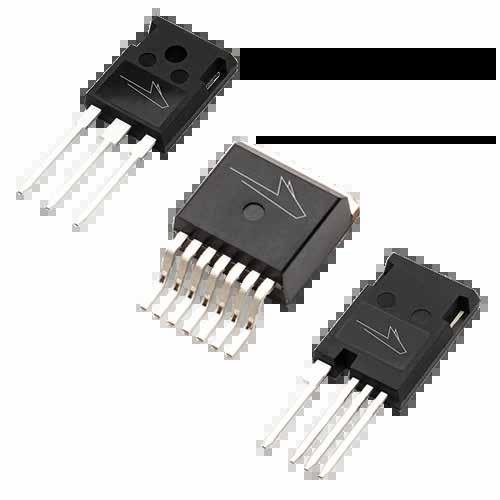
temperature close to its melting temperature, this material can be very difficult to process without melting.
Variants
• Pressureless sintered B 4C: 2,380°C, positive-pressure argon (solid-state sintering)
• Reaction-bonded B 4C: 1,600°C, partial or positive-pressure argon (liquid-phase Si infiltration)
• Hot-pressed B 4C: 2,300°C, ~50 MPa (~7,250 psi), flowing Ar
• HIP B 4C: 2,200-2,300°C, up to 100 bar (1,500 psig)
Applications include armour, nuclear shielding and control rods, and abrasive nozzles.
Aluminium nitride (AlN)
Aluminium nitride (AlN) is a solid nitride of aluminium known for its high thermal conductivity and electrical insulation properties. It can be used up to 1,200°C in air and up to 1,600°C in vacuum or inert atmos -
3.26 g/cm 3 and a melting point of 2,670°C.
Separate debinding in air furnaces is usually mandatory to remove ~99% of organic (carbon) binder. Processing is carried out in refractory metal hot zones in positive pressure 60% hydrogen/40% nitrogen or forming gas, and in graphite hot zones in positive pressure flow-through nitrogen.
MgO, or CaO. The Y 2O 3 reacts with the Al 2O 3 layer on the AlN surface (formed during debinding), forming secondary Yttria aluminate liquid phases that promote densification at lower temperatures through liquid phase sintering (LPS). They also help reduce the oxygen content in the AlN lattice, thereby improving thermal conductivity.
“Boron carbide (B4C) is an extremely hard ceramic material composed of boron and carbon, characterised by low density, high-temperature resistance, and strong neutron absorption capability.”
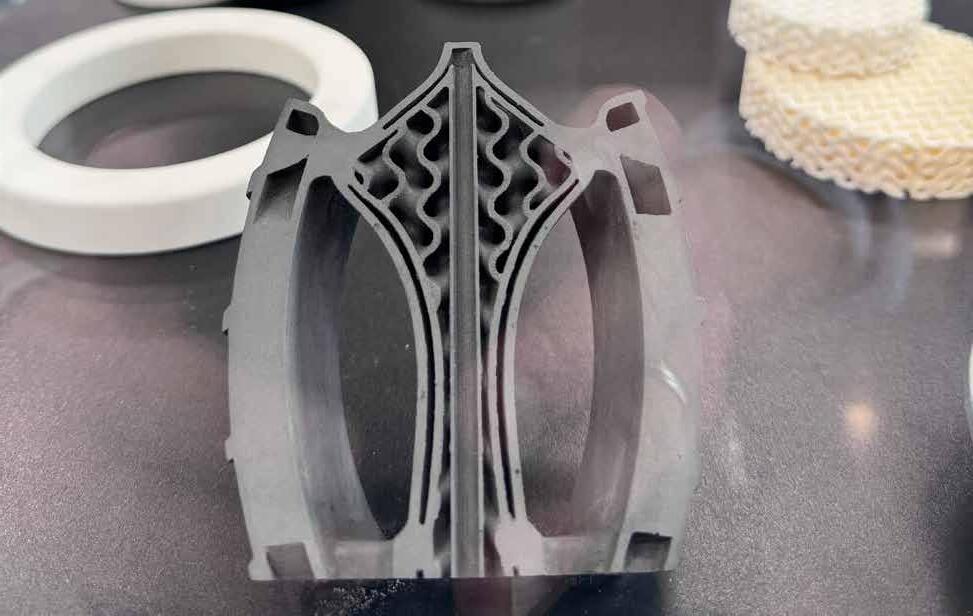
“Contact (either direct or gas phase) with graphite hot zones can discolour the AlN surface, requiring parts to be packed in AlN powder within high-quality BN workboxes.”
Al 2O 3/Y 2O 3 offgassing inside graphite retorts reacts with the hot zone components, limiting the life of the graphite elements and insulation to one to three years. Contact (either direct or gas phase) with graphite hot zones can discolour the AlN surface, requiring parts to be packed in AlN powder within high-quality BN workboxes.
Applications include electronic substrates, LEDs, and components
for high-speed and high-power communication networks.
Boron nitride (BN)
Boron Nitride (BN) is a white solid with excellent thermal conductivity and high chemical and thermal stability, making it a good insulating material that is easily machinable. Often referred to as ‘white graphite’ due to its similar structure and lubricious
feel, it is available in hexagonal and cubic structures. It can be used up to 850°C in air and up to 2,000°C in vacuum, inert, or reducing atmospheres. The material is white in colour, with a density of 2.1 (hexagonal) to 3.45 (cubic) g/cm 3 and a sublimation point of 3,000°C.
Separate debinding in air furnaces is required to remove 99% of the organic (carbon) binder, unless the raw powder is hotpressed. BN sinters in graphite hot zones in positive pressure flow-through nitrogen at <2,000°C using sintering aids, but to low densities. Hot pressing (at typically 100°C lower than pressureless sintering) under 100-300 ton pressures provides the best densities. B 2O 3 offgassing from residual oxides on spray-dried powders can form a boric oxide glassy phase in the furnace exhaust and must be removed.
Applications include insulators, cosmetics, paint additives, and kiln furniture for AlN processing.
Silicon nitride (Si 3N 4)
Silicon nitride (Si 3N 4) is a ceramic compound of silicon and nitrogen used in high-temperature applications due to high thermal stability, low thermal expansion, and high hardness and fracture toughness. It can be used up to 1,400°C in air and up to 1,500°C in vacuum or inert atmospheres. The material is light grey to black in colour, with a density of 3.27 g/cm 3 and a melting point of 1,900°C.
Separate debinding in air or nitrogen is required to remove the majority of the carbon binder. Processing is carried out in refractory metal hot zones for reaction-bonded material (exothermic nitridation of silicon powder), or in graphite hot zones (liquid phase sintering in positive pressure flow-through nitrogen).
Silicon nitride can be fired by pressureless sintering, Sinter-HIP, hot pressing, or HIP, with high nitrogen pressure used to inhibit the high-temperature decomposition of Si 3N 4. Pressureless sintering typically occurs at 1,750-1,850°C using sintering aids such as Y 2O 3, MgO, or Al 2O 3. These oxides react with the silica layer on Si 3N 4 particles to form a glassy phase, enabling densification during firing.
Sinter-HIP is carried out at 1,700-1,800°C at 10 MPa (100 bar; 1,500 psig), which can use less sintering aid. Hot pressing is performed at 1,750-1,900°C under 17-51 MPa (2,500-7,500 psig). HIP is performed at 1,600-1,800°C and 100-200 MPa (15,000-30,000 psig).
Parts are packed in Si 3N 4 powder within graphite or BN workboxes, or pre-sintered to ~94% theoretical density. SiO 2 offgassing inside the graphite retort reacts with hot zone elements and insulation, which can result in a hot zone life of 50-100 cycles.
Applications include molten metal thermocouple sheaths, medical components (knees and hips), piston rods, bearings and cutting tools.
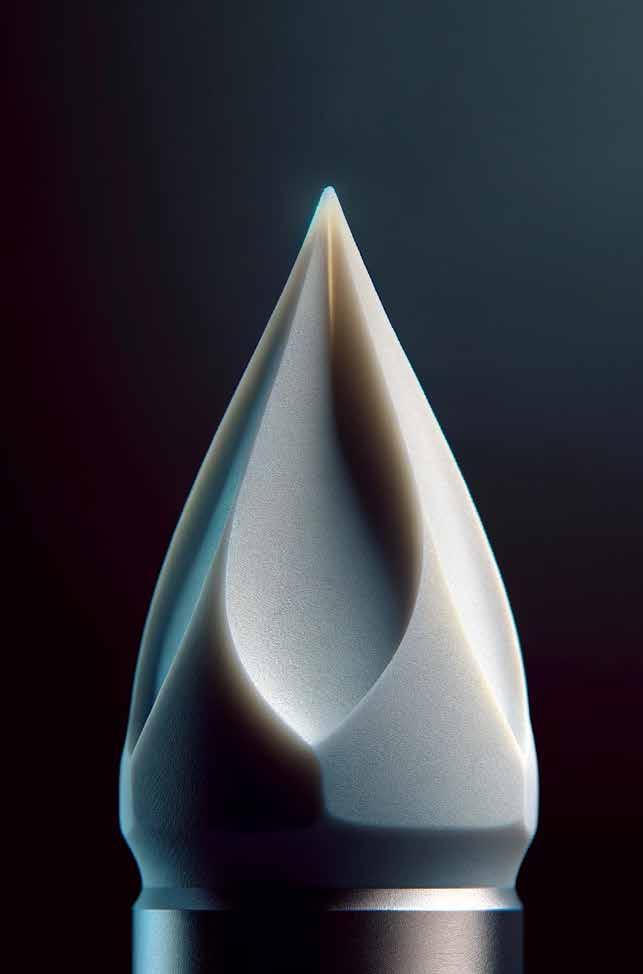
“Silicon nitride can be fired by pressureless sintering, Sinter-HIP, hot pressing, or HIP, with high nitrogen pressure used to inhibit the high-temperature decomposition of Si3N4.”
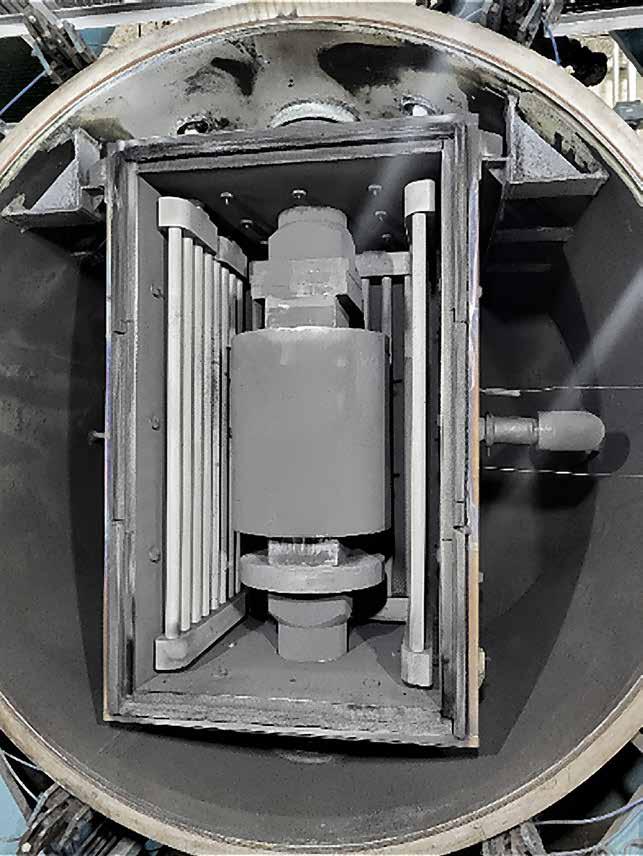
“Silicon aluminium oxynitride (SiAlON) is a silicon nitride-based ceramic containing aluminium, oxygen, and nitrogen, typically processed with sintering additives such as MgO or yttria (Y2O3), developed as a lower-cost, lowerdensity alternative to Si3N4.”
Silicon aluminium oxynitride (SiAlON)
Silicon aluminium oxynitride (SiAlON) is a silicon nitride-based ceramic containing aluminium, oxygen, and nitrogen, typically processed with sintering additives such as MgO or yttria (Y 2O 3), developed as a lowercost, lower-density alternative to Si 3N 4. Some references list it as a solid solution of Si 3N 4 with Al 2O 3/AlN substitutions. It can be used from 1,200-1,450°C. The material is grey in colour, with a density of 3.20 g/cm 3 and a melting point of 2,745°C.
Separate debinding in air furnaces is required to remove the majority of the organic carbon binder. SiAlON sinters in graphite hot zones in positive pressure nitrogen at 1,4001,700°C with sintering aids of CaO, MgO, or Y 2O 3, enabling densification through liquid phase sintering.
Densification occurs at lower temperatures than other non-oxides, forming a dense crystalline structure of interlocked needle-like grains within a glassy matrix having refractory thermal properties.
Applications include thermocouple sheaths, molten aluminium handling, heat riser tubes, wire drawing tools, sandblast nozzles, and cutting tools.
Tungsten carbide (WC) is a very hard compound of tungsten and carbon fired at 1,400-1,600°C in hydrogen. When combined with paraffin wax (binder) and powdered metals such as 8-14% cobalt or nickel, it can be used to produce hardmetal (or cemented carbide) cutting tools. It is serviceable to 600°C in air. The material is dark grey in colour, with a density of 15.6 g/cm 3 and a melting point of 2,870°C.
Debinding is carried out in a single step in vacuum (vacuum dewax), 10 torr partial pressure argon (sweepgas), partial pressure hydrogen (15-300 torr), or positive pressure hydrogen (PEG), in the same furnace used for sintering. Cemented carbide sinters in a vacuum or partial pressures of argon or hydrogen at ~1,450°C. It can also be sintered at 60 bar (900 psig) overpressure of argon to improve density. Partial pres -
sures of 10 -3 mbar to 1 mbar are used above 1,300°C to minimise sublimation of lower melting constituents in the load, such as cobalt.
Applications include cutting tools, dies, drilling tools, ballpoint pen tips, surgical instruments, jewellery.
Ultra-high temperature ceramics (ZrB 2, ZrC, HfC, TaC)
Ultra-high temperature ceramics include carbide, nitride, and boride formulations that surpass the performance of conventional SiC and B 4C at high temperatures. These materials operate under extreme temperatures and harsh environments, such as those encountered in aerospace re-entry conditions. Many of these materials exhibit oxidation resistance above 1,650°C in air and stability above 2,000°C in vacuum or inert environments.
Debinding is carried out using conventional two-step processes for borides and nitrides, and single-step processes for carbides. Sintering is performed under partial or positive pressure of Ar, with sintering aids.
Applications include Thermal Protection Systems (TPS) in hypersonic vehicles, vehicle leading edges, rocket nozzles, and energy applications such as nuclear reactor components.
Conclusion
Ceramic Injection Moulding and sinter-based Additive Manufacturing
demand precise control of debinding and sintering. Furnace design, atmosphere control, binder removal, thermal uniformity and process repeatability remain critical as these processes scale.
The ability to shape ceramic powders using CIM or AM before final densification opens opportunities that were previously difficult or impossible. Binder Jetting and related sinter-based AM processes, in particular, enable tool-free production and greater design freedom, allowing more complex geometries, internal features, lightweight structures and application-specific components. For markets such as aerospace, hypersonics, electronics, energy, defence, wear components and high-temperature industrial systems, this means both better part performance and manufacturing flexibility.
Success depends on managing the full thermal process chain effectively. Whether parts are made by CIM, Binder Jetting or another sinterbased route, the final properties of non-oxide ceramic components are determined not only by powder chemistry and forming method, but also by debinding, sintering atmosphere, furnace configuration and cooling strategy. As new markets emerge and applications demand more complex components, advances in furnace technology and process control will be essential to realising the full potential of non-oxide ceramics in advanced manufacturing.
Author Scott K Robinson Product Manager srobinson@centorr.com
Centorr Vacuum Industries combines Vacuum Industries (founded 1954, Somerville, MA) and Centorr Furnace (founded 1962, Suncook, NH). The company designs and manufactures production-scale furnaces for the metals and ceramics industries, including early 3,000°C systems developed for processing ultra-hightemperature ceramics.
CVI supplies sintering furnaces for carbon, graphite, and composite applications, particularly in aerospace and hypersonics. The company has an installed base of over 7,000 units worldwide and provides support through its Aftermarket Field Service group and Applied Technology Center, offering R&D and toll processing services.
Centorr Vacuum Industries 55 Northeastern Blvd Nashua, NH 03062
United States Tel: +1 603-595-7233 www.centorr.com

In this feature, Marcel Strobel, Chief Product Officer at Headmade Materials, outlines what makes ColdMetalFusion different, how the process works, and where it fits within today’s industrial manufacturing landscape. Combining polymer PBF-LB with established sintering technology, the process uses a feedstock in which the laser melts only the polymer binder rather than the metal itself, offering an alternative route to industrial metal Additive Manufacturing with lower thermal loads, simplified feedstock handling, and compatibility with existing manufacturing infrastructure.
Manufacturers do not only evaluate new processes on technical capability, but also on economics, scalability, material efficiency, and supply chain resilience. While conversations around industrial metal Additive Manufacturing (AM) have increased in the last decade, a growing number of alternative technologies are seeking to overcome some of the limitations of the better-known AM processes. Among these approaches is ColdMetalFusion (CMF), which combines the greater design freedom of metal Laser Beam Powder Bed Fusion (PBF-LB) with the proven industrial reliability of Metal Injection Moulding.
Unlike metal PBF-LB, in which loose pure metal powder is placed directly into an AM machine, the CMF process begins with a specialised engineered feedstock consisting of metal particles coated with a plastic binder system. The resulting material behaves very differently from standard metal powders and is specifically engineered for use in standard polymer
Laser Beam Powder Bed Fusion (PBF-LB/P) machines, a process also referred to as Selective Laser Sintering (SLS).
So, while CMF shares characteristics with polymer PBF-LB, MIM, and – to a lesser extent – Binder Jetting and investment casting, it
should be a category of its own. The process offers a route to lower-cost, serial metal production with reduced thermal distortion, lower energy consumption, simplified feedstock handling, and greater compatibility with existing industrial infrastructure.


Conventional metal PBF-LB machines rely on extremely high-energy lasers to selectively melt metal powder, layer by layer, inside the machine. This approach enables excellent material properties and geometric freedom, but it also introduces substantial thermal loads, expensive hardware requirements, and a range of process challenges related to distortion, residual stress, and feedstock handling.
CMF takes a fundamentally different approach. The feedstock is processed in PBF-LB polymer machines, where the laser only melts the polymer binder rather than the metal in the feedstock. The resulting component emerges from the machine as a ‘green part’ that already possesses its final geometry but has not yet been densified into a fully metallic structure.
The actual metallic consolidation occurs later through debinding and sintering. Unlike Binder Jetting, however, where a liquid binder is selectively deposited onto a loose powder bed, CMF processes a feedstock in which metal particles and binder are already combined before the build. This distinction significantly influences powder handling, green part stability, and overall process robustness.
“CMF takes a fundamentally different approach. The feedstock is processed in PBF-LB polymer machines, where the laser only melts the polymer binder rather than the metal in the feedstock.”
Because the machine does not need to reach temperatures high enough to melt metal, the thermal input during a build is substantially lower, as only the binder is fused. This distinction explains the ‘cold’ in ColdMetalFusion. Lower thermal energy means reduced thermal gradients within the green part, which, in turn, can reduce distortion and residual stress.
In conventional metal PBF-LB, thermal management is a defining engineering challenge. Rapid melting and cooling cycles create internal stresses that often require support structures, heat treatment, and extensive post-processing to
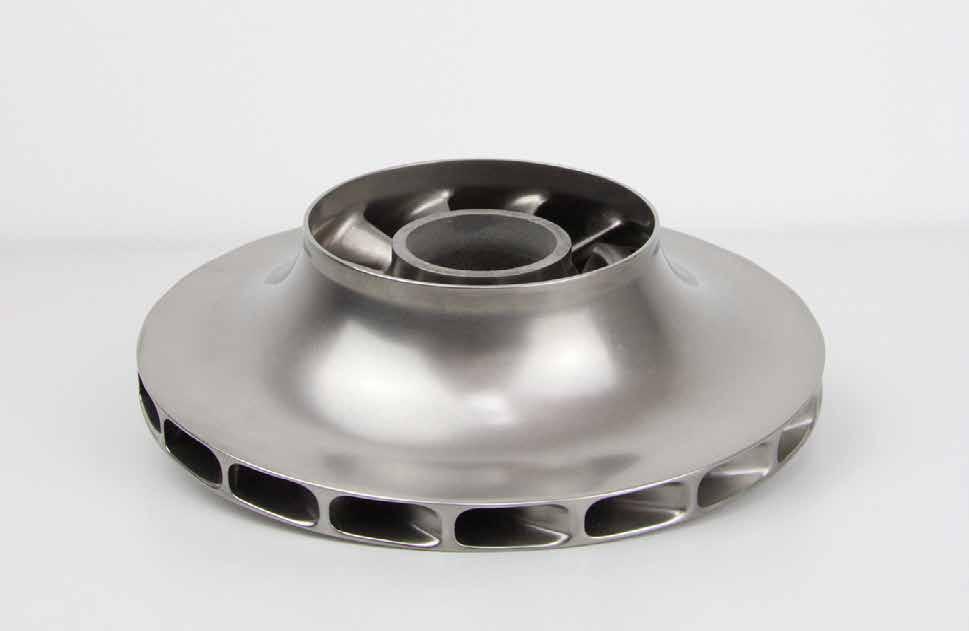
manage. In comparison, CMF largely shifts the densification process away from the AM machine and into a furnace environment, where thermal cycles are more controlled and uniform.
Once a build is complete, green parts remain embedded in the powder bed, much like polymer PBF-LB components. However, because the feedstock contains metal particles bound within the polymer system, the handling characteristics differ from standard polymer parts. CMF green parts are generally more robust during handling than components produced through some competing technologies, particularly Metal Binder Jetting. The fragility of green parts has long been a practical challenge in Binder Jetting workflows, where components can be vulnerable during depowdering and transportation prior to sintering. CMF offers improved mechanical stability at this stage, simplifying de-caking and powder removal
“CMF largely shifts the densification process away from the AM machine and into a furnace environment, where thermal cycles are more controlled and uniform.”
while reducing the risk of handling damage. This robustness can offer important industrial advantages, as process reliability is just as important as material performance: a technology that reduces handling failures and scrap rates can offer substantial operational advantages even if headline mechanical properties are similar to those of competing approaches.
Additionally, due to its robustness, the green part can be mechanically processed to achieve thinner walls and smoother surfaces.
Following depowdering, the component moves into the debinding process. During this stage, most of the binder system is removed while leaving enough residual binder to maintain dimensional stability. The remainder is then removed thermally
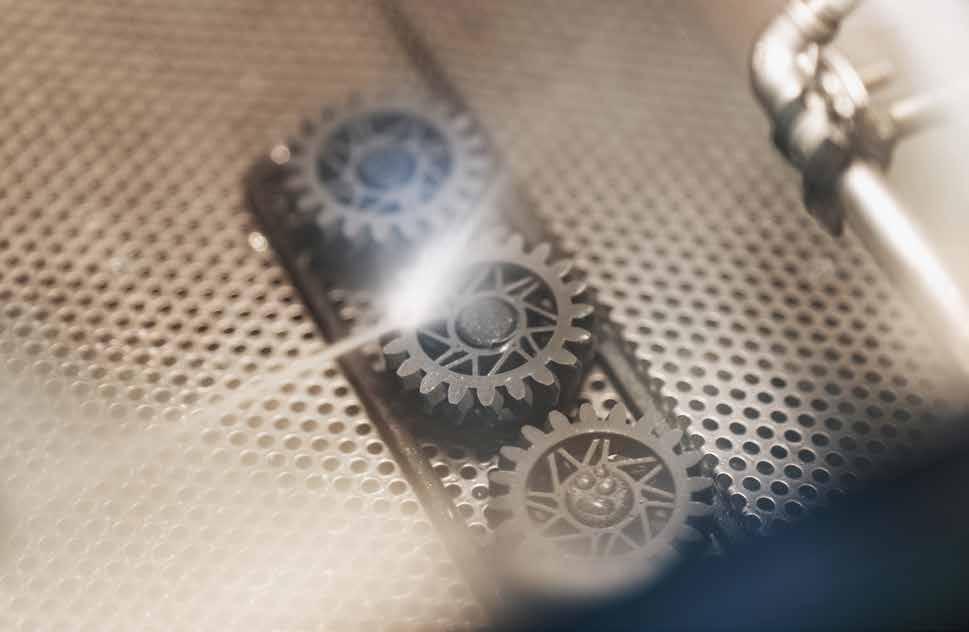
“Unlike many emerging additive technologies that require entirely new process knowledge, sintering is already well established in the MIM industry.”
during furnace treatment, followed by sintering, during which the metal particles fuse into the final dense structure.
The reliance on sintering is particularly significant because it connects CMF to established industrial processes. Unlike many emerging additive technologies that require entirely new process knowledge, sintering is already
well established in the MIM industry. Existing furnace infrastructure, metalwork expertise, and quality-control methodologies can therefore be leveraged. This connection to established industrial metalwork is one reason CMF is increasingly being viewed as a new approach within Additive Manufacturing rather than as a standalone process.
CMF feedstocks are produced in a controlled process and then supplied as ready-to-use material. This allows for a simpler operational workflow for customers, positively impacting the supply-chain structure, safety considerations, and material economics. The feedstock is manufactured by Headmade Materials as part of its patented process model, ensuring consistent material quality, validated process performance, and reliable production results.
However, the system remains open, as customers can request the development of additional feedstocks tailored to specific applications and industries. This hybrid strategy combines tight process control with continuous expansion of the material portfolio.
As powders are encapsulated in polymer, reactive powders can be handled in a far less restrictive way. Feedstock can be stored relatively
simply, even in baskets, and can present fewer safety concerns than standard metal powder systems. These handling advantages become particularly relevant when working with reactive materials such as titanium, where conventional powder management often requires stringent environmental and safety controls.
Material reuse is another notable factor when discussing the advantages of CMF. Unused feedstock can be fully reused, thereby contributing to sustainability and overall process economics. In an industry increasingly focused on material utilisation and waste reduction, feedstock recyclability is becoming a more important competitive differentiator.
A key advantage of CMF is its compatibility with existing polymer PBF-LB machines. Machines from EOS and other established suppliers can be adapted for CMF processing with relatively limited hardware changes. Although some suppliers modify systems with additional safety features and market them as dedicated CMF platforms, the core process remains fundamentally compatible with standard polymer PBF-LB equipment.
For manufacturers already operating polymer PBF-LB production environments, this significantly lowers the barrier to stepping into metal Additive Manufacturing. Existing machine fleets, operator experience, workflow knowledge and facility layouts can often be leveraged rather than completely replaced. In many cases, companies can integrate CMF into existing Additive Manufacturing operations without the substantial investment typically associated with conventional metal AM systems.
This represents an important distinction from standard metal PBF-LB, which is considered to be highly specialised, proprietary, and
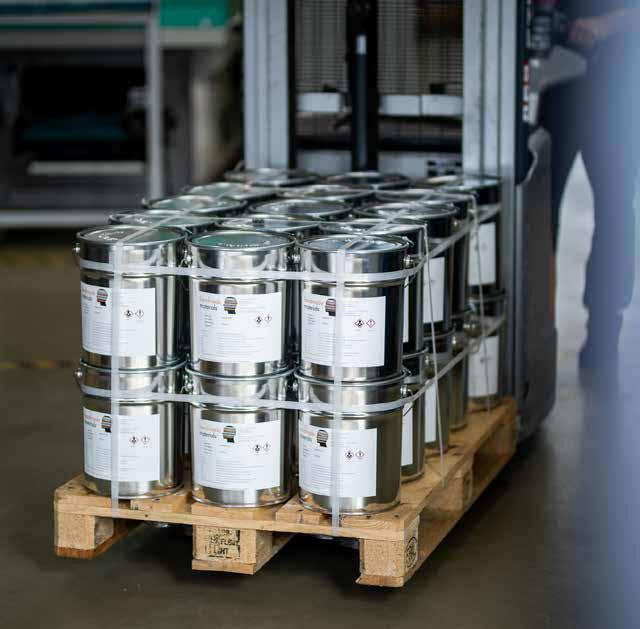
capital-intensive. Conventional PBF-LB also typically requires tightly controlled environments, high-energy laser systems, sophisticated feedstock management, extensive safety infrastructure to process reactive fine metal powders safely, and extensive postprocessing equipment to remove support structures and execute heat treatment.
These requirements increase both equipment costs and operational complexity. CMF, by contrast, benefits from a mature and widely deployed polymer AM ecosystem, allowing manufacturers to build on familiar equipment, established operating procedures, and existing workforce expertise while reducing many of the practical and economic barriers to adopting metal AM.
“As powders are encapsulated in polymer, reactive powders can be handled in a far less restrictive way. Feedstock can be stored relatively simply, even in baskets, and can present fewer safety concerns than standard metal powder systems.”
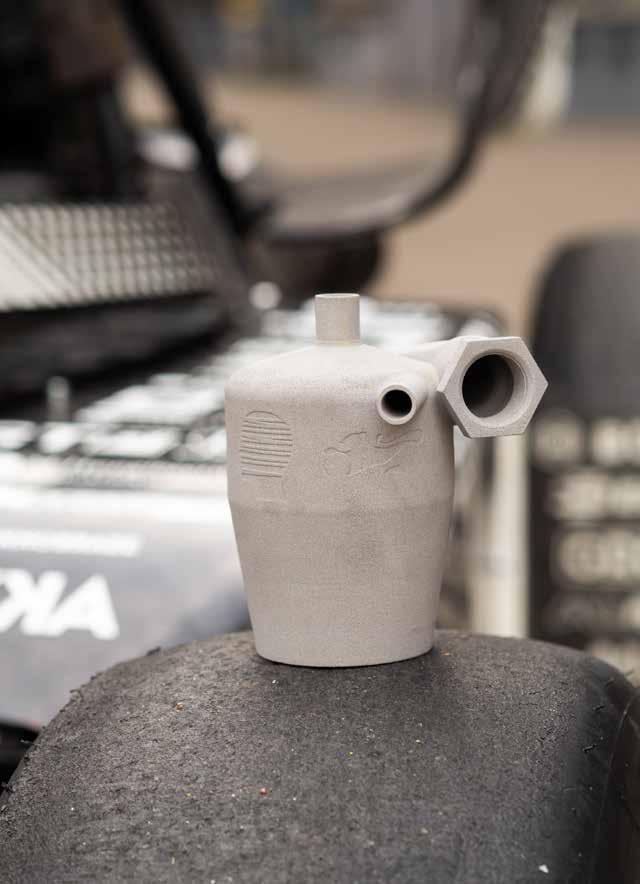
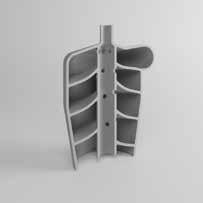
Tit anium’s combination of low density, high strength, corrosion resistance, and thermal performance has made it a highly desirable engineering material across the aerospace, automotive, defence, and energy sectors. Yet it is also one of the most difficult and expensive metals to process traditionally. Processing titanium is notoriously time-consuming due to the material’s density and thermal behaviour, and casting also presents substantial technical challenges. As a result, titanium components often involve long lead times and high manufacturing costs.
CMF is particularly well aligned with these challenges because the process enables near-net-shape production while reducing dependence on extensive subtractive machining. Complex geometries that would be difficult or expensive to machine conventionally can instead be produced directly within the Additive Manufacturing workflow. This makes titanium parts more practical and economically viable for a broader range of industrial applications.
Alongside Ti-6Al-4V, Headmade Materials’ available feedstocks include 316L and 17-4PH stainless steels, M2 tool steel and Inconel 625. Additional development work is focused on high-temperature stainless steels and nickel-based alloys.
“Complex geometries [...] can instead be produced directly within the Additive Manufacturing workflow. This makes titanium parts more practical and economically viable for a broader range of industrial applications.”
While CMF shares many similarities with MIM, it eliminates the need for dedicated moulds and tooling, which significantly improves manufacturing flexibility, particularly for lower production volumes and complex geometries. Investment casting, which is also widely used for highly detailed geometries and excellent surface finishes, presents limitations in production flexibility and manufacturing workflow. It generally requires
dedicated tooling for wax injection and mould production, making it economically favourable for medium-to-high production volumes but less economically attractive for single-part production.
CMF is tool-free and therefore offers many of the design freedoms associated with Additive Manufacturing, while also enabling more complex internal geometries and lightweight structures. CMF is not intended to replace investment casting in high-volume commodity production. Instead, it addresses applications where tooling costs, long lead times, complex internal geometries, or frequent design iterations reduce the economic efficiency of conventional casting workflows.
As a result, CMF appears particularly well suited to applications involving geometrically demanding metal components, including gas turbine parts, LNG pump components, impellers, turbine hardware, and high-performance motorsport cooling pumps and gearbox components. These applications share several common characteristics, including intricate internal features, tight dimensional requirements, and moderate production volumes, in which manufacturing agility is more important than pure mass-production efficiency.
From an economic perspective, conventional manufacturing methods remain more cost-effective for certain high-volume applications, particularly when tooling investments can be spread across very large production runs. However, CMF becomes increasingly attractive when evaluating the total cost of ownership, especially in applications where supply chain constraints, inventory reduction, post-processing requirements, the integration of additional functionalities or long lead times have a significant impact on overall manufacturing economics. In these scenarios, the value of increased flexibility and faster production responsiveness can outweigh the efficiencies traditionally associated with large-scale manufacturing.
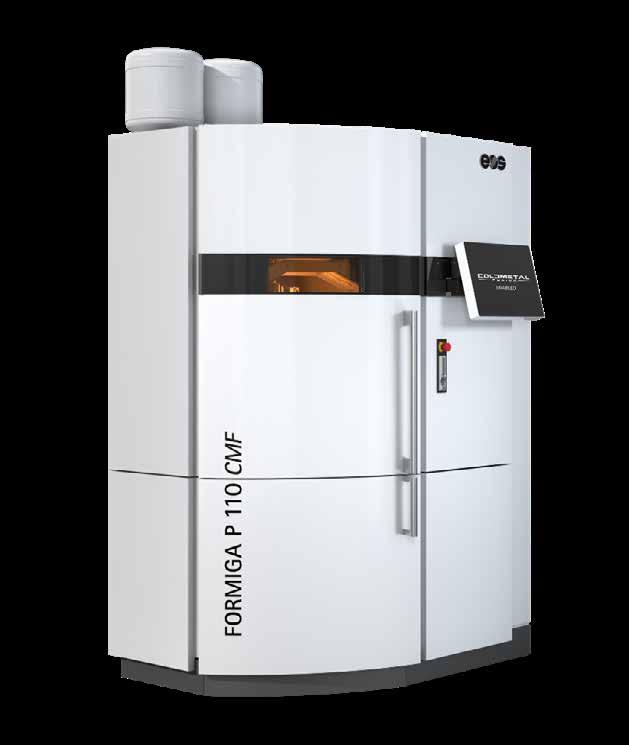
“The value of increased flexibility and faster production responsiveness can outweigh the efficiencies traditionally associated with large-scale manufacturing.”
Despite its advantages, CMF also has clear practical limitations that define the range of applications for which it is best suited. Typical part sizes currently range from approximately matchbox to shoebox scale, with minimum wall thicknesses of around 1 mm and maximum wall thicknesses of approximately 2.5 cm. These
constraints are largely set by furnace behaviour, thermal uniformity, and the underlying considerations of debinding and sintering.
Extremely thin walls may lack sufficient structural stability during handling and thermal pr ocessing, while very thick walls can pose challenges with binder removal, shrinkage control, and density uniformity during sintering.
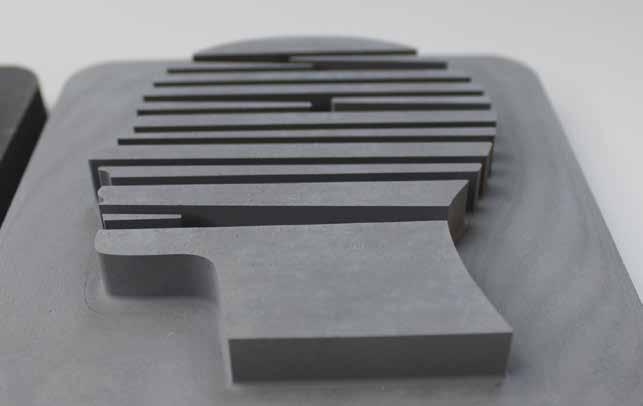
As with other sinter-based manufacturing processes, achieving predictable dimensional accuracy and consistent material properties becomes increasingly difficult when part geometry and wall thickness vary significantly.
For these reasons, CMF should not be viewed as a universal replacement for all metal manu -
facturing methods, but rather as a highly targeted production technology optimised for specific categories of industrial components. Its strengths are most apparent in applications requiring complex geometries, moderate production volumes, reduced tooling dependence, and improved manufacturing flexibility.
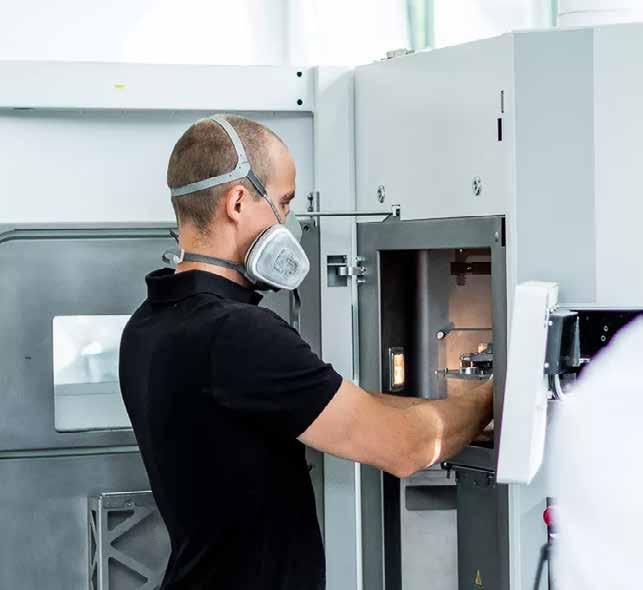
Rather than attempting to compete directly across every segment of metal production, CMF is strategically positioned in areas where its combination of geometric freedom, lower thermal stress, sintering-based economics and high-performance materials provides meaningful differentiation.
As Additive Manufacturing continues to mature, technologies such as ColdMetalFusion suggest that the future of industrial metal production may not be defined solely by faster AM machines or higher-powered lasers. Instead, the next phase of innovation is likely to emerge from manufacturing models that integrate additive technologies into broader industrial ecosystems, combining digital production flexibility with established metalwork processes and scalable post-processing infrastructure. In this context, CMF represents a shift towards more resilient, distributed, and economically adaptable manufacturing strategies capable of supporting increasingly dynamic global production environments.
Author
Marcel Strobel Chief Product Officer
Headmade Materials
Langhausstrasse 9 97294 Unterpleichfeld Germany www.headmade-materials.de/en/
Headmade Materials is a Germanybased materials and technology company focused on advancing metal Additive Manufacturing through its proprietary ColdMetalFusion process. It aims to make metal manufacturing more accessible, scalable, and costefficient for industrial production environments.








PIM International is the only business-to-business publication dedicated to reporting on the technical and commercial advances in the MIM, CIM, and sinter-based Additive Manufacturing industries.
Available in both digital and print formats, PIM International is the perfect platform to promote your company to a global audience.
www.lucideon.com
Schunk Sintermetalltechnik GmbH 27 www.schunk-mobility.com
Combining digital and print publishing for maximum exposure Every issue of the magazine is distributed via multiple channels, including our website, newsletters and social media networks.

The print edition is distributed at numerous industry events worldwide as well as to a core subscriber base. All past editions of PIM International magazine are freely accessible via our digital archive, adding extended exposure for your brand and products. For more information contact: Jon Craxford, Advertising Sales Director Tel: +44 207 1939 749 jon@inovar-communications.com
ATM Qness GmbH - Verder Group 19 www.qatm.com | www.verder-scientific.com
Microtrac Retsch GmbH - Verder Group 19 www.microtrac.com | www.verder-scientific.com
AM Ceramics 2026
amceramics.cc
ASTM ICAM 2026 80 amcoe.org/event/icam2026
Ceramics Vietnam & Stone Vietnam 118 aseanceramics.com | aseanstone.com
Euro PM2026
www.powdermetallurgycongress.com
Formnext
www.formnext.com
PM China 2027 | PM Shenzhen 2026
en.pmexchina.com
WorldPM 2026 | AMPM2026
Tungsten 2026
www.worldpm2026.org | www.ampm2026.org www.tungsten2026.org
Newsletter
an email containing a direct link to our digital edition.
www.pim-international.com/e-newsletter-

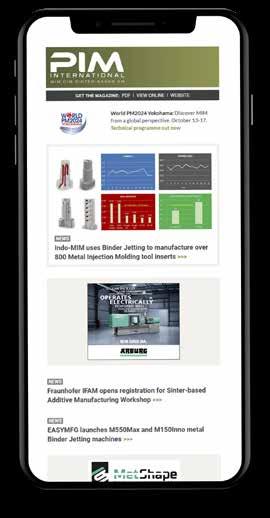

PIM International is dedicated to driving awareness and development of the MIM, CIM and sinter-based AM industries and their related technologies. Key to this aim is our support of a range of international partner conferences. View our complete events listing on: www.pim-international.com
Powder Metallurgy and Additive Manufacturing of Titanium (PMAMTi 2026)
HI-AM Conference – Holistic Innovation in Additive
Manufacturing
June 22–23 - Banff, AB, Canada hiam.uwaterloo.ca/2026/
Design for Additive Manufacturing:
Design at Elevation
June 24–26 - Golden, CO, United States amcoe.org/event/ design-for-additive-manufacturing-design-at-elevation/
WorldPM2026 | AMPM2026 | Tungsten2026
June 25–29 - Montreal, Canada www.worldpm2026.org | www.ampm2026.org www.tungsten2026.org
Ceramic AM Summit
June 29 – July 1 - Freiburg, Germany www.amsummit.dkg.de
The Advanced Ceramics Show | The Advanced Materials Show
July 8–9 - Birmingham, United Kingdom advancedceramicsshow.com advancedmaterialsshow.com
EPMA Summer School
July 19–24 - Porto, Portugal summerschool.epma.com
America Makes Members Meetings & Exchange (MMX)
August 4–5 - Youngstown, OH, United States www.americamakes.us/events/mmx/
Formnext Asia Shenzhen
August 26–28 - Shenzhen, China formnext-sz.hk.messefrankfurt.com
Looking for an event partner?

If you would like to see your CIM, MIM or sinter-based AM related event listed in this magazine and on our websites, please contact Merryl Le Roux: merryl@inovar-communications.com
September 2–4 - Taipei, Taiwan www.pmti2026.com
VICENZAORO + T-GOLD
September 4–8 - Vicenza, Italy www.vicenzaoro.com/en/t.gold
JTF Jewelry Technology Forum
September 7 - Vicenza, Italy jtf.it/en/jtf-2/
ASTM International Conference on Advanced Manufacturing 2026
September 28 – October 2 - Orlando, FL, United States amcoe.org/event/icam2026/
The Advanced Materials Show USA
October 6–7 - Pittsburgh, PA, United States advancedmaterialsshowusa.com
Euro PM 2026 Congress and Exhibition
October 11–14 - Budapest, Hungary powdermetallurgycongress.com
AM Ceramics 2026
October 13–14 - Frankfurt, Germany amceramics.cc
Shenzhen International Powder Metallurgy and Advanced Ceramics Exhibition
October 14–16 - Shenzhen, China en.pmexchina.com
Formnext
November 17–20 - Frankfurt, Germany www.formnext.com
Ceramics & Stone Vietnam
December 2–4 - Hanoi, Vietnam aseanceramics.com/vietnam
PM China 2027
March 24–26 - Shanghai, China en.pmexchina.com
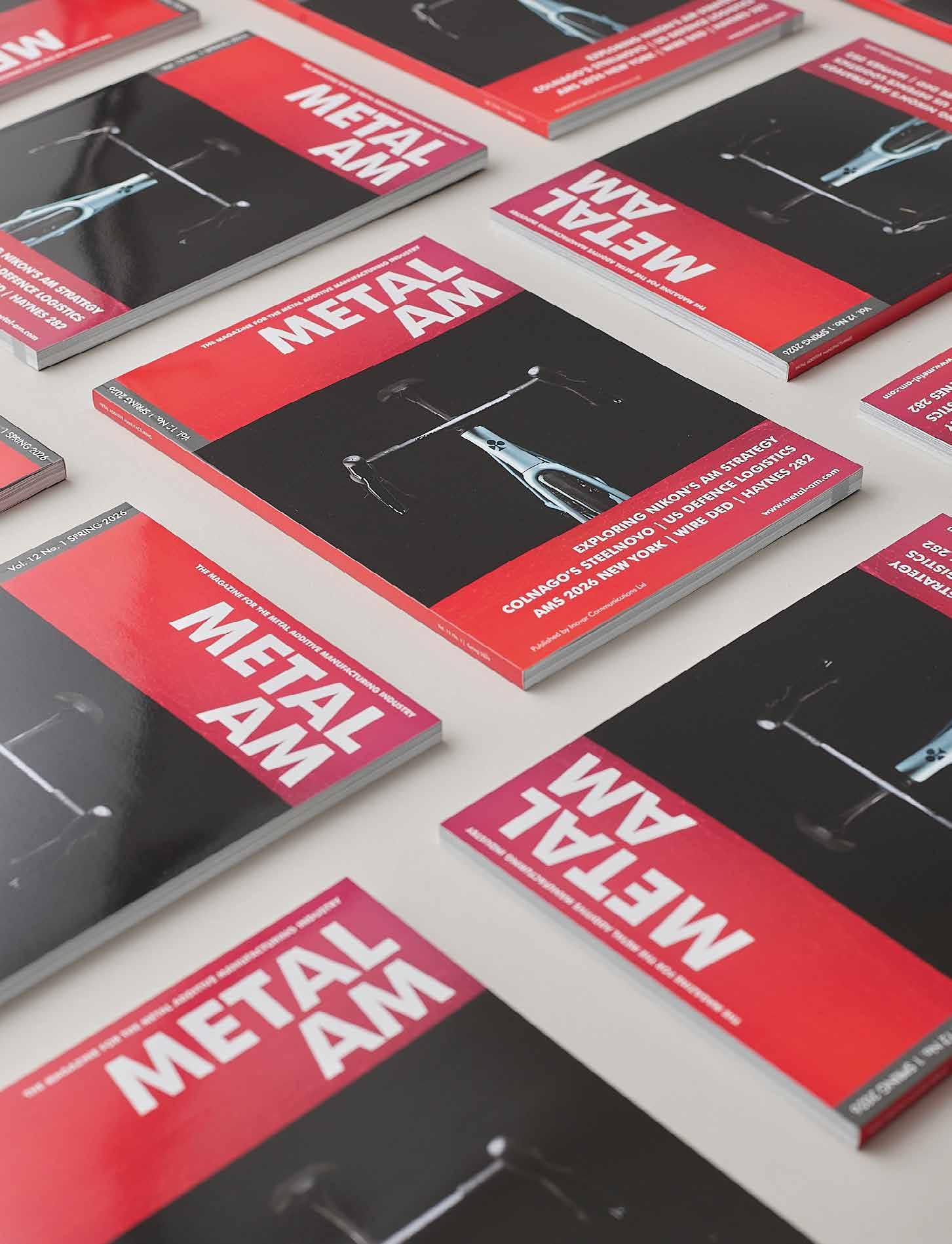

Enjoy