Vol. 12 No. 3 AUTUMN 2026
THE MAGAZINE FOR THE METAL ADDITIVE MANUFACTURING INDUSTRY
METAL AM
APPLE’S METAL AM HINGE | INSIDE BLT NUCLEAR FUSION | ATI: FROM ALLOY TO PART WIRE ARC DED: FROM TURBINES TO SUBMARINES Published by Inovar Communications Ltd
www.metal-am.com
Meet us at
Hall 12.0 | Booth E81
17–20 November 2026 | Frankfurt, Germany
PUBLISHER & CONTACTS
Inovar Communications Ltd 11 Park Plaza Battlefield Enterprise Park Shrewsbury SY1 3AF United Kingdom Tel: +44 (0)1743 469909
Managing Director & Editor Nick Williams, nick@inovar-communications.com
METAL ADDITIVE MANUFACTURING MAGAZINE
Group News Editor & Director Paul Whittaker, paul@inovar-communications.com Advertising Sales Jon Craxford, Advertising Sales Director, Tel: +44 (0)207 1939 749, jon@inovar-communications.com Sally Pye, Advertising Business Development Manager Tel: +44 (0)1939 839988, sally@inovar-communications.com News Editors Amelia Gregory, amelia@inovar-communications.com Charlie Hopson-VandenBos, charlie@inovar-communications.com Features Editor Emma Lawn, emma@inovar-communications.com Technical Consultant Dr Martin McMahon Marketing Lead Mulltisa Moung, mulltisa@inovar-communications.com Production Manager Hugo Ribeiro, hugo@inovar-communications.com Operations & Partnerships Manager Merryl Le Roux, merryl@inovar-communications.com Office & Accounts Manager Jo Sheffield, jo@inovar-communications.com SUBSCRIPTIONS
Metal Additive Manufacturing is published on a quarterly basis as either a free digital publication or via a paid print subscription. The annual print subscription charge for four issues is £175.00. Rates in € and US$ are available on application. ACCURACY OF CONTENTS
Whilst every effort has been made to ensure the accuracy of the information in this publication, the publisher accepts no responsibility for errors or omissions or for any consequences arising there from. Inovar Communications Ltd cannot be held responsible for views or claims expressed by contributors or advertisers, which are not necessarily those of the publisher. ADVERTISEMENTS
Although all advertising material is expected to conform to ethical standards, inclusion in this publication does not constitute a guarantee or endorsement of the quality or value of products or of the claims made by its manufacturer.
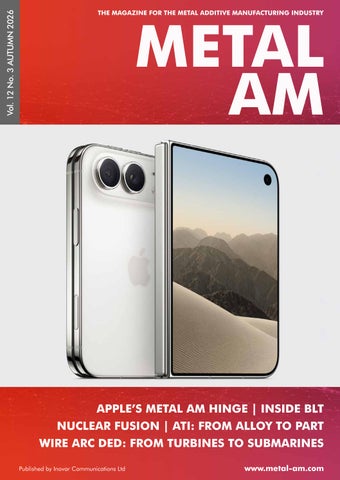
Metal AM, by the million For years, we debated what metal Additive Manufacturing at scale might look like. Today, we are witnessing production runs stretching to millions of parts. Highvolume metal AM is no longer an ambition, but an industrial reality. Apple’s titanium hinge component for the new iPhone Duo brings yet another high-profile, high-volume consumer application to our magazine cover. Following its use of AM for titanium watch cases, this newest application gives the industry further cause for confidence. Such progress deserves recognition across the AM community. Years of work in materials, machines, software and process control are supporting these production volumes. Producing an impressive part is one thing; manufacturing it reliably by the million marks a significant industrial achievement. This reflects collaboration between engineers, researchers and design and manufacturing teams. For an industry that has spent so long making the case for production at scale, this is a defining moment. Metal AM has demonstrated that it can meet the demands of mass-market manufacturing, moving beyond specialised applications into products used by millions of people. As the industry gathers at Formnext, there is much to celebrate. The question is no longer whether metal AM can deliver at this scale, but which applications will follow. Nick Williams Managing Director
REPRODUCTION, STORAGE AND USAGE
Single photocopies of articles may be made for personal use in accordance with national copyright laws. All rights reserved. Except as outlined above, no part of this publication may be reproduced, modified or extracted in any form or by any means without prior permission of the publisher and copyright owner. DESIGN AND PRODUCTION
Inovar Communications Ltd ISSN: 2057-3014 (PRINT) ISSN: 2055-7183 (ONLINE) www.metal-am.com © 2026 Inovar Communications Ltd
Cover image
The iPhone Duo features a titanium additively manufactured hinge cover with a micro-blasted finish (Courtesy Apple)
Metal Additive Manufacturing | Autumn 2026
3
| contents | news | events | advertisers | website | newsletter |
4 x 1kW full field lasers Optimised gas flow for increased productivity & quality Variable beam diameter on demand
The perfect configuration to fit your application, operation or production workflow
420K
420K
Modular & automated architecture
Dual Core
420K
420K
Core
Core Continuous Production
420K
420K
Core Automation
Dual Core Automation
4
Automated & in-process calibration
Dual Core Continuous Production
www.additiveindustries.com team@additiveindustries.com © 2026 Inovar Communications Ltd Vol. 12 No. 3
Metal Additive Manufacturing | Autumn 2026
11
32
64
183
201
Contents 141 BLT: Inside the world’s largest metal Additive Manufacturing parts-production operation Bright Laser Technologies (BLT) is one of China’s largest metal AM machine producers, but the scale of its partsproduction business is less well known. With between 900 and 1,000 Laser Beam Powder Bed Fusion (PBF-LB) machines operating internally, its Xi’an facilities likely represent the world’s largest concentration of metal AM production capacity. Martin McMahon visited the site for Metal AM magazine, meeting founder, Chairman and CEO Dr Xue Lei and Vice President Vincent Wanhu Yang, and reassessing assumptions about how far metal AM has progressed towards true mass production. >>>
165 Nuclear fusion’s manufacturing challenge: Where metal Additive Manufacturing can make the difference As nuclear fusion advances towards power plants, attention is shifting from plasma performance to manufacturing reliable reactor hardware. Drawing on individual interviews with experts from Fusion for Energy, UK Atomic Energy Authority, Max Planck Institute for Plasma Physics, University of Birmingham, Novatron Fusion Group and Freemelt, Ulric Ljungblad examines where metal AM could earn its place – from tungsten plasma-facing components and tungsten-copper interfaces to integrated cooling and maintainability – and what is needed to achieve qualified industrial production. >>>
Regular features... 11
Industry news >>>
236 Events guide >>> 238 Advertisers’ index & buyers’ guide >>>
No. 3 © 2022 Inovar Communications Ltd
Vol. 12 No. 3 © 2026 Inovar Communications Ltd
Metal Additive Manufacturing | Autumn 2026
5
| contents | news | events | advertisers | website | newsletter |
Osprey takes flight. SAME
POWDERS
·
SAME
EXPERTISE
·
SAME
PARTNERSHIP
For fifty years the Osprey name has defined gas-atomized metal powders, the last decades as part of Sandvik. Now the bird flies on its own again: Osprey Atomiqs, an independent advanced materials platform.
ADVANCED
MATERIALS
PLATFORM
AEROSPACE
·
·
6
DEFENCE
HEALTHCARE
Metal Additive Manufacturing | Autumn 2026
·
ENERGY
ospreyatomiqs.com © 2026 Inovar Communications Ltd Vol. 12 No. 3
183 From alloy design to aerospace components: Industrialising the ATI® 1700® superalloy for metal Additive Manufacturing Developing a new nickel-based superalloy for Additive Manufacturing involves more than achieving improved mechanical properties. Alloy design, powder production, process development, heat treatment and qualification must all be addressed. Matias Garcia-Avila and Austin Mann of ATI examine the development of the ATI 1700 superalloy, from alloy screening through to complex AM components and large-format manufacturing. Their account highlights the technical challenges, industrial capabilities and qualification requirements involved in bringing a new high-performance material into wider use in demanding aerospace and defence applications. >>>
OUR READERS YOUR AUDIENCE Metal AM magazine is the only publication exclusively dedicated to covering the world of metal Additive Manufacturing. Our mission is simple: to be the leading source of knowledge for industry professionals while
193 From coupon to component: Qualifying wire arc DED for the US Submarine Force As the US Navy looks to expand the use of wire arc Directed Energy Deposition (DED) across the Submarine Industrial Base, qualification must move beyond controlled test coupons to large, geometrically complex production parts. AML3D’s work explores how thermal behaviour, bead geometry, process parameters and software control can be managed as build scale increases, while new US Navy qualification and material-interchangeability frameworks aim to remove barriers to adoption. The research examines thermal compensation strategies to support the transfer of qualified procedures to full-scale submarine components. >>>
201 Scaling wire arc Directed Energy Deposition: Building on existing qualification evidence at WAAMathon #3 Scaling wire arc Directed Energy Deposition requires manufacturers to understand how changes in equipment, materials and component design affect a qualified process. Drawing on Siemens Energy’s series-production experience and discussions at WAAMathon #3 in Berlin, Christiane Herzer examines the practical foundations for wider adoption: standards that reflect industrial needs, access to qualificationrelevant machine data and monitoring that strengthens the evidence base.
actively championing the adoption of metal AM technology globally. Advertising with Metal AM is more than exposure; it is a strategic partnership that elevates your brand’s visibility and authority within the complex and multifaceted metal AM industry. Together, we can shape the conversation and accelerate the global adoption of metal Additive Manufacturing.
BE VISIBLE Discover our 2027 advertising & webinar opportunities > jon@inovar-communications.com
FOLLOW US
45,000+ metal AM professionals can’t be wrong Follow Metal AM magazine on LinkedIn
Together, these approaches offer a route to faster industrialisation while preserving the rigour required for demanding applications. >>>
Vol. 12 No. 3 © 2026 Inovar Communications Ltd
Metal Additive Manufacturing | Autumn 2026
7
SINTERING ISN’T DIFFICULT | contents | news | events | advertisers | website | newsletter |
Not when you have the right expertise behind you. With the right knowledge, it becomes a controlled, reliable, and repeatable process. At DSH Technologies, we turn process complexity into production capability.
Reduce Scrap Rate & Variability Improve Yield & Consistency Emergency Troubleshooting Toll Debinding & Sintering
STOP GUESSING, START IMPROVING WITH DSH TECHNOLOGIES. 8
Metal Additive Manufacturing | Autumn 2026
© 2026 Inovar Communications Ltd Vol. 12 No. 3
211 Hidden cracks in pure tungsten: How JEOL changed the PBF-EB thermal cycle Pure tungsten remains difficult to process by Additive Manufacturing, but its properties make it attractive for demanding high-temperature applications. JEOL’s high-temperature PBF-EB trials showed that a sound surface could conceal internal cracking. Looking beneath the surface through sectioning and microscopy led to a local pre-hatch strategy that improved internal quality.
Günter Kappler, Dominik Kunz and Michael Jan Galba investigate four Ti-6Al-4V designs produced by Laser Beam Powder Bed Fusion (PBF-LB), revealing an approximately ninefold range in axial stiffness. Their findings show where simulation falls short and why pressure testing alone may not reveal progressive fatigue damage. >>>
229 Build plate resurfacing in metal Additive Manufacturing: A practical guide to process control Build plate resurfacing affects far more than surface finish. As metal AM production scales up, control of this operation can help preserve plate life, improve plate turnaround and support consistent builds. From abrasive selection and workholding to inspection, traceability and automation, a repeatable process depends on more than the grinder alone.
Ulf Lindhe examines the resulting material properties, complex tungsten demonstrators, fusion-related trials, and the work still needed to scale and qualify the process. >>>
219 Titanium bellows: Engineering flexibility and testing durability with metal Additive Manufacturing
Jennifer Rutz, President of DCM Tech, examines the practical requirements for returning plates to service and the factors manufacturers should weigh when considering whether to bring resurfacing in-house. >>>
Metal bellows must flex repeatedly without losing pressure integrity. Additive Manufacturing offers new freedom to tailor their geometry, but predicting the performance of thin-walled components remains a challenge.
Regular features... 11
Industry news >>>
236 Events guide >>> 238 Advertisers’ index & buyers’ guide Our advertisers’ index serves as a convenient guide to suppliers of AM machines, materials, part manufacturing services, software and associated production equipment. In the digital edition of Metal AM magazine, available at www.metal-am.com, simply click on a company name to view its advert, or on the weblink to go directly to its website. >>>
Vol. 12 No. 3 © 2026 Inovar Communications Ltd
Metal Additive Manufacturing | Autumn 2026
9
| contents | news | events | advertisers | website | newsletter |
10
Metal Additive Manufacturing | Autumn 2026
© 2026 Inovar Communications Ltd Vol. 12 No. 3
| contents | news | events | advertisers | website | newsletter |
Industry news
To submit news please contact Paul Whittaker, Group News Editor: paul@inovar-communications.com
Apple’s iPhone Duo adds multi-millionpart titanium AM application In its latest product launch, Apple has confirmed the use of metal Additive Manufacturing in its new iPhone Duo. The foldable iPhone includes an additively manufactured titanium hinge cover as part of the device’s folding mechanism. The application adds a multi-million-unit programme to Apple’s growing use of metal AM and further underlines the technology’s shift into ultra-high-volume production. Unveiled on September 9, the iPhone Duo is Apple’s first foldable iPhone. The device features a Grade 5 titanium (Ti-6Al-4V) enclosure and an additively manufactured hinge cover with a contrasting micro-blasted finish. The hinge mechanism comprises more than 100 components and is designed to control opening and closing while supporting the centre of the display when the device is open. Apple has not specified the Additive Manufacturing process used for the hinge cover, or whether any other components within the hinge are additively manufactured. The company has, however, previously used Laser Beam Powder Bed Fusion (PBF-LB) for its additively manufactured titanium Apple Watch cases. Apple first publicly confirmed its use of metal AM in consumer products in autumn 2025, when it announced that all Apple Watch Ultra 3 cases and titanium Apple Watch Series 11 cases were additively manufactured. In detailing the development programme at that time, Apple said one of the challenges had been establishing whether Additive Manufacturing could produce “millions of identical enclosures” to its required standards.
The newly announced next generation of these watches, Apple Watch Ultra 4 and titanium Apple Watch Series 12, continue this approach, with their cases still additively manufactured from 100% recycled aerospace-grade titanium powder. The same recycled titanium powder
and AM process were also used for the titanium USB-C port enclosure in the iPhone Air, enabling Apple to produce the geometry required for the device’s thin design. The iPhone Duo is expected to be a significantly higher-volume product and will substantially increase Apple’s requirements for metal AM production. Counterpoint Research forecasts shipments of up to six million iPhone Duo models in 2026
The iPhone Duo features an additively manufactured hinge cover with a contrasting micro-blasted finish (Courtesy Apple)
Shipments of the new iPhone Duo are forecast to be in the millions, adding further momentum to the growing use of metal AM in high-volume consumer electronics (Courtesy Apple)
Vol. 12 No. 3 © 2026 Inovar Communications Ltd
Metal Additive Manufacturing | Autumn 2026
11
| contents | news | events | advertisers | website | newsletter |
Industry News
The hinge comprises more than 100 components and is designed to control opening and closing while supporting the centre of the display when the device is open (Courtesy Apple)
alone, giving Apple around 25% of the global foldable smartphone market. If shipments develop at anything close to this level, the iPhone Duo would establish another metal AM programme requiring several million titanium components annually. Combined with Apple’s existing watch production, this would put the company’s use of metal Additive Manufacturing firmly into a production regime measured in tens of millions of parts rather than thousands. Material efficiency has also been an important factor in Apple’s
adoption of the technology. The company previously estimated that its move to AM for titanium watch cases would save more than 400 metric tonnes of raw titanium during 2025. The iPhone Duo hinge cover is likewise produced from 100% recycled titanium, continuing the use of recycled feedstock across Apple’s metal AM applications. Past successes for metal AM in phone hinges Apple is not the first smartphone manufacturer to apply metal AM to the hinge of a foldable device. In
Counterpoint Research forecasts shipments of up to six million iPhone Duo models in 2026 (Courtesy Apple)
12
Metal Additive Manufacturing | Autumn 2026
2023, Metal AM reported on the Honor Magic V2, whose titanium hinge shaft cover was manufactured via PBF-LB. At the time, the application was reported to be the first use of Additive Manufacturing in final production for a high-volume 3C device. Around one million Magic V2 phones had reportedly been ordered when Metal AM covered the application. The technology has since become increasingly established in foldable smartphones. OPPO’s Find N5, launched in 2025, incorporated additively manufactured Grade 5 titanium components within its hinge system. Xi’an Bright Laser Technologies Co., Ltd (BLT), China, subsequently confirmed that it had worked with OPPO on the development and production of these components, including the titanium hinge cover and wing plate. The collaboration continued with the OPPO Find N6, where BLT confirmed that Additive Manufacturing was used to consolidate a wing-plate assembly that would conventionally consist of as many as thirteen machined components into a single titanium structure. The component incorporated complex geometries and lattice features while reducing part count and weight. Foldable smartphone hinges are proving to be a particularly suitable application for metal AM, combining the need for thin, lightweight structures with complex geometries, high mechanical performance and increasingly large production volumes. With Honor and OPPO already using the technology, Apple’s adoption brings another potentially very high-volume application. For the metal AM industry, the scale of these applications is particularly significant. Apple has already developed its watch production around the ability to manufacture millions of identical additively manufactured enclosures. With iPhone Duo shipments forecast in the millions, its adoption adds further momentum to the growing use of metal AM in high-volume consumer electronics. www.apple.com
© 2026 Inovar Communications Ltd Vol. 12 No. 3
| contents | news | events | advertisers | website | newsletter |
Vol. 12 No. 3 © 2026 Inovar Communications Ltd
Metal Additive Manufacturing | Autumn 2026
13
| contents | news | events | advertisers | website | newsletter |
Industry News
Beehive targets production of 8,000 jet engines annually with $70M expansion Beehive Industries, headquartered in Denver, Colorado, USA, has announced plans to expand its operations in southwest Ohio, creating more than 200 jobs and investing $70 million in the region. The expansion is being supported by the State of Ohio and JobsOhio, which have developed a statewide ‘Team Ohio’ economic development model aimed at accelerating industrial investment through construction-ready sites, streamlined permitting and workforce support. Beehive Industries produces additively manufactured jet engines for uncrewed aerial defence applications and has developed an integrated US supply chain with in-house manufacturing capabilities intended to reduce engine development and production times. According to the company, the expansion will support advanced aerospace manufacturing, workforce growth and long-term investment in Ohio. “Our success is fundamentally tied to the calibre of the workforce we are building in southwest Ohio,” said Gordie Follin, Chief Product Officer at Beehive Industries. “Beehive Industries is investing in a region that possesses a unique combination of aerospace heritage and precision
manufacturing skill. This expansion allows us to pair our advanced Additive Manufacturing technology with the deep technical expertise found there, creating a sustainable model for growth that benefits both our mission and Ohio’s economy.” According to the company, its Frenzy engine has entered full-rate production following the award of a $29.7 million contract from the US Air Force to support development of the Frenzy engine family. In June, Beehive also announced plans to more than double its metal AM production capacity through what it described as ‘the largest publicly disclosed order’ for EOS metal Additive Manufacturing machines. The company also acquired Greater Cincinnati-based precision machining companies Able Tool Corporation and Planet Products Corporation, establishing a production machining centre of excellence in the region. Beehive states that these investments are intended to support annual production of more than 8,000 engines. The project is expected to receive support through a package of state incentives linked to job creation. Beehive intends to apply for a Job Creation Tax Credit through the
Beehive Industries produces additively manufactured jet engines for uncrewed aerial defence applications (Courtesy Beehive Industries)
14
Metal Additive Manufacturing | Autumn 2026
Ohio Department of Development, while JobsOhio also plans to provide financial assistance once a final agreement has been completed. Kim Lauterbach, president and CEO of REDI Cincinnati, added, “Beehive Industries’ continued investment across multiple communities in southwest Ohio speaks to our region’s robust aerospace expertise, world-class talent and strong network of industry partners. Combined with our more than $6 billion aerospace industry, this expansion further accelerates the Cincinnati region as the leading destination for next-generation aerospace manufacturing and innovation.” $4.2 million tax credit for Colorado manufacturing expansion Beehive also announced that the Colorado Economic Development Commission (EDC), operating under the Office of Economic Development & International Trade (OEDIT), had approved a $4.2 million performancebased Job Growth Incentive Tax Credit award for the company. The performance-based award is tied directly to actual job creation and specific economic milestones, a structure intended to ensure mutual benefit for the company and the local community. Over the coming years, the project is projected to create 220 new jobs, primarily focused on advanced engineering and manufacturing roles. “We are incredibly grateful to the Colorado Economic Development Commission and the Office of Economic Development and International Trade for their partnership and confidence in Beehive,” added Follin. “This support marks an exciting milestone for our organisation and validates our vision for future growth. We look forward to deepening our roots in Colorado, creating meaningful employment opportunities, and contributing to the state’s economic momentum.” With state approval officially secured, Beehive is cleared to advance its real estate, operational, and recruitment plans immediately. www.beehive-industries.com
© 2026 Inovar Communications Ltd Vol. 12 No. 3
| contents | news | events | advertisers | website | newsletter |
17-20 November | Frankfurt, Germany
Visit us at Formnext 2026 Stand 12.0 B139
NeuBeam Freedom to Manufacture ®
Hear from Martyn Hussey about how this power is being unleashed 17 November | 2:00 pm | Technology Stage, Hall 12.1 B49 Get in touch today. Email us at enquiries@waylandadditive.com or find out more at www.waylandadditive.com Follow us at www.linkedin.com/company/wayland-additive
Vol. 12 No. 3 © 2026 Inovar Communications Ltd
Metal Additive Manufacturing | Autumn 2026
15
| contents | news | events | advertisers | website | newsletter |
Industry News
Bodycote agrees £1.65 billion acquisition by Veritas Capital Bodycote, headquartered in Macclesfield, England, UK, has agreed the terms of a recommended cash acquisition by Vulcan Alpha Bidco Limited, a newly formed company owned by US investment firm Veritas Capital Fund Management. The offer values Bodycote’s issued and to-be-issued share capital at approximately £1.65 billion, with an implied enterprise value of around £1.85 billion. Bodycote is a global provider of heat treatment and specialist thermal processing services, operating approximately 130 facilities in 22 countries and employing around 4,000 people. “Bodycote has established itself as a global leader in providing essential technologies for performance metallurgy across a range of mission-critical end markets,” explained James Dimitri, partner & co-head of Flagship Private Equity at Veritas. “We admire what Bodycote and its talented employee base have built, and we look forward to leveraging our deep sector experience and track record of partnering with leading companies in the
performance industrial supply chain to support Bodycote’s continued development and unlock a new chapter of growth.” Under the terms of the acquisition, Bodycote shareholders will receive 932.8 pence in cash per share and will retain the FY26 interim dividend of 7.2 pence per share, giving a total offer value of 940 pence per share. Bodycote’s directors intend unanimously to recommend the transaction to shareholders. As part of Bodycote’s current growth strategy, the company has been investing in increased HIP capacity for aerospace and defence customers, as well as expanding its Specialist Technologies activities. In 2026, Bodycote also completed its acquisition of Spectrum Thermal Processing, a North American precision heat treatment business focused on the aerospace and defence sectors. New York-based Veritas had approximately $54 billion in assets under management as of June 30, 2026. The investment firm has cited Bodycote’s technical capabilities and its exposure to aerospace, defence
Global Laser Box raises nearly $30 million in funding round China-based Jiangsu Global Laser Box Digital Technology (Global Laser Box) has announced the completion of a Series A financing round worth nearly RMB 200 million (around US$30 million). According to the company, the round included investment from Qifu Capital, Changxing Investment and Chuangshiji Investment, alongside other investment and government-backed funds. Global Laser Box stated that the financing will support R&D of its Laser Beam Powder Bed Fusion (PBF-LB) Additive Manufacturing machines, development of an AI-based AM software ecosystem,
16
expansion of production capacity and international sales activities. The company supplies metal AM equipment for applications including energy storage, consumer electronics, mould and model making, aerospace, medical and automation. It stated that it develops core components including lasers, control systems and software in-house, and that its products have been sold in more than sixty countries. In June 2026, Global Laser Box launched a desktop metal Additive Manufacturing machine aimed at individual users, small studios and service providers. The company stated that the machine is ready
Metal Additive Manufacturing | Autumn 2026
and other engineering markets as factors behind the acquisition. Completion is currently expected in Q1 2027. “The Bodycote Board believes that this offer from Veritas reflects the high quality of Bodycote’s business and management, and delivers shareholders excellent value in cash,” stated Daniel Dayan, Bodycote Chair. “The Bodycote team has worked extremely hard over many years to build a leading position in our industry, including recent success in delivering on the Optimise, Perform and Grow initiatives; accordingly, the board wishes to express its thanks to management and employees on behalf of shareholders. “It is gratifying to see Veritas’ strong support in this announcement for Bodycote’s strategy in focusing the group on its most attractive markets for the benefit of all stakeholders. Veritas is an experienced and knowledgeable owner of industrial businesses with the capability to accelerate the delivery of this strategy. The board remains highly confident in Bodycote’s prospects and believes that this offer recognises that value today and is therefore recommending it to shareholders.” www.veritascapital.com www.bodycote.com
for volume production and delivery. It is supported by the company’s IronNova mobile application, which offers functions including AI-assisted model repair, cloud-based slicing and automated build preparation. Global Laser Box operates five sites in Yancheng, Jiangsu; Huzhou, Zhejiang; Changsha and Changde, Hunan; and Shenzhen, Guangdong. Expansion of the company’s desktop metal AM activities could increase demand for smaller quantities of metal powders, including stainless steels, packaged for handling and distribution through retail channels. Expansion of both its industrial and desktop product lines could also create additional requirements for powder parameter validation and consumable supply. www.glb3d.cn
© 2026 Inovar Communications Ltd Vol. 12 No. 3
| contents | news | events | advertisers | website | newsletter |
The heart of the design lies within the material!
When the design pushes limits, the material has to keep up. Höganäs metal powders for Additive Manufacturing are engineered to do exactly that, enabling cost-efficient production of high-performance components with more intricate shapes than conventional manufacturing would allow. The result? Consistency in printed material properties, improved rate of 3798HOG
successful prints, reduced printer downtime and lower cost per part. It all starts with what's inside, The Material.
Vol. 12 No. 3 © 2026 Inovar Communications Ltd
POWDER THAT EMPOWERS®
Metal Additive Manufacturing | Autumn 2026
17
| contents | news | events | advertisers | website | newsletter |
Industry News
AmPro secures order for over 100 metal AM machines from consumer electronics manufacturer AmPro Innovations, headquartered in Melbourne, Australia, has reported securing an order for more than 100 metal Additive Manufacturing machines from an unnamed global consumer electronics manufacturer. The company stated that the order centres on its SP450 multi-laser Laser Beam Powder Bed Fusion (PBF-LB) machine, and represents a significant commercial development as it seeks to expand its international presence. The SP450 has been developed for industrial-scale metal Additive Manufacturing, with a reported build volume of 450 × 450 × 300 mm and a configuration incorporating eight 500 W lasers. According to AmPro, the machine includes bi-directional powder recoating, long-life self-cleaning filtration, automatic powder feeding and recycling,
substrate heating and an inert argon gas processing chamber. AmPro states that the SP450 is designed to combine high productivity with competitive equipment and operating costs. The machine is intended to process a range of engineering materials, including titanium, nickel-based alloys, aluminium, steels, copper alloys and pure copper, depending on its configuration and the processing parameters employed. The SP450 forms part of AmPro’s expanding range of metal AM machines, which includes compact models such as the SP101 and SP160, medium-format machines including the SP501, and larger production machines. Among these is the SP801, which has a published build volume of 800 × 800 × 600 mm and configurations incorporating
The order includes the new SP450 multi-laser PBF-LB metal Additive Manufacturing machine (Courtesy AmPro)
18
Metal Additive Manufacturing | Autumn 2026
two or four 1,000 W lasers. The company has also announced an eight-laser version with an extended build height of 1,000 mm. At the upper end of its portfolio, the SP1200 offers a build volume of 1,200 × 600 × 1,500 mm and incorporates twelve 500 W lasers for large-format component production. Complementing its metal AM machines, AmPro supplies powder handling and processing equipment, including gloveboxes, sieving machines, vacuum conveying equipment, powder dryers and storage solutions. These are intended to support integrated manufacturing operations and improve powder handling and recovery. “We are very excited to see the culmination of decades of pioneering research and development coming to fruition, and the recognition of our advanced technologies and solutions by leading global companies across multiple industry sectors,” stated Dr Xinhua Wu, CEO and founder of AmPro Innovations. “Our mission is to bring a new paradigm for affordable AM, and that starts here! This is a critical moment in our rapid development and expansion, so we are not able to share further information at this moment. Together with our team and partners, we will be delighted to welcome new enquiries during the upcoming Formnext in Germany.” The reported order follows AmPro’s recent announcement of a distribution agreement with UnionTech, headquartered in Shanghai, China, under which UnionTech will serve as its exclusive distributor across the Americas. The partnership covers AmPro’s metal Additive Manufacturing machines, metal powders and associated powder processing equipment, alongside local sales and technical support. The company plans to discuss its latest developments and potential manufacturing partnerships at Formnext 2026 in Frankfurt, Germany. www.amproinnovations.com
© 2026 Inovar Communications Ltd Vol. 12 No. 3
| contents | news | events | advertisers | website | newsletter |
BUILD THE FUTURE. SUSTAIN THE MISSION.
MANUFACTURE AT
THE FRONTIER. Unleash new manufacturing capabilities with AML3D’s ARCEMY® Systems. Purpose-built for mission-critical environments, ARCEMY® delivers Wire Additive Manufacturing (WAM®) solutions to rapidly produce certified, large-scale metal components on-demand. From sovereign defense readiness to energy infrastructure resilience, ARCEMY® Systems enable: • Agile, scalable production of complex metal parts; • On-site manufacturing readiness; • Reduced lead times, lower carbon emissions, and enhanced performance.
Discover how ARCEMY® empowers manufacturing supply chains. Visit aml3d.com/arcemy-build-the-future
ADDITIVE MANUFACTURING FACILITY QUALIFICATION
Quality Certified
United States +1 330 900 7610 ISO 9001:2015
DNV.COM/AF
AS 9100D
URER CT FA
ITIME MAN AR U M
CERTIFIED
Australia +61 429 550 593 APPRO VE D
2026-03-16 Metal AM FP Spring 2026
Build parts bigger, stronger, faster, greener with AML3D’s ARCEMY® Wire Additive Manufacturing Systems.
Quality Certified
Vol. 12 No. 3 © 2026 Inovar Communications Ltd AU1769-QCM
AU1769B-QC
www.aml3d.com info@aml3d.com Metal Additive Manufacturing | Autumn 2026
Aus. Pat. 2019251514. JP 7225501. EP 3781344. WAM ®: Wire Additive Manufacturing. AML3D ®, WAM ®, WAMSoft ®, ARCEMY® are all registered trademarks of AML3D Limited. Quality Certified
Quality Certified
19
| contents | news | events | advertisers | website | newsletter |
Industry News
Exentis signs $40.8 million agreements for twenty-three AM machines Exentis Group AG, headquartered in Stetten, Switzerland, has entered into separate framework agreements with two new customers in Asia covering twenty-three Exentis Additive Manufacturing machines, with a combined value of around $40.8 million. The first framework agreement covers fifteen AM machines with a value of approximately $27.2 million, while the second covers eight AM machines valued at around $13.6 million. Both customers intend to use the Additive Manufacturing machines for the large-scale production of components for the consumer electronics market. “We are very pleased to have convinced another key customer in
Asia of the benefits of our unique technology platform,” stated Dr Rolf Bachmann, Chief Executive Officer of Exentis Group AG. “Consumer electronics is a particularly attractive market for Exentis, as high production volumes coincide with demanding requirements in terms of precision, component performance and manufacturing costs. This is where our technology platform can fully leverage its strengths: the large-scale production of millions of high-precision parts, while offering free choice of materials, maximum design flexibility – including the ability to adapt component geometries within just a few days – and an attractive cost-benefit ratio.
The Exentis Additive Manufacturing machines use an additive screen printing process (Courtesy Exentis Group)
Osprey becomes independent following completion of Mimir acquisition Swedish investment company Mimir, headquartered in Stockholm, has completed its acquisition of Osprey from Sandvik. Osprey will now operate as an independent advanced materials company, supplying gas atomised metal powders, controlled expansion alloys and engineered materials for demanding applications. With production sites in Neath, Wales and Sandviken, Sweden, Osprey combines more than 50 years of metallurgical expertise with established manufacturing
20
capabilities and long-standing customer relationships. Under Mimir’s ownership, the company will reportedly focus on developing its advanced materials business through investment in capacity, alloy development and long-term customer partnerships. Mimir stated that customers will continue to work with the same teams and receive products made on the same qualified production lines, to the same specifications. Existing contracts, orders and technical contacts remain
Metal Additive Manufacturing | Autumn 2026
This major order also underscores the international scalability of our business model across a wide range of market segments.” Commenting on the second agreement, Bachmann added: “The conclusion of a further framework agreement covering multiple production systems confirms our strategy of building customer relationships on a long-term and scalable basis from the outset. Such agreements provide our customers with planning certainty while also increasing our visibility into future business. We are particularly pleased to have achieved this with another new customer within such a short period of time.” Exentis supplies proprietary technology platforms for large-scale Additive Manufacturing for industrial and clean-room applications. Its technology can process materials including metals, ceramics and polymers, as well as materials for pharmaceutical and bioprinting applications. The company’s process operates without heat during the build stage and is designed to enable the production of complex component geometries with minimal rework. Customers can either operate Exentis machines in-house under licence agreements or use Exentis as a contract manufacturer for highvolume production. www.exentis-group.com unchanged, and ordering continues without interruption. Customers will be notified directly in advance of any changes to company names or registration details on documentation. “Osprey has deep technical expertise and a strong foundation to build on,” stated Joakim Notö, Group Chairman & Managing Partner, Mimir. “Our role is to give the business the focus, investment and speed of decision making to take its next step. We have carved out and built a significant number of businesses since 2017, and we intend to be a long term owner.” www.mimirinvest.com www.ospreyatomiqs.com
© 2026 Inovar Communications Ltd Vol. 12 No. 3
| contents | news | events | advertisers | website | newsletter |
The Future of Engineered Materials & Manufacturing MADE IN AMERICA Explore Amaero’s innovative, high-performance materials, specifically engineered to meet the demanding needs of industries such as Defense, Space, Aerospace, Oil & Gas, Industrial, Heavy Industry, Medical, and Energy. Partner with us to harness cutting-edge solutions for your most challenging applications.
TI64 METAL POWDER
C103 METAL POWDER
TITANIUM & REFRACTORY POWDERS Metal powders designed for mission-critical, high-temperature applications.
REGISTRATIONS AND CERTIFICATIONS
POST-HIP
POST-CHEM MILLED
PM-HIP
(Powder Metallurgy Hot Isostatic Pressing) Near-net-shape components with reduced lead times, ideal for high-mix, low-volume demand.
SEE AMAERO AT THE UPCOMING SHOWS: America Makes TRX | Los Angeles, CA Oct. 27 - Oct. 29 PM-HIP 2026 Workshop | Knoxville, TN Nov. 4 - Nov. 5 Formnext | Frankfurt, Germany Nov. 17 - Nov. 20
HEADQUARTERS 130 Innovation Drive SW McDonald, TN 37353
FOLLOW US
contactsales@amaeroinc.com Vol. 12 No. 3 © 2026 Inovar Communications Ltd
GET STARTED TODAY For your Powder and PM-HIP MetalComponent Additive Manufacturing | Autumn 2026 Needs
21
| contents | news | events | advertisers | website | newsletter |
Industry News
CISRI-HIPEX expands HIP service network and reports over 30 machine sales in 2026 CISRI-HIPEX Technology Co., Ltd. (HIPEX), headquartered in Beijing, China, has reported continued growth in its Hot Isostatic Pressing (HIP) equipment and processing services business, including more than 30 HIP machine sales in 2026 and the expansion of its domestic service network. The company has also announced an ASME certification milestone for its HIPEX 300ARC Advanced Rapid Cool machine as it looks to strengthen its position in international markets. A wholly owned subsidiary of the China Iron & Steel Research Institute Group (CISRI), HIPEX develops and manufactures HIP equipment and provides processing services for applications including Additive Manufacturing, aerospace, energy, medical technology and tooling. The company reports that it now operates seven HIP service centres across China, with more than 35 presses installed and operating at high utilisation. HIPEX also claims to hold a leading position in China’s HIP market based on equipment sales and processing-services revenues. Among the machines in its service network is the HIPEX 1850, located at its Qingdao facility, which the company reports is the largest HIP
press in China. The machine has a working zone measuring 1,690 mm in diameter and 3,500 mm in height, with a maximum operating temperature of 1,300°C and pressure of 140 MPa. In addition to its domestic expansion, HIPEX reports that its HIPEX 300ARC, which incorporates Advanced Rapid Cool technology, has achieved approval under ASME requirements. The rapid cooling capability is intended to provide greater control over material processing and potentially reduce overall processing cycle times. The company’s HIPEX 300 platform includes a working zone of 260 mm diameter × 500 mm height, a maximum operating temperature of 2,000°C and a maximum pressure of 200 MPa. The reported ASME approval represents a further step in HIPEX’s efforts to establish its equipment in international markets, where compliance with recognised engineering and pressure vessel standards is an important consideration. HIPEX is also undertaking CE testing and associated conformity assessment activities as part of its plans to expand into Europe and other international markets. www.cisri-hipex.com
Located at its Qingdao facility, the HIPEX 1850 is reported to be the largest HIP press operating in China (Courtesy CISRI-HIPEX)
22
Metal Additive Manufacturing | Autumn 2026
EWI to lead $13.2 million America Makes INSITE project America Makes, based in Youngstown, Ohio, and the National Center for Defense Manufacturing and Machining (NCDMM) have announced EWI as the winner of a recent project call worth $13.2 million in funding. INtegrated System for In-situ Testing & Evaluation (INSITE) is funded by the Office of the Under Secretary of War, Manufacturing Technology Office. Its objective is to establish an integrated AM quality‑assurance system that unifies in‑situ monitoring and post‑build inspection to strengthen defect detection, advance Department of Defense priorities for more reliable AM qualification, and deliver production‑ready capabilities that enhance efficiency, readiness, and competitiveness across the supply base. This combined in-situ and postbuild non-destructive evaluation (NDE) approach aims to improve inspection of some of AM’s most challenging parts, including large components, dense materials, and complex geometries that are difficult to assess using traditional methods. America Makes states that by combining real-time production monitoring with accelerated post-build inspection and expert oversight, the approach seeks to strengthen quality assurance, support certification, and expand manufacturing capabilities for critical components. Rather than advancing individual sensing or NDE technologies in isolation, the programme is focused on developing and demonstrating an integrated quality assurance system that unifies in-situ monitoring and post-build inspection within a certifiable framework. Project team partners include Lockheed Martin, Northrop Grumman, Boeing Company, GKN Aerospace GTC, Norsk Titanium, Addiguru, FormAlloy, TRI Austin and Computational Tools. www.ewi.org www.americamakes.us
© 2026 Inovar Communications Ltd Vol. 12 No. 3
| contents | news | events | advertisers | website | newsletter |
VERDER FOR METAL ADDITIVE MANUFACTURING
VISIT US AT FRANKFURT HALL 12.0 BOOTH F119
DISCOVER MORE
carbolite.com eltra.com qatm.com retsch.com microtrac.com
Vol. 12 No. 3 © 2026 Inovar Communications Ltd
Metal Additive Manufacturing | Autumn 2026
23
| contents | news | events | advertisers | website | newsletter |
Industry News
Precera acquires MIM and sinter-based AM assets of Additive Metal Services Precera Medical, a contract development and manufacturing organisation headquartered in Big Lake, Minnesota, USA, has acquired the assets and business of Additive Metal Services, LLC (AMS), a Port Huron, Michigan-based provider of Metal Injection Moulding (MIM) and sinter-based Additive Manufacturing. Precera serves medical device OEMs and innovators, producing high-precision components and assemblies for applications including
The acquisition adds AMS’s MIM and sinter-based AM capabilities (Courtesy Additive Metal Services)
surgical robotics, minimally invasive surgery, orthopaedics and interventional therapies. The company operates four manufacturing sites – two in Minnesota and two in France – and is a portfolio company of SK Capital Partners. The acquisition adds AMS’s MIM and sinter-based AM capabilities to Precera’s existing capabilities in design and process development, rapid prototyping, precision multiaxis and Swiss machining, microfeature machining, automation and finished device assembly. Precera stated that the combined capabilities will support manufacturing process selection and projects spanning early-stage development and design for manufacturability through validation and scaled commercial production. “This is the first strategic acquisition for Precera as we continue building a new era of precision manufacturing,” stated Dylan Hushka, CEO of Precera Medical. “By bringing together decades of MIM experience and specialised equipment with Precera’s capabilities in precision machining and automation, we are creating a scalable solution for
AML3D wins Austal USA order for US Navy submarine parts AML3D Limited, headquartered in Adelaide, Australia, has received an initial production parts order from Austal USA, based in Mobile, Alabama, USA, valued at approximately AU$0.5 million (approx. US$356,000). The order will transition the production of three large, high-pressure copper-nickel (CuNi) fluid control components from traditional manufacturing to AML3D’s Advanced Wire-Arc Additive Manufacturing (WAAM) technology, a form of Directed Energy Deposition (DED). The order follows AML3D’s CuNi qualification programme supporting the US Navy submarine industrial
24
base (SIB), moving the work into production-part manufacturing. The components, intended for US Navy nuclear submarines, will be additively manufactured at AML3D’s US headquarters and technology centre in Stow, Ohio. Delivery, testing and commissioning are expected to be completed by the end of the third quarter of FY27. Component manufacturing and ARCEMY machine sales are the initial drivers of AML3D’s US Scale-up strategy. The company has deployed 17 ARCEMY machines to meet US demand to date, including 16 in support of the US Navy SIB. AML3D
Metal Additive Manufacturing | Autumn 2026
critical components such as robotic surgery end effectors and distal components for interventional catheter-based devices with the tolerances, quality and process control these applications demand.” Precera has also invested in production equipment and infrastructure at its Minnesota operations to expand its MIM capabilities for scaled programmes requiring an automated MIM process with finished machining. The company stated that the process is particularly suited to products with complex geometries and tight tolerances. “This is a unique opportunity to combine AMS’s Metal Injection Moulding and metal Additive Manufacturing capabilities with Precera’s strengths in rapid prototyping, machining and automation and deliver a new level of technical expertise and responsiveness to customers,” added Mark Ward, founder and Managing Director of AMS. Precera Medical was launched as a new platform by SK Capital in November 2025. The company stated that it will continue to seek strategic acquisitions that add manufacturing capabilities to support medical device OEMs in advanced areas of medical device technology. www.ams3dmetal.com www.preceramedical.com also cites US Navy forecasts indicating a need for up to 100 Additive Manufacturing machines and 1,600 additively manufactured components by 2030. “It is exciting to deliver parts that directly support the US Navy nuclear submarine programmes. AML3D has been diligently delivering component and materials qualification and test programmes for the US Navy over several years. We have always known that our WAM technology produced parts that match and regularly exceed traditional manufacturing. We view this order for production parts from Austal USA as a strong endorsement of our WAM technology,” stated Sean Ebert, CEO of AML3D. www.austalusa.com www.aml3d.com © 2026 Inovar Communications Ltd Vol. 12 No. 3
| contents | news | events | advertisers | website | newsletter |
www.uniontech3d.com Vol. 12 No. 3 © 2026 Inovar Communications Ltd
Email: mkt@uniontech3d.com Metal Additive Manufacturing | Autumn 2026
25
| contents | news | events | advertisers | website | newsletter |
26
Metal Additive Manufacturing | Autumn 2026
© 2026 Inovar Communications Ltd Vol. 12 No. 3
| contents | news | events | advertisers | website | newsletter |
Industry News
MX3D earns DNV AMC3 certification for WAAM MX3D, based in Amsterdam, the Netherlands, has received a DNV Certificate of Qualification at Additive Manufacturing Criticality 3 (AMC3) level. The certification is for MX3D’s Directed Energy Deposition-Arc (DED-Arc) process, also known as Wire Arc Additive Manufacturing (WAAM), in accordance with DNV-ST-B203. It was added that MX3D is the first company globally to achieve AMC3 certification for DED-Arc/WAAM technology. AMC3 is recognised as the most stringent qualification level under DNV-ST-B203. The certification covers MX3D’s facility, software and WAAM processes for the production of critical metal
components for maritime, defence and energy applications. The qualification involved testing, material validation and quality controls relating to the company’s robotic Additive Manufacturing machines and proprietary MetalXL software. “Achieving the DNV AMC3 certification is a monumental milestone for MX3D and the entire WAAM industry,” stated Gijs van der Velden, CEO of MX3D. “This confirms that our technology and processes meet the most stringent quality and safety standards required for producing highly critical metal parts.” Dr Sastry Kandukuri, Global Practice Lead on Additive Manufacturing at DNV’s Technology Centre
MX3D is the first company to achieve AMC3 certification for DED-Arc/WAAM technology (Courtesy MX3D)
in Oslo, Norway, added, “On behalf of the DNV team, I congratulate MX3D on achieving a DNV Certificate of Qualification for its Additive Manufacturing facility in accordance with DNV-ST-B203.” www.mx3d.com
3DEO Inc enters insolvency as assets put up for sale 3DEO, Inc., headquartered in Torrance, California, USA, is undergoing an insolvency process under California law, with substantially all of the company’s intellectual property assets, together with its remaining production machinery and equipment, having been offered for sale by Insolvency Services Group, acting as assignee for the benefit of creditors. According to auction documents issued by Insolvency Services Group, 3DEO made an Assignment for the Benefit of Creditors (ABC), a California insolvency procedure under which a company’s assets are transferred to an independent assignee for sale, with the proceeds distributed to creditors. The sale, scheduled to take place in August, encompassed substantially all of 3DEO’s intellectual property assets, comprising a portfolio of nineteen issued patents and ten pending patent applications, together with trade secrets, engineering and
offering and the machinery sale available to prospective bidders. Founded in 2016, 3DEO developed its proprietary ‘Intelligent Layering’ process documentation, software and metal Additive Manufacturing control systems, and the company’s process and operated as a contract brands, trademarks and domain manufacturer rather than selling names. The intellectual property, AM equipment. According to the along with directly related proprietary company, the technology combines machinery and equipment, was offered metal powder deposition, binder as a single lot through a stalkingapplication, precision machining and horse sale process. sintering to produce high-volume The company’s remaining producmetal components for applications including the medical, aerospace, tion machinery and equipment were industrial and semiconductor sectors. also offered through a timed online During 2024, 3DEO announced auction. Brian Testo Associates strategic investments from the (BTA) marketed both the intellectual Development Bank of Japan, Seiko property offering and the machinery sale, with the timed online machinery Epson Corporation, IHI Aerospace and Mizuho Bank. auction conducted through the No public statement explaining the BidSpotter online auction platform. reasons for the insolvency was idenAccording to the auction notice, the assets included metal Additive tified from either 3DEO or Insolvency Manufacturing machines, debinding Services Group. As the Assignment and sintering furnaces, CNC equipfor the Benefit of Creditors is a ment, metal powder handling systems, California state-law process rather than a federal bankruptcy proceeding, inspection and metrology equipment, detailed financial information has not and laboratory tooling and support equipment. BTA also made catalogues, been made publicly available. www.3deo.co photographs and additional informawww.btesto.com tion on both the intellectual property
Vol. 12 No. 3 © 2026 Inovar Communications Ltd
Metal Additive Manufacturing | Autumn 2026
27
| contents | news | events | advertisers | website | newsletter |
Industry News
workforce development through Phillips Federal supplies 12 Meltio hybrid and the integration of polymer and metal AM across shipboard and AM machines to US Navy Phillips Corporation, Federal Division (Phillips Federal), headquartered in Hanover, Maryland, USA, has supplied the US Navy’s Schoolhouse in Danville, Virginia, with twelve hybrid metal Additive Manufacturing machines delivered in partnership with BlueForge Alliance, the Navy’s procurement and program management partner. In addition to the twelve Phillips Hybrid Manufacturing Systems, the investment included twelve Markforged X7 composite AM machines, providing sailors with hands-on experience across metal hybrid manufacturing, composite AM, and production-ready workflows. The new equipment will support Navy personnel participating in the Afloat Training Program and help develop the skilled advanced manufacturing workforce required to strengthen fleet readiness and sustainment capabilities. The Phillips Hybrid machines are built on Haas TM-1P CNC platforms and integrated with Meltio’s Directed Energy Deposition (DED) technology. By combining precision CNC machining and metal AM in a single platform, the machines enable sailors to manufacture new components, repair worn parts, restore high-value assets, and add material only where needed.
According to Phillips Federal, this integrated approach provides greater speed and flexibility than traditional manufacturing methods while reducing material waste and shortening lead times. For Navy personnel, these capabilities provide hands-on experience with productionready technologies designed to support fleet sustainment, depot maintenance, and expeditionary manufacturing operations. Together, the new machines are intended to create a comprehensive advanced manufacturing training environment that mirrors the production capabilities increasingly being deployed throughout the US Navy. By providing hands-on experience with both metal hybrid manufacturing and composite AM technologies, the Danville Schoolhouse is intended to help prepare sailors to manufacture, repair, and sustain critical components closer to the point of need. BlueForge Alliance executed the procurement on behalf of the US Navy, working closely with Phillips Federal to deliver a standardised, production-ready manufacturing solution aligned with fleet sustainment and workforce development objectives. The Navy’s broader Deployed Advanced Manufacturing initiatives emphasise point-of-need production
The US Navy has acquired twelve Phillips Hybrid Manufacturing Systems and twelve Markforged X7 composite AM machines (Courtesy Meltio)
28
Metal Additive Manufacturing | Autumn 2026
shore-based operations, priorities directly supported by the Danville Schoolhouse training environment. Shipboard success, including the production of a replacement sprayer plate aboard USS Bataan, underscores the importance of training sailors on production-ready manufacturing technologies before they deploy. “This effort reflects a highly collaborative approach between the Navy, BlueForge Alliance, Meltio, Markforged, and Phillips Federal to deliver real-world manufacturing capability for the fleet,” said Bobby Keithley, Vice President of Sales & Product Strategy, Phillips Federal. “By training sailors on the same hybrid and additive systems they will encounter aboard ship, the Navy is accelerating readiness, improving sustainment outcomes, and strengthening its advanced manufacturing workforce. Hybrid manufacturing provides a powerful advantage by combining additive and subtractive processes, enabling sailors to produce new components, repair worn parts, and reduce dependence on traditional supply chains when operating in contested or remote environments.” Gabriel Ortiz, Americas Channel Manager at Meltio, shared, “It is difficult to think of a more challenging environment than operating at sea, and Meltio’s technology could not be in better hands than the team at the Navy’s Danville Schoolhouse, supported by Phillips Federal.” “As a retired sailor, I have a special appreciation for what this technology can accomplish when placed in the hands of well-trained sailors and Marines. Equipping the next generation of naval maintainers with advanced manufacturing capabilities will strengthen fleet readiness and help ensure critical parts can be produced whenever and wherever they are needed,” Ortiz added. www.phillipscorp.com www.meltio3d.com
© 2026 Inovar Communications Ltd Vol. 12 No. 3
| contents | news | events | advertisers | website | newsletter |
Vol. 12 No. 3 © 2026 Inovar Communications Ltd
Metal Additive Manufacturing | Autumn 2026
29
| contents | news | events | advertisers | website | newsletter |
Industry News
Freemelt moves beyond machine sales into metal AM component production Freemelt AB, based in Mölndal, Sweden, has announced it will now include Additive Manufacturing production services in response to a shift in customer demand. The company stated that the expansion reflects a broader shift in advanced metal Additive Manufacturing from technology validation and development towards industrial deployment and serial production, particularly in sectors including fusion, defence and MedTech. The company will structure its new offering around two business areas: Production Systems and Manufacturing. Production Systems will continue to target customers seeking to establish and control their own Additive Manufacturing capacity, while the new Manufacturing business will provide services ranging from component design, application engineering and process development to qualification, inspection and delivery. “The market is changing. Customers increasingly need access to qualified manufacturing capacity, materials expertise and reliable supply chains – not only advanced production systems,” stated Daniel Gidlund, CEO of Freemelt. “By expanding our offering with manufacturing services for advanced metal components, we are meeting this shift in demand and taking an important step towards building Europe’s industrial
platform for qualified advanced metal components.” Freemelt intends to build the manufacturing offering around its Electron Beam Powder Bed Fusion (PBF-EB) Additive Manufacturing technology and experience with extreme materials, including tungsten and other refractory metals. The company also has an installed base of more than forty-five machines and experience in qualification and production programmes across MedTech, fusion, defence and other industrial sectors. A recent example quoted was a contract awarded by Fusion for Energy (F4E), the European organisation responsible for Europe’s contribution to ITER and other major fusion programmes. The contract covers the manufacture and delivery of approximately 31,000 tungsten-based components for the JT-60SA fusion programme.
Freemelt received a contract to manufacture approximately 31,000 tungsten-based components for the JT-60SA fusion programme (Courtesy Freemelt) addressable market could increase to SEK 450–560 billion, approximately twenty times the opportunity represented by production systems alone.
New financial ambitions reflecting an expanded offering To reflect the expanded offering, Freemelt reaffirmed its ambition to reach SEK 1 billion in annual order intake by 2030 and introduced a new Expanding the addressable market financial ambition to become EBITDA opportunity positive in 2028. By expanding its offering with The company expects more than manufacturing services for qualified half of its revenues to come from advanced metal components, Freemelt recurring sources, including service said it expects to significantly and aftermarket activities related increase its addressable market to production systems, process and opportunity. application development, qualification The company estimates that services, component manufacturing the market for production systems and long-term industrial customer alone is worth SEK 22–33 billion. By relationships. expanding into qualified component Freemelt plans to pursue the manufacturing and, over time, higher- expansion through what it describes value subsystems, it estimates its as an equity-light strategy, using partnerships and external capacity where appropriate. Initial production volumes within the Manufacturing business are expected to be supported by selected equipment investments and partners associated with specific customer contracts, while Freemelt uses its existing facilities, infrastructure and support functions. Organic growth will remain the primary focus, although the company may also consider acquisitions that complement its industrial platform and longer-term growth plans. The company’s e¯MELT-iM is an industrial Additive Manufacturing machine www.freemelt.com designed for serial production (Courtesy Freemelt)
30
Metal Additive Manufacturing | Autumn 2026
© 2026 Inovar Communications Ltd Vol. 12 No. 3
| contents | news | events | advertisers | website | newsletter |
Fronius
Additive Cell
Plug-and-play ecosystem Additive manufacturing using wire- and arcbased layer-by-layer deposition enables the creation of custom geometries of medium to high complexity. This makes the production and modification of components more flexible, more cost-effective, and more resource-efficient. The Fronius Additive Cell is our turnkey system for immediate use. From the robot mechanics and software to a thermally optimized clamping system, we offer you a validated, all-in-one system from a single source—designed to seamlessly integrate into your manufacturing process.
For further information visit: www.fronius.com/fronius-additive
Vol. 12 No. 3 © 2026 Inovar Communications Ltd
Metal Additive Manufacturing | Autumn 2026
31
| contents | news | events | advertisers | website | newsletter |
Industry News
GKN and Pratt & Whitney target AM for large F135 engine parts RTX’s Pratt & Whitney and GKN Aerospace have signed a Technology Development Agreement to jointly explore the use of Additive Manufacturing for large structural components for the F135 engine, which powers the F-35 Lightning II. The agreement, supported by the Norwegian Defence Materiel Agency (NDMA), enables a joint development programme to demonstrate the feasibility of producing a large-scale engine case using AM. “I am pleased to see this collaboration bringing together
strong industrial capabilities and advanced manufacturing expertise. This initiative reflects our ambition to further develop and industrialise additive technologies for demanding aerospace applications,” stated Sébastien Aknouche, Senior Vice President GKN Aerospace. The development work will be led from GKN Aerospace’s facility in Kongsberg, Norway, and will utilise GKN Aerospace’s laser wire Directed Energy Deposition (DED) process, a technology developed and matured over several years. The ambition is
The initiative will represent a significant step forward in applying AM to largescale, high-performance aero-engine structures (Courtesy GKN Aerospace)
to produce a full-scale component while maintaining compatibility and interchangeability with the current engine design. “This agreement reflects our continued focus on advancing technologies that support the long-term needs of the F135 program,” added Chris Johnson, vice president of the F135 Program at Pratt & Whitney. “We appreciate the collaboration with GKN Aerospace as we explore new manufacturing approaches that contribute to future engine readiness.” The initiative could represent a significant step forward in applying AM to large-scale, high-performance aero-engine structures. The component is expected to be among the first of its kind at this scale within military engine applications. Additive Manufacturing has the potential to increase supply chain resilience and improve production processes by reducing lead times, lowering material usage, and increasing overall efficiency. The collaboration will assess these benefits in the context of future aerospace applications. A first demonstrator component is expected to be ready by 2027, and the product certified by the end of 2028. www.rtx.com www.gknaerospace.com
Norsk Titanium joins America Makes JAQS-SQ programme Norsk Titanium, headquartered in Hønefoss, Norway, has been selected for its first America Makes project, joining the Joint Additive Qualification for Sustainment – Supplier Qualification programme (JAQS-SQ). The fully funded twelve-month JAQS-SQ project will enable Norsk Titanium to support qualification pathways for Rapid Plasma Deposition (RPD), accelerating broader adoption of Additive Manufacturing across defence applications. Norsk Titanium states that, upon completion of the project, it will hold qualified status as a supplier of Ti-6Al-4V
32
maritime applications as part of its Industrial Base Policy. “Together, the two awards mark an important inflection point for our defence business, highlighting titanium alloy products across all US Department of Defense (DoD) services. the increasing recognition of Norsk Titanium and RPD as key enablers The company also states that its in addressing urgent manufacturing RPD Ti-6Al-4V titanium alloy was capacity challenges across the recently accepted into the Metallic Materials Properties Development and defence industrial base,” said Fabrizio Ponte, President and CEO of Norsk Standardization (MMPDS) Handbook and qualified for aerospace and other Titanium. “We are pleased to be selected for JAQS-SQ for titanium and defence applications. will leverage this award to accelerate This selection follows Norsk the adoption of RPD as a scalable Titanium’s recent award under the production solution also for missionDefense Industrial Base Expansion, critical naval applications.” Development, and Growth Enterprise www.ncdmm.org (DIB-EDGE) initiative, under which www.americamakes.us the DoD committed $4.2 million to www.norsktitanium.com advance RPD for submarine and
Metal Additive Manufacturing | Autumn 2026
© 2026 Inovar Communications Ltd Vol. 12 No. 3
| contents | news | events | advertisers | website | newsletter |
Vol. 12 No. 3 © 2026 Inovar Communications Ltd
Metal Additive Manufacturing | Autumn 2026
33
| contents | news | events | advertisers | website | newsletter |
Industry News
3D Systems and SRNL target metal AM for advanced nuclear components 3D Systems Corporation, headquartered in Rock Hill, South Carolina, USA, has entered into a Cooperative Research and Development Agreement (CRADA) with Savannah River National Laboratory (SRNL), based in Aiken, South Carolina, focused on Additive Manufacturing for advanced energy generation and national security applications. The collaboration centres on SRNL’s Advanced Manufacturing Collaborative (AMC), South Carolina’s only national laboratory-operated facility located on a public university campus. Under the CRADA, SRNL and 3D Systems will jointly pursue developments in materials, equipment, artificial intelligence and machine learning-enabled process optimisation, manufacturing systems, cybersecurity and workforce development training. The work will include the development of AM materials, real-time process optimisation tools and scalable production solutions, alongside training intended to support the adoption of advanced manufacturing technologies. “We look forward to partnering with SRNL at the Advanced Manufacturing Collaborative and deploying 3D Systems’ leading AM technologies,” said Jeff Graves, President and CEO of 3D Systems. “This agreement demonstrates the impact and importance of high-quality 3D printing materials and technologies on key industrial markets, particularly
energy and national security, and on developing the skilled workforce those markets require.” A primary focus of the collaboration will be the application of Additive Manufacturing to energy-related challenges, particularly nuclear energy and wider energy infrastructure. The work will consider the production of complex components from advanced alloys that are difficult or impossible to produce by conventional methods. These include high-temperature nickel-based superalloys and other radiation-tolerant materials for components such as heat exchangers with internal cooling channels, reactor internals, pumps, and valves used in advanced nuclear systems. The partners state that these capabilities could support improved performance under extreme conditions, reduced material waste, greater design freedom and increased supply-chain resilience. Potential applications include advanced nuclear reactor systems, fusion energy technologies, power generation equipment and US energy infrastructure modernisation. The agreement coincides with a period of renewed investment and development in the US nuclear and energy sectors. Advanced reactor designs, small modular reactors (SMRs) and related energy initiatives are increasing demand for manufacturing approaches intended to shorten development cycles,
SRNL is partnering with 3D Systems on Additive Manufacturing technologies for advanced energy and national security applications (Courtesy SRNL)
34
Metal Additive Manufacturing | Autumn 2026
reduce costs and strengthen domestic production capacity. The collaboration also coincides with projected growth in advanced nuclear capacity worldwide. According to the International Energy Agency, SMR capacity could reach around 40 GW under current policies or up to 120 GW under accelerated scenarios by 2050. The projected growth is linked to demand for reliable, low-carbon power for applications including data centres, industrial heat, grid stability and energy security. The collaboration combines 3D Systems’ commercial AM platforms and materials expertise with SRNL’s knowledge of nuclear materials, environmental stewardship and energy resilience, with the aim of moving research towards industrial application. “This collaboration positions SRNL and 3D Systems to deliver groundbreaking Additive Manufacturing technologies, strengthen US manufacturing competitiveness, and drive forward the next era of AM innovation,” explained Roderick Jackson, associate laboratory director for science, energy and innovation at SRNL. The CRADA is intended to provide a pathway from foundational research through technology transfer to commercial application. 3D Systems equipment has been installed at the AMC, supported by facility upgrades and resident AM subject-matter experts. The infrastructure will support research and the demonstration of processes intended for production, with the partners seeking to develop scalable manufacturing solutions for applications including nuclear energy, aerospace and defence, and environmental technologies. “This agreement underscores SRNL’s commitment to building world-class research capabilities, leveraging partnerships to enhance its competitive edge and solidify its presence as a leader in AM technologies,” stated G Jeremy Leong, director of the Advanced Manufacturing Collaborative at SRNL. www.3dsystems.com www.srnl.gov
© 2026 Inovar Communications Ltd Vol. 12 No. 3
| contents | news | events | advertisers | website | newsletter |
Vol. 12 No. 3 © 2026 Inovar Communications Ltd
Metal Additive Manufacturing | Autumn 2026
35
| contents | news | events | advertisers | website | newsletter |
Industry News
Kongsberg expands metal AM capacity for defence Norway’s Kongsberg is collaborating with Germany’s EOS and its affiliate AMCM, suppliers of Additive Manufacturing technology, to expand the use of metal AM across its defence and security programmes. As part of the collaboration, Kongsberg has acquired two multi-laser metal AM machines from EOS and AMCM. The company states that the investment is intended to shorten innovation cycles, increase design freedom and production flexibility, and expand production capacity and capabilities. The investment forms part of Kongsberg’s wider digital transformation strategy. By integrating AM into its product development and manufacturing processes, Kongsberg aims to make greater use of digital design and manufacturing, reduce constraints associated with traditional manufacturing and shorten product development timelines.
The company states that producing hardware earlier in the design cycle will also increase its defence delivery capabilities. “Additive Manufacturing is opening a whole new opportunity to challenge the traditional design and manufacturing process moving forward and represents a new way of thinking in design and manufacturing,” stated Sverre Ulland, SVP Strategic Production at Kongsberg’s Missiles & Aerostructures division. “As we implement the tools and the way of working in our organisation, the limiting factor will probably be the designer’s imagination and not the technology.” Initially, Kongsberg plans to install two multi-laser AM machines from AMCM at its main production facility in Norway. The investment includes the AMCM M 4K, the AMCM M 290-2 1KW and associated equipment. The
equipment will be used to produce full-scale sections for technology demonstrators, product qualifications and flyaway hardware. EOS and AMCM will also support Kongsberg during the initial implementation phases, working with EOS’ Additive Minds consulting unit to integrate Additive Manufacturing into its design and production processes. “Establishing Additive Manufacturing as a reliable and scalable production technology requires close collaboration across technology, application development and industrialisation,” said Markus Glasser, SVP EMEA at EOS. “Together with Kongsberg, we are building a long-term partnership that combines advanced AM technology with deep application expertise from our Additive Minds team to accelerate the adoption of Additive Manufacturing across their design and production processes.” www.kongsberg.com www.amcm.com
3D-PRINTED TUNGSTEN CARBIDE WEAR SOLUTIONS METAL POWDERS | PRINTED COMPONENTS | SERIES PRODUCTION
Contact us today to find out how we can help you unlock the full value of 3D printing for your demanding wear, erosion, corrosion, and high-temperature applications.
www.kennametal.com/am
36
Metal Additive Manufacturing | Autumn 2026
© 2026 Inovar Communications Ltd Vol. 12 No. 3
| contents | news | events | advertisers | website | newsletter |
Industry News
VulcanForms and Specter Aerospace partner to scale hypersonic weapons production VulcanForms, headquartered in Devens, Massachusetts, USA, and Specter Aerospace, Peabody, Massachusetts, USA, have announced a strategic partnership to scale the production of airbreathing hypersonic weapons. The companies state that the partnership will support the secure and economical manufacture and all-up-round (AUR) integration of low-cost hypersonic munitions, interceptors and cruise missiles for US national security requirements. Specter Aerospace has previously employed VulcanForms’ Additive Manufacturing and high-volume manufacturing expertise in its hypersonic vehicle development. The companies now intend to transition this work towards full-rate production, combining Specter’s experience in hypersonic missile development with VulcanForms’ Additive Manufacturing
and post-processing capabilities. As part of the partnership, VulcanForms and Specter Aerospace are evaluating sites across the USA for a future dedicated production facility. In the meantime, the partnership is already leveraging the existing production facilities of both companies as they work towards a dedicated, long-term manufacturing operation. “Specter has spent nearly a decade building airbreathing hypersonic missiles and targets in collaboration with the Department of War,” said Specter Aerospace CEO Felipe Gomez del Campo. “Today, in response to the urgency of delivering hypersonic munitions to the US Joint Force to deter our adversaries, Specter is partnering with VulcanForms to build America’s first dedicated hypersonic manufacturing capacity from the
Vol. 12 No. 3 © 2026 Inovar Communications Ltd
VulcanForms and Specter Aerospace plan to scale the production of airbreathing hypersonic weapons (Courtesy Specter Aerospace) ground up to deliver affordable and lethal hypersonic weapons to fighter aircraft and joint operations.” VulcanForms Executive Vice President Matthew Rose stated, “The Defense Industrial Base 2.0 must be resilient. VulcanForms is unique because it serves all industries, which has allowed us to learn and share faster with our customers. Partnerships that win embrace physical AI and leverage lessons from commercial industries. Our north star is to bridge the digital and physical worlds.” www.vulcanforms.com www.specteraerospace.com
Metal Additive Manufacturing | Autumn 2026
37
| contents | news | events | advertisers | website | newsletter |
Industry News
IperionX validates GenX continuous titanium production IperionX, based in Charlotte, North Carolina, USA, has announced that GenX, its next-generation continuous HAMR titanium production platform, has been validated through four production campaigns on the commercial-scale GenX machine at its Virginia R&D facility. The GenX machine processed more than 500 kg of titanium powder across four continuous runs totalling 41 hours, at an average rate of approximately 12 kg per hour. Product from each run was collected separately, with samples selected from different locations for oxygen analysis. IperionX reported that all seven of the eight angular powder samples met the Grade 5 oxygen limit applicable to Ti-6Al-4V plate and bar
under ASTM B265 and B348, with four also meeting the more stringent Grade 23 limit. An eighth sample, from an interrupted furnace run that did not complete the HAMR cycle, was excluded from the validation assessment. All spherical titanium powder samples met the Grade 23 oxygen limit. The patented HAMR process is IperionX’s hydrogen-enabled, lowtemperature process for producing low-oxygen titanium powder, currently operated on a batch basis in Virginia. GenX applies the process continuously, eliminating the repeated furnace heat-up, cool-down, loading and unloading associated with batch cycles. Compared with IperionX’s batch HAMR operations, GenX used more
The HAMR process is a hydrogen-enabled, low-temperature method used for producing low-oxygen titanium powder (Courtesy IperionX)
than 45% less magnesium, over 60% less hydrogen and more than 75% less power per kilogram of titanium powder, while achieving six times the throughput on a like-for-like run-time basis. IperionX stated that continuous operation is expected to improve equipment utilisation and support expansion through replicated and scaled-up production lines. During Q4 2026, the company plans to continue optimising the GenX furnace, integrate it into a full powder production line and undertake engineering and economic evaluation for its first industrialscale GenX production line. GenX is not required for IperionX’s existing 200 tpa production ramp or planned expansions in Virginia. GenX also supports the company’s development of continuous HSPT processing for the production of finished titanium components. A US Army task order awarded in August under IperionX’s $99 million SBIR Phase III contract is funding continuous HSPT and dehydrogenation capacity in Virginia. “Achieving continuous primary titanium production has long been the ultimate aspiration for the titanium industry. IperionX’s GenX process is a continuous titanium production platform that is more efficient to operate and easier to scale. These first results exceeded our expectations: more than 500 kilograms of recycled titanium powder processed across four separate runs, with every sample meeting its relevant oxygen specification,” stated IperionX CEO Taso Arima. www.iperionx.com
Discover the magazine for MIM, CIM and Sinter-based Additive Manufacturing Read PIM International, our sister publication, for free at www.pim-international.com
38
Metal Additive Manufacturing | Autumn 2026
© 2026 Inovar Communications Ltd Vol. 12 No. 3
| contents | news | events | advertisers | website | newsletter |
PIONEERING THE FUTURE
INDUSTRIAL METAL ADDITIVE MANUFACTURING, AT EVERY SCALE Backed by 200 years of industrial engineering expertise from the Fives Group, Fives AddUp delivers high-performance metal additive manufacturing solutions for production, repair and large-scale applications. From powder bed fusion to directed energy deposition, our machines are engineered to maximize throughput, reliability and industrial productivity.
Laser Powder Bed Fusion (L-PBF) FormUp® Series (FormUp 350 | FormUp 750)
Directed Energy Deposition (DED) BeAM Series (BeAM 400 | BeAM 800)
Preview the next chapter at Formnext 2026! Hall 11 - Booth D32
Discover the upcoming FormUp 750 and explore the full AddUp portfolio.
www.addupsolutions.com Vol. 12 No. 3 © 2026 Inovar Communications Ltd
Metal Additive Manufacturing | Autumn 2026
39
| contents | news | events | advertisers | website | newsletter |
Industry News
AMCM expands production capacity for M 8K and large-format PBF-LB machines AMCM, an EOS GmbH subsidiary headquartered in Starnberg, Germany, has opened a new production facility in Weilheim to expand its assembly and commissioning capacity for large-format metal Additive Manufacturing machines. According to the company, the expansion follows increased demand, including several orders for its AMCM M 8K Laser Beam Powder Bed Fusion (PBF-LB) AM machine. Developed in collaboration with the Bauer Group, the facility allows multiple large-scale machines to be assembled in parallel. The AMCM M 450, AMCM M 4K and AMCM M 8K, as well as future large-format machines, are expected to be assembled and commissioned at the site, depending on the product mix. The opening was attended by employees, partners and representatives of the Bauer Group.
“The new assembly facility in Weilheim is an important milestone in AMCM’s growth strategy. With additional capacity and a production environment designed for efficiency, we are creating the conditions to sustainably meet the growing demand for our Additive Manufacturing systems,” stated Martin Bullemer, Managing Director at AMCM. AMCM’s machines are used in aerospace, energy, research and other manufacturing applications. The AMCM M 8K is designed for metal materials, with a build volume of 800 × 800 × 1,200 mm, with larger configurations also available. Applications cited by the company include rocket components, heat exchangers, power-generation systems and other complex metal parts. The Weilheim facility is equipped with a 10-tonne crane with a 25 m
The official handover of the new facility to AMCM (Courtesy AMCM) span and an additional 5-tonne crane to support assembly, logistics and commissioning. AMCM stated that the project developed from a longstanding business relationship with the Bauer Group and that the companies plan to continue the partnership. The additional facility increases AMCM’s capacity in Germany for the assembly and commissioning of large-format metal Additive Manufacturing machines for customers worldwide. www.amcm.com
Your Additive Manufacturing Hidden Champion m4m is a certified contract manufacturer in laser-based additive manufacturing, specializing in the engineering and serial
production of innovative medical devices. We support your NPIs through to scale production. Surgical Instruments
Implants
Patient Specific Implants
swissm4m.ch info@swissm4m.ch
40
Metal Additive Manufacturing | Autumn 2026
© 2026 Inovar Communications Ltd Vol. 12 No. 3
| contents | news | events | advertisers | website | newsletter |
Industry News
ASTRO America and Northrop Grumman target faster Gray Wolf missile production with AM The Applied Science & Technology Research Organization of America (ASTRO America) has announced a Cooperative Research and Development Agreement (CRADA) with Northrop Grumman, Florida State University’s Institute for Strategic Partnerships, Innovation, Research, and Education (FSU InSPIRE), and the Air Force Research Laboratory (AFRL) Air Warfare Directorate’s Mission Effects Division. The collaboration will investigate manufacturing processes intended to reduce the cost and production time of subsonic munitions. Under the Design for Affordable and Rapid Throughput (DART) initiative, the partners will assess, develop and implement manufacturing processes aimed at reducing production and qualification costs for
adaptable subsonic missile bodies and components. These include Additive Manufacturing technologies such as additive solid-state deposition and Powder Bed Fusion (PBF), alongside casting and subtractive manufacturing methods. The work will take place at a new production laboratory near Eglin Air Force Base in Northwest Florida. ASTRO America will collaborate with FSU InSPIRE on materials and subsystem evaluation, including mechanical, thermal and aero testing. The DART initiative will apply these manufacturing processes to the Gray Wolf missile system, developed through collaboration between Northrop Grumman and the AFRL Munitions Directorate, now the AFRL Air Warfare Directorate. The missile system was developed with
The initiative will apply AM and other processes to the Gray Wolf missile system (Courtesy Northrop Grumman) the aim of minimising per-unit costs and features an open architecture designed to support a range of payloads and carriage on multiple US Air Force and US Navy platforms. The partners will investigate how the manufacturing processes can support higher-throughput production of Gray Wolf components, with the findings potentially informing manufacturing approaches for other munition systems. www.astroa.org | www.afrl.af.mil www.northropgrumman.com inspire.fsu.edu
ADVANCED SOLUTIONS
Vol. 12 No. 3 © 2026 Inovar Communications Ltd
Metal Additive Manufacturing | Autumn 2026
41
| contents | news | events | advertisers | website | newsletter |
Industry News
Renishaw reports AM as main driver of Specialised Technologies performance Renishaw plc, headquartered in Wotton-under-Edge, Gloucestershire, UK, has reported that increased demand for its Additive Manufacturing machines was the main growth driver in its Specialised Technologies segment during its 2026 financial year. Specialised Technologies was Renishaw’s fastest-growing segment, with revenue reaching £107.5 million for the year ended June 30, 2026, up 43% from £75.0 million in FY2025. Adjusted operating profit reached £4.7 million, compared with an adjusted operating loss of £9.9 million in the previous year. FY2026 was Renishaw’s first year reporting under three new business segments: Industrial Metrology, Position Measurement and Specialised Technologies. The Specialised Technologies segment comprises the company’s Additive Manufacturing,
spectroscopy and neurological product lines. The segment figures therefore do not represent standalone AM revenue or profit. Renishaw stated that growth in Specialised Technologies was driven mostly by sharply higher demand for its AM machines, particularly from the aerospace and defence sectors. The company secured multiple-machine orders from existing customers and stated that it was gaining market share, particularly in these markets. All product lines within Specialised Technologies generated a profit during the year. Growth was also evident geographically. In the Americas, Renishaw reported strong demand for high-value capital equipment, including its metal AM machines. The company said aerospace and defence, along with power
generation, were the main drivers of growth in the region. Total group revenue from the Americas increased by 35% at constant exchange rates to £219.0 million. In EMEA, where total revenue increased by 3% at constant exchange rates to £214.9 million, Renishaw also reported good growth in sales of AM machines. Renishaw also highlighted recent developments in its AM software. The company launched its LIBERTAS software at Formnext 2025 in Frankfurt, Germany. Renishaw states that the software enables complex geometries to be produced without the need for additional supports. The company also cited its TEMPUS technology as part of the development of its AM offering. Beyond its established aerospace and defence activities, Renishaw reported increased interest in AM from the consumer electronics sector, which it sees as a potential area for further expansion. www.renishaw.com
INTRODUCING THE NEW GRANUDRUM
KNOW YOUR POWDER BEFORE YOU PRINT. Assess the spreadability of your powder before it ever reaches the printer.
MORE
FASTER
HIGHER
Automation
Results
Accuracy
MEET US AT FORMNEXT 17–20 November 2026 · Frankfurt, Germany WWW.GRANUTOOLS.COM
42
Metal Additive Manufacturing | Autumn 2026
HALL 11.0
DISCOVER
BOOTH C53B
THE NEW GRANUDRUM
© 2026 Inovar Communications Ltd Vol. 12 No. 3
3D Printing
| contents | news | events | advertisers | website | newsletter |
Advanced metal additive manufacturing A specialised service bureau combining advanced technologies with deep expertise in metals. Metal Jet MoldJet®
ISO 9001 ISO 14001 ISO 45001 Legor Group S.p.A. - Benefit Company
legor.com Via del Lavoro, 36050 (VI) Italy | T.Ltd+39 0444 467911 | M. info@legor.com 43 Vol. 121No. 3 ©Bressanvido 2026 Inovar Communications Metal Additive Manufacturing | Autumn 2026
| contents | news | events | advertisers | website | newsletter |
Industry News
Hiperbaric to supply first Spanish-built HIP system to TTT Group Hiperbaric, located in Burgos, Spain, will supply TTT Group with the first Hot Isostatic Pressing (HIP) machine featuring 100% Spanish technology to be marketed in Spain. The machine, a Hiperbaric HIP 107, enables post-processing and enhances the mechanical properties of critical metal components intended for industries such as aerospace, defence, and energy, particularly when casting and Additive Manufacturing are used. The supplied model features high industrial capabilities, operating at extreme pressures of up to 2,000 bar (200 MPa) and temperatures of up to 1,400°C (with the option to reach 2,000°C). The equipment incorporates Fast Cooling technology, which allows the heat treatment cycle and material consolidation to be integrated into a single step, reportedly reducing energy costs and optimising cycle times. Andrés Hernando, CEO of Hiperbaric, shared, “We are immensely proud that our first HIP system installed in Spain is being deployed by a leader like TTT Group. We’ve been exporting our leadership in high-pressure technology to all five continents for 27 years, and seeing our own domestic industry firmly
commit to taking this leap toward excellence in critical components strengthens our position at home.” Xabier Berasategi, CEO of TTT Group, commented, “This operation represents the largest investment in our company’s 65-year history. For TTT Group, incorporating Hiperbaric’s HIP technology aligns with a clear strategy of diversification and high added value, with a particular focus on the aerospace sector; it also opens the door to other markets and future technologies such as Additive Manufacturing and Near Net Shape (PM-HIP). With this equipment, we not only eliminate microscopic internal pores in mechanical parts to ensure their extreme fatigue resistance, but we also provide the market with a comprehensive competitive advantage: heat treatments and HIP densification under one roof.” With more than 65 years of history and a solid presence in the European automotive and aerospace supply chains, TTT Group provides heat treatments, surface treatments, and coatings for major OEMs and Tier 1 suppliers. With this new investment, the company is definitively expanding its industrial capabilities into emerging markets such as Oil & Gas.
Representatives of Hiperbaric and TTT Group standing in front of a HIP 107 unit under construction (Courtesy Hiperbaric)
44
Metal Additive Manufacturing | Autumn 2026
TTT Group to launch TTT HIP business unit TTT Group also announced plans to establish a new dedicated Hot Isostatic Pressing business unit, TTT HIP, which is scheduled to begin operations in 2027. Utilising the new Hiperbaric HIP 107, the company will target a number of industrial sectors. In aerospace, proposed applications include nickel-based superalloy turbine blades, Powder Metallurgy compressor and turbine discs, and titanium engine casings. HIP can be used in these applications to reduce internal porosity and casting defects and to support the required mechanical properties of critical components. For space applications, TTT Group highlighted additively manufactured rocket combustion chambers and injectors produced from copper alloys including GRCop-42 and GRCop-84, as well as nickel-based alloys such as Inconel. HIP may be used to reduce internal porosity and support diffusion bonding in suitable component designs. Energy applications identified by the company include subsea manifolds and valves produced from duplex and superduplex stainless steels, as well as components for nuclear energy systems and rotors and impellers for gas and steam turbines. In the biomedical sector, potential applications include reducing defects in cast prostheses, post-processing additively manufactured implants and processing advanced ceramic components for artificial joints. HIP4AE project TTT Group is also participating as the lead company in HIP4AE (HIP as Advanced Manufacturing Technology for Components for Extreme Applications). The applied R&D project forms part of Hazitek, the Basque programme supporting business R&D and managed by SPRI, the business development agency of the Basque Government. www.hiperbaric.com www.grupottt.com
© 2026 Inovar Communications Ltd Vol. 12 No. 3
| contents | news | events | advertisers | website | newsletter |
Advanced Manufacturing at Sea Aboard USS Theodore Roosevelt CVN-71
Top Performance Metrics
Mission-Impact Metrics
: : 18+ parts manufactured
: : Critical seaworthy and airworthy components
: : 5 alloys processed
: : Hundreds of dollars saved on a single repair
: : 300+ operational hours during RIMPAC 2026
: : Nearly 3 years of lead-time savings
Add Innovation
additec3d.com
Vol. 12 No. 3 © 2026 Inovar Communications Ltd
Metal Additive Manufacturing | Autumn 2026
45
| contents | news | events | advertisers | website | newsletter |
Industry News
Eplus3D supports UCL Rocket cryogenic LOX/IPA engine hot-fire testing Eplus3D, headquartered in Hangzhou, China, has collaborated with University College London (UCL) and its UCL Racing (UCLR) Rocket team to support the development and testing of liquid rocket engine hardware. The latest campaign marked UCLR’s first successful hot fire of a cryogenic regeneratively cooled rocket engine, powered by liquid oxygen (LOX) and isopropyl alcohol (IPA). The transition from the N2O-based oxidiser used in the previous Excelsior engine to cryogenic LOX introduced higher heat fluxes, more extreme thermal gradients, stricter cleanliness requirements and additional material compatibility considerations. Eplus3D supported the production of key CuCrZr engine hardware, helping UCLR validate its cryogenic engine concept. 2025 project: the Excelsior engine The initial collaboration focused on the Excelsior engine from the 2025 Race 2 Space competition, a regeneratively cooled bipropellant rocket engine and swirl injector. Manufactured using the EP-M400S metal Additive Manufacturing machine, the project demonstrated the production of complex internal cooling channels and integrated structures.
coolant channel area was found to be obstructed by metallic swarf generated during final subtractive post-machining. This unforeseen issue reduced available cooling capacity and increased thermal risks during firing. To mitigate these risks, UCLR adjusted the test plan before ignition. The engine was operated at a 50% throttle baseline, and a 2% PDMS fuel additive was introduced to reduce wall heat flux. These modifications allowed testing to proceed while capturing hot-fire data from the cryogenic LOX/IPA engine. Despite the restricted cooling capacity, the engine successfully completed its ignition sequence and withstood the thermal loads throughout the test.
Using N2O as the oxidiser, Excelsior achieved its target thrust of 5 kN during hot-fire testing and became one of the few engines in the competition to survive all tests. The latest campaign built on this work, moving beyond manufacturability and operational demonstration to assess the resilience of CuCrZr combustion chamber hardware under more demanding cryogenic LOX/IPA conditions. Testing a 57-channel CuCrZr combustion chamber On June 24, 2026, UCL Rocket conducted a static hot-fire test campaign for a 7 kN LOX/IPA liquid rocket engine. At its centre was an Eplus3D additively manufactured CuCrZr combustion chamber incorporating 57 internal cooling channels for regenerative thermal management. The chamber was manufactured on an EP-M300 machine equipped with 1,000 W lasers, followed by post-processing using the EP-MC400 depowdering system. The internal cooling channels required particular attention to powder removal, cleanliness and process control. Test adjustment and hot-fire execution During pre-test inspection, approximately 33% of the active
Eplus3D additively manufactured the CuCrZr combustion chamber used in UCL Rocket’s 7 kN cryogenic LOX/IPA engine hot-fire campaign (Courtesy Eplus3D)
46
Metal Additive Manufacturing | Autumn 2026
Results and outlook According to Eplus3D, the primary achievement was UCLR’s first successful hot-fire test of a cryogenic regeneratively cooled rocket engine, representing an advance over the previous N2O-based Excelsior architecture. The CuCrZr combustion chamber remained intact after testing, with no visible thermal erosion or structural deformation. Although the coolant channel obstruction was unintended, Eplus3D stated that the chamber’s condition provided further confidence in the material quality, build integrity and structural resilience of the component. For UCLR, the campaign provided validation data for future propulsion development, improving understanding of combustion chamber behaviour, cooling sensitivity and cleanliness requirements. It also highlighted the importance of process control across Additive Manufacturing, post-machining, cleaning, inspection, assembly and testing. By manufacturing complex CuCrZr hardware with integrated cooling structures, Eplus3D helped UCLR progress towards validation of its cryogenic engine concept. www.eplus3d.com www.ucl.ac.uk
© 2026 Inovar Communications Ltd Vol. 12 No. 3
| contents | news | events | advertisers | website | newsletter |
ADVANCE YOUR POWDER
PRODUCTION
ATO TECHNOLOGY
METAL POWDERS PRODUCED WHEREVER YOU NEED
TAKE CONTROL OF YOUR METAL POWDER PRODUCTION
UNLOCK NEW POSSIBILITIES WITH ATOMIZATION Vol. 12 No. 3 © 2026 Inovar Communications Ltd
Metal Additive Manufacturing | Autumn 2026
47
| contents | news | events | advertisers | website | newsletter |
Industry News
Gas Atomised
AM MIM Filter Press Sinter Thermal Spray
WE MAKE THE POWDERS
www.atomising.co.uk Hall 11.0 E30
Stainless Steels
Fives AddUp plans US production of FormUp 750 Fives AddUp, the metal Additive Manufacturing subsidiary of France’s Fives Group, has announced plans to establish US manufacturing capabilities for its FormUp 750 large-format metal AM machine. Initial industrialisation activities are expected to begin in 2027 at Fives Machining Systems Inc’s existing facility in Hebron, Ohio, USA. The FormUp 750 is being designed and developed by Fives AddUp’s engineering teams in France. Machines for the European market will be manufactured and assembled in France, while planned US manufacturing will serve the North American market. The FormUp 750 is a Laser Beam Powder Bed Fusion (PBF-LB) metal AM machine with a build volume of 750 x 750 x 1,000 mm. Building on technology used in the company’s FormUp 350, it can be configured with up to twelve lasers and is intended for the industrial production of large, complex components. Target applications include aerospace, defence, space, energy and maritime. According to Fives AddUp, the machine’s build volume enables manufacturers to produce larger components as single parts, consolidate assemblies, reduce joining operations or manufacture multiple sizeable parts in a single build. The planned manufacturing operation in Hebron will complement Fives AddUp’s existing North American presence, including its Solution Center in Cincinnati, Ohio. The facility provides application development, automation and integration, training and service capabilities for customers introducing AM into industrial production. “For aerospace, defence, and other advanced industrial customers, Additive Manufacturing is becoming a strategic production capability,” stated Nick Estock, North America CEO, Fives AddUp. “Fives AddUp’s FormUp 750 is bringing next-generation metal Additive Manufacturing technology closer to the North American market, supported by the responsiveness, expertise, and industrial strength of the Fives Group network. Our goal is to help customers scale production, advance qualification programs, and access the local support they need to move Additive Manufacturing into critical applications.” www.addupsolutions.com
Nickel Alloys Low Alloy Steels Tool Steels Water Atomised 48
Metal Additive Manufacturing | Autumn 2026
The FormUp 750 has a build volume of 750 x 750 x 1,000 mm and is designed for the industrial production of large, complex, and high-value components (Courtesy Fives AddUp) © 2026 Inovar Communications Ltd Vol. 12 No. 3
| contents | news | events | advertisers | website | newsletter |
See you at
Hall 12.0 - Booth E139
WWW.ALTFORM.COM
METAL AM SOLUTIONS. BUILT TO RUN 24/7. We have already automated metal additive manufacturing for continuous, around-the-clock production. Tell us what you need to produce. We will engineer the solution to run it. AltForm designs and builds Laser Powder Bed Fusion and Direct Energy Deposition systems for industrial production, from single machines to fully automated setups. Aerospace, defense, energy, oil & gas, automotive, or any industry with its own specifications: we build the solution that matches your components and your requirements.
Vol. 12 No. 3 © 2026 Inovar Communications Ltd
Metal Additive Manufacturing | Autumn 2026
49
| contents | news | events | advertisers | website | newsletter |
Industry News
MPW accelerates $2 million capacity investment to target 800 t by 2027 Metal Powder Works Limited (MPW), headquartered in Pittsburgh, Pennsylvania, USA, a producer of metal powders for Additive Manufacturing and other applications, has accelerated its planned capacity expansion programme, committing approximately $2 million to bring forward its target of around 800 tonnes of installed annual capacity from 2028 to the first half of 2027. The decision to accelerate the expansion followed the commercialscale validation of its NextGen DirectPowder platform. According to the company, its first NextGen unit was sustaining production at a rate equivalent to 100 tonnes per annum, with a saleable yield above 95%. The company plans to add four further NextGen machines and order long-lead-time hardware for another
Copper powder produced by Metal Powder Works using its DirectPowder process (Courtesy Metal Powder Works)
four units. MPW had previously flagged two machines for year-end 2026. MPW estimated that the accelerated expansion would require capital expenditure of approximately $2 million, funded from existing cash reserves. The investment is expected to be made across the second half of 2026 and the first half of 2027, with the additional capacity intended to support opportunities in the Additive Manufacturing and Powder Metallurgy markets. MPW produces powder from bar stock at its Pittsburgh facility. Its patented DirectPowder process is non-thermal and does not use conventional atomisation. The company stated that it could replicate NextGen units as demand developed, enabling further production capacity to be brought online. “We are at an inflection point where our NextGen machine is ready to scale, we’re bringing on experience at the leadership level, and we have a re-tooled sales team poised to take advantage of the supply chain constraints plaguing press & sinter markets,” stated John Barnes, founder and Managing Director of Metal Powder Works. “I want the press and sinter market to know we’re here, we’re serious, and we want them to make money.”
Taiyang to acquire control of Cold Spray AM company Chaozhuo Hangke Chaozhuo Hangke, a Shanghai STAR Market-listed Cold Spray Additive Manufacturing company based in Xiangyang, China, announced on July 22 that its controlling shareholders have agreed to transfer a 26.58% equity stake, representing 23.8372 million shares, to Taiyang Technology, Shanghai, at RMB 42.80 per share. The transaction is valued at approximately RMB 1.02 billion (approx $151 million).
50
Upon completion of the transaction, control of Chaozhuo Hangke will pass from the company’s founding shareholders to Jiang Jiafu and Jiang Shicheng, who control Taiyang Technology. Trading in Chaozhuo Hangke shares resumed following the announcement. The change in ownership is said to represent a corporate governance development rather than any indication of changes to the company’s technology, products or commercial
Metal Additive Manufacturing | Autumn 2026
Metal Powder Works names Ahmed El Desouky COO to drive growth In a further update, Metal Powder Works announced the appointment of Dr Ahmed El Desouky as Chief Operating Officer. With a PhD in Mechanical and Aerospace Engineering, Dr El Desouky is a highly experienced metallurgist with fifteen years of operations and advanced manufacturing leadership. His appointment is intended to bring public-company operating discipline and technical credibility in powder-based and Additive Manufacturing to MPW at a pivotal point in the company’s growth. Dr El Desouky joins MPW from Veeco Instruments Inc, where he most recently served as Director of Operations – New Product Introduction, leading operations, quality, supply chain and programme management for Veeco’s largest active development programme. The MPW Board stated that Dr El Desouky’s appointment as Chief Operating Officer will accelerate MPW’s transition from qualification to commercial-scale production, with a focus on scaling manufacturing capacity, improving production yield across the powder portfolio, and building the supply chain and operational infrastructure required to support growing customer demand. www.metalpowderworks.com
activities. Chaozhuo Hangke has not announced any changes to its technology roadmap, customer programmes or qualification activities. The company specialises in Cold Spray Additive Manufacturing and is one of the few public companies focused on the technology. It was not confirmed if Taiyang Technology intends to retain Chaozhuo Hangke’s existing management and technical teams, or alter the company’s strategic direction following completion of the acquisition. www.cz-tec.com www.taiyangkj.com
© 2026 Inovar Communications Ltd Vol. 12 No. 3
| contents | news | events | advertisers | website | newsletter |
WORLD PREMIERE OF A NEW SYSTEM AT FORMNEXT:
THE NEXT BENCHMARK FOR DEPOWDERING IS COMING
SOFTWARE TO SIMULATE & CALCULATE DEPOWDERING
GOOD TO KNOW: SFM-AT350-E ALSO ON DISPLAY
Vol. 12 No. 3 © 2026 Inovar Communications Ltd
solukon.de 17.–20.11.2026 51 Metal Additive Manufacturing | Autumn 2026 BOOTH 12.0-D58
| contents | news | events | advertisers | website | newsletter |
Industry News
AnyShape adds two EOS M 400-4 machines for aerospace and defence production AnyShape, based in Villers-leBouillet, Belgium, has strengthened its industrial metal Additive Manufacturing capacity with two new EOS M 400-4 Laser Beam Powder Bed Fusion (PBF-LB) machines. Each machine features four 400 W lasers and a build volume of 400 × 400 × 400 mm. This is intended to enable the production of large and complex metal components while providing the productivity and repeatability required for industrial applications. The two systems have been configured to support several ongoing aerospace and defence programmes. AnyShape plans to use the machines for the production of components in aluminium alloys, including Scalmalloy, as well as
52
large, high-performance parts in titanium alloys. Both EOS M 400-4 machines are currently undergoing qualification for several OEM customers. The qualification activities are intended to support the transition of demanding applications to repeatable series production. “These two systems represent more than an increase in manufacturing capacity. They strengthen our ability to support demanding aerospace and defence programmes, from process development and qualification through to industrial production,” stated Roger Cocle, co-founder of AnyShape. AnyShape provides end-to-end Additive Manufacturing services, including design and engineering
Metal Additive Manufacturing | Autumn 2026
AnyShape’s two EOS M 400-4 machines at its facility in Villersle-Bouillet, Belgium (Courtesy AnyShape)
optimisation, material and process development, metal AM production, post-processing, laboratory testing and inspection. The company is certified to EN 9100, ISO 9001 and ISO 13485 and serves customers across aerospace, space, defence, medical, automotive, motorsport and other industrial markets. www.any-shape.com
© 2026 Inovar Communications Ltd Vol. 12 No. 3
| contents | news | events | advertisers | website | newsletter |
LAST YEAR: REVEALED
TODAY: 100+ SOLD EOS M4 ONYX Built to Scale Industrial Metal Additive Manufacturing
Now at Formnext Hall 12.0, Booth D71
Ready to scale metal AM without compromising quality? Meet our experts at Formnext and find the right solution for your production. Vol. 12 No. 3 © 2026 Inovar Communications Ltd
Metal Additive Manufacturing | Autumn 2026
53
| contents | news | events | advertisers | website | newsletter |
Industry News
Radian Forge raises $2.5 million to expand large-format WAAM capacity Radian Forge, based in Portsmouth, Virginia, USA, has closed a $2.5 million Series Seed Preferred financing round led by Veteran Ventures Capital (VVC). The investment will support the expansion of Radian Forge’s large-format Wire Arc Additive Manufacturing (WAAM) capacity for the US naval, maritime and defence sectors. The financing was made through VVC’s Fund II, with additional participation from the Virginia Innovation Partnership Corporation (VIPC) and existing Radian Forge investors. Radian Forge uses large-format WAAM, a form of Directed Energy Deposition using an electric arc (DED-Arc), to produce large metal components for naval, maritime and defence applications. The company states that its process can reduce
production lead times by 40–80%. “The United States cannot sustain naval power or rebuild its fleets without a responsive manufacturing base capable of producing critical components at the speed of the mission,” stated Joshua Weed, General Partner at Veteran Ventures Capital, who led the investment and will join Radian Forge’s Board of Directors. “Radian Forge is building the domestic manufacturing capacity needed to help close that gap.” The latest financing follows plans announced in February 2026 for Radian Forge to invest $10.5 million in the expansion of its Portsmouth operations. The project is expected to create 53 jobs and received approval for a $265,000 grant from the Commonwealth’s Opportunity Fund.
“America has spent decades accepting manufacturing timelines that no longer match the urgency of the mission. We don’t accept them. Radian Forge is building the capacity to put critical components into the hands of our customers in weeks, not months. This investment allows us to move faster and scale that capability,” stated Jeff Yeager, CEO of Radian Forge. “Veteran Ventures understands that this isn’t just a manufacturing problem—it’s a readiness problem— and that’s exactly the kind of partner we want beside us.” Veteran Ventures Capital invests in dual-use national security technologies, with a focus on businesses led by military veterans. Its portfolio covers defence, aerospace, advanced manufacturing, cybersecurity and related technologies. www.veteranventures.us www.radianforge.com
MUT ADVANCED HEATING from
laboratory scale
to get in contact:
formnext 12.A91
54
high volume production
Metal Additive Manufacturing | Autumn 2026
© 2026 Inovar Communications Ltd Vol. 12 No. 3
| contents | news | events | advertisers | website | newsletter |
Making Metal 3D Printing Accessible Industrial LPBF Systems $185,000 $89,000 $39,000
Vol. 12 No. 3 © 2026 Inovar Communications Ltd
info@mastrex.com
Metal Additive Manufacturing | Autumn 2026
55
(888) 471-6646
| contents | news | events | advertisers | website | newsletter |
Industry News
DEEP Manufacturing says the DEEP Manufacturing expands capacity at expanded capability is intended to support customers in the defence, Bristol facility DEEP Manufacturing has marked eighteen months of operation with an expansion of its Wire Arc Additive Manufacturing (WAAM) capacity, including new CNC machining equipment, its Rollerbot 2.0 hybrid machine and additional WAAM robots at its Bristol, UK, facility. Launched in January 2025, the company has expanded from a single site to facilities in Bristol and Houston, Texas, USA. DEEP Manufacturing states that it is the ‘first and only’ manufacturer with full DNV approval for WAAM production of pressure vessels for human occupancy (PVHOs), pressure hulls and associated equipment.
The Bristol facility now combines WAAM and CNC machining, enabling large-format metal components to progress from the AM build stage to machining and certification on one site. DEEP Manufacturing states that it has moved to 24/7, DNV-approved production. Components delivered to customers include hemispheres, cylinders, propeller blades and material development blocks. The company’s material portfolio has also expanded to include carbon steel, stainless steel (ER316LSi), duplex and super duplex (UNS S32750), nickel aluminium bronze (ERCuNiAl), copper alloy (ERCuNi30) and aluminium (ER2319/2219).
Peter Richards, CEO of DEEP Manufacturing, speaking at the company’s Bristol facility (Courtesy DEEP Manufacturing)
Valimet gains AS9100 certification for aluminium alloy powder production Valimet, Inc, headquartered in Stockton, California, USA, has gained AS9100 certification as a manufacturer of aluminium alloy powders. The company stated that its powders are now produced under Quality Management Systems certified to both ISO 9001 and AS9100. AS9100 is an internationally recognised Quality Management System standard for organisations operating in the aviation, space and defence industries. Based on ISO 9001, it incorporates additional
56
requirements specific to these sectors. Valimet stated that it operates in, and is continuing to expand its contribution to, the aviation, space and defence markets. The company supplies aluminium alloy powders for applications including energetics, propellants, Additive Manufacturing and thermal interface materials. Valimet produces spherical aluminium and aluminium alloy powders using inert gas atomisation at its manufacturing facility
Metal Additive Manufacturing | Autumn 2026
aerospace, energy and maritime sectors. The company claims that its production route can provide lead times up to three times faster than casting or forging, while meeting certification requirements for safetycritical components. “We’re not seeing a spike in demand for large-format Additive Manufacturing. We’re seeing the market arrive at where we always believed it was heading,” stated Peter Richards, CEO of DEEP Manufacturing. “The question was never whether this shift was coming, it was who would be ready to meet it. Eighteen months ago, this was a single site and an idea. Today it’s a facility that can take a component from design to raw print to a certified part ready to ship.” The company said that bringing large-format production, machining and certification together at Bristol is intended to reduce the number of suppliers involved compared with conventional casting and forging routes. DEEP Manufacturing’s expansion in Bristol follows the opening of its Houston facility earlier in 2026. Parent company DEEP has also announced a $100 million investment in a permanent engineering and development hub in Florida. www.deepmanufacturing.com
in Stockton. Its powder production capabilities support a range of industrial applications, including Additive Manufacturing. According to Valimet, achieving AS9100 certification required a coordinated effort across the organisation. The certification project was led by the company’s Quality Manager, Simi Dhaliwal Hundal. Valimet stated that Hundal guided the team through the certification process and coordinated the company-wide effort required to complete the project. The company announced the completion of its AS9100 certification on August 10, 2026. www.valimet.com
© 2026 Inovar Communications Ltd Vol. 12 No. 3
| contents | news | events | advertisers | website | newsletter |
3-METER 100 LASERS (Up to 256 lasers) World's first 3-Meter-Class Ultra-Large Metal PBF System
Up to 280 cm3/h theoretical printspeed
3050 × 3050 × 1200 mm Build Volume
Theoretical Printspeed Up to 3500 cm³/h
Square & Cylindrical Build Chambers
Built for Meter-Scale Integrated Parts
www.eplus3d.com info@eplus3d.com info@eplus3d.com Vol. 12 No. 3 © 2026 Inovar Communications Ltd www.eplus3d.com
Date: ��-�� November, Booth: 12.0-E101���� Booth: ���-E��� 57 Metal Additive Manufacturing | Autumn 2026
Date: 17-20 November 2026
| contents | news | events | advertisers | website | newsletter |
Industry News
More building space. More possibilities. The same precision.
6K Additive posts record second-quarter revenue
40 µm 50 µm 3DMP 100 µm
100
120
mm
120
The new DMP 120 offers an increased build platform for larger components and more parts per build while maintaining the same high level of detail resolution and microscale precision - thereby expanding the possibilities of micro-additive manufacturing. Produce more at once. Think bigger. Achieve the finest details.
www.3dmicroprint.com
58
Metal Additive Manufacturing | Autumn 2026
6K Additive, a division of 6K, based in Burgettstown, Pennsylvania, USA, has reported record second-quarter revenue of $7.1 million for the period ended June 30, 2026, driven by continued growth across its Powder and Alloy businesses and increasing demand from the aerospace, defence and industrial sectors. Revenue increased 63% compared with the second quarter of 2025 and 14% over the previous quarter. Powder sales were reported at $5.0 million, while the Alloy business contributed $2.1 million. The company ended the quarter with $22.1 million in cash and a backlog of $11.9 million, up 23% from the previous quarter. During the quarter, 6K Additive continued work on the expansion of its headquarters and manufacturing campus in Burgettstown. Major construction contracts have been awarded, the primary production furnace has been ordered, and upgrades to the site’s electrical infrastructure are under way. The company expects the expanded facility to begin production by the end of 2026, increasing annual production capacity from 1,600 to more than 6,000 metric tonnes across its product range. The company also secured a further $1.9 million Small Business Innovation Research (SBIR) Phase II contract from the US Defense Logistics Agency, bringing the total value of the eighteen-month programme to $3.9 million. The project supports domestic production of titanium, tungsten, niobium and nickel powders for defence and industrial applications. Operationally, 6K Additive appointed Brandon Davis as Chief Operating Officer and reported no lost-time incidents during the quarter. The company also launched its Mission Zero safety programme as it prepares for the next phase of its manufacturing expansion. “The second quarter of 2026 demonstrated continued execution across the business, highlighted by record quarterly revenue, strong order intake, and expanding customer demand across our advanced materials portfolio,” stated Frank Roberts, CEO. “While we are pleased with the operational and commercial progress achieved during the quarter, we believe the more significant story is the strategic position 6K Additive is building for the years ahead.” He continued, “The United States is entering a sustained period of investment in defence, advanced manufacturing, and supply chain resilience. As government and industry increasingly prioritise secure, domestic sources of critical materials, the reshoring of strategic manufacturing is creating a structural demand tailwind that extends well beyond traditional market cycles. We believe 6K Additive is uniquely positioned to benefit from these trends through our domestic production capabilities, qualified aerospace and defence materials, and expanding portfolio of critical metal powders.” www.6kadditive.com © 2026 Inovar Communications Ltd Vol. 12 No. 3
| contents | news | events | advertisers | website | newsletter |
Vol. 12 No. 3 © 2026 Inovar Communications Ltd
Metal Additive Manufacturing | Autumn 2026
59
| contents | news | events | advertisers | website | newsletter |
Industry News
Daihen launches ArcBuilder 3D and contract manufacturing service Daihen Corporation, headquartered in Osaka, Japan, has announced the launch of its ArcBuilder 3D metal Additive Manufacturing machine, along with a contract manufacturing service for large metal components in sectors such as shipbuilding, energy, construction machinery and aerospace. ArcBuilder 3D Daihen’s ArcBuilder 3D is a wire-arc Directed Energy Deposition (DED) AM machine, a process commonly referred to as WAAM. The new machine combines the company’s
arc welding technology with robotic motion control and is designed to process a range of materials, including steels, stainless steels and aluminium alloys, using welding waveforms optimised for each material. The ArcBuilder 3D incorporates Daihen’s proprietary AC synchronous wire-feed welding technology, which is designed to enable high deposition rates while reducing heat input. According to Daihen, the process improves deposition efficiency by approximately 24% compared to its conventional welding technology,
According to Daihen, the ArcBuilder 3D is the first domestically developed metal AM machine of its type in Japan (Courtesy Daihen)
BEAMIT installs first EOS M4 ONYX in EMEA; renews Nadcap accreditation BEAMIT Group, Italy, has installed an EOS M4 ONYX Laser Beam Powder Bed Fusion (PBF-LB) Additive Manufacturing machine, which EOS reports is the first installation of the machine in the EMEA (Europe, the Middle East and Africa) region. The new M4 ONYX expands BEAMIT’s existing EOS capacity, which includes four EOS M 290 machines and four EOS M 400-4 machines. EOS developed the M4 ONYX for the serial production of large metal components for applications in the aerospace, space, defence, energy and industrial sectors. The company stated that the machine is intended to support increased productivity and scalable manufacturing.
60
Announcing the installation, BEAMIT stated that it is “proud to be the first company in the EMEA region to welcome the new EOS M4 ONYX.” The company added, “For BEAMIT, investing in advanced technologies means continuing to push the boundaries of industrial Additive Manufacturing and offering our customers even greater production capabilities.” BEAMIT renews Nadcap Additive Manufacturing accreditation In a further release, BEAMIT announced it has renewed its Nadcap accreditation for Additive Manufacturing. The company stated that the accreditation confirms the robustness of its processes and its
Metal Additive Manufacturing | Autumn 2026
helping to reduce cooling times and minimise defects associated with excessive heat input. ArcBuilder 3D also includes dedicated software to support robot programming. The software enables users to generate programmes for large-scale components and automatically optimise robot paths and posture based on CAD data. Contract manufacturing service Alongside equipment sales, Daihen will also offer a contract manufacturing service for customers requiring large prototype or production components. Parts will be additively manufactured for customers using Daihen’s in-house wire-arc DED technology and engineering expertise. According to Daihen, wire-arc DED was selected for its higher deposition rates and lower operating costs compared with other metal AM processes. The company stated that customers can submit 3D CAD data for quotation and manufacture, with Daihen providing engineering support throughout the process, from initial consultation through to production and delivery. www.daihen.co.jp
ability to meet complex requirements with qualified solutions that address customer requirements. BEAMIT provides metal Additive Manufacturing and precision CNC machining to produce complex metal components with tight tolerances. The company manages the production process from powder through to finished parts ready for assembly and supplies components to the aerospace, automotive, energy, motorsport, biomedical and other industrial sectors. Beyond the Nadcap recertification, the company holds several quality certifications and accreditations, including AS/EN 9100 and IATF Automotive. The company attributed the renewal to the work, expertise and collaboration across its departments. www.beam-it.eu www.eos.info © 2026 Inovar Communications Ltd Vol. 12 No. 3
| contents | news | events | advertisers | website | newsletter |
AMCM M 8K BUILD VOLUMES: 800 × 800 mm² or larger Z-AXIS: 1600 mm or larger
Scalability redefined with AMCM AirSword™ Effortlessly adaptable for large-scale additive manufacturing. Experience reliable performance and uniform gas coverage – every layer, every time.
Precision meets productivity Unlock superior accuracy and speed with our nextlevel light engine, featuring advanced beam shaping technology. Vol. 12 No. 3 © 2026 Inovar Communications Ltd
MEET US AT Hall 12.0 | Booth C71
Discover AMCM: your gateway to advanced printing
Metal Additive Manufacturing | Autumn 2026
61
| contents | news | events | advertisers | website | newsletter |
Industry News
US Navy cuts Seawolf submarine valve replacement lead time The US Navy’s Submarine Industrial Base (SIB) Program Office has reported the installation of a replacement valve aboard a Seawolfclass submarine, incorporating an additively manufactured valve body. The flushing-water pressurereducing valve was no longer readily available, as the original manufacturer had not produced a casting
The replacement valve, incorporating an additively manufactured coppernickel valve body, was installed aboard a Seawolf-class submarine (Courtesy VACCO Industries)
for over a decade. Manufacturing a conventional replacement was expected to take sixteen months. The SIB Program Office coordinated an alternative production route using Laser Beam Powder Bed Fusion (PBF-LB). “Additive Manufacturing gives us another way to return time to the submarine industrial base,” stated Capt Kevin Moller, programme manager for the SIB Program Office. “When a critical part carries a lead time measured in months, finding a way to produce it faster can shorten maintenance timelines and help return submarines to the fleet sooner. That is the outcome we are working toward across production and sustainment.” Using legacy drawings, Penn United, headquartered in Cabot, Pennsylvania, USA, manufactured a copper-nickel valve body that, according to the Navy, met the required technical specifications. VACCO Industries, South El Monte, California, completed final machining, finishing, initial non-destructive testing and valve assembly. Puget Sound Naval Shipyard subsequently conducted hydrostatic testing before installation and approval.
Dou Yee Technologies advances metal Binder Jetting programme with HP and NAMIC Dou Yee Technologies Pte Ltd (DYT), headquartered in Singapore, has reported that it is developing its metal Binder Jetting (BJT) capabilities, building on its range of metal Additive Manufacturing services and extending its expertise in Powder Injection Moulding (PIM) to sinterbased metal AM. Established in 1996, the company manufactures Metal Injection Moulding (MIM) and Ceramic Injection Moulding (CIM) components for sectors including medical,
62
automotive, consumer, industrial and semiconductor manufacturing. It also offers metal Laser Beam Powder Bed Fusion (PBF-LB) and Fused Filament Fabrication, as well as polymer AM services. The BJT programme is being developed in collaboration with A*STAR’s Additive Innovation Centre (AIC), the National Additive Manufacturing Innovation Cluster (NAMIC) and HP. The work follows a Memorandum of Understanding signed by DYT, NAMIC and HP in October
Metal Additive Manufacturing | Autumn 2026
The near-net-shape component reportedly reduced machining requirements and avoided castingrelated defects, while Navy inspection and approval requirements remained unchanged. The additively manufactured valve was delivered, certified and installed within nine months, compared with the projected sixteen months for a conventional casting. The submarine subsequently returned to active duty. “The successful installation of the Additive Manufacturing PL-30 valve on a Seawolf-class submarine is a testament to the power of public-private partnership,” said Cmdr Brian Pendleton, deputy for capability development, Commander, Submarine Development Squadron 5. “By collaborating with Penn United, VACCO, and Puget Sound Naval Shipyard, we have demonstrated that advanced manufacturing is no longer a future concept, it is a current, operational reality delivering critical parts directly to our hulls. This milestone directly enhances the readiness of our Seawolf-class fleet at a critical time.” The Navy expects shorter lead times for future replacements now that the manufacturing data has been developed. www.secnav.navy.mil www.pennunited.com www.vacco.com 2025 to establish a ‘developmentto-production’ workflow for metal Binder Jetting applications. The current programme uses HP Metal Jet technology and initially focuses on 316L and 17-4PH stainless steels. According to DYT, both materials have been qualified within the programme, while copper is under evaluation. Nickel superalloys and WC-Co are identified as materials for future development. DYT states that the wider objective of the programme is to establish a repeatable route from application development and material qualification through to production. www.douyeetech.com www.hp.com www.namic.sg
© 2026 Inovar Communications Ltd Vol. 12 No. 3
| contents | news | events | advertisers | website | newsletter |
BUILT FOR PRODUCTION. PROVEN BY FLEETS.
Visit Nikon at:
Visit us in Hall 12.0, D119 to explore Nikon additive manufacturing solutions for your production fleet.
Vol. 12 No. 3 © 2026 Inovar Communications Ltd https://nikon-slm-solutions.com Metal Additive Manufacturing | Autumn 2026
63
| contents | news | events | advertisers | website | newsletter |
Industry News
Lufthansa Technik and Materialise develop Ti-6Al-4V AM latch for Airbus aircraft Lufthansa Technik, Hamburg, Germany, has worked with Materialise, headquartered in Leuven, Belgium, to produce a titanium Ti-6Al-4V replacement for a polymer latch used in roller shutter assemblies on Airbus A330, A340 and A380 aircraft. The project followed repeated in-service damage to the roller shutter assemblies, which was traced to the original polymer latch. The latch retains the roller brake and endcap within the roller shutter assembly, but according to the case study, it could not be purchased individually from the original equipment manufacturer. As a result, failure of the component could require replacement of the complete roller shutter assembly. Lufthansa Technik therefore redesigned the latch for metal Additive Manufacturing to produce a replacement component separately from the complete assembly. “The original part was an injection moulded polymer component with a complex geometry,” stated David Rudolz, Project Engineer at Lufthansa Technik. “It was immediately identified as an ideal candidate for metal Additive Manufacturing.”
The redesign had to reproduce the function of the original polymer component while accounting for the different mechanical behaviour of Ti-6Al-4V. Lufthansa Technik stated that the elastic response of the titanium alloy, geometry and wall thickness of the redesigned latch were considered during development. Following the selection of Ti6Al4V for the application, Lufthansa Technik chose Materialise to manufacture the component. Materialise subsequently underwent a supplier audit and was qualified by Lufthansa Technik for the production of metal Additive Manufacturing parts. The two companies worked together on manufacturing requirements, process stability and production controls. Materialise states that the parts were manufactured in accordance with its EN 9100 certification and Lufthansa Technik’s design requirements, and are now certified for flight use and in service. The new design of the titanium latch, and in particular the increased material strength, is expected to significantly increase the latch’s service life. It was stated that its ability to withstand increased wear is already having a noticeable impact
The original polymer latch was redesigned for Additive Manufacturing and built in titanium (Courtesy Materialise) on Lufthansa Technik’s supply chain. The availability of the component as an individual replacement part also enables Lufthansa Technik to repair the roller shutter assembly rather than replace the complete unit. Following the project, Materialise has also been named an official ‘workbench’ for metal parts by Lufthansa Technik. www.materialise.com www.lufthansa-technik.com
The Ti-6Al-4V latch developed by Lufthansa Technik and manufactured by Materialise for Airbus A330, A340 and A380 roller shutter assemblies (Courtesy Materialise)
64
Metal Additive Manufacturing | Autumn 2026
© 2026 Inovar Communications Ltd Vol. 12 No. 3
| contents | news | events | advertisers | website | newsletter |
Explore your CT data from a new perspective. Dragonfly 3D World 2027 has arrived.
Additive manufacturing continues to push the limits of part complexity, but inspecting and validating those parts presents its own challenges. As CT datasets become larger and more intricate, engineers need tools that keep pace with modern manufacturing workflows. Dragonfly 3D World 2027 delivers that capability through AI-powered image processing and analysis, advanced measurements, integrated reporting, and workflow improvements. Our new Subvoxel Multi-Mesh tool extracts individual pores directly from CT images at subvoxel resolution, delivering pore analysis and porosity quantification with the precision and consistency required to match modern additive manufacturing quality standards. Experience the difference with a free 30-day trial.
Visit us at Formnext! Frankfurt, Nov. 17 - 20 Hall 11, Booth C31
comet.tech/dragonfly Vol. 12 No. 3 © 2026 Inovar Communications Ltd
Metal Additive Manufacturing | Autumn 2026
65
| contents | news | events | advertisers | website | newsletter |
Industry News
GKN Aerospace unveils UAV turbojet featuring Additive Manufacturing GKN Aerospace, headquartered in Birmingham, UK, has unveiled a fullscale mock-up of the uncrewed aerial vehicle (UAV) demonstrator and the turbojet engine being developed under a collaborative programme with the Swedish Defence Materiel Administration (FMV). Joakim Andersson, President Engines, GKN Aerospace, told
Warsight that a significant proportion of the powerplant had been additively manufactured, with multiple AM and fabrication techniques used in its production. The initiative was announced in November 2025 with the objective of developing a UAV demonstrator and dedicated turbojet engine within 18 months. The project brings together
The public display at The Armed Forces Air Venture 2026 included a full-scale UAV mock-up together with the dedicated turbojet engine being developed as part of the programme (Courtesy GKN Aerospace)
Velo3D raises 2026 revenue guidance after 52% Q2 growth Velo3D, headquartered in Fremont, California, USA, has reported second-quarter 2026 revenue of $20.7 million, up 52.3% from $13.6 million a year earlier. Gross margin improved to 21.5%, compared with a negative 11.7% in the second quarter of 2025, while GAAP net loss narrowed to $11.5 million from $13.3 million. “We delivered a strong quarter, with 52.3% year-over-year revenue growth, expanding margins and disciplined execution across our business,” stated Arun Jeldi, Chief Executive Officer. “The strength of our results reflects the increasing demand for our advanced metal Additive Manufacturing solutions, the successful execution of our commercial strategy and our team’s relentless focus on operational excellence.
66
During the quarter, we expanded strategic customer relationships, advanced new partnerships and continued building momentum across the aerospace, defence, energy and space markets, positioning Velo3D for continued growth.” “Looking ahead, we are entering an exciting new phase for Velo3D with the launch of our Livermore Production Campus, which we expect will triple our manufacturing capacity and become our primary production and manufacturing centre. This expansion is expected to significantly enhance our ability to meet growing customer demand, shorten delivery timelines and support larger production programmes as Additive Manufacturing becomes an increasingly
Metal Additive Manufacturing | Autumn 2026
expertise in propulsion, aerostructures and systems integration from Sweden, the Netherlands, and the UK. “One year ago, this was an idea and an ambition,” added Andersson. “Today, we are unveiling the first tangible result of that work. That achievement reflects close collaboration with FMV, the Swedish Armed Forces and the combined expertise of teams across GKN Aerospace.” The demonstrator has been developed as a flexible platform for testing and evaluation, supporting the exploration of future uncrewed aviation technologies while providing valuable experience in how complex aerospace systems can be developed, integrated and manufactured on accelerated timelines. Sara Eklöf, Senior Vice President Government Solutions, GKN Aerospace, added, “This milestone demonstrates what can be achieved when engineering, manufacturing and customer teams work towards a common goal. The experience gained will be valuable as the programme moves into its next phase.” www.fmv.se www.gknaerospace.com important part of next-generation industrial supply chains. With expanded capacity, a strengthened balance sheet and a growing pipeline of opportunities, we believe Velo3D is well-positioned to capitalise on the market opportunities ahead,” Jeldi concluded. The Livermore Production Campus is expected to become operational later in 2026. At June 30, 2026, Velo3D held $91.1 million in cash, up from $39 million at year-end 2025. Following equity raises and debt-to-equity conversions, debt fell by more than 70% to $8.2 million. Second-quarter bookings totalled $29 million, with a backlog of $31 million. Velo3D has increased its full-year 2026 revenue guidance to $65–75 million, from $60–70 million, while reaffirming its other full-year guidance. www.velo3d.com
© 2026 Inovar Communications Ltd Vol. 12 No. 3
READY TO
| contents | news | events | advertisers | website | newsletter |
SCALE UP YOUR METAL AM PRODUCTION? TALK TO US.
From prototyping to repeat production, Innovative 3D Manufacturing has the capacity, experience and certifications you can rely on.
28
RENISHAW PBF-LB MACHINES
15 Multi 24/7 20,000
CNC Machines
MATERIALS AVAILABLE
MOVING METAL AM PARTS INTO VOLUME PRODUCTION. Our new 30,000 sq ft facility in Franklin, Indiana is dedicated to high-volume metal Additive Manufacturing, backed by 28 Renishaw PBF-LB machines and 24/7 operations. We combine metal AM with precision CNC machining, Wire EDM and experienced production engineering to deliver consistent quality and on-time performance. More capacity. More capability. One production partner.
MANUFACTURING
PARTS PER MONTH
CERTIFIED. COMPLIANT. TRUSTED. ISO-9001:2015 . AS-9100D . ISO-13485:2016 . ITAR . FFL & SOT . CMMC Compliant
MATERIAL CAPABILITIES Ti6Al4V . 718 Inconel . 625 Inconel . Haynes 282 . Haynes 230 . Cobalt Chrome . AlSi10Mg . 17-4PH . 316L . M300 91 Linville Way . Franklin, Indiana 46131 USA
Chris.Beck@ Innovation3DM.com
www.Innovative3DM.com Vol. 12 No. 3 © 2026 Inovar Communications Ltd Metal Additive Manufacturing | Autumn 2026 C A PA C I T Y . E X P E R I E N C E . Q U A L I T Y . D E L I V E R E D
67
| contents | news | events | advertisers | website | newsletter |
Industry News
AE Industrial acquires Powder Alloy Corporation AE Industrial Partners, a private investment firm focused on technologies and services critical to the aerospace, national security and economic security sectors, has announced the acquisition of Powder Alloy Corporation (PAC), headquartered in Loveland, Ohio, USA. Founded in 1973, PAC produces a diverse range of specialised powders used in both OEM and aftermarket applications in the aerospace and gas turbine sectors, as well as biomedical, power & energy, and other industrial segments. PAC’s in-house capabilities include inert gas atomisation, composite cladding, mechanical blending, agglomeration and sintering, and plasma densification. “PAC’s end markets run on materials that are extraordinarily difficult to produce – powders engineered to exacting specifications, qualified
through years of rigorous testing, and proven in the most demanding applications on earth and in the air,” stated Bryan McElwee, Partner at AE Industrial. “PAC has built exactly that capability over more than 50 years, and the breadth of their proprietary portfolio is something that simply cannot be replicated.” “This investment is the foundation of our newest specialty materials platform. Our vision is to build the preeminent independent provider of proprietary powders and materials – a platform purpose-built to address the critical supply chain gaps that exist today for unique, difficult-toproduce materials across PAC’s end markets,” added McElwee. Steve Payne, President and founder of PAC, stated, “For more than 50 years, PAC has built its reputation on delivering specialised
powders that meet the most demanding specifications throughout our end markets. AE Industrial understands these markets and brings the resources and relationships to help us scale production capacity, invest in next-generation formulations, and serve the growing demand for PAC’s existing portfolio of specificationcontrolled products.” Andrew McElhinney, Principal at AE Industrial, added, “As a differentiated strategic manufacturing partner, the investment in PAC reflects our firm’s philosophy of supporting companies that are addressing the critical tollgates for national and economic security. This acquisition launches our specialty materials platform, and we see meaningful growth opportunities through new product development, strategic partnerships, and complementary acquisitions.” Financial terms of the transaction were not disclosed. www.aeroequity.com www.powderalloy.com
Continuous high temperature pusher furnaces for high volume 3D printed metal parts The furnaces have both debind and sinter capabilities
www.cmfurnaces.com info@cmfurnaces.com 68
103 Dewey Street Bloomfield, NJ 07003-4237 | Tel: 973-338-6500 | Fax: 973-338-1625
Metal Additive Manufacturing | Autumn 2026
© 2026 Inovar Communications Ltd Vol. 12 No. 3
| contents | news | events | advertisers | website | newsletter |
MetcoAdd 939-A Meet our latest nickel-based superalloy. Optimized for crack-free LPBF additive manufacturing, MetcoAdd™ 939-A delivers exceptional high-temperature strength and creep resistance up to 850°C, combined with outstanding oxidation and corrosion resistance. The material is ideally suited for industrial gas turbine components and critical oil and gas applications operating in extreme environments.
Meet us at Formnext November 17-20, 2026 | Frankfurt, Germany Hall: 12.0 | Booth: A-132
Learn more
Vol. 12 No. 3 © 2026 Inovar Communications Ltd
Metal Additive Manufacturing | Autumn 2026
69
| contents | news | events | advertisers | website | newsletter |
Industry News
AML3D reports 70% revenue growth as ARCEMY expands beyond US defence AML3D Limited, Adelaide, Australia, has reported revenue, including lease income, of A$12.5 million for the financial year ended June 30, 2026 (FY26), up 70% year-on-year. The company also recorded its first EBITDA-profitable half-year, generating A$608,000 in the second half of FY26. AML3D’s order book peaked at A$29 million during FY26, including A$20 million in new orders. At year-end, it held A$16.8 million in contracted work and an estimated global sales pipeline of A$78 million. Growth was driven by demand for its ARCEMY metal Additive Manufacturing technology within the US Navy’s Maritime Industrial Base (MIB). Since entering this market in 2023, AML3D has secured contracts for fourteen ARCEMY machines within the US Navy supply chain, alongside
70
two additional orders for US industrial applications. During FY26, the company also secured an A$2.6 million contract to manufacture non-safety-critical replacement components for US Navy submarines. Diversification and outlook AML3D expanded beyond US defence during FY26, deploying ARCEMY machines to the Tennessee Valley Authority (TVA) for power generation repairs and to industrial manufacturer FasTech. The company also entered the UK defence market, progressing a material feasibility programme with BAE Systems and securing distribution agreements covering the UK and Europe. It now has defence relationships across all three AUKUS countries.
Metal Additive Manufacturing | Autumn 2026
With a cash balance of A$26.8 million at June 30, 2026, AML3D plans to continue its A$12 million investment to double US manufacturing capacity, alongside a further A$5 million investment in a UK Technology Centre to support growing demand from defence and industrial customers. In Australia, the company aims to finalise an A$2.24 million advanced manufacturing programme and has established a manufacturing base to support AUKUS demand. It has also joined the AUKUS Vendor Qualification (DIVQ) Program. “The 2026 financial year saw rapid growth in ARCEMY system installations and component manufacturing in the USA. It is encouraging to see our strategy of moving beyond the US Defence market begin to gain traction,” stated Sean Ebert, AML3D Managing Director. “During the year, we achieved record revenue growth and delivered our first profitable half-year in the second six months.” www.aml3d.com
© 2026 Inovar Communications Ltd Vol. 12 No. 3
| contents | news | events | advertisers | website | newsletter |
FASTER. SMARTER. BIGGER. BETTER. The Innovation Powerhouse Scaling Industrial AM Production.
Visit us at: Hall 11.0 - Booth E11 Frankfurt | Nov 17-20, 2026
Farsoon's automation production line layout
Explore our technology innovations: > Automation / Customization > Manufacturing Execution System (MES) > Continuous AM production solution > Auto laser calibration > Fine detail printing > Support Reduction System for Metal AM > Beam Shaping Technology > Autografting for mold industry > Ultra-temp SLS > "Flight" Fiber light SLS technology > Copper Alloy printing
21,000+ Stacking auto parts printed in 1 build with Farsoon FS721M
contact wehelpyou@farsoonam.com Claim your free trade show pass!
Vol. 12 No. 3 © 2026 Inovar Communications Ltd
Limited to 30 tickets per month.
farsoon-gl.com
Metal Additive Manufacturing | Autumn 2026
71
| contents | news | events | advertisers | website | newsletter |
Industry News
iAM3D unveils large-format LPW Z2500 metal AM machine iAM3D, based in Sriperumbudur Taluk, India, has launched the LPW Z2500, a large-format laser Directed Energy Deposition (DED) multi-axis Additive Manufacturing machine designed for space-tech, aerospace, defence, oil & gas, heavy engineering and research applications.
The new machine supports both powder-fed and wire-fed laser DED, which is intended to enable high-resolution builds, ultra-high deposition rates and flexible material strategies within a single machine. The integrated BEAM SWITCH offers instant changeover.
iAM3D has launched the large-format LPW Z2500 Additive Manufacturing machine (Courtesy iAM3D)
Elmet to acquire ams OSRAM tungsten and molybdenum facility The Elmet Group Co, headquartered in Portland, Maine, USA, has signed a definitive agreement to acquire ams OSRAM’s tungsten and molybdenum manufacturing operations in Schwabmünchen, Bavaria, Germany. The assets will be acquired through Elmet’s newly formed German subsidiary, Elmet Technologies GmbH. The transaction will establish Elmet’s first refractory metals manufacturing operation in the European Union, creating a European production base for tungsten and molybdenum powder, rods, wire, electrodes and machined components. Operating since 1961, the Schwabmünchen site has an integrated tungsten and molybdenum production chain covering powder production, pressing, sintering, swaging, drawing and finishing. The facility also includes an on-site materials laboratory.
72
“We are excited to welcome the talented Schwabmünchen team to Elmet and build on the expertise and capabilities they have developed over many decades,” stated Peter V Anania, CEO and Chairman of the Board at The Elmet Group Co. “We expect this acquisition to extend our vertically integrated tungsten and molybdenum platform into Europe, giving us a production base to serve customers there directly. It is intended to advance one of our key post-IPO objectives of expanding our footprint in Europe.” Elmet’s Critical Materials Components Division currently operates refractory metals manufacturing facilities in Maine, Ohio and Michigan, USA, with operations spanning powder processing, pressing, sintering, forming and machining. The Schwabmünchen acquisition is expected to extend this manufacturing model to Europe
Metal Additive Manufacturing | Autumn 2026
The LPW Z2500 features a 2000 × 2000 × 2500 mm build envelope and a fully enclosed argon chamber architecture designed for reactive and aerospace-grade alloys including titanium, Inconel, tantalum, and refractory materials. A high-power fibre laser architecture, combined with optimised material delivery systems, delivers rapid deposition rates for large-part manufacturing and heavy-industry applications. The LPW Z2500 also features an integrated monitoring suite with HDR melt-pool imaging, pyrometer feedback, and live process diagnostics for stable deposition and repeatable metallurgical quality. Additionally, the machine incorporates Machine Learning Software & Process Library for rapid prototype development. iAM3D claims that any metal AM alloy available in powder or wire form can be processed, with a primary focus on titanium, nickel, and refractory alloys for demanding applications. www.iam3d.com
and provide locally manufactured tungsten and molybdenum products for applications including defence, fusion research, semiconductor manufacturing, medical technology, automotive production and general industry. Elmet plans to retain the existing Schwabmünchen leadership and operating team and invest in the site’s workforce, equipment, production capacity, quality systems and commercial capabilities. It also intends to expand the range of materials manufactured at the site to include TZM and tungsten heavy alloys. “Schwabmünchen has a long history of technical excellence in tungsten and molybdenum manufacturing. I am happy that our great team from Schwabmünchen will become part of Elmet, an organisation committed to carrying this legacy forward through its people and capabilities,” stated Rainer Barthel, Managing Director of OSRAM GmbH. www.theelmetgroup.com © 2026 Inovar Communications Ltd Vol. 12 No. 3
| contents | news | events | advertisers | website | newsletter |
Invisible Pressure. Visible Performance. Advanced Metal AM with Hot Isostatic Pressing A successful Metal AM build is only part of the story. What happens inside the material can determine how the part performs in service.
Hot Isostatic Pressing (HIP) eliminates internal porosity. It helps improve fatigue performance, ductility, and fracture toughness. That is why HIP is used in demanding applications such as aerospace and medical. Quintus HIP goes beyond porosity removal. With High Pressure Heat Treatment (HPHT™), densification and heat treatment can be combined in the same cycle. This reduces processing steps, improves material consistency and supports higher productivity.
Watch the webinar
Want to know how it really works? Watch our webinar Hot Isostatic Pressing (HIP) for Metal AM in the Quintus Knowledge Center and discover what HIP can bring to your Metal AM process.
Visit us at Hall 11.0 Booth A11
www.quintustechnologies.com Vol. 12 No. 3 © 2026 Inovar Communications Ltd
Metal Additive Manufacturing | Autumn 2026
73
| contents | news | events | advertisers | website | newsletter |
Industry News
Kennametal launches KAF82 tungsten carbide grade for AM Kennametal Inc, Pittsburgh, Pennsylvania, USA, has launched KAF82, a tungsten carbide grade developed for the Additive Manufacturing of custom hole-finishing tools. The material is intended to enable the production of complex tool geometries and optimised cooling channels, while helping to reduce lead times for customised tooling. KAF82 is reported to be the first fully dense Additive Manufacturing tungsten carbide grade of its kind to be commercialised at scale, with proven performance in metal-cutting applications. Its development is said to draw on the company’s Powder Metallurgy and sintering expertise. According to Kennametal, tooling produced using KAF82 can be developed and manufactured in weeks rather than months. The www.psiltd.co.uk powder is produced internally and is not sold externally.
“Because we engineer our own powders and control the entire process, we can push the boundaries A component produced using KAF82 of Additive Manufacturing and help tungsten carbide grade for Additive customers bring highly engineered Manufacturing (Courtesy Kennametal) custom hole-finishing tools to production faster,” stated Dr Carlonda Reilly, Vice President and Chief transportation. The company states Technology Officer, Kennametal. that KAF82 can also reduce tungsten The company reports that two use compared with conventional automotive OEMs have integrated manufacturing methods. custom tooling made with KAF82 into The new grade is part of their production lines, demonstrating Kennametal’s vertically integrated its use in high-volume production Additive Manufacturing capability, environments. which includes proprietary powder Ed Rusnica, Vice President of production, processing, sintering and Technology, Kennametal, added, finishing. It builds on the company’s “Additive changes the way customers broader Additive Manufacturing think about metal cutting tools – from capabilities, where Binder Jetting designing within constraints to technology has already enabled engineering for performance.” solutions for complex, high-wear Kennametal is targeting applicaapplications that traditional methods could not achieve. tions in aerospace and defence, HALL 12.0 G136 www.kennametal.com energy, general engineering and
Enhancing Precision in Powder Metallurgy
Our high-performance VIGA systems deliver high-quality metal powders, engineered for novel and complex alloy compositions
Empowering Innovation, Atom by Atom
Pure Titanium. Infinite Potential. From aerospace to medical innovation, our Titanium Powder is the foundation of the future—where strength meets precision, and performance takes flight.
Precision Powder, Engineered Excellence www.metalpowderprocess.co.uk
74
Metal Additive Manufacturing | Autumn 2026
HALL 12.0 G136
© 2026 Inovar Communications Ltd Vol. 12 No. 3
| contents | news | events | advertisers | website | newsletter |
Industry News
Continuum and Mastrex develop PBF-LB parameters for metal powders Continuum Powders, based in Houston, Texas, USA, and Mastrex, based in Mount Laurel, New Jersey, have announced a collaboration to evaluate and validate Continuum’s metal powders and develop processing parameters for them across Mastrex’s MX series of Laser Beam Powder Bed Fusion (PBF-LB) Additive Manufacturing machines. The collaboration combines Continuum’s materials expertise with Mastrex’s machine development, with the aim of simplifying the process from powder selection to production for Additive Manufacturing applications. Initial work is focused on cobalt chrome, Ti-6Al-4V and 17-4 stainless steel. Nickel-based superalloys and copper-nickel alloys are also planned as the collaboration develops. The companies are working to optimise processing parameters and establish repeatable build performance across Mastrex’s portfolio of PBF-LB machines. “One of the biggest barriers to broader adoption of additive manufacturing isn’t a lack of innovation, it’s reducing the effort required for customers to confidently implement new materials and technologies,” explained Jon Cozens, CEO, Continuum Powders. “By working closely with Mastrex from the beginning, we’re helping create a more seamless path from material selection and process development to successful production. Ultimately, our shared goal is to give customers greater confidence in the complete manufacturing solution, not just the powder.” The companies are assessing powder behaviour, processing conditions, build consistency and material performance on applicable Mastrex machines. The work is intended to provide starting parameters and supporting technical data to reduce the time and resources required to introduce a new material.
“Mastrex entered the market with the aim of providing high-quality LPBF technology while at the same time lowering the barrier of entry,” stated Ilay Fridland, a partner at Mastrex. “Customers are looking for complete manufacturing solutions, not disconnected pieces of the process. Collaborating closely with Continuum allows us to optimise materials alongside our LPBF plat-
Vol. 12 No. 3 © 2026 Inovar Communications Ltd
AUTOMATION
forms, helping customers adopt new applications with greater confidence while reducing development effort.” Both companies stated that the announcement marks the beginning of a broader technical collaboration. As additional materials progress through validation and qualification milestones, Continuum and Mastrex plan to share technical updates, application data and customer case studies covering powder-platform combinations in manufacturing. www.continuumpowders.com www.mastrex.com
EFFICIENCY
RELIABILITY
LEARN MORE
Metal Additive Manufacturing | Autumn 2026
75
| contents | news | events | advertisers | website | newsletter |
Tungsten 3D Printing Additive Manufacturing
Electron Beam Powder Bed Fusion
JAM-5200EBM Metal 3D Printer Advantages of Tungsten 3D Printing: 6kW Electron Beam – High Power and Speed Maintains Preheated powder bed up to 1600ºC Greater than 99% density achievable Multiple Build Volume Sizes available No oxygen content increase in Reused Powder
Tungsten Parts Printed by EB-PBF
Tungsten Microstructure – No microcracks
Upcoming Events: JIMTOF 2026 Booth No. E3016 October 26-31, 2026 Tokyo Big Sight 76
Formnext 2026 Booth No. 12.0-C42 November 17-20, 2026 Frankfurt, Germany
Metal Additive Manufacturing | Autumn 2026
© 2026 Inovar Communications Ltd Vol. 12 No. 3
www.jeoladditive.com salesinfo@jeol.com
| contents | news | events | advertisers | website | newsletter |
Industry News
Metalysis produces C-103 alloy powder to commercial specification Metalysis, Rotherham, UK, has produced C-103 alloy powder, a niobium-hafnium-titanium alloy, to commercial specification for space, aerospace, defence and hypersonic applications. The company said the development is intended to provide an alternative source of C-103 for Western customers seeking secure and consistent supplies of the refractory alloy for high-temperature and extreme-environment applications. The C-103 market is estimated at $46 million and is forecast to reach $200 million by 2032. It currently accounts for about 2% of the wider niobium alloy market. Applications for C-103 include: • Rocket engine nozzles, thrust chambers and combustion chambers • Hypersonic engine components, thermal protection units, leading edges and control surfaces • Aerospace turbine engines and high-temperature turbine vanes and blades • Satellite propulsion components Niobium has a melting point of 2,477°C, good corrosion resistance
and a high strength-to-weight ratio. The supply of C-103 is vulnerable in part because of constraints in hafnium metal production, rather than in hafnium oxide production. Demand for other hafnium compounds has also increased, driven by the expansion of semiconductor chip manufacturing. Demand for C-103 is also expected to increase following advances in Additive Manufacturing. AM allows complex C-103 structures and geometries to be produced with less material waste, addressing historical manufacturing challenges and reducing costs and lead times. Metalysis uses its FFC electrolysis process to reduce metal oxides and carry out in-situ alloying within a solid-state process. Its Gen 1 to Gen 4 systems range from grammes of output per run to tens of tonnes a year, depending on reactor size. The company can now produce C-103 at up to Gen 4 scale, with each unit capable of producing tens of tonnes of output. The process is described as ‘powder in, powder out’: controlling the size of the feedstock enables powders to be produced within a
FOMAS extends ISO 19443 scope to MIMETE metal powders FOMAS Group, based in Osnago, Italy, has extended the scope of its ISO 19443-certified quality management system to include production of its MIMETE metal powders. The company has produced metal powders since 2019 using vacuum induction melting inert gas atomisation (VIGA). Its powders are suitable for metal Additive Manufacturing processes, including Powder Bed Fusion, Directed Energy Deposition and Binder Jetting, as well as HIP applications.
The MIMETE portfolio includes iron-based 316L, M300 and H13 powders, nickel-based 718 powder and cobalt-based N75 powder. The company offers four particle-size distribution ranges to meet customer requirements. Chemical, physical and morphological characterisation is carried out in-house, with selected testing performed by an ISO/IEC 17025-accredited laboratory within the group. Its in-house capabilities include sieving, blending, air classification and packaging.
Vol. 12 No. 3 © 2026 Inovar Communications Ltd
defined size range for Additive Manufacturing applications. The resulting powder particles are naturally irregular in shape but can be spheroidised in-house by Metalysis to improve density and flowability while retaining the original size range. Oxygen levels in Metalysis’ C-103 powder are below 500 ppm. A full material specification is available on request. Metalysis sources its hafnium oxide from a number of countries, including the US and Australia. “Metalysis is adding C-103 niobium hafnium titanium alloy to its product suite, given our core focus on refractory alloys – combined with lightweighting expertise. C-103 was developed in the 1960s, but now we are seeing a huge surge in demand because of the renewed race for space – as well as advanced manufacturing sectors such as hypersonics/defence,” stated Nitesh Shah, CEO of Metalysis. “The Metalysis FFC process is able to produce C-103 alloy to the morphology required by AM partners, whilst reducing metal oxides rather than metal means we are not constrained by the availability of hafnium metal. Our engagement with customers in this sector has already been highly encouraging.” www.metalysis.com
The inclusion of metal powder production within the ISO 19443-certified quality management system is intended to strengthen process control, traceability, supply chain oversight and nuclear safety culture, as well as the prevention of counterfeit, fraudulent and suspect items. FOMAS Group also lists ISO 14001, ISO 45001 and ISO 50001 certifications for its HSE management system; EN 9100 and ISO 9001 for quality management; ISO/ IEC 17025 accreditation; ISO 14067 for carbon footprint management; and UNI/PdR 125 for gender equality. www.fomasgroup.com
Metal Additive Manufacturing | Autumn 2026
77
| contents | news | events | advertisers | website | newsletter |
Industry News
several times larger than that which
PyroGenesis wins titanium powder order is currently in place. At the time, we enumerated a six-point approach to from US DoD and NASA-supported achieve this goal, which included (i) research facility continuous improvement, (ii) reducPyroGenesis Inc, based in Montreal, Canada, has announced a contract with a large US applied research facility. PyroGenesis will provide coarse-cut titanium powder, produced using its NexGen plasma atomisation process, for use in critical materials research. The identity of the client and terms of the contract have not been disclosed for competitive reasons. As previously mentioned in the company’s Q2 2026 earnings release, the company has been in discussions with a major US entity for the sale of metal powder for use in advanced research. According to PyroGenesis, the client operates one of the largest applied research laboratories supported by the US Department of Defense and NASA. The facility was established at the end of World War II and currently employs more than 1,000 personnel. PyroGenesis stated that the contract award had been delayed while its compliance with the Defense Federal Acquisition Regulation Supplement (DFARS) was
confirmed. This included securityrelated requirements applicable to certain US Department of Defense contractors. This process has now been completed. The company states that this contract marks the first commercial order with this client, which has indicated an immediate need for potential follow-up orders. The order is for a Ti64 “coarse” cut titanium metal powder (particle size: 45-106 µm) for use in Electron Beam Powder Bed Fusion (PBF-EB), a technology widely used in the aerospace and biomedical manufacturing industries to manufacture lightweight, robust, and intricate structural components. At the time of the announcement, PyroGenesis said the powder would be shipped to the client in the following days. “This contract speaks directly to the strategic goal we outlined in our April 29, 2026, press release, which was to position the Additive Manufacturing Division for the next level of growth anticipated to be
tion of operational expenses, (iii) development of additional products from existing production runs, (iv) expanding our customer base, (v) developing repeat customers, (vi) expanding powder suitability across three broad-based applications,” stated P Peter Pascali, President and CEO of PyroGenesis. “While our numerous press releases relating to Additive Manufacturing have spoken at great length to the first 3 targets of our 6-point approach, today’s announcement speaks directly to the last three elements of this approach, namely (i) expanding the customer base, (ii) developing repeat customers, and (iii) expanding powder suitability. As we add to the established success underscored by today’s announcement, we are quickly reaching the critical mass required to execute on our strategic goal. Now that we have confirmed our DFARS-compliant status, we look forward to an ongoing relationship with this important new client,” concluded Pascali. www.pyrogenesis.com
Addiblast introduces MARS05 XL for depowdering builds up to 7 tonnes Addiblast, based in Dolenjske Toplice, Slovenia, has introduced the MARS05 XL, an automated depowdering system developed for large-format metal Additive Manufacturing builds. The MARS05 XL can accommodate builds measuring up to 1,375 × 1,375 × 1,700 mm and payloads of up to 7,000 kg. Powder is removed within an enclosed workspace using controlled two-axis rotation and vibration to release loose and trapped powder, reducing the need for manual handling of large and heavy components. The depowdering process can be adapted to the geometry and complexity of individual components. The system is suitable for both
78
reactive and non-reactive metal powders and features an ATEX-rated working chamber. Removed powder can be pneumatically conveyed from the system for subsequent handling. The MARS05 XL opens the possibility to depowder very large additive builds that were previously impractical to clean manually, addressing the needs of the space industry and energy sector. In addition to its range of automated depowdering systems, Addiblast offers manual depowdering units ideal for smaller production runs, research labs, or highly delicate parts that benefit from human oversight. These systems still feature sealed,
Metal Additive Manufacturing | Autumn 2026
Addiblast’s MARS05 XL, an automated depowdering system designed for large-format metal AM (Courtesy Addiblast) inert-capable cabinets to maintain safety, while allowing the operator to manually access and clean the part. www.addiblast.com
© 2026 Inovar Communications Ltd Vol. 12 No. 3
Cut Metal Powder Handling Time by 85%. REcover. REclaim. REcondition. REuse. | contents | news | events | advertisers | website | newsletter |
Direct-to-printer, HEPA-filtered metal powder transfer, full extraction, and integrated sieving in one compact, mobile system. Move faster, recover more − safely.
Reactive & Non-Reactive Metal Powders No Manual or Open Transfer Steps Closed-Loop Capability AM-MPRR
Additive Manufacturing Metal Powder Recovery & Reconditioning System
AM-MPRS
Additive Manufacturing Metal Powder Recovery System
For RFQ visit www.vac-u-max.com or call (800) VAC-U-MAX
VAC-U-MAX -69 William Street, Belleville, New Jersey 07109 www.vac-u-max.com • info@vac-u-max.com • (800) VAC-U-MAX Vol. 12 No. 3 © 2026 Inovar Communications Ltd
Metal Additive Manufacturing | Autumn 2026
79
| contents | news | events | advertisers | website | newsletter |
Industry News
VMP gains SCS recycled-content certification for Ti-6Al-4V powder Jiangsu Vilory Advanced Materials Co., Ltd (VMP), Xuzhou, China, has received SCS Recycled Content Certification from SCS Global Services for its Ti-6Al-4V titanium alloy powder, grade Ti6Al4V-R. Certificate SCS-RC21390 verifies that the powder contains 100% pre-consumer recycled content in accordance with the SCS Recycled Content Standard V8-0. The powder is produced using electrode induction melting gas atomisation (EIGA), which avoids contact with a ceramic crucible. VMP
states that this helps to minimise oxygen pickup when reprocessing titanium feedstock. The company’s in-house titanium recycling operation recovers titanium scrap and converts it into spherical powder for reuse. VMP states that the certification is intended to address demand from European OEMs for third-partyverified recycled content to support Scope 3 and ESG reporting. The company also states that it is among the first Chinese metal powder
producers to receive SCS Recycled Content Certification. Alongside the certification, VMP is progressing EU REACH registration for its core material families. Chemical safety assessments covering its titanium alloys, nickelbased superalloys and ferrous alloys have been submitted to ECHA, with exposure-scenario and tonnage-band documentation progressing for these material groups. Registration of VMP’s aluminium, cobalt-chromium and copper alloy powders is scheduled to follow in 2027 as the company expands its supply to the European market. www.wllxcl.com
CSIRO opens Powder Lab for development of advanced metal powders The Commonwealth Scientific and Industrial Research Organisation (CSIRO) has commissioned a new Powder Lab at its Clayton site in Melbourne, Victoria, Australia, providing industry with facilities for the development, processing and characterisation of advanced powders for Additive Manufacturing and Powder Metallurgy. The facility includes a Tekna TEK SPHERO 15, which uses hightemperature radio-frequency plasma to spheroidise irregular particles and produce more consistent spherical powders, and a NARA NHS-1 powder hybridisation mill, which enables the coating and combination of materials at a microscopic level using shear forces and air currents. The equipment will enable researchers to investigate metals, ceramics and composite material combinations and develop feedstocks with properties tailored to specific manufacturing processes and applications. “The feedstocks we develop can be used for additive manufacturing and powder metallurgy fabrication of components with enhanced properties,” stated Dr Robert Wilson, metallurgical engineer and head
80
of CSIRO’s Powder Lab team. “This ranges from forming compactable powders, to preform compacts used for wire manufacturing through CSIRO’s TiWi® technology.” The Powder Lab can also develop ‘doped’ metals, which CSIRO describes as materials deliberately enhanced to modify the physical, mechanical or thermal behaviour of the final part. Working with partners including Singapore’s A*STAR and Sydney-based Romar Engineering, CSIRO can use tailored feedstocks to produce additively manufactured composite prototype parts. According to CSIRO, demand for specialised feedstocks is increasing as manufacturers seek powders tailored to particular products, performance requirements and production processes. “As additive manufacturing becomes increasingly sophisticated, manufacturers are seeking more bespoke feedstocks that are specifically designed to meet the unique requirements of their custom products,” Wilson continued. “They also want them to be cheaper to drive down their input costs in a global and competitively contested environment. That has created a
Metal Additive Manufacturing | Autumn 2026
CSIRO has opened a new powder lab at its Clayton site in Melbourne (Courtesy CSIRO) need for locally produced niche metal powders.” CSIRO reported that the Powder Lab has already been used to modify metal and battery materials through projects involving industry and international partners, including aerospace and resources companies, the Trailblazer programme and Cooperative Research Centres. Together with CSIRO’s Lab22 Additive Manufacturing facility, the Powder Lab provides capabilities spanning feedstock development through to the fabrication of prototype devices in metallic, composite and technical ceramic materials. “We’re essentially turning cutting-edge materials research into real-world manufacturing outcomes,” Wilson stated. “It is a practical pathway to reduce waste, cut costs and support circular economy outcomes for industry.” www.csiro.au
© 2026 Inovar Communications Ltd Vol. 12 No. 3
| contents | news | events | advertisers | website | newsletter |
CONNECT THE PRODUCTION CHAIN. AUTOMATE THE WORKFLOW. SCALE ADDITIVE MANUFACTURING.
From powder handling and machine connectivity to automated postprocessing and part flow, Grenzebach Additive Solutions transforms isolated AM processes into integrated production environments built for industrial scale.
INDUSTRIAL AM NEEDS MORE THAN A PRINTER. • • • •
End-to-end material and part handling Automated unpacking and depowdering Integrated post-processing workflows Machine connectivity and process orchestration Scalable concepts for serial production Improved equipment utilization and lower cost per part
» • •
MEET US AT FORMNEXT 2026 Hall 12.0 | Booth D61 November 17–20, 2026 Frankfurt am Main, Germany
FROM STANDALONE MACHINES TO INDUSTRIAL PRODUCTION.
www.grenzebach.com/am
Vol. 12 No. 3 © 2026 Inovar Communications Ltd
Grenzebach Additive Solutions GmbH Albanusstraße 1 86663 Hamlar, Asbach-Bäumenheim Germany Phone: +49 906 982 2000 E-mail: am@grenzebach.com Metal Additive Manufacturing | Autumn 2026
81
| contents | news | events | advertisers | website | newsletter |
Industry News
SBO expands capacity with Velo3D, Renishaw and EOS machines Precision equipment manufacturer SBO, headquartered in Ternitz, Austria, is expanding its metal Additive Manufacturing capacity in the US and UK, while its subsidiary 3T has received industry recognition. The developments support SBO’s diversification strategy in the growing AM market. In the US, SBO added one Velo3D Sapphire XC Laser Beam Powder Bed Fusion (PBF-LB) machine and two Renishaw 500Q machines for processing high-performance alloys, including Inconel and titanium, in Q2 2026. Two additional Velo3D Sapphire XC machines were ordered for delivery and operation in Q3 2026. SBO is also expanding its Houston, Texas, AM facility by 50% to more than 2,100 m². Combined with existing precision post-processing capabilities, the expansion will support demand
from the space, aerospace, defence, semiconductor and energy industries. SBO cited market forecasts indicating growth from approximately $1.5 billion in 2025 to $4.8 billion by 2030. In Europe, 3T Additive Manufacturing Limited, based in Newbury, UK, has been part of SBO’s Precision Technology division since October 2025. The company was named ‘Tech SME of the Year’ at the Thames Valley Tech & Innovation Awards 2026, recognising its technical expertise, material and process data capabilities, and growth in metal AM. During Q2 2026, 3T added an EOS M 400 machine to its existing fleet and ordered another in Q3 for delivery by the end of the quarter. The company has also invested in additional post-processing equipment. SBO states that its acquisition of 3T strengthened its customer base
Aluminium powder 30 years of expertise – at your service
in space, aerospace, defence and semiconductors. “3D metal printing is a key pillar of our diversification strategy, through which we are broadening our business beyond the oil and gas industry and continuing our transformation into a high-precision technology group. It is an attractive growth market: 3D metal printing is growing significantly faster than our core business and is gaining further momentum. We are capitalising on that dynamic. We leverage our core capabilities in high-performance materials and high-precision manufacturing, offering the entire value chain from a single source, from printing to post-processing. With the new printers and expanded manufacturing space in the US and the award-winning performance of 3T in Europe, we are expanding where demand is highest: in space, aerospace, defence and semiconductors,” stated Klaus Mader, CEO of SBO. www.sbo.at
Hall 12.0 Booth B49
Standard and custom alloys of consistent quality for additive manufacturing and beyond. Let’s shape the future together.
82
Metal Additive Manufacturing | Autumn 2026
© 2026 Inovar Communications Ltd Vol. 12 No. 3
| contents | news | events | advertisers | website | newsletter |
Industry News
AltForm to launch modular DED cells at Formnext 2026 AltForm, the Italian manufacturer of metal Additive Manufacturing machines formerly known as Prima Additive, will present new modular Directed Energy Deposition (DED) cells at Formnext 2026, taking place November 17–20 in Frankfurt, Germany. The new machines expand the company’s Zenit range and will be available in three configurations. The Zenit L has a 2 x 2 m work area and one robot, while the Zenit XL increases the work area to 4 x 2 m and incorporates two robots. The robots can operate simultaneously on the same part or independently on separate parts. The Zenit XXL has a 4 x 4 m work area and four robots, which can work together on a single component or independently on up to four parts. Additional modules can be added
after installation to increase the size and capacity of the cell. An optional inert chamber enables the machines to process reactive materials, including titanium and aluminium alloys for aerospace and defence applications, among others. AltForm will also exhibit two Laser Beam Powder Bed Fusion (PBF-LB) machines, both equipped with a new human-machine interface (HMI) incorporating an AI assistant intended to support machine operation and production workflows. The Print Brilliance 400 has a 420 x 420 x 450 mm build volume and four lasers and is intended for higher-volume production and automated manufacturing. The Print Sharp 200 is a singlelaser machine with a Ø 200 x 200
AltForm will showcase new modular Directed Energy Deposition cells, expanding its Zenit range of Additive Manufacturing machines, at Formnext 2026 (Courtesy AltForm) mm build volume. It uses the same HMI as the Print Brilliance 400 and offers an open-parameter configuration for users developing materials and process parameters, such as research centres. AltForm also plans to introduce new software developments at Formnext 2026. The company will exhibit in Hall 12.0, Booth E139. www.altform.com
OP_ring_core_software_Metal_AM_175x120_E_26_RZ.indd 1
Vol. 12 No. 3 © 2026 Inovar Communications Ltd
28.08.26 11:46
Metal Additive Manufacturing | Autumn 2026
83
| contents | news | events | advertisers | website | newsletter |
Industry News
Patient-specific titanium implants aid chest reconstruction Researchers from Morriston Hospital and Swansea University, Wales, UK, have published a study in npj Biomedical Innovations describing a digital-to-surgical workflow for reconstructing large chest wall defects using patient-specific titanium implants produced by Laser Beam Powder Bed Fusion (PBF-LB) Additive Manufacturing. Discussed in ‘An integrated digital-to-surgical framework for patient-specific chest wall resection and reconstruction using 3D-printed titanium implants: proof-of-concept study,’ the report assessed six consecutive adult patients requiring major chest wall resection. Eligible cases included resections involving three or more ribs and adjacent structures, combinations of ribs and hemi-sternum, or the sternum, cartilage, and ribs, where the resulting full-thickness skeletal defect was considered unsuitable for primary closure. The workflow began with highresolution, thin-slice CT imaging of 1 mm or less, supplied in Digital Imaging and Communications in Medicine (DICOM) format. The data were segmented using Mimics Medical software to generate patient-
A, Aa: Virtual fit validation of the 3D implant. B, Bb: Physical fit validation C, Cc: The final additively manufactured titanium implant (Courtesy https://doi. org/10.1038/s44385-026-00113-6)
specific 3D models of the chest wall and tumour, allowing the surgical team to assess tumour geometry and its relationship with surrounding thoracic structures. Virtual surgical planning was then carried out using Geomagic Freeform Plus. The segmented models were digitally edited to simulate tumour excision, define resection margins and design an implant matching the anatomical shape, size, and contour of the planned resection. Following virtual validation, the implant designs were physically assessed using stereolithography (SLA) prototypes. The final patient-specific implants were then manufactured in medical-grade Ti-6Al-4V ELI Grade 23 titanium alloy
Apex Additive Technologies gains ISO 13485 certification for medical AM Apex Additive Technologies, Ebbw Vale, Wales, UK, has announced that it is now certified to ISO 13485, following the development, documentation and audit of a quality management system for highly regulated medical contract manufacturing. ISO 13485 is the internationally recognised standard for quality management systems in the design and manufacture of medical devices.
84
“Our team has built, documented and proven a quality management system fit for heavily regulated medical contract manufacturing,” stated Youssef Gaber, CEO at Apex Additive Technologies, in a LinkedIn post. “Not just by meeting the minimum requirements, and not by acting as an intermediary, but by controlling every process end to end. One site. One register. One evidence trail.”
Metal Additive Manufacturing | Autumn 2026
using PBF-LB and sterilised before surgery. In all six cases, the digitally planned resections and reconstructions were completed without intraoperative modification. The implants were reported to provide an accurate anatomical fit and secure fixation, with satisfactory restoration of chest wall anatomy. Follow-up ranged from five months to five years, during which no implant failures or implant-related complications were reported. Two patients who underwent reconstruction for palliative purposes subsequently died following progression of their underlying disease. sbuhb.nhs.wales www.swansea.ac.uk
Each manufacturing stage is recorded, from the build through to finishing. “Full, transparent traceability from powder to dispatch. In-house CT inspection to verify material quality and validate contamination control. An evidence trail behind every single component. Nothing left to chance,” added Gaber. In the announcement, Gaber expressed pride in the work of the Apex team and thanked Jono Munday and Bozena Wood for their contributions, alongside the company’s partners and suppliers. www.apex.tech
© 2026 Inovar Communications Ltd Vol. 12 No. 3
IMPACT 4530 | contents | news | events | advertisers | website | newsletter |
LPBF ADDITIVE MANUFACTURING MACHINE
Now available in Europe
Maximum Productivity Large build volume Fast job-to-job and material changes 4 × 1 kW full-field lasers with LEAP technology Optional full robotic automation Swiss Made irpd.ch
Vol. 12 No. 3 © 2026 Inovar Communications Ltd
ThinkAdditive®
Metal Additive Manufacturing | Autumn 2026
A member of UNITED MACHINING SOLUTIONS
85
| contents | news | events | advertisers | website | newsletter |
Industry News
SCI adds plasma spheroidisation capability for metal AM powders SCI Engineered Materials Inc, Columbus, Ohio, USA, announced that it has installed a Plasma Spheroidisation System (PSS), expanding its materials processing capabilities. The company states that the equipment can process high-value raw materials, including platinum-group precious metals. The PSS uses plasma processing to convert irregular metal powder into high-sphericity, high-purity powder suitable for use as Additive Manufacturing feedstock, with SCI stating that spherical powders can improve manufacturing and performance properties. SCI offers
advanced characterisation and testing used to validate feedstock qualifications and other customer quality requirements before higher-volume production, which the company stated can result in fewer defects. SCI has also developed debinding capabilities for use prior to sintering. The company reported that its debinding process can reduce costs and support product integrity by improving flow, density, tensile strength and material fatigue performance. Faster debinding may also improve throughput and reduce cycle times in the manufacture of customer products.
“The PSS equipment complements our current manufacturing footprint and highlights the company’s strategic focus on advanced materials through Additive Manufacturing,” stated Jeremy Young, President and Chief Executive Officer. “We are now able to produce spherical powders and debind custom parts for customers. This comprehensive solution is especially important for companies engaged in the aeronautical, defence and biomedical markets.” The company said it planned to launch targeted marketing initiatives in the third quarter of 2026, initially through online campaigns and direct customer contact. www.sciengineeredmaterials.com
Ames National Laboratory adds high-temperature refractory metal powder atomiser The US Department of Energy’s Ames National Laboratory has installed a new refractory metal powder atomiser capable of processing materials at temperatures up to 3,400°C, with production rates of up to 1 kg per minute. The atomiser will support the development of materials for extreme-temperature applications, including gas turbines and fusion energy systems. “Ames Lab has a long history of making specialized powders that other places simply can’t,” stated Ames Lab Scientist Jordan Tiarks. “This system builds on that foundation but pushes us into a new temperature and materials regime that’s been largely out of reach.” Refractory metals such as tungsten, molybdenum, niobium and vanadium have high melting points and can be used to develop alloys capable of operating at temperatures beyond conventional nickel- and cobalt-based superalloys. However, these materials can be difficult to process into complex components using conventional manufacturing methods.
86
The new atomiser is intended in part to support the Department of Energy’s Advanced Research Projects Agency-Energy (ARPA-E) ULTIMATE programme, which is developing ultra-high-temperature materials for next-generation gas turbines. According to Ames Lab, researchers developing new alloys under the programme have experienced difficulties obtaining powders in the quantities and quality required for testing and validation. The new atomiser uses a transferred arc plasma process, in which high-energy plasma locally melts feedstock before atomisation. Feedstock can include bars and chunks, provided the composition is consistent throughout. Melting takes place in a water-cooled copper hearth, where a layer of solidified material forms a protective ‘skull’ between the molten material and copper. Only a small volume is molten at any one time, reducing exposure to high temperatures and helping control purity and reactivity.
Metal Additive Manufacturing | Autumn 2026
Detail of metal powders for research into high-temperature and refractory alloys at Ames (Courtesy Ames National Laboratory) The refractory atomiser complements Ames Lab’s existing induction and close-coupled atomisers. These can achieve yields of 50–60% within the target particle-size range, compared with around 10–20% for high-temperature alloys processed using the refractory atomiser. “One of our long-term goals is to take what we’ve learned over decades of atomization and apply it to this new class of equipment,” Tiarks added. “We want to improve yields, develop smart recycling strategies for off-size powders, and help push the industrial state of the art forward for ultra-high-temperature materials.” The atomiser was funded through ARPA-E’s ULTIMATE programme. www.ameslab.gov
© 2026 Inovar Communications Ltd Vol. 12 No. 3
| contents | news | events | advertisers | website | newsletter |
Scalmalloy Now made in California ®
LICENSED U.S. PRODUCER High-performance aluminum alloy powder for AM.
Scalmalloy® is a registered trademark of APWORKS GmbH, used under licence.
AS9100 CERTIFIED
WWW.VALIMET.COM
Vol. 12 No. 3 © 2026 Inovar Communications Ltd
Metal Additive Manufacturing | Autumn 2026
87
| contents | news | events | advertisers | website | newsletter |
Industry News
China releases seven national Additive Manufacturing standards The Chinese State Administration for Market Regulation (SAMR) and the Standardization Administration of China (SAC) have published seven national standards for metal Additive Manufacturing. Six came into effect on August 1, 2026, with the seventh following on September 1, 2026. The standards cover various stages of the metal AM process chain, including metal powder feedstock, the production of titanium and aluminium alloy components, quality classification for parts produced via Laser Beam Powder Bed Fusion (PBF-LB), non-destructive inspection and personnel qualification. The seven standards are: 1. GB/T 47005-2026 ‘Technical Specification for Laser Directed Energy Deposition of Titanium Alloy Parts’ establishes requirements for producing titanium alloy
5. GB/T 47094-2026 ‘Zinc and Zincalloy Powder for Additive Manufacturing’ introduces zinc powder into the national AM standards system for the first time.
components using laser-based Directed Energy Deposition (DED), including aerospace applications.
6. GB/T 47195-2026 ‘Specification for aluminum alloy and its composite components by laser powder bed fusion’ establishes requirements for aluminium alloy and composite components.
2. GB/T 47006-2026 ‘Quality Classification and Testing Requirements for Laser Powder Bed Fusion Metal Parts’ establishes quality grades and testing requirements, including assessment of defects such as pores and cracks.
7. GB/T 47570-2026 ‘Additive Manufacturing of Metals – Qualification Principles – Qualification of Coordination Personnel’ establishes qualification requirements for personnel coordinating metal AM activities.
3. GB/T 47008-2026 ‘Atlas for industrial endoscopy visual testing of laser powder bed fusion metal parts’ includes over one hundred standard images of internal cavity defects.
The introduction of these standards reflects China’s continuing efforts to establish consistent technical requirements for industrial metal AM applications, particularly in areas where material quality, repeatability and component inspection are important. openstd.samr.gov.cn
4. GB/T 47084-2026 ‘Aluminium Alloy Processed by Powder Bed Fusion’ specifies material classification, composition, mechanical properties, quality inspection and testing methods.
TITANIUM POWDER AVAILABLE FROM STOCK
Ti Grade 1 & Grade 23 • Short delivery times
SPECIAL PRICES FROM
€100/kg
METAL POWDERS FOR ADDITIVE MANUFACTURING Looking for titanium powder without long lead times? Nanoval offers Ti Grade 1 and Ti Grade 23 powder from stock at special prices starting from €100/kg.
In addition to standard titanium powders, NANOVAL develops customized metal powders tailored to specific application and process requirements. Our patented production process enables flexible production of customized powders, including small batches for R&D and specific customer requirements. Ti Grade 1 & Grade 23
Customized metal powders
Available from stock
Small batches for R&D
Special prices from €100/kg
Patented production process
Short delivery times
FORMNEXT 2026 • HALL 12.1 • BOOTH B101
88
Metal Additive Manufacturing | Autumn 2026
www.nanoval.de • sales@nanoval.de
© 2026 Inovar Communications Ltd Vol. 12 No. 3
| contents | news | events | advertisers | website | newsletter |
Industry News
Isar Aerospace reaches orbit with AM-enabled Spectrum rocket Isar Aerospace, Ottobrunn, Germany, has announced that its two-stage Spectrum launch vehicle successfully reached orbit after lifting off from Norway’s Andøya Spaceport on September 5, 2026. Isar Aerospace uses Laser Beam Powder Bed Fusion (PBF-LB) to manufacture complex engine components. The vehicle is 28 m tall and 2 m in diameter, has ten engines and can carry payloads of up to 1,000 kg to low Earth orbit. “A historic launch from Andøya Spaceport in Norway today, the first European Launcher Challenger to reach orbit,” stated ESA’s Director General Josef Aschbacher. “Spectrum quite literally rose to the challenge and delivered its payloads in low Earth orbit. An astounding achievement by German company Isar Aerospace, founded only eight years
ago, and backed by the European Space Agency. This is yet another step towards a more diverse autonomous European launch service sector, and I am excited for what is still to come!” The launch followed Spectrum’s first test flight in 2025, which lasted 30 seconds and demonstrated its ability to complete liftoff. For its second launch, Spectrum carried five commercial and educational CubeSats and a technology demonstration. All payloads were successfully deployed into orbit, with most satellites subsequently establishing contact and beginning operations. The payloads were selected following Isar Aerospace’s success in the German Space Agency at DLR’s first Microlauncher Competition. Initially supported by ESA’s Business Incubation Centre, Isar
Aerospace subsequently received co-funding through ESA’s Boost! programme, supporting development of the Spectrum launch service, including its second flight. In 2025, Isar Aerospace was selected for the European Launcher Challenge, which requires operators to achieve an orbital launch by 2027. The company became the first participant to reach this milestone. “All launches are special, but what Isar Aerospace achieved today is historic: the first European company to reach orbit with their own launch vehicle,” added Géraldine Naja, ESA’s Director of Space Transportation. “A huge congratulation to the teams involved, who with this launch also complete the first milestone of ESA’s European Launcher Challenge, looking forward to seeing many more European launches, including from Andøya Spaceport in Norway in the near future.” www.isaraerospace.com
POWDERS. PRECISELY SEPARATED. Ultrasonic-assisted screening technology for additive manufacturing
VISIT US IN FRANKFURT
17–20 November 2026 Hall 11, booth C19
assonic Dorstener Siebtechnik GmbH
Vol. 12 No. 3 © 2026 Inovar Communications Ltd
www.assonic.de
Metal Additive Manufacturing | Autumn 2026
89
Industry News
| contents | news | events | advertisers | website | newsletter |
EOS partners with Constellium on aluminium AM alloys EOS GmbH, headquartered in Krailling, Germany, has announced a strategic partnership with Constellium, based in Paris, France, under which EOS will add Constellium Aheadd CP1 to its materials portfolio as EOS Aluminium Constellium CP1. EOS Aluminium Al5X1 will remain in the EOS materials portfolio, to be renamed EOS Aluminium Constellium Al5X1, and will be added to Constellium’s alloy portfolio. This partnership combines EOS’ expertise in AM technologies, materials, global deployment and industrialisation with Constellium’s proven capabilities in advanced aluminium alloy development. The collaboration extends beyond these two materials and establishes a long-term framework for the development of next-generation aluminium alloys for Additive Manufacturing. For customers, the partnership expands access to advanced aluminium materials across EOS and AMCM metal systems with validated process parameters and application expertise, enabling faster qualification and supporting reliable industrial-scale production. “This partnership represents a unique opportunity to bring next-generation aluminium alloys into industrial Additive Manufacturing at scale. By combining
90
Metal Additive Manufacturing | Autumn 2026
From left: Sylvain Henry, Joachim Zettler, Ludovic Piquier, Pekka Ekqvist sign the Constellium and EOS agreement (Courtesy EOS) Constellium’s alloy development expertise with EOS’ leadership in AM, we aim to accelerate innovation and unlock new high-performance applications for customers worldwide,” said Ludovic Piquier, Senior Vice President, Manufacturing Excellence and Chief Technical Officer at Constellium. EOS Aluminium Constellium CP1 is reported to offer higher strength than traditional aluminium alloys, combined with good elongation, thermal stability and corrosion resistance. The alloy also offers simplified heat treatment, with no quenching required and flexible heating and cooling cycles. Free from volatile elements such as magnesium and zinc, it is said to support stable processing at high laser powers and increased productivity. Additional benefits include good electrical and thermal conductivity, as well as suitability for anodising and electrochemical polishing. Typical applications include heat exchangers; parts for the semiconductor industry including heat sinks and wafers; components requiring high-quality surface finishing, polishing, and anodisation; parts exposed to corrosive environments as an alternative to coated traditional alloys; and lightweight structural components with moderate mechanical load requirements. EOS states that many existing AlSi10Mg applications can benefit from EOS Aluminium Constellium CP1’s improved processing characteristics and performance. Complementing the aluminium alloy portfolio, EOS Aluminium Constellium Al5X1 provides a highstrength, high-elongation, and anodisable solution for demanding aerospace, transportation, and motorsport applications. Joachim Zettler, Chief Technology Officer, EOS, shared, “With EOS Aluminium Constellium CP1, EOS Aluminium Constellium Al5X1, and our partnership with Constellium, we are setting a new benchmark for aluminium in Additive Manufacturing. Together, we are enabling higher performance, greater productivity, and faster industrial adoption for our customers.” www.eos.info www.constellium.com © 2026 Inovar Communications Ltd Vol. 12 No. 3
| contents | news | events | advertisers | website | newsletter |
BLUE POWER.
EQUIPMENT & EXPERTISE FOR YOUR METAL POWDER PRODUCTION ● GAS ATOMIZERS
INDUCTION HEATED (PLASMA HEATED IN DEVELOPMENT) ● ULTRASONIC
FOR SPHERICAL POWDERS WITHOUT ANY SATELLITES, IN HIGH PURITY AND A WIDE RANGE OF REPRODUCIBLE PARTICLE SIZE DISTRIBUTION.
ATOMIZERS
● WATER ATOMIZERS
FOR MORE IRREGULAR POWDERS, IDEAL FOR RECYCLING/REFINING, PRESS & SINTER PROCESS AND OTHERS.
● AIR CLASSIFIERS
FOR THE PRECISE SEPARATION OF METAL POWDERS INTO FINE AND COARSE POWDER FRACTIONS ESPECIALLY IN THE RANGE < 25 µM
See us at Formnext Hall 12.0 D41
www.bluepower-casting.com
Vol. 12Walzbachtal No. 3 © 2026 Inovar Communications Ltd+49 7203 9218-0 · E-mail: Metalinfo@bluepower-casting.com Additive Manufacturing | Autumn 2026 75045 · Germany · Phone
91
Member 2026
| contents | news | events | advertisers | website | newsletter |
Industry News
Titomic USA provides rapid manufacturing support to EOS Defense Systems USA Titomic Limited, headquartered in Melbourne, Australia, has announced that Titomic USA supported EOS Defense Systems USA by providing rapid manufacturing modifications for a critical component supporting a US Government defence production programme. The work enabled
accelerated delivery of a production article while demonstrating Titomic’s ability to rapidly respond to urgent defence manufacturing requirements. Titomic USA, Inc leveraged its internal manufacturing capabilities to assist EOS directly
Sintervac® AM debind and sinter vacuum furnaces for Additive Manufactured parts Over 6,500 production and laboratory furnaces manufactured since 1954 • Metal or graphite hot zones • Processes all binders for metals or ceramics • Sizes from 8-1500 liters (0.3–54 cu ft.) • Pressures from 10-6 mbar to Atmosphere • Precision heat treating post processing available • Vacuum, Ar, N2 and H2 • Max possible temperature 3,500°C (6,332°F) • Worldwide field service, rebuilds and parts for all makes
Sintervac® AM WorkhorseTM AM Centorr Vacuum Industries
www.centorr.com/am 92
Metal Additive Manufacturing | Autumn 2026
55 Northeastern Blvd Nashua, NH 03062 USA Tel: +1 603 595 7233 Fax: +1 603 595 9220 Email: sales@centorr.com
Titomic USA provided rapid manufacturing modifications for a critical component to EOS Defense Systems USA (Courtesy Titomic USA) with its production programme and provided modifications of a critical component within a week. Titomic states that the partnership allowed EOS to deliver the component to the Government customer in a greatly reduced timeframe. Titomic states that the work further demonstrates its expanding role in supporting the US Defense Industrial Base through rapid manufacturing, production surge capability, repair and sustainment using advanced materials technologies. The company states that as global defence production requirements continue to increase, Titomic’s vertically integrated manufacturing platform is intended to enable accelerated responses to customer requirements while reducing schedule risk. “Supporting our defense customers when schedule, quality, and mission readiness matter most is exactly what Titomic was built to do,” said Dr Patti Dare, President of Titomic USA. Titomic provides vertically integrated manufacturing services including precision machining, grit blasting, thermal testing and stress relieving, material characterisation, mechanical testing, inspection and quality assurance, rapid production support, and repair and sustainment services. www.eosdsusa.com www.titomic.com
© 2026 Inovar Communications Ltd Vol. 12 No. 3
| contents | news | events | advertisers | website | newsletter |
Industry News
NordSpace advances Canadian launch plans with Hadfield-150 metal Additive Manufacturing engine NordSpace, based in Markham, Ontario, Canada, has revealed the Hadfield-150, its orbital-class engine featuring a combustion chamber produced using metal Additive Manufacturing, built for the company’s light- and medium-lift orbital launch vehicles. The company states that the patent-pending Hadfield-150 is the only Canadian orbital-class engine of its kind to have reached this stage of development. NordSpace stated that years of designing, building and testing its first liquid engine to combine AM with regenerative cooling, the Hadfield-10 series, laid the groundwork for the Hadfield-150. The Hadfield-150 series is designed to power Tundra and Tundra+, NordSpace’s light and medium-lift vehicles, with headroom
built in to scale towards Tempest, the company’s larger reusable medium-lift rocket. The engine is being produced at Rocket Factory 1 using the company’s expanding metal AM fleet at the AMA Lab. NordSpace states that the engine was designed for reusability and medium-lift applications from the outset, with an architecture intended to reduce the time, cost, and infrastructure associated with iterative engine testing, while allowing the design to scale to larger engines. The Hadfield-150 is also manufactured to be engine-out capable. The engine was purpose-built for Canada’s Launch the North initiative, which is intended to bring sovereign launch capability online quickly and affordably.
NordSpace has revealed the Hadfield-150, featuring a metal AM combustion chamber (Courtesy NordSpace via LinkedIn) NordSpace plans to begin initial testing later this year on Blackhawk, NordSpace’s new orbital engine test cell at Area 66, the company’s private Ontario test range, with full stacked vehicle testing to follow at its Atlantic Spaceport Complex (ASX) in Newfoundland and Labrador. www.nordspace.com
MADE BY ECKART. DESIGNED FOR AM. In-house manufacturing of metal powders backed by decades of atomization experience.
Visit us at Formnext, Frankfurt / Germany November 17 – 20, 2026 / Booth 12.0 B42 For further information, please contact: ECKART GmbH · Guentersthal 4 · 91235 Hartenstein · Germany Tel.: +49 9152 77-0 · E-Mail: request.eckart.bitterfeld@altana.com www.eckart.net
Vol. 12 No. 3 © 2026 Inovar Communications Ltd
Metal Additive Manufacturing | Autumn 2026
93
| contents | news | events | advertisers | website | newsletter |
Industry News
CFPR uses Meltio hybrid metal AM to embed crystal seeds in platinum At UWE Bristol’s Bridge Studios, researchers from the Centre for Print Research (CFPR) used a hybrid metal Additive Manufacturing and CNC machining setup – incorporating technology from Meltio, Linares, Spain – to address an unusual jewellery-manufacturing challenge: placing a crystal seed inside a solid metal structure while it was still being built. The work formed part of CFPR’s neo-gemstone project, led by researcher Sofie Boons, which explored the cultivation of rubies and sapphires directly within platinum settings. Rather than using mined gemstones or stones grown separately before being set, the project used residual material, offcuts and waste from existing gemstones as seeds for new crystals. For the approach to work, each seed had to be positioned accurately within a metal structure designed to support subsequent crystal growth and to withstand fabrication. Casting, Powder Bed Fusion (PBF) and other methods previously investigated by CFPR did not provide the required combination of access and control. The use case was developed jointly by UWE Bristol, Meltio partner 3DGBIRE and the CREATE Education Project. Hybrid metal AM and CNC machining CFPR developed its approach around a Meltio Engine integration kit fitted to a HAAS five-axis CNC machine, combining Meltio’s wire-Laser Metal Deposition (LMD) with in-process CNC machining in a single setup. Rather than enclosing the part in a powder bed, the LMD process deposited platinum wire into a laser-generated melt pool while the build remained accessible. The team could pause deposition at the point specified by the design, place or adjust the seed manually with a level
94
The concept behind the CFPR project is to grow gemstones in place inside platinum settings (Courtesy Meltio) of positional control unavailable to casting or PBF in this application, and then resume deposition around it. Once the seed had been positioned, deposition could continue around it, creating a structure intended to support subsequent crystal growth. The same setup could then switch to subtractive machining without moving the part to a second station. Deposition and CNC finishing were carried out sequentially on the same machine, eliminating intermediate handling and re-fixturing and therefore reducing the opportunity for additional positional error after the seed had been placed. Researcher Michael White developed the other part of the system: a material-recovery loop for the by-products generated during processing. A localised vacuum extraction system, controlled through the same G-code used for the CNC cycle, captured platinum lemel and other machining by-products for reprocessing as they were produced, rather than allowing the material to disperse as swarf. Given platinum’s value, this recovery loop was an important part of the approach’s material-efficiency strategy. Meltio also stated that wire-laser deposition was suited to platinum on technical grounds. The metal’s high melting point, which presented challenges during casting, was less problematic in a mould-free deposition process. The company further stated that the sustained, localised heat delivered by the deposition process was compatible with the
Metal Additive Manufacturing | Autumn 2026
requirements of the crystal-growth approach once the seed was in place. The hybrid approach enabled CFPR to position the seed within the structure without displacing or damaging it, which the research team reported it could not reliably achieve with previously investigated methods. Because the vacuum extraction system captured machining by-products as they were generated, CFPR expected the approach to produce less scrap and require less reprocessing than a casting route, while providing full traceability over where the platinum in each part ended up. From research to production At the time of the project, the neogemstone process remained a research effort rather than a finished production line. CFPR described the work as being actively tested and refined, with no production-scale process or cost model in place. The project demonstrated an approach for positioning a seed accurately inside a metal structure during the build. Developing and validating this capability as a repeatable production process was identified as the next phase. The underlying capability of pausing an AM build to position an object accurately inside it also suggested applications beyond jewellery. The technique could be used for components requiring a sensor, marker or dissimilar material to be embedded within a metal structure, for example. www.meltio3d.com cfpr.uwe.ac.uk www.3dgbire.com www.createeducation.com
© 2026 Inovar Communications Ltd Vol. 12 No. 3
| contents | news | events | advertisers | website | newsletter |
Vol. 12 No. 3 © 2026 Inovar Communications Ltd
Metal Additive Manufacturing | Autumn 2026
95
| contents | news | events | advertisers | website | newsletter |
Industry News
Eplus3D supports nickel-copper alloy PBF-LB validation Eplus3D, headquartered in Hangzhou, China, reports it has supported Jiangsu Young-Will Aerospace Equipment Technology Co., Ltd in completing Laser Beam Powder Bed Fusion (PBF-LB) process validation for a nickel-copper alloy using its EP-M400 metal Additive Manufacturing machine. Through process parameter development and scanning strategy optimisation, the project achieved crack-free production of nickel-copper alloy components. According to Eplus3D, the additively manufactured parts reached a tensile strength of 570 MPa, representing an 18% improvement compared with conventionally forged parts. Nickel-copper alloys offer corrosion resistance, stable mediumtemperature strength and good processability, making them suitable for aerospace applications including
fuel pipelines, hydraulic components, engine combustion chambers, fasteners and rocket engine pipe joints. However, processing these alloys using PBF-LB requires careful control of cracking, elemental segregation, part density and mechanical properties. Eplus3D stated that although copper segregation at grain boundaries is difficult to eliminate completely, its effects can be reduced through process optimisation. For the Young-Will Aerospace project, Eplus3D optimised processing parameters and scanning strategies using the EP-M400, establishing a stable manufacturing route for the alloy. Designed for medium-to-large metal components, the EP-M400 has a build chamber of 400 × 400 × 450 mm, can accommodate up to six lasers and offers a stated maximum
build rate of 210 cm³/h. The machine supports complex structural components, batch production and special alloy development. According to Eplus3D, PBF-LB could enable nickel-copper alloys to be manufactured as integrated structures, reducing the need for multiple machining, welding and assembly operations. Potential applications include aerospace fuel pipe joints, valve components, sealing structures and low-temperature storage and transfer equipment. The company also identified opportunities in liquid hydrogen storage and transfer systems and rocket engine fuel systems. Eplus3D stated that the validation established a process foundation linking powder characteristics, machine capabilities, processing parameters and final component performance, supporting further development of nickel-copper alloys for aerospace applications. www.eplus3d.com
We Have The Powder. Looking to convert an alloy to powder? At Metal Powder Works, we give you the freedom to work with the materials you need, when you need them, accelerating your path to production.
Wide Range of Available Powders Titanium Copper Brass Bronze Aluminum Visit our website to learn more
METALPOWDERWORKS.COM
96
Metal Additive Manufacturing | Autumn 2026
© 2026 Inovar Communications Ltd Vol. 12 No. 3
| contents | news | events | advertisers | website | newsletter |
Cailabs develops compact coaxial wire DED head Cailabs, based in Rennes, France, has developed an optical head for wire-based Directed Energy Deposition (DED) Additive Manufacturing that positions the feed wire coaxially within a ring-shaped laser beam. The CANUNDA-DED head uses a patent-pending three-mirror concept for integration with robots, CNC machines and hybrid manufacturing machines. In conventional wire-based DED, the wire is typically fed from the side, changing its orientation relative to the laser and melt pool with travel direction. Cailabs’ coaxial approach positions the wire centrally within a symmetrical ring of laser radiation, maintaining consistent geometry regardless of travel direction. This aims to simplify toolpath planning and improve deposition consistency. The optical system uses three mirrors to collimate the beam, divide it into two half-rings and focus the radiation around the wire. Each optical path requires two reflections. The head supports laser powers up to 12 kW and wire diameters of 0.8–1.6 mm, with other sizes available on request. Larger wires and higher powers can increase deposition rates, while smaller wires enable finer features. Following proof-of-concept testing, Cailabs redesigned the head for machine integration, reducing its weight from 7.5 kg, excluding the wire feeder and sensors, to less than 5 kg. The current CANUNDA-DED head measures 250 × 165 × 145
Industry News
mm, with a reported depth of field of approximately 5 mm. The design supports integration with smaller robots and CNC machines, with provisions for pyrometry, imaging, temperature and contamination monitoring, and mounting points for crossjets and thermal cameras. The modular wire delivery system supports push-pull configurations for heavy wire drums or remote coils. The CANUNDA-DED head is available for application development. www.cailabs.com
ME
ET Ha US A ll 1 T 2.0 FOR · B MN oo E th XT F1 20 21 26
With technology validated by SiC Crystal growth using PVT, we confidently offer:
Repeatable, High-Precision Heat Treatment for Innovative AM Applications ANNEALING · SINTERING · STRESS RELIEF · DEBINDING
3000 ± 1 °C
Vol. 12 No. 3 © 2026 Inovar Communications Ltd
-5
< 1×10 mbar
Selected for Swedish national AM infrastructure project for research on fusion materials with focus on tungsten
Refractory Metals · Superalloys · Technical Ceramics Fusion · Aerospace/Hypersonic · Medtech · Semiconductor · Defense Research · R&D · Production
Process control
Full parameter authority
Atmosphere
High vacuum, inert or reactive
Data logging
Extensive, exportable
Hotzone
Interchangeable - optimize thermal profile to application
Production proven Delivering 24/7 up-time with minimal maintenance
Featuring
The CANUNDA-DED head (Courtesy Cailabs)
The CANUNDA-DED head with a 17 kg titanium rocket nozzle produced using the process (Courtesy Cailabs)
Learn more about TEKSiC, our heat treatment capabilities and our Silicon Carbide know-how. Visit www.teksic.com
Metal Additive Manufacturing | Autumn 2026
97
| contents | news | events | advertisers | website | newsletter |
Industry News
Elmet adopts 3D Systems metal AM for hypersonic parts 3D Systems Corporation, Rock Hill, South Carolina, USA, has announced that Elmet Technologies, a subsidiary of Elmet Group, based in Lewiston, Maine, USA, is deploying the DMP Flex 350 Triple Laser Beam Powder Bed Fusion (PBF-LB) metal Additive Manufacturing machine for the rapid production of advanced aerospace parts for hypersonic vehicles. Using the high-performance C103 alloy, Elmet expects to qualify and certify the machine before beginning production later in 2026. Elmet Technologies has worked with 3D Systems’ Application Innovation Group (AIG) for the past eight years, a team of expert engineers who consult with, guide and assist customers with advanced development of processes and materials. As part of this work, the team developed processing parameters for C103 material specifically for this deployment. C103 is a niobium-based alloy composed primarily of niobium with hafnium and titanium, designed for extreme high-temperature and aerospace applications. “We collaborated with AIG on the parameter sets for the C103 material,” said Scott Ohm, R&D Manager,
Elmet Technologies. “The work was done on an earlier 3D Systems metal 3D printer and we expect that prior research work will make it very easy to begin production on the DMP Flex 350 Triple.” The DMP Flex 350 Triple supports a 350 x 350 x 350 mm build size, with three lasers for greater productivity. A best-in-class low oxygen environment maintains <25 ppm oxygen, typically ~0-6 ppm oxygen. This low oxygen (and other interstitial elements) environment allows for exceptional powder reuse rates along with tight control of metal chemistry and superior surface finishes. “This machine, material and process should achieve qualification within a couple of months,” Ohm shared. “We anticipate NASA 6030 certification a few months after that. This is very fast and indicative of the quality of this entire solution, as well as confirmation of the sound business case for collaboration with 3D Systems’ Aerospace and Defense experts to streamline the qualification and certification process.” Metal AM from 3D Systems is intended to enable the design and manufacture of higher performance
Elmet Technologies is deploying a DMP Flex 350 Triple PBF-LB machine to produce aerospace components for hypersonic vehicles (Courtesy 3D Systems)
98
Metal Additive Manufacturing | Autumn 2026
heat transfer structures that are accurate, complex, and leak-tight with less assembly, shorter lead times, reduced costs, higher yield, and better component reliability than legacy processes like brazing. The use of PBF-LB reduces reliance on extended supply chains and helps protect intellectual property while delivering components that cannot be produced using traditional methods including thin walls, increased surface-to-volume ratios and maximal heat transfer with acceptable pressure drop. Mike Shepard, Vice President of Aerospace & Defense, 3D Systems, stated, “This collaboration with Elmet is a standout example of using metal Additive Manufacturing to create new advantages in aerospace design and production. The low oxygen architecture of our DMP series metal additive machines is ideal for manufacture of complex components from highly reactive metals, like C103 and other refractory alloys.” By integrating in-house materials with 3D Systems’ DMP Flex 350 Triple, Elmet is aiming to strengthen its supply chain for the US defence industrial base, enabling fast, toolfree localised production of advanced aerospace parts. www.elmettechnologies.com www.3dsystems.com
The DMP Flex 350 Triple has a build volume of 350 x 350 x 350 mm, and uses three 500 W fibre lasers (Courtesy 3D Systems) © 2026 Inovar Communications Ltd Vol. 12 No. 3
LARGE-FORMAT LASER POWDER FUSION | website | newsletter | | contents | news | eventsBED | advertisers
A 3 m powder bed isn't for bigger parts. It's for 36 of them. Large-format AM gets sold on geometry. The bigger story is the denominator. Fill a 3,000 × 3,000 mm platform with a repeat production batch and every build-level cost — setup, preheat, monitoring, powder handling, cooldown, quality records — is carried by 36 saleable parts instead of one.
The gain is progressive, not all-or-nothing. Five powder-bed platforms, one 25 kg component, one recurring 400-part programme. PLATFORM (MM)
PARTS / BUILD
THROUGHPUT
CAPITAL PROD.
450 × 450
1
1×
1.0×
1000 × 1000
4
4×
1.6×
1500 × 1500
9
9×
2.7×
2000 × 2000
16
16×
3.4×
3000 × 3000
36
36×
4.5×
5 years → 1.8 months
The programme clock collapses. The same 400part order needs about 10,000 productive machine hours on the baseline platform. On the 3 m platform it is twelve builds and about 300 hours — a 97% reduction, for 8× the machine investment.
LEAM by CANMORA TECH INC ctleam.com · info@canmora.tech Basis: Canmora Tech economic model, August 2026. Five powder-bed platforms compared on a recurring 400-part programme of a 450 mm-diameter, 25 kg component. Capital productivity = accepted throughput ÷ installed machine investment. Realised savings depend on utilisation, yield and post-processing. Full assumptions in the study.
Start with a part, not a machine.
Send us a part. We'll model your programme.
Prove demand, process stability and utilisation before you commit capital. We run the parts on our platforms — your first programme becomes the evidence for the investment decision. At full utilisation a 3 m platform runs 2,880 parts a year.
10
50
100
400+
PROCESS QUALIFICATION
REPEATABILITY
DELIVERY CADENCE
SCALED PRODUCTION
Vol. 12 No. 3 © 2026 Inovar Communications Ltd
QR TRACKED LINK
ctleam.com/cases
Ready to bring it in-house? The same platform is available as equipment — LEAM laser powder bed fusion systems up to 4 × 4 × 4 m. Rail · Defence · Energy · Marine · Aerospace.
Metal Additive Manufacturing | Autumn 2026
99
| contents | news | events | advertisers | website | newsletter |
Industry News
Czinger expands metal Additive Manufacturing in new 21C Spyder Czinger Vehicles, headquartered in Los Angeles, California, USA, has unveiled the 21C Spyder, an open-top variant of its 21C hypercar that extensively uses metal Additive Manufacturing. According to the company, 23% of each vehicle is additively manufactured using processes developed by its sister company, Divergent Technologies, Torrance, California. These components form part of the vehicle’s chassis, suspension, braking system, powertrain and interior. Among the most significant new applications is BrakeNode, described by Czinger as the world’s first fully integrated, topology-optimised, additively manufactured brake assembly. Produced from the company’s proprietary Z301 aluminium alloy, BrakeNode combines the suspension upright, brake calliper and internal hydraulic fluid passages in a single structure. Czinger states that, compared with conventional
brake structures, the design can reduce unsprung mass and increase stiffness by up to 30%. Replacing the existing additively manufactured suspension upright further reduces total vehicle unsprung mass by 2.7 kg. The component has reportedly been tested at pressures of up to 500 bar. “We started Czinger to build the next era of automotive performance,” stated Lukas Czinger, founder and CEO of Czinger Vehicles. “Not a faster version of cars that have come before, but something fundamentally new. A hypercar designed from the ground up and built using technology the automotive world had never seen. That car is the 21C, and with 21C Spyder, we’re going even further, amplifying the driver’s connection to the car, debuting world-first technology, and introducing an all-new cockpit experience. The 21C Spyder delivers a drive with no equal.”
The BrakeNode, seen here on the 21C Spyder, is reported to be the world’s first fully integrated, topology-optimised, additively manufactured brake assembly (Courtesy Czinger Vehicles)
Czinger’s BrakeNode integrates the suspension upright, brake calliper and internal hydraulic fluid passages into a single additively manufactured structure (Courtesy Czinger Vehicles) Metal Additive Manufacturing is also used throughout the wider vehicle architecture. Czinger states that additively manufactured components in its BioLogic Chassis include the MegaNode front structure, side and rear crash structures, rear subframe and suspension components. AM is also used for the vehicle’s control arms, gearbox casing, exhaust and intake manifolds, catalyst assembly and thermalmanagement system. Within the cockpit, the Spyder adds an additively manufactured steering wheel, phone and key mounts, speaker grilles and other metal components, while its NeuralNode dashboard incorporates hollow internal channels to route air from the HVAC system to the cabin vents. The 21C Spyder combines Czinger’s 750 hp, 2.88 litre twinturbocharged V8 with three electric motors for a stated combined output of 1,250 hp. The vehicle has a reported dry weight of 1,620 kg and will be limited to thirty examples, each assembled at Czinger’s Area 21 production facility in Los Angeles. www.czinger.com
Metal AM in automotive: How the Czinger 21C is redefining next-generation car manufacturing Want to know more about Czinger’s use of metal Additive Manufacturing? Take a deeper look at how the Czinger 21C was developed, and how metal AM and Divergent’s manufacturing technology have enabled many of its most distinctive structural and performance-focused components, in our in-depth feature: https://bit.ly/4y8PY2K
100
Metal Additive Manufacturing | Autumn 2026
© 2026 Inovar Communications Ltd Vol. 12 No. 3
| contents | news | events | advertisers | website | newsletter |
Vol. 12 No. 3 © 2026 Inovar Communications Ltd
Metal Additive Manufacturing | Autumn 2026
101
| contents | news | events | advertisers | website | newsletter |
Industry News
AMEXCI additively manufactures first Swedish-produced SIG Sauer suppressor SIG Sauer Inc, headquartered in Newington, New Hampshire, USA, and Swedish companies AMEXCI, based in Örebro, and MP-SEC International AB, located in Mölnlycke, have collaborated to produce the first SIG Sauer suppressor manufactured and assembled in Sweden. Joshua Shoemaker, Defence Product Manager at SIG Sauer Inc, stated in a LinkedIn post, “Sweden has an increasingly important role to play in European and NATO defence, and this partnership demonstrates the strength of Swedish engineering and manufacturing when combined with SIG Sauer’s global defence expertise.” The suppressor was additively manufactured by AMEXCI, a certified producer of Laser Beam Powder Bed Fusion (PBF-LB) components in aluminium, titanium, stainless steel and nickel-based superalloys.
Edvin Resebo, CEO and co-founder of AMEXCI, added, “For us, this milestone is proof of a principle we have built AMEXCI around: advanced defence components can and should be produced close to where they are needed. Qualified, certified, and serially manufactured on European soil.” MP-SEC International is a supplier of equipment to police, defence, and security organisations in the Nordics. Since its inception in 1994, the company has built a network of over 100 international manufacturers and acquired extensive knowledge of the requirements set by Nordic authorities. Pär Biörsson, CEO of MP-SEC, described the Swedish production as a first step. “Our ambition is to keep building production capability in both Sweden and Finland, so that Nordic
The first SIG Sauer suppressor to be manufactured and assembled in Sweden (Courtesy SIG Sauer Inc) defence forces are supplied from a Nordic industrial base with the resilience that comes with it.” “Thank you to SIG SAUER for the trust and for backing real industrial capability in the Nordics, and to AMEXCI for the manufacturing expertise that made it happen. Projects like this only work when partners share the same standard of quality and the same willingness to solve problems together,” concluded Biörsson. www.sigsauer.com www.amexci.se
Moisture and Oxygen Analyzers for the Complete AM Process
Scan to discover our solution for your AM application
Come see us at Formnext, Hall 11.0, Booth A19
102
Metal Additive Manufacturing | Autumn 2026
© 2026 Inovar Communications Ltd Vol. 12 No. 3
| contents | news | events | advertisers | website | newsletter |
Industry News
RMIT develops buoyant PBF-LB titanium lattice for marine applications Researchers at RMIT University, in Melbourne, Australia, have developed a buoyant titanium structure produced using Laser Beam Powder Bed Fusion (PBF-LB) that is intended to retain buoyancy even when damaged. The structure combines additively manufactured Ti-6Al-4V hollow-strut lattices with polyurethane foam filling the internal channels. The approach is intended to combine the strength and corrosion resistance of titanium with a lightweight architecture capable of maintaining buoyancy following localised structural damage. The researchers designed the lattice with hollow struts rather than relying on sealed external cavities for buoyancy. Polyurethane foam is introduced inside the interconnected hollow channels, providing distributed buoyancy throughout the structure. According to the researchers, this
means cracking or damage to one area does not necessarily allow water ingress to compromise the complete structure. Mechanical testing showed that the architecture could remain buoyant following significant damage, including the failure of an entire lattice layer. At an equivalent overall density, the titanium-polyurethane lattice was reported to be around 70% stronger than stainless steel or high-density polyethylene (HDPE). The researchers also investigated its performance in a marine environment. Following two weeks of exposure to natural seawater, the material reportedly showed approximately 0.15% mass loss and less than a 1% reduction in strength. As part of the study, the team produced a prototype buoy incorporating the PBF-LB titanium
structure and demonstrated it in turbulent seawater. The researchers see potential applications for the technology in marine structures and offshore infrastructure, particularly where conventional buoyant materials may be vulnerable to damage or degradation. The combination of PBF-LB and lattice design also allows the geometry, wall thickness and distribution of material to be tailored to different structural requirements. The researchers state that the approach could therefore be adapted for applications ranging from floating platforms and offshore energy infrastructure to deep-sea equipment. Further work is planned to manufacture larger demonstration components and assess the structures under longer-term, realistic marine and deep-sea conditions. The team is also seeking industry partners to support scale-up and application development. www.rmit.edu.au
Analysis & characterization of powder and innovative materials From powder to part, Framatome helps manufacturers gain a deeper understanding of their additive manufacturing processes. Through advanced characterization techniques, including powder analysis, chemical, metallurgical and mechanical testing, SEM investigations and X-ray tomography, our experts help shorten development cycles, reduce costly iterations, optimize performance and ensure component quality. Turning test results into actionable insights, we support confident decision-making at every stage of production.
Understanding every layer
Count on it.
See how we can support your challenges
laboratoireMGMI@framatome.com ©2026 Framatome. All rights reserved.
Vol. 12 No. 3 © 2026 Inovar Communications Ltd
Metal Additive Manufacturing | Autumn 2026
103
Industry News
Empa explores metal Additive Manufacturing to extend life of damaged steel structures Researchers at Empa, the Swiss Federal Laboratories for Materials Science and Technology, based in Dübendorf, Switzerland, are investigating how steel components can be repaired or redesigned using metal Additive Manufacturing. The team aims to use Wire Arc Additive Manufacturing (WAAM), a form of arc-based Directed Energy Deposition (DED-Arc), to repair cracked parts of bridges and structural frameworks because permanently installed steel components are often difficult or very costly to replace. “The key isn’t to apply as much material as possible,” explained Hossein Heydarinouri of Empa’s Structural Engineering laboratory. “The shape is much more important: An optimised geometry distributes stresses in such a way that the propagation of existing cracks is stopped or significantly slowed down.” For example, researchers from Empa and ETH Zurich were able to extend the service life of the damaged steel plates under investigation by up to four times as part of a master’s thesis project. In extensive tests conducted in Empa’s construction hall, cracked steel plates were fitted with metal reinforcements
104
Metal Additive Manufacturing | Autumn 2026
| contents | news | events | advertisers | website | newsletter |
of various shapes and then subjected to repeated loading. The results showed that all reinforced samples exhibited a significantly higher fatigue life than unrepaired control plates. Two-layer, stepped reinforcement geometries proved particularly effective. At the same time, the study also highlights the limitations of the approach. If the geometry is chosen poorly, new stress concentrations can arise, for example, at the interfaces between the base material and the additively manufactured metal. “Our results show how important a targeted design of the reinforcement structure is,” said Heydarinouri. Fatigue cracks are among the most common types of damage in steel construction, and targeted reinforcement is significantly more efficient than completely replacing the damaged component. “Using 3D printing, we can apply metal reinforcements exactly where they are structurally needed,” added Heydarinouri. “Repairs save material, energy, and costs.” Despite the great potential, the path to practical application is still challenging. Metal AM is currently carried out using industrial robotic systems that are difficult to transport. “Damaged components are usually installed within the structure,” said Heydarinouri. “Today, they would have to be taken to a workshop for repair, which isn’t always realistic in practice.” In addition to repairing damaged components, the team led by Empa researcher Heydarinouri is also working on more advanced concepts. The combination of intelligent geometries, metal AM, and new materials enables metal structures that deliberately yield under extreme loads, absorbing energy in the process and then returning to their original shape as much as possible or at least avoiding permanent damage. In the future, they could be used as metallic damping elements for earthquakes or vibrations, for example, in bridges, buildings, or technical installations. Moreover, the Empa researcher sees potential in mechanical engineering, such as for lightweight yet highly stressed components in production machinery. “3D printing gives us enormous geometric freedom,” said Heydarinouri. “We can specifically optimise structures – for example, to reduce weight while maintaining or even optimising load-bearing capacity.” In addition, Empa materials scientist Maryam Mohri is researching how shape memory alloys (SMAs) can be used to specifically enhance material properties. These smart materials have the ability to return to their original shape after being deformed. In this way, improved material properties can be combined with customised geometries, opening up new possibilities for material-efficient and adaptive metal components. The corresponding geometries are developed at Empa using numerical simulations and then tested experimentally. The researchers thus ensure that the additively manufactured components meet realistic conditions and are suitable for industrial applications. www.empa.ch
© 2026 Inovar Communications Ltd Vol. 12 No. 3
| contents | news | events | advertisers | website | newsletter |
Flying Ray®: Built for Industrial Takeoff. Controllable. Repeatable. Scalable. Part quality should not depend on build position. Flying Ray® moves its optics on a pivot arm to maintain a constant angle of incidence across the build plate. Integrated mechanics and software support process control and repeatable quality. Its architecture provides the foundation for process transfer to larger systems within a planned machine family.
Meet Flying Ray® S at Formnext 2026!
17-20 November, Frankfurt am Main Hall 12.0, Booth C31
Kurtz GmbH & Co. KG Frankenstr. 2 D-97892 Kreuzwertheim
Phone: +49 9342 807-0 info@kurtz.de www.kurtzersa.com/products/additive-manufacturing
Vol. 12 No. 3 © 2026 Inovar Communications Ltd
Metal Additive Manufacturing | Autumn 2026
105
Industry News
| contents | news | events | advertisers | website | newsletter |
Flying Ray challenges the traditional scanner set-up in powder bed fusion
therefore differ from those at the centre. Calibration and parameter adjustments can reduce these effects, but the underlying laser-powder simply whether a part can be At Formnext 2026, Kurtz Ersa, interaction still varies with position. produced, but whether a process can headquartered in Kreuzwertheim, Flying Ray changes which element be qualified, transferred and relied Germany, will showcase Flying Ray® moves. The Pivot concept combines upon. Quality must be maintained S, a Laser Beam Powder Bed Fusion linear and rotational motion to carry across the build area, from job to job metal (PBF-LB/M) AM machine with the beam-deflection unit across the and from machine to machine. This is a build volume of 250 × 250 × 350 build area. Rather than reaching the particularly important for high-value mm, developed around a different entire platform through progressively components in regulated or safetyapproach to laser beam delivery. greater beam deflection from a fixed critical industries. Powder condition, Instead of directing the laser across point, the beam-delivery unit moves gas flow, heat management, calibrathe powder bed from a fixed scan with the working position. The design head, the Flying Ray Pivot moves tion and software can all affect the principle is to maintain a constant the optics across the build area. The result, adding development, inspection angle of incidence across the build approach is designed to maintain and documentation requirements. platform. According to Kurtz Ersa, this consistent conditions under which the Flying Ray was developed around is intended to ensure that the laserlaser strikes the powder bed, regardthe principle of eliminating sources powder interaction remains consistent of process variation where possible, less of where a part is positioned. as the working position changes. rather than compensating for their Kurtz Ersa aims to address buildFlying Ray retains the fundamental effects. position dependency through the requirements of PBF-LB/M, but its machine architecture itself, rather architecture is designed to eliminate Fixed-point beam deflection creates than compensating for it afterwards. one source of position-dependent variposition-dependent geometry The objective is to provide a stronger ation. This is expected to reduce the Conventional PBF-LB/M machines foundation for quality, process need for position-specific corrections use a stationary scanner to direct the and improve the consistency of energy transfer and qualification at an laser across a defined field. As the industrial scale. delivery, melt-pool behaviour, surface beam moves away from the central characteristics and part properties axis, its angle of incidence changes Reducing build-position dependency across the usable build area. and the spot becomes elliptical. The For metal Additive Manufacturing conditions in the interaction zone production, the challenge is not Moving optics requires control of the process chain Moving the beam-deflection unit presents an engineering challenge: positioning a significant moving mass with the dynamics and precision required for PBF-LB/M. The Flying Ray Pivot combines a stiff structure, optimised inertia distribution and advanced motor technology to balance dynamic movement with accurate path execution. Flying Ray S also integrates Flying Ray® S – material 316L – low porosity and homogeneous distribution optimised gas flow, in-situ monitoring (see scale) (Courtesy Kurtz Ersa) and traceable error logging. Software is another important element. Fuse-IQ, Kurtz Ersa’s in-house build processor, converts sliced geometry into exposure paths. Path planning, trajectory calculation and machine control are also developed in-house to match the moving mechanics, giving the company control of the process chain from build path to machine movement. Flying Ray® S – material 316L – mechanical properties with very low variation The Flying Ray S MultiHead (Courtesy Kurtz Ersa) configuration treats the optional
106
Metal Additive Manufacturing | Autumn 2026
© 2026 Inovar Communications Ltd Vol. 12 No. 3
| contents | news | events | advertisers | website | newsletter |
second laser as more than a throughput multiplier. When two heads contribute to the same part, the transition between them becomes critical. Processing rules are being developed for overlap, sequence and timing, with the aim of achieving a visually seamless and process-stable transition. This work remains ongoing. As an R&D partner, the Computational Manufacturing group at ETH Zurich contributes simulation and modelling expertise to Flying Ray. For Mamzi Afrasiabi, who leads the group, the team’s ambition became tangible during a visit to Kurtz Ersa in Kreuzwertheim: “I’ve been closely engaged with Additive Manufacturing for more than a decade, from several different perspectives and across various aspects of the process. So I’m familiar with the complexity behind it — the dynamics, the control challenges, and the constant effort to avoid defects. When I first entered the lab and saw the machine, it was a real shock… in a genuinely impressive way! What stood out to me was the ambi-
Industry News
tion of the team: they are not simply refining an established solution, but building something from the ground up and tackling the fundamental technological challenges head-on.” Flying Ray S forms the basis of a larger machine family Flying Ray S is intended as the first platform in a larger machine family. The development goal is to retain its defining technical characteristics in machines with larger build areas, allowing processes developed on the smaller platform to be transferred without restarting development. This transferability remains to be demonstrated as the machine family expands. Flying Ray cannot eliminate every source of process variation. Powder, gas flow, recoating, calibration and software remain important. Its contribution is focused on addressing one source of positiondependent beam geometry through the machine architecture. For Kurtz Ersa, the wider industrial objective is to establish repeatable
Kurtz Ersa will showcase the Flying Ray® S at Formnext (Kurtz Ersa) processes that can be transferred to larger machine configurations without introducing additional variability. Flying Ray S will make its world premiere at Formnext 2026 with a build volume of 250 × 250 × 350 mm and a 400 W fibre laser. A second laser is available as an option. The machine will initially support stainless steel 316L, with Inconel and titanium alloys intended to follow. Visit Kurtz Ersa at Formnext in Hall 12.0, Stand C31. www.kurtzersa.com
Aluminium, Zinc and Tin Metal and Alloy Powders
We are your development and production partner for Aluminium, Zinc and Tin Metal and Alloy Powders. We are providing customized powder solutions, creating new opportunities for metal and metal-containing components as well as coating applications. www.imr-metalle.com
Untitled-1 1
Vol. 12 No. 3 © 2026 Inovar Communications Ltd
Hall 12.0 - Booth B71 09/05/2025 10:42:29
Metal Additive Manufacturing | Autumn 2026
107
| contents | news | events | advertisers | website | newsletter |
Industry News
Researchers develop EIGA aluminium powder for foamable WAAM wire Researchers at Leibniz University Hannover, Germany, have developed a custom aluminium alloy and produced pre-alloyed powder by Electrode Induction Melting Inert Gas Atomisation (EIGA) for use in metallic foams. The material is ultimately intended for the production of foamable wire for Wire Arc Additive Manufacturing (WAAM). The research, ‘Powder-based porous materials for Additive Manufacturing: alloy design and custom atomization process,’ published in The International Journal of Advanced Manufacturing Technology, focused on developing an aluminium alloy with a melting range suited to the production of metal foams while retaining sufficient workability for subsequent extrusion into thin wire. Metal foams combine low density with properties including stiffness, energy absorption and damping. One established Powder Metallurgy production route involves mixing metal powder with a blowing agent and compacting the mixture into a precursor. During subsequent heating, gas released by the blowing agent causes the material to expand and form a porous structure.
Integrated InductIon alloyIng and atomIzatIon SyStemS
Arcast Atomizers are custom built and competitively priced to meet the growing demand to produce high quality, low cost, technically advanced metal powders fulfilling the requirements of today’s pioneering manufacturing processes. We can supply machines to atomize titanium alloys, super alloys, refractory and reactive metals, and ferrous and non-ferrous alloys in high vacuum purged vessels with inert gas replacement atmospheres. We have installed machines all over the world, from 1 kg research furnaces to 1000 kg production units.
www.arcastinc.com 108
Metal Additive Manufacturing | Autumn 2026
Schematic representation of the conflicting objectives of the alloy design (Courtesy The International Journal of Advanced Manufacturing Technology)
For the study, the researchers developed the AlMg2Si1.2 alloy, containing nominally 2 wt.% magnesium and 1.2 wt.% silicon. Thermodynamic calculations were used to select a composition containing less than 5 wt.% alloying elements and with a liquidus temperature below the principal hydrogen-release peak of the pre-treated titanium hydride (TiH 2) used as the blowing agent. The alloy was cast into cylindrical billets before being extruded into rods and machined into electrodes. These were processed using an EIGA 70–500/VIGA 2B inert gas atomisation system from ALD Vacuum Technologies. Five atomisation runs were carried out using argon, with gas pressures ranging from 16.8–23.0 bar. Increasing the atomisation pressure reduced the median particle size from 51 µm to 40 µm. The resulting powders were predominantly spherical, with the 63–90 µm fraction showing the best flow properties. One powder batch, produced at an atomisation pressure of 20.3 bar, was selected for further investigation based on its stable atomisation conditions and particle size distribution. This powder had d10, d50 and d90 values of 20 µm, 44 µm and 76 µm, respectively. Differential scanning calorimetry determined a solidus temperature of 560 ± 2°C and a liquidus temperature of 646 ± 2°C. This positioned the alloy’s melting interval to overlap with the hydrogen release from TiH 2 that had been pre-treated in air at 480°C for 180 minutes. To demonstrate foamability, selected powder fractions were mixed with 0.7 wt.% TiH 2 and compacted into precursors before being heated to produce foam samples. X-ray microscopy showed porosities of 64.1–67.7%. No statistically significant difference in porosity or median pore size was found between foams produced using the 45–63 µm and 63–90 µm powder fractions. The researchers concluded that the AlMg2Si1.2 powder provides a suitable basis for the Powder Metallurgy production of foamable material. Work is now underway to extrude the developed powder into foamable wires and integrate these into a WAAM process. www.springer.com
© 2026 Inovar Communications Ltd Vol. 12 No. 3
| contents | news | events | advertisers | website | newsletter |
Highest Quality Thermocouples for Advanced Materials SHORTEST Lead-Times in the Industry Knowledgeable Staff to Answer Your Questions
Vol. 12 No. 3 © 2026 Inovar Communications Ltd
Metal Additive Manufacturing | Autumn 2026
109
| contents | news | events | advertisers | website | newsletter |
Industry News
Gränges, PINT and IRT M2P develop aluminium-scandium alloys for AM Gränges Powder Metallurgy (GPM), based in Saint-Avold, France, along with PINT and the Institut de Recherche Technologique Matériaux, Métallurgie et Procédés (IRT M2P), both based in Metz, France, have reported developing two aluminiumscandium alloys for Laser Beam Powder Bed Fusion (PBF-LB) AM. The addition of scandium to aluminium alloys has been studied for decades, although its use has been limited by geopolitical and supply concerns. According to the partners, emerging supply sources, particularly in Canada, could help address these constraints. The first alloy, Al-Si-Sc, is intended for applications requiring elevated-temperature performance and dimensional accuracy. The alloy contains a high proportion of silicon, together with scandium and other alloying elements.
IRT M2P is conducting atomisation trials to assess the effects of variations in alloy chemistry, while PINT is developing PBF-LB Additive Manufacturing process parameters. According to the partners, initial results indicate good processability across a broad processing window. Material testing is ongoing and is expected to conclude in the fourth quarter of 2026. Discussions have also begun with potential industrial users, particularly in the defence and automotive sectors, where lightweight components with thermal stability and dimensional accuracy are required. The second alloy, Al-Mg-Sc, is being developed for applications operating in hydrogen environments at temperatures of 100–250°C, where fatigue resistance is a key requirement. Following development of the alloy chemistry,
patenting activities are under way. The partners report successful pilot-scale powder production, with further atomisation trials planned to assess the effects of variations in chemical composition. PBF-LB trials are also scheduled to begin, with initial results expected in the fourth quarter of 2026. Material characterisation and qualification activities are planned for completion in the first quarter of 2027. An industrial partner from the energy sector is supporting the testing programme, with a focus on material development and qualification for hydrogen-related applications. The two programmes are intended to expand the range of aluminium alloys available for PBF-LB, with potential applications in transportation, energy and other engineering sectors. www.granges.com www.pint.fr www.irt-m2p.fr
VACUUM FURNACES FOR POST ADDITIVE MANUFACTURING info@tmvacuum.com
+1-856-829-2000
www.tmvacuum.com
T-M Vacuum Products, Inc. Cinnaminson, NJ
Perfect choice for stress relieving, solution treatment, ageing, sintering, brazing or other thermal processes All metal hot zones High vacuum, bright and shiny Integrated quick cool Controlled atmosphere ±3°C uniformity Sizes from 0.25 to 16ft3 (7-453l) Work loads from 50 to 1,600lbs (23-726kgs) Operating pressure 10-6 torr to 6 bar
110
Metal Additive Manufacturing | Autumn 2026
Super Series High Vacuum Furnace © 2026 Inovar Communications Ltd Vol. 12 No. 3
| contents | news | events | advertisers | website | newsletter |
Taking automated depowdering to a new scale. 1375 x 1375 x 1700 mm
7000 kg
See us at formnext BOOTH 12.0 - C12 Vol. 12 No. 3 © 2026 Inovar Communications Ltd
Metal Additive Manufacturing | Autumn 2026
111
| contents | news | events | advertisers | website | newsletter |
Industry News
shows how defence and Alloyed and UK MOD develop additively months industry can work together to deliver manufactured turbojet engines capabilities at the speed required by The UK’s Ministry of Defence (MOD) and Alloyed Ltd, based in Oxford, UK, have announced the development of a new family of turbojet engines as part of a co-development programme. Led by MOD’s Strategic Capabilities Office, the programme combines MOD investment with matched funding from Alloyed and is intended to support the UK’s defence industrial base. The programme has delivered a range of digitally designed and manufactured turbojet engines, with applications ranging from small drones to larger aircraft. Alloyed’s A300 and A1100 Argive engines use an additively manufactured architecture designed to reduce part count and enable optimised internal geometries. Alloyed established its Argive propulsion division in 2025.
According to the MOD, the programme establishes a sovereign propulsion capability for future defence systems, strengthening the UK’s ability to design, manufacture, test and sustain critical defence capabilities independently and at scale, while supporting skilled employment and UK supply chains. More than 60 engineering and advanced manufacturing jobs have already been created through the programme, with a further 45 roles anticipated over the next 12 months as production expands. The initiative also supports a national supply chain involving more than 40 UK suppliers, mainly small and medium-sized enterprises. Minister for Defence Readiness and Industry, Luke Pollard MP, stated, “Taking a jet engine from concept to flight-ready in just a matter of
The UK Ministry of Defence and Alloyed Ltd have announced a new family of turbojet engines, including a 1,100 N-class engine taken from concept to flight-ready status in under seven months (Courtesy Alloyed)
today’s world.” The programme has developed a family of turbojet engines spanning a thrust range of 30 N–2,000 N. Two engines have already progressed into production: a 300 N-class engine has completed flight testing and is now in serial production in the UK, while the larger 1,100 N-class engine progressed from initial concept to flight-ready status in less than seven months. Alloyed’s Argive division lists corresponding A300 and A1100 turbojet engines, both of which use an additively manufactured architecture. The company states that the engines were designed for AM from the ground up, allowing reduced part counts, improved robustness and optimised internal geometries. Hotsection components in both engines are manufactured using Alloyed’s ABD-900AM high-temperature alloy. Alongside the engines themselves, the MOD states that the programme has established a UK-based digital design and modelling approach that enables new propulsion systems and engine variants to be designed, assessed and brought into production in months rather than years. Michael Holmes, CEO of Alloyed, commented, “Working alongside the Ministry of Defence has enabled Alloyed to bring to bear its worldleading metals technologies to mature and demonstrate advanced propulsion systems at remarkable pace while building a lasting capability in the UK. This programme shows the power of combining defence expertise, digital engineering and industrial innovation.” www.alloyed.com
TRUSTED CONTENT TARGETED AUDIENCE Advertise with Metal AM and reach over 50,000 AM professionals Contact Jon Craxford: jon@inovar-communications.com
112
Metal Additive Manufacturing | Autumn 2026
© 2026 Inovar Communications Ltd Vol. 12 No. 3
| contents | news | events | advertisers | website | newsletter |
Vol. 12 No. 3 © 2026 Inovar Communications Ltd
Metal Additive Manufacturing | Autumn 2026
113
| contents | news | events | advertisers | website | newsletter |
Industry News
Meltio offers US-assembled Robot Cell for metal AM “Meltio is committed to supporting the North America industrial base on its journey towards reestablishing technological sovereignty, and providing Meltio’s technology assembled in the USA, is just a first step towards improving access and service levels to an already established customer base using what is now better understood as one of the most flexible and user friendly technology that provides real solutions to real every day problems of obsolescence, logistics nightmares, and excessive costs of operation in many cases,” stated Gabriel Ortiz, Meltio North America Sales Manager. The USA-assembled Meltio Robot Cell is designed as a plug-and-play solution, requiring only a single electrical power connection and a single inert gas supply. It is designed to operate in standard industrial
Meltio’s US-assembled Robot Cell combines its wire-laser Directed Energy Deposition technology with an ABB industrial robot (Courtesy Meltio) environmental conditions within a controlled, indoor environment. The machine is being targeted at applications including component manufacture, repair, feature addition, cladding and the production of spare parts. Meltio identifies automotive, aerospace, defence, mining, heavy industry, oil and gas, construction and shipbuilding among its target markets. www.meltio3d.com
M A D E I N I TA LY
Meltio, headquartered in Linares, Spain, has introduced a US-assembled version of its Meltio Robot Cell, developed in collaboration with robotic integration specialist FORCE Automation Inc. The machine combines Meltio’s wire-laser Directed Energy Deposition (DED) technology with an ABB industrial robot in a laser-safe enclosure, providing a turnkey solution for metal Additive Manufacturing and repair applications. The initiative is intended to reduce delivery times and improve local support for customers across the Americas. According to Meltio, assembling the machine in the US is intended to reduce the shipping and customs requirements associated with importing complete cells from Spain, while allowing the machine to be configured for the US market.
VACUUM INDUCTION METAL ATOMIZER TMA: OPTIMIZED SOLUTION FOR DEMANDING POWDER METALLURGY TMA is a family of metal atomizers designed for a wide range of metallic powders production such as Titanium, Stainless Steels, Chrome-Cobalt, Nickel based alloys, Precious and Non-Ferrous metals and for a variety of different fields of application, such as: Industrial, Chemical, Electronics and Part Manufacturing using AM techniques (like SLM and EBM). In order to cover this range, different plant architectures are involved such as: Gas-Atomizers (VIGA / EIGA) and Water Atomizers Topcast TMA Atomizers are designed to easily control all the process variables, such as Gas/Water pressure and flow rate, metal temperature and flow through the nozzle. Therefore, shape and particle size distribution of the produced powder can be adjusted and tuned according to the customer needs. For additional details please visit our website: https://www.topcast.it/en/products/metal-atomizers
Topcast s.r.l. Via Leopoldo di Toscana, 9-11 52048 Loc. Alberoro / Monte San Savino (AR) Italy Tel. +39 0575 441341 - Fax +39 0575 441222 info@topcast.it / www.topcast.it
114
Metal Additive Manufacturing | Autumn 2026
© 2026 Inovar Communications Ltd Vol. 12 No. 3
| contents | news | events | advertisers | website | newsletter |
VIBENITE
®
REDEFINING REDEFINING WEAR WEAR RESISTANCE RESISTANCE
Industry News
®® VIBENITE VIBENITE Alloys that redefine Alloys that redefine wearresistance resistance wear
ISWEAR WEARRESISTANCE RESISTANCE IS ONTHE THEAGENDA? AGENDA? ON
Withour ourpatented patentedVibenite® Vibenite® With materialsyou youget: get: materials exceptionalwear wear •• exceptional resistance resistance • extremeheat heatresistance resistance • extreme complexgeometry geometry •• complex Whetheryou youchoose choosethe the Whether world’shardest hardeststeel steelororour our world’s hybrid carbide, you will expehybrid carbide, you will experienceaanew newper performance formanceinin rience yourapplication. application. your
THEVIBENITE® VIBENITE®FAMILY FAMILY THE VIBENITE®350 350– –Corrosion Corrosionresistant, resistant, VIBENITE® butstill stillwith withrather ratherhigh highwear wearresistance resistance but andtoughness. toughness.Hardness Hardnessofof~60 ~60HRC HRC and (680–700HV). HV).High Highchromium chromiumcontent. content. (680–700 VIBENITE® 130 130- -Hot Hotworking workingsteel steel VIBENITE® that combines combines extreme extreme toughness toughness that with withhigh highwear wearresistance, resistance,hardness hardness range range from from 46-60 46-60 HRC HRC (460-690 (460-690 HV). HV). VIBENITE® VIBENITE®150 150– –Multipurpose Multipurposematematerial, rial,hardness hardnessrange rangefrom from55–63 55–63HRC HRC (600-780 (600-780HV). HV).
wear-resistant Extremely wear-resistant VIBENITE® 480 blasting blasting nozzle.
VIBENITE® VIBENITE®280 280– –Suitable Suitablefor formultiple multiple wear wearapplications applicationsand andfor forcutting cuttinginin other othermetals. metals.Hardness Hardnessrange rangefrom from6363 toto70 70HRC HRC(780–1000 (780–1000HV). HV).
(Get in in touch touch to to find (Get find out out ifif it it will will last last longer than than the the one longer one you you have!) have!)
VIBENITE® VIBENITE®290 290– –The Thehardest hardestcomcommercially merciallyavailable availablesteel steeltype typeininthe the world. world.Hardness Hardnessrange rangeofof68–75 68–75HRC HRC (940–above (940–above1100 1100HV). HV).Perfect Perfectfor for cutting cuttingininother othermetals metalsand andother otherhigh high wear wearapplications. applications.
Hall 12.0 Hall 12.0 Stand Stand F121 F121 "Swedish Pavilion" "Swedish Pavilion"
Our material material Our Your application application Your new performance performance AA new Vol. 12 No. 3 © 2026 Inovar Communications Ltd
Pure tungsten, Pure tungsten, extraordinary extraordinary possibilities — possibilities — discover discover VBN’s VBN’s new 3D-printed Vibenite® 500 in new 3D-printed Vibenite® 500 in our latest press release. our latest press release.
VIBENITE® VIBENITE®480 480– –Hybrid Hybridcarbide carbide (cemented (cementedcarbide/hard carbide/hardmetal). metal). Hardness Hardnessofof66 66oror7070HRC, HRC,carbide carbide content contentofof~65%, ~65%,long-term long-termheat heat resistance of 750°C, corrosion resistance of 750°C, corrosion resistant. Recommended where highresistant. Recommended where highspeed steels are not heat resistant speed steels are not heat resistant enough and where cemented carbides enough and where cemented carbides are too brittle or need complex shapes. are too brittle or need complex shapes.
Get Getinintouch touchtotolearn learnmore more about our unique materials. about our unique materials. vbncomponents.com vbncomponents.com
Metal Additive Manufacturing | Autumn 2026
115
| contents | news | events | advertisers | website | newsletter |
Industry News
AltForm showcases Print Brilliance 400 metal AM machine at IMTS 2026 AltForm, formerly Prima Additive by Sodick, based in Turin, Italy, showcased its Print Brilliance 400 metal Additive Manufacturing machine at IMTS 2026, held September 14–19 at McCormick Place, Chicago, USA. The company exhibited alongside Sodick Inc, the North American subsidiary of Japan’s Sodick Group. Sodick Co., Ltd., headquartered in Yokohama, acquired a majority stake in AltForm, then known as Prima Additive, in May 2025. The acquisition brought the Italian company’s metal AM and laser processing expertise into the group’s industrial portfolio, with Sodick Inc providing commercial operations, application consulting and technical support across the US and Canada. Through Sodick Inc’s facility in Schaumburg, Illinois, AltForm machines are available for demonstration and application development. The facility includes a showroom where manufacturers can evaluate machines, discuss production requirements and access technical support. Print Brilliance 400 The centrepiece of AltForm’s IMTS display was the Print Brilliance 400, the flagship machine of its Print
400 Series. Equipped with four full-overlap lasers, each capable of accessing the entire build area, the machine is designed for industrial serial production of complex metal components. The Print Brilliance 400 offers a stated build rate of up to 4 × 100 cm³/h, with adjustable layer thicknesses from 20–120 µm. Optional preheating reaches 200°C, or 300°C on request, to accommodate a wider range of materials and processing requirements. The machine supports external powder removal and incorporates an advanced filtration unit with automatic backflushing, intended to maintain continuous operation and reduce maintenance requirements. Powder management, build execution and post-processing can also be integrated into automated production cells, supporting the transition from standalone machines to larger manufacturing operations. The Print Brilliance 400 incorporates AltForm’s AI-powered software platform, which combines an intelligent human-machine interface, remote monitoring and fleet management capabilities. The AI-assisted interface is designed to guide operators through
AltForm’s Print Brilliance 400 (Courtesy AltForm)
116
Metal Additive Manufacturing | Autumn 2026
job preparation, monitor process stability, detect anomalies and recommend maintenance actions. A mobile application provides remote access to build status, alerts and production data, allowing production managers to monitor operations remotely. For multi-machine operations, the fleet management platform provides centralised monitoring and MES/ERP connectivity through OPC-UA, alongside Siemens ecosystem compatibility. According to AltForm, blockchain-secured digital passports can link individual components to manufacturing parameters, material batches, machine identification and production dates. The company states that its open parameter architecture, AI-assisted process monitoring and traceability capabilities are particularly relevant to aerospace and defence applications, where process documentation and repeatability are important for component qualification. Automated production capabilities Beyond standalone machines, AltForm develops customised manufacturing solutions, including automated multi-machine production lines, robotic cells combining additive and subtractive processes, and turnkey installations tailored to specific production requirements. The company has also commissioned automated AM and laser processing lines for European customers, including laser coating production lines for automotive brake discs. According to AltForm, its RC Flex and RC Fast machines have stated annual production capacities of 150,000 and 250,000 brake discs, respectively. AltForm stated that its experience in automated manufacturing and process integration could support customers looking to scale metal AM production for aerospace, defence, automotive and other industrial applications. www.altform.com www.imts.com
© 2026 Inovar Communications Ltd Vol. 12 No. 3
| contents | news | events | advertisers | website | newsletter |
Vol. 12 No. 3 © 2026 Inovar Communications Ltd
Metal Additive Manufacturing | Autumn 2026
117
| contents | news | events | advertisers | website | newsletter |
Industry News
Walter Reed gains FDA clearance for cranial implant Walter Reed National Military Medical Center (WRNMMC), Bethesda, Maryland, USA, has received US Food and Drug Administration (FDA) 510(k) clearance for its patient-specific Titanium Cranial Plate (TCP) system, enabling distribution to other approved point-of-care facilities. Developed by Dr Peter Liacouras, director of services at Walter Reed’s 3D Medical Applications Center (3D MAC), the implant is designed to reconstruct complex cranial and facial defects resulting from trauma, disease or cancer. The titanium implant incorporates fixation bars into its design, allowing surgeons to secure it directly. CT scans and 3D reconstructions are used to determine the implant geometry and fixation
locations, with design and manufacturing carried out in-house. “One feature of the TCP is that the fixation bars are already incorporated into the design, so you can simply place it and screw it down,” Liacouras stated. “You can also plan the fixation locations using the CT scans and the 3D reconstructions. We can produce these quite quickly because we receive the CT scans and carry out all the design and manufacturing in-house.” In 2020, Liacouras began collaborating with Dr Beth Ripley of the VA Puget Sound Health Care System to prepare for regulatory requirements governing point-of-care Additive Manufacturing. Funding from a Joint Incentive Fund (JIF) supported the implementation of Quality Management Systems (QMS) at both facilities.
PRINTpro
118
Metal Additive Manufacturing | Autumn 2026
Walter Reed’s FDA submission was sponsored by the Defense Health Agency’s Office of Regulated Activities (ORA). The clearance allows the TCP system to be distributed to other point-of-care facilities within the US Department of Defense and potentially the Department of Veterans Affairs. The 3D MAC is also developing a patient-specific titanium ridge augmentation matrix for dental reconstruction. The device is intended to regenerate bone in patients lacking sufficient bone to support conventional dental implants, with regeneration expected to take six to eight months. Walter Reed also plans to expand collaboration with other military medical facilities, allowing them to design patient-specific implants under its QMS before sending the files to 3D MAC for manufacture. walterreed.tricare.mil
© 2026 Inovar Communications Ltd Vol. 12 No. 3
| contents | news | events | advertisers | website | newsletter |
Vol. 12 No. 3 © 2026 Inovar Communications Ltd
Metal Additive Manufacturing | Autumn 2026
119
| contents | news | events | advertisers | website | newsletter |
Industry News
Snowbird demonstrates shipboard AM during RIMPAC Snowbird Technologies, based in Jacksonville, Florida, USA, has announced the successful production and machining of a 316L stainless steel component aboard the USS Essex (LHD-2) during Rim of the Pacific Exercise 2026 (RIMPAC 2026). The demonstration marked the first phase of the company’s participation in this year’s exercise, following its previously announced deployment of the SAMM Tech mobile manufacturing platform as part of the Naval Postgraduate School’s Consortium for Advanced Manufacturing Research and Education (CAMRE) distributed Additive Manufacturing initiative. As reported in May, Snowbird deployed its SAMM Tech (Snowbird Additive Mobile Manufacturing Technology) machine aboard the USS Essex while the vessel transited from San Diego, California, to Hawaii in support of RIMPAC 2026. The ruggedised, containerised machine was integrated into CAMRE’s distributed manufacturing experiment, which is intended to evaluate expeditionary manufacturing technologies in operational environments. During the transit, the company stated that SAMM Tech additively manufactured 316L stainless steel components
y R a on
i
t u l vo
Re
Results demand RevolutionaRy powdeR
POWDER
Our powder is:
Due to the efficiency of our cuttingedge technology we can offer the lowest priced powder on the market with no compromise in quality.
• Spherical • Free-flowing • D50 of 35µm for most materials • D50 of 20µm for titanium super alloys • Has high tap density
We process directly from: • Raw elemental material • Pre-alloyed stock • Sponge • Recycled chip • Recycled parts • Over-sized powder • We can handle refractory and reactive alloys
www.arcastmaterials.com ISO 9001:2015 and AS9100D Certified A division of Arcast Inc.
120
Metal Additive Manufacturing | Autumn 2026
SAMM Tech was relocated to Schofield Barracks, Oahu, following RIMPAC (Courtesy Snowbird Technologies)
using laser-wire Directed Energy Deposition (DED) with nitrogen shielding gas before completing CNC machining to achieve the required geometry and surface finish. The demonstration showcased the platform’s ability to complete the full manufacturing workflow – Additive Manufacturing, machining and finishing – within a single deployable machine. “SAMM Tech was designed to bring advanced manufacturing capabilities directly to the warfighter, wherever the mission requires,” stated Karl Wojtkun, Vice President of Business Development at Snowbird Technologies. “Successfully producing and machining stainless steel components aboard USS Essex demonstrates the potential of expeditionary manufacturing to reduce logistics burdens, improve readiness, and deliver critical parts closer to the point of need.” SAMM Tech integrates wire-based metal Additive Manufacturing, polymer Additive Manufacturing, CNC machining and digital engineering tools into a modular platform intended for maintenance, repair and sustainment operations in remote or contested environments. Its metal Additive Manufacturing capability is based on the Meltio Engine Blue, which uses wire feedstock in a laser-wire DED process rather than metal powder. According to Snowbird, this approach is intended to improve safety and simplify deployment in operational environments. Following the transit aboard USS Essex, the machine was offloaded at Pearl Harbor and relocated to Schofield Barracks, Oahu, Hawai’i, where it continued supporting CAMRE’s distributed manufacturing activities throughout the remainder of RIMPAC 2026. Snowbird explained that phase of the exercise was intended to evaluate expeditionary manufacturing concepts across both shipboard and land-based environments, building on its participation during RIMPAC. www.snowbirdtech.com
© 2026 Inovar Communications Ltd Vol. 12 No. 3
| contents | news | events | advertisers | website | newsletter |
Industry News
Solukon launches SPR-Pathfinder PRO depowdering software Solukon, based in Augsburg, Germany, has launched SPR-Pathfinder PRO, an upgraded version of its intelligent depowdering software for Laser Beam Powder Bed Fusion (PBF-LB) components. The software offers higher simulation resolution, process-time prediction and improved design-stage depowdering validation. The company has also introduced SPR-Pathfinder BASIC, a lower-cost version for moderately complex parts. As PBF-LB components become increasingly complex, particularly those incorporating intricate internal channels, reliable powder removal presents challenges. Solukon developed SPR-Pathfinder PRO to address limitations in its existing software and enable manufacturers to assess depowderability before production. Using CAD data and a digital twin, the software calculates optimised
motion sequences that replicate movements performed by Solukon’s depowdering machines. SPR-Pathfinder PRO supports up to one million simulated particles, a twentyfold increase over the standard version, and removes the previous limit of 2.4 million voxels. According to Solukon, this enables simulation of complex geometries, including sub-millimetre channels and densely packed internal structures. The software also provides cross-sectional inspection in all three planes (X, Y and Z), helping identify powder traps and restrictions. Process-time prediction enables manufacturers to estimate calculation and depowdering times for production planning. “At Solukon, we have always believed that reliable and intelligent automated depowdering can be
Vol. 12 No. 3 © 2026 Inovar Communications Ltd
achieved when machine, process, and software are aligned. The parts our customers print today are more complex than ever and we have grown alongside that ambition. SPR-Pathfinder PRO reflects years of listening to the market and advancing our software in step with the most demanding AM applications: parts with sub-millimeter channels, densely packed internal surfaces, and geometries previously inaccessible,” stated Andreas Hartmann, CEO and CTO. The software supports Design for Depowdering, allowing engineers to assess powder removal from complex internal structures before manufacturing, potentially reducing development iterations. SPR-Pathfinder BASIC provides automated cleaning-program generation for moderately complex components, while PRO targets applications requiring advanced simulation, internal inspection and precise production planning. www.solukon.de
Metal Additive Manufacturing | Autumn 2026
121
| contents | news | events | advertisers | website | newsletter |
Industry News
Volkmann vDryer removes moisture from metal AM powder Volkmann USA, Bristol, Pennsylvania, has highlighted its vDryer vacuum drying module for conditioning metal Additive Manufacturing powders that have absorbed moisture. The machine is designed to return powder to a defined moisture level before it is delivered to Additive Manufacturing equipment. Installed upstream of one or more AM machines, the vDryer is available as an optional module for Volkmann’s vLoader 250 powder conveyor. It uses vacuum drying without heat to remove absorbed moisture, aiming to improve powder flowability and reduce moisture-related effects that could affect part quality or increase post-processing requirements.
122
The vDryer uses Volkmann’s electric vacuum pump technology to remove moisture without exposing temperature-sensitive powders to elevated temperatures. According to the company, conditioning the powder can help reduce agglomeration, caking, particle adhesion and other moisturerelated issues during material handling. The machine is compatible with Additive Manufacturing equipment from a range of manufacturers and is suitable for powders including stainless steel, aluminium, titanium, nickel-chromium alloys, copper, cobalt, tungsten, silver, iron and alumina. The vDryer can be integrated into Volkmann’s automated closedloop powder handling systems or
Metal Additive Manufacturing | Autumn 2026
The vDryer vacuum drying module is designed to condition Additive Manufacturing powders by removing absorbed moisture without the use of heat (Courtesy Volkmann USA)
supplied as a standalone unit for applications requiring dedicated powder drying. www.volkmannusa.com
© 2026 Inovar Communications Ltd Vol. 12 No. 3
| contents | news | events | advertisers | website | newsletter |
Vol. 12 No. 3 © 2026 Inovar Communications Ltd
Metal Additive Manufacturing | Autumn 2026
123
| contents | news | events | advertisers | website | newsletter |
Industry News
Ipsen launches ICON vacuum furnace control platform Ipsen USA, Cherry Valley, Illinois, USA, has announced the launch of ICON, its next-generation vacuum furnace control platform, now available on most standard Ipsen furnace models. Developed through extensive customer collaboration and real-world testing, the company states that ICON combines the proven strengths of Ipsen’s CompuVac and VacuProf control systems into a single, modern interface, with additional features intended to improve the user experience and provide greater visibility into furnace operations. The launch marks the culmination of an 18-month development effort focused on understanding how customers interact with their equipment every day. Throughout the process, Ipsen gathered feedback from operators, maintenance
personnel, and management teams to develop what the company describes as a platform that is both intuitive and capable of meeting the evolving needs of today’s heat treaters. “ICON represents more than a new control system. It reflects how our customers want to operate their furnaces,” said Aymeric Goldsteinas, Vice President of Digital Technologies at Ipsen. “By listening to their feedback throughout development, we’ve created a platform that simplifies operation while providing the information users need to make informed decisions.” Before its public release, ICON was reportedly evaluated in demanding production environments, including a commercial heat treater and a global aerospace manufacturer. Ipsen states that feedback from both organisations helped refine the platform and
Aheadd CP1
Ipsen USA has announced the launch of ICON, its next-generation vacuum furnace control platform, now available on most standard Ipsen furnace models (Courtesy Ipsen USA) confirmed its ability to deliver an intuitive user experience while supporting the high standards required in critical heat-treating applications. ICON is available immediately on most standard Ipsen vacuum furnace models. Availability for larger, highly customised, or specialised furnace configurations may vary during the initial rollout as Ipsen continues to expand compatibility across its product portfolio. www.ipsenglobal.com
®
We aim to provide Aluminum Powders
Hall 12.0, Booth C18
Post Processing
Printability & Geometry
Aheadd® CP1
Corrosion performance
Al-Si Alloys Mechanical performance
Thermal stability Thermal conductivity
by Courtesy of PWR Advanced Cooling Technology
PROVEN PERFORMANCE ON ALL LEADING LPBF PLATFORMS
CONSTELLIUM_C-TEC_PUB_A5_juil26_sansmacaron.indd 1
124
Metal Additive Manufacturing | Autumn 2026
01/07/2026 09:31
© 2026 Inovar Communications Ltd Vol. 12 No. 3
| contents | news | events | advertisers | website | newsletter |
EDMMax “Fast” Wire EDMs
Made in Taiwan
DWC434 (Vertical)
650HW (Horizontal)
CHMER EDM now offers its first FAST Wire EDMs using reusable molybdenum wire. High-quality machines made in Taiwan.
The horizontal FAST Wire EDMs are specifically designed to cut medium, large, and very large 3D build plates. Current size offerings are 1000 x 650 x 1250 mm and 1400 x 1100 x 1650 mm.
Three models are now available: • 450 x 300 x 450 mm • 625 x 500 x 625 mm • 800 x 600 x 800 mm These 4-axis Wire EDMs can cut fixtures, tools, dies, and large parts, in addition to removing additivemanufactured parts from LPBF build plates used in 3D printing. The fast-moving molybdenum wire is extremely difficult to break, regardless of flushing conditions. With reusable wire, operating cost is approximately US $1/hour.
The single-axis horizontal FAST Wire EDM offers several advantages over vertical machines: • Quick and easy setup - no additional fixtures are required • Cuts with the parts standing upright • No need to catch the cut parts; they simply collapse onto the plate • Completely unattended cutting - no need to shim, catch or monitor the operation • The cut parts do not pinch the wire at cutoff, the wire continues to the programmed stop
Sold and supported by an exclusive EDM company, since 1992 (630) 466-5588 | 17974 Bucktail Ln, Sugar Grove, IL 60554 sales@edmnetwork.com
Vol. 12 No. 3 © www.edmnetwork.com
2026 Inovar Communications Ltd
125 Metal Additive | Autumn 2026 dealers We are looking forManufacturing European EDM
| contents | news | events | advertisers | website | newsletter |
Surface Technology
ENESKApostprocess the unique & safe system
for all materials and high efficient workflow
joke Technology GmbH Asselborner Weg 14 -16 51429 Bergisch Gladbach, Germany +49 2204 8390 sales@joke.de www.joke-technology.com
126
Metal Additive Manufacturing | Autumn 2026
100% Germany made in
© 2026 Inovar Communications Ltd Vol. 12 No. 3
| contents | news | events | advertisers | website | newsletter |
Instruct3D launches build intelligence platform to predict build issues in metal AM Instruct3D, based in Sheffield, UK, has launched Additive Build Intelligence, a platform intended to help metal Additive Manufacturing users predict build issues, analyse process data and generate evidence to support build verification. The platform combines physicsbased optimisation, sensor hardware and data analysis. According to Instruct3D, the technology builds on more than twenty years of Additive Manufacturing research at the University of Sheffield. Rather than positioning the technology solely as an in-situ monitoring system, Instruct3D uses camera-based data captured by its VertX hardware as an input to AdditiveOS, the company’s software platform. AdditiveOS analyses this process data alongside physicsbased predictions to provide information intended to support decision making before, during and after a build. The company states that the platform can be used to identify where build issues may occur, analyse events during a build, generate data for build verification and use information from previous builds to inform subsequent production. “Metal AM does not need more disconnected data,” stated Ben Thomas, co-founder and CEO of Instruct3D. “It needs intelligence that helps manufacturers make better decisions before, during, and after the build. Additive Build Intelligence is about giving teams the confidence to build high-value parts more predictably, reduce trial-and-error, and move faster from development into production.” According to Instruct3D, the technology has been deployed on
Industry News
multiple machines internationally, with use extending from academic environments to contract manufacturing and prime-led applications. Rob Snell, co-founder of Instruct3D, added, “Cameras are part of the system, but they are not the story. The story is what we do with the data. By linking measured build behaviour with physics-based prediction and learning workflows, we can help users understand the material reality of the build, not just observe the process.” www.instruct3d.io
Vol. 12 No. 3 © 2026 Inovar Communications Ltd
The Additive Build Intelligence platform combines physics-based optimisation, sensor hardware and data analysis (Courtesy Instruct3D)
SSAB AM high-strength steel powder
Powders to Possibility Meet us at Hall 12, Booth G117
• Free-flowing • Optimal combination of strength and toughness • As-built performance without heat treatment • Available as a fossil-free steel powder from SSAB Zero™
See what’s possible with SSAB AM
Metal Additive Manufacturing | Autumn 2026
127
| contents | news | events | advertisers | website | newsletter |
Industry News
Addireen upgrades XH-M350G-2HR for series production of pure-copper parts Addireen, based in Shenzhen, Guangdong, China, has introduced the third-generation XH-M350G-2HR, upgrading its green Laser Beam Powder Bed Fusion (PBF-LB) platform for series production of pure-copper parts. Addireen states that the update concentrates on three practical requirements: build efficiency, stability during extended operation, and consistent results across full-build-plate layouts. The XH-M350G-2HR uses two in-house-developed green lasers, with dual 500 W systems as standard and a dual 1,000 W option. It provides a 350 × 350 × 550 mm build volume, including the build plate, and qualified pure-copper processes at 30, 40 and 80 μm layer thicknesses. “For our customers, scaling up copper AM means producing more parts per build, sustaining reliable operation over long production cycles and maintaining consistent quality from batch to batch. The thirdgeneration XH-M350G-2HR focuses on these production priorities to help customers scale their pure-copper manufacturing with confidence,” said Yujing Xu, Director of Global Business at Addireen. For build efficiency, the dual green lasers support pure-copper build rates of up to 24.24 cm 3/h at 40 μm under the specified test conditions. Bidirectional variable-speed
recoating reduces non-exposure time between layers. Updated purging logic and chamber sealing also shorten preparation. Addireen states that at room temperature, pure copper absorbs 532 nm green laser light at roughly eight times the rate of conventional near-infrared wavelengths. Higher absorption, combined with a focused 40–60 μm spot, delivers energy more efficiently into the material. This reportedly helps reduce spatter, widens the processing window and supports finer feature resolution. Addireen reports that fine features down to 0.10 mm can be produced, while process development for materials is faster and more straightforward. For stable long builds, Addireen revised the optical path and key optical components and added active temperature control to limit thermal drift. The changes are intended to maintain laser energy distribution across the build area during extended operation. A two-level airflow system separately clears smoke and spatter from the powder bed and limits particle accumulation near the protective window. Under the recorded conditions, the buildarea airflow coefficient of variation was 3%, and protective-window cleanliness was maintained for more than 360 hours. The company
Full-build-plate production layout of approximately 400 pure-copper optical transceiver heat sinks (Courtesy Addireen)
128
Metal Additive Manufacturing | Autumn 2026
Addireen XH-M350G-2HR green-laser metal Additive Manufacturing machine (Courtesy Addireen) states that the XH-M350G series has accumulated more than 100,000 manufacturing hours. For full-plate consistency, the machine connects motion control, recoating and process monitoring in a closed loop. Linear-scale feedback and servo control maintain the build position, while powder-layer inspection checks recoating quality before exposure. Laser power and build-chamber oxygen concentration are recorded for process review and traceability. For the evaluated production setup, Addireen recorded within-build dimensional consistency of Cpk > 1.33. One production build brought these updates together in a full-plate layout of approximately 400 pure-copper heat sinks for optical transceivers. The build ran for about 140 hours and included closely spaced fins and local wall thicknesses below 0.5 mm. Under defined process conditions, pure copper achieved a 0.1 mm minimum wall thickness, up to 99.9% relative density, 400 W/(m·K) thermal conductivity and 101% IACS electrical conductivity. Results depend on the part and test method. The XH-M350G-2HR is intended primarily for pure-copper and copperalloy applications in thermal management and other high-conductivity components. Typical applications include liquid cold plates, heat exchangers, optical-transceiver heat sinks and induction coils. The machine is also suited to CuCrZr aerospace combustion chambers with integrated cooling channels. www.addireen.com © 2026 Inovar Communications Ltd Vol. 12 No. 3
| contents | news | events | advertisers | website | newsletter |
Visit us at • Formnext 2026 Frankfurt Hall 11.0 Booth B57 • SpaceTech Bremen Booth X17
TANIOBIS Based on our 60 years expertise in manufacturing and development of refractory metals, we have developed AMtrinsic® atomized tantalum and niobium spherical powders and their alloys for demanding additive manufacturing technologies. Our ability to adjust specific intrinsic material properties enables us to push the limits according to the requirements of your application.
AMtrinsic® spherical tantalum and niobium powders 73
Ta-W
Ta
provide outstanding combinations of material properties customized for specific applications. Aligned with 3D-printing technology, AMtrinsic® powders can help
108.95
overcome hurdles in various high-tech industries. The high temperature stability, excellent corrosion resistance
TNTZ
and biocompatibility of AMtrinsic® Ta, Nb powders and their alloys deliver a perfect fit for biomedical (Ta, TNT and
41
Nb
TNTZ), chemical (Ta, Nb, Ta-W) and aerospace (Ta-W, C103
HEA
and FS-85) applications. In addition, AMtrinsic® Nb with its prominent superconducting properties is ideal for the
92.906
Ti-Nb-Ta
C103
superconducting industry.
FS-85
TANIOBIS offers atomized AMtrinsic® C103 (Nb-10Hf-1Ti) and FS-85 (Nb-28Ta-10W- 1Zr) pre-alloyed powders. Hightemperature strength, superior creep properties and their excellent workability with Additive Manufacturing make these alloys great candidates as structural materials for various aerospace applications. AM offers design freedom enabling manufacturing of lightweight components with complex features e.g. rocket thruster with integrated cooling channels which is one of the many applications of our AMtrinsic® C103 and FS-85 alloys.
Vol. 12 No. 3 © 2026 Inovar Communications Ltd
Metal Additive Manufacturing | Autumn 2026
129
| contents | news | events | advertisers | website | newsletter |
Industry News
Fraunhofer develops fatigue prediction tool for metal AM Researchers from the Fraunhofer Institute for Mechanics of Materials (IWM), Freiburg, Germany, have developed a model-based calculation chain to predict how mechanical surface post-processing affects the fatigue performance of additively manufactured metal components. The approach enables engineers to select and optimise post-treatment methods before physical testing. Fatigue performance remains a challenge for metal Additive Manufacturing, particularly in safety-critical applications. Surface roughness, residual stresses and process-induced defects can initiate cracks and lead to premature failure. The Fraunhofer methodology models the effects of treatments such as shot peening, deep rolling and burnishing, which can improve surface hardness and introduce
beneficial compressive residual stresses. Developed through a project funded by Germany’s Federal Ministry for Economic Affairs and Energy (BMWE), the calculation chain was validated using AlSi10Mg, 316L stainless steel and Ti-6Al-4V components produced by Laser Beam Powder Bed Fusion (PBF-LB) and Cold Metal Fusion (CMF). The workflow combines component assessment and post-treatment selection, simulation of surface properties and process parameters, and fatigue life prediction based on adapted FKM guidelines. According to Fraunhofer IWM, experimental validation at specimen and component levels demonstrated fatigue strength improvements of up to 40%, alongside significant increases in predicted service life.
“One significant reason why post-treatment methods are rarely used for AM components is the lack of understanding of the effect chain from process parameters to service life improvement, and the absence of a fatigue life verification method. With our approach, we are now opening new possibilities for novel applications,” Fraunhofer stated. The methodology enables engineers to compare postprocessing strategies during early product development, potentially reducing physical testing requirements. Fraunhofer states that the approach could also be extended to additional alloys using fundamental mechanical properties, including yield and tensile strength. Fraunhofer IWM describes the development as the first computer-aided design methodology specifically for mechanical surface post-processing of additively manufactured metal components. www.iwm.fraunhofer.de
W E ' RE E X H I BI T I N G AT
17 - 20 NOV 2026
FRANKFURT, GERMANY
PRECISION GAS ANALYSIS
VISIT US AT
HALL 12.0 | STAND F139
FOR METAL ADDITIVE MANUFACTURING Real-time oxygen and gas analysis solutions designed to improve process control, part quality and safety in metal AM.
HIGH ACCURACY ppm to % O2
REAL-TIME MEASUREMENT for better process control
RELIABLE & ROBUST for demanding AM environments
FLEXIBLE INTEGRATION for OEMs and end users
www.cambridge-sensotec.co.uk
130
Metal Additive Manufacturing | Autumn 2026
SUPPORTING A CLEANER, SAFER TOMORROW through innovative gas analysis
DISCOVER OUR SOLUTIONS FOR METAL AM
© 2026 Inovar Communications Ltd Vol. 12 No. 3
PRECISION E H T D N O BEY PRINT | contents | news | events | advertisers | website | newsletter |
From internal channel polishing to fatigue life increase—we provide the ultimate finish for complex Metal AM components
SEE US at formnext BOOTH 11.0-E64 remchem.com Vol. 12 No. 3 ©
2026 Inovar Communications Ltd
Metal Additive Manufacturing | Autumn 2026
131
| contents | news | events | advertisers | website | newsletter |
Industry News
Invar 36 study questions conventional limits on powder reuse in PBF-LB Italian researchers from Politecnico di Bari, IMAST (High Tech District on Polymers and Composite Materials Engineering), Sòphia High Tech and CNR-IPCB (National Research Council – Institute of Polymers, Composites & Biomaterials) have published a study in Materials & Design investigating Invar 36 powder reuse in Laser Beam Powder Bed Fusion (PBF-LB) Additive Manufacturing. In the paper, ‘Powder reuse effects on refreshed Invar 36 batches and selected PBF-LB/M part properties,’ the authors suggest that powder condition and resulting part properties may be more meaningful criteria for reuse than the number of completed build cycles. Invar 36 is used in aerospace and other applications requiring
dimensional stability due to its exceptionally low coefficient of thermal expansion (CTE). The study examined how repeated powder recovery and refreshing affected feedstock characteristics and PBF-LB specimen properties. The researchers used gasatomised Invar 36 powder, recovered after each build, sieved at 63 µm and refreshed with 10 wt.% virgin powder. Three conditions were evaluated: virgin powder (N1), powder sampled after ten build–recovery–sieving– refresh cycles (N2), and powder sampled after twenty cycles (N3). An ideal-mixing mass balance showed that nominal reuse cycles did not represent the actual exposure history of every particle. N2 and N3
Representative SEM images of Invar 36 powders at low (500x) and high (4000x) magnification for N1 (a, b), N2 (c, d) and N3 (e, f) batches (Courtesy Materials & Design)
132
Metal Additive Manufacturing | Autumn 2026
had predicted mass-weighted buildexposure ages of 5.86 and 7.91 builds, respectively, with 34.9% of N2 and 12.2% of N3 still originating from the initial powder batch. Chemical analysis showed nickel contents of 36.2–36.7 wt.%, consistent with Invar 36. Oxygen content did not increase progressively, measuring 0.018 wt.% in N1, 0.031 wt.% in N2 and 0.021 wt.% in N3. The N2 value exceeded the supplier-reported maximum by 0.001 wt.%. Nitrogen, carbon and sulphur also showed no progressive increase. The sieved powders remained predominantly near-spherical, with D50 particle sizes of 34.4–36.7 µm. N2 and N3 recorded Hall flow times of 13 ± 1 and 14 ± 1 s/50 g, respectively, while virgin N1 powder did not flow under the same conditions. PBF-LB specimens showed no significant progressive deterioration in the measured properties. Relative density ranged from 99.38–99.88%, mean optical porosity from 0.04–0.21%, surface roughness (Ra) from 6.97–8.48 µm and microhardness from 141–145 HV0.3. Microstructural analysis showed that specimens retained the columnar-dendritic solidification morphology typical of PBF-LB Invar 36. Following heat treatment, specimens exhibited low thermal expansion between –50 and 100°C, with incremental CTE at 100°C of 1.04–1.06 x 10 -6 K-1. The measured curves also showed a characteristic slope change around 230–250°C. The authors stressed that N3 was simply the furthest condition investigated and did not establish a universal twenty-cycle reuse limit. Further mechanical and thermophysical testing would be required for specific applications. The study concludes that linking refresh rates, powder exposure history, feedstock condition and component properties offers a more reliable basis for reuse decisions than nominal cycle counts alone. www.poliba.it www.imast.biz www.sophiahightech.com www.ipcb.cnr.it
© 2026 Inovar Communications Ltd Vol. 12 No. 3
| contents | news | events | advertisers | website | newsletter |
FROM REQUIREMENT TO REALITY: HOW DEEP MANUFACTURING IS SCALING LARGE-FORMAT METAL AM DEEP Manufacturing is not a conventional metal Additive Manufacturing company. Established to support the wider DEEP Group’s ambition of enabling long-duration human habitation beneath the sea, the privately backed organisation is part of a programme supported by more than $230 million in publicly reported investment across the UK and US. Metal AM’s Martin McMahon, Emma Lawn and Nick Williams visited DEEP Manufacturing’s Avonmouth facility and spoke with COO Louise Slade about how an ambitious subsea habitat programme created one of the largest wire-arc DED operations. Vol. 12 No. 3 © 2026 Inovar Communications Ltd
http://ads.metal-am.com/LFAMArticle
Metal Additive Manufacturing | Autumn 2026
133
| contents | news | events | advertisers | website | newsletter |
Industry News
Arc Impact outlines BJT scale-up for aerospace and defence Arc Impact, Burlington, Massachusetts, USA, a provider of metal and ceramic Binder Jetting (BJT) solutions, has outlined its approach to developing and scaling production applications for the aerospace and defence sectors. Through its AM2 Production framework, the company works with manufacturers to develop production workflows intended to meet dimensional, material and commercial requirements. The company specialises in materials science, Powder Metallurgy and ceramics, and offers powderbased and bound-metal machines, sintering furnaces and software. Its activities cover materials selection, applications development, process qualification and the integration of downstream manufacturing processes. According to Arc Impact, the challenge for aerospace and defence applications is increasingly not whether a complex geometry can be produced, but whether the complete
134
The company’s X-Series BJT machines are designed to process metal and ceramic materials, including non-oxide ceramics such as silicon manufacturing process can provide carbide. Open process parameters are the repeatability, dimensional control said to enable adjustment of factors and material performance required for including powder morphology, binder qualification and serial production. saturation and sintering profiles. Its AM2 Production framework The X25Pro provides a mid-sized addresses materials and applicaplatform for benchmark parts and tions development, candidate-part early-stage programmes, including evaluation, design optimisation, process development, densification manufacturing work cell implementastudies and dimensional evaluation. tion, technical and business validation, The larger X160Pro is intended and production scale-up. This includes to apply established processes at upstream and downstream stages production scale, accommodating such as powder selection, sintering, larger components, batches or arrays machining, finishing and inspection. where throughput and cost per part One material being addressed become greater considerations. through this approach is silicon Arc Impact’s objective is to estabcarbide. Advanced ceramic compolish qualified manufacturing routes nents can be required to meet tight capable of progressing high-value tolerances while operating under components from initial development demanding thermal and mechanical to serial production, without changing conditions. Arc Impact identifies the underlying BJT process. Process potential aerospace and defence control is supported by the company’s applications ranging from spaceborne Live Suite software, which provides optics to thermal management scan-based deformation correction, and protection systems, including tolerancing and tools to predict and components for propulsion, sensing manage dimensional performance. and survivability. www.arc-impact.com
Metal Additive Manufacturing | Autumn 2026
© 2026 Inovar Communications Ltd Vol. 12 No. 3
| contents | news | events | advertisers | website | newsletter |
www.indo-mim.com www.indo-mim.com
www.indo-mim.com www.indo-mim.com
LOOKING FOR PROTO-SAMPLES LOOKING IN FOR 15 PROTO-SAMPLES DAYS ? LOOKING LOOKING FOR FOR PROTO-SAMPLES PROTO-SAMPLES IN 15 DAYS ? IN 15INDAYS 15 DAYS ? ?
3D PRINTING IS YOUR SOLUTION 3D PRINTING IS YOUR SOLUTION LPBF Binder-Jetting Metal SLA 3D PRINTING 3D PRINTING IS YOUR IS YOUR SOLUTION SOLUTION
(Nikon SLM) LPBF
(HP | Ex-One) (Incus) Binder-Jetting Metal SLA (Nikon SLM) (HPBinder-Jetting | Ex-One) LPBF LPBFBinder-Jetting Metal(Incus) SLA Metal SLA
Material Options(Nikon SLM) (Nikon SLM) (HP | SS Ex-One) (HPSS| 304, Ex-One) (Incus) SS 17-4PH, 316, Tool Steel M2, S-7, & (Incus) H13, IN 625, IN 718 (Metal) Material Options SS 17-4PH, SS 316, SS 304, Tool Steel M2, S-7, & H13, IN 625, IN 718 (Metal) Weight: 1gm to 8Kg Material Material Options BuildOptions Envelope SS 17-4PH, SSSS17-4PH, 316,Thickness: SS SS 304, 316, Tool SS Steel 304, Tool M2, S-7, Steel&M2, H13, S-7, IN &625, H13, ININ 718 625, IN 718 Minimum Wall 0.2 to 1mm (Metal) (Metal) Weight: 1gm to 8Kg Build Envelope Minimum Wall Thickness: 0.2 toon1mm 10-50 samples/build box based envelope dimension/Serial Quantity Weight: 1gm Weight: to 8Kg1gm to 8Kg production possible Build Envelope Build Envelope Minimum Wall Minimum Thickness: Wallbox Thickness: 0.2based to 1mm to 1mmdimension/Serial 10-50 samples/build on0.2 envelope Quantity production possible Within 2% of the feature size, 2~3 Ra Surface finish, Option of finishing 10-50 samples/build 10-50 samples/build box based box on envelope based ondimension/Serial envelope dimension/Serial Tolerance capability Quantity Quantity to closer tolerances available production production possible possible Within 2% of the feature size, 2~3 Ra Surface finish, Option of finishing Tolerance capability to closer tolerances available Within 2%Within of the feature 2% of the size, feature 2~3 Ra size, Surface 2~3 Ra finish, Surface Option finish, of finishing Option of finishing ToleranceTolerance capabilitycapability to closer tolerances to closer tolerances available available Powders List CONTACT FOR MORE DETAILS ASIA Email: InfoHQ@indo-mim.com Ph: +9198459 47783 / +91 8970081826 CONTACT FOR MORE DETAILS EUROPE Email: InfoEU@indo-mim.com Ph: +49 71165500243 ASIA Email: InfoHQ@indo-mim.com Ph: +9198459 47783 / +91 8970081826 NORTH AMERICA Email: shrikant.t@indo-mim.com Ph: +1 609-651-8238 EUROPE Email: CONTACT FOR CONTACT MOREInfoEU@indo-mim.com DETAILS FOR MORE DETAILS Ph: +49 71165500243 ASIAISO Email: ASIA InfoHQ@indo-mim.com Email: InfoHQ@indo-mim.com Ph:/+9198459 Ph: 47783 +9198459 / ISO +91 8970081826 47783 / +91 /8970081826 NORTH AMERICA Email: shrikant.t@indo-mim.com +113485:2016 609-651-8238 9001:2015 / IATF 16949:2016 AS 9100:Rev D /Ph: ISO 14001:2015 EUROPE Email: EUROPE InfoEU@indo-mim.com Email: InfoEU@indo-mim.com Ph: +49 71165500243 Ph: +49 71165500243 NORTH AMERICA NORTH/Email: AMERICA shrikant.t@indo-mim.com Email: shrikant.t@indo-mim.com Ph: 609-651-8238 Ph: +1 609-651-8238 ISO 9001:2015 IATF 16949:2016 / AS 9100:Rev D +1 / ISO 13485:2016 / ISO 14001:2015
Powders List Powders List
ISO 9001:2015 ISO/ 9001:2015 IATF 16949:2016 / IATF 16949:2016 / AS 9100:Rev / AS D 9100:Rev / ISO 13485:2016 D / ISO 13485:2016 / ISO 14001:2015 / ISO 14001:2015 Vol. 12 No. 3 © 2026 Inovar Communications Ltd Metal Additive Manufacturing | Autumn 2026
135
Powders List
| contents | news | events | advertisers | website | newsletter |
Industry News
AMCM integrates PanX simulation software with EOSPRINT
Precision meets Design Freedom
DISCOVER OUR 3D METAL PRINTING SOLUTIONS HALL 12 | BOOTH C139 pro-beam.com
136
AMCM GmbH, based in Starnberg, Germany, has integrated PanX thermomechanical simulation software from State College, Pennsylvania-based PanOptimization with EOSPRINT, enabling metal Additive Manufacturing builds to be simulated and optimised as part of the build-preparation workflow. The integration is intended to help users identify thermal hotspots, distortion and other thermally induced problems before production begins, particularly when manufacturing large and complex components. “Especially for the large and complex applications our customers manufacture on the AMCM M 4K and M 8K, thermomechanical simulation is a key tool to counteract overheating and thermally induced distortion,” stated Tobias Petzinger, Application Specialist at AMCM GmbH. “By integrating PanX directly into EOSPRINT, we can seamlessly optimise thermal management and build strategies before production begins.” PanX reads an openjz file from EOSPRINT and extracts build information including component geometries, build-plate layout and processing parameters. Additional information required for the simulation, including processing time per layer, is transferred to PanX through the EOSPRINT API. Once a simulation has been completed, optimised dwell times, compensated geometries and optimised laser powers can be written back into the openjz file. The laser-power adjustments are written as a TIFF image stack and corresponding Smart Fusion Replay file for implementation on the machine. According to PanOptimization, the integration removes redundant build set-up work and supports simulation turnaround times measured in hours. It is intended to benefit EOS users ranging from EOS M 290-class machines through to the large-format AMCM M 8K.
Metal Additive Manufacturing | Autumn 2026
AMCM has demonstrated the workflow on a large build produced using its M 8K. Local heat accumulation in large builds can lead to dimensional distortion, residual stresses, internal defects, reduced part quality, partially sintered powder and difficulties during depowdering. Thermal simulation can be used to identify hotspots before a build begins and allow overheating to be addressed before it affects part quality. As previously covered by Metal AM, PanX has been developed to enable thermomechanical simulation of large and complex metal AM components. An earlier example involving the AMCM M 8K simulated a component measuring 820 × 820 × 1,200 mm while retaining detailed representation of the geometry. “AM is moving into a phase where simulation has to become a standard part of the manufacturing process,” added Erik Denlinger, Co-Founder and Chief Engineer at PanOptimization. “If manufacturers want to print and qualify high-value metal AM parts with confidence, they need physics-based models that help them understand and optimise what will happen before the build begins.” PanX can also be used as a standalone thermomechanical simulation tool with metal Additive Manufacturing machines independently of the EOSPRINT integration. www.amcm.com www.panoptimization.com www.eos.info
Aerospike component additively manufactured by AMCM (left) and corresponding PanX finite element model (right) (Courtesy AMCM)
© 2026 Inovar Communications Ltd Vol. 12 No. 3
| contents | news | events | advertisers | website | newsletter |
Ferrous Alloys
Nickel Alloys
Cobalt Alloys
NORTH AMERICA Email: Shrikant.t@indo-mim.com Ph: +1 510-707-2098
ASIA Email: Joel.f@indo-mim.com Ph: +918970081826, 9845947783
EUROPE Email: John.s@indo-mim.com, Paul.d@indo-mim.com Ph: +49 173-758-3850
ISO 9001:2015/IATF 16949:2016/AS 9100:Rev D/ISO 13485:2016/ISO 14001:2015
Vol. 12 No. 3 © 2026 Inovar Communications Ltd
Thermal Spray Alloys
Metal Additive Manufacturing | Autumn 2026
137
| contents | news | events | advertisers | website | newsletter |
Industry News
Additive Willmann selects amsight for AM quality management Additive Willmann, headquartered in Löffingen, Germany, has selected production-level quality management software from amsight, based in Hamburg, Germany, to help strengthen traceability, reduce manual effort, and support the company’s next step toward more robust serial AM production. Additive Willmann supports customers from initial concept through to finished components, with activities covering Additive Manufacturing, materials, process development and quality management. As AM moves to repeatable industrial supply, customers need confidence that every step – from powder to delivery – is documented, controlled, and available when required. amsight’s software connects powder, process, post-processing, machine and inspection data at
138
the individual part level. Additive Willmann will use the software to document data across its production chain and reduce the manual work involved in compiling quality records. “Traceability is one of the biggest benefits,” stated Jörg Willmann, founder and CEO of Additive Willmann. “With amsight, we can document the full route from powder to delivery in a much more structured way. That gives our customers more security and trust, and it supports the move from individual projects toward more serial production.” The company also expects the implementation to reduce repetitive manual tasks associated with quality documentation through the use of structured digital workflows. “In AM, quality is not only proven at final inspection,” added Willmann. “It is built through the process.
Metal Additive Manufacturing | Autumn 2026
Serial Production of AM parts with Binder Jetting at Additive Willmann (Courtesy amsight) amsight helps us keep that process aligned, documented, and easier to optimise. That reduces effort for our team and gives customers clearer evidence of how their components were produced.” The partnership was highlighted during Additive Pulse X Days, which took place at Additive Willmann’s premises. During the event, Philip Sperling of amsight discussed the use of connected quality data in regulated AM production. www.additive-willmann.com www.amsight.de
© 2026 Inovar Communications Ltd Vol. 12 No. 3
| contents | news | events | advertisers | website | newsletter |
STEEL REINVENTED: COLNAGO’S STEELNOVO AND THE SEARCH FOR THE PERFECT MODERN ROAD BIKE For Colnago, one of cycling’s most prestigious brands, the Steelnovo represents a showcase project – a modern interpretation of what the ‘perfect’ road bike might look like. Instead of the titanium more commonly used for additively manufactured frame lugs, the company worked with Additiva Srl and ATLIX to develop complex 316L steel nodes combined with Columbus steel tubing. Metal Additive Manufacturing magazine’s Nick Williams explores how the project demonstrates the potential of AM to modernise traditional materials while preserving the distinctive ride quality associated with steel frames. Vol. 12 No. 3 © 2026 Inovar Communications Ltd
http://ads.metal-am.com/ColnagoArticle
Metal Additive Manufacturing | Autumn 2026
139
| contents | news | events | advertisers | website | newsletter |
17 – 20.11.2026 FRANKFURT / GERMANY
Where Additive Manufacturing Advances Your Production Discover how Additive Manufacturing enables more efficient, flexible, and sustainable industrial processes while making your production more independent and cost-effective. Gain clear guidance for investment and strategic decisions through direct exchange with leading providers and users. At Formnext, international market leaders showcase the latest developments across the entire AM process chain – from materials and manufacturing systems to automated post-processing, as well as software and quality assurance solutions. Secure your ticket now!
formnext.com/tickets
Honorary sponsor
140
Metal Additive Manufacturing | Autumn 2026
Messe Frankfurt Group
© 2026 Inovar Communications Ltd Vol. 12 No. 3
| contents | news | events | advertisers | website | newsletter |
BLT: Integrated metal AM at scale
BLT: Inside the world’s largest metal Additive Manufacturing parts-production operation Bright Laser Technologies (BLT) is one of China’s largest metal AM machine producers, but the scale of its parts-production business is less well known. With between 900 and 1,000 Laser Beam Powder Bed Fusion (PBF-LB) machines operating internally, its Xi’an facilities likely represent the world’s largest concentration of metal AM production capacity. Martin McMahon visited the site for Metal AM magazine, meeting founder, Chairman and CEO Dr Xue Lei and Vice President Vincent Wanhu Yang, and reassessing assumptions about how far metal AM has progressed towards true mass production.
The figures accumulated quickly. One production area had recently completed a run of millions of parts. Hundreds of PBF-LB machines were operating across multiple manufacturing halls. In another building, sixty-six medium- to large-format machines stood in six rows of eleven, all reportedly allocated to customers. Nearby, multiple BLT-S1500 machines were undergoing factory validation, each combining thirty-two lasers with a build envelope of 1,500 x 1,500 x 1,500 mm. Elsewhere, multiple rows of Electrode Induction Melting Inert Gas Atomisation (EIGA) systems were simultaneously producing titanium powder. Taken together, these figures suggested a different way of understanding BLT. The company is usually encountered internationally as a machine manufacturer, but in Xi’an, China, the more consequential story was its role as a parts producer. Hundreds of its machines are used internally to develop processes, qualify production and manufacture components at scale. That production capability sits inside a vertically inte-
Fig. 1 A one-piece aluminium-alloy vehicle rear subframe, produced on a BLT-S815. Measuring 1,230 x 845 x 253 mm and weighing 21 kg, the topologyoptimised component uses a hollow lattice structure with 2 mm-thick walls and is 20% lighter than the original cast-aluminium design (Courtesy BLT)
Vol. 12 No. 3 © 2026 Inovar Communications Ltd
Metal Additive Manufacturing | Autumn 2026
141
| contents | news | events | advertisers | website | newsletter |
BLT: Integrated metal AM at scale
Fig. 2 The main entrance to BLT’s original Zone A site in Xi’an, where AM production is supported by R&D, testing, post-processing and powder manufacture. This integration of manufacturing and supporting processes is central to the company’s approach to industrial-scale metal AM. The wider campus is shown in Fig. 3 (Courtesy BLT)
“After two days at BLT, I came away convinced that the company was better understood not simply as a major AM machine manufacturer, but as an industrial production enterprise spanning machines, materials, process development and serial component manufacture.” grated operation spanning powder production, machine manufacture, process development, testing, heat treatment, Hot Isostatic Pressing (HIP), CNC machining and final qualification. Rather than supporting machine sales from the side, these activities form a production system built around delivering parts. For an industry accustomed to discussing serial metal AM in terms
142
of tens of machines and thousands of components, the scale forced a reassessment. After two days at BLT, I came away convinced that the company was better understood not simply as a major AM machine manufacturer, but as an industrial production enterprise spanning machines, materials, process development and serial component manufacture.
Metal Additive Manufacturing | Autumn 2026
The visit began in the main office and conference building at BLT’s original Zone A site (Fig. 2). There was little indication of the scale of the wider operation from its glassfronted reception atrium. Clean, quiet and carefully presented, it offered a restrained introduction to the scale of the industrial operation beyond. Gloria Du, a marketing specialist at BLT who hosted my visit, began by outlining the company’s operations, recent growth and financial performance. For a company established little more than a decade ago – and operating in a sector where many businesses have struggled to scale – the figures are striking. According to BLT’s 2025 annual report, revenue from the aerospace sector reached RMB 883 million (approximately $123 million), an increase of 8.44% compared with 2024. Revenue from activities classified by BLT within its industrial sector reached RMB 894
© 2026 Inovar Communications Ltd Vol. 12 No. 3
| contents | news | events | advertisers | website | newsletter |
F
E
BLT: Integrated metal AM at scale
D
C
B
A
Fig. 3 BLT’s Xi’an campus, showing the scale of its expansion beyond the original Zone A site at right. The visit covered offices, R&D, testing and parts production in Zone A, machine-assembly workshops in Zone C, and further partsproduction facilities in Zone E. Zones B-D form the company’s Phase III development, focused on metal AM industrial innovation, while Zones E-F form Phase IV, dedicated to large-scale intelligent production (Courtesy BLT)
million (approximately $124 million), representing year-on-year growth of 97.67%. Industrial revenue therefore slightly exceeded aerospace revenue, highlighting the growing importance of applications in consumer electronics, robotics, automotive, sports and healthcare, as well as tooling for production lines serving these sectors. These sector figures encompass activity across BLT’s parts-production, machine and powder businesses. Viewed instead by business activity, revenue from Additive Manufacturing equipment, accessories and associated technical services reached RMB 686 million (approximately $95 million), an increase of 25.80%.
The figures are therefore different ways of looking at BLT’s overall business rather than separate, directly comparable revenue streams. More importantly, they underline that BLT is far more than simply a machine supplier. Vincent Wanhu Yang, Vice President of BLT and General Manager of Bright Laser Technologies (Shenzhen) Co., Ltd., then joined us at the Xi’an site (Fig. 3). Together, he and Du led me through a display that felt less like a conventional machine-vendor showroom than a museum of metal AM. Even with many exhibits away at Formnext China, the collection ranged from finely detailed consumer products to large industrial components.
Vol. 12 No. 3 © 2026 Inovar Communications Ltd
It was during this introduction that I learned something completely new about the company: BLT had actually begun with Directed Energy Deposition (DED), rather than PBF-LB. Yang showed me one of the company’s earliest DED components, a relatively simple cylindrical part typical of the technology’s early applications. Alongside it was a large and varied selection of components illustrating how far BLT’s capabilities have since developed. BLT used the display to demonstrate the breadth of its capabilities, from the extremely fine detail of a badminton shuttlecock (Fig. 4) to components measuring up to 1.5 m in diameter, built as single parts. Despite their scale, some of these
Metal Additive Manufacturing | Autumn 2026
143
BLT: Integrated metal AM at scale
| contents | news | events | advertisers | website | newsletter |
larger components incorporated features more commonly associated with intricate heat exchanger geometries. The combination of size and fine detail illustrated both the level of build control required and the precision that can now be achieved on BLT’s latest large-format PBF-LB machines. Across its Xi’an sites, BLT manufactures components for applications spanning consumer electronics, domestic and sporting goods, medical, automotive and aerospace. BLT identified companies with which it works, including Airbus, Safran, COMAC, Audi, Volkswagen and Kohler.
The emergence of highvolume consumer-electronics production
Fig. 4 Additively manufactured badminton shuttlecocks on display at BLT, demonstrating the fine-feature capability of PBF-LB through their thin, closely spaced feather-like structures and open lattice geometry (Courtesy BLT)
“I was shown an area that had recently completed a production run of millions of parts. To secure the programme and build the customer’s confidence, BLT had first produced thousands of test parts and coupons.”
144
Metal Additive Manufacturing | Autumn 2026
I was shown an area that had recently completed a production run of millions of parts. To secure the programme and build the customer’s confidence, BLT had first produced thousands of test parts and coupons. That qualification exercise alone was therefore on a scale that many AM companies would regard as series production. After years of hearing visions of large-scale AM factories, this was the first time I had seen one operating at this level. The identity of the customer and the application were not disclosed. The scale of the programme nevertheless reflects the growing role of metal AM in mass market applications in which very high production volumes must be reconciled with demanding requirements for size, weight, mechanical performance and cost. One publicly identified example is BLT’s work with OPPO (Fig. 5). In 2025, the company disclosed its involvement in the OPPO Find N5 foldable smartphone, whose Flexion Hinge incorporated an additively manufactured titanium alloy casing and wing plate. BLT reported that the hinge thickness was reduced from 0.3 to 0.15 mm, while its multi-laser PBF-LB process enabled the production of 300 hinges in twenty-five hours [1].
© 2026 Inovar Communications Ltd Vol. 12 No. 3
| contents | news | events | advertisers | website | newsletter |
BLT: Integrated metal AM at scale
Yang offered insight into BLT’s approach to the project: “They came to us wanting to make the flattest phone in the world.” Meeting that objective required BLT to work “from raw materials to print processes, to the printing machines, and to the way that it’s produced”, he explained, “so that, in the end, users get to enjoy what they think is not possible” [2]. Discussing the wider consumerelectronics market, Yang added: “3D printing allows designers to enjoy the design complexity that 3D printing is able to bring, without having to compromise too much on costs” [2].
The organisation of high-volume Additive Manufacturing The production capacity underpinning BLT’s combination of design complexity and cost became clear in its manufacturing halls. Having visited service providers operating anything from one or two machines to several tens, I was unprepared for the sight of hundreds operating together in a single clean, organised production environment. The layout had clearly been designed around the movement of workpieces and powder, as well as the control of work in progress. To anyone familiar with high-volume conventional manufacturing, this discipline may appear routine; within metal AM, however, it remains exceptional. As we walked between rows of PBF-LB machines of different sizes, Yang explained that BLT classifies machines with build plates of 400 x 300 mm within its small-machine category. We routinely saw machines operating with four, eight and twelve lasers, while BLT’s larger machines extend beyond twenty lasers and up to thirty-two. At that scale, the machines become substantially larger and require dedicated largeformat production areas. Operationally, BLT maintains tightly controlled production. The company runs two shifts per day and supports the many hundreds of employees working across them
Fig. 5 A build plate densely packed with titanium-alloy hinge covers for OPPO’s Find N5 foldable smartphone, launched in 2025, as displayed at RAPID + TCT 2026. The arrangement illustrates how BLT uses multi-laser PBF-LB and high part density to drive productivity in consumer-electronics production (Courtesy Nick Williams/OPPO)
Vol. 12 No. 3 © 2026 Inovar Communications Ltd
Metal Additive Manufacturing | Autumn 2026
145
| contents | news | events | advertisers | website | newsletter |
BLT: Integrated metal AM at scale
Fig. 6 BLT’s original Zone A production hall in Xi’an, showing the dense concentration of PBF-LB equipment that underpinned the company’s early expansion in contract parts manufacturing (Courtesy BLT)
with a five-storey canteen block and on-site mini-markets. At peak production, the number of people on site can exceed 4,000. Even though a build on some of the larger machines may take as long as three weeks, the sheer number in operation means there are still frequent turnarounds, each requiring its own changeover procedure. On the smaller machines this can be completed within an hour, while a BLT-S400 typically takes around two hours. The largest systems require considerably more work, with changeovers taking from one day to a day and a half and, depending on the machine and build, involving the exchange of build chambers. In some cases, however, even the build plate remains in place. Powder handling is largely based around wheeled
146
intermediate bulk containers (IBCs) carrying 200-250 kg batches; during the visit, I saw only one instance of the smaller plastic containers more familiar in many AM facilities.
Qualification and quality infrastructure for series production BLT reinvests 13.05% of its revenue in R&D as disclosed in its 2025 financial reports. Although that proportion may not appear exceptional in isolation, the scale of BLT’s revenue turns it into a substantial absolute investment, visible in the infrastructure dedicated to process development, inspection and qualification. We entered what appeared to be a relatively new building, with
Metal Additive Manufacturing | Autumn 2026
immaculately clean grey tiled floors, white walls and a corridor lined with viewing windows into densely equipped test areas. Yang explained that the ground floor housed front-end R&D, providing centralised testing, inspection and metallurgical services for the wider business. The upper floor was dedicated to back-end development, including raw materials, machine development, process engineering, software development for BLT’s own manufacturing execution system (MES) platform and factory automation. I have never before seen such a concentration of test and inspection equipment under one roof. It also challenged any assumption that a Chinese company of this scale would rely solely on domestically sourced equipment or compromise on its testing infrastruc-
© 2026 Inovar Communications Ltd Vol. 12 No. 3
| contents | news | events | advertisers | website | newsletter |
ture. Any materials scientist would recognise the calibre and breadth of the facilities BLT has created. Olympus, GOM, Hexagon, Instron, Zeiss, Malvern, Fisher Scientific and LECO were among the brands I immediately recognised. Having visited some of the world’s most highly regarded AM companies and university laboratories, I am accustomed to seeing one or two examples of this kind of equipment. At BLT, however, I encountered ten, twenty or even thirty examples of the same type of test system installed and apparently operating almost continuously. “Some of these tests can take a long time, so if you need a lot of data, you must either wait a very long time, or you just buy more machines,” Yang stated. Even then, I was permitted to see only one of the laboratories. Many projects are carried out within high-security client areas to which access is tightly controlled. Some of these programmes also help explain BLT’s unusually high level of inspection capacity. Yang noted that, particularly during the early stages of transferring a component from conventional manufacturing to AM for mass production, customers may require extensive inspection data to demonstrate process stability before testing frequencies can be reduced. In his view, this reflects a wider challenge for the industry: AM must earn confidence through consistent products and the data needed to prove their performance. The tour through this engineering facility took me into wet chemistry laboratories comparable in scale to those used by pharmaceutical companies, metallurgy labs that themselves resembled production lines, and robotic testing areas capable of processing hundreds of fully machined test specimens per day, all prepared to ISO standards. Yang and the duty lab manager then outlined the scale of the testing workload. Depending on the programme, multiple coupons may be produced with each build, with some tested immediately and others retained for future reference.
BLT: Integrated metal AM at scale
Fig. 7 BLT’s qualification and inspection infrastructure spans a wide range of materials testing and characterisation equipment. From banks of mechanical test systems (top) to multiple industrial CT inspection booths for non-destructive evaluation (centre) and dedicated analytical and inspection stations (bottom), the facilities are designed to handle the large volumes of data generated by serial AM production and process qualification (Courtesy BLT)
Vol. 12 No. 3 © 2026 Inovar Communications Ltd
Metal Additive Manufacturing | Autumn 2026
147
CERTIFIED COMMERCIAL AVIATION PARTS
| contents | news | events | advertisers | website | newsletter |
BLT: Integrated metal AM at scale
LL AVIATION AVIATION PARTS PARTS Lower Bleed Bleed Lower Material: IN718, IN718, 11 kg kg Material: Condition: Final Final Condition: Size: Size: 160 mm mm xx 130 130 mm mm xx 180 180 mm mm 160 Printer: BLT-S320 Printer: BLT-S320
x140 140mm mm
Clip Clip
Material: Ti64, Ti64, 11 kg kg Material: Condition: Final Final Condition: Size: Size: 120 mm mm xx 150 150 mm mm xx 140 140 mm mm 120 Printer: BLT-S320 Printer: BLT-S320
Fig. 8 Examples of certified commercial aviation components produced by O-Ring BLT. Top left: an IN718 lower bleed component, weighing 1 kg and measuring O-Ring Floor Beam Floor Beam Material: IN718, 1.91 kg Material: Ti64, 2.7 160 x 130 x 180 mm, produced on a BLT-S320. Top right: a Ti-6Al-4V Material: IN718, 1.91 kg Material: Ti64, 2.7kg kg clip, also weighing 1 kg,Final measuring 120 x 150 x 140 mm and produced on a BLT-S320. Condition: Size: Condition: Final Size: Bottom left: an IN718 O-ring, weighing 1.91 590mm kg and measuring 200 x 220 x 250 Size: Size: 590mmxx245mm 245mmxx45mm 45mm mm, produced on a BLT-S400. Bottom right: a Ti-6Al-4V floor beam, weighing 200 mm x 220 mm x 250 mm Printer: BLT-S600 200 mm x 220 mm x 250 mm Printer: BLT-S600 2.7Printer: kg and BLT-S400 measuring 590 x 245 x 45 mm, produced on a BLT-S600. The Printer:illustrate BLT-S400 examples the range of geometries, materials and component scales already qualified for commercial aviation applications (Courtesy BLT)
At peak production, this translates into a very high daily throughput of coupon preparation and testing. BLT supports this workload through custom-designed jigs and fixtures for its test equipment, many of which the company also produces using AM. Yang summarised this part of the visit as we were leaving the building: “We can’t afford to cut corners. One mistake and you’d be right down that bad hole of negative perceptions.” That helps explain the scale of BLT’s quality-control O-Ring O-Ring effort. On high-volume production Floor Beam Beam Floor Material: IN718, IN718, 1.91 kg kgproportion Material: Material: Ti64 Ti6 Material: 1.91 programmes, a substantial of the workforce may be dedicated Condition: Final Size: Condition: Final Size: to testing and inspection, spanning Size: 590mm xx 24 24 Size: 590mm activities metallurgical 200 mm mmfrom 220 mm xx 250 250analysis mm Printer: BLT-S BLT-S 200 xx 220 mm mm Printer: through final part quality. Yang Printer:toBLT-S400 BLT-S400 Printer: emphasised that this level of scrutiny is necessary to support repeatable production at scale. BLT is also looking to increase this capacity further, with plans to automate more of the metallographic preparation process through to microscopy and inspection. Discussing the risks associated with large builds and the need to reduce uncertainty before production, Yang acknowledged: “If we don’t overcome the shortcomings or take away the guesswork, then we don’t have a clean exit for the technology, and we won’t have a future using the technology.”
Integrating AM within an industrial production system
“In one security-controlled area, where hundreds of PBF-LB machines were producing components in volume, the entire ground floor was occupied by CNC equipment. I estimated the machining area to be roughly the size of a football pitch.”
148
Metal Additive Manufacturing | Autumn 2026
In the small- and medium-size equipment facility, six large screens displayed BLT’s bespoke MES system. This type of software is now increasingly common across digital manufacturing, but the scale of what it was managing at BLT was striking. The internally developed system combines conventional material requirements planning (MRP) functions with production scheduling, dynamically allocating materials, equipment and personnel as workflows change. The displays provide a real-time view of production activity on every individual machine, while
© 2026 Inovar Communications Ltd Vol. 12 No. 3
| contents | news | events | advertisers | website | newsletter |
BLT: Integrated metal AM at scale
Fig. 9 Inside BLT’s Zone E production facility in Xi’an, rows of PBF-LB machines operate as part of the company’s large-scale parts-manufacturing capacity. The closely organised layout reflects the industrialised approach required to manage serial production across a fleet of machines rather than individual stand-alone systems (Courtesy BLT) the associated data is made immediately available to downstream quality processes. As with any AM operation, post-processing is essential. At BLT, however, the scale and range of production make the requirement unusually broad: production runs can range from fewer than ten parts to several million, while component size extends from parts little larger than a fingernail to structures approaching the size of a modern saloon car. BLT has therefore developed CNC finishing and associated conventional metalworking capacity on a corresponding scale. In one security-controlled area, where hundreds of PBF-LB machines were producing components in volume, the entire ground floor was occupied by CNC equipment. I estimated the machining area to be roughly the size of a football pitch.
The production area was subject to tight security controls, with screening at entry and exit and no cameras or mobile phones permitted. Photography was therefore impossible, but what I saw on the shop floor suggested that BLT is applying AM in ways that remain unusual even within high-volume industrial production. In some respects, none of this should be surprising: mature manufacturing environments routinely integrate multiple processes around the requirements of the finished product. Yet AM is still often treated as a standalone technology rather than as one stage within a wider production chain. BLT’s approach was notably different, with AM integrated directly alongside conventional manufacturing processes. BLT also holds approvals covering a number of its Additive Manufacturing processes, including Airbus
Vol. 12 No. 3 © 2026 Inovar Communications Ltd
approval associated with its widely reported O-ring application (Fig. 8, bottom left). Entering a dedicated aerospace facility, I remarked that its vacuum furnace was the largest I had ever seen. “But that’s just the medium one,” Yang replied. Beyond the large, configurable heat-treatment baskets stood two substantial HIP vessels. Their scale, unusual even by the standards of dedicated heat-treatment suppliers, reflected both the qualification demands of aerospace production and the sector’s particularly riskconscious approach to AM.
Extending vertical integration into machines and materials A short car journey took us to Zone C, where we visited BLT’s assembly workshops for both small- to
Metal Additive Manufacturing | Autumn 2026
149
| contents | news | events | advertisers | website | newsletter |
BLT: Integrated metal AM at scale
Make Easier Manufacturing Make a Better World
BLT-S1500
26 Lasers Ultra-large Format System Safe and Continuous Production·Oversized Build Dimension Pioneer in Multi-laser Manufacturing·Stable Full-substrate Printing Automatic Circulation of Powder
Fig. 10 An integrated hybrid reaction heat exchanger (top) produced using BLT’s 26-laser BLT-S1500 (bottom). Measuring 1,190 x 1,190 x 311 mm, the component combines cooling channels, fins, a mixer and a reactor in a single part, illustrating the use of metal Additive Manufacturing to produce large-format components with complex internal flow channels and multiple functions (Courtesy BLT)
150
Metal Additive Manufacturing | Autumn 2026
medium-sized and large-format machines. One might imagine what the production line of a company that uses hundreds of its own AM machines would look like, but nothing quite prepared me for the largeformat assembly hall. In the past, I have been accustomed to seeing perhaps ten or so machines being assembled and tested at a single factory site. BLT has taken this much closer to mass production. Here, the company was assembling machines with build volumes of 650 x 650 x 850 mm and above. The hall was comparable in scale to a housing development. A multitude of machines were lined up along several rows, with every assembly position occupied by work in progress and technicians carrying out different stages of the build. Yang explained that these machines were not being built for stock. All reportedly had orders against them and customers waiting, although in some cases the customer might be another BLT site in China, including Shenzhen, Shanghai, or Weinan. The scale was equally evident in parts production, where I saw six BLT-S1500s operating in a large-format printing facility. All six were actively printing production parts during the visit. Each occupied a footprint approaching that of a typical five-bedroom detached house and incorporated a 1,500 x 1,500 x 1,500 mm build chamber. I also caught a brief glimpse of the large z-axis assembly and build chamber, both produced using BLT’s own DED technology. While other suppliers in the AM sector generally construct the z-axis column and chamber as welded assemblies, BLT has produced its own using wire-arc DED since 2022 (Fig. 11). In the BLT-S450, for example, the 450 x 450 x 500 mm (W x D x H) assembly takes around six days to build. Within these large PBF-LB machines, the DED-manufactured z-axis structure must withstand the load imposed by substantial quantities of powder, while also supporting the z-axis mechanism and build
© 2026 Inovar Communications Ltd Vol. 12 No. 3
| contents | news | events | advertisers | website | newsletter |
BLT: Integrated metal AM at scale
platform. BLT therefore deposits the structure as a thick-walled rectangular section, incorporating the required flanges, stiffeners and other features as a single unit. This approach avoids the alignment challenges associated with welding together separate cut plates. BLT then uses CNC machining to achieve the required precision on critical surfaces, while leaving much of the structure in the as-built condition. Notably, the company applies this method across the z-axis columns and chambers used throughout its machine range – AM for AM.
Machine design for production-scale deployment Zone C occupies around 70,000 m². Its small- and medium-size machine-assembly workshop offered a different perspective on BLT’s approach to production. In BLT’s terminology, ‘small’ means machines with build plates of 400 x 300 mm (W x D) or less. This was more like a traditional factory, not least because the machines themselves were of a physical size much more familiar to me from the 250 mm platform machines I have worked with throughout my career in AM. The important distinction, however, is that these were not 250 mm machines. Despite offering build areas as large as 400 x 300 mm, BLT has evidently put considerable effort into keeping the overall machine footprint compact. Once again, there were lines of machines under construction, but their smaller overall size made the activity around them more visible: forklifts moving between workstations, completed machines being boxed for shipment, others undergoing testing, and some only at the earliest stages of assembly. Yang explained that the floor above the main assembly area is used to prepare control sub-assemblies, electronics and related components, alongside other development and engineering functions.
Fig. 11 A wire-arc DED-manufactured z-axis column and build-chamber structure used in BLT’s PBF-LB machines. Produced as a thick-walled integral section before CNC finishing of critical surfaces, it illustrates BLT’s use of AM to manufacture key components for its own AM systems – ‘AM for AM’ (Courtesy BLT)
Vol. 12 No. 3 © 2026 Inovar Communications Ltd
“...there were lines of machines under construction, but their smaller overall size made the activity around them more visible: forklifts moving between workstations, completed machines being boxed for shipment, others undergoing testing, and some only at the earliest stages of assembly.”
Metal Additive Manufacturing | Autumn 2026
151
| contents | news | events | advertisers | website | newsletter |
BLT: Integrated metal AM at scale
Fig. 12 A row of EIGA atomisation systems in BLT’s titanium powder-production facility in Xi’an. The installation forms part of the company’s vertically integrated materials capability, supplying powder both to BLT’s own AM operations and to external customers (Courtesy BLT)
“What I did not expect was to walk into a production hall and see a line of EIGA atomisation systems stretching into the distance. Along one entire side of the factory floor, the systems were operating simultaneously, producing titanium powder.”
There was also evidence of a smaller machine being assembled, with a build platform slightly below the familiar 250 x 250 mm size. Yang explained that this machine is not yet commercially available, but has been produced in relatively small numbers for use in the consumer electronics sector. Noticeably more compact
152
than BLT’s standard machines, it is intended for the production of very fine-feature components used in flexible hinges for some domestic brands of handheld communication devices manufactured in China. If brought to market, Yang suggested that the machine could be positioned competitively within
Metal Additive Manufacturing | Autumn 2026
the smaller-format PBF-LB segment. Its combination of compact size, fine-feature capability and BLT’s experience in high-volume consumerelectronics production could make it relevant to manufacturers seeking a production-oriented system in this size class.
Internalising powder production and materials supply Powder supply forms another part of BLT’s vertical integration, with the company establishing its own production capacity to feed its manufacturing operations. I knew this before travelling to Xi’an and had expected to see a relatively modest powder production facility. Having worked for two of the world’s most recognised metal powder suppliers,
© 2026 Inovar Communications Ltd Vol. 12 No. 3
| contents | news | events | advertisers | website | newsletter |
BLT: Integrated metal AM at scale
Fig. 13 BLT’s Zone C machine-manufacturing and assembly facilities in the foreground, with Zone B and the original Zone A site beyond. The Zone C workshops visited during the tour handled assembly of both small- to medium-sized and large-format AM systems (Courtesy BLT)
I know what production at tonnesper-day scale looks like, particularly for steels and aluminium. I had also seen titanium powder produced on dedicated EIGA systems on several occasions. What I did not expect was to walk into a production hall and see a line of EIGA atomisation systems stretching into the distance. Along one entire side of the factory floor, the systems were operating simultaneously, producing titanium powder (Fig. 12). Cyclonic separation equipment, pneumatic transport lines and fully enclosed inert vessels were everywhere. The noise inside the facility was considerable, but so too was the scale of production. While much of the powder being produced was destined for BLT’s own internal use, the company also makes the powder available commercially. At typical powder-production yields, it is easy to imagine how much titanium could otherwise end up in the waste stream from such a large
number of atomisation systems. BLT’s use of blown-powder DED already creates an opportunity to consume a broader fraction of the powder produced in each run, but there will always be material that falls outside the specification required for AM. BLT does not allow that fraction to go to waste. Instead, in a notably closed-loop approach, the company
Vol. 12 No. 3 © 2026 Inovar Communications Ltd
uses it to produce new electrode rods for subsequent atomisation. By keeping the powder continuously under an inert atmosphere, this material can be fed directly into DED machines and consolidated into new feedstock rods. Yang explained that, through this approach, the company has reduced its overall waste fraction to around 3% or less.
“The noise inside the facility was considerable, but so too was the scale of production. While much of the powder being produced was destined for BLT’s own internal use, the company also makes the powder available commercially.”
Metal Additive Manufacturing | Autumn 2026
153
| contents | news | events | advertisers | website | newsletter |
BLT: Integrated metal AM at scale
facility with capacity for many dozens of atomisation systems. This new facility is expected to come online in 2027. If completed and operated at the planned scale, it would place BLT among the world’s largest producers of titanium powder and could potentially make it the largest single-site producer.
The origins of BLT’s industrial model
Fig. 14 A CuCrZr thrust chamber liner for a rocket engine, produced by BLT as a single piece on a six-laser BLT-S615. Measuring Ø502 x 946 mm and weighing 35 kg, the component incorporates integrated conformal cooling channels designed to improve coolant flow and heat dissipation while eliminating welds from the liner structure (Courtesy BLT)
Claims that Chinese powder is necessarily of low quality or produced without tight process controls are not supported by what I observed at this facility. Taken individually, any one of these powderproduction lines would compare comfortably with established bestin-class facilities elsewhere. BLT has simply replicated that standard many times over within a single factory. Evidence of quality assurance was visible throughout, from job sheets and batch controls to full traceability
154
procedures. The production environment was exceptionally clean, with a strong downward flow of filtered air helping to minimise the risk of airborne contamination. Nor is this BLT’s only powderproduction facility. At the opposite end of its six Xi’an zones is another, slightly smaller plant, on the site where the company originally established its powder-production operations. Around 20 km away, meanwhile, BLT is completing a dedicated large-scale powder-production
Metal Additive Manufacturing | Autumn 2026
The scale of BLT’s production, machine-building and powdermanufacturing operations raises an obvious question: how did a university research group develop into such a vertically integrated industrial business? To understand how this model emerged, I spoke with BLT’s founder, chairman and CEO, Dr Xue Lei. Xue had wanted to develop PBF-LB technology since the early 2000s, but the available components could not yet deliver the material properties he was seeking. His metallurgical background led him to conclude that the broad-beam CO 2 lasers then available were inadequate for the task, and that higher-power fibre lasers would ultimately be required. He began studying Materials Science in 1999, specialising in casting, before undertaking master’s and doctoral research in laser cladding using YAG lasers from 2003. The Xi’an research group had been working with DED since 1995, giving him access to a stable titanium process while his own interest increasingly shifted towards powder bed fusion. In 2007, he persuaded the university to purchase a 300 W IPG fibre laser, although institutional delays meant that it was not put into use until around 2011. The slow pace of progress intensified his frustration with academic research. At the time, Xue considered domestically produced fibre lasers and scanning heads insufficiently reliable, recalling the repeated adjustment required when using local components during his doctoral work.
© 2026 Inovar Communications Ltd Vol. 12 No. 3
| contents | news | events | advertisers | website | newsletter |
The group therefore concentrated on DED, developing powder feeders and full-scale deposition systems while generating revenue from the repair of castings, forgings and AM parts. This work built expertise in interfaces, layer-to-layer metallurgy and the production of fully dense material. A later project for COMAC involved producing large structural samples to accelerate the development of new forgings. The work helped create both the opportunity and the funding to establish BLT. Xue was the only member of the university team prepared to leave academia, although several alumni supported the new company financially. BLT initially continued with DED because it lacked the resources to complete development of its own PBF-LB machine or purchase foreign equipment. When a customer requested PBF-LB parts, Xue chose to acquire an EOS machine rather than lose the opportunity. This led to a period in which BLT also resold EOS machines in China. Xue explained that his interest in developing PBF-LB technology began during his earlier university work and predated BLT’s acquisition of EOS equipment. He described the years spent arguing that PBF-LB had a future, before there were enough applications to demonstrate it, as the most difficult period. It was during this time that he devised the name Bright Laser Technologies: “BLT gets its name because we always believed back then that there would be a bright future for AM.” Although Xue occasionally missed the relative simplicity of university research, he said the challenges of running a business were preferable to the frustration of waiting for academic institutions to move. BLT’s formation also differed from that of a typical Western university spin-out. Xue said that around half of the company’s initial shares were owned by the university, with the remainder held by research colleagues and outside investors, including alumni and friends. His colleagues remained in academia
BLT: Integrated metal AM at scale
Fig. 15 A PBF-LB copper heat-exchanger demonstrator, illustrating one of the most promising application areas for additively manufactured copper. Its high thermal conductivity, combined with AM’s ability to create dense arrays of thin walls and complex internal channels, opens opportunities in compact heat exchangers, cold plates, power electronics, induction systems and rocket propulsion. Demand for increasingly effective thermal management in high-performance computing and AI data centres could make such geometries particularly significant (Courtesy BLT)
while he pursued the company, which later floated on the stock market and became one of the university’s most prominent spin-outs. For Xue, ownership brought the ability to control the pace of R&D: “I can control my own destiny. I can now do the things I dearly wanted to do more than a decade ago.” That freedom, combined with his metallurgical focus, helps explain the breadth of the operation now visible in Xi’an.
Vol. 12 No. 3 © 2026 Inovar Communications Ltd
Vertical integration as an industrial strategy The advantage of BLT’s vertical integration lies not simply in owning each stage of the process, but in the feedback loop connecting part production, machine development, powder manufacture, metallurgical control, qualification data and cost. Experience gained in one part of the business can therefore inform
“For Xue, ownership brought the ability to control the pace of R&D: ‘I can control my own destiny. I can now do the things I dearly wanted to do more than a decade ago.’”
Metal Additive Manufacturing | Autumn 2026
155
| contents | news | events | advertisers | website | newsletter |
BLT: Integrated metal AM at scale
Fig. 16 An additively manufactured volute casing. The component’s integrated curved flow passages illustrate the potential of PBF-LB to consolidate complex turbomachinery geometries into a single part (Courtesy BLT)
development elsewhere in the organisation. That chronology helps explain what might otherwise seem counterintuitive: BLT is both a machine manufacturer and a major contract parts producer. For Xue, however, part production was always central to the model. Xue explained that the best way to sell machines was to prove that they worked as part of a complete
production solution. By developing applications around specific customer requirements, BLT could demonstrate the process in practice, supply the machines needed to reproduce it and actively seek out customers with problems that AM could solve. Looking around the Xi’an sites, it was clear that this application-led approach had generated a substantial pipeline of work.
“BLT is both a machine manufacturer and a major contract parts producer. For Xue, however, part production was always central to the model. [...] By developing applications around specific customer requirements, BLT could demonstrate the process in practice...”
156
Metal Additive Manufacturing | Autumn 2026
Given the scale of BLT’s contract manufacturing operations, it might be assumed that the company would be content to continue primarily as a high-volume parts producer. Xue’s view was very different. “If this industry is only enabled by companies like us, then the industry won’t work. We need large industrial manufacturers to gain direct experience of AM. Otherwise we’ll always just be on the outside. If we alone continue to optimise the technology and processes, then the rest of industry will never truly learn the benefits of AM. We need others to be optimising the process and applications, and that will drive greater adoption and also our product development.” Yang put BLT’s wider ambition this way: “We want to do what’s best for the AM sector. If it’s better to sell machines, then we’ll sell machines.” Xue added: “But it’s not our aim to dominate the market, it’s our aim to have BLT solutions dominate the market.”
© 2026 Inovar Communications Ltd Vol. 12 No. 3
| contents | news | events | advertisers | website | newsletter |
BLT: Integrated metal AM at scale
That ambition extends to how BLT views AM itself: not simply as a collection of specialist processes, but as a next generation of metalmaking technologies encompassing PBF-LB and DED, including wire-arc DED. Xue and Yang envisage AM eventually being regarded much like casting or forging – as an established route for producing metal components.
Metallurgical control as a design principle BLT’s early relationship with EOS also contributed to a perception, familiar to a number of Chinese AM companies, that its technology had simply followed Western developments. The history described by Xue suggests a more complicated picture. BLT had been working towards its own PBF-LB machine for years before acquiring its first EOS machine; the principal constraints were timing and resources rather than a lack of technical understanding. Xue and Yang described BLT’s machine architecture as the product of its own technical evolution, shaped by experience in metallurgy, machine development and production. Early design decisions included a vertical powder-feed arrangement, while Xue’s experience with large CNC systems influenced the company’s approach to axial stability. BLT adopted digitally controlled servo motors and linear encoders on the z-axis as part of that development, with successive generations of machines continuing to evolve as the company accumulated more experience from its own production operations. They also highlighted BLT’s use of stainless steel for selected critical components, particularly where wear resistance was important or where aluminium might introduce a contamination risk. The similarities to other PBF-LB machines of the period, meanwhile, were largely dictated by the components and constraints then available. Xue selected IPG lasers because he regarded them as the best available
Fig. 17 Metallurgical examination at BLT’s testing centre. Microscopy forms part of the company’s extensive materials-characterisation capability, supporting process development, qualification and ongoing quality control across its AM production programmes (Courtesy BLT)
option for performance and reliability, and used the same type of scanning optics available to other suppliers. With similar optical configurations and focal lengths, this naturally led to a comparable build-platform area. Xue also pointed to the high cost of powder at the time as an important constraint on build height, since larger build volumes required correspondingly greater powder inventory. Given these shared limitations, he acknowledged that BLT’s first PBF-LB machine inevitably resembled other machines of the period, even though a number of its underlying design choices were different. Xue and Yang repeatedly returned to the importance of the end result – the material properties – as a driving force behind BLT’s development work. They highlighted, in particular, the control of inclusions and gas-
Vol. 12 No. 3 © 2026 Inovar Communications Ltd
related porosity, including defects associated with reactions involving the shielding atmosphere. Xue explained that BLT had identified powder reuse as an important factor in improving the economics of PBF-LB, particularly for titanium. Rather than accepting fixed limits on the number of reuse cycles, the company sought to minimise the causes of powder degradation in the first place. During the factory tour, Yang showed how this has been implemented through close-coupled inert-gas pneumatic transport, moving powder from the machines to sieving stations and back again without routine exposure to the surrounding atmosphere. Xue and Yang argued that, if powder is kept continuously under controlled inert conditions, its quality
Metal Additive Manufacturing | Autumn 2026
157
| contents | news | events | advertisers | website | newsletter |
BLT: Integrated metal AM at scale
Fig. 18 A view down one of BLT’s Zone E production halls in Xi’an, where rows of PBF-LB systems are supported by permanent powder-handling, extraction and service infrastructure. The installation gives a sense of how far BLT has moved from individual machines towards factory-scale AM production (Courtesy BLT) should remain stable for much longer. Yang added that BLT has accumulated many thousands of test-coupon analyses to support this approach. Xue summarised this philosophy directly: “Metal Additive Manufacturing isn’t just about making shapes, it’s about controlling metallurgy at the same time as making shapes.” He added that metallurgy has always been central to BLT’s approach to PBF-LB and to the development of its machines.
158
Yang made the same point from a commercial perspective: “It’s not just about selling machines because the machines need to be able to make products. If those products are no good, you won’t sell many machines, it is that simple.”
Scaling productivity while reducing process cost Combining the output of thirty-two lasers within a single production process inevitably creates additional
Metal Additive Manufacturing | Autumn 2026
challenges. Xue acknowledged that maintaining consistent performance across all thirty-two is far from trivial, since each laser must ultimately behave as part of one integrated process. To manage this, Yang explained that BLT has developed repeatable laser modules containing either two or four lasers. This modular approach simplifies setup and helps improve consistency across the larger machines. The scanning modules also incorporate copper components for thermal management, although Xue and Yang were understandably reluctant to discuss the design in detail. Asked why BLT had not instead pursued a moving-laser arrangement, comparable to a wide-format x-y printing or plotting system, Xue pointed to the additional variables such an architecture introduces, including atmosphere and gas-flow management, stitching, thermal cycles and mechanical stability. For BLT, he explained, the fixed modular approach offered a more appropriate route for scaling multi-laser production. PBF-LB is not the only technology in BLT’s portfolio. The company has worked with DED from the beginning, and more recently has been developing wire-arc DED as well. There were several indications that wire-arc DED will play a larger role in BLT’s expansion across Zones B through to F. Asked about future DED development, Xue indicated that BLT is more likely to focus on larger-scale applications than on fine-detail deposition. He acknowledged developments in microscale DED, which can achieve feature sizes approaching those associated with PBF-LB, but said BLT currently sees greater commercial potential in larger-scale applications. Qualification data is another important output of BLT’s integrated model. Yang cited one programme involving hundreds of builds and extensive coupon testing as part of the process-validation effort. Xue acknowledged, however, that customers still prefer to generate their own evidence: “People don’t
© 2026 Inovar Communications Ltd Vol. 12 No. 3
| contents | news | events | advertisers | website | newsletter |
BLT: Integrated metal AM at scale
Fig. 19 A topology-optimised brake calliper produced by BLT, demonstrating how PBF-LB can combine substantial weight reduction with integrated, load-driven geometry. BLT has applied similar designs in both high-performance automotive and flying-car applications (Courtesy BLT)
care what we say or tell them; they still prefer to make their own data.” Given the scale of what I had already seen, Xue’s assessment was striking: even the production and qualification capacity visible in Xi’an and Shenzhen was, he said, “still not enough” if AM is to become a general metal-processing technology. Materials economics are equally important. Yang emphasised that improving powder cost and material utilisation will be critical if metal AM is to compete across a broader range of industrial applications. BLT’s operating sites purchase powder internally at open-market prices, helping to keep the true production cost visible within the business. Yang argued that the combination of closed-loop recovery and production scale already enables BLT to supply Ti-6Al-4V powder at a highly competitive price, with further reductions potentially possible as the company expands its EIGA capacity.
“Given the scale of what I had already seen, Xue’s assessment was striking: even the production and qualification capacity visible in Xi’an and Shenzhen was, he said, ‘still not enough’ if AM is to become a general metal-processing technology.” For Xue, the next challenge lies beyond the materials already well established in AM. “The low-hanging fruit has all been identified and is all on the table to be worked on. We’re already very well established with all the usual AM metals, like titanium, aluminium, and even Inconel, but the real challenge now is how to work with the everyday steels and alloys used across industry.”
Vol. 12 No. 3 © 2026 Inovar Communications Ltd
Materials such as mild steel can already be processed using technologies including wire-arc DED, but for PBF-LB the economics remain more difficult. Yang put the implication bluntly: “If we don’t conquer that market then quite frankly we wouldn’t be able to achieve the vision to make AM a general metalproduction tool.” Yang’s point was not that Europe lacked application ideas or technical
Metal Additive Manufacturing | Autumn 2026
159
| contents | news | events | advertisers | website | newsletter |
BLT: Integrated metal AM at scale
Metal Additive Manufacturing and humanoid robots
A high-strength aluminium-alloy hip-joint housing for HONOR’s ‘Lightning’ humanoid robot, produced by BLT as a single topology-optimised component with integrated cooling channels (Courtesy BLT) BLT has used metal AM to produce a high-strength aluminium-alloy hipjoint housing with integrated cooling channels for HONOR’s ‘Lightning’ humanoid robot. Produced as a single component on a BLT-S600 machine, the housing combines the load-bearing structure with internal passages designed to manage heat generated during sustained running. The application brings together several requirements for humanoid robot joints: low component weight, structural strength and effective thermal management. Repeated flexion and extension place mechanical demands on the joint, while heat generated during operation must be removed to maintain performance. BLT’s design incorporates closedloop cooling channels directly into the housing walls, around the heat source. The annular channels follow the curved surface of the heat source, bringing the cooling passages close to the region where heat is generated. According to BLT, this arrangement improves heat transfer and cooling uniformity, while integrating the cooling structure and housing reduces weight, assembly requirements and the space occupied by the component.
160
Lightning completed the Beijing Yizhuang Humanoid Robot Half Marathon in 50 minutes and 26 seconds in the first half of 2026. According to BLT, the motor core temperature remained at 31-32°C throughout the race, with no thermal throttling or performance degradation. At the second World Humanoid Robot Games in August 2026, the robot ran 100 m in 9.32 seconds, 400 m in 39.45 seconds and 1,500 m in 2 minutes and 30 seconds, reaching a peak speed of 14.5 m/s. Together, these demonstrations tested the robot during both sustained operation and short periods of high-speed running. The BLT-S600 has a build envelope of 650 x 650 x 850 mm and can be configured with up to sixteen lasers. An optional integrated powder recycling system supports automated powder circulation. The hip joint forms part of BLT’s wider work on components for humanoid robots. At the 2026 World Robot Conference, the company displayed shoulder brackets, sternums, forearms, thighs and finger joints developed using topology optimisation and multiscale structural design.
Metal Additive Manufacturing | Autumn 2026
innovation, but that assumptions about AM costs could prevent those ideas from being pursued at production scale. “We can get to 60 cents per part whereas in Europe it might still be $2,” he said, referring to optimisation beyond standard machine-vendor parameters. One example was a Ti-6Al-4V component produced using 60 µm layers rather than 30 µm, while still achieving a near-smooth as-built surface. This, he argued, is the level of process optimisation required to secure orders measured in millions of parts.
International expansion and market acceptance China’s domestic market is large enough to support substantial further growth, but Xue saw no reason for the technology to remain within national borders. “There are no borders for technology,” he said. Yang added that BLT had not started out with an aggressive export strategy, but neither had it turned away international opportunities. Perceptions of Chinese products nevertheless remain a barrier in some Western markets. Yang said these perceptions had made it more difficult for BLT to win machine customers in Europe and the US, helping push the company towards proving its capabilities through contract manufacturing. Its subsequent work for Western aerospace and consumer brands has given BLT another route to demonstrate both quality and cost competitiveness through volume production. Xue contrasted the mature international networks of many Western companies with the still-developing overseas support infrastructure of many Chinese suppliers. BLT established a German operation to access metal AM expertise around Munich, strengthen its presence in an important European market and remain close to Formnext in Frankfurt. “At the end of the day the product needs to speak for itself. When early adopters use it successfully, you
© 2026 Inovar Communications Ltd Vol. 12 No. 3
| contents | news | events | advertisers | website | newsletter |
BLT: Integrated metal AM at scale
Fig. 20 A lightweight aluminium structural component for a robotic application, produced by PBF-LB. Such parts point to the potential of humanoid robotics as a major growth market for metal AM, combining lightweighting, structural integration and the prospect of increasingly high production volumes (Courtesy BLT)
gain a positive reputation,” Yang said. Xue put the shift in perceptions more bluntly: “In the past, Western people may have only bought Chinese products because they were cheap. These days they can choose Chinese products because they are the best.” The company’s work for advanced consumer-electronics applications, Xue argued, depended on combining cost competitiveness with consistent quality.
markets. Xue regarded the number of lasers and optical modules that can be integrated per square metre as an important measure, since this has a direct bearing on both machine cost and productivity. Automotive subframes, such as the component shown in Fig. 1, were one example. Large-format machines allow manufacturers such as BYD to produce single-piece structures
Towards AM as a generalpurpose metal-production technology BLT’s ambition, however, extends beyond high-value niche applications. Its large-format machines are intended not only to increase the size and volume of parts that can be produced, but also to reduce the cost of large components sufficiently to address much broader industrial
Vol. 12 No. 3 © 2026 Inovar Communications Ltd
for development and low-volume validation. In 2026, BLT also signed a collaboration agreement with Siemens covering metal AM machines and processes, industrial software and automation, with the aim of developing end-to-end digital manufacturing workflows extending from prototyping to scalable production. Xue believes that BLT – and perhaps metal AM more broadly – is
“‘At the end of the day the product needs to speak for itself. When early adopters use it successfully, you gain a positive reputation,’ Yang said.”
Metal Additive Manufacturing | Autumn 2026
161
| contents | news | events | advertisers | website | newsletter |
BLT: Integrated metal AM at scale
still some way from being cost competitive for full-scale automotive production. He referred to an industry target of around £30,000 per tonne, a level BLT has not yet reached. Asked when that might become achievable, he replied: “I think we’re talking about three to five years.” Yang added an important qualification: “We see the opportunity in the chassis. Currently it doesn’t work but the ability to incorporate thermal management and battery enclosures will make it work.” Asked what I might see on returning in 2030, Xue laughed: “I’ll probably take you somewhere else, a different city.” Xi’an already comprises multiple large sites, with further construction underway across the wider operation. BLT is also developing additional powderproduction capacity outside the city, including a new facility designed to accommodate a substantial number of atomisation systems. Yang stressed that this expansion is being driven by existing demand rather than speculative capacity alone. Whilst BLT does not give the exact number of PBF-LB machines operating internally, it reports 6,300 lasers in use in-house and around 2,000 machines installed at customer sites, including more than 200 outside China. Those figures still require independent confirmation, but they illustrate the scale from which the company is pursuing its next stage of growth. “For AM to become globally successful, we know the machine costs need to come down, but we
162
Contact
need to control margins to allow simultaneous growth of the entire market and our business,” Xue concluded.
Bright Laser Technologies (BLT) No. 1000 Shanglinyuan 7th Road, High-Tech Zone, Xi’an, Shaanxi Province, 710000, China
Final thoughts
www.xa-blt.com/en/
When this article was commissioned, the intention was to understand BLT primarily as a machine manufacturer: one of China’s largest metal AM companies, expanding rapidly at home and increasingly visible internationally. After two days in Xi’an, that description seemed inadequate. The more significant story may be BLT’s role as a parts producer. Hundreds of PBF-LB machines are being used internally not simply for process development or demonstration, but to manufacture components in series, including programmes measured in millions of parts. Around that production activity, BLT has built its own powder capacity, extensive qualification and metallurgical infrastructure, post-processing operations and machine-development capability. It is this integration that perhaps matters most. BLT offers evidence that metal AM can move beyond isolated high-value applications and become an industrial production method operating at genuinely large scale. For an industry that has spent years discussing what mass production with metal AM might eventually look like, the most striking conclusion from Xi’an was that, in some applications, it may already have arrived.
Metal Additive Manufacturing | Autumn 2026
Author Martin McMahon Technical consultant, Metal AM magazine, and founder of M A M Solutions www.mamsolutions.uk
References [1] ‘BLT’s metal Additive Manufacturing helps OPPO build thinnest foldable smartphone,’ Metal Additive Manufacturing, 11 March 2025, www.metal-am.com/ blts-metal-additive-manufacturinghelps-oppo-build-thinnest-foldablesmartphone/ [2] BLT, ‘From materials to parts: How BLT turns consumer electronics ideas into reality,’ LinkedIn video, 2026, www.linkedin.com/ posts/from-materials-to-partshow-blt-turns-consumer-ugcPost7503994548356976640-GZAG/
© 2026 Inovar Communications Ltd Vol. 12 No. 3
| contents | news | events | advertisers | website | newsletter |
THE MAGAZINE FOR MIM, CIM AND SINTER-BASED ADDITIVE MANUFACTURING PIM International is the leading international resource for the latest developments in Powder Injection Molding (comprising MIM and CIM), as well as the sinter-based Additive Manufacturing of metals and ceramics.
www.pim-international.com
Vol. 12 No. 3 © 2026 Inovar Communications Ltd
Delivering in-depth, industry-focused coverage, the magazine explores market trends, technical innovation, materials, equipment advances, research breakthroughs, and software developments shaping the sector.
Metal Additive Manufacturing | Autumn 2026
163
| contents | news | events | advertisers | website | newsletter |
THINK PRINTING TUNGSTEN IS A CHALLENGE? Professor Liam Blunt is an expert in the field and its application in Nuclear Fusion components Watch the case study video of Professor Liam Blunt and his additive team led by Dr Ahmed Tawfik solving some of the toughest challenges in nuclear fusion with tungsten parts produced by additive manufacturing.
CLICK HERE TO WATCH THE VIDEO
MAKE SURE TO CHECK OUT 6K ADDITIVE’S FULL PORTFOLIO
164
© 2026 Inovar Communications Ltd Vol. 12 No. 3 Metal 2026 BY VISITING - QUALITY| Autumn OF Additive HIGH Manufacturing POWDER 6KADDITIVE.COM
| contents | news | events | advertisers | website | newsletter |
Nuclear fusion and AM
Nuclear fusion’s manufacturing challenge: Where metal Additive Manufacturing can make the difference As nuclear fusion advances towards power plants, attention is shifting from plasma performance to manufacturing reliable reactor hardware. Drawing on individual interviews with experts from Fusion for Energy, UK Atomic Energy Authority, Max Planck Institute for Plasma Physics, University of Birmingham, Novatron Fusion Group and Freemelt, Ulric Ljungblad examines where metal AM could earn its place – from tungsten plasma-facing components and tungstencopper interfaces to integrated cooling and maintainability – and what is needed to achieve qualified industrial production. For much of nuclear fusion’s modern history, progress has been measured primarily through advances in plasma physics. The Lawson criterion, formulated in 1955, relates plasma temperature, fuel density and energy-confinement time to the conditions required for fusion energy gain [1]. The tokamak concept – its name a Russian acronym meaning ‘toroidal chamber with magnetic coils’ – emerged from Soviet work in 1950. Oleg Lavrentiev’s proposal for controlled thermonuclear energy prompted Andrei Sakharov and Igor Tamm to develop the idea of toroidal magnetic confinement [2, 3]. Sakharov later received the Nobel Peace Prize in 1975 for his work on human rights. Tokamak research continued at the Joint European Torus (JET) at Culham, UK. In October 2023, JET produced 69.26 megajoules of fusion energy in a single pulse, released principally in the form of fast neutrons, while its plasma core reached approximately 150 million degrees Celsius – around ten times hotter than the centre of the Sun. The experiment set a fusion-energy
record, but it did not achieve plasma energy breakeven. The International Thermonuclear Experimental Reactor (ITER) is a multinational research tokamak under construction at Cadarache in southern France. ITER is intended to demonstrate that a magnetically confined plasma can produce
substantially more fusion power than is supplied directly to heat it. It will not, however, generate electricity or demonstrate net power across the complete facility. Alongside ITER, a number of public and private programmes are pursuing routes towards fusion electricity. Tokamak Energy, based
Fig. 1 Plasma in Tokamak Energy’s ST40 spherical tokamak in Oxfordshire, UK (Courtesy Tokamak Energy)
Vol. 12 No. 3 © 2026 Inovar Communications Ltd
Metal Additive Manufacturing | Autumn 2026
165
| contents | news | events | advertisers | website | newsletter |
Nuclear fusion and AM
Fig. 2 Interior of the JET tokamak at Culham, UK, photographed in 2017. Its highly segmented ITER-like wall combined beryllium plasma-facing components in the main chamber with tungsten in the divertor. JET provided an important large-tokamak test environment for this material combination before completing operations in 2023. The image also conveys the manufacturing, installation, inspection and replacement challenge presented by the many individual components (Credit: UKAEA, courtesy of EUROfusion)
Alexander von Müller Alexander von Müller leads the Research Group on High Heat Flux Materials at the Max Planck Institute for Plasma Physics (IPP), Garching, Germany. He has worked in Additive Manufacturing for fusion plasma-facing components for approximately a decade (Courtesy Max Planck Institute for Plasma Physics/Elisabeth Jaletzke-Heer)
“At present, apart from experimental machines, we do not yet have a complete set of specific manufacturing requirements for power plants. In a sense, we have prototypes for prototypes. Those requirements still have to evolve towards something practical.”
166
Metal Additive Manufacturing | Autumn 2026
in Oxfordshire, UK, combines research into compact spherical tokamaks with the development of high-temperature superconducting magnets [4]. Commonwealth Fusion Systems (CFS), in Devens, Massachusetts, USA, is building its SPARC demonstrator as a step towards its planned ARC power plant in Virginia [5]. The publicly funded Spherical Tokamak for Energy Production (STEP) programme is developing a prototype power plant at West Burton, Nottinghamshire, UK, using a spherical tokamak design [4,6]. Despite their different designs, these programmes face common engineering challenges. Producing and controlling the plasma is fundamental, but a functioning power plant must also exhaust heat, breed and manage tritium, shield against neutrons, protect its magnets and allow highly activated components to be inspected, maintained and replaced. Those components must be manufactured consistently, joined reliably and qualified for service, while the necessary industrial capacity is developed at scale. Nowhere are these demands more concentrated than at the plasmafacing surface. Here, tungsten must withstand extreme heat, particle bombardment, neutron irradiation and repeated thermal cycling while transferring heat into adjoining materials with markedly different properties. It is at this difficult interface between plasma physics, materials and manufacturing that metal Additive Manufacturing may have some of its most important opportunities. Alexander von Müller of the Max Planck Institute for Plasma Physics in Garching, Germany, described the present position: “As fusion develops, machine designs will have to deal with practical, real-world manufacturing requirements, just as any other power-plant construction project does. At present, apart from experimental machines, we do not yet have a complete set of specific manufacturing requirements for power plants. In a sense, we have prototypes for prototypes. Those requirements still have to evolve towards something practical.”
© 2026 Inovar Communications Ltd Vol. 12 No. 3
| contents | news | events | advertisers | website | newsletter |
Nuclear fusion and AM
Fig. 3 The ITER tokamak assembly pit in June 2026, with five of nine vacuum vessel modules in place (Courtesy ITER Organization)
Where heat, particles and materials converge “Nuclear reactions take place not far away from what we call the first wall,” von Müller explained. “These reactions release a significant amount of energy in the form of energetic particles, and eventually, all those particles and their energy must be exhausted. That is why we need specific components inside a fusion reactor to handle this combination of power and particles.” Many of the constraints on a future reactor converge at this plasma-material interface. The first wall and, most severely, the divertor – the component that extracts heat and particles from the plasma edge – must withstand steady and transient heat loads while removing helium ash and impurities and protecting underlying structures. At the same time, these components face ionised and neutral species, helium, electromagnetic forces, thermal cycling
and 14.1 MeV neutrons travelling at approximately 52,000 km/s. Erosion shortens component life and can contaminate the plasma. Implanted hydrogen isotopes affect the amount of tritium trapped within the reactor walls, creating a radioactive safety concern and depleting the available fuel. Combined heat and irradiation progressively alter both near-surface and bulk material prop-
Vol. 12 No. 3 © 2026 Inovar Communications Ltd
erties [7]. Selecting a plasma-facing material is therefore considerably more complex than identifying the metal with the highest melting point. Stefan Wikman of Fusion for Energy, the EU organisation headquartered in Barcelona, Spain, emphasised that the materials do not experience these conditions independently: “We need one material to withstand the heat, another to
“Combined heat and irradiation progressively alter both nearsurface and bulk material properties. Selecting a plasma-facing material is therefore considerably more complex than identifying the metal with the highest melting point.”
Metal Additive Manufacturing | Autumn 2026
167
| contents | news | events | advertisers | website | newsletter |
Nuclear fusion and AM
Stefan Wikman Wikman is Head of Materials, Manufacturing and Metrology at Fusion for Energy (F4E), Barcelona, Spain. He holds an MSc and PhD in Powder Metallurgy and Joining, with expertise spanning advanced materials, component design, manufacturing and mechanical testing (Courtesy Stefan Wikman)
“Smaller tiles reduce the forces caused by differential expansion and limit the consequences of losing one tile. But we still need acceptance criteria: how much damage can be tolerated without failure, and how many damaged or missing tiles are compatible with continued operation?”
As Simon Corah of the University of Birmingham explained: “Ions reach the surface and transfer their energy from the plasma to the material. One consequence is sputtering, which removes individual atoms from the plasma-facing material. We also have very high heat fluxes and severe thermal gradients that the material must withstand.” Neutron damage penetrates into the bulk, while plasma instabilities and transient events can deposit large amounts of energy onto the wall over very short periods. Thermal shock and cyclic loading can crack the material, while reaching the recrystallisation temperature can undo the microstructural engineering. Crucially, these mechanisms do not occur independently. As Corah explained: “The difficulty is that all these mechanisms occur together. We often isolate them in research so that we can understand them, but in a reactor it is thermal, mechanical, nuclear and plasma-surface science operating at the same time.”
Why tungsten is critical to fusion transfer it, and structural materials to support the assembly. They do not swell or expand by the same amount. Those differences generate forces, so getting the design right is essential to achieving a long operational lifetime.” At component level, Wikman pointed to the thickness of the tungsten armour: “One of the first questions is how thick the tungsten should be. It is heavy, so we do not want more thickness than is necessary.” As the armour heats and expands against the copper or copper-alloy heat sink, the joint must survive repeated differential movement. If defects such as cracks occur, or are present in the manufactured parts, their location is also critical. Cracks parallel to the surface can detach material or create a gap that interrupts heat transfer, allowing the plasma-facing surface to overheat and melt. Component dimensions,
168
joint architecture and acceptable damage criteria must therefore be considered together. Wikman also highlighted the relationship between tile dimensions and acceptable damage: “Smaller tiles reduce the forces caused by differential expansion and limit the consequences of losing one tile. But we still need acceptance criteria: how much damage can be tolerated without failure, and how many damaged or missing tiles are compatible with continued operation? That is a design question as well as a materials question.” He added: “Fuel retention is another consideration. Hydrogen isotopes can penetrate materials, and cracking provides additional opportunities for fuel to become trapped. We must select materials against several criteria, then decide where the acceptable balance lies.”
Metal Additive Manufacturing | Autumn 2026
The historical search for an acceptable plasma-facing material reflects this combination of demands. Early high-atomic-number metals were replaced by low-atomic-number graphite, carbon-fibre composites and beryllium, since low-Z impurities radiate less strongly and carbon tolerates severe thermal shocks. Carbon, however, erodes and co-deposits tritium in a growing solid film on the wall. Beryllium presents erosion, melting, toxicity and handling concerns. As pulse duration, duty cycle and fuel-inventory requirements increased, attention returned to high-Z refractory metals. Pure tungsten is now the principal candidate armour material for divertors and, increasingly, much of the first wall (Fig. 4) [8]. Pure tungsten combines the highest melting point of any metal with high thermal conductivity, low physical sputtering under
© 2026 Inovar Communications Ltd Vol. 12 No. 3
| contents | news | events | advertisers | website | newsletter |
Nuclear fusion and AM
Fig. 4 Tungsten first-wall finger components for ITER enhanced heat-flux blanket panels, designed for peak heat loads of 4.7 MW/m² and reported to have passed thermal-cycling fatigue tests (Courtesy ITER China and SWIP)
hydrogen-isotope bombardment and comparatively low fuel retention. Its engineering window is nevertheless narrow. Pure tungsten has a high ductile-to-brittle transition temperature, and recrystallisation can further reduce its ductility and hightemperature strength [9]. Neutron damage and transmutation can cause further hardening and embrittlement. Hydrogen isotopes and helium can be retained at defects and produce additional defects and gas-filled cavities. Helium can generate nanostructured tungsten ‘fuzz’, while accidental air ingress can oxidise hot tungsten. Even low concentrations of tungsten impurities in the plasma core can cause substantial radiative energy losses. For components directly facing a magnetically confined plasma, von Müller saw no ready substitute: “I do not see a viable alternative to tungsten for at least the first generations of magnetic-confinement fusion power plants. Other fusion
Vol. 12 No. 3 © 2026 Inovar Communications Ltd
Simon Corah Corah is a PhD Researcher in Fusion Energy at the University of Birmingham, UK. His research focuses on plasmamaterial interactions involving advanced and additively manufactured tungsten for fusion applications (Courtesy Simon Corah)
“The difficulty is that all these mechanisms occur together. We often isolate them in research so that we can understand them, but in a reactor it is thermal, mechanical, nuclear and plasma-surface science operating at the same time.”
Metal Additive Manufacturing | Autumn 2026
169
| contents | news | events | advertisers | website | newsletter |
Nuclear fusion and AM
Fig. 5 PBF-LB tungsten lattice specimens produced for plasma-facing limiter component application tests (Courtesy UK Atomic Energy Authority)
Fig. 6 Scanning electron micrograph (SEM) image of a pure tungsten lattice structure additively manufactured by PBF-LB (Courtesy UK Atomic Energy Authority)
approaches may have different solutions or interesting candidate materials, but for magnetic confinement fusion I think we will have to work with tungsten for a long time.” The properties that make tungsten suited to the reactor environment also make it difficult to manufacture. Established machining routes are possible, but tungsten’s hardness and brittleness make them slow and expensive.
170
Conventional manufacturing remains essential A realistic assessment of metal Additive Manufacturing in fusion starts by recognising just how much of a power plant will continue to be manufactured conventionally. Wikman emphasised that large structural components must carry substantial mechanical and magnetic loads while maintaining
Metal Additive Manufacturing | Autumn 2026
precise positions and tolerances. For thick sections of this kind, forgings, hot-rolled plates and bars remain sensible starting materials. Machining and deep drilling will also continue to serve many large components, while Hot Isostatic Pressing can provide an intermediate route with additional shaping freedom and reduced material waste. Wikman sees the greatest potential in functional components: “The opportunity for AM is much clearer in functional components: plasma-facing parts, graded joints, ports, connection hubs and the distribution of cooling pipes or electrical services. These can be very complex. A large proportion of the total material will remain conventional structural material, but that still leaves many tonnes of components with potential for AM.” Miguel Zavala-Arredondo of the UK Atomic Energy Authority (UKAEA), based in South Yorkshire, UK, highlighted the scale of the manufacturing challenge: “Fusion machines may contain tens of thousands of joints between dissimilar materials. Many components will be made from advanced, difficult-to-process materials that are themselves complex to join, while the resulting assemblies must meet exceptionally demanding thermomechanical performance requirements, among other intricacies. Advanced manufacturing is fundamental to addressing these challenges.”
Using AM to tackle the tungsten-copper interface One of the clearest opportunities lies behind the tungsten surface. In a high-heat-flux component, tungsten armour must transfer energy into copper or a copper alloy such as CuCrZr, which acts as a heat sink and passes that heat to the cooling system. Tungsten and copper expand by different amounts as their temperatures change. The resulting stresses can cause fatigue cracking or interfacial debonding under cyclic thermal loading [9]. A crack parallel to the surface can detach
© 2026 Inovar Communications Ltd Vol. 12 No. 3
| contents | news | events | advertisers | website | newsletter |
Nuclear fusion and AM
Fig. 7 Final factory activities on ITER vacuum vessel sector #2 in Monfalcone, Italy, the last of five sectors produced in Europe (Courtesy Fusion for Energy)
material or create a gap that interrupts heat transfer, allowing the surface to overheat and melt. Conventional designs treat tungsten, copper alloys and structural steels as separate materials that must subsequently be joined. AM and powder-based processing create the possibility of replacing an abrupt, flat interface with an architected transition. Wikman offered an example: “We can make gradient joints and interlock the materials rather than simply join one flat material to another. For example, we can look at honeycomb structures in tungsten that are then filled with copper. That anchors the tungsten more deeply for mechanical strength and reduces the abrupt difference in thermal expansion across the joint.” Von Müller also saw a potential material-efficiency benefit. “The monoblock design we know from ITER uses a lot of tungsten in places that do not directly see the fusion plasma, including the back and sides of the plasma-facing units. If additively manufactured structures improve
Vol. 12 No. 3 © 2026 Inovar Communications Ltd
Miguel Zavala-Arredondo Dr Miguel Zavala-Arredondo is a Senior Fusion Technologist within the Manufacturing Technology and Equipment Qualification Group at UKAEA South Yorkshire, Rotherham, UK (Courtesy Miguel Zavala-Arredondo)
“Many components will be made from advanced, difficult-to-process materials that are themselves complex to join, while the resulting assemblies must meet exceptionally demanding thermomechanical performance requirements.”
Metal Additive Manufacturing | Autumn 2026
171
| contents | news | events | advertisers | website | newsletter |
Nuclear fusion and AM
and coolant-facing surfaces are just as important to investigate.” Wikman also argued for a wider materials perspective: “We should also remain open to new materials and alloys. We need to consider neutron exposure, thermal shock, heat transfer and magnetic fields together, and ask which material combinations can deliver better performance and cost efficiency.”
Additive Manufacturing of tungsten by Powder Bed Fusion
Fig. 8 Architected tungsten-copper transition region manufactured by Fraunhofer IGCV. The tungsten lattice was produced using Laser Beam Powder Bed Fusion (PBF-LB) and filled with copper (© Fraunhofer IGCV)
“Different cooling media require different material choices and different heat-transfer optimisation. AM allows us to manufacture a test piece, expose it to the intended coolant in an autoclave, observe its behaviour and modify the design or material combination.”
bonding and allow us to reduce the total amount of tungsten in a fusion machine, there is a real case for using them.” AM can also provide internal cooling geometries, compliant lattices, near-net-shape monoblocks [10] and architected tungsten-copper transition regions (Fig. 8) [11] that conventional Powder Metallurgy and machining cannot readily realise. Wikman emphasised the value of testing the complete material-coolant system: “Cooling must not be overlooked. Different cooling media require different material choices and
172
different heat-transfer optimisation. AM allows us to manufacture a test piece, expose it to the intended coolant in an autoclave, observe its behaviour and modify the design or material combination.” He continued: “There is also the response of the coolant to neutrons. With water, for example, we have to consider radiolysis and the formation of radicals. When we change the material or cooling medium, we have to understand that behaviour as well. The plasma-facing surface attracts attention, but the interfaces, joints
Metal Additive Manufacturing | Autumn 2026
AM does not remove tungsten’s intrinsic limitations. Steep temperature gradients, residual stress, porosity, lack-of-fusion defects, oxygen impurity, crystallographic texture, anisotropy and intergranular cracking remain central concerns, particularly in Laser Beam Powder Bed Fusion (PBF-LB) [12]. Cracking is especially difficult to avoid because the intense, highly localised heating and rapid cooling inherent to PBF-LB generate severe thermal gradients and residual stresses. As tungsten cools through its relatively high ductile-to-brittle transition temperature, its ability to accommodate these stresses by plastic deformation falls sharply, promoting crack initiation and propagation. Reproducibility, inspection, scaleup and qualification under combined plasma and neutron exposure are equally important. The decisive test is whether AM can move from promising coupons to repeatable manufacturing of plasma-facing components. This is not a new challenge for laser-based processing: pure tungsten has been manufactured by PBF-LB for more than a decade, with published studies dating back to at least 2015 [13], but demonstrated parts have generally remained relatively small. Electron Beam Powder Bed Fusion (PBF-EB) offers a different processing environment for tungsten. Operating with an elevated-temperature powder bed can reduce the thermal gradients generated during melting and cooling and therefore reduce the
© 2026 Inovar Communications Ltd Vol. 12 No. 3
| contents | news | events | advertisers | website | newsletter |
thermal stresses introduced into the material. High-temperature PBF-EB has produced pure tungsten close to full density [14] and demonstrated monoblock geometries with complex backside structures intended for strong-gradient tungsten-copper transitions. Corah highlighted the importance of both thermal history and purity: “Low impurity levels are also important. Impurities at tungsten grain boundaries can weaken them and make the material more susceptible to brittle fracture. They also change how deuterium and tritium move through the material and where they are retained, whether at grain boundaries or at sites associated with oxygen.” Corah added, “Reducing thermal stress and contamination matters both for manufacturing and for the material’s subsequent behaviour in the reactor.” The ability to influence crystallographic texture introduces another possible design variable. It creates an opportunity to investigate whether microstructure and orientation can be tailored to reduce susceptibility to particular defects or patterns of fuel retention. It also introduces a qualification concern: properties cannot be assumed to be independent of build direction, process history or component geometry. Freemelt’s Per Woxenius identified the elevated-temperature build environment and high vacuum as central to the PBF-EB proposition for tungsten: “We work at elevated temperatures above the ductile-tobrittle transition temperature. This, in combination with less temperature cycling compared to PBF-LB, reduces crack formation. We work in high vacuum. This means that the material is not contaminated. It is rather the opposite. The parts become cleaner than the powder with single ppm oxygen levels.” Woxenius added: “High beam scanning speed allows for spot melting and control of the temperature history. Thanks to this, the microstructure can be controlled.”
Nuclear fusion and AM
Fig. 9 Additively manufactured tungsten blocks (Courtesy Freemelt)
Vol. 12 No. 3 © 2026 Inovar Communications Ltd
Per Woxenius Woxenius is Head of Energy at Freemelt, Gothenburg, Sweden. He has extensive experience in engineering, research and development, and technology management, including previous senior roles at GKN Aerospace, Breas Medical and Arcam (Courtesy Per Woxenius)
“We work in high vacuum. This means that the material is not contaminated. It is rather the opposite. The parts become cleaner than the powder with single ppm oxygen levels. High beam scanning speed allows for spot melting and control of the temperature history. Thanks to this, the microstructure can be controlled.”
Metal Additive Manufacturing | Autumn 2026
173
| contents | news | events | advertisers | website | newsletter |
Nuclear fusion and AM
Fig. 10 The sixth of ITER’s nine sector modules is lowered into its final position in the tokamak pit (Courtesy ITER Organization)
Anders Österberg Anders Österberg is Development Director at Novatron Fusion Group, Stockholm, Sweden. He has more than thirty-five years’ experience in systems development and R&D leadership and is associated with five granted patent families (Courtesy Anders Österberg)
“You cannot finish the design and then ask how to make a clever robot that can maintain it. Materials will be damaged in these conditions, so ease of replacement and maintenance will be important.”
174
Metal Additive Manufacturing | Autumn 2026
The AM build is only the first step The gap between successfully building a tungsten component and establishing a qualified production route for fusion components is substantial. The design and production route must accommodate the required support strategy, heat treatment, surface finishing, machining and inspection. Local changes in microstructure at joints may be as important as bulk properties. Zavala-Arredondo set out the qualification challenge in full: “I believe component qualification will be critical from small parts to final assemblies. This includes the effect of manufacturing parameters on final net-shape components, and dissimilar material joining considerations like possible microstructure changes at the joints. Design for manufacturability, particularly design
© 2026 Inovar Communications Ltd Vol. 12 No. 3
| contents | news | events | advertisers | website | newsletter |
Nuclear fusion and AM
for Additive Manufacturing, will be key. On this note, material properties should consider geometric characteristics for complex materials where mechanical properties are geometry dependent, as is the case with AM tungsten.” The regulatory landscape adds another layer. Requirements developed for nuclear fission can provide valuable experience, but fusion developers and suppliers must determine where those requirements are applicable and where the different risk and operating environment of fusion requires a more appropriate approach. Whatever framework emerges, confidence will depend on evidence generation, representative testing and engineering methods that connect process control to component performance. Qualification will therefore need to address grain structure, impurity control, residual stress, repeatability, inspection, joining, post-processing, combined-load behaviour and acceptable damage.
Design, manufacture and maintenance must develop together Von Müller was unequivocal about involving manufacturing expertise early: “This is crucial. Component designs that take manufacturability into account are key to the further development of fusion as a potential energy source. If fusion research treats manufacturing as a downstream problem, we risk a great deal.” Corah described the more collaborative model enabled by AM: “With AM, it feels as though the gap between an idea, producing the material and testing it can become smaller. There is still work to do on density, grain size and other aspects, but ideas can be shared and tested more quickly. It becomes a joint activity rather than simply handing over a set of results and saying, ‘This is what we need you to build.’ Sometimes that requested component might be impossible to manufacture.
Fig. 11 Novatron Fusion Group’s N1 experimental mirror machine at KTH Royal Institute of Technology in Stockholm, Sweden. The system integrates a high-vacuum vessel, conventional copper magnet coils, plasma heating, diagnostics, cooling and control equipment to investigate the stability of Novatron’s axisymmetric magnetic-confinement concept (Courtesy Novatron Fusion Group)
Bringing those perspectives together earlier helps avoid that situation.” Zavala-Arredondo emphasised the importance of design for manufacturability across the complete manufacturing process chain: “Early cooperation is a critical step in manufacturing. Design for manufacturability is very important in near-net-shape technologies like Additive Manufacturing since the microstructure, thermomechanical properties, etc. are geometrydependent. Furthermore, it can
Vol. 12 No. 3 © 2026 Inovar Communications Ltd
facilitate post-processing to develop a lean manufacturing process chain.” Anders Österberg of Novatron Fusion Group in Stockholm, Sweden, used the blanket to illustrate the need for cross-disciplinary cooperation: “The blanket is a good example. It is an intricate design that needs to be optimised from both a manufacturing and a maintenance perspective. Different disciplines must be involved. It is not something a mechanical designer can optimise alone.”
Metal Additive Manufacturing | Autumn 2026
175
| contents | news | events | advertisers | website | newsletter |
Nuclear fusion and AM
Fig. 12 ITER toroidal field coil #7 is removed from the magnet cold test facility after successful cold testing at 4 K (-269°C) (Courtesy ITER Organization)
Österberg cautioned: “You cannot finish the design and then ask how to make a clever robot that can maintain it. Materials will be damaged in these conditions, so ease of replacement and maintenance will be important. If a fusion reactor is to be a power plant with high uptime, it has to be designed with maintenance in mind. Could we make designs that are self-supporting or self-locking and easy to replace? A tungsten component might provide not only a heat shield, but also a useful mechanical function.”
Productivity, economics and access to tungsten Any production calculation begins with access to material. Tungsten supply is geopolitically concentrated, and suitable powder must be available at the required scale, specification and price. Chemically reduced powder may lower rawmaterial and manufacturing costs, provided that it meets the application’s requirements for impurity levels, morphology, consistency and process control.
“Could we make designs that are self-supporting or self-locking and easy to replace? A tungsten component might provide not only a heat shield, but also a useful mechanical function.”
176
Metal Additive Manufacturing | Autumn 2026
From Woxenius’ perspective, productivity and powder route are closely connected. “It only makes sense to do the maths if you can get access to tungsten. We believe that using chemically reduced powder can alleviate that problem.” Woxenius connected powder cost, productivity and finishing directly: “Productivity is important if you can use significantly cheaper chemically reduced powder. Then you reduce both powder and manufacturing costs. Post-processing is surprisingly costly and well on par with the cost of Additive Manufacturing. This means that surface finish and dimensional accuracy are important contributors to the total cost.” Architected structures could reduce tungsten use by placing it only where its plasma-facing properties are needed, while near-net-shape production may reduce machining. Those savings can quickly disappear, however, if build productivity is low or finishing, inspection and rejected components add excessive cost.
© 2026 Inovar Communications Ltd Vol. 12 No. 3
| contents | news | events | advertisers | website | newsletter |
Nuclear fusion and AM
Scaling an industrial fusion supply chain The supply chain serving fusion has largely grown around public research programmes and small numbers of highly specialised machines. Multiple developers may compete for the same low-activation steels, tungsten and specialist equipment. The challenge is not confined to raw materials: shortages or long lead times for gyrotrons, tritium-handling equipment and other specialised systems can constrain an entire programme. Österberg warned that future demand would not be limited to isolated quantities: “Many developers will need the same materials, such as low-activation steel and tungsten. We are not talking about a few tonnes here and there, so I can see significant supply shortages developing. The problem is not limited to raw materials. There is already a shortage of gyrotrons, a type of microwave tube, and similar issues may emerge for other system components, including tritium-handling equipment. New suppliers can enter the market, but these are intricate devices, and it takes experience to deliver them reliably. Building that capability will take time, so it is important to act now.” Philip von Segebaden of Novatron Fusion Group in Stockholm, Sweden, made the commercial implication explicit: “The supply chain has been serving public research programmes, but not in large numbers. Private companies cannot assume that there will automatically be capacity to serve all of them as well. That creates an opportunity for new companies to provide alternatives.” The commercial requirement extends beyond access to manufacturing capacity. Von Segebaden connected component design directly to plant availability: “In a commercial operation, we cannot accept very long downtimes. We need smarter solutions, and maintenance connects directly to the design and manufacture of the components. It is a system-level task.”
Vol. 12 No. 3 © 2026 Inovar Communications Ltd
Philip von Segebaden Philip von Segebaden is Head of Partnerships at Novatron Fusion Group, Stockholm, Sweden. He has twenty years’ experience in strategic partnerships, research funding and high-level project management, including roles at KTH Royal Institute of Technology and Karolinska Institute (Courtesy Philip von Segebaden)
“The supply chain has been serving public research programmes, but not in large numbers. Private companies cannot assume that there will automatically be capacity to serve all of them as well. That creates an opportunity for new companies to provide alternatives.”
Industrial-scale delivery: Freemelt receives order for 31,000 fusion components In September 2026, Freemelt announced that it had received an order from Fusion for Energy (F4E), the European organisation responsible for Europe’s contribution to ITER and the development of fusion energy, to manufacture and deliver 31,000 tungsten-based components for the European-Japanese JT-60SA fusion programme. The order has a base value of SEK 55 million (€5 million) and a potential total value of up to SEK 84 million (€7.5 million). Deliveries are expected to take place over a two-year period through 2028, with the majority scheduled for 2027. JT-60SA, described by
Freemelt as the world’s largest superconducting tokamak, is located in Naka, Japan. Freemelt stated that it will fulfil the order through its Manufacturing business area, working with established partners across the value chain, from material supply to finished, qualified components. “The market is changing. Customers increasingly need access to qualified manufacturing capacity, materials expertise and reliable supply chains – not only advanced production systems,” stated Daniel Gidlund, CEO of Freemelt.
Metal Additive Manufacturing | Autumn 2026
177
| contents | news | events | advertisers | website | newsletter |
Nuclear fusion and AM
Fig. 13 A Commonwealth Fusion Systems technician performs metrology on one of the two 48-ton halves of SPARC’s steel vacuum vessel at the company’s facility in Devens, Massachusetts, USA. The vessel is being inspected, measured and equipped with diagnostic systems ahead of the installation of tungsten and tungsten-alloy plasma-facing components and final assembly. The work illustrates how fusion development is moving from experimental science into precision manufacturing and systems integration (Courtesy Commonwealth Fusion Systems)
“For some products and services, there are too few suppliers, or the lead times are too long. We are looking for companies that will be in this for the long run and that we can trust. It is good that the AM industry is beginning to understand these challenges...” He also emphasised the need for dependable, long-term industrial relationships: “For some products and services, there are too few suppliers, or the lead times are too long. We are looking for companies that will be in this for the long run and that we can trust. It is good
178
that the AM industry is beginning to understand these challenges and is interested in contributing. We need collaboration along the way, and it is good to start as early as possible.” Österberg emphasised that suppliers must understand more than a drawing or material specification.
Metal Additive Manufacturing | Autumn 2026
Fusion combines heat loads, activation, neutron loading and radiation in ways that affect both materials and manufacturing equipment. “The more a supplier already understands that context, the easier it is to work together,” he said. Knowledge of the operating environment, relevant codes and standards, and the differences between fusion and fission will therefore become part of a supplier’s capability. Zavala-Arredondo made the role of public support explicit: “Government programmes can play an important role in bridging the gap between research and industrial deployment. For emerging applications, such as AM in fusion, this can include supporting the evidence generation, representative testing and engineering approaches needed to increase confidence in AM materials and components.”
© 2026 Inovar Communications Ltd Vol. 12 No. 3
| contents | news | events | advertisers | website | newsletter |
Von Müller placed equal emphasis on continuity: “Increased research investment is valuable,” he said, “but sustained support is needed to educate and retain experts across all the disciplines involved in designing, constructing and operating fusion machines.” Von Müller added, “That does not mean investing only in academia. Industry and supply-chain partners also need to be motivated to contribute, and we need a strong workforce across those organisations. Academic research and industrial capability are both important.” Von Müller expressed caution about the role of private initiatives: “I am not sure if we can already say private initiatives are accelerating fusion research, while I should acknowledge that I work for a large publicly funded research institution. In general, though, we welcome all developments in the field that are sound regarding the related physical basis and engineering.” Public and private fusion development are also increasingly interconnected. Tokamak Energy is STEP’s Magnet Systems Partner, while CFS is preparing blankettechnology experiments through UKAEA’s LIBRTI programme [5,6]. For AM suppliers, opportunities may therefore emerge through both public and commercial programmes, each with its own manufacturing and qualification requirements.
From promising material to dependable component Most of the structural mass in a fusion power plant will continue to be made conventionally. The credible opportunities for AM are more specific: functional components involving refractory materials, dissimilar-material transitions, internal cooling, integrated geometry or remote replacement. Tungsten shows both how much AM can offer and how much remains unproven. High-temperature PBF-EB can enable near-net-shape armour,
Vol. 12 No. 3 © 2026 Inovar Communications Ltd
Nuclear fusion and AM
OTHER ARTICLES RELATING TO THIS TOPIC...
Fusion energy, tungsten and PBF-EB
Enabling the fusion energy revolution: Mastering tungsten with PBF-EB Additive Manufacturing There is a growing interest in additively manufactured pure tungsten, primarily propelled by the expected demand for tungsten components in future fusion power plants. Here, Additive Manufacturing veterans and PBF-EB enthusiasts, Ulf Ackelid and Ulric Ljungblad – both of Sweden’s Freemelt AB – provide insights into the AM of tungsten and the benefits of using an electron beam as the energy source. This article is a standalone continuation of previous PBF-EB articles in Metal AM, published in the Summer 2020, Autumn 2022, and Summer 2023 issues.
Tungsten is an element with Swedish and Spanish heritage. The famous Swedish chemist, Carl Wilhelm Scheele, identified tungsten (the name is a portmanteau of the Swedish words for heavy stone, ‘tung’ and ‘sten’) in 1781 as the major constituent of the ore scheelite, later identified as calcium tungstate (CaWO 4). Two years later, the Spanish chemist brothers, José and Fausto de Elhuyar, found a reduction process that isolated pure tungsten metal from its wolframite ore. To this day, tungsten maintains its original Swedish name in major languages such as Spanish, English, and French, whereas the Swedes have adopted the German word ‘wolfram.’ The name wolfram is the origin of tungsten’s chemical symbol W. Tungsten has several outstanding material properties that make it industrially useful. It is classified as a refractory metal and has the highest melting point of all elements, 3,422°C, making it extremely heat resistant. It also has the lowest thermal expansion of all elements. Its
density is as high as gold and seven times higher than aluminium. The X-ray shielding properties of tungsten are excellent, better than lead and without the environmental concerns and toxicity. Tungsten is also a good conductor of heat and electricity, is non-magnetic and has high hardness,
and excels in wear resistance as well as corrosion resistance. All in all, tungsten is a unique metal. Tungsten and tungsten alloys are used in a multitude of applications, such as heat resistant metal components, medical X-ray shielding equipment, X-ray sources, rocket
Fig. 1 Tokamak fusion reactor cladded with tiles (Copyright 2024 EPFL/ Laboratory for Experimental Museology (EM+) - CC-BY-SA 4.0)
Vol. 10 No. 3 © 2024 Inovar Communications Ltd
Metal Additive Manufacturing | Autumn 2024
185
Read online: https://bit.ly/3Vp7AcX
Plansee Seminar 2025
Additive Manufacturing at Plansee Seminar 2025: The rise of refractory metals and hard materials At the 21st Plansee Seminar, it became clear that Additive Manufacturing has firmly established itself within the refractory metals and hard materials community. Presentations covered the full process spectrum – from powder handling and melt pool modelling to in-situ control and post-processing – with results directly relevant to industrial adoption. As Bernard North reports, work on molybdenum, tungsten, rhenium and niobium highlighted practical paths toward dense, reliable components for energy, aerospace and nuclear fusion technologies, marking a decisive step from laboratory feasibility to engineered applications.
The Plansee Seminars have been a fixture in the refractory metals and hard materials industry since 1952, when Paul Schwarzkopf of the Plansee company established them to promote knowledge exchange among professionals – in his words, “to sinter the participants to a dense powder metals community” [1]. The event is held in Reutte, Austria, home of the Plansee Group. Initially held every three years and later every four, the seminars have grown into a major event series for the international community. The author has attended at least six, including the last three. The 20 th Plansee Seminar, initially scheduled for 2021, was postponed to 2022 due to the COVID-19 pandemic. The 21 st Seminar, however, retained its planned June 2025 slot to align with other technical conferences. Held from 1-6 June 2025, this year’s seminar brought together over 530 participants from across industry and academia to exchange insights and present the latest advances in refractory metals, hard materials, and related processing technologies.
Vol. 11 No. 3 © 2025 Inovar Communications Ltd
Fig. 1 Over 530 participants attended the 21 st Plansee Seminar, 1-6 June 2025, Reutte, Austria (Courtesy Plansee Seminar)
Metal Additive Manufacturing | Autumn 2025
183
Read online: https://bit.ly/4rDmzfe
Metal Additive Manufacturing | Autumn 2026
179
| contents | news | events | advertisers | website | newsletter |
Nuclear fusion and AM
Partner for STEP Fusion programme’
Ulric Ljungblad Ulric Ljungblad PhD is Senior Advisor – Special Projects at Freemelt and a co-founder of the company. He served as CEO of Freemelt from 2019 to 2022 and previously worked at Micronic Laser Systems and Arcam. He holds a PhD in physics from the University of Gothenburg (Courtesy Freemelt) greater control over microstructure and architected tungsten-copper interfaces in a material that is exceptionally difficult to process. Producing high-density tungsten specimens is therefore only one part of the challenge. Deployment requires repeatable production, a complete post-processing route, inspectable geometries and representative evidence under interacting fusion loads. Some of the most consequential manufacturing decisions are therefore being made while component concepts can still change. This places a premium on involving materials and manufacturing specialists early, and on developing processes around the requirements of the application rather than treating manufacturing as a downstream step. Von Müller summarised the stakes simply: “If we do not work on this, fusion might not become an option in the future.” Metal AM will matter in fusion where it solves manufacturing problems that conventional processes cannot, or where it improves the performance, manufacture or replacement of real components. At several critical interfaces, it may do exactly that. Determining which ones can move into qualified production will require reactor and manufacturing development to advance together.
180
Author Ulric Ljungblad PhD Senior Advisor – Special Projects Freemelt Fiskhamnsgatan 6A 414 51 Gothenburg Sweden www.freemelt.com
References [1] Lawson, J D (1957). ‘Some Criteria for a Power Producing Thermonuclear Reactor.’ Proceedings of the Physical Society, Section B, 70, 6–10. DOI: 10.1088/03701301/70/1/303 [2] Arnoux, R (2008). ‘The “Kremlin letter” that started it all.’ ITER Newsline, 3 November. https://www. iter.org/node/20687/kremlin-letterstarted-it-all [3] Bonner, E (2005). ‘Sakharov Is Tokamak’s Originator.’ Physics Today, 58(12). DOI: 10.1063/1.2169425 [4] Tokamak Energy (2022). ‘Tokamak Energy and UKAEA to collaborate on developing Spherical Tokamak technology for commercial fusion energy’ [5] Commonwealth Fusion Systems (2026). ‘CFS named first international partner in UKAEA’s LIBRTI program’ [6] Tokamak Energy (2026). ‘Tokamak Energy named Magnet Systems
Metal Additive Manufacturing | Autumn 2026
[7] Federici, G, et al. (2001). ‘Plasmamaterial interactions in current tokamaks and their implications for next step fusion reactors.’ Nuclear Fusion, 41, 1967–2137. DOI: 10.1088/0029-5515/41/12/218 [8] Li, F, et al. (2026). ‘Plasmafacing materials for fusion energy: Historical review, challenges and future directions.’ Extreme Materials, article 100044. DOI: 10.1016/j.exm.2026.100044 [9] Linsmeier, Ch, et al. (2017). ‘Development of advanced high heat flux and plasma-facing materials.’ Nuclear Fusion, 57, 092007. DOI: 10.1088/1741-4326/aa6f71 [10] Dorow-Gerspach, D, et al. (2021). ‘Additive manufacturing of high density pure tungsten by electron beam melting.’ Nuclear Materials and Energy, 28, 101046. DOI: 10.1016/j.nme.2021.101046 [11] Lürbke, R, et al. (2026). ‘High heat flux testing of plasma-facing component mock-ups with tailored tungsten-copper composite heat sinks.’ Journal of Nuclear Materials, 618, 156233. DOI: 10.1016/j. jnucmat.2025.156233 [12] Talignani, A, et al. (2022). ‘A review on additive manufacturing of refractory tungsten and tungsten alloys.’ Additive Manufacturing, 58, 103009. DOI: 10.1016/j. addma.2022.103009 [13] Zhou, X, Liu, X, Zhang, D, Shen, Z & Liu, W (2015). ‘Balling phenomena in selective laser melted tungsten.’ Journal of Materials Processing Technology, 222, 33–42. DOI: 10.1016/j. jmatprotec.2015.02.032 [14] Sjöström, W, et al. (2025). ‘PBF-EB process development of chemically reduced tungsten via a dual-gradient parameter approach utilizing the backscatter signal.’ Progress in Additive Manufacturing, 10, 10515–10532. DOI: 10.1007/ s40964-025-01312-0
© 2026 Inovar Communications Ltd Vol. 12 No. 3
| contents | news | events | advertisers | website | newsletter |
Building Europe’s Industrial Platform for Qualified Advanced Metal Components
Qualified manufacturing for demanding materials. Freemelt supports the industrialisation of advanced metal components across fusion energy, medtech and defense. By combining industrial production systems, materials and process expertise, and qualified manufacturing capabilities within a single platform, Freemelt helps customers move from application development and process qualification to serial production. Freemelt's expertise includes demanding materials such as tungsten, titanium and copper, supporting applications where performance, quality and supply chain resilience are mission-critical.
Selected by Fusion for Energy to manufacture more than 30,000 tungsten-based components for the JT-60SA fusion programme. Tungsten is one of the most demanding materials to process. Freemelt’s Electron Beam Powder Bed Fusion technology combines high-temperature processing, vacuum conditions and controlled energy input to support process stability, high material purity and repeatable component quality.
A A platform platform engineered engineered for for qualified qualified industrial industrial production: production: REPEATABLE QUALITY QUALITY || Controlled Controlledmelting, melting,active activecooling coolingand andhigh highbuild buildtemperatures temperatures REPEATABLE support process stability and help reduce cracking in demanding materials. support process stability and help reduce cracking in demanding materials. INDUSTRIAL Modularsystems, systems,focused focusedenergy energyinput inputand andefficient efficientprocessing processing INDUSTRIAL PRODUCTIVITY PRODUCTIVITY || Modular support higher output per installed system. support higher output per installed system. PROCESS Anopen openplatform platformenables enablescustomers customerstotodevelop, develop,control controland andown own PROCESS OWNERSHIP OWNERSHIP || An their process process parameters parameters as as applications applications move move towards towards qualified qualified production. production. their FLEXIBLE CAPACITY CAPACITY || Develop Developand andproduce producein-house in-housewith withFreemelt's Freemelt'seMELT eMELTproduction production FLEXIBLE systems or or source source qualified qualified components components through through Freemelt Freemelt Manufacturing. Manufacturing. systems
Freemelt transforms manufacturing - for good. Freemelt transforms manufacturing - for good. Made in Sweden. Deployed worldwide. Made in Sweden. Vol. 12 No. 3 © 2026 InovarDeployed Communicationsworldwide. Ltd
Metal Additive Manufacturing | Autumn 2026
181
| contents | news | events | advertisers | website | newsletter |
We Convene...
The most brilliant minds from industry and academia
We Coordinate...
We Catalyze...
Transformative technical and workforce data
High-value, high-impact collaborative projects
America Makes is the leading collaborative partner for additive manufacturing and 3D printing technology research, discovery, and innovation in the U.S. Structured as a public-private partnership, we innovate and accelerate AM/3DP to increase global manufacturing competitiveness.
Focused on additive manufacturing, America Makes is the first institute of the Manufacturing USA® network. 182
Metal Additive Manufacturing | Autumn 2026
Learn more at
®
www.AmericaMakes.us
© 2026 Inovar Communications Ltd Vol. 12 No. 3
| contents | news | events | advertisers | website | newsletter |
ATI Materials
From alloy design to aerospace components: Industrialising the ATI® 1700® superalloy for metal Additive Manufacturing Developing a new nickel-based superalloy for Additive Manufacturing involves more than achieving improved mechanical properties. Alloy design, powder production, process development, heat treatment and qualification must all be addressed. Matias Garcia-Avila and Austin Mann of ATI examine the development of the ATI 1700 superalloy, from alloy screening through to complex AM components and large-format manufacturing. Their account highlights the technical challenges, industrial capabilities and qualification requirements involved in bringing a new high-performance material into wider use in demanding aerospace and defence applications.
A compact heat exchanger designed for supercritical CO 2 service, with inlet temperatures of 800-1,000°C and pressures near 80 bar, presented ATI with a combined materials and manufacturing challenge. Additive Manufacturing offered a means of producing intricate internal geometries that conventional manufacturing processes could not achieve, but the alloy also needed to deliver the required high-temperature performance while remaining suitable for additive processing. This application provided a demanding test case for ATI’s developmental nickel-based superalloys. ATI is a global producer of high-performance materials and components for aerospace, defence and other demanding industries. Its patent-pending ATI 1700 nickelbased superalloy emerged from an R&D programme aimed at improving high-temperature strength and creep resistance compared with established alloys used in gas turbine engines. Over several years, ATI used an Integrated Computational Materials Engineering (ICME) approach
Fig. 1 Additively manufactured heat exchanger produced using ATI 1700 nickelbased superalloy. Its intricate internal channels demonstrate the geometric complexity achievable using metal AM and the demanding application requirements that helped drive the alloy’s development. The development programme targeted operation with supercritical CO 2 at temperatures of 800-1,000°C and pressures approaching 80 bar (Courtesy ATI)
Vol. 12 No. 3 © 2026 Inovar Communications Ltd
Metal Additive Manufacturing | Autumn 2026
183
| contents | news | events | advertisers | website | newsletter |
ATI Materials
Fig. 2 Scanning electron micrograph of ATI 1700 superalloy powder showing particle morphology (Courtesy ATI)
“The alloy can now be processed using both Laser Beam Powder Bed Fusion (PBF-LB) and laser/powder Directed Energy Deposition (DED), combining high-temperature strength with resistance to stress rupture and environmental degradation.”
to assess dozens of compositions, ultimately developing a gammaprime-strengthened alloy combining high-temperature performance with suitability for Additive Manufacturing. Selected compositions were melted at ATI’s pilot facility to produce small ingots, which were subsequently forged to refine their microstructure. These initial experiments identified a range of compositions with the potential to deliver greater high-temperature strength and creep resistance than comparable nickel-based alloys. Although existing nickelbased superalloys offer excellent high-temperature performance,
184
compositions developed for conventional manufacturing routes are not necessarily well suited to fusionbased AM processes. The challenge is therefore not simply to develop alloys with improved properties, but to establish manufacturing processes capable of translating those properties into complex components with consistent, repeatable quality. The heat-exchanger application became the focus of a development programme supported by the US Department of Energy’s Advanced Research Projects Agency–Energy (ARPA-E), through its High Intensity Thermal Exchange through Materials and Manufacturing Processes
Metal Additive Manufacturing | Autumn 2026
(HITEMMP) initiative [1]. Working with Boeing Research and Technology group, ATI combined alloy development, topology optimisation and Additive Manufacturing to develop compact metallic heat exchangers capable of operating in extreme environments. For ATI, the programme provided a valuable opportunity to develop the alloy and its manufacturing processes in parallel. A high-performance alloy is of little use if its powder cannot be atomised consistently, the melt pool is unstable, support structures fail during a build, internal features cannot be reproduced, or the heat-treated material fails to retain the required properties. HITEMMP brought all these challenges together in a single development programme. The ATI 1700 superalloy was one of several alloys tested in the programme. Its development progressed through powder production, process optimisation, heat treatment, characterisation and component demonstrations, with increasing emphasis on qualification and scale-up. The alloy can now be processed using both Laser Beam Powder Bed Fusion (PBF-LB) [2, 3] and laser/powder Directed Energy Deposition (DED), combining hightemperature strength with resistance to stress rupture and environmental degradation.
Alloy design and powder development ATI began developing ATI 1700 by using thermodynamic modelling to identify promising alloy compositions, which were then screened through controlled experimental melts. The objective was to create a gammaprime-strengthened nickel-based superalloy combining high-temperature strength and environmental resistance with suitability for Additive Manufacturing. The screening process included vacuum induction melting (VIM) and thermomechanical processing to evaluate microstructure and material properties before
© 2026 Inovar Communications Ltd Vol. 12 No. 3
| contents | news | events | advertisers | website | newsletter |
progressing to powder atomisation and additive processing [2]. An alloy that performs well after conventional melting and forging can prove difficult to process using AM because of repeated thermal cycling and the localised solidification conditions involved. Conversely, an alloy designed specifically for AM can offer high-temperature performance while avoiding some of the processing difficulties associated with conventional aerospace superalloys. Early AM trials showed higher yield strength at room temperature and 800°C than the comparable alloys assessed during initial screening [2]. The next challenge was to establish whether these results could be reproduced consistently on larger AM platforms. The transition from an alloy composition to an AM feedstock is a major step in any aerospace materials programme. Powder morphology, particle size distribution, chemistry control, internal defects, surface condition and handling behaviour all influence the quality of the final component. ATI progressed from development-scale production of the ATI 1700 superalloy to gas-atomised powder suitable for PBF-LB and laser/powder DED (Fig. 2), drawing on its full-scale atomisation and powder production capabilities in Monroe, North Carolina, and Oakdale, Pennsylvania [2]. By connecting alloy development with powder production, ATI was able to address feedstock and processing requirements together, establishing a foundation for subsequent AM process optimisation and qualification.
ATI Materials
Fig. 3 An ATI 1700 superalloy build (top), and PBF-LB scale-up from the SLM 125 to EOS M 290 and M 400 platforms (bottom) (Courtesy ATI)
trials demonstrated both capabilities, after which ATI began scaling the process to larger platforms. Initial builds on a small-format system can establish a process window and generate mechanical-property data, but do not demonstrate that the same approach will transfer directly to larger platforms. Changes in thermal behaviour,
From powder to functional components Initial AM process development trials were conducted on a smallformat SLM 125 PBF-LB machine from Nikon SLM Solutions. The aim was to establish whether the ATI 1700 superalloy could be processed successfully using PBF-LB and deliver useful mechanical properties following heat treatment. The early
Vol. 12 No. 3 © 2026 Inovar Communications Ltd
scan strategies, gas flow, powder inventories and support requirements must all be considered as build volumes increase. For ATI 1700, the challenge was to demonstrate consistent processing and material properties as build volumes increased. ATI subsequently transferred the process to an EOS M 290 PBF-LB
“Initial builds on a small-format system can establish a process window and generate mechanical-property data, but do not demonstrate that the same approach will transfer directly to larger platforms.”
Metal Additive Manufacturing | Autumn 2026
185
| contents | news | events | advertisers | website | newsletter |
ATI Materials
Fig. 4 Representative microstructures of ATI 1700, showing the material’s characteristics following additive processing and gamma-prime precipitation after heat treatment (Courtesy ATI)
1500 1400 1300 1200 Tensile strength (MPa)
1100 1000 900 800 700 600 500 400 300 200 Ultimate Tensile Strength 0.2% Tensile Yield Strength
100 0 0
100
200
300
400
Build direction (Z) 500
600
700
800
900
1000
Temperature, °C Fig. 5 Typical yield strength and ultimate tensile strength of ATI 1700 material as a function of temperature (Courtesy ATI)
“The objective was to establish a robust, repeatable post-processing sequence suitable for aerospace manufacturing, with particular attention to gamma-prime precipitation and carbide evolution during thermal exposure.”
186
Metal Additive Manufacturing | Autumn 2026
system, followed by the larger EOS M 400 platform, as part of its scaleup programme (Fig. 3). A significant milestone in the development of ATI 1700 was the transition from test specimens to functional components. Under HITEMMP, the team adopted a building-block approach, progressing from mechanicalproperty and feature coupons to subscale heat-exchanger structures and full-scale prototypes. This culminated in a heat exchanger incorporating intricate internal channels and fine-scale thermal management features [1] (Fig. 1).
Heat treatment and hightemperature performance Rapid, localised solidification and repeated thermal cycling during PBF-LB produce a microstructure that differs from that of conventional wrought material. Heat treatment must transform this nonequilibrium structure to achieve the grain structure, precipitate distribution and carbide morphology required in service. Heat-treatment development went beyond applying a conventional superalloy treatment. Heat treatment influences dimensional stability, mechanical properties, creep and stress-rupture performance, as well as the practicality
© 2026 Inovar Communications Ltd Vol. 12 No. 3
| contents | news | events | advertisers | website | newsletter |
800
ATI 1700 superalloy AM Haynes® 282® (Z) AM Alloy 939 (Z) Haynes® 282® Sheet ATI 718™ Sheet
700 600 Applied stress, MPa
of serial production. The objective was to establish a robust, repeatable post-processing sequence suitable for aerospace manufacturing, with particular attention to gamma-prime precipitation and carbide evolution during thermal exposure. The resulting heat-treatment sequence comprises Hot Isostatic Pressing (HIP), solution treatment with rapid gas quenching, and an ageing step designed to reduce overall processing time and cost. This produces a microstructure containing a homogeneous distribution of MC carbides and gamma-prime precipitates approximately 50–80 nm in size [3] (Fig. 4). ATI’s mechanical-property data demonstrate the alloy’s hightemperature performance. Results show high yield and ultimate tensile strengths in both primary build orientations, with a yield strength of at least 655 MPa at 800°C and useful strength retained at temperatures approaching 1,000°C. Tensile elongation also remains relatively stable across a broad temperature range [2, 3] (Fig. 5). Creep and stress-rupture performance are particularly important in aerospace applications where components must withstand sustained loads at elevated temperatures. At 815°C, ATI 1700 demonstrated up to a tenfold improvement in stressrupture performance compared with PBF-LB Haynes® 282® alloy [2–4] (Fig. 6). In terms of oxidation resistance and long-term stability, ATI 1700 superalloy exposed to air at 815°C for 1,000 hours showed a typical specific mass gain of 0.5 mg/cm 2 and retention of at least 90% of the initial room-temperature yield strength after exposure. Analysis showed the alloy forms a protective chromia scale during environmental exposure, which remains durable up to 1,000°C [3]. The ATI 1700 superalloy combines elevated-temperature strength, stress-rupture performance and oxidation resistance with suitability for AM processing. For designers of high-temperature components, this
ATI Materials
500 400 300 200 100 0 18
22
20
26
24
28
Larson-Miller Parameter, (Kx10 , C=20) -3
Fig. 6 Typical stress-rupture performance (Larson–Miller plot) of ATI 1700 material in several build directions compared with additively manufactured and conventional nickel-based alloys [4, 5] (Courtesy ATI)
“The ATI 1700 superalloy combines elevated-temperature strength, stress-rupture performance and oxidation resistance with suitability for AM processing.”
could make AM a viable alternative to conventional manufacturing for a wider range of applications, subject to appropriate process controls and qualification.
Process control and aerospace qualification As the ATI 1700 superalloy progressed towards larger PBF-LB platforms, attention shifted from demonstrating manufacturing feasibility to establishing the process controls and material-property data
Vol. 12 No. 3 © 2026 Inovar Communications Ltd
required for aerospace qualification. This involves understanding property variability between builds and across the build volume, together with documenting manufacturing parameters to ensure consistent, repeatable results. To support aerospace and defence applications, ATI is working through SAE International’s Aerospace Materials Specifications (AMS) programme to develop specifications for ATI 1700 powder feedstock and for PBF-LB and laser/powder DED processing. This work includes generating statistically substantiated material-property data to support manufacturing readiness,
Metal Additive Manufacturing | Autumn 2026
187
ATI Materials
| contents | news | events | advertisers | website | newsletter |
Fig. 7 ATI’s Additive Manufacturing facility in Margate, Florida. The site brings large-format AM and post-processing into a single aerospace and defence manufacturing environment (Courtesy ATI)
“Common feedstock requirements, material-property data and process specifications will help other manufacturers evaluate and qualify the alloy without relying solely on ATI’s internal experience.”
188
Metal Additive Manufacturing | Autumn 2026
component qualification and eventual serial production [2, 3]. To establish the statistically based material properties and design allowables needed for aerospace applications, ATI is partnering with The Boeing Company through the America Makes Powder Alloy Development for Additive Manufacturing (PADAM) programme [6]. The programme aims to expand the material-property database while demonstrating the process maturity and manufacturing controls required for commercialisation. This includes assessing property variability using standardised methods from the Metallic Materials Properties Development and Standardization (MMPDS) handbook, which provides the basis for structural design allowables in aerospace and defence applications. Current work under PADAM focuses on generating material-property data from large-scale PBF-LB and laser/powder DED processes to support testing of components intended for extreme environments. Additional data is being generated to support industry specifications, with several SAE AMS powder and material specifications under development and expected to be published within the next year. These specifications are an important step towards wider adoption of the ATI 1700 superalloy. Common feedstock requirements, material-property data and process specifications will help other manufacturers evaluate and qualify the alloy without relying solely on ATI’s internal experience. This could support adoption beyond ATI’s own component manufacturing operations, although individual processes and applications will still require appropriate qualification.
Integrated manufacturing at scale Alongside the development of the ATI 1700 superalloy, ATI was expanding its manufacturing infrastructure to support aerospace-scale AM produc-
© 2026 Inovar Communications Ltd Vol. 12 No. 3
| contents | news | events | advertisers | website | newsletter |
ATI Materials
Fig. 8 ATI team members with a large-format Nikon SLM Solutions NXG 600E system at the Margate facility (Courtesy ATI)
tion. Its new facility in Margate, Florida, opened in February 2025, providing more than 12,000 m² of space for large-format metal AM and associated post-processing operations, with capacity for further expansion (Fig. 7). The facility houses several small- and medium-format PBF-LB systems from EOS, alongside larger systems from Velo3D and Nikon SLM Solutions (Fig. 8). Its supporting capabilities include powder-handling equipment (Fig. 9), vacuum heat treatment, 3D scanning, coordinate-measuring inspection, X-ray radiography, wire electrical discharge machining (EDM) and fiveaxis CNC machining. Together, these enable ATI to manage the component manufacturing sequence, from AM build and heat treatment through to inspection, machining and final inspection. The expansion accompanied the relocation of ATI’s AM operations from New Britain, Connecticut, to Margate, establishing a dedi-
“At Margate, development and production engineers work together on build strategies and process parameters for customer components. This allows manufacturing requirements to be addressed early in material and process development.”
cated centre for industrial-scale component manufacturing. The site provides an integrated manufacturing route from powder to components at industrial scale, while supporting continued process development and customer qualification for the ATI 1700 superalloy. ATI’s integrated approach to AM builds on decades of experience
Vol. 12 No. 3 © 2026 Inovar Communications Ltd
in powder and component manufacturing. Its 2009 acquisition of Crucible Compaction Metals Operations established ATI’s powder atomisation and processing operations, while the acquisition of Ladish in 2011 strengthened its capabilities in the manufacture of nickel-based superalloy and titanium forgings.
Metal Additive Manufacturing | Autumn 2026
189
| contents | news | events | advertisers | website | newsletter |
ATI Materials
Bed Fusion, EuroPM 2026 conference presentation, October 2026 [3] Mann, A. and Garcia-Avila, M., ATI, Heat Treat Response of ATI 1700™: A High-Performance NickelBased Superalloy Manufactured via Laser Powder Bed Fusion, ASTM International Conference on Advanced Manufacturing, October 2, 2026 [4] Haynes® 282® Datasheet, Haynes International, https://haynesintl. com/en/alloys/alloy-portfolio/ high-temperature-alloys/haynes282/#principal-features
Fig. 9 Powder-handling equipment within ATI’s Margate Additive Manufacturing operation (Courtesy ATI)
[5] EOS IN939 Datasheet, EOS GmbH, https://www.eos.info/ metal-solutions/metal-materials/ data-sheets/mds-eos-nickelalloyin939
At Margate, development and production engineers work together on build strategies and process parameters for customer components. This allows manufacturing requirements to be addressed early in material and process development.
[6] America Makes, America Makes Announces Winners of Powder Alloy Development for Additive Manufacturing (PADAM) Project Totaling $6M. https://www.americamakes. us/america-makes-announceswinners-of-powder-alloy-development-for-additive-manufacturing-padam-project-totaling-6m/
Towards aerospace adoption The ATI 1700 superalloy has progressed well beyond initial AM feasibility trials, with successful demonstrations across different AM processes, machine sizes and component geometries. Mechanical and environmental testing has shown advantages in selected high-temperature properties compared with the alloys evaluated. ATI reports that the ATI 1700 superalloy is now being assessed by multiple companies for a range of applications, both at its Margate facility and elsewhere. The ARPA-E HITEMMP programme provided the demanding application through which ATI 1700’s material and manufacturing capabilities were developed and demonstrated. The
190
subsequent PADAM programme is helping establish the statistical material-property data and manufacturing controls needed for wider adoption, while work on industry specifications and customer-specific qualifications continues. Wider aerospace adoption will depend on completing the specification and qualification work now underway, but the programme has already demonstrated how alloy development, powder production and component manufacturing can be brought together to establish a viable route towards industrial use.
Matias Garcia-Avila PhD Austin Mann PhD ATI Inc. 2021 McKinney Avenue, Suite 1100 Dallas, TX 75201, USA www.atimaterials.com
References [1] ARPA-E HITEMMP Program Details, https://arpa-e.energy. gov/programs-and-initiatives/search-all-projects/ highly-compact-metallic-heatexchangers-extreme-environments [2] Garcia-Avila, M. and Radosavljevic, I., ATI, Development of a High-Performance Nickel-based Superalloy for Additive Manufacturing Laser Powder
Metal Additive Manufacturing | Autumn 2026
Authors
ATI trademarks and service marks are the property of ATI or its affiliates. All other trademarks, service marks, trade names, product names, and logos are the property of their respective owners. Unless otherwise indicated, all photographs, images, illustrations, and other visual content appearing herein are © 2026 ATI Inc. All rights reserved.
© 2026 Inovar Communications Ltd Vol. 12 No. 3
| contents | news | events | advertisers | website | newsletter |
2027
ADDITIVE MANUFACTURING USERS GROUP The AM Conference Where Users Lead the Conversation
PLAN TO JOIN US
March 14 - 18, 2027 | Atlantic City, NJ
RE AL C O N N E C T IO NS Camaraderie, conversations, and meaningful relationships —without the agenda.
RE AL E X P E RT IS E
Hands-on learning, real-world solutions, and a community of problem-solvers.
RE AL VAL UE
All-inclusive access: 4 days of sessions, workshops, expo, competitions, meals, and entertainment.
FOR USERS. BY USERS. You Belong Here.
REGISTER TODAY WWW.AMUG.COM #AMUG2027
Vol. 12 No. 3 © 2026 Inovar Communications Ltd
Metal Additive Manufacturing | Autumn 2026
191
| contents | news | events | advertisers | website | newsletter |
Europe‘s Leading User Conference on Industrial Additive Manufacturing
March 2 - 3, 2027 | ECC Berlin Get your Early Bird Ticket until Nov 26, 2026!
www.am-forum.de
Competence Partners
192
Metal Additive Manufacturing | Autumn 2026
Supported by
© 2026 Inovar Communications Ltd Vol. 12 No. 3
| contents | news | events | advertisers | website | newsletter |
DED for the US Submarine Force
From coupon to component: Qualifying wire arc DED for the US Submarine Force As the US Navy looks to expand the use of wire arc Directed Energy Deposition (DED) across the Submarine Industrial Base, qualification must move beyond controlled test coupons to large, geometrically complex production parts. AML3D’s work explores how thermal behaviour, bead geometry, process parameters and software control can be managed as build scale increases, while new US Navy qualification and material-interchangeability frameworks aim to remove barriers to adoption. The research examines thermal compensation strategies to support the transfer of qualified procedures to full-scale submarine components.
The US Submarine Industrial Base (SIB) needs additional manufacturing capacity to support the Columbiaclass and Virginia-class programmes. Conventional castings and forgings can have long lead times and few available suppliers. Wire Arc Directed Energy Deposition (wire arc DED) can help meet demand for selected components and replacement parts, provided manufacturers have qualified procedures, effective process controls and trained personnel. However, producing a full-size submarine component by wire arc DED requires the material properties and build consistency demonstrated on qualification blocks to be maintained across the part. Variations in section thickness, deposition path and temperature make this harder as the build grows. Since 2023, AML3D’s work with the US Navy has progressed from material test coupons to proof-of-concept components subjected to nondestructive and destructive testing, and then to parts for in-service trials. Its Arcemy machines are now operating within the SIB supply chain.
The company’s current research focuses on maintaining consistent deposition as parts become larger and more complex, while meeting the Navy’s requirements for procedure qualification and part verification.
A new framework for material interchangeability The US Navy’s efforts to streamline Additive Manufacturing qualification date back to at least 2024, when NAVSEA revised its requirements
Fig. 1 An Arcemy system building a large component by wire arc DED (Courtesy AML3D)
Vol. 12 No. 3 © 2026 Inovar Communications Ltd
Metal Additive Manufacturing | Autumn 2026
193
| contents | news | events | advertisers | website | newsletter |
DED for the US Submarine Force
PPD eliminates those barriers by enabling direct material substitution, without the need to modify individual engineering drawings, perform partby-part engineering assessments or conduct redundant design verification First Article Testing (FAT).” Manufacturers must still demonstrate that their procedures can consistently produce material meeting the specified requirements.
The US Navy’s qualification framework
tuted with materials meeting AM specifications without modifying individual engineering drawings. CF8M stainless steel castings, for example, map to MIL-PRF-32802 Grade A or B for Laser Beam Powder Bed Fusion (PBF-LB), while C96400 copper-nickel castings map to MIL-PRF-32804 Grade A or B for DED processes. Grade B is the default for most applications; Grade A is required for SUBSAFE and Level I applications. The PPD also clarifies that a material specification change alone does not require repeat testing of the component’s design: “no repeated shock, UNDEX (Underwater Explosion), vibration, acoustic, etc. testing is required as a result of this interchangeability guidance.” The memorandum’s background section explains the reasons for the change: “Standardising material interchangeability is critical to scaling AM capabilities across the Submarine Force. Evaluating AM suitability on a part-by-part basis creates severe administrative delays. This
The PPD invokes NAVSEA S9074A4-GIB-010/AM-WIRE DED, the governing technical publication for metal wire-fed Directed Energy Deposition. The revision “streamlines the qualification process for metal Directed Energy Deposition (DED) Additive Manufacturing procedures and components using wire feedstock”. It sets out the qualification requirements that support the PPD’s material interchangeability provisions. The standard links procedure qualification, part verification and production conformance testing. Initial procedure qualification requires at least four builds covering the maximum and minimum heat inputs and preheat/interpass temperatures. Part verification builds assess preproduction parts for requirements dependent on geometry and build orientation. During production, witness coupons are produced with the parts to provide specimens for conformance testing of the deposited material. The destructive testing regime is substantial: tensile tests, guided bend tests, Charpy V-notch impact testing, macro- and microscopic metallographic examination, hardness mapping and chemical analysis.
Reading (HV10)
Average (HV10)
Fig. 2 Microstructure of a procedure qualification record (PQR) block, with the α, κIII and κIV constituents identified. Scale bar: 20 µm (Courtesy AML3D)
for metal wire-fed Directed Energy Deposition. In August 2026, the Navy issued new material-interchangeability requirements to reduce the administrative barriers to using AM in submarine applications. Evaluating suitability on a part-by-part basis had meant that each new component required engineering assessments, First Article Testing and modifications to engineering drawings, delaying adoption. PPD 802-8436658, a Project Peculiar Document issued by the US Department of the Navy on 11 August 2026, sets out the technical requirements for substituting additively manufactured materials for conventional cast and wrought materials in submarine applications. The covering memorandum states the purpose as “to enhance supply chain resilience, compress lead times, and directly improve Submarine Force Operational readiness.” Its material interchangeability framework allows specified wrought and cast material grades to be substiTest no.
Macro
HS10020
Macro 4b horizontal
230
223
225
223
220
224
HS10021
Macro 4b vertical
224
222
226
222
219
223
Table 1 Vickers hardness results for the PQR block. Mean values were 224 HV10 horizontally and 223 HV10 vertically. These results are for information only; no hardness acceptance criteria are specified (Courtesy AML3D)
194
Metal Additive Manufacturing | Autumn 2026
© 2026 Inovar Communications Ltd Vol. 12 No. 3
| contents | news | events | advertisers | website | newsletter |
The thermal challenge of scaling from coupon to component AML3D’s current research programme examines how a procedure qualified on small blocks can be applied to components with more complex geometries and thermal histories. The investigation focuses
320 300
Legend PQR first layer cooling rate 0.32°C/s PQR last layer cooling rate 0.39°C/s PQR first layer cooling rate 0.81°C/s PQR last layer cooling rate 0.18°C/s
280 Temperature [°C]
For procedure qualification builds, non-destructive testing (NDT) includes magnetic particle testing (MT) or penetrant testing (PT) on all accessible surfaces and volumetric inspection by either ultrasonic testing (UT) or radiographic testing (RT). Visual testing (VT) is also required at this stage, with additional colour requirements applying to as-deposited titanium and titanium alloys. For production components, the PPD’s inspection requirements depend on the application. For machinery, piping and pressurevessel applications, VT and MT or PT cover 100% of accessible surfaces in the final surface condition. Either UT or RT may be used for volumetric inspection, depending on the component geometry and inspection requirements. Required volumetric coverage is application-dependent. Manufacturers also need to establish how the acceptance classes used for legacy casting applications apply to DED parts, taking material thickness into account. In practice, every part manufactured by wire arc DED for submarine service carries an auditable chain of evidence: from the procedure qualification builds that established the material properties, through the part verification builds that confirmed geometry-specific performance, to the production witness block testing that verifies every production run. However, procedure qualification is based on small, rectangular blocks built under controlled conditions. The challenge for industry is to transfer those qualified procedures to production parts with different shapes and levels of complexity.
DED for the US Submarine Force
260 240 220 200 0
100
200
300
400
500
600
Time [s] Fig. 3 Cooling-rate comparison for the PQR block and a larger part. First- and last-layer rates were 0.32 and 0.39°C/s for the PQR block, compared with 0.81 and 0.18°C/s for the larger part. The qualification block shows relatively little variation, while the larger part cools rapidly at the start and more slowly in its final layers. AML3D attributes the rapid initial cooling to the substrate acting as a heat sink. Measurements cover the temperature range measured by the pyrometer (Courtesy AML3D)
“...procedure qualification is based on small, rectangular blocks built under controlled conditions. The challenge for industry is to transfer those qualified procedures to production parts with different shapes and levels of complexity.” on the relationship between temperature, heat input and bead geometry, and on the parameter changes needed to keep deposition consistent as build conditions change (Fig. 3). This issue is significant because small qualification blocks have relatively uniform thermal profiles. Their simple, uniform shape allows heat to accumulate predictably, with stable cooling rates between layers, but does not reproduce the challenges of a large, multidirectional part. Scaling up to a production part larger than a 165 mm-long, 290 mm-tall, six-beadwide test coupon creates dramatic
Vol. 12 No. 3 © 2026 Inovar Communications Ltd
thermal variations from bottom to top. The first layers cool quickly, and the much larger build area makes maintaining temperature difficult. Consequently, bead geometry shifts: bead width decreases and bead height increases. Slicing offsets that worked for the qualification block may therefore no longer be accurate for the production part. A key finding is the relationship between base material temperature and bead geometry. Digital modelling shows that as the base material temperature rises, bead width increases and bead height
Metal Additive Manufacturing | Autumn 2026
195
| contents | news | events | advertisers | website | newsletter |
DED for the US Submarine Force
decreases, producing wider, flatter beads. AML3D’s research programme examines the parameter adjustments needed to compensate for these changes and maintain correct slicing offsets. The test matrix tackles this headon. Six nickel-aluminium-bronze (NAB) test blocks of varying sizes are being produced in two experimental groups:
Fig. 4 Microstructure of a larger part, with the α, κIII and κIV constituents identified. AML3D reports that the process controls already integrated into AMLSoft can produce grain sizes similar to those in the qualification block shown in Fig. 2. Scale bar: 20 µm (Courtesy AML3D)
Fig. 5 An Arcemy system building a rectangular test block by wire arc DED (Courtesy AML3D)
Group 1: fixed heat input Three blocks are built at a constant heat input, measured in kJ/ mm, but at different preheat/ interpass temperatures: ambient (20–30°C), 100°C and 250°C. This group compares bead geometry and mechanical properties at different temperatures while holding heat input constant. The ambient block is expected to exhibit the fastest cooling rate, the finest microstructure and the highest strength, but potentially reduced ductility. The 250°C block should show slower cooling, a coarser grain structure and improved ductility. The 100°C block should provide a balance between the two. Group 2: heat input adjusted for temperature Three blocks are produced with varying heat input to compensate for temperature differences: high heat input at ambient temperature to offset fast cooling, nominal heat input at 100°C and low heat input at 250°C to reduce excess thermal accumulation. The hypothesis is that this compensation strategy will yield consistent bead geometry across all three blocks, allowing the same slicing offsets to be used regardless of starting temperature.
Test no.
Macro
Readings (HV10)
Average (HV10)
HS10087
Macro 4 horizontal
214
213
212
218
218
215
HS10088
Macro 4 vertical
217
217
222
217
219
218
Table 2 Vickers hardness results for the larger part. Mean values were 215 HV10 horizontally and 218 HV10 vertically, compared with 224 and 223 HV10 respectively for the qualification block in Table 1. AML3D reports broadly comparable mean hardness using its existing process controls. These results are for information only; no hardness acceptance criteria are specified (Courtesy AML3D)
196
Metal Additive Manufacturing | Autumn 2026
© 2026 Inovar Communications Ltd Vol. 12 No. 3
| contents | news | events | advertisers | website | newsletter |
DED for the US Submarine Force
Data from the six test blocks will be used to assess the proposed compensation strategy and guide the development of temperaturedependent parameter tables in AMLSoft. Once the compensation strategy has been validated, AML3D plans to incorporate the feature into AMLSoft’s 6.4 release candidate. Operators would select parameter sets for the thermal conditions encountered during a build from tables defined by a subject matter expert. Those parameter sets would remain within approved qualification ranges. Adjustments may involve travel speed, wire feed speed or controls such as voltage correction. The test programme will assess whether these adjustments maintain consistent bead width and height as thermal conditions change.
Linking bead geometry to build strategy A thorough understanding of build methodology and geometric design is essential for effective path planning in wire arc DED. Single-wall thickness typically ranges from 3 mm to 10 mm. For thicker walls, multiple beads with a maximum overlap of 60% of bead width are recommended. Optimal bead spacing is necessary for surface quality and dimensional uniformity.
Fig. 6 Dimensional measurements during thermal-management trials at layer 37 (left) and layer 41 (right) (Courtesy AML3D)
Validation testing compares expert system predictions with actual as-built dimensions across a range of geometries, including single walls. The results demonstrate that systematic parameter optimisation yields accurate and reproducible results. WAMSoft incorporates these geometric principles into deposition path planning.
Controlling process variables for repeatable production Parameter management in wire arc DED is a dynamic process, requiring ongoing monitoring and adjustment as build conditions change. The critical process variables demanding constant attention include:
Fig. 7 WAMSoft deposition-path visualisation for a complex geometry (Courtesy AML3D)
Vol. 12 No. 3 © 2026 Inovar Communications Ltd
Metal Additive Manufacturing | Autumn 2026
197
| contents | news | events | advertisers | website | newsletter |
DED for the US Submarine Force
Fig. 8 Shielding-gas flow visualisation, with the laminar region indicated near the top of the gas column (Courtesy AML3D)
Fig. 9 Build-surface oxidation comparison: one half laser-cleaned and the other left as welded (Courtesy AML3D)
Shielding gas composition and flow In a separate study using 316L stainless steel, AML3D is testing a newly developed shielding shroud designed to reduce or eliminate oxidation and atmospheric contamination. Gas selection is material-specific, and flow rates must be validated to ensure the formation of a long, laminar gas column and consistent shielding at elevated travel speeds and high heat inputs (Fig. 8).
Wire feed consistency Wire feed speed directly controls deposition rate and, in turn, heat input. Variations that might be acceptable in manual welding are unacceptable in wire arc DED, where consistent bead geometry is paramount.
Oxidation on the build surface For materials such as NAB, oxidation and porosity are particular concerns when preheat temperatures are elevated and solidification rates are slower (Fig. 9). Wire and surface contamination The NAVSEA standard requires, where applicable, a Feedstock Material Plan as part of the Process Control Plan. Rigorous inspection on receipt and traceability are required for every wire lot. Contact tip wear A worn contact tip affects arc stability and introduces inconsistencies in bead geometry (Figs. 10, 11). The Maintenance Control Plan must include schedules for regular inspection and replacement.
198
Contact tip-to-work distance (CTWD) NAVSEA standards identify CTWD as an essential element of wire arc DED. Maintaining a consistent CTWD requires careful calibration and monitoring throughout the build (Fig. 12).
Software control within qualified process limits WAMSoft translates CAD geometry into deposition toolpaths. AMLSoft manages parameter sets and monitors process conditions in real time on Arcemy machines, allowing operators to apply those parameters during a build. The proposed temperaturedependent tables would allow operators to select parameters within approved qualification ranges. A further development step would use measured thermal feedback to adjust parameter selection during deposition.
Metal Additive Manufacturing | Autumn 2026
Towards adaptive control using thermal feedback AML3D’s R&D test plan explicitly calls for AMLSoft parameters to be “uplifted to make on-the-fly changes for odd geometries.” If the temperature profile is determined along the full bead length, different Fronius job numbers within the approved qualification range can be applied at set points along the bead to compensate for localised thermal variation. Temperature measurements from thermocouples, pyrometers or other in situ monitoring equipment would guide automatic parameter adjustment along the deposition path, without operator intervention and within approved qualification ranges. The primary aim is to maintain consistent bead width and height as thermal conditions change, preserving the geometric offsets established in the deposition path. Closer alignment of the resulting microstructure with that of the qualification blocks would be a further potential benefit. AML3D also aims to use data from qualification blocks and its software to predict whether larger builds will meet the mechanical property expectations established during qualification.
© 2026 Inovar Communications Ltd Vol. 12 No. 3
| contents | news | events | advertisers | website | newsletter |
DED for the US Submarine Force
12 10 8 6 4 2 0
Bead point
1
2
3
4
5
6
7
8
9
10 12 14 16 11 13 15
1
2
3
4
5
6
7
8
9
10 12 14 16 11 13 15
Contec tip
1.4mm tip 1.4mm tip
Contec tip
Fig. 10 Results of a comparison between a 1.4 mm contact tip and a Contec tip across 16 bead points (Courtesy AML3D)
Fig. 11 The two contact tips compared in the trials (Courtesy AML3D)
Fig. 12 Contact tip-to-work distance and shielding-shroud positioning, illustrated in two annotated views (Courtesy AML3D)
This capability is included in AML3D’s Technology Roadmap, and the company plans to incorporate it into its software in the near future. The NAB trials will provide data to validate the compensation strategies intended for use in this planned feature.
From a qualified procedure to repeatable production The US Navy’s materialinterchangeability framework supports wider use of wire arc DED for submarine components.
Manufacturing those components consistently requires control of thermal history, bead geometry and the other process variables that change as parts grow in size and complexity. AML3D’s six-block trials will test the proposed thermal compensation strategy and guide its planned software developments. Its value for submarine manufacture will depend on how reliably it transfers to full-scale components, supported by the procedure qualification, part verification and production controls required by the Navy.
Vol. 12 No. 3 © 2026 Inovar Communications Ltd
Author Thoran Pringle Welding Coordinator and R&D Technical Lead AML3D Limited Unit 4, 136 Mooringe Avenue, North Plympton SA 5037 Australia thoran.pringle@aml3d.com www.aml3d.com
Metal Additive Manufacturing | Autumn 2026
199
| contents | news | events | advertisers | website | newsletter |
17- 19 november 2026 | bremen, Germany
Europe’s largest b2b space event your pass includes: · Ac c e s s t o over 1,000 ex hibitors · in s i g h t s f r om mo r e t ha n 1 50 e x p e rt spe ake r s · n e t w o r k i ng d r i nks r eception · b 2b m a t ch maki ng platform · and s o mu c h mo r e Attend
for
fr
ee
200
Metal Additive Manufacturing | Autumn 2026
© 2026 Inovar Communications Ltd Vol. 12 No. 3
| contents | news | events | advertisers | website | newsletter |
Scaling wire arc DED
Scaling wire arc Directed Energy Deposition: Building on existing qualification evidence at WAAMathon #3 Scaling wire arc Directed Energy Deposition requires manufacturers to understand how changes in equipment, materials and component design affect a qualified process. Drawing on Siemens Energy’s series-production experience and discussions at WAAMathon #3 in Berlin, Christiane Herzer examines the practical foundations for wider adoption: standards that reflect industrial needs, access to qualification-relevant machine data and monitoring that strengthens the evidence base. Together, these approaches offer a route to faster industrialisation while preserving the rigour required for demanding applications.
More than 3,100 turbine stator vanes have now been produced by Siemens Energy using qualified wire arc DED, demonstrating that the process has moved well beyond development and into repeatable industrial production. The next challenge is how to scale from that kind of proven application: when a manufacturer changes machine, material or component, how much of the existing qualification can be carried forward, and what must be demonstrated again? That question ran through WAAMathon #3 in Berlin, where around 150 specialists from industry, research and engineering examined qualification transfer, standards, machine transparency and process monitoring. Wire arc DED is particularly suited to the production of large metal components. In ISO/ASTM terminology, it falls within DEDArc/M (Directed Energy Deposition – arc with metals). The process uses an electric arc to melt metallic wire feedstock, depositing it layer by layer at high rates to produce nearnet-shape parts.
Its advantage lies less in intricate geometries than in scale, deposition rate and material efficiency, particularly where other AM technologies face limitations in productivity or build volume. This makes wire arc DED attractive for high-value materials and components with high buy-to-fly or buy-to-part ratios.
Rather than machining away large quantities of material from forged or rolled stock, the process builds a near-net-shape preform with comparatively little excess material before final machining. High material utilisation, shorter manufacturing chains and the ability to produce large components without part-specific
Fig. 1 Wire arc DED uses an electric arc to melt wire feedstock as it is deposited layer by layer, producing a near-net-shape preform for subsequent machining (Courtesy Gefertec GmbH)
Vol. 12 No. 3 © 2026 Inovar Communications Ltd
Metal Additive Manufacturing | Autumn 2026
201
| contents | news | events | advertisers | website | newsletter |
Scaling wire arc DED
Fig. 2 René Liers of Siemens Energy and Sebastian Recke of Gefertec at WAAMathon #3 (Courtesy Berlin.Industrial.Group.)
“According to Siemens Energy’s Görlitz manufacturing site, more than 3,100 stator vanes have been produced using wire arc DED, with seventeen part types qualified. Compared with the previous manufacturing route, the company reports a 70% reduction in production time and a 15% reduction in production costs.” tooling make it attractive for applications in aerospace, energy, marine and tooling, among other sectors.
From qualification to series production at Siemens Energy The progress already made is illustrated by Siemens Energy’s Görlitz manufacturing site. The company began exploring the use of wire arc
202
DED for turbine stator vanes in 2017. A Gefertec system was installed there in 2019, qualification followed in 2020, and series production began in 2021. Since 2026, production has been running automatically around the clock. According to Siemens Energy’s Görlitz manufacturing site, more than 3,100 stator vanes have been produced using wire arc DED, with seventeen part types qualified. Compared with the previous manu-
Metal Additive Manufacturing | Autumn 2026
facturing route, the company reports a 70% reduction in production time and a 15% reduction in production costs. How Siemens Energy’s steam turbine and generator business reached series production is particularly relevant to the debate over qualification transfer. During pre-qualification, the company investigated how build height and position within the build volume affected the resulting part. Torch angle, shielding gas supply and process stability were also evaluated, with Gefertec involved as both machine supplier and technology partner. The qualification itself required answers to a number of fundamental questions. Which reference values should apply to wire arc DED material? Were the resulting properties reproducible at different positions within the build volume? What sampling and metallurgical testing would be required? TÜV Thüringen was involved as an independent third party. At the same time, a process monitoring system was established to continuously record and document relevant parameters. The programme resulted in seven new internal process specifications and revisions to four existing ones. The outcome was formal approval of the wire arc DED process for series production. Once established, the qualified process was transferred from a Gefertec arc403 reference machine to a larger arc605 to increase capacity. A prerequisite was that the reference process could be carried over unchanged, using the same process parameters. According to Siemens Energy, qualification tests confirmed identical properties in the resulting builds. The example illustrates how an established qualification can provide the starting point for a machine transfer, while testing is still needed to verify that the resulting properties are reproduced. René Liers, Project Manager WAAM at Siemens Energy, recalled how unfamiliar the qualification route initially was: “When we started, even the qualification path was new to us: was
© 2026 Inovar Communications Ltd Vol. 12 No. 3
| contents | news | events | advertisers | website | newsletter |
Scaling wire arc DED
this a welding qualification or an AM qualification? Once the process was qualified, we had the basis to scale it to additional machines, materials and applications.”
From established production to new applications Companies developing new wire arc DED applications can draw on earlier qualifications and a growing body of AM-specific standards. At the event, SNCF Voyageurs described its Additive4Rail programme, which is qualifying the process for the longterm supply of rail spare parts. Its work illustrates how manufacturers are beginning to build new qualification programmes on evidence generated by established processes. The panel discussion, ‘Standardisation and Certification: What Else is Needed for Scaling Up?’, explored these challenges (Fig. 4). Panellists highlighted the need to define the limits of qualification transfer, give users access to qualificationrelevant machine data and make better use of experience gained in industry. They also called for greater industry participation in standards development to ensure that requirements reflect practical manufacturing needs.
Defining the limits of qualification transfer For each new application, manufacturers must demonstrate that the relevant requirements are met. Previous qualifications can help identify the machine, material and process characteristics that matter, but their relevance must be assessed against the conditions of the new application. Transfer therefore requires evidence that the relevant properties can be reproduced within defined limits, rather than an assumption that a previously qualified process will perform identically elsewhere. Stephan Braun of KSB framed the requirement in similar terms: “You
Fig. 3 Siemens Energy’s wire arc DED vane production, from an early qualification batch (inset) to an optimised 30-piece batch (Courtesy Siemens Energy)
Fig. 4 WAAMathon #3’s standardisation and certification panel: Gregor Reischle (Qualified AM), Carl Hauser (Wohlers Associates/ASTM International), René Liers (Siemens Energy) and Stephan Braun (KSB), moderated by Stefanie Brickwede (Mobility Goes Additive/DB) (Courtesy Berlin.Industrial.Group.)
Vol. 12 No. 3 © 2026 Inovar Communications Ltd
“Panellists highlighted the need to define the limits of qualification transfer, give users access to qualification-relevant machine data and make better use of experience gained in industry.”
Metal Additive Manufacturing | Autumn 2026
203
Scaling wire arc DED
| contents | news | events | advertisers | website | newsletter |
need a qualified machine, a qualified material and a qualified process. The goal is consistent quality, regardless of which machine is used.” The key to scaling is therefore to determine systematically which elements of an existing qualification remain valid and which need to be demonstrated again when a change is made. The clearer these boundaries become, the more effectively a new qualification can build on knowledge that has already been validated. Gregor Reischle of Qualified AM summarised the principle succinctly: “Industrial scale means repeating a qualified recipe within a defined process window. That is what makes manufacturing scalable.” Reischle also highlighted the potential to shorten qualification timelines by building on existing knowledge. Organisations can draw on a growing body of standards, structured risk management methods, qualification frameworks, software tools and practical experience. Where a process, material system and engineering basis are already established, these resources can support subsequent qualifications, although the evidence required will depend on the application.
Building on welding and AM standards Fig. 5 Large Gefertec-branded mixing drill head for tunnelling on display at WAAMathon #3 (Courtesy Berlin.Industrial.Group.)
“Wire arc DED can draw on established welding knowledge relating to materials, processes and quality assurance. Additive deposition nevertheless introduces a build geometry and thermal history that require additional consideration.”
204
Metal Additive Manufacturing | Autumn 2026
Wire arc DED can draw on established welding knowledge relating to materials, processes and quality assurance. Additive deposition nevertheless introduces a build geometry and thermal history that require additional consideration. A wire arc DED part is built by depositing beads alongside one another and layers on top of each other. Process parameters and deposition strategies can vary, layers need not be planar, and the thermal history changes with heat source, material, geometry and build progression. Established welding expertise therefore provides a foundation, but it needs to be supplemented by AM-specific qualification strategies where the three-dimen-
© 2026 Inovar Communications Ltd Vol. 12 No. 3
| contents | news | events | advertisers | website | newsletter |
sional build process introduces additional requirements. Joint ISO/ASTM standards already provide a common international framework. ISO/ASTM 52900 establishes the fundamentals and vocabulary for Additive Manufacturing, while ISO/ASTM 52920 defines requirements for industrial Additive Manufacturing processes and production sites, irrespective of the material or AM technology used. More specific standards address distinct aspects of wire arc DED production. ISO/ASTM 52943-2:2024 sets out requirements for manufacturing metallic aerospace parts using wire feedstock and an arc as the energy source. ISO/ASTM 529265:2023 addresses the qualification of DED-Arc/M machine operators, including criteria for assessing their theoretical knowledge and practical skills. The panel discussed ISO/ASTM 52920 in the context of scalability. It is designed to complement rather than replace an existing quality management system: its requirements are additional to those of quality management standards such as ISO 9001, EN 9100, ISO 13485 and IATF 16949. This also helps explain why it overlaps substantially with requirements already familiar to regulated sectors. According to Qualified AM, many of the principles defined in the standard are already familiar to industries expected to benefit most from wire arc DED, including maritime, naval, defence, space and large industrial spare-part applications. Process qualification, traceability, risk management and objective evidence of conformity form a common foundation, while compliance with application-specific performance requirements must still be demonstrated separately. Evidence relating to fatigue performance, structural integrity, service life and missioncritical operation remains essential for many applications. Industry does not need an entirely new rulebook for every new application. Overarching standards can establish a common foundation, with
Scaling wire arc DED
Fig. 6 Stephan Braun (KSB) and Carl Hauser (Wohlers Associates/ASTM International) (Courtesy Berlin.Industrial.Group.)
“As Carl Hauser of Wohlers Associates/ ASTM International put it, ‘The question has moved on from whether we can qualify an additive process to how we scale qualification across technologies, applications and supply chains. Standards provide the common framework that makes that transfer possible.’”
technology- and sector-specific standards adding requirements where the material, process or operating conditions demand further evidence. As Carl Hauser of Wohlers Associates/ASTM International put it, “The question has moved on from whether we can qualify an additive process to how we scale qualification across technologies, applications and supply chains. Standards provide the common framework that makes that transfer possible.”
Vol. 12 No. 3 © 2026 Inovar Communications Ltd
Machine data needed for qualification For such standards to work in practice, users need to know which quality-relevant conditions their equipment actually maintains. This is where machine manufacturers’ legitimate need to protect their process know-how meets the requirements of industrial quality assurance. The issue goes beyond a general call for ‘open machines’. A manufac-
Metal Additive Manufacturing | Autumn 2026
205
| contents | news | events | advertisers | website | newsletter |
Scaling wire arc DED
Fig. 7 From capability to industrial adoption: system readiness (IQ), process control (OQ), repeatable outcomes (PQ) and supporting evidence underpin qualified deployment. Adapted from Carl Hauser’s WAAMathon presentation (Courtesy ASTM International)
“The importance of such a clearly documented baseline becomes particularly apparent when a qualified machine is modified. Even a firmware update can affect machine behaviour.” turer does not need to disclose its algorithms, control logic or proprietary process knowledge in full. Users do, however, need access to the information required to demonstrate a machine’s qualified state and reproducible performance. This includes defined inputs and outputs, as well as quality-relevant process data and metrics. For qualification purposes, a machine cannot remain a black box. One way of structuring machine qualification is through the IQ, OQ and PQ stages already established in other industrial sectors. Installation Qualification (IQ) documents that the equipment has been installed and configured in accordance with defined requirements and that the necessary infrastructure is in place. Operational Qualification (OQ) demonstrates that the system oper-
206
ates as intended within defined operating ranges. Performance Qualification (PQ) assesses whether the system can reproducibly deliver the required performance under the intended production conditions. For wire arc DED, this framework offers a way to assess and document machine condition, operating range and actual performance in a structured and traceable manner. Qualification of the specific manufacturing process can then build on this foundation. To make this possible, machine manufacturers need to provide users with qualification-relevant information and documentation without having to disclose their entire process know-how. The importance of such a clearly documented baseline becomes particularly apparent when a quali-
Metal Additive Manufacturing | Autumn 2026
fied machine is modified. Even a firmware update can affect machine behaviour. It must therefore be possible to determine whether a change affects qualification-relevant functions and whether specific evidence needs to be generated again. Industry participation and international acceptance Technical requirements must also gain international acceptance. This depends on how standards are developed and on whose industrial experience informs them. International standards are developed and balloted through technical committees. Liers recalled that a standard of around eighty pages took three years to develop, illustrating the time required to reach agreement. Faster publication does not guarantee adoption. Braun pointed to standards that had been fast-tracked but subsequently saw little use. International consultation takes time, but helps establish the agreement needed for a standard to be used across different regions. Broad participation is particularly important for wire arc DED. Machine manufacturers understand the capabilities and limitations of their equipment. Users contribute prac-
© 2026 Inovar Communications Ltd Vol. 12 No. 3
| contents | news | events | advertisers | website | newsletter |
Scaling wire arc DED
tical experience from qualification and production. Material suppliers, research institutions, testing organisations and certification bodies provide additional critical perspectives. Effective standards are more likely to emerge when all relevant stakeholders are represented in their development. Reischle encouraged companies with practical wire arc DED experience to participate in standards development. Their contribution can help committees define requirements that are applicable internationally while remaining useful for qualification.
Sharing qualification lessons through standards Qualification programmes generate knowledge as well as approvals. Companies may need to protect detailed process data and parameters, but limited dissemination of their experience can lead others to repeat work that has already been completed. Hauser described a recurring problem in DED: findings established within one organisation can be rediscovered independently elsewhere years later because the original knowledge was never disseminated in a form that others could build on. The result is duplicated effort and slower progress for the technology as a whole. Standards offer one route for making some of this experience more widely usable without disclosing proprietary datasets. Companies do not have to publish their parameter libraries or their entire process know-how. Lessons about which variables are relevant to qualification, how evidence should be structured, or which changes require renewed validation can nevertheless be incorporated into common rules. Process monitoring as qualification evidence Process monitoring offers an additional source of qualification evidence by recording whether a build remains within defined process limits. At WAAMathon #3, Sven Goecke of Brandenburg University of Applied Sciences and Prashant Kumar Chaurasia of University West, Sweden,
Vol. 12 No. 3 © 2026 Inovar Communications Ltd
Fig. 8 Titanium wire feedstock on a Tipro spool displayed at WAAMathon #3 (Courtesy Berlin.Industrial.Group.)
“Hauser described a recurring problem in DED: findings established within one organisation can be rediscovered independently elsewhere years later because the original knowledge was never disseminated in a form that others could build on.”
Metal Additive Manufacturing | Autumn 2026
207
Scaling wire arc DED
| contents | news | events | advertisers | website | newsletter |
presented work on real-time melt pool monitoring using sensor fusion, thermography and machine vision. Other presentations explored simulation and AI to support process development. Standardised test coupons and material samples remain established tools for demonstrating material and process properties. Process data can complement these methods by providing additional information about what actually occurred during the manufacture of a specific component. In the longer term, this opens the prospect of more data-driven certification. It is not yet clear to what extent process data could supplement or partially replace existing testing methods. In the short to medium term, its main potential lies in broadening the evidence base available for existing qualification procedures.
Scaling within defined qualification limits
Fig. 9 Rocket nozzle on a printed mandrel exhibited at WAAMathon #3 by Siemens and VLM Robotics (Courtesy Berlin.Industrial.Group.)
“It is not yet clear to what extent process data could supplement or partially replace existing testing methods. In the short to medium term, its main potential lies in broadening the evidence base available for existing qualification procedures.”
208
Metal Additive Manufacturing | Autumn 2026
Series-production experience in Siemens Energy’s steam turbine and generator business shows that qualification knowledge can be reused when its limits are clearly understood. Standards, documented machine behaviour and process data can help manufacturers determine what evidence remains valid as machines, materials and applications change. As more qualified applications enter production, feeding those lessons back into standards and qualification frameworks should make subsequent industrialisation faster without weakening the evidence required for each application.
Author Christiane Herzer Berlin.Industrial.Group. (B.I.G.) Schwarze-Pumpe-Weg 16 12681 Berlin, Germany christiane.herzer@berlin.industrial. group www.waamathon.de www.berlin.industrial.group/en
© 2026 Inovar Communications Ltd Vol. 12 No. 3
| contents | news | events | advertisers | website | newsletter |
CALL FOR PAPERS SUBMISSIONS OPEN : 4 NOV 2026 DEADLINE : 20 JAN 2027
WHERE MATERIAL SCIENCE MEETS INNOVATION 10 – 13 OCTOBER 2027 | Florence, Italy
Networking Vol. 12 No. 3 © 2026 Inovar Communications Ltd
Technical Congress
World Exhibition
Metal Additive Manufacturing | Autumn 2026
209
| contents | news | events | advertisers | website | newsletter |
FOR METAL POWDER PRODUCTION, PM AND THE BROADER INDUSTRIAL USE OF METAL POWDERS. Metal Powder Technology magazine is your go-to resource to stay updated on the world of metal powders and metal powder production. Each quarterly issue features a range of content such as exclusive market-focused and technical articles, company profiles and conference reports, and extensive news coverage.
210
Metal Additive Manufacturing | Autumn 2026
www.metal-powder.tech
© 2026 Inovar Communications Ltd Vol. 12 No. 3
| contents | news | events | advertisers | website | newsletter |
Processing pure tungsten
Hidden cracks in pure tungsten: How JEOL changed the PBF-EB thermal cycle Pure tungsten remains difficult to process by Additive Manufacturing, but its properties make it attractive for demanding high-temperature applications. JEOL’s high-temperature PBF-EB trials showed that a sound surface could conceal internal cracking. Looking beneath the surface through sectioning and microscopy led to a local pre-hatch strategy that improved internal quality. Ulf Lindhe examines the resulting material properties, complex tungsten demonstrators, fusion-related trials, and the work still needed to scale and qualify the process.
Tungsten was first isolated in 1783, and its name derives from the Swedish words for ‘heavy stone’. With a density of 19.25 g/cm³, roomtemperature thermal conductivity of around 174 W/m·K, and the highest melting point of any pure metal, it is well suited to extreme thermal environments. Its low coefficient of thermal expansion and resistance to sputtering further enhance its value in demanding applications. These same properties also make tungsten exceptionally difficult to process. Below its ductile-to-brittle transition temperature, which varies with purity, grain size and processing history, tungsten is inherently brittle. Oxygen segregation at grain boundaries can further promote intergranular cracking during cooling – a challenge in conventional processing that becomes particularly acute in melt-based Additive Manufacturing. Conventional press and sinterPowder Metallurgy and Hot Isostatic Pressing (HIP) can produce relatively simple tungsten shapes, which can then be finished by turning, grinding
or electrical discharge machining. As component geometry becomes more complex, however, these secondary operations become increasingly difficult and costly. AM can make internal channels, thin walls and integrated cooling features feasible in tungsten
where conventional fabrication would be prohibitively complex. Tungsten-based materials are used in medical imaging collimators and radiation shielding, while pure tungsten is an important plasmafacing material in fusion devices.
Fig. 1 Sectioned pure tungsten aerospike built on the JAM-5200EBM, Ø67 x 90.5 mm, showing internal passages (Courtesy JEOL)
Vol. 12 No. 3 © 2026 Inovar Communications Ltd
Metal Additive Manufacturing | Autumn 2026
211
| contents | news | events | advertisers | website | newsletter |
Processing pure tungsten
Earlier PBF-EB studies have demonstrated dense tungsten without HIP, while also investigating fusionrelevant heat loads [1], the influence of process parameters on defect formation [2], and high-temperature tensile behaviour, including texturerelated anisotropy [3]. In research examined in this article, pure tungsten was processed using a specially shielded, hightemperature configuration of the JAM-5200EBM PBF-EB machine. A 10 mm cube initially passed top-surface screening, but sectioning revealed cracks running predominantly in the build direction. Examination of the crack paths and surrounding grain structure then guided the introduction of a local pre-hatch scan, designed to modify the thermal conditions immediately before melting.
Fig. 2 JEOL JAM-5200EBM PBF-EB machine. The pure tungsten trials used a reduced, heavily shielded build envelope rather than the machine’s full Ø250 x 400 mm build volume (Courtesy JEOL)
“...the JAM-5200EBM automatically corrects beam alignment, focus, astigmatism and distortion across the build area, while the chamber vacuum during melting is specified at ≤1 x 10⁻⁷ bar.”
High-heat-flux aerospace components are another area of interest. AM offers the potential to produce internal passages and other features that are difficult to machine, although the parts discussed here still require inspection and application-specific testing before entering service. Laser Beam Powder Bed Fusion (PBF-LB) has demonstrated the
212
production of tungsten parts, but cracking remains a persistent challenge. Electron Beam Powder Bed Fusion (PBF-EB) offers two potentially important advantages for this refractory metal: processing under vacuum and maintaining the powder bed at elevated temperature, helping to limit oxygen exposure and reduce severe thermal gradients.
Metal Additive Manufacturing | Autumn 2026
Building tungsten at 1,600°C During PBF-EB, the JAM-5200EBM automatically corrects beam alignment, focus, astigmatism and distortion across the build area, while the chamber vacuum during melting is specified at ≤1 x 10 -7 bar. After processing, scanning electron microscopy (SEM) and electron backscatter diffraction (EBSD) were used to examine the cracking and grain structure, helping to identify its likely origins and guide the subsequent change in scan strategy. The standard JAM-5200EBM has a build envelope of up to Ø250 x 400 mm and a 6 kW electron beam. Its specified powder-bed surface temperature is 900°C, rising to 1,200°C in the high-temperature configuration. The tungsten trials, however, used a smaller, shielded build area, so these results should not be interpreted as demonstrating tungsten processing across the machine’s full build envelope. The pure tungsten trials used a shielded Ø100 x 150 mm build envelope, with the powder-bed surface maintained at around 1,600°C during preheating. Reaching this temperature required the development of
© 2026 Inovar Communications Ltd Vol. 12 No. 3
| contents | news | events | advertisers | website | newsletter |
Log(scanning velocity) in m/s →
10
Processing pure tungsten
+: good -: bad
Cracks
1
0,1 0.1 10
100 Log(hatch distance) in μm →
z
1000
1 mm
Fig. 3 Process-window map and cross-section of the cube built at 533.3 J/mm³. Although the top surface passed initial screening, sectioning revealed internal cracking (Courtesy JEOL)
an 8.4 kW electron gun operating at 60 kV and 140 mA, while an infrared camera monitored the bed surface. Additional shielding helped retain heat within the build zone while protecting surrounding hardware. This thermal configuration reduced the available build volume, meaning that the tungsten parts demonstrated to date have been produced within the smaller envelope; extending the process to larger builds remains under development. The 1,600°C powder-bed temperature is central to the process. Maintaining the tungsten above its ductile-to-brittle transition temperature during processing reduces its susceptibility to cracking as successive layers are melted and cooled. This is particularly important when
moving beyond simple test coupons towards larger and more complex geometries. The feedstock was plasmaatomised pure tungsten supplied by TEKNA, with a tungsten content greater than 99.9 wt.% and a particlesize range of 45–90 µm. Oxygen content was measured by LECO analysis on virgin powder and on powder that had passed through eight consecutive builds. Average values were 0.006 wt.% for the virgin powder and 0.005 wt.% after reuse. Oxygen is an important process variable because oxidation of tungsten powder can contribute to intergranular cracking during cooling. Significantly, no increase in oxygen content was detected over the eight-build reuse sequence, although
“Maintaining the tungsten above its ductile-to-brittle transition temperature during processing reduces its susceptibility to cracking as successive layers are melted and cooled.”
Vol. 12 No. 3 © 2026 Inovar Communications Ltd
the effects of longer-term powder reuse remain to be established. Each layer cycle began with plate heating and powder recoating, followed by a broad, defocusedbeam preheat that heated and lightly sintered the powder layer. The beam then melted the selected part crosssection before the bed was heated again and the next layer recoated. This broad bed preheat should not be confused with the local pre-hatch scan introduced later: the latter passes across the part cross-section immediately before the main melting scan.
A sound surface concealed internal cracks An initial process window was established using 10 mm tungsten cubes, with hatch distance and scan speed varied independently while beam current was held at 20 mA. Optical screening excluded wavy top surfaces associated with excessive heat input, as well as incomplete or poorly formed melt beads indicating insufficient input. Smooth surfaces with well-formed beads defined an apparent process window of approximately 200–600 J/mm³. A representative cube built at 533.3 J/mm³ passed top-surface screening, but polished cross-sections revealed cracks running mainly in
Metal Additive Manufacturing | Autumn 2026
213
| contents | news | events | advertisers | website | newsletter |
Processing pure tungsten
Cracks
Nano-pore z 100 µm
z 10 µm
Fig. 4 SEM images of the crack path at different magnifications, showing nanoscale pores near grain boundaries adjacent to the crack (Courtesy JEOL)
the build direction (Fig. 3). Surface appearance alone could therefore not establish internal soundness or confirm crack suppression. For larger parts, relying on the last-layer surface would present the same inspection risk. Optical microscopy of polished sections showed the crack direction and supported defect-rate analysis; SEM examined the crack path, grain boundaries and nearby pores; and EBSD mapped grain and subgrain structure. For this analysis, subgrain boundaries had misorientations below 2° and high-angle grain boundaries above 15°. SEM revealed grain-boundary cracks and nanoscale pores close to the crack path (Fig. 4), with the pores identified as possible crackinitiation sites. EBSD also revealed numerous subgrain boundaries within the melted material, alongside
the network of high-angle grain boundaries. The high density of subgrain boundaries was interpreted as consistent with dislocations migrating and accumulating under thermal strain during building. The resulting residual stresses could then provide a driving force for cracking after cooling. Rather than making further adjustments to hatch spacing or scan speed, the next process change therefore focused on controlling the local thermal conditions immediately before hatching.
How pre-hatching changed the thermal cycle The process change involved a local pre-hatch scan, in which a defocused beam passed across the part crosssection before the main hatch scan.
“Pre-hatching raised the temperature immediately before melting by around 100°C [...] Its proposed metallurgical effect is to reduce residual stress and, in turn, the driving force for cracking.”
214
Metal Additive Manufacturing | Autumn 2026
Infrared measurements taken at the same location, with and without this additional pass, showed that pre-hatching raised the temperature immediately before melting by around 100°C (Fig. 5). Against a powder-bed temperature already near 1,600°C, the local pre-hatch was intended to prevent a temperature drop across the part cross-section before melting. While broad bed preheating helps keep the material out of the brittle regime, the additional local scan targets the layer immediately before hatching. Its proposed metallurgical effect is to reduce residual stress and, in turn, the driving force for cracking. Optical sections gave a defect rate of 0.015%. Archimedes density was 19.26 g/cm³, closely matching the listed theoretical density of 19.25 g/cm³; this should be understood as agreement within the limits of the measurement method, rather than evidence that the as-built material exceeded theoretical density. Open cracks and surface-connected porosity can also influence Archimedes measurements, so density must be considered alongside the optical defect rate and microscopy results. Vickers hardness was 380 kgf/ mm² HV0.3 (measured under a 300 g load), comparable with recrystallised pure tungsten. SEM of the pre-hatched cubes also showed substantially fewer subgrain bound-
© 2026 Inovar Communications Ltd Vol. 12 No. 3
| contents | news | events | advertisers | website | newsletter |
aries than in cubes produced without the additional scan, consistent with the proposed reduction in residual stress. The improvement was demonstrated for the tested cube geometry and selected process conditions; larger or more complex geometries will require separate verification.
Processing pure tungsten
Pre-hatching
Hatching
2000 No Pre-hatching
1900
Pre-hatching
Temperature in ℃ →
1800 1700
Mechanical behaviour at elevated temperature Mechanical testing was carried out on rectangular blanks measuring 15 x 15 x 105 mm, built parallel to the build direction and machined to ASTM E8 tensile-test geometry. Tests were performed at room temperature, at 600°C in a constant-temperature chamber, and at 1,000°C using an infrared image furnace. At room temperature, the as-built, pre-hatched specimens reached an ultimate tensile strength of about 410 MPa and a nominal strain to failure of around 1.2%, consistent with tungsten’s low-temperature brittleness. At 600°C, nominal strain to failure rose markedly to about 45%, with peak nominal stress around 310 MPa; at 1,000°C, the corresponding values were about 38% and 220 MPa. Nominal strains were estimated from crosshead displacement. These tensile results characterise the tested material rather than establish design allowables. They show the expected transition from low strain to failure at room temperature to much greater ductility at elevated temperature. This high-temperature response is particularly relevant to components intended for hot-service conditions, although application-specific testing and qualification remain essential.
1600 1500 1400 1300
Increase 100 °C
1200 0
2
4 6 Time in s →
8
10
Fig. 5 Infrared temperature traces from the same location with and without pre-hatching. Immediately before the main hatch scan, the local temperature is around 100°C higher with the additional scan (Courtesy JEOL)
From cubes to complex tungsten parts The parts produced demonstrate a range of geometries within the reduced high-temperature build envelope. A tungsten vessel measuring Ø65 x 123 mm provides a thicksection example (Fig. 6): when cut open, it reveals an internal cavity,
Fig. 6 Sectioned tungsten vessel, Ø65 x 123 mm, revealing its internal cavity and substantial wall thickness (Courtesy JEOL Ltd)
Vol. 12 No. 3 © 2026 Inovar Communications Ltd
Metal Additive Manufacturing | Autumn 2026
215
| contents | news | events | advertisers | website | newsletter |
Processing pure tungsten
Fig. 7 Flat and domed tungsten tiles after wire electrical discharge machining and five-axis grinding, showing the finished plasma-facing surfaces [4] (Courtesy JEOL, NC State University and Oak Ridge National Laboratory)
“For tungsten and other difficult-toprocess materials, the wider lesson is clear: surface appearance cannot substitute for evidence of internal quality.” substantial wall thickness and external features that would be difficult to machine from solid tungsten. Other builds explored finer and more complex features. The Ø67 x 90.5 mm aerospike incorporates internal passages (Fig. 1), while a lattice hemisphere uses 1 mm struts and a related component includes 5 mm internal tubes. A smaller heatexchange/shielding-related geometry measures Ø65 x 55 mm. Together, these parts demonstrate thick-section processing, fine-feature formation, internal channels and successful powder removal following high-temperature tungsten builds. The aerospike points towards potential high-temperature propulsion applications, while the divertor-tile example introduces requirements such as fastening, cooling and remote handling for plasma-facing components. These remain development examples rather than qualified components, but they demonstrate that thick walls, fine struts and
216
internal passages can be produced in pure tungsten using the hightemperature PBF-EB configuration.
Testing AM tungsten in a fusion environment A separate collaborative project brought additively manufactured tungsten to the DIII-D National Fusion Facility, a tokamak in San Diego, California, for testing in a fusion research environment. JEOL USA, North Carolina State University and Oak Ridge National Laboratory built full-scale split tungsten tiles with flat and domed plasma-facing surfaces on the JAM5200EBM. Wire electrical discharge machining shaped the back faces, bolt cavities and domed taper; five-axis grinding removed approximately 250 µm of recast layer (Fig. 7). The tiles were finished to a 0.25 mm height tolerance, annealed at 1,000°C and mounted on CuCrZr pedestals.
Metal Additive Manufacturing | Autumn 2026
The completed assemblies were installed on the tokamak’s lower divertor shelf. The available presentation does not state whether these tiles were produced using the same pre-hatch conditions evaluated in JEOL’s cube trials. During the campaign, the tiles were exposed to seventy-four plasma discharges, representing around four minutes of cumulative exposure, including fifteen successful high-power shots in H-mode (highconfinement mode). Reported target heat fluxes ranged from approximately 1.5 to 5.0 MW/m² [4]. The AM tungsten tiles remained intact, although melting at the leading edge of a misaligned neighbouring tile produced secondary surface effects on the adjacent flat AM tile (Fig. 8). The trial therefore demonstrates exposure of additively manufactured tungsten in a fusion research environment, but should not be interpreted as an undamaged test result or as qualification for service.
The path to scale-up and qualification The most significant result is the link between inspection, analysis and process change. A cube that passed surface screening was found to contain internal cracks after sectioning; microscopy helped identify the likely mechanism, and the introduction of a local pre-hatch scan altered the thermal cycle and improved internal quality. The vessel, aerospike and lattice builds then demonstrated the range of geometries achievable within the reduced high-temperature build envelope. The next challenge is to demonstrate that the process remains repeatable beyond the tested cubes and the Ø100 x 150 mm shielded build envelope: across larger geometries, different machines, powder lots and operators. The cracks described here were identified only through post-build inspection, which would provide no warning of a developing problem during a larger build.
© 2026 Inovar Communications Ltd Vol. 12 No. 3
| contents | news | events | advertisers | website | newsletter |
Processing pure tungsten
Fig. 8 Flat split tungsten tiles on the DIII-D lower divertor shelf before (left) and after (right) plasma exposure. Melting
BEFORE BEFORE AFTER AFTER at the leading edge of a misaligned neighbouring tile caused secondary surface effects on the adjacent AM tile [4] (Courtesy JEOL, NC State University and Oak Ridge National Laboratory)
The JAM-5200EBM’s backscattered electron (BSE) system images the melted surface of each layer and could potentially provide earlier indications of process irregularities, but it has not yet been shown to detect the type of internal cracking found in these cubes. Correlation with post-build sectioning will therefore be needed. Support removal, heat treatment, any HIP stage and surface finishing must also be defined for specific applications, followed by heat-flux, sputtering and component-level testing under relevant service conditions. For tungsten and other difficultto-process materials, the wider lesson is clear: surface appearance cannot substitute for evidence of internal quality. Here, sectioning and microscopy identified a problem that surface inspection missed, informed a targeted change to the thermal cycle, and were followed by a measurable improvement in the tested cubes. Whether that approach can be reproduced consistently at larger scale is the key question for the next stage of development.
Vol. 12 No. 3 © 2026 Inovar Communications Ltd
Acknowledgement The DIII-D tile work was carried out within a wider US research programme. This material is based upon work supported by the US Department of Energy, Office of Science, Office of Fusion Energy Sciences, using the DIII-D National Fusion Facility, a DOE Office of Science user facility, under contracts DE-FC0204ER54698, DE-AC05-00OR22725 with UT-Battelle LLC, DE-NA0003525 with NTESS under DOE NNSA and DE-AC02-09CH11466.
References
[3] Ledford, C., et al. (2023). ‘Microstructure and high temperature properties of tungsten processed via electron beam melting additive manufacturing’. International Journal of Refractory Metals and Hard Materials, 113, 106148 [4] JEOL, NC State University and Oak Ridge National Laboratory (2026). ‘Full-Scale AM Tungsten Tiles, Built and Proven in the DIII-D National Fusion Facility.’ Project flyer, July
Author Ulf Lindhe Ulf.Lindhe@microbay.eu
[1] Dorow-Gerspach, D., et al. (2021). ‘Additive manufacturing of high density pure tungsten by electron beam melting’. Nuclear Materials and Energy, 28, 101046 [2] Ellis, E. A. I., et al. (2021). ‘Processing of tungsten through electron beam melting’. Journal of Nuclear Materials, 555, 153041
JEOL 3-1-2 Musashino, Akishima Tokyo 196-8558 Japan www.jeol.com
Metal Additive Manufacturing | Autumn 2026
217
| contents | news | events | advertisers | website | newsletter |
2027 China International Exhibition for Additive Manufacturing Application Technology Concurrent Exhibitions: PM CHINA 2027, IACE CHINA 2027 March 24–26 2027 National Exhibition Center (Shanghai, China)
Where you can nd clients and solutions
Tel: +86-21-5988 1253
218
Email: amchina@unirischina.com
Metal Additive Manufacturing | Autumn 2026
© 2026 Inovar Communications Ltd Vol. 12 No. 3
| contents | news | events | advertisers | website | newsletter |
Titanium bellows
Titanium bellows: Engineering flexibility and testing durability with metal Additive Manufacturing Metal bellows must flex repeatedly without losing pressure integrity. Additive Manufacturing offers new freedom to tailor their geometry, but predicting the performance of thin-walled components remains a challenge. Günter Kappler, Dominik Kunz and Michael Jan Galba investigate four Ti-6Al-4V designs produced by Laser Beam Powder Bed Fusion (PBF-LB), revealing an approximately ninefold range in axial stiffness. Their findings show where simulation falls short and why pressure testing alone may not reveal progressive fatigue damage.
Metal bellows are widely used as flexible elements in piping systems, compensators and actuators, combining pressure integrity and thermal resistance with controlled flexibility. Their mechanical behaviour is governed by the deformation of the thin-walled shell, with stress maxima typically occurring at convolution crests and roots under axial displacement. Classical bellows theory therefore identifies convolution geometry, wall thickness and allowable cyclic displacement as key design parameters [1]. Conventionally, metal bellows are manufactured by hydroforming or mechanical forming. Although these processes provide excellent performance for standardised products, they offer limited flexibility when application-specific geometries are required. Producing customised bellows can involve dedicated tooling, increasing both development time and manufacturing cost, particularly for prototypes and small production volumes. Laser Beam Powder Bed Fusion (PBF-LB) offers a different approach: rather than adapting an application
to commercially available bellows geometries, the bellows can be designed around its functional requirements. Diameter, convolution geometry, wall thickness, local stiffness distribution, centreline shape and connection interfaces can all be adapted without additional tooling. This creates
opportunities for highly individualised expansion joints combining structural integration, functional optimisation and lightweight design [2]. The potential is particularly significant in aerospace and space applications, where mass, installation space and functional
Fig. 1 The four PBF-LB Ti-6Al-4V bellows variants, A-D from left to right, shown from the side and in perspective. The variants differ in convolution height, number of convolutions and wall thickness (Courtesy Günter Kappler Engineering and EOS GmbH)
Vol. 12 No. 3 © 2026 Inovar Communications Ltd
Metal Additive Manufacturing | Autumn 2026
219
| contents | news | events | advertisers | website | newsletter |
Titanium bellows
Test
Specimen
Variant
Convolutions
Height [mm]
Wall [mm]
Cycles
Max. Elong. [mm]
Max. Elong. [%]
Max. Comp. [mm]
1
1
A
7
13
0.4
1,000
17
81
-3
2
1
A
7
13
0.4
1,000
23
110
-3
3
1
A
7
13
0.4
1,000
28
133
-3
4
2
A
7
13
0.4
1,000
23
110
-3
5
3
A
7
13
0.4
1,000
23
110
-3
6
4
B
7
9
0.4
1,000
10
48
-3
7
5
B
7
9
0.4
10,000
5.5
26
-3
8
6
C
5
9
0.4
1,000
8
38
-3
9
7
C
5
9
0.4
10,000
5.5
26
-3
10
8
C
5
9
0.4
10,000
5.5
26
-3
11
9
D
5
9
0.6
10,000
3
14
-3
12
10
D
5
9
0.6
1,000
6
29
-3
Table 1 Specimen geometry, cyclic test conditions, and maximum axial elongation and compression. Tests 1-3 were conducted sequentially on specimen 1. All other specimens underwent a single test (Courtesy Günter Kappler Engineering and EOS GmbH) integration are critical design factors. Additively manufactured bellows have already been investigated for these applications [2,3]. Further opportunities can be found in vacuum technology, cryogenic and hydrogen systems, semiconductor manufacturing equipment, and corrosion-resistant compensators for aggressive chemical processing. However, translating this design freedom into reliable components presents a substantial engineering challenge. The surface roughness, defect populations and residual stresses associated with PBF-LB can reduce fatigue life and increase scatter under cyclic loading [4-7]. Although the fatigue behaviour of PBF-LB metals has been investigated extensively [4-6], few systematic studies of additively manufactured metal bellows have examined both stiffness and durability under axial cyclic loading. This study addresses that gap by investigating the mechanical behaviour and fatigue response of PBF-LB Ti-6Al-4V bellows. Four geometries, differing in wall thickness, convolution height and number of convolutions, were manufactured using optimised EOS strategies
220
for thin-walled structures. These included dedicated exposure parameters and scan-path optimisation intended to improve dimensional accuracy and surface quality close to the practical limits of the process. Quasi-static and cyclic testing was used to determine allowable axial elongation and quantify the influence of geometry on stiffness and durability. The results were then compared with finite element method (FEM) simulations. While the model reproduced the overall deformation behaviour and relative stiffness trends, manufacturing-related effects produced quantitative deviations. Cyclic testing also revealed a gradual reduction in maximum reaction force before leakage or complete failure, indicating the progressive accumulation of fatigue damage. For engineers working in metal Additive Manufacturing, the findings address three practical questions: how strongly printable geometry influences bellows stiffness; how closely FEM predictions represent manufactured performance; and whether changes in reaction force can indicate fatigue degradation before leakage or structural failure.
Metal Additive Manufacturing | Autumn 2026
Designing and testing thinwalled AM titanium bellows From geometry to manufacture Four geometric variants, designated A–D, were represented by ten individual Ti-6Al-4V bellows specimens. The variants differ in bellows height, number of convolutions and wall thickness – parameters that strongly influence axial stiffness and stress levels. Twelve tests were conducted because specimen 1 underwent three sequential tests at increasing elongations; every other specimen underwent one test. Throughout the article, ‘variant’ identifies the bellows geometry, ‘specimen’ identifies an individual manufactured component and ‘test’ identifies an applied loading sequence. Table 1 summarises the complete specimen and test matrix, while Fig. 1 shows an example of each variant. All specimens were manufactured from Ti-6Al-4V using PBF-LB. Because the investigated wall thicknesses of 0.4 and 0.6 mm are close to the practical process limits, particular attention was paid to process optimisation. The EOS PBF-LB process employs dedicated
© 2026 Inovar Communications Ltd Vol. 12 No. 3
| contents | news | events | advertisers | website | newsletter |
Titanium bellows
Fig. 2 Axial cyclic test rig (left) and maximum and minimum displacement states of specimen 1 during test 3 (right) (Courtesy Günter Kappler Engineering and EOS GmbH) exposure strategies for thin-walled structures, together with optimised scan paths and thermal management, to improve process stability and minimise geometric deviations arising from melt-pool dimensions, powder characteristics and thermal effects. The bellows were built at an inclination of approximately 45° to the build platform. This orientation largely eliminates the need for internal supports, which would be difficult to remove after fabrication [8]. The resulting improvement in geometric stability also reduces distortion during the build process and enhances the surface quality of the functional bellows region. Consequently, adverse effects of unsupported surfaces on surface quality and fatigue behaviour can be largely avoided [3,4,9]. Remaining manufacturing effects, including residual stresses, porosity and lackof-fusion defects, were mitigated by optimised process parameters and, where required, could be further reduced by subsequent stress-relief heat treatment.
loading at a frequency of approximately 0.5 Hz, while force and displacement were recorded continuously throughout the experiments. Because the force and displacement signals exhibited a slight phase shift, the maximum reaction force at each reversal point was determined by interpolation at the corresponding displacement extremum. The maximum and minimum displacement states of specimen 1 during test 3 are shown in Fig. 2, right. Twelve tests were conducted: eight comprising 1,000 cycles and four comprising 10,000 cycles. Tests 1-3 were performed sequentially on the same specimen at increasing axial elongations of 17, 23 and 28 mm to determine the maximum permissible axial elongation. Systematic variation of the geometric parameters listed in Table 1 enabled the effects of bellows height, number of convolutions and wall thickness on stiffness
Cyclic testing of the bellows Axial cyclic tension-compression tests were conducted using the custom-designed test rig shown in Fig. 2, left. The bellows were subjected to displacement-controlled
Vol. 12 No. 3 © 2026 Inovar Communications Ltd
and durability to be investigated. After mechanical testing, every specimen underwent a pressure-tightness test at 6 bar. In addition to this binary pressuretightness criterion, durability was assessed by examining the evolution of maximum reaction force, F max, over the cycle count. A monotonic reduction in F max at constant displacement was interpreted as an indicator of progressive fatigue damage. Finite element simulations were additionally used to evaluate the relative effects of the investigated geometric parameters on bellows stiffness. The numerical models assumed ideal geometry and homogeneous material properties. In contrast, PBF-LB components inherently exhibit surface roughness, manufacturing imperfections and residual stresses [4-7]. The comparison therefore focused primarily on relative trends rather than absolute values.
“The bellows were built at an inclination of approximately 45° to the build platform. This orientation largely eliminates the need for internal supports, which would be difficult to remove after fabrication.”
Metal Additive Manufacturing | Autumn 2026
221
| contents | news | events | advertisers | website | newsletter |
Titanium bellows
600
Test 1
500
Test 6
400
Test 8 Test 12
300 200 100 0 -100 -200 -0.2
0
0.2
0.4
0.6
cm
Fig. 3 Force-displacement curves for tests 1, 6, 8 and 12, representing bellows variants A-D, respectively, within the quasi-linear displacement range used to determine axial stiffness (Courtesy Günter Kappler Engineering and EOS GmbH)
What the tests reveal about mechanical performance A ninefold stiffness range through geometric design Across the four designs, measured axial stiffness varied from 10.5 to 95.1 N/mm – an approximately ninefold range produced by the combined changes in convolution height, convolution number and wall thickness. Fig. 3 compares the forcedisplacement characteristics of selected tests (tests 1, 6, 8, and 12), representing geometric variants A-D, within a quasi-linear displacement window. Variant A (test 1), characterised by the largest bellows
height (13 mm), the highest number of convolutions (seven), and the smallest wall thickness (0.4 mm), exhibits the lowest axial stiffness. Variants B and C show progressively steeper slopes as either the bellows height or the number of convolutions is reduced. Variant D (test 12), featuring an increased wall thickness of 0.6 mm, exhibits a markedly steeper slope and thus significantly higher axial stiffness than all other variants. The corresponding stiffness values are summarised in Table 2. Variants A-C show very low axial stiffness values between 10.5 and 21.4 N/ mm, confirming their classification as
highly flexible metallic bellows. Reducing the bellows height from 13 to 9 mm increases stiffness by a factor of 1.66, while reducing the number of convolutions from seven to five leads to a further increase by a factor of 1.23. These trends are consistent with the serial deformation behaviour of bellows and the reduced effective bending length of each convolution. The most pronounced effect is observed for wall thickness variation. Increasing the wall thickness from 0.4 to 0.6 mm increases axial stiffness from 21.4 to 95.1 N/mm, corresponding to a relative increase by a factor of approximately 4.4. In cumulative terms, variant D exhibits nearly nine times the stiffness of the reference variant A, demonstrating the dominant influence of wall thickness within the investigated design space. This behaviour is in good agreement with classical bellows theory stating that wall thickness directly influences both the bending and membrane stiffness of the thinwalled structure [11,12]. It is also established in design guidelines for metal expansion bellows [1,10]. Overall, the results show that varying all three parameters through Additive Manufacturing allows the axial stiffness of the bellows to be fine-tuned. Increasing elongation reveals the limits of mechanical response Tests 1 and 2, conducted at elongations of 17 and 23 mm, respectively, showed no external damage after 1,000 cycles, and the specimen passed the subsequent pressure test. Increasing the elongation to 28
Variant
Test
Height [mm]
Convolutions
Wall [mm]
F@6 mm [N]
k [N/mm]
Δrel
A
1
13
7
0.4
63
10.5
1.00
B
6
9
7
0.4
105
17.4
1.66
C
8
9
5
0.4
129
21.4
1.23
D
12
9
5
0.6
571
95.1
4.44
Table 2 Measured axial stiffness and relative change between consecutive variants (Courtesy Günter Kappler Engineering and EOS GmbH)
222
Metal Additive Manufacturing | Autumn 2026
© 2026 Inovar Communications Ltd Vol. 12 No. 3
| contents | news | events | advertisers | website | newsletter |
mm in test 3 (Fig. 2, right) resulted in a progressive decrease in force, followed by an abrupt drop after approximately 620 cycles, indicating crack propagation and structural failure. The relationship between force and elongation was nonlinear, with force increasing more than proportionally as elongation increased. Increasing the elongation from 17 to 23 mm (+35%) increased the force from approximately 233 N to 365 N (+57%), while a further increase to 28 mm (+22%) increased the force to approximately 490 N (+34%). This behaviour is consistent with geometric nonlinearity and the increasing contribution of membrane stresses in metal bellows at large axial displacements [1]. While Fig. 4 shows the evolution of maximum force over successive cycles, Fig. 5 compares the forcedisplacement response within cycle 10 of tests 1 and 3. The loading and unloading paths are nearly coincident in both tests, with no pronounced hysteresis, indicating predominantly elastic behaviour within the investigated displacement ranges. However, the curve shapes differ significantly as elongation increases. The response in test 1 is nearly linear up to the maximum elongation of 17 mm, whereas test 3 exhibits pronounced nonlinearity at the maximum elongation of 28 mm. This difference reflects the activation of different bending- and membranedominated deformation mechanisms in the thin-walled bellows [1,10]. Reaction force provides an early signal of degradation The durability tests indicate that changes in maximum reaction force may reveal degradation that is not detected by visual inspection or a subsequent pressure-tightness test. Durability is typically assessed using Wöhler-type relationships, correlating allowable displacement amplitudes with the number of load cycles. For metallic bellows, empirical reduction factors between allowable displacement at 1,000 and
Titanium bellows
500
Test 1 Test 2
400
Test 3
300
200
100
0
1
101
201
301
401
501
601
701
801
901
Fig. 4 Maximum force, Fmax, over the cycle count for tests 1-3, conducted on the same specimen at axial elongations of 17, 23 and 28 mm, respectively. Test 3 shows an abrupt reduction in force after approximately 620 cycles (Courtesy Günter Kappler Engineering and EOS GmbH)
550 450 350 250 150 cm
50 -50 -1.0
0.0
1.0
2.0
3.0
550 450 350 250 150 cm
50 -50 -1.0
0.0
1.0
2.0
3.0
Fig. 5 Force-displacement loops for cycle 10 of test 1 at a maximum elongation of 17 mm (top) and test 3 at a maximum elongation of 28 mm (bottom) (Courtesy Günter Kappler Engineering and EOS GmbH)
Vol. 12 No. 3 © 2026 Inovar Communications Ltd
“The loading and unloading paths are nearly coincident in both tests, with no pronounced hysteresis, indicating predominantly elastic behaviour within the investigated displacement ranges.”
Metal Additive Manufacturing | Autumn 2026
223
Titanium bellows
| contents | news | events | advertisers | website | newsletter |
10,000 cycles in the range of 0.5-0.55 are commonly applied in industrial 300.0 practice [1]. 500 Fig. 6 presents the evolution of 250.0 the maximum force over the cycle 400 count for all twelve tests. A clear 200.0 distinction can be made between 300 catastrophic failure behaviour and 150.0 subcritical degradation. Only test 200 100.0 3, performed at the highest elongation of 28 mm, exhibits a sudden 100 50.0 force collapse at approximately cycle 620, indicating crack propaga0 0.0 1 251 501 751 tion and complete structural failure. 1 1001 2001 3001 4001tests 5001 6001 In contrast, all other remain Test 1 Test 2 Test 3 Test 4 7 Testpass 9 Test 10 Test 5 Test 6 Test 8 Test 12 mechanicallyTest intact and the subsequent pressure tightness test 350.0 at 6 bar. However, a more detailed evalu300.0 ation of durability can be obtained 250.0 by analysing force stability over the test duration. Table 3 quantifies the 200.0 relative change in maximum force by comparing the average of the 150.0 first twenty cycles with the average of the last twenty cycles for each 100.0 test. Several tests show a measurable and systematic reduction in 50.0 F max despite the absence of visible 0.0 damage or leakage. Tests 2, 4, and 5 exhibit force 1 1001 2001 3001 4001 5001 6001 7001 8001 9001 reductions of -4.9%, -10.3%, and Test 7 Test 9 Test 10 Test 11 -9.1%, respectively, over 1,000 Fig. 6 Maximum reaction force, Fmax, over the cycle count for the 1,000-cycle cycles. These reductions are considtests (top) and 10,000-cycle tests (bottom); test 3 shows an abrupt force erably above the measurement collapse at approximately 620 cycles (Courtesy Günter Kappler Engineering uncertainty of the test setup (±2.5%) and EOS GmbH) and therefore indicate progressive stiffness degradation. Notably, the Test Cycles Avg. Fmax [N] F 1– 20 [N] F_end [N] ΔF [%] force reduction observed in test 2 1 1,000 234 235 233 −0.8 preceded the subsequent failure of the same specimen under increased 2 1,000 354 361 343 −4.9 elongation in test 3. 3 1,000 329 481 146 −69.7 In contrast, the 10,000-cycle tests (tests 7, 9, 10, and 11) show 4 1,000 433 451 405 −10.3 markedly lower force reductions, 5 1,000 343 355 323 −9.1 ranging between -2% and +2.5%. This behaviour is consistent with 6 1,000 200 203 197 −2.6 the reduced displacement ampli7 10,000 101 102 101 −1.6 tudes applied in these tests, derived 8 1,000 184 185 183 −1.2 using an empirical reduction factor of approximately 0.53 relative to 9 10,000 121 120 123 +2.5 the 1,000-cycle reference elonga10 10,000 123 124 122 −2.0 tion. The results therefore confirm that durability is not adequately 11 10,000 285 284 288 +1.4 described by a binary failure crite12 1,000 561 562 558 −0.8 rion alone, but rather by the stability Table 3 Change in maximum force as durability indicator (Courtesy Günter of the mechanical response over the Kappler Engineering and EOS GmbH) cycle count. 600
Test 4 Test 12
224
Metal Additive Manufacturing | Autumn 2026
350.0
© 2026 Inovar Communications Ltd Vol. 12 No. 3
7001
8001
Test 11
9001
| contents | news | events | advertisers | website | newsletter |
Titanium bellows
400
400
300
300
200
200
100
100
0 -0.5
cm
0
0.5
1
1.5
2
2.5
-100
0 -0.5
0
0.5
1
1.5
2
2.5
-100
-200
-200 4
2
4
150
150
100
100
50
50
0 -0.5
cm
cm
0
0.5
-50
1
0 -0.4
2
cm
-0.2
0
0.2
0.4
0.6
-50
-100
-100 9
10
10
9
Fig. 7 Reproducibility of force–displacement behaviour for tests 2 and 4 (variant A) and tests 9 and 10 (variant C), shown at cycles 10 (left) and 950 (right) (Courtesy Günter Kappler Engineering and EOS GmbH)
These findings demonstrate that, for additively manufactured metal bellows, fatigue damage accumulates progressively and manifests as a continuous reduction in axial stiffness prior to macroscopic failure. Consequently, monitoring the evolution of F max at constant displacement provides a sensitive, quantitative indicator of durability. To establish whether the observed trends exceeded experimental scatter, the combined reproducibility of the manufacturing process and test setup was assessed using nominally identical bellows under identical loading conditions. Fig. 7 compares the forcedisplacement characteristics of tests 2 and 4 (variant A) and tests 9 and 10 (variant C). For each pair, forcedisplacement loops are shown at cycles 10 and 950. At the start of testing, the force-displacement curves are nearly
Vol. 12 No. 3 © 2026 Inovar Communications Ltd
coincident, indicating a high level of geometric and material reproducibility of the PBF-LB-manufactured bellows. The results shown in Fig. 7 demonstrate that the experimental scatter is low relative to the observed geometric and durability-
related effects. The reproducibility of the absolute force levels and the changes observed between cycles 10 and 950 supports the reliability of the experimental data for comparative analysis and model correlation. Beyond pairwise comparisons, the global plausibility of the
“These findings demonstrate that, for additively manufactured metal bellows, fatigue damage accumulates progressively and manifests as a continuous reduction in axial stiffness prior to macroscopic failure.”
Metal Additive Manufacturing | Autumn 2026
225
300
| contents | news | events | advertisers | website | newsletter |
Titanium bellows 250 Chart Title 350 200
300 150
250 100
200 50
150 0
1
101
100
201
701
801
Test 1
301 Test 2
401 Test 3
501
Test 4
601
Test 5
Test 6
Test 7
Test 8
Test 9
Test 10
Test 11
Test 12
901
Fig. 8 Reaction force measured at a fixed axial displacement of 3 mm over the first 1,000 cycles of all twelve tests; the force levels cluster according to 50 bellows geometry, with greater scatter at higher force levels (Courtesy Günter Kappler Engineering and EOS GmbH) 0 Parameter 1 101
201
Measured Δrel 301 401
Bellows height
Test 1
Test 2 1.66
Convolutions Wall thickness
Test 7
Test 8
1.23
Test 3 Test 9
4.44
501
FEM Δrel 701 601
Measured/FEM 801 901
Test 42.16 Test 5
Test 6
Test 10
1.34
Test 11
2.22
Test 12
0.77 0.92 2.00
Table 4 Comparison of experimentally measured and FEM-predicted relative stiffness changes (Courtesy Günter Kappler Engineering and EOS GmbH) experimental dataset was evaluated by comparing all tests at identical displacement positions. Fig. 8 shows the force levels of all tests over 1,000 cycles at a fixed axial displacement of 3 mm, enabling a direct comparison across different geometric variants and loading conditions. The increased scatter at higher force levels is primarily attributed to dynamic measurement effects. Unlike force values recorded at displacement reversal points, these data are acquired during continuous motion, where inertia, system compliance, and synchronisation errors influence the signal. As the force gradient increases for stiffer specimens, small uncertainties in displacement measurement or sampling result in larger force deviations [13-15]. This clustering behaviour is fully consistent with the stiffness values summarised in Table 2.
226
FEM captures the trends – but not the full effect of geometry FEM predicted the relative ordering of the designs but did not reproduce the magnitude of every geometric effect. The largest discrepancy concerned wall thickness. Table 4 compares the experimentally measured relative stiffness changes with FEM predictions for systematic variations of bellows height, convolution number, and wall thickness. The influence of bellows height is overestimated by the FEM. Reducing the bellows height from 13 to 9 mm increases the experimental stiffness by a factor of 1.66, compared with 2.16 predicted by the FEM (ratio: 0.77). This suggests that the contribution of bellows height to bending deformation is reduced in the additively manufactured specimens. In contrast, the influence of the number of convolutions is well
Metal Additive Manufacturing | Autumn 2026
captured by the FEM. The experimentally determined stiffness increase of 1.23 agrees closely with the predicted value of 1.34 (ratio: 0.92), indicating that the serial deformation mechanism is largely insensitive to manufacturing-induced imperfections. The largest deviation is observed for wall thickness. Increasing the wall thickness from 0.4 to 0.6 mm increases the experimental stiffness by a factor of 4.44, compared with 2.22 predicted by the FEM. This discrepancy is attributed to AM-specific effects not included in the idealised model, such as geometric imperfections, surface roughness, material anisotropy, and residual stresses inherent to PBF-LB [4-7]. Despite these quantitative differences, the deviations are systematic, confirming that the FEM captures the dominant deformation mechanisms while underestimating the influence of wall thickness.
Towards applicationspecific AM titanium bellows Across the four PBF-LB bellows designs, measured axial stiffness varied from 10.5 to 95.1 N/mm, demonstrating the extent to which geometry can be used to tailor mechanical response. Wall thickness produced the largest individual change within the investigated parameter sequence. FEM captured the qualitative ranking of the designs, but the quantitative deviations – particularly for wall thickness – show that manufacturing-related effects must be considered when correlating idealised models with printed components. The cyclic tests also indicate that force stability can provide information beyond a binary pressure-tightness result. Several specimens showed measurable and systematic reductions in maximum reaction force despite the absence of visible damage or leakage, while the specimen tested at the highest elongation subsequently underwent a pronounced force collapse. Force
© 2026 Inovar Communications Ltd Vol. 12 No. 3
| contents | news | events | advertisers | website | newsletter |
stability over cycle count is therefore proposed as a robust durability indicator, although longer-duration testing and defect characterisation are required before the method can support qualification or service-life prediction. From an industrial perspective, these results demonstrate the potential of PBF-LB to produce highly individualised titanium bellows tailored to applicationspecific requirements. The ability to tailor stiffness, flexibility and connection geometry makes Additive Manufacturing particularly attractive for aerospace and space systems, with further opportunities in vacuum technology, cryogenic fluid handling, semiconductor equipment and chemically aggressive process environments. The successful fabrication of the investigated thin-walled bellows demonstrates that these applicationspecific geometries can be reliably manufactured using optimised EOS PBF-LB process strategies. Further qualification is required before industrial implementation, including long-term fatigue testing over one or several million load cycles, extended pressure cycling, leak-tightness verification, computed tomography for defect characterisation, and investigation of post-processing strategies such as surface finishing and heat treatment. A further essential step will be validation in a representative industrial use case, preferably within an aerospace or space application where the advantages of applicationspecific lightweight bellows can be fully exploited.
References [1] Witzenmann GmbH, ‘Metal Bellows Manual’, fully revised version, May 2019 [2] B Bonvoisin, A Brandao, M Hatzenbichler, M Scheerer, Z Simon, S Senck and T Ghidini, ‘Additive manufacturing based bellows’, CEAS Space Journal , Vol 15, 2023, pp 27-35
Titanium bellows
“Force stability over cycle count is therefore proposed as a robust durability indicator, although longer-duration testing and defect characterisation are required before the method can support qualification or service-life prediction.” [3] ‘Flexible metallische Elemente aus dem 3D-Drucker’, 3Druck.com
expansion bellows: A review’, Forces in Mechanics , Vol 13, 2023, 100244
[4] T DebRoy, HL Wei, JS Zuback, T Mukherjee, JW Elmer, JO Milewski, AM Beese, A Wilson-Heid, A De and W Zhang, ‘Additive manufacturing of metallic components – Process, structure and properties’, Progress in Materials Science , Vol 92, 2018, pp 112–224
[11] W Flügge, ‘Stresses in Shells’, Springer, 1973
[5] S Leuders et al , ‘On the mechanical behaviour of titanium alloy TiAl6V4 manufactured by selective laser melting’, International Journal of Fatigue , 2013 [6] H Gong, K Rafi, H Gu, T Starr and B Stucker, ‘Analysis of defect generation in Ti-6Al-4V parts made using powder bed fusion additive manufacturing processes’, Additive Manufacturing , Vols 1-4, 2014, pp 87-98 [7] P Mercelis and J-P Kruth, ‘Residual stresses in selective laser sintering and selective laser melting’, Rapid Prototyping Journal , Vol 12, No 5, 2006, pp 254-265 [8] K Bartsch and C Emmelmann, ‘Enabling cost-based support structure optimization in laser powder bed fusion of metals’, JOM , Vol 74, 2022, pp 1126-1135 [9] DA Renzo, C Maletta, E Sgambitterra, F Furgiuele and F Berto, ‘Surface roughness effect on multiaxial fatigue behavior of additively manufactured Ti6Al4V alloy’, International Journal of Fatigue , Vol 163, 2022, 107022 [10] SD Wankhede and SH Gawande, ‘Design and analysis aspect of metal
Vol. 12 No. 3 © 2026 Inovar Communications Ltd
[12] SP Timoshenko and JM Gere, ‘Theory of Elastic Stability’, McGrawHill, 1961 [13] ISO 376:2011, ‘Metallic materials – Calibration of force-proving instruments used for the verification of uniaxial testing machines’, International Organization for Standardization, Geneva, 2011 [14] ASTM E467-21, ‘Standard Practice for Verification of Constant Amplitude Dynamic Forces in an Axial Fatigue Testing System’, ASTM International, West Conshohocken, PA, 2021 [15] NE Dowling, ‘Mechanical Behavior of Materials: Engineering Methods for Deformation, Fracture, and Fatigue’, 4 th ed, Pearson, 2013
Authors Dr-Ing Günter Kappler Günter Kappler Engineering Schmidgern 11 82205 Gilching Germany info@kappler-engineering.de www.kappler-engineering.de Dominik Kunz and Michael Jan Galba EOS GmbH Robert-Stirling-Ring 1 82152 Krailling, Munich Germany www.eos.info
Metal Additive Manufacturing | Autumn 2026
227
| contents | news | events | advertisers | website | newsletter |
SHUFFLE OFF TO
CALL FOR PAPERS & POSTERS Americas’ Leading Conferences on Powder Metallurgy and Metal Additive Manufacturing PowderMet2027 International Conference on Powder Metallurgy & Particulate Materials AMPM2027 Additive Manufacturing with Powder Metallurgy
TECHNICAL PROGRAM Attendees will have access to hundreds of technical presentations from worldwide experts on the latest research and development. TRADE EXHIBIT The largest annual American exhibit showcasing leading suppliers of powder metallurgy and metal additive manufacturing powders, equipment, and products.
Visit PowderMet2027.org or AMPM2027.org Metal Powder Industries Federation APMI International 228
Metal Additive Manufacturing | Autumn 2026
JUNE 20–23 • BUFFALO © 2026 Inovar Communications Ltd Vol. 12 No. 3
| contents | news | events | advertisers | website | newsletter |
Build plate resurfacing
Build plate resurfacing in metal Additive Manufacturing: A practical guide to process control Build plate resurfacing affects far more than surface finish. As metal AM production scales up, control of this operation can help preserve plate life, improve plate turnaround and support consistent builds. From abrasive selection and workholding to inspection, traceability and automation, a repeatable process depends on more than the grinder alone. Jennifer Rutz, President of DCM Tech, examines the practical requirements for returning plates to service and the factors manufacturers should weigh when considering whether to bring resurfacing in-house.
As metal Additive Manufacturing makes the shift to sustained production, manufacturers are paying closer attention to the processes that precede and follow each build. Build plate resurfacing is one such operation: although it represents a relatively small part of the production sequence, it can affect machine availability, workin-progress inventory and the consistency of subsequent builds. DCM Tech has brought decades of industrial grinding experience to this challenge, developing equipment and application expertise for metal AM build plate resurfacing. Founded in 1975 as a manufacturer of automotive flywheel grinders, the company expanded into wider industrial grinding applications during the 1990s. Today, its work with manufacturers of metal AM components encompasses not only grinding equipment, but also the selection of abrasives, workholding methods and process parameters needed to return build plates to service.
Why build plate condition matters In Laser Beam Powder Bed Fusion (PBF-LB), components and their support structures are built directly on a plate that provides the physical
foundation for the process. Once the build has been completed and the components removed, the plate must be resurfaced to meet the flatness, parallelism and surface-condition requirements of the AM machine and the next application, while retaining
Fig. 1 Residual build material on a metal AM build plate following component removal. Resurfacing prepares the plate for subsequent builds (Courtesy DCM Tech)
Vol. 12 No. 3 © 2026 Inovar Communications Ltd
Metal Additive Manufacturing | Autumn 2026
229
| contents | news | events | advertisers | website | newsletter |
Build plate resurfacing
Understanding the resurfacing cycle
Fig. 2 A build plate awaiting resurfacing, showing residual material and an uneven surface following part removal (Courtesy DCM Tech)
“Saw cutting, wire electrical discharge machining or another separation method may leave remnants of supports or build material on the surface, while thermal stresses generated during the build may leave the plate distorted as well as rough.”
sufficient thickness for reuse. Residual build material, marks left by part removal and distortion accumulated during the build may all have to be addressed before the plate can be released for reuse. A plate that no longer meets the required condition can complicate levelling and setup and may affect the formation of the first
230
layers. Conversely, removing more material than necessary during resurfacing consumes a finite asset and shortens its usable life. The objective is therefore not simply to make the surface look clean: it is to restore the plate to a known and documented condition while preserving as much thickness as possible.
Metal Additive Manufacturing | Autumn 2026
The resurfacing cycle begins before the plate reaches the grinder. Following depowdering and part removal, the operator assesses the plate to establish its condition and the extent of resurfacing required. Saw cutting, wire electrical discharge machining or another separation method may leave remnants of supports or build material on the surface, while thermal stresses generated during the build may leave the plate distorted as well as rough. The plate’s condition determines the grinding strategy. Substantial residual material may require an initial roughing stage, followed by controlled finishing as the plate approaches its target thickness. A plate requiring only light restoration needs less material removal. Inspection before grinding therefore helps ensure that resurfacing restores the required condition without unnecessarily shortening plate life. An example of a plate awaiting resurfacing is shown in Fig. 2. After grinding, the build plate should be cleaned and inspected to verify that it meets the manufacturer’s requirements for reuse. Key measurements may include final thickness, flatness, parallelism and surface finish. Documenting these results, along with the amount of material removed and the number of previous resurfacing cycles, gives manufacturers a consistent way to track each plate over its service life. This helps determine whether a plate can safely return to production, requires additional resurfacing or should be retired. These records should be linked to a unique plate identifier, together with the approved grinding process, the compatible AM system and confirmation of whether the plate has been released for reuse, requires further work or has been withdrawn from service. This provides a traceable history to support decisions about its continued use.
© 2026 Inovar Communications Ltd Vol. 12 No. 3
| contents | news | events | advertisers | website | newsletter |
Build plate resurfacing
Outsource or bring the process in-house? Many metal AM operations outsource build plate resurfacing, particularly while production volumes are low. This avoids an immediate investment in grinding equipment and the need to establish an internal process. As throughput increases, transport, supplier lead times, incoming inspection and the spare plates needed to keep AM machines running become increasingly important to the business case. Bringing resurfacing in-house gives the manufacturer direct control over scheduling and turnaround. The main benefit is the ability to grind, inspect and return a plate to production without waiting for an external supplier. This can shorten the overall turnaround even when grinding times are similar, potentially reducing the number of spare plates required and the risk of AM machines standing idle while awaiting a suitable plate. For manufacturers already resurfacing plates on a CNC mill, transferring this work to a dedicated grinder may release milling capacity for component production. The value of that capacity should also be considered. The business case should compare the costs and practical demands of both routes. Alongside outsourcing charges and transport, it should account for plate volumes and replacement values, turnaround times, spare-plate inventory, labour, floor space, consumables, inspection and equipment costs. Any savings should be assessed alongside the value of more predictable plate availability and improved AM machine utilisation.
Fig. 3 A build plate positioned beneath the grinding wheel on a rotary surface grinder, with the coolant nozzle visible at the right (Courtesy DCM Tech)
Why rotary surface grinding? In a vertical-spindle rotary surface grinder, the build plate is secured to a rotating table that carries it beneath the grinding wheel. The abrasive works across a broad contact area, enabling controlled material removal from the plate’s surface. In a reciprocating-table arrangement, the workpiece instead moves back and forth beneath the wheel, with successive passes covering the surface.
Rotary surface grinding is well suited to applications requiring flatness, parallelism and efficient stock removal. Achieving these results depends on selecting the abrasive, workholding and operating parameters for the particular plate and machine. Machine capacity must also accommodate the largest plate to be processed, taking account of its diameter or diagonal dimension, thickness and mass. DCM Tech’s IG Series offers a range of table diameters, maximum swing capacities and grinding-spindle powers to suit different build plate requirements (Table 1).
Model
Table diameter
Maximum swing
Grinding spindle
IG 180 SD
18 in (457 mm)
24 in (610 mm)
10 hp (7.5 kW)
IG 282 SD
24 in (610 mm)
27 in (686 mm)
20 hp (14.9 kW); 30 hp optional
IG 382 SD
36 in (914 mm)
40 in (1,016 mm)
30 hp (22.4 kW)
IG 482 SD
48 in (1,219 mm)
52 in (1,321 mm)
50 hp (37.3 kW)
Table 1 Selected specifications for DCM Tech’s IG Series rotary surface grinders (Courtesy DCM Tech)
Vol. 12 No. 3 © 2026 Inovar Communications Ltd
Metal Additive Manufacturing | Autumn 2026
231
| contents | news | events | advertisers | website | newsletter |
Build plate resurfacing
Fig. 4 The DCM Tech IG 282 SD rotary surface grinder (Courtesy DCM Tech)
Workholding is a key part of this selection. Ferromagnetic steel plates can be secured on an electromagnetic chuck, while non-magnetic plates may require vacuum or purposedesigned mechanical fixturing. In each case, the plate must be held securely without introducing distortion or obstructing the surface to be ground. DCM Tech offers magnetic, vacuum and custom-fixturing options across its IG Series, with the choice depending on the plate material, geometry and grinding requirements. The IG 282 SD, one of the models listed in Table 1, is shown in Fig. 4.
Developing a repeatable grinding process Consistently removing residual material and restoring the required plate geometry depends on several interacting variables. These include the plate material and condition, abrasive specification, grinding-wheel and table speeds, down-feed rate, depth of cut, coolant delivery, wheeldressing condition and the transition from roughing to finishing. Abrasive selection is especially important because metal AM facilities may process steels, nickel-base
“Rotary surface grinding is well suited to applications requiring flatness, parallelism and efficient stock removal. Achieving these results depends on selecting the abrasive, workholding and operating parameters for the particular plate and machine.”
232
Metal Additive Manufacturing | Autumn 2026
alloys, titanium alloys, aluminium alloys and other materials with markedly different grinding behaviour. An abrasive that cuts one material efficiently may load, glaze or generate excessive heat when used on another. The choice must therefore account for the material, the amount of stock to be removed, the required surface finish and the machine configuration. Both conventional abrasives and superabrasives have roles in these applications, but the material alone is not enough to determine the appropriate wheel. Where residual build material differs from the plate beneath it, the process must also account for their different grinding characteristics as the wheel moves from removing remnants to resurfacing the plate. Coolant carries heat and swarf away from the grinding zone and helps maintain stable cutting conditions. Effective filtration is also essential, as recirculating contaminated coolant can impair grinding performance and surface finish. DCM Tech offers integral coolant filtration and mist collection on its larger IG grinders, while enclosed grinding areas help contain debris. The grinding cycle commonly comprises roughing and finishing stages. Roughing removes residual material and surface damage; finishing uses a reduced down-feed rate as the plate approaches its target dimensions to achieve the required geometry and surface finish. Programmable machines allow the settings and transition between these stages to be stored, reducing reliance on manual adjustment. Finishing should achieve the surface texture specified for the next build, which is not necessarily the smoothest finish attainable. If grinding produces that texture consistently, a separate preparation step such as abrasive blasting may be unnecessary. Application testing helps establish an initial process for each plate type. DCM Tech uses representative plates or material samples to assess workholding, compare abrasives and determine suitable speeds, feeds and
© 2026 Inovar Communications Ltd Vol. 12 No. 3
| contents | news | events | advertisers | website | newsletter |
Build plate resurfacing
stock-removal stages. The results provide a starting point for validation under the manufacturer’s production conditions.
From operator knowledge to controlled recipes Once a grinding process has been validated, its parameters and procedures need to be recorded so that operators can reproduce it consistently. Modern servo-controlled grinders allow down-feed rates and target dimensions to be programmed, with recipes stored for different materials and plate sizes. On DCM Tech’s SD controls, spindle-load monitoring provides information on cutting conditions, and down-feed can be set to pause if the load exceeds a programmed limit. Z-axis feed amounts or part dimensions can be entered at resolutions of 0.0001 in or 0.001 mm. These values describe the control’s input resolution; achievable finished-part tolerances depend on the complete grinding process. Stored recipes help operators switch between plate types without recreating the settings each time. The accompanying process instructions should also specify the approved abrasive, wheel-dressing procedure, workholding method, coolant requirements, inspection stages and permitted stock removal. Changes should be tested, approved and recorded so that operators work to the current validated process. The IG 282 SD control interface is shown in Fig. 6. Preparing for automated resurfacing A stable grinding and inspection process provides the foundation for automation. Machines within DCM Tech’s IG 82 Series can be configured for integration with third-party robotic systems, while automatic part detection, load monitoring, programmable dressing and sequential grinding modes can reduce the need for manual intervention. For metal AM build plates, cell design would need to account for plate mass and temperature, gripping
Fig. 5 A resurfaced build plate on the grinder’s rotary table, showing the surface finish produced by grinding (Courtesy DCM Tech)
Fig. 6 Grinding enclosure and control interface on a DCM Tech rotary surface grinder. Programmable controls and stored recipes help operators reproduce established grinding processes (Courtesy DCM Tech)
Vol. 12 No. 3 © 2026 Inovar Communications Ltd
Metal Additive Manufacturing | Autumn 2026
233
| contents | news | events | advertisers | website | newsletter |
Build plate resurfacing
“Tracking thickness and material removal provides a clearer picture of how much usable stock remains. A plate’s history should record changes in thickness and condition, inspection results and the grinding recipes used.” and orientation, secure workholding, surface cleanliness and safe release after grinding. The control system would also need to link each plate to its material, compatible AM machine, approved grinding recipe and minimum permitted thickness. Plates that fail inspection would need to be identified and routed for further assessment, rework or withdrawal from service.
Protecting plate life through traceability Build plates are consumable assets, but cycle count alone is an unreliable guide to their remaining life. Different builds and part-removal methods leave plates requiring different amounts of resurfacing. Tracking thickness and material removal provides a clearer picture of how much usable stock remains.
234
A plate’s history should record changes in thickness and condition, inspection results and the grinding recipes used. This helps the production team confirm that the plate remains within its defined limits and plan its replacement. These records can also support investigations into whether plate condition contributed to a build problem. Criteria for withdrawing a plate from service must reflect the requirements of the AM system, the build strategy and the plate itself; they cannot be set by the grinding-machine supplier alone. Plates with cracks, damage that cannot be removed within the permitted stock allowance, or distortion that cannot be corrected to meet the required tolerances should be segregated for assessment before any further use.
Metal Additive Manufacturing | Autumn 2026
Treating resurfacing as part of production As metal AM moves into sustained production, build plate resurfacing deserves the same process control as other operations that influence build quality and machine availability. Suitable grinding equipment is one part of this: manufacturers also need validated parameters, clear acceptance criteria and records that support decisions about each plate’s continued use. DCM Tech’s equipment and application testing can help manufacturers establish this capability, while the requirements for returning a plate to service remain specific to the AM system and application. A well-controlled resurfacing process preserves usable plate thickness, supports consistent build preparation and helps keep plates available when production needs them.
Author Jennifer Rutz President DCM Tech www.dcm-tech.com
© 2026 Inovar Communications Ltd Vol. 12 No. 3
| contents | news | events | advertisers | website | newsletter |
CALL FOR PRESENTATIONS 2 0 2 7
International Conference on Injection Molding of Metals, Ceramics and Carbides March 1–3, 2027 Costa Mesa, California
Join us and be part of this exciting field! Innovation in different segments of metal injection molding (MIM), ceramic injection molding (CIM), and cemented carbide injection molding (CCIM), is responsible for the rapid growth of this technology.
Visit MIM2027.org to submit an abstract.
The objective of this conference is to explore the innovations and latest accomplishments in the areas of part design, tooling, molding, debinding, and sintering of parts. The conference will also focus on the developments in processing of different materials, including metals and alloys, ceramics, and hard metals.
CALL FOR PRESENTATIONS! We invite you to contribute to our technical program focusing on: • Theme: “Designing Materials and Parts for Performance and Value”. • Submissions: All proposals welcome! • Distribution: All presentations will be shared with conference registrants. Conference Highlights: • Explore Innovations in: ° Metal Injection Molding (MIM) ° Ceramic Injection Molding (CIM) ° Cemented Carbide Injection Molding (CCIM)
• Discuss Advancements in: ° Part Design ° Tooling and Molding ° Debinding and Sintering
Who Should Attend? • Product Designers • Engineers • Manufacturers
• Procurement Specialists • Researchers • Educators and Students
Conference Sponsors:
Metal Injection Molding Association
Metal Powder Industries Federation | mpif.org
Vol. 12 No. 3 © 2026 Inovar Communications Ltd
Metal Additive Manufacturing | Autumn 2026
235
Events guide
| contents | news | events | advertisers | website | newsletter |
Industry events Metal AM magazine is dedicated to driving awareness and development of metal Additive Manufacturing and its related technologies. Key to this aim is our support of a range of international partner conferences and exhibitions. View our complete events listing on: www.metal-am.com
2026 Smart Manufacturing Aerospace & Defense October 27, Chicago, IL, United States www.amg-world.co.uk/smart-manufacturingaerospace-defense/ Medical Device Manufacturing & R&D Summit November 2–3, San Diego, CA, United States www.marcusevans.com/summit/medman-rd/nov26/ Metal Additive Manufacturing Conference (MAMC) November 10–12, Vienna, Austria www.mamc.at Aerospace & Defense Manufacturing & R&D Summit November 16–17, San Diego, CA, United States www.marcusevans.com/summit/aerospacedefense/ nov26 Space Tech Expo Europe November 17–19, Bremen, Germany www.spacetechexpo-europe.com Formnext November 17–20, Frankfurt am Main, Germany www.formnext.com 44 th Hagen Symposium November 26–27, Hagen, Germany www.hagener-symposium.de
TRUSTED CONTENT TARGETED AUDIENCE Advertise with Metal AM and access a global base of 50,000+ AM professionals Contact Jon Craxford: jon@inovar-communications.com 236
Metal Additive Manufacturing | Autumn 2026
© 2026 Inovar Communications Ltd Vol. 12 No. 3
| contents | news | events | advertisers | website | newsletter |
Events guide
2027 Military Additive Manufacturing Summit & Technology Showcase (MILAM) January 26–28, Tampa, FL, United States www.militaryam.com Additive Manufacturing Strategies 2027 February 23–25, New York, NY, United States additivemanufacturingstrategies.com AdditƐD February 23–25, Bilbao, Spain addit3d.bilbaoexhibitioncentre.com Space-Comm Expo Europe February 24–25, London, United Kingdom space-comm.com 6 th Int. Conference on Electron Beam Additive Manufacturing | EBAM February 24–26, Erlangen, Germany www.ebam.fau.de MIM 2027 International Conference on Injection Molding of Metals, Ceramics, and Carbides March 1–3, Costa Mesa, CA, United States www.mim2027.org
AM China 2027 March 24–26, Shanghai, China www.amatex.cn AeroDef Manufacturing April 13–15, Detroit, MI, United States www.aerodefevent.com RAPID + TCT 2027 April 13–15, Detroit, MI, United States www.rapid3devent.com Defence Manufacturing and Materials Expo April 28–29, Katowice, Poland defencemanufacturingexpo.com PowderMet 2027 | AMPM 2027 June 20–23, Buffalo, NY, United States www.powdermet2027.org | www.ampm2027.org Ti-2027 September 12–17, Berlin, Germany titanium2027.com Euro AM/PM Congress & Exhibition October 10–13, Florence, Italy www.europm2027.com
11 th AM Forum 2027 March 2–3, Berlin, Germany en.am-forum.de AMUG 2027 March 14–18, Atlantic City, NJ, United States www.amug.com
Running an event? Partner with us If you would like to see your metal Additive Manufacturing related event listed in this magazine and on our websites, please contact: Merryl Le Roux, Operations and Partnerships Manager merryl@inovar-communications.com
Vol. 12 No. 3 © 2026 Inovar Communications Ltd
Metal Additive Manufacturing | Autumn 2026
237
| contents | news | events | advertisers | website | newsletter |
Advertisers’ index & buyers’ guide
Advertisers’ index & buyers’ guide Our advertisers’ index and buyers’ guide serves as a convenient guide to suppliers of AM machines, materials, part manufacturing services, software and associated production equipment. In the digital edition of Metal AM magazine, available at www.metal-am.com, simply click on a company name to view its advert, or on the weblink to go directly to its website: www.metal-am.com
AM MACHINES Laser Beam Powder Bed Fusion (PBF-LB) 3D MicroPrint GmbH
Gekonn - Sipra d.o.o.
58
www.3dmicroprint.com
3D Systems, Inc.
OBC
www.3dsystems.com
Additive Industries
04
www.additiveindustries.com
Additive Technologies LLC (ADDiTEC)
45
www.additec3d.com
AddUp SAS
39
www.addupsolutions.com
AltForm S.r.l.
49
www.altform.com
AMCM GmbH
61
www.amcm.com
ATLIX GmbH
90
www.sipra.eu
10
HBD
35
en.hb3dp.com
IRPD AG
85
www.irpd.ch
Kurtz Ersa Group
105
www.kurtzersa.com
Mastrex
55
www.mastrex.com
Nikon SLM Solutions AG
63
nikon-slm-solutions.com
One Click Metal
118
www.oneclickmetal.com
Shenzhen Addireen Tech. Co., Ltd.
101
www.addireen.com
UnionTech
25
www.uniontech3d.com
www.atlix.com
Avimetal AM Tech Co., Ltd
26
www.avimetalam.com
Canmora Tech Inc.
99
www.ctleam.com
EOS GmbH
53
www.eos.info
Eplus3D
(VPP) Incus GmbH
Cold Spray
71
IMPACT Innovations GmbH
www.farsoon.com
134
www.incus3d.com
57
www.eplus3d.com
Farsoon Technologies
Vat Photopolymerisation
121
www.impact-innovations.com
Wish you were listed? For information on advertising contact: Jon Craxford, Advertising Sales Director Tel: +44 207 1939 749 | jon@inovar-communications.com
238
Metal Additive Manufacturing | Autumn 2026
© 2026 Inovar Communications Ltd Vol. 12 No. 3
| contents | news | events | advertisers | website | newsletter |
Directed Energy Deposition (DED) Additive Technologies LLC (ADDiTEC)
Electron Beam Powder Bed Fusion (PBF-EB) 45
www.additec3d.com
AddUp SAS
JEOL Ltd.
49
pro-beam
19
Wayland Additive Limited
www.altform.com
AML3D Limited www.aml3d.com
Fronius International GmbH
Freemelt AB
181
www.freemelt.com
39
www.addupsolutions.com
AltForm S.r.l.
Advertisers’ index & buyers’ guide
76
www.jeol.com
136
www.pro-beam.com
15
www.waylandadditive.com
31
www.fronius.com
WAAM3D Limited
13
www.waam3d.com
METAL POWDER 6K Additive
164
Amaero Inc.
21 120 48 26 33 124
93 119 117 59 82 17 107
www.indo-mim.com
Vol. 12 No. 3 © 2026 Inovar Communications Ltd
88
Oerlikon Metco
69
Osaka Titanium Technologies Co. Ltd.
70
Osprey Atomiqs Ltd
06
Sanyo Special Steel Co., Ltd.
123
SSAB AB
127
TANIOBIS GmbH
129
Ultra Fine Specialty Products
29
www.ultrafinepowder.com
www.imr-metalle.com
Indo-MIM
Nanoval GmbH & Co. KG
www.taniobis.com
www.hoganas.com
IMR metal powder technologies GmbH
138
www.ssab.com
www.granges.com
Höganäs AB
Metalysis
www.sanyo-steel.co.jp
www.fomasgroup.com
Gränges Powder Metallurgy
96
ospreyatomiqs.com
www.atmix.co.jp
FOMAS Group
Metal Powder Works Limited
www.osaka-ti.co.jp
www.eloiml.com
Epson Atmix Corporation
74
www.oerlikon.com/metco/
www.eckart.net
Eloi MateriaLs
Metal Powder and Process Ltd
www.nanoval.de
www.constellium.com
ECKART GmbH
IFC
www.metalysis.com
www.cnpcpowder.com
Constellium
Linde Advanced Material Tech. Inc.
www.metalpowderworks.com
www.avimetalam.com
CNPC Powder Group Co., Ltd.
43
www.metalpowderprocess.co.uk
www.atomising.co.uk
Avimetal AM Tech Co., Ltd
Legor Group S.p.A.
www.linde-amt.com
www.arcastinc.com/materials.htm
Atomising Systems Ltd
36
www.legor.com
www.amaeroinc.com
Arcast Inc.
Kennametal Inc. www.kennametal.com
6kadditive.com
137
Valimet Inc.
87
www.valimet.com
Metal Additive Manufacturing | Autumn 2026
239
| contents | news | events | advertisers | website | newsletter |
Advertisers’ index & buyers’ guide
Alphabetical index 3D MicroPrint GmbH. . . . . . . . . . . . . . . . . . . . . . . . 58 3D Systems, Inc.. . . . . . . . . . . . . . . . . . . . . . . . . OBC 6K Additive . . . . . . . . . . . . . . . . . . . . . . . . . . . . . . 164 Addiblast by FerroECOBlast . . . . . . . . . . . . . . . 111 Additive Industries . . . . . . . . . . . . . . . . . . . . . . . 04 Additive Technologies LLC (ADDiTEC) . . . . . . . . . 45 AddUp SAS . . . . . . . . . . . . . . . . . . . . . . . . . . . . . . 39 AltForm S.r.l.. . . . . . . . . . . . . . . . . . . . . . . . . . . . . 49 AM China 2027 . . . . . . . . . . . . . . . . . . . . . . . . . . 218 AM Forum 2027. . . . . . . . . . . . . . . . . . . . . . . . . . 192 Amaero Inc.. . . . . . . . . . . . . . . . . . . . . . . . . . . . . . 21 AMCM GmbH. . . . . . . . . . . . . . . . . . . . . . . . . . . . . 61 America Makes . . . . . . . . . . . . . . . . . . . . . . . . . . 182 AML3D Limited . . . . . . . . . . . . . . . . . . . . . . . . . . . 19 AMUG 2027. . . . . . . . . . . . . . . . . . . . . . . . . . . . . 191 Arcast Inc. . . . . . . . . . . . . . . . . . . . . . . . . . 108/120 assonic Dorstener Siebtechnik GmbH. . . . . . . . . 89 ATLIX GmbH . . . . . . . . . . . . . . . . . . . . . . . . . . . . . 10 ATM Qness GmbH - Verder Group . . . . . . . . . . . . 23 ATO by 3D Lab . . . . . . . . . . . . . . . . . . . . . . . . . . . 47 Atomising Systems Ltd . . . . . . . . . . . . . . . . . . . . 48 Avimetal AM Tech Co., Ltd . . . . . . . . . . . . . . . . . . 26 Blue Power Casting Systems GmbH . . . . . . . . . . 91 Cambridge Sensotec Limited . . . . . . . . . . . . . . . 130 Canmora Tech Inc. . . . . . . . . . . . . . . . . . . . . . . . . . 99 Carbolite Gero Ltd - Verder Group . . . . . . . . . . . . 23 Centorr Vacuum Industries . . . . . . . . . . . . . . . . . 92 CM Furnaces Inc. . . . . . . . . . . . . . . . . . . . . . . . . . 68 CNPC Powder Group Co., Ltd. . . . . . . . . . . . . . . . 33 Comet Technologies Canada Inc . . . . . . . . . . . . . . 65 Constellium . . . . . . . . . . . . . . . . . . . . . . . . . . . . . 124 DSH Technologies . . . . . . . . . . . . . . . . . . . . . . . . . 08 DwyerOmega . . . . . . . . . . . . . . . . . . . . . . . . . . . . 102 ECKART GmbH . . . . . . . . . . . . . . . . . . . . . . . . . . . . 93 EDM Network Inc. . . . . . . . . . . . . . . . . . . . . . . . . 125 Elcan Industries. . . . . . . . . . . . . . . . . . . . . . . . . . 113 Eloi MateriaLs. . . . . . . . . . . . . . . . . . . . . . . . . . . . 119 Eltra GmbH - Verder Group . . . . . . . . . . . . . . . . . . 23 EOS GmbH . . . . . . . . . . . . . . . . . . . . . . . . . . . . . . . 53 Eplus3D . . . . . . . . . . . . . . . . . . . . . . . . . . . . . . . . . 57 Epson Atmix Corporation . . . . . . . . . . . . . . . . . . 117 Euro AM/PM Congress & Exhibition . . . . . . . . . . 209 Farsoon Technologies . . . . . . . . . . . . . . . . . . . . . . 71 FOMAS Group . . . . . . . . . . . . . . . . . . . . . . . . . . . . . 59 Formnext . . . . . . . . . . . . . . . . . . . . . . . . . . . . . . . 140 Framatome. . . . . . . . . . . . . . . . . . . . . . . . . . . . . . 103 Freemelt AB . . . . . . . . . . . . . . . . . . . . . . . . . . . . . 181 Fronius International GmbH. . . . . . . . . . . . . . . . . . 31 Gekonn - Sipra d.o.o. . . . . . . . . . . . . . . . . . . . . . . . 90 more >>>
240
Metal Additive Manufacturing | Autumn 2026
HIP SYSTEMS & SERVICES Amaero Inc.
21
www.amaeroinc.com
Quintus Technologies AB
73
www.quintustechnologies.com
Wallwork Group
52
wallworkht.co.uk
HEAT TREATMENT & SINTERING Sintering, debinding and heat treatment systems Carbolite Gero Ltd - Verder Group
23
www.carbolite-gero.com
Centorr Vacuum Industries
92
www.vacuum-furnaces.com
CM Furnaces Inc.
68
www.cmfurnaces.com
MUT Advanced Heating GmbH
54
www.mut-jena.de
T-M Vacuum Products Inc
110
www.tmvacuum.com
TAV Vacuum Furnaces SPA
75
www.tav-vacuumfurnaces.com
TekSiC AB
97
www.teksic.com
Temperature measurement & calibration GeoCorp, Inc.
109
www.geocorpinc.com
Toll debinding & sintering DSH Technologies
08
www.dshtech.com
CONSULTING, TRAINING, MARKET DATA & ASSOCIATIONS America Makes
182
www.americamakes.us
DSH Technologies
08
www.dshtech.com
© 2026 Inovar Communications Ltd Vol. 12 No. 3
| contents | news | events | advertisers | website | newsletter |
PART MANUFACTURERS 3D MicroPrint GmbH
58
www.3dmicroprint.com
Indo-MIM
Laser technology & calibration
67
Ophir Optronics Solutions Ltd.
36
Santec Holdings Corporation
43
Atmosphere analysis
www.innovative3dm.com
Kennametal Inc. www.kennametal.com
Legor Group S.p.A. www.legor.com
Swiss m4m Center AG
40
www.swissm4m.ch
VBN Components AB
PROCESS MONITORING & CALIBRATION
135
www.indo-mim.com
Innovative 3D Manufacturing, LLC
Advertisers’ index & buyers’ guide
115
vbncomponents.com
83
www.ophiropt.com
95
www.santec.com
Cambridge Sensotec Limited
130
www.cambridge-sensotec.co.uk
DwyerOmega
102
dwyeromega.app
Inert Corporation
104
www.inertcorp.com
GeoCorp, Inc.. . . . . . . . . . . . . . . . . . . . . . . . . . . . 109 Gränges Powder Metallurgy . . . . . . . . . . . . . . . . 82 Granutools . . . . . . . . . . . . . . . . . . . . . . . . . . . . . . 42 Grenzebach Group . . . . . . . . . . . . . . . . . . . . . . . . 81 HBD . . . . . . . . . . . . . . . . . . . . . . . . . . . . . . . . . . . 35 Höganäs AB. . . . . . . . . . . . . . . . . . . . . . . . . . . . . . . 17 IMPACT Innovations GmbH . . . . . . . . . . . . . . . . . 121 IMR metal powder technologies GmbH . . . . . . . 107 Incus GmbH. . . . . . . . . . . . . . . . . . . . . . . . . . . . . . 134 Indo-MIM. . . . . . . . . . . . . . . . . . . . . . . . . . . . 135/137 Inert Corporation . . . . . . . . . . . . . . . . . . . . . . . . . 104 Innovative 3D Manufacturing, LLC. . . . . . . . . . . . . 67 IRPD AG. . . . . . . . . . . . . . . . . . . . . . . . . . . . . . . . . . 85 JEOL Ltd. . . . . . . . . . . . . . . . . . . . . . . . . . . . . . . . . 76 joke Technology GmbH . . . . . . . . . . . . . . . . . . . . 126 Kennametal Inc. . . . . . . . . . . . . . . . . . . . . . . . . . . . 36 Kurtz Ersa Group . . . . . . . . . . . . . . . . . . . . . . . . . 105 LECO Corporation . . . . . . . . . . . . . . . . . . . . . . . . . 37 Legor Group S.p.A. . . . . . . . . . . . . . . . . . . . . . . . . . 43 Linde Advanced Material Technologies Inc. . . . . IFC Mastrex. . . . . . . . . . . . . . . . . . . . . . . . . . . . . . . . . . 55 Metal Powder and Process Ltd . . . . . . . . . . . . . . . 74 Metal Powder Works Limited . . . . . . . . . . . . . . . . 96 Metalysis . . . . . . . . . . . . . . . . . . . . . . . . . . . . . . . 138 Microtrac GmbH - Verder Group . . . . . . . . . . . . . . 23 MIM2027 . . . . . . . . . . . . . . . . . . . . . . . . . . . . . . . . 235 MUT Advanced Heating GmbH. . . . . . . . . . . . . . . . 54 Nanoval GmbH & Co. KG . . . . . . . . . . . . . . . . . . . . 88 Nikon SLM Solutions AG . . . . . . . . . . . . . . . . . . . . 63 Oerlikon Metco . . . . . . . . . . . . . . . . . . . . . . . . . . . . 69 One Click Metal . . . . . . . . . . . . . . . . . . . . . . . . . . 118
Vol. 12 No. 3 © 2026 Inovar Communications Ltd
Ophir Optronics Solutions Ltd. . . . . . . . . . . . . . . . 83 Osaka Titanium Technologies Co. Ltd. . . . . . . . . . 70 Osprey Atomiqs Ltd . . . . . . . . . . . . . . . . . . . . . . . . 06 PowderMet2027 | AMPM2027. . . . . . . . . . . . . . . . 228 pro-beam. . . . . . . . . . . . . . . . . . . . . . . . . . . . . . . . 136 Quintus Technologies AB . . . . . . . . . . . . . . . . . . . . 73 REM Surface Engineering. . . . . . . . . . . . . . . . . . . 131 Retsch - Verder Group. . . . . . . . . . . . . . . . . . . . . . 23 Santec Holdings Corporation . . . . . . . . . . . . . . . . 95 Sanyo Special Steel Co., Ltd. . . . . . . . . . . . . . . . . 123 Shenzhen Addireen Tech. Co., Ltd. . . . . . . . . . . . 101 Solukon Maschinenbau GmbH . . . . . . . . . . . . . . . . 51 Space Tech Expo Europe . . . . . . . . . . . . . . . . . . . 200 SSAB AB . . . . . . . . . . . . . . . . . . . . . . . . . . . . . . . . 127 Swiss m4m Center AG . . . . . . . . . . . . . . . . . . . . . . 40 T-M Vacuum Products Inc . . . . . . . . . . . . . . . . . . 110 TANIOBIS GmbH . . . . . . . . . . . . . . . . . . . . . . . . . . 129 TAV Vacuum Furnaces SPA . . . . . . . . . . . . . . . . . . 75 TekSiC AB . . . . . . . . . . . . . . . . . . . . . . . . . . . . . . . . 97 Topcast SRL . . . . . . . . . . . . . . . . . . . . . . . . . . . . 114 Ultra Fine Specialty Products . . . . . . . . . . . . . . . 29 UnionTech . . . . . . . . . . . . . . . . . . . . . . . . . . . . . . . 25 United Performance Metals . . . . . . . . . . . . . . . . . 41 VAC-U-MAX . . . . . . . . . . . . . . . . . . . . . . . . . . . . . . 79 Valimet Inc. . . . . . . . . . . . . . . . . . . . . . . . . . . . . . . 87 VBN Components AB . . . . . . . . . . . . . . . . . . . . . . 115 Verder Scientific GmbH & Co. KG . . . . . . . . . . . . . 23 Volkmann GmbH . . . . . . . . . . . . . . . . . . . . . . . . . 122 WAAM3D Limited . . . . . . . . . . . . . . . . . . . . . . . . . 13 Wallwork Group . . . . . . . . . . . . . . . . . . . . . . . . . . . 52 Wayland Additive Limited . . . . . . . . . . . . . . . . . . . 15
Metal Additive Manufacturing | Autumn 2026
241
| contents | news | events | advertisers | website | newsletter |
Advertisers’ index & buyers’ guide
POWDER PRODUCTION & ANALYSIS Atomisers Arcast Inc.
108
www.arcastinc.com
ATO by 3D Lab
47
www.3d-lab.pl
Atomising Systems Ltd
48
www.atomising.co.uk
Blue Power Casting Systems GmbH
91
www.bluepower-casting.com
Topcast S RL
114
www.topcast.it
PRE & POST-PROCESSING TECHNOLOGY, PROCESS AUTOMATION Addiblast by FerroECOBlast EDM Network Inc. Grenzebach Group Inert Corporation joke Technology GmbH
89 23 91 113 23 103
www.framatome.com
42
www.granutools.com
LECO Corporation
37 23
www.microtrac.com
Retsch - Verder Group
23
www.retsch.com
VAC-U-MAX
79
www.vac-u-max.com
Volkmann GmbH
122
www.volkmann.info
Wish you were listed? For information on advertising contact: Jon Craxford, Advertising Sales Director Tel: +44 207 1939 749 jon@inovar-communications.com
242
VAC-U-MAX Volkmann GmbH
41 79 122
AM SOFTWARE Comet Technologies Canada Inc
Metal Additive Manufacturing | Autumn 2026
65
dragonfly.comet.tech
EVENTS & COURSES AM China 2027
www.leco.com
Microtrac GmbH - Verder Group
United Performance Metals
www.volkmann.info
www.eltra.com
Granutools
51
www.vac-u-max.com
www.elcanindustries.com
Framatome
131
www.upmet.com
www.bluepower-casting.com
Eltra GmbH - Verder Group
126
www.joke-technology.com
www.solukon.de
www.qatm.com
Elcan Industries
104
www.inertcorp.com
Solukon Maschinenbau GmbH
www.assonic.de
Blue Power Casting Systems GmbH
81
www.grenzebach.com
www.remchem.com
Powder processing, classification & analysis ATM Qness GmbH - Verder Group
125
www.edmnetwork.com
REM Surface Engineering
assonic Dorstener Siebtechnik GmbH
111
www.addiblast.com
218
www.amatex.cn
AM Forum 2027
192
www.am-forum.de
AMUG 2027
191
www.amug.com
Euro AM/PM Congress & Exhibition
209
www.europm2027.com
Formnext
140
www.formnext.com
MIM2027
235
www.mim2027.org
PowderMet2027 | AMPM2027
228
www.powdermet2027.org | www.ampm2027.org
Space Tech Expo Europe
200
www.spacetechexpo-europe.com
© 2026 Inovar Communications Ltd Vol. 12 No. 3
SCALING METAL AM FOR MARITIME SPARE PARTS: FROM LEGACY PORTFOLIOS TO ON-DEMAND SUPPLY Metal Additive Manufacturing is increasingly capable of producing qualified end-use parts, but for maritime OEMs the greater challenge is delivering those parts consistently, securely and at scale. For operators supporting long-lived vessels and offshore assets, legacy spare parts present a persistent service and inventory challenge. Håkon Ellekjær, CEO, and Scott Harding, VP Engineering, of Pelagus, a joint venture between Wilhelmsen and thyssenkrupp, examine how digital inventory, traceability and qualified manufacturing networks are enabling controlled, ondemand production. http://ads.metal-am.com/MaritimeAMArticle
Invented 3D Printing. Industrialized Production. Transforming the Future of Manufacturing. From the first idea to industrial impact, we transform possibilities into real-world solutions─at scale.
PIONEERING INNOVATION
BUILT FOR SCALE
We invented 3D printing and continue to redefine what’s possible
From prototypes to thousands of production parts─consistently
SHAPING WHAT’S NEXT Powering the future across industries, from aerospace to healthcare and beyond
VISIT US AT STAND # 11.0 D11 INVENTOR
DISCOVER WHAT’S POSSIBLE 3dsystems.com
|
INNOVATOR
|
PARTNER
|
SOLVER