“Mariko is a very gifted communicator and author and has combined decades of research, revelation, and biblical truth in a way I have never seen before. Her authority and clarity come from many years of serving local churches in worship and leadership ministry. Not only will you be challenged and inspired by the content of this book, but you will also experience personal growth, just like the plants and flowers she writes about. I am excited for you to read this unique and insightful book!” —Dave Patterson, Lead Pastor, The Father’s House, Northern California
“Mariko has provided a fresh and timely guide toward a biblical worldview. She draws out its significance to those who follow Christ, giving us a spectacular vision of what that life can look like as we follow the good words of Christ the King. She takes God’s Word and reveals its everyday, here and now practicality, and she reminds us that God’s ways are good, and His words are life, health, and peace. From the classroom to the boardroom, questions of character are making headlines. In this environment of moral ambivalence, does character count for anything? You bet it does! In Lessons from the Garden, a successful artist argues that you can never escape your character. You will thoroughly enjoy how this author, in an unconventional way, will sound the battle cry of values. And character most definitely counts.” —Ron P. Simmons, Chief Operating Officer, ViaTech, Inc.; Author of A Question of Character & Value-Directed Management
“Mariko has combined her love of art, the environment, scripture, and health into a treasure house of information. Don’t be tempted to turn the pages too quickly just to see the beautiful photos, illustrations, and craft ideas. Mariko presents so much fun information and character development through the carefully chosen scriptures, thoughtful text, and crafts. Take time to let her ideas go deep into your soul. Lessons from the Garden is more than creative ideas; it’s nourishment for your soul!” —Marcia Zimmermann, Content Development Specialist, Youth with a Mission staff
“One of the most beautiful gifts that Mariko has is inspiring others to find their God-given creative gifts. We are made in God’s image, and I always tell my kids and my patients that He is the Creator, and we all have unique creative gifts to discover that honor Him and anchor us to this amazing world He gave us. One of the most honoring things is to inspire others to find a way to create with what He gave us. Mariko’s words are like a melody that will draw the reader to God’s Word and simultaneously ignite a creative fire within!” —Dr. Michelle L. C. Swenson, Chiropractor, Applied Clinical Nutritionist, Christian Homeschool Mom
“Mariko has gifted us with many of her talents in the creation of this offering. As a homeschool mom, I am thrilled to go through this book with my kids. Mariko artfully brought us her passion for the Lord, while teaching us how to emanate His character to the world. Probably my favorite element of the book is the correlation of character with the plants of the Bible. As someone who planted saffron this year, I’ll never look at it the same way. Sitting down and making a craft with your family provides a wonderful opportunity for discussion of these important topics. There are not many books that could be used with kids and adults alike, but leave it to Mariko and her many talents to create one. This book will be a great piece of her legacy.” —Shannon Jorgensen, Homeschool Mom, Owner of Forage & Feast Farm and Store
innovopublishing.com
Published by Innovo Publishing, LLC www.innovopublishing.com 1-888-546-2111
innovopublishing.com
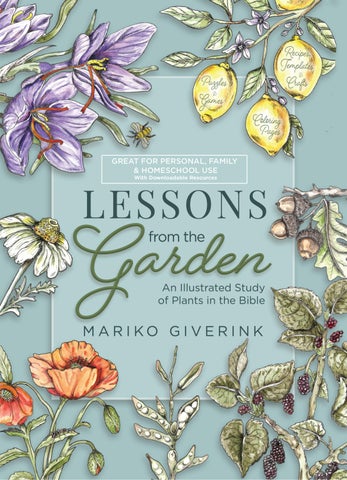
Innovo Publishing LLC is a Christ-centered publisher located near Memphis, TN. Since 2008, Innovo has published quality books, eBooks, audiobooks, music, screenplays, and online and physical curricula that support the Great Commission, equip believers, and help create a positive Christian worldview. Innovo’s capabilities and global reach provide Christian authors, artists, and ministries access to the world for Christ. To learn more about Innovo Publishing, visit our website at innovopublishing.com. To connect with other Christian creatives and to learn best practices for creating, publishing, marketing, and selling Christian titles, visit the Christian Publishing Portal at cpportal.com. Lessons From the Garden An Illustrated Study of Plants in the Bible (Compact Edition) Copyright © 2025 by Innovo Publishing All rights reserved. No part of this publication may be reproduced, stored in a retrieval system, or transmitted in any form or by any means electronic, mechanical, photocopying, recording, or otherwise, without the prior written permission of Publisher. Unless otherwise noted, all scripture was taken from the Holy Bible, New International Version®, NIV® Copyright ©1973, 1978, 1984, 2011 by Biblica, Inc.® Used by permission. All rights reserved worldwide. Amplified Bible (AMP). Copyright © 2015 by The Lockman Foundation, La Habra, CA 90631. All rights reserved. The Bible in Basic English (BBE). Public domain. Common English Bible. Copyright © 2011 by Common English Bible. The Holy Bible, English Standard Version. ESV® Text Edition: 2016. Copyright © 2001 by Crossway Bibles, a publishing ministry of Good News Publishers. Good News Translation® (Today’s English Version, Second Edition) © 1992 American Bible Society. All rights reserved. For more information about GNT, visit www.bibles.com and www.gnt.bible. The Holy Bible, International Children’s Bible® Copyright© 1986, 1988, 1999, 2015 by Thomas Nelson. Used by permission. King James Version. Public domain. The Living Bible copyright © 1971 by Tyndale House Foundation. Used by permission of Tyndale House Publishers Inc., Carol Stream, Illinois 60188. All rights reserved. New American Standard Bible®, Copyright © 1960, 1971, 1977, 1995, 2020 by The Lockman Foundation. All rights reserved. The Holy Bible, New Century Version®. Copyright © 2005 by Thomas Nelson, Inc. New International Reader’s Version (NIRV). Copyright © 1995, 1996, 1998, 2014 by Biblica, Inc.®. Used by permission. All rights reserved worldwide. Scripture taken from the New King James Version®. Copyright © 1982 by Thomas Nelson. Used by permission. All rights reserved. Holy Bible, New Living Translation, copyright © 1996, 2004, 2015 by Tyndale House Foundation. Used by permission of Tyndale House Publishers, Inc., Carol Stream, Illinois 60188. All rights reserved. Library of Congress Control Number: 2025938057 ISBN: 979-8-88928-065-1 Cover Design & Interior Layout: Innovo Publishing, LLC Illustrations: Mariko Giverink Game Formatting: http://www.livingwaterbiblegames.com Worksheets: https://www.education.com/worksheet-generator/reading Printed in the United States of America U.S. Printing History First Edition: 2025
Contents
Introduction..................................................................................................................................... 9 How to Use This Book................................................................................................................... 12 Note to Parents.............................................................................................................................. 14
Flowers of the Bible
Broom Bush.................................................................................................16 Caper............................................................................................................18 Crocus......................................................................................................... 20 Daffodil....................................................................................................... 22 Henna.......................................................................................................... 24 Hyacinth..................................................................................................... 26 Lily............................................................................................................... 28 Rose............................................................................................................. 30 Violet............................................................................................................32
Wildflowers of the Bible
Anemone.................................................................................................... 36 Lupine......................................................................................................... 39 Poppy.......................................................................................................... 42 Buttercup.....................................................................................................45
Herbs of the Bible
Black Cumin............................................................................................... 50 Caraway.......................................................................................................52 Chamomile..................................................................................................54 Dill................................................................................................................56 Hyssop.........................................................................................................58
Laurel............................................................................................................ 60 Mint................................................................................................................ 63 Mustard..........................................................................................................66 Onion, Leek & Garlic..................................................................................68 Rue..................................................................................................................70 Saffron........................................................................................................... 72
Grains of the Bible
Barley & Wheat............................................................................................ 76
Trees & Vines of the Bible
Almond..........................................................................................................82 Apple & Apricot........................................................................................... 85 Black Mulberry.............................................................................................88 Date Palm..................................................................................................... 90 Fig................................................................................................................... 93 Grapes............................................................................................................96 Lemon (Citron).............................................................................................99 Oak............................................................................................................... 102 Olive............................................................................................................. 104 Pistachio...................................................................................................... 107 Pomegranate............................................................................................... 110
Beneficial Insects of the Bible
Ants...............................................................................................................114 Honeybee......................................................................................................116 Closing Thoughts......................................................................................................................... 119
S
Introduction
ince I was a little girl, I have been fascinated with growing things. In elementary school, I learned about sprouting seeds with the good ol’ science class bean in a cotton ball experiment in glass jars. Those hard little bean seeds went into jars with the soggy cotton balls, and day by day those seemingly dead beans came to life. First, the hard outer shell slowly softened and gave way. Soon after, a tiny little nub formed on the end of the bean with short stringy roots reaching down. Then, a small sprout and a short little stem started popping up. Before long, that stem would find its way out of the jar and sprout two little leaves. For some reason, watching that process excited me to no end and piqued my interest in growing things. I remember asking my mom if I could have some vegetable seeds, even though we lived in a tiny urban beach city yard with just a few woody shrubs on the fence line. In that little yard was also one little lemon tree and a tiny patch of grass. I didn’t realize then that plants needed sun and regular watering, so I scratched around in the hard dirt between the old shrubs and, full of hopeful anticipation, dropped the seeds in and covered them up with dirt. Much like I do now at the start of every planting season, I would dream about all the amazing things I could grow with those seeds, and sporadically I would remember to water them. Of course not a single one of those seeds sprouted, and I quickly lost interest, but I like to think that first try at gardening was a small spark that eventually ignited my passion for growing things into a giant flame. One summer my mom signed me up for a kids vegetable gardening class at our local community center. Once a week I would look forward to getting my hands into the dirt to dig rows, plant seeds, and pull weeds. I still have a strange addiction to pulling weeds. Once I start, I can’t stop! This time around, with the help of an actual teacher who knew actual things about gardening, I experienced a level of success in my gardening journey. Things actually grew! However, those classes came to an end before anything was ready to harvest. But the experience of seeing things grow from week to week was enough to thrill me to my core. The class was a great experience, and I learned about things like seasons, soil, sun, and water. In a nutshell, I came to understand that plants, like people, needed nurturing to grow. Nothing happened by accident in that barren and dry city lot. It took effort and knowledge to experience the reward.
My Testimony
At sixteen years old, getting ready to start my senior year of high school, I encountered the love of God for the first time, and after much struggle and hesitancy, I asked Jesus to be Lord of my life. As my faith grew, I also started learning there were a great many stories and parables in both the Old and New Testament about growing things. And pruning things. And watering things. There were stories about reaping and sowing. Agricultural references are everywhere in the Bible! I began to know God as the great Master Gardener, who is not only concerned with every tiny seed that falls to the ground but also takes care of even the tiniest bird. He is incredibly tuned in to details, knowing even the number of hairs on our head. There are so many life lessons that parallel lessons from plants and nature.
Nutrition and Health
After becoming a mom of two boys, Jacob and Joshua, we relocated to the suburbs east of San Francisco. It was during this time that I discovered the hard way the very important connection between nutrition and health. I wasn’t aware before then that there was a link between processed foods and declining health. Growing up in the concrete jungle of LA, I never had any health problems and rarely got sick. When my growing young family relocated to the Bay Area with its expansive grassy hills and abundance of wildflowers, I got the shock of my once healthy life. On the first day of our house hunting trip, I found myself coughing in a hotel room, gasping for air. Later that night in the emergency room, they told me I was having a full-blown asthma attack. I smugly told them I didn’t have asthma and was quickly informed that “you do now.” That was my introduction to the world of pharmaceuticals. While they helped me breathe, they also slipped me into a dark hole. By the time our daughter Elise arrived, it seemed natural to blame postpartum depression for my emotional state. Not a single doctor ever warned me that all those medications had side effects like depression, among other things, and I never thought to make the connection.
How to Use This Book
How to Use This Book
M
ost precious and sacred to me are the scriptures and prayers I’ve written into these lessons because the most important thing to me is for all of my kids, and the generations that follow, to learn to love God’s Word and to know Him, the Lover of our souls, in an intimate way. Faith in the unseen is something every person has to experience firsthand to really understand, but once experienced, it’s unshakable. Nothing is more precious to me than the faith I came to understand in its seed form all those years ago that, over time and testing, fully bloomed into a peace that passes all understanding. As you begin this journey, here are some important things to keep in mind in order to get the most use out of the lessons:
Lesson Components
Included in all lessons:
Plant Benefits: Brief explanations of the key benefits and uses for the lesson’s highlighted plant.
Memory Verse: Scripture to reflect on and memorize as it relates to the biblical themes of the lesson.
Prayer: A guided prayer to the Lord for what He is teaching you through each lesson.
One of the following in each lesson: Fun, engaging activities, challenges, crafts, recipes, or games embedded or provided as a downloadable resource. These allow the reader to be creative with the amazing botanical creations God has given us.
Activity
Challenge
Downloadable Resources
Craft
Recipe
Game
Activites, Challenges, Crafts, Recipes & Games: Each lesson includes one of these engaging, hands-on activities (provided or accessed through a free download). Coloring Pages: Each lesson begins with a beautiful, colorful illustration of the specific plant discussed. You can download a black and white version so children (or you!) can color along with the lesson. Templates, References & Answer Key: Templates needed for crafts and activities, references and resources used, as well as the answer key for the lessons’ puzzles and games are provided.
12
How to Use This Book To access all of the additional resources for this book, simply scan the QR code here. You will receive a PDF that contains everything you need to complete all the activities!
Personal and Family Use
0 Families who want to set aside time for guided devotions can use this book as a once-a-week read aloud. 0 Activity suggestions can be done together and incorporated into a regular Saturday or Sunday routine. 0 You can plan any recipe suggestions around your meal plan and add ingredients to your weekly grocery list. Likewise, plan for crafts by purchasing any needed supplies in advance. If you use Amazon Prime, most supplies will arrive within two days.
Homeschool Use
0 There are approximately the same number of lessons as there are weeks in a typical school year, making this a great resource for homeschool families. 0 Be sure to print the coloring pages so kids can engage kinetically while you or an older child reads (use the QR code on the previous page). I suggest printing all of them at once and inserting them into a folder for each child. 0 Make a list of unfamiliar words and use them as vocabulary lessons by looking them up in the dictionary together. 0 Plan and set aside time in your school schedule for the suggested activity, art project, or recipe. Don’t assume your kids won’t be interested in a project; you might be shocked at how engaged they will become and how hard they will work at it. My six-year-old grandson is not one to ever sit still, but he managed to complete a meticulous embroidered hummingbird project that he got to design. I was completely taken by surprise.
Tips
The coloring pages can be printed on watercolor paper for kids interested in painting. Some home printers can do this, but if yours doesn’t, take your watercolor paper to a local printer. As a reference, my local printer charged 17 cents per print. Have students use the colored illustrations as a guide. Display the finished pages proudly to show off their hard work. Most importantly, praise and encourage all artwork and craft creations, and be specific in your feedback. As an example, when I taught three of my grandkids (ages four, seven, and ten) how to watercolor their pet chickens, they were so excited and proud, they couldn’t wait to show their dad when he got home from work. I praised the oldest for how much detail he put into the back feathers and for the detail of adding the green foot tag that wasn’t in the original picture. I praised the sevenyear-old for how she paid so much attention to texture and color and even added her own background colors to brighten up the art. I praised the youngest for his attention to staying in the lines and adding his own blades of grass. We pinned them up in the dining room as a display and celebration of how much effort they put into their paintings. Beauty isn’t found in perfection, but in effort. If you find the beauty in their art and think it’s wonderful, they’ll learn to see it too and will want to practice some more.
13
Note to Parents
Note to Parents
F
irst off, this is not a comprehensive book of biblical plants, so every flower, herb, and tree mentioned in the Bible isn’t included. I chose to include only the most well-known plants likely to be found in our modern-day gardens or kitchens, to keep it readable and relatable. This book can be read for the sole pleasure of learning more about plants, but it is also formatted so it can easily be used as a homeschool or family devotional resource. There are thirty-six lessons, approximately the same number of weeks in a typical school year. In each lesson, you’ll find a scripture memory verse for the week that I encourage adults to memorize along with their children. Some lessons have recipes, craft ideas, and even a few games and activities to use for more hands-on learning, because honestly, what kid doesn’t love doing projects and games or creating something in the kitchen, whether they homeschool or just love an after-school or weekend project? When my kids were young, we would sit by the fire on colder days with a cup of coffee for me (always) and hot chocolate for them (sometimes) and start our mornings together reading out loud. My only rule was they had to be upright and attentive while I read, even if they chose to start the day in their pajamas, which we did more often than not. One book series that’s etched into my memory, Character Sketches by Institute in Basic Youth Conflicts, was a trilogy set of detailed drawings with character lessons drawn from scripture. My kids would trace drawings that I copied for them out of the book while I read them the lesson about a particular animal or insect. My intention was for Lessons from the Garden to be used in much the same way—enjoyed as a family rather than individually. The more I dove into writing, the more I realized tracing and drawing are things I still enjoy as an adult. I’ve never gotten over my love for coloring, although now my tools of choice are colored pencils rather than thick crayons. You might find your kids enjoy the finer points on them like I do. To keep fidgety hands busy, there are coloring pages to partner with this book, which makes it easier to use as tracing and sketching pages for children while you read together. Students can use watercolors or colored pencils to shade in their traced drawings and might enjoy the suggested craft project or recipe on their own—or with help. I recommend printing on watercolor paper for budding watercolor artists. Hands-on learning has a way of cementing a concept better than merely listening or reading words on a page. I’ve never believed in talking “down” to children, therefore I’m not afraid to push vocabulary boundaries with kids from a young age. I have been shocked and pleasantly surprised at the big words that come out of the mouths of babes and even more so the fact that they fully understand what those words mean and use them in perfect context. So when you do run across unfamiliar words, pause and explain them, and use it as an opportunity to expand their vocabulary. One of my fondest recollections from our homeschool years is our read-aloud times together, and my prayer is that this will be one more useful and interesting tool in your toolbox and another helpful resource to encourage you to spend quality time with your little ones.
Dedicated to
Gavin, Norah, Theo, Everett, Leilani, and Ava May your lives be like beautiful gardens, “rooted and built up in Him, strengthened in the faith as you were taught, and overflowing with thankfulness” (Colossians 2:7). “Trust in the Lord with all your heart and lean not on your own understanding; in all your ways submit to Him, and He will make your paths straight” (Proverbs 3:5). “And those who seek Him will find Him, when they search for Him with all their hearts” (Jeremiah 29:13).
14
Part 1:
Flowers of the Bible
The heavens declare the glory of God; the skies proclaim the work of his hands. Day after day they pour forth speech; night after night they display knowledge. —Psalm 19:1-2
F
lowers just make life more beautiful, don’t you think? There’s a reason why the gift of flowers is so meaningful to celebrate special occasions. Their beauty and their fragrance can help lift our spirits no matter what we are experiencing, whether it be happy or sad. Flowers are symbols of beauty, purity, and life, and each one has its own significance, carrying a specific cultural meaning. Jorge Luis Borges shared meaningful advice when he penned the following quote: So you plant your garden and decorate your own soul, instead of waiting for someone to bring you flowers.2
The plant kingdom as a whole plays a vital role in our environment, providing life-sustaining oxygen through a process called photosynthesis. Plant leaves take carbon dioxide and water from the air and use the energy of the sun to transform it into chemical compounds that feed the plants. While this is happening, the plants are making oxygen and releasing it into the atmosphere. So when you buy a houseplant, it is actually working as an air purifier for your home. How incredible is that? This could explain why studies have shown that flowers and plants make for a healthier emotional environment. Even in office spaces or basements with no windows, just hanging pictures of plants has been shown to make workers happier and more productive. So the next time someone you know is feeling down, giving them a bouquet of flowers or a potted plant will surely boost their mood. Considering this, it’s no surprise that flowers and plants have a very special place in the Bible. When flowers are mentioned, they are typically used to convey deeper meanings and teach spiritual lessons. That’s why we will study these stories and pray for wisdom to put these lessons into practice. Let’s see what we can learn from some of the flowers mentioned in the Bible.
2. Excerpt from “Comes the Dawn” by Jorge Luis Borges (1899–1986), but the title is subject to debate. Some call it “You Learn” and others “After a While.” It is believed to have been written in the 1940s and possibly translated by an American translator collaborating with Borges from 1967 to 1972. The poem was published in the Spanish book Para Que Nunca Lo Olviden by Barrie Sanford Greif (paperback: December 29, 1999) and was cited as anonymous, and it has also been attributed to Yamira Hernandez of Colombia, since it is argued that it does not match the style of Borges. Thus, there is no conclusive evidence as to whom exactly is the author of this poem.
Lessons from the Garden
Broom Bush Retama raetam
T
Lesson 1: Provision
he broom bush is a dense, twiggy shrub, with small leaves covering the plant during the rainy season and bunches of small white flowers at the end of winter. It grows to about ten feet tall and has roots that are incredibly long. Some even say the roots can grow as deep as sixty-five feet, so they can reach down in the soil for water even when the soil has become dry from lack of rain. This shrub is mentioned in 1 Kings when Elijah was fearful, exhausted, and most likely depressed.
16
Part 1: Flowers of the Bible Elijah was afraid and ran for his life. When he came to Beersheba in Judah, he left his servant there, while he himself went a day’s journey into the wilderness. He came to a broom bush, sat down under it and prayed that he might die. “I have had enough, Lord,” he said. “Take my life; I am no better than my ancestors.” Then he lay down under the bush and fell asleep. All at once an angel touched him and said, “Get up and eat.” —1 Kings 19:3-5
God was right there with him, and when he was discouraged and ready to give up, He sent an angel to feed him and take care of him. All at once an angel touched him and said, “Get up and eat.” He looked around, and there by his head was some bread baked over hot coals, and a jar of water. He ate and drank and then lay down again.
—1 Kings 19:5-6
After this, Elijah felt strong again and was ready to continue his journey. It’s likely his rotten mood was partly because he was so hungry and tired! And I believe he found comfort under that broom bush, since it was tall enough to give him some cool shade to rest and fall asleep in. Sometimes when we are anxious, discouraged, or crabby, it can be because we are tired and hungry. Maybe a snack and a nap could help us feel better, just like Elijah.
Plant Benefits
The broom bush is well-known in Mediterranean regions for the treatment of bacterial, viral, and parasitic infections. The powdery leaves are used as an antiseptic for soothing and healing wounds and skin rashes.
Memory Verse
When I am afraid, I will put my trust in you. I praise God for what he has promised. I trust in God, so why should I be afraid? —Psalm 56:3-4 nlt
Prayer
God, whenever we are feeling discouraged or anxious, help us to remember Elijah. You provided the broom bush as a place where he could rest and even brought him fresh baked bread and water. Just like you cared for Elijah, we pray you will take care of us. We trust you as the Great Provider for our every need. Amen.
Game
Broom Brush Crossword Puzzle
Download & print the Broom Brush Crossword Puzzle and Coloring Page from the QR code on page 13.
17
Lessons from the Garden
Crafts
Pressed Flowers Pressing flowers is a wonderful way to preserve their beautiful petals and colors. Although their scent will fade, their beauty will not. Always use fresh petals with lots of color and no blemishes. I once haphazardly put flower petals and leaves in the back of a book and completely forgot about them for several months. When I flipped through the book, they surprised me with beautiful, perfectly flat, colorful petals, ready to use for a project! Flowers that are not too thick are best for pressing, which is why violets are perfect. Or try pansies, vinca, rose petals, cosmos, poppies, or sprigs of thin leaves or grass. Technically the printer paper isn’t necessary but will prevent your book pages from getting stained. Keep in mind that white flowers and yellow flowers may dry a beige color.
Supplies:
0 Flower petals and leaves 0 Printer paper 0 Heavy book
Directions:
1. Place the flowers and leaves as flat as possible between two pieces of plain printer paper. Sandwich them inside the book. 2. Stack more heavy books or a large rock on top of your flower and book sandwich, and let them dry for a week before checking on them. 3. Allow two to three weeks for complete drying, then you can make this bunting (see below); glue them on a blank note card, book marker, or small wood disk; or arrange into a small frame. Pressed Flower Bunting This craft idea is from my daughter-in-law Rachelle, who made this bunting with her kids to brighten up the dining room window where they do schoolwork. It’s such a simple way to add some cheerful color to your home.
Supplies:
0 Pressed flowers 0 String cut to desired length 0 Wax paper 0 Iron 0 Cotton cloth or tea towel 0 Diamond template 0 Optional: small wood, glass, or plastic beads, one for between each wax triangle
Directions: 1. PRINT the diamond template, and trace as many pieces as you want onto wax paper, then cut out the diamonds. 2. On an ironing board or protected table, fold each diamond in half on the fold line, placing string between the folds. If using beads, string them in between the wax papers before ironing. 3. Arrange the pressed flowers inside each triangle, and place the cotton cloth or tea towel on top. 4. Iron on low heat until the layers hold together. 5. Trim the string, leaving enough on each end to tie to a curtain rod or whatever you choose to hang them on. Download & print the Diamond Template and Coloring Page from the QR code on page 13.
34
Part 2:
Wildflowers of the Bible I pray that your heart rises up like a wildflower—growing in strength to rise up amid the storms of life that surround it. May it bloom and prosper even in the most desolate of places.5
W
ildflowers are plants that grow on their own without needing anyone to plant their seeds, fertilize or water. They spring up all by themselves year after year with beautiful bursts of color. They are strong and resilient and are able to adapt to their local environment over time and provide habitats for the wildlife and insects around them. Every region has its own native wildflowers, and you can typically see them springing up in meadows, forests, deserts and even along freeways and median strips. Sometimes whole hillsides and mountains will be covered in one variety of wildflower, creating a stunning landscape. Jesus uses wildflowers as examples to teach us important lessons, like not to worry. If He takes care of all the wildflowers in the fields, He will surely take care of us. God clothes the grass in the field like that. The grass is living today, but tomorrow it is thrown into the fire to be burned. So you can be even more sure that God will clothe you. Don’t have so little faith! —Matthew 6:30 icb Consider how the wild flowers grow. They do not labor or spin. Yet I tell you, not even Solomon in all his splendor was dressed like one of these. If that is how God clothes the grass of the field, which is here today, and tomorrow is thrown into the fire, how much more will he clothe you—you of little faith! —Luke 12:27-28 Human life is like grass. We grow like a flower in the field. After the wind blows, the flower is gone. There is no sign of where it was. —Psalm 103:15-16 icb
5. Author’s paraphrase of a quote by Nikita Gill, taken from her personal Instagram account: @nikita_gill.
Lessons from the Garden
Anemone Anemone coronaria
Lesson 10: Trust 36
Part 2: Wildflowers of the Bible Look at the lilies and how they grow. They don’t work or make their clothing, yet Solomon in all his glory was not dressed as beautifully as they are. And if God cares so wonderfully for flowers that are here today and thrown into the fire tomorrow, he will certainly care for you. Why do you have so little faith? And don’t be concerned about what to eat and what to drink. Don’t worry about such things. —Matthew 6:28-30 nlt
T
he “lilies of the field” that Jesus referred to in His teaching on worry were likely not the same lilies we might recognize in our stores or garden centers today, but more common wildflowers like the crown anemone, or simply various wildflowers common in His day. These field flowers still grow today in Palestine near the lake of Galilee where Jesus spent time and preached, and those whom He ministered to would have been familiar with them, seeing them often where they lived. This story teaches us an important lesson. This verse is pointing out that as children of God, we can trust that He is our provider, and we don’t need to fear or worry that our needs will be met. If He takes care of the flowers and the birds, how much more will He take care of us, His children? Jesus uses the world of flowers to help us understand this very important concept of trusting Him. So if you are ever worried about anything, remember the anemones and the wildflowers, remember how God takes care of them, and remember that He will always take care of you.
Plant Benefits
Believe it or not, there are over fifty species of anemones that are used for medicinal purposes. Compounds found in these plants are used to create various remedies for dozens of illnesses and injuries, including cancer, ulcers, sores, arthritis, and traumatic injuries.
Memory Verse
If God cares so wonderfully for flowers that are here today and thrown into the fire tomorrow, he will certainly care for you. —Matthew 6:30 nlt
Prayer
God, we know that You can be trusted, and You always have our best interests in mind. You are the source of our provision and will take care of us. Help us to look to You for all of our needs. May we not complain when we don’t get everything we want. You have a perfect plan for us, and we trust You to carry it out in our lives. Amen.
Craft
Anemone Embroidery Try this simple embroidery project. You could do this as a simple outline all in one color, or for more patient older kids or adults, it can be filled in over the course of a few days. It can be further simplified by omitting the leaves and outer sprigs. The key to finishing an embroidery project is not to let it sit too long. Pack the project in a zip-top bag, and bring it with you to work on when you need something to do with your hands. It’s much healthier than screen time, and you will be surprised how long even the most active kids will want to sit with this project. My six-year-old granddaughter finished her project in three sittings, all in one day, and her ten-year-old brother finished his the following morning. The three-year-old played along and loved making zigzag lines with his needle and thread.
37
Part 3:
I
Herbs of the Bible
n the first chapter of the Bible, God created the earth, light, the sky, oceans, land, plants, and animals. Then He formed Adam and brought him to life by breathing breath into his nostrils, and Eve immediately followed as his companion. The first thing He did after creating them was show them their garden. Could it be that this is the reason we humans feel so connected to the earth and its flowers, trees, herbs, fruits, and vegetables? It’s a kinship that started on that sixth day of Creation, and I can only imagine Adam’s and Eve’s wonder as they saw their garden for the first time—a literal paradise where they could “shop” for their daily provisions and sustenance. Then God said, “I give you every seed-bearing plant on the face of the whole earth and every tree that has fruit with seed in it. They will be yours for food. —Genesis 1:29
Herbs are wonderful for giving food a boost of flavor, like rosemary on chicken, basil on tomatoes, or dill in pickles. They not only enhance the scent and the colors of foods and beverages, they also make everything taste even more delicious. Can you imagine eating soups without any seasonings? It just wouldn’t taste that good. Like the many plants that play an important role in our diet, herbs also help us stay healthy and can even make us heal faster if we get sick. They are like God’s original medicine cabinet, protecting us from diseases, thoughtfully designed to provide many remedies if we take the time to study and learn how to use them. Plants have been used as healing agents since the beginning of time, and herbs were once so valuable they were even used as money. Our earliest ancestors got to know all the plants and roots around them to speed the healing of cuts and bruises, skinned knees and rashes, coughs, colds, sore throats, and every other health problem they suffered from. Certain plants help us fight harmful bacteria and germs, and others make our immune systems stronger so we can stay healthy even when we’re exposed to contagions like the flu, viruses, or harmful bacteria. Herbs can also be poisonous, so it’s important to learn about an herb if you want to cook with it. Never ingest plants if you are not sure what they are and how they should be prepared and used. Just like mushrooms, some are incredibly delicious and healthy, while others are toxic and can even kill you. This section is not a comprehensive list of every herb mentioned in the Bible. Because there are so many mentioned, I chose to include only those that are the most familiar and typically used in our modern-day gardens and kitchens. All of the herbs in this section are edible and beneficial.
Lessons from the Garden
Black Cumin Nigella sativa
Lesson 14: Generosity 50
Part 3: Herbs of the Bible “How terrible for you, teachers of the law and Pharisees! You are hypocrites! You give to God onetenth of everything you earn—even your mint, dill, and cummin. But you don’t obey the really important teachings of the law—being fair, showing mercy, and being loyal. These are the things you should do, as well as those other things.” —Matthew 23:23 icb “Listen and hear my voice; pay attention and hear what I say. When a farmer plows for planting, does he plow continually? Does he keep on breaking up and working the soil? When he has leveled the surface, does he not sow caraway and scatter cumin?” —Isaiah 28:23-25
T
he pharisees here were strict about giving their required tithe, but they were missing the point of being generous in other areas: fairness, mercy, and loyalty. Both are important, and neither should be ignored. God has been generous to us in so many ways, and one of the ways we can and should give back to God is with our obedience. Also called black caraway, fennel flower, or nutmeg flower, black cumin has paper-thin blue flowers and fine, feathery foliage. Their black seeds are pungent, with a deep, smoky, warm flavor, and are sold as a powder in the spice section of the grocery store. I think it is wonderful in chili, but it is also used in Middle Eastern countries in products like bread and cheese.
Plant Benefits
Black cumin is used medicinally for conditions like asthma, bronchitis, headaches, back pain, anorexia, inflammation, skin rashes, and more. Cumin seeds contain a good amount of protein and fat, as well as essential fatty acids, amino acids, vitamins, and minerals. These all help our immune systems and support overall health. Maybe this was why people used it to tithe in the Old Testament—because it was considered valuable enough to be used as currency.
Memory Verse
“Bring the whole tithe into the storehouse, that there may be food in my house. Test me in this,” says the Lord Almighty, “and see if I will not throw open the floodgates of heaven and pour out so much blessing that there will not be room enough to store it.” —Malachi 3:10
Prayer
We know that You are the God of provision, and You generously consider our needs and our wants. Help us to follow Your example by being generous to others with our time, talents, and treasures. Teach us to be generous and honor You with all that You’ve blessed us with. May we be loyal and merciful like You are, remembering that You always show us mercy and grace. Amen.
Challenge
The next time you earn chore money or get paid for a job, remember this memory verse from Malachi. Set aside the first ten percent as a tithe to give back to God at church or Sunday school. Remember that God is the One who provides everything we need, so giving Him a small portion back is the least we can do to obey Him. Like Malachi says, watch and see how He will bless you because of your obedience to His Word. And don’t neglect the rest of Matthew 23. Be fair, show mercy, and be loyal. These character traits are just as important as being generous. Download & print the Coloring Page from the QR code on page 13.
51
Part 5:
T
Trees & Vines of the Bible
rees in the Bible symbolize life, growth, and fertility. They are used as an example of the abundant blessings that God lavishes on all of His creation—people and nature alike. After people in the Bible, trees are mentioned more than any other living thing. There are trees from Genesis 1 all the way to the last chapter of Revelation. It’s interesting that a tree is given as an example of wisdom in Proverbs. Wisdom is a tree of life to those who embrace her; happy are those who hold her tightly.
—Proverbs 3:18 nlt
Did you know that every major individual and every key biblical event has a tree mentioned along with it? The only exception to this interesting parallel is Joseph because Joseph is actually called a tree: Joseph is a fruitful tree beside a fountain. His branches shade the wall. —Genesis 49:22 tlb
Jeremiah actually tells us to be like a tree: But blessed is the one who trusts in the Lord, whose confidence is in him. They will be like a tree planted by the water that sends out its roots by the stream. It does not fear when heat comes; its leaves are always green. It has no worries in a year of drought and never fails to bear fruit.
—Jeremiah 17:7-8
Trees were considered such a thing of beauty that they were carved on wood decorations and candlesticks for God’s holy temple and were embroidered on clothes for the priests. Even now, trees are a popular emblem for decorations. In Revelation we find that even God’s throne faces a tree, which must be an incredibly glorious sight to behold. I can’t even imagine its heavenly beauty! Trees are not just a thing of beauty, which as humans our souls instinctively crave, but they also provide us with important things we need to live, like shelter, fire, and food. They play a vital role in the garden. When I plant my vegetable garden, I always plant trees nearby for their mutual benefit. I call it our food forest, which I explained in more detail in the introduction. Because there are more than thirty-six trees mentioned in the Bible, I have chosen to focus on the more familiar ones that bear edibles. So, as with some of the other sections, this is not a comprehensive list.
Lessons from the Garden
Almond Prunus amygdalus
F
Lesson 26: Faithfulness
un fact: almond trees come from the rose family, along with apples, apricots, and a few other fruits you might not expect. Everyone knows about the popular almond seeds (nuts), but would you recognize its fruit and beautiful flowers? Almonds produce lovely fragrant pink blooms, and when the tree is full of blooms, it looks like an explosion of pink snow. In addition to its delicious nuts, it also gives us oil, milk, butter, flour, and food flavorings.
82
Part 5: Trees& Vines of the Bible Many believe almond trees symbolize God is watching, or God is faithful. In other words, He is firm in His promises. Jeremiah points out God’s careful attention to His people in this verse: The Lord spoke this word to me: “Jeremiah, what do you see?” I answered the Lord and said, “I see a stick of almond wood.” The Lord said to me, “You have seen correctly! And I am watching to make sure my words come true.” —Jeremiah 1:11-12 ncv
The almond tree is a symbol of hope, resurrection, and God’s faithfulness to keep watch over us. It is one of the first trees to bloom in the spring, signifying the return of life after a long winter. Almond flowers are so beautiful that when Moses was building a holy tent for the Lord, some of the pure gold items God instructed him to make were decorated with almond flowers, specifically with its buds and petals. Each branch must have three cups shaped like almond flowers on it. Each cup must have a bud and a petal. And there must be four more cups made like almond flowers on the lamp stand itself. These cups must also have buds and petals. —Exodus 25:33-34
Plant Benefits
Almonds are very high in antioxidants, protein, vitamin E, fiber, magnesium, and healthy fats, which makes them especially good for heart health. They will give you a little boost of energy, which makes them a great choice for an afternoon or morning snack.
Memory Verse
For the Lord is good and his love endures forever; his faithfulness continues through all generations. —Psalm 100:5
Prayer
Lord, we praise You for Your faithfulness to us. Help us to be faithful just as You are faithful. We know You are watching over us, so help us to never doubt Your faithfulness. Help us to keep our promises, to be honest, and to love and care for others as You care for us. Amen.
Recipes
Pumpkin Spice Candied Nuts We once won a raffle for a Restoration Hardware gift card, and we opted to spend it at their restaurant. They have a shaved vegetable salad to die for, and we order it every time we go. I think what we love most about that simple little salad isn’t the thinly sliced radishes, carrots, beets, apples, and fennel, but the crunchy candied nuts on top. Those little nuggets are like icing on a cake. Consider yourself warned—these nuts will test your self-control. They are a wonderful treat for a tea party, on a guest room tray, or for company in a pretty little snacking bowl. As one friend said when I offered her a sample, “I don’t know what book you are writing, but I’m buying it just for this recipe!” You’ve been warned!
83
Lessons from the Garden
Activities
Gratitude Journal Do you have an empty notebook? Use it to start a gratitude journal. Every night, write about something that you are grateful for. Even if you had a bad day, I’m sure you can find something to be thankful for if you really think about it. This is a great way to develop optimism and create a thankful heart. Song Reflection The song “Gratitude” by Nichole Nordeman reflects on the themes of faith, trust, and finding gratitude in every circumstance. Look this song up wherever you stream music, and listen to it as you pray along with the lyrics.
Recipe
Cold Weather Simmer Pot When the weather gets cold, there’s nothing like a simmer pot to make the house smell cozy and inviting. I love to save the peels of pomegranates to use in simmer pots along with the peels of citrus or apples. The next time you eat one of these fruits, don’t throw the peels away; dry them and save to make a simmer pot. The scent is lovely when the weather starts to get chilly and you want warm, cozy scents in your house, but honestly the autumn scent is delightful any time of year. You can also make simmer pots with fresh ingredients too, but dried ingredients are perfect for storing in jars and make wonderful autumn or winter gifts. I also use dried citrus to add extra vitamins to my tea. I just add a slice or two to whatever tea I’m brewing and leave it in the cup as I drink it. I guess this would be considered a sippable simmer pot!
Ingredients:
0 Fruit peels like apples, oranges, and pomegranates, fresh or dried 0 1 cinnamon stick or 1 tsp ground or crushed cinnamon 0 1 tsp whole or ground cloves
Directions:
Place all of your ingredients in a medium-sized saucepan or slow cooker (safer) with at least an inch of water. Keep the heat as low as possible. This is why a slow cooker works great for simmer pots. If using a saucepan, set a timer to check on the water level, and add more if it starts to get low. You don’t want this to burn. Dried simmer pot ingredients make a nice gift. Pack in a pretty jar with a cute label and instructions. Download & print the Coloring Page from the QR code on page 13.
112
Part 6:
Beneficial Insects of the Bible T
Bonus Section
he Bible mentions both beneficial and destructive insects. Who could forget the locust swarms that destroyed Egypt, or the disgusting maggots that God sent in Pharaoh’s plague? It’s true that there are plenty of insects that cause damage, and any gardener can tell you stories of grubs, beetles, or hornworms that wreaked havoc on their vegetables or trees. But for every insect that harms the garden, there are plenty more that partner with it to help it grow. As an example, my artichoke plants seemed to attract every aphid in my neighborhood. Those little bugs infested the artichokes so badly that it wasn’t even worth it to try washing them off. Pesticides are off-limits in my garden, so I was left to figure out a natural solution. I bought ladybugs from the local garden center and released them by the artichoke plants. Wouldn’t you know, they did an amazing job taking care of those pesky aphids? Not only that, but from then on, they reproduced year after year, leaving me with more artichokes every season than we could possibly eat. When I couldn’t eat even one more artichoke, I let them go to flower and watched the bees bury themselves in the gigantic purple blossoms, gathering pollen to their little hearts’ content. It seemed nothing made the bees happier than those bright purple, fuzzy artichoke flowers, most of which are bigger than a softball. Without insects to pollinate plants, many fruits and vegetables would fail to grow altogether. Everything alive on earth has a goal of creating offspring. The way plants do that is by making seeds. In order for seeds to be produced, pollen has to be transferred between flowers. Some (but very few) plants can do this with the help of wind, but most plants need insects and birds to help. Insects travel from plant to plant, picking up pollen as they go and rubbing it on every other plant they visit. This act of pollination transfers grains from the male anther of one flower to the female stigma of another. Without this amazing process of pollination, we would have no pumpkins or melons, apples or blueberries, and most other plants would produce far smaller yields with very poor fruit. This is why the symbiotic relationship between insects and plants is critical to the success of food production.
Lessons from the Garden
Honeybee Apis mellifera
Lesson 38: Responsibility So I have come down to rescue them from the hand of the Egyptians and to bring them up out of that land into a good and spacious land, a land flowing with milk and honey. . . . —Exodus 3:8
116
W
Part 6: Beneficial Insects of the Bible hen the Bible mentions honey, it often represents the way God provides for His people, often times when they are in desperate need. Honey nourished John the Baptist in the wilderness:
John wore clothing made of camel’s hair, with a leather belt around his waist, and he ate locusts and wild honey. —Mark 1:6
In 2 Samuel 17:28-29, when King David and his men were fleeing from Absalom, they were greeted with “beds, basins, pottery, wheat, barley, flour, roasted grain, beans, lentils, roasted seeds, honey, curds, sheep, and cheese of the herd to eat.” David also tells us in Psalm 19:10 that the commands of the Lord “are more desirable than gold, yes, than much pure gold; sweeter also than honey and drippings of the honeycomb.” Responsibility is an important aspect of the bee colony. Bees are incredibly busy and hardworking little things, organizing themselves into groups and working together to ensure a healthy hive and thriving colony. They are fiercely protective of their queen and will band together to fight for the safety of their hive. In order to get work done, bees have to communicate and cooperate with each other and stay loyal to their colony. Every bee is assigned a job (responsibility) by their queen, and they all work toward a common goal, like any successful team should. The youngest bees are called nurses, caring for the growing larvae. Builder bees excrete and form perfect little hexagons of wax to store honey and grow new babies. They repair damaged comb and repair cracks with a resin called propolis. Some workers assist bees that have returned from foraging trips. They pack the goods into cells, and the bees on “honey duty” fan it to thicken into honey. Other workers fan the hive in summer to keep it cool. Undertaker bees take dead bees out of the hive to keep it clean and tidy. The oldest bees are the foragers, and they fly out every day to fill their bellies with nectar and their hind legs with pollen. They have stingers so they can attack if they feel threatened. They work so hard they eventually collapse and die from exhaustion. Guardian bees stay close to the entrance to protect against intruders, and they keep foreign bees from invading. The bees of the royal court constantly surround the queen to groom and feed her. She is so busy laying up to two thousand eggs a day that she can’t take care of herself. Of all the bees, the queen lives the longest. The fewest bees in the hive are the males, called drones. Their only job is to mate with a neighboring queen, and once that is done they do nothing else to help. They can’t sting, make honey, forage, or work, so the bees eventually kick them out because they don’t contribute any help to the colony.
Insect Benefits
The most commonly known benefit of bees is that they give us sweet, delicious honey, but some of the other substances they make are equally as nutritious. Pollen contains vitamins, minerals, antibiotics, and antioxidants. Many people use it to help with seasonal allergies. Propolis is antimicrobial and is known to help with many health conditions, including cancer and ulcers. Some beekeepers report that bee stings reduce arthritis pain, and I knew one personally who would sting himself in the knees to relieve his arthritis. Raw honey has too many benefits to list, but its most common use is for coughs and infections. It is antibacterial so you can use it to heal wounds. Honey is the most powerful healing agent for burns, so hospitals are now recognizing it as the most powerful remedy for burn patients. With all of these benefits, it’s important to note that infants under six months (some up to one year) should never eat honey. They do not have the ability to fight the bacteria clostridium botulinum, which can be found in both raw and processed honey. Another crucial benefit of bees is that they pollinate most of the foods we eat. Without this, many crops wouldn’t survive, and those that do would be of much poorer quality. Very few crops can produce without pollination.
117
Closing Thoughts We can all relate to Solomon’s words because no one can truly understand the ways of God. Yet throughout the Bible we read over and over again of how cherished and loved we are by this magnificent God. King Solomon sums up the great gift we have in verses 12 and 13: People should be happy and do good while they live. I know there’s nothing better for them to do than that. Everyone should eat and drink. People should be satisfied with all of their hard work. That is God’s gift to them. —Ecclesiastes 3:12-13 nirv
The greatest lessons are often the simplest ones. Enjoy life, and do good for each other. We must always recognize that God has given us many blessings in life, and we should view everything through the lens of gratitude and thankfulness. And in the end, the most important thing in life is to know God and to seek His will in everything.
Download the Answer Key and list of References for this book:
120