
Opposites attract. We’ve all witnessed life-long relationships between seemingly unsuitable individuals. Rivals in sports are often friends before and after the game. Even some soldiers at war have enjoyed socializing with the enemy. Some even played games such as soccer and only returned to fighting when their superiors forced them to. Even then, there’s evidence that some combatants purposely missed when shooting at their newfound friends.
I do not mean to say that relationships involving people with similar interests can’t be wonderful as well. I know people who don’t have many conflicts. Several times I’ve seen one spouse pass away, leaving a healthy surviving spouse who ultimately dies not long after; they literally could not live without their spouse. For the purpose of this book, however, it’s much harder to see the positives that can result from conflicts. That’s why I want to focus on those oft-maligned contentious relationships.
I’ve long been drawn to apparent discord. Sometimes this magnetism leads me to people I have never met before, usually because of perceived personality similarities or a shared quirkiness. I often relate to people whose lives exhibit contrasts, as my life has been full of them. I’m one of those oddballs who is happy with very little social interaction, yet I’ve been curiously labeled a talker. I’ve spent some periods of my life in the blue-collar world, but I also enjoyed reading Shakespeare and John Bunyan’s Pilgrim’s Progress. I might swing a hammer during the day and then spend the night drawing. I could jump out of an airplane on a Sunday morning and then go to Sunday school. At other times I would play a rugby match and then go minister to abused children. Moving from one world to another would cause some people a lot of stress, but for me, those contrasts are what make life interesting, and they teach me to find peace, even during the melee. There are two people I feel a connection with because we seem to share lives of contrasting quirks: the biblical David and the philosopher William James. I don’t claim to be at David’s spiritual level or James’s intellectual level, but I relate to the contrasts within their lives that I recognize when reading their writings. David was a shepherd who, through no personal ambition of
his own, became a king. He was a poet and great musician who could calm others’ moods, but he was also a skilled warrior. He was the great leader of a nation but failed as a father. He was a murderer and adulterer but one of God’s greatest worshippers. David was far from perfect, but it is hard to deny that his varied experiences led to an interesting life. I think his full life is one reason David was able to peacefully pass into the next one.
William James first trained to be an artist but ultimately became a scientist. He defended the value of individual opinions and explored such mental states with the use of physiology. He was a pessimist who struggled with severe bouts of depression and suicidal thoughts, and he was fascinated by spiritual experiences. He earned a medical degree but never practiced medicine. He moved from teaching physiology to teaching psychology and, later, to teaching philosophy. At the age of thirty-four, he was living in his parents’ home, unemployed and bedridden. Yet James went on to open the first psychology lab in North America and wrote The Principles of Psychology.1 The Varieties of Religious Experience: A Study in Human Nature resulted from a series of lectures he was invited to give in 1901 and 1902.2 It is such a monumental work that it remains in print to this day.
“ From an educational viewpoint, I sometimes refer to myself as a redneck who wasn’t smart enough to stop going to school, so I ended up with a PhD. ”
The contrasts found within David and James are why I feel a connection with them. It’s a sort of familiarity related to emotional ups and downs and learning from our experiences. One of the most intriguing parts of their lives is how their contrasts converged to create legacies that continue to connect with people long after they have passed on. As I said, I am not at their level—I feel, as C. S. Lewis once put it, that I don’t even feel worthy to sit on the back pew of the church. From an educational viewpoint, I sometimes refer to myself as a “redneck who wasn’t smart enough to stop going to school, so I ended up with a PhD.”
I often add, “but I was smart enough to drop out of high school.” I called my old public high school and asked if I could get a copy of my transcripts to make sure I got my facts correct. I vaguely remembered my grades were not good, and when I went to pick up my records, I was curious to see just how bad they were. As I walked to the desk, I commented to a girl sitting outside the principal’s office that I had spent a lot of time there and that “it will get better.” The office worker was smiling and laughing as she handed me the
Sleeping under a church pew during the sermon is awesome. Trust me, I know. I have a lot of experience.
I was born into a conservative religious family and spent many of my adolescent years attending a church founded by Reverend D. L. Welch. In most of those services, I would watch my elders raise their hands in worship, dance in the spirit, run around in excitement, speak in tongues, laugh in the spirit, and yell “Amen!” “Hallelujah!” and “Preach it!” back at the fiery preacher. Energy, sweat, and noise were staples. Of course, I also spent time playing with my G. I. Joe or scribbling rudimentary pictures of race cars on scrap paper. Since this all took place in hot and humid Florida, one of the coolest places was on the hard tile floor under the wooden pews. I usually found my way down there for a good nap within the first few minutes of the sermon, and it was not uncommon for my mother to have to carry me to the car for the trip home. Sometimes I faked being asleep. I just didn’t want to walk.
I don’t mean to give the impression that I was simply an observer of those services. Even though I was too young to understand what was happening or to participate without possibly getting injured by the adult worshippers, I did experience what was happening around me. I could feel something during those services. I didn’t know what it was, but I knew I didn’t feel it anywhere else. I also felt a special something while with my grandparents, and I could locate the source of that something with them.
Sanctuary Siestas and Synaptic Secrets
began to affect things like mood, sleep, and relationships; acetylcholine (helps with muscle movements) decreased in me, while it increased in others so that movements like moving purses could be performed.
I came to understand that when I decided to nap under a pew, I created behavioral, physiological, and emotional changes in myself and others within my vicinity. We even created some basic neurological bonds, though they were not nearly as strong as the neurological bonds I now have with my wife and kids. Even this simple task of writing about sleeping under pews gives me a sense of peace and calm; a release of serotonin helps to produce a positive mood, and oxytocin strengthens those mental memories and relationships. Those individuals still hold a special place in my heart, and I enjoy laughing with them about how small and cute I was.
While I often think of events in terms of science, I realize that science cannot fully explain spiritual events. Neither can spirituality fully explain science. Neither does one need the other to survive or prosper. However, at times, they can provide a better understanding of one another and can help correct some bad behaviors of the other—science balancing religion’s capacity for self-delusion, and religion balancing science’s tendency toward reductionism, for instance. Both have existed in some form in all known civilizations, and both have had tremendous influence on humanity. At times they’ve worked together; at other times they’ve fought each other. Let’s look at a very broad history about this relationship.
“ Science cannot fully explain spiritual events. Neither can spirituality fully explain science. Neither does one need the other to survive or prosper. However, at times, they can provide a better understanding of one another. ”
The Greek philosopher Heraclitus suggested that humans were made of both a body and a soul, with the soul being responsible for thoughts and emotions. Plato proposed a more strictly dualistic view that confined the soul to the brain; it was physically located within the body. Democritus, apparently not comfortable with some of the supernatural parts of those philosophies, proposed that everything is composed of only matter, no soul; everything is physical. When we die, we simply cease to exist. Hippocrates (of Hippocratic Oath fame) argued that, since a brain injury can impair mental processing, it must be the seat of
I began this chapter by recounting some childhood experiences of sleeping under church pews and feeling a unique spiritual presence. That was followed with a brief demonstration of how I sometimes combine those youthful memories with data learned later in life. Scientific perspectives (behavioral, physiological) provide greater depth of understanding as I consider those memories of a “protective wall” of legs, purses, and coats created by others. We then traced, broadly, the historical science-religion divide before I argued for the importance of integrating science and religion. Neurotheology was introduced as a framework for using the brain to bridge science and spiritual understanding. However, the philosophical problem of our objectivity being limited because we can only experience reality through our brains (confinement) was presented. Therefore we cannot be truly objective, but open-mindedness and mutual respect for both science and religion can help us to realize the complementary roles of both in understanding the human experience so that we are better able to build relationships. We concluded the chapter with an anecdote about an instance that led me to approach some life events with more openness.
My sanctuary siestas occurred among loud worship, music, dancing in the Spirit, speaking in tongues, and call-and-response behaviors. Some people believe those excited behaviors spring from mental pathologies, and we’ll explore the validity of such claims later. On the other hand, some within my chosen belief system may take offense at looking at such highly spiritual and personally meaningful behaviors from a secular viewpoint. I don’t mean to offend either—and to be fair, I put some of my own religious behaviors on display and analyze them with scientific research, particularly in the last few chapters. Instead, I hope that through this process both sides will gain a better understanding of the psychological and physiological foundations of some practices. But why even worry about the natural side of things?
Ο Personal Connection: The author vividly describes feeling an undefined “something” in church as a child. Can you recall any experiences from your own life (spiritual, emotional, or otherwise) that felt powerful but difficult to pinpoint or explain rationally? How do you make sense of such experiences now?
Ο Childhood Memories and Meaning: The author’s childhood memories of church services shaped his later reflections on science and spirituality.
suggestions, and it is more descriptive and more efficient than my original. I am appreciative of them.
As part of that verification process, I asked about the idea of relationships with other humans being improved because of glossolalists’ connection to the Spirit. While I didn’t specifically ask non-believers or non-practitioners about the model, I did ask about the idea of relationships being improved with everyone (believers and non-believers, glossolalists and non-glossolalists) because of speaking in tongues (represented by the dashed line between the Spirit and others). A general, consistent theme among practitioners, non-practitioners, and non-believers was—Yes. One’s adamant response was, “Oh, absolutely! I could not be friends with you if you didn’t speak in tongues.” It appears I need to continue to improve on my people skills. Hopefully the general visualization of the glossolalic process helps to explain why researchers easily find dissociation, but practitioners feel that it is more about connection (see Figure 15).
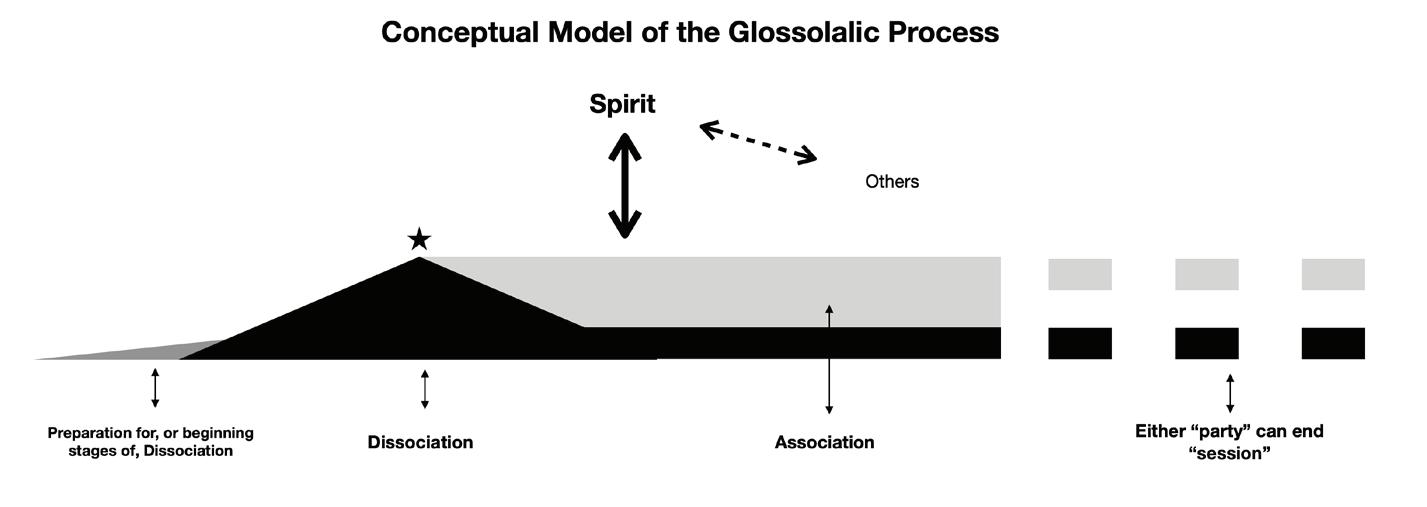
Figure 15. Author’s conceptual model of the general process of achieving glossolalia. Development of the model is informed by the author’s personal experiences, conversations over a lifetime with other glossolalists, and a survey of research data. The medium grey base represents preparation and initial, increasing dissociation from the physical environment through activities like meditation, prayer, or singing. Black sections show relative levels of dissociation. The star at the peak of the pyramid symbolizes the “determination and decision time,” where individuals subconsciously assess if their excitement is spiritual or self-induced. Four potential decision paths follow: maintaining, increasing, stopping dissociation, or associating with the Spirit. The light grey section illustrates the path of spiritual association, where dissociation decreases, and spiritual connection surpasses it, with no barrier between the speaker and the Spirit. Large black and light grey dashes at the end indicate that either the Spirit or the individual can end the experience. A dashed line connects the Spirit to others, showing positive relational impacts because of glossolalia.
As we continue moving toward our goal of viewing coherence among chaos, and in further preparation for the images that follow, and because we use music, we need to define the dominant chord and the tonic chord for those who may not know what they are. The dominant chord is composed
competition with nature, can such harmony be achieved. . . . In sum, a lack of conscious, self-determined order does not result in chaos. Rather, a humble recognition that one’s own rationality is not the arbiter of reality, that one is in need of community, and that one is a part of the larger created order can yield spectacularly beautiful results.346 (emphasis mine)
Indeed, corporate singing in tongues pushes our limits of rationality far beyond our normal understanding of reality. It also stretches our understanding of our dependence on community and, by extension, our connection to all creation. But maybe, just maybe, we can get a glimpse of that order that is “deeper than rationality.”
Below I share, with permission, some of Hinck’s visual representations of corporate singing in tongues that helped him reach his conclusions. Sonograms produce a graph that shows the intensity of multiple pitches over time, and those pitches correlate with audio frequencies. The intensity of the differing shades of gray at different points represents the level of the volume of the corresponding frequency at that particular point in time.
Figure 16 is a printout of general crowd noise. It is easy to notice the absence of patterns and the absence of sustained tones. In essence, it is a good example of the noise pollution we may hear in a typical environment. Coffee shop? Mall? Street? Office setting?
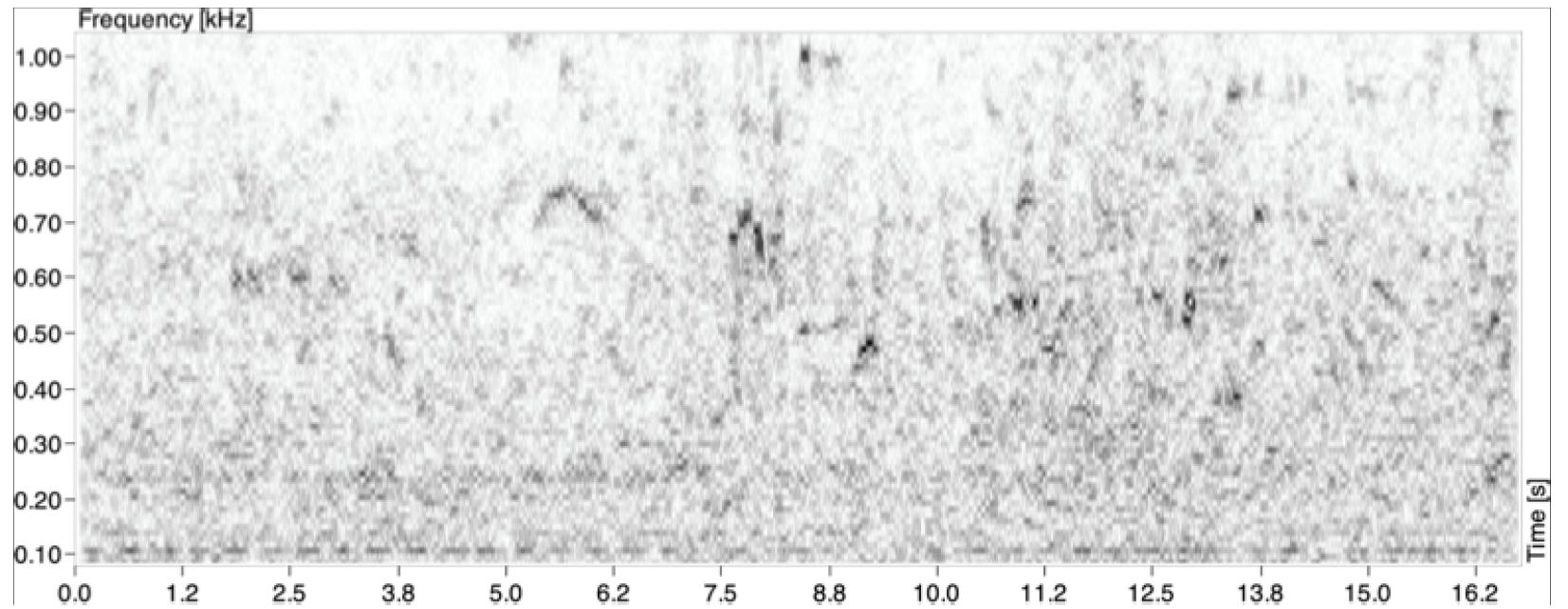
Figure 16. Hinck’s sonogram of human vocal disorder in non-ordered environments with noise pollution. Clearly, the auditory frequencies are diffuse with no organization. Used with permission. 347
Figure 17 is a representation of a harmonizing choir. The darkest spots are the loudest pitches. They are stacked on top of each other because they are forming chords. For example, at time 2.5 we see the most dominant frequencies occur around .20, .40, .60, and .80, respectively, with .80 being
Instead of beginning this chapter with a new anecdote, let’s return to the beginning of the Sanctuary Siestas and Synaptic Secrets chapter, to my childhood experience of sleeping under church pews. I mentioned that as a child, I sensed an undeniable presence, a something that grew more potent the nearer I drew to individuals seemingly touched by the supernatural, especially those speaking in tongues. This consistent experience led my young mind to wonder, If I can perceive such a force externally, what profound sensations must they be experiencing within themselves? Naturally, I lacked the words for such a question then, but a deep-seated desire to experience that something for myself took root in me. Maybe someday I would be the elder that a young child stood next to in order to sense the presence of the something.
However, in my typical contradictory personality, there were times that I felt embarrassed by the glossolalia and my desire to experience it for myself, mostly because I was not able to explain the event to myself or others. Besides, didn’t my desire to experience tongues mean I was weak and at least a little bit crazy? What was wrong with me? (My words from youthful conversations.) How is an adolescent supposed to explain an event that even older, lifelong practitioners struggle to explain? I now have more information and a larger vocabulary with which to attempt explanations, but still, they remain inadequate. Even individuals who are not embarrassed are unable to adequately describe the event. Though I still struggle to describe tongues, I continue to try to bring some clarity to the process.
“ Avoiding topics that might offend only leads to longterm inability to deal with conflict. ”
Hopefully you have paused to consider at least one topic in relation to your current beliefs. While I have attempted to ease your stress in some sections, such as medications and strictly evolutionary ideas and heavily theistic discussions, the reality is that many deal with those issues each day, and caring theists and atheists alike should try to understand the struggles of the others. Avoiding topics that might offend only leads to long-term inability to deal with conflict. As previously mentioned, I don’t always view conflict as a bad thing — it can be a great place to find “tools” to improve relationships. It can be a great teacher and unifier, and I have presented multiple examples of individuals who developed wonderful lives and works from conflict and dissociation. I summarize three that exemplify the beauty that can result from contrasts.
1. David struggled with his leadership at personal, familial, and national levels, but what would have happened to the Jewish nation if David had simply given up? Had not learned from his mistakes? How might the Jewish nation look now if he had been a one-trick pony? Just a warrior and not a poet or musician? We wouldn’t have the psalms. There would be one less nation, or at least it would look very different. Even secular leadership methods would be lacking because some of the most effective and modern methods are based on some of David’s teachings.
2. James struggled with mental and physical illnesses for a large portion of his life, but where would the field of psychology be if he had simply given up? His weaknesses became a driving force. He based much of psychology’s foundation in spirituality. The field currently has a lot of negativity associated with it, but that often results from the removal of spirituality from the field. James also made significant contributions to the field of philosophy. Without him we might not have solid psychological or philosophical foundations from which to discuss spiritual experiences.
3. Lewis struggled with religious issues. He went from theism to atheism, then back to theism, though he still had some theological struggles (don’t we all?). But it was his path that led him to becoming one of the greatest philosophers, and one of the most effective Christian defenders, of all time. In relation to the later portions of this book, he provided a great example of how
extending it to the possible eschatological role of tongues. We wondered if, even though it is considered Divine speech, it will cease to exist or be the universal language of the afterlife. We also included a tapestry metaphor: life’s contrasts—struggle and joy, dissociation and association—can create beauty and unity, like warming our hands at the paper fire. Embracing these tensions, appropriately questioning assumptions, and respectfully engaging diverse perspectives are essential for personal and spiritual growth and opening doors for connections. Despite containing dissociation, glossolalia is a profound symbol of association between ethereal and physical worlds.
Ο Beyond Scientific Explanations: When have you encountered a question (e.g., about spirituality, consciousness, or purpose) where scientific explanations felt incomplete? How did you, or might you, use philosophical or introspective methods to seek deeper understanding, similar to how the text shifts to philosophy for further explanation of glossolalia?
Ο Discomfort as Motivation: C. S. Lewis found glossolalia embarrassing, yet this discomfort drove exploration. Reflect on a time when unease or confusion about a belief or practice (like glossolalia) motivated you to understand it better. What insights or growth resulted from this process?
Ο Transposition’s Limits: Lewis’s transposition involves expressing a higher reality (e.g., spiritual insight) through a lower medium (e.g., words, behaviors, drawings). Where do you feel the limitations of language or physical expression most acutely when sharing profound experiences? How does this shape your understanding of spiritual communication?
Ο Perspective and Humility: The author contrasts a child’s limited view under the pew with an adult’s broader perspective, noting, “Knowing that I know very little is beneficial.” How does acknowledging your perspective’s limits influence your engagement with those holding different beliefs? What challenges or benefits arise from this humility?
Ο Judgmental Errors: Lewis warns that viewing phenomena only from below misses deeper meaning, leading to incorrect conclusions. Have you ever focused solely on observable facts and misunderstood a situation’s significance? How might considering a higher perspective (e.g., spiritual or emotional) alter your understanding?
Ο Breaking Informational Silos: The author cautions, “Informational silos produce individuals that others often pity or dislike.” Where might you be susceptible to staying in a comfortable intellectual or theological
It is my interest in the contrasting quirks evident in the lives of others like King David and William James, and the rich insights their lives offer about the human condition, that fuels my inquiry into complex behaviors. My own contrasts and those of others I know continue to stoke the flames. This drive to understand the multifaceted nature of our physical and spiritual experiences underpins the question I now present: Why have we invested so much time exploring a deeply spiritual phenomenon like glossolalia, especially when I naturally look for physical explanations over spiritual ones?
The answer lies in the wealth of insights it provides for unraveling some of the hows and whys of human behavior. We began by examining how sight and sound subconsciously shape our actions, for better or worse. This led to a discussion on why negative behaviors might hold hidden positive potential. Though sometimes viewed skeptically, non-pathological speaking in tongues positively influences conscious and subconscious processing. Even tongues’ ecstatic behaviors were explored through the lens of Lewis’s transposition.
Glossolalia’s value extends beyond the spiritual, as its patterns resonate with everyday life. The Conceptual Model of the Glossolalic Process (Figure 15) offers a versatile framework for understanding behavior. For example, when our children frustrate us, eventually reaching the “determination and decision time”—that pivotal moment marked by the star at the dissociation triangle’s peak. Here, we choose, consciously or subconsciously, to redirect the raw emotions or continue to allow them to grow. Ideally our choice fosters reconnection with our child (symbolizing connecting with the Spirit), despite our lingering frustration (lower level of dissociation). The tragic Mustang-Hyundai accident, where one driver’s actions severely injured another, illustrated this dynamic vividly. While we all face this cycle throughout each day, high-stress environments often require more frequent navigation through the model’s stages.
Dissociation and our progression through the stages may even last for a long time. The dissonance of feeling like a high school “quitter” fueled my drive to pursue education—after mentors planted the seeds—but I had to be the one who chose to act and to persist. Along the way, and in life in general, I have also learned to evaluate my unwise choices so that each bad decision teaches me something that will help me make better ones next time (hopefully).
This glossary offers definitions of key terms as they are used in this book, reflecting the author’s professional knowledge, personal experiences, and the specific contexts of psychology, neuroscience, religion, music, and philosophy. Tailored to the book’s interdisciplinary themes, these definitions may differ from broader uses and serve as a reference to enhance reader understanding.
Action observant treatment (AOT): A therapeutic approach emphasizing mindful observation of actions and their consequences to promote behavioral change.
Active listening: Fully concentrating, understanding, and responding to a speaker, showing engagement through verbal and non-verbal cues.
Affective system: The brain’s neural network responsible for processing emotions and emotional responses.
Age of Reason: A historical period (17th–18th centuries) emphasizing rational thought and science; also, the developmental stage (around age seven) when children develop logical reasoning.
Agnosticism: The belief that the existence of God or the supernatural is unknown or unknowable.
Altered state of consciousness (ASC): A mental state differing from normal wakefulness, often induced by meditation, drugs, or trance.
Alternation (in music): The technique of switching between contrasting musical sections or themes.
Amygdala: A brain structure involved in processing emotions, fear, and memory.
α-Amylase (alpha-amylase): An enzyme in saliva, used as a biomarker for stress or arousal.
Aphasia: A disorder impairing the ability to understand or produce language, often due to brain damage.
Apologist (Christian): A person who defends Christian beliefs through reasoned arguments.
Apostolic Pentecostals (Apostolics): A Christian denomination emphasizing baptism in Jesus’ name, speaking in tongues, and strict holiness standards.
Artificial intelligence (AI): Computer systems designed to perform tasks requiring human-like intelligence, such as learning or problem-solving.
Action
Corticospinal
1 James W. 1890. The Principles of Psychology. Henry Holt and Company.
2 James W. 1902. The Varieties of Religious Experience: A Study in Human Nature Longmans, Green, and Co.
3 Kant I. 1781. The Critique of Pure Reason. CreateSpace Independent Publishing Platform.
4 Schiller FCS. 1891. Riddles of the Sphinx: A Study in the Philosophy of Evolution London: S. Sonnenschein. Pages xxvii, 468.
5 James W. 1898. Human Immortality: Two Supposed Objections to the Doctrine Houghton, Mifflin.
6 Baker MC, Goetz S. 2010. The Soul Hypothesis: Investigations into the Existence of the Soul. Bloomsbury Publishing.
7 Eccles JC. 1994. How the Self Controls Its Brain. Springer-Verlag.
8 Snow CP. 1959. The Two Cultures and the Scientific Revolution. Cambridge University Press.
9 Maslow AH. 1964. Religions, Values, and Peak-Experiences. Ohio State University Press.
10 Sciences NAo, Medicine Io. 2008. Science, Evolution, and Creationism. Washington, DC: The National Academies Press. Page 88.
11 Wachowski L, Wachowski L. 1999. The Matrix.
12 Zee A. 1989. Fearful Symmetry: The Search for Beauty in Modern Physics. Collier Books.
13 Quoted in Chidambaram RS. 2011. Law of Love and the Mathematics of Spirituality. AuthorHouse.
14 Downing DC. 2012. C. S. Lewis as Atheist Turned Apostle
15 Flew A. “Theology and Falsification.” 1950. Presented at Socratic Club, Oxford University.
16 Flew A. “Theology and Falsification.” 1950–51. University.
17 Flew A. 1966. God and Philosophy. Hutchinson.
18 Flew A. 1976. The Presumption of Atheism and Other Philosophical Essays on God, Freedom, and Immortality. Barnes and Noble.
19 Flew A, Varghese RA. 2007. There Is a God: How the World’s Most Notorious Atheist Changed His Mind. HarperCollins.