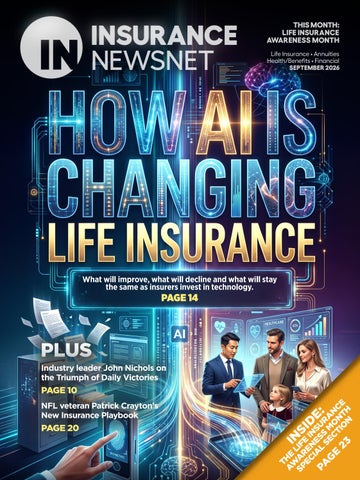
What will improve, what will decline and what will stay the same as insurers invest in technology.
PAGE 14
PLUS Industry leader John Nichols on the Triumph of Daily Victories NFL veteran Patrick Crayton’s New Insurance Playbook
PAGE 20
T AWHE I N SP ARLIF S EC E E I ID IA NE NS E PA L SS UR : G SEC MO AN E 23 TIO NTHCE N
PAGE 10
SEPTEMBER 2026
For the moment your client becomes our commitment Protection endures long past the moment of the sale. We’re by your side to support your long-term approach.
Protective refers to Protective Life Insurance Company (PLICO) located in Omaha, NE, and its affiliates, including Protective Life and Annuity Insurance Company (PLAIC) located in Birmingham, AL.
Support to meet the needs that matter most Long‑term commitments require a carrier aligned to the way you do business. See how we help you protect and guide clients through change.
Reliable solutions
Proactive underwriting
Life insurance designed to deliver lasting client outcomes
Fast, clear underwriting paths: instant, accelerated and traditional
Low-friction service
Strength and performance
Digital submission experience and real-time case updates
Strong ratings that reflect our durable structure and disciplined management1
Get to know us As of May 31, 2026, Protective Life Insurance Company and Protective Life and Annuity Insurance Company have insurer financial strength ratings of A+ (Superior, 2nd highest of 15 ratings) from A.M. Best, AA- (Very Strong, 4th highest of 21 ratings) from S&P Global Ratings, AA- from Fitch (Very High Quality, 4th highest of 22 ratings).
1
Protective® is a registered trademark of Protective Life Insurance Company. The Protective trademarks logos and service marks are property of Protective Life Insurance Company and are protected by copyright, trademark, and/or other proprietary rights and laws. Protective and Protective Life refer to Protective Life Insurance Company (PLICO) and its affiliates, including Protective Life and Annuity Insurance Company (PLAIC). PLICO, founded in 1907, is located in Omaha, NE, and is licensed in all states excluding New York.PLAIC is located in Birmingham, AL, and is licensed in New York. Protective Life Insurance Company does not solicit business in the state of New York, nor is it authorized to do so. Product availability and features may vary by state. Each company is solely responsible for the financial obligations accruing under the products it issues. Guarantees are subject to the financial strength and claims-paying ability of the issuing insurance company. Product guarantees are backed by the financial strength and claims-paying ability of the issuing company. Securities offered by Investment Distributors, Inc. (IDI), the principal underwriter for registered products, are issued by PLICO and PLAIC, its affiliates. IDI is located in Birmingham, Alabama. CLA.8104312.06.26 Not FDIC/NCUA Insured
No Bank or Credit Union Guarantee
Not Insured By Any Federal Government Agency
May Lose Value Not a Deposit
For Financial Professional Use Only. Not for Use With Consumers.
protective.com
Income for the Long Game The journey to retirement doesn’t follow a straight line. Every decision along the way matters. A strong income strategy prepares your clients for the financial curves retirement may bring. See how Global Atlantic can help your clients cover their financial bases in retirement. Global Atlantic is the marketing name for The Global Atlantic Financial Group LLC and its subsidiaries, including Forethought Life Insurance Company and Accordia Life and Annuity Company. Each subsidiary is responsible for its own financial and contractual obligations. These subsidiaries are not authorized to do business in New York. IMO317060
Aim higher with Ascend annuities Our diverse portfolio of annuities is designed to help you and your clients aim higher. We offer fixed, fixed-indexed, registered index-linked and advisory annuities, all backed by the financial strength clients deserve. Superior ratings1 A++ by AM Best. AA by S&P. Stability Fixed income investments make up nearly 80%2 of our invested assets. Commitment to customers More than $15 billion in guaranteed income benefits paid since 2000. Scan the QR code to learn more about how we can help you.
AM Best rating of “A++” (Superior) affirmed on October 23, 2025. AM Best rating of “A++” is the highest of 16 ratings. S&P rating of “AA” (Very Strong) upgraded on February 20, 2025. S&P rating of “AA” is the 3rd highest of 21 ratings.
1
2
Data is as of December 31, 2025. Fixed income investments include bonds, cash, short-term investments and policy loans.
1012-ASC-34b
2/26
IN THIS ISSUE
View and share the articles from this month’s issue
» read it online InsuranceNewsNet.com/magazine
SEPTEMBER 2026 » VOLUME 19, NUMBER 7
HEALTH/BENEFITS
FEATURE
he benefit category that employers How AI is changing 48 Tmust reconsider life insurance By Diana Steinhoff
14
By John Hilton What will improve, what will decline and what will stay the same as insurers invest in technology.
Supplemental health insurance gives employers a way to preserve affordability in the core medical plan.
ADVISORNEWS
52 What advisors must know about accessible client documents By Donnell Stidhum
10
23 Life Insurance Special Section Get the latest perspectives on the trending sales, strategies and products dominating an ever-changing life insurance marketplace.
LIFE
INTERVIEW
10 T he triumph of daily victories
John Nichols has served as head of two of the industry’s major professional associations while growing a successful practice. But he didn’t achieve his accomplishments alone. In this interview with Publisher Paul Feldman, Nichols discusses the value of mentorship and the power of overcoming fear.
IN THE FIELD
20 P atrick Crayton’s new insurance playbook
38 The rise in crowdfunding: A symptom of the coverage gap By Grant D. Ward Sr.
Too many households are trying to address a financial protection gap reactively.
ANNUITY
After an eight-year NFL career, Patrick Crayton is building his own insurance agency.
BUSINESS
54 Why traditional websites are failing insurance agents By David DeCelle
AI is replacing traditional search engines as the main tool for consumers to find provider websites.
BONUS FEATURE
56 T he framework that builds excellence By John D. Terry III
Exploring human performance principles that separate average practitioners from those who achieve true excellence.
44 H ow annuities address the growing income gap
IN THE KNOW
By Jay Thudium
By John Hilton
Firms that provide public-facing services are expected to make digital documents accessible to people with disabilities.
Closing the annuity income gap comes down to combining tools in a way that reflects multiple priorities instead of forcing one solution to do everything.
58 T he power of independence in the high net worth market By Michael Babikian
Independent advisors can innovate and implement new strategies without the constraints imposed by larger groups.
INSURANCENEWSNET 20 Erford Road • Suite 304 • Lemoyne, PA 17043 717.441.9357 www.InsuranceNewsNet.com PUBLISHER EDITOR IN CHIEF, MAGAZINE EDITOR IN CHIEF, WEBSITE MARKETING DIRECTOR
Paul Feldman Susan Rupe John Hilton Jenn Becker
SENIOR CREATIVE DIRECTOR EMAIL & DIGITAL MARKETING SPECIALIST MARKETING MANAGER SALES OUTREACH SPECIALIST
Jacob Haas Megan Kofmehl Sorayah Talarek Isabella Bonvisuto
DIRECTOR OF SALES NATIONAL ACCOUNT DIRECTOR NATIONAL ACCOUNT DIRECTOR STAFF ACCOUNTANT
Ashley McHugh Brian Henderson Tobi Schneier Katie Turner
Copyright 2026 Insurance & Financial Media Network. All rights reserved. Reproduction or use without permission of editorial or graphic content in any manner is strictly prohibited. How to Reach Us: You may e-mail editor@insurancenewsnet.com, send your letter to 20 Erford Road, Suite 304, Lemoyne PA 17043, fax 866.381.8630 or call 717.441.9357. Reprints: Copyright permission can be obtained through InsuranceNewsNet at 717.441.9357, Ext. 125, or reprints@insurancenewsnet.com. Editorial Inquiries: You may e-mail editor@insurancenewsnet.com or call 717.441.9357, ext. 117. Advertising Inquiries: To access InsuranceNewsNet Magazine’s online media kit, go to www.innmediakit.com or call 717.441.9357, Ext. 125, for a sales representative. Postmaster: Send address changes to InsuranceNewsNet Magazine, 20 Erford Road, Suite 304, Lemoyne PA 17043. Please allow four weeks for completion of changes. Legal Disclaimer: This publication contains general financial information. It should not be relied upon as a substitute for professional financial or legal advice. We make every effort to offer accurate information, but errors may occur due to the nature of the subject matter and our interpretation of any laws and regulations involved. We provide this information as is, without warranties of any kind, either express or implied. InsuranceNewsNet shall not be liable regardless of the cause or duration for any errors, inaccuracies, omissions or other defects in, or untimeliness or inauthenticity of, the information published herein. InsuranceNewsNet uses AI tools to assist in producing content and images, which are reviewed and edited by staff. Address Corrections: Update your address at insurancenewsnetmagazine.com.
Source: Federal Reserve
2
InsuranceNewsNet Magazine » September 2026
®
Palladium
Multi-Year Guarantee (MYG) Solutions Palladium MYG ®
A solid, straightforward solution offering guarantee periods ranging from 3 to 10 years. Designed to deliver stability and predictable accumulation potential.
Palladium MYG MAX ®
Offers the same guarantees for 3, 5, 6, 7, & 10 year periods, without the 10% annual free withdrawal, allowing for higher rates and a greater opportunity to grow earnings.
Palladium Match MYG ®
Interest guaranteed periods of 3, 5, and 7 years, perfectly aligned with a matching surrender charge period.
Every client’s financial journey is unique. That’s why we offer a suite of Multi-Year Guarantee (MYG) annuities designed to meet a range of financial goals – with competitive rates, flexible terms, and built-in value. Whether your clients want growth or a bridge to retirement, Palladium® MYG annuities help turn plans into progress.
Form Series: MYG24 (Forms may vary by state). American National Insurance Company is headquartered in Houston, Texas and is licensed in all states except New York. Not FDIC/NCUA insured / Not a deposit / Not insured by any federal government agency / No bank / CU guarantee / May lose value For Agent Use Only; Not for Distribution or Use with Consumers. LAD10857-INN 06/26
AMERICAN NATIONAL INSURANCE COMPANY / 888-501-4043 / lad.americannational.com
WELCOME LETTER FROM THE EDITOR
It’s September.
You know what that means.
I
’ve often thought that September — and not January — should be the first month of a new year. September is the month when everything ramps up after the lazy days of summer. Vacation time is over. School is in full swing. People get serious about their work after three months of saying, “Let’s circle back after Labor Day.” The pace of life quickens as the days grow shorter. September definitely marks a turning point on the calendar each year. The industry observes Life Insurance Awareness Month in September, and InsuranceNewsNet marks this special month by looking at several aspects of life insurance. In this month’s feature, John Hilton examines the debate over indexed universal life (page 14). Marketed to high earners as a powerful, tax-free vehicle for building retirement wealth, IUL now faces intense scrutiny over hidden fees and complex structures. IUL continues to resonate with Americans despite the controversy surrounding it. Sales of IUL hit a record $4.5 billion in new annualized premiums for the full year of 2025, with that momentum surging straight into 2026. New annualized IUL with excess premium reached $1.1 billion in the first quarter of 2026, up 9% from the prior year, LIMRA reported. IUL now represents 25% of all life insurance sold. Artificial intelligence is transforming every business, and it is predicted to reshape the life insurance industry as well. As insurers invest in automation and generative AI, routine administrative work is expected to decline. Experts say human judgment, compliance expertise and customer relationships will remain essential to the industry’s future. Hilton examines the ways in which AI will improve efficiency, reduce costs, enhance underwriting, change the nature 4
of many jobs, and eliminate some of them outright. Most industry observers expect AI to augment but not replace most insurance professionals, with the workforce shifting toward higher-skilled, technology-enabled positions rather than experiencing widespread job elimination.
GoFundMe is no substitute for life insurance
Families continue to depend on crowdsourcing platforms such as GoFundMe to fund final expenses for a loved one who died without sufficient means to pay for a funeral and final costs. GoFundMe experienced a 20% increase in crowd funding for everyday expenses in 2025. In this month’s Life article, Boston Mutual CEO Grant Ward D. Ward Sr. describes the rise in crowdfunding as a symptom of a bigger life insurance coverage gap in the U.S (page 40). He noted some of the contributing factors to the gap:
» There is still a widespread perception that life insurance is too expensive.
» Many people simply avoid planning for the inevitable.
» With more product options than ever, some feel overwhelmed by choice.
» Trust remains a barrier. Ward said when people encounter consistent messaging from financial advisors, employers, digital platforms and third-party sources, it reinforces credibility and helps normalize planning behaviors. Equally important is demonstrating real outcomes. Sharing examples of how coverage supports families in times of
InsuranceNewsNet Magazine » September 2026
need can make the value more tangible and relatable. People are more likely to act when they can see how a decision applies to their own lives.
Mastery and leadership
This month’s issue contains a bonus feature by John D. Terry III on the MASTER Framework (page 56). Terry is a three-time Martial Arts Hall of Fame inductee a nd the founder of Black Belt Leadership. He describes the six interTerry connected principles in the MASTER Framework that define the relentless pursuit of true professional mastery and how advisors can apply these principles to achieve true excellence in their professional lives. Terry’s article is an introduction to a series, “Mastery in Motion,” that will appear monthly on InsuranceNewsNet.com. Speaking of mastery, John Nichols became a leader in the life and disability insurance business by overcoming his call reluctance and fear of rejection and by achieving what he called “daily victories.” Nichols went on to become president of both the Million Dollar Round Table and the National Association Nichols of Insurance and Financial Advisors. He describes his journey in the industry in an interview with InsuranceNewsNet Publisher Paul Feldman in this month’s issue (page 10). September may not be the first month of a new year, but it’s a great month to take a fresh look at your goals and reset yourself for the remainder of the year. Here’s to finishing the year strong! Susan Rupe Editor in Chief, magazine
Your next wave of sales is below the surface. Millions of underserved consumers are looking for protection. Pan-American Life helps you turn unmet needs into meaningful conversations.
WHAT MANY PRODUCERS DON’T SEE: • 50M middle-income consumers say they need more protection*
• 53% of Hispanic consumers report needing life insurance or more coverage* • Women represent one of the fastest-growing opportunities in life insurance* • Gen Z and Millennials show the highest intent to buy coverage* Wherever opportunity exists, we have a solution. AGENT-BUILT. AGENT-LED. AGENT-OBSESSED. » Get the Sales Solution Collection (English/Spanish) *Source: LIMRA and Life Happens, Insurance Barometer Study, 2025.
palig.com
September 2026 » InsuranceNewsNet Magazine For producer use only. Not for use with clients.
5
NEWSWIRES
INTERVIEW
CMS will discontinue Part D subsidies for 2027
Medicare Part D prescription drug plans could be more expensive for about 25 million Americans next year as the Trump administration plans to end Medicare Part D subsidies. The Centers for Medicare & Medicaid Services announced that it will discontinue the Part D voluntary premium stabilization program after 2026. CMS said that plan sponsors now have sufficient experience to price bids without the subsidy program. CMS began the Part D Premium Stabilization Demonstration in 2025 in response to a spike in premiums CMS saw after the Inflation Reduction Act’s Part D redesign took effect. CMS found that the average total Part D beneficiary premium was projected to decrease by $7.45 in 2025 as a result of the program, with about 99% of enrollees in a participating standalone plan. The impact on Part D beneficiaries will be uneven, CMS said. Administration officials said that about 25% of Part D enrollees will see premiums decline or remain the same for 2027, while about 30% could face monthly increases of less than $10. The remaining 45% are projected to see premium increases of between $11 and $20 per month.
PROPOSED LEGISLATION TAKES AIM AT SOCIAL SECURITY SHORTFALL HIGH COST OF HOME INSURANCE MAY DRIVE VOTER TURNOUT FOR MIDTERMS
A majority of Americans say rising home insurance costs would make them more likely to vote in the midterm elections. An Insurify study revealed 58% of respondents say higher insurance costs are motivating them politically. The study revealed that home insurance premiums have increased by 46% since 2021 — including a 12% rise in 2025 — leaving many homeowners struggling financially. Inflation and climate risk have made home insurance a key cost consideration, sometimes determining whether someone can afford a home in the area where they want to buy. The Insurance Fairness Project and Climate Power conducted a poll that found 75% of Americans are concerned about home insurance costs rising in the next three years. DID YOU
KNOW
?
6
With Americans living longer and a shrinking workforce, the Bipartisan Policy Center’s 2026 Social Security Trustees Report projects that Social Security’s primary trust fund will be depleted in 2032.
Under current law, depletion automatically triggers an across-the-board benefit cut of 22% for every current and future beneficiary — roughly $10,560 per year for a married couple of average earners. In an attempt to prevent this, Reps. Tom Cole, R-Okla., and Tom Suozzi, D-N.Y., introduced The Bipartisan Social Security Commission Act of 2026 (H.R. 9187). The bill would create a 13-member commission on long-term Social Security solvency. Members would be appointed by the president,
Q U O TA B L E We have begun a new chapter, and we understand that the fiveplus years of inflation above target cannot be cured in nine weeks.” — Federal Reserve chair Kevin Warsh
congressional leaders of both parties, and the chairs and ranking members of the Ways and Means and Finance committees. At least one expert from each party must be a nonelected, outside expert. If the bill is enacted, within one year of its first meeting, the commission must produce recommendations and proposed legislation sufficient to keep Social Security solvent for at least 75 years.
ONLY 1 IN 4 AMERICANS THINK IT’S A GOOD TIME TO INVEST
A potential recession and ongoing market volatility are making Americans more cautious about investing, according to the Allianz Center for the Future of Retirement. Only one in four (25%) Americans said in the second quarter that they think it is a good time to invest in the market, down from 34% in the previous quarter. The last time this few Americans thought it was a good time to invest was in Q2 of 2022 during a surge in inflation. The majority (71%) are concerned that continued market volatility could negatively impact their long-term financial plan. Americans are taking action to reduce risk in their portfolio. The majority of Americans (58%) say they are looking to add more protection to their portfolio after recent market volatility. Half say they have made changes to their investments to make them less risky.
84% say the American Dream is now more about financial stability than building wealth. Source: Nationwide Retirement Institute
InsuranceNewsNet Magazine » September 2026
O T Y D A E R U ARE YO H T I W E T A N I DO M
D A E L I A PROVEN N? O I T A R E N E G a de r nce industry le ra su in e lif e th e d as a ge has emerg that gives you y g lo o n ch Wells Advanta te , rowth AI-Powered G N! by delivering OMPENSATIO C H IG H d n a , massive EDGE
ARE YOU READY FOR THE NEXT LEVEL? If you want AI LEADS, tactical hands-on training, getting PAID on submit, IULs issued in under 10 minutes, and complimentary wills for your clients — the answer is YES. You deserve proprietary lead generation, customized growth opportunities, and world-class appreciation events.
844-519-1188
CALL today to become one of the FIRST 100 ADVISORS in our exclusive POWER-UP Club. Don’t let your competition beat you to the future of insurance. September 2026 » InsuranceNewsNet Magazine
7
WHO PROTECTS THE PROTECTORS? WE DO.
N OVE MBER 9 T H - 1 1 TH, 2026 T HE V EN ET I AN LAS V EGAS
BY THE NUMBERS
AT T E N D E E S
SPEAKERS
SPONSORS
SESSIONS
LIFE AND ANNUITY. FINALLY, UNDER ONE ROOF From the creators of Medicarians and InsureTech
Connect — and powered by NAIFA — Protectors brings 1,000+ producers, carriers, IMOs, index providers,
technology innovators, and investors to The Venetian for the most consequential three days in the industry’s calendar.
T H E P R O T E C TO R S PA S S P R O G R A M
GET PAID TO ATTEND. Qualifying agents and advisors receive a complimentary all-access pass — a $2,295 value — plus up to $1,000 in travel reimbursement. A P P LY AT P R O T E C T O R S V E G A S . C O M / PA S S
Sponsor and exhibit opportunities — sales@protectorsvegas.com
INTERVIEW
10
InsuranceNewsNet Magazine » September 2026
THE TRIUMPH OF DAILY VICTORIES — WITH JOHN NICHOLS INTERVIEW
J
ohn Nichols knows that no one achieves success alone; it takes mentorship to survive and thrive in a business that’s tough to break into. Nichols has served as head of two of the industry’s major professional associations. He was president of the National Association of Insurance and Financial Advisors in 2013-2014 and recently wrapped up his term as 2026 Million Dollar Round Table president. He has been a sought-after speaker at industry events for more than a decade. He is a nationally recognized disability benefits consultant, the creator of disability products and administration systems and an expert witness in disability proceedings. Nichols served as president of Disability Resource Group Inc., a national insurance agency that he founded in 1999. In 1993, Nichols had a near-death experience from a water-skiing accident that left him paralyzed from the neck down to his toes. Through six years of rehabilitation, he reached a level of recovery that less than 1% of all spinal cord injury patients attain and eventually became a marathon runner. He chronicled his story in his first book, Income Protection: The Conversation. Nichols attributes much of his success to self-leadership, learning from others in the industry and fighting the fear of rejection that almost every advisor knows. In this interview with InsuranceNewsNet publisher Paul Feldman, Nichols describes what he calls his “daily victories,” and shares his views on how the industry can attract more professionals. PAUL FELDMAN: You became a quadriplegic, were told you could never walk again, but you ran a marathon, reached MDRT Top of the Table, and pushed through. This is such an inspiring story for me. JOHN NICHOLS: Sometimes it feels as though I’m outside of myself, because I’m not sure how it all came about. I think one of the key strands of any form of success we may look to or achievements we may have is the people who have helped us along the way. The story I tell on the MDRT platforms is about the suit that I had made. It’s an MDRT suit. I had the stitching of
the pinstripe made of MDRT, and then the logo of MDRT on the suit coat, but on the back panel I put 180 names of NAIFA members, MDRT members, MDRT Foundation members, my family, my professional staff, other salespeople, mentors, friends — all the people who contribute to who we become as individuals. For me, yeah, I know I’ve done the work, but I always look back to those who helped me on my path.
NICHOLS: It’s that journey of self-discovery. A fair amount of the content I share is about leadership of self. We all want to be leaders, and we want to direct people, but until we can be leaders of ourselves and recognize how we best operate, will we really achieve the success we want?
FELDMAN: How did you get started in the business?
NICHOLS: I was exposed to this in grade school. I was in the safety patrol; I was in Boy Scouts. Then I was a team captain in high school. But I needed more of that development as I matured so I could overcome some of the fears I had, and my biggest fear was the fear of rejection. It’s the issue I had to deal with to make the calls, go see the people and be OK with rejection.
NICHOLS: I grew up in a big family and my parents always had us working as kids. One of the jobs I had was as a caddy at our local country club, and it was through my caddying that I met a gentleman named Norb Winter. He was a third-generation general agent. I was selling radio advertising to pay for school, and Norb invited me to breakfast and said, “If you can sell radio advertising, you can sell insurance,” and that was my invitation into the profession. I didn’t make it. I failed. I was a statistic. I couldn’t get out of the way of my own fears. Then I got the bright idea of moving from Minnesota to Chicago. I stayed in the profession, joined another
company, and started to work on my skill set and face my fears. It took eight years from the time I started in the profession to reaching MDRT, and things started to click from that point forward. FELDMAN: I appreciate what you said about perseverance for those first eight years before you made MDRT. Once agents get past the five-year mark, it seems to get better, but those first five years are difficult for a lot of people.
FELDMAN: That’s a powerful statement. You can’t be a leader of others unless you can lead yourself.
FELDMAN: What are some of the tricks you use to overcome that fear of rejection? NICHOLS: The first one is picking a mantra that works for you. Mine is either “release” or “next.” When I get a rejection, it’s immediately about releasing it or saying, “Next.”
What really got me over the hurdle was something I learned when my general agent sent me to call-reluctance school. I learned the psychology around rejection. I learned about a tool called the “thought zapper”; it’s a rubber band around your wrist. I’ll even use a Life Happens rubber wristband. When you feel that reluctance to make that phone call, you snap the rubber band and it sends a signal to the brain to make the call. Snapping the rubber band kind
September 2026 » InsuranceNewsNet Magazine
11
INTERVIEW THE TRIUMPH OF DAILY VICTORIES — WITH JOHN NICHOLS
“Our mind goes 24/7 and it’s where all the emotions and all the excuses sit. Our intellect is where the reasoning and logic sit. When you use your intellect to manage your mind, you will accomplish more than you will if you listen to all the excuses.” of interrupts the flow of your excuse and you do the work. There’s a difference between our mind and our intellect. Our mind goes 24/7 and it’s where all the emotions and all the excuses sit. Our intellect is where the reasoning and logic sit. When you use your intellect to manage your mind, you will accomplish more than you will if you listen to all the excuses in your mind. So rejection sits in all the excuses that sit in my mind. When I use my intellect with the thought zapper, and get the work done, I don’t think about rejection. FELDMAN: What I found interesting is that you went to a school for call reluctance. I think there should be a class about call reluctance because people are reluctant to get on the phone nowadays. NICHOLS: I would broaden that class and make it about tools around behavior, which ultimately lead to leadership itself. I am extremely disciplined — maybe fanatical — about something I call daily victories. That’s another tool I use to manage my behavior and my mindset to accomplish my objectives for the day. If you followed me for 24 hours — except when I’m sleeping — you would see that’s 12
how I work; it’s about achieving daily victories and saying, “next,” “next,” “next.” FELDMAN: During your career, mentorship and training were prevalent. How are we missing this in today’s world? What can we do better? NICHOLS: This is one of the great things about our profession. By participating in associations, you develop that camaraderie. I’ve made friends for life because of my association involvement. But it was also the mentorship that helped me move from MDRT to Court of the Table to Top of the Table, and it was the mentorship that helped propel me. Quite frankly, it isn’t just business; it’s my entire life. I didn’t search out leadership positions in any of the associations that I’ve been connected with; it was my peers who put me in those roles. The return on one’s life will be based on their depth of engagement, and a great way to get engaged in our profession is through the associations. FELDMAN: How did you find your mentors? NICHOLS: Sometimes they found me. As you know, I kind of became a
InsuranceNewsNet Magazine » September 2026
disability expert. Someone identified that I was running down that path, and they mentored me when I got involved in NAIFA. It was NAIFA members who were kind of a generation or two ahead of me who identified me. There are, and there have been, occasions where I have asked for help, and I’ve done that through those relationships within the associations. I’ve been grateful to be able to speak at many different offices and events around the United States. One of the things that I offered the audience was that if you’d like to have a 20-minute call with me, reach out to me. There were 200 people in the room; I made that offer. How many people in the room made the phone call? Only one out of 200. But when I said, “If you want a 20-minute call with me, just turn in your business card and I’ll reach out to you,” how many business cards out of the 200 did I get? I got all 200 business cards. The surprising thing is, the people who gave me their business cards never expected me to call, so I made the phone calls. Why do I tell this story? The point of the story is that if you want it, you must go after it. There is one person out of those 200 who I still mentor today. She’s an MDRT producer and a leader.
THE TRIUMPH OF DAILY VICTORIES — WITH JOHN NICHOLS INTERVIEW That started six years ago, so I don’t know when it flipped from me being the mentee to me being the mentor, but at some point in time, it happened. FELDMAN: Let’s go back to the 200 business cards. What did you learn from that experience? NICHOLS: I perform best when I position myself into an environment of accountability, so when I have association work or my business, my family, my workouts — what work do I do first? I do the public work first because I don’t like to be embarrassed. Second, there is a demand for more knowledge, more connection, more relationships. Associations play a role in fulfilling that demand. If we don’t fulfill that demand, then more apathy sets in. Third, we have to be more proactive. We can’t just sit and think business is going to come; that isn’t the case.
to create the mindset of habit that every year we will visit with clients to make sure they have their house in order. No. 2, let’s make sure our house is in order. Just yesterday, I emailed my estate planning attorney to say, “I want to make sure we have this in place, etc., etc.” So, again, it’s up to us to be proactive in the promotion. And it doesn’t have to be about selling something; it can be about educating. “Hey, as you may or may not know,
FELDMAN: You recently wrapped up a year as president of MDRT. What is new at MDRT? NICHOLS: MDRT is rolling out ChatMDRT. It won’t be a generic internet search. ChatMDRT will be within the wisdom of MDRT and with the capability of translation into any language. Artificial intelligence will be our backstage; our frontstage will still be human-to-human
John Nichols had a custom-tailored suit created that includes the names of his mentors stitched into it. He wore it during his MDRT speeches.
FELDMAN: How did you get started in the disability insurance space? NICHOLS: I was doing disability insurance before the crazy accident. I had the honor of working with the Association of American Medical Colleges, and we developed an HIV disability program. That really kick-started my specialty. I became a student of that and then I had a mentor help me accelerate it. At that time, I was with a career company. Six years after the accident is when I spun out on my own and broadened the number of carriers I represented. My business has always been what I’ll call joint work or buddy system work. I worked with a ton of advisors in my vertical of disability insurance, so another value in getting involved in associations is that you get to meet people and you can work together. FELDMAN: September is Life Insurance Awareness Month. What strategies can advisors use to leverage it? NICHOLS: The No. 1 thing is to do client reviews. Even though I mainly work in disability insurance, when I do reviews, I can extend the offering, whether it’s more planning, product, trust or charitable giving, and estate planning. It’s asking clients if their will is in order. It’s trying
it’s Life Insurance Awareness Month. Not only did I want to review your life insurance portfolio, but I also wanted to help educate you on such and such.” FELDMAN: Part of the struggle we have is that we do not have enough people in our profession. What can be done about that? NICHOLS: We just don’t have enough people in the profession, and so therein lies incredible opportunity. But this is something that gives me hope: I’ve had calls from two young men recently. One of them found me on the NAIFA website and contacted me to see if he should join NAIFA — and this was before he even had a job. We had a conversation, and I finally asked him what part of the business he wanted to be in. He said he was leaning toward wealth management. The other young man was being recruited by a career company, and he was thinking about wealth management but also that the career company is going to teach him insurance. I had to open his eyes a little bit so he knows what he’s walking into. We just need more people in our profession.
connection, human-to-human relationships. I think that’s where our associations can continue to develop individuals back to that leadership of self. We’re formalizing our learning program. It will be called MDRT Learn, and it’s where members can learn so that they can achieve their dreams and goals. And it’s also MDRT’s 100th anniversary this year. We’re growing leaders and we’re delivering on the mission of empowering our members so that they can serve their clients better. I have to be honest with you, I’m trying to figure out, am I in the association business or am I in the insurance business? I haven’t figured that out yet. My peers keep putting me in these positions, and I’m like, are you just trying to take me away from my insurance business? But our profession has blessed me and so many others. It’s not about the money; it’s about making a difference. Scan the QR code to view the full video interview online now on our YouTube page.
September 2026 » InsuranceNewsNet Magazine
13
COVER STORY
14
InsuranceNewsNet Magazine » September 2026
HOW AI IS CHANGING LIFE INSURANCE COVER STORY
As insurers invest in automation and generative AI, routine administrative work is expected to decline. Experts say human judgment, compliance expertise and customer relationships will remain essential to the industry’s future.
A
BY JOHN HILTON
rtificial intelligence is expected to reshape the life insurance industry over the next decade by improving efficiency, reducing costs, enhancing underwriting, changing the nature of many jobs and eliminating some of them outright. Most industry observers expect AI to augment but not replace most insurance professionals. Roles centered on judgment, relationship management, regulatory expertise and complex decision-making are likely to remain in high demand, while routine administrative work will continue to be automated. The life insurance workforce is therefore expected to shift toward higher-skilled, technology-enabled positions rather than experience widespread job elimination. “I truly believe I wouldn’t have survived the insurance industry if I had not implemented AI into my daily business workflow,” said T. Necole Gibbs, an Atlanta-based insurance broker and digital marketing consultant. “Being open-minded allowed me to make this technological pivot, which was necessary and changed the trajectory of my sales, revenue and commission checks.” Roughly 40% of Gibbs life underwriters report that AI’s main advantage is accelerating decisions, according to Pacific Life’s 2026 Underwriting Outlook Survey, while 35% point to better utilization of medical and third-party data. AI adoption is projected to drive an 11% increase in new annualized individual life
insurance premiums in the U.S. by 2030, Deloitte reports, shifting the anticipated market from $19.1 billion to $21.2 billion. On a day-to-day basis, Gibbs said AI acts as a personal virtual assistant, giving her more time to prospect versus having to concentrate so much on follow-up and service. “Incorporating AI strategies into my sales proposals not only increased the quality of my relationships, but it also elevated a once struggling insurance business to a multimillion-dollar book of business,” she added.
An early adopter
Patra Corp. provides a variety of technology and back-office services to insurers. The company, under the leadership of CEO Pratap Sarker, jumped in early on AI. Patra provides an AI platform that assists with policy data extraction, comparing quotes and verifying policy limits against checklists.
“AI is embedded in what we do every day. We’ve moved past simply using it as a productivity tool and are using it to redesign business processes altogether, internally and on behalf of our clients,” Sarker said. Patra received a U.S. patent this summer for the AI and human-in-theloop methods at the core of its Policy Sarker Checking AI. The patent describes a method for automatically extracting values from insurance documents and guiding a reviewer directly to the information that matters. Among other things, the system scans a document, maps the position of every word, locates the items a user is looking for, identifies the likely value associated with each, and then directs the user to confirm the result. Sarker noted traditional insurance operations have always required significant manual effort for repeated tasks such as moving information between systems, reviewing documents, validating data, and completing transactions in a variety of legacy systems. AI automates large portions of that work, which is getting done faster than ever before. “But what excites me most isn’t doing the same work faster,” Sarker said. “It’s tackling larger, more transformational opportunities that would have been impractical before. Instead of individual
“The ‘winners’ in the AI revolution will be those organizations that treat AI as a strategic capability, not a technology experiment. AI offers organizations the opportunity to redeploy people and costs away from undifferentiated back-office work, toward customer-facing work that drives growth and advantage.” — PRATAP SARKER, CEO OF PATRA CORP.
September 2026 » InsuranceNewsNet Magazine
15
COVER STORY
HOW AI IS CHANGING LIFE INSURANCE
tasks or isolated process fixes, we’re now able to help organizations rethink entire workflows and operating models, with AI orchestrating everything behind the scenes.”
Strategic redeployment
The “winners” in the AI revolution will be those organizations that “treat AI as a strategic capability, not a technology experiment,” Sarker said. “AI offers organizations the opportunity to redeploy people and costs away from undifferentiated back-office work, toward customerfacing work that drives growth and advantage.” As AI gains traction across the life insurance industry, employment data points to a sustained decline in industry jobs. The insurance industry’s workforce continued to shrink through the spring, with employers cutting 10,700 jobs in May after eliminating 9,100 positions in April and 5,700 in March, according to preliminary data from the U.S. Bureau of Labor Statistics. The trend continued in June, when employment edged lower and the industry’s unemployment rate rose to 2.7%, reaching its highest level since May 2025. Insurance analysts say there is no reason for concern Léonard at this point.
“Incorporating AI strategies into my sales proposals not only increased the quality of my relationships, but it also elevated a once struggling insurance business to a multimillion-dollar book of business.” — T. NECOLE GIBBS, INSURANCE BROKER AND DIGITAL MARKETING CONSULTANT “While it’s difficult to draw broad conclusions from a single month’s employment data, in our view, the industry remains well capitalized, and current workforce actions appear to be driven primarily by organizational restructurManyem ing and productivity gains rather than financial stress,” said Sridhar Manyem, senior director, industry research and analytics, AM Best. AM Best surveyed insurers on AI adoption earlier this year. While 37% of respondents indicated they expect to redeploy employees to higher-value work by using AI to automate routine, low-judgment tasks, only 9% anticipated a net reduction in head count. Michel Léonard is chief economist and data scientist for the Insurance Information Institute. Insurance
employment follows a cyclical trend, he said, as it is an industry that does not “over-hire or over-fire through economic cycles.” AI is likely to be a net positive for agents and employment in the industry, Léonard added. “Technology will keep agents competitive in a crowded market,” he explained. “It’s not just AI but a range of automation tools that speed up everything from policy acquisition and creation through claims processing. AI has proven most useful in sales and marketing — directly impacting agents’ bottom line.” InsuranceNewsNet Senior Editor John Hilton covered business and other beats in more than 20 years of daily journalism. John may be reached at john.hilton@innfeedback. com. Follow him on X @INNJohnH.
YOU’RE LOSING UP TO 20% OF YOUR COMMISSIONS
Find Your Money!
If you’re writing more than 250 policies a year, chances are you’re missing 20% of your commissions. GreenWave helps BGAs, IMOs, and agencies find, fix, and prevent commission errors before they cost you more. When you think commissions, think GreenWave.
We make it easy to take control of your commissions.
16
InsuranceNewsNet Magazine » September 2026
Download and learn our secrets here: ClaimMyCommissions.com or call (844) 953-3938
A MYGA for Clients Hesitant to Commit to One Long-Term Rate Many clients like the protection, simplicity, and tax-deferred growth of a MYGA. But what if rates change after they buy? CurrentRate® MYGA from Oceanview was built for that conversation. Unlike traditional MYGAs that lock in a single declared rate for the entire guarantee period, CurrentRate MYGA offers a different approach, combining the familiar foundation of a fixed annuity with interest rates that are updated annually after year one.
Why CurrentRate® MYGA? • A guaranteed first-year rate
• Annual rate updates after year one
• A transparent formula tied to the 1-Year U.S. Treasury Rate plus a guaranteed spread
• Principal protection and tax-deferred growth After the first contract year, interest rates are determined pursuant to the contract’s interest-crediting methodology, tied to the 1-Year U.S. Treasury Rate plus a guaranteed spread. It’s still a MYGA. Just a different approach for clients who want principal protection but are hesitant to commit to one long-term rate.
Download the CurrentRate® MYGA Sales Kit FOR FINANCIAL PROFESSIONALS USE ONLY. Not to be distributed to the general public. Oceanview’s Fixed Annuity Contract [ICC26 OLA SPDA – CurrentRate], product riders and state variations. Policy form numbers and provisions may vary. May not be available in all states. Rates are guaranteed depending on the guarantee period selected at policy issue, subject to contract terms. For clients of our Fixed Annuity contract, within 30 days prior to the end of the Initial Interest Guarantee Period, we will send you a notification informing you of the date the Guarantee Period is ending and provide the first year guarantee rate and Surrender Charges in effect for the subsequent Guarantee Period. OCEANVIEW ANNUITIES ARE PRODUCTS OF THE INSURANCE INDUSTRY AND NOT GUARANTEED BY ANY BANK NOR INSURED BY THE FDIC OR NCUA/NCUSIF OR ANY OTHER FEDERAL GOVERNMENTAL AGENCY. MAY LOSE VALUE. NO BANK/CREDIT UNION GUARANTEE. NOT A DEPOSIT. MAY ONLY BE OFFERED BY A LICENSED INSURANCE AGENT. GUARANTEES ARE SUBJECT TO THE CLAIM PAYING ABILITY OF THE ISSUING INSURANCE COMPANY.
As each client and prospective client’s financial needs differ, care should be taken in making any recommendation to purchase an annuity. Therefore, nothing in this document should be read as investment advice. Neither Oceanview Life and Annuity Company nor any of its representatives may provide tax or legal advice. Clients should consult their own qualified tax or legal advisors. Withdrawals in excess of any Free Partial Withdrawal amounts are subject to a Surrender Charge and Market Value Adjustment (MVA). The MVA may have the effect of increasing or decreasing the Surrender Value of the withdrawal depending on the market interest rate changes.
Annuities issued by Oceanview Life and Annuity Company, 1331 17th Street, Suite 1050, Denver, CO 80202. In California, doing business as Oceanview Life and Annuity Insurance Company www.oceanviewlife.com.
Contracts purchased in an IRA or other tax-qualified plan provide no additional tax-deferral benefit, since they are already afforded tax-deferred status. All annuity features, risks, limitations, and costs should be considered prior to purchasing an annuity within a tax-qualified retirement plan. For non-qualified annuities, tax deferral is not available to corporations and certain other entities.
Annuities are generally designed as long-term retirement solutions and have certain limitations. They are generally not intended to replace emergency funds, serve as income for day-to-day expenses, or support short-term savings goals. Please refer to the contract for complete details, including features, limitations, and charges.
Rates, renewal caps, and declared interest rates, will always follow contract provisions relative to minimums and maximums stated. Oceanview determines, at its discretion, the rates, renewal caps and, declared interest rates above the contractual minimums that are guaranteed.
A.M. Best Rating as of February, 11, 2026, is subject to change. A (Excellent) rating is third highest of fifteen possible rating classes for financial strength. The outlook assigned to these Credit Ratings is stable.
COVER STORY
Indexed Universal Life:
Tax-Free Promise or Costly Illusion? Marketed to high earners as a powerful, tax-free vehicle for building retirement wealth, indexed universal life insurance now faces intense scrutiny over hidden fees and complex structures. BY JOHN HILTON
A
fter a year of increasing controversy, indexed universal life insurance sits at a highly debated crossroads in the financial landscape. IUL is marketed heavily as a “hybrid” tool for tax-free retirement growth but is facing intense scrutiny over hidden costs and complexity. Although IUL remains popular among high earners as a supplemental wealth vehicle, mainstream financial experts increasingly warn consumers about the gap between illustrative sales projections and real-world performance. “The best a policy will ever look is when it’s first depicted in a sales illustration,” longtime industry veteran Dick Weber told regulators during a summer conference call. Despite front-page controversy, IUL continues to resonate with Americans. IUL insurance sales reached a record high of $4.5 billion in new annualized premiums for the full year of 2025, and that momentum surged Weber straight into 2026. New annualized IUL with excess premium reached $1.1 billion in the first quarter of 2026, up 9% from the prior year, LIMRA reported. Policy count was flat year over year, and six of the top 10 IUL carriers reported double-digit growth. IUL now represents 25% of all life insurance sold.
A pair of big issues
The key criticisms of IUL center on two areas: policy illustrations and premium financing arrangements. 18
On the former issue, the National Association of Insurance Commissioners has shown no inclination to reopen the life insurance illustration model regulation. The life insurance model governing illustrations dates to 1995, or just prior to Transamerica offering the first IUL product. Over the past decade, the NAIC sought to shore up the illustration’s regulation via actuarial guidelines that can be implemented more quickly. Adopted in 2015, AG 49 established a uniform standard for index-based policy illustrations. AG 49-A (2020) focused on curbing premium bonuses and lowering illustrated loan leverage, while AG 49-B (2023) specifically targeted volatility-controlled indexes to prevent artificial inflation of projected policy cash values. Despite those efforts, IUL illustrations are still misleading consumers, Weber told the NAIC Life Insurance and Annuities Committee during a special conference call on the topic. A 59-year industry veteran, Weber spoke on behalf of the Life Insurance Consumer Advocacy Center in California. “The issue is not the product,” Weber told regulators. “It’s the illustration of IUL that is creating issues for us.” The center is seeing increased litigation involving IUL policies across the country, Weber said. “There are quite a few cases both in California and nationwide that are
involving indexed universal life, and it is on that basis that we thought it would be valuable to bring you the information that we’ve acquired,” he told the committee.
Unpredictable future returns
IUL policies typically assume a constant crediting rate over several decades, a practice that may give consumers the false impression that future returns are predictable, according to Weber. He said policyholders often focus on projected retirement income while receiving far less information about the potential for poor performance or policy failure. Weber said the issue is especially significant when insurance agents also serve as registered investment advisors or certified financial planners, who are subject to fiduciary obligations requiring them to act in clients’ best interests. About 70% of IUL policies sold to high net worth consumers are marketed primarily as tax-free retirement income strategies rather than as life insurance products providing a death benefit, he said. To illustrate the risks, Weber described a hypothetical 45-year-old client contributing $25,000 annually for 20 years. The policy illustration projected the client could withdraw nearly $89,000 a year in retirement, reflecting an internal rate of return of approximately 6.55%. However, Weber said a stochastic analysis using 1,000 simulations based on historical market returns painted a
The issue is not the product. It’s the illustration of IUL that is creating issues for us.
InsuranceNewsNet Magazine » September 2026
INDEXED UNIVERSAL LIFE: TAX-FREE PROMISE OR COSTLY ILLUSION? COVER STORY markedly different picture. Only about 10% of the simulations produced a policy that remained in force through age 100, while roughly 905 of the 1,000 scenarios resulted in the policy lapsing before then. “What’s important is, first, for the agent to understand, and then especially the customer to understand,” Weber said. “Not that this makes it a bad product, but that they understand what we call the good, the illustration, the bad and the ugly. Understand how it works, understand the upside and understand the downside.”
Sensitive to crediting assumptions
Weber also highlighted the sensitivity of IUL policies to changes in crediting assumptions. In one example, reducing an illustrated cap rate by a single percentage point — from 10.5% to 9.5% — caused the modeled success rate to drop to about 1%, with 989 out of 1,000 stochastic simulations resulting in the policy lapsing before the insured reached age 100. He cited a legal case involving a registered investment advisor who recommended a premium-financed IUL strategy. The policy illustration projected decades of retirement income based on assumptions that policy crediting rates would consistently exceed borrowing costs. Using the same stochastic modeling, however, Weber said the analysis showed a high probability that the policy would lapse before the insured’s expected lifespan, potentially triggering substantial tax liabilities after years of policy loans and withdrawals. “IUL is almost always front-loaded with expenses,” Weber said. “That’s not necessarily bad; it’s just that the illustration doesn’t express that.” To improve consumer understanding, Weber urged regulators to consider allowing or requiring stochastic analysis as part of the illustration process so prospective buyers could evaluate a range of potential outcomes rather than relying on a single projected scenario. He also recommended replacing traditional paper illustrations with interactive digital tools that would allow consumers to test different assumptions and see how changes in crediting rates, participation rates and policy caps affect policy performance. Weber noted that the illustrations
model not only predates IUL but also came before widespread internet access and long before tablet-based technology became commonplace. Regulators have not responded to Weber’s presentation. While the NAIC’s Annuity Illustration Working Group is considering incremental updates to the model governing annuity illustrations, regulators have not yet undertaken a comparable effort to modernize illustration standards for IUL.
Premium financing IUL
IUL is part of another controversial practice known as premium-financed life insurance. Michael J. Rothman, chief distribution officer at Succession Capital Alliance, explained how the strategy works in a recent column for InsuranceNewsNet: A client with a significant estate-planning need, typically a projected estate tax liability of millions Rothman of dollars, takes out a loan from a third-party lender to fund the premiums on a large IUL policy. The policy is pledged as collateral, along with other personal assets. The client pays interest on the loan, typically out of pocket each year. The policy accumulates cash value over time, and the design assumes the cash value will eventually retire the loan principal, usually within 15 to 20 years. “What remains is a fully funded life insurance policy that provides a tax-advantaged death benefit to address the estate tax exposure the client sought to address in the first place,” Rothman wrote. “This is not a funding strategy for the average policyholder. It is a sophisticated planning approach for clients with complex balance sheets, illiquid assets and real, quantifiable estate-planning needs.” IUL premium financing is a viable strategy for some clients, Rothman said, but is plagued by several “misconceptions.” “The cases driving the negative coverage are real, but they are problems of execution and disclosure, not of the strategy itself,” Rothman wrote. “There is an important distinction between the two, and it is one every advisor who works
with high-net-worth clients must clearly understand.” Nearly all the top life insurers — including Lincoln National, Pacific Life, Penn Mutual, Mass Mutual and New York Life — have been named in various IUL premium financing lawsuits.
‘Unstable financial design’
Larry Rybka is a longtime critic of IUL and responded to Rothman’s column with one of his own. CEO of the Valmark Financial Group, Rybka noted Valmark’s $70 billion in in-force life insurance. But IUL premium financing is an “unstable financial design,” Rybka wrote, not the result of a few misconceptions and bad actors. “My criticism is directed at a sales concept that takes an already complex, opaque and risk-sensitive product and sells it in the most aggressive, highly leveraged way possible,” he wrote. Rybka offers several examples of how the simple math of an IUL premium-financed plan can go sideways. For example, premium finance depends on positive arbitrage, he explained. Net policy performance must exceed borrowing costs after product charges, loan costs and commissions. “That premise is increasingly unrealistic,” Rybka wrote. Borrowing costs often rising above 7% make it that much more difficult for an IUL premium-financed plan to win for the client, he added. “Not every IUL product is flawed,” Rybka concluded. “Used appropriately, with full disclosure and restrained assumptions, IUL can serve a legitimate planning purpose. But premium-financed IUL is different: It layers leverage, collateral risk and optimistic assumptions onto an already complex product.” Rybka
InsuranceNewsNet Senior Editor John Hilton covered business and other beats in more than 20 years of daily journalism. John may be reached at john.hilton@innfeedback.com. Follow him on Twitter @INNJohnH.
September 2026 » InsuranceNewsNet Magazine
19
the Fıeld A Visit With Agents of Change Louis Lopez/Cal Sport Media/Newscom Patrick Crayton celebrates after scoring a touchdown against the New York Giants in a December 2008 game in Irving, Texas.
20
InsuranceNewsNet Magazine » September 2026
PATRICK CRAYTON’S NEW INSURANCE PLAYBOOK IN THE FIELD
After an eight-year NFL career, Patrick Crayton is tackling the entrepreneurial world by launching his own Farmers Insurance agency from the ground up in Carrollton, Texas. By John Hilton
W
hen Patrick Crayton decided to enter the insurance business, buying an established book of business was not a realistic option. Crayton, an eight-year National Football League veteran, owns a startup Farmers Insurance agency in Carrollton, Texas. Farmers allows new agents to buy an existing book of business only from another agent in the same district. In other words, a book must be available from a limited supply. “I look back and think that it may have helped” to buy an existing book, Crayton said. “But I already had some revenue coming in out of the game. So, this is totally mine. I built all this, with the help of my teammates and my employees and everything.” The Crayton Agency opened in late 2024 and offers the full gamut of insurance options, from life insurance to condominium and motorcycle coverage. It has been a whirlwind filled with nonstop hustle to get the agency off the ground. “It is a day-to-day grind,” Crayton said. “When we first opened the office, I was going from 8 in the morning and I might not turn my laptop off until 8, 8:30 at night. You just get going and you look up and dang, it’s already 7 p.m.”
A comfortable underdog
Crayton, 47, knows what it means to face long odds as an underdog. It became his identity in a football career that began at DeSoto High School, a suburban Dallas school that has sent dozens of players to the NFL. After starring as a wide receiver, quarterback and running back at DeSoto, Crayton accepted a football scholarship from the National Association of Intercollegiate Athletics program at Northwestern Oklahoma State University. Crayton played wide
receiver his first three seasons at NOSU but switched to quarterback as a senior. During that season, Crayton passed for 1,837 yards and a school-record 19 touchdowns. He also rushed for a school single-season record of 1,476 yards with 13 touchdowns on 173 carries while adding 15 receptions for 331 yards and four scores. He became the first player in NAIA history to score a touchdown passing, receiving, rushing, and on kickoff and punt returns in a single season. Still, his chances of making professional football a career seemed slim. Before Crayton’s time, only four players in the history of the NOSU football program had heard their names called in an NFL draft. And three of them were
Crayton played two years before eventually retiring from the game. According to Spotrac, which tracks NFL salaries, Crayton made slightly more than $15 million as an NFL player. One of his first business ventures outside the game saw Patrick and his wife, Najiyyah Crayton, open a Primrose preschool franchise in South Plano, Texas. They still own it. “I let her have that,” Crayton said of his wife. “She’s the nurturer. She can handle the kids and everything. So, I had to find my own lane.” Crayton found that lane literally after acquiring several FedEx routes in 2019 and starting a logistics business. Then COVID-19 hit and before long, Crayton got the itch to expand his business portfolio.
“I tell my team, ‘We’re not selling anything.’ I say, ‘We’re offering and giving people an option to get a product that they need.’”
drafted in later rounds that didn’t exist after the NFL shortened the draft to seven rounds in 1994. But Crayton’s exploits attracted the attention of the Dallas Cowboys, which picked him in the seventh round. On a 2024 podcast, Crayton talked about being angry that he wasn’t selected earlier and how he used it as motivation. “I wrote down every name drafted in front of me, and I put a star beside every wide receiver,” Crayton said. “It was just my motivation.”
Long professional career
Crayton played for the Cowboys for six years, earning a four-year, $14 million contract extension in 2007. Traded to the San Diego Chargers in September 2010,
Insurance had long been on his mind, Crayton explained. A cousin has been in the insurance business for several years. A few friends are as well. “We own a family cemetery up in Oklahoma City, on my wife’s side, and we got so tired of hearing these people would have to go do GoFundMe to bury a loved one or ask to borrow money,” Crayton said, “instead of just simply spending $20 or $25 a month for a burial policy or life insurance policy.” Crayton admits that the image of the traditional insurance man in a business suit and tie was hard to shake. Once he took the leap with Farmers, he quickly found out that the insurance business in 2026 does not look like any one picture. “It’s so crazy how much it’s changed,”
September 2026 » InsuranceNewsNet Magazine
21
the Fıeld A Visit With Agents of Change “My end goal is to build the business up, get the agency going and maybe one of the kids will want to step in and go into the insurance world.”
he said. “I don’t wear suits to the office. If I put on a polo shirt, that’s about as dressed up as I’m going to get in the office.”
A licensed agent
Unlike some pro athletes, Crayton did not simply invest in an agency and slap his name on the door while leaving others to manage it. He earned his Texas licenses in 2024 to sell life, health and property/ casualty insurance. Since then, Crayton has quickly become an insurance evangelist. During an interview, he was quick to cite the story of Walt Disney, who famously owned a life insurance policy with significant cash value, which he decided to borrow against to fund the initial development of Disneyland. “I want to really make sure people are educated on what they actually have and what they can get,” Crayton said. “So many people are caught up on price that they don’t even know what kind of coverage they have until they have to use it. “I tell my team, ‘We’re not selling 22
anything.’ I say, ‘We’re offering and giving people an option to get a product that they need.’” Crayton is working hard to educate Texans on the value of the right amount of insurance, even as Texas homeowners pay some of the highest home insurance costs in the country. According to LendingTree’s 2026 State of Home Insurance Report, home insurance premiums in Texas have risen 55.9% since 2020. Texas now ranks fifth in the nation for the highest average home insurance premiums. “My biggest thing when I talk to people, I say, ‘What’s your biggest concern? Are you more concerned with price, or are you more concerned with the product?’” Crayton said. “And seven out of 10 times, you will hear price; that’s going to be the biggest thing.”
Busy family life
The Craytons are an active family, with their three children living out their own athletic dreams.
InsuranceNewsNet Magazine » September 2026
Patrick Crayton Jr. is a sophomore at Rice University and a rising quarterback for the Owls. Daughter Kennedy finished high school early, Crayton said proudly, and attends Temple University in Philadelphia where she plays volleyball. The Craytons’ younger son, Preston, is a senior and football star in high school. Although he is still a young man, Crayton has an eye on the future. He hopes to one day pass Patrick Crayton Agency to one of his children. “My end goal is to build the business up, get the agency going and maybe one of the kids will want to step in and go into the insurance world,” Crayton said, “and at least learn the business side of it based on whatever degree they end up getting.” Insurance N ewsN et Senior Editor John Hilton covered business and other beats in more than 20 years of daily journalism. John may be reached at john.hilton@innfeedback.com. Follow him on X @INNJohnH.
THE FIRST OF EVERYTHING — WITH UZIEL GOMEZ IN THE FIELD
SPECIAL SPONSORED SECTION
2026 Your Annual “Awareness” Booster In this year’s Life Insurance Awareness Month Thought Leadership Series, leaders throughout the industry offer perspective on the trending sales, strategies and products dominating an ever-changing life insurance marketplace.
INSIDE Protective: Flexible Protection for a Changing Market with Aaron Seurkap of Protective Page 24
Modernization That Keeps Delivering, Long After Go-Live with Jennifer Smith of Sapiens Page 30
The Wealth Management Opportunity Hiding Inside Your Distribution Network with Joanna Kanakis of LPL Financial Page 26
Life Stage Planning: The Growth Strategy Financial Professionals Can’t Afford to Ignore with Joel S. Liew, JD, of MassMutual Strategic Distributors Page 32
Insurance Doesn’t Need More Disruptions. It Needs Better Solutions with Stephen Collins of ManageMy Page 28
The value of indexed life insurance in today’s legacy planning environment with Jason Goodrich of EquiTrust Life Insurance Company Page 34
AI made the build v. buy decision harder, not easier by Chad Hersh of Bestow Page 35
The Life Insurance Issue • Special Sponsored Section
Protective: Flexible Protection for a Changing Market As client needs evolve, Protective is helping financial professionals tailor life insurance strategies through speed, ease, transparency and support.
L
ife insurance was once viewed by many as a point-intime transaction: calculate the need, select a product and put coverage in place. But as financial strategies have expanded beyond single-product decisions, the conversation around protection has changed. Today’s clients increasingly expect life insurance to fit within a broader financial plan. Financial professionals, in turn, need carrier partners that can support a wide range of needs while delivering an experience that feels faster, simpler and more aligned with their clients’ other financial products. “The protection conversation has really evolved from a point-in-time transaction to address a specific need to being much more a part of a broader financial strategy conSeurkamp versation,” said Aaron Seurkamp, President of the Protection and Retirement Division at Protective. “Increasingly, clients are buying life insurance from financial professionals that provide a suite of products designed to address the entire scope of their needs.” That shift has important implications for carriers. It is no longer enough to offer competitive products on paper. Financial professionals need solutions that are flexible enough to meet individual client needs, efficient enough to support modern expectations and reliable enough to protect the client relationships they have worked hard to build. At Protective, that means focusing on an experience built around speed, ease and transparency, while preserving the human support that matters when cases become complex.
A More Flexible Conversation
For Seurkamp, one of the biggest misconceptions about life insurance is that it is rigid or one-dimensional. “In my mind, life insurance is one of the most customizable financial products that can be purchased,” he said. That customization can begin with the amount of coverage needed, whether the client is addressing income replacement, outstanding debts, estate planning needs, business obligations or other long-term goals. But it also extends to product type, duration, optional riders and future flexibility. Protective’s core product lineup is designed to support a range of needs-based conversations. Classic Choice Term offers competitive term pricing, coverage durations up to 40 years and options that may help clients transition to permanent protection later. Lifetime Assurance UL supports
24
InsuranceNewsNet Magazine » September 2026
guaranteed death benefit strategies, with guarantees available to age 121 and flexible case designs such as short pays, single pays and 1035 exchanges. Strategic Objectives II VUL gives financial professionals the ability to build strategies around protection or accumulation, with access to a broad investment lineup and optional no-lapse guarantee features. The goal, Seurkamp said, is not to lead with product. It is to help financial professionals begin with the client’s needs and then identify the strategy that fits. “Let’s not talk about product,” he said. “Let’s nail down the needs that you have, and then identify the solutions that could best fit the needs uncovered during the fact-finding conversation.” That approach is especially important as clients’ needs change over time. A young family may begin with affordable term coverage. A business owner may need more complex strategies. A high-net-worth client may need a permanent strategy that addresses estate planning, tax-deferred growth or long-term policy flexibility. “What risks does the client want to transfer from themselves to the insurance company?” Seurkamp said. “What are the corresponding costs associated with it? And what flexibility do you want to entertain along the way?”
Meeting Clients Where They Are
Personalization has become a baseline expectation across nearly every consumer experience. Life insurance is no exception.
Protection Strategies Built Around Client Needs • Classic Choice Term: Competitive pricing, term periods up to 40 years, conversion options • Lifetime Assurance UL: Guaranteed UL protection, guarantees available to age 121 • Strategic Objectives II VUL: Protection or accumulation strategies, investment flexibility, online servicing tools Protective approaches personalization in three ways: product design, the buying experience and the ownership experience. Clients can select the type and duration of coverage, determine whether they want temporary or permanent protection, and consider options that may support future needs. But the purchase process also must fit the client. Some clients want a streamlined, low-friction experience. Others have complex health histories, larger coverage needs or sophisticated goals that require more guidance.
The Life Insurance Issue • Special Sponsored Section
Protective has built multiple underwriting paths to support the purchase experience and when something does not go those different journeys. exactly as planned. For qualifying clients, instant approval can provide cov“How often do things go right? And then how quickly does erage in as little as 14 minutes, with the fastest decisions in that carrier respond when things go wrong?” he said. three minutes. Accelerated underwriting offers decisions For financial professionals, that distinction matters in about three days, with no medical exams, fast decisions because recommending a carrier is also an act of trust. and minimal health questions. Traditional underwriting Their client relationship may span many years, multiple remains available for more complex cases, including those products and a broad financial plan. If a carrier fails to that may require a full review, medical examination or medical records. The flexibility of those paths matters because, as Seurkamp noted, a client seeking $1 million of 20-year term coverage may have very different expectations than a 70-year-old client seeking $25 million of life insurance for a complex need. “It can’t be one size fits all,” he said. — Aaron Seurkamp, President of the Protection and Retirement Division “We pride ourselves on being able to meet all of those protection needs.” deliver, the financial professional’s relationship with the Technology with a Human Center client can be affected. Technology is helping Protective make the buying process “Every time an agent makes the decision to place a case faster and more efficient. More applications can move with Protective, we know that that agent is giving us a vote through instant or accelerated underwriting. Fewer cases of confidence that we will protect and defend that client require traditional fluids or medical requirements. Behind relationship,” Seurkamp said. the scenes, newer capabilities can help summarize attendProtective brings significant scale to that responsibility. ing physician statements and support faster review of more Through its subsidiaries, Protective is helping more than 32 complicated cases. million people protect what matters most and has $1 trillion But Seurkamp is clear that technology is not meant to of life insurance in force. The company also has received replace relationships. third-party recognition, including Forbes Advisor’s “Best “Despite all of the automation and the investment in Term Life Insurance Companies” award in 2023, 2024 and technology and the speed that we are achieving as an 2025, a 5-star rating from USA Today as a best overall life organization, we don’t want to do that at the expense of insurance company and a 4.5-star rating from U.S. News as the relationships that we form with our distribution parta best life insurance company of 2024. ners,” he said. But Seurkamp said the company’s focus remains practical That balance is critical. Straightforward cases should and forward-looking: continue improving, continue reducmove quickly and smoothly. But when a case is complicated, ing friction and continue helping financial professionals financial professionals need access to experienced people make life insurance part of their client conversations. who can help them navigate the process. “I think the greater opportunity is to change the conver“There are times when a case will be complicated regardsation and make life insurance a day-to-day conversation as less of size, and you will need to get a trusted friend on the part of the broader financial plan,” he said. phone to help you through that process,” Seurkamp said. Looking ahead, he believes financial professionals will “We are still, at our heart, a relationship-driven company need two things most from carriers: consistency and a comthat exists to support our field force.” mitment to continuous improvement. That same philosophy shapes Protective’s broader view of “We want Protective to be perceived as the most consisease of doing business. Speed is important, but it is only one tent, and flexible carrier that our financial professionals part of the experience. Financial professionals need clarido business with,” Seurkamp said. “We take a great deal of ty before the sale, efficiency during the purchase process, pride in meeting agents, financial advisors and their cliself-service tools during ownership and confidence that ents where they are and aligning our business processes beneficiaries will be supported when a claim is made. to deliver value.” “When we talk about delivering an end-to-end favorable In other words, Protective is not just working to make life experience for our customers and agents, we have a whole insurance faster. It is working to make protection easier to dislot of focus on the product side,” Seurkamp said. “We have cuss, easier to tailor, easier to purchase and easier to trust. a whole lot of focus on the purchase and underwriting side, but we have equivalent amounts of focus on the ownership experience once it’s purchased and the claims process when we fulfill that.”
“Every time an agent makes the decision to place a case with Protective, we know that that agent is giving us a vote of confidence that we will protect and defend that client relationship.”
A Partner, Not Just an Insurer
Visit www.protective.com to learn more.
In a competitive market, products can appear similar on the surface. Pricing, rates and features matter, but Seurkamp believes true differentiation often becomes clear during
September 2026 » InsuranceNewsNet Magazine
25
The Life Insurance Issue • Special Sponsored Section
The Wealth Management Opportunity Hiding Inside Your Distribution Network LPL Financial’s Joanna Kanakis explains how insurance organizations can unlock opportunities by equipping advisors to deliver more complete financial guidance.
I
nsurance organizations have long excelled at building products, distribution networks, and developing trusted relationships. The challenge today is how clients are now defining value. Clients are now expecting a single advisor who understands their full financial picture rather than separate conversations around insurance, retirement income, and investments. That shift is prompting many organizations to rethink how to optimize their distribution and how agents and advisors are enabled to serve clients more completely. As Head of Institutional Business Development at LPL Financial, Kanakis Joanna Kanakis works closely with insurance organizations to help them expand advisor capabilities while preserving the strengths that define their businesses. LPL provides the infrastructure, technology, regulatory support, and advisor training that enables organizations to evolve their wealth management capabilities without losing their identity. In this interview with InsuranceNewsNet Publisher Paul Feldman, Kanakis discusses how distribution is evolving, why scale and technology matter more than ever, and how insurance organizations can ease the transition to a more integrated financial advice model.
INN: Let’s start with the big picture. What’s changing for insurance organizations today?
JOANNA KANAKIS: Insurance organizations have been exceptional at recruiting, developing advisors, and building products and distribution. This has been a great strength of the industry. What’s changing is how organizations think about creating value for clients. For years, the model was product-first. Today, organizations are asking different questions: How do we help advisors have broader conversations? Which solution should we lead with? How do we create a connected client experience rather than separate conversations around insurance, retirement, and investments? Clients increasingly expect one trusted advisor who understands their complete financial picture. That’s creating a significant opportunity for organizations willing to expand the way they serve clients.
26
InsuranceNewsNet Magazine » September 2026
INN: Where does LPL fit into that evolution?
KANAKIS: Our mission is very focused. Everything we do is centered on supporting institutions and their financial advisors to help them deliver human-centric advice. Insurance organizations are first and foremost insurance providers. They manufacture products, understand risk, and know how to build successful distribution organizations. Our role isn’t to change that practice. It’s to provide the infrastructure, technology, regulatory support, and training that helps them expand wealth management capabilities efficiently. We always start by understanding what our partners already do well. Then we look at how we can protect, support, and enhance those strengths.
INN: Who should really be paying attention to this conversation?
KANAKIS: This evolution toward a more integrated advice model impacts everyone from Heads of Distribution, to anyone responsible for the client experience. It goes all the way to the C-Suite, because maximizing wealth management can materially impact the bottom line. Organizations that already have wealth management businesses should particularly be paying attention, as insurance organizations with strong advisor relationships are asking, “What else do our clients want or need?” Whether organizations already deliver comprehensive financial planning or primarily offer insurance products and annuities, they’re seeing the same client expectation: people want comprehensive financial guidance and a relationship with someone they can trust. The good news is they don’t have to build everything from scratch. LPL brings experienced teams who understand the operational, regulatory, technology, advisor, and client-experience challenges institutions face. That expertise helps reduce the friction that keeps wealth programs from growing.
INN: Why has technology become an important part of that conversation?
KANAKIS: The cost of building and maintaining advisor technology continues to grow. Organizations are modernizing infrastructure while navigating regulatory requirements and trying to create better advisor and client experiences. We just unveiled LPL Latitude, a unified technology
The Life Insurance Issue • Special Sponsored Section
experience that helps deliver more seamless, intelligent experiences for advisors and their clients. Over the last three years, we invested nearly $2 billion in building the core pillars of Latitude, and this year we expect to introduce more than 35 major enhancements. Our scale allows us to continuously reinvest in the advisor experience. When we build capabilities for one partner, those improvements are implemented across our entire network. As of June 2026, we support ~32,500 advisors, over 1,100 financial institutions, and approximately $2.6 trillion in advisory and brokerage assets serviced or custodied. A great example is a strategic relationship where we knew improving annuity processing and operational efficiency would be critical to the business. So we made significant investments in our annuity infrastructure, and those enhancements reduced friction throughout the application process.
INN: AI has become one of the industry’s biggest topics. How is LPL approaching AI?
It helps advisors deliver more value, strengthens client relationships, and positions organizations to grow alongside the evolving needs of the clients they serve.
INN: Insurance organizations don’t all approach wealth management the same way. How flexible is LPL’s model?
KANAKIS: We’ve seen multiple successful models. Some organizations use a centralized team of investment specialists, while others license and equip every advisor to deliver comprehensive financial guidance. LPL doesn’t believe there is a single right answer. The right approach depends on the organization’s culture, its strategy, and the experience it wants to create for clients. We don’t ask organizations to fit into our model. We build around theirs.
INN: What’s the biggest concern organizations have when considering a relationship?
KANAKIS: Change management. Conversions are significant undertakings, and organizaKANAKIS: We look at AI the same way we look at every tions naturally wonder whether it’s the right time, or worry technology investment. No matter the latest trend, we’re committed to bringing the right tools, efficiency, and optimization to advisors and their clients. Today, that includes embedding AI into our platform to surface meaningful client opportunities, improve workflows, and help advisors have more informed conversations. — Joanna Kanakis, Head of Institutional Business Development Just as importantly, we’re doing it responsibly. Success isn’t simply adopting AI. It’s ensuring the data is reliable, the outputs are trustworthy, about potential risks inherent in the transition itself. and the tools can be used in a highly regulated environFortunately, we’ve seen this movie before. ment. The true opportunity is applying AI to improve the We have about 400 conversion specialists whose entire focus advisor and client experience. is helping organizations navigate transitions while minimizing disruption and supporting both advisors and clients. We want to understand what makes your organization INN: Technology is important, but you also unique, then design an operating model around it. talk a lot about people. Why? KANAKIS: Because technology doesn’t replace great advisors. Insurance organizations have excelled at recruiting and INN: What does success look like several years developing talent. We believe we can complement this into a relationship? excellence and help insurance organizations advance their KANAKIS: Success starts with the insurance organization’s delivery. core business becoming even stronger. LPL offers advisor education, coaching, and training to We want to help organizations mature their wealth manhelp professionals become more comfortable discussing agement capabilities in ways that make sense for them. investments, financial planning, and holistic advice alongWhen advisors become more producside insurance solutions. tive, organizations build deeper client relationships, communities gain greater access to financial guidance, and clients INN: For organizations that haven’t expanded receive more holistic advice. That’s when into wealth management, or haven’t embraced we know we’ve done our job. it, why start now? KANAKIS: Whether an organization already offers investment solutions or is just beginning that journey, the client Learn more about LPL Financial at expectation is the same. People want an advisor who underwww.lpl.com/institutions/insurance-firms.html stands them holistically and can help them navigate a variety of financial needs, not just one product or one moment or scan to directly connect with Joanna Kanakis. in time. LPL helps institutions turn wealth into a growth LPL Financial, Member FINRA/SIPC For Institutional Use Only. InsuranceNewsNet business by solving the real constraints that keep wealth Magazine and LPL Financial are separate entities. Tracking #1136169 programs from reaching their potential. Clients increasingly expect the kind of personalized experience they receive in other parts of their lives. That’s why we believe holistic wealth management is becoming such an important opportunity for insurance organizations.
“We don’t ask organizations to fit into our model. We build around theirs.”
September 2026 » InsuranceNewsNet Magazine
27
The Life Insurance Issue • Special Sponsored Section
Insurance Doesn’t Need More Disruption.
It Needs Better Solutions. Built by insurance professionals, ManageMy is helping carriers modernize, innovate, and grow—without the disruption. Introducing ManageMy
The insurance industry has spent years talking about disruption. New technologies, new platforms, and new business models have promised to transform how carriers operate and how consumers buy insurance. Yet many insurers still face familiar challenges: disconnected customer experiences, complex legacy environments, lengthy implementation projects, and growing pressure to drive growth while improving efficiency. Stephen Collins, Executive Chairman and Co-Founder of ManageMy, believes the problem isn’t a lack of technology. It’s how technology is applied. “ManageMy was never about trying to disrupt the industry,” Collins said. “We want to make Collins carriers develop better relationships with agents, brokers, and policyholders.” That philosophy has shaped the company from day one and continues to guide its growth today. ManageMy is a leader in SaaS technology solutions delivering a no-code experience platform purpose-built for insurance carriers. Its Deep Front-End connects carriers, agents, and policyholders through a single, unified platform that supports engagement, sales, servicing, claims, and growth without disrupting core systems.
Outcomes Over Technology
For Collins, technology is a tool, not the destination. “We don’t sell technology,” he said. “We sell better business outcomes for our clients.” That mindset influences how ManageMy measures success. At the center of the company’s approach is what Collins calls the “trinity” of insurance “unifying the carrier, the policyholder, and the agent experience.” “Unless those three parties are aligned and they all benefit, we haven’t done our job properly,” he said. Success is measured through business metrics that matter to carriers, including conversion rates, customer engagement, persistency, claims efficiency, underwriting performance, and customer lifetime value. ManageMy also provides proprietary services that help carriers
28
InsuranceNewsNet Magazine » September 2026
drive customer acquisition, cross-selling, upselling, retention, and long-term engagement. The company’s philosophy is simple: if information and evidence can be gathered automatically, it should be. If a process can be simplified, it should be. If friction can be removed without compromising security or compliance, it should be. “Above all, there has to be a pathway to monetization for our clients,” Collins said. “We don’t want to be a technology cost to a partner.”
Solving the Industry’s Biggest Challenge
One of ManageMy’s biggest differentiators is its Deep Front-End approach. Rather than asking carriers to replace core systems, ManageMy works with the insurers’ existing environments while creating a clear path toward modernization. “We wanted great technology that could work with legacy systems easily while providing a path toward modernization and emerging technologies, such as AI,” Collins said. That approach helps carriers improve experiences, streamline operations, and accelerate transformation without unnecessary implementation risk. “Speed is everything,” Collins said. “The faster carriers can implement, the quicker they can deliver value to customers, agents, and themselves. In simple terms, our clients want to sell more, they want to sell it faster, and they don’t want to take on additional and unnecessary risk.” ManageMy aims to reduce the costs and delays associated with transformation fatigue by helping insurers realize value sooner while reducing the operational burden often associated with modernization efforts. While much of the industry focuses on operational efficiencies, Collins believes a larger challenge often receives less attention due to the perceived degree of difficulty. “Notwithstanding a decade or more of effort, we have a serious engagement problem as an industry,” he said. Although premium growth remains strong across many segments, policyholder density has lagged behind. Collins sees that as evidence of the industry’s struggle to communicate the value of protection to large segments of the population. ManageMy addresses that challenge
The Life Insurance Issue • Special Sponsored Section
by helping carriers and agents engage consumers through digital tools, behavioral analytics, personalized communication, and modern experiences. The company believes that a key part of solving that problem is to make better use of technology to strengthen the role of agents and brokers as they play the critical role in motivating consumers to act. “The biggest misapprehension of transformation 1.0 was that poor processes were the main reason consumers weren’t purchasing life insurance. As we become more digital, the relational value of an agent increases,” Collins said. “What has changed is the need for agents to digitize their businesses. I am aware of the alternative point of view but there is far more evidence to support ours.”
That experience forced him to ask a simple question: If the process was difficult for someone who knew insurance inside and out, how difficult was it for everyone else? “We started thinking there’s got to be a better way for the carrier, the agent, and the policyholder to work together in one place.” ManageMy was founded by insurance professionals who shared that belief and brought their own firsthand experiences to the business. That question ultimately became the foundation for ManageMy. The platform exists because someone who lived both sides of the insurance experience, as an industry veteran and as a policyholder, refused to accept that the process couldn’t be better.
Qualified to Build
The Future of Insurance
Many technology companies enter the insurance space believing technology alone will solve industry challenges. Collins sees things differently. “We thought the missing link was understanding where our clients really are,” he said. “To do that, you need a deep understanding of their business.” ManageMy was intentionally built around insurance expertise, combining technology professionals with people who understand products, distribution, underwriting, claims, regulations, and carrier operations. It isn’t a tech company that learned insurance. It’s an insurance company that built technology. Collins believes that expertise matters because insurance presents unique challenges that many outside the industry underestimate. “Life insurance is a low velocity, high intensity transaction model,” he said. “I think a lot of our competitors still don’t understand the reality of what that means in terms of product, distributor, and carrier economics.” A consumer may only purchase life insurance a handful of times and interact with the policy infrequently, as opposed to something like a bank app. When they do engage, especially during a claim, the stakes are far higher than almost any other financial transaction and conducted at moments of unique stress. Building technology for those moments is what we are about.
Built by Insurance Professionals, for Insurance Professionals
Collins formed that opinion after his own experience. While working for an insurer, Collins needed to file a claim under a policy he had helped develop years earlier. Even with deep knowledge of the policy, the company, and the system, the experience was far more difficult than he expected. “I found the claims process to be difficult,” Collins said. “Not because the company wasn’t cooperative. It was just hard to gather medical records, coordinate information, and navigate the process during a stressful time.”
Collins sees tremendous opportunity for insurers willing to embrace technology strategically. Hybrid distribution models, AI-enabled workflows, personalized engagement, and new approaches to reaching underserved markets are creating opportunities that simply didn’t exist a decade ago. ManageMy continues to invest heavily in emerging technologies, including agentic AI capabilities scheduled for release later this year. But Collins believes innovation should be guided by business realities rather than technology hype. He points to one of the biggest lessons from the past decade of transformation efforts: many projects fail because they are treated as technology initiatives rather than business initiatives. For ManageMy, innovation only matters when it creates value. “And innovation means monetization for the client,” Collins said. ManageMy’s mission remains clear: become the leading customer experience platform for insurers while helping carriers modernize, grow, and serve policyholders more effectively. As Collins recalled from a conversation with one industry executive, the goals facing insurers can be distilled into three simple objectives: “We want to sell more, sell faster, and sell without taking on additional risk.” ManageMy was built to help make that happen.
To learn more about ManageMy and its solutions for insurance carriers, visit www.managemy.com.
September 2026 » InsuranceNewsNet Magazine
29
The Life Insurance Issue • Special Sponsored Section
Modernization That Keeps Delivering, Long After Go-Live. How Sapiens and Armed Forces Mutual turned a single implementation into ongoing business transformation.
C
ore system implementations have long been viewed as the finish line. For Armed Forces Mutual, an insurer serving military members and their families where continuous, gap-free coverage is mission-critical, going live was only the beginning. That milestone proved to be the starting point. Working with Sapiens, Armed Forces Mutual quickly discovered that modern technology did far more than replace legacy systems. It gave the organization a clearer view of its own operations, and that view raised questions no one had thought to ask before. It is a pattern Sapiens has seen across the industry. Modernization is not a project with an end date. It is a continuous process, and the carriers that treat it that way keep compounding the return on their investment long after go-live. “We knew changing technology would come with a learning curve,” recalled Charlene Wilde, SVP of Wilde Insurance Administration at Armed Forces Mutual. “What we didn’t anticipate was how clearly it would expose the silos within our organization. Technology didn’t create those problems. It simply made them impossible to ignore.” That realization became the catalyst for a broader transformation. With Sapiens alongside them, Armed Forces Mutual began reshaping their business processes with the realization that this was going to be an ongoing and continuous transformation leading to their broader modernization.
Strategy for Life & Annuities at Sapiens. “The platform creates new possibilities. What matters is how far an organization chooses to take them, and our role is to make sure the platform is never the limit.”
Choosing a Partner, Not Just a Platform
From Transactions to Ownership
When Armed Forces Mutual began evaluating modernization partners, it wasn’t looking only for new software. It wanted an experienced technology provider that understood life insurance and could support its unique mission of serving military members and their families. “We were looking for an established partner with deep insurance expertise,” Wilde explained. “We wanted someone who understood our niche, but who could also guide us with industry best practices instead of allowing us to customize everything. Sapiens gave us a trusted foundation that would support where we wanted to grow, not just where we were.” It is a distinction that shapes how Sapiens approaches every engagement. The right foundation doesn’t just meet a carrier where it is. It gives the carrier room to decide how far to go next. “Technology alone isn’t what transforms an organization,” explained Jennifer Smith, Vice President of Product
30
InsuranceNewsNet Magazine » September 2026
When Visibility Changes Everything
During Armed Forces Mutual’s first year on the Sapiens platform, the biggest surprises weren’t technical. They were organizational. Years of disconnected workflows, manual workarounds, and department silos suddenly became visible. Teams that had previously worked independently could now see how their decisions affected the next step in the customer journey. “What surprised us most was realizing how many assumptions had become embedded in the way we worked,” Wilde reflected. “Some of those silos even existed within the same department. Until everything became connected, we really didn’t know they were there.” Smith noted that Armed Forces Mutual’s experience is far from unique. “This isn’t an isolated story,” she observed. “It’s something we see repeatedly during the first year after implementation. Technology exposes habits, workarounds, and communication gaps that organizations often don’t realize exist because they’ve evolved over decades.” Rather than viewing those discoveries as setbacks, Sapiens encourages carriers to see them as opportunities. “Your first reaction can be, ‘We missed something,’” Wilde admitted. “It isn’t failure. It’s giving yourself and your team the grace to work through it, learn from it, and improve.” One of the most meaningful changes occurred within Armed Forces Mutual’s sales process. Before modernization, success was largely measured by application volume. Once an application was submitted, ownership shifted to another department with little visibility into what happened next. The new platform has fundamentally changed that dynamic. Smith The Sales team could now monitor an application’s progress, identify where delays occurred, and work collaboratively with underwriting to move cases forward. “Once our team could see the entire process, they took ownership of it,” Wilde explained. “Instead of simply submitting applications, they became invested in helping
The Life Insurance Issue • Special Sponsored Section
each family reach the finish line. We stopped thinking in terms of transactions and started thinking in terms of case ownership.” That shift was especially meaningful for Armed Forces Mutual’s military mission. During periods of increased global conflict, Armed Forces Mutual can identify high-priority applications for military members preparing for deployment and track those applications throughout the process. “We’re able to give families confidence that when we say we’re taking care of them, we truly are,” Wilde said. “That’s incredibly important to who we are.”
Alignment Before Optimization
As implementation settled, Armed Forces Mutual reached another realization. Go-live had created organizational alignment. The next challenge was optimization. “We think about it in two phases,” Wilde explained. “First you get everyone aligned. Then you optimize. If we had stopped after implementation, we would have missed the best part.” The second phase depended on visibility the old systems could never provide. With the new platform, Armed Forces Mutual could track application cycle times, measure straight-through processing, and pinpoint the bottlenecks that had been invisible before. The metrics that surfaced started conversations the organization had never been able to have. One number made the point. Armed Forces Mutual cut application cycle time by 8% while absorbing a 13% increase in application volume. The platform enabled it, but the gains also came from how Armed Forces Mutual chose to work differently, not from the software on its own. Armed Forces Mutual’s attention soon shifted toward underwriting. Like many insurers, Armed Forces Mutual initially automated existing manual processes. Over time, leadership recognized that true modernization required rethinking the underwriting philosophy itself. “We had carried many of our old habits into the new platform,” Wilde acknowledged. “Now we’re asking, ‘Are we really using this technology the way it was intended?’ That’s required us to trust the tools, challenge long-held assumptions, and be willing to operate differently.” Smith sees many insurers reach this same turning point. “A lot of carriers digitize manual work,” she said. “The real opportunity comes afterward, when they begin asking how to redesign the work entirely to take advantage of true digital enablement.”
Turning Go-Live into Long-Term Value
According to Smith, organizations that continue making progress after implementation share a defining characteristic: business leaders remain actively engaged. “You can have two insurers using the exact same technology platform and achieve completely different outcomes,” she noted. “The difference isn’t the software. It’s whether the business owns the transformation alongside IT.” When modernization becomes an IT initiative alone, organizations tend to drift back toward maintenance mode, quietly rebuilding the workarounds and manual steps the new system was meant to retire. The carriers that pull ahead keep asking questions instead. How can underwriting get
sharper? Where can the customer experience improve? What processes no longer make sense? Supporting those conversations is a core part of Sapiens’ customer success strategy. Sapiens’ helps insurers maximize their technology investment year after year. “We’re not only focused on getting customers to go-live,” Smith explained. “We’re focused on helping them succeed throughout the lifetime of that relationship. It is an ongoing collaborative success story.”
Modernization Never Stands Still
Emerging technologies such as AI are accelerating change, but both leaders emphasized that successful modernization isn’t about replacing people. It’s about empowering them.
“We’re not only focused on getting customers to go-live. We’re focused on helping them succeed throughout the lifetime of that relationship. It is an ongoing collaborative success story.” — Jennifer Smith, VP of Product Strategy for Life & Annuities Applications at Sapiens “We think about AI as a growth enabler and assistant to the business specialists, not a replacement,” Smith emphasized. “The technology only creates value when it’s paired with people who understand the business.” For Wilde, the experience fundamentally changed how Armed Forces Mutual hires, develops talent, and prepares employees for the future. “Technology showed us what was possible,” she reflected. “Now it’s our responsibility as leaders to build an organization that’s brave enough and ready to meet it.” That may be the most important lesson of Armed Forces Mutual’s modernization journey. The initial Go-live wasn’t the destination. It simply opened the door. Organizations that continue challenging assumptions, embracing change, and improving processes are the ones that transform technology investments into lasting competitive advantage. They are able to turn modernization into lasting business value.
Find out more at sapiens.com.
September 2026 » InsuranceNewsNet Magazine
31
The Life Insurance Issue • Special Sponsored Section
Life Stage Planning: The Growth Strategy Financial Professionals Can’t Afford to Ignore How MassMutual Powers Life Stage Planning
F
inancial professionals have never had more information available to them than they do today. Yet clients continue to seek something technology alone cannot provide: meaningful guidance. Today’s clients want answers quickly, but they also want advice tailored to their unique circumstances, goals, and concerns. Meeting those expectations requires more than solving the problem sitting on the table today. It requires a planning approach that evolves alongside the client. For Joel S. Liu, JD, Head of Advanced Sales and Sales Enablement for MassMutual Strategic Distributors (MMSD), the answer is life stage planning. “Financial professionals have to Liu be able to discern between meeting the immediate need, which they should do, and then also helping clients discover and anticipate some of their needs that they otherwise may not have thought of,” Liu said. That distinction is important. While transactional conversations focus on solving an immediate issue, life stage planning focuses on building an ongoing relationship centered on the client’s long-term objectives. The result is not only better client outcomes. It is also a powerful growth strategy for financial professionals.
Moving Beyond Transactional Conversations
Many clients initially engage a financial professional because of a specific need. They may have questions about retirement, insurance protection, wealth accumulation, or legacy planning. Addressing those needs is important, but Liu believes the most valuable conversations go much deeper. “Financial professionals may be offering too much advice without asking enough questions,” he said. Instead of immediately presenting solutions, professionals should focus on discovery and helping clients identify opportunities, vulnerabilities and priorities they may not have considered. “Financial professionals can serve customers better by helping them discover what they need through asking the right questions, actively listening when they respond, and doing their best to understand the client.”
32
InsuranceNewsNet Magazine » September 2026
That deeper understanding allows professionals to move from product-focused conversations to client-focused planning. “The transactional approach will only get you so far,” Liu said. “Think about the life stage approach as transactional plus. The numbers are important, but that’s really just the starting point.”
Meeting Rising Client Expectations
The shift toward life stage planning is being driven in part by changing client expectations. Consumers have become accustomed to highly personalized experiences in nearly every aspect of their lives. They expect recommendations tailored to their interests, preferences, and behaviors. Financial services are no exception, as client expectations continue to evolve. “Customers these days tend to want either an immediate answer or an ultra-customized, personalized service,” Liu said. “The answer is probably a bit in both.” That expectation creates both a challenge and an opportunity for financial professionals. Those who embrace a consultative, long-term planning approach can differentiate themselves by delivering personalized guidance that extends far beyond a single transaction. Life stage planning helps create those experiences by focusing on the client’s broader goals, evolving priorities, family dynamics, and future aspirations rather than simply addressing today’s concern. “If a client leaves with more questions than when they first walked in, that’s okay, as long as they’re the right questions,” Liu said. Helping clients uncover those questions often becomes one of the most valuable services a financial professional can provide.
A Growth Strategy for Financial Professionals
While life stage planning creates meaningful benefits for clients, Liu believes it also creates meaningful business benefits for financial professionals. “Life stage planning is one of the best ways for financial professionals to prove their value and build a long-lasting relationship with their clients.” When clients feel confident in their plan and understand
The Life Insurance Issue • Special Sponsored Section
the purpose behind it, they are more likely to remain engaged and maintain long-term relationships with their financial professionals. “If the clients are more confident and comfortable in their financial plan, that incentivizes them to continue working with that financial professional,” Liu explained. Strong relationships also create opportunities for referrals, increased client retention and deeper household engagement. Perhaps most importantly, life stage planning helps financial professionals build relationships that extend across generations.
consultative, long-term mindset have the right starting place,” Liu said. “They also have to make sure they have the requisite skills, the requisite credentials and the requisite resources.” Through support, educational resources, advanced sales expertise, and access to a broad range of life insurance, annuity, and protection solutions, MMSD helps financial professionals navigate those challenges with confidence. “The same way they have to think of themselves more as a partner to their customers, the same is true for MMSD and MassMutual,” Liu shared. “We’re a supporting partner to the financial professional.” That partnership is backed by the strength, stability, and resources of MassMutual, helping professionals deliver more value throughout the client relationship. “We’re the backup for the financial professional,” Liu said.
The Future of Financial Planning
The Client Life Cycle Rather than serving only one client, professionals become trusted partners to families. “If you’re following life stage planning as you should, you wouldn’t be a new face to the surviving spouse or the surviving children,” Liu noted. That continuity can help strengthen relationships, improve retention and position practices for long-term growth.
How MassMutual Strategic Distributors Supports Life Stage Planning
Successfully implementing a life stage planning approach requires more than good intentions. “It is a heavier lift,” Liu said. “It’s a more involved longterm approach. It can be more complicated.” Financial professionals need access to expertise, resources, training and solutions that help them address increasingly complex client needs, spanning protection, income, wealth accumulation, and legacy planning. That’s where MassMutual Strategic Distributors plays an important role. Dedicated to supporting independent brokerage and third-party distribution, MMSD helps financial professionals expand their capabilities and deliver more comprehensive guidance. “The financial professionals who want to embrace a more
As technology continues to evolve, the value of personalized guidance will only increase. Liu believes artificial intelligence will help professionals become more efficient, automate routine tasks and provide faster service. But technology cannot replace the human element that sits at the heart of life stage planning. “AI can help with analysis,” Liu said. “But it still can’t help you ask the open-ended questions, listen proactively and have that dialogue.” At its core, financial planning remains a relationship business. For professionals looking to grow, deepen client relationships and create lasting value, life stage planning offers a clear path forward. As Liu puts it, “We’re all working toward the same thing. We want to help people protect the ones they love and secure their financial futures.” Life stage planning helps make that possible for clients and for the professionals who serve them.
Ready to Grow Through Life Stage Planning?
See how MassMutual Strategic Distributors helps financial professionals build deeper client relationships, strengthen retention, and create multigenerational planning opportunities.
Scan the code or call the MMSD sales desk today at 855-737-1610.
FOR FINANCIAL PROFESSIONALS. NOT FOR USE WITH THE PUBLIC. Insurance products issued by Massachusetts Mutual Life Insurance Company (MassMutual) (Springfield, MA 01111-0001) and its subsidiaries, C.M. Life Insurance Company and MML Bay State Life Insurance Company (Springfield, MA 01111-0001).
September 2026 » InsuranceNewsNet Magazine
33
The Life Insurance Issue • Special Sponsored Section
The value of indexed life insurance in today’s legacy planning environment As the Great Wealth Transfer reshapes the financial landscape, indexed life insurance can play a valuable role in helping clients preserve, grow and transfer wealth.
T
he Great Wealth Transfer is already underway. Over the next two decades, Baby Boomers are expected to pass $124 trillion in assets to their heirs.1 For financial professionals, that creates an opportunity to revisit the role life insurance can play in helping clients preserve, grow and transfer wealth.
“Legacy planning is about more than transferring assets — it’s about helping clients protect what they’ve built, maintain flexibility and create meaningful outcomes for the next generation.” — Jason Goodrich, Assistant Vice President, Sales
Balancing growth and protection
Some life insurance solutions focus primarily on providing a death benefit. Others offer accumulation tied to market performance, but expose clients to market risk. Indexed life insurance is different. It’s designed to help clients participate in market growth opportunities while protecting them from market downturns and providing a death benefit for beneficiaries. Today’s indexed life insurance products offer more flexibility than many clients may realize. Some policies begin with a single premium payment, while others allow ongoing contributions over time. Certain products may also offer premium bonuses that can help accelerate accumulation. And many carriers now provide simplified digital underwriting, helping clients receive decisions faster.
Tax advantages
Indexed life insurance offers tax advantages that can support legacy planning. With these policies, the accumulation value grows tax-deferred, and beneficiaries generally receive the death benefit income tax-free — advantages that can help clients preserve more wealth for future generations.
Access to funds when plans change
While many clients purchase life insurance for the death benefit, today’s solutions can offer much more. Some policies include living benefits that provide access to funds for qualifying expenses related to chronic care, nursing home confinement or terminal illness. Others offer penalty-free withdrawal features and the ability to turn the death benefit into income in later years, providing flexibility if a client’s priorities change over time. The time is now. You have a unique opportunity to help clients navigate the Great Wealth Transfer with solutions that help them protect their families and preserve and pass down the wealth they’ve worked hard to build.
Learn about a dynamic legacy planning solution with index-linked growth potential and flexible living benefits.
“America’s Great Wealth Transfer: Young Clients Want Human Connection with Their Financial Advisors”; The Harris Poll; February 20, 2026; https://theharrispoll.com/articles/americas-great-wealth-transfer-young-clients-want-human-connection-with-their-financial-advisors/; accessed June 29, 2026. Products underwritten, issued and distributed by EquiTrust Life Insurance Company, West Des Moines, Iowa. 3220-WMAX-AD-INN (06-26) © EquiTrust 2026. All rights reserved. 1
34
InsuranceNewsNet Magazine » September 2026
The Life Insurance Issue • Special Sponsored Section
AI made the build v. buy decision harder, not easier By Chad Hersh, Head of AI Solutions at Bestow
F
or decades, the insurance software pendulum has swung between buy and build. It’s never been an easy decision, but at times it’s been clear there wasn’t a good solution available to buy (think about the late 1990s), or that an entire segment of the industry was buying packaged Hersh solutions (think CSC in the 1980s and 1990s, or Guidewire and Duck Creek for P&C carriers in the 2010s). But much of the time, sitting inside the carrier IT departments, the decision is quietly being litigated across the industry: to build or buy. What’s different this year is the AI factor. Particularly in life and annuities, conversations that previously ended in deadlock or uncertainty are now bolstered by acolytes of agentic AI. Engineers and executives alike point to how fast an agent can scaffold a working system. AI has made it look a lot more enticing to build, promising cheaper and faster execution. And that’s shifted the thinking of the entire industry. The choices have often been “build, buy, or do nothing,” and the answer has most often been “do nothing” (AKA “kick the can down the road”). Today’s frontier models and agentic coding platforms can build amazing software in a mind-bogglingly short time. In the early stages, progress feels dramatic and promising. Prototypes often look and feel almost production-ready. But a convincing first draft isn’t a production-ready system for a heavily regulated industry, and the gap between those things is what the AI-accelerated projections ignore. Lower cost estimates lean on the part of the job that got cheaper, writing code, while ignoring the part that never did: expertise about what the system needs to do. There is no template for AI to emulate, no public model an LLM can learn from. Every carrier’s system encodes years of accumulated, complex judgment calls, like how underwriting, claims, billing and compliance actually interact, which regulations apply where, which edge cases matter
and why, and even when human involvement is required. None of that has been documented for an LLM to pull from. The detour of trying to build a policy administration system using agentic coding has a real cost beyond the significant cost of AI tools. It’s time your engineers and their colleagues on the business side could be focused on building solutions that make sense to build, the ones you can’t find in the market or that don’t benefit from sharing R&D budget across multiple carriers. Projects that aren’t just undifferentiated heavy lifting but instead create value for the customer and distributor (such as customer and agent portals). AI is a valuable tool when pointed at the right problems. But it doesn’t magically solve the problem of needing expertise to build a production-grade policy admin system. So what works? The same thing that always worked: put resources on underwriting complex cases, marketing to an increasingly underinsured population, and pointing new tech on the edge, while leaning in to proven expertise for
The detour of trying to build a policy administration system using agentic coding has a real cost beyond the significant cost of AI tools. the core. That allocation, not another year of build-versusbuy debate, is what closes the coverage gap. Make sure your vendor is using AI to build better, faster systems with features you need so that you can take advantage of the AI revolution without having to build it yourself.
Visit www.bestow.com to learn more.
September 2026 » InsuranceNewsNet Magazine
35
LIFEWIRES
Life insurers potentially missing millions of deaths annually
Consumer advocates are urging life insurance regulators to strengthen deathclaim searches, warning that the federal Death Master File may be missing millions of deaths each year. At a recent National Association of Insurance Commissioners meeting, regulators were told only about 16% of U.S. deaths are now captured in the Social Security Administration’s limited-access Death Master File, the primary federal database insurers are required to check under many state unclaimed life insurance laws. The discussion focused on whether regulators should modernize standards governing how insurers identify deceased policyholders and locate beneficiaries. The NAIC was urged to consider developing a new model regulation that would require insurers to search additional sources of death information, including state vital records, obituary databases, funeral home records and other commercially available death-data services. Among the recommendations were requiring monthly death searches instead of semiannual or quarterly reviews, shortening beneficiary-search timelines from 90 days to 60 days, and establishing annual reporting metrics on death matches and successful beneficiary contacts.
NAIC URGED TO FIX FLAWED IUL ILLUSTRATIONS
The National Association of Insurance Commissioners is facing increasing scrutiny over the regulation of indexed universal life insurance illustrations. Dick Weber, representing the Life Insurance Consumer Advocacy Center in California, became the latest industry expert to highlight IUL illustration issues during an NAIC Life Insurance and Annuities Committee call. Current disclosure standards are likely to leave consumers with unrealistic expectations about policy performance and retirement income potential, Weber said. According to Weber, many IUL illustrations present a constant crediting rate over decades, which may lead consumers to assume future returns will be fairly predictable when they are anything but. He argued that policyholders often focus on projected benefits while DID YOU
KNOW
?
36
Q U O TA B L E We went through decades with no policy growth, but since 2022, we are seeing an increase in policy growth every quarter.” — Karen Terry, LIMRA corporate vice president and director of insurance research
while 17% say they don’t have it because they don’t have dependents. Age is a factor, too: 27% of Gen Zers without coverage say it’s because they’re too young to need it.
LIFE INSURERS’ PRIVATE CREDIT PUSH CREATES RISKS
U.S. life insurers held $807 billion in prireceiving insufficient information about vate credit and illiquid assets at the end potential downside outcomes. of 2025, reaching 20% of the industry’s $4 trillion fixed-income portfolio, up from $685 billion (18%) in 2024. Moody’s Ratings warns that this structural shift creates rising liquidity, complexity and concentration risks. Among the key risk factors Moody’s highlighted are the high concentration of investment, with the 10 largest holders controlling $352 billion — or about MISCONCEPTIONS THAT CREATE 44% — of the sector’s total private THE COVERAGE GAP and illiquid investments. Nearly 10% of While 78% of respondents believe most these private holdings carry ratings below people should have life insurance, only investment grade, which shows weaker 51% actually carry a policy, according to characteristics than standard public bond a NerdWallet survey. Many of the reasons portfolios. Roughly 38% of these illiquid consumers give for not having life insur- investments are tied up in complex asance boil down to two factors: cost and set-backed debt and private structures timing. Consumers have some miscon- rather than standard corporate or governceptions about both. ment bonds. About a quarter (27%) of those who Moody’s raised concerns about indon’t have individual life insurance say surers’ use of private credit to capture it’s because it’s too expensive. higher yields needed to fund competitive Many Americans said life insurance payouts on annuities and long-term polifeels like a financial move that can wait. cies. In addition, Moody’s said hard-to-sell NerdWallet found that 18% of Americans private loans are difficult to value using without individual life insurance don’t have observable market prices and pose cashit because they haven’t really considered it, out challenges during severe market stress.
Combination policies (life with critical illness or chronic care riders) saw a 21% premium increase year over year. Source: LIMRA
InsuranceNewsNet Magazine » September 2026
RENEWAL RATE INTEGRITY
with independent analysis from
SILAC Insurance Company® voluntarily provided complete historical renewal rates to The Index Standard®, an independent index research firm, for detailed review.
The Index Standard reviewed
ALL 7 YEARS
of SILAC Fixed Indexed Annuity renewal rates - a total of
over 100,000 policies &
over 4.5 Million individual renewal observations.
JUNE 2026
SILAC® renewal rates average within
Fixed rates renewed at or above intial rates
of their original rates
of the time
S&P 500® Annual Point-to-Point Participation renewal rates
96% 100% INCREASED
25% of the time
TRANSPARENCY SUPPORTED
BY RESULTS
Renewal rates reflect how a carrier manages FIA crediting strategies after a policy is issued. The Index Standard independently compared SILAC's historical renewal rates using actual policyholder experience rather than selected examples.
DOWNLOAD THE COMPLETE RENEWAL RATE INTEGRITY REPORT TODAY! Visit: www.SILACins.com/INN
FOR AGENT USE ONLY.
SOURCE: The Index Standard Renewal Rate Integrity Score, June 2026. The Index Standard Renewal Rate Integrity Score, developed independently by The Index Standard, reflects SILAC FIA historical renewal experience from inception through June 2026 and shall not be construed as a guarantee of SILAC’s renewal rate consistency or performance. The Score is the stated opinion of the Index Standard. SILAC is not affiliated with The Index Standard and makes no warranties, express or implied, as to the Score or the methodology to determine the Score. See The Index Standard materials for methodology, disclosures, and limitations. SILAC® is licensed as SILAC Life Insurance Company™ in the state of California, license #6244-8. These are products of the insurance industry and not guaranteed by any bank, nor insured by FDIC or NCUA/NCUSIF. Product availability may vary by state. In Idaho, policy form is ELCFIA-ID. Stated interest credits are not to be construed as guarantees or estimates of amounts paid in the future. Interest Rates and caps are subject to change at any time. Past performance is not indicative of future results. Withdrawal charges, market value adjustment, and bonus & interest recovery charges may apply to withdrawals made during the withdrawal charge period. Not a deposit. Not insured by a federal government agency. Restrictions apply. May only be offered by a licensed agent. The “S&P 500®, S&P 500 Duo Swift Index, and S&P 500 RavenPack AI Index” (the “Indices”) are products of S&P Dow Jones Indices, LLC or its affiliates (“SPDJI”) and have been licensed for use by SILAC Insurance Company® dba SILAC Life Insurance Company™ in the state of California (“SILAC”). S&P®, S&P 500®, US 500 and The 500 are trademarks of S&P Global, Inc. or its affiliates (“S&P”); Dow Jones® is a registered trademark of Dow Jones Trademark Holdings LLC (“Dow Jones”); RavenPack® and RavenPack AI are trademarks of RavenPack International S.L.U. (“RavenPack”), and these trademarks have been licensed for use by SPDJI and some have been sublicensed for certain purposes by SILAC. SILAC’s insurance products based on the Index (the “Products”) are not sponsored, endorsed, sold, or promoted by SPDJI, Dow Jones, S&P, their respective affiliates, or RavenPack and none of such parties make any representation regarding the advisability of investing in such product(s) nor do they have any liability for any errors, omissions, or interruptions of the Index. SIC-RRI-INN-2026 www.SILACins.com
LIFE
The rise in crowdfunding: A symptom of the coverage gap The increase in crowdfunding to cover final expenses reveals why planning is crucial. By Grant D. Ward Sr.
I
n times of desperation and distress, families are turning to crowdfunding platforms to cover funeral costs and immediate expenses after the loss of a loved one. GoFundMe, one of the platforms known for these purposes, experienced a 20% increase in crowdfunding for everyday expenses in 2025. Many insurance professionals have seen or heard of families using crowdfunding to help cover funeral costs or other immediate financial needs after a loss. These campaigns can generate meaningful support in a short period, but this signals that many households are trying to address a financial protection gap reactively. For insurance professionals, this trend is worth paying attention to. It reveals how 38
families respond in moments of financial vulnerability and why proactive planning remains so important. Life insurance can provide a more structured and dependable source of support, helping families prepare for immediate needs while maintaining greater financial stability after a loss.
A visible symptom of a deeper gap
The growing reliance on crowdfunding reflects a combination of factors that continue to shape consumer behavior: » There is still a widespread perception that life insurance is too expensive. Even when individuals recognize its value, they may assume it’s out of reach. » Many people simply avoid planning for the inevitable. Conversations around death and long-term financial protection are uncomfortable. That discomfort leads to inaction. » With more product options available than ever, some feel overwhelmed by choice. Instead, they delay or attempt
InsuranceNewsNet Magazine » September 2026
to navigate the process on their own. » Trust remains a barrier. Insurance isn’t always viewed as a highly trusted industry. That skepticism can make it harder for people to take the next step. Together, these factors create an environment where financial decisions are made reactively rather than proactively.
Why reactive decisions persist
For many households, financial tradeoffs are real and immediate. In tighter economic conditions, decisions, which framed as this or that, not this and that. That can push long-term financial planning further down the priority list. At the same time, the lack of a trusted, accessible resource can leave individuals unsure of where to turn. Without guidance, even those who are ready to build their plans may delay decisions, which ultimately may leave them unprepared. In this context, crowdfunding is simply a fallback plan. It may help
HOSPITAL INDEMNITY PLAN Hospital protection to help your clients prepare for the unexpected.
Help your clients prepare for the unexpected costs they could incur from a hospital stay. Our Mutual of Omaha Hospital ProtectionSM plan can help pay those expenses and protect your clients financially. Our plan features*: • Built-in benefits for hospital confinement, observation stays, inpatient mental health and pet boarding.
For more information, please contact your marketer or scan this QR code with your smartphone.
• An easy-to-use e-App to submit your client’s application in minutes. • Flexible coverage your clients can customize. • Riders that provide comprehensive coverage through different stages of recovery. * Product benefits and riders vary by state. 648079
For producer use only. Not for use with the general public.
LIFE THE RISE IN CROWDFUNDING: A SYMPTOM OF THE COVERAGE GAP cover immediate expenses, but the same amount of money raised after a loss could often have gone much further if used proactively to secure life insurance coverage. For example, a few thousand dollars in annual premium may support a policy with a much higher face amount, depending on the individual’s age, health, product type and coverage needs.
What this means for life insurance advisors
For life insurance brokers, this environment presents an opportunity to help clients move from uncertainty to action. LIMRA research shows many younger adults recognize they need life insurance — or more of it — but still believe coverage is out of reach. In fact, according
In addition, while many turn to digital tools for researching life insurance, LIMRA reported 40% of consumers would still want to work with an advisor early in the process — reinforcing the value of the broker’s role. Over the years, I’ve spoken with many successful advisors about what helps clients feel more comfortable taking the first step toward protection and building trust. A few common themes consistently stand out: » Speak in plain language. Avoid industry jargon and explain options in a way that’s easy to understand. Clarity builds confidence and helps clients feel more comfortable making decisions. » Lead with connection. Building trust starts with demonstrating that you
Crowdfunding will continue to serve a role in helping families navigate immediate needs. However, it shouldn’t be the primary safety net.
more likely to move forward when they know support is readily available. » Position yourself as a partner: The most effective producers act as counselors, guiding clients through decisions instead of pushing products. Employer-sponsored benefits can also play an important role by providing a more accessible entry point. Life insurance offered through the workplace makes it easier for employees to access and understand their options without having to navigate the process on their own. Although these one-on-one interactions matter, they’re only part of the solution. Building lasting trust requires consistent education across multiple touchpoints.
Building trust through education and consistency
Closing the financial preparedness gap depends on sustained education and awareness across multiple channels. When people encounter consistent messaging from financial advisors, employers, digital platforms and third-party sources, it reinforces credibility and helps normalize planning behaviors. Over time, that consistency can help shift perceptions and reduce hesitation. Equally important is demonstrating real outcomes. Sharing examples of how coverage supports families in times of need can make the value more tangible and relatable. People are more likely to act when they can see how a decision applies to their own lives.
A more proactive approach
to LIMRA, in 2025 almost half of millennials reported not purchasing life insurance because they believed it was too costly — and when asked to guess a premium payment for a $250,000 policy, many greatly overestimated the cost. That misconception can prevent people from making life insurance a priority even when affordable options may be available. Producers can help close that gap by bringing clarity to the conversation and showing clients how coverage can fit their needs and budgets. 40
understand a client’s situation and priorities. People are more likely to act when they feel heard. » Right-size the recommendation. Many clients may want comprehensive coverage but feel constrained by cost. Starting with a smaller, more affordable policy can help them take that first step with the understanding that coverage can grow over time. » Be present and responsive. Whether in person or through timely follow-up, accessibility reinforces trust. Clients are
InsuranceNewsNet Magazine » September 2026
Crowdfunding will continue to serve a role in helping families navigate immediate needs. However, it shouldn’t be the primary safety net. Help more individuals take proactive steps before a crisis occurs. By building trust and meeting clients where they are, you can play a central role in turning awareness into action and in helping families build more reliable financial protection over time. Grant D. Ward Sr. is president and CEO of Boston Mutual Life Insurance. Contact him at grant.ward@ innfeedback.com.
Put your client’s retirement income dollars on the right path
Set yourself apart from the competition by providing your clients a guaranteed income for life with Kansas City Life Insurance Company’s Lifetime Income Rider that: • Offers 7.2% guaranteed increase to Lifetime Income Amount for the first 10 rider years if no withdrawals in years 1 – 10. • Provides a secure, guaranteed retirement income stream for life. • Helps clients grow their retirement savings with a competitive fixed interest rate. • Protects the value of a fixed annuity during market turmoil. • Allows clients the ability to maintain the flexibility and control of their deferred annuity contract even after they start receiving income.
The Lifetime Income Rider provides guaranteed income for life and is an optional benefit available on all of Kansas City Life’s fixed annuity portfolio. For information about a career with Kansas City Life Insurance Company, call Mike Deon, Vice President, Agencies, Marketing, 855-277-2090
ANNUITYWIRES
Annuity sales nearly reach $124B in second quarter
Q2 2026: $123.9 billion (preliminary) Q1 2026: $107.4 billion Q4 2025: $117.2 billion Q3 2025: $121.2 billion Q2 2025: $119.2 billion Source: LIMRA
The annuity market continued its record-breaking run in the second quarter, with preliminary sales reaching $123.9 billion, according to LIMRA. That marks the 11th consecutive quarter in which annuity sales exceeded $100 billion, and it pushes first-half sales to a record $231.3 billion. Strong equity markets, persistent volatility and investor demand for principal protection helped drive growth across nearly every major product category, a LIMRA analyst said. Registered index-linked annuities posted another record quarter at $23.3 billion, up 22% from a year earlier, while fixed-rate deferred annuities remained the largest segment, with $44.7 billion in sales. Fixed indexed annuity sales rose sequentially to $30.7 billion, aided by improving cap rates, although they remained below year-earlier levels. Traditional variable annuity sales also climbed 25% year over year as higher equity values attracted investors. LIMRA said demographic trends and continued uncertainty in financial markets are expected to support demand through the remainder of 2026. shorter illustration periods, standardized disclosure language, enhanced accountability for insurers and possible changes to illustrated crediting rates.
NAIC REGULATORS CONTINUE TO WORK ON ANNUITY ILLUSTRATIONS RULE
The National Association of Insurance Commissioners is moving forward with a significant revision of its Annuity Disclosure Model Regulation 245, which governs how insurers illustrate fixed indexed annuity performance. The Life Insurance and Annuities Committee recently approved a request to reopen the regulation, allowing regulators to begin drafting substantive changes after months of public discussion. The NAIC Executive Committee was expected to do the same at the organization’s August summer meeting. Regulators have expressed concern that current illustrations may overemphasize hypothetical returns, rely on back-tested index performance and create unrealistic consumer expectations. Working groups are now debating DID YOU
KNOW
?
42
PRIVATE EQUITY INVESTMENT PRACTICES REMAIN UNDER REGULATORY SCRUTINY
State insurance regulators continue to examine how life insurers — many of them major annuity writers — invest policyholder assets as firms increasingly shift away from traditional collateralized loan obligations into other structured-credit investments. The NAIC recently finalized revised capital rules for CLOs after several years of development, but industry participants had already begun allocating more assets into other securitized products backed by student loans, auto loans and royalty payments. Regulators worry that evolving investment structures may carry risks similar to CLOs while falling outside existing
In the second quarter, traditional variable annuity sales jumped 25% compared to Q2 2025. Source: LIMRA
InsuranceNewsNet Magazine » September 2026
Q U O TA B L E We’ve seen multiple illustrations that are 30 pages of quantitative information.” — Ben Slutsker, director of life actuarial valuation at the Minnesota Department of Commerce
capital standards. The issue has drawn particular attention because many large annuity carriers owned by private equity firms depend on higher-yielding investment strategies to support product pricing and profitability. Analysts expect regulators to continue reviewing structured-credit investments as they assess whether additional capital standards or reporting requirements are needed to keep pace with changing investment practices.
RETIREMENT INCOME DEMAND CONTINUES RESHAPING THE ANNUITY MARKET
The retirement wave continues to fuel strong demand for income-producing annuities, with product innovation increasingly centered on guaranteed lifetime income. Industry analysts say a record number of Americans reaching retirement age, combined with concerns about outliving savings, continues to reshape product design and distribution strategies. Fixed indexed annuities remain especially popular because they generally provide higher guaranteed income payouts than many variable annuities or registered index-linked annuities while limiting downside risk. Advisors are also placing greater emphasis on comparing products across multiple insurers rather than focusing on a single carrier or product type. Industry experts caution that retirees should periodically review existing contracts once surrender periods expire because newer products may offer improved income guarantees or more favorable features.
One thing you can count on: Brighthouse Financial.
When it comes to helping clients reach their financial goals, it’s reassuring to have a partner you can rely on. At Brighthouse Financial®, we’re committed to delivering industry-leading products and enhanced services to support you as you guide clients through some of life’s most important decisions. That commitment to service has earned us recognition as one of USA TODAY’s America’s Best Customer Service in Financial Services companies.1 See how partnering with Brighthouse Financial can help clients meet their goals by visiting brighthousefinancialpro.com or scanning the QR code.
1
Scan the QR code to learn more
Which banks, credit cards and insurers have the best customer service? USA TODAY, January 23, 2026.
Annuities and life insurance are issued by, and product guarantees are solely the responsibility of, Brighthouse Life Insurance Company, Charlotte, NC 28277 and, in New York only, by Brighthouse Life Insurance Company of NY, New York, NY 10017 (“Brighthouse Financial”). Registered products are distributed by Brighthouse Securities, LLC (member FINRA). All are Brighthouse Financial affiliated companies. Brighthouse Financial® and its design are registered trademarks of Brighthouse Services, LLC and/or its affiliates. 8119036.1[06/30/2027] • Not a Deposit • Not FDIC Insured • Not Insured by Any Federal Government Agency • Not Guaranteed by Any Bank or Credit Union • May Lose Value
ANNUITY
How annuities address the growing income gap The annuity income gap arises when income, growth, risk and flexibility must work together. By Jay Thudium
M
ost retirement income strategies solve one problem well. They provide certainty, protect the principal and create predictable cash flow. Where things start to break down is what happens around these income strategies. That’s where the annuity income gap comes into focus. This gap is revealed when a strategy delivers guaranteed income but no longer aligns with the way individuals think about their money. Protection still matters. Income still matters. Participation in growth now matters as much. This tension leads to more conversations that must be held, especially among individuals in the 60 to 75 age group who want to lock in income without feeling as though they’re giving anything up. Recent data reinforces the disconnect. More than half of preretirees and retirees say they’re concerned about running out of income in retirement, yet fewer than 1 in 5 own an annuity designed to address the risk. Fixed indexed annuities are gaining traction in this space because they help bridge part of that disconnect. Not completely, but in a way that feels more aligned with real-world priorities. This alignment is shown in LIMRA’s data. U.S. annuity sales reached $461.3 billion in 2025, with indexed products accounting for roughly 45% of total volume. FIA sales alone surpassed $128 billion, reflecting a continued shift toward solutions that balance protection and growth.
Where the annuity income gap shows up in real conversations
Traditional fixed annuities, certificates of deposit and bond ladders continue to do 44
their job. Predictability isn’t the issue. The disconnect shows up when expectations expand beyond that. Across conversations, the same themes come up consistently: » Income must last longer than it used to. » Inflation still plays a part, even when it’s not dominating headlines. » Sitting on the sidelines during market growth feels like a real trade-off. » Flexibility carries more weight than locking into a rigid structure. Put those together, and a gap forms between what traditional fixed strategies deliver and what individuals expect. FIAs tend to enter the conversation right at this intersection. They offer principal protection while linking interest potential to market-indexed crediting, which helps narrow that gap. It doesn’t eliminate the gap, but it moves closer to balance.
How income design in FIAs is helping close the gap
The newer generation of FIA income riders reflects the evolution of expectations. Now the conversation goes beyond simply generating income. It centers on how income fits into a broader strategy that can adjust over time. When evaluating these structures, a few elements stand out: » Guaranteed lifetime income to support essential expenses. » Deferral features that reward waiting to activate income. » Flexibility around timing so income aligns with real needs. » Structures are designed to work effectively for both individuals and couples. These enhancements don’t change the purpose of annuities. They improve the way in which that purpose shows up in practice. This refinement makes FIAs more practical in planning conversations, especially for individuals who want predictability without feeling locked into a single path.
InsuranceNewsNet Magazine » September 2026
Where registered indexlinked annuities fit in the same conversation
RILAs often come up alongside FIAs, but they solve a different problem. FIAs emphasize protection with growth tied to market performance. Buffer strategies allow a defined level of downside in exchange for more upside potential. That creates a different set of trade-offs: » FIAs align with individuals who prioritize principal protection. » Buffer strategies appeal to those comfortable taking some risk for additional growth. » Both can support a broader strategy depending on the objective. Each approach addresses a different part of the same challenge. The annuity income gap arises when income, growth, risk and flexibility must work together. No single solution handles all of that on its own.
Addressing the debate around FIA illustrations
Illustrations tend to be the point at which conversations either gain clarity or lose it. The concern is straightforward. Projected outcomes can be misunderstood, especially when they’re compared directly to fixed rates. Clarity comes from how those illustrations are handled. A consistent approach includes: » Separating guaranteed elements from nonguaranteed projections. » Explaining caps, participation rates and spreads in plain terms. » Positioning illustrations as scenarios instead of expectations. » Keeping the focus on income objectives instead of hypothetical returns. When handled this way, illustrations support rather than complicate. This reflects a broader responsibility: helping individuals understand their options clearly without overstating outcomes or creating confusion.
HOW ANNUITIES ADDRESS THE GROWING INCOME GAP ANNUITY
FIA sales alone surpassed $128 billion, reflecting a continued shift toward solutions that balance protection and growth. How FIAs are positioned alongside bonds and CDs
The most productive conversations aren’t framed around which option wins. They’re framed around what part each option plays: » Bonds and CDs provide defined returns and predictable timelines. » FIAs offer principal protection with the opportunity for index-linked growth. » Income riders introduce longevity protection that traditional fixed instruments don’t directly address.
This framing shifts the discussion from comparison to coordination. FIAs don’t replace traditional fixed strategies. They complement them. Closing the annuity income gap comes down to combining tools in a way that reflects multiple priorities instead of forcing one solution to do everything.
A more complete approach to retirement income
The annuity income gap arises when income strategies focus solely on certainty
and overlook how individuals think about growth, flexibility and long-term opportunity. FIAs are gaining momentum because they help bring those elements into the same conversation. For financial professionals, the opportunity is straightforward: Define the gap, explain the trade-offs and build strategies that reflect how people make real-world decisions. That approach supports more informed income-planning conversations, stronger relationships and greater client confidence across the board — which ultimately is what helps close the gap. Jay Thudium is the director of annuity product and advanced strategies at AmeriLife. Contact him at jay.thudium@ innfeedback.com.
CONVERT CHAOS INTO COMMISSIONS The senior health market is changing. Your income doesn’t have to. You already have the clients. Now you have the solution. September is Life Insurance Awareness Month, and the perfect opportunity to cross-sell simplified issue life and turn market disruption into revenue. Turn today’s market shifts into tomorrow’s income. Get started with LifeShield.
Why LifeShield? • One application • Same premium and for both level commission strucand graded plans ture—no surprises • Competitive • Joint coverage pricing that helps options to deepen close the sale client relationships
Empowering Agents. Elevating Coverage. Scan the code to learn more today! September 2026 » InsuranceNewsNet Magazine
45
HEALTH/BENEFITSWIRES Q U O TA B L E
Caregiving costs employers billions
Caregiving is the defining workplace issue of our time, costing employers $50 billion in lost productivity every year. One in four American adults is a caregiver, and caregiving has a ripple effect on their financial situation. The Employee Benefits Research Institute kicked off its Caregiving@Work initiative by announcing the results of research EBRI and Greenwald Research conducted on caregiving’s impact on the workforce. Caregivers are less confident about retirement, more stressed about expenses and report worse health than noncaregivers, according to Greenwald Research. In addition, research from AARP and Greenwald revealed that caregivers may need to cut back on their working hours or leave the workforce entirely to focus on care. Employer interest in caregiving benefits is on the rise, EBRI research showed. Employers said they plan to offer more benefits to support caregivers, with 47% saying they plan to offer an unpaid family caregiver leave policy, and 46% saying they plan to offer either paid childcare slots in the community, childcare reimbursements or subsidies, or eldercare services or programs.
We know that lots of people have seen higher premiums, and there’s really good evidence that when premiums go up, people drop coverage.” — Matthew Fiedler, senior fellow at the Brookings Institution
implementation, suggesting that many employers are still gathering information rather than preparing to make an immediate change.
EMPLOYERS CONSIDER ICHRAS DESPITE BARRIERS
HOW CAN EMPLOYERS MAKE BENEFITS MORE MEANINGFUL?
Financial stress and the rise of supplemental benefits are two trends driving employee benefits in 2026, according to Benefitfocus, a Voya company. Andrew Stocker, the president of employee benefits at Voya Financial, identified the two main trends in employee benefits that the survey revealed. Financial stress is taking a measurable mental health toll on employees — particularly younger workers. Nearly 8 in 10 millennials (79%) said that financial stress often or sometimes affects their mental health and well-being. Supplemental benefit popularity is on the rise. Forty-six percent of employers offered supplemental benefits for the 2026 plan year, up from 41% for 2024. DID YOU
KNOW
?
46
More than one-third of employers are evaluating individual coverage health reimbursement arrangements as a potential approach to providing health benefits, but broader adoption requires stronger education and market stability. That is among the findings from EBRI and Morgan Health, a division of JPMorganChase.
Nearly 6 in 10 employers reported being at least somewhat familiar with ICHRAs, with familiarity highest among large employers that currently offer health benefits. Awareness remains lower among small employers that do not currently offer health coverage. More than one-third of employers reported that they are actively planning or evaluating an ICHRA. However, only 11% said they are actively planning
1 IN 4 AMERICANS STAY ON THE JOB FOR HEALTH INSURANCE
A new report finds that nearly a quarter of workers who get health insurance through their jobs report staying in unwanted jobs for health insurance — and that percentage is on the rise. The survey from West Health-Gallup Center on Healthcare in America finds that approximately 23 million adults are in what the report authors call “job lock.” In 2021, 16% of those surveyed were in job lock. An even higher percentage of American workers who have three or more chronic health conditions (41%) are staying on the job for coverage. Meanwhile, concerns about healthcare costs have been climbing. A poll from the health research organization KFF found nearly two-thirds of adults are anxious about affording healthcare — tied for first with concerns about affording gas and transportation.
45% of workers say they are “very satisfied” with their employee benefits. Source: LIMRA
InsuranceNewsNet Magazine » September 2026
Clients know their retirement number. Do they know their retirement income strategy?
Most clients can estimate how much they’ll need for retirement. Fewer have a clear plan for converting those assets into income that can last through market volatility, inflation and longevity. That’s why retirement income planning shouldn’t begin at retirement— it should start years before.
Spotlight on Retirement Income Explore strategies, insights and financial professional-focused conversations designed to help bring retirement income planning into focus.
Watch the Retirement Income Series Symetra Life Insurance Company, 777 108th Avenue NE, Suite 1200, Bellevue, WA 98004-5135. Symetra® is a registered service mark of Symetra Life Insurance Company.
September 2026 » InsuranceNewsNet Magazine
47
HEALTH/BENEFITS
The benefits category that employers must reconsider Supplemental health insurance gives employers a way to preserve affordability in the core medical plan while also making that plan more usable in real life. By Diana Steinhoff
T
he biggest blind spot in employer-sponsored health coverage today is not that people lack insurance; it’s that many people have insurance they are afraid to use. That is the contradiction sitting at the center of the modern benefits market. Employers can point to a medical plan, a menu of voluntary offerings and a meaningful investment in employee benefits. Employees meanwhile can still find themselves hesitating before an urgent care visit, postponing follow-up testing or mentally calculating whether one unexpected diagnosis will throw off the family budget for months. For years, supplemental health products were treated as peripheral. Accident, critical illness and hospital indemnity coverages were positioned as optional add-ons, useful in certain scenarios but secondary to the real centerpiece: major medical. That framing may have made sense in a different cost environment, but it makes far less sense now. For a workforce increasingly enrolled in high-deductible health plans, the core financial pain point is not rare catastrophe alone — it’s routine exposure. It is the emergency room visit that turns into a large deductible bill. It’s the imaging appointment, the outpatient procedure, the child’s unexpected injury, the diagnosis that is serious enough to create real financial stress but may not fit neatly into a narrow, legacy benefit trigger. That is why employers and brokers are starting to ask tougher questions about what supplemental health insurance is supposed to do. 48
A product that only pays in a small set of edge cases may still look fine on a spreadsheet. But if it rarely provides meaningful support when employees are dealing with medical bills, it’s fair to ask whether the design still aligns with the moment. Benefits strategy is no longer just about offering more lines on an enrollment sheet; it’s about whether coverage works in the context in which employees now live.
Employers need new tools
The market is shifting accordingly. Employers are under pressure from every direction: rising medical costs, tighter benefit budgets, workforce expectations, and growing scrutiny of value and transparency. In that environment, the old standard for supplemental coverage — narrow triggers, confusing rules and low perceived relevance — is becoming harder to defend. What is replacing it is a broader category of health financial protection benefits. The most important innovation in supplemental health is not cosmetic; it’s structural. Instead of centering benefits on a short list of qualifying events, newer models are being built around how care is diagnosed, coded and experienced. That matters because real financial strain doesn’t always arrive through the classic insurance scenarios the industry has historically
InsuranceNewsNet Magazine » September 2026
emphasized. More often, it shows up through common, disruptive health events that create high out-of-pocket costs before a deductible is met. A better design starts there. When supplemental health insurance is aligned with diagnoses and real patterns of care, more employees can actually access value from it. When claims can be connected to existing medical data flows rather than requiring people to decipher paperwork in the middle of an already stressful moment, the benefit becomes easier to use. And when employees understand that the coverage is there to help with the bills most likely to destabilize their finances, not just the rarest emergencies, the category becomes much more relevant. That change is important for employees, but it is equally important for employers. Many organizations are committed to high-deductible strategies because the economics of healthcare leave them few easy alternatives. The problem is that a high-deductible plan without a meaningful supplemental protection layer can feel to employees less like coverage and more like cost transfer. Over time, that creates distrust. It can also create the exact downstream problems employers are trying to avoid: delayed care, financial stress, lower engagement and resentment toward the benefit program itself.
THE BENEFITS CATEGORY THAT EMPLOYERS MUST RECONSIDER HEALTH/BENEFITS
Supplemental insurance closes the gap
A well-designed supplemental layer helps close that gap. It gives employers a way to preserve affordability in the core medical plan while also making that plan more usable in real life. That’s a different proposition than simply stacking on another voluntary product and hoping employees can sort out when or whether it will ever pay. This is also why language matters. The word “voluntary” suggests something elective, adjacent, maybe even expendable. The word “supplemental” can imply a nice extra around the edges of real coverage. But for many workers facing large deductibles and limited savings, the real source of financial risk is not outside the health plan; it’s inside it. The exposure is built into the coverage design itself. That means the benefits surrounding major medical insurance deserve a new level of seriousness. Employers should evaluate them less like optional perks and more
like infrastructure for financial resilience. That evaluation starts with practical questions. How often do these benefits actually pay? Are employees able to understand them without a decoder ring? Do they address the kinds of medical events that commonly create financial disruption or only a narrow slice of worstcase scenarios? Is administration simple enough that people will use the coverage when they need it rather than abandon the process? Those questions are becoming more urgent as plan sponsors, regulators and advisors take a closer look at how benefits are structured and whether they deliver real value. That scrutiny is healthy. It pushes the market away from inherited assumptions and toward designs that are clearer, broader and more defensible.
Supplemental health is part of affordability
The employers that adapt first will be those who stop thinking about supplemental health as a sidecar and will treat
it as part of the overall architecture of affordability. That doesn’t mean every employer needs to buy more benefits but that means they need to buy smarter. It means looking beyond legacy labels and focusing on whether a benefit meaningfully protects employees from the cost exposure that now defines so much of the healthcare experience. The future of benefits will belong to organizations that understand a simple truth: Coverage is not just about whether a plan exists; it is also about whether people can realistically use it without financial fallout. In that environment, supplemental health insurance is no longer a fringe category. It is one of the clearest opportunities employers have to make health coverage feel usable again. Diana Steinhoff is president and CEO of Renaissance Benefits. Contact her at diana.steinhoff@innfeedback.com.
THE POWER OF
PACIFIC
Your clients trust that you’ve done your due diligence when you create plans for their futures. So, why not empower them with a product from a carrier that’s kept its promises for more than 150 years? PL Promise GUL1 from Pacific Life Insurance Company is designed to provide opportunities to a variety of your clients.
Contact your BGA or Pacific Life at (866) 722-0818, or scan/click the QR code to learn more. InsuranceNewsNet Magazine is not an affiliated company of Pacific Life Insurance Company. 1
PL Promise GUL no-lapse guarantee universal life insurance (Form series P18PRUL, S18PRUL, varies based on state of policy issue).
This ad is intended for financial professional use only. If you are not a financial professional, please visit our public website at PacificLife.com. Pacific Life is a product provider. It is not a fiduciary and therefore does not give advice or make recommendations regarding insurance or investment products. Pacific Life Insurance Company is licensed to issue insurance products in all states except New York. Product/material availability and features may vary by state. Life insurance is subject to underwriting and approval of the application and will incur monthly policy charges. The home office for Pacific Life Insurance Company is located in Omaha, Nebraska. 24-27
Pacific Life Insurance Company TA-53422-00
September 2026 » InsuranceNewsNet Magazine
49
Financial facts and figures powered by AdvisorNews.com
Prepare clients for an uncertain retirement landscape
As inflation expectations rise and geopolitical uncertainty persists, advisors are closely monitoring how these factors may impact client portfolios. According to Security Benefit’s recent data from its Q2 Financial Professional Outlook Index, 51% of financial professionals expect inflation to remain between 3% and 3.9% over the next 12 months, suggesting today’s higher-interest-rate environment could
continue. Security Benefit found that 76% of advisors consider geopolitical instability the most difficult risk to plan for, and 39% have increased allocations to international equities. Diversifying internationally could make sense, but advisors should
Investors are not waiting out uncertainty
Inflation and market volatility have created one of the most complex financial environments in recent memory, causing more than 3 in 4 (77%) nonretired investors to be concerned about a U.S. economic recession over the next 12 months. However, recent data from the Nationwide Retirement Institute reveals that rather than retreating, a growing number of Americans are leaning in.
also consider whether protection-based products such as fixed indexed annuities fit within a client’s broader retirement strategy.
Widowed women face their own set of financial challenges
Although more than $54 trillion in wealth is expected to transfer to widows by 2048, many women still face financial insecurity after their spouse dies. A LIMRA report, “A Widow’s Walk to Financial Confidence,” found older widowed women have a higher-than-average poverty rate, while widows overall report low financial preparedness. The poverty rate among widowed women aged 65 and older is 15.5%, compared with 10.3% for all individuals aged 65 and older,
the report said. This strongly correlates with their spouses’ Social Security claiming decisions, which leaves many widows with lower survivor benefits. When combined with women’s longer lifespans and lifestyle costs that do not reduce significantly after a spouse’s death, it’s easy to see the negative impact of widowhood on women’s financial well-being.
Will they ever be able to retire?
Nearly half of Americans surveyed remain skeptical about their ability to fully retire. This is despite 58% of nonretirees saying they’re confident they’ll have enough money to retire from their primary career on schedule. These are among the findings of Thrivent’s 2026 Retirement Expectations Survey. 50
The study shows a notable shift from caution to action, with investor activity at some of the highest levels tracked across the study. One in three (33%) nonretired investors say they will change their retirement savings approach over the next 12 months
by planning to take advantage of investment opportunities now, up from 21% in the summer of 2024. More than 1 in 5 (22%) say they plan to manage their investments more aggressively, up from 16% in 2024. The data also shows an emerging sense of stabilization in retirement planning, even as concerns remain elevated. Just 15% of nonretired investors say they expect to retire later than planned, down from a peak
of 22% in 2024. The number of investors who don’t know if they will ever be able to retire (11%) is down from a high of 16% in 2024. Several themes are driving Americans’ retirement expectations. Americans across generations are grappling with how advances
58% of advisors expect their clients’ future tax burden to increase. Nationwide Retirement Institute
InsuranceNewsNet Magazine » September 2026
in artificial intelligence could affect jobs, earnings and long-term retirement security. Retirement is also taking a back seat to
current finances as Americans are prioritizing their financial needs today instead of planning and saving for the future. Finally, economic and global events are having a greater impact on retirement saving.
u
Group Employee Benefits
u
Key Person Benefits
u
High-Limit Benefits
Critical Illness Insurance
(800) 345-8816
u
www.piu.org
ADVISORNEWS
What advisors must know about accessible client documents An accessible client document delivers its full information to any reader, regardless of how they perceive, navigate or process content. • Donnell Stidhum
A
sk most financial advisors what they focus on improving, and you’ll hear about issues such as client acquisition, portfolio strategy or customer relationship management setup. Rarely does anyone mention document accessibility. That gap is important because the statements, disclosures and financial plans sent to clients are often the clearest signal of how much a firm respects the people it serves. Many clients can’t fully use those documents, not because they’re careless readers but because the documents were never designed with them in mind. Older adults with reduced vision, clients with dyslexia, people who read English as a second language and screen reader users are not fringe groups; they’re in most client books right now.
What document accessibility means
When people hear accessibility, they usually picture large-print brochures or maybe a setting someone toggles in a PDF. The real picture is wider than that. An accessible client document delivers its full information to any reader, regardless of how they perceive, navigate or process content. In practical terms, that involves several things that don’t always get attention: » Screen readers follow a document’s underlying structure. If that structure is jumbled, the reading experience is too, even if the document looks organized visually. 52
» Charts and graphs are invisible to a screen reader unless a written description of what the data shows is embedded instead of using just a label. » Color contrast between text and background must meet a minimum threshold. Gray on white and light blue on white, both common in financial documents, frequently fail. » Headings built from bold text alone don’t register as headings to assistive technology. Only proper heading styles in the document structure work. None of this is exotic. These are design decisions that are made or not made when documents are created. Under laws such as the Americans with Disabilities Act, firms that provide public-facing services are expected to make digital documents accessible to people with disabilities. For most financial firms, it has never been part of the conversation.
Where problems show up in dayto-day practice
The pattern repeats across most advisory practices, and firms rarely know it’s happening. Account statements, the most frequently sent documents, often have tables with no header rows, so a screen reader delivers a stream of numbers with no indication of what each column means. Charts ship with no written explanation. PDFs are produced from scanned paper, turning the entire document into an image that assistive technology can’t read at all. Disclosure documents are drafted to satisfy regulatory requirements and limit liability, not to communicate with clients. The result is dense, heavily hedged and long enough that most clients stop reading. Financial plans lean so heavily on charts and projection graphs that a client using screen reader software may receive
InsuranceNewsNet Magazine » September 2026
the key conclusions as a string of unlabeled numbers and axis values.
What must change
Fixing document accessibility doesn’t require a complete overhaul; it requires targeted changes to templates and writing habits and a commitment to checking before you send.
Step 1: Audit what you’re already sending
Grab the last statement, disclosure and financial plan that went out. Before touching anything, run through these checks. » Can you select text in the PDF? Click and drag over any paragraph. If the text is not highlighted, the file is a scanned image and assistive technology cannot read any words. » Do your headings use real styles? Click a section heading and check the Styles panel. It should say “Heading 1” or “Heading 2,” not “Normal” with bold applied. A screen reader reads past manually bolded text as if it were a regular sentence. » Is every chart explained in writing? Cover each chart with your hand. If the surrounding text doesn’t explain what the visual shows, clients who can’t see it get nothing from that section. » Can a nonspecialist follow the language? Read one paragraph of a disclosure aloud. If it sounds like a legal filing, it isn’t communicating, and a client who can’t follow what they signed hasn’t truly been informed. Most firms find real problems in the first document they open. That’s the starting point.
Step 2: Fix the structure of your templates
Template fixes are a one-time investment that will improve every document produced from that point forward:
WHAT ADVISORS MUST KNOW ABOUT ACCESSIBLE CLIENT DOCUMENTS ADVISORNEWS
» Replace fake headings with real ones. In the Styles panel, apply Heading 1, 2 or 3 instead of Bold Normal text. This single change makes the entire document navigable by a screen reader. » Add alt text to every image and chart placeholder. Right-click any chart in your template, select “Edit Alt Text” and write what the data actually shows. “Bar chart comparing portfolio returns” means nothing to a screen reader user. “Portfolio returned 6.2% in 2024, outperforming the benchmark by 1.4%” does. » Mark header rows in every table. Select the top row of any data table, open “Table Properties” and check “Repeat as header row.” Without this, a screen reader reads a table as a flat list of values with no labels. What to check
average of 20 words per sentence. Long sentences with multiple clauses are where comprehension breaks down fastest. » Use the simpler word. “Use,” not “utilize.” “Help,” not “facilitate.” “Pay,” not “remit.” Every substitution lowers the cognitive load for every reader, not just those with disabilities. » Define terms immediately. Define technical terms in the same sentence where they first appear, not in a back glossary most clients never reach.
and assigns a process to it. Designate someone on your staff and make it their responsibility. Something that’s everyone’s job will become no one’s job. Start small: Run your most-used templates through an accessibility checker, act on what fails and add accessibility expectations to your next vendor contract. Firms that need to go further can engage with financial document accessibility providers who handle complex or vendor-generated output that the firm can’t control directly.
Step 4: Check color and contrast before anything goes out
2. Build basic knowledge across the team
Color problems are invisible to someone with good color vision looking at a well-lit monitor. But those problems are not invisible to the clients experiencing them. How to check it
PDF is text-based, not a scanned image.
Select text in the file. If you can’t select it, it’s image based.
All headings use real heading styles.
Click the heading. Check the Styles panel; it should show Heading 1, 2 or 3.
Every chart has a written description.
Read the document without looking at any visuals. Does it still communicate?
Text contrast meets 4.5 to 1 for body text.
Run your color scheme through the Color Contrast Analyzer.
Color isn’t the only way information is distinguished.
Imagine the document in grayscale. Is all the meaning still there?
Data tables have labeled header rows.
Check table properties in Acrobat or Word. Headers must be marked, not just bold.
Form fields are completed in logical order.
Tab through the form. Confirm focus moves in visual reading order.
Language is plain enough for a nonspecialist.
Read one paragraph aloud. If it sounds like a contract, it needs editing.
» Set a logical tab order for any form fields. Tab through every field in any fillable PDF or Word form. Focus should move from top to bottom, left to right, the way a sighted reader would read it. If it jumps unpredictably, keyboard-only users won’t be able to complete it. Step 3: Rewrite for clarity, not coverage
The instinct in financial writing is to include everything and hedge everything. Plain language isn’t about reducing information; it’s about delivering it so it lands. » Lead with what matters. Start with the conclusion or recommendation, then explain the reasoning. Most financial documents bury the point after two pages of context, and clients who have reading challenges won’t get there. » Cut sentence length. Aim for an
3. Communication quality is a competitive differentiator
» Test your contrast ratio. The free Color Contrast Analyzer lets you click any two colors on screen and instantly check whether they meet the WCAG 4.5:1 ratio. Light gray (#888888) on white fails. Navy on white passes. Run it on your standard document colors once. » Never use color as the only signal. If gains are green and losses red with no other difference, someone with red-green color blindness, roughly 8% of men, sees two identical columns. Adding a + or − sign fixes it entirely.
Making accessibility part of how the firm works 1. Assign ownership
Accessibility isn’t a technology problem that sits with one person; it touches everyone who produces what clients receive. An hour of training covering plain language basics, heading styles and how to run an accessibility check in Word or Acrobat is enough to reduce common mistakes. It pays back quickly in fewer documents that need to be explained twice.
Accessibility improvements don’t happen through good intentions alone. They happen when someone decides it’s a priority
Clients who can read and follow their documents tend to feel more confident in their advisor, come into meetings better prepared and are more likely to give referrals. In a market where investment performance numbers across firms are often close, communication quality is one of the few real differentiators. Most financial firms have produced documents the same way for years, and accessibility has never been part of that process. It makes less sense to continue that way now, when clients expect more, regulators are looking more closely, and the tools to improve things are readily available and often free. What’s required isn’t a redesign of everything — it’s a decision to look at what’s going out and ask whether it works for everyone receiving it. Pull up a client document right now. There’s probably something in there that doesn’t work as well as you thought it would. That’s where you start. Donnell Stidhum is a private pension plan consultant and owner of Self-Directed Retirement Plans. Contact him at donnell.stidhum@ innfeedback.com.
September 2026 » InsuranceNewsNet Magazine
53
BUSINESS
Why traditional websites are failing insurance agents Artificial intelligence is replacing traditional search engines as the main tool for consumers to find a provider’s website. David DeCelle
A
rtificial intelligence-driven Google and chatbot search is shifting how consumers discover and select providers. This exposes the limits of brochure-style websites built for a different era. If a website isn’t generating business, it doesn’t matter how polished it looks. This is especially true in a digital world, where consumers increasingly make the internet their first stop for vetting providers of insurance and other financial services. But with a growing reliance on AI-optimized search, the dynamics around online brand discoverability are changing. Websites historically functioned more like digital brochures than business development tools — static platforms that surface only when someone searches for a company name or specific keyword. Today’s prospects ask AI-backed Google and other platforms — such as Claude, ChatGPT or Gemini — specific,
54
intent-driven questions before visiting a website or engaging with the business. Prospects are now asking detailed questions, often aimed at gaining more information around specific topics or weighing their options. They want to know things like:
» What reputable insurance providers are near me?
» Which insurance companies are
known for fast claims processing?
» How can I lower my home and auto insurance premiums?
» What insurance gaps should high net worth families watch for?
» How much disability insurance should a business owner carry?
Increasingly, prospects expect immediate, tailored answers before they ever speak to an agent. That means agents must rethink how their websites are structured and how they present their expertise online. Content can no longer be designed solely for traditional search engine optimization. It must also be organized in ways that AI-driven search tools can easily identify, interpret and surface in response to consumer questions. AI platforms rely on credible, current and carefully curated content published on digital channels, including websites, to provide answers to these more pointed searches. Businesses that fail to optimize their web presence risk becoming significantly less visible in AI-driven search environments. This can result in missed opportunities to attract and convert leads.
Prospects are now asking detailed questions, often aimed at gaining more information around specific topics or weighing their options.
InsuranceNewsNet Magazine » September 2026
WHY TRADITIONAL WEBSITES ARE FAILING INSURANCE AGENTS BUSINESS
Outdated website models, overstated value
For years, insurance carriers and agencies have largely relied on two website approaches. The first is the templated subscription model, in which providers distribute nearly identical websites across large client bases using recycled content and standardized messaging. The second is the expensive custom-built site that may look polished at launch but often lacks ongoing optimization and dedicated effort to keep it updated. In both cases, websites are commonly built, launched and then left unchanged for long periods while search behavior, AI platforms and competitive industry dynamics continue to evolve.
A case study: Identifying an opportunity
Many professional website providers still revert to one of these legacy models. This creates a false sense of security for insurance carriers and other similar businesses, which are unwittingly left paying for antiquated websites that don’t perform. This was a key finding in a recent audit performed on thousands of financial industry websites. This audit evaluated more than 30,000 websites across the industry and consistently exposed missing or broken header structures, incomplete metadata and a lack of schema marks. Many also appeared to have inaccurate or stale content and data. A good number of these sites failed to appear in search results, revealing a broad visibility and credibility gap. Even aesthetically well-designed websites were largely invisible when not optimized for modern AI-powered search engines.
From static websites to living systems
Traditional websites weren’t designed to keep pace with the latest search practices. This was the genesis for an emerging category of supported dynamic website models. A newer generation of dynamic “living sites” uses AI-driven monitoring tools to analyze changing search behavior, adapt content and improve discoverability over time. Instead of relying on periodic redesigns, these websites are continuously monitored, updated and optimized to
Dynamic website models can improve visibility while increasing both the volume and quality of inbound opportunities. maintain visibility and functionality. This cutting-edge living site model technology can be applied to new or existing websites, eliminating the need for an entire website rebuild or overhaul. Over time, this optimization compounds, as these sites can become more aligned with AI and traditional search demands, leading to increased business. AI-powered living sites offer capabilities that traditional websites typically cannot support, including:
» Monitoring of rankings, competitors and emerging search trends.
» Automated updates to maintain visibility and relevance.
» Content aligned with traditional and AI-driven search.
» Built-in compliance review and approval workflows.
» Ongoing optimization of metadata, schema and site structure.
» Continuous updates outside fixed development cycles.
These functions allow websites to stay aligned with both search engines and evolving client and prospect expectations.
A follow-up to the case study
Drawing from the findings of these audited websites, a pilot firm shifted from a static website to a living site and realized measurable gains within just 30 days. The firm’s monthly traffic increased from roughly 400 to more than 1,300,
while organic visibility more than doubled. Additionally, inbound appointments rose to more than 25 in a single month, with most prospects meeting high-value thresholds. The test firm also reported a 50% close rate on those inbound opportunities. The takeaway is that dynamic website models can improve visibility while increasing both the volume and quality of inbound opportunities. While improved discoverability is increasingly important, websites also play a critical role in building trust. Consumers ultimately choose insurance providers based not only on who appears in search results, but also on who demonstrates expertise, credibility and relevance to their needs.
The shift from digital brochure to growth engine
Insurance carriers can no longer afford to treat their websites like static brochures. As AI-driven search reshapes how consumers evaluate providers, agents relying on outdated digital strategies risk losing visibility during the earliest stages of the prospect’s journey. Turning a website into a growth engine now requires continuous optimization, fresh content and technical adaptability. Insurance agents who embrace more dynamic digital strategies will be better positioned to compete for attention, build credibility and generate business in the AI era. David DeCelle is the cofounder and chief partnership officer of WealthReach. Contact him at david.decelle@ innfeedback.com.
September 2026 » InsuranceNewsNet Magazine
55
BONUS FEATURE
The framework that builds excellence The MASTER Framework is a series of principles that separate average practitioners from those who achieve true excellence in their professional lives. John D. Terry III
T
here is a moment in every martial arts student’s journey that separates those who will eventually earn a black belt from those who will not. It doesn’t happen during a test. It doesn’t happen during sparring. It happens on an otherwise ordinary Tuesday night, somewhere around the third month of training, when that new student, still a white belt, looks around the dojo, takes inventory of how far they still must go and makes a quiet, internal, deliberate decision. Some decide they will never get there, and they start finding reasons not to come back. They begin to rationalize quitting, giving up on themselves. Others decide something different. They look at that same distance and see a possibility. Same dojo. Same training. Same 56
instructor. Two completely different outcomes, both determined entirely by what each person chose to see and believe. That moment and the choice embedded within it are where we begin. This article is an introduction to a series, “Mastery in Motion,” that will appear online at InsuranceNewsNet.com for the next several months. This will be a monthly exploration of the human performance principles that separate average practitioners from those who achieve true excellence in their professional lives. This isn’t technical information. INN already provides you with a wealth of resources on product knowledge, regulatory updates and market analysis. What most professionals are missing isn’t more information about the industry. What’s missing is a deeper insight into themselves. Sometimes it’s that moment when we look in the mirror and realize
InsuranceNewsNet Magazine » September 2026
that if we want things to change in our business, the change must start with us. Here is a principle I’ve carried from the dojo into every boardroom, every coaching conversation and every stage I’ve spoken from: People cannot consistently outperform their level of awareness. As awareness expands, possibilities emerge. As possibilities emerge, performance improves. As performance improves, lives change. This is not a tagline; it’s a truth I’ve seen borne out repeatedly across decades of working with leaders in business, in the martial arts and in life. My goal is to expand your awareness and by extension your performance, your practice and the impact you make on the people you serve.
The framework behind the journey
I will move through what I call the MASTER Framework. This acronym
The MASTER Framework consists of six interconnected principles that define the relentless pursuit of true professional mastery.
THE FRAMEWORK THAT BUILDS EXCELLENCE BONUS FEATURE consists of six interconnected principles that define the relentless pursuit of true professional mastery. indset: This is the lens through which we view ourselves and the world. Everything we say, do and become starts as a thought. To improve the quality of our saying, doing and becoming, we must first improve the quality of our thinking. wareness: This is our ability to perceive possibilities and opportunities that others often overlook or ignore. It’s also the ability to see and seize opportunities often disguised as challenges or obstacles. trategy: This is how we make the intentional choices that direct our actions and outcomes. It’s neither a borrowed strategy nor an inherited strategy. This is your unique strategy, designed around who you are, who you serve and how you serve them. ransformation: Referred to in martial arts as Kaizen, this is the continual process of incremental learning and growing. Mastery is not an event — it is a process, and every serious student of it understands that the work is never finished. xecution: This is the bridge where potential is converted into performance, because most professionals live on the knowing side of doing. Execution is the bridge. eproduction: Leaders reproduce who they are and what they do. It is what continues because of you in the lives of your clients, the colleagues you mentor and the culture you build. In martial arts, the colored belt system, white to black, maps this same journey. Each rank isn’t a reward; it’s a mark of growth, a checkpoint in the process of becoming. The white belt isn’t a symbol of ignorance; it represents openness. And openness, I would argue, is the most powerful professional asset available.
M A S
T
E
R
The professionals I’ve coached who achieve the greatest results carry the same quality. They never stop being students of their craft, their clients and themselves. What most people miss
The professionals I’ve observed who plateau aren’t lacking talent or technical knowledge — they’re lacking one of the six dimensions of the MASTER Framework. The breakdown usually starts at the very beginning, with how we think. We get into a groove — a routine of thinking, seeing and responding — and we call it experience. But experience without continued awareness can quietly become an invisible wall. Two advisors walk into the same client meeting. They hear the same words, review the same financial documents and sit in the same room. One hears a routine case. The other hears a legacy-planning conversation, an unaddressed protection gap and a family that needs someone to ask better questions. Same room. Same client. Two completely different possibilities. This is not luck, nor is it talent. That’s a function of how each professional has trained themself to see.
The dojo and the practice have more in common than you think
In the martial arts, we have a saying: “A black belt is a white belt who never quit.” I would add that a black belt is also a white belt who stayed curious. My dad joined my karate school on his 70th birthday, convinced he was too
old to train. I handed him a gi and a certificate for a free month of classes. Five years later, I sat on his testing panel and watched him earn his black belt at 75. What carried him through wasn’t athletic ability; it was his willingness to keep seeing himself as a student, remaining open to what the journey had to teach him even when it was hard, even when progress felt slow. The professionals I’ve coached who achieve the greatest results carry the same quality. They never stop being students of their craft, their clients and themselves. They don’t just work in their practice. They also work on themselves.
Your first step on the mat
Here’s the question I want you to sit with: In which area of your practice have you stopped seeing yourself as a student? This is not where you’re struggling; it’s where you’ve stopped questioning. It’s the product you present the same way every time. It’s the client conversation that always follows the same path. It’s the prospecting approach you haven’t revisited because it’s comfortable. The most dangerous phrase in any professional’s vocabulary isn’t “I don’t know how.” It’s “I already know this.” This is the place to start. Mastery is not a destination. It is a direction. Welcome to the dojo.
Read more about “Mastery in Motion” at InsuranceNewsNet.com John D. Terry III is a three-time martial arts Hall of Fame inductee, a multidiscipline black belt, a Los Angeles Tribune bestselling author, and a Real Leaders Top 50 Executive Coach and Top Impact Speaker. He is the founder of Black Belt Leadership, the creator of The MORE Score and the author of multiple books on human performance leadership, and professional excellence. Contact him at john.terry@innfeedback.com.
September 2026 » InsuranceNewsNet Magazine
57
the Know In-depth Discussions With Industry Experts
The power of independence in the high net worth market Being independent enhances the producer’s ability to respond quickly to client needs and emerging market trends. BY MICHAEL BABIKIAN
T
he landscape of the high-networth life insurance market is undergoing a significant transformation that may severely compromise producers’ autonomy and adversely affect clients. Although producer groups can offer certain efficiencies, they often constrain independent decision-making and lead to a more cut-and-paste approach to client solutions. The enduring value of independence has never been more important than it is today for enabling producers to serve HNW clients effectively.
Challenges faced by producers in the current environment
The rise of the modern producer group has resulted in a troubling limitation of choice for individual producers. Many of these groups favor select carriers and technologies designed to maximize efficiency for the group, often at the expense of individual members’ needs. Producers may find themselves restricted in their options, forced to align with particular products and carriers to remain competitive. This narrowing of choice can stifle innovation and limit the range of solutions available to clients. This is especially critical in the nuanced world of HNW life insurance. Producers frequently face carrier requirements that force them to join 58
specific groups to access certain products. This can create a conflict of interest, leading producers to recommend solutions that financially benefit the group — such as additional marketing funds or other noncommission forms of compensation — rather than those that truly serve their clients’ best interests. This situation not only compromises client-focused decision-making but also undermines the trust essential to high net worth relationships. The roles of many producer group-affiliated brokers contrast sharply with those of independent producers. While group-affiliated brokers may have access to certain resources at the group level, they can be significantly limited in their ability to offer diverse product options tailored to client needs. The influence of private equity on the life insurance producer landscape can further complicate matters. Outside investments often prioritize profit over client needs, diluting the autonomy of individual producers and restricting their capacity to make independent decisions. Private equity ownership in many producer groups often drives a repeatable, scalable and highly homogenized business model designed to optimize revenue across multiple markets. While efficient from a capital-return perspective, this
InsuranceNewsNet Magazine » September 2026
approach frequently comes at the cost of flexibility and personalization. Carriers are narrowed to those that support the group’s standardized platform. This reduces the range of available products. Producers are often steered toward, or even required to use, prescribed technology stacks, business tools and processes, which limits their ability to differentiate their practice. Over time, this operational uniformity can erode the uniqueness of the producer-client relationship and diminish the value of bespoke planning. In effect, producers are herded toward a model that prioritizes systematization over individual client solutions, potentially diminishing the depth and quality of service HNW clients expect.
The value of independence
Maintaining independence in decision-making and product offerings presents several distinct advantages for producers. Independent producers can customize their services to guide their clients better, ensuring that the solutions they provide align closely with the specific needs and goals of HNW individuals. This level of flexibility fosters trust and strengthens long-term relationships, as clients appreciate the personalized attention and care that independent producers can offer.
THE POWER OF INDEPENDENCE IN THE HIGH NET WORTH MARKET IN THE KNOW
Independence also enables producers to focus on building their firm’s value instead of being beholden to the broader group’s interests. This autonomy allows for strategic planning and investment that aligns with the producer’s long-term vision, fostering a sustainable business model resilient to market changes and group dynamics. Being independent enhances the producer’s ability to respond quickly to client needs and emerging market trends. In a rapidly evolving financial environment, the ability to pivot and adapt is crucial for success. Independent producers can innovate and implement new strategies without the constraints often imposed by larger groups. For example, an independent producer can quickly introduce new product offerings or adjust their marketing strategies in response to shifting client preferences or economic conditions, which is vital in the competitive HNW market.
Economies of scale through collaboration and transparency
Although independence is crucial, it does not preclude collaboration among producers. Independent producers can still work together to achieve cost efficiencies without sacrificing their autonomy. By pooling resources in areas such as technology and marketing, producers can enhance their business operations while maintaining their independence. The key lies in providing, rather than mandating, tools and support that empower producers to operate effectively on their terms. “Being able to associate with and learn from other independent producers saves time,” said Matt Hudack, president of Financial Synergistics, a life insurance firm with offices in Tustin, Calif., and Dallas, Texas. “I may not spend as much time in my practice on a specific discipline as a peer might, but through that other producer’s willingness to share his or her expertise, I can more efficiently and effectively serve my clients.” The value of fostering a community of independent producers cannot be overstated. Such a community enhances individual business outcomes and leads to a better client experience. Producers can share best practices, collaborate on complex cases and leverage collective expertise to provide comprehensive solutions that address the diverse needs of HNW clients.
Being independent enhances the producer’s ability to respond quickly to client needs and emerging market trends. For example, independent producers could pool resources to invest in cuttingedge technology solutions, streamlining operations and enhancing client engagement. By maintaining transparency and open communication, producers can build a culture of trust that benefits everyone involved, ultimately enhancing client satisfaction. This collaborative spirit can lead to innovative approaches that might not be possible within a more restrictive group framework. Michael Marion, founder and president of Marion Consulting in Irvine, Calif., and Scottsdale, Ariz., said that maintaining control of his available resources is critical. “If I had been dictated to in terms of what resources to purchase or license, the growth of my firm would have been stunted. Just as my clients’ problems cannot be addressed by one-size-fits-all life insurance solutions, my practice cannot thrive with requirements to have cookiecutter resources.”
The long-term vision of independence
A long-term vision of independence helps firms plan for their futures without being subject to the whims of an affiliated producer group. The fear of potential changes — such as a group disbanding or being sold — can create instability. Independence allows producers to strategize without worrying about whether their support system will change or whether they will have to adjust their practices to fit a new paradigm. “Early in my career, I was a member of a producer group and eventually found that my loyalty was not reciprocated,” Marion said. “I noticed that the ultimate goal of the producer group was to build their number of firms to drive revenue for an eventual sale and not to help their existing firms grow organically.” Producers can take pride in knowing that their choices are driven by their clients’ needs, not by external pressures or financial incentives tied to group
affiliations. This autonomy not only builds confidence within the firm but also reassures clients that their best interests are being prioritized. “By not being governed by the rules of a corporate parent, I can grow my business the way I want to and in a manner that ultimately best serves my clients,” Hudack said. Furthermore, independent producers are often more adept at building long-lasting relationships based on trust and transparency. Clients appreciate working with professionals who can provide tailored solutions and are not bound by the constraints of group mandates. This direct relationship promotes loyalty and can lead to referrals, which are essential for growth in the HNW sector.
Your firm, your choices
The power of independence in the HNW life insurance market is profound. Producers who embrace independence are better positioned to navigate the complexities of client needs, market dynamics and industry changes. By prioritizing client-centric decision-making, fostering trust and collaborating transparently, independent producers can build sustainable practices that thrive in the long term. In a world where choices are often dictated, embracing independence is not just a preference; it is a pathway to enduring success and heightened client satisfaction. The journey toward maintaining independence is about more than individual gain; it’s about encouraging a more robust and client-focused industry. By championing independence, producers can ensure they are meeting their clients’ needs and also setting a standard for excellence in the HNW market. Michael Babikian is the CEO of FFR (First Financial Resources). Contact him at micha el . babikian @ innfeedback.com.
September 2026 » InsuranceNewsNet Magazine
59
INSIGHTS
Finseca is the home of the top financial security professionals. This member-driven community serves as a credible source for the profession and provides exclusive access to the brightest minds in it.
The national debt: A retirement planning issue Advisors can help clients build resilient plans that can withstand changing economic and policy conditions.
T
By Alex Kim
he national debt has exceeded $39 trillion, but many Americans still perceive it as a problem for politicians rather than families. In reality, the debt increasingly shapes the economic environment in which every retirement plan must succeed. The debt itself won’t determine whether someone enjoys a secure retirement. Its ripple effects, however, can. Persistent borrowing can contribute to higher interest rates, inflationary pressures, slower economic growth and growing uncertainty around taxes and government benefits. Those forces influence everything from mortgage costs and investment returns to purchasing power in retirement. Perhaps nowhere is that uncertainty more important than with Social Security. While no one knows exactly how lawmakers will address the program’s long-term funding challenges, most experts agree changes will eventually be required. Whether those changes come through higher taxes, adjustments to benefits, a higher retirement age or some combination of reforms, today’s retirees and those approaching retirement 60
should avoid assuming the future will look exactly like the present. That doesn’t mean families should panic. It does mean financial planning must become more flexible. Rather than building a retirement strategy around one “most likely” scenario, families should prepare for multiple possibilities. How would a retirement plan perform if taxes increase? What if inflation remains elevated longer than expected? What if Social Security benefits are reduced or delayed? Asking those questions today creates options tomorrow. This is where financial advisors provide tremendous value. Their role is not to predict Washington’s next move or use the national debt as a scare tactic. Instead, advisors help clients build resilient plans that can withstand changing economic and policy conditions. That may include diversifying tax exposure across taxable, tax-deferred and tax-free accounts; stress-testing retirement income under different market
InsuranceNewsNet Magazine » September 2026
and inflation scenarios; evaluating guaranteed income solutions; and making thoughtful decisions about Roth conversions, Social Security claiming strategies and retirement timing. The national debt may continue to be debated in Washington, but its consequences will increasingly be felt around the family table. For financial advisors, the conversation is no longer simply about investment returns. It’s also about preparing clients for a future where taxes, benefits, inflation and market conditions are likely to be less predictable than they were in the past. The goal isn’t to forecast the future with certainty. It’s to build financial plans resilient enough to succeed no matter what the future brings. Alex Kim is Finseca’s vice president of public policy. Contact him at alex.kim@ innfeedback.com.
The national debt may continue to be debated in Washington, but its consequences will increasingly be felt around the family table.
INSIGHTS
More than 850 financial services companies in more than 70 countries turn to LIMRA first to help them build their businesses and improve their performance.
Turning awareness into action during Life Insurance Awareness Month The industry must combine innovative technology with trusted professional guidance and a renewed commitment to consumer education. By David Levenson
S
eptember is Life Insurance Awareness Month — a fitting time to reflect on the progress our industry has made in reaching consumers about their life insurance needs and the work that still lies ahead. For more than 15 years, LIMRA’s Insurance Barometer Study has tracked how Americans think about life insurance. This year’s findings are encouraging in several respects. Consumers continue to recognize the importance of financial protection, and the overall need gap has begun to narrow from the historic highs we saw during the COVID-19 pandemic. Yet millions of Americans still acknowledge they need coverage they don’t have. The challenge before us is no longer simply creating awareness; it’s helping consumers take the next step. The good news is that this year’s research provides valuable insight into how we can do that.
Consumer expectations continue to evolve
Today’s life insurance shopper follows a much different path than even a few years ago. Consumers increasingly begin their journey online, using search engines, social media, videos and artificial intelligence-powered tools to educate themselves before ever speaking with a financial professional. In fact, YouTube has surpassed Facebook as the leading social platform consumers use when researching financial products. At the same time, consumers haven’t
abandoned the value of personal advice. More than half say they still prefer speaking directly with a financial professional — whether in person, by phone or via video — when making important insurance decisions. Nearly half already work with a financial professional, while another one-quarter are actively looking for one. This tells us something important. Consumers don’t view digital tools and professional guidance as competing experiences. They expect them to work together. For insurers, that means continuing to invest in digital capabilities that educate, simplify and engage while ensuring consumers can easily transition to trusted human advice when they’re ready.
Education remains our greatest opportunity
One of the most persistent findings in the Barometer Study remains one of the industry’s greatest opportunities. Many consumers continue to overestimate the cost of life insurance — often by four to six times its actual cost for younger adults. Even more concerning, many acknowledge their estimates are based on little more than a “wild guess.” Others say they don’t know how much coverage they need or what type of policy is right for them. These misconceptions and lack of understanding have real consequences. Consumers who believe coverage is unaffordable are unlikely to begin the buying process, regardless of their actual financial circumstances. The solution isn’t simply more advertising. It’s better education delivered at the moments consumers are most receptive — through financial professionals, employers, digital channels and trusted educational resources. Every interaction that improves understanding helps build confidence and moves consumers closer to protecting their families.
Looking ahead
The Barometer Study also suggests that younger consumers are increasingly open to new purchasing experiences, including embedded insurance opportunities and policies that offer greater flexibility as life circumstances change. Those findings reinforce that innovation extends beyond product design to the entire customer experience. As our industry continues to modernize distribution, we should remain focused on one fundamental objective: making it easier for consumers to understand, purchase and maintain the protection they need. Life Insurance Awareness Month reminds us why this work matters. Every policy represents more than a financial product — it represents security for a family, confidence for the future and peace of mind during life’s most difficult moments. The opportunity before us is significant. By combining innovative technology with trusted professional guidance and a renewed commitment to consumer education, our industry can help more Americans move beyond recognizing the importance of life insurance to taking action. That is how we’ll continue to narrow the protection gap — and to fulfill our industry’s mission of helping families achieve financial security. David Levenson is president and CEO of LIMRA and LOMA. Contact him at david.levenson@ innfeedback.com.
September 2026 » InsuranceNewsNet Magazine
61
INSIGHTS
The Million Dollar Round Table is the premier association of the world’s most successful life insurance and financial services professionals.
How young clients redefine financial success Younger generations aren’t resistant to financial planning. They’re redefining what they want it to deliver.
F
By Cecilia Tsang
or decades, financial planning has largely focused on a shared purpose: guiding clients toward their financial goals to drive growth and meet evolving needs, ultimately providing a comfortable retirement. Although younger generations still value financial security, they’re pursuing a completely different goal — optionality. Instead of asking, “How much do I need to save to retire?” many young clients are asking, “What’s the minimum I need to save so I can enjoy my life today and still be OK in the future?” The shift is subtle, but it reflects a fundamental change in how clients aged 25 to 35 define financial success. It’s crucial to understand this shift as we seek to attract the next generation of clients seeking financial guidance.
Planning for choice, not just retirement
Emerging generations are prioritizing flexibility, work-life balance and meaningful experiences. Some want the ability to take extended career breaks, work remotely, pursue entrepreneurial ventures or simply have greater control over how they spend their time. I have found that many millennials still think about retirement and longterm wealth building, but often through a different lens than previous generations. Generation Z takes this even further. Many young adults are less focused on retiring at age 65 and more focused on achieving financial independence earlier in life. They want the freedom to choose how and when they work, often through multiple income streams and flexible career paths. 62
This presents an opportunity for advisors. Rather than leading with retirement projections, we can connect financial planning to the lifestyle goals clients already care about. When clients understand how long-term planning supports the life they want now, the conversations become far more meaningful.
The difference between saving and spending later
One of the most common misconceptions I hear from young clients is their belief that they are saving, when, in reality, they are setting aside money for future spending. For example, many are disciplined early in their careers about saving for travel, a home purchase or time away from work. Although these are important goals, I often explain that they represent planned
InsuranceNewsNet Magazine » September 2026
spending down the road — not long-term wealth building. I use a simple three-bucket framework to help clarify the difference: emergency reserves, medium-term goals and longterm wealth accumulation. Most young clients are already strong in the first two. The real challenge is helping them bring that same discipline to the third. This approach works because it doesn’t force a trade-off between enjoying life now and planning for the future. It shows how both can be achieved at the same time.
Aligning investments with client values
Another trend advisors should not overlook is the growing importance of values-based decision-making. Gen Z and
INSIGHTS millennial clients want their investments to reflect their personal beliefs and priorities. Environmental, social and governance considerations can play a role, but the broader trend extends well beyond these traits of an investment. Most early- and midcareer individuals I work with want alignment across every aspect of their lives — seeking purpose in their careers and prioritizing experiences that reflect their values. Naturally, they expect the same from their investments. For them, it’s not just about performance; it’s also about ensuring their financial decisions reflect who they are and support what they care about. For advisors, the takeaway isn’t that every client needs an ESG-focused portfolio. It’s that values-based conversations are a powerful discovery tool. Understanding what matters often uncovers the deeper motivations behind financial decisions, helping to better align strategies with long-term goals.
The advisor’s value is context
As young generations begin navigating the world with “adult money,” they’re also consuming a constant stream of financial content, from social media and podcasts to online communities. As a result, they often come to conversations with questions sparked by something they recently saw or heard. While misinformation exists, I see these moments as opportunities, not challenges. The advisor’s value isn’t simply in providing information. It is also in offering context. We help clients evaluate ideas within the bigger picture of their financial well-being, understand trade-offs and make decisions that go beyond headlines or trending topics. Younger generations aren’t resistant to financial planning. They’re redefining what they want it to deliver. Advisors who recognize and adapt to this shift will be best positioned to build lasting relationships with the next generation. Cecilia Tsang, CFP, is a financial advisor at RGF Integrated Wealth Management. She is also a 10-year MDRT member, holding Top of the Table status for 10 years. Contact her at cecilia. tsang@innfeedback.com.
This Life Insurance Awareness Month, Ask One More Question.
Could this policy qualify for a life settlement? Every year, more than $100 billion in life insurance for seniors over 65 is surrendered or lapses. Many of those policies could be worth 5 to 8x more through a life settlement.
The Biggest Risk?
· · ·
Not recognizing the opportunity. Not because it’s complicated. Because most advisors were never shown what to look for.
It’s Easier Than You Think
· · ·
Identify a policy that no longer fits Get a no-obligation appraisal Present the option
The Result?
· · ·
Free
Guide!
More value for clients More planning opportunities More confidence in every policy review
Life Insurance Awareness Month is the perfect time to look closer.
Start with LISA
For more than 30 years, the Life Insurance Settlement Association (LISA) has helped advisors understand life settlements and protect policyowners through education and advocacy.
Download the Guide to Common Life Settlement Questions Know what to look for. Know what to say.
September 2026 » InsuranceNewsNet Magazine
63
INSIGHTS
Founded in 1890, NAIFA is one of the nation’s oldest and largest associations representing the interests of insurance professionals from every congressional district in the United States.
Life insurance is for real life Technology can’t replace a personal connection with someone you trust. By Kevin Mayeux
A
rtificial intelligence is changing nearly every customer experience, including how people shop for insurance and financial advice. Yet as technology becomes more sophisticated, something surprising is happening: Consumers are placing even greater value on human relationships when it comes to their most important financial decisions. The latest 2026 Insurance Barometer Study by Life Happens and LIMRA bears that out. Among consumers who want to work with a financial professional, 53% say they are looking for something technology can’t provide: a personal connection. They want one-on-one conversations with someone they trust — whether in person, over the phone or by video. Their priorities are reflected perfectly in this year’s Life Insurance Awareness Month theme: “Life insurance is for real life.” Financial decisions are rarely just about dollars and cents; they are also about protecting the people we love, preparing for the unexpected, building a legacy and finding confidence in an uncertain world. Those conversations require trust, empathy and understanding, qualities that can’t be programmed into an algorithm. That’s where financial professionals make the difference. In addition to recommending policies, they listen to concerns, answer difficult questions, recognize emotions that aren’t spoken aloud and help families make decisions they’ll live with for years. AI may become a valuable assistant, but it will never comfort a widow, reassure anxious parents or celebrate with a client who achieves a lifelong financial goal. Life insurance is for real life because it protects families through life’s biggest moments, many of which are deeply personal milestones that deserve thoughtful guidance from someone who understands each family’s unique circumstances. 64
AI may become a valuable assistant, but it will never comfort a widow, reassure anxious parents or celebrate with a client who achieves a lifelong financial goal. That’s why Life Happens, a NAIFA community, created LIAM more than two decades ago as a nationwide public awareness campaign. Every September, financial professionals, carriers and consumer advocates come together to remind Americans that life insurance is one of the most important ways families can protect the people and dreams they care about most. What can financial professionals do to make the most of LIAM? In short: Start more conversations. One of the advantages of NAIFA membership is that our members don’t have to create their own campaign from scratch. Through Life Happens, NAIFA members have access to a comprehensive library of professionally designed LIAM resources, including social media graphics, videos, animations, digital flyers, client education materials and more, making it easy to engage clients and prospects throughout September. If you’re not a NAIFA member, here’s what all advisors can do to engage in LIAM:
» Reach out to clients and prospects.
LIAM provides the perfect opportunity to encourage people to review their life insurance coverage and overall financial plans.
» Share Real Life Stories. Stories about how life insurance (or the lack of it) affected real families (your clients) often resonate far more than statistics ever could.
InsuranceNewsNet Magazine » September 2026
» Engage your community. Partner
with chambers of commerce, community organizations, local businesses, churches or other groups to offer educational workshops and resources about financial planning and the role life insurance plays in protecting families. AI is here to stay, and that’s not a bad thing. Used wisely, it can help financial professionals save time, improve efficiency and better serve their clients. But technology works best when it supports human relationships instead of replacing them. It cannot build trust, earn confidence or help families navigate life’s most emotional financial decisions. This September, I encourage every financial professional to focus on real life. Have those one-on-one conversations. Share a Real Life Story. Help families understand what life insurance can mean when it matters most. Because even in an age of remarkable technology, consumers continue to value something AI can never replace: a trusted advisor who listens, understands and genuinely cares. Kevin Mayeux, CAE, is CEO of the National Association of Insurance and Financial Advisors. Contact him at kevin. mayeux@innfeedback.com.
Living benefits for a lifetime.
Seamless wealth transfer for beyond. WealthMax Bonus Life® — single premium, index-linked life insurance with a guaranteed death benefit, plus: Flexible living benefits Simplified digital underwriting 15% premium bonus
1
Your sales kit is ready!
Have questions about WealthMax Bonus Life? Contact Sales Support at 866-598-3694 or Sales.Support@EquiTrust.com. 1
Reflects extra 3% premium bonus special offer, subject to expiration.
WealthMax Bonus Life policy issued on Policy Form Series ICC19-ETLIUL-2000(01-19) or ETL-IUL-2000(01-19). Riders issued on Form Series ICC11-ETL-ADBR(03-11); ICC17-ETL-FPW(01-17); ICC17-ETL-PBR(01-17); ETL-GWBR(12-23); and ICC19-ETL-MCSV(01-19). Guarantees are based on the claims-paying ability of EquiTrust Life Insurance Company. The policy must be in force at the time of death to pay a death benefit. Products underwritten, issued and distributed by EquiTrust Life Insurance Company, West Des Moines, Iowa. 3219-WMAX-AD-INN (09-26)
© EquiTrust 2026. All rights reserved.
Ready to Sell Your Annuity Business?
We’ll Buy It. Retire. Cash out. Move on.
If you’re ready to retire or just want out, we’re ready to buy.
1
We take over the clients
2
We handle the service
3
YOU GET
PAID
Get The Official Guide to Selling Your Annuity Business.
Everything you should know about selling your annuity business, and how to get top dollar. Download your free guide at
SellMyAnnuityBook.com 844-715-1408
Know someone that is ready to sell? We’ll pay a 5% referral fee.