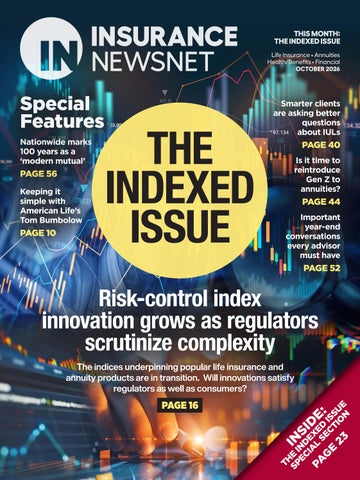
THIS MONTH: THE INDEXED ISSUE Life Insurance • Annuities Health/Benefits • Financial OCTOBER 2026
Special Features Nationwide marks 100 years as a ‘modern mutual’
PAGE 56 Keeping it simple with American Life’s Tom Bumbolow
PAGE 10
THE INDEXED ISSUE
Smarter clients are asking better questions about IULs
PAGE 40 Is it time to reintroduce Gen Z to annuities?
PAGE 44 Important year-end conversations every advisor must have
PAGE 52
Risk-control index innovation grows as regulators scrutinize complexity PAGE 16
TH SP E IN EC IND S I E I PA AL XE DE G SEC D IS : E 23 TIO SUE N
The indices underpinning popular life insurance and annuity products are in transition. Will innovations satisfy regulators as well as consumers?
Nasdaq-100® Index:
How innovation, market leadership, and strategic partnership have made Nasdaq-100 Index® a trusted provider of next-generation index solutions.
Building tomorrow’s markets: Inside Nasdaq’s blueprint for collaborative, outcome-driven index solutions.
Page 37
Looking for more insights? Explore Nasdaq Insurance Index Solutions
Scan to learn more
Streamline your outreach effortlessly. Track all active marketing initiatives, manage prospect responses, and monitor lead activity in one interactive, centralized hub. Industry-Leading Technology Gain a distinct market advantage with proprietary software and exclusive sales tools like LifeLink™ and The Tools You Need AnnuiBusiness tyLink™. for the You Want Work Smarter. Serve Better. Scale Faster… Introducing the Simplicity Agent Center
On-Demand Education and Dedicated Support
Access our expansive library of educational webinars and materials anytime; Engage with the Simplicity Sales Support team for quoting, il ustration, and advanced support.
Your time is best spent advising clients and growing your practice. The Simplicity Agent Center is your all-in-one command center, purpose-built to streamline your daily operations, sharpen your competitive edge, and scale your business with total clarity. Exclusive Single-Sign-On Resources Designed to Drive Growth: Inforce Action Center Turn policy servicing into growth opportunities. Automatically highlights top revenue and engagement possibilities within your existing book of business.
Ready to Transform Your Workflow?
My Marketing Campaigns
Streamline your outreach effortlessly. Track all active marketing initiatives, manage prospect responses, and monitor lead activity in one interactive, centralized hub.
Take control of your business with the platform designed for high-performing financial professionals. Visit SimplicityAgentCenter.com Industry-Leading Technology
Gain a distinct market advantage with proprietary software and exclusive sales tools like LifeLink™ and AnnuityLink™. On-Demand Education and Dedicated Support
Access our expansive library of educational webinars and materials anytime; Engage with the Simplicity Sales Support team for quoting, illustration, and advanced support.
Ready to Transform Your Workflow? Take control of your business with the platform designed for high-performing financial professionals. Visit SimplicityAgentCenter.com
© 2026 Simplicity Group. All Rights Reserved. For financial professional use only. NOT FOR PUBLIC DISTRIBUTION. 5820642-0826 © 2026 Simplicity Group. All Rights Reserved. For financial professional use only. NOT FOR PUBLIC DISTRIBUTION. 5820642-0826
SMART START Accumulator Series
Because first impressions are everything. Start smarter. Grow stronger. Help clients start their accumulation journey with confidence with the Smarter Start Guarantee which provides a guaranteed minimum index credit on all first-year allocations and eliminates the concern of a first-year zero.1 Smarter Start Guarantee Effortless portfolio allocations Leading indices
See how Smarter Start Guarantee works Scan to watch a short video
1) The Custom Portfolio allocations are not eligible for the Smarter Start Guarantee. Smarter Start Guarantee is only available for the first-year segment term allocations, subsequent years will be at 0%. Forms Series: FIA25; ICC25; PER25; WSR25-D; WSR25-CT; AFWR25; MVA24; SRR25 (Forms may vary by state). When a person buys this annuity, the person is not buying an ownership interest in any stock or index. American National Insurance Company, headquartered in Houston, Texas, is licensed to conduct business in all states except New York. For Agent Use Only; Not For Distribution or Use With Consumers. Not FDIC/NCUA insured / Not a deposit / Not insured by any federal government agency / No bank/CU guarantee / May lose value AMERICAN NATIONAL INSURANCE COMPANY / 888-501-4043 / lad.americannational.com LAD10910_INN / 09.26
IN THIS ISSUE
View and share the articles from this month’s issue
» read it online InsuranceNewsNet.com/magazine
OCTOBER 2026 » VOLUME 19, NUMBER 8
FEATURE
Risk-control index innovation grows as regulators scrutinize complexity
16
By John Hilton Record-breaking demand from an aging population and a volatile stock market continues to push indexed insurance products into the financial mainstream.
HEALTH/BENEFITS
48 Why benefits brokers should rethink the LTC conversation By Adam Bezman
Long-term care is a workforce issue, and it is already impacting the employees sitting in their offices today.
ADVISORNEWS
52 Important year-end financial conversations every advisor must have By Tyler de Haan
INTERVIEW
10 K eeping it simple
Tom Bumbolow, head of distribution and business development at American Life, talks about the need to keep annuities easy to understand and the importance of listening to agents and clients.
23 2026 Indexed Special Section The latest perspectives, tools and tech in the indexed markets space.
40 Smarter clients are asking better questions about IULs
IN THE FIELD
20 A partner on life’s financial journey By Susan Rupe
Leah West believes that proactive planning is the foundation of building each client’s financial house.
By Joe Templin
Why clients often succumb to bad advice from family members and popular talking heads.
One-third of young investors said lack of guaranteed income is their biggest concern when it comes to retirement planning.
It puts you in the role families need most in their hardest moment — the person who spared them from having to make decisions.
BONUS FEATURE
56 N ationwide marks 100 years as a modern mutual By Susan Rupe
The iconic brand reflects on its beginnings while looking ahead to serve the 21st-century consumer.
By Rayne Morgan
By Adam Sheer
54 ‘Prebunking’ the sales killers before they attack
When consumers realize you’re there to educate rather than pressure, the energy in the room changes.
44 I s it time to reintroduce Gen Z to annuities?
39 Why funeral preplanning belongs in your practice
BUSINESS
By Amber Allen
ANNUITY
LIFE
A few important items to add to your year-end to-do list to help your clients reflect on their financial goals and have important financial conversations.
IN THE KNOW
60 Harnessing, cultivating and profiting from centers of influence By Michael Babikian
Building COI relationships requires relevance, trust and credibility.
INSURANCENEWSNET 20 Erford Road • Suite 304 • Lemoyne, PA 17043 717.441.9357 www.InsuranceNewsNet.com PUBLISHER EDITOR IN CHIEF, MAGAZINE EDITOR IN CHIEF, WEBSITE MARKETING DIRECTOR
Paul Feldman Susan Rupe John Hilton Jenn Becker
SENIOR CREATIVE DIRECTOR EMAIL & DIGITAL MARKETING SPECIALIST MARKETING MANAGER SALES OUTREACH SPECIALIST EDITORIAL ASSISTANT
Jacob Haas Megan Kofmehl Sorayah Talarek Isabella Bonvisuto Noah Lopez
DIRECTOR OF SALES NATIONAL ACCOUNT DIRECTOR NATIONAL ACCOUNT DIRECTOR STAFF ACCOUNTANT
Ashley McHugh Brian Henderson Tobi Schneier Katie Turner
Copyright 2026 Insurance & Financial Media Network. All rights reserved. Reproduction or use without permission of editorial or graphic content in any manner is strictly prohibited. How to Reach Us: You may e-mail editor@insurancenewsnet.com, send your letter to 20 Erford Road, Suite 304, Lemoyne PA 17043, fax 866.381.8630 or call 717.441.9357. Reprints: Copyright permission can be obtained through InsuranceNewsNet at 717.441.9357, Ext. 125, or reprints@insurancenewsnet.com. Editorial Inquiries: You may e-mail editor@insurancenewsnet.com or call 717.441.9357, ext. 117. Advertising Inquiries: To access InsuranceNewsNet Magazine’s online media kit, go to www.innmediakit.com or call 717.441.9357, Ext. 125, for a sales representative. Postmaster: Send address changes to InsuranceNewsNet Magazine, 20 Erford Road, Suite 304, Lemoyne PA 17043. Please allow four weeks for completion of changes. Legal Disclaimer: This publication contains general financial information. It should not be relied upon as a substitute for professional financial or legal advice. We make every effort to offer accurate information, but errors may occur due to the nature of the subject matter and our interpretation of any laws and regulations involved. We provide this information as is, without warranties of any kind, either express or implied. InsuranceNewsNet shall not be liable regardless of the cause or duration for any errors, inaccuracies, omissions or other defects in, or untimeliness or inauthenticity of, the information published herein. InsuranceNewsNet uses AI tools to assist in producing content and images, which are reviewed and edited by staff. Address Corrections: Update your address at insurancenewsnetmagazine.com.
Source: Federal Reserve
2
InsuranceNewsNet Magazine » October 2026
crease—Now 40%!
In Benefit Base Bonus
PAYOUTS ON THE
RISE! Issue Age
Benefit Base
Annual Projected Level Payout
Ranking1
60
$140,000
$7,448
#1
65
$140,000
$7,980
#1
70
$140,000
$8,512
#3
75
$140,000
$9,408
#1
80
$140,000
$10,220
#1
85
$140,000
$10,990
#1
Scan the QR code or visit www.ApexAdvantageIncome.com to discover how high your clients’ immediate income can be!
Top-tier immediate income at select ages as shown on AnnuityRateWatch.com.1 Competitive in all ages!
Look Now— Don’t Miss Out!
Assumptions: ApexAdvantage with FutureNow RiderSM,* single life, male, level payout, $100,000 premium, income starting in 32 days. All information is current as of 8/19/2026. 1. Rankings are based on comparison of similar products shown on AnnuityRateWatch.com from carriers with 10-year surrender schedules, excluding fee-based products, reducing benefits, and non-IMO-related products as of 8/19/2026.
800-395-1053, Ext. 4002 | www.LegacyNet.com In approved states, ApexAdvantage Index Annuity (Form ICC22 2707 with ICC22 2707-SCH or 2707 with 2707-SCH) and riders are issued by Ameritas Life Insurance Corp. (Ameritas) located at 5900 O Street, Lincoln, NE 68510. Products are designed in conjunction with Ameritas and exclusively marketed by Legacy Marketing Group®. Ameritas and Legacy Marketing Group are separate, independent entities. ApexAdvantage Index Annuities are modified single premium deferred annuities that offer a fixed interest option and index interest options. The index options are not securities. Keep in mind, your clients are not participating in the market or investing in any stock or bond. Policies, index strategies, and riders may vary and may not be available in all states. Optional features and riders may have limitations, restrictions, and additional charges. Product guarantees are based on the claims-paying ability of Ameritas Life Insurance Corp. Refer to brochures for additional details. ApexAdvantage is a registered service mark, and FutureNow Rider is a service mark, of Legacy Marketing Group. Ameritas® is a registered service mark of Ameritas Life Insurance Corp. Unless otherwise specified, any person or entity referenced herein is not an affiliate of Ameritas or any of its affiliates. * A Guaranteed Lifetime Withdrawal Benefit is available for a current annual charge of 1.25% for the FutureNow Rider and 1.35% for the FutureNow Rider With Booster, multiplied by the premium accumulation value during the accumulation phase and by the benefit base during the withdrawal phase. AL1401v0826_INN
FOR AGENT USE ONLY. NOT FOR USE WITH CONSUMERS.
WELCOME LETTER FROM THE EDITOR
Falling Leaves, Rising Numbers W
e are firmly in the “ber” months, and it’s time for InsuranceNewsNet’s annual look at indexed products. What we found is that the indexes driving today’s most popular annuity and life insurance products are evolving quickly, introducing new investment strategies, artificial intelligence and more advanced risk-control features into the market. However, as innovation progresses, regulators are raising concerns about whether certain index designs have become overly complex. They are also questioning whether aggressive back-tested performance projections might set unrealistic expectations for consumers. InsuranceNewsNet’s John Hilton delved into the world of life and annuity indexes and found indexed annuities and indexed universal life products continue to drive sales growth, fueled by retirees seeking protection from market volatility. More than 365 indexes are now available for insurance products, and the number continues to grow. But regulators are scrutinizing whether back-tested index performance may overstate future results and mislead consumers. In addition, industry experts debate how to balance innovation, transparency and consumer protection. Our feature explores what these developments could mean for insurers, advisors and consumers.
Also in October, InsuranceNewsNet brings the insights of two industry leaders. Tom Bumbolow joined American Life after a 20-year career at JPMorgan, where he helped to build its credit business. He took what he learned at JPMorgan and brought it to American Life, where he now serves as head of the company’s distribution and business development. American Life became the first insurance company to be entirely cloud based. This transformed the buying experience and allowed the company to continue its mission of providing simple, easy-to-understand products in an uncomplicated way. In this month’s Interview (page 10), Bumbolow discusses with Publisher Paul Feldman the need to keep annuities easy to understand and the importance of listening to agents and clients. Leah West has had a 30-year career working with clients as they navigate the twists and turns of life’s financial journey.
West
Bumbolow
4
As the owner and founder of Rivertown Financial in Stockton, N.J., West works with multiple generations of high net worth clients, helping them build their financial houses and keep them strong. Read about West’s philosophy of working with clients as well as her inspiring personal story in this month’s In the Field feature (page 20). It’s difficult to imagine a time in the U.S. when there were more cars than
InsuranceNewsNet Magazine » October 2026
tractors on farms. Farmers might have embraced the automobile enthusiastically in 1926, but these rural car owners had their own set of challenges — from driving on unpaved country roads to being unable to find affordable auto insurance coverage.
The Ohio Farm Bureau Federation stepped up to meet the need, offering auto insurance to farmers under the name Farm Bureau Mutual Automobile Insurance Co. From there, an iconic American insurance brand was born. Nationwide marks 100 years in business this year, growing to offer life and property/casualty insurance, as well as annuities and financial products, to a 21st-century consumer audience while remaining true to its rural roots and invested in its hometown of Columbus, Ohio. Read more about the company’s history and its view to the future in this month’s Special Feature (page 56). October is one of my favorite months of the year. If you’re lucky enough to live in a place that experiences colorful foliage and cool, crisp air in October, I hope you make the time to get outside and enjoy it. Susan Rupe Editor in Chief, magazine
Aim higher with Ascend annuities Our diverse portfolio of annuities is designed to help you and your clients aim higher. We offer fixed, fixed-indexed, registered index-linked and advisory annuities, all backed by the financial strength clients deserve. Superior ratings1 A++ by AM Best. AA by S&P. Stability Fixed income investments make up nearly 80%2 of our invested assets. Commitment to customers More than $15 billion in guaranteed income benefits paid since 2000. Scan the QR code to learn more about how we can help you.
AM Best rating of “A++” (Superior) affirmed on October 23, 2025. AM Best rating of “A++” is the highest of 16 ratings. S&P rating of “AA” (Very Strong) upgraded on February 20, 2025. S&P rating of “AA” is the 3rd highest of 21 ratings.
1
2
Data is as of December 31, 2025. Fixed income investments include bonds, cash, short-term investments and policy loans.
1012-ASC-34b
October 2026 » InsuranceNewsNet Magazine 2/26 5
IN CASE YOU MISSED IT
What’s in the news on InsuranceNewsNet.com Homeowners accuse the Texas Windstorm Insurance Association of secretly reducing claims, insurers’ rating firms push back on the National Association of Insurance Commissioners’ rating oversight plan, and a federal solution for rising home insurance costs could be in the works.
[Editor’s Note: These are some of the major stories to which we are devoting ongoing coverage at INN. Visit our website to sign up for our free newsletters at insurancenewsnet.com/subscribe and don’t miss another important story!]
Home insurance is in crisis: Could a federal solution be the answer?
By Anna Baluch Home insurance premiums have risen dramatically across the country, with homeowners in disaster-prone areas facing the steepest increases. “A myth I see repeated regularly is the idea that some people deserve to pay more for insurance because they chose to live in a risky place,” said Moira Birss, senior fellow at the Climate and Community Institute. According to Birss, this point of view
is problematic for a number of reasons. First, climate risk is rising everywhere. If it’s not wildfires or hurricanes in your area, it could be hail, floods or landslides. Second, your ability to choose where you live is often constrained by things like where your job or family is located, or where you can afford the rent or mortgage. You may also have moved somewhere long before disasters were as frequent as they are today, and are now stuck.
“A myth I see repeated regularly is the idea that some people deserve to pay more for insurance because they chose to live in a risky place.” 6
InsuranceNewsNet Magazine » October 2026
“The only ones who truly get to choose where they live are the rich,” Birss explained. That’s why the Climate and Community Institute proposes a federal solution to the home insurance crisis: a collective protection system in which risk is shared and Americans recognize that disasters affect us all, especially as climate change worsens. Unless policymakers prioritize making housing safer and helping us pool our shared exposure to disaster risks rather than trying to rescue insurance companies, the crisis will continue, the institute said. The institute is promoting a holistic approach through a proposed National Housing Resilience Agency. The agency would aim to reduce disaster risk by moving away from fossil fuels to limit further climate change while also investing in measures to make homes more resilient, the institute said. It would also help spread out the costs of disasters so that all U.S. homeowners have adequate financial protection when they need it, because the reality is that everyone faces disaster risk, no matter where they live, the institute said. The controversial proposal would establish a single-payer national disaster insurance and risk mitigation program. Critics, insurance industry stakeholders and fiscal analysts raise significant concerns regarding this model. Read the full story online: https://bit.ly/homecrisis26 Anna Baluch is a finance reporter and writer with more than a decade of experience. Contact her at anna.baluch@innfeedback.com.
TOP PICKS FROM INSURANCENEWSNET.COM
Insurers, rating firms push back on NAIC credit rating oversight plan By John Hilton Regulators received about 90 pages of pushback from insurers, credit rating agencies, trade groups and other stakeholders on their plan to step up oversight of credit rating agencies. The Credit Rating Provider Working Group met at the National Association of Insurance Commissioners’ summer meeting in Columbus, Ohio. The panel is considering a due diligence process for evaluating the credit rating providers whose ratings insurers rely on to determine regulatory capital requirements. Regulators want to end the blind reliance on external credit rating agencies to help ensure that insurance companies are not hiding high-risk assets behind inflated credit grades. Industry ratings have come under fire recently for a variety of reasons. Jake Garn is director of the Financial
Regulation and Licensing Division at the Utah Insurance Department. He also chairs the working group. “Neither the NAIC nor the framework will tell [credit ratings providers] what their methodology must be or how to do their jobs,” Garn said at the outset of the meeting. “The framework is simply the NAIC taking another step in becoming more responsible,
By John Hilton A new lawsuit accuses the Texas Windstorm Insurance Association and several outside adjusting firms of orchestrating a racketeering scheme that allegedly reduced Hurricane Beryl insurance payouts. The plaintiffs, who seek class-action status, allege that TWIA and the adjusting firms secretly altered damage estimates after inspections. “Defendants devised and executed a scheme to obtain money and property — namely, reduced claim payments that TWIA would otherwise have been obligated to pay — by means of material false pretenses, representations, and omissions,” the lawsuit reads. The complaint, filed in the U.S. District Court for the Southern District of Texas, alleges that the defendants violated the federal Racketeer Influenced and Corrupt Organizations Act by using
interstate electronic communications and mail to conceal revisions that lowered claim payments to policyholders following the July 2024 hurricane. The plaintiffs — Ernestine Bell, Alicia Stuart and David Mohun — contend that field adjusters initially prepared estimates reflecting the damage to their homes, but those estimates were later electronically modified by other personnel, reducing covered repair costs before payments were calculated. “It is TWIA’s practice not to comment on active or potential litigation,” Aaron
educating users of ratings, and in doing so, aligning ourselves with the purpose and objective of the 2006 Credit Rating Agency Reform Act.” The proposal will not improperly regulate nationally recognized statistical rating organizations, or NRSROs, a responsibility reserved for the Securities and Exchange Commission, Garn said. Regulators said no action will be taken on the proposal until regulators review the comments and work with staff and consultant PwC to prepare a revised draft. Read the full story online: https://bit.ly/naicrating26 InsuranceNewsNet Senior Editor John Hilton has covered business and other beats in more than 20 years of daily journalism. John may be reached at john.hilton@innfeedback.com.
Homeowners accuse Texas windstorm insurer of secretly reducing claims
Taylor, spokesman for TWIA, told InsuranceNewsNet. “The association’s claim-adjusting procedures are compliant with applicable Texas and federal laws.” Read the full story online: https://bit.ly/txwinds26 InsuranceNewsNet Senior Editor John Hilton has covered business and other beats in more than 20 years of daily journalism. John may be reached at john.hilton@innfeedback.com. Follow him on X @INNJohnH.
October 2026 » InsuranceNewsNet Magazine
7
NEWSWIRES
INTERVIEW
Actuaries look at the impact of wildfires
As wildfires occur more frequently, research shows that breathing wildfire-related particulate matter is as hazardous to health as smoking cigarettes. The potential health impact of wildfire smoke is driving a rise in chronic health crises, with implications for life and health insurance. The Society of Actuaries researched the impacts of wildfire-related air pollution on mortality and morbidity in the wake of Canadian wildfires that brought dangerous air quality to more than 100 million people across the United States over the summer. As more wildfires from Canada bring smoke into heavily populated areas of the northeastern and midwestern U.S., hospitalization rates for smoke-related ailments rise, said Aadit Sheth, pricing actuary at PartnerRe, and those rising hospitalization rates should concern health insurers. Health insurers may consider integrating climate risks into actuarial models, the researchers said. Traditional risk assessments may underestimate the growing healthcare burden of climate change. Incorporating climate-adjusted predictive modeling could improve financial projections and premium pricing strategies.
Q U O TA B L E I don’t know what we’re restricting currently with the rate policy that we’re at today.” — Kansas City Federal Reserve President Jeffrey Schmid
Functional unemployment across the U.S. has climbed for four straight months and stood at 24.9% as of July, down from 25.2% in December, according to the Ludwig Institute.
‘FUNCTIONAL UNEMPLOYMENT’ ON THE RISE
The nation’s unemployment rate is a percentage that is thrown around each month, but there’s another rate of note: the percentage of Americans who are “functionally unemployed.”
COULD THE S&P 500 HIT 8,000 THIS YEAR? 25% DON’T TOUCH SAVINGS IN FIRST 5 YEARS OF RETIREMENT
One in 4 retirees never touch their savings in their first five years of retirement, Vanguard research revealed. Vanguard studied 70,000 people aged 60 or older over the five years after they left an employer. The research included the bulk of their Vanguard-held assets across 401(k)s, individual retirement accounts and taxable accounts. Half took withdrawals, although not on a regular schedule. About one-quarter left their savings untouched, while the remaining quarter cashed out entirely within their first year. DID YOU
KNOW
?
8
The Ludwig Institute for Shared Economic Prosperity defines those who are functionally unemployed as not only people who are unemployed and looking for a job but also those who are involuntarily working part time and earning poverty-level wages, or less than $26,000 annually before taxes.
Baby boomers are collecting 265% of what they paid into Social Security. Source: Committee for a Responsible Federal Budget
InsuranceNewsNet Magazine » October 2026
Traders on prediction market platform Kalshi now see about a 66% chance that the S&P 500 hits 8,000 in 2026. Those high odds come after the broad index surged more than 5% over just four sessions as the artificial intelligence trade reignited after a slump in late June and July. Odds that the S&P 500 marches even higher are rising, too. Kalshi traders now place a 1-in-3 chance to cross 8,200 this year. The contracts on Kalshi ask speculators whether the S&P in 2026 will trade above various levels. The platform uses Google Finance to resolve the contracts.
A Different Way to Compete Rates move quickly. Retirement decisions last decades. Competitive products are only part of the equation. Disciplined, long-term management is designed to support long-term product performance.
98.2%
10.8%
Since launching Harbourview FIA in January 2021, renewal cap rates across all contracts have averaged 98.2% of initial cap rate. This reflects historical experience and is not a guarantee of future renewal rates.
A portion of contracts received higher cap rates at their renewal anniversary dates, reflecting responsiveness when market conditions improved.
October 2026 » InsuranceNewsNet Magazine
9
INTERVIEW
Keeping it simple An interview with Tom Bumbolow, head of distribution & business development at American Life, by Paul Feldman, publisher
10
InsuranceNewsNet Magazine » October 2026
KEEPING IT SIMPLE — WITH TOM BUMBOLOW INTERVIEW
A
merican Life isn’t exactly a household word, and that’s exactly how Tom Bumbolow, head of distribution and business development, wants it. The company, founded in 1960, partnered with FAST, a digital platform, in 2018. This made American Life the first insurance company to be entirely cloud based. This transformed the buying experience and allowed the company to continue its mission of providing simple, easy-to-understand products in an uncomplicated way. Bumbolow joined American Life after a 20-year career at JPMorgan, where he helped build its credit business. He started in credit derivatives, which morphed into funds, structured credit and cap structure, statistical arbitration and correlation trading. He took what he learned at JPMorgan and applied it to American Life as the company’s leadership rebuilt the carrier. In this interview with InsuranceNewsNet publisher Paul Feldman, Bumbolow talks about the need to keep annuities easy to understand and the importance of listening to agents and clients. PAUL FELDMAN: American Life is a name that not everyone’s familiar with in the marketplace. Tell me about the formation of the company over the past several years and your vision for the future. TOM BUMBOLOW: We took a different approach. There has been a lot of talk and a lot of activity around the convergence of asset management and insurance. We saw that opportunity a while back, and we thought about acting in a different way. For every large deal that was getting done, there were probably 20 or 30 other asset managers who were involved and wanted to access these liabilities but didn’t get the opportunity. They didn’t know if they wanted to start their own insurance company, so we saw that as demand for liabilities. We saw the annuity space as a growing opportunity, somewhere we could come in and provide products that add value to retirees. If you think about it — and that’s a correlation back to my old life — it’s looking at risk on two different fronts:
finding buyers of that risk and sellers of that risk, and finding unique ways to put them together. As we started the company, we had an open investment infrastructure. We productized our liabilities through reinsurance. Asset managers were looking for these nonmarket long-term liabilities, and we, on the other hand, were just starting, building a company, and needed capital to continue to grow and scale. So we used reinsurance strategically to get our business up and off the ground. FELDMAN: How does your trading background influence product development and crediting rates? I think that is a big part of American Life’s foundation. BUMBOLOW: If you think about it, at the end of the day, carriers are borrowing money from retirees, right? That’s kind of what we’re doing, and you have two
If you think about being an asset manager and you’re getting compensated with more yield for shorter-term risk than you are for longer-term risk, and if you have a mindset around matching your assets and liabilities, it was a perfect storm. What we were selling was in three-year and five-year duration, and what those folks were looking for were liabilities with similar duration because all the assets that they were investing in the front end as well. I’ve been a student of the space, and I will continue to be a student of the space. I’ve learned a lot in the years I’ve been involved here and hopefully will keep learning. That excitement is what drives me every day. Understanding where the annuity market is, what retirees are looking to buy, what riders matter, what duration matters — that helps inform and set where we turn around and deploy the capital. Whether it’s private credit, structured credit,
We’ve been focused on service, we’ve been focused on renewal rates, and we’ve been focused on really thoughtful and intentional growth so we don’t outrun our capital. choices at that point. You go and invest that money — and hopefully you earn a rate that’s greater than the rate that you owe back to the retirees — or you can lend it out through reinsurance and bring in best-in-class institutional asset management. If you understand the way you can deploy capital, you can then turn around and be more mindful about how to procure that capital for the company. A direct example is, as we were getting started and interest rates kind of took off back around 2021 to 2023, multiyear guaranteed annuities were really in favor. It wasn’t necessarily just the increase in interest rates; it was the velocity of the increase in interest rates. Multiyear guaranteed annuities were at 2 1/2%, and then all of a sudden they went up to 5% or 6%. That was kind of a perfect storm for us, in that the yield curve was also inverted at the same time.
investment grade — all the different kinds of asset classes that pertain to any insurance space — the better we understand both sides in a model like ours that uses around 70% reinsurance, the better we can create a product and then match it with someone who’s looking to take on that risk, and mitigate as much of the risk as possible. FELDMAN: Your company started in the MYGA space, then you started developing indexed products. What about registered index-linked annuities? Are you into that at the moment, or do you plan to be? BUMBOLOW: That’s one of the fastest-growing products out there, and we’re certainly watching it. But I think we’ve been intentional with our growth, and I would say a lot of new carriers have hit the market over the past couple of years
October 2026 » InsuranceNewsNet Magazine
11
INTERVIEW KEEPING IT SIMPLE — WITH TOM BUMBOLOW
Thomas Bumbolow (second from right) reacts to a comment by Sky Opila of Zinnia during a panel discussion at the LIMRA Life Insurance and Annuity Conference, held April 2026 in Tampa, Fla.
and there are probably more to come right behind them. We’ve been thoughtful with our growth. We’ve chosen our independent marketing organization partners carefully. We’ve stuck with those partnerships for the past five or six years. We’ve been thoughtful about slow but steady progression and the idea that we’re here for the long haul. I’m not interested in premium for one or two years. I’m not here to flash a fancy crediting rate and then next year drop rates down by a ton. We’ve been focused on service, we’ve been focused on renewal rates, and we’ve been focused on really thoughtful and intentional growth so we don’t outrun our capital. Right now, we offer a MYGA and we’re in accumulation fixed indexed annuities. There are a number of things that we can do to continue to grow. We’ve been committed to our financial strength, and you know the progression of rating for with AFS and to be moving in a positive light in that regard too. So it’s not just about writing as much premium as you can in a given year. It’s about profitability. It’s about capital. It’s about building sustainable business. We’re excited about the opportunity in front of us. We have states we can launch into. We’re in only 31 states right now. We have new products we can launch and potentially expand our distribution 12
into new channels as our ratings continue to progress. So the future is bright. Last year, we wrote about $1.5 billion in 25 states with nine IMOs. It shows what could be accomplished, but we’re not going to run out after that. We’re going to be thoughtful. We’re going to work with our distribution partners,
their clients, because everyone’s trying to do the best for their clients? BUMBOLOW: We have a fiduciary responsibility, and we take that responsibility seriously. Our business has grown, and our success has been driven first and foremost by service. We focus on that experi-
“If you think about it, at the end of the day, carriers are borrowing money from retirees, right? ... You had better know what we’re investing it in and how we’re investing it, how much leverage we’re taking, how we’re protecting the capital, and how much capital we’re reserving against it.” our agents, our IMOs, and understand where they believe the puck is moving. Think about the asset allocation strategy and how that may or may not fit with the liabilities that we’re bringing in, and pick our spots and try to be as consistent as humanly possible. FELDMAN: What would you say to an advisor who may not be familiar with your portfolio? Why should they choose you, and why does that make sense for
InsuranceNewsNet Magazine » October 2026
ence that the agent has when they come into a carrier — whether that’s around things such as policy administration, suitability, regulation — or if it’s around crediting rates. As I said earlier, we’ve tried to be thoughtful about renewal rates and to maintain that integrity as best we can. It’s about listening to and connecting with our agents and our IMO partners to understand what that process is all about. We didn’t go guns blazing into the annuity space. We were slow and steady and
KEEPING IT SIMPLE — WITH TOM BUMBOLOW INTERVIEW Retirement is increasingly defined by a secure income stream
1
Your # Source for ANNUITY NEWS Lack of digital tools drives wedge between insurers, advisors
How annuities can help protect retirees from financial scams
NAIC regulators continue pushing for annuity illustration updates
Get the latest news and insights delivered to your inbox! Sign up for our FREE newsletters at:
insurancenewsnet.com/manage-subscription
October 2026 » InsuranceNewsNet Magazine
13
INTERVIEW KEEPING IT SIMPLE — WITH TOM BUMBOLOW
“These products are sold; they’re not bought. People need to be educated about these products. They’re large chunks of an individual’s or a family’s earnings over their lifetime. To think about selling that with one click and not having a relationship with the customer and talking through risks and suitability — I find that hard to believe.”
thoughtful. We wanted to understand what drove buyers, the things they cared about, what agents cared about, and we founded our company based on that. Imagine having that conversation and having to go back to that kitchen table and explain why your F rate just dropped four points, or why you know you might want to shift out of this company because you know they outran their capital or their ratings are going down or all these different things that can happen. So again, we wanted to have simple products. We wanted a lot of embedded value. We think that we uniquely attack the insurance value chain by aligning asset managers that are specialized in their 14
areas of expertise. That’s going to create a little bit of alpha to it. Fewer defaults, better returns over time. In that, we can provide better rates to our annuity holding, so aligning those two, explaining how we’re growing, explaining the pace at which we’re growing and listening because we’re not going to get it all right on Day 1. This idea of connection is strong with us: the connection with our asset management partners, the connection with our capital partners and their connection with our distribution partner. FELDMAN: Someone told me recently that carriers don’t understand what the consumer wants, what the buyer
InsuranceNewsNet Magazine » October 2026
wants. They said most of the carriers just ask what the IMO wants. And it doesn’t filter down as much to the agents because IMOs, to some degree, have a lot of control over product selection and other things. How do we as an industry communicate better with clients and prospects? BUMBOLOW: There are a lot of competing interests out there. How do you make sure that you’re focused on the bottom line — which is the annuity holder — what they need and what’s available to them? There’s a need for more education across the entire landscape, and that falls on the carrier, that falls on the IMO, that falls on the agent. I think we’ve made a lot of progress. But I think the education process must continue to improve. One product can’t be everything to everyone. We built something into our products, which we describe as a kind of loyalty bonus. If I can give an asset manager more certainty of having that capital for the full duration, that’s valuable. They know that if I am able to guarantee that they have this capital for five, 10 years, that’s valuable. Because it’s not like a bank loan or some of these other things that go away or have to be refinanced every year or every six months. If I can give them more certainty about that, then that’s valuable to them, and I need to find a way to give that back to the policyholder. So we’ve done that in a loyalty bonus. You buy one of our MYGAs, you go on to one of the crediting websites that are out there and you’ll see two different rates. You’ll see the liquidity rate and the nonliquidity rate. It’s the same product, but the idea when we created our MYGA product was that clients shouldn’t have to choose between liquidity and yield. That’s the constant struggle in the annuity space. How much liquidity will I need? Well, it depends. Is COVID-19 going to come back? If everything is normal, I’m pretty sure I know what I’ll need. But what if? So the way our MYGA product works is, if you stay within your required minimum distributions for the duration of the period, you get a bonus at the end. Call it a loyalty bonus. Same thing with our FIA product. If you hold liquidity through the end, you get a bonus on the accumulated value at the end of the surrender charge period as well. So it’s trying
KEEPING IT SIMPLE — WITH TOM BUMBOLOW INTERVIEW to line that up and provide some flexibility within the contract. Our clients say, “I don’t know what I’m going to need. I think this is what the outcome will be over the next five, 10 years, but I don’t know.” So we try to embed that within the product and give the client two paths, depending on whatever life throws at them, and explain that upfront. We have another product that takes a lot of liquidity out of it, accrues the interest credit but pays a much higher crediting rate. So if there’s a client who wants to put a throttle down on the crediting rate but isn’t as concerned with liquidity, that fits them much better. Again, we’re listening to the space and to the buyers out there. What do they care about? How can we offer your fantastic indexes to get to diversification? How can we create products around what they need while also meeting the asset management side? FELDMAN: Tell us how you’re using technology and innovation at American Life. BUMBOLOW: We’ve looked at technology since Day 1, and I think that’s been one value proposition we offer to our agents and clients. We are thinking about implementing artificial intelligence and how we can make the agent experience and the customer experience smoother. That being said, we’re an annuity company and we don’t have the largest balance sheet in the industry. So we’re not going to be the first one out there that tries all these different things. Sometimes it pays to follow some of these things. We’ve already implemented some artificial intelligence on the operations side. We’re also looking at using the app as a training tool for call centers. I think there are a lot of other opportunities to come. I think the key to technology in the industry is connected to our partners. We take the approach of getting to know our clients as well as we can and building together. FELDMAN: As a smaller company, how do you gain attention in the marketplace? Everybody’s fighting for shelf space, and there’s only so much bandwidth.
BUMBOLOW: Even though it’s a competitive landscape, this is still a relationship business. I believe consistency matters. And when you have a lot of new entrants to the space, understanding their motivation and what drives them is important. We focus on simplicity. We focus on service. We focus on the connection and putting out value. We’re not here to write as much business as we possibly can but to listen to what customers need. FELDMAN: Where do you think the puck will go in the next three to five years? Will we have new product categories? BUMBOLOW: The only thing I can tell you is I don’t know. Again, it’s about listening. That connection is tantamount to our growth and our success. When I listen to our partners, I see a distribution effort that is trying to sell more product to the same person. I see folks who are trying to maximize the number of contracts for households. I sell life insurance. Can I sell them an annuity? Can I move their exchange-traded fund money? What about their investments in retail private credit? But if I run out of things to offer, they’ll call someone else. Instead of having them call four different people for those products, why can’t they just call me? I see IMOs setting up that way. IMOs and insurance agents are becoming registered investment advisors; RIAs are becoming insurance agents. Those lines seem to blur every day. FELDMAN: What do you think about direct-to-consumer channels for MYGAs? BUMBOLOW: These products are sold; they’re not bought. People need to be educated about these products. They’re large chunks of an individual’s or a family’s earnings over their lifetime. To think about selling that with one click and not having a relationship with the customer and talking through risks and suitability — I find that hard to believe. I see the value that our IMOs and our agents create for our clients, and it’s tremendous. So I don’t really see that going away. But we have fee-based clients, and we want to be able to offer those products to our RIA-based agents as well.
FELDMAN: I think that using AIenabled advisors is the best of both worlds. BUMBOLOW: You have to embrace AI and use it as a tool. I think it is a tool and not a replacement for the advisor. FELDMAN: Is there a question that I didn’t ask that I should have? BUMBOLOW: I think about understanding who you’re doing business with. I don’t care if you’re rated A-plus or B-plus. We’re borrowing money for retirees and we’re investing it. You had better know what we’re investing it in and how we’re investing it, how much leverage we’re taking, how we’re protecting the capital, how much capital we’re reserving against it, you know, who we’re using on the asset management side to help. Those are all questions that I think are fair game for an agent to ask their carriers. How are you attacking this space? Why should I be doing business with you? What’s your value proposition versus the other carriers out there? And how do I know you’re going to be around in five years? Those are all really valid questions. At the end of the day, we’re trying to create products that benefit retirees. We’re trying to protect those retirees, and we’re trying to create new and innovative products that will be helpful to them. That will be here for the long haul. So it’s about understanding each part of the value chain: the provision, the asset management side, the carrier side, and making it as seamless as you possibly can between those three. We’re doing it slow and steady, which sometimes is frustrating for a Type A personality who wants to go out there and just kill it. But we’re doing it in a way that is more thoughtful and more sustainable for years to come. That’s the plan. We’re trying to build and grow together, and we’re really excited about what’s in front of us. Scan the QR code to view the full video interview online now on our YouTube page.
October 2026 » InsuranceNewsNet Magazine
15
COVER STORY
Risk-control index innovation grows as regulators scrutinize complexity The indices underpinning popular life insurance and annuity products are in transition. Will innovations satisfy regulators as well as consumers? BY JOHN HILTON
16
InsuranceNewsNet Magazine » October 2026
R
ecord-breaking demand from an aging population and a volatile stock market continues to push indexed insurance products into the financial mainstream. New data from LIMRA and Wink Inc. shows that indexed designs are driving the dominant share of new life insurance and annuity premium growth. The surge comes as a massive wave of retiring Americans seeks wealth-management tools that pair stock market growth potential with absolute protection against market downturns. The data paints a relentlessly rosy picture of indexed dominance:
» The total number of indexed universal
life policies sold grew 5% during the second quarter and sales hit $2.2 billion for the first half, LIMRA reported. Sales are flat due to explosive 17% growth to $4.5 billion in full-year 2025.
» Wink reported $30.1 billion in sales of pure indexed annuities in Q2 and another $22.1 billion in structured, or registered, index-linked annuity sales. RILA sales topped the previous record-setting quarter by 3.5%, Wink said.
The competition for sales is intense, said Sheryl Moore, founder and CEO of Wink and Moore Market Intelligence, and is being felt throughout the industry. “It is harder than ever to break into the independent agent distribution for indexed annuities,” she Moore said. “We have startup insurance companies with aggressive features, insurance companies that have been funded by marketing organizations, increasingly competitive features offered by insurance companies with private equity ownership and a couple of handfuls of marketing organizations developing their own products.” In response to consumer demand, the index market continues to innovate as asset managers and insurers develop new ways to manage market risk, blend active and passive strategies, and use emerging technologies such as artificial intelligence. Indexed products remain popular for
RISK-CONTROL INDEX INNOVATION GROWS COVER STORY a couple of reasons, said Laurence Black, founder of The Index Standard, an independent research firm providing ratings, forecasts Black and analysis. For starters, they offer good value for investors and future retirees to manage volatility. Second, an indexed product adds diversification to a portfolio, he explained. “I think that by offering a multi-asset risk control index or offering some diverse exposures — whether it’s international equities, gold or commodities — that allows the end consumer to build a more holistic portfolio to get a more consistent return,” Black said. The Index Standard counted roughly 365 different indices in the market as this issue went to print. “And it’s growing every single month,” said Trent McKinnon, vice president at The Index Standard. McKinnon The index developments come as insurance regulators, mainly the National Association of Insurance Commissioners, take a closer look at the complexity of indexes and the use of historical back-tested performance in annuity illustrations.
Emerging focus on budgeting
The dozens of new indexes hitting the market each year include a wide range of technologies, strategies and options available to insurers and consumers. One emerging approach is “variance budgeting,” which McKinnon said can provide a more cost-effective way to track an underlying benchmark. “So when you get those really big rebounds, you’re not really backed out; one still has exposure to the underlying index,” he explained. “You’re able to basically capture that very large and sharp recovery where you historically had not been able to.” The approach is being used in an index known as the S&P Distance Stabilizer, Black noted. Available since September, the Distance Stabilizer is a custom volatility-controlled index developed by S&P
Dow Jones Indices in collaboration with Société Générale. It is primarily designed as a crediting option inside modern fixed indexed annuities and indexed universal life insurance policies. That index structure can be particularly important following steep market declines, when some risk-control strategies can reduce exposure at the same time as the market begins a rapid recovery. Another emerging trend is the blending of active and passive investment strategies, Black said. Active funds and exchange-traded funds increasingly are being wrapped in risk-control features and incorporated into annuity products. The approach can give consumers access to active management while using risk controls to stabilize the cost of the underlying exposure. “It’s kind of like the best of both worlds,” Black said. The analysts said they have seen four or five such products emerge and expect more to follow.
Indexes grow more complex
The expansion of index strategies is raising further questions about whether greater complexity actually benefits consumers. The Index Standard is using an internal complexity score to evaluate hundreds of indexes, examining factors such as the number of signals, allocation methods, how quickly allocations change, the use of market regimes and additional risk-control features. If anything, newer indices are showing slightly less complexity than they did during the ultra-low-rate environment of a few years ago, McKinnon said. But that does not mean that complexity has completely gone away. “The different forms of complexity are not necessarily extreme,” McKinnon said. Indexes include traditional benchmarks such as the Dow Jones Industrial Average and the S&P 500. Those indexes are relatively simple but can become more expensive to access, particularly when market conditions drive up the cost of options and other components used to construct annuity crediting strategies. The best place to be, McKinnon said, is “somewhere in the middle” ground in which an index has enough sophistication to manage risk without becoming overly engineered.
October 2026 » InsuranceNewsNet Magazine
17
COVER STORY
RISK-CONTROL INDEX INNOVATION GROWS
The complexity findings are influenced by the recent market environment, Black noted. Technology stocks and major equity benchmarks have performed exceptionally well during the past several years, making it difficult for risk-control strategies to keep pace with a largely upward-moving market. “If we’d been in a bit more of a choppy market, maybe the story would be a little bit different,” Black said.
Evolving in a competitive market
In June, Jackson National Life Insurance Co. became the first in the industry to introduce the Dow Jones Industrial Average as an index option with a RILA. The Market Link Pro 4 offers clients the ability to add funds to an existing contract while adding a guaranteed cap crediting method that locks in rates for six premium years. Jackson is not restricting which index options can be selected with each crediting method or protection option, enabling clients to adjust their allocations without triggering unwanted tax consequences. That Jackson is now an innovator highlights just how dynamic indexed offerings have become. A market leader in traditional variable annuities, Jackson was a late entrant in the popular RILA space, acknowledged Lemieux Matthew Lemieux, head of product and advanced planning solutions at Jackson. But since launching its Market Pro Link product line late in 2021, Jackson has become a top seller of RILAs. It’s an evolution sparked by consumer feedback and a dynamic competitive environment, Lemieux said. “We had the philosophy of making sure that as we introduce indices, as we introduce different crediting methods, different protection levels, we wanted to make sure that was an open platform, that we weren’t creating any restrictions, depending on what index you selected or what protection level you selected,” he added. In another new offering, announced as this issue went to press, Nationwide, Annexus and Capital Group partnered to add the American Funds Growth Fund 18
of America Class F-3 mutual fund to the Nationwide New Heights Select FIA suite. It makes New Heights Select the first FIA in the industry to include a strategy linked to an actively managed mutual fund. “This expansion brings financial professionals and their clients new opportunities for growth potential within a risk-managed solution that offers 100% principal protecLaiFook tion from market losses,” said Stacy LaiFook, vice president of Nationwide Annuity Business Development.
Regulators scrutinize backtesting
The explosive growth of indexed products comes as insurance regulators examine how much historical data should be required before newer indexes can be used in annuity illustrations. The NAIC Life Insurance and Annuities Illustrations Working Group is considering changes to its annuity illustration model amid concerns that backtested indexes can produce unusually high illustrated returns and potentially create unrealistic consumer expectations. Regulators began looking harder at annuity illustrations this year after learning that some products were illustrating as high as 27%.
InsuranceNewsNet Magazine » October 2026
The working group plans to address illustration length, disclosures, accountability and illustrated crediting rates before considering whether an interim actuarial guideline or other temporary measure is needed. Many insurers are using “proprietary” or custom-designed, managed-volatility indices. Because these indices are relatively new, they have little to no “live” market history. In order to illustrate products, carriers are using “backtested” or synthetic historical data. Regulators note these models are often engineered to look highly optimized, resulting in often deceptive projections that do not reflect actual forward-looking economic environments. Discussions have focused on how much history is needed to show responsible illustrations. On this issue, regulators seem set to come down hard. “It’s my opinion that illustrations or charts that are used to create unrealistic expectations in the minds of annuity holders are not only Ommen unfair and deceptive; they present a significant reputational risk to the entire business,” said Iowa Insurance Commissioner Doug Ommen during a September meeting of the working group.
“It’s my opinion that illustrations or charts that are used to create unrealistic expectations in the minds of annuity holders are not only unfair and deceptive; they present a significant reputational risk to the entire business.” DOUG OMMEN, IOWA INSURANCE COMMISSIONER
RISK-CONTROL INDEX INNOVATION GROWS COVER STORY
“The S&P, as great an index as it is, wasn’t really designed for modern annuities that rely heavily on options in their construction.” LAURENCE BLACK, FOUNDER OF THE INDEX STANDARD
Annuity illustration Model 245 initially required 10 years of history. In 2021, revisions were made allowing insurers to illustrate indices that had been in existence for fewer than 10 years under certain conditions. Some regulators want to require 20 years. Black said that goes too far to the other extreme. Having evaluated indexes for decades, he said three years of live performance can provide meaningful information about whether a new index is working as intended. A 20-year requirement could prevent newer technologies and investment approaches from reaching consumers, Black added. The analyst compared a 20-year-old index requirement to intentionally choosing old and slower technology. “If I said to you, ‘Would you be happy using a Nokia from 20 years ago?’ Not really, right?” Black said. “I want to use the latest smartphone with modern technology. Well, the S&P, as great an index as it is, wasn’t really designed for modern annuities that rely heavily on options in their construction.”
‘You do want to be open-minded’
The regulatory scrutiny has not stopped index innovation, Black added. Artificial intelligence, in particular, is beginning to appear more frequently in index construction. Some indexes use AI to select or weight stocks or to allocate among multiple asset classes. Black said he initially approached the strategies with skepticism, but some AI-based indexes have performed well in their evaluations. The firm is seeing several new AIrelated indexes each quarter, although the technology remains far from ubiquitous. “I think you do want to be open-minded to some of this new innovation that we’re seeing, and we’re monitoring it all
closely,” Black said. “We were skeptical, but it’s performed.” Risk-control indexes have generally lagged traditional equity benchmarks during the recent bull market, the analysts said. But that is not necessarily a sign that the strategies are failing to accomplish their intended purpose. The U.S. economy enters the late stages of 2026 facing deep structural vulnerabilities, as an expensive, AI-driven infrastructure boom masks underlying threats of persistent inflation and fiscal depletion. Speaking at the Federal Reserve’s recent annual economic symposium, Chairman Kevin Warsh warned that consumer prices remain stubbornly high, forcing the central bank to consider further interest rate hikes. This type of economic uncertainty is what risk-control indices were made Warsh for, Black said. “Now is the time to be thinking about them because if you’re worried about markets dropping, and markets are richly valued right now, this is an ideal time to have this type of index in your portfolio,” he explained.
More consistent returns
Risk-control indexes are designed primarily to reduce losses and smooth returns when markets become volatile rather than maximize returns during a sustained bull market. When volatility rises, these strategies typically reduce exposure to a risky asset like equities and shift some assets into cash or other less-risky investments. That can produce lower drawdowns and more stable performance during turbulent markets. The risk-control strategies could become more attractive if markets experience a significant downturn, particularly
after the strong gains of recent years. The ability to reset after market downturns is a particularly attractive quality, McKinnon noted. “It depends on the type of crisis that you’re dealing with,” he said. “If there’s a sharp fall in markets and a recovery, these products are built for that, as they protect your downside. You suffer that consequence of a zero return, but then next year, you reset.” A prolonged, multiyear bear market presents a greater challenge to generate returns, and this is where diversification is important, he added.
Focus shifts to annuity renewal rates
The industry is also seeing new tools aimed at giving consumers and advisers greater transparency into annuity products. One recently launched by The Index Standard called the FIA Product Evaluation assesses FIAs based on both carrier characteristics and the overall product quality, Black explained. The evaluation considers factors such as financial strength, service and renewal rates, as well as index quality, diversification, product benefits and potential performance of the underlying indexes. This can be used for Reg BI purposes or due diligence. Another tool focuses specifically on renewal rates. Annuity crediting terms can change over time. For example, a benchmark crediting strategy with a cap that begins at 12% could later decline to 10% or 5%, depending on the carrier and market conditions. The new analysis examines carriers’ historical caps and participation rates, using years of disclosed data to evaluate how crediting terms have changed throughout the life of an annuity. Many distributors are curious about how caps and participation rates evolve over time, Black noted. InsuranceNewsNet Senior Editor John Hilton covered business and other beats in more than 20 years of daily journalism. John may be reached at john. hilton@innfeedback.com. Follow him on X @INNJohnH.
October 2026 » InsuranceNewsNet Magazine
19
the Fıeld A Visit With Agents of Change Leah West helps multiple
generations of clients build their wealth while negotiating life’s twists and turns.
L
By Susan Rupe ife has its strange ways of throwing challenges at people. Leah West wants to navigate those challenges with her clients by serving as their financial director. West is the founder of Rivertown Financial, a wealth management firm in Stockton, N.J., that she established 17 years ago. With more than three decades in financial services, she is now serving multiple generations of high net worth clients. “I have a couple of families I work with now that I started working with the grandparent,” she said. “And then I’ve gone all the way down through three or four generations. I normally wouldn’t take on younger adults as clients because they’re just starting to learn about money. But as my clients’ children, I know they will come into a legacy, and I want them to understand that we have to build their financial house from the ground up.” West said that helping build that financial house for clients is about more than knowing the best fund in which to invest. “It’s about understanding the full picture,” she said. “I like to say that I work as my clients’ financial director so that when things come up — whether the water heater blew up or you need a new car or you’re changing jobs — whatever it is, you need to call me. We need to communicate about how that will affect you.” West believes that proactive planning is the foundation of building each client’s financial house. “Having a written plan is the start of it. But life changes, things come up. That plan is never written in concrete. It will always be modified or molded in a different way. So we start with that written plan. We also want to make sure that we go back to the basics. Do you have an emergency fund? Do you have the proper insurances? Do you have a trust? What happens if you become disabled?”
20
InsuranceNewsNet Magazine » October 2026
A PARTNER ON LIFE’S FINANCIAL JOURNEY — WITH LEAH WEST IN THE FIELD
THE what about THE what about rising expenses ANNUITY.
rising expenses ANNUITY.
Protective® Aspirations variable annuity. The variable annuity for the variables of lifeSM .
Protective® Aspirations variable annuity. The variable annuity for the variables of lifeSM.
The cost of retirement has risen 65% over the past 20 years.* Yet, many clients may not account for the rising cost of basic expenses. Protective Aspirations variable annuity with optional SecurePay Protector℠ lifetime income benefit may help.
The cost of retirement has risen 65% over It offers a 7% compounding roll-up rate and 6% guaranteed * the past 20atyears. income for life age 65 — providing a flexible retirement 1
2
income strategy with future growth potential to help prepare clients for clients the moments Yet, many may notahead. account for the rising cost of basic
Scan here to help your clients be ready for the rising costs of retirement.
expenses. Protective Aspirations variable annuity with optional * Before factoring in healthcare. U.S. Bureau of Labor Statistics CIP Inflation Calculator. Based on changes in the Consumer Price Index from 2006-2026. The CPI is a measure of the average change over SecurePay Protector℠ lifetime income benefit may help. time in the prices paid by urban consumers for a market basket of consumer goods and services. It is not a measure of retirement-specific expenses. Individual retirement expenses may vary. 1
The 7% roll-up applies to the rider’s Benefit Base, which is used to determine future guaranteed income and does not represent growth of the Contract Value. The roll-up is available annually until 10 Benefit Base increases have occurred or until income withdrawals begin, if earlier. At age 65, a covered person who elects the Standard Option may receive guaranteed lifetime withdrawals of up to 6.00% of the Benefit Base, subject to rider terms and conditions. Withdrawals, including 1 excess withdrawals, may reduce rider benefits. Investment and • Not FDIC insured • Not insured by any federal government agency • Not a deposit or other obligation, or guaranteed by, the bank or any of its affiliates 2 insurance products are: • Subject to investment risks, including possible loss of the principal amount Invested
It offers a 7% compounding roll-up rate and 6% guaranteed Scan here to help income for life at age 65 — providing a flexible retirement your clients be Protective refers to Protective Life Insurance Company (PLICO) and its affiliates, including Protective Life and Annuity Insurance Company (PLAIC). PLICO, founded in 1907, is located in Omaha, NE, and is licensed in all states excluding New York. PLAIC is located in Birmingham, AL, and is licensed in New York. Securities offered by Investment Distributors, Inc. (IDI), a registered broker-dealer and principal income strategy with future growth potential to help prepare ready for the rising underwriter for registered products issued by PLICO, its affiliate. IDI is located in Birmingham, AL. Product guarantees are backed by the financial strength and claims-paying ability of the issuing company. clients for the moments ahead. costs of retirement. Protective Aspirations variable annuity is a flexible premium deferred variable and fixed annuity contract issued by PLICO in all states except New York under policy form series VDA-P-2006. SecurePay 2
Investor benefits issued under rider form number VDA-P-6063. SecurePay Protector benefits issued under rider form number VDA-P-6061. SecurePay Nursing Home benefits issued under form number VDA-P-5072R, in all states except in California where issued under form number IPV-2159. Policy form numbers, product availability and product features may vary by state. Protective Aspirations NY variable annuity is a flexible premium deferred variable annuity contract issued by PLAIC in New York under policy form series NY-VDA-A-2024. SecurePay Investor benefits issued under rider form number NY-VDA-A-6075. SecurePay Protector benefits provided by rider form number NY-VDA-A-6073. * Variable annuities are long-term investments intended for retirement planning and involve market risk and the possible loss of principal. Investments in variable annuities are subject to fees and charges Before factoring in healthcare. U.S. Bureau of Labor Statistics CIP Inflation Calculator. Based on changes in the Consumer Price Index from 2006-2026. The CPI is a measure of the average change over from the insurance company and the investment managers. time in the prices paid by urban consumers for a market basket of consumer goods and services. It is not a measure of retirement-specific expenses. Individual retirement expenses may vary. Withdrawals reduce the annuity’s remaining death benefit, contract value, cash surrender value and future earnings. Withdrawals may be subject to income tax and, if taken prior to age 59½, an 1 additional 10% IRS tax penalty may apply. More frequent withdrawals may reduce earnings more than annual withdrawals. During the withdrawal charge period, withdrawals in excess of the penalty-free The 7% roll-up applies to the rider’s Benefit Base, which is used to determine future guaranteed income and does not represent growth of the Contract Value. The roll-up is available annually until 10 amount may be subject to a withdrawal charge. Benefit Base increases have occurred or until income withdrawals begin, if earlier. Investors should carefully consider the investment objectives, risks, charges and expenses of a variable annuity, any optional protected lifetime income benefit, and the 2 At age 65, a covered person who elects the Standard Option may receive guaranteed lifetime withdrawals of up to 6.00% of the Benefit Base, subject to rider terms and conditions. Withdrawals, including underlying investment options before investing. This and other information is contained in the prospectus for a variable annuity and its underlying investment options. Investors should read the prospectus carefully before investing. Prospectuses may be obtained by contacting Protective at 800-456-6330. excess withdrawals, may reduce rider benefits. For Financial Professional Use Only. Not For Use with Consumers. Investment and • Not FDIC insured • Not insured by any federal government agency • Not a deposit or other obligation, or guaranteed by, the bank or any of its affiliates CABD.8155062.07.26
insurance products are:
• Subject to investment risks, including possible loss of the principal amount Invested
Protective refers to Protective Life Insurance Company (PLICO) and its affiliates, including Protective Life and Annuity Insurance Company (PLAIC). PLICO, founded in 1907, is located in Omaha, NE, and is October 2026 » InsuranceNewsNet Magazine licensed in all states excluding New York. PLAIC is located in Birmingham, AL, and is licensed in New York. Securities offered by Investment Distributors, Inc. (IDI), a registered broker-dealer and principal underwriter for registered products issued by PLICO, its affiliate. IDI is located in Birmingham, AL.
21
the Fıeld A Visit With Agents of Change Proactive planning is making sure a client’s lifestyle will be protected, no matter what life throws their way, she said. The goal for her clients, she said, is “to make sure that their lifestyle doesn’t change when their life changes.” “I want them to understand and know and grow to make sure that their lifestyle will always be there whether it’s now or later. Life changes but we don’t want our lifestyle to change. We only want it to improve.”
A life-changing accident leads to a new career
West knows something about how quickly life can change. When she was 28 years old, she was enjoying a Valentine’s Day motorcycle ride on a rain-soaked California road. She accelerated a little too quickly on that wet road and nearly drove off a cliff. The resulting accident left her with a broken knee and fibula, requiring several surgeries and a year of physical therapy to repair the damage. During that time, she was unable to work at her job as an oral surgery assistant and was rapidly depleting her savings. West turned to a financial advisor for help in getting back on track. She found a new career. “When I was disabled for more than a year, I didn’t know what I was going to do,” she said. “My advisor said, ‘Why don’t you consider coming into financial services and become a registered representative, and I’ll be here to support you.’ That was more than 31 years ago, and I haven’t looked back. It was a tough time, but it changed the trajectory of my life.” Starting a new career “was exciting but scary,” West recalled. “But it also made a lot of sense because my advisor told me it was an opportunity for me to rebuild. So here I am.”
Mentorship is the key
West credits mentorship for her success in a career that can be challenging to launch. “For me, mentors are the key,” she said. “I still work with people who you can share with and learn from and aspire to be.” Not only was it challenging to begin a new career, West said, but she was also one of only two women in an office of 25 men. “I don’t know how seriously the guys 22
took us, but I had a couple of really strong mentors who took me under their wing and showed me the ropes,” she said. “But it was still hard. It took a few years to get the ball rolling.” In the early days of her career, West began working with house accounts and then began prospecting and finding her own clients. At that time, she connected with another advisor who became her mentor and the two of them began to build a kind of business partnership. “I was doing a lot of work,” she recalled. “I was starting at 6:30, 7 in the morning, and we would go down the New Jersey
make sure everybody is protected. I want to take what I learned from my experience and use it to help everybody.”
Taking time to relax
When she isn’t working, West enjoys getting away “down the shore” for some boating. “I love boating because it’s just so relaxing and free, and there’s nothing else to think about except being in the boat and relaxing,” she said. She also enjoys gardening and attending concerts, and she recently made her first visit to the Metropolitan Opera in New York.
“Life changes, but we don’t want our lifestyle to change. We only want it to improve.” shore, we would go to New York, we would go to upstate New Jersey — all over the place. But it taught me a lot.” West said she always was passionate about the belief that life happens, and that guided her interactions with clients and prospects. “I was trying to understand more than the spreadsheets. I was trying to understand the people we met with — who they are and what they want to do. That’s what you do first — make that connection with people — and then you start looking at spreadsheets and investments and things like that.” West’s mentor and collaborative partner had been in the business for 50 years. “He taught me a lot,” she said. Eventually, West began to build her own book of business and opened Rivertown Financial. “It was a lot of hard work in the beginning, and it’s still hard work,” she said. “But it’s different now because I can choose who I work with. I don’t have to work with people who aren’t a good fit for my firm, and I really want to work with people who are willing to collaborate and share their full story because I want to
InsuranceNewsNet Magazine » October 2026
Looking at the future of her practice, West said she is at a crossroads. “I am considering whether I want to be a part of another group,” she said. “But I really like my independence, and I like Rivertown Financial and all it represents. I’m in a state of flux right now, but I know it’s a growth trajectory wherever I go. To me, growth looks like not only growing our assets under management but limiting the number of clients I see so that I can ensure everybody is getting the services and the time I promise them right from the beginning.” Susan Rupe is editor in chief, magazine, for InsuranceNewsNet. She formerly served as communications director for an insurance agents’ association and was an award-winning newspaper reporter and editor. Contact her at susan. rupe@innfeedback.com.
Like this article or any other?
Take advantage of our award-winning journalism, licensure and reprint options. Find out more at innreprints.com.
THE FIRST OF EVERYTHING — WITH UZIEL GOMEZ IN THE FIELD
SPECIAL SPONSORED SECTION
2026 INDEXED
Thought Leadership Special Section The Index is Changing Indexed products are one of the fastest growing areas in the insurance industry, from annuities to IUL. In this year’s Indexed Spotlight, great minds from eight elite companies offer their perspective on this transformative segment.
INSIDE Retirement Planning Has to Answer “What Now?” with Drew Farrell of Symetra PAGE 24 From Product to Portfolio: Rethinking the Role of Annuities in Modern Retirement with Tom Buckingham of Nassau Financial Group PAGE 26 The Future Runs on Better Indices by Ibexis Life & Annuity Insurance Company PAGE 28 The hidden costs of delayed modernization by Christine Seidman of Bestow PAGE 30
Playing the Long Game: Building Retirement Confidence Through Planning, Partnership, and Innovation with Emily LeMay and Jason Bickler of Global Atlantic PAGE 32 Preparing Clients for Retirement’s Variables with Sonja V. Hayes of Protective Life Insurance Company PAGE 34 Claim Your Unlimited Pipeline with Chris Dixon of Oxford Advisory Group PAGE 36 Building Tomorrow Together: Now Nasdaq Differentiates Itself as an Index Provider and Strategic Partner by Nasdaq PAGE 37
2026 Indexed Product • Special Sponsored Section
Retirement Planning Has to Answer “What Now?” Retirement planning cannot end with accumulation. The real work is helping clients turn assets into income that can support the retirement life they want.
A
fter more than 30 years in the insurance industry, Drew Farrell has watched retirement planning evolve. As Senior Vice President of Symetra’s Retirement Division and President of Symetra Securities, he believes the industry must give greater urgency to a question that often gets pushed into the future: How will clients turn their savings into retirement income? “The conversation that we’re having today continues to evolve, but with a sense of urgency,” Farrell said. “It’s a passion, but it’s also why we show up every day to help financial professionals navigate clients through their earning years. Then comes the question that has been looming all along: What now?” For Farrell, the gap is not an opportunity to introduce another retirement solution. It Farrell is an education gap. Accumulation remains essential, but clients must understand how those assets will generate income and address retirement’s uncertainties.
The Number Is Only the Beginning
Accumulation offers a measurable objective. Clients can increase contributions, monitor balances, and track progress toward a target. Income planning asks different questions: How much income will be needed? How long must it last? How could changing conditions affect the answer? “Accumulation planning feels more certain because it is linear: save as much as possible and work toward a number,” Farrell said. “The particulars of the income that number must produce often get pushed to later.” But reaching that target does not answer the most important question once the paycheck stops. “Retirement income is about cash flow, not simply the total value of an account or the size of the savings bucket,” Farrell said. “For most people, a portfolio balance alone cannot tell them how long their money will last.” Farrell believes income planning should be part of the conversation well before retirement. “Retirement income should be part of every financial conversation a financial professional has with a client,” he said. That does not mean clients or advisors are ignoring retirement. Families, education, housing and everyday expenses naturally command attention during the accumulation years. “It’s not that consumers and financial professionals are pro-
crastinating,” Farrell said. “The here and now naturally takes center stage, so retirement income becomes something to worry about later. Then, suddenly, later is here.”
Make Income Planning an Ongoing Conversation
By retirement, many earlier assumptions may have changed. Retirement dates move, families change, healthcare needs evolve, and lifestyle priorities shift, while markets, inflation and interest rates add uncertainty. For Farrell, that makes income planning an ongoing discipline rather than a one-time calculation. “People’s lifestyles evolve, and so do the goals,” he said. “Income planning has to evolve with them.” Four risks, in particular, deserve attention: inflation, interest rates, sequence of returns, and longevity. “These are the factors that can change,” Farrell said. “They are not disclaimers. They are realities of retirement planning.” Longevity may be the most fundamental uncertainty. Clients may know when they hope to retire, but they cannot know exactly how long their income will be needed. “People do not like talking about mortality, but longevity does not have to be a morbid conversation,” Farrell said. “It has to be a real one, because clients cannot know how long their retirement income will need to last.”
Start With the End in Mind
Farrell’s approach is straightforward: define what retirement income needs to accomplish, then work backward. “Let’s start with the end in mind and work our way backwards,” he said.
“The here and now naturally takes center stage, so retirement income becomes something to worry about later. Then, suddenly, later is here.”
24
InsuranceNewsNet Magazine » October 2026
That means defining the retirement itself before determining how the portfolio should support it. What expenses are essential? What income needs to be dependable? What does the client want retirement to look like beyond the basics? “This is where art and science collide,” Farrell said. “The numbers show what may be possible, but an in-depth discussion between a client and financial professional shapes what retirement should actually look like.”
2026 Indexed Product • Special Sponsored Section
Once essential spending is established, the conversation can move to discretionary goals such as travel, hobbies and experiences. “That picture is different for everybody,” Farrell said. Starting with those priorities connects accumulation to the life the client wants. Saving becomes less about reaching the largest possible balance and more about building the resources and income strategy needed to fund a specific retirement.
The Risks Change When Saving Becomes Spending
The shift from accumulation to income changes retirement risk. During the accumulation years, clients generally have time to continue contributing through market declines. Once withdrawals begin, the sequence of returns can become much more consequential. “Sequence of returns risk can permanently impact the income, particularly the early income of retirement,” Farrell said. “It’s something that probably has the greatest amount of control in terms of how people arrive at retirement income.” The issue is not simply how much a portfolio earns. It is how assets are converted into income. “How and when you withdraw can be as important as the returns themselves,” Farrell said. Inflation and interest rates add uncertainty that cannot be controlled, while longevity can extend the period over which assets must support a client. Those risks reinforce the importance of considering income solutions as part of the overall strategy. “A portfolio setting can include lifetime and guaranteed lifetime income, with an emphasis on guarantee, that can provide a level of stability that market-based assets alone can’t deliver,” he said. For clients, that can create a foundation for essential expenses while the broader portfolio supports other retirement goals. The objective is not to eliminate uncertainty, but to create enough certainty to give clients a plan for the retirement they envision.
Make the Conversation Matter From Day One
For Farrell, the answer to “what now?” begins with a change in the conversation. Retirement income should help shape the strategy from the beginning. When asked what he most wanted financial professionals to take away, Farrell returned to education and guaranteed lifetime income. “Guaranteed lifetime income is paramount in any financial plan. And it starts in the first profile that you have with a client.”
“This is where art and science collide. The numbers show what may be possible, but an in-depth discussion between a client and financial professional shapes what retirement should actually look like.”
Partnering for Better Retirement Conversations
If income planning is ongoing, financial professionals need more than a solution to recommend at a single point in the client’s journey. They need resources to continue the conversation as circumstances change. That is an important part of how Farrell describes Symetra’s role. Its support extends beyond retirement solutions to thought leadership, practice management and behavioral finance. “It’s not just about the solutions we offer,” Farrell said. “Our thought leadership, practice management and behavioral finance resources help financial professionals have difficult conversations with clients as needs and market conditions change.” “We continually look for ways to close gaps in retirement income planning and equip financial professionals to lead these conversations and educate clients along the way,” he added.
The conversation should remain alive throughout the relationship. And financial professionals do not have to navigate it alone. “Look to partners and thought leaders like Symetra to help along the way,” Farrell said. “We do a lot of work to help you as a financial professional and your clients realize financial freedom. There’s a lot that goes into it. We want to be your partner of choice.” Retirement planning may begin with a number. But the more important question is what that money must do and whether the strategy can turn savings into income that supports the retirement a client has spent a lifetime preparing for.
Find out more
Learn how Symetra can help you start stronger retirement income conversations with clients. Scan the QR code to explore retirement income resources for financial professionals.
October 2026 » InsuranceNewsNet Magazine
25
2026 Indexed Product • Special Sponsored Section
From Product to Portfolio: Rethinking the Role of Annuities in Modern Retirement
R
ecord annuity sales 1 demonstrate growing demand for protected retirement solutions, but the industry’s next opportunity extends beyond selling more contracts. It requires changing the way investment advisors, insurance agents and consumers view annuities. For Tom Buckingham, Chief Growth Officer at Nassau Financial Group, the future of retirement planning depends on repositioning annuities as part of a retirement portfolio rather than a standalone insurance product. “Annuities are more relevant today than they’ve ever been, especially for people approaching and living in retirement,” Buckingham explained. “People are generally living longer than prior generations, and fewer people have pension income they can rely on alongside Social Security.” Buckingham brings a broad perspective shaped by more than 25 years of experiBuckingham ence spanning actuarial, product, operational, distribution and executive leadership roles. That experience has influenced his view that the next generation of retirement solutions will require more than product innovation. It will require better education, improved consumer experiences, and stronger partnerships between carriers and distribution.
Closing the Annuity Awareness Gap
The growth of the annuity market has been undeniable, but a critical challenge remains: helping more consumers understand how annuities fit into a broader retirement strategy. While premium growth has accelerated, the number of new annuity contracts issued annually has remained relatively consistent, partly due to replacement activity. “The industry has grown significantly over the past decade, and there are clear signs of increasing acceptance,” Buckingham noted. “But we’re still issuing roughly the same number of new contracts year after year. Premium is growing, and more people are interested, but we’re not necessarily reaching more consumers.” Part of the challenge stems from familiarity. Most consumers understand traditional investment categories such as stocks and bonds because those solutions have long been part of workplace retirement plans and other financial conversations. “Consumers are generally more familiar with stocks and bonds because that’s what they tend to hear about on the daily news and what they’re probably already invested in through mutual funds in their 401(k)s,” Buckingham said. “The first step for the industry is educating consumers earlier and more consistently about annuities and the benefits they provide.”
26
InsuranceNewsNet Magazine » October 2026
That educational effort also requires making annuities easier to understand and use. “Over time, simplifying the buying process and standardizing products would help, similar to what we’ve seen in the mutual fund industry,” he added.
Moving Annuities into the Portfolio Conversation
Perhaps the industry’s biggest opportunity is changing how annuities are positioned. Rather than focusing primarily on guarantees and protection, the conversation should expand to how annuities can help retirees confidently use their assets. “We tend to focus on the protections annuities provide, whether that’s protected growth or guaranteed income,” Buckingham said. “Those are valuable features, but we would benefit from positioning annuities as a way to give people the confidence to spend more freely in retirement.” That distinction is especially important as retirees navigate the increased possibility of living longer and market uncertainty. With a lower percentage of today’s retirees having traditional pensions, retirees are left to create their own income strategies while balancing growth, flexibility, and risk. Buckingham believes annuities deserve a place alongside traditional asset classes as part of that broader strategy. “Most people understand asset allocation between stocks and bonds,” he explained. “I think we need to educate people that annuities should be part of that mix, whether as a bond alternative during accumulation or as a way to generate guaranteed income during retirement.” He pointed to research and academic analysis 2 showing that incorporating annuities into retirement portfolios could improve long-term outcomes, in part by reducing downside risk. The need for protection becomes especially important once retirees begin drawing income, when market downturns can have a much greater impact. “There is arguably more risk during retirement because withdrawals can have a pronounced effect on balances during a market downturn,” Buckingham said. “If the market drops while someone is working and rebounds over the next few years, that may not significantly change their long-term outcome. But if it happens early in retirement and they are withdrawing assets, it can rapidly decrease their account values.”
Relationships as a Competitive Advantage
As annuity competition has increased, products alone have become less effective at creating lasting differentiation. “There are dozens of carriers and hundreds of products in the marketplace,” he said. “If someone develops something successful, it can often be replicated. It’s difficult to win solely on product innovation or price.”
2026 Indexed Product • Special Sponsored Section
For Nassau, differentiation comes from combining competitive and innovative solutions with meaningful relationships and a commitment to service. Agents value having direct access to the people behind the company, especially when challenges arise. “When firms and agents have access to key decision-makers, that matters,” Buckingham said. “When something goes wrong, they know they can escalate the situation and get it resolved quickly.”
“One of the greatest opportunities I see is having product knowledge at advisors’ fingertips,” Buckingham explained. “That applies to the advisor themselves, but also to their clients.” AI and digital tools can reduce administrative tasks, improve follow-up, and deliver more personalized service. That evolution gives advisors more time to focus on what matters most: understanding clients and helping them make confident decisions.
“The future of retirement planning depends on repositioning annuities as part of a retirement portfolio rather than a standalone insurance product.” — Tom Buckingham, Chief Growth Officer Nassau's headquarters in Hartford, CT Nassau reinforces that commitment by measuring customer experience through metrics such as Net Promoter Score and Trustpilot ratings, recognizing that service ultimately shapes how advisors and consumers remember a company. “I’d like them to remember how much we cared about serving them and their client,” Buckingham said. “I’d like them to remember that we were easy to do business with, responsive when support is needed, and quick to issue business.”
Creating a More Modern Retirement Experience
The next wave of annuity innovation won’t be defined solely by additional product features. It will also come from improving the overall experience for advisors and consumers. “I think we need annuities to feel more like other financial products,” Buckingham said. “That means improving access to information, expanding mobile access to contract values, and creating experiences that align with what consumers expect from financial services today.” Consumers expect the same real-time access, digital tools, and simplified experiences from annuities that they receive from other financial products. And technology represents an opportunity to strengthen advisor relationships, not replace them.
Building the Future of Retirement Confidence
Looking ahead, Buckingham sees several forces shaping retirement planning, including the unprecedented transfer of wealth between generations, the growth of in-plan annuity options, and continued advances in technology. He challenges the industry to look outside its own walls for lessons. “I’d encourage us to learn from the asset management industry,” Buckingham said. “Think about how people bought a stock or bond 50 years ago compared with how they buy one today. We need to simplify products, standardize features, and give people access at their fingertips.” For Nassau, leading the future of retirement means combining innovation with the fundamentals that matter most: strong solutions, trusted partnerships, and exceptional service. “Our product is always going to be in the mix,” Buckingham said. “We pride ourselves on building relationships with firms and agents that matter in both directions. And I’ll put our service up against any carrier in the industry.” As retirement continues to evolve, the opportunity remains clear: help more consumers understand their options, help more advisors and agents deliver comprehensive solutions, and help make the protected growth and guaranteed income provided by annuities a standard part of modern retirement portfolios. “The combination of great products, great relationships, and great service is what allows us to help more people retire confidently,” he said.
Take the Next Step
Explore our suite of products and learn how to get contracted. Visit nfg.link/grow or scan the QR code.
Sources: 1. LIMRA: U.S. Annuity Sales Set New Quarterly Record, Totaling $123.9 Billion in the Second Quarter of 2026, July 2026 2. LIMRA, The Growth of In-Plan Annuities in the U.S. Retirement Plan Income Annuity Market (LL Global, Inc., 2026), p. 7. For financial professional use only. Not intended for use with the general public. As to Nassau content, © 2026 Nassau. All rights reserved. Nassau does not provide financial advice or act as a fiduciary in the sale or service of its annuity contracts. Nassau annuities are issued by Nassau Life and Annuity Company (Hartford, CT) or Nassau Life Insurance Company (East Greenbush, NY), subsidiaries of Nassau Financial Group. Products are not available in all states. BPD42703
October 2026 » InsuranceNewsNet Magazine
27
2026 Indexed Product • Special Sponsored Section
The Future Runs on Better Indices With the addition of two new index strategies and an expanded network of banking partners, Ibexis gives financial professionals greater flexibility to redefine what’s possible in fixed indexed annuities.
F
ixed indexed annuities have entered a new era. makes this index different, and how can it help my clients?” Not because they’ve abandoned the principles Innovation Inspired by the World’s Largest that made them successful, but because the conAsset Manager versation has changed. One of the most compelling examples of this evolution is the Today’s financial professionals aren’t just comBlackRock® U.S. Equity Bitcoin Balanced Risk 12% Index. paring participation and cap rates. They’re evaluInvestor interest in digital assets has grown dramatically, ating the strategies behind the indices themselves. They want to yet many clients remain reluctant to invest directly because know where growth opportunities come from, how risk is manof bitcoin’s well-known volatility. This strategy addresses that aged, and whether an index has been thoughtfully engineered challenge by combining broad U.S. equity exposure through to help address the challenges clients face in today’s investment the iShares® Core S&P 500 ETF with bitcoin-linked growth environment. potential through the iShares® Bitcoin Trust ETF, one of the That’s a significant shift. The index is no longer just one fastest-growing ETFs in history. component of a fixed indexed annuity. It’s becoming one of the product’s most important differentiators. Recognizing that evolution, Ibexis has expanded For financial professionals, its strategic relationships with globally respected inthis evolution expands the vestment leaders while introducing two innovative conversation from product ® index strategies to its FIA Plus and Wealthfeatures to investment philosophy. Defender ® Series. One brings together traditional Instead of asking, “What does this equity exposure and bitcoin-linked growth potenannuity offer?” they’re asking, tial through BlackRock. The other applies Nobel “What makes this index different, Prize-winning research to a sophisticated volatilityand how can it help my clients?” management strategy built around the S&P 500. Together, they represent more than additional credThe result is a strategy designed to bridge established mariting options. They reflect a broader vision for the future of FIA kets with emerging opportunities in a way that’s both innovainnovation: one built on institutional expertise, differentiated tive and approachable. investment strategies and practical tools that help financial proWhat truly differentiates the index, however, is its risk-manfessionals deliver greater value to their clients. agement methodology. Inspired by BlackRock AI Labs, a patThe Index Has Become the Conversation ent-pending, award-winning volatility-control framework dyThere was a time when the discussion around fixed indexed annamically adjusts allocations to target 12% volatility. Beyond nuities centered primarily on guarantees, caps, and participapursuing returns, the strategy seeks to create a more disciplined tion rates. Those features remain essential, but they’re no loninvestment experience across changing market conditions. ger enough to distinguish one solution from another. For financial professionals, it’s a compelling story. Clients Financial professionals increasingly recognize that the qualgain exposure to two powerful sources of potential growth ity of the index itself can have a meaningful impact on how a within a strategy backed by one of the world’s most respected product fits within a client’s broader retirement strategy. investment organizations and supported by a sophisticated, That’s driving a new generation of index design. Instead of rules-based approach to managing risk. simply tracking a market benchmark, today’s leading strategies Nobel Prize-Winning Research Meets are engineered with a purpose. They combine institutional reRetirement Planning search, disciplined volatility management, and innovative apInnovation takes many forms. proaches to diversification, creating opportunities that extend While the BlackRock strategy expands diversification through beyond traditional index exposure. new sources of market exposure, the S&P 500® Engle 16% VT For financial professionals, this evolution expands the converTCA Index demonstrates how groundbreaking academic resation from product features to investment philosophy. Instead search can reshape the way market risk is managed. of asking, “What does this annuity offer?” they’re asking, “What
28
InsuranceNewsNet Magazine » October 2026
2026 Indexed Product • Special Sponsored Section
Built on the forecasting methodology developed by Nobel Laureate Dr. Robert F. Engle, the strategy provides exposure to E-mini S&P 500 futures while employing an intraday volatility mechanism designed to maintain a competitive 16% volatility target. Dr. Engle’s pioneering work transformed the understanding of market volatility by demonstrating that it can be measured, forecasted, and incorporated into investment strategies. Applying that methodology within an FIA creates another differentiated approach for financial professionals seeking sophisticated equity exposure backed by disciplined risk management. Although the BlackRock and Engle strategies follow different paths, they share the same objective: expanding the choices available to financial professionals while giving clients access to thoughtfully engineered index strategies designed for today’s retirement landscape.
The Future Belongs to Smarter Strategies
Innovation isn’t measured by how many indices a carrier offers. It’s measured by how well those indices align with real retirement planning challenges. The addition of the BlackRock® U.S. Equity Bitcoin Balanced Risk 12% Index and the S&P 500® Engle 16% VT TCA Index reflects a deliberate commitment to bringing institutional-quality investment thinking into fixed indexed annuities. Through expanded strategic relationships, differentiated index design
Introducing innovative indices is only part of the equation. Helping financial professionals use them effectively is equally important.
More Than New Index Options
Introducing innovative indices is only part of the equation. Helping financial professionals use them effectively is equally important. That’s why Ibexis has paired these new strategies with practical planning resources that simplify diversification. The Dynamic Allocation Tool makes it easier to demonstrate how multiple indices can work together within a retirement strategy. The built-in diversification models, integrated into both the illustration and application process, create a streamlined and efficient sales process. These resources transform innovation into action. Rather than asking financial professionals to navigate increasingly sophisticated index choices on their own, Ibexis provides tools that help make diversificati on more intuitive, more efficient and more meaningful for clients.
and practical tools, Ibexis continues to broaden what’s possible within principal-protected retirement solutions. The future of fixed indexed annuities won’t be defined by more index choices. It will be defined by more thoughtful index design. With these two innovative index strategies, Ibexis is helping financial professionals move beyond traditional benchmarks and toward a new generation of retirement planning built on innovation, diversification and confidence.
Find out more
Explore our innovative index strategies at www.ibexis.com or scan the code.
Important Disclosures The FIA Plus® and WealthDefender® Series do not invest directly in any index. Index performance does not reflect dividends paid on underlying securities unless otherwise stated. Product features, availability, and terms may vary by state and are subject to contract provisions. Products are not available in all jurisdictions and are subject to regulatory approval. Policy Form ICC22_FIA_0922 / ICC24_FIA_WG_0724 and related state-specific forms are insurance products issued by Ibexis Life & Annuity Insurance Company® and are backed solely by the claims-paying ability of the issuer. Products are not insured by the FDIC, NCUSIF, or any other government agency. The BlackRock U.S. Equity Bitcoin Balanced Risk 12% Index is a product of BlackRock Index Services, LLC and has been licensed for use by Ibexis Life & Annuity Insurance Company®. BlackRock®, BlackRock U.S. Equity Bitcoin Balanced Risk 12% Index, and the corresponding logos are trademarks of BlackRock, Inc. or its affiliates. The Indexed Annuity Product is not sponsored, endorsed, sold or promoted by BlackRock Index Services, LLC, BlackRock, Inc., or any of its affiliates, or any of their respective third-party licensors (including the Index calculation agent, as applicable) (collectively, “BlackRock”). BlackRock has no obligation or liability in connection with the administration or marketing of Indexed Annuity Product. BlackRock makes no representation or warranty, express or implied, to the owners of the Indexed Annuity Product or any member of the public regarding the advisability of investing the Indexed Annuity Product or the ability of the BlackRock U.S. Equity Bitcoin Balanced Risk 12% Index to track general market performance. iShares is a registered trademark of BlackRock, Inc. and its affiliates. BlackRock does not guarantee the adequacy, accuracy, timeliness, and/or completeness of the Index or any data or communication related thereto nor does it have any liability for any errors, omissions or interruptions of the BlackRock U.S. Equity Bitcoin Balanced Risk 12% Index. The S&P 500 Engle 16% VT TCA Index (USD) ER (the “Index”) is a product of S&P Dow Jones Indices LLC or its affiliates (“SPDJI”) and incorporates methodology licensed from UBS AG (“UBS”) and has been licensed for use by Ibexis Life & Annuity Insurance Company®. S&P®, S&P 500®, US 500, The 500, iBoxx®, iTraxx® and CDX® are trademarks of S&P Global, Inc. or its affiliates (“S&P”); Dow Jones® is a registered trademark of Dow Jones Trademark Holdings LLC (“Dow Jones”); Engle is a trademark of Engle Volatility Consulting LLC (“Engle Consulting”), the research principal of which is Robert F. Engle (“Engle”), and these trademarks have been licensed for use by SPDJI and sublicensed for certain purposes by Ibexis Life & Annuity Insurance Company®. Fixed Indexed Annuity is not sponsored or sold by SPDJI, Dow Jones, S&P, their respective affiliates, Engle Consulting, Engle, or UBS and none of such parties make any representation regarding the advisability of investing in such product(s) nor do they have any liability for any errors, omissions, or interruptions of the Index. The “S&P 500” is a product of S&P Dow Jones Indices LLC or its affiliates (“SPDJI”),and has been licensed for use by Ibexis Life & Annuity Company (Ibexis). Standard & Poor’s® and S&P® are registered trademarks of Standard & Poor’s Financial Services LLC (“S&P”); Dow Jones® is a registered trademark of Dow Jones Trademark Holdings LLC (“Dow Jones”). FIA Plus™ is not sponsored, endorsed, sold or promoted by SPDJI, Dow Jones, S&P, or their respective affiliates, and none of such parties make any representation regarding the advisability of investing in such product(s) nor do they have any liability for any errors, omissions, or interruptions of the S&P 500.
October 2026 » InsuranceNewsNet Magazine
29
2026 Indexed Product • Special Sponsored Section
The hidden costs of delayed modernization By Christine Seidman, Director of Strategic Partnerships, Bestow
T
here is so much paralysis at play inside a carrier weighing decisions about modernization. And why shouldn’t there be? It’s risky. Whether undertaking an ambitious in-house build or handing over your infrastructure to a tech provider, a lot of stakeholders are going to have reasonable concerns. But every month that passes puts you more and more behind the market, the competition, and your growth goals. I’d always known there was a cost to waiting, but not until recently did I do the math. The gap between the two paths is quantifiable. And the equation plays off differently for each carrier. While recently helping a carrier build a business case for external investment, evSeidman ery way we sliced the data, one thing was clear: waiting was always the most expensive option. And a lower upfront price tag rarely offsets a longer timeline to producing results.
The math
An internal build of this scope typically runs twenty-four to thirty-six months. That’s the industry standard estimate, and it’s the generous one.
carriers achieve their growth ambitions in quarters, not years. If you model the opportunity cost of that gap using even modest growth assumptions, the number lands in the tens of millions of dollars in forfeited premium. All because another year passed without making a decision. That gap doesn’t close once the platform finally launches. Every year the build option stays offline, growth that a live platform would have captured simply doesn’t happen. It’s not a one-time loss. It repeats every year the platform stays dark, and it never gets recovered. Because your competitors, who didn’t hesitate, are busy capturing your market share.
The costs nobody models
That premium figure above isn’t even the largest piece of the real cost. Seriously. Hear me out. Delay means a series of compounding costs that not only prevent you from hitting your goals, but dig a hole that’ll be hard to climb out of over the next decade. There are the families and individuals who could have been insured sooner, and weren’t. Say they wait around for your direct-to-consumer experience to come to fruition (spoiler: they won’t), that’s years of premium not on the books. The agent and customer experience is frustrating for another two or three years, while competitors unveil faster, better
“The real decision isn’t build versus buy in the abstract. It’s whether the organization is willing to put a number on the cost of staying exactly where it is.” Bestow offers the whole platform: new business, underwriting, and policy delivery, because a unified system is critical, particularly for data visibility, any AI layer, and even fraud protection. A build of that scope from scratch, in house, can hit 24 months. But ask anyone who has managed one of these projects and the number climbs. Scope creep, integration surprises, and regulatory requirements discovered mid-project push timelines out, rarely in. Compare that to a proven platform like Bestow. We’re talking months, not years, to get live. More specifically, we’ve helped
30
InsuranceNewsNet Magazine » October 2026
processes. Have fun trying to get your loyal agents back. Let’s not forget that operational and underwriting inefficiencies don’t pause during a build. They keep running, keep costing money, and keep frustrating the people stuck operating around them. A money pit doesn’t stop being a money pit because you’re in development on something new. You’ll carry the cost of maintaining legacy technology while simultaneously funding a build. Most carriers underestimate this one. It’s not paying once. It’s paying for the old system and the new one, at the same time, for years.
2026 Indexed Product • Special Sponsored Section
But you’ve got the internal resources required to design, build, test, and maintain an insurance platform right? Because this isn’t just a tiger team project. It’s a standing technology organization: developers, QA, DevOps, security, cloud engineers, ongoing support. That headcount doesn’t disappear after launch. It becomes a permanent cost center. There’s a very real risk that timelines extend well past the original estimate, which turns out to be closer to the norm than the exception. This can also occur with a tech partner,
The tipping point
At some point, every organization has to ask whether continued delay is a real strategic choice or just inertia with a good excuse. That question rarely gets asked directly, because whoever owns the build estimate has an incentive to protect it. Nobody wants to be the one who tells leadership the timeline they signed off on two years ago was wrong. Most business cases stop counting the moment the platform goes live. They don’t factor in post-launch support, ongoing
“Every month spent deciding is a month a live platform would have been compounding growth. That math doesn’t wait for anyone to feel ready.”
but if you do your homework and check references, you can minimize this risk. Market share ceded to competitors who modernized faster. This should worry you more than it probably does. A platform that’s live first doesn’t just capture new growth. It locks in a positioning advantage that’s expensive, sometimes impossible, to claw back later. And the biggest risk of all, of course, is investing years into a build that never delivers the outcome it promised. While it might seem tempting to let the responsibility for modernization fall on the shoulders of the tech team, it’s ultimately the business that takes the possibly long-term hit.
Won’t AI change this math?
If AI is making software cheaper to build, does that undercut the whole build-versus-buy argument? No. AI can lower the cost of writing code, but it doesn’t lower the cost of carrying an insurance platform. Regulatory expertise doesn’t get cheaper. Governance obligations don’t shrink. And running AI well inside a regulated business isn’t a one-time decision. It’s an ongoing discipline: matching the right model to the right task, as that market shifts every few weeks, and re-checking that math continuously. That’s a full-time job on its own, separate from the platform itself. There’s also the gap between a working demo and something production-grade. A prototype that impresses in a conference room and software that runs unattended, at scale, through audits and edge cases and regulatory change, aren’t the same distance apart they used to be. AI has made the demo easier to build. It hasn’t made the last mile to production any shorter.
maintenance, or the compounding cost of standing still while the market keeps moving. The bill doesn’t end at go-live. For a build, that’s often when it really starts.
Where this leaves you
Building modern insurance technology is a lot harder than it looks. Every additional year spent getting there has a cost, whether or not anyone inside your carrier is calculating it. The real decision isn’t build versus buy in the abstract. It’s whether the organization is willing to put a number on the cost of staying exactly where it is. Most never do, until someone forces the comparison. Every month spent deciding is a month a live platform would have been compounding growth. That math doesn’t wait for anyone to feel ready.
Ready to see the real math on modernization? Discover how leading carriers scale faster with a proven, enterprise-ready infrastructure at www.bestow.com or scan the code.
October 2026 » InsuranceNewsNet Magazine
31
2026 Indexed Product • Special Sponsored Section
Playing the Long Game: Building Retirement Confidence Through Planning, Partnership, and Innovation
I
n sports, success is rarely determined by a single play. A baseball season spans 162 games. Hockey teams endure an 82-game regular season before facing the rigors of the playoffs. Golf’s major championships are won over four rounds, not one shot. The athletes and teams that achieve sustained success understand a fundamental truth: championships are earned by focusing on the long game. Retirement planning follows the same principle. While market headlines, interest rate movements, and economic uncertainty can dominate the conversation on any given day, retirement is not a one-quarter event. It is a decades-long journey that requires thoughtful preparation, disciplined execution, and a strategy designed to withstand
and capital markets expertise to enhance the value we deliver to financial professionals and their clients. Combined with Global Atlantic’s deep expertise in retirement, insurance, and annuity products, this creates a differentiated offering in the marketplace. The result is a shared commitment to long-term thinking. Together, Global Atlantic and KKR help clients achieve greater financial security. Rather than focusing on short-term market movements, the emphasis is on disciplined investing, thoughtful risk management, and creating products designed to support retirement outcomes over decades. Importantly, the combination of insurance expertise and institutional investment capabilities provides a foundation that can help Global Atlantic continue delivering innovative products and “Retirement isn’t about outperforming the competitive value propositions in an increasingly dynamic marketplace. market in any single year. It’s about helping As Jason Bickler, Copeople feel confident that the income they’ve Head of Individual Markets, recently observed, “Long-term worked so hard to build will support the life commitments require long-term they want to live for decades to come.” partners. By combining Global Atlantic’s insurance expertise with — Emily LeMay KKR’s investment capabilities, we’re building a business designed changing conditions over time. The decisions clients make to innovate, adapt, and support clients for decades.” today will influence their financial security not just next year, The message is simple but powerful: helping clients succeed but potentially 20, 30, or even 40 years into the future. in retirement requires more than a product. It requires a At Global Atlantic, we believe helping clients prepare for long-term commitment to financial strength, innovation, and the long game is one of the most important responsibilities execution. The combination of Global Atlantic’s insurance financial professionals have. Retirement income planning is not expertise and KKR’s investment capabilities helps reinforce about chasing short-term outcomes or reacting to every market that commitment. fluctuation. It is about creating durable solutions that provide Consumers Are Telling Us the Same Story confidence, flexibility, and income that can last a lifetime. The findings from Global Atlantic’s 2026 Retirement Outlook As Emily LeMay, Co-Head of Individual Markets, Survey further validate the importance of focusing on the recently noted, “Retirement isn’t about outperforming the long game. market in any single year. It’s about helping people feel The survey revealed that retirement concerns are shifting. confident that the income they’ve worked so hard to build will For many Americans, the conversation is no longer centered support the life they want to live for decades to come.” exclusively on accumulating assets. Instead, attention is That philosophy is increasingly resonating with financial increasingly turning toward generating dependable income professionals and consumers alike. In an environment where and protecting what has already been built. uncertainty has become a constant, the value of long-term According to the survey, 61% of consumer respondents placed planning has never been more apparent. greater importance on protecting their assets than growing Stronger Together: The Power of them. Concerns about market volatility, inflation, healthcare Global Atlantic and KKR expenses, and Social Security sustainability continue to shape The long game requires not only a sound strategy, but also the retirement planning priorities. strength and resources necessary to execute it consistently. Perhaps even more telling, 38% of respondents reported that That belief is central to Global Atlantic and KKR. they do not have a specific retirement income plan in place As a wholly owned subsidiary of KKR, Global Atlantic is able despite many working with financial professionals. to leverage KKR’s world-class investment capabilities, scale, That finding highlights a critical gap.
32
InsuranceNewsNet Magazine » October 2026
2026 Indexed Product • Special Sponsored Section
Many savers understand the importance of retirement income, but they have not yet translated that understanding into a comprehensive strategy. As retirement approaches, that gap can create uncertainty and anxiety. The survey also found that Generation X investors approaching retirement are expressing even greater concern
service tools, and dedicated operational support teams, we are creating a service experience that is more reliable, efficient, and transparent. We believe helping financial professionals succeed requires more than strong products — it requires a partner committed to making it easier to do business and easier to serve clients. While specific product features may evolve over “Long-term commitments require long-term time, the underlying objective remains consistent: helping partners. By combining Global Atlantic’s financial professionals build insurance expertise with KKR’s investment strategies that support reliable capabilities, we’re building a business designed to retirement income and longterm financial confidence. innovate, adapt, and support clients for decades.” Innovation for its own sake is not the goal. Innovation that — Jason Bickler helps clients navigate retirement more successfully is. than Baby Boomers about their financial future. Many worry That commitment reflects the broader philosophy behind about whether their savings will last, while nearly half indicated everything we do. Whether through product development, they may need to return to work during retirement because of investment management, strategic partnerships, or service financial pressures. enhancements, our focus remains on helping financial The research underscores an important reality: retirement professionals guide clients through the challenges and income planning is no longer optional. It is becoming the opportunities of retirement. centerpiece of retirement preparedness. Looking Ahead Consumers increasingly recognize that they must create The most successful athletes understand that championships their own income streams. They are seeking products that can are won through preparation, discipline, and a commitment to provide predictability, stability, and confidence throughout the long game. retirement. Retirement planning is no different. That trend aligns directly with Global Atlantic’s focus on Clients face a future that will inevitably include changing helping financial professionals address one of the most pressing market conditions, evolving personal circumstances, and challenges many of their clients face: converting accumulated unexpected challenges. The goal is not to predict every twist assets into sustainable lifetime income. and turn. The goal is to build a strategy capable of enduring Service Innovation for the Long Game them. Meeting the evolving needs of retirees requires continuous At Global Atlantic, we remain committed to helping financial innovation. professionals do exactly that. By leveraging KKR’s investment That is why Global Atlantic remains committed to enhancing capabilities and scale, our ongoing product innovation, our annuity portfolio and delivering products designed to help investments in the financial professional and contract owner financial professionals serve clients more effectively. experience, and a continued focus on retirement income Recent enhancements across our retirement income and products, we are working to help clients stay focused on what accumulation lineup reflect that commitment. Over the past matters most: achieving financial confidence for the long run. year, Global Atlantic has introduced meaningful updates Because retirement is not a single play, a single quarter, or a designed to improve client outcomes, increase flexibility, and single season. expand planning opportunities for financial professionals. It is the ultimate long game. These enhancements include higher Level Withdrawal Learn More Percentages on key retirement income-oriented annuities, Explore how Global Atlantic’s expanded Interest Crediting Strategy choices, and innovative innovative retirement solutions approaches to lifestyle income planning that are designed to and strategic partnership with help clients align retirement income with the lives they want to KKR can strengthen your clients’ live. Rather than focusing solely on asset accumulation, these long-term financial plans. products are designed to help financial professionals address one of the most important retirement questions clients face: how to generate income that supports their desired lifestyle throughout retirement. Our commitment to innovation extends well beyond product design. Since 2020, Global Atlantic has invested more than $80 million in service operations and technology enhancements designed to improve the experience for both financial professionals and policyholders. Through investments in intelligent automation, generative AI, digital capabilities, self-
October 2026 » InsuranceNewsNet Magazine
33
2026 Indexed Product • Special Sponsored Section
Preparing Clients for Retirement’s Variables Protective highlights the importance of flexibility in preparing clients for retirement’s many variables.
R
etirement has never been one-size-fits-all. Every client enters retirement with different goals, priorities, and concerns. Just when a plan seems complete, life introduces another variable. That reality has fundamentally changed the conversations financial professionals are having with clients. At Protective, those evolving conversations have shaped a suite of products designed to support financial professionals as they help clients prepare for retirement’s many variables with greater flexibility. “If you were to look back 10 years, the primary goal was accumulation,” reflected Sonja V. Hayes, Advanced Planning Attorney at Protective. “People were much more focused on how much money they had. Now the switch has turned from, ‘How much money do I have in the bank account?’ to, ‘What can those dollars do for me?’” Hayes That shift from accumulation to distribution has reshaped retirement planning. Rather than simply growing assets, today’s financial professionals are seeking products that support flexible retirement income strategies as clients’ needs evolve.
Planning for the certainty of uncertainty
Market volatility. Longer life expectancies. Rising healthcare costs. Unexpected retirement. Family obligations. Few clients can predict how retirement will unfold, making adaptability one of the most valuable elements of any retirement strategy. “It’s the certainty of uncertainty,” she explained. “Things are going to change. That’s really what we’re trying to focus on at Protective. What flexibility can be built into the strategy, knowing that a retiree’s needs and plans can change down the road?” “The obvious one is market volatility,” Hayes observed. “It really makes a difference if the market is going up or down when a person is getting ready to retire.” Longevity presents another challenge. “No one knows how long they’re going to live,” she added. “Then there’s what I call ‘life happens.’ People get sick. People lose their jobs. They have to move. Marriages, divorces, and family changes all affect retirement.” Rather than attempting to predict every possible outcome, financial professionals should acknowledge what cannot be controlled and explore products that may offer flexibility as client needs change. That philosophy influences how Protective develops products designed for the realities clients and financial professionals face today. Many financial professionals are shifting from investment-return conversations to discussions that focus on clients’ retirement income, legacy and long-term care planning. “Clients are becoming more goal-focused as opposed to returnon-investment focused,” she noted. “Today, a client may want the best return possible. Tomorrow, they may want a less volatile investment. Those two things don’t always go hand in hand.”
34
InsuranceNewsNet Magazine » October 2026
Start the conversation sooner
Preparing clients for retirement’s variables should begin long before retirement itself. According to the Employee Benefit Research Institute’s 2024 Spending in Retirement Survey, 32% of near-retirees said understanding retirement withdrawal options was one of their biggest challenges.1 Hayes explained that’s exactly why retirement income conversations shouldn’t wait until clients are on the verge of leaving the workforce. “I’m a firm believer that the sooner you start, the better off you will be,” she said. Retirement planning often involves 401(k) distributions, required minimum distributions, taxes, Social Security, healthcare expenses, and income planning. Covering every topic in the final year before retirement can overwhelm clients emotionally and financially. “I think it’s important to start having smaller conversations and put everything into bite-sized pieces,” Hayes explained. “That allows clients to figure things out little by little instead of experiencing an information overload right before retirement.”
“Since we don’t know when it will happen, creating a guaranteed stream of income is extremely important. What income can you count on to be there consistently, no matter what the market does?” The same principle applies to planning for Social Security. The Social Security Administration estimates monthly retirement benefits increase approximately 8% each year benefits are delayed beyond full retirement age, up to age 70.2 While delaying Social Security may result in higher benefit payments, some clients may need guaranteed income to cover expenses before benefits begin. “There isn’t one right answer for everyone,” Hayes acknowledged. “It’s about having that open conversation with clients and understanding that what they choose today may become a different conversation later.”
Every variable affects retirement income
Healthcare costs remain one of the most unpredictable retirement expenses. Financial professionals should have these conversations long before retirement, giving clients more time to prepare for costs that are often underestimated. Fidelity estimates a 65-year-old retiring in 2025 will spend an average of $172,500 on healthcare throughout retirement, excluding long-term care.3 “The first time clients hear that number shouldn’t be when they’re 60,” Hayes remarked. “That’s a conversation that probably should begin around age 50.”
2026 Indexed Product • Special Sponsored Section
She also encouraged financial professionals to educate clients about Medicare and future healthcare expenses before they become immediate concerns. “The sooner you address a future debt, the better off you’re going to be,” she observed. Market volatility creates another challenge. Vanguard research found retirees who experienced poor investment returns
“When clients want to enjoy retirement but also leave something behind, it’s important to have assets that aren’t necessarily going to be depleted.” early in retirement were 31% more likely to outlive their savings and saw retirement income streams fall by 11% when using constant real-dollar withdrawals. 4 Those realities reinforce the importance of dependable income. “We have to accept that market volatility exists,” she explained. “Since we don’t know when it will happen, creating a guaranteed stream of income is extremely important. What income can you count on to be there consistently, no matter what the market does?” That predictable income can help cover ongoing household expenses while allowing other assets to remain invested through changing market conditions. Legacy planning introduces another balancing act. LIMRA research found that 54% of investors are motivated by securing lifetime income, while 44% are focused on protecting principal.5 “When clients want to enjoy retirement but also leave something behind, it’s important to have assets that aren’t necessarily going to be depleted,” Hayes explained. “You want income throughout retirement while also preserving opportunities to transfer what’s left in the most efficient way possible.”
children or grandchildren. Each life event can reshape retirement priorities. For Hayes, that’s why retirement strategies should be evaluated regularly rather than viewed as static documents. “Financial professionals should evaluate investments and strategies on an ongoing basis,” she said. “Tax laws change. Legislation changes. Clients’ lives change. The goal is to build in the best opportunity for flexibility.” That emphasis on flexibility shapes Protective’s product design. Rather than assuming every retiree follows the same path, the company focuses on providing financial professionals with products that can help clients prepare for changing retirement needs. “The conversation between the financial professional and the client is the most important part,” Hayes emphasized. “It’s about evaluating the client’s situation and asking whether flexibility exists so decisions made today don’t unnecessarily limit choices later.” “Clients don’t live off their retirement nest egg. They live off the income it provides,” she concluded. “That nest egg must ultimately be converted into dollars that pay for groceries, co-payments and the countless expenses of everyday life.” Retirement will always include variables that no one can predict. Markets will fluctuate. Goals will evolve. Families and health will change. Planning beyond the plan and building flexibility means preparing clients for those variables before they happen. As Hayes summed it up, “No one knows what’s going to happen. But clients should feel comfortable that their retirement strategy is as flexible as it can be.”
Explore Protective’s suite of products designed to help financial professionals address the variables of life.
Flexibility creates confidence
No retirement unfolds exactly as planned. Unexpected job loss. A health diagnosis. Caring for an aging parent. Supporting adult 1. Employee Benefit Research Institute. 2024 Spending in Retirement Survey. EBRI Issue Brief, Nov. 7, 2024. Available at: 2024 Spending in Retirement Survey. Accessed July 14, 2026. [ebri.org] 2. Social Security Administration. Benefits Planner: Delayed Retirement Credits. Available at: Benefits Planner: Delayed Retirement Credits. Accessed July 14, 2026. (Benefits for individuals born in 1943 or later increase 8% annually for each year benefits are delayed beyond full retirement age, up to age 70.) [ssa.gov] 3. Fidelity Investments. Fidelity Investments Releases 2025 Retiree Health Care Cost Estimate, a Timely Reminder for All Generations to Begin Planning. July 30, 2025. Available at: 2025 Retiree Health Care Cost Estimate. Accessed July 14, 2026. [newsroom.fidelity.com] 4. Khang, Kevin I., and Andrew S. Clarke. Safeguarding Retirement in a Bear Market. Vanguard Research, June 2020. Available at: Safeguarding Retirement in a Bear Market. Accessed July 14, 2026. [vanguard.co.uk] 5. LIMRA. The Modern Retiree: Embracing the Future of Retirement. 2025 Retirement Investors Behaviors, Attitudes and Financial Situations Study. Available at: The Modern Retiree: Embracing the Future of Retirement. Accessed July 14, 2026 Protective refers to Protective Life Insurance Company (Omaha, NE) and its affiliates, including Protective Life and Annuity Insurance Company (Birmingham, AL). Variable products distributed by affiliate broker-dealer Investment Distributors, Inc., Birmingham, AL. Protective is a registered trademark of Protective Life Insurance Company. The Protective trademarks, logos and service marks are property of Protective Life Insurance Company and are protected by trademark and/or other proprietary rights and laws. Life insurance and annuities are issued in all states except New York by Protective Life Insurance Company. In New York, life insurance and annuities are issued by Protective Life and Annuity Insurance Company. Products may have limitations and restrictions, may not be available in all states, and state variations may apply. Product guarantees are subject to the claims-paying ability of the issuing company. CABD.8147562.07.26
October 2026 » InsuranceNewsNet Magazine
35
2026 Indexed Product • Special Sponsored Section
SERIOUS ADVISO
RS ONLY
Claim Your Unlimited Pipeline Our agents get 5-7 qualified appointments per day — every day. No prospecting and our advisors handle everything from application.
T
en years ago, Chris Dixon was building financial plans from a McDonald’s because he couldn’t afford internet at home. Today, as co-owner of Oxford Advisory Group, he leads a team of more than 50 professionals that manage BILLIONS in client assets, and on pace to bring in hundreds of millions in new assets this year. The numbers sound impressive, but this is reality and the story is even more compelling. “My first client still doesn’t know I built their financial plan using the free wi-fi at McDonald’s,” Dixon said. “I was living in a single-wide trailer with my wife and son, and something deep down told me this wasn’t who I was going to be.” That experience shaped more than his work ethic. It shaped his philosophy. “I don’t view things as sales,” he said. “I view them as opportunities.” Dixon That mindset still drives Oxford today. While many firms focus on products or transactions, Dixon has built a business around one belief: if you educate people, simplify the complex, and solve problems others can’t, growth follows. “The report I care about isn’t how many assets we gathered,” he said. “It’s how many families we affected.” That philosophy is most evident in estate planning, where Dixon believes the industry often falls short. “People think getting a trust is estate planning,” he said. “It’s not.” Too often, clients bounce between a financial advisor, a CPA, and an estate planning attorney, with no one coordinating the strategy. Oxford took a different approach by bringing those professionals together, allowing investments, tax planning, estate planning, healthcare, and retirement income strategies to work as one comprehensive plan. “We’re asking how everything works together,” Dixon said. “The details matter.” Estate planning may open the conversation, but Dixon believes tax strategy is what captures attention because it’s immediate, tangible and personal. Once clients understand how Our average advisor earns approximately $750,000 annually, not because they’re expected to do everything, but because they’re free to focus on what they do best.
36
InsuranceNewsNet Magazine » October 2026
taxes, legacy planning and asset protection fit together, they’re able to make more informed decisions about protecting what they’ve built. “People don’t make decisions because of numbers,” he said. “The numbers help them understand. The decision happens when they understand what’s really at stake.”
“The report I care about isn’t how many assets we gathered. It’s how many families we affected.” That same thinking extends to how Oxford develops advisors. Dixon studies communication as intensely as he studies finance because he believes the best advisors don’t overwhelm people with technical knowledge. They earn trust by making complicated ideas simple and connecting through authentic stories. “I tell every new advisor, ‘We have to craft your story,’” he said. “People connect with people.” Oxford has built its business so advisors can focus on exactly that. Marketing, educational events, client acquisition, operations and back-office support are handled internally, allowing advisors to spend their time educating clients and building relationships instead of chasing prospects. The result is what Dixon calls an “unlimited pipeline.” Oxford advisors arrive each day with qualified appointments already on their calendars, supported by a team designed to help them succeed. The firm’s average advisor earns approximately $750,000 annually, not because they’re expected to do everything, but because they’re free to focus on what they do best. “I create the opportunity,” Dixon said. “They show up, tell their story, and help people make better decisions. We do it all for the right advisor” For advisors who are content with the status quo, Oxford probably isn’t the right fit. But for those committed to mastering their craft, making a bigger impact, and building an unlimited pipeline, Dixon has a simple message: “I don’t want average,” he said. “I want the best.”
Find out more
Claim Your Unlimited Pipeline, visit:
unlimitedpipeline.net
2026 Indexed Product • Special Sponsored Section
Building Tomorrow Together: How Nasdaq Differentiates Itself as an Index Provider and Strategic Partner
T
he role of an index provider has evolved far beyond simply calculating financial benchmarks. They serve as innovation partners, helping asset managers, insurance carriers, wealth managers, and institutional investors develop solutions that address a variety of market needs. Nasdaq has distinguished itself by embracing this responsibility, combining world-class index development capabilities with a deeply collaborative approach, helping their clients bring differentiated investment solutions to market. At the core of Nasdaq’s philosophy is the belief that successful innovation happens through partnership. Nasdaq works alongside clients to identify emerging opportunities and create customized solutions that support specific business objectives. Rather than offering a one-size-fits-all platform, Nasdaq collaborates closely with partners to design indexes that align with their distribution strategies, product goals, and investor outcomes. Nasdaq’s “Blueprint of Tomorrow” supercharges this vision by emphasizing the role indexes play in building the financial infrastructure of tomorrow. This client-centric approach has enabled Nasdaq to become a trusted partner across the asset management, insurance, and wealth management industries. One of Nasdaq’s key differentiators is its ability to connect innovation with practical implementation. “American Life partnered with Nasdaq on the development of the Intraday Elite 15% Index because we knew their collaborative approach would help make it a success. They listened to our goals, challenged our thinking where appropriate, and partnered with us to create an index that met our business objectives and timeline. Beyond the index, the Nasdaq team has been invaluable in helping us strengthen relationships with our IMO partners and supporting our broader growth initiatives,” says Thomas Bumbolow, Head of Distribution & Business Development at American Life. “Adding the Nasdaq-100 Max 30 ™ Index to our LiveWell Dynamic Annuity ® registered index-linked variable annuity (RILA) expanded diversification opportunities by delivering exposure to additional market sectors,” said Greg Bonzagni, Head of Distribution, Sammons Institutional Group. This type of collaboration reflects Nasdaq’s ability to help partners bring differentiated solutions to market that address evolving investor needs. Whether focused on technology, income generation, risk management, or multi-asset diversification, Nasdaq’s indexes are designed to help clients remain competitive while delivering meaningful outcomes for investors. Nasdaq’s reputation for innovation is supported by its unique position at the intersection of markets, technology, and data. As one of the world’s leading exchange operators, Nasdaq has a firsthand view into how markets evolve and how investor
behavior changes over time. This perspective allows the firm to identify opportunities earlier, develop forward-looking solutions, and create index methodologies that reflect the realities of modern investing. For partners, this means access to a strategic advisor that understands not only index construction but also the broader forces influencing capital markets.
“This ongoing support is what transforms an index into more than just a methodology, but a business-building asset.” Another hallmark of Nasdaq’s partnership model is its commitment to helping clients grow and succeed after launch. Nasdaq supports partners through marketing collaboration, thought leadership initiatives, educational content, and client engagement programs designed to increase awareness and adoption of index-based products. A great example is the way Nasdaq has embraced and led advocacy campaigns during both Annuity and Life Insurance Awareness Month, helping to elevate and advance their clients’ products. This ongoing support is what transforms an index into more than just a methodology, but a business-building asset. By investing in the long-term success of their partners, Nasdaq demonstrates a level of commitment that extends well beyond traditional index licensing relationships. Ultimately, Nasdaq’s differentiation extends beyond index methodology. Through close collaboration, market insight, and ongoing support, Nasdaq helps clients navigate evolving investor demands and bring forward-looking solutions to market. By working closely with clients to create meaningful investment solutions and helping them succeed throughout the product lifecycle, Nasdaq has established itself as more than an index provider — it has become a strategic partner dedicated to building tomorrow’s markets together.
Find out more
Partner with Nasdaq to design innovative, outcome-driven solutions tailored to your market goals. Explore more at nasdaq.com.
October 2026 » InsuranceNewsNet Magazine
37
LIFEWIRES
Whole life, VUL fuel Q2 life insurance growth
Total U.S. individual life insurance new annualized with excess premium rose 3% year over year to $4.7 billion in the second quarter of 2026, according to preliminary results from LIMRA’s U.S. Life Insurance Sales Survey. The number of policies sold increased 8% in the second quarter, outpacing premium growth. Whole life new annualized with excess premium totaled $1.78 billion in the second quarter, up 9% from the prior year, and was the largest single contributor to overall premium growth. Whole life also posted the strongest policy growth of any product line, with the number of policies sold up 11% year over year. Whole life remained the largest product line in the U.S. market, representing 37% of total new annualized with excess premium in the second quarter. Variable universal life new annualized with excess premium rose 11% in the second quarter to $800 million — the strongest premium growth rate of any product line. VUL premium represented approximately 17% of the total U.S. life insurance market in the second quarter.
MORE CLIENTS BRING TIKTOK TO ADVISOR MEETINGS
SUPPORT WIDOWED CLIENTS THROUGH LIFE INSURANCE
When an advisor learns their client’s spouse has died, the advisor should be patient and focus on listening and addressing the client’s questions rather than inundating them with too much information. “Widows already feel like they have an overwhelming amount of considerations to deal with, over and above the emotional pain they’re experiencing,” said Nichole Myers, chief underwriter at Ethos. Widowed clients may still need life insurance even if they no longer have dependent children, she said. If the client has a business partner or employees who would be financially impacted if they die, they might consider a policy to help their business recover from that loss. Additionally, consider whether they have debt with someone else, like a business partner or parent, who could become responsible for the payments. DID YOU
KNOW
?
38
Q U O TA B L E At the end of the day, we want our clients and surviving spouses to live the life that they’ve always wanted to.” — Dave Buckwald, partner at Prosperity Capital Advisors
without confirming whether it makes sense for their unique financial situation. When this happens, Wiseman recommended simply asking them why the video, image or text stood out to them. “Don’t attack it. Find out why they think it will help them or fix a problem they may have,” he said.
Social media outlets such as Facebook, Instagram and TikTok are flooded with financial advice. Many so-called experts are sharing insurance tips that may or may not be accurate, often leaving clients confused and misinformed. “It used to be that a client would repeat something a cousin or a co-worker told them. Now they just pull out their phone PRUDENTIAL TO EXIT EMERGING and hand it to you: 30 seconds, two mil- MARKETS lion views, some random guy talking fast,” Prudential Financial will narrow its global said Marcus Wiseman of RFM Digital, a footprint, exit emerging markets and redirect more than $3 billion in capital toward retirement, asset management and U.S. insurance businesses. The overhaul represents the latest sweeping strategy employed by CEO Andy Sullivan in his second year leading the insurer. It is aimed at accelerating earnings growth and improving cash generation, he said during a recent call with Wall Street analysts. company that builds artificial intelligence, Prudential intends to cut its retirement content and automation systems for indi- and insurance footprint from more than viduals in insurance and financial services. a dozen countries to roughly half that Some common insurance misconcep- number, focusing on the United States, tions come up on social media more of- Japan and select European markets while ten. It’s not uncommon for a client to trust exiting emerging markets. an influencer they saw and take their advice
Shea Doyle will be president and CEO of Modern Woodmen of America effective June 1, 2027. Source: Modern Woodmen of America
InsuranceNewsNet Magazine » October 2026
LIFE
Why funeral preplanning belongs in your practice Preplanning is another way of protecting families By Adam Sheer
Y
esterday I decided to preplan my own funeral — but I didn’t yet know where I wanted to be buried. So I called my advisors. They hadn’t guided a client through this before, but they found a point-of-sale system and used it to walk me through the process. I’m not sharing that to be morbid. I did it because I believe in the value of this process — and going through it firsthand changed how I think about what we actually do for a living as advisors. At its core, our job is to protect families — through life insurance, longterm care planning and making sure the right estate documents are in place. Preplanning is that same promise applied to one of the most painful days a family will ever face.
It’s more personal than you’d expect
I went in expecting a form-filling exercise: burial or cremation, check a box, sign here. Instead, I found myself thinking through things I’d never actually sat with — what music should play, who I wanted to honor with readings or a eulogy, which clergy or lay person should officiate. Asked about some of this on the spot, all I could say was “I need some time to think about this.” That’s not a flaw — it’s the honest reaction of someone doing real work, often for the first time. A good advisor sits with that moment and follows up. My faith shaped almost every decision — a graveside service, a simple unlined wooden casket, sitting shiva, an environmentally conscious burial. Preplanning done well isn’t about filling in the blanks; it’s about drawing out what a client’s values actually require, then making sure those wishes are documented and funded. Small details matter
too — organ donation preferences, for example, are easy to overlook unless someone is asking the right questions.
Shielding the family from the hard decisions
Grief is disorienting. Families making funeral decisions in the days after a death are often exhausted, in shock and prone to costly mistakes or lasting regret. Some estimates put the number of decisions a family must make at the time of need at more than 100 — casket and service details, financial and legal matters — all settled within days. Preplanning removes that burden before it ever lands on them. An advisor who guides a client through this in advance stands between the people the client loves and the hardest decisions of their lives, made under the worst possible conditions. That’s not a by-product of preplanning — it’s the whole point, and it’s a form of protection every bit as real as a death benefit. For my own family, that protection is concrete; they know exactly who to call — my advisor, who holds the plan — and that the funds needed are available within two days without the plan being tied up in probate. That’s my family, at the worst moment of their lives, not having to wonder what happens next.
Bring the whole family in
The advisors who get the most out of this process don’t do it one-on-one; they invite the spouse and children in. A spouse or an adult child who sits in isn’t only hearing about wishes secondhand later; they’re also part of shaping them so there’s no gap for confusion or disagreement to fill later. It’s often the moment the relationship stops being with one client and becomes a relationship with the whole family.
Why this builds the relationship of a lifetime
first — the person who already has the paperwork and can say “I’ve got this” — becomes indispensable to that family for a generation, often for multiple generations. Preplanning gives you a legitimate reason to be that person, and it naturally opens the door to the rest of the relationship: beneficiaries, funding, estate coordination, the next generation of clients in that same family. The numbers back this up. In one industry study, nearly two-thirds of people who had prearranged their own funeral — 63% — had already recommended the practice to someone else or planned to. Few conversations in this business generate that kind of organic referral.
What to expect
A couple of honest notes from my own experience — this takes real time and reflection, so plan for a follow-up meeting instead of expecting to finish in one sitting. And a short note afterward — simply acknowledging how meaningful and how difficult the conversation was — goes a long way. It’s a small gesture clients remember.
The invitation
Consider offering preplanning to your clients, not as another product or checkbox but as a genuine service to them and their families. It puts you in the role families need most in their hardest moment — the person who already protected them from having to decide. That’s what this work really is. Not paperwork — protection. And it’s what makes you the person a grieving family calls first. Adam Sheer is CEO of Letum Financial. Contact him at adam.sheer@innfeedback.com.
Like this article or any other?
Think about the moment a client’s family calls after a death. Whoever they call
Take advantage of our award-winning journalism, licensure and reprint options. Find out more at innreprints.com.
October 2026 » InsuranceNewsNet Magazine
39
LIFE
Smarter clients are asking better questions about IULs Indexed universal life insurance has sparked curiosity and confusion, creating an opportunity for professionals to turn interest into understanding and trust. By Amber Allen
A
cross the life insurance industry, a noticeable shift has occurred in how consumers discover and talk about indexed universal life. The conversation is no longer confined to client meetings or annual reviews; it’s played out in comment sections, podcasts and social media videos led by self-taught “financial influencers” who often blur the line between fact and opinion. This growing buzz isn’t just online chatter. It’s showing up in the numbers, too. LIMRA reported that for the second quarter of 2025, IUL new premiums 40
soared 31% to $1.2 billion, representing roughly 25% of total U.S. new life premiums for the first half of the year. The momentum proves that consumer curiosity is translating into real action and that today’s buyers are seeking more than just performance. They’re also seeking clarity and confidence about the products they choose. Instead of letting misinformation dominate, advisors can turn this moment into an educational advantage. When we listen first and lead with transparency, we show people that their curiosity is welcome. We also prove that credible counsel still matters in a world overflowing with conflicting guidance.
What consumers are hearing
By the time most people are ready to talk about an IUL, they’ve already absorbed a lot of “advice” online. They’ve watched videos that compare IULs to investment
InsuranceNewsNet Magazine » October 2026
accounts or warn that they’ll “lose everything” if the market dips. Some prospects even come in with online calculators that promise guaranteed returns or “no-risk wealth.” I hear the same myths repeatedly:
» “ IULs are just investment accounts with life insurance attached.”
» “ The company keeps all the gains.” » “ If the market crashes, I’ll lose money.” Those claims sound convincing when they come from a confident influencer, but they don’t tell the whole story. What consumers need most is clarity. When structured and managed correctly, IUL can be a powerful long-term tool that blends protection and potential. The key is to align expectations with goals right from the start.
SMARTER CLIENTS ARE ASKING BETTER QUESTIONS ABOUT IULS LIFE
The four biggest questions people ask
When consumers realize you’re there to educate rather than pressure, the energy in the room changes. They lean in. They ask sharper questions.
These are the questions I hear most often, and they reveal what consumers are genuinely trying to understand. When they start asking questions, I pay attention. Their curiosity usually follows a few themes.
1.
“How does the index part actually work?”
2.
“What happens when the market goes down?”
3.
“Are the fees and caps worth it?”
4.
“Can I use this for retirement income or college savings?”
In your answer, explain that the index tracks market performance without directly investing in it. The policy’s credited interest depends on index changes, and built-in caps and floors help manage growth while protecting against loss.
That’s when the floor matters most. It keeps them from losing cash value during a downturn, even if growth slows temporarily.
Every financial product has trade-offs. The goal is to help people see the value, not just the cost. When used strategically, the upside potential, tax advantages and lifetime protection make the limits worthwhile.
Yes, possibly, but not as a quick win. IULs reward consistency and long-term planning. When consumers hear that honesty, it builds credibility fast. The more open the conversation, the stronger the relationship becomes. The “tough” questions aren’t obstacles — they’re signs of genuine engagement.
Reframing the conversation
A few years ago, IUL discussions often felt like product presentations. Now they feel more like translations. My role isn’t to push a policy but rather to connect the features of an IUL to what truly matters to each person: family protection, supplemental income, flexibility and legacy. That shift begins with transparency. I show both optimistic and conservative illustrations. I talk about what happens in
stagnant markets. I describe every moving part in clear, plain language. And I never skip the fine print. When consumers realize you’re there to educate rather than pressure, the energy in the room changes. They lean in. They ask sharper questions. They stop seeing IULs as confusing or risky and start viewing them as adaptable solutions designed for real life. This approach has a ripple effect. Clear communication doesn’t help just one person understand their policy; it helps everyone understand it. It raises the standard for the following conversation, too. When professionals across the industry take time to educate rather than sell, trust grows stronger.
The future of IUL growth through education
Rapid growth creates responsibility. As more consumers explore IUL, the need for clear, consistent education grows alongside it. The industry is evolving, and so is the audience we serve. Many people now research policies before ever speaking with a professional. They read reviews, watch tutorials and form early opinions. That makes our responsibilities as educators more critical than ever. We need to meet consumers where they already are with information that feels trustworthy and human. That might mean recording short videos, hosting live Q&A sessions or using visual tools that explain crediting methods in real time.
Whatever the format, the mission stays the same — make complex ideas simple without losing their substance. Technology and AI can support that mission when used responsibly. Visual simulations, side-by-side comparisons and digital calculators can help consumers see how small changes in funding or timing affect long-term results. The tools may change, but the principle stays constant. Clarity builds confidence, and confidence builds trust. When consumers truly understand how IUL works, they begin to connect with the purpose behind it, laying the foundation for lasting relationships.
A clear path forward
IUL can seem complicated because of the noise that surrounds IUL policies, not because of how they work. Our responsibility is to cut through that noise with consistent education and empathy. Clarity, transparency and personalization will keep driving this surge in growth, and they’ll be the qualities that build lasting consumer confidence. The loudest voices online won’t define this market; the professionals who slow down, teach clearly and help families make informed choices will. Amber Allen is the senior marketing director at AmeriLife Marketing Group. Contact her at amber.allen@innfeedback.com.
October 2026 » InsuranceNewsNet Magazine
41
ANNUITYWIRES
Annuity sales register another strong second quarter, Wink finds
Annuity sales have leveled off, but that level is at a place the industry can live with. Athene USA: $7,459,152 The second quarter saw sales of $112.7 New York Life: $6,194,234 billion, according to Wink’s Sales & Nationwide: $2,098,700 Market Report, down slightly from $115.5 MassMutual: $1,799,120 billion in Q2 2025 and up from $99.4 bilCorebridge: $1,745,931 lion in the first quarter of this year. Multiyear guaranteed annuities led Source: Wink’s Sales & Market Report the way with $37.6 billion. MYGA sales were up nearly 17% when compared to the previous quarter but down more than 18% over Q2 2025. Indexed annuity sales hit $30.1 billion, up more than 16% when compared to the first quarter but down nearly 4% when compared to the same period last year. Athene Annuity and Life Co. was the top seller in both MYGA and indexed categories. Structured annuity sales were $22.1 billion, up more than 8% compared to the first quarter and up more than 21% when compared to the same period last year. It was a record-setting quarter for the product, also known as registered indexed-linked annuities, topping the Q4 2025 record by 3.51%.
RILAS INCREASINGLY POSITIONED AS ALTERNATIVE TO BONDS
Registered index-linked annuities are attracting renewed attention as advisers consider alternatives to traditional stock-and-bond portfolios, according to a recent analysis published by Kiplinger. RILAs can provide market-linked returns while offering a defined level of protection against losses during a specified outcome period. The products typically use buffers or other structures to limit an investor’s exposure to market declines while retaining some upside potential. The growing interest comes as investors weigh how best to manage market risk while maintaining growth potential. Unlike bonds, RILAs are not primarily driven by interest-rate movements and can be structured around different levels of downside protection. DID YOU
KNOW
?
42
RILAs still carry trade-offs, including surrender restrictions, potential losses beyond the protection level and limits on upside participation. Recent industry data shows continued momentum for RILAs, with sales reaching record levels in the second quarter. The products also are becoming more diverse as insurers introduce new indexes, protection levels and outcome structures.
NAIC WORKING GROUP REVISES ANNUITY BUYER’S GUIDE
The National Association of Insurance Commissioners is continuing work on revisions to its Annuity Buyer’s Guide as regulators seek to update consumer information surrounding deferred annuities. The buyer’s guide is intended to provide consumers with information to help them understand annuity products before making a purchase. The NAIC Annuity Buyer’s Guide Working Group’s current assignment follows earlier discussions and revisions of the guide, including work on deferred annuities. The effort comes as annuity products continue to attract record levels of
Q U O TA B L E A QLAC [qualified longevity annuity contract] is not an investment. It is insurance against outliving your money.” — Suze Orman, during a recent episode of her “Suze School” podcast
consumer interest. Regulatory attention to annuity disclosures also has increased as product designs have become more sophisticated, particularly for indexed and registered index-linked annuities.
LEGACY MARKETING GROUP PARTNERS WITH MALIBU LIFE USA FOR ANNUITY LAUNCH
Legacy Marketing Group is partnering with Malibu Life USA on distribution of two new fixed indexed annuities. Under the agreement, Legacy will distribute the products, PillarMark and SpireMark, through its network of independent marketing organizations and insurance agents. The annuities will be issued by TruSpire Retirement Insurance Co., Malibu Life USA’s Texas-domiciled insurer. For Malibu Life, the agreement represents another step in its expansion into the U.S. retirement market. The company completed its acquisition of TruSpire Retirement Insurance Co. in July, establishing Malibu Life USA as its U.S. retail insurance brand and annuity origination platform. Industry reports said the acquisition gave Malibu access to broad state licensing, an approved fixed indexed annuity product and established distribution channels.
67% of Americans now fear running out of money in retirement more than they fear death, up 10 percentage points from 2022. Source: 2026 Allianz Annual Retirement Study
InsuranceNewsNet Magazine » October 2026
Who says nothing in life is guaranteed? Guaranteed Lifetime Income
1
It sure is a nice feeling for clients to know they have a source of guaranteed lifetime income through a built-in income rider. By adding our award-winning Brighthouse 2 Shield Level Pay Plus® II Annuities to their portfolio, you can help give them that. For important information and prospectuses, scan the QR code or visit brighthousefinancialpro.com.
1
Dependent upon staying within the parameters of the rider.
2
Brighthouse Shield Level Pay Plus® II Annuities. Barron’s Best Annuities, 2026.
This is not an offering of any securities for sale in New York. This communication refers to Brighthouse Shield Level Pay Plus® II Annuity and Brighthouse Shield Level Pay Plus® II Advisory Annuity, collectively referred to as “Shield Level Pay Plus® Annuities” or “Shield Level Pay Plus® II Annuities,” which are part of the suite of single premium deferred annuity products referred to as “Shield® Level Annuities Product Suite” or “Shield® Level Suite Annuities.” These products are index-linked annuities issued by, and product guarantees are solely the responsibility of, Brighthouse Life Insurance Company, Charlotte, NC 28277, on Policy Form 5-213-1 (07/24) (“Brighthouse Financial”). Shield Level Pay Plus Annuities are distributed by Brighthouse Securities, LLC (member FINRA). All are Brighthouse Financial affiliated companies. Shield Level Pay Plus Annuities have charges, termination provisions, and terms for keeping them in force. Please contact a financial professional for complete details. Product availability and features may vary by state or firm. These products are not available in New York. Brighthouse Financial® and its design are registered trademarks of Brighthouse Services, LLC and/or its affiliates. Shield Level Pay Plus Annuities are registered with the SEC. Before you invest, you should read the prospectus in the registration statement and other documents Brighthouse Life Insurance Company has filed for more complete information about the company and the product. You may obtain these documents for free by visiting EDGAR on the SEC website at www.sec.gov. You may also request a prospectus from your financial professional or directly from Brighthouse Financia at (888) 243-1932 or brighthousefinancial.com. 6819888.3[05/31/2028] • NOT A DEPOSIT • NOT FDIC INSURED • NOT INSURED BY ANY FEDERAL GOVERNMENT AGENCY • NOT GUARANTEED BY ANY BANK OR CREDIT UNION • MAY LOSE VALUE
ANNUITY
Is it time to reintroduce Gen Z to annuities? There is an opportunity for advisors to build awareness and understanding, which could lead to action when the time is right.
Unpublished data from Nationwide Retirement Institute found 33% of Gen Z investors aged 18-29 said lack of guaranteed income is their biggest concern when it comes to retirement planning.
By Rayne Morgan
N
ew research has found that Generation Z is finally starting to pay attention to their retirement plans, including considering annuity solutions. But with misinformation on the product rife online, two industry experts are emphasizing the need for education on how annuities can benefit Gen Z and when they should consider investing. Kush Kotecha, president of Nationwide Annuity, said Gen Zers are facing retirement without access to “traditional pensions like generations before them,” and many are concerned about “Social Security’s long-term viability, making guaranteed income even more pressing.” “The rising cost of living and market volatility over the last few years have compounded these concerns, causing this generation to be more open to guaranteed income solutions like annuities than ever before,” Kotecha said. However, Roberta Rafaloff, vice president and head of institutional income annuities at MetLife, said, “There really is a clear gap between expectations and reality” that must be addressed when it comes to Gen Z and retirement planning overall. “Part of the issue today is people look at defined contribution plans as a savings plan,” Rafaloff said. “Yes, it absolutely is a way to save money, but it needs to be reframed as a way to save money for retirement and to replace that paycheck that you got while you were working.” Both experts agreed that annuities could be a good option for Gen Z to consider for retirement planning further down the line, but emphasized the need for advisors to help Gen Zers weigh their choices and set them up for future success. 44
“My guess is the decision to purchase annuities will be more likely to occur for some Gen Zers when they advance further in their investment journeys,” Kotecha said. “But, in the meantime, there is an opportunity for advisors to build awareness and understanding, which could lead to action when the time is right.”
Gen Z investors are eyeing annuities
A spokesperson shared unpublished data from Nationwide Retirement Institute, which found 33% of Gen Z investors aged 18-29 said lack of guaranteed income is their biggest concern when it comes to retirement planning. That research showed 62% of Gen Z investors said they are more likely to put part of their portfolio in an annuity or guaranteed income solution as a result of last year’s global events.
InsuranceNewsNet Magazine » October 2026
About one-third of Gen Z respondents said they place high value on having guaranteed income sources such as annuities, while 29% said not having guaranteed income sources, such as annuities, in retirement is one of the concerns they’re most stressed about when it comes to retirement planning. Yet, that same research showed only 3% of Gen Z investors have already invested in an annuity or other form of guaranteed income solution. Kotecha suggested this disconnect could be because many Gen Z investors don’t fully understand what an annuity is and how it can help. “Younger generations are more likely to turn to social media and other nontraditional sources for financial information,” he said. “With that comes potential misinformation about products like annuities, which may have fueled
some skepticism and turned some Gen Zers off a bit.”
Tackling misinformation
Rafaloff said it’s “important and urgent” for advisors to help educate younger clients on retirement planning, including annuity solutions. She cited research that suggests younger Americans worry they’ll only have enough savings to last around 15 years of retirement, while the reality is that retirement can last 20 to 30 years. “I think what is critically important for the Gen Z population and people in defined contribution plans in general is education,” Rafaloff said. “How do we provide the right level of education for younger people so that when they do get to the point where they need to start thinking about converting their assets into guaranteed income, they have the education, they have the knowledge, they understand what the risks are in retirement?” She noted that many young Americans have not begun to think about retirement yet, but said the sooner people are encouraged to start to think about their plan, “the better it will be for everyone.” However, she underscored that timing matters, and she does not encourage Gen Zers to buy annuities too early on. “I don’t think that really young people should be investing in a product that they’re not going to need for 40, 50 years,” Rafaloff said. “During your working career, our viewpoint is that people should save as much as they possibly can in their defined contribution plan so that when they retire, they do have a significant nest egg that they can then turn into guaranteed income.” “Advisors should talk to their Gen Z clients now about the advantages of investing in annuities, breaking down misinformation and misperceptions,” Kotecha added. “Retirement may feel like a lifetime away for many Gen Zers, but without proper preparation now, that future retirement may slip out of reach.” Rayne Morgan is a journalist, copywriter and editor with more than 10 years’ combined experience in digital content and print media. Contact her at rayne.morgan@ innfeedback.com.
$24,000 or
$212,000? Which would you recommend to your client? One policy. Two very different outcomes. A client could have surrendered a life insurance policy for $24,000. Instead, a life settlement generated $212,000. If you’d choose the higher value for yourself... Why wouldn’t you offer it to your client?
Every year, more than $100 billion in life insurance owned by seniors over 65 is surrendered or lapses. Many of those policies may qualify for a life settlement.
Free
Guide!
Don’t let another opportunity slip away. LISA can help.
For more than 30 years, the Life Insurance Settlement Association (LISA) has helped advisors understand life settlements and protect policyowners.
Download the Guide to Common Life Settlement Questions Know what to look for. Know what to say.
HEALTH/BENEFITSWIRES
Young adults turn to AI as healthcare front line
A wellness paradox is emerging as Americans — particularly younger generations — feel more confident and in control of their health than ever before, yet they have never been less likely to see a doctor. An Aflac survey showed 76% of Generation Z and 63% of millennials are turning first to artificial intelligence for health support in lieu of seeking professional medical care. According to the survey, 18% of Gen Z and 14% of millennials admit that they will only schedule a doctor’s appointment after exhausting AI or online tools for answers to health questions or when health concerns escalate, compared to 3% of Generation X and 2% of baby boomers. On-demand access to social media, health influencers and online search is helping Gen Z and millennials feel more informed and confident on health matters, but they are equally passive when it comes to making preventive care appointments. Furthermore, the feeling of being healthy, logistics and frustration associated with doctor’s appointments are the biggest barriers to proactive healthcare for young Americans. Gen Z (42%) and millennials (47%) worry frequently or always about increasing healthcare costs, in line with 50% of Americans overall. medical expenses. Forty-five percent said they were still experiencing financial difficulty related to past medical events, and 37% reported having a medical bill sent to collections.
Q U O TA B L E Our job is to keep people out of bankruptcy court and keep them well.” — Gaylan Hendricks, managing partner at Integrity Marketing Group
debt (20%), who are more than twice as likely to stay in unwanted jobs because they fear losing their health insurance (44% vs. 21%). People who borrowed money in the past year were also significantly more likely to report job lock (37% vs. 22%). Beyond current debt holders or new borrowers, nearly half (48%) of Americans who consider healthcare costs a major financial burden also find themselves locked in jobs they do not want out of fear something might happen that would require health insurance. The same is true for a majority of workers (53%) who report experiencing “a lot” of daily stress related to the cost of healthcare.
MANY EMPLOYEES LACK A FINANCIAL CUSHION FOR UNEXPECTED MEDICAL COSTS
Even employees who are eligible for workplace benefits remain financially vulnerable to unexpected medical expenses despite having access to at least some employer-sponsored benefits. Research by the Employee Benefit Research Institute, in collaboration with Lincoln Financial, found that 53% of employees who experienced a recent medical event paid at least $1,000 out of pocket, yet only 28% said they were very prepared to handle an unexpected expense of that amount. In addition, 44% reported having no money set aside for unexpected medical costs. Nearly half of employees with a recent medical event, 47%, experienced at least moderate financial difficulty because of DID YOU
KNOW
?
46
1 IN 4 WORKERS STAY IN UNWANTED JOBS FOR HEALTH INSURANCE
Nearly 1 in 4 U.S. workers (24%) say they are currently in a job they want to quit but stay with their employer for the health insurance, according to research from the West Health-Gallup Center on Healthcare in America. The share of workers experiencing “job lock” has been increasing steadily, rising eight percentage points since 2021, suggesting health insurance coverage is becoming a major consideration for career decisions and economic mobility. The numbers run higher for workers holding personal or household medical
BRAND DRUGMAKERS CONTINUE TO HIKE PRICES
Brand drugmakers raised list prices on nearly 250 prescription drugs in three months over the summer, AHIP reported, bringing the 2026 count to 1,284 brandname drugs that have become more expensive as of August. Americans paid $915 billion for prescription drugs last year, and 2026 spending is projected to approach $1 trillion, AHIP said. Prescription drugs already consume more than 24 cents of every premium dollar in the commercial market, according to AHIP, more than any other individual category.
75% of Affordable Care Act marketplace enrollments came from brokers during the most recent open enrollment period. Source: Centers for Medicare & Medicaid Services
InsuranceNewsNet Magazine » October 2026
SENTINEL SECURITY LIFE INSURANCE COMPANY Their Retirement Goals. Your Expertise. Our Partnership. At Sentinel Security Life Insurance Company (Sentinel), we’re committed to helping you grow your book of business while offering products that make a real difference in your clients’ financial retirement journeys. By staying ahead of trends and listening to the evolving needs of today’s retirees, we’ve built a portfolio designed to meet clients wherever they are.
Four Principles. One Standard.
COMPETITIVE, PURPOSEFUL RATES
TRUE PARTNERSHIP
ALWAYS LOOKING AHEAD
EXPANSIVE PORTFOLIO
Rate Integrity Philosophy In contrast to many other annuities laden with unwanted features, our approach presents a higher interest rate and is backed by our Rate Integrity philosophy. Sentinel’s Rate Integrity philosophy is a thoughtful and consistent business approach to establish, manage and maintain competitive rates, to the highest extent possible, over the life of your client’s contract.
EXPLORE OUR LATEST LEADING RATES HERE
FOR ANGENT USE ONLY. NOT FOR DISTRIBUTION TO CUSTOMERS. All product recommendations must be prioritized by the consumer’s best interest.
Sentinel Security Life Insurance Company PO Box 64435 | St Paul, MN 55164-0435 1-800-247-1423 | www.sslco.com
SENTINEL SECURITY LIFE INSURANCE COMPANY IS A MEMBER OF THE A-CAP FAMILY
October 2026 » InsuranceNewsNet Magazine
47
HEALTH/BENEFITS
Why benefits brokers should rethink the LTC conversation Your clients have a caregiving problem. They just don’t know it yet. By Adam Bezman
W
hen benefits brokers sit down with clients to discuss workforce challenges, the conversation typically focuses on familiar topics: healthcare costs, talent attraction, retention, mental health and employee engagement. Rarely does caregiving make the list. That may be a mistake. Across the country, millions of employees are quietly balancing full-time jobs while caring for aging parents, spouses, children with special needs and other loved ones. Many are coordinating doctor appointments, researching care options, managing medications, handling financial matters and responding to unexpected crises — all while trying to maintain their performance at work. 48
For employers, the impact often goes unnoticed until it begins affecting productivity, absenteeism and retention. For benefits advisors, that creates an opportunity. Caregiving is emerging as one of the most significant workforce issues employers aren’t adequately measuring or addressing. Advisors who can help clients understand the scope of the challenge and identify solutions that support employees both financially and practically can elevate the conversation from benefits administration to workforce strategy.
Caregiving is no longer a niche issue
Many employers still view caregiving as a personal issue affecting a small percentage of employees nearing retirement. The reality is much different. AARP and the National Alliance for Caregiving report that 63 million American adults provide unpaid care to another adult, yet only a fraction identify themselves as caregivers. At the same time, the Administration for
InsuranceNewsNet Magazine » October 2026
Community Living reports that 70% of Americans turning age 65 will require some form of long-term care during their lifetime. Meanwhile, more than one-third of LTC recipients are younger than 65, according to the Family Care Alliance. This highlights that care needs can emerge much earlier than many employees expect. Caregiving touches employees across generations. A mid-career manager helping an aging parent navigate Alzheimer’s disease while also caring for their own children at home. A young professional coordinating care for a disabled sibling. An executive balancing work responsibilities while supporting a spouse with a chronic illness. These situations are no longer exceptions. They are becoming increasingly common workforce realities.
The hidden costs employers are absorbing
One of the challenges with caregiving is that its costs rarely appear in a benefits utilization report or financial statement.
WHY BENEFITS BROKERS SHOULD RETHINK THE LTC CONVERSATION HEALTH/BENEFITS Instead, they surface in ways that are harder to measure:
» Increased absenteeism »L ost productivity and workday interruptions
» Burnout and emotional exhaustion » Delayed career advancement » Premature workforce exits Research cited in a recent caregiving analysis found that 1 in 5 employees is actively caregiving at any given time, with caregivers losing an average of $5,600 annually in productivity and 1 in 5 leaving the workforce entirely within three years. Perhaps most striking, nearly one-third of caregivers have voluntarily left a job because of caregiving responsibilities. For employers already struggling to retain experienced talent, that’s a statistic worth paying attention to. Providing a solution will not only be in the employee’s best interest, but it also helps retain employees while keeping them more productive.
Why traditional LTC conversations fall short
For years, LTC planning has centered on future financial protection. While financial protection remains critically important, today’s workforce caregiving challenges reveal a gap in that approach. Most caregiving journeys don’t begin with an insurance claim. They begin with a phone call. I experienced this firsthand. A family member’s health condition took her from being fully independent to being unable to care for herself in a very short period. At that moment, I wasn’t asking about benefit payouts. I was trying to figure out what to do next. Who can help? What are the care options? How much will care cost? Who coordinates appointments? How do we manage to figure all of this out while continuing to work? The need for support begins long before someone enters a care facility or files an LTC claim. Yet many benefit strategies continue to focus exclusively on the financial component of care. And for many, that’s a care need that we all hope is in the distant future. That’s where many
employers — and many benefits brokers — have an opportunity to rethink their approach as caregiving presents a more immediate need.
What brokers should discuss with clients
Instead of limiting conversations to LTC insurance products alone, benefits brokers should help clients evaluate their broader caregiving strategy.
Education
Employees often underestimate the likelihood, complexity and cost of future care needs. Providing educational resources during enrollments as well as ongoing education can help them make more-informed decisions before a crisis occurs.
Financial protection
LTC and hybrid life and LTC solutions remain an important part of a compre-
The need for support begins long before someone enters a care facility or files an LTC claim. A few important questions include:
»H ow many employees in your work-
hensive strategy. Financial protection helps employees prepare for potentially significant future care expenses while protecting retirement savings and family assets.
»W hat impact might caregiving be
An opportunity for brokers
force are currently caregivers?
having on productivity and retention?
»W hat resources exist today to help employees navigate care decisions?
»A re employees educated about LTC risks and planning options?
»D o benefits offerings address both
financial protection and practical caregiving needs?
Increasingly, employers are recognizing that employees need more than financial coverage. They also need guidance, education and support. The most effective caregiving strategies tend to include three key elements.
Care navigation and support
Employees frequently need help finding providers, evaluating care options, understanding Medicare and Medicaid, coordinating services and managing family caregiving responsibilities. Access to care coaches and navigation resources can significantly reduce both stress and time away from work.
The best benefits brokers have always done more than sell products. They help clients identify risks, solve workforce challenges and improve employee outcomes. Caregiving is one of the largest workforce challenges many employers have yet to recognize fully. As the population ages and care costs continue to rise, employers will increasingly look for guidance on how to support employees navigating caregiving responsibilities while remaining productive and engaged at work. Brokers who can help clients connect the dots between caregiving, workforce performance and benefit strategy will be well positioned to lead those conversations. Caregiving is no longer simply a future retirement issue. It is a workforce issue, and it is already impacting the employees sitting in their offices today. Adam Bezman is the executive director of product and innovation at Trustmark. Contact him at adam. bezman@innfeedback.com.
October 2026 » InsuranceNewsNet Magazine
49
Financial facts and figures powered by AdvisorNews.com
What ‘gray divorce’ means for financial advice
A gray divorce, which typically occurs in couples who are age 50 and older, can be one of the biggest financial transitions someone experiences. Since about 36% of individuals are getting divorced later in life today, up from 8.7% in 1990, advisors need to understand the unique needs of this growing group. By doing so, they can help clients evaluate their financial situation and design a plan that aligns with their new reality. When an advisor learns about a client’s gray divorce, reviewing cash flow should be a top priority, said Kathleen Judge, financial advisor at Edward Jones. In addition to the financial changes, people going through divorce later in life are often navigating emotional and lifestyle changes as well. “An advisor can help them slow down, prioritize and make sure their financial strategy reflects the life they’re building going forward, not the one they had before,” Judge said.
A hybrid approach beats the 4% Rule
Many retirees believe they have two choices when it comes to withdrawing their retirement funds: either let the 4% Rule guide them and risk running out of money, or put the entire amount into an annuity. Research from Mark Warshawsky and Gaobo Pang, and commissioned by the American Council of Life Insurers, has challenged this with a new finding: The 4% Rule works, but is not optimal. This research shows there’s a better third way. Warshawsky and Pang found that a hybrid approach — combining partial annuitization with market exposure — outperforms pure withdrawal strategies and full annuitization across virtually every demographic scenario. This hybrid approach to retirement strategy consistently delivers better outcomes than traditional withdrawal-only strategies, the researchers said.
Americans aren’t turning retirement plans into action New LIMRA research finds that while most Americans approaching retirement have considered how they will generate income after leaving the workforce, many have yet to translate that awareness into a formal retire50
InsuranceNewsNet Magazine » October 2026
Americans without children are least likely to feel confident in their ability to meet their retirement savings goal (54%), compared to those with kids (72%). Source: Allianz Center for the Future of Retirement
Financial planning’s growing blind spot For decades, the financial services industry has focused on helping families prepare for the future. Yet one of the biggest risks facing families today may have less to do with financial products or planning strategies and more to do with something far simpler: communication. New research from Lincoln Financial’s Consumer Sentiment Tracker found that adult children consistently overestimate the extent to which their parents have planned for key retirement and protection needs. For example, 60% of adult children
believe their parents have a life insurance plan in place, while only 44% of parents say they actually do. Similarly, 55% of adult children believe their parents have a plan for age-related healthcare costs, while only 38% of parents say they do, according to the survey. The same disconnect exists around retirement funding and legacy planning. Despite the disconnect, families are largely avoiding these discussions altogether. Of those surveyed, nearly 78% of families have not had in-depth conversations about life insurance, 78% have
not discussed retirement income, 80% have not discussed healthcare costs and 77% have not discussed leaving money or assets behind. ment plan or seek professional financial guidance. According to the Retirement Income Readiness Report, 88% of preretirees
have thought about retirement income, but half do not have a recently updated written retirement plan. Only 40% said
they work with a financial advisor, while 76% reported either having no retirement plan or spending fewer than five hours planning for retirement over the past year.
STRENGTH MATTERS Mutual of Omaha Indexed Universal Life Insurance — Income Advantage We’ve spent the past century building a reputation for strength and trustworthiness and we don’t take that lightly. So when we built our IULs, we knew they had to reflect our values. That’s why cap rate integrity is so important to us. Your clients can count on consistent, sustainable performance and a published cap rate history. Why do we build strong products like these? Because when you have a reputation like ours, you don’t risk it.
Mutual of Omaha IULs — The Choice is Simple
For producer use only. Not for use with the general public. 639857_0826-INN
ADVISORNEWS
Important year-end financial conversations every advisor must have Life moves quickly, and some valuable opportunities could be missed. By Tyler De Haan
T
he end of the year comes up incredibly fast. We celebrate Labor Day and the unofficial end of summer and then move right into football season. Before you know it, we are getting the turkey out of the oven and preparing for the holidays. In my two decades of experience, I have noticed that critical financial conversations are often put off. By the time they occur after the new year, it is too late, and valuable year-end opportunities are missed. While life moves quickly, here are a few important items to add to your yearend to-do list to help your clients reflect on their financial goals and have important financial conversations with their loved ones.
Medicare open enrollment
If your client is eligible for Medicare, the annual enrollment period runs from Oct. 15 through Dec. 7. Many people over 65 may overlook the importance of reviewing their coverage each year. The open enrollment period is an opportunity for your 52
clients to evaluate their Medicare coverage, especially their prescription drug coverage, to make sure it still aligns with their healthcare needs. This is the time to remind clients to review their coverage and determine whether any changes are necessary given their current circumstances. Refer your clients to a Medicare specialist if this isn’t something you are qualified to advise on.
Tax planning in a lower-income year
Will your client realize additional income this year? If your client or their spouse is in a job where income fluctuates, it may be worth evaluating whether it makes sense to realize some income in this tax year. Although this may sound counterintuitive, a lower-income year can create planning opportunities. Depending on their tax brackets, intentionally recognizing income now may improve your client’s long-term tax efficiency. Consider discussing whether a Roth conversion aligns with your client’s financial goals and circumstances, as it involves recognizing income today while allowing assets to grow tax-deferred. There are no required minimum distributions, and as long as the account meets the
InsuranceNewsNet Magazine » October 2026
five-year rule, qualified withdrawals will be tax-free. A Roth conversion can provide greater tax flexibility in retirement and is worth discussing based on your client’s current situation. If your client anticipates ongoing tax issues during their retirement, another strategy is tax-gain harvesting. Long term, it may be to your client’s advantage to sell nonqualified mutual funds with high turnover ratios and frequent capital gains distributions, recognize the tax now, and reinvest the proceeds in investments such as an annuity or municipal bond fund portfolio. Over time, this strategy could reduce future tax liability and improve after-tax returns, depending on individual circumstances and market conditions.
Tax planning in a high-income year
On the flip side, did your client have a monster year with significantly higher income? If so, strategies exist to help reduce their tax burden. Tax-loss harvesting may be useful during a high-income year. While it is nothing new, tax-loss harvesting is often overlooked at year-end, especially when markets are sitting at all-time highs. Even
IMPORTANT YEAR-END FINANCIAL CONVERSATIONS EVERY ADVISOR MUST HAVE ADVISORNEWS
so, it can be an important tax-planning tool and is worth discussing. If your client has the financial flexibility to do so, increasing or maximizing their 401(k) contributions may help reduce their adjusted gross income while allowing them to save more for retirement. And if your client is a small-business owner, don’t overlook the SEP IRA. A SEP IRA can provide an opportunity to save for retirement while potentially offering an above-the-line tax deduction.
Charitable giving
Charitable giving can lower your client’s potential taxable exposure. For individuals over age 70½, a qualified charitable distribution can satisfy their RMDs while allowing you to take money from their traditional IRA tax-free, if they send the money directly to a qualified charity. If your client has a highly appreciated asset, they may also want to consider giving it to charity rather than selling it. Donating appreciated assets to a qualified charity may help support their charitable
“The most important takeaway is not any one strategy — it is making the time to have these conversations before the end of the year.” goals while potentially providing tax benefits, including avoiding capital gains tax that could result from a sale. Year-end is when most people in the United States make charitable gifts. Discuss how your client wants to give this year. Does it make sense to write a check, gift appreciated securities or make a QCD? The outcome is the same, and the chosen method can have different tax implications. The most important takeaway is not any one strategy — it is making the time to have these conversations before the end of the year.
Once Labor Day passes, the calendar fills up quickly. By setting time aside now for these conversations, you can enter the new year with confidence, knowing you’ve helped your clients take advantage of opportunities that may no longer be available once the calendar turns. Tyler De Haan, CFP, is director of advanced sales at Sammons Institutional Group. Contact him at tyler. d e h a n n @ in nfe e d back.com.
We know an original when we see one... InsuranceNewsNet.com posts dozens of fresh exclusives, interviews and how-to articles every month, including special topics like the Department of Labor fiduciary rule saga, life insurance regulation, using AI in financial planning and more! We’ve got the stories you need to be best producers, advisors and brokers in your industry, and you can’t find them anywhere else. Original, authentic, and fresh, just like you.
Read up on the latest exclusive content, only at insurancenewsnet.com. October 2026 » InsuranceNewsNet Magazine
53
BUSINESS
‘Prebunking’ the sales killers before they attack How to inoculate your clients against the bad advice they will hear from popular talking heads and family members. Joe Templin
W
e’ve all had the experience of coming in on a Monday morning to a client message that goes something like this: “Uh, yeah, so I thought about it and talked to some people, and I don’t think I’ll be moving forward with that insurance.” Your gut wrenches; you wonder what changed over the weekend and how this client who agreed that the recommendations made sense, were in their budget and solved all their problems could turn like this over the weekend. Dutch psychologist Dr. Sander van der Linden, Cambridge University professor and author of The Science of Misinformation gave us an answer nearly a decade ago. In his article, “Inoculating 54
the Public Against Misinformation About Climate Change,” published in The Journal of Experimental Psychology, he put experimental rigor behind something I used to do with clients: prepare them to defend against well-meant but bad advice of family and friends. In his book, Foolproof, Van der Linden lays out how to inoculate our clients against the bad advice they will hear from popular talking heads and family members who care about our clients but don’t share our level of knowledge. As such, these well-meaning people harm our clients and their financial future by introducing doubt in their minds. Van der Linden “prebunks” their misinformation.
Start with assumptions; consider the process
Let’s start with the assumption that this is a new relationship that did not come teed up by another professional, such as an attorney who has told them to buy $5.75 million of permanent coverage from you to complete their estate planning. Let’s instead assume the person was indeed
InsuranceNewsNet Magazine » October 2026
“sold life insurance.” Consider the process that they went through to the point of your recommendation. 1. You reached out and set an appointment, hopefully through an introduction, as this has the highest social capital involved to minimize relationship friction. You probably had to apply some pressure and persuasion to get the appointment in the first place, overcoming objections of “I’m all set” and “I’ve got a guy” to even get your foot in the door. 2. You sat down with this individual, made a good first impression and were able to explain what you do and how you do it. Then you did a comprehensive fact finder to obtain the data needed to make a recommendation. You invested enough time to connect on a personal basis but also to dig into their underlying feelings or philosophies in order to connect these with their goals and objectives to integrate the quantitative components with the qualitative. You bonded with the client and
‘PREBUNKING’ THE SALES KILLERS BEFORE THEY ATTACK BUSINESS understood them. They bought in to the fact that they have some financial issues that they are now motivated to address, plus they believe you have the expertise to help them. They want to work with you. Your relationship capital is high. 3. You analyzed the situation, produced a data-heavy set of projections about all the shortfalls in their situation, then proposed a solution that they decided to implement. Let’s look at where in that sales meeting — that “close” — you missed the opportunities to inoculate your client against bad external advice and, as such, they fell to “buyer’s regret.”
Build your client’s immune system
Between Steps 2 and 3, you missed a chance to begin building your client’s immune system. During that factfinder meeting, you could tell the client, “It looks like there are some areas where you might have received some misleading information along the way or have some gaps in your knowledge. Is it OK to send you links to some third-party sources or articles to build your knowledge base before our next discussion?” This question allows you to start enhancing your credibility and reliability, and launch the inoculation protocol with the first shots of externally verifiable and non-salesy education. Two or three links or resources from a source other than your company will prime the client for more information and start building their knowledge base and defenses against the common misinformation that is everywhere. Providing resources helps inoculate your client by injecting weakened (or dead) versions of the untruths or myths that they will commonly hear about life insurance and other financial products, then deconstructing the myths with verifiable data from unbiased research. By purposely introducing weakened versions of the emotionally powerful arguments that clients will later be exposed to, you prime their defenses by making them aware of the potential arguments and giving them counters to the statements they will hear from uninformed individuals in their circle. And like many vaccinations, it will take a couple of shots
“Not hiding the bad parts means there was nothing to hide. This transparency builds trust by exposing the client to the questions they would get in the wild and teaching them to fend off attacks themselves.” to fully develop immunity. Most advisors avoid this process because they believe that their presentation skills are adequate to insulate their clients from the constant exposure to conflicting information that can instill doubt. But this is not true. Hundreds of peer-reviewed psychological studies show this to be arrogant and ineffective. Acknowledging that we can’t be with our clients, constantly whispering in their ear and deflecting misleading information, means we must give them rules of thumb to enable them to understand the false narratives about financial services products that are commonly uttered and remove the power to dissuade them. Yet most advisors are afraid to do so.
Call it what it is
Just as Harry Potter calls Voldemort by his name instead of referring to him as “He Who Cannot be Named,” facing the enemy and saying his name reduces his power. Bringing up the shortfalls in your products creates a balanced perspective for the client. This is stronger than your one-sided sales pitch about why everything about your policy is perfect for them. Acknowledging potential weaknesses is a sign of strength that healthy and resilient egos accept. Have the strength to face the questions and the suboptimal components of the product head-on. It makes you more professional and your arguments more powerful. Talk about the elephant in the room.
Summon up the shadow and look right at it, address it and dispel its mystique. In my presentations, I would tell clients the five reasons not to buy cash value life insurance and address each reason individually in that client’s unique situation. Clients would acknowledge that they were good potential arguments but did not apply in their individual situation. Then the client would be fully protected against the well-meaning but misguided people in their life who could have killed my sale. Because I understood the psychology of doubt well enough while being confident in my client relationship and the recommendation to present the good with the bad and give a balanced view, I allowed the client to make an intelligent, informed decision based on all the facts. Not hiding the bad parts means there was nothing to hide. This transparency builds trust and builds better relationships by exposing the client to the questions they would get in the wild and teaching them to fend off attacks themselves. This is how to protect your sales from a psychoimmunization point of view. Joe Templin, “The Human Kaizen Expert,” is a 30-year veteran of financial services and the author of “Financial Mistakes of Young Professionals.” Contact him at joe.templin@innfeedback.com.
October 2026 » InsuranceNewsNet Magazine
55
BONUS FEATURE
Nationwide marks 100 years as a modern mutual The iconic brand looks back on its beginnings while looking ahead to serve the 21st-century consumer. Susan Rupe
I
n 1926, the U.S. was at the height of the roaring twenties, but prosperity was not shared equally. Urban Americans were experiencing rising incomes, new consumer goods and rapid technological change, while many farmers had been struggling for years. The decade transformed the automobile from a luxury to a common part of American life, with many farmers using it for transportation, hauling supplies and connecting isolated rural families. In fact, cars were more common on farms than tractors were in the 1920s. But amid this growing adoption of the automobile came a problem: Farmers had trouble obtaining affordable insurance coverage for their vehicles, as most insurers at that time focused on covering vehicles in urban areas and premium rates reflected the risks of city driving. 56
The Ohio Farm Bureau Federation, established in 1919, was an organization that exclusively focused on helping farmers in Ohio deal with the many economic challenges that they faced in the post-World War I economy. The federation began to offer auto insurance to farmers under the name Farm Bureau Mutual Automobile Insurance Co., and a well-known U.S. insurance brand was born from that.
Steve Hausfeld, Nationwide’s archivist, looked back on Nationwide’s century of providing protection to individuals, families and businesses, starting from its origin as the Farm Bureau Mutual Automobile Insurance Co. “One of our early taglines was ‘Insurance at a farmer’s rate’ because we had a rate that was reflective of the farmers’ environment — rural roads,” he said.
Nationwide marks 100 years in business in 2026. The company calls itself “a modern mutual,” growing to offer life and property/casualty insurance, as well as annuities and financial products, to a 21st-century consumer audience while remaining true to its rural roots. The company maintains its headquarters in Columbus, Ohio, and continues to invest in the community there.
By 1928, other state farm bureaus began asking Farm Bureau Mutual to provide auto insurance to their members, and the federation began to grow through its relationships with farm bureaus and cooperatives. As the U.S. entered the 1930s, the population began an exodus from farms into rural towns and villages. The insurer evolved with the time, offering what it
InsuranceNewsNet Magazine » October 2026
NATIONWIDE MARKS 100 YEARS AS A MODERN MUTUAL BONUS FEATURE involved in some noninsurance business along the way. “We started a real estate development company and built some housing developments,” Hausfeld said. “We started a radio station called WRFD, with the RFD standing for ‘Rural Free Delivery,’ the postal designation for farmers. We got into auto and home financing.” As the company continued to expand into different businesses by the late 1940s, insurance commissioners from rural
“We weren’t fully operating in every state at that point,” Hausfeld said. “We were getting licensed to sell in every state, so there was some aspirational nature to that name, but it more reflected the diversification of the products and services that we were able to offer our members.” Nationwide expanded into other business interests besides insurance during the 1950s. The company bought radio stations in Ohio, eventually buying WGAR, which had assets of its own,
states recommended that it separate its operations from the Ohio Farm Bureau because it was still operating as part of that organization. “We agreed to separate operations in 1948 and became our own company,” Hausfeld said. “From there, we continued to look for opportunities to benefit more people.” The company’s CEO at that time, Murray Lincoln, saw an opportunity to offer asset protection to its customers, and the company acquired a mutual fund company, Mutual Income Foundation, in 1952.
including majority ownership of the Cleveland Browns.
called a “rural policy” for auto insurance on drivers in these rural communities. In 1934, Farm Bureau Mutual Fire Insurance Co. was created to offer fire insurance to homeowners in small towns and villages.
Branching out into life
The company branched out into life insurance in 1935, acquiring a Columbusbased life insurer that went into receivership and forming the Farm Bureau Life Insurance Co. During the economic expansion that swept the U.S. after World War II, the company expanded as well, becoming
A new name is adopted
As the company continued to expand its offerings in the 1950s, company leaders decided the Farm Bureau name no longer reflected the insurer’s increasing reach. The name Nationwide was adopted in 1955.
The agent field force hits the streets
In Nationwide’s early years, the company relied on a network of exclusive agents to distribute its products, which were advertised in local newspapers and brochures and on radio stations. A national advertising campaign was still years away. Hausfeld credited the agent field force for Nationwide’s early success. “It was through these local agents who talked to prospective policyholders, knocking on doors. I give them a lot of credit for their dedication and the service they provided. It was always important for us to provide quality claim service and training for our agents, and this was something that we talked a lot about in those early years.” In the 1950s, the company formed
October 2026 » InsuranceNewsNet Magazine
57
BONUS FEATURE NATIONWIDE MARKS 100 YEARS AS A MODERN MUTUAL Insurance to expand Nationwide’s commercial coverage. The company took a big step in 1997, when it formed Nationwide Financial Services Co., taking it public through an initial public offering on the New York Stock Exchange and expanding Nationwide’s presence in the financial services arena.
Investing in Columbus
a holding company called Nationwide Corp., which began acquiring some smaller life insurance companies. The following decade proved a challenge as the U.S. economy flattened a bit after its significant postwar expansion. Hausfeld said Nationwide responded by putting more emphasis on its customer service.
An iconic slogan takes shape
Murray Lincoln retired as Nationwide’s CEO in 1964. Lincoln was one of the founders of the company and served as its head for 25 years. In the wake of his departure, Nationwide adopted a new advertising slogan, “The man from Nationwide is on your side.” This replaced a slogan that had been in place since 1955: “In service with people.”
with the Public Employees Benefit Servicing Co. to begin underwriting their public employee benefit product. Nationwide eventually acquired Public Employees Benefit Servicing and soon began offering variable annuities. Nationwide continued to expand through the 1980s, acquiring Farmland Insurance and reaching further into agribusiness coverage. Nationwide also established a company called Scottsdale, which was an excess and surplus lines carrier. It also partnered with the former Wausau
The new advertising slogan was set to music in 1969, when Nationwide introduced its first TV commercials. It was shortened to “Nationwide is on your side” in 1973 and remains a familiar jingle heard on radio and TV and sung by recording artists such as Brad Paisley, H.E.R. and Jill Scott. The 1970s saw Nationwide branching out even further. The company partnered 58
InsuranceNewsNet Magazine » October 2026
Nationwide’s headquarters had been in downtown Columbus from the beginning but has been in several locations over the years, Hausfeld said. The company’s first headquarters was in a couple of rooms in a downtown hotel that no longer exists. Then it was located in the Farm Bureau Federation’s office, moving next to a Victorian house, where it stayed until 1936. In 1936, Nationwide moved to 246 N. High St., in view of the company’s current headquarters, One Nationwide Plaza, which became its home in the 1970s. “It was very intentional that we stayed in downtown Columbus,” Hausfeld said. “Our CEO at the time, Dean Jeffers, saw that this was a challenged part of the city and Dean saw this as a commitment to the city and that we would help revitalize this part of town.” The Nationwide Foundation was established in 1959 and supports national and local programs. The most significant of these is the foundation’s support of Columbus Children’s Hospital, now known as Nationwide Children’s Hospital following a significant grant to the institution in 1996. Also in the mid-1990s, Nationwide announced it would privately fund the construction of an arena in downtown Columbus to attract an NHL expansion team, now known as the Columbus Blue Jackets. The arena opened in 2000, leading to the redevelopment of the neighborhood known as the Arena District.
Supporting public safety
Nationwide has supported several driver and public safety programs over its lifetime. The company sponsored a traffic safety and education program for high school students. In the early 1960s, the company was the first insurer to create financial incentives for policyholders who wore seatbelts while traveling in their cars.
NATIONWIDE MARKS 100 YEARS AS A MODERN MUTUAL BONUS FEATURE
Former Denver Broncos quarterback Peyton Manning has been a Nationwide spokesperson since 2014.
The company remains committed to the farm community, partnering with the National FFA Organization to conduct farm safety programs. Nationwide launched its Grain Bin Safety campaign in 2014 to address the growing problem of grain bin entrapments and fatalities on U.S. farms. The program’s stated goal is a “zero lives lost” approach to grain bin accidents. The program is perhaps best known for providing grain rescue tubes to rural fire departments and hands-on rescue training for first responders.
ranks seventh in LIMRA’s 2025 rankings at $21.9 billion, with balanced strength across fixed, indexed and variable lines. The National Association of Insurance Commissioners ranks Nationwide in seventh place among U.S. life insurers based on direct premiums written in 2025. On the property/casualty side, Nationwide ranks 13th based on 2025 net premiums written, according to AM Best data. Hawley attributes Nationwide’s rankings to “having diverse offerings and a wide breadth of distribution.” Value and strength are what set Nationwide’s life and annuity offerings apart in a crowded marketplace, Hawley said. “People are looking for strong value. They’re looking for experiences. They’re looking for someone who will make a promise to them that’s going to be kept.”
Hawley
‘A modern mutual’
Nationwide’s executives describe the company as “a modern mutual,” and Craig Hawley, president and chief operating officer of Nationwide Financial, said that term is used “because we aspire to take all the benefits of not having the pressure of quarterly earnings, of being able to think long term and make the long-term decisions that mutuals have, but we also push ourselves to have the urgency of a publicly traded company. I think that over the last decade we’ve really done a great job with that, and it’s allowed us to take a lot of market share across our businesses.” Among annuity carriers, Nationwide
Berven
A change in distribution
Nationwide’s distribution system underwent a major change when the company announced in 2018 that it would convert its exclusive agents into independent agents and become a “fully independent agency carrier.” More than 99% of its former captive agents chose to continue working with Nationwide through
the independent channel. Mark Berven, Nationwide Property & Casualty chief operating officer, said that move “was a difficult decision, but it was the right decision because we focused the decision on what was in the customers’ best interest.” Berven said that in a captive agent environment, “you need to be a generalist. “What we found was that as risk continues to become more complex, the ability to specialize and have the capabilities to take care of customer needs became more complex,” he said. “One size fits all wasn’t in our customers’ best interest. We have a specific appetite in the market about the customers we can best serve with the solutions that we can deliver. It meant there were also things that we looked at and said we may not be able to be the best provider for a certain type of customer based on their risk, and the captive agency model was somewhat restrictive for that.” Berven said Nationwide’s leaders also recognized that the company’s agents needed access to products and services beyond what Nationwide could offer. “We approached that as a partnership with our agents — of how we can best enable them to have a successful future, understanding that their success would be dependent on their having the types of solutions needed for the clients they serve. “Today, we feel like both the company and our agency partners are in a great place because we’re both better positioned today than we were a decade ago to serve our customers’ needs,” he continued. “We can deliver great customer experience. We can deliver solutions that are relevant to the clients’ needs, which helps the agents sell. Those solutions also deliver the underwriting performance that the company needs for us to continue to generate capital for investment for the next 100 years of our growth.” Susan Rupe is editor in chief, magazine, for I nsura n ce N ews N et . She formerly served as communications director for an insurance agents’ association and was an award-winning newspaper reporter and editor. Contact her at susan.rupe@innfeedback.com.
October 2026 » InsuranceNewsNet Magazine
59
the Know In-depth Discussions With Industry Experts
Harnessing, cultivating and profiting from centers of influence Cultivating these relationships will help advisors grow in the high net worth market. BY MICHAEL BABIKIAN
T
he ability to generate consistent, high-quality referrals is one of the defining differences between a good life insurance practice and a great one. For advisors working in the high net worth market, the most scalable and repeatable way to grow is not through traditional client marketing, but through intentional relationships with centers of influence. These COIs include estate planning attorneys, accountants, family office advisors, trust officers, private bankers and even nontraditional partners such as high-end real estate professionals or executive recruiters who serve as trusted gatekeepers to the individuals and families producers hope to serve. One often overlooked segment of COIs is an advisor’s existing clients, who frequently have personal and professional networks capable of generating valuable introductions. Transitioning from a mass-affluent model of direct prospecting to an HNW model built around professional introductions requires a significant shift in mindset. Instead of chasing individual clients, producers focus on relationships with professionals who can introduce the right clients over time. Building COI relationships requires relevance, trust and credibility that allow COIs to introduce important client relationships with confidence. 60
Understanding the needs and priorities of COIs
To earn the confidence of COIs, producers must first understand what matters to them. At the most basic level, COIs want to know that you will not make them look bad. They want confidence that their clients will be handled professionally and thoughtfully in a way that complements the existing planning process. COIs are not searching for another product salesperson; they are searching for a partner who helps strengthen the relationship they already have with their client. “Prior to becoming an independent producer, I was a captive agent for a large mutual company,” said Christopher D. Wright, president of Wright Insurance Planning in St. Louis, Mo. “Client advisors did not fully trust my advice because they assumed I would end up recommending another product from my company.” After leaving the agency and establishing his own firm, Wright’s priority was helping advisors understand he could provide a broader range of product solutions. “I rarely received a referral from a COI when I was an agent,” he said. “Today, COIs in my community recognize that my firm can offer optionality to our shared clients and that I am not a product pusher.” The most effective producers take time to understand each COI’s business model,
InsuranceNewsNet Magazine » October 2026
ideal client profile and planning priorities. Tailoring communication to what matters most to the COI is one of the fastest ways to establish credibility. At the same time, advisors must clearly articulate their own value proposition. COIs want to know what types of clients you serve best, what problems you solve and how you collaborate with other professionals. Being vague about your process or overly product-centric in your discussions can quickly close the door to future opportunities.
Building trust and credibility over time
COI relationships are rarely transactional. They are built gradually through repeated, value-added interactions over months of communication, education and collaboration. The best advisors stay visible without becoming intrusive. They share timely articles, invite COIs to educational events, provide planning insights and occasionally facilitate introductions to other professionals. They understand referrals are earned through trust built over time and not through sales pitches. Deborah Stavis, founder and CEO of Stavis Wealth Transfer Solutions in Houston, Texas, believes in-person interaction remains essential.
HARNESSING, CULTIVATING AND PROFITING FROM CENTERS OF INFLUENCE IN THE KNOW
“First and foremost, in-person meetings with COIs are essential to building a relationship — Zoom meetings just don’t cut it,” she said. “Getting together for a shared experience such as for coffee or lunch or even attending a community event in which you and a COI have a shared interest helps to establish and strengthen relationships.” Stavis is involved in several philanthropic organizations and said many COI relationships have emerged organically through that involvement. “While gaining COI relationships is not exactly top-of-mind when I am volunteering in my community, this work creates an environment where volunteers — some of whom are attorneys, accountants and family office executives — get to know one another outside of a traditional work environment,” she said. “Eventually trust is built, and clients are shared.” Advisors who demonstrate genuine curiosity about a COI’s business and goals often create deeper relationships. When producers act as strategic partners instead of service providers, they become part of the client’s advisory ecosystem. Trust is reinforced by execution. When a COI refers a client, the way the advisor handles that engagement becomes the advisor’s resume. Prompt follow-up, collaborative communication and professionalism strengthen the COI’s decision to trust the referral. Conversely, poor communication, overstepping boundaries or treating the relationship like a sales opportunity can permanently damage the partnership.
Turning ‘my client’ into ‘our client’
One of the most important adjustments in the HNW market is learning to operate within an advisory team. In this environment, no single advisor “owns” the client. Instead, the client is served by attorneys, accountants, investment advisors and life insurance specialists working together. For some advisors, this requires a major mindset shift. The instinct to protect client relationships must be replaced by a willingness to share them. COIs need to feel that the advisor views them as equal partners instead of simply referral sources. Advisors must communicate collaboratively, defer to the expertise of other advisors when appropriate and embrace a team-based approach.
“COIs are not searching for another product salesperson; they are searching for a partner who helps strengthen the relationship they already have with their client.” This model also reflects what sophisticated clients increasingly expect. HNW clients want advisors coordinating strategies instead of operating in silos. When done properly, the producer enhances the COI’s value by identifying planning opportunities the COI may not have had time or the expertise to address. Of course, not every COI relationship proves worthwhile. Producers should periodically assess whether a relationship remains productive and mutually beneficial. If a COI repeatedly fails to follow through, is unresponsive or does not value the partnership, producers must be willing to move on professionally. The opportunity cost of maintaining weak relationships is real. Wright is disciplined about meeting quarterly with his most productive COIs. “I want to hear what is going on with their businesses and to stay top of mind for when one of their clients has a problem where I might be of assistance,” he said. “The other side of the coin with COI relationships is knowing when you need to move on from an unproductive one. By saying ‘goodbye’ to a relationship, you make room to add a new and potentially valuable COI connection.”
Tools that support, not suppress, relationships
Just as important as the personal work involved in building COI relationships is the environment supporting those efforts. Producer groups and distribution organizations should empower producers and not interfere with authentic relationships. That means offering technology tools for customer relationship management, joint marketing campaigns, customized planning illustrations and client-ready presentations. But it also means avoiding rigid systems that compromise independence or force producers into one-sizefits-all business models.
“Several years ago, I made a decision to join an independent life insurance distribution organization and evaluated several,” Stavis said. “Many were ultimately owned by private equity and either mandated or incentivized their members to write policies with specific carriers or to pay for services and technology I did not need. Ultimately, I joined an organization that emphasized and supported my independence and, in turn, has allowed me to provide a high-touch service to clients.” The role of a modern distribution organization should be to remove friction, not add it. By providing tools that enhance efficiency without dictating how they must be used, organizations help producers preserve independence while benefiting from economies of scale.
A winning team
Cultivating COI relationships is not a short-term marketing tactic. It is a longterm strategy that compounds in value over time. For HNW producers, these relationships are not merely sources of leads — they become the foundation of a sustainable and highly credible practice. By aligning with the values and priorities of COIs, consistently adding value, and treating referrals with professionalism and respect, advisors can create a steady pipeline of highly qualified clients. Supported by organizations that value independence and collaboration, those relationships become even more powerful. For advisors seeking to evolve from transactional selling to advisory leadership in the HNW market, mastering COI relationships is not optional. It is the next evolution of their practice and one of the clearest paths from good to great. Michael Babikian is the CEO of FFR (First Financial Resources). Contact him at michael.babikian@ innfeedback.com.
October 2026 » InsuranceNewsNet Magazine
61
INSIGHTS
Finseca is the home of the top financial security professionals. This member-driven community serves as a credible source for the profession and provides exclusive access to the brightest minds in it.
A perfect storm demands better planning The policy agenda in Washington will shape families’ financial decisions for years to come.
A
By Bob Schellhas
merica’s financial security system is entering a period of convergence: growing pressure on Social Security, unprecedented federal debt and a more volatile political environment. These forces will not merely shape the policy agenda in Washington. They will also shape the retirement, tax, estate and protection decisions families make for years to come. That is why the financial security profession must be prepared — not only to respond to legislative proposals after they arrive but also to help policymakers and consumers understand the practical consequences of inaction. First, Social Security faces a defining test. Without congressional action, beneficiaries could face a significant reduction in scheduled benefits around 2032. For millions of Americans, Social Security is not supplemental income; it is a foundational component of retirement security. As the population ages and more baby boomers enter retirement each day, the pressure on Social Security, Medicare and Medicaid will only intensify. The eventual policy response may involve benefit changes, revenue increases or reforms that extend beyond Social Security itself. Whatever Congress chooses, financial professionals will have an essential role in helping clients assess what it means for their own income plans, savings behavior and retirement expectations. Second, the nation’s fiscal outlook makes a broad debate over taxes increasingly difficult to avoid. Federal debt has reached $40 trillion, and interest costs 62
are approaching the scale of national defense spending. That imbalance creates pressure for policymakers to find new sources of revenue — regardless of which party controls Washington.
Our profession must communicate value
Historically, when fiscal pressures mount, tax treatment of life insurance, annuities, business income and estate-planning strategies can become part of the conversation. That does not mean every product or planning tool is under imminent threat. It does mean our profession must communicate clearly about the value these tools provide: protecting families, helping Americans create reliable retirement income, supporting small businesses and enabling responsible wealth transfer. Third, the political center that once produced durable, bipartisan policy outcomes has narrowed. This makes relationship-building more important, not less. The profession cannot afford to be viewed as a special-interest voice that appears only when its own tax treatment
InsuranceNewsNet Magazine » October 2026
is at stake. We must be a constructive partner in the larger work of improving Americans’ financial resilience.
Optimism is not a strategy
There is cause for optimism. Recent legislative wins — including expanded retirement-plan access and greater opportunities for lifetime-income solutions — show that bipartisan progress remains possible. New savings initiatives for children also reflect a shared recognition that earlier saving and long-term asset accumulation matter. The storm clouds are gathering. Our responsibility as a profession is to help Americans prepare — not with fear, but with informed planning, sound policy and a clear commitment to long-term financial security. Bob Schellhas is Finseca’s chief advocacy officer. Contact him at bob.schellhas@ innfeedback.com.
INSIGHTS
More than 850 financial services companies in more than 70 countries turn to LIMRA first to help them build their businesses and improve their performance.
Only about 1 in 4 preretirees believe their protected income sources will cover essential expenses, even as roughly 3 in 4 say they want to learn more about how to create that kind of income.
Gen X doesn’t just need a portfolio. It needs confidence. Those nearing retirement need a plan to create income from their savings. By David Levenson
A
sk most people in our business what makes someone ready for retirement, and you’ll get a number — a savings target, a safe withdrawal rate, the right mix of investments. I’d push back on that. After enough years watching how people actually feel as retirement approaches, I’ve come to believe the number was never really the point. What people are after is confidence — the quiet certainty that they’re going to be OK. And for the Generation X workers now stepping into their preretirement years, that confidence is in surprisingly short supply. LIMRA’s new Retirement Income Readiness Report helps explain why. Most Americans nearing retirement do feel reasonably prepared — but that readiness isn’t simply a function of how much they’ve saved. Nearly 9 in 10 preretirees said they’ve thought about how they’ll generate income in retirement, yet more than three-quarters have no meaningful or recently updated plan. Awareness, it turns out, isn’t translating into action. This is where financial professionals
matter most, and the data makes the case plainly. Preretirees who work with an advisor are far more likely to feel highly prepared than those who go it alone — 77% versus 47% — and that advantage holds even after we account for wealth. Yet only about 4 in 10 currently work with an advisor. The opportunity is enormous, and it’s largely untapped. The harder question is exactly what advisors should be talking about. Clients rarely walk in asking to optimize a portfolio; rather, they walk in uncertain, sometimes overwhelmed, wanting to know one thing: Will I be OK? We’ve found it helps to organize that conversation around three simple questions — what we call R3: Readiness, Resilience and Retirement income. Readiness asks where a client stands today. Do you have a plan, and have you looked at it lately? It’s a judgment-free starting point, and for most people it bridges the gap right away, because the majority have no current plan and little recent planning activity. Helping someone simply put their goals on paper is among the most valuable — and most overlooked — things an advisor can do. Resilience asks how well that plan would hold up. Inflation, market swings, an unexpected health event, a longer life than planned — these are the risks that keep even well-prepared people awake at night. In fact, anxiety about running out
of money persists among consumers who consider themselves financially secure. Framing planning as adaptation rather than perfection gives clients permission to prepare for uncertainty instead of pretending it away. Retirement income asks the question our whole industry is only beginning to answer well: Do you know how your savings will actually become income? Only about 1 in 4 preretirees believe their protected income sources will cover essential expenses, even as roughly 3 in 4 say they want to learn more about how to create that kind of income. Turning a balance into a dependable monthly paycheck — and explaining where guaranteed income fits — is quickly becoming the center of the advice relationship. What ties those three together is a shift in what clients are really buying. It isn’t market outperformance or a forecast about the next quarter; it’s the reassurance from someone capable and someone they trust that they’ll be OK financially. Ultimately, it’s this confidence in a financial professional that will always matter and help all of us sleep better at night. David Levenson is president and CEO of LIMRA and LOMA. Contact him at david.levenson@ innfeedback.com.
October 2026 » InsuranceNewsNet Magazine
63
INSIGHTS
Founded in 1890, NAIFA is one of the nation’s oldest and largest associations representing the interests of insurance professionals from every congressional district in the United States.
Beyond the death benefit: Whole life as an asset class Whole life insurance and real estate share some of the same characteristics.
» Both may accrue value, although in the
By John W. Wheeler Jr.
» Neither is likely to cost less in the
U
nderstanding life insurance and how various life and annuity products fit the financial plans of all kinds of clients is imperative for any financial professional. Most of us are well versed in life insurance as a risk-protection product that provides income replacement, mortgage protection, estate liquidity and peace of mind to families. Life insurance also, of course, can figure into retirement, education funding, charitable giving, generational wealth and business continuity planning. I am particularly interested in whole life insurance as a potential asset class within a broader wealth-management strategy, although clients are often less likely to think of life insurance in this way. To enhance their understanding of the concept, I find it helpful to compare whole life insurance as an asset class to something they better comprehend: real estate.
Comparing assets
People fundamentally understand the value of real estate. Many of them (and perhaps nearly all if we are dealing with more affluent clients) have experience obtaining and maintaining a mortgage and possessing real property. Life insurance may seem less tangible, making it more mysterious as an asset class than a home or land, but there are ways that we as advisors can take the mystery out of whole life. What are some characteristics shared by whole life insurance and real estate?
» Both feature contractual guarantees. » Both may be set up so the purchaser knows up front how long they will be paying for the asset (the term of a mortgage and a premium payment schedule for life insurance). 64
case of whole life it’s guaranteed (property equity and whole life cash value). future than it does now.
Real estate ownership offers control, potential appreciation, equity accumulation, potential rental income and certain tax advantages. However, ownership also carries continuing expenses, including property taxes, insurance and maintenance. Real estate investors also face potential risks, such as market fluctuations, interest-rate changes and liability issues. A mortgage borrower remains obligated to make payments even if the property declines in value or the owner dies or becomes disabled. Accessing accumulated equity can depend on creditworthiness, market conditions and lender approval. With a properly designed whole life policy, the premiums and the payment period may be established at issue, guaranteed cash value increases over time and the policy can provide additional upside through dividends or other nonguaranteed values. Once the scheduled premium period ends, no additional payments are required to maintain the policy. Policyowners may also have access to a substantial portion of cash value, potentially through tax-free loans or withdrawals regardless of credit rating or income. Cash value growth is generally tax-deferred, and death benefit payments are tax-free.
Crunching the numbers
Consider a hypothetical situation involving a client with a 30-year $500,000 mortgage at 6.125% interest. Total mortgage payments would be approximately $1.094 million, excluding ongoing property expenses, but the property’s future value is uncertain. Meanwhile, a hypothetical 45-year-old Select Preferred Non-Tobacco male purchasing a 20-year-pay whole life policy at the same $3,038.05 monthly cash outlay would pay total premiums of
InsuranceNewsNet Magazine » October 2026
$729,132 and receive a $1.082 million initial death benefit, $779,278 of guaranteed cash value after 30 years and $1.756 million of illustrative cash value. (Note: These figures are presented as illustrations rather than guarantees and should be evaluated against the specific policy contract and carrier assumptions.) By comparing whole life insurance to real estate, advisors can demystify the product for clients and show how it can serve as a viable asset class. It can potentially serve multiple planning functions simultaneously: death-benefit protection, guaranteed cash-value accumulation, liquidity, tax-advantaged access to capital and supplemental financing. Suitability depends on the client’s objectives, cash flow, insurability, time horizon, tax circumstances and ability to sustain premiums. There is obviously a lot more to life insurance than covering final expenses. Financial professionals must keep abreast of the developments, innovations and trends shaping the future of income and financial security. I’ll expand on the concept of using whole life insurance as an asset class at the Protectors, Powered by NAIFA conference in Las Vegas, Nov. 9-11. This will be a gathering of the producers, carriers, wholesalers and innovators shaping the future of the life and annuity industry. It’s another opportunity for financial professionals to grow their knowledge and learn to better serve their clients. John W. Wheeler Jr., CFP, CLU, ChFC, CRPC, LACP, CLTC, LUTCF, CPFA, is president-elect of NAIFA. Contact him at john.wheeler@ innfeedback.com.
Like this article or any other?
Take advantage of our award-winning journalism, licensure and reprint options. Find out more at innreprints.com.
u
Group Employee Benefits
u
Key Person Benefits
u
High-Limit Benefits
Critical Illness Insurance
(800) 345-8816
u
www.piu.org
Ready to Sell Your Annuity Business?
We’ll Buy It. Retire. Cash out. Move on.
If you’re ready to retire or just want out, we’re ready to buy.
1
We take over the clients
2
We handle the service
3
YOU GET
PAID
Get The Official Guide to Selling Your Annuity Business.
Everything you should know about selling your annuity business, and how to get top dollar. Download your free guide at
SellMyAnnuityBook.com 844-715-1408
Know someone that is ready to sell? We’ll pay a 5% referral fee.