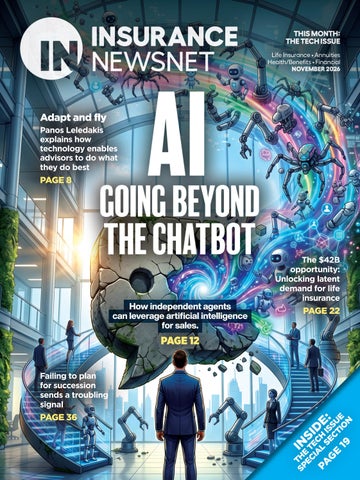
Adapt and fly Panos Leledakis explains how technology enables advisors to do what they do best
PAGE 8
How independent agents can leverage artificial intelligence for sales.
The $42B opportunity: Unlocking latent demand for life insurance
PAGE 22
PAGE 12
PAGE 36
SP TH IN EC E T S I E ID PA AL SCH E G EC ISSU: E T 19 IONE
ailing to plan F for succession sends a troubling signal
ADVERTISEMENT
Life Insurance • Health/Benefits Annuities • Financial Services NOVEMBER 2026
FOR SE
Y. L N O S R O IS V D A S U O RI
No prospecting | No cold calling | No chasing leads.
Just show up. Meet. Advise. Close.
to ed 4 t E mi G li A P un e to ur lin rn yo ipe u T im p a cl
WHAT IF YOUR
CALENDAR
WAS ALREADY FULL? 5–7 qualified appointments. Every day. We build the pipeline. You work the appointments. Do what you do best: Advise, Educate, and Close. • No prospecting. • No cold calling. • No chasing leads. • No paperwork marathon. • No building your own back office. Oxford Advisory Group handles the infrastructure. You focus on the client. You show up. You do your thing. Then you do it again.
THIS ISN’T A DREAM PIPELINE. IT'S THE OXFORD MODEL. Serious advisors only.
Claim your unlimited pipeline →
Check out PAGE 4!
Exclusive Single-Sign-On Resources Designed to Drive Growth: Inforce Action Center Turn policy servicing into growth opportunities. Automatically highlights top revenue and engagement possibilities within your existing book of business.
The My Tools The Need T ools MarketingYou Campaigns for the Business for You Wantthe Bu
Streamline your outreach effortlessly. Track all active marketing initiatives, manage prospect responses, Work Smarter. W Serve Better. ork Scale Faster… Smarter and moni t or l e ad acti v i t y i n one i n teracti v e, central i z ed hub. Introducing theIntroducing Simplicity Agent Center th Industry-Leading Technology
Your time is best spent Y advising our clients and time growing your practice. is The Simplicity best Agent Center is your Agent all-in-one command center, Center purpose-built to streamline your dailyis Gai n a di s ti n ct market advantage wi t h propri e tary software and exclusive sales tools like Litotal feLink™ and operations, sharpen operations, your competitive edge, and scale your business withsharp clarity.
AnnuityLink™.
Exclusive Single-Sign-On Exclusive Resources Designed to Drive Growth: Single
On-Demand Education and Dedicated Support Inforce Action Center
Inforce Ac
Turn policy servicing opportunities. T top Access our expansi ve linto ibrarygrowth of educati onal webiAutomatically nars and materihighlights als anyti murn e;revenue Engageand withengagement thepolicy Simplicity possibilities within your existing book of business. possibilitie Campaigns SalMyesMarketing Support team for quoting, il ustration, and advanced support. My Marke
Streamline your outreach effortlessly. Track all active marketing initiatives, Streamline manage prospect responses, and monitor lead activity in one interactive, centralized hub. and monito Industry-Leading Technology
Industry-L
Gain a distinct market advantage with proprietary software and exclusive Gain sales tools like LifeLink™ a and dist AnnuityLink™. AnnuityLin
Ready to Transform Your Workflow?
On-Demand Education and Dedicated Support
On-Dema
Take control of your business with the platform designed for high-performing financial Ready professionals. Visit SimplicityAgentCenter.com to Transform Your Workflow?
Access our expansive library of educational webinars and materials Access anytime; Engage with the Simplicity ou Sales Support team for quoting, illustration, and advanced support. Sales Supp
Take control of your business with the platformT designed ak for high-performing e cont financial professionals. Visit SimplicityAgentCenter.com
© 2026 Simplicity Group. All Rights Reserved. For financial professional use only. NOT FOR PUBLIC DISTRIBUTION. 5820642-0826
© 2026 Simplicity Group. All Rights Reserved. For financial professional use only. NOT © FOR PUBLIC 2026 DISTRIBUTION. 5820642-0826 Simplici
FOR THE MOMENT
when you need life insurance that’s easy to deliver Get support that’s built around the way you work — with dedicated people, streamlined processes and life insurance solutions you can count on, every time.
Reliable solutions
Proactive underwriting
Life insurance designed to deliver lasting client outcomes
Fast, clear underwriting paths: instant, accelerated and traditional
Low-friction service
Scan here to see how you can grow your business
Digital submission experience and real-time case updates
Protective® is a registered trademark of Protective Life Insurance Company. The Protective trademarks logos and service marks are property of Protective Life Insurance Company and are protected by copyright, trademark, and/or other proprietary rights and laws. Protective and Protective Life refer to Protective Life Insurance Company (PLICO) and its affiliates, including Protective Life and Annuity Insurance Company (PLAIC). PLICO, founded in 1907, is located in Omaha, NE, and is licensed in all states excluding New York.PLAIC is located in Birmingham, AL, and is licensed in New York. Protective Life Insurance Company does not solicit business in the state of New York, nor is it authorized to do so. Product availability and features may vary by state. Each company is solely responsible for the financial obligations accruing under the products it issues. Guarantees are subject to the financial strength and claims-paying ability of the issuing insurance company. Product guarantees are backed by the financial strength and claims-paying ability of the issuing company. Securities offered by Investment Distributors, Inc. (IDI), the principal underwriter for registered products, are issued by PLICO and PLAIC, its affiliates. IDI is located in Birmingham, Alabama. CLA.8236762.07.26 Not FDIC/NCUA Insured
No Bank or Credit Union Guarantee
Not Insured By Any Federal Government Agency
May Lose Value Not a Deposit
For Financial Professional Use Only. Not for Use With Consumers.
IN THIS ISSUE 12
View and share the articles from this month’s issue
» read it online InsuranceNewsNet.com/magazine
NOVEMBER 2026 » VOLUME 19, NUMBER 9
FEATURE
AI: Going beyond the chatbot
By Rayne Morgan How agents can make the most of AI to generate leads, strengthen prospects and create more sales opportunities.
HEALTH/BENEFITS
30 4 ways to give workplace life insurance a higher profile By Jennifer Gassaway
8
19 The 2026 Tech Guide
Special Section
November Thought Leadership Series
LIFE
22 The $42B opportunity: Unlocking latent demand for life insurance
INTERVIEW
Benefits brokers can start by dispelling some common misperceptions about workplace life insurance.
ADVISORNEWS
34 Wealth planning vs. estate planning: Honoring your client’s wishes
By Jena Kennedy
By Susan Rupe
A look at the reasons why so many Americans put off buying coverage.
Wealthy families face a generational wealth-loss problem that an estate plan alone can’t solve.
8 Adapt and fly
Panos Leledakis explains how technology enables advisors to do what they do best — create relationships with clients.
IN THE FIELD
ANNUITY
16 T he velocity of money By Susan Rupe
Stefun Darts is a young advisor whose mission is to demystify wealth building and make financial freedom simple and accessible.
26 W hat to do when your client wants to cash out their annuity By Anna Baluch
While you can’t control what a client ultimately does, you can point them in the right direction.
IN THE KNOW
36 Failing to plan for succession sends a troubling signal By Michael Babikian
What happens to your clients and your firm when you exit your practice?
INSURANCENEWSNET 20 Erford Road • Suite 304 • Lemoyne, PA 17043 717.441.9357 www.InsuranceNewsNet.com PUBLISHER EDITOR IN CHIEF, MAGAZINE EDITOR IN CHIEF, WEBSITE MARKETING DIRECTOR
Paul Feldman Susan Rupe John Hilton Jenn Becker
SENIOR CREATIVE DIRECTOR EMAIL & DIGITAL MARKETING SPECIALIST MARKETING MANAGER SALES OUTREACH SPECIALIST EDITORIAL ASSISTANT
Jacob Haas Megan Kofmehl Sorayah Talarek Isabella Bonvisuto Noah Lopez
DIRECTOR OF SALES NATIONAL ACCOUNT DIRECTOR NATIONAL ACCOUNT DIRECTOR STAFF ACCOUNTANT
Ashley McHugh Brian Henderson Tobi Schneier Katie Turner
Copyright 2026 Insurance & Financial Media Network. All rights reserved. Reproduction or use without permission of editorial or graphic content in any manner is strictly prohibited. How to Reach Us: You may e-mail editor@insurancenewsnet.com, send your letter to 20 Erford Road, Suite 304, Lemoyne PA 17043, fax 866.381.8630 or call 717.441.9357. Reprints: Copyright permission can be obtained through InsuranceNewsNet at 717.441.9357, Ext. 125, or reprints@insurancenewsnet.com. Editorial Inquiries: You may e-mail editor@insurancenewsnet.com or call 717.441.9357, ext. 117. Advertising Inquiries: To access InsuranceNewsNet Magazine’s online media kit, go to www.innmediakit.com or call 717.441.9357, Ext. 125, for a sales representative. Postmaster: Send address changes to InsuranceNewsNet Magazine, 20 Erford Road, Suite 304, Lemoyne PA 17043. Please allow four weeks for completion of changes. Legal Disclaimer: This publication contains general financial information. It should not be relied upon as a substitute for professional financial or legal advice. We make every effort to offer accurate information, but errors may occur due to the nature of the subject matter and our interpretation of any laws and regulations involved. We provide this information as is, without warranties of any kind, either express or implied. InsuranceNewsNet shall not be liable regardless of the cause or duration for any errors, inaccuracies, omissions or other defects in, or untimeliness or inauthenticity of, the information published herein. InsuranceNewsNet uses AI tools to assist in producing content and images, which are reviewed and edited by staff. Address Corrections: Update your address at insurancenewsnetmagazine.com.
Source: Federal Reserve
2
InsuranceNewsNet Magazine » November 2026
O T Y D A E R U ARE YO H T I W E T A N I DO M
D A E L I A PROVEN N? O I T A R E N E G a de r nce industry le ra su in e lif e th e d as a ge has emerg that gives you y g lo o n ch Wells Advanta te , rowth AI-Powered G N! by delivering OMPENSATIO C H IG H d n a , massive EDGE
ARE YOU READY FOR THE NEXT LEVEL? If you want AI LEADS, tactical hands-on training, getting PAID on submit, IULs issued in under 10 minutes, and complimentary wills for your clients — the answer is YES. You deserve proprietary lead generation, customized growth opportunities, and world-class appreciation events.
844-519-1188
CALL today to become one of the FIRST 100 ADVISORS in our exclusive POWER-UP Club. Don’t let your competition beat you to the future of insurance.
CLAIM YOUR UNLIMITED PIPELINE: Built for Advisors Who Refuse to Be Average What happens when advisors are free to focus on clients instead of chasing them?
C
hris Dixon, Co-Founder and Managing Partner at Oxford Advisory Group, knows what it feels like to build a business from the ground up. A decade ago, fresh out of college, married with a young son, Dixon and his younger brother had about $3,000 between them. They launched their financial practice with only enough money for four or five educational workshops. At one point, Dixon was sitting in a McDonald’s, building a financial plan over the free Wi-Fi. That first client is still with him today. The experience shaped how Dixon would eventually build Oxford Advisory Group. “I realized pretty quickly that I didn’t want to just sell insurance,” he said. “I wanted to build something bigger. I wanted to manage assets. I wanted to build a firm of my own.” Today, Oxford manages billions in combined assets. But Dixon’s bigger accomplishment may be the business model he built around the advisor. “I’ve taken inventory of hundreds of firms and compensation structures,” Dixon said. “And I kept asking myself, why does the advisor have to do all of this?” That question became the foundation for a very different kind of advisory firm.
No Chasing Leads. Just Meeting Clients.
Oxford has built a marketing and events operation designed to continually generate opportunities. The firm hosts events using digital advertising and a multi-step process to attract and qualify prospects.
The goal is not simply to generate leads. It is to put qualified prospects in front of advisors. Oxford advisors can have 5-7 qualified appointments on their calendars every day. “You don’t need to prospect anymore,” Dixon said. “You don’t need to dial anymore. You don’t need a back office anymore. You don’t even need an office anymore. I take care of all that for you.” The advisor’s role becomes sharply focused. “Just show up and do your thing, which is to be a closer and bring on clients and tell your story. I’ll do the rest. I’ll get prospects to you. I’ve got the back office. I facilitate all that.” Once a client is onboarded, the service team takes over. That leaves advisors with more time to do the part of the job that cannot be automated: building trust and helping people make important decisions. And Dixon believes doing that well requires more than knowing the numbers. “Numbers check the box,” he said. “Emotion moves the decision.”
Make Complex Ideas Matter
Dixon has spent years studying communication, psychology, and storytelling because he believes financial advice only works when clients understand it and connect with it.
“You have to break things down simply,” he said. He learned the power of making financial concepts personal while working on his own estate plan. Dixon knew he needed one but kept putting it off. Then his attorney called while Dixon was pumping gas. “What happens if you get T-boned and you’re paralyzed in seven minutes?” the attorney asked. The question changed the conversation. “I went home and finished my estate plan,” Dixon said. For Dixon, that’s the difference between explaining something and making it matter. “With everything you do, you’re telling a story,” he said. He applies that philosophy to advisor development, too. New and experienced advisors recraft and work on their own stories to learn how to communicate their experience without simply announcing their credentials. “Tell stories that portray aptitude,” Dixon said. “Don’t tell them you’re smart. Tell them a story that helps them know you’re smart.”
“When we’re finished talking, you will know what you want to do. We’re going to educate you.”
And vulnerability matters. “If you can have the confidence to be vulnerable to somebody, people appreciate that,” he said. The objective is not to perform. It is to become relatable enough that clients are eager to listen.
Comprehensive Planning, Without the Ping Pong.
That same philosophy shapes the Oxford client experience. Dixon is skeptical of the word “comprehensive” when firms use it as a label without actually delivering it. “People throw around comprehensive and holistic,” he said. “But they don’t really do it.”
Oxford brings investment, income, tax, healthcare, and legacy planning together, supported by financial professionals, CPAs, enrolled agents, and attorneys. The reason is practical. A client may go to an attorney for a trust, only to return to a financial advisor with questions about which assets belong in the trust, how the trust should be funded, how retirement income will work, and what the tax consequences might be. “You’re playing ping pong,” Dixon said. Oxford’s model is designed to keep those disciplines working together. The process begins with education and understanding the client’s situation, not forcing a predetermined solution. “When we’re finished talking, you will know what you want to do,” Dixon
said. “We’re going to educate you.” Tax and estate planning can also open the door to deeper conversations with affluent clients because the issues are tangible: taxes, wealth transfer, asset protection, and what happens to the money they’ve spent a lifetime building. But Dixon’s measure of success goes beyond assets. “How many families did we impact?”
The Opportunity Is Built, All You Need is to Deliver.
Oxford’s model ultimately comes down to specialization. Marketing generates the opportunity. Events bring prospects into
the system. Qualified appointments reach the advisor. Support teams help with applications and onboarding. Service takes over after the client is established. The advisor gets to keep moving. Dixon calls it an Unlimited Pipeline. And according to Dixon, the model has created significant earning potential. Oxford’s average advisor earns approximately $750,000 annually, he says. “They don’t have to do anything but just show up and close.” That sounds simple. It isn’t. Closing requires skill. Building trust requires discipline. Communicating complex strategies requires practice. And Dixon is selective about the advisors he wants to develop. “I want my team to be the best,” Dixon said. “If you’re okay with average, don’t apply with us,” he said.
“But if you’re ready and serious, we would love to chat with you.” He believes advisors should be challenged to become better rather than limited by conventional expectations. “My opportunity is unlimited,” Dixon said. Even his approach to goals reflects that philosophy. “I don’t really set a goal,” he said. “The focus is getting better every single day and putting the pedal to the metal. Then let’s see where we end up.” That mindset has taken Dixon from building financial plans at McDonald’s to building a firm designed to remove the barriers between advisors and opportunity. But Oxford’s model isn’t really about doing less. It’s about doing more of what matters. More conversations. More relationships. More opportunities to put expertise to work. And more families impacted by the work. The pipeline is built. The opportunity is there. What happens next depends on who’s ready to claim it. •
Claim Your Unlimited Pipeline! Scan the code or visit unlimitedpipeline.net to get started!
WELCOME LETTER FROM THE EDITOR
AI: What it will and won’t replace
T
his month marks 14 years of my writing for and developing content for InsuranceNewsNet. When I started working here, one of the industry’s big news stories was the development and rise of roboadvisors. Remember roboadvisors? They are an automated asset-allocation system that works something like this: “Client is 55 years old with moderate risk tolerance. Put 60% in stock ETFs and 40% in bond ETFs.” At the time roboadvisors became more common, the question was whether they would eventually replace professionals giving investment advice. Now, we have artificial intelligence 6
tools that serve more like intelligent assistants, working something like this: “Analyze this client’s retirement plan, summarize their concerns, draft an email, identify coverage gaps, and explain the tax implications.” Again, the question is whether these AI tools will replace humans in the insurance and financial services space. Rayne Morgan’s featured article in this month’s InsuranceNewsNet answers that question with a resounding “no.” (See page 12.) AI won’t replace networking and relationship-building. The experts interviewed agree that agents hoping AI will magically generate a stream of highquality prospects are likely to be disappointed. The best leads still come through
InsuranceNewsNet Magazine » November 2026
trusted relationships, referrals and industry networks. AI can support sales efforts, but it is not a substitute for human trust. The biggest AI opportunity may be helping customers find you. Instead of using AI to chase prospects, agents may get better results by improving their online presence so AI-powered search tools such as ChatGPT, Claude and Gemini can direct consumers to them. But agents can’t skip the fundamentals when employing AI tools. Agents often jump straight to AI tools without first creating a clear sales plan, defining their ideal customer or establishing strong messaging. AI works best when it enhances a solid business strategy rather than replacing one. One thing AI can do is make prospecting more efficient. Instead of simply producing lists of names, AI can enrich prospect data, helping agents spend less time chasing stale leads and more time talking to decision-makers. The goal is not more leads, but better-qualified opportunities. Also in this month’s issue, we hear from one of AI’s biggest cheerleaders, Panos Leledakis (page 8). He is the founder and CEO of IFAAcademy, an insurance futurist, an expert in the use of virtual reality, and a member of the NextGen Advisory Task Force at The American College. He is an award-winning inventor of software for insurance needs analysis. Leledakis is also an international public speaker with hundreds of hours on stages around the world, giving presentations characterized by his passionate way of expression. In this month’s issue, Leledakis challenges the adage “adapt or die” and replaces it with a new one, “adapt and fly,” as he teaches financial professionals how AI can take their practices to new heights. The human advantage remains irreplaceable. Despite all the excitement around AI, insurance is still a relationship business. Customers may be overwhelmed by information and options, making an advisor’s experience, judgment and personal guidance more valuable than ever. Susan Rupe Editor in Chief, magazine
NEWSWIRES
INTERVIEW
About 750K cut from ACA coverage After the Trump administration placed a temporary moratorium on registering new agents to enroll consumers in Affordable Care Act coverage, the administration announced it is canceling ACA coverage for about 750,000 people. Vice President JD Vance and Centers for Medicare & Medicaid Services Administrator Mehmet Oz claimed that many of these ACA enrollees were receiving subsidies they didn’t qualify for and that some enrollees did not even exist. Oz also said some of those being removed from the program had “never filed a claim.” The administration did not provide details about who lost coverage or how those individuals were informed. At a news conference, Vance said the cuts would save U.S. taxpayers about $2 billion. Vance added that CMS will perform additional verification on more than 400,000 ACA enrollees to make sure they are legal U.S. residents and that they meet the income threshold to receive ACA subsidies. A 2026 Government Accountability Office report outlined how undercover investigators were able to obtain subsidized ACA coverage using fictitious applicants. The GAO also identified tens of thousands of potentially unauthorized broker-of-record changes and noted CMS had received large numbers of complaints linked to unauthorized enrollments and plan switching.
Q U O TA B L E We should pay attention to money created by the central bank and money that comes from the banking and financial systems.” — Federal Reserve Chair Kevin Warsh
the impact at $400 to $700 annually for the average U.S. family.
MOST FIRMS KEEP CASH FROM TARIFF REFUNDS
FEDERAL AUDIT SEEKS $47M REFUND FROM UNITEDHEALTHCARE
Federal auditors want UnitedHealthcare to repay $47 million to the federal government after an investigation concluded the company’s Medicare Advantage health plans received significant overpayments. Investigators found most medical records reviewed in the audit failed to justify the extra payments that UnitedHealthcare requested for covering MA beneficiaries with more complicated medical histories, according to the report by the Office of Inspector General at the U.S. Department of Health and Human Services. UnitedHealthcare said the latest audit’s methodology was “flawed” and added that the OIG and the CMS should improve the auditing process. DID YOU
KNOW
?
FRAUD COSTS INSURERS $45B ANNUALLY
U.S. personal auto and homeowners insurers see an estimated $45.3 billion in annual losses from fraud, inaccurate information and misrepresentation, according to an analysis released by insurance risk-assessment company Clearspeed. The analysis estimates the cost of inaccurate information and fraud at $31.6 billion annually for auto insurance and another $13.7 billion for homeowners insurance. At least some of these losses are passed on to policyholders through premium increases. The National Insurance Crime Bureau, citing research from the Coalition Against Insurance Fraud, estimates that insurance fraud results in roughly $900 in additional annual premium expense per policyholder. The FBI has also estimated
The majority of companies that received billions of dollars in tariff refunds are mostly holding on to the money, according to a Federal Reserve Bank of Atlanta survey. Refunds began moving to companies in May after the Supreme Court ruled that $166 billion of emergency tariffs were unlawful. As of Sept. 11, approximately $134.7 billion in refund payments, including interest, had been paid out or accepted for processing, according to a court filing from U.S. Customs and Border Protection. Not much is known about how that money is flowing into the U.S. economy. Out of 220 executives who shared their plans with the researchers, about three-quarters said they expected to keep the refund in cash. Slightly more than half of the group also said they planned to invest in research and capital projects, and 17% said they expected to give customers rebates. Nearly 15% said they’d use it to lower prices. Respondents were told to select all the uses that applied.
27% of unemployed workers have been looking for a role for more than half a year. Source: U.S. Bureau of Labor Statistics
November 2026 » InsuranceNewsNet Magazine
7
INTERVIEW
r o s i v ad y r e v ence e p l e tellig h o t s cial in t n a w f artifi er s i h s k i l da wer o pub e , l n e a L e po s ldm e o F n h l Pa p into t Pau h t i ww ta e i v r e t An in
8
InsuranceNewsNet Magazine » November 2026
ADAPT AND FLY — WITH PANOS LELEDAKIS INTERVIEW
W
e often hear the adage “adapt or die.” Panos Leledakis wants to change that mindset to
“adapt and fly.” Leledakis is referring to artificial intelligence, which he has embraced as a way to prospect and sell to his target market. Now he is branching out to share the secrets of using AI’s power with as many advisors as possible. He is the founder and CEO of IFAAcademy, an insurance futurist, an expert in the use of virtual reality, and a member of the NextGen Advisory Task Force at The American College. He is an award-winning inventor of software for insurance needs analysis. Leledakis is an international public speaker with hundreds of hours on stages around the world, giving presentations characterized by his passionate way of expression. In this interview with publisher Paul Feldman, Leledakis describes his enthusiasm for AI and VR and explains how technology enables advisors to do what they do best — create relationships with clients. PAUL FELDMAN: How did you get into the business? PANOS LELEDAKIS: My story starts in Greece. When I was very young, my father’s dream was for me to become a lawyer. We were a poor family, and he sacrificed everything to get me the means to start preparing for the local university. In my first year in the university, I was working in fast food to pay for my studies. I met a manager in the insurance industry, and he proposed that I become a part-time insurance advisor. I was fascinated by the idea, and I loved it so much that after six months, I started working in it full time. I have had an amazing career in it for 27 years now – I started in the insurance business in 1999. In 2010, we experienced the default of an insurance company in Greece while the country was in a recession, so we lost everything and had to rebuild. Then I became specialized in corporate insurance. I wasn’t happy with the way I was taught to sell insurance, so I began researching what I call three pillars. The first pillar is that, instead of selling, we
can consult with either the individual or the corporation. I found out that we can use risk management science based on ISO 31000; there is a procedure in which you can identify all the risks, measure them, prioritize them, quantify them and instead of trying to sell your product, give a risk assessment that’s a diagnosis, and then we can decide if insurance is the best solution. The second pillar was neuroscience and behavioral economics. We know why the human brain is not compatible with the idea of risk, and if you don’t understand the problem, you don’t care about the solution. So that’s why people are not eager to learn about insurance. The third pillar was around technology. I began selling through Skype in 2023. I was prospecting with webinars in 2010 and have been using virtual reality technology to do meetings since 2017. I founded an insurtech startup, and we developed a consulting methodology and software. We dominated the market in Greece, and in 2018, I started traveling around
LELEDAKIS: I think both AI and VR can bring young advisors into the profession. The younger generation is using AI and VR to play and to form communities. They don’t hang out on social media anymore; they hang out in the VR world. When I first started using VR, I was using it for meetings and to find communities. With VR, you go inside as an avatar and you can meet people, so you can socialize and network at a conference. FELDMAN: You wrote a $35 million case on somebody you met through VR. Tell me how that happened. LELEDAKIS: When I was using VR, I was invited — along with a very small group of beta testers — but they were high-level executives, to a VR tour from Meta. We were in a VR presentation as avatars. Another avatar was standing next to me. We began talking, and he told me he was a startup founder. I asked him about his project, and he said they raised
AI is the smartest-like creature, so it’s going to change everything. It’s going to change everything fast. My motto is “adapt and fly” because I don’t like negative messages. People may say, “adapt or die,” but we say forget about dying — adapt and fly. the world to see whether my idea had merit. In 2020, I moved to New York to scale my company. We were researching AI before it was cool, before ChatGPT came into play and changed everything. I moved to Miami two and a half years ago, and that’s where I’m based today. For the past five years, I have been in the venture capital world. I’m doing a specific key-person insurance project for big startups.
$200 million just for the first round as a startup. I asked him whether he ever had a meeting in VR aside from playing or training, because I would love to do a presentation on my key-person insurance in VR. I invited him to the meeting room, and we had floating graphics, screens everywhere. It was very impressive. I pitched him my idea, and we even signed the agreement in VR.
FELDMAN: I’m interested in your use of virtual reality. I think VR could be one of the greatest things ever invented to bring new agents into the business and train them. Tell me about your experience with it.
FELDMAN: How can VR help with training? LELEDAKIS: With training, you can have a meeting. But training with VR is even better because you can create some
November 2026 » InsuranceNewsNet Magazine
9
INTERVIEW ADAPT AND FLY — WITH PANOS LELEDAKIS rooms. And now AR — augmented reality — is coming, and it will be even better. With my VR, I have floating graphics inside. People feel like they are in the same room with me. I have different screens. I can make it appear as though I’m by the pool or in a helicopter or inside the Oval Office. Training inside VR is so impressive and so engaging that it’s better than Zoom training for sure. We have combined VR with AI technology now. We can have a discussion with a VR chatbot. I can appear as a hologram. Training with VR is so much fun, engaging and more effective.
“We are living in the experience economy, so we need to give them experiences.”
FELDMAN: What are your thoughts on AI? LELEDAKIS: Everybody’s underusing AI big-time. We’re not using enough of the capabilities that large language models have. Here is a cool thing we can do. There is a program called HeyGen. It’s an avatar creation software where you record yourself, or you give it a picture and you can give it a script and you will see yourself narrating and making the video without you having to make the video. I’m doing something innovative with it where I use it to create avatars of other people and use them in presentations. Now, imagine that we do that for clients. First of all, they sign easier. Second, they will ask for the video and share it with their friends. Then their friends come to me just for the experience because we are living in the experience economy, so we need to give them experiences. We have our blank near field communication card, and you can program it to do whatever you want, and you can do it with a free software called NFC Tools. And I can put an avatar of myself in an NFC card. So when I speak to my clients, I say, “Listen, I’ll be here for you 24/7. Call me whenever you want, but in case I’m in this interview or I’m flying or whatever, take this card, and if you need me, just tap this card to your phone. My avatar will come up, and you can ask anything like it’s me.” How cool is that, and how convenient? FELDMAN: What else can you tell us about AI? 10
LELEDAKIS: The only thing I can tell you is that it’s going to change everything. It’s changing the way we think, the way we interact, the way we work, the way we communicate. It’s the fastest revolution humanity will ever experience. We used to be the smartest species in this universe, but not anymore. AI is the smartest-like creature, so it’s going to change everything. It’s going to change everything fast. My motto is “adapt and fly” because I don’t like negative messages. People may say, “adapt or die,” but we say forget about dying — adapt and fly. FELDMAN: How do you see AI working for advisors today? LELEDAKIS: There are two kinds of
InsuranceNewsNet Magazine » November 2026
people out there — those who are scared and overwhelmed by AI and those who decide it’s something new that they need to embrace quickly and learn. But it’s about the prompts. Prompt engineering is the skill of the 21st century. We have had generative AI up to now. That means I’m prompting and I’m getting a response. That’s why it’s called generative AI. Now we are in the era of agentic AI, where AI will do tasks for us like an employee. We already have Claude Cowork. It can work with your computer and your files. It can do things for you on the internet like an employee. You don’t need to prompt it. You need to create a job description and the steps. It’s called end goal or looping, but it’s a different process than prompting.
ADAPT AND FLY — WITH PANOS LELEDAKIS INTERVIEW And there are third-party software tools that can make it easy to create content for content marketing and social media, to publish the content, to prospect for you. We’re going to save time by automating many of the boring and mundane tasks that we have. We’re going to have more clients because, in the AI era, if you know how to do that, prospecting is not a problem anymore. Then you can sit down and do the happy and nice part of the job, which is to convince people and create relationships. This is the new landscape. FELDMAN: Tell me more about how agents can prospect with AI. LELEDAKIS: They can use LLMs like Claude or ChatGPT to go out on the internet every day, give them a specific target market and bring back names with emails and everything they need to approach those names in a quantitative way. They also can have LLMs approach prospects in an automated way to send them emails or text messages or WhatsApp messages to try to book appointments. I’ll give an example of something successful for me. There are many social media groups for everything that you can imagine. My niche market is venture capitalists and startup founders. On LinkedIn, there are groups for that — either for investors or startups. So I’m using AI to create content to post in these groups. The idea is called “give, give, give, give and then ask.” You need to give value to the things that they are interested in. You need to create content that they’re going to watch or read and say it’s useful to them. After a while, I’ll create a landing page that says I have a free book for them. If they want to download it, give me their email. I format and design the book with AI, and I can do it in less than 30 minutes. When people download the book, I gather thousands of emails of people that I interact with online. Then I invite them to a free webinar about something they care about or want to know. After the webinar, my team will contact them to book an appointment with me. The last time I did this, I had 1,700 people at the webinar and 500 of them said they were interested in learning more; 175 booked
an appointment, and I wrote 95 policies in two months. FELDMAN: Let’s talk about creating content using AI. How do you prevent AI slop? LELEDAKIS: It’s in the prompting. You need to give examples of what you want to do and describe what you want. You
the consumer’s eyes, and they don’t know how to find clients. If you give them an idea of how they can use AI to find clients and become the AI advisors, it will be a game changer that will allow us to bring in more talent if we reengineer and rebrand the way we present our career. So imagine you can have training programs with AI. You can have chatbots to support them 24/7. Let’s say you are my
On the speed of technological disruption:
“It’s changing the way we think, the way we interact, the way we work, the way we communicate. It’s the fastest revolution humanity will ever experience.” explain that you want content in a certain format; you tell the LLM the voice or the style you want to use. Tell it you want to use human voice and not be chatbotic. You give it the kind of phrases you want it to use. You also can upload articles that are similar to what you want to put out there, so now your project will be trained with those files. FELDMAN: Let’s talk about agentic AI. What is it, and where is it going? LELEDAKIS: Generative AI is like the brain, and agentic AI gave hands to this brain. So now it can do tasks for us. In order to create an AI agent, you need to create memory. It’s called RAG, retrieval augmented generation. Agentic AI is all about creating automation with steps, so you can replicate workflows, and they can do tasks for us. FELDMAN: Recruiting is a big problem in this industry. How can AI help the industry bring in more people? LELEDAKIS: The ways I described using AI for prospecting are also similar to ways of using it for recruitment. Two things that stop people from coming into this business are prospecting and rejection. They don’t want to represent something that’s not so sexy in
new advisor. I should come with you to every appointment to see what you are saying and tell you how to become better. Right? This is the best training that we can have in the field. We call it field training. Now it’s not needed because I’m going to give you an AI notetaker. You will have the client’s consent to record the meeting. Then when you finish the meeting, I’m going to have a sales mentor trained with my material. So when you finish the meeting, the transcript is going to go directly to the sales mentor, and it’s going to tell you how you could handle this meeting better. It’s going to analyze the client’s personality. It’s going to take all the tasks and the follow-up things that you need to do, and it’s going to put them directly into your customer relationship management system and your task management system. By finding more names, by presenting a career that is much different than what they know, and supporting them with what they need to survive and grow, AI will be a game changer. Scan the QR code to view the full video interview online now on our YouTube page.
November 2026 » InsuranceNewsNet Magazine
11
COVER STORY
How independent agents can leverage artificial intelligence for sales. BY RAYNE MORGAN
12
InsuranceNewsNet Magazine » November 2026
AI: GOING BEYOND THE CHATBOT COVER STORY
T
here’s no doubt that advanced technology such as artificial intelligence is playing an increasingly prominent role across the insurance business. But the benefits and challenges offered by AI can vastly differ between large carriers and independent agents or the agencies they work with. Experts told InsuranceNewsNet that independent agents can make the most use of AI in surprising ways to:
»G enerate leads » S trengthen cold-calling prospects »H elp identify coverage gaps for upselling
» P rovide quotes or shop renewals
much faster, creating even more sales opportunities
But the solution isn’t as simple as creating a prompt that does all the work for you. To begin with, experts we spoke with said most agents — whether they work with a smaller agency without sophisticated infrastructure or a larger firm that already has its own preapproved tools — aren’t even taking the basic steps required to leverage AI and bring more quality leads in or take advantage of more sales opportunities. They suggested ways AI should — and shouldn’t — be leveraged and emphasized that the tool shouldn’t be relied on to do all the work.
Outbound leads
Andrei Craciunescu, CEO of RiskCube, suggests AI can indirectly generate more business. Still, it’s not a magic wand
Craciunescu
that will automatically produce a list of high-quality leads for agents to chase. “If you only rely on AI and if you think that AI can bring customers and you can make money just with it, maybe it works for you. But for us, it didn’t,” Craciunescu said. He told InsuranceNewsNet it is possible for independent agents to “get customers or leads with AI, but the quality of your leads will be very low.” “If you want high-quality customers, I don’t think that AI can really solve that yet,” he said. “From our experience now, in the last months, the highest-quality customers and the highest-quality leads are still coming through networks and not through AI agents that sell for us.”
Leveraging AI search
While finding outbound prospects may not be the best use of AI, Craciunescu said there “is a space where you can get leads through AI” from the inbound side. The opportunity, he said, is in leveraging search engine optimization — or its newer counterparts, generative engine optimization and answer engine optimization. SEO is a common term used in marketing. It describes a strategy used to increase a website’s ranking on popular search engines such as Google, increasing the website’s visibility so that more people can view it. With more people using chatbots like Anthropic’s Claude or OpenAI’s
“From our experience now, in the last months, the highest-quality customers and the highest-quality leads are still coming through networks and not through AI agents that sell for us.” RiskCube, a San Francisco-based company founded by Craciunescu in 2024, defines itself as “an AI-native insurance broker for startups.” As its founder, Craciunescu said it’s a highly specialized boutique agency that specializes in space and defense. But Craciunescu also says he built the organization with the idea to better leverage “what are the parts of the agency that you can automate with AI and what are the parts where using AI doesn’t make sense.” And in his experience, AI is just not the right tool for strong outbound prospects. He noted that when it comes to buying and selling insurance, trust and expertise simply “play a much higher role than AI can provide at the moment,” especially with higher premiums as customers scrutinize agents and carriers more. “I wouldn’t say that outbound is working with AI. … We realized you can use AI to enhance your expertise or answer questions faster, but it’s very difficult to get leads with AI. Even if you get leads, if you cannot qualify them, if they don’t convert, you have nothing in the end, and then you lose your time,” Craciunescu said.
ChatGPT instead of traditional search engines, many marketers have shifted to GEO and/or AEO to increase chances that a popular chatbot will redirect customers to their website. Craciunescu suggested this kind of inbound sales strategy, where customers are directed to an agent’s website, is a much more effective use of AI. But in his experience, establishing the basics of SEO needed to leverage this strategy effectively is where most agents fall short. “I see that most of the insurance agents don’t do that in the first phase,” he said. “When you have SEO established in the first step, that’s already a great foundation. And then in the second phase, you can include more things that are tailored to your ideal customer profile. But you can’t skip the foundation.” He said RiskCube has been able to use this strategy to the point where they get most of their cold inbound customers through AI searches from Claude and Gemini. However, he also acknowledged that it works because the company operates in a small, niche market where they are basically the only agency Claude recognizes
November 2026 » InsuranceNewsNet Magazine
13
COVER STORY
AI: GOING BEYOND THE CHATBOT
as experts in that field. “I can tell you, we get high-quality leads through inbounds at the moment, and this is what we want,” he said. “We don’t want to invest in outbound because we want that customer to find us. There are not many agencies in defense, so this is where we can really win. If you win one category in insurance, then Claude can scale this for you.”
Data, insights and messaging
While the AI search optimization strategy may be a winner for smaller businesses, the same strategy may not be the best for a larger firm. For example, Rob Erfurt , national industry leader and New Jersey market leader at World Insurance Associates, said agents can miss a lot of AI’s other value by looking at only this one path.
Erfurt
“AI has come on the scene so quickly in insurance that what we’re seeing on a dayto-day basis is users interacting with it like it’s an internet search engine,” Erfurt said. “When you take that approach, you miss a lot of value that AI can offer from text generation, speech recognition and a smart automation standpoint.” Like Craciunescu, he agreed that using AI for leads can have limitations, but from more of a data aspect. “An example of how AI is being used inefficiently as it relates to lead generation is someone asking for a list of prospects in a given industry or geography,” Erfurt said. “While it can pull data, it’s not too different from the databases people buy data from now, which is to say a lot of the metrics are stale. “The opportunity with AI, from a lead generation standpoint, is to not just pull a list but to enrich the data. So, when we talk about data enrichment, it’s the idea 14
that we can enhance what we have with more reliable data points and metrics.” Erfurt emphasized that this is important because independent agents must make the most use of their time instead of chasing stale leads. “There are only 168 hours in the week; we have limited time to prospect with all the needs of our existing clients. If we make 10 calls, we want to talk to 10 decision-makers. We don’t want to find out that those 10 people don’t work at the company anymore,” he said. AI can also help agents save time by shaping their messaging, such as with text generation, which Erfurt said is “one of the most effective ways to leverage AI from a new business standpoint.” However, he said agents must start with having a sales plan — and, like Craciunescu, he said most agents fail this first step. “It starts with your messaging,” Erfurt said. “From there, coming up with your sales plan — Who am I going to call? What is the best solution for them? That can help with your new business prospecting or your cross-selling. What we found is most people don’t have a plan, and that’s where you start to waste time.” According to Erfurt, leveraging AI is all about “finding efficiencies and compressing time” — for example, using AI infrastructure to find coverage gaps or upsell opportunities in existing accounts. “Talk to the platform about what it is you do that’s repetitive and ask how it can help, and it will outline the value that can be created. You don’t have to be highly technical to do these things,” he said. He noted that World Insurance Associates can do this through a tech stack where its AI platform is integrated with the company’s customer relationtship management tool, marketing automation and Power BI tool. “We’re able to leverage our IT-approved AI platform to all client opportunities out
of Power BI to tell us what they’re most likely to buy next. I’d say that’s a more sophisticated model,” Erfurt said.
Faster sales
One other way AI can help agents and brokers is by speeding up the quotebuying cycle of the entire process, according to Scot Barton, chief product officer at Carpe Data. He told
Barton
InsuranceNewsNet this opens up the door for market expansion. “That opportunity for them is a speed of market expansion and a speed of gaining touchpoints internally and externally,” Barton said. “Now, with AI enablement, you have agents and brokers who are identifying options, they’re remarketing the accounts, they’re shopping for risks more frequently.” Barton, a former Farmers Insurance executive, explained that before AI became so mainstream, the quote-buying cycle could take anywhere from six months to a year because of the many manual steps involved. He said many agents would do this only once a year, if at all, simply because the process was so tedious. But now, with AI, they can do it every single day, maximizing sales opportunities. “Now, with AI, what we’re seeing is that it’s frictionless to get multiple quotes from different carriers, and they could do that
“The opportunity with AI, from a lead generation standpoint, is to not just pull a list but to enrich the data.”
InsuranceNewsNet Magazine » November 2026
AI: GOING BEYOND THE CHATBOT COVER STORY
“You could literally cycle through all your independent channels daily looking for a price drop. When you get one, snag it because it’s showing your customer loyalty.” daily,” Barton said. “You could literally cycle through all your independent channels daily looking for a price drop. When you get one, snag it because it’s showing your customer loyalty. That cycle of shop-tobuying to process, even with follow-ups, can all be automated, and so it’s happening much more frequently.” This can even help with cold calls, he said. For example, an agent can automatically re-shop a quote from a year ago and “just reach out with a cold call saying, ‘Hey, I know you were in the market a year ago. Maybe I didn’t even meet your needs, but I found this one.’” Or a “lackluster” quote could be “polished up a little bit easier with automated tools from AI, and now all of a sudden it looks like a legitimate, full quote that they could buy.”
Learning curve
With the many ways agents can leverage AI for sales, both Erfurt and Craciunescu said that insurance professionals cannot afford not to learn the basics of technology and AI in today’s age. For instance, Craciunescu said it took months before his company got their winning formula right. “For us, this was a learning experience. We didn’t really understand all this. We spent almost six months without knowing anything about it. After six months, we were like, nobody’s coming through the website — we didn’t even get any inbound requests,” he noted. “And I thought that Google would start to trust the website in about six months. But we still didn’t get it. I mean, here and there we got a few, but not scalable. Now we get almost daily inbound leads through the website.” What changed for them was learning the basics of SEO and putting serious work into improving their rankings.
For agents and agencies just starting to leverage this kind of technology, he said, they can start by understanding questions like “Who is your ideal customer profile?” “How can you establish trust in the industry that you’re operating in?” and “What do we need to publish tomorrow to increase the likelihood that people can find us through AI search?” They can also ask customers for feedback to better understand what potential leads might be searching for, such as “How did you find us?” and “What is important for you when you search for an insurance provider?” “It takes a while. But the earlier you start, the easier it will be afterward to get leads and everything. You have to invest in the foundation, and then you can scale on top of this with AI. But the earlier you start to understand that you need to build a great foundation, the better,” Craciunescu said. It may be even easier for established agencies that already have a large client base, he added, as they “have already established customers, they know their customers, they just need to scale this more.” “How can I generate more revenue with my existing headcount? That’s the main question. I think this is where AI can really help you to accelerate this. So, instead of having 10 customers a day, I can now have 50 customers a day. I think this is where the value of AI is coming in,” he said. For Erfurt, meanwhile, the starting point for agents who may work with a larger agency is getting familiar with that agency’s approved AI platform and learning how it can help them achieve goals. He pointed out that using more common AI tools, many of which may not be agency-approved, could pose a macro security challenge for agents who work with larger agencies — compromising both
client data and the agent’s employment. “The first step for anyone who doesn’t feel like they know how to use AI is to get into their company’s approved platform, create their profile by telling the platform what it is they do and their goals and their responsibilities, and then ask it how they should be thinking about a specific task in their job,” he said. He said agents can “have really big, eye-opening moments” in an interaction like that because “they learn the tool can help them think about challenges in different ways. “For folks who don’t have that infrastructure, who are just getting started, the advice I give everyone is learn how to use AI, and it’s easier than most people think,” Erfurt said.
No substitute
While there is a time and a place to leverage AI for scaling business, Craciunescu emphasized that it cannot replace the in-person connections that human agents make. “You still need to invest in going to events. AI cannot go to events; AI cannot go to conferences. So you still need to do these basics, because you cannot rely completely on AI to recommend you,” he said. Barton also pointed out that just as many agents can feel overwhelmed by technology, so too can customers. This is where an agent’s personal touch can be the defining factor that makes a customer trust the product. “The customer has the same experience the agent has; they’re inundated with too much information, too many quotes coming at them. One of the values the agent still has is that they have the inside knowledge on what the carriers really can do, how they deliver it, what the claims experience is,” Barton said. “It isn’t just about the cheapest price; everyone wants to save money, but not at the expense of a terrible process. The agent can still add some comfort to the customer who’s also overwhelmed by the process.” Rayne Morgan is a journalist, copywriter and editor with over 10 years’ combined experience in digital content and print media. You can reach her at rayne.morgan@innfeedback.com.
November 2026 » InsuranceNewsNet Magazine
15
the Fıeld A Visit With Agents of Change Stefun Darts wants to pay
his celebrity benefactor forward by helping families find financial security. By Susan Rupe
W
hile his teenage peers were partying and having fun, Stefun Darts was quietly working toward fulfilling a promise he made to his grandparents, who raised him. In 2016, at the age of 24, Darts fulfilled his promise by presenting his grandparents with a check to pay off their mortgage and to fund a trip to The Bahamas in celebration. It took him six years to accumulate the $15,000 needed to make good on the promise he made to himself to pay for his grandparents’ home in gratitude for the sacrifices they made throughout his life. “God put me with my grandparents because my mom wasn’t able to give me what I needed,” Darts said. “As I got older, I was able to be thankful for what my grandparents did for me, as well as understand my mom. Now I plan to buy my mom a house by the end of the year.” Darts is the founder and president of Blackstone Wealth Partners in Houston, Texas, where his mission is “to demystify wealth-building and make financial freedom simple and accessible.” He focuses on families and business owners to improve cash flow and reduce debt and said his client base is 100% referral-based. A top performer with Pan-American Life, Darts has the goal of serving 1,000 clients.
Making the news
When Darts paid off his grandparents’ house, the story of how he fulfilled a promise made when he was in the second grade hit local and national news, ending up as a feature on NBC’s “Today.” At the time, he was working as a loan officer and was at the point in life where he was beginning to make some money. But his life was about to take a different direction, thanks to comedian and TV personality Steve Harvey. The story of how Darts bought his grandparents a house came to Harvey’s attention, and the actor invited Darts to appear on his TV talk show. Darts received a scholarship from the Steve & Marjorie Harvey 16
InsuranceNewsNet Magazine » November 2026
A PARTNER ON LIFE’S FINANCIAL JOURNEY — WITH LEAH WEST IN THE FIELD
NEW! Performance-Driven Retirement Planning
Break Through Limits Discover how performance-driven income can help your clients pursue their retirement goals with the potential for increasing income for life. 60-YEAR-OLD CLIENT WAITING 10 YEARS TO TURN ON INCOME Initial income: $17,685/year Cumulative income by age 95: $731,540 Rank: #1 for initial income in Year 10 Rank: #1 for cumulative lifetime income (over 35 years) Based on available information for all fixed indexed annuities displayed on Annuities Genius, as of September 11, 2026. Rates and results may vary. Assumes $100,000 initial premium with 100% allocation to the One-Year S&P 500® Point-to-Point With Cap strategy, with a 5.00% cap rate applied in all years. Actual cap rates subject to change annually.
HOME OF THE BENEFIT BASE TRIFECTA—
one Benefit Base, three significant retirement needs:* Potential for increasing income for life. Two ADL-triggered benefits.** Built-in Enhanced Death Benefit.†
ALSO AVAILABLE:
New SpireMark FIA for clients seeking earlier income flexibility. SM
Issued by TruSpire Retirement Insurance Company, a Malibu Life USA company
Go to www.PerformanceDrivenIncome.com to download a case study on performance-driven income, and discover how high your clients’ income can grow! Malibu Life USA is the marketing name for the United States retail insurance business of Malibu Life Holdings Ltd. Malibu Life Holdings Ltd. does not offer products for sale in the United States. All annuities are issued by and solely the financial responsibility of TruSpire Retirement Insurance Company (TruSpire), a Malibu Life USA company. TruSpire is headquartered in Irving, Texas. Product series ICC23-FIA-TS is an Individual Modified Single Premium Deferred Fixed Indexed Annuity. Product, features, riders, and availability may vary by state. Certain restrictions and variations apply. Consult contract and riders for all limitations and exclusions. TruSpire is licensed to conduct business in 43 states and the District of Columbia. TruSpire does not do business in New York and certain other states. For more information about where TruSpire is licensed, please visit www.malibulifeusa.com. Withdrawals may be subject to income tax, and a 10% federal income tax penalty may apply to withdrawals taken before age 59½. Products are designed and exclusively marketed by Legacy Marketing Group, an independent agency. PillarMark and SpireMark are service marks of Legacy Marketing Group. The “S&P 500®” and “S&P 500 IQ 0.5% Decrement Index” (“S&P 500 IQ Index” or the “Index”) are products of S&P Dow Jones Indices LLC or its affiliates (“SPDJI”) and have been licensed for use by TruSpire Retirement Insurance Company (TruSpire). S&P®, S&P 500®, SPX®, and The 500® are trademarks of S&P Global, Inc. or its affiliates (“S&P”); Dow Jones® is a registered trademark of Dow Jones Trademark Holdings LLC (“Dow Jones”). TruSpire’s Fixed Indexed Annuities are not sponsored or sold by SPDJI, Dow Jones, S&P, their respective affiliates, and none of such parties make any representation regarding the advisability of investing in such product(s) nor do they have any liability for any errors, omissions, or interruptions of the S&P 500® and S&P 500 IQ Index. * Not all benefits can be used at the same time. ** The ADL Benefit terminates all other rights and benefits under the contract. † The Enhanced Death Benefit calculation may vary by state. ML1127v0926
FOR AGENT USE ONLY. NOT FOR USE WITH CONSUMERS. November 2026 » InsuranceNewsNet Magazine
17
the Fıeld A Visit With Agents of Change it’s from a down market, a health crisis or anything else that might come up.”
Referrals, not social media
Stefun Darts was honored as a member of Pan American Life’s President’s Club in 2026.
Foundation, which he used to attend Savannah College of Art and Design. After graduating from SCAD with a degree in fashion marketing and management, he worked with Harvey’s mentorship camp, where he advised teenage boys in need of male role models. Harvey has a connection to the insurance world. He worked as a debit insurance salesman early in his life before quitting at age 27 to pursue comedy, and he later said that cash-value life insurance was among his smartest investments.
The power to transform lives
Through Darts’ contact with Harvey, he became aware that life insurance has the power to transform people’s lives, and he set out on a new path. “He showed me what life insurance can do,” Darts said. “It can do some impactful things to help people.” Darts said his new goal was to help people build long-term wealth through life insurance. He recalled something his grandmother told him: “Send that elevator back down. Other people may not get to be in those rooms that you are in, so it’s important that you send the elevator back down. Go back and impact those who don’t have the information you have.” He said he works mostly with middleincome households, helping them develop financial discipline and work toward future goals. “A lot of my clients come to me for budget financing,” he said. “Many people in this business push products; I just give value and people see the value. People want to have their money working for them, so we design a plan to have that money working for them in multiple places.” Darts said his job is “to flip that switch that says you need to own a lot of stuff to be successful. “We educate people and provide them with plans that work so they can be financially secure and avoid a crash — whether 18
Darts said his clients come to him through referrals and that he does not do any social media marketing. “I always say that if you just show up for people, the people will come,” he said. “If you give people value, they’re going to refer you all day long. We want to serve the people and give them the knowledge that most people don’t know.” Darts said he first started networking through mastermind groups and then other communities opened up to him. From there, the clients followed. He has a goal of “changing the industry, by showing people the velocity of money.” Darts said he begins by helping clients get out of debt and then building a wealth plan. “After people see their money working for them, they see their life changing,” he said.
Reaching 1,000 clients
His goal of eventually serving 1,000 clients is only a starting point, he said. “I want to help people get back control of their money so that their families are taken care of and so they can retire instead of working extra years. So they don’t have to worry about a downturn in the market, because they have control of their money” he said. “My goal is to reach 1,000 people. But it could be 100,000 people. We’re just steadily knocking out our goals of what God wants us to do, and so that way we can serve our community and show up.” Faith plays an important role in Darts’ life. “At the end of the day, I’m not here just for me,” he said. “Once you understand that, you understand the gravity that comes with it. Because God wouldn’t put so many people’s lives in my hands if I didn’t understand the impact. So that’s how I make my decisions. He tells me what to do and I do it. I have to be faithful.” Susan Rupe is editor in chief, magazine, for InsuranceNewsNet. She formerly served as communications director for an insurance agents’ association and was an award-winning newspaper reporter and editor. Contact her at susan.rupe@ innfeedback.com.
InsuranceNewsNet Magazine » November 2026
With AI and advanced technology reshaping the industry, advisors can enhance efficiency, improve client insights, and stay ahead in a competitive market. Read up on the latest tools and technology for smarter, faster growth.
INSIDE The Next Digital Transformation Isn’t About New Tech, It’s About Better Adoption by Cambridge PAGE 19
Technology Issue • Special THESponsored FIRST OFSection EVERYTHING — WITH UZIEL GOMEZ IN THE FIELD
The Next Digital Transformation Isn’t About New Tech, It’s About Better Adoption Cambridge Investment Research, Inc. Chief Technology Officer Sean Van Moorleghem discusses the transformative impact technology will continue to have on the financial services industry and says tech’s true power does not lie in the next innovation, but in how firms construct, integrate, and build out their entire tech stack to encourage adoption. With many focusing on the next breakthrough in AI capabilities, those losing sight of the foundational elements of their digital ecosystem will not be equipped to capitalize on those breakthroughs. Financial services tech teams that are getting digital transformation right are the ones who see their mandate as building a holistic, harmonized ecosystem instead of capturing iterative innovations as they emerge. After all, adopting the most revolutionary AI tools and integrating them into a broken process is not transformative; it’s an exercise in self-delusional AI-washing.
What does success look like in today’s digital landscape?
Successful, tech-forward firms don’t consider the introduction of new technological capabilities as merely a matter of implementation, but rather part of a continuous process improvement. Just as data is not knowledge, new tech, in and of itself, is not a solution; it needs to be part of a well-thought-out plan. That plan begins with the right mindset: tech leaders must have concrete ideas about the outcomes they are seeking, be intentional about solving specific problems, and establish processes to ensure adoption. Those outcomes need to directly correlate to higher level business goals. There must be accountability and measurement. There must be transparency and honesty around the projects they work on, the results that they hope to achieve, and the metrics that illustrate the successes or shortcomings of their approach. The firms that practice this mindset will see higher returns on the tech investments they are making. A true competitive advantage has less to do with technology and more to do with the strategic plan behind it. A technology component can enable transformation, but the tech does not exist in a vacuum. The business must be all-in on driving comprehensive transformation, and that could be anything from reimagining core processes to modernizing legacy business models to reimagining client experiences.
The elements of a winning strategy
Have a result in mind and pivot when needed: If the introduction of new functionality is seen as just a technology project, your results may vary. Any valuable
digital transformation must be done alongside the business, and include proper change management and training steps. A “test and learn” mindset: Start small to minimize risk, maintain short feedback loops, build momentum and improve as you go. As Beckett said, “Try again. Fail again. Fail better.” Focus on governance: Cybersecurity is a constant concern. Work produced using AI needs at least the same level of review and ove rsight – ofte n e ve n more . Firms must build a gove rnance framework to address questions such as: Where do we need to keep a human in the loop? Where do we not want to rely on AI? Where are the regulatory boundaries that we still need to consider when it comes to suitability? Continuous learning: We ’re utilizing AI-drive n te chnologie s he avily at Cambridge, and our associates are a key part of that effort. We’ve ensured extensive and ongoing training is included in our tech planning. Listen to your constituents: Cambridge advisors are, by nature, problem solvers, and we do our best to learn directly from those we support. Their feedback helps us better understand their challenges and plays a critical role in how we evaluate, adopt, and implement AI solutions designed to alleviate their pain points.
The human touch
The humanity of the advisor-client relationship cannot be replaced because situations that need empathy and care remain at the core of the advice business. Done right, technology can augment an advisor’s ability to deliver that uniquely human element. I believe there will be a big differentiation in service levels between firms that have simply bought a tool, and those that have truly made technology part of their DNA. Ultimately, I don’t think the winners are necessarily going to be those firms who reacted to the headlines or made the biggest dollar investment. Rather, they will be those who invested with the right mindset and maintained a disciplined approach to turn innovation into lasting transformation.
Member FINRA/SIPC
LIFEWIRES
Life insurance sales rise across all product lines in Q2
Life insurance sales topped $3.1 billion in the first quarter, Wink Inc. reported, up 6.5% compared to the previous quarter and up 6.4% compared with the same period last year. All life sales includes fixed universal life, indexed UL, variable UL, indexed whole life, whole life and term life product sales. Noteworthy highlights for total life insurance sales of all products in the first quarter included Transamerica ranking as No. 1 in overall sales for all life insurance sales, with a market share of 7%. Transamerica Life’s Transamerica Financial Foundation IUL II, an indexed universal life product, was the No. 1 selling product for all life insurance sales for all channels combined for the quarter.
Q U O TA B L E Where else can you turn a small amount of money into a much larger benefit right away, while potentially getting tax and creditor protection.” — Dave Buckwald, partner at Prosperity Capital Advisors
advisor interaction at some point during their journey, whether to validate research, answer questions, or provide reassurance.
CONSUMERS ARE CONFUSED AND UNCONVINCED ABOUT LIFE INSURANCE
While consumers recognize the importance of financial protection, many struggle to see how life insurance fits into their lives, according to new research. The World Life Insurance Report 2027, researched jointly by the Capgemini Research Institute and LIMRA, finds that 47% of consumers say they are considering purchasing a life insurance policy, yet more than 40% of those feel confused, uncertain or unconvinced by the information they find. As a result, 1 in 4 drops out of the purchase journey before completion. Although more than half (51%) of consumers plan to use generative artificial intelligence tools to research and compare life insurance products, human guidance continues to play a pivotal role in decision-making. Two-thirds of consumers prefer working with a human advisor when finalizing coverage decisions, and 85% want DID YOU
KNOW
?
20
78% OF ADULTS HAVEN’T DISCUSSED LIFE INSURANCE
New research reveals adult children and aging parents are sidestepping conversations about life insurance, Lincoln Financial found. Of families surveyed, 78% have not had an in-depth conversation about life insurance. Additionally, 60% of adult children believe their parents have life insurance coverage in place, while only 44% of parents say they actually do, underscoring a critical gap between expectation and reality among family conversations and future preparedness. Lincoln suggested family members hold a meeting where key members discuss financial protection, coverage needs and long-term goals; don’t assume everyone is already on the same page. Meet once a year or when any major life event may occur.
54% of 18-to-40-year-olds are considering buying life insurance. Source: World Life Insurance Report 2027
InsuranceNewsNet Magazine » November 2026
FTC WARNS OF LIFE INSURANCE SCAM
The Federal Trade Commission is warning consumers that a life insurance scam is resurfacing. The FTC says it has been contacted by numerous people who have received letters in the mail from law firms about unclaimed life insurance money. In the letter, the supposed lawyer says one of their clients died and the recipient of the letter is the heir to a life insurance policy worth millions. The letter goes on to claim that they’d like to split the proceeds between the recipient, some charitable organizations and their law firm, the FTC said. The law firm and the unclaimed life insurance policy are both fake. The scammers are attempting to convince the target to send them personal and financial information, such as Social Security numbers and bank account information.
Help provide your clients with financial protection without breaking the bank. Set yourself apart from the competition by providing your clients with one of the most straightforward and affordable ways to protect their family with Kansas City Life Insurance Company’s EssentialGuard Term. While your clients are focusing on the day to day, EssentialGuard Term 10-, 20-, and 30-year life insurance can ensure it’s working for them behind the scenes. Designed with competitive premium rates and riders that allow clients to meet their specific needs, EssentialGuard Term death benefits are level and guaranteed to not change for the life of the policy. Additionally, conversion privileges are available to convert the buyer into a lifelong plan.
For information about a vested independent contract with Kansas City Life Insurance Company, call Mike Deon, Vice President, Agencies, 855-277-2090, or visit join.kclife.com. November 2026 » InsuranceNewsNet Magazine
21
LIFE
The $42B opportunity: Unlocking latent demand for life insurance What research says about the barriers preventing consumers from buying coverage, and how to narrow the protection gap. By Jena Kennedy
L
ife insurance doesn’t sell itself the way that auto, property and health coverage do. But life insurance remains an important source of longterm financial protection for families and businesses. Too many prospects fail to buy the coverage they know they need. According to LIMRA and Bain & Company’s 2025 report, “How to Convert Intent to Action: Closing the Life Insurance Coverage Gap,” some 100 million Americans acknowledge they need life insurance, yet only 9.4 million new policies were sold in 2024. The gap between need and action 22
— commonly known as the protection gap — has widened by nine percentage points over the past decade. I believe we can narrow it, and the opportunity is significant.
Why prospects wait
Understanding consumer hesitation can help life insurers target, engage and convert the right leads. So why do so many people put off this critical purchase? Cost is one reason. The LIMRA and Bain research found that two-thirds of those who say they need life insurance, or need more of it, believe they cannot afford it or have competing financial priorities. Many Americans also overestimate its true cost by six to 10 times. Complexity is another barrier. Many are unsure what life insurance covers, how much they need or where to begin. Of those who say they need coverage, only 15% have consulted a financial professional.
InsuranceNewsNet Magazine » November 2026
Yet 86% of those who meet with a life insurance agent buy a policy, according to the same research. These barriers — misperceived cost, product complexity and limited access to advice — are also data challenges. Without visibility into who needs coverage, when they are receptive to buying and what guidance they require, insurers struggle to address them at scale.
Connecting advisors to prospects: The upside
The most efficient way to connect prospects with agents is through predictive tools and data that show which obstacle is likely to hold someone back. Carriers can then tailor outreach to correct affordability misperceptions, simplify decisions or connect people with advice when they are most likely to act. LIMRA estimates that converting only 30% of the 100 million Americans who
THE $42B OPPORTUNITY: UNLOCKING LATENT DEMAND FOR LIFE INSURANCE LIFE
Why the persistent gap? Failure to convert interest into action.
90%
68%
66%
Note: Prospect is a consumer who self-reports they have a need for (more) life insurance Source: Bain LIMRA Consumer Survey (n=1,887)
39% of prospects say life event(s) are a key driver that prompted them to recognize their need for life insurance
“Our ability to slice and dice the audience is greatly increasing. We can now easily find that 32-year-old who’s just had their first child and specifically target them with our messaging.” — CMO, Life Carrier Source: LIMRA Bain Consumer Survey (2025)
need but have not bought life insurance would boost new policy premium equivalents from $16 billion to $42 billion — a $26 billion opportunity. Better prioritization and timing can produce more conversions while helping more consumers protect their families.
Learn more about your prospects
Lead quality and quantity are critical to improving close rates and policyholders’ lifetime value. Carriers and agencies can strengthen the leads they provide by integrating authoritative market data with existing prospect data, helping agents select, prioritize and time their outreach. These insights can help carriers match messages to specific barriers such as correcting cost assumptions, simplifying
coverage recommendations or prompting advisor outreach when a consumer is most likely to act. Insurance-specific scores and tools that screen out fraudulent identities can enrich leads with metrics. Family events: A death, marriage, birth, new job, child entering college or retirement can signal higher intent. LIMRA and Bain found that 39% of prospects cite a major life event as the reason they finally bought life insurance. New data can identify these events as they occur and help carriers distinguish new prospects from existing policyholders who may be underinsured. Timely outreach can make advisor conversations more relevant and actionable. Mortality risk: Earlier insight into a consumer’s likely risk profile can help
carriers and advisors identify realistic coverage amounts and product paths. Instead of a generic message, an advisor can offer a right-sized recommendation tied to the prospect’s financial responsibilities and likely path to coverage. That can address affordability concerns while supporting sound risk alignment. Attrition risk: Closing the protection gap also means preventing consumers from becoming underinsured or uninsured. AM Best reported a 5.1% lapse ratio for U.S. individual life insurance in 2023. Historical data can help carriers identify policyholders at higher risk of lapsing or reducing coverage and offer a coverage review before a policy is lost.
Customized ‘net’ yields better catch
Many life producers still sort prospects by broad metrics such as homeownership or presence of children. Richer consumer insights can help insurers identify high-intent segments. These solutions can enrich and score leads, then share them with agents through automated workflows that track results. Carriers can tailor outreach around life events, prioritize prospects with higher lifetime value and address the factors most likely to delay purchase. They can also test strategies by segment to learn what is most likely to drive action.
Closing the gap
No one benefits when families remain uninsured and unprotected. Helping more Americans get the coverage they need supports financial security while strengthening long-term customer relationships. Addressing affordability misperceptions, reducing complexity and connecting consumers with timely advice can turn intent into action. With better targeting and timing, carriers can reach underinsured populations more effectively and make progress toward closing the protection gap. Jena Kennedy is senior director of life insurance for LexisNexis Risk Solutions. Contact her at jena.kennedy@ innfeedback.com.
November 2026 » InsuranceNewsNet Magazine
23
ANNUITYWIRES
AM Best downgrades A-Cap insurers
AM Best downgraded the financial strength ratings of two Advantage Capital Holdings insurers, citing deteriorating capital levels, weak operating performance, and concerns about investment and reinsurance exposures. The ratings agency lowered the financial strength ratings of Atlantic Coast Life Insurance Co. of Charleston, S.C., and Sentinel Security Life Insurance Co. of Salt Lake City to C+ (Marginal) from B (Fair). Their Long-Term Issuer Credit Ratings were lowered to “b-” (Marginal) from “bb+” (Fair). The ratings remain under review with negative implications. AM Best said the downgrades reflect increasing weakness in A-Cap’s balance sheet strength and operating performance during the first half of 2026. Capital levels and regulatory capital ratios deteriorated during the period, continuing a trend evident since 2024. The insurers also have significant exposure to illiquid assets and equities, including affiliated assets, thinly traded Level 3 assets, rising paid-in-kind assets and underperforming mortgages.
NAIC WEIGHS CHANGES TO ANNUITY ILLUSTRATIONS
NATIONWIDE ADDS MUTUAL FUND STRATEGY TO FIA
Nationwide and Annexus have introduced what the companies describe as the first fixed indexed annuity strategy linked to an actively managed mutual fund. The strategy, offered through Nationwide New Heights Select fixed indexed annuities, is linked to the American Funds Growth Fund of America Class F-3 mutual fund. The product also adds two index strategies from Goldman Sachs and S&P Dow Jones Indices. The mutual fund-linked option is a departure from the traditional FIA structure, which generally credits interest based on the performance of specified market indexes. Nationwide said the new strategy was developed with Annexus and Capital Group, the investment manager behind the American Funds strategy. The companies are positioning the offering as another way for annuity owners to participate in market growth while retaining the contractual guarantees associated with an FIA. The product launched Sept. 1. DID YOU
KNOW
?
24
A National Association of Insurance Commissioners working group is moving toward changes that would limit the use of historical investment returns in annuity illustrations. The Life Insurance and Annuities Illustrations Working Group held weekly calls in an intensive review of the model law governing annuity illustrations. The review follows an industry checkup that found some annuity products illustrating returns as high as 27%. Regulators debated ways to give consumers more consistent information about how indexed products could perform. Members showed little support for extending the historical period used to generate high- and low-return scenarios. Instead, the group agreed to include prescribed up-and-down index scenarios in its next exposure of proposed changes. Several regulators and consumer representatives favored fixed index returns rather than projections based on historical performance. Consumer advocate Birny Birnbaum warned that hypothetical scenarios can allow insurers to “game” illustrations by
Q U O TA B L E A combination of global tensions, record equity market performance and rising interest rates continued to drive demand.” — Bryan Hodgens, senior vice president and head of LIMRA research, on annuity sales
selecting favorable historical returns. Members also discussed providing information on guaranteed and nonguaranteed elements and ensuring that additional disclosures improve consumer understanding rather than simply making illustrations longer.
DELAWARE LIFE FACES LAWSUIT OVER INVESTMENTS
Delaware Life Insurance Co. is facing a proposed class-action lawsuit alleging that the insurer failed to adequately disclose the extent of investments tied to companies affiliated with its ownership group. The complaint, filed Sept. 16 in federal court in Florida, was brought by an annuity owner who seeks to represent potentially tens of thousands of policyholders. The plaintiff alleges Delaware Life invested roughly 40% of its assets in private credit arrangements involving related companies without adequately disclosing the nature of those investments. The lawsuit involves holders of fixed annuities, fixed indexed annuities and income riders. The complaint seeks rescission of affected contracts as well as damages. Delaware Life’s parent, Group 1001 Insurance, has said it intends to defend the case and that no court has determined the company did anything wrong.
83% of U.S. workers say they want some guaranteed income as part of their retirement income strategy. Source: 2026 Goldman Sachs Asset Management Retirement Survey & Insights Report
InsuranceNewsNet Magazine » November 2026
Retirement is increasingly defined by a secure income stream
1
Your # Source for ANNUITY NEWS Lack of digital tools drives wedge between insurers, advisors
How annuities can help protect retirees from financial scams
NAIC regulators continue pushing for annuity illustration updates
Get the latest news and insights delivered to your inbox! Sign up for our FREE newsletters at:
insurancenewsnet.com/manage-subscription
ANNUITY
What to do when your client wants to cash out their annuity How can advisors best help clients understand the benefits and drawbacks of surrendering an annuity contract? By Anna Baluch
A
t some point in time, a client may tell you they’re ready to surrender an annuity. This may be because their financial situation has changed and they now need the funds. Or they may simply have buyer’s remorse or want to chase market returns when the market is hot. “Clients usually start thinking about cashing out an annuity because something has changed whether that is an immediate need for liquidity, a shift in their financial priorities, or uncertainty about whether the annuity still fits their plan,” said Phil Caminiti, head of third-party sales at New York Life. Regardless of a client’s reasoning, it’s your job as an advisor to help them understand the benefits and drawbacks of going this route. While you can’t control what a client ultimately does, you can point them in the right direction. 26
What to do when a client is ready to pull their cash
When a client says they want to cash out, the first step is to understand what has changed and what they’re trying to accomplish. “If a client needs $25,000, for example, you should focus on the best way to generate that $25,000 rather than assuming the entire annuity needs to be surrendered,” Caminiti explained. Once you understand their need, you can look at the role the annuity is playing in the broader financial strategy and the options available to address it. This means revisiting why the annuity was purchased in the first place. Maybe it was intended to generate guaranteed retirement income, provide tax-deferred accumulation, address longevity risk or leave a benefit to beneficiaries. For guarantees intended to support a client years or even decades into the future, the financial strength and track record of the insurer standing behind them are part of the value the client originally chose. “If those objectives remain priorities, you should consider how they will be addressed if the client moves forward with
InsuranceNewsNet Magazine » November 2026
the surrender,” Caminiti said. It’s also important to review the client’s annuity contract thoroughly and identify potential surrender charges, tax consequences and benefits they could lose. “At the end of the day, the goal is to determine how a client’s financial situation will change if they surrender the annuity,” explained Caminiti. Surrender charges and taxes are part of that analysis, along with the income, guarantees and other benefits the client may be giving up. You should also help a client understand where they are in the surrender charge period and whether waiting 12 or 24 months could materially change the economics. “Don’t forget to clarify tax consequences, including the treatment of gains as ordinary income in a nonqualified annuity, the impact a sizable surrender could have on the client’s tax picture and the potential additional tax that can apply to taxable withdrawals before age 59½,” added Caminiti. The decision should be viewed in the context of the client’s full financial picture, including income, liquidity, taxes, guarantees and risk.
WHAT TO DO WHEN YOUR CLIENT WANTS TO CASH OUT THEIR ANNUITY ANNUITY
Alternatives to a full surrender
In some cases, a partial surrender can make sense. “Fortunately, many providers allow partial surrender up to a certain percent of the contract value without any surrender charges,” said Roland Chow, financial planner and portfolio manager at Optura Advisors. If the need is liquidity, a partial surrender may provide the funds the client requires while preserving the remainder of the annuity. “It’s also essential to determine any free-withdrawal amounts, hardship provisions or accelerated-access features available under the annuity,” explained Caminiti. If the existing annuity no longer fits but the client still values the role an annuity can play in the plan, a 1035 exchange may be worth exploring. Before recommending the exchange, weigh the benefits, costs and surrender period of the new annuity along with the financial strength and stability of the carrier. “With a product designed to deliver guarantees over many years, who stands
behind those promises can be every bit as important as the features or rate being compared,” added Caminiti. Timing also matters. If a client is relatively close to the end of a surrender period, waiting may be the way to go. Looking across the client’s entire balance sheet can also help determine which available asset is the most appropriate source of liquidity.
When surrendering is a good idea
Sometimes, moving forward with a surrender may be the right choice. “If the client is older and their contract is out of surrender, cashing out an annuity could help them fulfill their bucket list,” Chow explained. Surrendering may also be reasonable when the annuity no longer serves the client’s objectives, surrender charges are minimal or have expired, the tax consequences are manageable and there is a better solution for meeting the client’s needs going forward. “That decision should be evaluated across the client’s full financial picture rather than through any single variable,
whether that is the surrender charge, a current rate or the potential return available elsewhere,” Caminiti said. Comparing the client’s position before and after the transaction across income, liquidity, taxes, guarantees and risk provides a clearer view of the trade-offs and any unintended consequences. If the client is moving to another annuity, that same comparison should include both the new product and the insurer standing behind it. Remember, a request to surrender an annuity is an opportunity to revisit the plan. “Your role as the advisor is to help the client understand what has changed, weigh the trade-offs and make a decision in the context of their broader financial picture,” Caminiti added. Anna Baluch is a finance reporter and writer with more than a decade of experience. Contact her at anna.baluch@innfeedback.com.
We know an original when we see one... InsuranceNewsNet.com posts dozens of fresh exclusives, interviews and how-to articles every month, including special topics like the life insurance distribution, Gen-X’s pension envy, ongoing ACA coverage, and more! We’ve got the stories you need to be best producers, advisors and brokers in your industry, and you can’t find them anywhere else. Original, authentic, and fresh, just like you.
Read up on the latest exclusive content, only at insurancenewsnet.com. November 2026 » InsuranceNewsNet Magazine
27
HEALTH/BENEFITSWIRES
Americans unprepared to fund long-term care
Nearly 40% of middle-class Americans said they plan to use Medicare to cover their future LTC expenses — even though Medicare doesn’t cover LTC. In addition, nearly a quarter of Americans haven’t even considered how they will pay for LTC, meaning that more than 60% of Americans are financially unprepared for health challenges as they age. Those were among the findings of the American Council of Life Insurers’ latest Financial Resilience Index. The survey also found that 40% of middle-class households said they are most concerned about affording healthcare services over the next year. Concerns about healthcare affordability increase significantly with age, but the biggest gap is between Generation Z and millennial households; slightly more than a quarter of Gen Z is concerned about healthcare costs, compared to nearly two-fifths of millennials.
Q U O TA B L E Our children love us, but love isn’t a care plan.” — Chuck Greenblott, founder of Power10 Financial and creator of the Future Independence Planning framework
able to afford the cost of a serious illness or accident, while 45% are concerned about future healthcare needs or unexpected medical situations. About 1 in 4 insured people said they needed care their plan didn’t cover, and a similar portion reported financial strain related to medical costs. Prescription costs remain a major pressure point, with 34% of insured respondents reporting higher premiums and 27% reporting higher prescription out-of-pocket costs.
EMPLOYER HEALTH COSTS FACE BIGGEST JUMP SINCE 2003
NO SURPRISES ACT ARBITRATION COSTS REACH $22.4B
A payment dispute system created under the No Surprises Act has generated an estimated $22.4 billion in costs since 2022, according to a new Georgetown University study. The study focuses on the law’s independent dispute resolution process, which was created to settle payment disputes between health insurers and out-ofnetwork providers while protecting patients from surprise medical bills. The $22.4 billion estimate includes payment awards, administrative costs and fees tied to the IDR process. Researchers said dispute volumes have far exceeded early federal projections, with millions of cases moving through the arbitration system each year. DID YOU
KNOW
?
28
Employer-sponsored health insurance plans are expected to cost 8.2% more on average in 2027. It’s the largest annual jump since 2003, and workers will be expected to pay for part of the increase. Marsh, the consulting firm that surveyed employers about their health insurance, found that 59% of employers surveyed also plan to make new cost-cutting changes to health benefits for their employees in 2027, including higher deductibles. Among the factors blamed for the rise in benefit costs was the expanded use of expensive GLP-1 drugs for weight loss.
MORE THAN HALF OF AMERICANS FEAR A LARGE MEDICAL BILL
Heights, snakes, spiders, thunderstorms — what do they all have in common? They’re things people are most afraid of. Now you can add one more item to the list of fears — a major, unexpected medical bill. A GoodRx survey found that 56% of Americans are worried about being
NEW RULES LIKELY TO REDUCE MEDICAID PAYMENTS
New federal rules likely will force three dozen states to reduce their annual Medicaid payments to doctors and hospitals by a total of more than $50 billion, according to an analysis by Health Affairs. This reduction could potentially shrink the number of providers willing to see Medicaid patients. The analysis estimates that the 17 states with the highest provider reimbursement rates will have to cut their spending by between 10% and 25% of their overall Medicaid budgets. The 15 states that spent more than 20% of their fiscal 2024 Medicaid budgets on state-directed payments that were at or near the average commercial rate will have to make the most significant cuts, according to Health Affairs.
Only 3% to 4% of Americans who are age 50 and over have a private long-term care insurance policy. Source: LIMRA
InsuranceNewsNet Magazine » November 2026
Critical Illness Insurance
u
Group Employee Benefits
u
Key Person Benefits
u
High-Limit Benefits
Critical Illness Insurance
(800) 345-8816 (800) 345-8816
u
www.piu.org
u ww w . p i u . o r gMagazine November 2026 » InsuranceNewsNet
29
HEALTH/BENEFITS
4 ways to give workplace life insurance a higher profile How benefits brokers can show workers the value of life insurance. By Jennifer Gassaway
I
n many workplaces, the topic of life insurance comes up once a year at benefits enrollment time — if at all. The result is that many employees don’t know they have employer-provided coverage or don’t understand the coverage well. They also may underestimate how much coverage they should have. According to LIMRA, more than 10% of workers say they’re unsure whether their companies offer various types of insurance and noninsurance benefits. This lack of understanding, along with common misperceptions about life insurance, can add up to low enrollment for a 30
valuable financial wellness benefit. This can be a problem for companies that position their benefits to attract and retain talented employees. If employees are not even aware they have benefits such as life insurance, companies may experience a low return on their investment.
What employees are thinking
Life insurance doesn’t have to be the workplace benefit nobody talks about. Thoughtful strategy and timing can go a long way toward helping employees understand its value. Meaningful content and frequent communication about benefits are associated with better understanding, according to LIMRA’s 2025 Insurance Barometer Study. An effective strategy could start by dispelling some common misperceptions:
InsuranceNewsNet Magazine » November 2026
» Life insurance is too expensive. I can’t afford it. Group rates through an employer can be very cost-effective and are usually lower than those for individual plans. Also, group life insurance offers a guaranteed issue amount, which means medical history information is not required. This can make it easier to enroll in group life insurance than in individual plans.
» I don’t know why I need it. The
answer can be as simple as this: Life insurance helps protect your loved ones financially when you’re no longer there to support them. It can help them maintain their current lifestyle, pay debts such as a mortgage and cover bills such as utilities and funeral costs. It can also help leave behind a financial legacy for beneficiaries.
4 WAYS TO GIVE WORKPLACE LIFE INSURANCE A HIGHER PROFILE HEALTH/BENEFITS
» Life insurance is something I’ll need
when I’m older. It’s never too early to provide a safety net for your loved ones. Life insurance provides security from the unexpected, which is a risk at any stage in life. Younger adults may think they can put off buying life insurance; what they may not realize is that medical history is frequently required if they enroll for group life insurance outside their eligibility window. Coverage may be more challenging to get as they age and as health problems become more common. In addition, coverage is more affordable when you’re younger.
» My workplace plan provides enough
coverage. Many companies provide a basic life insurance policy at no cost to the employee. It typically provides a policy equal to one year’s salary. However, losing one income could be devastating to a family’s finances, considering that nearly half of married-couple families had both spouses employed in 2025. Fortunately, many employers offer additional coverage at affordable group rates, so employees can buy more coverage to meet their family’s needs.
4 ways to raise the profile
Employers who want to move the needle on life insurance awareness and enrollment have many tactics to kick into gear.
1.
Power up the content. Educational materials for employees must do more than point to the enrollment process; they also must clearly state the value of their workplace benefit and why choosing group life insurance is a smart choice for these reasons: » Affordability — Group rates are almost always lower than for individual plans. » Accessibility — Employer-offered coverage provides some amount on a guaranteed issue basis, which means no medical questions for employees to answer for a benefit up to the guaranteed issue amount. » Convenience — Payroll deductions allow premium payments to be seamlessly deducted from employees’ paychecks. » Flexibility — Employees can easily change their coverage amounts to meet their evolving needs. This may happen after getting married, having children or
Meaningful content and frequent communication about benefits are associated with better understanding. buying a home. At the same time, they may also request a change in beneficiary to align with these life changes
2.
Customize their coverage. Providing optional coverage for employees and their dependents is key to allowing employees to find the best fit for their family. A guaranteed issue amount is usually available for optional amounts for employees and their spouses and children. Offer resources, such as online calculators to help employees figure out how much to buy. This can help them choose the right coverage amount based on their income, major expenses and assets. Also reach out to groups of employees who may appreciate more information about life insurance. For example, the Insurance Barometer Study found that fewer women say they have life insurance — 49% compared with 55% of men — and that more than a quarter of Generation Z and millennials cite a lack of knowledge about life insurance products as a reason they don’t own them.
3.
Demystify premiums. Counter the misperception about the cost of life insurance by helping employees understand how little their premiums might be. Use premium grids and calculators to show per-paycheck amounts for varying amounts of coverage. That can help them decide what they can afford for the coverage they need. It may help to compare paying premiums to subscribing to a streaming service. As long as they keep paying the subscription fee, their service continues. Likewise,
as long as they keep paying their premium, their coverage continues.
4.
Turn up the frequency. Employees want to hear about their benefits more often than once a year. In fact, 73% of those surveyed told LIMRA they would prefer to receive benefit communications either a few times or more frequently throughout the year. Gen Z workers, who have the least experience with benefits, are even more likely to want more frequent communications: » Post reminders in benefits newsletters, intranet sites and employee portals. » Highlight life events that may trigger a review of coverage. These include getting married or divorced, buying a home and having a child. » Offer periodic “benefits checkup” campaigns throughout the year. The value of workplace life insurance isn’t hidden because it’s unimportant; it’s hidden because many employees don’t get enough information to understand how it can enhance their financial lives. Employers who spotlight the benefit throughout the year, simplify concepts and encourage employees to review their coverage can help turn awareness into action. This can give life insurance the higher profile it deserves and help ensure employers are able to attract and retain the talent they need to be successful. Jennifer Gassaway is a senior product manager at The Standard. You may contact her at jennifer.gassaway@ innfeedback.com.
November 2026 » InsuranceNewsNet Magazine
31
Financial facts and figures powered by AdvisorNews.com
Retirement advisors go digital to retain assets
Retirement providers are spending more on digital engagement as competition for participant assets grows. The trend comes as rollover assets remain a significant opportunity across the retirement and wealth-management industries. Corporate Insight research found that retirement providers increased digital-experience updates by 87.3% in 2025. Retirement-planning
tools, navigation improvements and cybersecurity capabilities accounted for many of the updates. In separate research, Corporate Insight found retirement-plan participants frequently cited usability, navigation and website design among the areas they would most like providers to improve.
The ‘sandwich generation’ faces retirement saving roadblocks
“Dual caregiving is hitting people much earlier than anyone expected,” Jill McNamara, vice president of strategic growth at Care.
com, said. “Responsibilities are starting at around age 34 on average, and it’s happening suddenly. Most people don’t see it coming until they’re already in it.” Previous research found that not only has the number of American adults providing caregiving increased by more than 45% within the last decade, but the age at which it begins has also dropped from around 40 to 50 to around 35. “This isn’t just a ‘boomer caring for parents’ story anymore — it’s hitting people in their early to mid-30s, which is reshaping what ‘sandwich generation’ even means,” McNamara said.
Most Gen Z investors look at the short term
32
InsuranceNewsNet Magazine » November 2026
401(k) accounts than those who have no student debt, according to a report by the
Student loan debt reached $1.66 trillion at the end of the first quarter of 2026, up from $360 billion in 2005. While student
loan debt is most prevalent among younger workers, the research found student loan debt among participants across age, income, tenure and retirement account balance levels. The report also found that 401(k) participants with student loan debt generally contributed at lower rates. The median contribution rate was as much as 14.7% lower among participants ages 50 to 54 with student loan debt, and lower contribution rates among borrowers persisted across all income levels. shorter planning horizons, Gen Z appears unusually receptive to professional financial guidance. Nearly half
(45%) say they want to work with a financial professional, compared with just 30% of consumers overall.
Gen Z faces many financial pressures, and those pressures are also shortening their view of the future: 61% primarily make fi-
Retirement Institute. Gen Z’s short planning horizon isn’t a sign of low financial ambition. In fact, despite their
Those who have student loan debt in their 40s have an average of 45% less in their
Employee Benefit Research Institute. The research also estimates that universal adoption of a student loan retirement matching program could add $11.2 billion or $20.2 billion in annual 401(k) matching contributions, depending on the assumed maximum employer matching threshold.
An increasingly younger percentage of Americans known as the “sandwich generation” faces more difficulty saving for retirement as they balance caring for their own young children and for aging parents.
nancial decisions looking less than a year ahead, according to research from Nationwide
How student loan debt impacts 401(k) balances
74% of Americans believe recent stock market highs are unsustainable. Source: Allianz Life
For financial professionals, Gen Z’s willingness to accept counsel creates an opportunity, but serving this generation may require a different approach.
FROM FASTER APPROVALS TO FASTER COMMISSIONS Business happens faster with our e-App storefront.
Save time and get paid fast by using our e-App storefront, your go-to place to submit Medicare supplement, hospital indemnity and dental insurance business. Get Paid Sooner
Keep Track of Your Apps
Applications are typically issued in days, which means you get paid faster.
Check the dashboard to get real-time updates on the status of your submitted apps.
Ensures Apps Are in Good Order
More Signature Options
Look for alerts notifying you to enter any missing information before continuing to the next step. This ensures all apps are submitted in good order.
Choose the signature option that best meets your clients’ needs and payment method.
Sell More at Once If a client wants to apply for more than one policy, the e-App storefront makes it easy to pivot from one application to the next. Plus, you can conveniently submit all your apps at the same time.
For producer use only. Not for use with the general public. 648080
Questions? To learn more, contact your marketer or scan the QR code with your smartphone.
ADVISORNEWS
Wealth planning vs. estate planning: Honoring your client’s wishes How advisors and clients can work together to protect a legacy. By Susan Rupe
W
ealthy families face a generational wealth-loss problem that an estate plan alone can’t solve. An estate plan is the first step, but a wealth transfer plan goes further to protect a legacy. Marguerita (Rita) Cheng, CEO at Blue Ocean Global Wealth, described what advisors must know about wealth transfer planning during a recent webinar. She cited statistics from a study by The Williams Group, a f a m i ly we a lt h consu lt i n g f i r m , Cheng that found 70% of wealthy families lose their wealth by the second generation and 90% of wealthy families lose their wealth by the third generation. “That means that the wealth creation was not sustainable,” she said. “We need to change course.” Over the next 30 to 40 years, baby boomers are expected to pass down $30 34
trillion to Generation X and millennials, but an estate-planning gap exists, Cheng said. She cited statistics from Kiplinger that found only 4 in 10 parents have a will and about one-third have designated beneficiaries on their insurance policies or retirement accounts. “It all starts with recognizing the gap,” she said. “If we don’t recognize it, how can we solve it?” It’s not only the lack of planning that leads to generational wealth loss, she said. Lack of communication or trust within the family, or misalignment of priorities within the family, contributes to that loss as well. Many clients may “set it and forget it” with their investments, but Cheng said that strategy does not work with wealth-transfer planning.
Understanding plans
Cheng listed the differences between estate planning and wealth transfer planning. » Primary focus. The primary focus of estate planning is managing and protecting the client’s assets during their lifetime and directing their distribution after death. Meanwhile, wealth transfer planning’s primary focus is optimizing how
InsuranceNewsNet Magazine » November 2026
wealth moves from one generation to the next with minimal tax, legal friction and family friction. » Scope. Estate planning prioritizes legal and financial issues. Wealth transfer planning deals with these same issues but also deals with family issues that are crucial to successful wealth transfer. » Objective. The objective of estate planning is to ensure the client’s wishes are honored, to minimize probate and to provide for heirs. The objective of wealth transfer planning is to preserve family wealth, reduce tax erosion and sustain a legacy. » Tools used. Tools used in estate planning include wills, trusts, powers of attorney and healthcare directives. Wealth transfer planning tools include gifting strategies, family limited partnerships, charitable trusts and insurance structures. » Timing. Estate planning deals primarily with distribution of assets after death. Wealth transfer planning deals with transfers of wealth during and after the client’s life. » Beneficiaries. Beneficiaries of estate planning include heirs, dependents and sometimes charities. Wealth transfer planning also deals with family issues that are crucial to successful wealth transfer.
WEALTH PLANNING VS. ESTATE PLANNING: HONORING YOUR CLIENT’S WISHES ADVISORNEWS
» Philanthropy. Estate planning may include charitable bequests while wealth transfer planning often integrates philanthropy as a strategic tool. » Complexity. Estate planning can be straightforward with basic documents, while wealth transfer planning involves multigenerational planning and advanced structures. “At the end of the day, none of these matters unless you have engagement and conversation,” Cheng said. She added that for planning to be successful, it must be conducted before the client is in “a crisis mode.”
impartiality and willingness to handle the role — not on family loyalty or seniority. 8. Establish roles and responsibilities among beneficiaries. Clearly define responsibilities to avoid confusion and stepped-on toes down the line. 9. Protect assets. Use trusts, insurance and legal structures to shield significant assets from creditors, divorce, lawsuits or mismanagement. 10. Expect the unexpected. Build flexibility into the plan for events such as death out of order, disability, remarriage or sudden tax law changes.
10 generational wealth transfer tips
“Wealth transfer planning gives individuals the chance to see the good their wealth can do while they are alive,” Cheng said. She listed some issues advisors and clients should consider when
Cheng provided this advice for helping clients pass on their wealth. 1. Consider financial wealth as part of a larger picture. Money is only one part of what a client passes down. For the wealth to last, family values, knowledge and relationships are equally important. 2. Establish a mentoring system. Pair members of the older generation with their heirs early so financial literacy and decision-making skills are transferred along with the assets. Help the older generation and their heirs connect and align on things that matter to both of them. 3. Adopt family governance. Create formal structures, such as family meetings, so decisions about shared wealth are made transparently instead of informally or by whoever shouts the loudest. 4. Plan for conflict resolution. Build a clear process for resolving disagreements before they arise, so family disputes don’t end up destroying both relationships and assets. Avoiding a problematic topic altogether is not a solution, because the problem won’t go away. 5. Evaluate individual risk. Assess each heir’s financial maturity, life circumstances and risk tolerance individually. Don’t assume a one-size-fits-all distribution will work for everyone. It’s about equity and not equality; make sure to communicate that to heirs. 6. Take the time to get organized. Consolidate and document accounts, assets and key information now so heirs aren’t left untangling a mess during an already difficult time. 7. Choose your trustees wisely. Pick trustees based on their judgment,
Incorporating charitable giving
picture of the client’s situation and wishes because each professional works with different information. No single professional sees the whole picture in real time as the client’s life evolves. “We’re all on the client’s team,” she said. The solution, she said, is to put fact alignment before strategy. Team members must agree on what is true before deciding what to do. Coordination among team members is necessary when a decision is hard to reverse. High-stakes, hard-to-reverse actions include irrevocable transfers, trust funding, beneficiary changes, business sales and executing estate documents.
Start the conversation
Cheng said family members say discussions about inheritance are more uncomfortable than talking about mental health,
High-stakes, hard-to-reverse actions include irrevocable transfers, trust funding, beneficiary changes, business sales and executing estate documents. incorporating charitable giving into the wealth transfer plan. Clients should clarify what they want their giving to accomplish, whether that’s supporting a specific cause, honoring a legacy or addressing a community need. Advisors and clients should bring family members into the conversation early so that charitable giving becomes a shared value instead of a decision imposed on them. Clients should decide how much they can give sustainably without compromising their own financial security or other planning goals. Clients also should research charities for financial health, transparency and impact before committing funds.
Cooperating with other professionals
One problem with wealth transfer planning, Cheng said, is that each client’s individual professional — such as advisor, accountant or attorney — has a different
politics or funeral arrangements. But avoiding the conversation can leave heirs unprepared to manage wealth and leave families vulnerable to conflict. Ultimately, heirs may be unequipped for their role, and siblings could develop resentment. To start the conversation, begin with basic money management skills during childhood. Introduce more details about family finances as children mature. Save the specifics about inheritance until children are ready to learn about them. It is never too late to have the discussion with adult children, but clients should ideally start the conversation before a crisis hits. Susan Rupe is editor in chief, magazine, for I n su ra n ce N ews N et . She formerly served as communications director for an insurance agents’ association and was an award-winning newspaper reporter and editor. Contact her at susan.rupe@ innfeedback.com.
November 2026 » InsuranceNewsNet Magazine
35
the Know In-depth Discussions With Industry Experts
Failing to plan for succession sends a troubling signal What happens to your clients, your team and your firm when you decide to stop practicing or are forced to exit unexpectedly? BY MICHAEL BABIKIAN
F
or advisors in the high net worth life insurance market, few conversations are more critical, or more frequently deferred, than those around succession and continuity planning. It is ironic that the very professionals who guide clients through life’s most significant financial transitions often overlook their own. Yet the question looms large: What happens to your clients, your team and your firm when you decide to stop practicing or are forced to exit unexpectedly? Succession planning isn’t simply a retirement strategy. It protects client relationships, stabilizes enterprise value, and ensures that decades of effort and goodwill do not disappear in a chaotic handoff. Clients and advisors increasingly expect continuity in a marketplace driven by long-term planning.
The risks of ignoring succession planning
In a profession centered on trust and personal relationships, failing to plan for succession sends a troubling signal. Clients question what happens to their planning when you are no longer involved, centers of influence hesitate to introduce new relationships, and talented junior team members may begin to look elsewhere for stability. The economic impact can also be severe. According to the Succession 36
Resource Group, insurance practices that lack a formal succession plan can lose between 10% and 30% of their valuation if a sale becomes urgent or is unplanned. That is a steep discount for something entirely preventable. Succession planning shapes how clients perceive a firm’s professionalism and staying power. Advisors who treat continuity as an afterthought invite concern, especially in the HNW space, where planning horizons often span decades.
Models for effective succession planning
There is no one-size-fits-all approach to succession, but several proven models can help advisors think through the possibilities. Internal succession is often the most seamless path. It allows a gradual transfer of responsibility and relationships, preserves firm culture and reinforces client confidence. Many successful transitions occur between senior advisors and younger family members or long-tenured junior partners. Andrea Acosta went to work for her father’s firm, Executive Benefit Programs, as a receptionist in 2009. Today, she is a vice president and the documented successor for her father, Greg Acosta, at the Diamond Bar, Calif., company. “The plan is for my dad to leave the company to my two siblings and me, and I will run it,” she
InsuranceNewsNet Magazine » November 2026
said. “This is detailed in the estate planning my parents have completed.” External succession options, including mergers or sales to larger firms, can also be effective when internal candidates are unavailable. Outside buyers may bring infrastructure and expanded planning capabilities, but they also create challenges around cultural alignment and client transition if not managed carefully. “Although there is a contingency plan to bring in an external successor as a leader, we have chosen an internal succession plan that takes into account every role in our firm,” said Eryka Morehead, president and CEO of Collaborative Planning Group in Omaha. “Making sure there is redundancy for every position is just as important for a fulsome succession plan as having continuity in ownership. Clients need to know that the high service level they experience will not be interrupted or diminished at the loss of either a shareholder or an employee.” What matters most is that the succession plan is intentional, documented and communicated.
Communicating succession plans to clients and advisors
Once a succession plan exists, it must be communicated clearly and proactively. This is not simply about optics. It is about reinforcing trust and helping clients feel confident that their planning
FAILING TO PLAN FOR SUCCESSION SENDS A TROUBLING SIGNAL IN THE KNOW
will endure beyond the founder’s tenure. For clients, succession should be framed as part of the firm’s long-term commitment to service. Conversations should occur well before any transition becomes imminent so clients can develop relationships with successor advisors while the primary advisor is still active. For centers of influence, these conversations are equally important. Attorneys, accountants and wealth managers want confidence that their referrals will continue to receive high-level service if something happens to the life insurance advisor. Communicating a succession strategy strengthens professional credibility and removes uncertainty. Morehead believes communication should happen internally as well as externally. “Employees deserve to know that their positions will be stable and that the death or disability of a rainmaker or a leader will not impair ongoing operations,” she said. As an example, should Morehead become disabled or die, key-person insurance would provide liquidity to allow the firm to continue servicing clients while searching for an advisor who could replace some or all of her skill set. “All of the employees know this, and having that knowledge provides a sense of security and certainty about the future,” she said. Transparency is critical. Attempting to minimize or hide future transitions only creates doubt. Producers should instead emphasize team depth, continuity of service and the values guiding client outcomes. “All of the employees are aware of our succession plan,” said Acosta. “In addition, all our clients have been informed. Communicating to our clients, some of whom have been with us for nearly half of a century, is key to maintaining these relationships and to continuing to build on trust we have earned from them.”
Attracting and fostering nextgeneration shareholders
A life insurance firm’s sustainability depends not just on the founder’s eventual exit but also on the pipeline of future leaders. Attracting and retaining next-generation talent require more than offering employment. They require creating an environment where younger professionals see long-term opportunity, mentorship and ownership potential.
Senior advisors must intentionally teach the next generation not only about products and planning techniques, but also about leadership, ethics and client stewardship. Firms that embrace teaming models often perform better in this area. By dividing responsibilities based on tenure, specialty or experience, firms can allow newer advisors to contribute meaningfully without being overwhelmed. Junior advisors learn through mentorship, observation and gradual client exposure before fully managing relationships themselves. According to McKinsey’s Agent Insights Survey, new-advisor retention more than doubles under teaming models because advisors feel integrated into the firm rather than isolated within it. Mentorship is essential to this process. Senior advisors must intentionally teach the next generation not only about products and planning techniques, but also about leadership, ethics and client stewardship. Firms should also consider equity participation, profit-sharing or other incentives that encourage younger professionals to think and act like long-term owners.
Planning for continuity, not just retirement
Succession is often viewed strictly as a retirement issue. But continuity planning addresses a more immediate concern: What happens if the founder suddenly cannot continue practicing? What happens to clients during a health crisis? Who handles urgent cases and maintains operations? These are real risks that require documented solutions. Continuity planning includes backup advisors, client handoff procedures and clearly assigned responsibilities so the business can continue functioning during unexpected events. Continuity planning also affects enterprise value. Firms with clear continuity plans are more attractive to buyers and less risky to clients and employees because they demonstrate resilience beyond any one individual. Morehead has seen business owners overvalue revenue while overlooking continuity. “Certainly, if I am alive and want to sell my firm, revenue is important to the valuation. However, if I die unexpectedly
or become disabled and revenue is impacted or eliminated altogether, the value of my company is in trouble. This is where having insurance and other continuity steps in place can make up for that lost revenue.”
A better way forward
Proactive succession and continuity planning can transform a practice. Firms with clear plans experience smoother transitions, stronger client retention and higher valuations. More importantly, they create cultures where everyone — from senior partners to junior team members to clients — knows the mission will continue. The process requires action and thoughtful planning, but the reward is significant: a firm that is durable, transferable and trusted to serve clients for generations. Acosta said her firm’s succession plan evolved over time. “It was a two- or three-year process. My brothers and I had to become comfortable with the arrangement, and our parents needed time to consider what the succession plan would look like and how it should be positioned with us.” Succession and continuity planning are no longer optional for the HNW life insurance advisor. Clients, advisors and even regulators increasingly expect clarity, professionalism and foresight. Advisors who ignore the issue risk their firm’s value and the relationships they have spent decades building. By embracing proven models, mentoring future leaders, communicating transparently and planning for continuity as well as retirement, advisors can protect their legacy and position their firms for enduring success. It is time to ask yourself: Who’s next? And more importantly, what are you doing today to prepare them? Michael Babikian is the CEO of FFR (First Financial Resources). Contact him at michael.babikian@ innfeedback.com.
November 2026 » InsuranceNewsNet Magazine
37
INSIGHTS
Founded in 1890, NAIFA is one of the nation’s oldest and largest associations representing the interests of insurance professionals from every congressional district in the United States.
Help clients get a head start on their financial resolutions Six items to discuss with clients before the end of the year. By Carroll Golden
N
ovember may be one of the most underappreciated months on an advisor’s calendar. That is why the financial security profession must be prepared — not only to respond to legislative proposals after they arrive but also to help policymakers and consumers understand the practical consequences of inaction. The year is winding down, but the December rush hasn’t quite begun. Clients are starting to think about the holidays, year-end expenses and, before long, New Year’s resolutions. That makes November an ideal time to get on their calendars. We often talk to clients in January about what they want to accomplish in the year ahead. Why wait? A year-end financial wellness conversation can help clients make decisions that have deadlines attached to them while also getting them to think more intentionally about what they want from their money in 2027. Here are six items I would put on the agenda. 1. Take another look at retirement contributions For 2026, the employee contribution limit for most 401(k), 403(b) and governmental 457 plans is $24,500. Those ages 50 or older may generally contribute an additional $8,000, while participants ages 60 through 63 may be eligible for a higher catch-up contribution of $11,250, depending on the plan. The combined 2026 contribution limit for traditional and Roth IRAs is $7,500, or $8,600 for those 50 and older, subject to applicable rules. But don’t make this conversation simply about “maxing out.” Ask whether increasing contributions makes sense given 38
the client’s emergency savings, debt, cash flow and other priorities. 2. Make sure required minimum distributions aren’t forgotten RMDs generally must be taken by Dec. 31. An individual’s first RMD may be postponed until April 1 of the following year, but doing so generally means taking two distributions and recognizing both as income in that calendar year. Workplace plans and inherited accounts can bring additional considerations. This is one of those year-end details that can easily get lost during the holidays, and missing an RMD can mean penalties and unnecessary headaches. 3. Talk about charitable intentions Charitable giving is another natural year-end conversation. Beginning with tax year 2026, taxpayers who do not itemize may be able to deduct up to $1,000 in qualifying cash contributions, or $2,000 for married couples filing jointly. Clients ages 70½ or older may also be able to make qualified charitable distributions directly from an eligible IRA to a qualifying charity. A properly completed QCD may count toward an RMD and be excluded from taxable income, subject to applicable rules and limits. 4. Revisit gains and losses For clients with taxable investments, year-end is an opportunity to review realized gains and losses. Capital losses can offset capital gains. When losses exceed gains, individuals may generally deduct up to $3,000 of remaining net losses against other income, with unused losses potentially carried forward. But tax strategy should support the investment strategy, not drive it. Selling a sound investment solely to create a tax loss may not serve the client’s long-term interests. Portfolio balance, transaction costs, holding periods and wash-sale rules all belong in the conversation. 5. Don’t overlook the health savings account
InsuranceNewsNet Magazine » November 2026
For eligible individuals with qualifying high-deductible health plans, 2026 HSA contribution limits are $4,400 for self-only coverage and $8,750 for family coverage, with an additional catchup contribution available beginning at age 55. HSAs can be a valuable part of retirement healthcare strategy because of their tax advantages. But clients approaching 65 must be careful. HSA contributions, Medicare enrollment, Social Security timing and employer coverage can interact. These decisions should be coordinated, not made in isolation. 6. Ask the question clients rarely think to ask Ask your clients: “Do your documents still reflect your life?” Review beneficiaries, wills, trusts where appropriate, powers of attorney, healthcare directives, insurance coverage, account titling and emergency contacts. Marriage, divorce, widowhood, births, deaths, moves and changing family relationships can all make yesterday’s instructions obsolete. As you schedule year-end client conversations, don’t approach them as simply a checklist of deadlines. Use them to ask bigger questions: What changed this year? What is the client worried about? What do they want to accomplish next year? By January, everyone will be talking about resolutions. Advisors have an opportunity in November to help clients do something better: Start turning those resolutions into a plan before the new year even begins. Carroll Golden, CLU, ChFC, LTCP, CASL, FLMI, CLTC, LACP, is executive director of NAIFA’s Limited and Extended Care Planning Center. She is the author of How Not to Tear Your Family Apart: A Practical Guide to Caregiving and Financial Stability. She may be contacted at carroll. golden@innfeedback.com.
INSIGHTS
The Million Dollar Round Table is the premier association of the world’s most successful life insurance and financial services professionals.
Solo agers need financial planning tailored to their needs “Advisors can provide something even more valuable than a financial plan: the reassurance that they do not have to navigate the future alone.”
How empathy, education and patience turn unique planning challenges into long-term trust. By Danielle Lucht
T
he term “solo ager” often brings to mind someone who is age 50 or older, single, living alone and without traditional family support. In reality, the solo aging population is far more diverse, encompassing individuals with a wide range of life experiences and circumstances who often make important financial decisions without the built-in sounding board that a spouse or partner can provide. As this client segment continues to grow, advisors have an opportunity to deliver tremendous value.
The realities of solo aging
Living as a “party of one” creates financial challenges that married couples may not face, including tax considerations, healthcare plans and the absence of shared financial resources. Those challenges can include understanding what happens to their assets without a will or trust and how different assets may be taxed when passed to loved ones. Just as important are the deep personal questions many solo agers face. Who can they trust if they become ill or experience a major medical event? Who should serve as their trusted contact, healthcare surrogate or power of attorney if they are no longer able to make decisions? For some, trusted decision-makers may be children or siblings. For others, they may be friends who’ve become their chosen family. Without financial and healthcare
powers of attorney in place, those loved ones may face added stress and legal hurdles when trying to help. Planning should account for the solo ager’s unique circumstances and relationships just as carefully as their assets.
Build trust through education, not pressure
Some solo agers delay estate planning and other important legal processes — not because they don’t care, but because they don’t have the bandwidth to manage everything else in their lives. I’ve learned that asking one simple question can completely change the conversation: What is the biggest roadblock that has kept you from taking action? For many clients, the answers are practical. Some believe estate planning is too expensive. Others find attorneys intimidating or simply don’t want to start over with another professional after already sharing deeply personal financial information with an advisor. Sometimes they aren’t ready to face the realities of aging alone. Those conversations reinforce an important lesson: Clients move on their own timeline, not ours. Our role is to educate, remove obstacles wherever possible and consistently demonstrate why these planning decisions matter. Some solo clients assume estate planning is less important than if they were married with children, when it is often even more critical. They need a plan that can protect the assets they have worked hard to build and ensure they have support when they need it most. Helping clients understand the “why” often gives them the confidence to move forward.
Confidence is the most valuable outcome
Working with solo agers requires an advisor who is willing to meet them where they are. It can be tempting to focus on completing checklists or moving clients toward the next planning milestone, but progress is achieved when advisors respect each client’s timeline and support them authentically along the way. One client came to me after a divorce. He had two adult children and a long-term partner, although they chose not to marry. He rarely completed the “homework” I’d give him or gathered the financial documents we needed, but he’d attend meetings consistently. Rather than allowing the planning process to completely stall, we focused on small, manageable steps. Over time, that patience built trust and enabled us to develop a comprehensive financial plan, complete his estate planning documents and help him navigate important decisions about protecting both himself and his children. Nearly 20 years later, life has inevitably thrown him several curveballs. Because we prepared for his unique needs, each challenge became a minor detour rather than a major reroute. This customization and care is ultimately what clients remember. As the solo-aging population continues to grow, advisors who approach these clients with empathy, patience and education will be well positioned to build lasting relationships with a client group for whom trusted partnerships can be especially meaningful. Advisors can provide something even more valuable than a financial plan: the reassurance that they do not have to navigate the future alone. Danielle Lucht, RICP, CDFA, is the founder of Everwell Financial and a seven-year MDRT member with five Top of the Table qualifications. Contact her at danielle. lucht@innfeedback.com.
November 2026 » InsuranceNewsNet Magazine
39
INSIGHTS
Finseca is the home of the top financial security professionals. This member-driven community serves as a credible source for the profession and provides exclusive access to the brightest minds in it.
Why Gen X needs a new retirement playbook When employers pair retirement benefits with practical financial education, they give workers the knowledge and confidence to make smarter long-term decisions. By Marc Cadin
A
s members of Generation X move closer to retirement, many are discovering that the path their parents followed no longer fits. For nearly a century, retirement rules were simple. Employers funded pension plans that guaranteed lifetime income. Those funds, along with entitlement programs, allowed Americans to retire with dignity at age 65. However, that formula no longer works in today’s market. On the private side, the types of accounts available to workers have changed dramatically. While most baby boomers benefited from a guaranteed employer-funded pension, only 14% of Gen Xers, those born between 1965 and 1980, have the same arrangement. At the same time, the public safety net Americans have long counted on may not be intact much longer. Some 22% of Gen Xers will be at retirement age in 2032, when the primary Social Security trust fund is projected to become insolvent. Families, companies and policymakers face a similar challenge: ensuring Americans can secure a dignified retirement amid shifting private and government benefits.
Addressing a larger problem
Part of the solution lies in addressing a larger problem. Americans want to build a stronger economic future, but basic financial education still challenges far too many families. As workers take on greater responsibility for their own financial futures, understanding how to save, invest and 40
plan is essential. Today 42% of American adults still rely on their parents for financial support, more than 60% don’t have a written financial plan, and nearly two-thirds couldn’t pass a basic financial literacy test. These gaps are costly. On an individual level, Americans lose $1,000 annually on average due to a lack of financial knowledge. Over a lifetime, those missed opportunities translate into tens of thousands of dollars in lost wealth.
Time to avert a crisis
It’s time for American leaders — public and private — to work together to reverse this trend before it becomes a national crisis. Members of Congress from both sides of the aisle should encourage more Americans to start saving earlier and to build habits that support long-term financial security. That starts with making it easier for individuals and families to save more, plan ahead and access the financial guidance they need to make informed decisions. In private industry, companies must take a proactive role by educating their employees about existing
InsuranceNewsNet Magazine » November 2026
tax-advantaged plans. For example, 401(k)s allow employers and employees to turn pretax dollars into compounding retirement savings. These tools work only if employees know how to use them. When employers pair retirement benefits with practical financial education, they give workers the knowledge and confidence to make smarter long-term decisions. Without a significant change to America’s approach to savings and financial education, Gen Xers and eventually their children will be left behind, unable to retire like their predecessors. We cannot allow Americans to rely on the outdated belief that a pension and Social Security alone will get them across the finish line. The retirement ecosystem has changed. Our approach to preparing Americans for it must also change. If we fail to adapt to this new reality, millions of hardworking Americans will pay the price. Marc Cadin is the CEO of Finseca. Contact him at marc.cadin@ innfeedback.com.
Aim higher with Ascend advisory annuities As momentum around advisory annuities continues to grow, we’re proud to be an industry leader in the RIA space. #1 in advisory FIA sales MassMutual Ascend named #1 provider of advisory FIAs for nine consecutive quarters.1 $2 billion lifetime advisory business MassMutual Ascend surpassed $2 billion in lifetime advisory annuity sales this year. Growing advisor adoption We’re trusted by more than 1,700 investment advisor representatives across nearly 1,000 RIAs. Scan the QR code to learn more about our advisory solutions.
1
LIMRA LOMA Second Quarter 2026 U.S. Individual Annuity Sales Industry Report
1012-ASC-34x
10/26
Ready to Sell Your Annuity Business?
We’ll Buy It. Retire. Cash out. Move on.
If you’re ready to retire or just want out, we’re ready to buy.
1
We take over the clients
2
We handle the service
3
YOU GET
PAID
Get The Official Guide to Selling Your Annuity Business.
Everything you should know about selling your annuity business, and how to get top dollar. Download your free guide at
SellMyAnnuityBook.com 844-715-1408
Know someone that is ready to sell? We’ll pay a 5% referral fee.