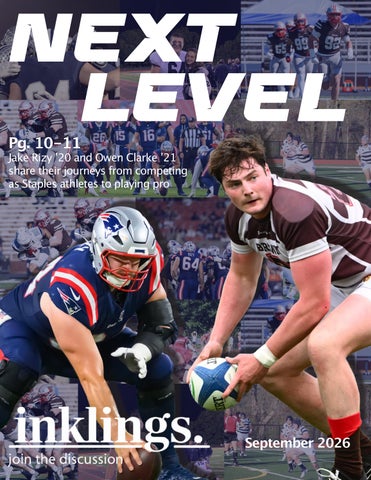
NEXT LEVEL
Pg. 10-11
Jake Rizy ’20 and Owen Clarke ’21 share their journeys from competing as Staples athletes to playing pro
September 2026
SEPTEMBER 2026
CONTENTS
Issue 1
About the cover Rizy ’20 & Clarke ’21 are continuing professionally within sports that they pursued at Staples.
More about us
Inklings News is uncensored, unedited by administration, and does not allow for prior review.
ARTS FEATURES NEWS
15
Nick Proper, father of two Staples students, is due to release “Stressed Self to Best Self.”
4-5
What you need to know about the new AI policy.
12
Flock cameras in Connecticut rise, impacting local communities.
OPINIONS 8
Brooke Kirkham ’27 explains the significance of having a dedicated space for the girls’ volleyball team.
9
Nate Gerber ’27 experiences McDonalds for the first time in his life.
Staff
Editors-In-Chief Avni Krishna, Camilla Garfield Managing Editors Ann Marie Maccaro Associate Managing Editor(s) Lily Ashford
6-7
Staples implements new policy requiring teachers to wear panic buttons.
15
SPORTS 10-11
Westport Farmers’ market celebrates its 25th year, showing big impact on local small businesses.
Staples graduates Rizy ’20 & Clarke ’21 head to the pros, reflecting on their careers at Staples.
Creative Directors Chloe Mitchell, Ella Turner Business Manager Ellie Kikorsky, Eva Matviyenko Advisors Joseph DelGobbo & Mary Elizabeth Fulco
Editors Phoebe Rosenberg --- pg.4,5 Reya Halper ---- pg.6,7,14 Katie Brill --- pg. 8 Leo Murstein ---- pg.9,12 Cody Feuerstadt --- pg.10,11 Juliet Varsov --- pg.13
Editorial
How panic buttons have precedent
I
n recent days, the word “panic” has been spoken in classrooms and on the loudspeaker, but few uttering the word actually seem to be in a state of panic. That’s because “panic” is in regards to the new installation of the teacher “panic button” (PAL system) that all Staples teachers are expected to wear on lanyards. The PALs look like small, black boxes with an indented button on one side. When pressed, the button vibrates and first-responders are electronically alerted to the location of the emergency. The implementation of the PALs started as an initiative by two Staples graduates. Zander Bauer ’26 and Elijah Falkenstein ’26 founded the Staples Make Our Schools Safe (MOSS) club and advocated to lobby the state government and Staples administration to adopt the PAL system. This adoption of a student initiative is a sign of incredible receptiveness from
the administration. This should be a catalyst for students at Staples to know that their voices have value and to see they are capable of a large-scale change. Bauer and Falkenstein’s success is a testament to how all Staples students should have the confidence to make meetings with administrators, attend Board of
We have an important responsibility to set the precedent. Education meetings, meet with local representatives and take the steps to make change in the community, or in this case, statewide. The Inklings editorial board commends the administration for listening to students and for supporting them in their pursuits for change. As the first school in Connecticut to have the PAL system, we have an important
responsibility to set the precedent. The state granted funds to all districts in Connecticut, leaving it up to the schools whether or not to use the money for the buttons. There are countless other schools in the state that are deliberating over whether to go through the process of getting the PAL system, and if Staples can utilize them well, we can be their deciding factor. A huge difference between Staples and numerous other schools in Connecticut is the immediate need for such safety measures. If Staples neglects this technology – not carrying them around or disregarding them – the schools in the state who have a primary need for direct emergency service lines will think this possible life saving system is of no use. Good ways to achieve this can be teachers routinely wearing the buttons, having schoolwide drills to ensure the tech is effective, more
thorough guidance for students on the new system and sharing our experience and data using the buttons with other schools. As a community, we need to be the trailblazers for statewide safety precautions. While there are initial concerns over effectiveness and false alarms, we should be able to give these buttons, and the students who advocated for them, a chance. Despite the naturally differing perspectives, Inklings’ editorial board can agree that this is a step in the right direction. For the future of student safety and voice, Staples should continue this policy and reinforce students’ power to make change.
The Editorial Board voted 19-1 in favor of this opinion.
Teachers can speak to first responders for 15 seconds once the button is pressed. Buttons are worn around teachers’ necks for easy access. First responders receive the teacher’s live location, across the entire campus, once the button is pressed.
The technology uses encrypted radio frequency signals that are independent from existing internet and wifi systems.
3
New “stoplight” policy sets standards for AI Chloe Mitchell ʼ28 Creative Director
Serena Goldfarb ʼ28 Paper Editor
Graphic contributed by Staples High School
4
T
he AI Stoplight policy has officially integrated in classrooms across the Westport Public Schools District. The new policy allows for increased teacher regulation and clearer guidelines for appropriate student use of AI. The AI Stoplight policy uses three color-coded levels to indicate the appropriate student use of AI for an assignment. Red means that all work must be completed without AI involvement. Yellow allows AI use when directed by the teacher and within specific limitations, with the goal of supporting skill-based learning. Green allows students to use AI more freely as part
of completing the assignment. “I think that the entire community felt a need to protect the value of learning,” coordinator for English Language arts Jessica DiBuono said. Starting last spring, a committee of educators from different departments across grade levels of the Westport school system met to review the academic integrity guidelines. The policy development was led by DiBuono and social studies teacher John Bengston. “[There are] skills that students are expected to learn to be AI literate from kindergarten to when they graduate,” health teacher and AI committee member Kelly Shamas said. “So we were really thoughtful and mindful that for those younger grades, the idea is not to get them on a computer.” As AI becomes more prevalent in classrooms, some students have questioned whether the district’s new framework makes expectations easier to understand. “I feel like they’re overcomplicating things a little bit. What’s the point of a stoplight? ‘Cause it’s kind of confusing,”
Cammy Brink ’28 said. “Also, why would I use all AI for an assignment? Then what’s the point of giving me the assignment?” On the other hand, some students have found the policy beneficial in understanding proper AI usage both in and outside of the classroom. “I think it’s helpful to see what our teacher’s opinions are about how much AI we should be using,” Julian Weilgus ’30 said. “It’s useful because sometimes we’re able to use some AI, and we’re able to use it in ways that are helpful for our work.” Some teachers have embraced some of the ways AI can assist students as a study tool, but many are hesitant to encourage it for assignments or projects. “If it’s going to make you a study guide quicker, fine, because it’s gonna help you with time management,” science teacher Kayla Ianetta said. “I’m having a hard time visualizing when it would be appropriate to skip the learning.” While AI has positive benefits that can improve student efficiency, it is often used for
malintended purposes, creating the need to reshape the way classrooms run. AI literacy lessons are being integrated into all grade levels throughout the Westport Schools District to improve student usage. “When you are no longer being the driver of the tool and the tool’s just doing it for you, you’re not being AI literate because you’re not getting the learning experience from that,” Shamas said. “It’s a tool. You need to be in charge of it, not just let it do it for you.” AI is not going away, and the Westport Public School district has noted that. That is why, as AI improves, Staples is encouraging students to become more educated on AI tools in order to increase ethical usage. “As our world changes, we wanted to review our guidelines to ensure they are clearly meeting the needs of all stakeholders,” DiBuono said. “Above all, we wanted it to be clear that student thinking is at the center of what we do and what we all are working to develop.”
Data
from
Yah o
o Fi
nan
ce
hics Grap
oeb
by Ph
berg
sen e Ro
’27
Inklinations Samantha Srihari ʼ28
Chris Gray ʼ27
“I think the Al stoplight policy makes sense because it’s trying to change Al usage and using it responsibly.”
“Honestly, I think it’s pretty dumb. The whole purpose behind it was to stop kids using Al when they’re not supposed to, but it’s just not gonna do that.”
News 5
Commitment to safety: New security button at Staples
Ella Turner 28
Creative Director
P
anic buttons are wearable devices that attach to teacher lanyards and, when pressed, alert first responders to the exact location of the emergency once the button is pressed. “It can [help] in everyday instances such as someone having a peanut allergy or fainting,” Bauer said. “It doesn’t have to just be in extreme instances, such as a school shooting.” The installation of these buttons passed through the Board of Education and Board of Finance unanimously.According to the CFO of Westport Schools, Elio Longo, $695,000 was approved to purchase the buttons for staff and administration. Of this number, $119,993.65 was received through a grant award called State of CT Department of Emergency Services 2023 Public Multi-Media School Security Competitive Grant. The other $575,006.35 was paid through local budgets. Longo explains that while any school district can apply for the grant, the process of receiving the grant was competitive. Superintendent Thomas Scarice believes that the buttons are imperative to strengthening school safety. “Staples has known cellular dead zones and the potential
6 features
for intermittent network issues at the very moments when reliable communication matters most,” Scarice wrote in an email in March to staff. Administrative action to move forward on Sept 16. National Protective Systems Inc. representatives, along with CEO Seth Romans, came to Staples to officially pass out Personal Alarm Locators (“PAL”), their branded name for these panic buttons. “It’s designed to be simply pressed with one press,” Romans said. Pressing the button immediately alerts police, the front desk, and the School Resource Officer with the exact location, activates nearby cameras, and signals an active voice line with a blue light. The voice line is active for 15 seconds, allowing the caller to relay verbal details. “It just saves so much time,” Romans said.“Our goal is to give PD as much incredible data as possible within a few seconds.” The design of the PAL, with an in-set button, prevents accidental calls if someone steps or sits on it. “[The button has] been designed so it can’t really be pressed until you’re all the way in and hold it down for a good half second. And when you do press it, it’s going to vibrate, so you’ll know,” Romans said. “You can instantly say, ‘Hey, it’s
Photo by Chloe Mitchell ’28
a false alarm’” Teachers have spent PD days and monthly faculty meetings learning about the buttons. For Principal Stafford W. Thomas Jr., the system adds another layer of security to the infrastructure Staples already has in place for emergency situations.
NEW BUTTON! Teachers, like English teacher Meghan Scheck, wear emergency buttons on their lanyards. However, to prevent accidental alerts the buttons are indented.
Graphic by Reya Halper ’29
Bauer & Falkenstein bring new law to Connecticut:
T
he school day was almost over at Marjory Stoneman Douglas High School in Parkland, Florida. Quick glances at the clock reconfirmed what students already knew: just 20 minutes until they could free their minds of lectures and classwork. Little did they know that in just that short window of time, the deadliest school shooting in America’s history would occur, and the lives of countless Parkland families and beyond would never be the same. A community of people came together in grief and determination for change; among them, the family of Elijah Falkenstein ’26. Falkenstein, a former resident of Parkland, Florida was aware of the shooting going into kindergarten. One of his cousin’s good friends and soccer teammate Alyssa passed away from the shooting. It’s a tragedy that has stuck with Falkenstein for a long time, and by the time he entered his freshman year, he
knew he had to do something about the issue of school safety. After Falkenstein moved to Westport, he and Zander Bauer ’26 established the first chapter of the Make Our School Safe organization in Connecticut during their freshman year. This organization was founded by Alyssa’s parents, and the chapter’s goal is to mandate and fund panic buttons to schools across the country by having each state pass “Alyssa’s Law.” “Hearing Alyssa’s story inspired me to want to make a change,” Falkenstein said, “[and] when I heard about [Make Our School Safe], I knew it would be such a great thing to do.” They wrote “Alyssa’s bill” and then began the process to advocate it into law. Falkenstein interned for Senator Ceci Maher during the summer going into his sophomore year, and she immediately became their spokesperson. Maher actively spoke to
Connecticut legislatures and, with some slight modifications, passed through the senate and house unanimously. In February, Governor Ned Lamont signed the bill into law. The modifications to the bill ultimately changed its title to Senate Bill 1216. This version of the bill grants funding to schools to purchase wearable panic buttons across Connecticut. SB1216 differs from Falkenstein and Bauer’s original vision for Alyssa’s law because it does not go so far as to require the installation of the buttons. Instead, the bill provides the $20 million in funds across the state for different districts if schools decide to implement them. Given this concession, Bauer and Falkenstein knew that in order to raise state-wide awareness for the available funding, they had to
use Staples as an example. “We’re hoping that once we prove that this is effective in Staples, we could roll it out throughout every other school in the district,” Falkenstein said. “Having [these buttons] in Westport sets precedent for all of Connecticut.”
USE OF THE BUTTON: DON’T PANIC! Zander Bauer ’26 and Elijah Falkenstein ’26 were awarded the 2026 Ralph J. Monaco Memorial Award for their work in establishing panic buttons at Staples. Photo contributed by Staples High School
7
More than a room
Graphics by Chloe Mitchell ʼ28
How a transformed closet built belonging Brooke Kirkham ʼ27 Sports Media Director
I
t’s the 2025 Staples girls’ volleyball season and I’m standing in the main gym before one of our biggest games of the year. I had just gotten out of class, but instead of getting into game mode, I was waiting for a bathroom stall to open so I could change. Since the girls’ locker room did not provide a space for teams to comfortably change and prepare together, we had to rely on individual bathroom stalls instead. So we all squeezed into the one place we could be alone: a basketball equipment closet. Sixteen volleyball players packed themselves between hanging jerseys, basketballs and shelves of equipment. In that room we would give our pregame speech, get ready and run out to the game. No girls’ team at Staples has ever had a team room, so I never imagined we could have something better than a borrowed closet. I never questioned this; it was simply a reality. For three seasons, I got ready for games against a gym wall or squeezed between another team’s equipment, never thinking there could be another option. My senior season changed that. During tryouts this August, Coach Lynch kept disappearing behind the locked doors of an old storage room in the back of the gym. Boxes were carried
Sports 8
inside. Wallpaper mysteriously appeared. Our coaches and booster moms had spent the summer secretly working on a project they refused to let us see until the final roster was announced. On our first official day together, the storage room door opened. Volleyball decorations covered the walls. Shirts with “Rise Up,” our motto for the season,
til we finally had our own space. Now, when the last bell rings on a game day, I don’t throw my backpack against a gym wall and wait for a bathroom stall. I walk into our team room. Music is on, someone is dancing, someone is doing their hair. For those few minutes we aren’t students rushing from 17 different classes anymore. We are Staples volleyball.
VOLLEYBALL ROOM [From left] Charlotte Felleman ’28, Emma Rivel ’28 and Erika Moss ’27 sit inside the team room, the first space of its kind created for a girls’ sports team at Staples.
were laid out for us on chairs. Coach Lynch even wrote an individual note to every player. This makeshift team room wasn’t huge or extravagant. But it was ours. There is a big difference between being part of a team and feeling like your team has a place within the school. I didn’t understand that distinction un-
That transition matters more than I ever expected. Sports are measured so often by what happens when the scoreboard is on: kills, assists, blocks, wins, losses. But I believe some of the moments that determine what happens on the court occur long before the first whistle. They are the conversations
and laughter before warmups. The pep talks after a bad practice. The few minutes when a teammate can admit she’s nervous before a big game. You can’t put those moments in a stat sheet, but you can feel them when six players step onto a court and trust one another. A team room doesn’t manufacture team chemistry. Four walls can’t win a volleyball game. But a team room can create the environment where relationships grow. And that is why I no longer see a team space as just a luxury. Our coaches and booster parents didn’t simply give us somewhere to store our backpacks. They showed our program that the moments surrounding competition deserve space, too. Our volleyball team room is a step forward for Staples’ female athletes, but it only came to exist because our coaches and parents took it upon themselves to claim it. If they had not done so, we would still be stuffing ourselves into a closet because the girls’ locker room at Staples still has not been renovated. Female athletes deserve spaces that recognize the time, work and pride they bring to their programs. What changed my final season shouldn’t feel exceptional. It should be something every team gets to experience. Four walls didn’t make us a team. But four walls of our own gave our team a home. Photos by Brooke Kirkham ʼ27
Thou shall not find happiness within the golden arches Nate Gerber discovers the reality behind McDonald’s Nate Gerber ’27 Event Manager
I
never had McDonald’s growing up. Not once. I nearly spent my whole childhood without a Big Mac, Filet o Fish, McRib or a Happy Meal. And that’s sad. I bet that’s illegal in Texas. Not Westport, apparently. So when I remembered this fact a week before my 18th birthday, I broke household law and drove to the golden arches as if it were divine command. The parking lot was empty save for a single Toyota Sienna idling by the drive-thru, its brake lights glowing red like something out of Exodus. I did not take this as a sign. I should have. I continued towards the monolith and became entranced by a dumpster. Behind the dumpster an apparition of the GRIMACE appeared to me. I saw that the dumpster was on fire, but it was not burning up. “This is strange!” I said to myself. “I’ll go over and see why the dumpster is not burning up.” When GRIMACE saw me coming near, he smote me with the command to break tradition and have a meal at McDonalds. I did not ask why. You do
not ask a purple blob why. You simply… obey. And thus, I entered the golden arches, approached the register and I ordered a happy meal… with 6pc McNuggets and golden honey mustard… like a man fulfilling prophecy. I forked over $50, because that’s what we typically pay for lunch in Westport, and the cashier looked at me. She stared. She smiled. It was the smile of someone who understood, better than I did, that I had heard the command of a false prophet, and that no amount of currency was going to save me now. I sat down at the booth built for someone half my height (but maybe ¾ my size) and unwrapped the meal. I saw the golden honey mustard and thought, “Is this El Dorado?” and then I tried the golden honey mustard and thought, “Absolutely not.” I opened the box. I found the toy. It was a character I did not recognize. I guess I’m too “unc” for that. And I’m just thinking, “what kind of 18 year old orders a happy meal?!” I tried the food and I finally understood. I was being shielded, cast away from… nothing worthwhile. And on the eighth day, GRIMACE rested. I did not. I had homework.
Photo Dramatization and Graphic by Chloe Mitchell ’28
featuresopinions 9 11
Wreckers turned pros: Dylan Robbin ’28
Sports Media Director
W
estport has never been shy about producing talented athletes, and this year, two former Staples athletes are taking their talents to the professional level. Though they play different sports, both athletes trace their successes back to the same hallways and practice fields at Staples.
J
NFL READY, Jacob Rizy ’20 plays center in his preseason debut for the Patriots.
Photos contributed by Jacob Rizy ‘20
10 Sports
acob Rizy’s ’20 road to the NFL began on the practice fields at Staples, where he first learned the game. Football carried him to three seasons at Harvard, two more at Florida State and now, a spot on the New England Patriots’ practice squad after signing as an undrafted free agent. Rizy credits Staples with instilling the mental toughness that’s carried him through every level since “Staples was where I really learned how to play football,” Rizy said. “There were a lot of high highs and low lows, so definitely learning how to stay consistent through adversity would be the most valuable thing I learned.” Although Rizy never won a state championship at Staples, he learned to focus on his own development regardless of the team’s results. “With a team sport, of-
tentimes you can’t control the outcome of games and seasons. I learned that no matter how good or bad we were, all I could control was getting better myself,” Rizy said. That mindset followed Rizy throughout his college career, where he played all over the offensive line. Rizy got snaps at left guard, center, right guard and right tackle, racking up two All-Ivy League accolades at Harvard before transferring to Florida State. Now, as he fights for a roster spot in the NFL, Rizy says his approach has not changed. “My goal is to improve,” Riwzy said. “There isn’t a limit to growth, especially at this level, so fixing one thing, getting 1% better every day, is all I can do.” As for advice for the next generation of Staples athletes chasing a similar dream, Rizy does not sugarcoat the hard work it takes to be successful. “There is not enough extra work that can be done,” Rizy said. “I didn’t realize how much time I needed to put into getting better on my own until I got to college. I wish I spent more time going to the field on my own time in high school.”
How Jacob Rizy & Owen Clarke tackled their dreams
Photos contributed by Owen Clarke ‘21
ry going,” Clarke said. “Each week he’d have his stats from the game, and I’d have mine, and we’d discuss it and see who played better.” He also credits his coaches, Coach Adam Behrends at Staples, and Lawrence Spinnato at Choate for playing an integral role in his development. Clarke is now settling into life with the Free Jacks, who set him up with an apartment as he spends the next six weeks with a de velopmental team before the full program reports in February. The regular season runs from March through June. As for expectations in year one, Clarke is keeping it simple. “I want to be able to learn as much as I can, pick it up as well as I can, and put myself in the best position to be the best player possible,” Clarke said. Clarke’s advice for any young athlete at Staples hoping to follow a similar path goes beyond the field. “It’s more than just playing the game,” Clarke said. “It’s taking your life outside that physical sport seriously… by the time the fourth quarter comes around, you’re going 100. Other people are going 80.”
Graphic by Chloe Mitchell ‘28
F
or Owen Clarke ’21, the news of being drafted to the New England Free Jacks of Major League Rugby came surrounded by his parents when his name got called in the second round. “I was excited to be able to continue to play sports and do something that I love,” Clarke said. “You put a lot of hard work into something, and you got a good result.” That draft moment was years in the making, tracing back to Staples where Clarke first picked up a rugby ball because of his older brother. “He was really into it,” Clarke said. “I played baseball my whole life as well, and that was actually a really tough decision for me, but I always liked to run and tackle, so I figured I might be better off playing rugby instead of baseball.” Clarke played rugby and football in his freshman season at Brown. He took a break from rugby for two years but rejoined the rugby team after his senior football season. He called the transition “seamless.” When asked about the influences that shaped Clarke along the way, he first pointed to his father: Staples Football defensive line coach, Ron Clarke, and his twin brother, who took a similar path. His brother took a post-grad year at Suffield and is playing football at Richmond. “We had a friendly rival-
HIGH ROUND DRAFT PICK, Owen Clarke ’21 is set to play his rookie season in the Major Rugby League for the New England Free Jacks.
Sports
11
Wh watches the watchmen?: Alex Gordonos ʼ27 Social Media Manager
T
he Westport Police Department installed 20 Flock ALPR (Automatic License Plate Readers) cameras on Jan. 1, 2025, in order to monitor and record any license plate that passes by. Within 30 days the cameras captured 360,343 unique license plates in Westport, according to Flock’s transparency portal, raising privacy and governmental overreach concerns. However, the Westport Police Department has justified its use of ALPR cameras. Unlike other ALPR systems, Westport’s do not include facial recognition and must follow Connecticut laws around the use of ALPR’s, which includes a ban on giving data to ICE (Immigration and Customs Enforcement). “ALPR technology has many applications for law enforcement,” Administrative Lieutenant Anthony Prezioso said, “including identifying vehicles involved in criminal activity, developing investigative leads and locating missing people, to name a few.” All searches by Westport officers are audited twice monthly to prevent system misuse, and all data collected by ALPR cameras are automatically deleted after 21 days. “We understand that questions about technology, privacy and government oversight are
12 news
legitimate,” Prezioso said. “At the same time, we believe it is important for the public to understand that LPR technology is one of many investigative tools available to law enforcement.” Since 2012, Connecticut law enforcement has been using license plate cameras but it was only in 2025 that Connecticut installed Flock cameras. Automatic cameras for traffic enforcement have been around for years, yet Flock cameras remain unprecedented in their collection and storage of data. Unlike speed or red light cameras, Flock cameras have no discretion and will capture and compile any plate that passes in front of the camera. The other major difference with Flock cameras is that the data is not just sent to law enforcement, but it is also stored. This allows for the tracking of vehicles around the state and
“
We understand that questions about technology, privacy and government oversight are legitmate.
- Westport Administrative Lieutenant Anthony Prezioso
even across state lines, as each camera will send data to servers, which when compiled, can allow law enforcement to track vehicle location and time. Backlash over flock cameras in Connecticut has led to many
towns that once embraced Flock to decouple themselves from the company. In 2026, Windsor’s town council voted 5-4 to discontinue the use of Flock cameras. “I think the concern I heard from people is really not about the police department,” Darleen Klase, a Windsor town council member, told CT Insider. “It’s really not about not trusting the police or not wanting to even support the police, it’s the data collection without consent.” Connecticut has now implemented laws preventing ALPR cameras data from being shared outside Connecticut, New York, Massachusetts, or Rhode Island, and never for the purpose of immigration enforcement, or tracking of reproductive health care consultation such as out of state abortions). “Our objective is straightforward,” Preziosos said. “Use technology responsibly to prevent crime, assist in solving crimes, protect victims, and make Westport a safer place to live, work, and visit while always maintaining appropriate protection for individual privacy.”
Graphic by Chloe Mitchell ’28
Flock cameras ignite debates over privacy and safety.
Stressed self to best self Staples dad writes book sharing insight on stress Lily Ashford ʼ27
Associate Paper Managing Editor
I
n capitalist American culture, productivity and success often go hand in hand, creating pressure to constantly accomplish more. Westport is no stranger to this cycle. The average Staples student balances rigorous academics, athletics and college expectations raised by parents who navigate their own high-pressure careers, passing down an idea of success built around constantly striving for more. Like many Staples parents, Nick Propper knows that cycle from both sides. Before moving here 10 years ago, Propper spent much of his career in the U.K., including 15 years in leadership at global advertising company Omnicom and serving as an executive at its public relations agency Porter Novelli. His former career came with demanding clients, constant
travel and the expectation of always being available. Now, as the father of Mabel Propper ’24 and Maggie Propper ’27, Nick Propper has watched the new generation encounter their own version of that pressure at Staples. His experiences as both an executive and a parent ultimately pushed him to step outside the corporate world to co-found his own organization, Impact Human Performance, which focuses on understanding stress and its relationship to human performance. After working with more than 75,000 people across drastically different environments, Propper began to notice the similar responses to stress, regardless of the source. “You can be sitting with someone serving in the U.S. Marine Corps, a doctor working in healthcare, or someone at the beginning of their career, and you hear remarkably similar things: I’m impatient. I can’t concentrate. I stop listening. I overthink things,” Propper said. “Beneath all the job titles and differences in our lives, we’re all operating with essentially the same human system.” Seeing those patterns emerge across thousands of people, Propper and his partner Kevin Kachin wanted to make the information they had learned accessible beyond just the organizations they worked with. That goal led them to write “Stressed Self to Best Self,” which explores how
Rethinking Stress Nick Propper helps people better understand responses to stress and how to effectively manage them.
people can recognize their indi- to move effectively between vidual responses to pressure and periods of stress and periods of develop habits to prevent stress recovery, so that you can keep from overwhelming them. performing without gradual“One of the biggest things ly depleting yourself,” Propper I’ve learned is that stress itself said. isn’t necessarily the enemy,” Finding that balance begins Propper said. “We actually need with recognizing when stress stress to grow and perform.” stops improving your life and That realization has changed instead causes impatience or the way Propper interprets ner- distraction. Prioritizing recovvousness in his own life. He ery can be as simple as choosno longer automatically views ing sleep when another hour of nerves as a sign that something studying is no longer producis wrong. Instead, he recognizes tive. that his body may be preparUnderstanding stress has ing him to meet the challenge also meant redefining success. ahead. “Stressed Self to Best Self ” enFor Staples students, that courages a definition of achievesame response can show up ment that considers more than before a test, the number a game or a of accomclass presenplishments, tation. The placing equal racing heart value on the and nervous ability to susenergy that tain perforcome with mance withthose moout losing ments do not the qualities always mean necessary to the pressure perform at has become one’s best. too much. In the right “The goal amount, isn’t to elimPropper beinate stress lieves it can from your provide the Spreading the word Nick life. That’s energy and Propper wrote “Stressed Self to impossible, focus need- Best Self” to inform readers on and probably ed to meet how to manage stress. undesirable,” a challenge. Propper said. The distinc“It’s to untion comes down to what hap- derstand yourself well enough pens after the stressful moment that you can spend more of passes. your life as the person you are “The real skill is being able when you’re at your best.” Photos contributed by Nick Propper
features
13
Market making a difference: Westport Farmers’ Market celebrates 20 years Phoebe Rosenberg 27 Web Communications Director
T
hursday is a special day in Westport. Once a week, the empty Imperial Avenue parking lot fills up with stands and tents. Over the course of four hours, thousands of shoppers peruse dozens of stalls run by small businesses dedicated to quality and the best food Connecticut has to offer.
Photos contributed by Jeff Roy
MARKET TIME! From home basements and side-hustle garages to thriving brick-andmortar storefronts, (above) like the team at Sound Coffee.Turning small businesses into expanding Connecticut favorites like (right) Pierluigi Mazzella of Fatto a Mano.
features 14
For 20 years, the Westport Farmers’ Market has been dedicated to supporting sustainable and over 50 local small businesses. Beyond servicing Westporters with healthy, fresh produce and food, the Westport Farmers’ Market has turned home-based business into expanding local favorites. Founded by Actor Paul Newman and Chef Michel Nischan in June of 2006, the Westport Farmers’ Market has become recognized for its “20 years of increasing awareness, knowledge & support for local farmers and food producers” according to Senator Richard Blumenthal. Many known businesses in Westport started with humble beginnings. In the case of authentic Italian bakery Fatto a Mano, owner Pierluigi Mazzella started small after moving to the U.S. from Italy in 2018. “I started my own thing from my house in a basement, selling two loaves of bread to neighbors,” Mazzella said. “Eventually we tried the Westport Farmers’ Market, and everyone was very good, but the prob-
Photos contributed by Pierluigi Mazzella
lem was we were selling out the first 30 minutes.” As Fatto a Mano grew in popularity, the production had to quickly follow. Since beginning at local markets, Mazzella has been able to expand from only making bread in a basement to having his own store in Westport, offering baking classes, catering and a growing menu of Italian baked goods. In 2022, Mazzella also won the Baker of the Year Award from the Connecticut Restaurant Association. “Fatto a Mano is not just a bakery anymore,” Mazzella said. “It’s an experience people can get for their special wedding or nice gelato and more to come.” The community that the Westport Farmers’ Market has built doesn’t just help new businesses. It also creates the support needed to keep small businesses alive. The Westport Farmers’ Market reach isn’t just limited to Westport. The market has been a valuable resource for growing businesses across ConGraphics by Chloe Mitchell ’28
necticut, including the specialty coffee roaster, Sound Coffee in Bridgeport. Founded by hobbyist coffee roasters Jeff and Sarah Roy during the Covid-19 pandemic, Sound Coffee began in their garage as a side hustle before deciding to scale their business through local markets. “Our neighbors encouraged us to keep going to farmers markets when they finally opened back up after the pandemic,” Jeff Roy said. “So our real original roots are definitely within farmers markets and direct consumers through our website.” Six years later, Sound Coffee has expanded beyond just roasting coffee and now has a coffee shop in Bridgeport, a kiosk in the Hartford HealthCare Amphitheater and still sells at multiple farmers markets across Connecticut, including the Westport Farmers’ Market. “Westport Farmers’ Market is amazing,” Roy said, “and 20 years is just a testament to what goes on there and the support of the community.”
interactive 15
Jake Rizy ’20
BLEED
WRECKER
BLUE
Owen Clarke ’21