LOOKING FOR MORE?
@doshombres | doshombres.com
LOOKING FOR MORE?
cd: ROBB AARON GORDON
FOURSEASONS.COM/LANAI
-
- Renew your senses at Hulopo e Bay
THE FARTHER YOU TRAVEL, THE MORE YOU MAY FEEL AT HOME.
Your home is not a stationary manmade structure, your home is planet Earth. Experience that familiar feeling in the Polar regions when you’re embraced by the comfort found aboard Le Commandant Charcot. Find new perspectives, change your mindset and discover your place in the world.
For reservations and information, call 1-844-656-3786 us.ponant.com
10
|
INKEDMAG.COM
ISSUE 4 / 2026
|
11
PUBLISHER Darrin Austin VP OF PRINT MEDIA Toby Thompson VP OF OPERATIONS Tianna Kaye VP OF ADVERTISING Christa Lebar PR/MARKETING MANAGER Carson Leathers MANAGING EDITOR Amy Higgins DIGITAL MARKETING Jennifer Kraybill WEB DEVELOPMENT Peter Talavera SOCIAL MEDIA / VIDEOGRAPHER Collin Pape
A
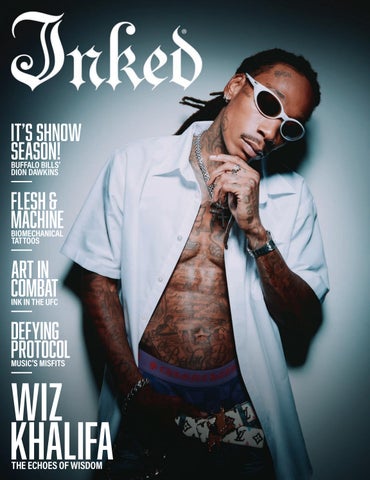
ssumption is the mother of all mistakes. Oftentimes, confidence gets mistaken for arrogance, while kindness gets confused with naivety, independence with loneliness, and ambition with selfishness. Outdated stereotypes assume a tattooed individual is unprofessional, yet world-famous divorce attorney James Sexton is evidence to the contrary. In essence, what is perceived based on outside appearances doesn’t always tell the full story. Take the shredded and tattooed exterior of Wiz Khalifa, one of the most famous and influential modern-day rappers and this issue’s cover subject. His fit frame has endured countless hours of ink sessions and stints at the gym, both requiring immense relentlessness, yet his physique is wrapped in compassion, protectiveness, and the highest humor. His presence commands the spotlight, yet one-on-one, his genuineness and good nature steal the show. In the same vein, Buffalo Bills offensive lineman Dion Dawkins is a boastful brute and commanding figure on the field, but when the helmet comes off, he’s humble, hilarious, and a champion for children and the disadvantaged. He’ll run over anyone who gets in the way of his star quarterback, yet he’ll target anyone with kindness when he’s out in the community — especially when he sees 73. One might assume that decades-long music veterans would stay within the bounds of their devoted enterprises, but sometimes they switch lanes and leave assumptions in the rearview. That’s precisely what Red Hot Chili Peppers’ bassist Flea did when he released his first jazz album, and what Face to Face frontman Trever M. Keith did when the punk rock legend recently announced an Americana album. Their albums were born from lifelong influences and went beyond fans’ expectations. This issue holds many more stories that stray beyond the customary, finding fervor — and sometimes controversy — outside the norms. Indigenous Greenlandic tattoos, for example, are seeing a rise in interest lately, sparking interest and inciting arguments. Harrison Alcock and Eden Kozo ink beyond the bounds of tattoo artistry norms. While inking skin is still in their DNA, both artists guide their tattoo machines along the contours of textiles and metallics. Much like the many others featured in this issue, they’re thinking outside the box, refusing to be pigeonholed into one category, and defying outward assumptions. The pages ahead reveal these stories, within and beyond outward impressions. Darrin Austin Publisher
12
|
INKEDMAG.COM
CREATIVE STRATEGY MANAGER James Leary OFFICE MANAGER/PENNSYLVANIA Jami Pearlman ACCOUNTS RECEIVABLE /PAYABLE Chris Watson FULFILLMENT Theresa Jones CONTRIBUTING WRITERS Anna Smith / Jason Murray / Nia Groce / Colin Wrenn / Kellie Speed Alexandra Shimalla / Tom Reardon / Kat Todorovic / Adam Szetela Jillian Dara / Kate Daniel / Max Freedman / Miguel Costa / Amy Young CONTRIBUTING PHOTOGRAPHERS Russ Harrington / Travis Shinn / Christopher Kolk / Leigh Keily ADVERTISING Kaydee Dici / Jaime Van Bogaert / Wallace Cedeno CORPORATE LOCATION Inked Holdings, LLC. 15210 N. 75th Street, Unit B Scottsdale, AZ 85260 WEBSITE INKEDMAG.COM SUBSCRIPTION INFO subscriptions@inkedmag.com Postmaster, send address changes to: Inked Magazine 15210 N. 75th Street, Unit B Scottsdale, AZ 85260
LINEWORK
(
)
he needle doesn’t know the difference. Leather, Harrison Alcock will tell you, is the nearest thing to living skin — close enough that a tattoo machine can’t feel the switch and that the ink still needs to earn its place. What it lacks is a client attached to it. And for the founder of Artimus Ink, that absence changed everything. Before shoes, supercar interiors, and NDA-bound projects with major brands, Alcock spent a decade as a traditional tattoo artist. It was, by his own account, a career he loved until he didn’t. “I think I kind of got to a part where the market was oversaturated and falling out of love with tattooing as a whole, which was such a sad moment for me,” he says. “That was my career.” The problem wasn’t the craft. It was the ceiling above it — a client-dependent industry, increasingly crowded, in a moment he describes as undoubtedly digital. “I knew that we were in a digital era now. So whether I like it or not, I have to change something about my process, or nothing will change.”
14
|
INKEDMAG.COM
BY NIA GROCE
ISSUE 4 / 2026
|
15
OBJECTS OF AFFECTION
Long before leather entered the picture, Alcock’s relationship to objects — specifically, to shoes — had already been in motion. He started skateboarding around 8 years old and stayed on a board into his early 30s, until injuries forced him off. Skateboarders tend to burn through shoes without much sentiment, but for Alcock, watching pair after pair get destroyed only deepened his fascination with them. “You go through shoe after shoe. You’re ripping them and you lose the emotional attachment and the love for shoes because you know they’re going to get ruined,” Alcock says. Skating was one half of his life. Tattooing, eventually, became the other. The idea of fusing them — putting a needle to a product instead of a person — wasn’t a market strategy so much as an inevitability. “It just seemed right to put them both together.” Once he landed on leather, the choice of material had its own particular logic. Thin fabrics couldn’t survive contact with a tattoo needle pulsating at speed. Suede, calico, anything delicate would simply tear, but leather could take it. “Leather is the nearest thing to skin,” he explains, “so I thought that was the best object to take.” Knowing leather could hold a tattoo and knowing how to make one that lasted were two different problems, and there was no rulebook to consult. Earlier attempts by others in the space, Alcock says, had produced work that degraded the material almost on contact, particularly with color. “It would ruin the leather. You could never do it on white leather at all. It would just ruin it as soon as you wipe,” he explains. “So, I’d seen people trying it, but it was not a legitimate industry because it didn’t have legitimate outcomes.” With no precedent to follow nor experts to call, Alcock built the process from nothing, alone, in a shed behind his house.
GOLDEN DRAGON CAR SEATS
“There was no avenue to go and talk to anyone about it,” he explains. “I have to do a trial. I have to make an error. I have to break machines, break needles, ruin shoes, spend the money, spend the time.” He shares that he spent six to eight months in that shed “like an OCD, ADHD kid, hyper focused, solving problems every day,” before the process stuck. The real proof came when a finished piece survived an intense stress test over time. He had found a way to make leather look tattooed and a way to make it stay.
LINE OF WORK
JIMMY’S ICED COFFEE BIKE
16
|
INKEDMAG.COM
JIMMY’S ICED COFFEE BIKE
The aesthetic that emerged from that process looked nothing like his earlier work. On skin, Alcock gravitated toward dense, high-contrast gothic imagery and Japanese-style tattooing. Leather demanded the opposite. “Rather than adding all this shading and doing all these other things, I realized that actually clean linework stands out more,” he says. Bold, uncomplicated linework on leather reads clearly on a shoe from 20 feet away, without the saturation his earlier style depended on. “It was a really weird change, but I had to adapt to the medium that I was working on.”
TATTOOED LOUBOUTINS ISSUE 4 / 2026
|
17
That restraint has become its own kind of signature. Snakes, dragons, and floral motifs recur across his pieces, not because his range is limited, but because a recognizable line does more for a brand than a technically harder one. “You know when you see my linework, that’s me,” he says, likening it to a logo. The long, curving lines suit the leather’s demands, too: a snake or dragon can wrap a form the way a shoe or seat curves, which he describes simply as “easy coverage.” As he refined his leather-shoe tattooing technique, he realized there was no limit to what he could ink. Shoes remain central to his limited-edition model — small numbered runs, handmade and sold directly — but his pioneering technique has since moved into automotive interiors, furniture, and branded partnerships once unthinkable for a “traditional” tattoo artist. He tattooed the seats of a Porsche GT3 and built an entire leather canvas from rawhide for a year-long global contract with Monster Energy. He’s activated in-store with Birkenstock, put a permanent design on a Jimmy’s Iced Coffee can sold worldwide, and inked the full interior of a 1966 Mustang, winning Best Interior at Gravity Show, one of Europe’s largest custom car shows, on his first appearance. He’s currently in talks with Mazda, Jaguar, Land Rover, and Porsche, after his tattooed leather samples passed 50-year stress tests for UV damage and abrasion. “Once you cut that human being out, tattoo artists now have an avenue into luxury fashion, design and homeware, the automotive space,” Alcock says. “There quite literally are limitless possibilities for artists to really expand their life outside of a tattoo studio.”
TATTOOED 1966 FORD MUSTANG
GIVING BACK THE BLUEPRINT
TATTOOED SHOES PROJECT
18
|
INKEDMAG.COM
For an artist who built his leathertattooing process alone, Alcock is direct about not wanting others to repeat that isolation. He credits a tattooer he trained under, Gino Dartnall, with the belief that shaped his own legacy: real change in this industry comes not from client work, but from what an artist gives back. “I truly believe I have given something to the industry that is hands down bigger than myself,” he says. In practice, that meant publishing his process rather than sitting on it. Alcock offers a step-by-step e-book and a video masterclass covering leather stencils, machine configuration, ink selection, and which leathers actually hold a tattoo. He’s kept both deliberately inexpensive, even as he weighs how long that pricing can hold before the market oversaturates. “I’m making it cheaper than I should do because I do believe that the industry needs more artists,” he says.
The instinct traces back to his own view of opportunity as a kid. The only in-person teaching he does is unpaid, reserved for kids without access to apprenticeships or financial support — kids, he says, who remind him of himself. “These are kids that just don’t have a lot of chances,” he says. “I’ve always made sure I teach them.” Two years ago, Alcock was an unknown tattoo artist coming off a decade of client work that he says he feels went nowhere. “I spent the effort to quite literally reinvent this craft to forward an industry,” he says. Today he’s signed with a global energy drink brand, courting three car manufacturers, and building a limited-edition business model designed to be replicated by other artists chasing their own way out of an oversaturated industry. With change comes opportunity, and Alcock’s focus on leather was a risky endeavor that is paying tangible dividends and, more importantly, demonstrating to fellow tattoo artists that they too can flourish with a little flexibility.
DR. MARTENS BAGS ISSUE 4 / 2026
|
19
INSPIRATIONAL
ROSE TATTOO
A YOUNG MAN, A BUCKET LIST, AND A PERMANENT SYMBOL OF SACRIFICE AND BRAVERY.
BY AMY HIGGINS PHOTOS BY COLLIN PAPE
L
ife is a countdown, and for Brendan Davies, that time is running out. Born with an extremely rare congenital heart defect, he was just 2 months old when he had his first open-heart surgery, received a heart transplant before his second birthday, and was just shy of turning 8 when he had to fight a cancer diagnosis. At 16 years old, the tough-as-nails warrior is living with a final diagnosis: stage 3 coronary allograft vasculopathy (CAV), an irreversible, terminal heart disease. “He has always had a swagger about him that belies how very sick and close to death he’s been many times over the years,” said his mother, Genevieve Davies, and joked, “His health is just a pesky bother that is below him to worry about.” Rather than suffer endless poking, prodding and testing, Brendan has chosen to check the boxes on his bucket list instead, and renowned tattoo artist Bubba Irwin recently helped tick one of those boxes with a rose tattoo. This summer at an Arizona-based Big D Media sports gym, Irwin set up shop inside a boxing cage to tattoo Brendan’s chest with a custom rose, a dagger plunging through the pistil, serving as a resilient stem. “He’s always loved the song ‘Rose Tattoo’ by the Dropkick Murphys since his older brother Wesley turned him onto it years ago,” Genevieve explained. “He added a dagger because that symbolizes strength, and the marigold symbolizes hope. The rose to him symbolizes the beauty and pain of life.” While getting tattooed, Brendan received a surprise video message from country music star Kane Brown. “What’s up, Brendan? This is Kane,” the two-time RIAA Diamondcertified winner announced. “I just heard you’re a big fan. Just want to say, love you, dude. And I heard you’re getting a tattoo by our boy Bubba. I hope he don’t mess it up — don’t let him mess it up. And God bless you.” Brendan bravely battled the pain from the pulsating needle, but was noticeably relieved, exclaiming, “Oh, hallelujah!” when the artwork was finished. “It was a painful process,
20
|
INKEDMAG.COM
Brendan took the tattoo like a Spartan. He’s a fearless badass who has already been through more than most of us will ever go through in our whole lives. - Bubba Irwin
BRENDAN DAVIES AND BUBBA IRWIN
like everything that precedes good things in life, but I’m glad I actually committed to getting my tattoo,” Brendan shared. “It looks good, and my friends were impressed.” Brendan was 8 years old when he begged his mother to stop the “torture” of medical care and asked to switch to palliative care. “Brendan wants to go out on his own terms,” Genevieve shared. “Honestly, that freedom (of palliative care) has allowed him to thrive and meet a lot of his bucket list dreams.” Since starting his bucket-list journey, Brendan has earned his brown belt in karate, gone axe throwing, started a chess club at his high school, and attended Winter Formal with his girlfriend. He has had countless adventures with the Powerfully Positive Project, including Muay Thai sessions on the beach, caring for horses, learning to operate a fire hose with firefighters, and racing go-carts.
“Brendan is a defiant teenage boy who will squeeze every last ounce of joy out of life until he drops — probably walking to class at school for maximum group trauma bonding, because Brendan is nothing if he isn’t including others in his chaos,” Genevieve joked, but added with sincerity, “He’s been such a light in this world and continues to show everyone he meets how you’re supposed to live with joy, a heart for fun, and a strong will.” Whether monumental or minor, tattoos tell the wearer’s story. From souvenirs to tragedy and triumph, ink is a badge on the body that stays with you throughout your lifetime. And stays with loved ones through eternity. To contribute to Brendan’s GoFundMe, visit gofundme.com/f/support-brendanspeaceful-journey.
PROFILE
22
|
INKEDMAG.COM
T
hroughout his childhood in Brazil, the tattoo artist and extreme distance runner Biel — who’s covered head to toe in tattoos, including around 40 on his face and neck — was into music, painting, and printmaking. His friends came to know him for the latter, and in his late 20s, when his friends asked if they could get his drawings tattooed, he bought a tattoo machine, taught himself how to use it, and started inking his friends. For a while, he was tattooing four to five times a week. But in his early 30s, everything changed. “These days, I tattoo very little,” Biel says — as in, just three or four days per month. “Running has really taken over my life. My training program is pretty demanding. I train twice a day, especially before big events like this one that I’m preparing for.” To call the event in question “big” is an understatement. It’s a roughly 500-kilometer run from Chamonix in the French Alps to the French city of Marseilles, put on by the invite-only The Speed Project. After he completes this run, Biel will set his sights on TSP’s 500-kilometer run through Chile’s Atacama Desert. Both events follow a recent headline-making accomplishment with TSP.
FROM ANGELS TO SIN
In April 2026, Biel set a new solo record at TSP by running approximately 500 kilometers from Los Angeles to Las Vegas in 67 hours and 15 minutes. By comparison, a marathon is 42.2 kilometers, and the top speed at the 2025 New York Marathon was two hours and eight minutes. TSP’s extreme runs are a major reason why Biel was drawn to the brand. “I’m a pretty extreme person, so it felt like a perfect match,” says the 43-year-old, noting that, when TSP Founder Nils Arend spoke about running and his vision of TSP, “I connected immediately.” Biel was first invited to The Speed Project in 2025, but the brand had already spent the last decade putting on underground ultra-distance races across the world. TSP’s invitees — athletes, creatives, thrill-seekers — have run through varying climates based on their own strategy and experience, without any audiences, fellow runners, or guidance. “The distances and environments aren’t there to prove who’s toughest,” Arend says. “They’re there because they strip away the noise. After a few hundred kilometers, external expectations no longer matter. What remains is character, creativity, and the willingness to trust the people around you.”
BIEL, COURTESY OF TYCJAN TRZPIOLA ISSUE 4 / 2026
|
23
PHOTOGRAPHY COURTESY OF DURAN LEVINSON
24
|
INKEDMAG.COM
Biel first encountered Arend when the latter was organizing a race around Sisyphos, a popular nightclub in Berlin. The race was a 5-kilometer loop, but participants ran around it for 24 hours. There wasn’t a livestream or any prize money, and there were no medals. It was just people having fun. “It matched my own romantic view of the sport,” Biel says, adding that it’s “not always about results or recognition. There’s something about just doing (it) for the love of the sport. That, I think, we really connected on.” “When you remove the prescribed route, support, the spectacle, and most guardrails,” Arend says, “you’re left with something much more honest and free. We don’t define what the experience should mean. That’s yours to discover and create.”
GOING THE DISTANCE
Hearing that Biel ran for 67 hours and 15 minutes, some questions naturally arise. Did he sleep? Did he eat? Although a car brought him food and drinks, he didn’t exactly rest. “I only slept for two hours and a half,” Biel recalls. Sleep was antithetical to going fast. “Sometimes, you just need to tell your brain that this 20-minute nap was enough,” he says. “Sometimes, I stop very quickly to eat something, take a nap, and go.”
We believe there are many ways to participate. Running is just one of them. Capturing the landscape, documenting the people, composing music, making films, taking photographs, writing stories, or creating art are all equally valid forms of participation. - Nils Arend Biel credits one of his most cherished tattoos, a horse on his stomach, with pushing him to keep going. “It gives me the power for running — I relate,” he says. That power comes in handy when running TSP’s massive distances, and nowadays Biel’s life is built around training for these races. “I’m running twice a day, and in between, I do some mobility work, strength work,” he says. “I cover around 200, 230 kilometers every week.” Where he trains matters, too. He spent a month in Arizona before his Vegas run “to adapt to the altitude and (running) in this type of terrain that is very different from Berlin.” He does the same for all his races with TSP, having spent four weeks in France prior to the Marseilles event. Running is most of his life, but not all of it. “I’m living like a pro athlete,” Biel says, “but I also have the urge to make things and create, so in between, I try.”
KEEPING THE SPARK ALIVE
Although Biel only has time to tattoo occasionally, he continues to make art. In fact, his artistic interests also drew him to TSP — the brand mixes running with the arts, and when TSP launched a shirt with Biel’s graphics, it instantly sold out.
ISSUE 4 / 2026
|
25
“We believe there are many ways to participate,” Arend says. “Running is just one of them. Capturing the landscape, documenting the people, composing music, making films, taking photographs, writing stories, or creating art are all equally valid forms of participation.” He adds that TSP “has become a place where athletes and creatives co-create alongside one another, each leaving their own mark on the experience.” TSP’s expansive definition of participation also drew Claudio, a Santiago, Chile-based runner and tattoo artist who owns the city’s Devoción Electric tattoo shop, to the brand, for which he designs garments intended to fit any body type. He says that, more than merely a race, TSP is “the materialization of a collective feeling, of what many people feel alone, and how movement, expression, wild nature, and poetry converge in these instances. All these facets are fundamental parts of art, and TSP brings them together and allows them to coexist. “In my life,” Claudio continues, “everything is interconnected (in) an ecosystem of ideas, proposals, and practices.”
NILS AREND, COURTESY OF DEVIN L’AMOREAUX
BIEL, COURTESY OF TYCJAN TRZPIOLA
THE SPEED PROJECT, COURTESY OF MARCUS MEISLER
When he learned about TSP, it affirmed his belief that “many of us out there are working (toward) making existence an experience and not an empty purpose.” Biel, too, perfectly fits TSP’s dual emphasis on art and running. Even with his limited time, he recently rediscovered his love for printmaking, but since he regularly travels and printmaking requires space and special tools, he’s taken up a new art form. “I got a Polaroid camera, a very old one, so I’m experimenting with photography,” he says. “I’m having a lot of fun with it — in experimenting, taking (it on) my runs and creating some artwork for The Speed Project.” “For me, running is more like performance art,” he adds. “I love thinking not only about running itself but how to tell the story through art, photography, whatever, in different creative mediums. “Running,” he says, “is always feeding the art.”
26
|
INKEDMAG.COM
BIEL, COURTESY OF DURAN LEVINSON ISSUE 4 / 2026
|
27
MUSIC
BREAKING THE FREQUENCY WHEN MUSICIANS GET OFF THE CONVENTIONAL PATH, THINGS GET INTERESTING.
BY AMY HIGGINS
28
|
INKEDMAG.COM
THE MAN OF “HONORA”
NOBLE BASS GUITARIST FLEA EMBARKS ON A LIFELONG DREAM TO PRODUCE A MODERN JAZZ ALBUM. PHOTOGRAPHY BY GUS VAN SANT
S
ome of the most interesting music stories break tradition — they take an unexpected path instead of cowering under the weight of conformity. Some of music’s most fascinating projects that step away from the norms have recently been unveiled, revealing the wisdom of some of music’s most iconic members and the innovation of new generations. For renowned Red Hot Chili Peppers bassist Flea, all roads led to channeling his roots when he released his first jazz album, “Honora,” earlier this year. His change of course from bursting basslines to transcendent trumpeting left many gobsmacked and completely enraptured. Punk rock legends Henry Rollins and Ian MacKaye recently collaborated on a project after Poison Ivy of The Cramps shared some of the band’s archived tracks. Thanks to this epic collaboration, punk rock disciples can savor this exhumed music from the album titled “Gravest Gravy,” released this summer. More rebels of the mundane stirred things up in 2026, like Face to Face frontman and punk rock legend Trever M. Keith, who just released an Americana album, and trip-hop trailblazer Tricky, who recently reemerged with his album “Different When It’s Silent.” In addition, Angine de Poitrine, a Canadian rock duo, experienced an explosion of curiosity this year with its otherworldly tracks and polka-dotted vibe. These five stories share a common theme: the most intriguing music comes when you break away from the conventional. The art of the detour can strengthen your wisdom and be the key to unlocking your inner nonconformist.
Fans were awestruck when Flea offered the world “A Plea” in late 2025. When they hit “play,” they didn’t hear the raw, irreverent punches that bled through the Red Hot Chili Peppers’ “The Uplift Mofo Party Plan,” or the musically textured grooves of “Return of the Dream Canteen.” Instead, it was a sneak peek at his latest passion project, “Honora,” a jazz-rooted album elevated with funk, psychedelia, and ambient numbers, released on March 27, 2026, by Nonesuch Records. “A Plea” is a “yearning for a place beyond, a place of love, for me to speak my mind and be myself. I’m always just trying to be myself,” Flea said in a Nonesuch Records press release. “I don’t care about the act of politics. I think there is a much more transcendent place above it where there’s discourse to be had that can actually help humanity and actually help us all to live harmoniously and productively in a way that’s healthy for the world. There’s a place where we meet, and it’s love.” “Honora” didn’t come out of nowhere; the esteemed Red Hot Chili Peppers bassist didn’t pick up a trumpet on a whim. In fact, Flea, born Michael Balzary, was enraptured by the instrument as a child, when his stepfather and his friends would jam in his family’s living room. That influence drew him to the instrument as a teenager, but the Chili Peppers — and the accompanying amorous female fandom — beckoned. “I always wanted to play the trumpet again,” Flea explained. “But we ended up making all these hit records and doing what we did, and it started to seem impossible. I’d try it for a few months, and then I’d just be too overwhelmed with Chili Peppers and life, just the hectic, hectic pace of everything.” A few years ago, Flea made a concentrated effort to practice the trumpet daily and began to assemble an elite group of jazz musicians to play alongside him on the 10-track album. Flea played the trumpet and bass and sang vocals, and he arranged vocal collaborations with Radiohead’s Thom Yorke and Nick Cave of Nick Cave and the Bad Seeds.
ISSUE 4 / 2026
|
29
He was inspired by the Meters’ version of “Wichita Lineman” and recorded his own version for “Honora.” Flea played the piano, bass, and trumpet on the track and loved the result, but when he played it back, Cave came to mind. “I sent what we did. Nick (Cave) responded within 30 minutes and was like, ‘Yes.’ The only catch: He had to do it the next day because he was leaving on tour,” Flea shared. “I think the day after, he sent in the recording, and it was just beautiful. I was so touched, and I was sobbing in my room listening to it. It has such a life-affirming warmth. I feel like I’m crossing over to the other side when I hear him sing it.” Yorke, fellow bandmate in the supergroup Atoms for Peace, brought a flavor to “Traffic Lights” that was befitting of the song’s otherworldly, mesmerizing qualities. “It’s funny because people always think of Thom (Yorke) as this guy… super cerebral, intellectual, kind of cold, you know what I mean? When he’s the complete opposite,” Flea shared with Nonesuch Records. “I mean, everyone has their ways of dealing with the world. But he’s just the warmest, free-flowing, jamming motherfucker.” Flea, a man who displays a compelling confidence when performing with the Chili Peppers, found himself in a unique position with his all-star “Honora” bandmates. His inner dialogue told him they’d identify him as an imposter, not a true jazz artist.
I always wanted to play the trumpet again. I’d try it for a few months, and then I’d just be too overwhelmed with Chili Peppers and life, just the hectic, hectic pace of everything. “It turns out they were all the most genuinely supportive people, moving me deeply and daily with their generous spirits,” Flea shared. “Sitting in a room and playing the music with them made me feel like I was on drugs. I was buzzing, tripping, and floating around the studio. I love them; they truly gave of themselves. I bow all the way down.” “Honora” began touring in May 2026, with sold-out dates across North America and Europe, starting at Chicago’s Thalia Hall. “Songs encouraged reflection, rewarded close listening, and prioritized sincerity,” the Chicago Tribune reported. “Watching Flea, routinely ranked among the finest rock bassists in history, challenge himself with a different kind of instrument and defer to his new peers seemed rather extraordinary. It showed a strain of boundless curiosity that guards against staleness, and was a reminder that we should never stop learning from others… an inspiring show from a student who just happens to be a Rock & Roll Hall of Fame inductee. We should all aspire to be so bold.”
30
|
INKEDMAG.COM
AFTER MORE THAN 30 YEARS OF HELPING TO DEFINE TRIP HOP, TRICKY RETURNS WITH ANOTHER INTOXICATING ALBUM.
BY TOM REARDON
I
magine walking down a street and meeting a complete stranger with your face permanently etched into their skin. Even in a world completely saturated with celebrity culture, it is an incredibly rare, deeply surreal marker of impact. Trip-hop pioneer Tricky, born Adrian Thaws, knows the feeling intimately. “I meet people with Tricky tattoos — my face or my name. I’ve met quite a few people. Just for someone to tattoo your image or your name is a serious honor,” Tricky says via Zoom on a day off from his recent European tour. “I’ve seen people with lyrics or song titles tattooed, so it’s an amazing honor.” As a longtime tattoo collector himself, Tricky appreciates that body art serves as a sort of lived history. Throughout the conversation, he speaks with refreshing candor about enjoying the physical process of being tattooed, largely because the ink remains permanently tethered to a specific time and place.
CREDIT: STEVE GULLICK
IMBIBE THE VIBE
“I got cherry blossoms in the ’90s when I went to Japan, and it was quite unusual,” Tricky recalls. “I didn’t see anybody with cherry blossoms then, so that makes me think of Japan.” The Bristol-born music legend, who first shook the industry through his early collaborations with Massive Attack at the tail-end of the 1980s, laughs when asked about the decidedly humble origin story of his very first piece of ink. “When I was a kid, you know, with a needle and ink with my friend — old school,” Tricky remembers with a grin. “It was like a little dot between my thumb and my forefinger. I don’t know why it was, but it was a thing back in the day.” That raw, old-school DIY approach has never left him. More recently, Tricky has been focused on his new album “Different When It’s Silent,” which officially dropped on July 17, 2026, on his own label, False Idols. The 14-track record leans strongly
toward the dark, heavy atmosphere of his 1995 debut “Maxinquaye.” It also features multiple contributions from another Bristol native, Mitch Sanders, whose falsetto blends perfectly into the dense soundscapes Tricky is known for creating. On a track like “Because I Don’t Know,” for example, Tricky pairs his own minimal vocal line with Sanders’ higher register to build a lush melody. When the fuzzy guitar kicks in mid-song, it takes a pretty track and turns it completely into a Tricky song. Another standout longtime fans will appreciate is “Be Still in the Pain,” which features Sanders alongside Run Red Rambo. The heavy, droning bass line riding over a classic, sluggish trip-hop beat is atmosphere at its finest. When you consider the actual time it took to record “Different When It’s Silent,” the final product is even more impressive. “The album took about nine days. It was done in nine, 10 days,” Tricky says casually. When pressed on how an artist can capture lightning in a bottle that quickly without overthinking it, he shrugs off the mechanics of the creative process. “I don’t believe in such a thing as writer’s block,” he explains. “I’m not in control of what I do. It could start with lyrics, it could start with anything — drumbeat, keyboard chords — it could start from anywhere.” Because Tricky completely self-funds his entire career, he doesn’t have to answer to anyone about how, when, or what he records. He doesn’t owe a major label a standard pop hook, and he doesn’t have to compromise his vision. “I fund everything myself,” he states bluntly. “I love being able to work in the studio. I’m really grateful that I get to be able to do this. For me, going in the studio is a win anyway, because I could be in a job I don’t like, or I could be doing something else I don’t want to do.” On September 18, 2026, Tricky will embark on his first full U.S. tour since 2018. The 18-date trek kicks off at Riot Fest in Chicago and winds across the country before wrapping up on October 16 in Miami. To pull off the intense intimacy of his live sets, Tricky relies entirely on a tight-knit, fiercely loyal touring band. “They look after me, I look after them,” Tricky says of his crew. “My band, they do a lot — they’re so behind me. I don’t really have to soundcheck if I don’t want to because they know what I want, they know what I expect. We really look after each other, so we’re a family.” But make no mistake: underneath that familial warmth lies the exacting standard of a true iconoclast. “It’s my music. It’s got to be played how I want it to be,” Tricky asserts. “Ego doesn’t work in the band. If you got an ego, it ain’t going to work.” When the tour ends, don’t expect to see him lingering under the Hollywood flashbulbs. True to the tiny DIY dot on his hand, Tricky remains a purist. “I don’t like the celebrity thing,” he concludes seamlessly. “If I’m not promoting something, I’m not around.”
ISSUE 4 / 2026
|
31
THE GUARDIANS OF “GRAVEST GRAVY” HENRY ROLLINS AND IAN MACKAYE’S ULTIMATE CRAMPS MISSION. BY TOM REARDON
P 32
|
INKEDMAG.COM
CREDIT: ROSS HALFIN
eople talk about bucket lists. Maybe it’s a trip to Europe, getting a piece by a legendary tattoo artist, or digging up that holy grail record hidden in a dusty crate at your local shop. We all have them — even the people who have already lived a life with a pretty full bucket. Case in point: punk rock icon Henry Rollins. He has spent decades logging a dizzying list of monumental accomplishments, yet he’s currently adding another legendary chapter to his lifelong ledger of “Yes, I’ve done that.”
tapes across the country at his own expense. Watching him talk, it’s clear he’d do it again in a heartbeat if more lost material surfaced. That devotion is fueled by Rollins’ immense respect for Poison Ivy. He recalls the nervewracking moment she visited his former L.A. home to inspect his storage capabilities, evoking a rare flash of pure fanboy adrenaline. “So, they came over, and suddenly Ivy is in my living room,” Rollins says, the excitement still fresh in his voice. “It was me, my manager Heidi (May), Larry (Hardy from In the Red Records), and Ivy. And I’m like, ‘A Cramp is in my house.’ Like, this is nuts.” “Gravest Gravy” is just the opening salvo from the recently revitalized Vengeance Records, which, according to Rollins, will be run as a subsidiary of Hardy’s In the Red Records. With the vast majority of The
CREDIT: STEPHANIE CHERNIKOWSKI
Recently, Rollins and his lifelong best friend Ian MacKaye (Minor Threat, Fugazi, The Evens, and founder of Dischord Records) formed RAM Prod. Together, they have worked tirelessly to help unearth and release “Gravest Gravy,” a legendary, previously unreleased 1977 studio session from The Cramps, which dropped August 21, 2026, via Vengeance Records. Rollins, who forged his reputation fronting Black Flag from 1981 to 1986 before leading the Rollins Band through 2003, wears a lot of hats. But at his core, he is one of the world’s most obsessive music fanatics and a dedicated collector of archival recordings, photographs, and vinyl. A few years back, an opportunity arose to assist The Cramps’ lone surviving original member, Kristy Wallace, better known as Poison Ivy Rorschach, with storing the massive archive of master tapes she kept at her Los Angeles home. For Rollins, who first witnessed the psychobilly fury of The Cramps as a teenager in Washington, D.C., working on this audio rescue mission is a chance to pay back a visceral debt. “The Cramps are still it,” Rollins says during an intense, two-hour Zoom conversation. “You know, the band that brung me to the dance. And I’m in this position now where I am working with this band’s catalog with Ian. I feel like I’ve won the lottery. I’ve worn a lot of
hats, as they say. But this is one of the coolest jobs I’ve ever had. I’m taking care of The Cramps’ tapes. That’s my job.” The historic tracks in question were originally produced by another counterculture icon: the late Alex Chilton, whose seminal solo work followed stints in the Box Tops of “The Letter” fame, and members of powerpop pioneers Big Star. Chilton died in 2010, so when the time came for Rollins to dive into the vault, listen to the multi-tracks, and determine the definitive mixes, he needed a trusted sounding board. That’s where MacKaye stepped in. “I wrote Ian and said, ‘OK, here’s your new job. I’m going to send you like 40 mixes, my notes, and my selections. I want you to listen to everything. Yes, I know you’re busy, but it’s The Cramps. You’re going to tell me if my selections are any good. If you have a better selection, let’s debate and discuss.’ Because two sets of ears are better than one,” Rollins explains. Both Rollins and MacKaye have invested staggering amounts of time and personal capital into the project, but neither punk veteran is looking for a financial return. This is pure devotion. When Rollins relocated from Los Angeles to his new home base in Tennessee, taking custody of the archive required flying back to L.A., renting a cargo van, and driving the priceless
IAN MACKAYE CREDIT: PAT GRAHAM
this is one of the coolest jobs I’ve ever had. I’m taking care of The Cramps’ tapes. That’s my job. LARRY HARDY & HENRY ROLLINS CREDIT: ROBYN GINSBURG
- Henry Rollins
Cramps’ legendary discography currently out of print, Vengeance — with continued curation from Rollins and MacKaye — is actively working to rectify that travesty. Rollins also teased another top-secret release on the horizon that he couldn’t legally disclose yet. Ultimately, he views this archival crusade as a sacred duty. “It’s our job to protect Ivy, and we are the guardians of The Cramps’ legacy, basically,” Rollins says. “It’s on us to speak for them and keep things in print. If you’re a Cramps fan, we are going to rock your world because you have Cramps music being put together by Cramps fans. Our main job is to not screw this up, not put out a bad product, and we won’t. This is the coolest thing ever for me.” ISSUE 4 / 2026
|
33
CREDIT: CONSTANTIN MONFILLIETTE
A
ngine de Poitrine descended from the universe to play a completely sold-out show at the Montreal International Jazz Festival. The historic fullto-capacity crowd was estimated to be in the tens of thousands, possibly more, promoting triangles, polka dots and hot dogs. Fans were turned away inside the festival grounds in downtown as the fenced-in area spreading multiple blocks was at full capacity. Other fans filled in side streets and anywhere they could find space to get a glimpse of the mighty Angine. The instrumental duo has been friends and bandmates since they were teens. Both in awe and disgust at the absurdity of the current state of rock music, their DIY approach, digital screams, and catchy noise connection take a stab at
34
|
INKEDMAG.COM
intergalactic glory with songs like “Fabienk,” “Sarniezz,” and “Sherpa.” The pair released two albums, “Vol. 1” and “Vol. II,” and have over 17 million views on their KEXP YouTube performance alone. The self-proclaimed art project has chosen to protect the members’ identities. They’re looking for fans to interpret the music, the interaction, and the experience the way they want. The band has chosen to do no interviews, but names like Dave Grohl, Lars Ulrich, and Jack White are supporting and promoting their online shows, appearances, and approach to making genuine music. Angine de Poitrine describes its music as Dada Pythago-Cubist Mantra-Rock. “Since 2023, the noble brothers Klek and Khn de Poitrine have been crafting a repertoire of
cardboard anti-arena instrumental rock that, much like techno music, is built around a dynamic interplay of adding and subtracting sonic motifs in constant metamorphosis,” the band’s website expounds. The two-piece outfit from Saguenay, Quebec, plays a mixture of microtonal math rock, jazz-punk with digital loops, and effects to create a unique and independent sound challenging anything being created on planet earth today. The dynamic duo has formed a buzz the old school way: by playing, not promoting. Its approach to rhythm makes it one of the most talked-about bands on the globe, and its tour dates are evidence of its interstellar takeover. With shows booked around the world in Europe, Canada, Mexico, Japan, and
all over the U.S., the dates keep piling up as they work toward universal domination in the Milky Way and beyond. The band’s latest album “Vol. II” was released on April 3, 2026, on Spectacles Bonzai, and has played shows and festivals full on ever since. The album has been longlisted for the prestigious 2026 Polaris Music Prize, a major moment for Canadians as they discover the hard work of all artists putting out work across the country. “Vol. II” was initially released as digitalonly, but because of the current interest, both “Vol. I” and “Vol. II” are being released worldwide on vinyl. The future looks great for the pair, who continue to bring their statement about the current state of everything to crowds focused on their costumes, odd time signatures, and gold triangles. An uncommon thing about the band is their indifference to following anyone in 2026. They see the world and the music they make through the lens of their own experiences: good, bad, maple sugar-coated, or otherwise. Fans are flocking to see and interact with the band and add to the energy. Crowds in the thousands folded their fingers in the form of a triangle to signal their allegiance to artists who right now represent some form of independence, originality, and freedom of thought we might have taken for granted.
“Angine de Poitrine is an anonymous art project. Any speculation regarding the identity of its members is unverified, is not endorsed by the group, and may constitute an invasion of privacy.” - Angine de Poitrine website
Angine de Poitrine is a call to arms for everyone to stand up, take control of your own narrative, and let your hands and feet do the talking as you create something new and interesting. If you have the means to start a band, draw a picture, write a line, or wave a flag, you owe it to the universe to kick in your two cents. Canadian money is only worth half of what the American dollar is worth, so Angine had to work twice as hard to be just as good. “Angine de Poitrine is an anonymous art project. Any speculation regarding the identity of its members is unverified, is not endorsed by the group, and may constitute an invasion of privacy,” the band’s website announces proudly. Both of the band’s albums are now available, and you can check them out on tour all over the world in the next year. Follow Angine de Poitrine on Instagram (@anginedepoitrine), Facebook (@angine. poitrine), and YouTube (@AnginePoitrine).
CREDIT: BENOIT ROUSSEAU
CREDIT: VICTOR DIAZ LAMICH
CREDIT: VICTOR DIAZ LAMICH
ISSUE 4 / 2026
|
35
FACE TO FACE FRONTMAN TREVER M. KEITH REVEALS THE OUTLAW IN HIM WITH THE RELEASE OF AMERICANA ALBUM. 36
|
INKEDMAG.COM
‘BRACKISH WATERS’ IN PARTICULAR IS THE SONG THAT MAYBE I APPLIED THE MOST TO BECAUSE IT DOES TELL A STORY FROM BEGINNING TO END. - TREVER M. KEITH
O
n July 10, 2026, Trever M. Keith released “We Drank From a Poisoned Well.” Punk rock fans from around the globe may say something like, “Oh great, another punk rocker has gone country,” and that’s exactly what Keith, a founding member of the hugely influential Southern California punk band Face to Face, is afraid of, too. “I didn’t want to just be the punk singer that straps on an acoustic guitar and bangs out bar chords on it and goes, ‘Hey, look at me. I can do folk and country now,’” Keith says. Luckily, this foray into American and country music is anything but that. “We Drank From a Poisoned Well” is a deep, deliberate dive into both storytelling and the classic sounds Keith grew up hearing in the greater Los Angeles area.
“My whole goal was to make a record that was true to form,” says Keith, who counts 1960s-era country among his favorites. “Growing up in California and being a punk rock fan, of course you’ve heard of Johnny Cash, Waylon Jennings and Merle Haggard. The outlaw country stuff is almost hand in hand with early punk rock. If you ever liked Social Distortion, you know some of those influences that have come through in how Mike Ness incorporated country leanings into rock and roll and punk rock.”
WHERE THE ROADS CONVERGE
For the last 16 years, Keith has made Tennessee his home. While living outside Nashville helped shape the path to this album, it didn’t come from a love of modern country radio. “I’m still not a big fan of contemporary country music that comes out of the big music industry here in town,” Keith says. “As a general rule, I’m more a fan of a very specific era of country.” Instead, the local advantage meant recording with independent session players who helped the record come to life, allowing traditional
instrumentation like fiddle and acoustic guitars to shine on tracks like “Only Time” and the title track. Another standout track is a gunfighter ballad called “Brackish Waters.” “‘Brackish Waters’ is one of those I started with a title. It didn’t really have a theme or a story. But I knew, I thought, well, a gunfighter ballad would be kind of cool. If maybe the imagery of it was where freshwater meets the saltwater somewhere, and something happening in the brackish waters,” Keith says. The record allowed Keith to significantly expand his lyric writing style. While Face to Face songs are often more like emotional snapshots than fully formed narratives, several tracks here allowed him to share a fully realized story. “‘Brackish Waters’ in particular is the song that maybe I applied the most to because it does tell a story from beginning to end,” he says. Keith’s artistic history fits that same restless, self-made arc. While it has been about a dozen years since he got his last tattoo — a small piece at Elm Street Tattoo in Dallas — he looks back fondly on the good and bad decisions he made while collecting ink. His first, a Punisher logo on his bicep at age 21, is now surrounded by full sleeves. He vividly shares a humorous, brutal tale of getting his ribs and stomach done while on tour with Face to Face in the late ‘90s. “I got this huge rib piece on one day and then the other huge rib piece the following day. That was pretty stupid,” Keith says, laughing. “By the time we made it down to Texas, I had an appointment with Oliver (Peck), so I had these two rib tattoos that weren’t fully healed — they’re all scabby — and then I sat down and (Peck) did a tattoo that would have taken most people probably six or eight hours in about four. Scott (Shiflett), our bass player in Face to Face, grabbed some photos of me, and I look like a corpse laying on a table. Then we did a show that night. So, I have a guitar on me up against this gigantic tattoo that Oliver Peck just did, sticking to my skin because I’m all sweaty. That was a little bit more than I bargained for.” Face to Face will perform at five select North American shows in 2026, and Keith plans to tour “We Drank From a Poisoned Well” in the spring of 2027. But his creative output isn’t slowing down or staying confined to music. He is actively working on paintings this year and is in the early stages of writing his first novel alongside author Rob Rufus. Keith clearly thrives at the intersection of these mediums. He says, “I’m trying to do the full creative roundhouse here with writing and painting and music.”
ISSUE 4 / 2026
|
37
ARTIST
38
|
INKEDMAG.COM
G
rowing up, Eden Kozo was “always interested in anything visual.” The 28-year-old micro-realistic tattoo artist was born and raised in Tel Aviv, a coastal city on Israel’s Mediterranean reputed for its striking concentration of Bauhaus architecture. It wasn’t necessarily this backyard design that inspired him, though, as he remembers browsing comic books from the age of 10 and feeling the poignancy of classical art. “I was collecting books to just look at the pictures,” Kozo shared. “There’s something about a beautiful composition with classical and academic techniques that moved me.” Today, these techniques are prevalent in his portfolio of ink, where the likes of a 3-inch replica of the Mona Lisa or a canvasto-skin translation of Salvador Dali’s “The Persistence of Memory” sparked his contemporary style. “I was fascinated that I could create these works in a smaller size,” Kozo said.
At the age of 14, Kozo made the jump from comic book collector and art admirer to an aspiring artist as he began drawing his friends in colored pencil. Two years later, Kozo extended his self-expression to underground culture. “I was really into skateboarding, which reminds me of art in many ways — there’s no rules.” Skateboarding drew Kozo into the world that comes with it: graffiti, tattoos and music. Soon, Kozo was tattooing his friends’ feet — a more temporary location for tattoos — with a cheap machine he purchased on eBay and a method he learned from watching a DVD tutorial on tattooing. “I knew I had a passion,” he said. As he honed this hobby, he became obsessed with defining his personal style. Practice was as much about a steady hand and fine lines as it was about finding a panache that felt authentic to him. Having spent his formative teenage years studying the techniques of classical paintings, Kozo felt there wasn’t enough
artistic anonymity in the traditional tattoos of this era. He started with Pokémon Poké Balls and flash-sheet roses before secondguessing a career path as a tattoo artist. “I felt like painting had way more opportunity to express myself,” he said. The 16-year-old stuck with it, though, creating and designing every day for five years; at the same time, tattoo culture changed drastically. Thanks to new equipment and single needle technique, there was more room for artists and creatives to enter the space. “People were able to make much more intricate, unique, expressive designs,” Kozo said. He rode the wave. “I realized that I didn’t have to stick with the traditional way of tattooing,” he said. Then came the miniature Mona Lisas. “Those small, color, realistic tattoos were my first break, my foundation that I could really resonate with.” They were also the motivation for a change in scenery as Kozo moved 6,000 miles across the Atlantic from his hometown to New York City. On a visa sponsored by Bang Bang Tattoo, Kozo began meeting and working alongside artists he previously looked up to: Mr. K, ISSUE 4 / 2026
|
39
you’re able to translate across different mediums and still be recognizable,” Kozo said. As he added marble, leather, and metal to his portfolio of canvases, Kozo’s work began spanning genres, from high-fashion collaborations with Maison Margiela to automobiles, with the transformation of a vintage Mustang in one of his latest projects, “Permanent Impermanence.” Inspired by the ceiling of the Palace of Versailles, Kozo explained how this new body of work, a Mustang enveloped in 30 paintings, is a contrast between the longevity of classical art and the temporary life of humans. He reflects this by portraying humans on a small scale in comparison to the oversized monuments and frescoes. “Despite their size, the scene shows how humans are able to make an impact through love and persistence,” he said. The layering effect contributes to the messaging, too, as “everyone leaves their mark on top of one another.” Despite inking handbags, shoes, cars and paper, skin is still his favorite medium to work with. “There’s nothing better than creating artwork for someone that they get
DRAGON, and Oscar Akermo. “It pushed my boundaries,” he said. One day, Kozo was cleaning his tattoo needle only to realize it left a mark on the paper towel. “It was a Eureka moment,” he said, as Kozo realized he could use the machine to not just tattoo skin but also different surfaces. He began experimenting on paper before feeling confident in the medium to create fine art with tattoo ink that matched the caliber of Manhattan galleries. His first work in this new style, “We’re All Mad Here,” featuring Alice in Wonderland atop a sculpture with tattoos from past clients surrounding her, sold the same day it was exhibited at DTR Modern. That first sale was a pivotal moment acknowledging his successful blend of early inspiration with contemporary influences. Now, he continues to create various series of inks on canvas; his signature mark on every piece being the individual needle he used to design it glued to the bottom right of the artwork. “The biggest challenge as an artist is trying to build a visual language that
40
|
INKEDMAG.COM
to have for the rest of their life,” he said. The feeling is so visceral, he explained, that it keeps him at the shop at least once a week. He’s found this is the sweet spot that maintains his creative energy with quality execution. Between gallery exhibits, constant sketching and future planning, if he were in the tattoo shop every day, he admitted he wouldn’t be able to uphold his best work for clients or himself. “I’m very attached to things I create; it’s not just a product.” Simultaneously, Kozo feels detached from the outcome, especially when it comes to social media. “It’s a brutal thing,” he said. “Artists shouldn’t constantly be graded on their work.” Yet, that’s what platforms like Instagram and TikTok encourage. “We don’t have control over algorithms or followers, but we do have control over quality and the things we create,” he said. That’s what he prioritizes: the craft and the day-to-day. “The work is the main thing, not the result it creates.” As Kozo looks toward his next opportunity, teasing sweeping scale mural work, he also practices mindfulness as he tries to remain grounded in the moment, using daily sketching as a way to evolve and focus on the areas he’s most interested in. “It’s almost like you’re filming a movie every single day and then when you look back after a year, you edit,” he shared. After 12 years in the industry, this is Kozo’s advice for anyone trying to break in: “Be proactive and create every day to show the world what you got. It’s not an easy path to become an artist, but it’s the most rewarding.”
ISSUE 4 / 2026
|
41
SPORT
THE ART IN COMBAT
UFC STARS CHARLES OLIVEIRA AND ALEXANDER VOLKOV DISH ON COMPETITION AND INK. BY MIGUEL COSTA
42
|
INKEDMAG.COM
F
or MMA fans, the names Charles Oliveira (37-11-0) and Alexander Volkov (40-11-0) ring bells all over the world. One is a record-breaking submission specialist from São Paulo, Brazil, while the other is a knockout specialist from Moscow, Russia. Separated by two hemispheres, three weight classes, and about 100 pounds, their worlds will never collide inside a UFC cage — although it would make for a compelling matchup given their pedigrees as Brazilian Jiu-Jitsu black belts. These two veterans of the octagon are bound by the systematic lifestyle that comes with pursuing a title, where between travel days and countless checkins at the UFC Performance Institute, they encounter some of the most spectacular tattoos imaginable, inked by some of the world’s most respected tattoo artists. The men recently caught up with Inked Magazine to talk about their pursuit of championship glory at the top of their divisions and the tattoos that set them apart from their competitors.
CREDIT: MIKE ROACH
CHARLES OLIVIERA It was about a quarter to six on July 10, 2026. Oliveira, ranked third in the lightweight division, was on a mission. He headed to the ceremonial weigh-in for the highly anticipated fight between Conor McGregor and Max Holloway at UFC 329 in Las Vegas. For the last five years, up until that point, a showdown with McGregor was firmly on his radar amongst a short list of would-be opponents. But having just defeated Holloway in a BMF title match in March, the future Hall of Famer did not arrive at T-Mobile Arena to scout the winner. Instead, his sights were set on the undisputed UFC Lightweight champion, Justin Gaethje, whose VIP presence was felt throughout International Fight Week. “I want Charles Oliveira against Justin Gaethje,” Oliveira confidently stated. He’s counting down the days until Gaethje is finally eligible to return from his 180day medical leave, set for any time after December 11, 2026. “I’m looking for the title, and everybody knows that,” Oliveira said. “I think that obviously being the ‘BMF’ champ just gives you more, you know, energy to go for the belt.” Amid his newly signed eight-fight deal with the UFC, Oliveira’s eagerness wasn’t the least bit unforeseen, considering that his last fight was in that very same arena about four months prior, when he defeated Holloway.
CREDIT: ED MULHOLLAND ISSUE 4 / 2026
|
43
44
|
INKEDMAG.COM
CREDIT: COOPER NEILL
During Oliveira’s dominant win over Holloway, the contrast of the fighters’ styles wasn’t the only thing on display at UFC 326. On that night, for about 25 minutes, the overhead camera captured sharp visuals of perhaps the two most tattooed stars of the Lightweight division engaged in a one-sided affair in favor of the Brazilian native. Unlike Holloway, who bears Polynesian-style tribal tattoos on his chest, Oliveira’s pectoral region is decorated with large-scale blackand-gray realism images of a few key figures nearest to his heart. “That was done by my bro William Espósito. That’s the guy who’s been doing it all,” Oliveira said of the Brazil-based tattoo artist and founder of WTS Tattoo Studio who inked his chest piece. “The first was my daughter, and then it was my dad and mom. And then, later, we added my son, Dom. It’s an amazing thing that I’m very proud to be carrying on my chest.” In São Paulo, Oliveira is called by many names, such as the “King of Favelas,” largely because of his unabashed connection to the streets of Vicente de Carvalho, where he was raised. Family is the reason “Oliveira” is etched on his back above the grand composition of a lion. Oliveira’s native country and the thriving tattoo culture that comes with it have also played a significant role in the pace at which his body ink has spread since joining the UFC in 2010. “Brazilian people, whether it’s in sports, culture, or tattoos, I think we have something inside of us where we basically have to dedicate ourselves 10 times (more) and give 10 times the effort to reach our goals,” Oliveira explained. “We’re going to give it more than 10%, more than 20%, more than 30% until you get that 100%. We’re always going to be dedicating ourselves.”
ALEXANDER VOLKOV >
CREDIT: MIKE ROACH
Three years ago, Volkov, the tallest man on the active UFC roster and a proud member of the Strela Team, reshaped his base discipline by moving his fight camp to Las Vegas. He enlisted the services of trainers Ronny Markes and Marcelo Nunes, whose specialty in defensive tactics in Brazilian Jiu-Jitsu made for a deadly pairing with the deep-range punching concepts of his Russia-based coach, Taras Kiyashko, created specifically for his 6-foot-7-inch frame. Since making that transformative decision, Volkov, ranked No. 2 in the heavyweight division, has posted a 5-1 record in the octagon, while occupying the No. 6 slot in the record books as the all-time leader in striking differential, the number of punches thrown versus punches taken. On the surface, he’s a smiling giant with a knack for comedic skits on social media and
ISSUE 4 / 2026
|
45
CREDIT: CHRIS UNGER
a growing tattoo collection. Internally, he’s a Type A competitor who, despite being ranked a No. 2 fighter for the first time in his career, can’t help but hearken back to the underlying context of the lone controversial blemish on his otherwise flawless win-loss record in the UFC since 2022. “Honestly, I believe I have seven wins in my last seven fights,” Volkov said. “I feel like I won that fight with Ciryl Gane. Authority robbed me, and I won this fight.” Outshining Gane in strikes, 105 to 48, his viewpoint on what took place at UFC 310 is shared by UFC CEO Dana White, pundits, and many fans. With that fight in the rearview mirror, amid his dominant run, Volkov appears to be on a collision course with Tom Aspinall, the undisputed UFC Heavyweight Champion. However, due to contractual stipulations, Volkov will likely have to wait out a second shot at Aspinall. That’s because Aspinall, who recently returned from an eight-month medical suspension, must now face Gane, who became interim champion during his absence, upon winning the belt at UFC Freedom 250. For now, Volkov’s job is to stay ready and await the winner. His dual training regimen has kept him locked in, but he found time to add more ink to his 257-pound frame. In July, the Moscow native traveled back home to get a Japanese-style tiger tattoo on his
46
|
INKEDMAG.COM
IN RUSSIA, WE LOVE TATTOOS. WE HAVE A REALLY BIG COMMUNITY WHERE A LOT OF BIG ARTISTS HAVE INTRODUCED DIFFERENT STYLES IN DIFFERENT WAYS. upper right shoulder from TANTO Studio owner Maxim “Max Titanic” Kislitsyn, who is also responsible for Volkov’s large-scale back tattoo. Max Titanic completed the work in three eight-hour individual sessions. These tattoo appointments required a pain tolerance level that prompted Volkov to tap into his fight-week mentality. “This time, Max Titanic and I decided to work with traditional Japanese imagery,” Volkov said. “The tiger felt like the right image for me. In Japanese tradition, it represents strength, courage, and protection, but I also simply love how powerful it looks as a tattoo. Max and I wanted it to feel traditional and recognizable as Japanese work, while still fitting naturally with the tattoos I already have.” Volkov’s introduction to the tattoo community came during the emergence of Russian realism, which has since spawned a renaissance of international recognition for
artists who grew up in the country’s capital city, just as he did. Observing the work of these curators as a collector and a supporter has deepened his appreciation for the newera pioneers “In Russia, we love tattoos. We have a really big community where a lot of big artists have introduced different styles in different ways. You can find any style you want in Russia,” Volkov said. “In Russia, we have tattoo conventions — it’s a really big culture. You’ll be surprised if you come to Russia and meet how many (artists) we have and how many Russians know about tattoos.”
PLAYING THE WAITING GAME
Oliveira and Volkov share a unique position as things currently stand in the UFC. Each of these men is firmly placed amongst the top contenders in their weight classes. With every passing day, the proprietors of the teams they represent are striving to bridge the gap between championship aspirations and the bout agreements that can finally get them in the octagon with the champions they are chasing. In the meantime, the two bruisers are lying in wait for the first quarter of 2027, when they will likely have their opportunities to add gold to the aesthetic of their inked-up profiles.
SPORT
BY MIGUEL COSTA PHOTOGRAPHY BY REILEY TAYA
O
n July 24, 2026, the top performers in the WNBA ascended upon the United Center in Chicago for a photo shoot celebrating the All-Star Class of 2026. Among the leading vote-getters was Gabby Williams, whose team, the Golden State Valkyries, was on an eight-game winning streak. Her wide smile in the “Team Coop” photo seemed to indicate she was privy to the 18 points she was about to drop on the opposing squad two days later in front of a record crowd. For Williams, it was a memorable All-Star weekend, with plenty of photo ops at the “Orange Carpet” event leading up to the big game. Wearing an all-black high-low skirt with a corset top, opera-length gloves, a golden pouch clutch, and sunglasses, the 5-foot-11inch forward showed off an extensive tattoo collection that decorates her right arm, right thigh, left bicep, and left foot. In a matter of 72 hours, the second-mostwatched All-Star game in the history of the “W” was highlighted by Williams’ avantgarde fashion sense, her proficiency as a two-way player, the same competitive nature that earned her one of the winningest careers in the history of UConn women’s basketball, and childhood manifestations.
48
|
INKEDMAG.COM
BRINGING A DEFENSIVE AURA
As the co-captain, leading scorer, and indispensable help defender for the Valkyries, Williams is an extension of her head coach, Natalie Nakase, who rose through the ranks of women’s basketball with a defensive philosophy that thrives on the instincts of its most disruptive stoppers on the perimeter. This year, Williams and the reigning Coach of the Year are a part of something extra special in the Bay Area: their team leads the league in overall defensive rating. Williams’ tattooed hands and fingers — all of which have ink dedicated to musicians like Prince, Freddie Mercury, and her mom’s favorite group AC/DC — helped steer her team toward the fourth-best odds of winning the WNBA Championship trophy. Her teammates are already chiming in about what her next tattoo should be. “My teammates want a tattoo on me,” Williams said. “I might do another anime piece on my back. I’m not sure of what yet.
HOOP DREAMS AND TATTOOS
Growing up in western Nevada during the 2000s, Williams had hoop dreams of someday running up and down the hardwood floor like two of her biggest inspirations: 2001 NBA MVP Allen Iverson and four-time WNBA Champion Seimone Augustus. Watching this pair of Hall of Famers donning noticeable body art gave her what you might call “Inked Dreams.” In a clever, anti-establishment move that would have made the great Iverson proud, Williams procured her first tattoo, on her shoulder, as a freshman in high school. Eight years and two National Championships later, the 2018 Cheryl Miller Award winner has already joined her idols in the record books of professional basketball lore — in some capacities. In contrast to their ink, many of the tattoos in Williams’ growing collection are steeped in anime, classic fresco paintings, and her mother’s heritage in France, where Williams is a dual citizen. She soon crossed paths with Lil B, the renowned tattoo artist from Bordeaux, France, who was honing his tebori shading skills. “Back when I became pro, I was always watching tattoo time lapses on all these Pinterest and Instagram pages, just looking at tattoos. I came across Lil B and
just became a huge fan of his and thought that he was (creating) something that no one else in the world could do,” Williams shared with Inked Magazine. “Lil B is pretty famous for doing the La Pietà tattoo. So, when I saw it on his Instagram, I was like, ‘Oh, yeah, that’s my Michelangelo brain and his world colliding,’ so he was the perfect one to do it.” After six days of sessions, Williams had an anime-themed sleeve with characters from “Attack on Titan,” “Spirited Away,” and the award-winning manga “JoJo’s Bizarre Adventure.” The piece was finished in time for Williams’ Olympic run with the French Women’s National Basketball Team in 2021. In the years that followed, the animeinspired work of Anastasia Blackwood, another European-based tattoo artist, found its way onto Williams’ skin. “She’s Russian, but she was in Hungary, and I was playing (basketball during the WNBA off-season) in a town called Sopron. I came across her page, and I thought it was amazing,” Williams recalled. “She was only an hour drive away, so I hit her up, and she did my left arm and my thigh.” The two portraits inked on Williams by Blackwood depict Captain Levi Ackerman and Eren Yeager, a pair of fictional characters from “Attack on Titan,” Williams’ favorite anime.
I am not someone who comes in (to a tattoo session) with my own ideas. I sit there, I hire (the tattoo artists), and I am paying them to do what they do best.” Williams recently surpassed 2,000 career points in the WNBA. In an era that is by far the most watched, most lucrative, most forward-thinking, and most tattooed, she is one of the most standout faces of the league. The Valkyries clinched a playoff spot about five weeks before the regular season ended in late September. Time will soon reveal whether or not there will be a 2026 WNBA Championship banner in the rafters next July, when they host the 2027 All-Star Game in San Francisco. As the chase for her first championship ring in the “W” wages on, so does the likelihood that Williams will someday have a legacy that leaves a lasting imprint on the next generation of ballers seeking to express themselves as members of the tattoo community.
ISSUE 4 / 2026
|
49
SPORT
BY KATE DANIEL
W
50
|
INKEDMAG.COM
CREDIT: VELALEN
hen images of Marin Takahashi smashing it on the basketball court circulated on social media earlier this year, it was many people’s first introduction to the Bangkokbased athlete. Named Female MVP of the Basketball Seasonal League (BSL) for three consecutive seasons and Queens Defensive Player of the Year, 30-year-old Takahashi is well-known for her formidable athletic prowess, as well as her distinctive tattoos. But her influence goes well beyond the realm of social media or sports. A licensed mental health therapist currently pursuing her PhD in counselling psychology, Takahashi uses her platform to encourage others to embrace their authentic selves and recognize that identity doesn’t need to be singular or neatly defined. She also invites others to approach life — and other people — with more receptiveness and curiosity. “Whether it’s tattoos, someone’s profession, the way they dress, or where they’re from, it’s very easy to make assumptions about people,” Takahashi says. “If there’s anything I’ve learned through basketball, psychology, and even getting tattooed, it’s that everyone has a story that you probably wouldn’t guess just by looking at them.”
CREDIT: BANKKO SNAP EVERYDAY
Takahashi’s own story is an intricate tapestry of interwoven identities and experiences. A “third-culture kid,” Takahashi was born and raised in Thailand to two Japanese parents, attending an international school before completing two bachelor’s degrees and a master’s degree at The University of Queensland in Brisbane. “I was constantly surrounded by people from different cultures, religions, and backgrounds. Looking back, I think that had a huge influence on how I see the world,” she says, adding that it inspired her curiosity and an appreciation for different ways of thinking and living. Basketball, too, has connected Takahashi with a diverse, dynamic community, while helping to shape her perspective and sense of self. “No matter where I’ve lived — whether it was Bangkok, Brisbane, or back in Thailand — basketball has always given me a sense of community,” she says. While she’s never aspired to make it a career, the sport has been a steady source of joy and accolades. After competing for junior varsity and varsity teams in high school, she represented Chulalongkorn University and the University of Queensland before returning to Thailand, where she quickly ascended the ranks of local women’s and co-ed leagues. In the past few years, she has earned championships with the Halo Halo
Heats, Halley’s Comet, the Bangkok Cats, Siam One, and the Blue Panthers. “Those achievements mean a lot to me, but if I’m being honest, what basketball has given me outside of competition has been even more valuable,” she says. Alongside cherished lifelong friends, this includes the opportunity to inspire others to fall in love with the sport — and embrace authenticity. “Women’s basketball has grown so much, but there are still young girls who don’t always see people they can relate to,” says Takahashi, who is also a youth women’s coach. “If I can contribute in some small way by coaching, playing, or simply being visible, I’d be really happy.” Takahashi’s ink also supports that goal. Although body art is becoming more mainstream in Asia and around the world, being a heavily tattooed woman continues to evoke commentary. “Overall, it’s been a positive experience, although living in Asia definitely comes with a mixture of reactions,” Takahashi says, adding that people tend to treat her much differently — for better or worse — when her tattoos are visible. Despite the occasional disapproving remark, she says, her ink also seems to make some people feel more at ease approaching her. “I’ve had younger women tell me that seeing someone who plays basketball, has
tattoos, and is still confident being herself has encouraged them to stop worrying so much about fitting into other people’s expectations,” Takahashi says. “If my tattoos help someone feel a little more comfortable in their own skin, then that’s a really nice outcome that I never expected when I got my first one at 16.” That first tattoo — a quote she accidentally came across in her mother’s diary — is inked in Japanese characters, and roughly translates as “Your consciousness is the gatekeeper of your mind.” “To me, it means that we have more control over how we experience the world than we sometimes realize. We can’t always choose what happens to us, but we do have a choice in how we respond to it and what we allow to shape us,” Takahashi says, adding that she’s carried that mindset with her ever since. “In hindsight, I think it was foreshadowing the use of CBT (cognitive behavioral therapy) in my practice. At 16, though, I have to admit I mostly thought I was the coolest person on Earth.” Over time, she began to see that and subsequent tattoos as a means of selfexpression. After getting several similar small black-and-gray pieces, she developed an admiration for the American traditional style while living in Australia.
I WAS CONSTANTLY SURROUNDED BY PEOPLE FROM DIFFERENT CULTURES, RELIGIONS, AND BACKGROUNDS. LOOKING BACK, I THINK THAT HAD A HUGE INFLUENCE ON HOW I SEE THE WORLD. “That was the first time I really fell in love with old-school tattooing as an art form,” she says, noting that two artists in particular — Jon FTW and Arthur Kim — have completed several of her traditional pieces, including her left leg and full arm sleeve. Today, Takahashi’s collection includes a variety of tattoos, ranging from traditional to contemporary, black-and-gray to boldly colored, and meaningful to just-for-fun pieces. Whether it’s Jon FTW’s elaborate traditional piece of a couple kissing or her best friend’s hand-drawn depiction of a fish with chicken legs smoking a cigarette, each documents a different facet of her identity and stage of life. “If there’s one thing my tattoos have taught me, it’s that identity doesn’t have to be simple. We don’t have to fit neatly into one category for our lives to make sense,” she says. “I think we’re all a collection of experiences, relationships, cultures, interests, and values that shape who we become. For me, basketball, psychology, tattoos, and growing up between cultures have all played a part in that. I wouldn’t want to lose any of them.”
ISSUE 4 / 2026
|
51
FEATURE
BY AMY HIGGINS PHOTOGRAPHY BY CONNOR WYSE
52
|
INKEDMAG.COM
O
n November 14, 2025, Mayor Christopher P. Scanlon awarded Buffalo Bills’ offensive lineman Dion Dawkins with a Key to the City of Buffalo, an honor bestowed on fewer than 10 people, including President John F. Kennedy. And it’s one that comes with a list of important questions. “So, what does the key open? Does it open city hall at night? What does it open?” Dawkins said, laughing, downplaying the honor. “I wonder if it opens Chick-fil-A on Sunday.” He’s a grandmaster on the field, a scorcher behind the wheel, and grinds like a boss to support his community. The five-time Pro Bowler also brings joy, humor, and humility to the conversation. “I’m an offensive lineman and I get treated like a quarterback, right? And I’m blessed and honored that that is my life,” he said. At press time, the 2026 NFL regular season just kicked off. Having finished an enormously successful 2025 season, fans can expect the Bills to crank up the power, and Dawkins already predicted on his @jerzeystar Instagram: “Shnowwwyyy Season on the Forcast.” “This past season, it was that bittersweet taste, right? We get all the way (until) we have two games left to be in the Super Bowl, and then things happen that are out of our control,” Dawkins lamented. “I would rather lose because they just outscored us, or lose because they made a tackle, or lose because of some stuff like that, right? But we get knocked out (by) stuff that we can’t control. ‘Did he catch it or did he not catch it?’”
ISSUE 4 / 2026
|
53
Ask any fan, and they’ll know that answer. Nevertheless, the Bills are itching for their shot at the Super Bowl title, and there isn’t a lot of real estate for Dawkins to carry out his seasonal custom. “When we hit a high in the season, I’ll get a tattoo, and then we’ll win, right?” he explained. “And then when we win, I get another one. And if we win, I get another one. If we win, I get another one. Then if we lose, then I stop.”
MAKING THE 0.001%
When Inked first caught up with Dawkins, the Super Bowl was a week in the rearview, and he made it clear that he was “absolutely not” practicing football. “We just started the off-season,” he explained. “Like, right now I’m on all bad food — McDonald’s and anything that I can get my hands on. I’m enjoying it because then when it’s over, it’s over.”
It was a short reprieve before organized team activities commenced in April, edging toward a full-fledged training camp where diet and drills are paramount. It’s a rigorous routine of boxing, walking, high-contact drills, and conditioning that Dawkins knows is a privilege given to just a bite-sized portion of young, aspiring footballers. In September, Dawkins entered his tenth season with the same team that drafted him in 2017, a feat in and of itself. “The percentage of people that make it to the NFL is slim. And then a percentage of people that get their second contract is slim. And then a percentage of people that get the third deal is even slimmer than that. And then you got the fourth deal,” he explained, pointing to the “0.001%” tattoo on his left hand. “That’s why I have this tattoo here.” In an organization where roster turnovers are relentless, Dawkins’ staying power has everything to do with his ability to protect Josh Allen — arguably the best quarterback in the NFL — playing in five consecutive AFC East title games, and his natural tendency to be an upright human being.
54
|
INKEDMAG.COM
His contributions off the field and excellence on the field earned him his fourth consecutive Walter Payton NFL Man of the Year Club Winner Award in 2025. “To get an award for being a good person, I think that that is probably one of my biggest honors, and it’s a beautiful feeling, a good feeling, a happy feeling, you know.”
THE ILLUSTRATED SHNOWMAN
In April, Dawkins revealed a completed, full black-and-gray backpiece with realistic renditions of his children, his fiancée Daiyaana Muhammad, his drifting car, the “Rahway,” a suited-up Dawkins, and the quote “Success doesn’t care what road you take to get there.” This road to his massive collection of ink was set in motion when he was 17, when he came home inked with a “Tupac Cross.” “It was me, one, being allowed to get a tattoo, and me if I came home with
something, what will it be that I won’t get in too much trouble, right?” he explained, adding, “Once I left the house, I was like, ‘Yeah, it’s over with now. It’s over with. I’m going crazy.’ I was like, ‘All right, I got to make sure that I’m kitted up the right way. I got to make sure that I got the sleeves and the whole thing.’” At 32, Dawkins’ collection has expanded across the entirety of his body, from a daddy duck and his ducklings — representations of Dawkins and his kids — to his nickname “Shnow,” inked like a billboard across his chest, a grinning snowman next to a street sign bearing the cross streets of his childhood home below it. “I want everybody to see (Shnow) when they look at me without my shirt off first, so they know Shnow. They wonder, ‘What is Shnow?’ And then once they Google or if they see what Shnow is, then they can go into all the trickles of everything, and then you can see the connection.” Dawkins was in the spotlight in Monster Energy’s “SELF MADE” YouTube series, where the energy drink company’s tattoo ambassador Luke Wessman gained an exclusive perspective of Dawkins’ life off
I am huge on leading by example, and I speak, ‘Go confidently in the direction of your dreams,’ and that is something that I live by. you have to know when to plug in and when to unplug. - Dion Dawkins
the field and was anointed the opportunity to tattoo the Shnowman. The completed tattoo, a regal eagle with fierce, flowing wings and imposing talons grasping a shield emblazoned with the letter “D,” rests on the Jersey native’s left knee, blending into Dawkins’ surrounding ink. The eagle represents his upbringing and is a tribute to his father, who worked for decades at Anheuser-Busch in New Jersey, where the company’s eagle logo spun continuously atop the brewery. “The eagle stands for strength, vision and pride — all tying back to where he came from,” Wessman said in “SELF MADE.” “That’s what I love about tattoos like this. They carry meaning, but they still have to move right, sit right, and look right. It’s story and style, just like the man wearing it.”
“This eagle, I look at it, I tap my knee every day,” Dawkins explained, adding, “The pain scale, man, I would say this one was like a seven and a half on a 10 scale.” Once Dawkins’ tattoo was complete, they traded places. Wessman entrusted the footballer with his tattoo machine, ready to get some new ink of his own. “I was geeked up when I could tattoo (him). I was like, ‘Man, what? I get the tattoo (machine)?’” he said. What he inked on Wessman shouldn’t come as a surprise. “Yeah, I put that 73 on him.”
CONTROLLED CHAOS
Dawkins has become a pro in another domain: escaping the stress and anxiety that comes with being an NFL player. “I am huge on leading by example, and I speak, ‘Go confidently in the direction of your dreams,’
and that is something that I live by,” Dawkins shared. So, mentally, “you have to know when to plug in and when to unplug. You can’t be all on all of the time.” He continued, “When you could figure out how to detach from something, it is a cheat code. It is a super booster. You can supercharge your brain; you can supercharge your energy; you can supercharge yourself. But what I do is I drive my drift cars.” Dawkins discovered drifting about three years ago. During the filming of his “SELF MADE” episode, Dawkins told Wessman he “was hooked off of the smell first. Once I smelled the burning tires, the burning rubber, I said, ‘Oh yeah, this is where I want to be.’” Just two days later, his friend Tony Cala and Eric White from Big Indian Drift Pit found Dawkins a car that could fit his 6-foot-5
frame. “It’s just incredible because it’s hard to find a ready-to-go drift car that fits you and it’s just perfect for you,” he shared with Inked. Drifting began as a distraction from the ball game, but it has turned into a calling of sorts. During the NFL off-season, Dawkins did his time at a Prison Break event, throttling and clutch kicking at the Hendry County Correctional Facility, an abandoned prison in Immokalee, Florida. “Prison Break is motor chaos, in a good way,” he explained. “As the drifters, the connection in the world is almost like having a football player at a UFC event, right? And the good thing about that analogy is we all have wheels instead of boxing gloves and cleats. So, with the wheels, we could all do our own thing with wheels, and it combines that love of motors.” ISSUE 4 / 2026
|
55
hardships. “It was like a flood of things, and then that just drove Dion’s Dreamers to its creation. It just keeps evolving every year and then we jump in so many different categories,” Dawkins explained. Dion’s Dreamers helps the community with needs like food, hygiene products, cleaning supplies, and baby supplies, and it also makes dreams come true, helping others learn new skills, like playing a musical instrument or professional skills training. “Some people hit brick walls, and they don’t have anywhere to go,” he explained. “I just enjoy being part of that ramming truck, to run right through the wall for them and help them. That’s kind of what Dion’s Dreamers is in a in a nutshell, and it just goes and it keeps going. Every day it’s something and we’re here to help.”
SHNOW IN THE FORECAST
“What stayed with me wasn’t the activity, it was the attitude. Here’s someone carrying an enormous amount of responsibility, who deeply respects people’s time, but still holds onto this childlike enthusiasm for life,” Wessman shared of his experience filming with Dawkins for “SELF MADE.” “That balance discipline without losing joy is incredibly inspiring, and it’s exactly the kind of human moment ‘SELF MADE’ exists to capture.”
On September 5, his Car Shnow kicked off its third year at Buffalo, New York’s Highmark Stadium. Drift car enthusiasts, celebrities, and special guests were on site, watching live drifting, enjoying games, prizes, and giveaways, and viewing an impressive selection of tricked-out vehicles. “It keeps my soul fresh. I’m happy. I am free when I’m spinning tires and tandeming and acting crazy,” he said of drifting. When he isn’t drifting, playing video games, film editing, or vaulting greased watermelons, he taps into his music addiction: cueing soundtracks and setting the pulse. “I play with my DJ equipment in the basement, and I put a show on for about 100 empty faces. Nobody there but me. And I have a good time.” But when it’s time to plug back into the game, those empty faces take the shape of dozens of driven footballers with DJ Dawkins energizing his teammates in the NFL locker
56
|
INKEDMAG.COM
room, blasting their favorite basslines, from hip hop to soul to pop rock. “It’s super fun, because you get to control the vibe. I call it the vibe creator. I’m the vibe creator. VC,” he told ESPN’s Marc Raimondi in 2025.
DREAMING BIG
Just two years into his NFL career, his brother was arrested, and Dawkins assumed responsibility for his children. “I wanted to. I’m like, ‘Give me my nephews. I got you,’” he shared. “But having to do that by default made me realize that there’s so many people in the world that have to do this by default, and they might not have the financial stability like I do to be able to do it at the level that I can do it comfortably while still pushing my career.” So, in 2020, Dawkins started the Dion’s Dreamers foundation, with a mission to help the underserved and those experiencing mental, financial, or physical
Aside from his brute strength and abilities on the field, his attitude and authenticity keep fans wanting more. Dawkins stays present in the community and doesn’t shy away from fans. In fact, he’s keeping an eye out. “Because I’m a lineman, I see every 73 out there,” he shared on “SELF MADE.” “If you have a 73 jersey on and I’m driving past you, I will pull over and say what’s up.” While a decade goes well beyond what statistics would tell you about an offensive lineman’s NFL career, Dawkins is maintaining his momentum, pursuing that Super Bowl ring. He admitted he wasn’t consistent with his tattoo ritual in 2025, so perhaps he finds that consistency this year, and winning ink will be a good luck charm for a Bills championship season.
ISSUE 4 / 2026
|
57
COVER FEATURE
Shorts: Balenciaga Sunglasses: Oakley Belt: Tyler, The Creator x Louis Vuitton Jewelry: Audemars Piguet, Chrome Hearts, Lone Ones
58
|
INKEDMAG.COM
A
t a secluded estate in the rolling, sundrenched Malibu hills, Wiz Khalifa eased back with Inked for an intimate chat, revealing the candor, confidence, and humor he is known for. He discussed music, fitness, tattoos, and new experiences, and it’s unmistakable that the “Yiccen” musician is far from finished. Over the last two years, he released his mixtape “Kush + Orange Juice 2,” his studio album “Khaotic,” and “blog era boyz,” a collaborative mixtape created by Khalifa and MGK. Yet, another album is already about to roll up: “Cool Azz Summer.” “It’s done. It’s all the way done,” Khalifa shared. “It’ll probably be dropping in a few weeks.” At 17, Cameron Thomaz was certain about his future: he would be a famous rap artist. Inspired by his nickname and his grandfather, he created Wiz Khalifa and made it permanent with ink.
ISSUE 4 / 2026
|
59
Shirt: Vintage Chrome Hearts Shorts: 424 Beanie: Vintage Chrome Hearts Sunglasses: Satisfy x Oakley Belt: Chrome Hearts Jewelry: Audemars Piguet, Chrome Hearts, Lone Ones
60
|
INKEDMAG.COM
“I think I became that — it was like a character,” Khalifa explained. “My name is Cameron — I don’t got Cameron nowhere tattooed on me. Wiz Khalifa is the character that’s like Superman getting his “S” or Batman having his symbol. I became the superhero.” Now 39, it’s loud and clear his intuition was spot on. Audibly, Khalifa is one of hiphop’s most notable musicians, churning out chart-topping hits and selling out tours. Aesthetically, he is a central figure in the tattoo, fitness, and cannabis cultures. “I’m proud that I made it through the whole fantasy of being a musician, and I’m actually able to live with it under my belt,” Khalifa shared. “A lot of people look at it, and you don’t really know what it is or how to navigate through it, but I think I’ve been through everything that it takes to understand it. And I still came out on the other side as a normal human being.” While Khalifa continues to master his music, the father of two is leaning into fitness and has arrived at a giving stage. “In a crazy way, it’s like I was allowed to accumulate so much stuff through hard work, and now I feel like I’m giving back with that same hard work,” he said. “I just feel really grateful to get to that place
original skin that I was born with. This is my new skin, so that’s what it means to me as being a new person and having a whole brand-new layer of skin.” In a relaxed state of mind, free from the Los Angeles noise and hustle, Khalifa was kicked back and candid, sharing the stories that helped shape his identity. You tattooed Wiz Khalifa on yourself when you were 17, before the world really knew who Wiz Khalifa was. What made you do that? Back then, everybody had a two-part rap name — it was Jae Millz, J-Hood — so I was like, I need a two-part name. I was already going by Wisdom, and my granddad, he gave me the Khalifa part, so I was like, “That sounds official, that sounds like a real name.” So, I was Wiz Khalifa, you know what I mean? To me, it was tough, so I went ahead and tatted it, and I knew I was going to be calling myself that forever. I knew that was going to be my name, so that’s why I got it tatted. In 2017, you told Inked, “At first, it was more like filling up space and getting things I like tattooed on me. But the older I got, the more I realized how spiritual my tattoos are.
So, are you Team Just Cover Up? Like, you’re just going to tattoo over tattoos? Yeah, I’ve been seeing some tough blast overs, so I’m Team Blast Over. I’m Team Just Keep Your Tats, Bro. You know what I mean? Wear that shit. You have a pumpkin tattooed on your face for your son Bash. Have you gotten a tattoo for Kaydence yet? I got Kaydence’s name on my face — some sick linework. My boy Brian Henry (@bhens), he does really good thin tattoos that don’t make everything swell up. So, I got a KK tat. I got my brother who passed away on my face. I got KK’s mother’s name on my face. I got Sebastian’s name on my face. I got all my family’s names on my face. What was the last tattoo you got? Actually, I’m working on my ass cheeks now — whole ass sleeve. What are you getting? I’m doing Japanese-style art. You know the scrolls when you unravel the scroll? They tell a story through each thing that’s on the scroll. So I just keep adding bits and pieces that come together to make one, but they’re all basically inspired by Japanese scrolls.
I FEEL LIKE IT’S SO GOOD BECAUSE IT HAS SOMETHING PEOPLE CAN RELATE TO AS SOON AS THEY HEAR THE SONG. IN MUSIC NOWADAYS, IT’S BIGGER THAN JUST THE SONG AND THE VIDEO AND THE ARTIST. IT’S ABOUT WHAT PEOPLE ARE EXPERIENCING WITH IT. - WIZ KHALIFA ON HIS NEWEST SONG “YICCEN” because I think so many people are just climbing and clawing at this thing, and they don’t even really know what they’re trying to achieve.” Make no mistake, he still lavishes in the luxuries and champions cannabis, but his outlook has evolved into something more judicious and mature. “People have the opportunity to change and grow in their legacy, expand. So, I’m just using the time that I have to make what I feel is important now at the forefront as well as bring my legacy with me,” Khalifa shared. “I don’t mind what I’ve done, but that’s not my only trick that I have in the book.” Khalifa peeled back the colorful layers of his life, loves, and ambitions, and shared a vision of where he sees himself at 50. The “See You Again” artist relishes his ink and views it as a part of his being, and although he’s short on space, more tattoos are a given. “Tattoos for me is like my second skin,” he explained. “Having a whole second layer of skin is a cool idea, whether it’s my face, my hands, my legs, my back. I’m realizing I’m not going to have the
Everything I feel on the inside is on the outside.” Can you elaborate on this? What do you feel is your most spiritual tattoo? I feel like one of the most spiritual tattoos is on my stomach. I got this Martin Luther King quote where it says, “The ultimate measure of a man isn’t where he stands in moments of comfort and convenience, but where he stands at moments of challenge and controversy.” And I was really young when I got that. I just thought it sounded cooler than shit, but growing up, that’s a really, really deep tattoo. I have a lot of family members that passed away, so of course, their names and the memories of them, and just stuff that I went through when I was younger that I see now that I really understand as like a badge more than just a piece of art. Have you gotten a tattoo lasered off yet? No, I tried, bro. That shit hurts. Hell no. I’m not doing that ever, bro. I was working on my hand because I was like, “Let me just laser my hand and then redo it.” But fuck that. It hurts so bad and there’s no relief. It just hurts.
What does it say on the scroll? There are words and pictures. Mine represents loss in family, making it out of certain situations that people put you in and that you didn’t think you would get out of, and there’s the strength in numbers. Whether it’s a crane, a waterfall, or leaves from the tree going into the pond, there are ways of incorporating a real story into the picture. So that’s mainly what I’m doing with my ass sleeve. The mixtape era revolutionized the way artists used social media and released music. When did you stop feeling like a new artist and realize you’re now the blueprint? It started feeling like I was the blueprint when I started bringing artists on tour with me. We were all peers at a certain point — we all enjoyed each other’s music — but I started to realize my shows were selling out a little bit more than everybody else’s. We all have our time, but there was a time that, leading the pack, I was like, “OK, I kind of got this right now.” And it was due to all of the support and just all of
ISSUE 4 / 2026
|
61
the work that everybody had put in to make our narrative so strong at that time. You used those tours and that platform to break new artists. Who comes to mind when you think back on those early days? Trinidad James. Because I think that was his first and only tour as an artist — he does creative direction now. But anybody, if I liked their song, that was the time when it was like, ”Yo, I like your song. I like your movement. Come on tour with me, man.” We would meet, smoke together, talk. Everybody was inspired by everybody and we wasn’t no haters, so it was just like, “Let’s get this money together, let’s share the platform, let’s travel, let’s make some history.” So that’s definitely one of the homies that instantly comes to mind. But Kendrick (Lamar) opened for me as well. Mac Miller, we went on tour together. (A$AP) Rocky, we had a legendary tour. Iamsu! and HBK (Gang) and P-Lo and all of them. Lil Uzi (Vert) was on tour with us early. Jack Harlow, on tour with us early. So, a lot of people in their early stages — those were the guys that we were rocking with. And it’s good to see everybody really successful and having their own shine now. Although Pittsburgh is the city you put on for, some people might not know you moved around a lot during your childhood. What were those early years like, and what do you feel you were able to bring to a city like Pittsburgh after living in other places? It’s funny growing up in Pittsburgh because everybody is one way. It doesn’t matter what color you are — we all act exactly the same. It just depends on what hood you’re from. So even in Pittsburgh, I grew up in different hoods. I lived on the East Side and the North Side, and I went to a lot of different schools, so you get to see different people in different pockets and how they get down. Every neighborhood in Pittsburgh has its own way of operating. Living in different cities helped me normalize stuff that people in Pittsburgh wouldn’t really be on to. I was living in Oklahoma, and that’s how I found out about screw music, like Mike Jones, Chamillionaire, and Slim Thug. Their music was local down at that point; it hadn’t really crossed over to mainstream. At that point, I was listening to Dipset and D-Block and all that stuff. Three 6 Mafia was the furthest down south that we would go in Pittsburgh. We loved Three 6 Mafia. Experiencing other people’s cultures and what is home to them helped me identify my own pride in Pittsburgh as well. Sometimes I feel like, in the city, we might take how good we got it for granted, or how swagged out we are, how different we talk, or just our attitude toward getting it. I think they get slept on when you’re in the city and you don’t really go outside of the city to experience other places and realize how dope we really are. (But) I had the experience to do that.
62
|
INKEDMAG.COM
Then it really started to cross over when I got older and when I traveled to New York and saw how people did music. I traveled to L.A. and I went to New Orleans with Spitta, and I was like, “Yo, we gotta do it like this.” You know what I mean? It stops being a place you’re from and becomes a piece of who you are. And you really want to put on; you really want to turn up. You really want to take a regular day and turn it into a movie. We live in a great city. We gotta make it a movie out here. Is that where “Black and Yellow” comes from? Like, we’ve got to do this for us. Yeah, we’ve got to make it a movie out here. And we got all of the surroundings. We got everything that it needs. We just really need to make it a movie. And I think just that attitude and that pride, that’s what “Black and Yellow” is about. It’s Pittsburgh pride. Just loving my city. Everything that I get is going to be black and yellow at this point. It’s to the point where if you see a black and yellow car in traffic, you’re like, “That’s probably Wiz.” So I did what I wanted to do, but I also want people to feel that for themselves and know how dope the city is and how you can just make it a movie every day. That’s what people are going to follow. When you listen back to some of those songs now, do you hear things that make you think, damn, Wiz really knew what he was doing? Absolutely. I was listening to “Boarding Pass” (on the “Flight School” mixtape) the other day, bro. Man, I snapped on that song. The flow, the punchlines that I was using, and just the lifestyle we were talking about. We had never flown first class before. All of that stuff was brand new, like getting my first Louis (Vuitton) bag, getting my first Louis belt. That shit was all in the music and the way I was popping it; it sounds good. And I was only 22-23 years old. We were young, bro. Heaven. The last few years have been an incredible time to be a Wiz Khalifa fan. You’ve been feeding the fans with new music. What’s your proudest song in the last year? Definitely “Yiccen.” That’s the newest song that I just put out. It’s on the new album that I’m going to drop called “Cool Azz Summer.” I’m proud of picking up and starting streaming, too, learning the technology of Twitch and just the whole Ingest system. But with “Yiccen,” I feel like it’s so good because it has something people can relate to as soon as they hear the song. In music nowadays, it’s bigger than just the song and the video and the artist. It’s about what people are experiencing with it. To have a song that people are diving into and engaging with right now, I feel like I did a great job. I’m really proud of myself, and I’m going to keep going.
PEOPLE HAVE THE OPPORTUNITY TO CHANGE AND GROW IN THEIR LEGACY, EXPAND. SO, I’M JUST USING THE TIME THAT I HAVE TO MAKE WHAT I FEEL IS IMPORTANT NOW AT THE FOREFRONT AS WELL AS BRING MY LEGACY WITH ME.
Shirt: Vintage Shorts: Balenciaga Sunglasses: Oakley Belt: Tyler, The Creator x Louis Vuitton Jewelry: Audemars Piguet, Chrome Hearts, Lone Ones ISSUE 4 / 2026
|
63
Shirt: Vintage Sunglasses: Oakley Jewelry: Audemars Piguet, Chrome Hearts, Lone Ones
64
|
INKEDMAG.COM
Can we settle this once and for all? So it’s “yiccen.” What does “yiccen” mean exactly? “Yiccen” is money. It’s slang for chicken. I like how back in the day people were like, “Yo, I need my chicken, I’m getting chicken out here.” So, I was like, man, I like that term chicken for money. But in Pittsburgh we say getting some “yiccen.” “Get us some ‘yiccen.’” “Run me my ‘yiccen.’” Or, “I’m about my ‘yiccen.’” “Send some ‘yiccen.’” Instead of some bread or some money, it’s “yiccen.” Have you even listened to the album on your runs? Usually when I do albums, I overdo it with listening to it — I just get drunk off the music. But this time I chilled. I recorded some songs at the beginning of the summer, and then I didn’t listen to shit. Then I recorded some songs in the middle of the summer, and I didn’t listen to shit. Then I finished it up in September, and now I’m kind of listening to stuff. So, I did take it on a run. It’s run-certified. It’s good for the run. As much time as you spend in the studio and on tour, there’s also a lot of time spent at the gym, which requires immense dedication and focus. What motivates you to run 10 miles, go to Muay Thai, and then hit weights? Outfits. I run for the outfit. I just like to get dressed, man. I like to put on the uniform. You got to actually put in the work when you put the uniform on. It’s also the playlist. Music is such a big thing in my life. As a kid, my music took me to the bus stop and to school or wherever I was going. Music got me through that. When I got older, music got me through smoking weed, driving in my car, in the club. Now music gets me through my workouts. I have to have a good playlist. It has to be a certain BPM; it has to have certain content. And I get excited about things that I’m going to listen to or just how I feel when I’m pumped up and I’m in that groove. It reminds me of being on stage when you’re freaking 75 minutes in, and you’re like, “Man, I could keep going all night.” And they’re like, “Yo, he’s sweating it. The band is killing it.” It’s like, “Yo, but I just got this rhythm, and I could just keep going and keep going.” I feel the same thing when I’m working out, so that’s why I love the gym, and that’s why I love the new music I’m putting out as well. It’s really a reflection of the tempo I’m at in life. I still smoke a shit ton of weed, but that’s not the main driver of what I’m doing now. Before, when I was picking out beats, I was like, “What can I smoke the most amount of pot to?” But now when I’m picking out beats, I’m like, “What can I run to?” We’ve seen different eras too, like Gym Wiz, Muay Thai Wiz. Is running the era that Wiz is in now? I still do Muay Thai every day, and I still do Taekwondo. I’m a red belt, so I’m high in the rankings, in case anybody wants to test my
range. No, but right now I do everything, all week, five days a week. But I would say yoga, plants, and running are my newest loves. Are we going to see Wiz Khalifa run a marathon? Absolutely. Hell yeah. One hundred percent. Multiple marathons. I can’t be running nowhere else before I run Pittsburgh. So, I’m going to do Pittsburgh and then I’ll start doing other places. What are you most proud of? I’m most proud of my family. I’m most proud of the man that I’ve become. I’m most proud of how I navigate things on an everyday basis. Yeah, just having my sanity. If you weren’t making music, what do you think Wiz Khalifa would be doing? I would definitely be working with kids in some way, whether it’s coaching or a freaking youth center or just dedicating my time to just helping out multiple and large amounts of kids. I love children. Just their minds and the way that they could be shaped and how important it is for them to be molded at that age. But yeah, I feel like that’s my purpose, and my main gift is to just help people. And to just validate them, too, and make them not scared to be who they are because that’s such a fragile stage when you’re young. You could go either way based on how people treat you or who encourages you or who doesn’t encourage you. So, you might have a good coach or a good teacher or somebody who just believes in you and empowers you and brings the best out of you rather than everybody just beating up on you. Every kid goes through that stage, and they just need somebody to bring them up through that. You spent your entire life creating Wiz Khalifa through music, tattoos, fashion, and everything surrounding it. Do you feel like you’re still actively creating who Wiz is or just living in the moment and enjoying it? I’m definitely still creating who Wiz is. I see Wiz and Cameron. I’m 39 now, so I see (Wiz) at like 50. What’s he doing? Chilling on a yacht! In Greece, working out on a yacht. You know, I’m about to take a boat to the island for lunch. Got my kids and my woman with me. Might be DJing a show or something later. Chromed out, no stress, no worries. The main thing is, you kind of project yourself into who you want to be later. And I’m still doing that now. And I think the main thing about that is just living like I’m already there. So, it’s not spending money on the yacht, but it’s being as responsible as it would take to get those things and cutting the things out of my life that hinder me from getting there. And just being aware and just valuing myself and my time and the things that I do as stepping stones and blocks that are going to get me to that point.
ISSUE 4 / 2026
|
65
CULTURE
PETAL DELIGHT (@PETAL.DELIGHT)
66
|
INKEDMAG.COM
A
cross countless dates, failed talking stages, and Hinge prompts that say they’re attracted to brunettes with tattoos or girls who take Zoloft, it’s no wonder that existential anxiety brews within the ever-entertaining dating market. That rings especially true when hoisting up a new pair of pants for yet another first date to answer, again, what one does for a living, or explain the intricate ins and outs of their singlehood. Rumor has it they picked up another hobby. Pickleball, this time. Between a sudden interest in paddle sports and balancing a five-year plan, potential partners offer a plethora of details ripe for evaluation, with tattoos long facing similar scrutiny. When those with wearable art “put themselves out there,” or another’s alluring ink proves hard to ignore, questions of attraction arise and become intertwined with both culturally fueled stories and personal experiences about what it all allegedly means.
WHAT THE NUMBERS SAY
In a 2007 PubMed “Body Image” study, psychologists Viren Swami and Adrian Furnham aimed to understand how people’s attraction to women with and without visible tattoos varied. The results showed that the 160 undergraduate participants perceived women with visible tattoos as less physically attractive, more sexually promiscuous, and even heavier drinkers compared to their inkless counterparts. Those findings effectively reinforced historical stereotypes surrounding tattoo wearers, especially women, who were often viewed no differently than a local circus performer or, evidently, a sort of “lady of the night.” Conversely, just 10 years later, psychologists Andrzej Galbarczyk and Anna Ziomkiewicz set out to test an opposing theory: that tattoos, or any form of body modification, could be a sign of strength, given the painful process and physical resilience required to recover without risking infection. By that logic,
ISSUE 4 / 2026
|
67
KEEGAN MAGEE (@THEKEEGANMAGEE)
68
|
INKEDMAG.COM
ISSUE 4 / 2026
|
69
70
|
INKEDMAG.COM
those individuals would have stronger immune systems, leaving Charles Darwin resting peacefully in his grave. That study flipped the 2007 design by focusing on tattooed male subjects and having more than 2,500 participants rank them. The study’s results, published in Semantic Scholar’s “Personality and Individual Differences,” revealed a peculiar split. The women participants viewed the tattooed male subjects as “healthier,” possessing more “masculine” traits such as dominance or aggression, yet didn’t consider them more attractive. On the other hand, the male participants found the tattooed men more attractive, but not necessarily “healthier.” That divide led both researchers to theorize that men may feel their competitive instincts rise in the presence of tattooed men. Even though Galbarczyk and Ziomkiewicz’s research offered a more nuanced view of tattoo attraction, it accomplished a phenomenon similar to that observed in Swami and Furnham’s 2007 study. In both cases, regardless of which poor tattooed souls were subjected to the participants’ mercy, the tattoos themselves seemed to hold more meaning for the raters than they actually conveyed about the people who wore them. It’s human design to assign meaning. And, for relational experts, co-founders of group practice The Therapy Group, and hosts of the “ShrinkChicks” podcast, Jennifer Chaiken and Emmalee Bierly, that tendency sits at the core of truly understanding how tattoos influence modern dating and attraction dynamics.
THE INFLUENCE OF EXPERIENCE
Cultural influences undeniably serve as the overarching umbrella for humans’ meaning-making systems, which vary across the globe. Those beliefs are then reinforced, challenged, and reshaped by personal experiences over one’s lifetime, with modern dating providing an apt convergence for those stories. The dating market offers no shortage of heartbreaking moments, after all, where supply often exceeds demand. Maybe someone texted two hours before a planned date, just to ghost. Or, perhaps another showed heavy interest during the first week, only to slam the brakes by saying timing isn’t in their favor. Those experiences become new reference points, and their
meanings filter the lens through which others are perceived. That same concept extends to those with tattoos. Maybe someone was cheated on by a former partner who wore an American Traditional leg sleeve, and now they’ve found themselves dating someone new with an uncannily similar artistic style. The fear of being cheated on is now equated with what the sleeve represents, and the new partner often becomes the target of the other’s anxieties, fears, and worries. When those feelings go unchecked, self-sabotaging patterns like avoidance or replication to remedy the past keep individuals stuck in cycles they wish to break free from. “We’re wired for familiarity,” said Chaiken, with Bierly adding that “it’s in our human nature” to normalize the undeniably annoying reality of human attraction and dating. None of that implies, however, that anyone’s attraction patterns or meaning-making systems are inherently flawed. It does, though, highlight the importance of untangling any thoughts and feelings before treating them as truth — a level of awareness and insight that both Chaiken and Bierly heavily advocate for. At the same time, both therapists also argued that tattoos can serve as a way of “showing something inside on the outside,” with Bierly sporting many tattoos herself, including an appropriate Zoloft bottle, while Chaiken has two of her own. One of hers is shared with Bierly: a matching ampersand that symbolizes the impact the phrase “yes, and” has, compared with its mildly demoralizing counterpart, “yes, but.” For them, that stylistic choice represented an intentional distinction that expressed their authentic beliefs, values, and personality. Those internal and vulnerable parts desire to be known just as much as the delicate, fine-line flowers or sigils on the skin want to be seen, after all. And while tattoos may not account for someone’s entire life story, they can act as a beautiful beacon of connection amid the seemingly infinite seas of dating. When a potential suitor has a rather appealing set of tattoos, with bold lines or notable motifs, take the opportunity to stay curious about who the person actually is beneath the ink, over what the ghosts of dating past haunt. Plus, who knows how far a simple “Hey, nice tattoos. Who did them?” may go.
ISSUE 4 / 2026
|
71
FULL-CONTACT
WORLDFAMOUS AND EXTENSIVELY INKED, DIVORCE ATTORNEY JAMES SEXTON IS LIVING A DRAMA-FILLED, DRAMA-FREE LIFE. BY ADAM SZETELA
72
|
INKEDMAG.COM
L
istening to James Sexton talk is like listening to Rage Against the Machine live. You might nod your head up and down in enthusiasm. You might cover your ears in refuge. But you’re definitely not going to fall asleep. “All marriages will end — in either death or divorce,” Sexton asserts. Sexton is widely regarded as the most famous divorce attorney in the world. He’s represented everyone from NFL players to hedge fund managers. Right now, his lowest net-worth client is worth at least $10 million. His highest net-worth client is worth about $8 billion. “What I do is full-contact storytelling. If you say, ‘I’m a good parent,’ that’s totally subjective. What’s the evidence to support that you’re a good parent? It doesn’t matter what you know. It matters what you can prove,” he says, adding, “I’ll fuck you up in court.” Sexton is the bad boy of American law. He has built a reputation for going to war for his clients. In his office, a black candle burns behind him. As the wax drips down the wick, your eyes make out the front of what the candle says: “The Tears of My Opposing Counsel.” There are also skulls — many, many skulls. The memento mori reminds Sexton that time is limited, both for his clients and himself. When he was 14, he took a heroic dose of LSD. As he
the big glasses that made him look like Squints from “The Sandlot.” His family was poor, but the library was free, so he spent a lot of his childhood with his nose between the pages of books. Then college hit, and women became interested in him. Suddenly, he went from reading about sex in novels to having it in real life. Lust became his sin. You might also say it’s the sin that keeps him in business. In college, Sexton got his first tattoo. There was an up-and-coming tattoo artist named Paul Booth in New York City. Today, Booth’s one of the most famous tattoo artists in the world, who has tattooed members of Slipknot, Pantera, and Slayer. Sexton laughs when he tells people that he, too, has a Booth piece. It’s a little yin-yang he got on his shoulder for around $25. Another artist, Orrin Hurley, gave him his full-back piece. It’s chūdō, a form of Japanese calligraphy, and means “the middle path.” “The Zen Way to the Martial Arts” by the Buddhist monk Taisen Deshimaru inspired it. A brown belt in Brazilian Jiu-Jitsu, Sexton has always had problems walking the middle path. An exgirlfriend joked that he made a mistake when he tattooed it on his back. She said he should have tattooed it across his chest so he would see it in the mirror every day.
THE SOCIOPATH YOU WANT ON YOUR SIDE remembers it, the trip shaped his view of death in the best way possible. “I had a smack realization that everything is part of one thing, and we can only experience ourselves subjectively, that death is an illusion, and there’s nothing to be afraid of,” Sexton says. “Great, cool, one less thing to worry about. I would be the worst after-school special ever.” Skulls decorate his desk and the bathroom in his law office, where a sign on the wall reads “Employees Must Carve Slayer into Forearms Before Returning to Work.” Skulls also decorate Sexton’s arms. Each skull represents one of the seven deadly sins. “Every one of the seven deadly sins is a very human, normal, healthy thing taken to its extreme. Gluttony is the desire to eat taken to an extreme. Greed is the desire to, you know, be secure in life taken to the wrong extreme. Envy, the natural tendency to make comparisons, taken to an extreme,” Sexton explains. “That’s really always been my challenge. I’m always going to extremes.” His biggest skull is lust because it’s the biggest stumbling block for him. As a kid, he was short, fat, and not good at sports. He had
“At age 54, my challenge continues to be extremes,” Sexton says. Sexton has had several clients get tattoos to commemorate their divorce. Metaphors, like a phoenix rising from the ashes, are common. More often than not, people get their kids’ names tattooed on them. Because divorce can really mess kids up, especially when the parents are at war with each other, it’s a physical reminder to keep their eyes on what matters most. After he himself got divorced, Sexton got “DFL” tattooed on his arm. It stands for “drama-free life.” After his divorce, he wanted to have a DFL. According to him, he has accomplished that. Tattoos have also figured into his work in a different way. The legal term is known as the “wasteful dispossession of marital assets,” meaning a husband or wife blew their shared savings on something that only benefits one of them. It could be a Ferrari, a Louis Vuitton handbag, or a trip to Las Vegas. It could also be a tattoo. Telling a story in which one side engaged in the wasteful dispossession of marital assets is part of what Sexton does as a full-contact storyteller. Sometimes that takes
CREDIT: RORY LEWIS ISSUE 4 / 2026
|
73
CREDIT: DIARY OF A CEO
him into the most elite tattoo shops in New York City. “I’m a trial lawyer and there’s a lot of aggression that comes with being a trial lawyer. You have to be able to cross-examine the shit out of somebody and make them cry,” Sexton explains, adding, “I’ve been described as the sociopath you want on your side.” In the courtroom, Sexton is known as the tatted-out, fiery trial lawyer who doesn’t pull his punches. But when he was coming up in the ‘90s, he hid his tattoos. “I was in the closet about having any tattoos for15 years of my career. I didn’t ever show them to anybody because I was a young lawyer. I wanted to be taken seriously. I didn’t have gray hair. So I kept it very covered up,” Sexton shares, adding, “There was a judge who I appeared in front of constantly. I didn’t realize he went to the same gym. I get out of the shower. I see him
CREDIT: WE NEED TO TALK
74
|
INKEDMAG.COM
BOOK LAUNCH
combing his hair in the mirror. Jesus Christ, his brain went like, ‘Oh my God.’” Sexton came out of the tattoo closet in a dramatic way. New York Magazine was doing a profile about divorce lawyers, whom they dubbed the “matrimonial mafia.” They were like the Italian-American Mafia’s five families and the power players in divorce law who were always fighting each other. But they were also intertwined with each other. There’s an old joke: If there’s one lawyer in the city, he’ll starve. If there’s a second lawyer, they’ll both become rich from fighting each other. The magazine sent Statia Grossman to photograph everyone who was being profiled. At the time, Grossman was the young, cool, rock photographer. According to Sexton, she came out to his office and said, “Let’s do one at your desk with your sleeves rolled up.” Sexton was like, “Oh, I can’t do
that.” When she asked why, he told her because he had tattoos. She convinced him to roll up his sleeves by telling him she wouldn’t use the photos. A few weeks later, the photography editor at New York Magazine called Sexton. “Listen,” he recalls her saying, “these photos of your tattoos jump off the page. All the other photos are just a bunch of white dudes in suits, all in the same poses, all in similar-looking offices. If you want to stand out, use one of those.” To which he said, “Alright. Fuck it. You can use one of the photos with the tattoos.” The way he remembers it, everything changed after that profile. He was in court two days after it was published. People he had known for years came up to him. “I never knew you were covered in tattoos, Jim, that’s crazy.” One of NYC’s top attorneys had just stepped out of the tattoo closet. To the surprise of everyone, underneath his three-piece suit Sexton looked like a Hells Angel. “Throughout the legal community, it was like a fucking atom bomb,” Sexton shares. Sexton’s appearances on “Soft White Underbelly,” the “Lex Fridman Podcast,” and the “Huberman Lab Podcast” have made him more famous than some of his celebrity clients. Every day, he is recognized in the streets of New York City, in his three-piece suits, with skulls running up his arms, entering his Manhattan office prepared for full-contact storytelling. The 54-year-old, who realized death is an illusion during an LSD trip when he was 14, doesn’t let that fame get to him. “Fame,” Sexton asserts, “is the mask that eats into the wearer.”
CREDIT: QUESTION EVERYTHING ISSUE 4 / 2026
|
75
PROFILE
A WIDEOPEN LIFE DEVON LÉVESQUE DARES TO UNLEASH HIS POTENTIAL TO ITS MAXIMUM PEAK.
BY ALEXANDRA SHIMALLA PHOTOGRAPHY BY @BRUBAKERFILMS
76
|
INKEDMAG.COM
W
hile most people might be planning one or two major vacations a year, Devon Lévesque is planning his next fitness challenge. The social media star and entrepreneur is known for his outrageous tests of physical potential, many of which have supported nonprofits. He regularly competes in marathons, has climbed Mount Everest, biked across America, and gained national attention when he famously bear-crawled nearly 21 hours to the finish line in the New York City Marathon in support of FitOps Foundation, an organization that trains veterans to become personal trainers. Lévesque has also climbed the tallest peak on Antarctica and recently climbed Mount Denali, the highest peak in North America, part of his long-term goal to climb the top of the tallest peaks on all seven continents. “We don’t know our capabilities unless we really push ourselves to a place where there’s a ton of uncertainty. It forces our brain to figure it out and our body to come to a calm place,” Lévesque says.
TRAINING AS MEDITATION
Lévesque knows there’s a chance he won’t finish the challenges he undertakes, and that’s part of the point. He refers to his annual events as his own form of “Misogi,” a Japanese term for purifying the body. The point is not the completion. It’s how his mind and body handle the pressure of training and the act of attempt, which he describes as his own form of meditation. Any problems or stressors from life, business, and relationships fall away. His only focus is on training or the next step. His latest challenge occurred in July when he climbed to the top of Mount Denali in
Alaska. During the 21-day climb, Lévesque lost feeling in his toes and legs for a few hours every night. In an ordinary setting, that loss of feeling in a limb would cause panic, but for Lévesque, it was just part of the experience. “(These events) are just laboratories for learning who I become under pressure. Every challenge teaches me something I can bring back into business, relationships and life,” Lévesque shares. Lévesque believes that the human body has tremendous potential. He also believes that people create “brain blocks” that prevent them from achieving their goals, usually due to fear. However, if the challenge can be broken down into its parts, whether that’s acclimating to extreme temperatures or preparing your hands, wrists, and back to withstand 26.2 miles of bear-crawling, humans can accomplish anything, Lévesque says. “I’m fascinated by human potential. Most people quit long before they’re actually done. They hit discomfort and assume it’s their limit,” Lévesque says. “The summit is never really the goal. It’s who you become on the way.”
ISSUE 4 / 2026
|
77
WELLNESS WITHIN REACH
In an effort to help others achieve their own form of wellness — climbing a mountain or otherwise — Lévesque cofounded Promix, a nutrition supplement company, and Rythm, which sells at-home blood tests. Lévesque says, “My whole intention and, I think, my purpose in the world is to help people live happier, healthier, and learn to live wide open.” Lévesque spent the majority of his childhood barefoot on a farm, riding horses. His parents were both professional weightlifters, so the concept of wellness and feeling good was so deeply ingrained in his life and childhood that it was foreign to him that people might not feel the same. “I became obsessed with one question: ‘How do we help people live longer, healthier, more fulfilling lives?’” he says. Lévesque hopes that his companies encourage people to live a “lighter life.” “Wellness isn’t about six-pack abs; it’s about giving people more time with their families, more energy to chase their dreams and more control over their lives,” he says. “Health is the foundation that everything else is built on. You can have money, success, recognition, but if you don’t have your health, none of it really matters.”
DRAWN TOWARD INK
It’s obvious that Lévesque has tremendous respect for what the human body is capable of, and his ink-covered body is tailored for a tattoo machine. Lévesque calls his tattoos the environment he carries with him, regardless of the situation he’s placed himself in, like Antarctica, he has his tattoos.
Wellness isn’t about six-pack abs; it’s about giving people more time with their families, more energy to chase their dreams and more control over their lives. His first tattoo was a colorful illustration of the Greek myth of Atlas, a god condemned to carry the sky and heavens on his shoulders for eternity. Following the death of his father by suicide when Lévesque was 16, Lévesque learned about the Greek myths in college and felt a kinship with the story of Atlas. “Tattoos represent different points in my life, what I was feeling,” says Lévesque, who got the tattoo at the age of 18. The other artwork that colors Lévesque’s body includes honey and horses, a scene from a children’s book of a boy leading a horse, and a garden of flowers. There’s also a line that runs the entire length of his body — from his toe up his torso — that took five hours. “I like looking at tattoos that make me feel good,” he says. “I created my own environment on my body.” The majority of his ink has been done by Christian Masot, a celebrated artist of tattoos, paintings, and photography whom Lévesque
78
|
INKEDMAG.COM
has known for years. “I enjoy sitting with him for hours,” Lévesque says. “He’s easy to work with. He cares. He’s not trying to rush you through. He has a good vision. He’s really good at coloring. He’s one of the best.” So far, the only tattoo representative of his fitness challenges is two lines on his neck, replicating the road lines he stared at for the duration of his cycling trek across the United States from California to Florida. For every mile the team rode, one bike was donated to a child. At the end of his journey, and without anything straight to use for a stencil, Lévesque disassembled his bike seat to use the metal rods that hold up the seat as the straight lines for the tattoo. Lévesque is discovering just how far he can go during this endless pursuit to reach another high-stakes finish line, symbolically and otherwise. “I just like to live life for a living,” he says. As for his tattoos, he’s still chasing those too. “I’m not done by any means.”
RESIDENTIAL
COMMERCIAL
HOSPITALITY
Spas Swimming Pools Acrylic-Walled Pools & Spas Energy-Efficient Portable Spas Swim Spas Cold Therapy Plunge Pools Tile-ready Pools & Spas Water Features Luxury Custom Indoor & Outdoor Bath Fixtures SPECIALIZING IN ELEVATED / ROOFTOP POOL & SPA INSTALLATIONS LIGHTWEIGHT & DURABLE
Photo: Jimi Smith Photography
Diamond Spas Pools
Custom Stainless Steel & Copper Aquatic Products
STAINLESS STEEL SPA WITH INTERIOR STAIRWAY, LED LIGHTING, LOUNGE & BENCH SEATING WITH FRONT ACRYLIC WALL PANEL SPA CANTILEVERS OUT BEYOND DECKING OVER LANDSCAPE BELOW.
TAKING AQUATIC ENJOYMENT TO A HIGHER LEVEL SINCE 1996 1.800.951.spas (7727) 720.864.9115 fax 866.605.2358 diamondspas.com info@diamondspas.com
BIOMECH
BY COLIN WRENN
80
|
INKEDMAG.COM
ART BY MARKUS LENHARD
PIONEERS OF BIOMECHANICAL TATTOOING TAKE INK AND IMAGINATION TO UNEARTHLY DEGREES.
That the path was nonlinear was of no consequence. In that one fateful moment, the cat had been let out of the bag. “It was this weird initiation into the world of effects and horror,” Lenhard said. “There’s something strangely erotic about the creature. The whole thing was forbidden fruit.”
ALIEN ORIGINS
A lot of artists came to biomechanical tattooing by way of Ridley Scott’s 1979 masterpiece. “I don’t know if biomech as we know it would exist without that film,” said Guy Aitchison, a man generally regarded as the godfather of the technique. “I cannot overstate the importance of that movie, and particularly the scene of the pilot’s chamber, in creating this genre.” As shocking and out-of-this-world as “Alien” was, it didn’t just materialize out of thin air. Swiss painter H.R. Giger had been developing what would become the blueprints since the 1960s. Influenced by psychedelics, surrealism, and his own dark psyche, Giger had been piecing together his own self-contained universe.
ART BY MARKUS LENHARD
I love how it flows, and I love that it doesn’t really have to have a subject matter. It really flows with the body more than any other style. - Jeremiah Barba
ART BY JEREMIAH BARBA
T
he first time Markus Lenhard watched “Alien,” it was at his grandparents’ house. He was around 9 years old, and the whole thing happened by accident. Like many kids in the ‘80s, he was entertaining himself by sifting through a collection of VHS tapes, all labeled, then relabeled with whatever show or movie had been taped onto them. The scribbles on the one he picked suggested he’d be enjoying “The Brave Little Toaster.” Then there it was: A sweat-laced Sigourney Weaver, flamethrower and machine gun in hand, attempting to lay waste to the towering Xenomorph Queen and her many halfhatched eggs. At 13, Lenhard secretly recorded and ultimately watched “Alien” while his parents were out. During the intervening years, he was endlessly drawing and reinterpreting the creature he had witnessed and become immediately obsessed with. Some of them were more like the Queen he had seen in the second film in the series, “Aliens.” Others sprang from his imagination but were still a close homage. “I was trying to draw it just to remember it. I had no access to it,” he said.
Disembodied faces, obscene monsters, and mechanically infused sex organs were mashed together in his airbrush style. Much of the iconography, and even early versions of the “Alien” entity, appeared long before Hollywood popularized it. For many artists, “Alien” cracked Pandora’s box. They found endless inspiration there, as well as in Giger’s paintings. “You look at his work, and it would feel so real you could almost smell it,” said Paul Booth, another one of biomech tattooing’s original pioneers. “It took me places.” For Jeremiah Barba, a Colorado-based tattooer who started putting ink to skin about a decade after Aitchison and Booth, Giger has remained fundamental to his artistic identity. “I get a lot of people asking for specific paintings,” he said. Working primarily in black and gray, Barba transforms large swathes of the body into cross sections of mechanical spines, realistic sinew, and sturdy cybernetic plates. While the images are entirely his own — most of the material he freehands with Sharpies — his stuff would still work as convincing camouflage for anyone trying to sneak onto the set of “Prometheus.” ISSUE 4 / 2026
|
81
82
|
INKEDMAG.COM
For the genre at large, Giger is a backbone, not a benchmark. Everyone doing the style admires his work, but what inspires them varies widely from artist to artist.
EVOLUTION OF THE SPECIES
For Aitchison, the earth and the rhythms of the natural world are far more essential than the stars or the silver screen. “I collect a lot of pieces of rotted wood. The patterns of growth and decay are very interesting to me,” he said. Early on, Aitchison veered from Giger and found inspiration in the work of artists like German painter and sculptor Max Ernst. He not only wanted color to be welcome but to be a big part of biomech tattooing. These days, artists like Ty McEwen, Jeff Croci and Ron Earhart are making nearly-neon renditions of the shapes and spaces cemented by their predecessors. Kaija Heitland was directly influenced by Aitchison, who literally wrote the book — or books — on biomechanical tattooing. The daughter of academics, Heitland grew up surrounded by sophisticated science kits and piles of National Geographic magazines, all things she said continue to shape her artistic viewpoint. When her father brought home a copy of Aitchison’s “Organica,”
a book that now commands a price tag that can go into the thousands, she felt a sense of instant recognition. “That book was highly formative,” Heitland said. “Everything in that book made sense to me.” Heitland and Lenhard both have styles that are particularly driven by nature. The two now work together out of their house on Vancouver Island, choosing only to do pieces that intrigue and enliven them. Having been married for four years and together for nine, the couple seems just as inspired by each other as they are by the motion of the universe. “We believe that the work we put out into the world was the beacon we needed to find each other,” Heitland said.
You look at his work, and it would feel so real you could almost smell it. It took me places.
Paul Booth, on H.R. Giger’s inspirational art “AMIDST THE CHAOS” ART BY PAUL BOOTH
ART BY PAUL BOOTH
PICTURED: PAUL BOOTH
Pieces like Lenhard’s career-defining “The Wing” brought fame to his name and helped steer him and Heitland to one another. “We both had super strong reactions to each other when we saw each other’s work online,” Heitland said. “My first reaction was, oh shit, this dude gets it. Then I was like, holy shit, this dude is a chick. That’s when I got a divorce,” Lenhard added with a grin. Both artists now define their work under subgenres — Lenhard calling his art “bioflow” and Heitland describing hers as “bio nouveau.” Much of biomech still skirts the edges of dark surrealism, and many artists still relish the sinister. “There’s a big overlap between metal, horror and biomech,” said Heitland. Booth says he’s been intrigued by the ghastly as long as he can remember. “I’ve always been there, even since I was a kid. I blacked out my windows when I was 10 years old,” he said, noting that his pieces often incorporate demonic faces and macabre themes. In the roughly 40 years it’s been around, biomechanical tattooing has splintered in all directions, with some people favoring more biological imagery ART BY PAUL BOOTH ISSUE 4 / 2026
|
83
and others leaning far into robotics and machinery. “I think every artist has their own unique style,” Aitchison said, adding, “Labels are just for the convenience of the customer.” Shamack, a U.K.-based artist born Przemek Malachowski, heavily favors the machine side of things. Decidedly a futurist, he builds tattoos in ZBrush, digital sculpting software that’s been used to create iconic characters in movies like “Avatar” and “Godzilla Minus One.” His electronic toolbox is full of auto parts, jet engines, springs, pistons, wires, and cables. “I’ve got a whole database of elements that I can use,” Malachowski said. “I’ve been collecting them for quite a long time.” There’s a general sense amongst biomech artists that the tattoos allow them to focus on abstract expression. “I love how it flows, and I love that it doesn’t really have to have a subject matter. It really flows with the body more than any other style.” Barba said.
The objective is to show something that is nothing. It’s to do something that’s just beautiful or just cool. I want people to think ‘I’ve never seen anything like it, but I like it.’ - Guy Aitchison
herself with the image of a raven. “I had read an article about traditional tattooing methods,” she said. “But the whole thing was pretty witchy.”
THE NEXT MUTATION
In a genre dominated by men, Heitland is one of the few women to become an important figure. “The influences behind biomech are not traditionally marketed to a female demographic,” she said, citing sci-fi, the higher sciences and various nerd fandoms as being central motifs. She also believes that there’s a certain logic behind biomech’s male-centered predisposition. “There’s a biological imperative for women to make an emotional connection to the things that they’re seeing,” Heitland said. “Testosterone-driven visual acuity is shape-, movement-, or contrast-driven,” she continued, adding that much of abstract art has been produced by men. Biomech is a relatively young genre. Its early actors continue to create, working with younger artists who help the craft progress by providing a feedback loop. It seems that the old and new guard mutually appreciate each other’s work. Looking to the future, the artists seem confident that biomech is in good hands. Folks like China’s Heng Yue, Poland’s Tomasz Torfiński, and New York’s Jesse Levitt are all taking the art form in their own direction. The sense remains that when man melds with machines, we can celebrate the exquisite dread of a tomorrow that may never come.
“Biomech is something that doesn’t need subject matter. It is the subject matter,” Booth asserted. Unlike much of tattooing, with decal images and fixed subjects, biomech strives to bring the untethered and the conceptual to life. With many of the pieces, the structure is the meaning. “The objective is to show something that is nothing. It’s to do something that’s just beautiful or just cool,” Lenhard said. “I want people to think ‘I’ve never seen anything like it, but I like it.’” Biomech artists all seem to stress the body’s three-dimensional nature and its role as a large-scale material canvas. “Biomech is really good for changing or enhancing the body,” Booth said. “There’s something about the biomech when you fill in the pieces. Each piece makes the last look better,” Barba added. As the pieces connect, the inner workings of the machine are exposed in full splendor. Heitland is considered by many to be the high priestess of biomechanical tattoos. A professional tattooer for 18 years, Heitland said she did her first tattoo at the age of 13. After tying together a bunch of sewing needles and making her own ink from the soot she burnt down from plants she found significant, Heitland tattooed L & R: ART BY SHAMACK
84
|
INKEDMAG.COM
ART BY GUY AITCHISON
Get covered today at InkShopGuard.com/allin
ARTIST
Y
oshihiro Sakaguchi didn’t mean to go viral. But at the top of 2026, the artist known as Yoshi was pushing close to 200,000 followers on Instagram. Tattoo enthusiasts worldwide were lining up to get pieces done. He was flooded with requests for both his classic Irezumi work and his own creation, the fine line-oriented Stareye. The latter is a growing series, mostly of eyes encased in rays of light, biblically accurate wing formations, and other geometric patterns. With these visions, Sakaguchi has propelled himself into the international limelight. He’s only been in the States for a short time, but he’s already tattooed dozens of people, both at his host shop in Los Angeles, VISM Studio, and at Austin’s Yanagi Tattoo. “I didn’t get a lot of followers or clients with the Irezumi the first time,” Sakaguchi says. “It was the Stareye that made me famous.” These days, Sakaguchi says he gets plenty of DMs from proud copycats emulating his designs. But creating the Stareye involved no grand breakthrough. “It’s a funny story, actually,” he says. It all began with a client’s request. “I made six eye flashes. One was starry. It was the one I hated the most,” he says, laughing. “I
86
|
INKEDMAG.COM
really didn’t want to do that.” In the roughly five years since he first posted a timelapse of him drawing one of his ornate oculi, Sakaguchi has become more comfortable with leaning into the style. While the majority of his career was spent perfecting classic Japanese iconography, Sakaguchi says that the Stareyes have given him a chance to flex his fine arts major. “I wanted to be a manga artist when I was young. The fine line work is more personal than the Irezumi,” he says. Sakaguchi was born in Japan to a Japanese father and a Korean mother. When he was only 2 years old, he lost his father to a tragic accident. After his father’s death, he relocated to Pusan, now Busan, South Korea, where he grew up and began tattooing. “When I came here, tattooing was still illegal,” Sakaguchi says. Yet, he was devoted from the jump and even caught a charge after three separate arrests for illegally putting ink to skin. It was only in September 2025 that South Korea passed the Tattooist Act, ending a 33-year ban that left the art form in a legal gray area, where only doctors could technically perform the craft. In addition to producing great commissioned pieces,
Sakaguchi is a devout adherent to the culture. He’s covered head to toe in highly personal compositions. The work is a physical map of loss and resilience. “On my ankles, I self-tattooed my father’s death anniversary in Japanese and my mother’s in Korean,” he says. Throughout the years, he’s used his own skin as a canvas of catharsis. The first tattoo he ever got is of his Japanese name, set on his forearm. “I got it because my name disappeared in Japan,” says Sakaguchi, noting that for most of his life he’s been referred to by his Korean name, Seonkwang Park. The word “Hopeless” is scrawled across his face, representing a burning defiance that was born when he hit rock bottom. “If I can look in the mirror, remember that absolute despair, and know I survived it, I can walk into a furnace. Nothing can break me anymore,” he says. Even though Sakaguchi’s work is a triumph in its own right, he’s been using his platform to pioneer a video series that lends deep insight into the meaning behind many of Irezumi’s most venerated motifs. In just nine months, he produced nearly 75 videos, covering topics like the meaning of the koi fish, why people tattoo beer cans, and the myth that tattoos automatically equal the Yakuza, the Japanese mafia. “Since coming to the U.S., I’ve realized how culturally
and physically distant Japan feels here. It’s incredibly hard for people to access the right information. It breaks my heart to see so many people who genuinely want authentic traditional tattoos end up with something else because they, or even their artists, don’t truly understand the tradition,” Sakaguchi says. “Explaining Japanese traditions on YouTube is practically an unspoken taboo in our scene, but being mixedrace and trilingual allows me to break that barrier. I want to serve as a cultural bridge connecting Korea, Japan, and the U.S.” Sakaguchi has unified his own identity with tattoos. That he wants to act as a conduit, helping to unite far-flung cultures in their common understanding of visual language, seems to be his way of sharing his own epiphany. Both the Irezumi and the Stareyes appear to be tributes. The Irezumi is a dedication to Sakaguchi’s father. Its logic, structure, and commitment to tradition allow Sakaguchi to preserve the past, each symbol a visceral reminder of the country he was forced to abandon. With the Stareyes, he’s literally looking to the future, one that’s defined by his own artistry and free expression. Imbued with all the rebelliousness of Korea, it eulogizes his mother and the land that shaped him. Forever set in ink, tattoos preserve the things we’ve lost and can’t get back.
ISSUE 4 / 2026
|
87
CULTURE
88
|
INKEDMAG.COM
BY ANNA SMITH
hey travelled from Siberia to East Greenland without changing over the course of 4,000 years,” Maya Sialuk Edelfelt Koch Madsen says, backed by more than 15 years of research into Inuit tattoo traditions. “The only things that don’t change are the things you’re not allowed to. They had to be sacred.” Inuttut kakiornerit, the Greenlandic word for traditional Inuit tattoos, touch every part of traditional Inuit life. They keep balance between the natural world and the spirit world, appeasing the spirits and keeping their “taboos.” Among many things, a woman’s inuttut kakiornerit would assist her community’s hunt in a harsh northern environment by helping an animal into the spirit world, allowing life and death to continue their cycle. “They are spiritual, they are religious, they are for women, done by women, and it has been that way since before we even existed,” Madsen explains. Inuttut kakiornerit arrived in Greenland, Madsen’s homeland, from Siberia. The lines and symbols carved into a 4,000-year-old Chukotka mask are the same as those worn by Greenland’s 500-year-old Qilakitsoq mummies. In turn, the patterns of the archaeological record could be seen on Greenlandic women for centuries after, until missionaries and colonists stamped them out through proselytization and shame.
ISSUE 4 / 2026
|
89
90
|
INKEDMAG.COM
The practice had disappeared from West Greenland by the 1770s — until a decade ago. Since the early 2010s, a small group of researchers and tattoo artists from across the Inuit world have been piecing together patterns, historical records, and photographs to rebuild an understanding of the sacred practice. When the Greenland National Museum hosted exhibits and workshops on this research in 2017, the kakiornerit began appearing once more on the faces, arms, hands, and legs of modern Greenlandic women. Knowledge keepers and society at large are now figuring out the role these ancient markings can play in a 21st-century nation.
REVISITING TRADITIONAL PRACTICES
Madsen, who is from Qeqertarsuaq in West Greenland, began her research into inuttut kakiornerit after a shoulder injury prevented her from working as a Western-style tattoo artist in Denmark. “I didn’t know anyone who knew anything about it,” she says. “The only thing I knew was that we had the mummies and they had tattoos.” Over five years, she created a tattoo map of the Arctic, tracking their changes over time and space and piecing together their religious and spiritual
learn about the lives of their foremothers. “It was instinctively understood that this is for women,” Madsen recalls. “What were they doing besides sewing, preparing food, and having babies? Why were they tattooed?” Madsen tattooed several women on that first trip, and around the same time, Nuuk-based artist Ikimalik Pikilak also began working with inuttut kakiornerit. In the decade since, Krutak believes the number of women with facial tattoos in Greenland has risen from single digits to over 100. Across the Arctic and the Kingdom of Denmark (which contributes two-thirds of Greenland’s budget revenue, according to the BBC), the number of women with traditionally-inspired markings may be in the thousands.
REVIVAL OR REINVENTION?
The reason individuals have embraced the markings varies widely. For Nadja Arnaaraq Kreutzmann, Greenland’s only trained goldsmith, it was a no-brainer. After seeing a painting
TATTOOS BY MADSEN
uses. Only after this first half-decade of research did she feel knowledgeable enough to practice kakiuineq, the act of giving kakiornerit. “I had a very strong feeling of responsibility and caution. Even though I waited, there are things I thought I understood that have changed over time,” Madsen says. As Madsen’s research progressed, more artists across the Inuit world began recreating the markings. Notably, artist Hovak Johnston was launching the Inuit Tattoo Revitalization Project across Canada, inspired by the death of the last woman in her community who wore the tattoos. This also coincided with a global Indigenous tattoo movement. Cultural anthropologist Lars Krutak says, “Materials became more accessible with the advent of the internet, and tattooing had become much more widespread. That broke the ice.” Madsen worked on a project at the Anchorage Museum in Alaska in 2015, but in 2017, when funding was cut for Indigenous projects in the U.S., she decided to take her work back to her birthplace. Her exhibition and workshops garnered immediate interest, particularly from women who wanted to
TATTOOS BY MADSEN
depicting inuttut kakiornerit, she researched the history via Madsen’s online project, Inuit Tattoo Traditions, and soon received her markings from Madsen herself. Kreutzmann, whose father worked on a shrimp trawler, explains that the ‘Y’ shape repeated around her forearm can help to protect fishermen at sea — not only her father, but all of her community’s fishermen. She designed a line of kakiornerit-inspired jewelry, including the ‘Y’ symbol for non-Inuit women who have a strong connection to Greenland, like her mother, or those who don’t want tattoos. A young Air Greenland cabin crew member who wears a ring designed by Kreutzmann says it helps to protect her partner, who is also a fisherman. A 2022 paper in Scandinavian-Canadian Studies reveals even more perspectives. Some Greenlanders believe the resurgence of the markings is a reaction ISSUE 4 / 2026
|
91
Her post garnered a lot of attention, with comments including, “We don’t have to live in the past, only using the common markings of our ancestors,” and “I think a colonial mindset is thinking Inuit tattoos are ‘one way.’” Madsen also hopes that inuttut kakiornerit can be separated from activist and political affiliations, saying, “This heritage belongs to all of us (Inuit), even if we love the Queen or we love Jesus.”
WHAT REMAINS SACRED
MAYA SIALUK EDELFELT KOCH MADSEN POKE TATTOOING
PANINNGUAQ PIKILAK POKE TATTOOING PHOTO BY ANINGAAQ R. CARLSEN
92
|
INKEDMAG.COM
to rapid modernization, others use them to display their Greenlandic identity, and some use them to reject colonial legacies. The symbols, patterns, and placements of the tattoos are often adapted to suit these various motivations. “Our tattoos are very dividable because they are lines and dots. We can say I want 20 lines or I want three, but you are supposed to have a certain amount according to where you come from,” Madsen says. For this reason, Madsen avoids using the word “revival” to describe the recent adoption of the markings. Instead, she uses “reinvention,” as she hopes to make a distinction between the traditional spiritual markings and the neo-traditional ones. “The patterns are not the same; the purpose is not the same. It’s inspired by the original but only visually,” she says. She believes a culture of individualism and Western beauty standards now supersedes Inuit religion and regional affiliations as a source of modern design inspiration. Madsen acknowledges that the need for the markings has shifted. “I am not a woman married to a hunter,” she says. “I’m not getting my tattoos to assist his hunt and follow the taboos.” But she works to educate her clients on the tradition. Her perspective is also not universally popular. A similar opinion shared by Pikilak on Instagram (@ikimilak_pikilak) reads, “I am witnessing the same approach (in Western tattooing) to personalize tattoos. That takes our traditional patterns away from their original context as well as erases the ancestral wisdom that comes with them.”
Despite the changes inuttut kakiornerit are going through, Madsen has a minority of clients who follow an Inuit religion and receive entirely traditional markings. It is for these clients that Madsen might revert to the traditional kakiuineq method: skin stitching. Originally, the sinew of a caribou would be saturated with soot and oil or urine and drawn beneath the upper layers of skin with a bone needle. Madsen learned the technique using modern materials by reading the accounts of a 19th-century ship captain and experimenting on her “research leg.” “It’s not a great way to tattoo — it looks shitty, it takes time, it’s more painful and inconvenient,” she says. For her, intention and understanding are the most important parts of inuttut kakiornerit, and she does not believe that intention can be placed on a specific tool or machine. The resurgence and reinvention of inuttut kakiornerit constitutes just 10 years of its 4,000-year history. As the markings find their place in a modern Greenland, researchers like Madsen are still discovering more about their traditional uses. Beyond the complex conversations about misconceptions, use, and misappropriation, Madsen highlights their importance for the women who create and wear them. “The tattoos,” she says, “are a beautiful example of cosmology, of life, of the world.”
PANINNGUAQ PIKILAK PHOTO BY ANINGAAQ R. CARLSEN
Something Beautiful Is Coming in 2027 , a new chapter begins at one of the caribbean’s most iconic luxury resorts.
coveatlantis.com
ARTIST
94
|
INKEDMAG.COM
VETERAN TATTOO ARTIST CARL GRACE’S SIGNATURE FREEHAND STYLE IS THE FOUNDATION OF HIS CAREER. BY KELLIE SPEED
W
hen Carl Grace was growing up, he knew his determined work ethic would eventually lead to making a prominent name for himself. Over the years, that philosophy has shaped the work of the talented freehand artist, who now counts numerous celebrities, including country superstar Brantley Gilbert, among his clients. After testing the youthful waters with his friends as a teenager, creating one-of-a-kind designs directly on the skin without using stencils or templates, the specialist’s unique style of blackand-gray surrealism quickly garnered professional attention. “I grew up in Los Angeles, and at 14 years old, me and a bunch of my buddies decided we were old enough to get tattoos,” Grace told Inked Magazine in a recent phone interview, adding, “So, I did my first one at 15. There wasn’t any internet at the time, but that eventually led me to an apprentice.” Even though the award-winning artist has been tattooing for nearly 30 years, he admits he still encounters highs and lows throughout his career but keeps busy through other artistic avenues. “When those times come, I try to stencil through those peaks and valleys,” he said. Today, Grace is well known globally for his large-scale black-and-gray compositions, but the tattoo artist is also largely revered for creating detailed charcoal portraits, like the custom artwork commissioned by Brantley that he gifted to his celebrity friends Bunnie Xo and Jelly Roll. Grace spent more than 50 hours creating the charcoal on cotton paper design of the beaming couple featured in a 24-by-36-inch portrait. “I would say my style is realism mixed with edgy freehand or dark surrealism,” said the artist who famously sports tattoos from head to toe. “I enjoy doing statuesque work like good versus evil.” Traveling has always been one of the top inspirations for Grace’s
ISSUE 4 / 2026
|
95
original designs. Those journeys have taken him all around the world and have now landed him at permanent studios in both Las Vegas and a small town in eastern North Carolina. Grace purchased an East Coast property that boasts a farmhouse and private studio where he operates Ink Barn in the coastal town of Arapahoe, North Carolina, with a population of just 416 residents. The remote retreat offers his clients an exclusive getaway where they can stay in private accommodations and enjoy outdoor adventures like fishing, hiking, or golfing while getting tattooed. “Freehand work you can’t copy, so that’s what has separated me,” he said. “I create it out of my head. A lot of times, me and my client are just vibing, and then I come up with something cool and creative for them. If you are confident in what you do, you can perform.” One of the most important things Grace has learned over the years is to be kind to himself. “I’m my own critic,” he said. “I can do a good tattoo and used to beat myself up pretty bad about it. Now, I still look to grow and get better.” With extreme competition in the world of tattooing today, Grace says the evolving industry should not be discouraging for new talent but rather pose exciting opportunities for emerging artists who are committed to dedicating the time to not only showcase their art but fine-tune it. “The industry is an open book,” he said. “If you want to get good, work hard. You can’t show up for just three hours a day. If you work harder than anyone else, you are going to thrive.” He also encourages tattoo artists to draw something every day to keep the artistic blood and creative juices flowing. Some of the tattoos Grace is most proud of include large-scale body panels. If someone comes in looking for a design that
96
|
INKEDMAG.COM
seems too unique for their personal style, he will pass on the opportunity. After all, he has “covered up twice” one of his own original tattoos. “You are not getting a face tattoo from me unless your whole body is tattooed,” he said. “When someone asks me to tattoo them, I feel like it’s a gift, so I still stay humble. I have been in this game a long time and made my own way.” Grace said some of the tattoo artists who have influenced him along his path to success include Paul Booth, Bob Tyrrell, and Joshua Carlton. “I used to watch people and ask questions,” he said. “It was an old school way. At the start, I built a style and was influenced by a lot of people I looked up to. It takes time to get recognition as your own artist.” Like every successful artist, Grace’s dedication to the art of tattooing came with numerous sacrifices to perfect his craft and get to where he is today. To his younger self, he admits he would “tell myself to slow down and stop and smell the roses every once in a while. When it comes to hard times, put your head down and work hard so you will continue to progress.” Today, he is a family-focused man with a healthy work-life balance with his wife, Lacee Grace, who also shares a passion for tattoos. “I find balance in not working my life away because tattooing can consume your life,” he said. “But I have a lot of fun tattooing.”
WHERE DRIVING / / / / / / / / BECOMES LIVING
Apex Motor Club—the premier private motorsports club designed for those who live to drive. Just 35 minutes from Phoenix and Scottsdale resorts, Apex offers an exclusive trackside community where performance, passion, and lifestyle meet. With 3 professionally designed circuits, state-of-the-art facilities, and a vibrant member culture, Apex redefines the automotive playground. P H AS E 2 G A RAG E CO N DO S N OW SELLI N G Own your personal motorsports oasis. Our trackside garage condos aren’t just storage—they’re highly customizable, luxury spaces where you can showcase your collection, host friends, or relax between track sessions. DR I V E R D EV E LOP ME NT | CON CIERG E CA R PREP | PRIVATE EVEN TS | A PEX VAULT T R AC KSI D E G A R AG E CON DO S | N EW MEMBERS’ C LU BH O U SE IN 2026
AP EX M OTORCLUB.CO M / / 1 .855.40 4 .7223