Stephanie Sittnick - Director of Sales ( 860) 227-8199 advertising@518mag.com
CONTRIBUTORS
Carol St.Sauveur Ferris, Karen Richman, Rona Mann
Chandler Stevens, Lawrence White, Susan Brink, Crystal Cobert Giddens, Chef Armand Vanderstigchel, Alan B. Richer, Kirsten Ferguson
COVER
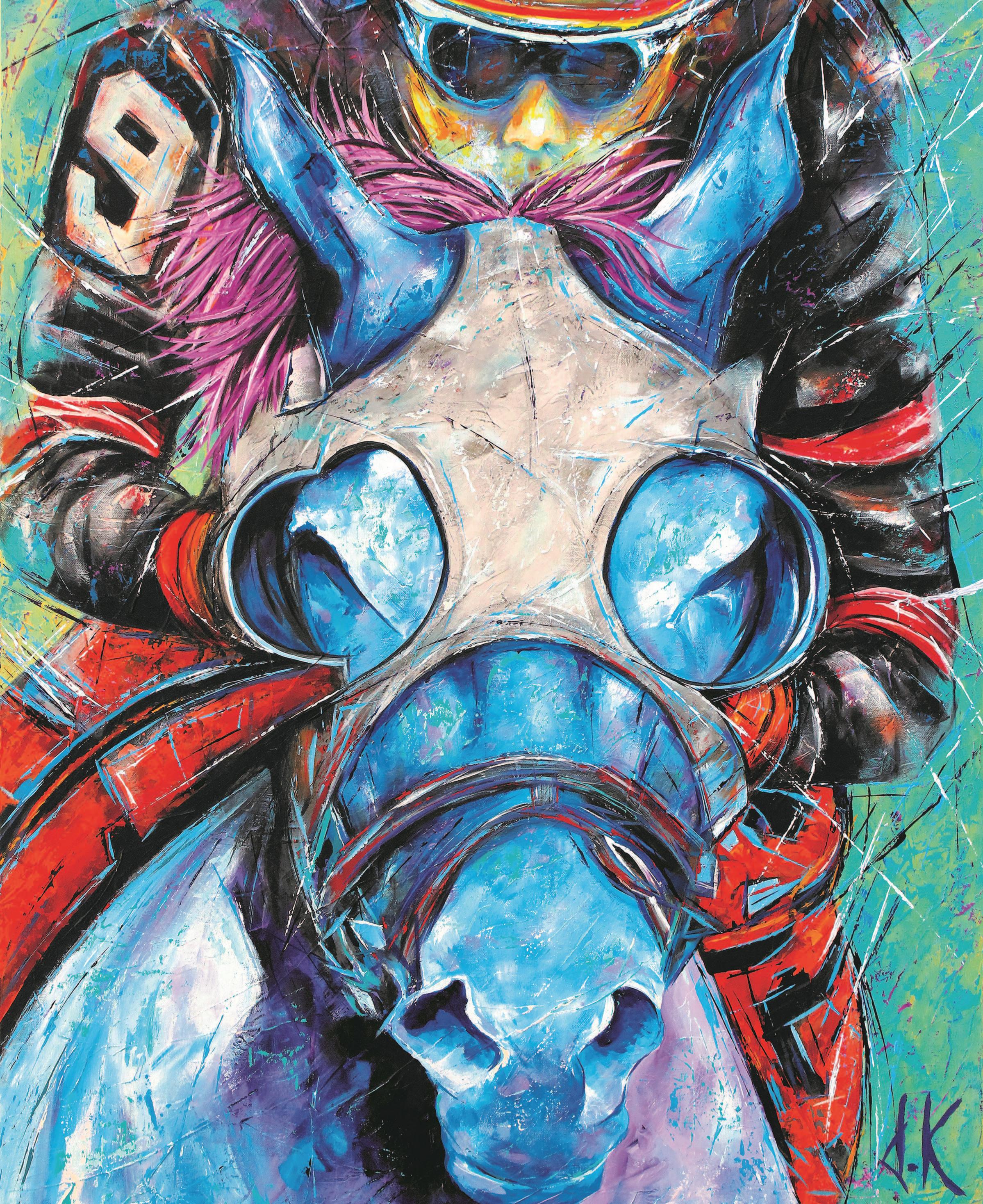
"FEARLESS” 30x40 inch Acrylic paint on canvas. Davidkeenan33/INSTAGRAM
The Hyde Collection Toshiko Takaezu: Voices of Abstraction pg. 6
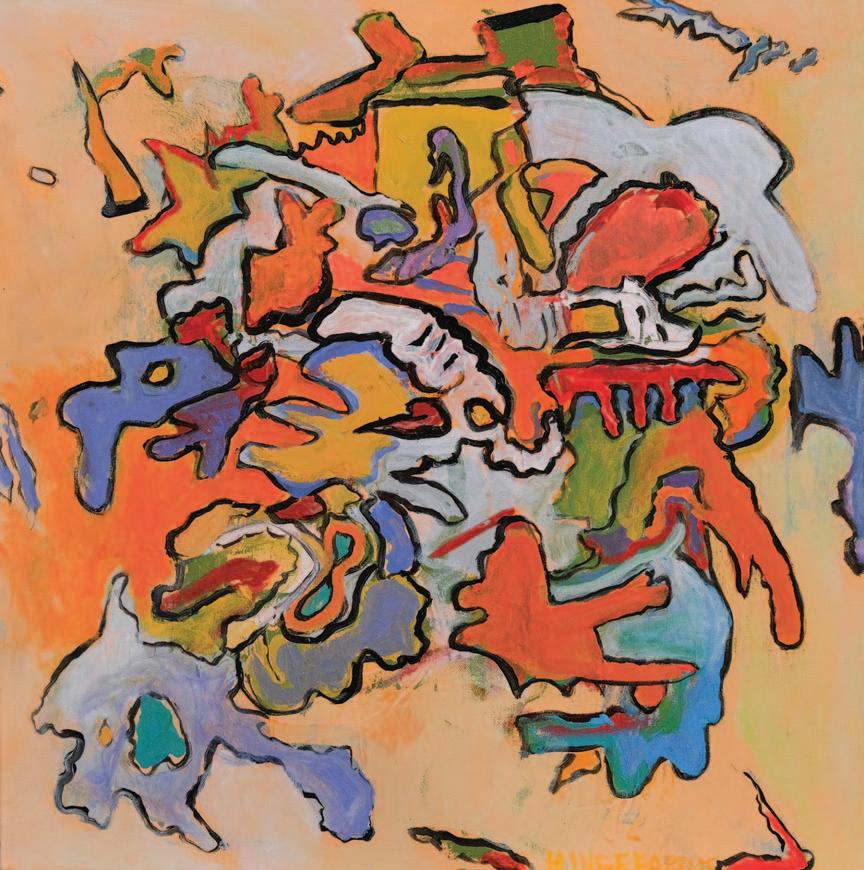
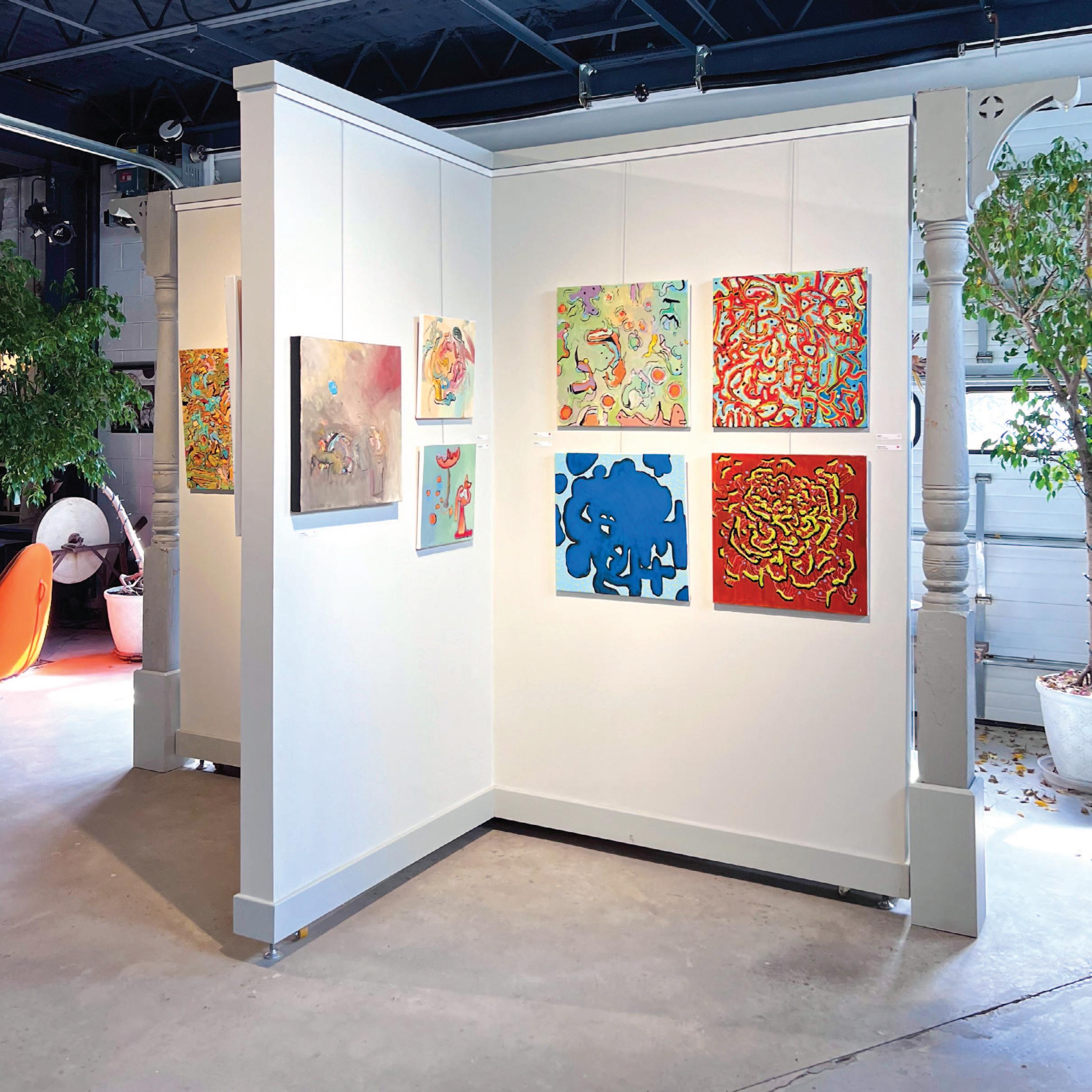
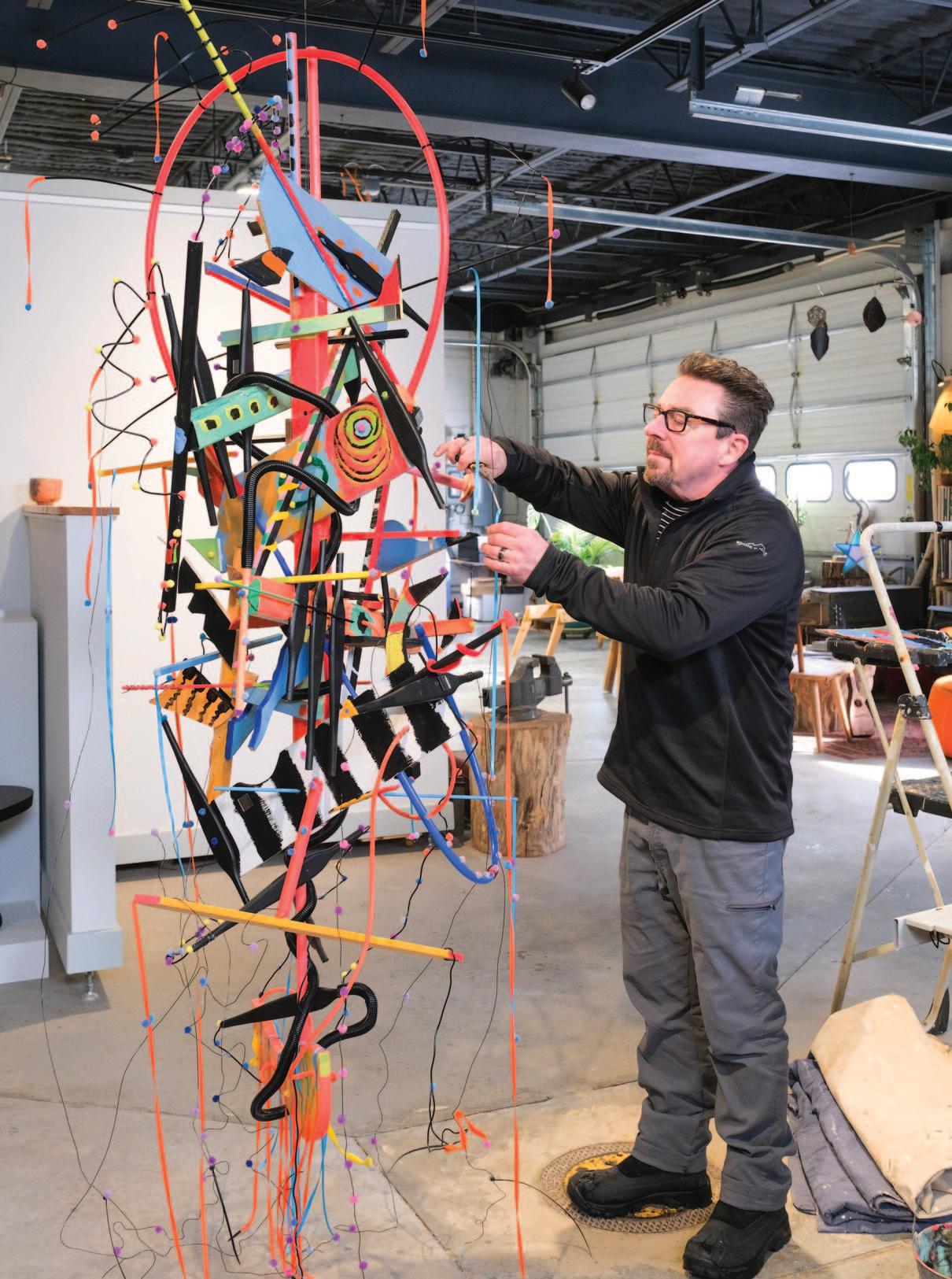
This Artist’s Life Began on a Refrigerator Clarke Hingeford... His Hands & Mind Power His Art pg. 14
Welcome to our June issue — and what a beautiful time to be part of the local community. As the days stretch longer, the rhythm inevitably changes. The air is suddenly thick with the basslines of weekend street festivals, small business owners greet new visitors shopping and din ing and the galleries are throwing open their doors to reveal vi brant new collections.
As we step out into the sunshine, we encourage you to listen to a local band you’ve never heard of, visit an exhibit in your neighborhood or browse through 518 Profiles and day trip some amazing shops. Thank you for continuing to support the voices and creators that make our community so vibrant. We couldn’t do it without you.
As always, I’m so grateful to our talented writers, our group of advertisers that grace our pages, to our readers for their curiosity, and to the creative community for your co ntinued embrace of 518 Profiles.
Stephanie Sittnick Founder / Publisher
John Griffith: The Capital Music District’s Outrider pg. 24
The Legend of Cowboy Ernie Sites pg. 34
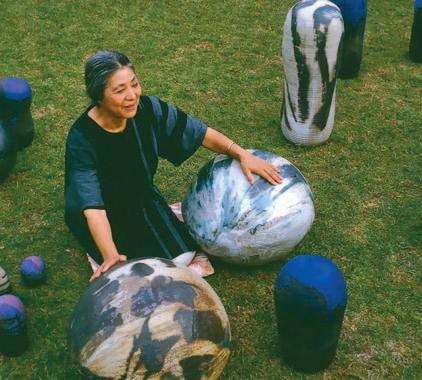
The Hyde Collection Toshiko Takaezu: Voices of Abstraction
by Carol St. Sauveur Ferris
Located at the gateway to the Adirondack Mountains, the small town of Glens Falls, New York, is known for its easy ac cess to Lake George, a walkable downtown, and its cultural des tinations, including The Hyde Collection.
Housed in a historic home once owned by Louis and Charlotte Hyde, The Hyde Collection is a lovely museum known for its world-class collection of over 4000 works of art, including modern and contemporary American and European paintings, and works on paper. Beautifully curated exhibitions are held year-round that feature work from their own collection, those from outside collections, and often a combination of both. Today, the museum is thrilled to show the work of renowned ceramic artist Toshiko Takaezu. This beautiful exhibit features spectacular pieces that harmonize with major works from The Hyde’s Modern and Contemporary Art collection.
Toshiko led a very interesting life. She was born in Pepeekeo, Hawaii in 1922 to Japanese immigrant parents. One of eleven children whose lives were steeped in Japanese traditions and culture, Toshiko and her siblings lived a simple life on a farm, working alongside their father and uncle. Toshiko only spoke Japanese until she entered grade school at age six, when she learned English.
At the age of nine, her family moved to Maui, where she was first exposed to po etry, crafts, painting, and drawing. She loved learning how to create with different media throughout her school years. After graduating from high school, Toshiko moved to Honolulu and worked at the Hawaii Potter’s Guild. It was a commercial studio that produced functional items in bulk, which she didn’t really enjoy creating; however, it was also where she met Carl Massa, a sculptor from New York. His influence inspired her to expand and explore the arts in greater depth, leading Toshiko to enroll in painting classes at the Honolulu Museum of Art School. From there, she attended the University of Hawaii, where she pursued her interest in clay art and studied textiles, design, and art history.
As her interest and expertise in various art media grew, Toshiko began teaching
ceramics at a YWCA. It was here that she discovered her love for teaching, prompting her to leave Hawaii and travel to Michigan to pursue further studies at Cranbrook Academy of Art in Bloomfield Hills. She also taught summer workshops while in attendance. Toshiko continued her art education by taking courses at the University of Wisconsin-Madison and summer sessions at the Cleveland Institute of Art. In time, she eventually became head of the Institute’s ceramic department. Years
later, she gave up that teaching position and moved first to Clinton, New Jersey, where she had a small studio, and later to Quakertown, New Jersey, where she established a larger one. For the next 25 years, she taught at Princeton University in the Creative Arts Program. In 1992, Toshiko retired from teaching
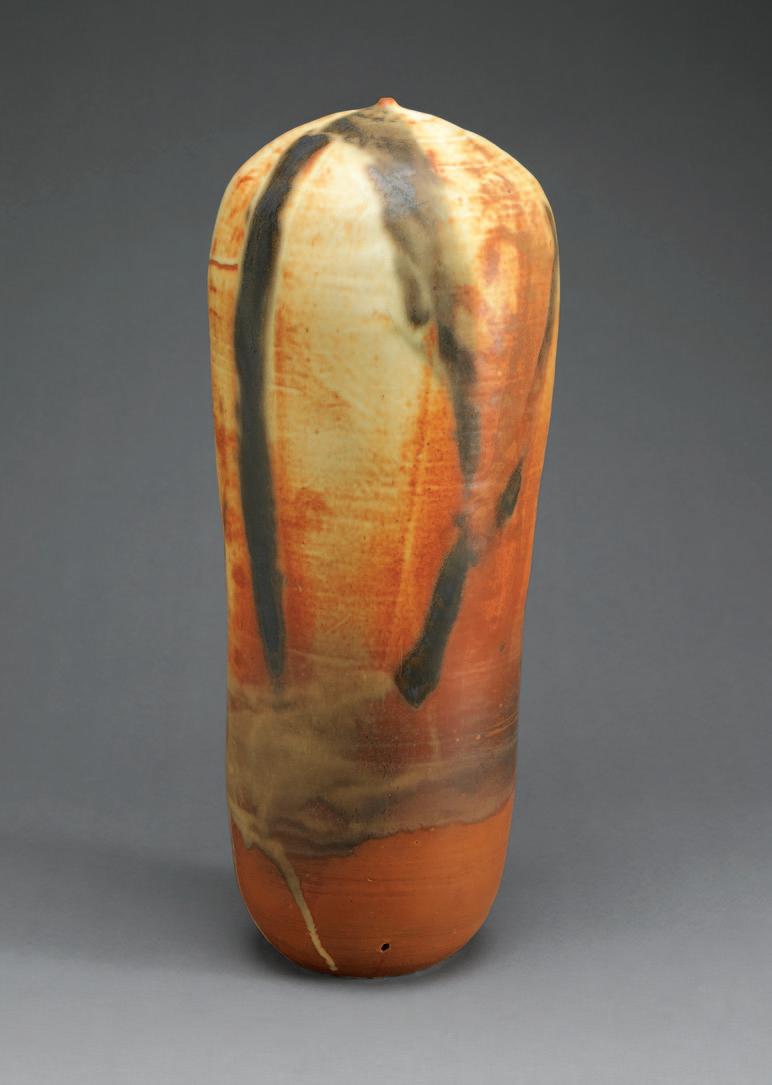
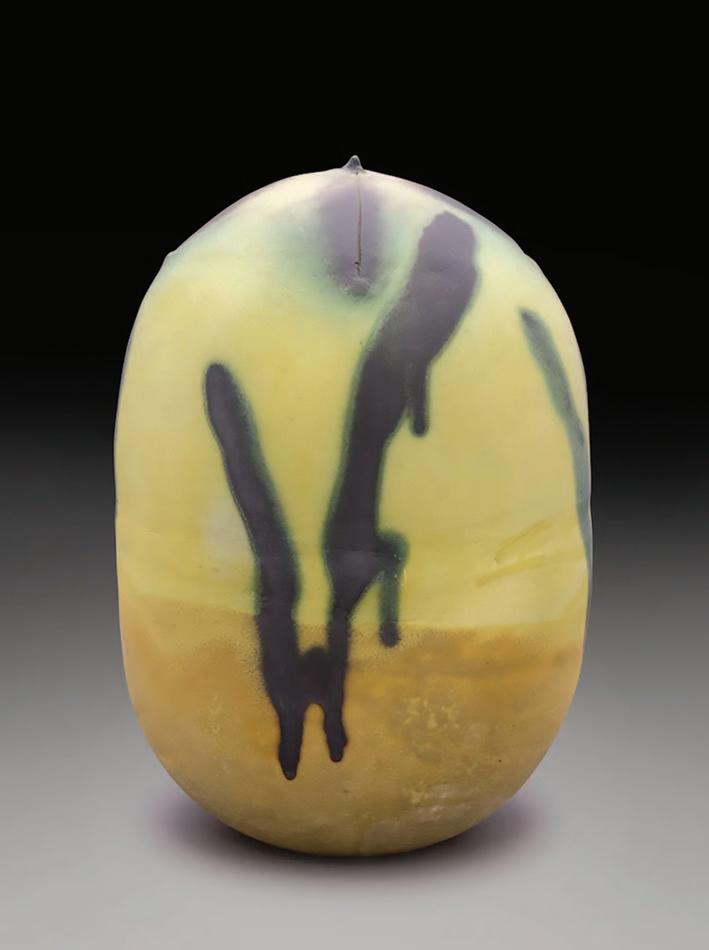
Closed Form, Porcelain, 19 x 7 “
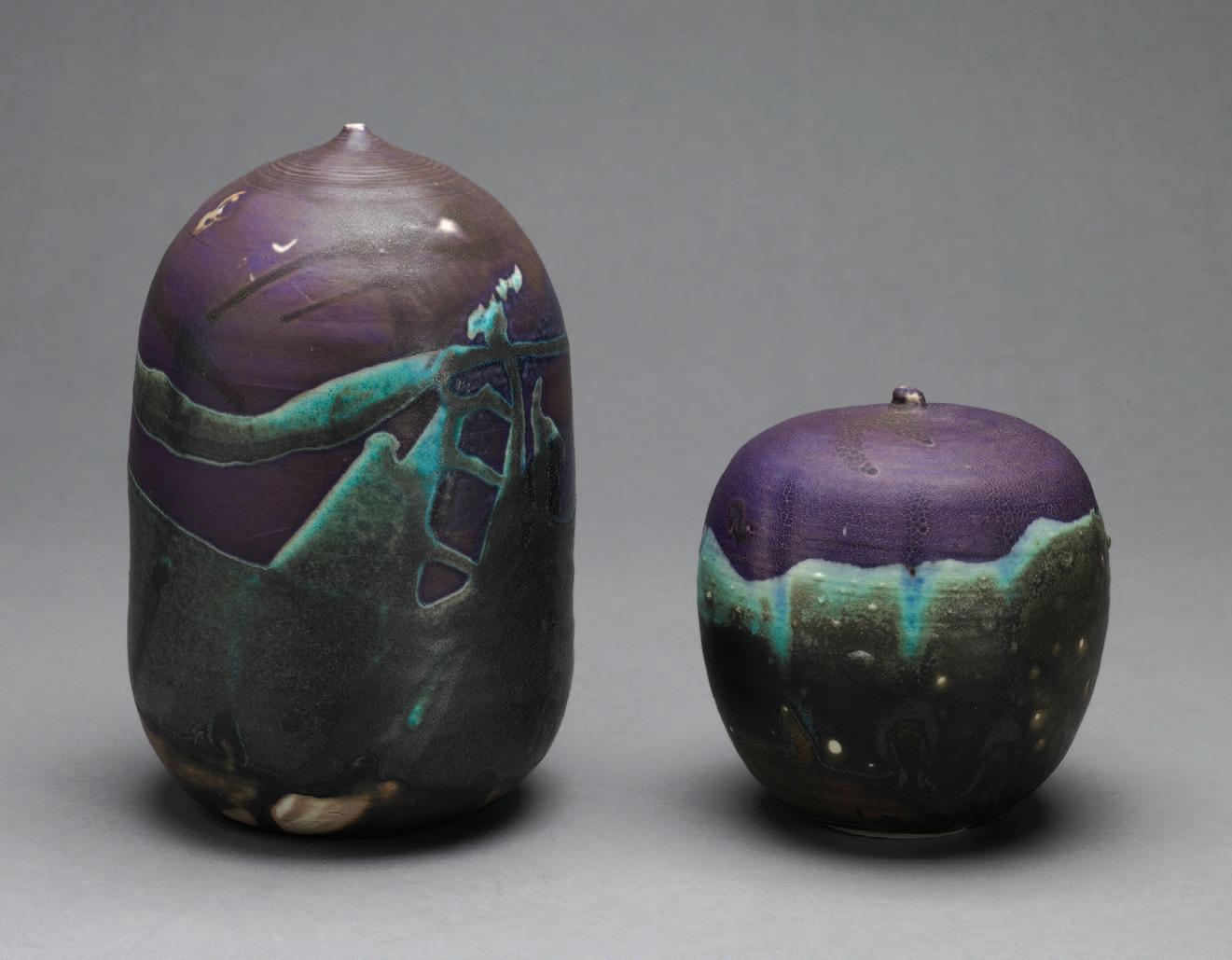
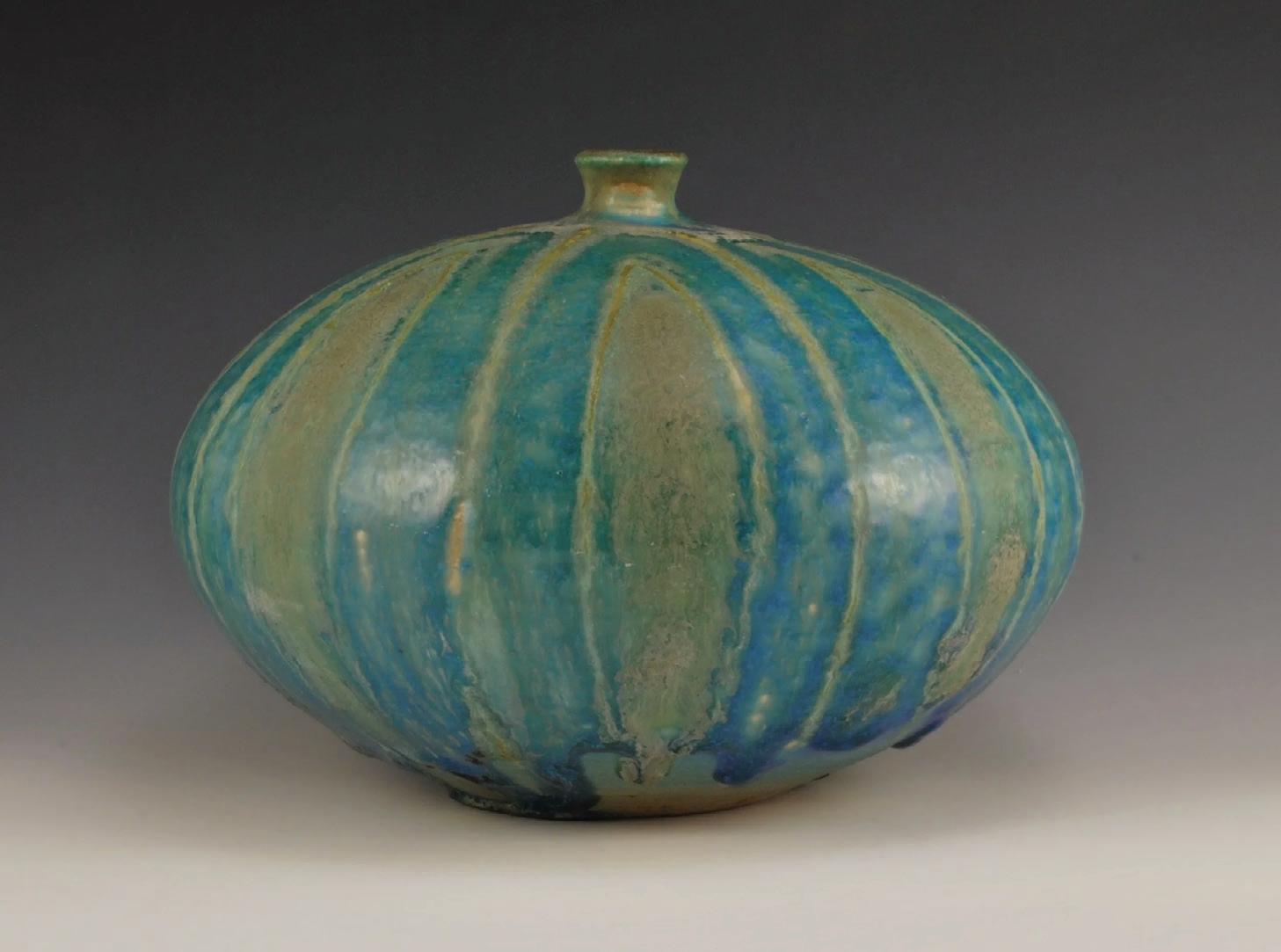
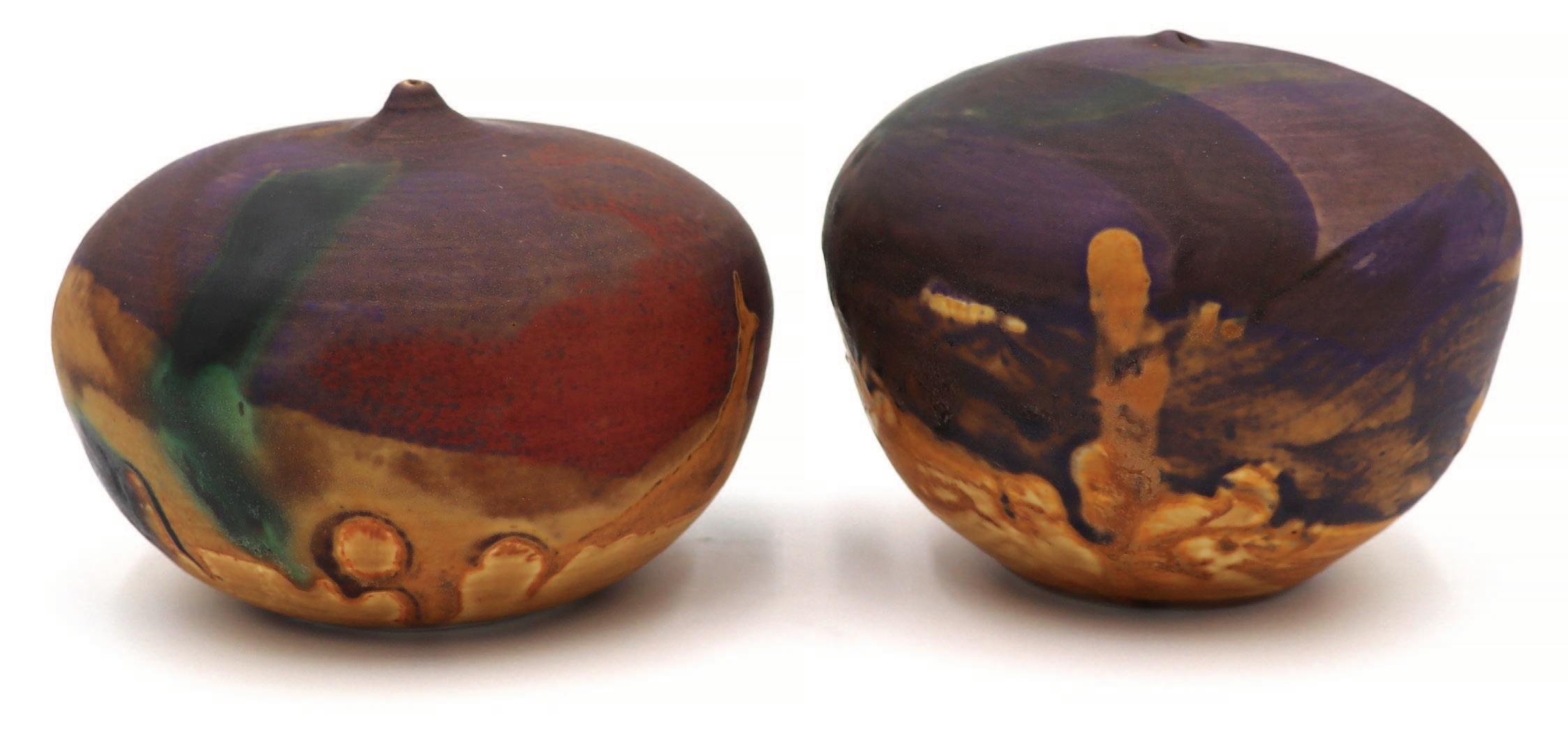
Untitled Vase, Glazed Porcelain. Height - 6 inches x Diameter - 9 inches (15.25 x 23 cm)
to focus on her own work, though she continued to teach summer workshops, including those at Skidmore College in Saratoga Springs, New York.
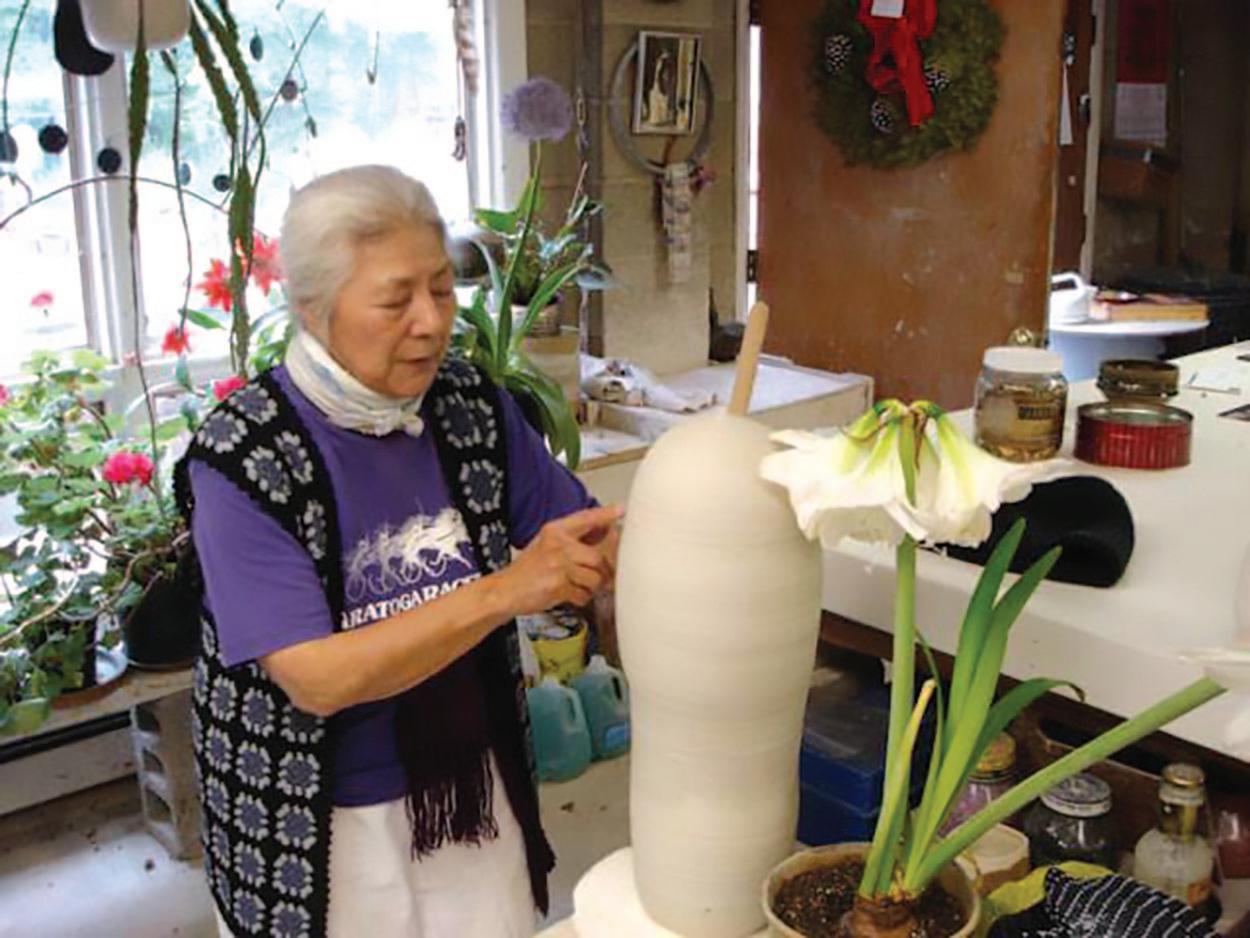
It was at Skidmore College that clay artist Jill Fishon-Kovachick met Toshiko. Jill, who is the founder and owner of the Saratoga Clay Arts Center, was a clay arts instructor when Professor Emeritus Regis Brodie brought Toshiko into the fold to teach the first of many summer workshops at Skidmore. Quite taken with Toshiko’s beautiful claywork, skills, and techniques, Jill learned a great deal from the artist and treasures the many summers spent with her. Today, she is honored to be the curator for The Hyde Collection’s exhibit of Toshiko’s work, accompanied by select paintings from their collection of modern and contemporary art.
Jill shares that “Toshiko Takaezu’s groundbreaking ceramics, celebrated for their spherical forms and rich glazes, are a perfect complement to The Hyde’s collection of abstract paintings. By showcasing Takaezu's work, we honor her legacy around the world and cement her importance as a Skidmore summer workshop artist who taught so many people in upstate New York.”
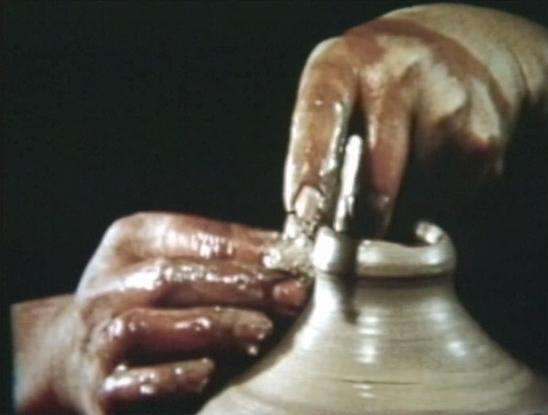
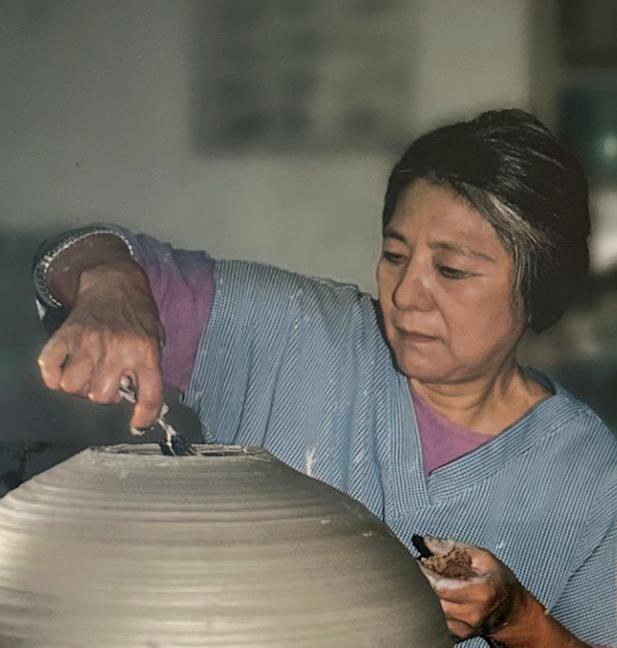
Toshiko’s ceramics were considered groundbreaking as she evolved, focusing less on utility and more on form. Her art forms expressed a singular belief in clay’s artistic and aesthetic potential. While many of her early creations were traditional vessels, bowls, and teapots, Toshiko explored clay’s other possibilities as well. In doing so, she
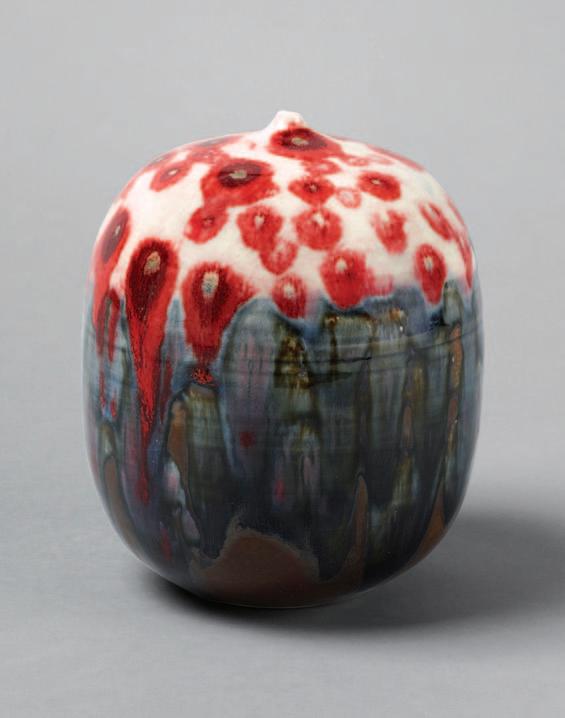
Copper Red Closed Form, Porcelain, 7.5 x 6 “
The Hyde Collection
invited a new understanding of what clay can be. Her evolving closed, spherical shapes spoke to the simple el egance and beauty of form for form’s sake, taking claywork, historically viewed as a craft, and elevating it to a fine art.
Her evolution into making ceramics a fine art form oc curred in the 1970’s following the groundbreaking work and worldwide recognition of Abstract Expressionism in the 1940’s. A major departure from traditional painting, Abstract Expressionists focused on individual expression, spontaneous emotion, and meditation. Some artists were known for gesture in their work. Large, bold brush strokes and random drips of colorful paint were intentional and used to convey emotions and feelings. Others painted canvases edge to edge, mixing colors from limited palettes, imbuing them with intense, meditative qualities. This break from convention also in cluded large works, unlike past smaller standards. Pieces were often as large as six feet, with some measuring up to twenty feet.
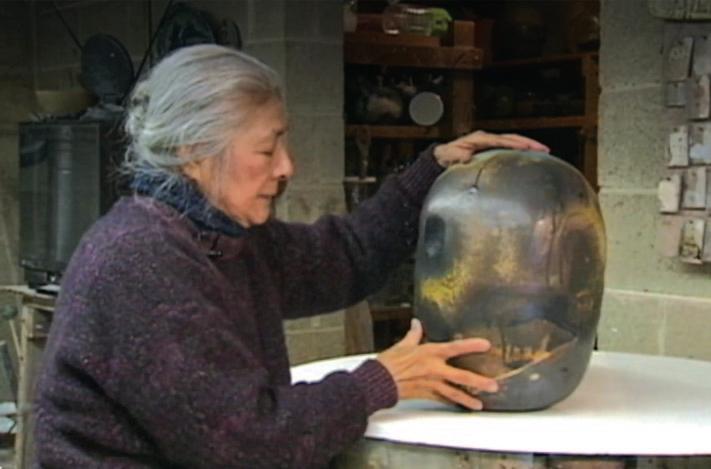
Toshiko, greatly influenced by their work, took to exploring and manipulating clay to express her deep feelings about nature and her Japanese heritage. She explored forms meant to be seen and ex perienced, not used. This pivotal time in her evolution elevated her work to the level of sculptures, or “paintings in the round,” with very distinct personalities.
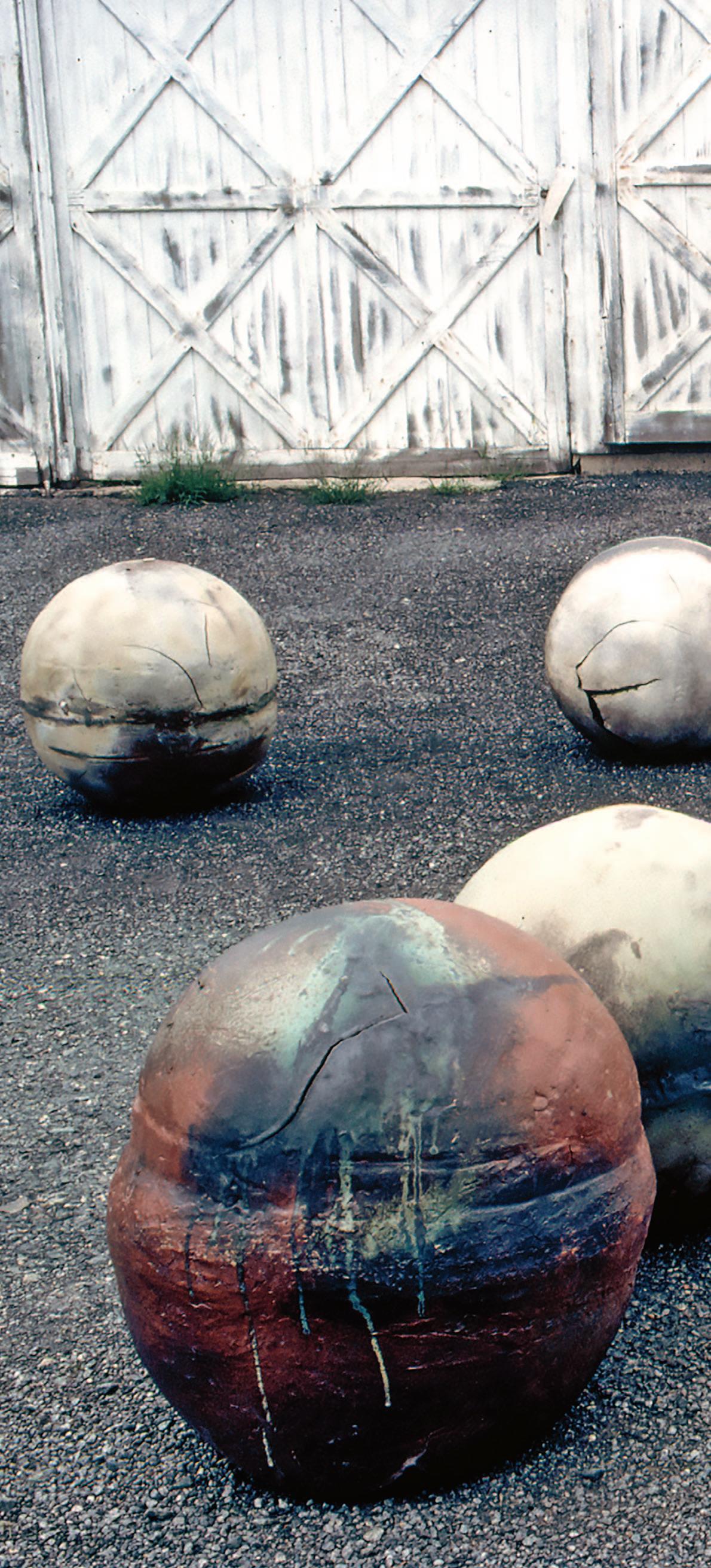
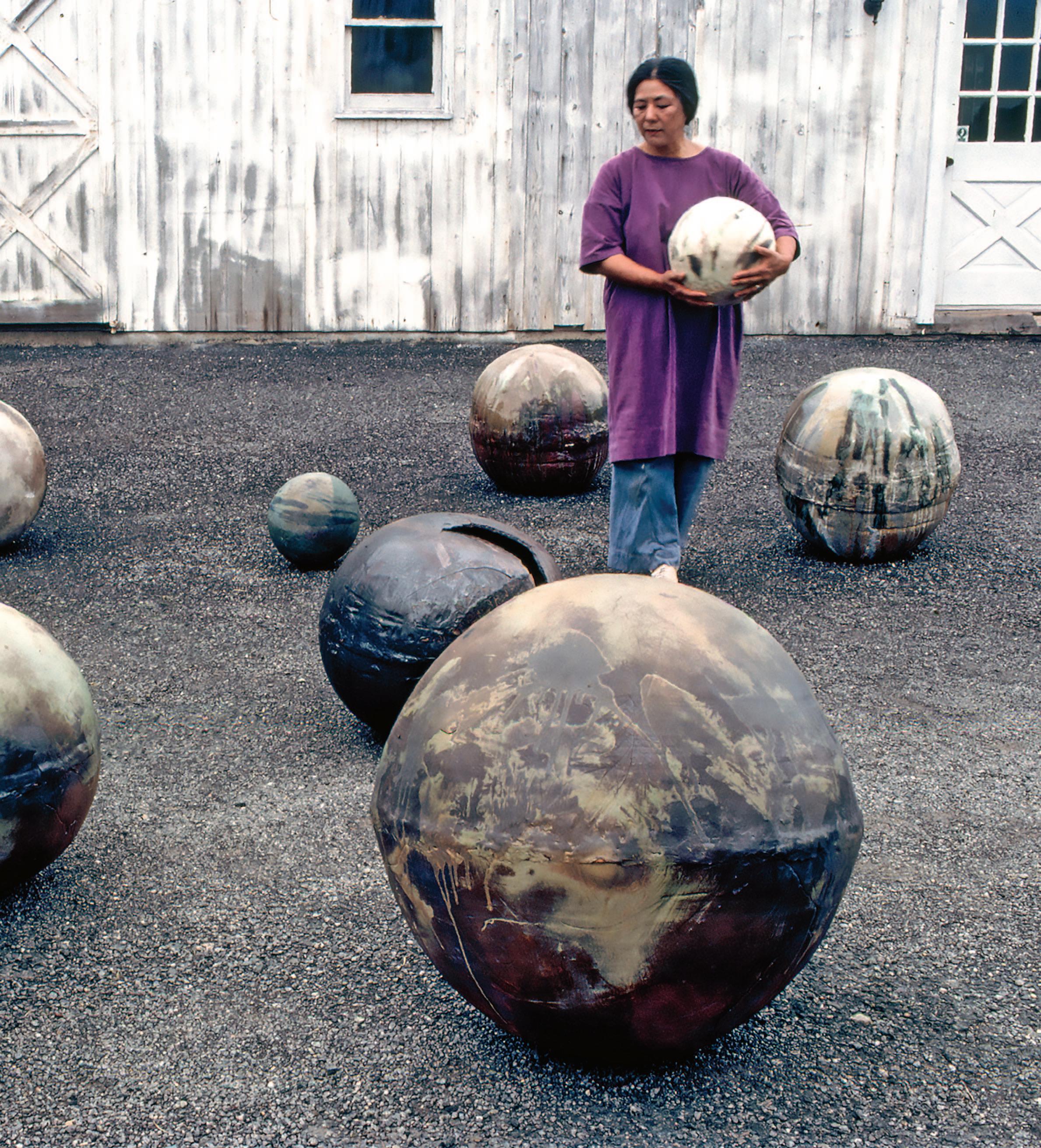
Her pieces were either hand-built or wheel-thrown. Some were quite tall, reaching nearly six feet, while others were small-scale and could be held in one’s hand. As Toshiko’s pieces became more emotionally expressive, she eliminated all openings except for a pinhole to allow gases to escape during firing. And given her desire for others to ex perience her work in a variety of ways, Toshiko would wrap a small ball of clay in paper and drop it into her piece before sealing it. During firing, the paper burned away, leaving the small ball of clay inside to rattle around when moved. She believed it gave each piece a unique personality and created a sensory element within the body
of the piece when someone handled it. Toshiko also believed that her sculptural clay forms enclosed negative space, which she considered both spiritual and unique to each piece.
Her beautiful glazes accentuated positive and negative space, too, but on the form’s surface. Colors ranged from sand and earth tones, representing Hawaii’s volcanic rock formations, to the bright blues and greens of the Pacific. They were also inspired by the landscapes of her childhood, by later visits to Japan, and by the flowers from her garden. Toshiko brushed, sprayed, and dripped her glazes, much as the Abstract Expressionists did in their paintings. Some included deliberate brush strokes and markings found in calligraphy. Others were spiritual expressions felt in the moment. Interestingly, she never dated her work, except for noting the decade in which they were created. She believed her evolution as an artist was far more important than a chronological calendar of achievements.
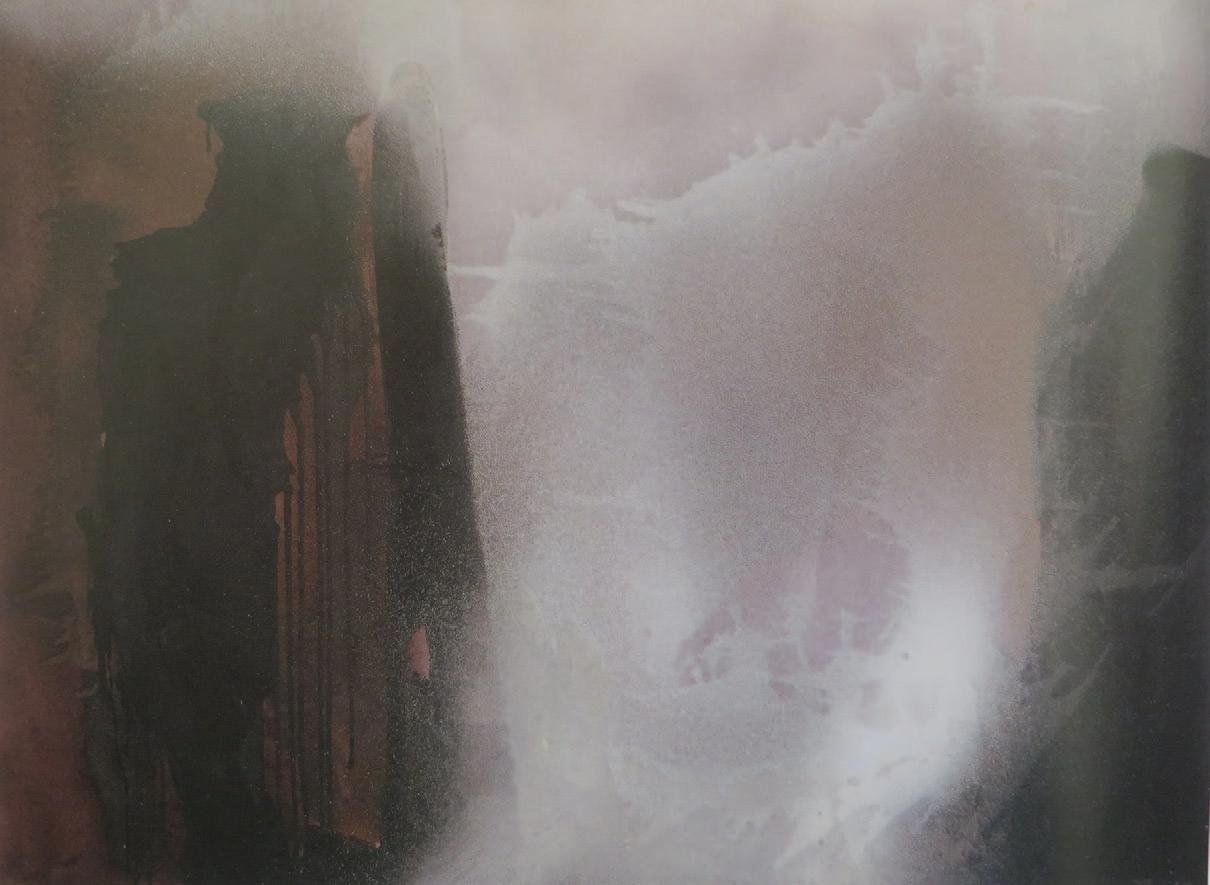
Koke'e #16, Acrylic on canvas, Height - 36 inches x Width - 48 inches (91.5 x 122 cm)
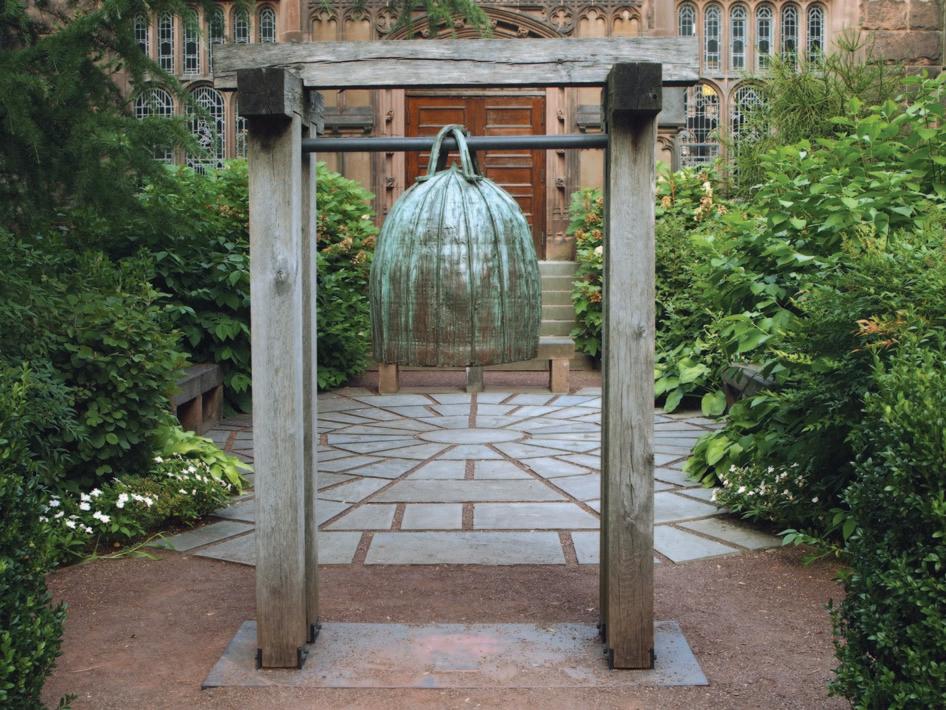
When she wasn’t creating clay forms, Toshiko also enjoyed fiber art, painting, and sculptural work in bronze. One bronze piece of note was a bell she cast to honor Princeton alumni who lost their lives in the terrorist attacks of 9/11. The bronze bell, known as the Remembrance Bell, stands at the entrance of Princeton’s 9/11 Me morial Garden and encourages reflection.
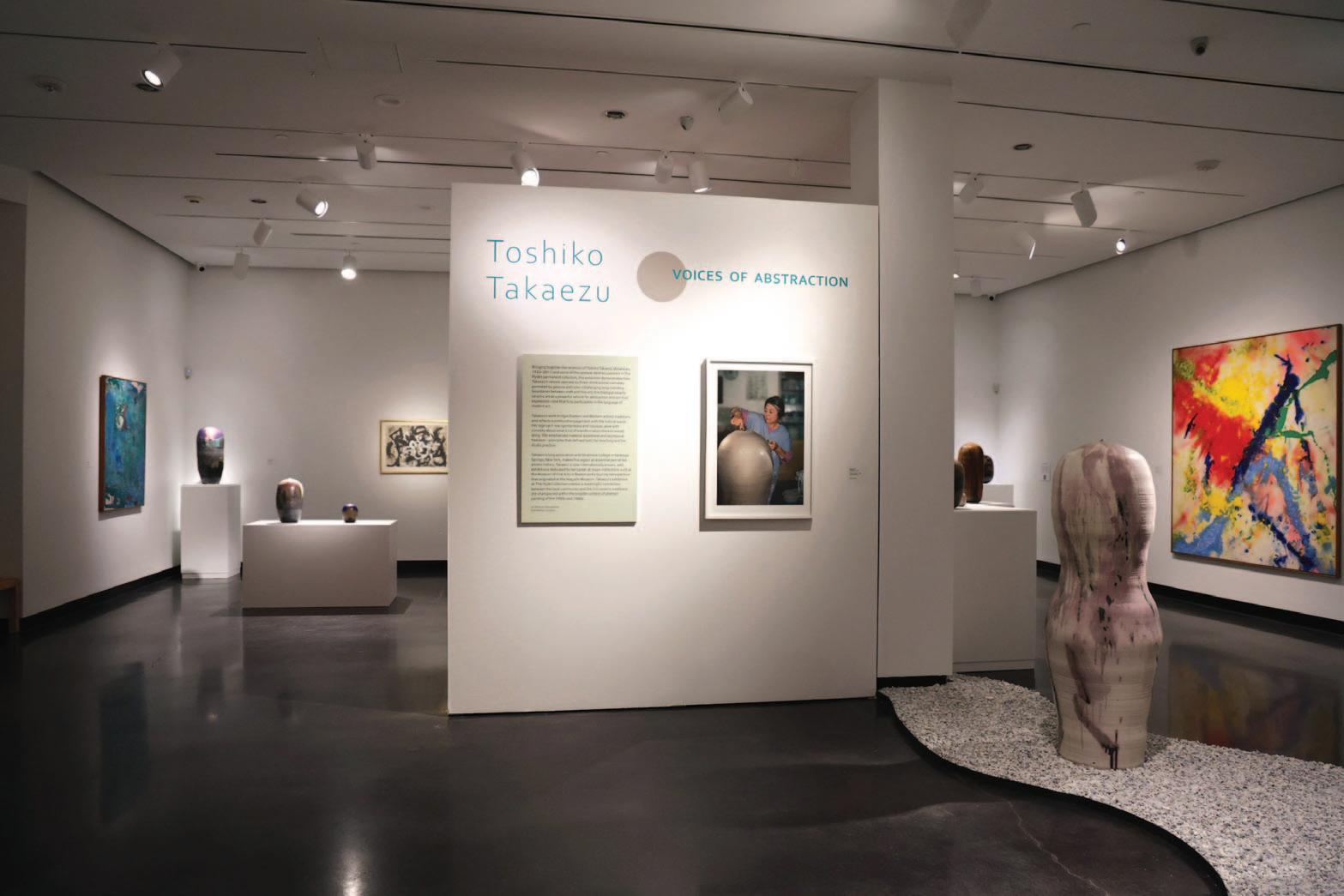
Today, The Hyde Collection’s beautiful exhibit of Toshiko’s clay work showcases select pieces that express both exuberance and meditative qualities. They are truly extraordinary paintings “in the round” that are perfect companions to the museum’s selected mod ern art, according to Derin Tanyol, Curator of Modern and Contemporary Art. All the paintings, including those by artists Lee Krasner, Sam Gilliam, and others, are thoughtfully displayed in their 1,500-square-foot gallery space, designed specifically for the exhibition of modern and contemporary art.
Derin also notes that “the show isn’t arranged in chronological order, but there is a chronological cohesion to it. The goal here, in Jill creating pairings, is to demonstrate the dialogue between the way Takaezu glazed her pots and her sculptures, and the way the artists painted”.
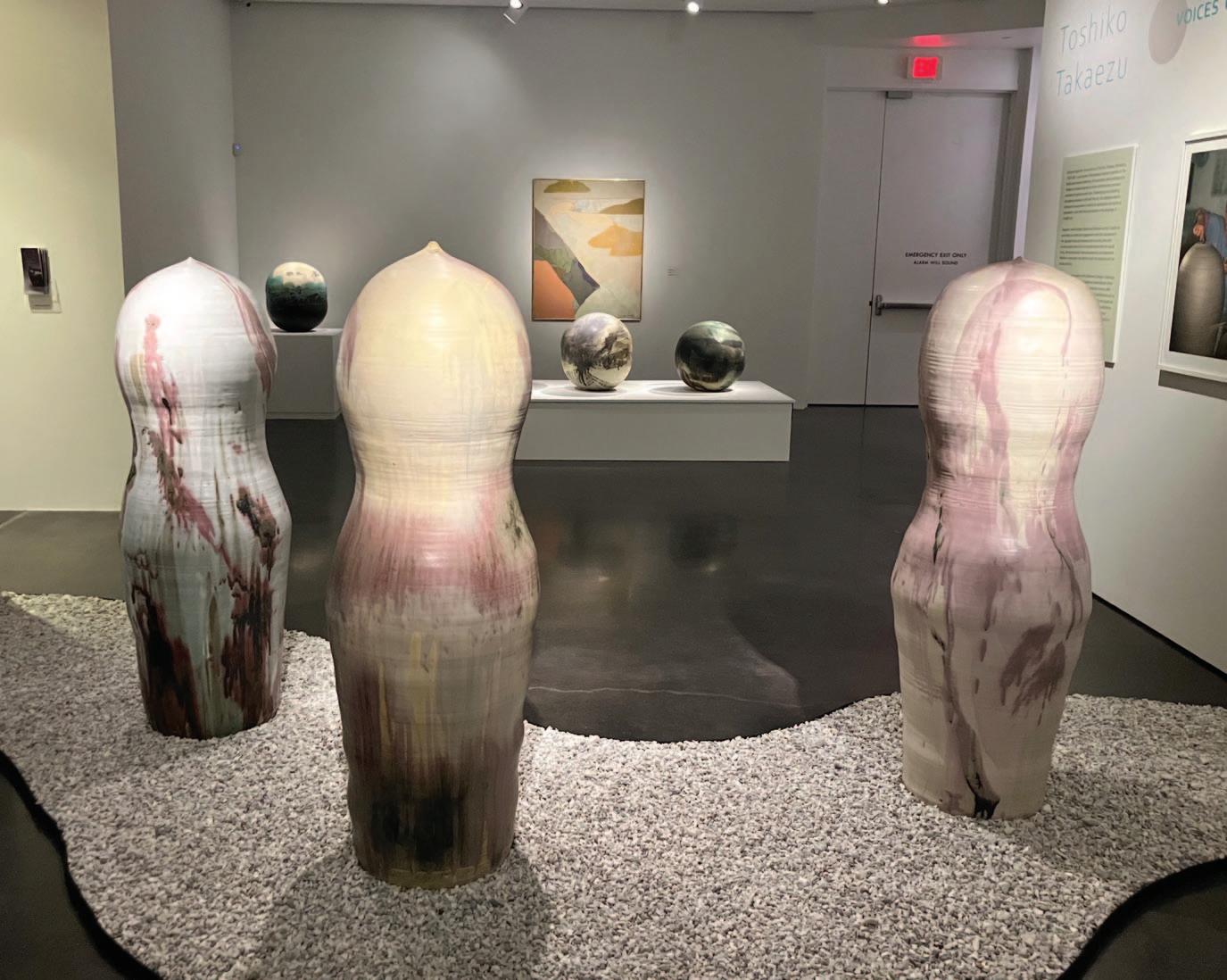
Without a doubt, the show promises to be a unique opportunity to view extraordinary works of modern and contemporary art by amazing artists, paired with 26 pieces of Toshiko’s simple yet profoundly beautiful clay sculptures. And it is also a wonderful opportunity to view the point-counterpoint of various media as they ex press life in the abstract.
Voices of Abstraction opened on April 11, 2026, and will run until July 19, 2026. While viewing this extraordinary exhibit, be sure to spend time with each of Toshiko’s fasci nating pieces, especially The Three Graces, Spring Moon, and Tall Ocean Edge.
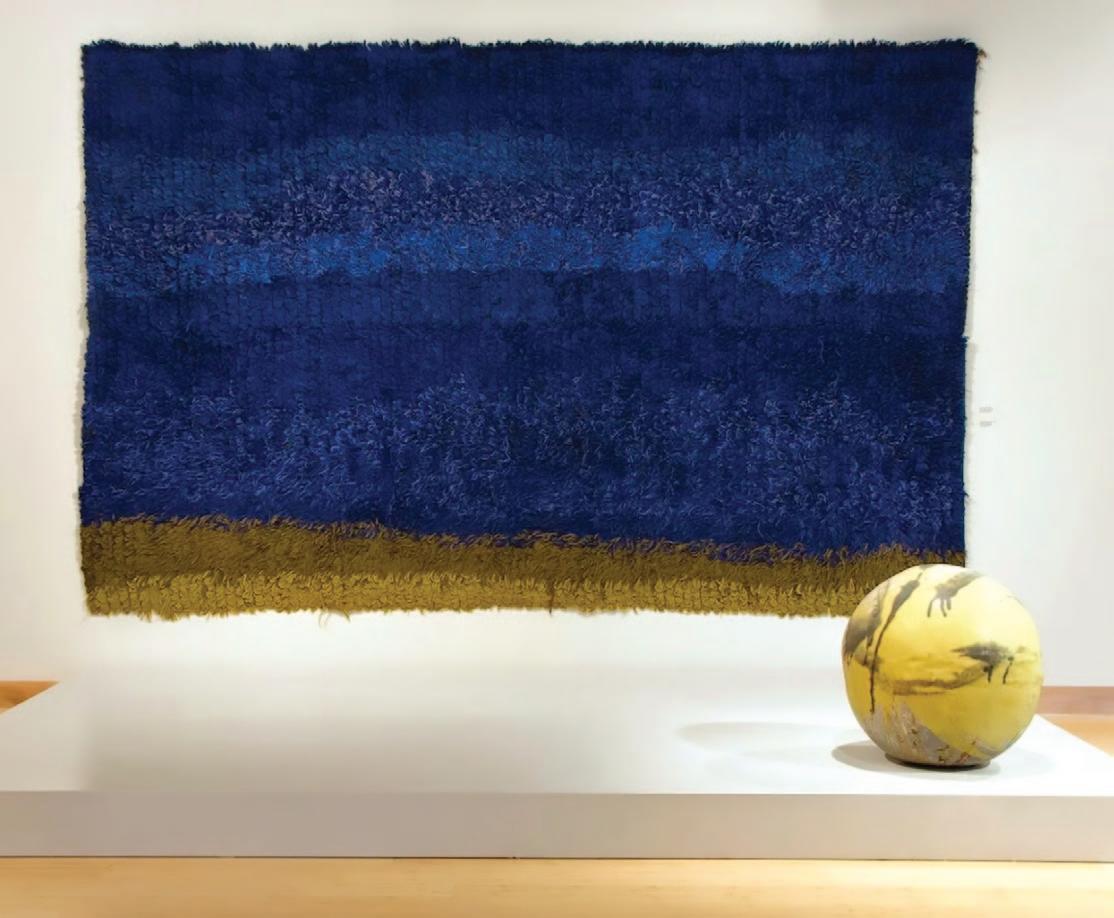
Ao-Ao (pictured with Lemon Moon) Wool, silk, linen, and rayon. Height108 inches x Length - 168 inches (274 x 427 cm)
In addition to the exhibit, there will be a special panel moderated by Derin Tanyol, Curator of Modern and Contemporary art, on May 21, 2026, at 6PM. The panel includes Jill Fishon-Kovachick, curator of the exhibit, and ceramic artists Tim Jones, Ben Eberle, and Darren Prodger, who worked as Toshiko’s apprentices and will offer greater insight into her work.
For more detailed information about upcoming exhibits, events, and hours, visit The Hyde Collection’s website at: www.hydecollection.org.
Remembrance, Cast Bronze, Height - 32 1/2 inches x Diameter - 21 1/2 inches (82.5 x 54.6 cm)
John Griffith: The Capital Music District’s Outrider
By Lawrence White
"Sharing
music is personal because music speaks, it feels, it breathes. And it always says something about you."
C. G. Drews, Author
There are many examples of great music scenes throughout contemporary American cultural history. We immediately think of San Francisco, New York, Austin, New Orleans, Detroit, Los Angeles, and so on.
Well, you can add the Capital District of New York to that list and put it near the top. Every night, numerous small venues host open mics
remarkable depth of local talent. Unlike many music scenes, the Capital District is not pricing out these businesses, allowing them to develop a following and thrive.
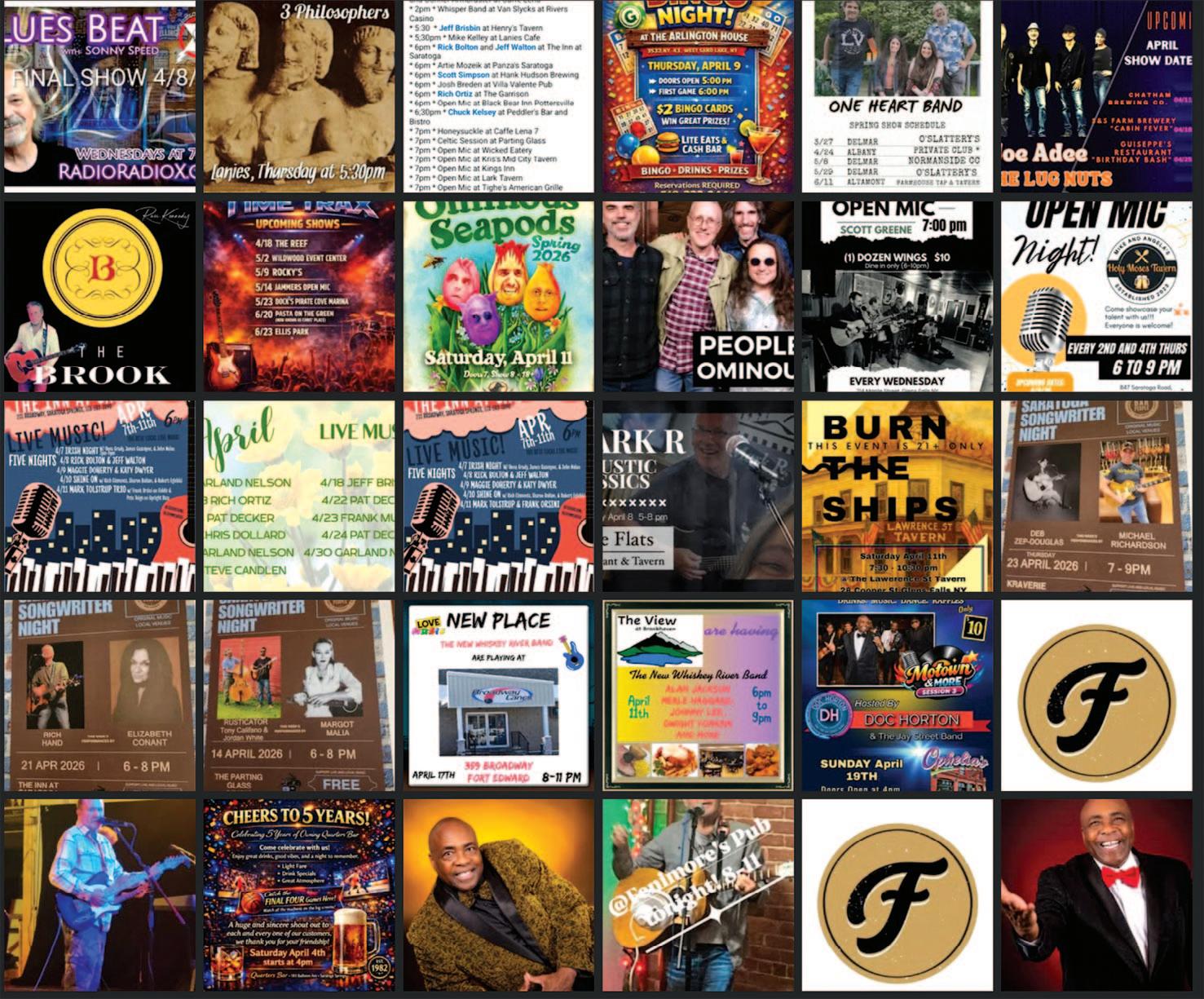
But the question remains: where, who, and when? How can you find out about all of the gigs, including small pubs, when so much is happening? That is the information that John Griffith and his online resource, BarPeople.com, provide.
You want to know what is going on in Albany, Saratoga, Rensselaer, Fulton, Schenectady, Warren, or Washington Counties? Go to BarPeople.com. You want to know about
spe cial bar events, brewery specials, or DJ events? Go to BarPeople.com. You want to know about public events and opportunities? Go to BarPeople.com. John is on the job and gives the best tips for a cool evening in one location, or if you’re hopping from one great gig to another. As of the writing of this piece,
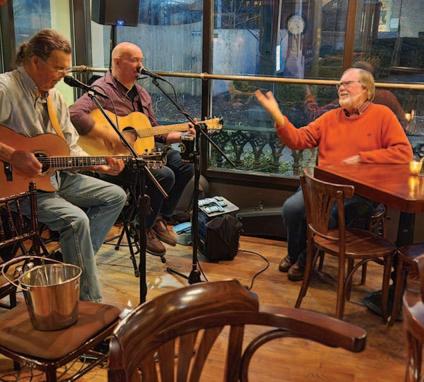
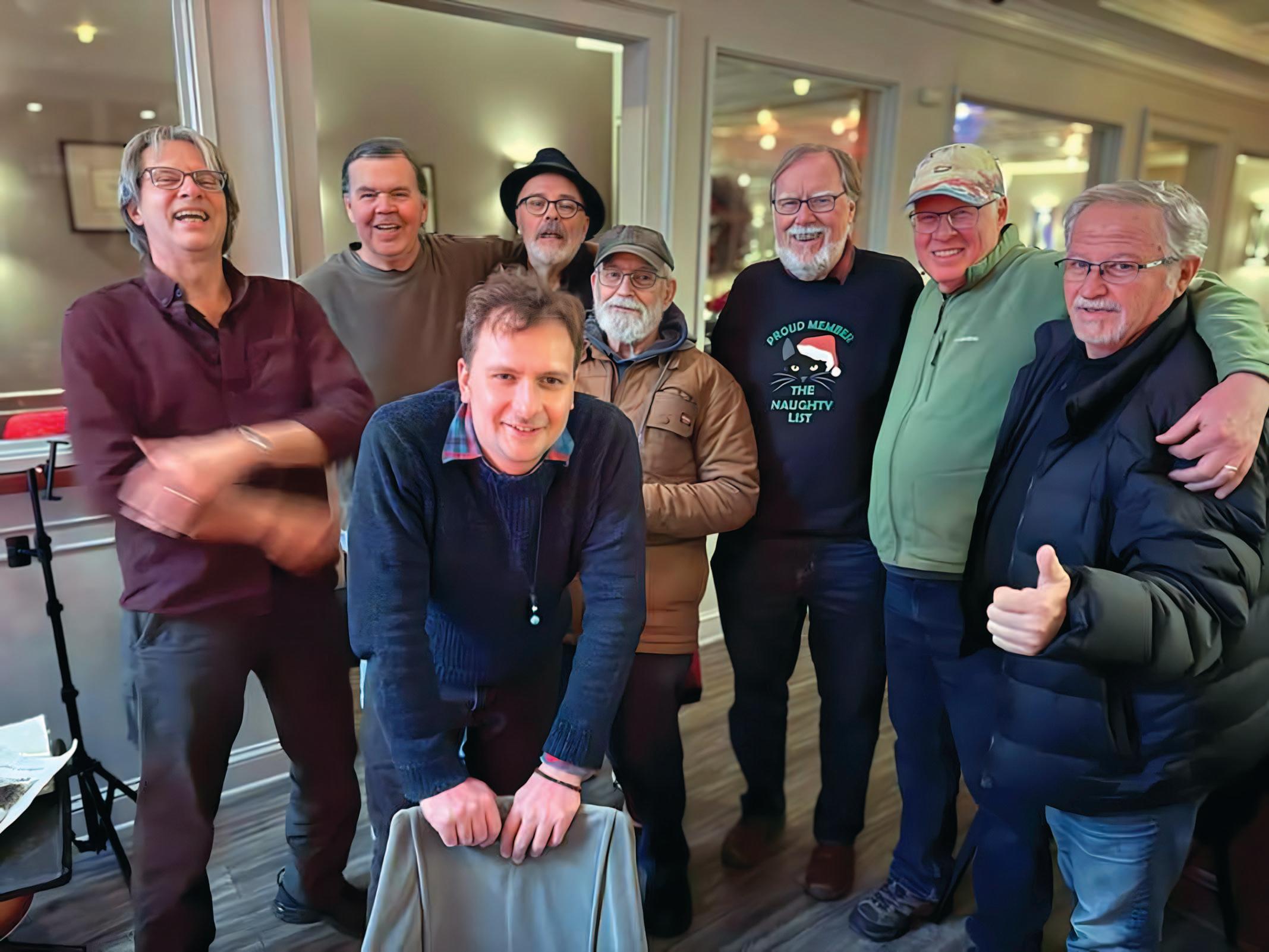
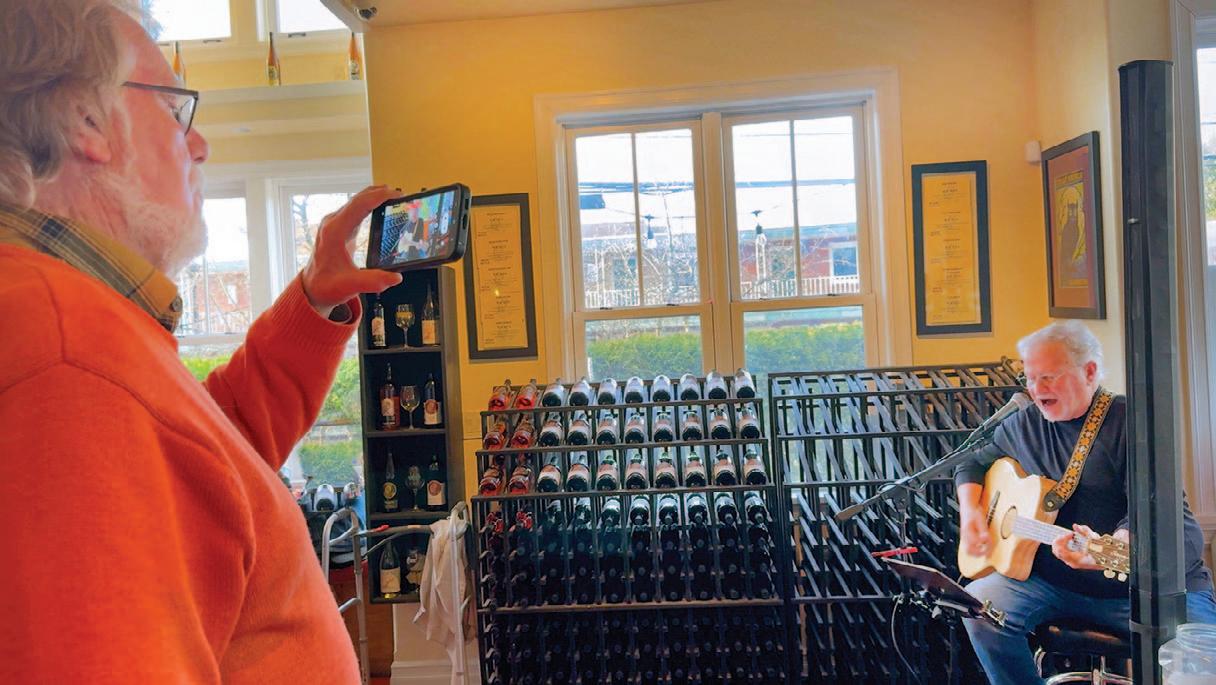
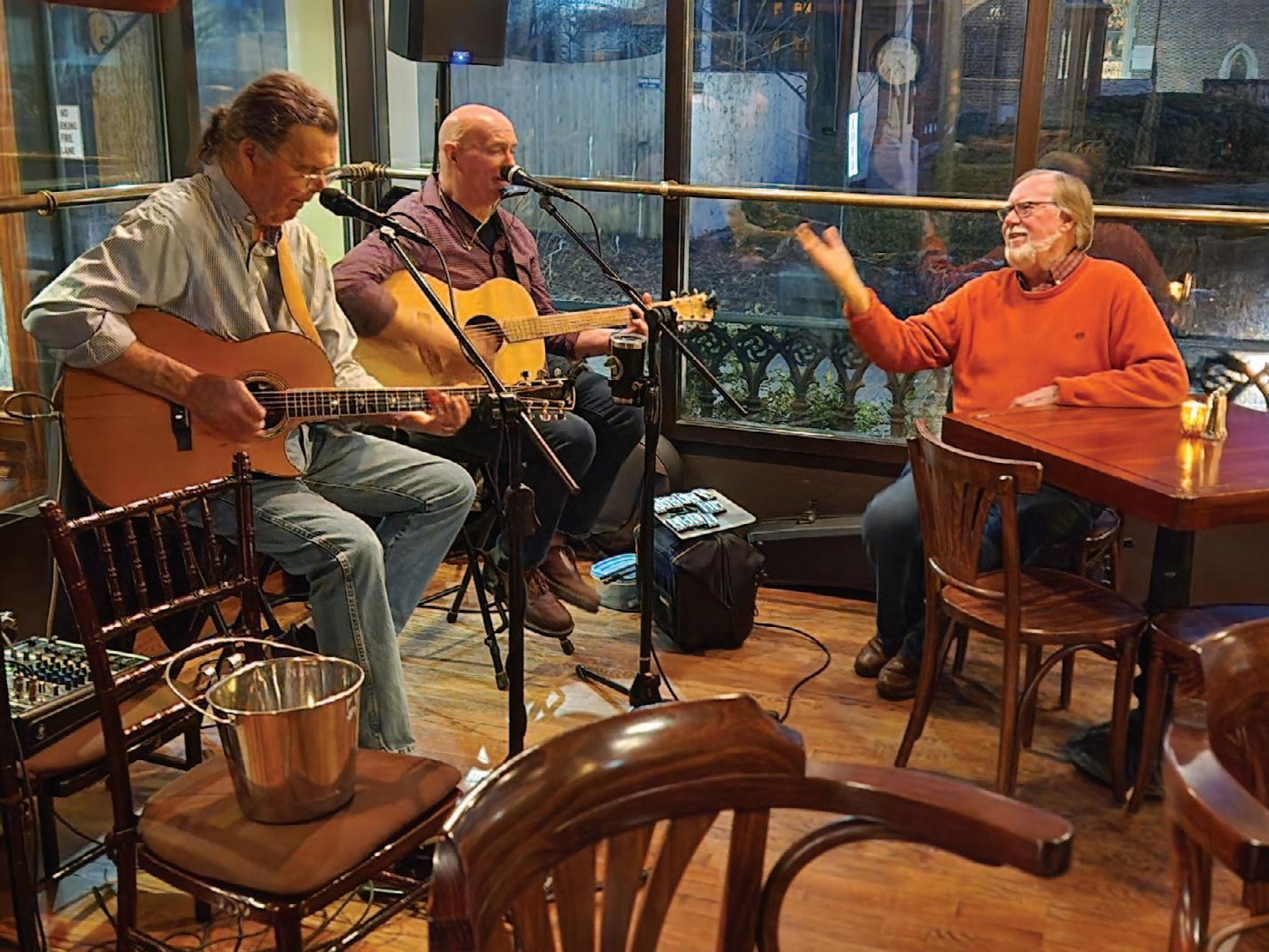
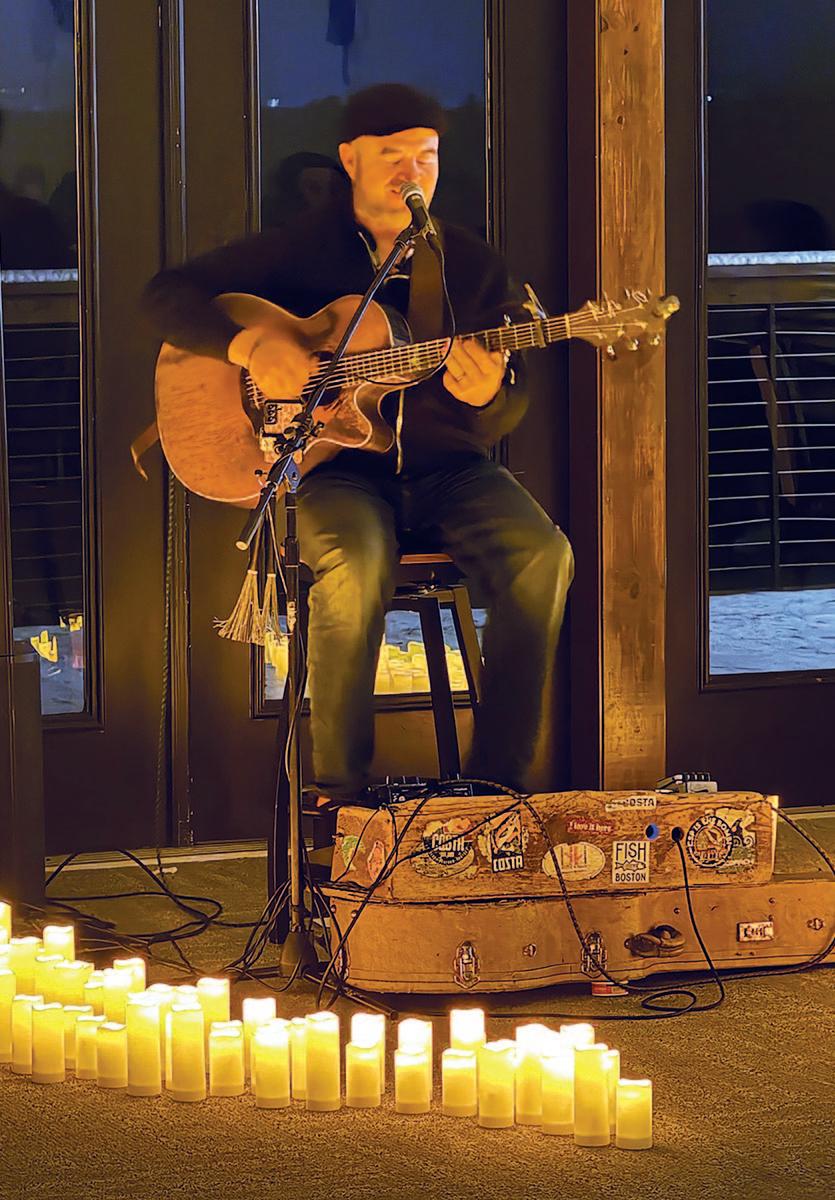
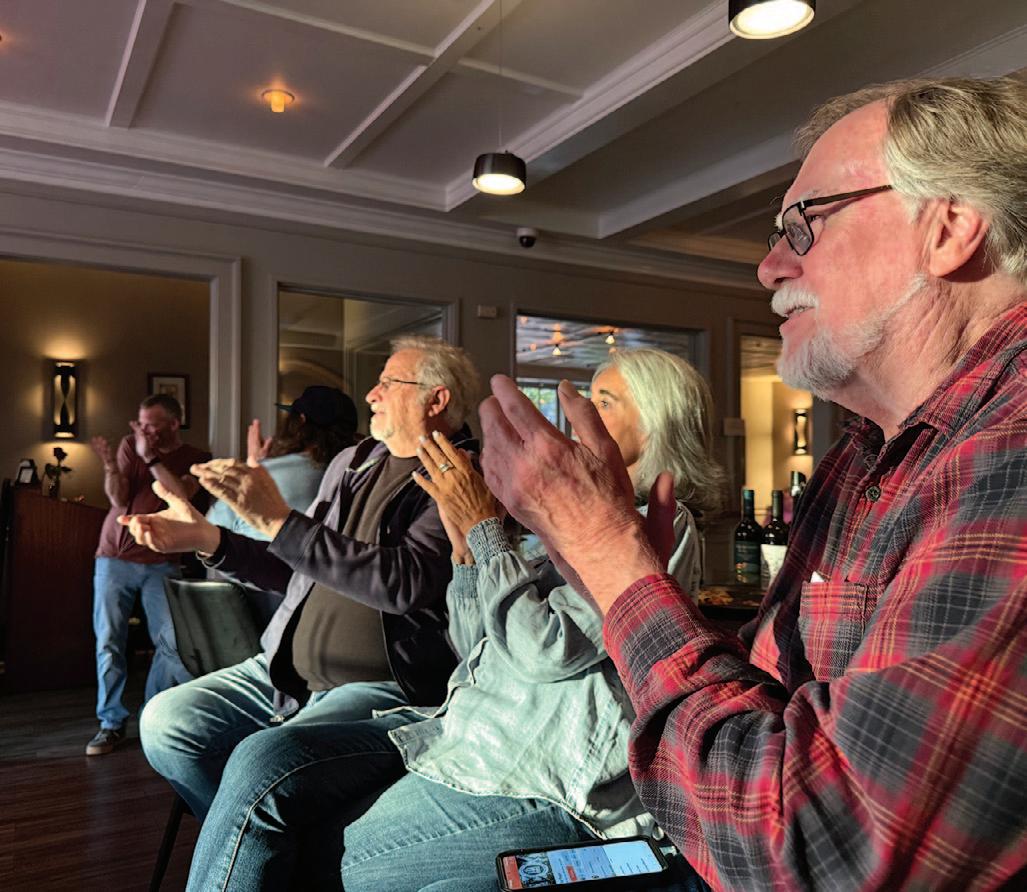
Singers, songwriters and performers with John at The Wine Bar, Saratoga Springs, Ny - Sharon Dwyer Bolton Photography
Saratoga Springs alone, and he also lists events for the 7 surrounding counties.
Well-known local performer, Jeff Brisbin, has been friends with John for 16 years. He puts it this way: “It takes John hours of work to organize all the information, and he does it with no remuneration. Saratoga and the surrounding area are a live music mecca, with so many venues, restaurants, pubs, and breweries that feature live music as part of their customer’s experience. BAR PEOPLE has made it easy for you to plan an evening by letting you know where your fa vorite band, duo, or solo performer is playing. As a musician, I’m so grateful to John for posting where I am performing.” Jeff pauses, then states, “We are all indebted to John. The Venues are too!”
Long-time employee and manager of the historic Parting Glass Pub in Saratoga Springs, Linda DiBlasio, agrees. “John has been com ing to hear the bands for many years. When he got this idea for BarPeople.com, I had no idea he would achieve such a meaningful and useful tool for our business, and
I know it is a big boost for others as well. We want to keep staging live music, and John’s effort is very helpful in doing that.”
As I speak to John, I am immediately struck by his easy, reassuring tone and his earnest focus on the live music. With that in mind, I ask John about his early influences, and he tells me, “When I was a kid, there was always music in our home, but it was Lawrence Welk and Lucky Strike Hit Parade.” John continues reflectively, “I guess you could say my real awakening was during Woodstock, early in the morning, someone with a boombox was playing Led Zeppelin #1. I had never heard anything like it, and that started my deep dive into music, live music in particular.”
I mentioned to John that at this point in life, after raising a family, most people kick back and chill out. Yet John is buzzing with activity vital to the culture of music. The obvious question is, how does he do it?
With eyes shining brightly, John tells me, “The music drives me. I love it. I go where the musicians go. We live in a very large area with several small villages and towns that are friendly to small businesses and do not price
With Matt Finnigan. Guitarist, Singer & Club Owner
With Rick Bolton and Jeff Walton
With Jeff Brisbin at The Thirsty Owl
Producer Chris Carey
artists out. A lot of the small venues, restaurants, and clubs feature live music at least one night a week, so I go where the musicians go and spread the word about what they’re doing the best I can.”
John has also organized a series of singer/songwriter events in Saratoga Springs that have drawn au diences not only to hear great music but also to experience meeting the artist and learning more about their creative process.
John explains, “I am trying to place these events in venues that are friendly to hearing
Lisa Rossi at The Parting Glass
Jeff Walton at The Hideaway
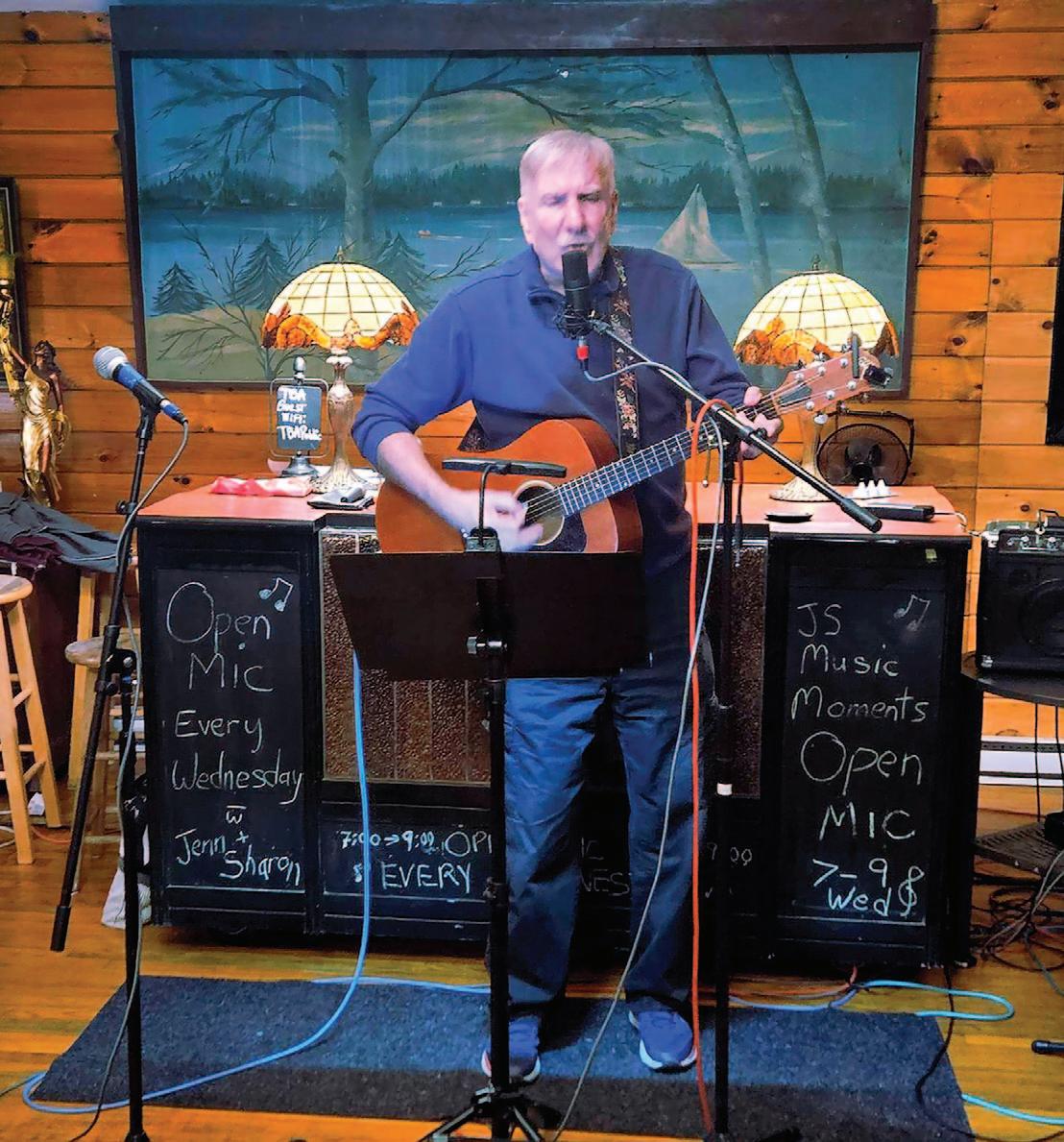
Open Mic at Tighe's Bistro Americain Sand Lake, Rensselaer, NY
Pat Perkinson
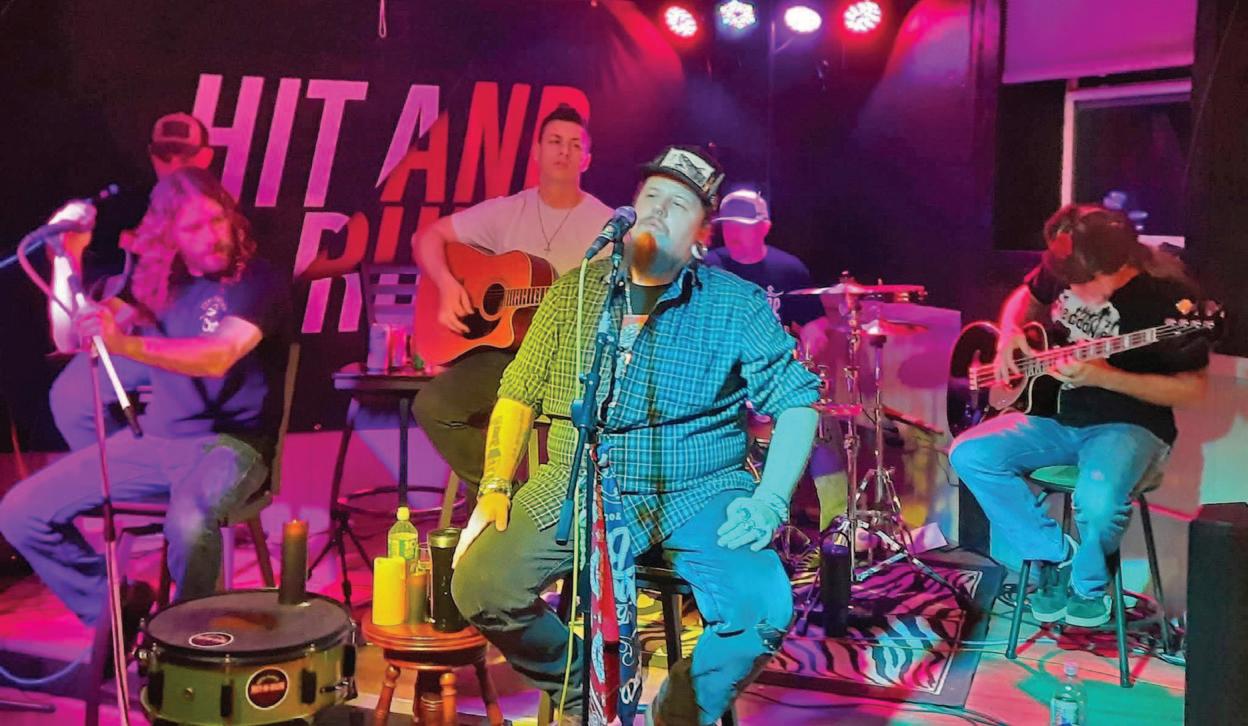
Hit And Run Warrensburg Jam
music as opposed to the social scene in bars. We make it comfortable for the audi ence and have refreshments, but the focus is on the music and the lyrics, and the musician, so it is a unique experience for everyone.”
I find that no matter who I speak to about John and BarPeople.com, I get the same positive, appreciative response. All the es tablishments say they benefit from searches through the listings John posts. Those who benefit include the Glove The atre in Gloversville, The Excelsior Pub in Albany, Mean Max Brewery in Warren County, Henry’s in Ballston Spa, Charlton Tavern at Ballston Lake, The Hideaway in Malta, The Franklin Square Market, the Inn at Saratoga and Caffe Lena in Saratoga Springs are a very few of the scores of Cap ital District venues John notes on his website and Facebook page.
While writing this piece, I keep returning to the fact that all this is achieved through the total devotion of one man’s love for live music. John’s Herculean effort certainly re quires finances to operate, and John ap preciates donations and those who ad vertise on his site, but the driving force that propels John is his great affection for the performance of music, and he works entirely gratis out of love alone.
Despite the lack of ongoing funding, John not only chronicles the events of the day for our reference, but he is also keeping an active log of a powerful music scene that is a cauldron for talent and expression, while at the same time, creating events to showcase the artistic talent of singer-songwriters that greatly nourish the cultural community.
With that stunningly active agenda in mind, I ask John if it is the Woodstock spirit that still inspires him today. He tells me, “There was a s sense of
com munity that fell together at Woodstock, and yes, there is a strong sense of community in the live music scene here today. There are 45 venues in a 5- mile radius of Saratoga Springs. That rivals anything in Nashville, and it is even more accessible, and so is the talent. I love that we can hang out and get to know the musicians!”
At that point, John excuses himself. “I am going to three shows tonight, so I have to fuel up my old jalopy,” he says with a laugh. Then, on a bit more se rious note, he adds, “Please tell the readers to sup port live music. Music always gives back more in experience than it costs to attend.” That is very true, and we are fortunate to have John and BarPeople.com listing all the music happening here in the Capital Music District.
Website - https://www.barpeople.com
Email: info@barpeople.com
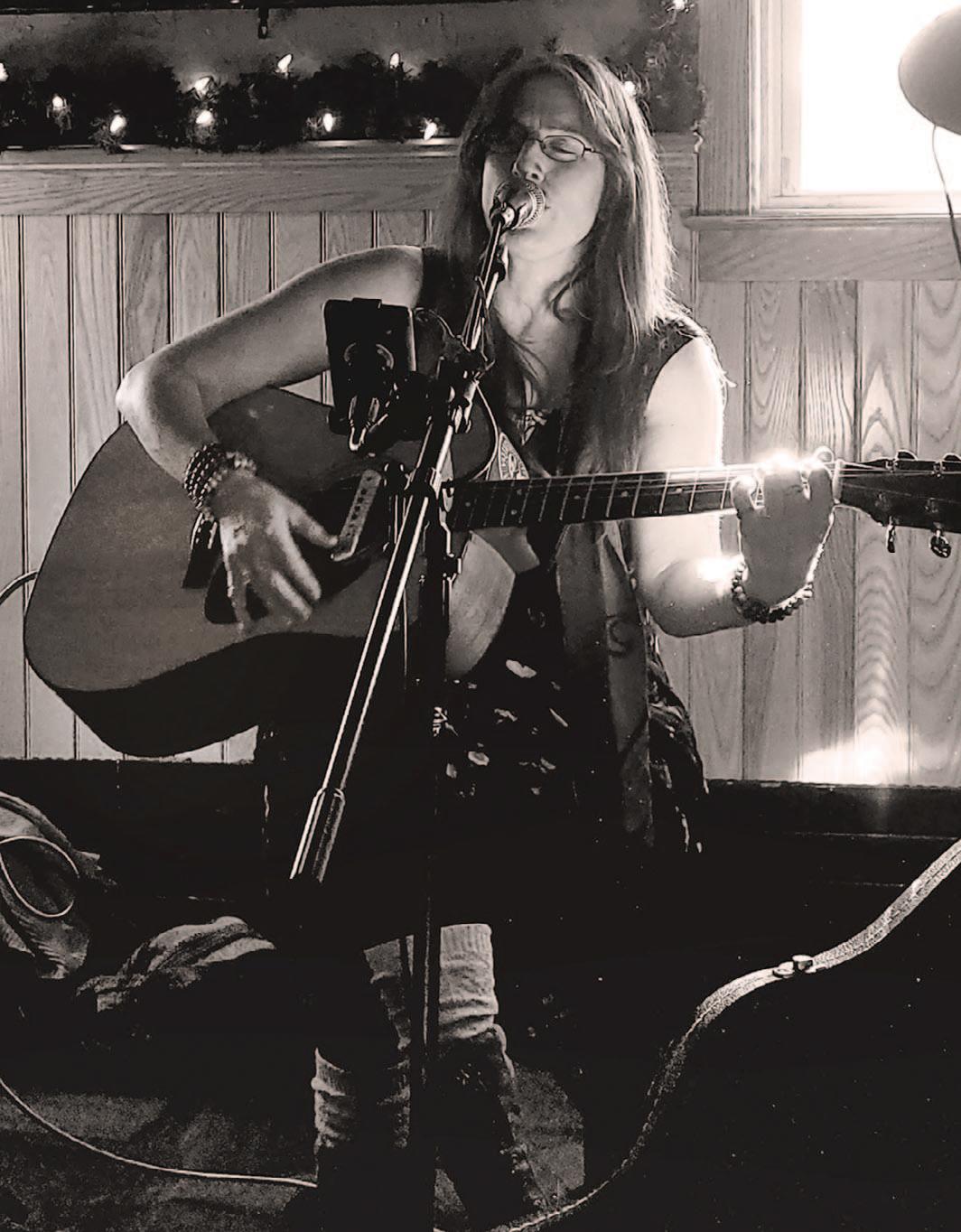
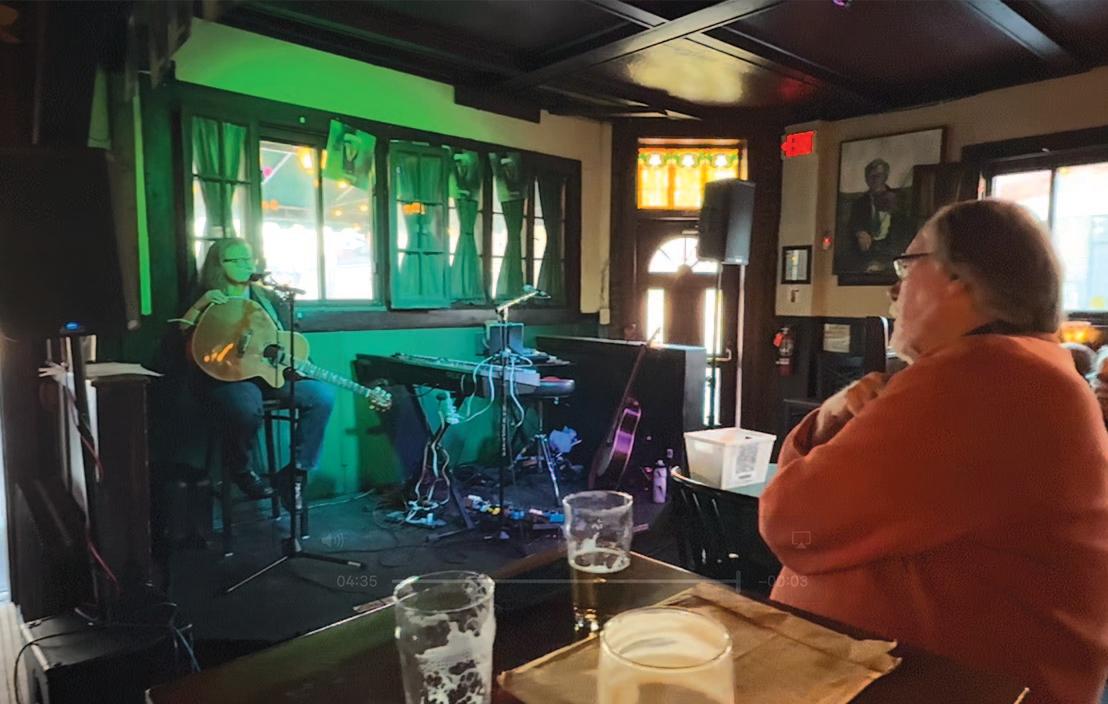
Mikki Bakken, Singer Songwriter, at The Parting Glass
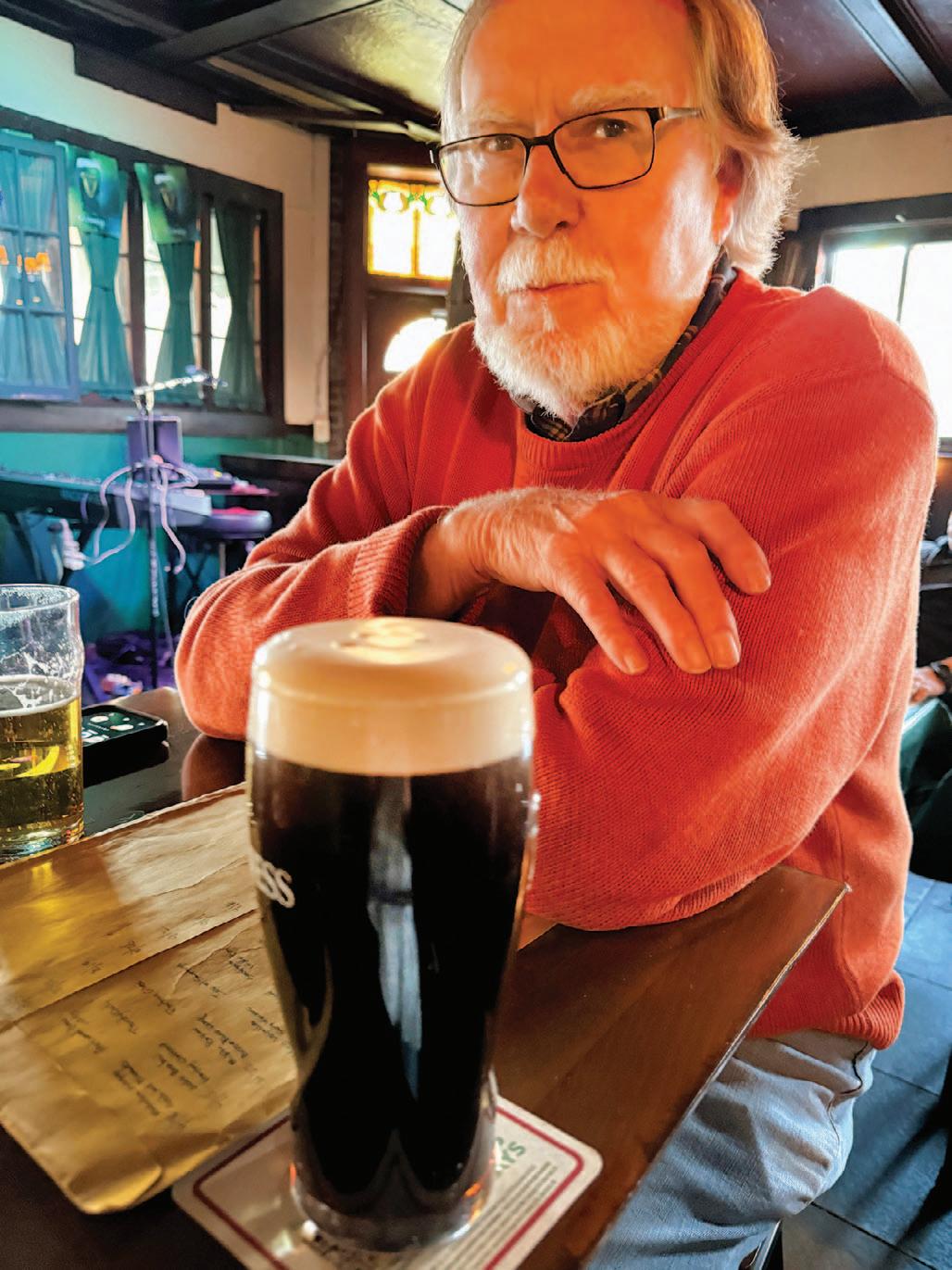
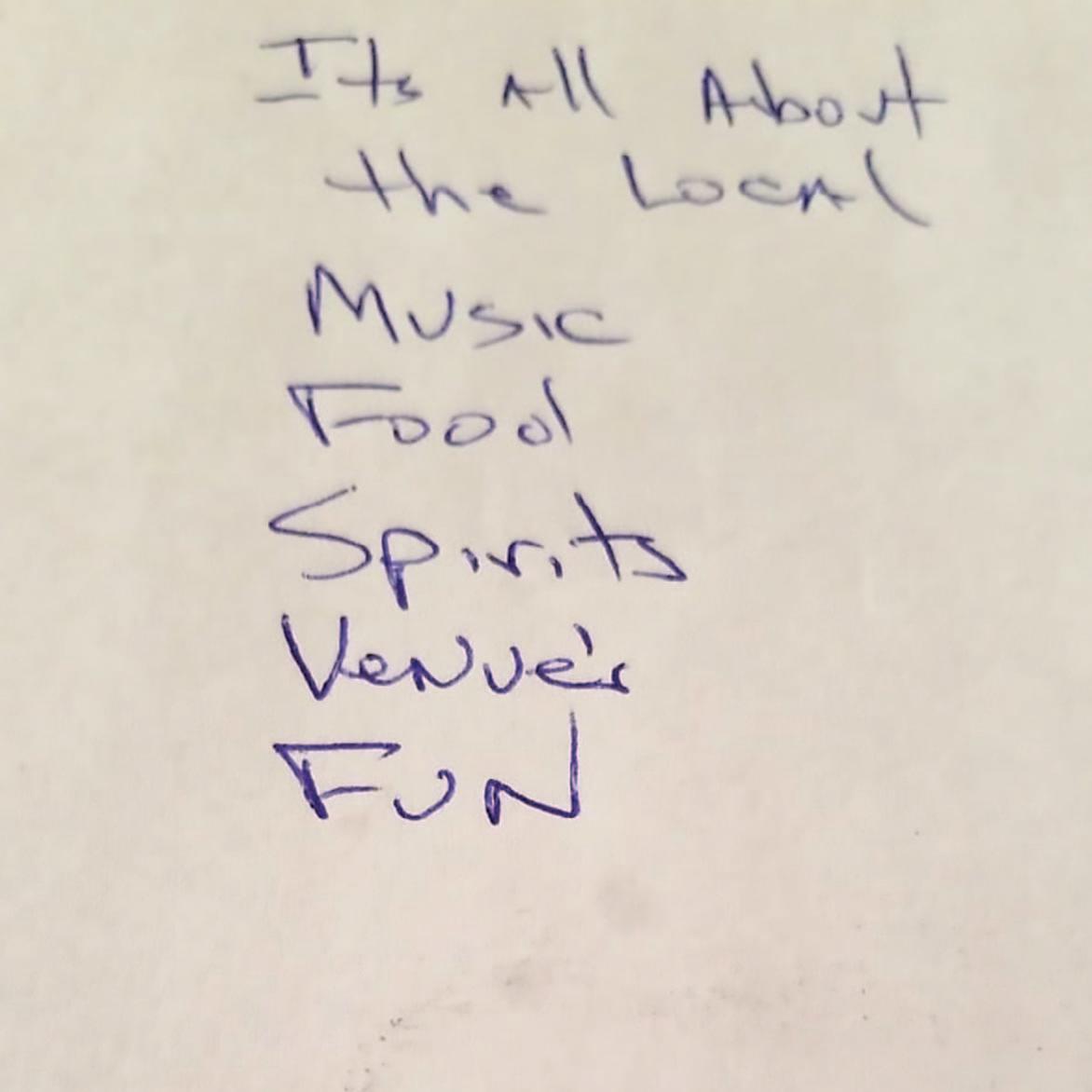
John Griffith’s moto written on his bar napkin
Let’s hear it for those special moms! And for their refrigerators too!
From the dawn of time, it seems the most special mothers were always there to encourage their children, to be supportive of their ideas, satisfy
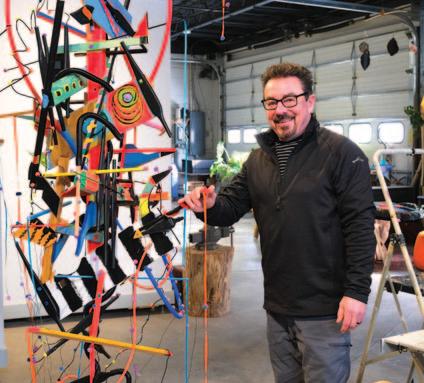
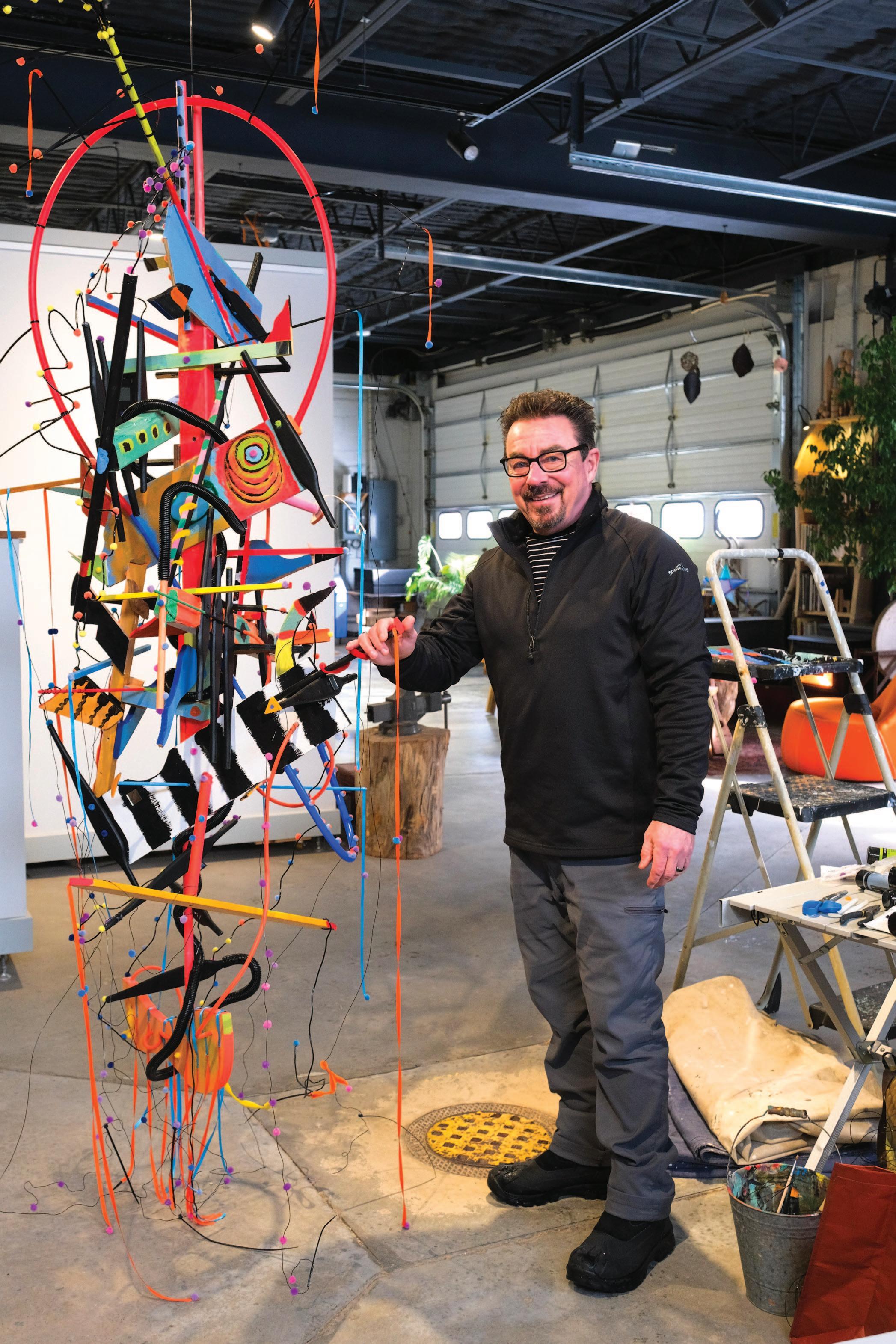
This Artist’s Life Began on a Refrigerator Clarke Hingeford... His Hands & Mind Power His Art
by Rona Mann photos by Dana Nemec
their wants, and propel them forward as best they could toward their dreams. And of course, that included putting their artwork up on the refrigerator door, telling them it was the most beautiful, most special, and most wonderful piece of art ever created. Those were the words that made even the shyest child smile. Even those little ones who were terribly uncertain of themselves, believing they didn’t fit in with the rest of the kids in the neighborhood, were made to feel
they mattered because they were lucky enough to have one of those mothers.
Clarke Hingeford was one of those lucky ones. A quiet little boy growing up in a small town in Fulton County, New York, he said, “I was very shy, but I loved to draw, so that was how I communicated with others, by drawing pictures. My parents always encouraged me, and my mother always put my pictures right up on the refrigerator door. So I just kept on drawing, and she just kept on putting them on the refrigerator.”
The refrigerator door may well be the best gallery in the house where masterpieces arrive still warm from the crayon and maybe redolent with the unmistakable odor of the peanut butter that served as the artist’s lunch. Long before the artwork is “installed” on that door, a child presents the work as carefully as a museum curator, waiting for any reaction. When papers are moved to accommodate the latest item for exhibition, the true installation begins, and the artist is vetted. “But as a kid, I didn’t know you could really do that for a living, you could just draw,” said Clarke.
Young Clarke also loved trips to the library. “The library was a refuge for me. I could stay there for hours and just lose myself in the beautiful and colorful art books they had there.” So there really was no indecision about his future on the part of the young man. “Early on, I knew I wanted to be an artist, so with the affirmation and support of his parents, he plunged headfirst into art from every direction, although his real love was art history. Still not quite believing you could do art for a living, he originally went to school and majored in psychology, but ultimately it was Art that eventually won out. Hingeford graduated from the University at Albany with a Master’s in Fine Arts.
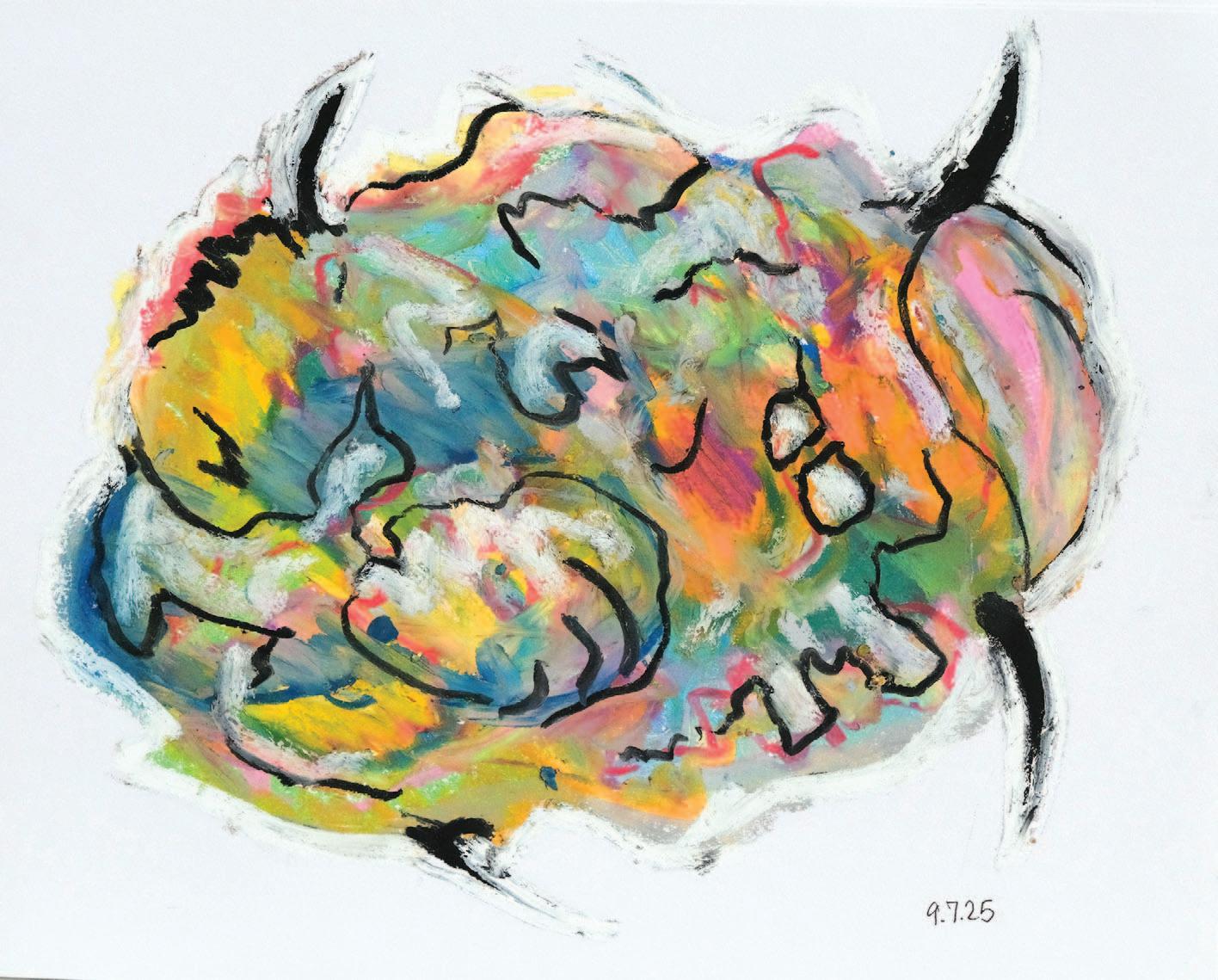
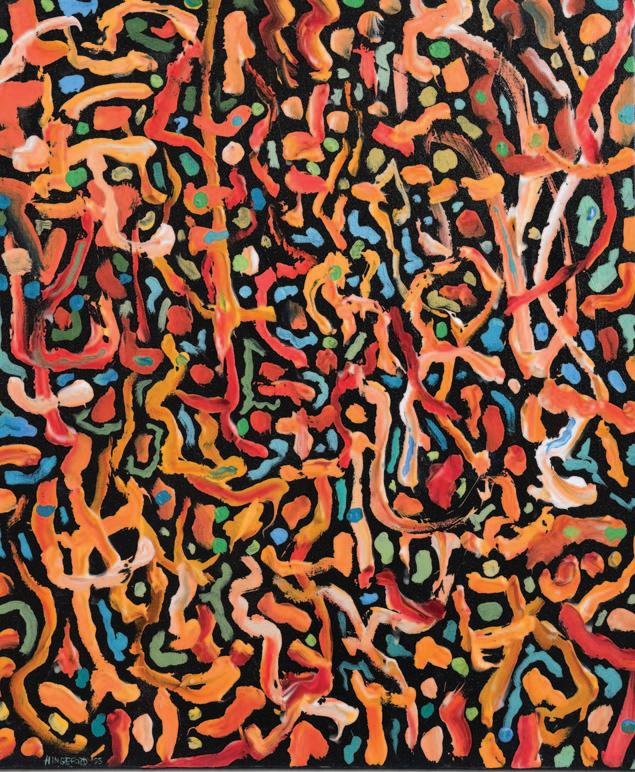
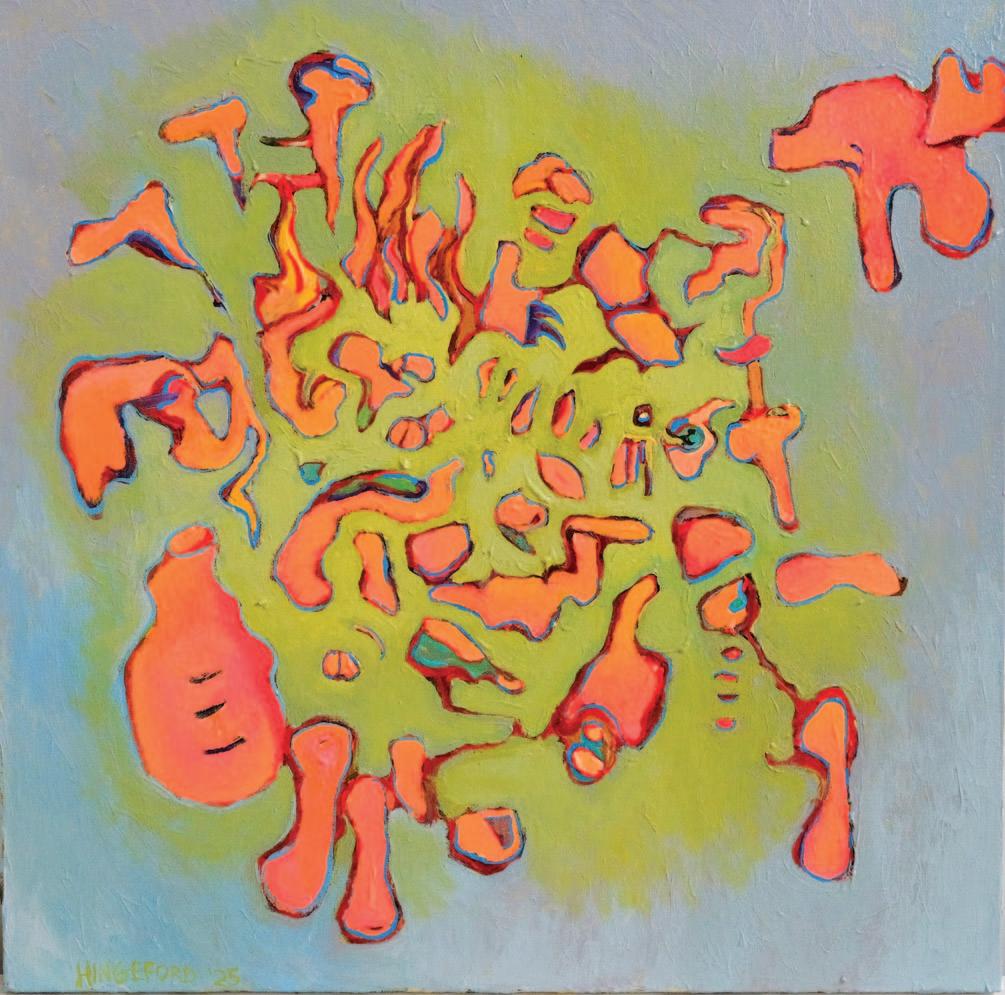
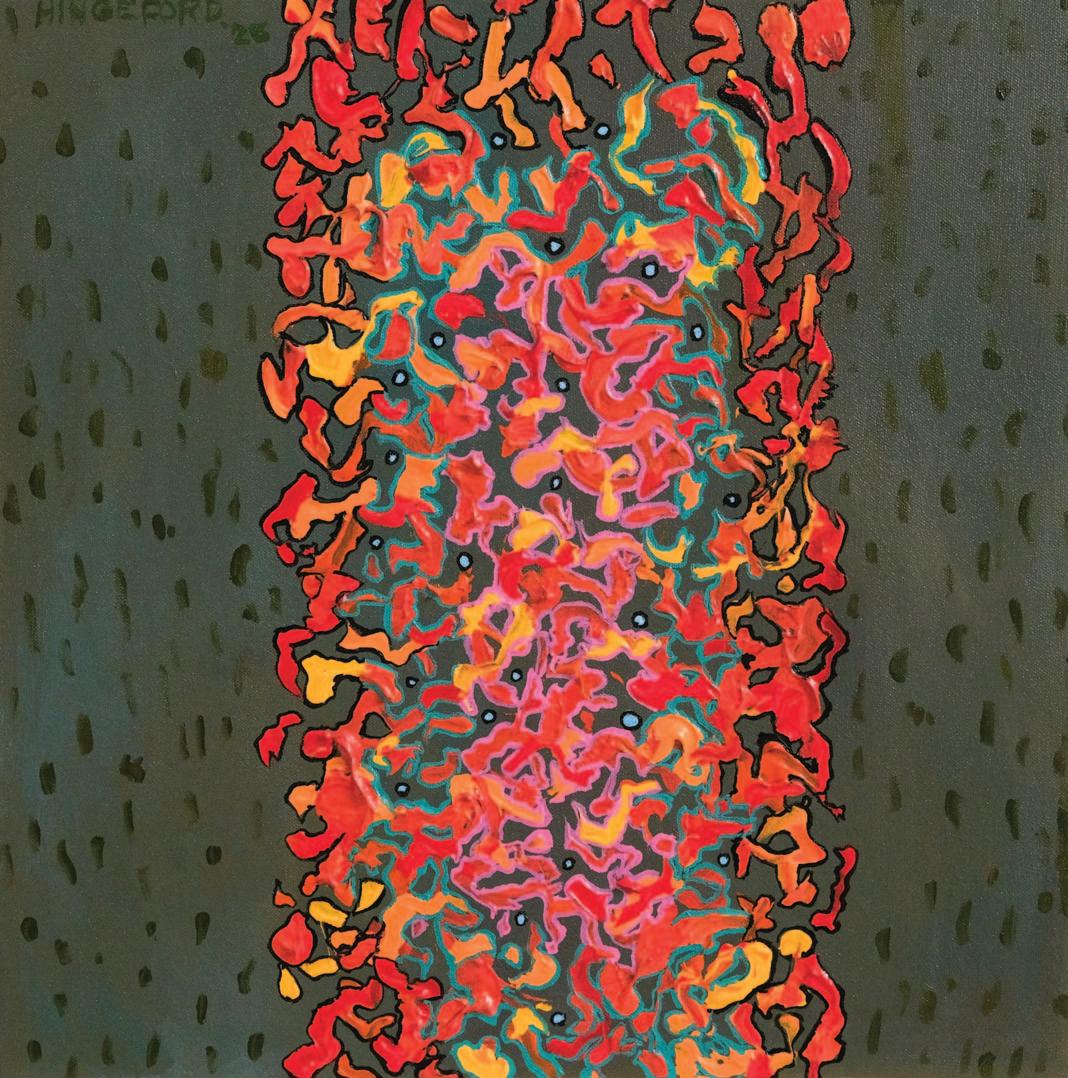
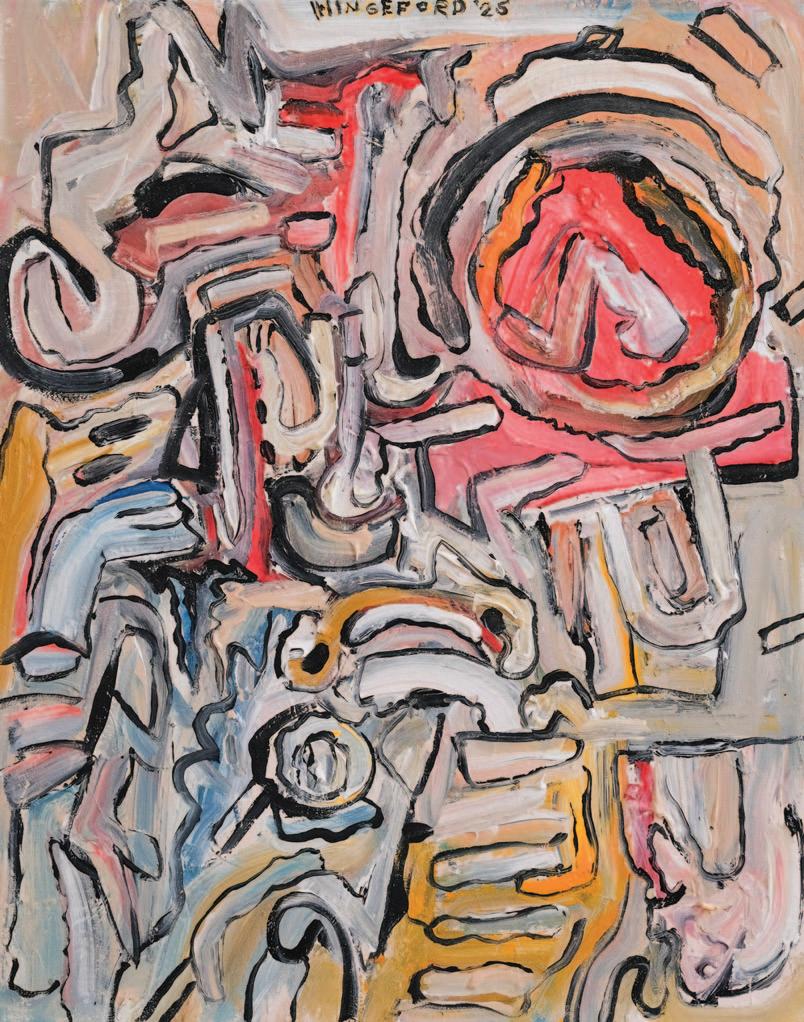
From the outset, Clarke believed in drawing every day, a practice he still follows. “It’s very freeing, a cathartic thing. I never plan
what I’m going to do, I just begin to draw, and it happens.”
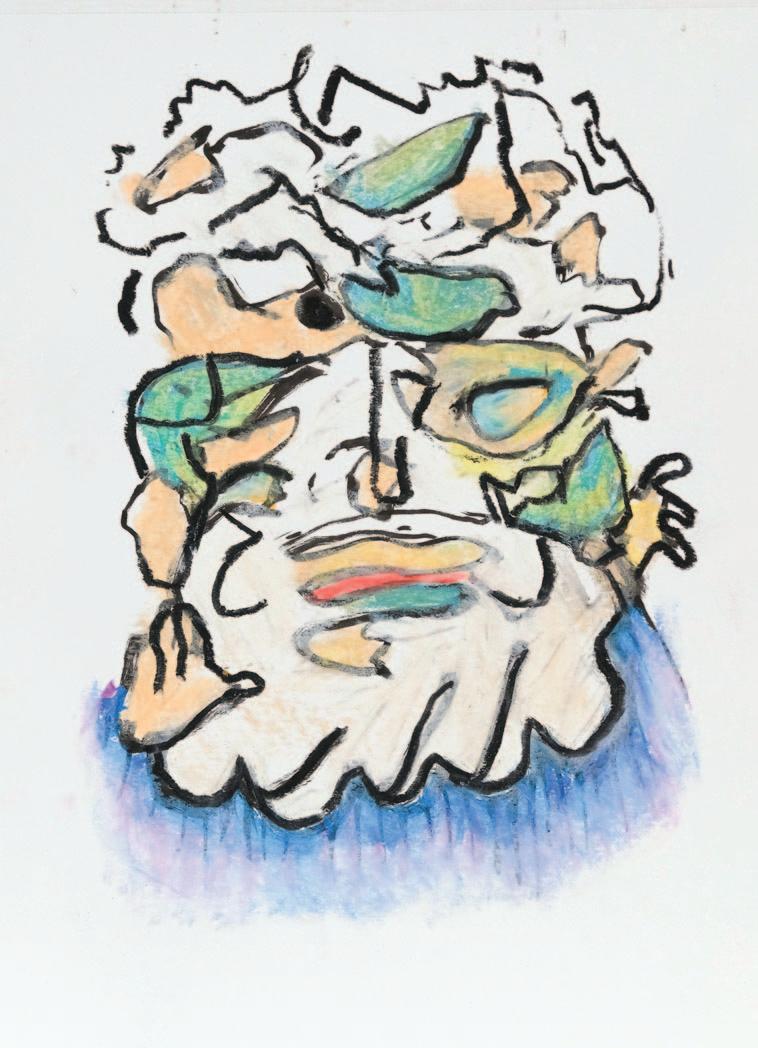
The “it” to which the artist refers is his true calling. It is a technique in which an artist draws without consciously planning or controlling what is created on paper or canvas... and yes, it has a
name. It is known as Automatic Drawing, drawing without thinking too much... and it is strongly aligned with the Surrealist movement, founded by Andre Breton and made even more famous by Salvador Dalí, whom many have anointed the “Master of Surrealism.”
Like drawing on autopilot, the artist taps into his subconscious, letting his hand move freely and allowing shapes, patterns, and images to emerge naturally. There is no correction, no erasing. Lines move about,
tangling with one another, creating shapes. Dali believed this technique could reveal hidden dreams and emotions; some artists in this genre are influenced by Sigmund Freud and his work on dreams.
There is no judgment, no refining of the work; a line may begin as nothing, and then somehow morph into a recognizable object or a face or an animal. Psychologically, this art is often seen as meditative and quiet, perfect for the introverted little boy who still lives deep within Hingeford.
There is no artist burnout with Clarke’s automatic drawing. He continues to draw daily, never knowing what will ap pear, never allowing the paper or the canvas to judge him. He continues to create random shapes from still, flat images, and he works every day in one of the two studios on his property . “One for art, one for music,” Clarke says as he has another artistic outlet in playing and recording. Along with his friend Kyle Pemrick, he comprises The Bit ter Stars and may be followed on Spotify, Apple Music, and YouTube. When asked what genre of music they play, he says without thinking for long, “Alternative Post Punky Pop. Soundscapes. Ambient Noise. Godzilla Fragment.” Check it out; they are quite prolific and have several albums.
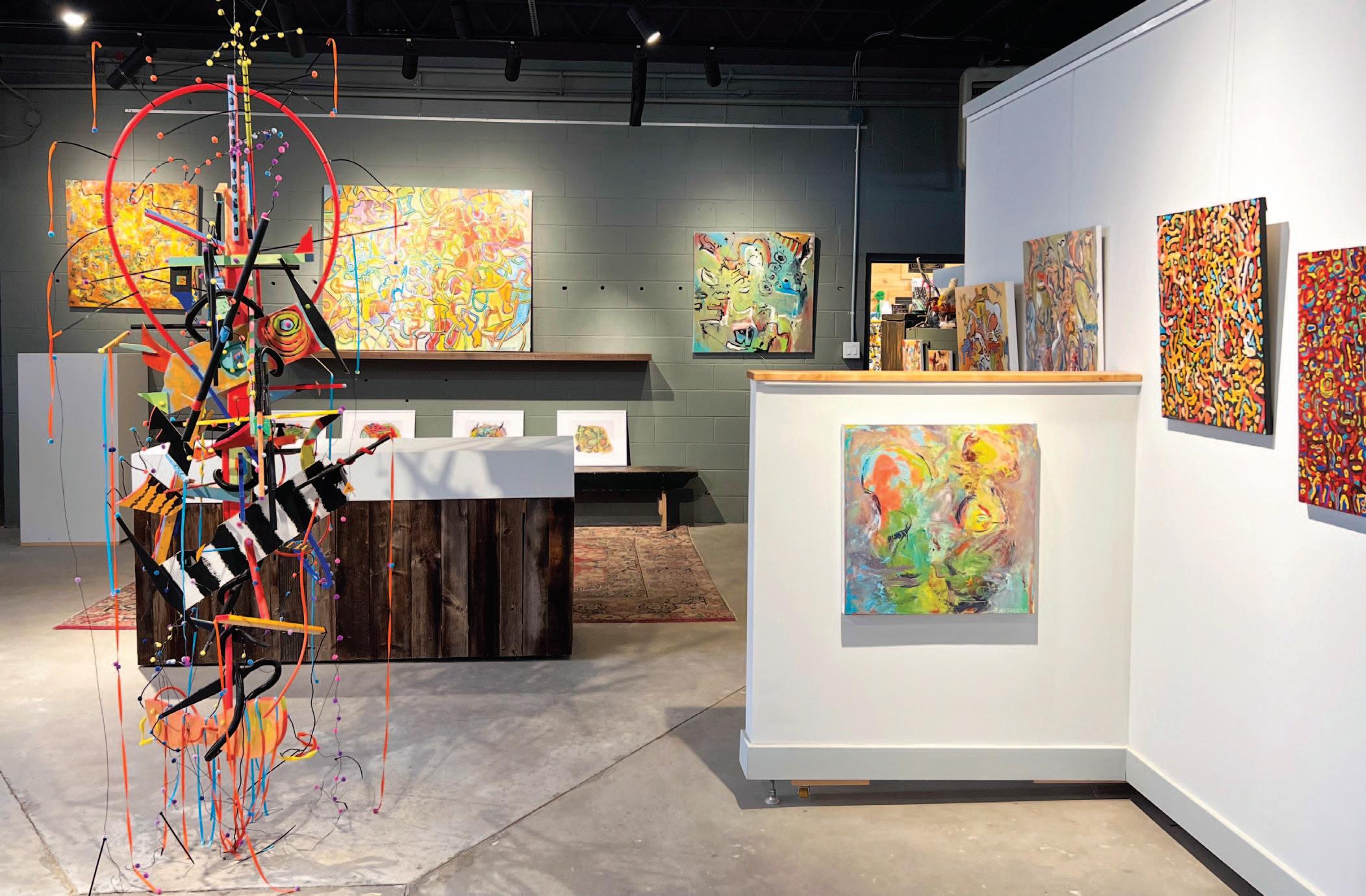
Recently, Clarke had a show at the Main Street Studio in his hometown of Charlton, a hamlet 18 miles from Saratoga with a population of less than 5000 people. The art show was aptly named, “Metanoia.” We didn’t ask him, but we researched the origin of the word. In theology, it is a “transformative change of heart, a conversion.” In other words, it perfectly describes what can happen when you sit daily and let your mind and thoughts invade your hands. Incidentally, he sold more than half his work at that show.
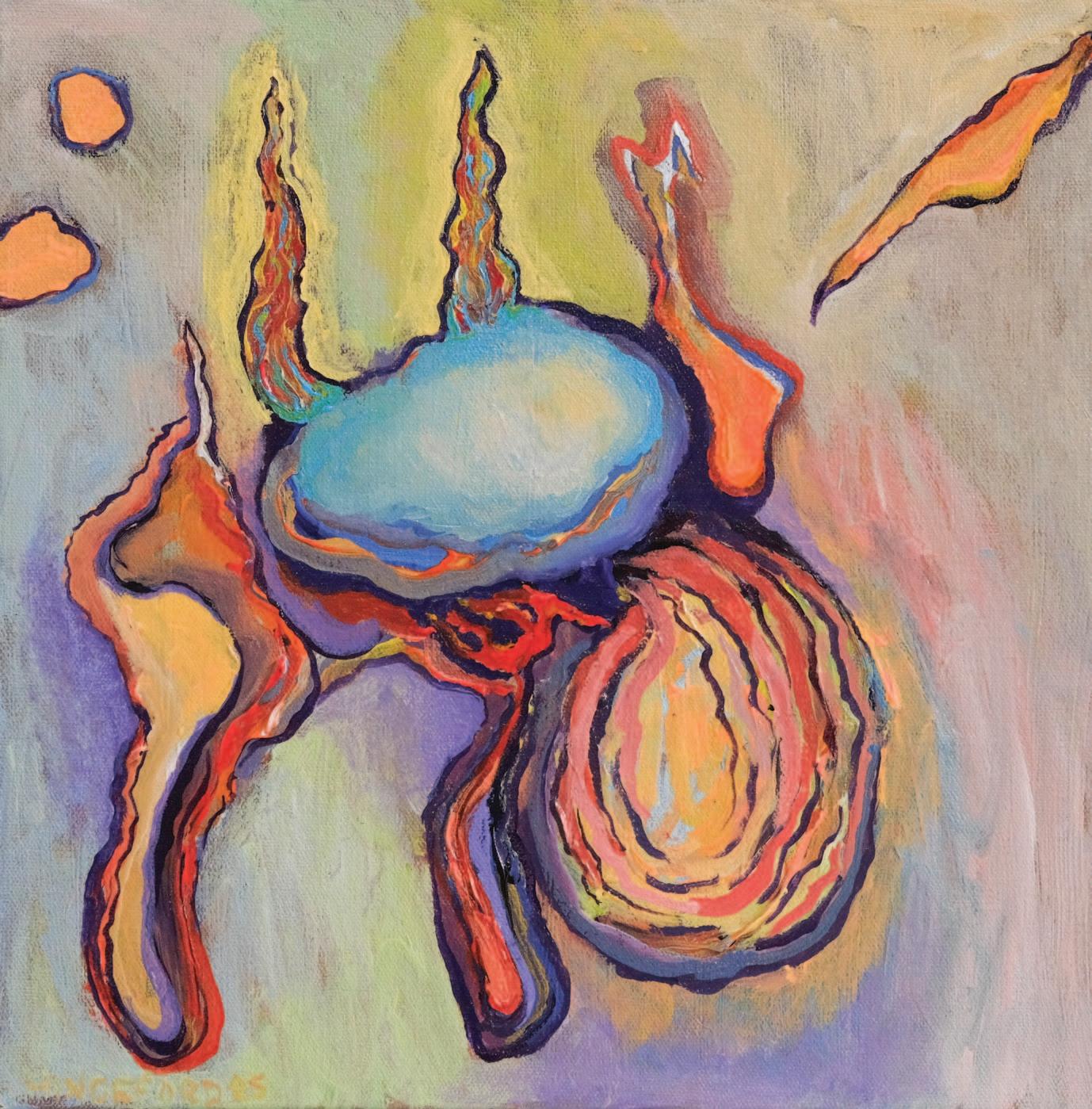
We asked Clarke if there would be anything else he’d like you, the reader, to know, and he uttered just one name. It wasn’t Breton or Dali or Freud. It was JeanMarie, his wife. “My friends remarked that when I first seriously began to delve into Automatic Drawing, the colors in my palette were earthy, dark browns and dark greens. My earlier work is definitely reflective of that. Then I met JeanMarie, and suddenly my palette brightened, my paintings vibrant and alive. She did that, and I love her.”
So it appears there was always a good woman in Clarke Hingeford’s corner, first his mother and then his wife. Unassuming, perhaps, but in their own special ways, they encouraged the man who always thought of himself as a “nerd,” as not fitting in. Because of JeanMarie’s presence in his life, suddenly the dark colors in Clarke’s palette seemed
to slowly disappear, and his art burst forth more vibrant than ever before with bright colors that simply popped on the canvas and into a wide variety of collections.
And that long-ago maternal figure realized she didn’t have to say very much to power a little boy toward a career in art. In a world where art is often filtered through markets
and gatekeepers, the gallery of the refrigerator ignores all that. It validates that a crayon swirl is as worthy of display as any oil painting, and in the case of Clarke Hingeford, wh o let his hand and his heart lead the charge, it turned the ordinary into a cele bration of creativity that did not wane with childhood.
As that little boy was coloring abstractly, it was his way of communicating with and connecting to the rest of the world. In many ways, Clarke Hingeford has never grown up, and for those who encounter his most unusual style and wish to collect it and make it their own, it is extraordinary.
Few artists even know once a work is sold to a collector, where it will be installed in their home or office, or what happens to it. Perhaps it’s not on a wall at all, but just maybe it’s on the very front of a refrigerator door where the art is not usually dis played but noticed every time you reach inside for a cold drink or some food. Where the owner of the piece might pause to admire the burst of color or to see something different and not seen the last time he put his hand on the refrigerator door. It is a gallery that never closes.
Discover the Automatic Drawing and talent of Clarke Hingeford by visiting: www.clarkhingeford.com
The Legend of Cowboy Ernie Sites
By Lawrence White
They’re independent critters, All different yet the same … They are the keepers of the prairie, And cowboy is their name.
...The Great American Hero, Ernie Sites
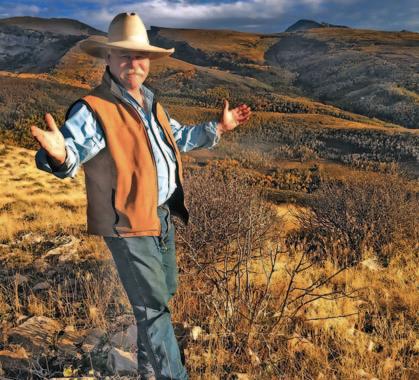
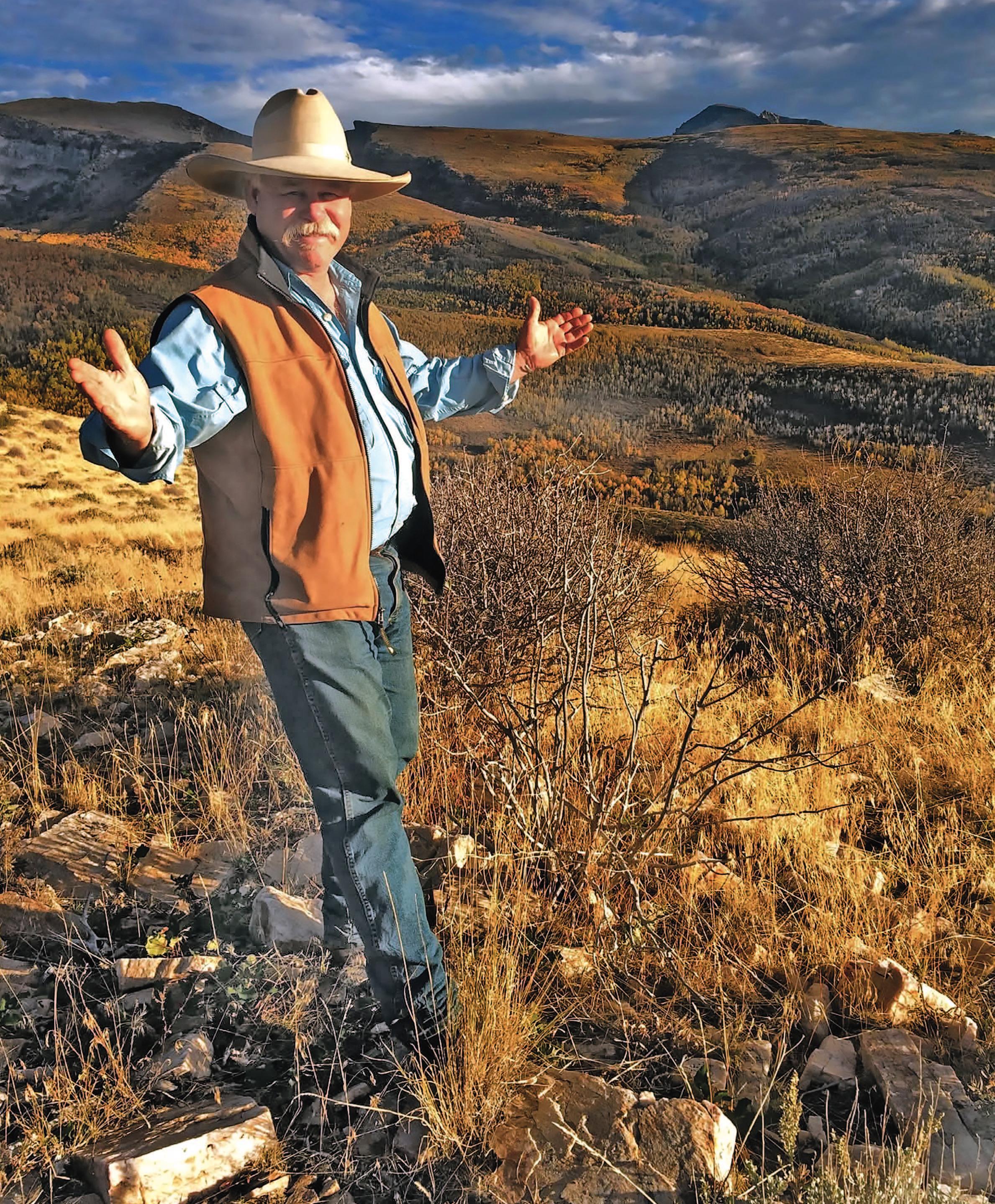
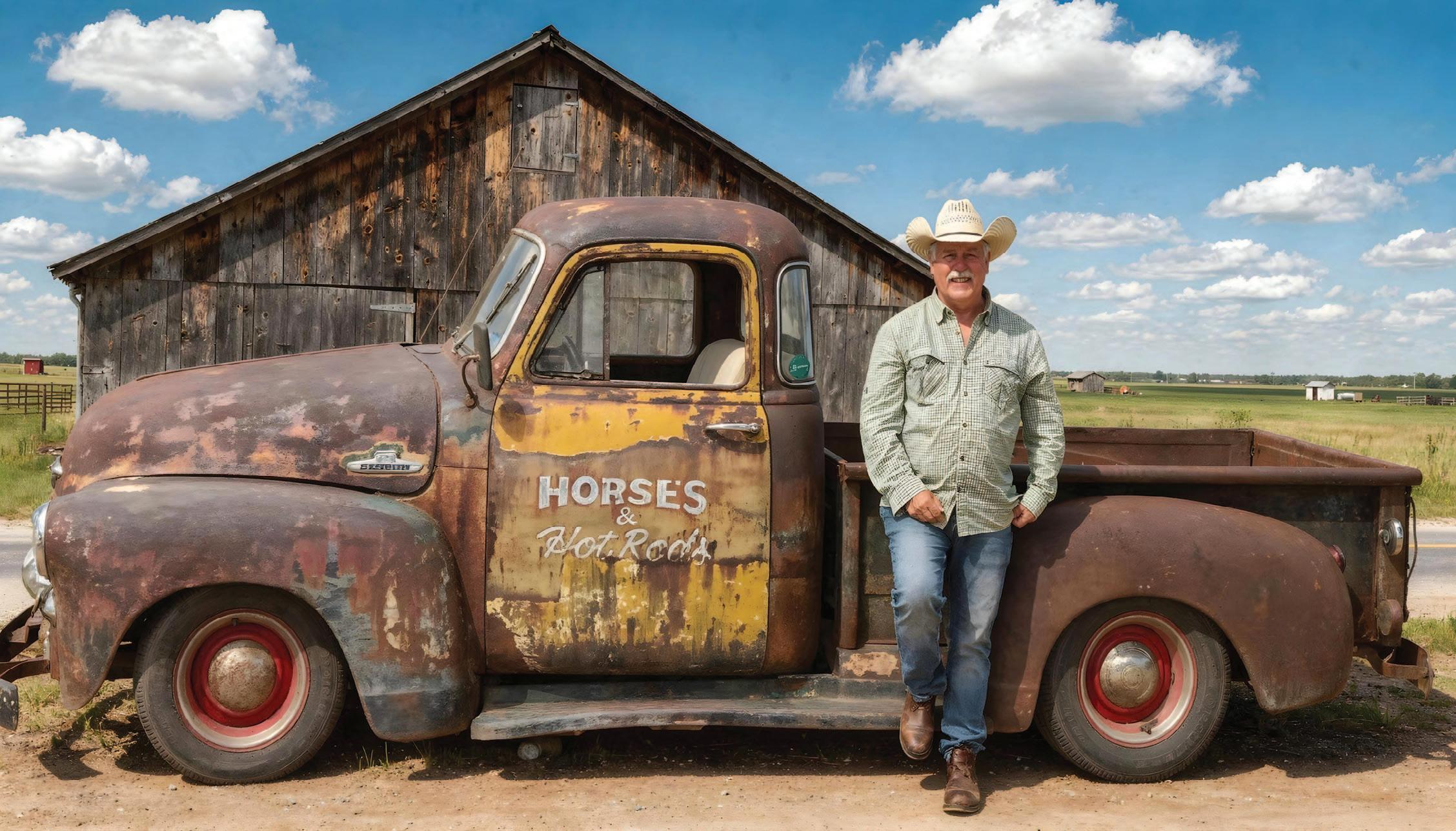
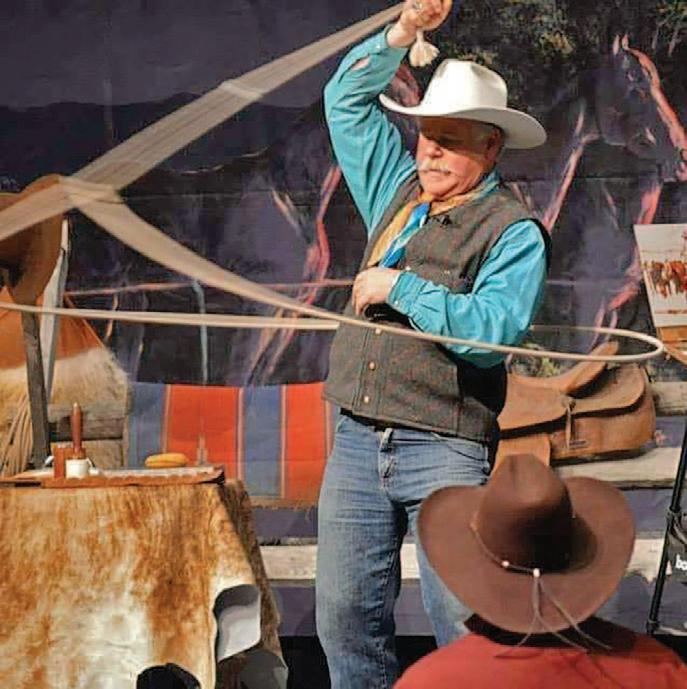
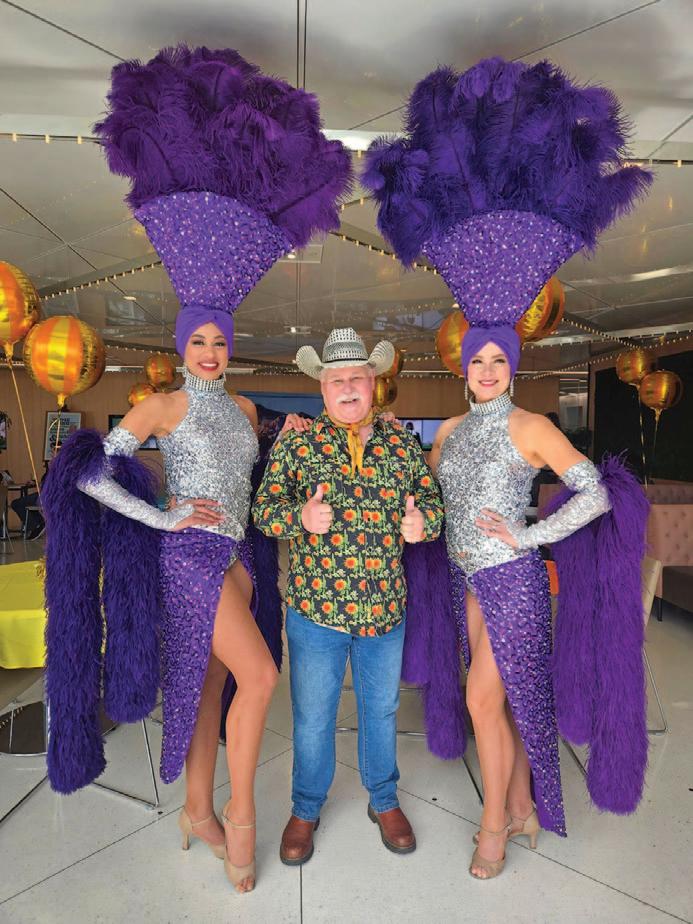
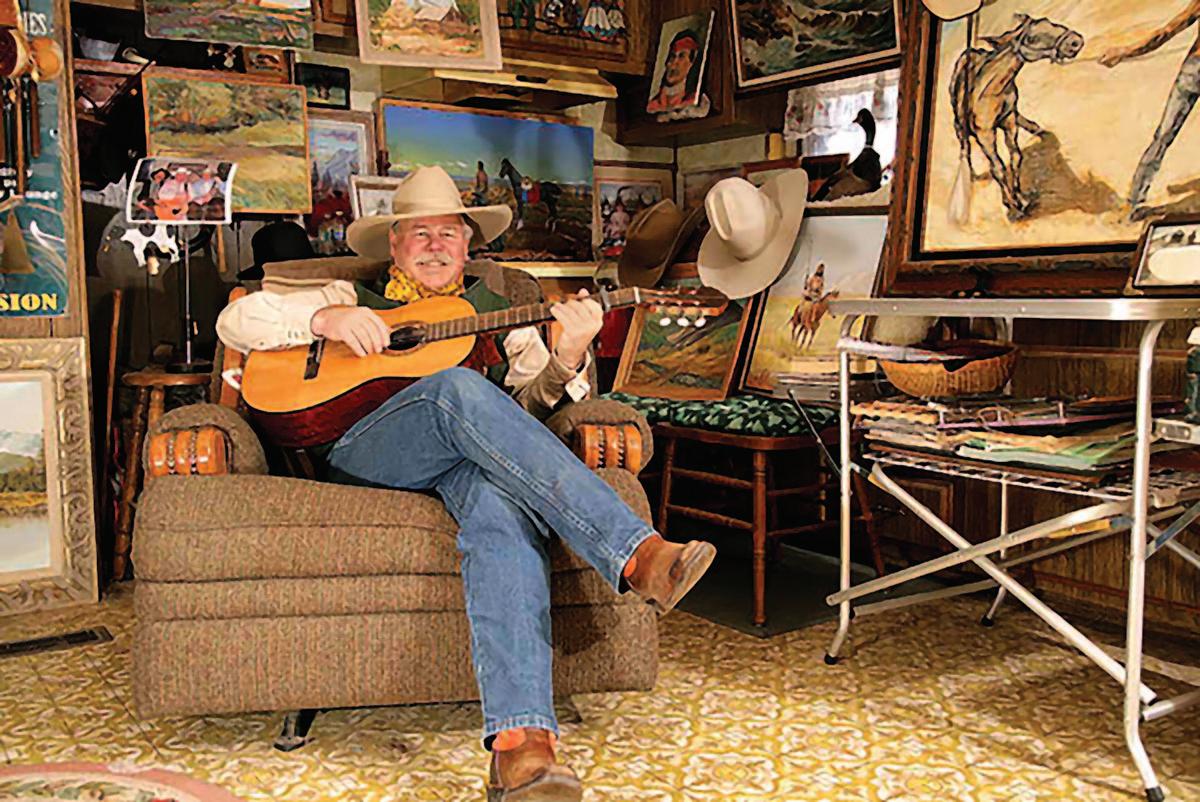
Some people are just naturally larger than life. Others are even larger than that. Cowboy Ernie Sites is such a man. When he enters a room, everything changes. His generous smile is topped by a classic handlebar mustache, and the booming, warm tones of his powerful voice immediately set things in motion. The energy does not stop for the duration of his presence.
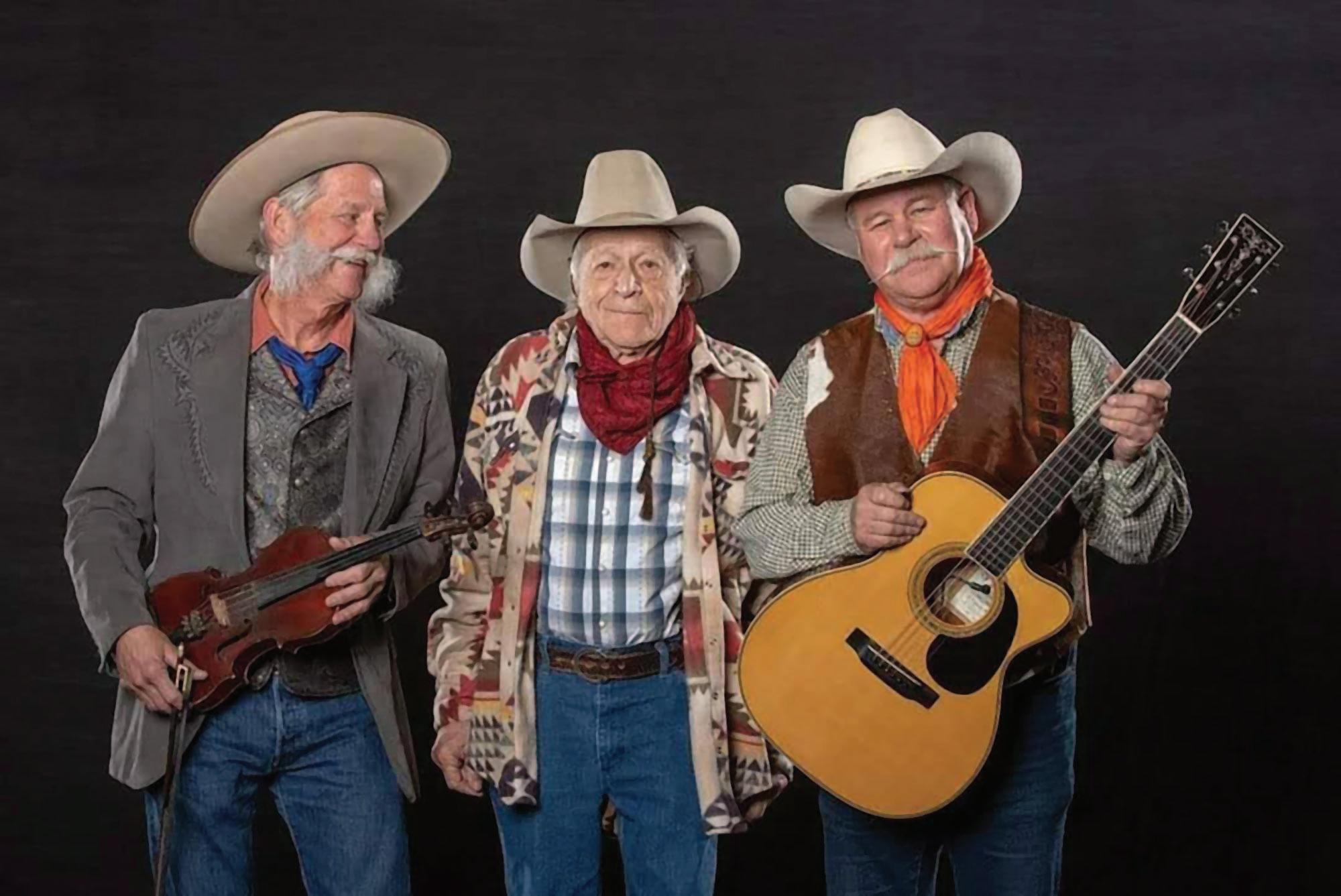
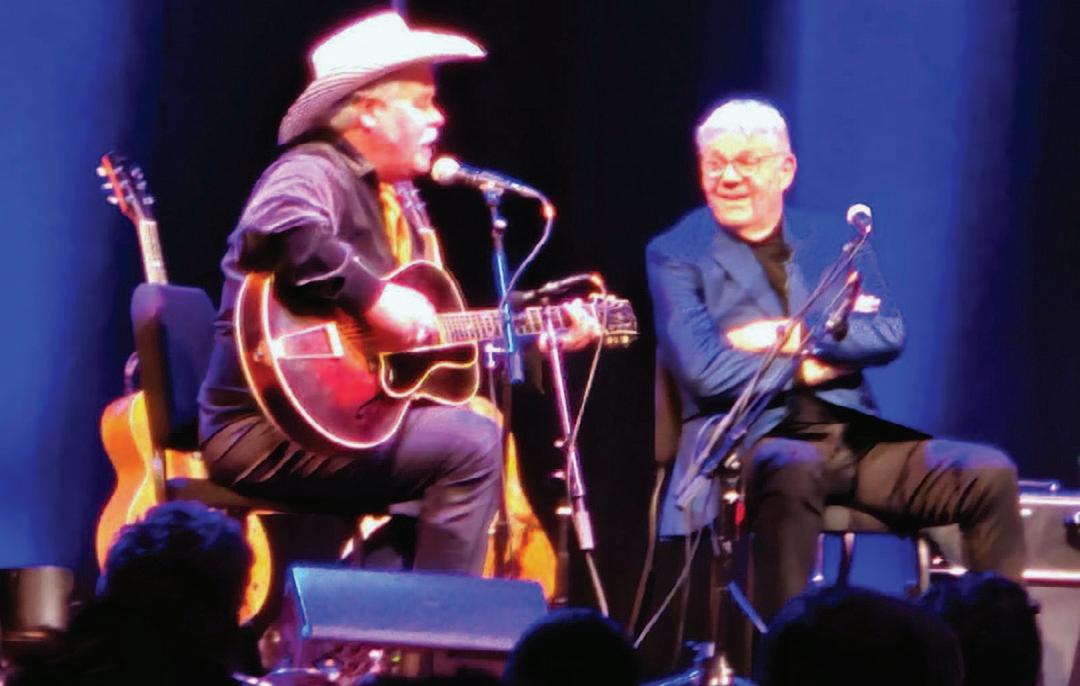
Ernie has a lifelong love for the cowboy lifestyle and for the music that has defined it. His resume includes western performer, songwriter, cowboy poet, trick roper, bull rider, rodeo clown, bareback rider, team roper, and calf roper. The original songs on his six CD’s reflect a rugged, romantic emotion that captures the imagination of new gen erations today. Ernie’s live performances are full of interesting stories, expertly rendered songs, yodeling, and expert roping skills, all while in an authentic wardrobe from the top of his hat to the bottom of his chaps. Ernie is the real deal, and audiences, young and old, love him, particularly in the Saratoga area, where he has been a regular summer resident/performer for decades.
In a sense, Ernie was born into a world of performance. His father, Ernest Samuel Sites, played semi-pro and professional baseball, in cluding in the Pittsburgh Pirates system. Ernie recalls, “I would sit in the dugout with the players. The smell of cigars wafting in from the stands, and the excitement of the crowd at each hit or catch, was thrilling for me. I felt like I was part of it.”
Born in Idaho Falls and raised in Wendell, Idaho, where he has a home today, Ernie
began learning the skills of a rodeo athlete and the basics of cowboy entertainment at a young age. At one time, Ernie's father tried to learn how to play the guitar, but after a few lessons, he set it aside. However, 8-year-old Ernie picked it up and started to play right away. To accommodate his small hands, Ernie’s father modified the guitar's neck, making it thinner so his fingers could reach across the fretboard, but at the same time, he challenged young Ernie to learn "BoogieWoogie music." If Ernie were successful, his parents would buy him an electric guitar. It
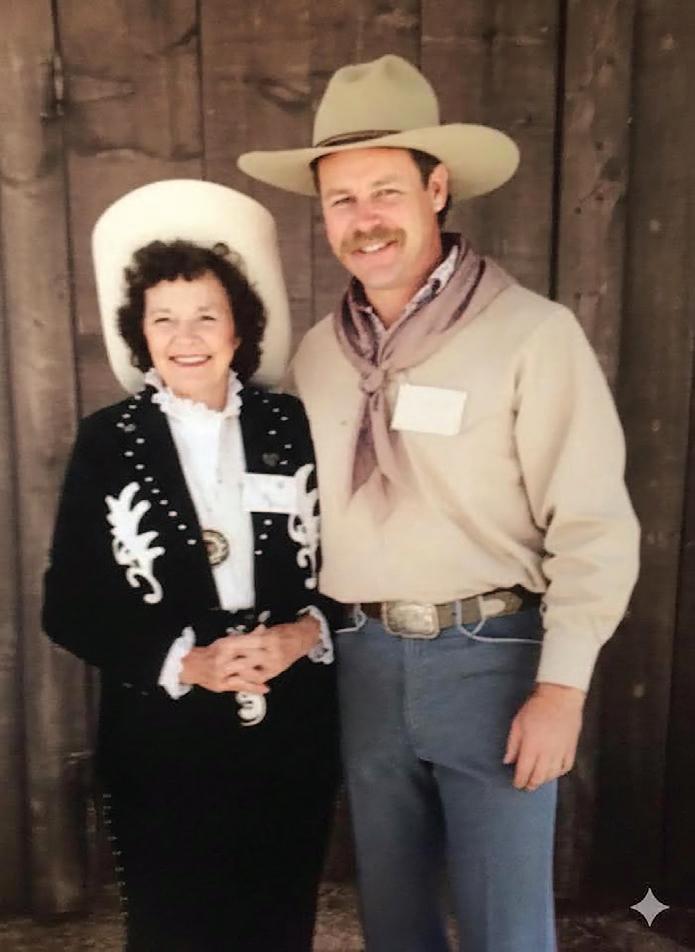
With Patsy Montana
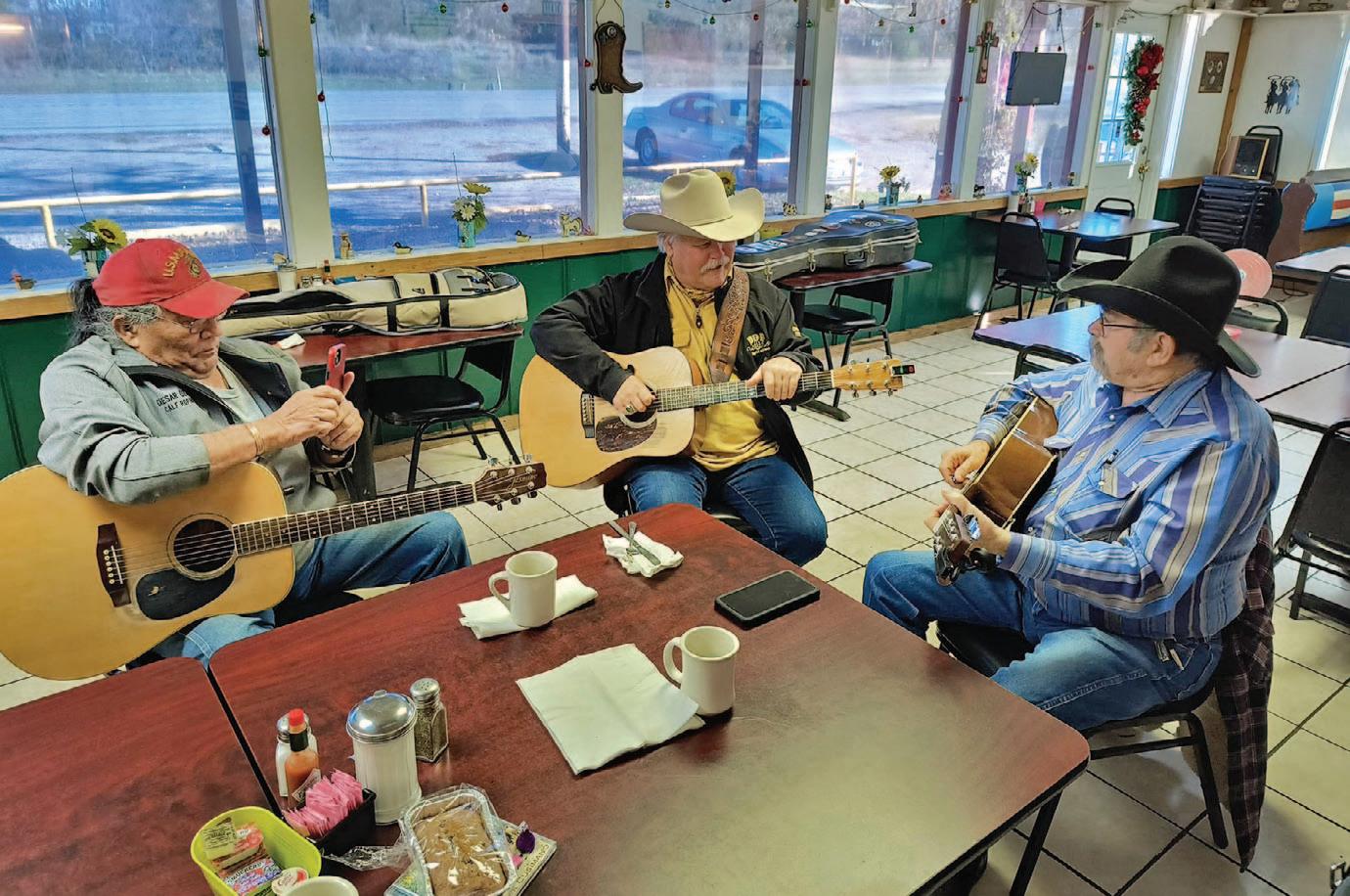
Spontaneous diner jam with Caesar and Chuck Cosmo
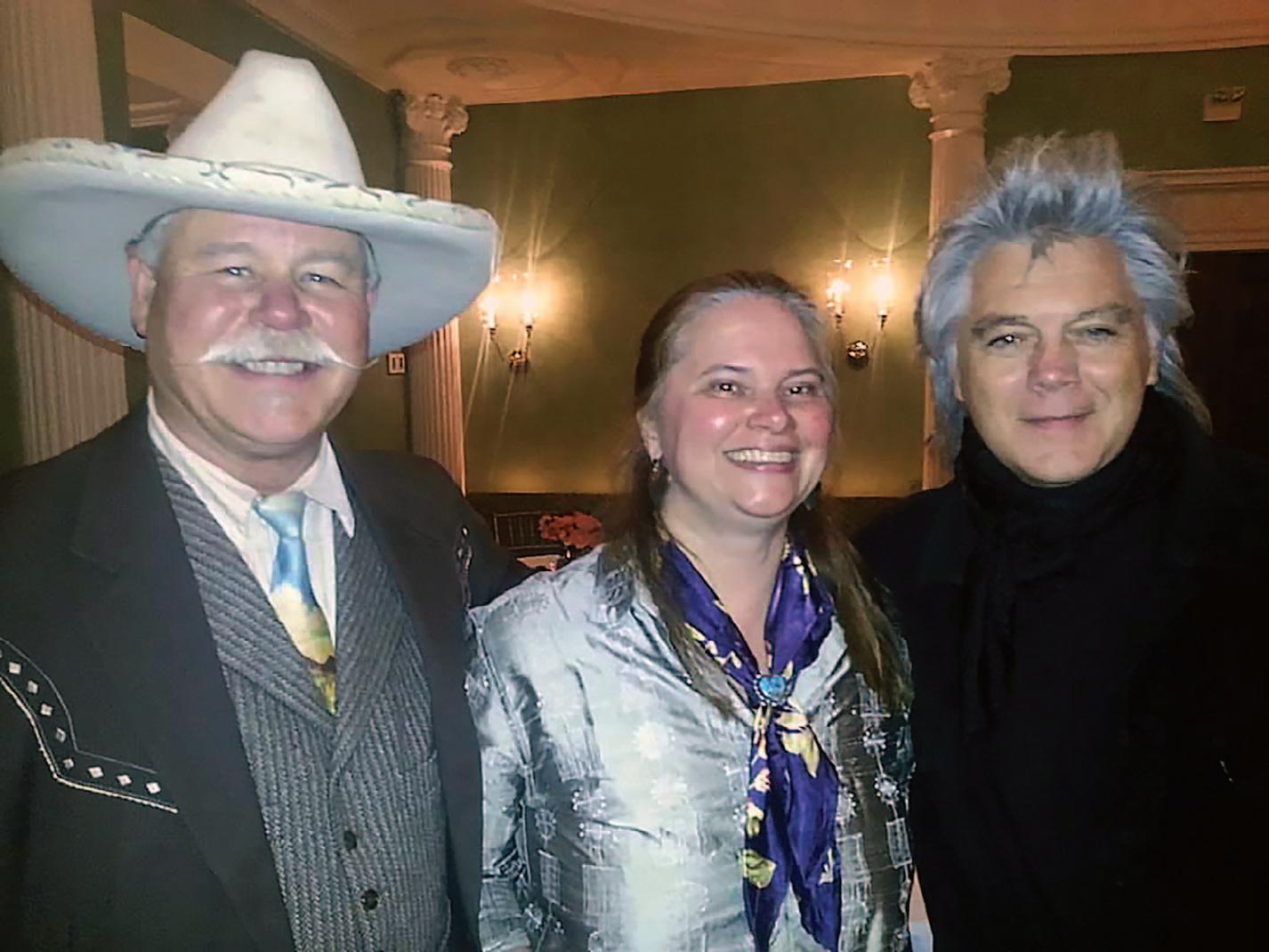
Ernie with Barbara and Marty Stuart
took 4 years for young Ernie to accomplish that level of rock-ability on the guitar, but true to their promise, when he did, Ernie’s parents gifted him an electric guitar.
“Of course, this made my playing and my mistakes much louder, so I had to practice in the barn where I would serenade the cows,” Ernie tells me with a hearty laugh.
“The local barber was a musician, and he allowed me to practice in the back of his shop. I could hear his clippers while I played, and if I hit a bad note, those clippers would stop, and the correction would commence.”
yodeled, along with a large catalog of classic cover tunes he could sing.
At the same time, Ernie developed a fondness for poetry. Eventually, he used this talent to create the lyrics to the music he sang and
Ernie formed his first band, The Golden Wheelers, with his brother Joe when he was
With Michael Martin Murphy
Peter Watercot, Fiddlin Pete and Ernie
With Dale Evans and Lynn Anderson
15. He continued to work on his cowboy skills at local rodeos and farm events. “I would work as a rodeo clown. We distract the bull when a rider goes down, so I would wear cleats with my clown outfit so I could run and stay off the horns. When events in the rodeo were scheduled close together, I would be forced to wear my clown clothes with a different hat, then go back to clowning in the next event with the old clown hat.”
Ernie at the Green Room Elko Cowboy Poetry Gathering
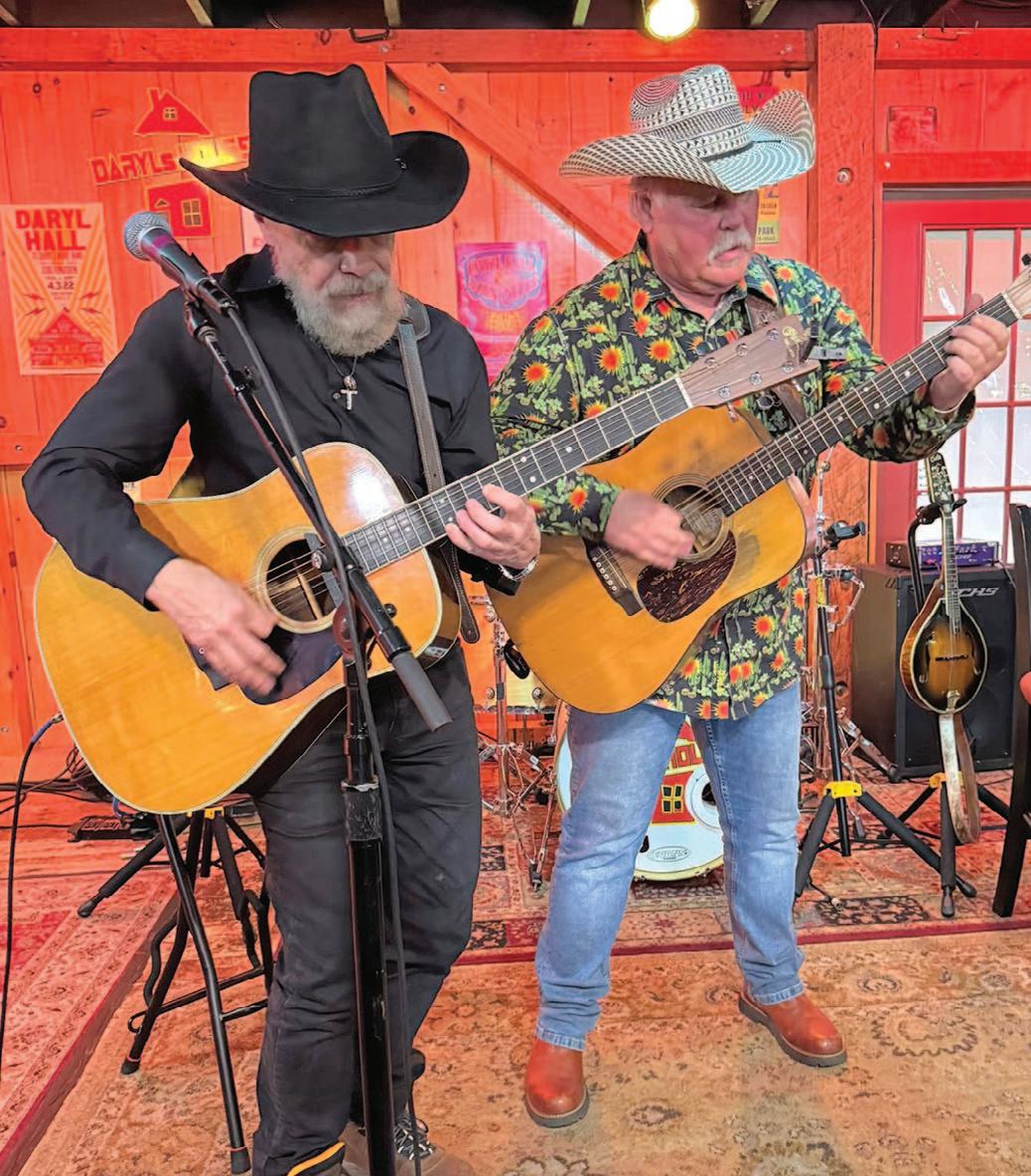
With Doug Monro at Daryl House
Ernie studied the art of trick roping to emulate his hero, Will Rogers. As his entertainment career grew, he discovered the National Cowboy Gathering in Elko, Nevada, and was delighted to find that many others were dedicated to preserving the cowboy way of life through music, poetry, and storytelling.
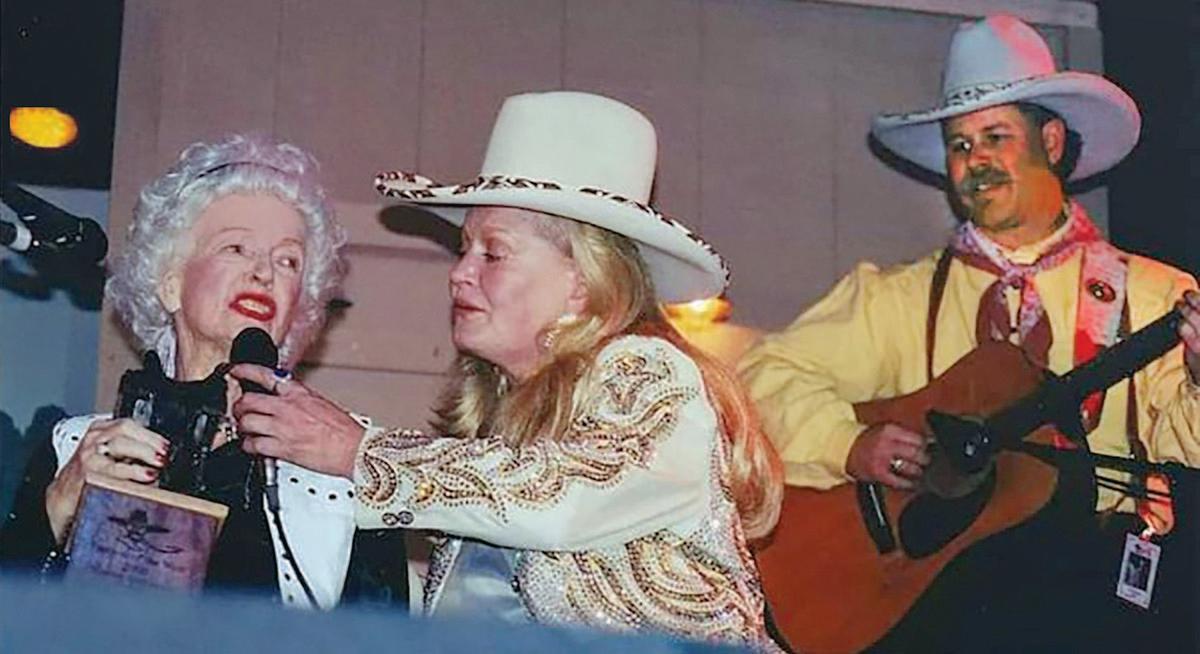
Ernie eventually became recognized by the Western Music Association (WMA) and began performing with such notable musicians as Riders in the Sky, Roy Rogers & Dale Evans, Gene Autry, and the Sons of the Pioneers. He has been a guest on CBS, PBS, TNN, the BBC, and Good Morning America.
I ask Ernie if he recalls any interesting stories from those experiences. He tells me. “When I performed Happy Trails with Dale Evans, I was told by her manager to play in the key of E major, but when we started the song on stage, Dale had me stop and told me that it was the wrong key. Of course, I was aston ished and tried to shift keys, but she said that was wrong too. From the wings, her manager whispered, ‘Play the key I told you,’ So I went back to E major, and she sang it perfectly.” Ernie continues with a smile, “Later, I saw Dale do the same thing in another performance and rea l ized I had been played, and she got a big kick out of it.”
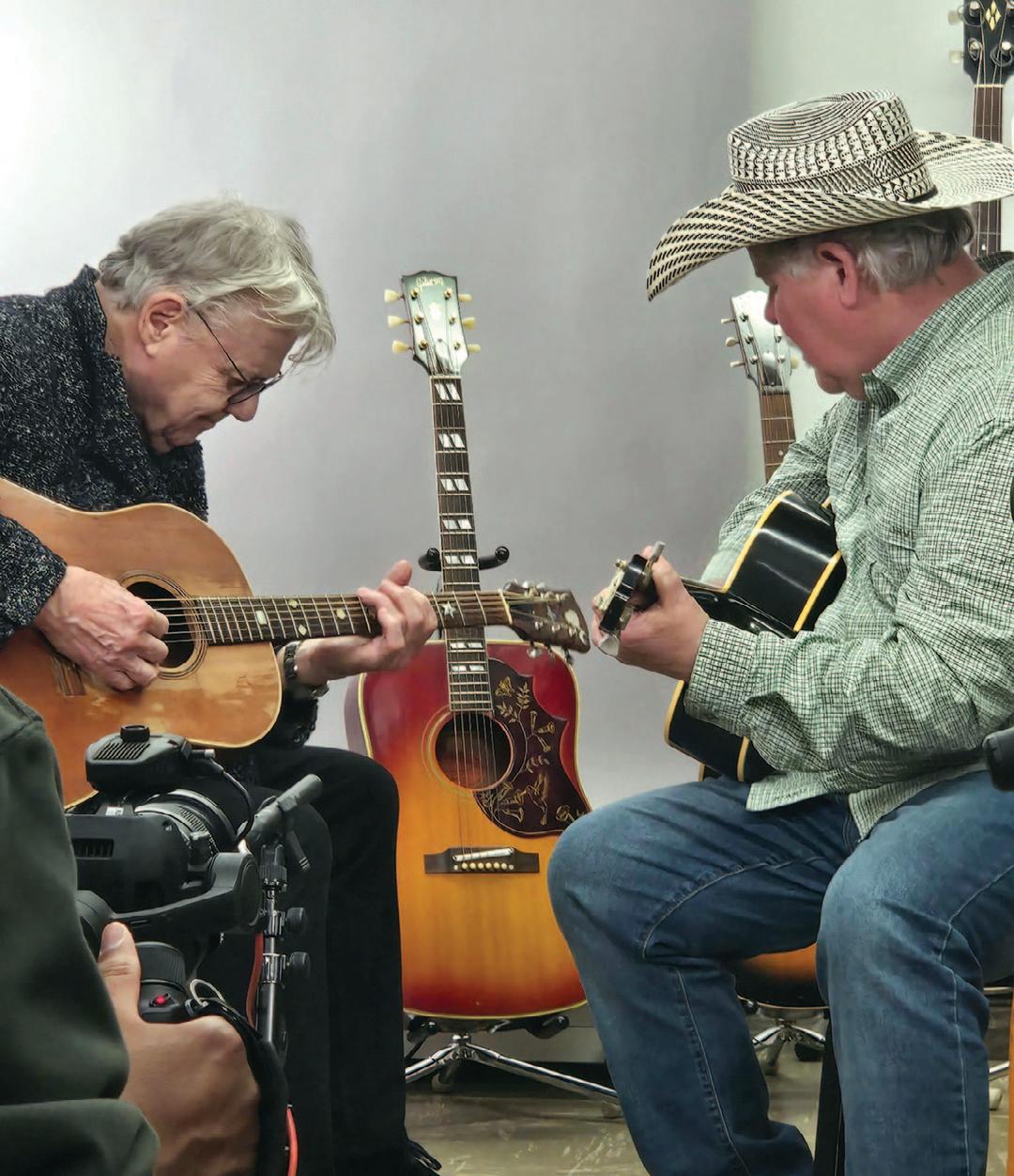
Ernie has had a long relationship with musician Steve Miller (The Joker, Jet Airliner). I expressed an interest in how they met. Ernie explains, “I was introduced to Steve by legendary guitar maker, performer, (former Martin Guitar Artist Rep) Dick Boak, who I know well. Steve has a home in Idaho, about 30 miles from my house there, so I have worked on his guitars, gigged with him at various events, and just plain hung out. Cool guy.”
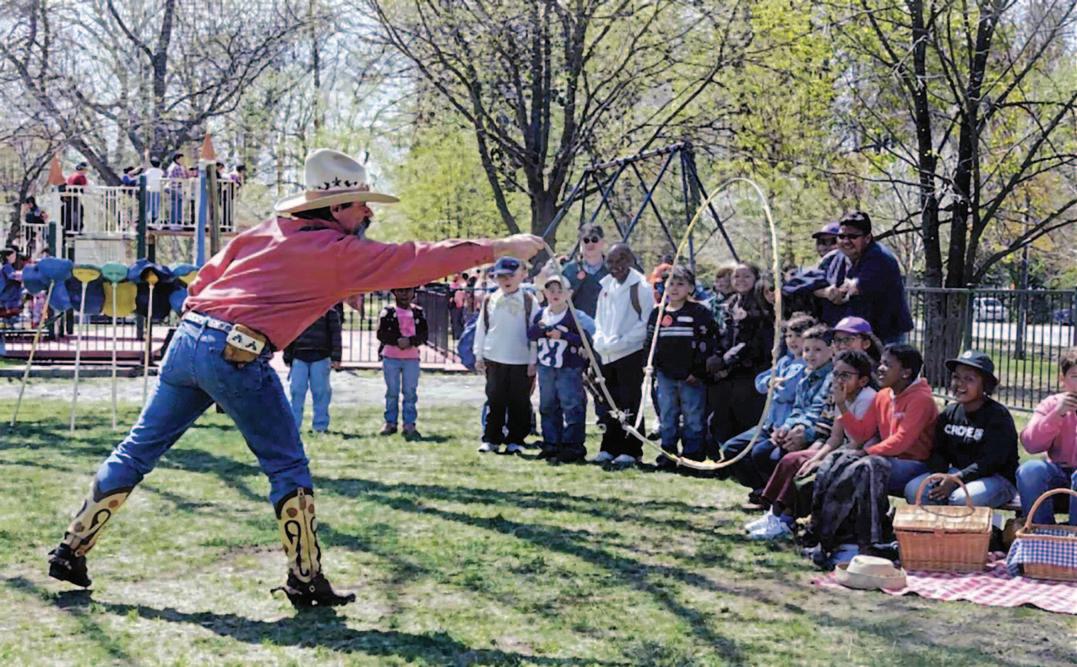
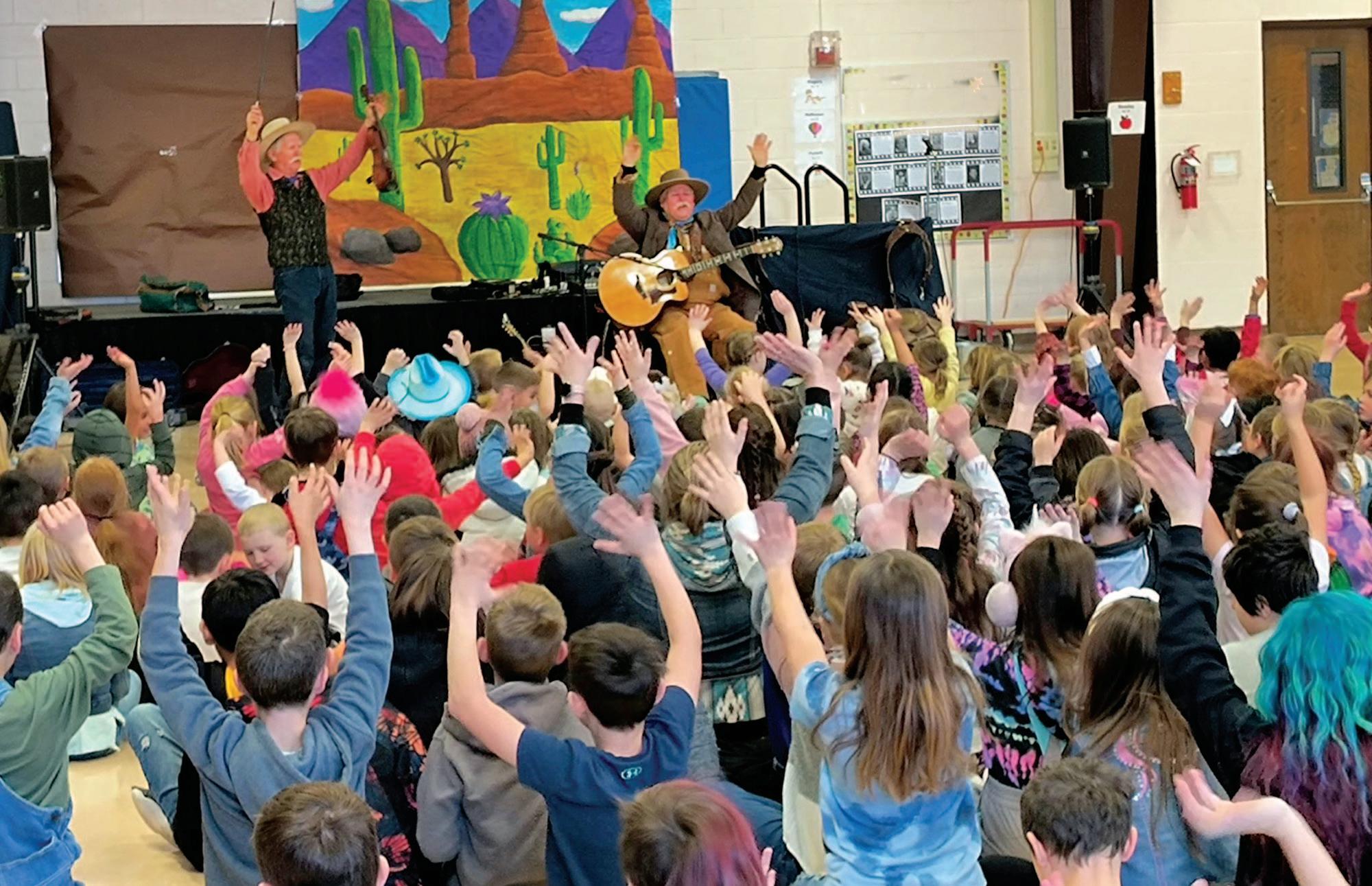
Along with his many accomplishments, Ernie is also a playwright and created a children’s songbook. In fact, Ernie is proudest of his work with children. His workshops for kids include traditional and original cowboy songs, western singing, songwriting, yodeling, and storytelling. He performs a variety of rope tricks that dazzle the kids and encourages them to try mastering them themselves.
Ernie also conducts creative writing classes for children in 3rd to 6th grades and for those with special needs, focusing on rhyming poetry as well as free verse. His goals for the future include further development of these educational programs.
I speak with Ernie a final time after a successful performance at the Rocking Horse Ranch, near Wappinger Falls. I ask him about his plans for this summer season, and with excitement, he tells me, “Memorial Day, I will be in Stony Creek with the great fiddle player Frank Orssini. We will be strolling and playing all over town; you can’t miss us. I will also be working outdoors at the Deuce Moose Cafe for the Lake George Steamboat Company, serving guests as they come and go. It is a beautiful venue with great vibes. We always have a lot of fun.”
Then, in a more reflective moment, Ernie tells me, “My motive and my goal are to share the cowboy way with as many people as possible. When I see the joy light up in their eyes as they recognize and connect with this wonderful history and heritage, I know I am doing something special and something lasting.”
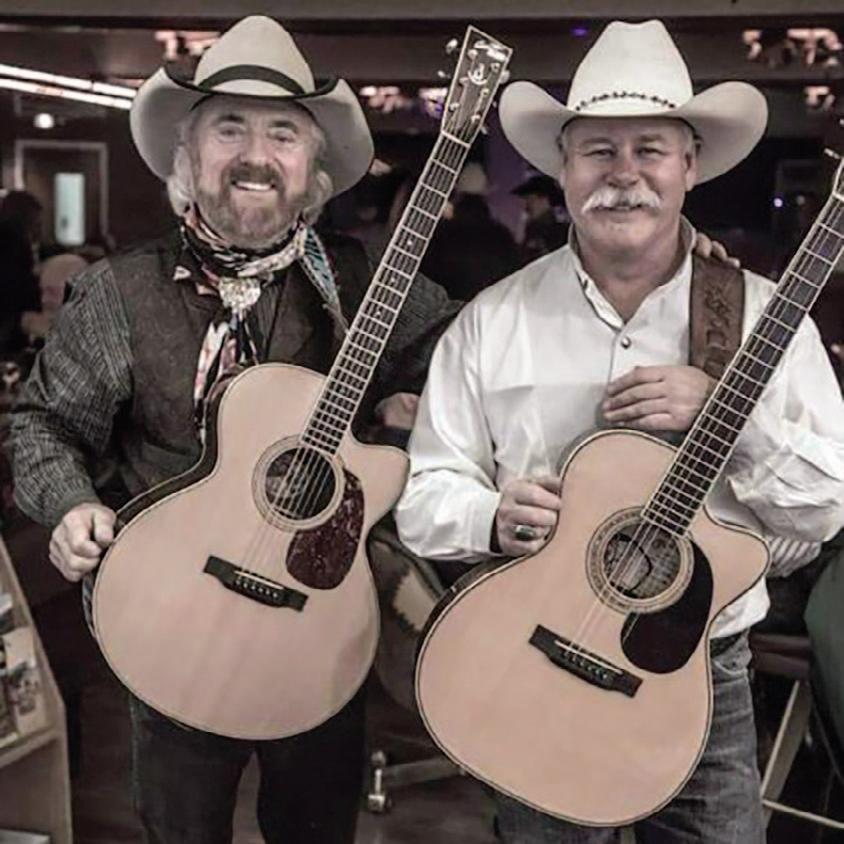
Metropolitan Museum Show NYC. Steve Miller and Ernie with Twin Martin Guitars
June Meant Saying Goodbye to Mrs. Seitz
by Karen Richman
When I was in school, I had a love-hate affair with the month of June.
I loved that June meant the end of the school year and the start of a couple of glorious months of camp, ice cream, playing outside till the streetlights came on, staying out late, and all the other delicious joys that came with the freedom of a seemingly endless summer vacation. But I also hated June because I’d have to say goodbye to Mrs. Seitz for a few months, and I didn’t like that one bit!.
Mrs. Seitz first came on the scene as a substitute teacher when I was in seventh grade. She served as my homeroom teacher and doubled for my geography teacher, a subject that didn’t interest me very much. But this woman was a force of nature! She took a personal interest in every young person in our homeroom, whether or not she had them for geography, wanting to know exactly what interested them, what they thought they might like to do when they grew up, and what stood in their way. She worked hard to teach them how to deal with obstacles, how to reach a bit higher and farther toward their goals, and always met them wherever they were. Yes, she was one of THOSE teachers.
As for my indifference to geography, she would hear none of it. “The whole wide world is out there, and you must get to know the big cities and the little towns and the dirt roads and rivers and oceans, and especially the people that make our planet so special!” she would repeat like a cate chism over and over. The more she said it, the more curious I became until I looked at my geography book with renewed interest and at the woman who made that book come alive with even more interest.
When she found out I liked to write, she hounded me to join the school newspaper. I did, and within a year, I was Editor-in-Chief. When I expressed a serious interest in the ater, she researched the best college drama programs and talked my mother into taking me for private acting lessons. When I graduated and chose a college, but didn’t like it after the first semester, she persuaded me to stay another semester or two and give it another chance... and while I was at it, to put in much more effort on my part. Mrs. Seitz was right, actually; she was rarely wrong. Not only did I stay another semester, but I stayed until I had earned both a Bachelor’s and a Master’s, opened a business, and met the love of my life.
That love of my life and I took her advice and traveled. We managed to explore 48 of our 50 states, to venture to Mexico a number of times, to visit Canada, and not only to travel to Europe but to find a “second family” of wonderful people in Scotland.
It was not until I reached my 40s that I felt comfortable enough to call her by her first name, Evelyn. Because to me, she would always be my teacher, my champion, and when warranted, my much-needed kick in the pants.
Mrs. Seitz, er, Evelyn, made it into her 90s. When she had a stroke and lost the use of her right arm, she looked on
the bright side, as she always did about everything. “Now I shall have time to learn another language!” she chirped to me on the phone...and she did. When my own mother died at age 60, Evelyn became a second mother. Someone I could go to with a problem, a decision that had to be talked out, or to share and celebrate something positive in my life. She was always in my corner, always there...until she wasn’t.
Her death came peacefully on a sunny morning, Ajax, her German-born husband, and the love of HER life at her side. I was torn be tween my sadness in losing her and the joy that perhaps now she was ex ploring someplace new. She would chide me for any sort of griev ing, telling me that she was free now to go anywhere in the world, perhaps to walk the Great Wall of China again, to speak fluent Russian in Red Square, to meet the latest Pope at the Vatican and speak to him in whatever language he chose, and be fully understood.
So that is why I shed no tears at all. Because the sunniest person I ever knew died on an equally sunny morning... in June.
THE QUIET HOUR
By Crystal Cobert-Giddens
We have reached a strange point in human history. We are being coached to distrust instincts that once came naturally. We are told we are breathing wrong, eating wrong, and, most profitably for the wellness industry, sleeping wrong. If you are not achieving a pristine, un interrupted eight-hour block of “optimized” rest, the message is clear. You are malfunctioning. You are inflamed You are behind.
But what if that midnight wake-up is not a flaw in your biology at all. What if it is a feature.
The Industrial Heist
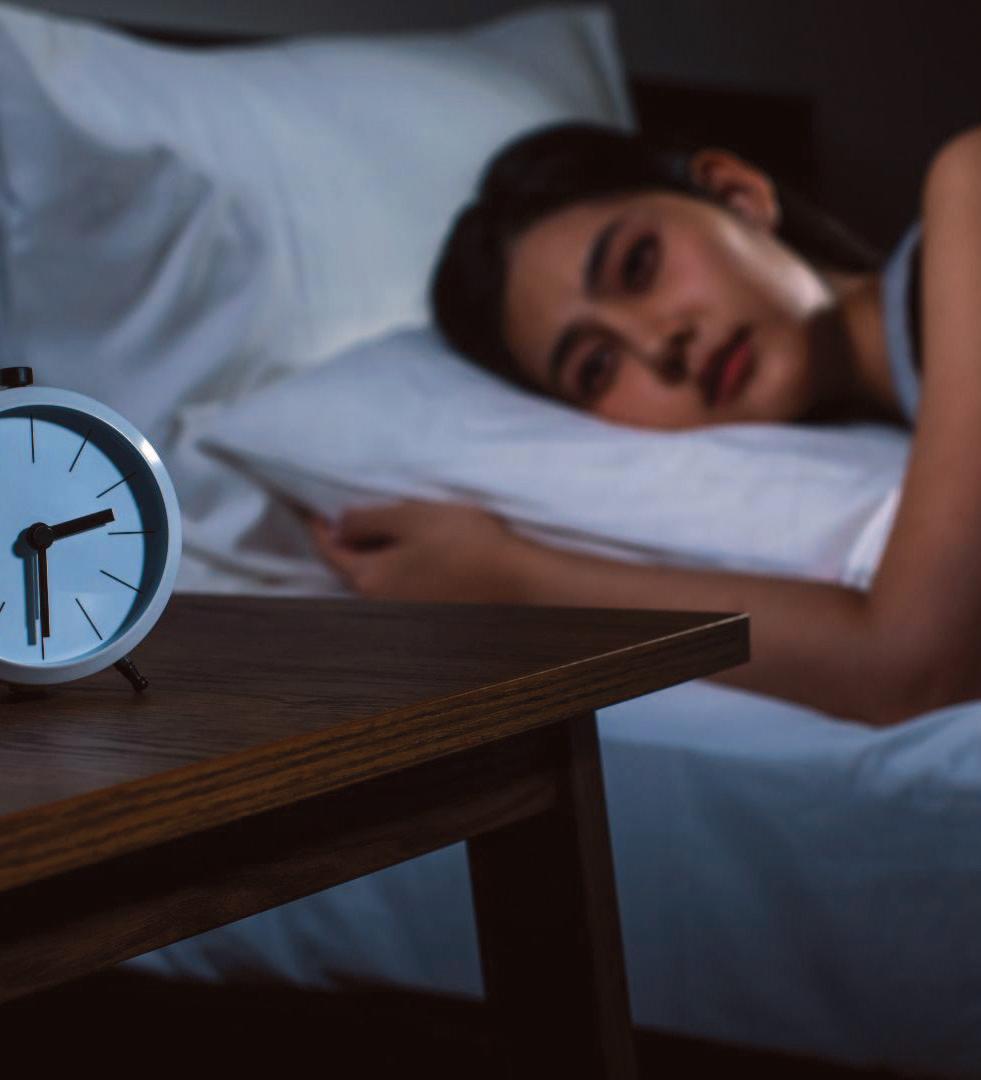
For nearly 200,000 years, humans did not sleep in a sin gle, industrial-grade block. Before the factory whistle dictated our rhythms, we lived by a pattern historians call biphasic sleep.
The sequence was simple. You drifted into your First Sleep shortly after dusk. Sometime around midnight, you woke with a calm, lucid alertness rather than the cortisol spike we now associate with insomnia. This twohour interval was known as The Watch.
It was a quiet pocket of the night reserved for prayer, reading, intimacy, quiet work, or simply tending the fire. Then came Second Sleep, carrying you gently into dawn.
The shift to the eight-hour monolith was not a medical revelation. It was an economic one. You cannot run a synchronized assembly line if your workers are off having midnight epiphanies.
We traded an ancient rhythm for industrial efficiency, and in the process we pathologized one of the most cre ative states the human mind can access. We renamed it “insomnia.” We medicated it. We convinced ourselves that wakefulness at night is a personal failure rather than a cultural artifact.
I am not a practitioner of biphasic sleep. I am simply someone who recognizes it when it happens and refuses to accept the narrative that it means something is wrong.
The 5:00 am Fallacy
What I find ASTOUNDING is the modern obsession with the 5:00 am Club, the hustle-culture gospel insisting the only path to success is to shock your body awake before sunrise. It is marketed as discipline, but it is really productivity culture draped in synthetic athleisure wear.
The 5:00 am Club is still tethered to the reactive world. It is about getting ahead of your inbox. It is about doing.
The Watch is about being. When you wake naturally in the middle of the night, you are not responding to alarms, deadlines, or the noise of the day. The world is profoundly quiet. No emails. No traffic. No performance. The chaos is still asleep.
There is a different quality to the dark at that hour. The air feels cooler. The edges of your thoughts sharpen. It is not the time for cold plunges, protein shakes or kettlebells. It is the hour of the Sacred Edit, the liminal space where the subconscious rises to meet the conscious mind.
A Diagnostic Lens on the Night
In my work as an esthetician, I teach clients to read their skin as a map of their internal environment. A midnight wake-up is a similar diagnostic moment. Instead of se dating it or numbing it with blue-light scrolling, try listening.
When you stop resisting the wakefulness, the anxiety dissolves. Thoughts that surface in this window have a different texture. They are cleaner, quieter, more honest. This is where I find clarity for my formulations, teaching methods and the most unencumbered ideas for my brand architecture. It is not hustle. It is revelation.
June, with its long horizons of light, is the perfect month to reconsider your relationship with the night. The season stretches the day at both ends. Even the evenings feel different, warm and unhurried, carrying that earlysummer hum that makes everything feel slightly more possible. The world is awake for longer, and somehow that makes your own wakefulness feel less like a disruption and more like a doorway.
Reclaiming Your Sovereignty
If you find yourself awake tonight, try treating it as a ritual rather than a malfunction. Keep the lights low and amber. Leave your phone untouched, as it is a portal back to the noise you are trying to escape. Let the moment feel like what it truly is, a two-hour inheritance from your ancestors.
There is something grounding about being awake when the world is not. The house is still. The air is cool. Even the shadows feel softer. You can hear your own thoughts without interference.
~ The moment you wake, remind yourself: I am not broken. This is The Watch.
~ Keep a notebook and pen nearby. Use only soft, lowwattage light.
~ Your “midnight mind” is too refined for social media. Pro tect the clarity.
~ Let the silence unfold. Meditate, write, or simply think without interference.
You are not failing at sleep. You are not broken. You are simply slipping into a form of consciousness that shaped art, philosophy, and human imagination for millennia.
This column was drafted at 1:45 am in the quiet before the world woke. Crystal Cobert-Giddens is an es theti cian and brand founder who long ago traded the 5:00 am hustle for the clarity of the midnight sov ereign. An acceptor, not a practitioner, of biphasic wakefulness, she believes the best ideas do not arrive on a factory schedule. She is the founder of FACES NEW YORK and a firm believer that you are not bro ken…you are simply awake.
518 CULINARY DESTINATIONS: Return to Miami
By Chef Armand Vanderstigchel
The endless snow this past winter was a strong motivator to point the compass south and board a convenient early morning Jet Blue flight from Albany Airport with convenient parking and many destination options greatly priced. We decided to return to the beautiful MB Hotel, a trademark collection by Wyndham directly located on the beach in Northern Miami, on Collins Avenue. In a previous issue we highlighted this hotel which I consider the best kept secret in Miami. Upon arrival we ironically ran into a couple from Saratoga that followed our editorial advice to lodge here.
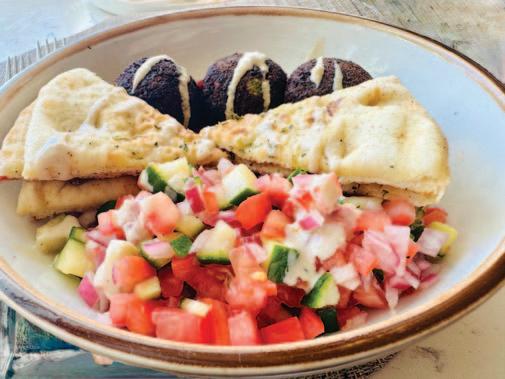
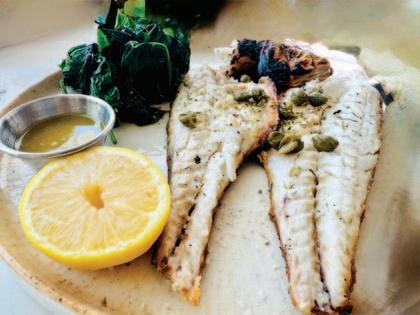
Reservations manager Angelo who was thrilled upon our return, rec ommended us to have lunch at the restaurant onsite-Kalypso Beach featuring Mediterranean cuisine poolside. A rapacious appetite from traveling persuaded us to order many offerings from the menu. Zucchini Croquettes were scrumptious Meatballs cleverly concocted from shred ded Zucchini & Feta Cheese on a spoonful of Tzatziki Yogurt sauce. Fried Calamari here is lightly battered and served with an ingenious Avocado Aioli-more please! A-must is the Greek salad, beautifully arranged Vegetables with Olives and Feta. The Falafel Salad also deserves recognition with its Chickpeas Falafel, Beet Hummus and Tahini Sauce-delicious. In addition, a Mushroom Pizza arrived at the table layered with Caramelized Onions, Wild Mushrooms and fragrant Goat Cheese-great crust and executed
per fectly. Finally, a whole grilled Branzino graced the table, served with sautéed Spinach & Capers.
The following day we explored downtown Miami for dinner options. The city of Miami extends great public transportation options traveling from north to south. There is the “city trolley," which is complementary making stops all along Collins Avenue hotels. An ingenious move by the city since parking is problematic and even sprouted a popular Tv show called “Miami Tow"-be forewarned!
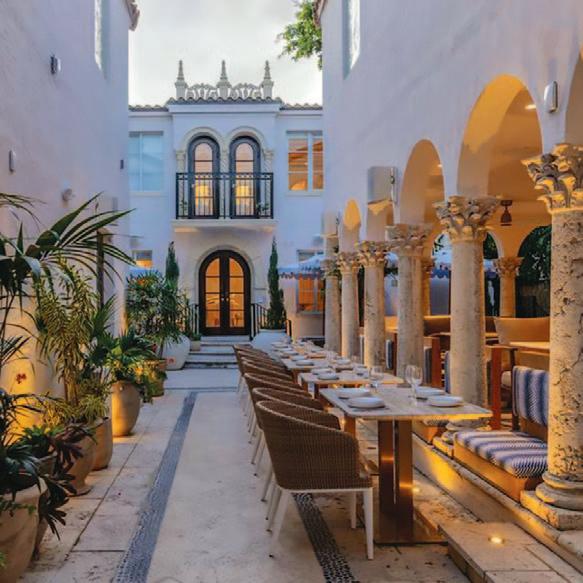
Our dining destination was Donatella Restaurant, a unique Italian restaurant and culinary gem that brings timeless Eu ropean charm to Miami Beach. Located inside the ele gant Donatella Boutique Hotel, the restaurant blends old-world Italian glamour in a semi-outside Tuscan style dining environment. Known for traditional dishes and handmade pastas, it brings
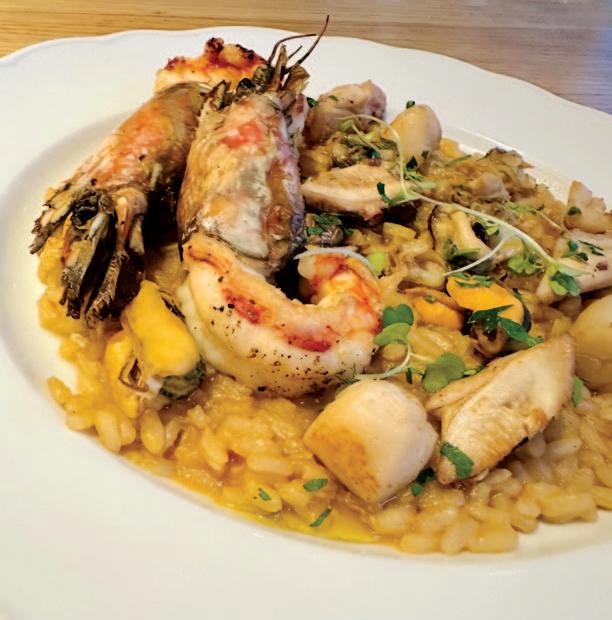
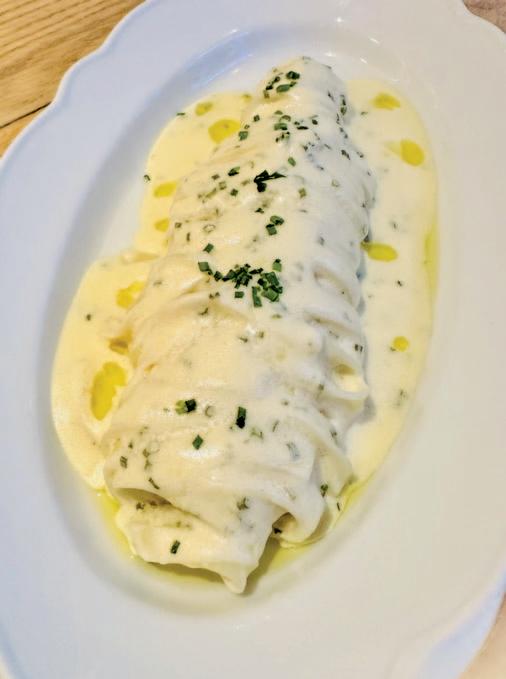
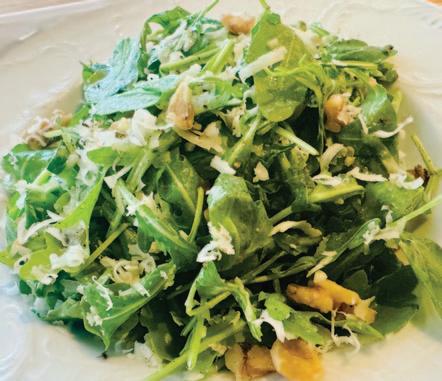
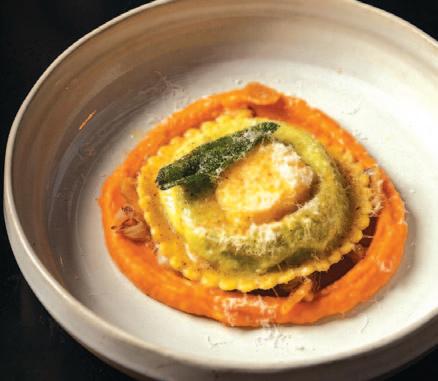
authentic ingredients departing from the typical ItalianAmerican cuisine offered n ationally. It starts with purchased water we ordered from Lake Cuomo in Italy-Chiarella, drawn from a pro tected mountain spring enriched with mag nesiumsimply delicious. By recommendation of Italian -born Dining-room manager Alfonso, we dered the warm freshly baked Rosemary bread flecked w roasted Tomatoes-perfection. A perfect Salad to share was the Grilled Pears and Goat Cheese Salad w roasted Walnuts, on Vinaigrette and Truffle Honey drizzle. The Prosciuttos Mozzarella is simply phenomenal comprising of Buffalo Mozzarella and silky melt-in-your-mouth 20-month aged San Danielle Prosciutto, thinly sliced on a special imported slicer from Italy best ever! Entrees of deliciousness followed such as the Amalfi Limone Fettuccini Pasta dressed in Meyer lemon Crème Fraiche and the Seafood Risotto laced with Jumbo Prawns, Scallops, Mussels and Clams-excellent preparation. Fior Latte Gelato was the chosen shared dessert comprising of freshly spun Gelato, candied Sicilian Pis tachios and Bronte sauce.
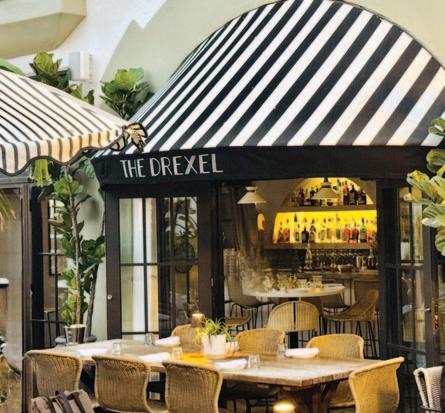
An after-dinner stroll throughout the area was a pre-cursor to pick the next-day dining destination. We came upon the beautiful Al Fresco dining area of the Drexel Hotel, a sophisticated Coastal Italian restaurant named after the iconic street and built on the corner of a historic 1920s village.
Offering Pizza from the charcoal grill and wood oven, the menu features housemade Pastas and Pizzas with a strong prominence on locally sourced Seafood and Vegetables inspired by the coastal re gions of Italy. A thoughtfully curated Wine list and a Cocktail program including “The Drexel Margarita," made with Mezcal, in-house organic infused Agave, Citrus, and a toasted Coconut Salt rim is enjoyable. We also relished a unique artisanal Beer from Italy-Mastri Birrai Golden Ale, a truly high-
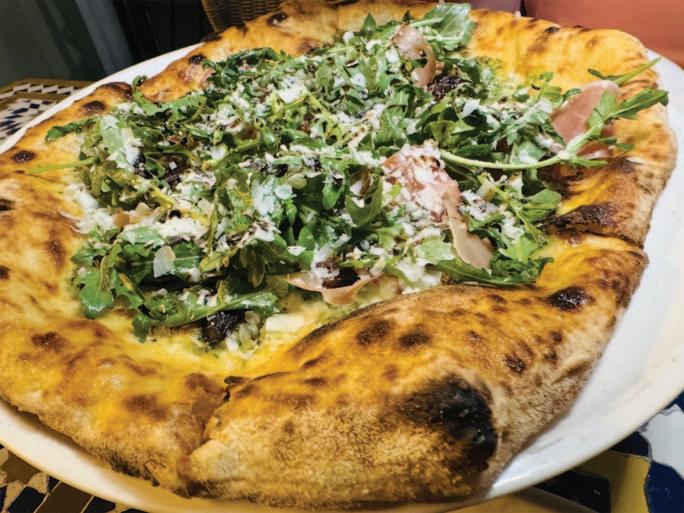
level beer with a great aroma and flavor patterns. We ordered a Woodfired Pizza with Prosciutto, Arugula, Taleggio Cheese, Figs and Balsamic glaze. The flat-iron Organic Chicken ordered, is a crispy delicacy with a savory pan-jus.
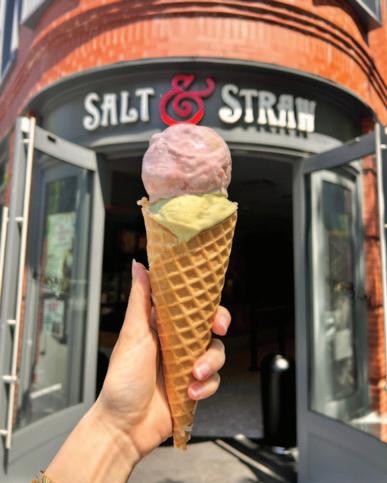
For dessert we visited the Lincoln Avenue restaurant mecca to indulge in Ice-Cream from Salt & Straw. They are known for high-level Ice-cream with unique flavors such as Strawberry Honey Balsamic with Black Pepper and Honey Lavender which we tried-fantastic!
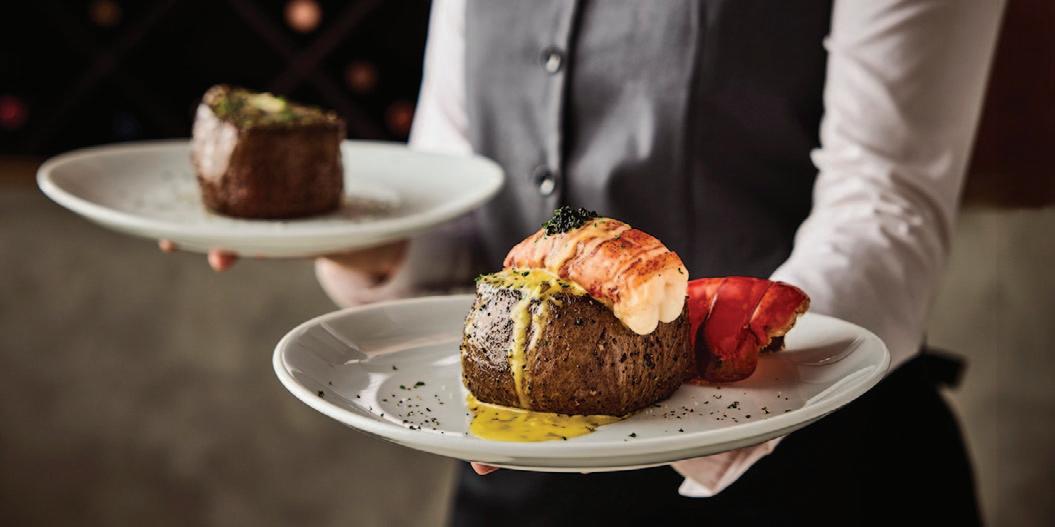
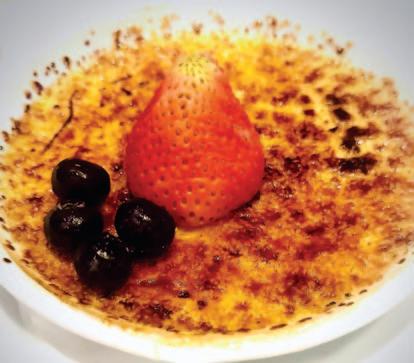
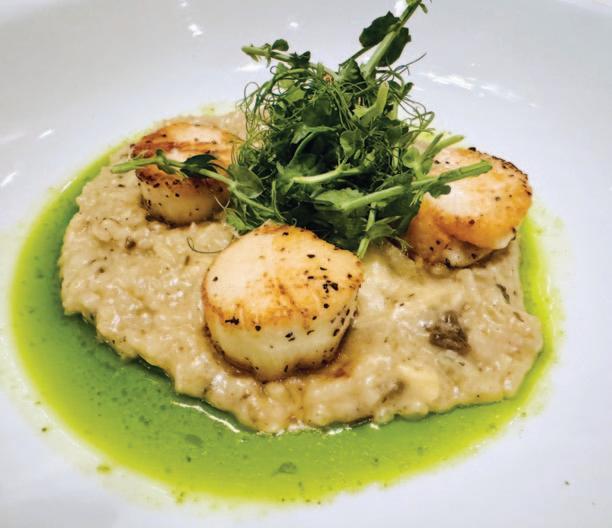
The final evening in Florida was spent in Fort Lauderdale at the airport Wyndham hotel adjacent to the airport. Las Olas Blvd in downtown Fort Lauderdale is an exciting restaurant hub, featuring many dining concepts such as Fleming’s Prime Steakhouse. We decided to indulge in a good Steak and Seafood and Fleming’s did not disappoint. After hot bread arrived to the table with a Cabernet Butter, we enjoyed Jumbo Scallops with Wild Mushroom Risotto, Truffle and Scallion oil. This was hands-down the best Scallop dish in my experience encompassing freshness and execution. The Petite Filet Mignon came accompanied with various sauces and no-knife-needed tender. Dessert was an easy choice, sharing a well-prepared Crème Brulee with a glass-like caramelized Sugar exterior.
Allegiant Air was our flight back, a great new economic airline which is now price-wise more a reason to enjoy sunny Florida during a snowy winter.
JUNE EVENTS
Month of June Glens Falls
• North Country Arts Gallery: “Expressions”
Annual Juried Art Show continues through June 20th. #120, The Shirt Factory, 71 Lawrence St., Glens Falls (Gallery open Thurs.-Sat. 12-5)
• NCA's 2nd Fl. Gallery: “Portals” mixed media paintings by Heather VanDyke continues through June 26 at City Hall, 42 Ridge St, Glens Falls (Gallery Hours Mon.-Fri. 8:30-4:30) 2nd Fl. Gallery:
• NCA Mezzanine Gallery: “Spring Show” Members art exhibition continues to June 26th at THE QUEENSBURY HOTEL, 88 Ridge St. Glens Falls (Open Daily)
Call for Art: “Stars Colliding” Drop off artwork Saturday June 20th, 12-3pm at NCA Gallery in the Shirt Factory
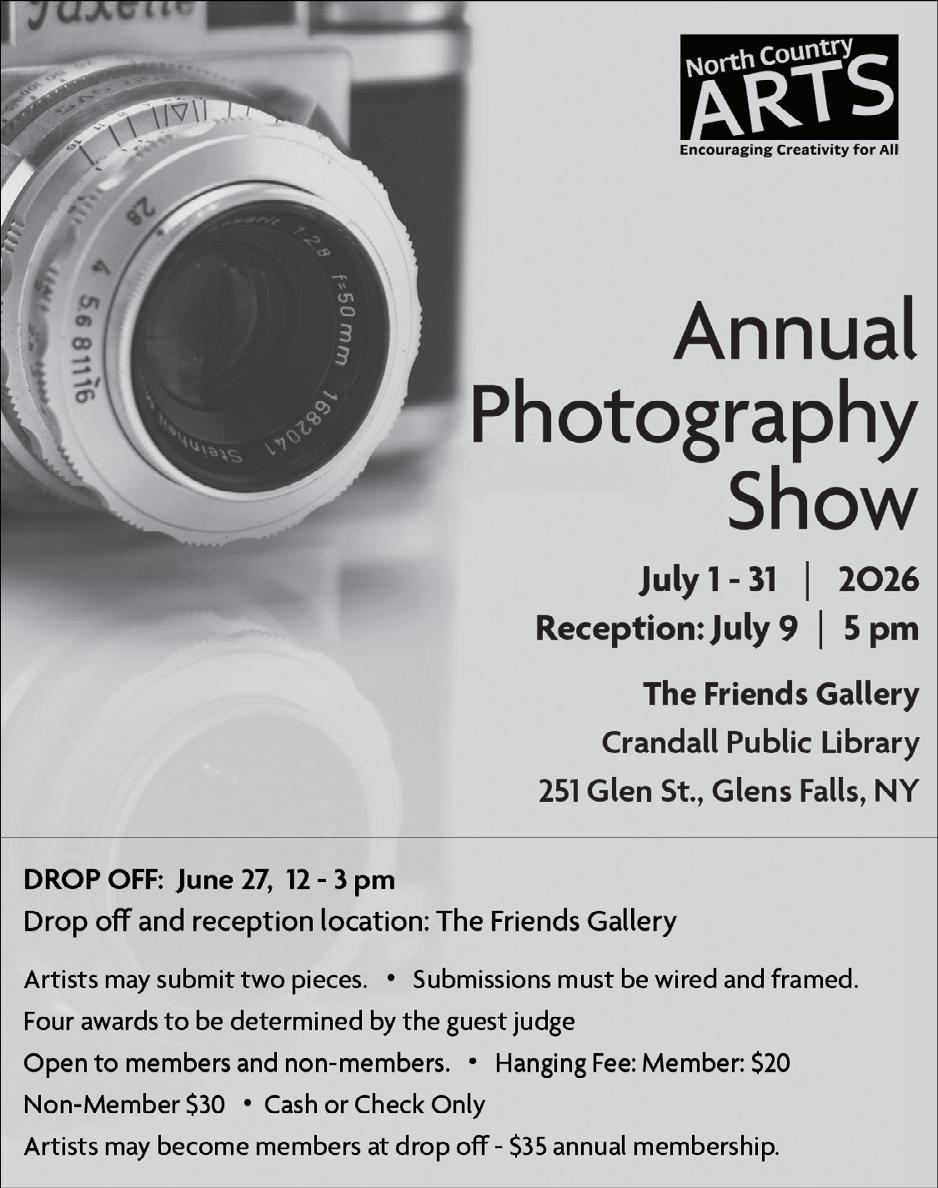
Annual Photography Exhibit - Drop off June 27th, 12-3pm at the Friend’s Gallery, 2nd fl. in Crandall Public Library
For more Info about events visit: northcountryarts.org
Month of June Hudson Falls
6/6 - Stones Alive/Rolling Stones. Tribute Featuring Tommy Love, 8pm
6/12-Creedence Clearwater Revival. Tribute with Fortunate Sons, 8pm
6/13 Aquanett/80'3 Rock Show, 8pm
6/19 - All Those Years Ago: The Songs of Lennon & Harrison 7:30pm
6/20 - The Richie Scarlett Band presents a Celebration of Ace Frehley. Featuring original members of "Frehley'3 Comet. Richie Scarlet & Tod Howarth, 8pm
Please visit www.mystrandtheater.org for the full list of events. Strand Theatre, 210 Main Street, Hudson Falls, NY, 12839. 518-832-3484
June 1 - 13 Clifton Park
Natural Order. The Blooming Artist Gallery & Instruction invites you to experience Nat ural Order. This exhibit fea tures works that lean into the invisible architecture that governs the natural order of our world. Ex pect a variety of subjects, mediums, and styles by various local artists. The Blooming Artist Gallery | Studio | Gathering Space, 675 Grooms Rd, Clifton Park, NY 12065. (518) 280-4928 www.thebloomingartist.gallery
June 5 Glens Falls
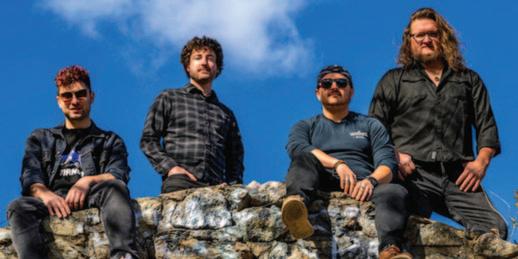
Leon Trout. Leon Trout is a four-piece jam influenced rock band based out of Boston that will shatter all of your expectations. With songs mixing hard rock, funk, psychedelic rock and a drop of reggae tossed in there, you get the perfect mix of foot stompers and head bangers. Doors: 7:00 PMShow: 8:00 PM. Under 18 must be accompanied by parent or guardian. The Park Theater, 14 Park Street, Glens Falls, NY
June 5 - 7 & 26 - 28 Greenwich
"Recent Works" curated by Dan Cameron held at Varosey Studio Greenwich NY with focus on An ongoing selection of sculptures, paintings, design objects and drawings by Gyula Varosy and Hannie Eisma will be on view throughout the summer.
June 5-7 ZACK LOBDELL reception June 5,5 to 7pm June 26-28 STEPHEN LACK reception June 26, 5 to 7 pm. Varosey Studio, 1522 N Rd, Greenwich, NY 12834
June 6 - October 11 Glens Falls
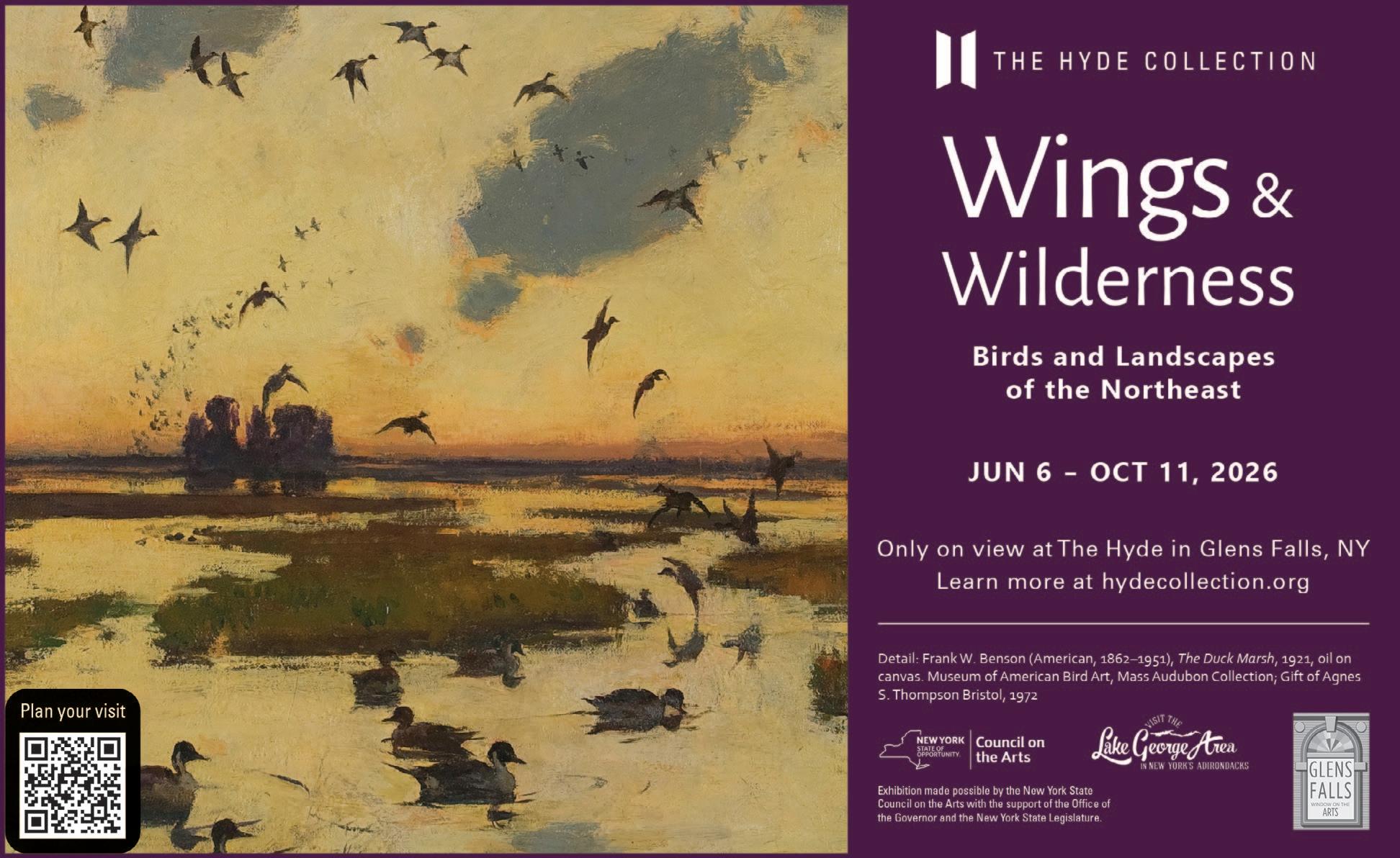
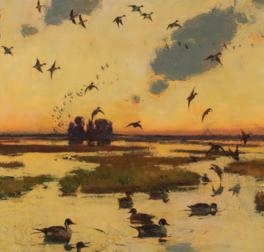
Wings and Wilderness: Birds and Landscapes of the Northeast. The Hyde Collection is partnering with the Museum of American Bird Art at Mass Audubon (MABA) on an exhibition that explores the birds and natural landscapes of Upstate New York. The exhibition will feature approximately twenty works from The Hyde’s permanent collection and a similar number of works from MABA’s collection. Key works from The Hyde’s collection include depictions of the Adirondacks by Winslow Homer and Mary Walters, paintings of Lake George by William Hart and John Marin, and a series of three works by Willard Metcalf, showing a landscape in Connecticut at different times of year. The exhibition will also explore why so many artists over the centuries have been drawn to the landscapes of the Northeast, including the painters of the Hudson River School, arguably the first purely American art movement. The Albany Institute of History and Art is lending a work by Hudson River School painter Thomas Cole to the exhibition. The Hyde Collection, 161 Warren Street, Glens Falls, NY
June 7 Saratoga Springs
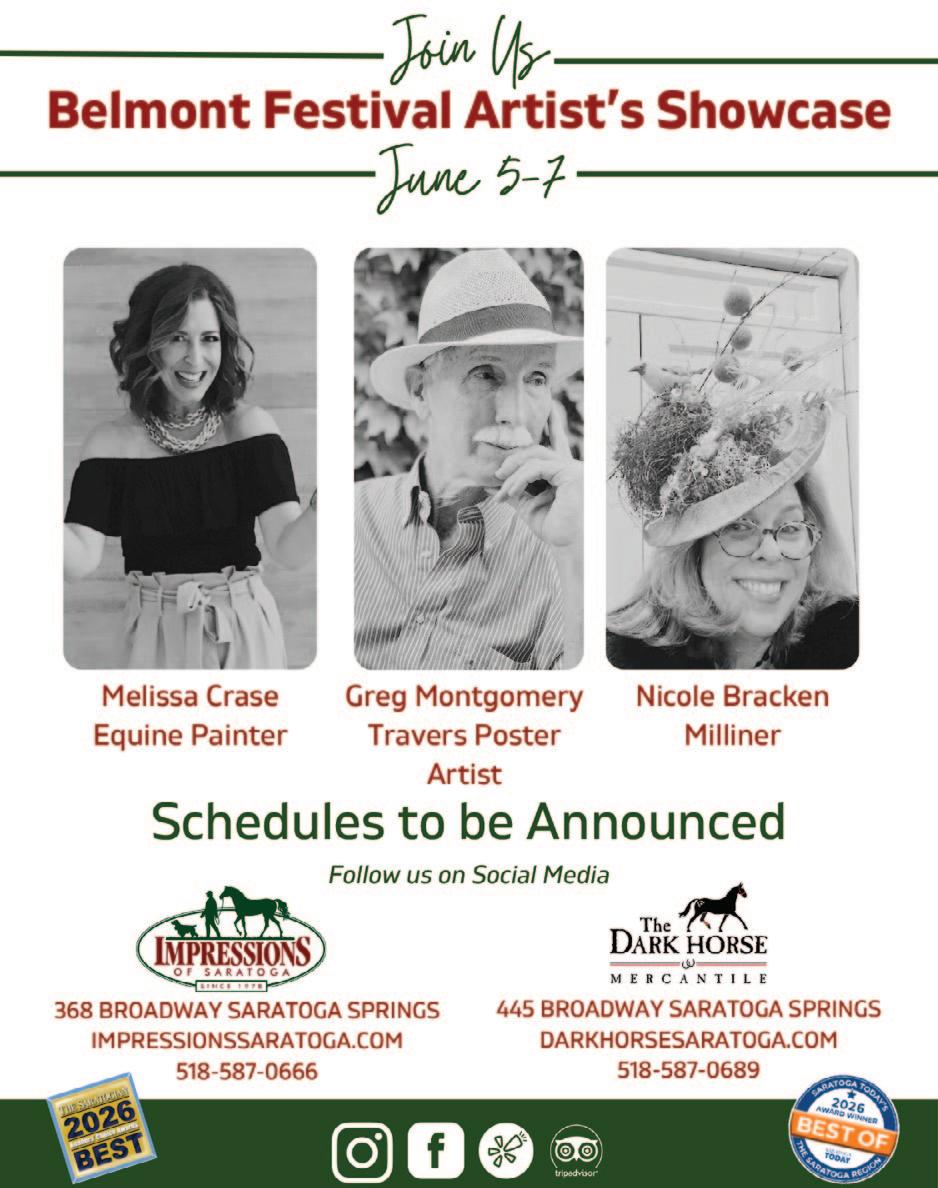
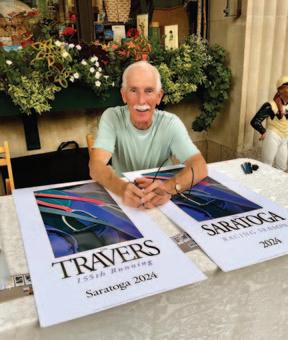
2026 and Final Belmont Poster Signing with Local Artist Greg Montgomery. Please join us in welcoming Greg Montgomery to Impressions of Saratoga for the annual signing of his 2026 final Belmont in Saratoga Poster on Sunday morning, June 7th, 2026. Greg will be available to autograph his stunning collection of Racing posters and sharing the stories of each design. Sunday June 7, 2026 - 11am – 1pm. Impressions of Saratoga, 368 Broadway, Saratoga Springs, NY 12866
June 12 -13 Saratoga Springs
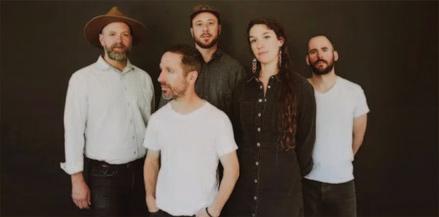
Hailing from Upstate New York, Driftwood brings their genre-blending sound to Caffè Lena for an unforgettable evening of music that’s equal parts heartfelt and high-energy. Known for their roots in folk, bluegrass, and rock, the band’s live shows are a celebration. They are dynamic, intimate, and brimming with joy. Friday, June 12, 8:00 pm – 10:00 pm, Doors Open: 7:30 pm and Saturday, June 13, 8:00 pm – 10:00 pm. Doors Open: 7:30 pm. Caffè Lena, 47 Phila Street, Saratoga Springs, NY 12866
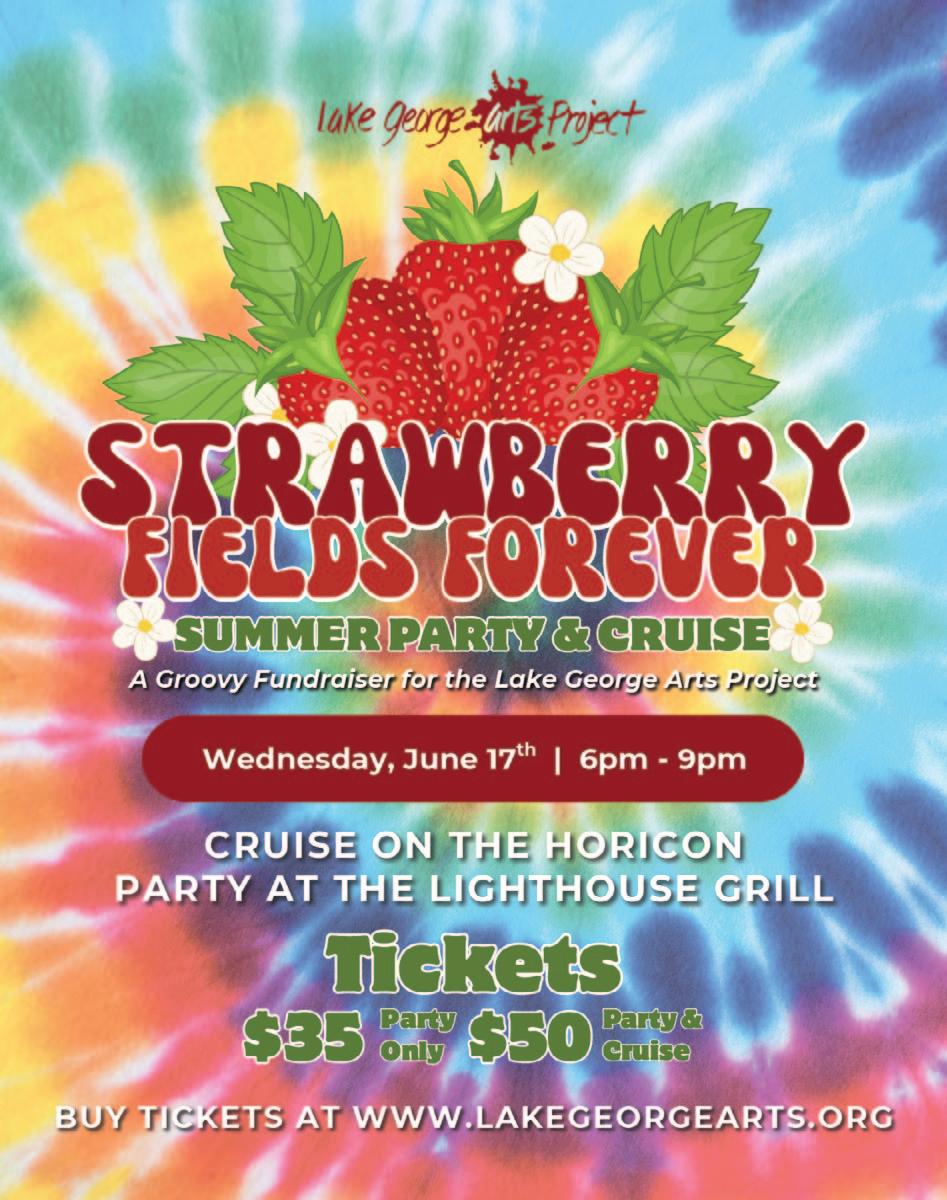
June 17 Lake George Strawberry Fields Forever Summer Party & Cruise. A groovy fundraiser for the Lake George Arts Project. Wednesday, June 17, 2026. Cruise on the Horicon (6pm – 7pm) Party at the Lighthouse Grill (7pm – 9pm) Last year, you found your way to our speakeasy…This summer, we’re heading somewhere a little more dreamy…and it’s a blast from the past! We’re bringing back strawberries (the theme that started it all) but we’re bringing them back with a Summer of Love twist. It’s going to be a whole lot of fun. PLUS it supports the Arts Project! Join us for the CRUISE. Join us for the PARTY… or better… JOIN US FOR BOTH!
June 20 Saratoga Springs
Amanda Pascali. Pascali loves the sounds of the early '60s. Not just the folk music you would have heard at Lena's, but pop artists like Roy Orbison, Sam Cooke and the Ronettes. “Pascali is not only a powerful poet with an angelic voice but an unstoppable force.” - GUITAR THRILLS. Saturday, June 20, 8:00 pm – 10:00 pm. Doors Open: 7:30 pm Caffè Lena, 47 Phila Street, Saratoga Springs, NY 12866
June 20 - July 18 Saratoga Springs
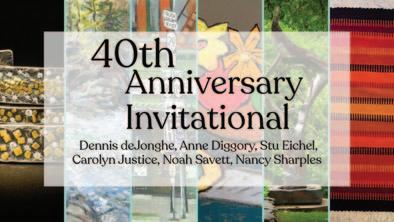
Opening Reception for our 40th Anniversary Invitational exhibition on Saturday, June 20th
6:00-8:00 pm. This show features artists Anne Diggory, Stu Eichel, Carolyn Justice, Noah Savett, Nancy Sharples, and Dennis deJonghe. Exhibit runs June 20th-July 18th, 2026. The re ception is free and open to the public.
Saratoga Arts, 320 Broadway, Saratoga Springs, NY 12866