Stephanie Sittnick - Director of Sales ( 860) 227-8199 advertising@518mag.com
CONTRIBUTORS
Carol St.Sauveur Ferris, Karen Richman, Rona Mann
Chandler Stevens, Lawrence White, Kirsten Ferguson, Susan Brink, Vanessa G. Ahern, Joseph Raucci, Crystal Cobert Giddens, Nellie Ackerman-Vellano, Kristina Watrobski
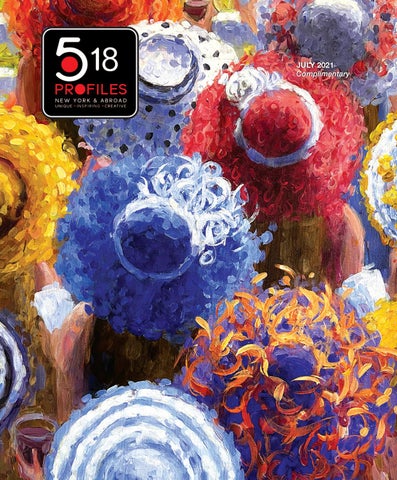
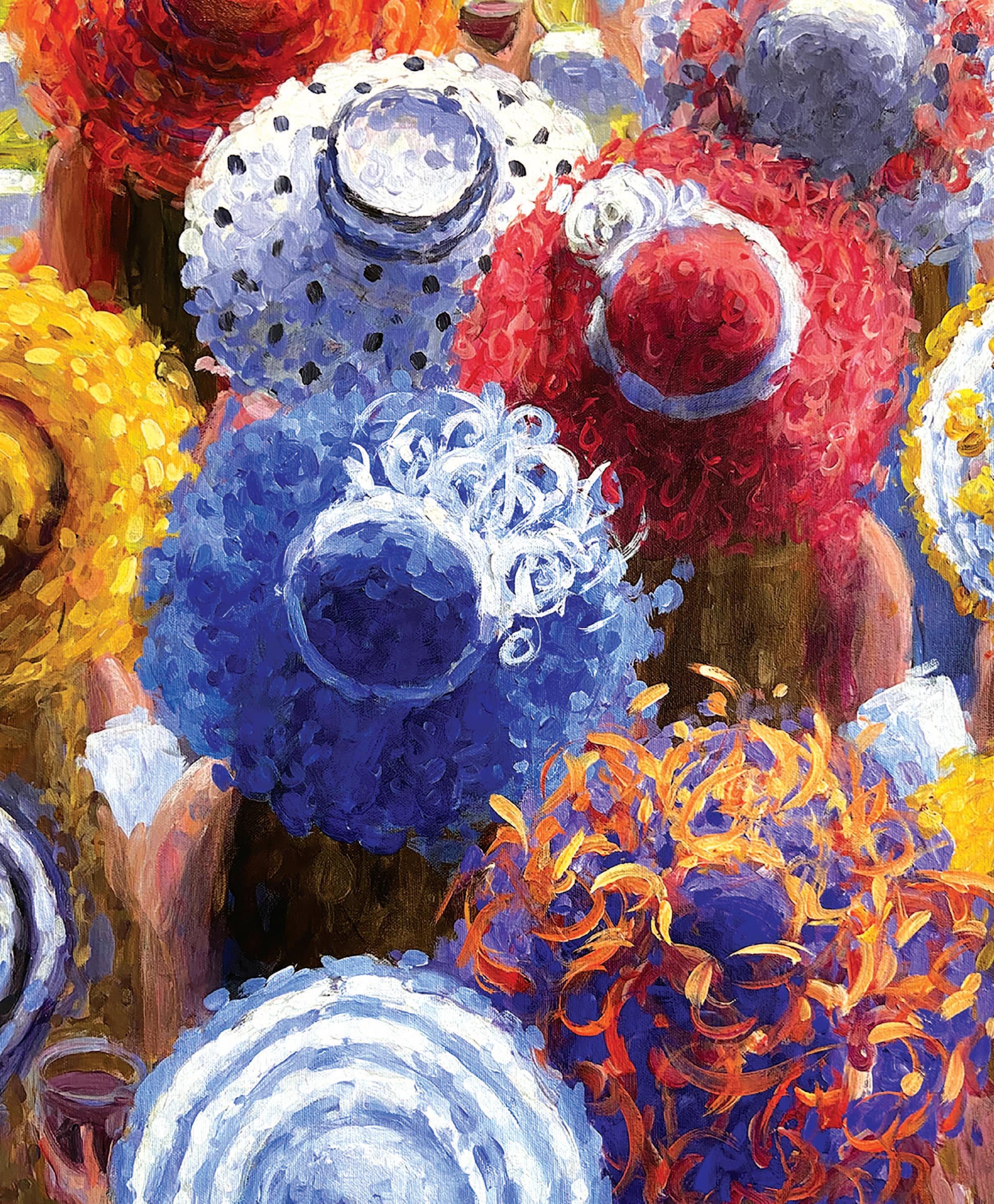
COVER
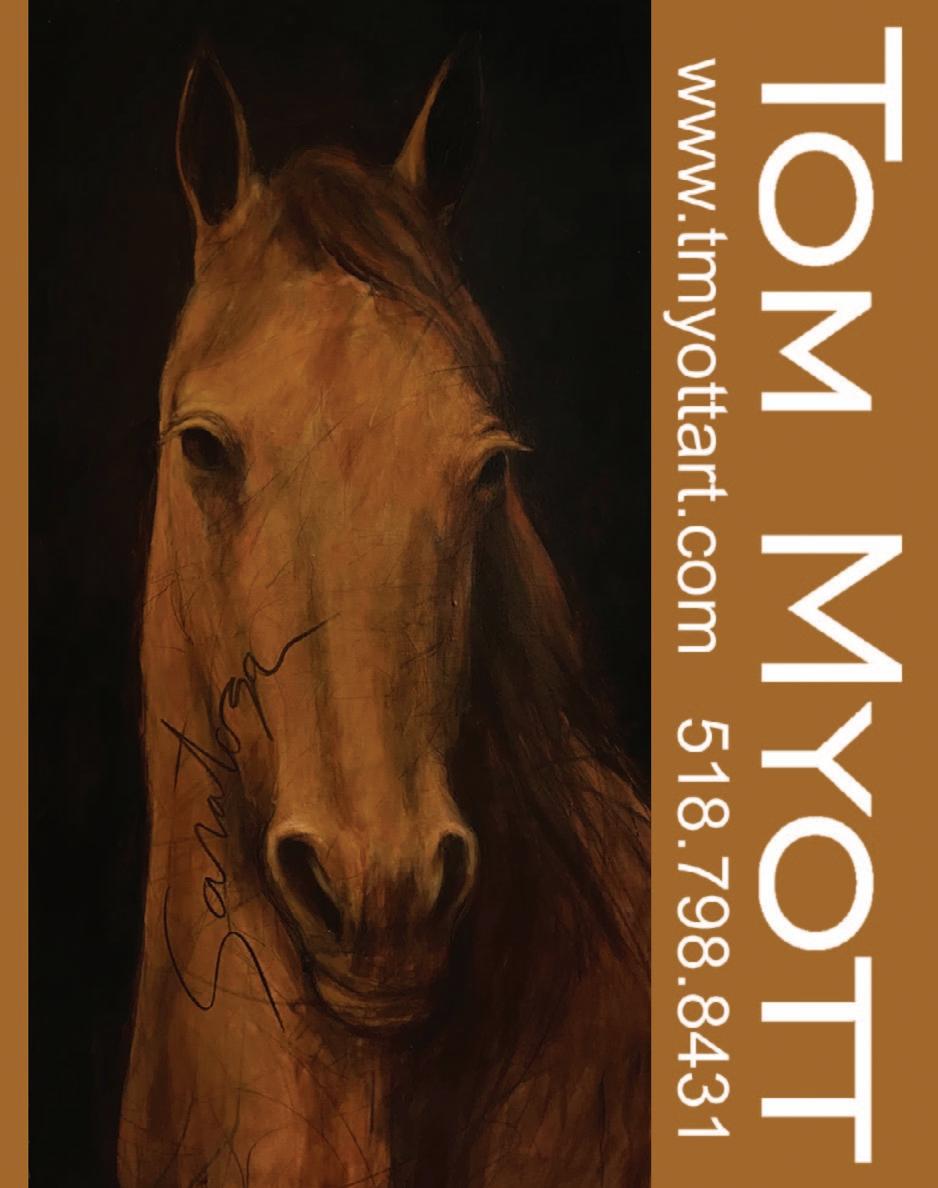
“Hat Day at Saratoga Race Course ” 30”x20” Acrylic on canvas Tom Myott - www.tmyottart.com
What a difference a year makes! After a year of uncertainty and fear for many, it appears we are gaining ground on a return to some sense of “normal.” Summer is here, it always brings out the joy in all of us. More outside, more barbecues, more beach days, more friends, more family, and more genuine celebration. It’s a time of renewal. Let the sun shine on your face and your smile be the warmth for those around you.
Welcome to the July issue! The best part of this job, by far, is meeting new people and discovering new things about the place we call home. Enjoy and celebrate with us the wonderful stories within these pages. We just love the energy of this group of individuals, they inspire us with their passion!
As always, our goal is to deliver authentic, and unique content about creative people and interesting places. We hope you love this issue as much as we do.
Stephanie Sittnick Founder / Publisher
518 PROFILES 587 Grand Ave, Saratoga Springs, NY 12866
CENTER STAGE
Mary Ellen Riell, Artist “A Beautiful Point of View” pg. 4
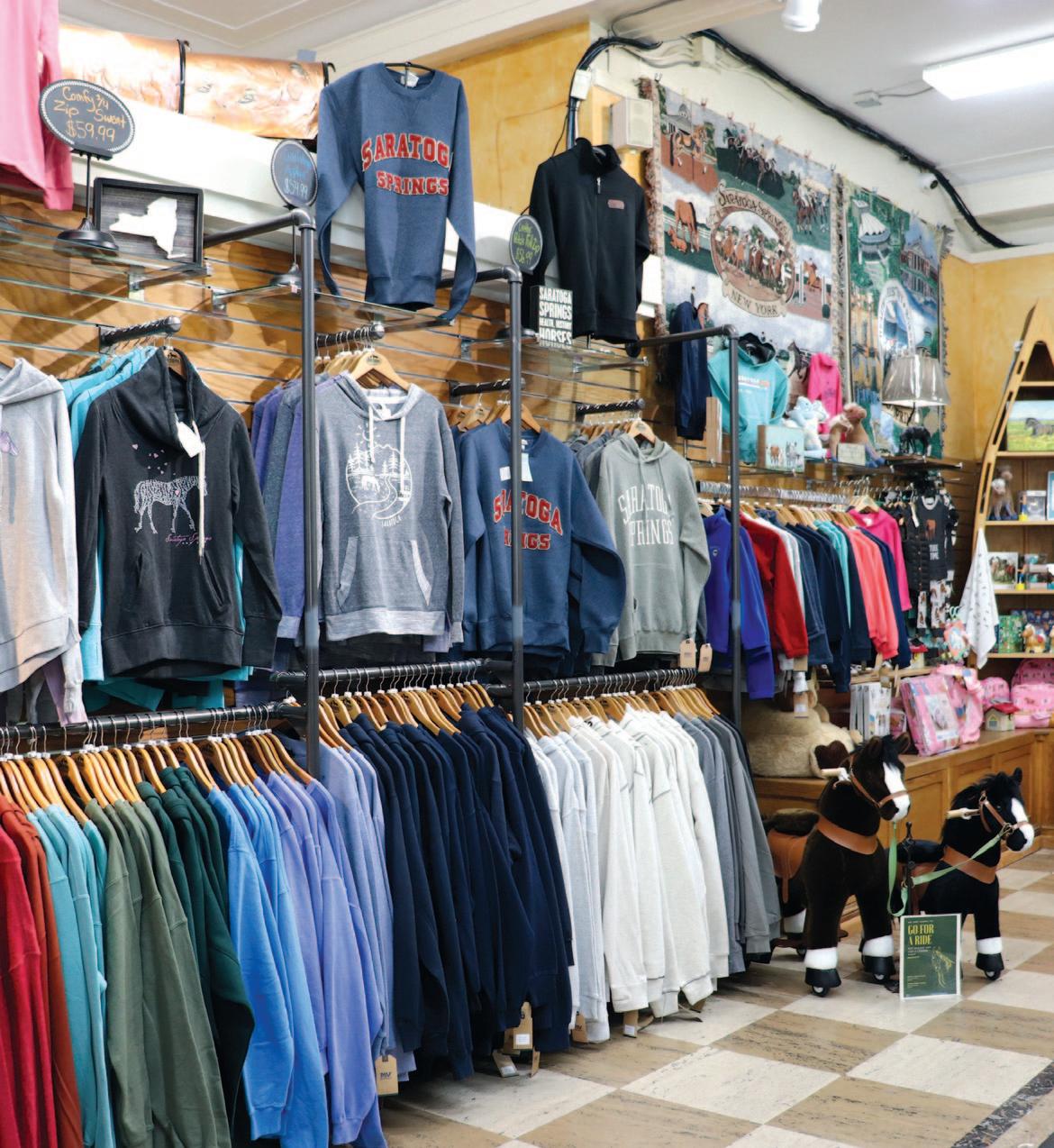
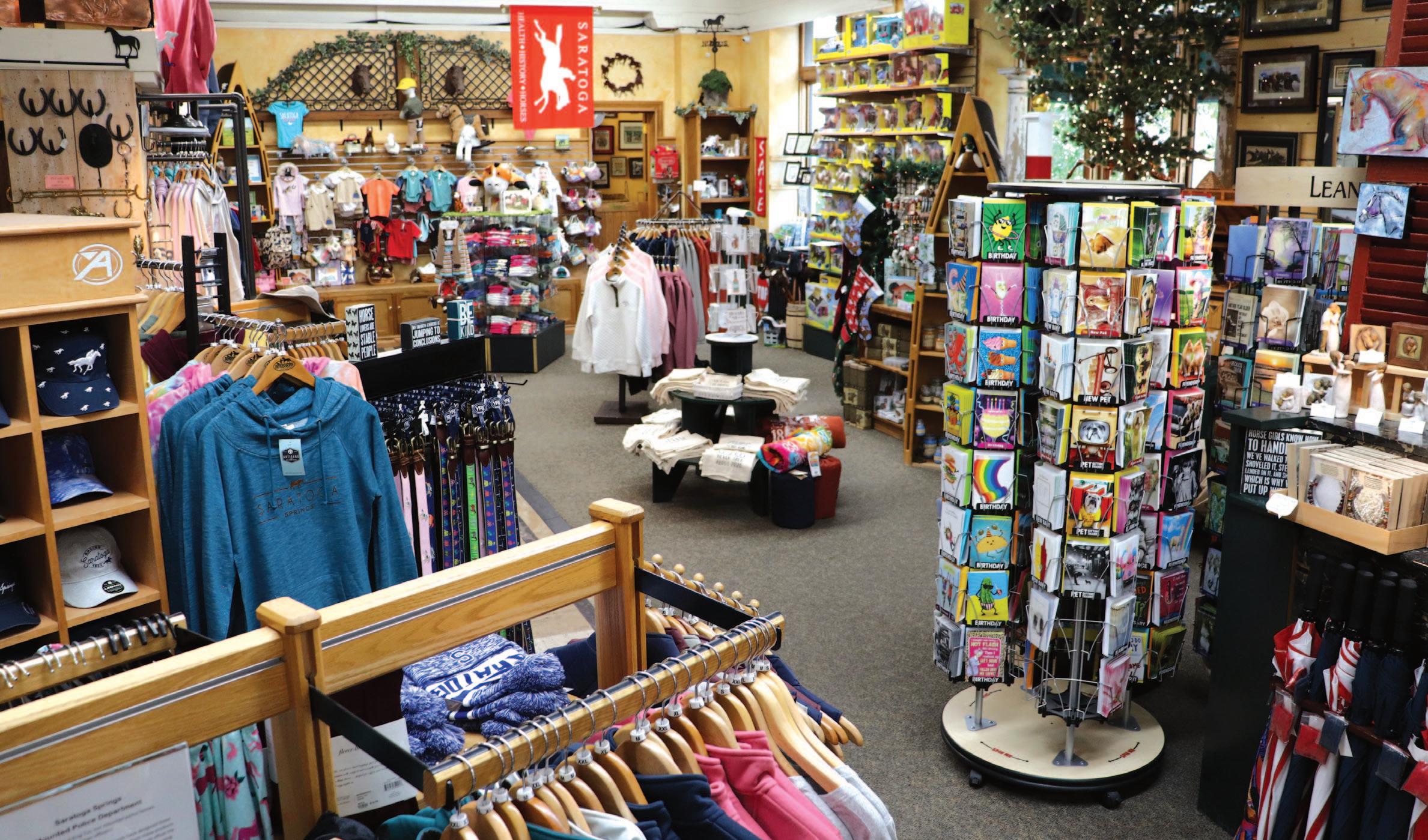
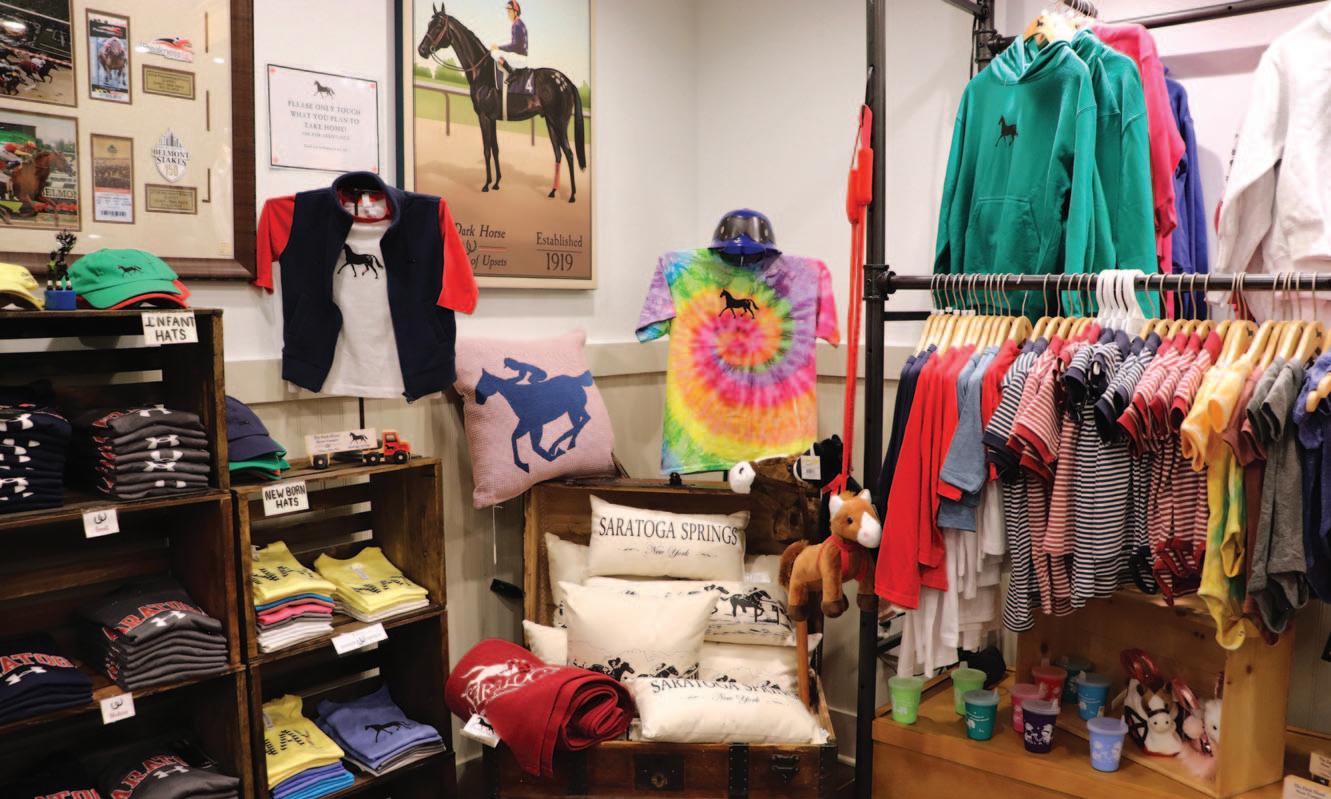
They Don't Sell Souvenirs, They Sell Memories Impressions of Saratoga & The Dark Horse Mercantile pg. 12
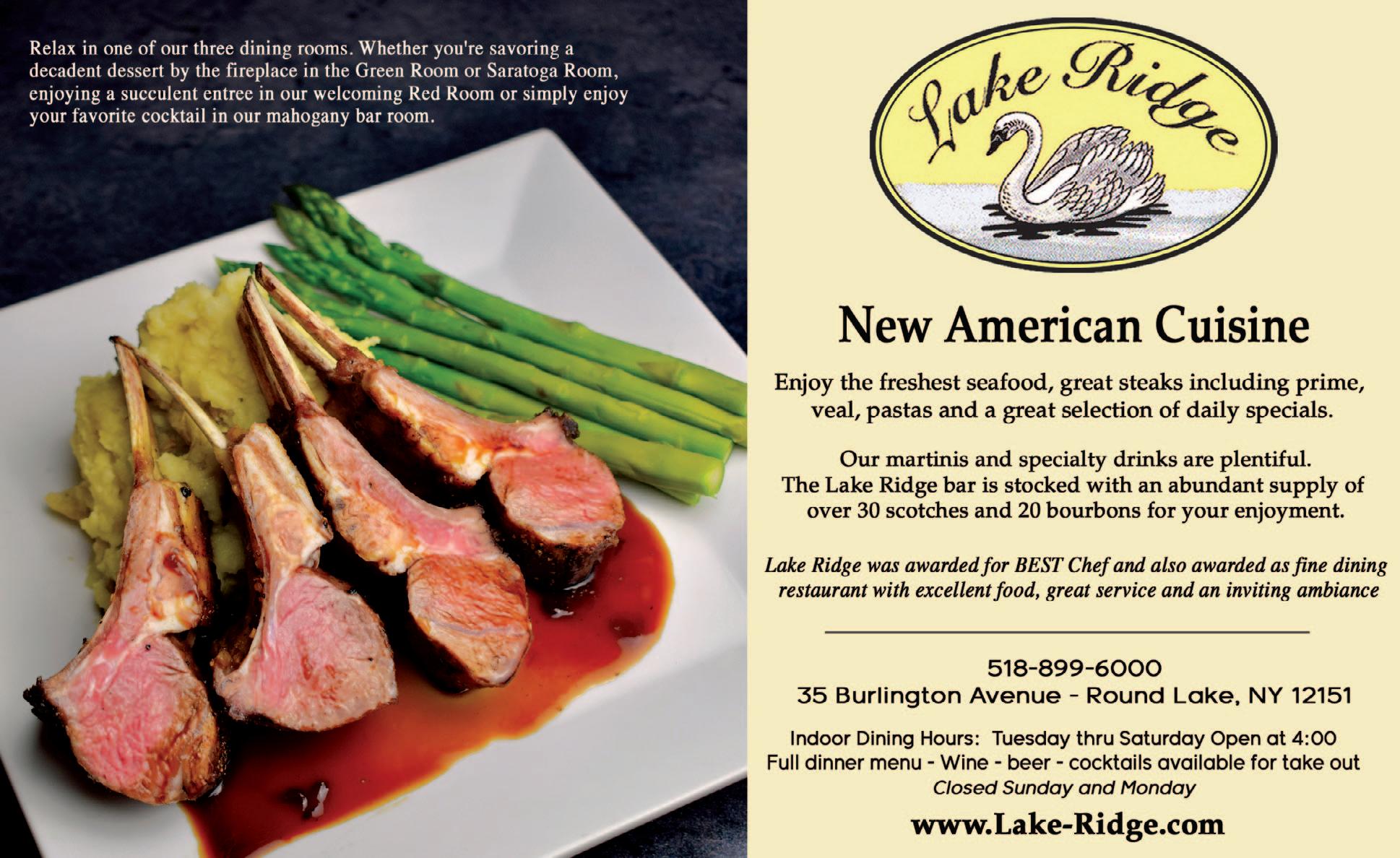
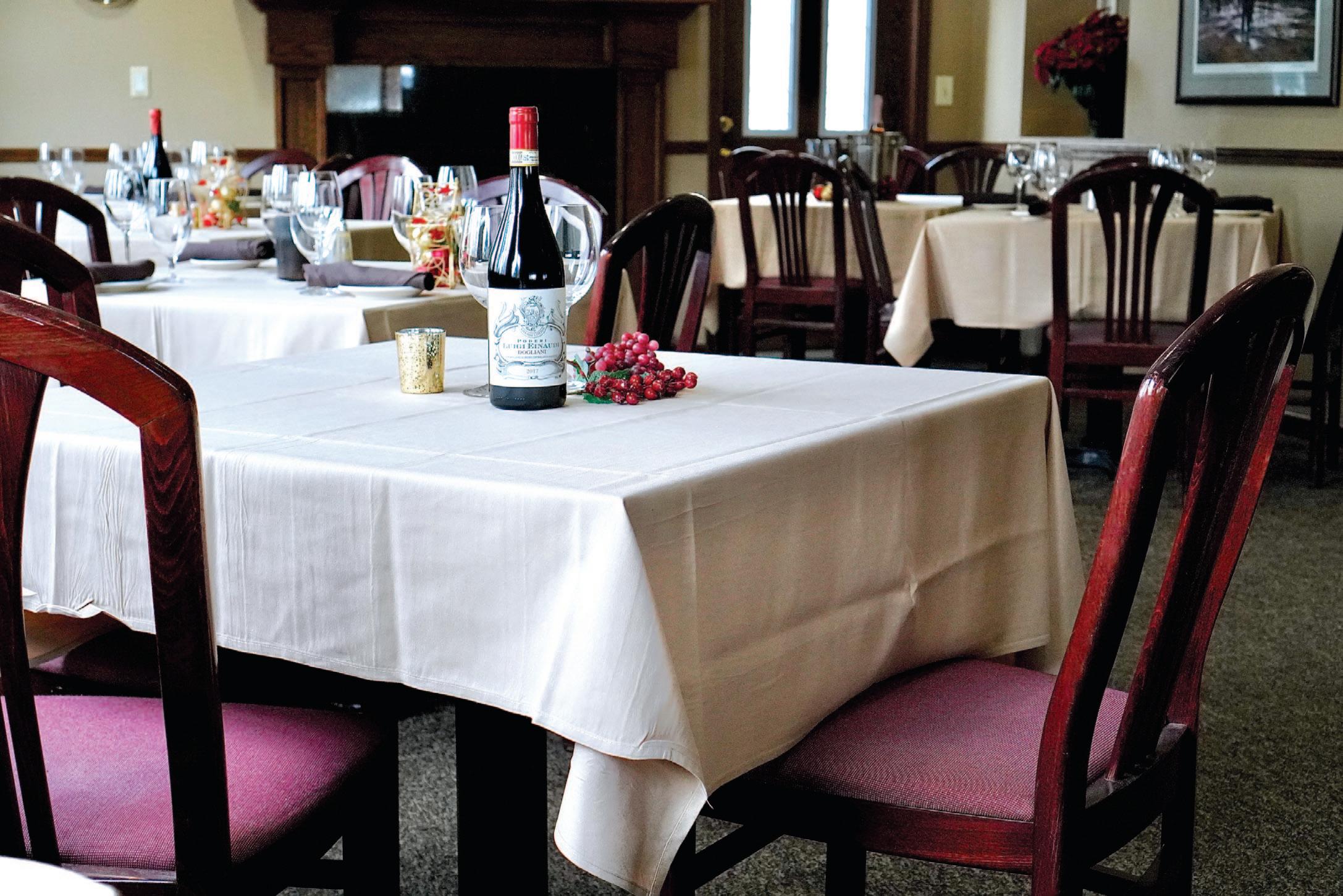
Your Every Day "Destination" Restaurant Because Every Day's a Celebration At Lake Ridge Restaurant pg. 22
"Imitated, But Not Equaled!" Alan Richer - A Chip Off the Old Block pg. 34
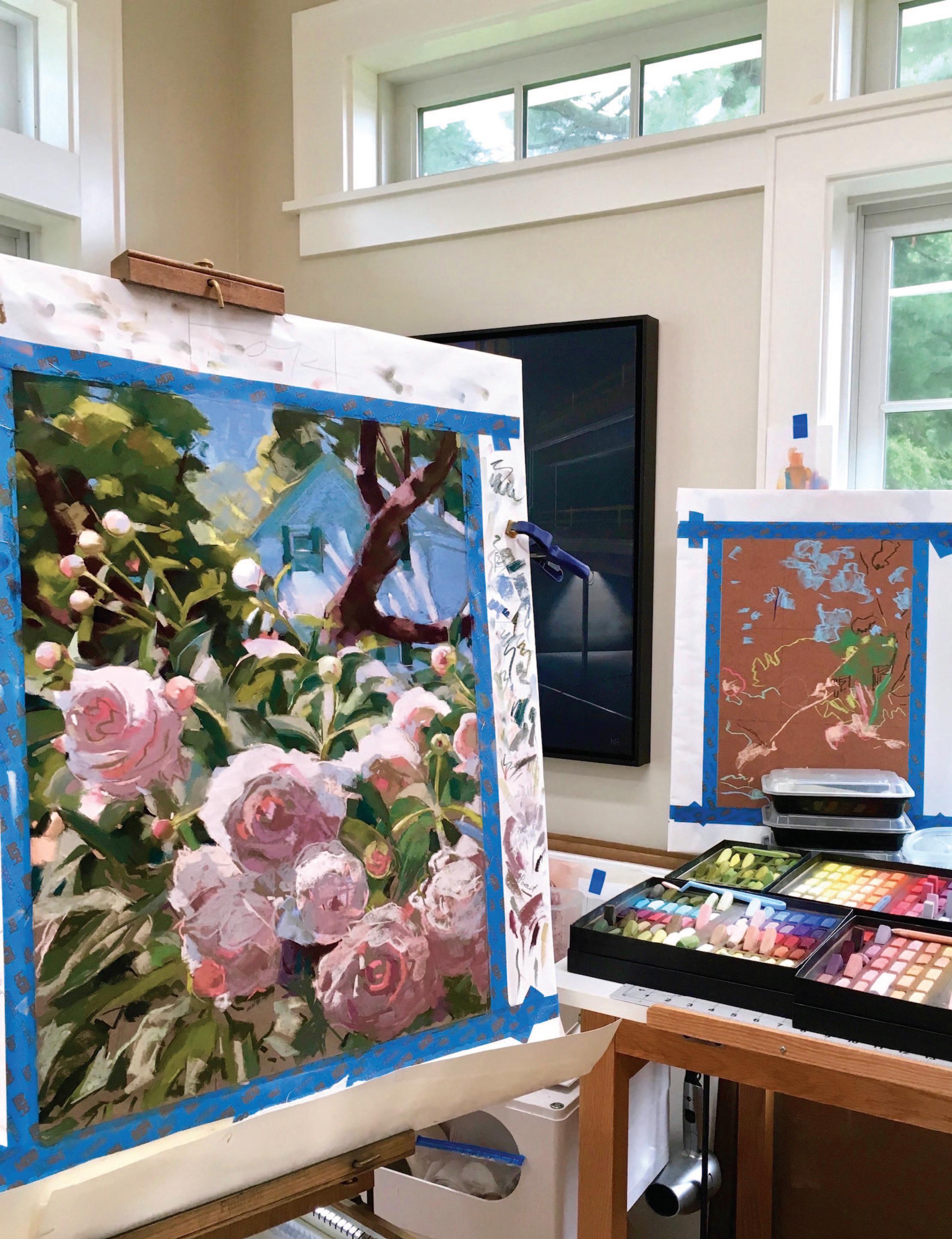
Studio completion of Peonies, Landis
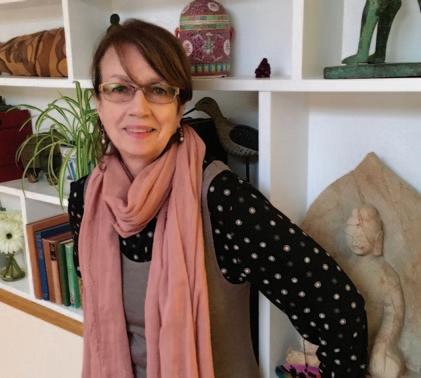
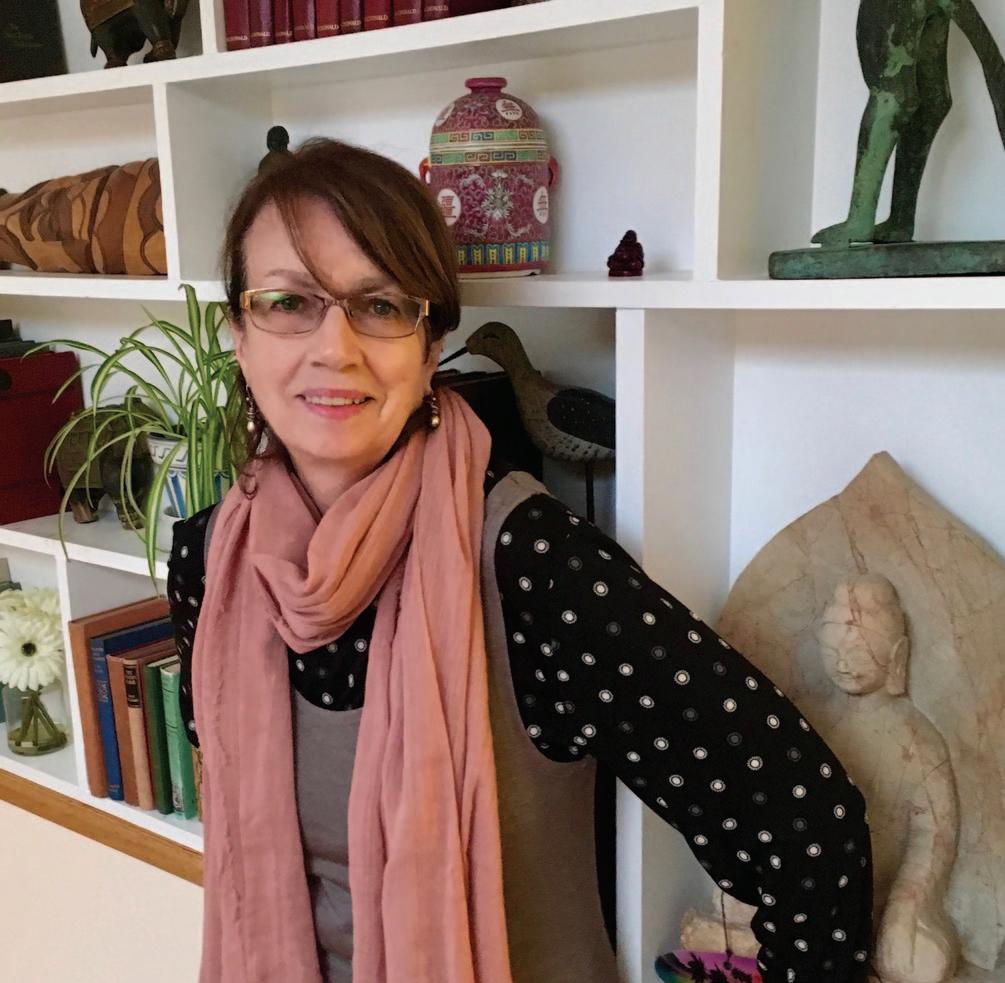
Mary Ellen Riell, Artist
“A Beautiful Point of View”
by Carol St.Sauveur Ferris
One can be taught to draw, paint, and sculpt, but to do it well while giv ing life to a piece takes something more. Emotion, purpose and presence are those intangibles that either are, or aren’t, so to speak. And while it can be argued that it is in the eyes of the beholder to see and feel, it is in the hands of the artist to create the possibility.
Brooklyn born artist Mary Ellen Riell loved the arts, including music, from the time she was a child. Since she didn’t own a violin or clarinet, pencil and paper became her instruments and drawing became her passion. She taught herself figurative drawing using her brothers and sister as her subjects and later took many high school art classes which she loved. What set art classes apart for her was the fact that they were participatory and forced a student to really think rather than simply take in information. Mary Ellen’s talent was apparent early on.
When asked if there were any artists in the family who may have influ enced her, she recalled that her maternal grandfather had an artistic sensibility. He was a degreed civil engineer in NYC, but he also did pencil drawings in college. Those drawings were displayed on the walls of his office which she now owns and treasures. “They were Gibson Girl in spired and I still have them”. He was an avid gardener, collected unique furniture and lamps, and was very in tune with the environment.
Her Mom attended Pratt Institute and was a trained draftsman. Besides her technical skills, she was a gifted artist and was able to draw incredibly detailed street scenes entirely from memory. “She had a strong aesthetic
Mary Ellen Riell’s art studio
sense for organization, style and color but never worked professionally in the arts. She stayed home.”
Luckily, Mary Ellen’s parents were very supportive of her art. They sent her to the Saturday art classes at the Art Students League in
New York City for $25.00 per month and a 50-cent subway ride. The journey all by herself into the big city from Brooklyn was a pretty big deal back then while the art classes she attended gave her an amazing start to her future career. And the body of work she cre ated over time, both in high school and at the Art Students League, allowed her to develop an art portfolio that won her a coveted spot at the Fashion Institute of Technology (FIT).
Five days a week for two years at FIT, Mary Ellen was immersed in fashion illustration, figurative drawing, painting, anatomy and graphic design. After a gap year, Mary Ellen then enrolled in the fine arts program at Brooklyn College and took photography,
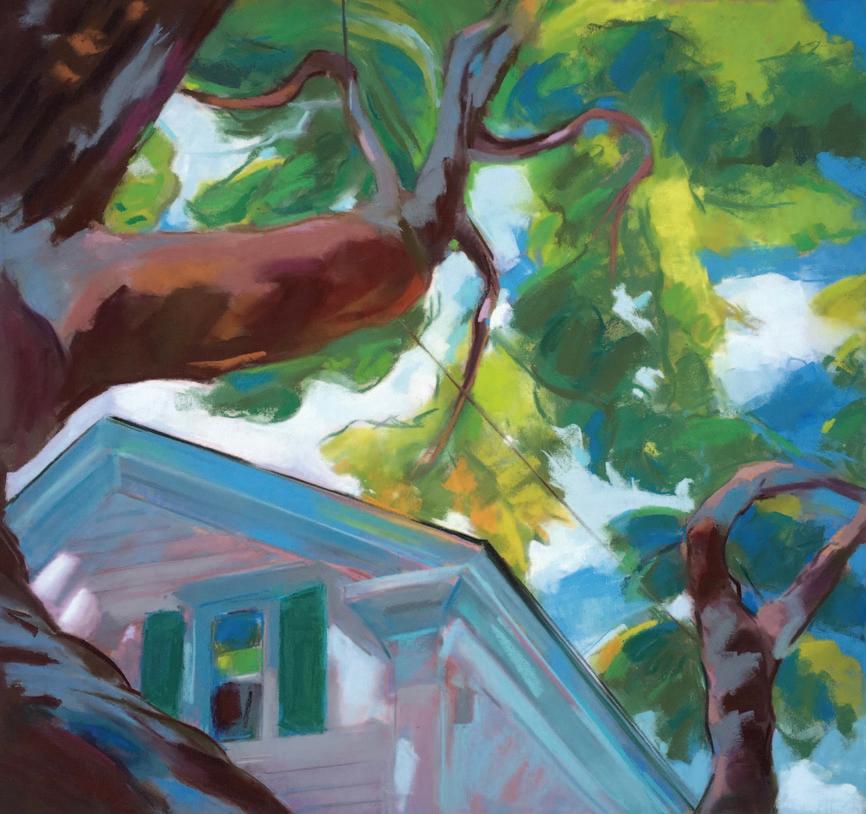
“Looking Up At The Lape House” Pastel 16x17
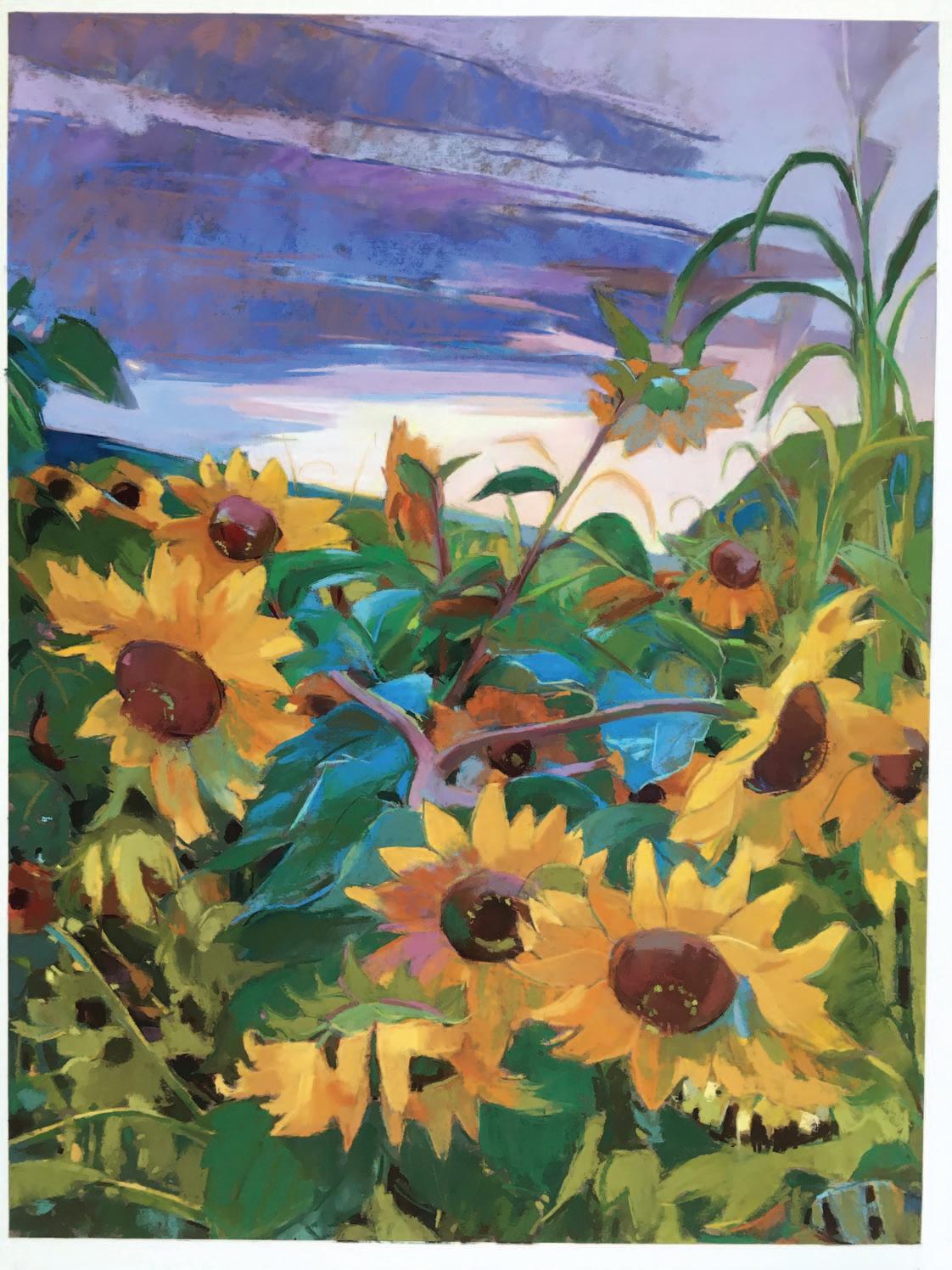
“Sunflowers, Early Evening (Mabee Farm)” Pastel
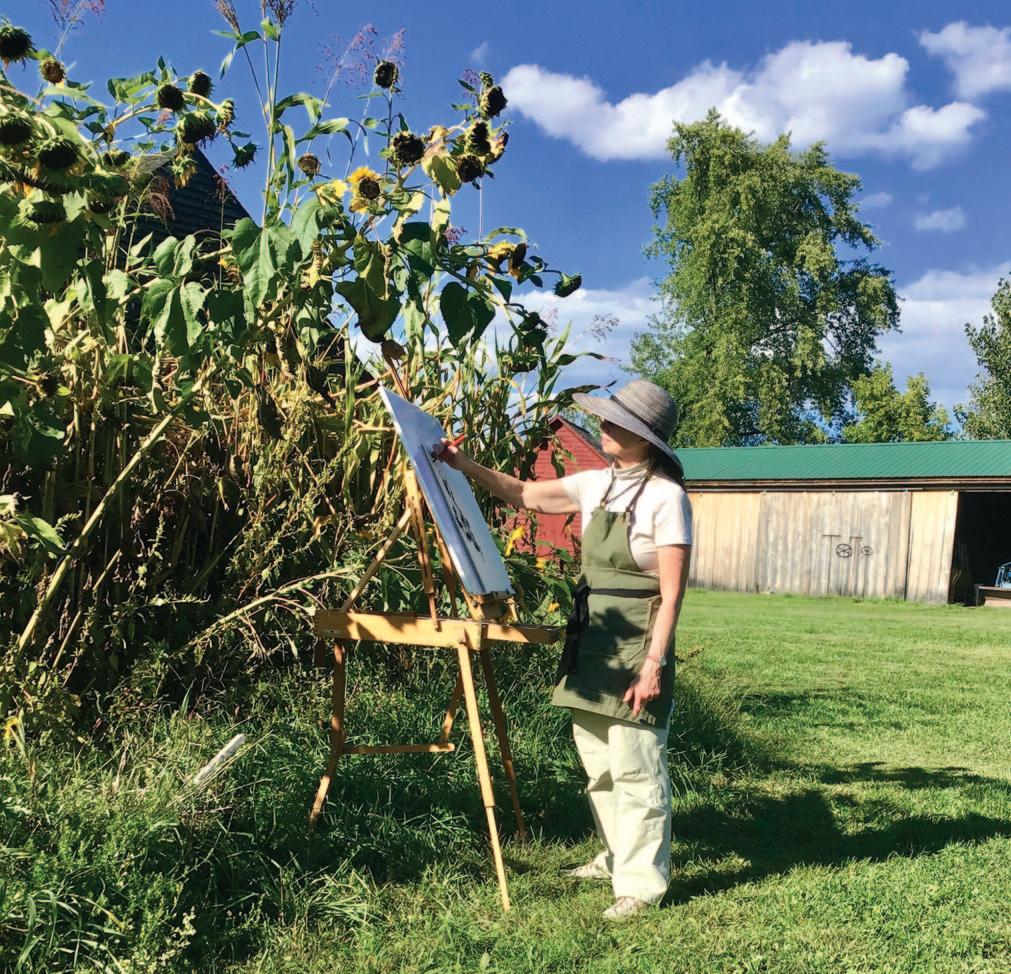
Mary Ellen sketching at Mabee Farm
“The Master Gardener's Garden” Pastel 13x15
painting, printmaking, and more life drawing classes. From there she married and worked as a fashion illustrator for a Brooklyn department store followed by a stint as an illustrator for the designers at McCall’s patterns.
Now married, Mary Ellen and her husband relocated to Albany, New York, where she attended College of St. Rose and earned her MS in Art Education. She then joined the St. Rose faculty as an adjunct professor for six years and taught Art and Learning, a unique course de signed for elementary school teachers who were not art teachers but were expected to teach art as part of their job. By then she was a yo ung Mom and not surprisingly, intro duced her son Kellen, to drawing and the arts. She even used his preschool drawings as a teaching tool in the class and strongly be lieves that providing creative opportunities for children helps them grow, learn and explore. Sadly, that program was recently eliminated as have so many art programs across the country. “I’m not really certain what young people are doing these days, but I have the feeling that they’re probably on their computer more than they should be, which is just not as participatory as actually sitting down and creating something on your own.”
When her teaching gig ended, Mary Ellen began to paint in earnest again and continued screen printing as well. She joined a few different art organizations in the Albany area, including The Oak Room Artists in 2002, a well-known arts organization whose membership is by in vitation only. Membership in Oak Room guarantees an artist a 1-2 person show every two years at the Oak Room Gallery located in the Unitarian Church in Schenectady. She was a very active member for quite a few years, and even the co-director for several, but is now an associate member which affords her more time to show in other galleries. Mary Ellen believes these groups are a great opportunity for like-minded people to gather, especially since artists spend so much time working alone.
Besides creating art and averaging six shows per year, the business side of her passion is quite consuming. As a result, she carefully ap portions her time between creating, promoting, social media and
exhibiting. Mary Ellen works four to five days every week, then takes three to four off, though sometimes less to keep the creative momentum going. Add in her printmaking at Ragged Edge Printmaking Studio in Cohoes, NY and life drawing classes every Tuesday evening at Union College, well, there is no doubt she is one busy artist.
Mary Ellen works mostly in watercolor and pastels and the finished pieces are usually 18”x 24” in size. Her inherited love for nature and gardening seems to take center stage in all her compositions. And her use of color and perspective are a powerful draw into her work. When planning a composition, she does many pencil drawings and watercolor studies, then takes pictures of the location from every possible angle for future reference. She effectively uses the foreground to create interest and to provide a worm’s eye view of her subject. Mary Ellen’s use of color is bold and beautiful. She shared that she does “tend to heighten the color and tweak it a bit so that it’s not quite as naturalistic” but is cognizant of the light at all times.
Several pieces of note include:
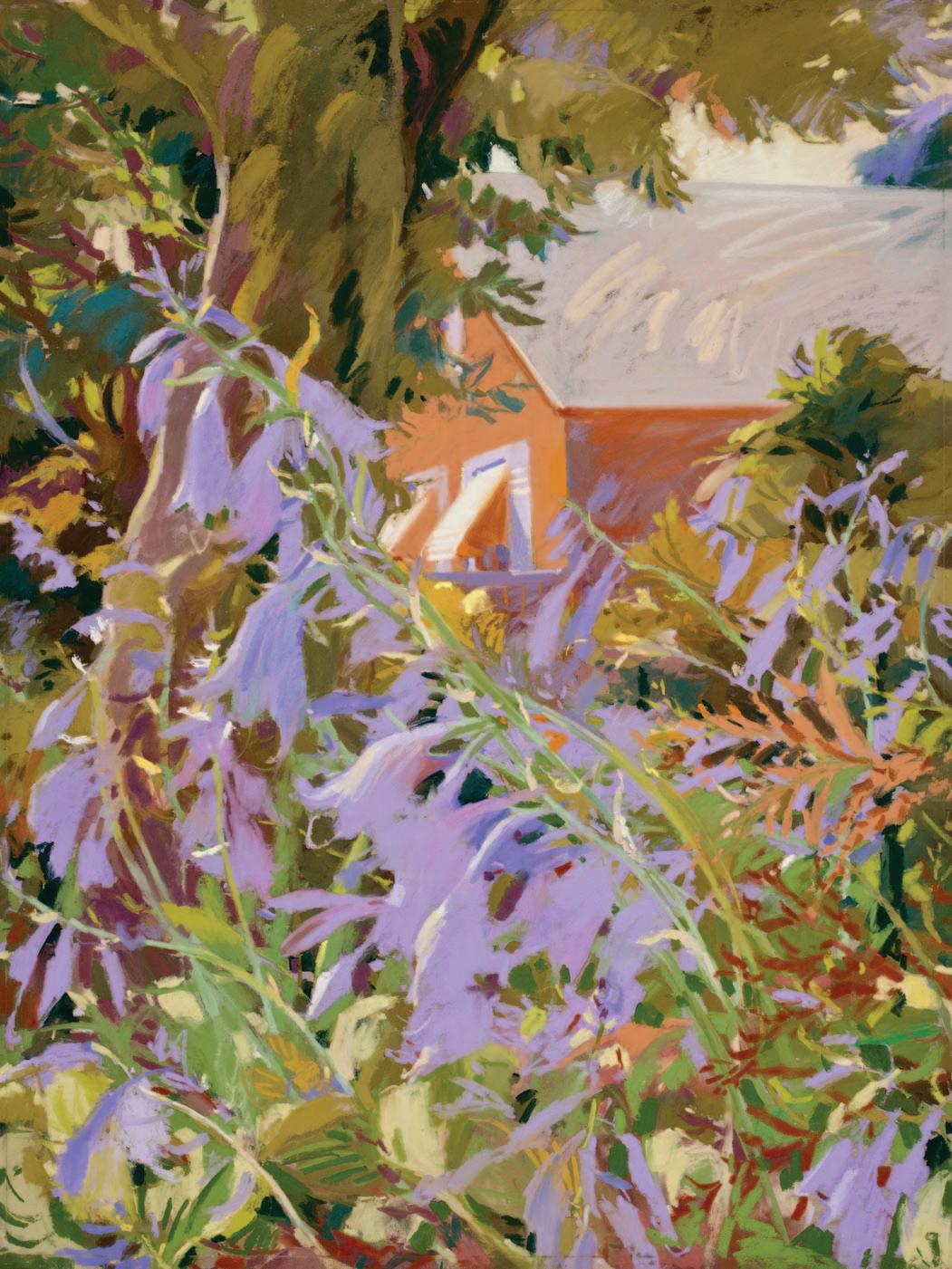
Corner of the Garden, Hostas: This is one of her earliest pastels and is a great example of her intentional use of the worm’s eye view and strong color. The composition features a simple red-orange out building with awnings seen through sun dappled, lavender Hostas. A heavily textured, robust tree trunk flanks the building and beautifully anchors the composition. It is both inviting and uplifting.
“Corner of the Garden, Hostas” Pastel, 24x18
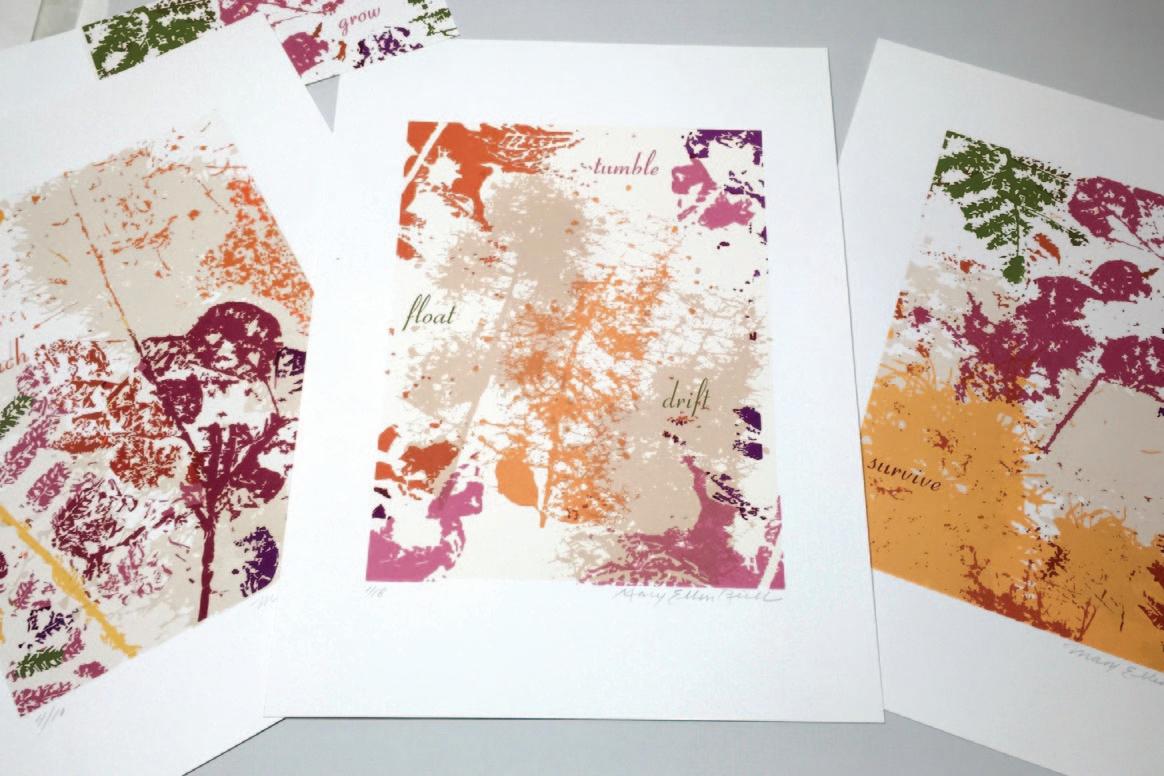
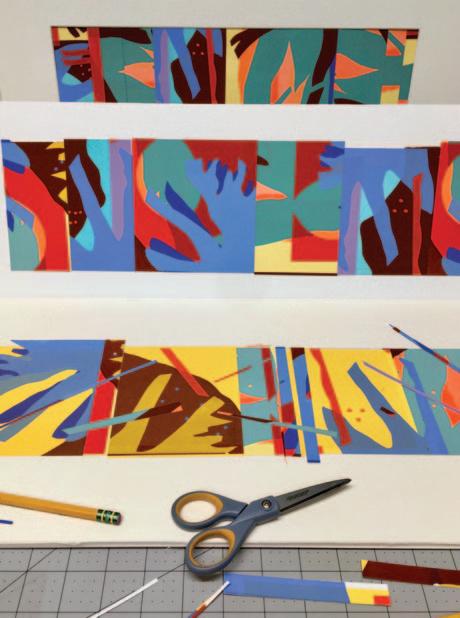
“Harness the Wind” series of 3 related images, Screenprint, 11”x8.5”
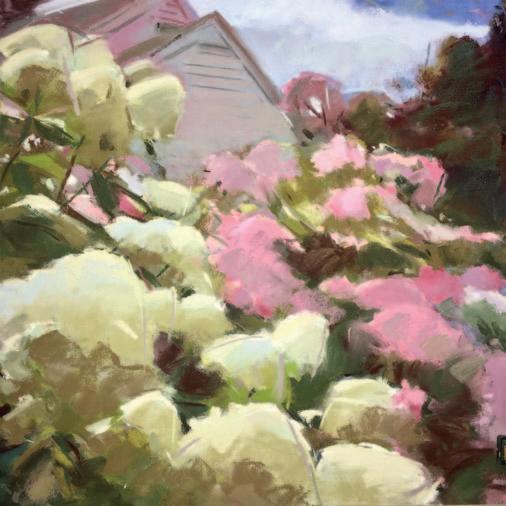
“Limelight Hydrangeas & Pink Phlox” Pastel 12x12
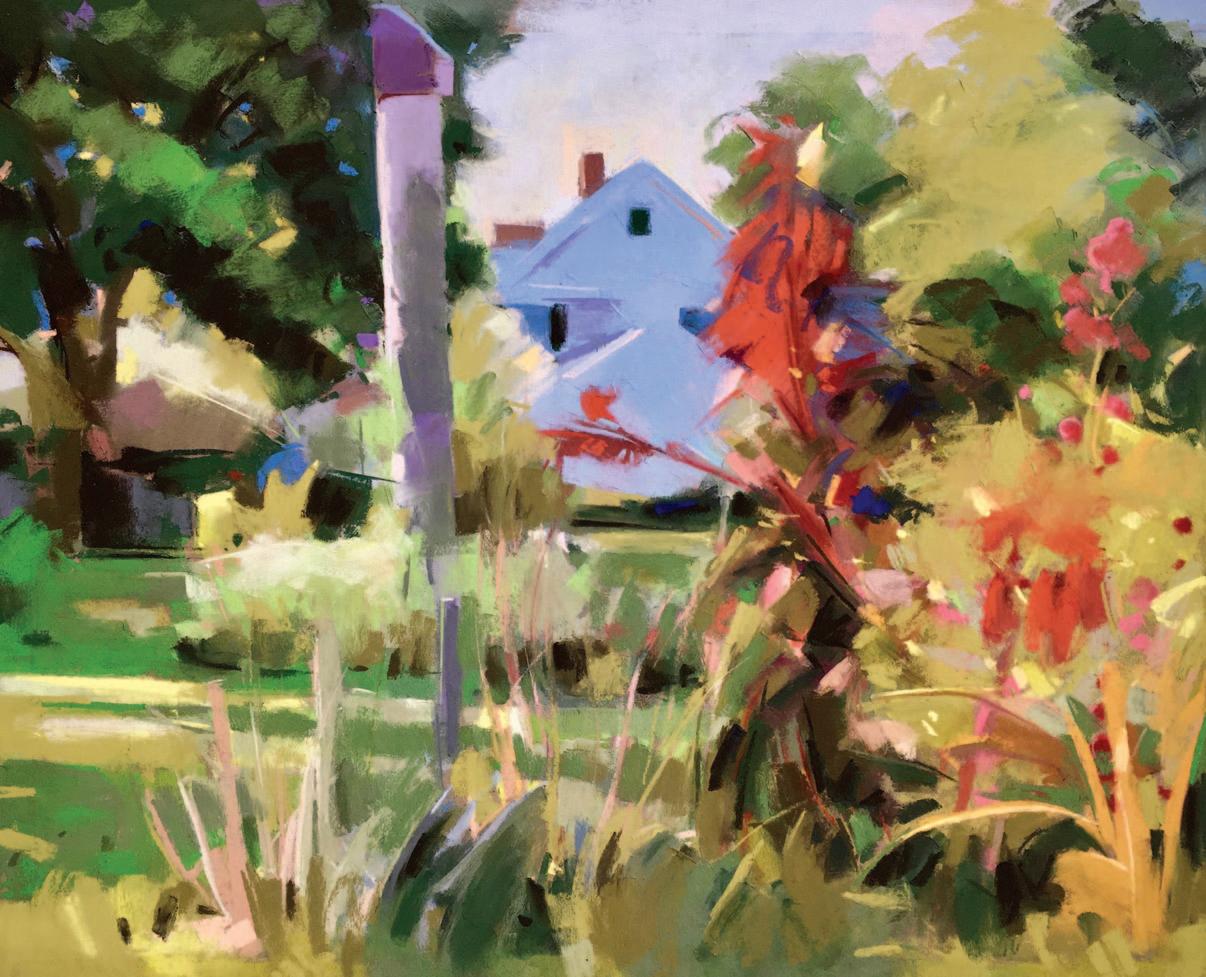
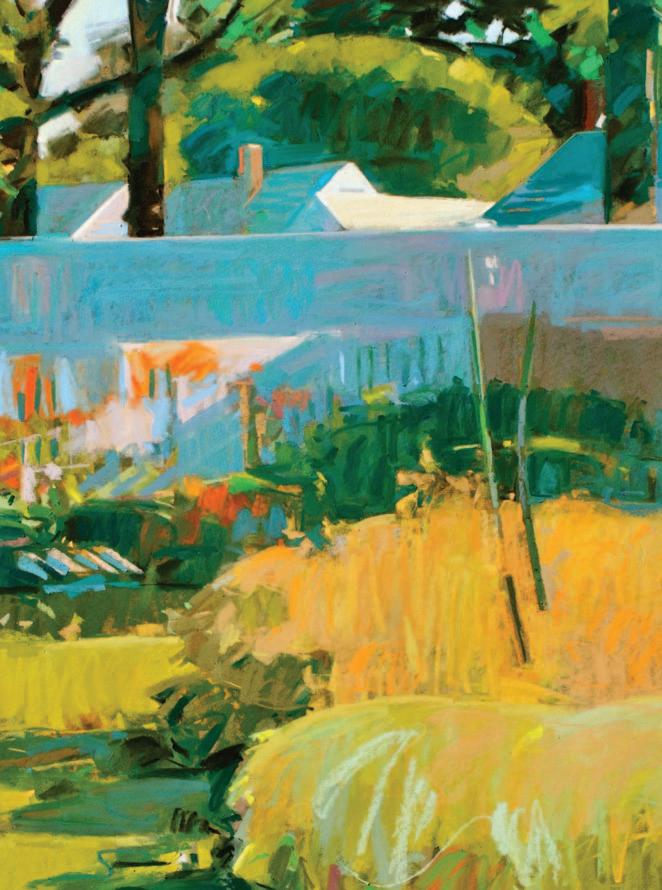
July Morning: This is another pastel with an interesting view from her own garden. While the yard is only a third of an acre, “there is so much to see on the other side of her fence,” according to Mary Ellen. A wooden fence rail has a prominent role in the composition and beckons one to peek into the next yard. The color of the fence was heightened from white to shades of blue and the perspective shows the fence rail aligned with the house in the background. Vibrant yellow shrubs in the foreground anchor the composition and create additional interest. This piece won Best in Show at the 70th Annual National Exhibition of the Cooperstown Art Association in Cooperstown, New York.
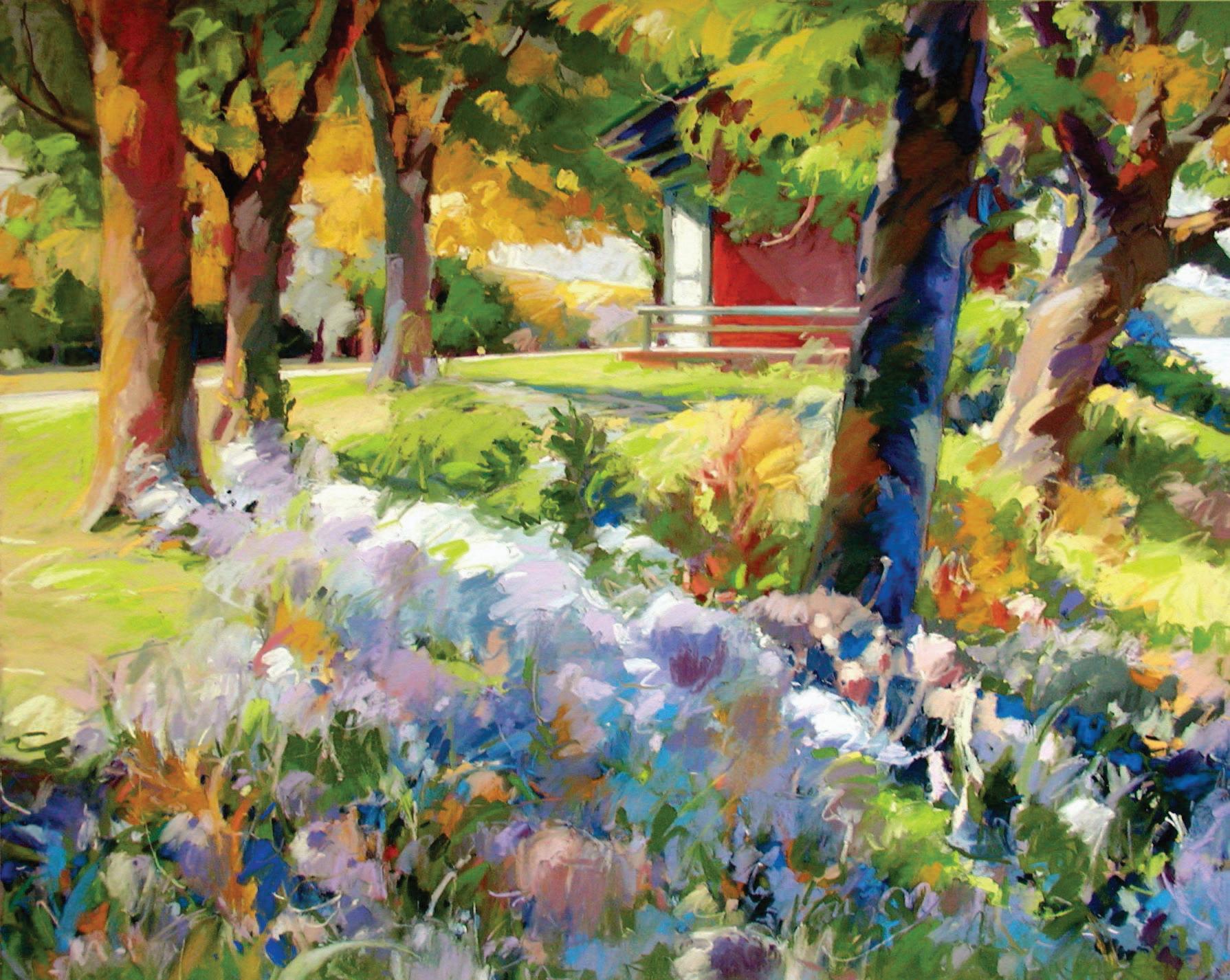
The Old Station House: This pastel of the old Niskayuna Rail Station on the Mohawk River is awash in beautiful color and natural light. Mary Ellen did many on-site drawings and watercolor studies to capture the beautiful light and color for her composition. Photographs
were taken as well to use as reference when back in her studio. She again employed the worm’s eye view which leads you between pillar-like trees to the now defunct station house tucked in the background. The foreground flowers balance the view and add strong, textural interest.
Reservoir: This watercolor was inspired by a radio program that discussed the impact of climate change. Mary Ellen was compelled to put brush to paper and record her thoughts and feelings about what she had just heard. It’s a departure from her colorful floral and nature scenes, but one that makes a statement. A once robust reservoir is rendered as a moonscape with receding water and serves as a stark reminder of what could be. It begs the question, what now, what next?
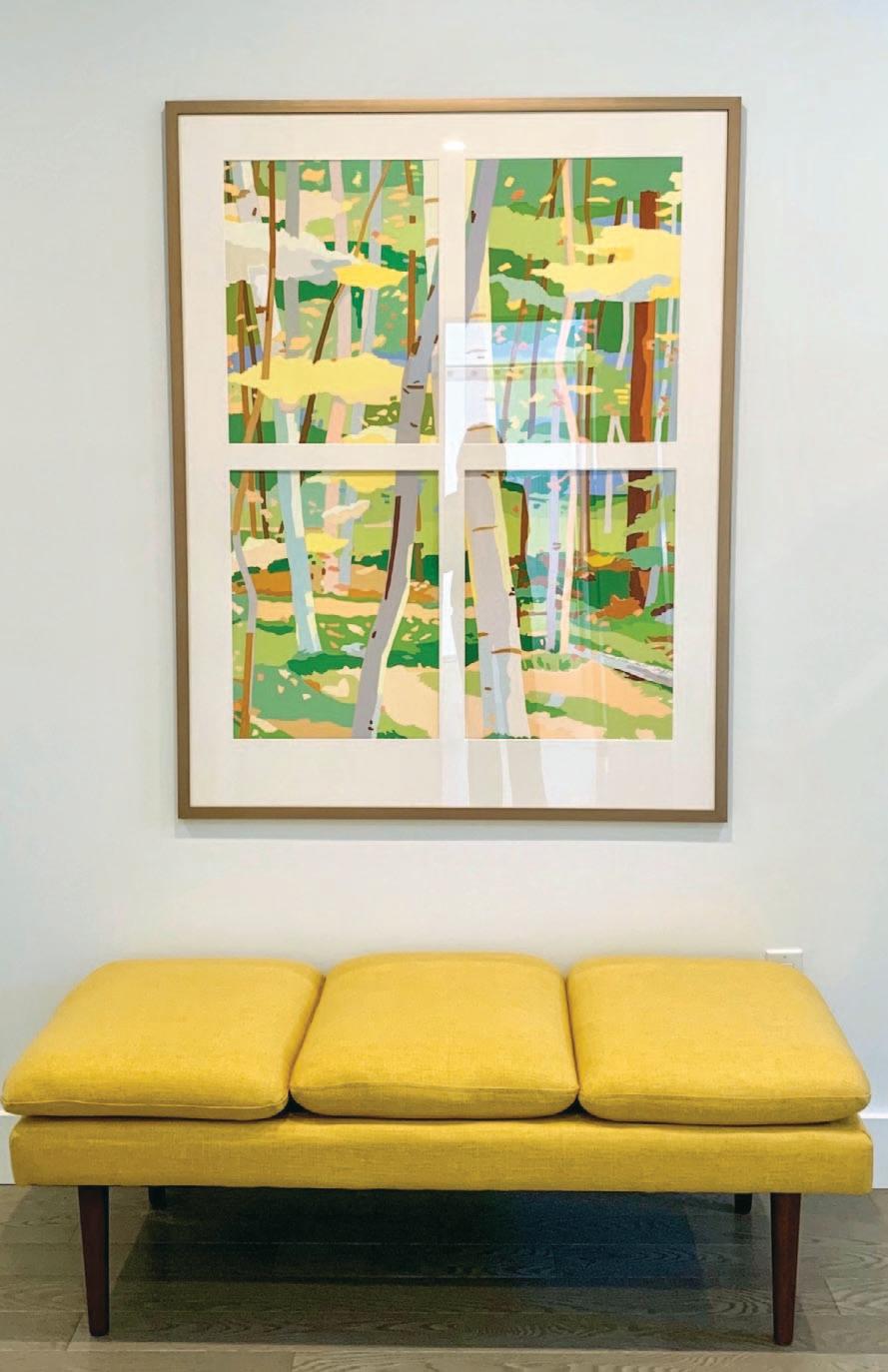
Shift (51” x 40”): One of her larger pieces, this screen print was created in four sections and cleverly matted to give a through-the-window
“The Old Station House” Mohawk River”, Pastel, 24x30”
“July Morning” Pastel 24x18
Now that the pandemic restrictions have eased, Mary Ellen plans to start painting larger pieces in oil. She will also be painting En Plein Air in other locations besides her own gardens, foregoing the luxury of her protective tent and easy access to cold drinks and snacks in the fridge. She sees
view of elegant birch trees and the woods beyond. It was inspired by a 34”x 30” oil painting she had done years earlier at Guilderland’s Tawasentha Park. It took her one year to complete the piece to her satisfaction because the everchanging light coming through the trees was quite a challenge to capture as a moment in time. Shift was printed in an edition of 12 and hangs in several private collections.
it as another creative adventure to be embraced. And besides her paints, let’s hope she remembers to bring the sunscreen and bug spray!
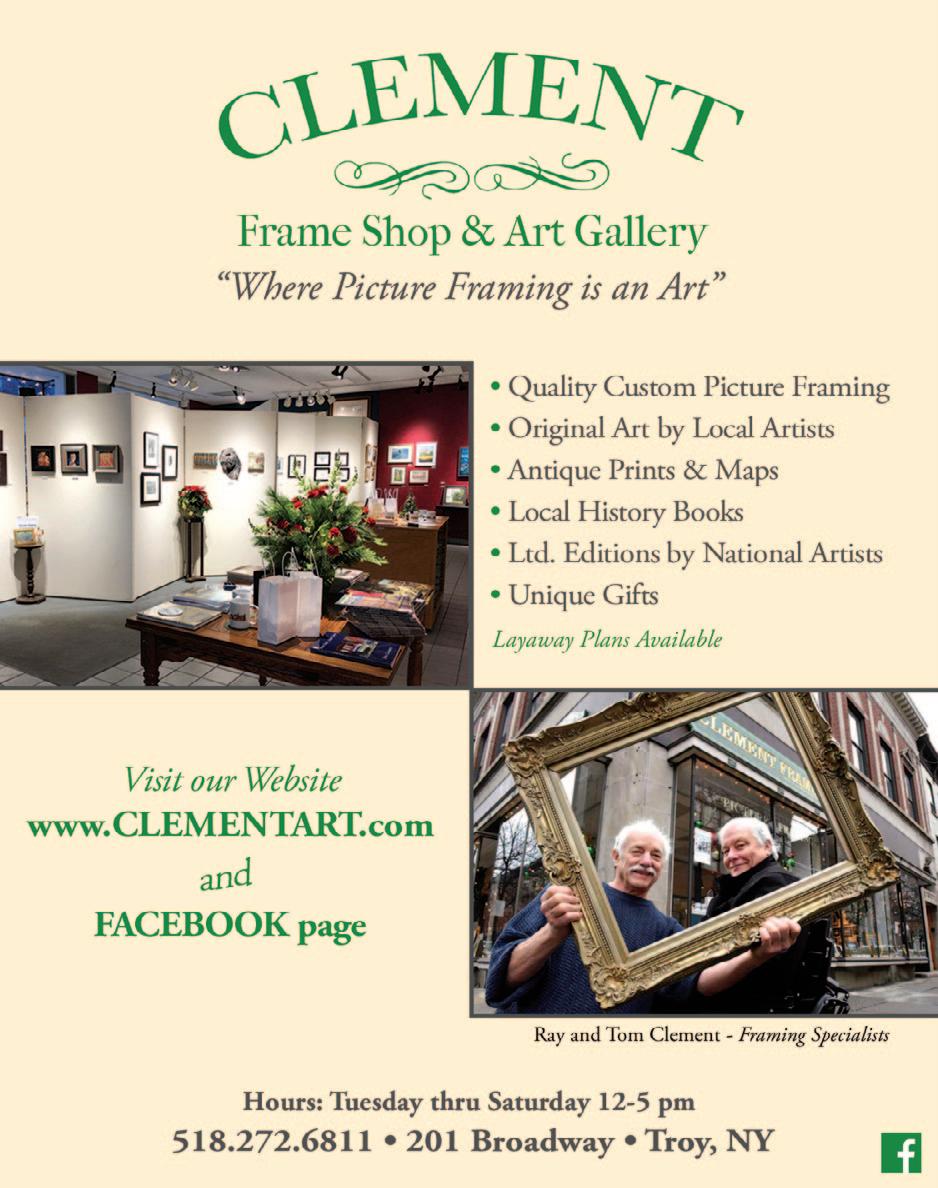
Mary Ellen Riell shows at the Laffer Gallery in Schuylerville, New York and the Clement Gallery in Troy, New York. Her work and can also be seen and purchased on her website: www.maryellenriell.com
“Reservoir” Watercolor 10x14
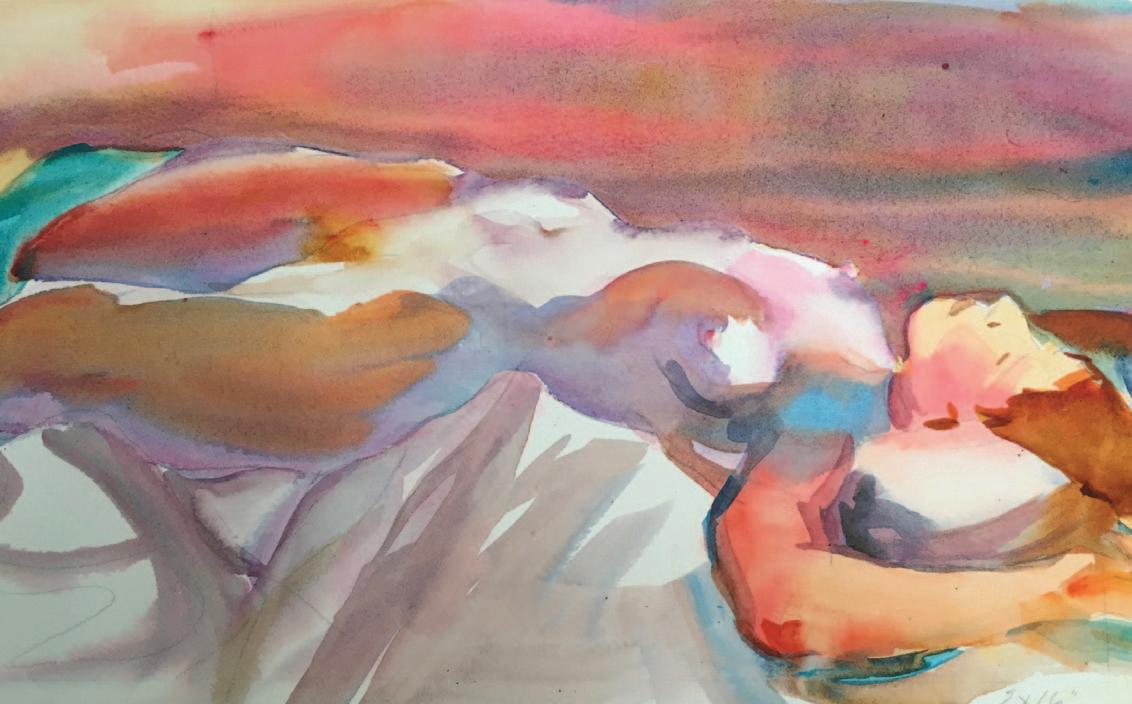
“Reclining Model with Drape” Watercolor, 10”x16"
They Don't Sell Souvenirs, They Sell Memories Impressions of Saratoga & The Dark Horse Mercantile
by Rona Mann
photos by Stephanie Sittnick
There really never was any other alternative. It was destined to be this way.
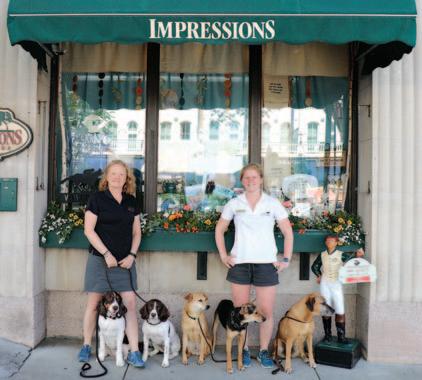
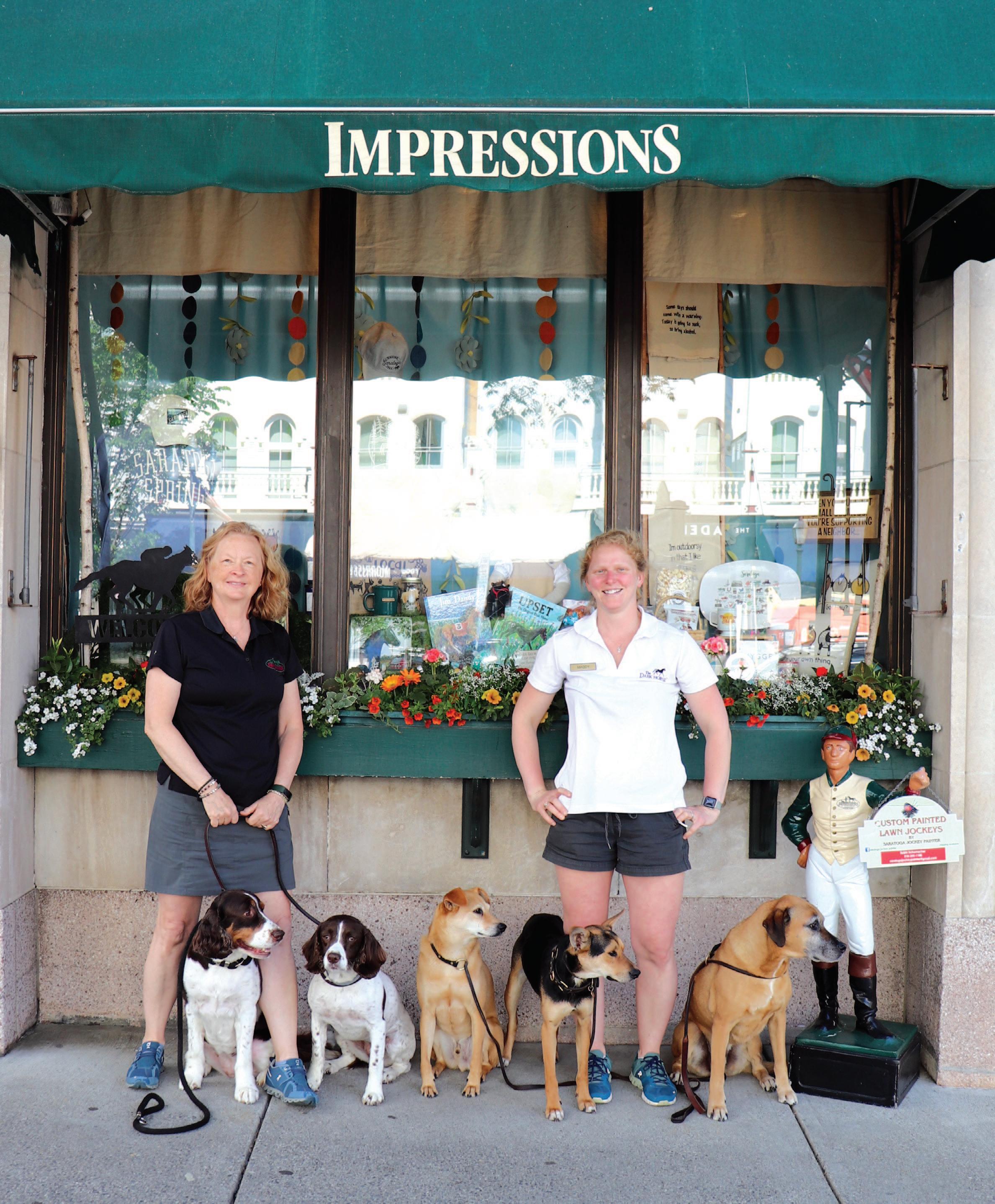
Maddy Zanetti would one day be a boss, a co-owner of Impressions of Saratoga. It was written in the wind, sealed by the fates, it was her destiny, and nothing would deter the little girl who was born and raised in Saratoga, went away to college ("as little as possible!"), but kept coming back like a homing pigeon, because she could not get Saratoga out of her blood, nor did she want to...ever. And she never has.
The direction that led Marianne Barker to Impressions of Saratoga was quite a different one, but her future was waiting at the foot of the Adirondacks. She was raised in Long Island, went to college in Cobleskill, and was on course to become a veterinarian. But as often happens, she met a guy while in college, fell in love, and for love of horses and the town itself in 1980 he brought her to Saratoga where he opened a wildly successful screen printing and embroidery business which eventually became Impressions, and along the way, Marianne fell in love again. This time with Saratoga.
As a child, Maddy Zanetti had shopped at Impressions. She loved the store because it was everything that was Saratoga to her. The history, the books, the apparel, the food items, the gifts, and of course, the horses. "As soon as I was old enough, I got my first job here at Impressions,
"says Maddy, "and I never left." She knew from the beginning that one day she wanted to run her own business, something that would also embrace her intense passion for horses, dogs, and Saratoga itself.
Marianne, who is known as "Mare" to Maddy and just about everyone else in town (think Mary Richards and Rhoda Morgenstern), was running Impressions along with Dave. Maddy worked for them, but when it came time for Dave to retire from screen printing, Maddy became the third partner, thus realiz ing her childhood dream of owning a business. It is unique and perhaps has a touch of serendipity to note that Mare and
Maddy who met in the store when Maddy was just a little girl, are both redheads, and with Mare having enough years on Maddy to be her mother, customers frequently think they are indeed a mother-daughter fiery combo!
The women are quick to credit both Dave and Maddy's husband, Zach, for "putting up with us, for their patience, and mostly for their support, since partnership is not always easy!" they laugh.
Impressions of Saratoga is unique in so many ways. Since both women are "owned" by a passel of dogs of varying sizes, ages, and questionable parentage, a number of them, and sometimes all of them, inhabit the back room and frequently greet customers who come in regularly to see Maddy's rescues, Smitty, Smalls, and Thatcher; and Cookie
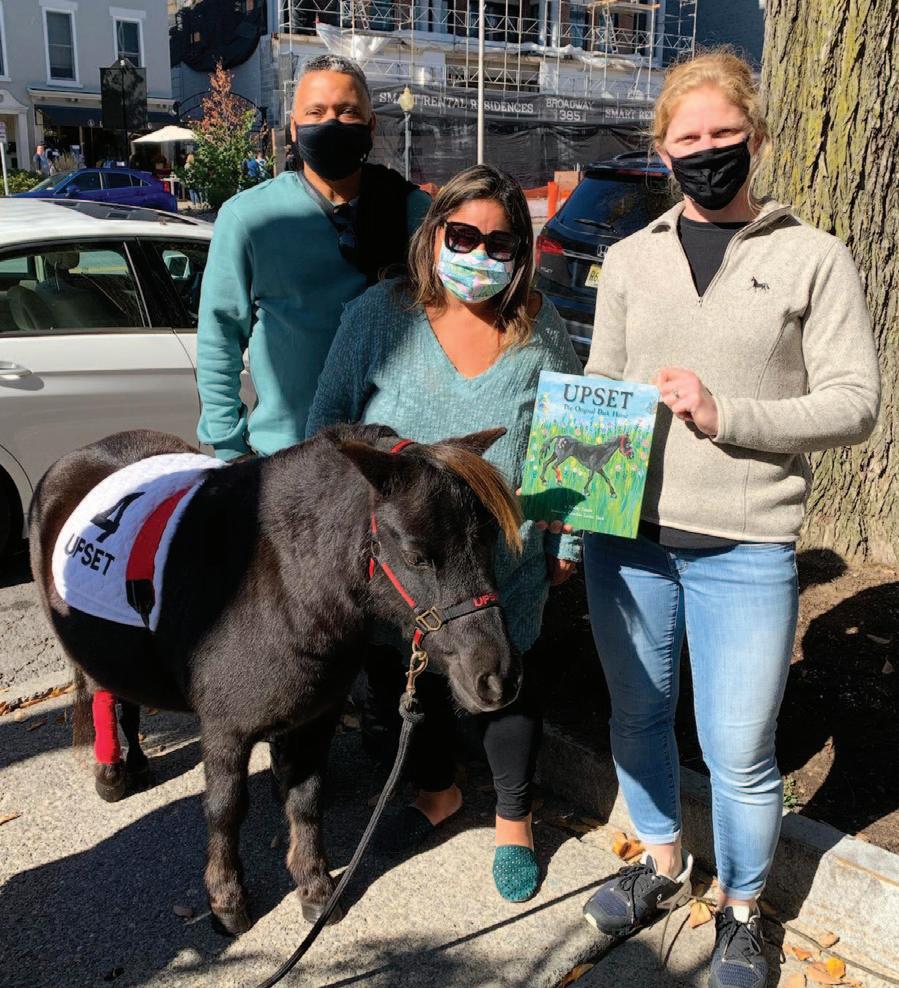
and Pupa, Mare's Springer Spaniels. From time to time their 33" mini-horse named "Upset" makes an appearance down town which creates an indelible im pression on everyone there and brings to gether a de lighted, if not curious crowd, but we'll get back to "Upset in just a bit.
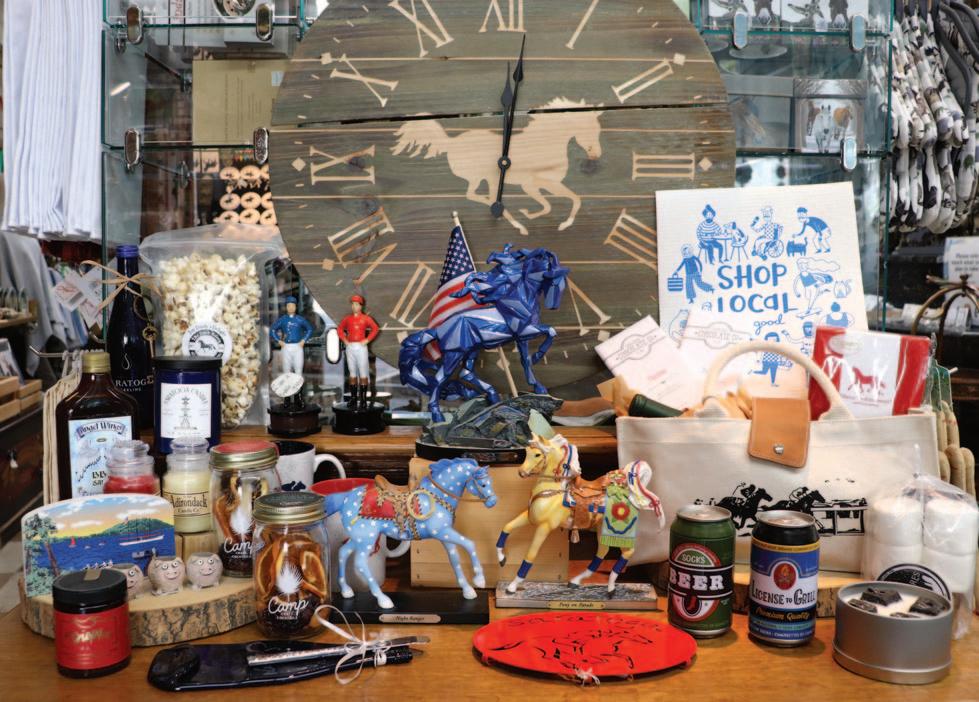
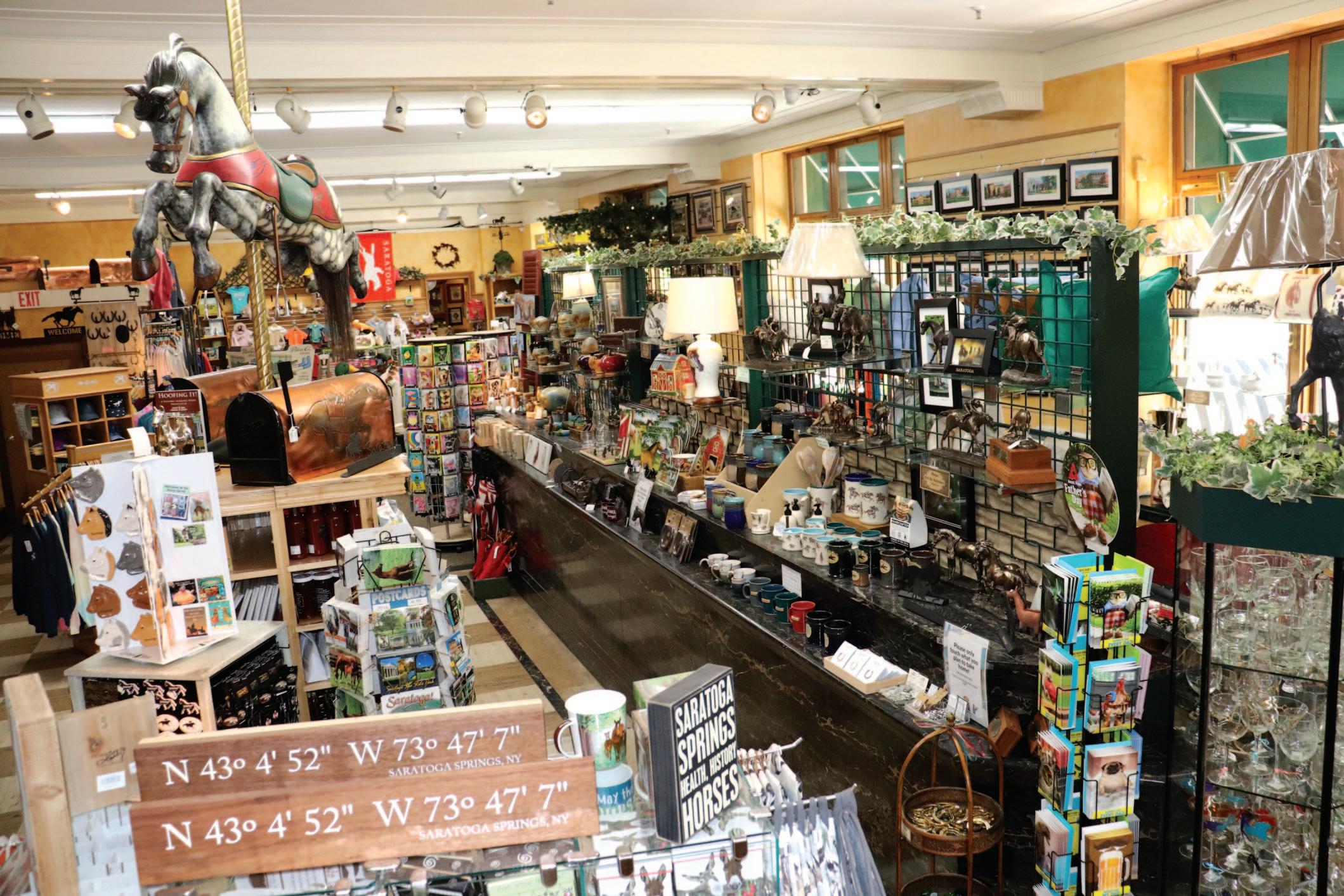
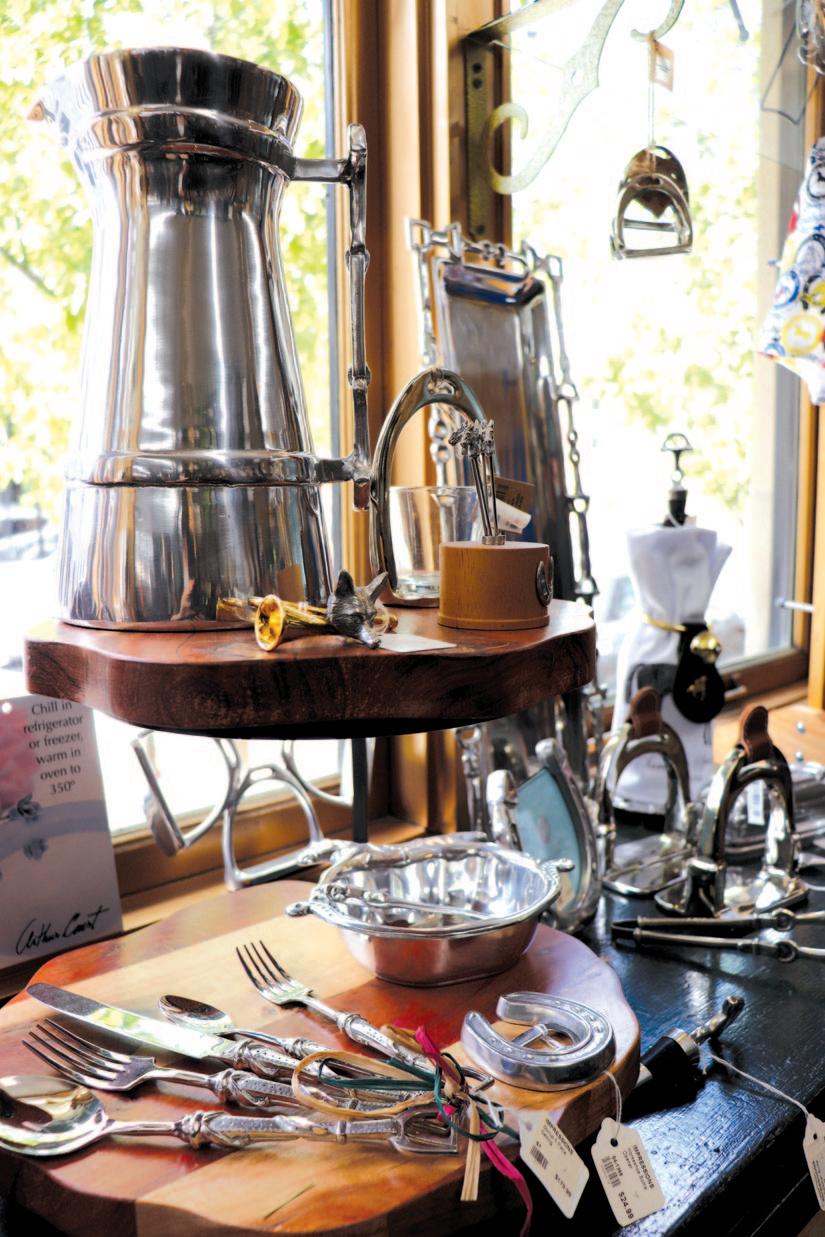
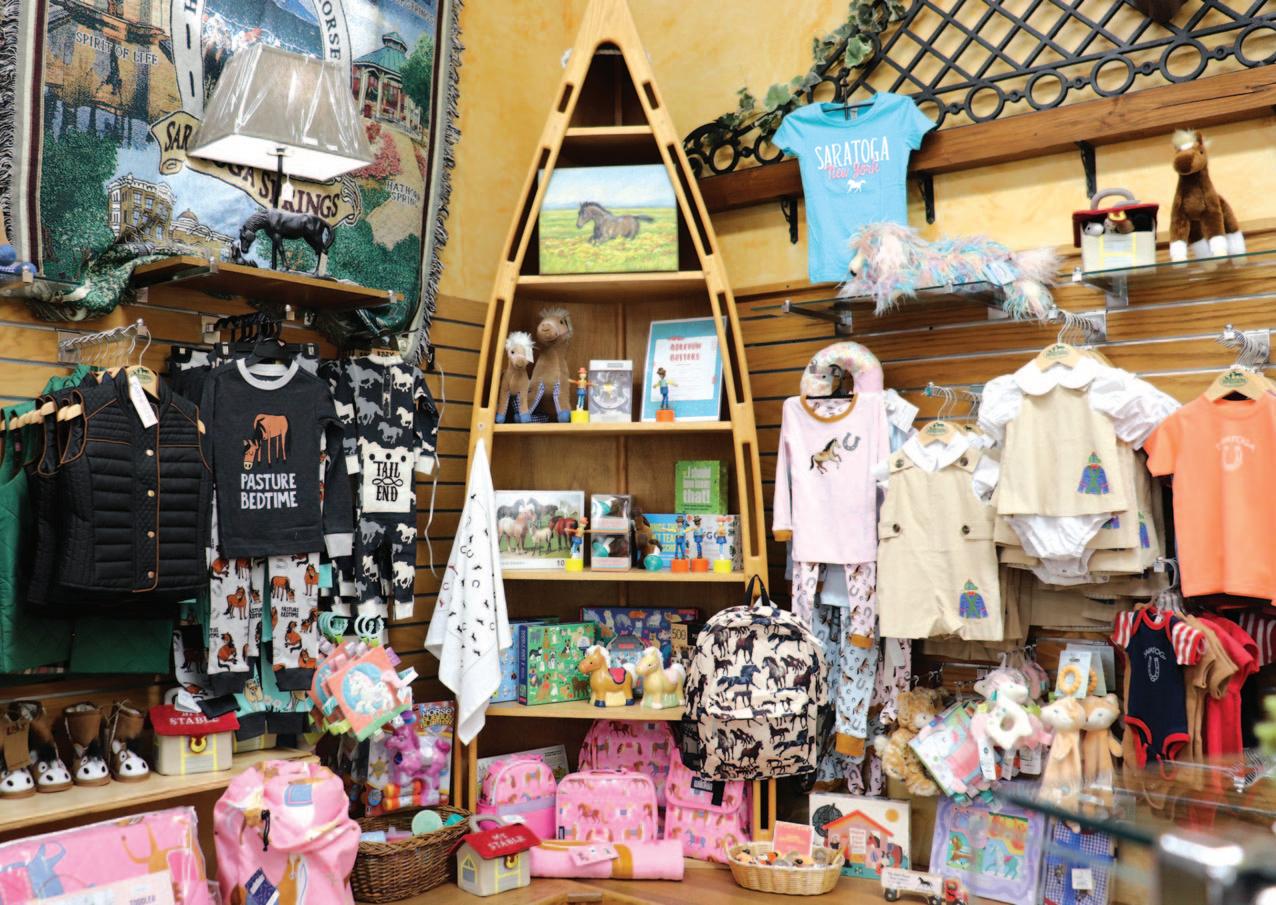
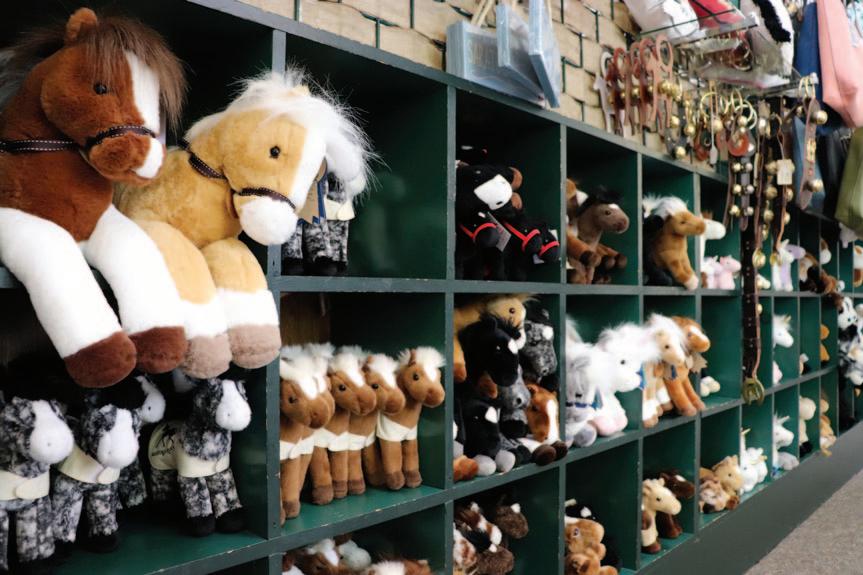
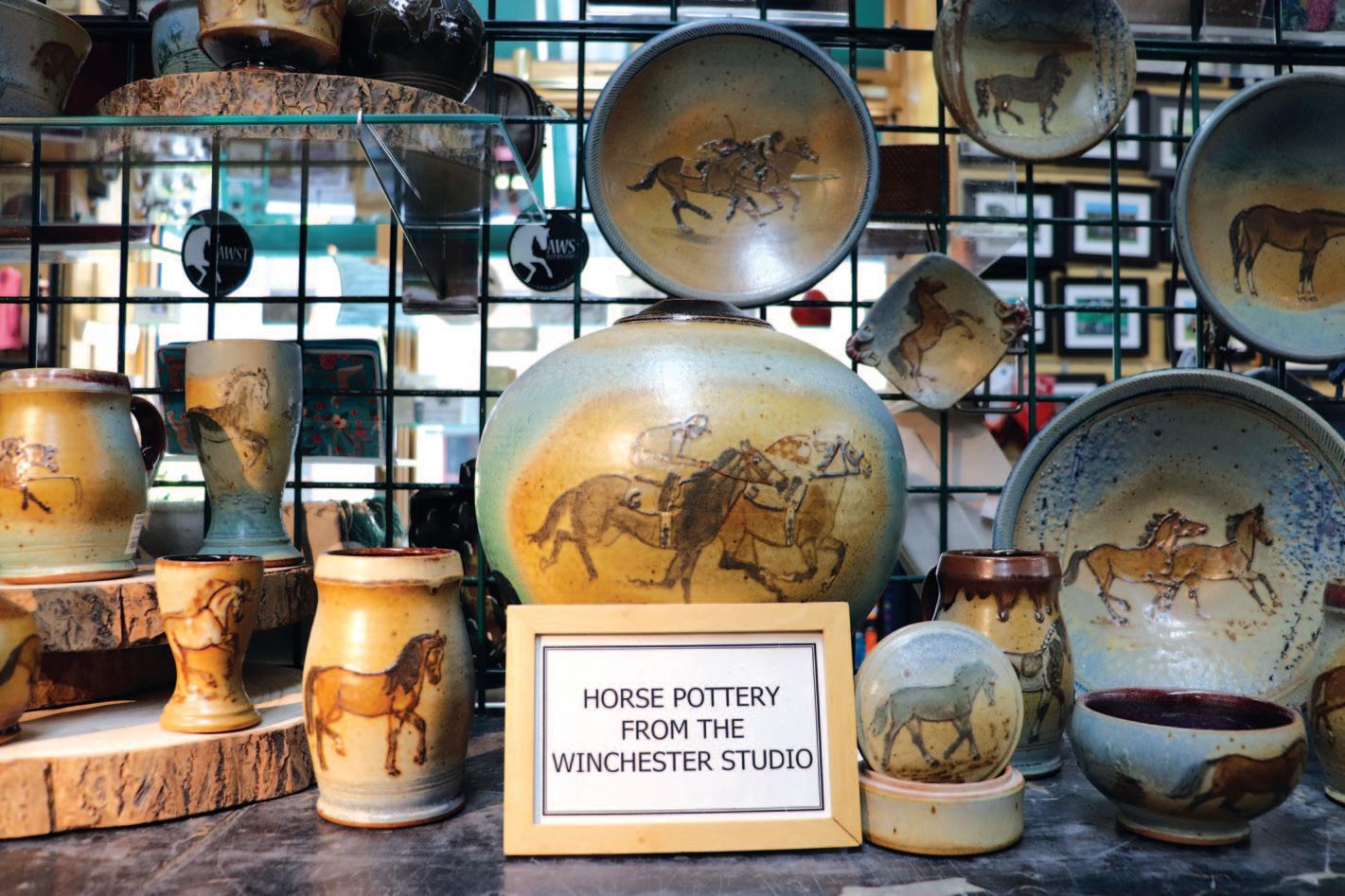
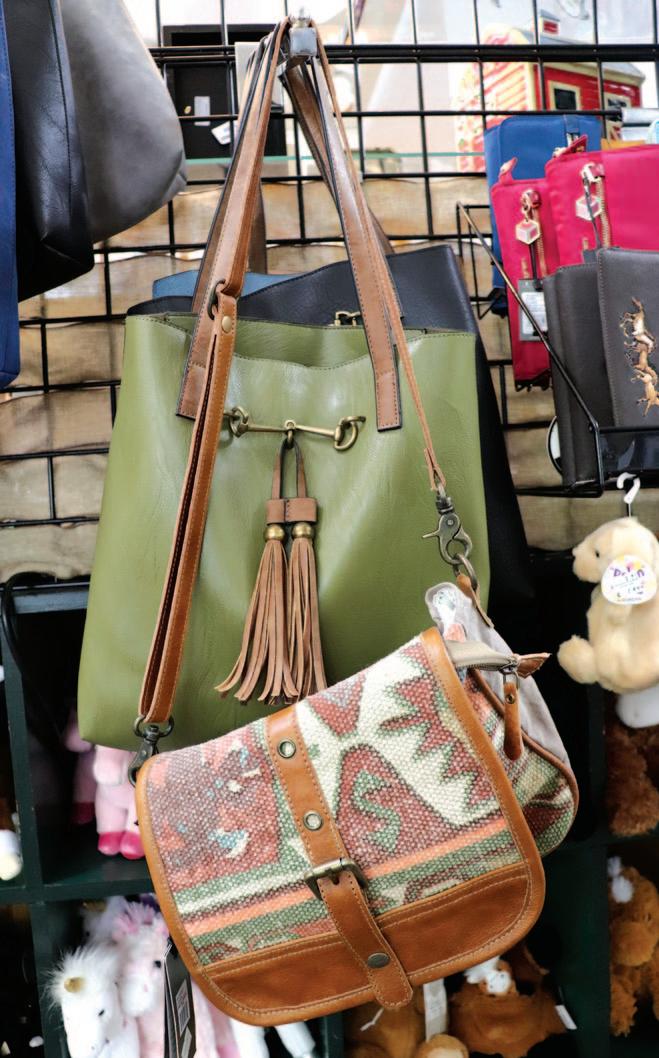
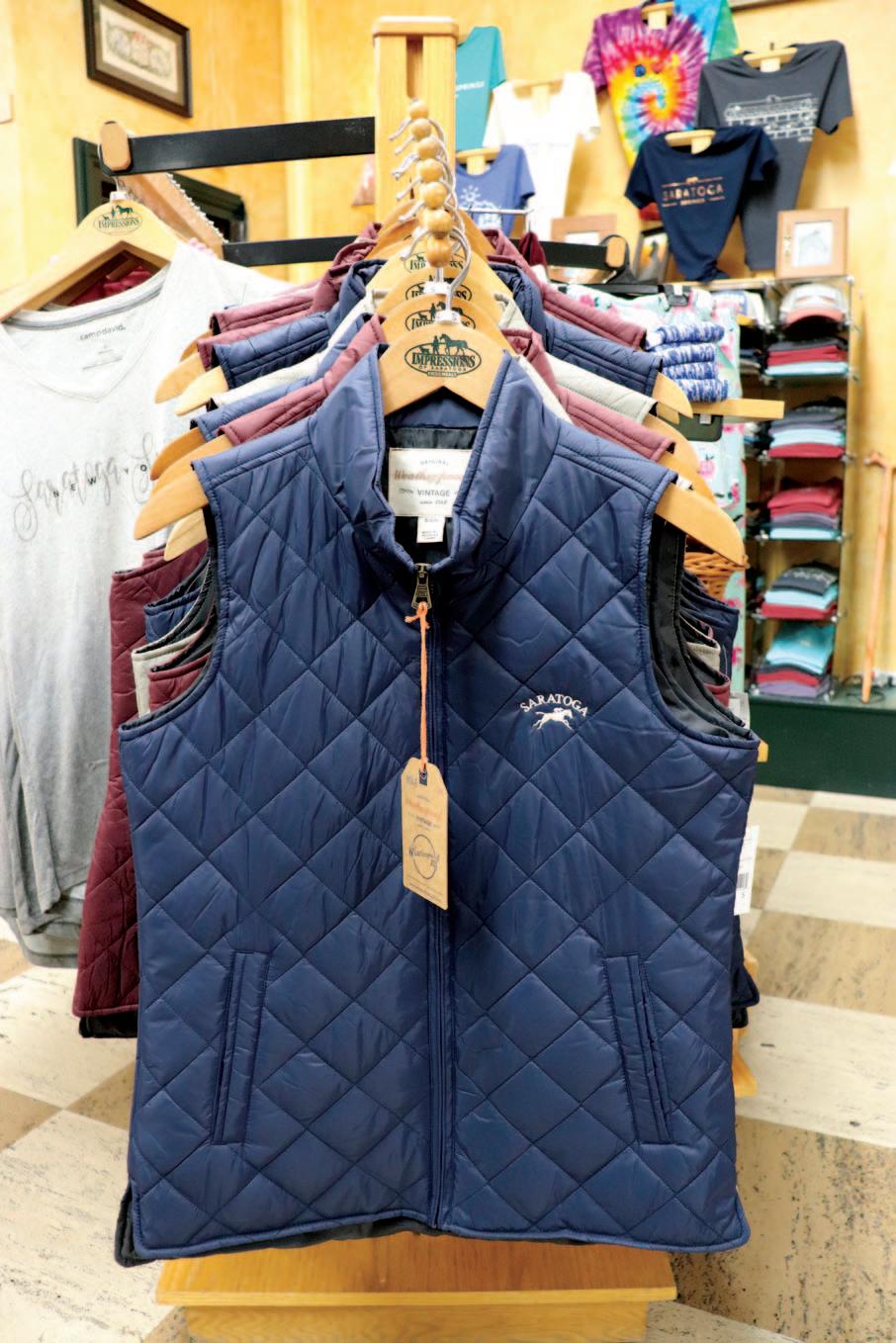
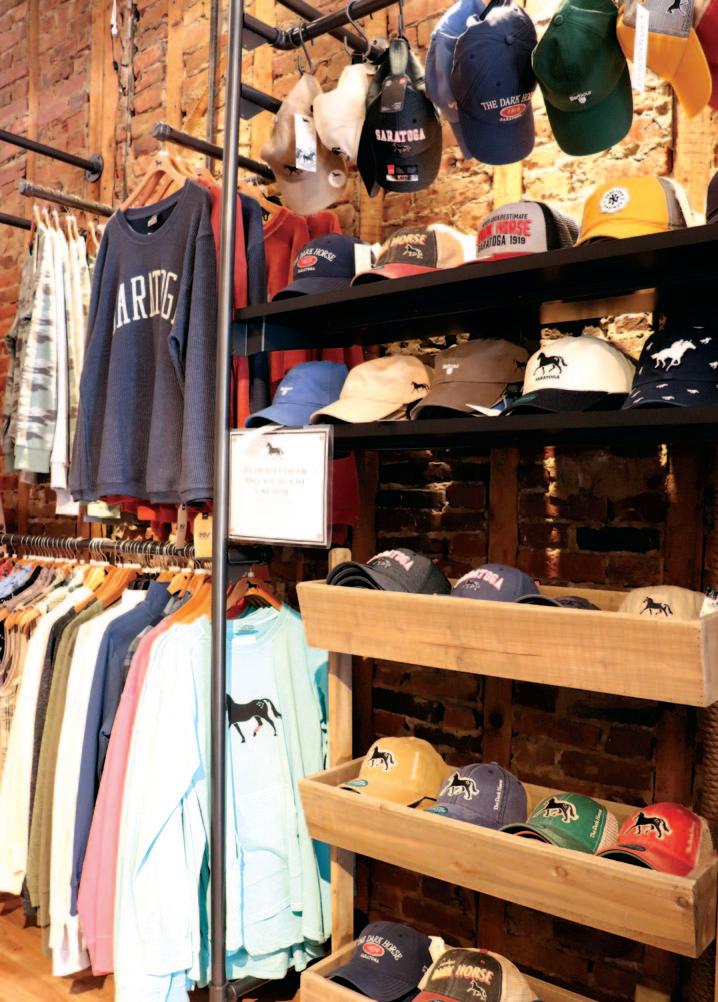
Impressions is "part of the Saratoga experience," says Mare pro udly. It is without a doubt an homage to everything that makes Saratoga a very special piece of geog raphy in the total landscape of New York State. It is all at once a treasure trove of history, memorabilia, the work of local artists, garments, gifts, foods, and of course every thing that relates to the town's love of horses. But make no mistake, Impressions is not your run-of-the-mill "sou venir" store filled with kitschy trinkets to buy for the folks back home, although Mare advises, "We do offer some traditional kitschy souvenirs, but we take it up a notch!" This shop echoes in every way the tremendous respect these two women have for their town, its history, and its people, and their pride in wanting to show it off to tourists and locals alike is legion.
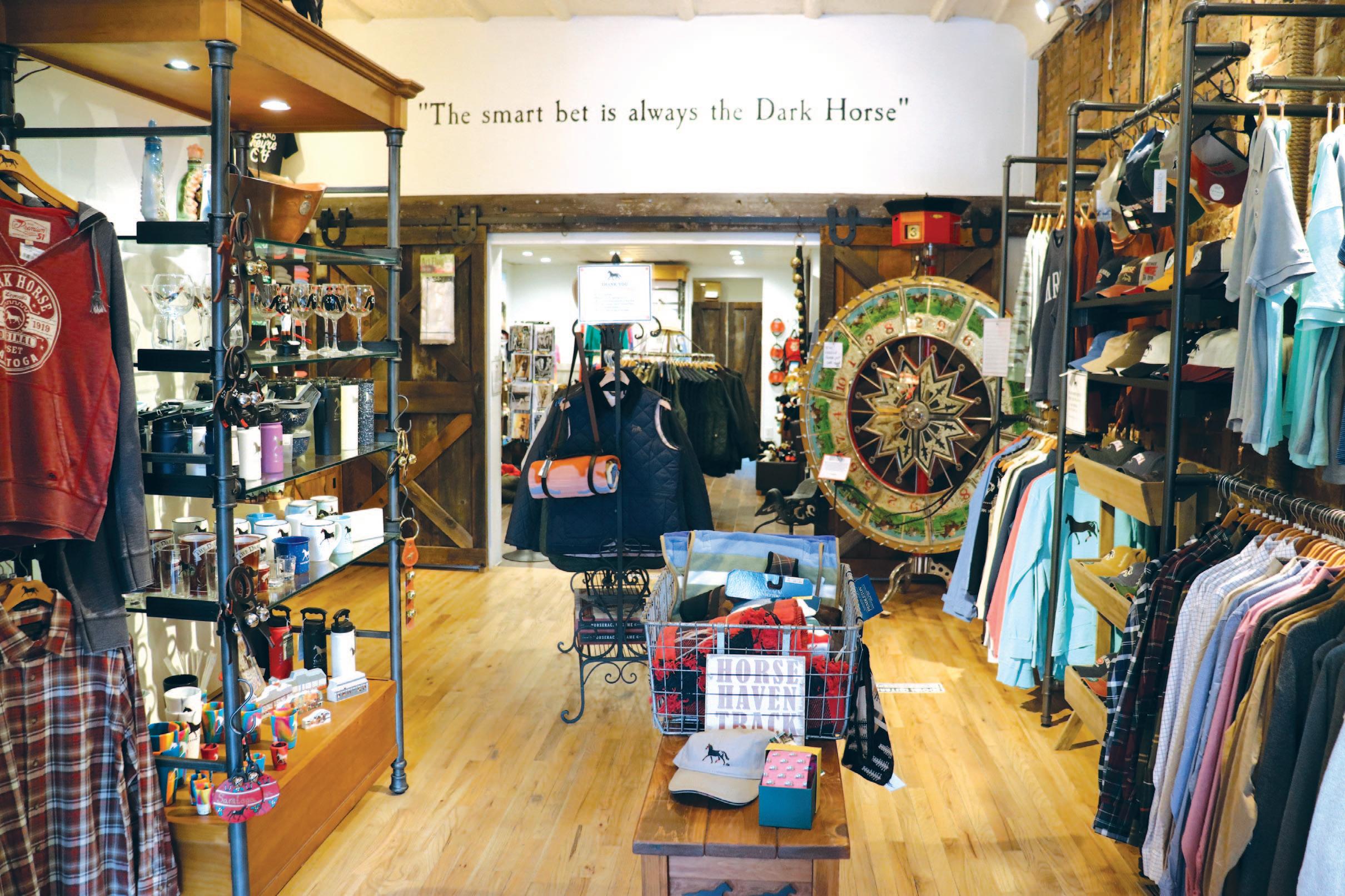
Because horses are so very synonymous with Saratoga and so important to both women, they launched the brand The Dark Horse in 2014, relegating a section of Impressions to the history, the legacy, and the enduring positive lessons of what a dark horse can teach. "It's all about overcoming odds and emerging victorious," Maddy said.
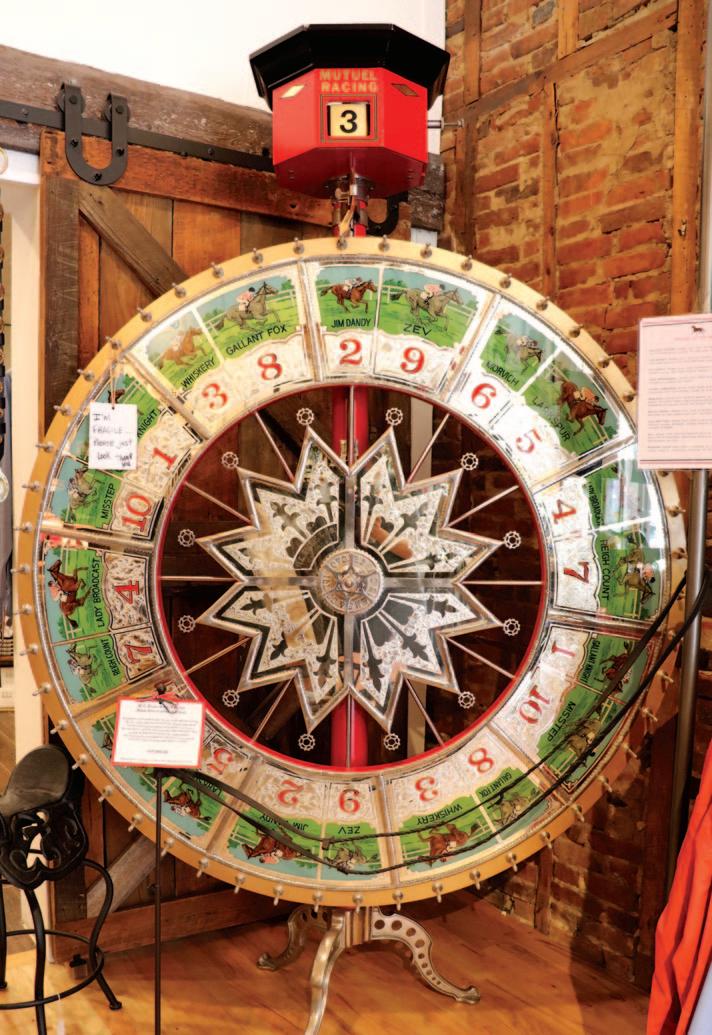
For the uninitiated, in racing parlance, a "dark horse" is one that is unknown so it's difficult for inveterate gamblers to justify placing a bet. It's the 30-1s, the 100-1s, the "also-rans" that few will chance their money on. Ah, but this is Saratoga where the dark horse has been championed since 1919 when "Upset" beat the unbeatable legend, "Man O' War."This is Saratoga where in 19 30 the su perstar "Jim Dandy" was defeated by a much lesser-known, "Gallant Fox." This is Saratoga where Triple Crown Win ner, "Sec retariat" lost the Whitney Stakes in 1973 to "Onion," and most recently when another Triple Crown winner, "American Pharaoh" went down in defeat to "Keen Ice."
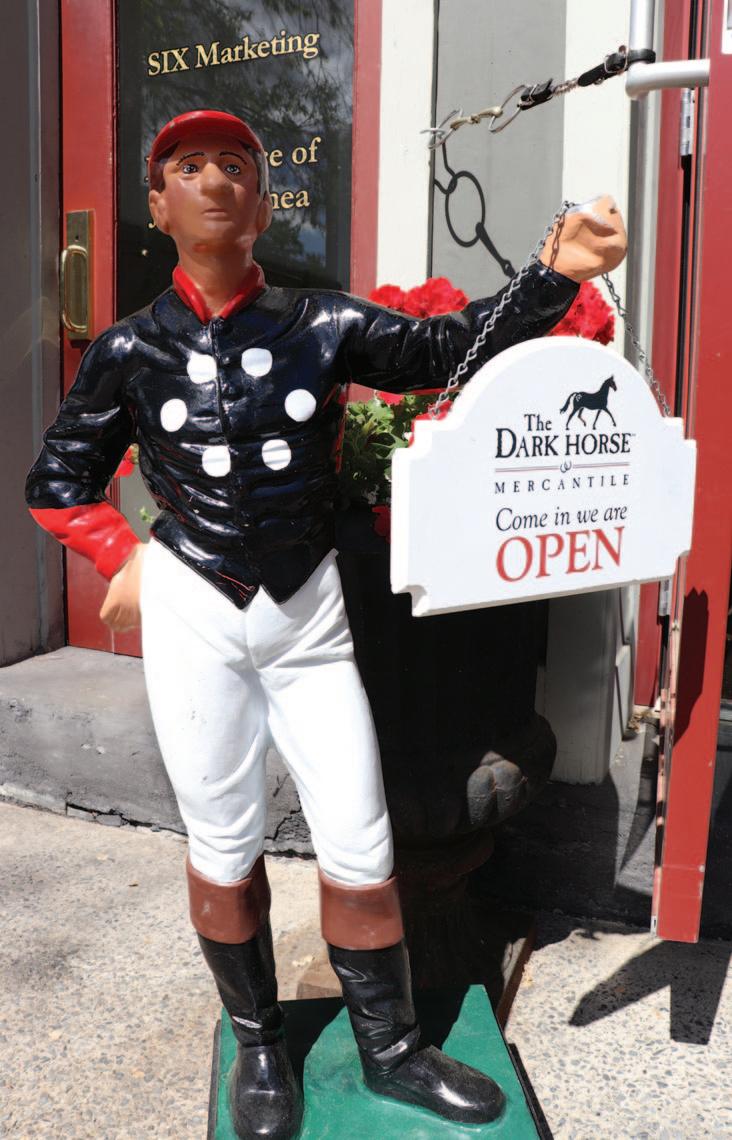
Mare and Maddy, therefore, celebrate the spirit of these great horses and equate the legacy they left to all those in life who may not have always finished number #1. Well, not so at Impressions nor at their other shop, The Dark Horse Mercantile, just down the street and opened three years ago. The Dark Horse is all about overcoming the odds, all about upsets, and features one-of-akind items that speak to this, even two children's books, Upset - The Original Dark Horse and Jim Dandy - A Dark Horse on a Dark Day.
"We will carry anything if it ties into the essence of this town," Mare states. And indeed it is the very essence of the town that is embodied here. Impressions is not only a frequent stop for residents who come to see what's new, to bring biscuits to the dogs, or just to say hello. The door is always open, and Maddy and Mare find each day so different because they never know who will be coming in. "I al ways loved people and love creating strong relationships with them," Mare says. "I couldn't think of doing anything else." And Maddy adores meeting visitors from all over the country and all over the world and giving them a history lesson right along with their purchase. "The best part is when people pop in year after year when they're visiting. They want to make us a definite destination during their trip, and we love remembering them. It's a good feeling all around."
Enter "Upset," that little black horse owned by both Maddy and Mare and an icon to the townspeople of Saratoga and its visitors. Upset appears in parades, at events, and from time to time makes a guest appearance at The Dark Horse, much to the total joy of everyone around.
This, then, is Impressions of Saratoga and The Dark Horse Mercantile, two definite stops in Saratoga whether you live here or just love here. Yes, they sell memorabilia and books and apparel and food, but above all, they sell total and complete joy, happiness, and an unadulterated respect for the land, the history, the horses, and the customers they are so delighted to meet and whose ac quaintance they enjoy revisiting.
"We feel we provide a service to both our community and the people who visit," Mare stated. This arrangement couldn't be more perfect. We have no regrets."
Impressions of Saratoga is at 368 Broadway, www.ImpressionsSaratoga.com (518) 587-0666
The Dark Horse Mercantile is not far away at 445 Broadway www. Dark HorseSaratoga.com. (518) 587-0689
Your Every Day "Destination" Restaurant Because Every Day's a Celebration At Lake Ridge Restaurant
by Rona Mann
photos by Stephanie Sittnick
We've all heard that expression, a "destination" restaurant.
Usually, it refers to going maybe only once or twice a year to a restaurant that is somewhat upscale, perhaps even dressing up (something there isn't much of these days!) for a birthday, anniversary, graduation, or another life mile stone, but it's not normally a place you would consider any other time.
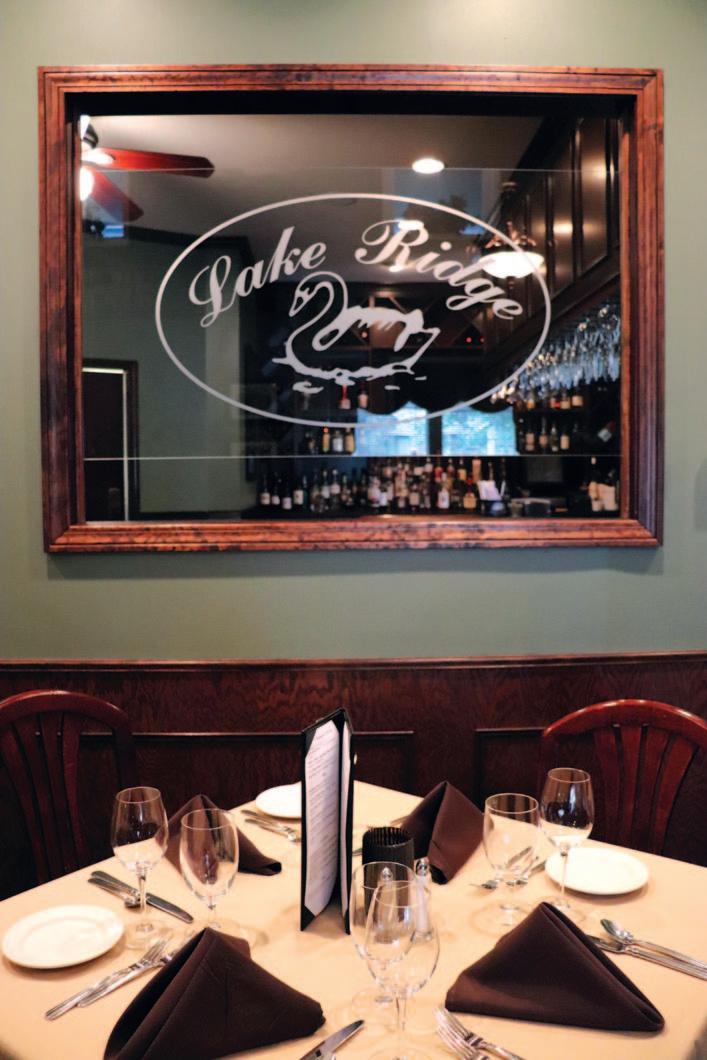
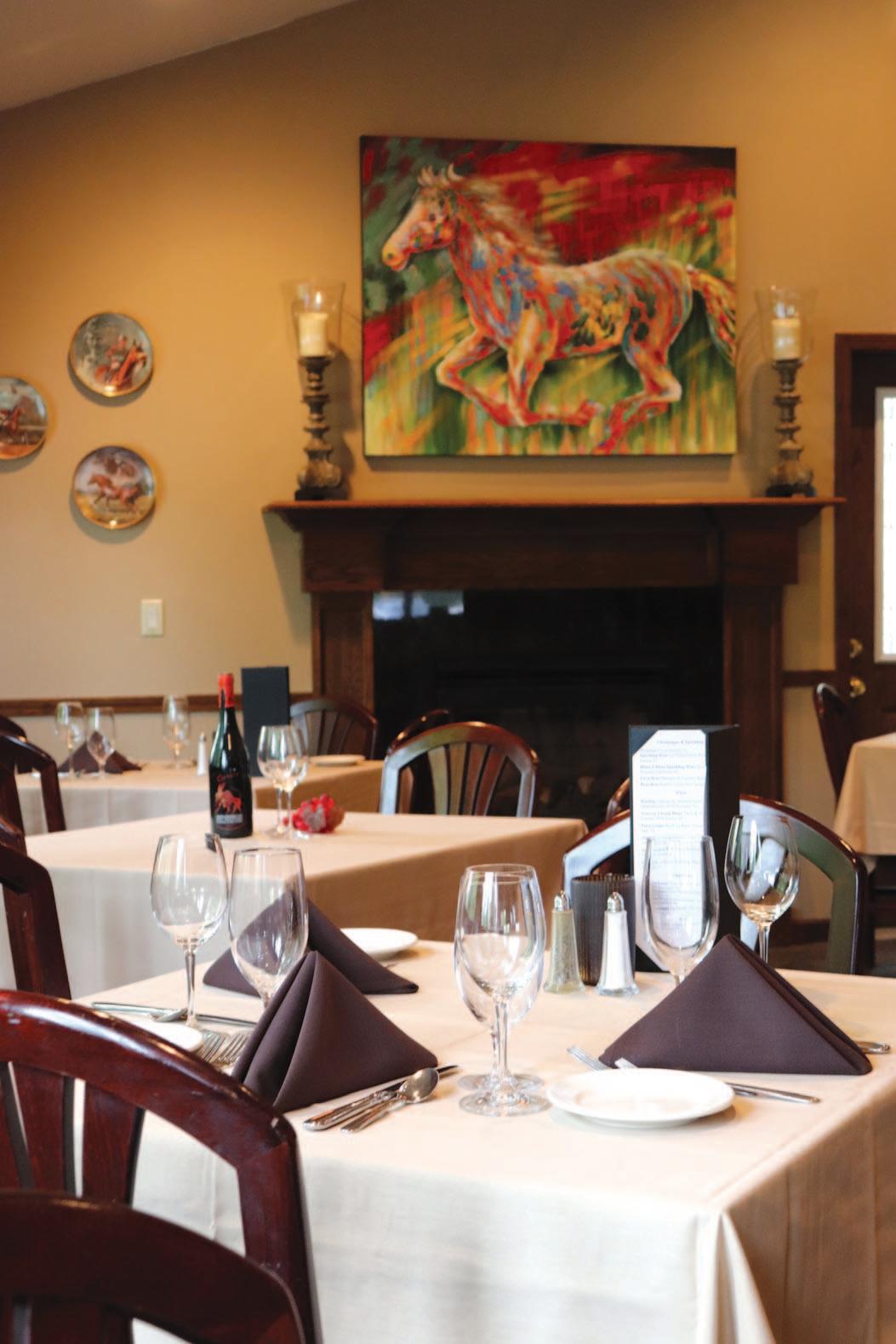
Well, why not? Why not consider excellent food always consistently prepared, a beautiful setting, incomparable service that's always at tentive and personal, yet never cloying, and an experience you'll want to revisit over and over again? Why not consider Lake Ridge Restaurant, your don't-need-a-reason destination for celebration.
After the year-plus we've all been through, why not celebrate the joy of getting through it?
Why not celebrate the good fortune that you and your loved ones are healthy, the sun is shining, the weather's warm, and you don't need to wait for your birthday to enjoy life once again? In essence, this is all our birthdays... it's a rebirth and a renewal and a wonderful way of looking at life, realizing how fragile and precious it is. It's time to hug and celebrate each other. It's time once again for Lake Ridge in Round Lake...and not just once a year!
But before you appreciate the incomparable food, service, and breathtaking location, you have to embrace the backstory, for it is this w hich makes Lake Ridge stand out and why it ha s endured. It's a wonderful story of friendship, belief, and respect that translates
into 20 solid years of knowing that the key to being a suc cessful part of the hospitality industry is realizing that your sole purpose is to make and keep people happy, that the entire experience of dining, whether it's with a burger or fine upscale cuisine, is to be consistent, give value for the diner's dollar, and above all, to do whatever it takes to make them happy and satisfied.
So this story is about automobiles, neighbors, taking chances, and making those chances
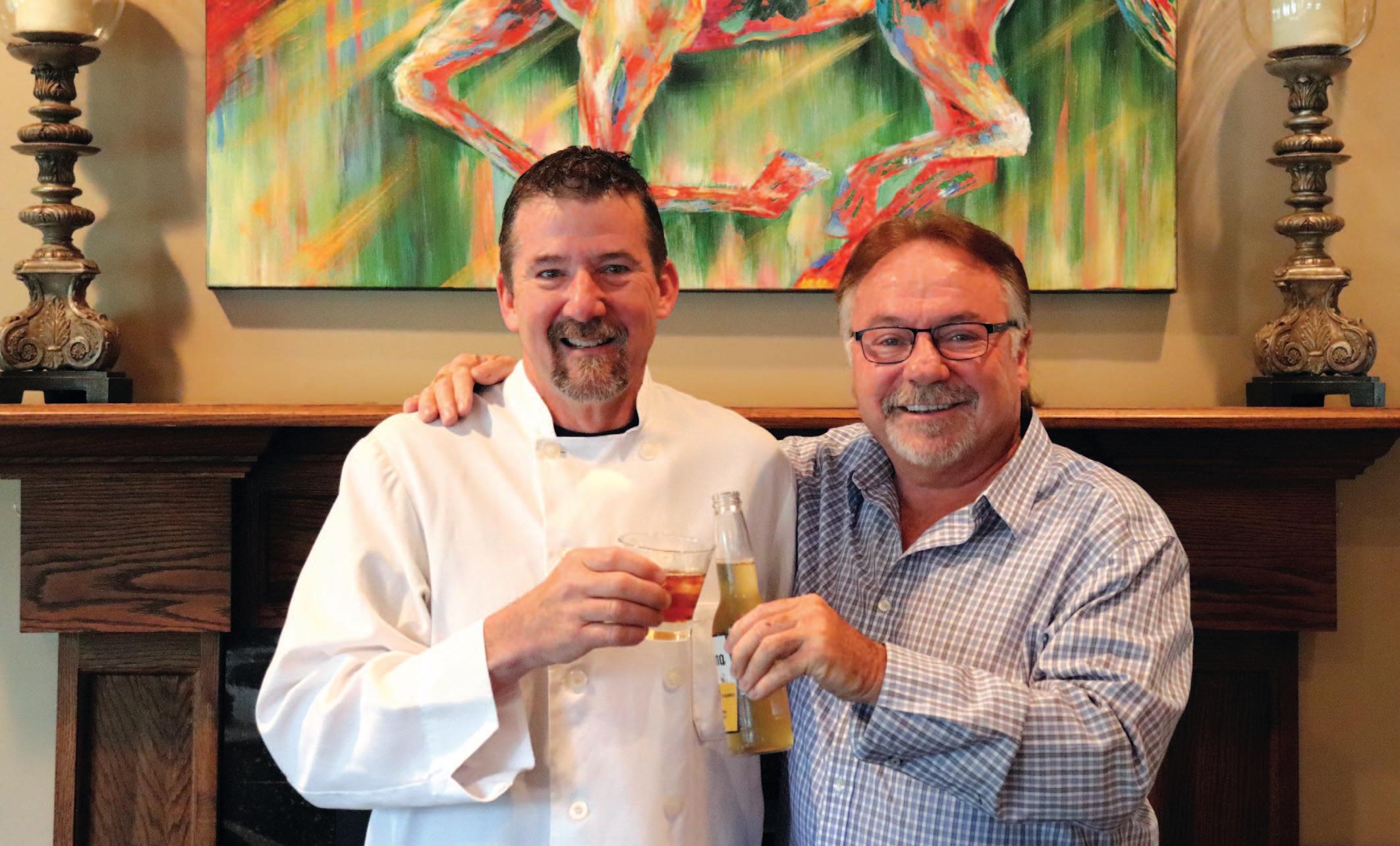
Chef Scott Ringwood and Bob McKenna
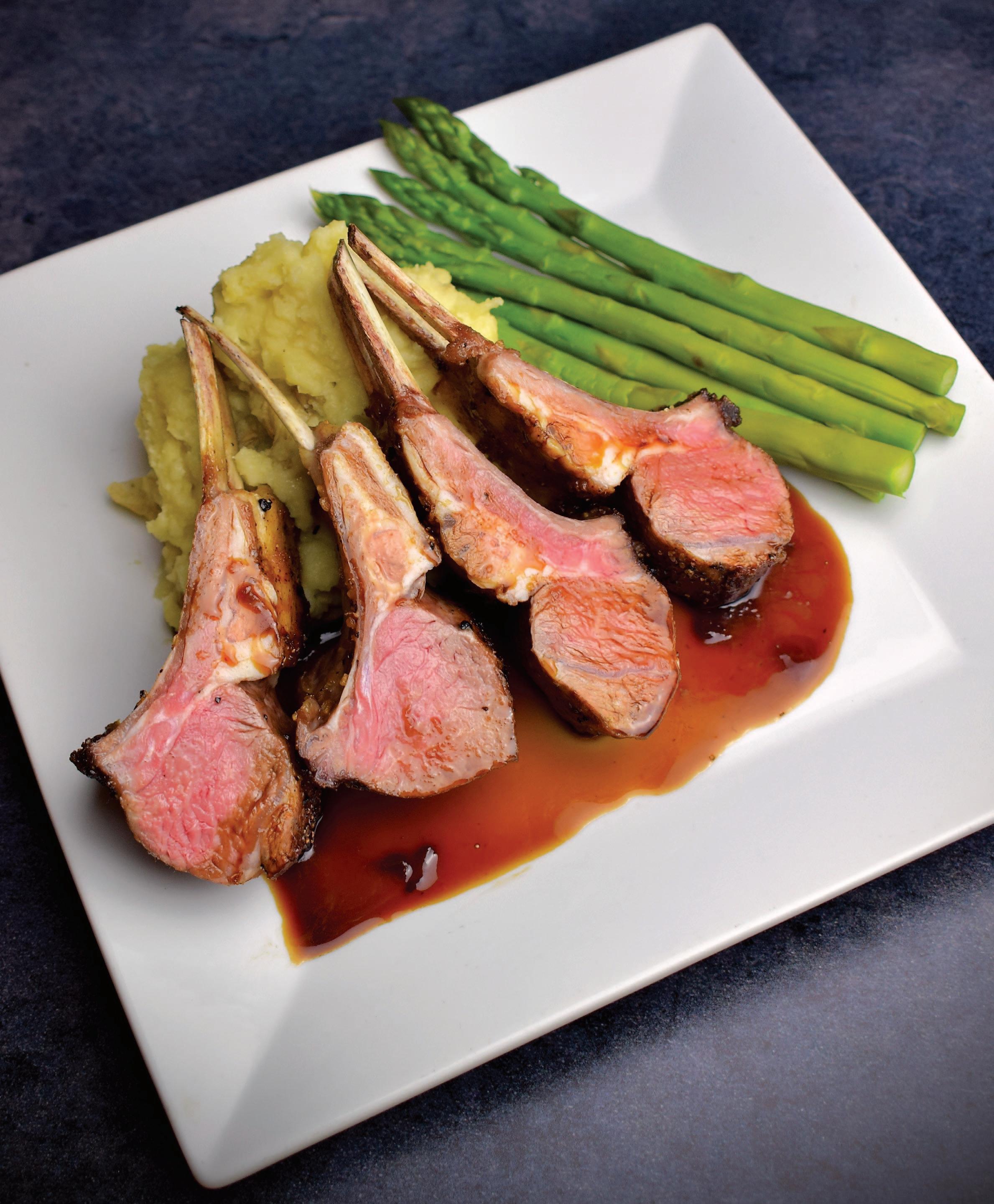
The Grilled New Zealand Lamb Rack, finished
a rosemary red wine demi-glace
evolve from dream to opportunity through hard work, respect, and dogged determination.
Yes, it all began with an automobile dealership in Saratoga where Bob McKenna was part owner for some 32 years and successful at what he built. It doesn't matter to Bob whether you're selling a vehicle or a steak, you still have to value the customer's experience and respect it at all costs.
At the time, Bob lived in Clifton Park and had forged a solid friendship with his neighbor, Scott Ringwood, a self-taught chef who was in the process of leaving an 11-year run at The
Old Dater Tavern. The two men began talking at a neighborhood party one day, and McKenna said, "I'd love to be your partner." Ringwood echoed a similar sentiment, and be fore long, the two men had purchased the building that housed Sweet Nothings, a breakfast and lunch eatery in Round Lake.
The partners completely remodeled it, and it became an upscale showplace with three separate rooms, two with fireplaces and each with its own distinct personality. From the very first, Lake Ridge Restaurant drew crowds. New places always draw crowds ini tially, the trick is to keep them. Well, over a
20 year period, through a recession and a pandemic, and many other bumps in the eco nomic and health scare road of this coun try, the incomparable success of Lake Ridge has never waivered. Why is it then that this restaurant has flourished when others have fallen on hard times or had to close? Once again, consistency. Consistency of Chef Scott's food, consistency of Bob McKenna's management style, and the total respect they have for one another. Bob keeps out of the kitchen, and Scott lets Bob do what he does! But Bob adds another very important piece to its success.
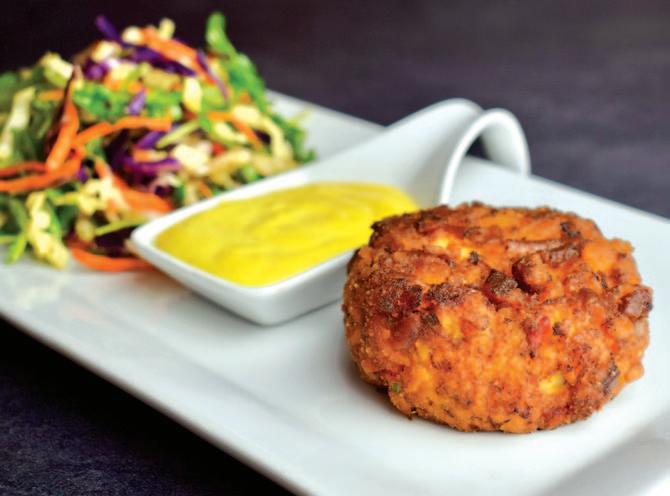
Pretzel Crusted Crab cake & Lobster cake served with curry mango aioli.
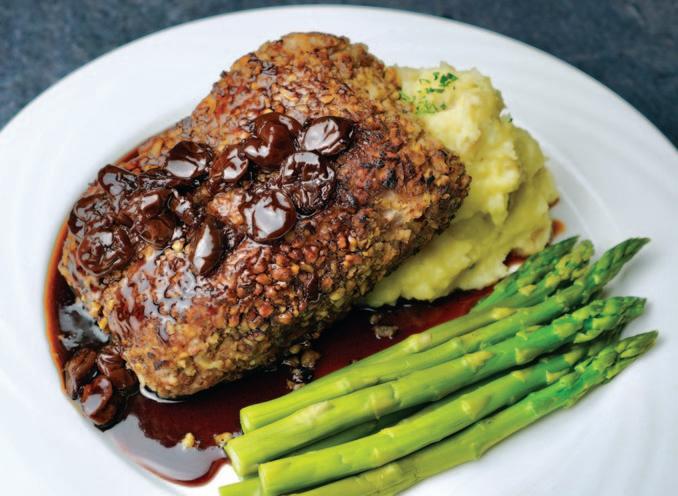
Pecan Pork Chop encrusted in pecans, and finished with a tart cherry demi-glace
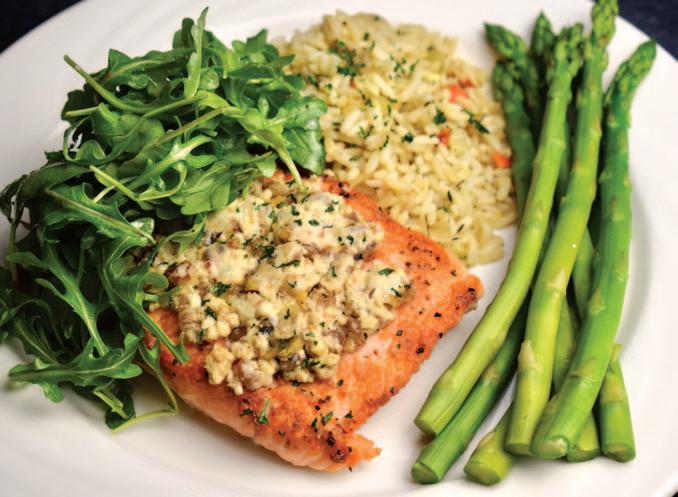
Goat cheese, walnut, and fig crusted Salmon fin ished with raspberry arugula vinaigrette
"We have a very good core of people here. Diana manages the front of the house and has for nearly all of our 20 years. She knows the customers, and the customers know her. Christina and Janelle are experienced servers. They know the menu, they know how to make suggestions, they appreciate their customers, and they love working here. Mike in the kitchen is a sous chef and Chef Scott's right hand at all times. We could not do what we do without our staff."
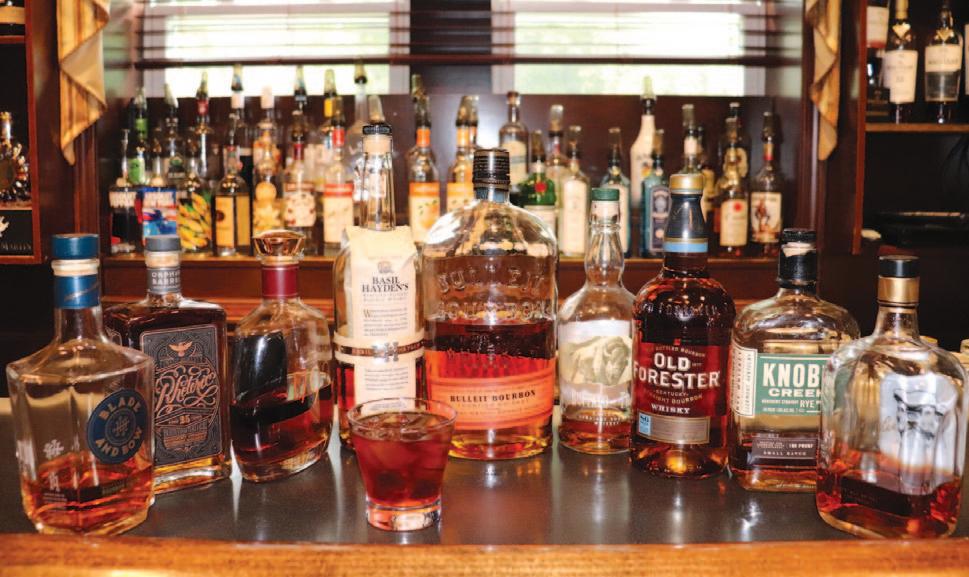
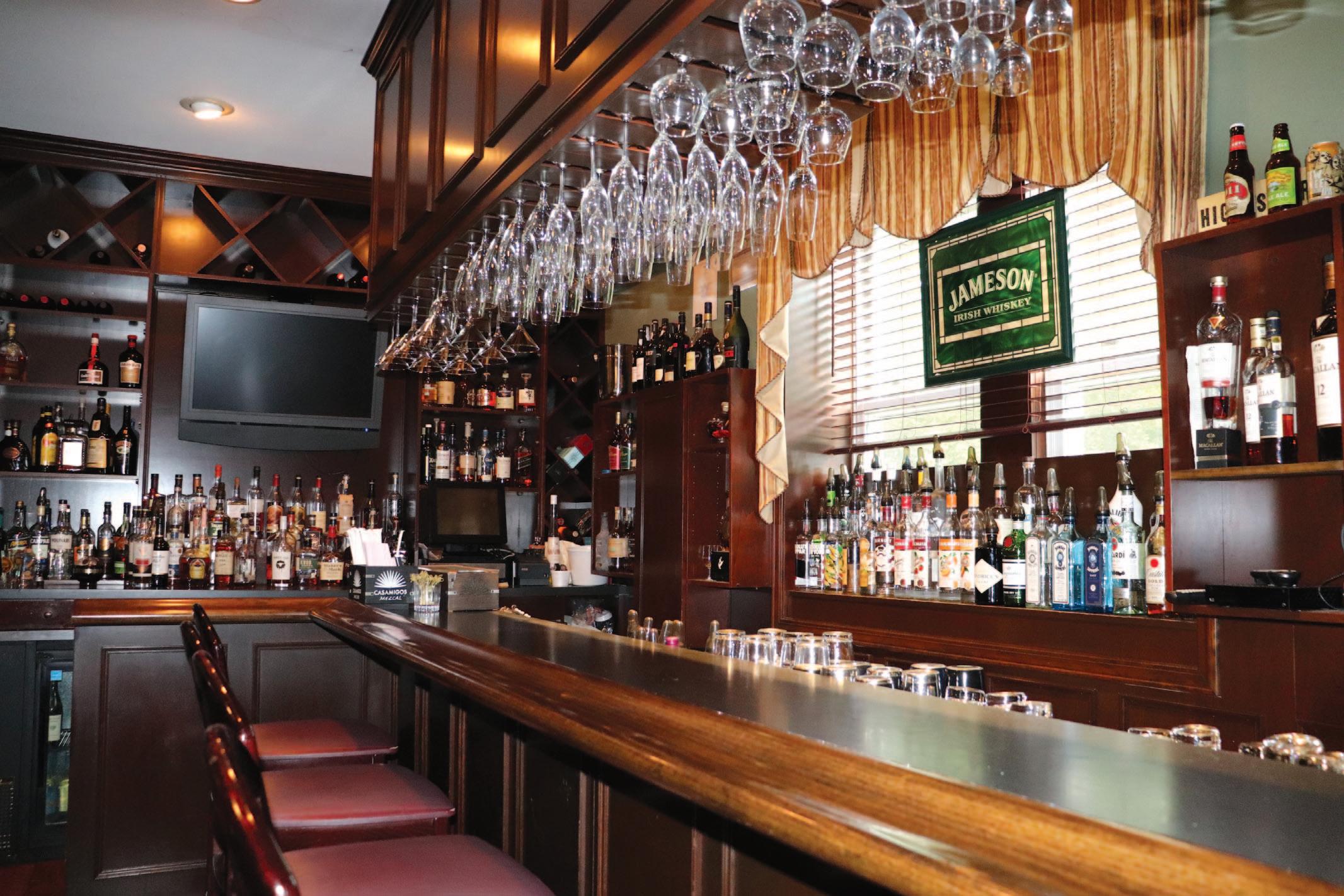
McKenna stops for a moment then adds, "Our Mahogany Bar Room boasts one of the most extensive selections of beer, wine, and spirits in the Capital District with more
than 30 scotches and 20 bourbons to add to your dining experience."
The food at Lake Ridge is categorized as New American Cuisine which is a type of fusion cuisine that assimilates flavors from the melting pot of traditional American cooking techniques and marries it with innovative components of season ings and sauces. It incor porates elements of French, Nouvelle, Asian, Latin American, and Mediterranean cuisines. Bottom line: when one of the owners is the guy in the kitchen doing the cooking, you are always going to have a wonderful end result and experience because his name and his reputation are on every dish that comes out of that kitchen.
If they weren't busy enough, McKenna and Ringwood also own another restaurant, Dunning Street Station on Rt. 9 in Malta. This venue is all about casual fare: small plates, appetizers, burgers, a full bar. "It's American food with an Italian flavor," Bob adds.
Both men realize it is not enough to just be lo cated in a community, you have to be a part of that community, so they are very generous, donating to village events and always trying to
be supportive of whatever is happening in Round Lake. "This community embraced us from the first," says McKenna, so we are both proud and happy to give back to them." Once again, it is that commitment to partnership that has garnered and powered their success.
There is a definite art to con sistently putting out good food and drink, and the part nership of McKenna, Ringwood, and their talented staff have mastered it. They also realize there's a partnership with a respected customer base of 20 years and that is valued and never forgotten.
"When our customers walk out after a dining experience here they make plans to come back. Many make reservations for the next time before they even leave."
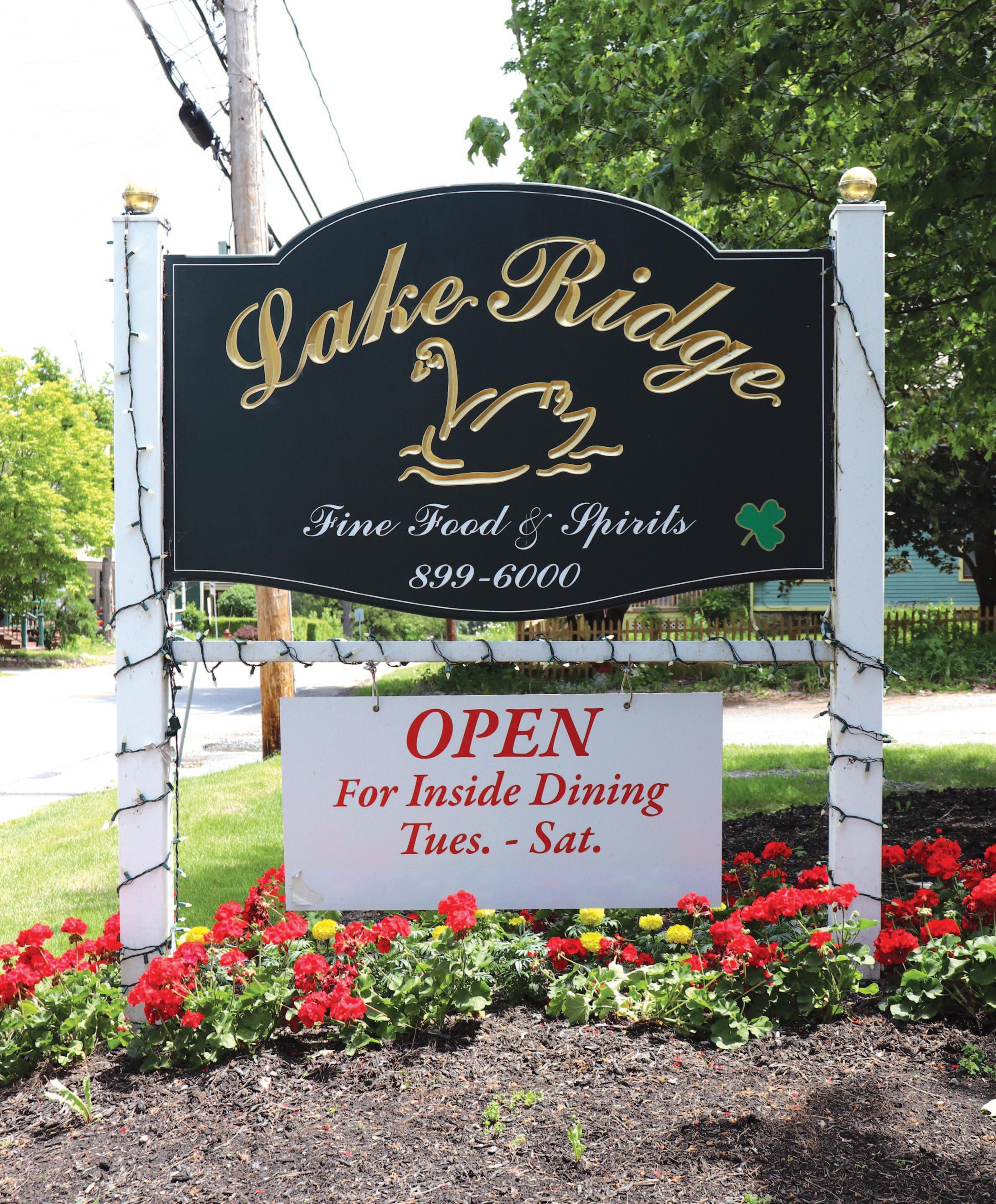
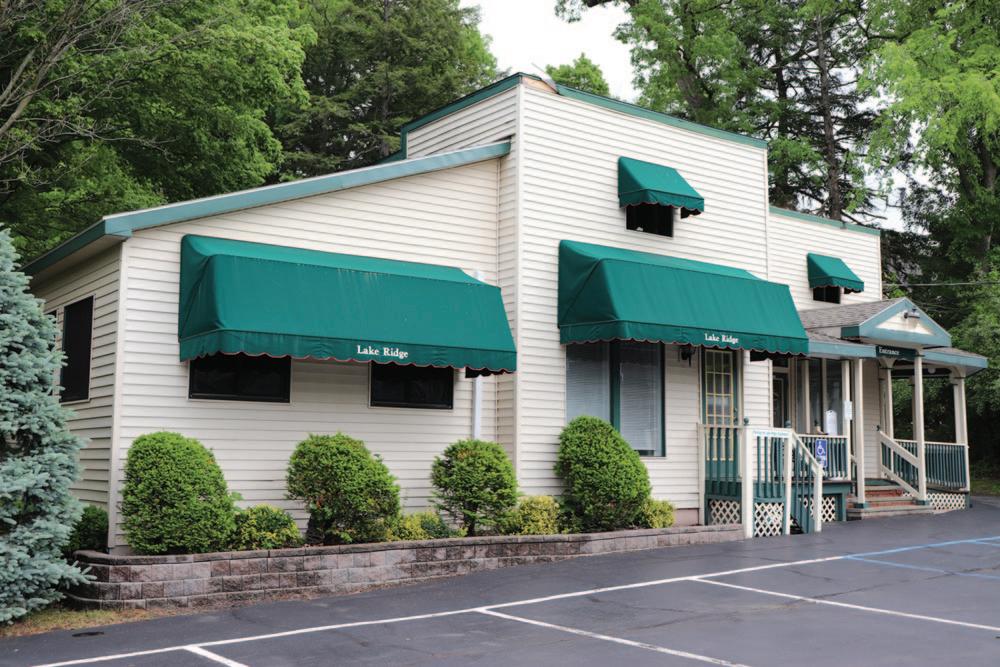
Lake Ridge Restaurant is lo cated at Exit 11 just off the Northway, 35 Burlington Lane in the quaint village of Round Lake.
RESERVATIONS ONLY, PLEASE! (518) 899-6000
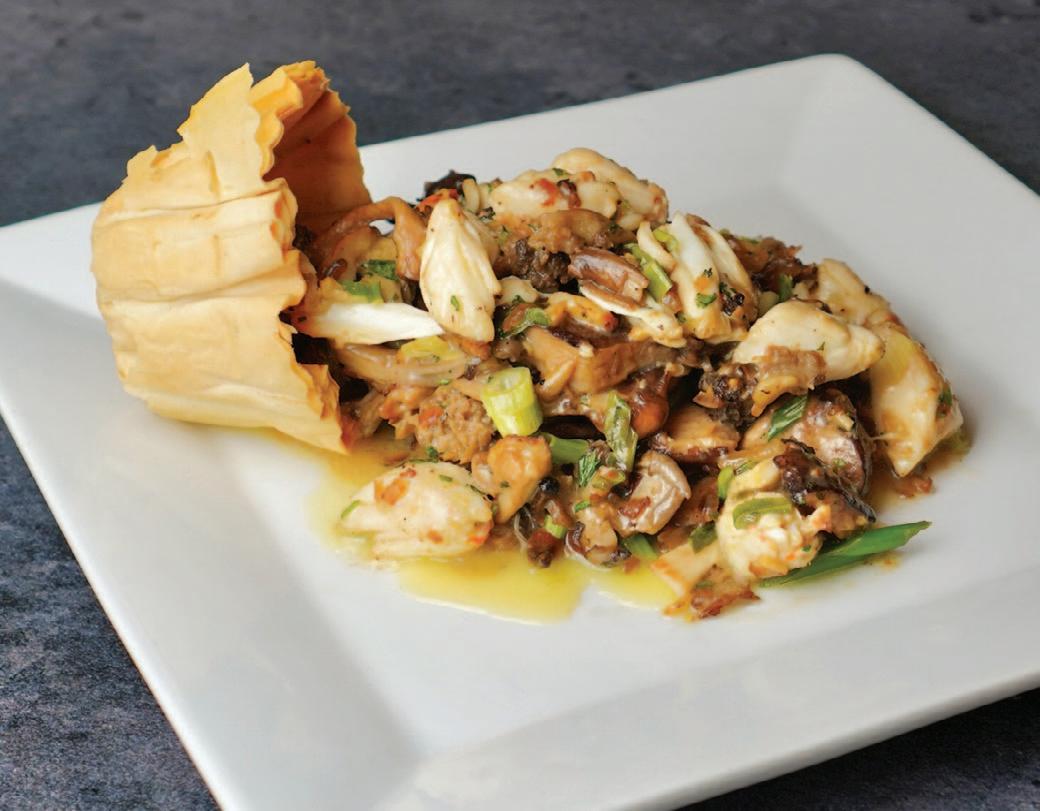
Mushroom and Crab Phyllo Cup in a garlic sherry butter sauce
Photo by Nellie Ackerman-Vellano, Feed Me 518™
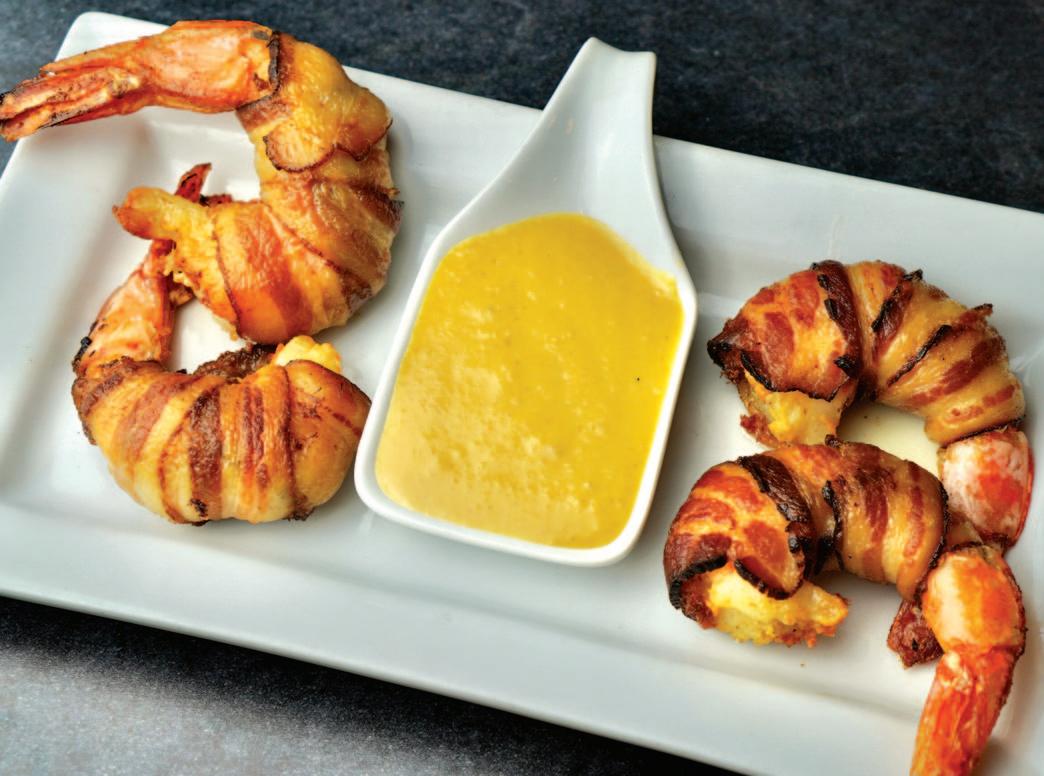
Bostonian Shrimp, jumbo shrimp wrapped in bacon and served with maple Dijon horseradish dipping sauce. Photo by Nellie Ackerman-Vellano, Feed Me 518™
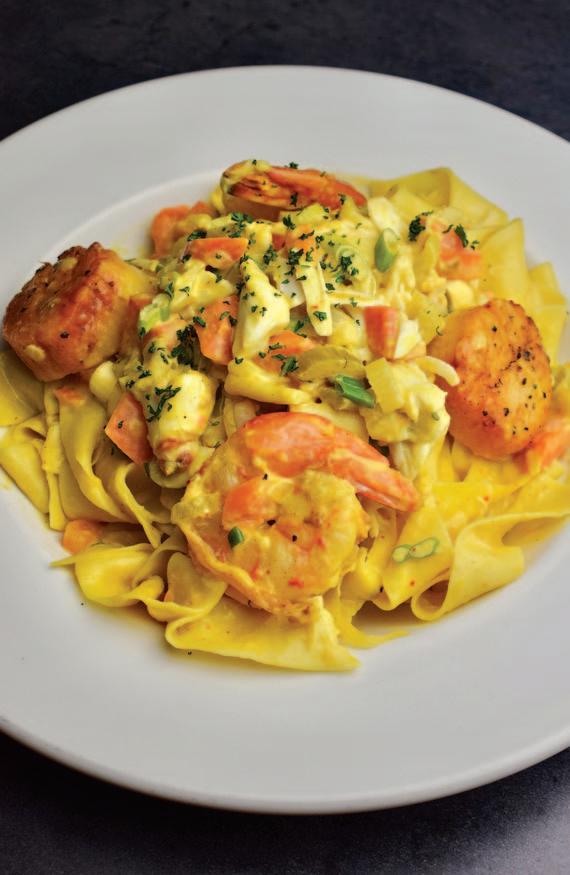
Red Curry Seafood Bolognese tossed with pappardelle pasta
Photo by Nellie Ackerman-Vellano, Feed Me 518™
Small Town English Pub has Big Influence Beyond Borders
By Nellie Ackerman-Vellano, Feed Me 518™
It's very rare that someone who sees the three little letters "MOK", doesn't know what it stands for or hasn't been to the Man Of Kent.
If you've been on a mission to find the best little unique bar in Upstate New York, you'll find it in rural Hoosick Falls, just minutes from the Vermont border. You'll find eclectic memorabilia embellishing the entire interior of the venue, and you'll be greeted by a friendly staff that re members you from your last visit.
This authentic English pub was established in 1984 by none other than a man from Kent, England. Jon Bombard purchased the MOK in 2007, and he brought over two of his closest friends to be a part of his team...Mike Barber, the very talented Head Chef at MOK and Spoon, the Bartender. Yes, his name is Spoon. Don't ask questions. We all know him as Spoon. Jon is known by all the locals and regular customers as "Jonny B," and at some point during your dining experience, you'll hear someone shout out "Jonny B!" across the bar.
August 2021 marks the 14 year anniversary that this trio of friends has been making the MOK experience happen for all of us.
When I asked Chef Mike what inspires him, he shared, "My biggest kitchen influence would be my mother’s cooking. She was a great cook and helping her in the kitchen as a child has influenced me as a chef, much before I knew this would become my career." "When taking over the Man of Kent kitchen, the menu that was in place was limited. Jon allows me free range to build and expand the menu," said Chef Mike. Chef Mike started taking what was on hand in the kitchen and leftover to create something new, then he added it to the Specials Menu. Cus tomers liked what he was making, so it would be added to the menu.
I've been coming here for four years. My husband lived nearby for many years before I met him, and he prides himself on having eaten his way
down the entire MOK menu. He said he's never had a bad meal here ever, and he's eaten everything they make.
My favorite appetizer, and something that I've gotten as my meal for lunch too, is the Sesame Crusted Ahi Tuna with ginger sesame dressing, scallion infused olive oil, and Szechuan sauce.
Their Cobb Salad with Blackened Skirt Steak is loaded with avocado, hard-boiled egg, bacon, tomato, and blue cheese crumbles.
We love their Bruschetta made fresh with garlic, tomatoes, onions, Provolone cheese, olives, art ichoke heart, olive oil, fresh basil on crostini, and finished with a caramelized balsamic vinegar.
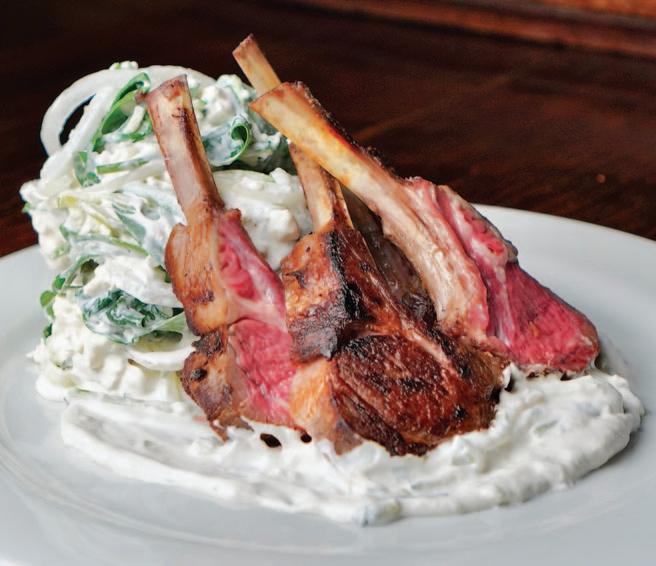
The Lamb Lollipop Chops are an MOK Special, and if it's on the menu, I order them. They are amazing! The lamb chops rest against a large pile of fresh onion, feta, and cucumber tossed in their house- made Tzatziki sauce.
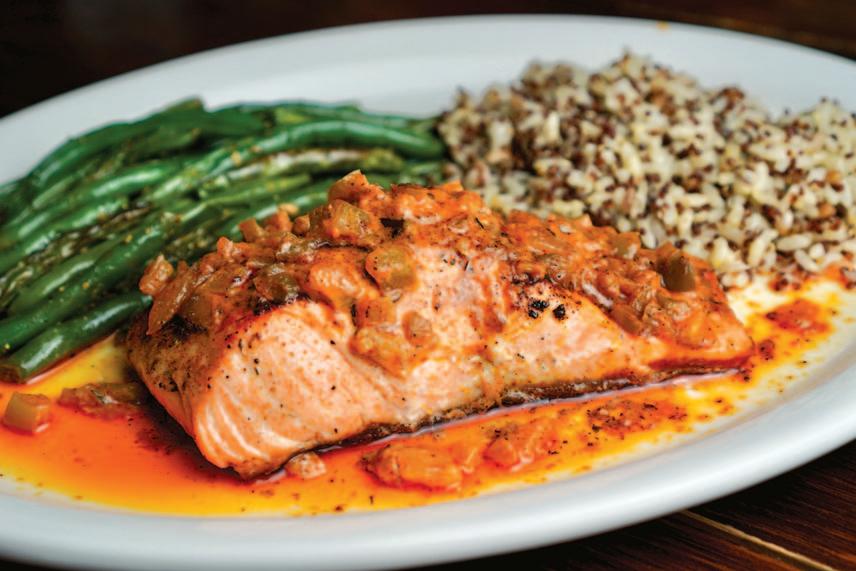
The Blackened Salmon is loaded with amazing flavor, and topped with Southern creole butter, onions, celery, green peppers, and a side of quinoa, white rice, and barrow. Cooked vegetables accompany this dish.
I've had the Fra Diabolo several times and will keep going back for that dish. The pasta is covered with scallops, shrimp, calamari, mussels, and clams in a spicy marinara sauce. There is an option to add a lobster tail.
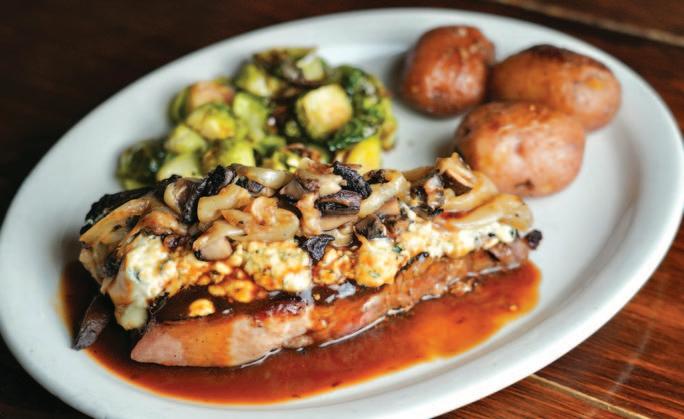
The Shingle Hollow NY Strip Steak, named after the Shingle Hollow creek that runs alongside the MOK is topped with melted blue ch eese, Bordelaise sauce, sauteed onions, and Portobello mushrooms.
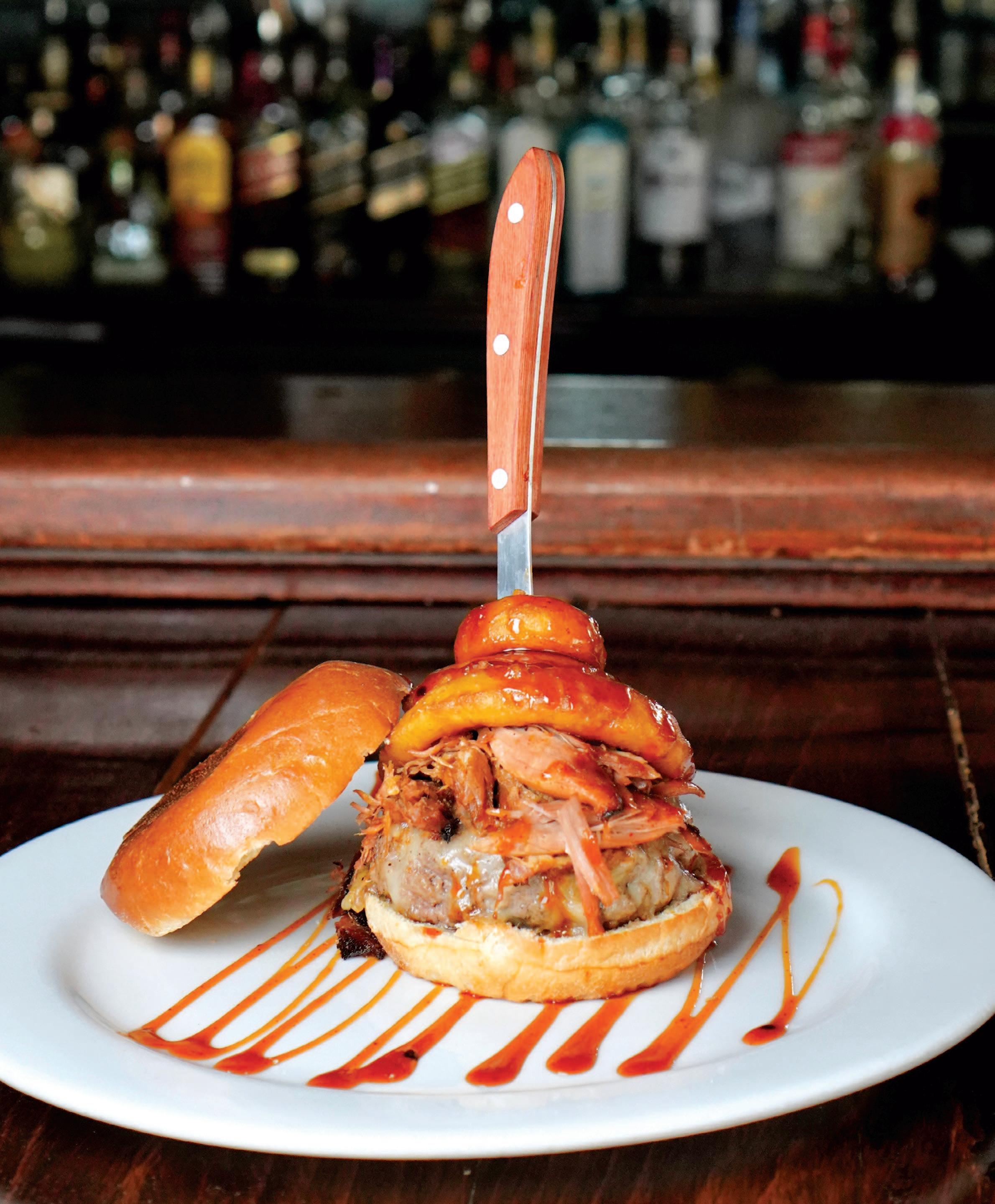
The Rodeo Burger is filling so make sure you're hungry if you go for this one. It's topped with cheddar cheese, a pile of pulled pork, a stack of onion rings, and drizzled with a bourbon molasses glaze.
The Jonny B Burger is an MOK classic topped with Swiss cheese, sauteed mushrooms, and onions with a perfectly cooked sunny-side up egg.
The MOK is truly a destination place that people go out of their way to experience. I personally drive 40 minutes to sit at the bar on a Sunday and eat my way down their delicious menu with my husband. I sincerely believe you will enjoy the MOK experience.
The Man Of Kent Tavern and Cafe is lo cated at 4452 State Route 7, Hoosick Falls, NY 12090
Happy Eating!
Nellie Ackerman-Vellano, Feed Me 518™
Instagram: @FeedMe518
FB: www.facebook.com/FeedMe518
Website: www.FeedMe518.com
Lamb Lollipop Chops
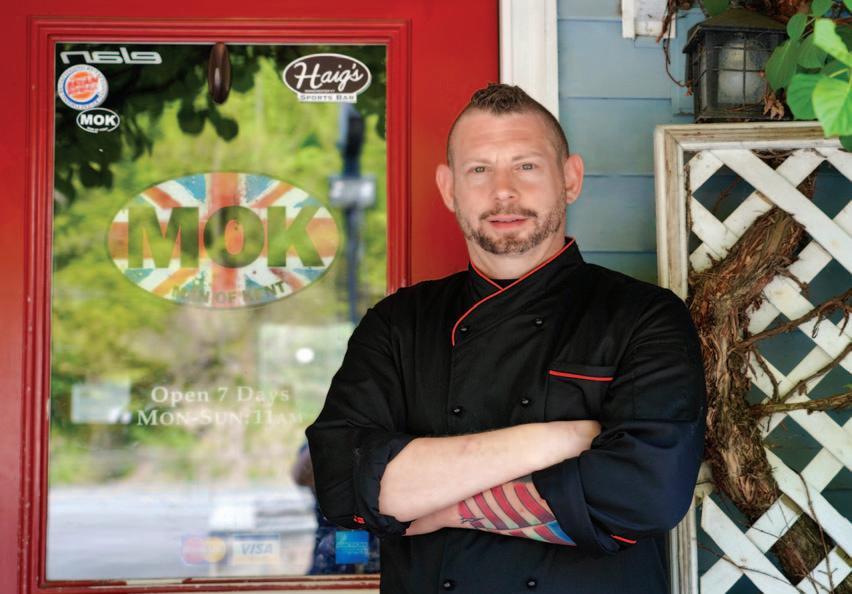
Head Chef Mike Barber
The Shingle Hollow Ny Strip Steak
The Blackened Salmon
Fra Diabolo
"Imitated, But Not Equaled!"
Alan Richer - A Chip Off the Old Block
by Carol St.Sauveur Ferris
Google any topic online and you’re sure to find at least one tidbit of information that will answer your question or satisfy your curiosity. Google potato chip and you’ll find a plethora of facts, fiction, and myths surrounding the ubiquitous snack. Not found o n the food pyramid but hidden in plain sight in most kitchens and pantries, the po tato chip is an American staple. Backpacks, lunch bags, c ar consoles, and desk drawers often harbor the last vestiges of opened bags. And greasy, salty fingertips offer indisputable evidence of countless happy snackers.
Every kind of chip you can imagine is out there. Just check out any fast-food joint, drugstore, grocery store, gourmet food mar ket, gas station, vending machine, and more…they’re everywhere, and if one were able to count how many of these tasty de lights are eaten in a lifetime, the number would be astronomical. One recent study by Statista states that 34.69 million Americans ate at least 16 bags of chips or more in 2020. And according to Spoon University, a typical snack bag of chips weighing anywhere
from 1 – 3 ounces contains 10 – 80 chips, which means, a single person ate 160 – 1,280 chips or more just during quarantine!
Ask anyone what their favorite chip is, and they may describe one kind for dipping, an other for scooping, and even others for munching right out of the bag. There are chips for special occasions like the Super Bowl, as a side with a burger or dog, and for a quick snack on the run, and let’s see,
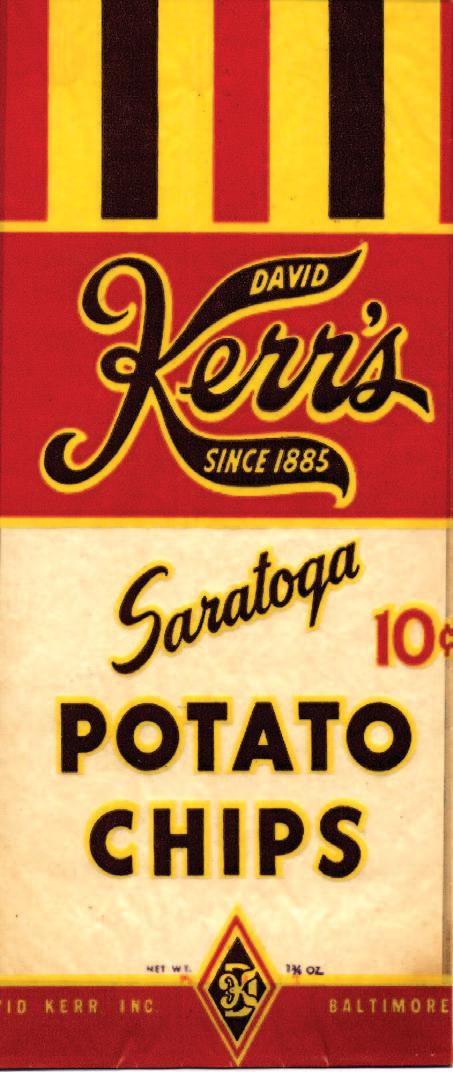
David Kerr Potato Saratoga Potato Chip Bag. Baltimore, MD since 1885. Circa 1930
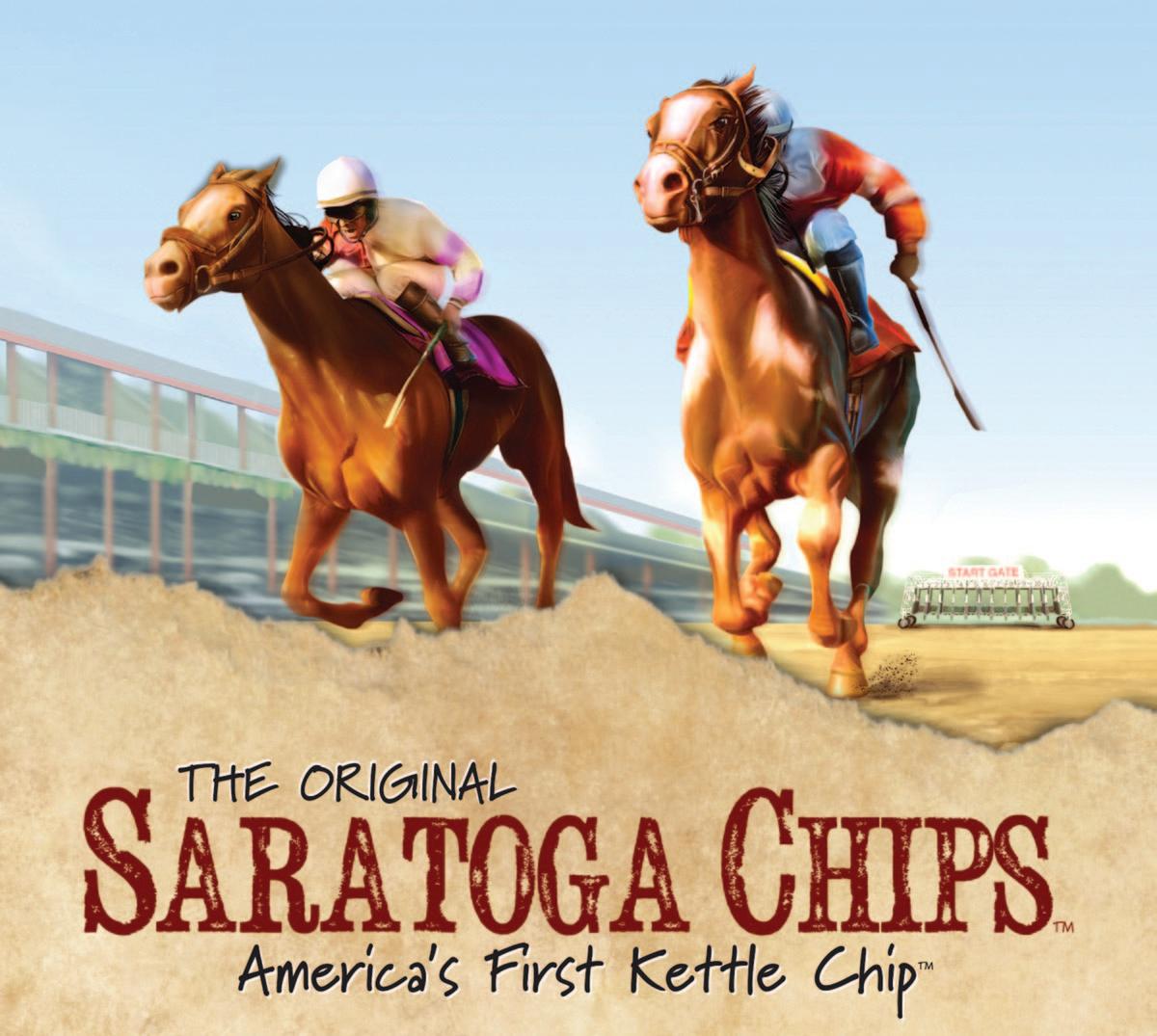
Moon Brand Saratoga Chips Horse Bag. Saratoga Specialties, Saratoga Springs, NY 2013
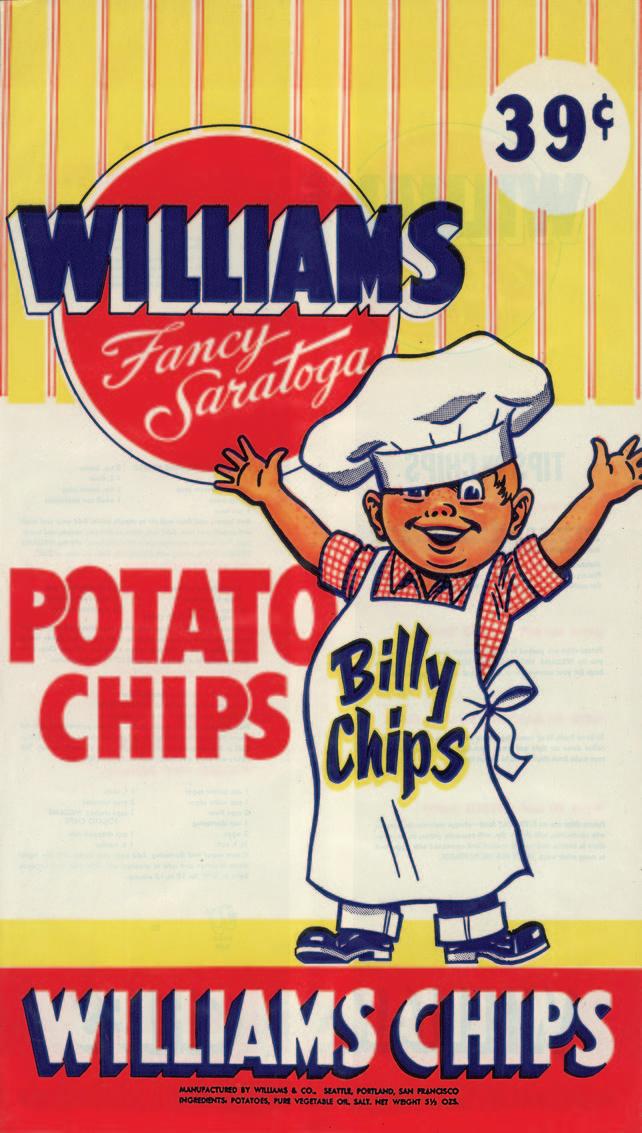
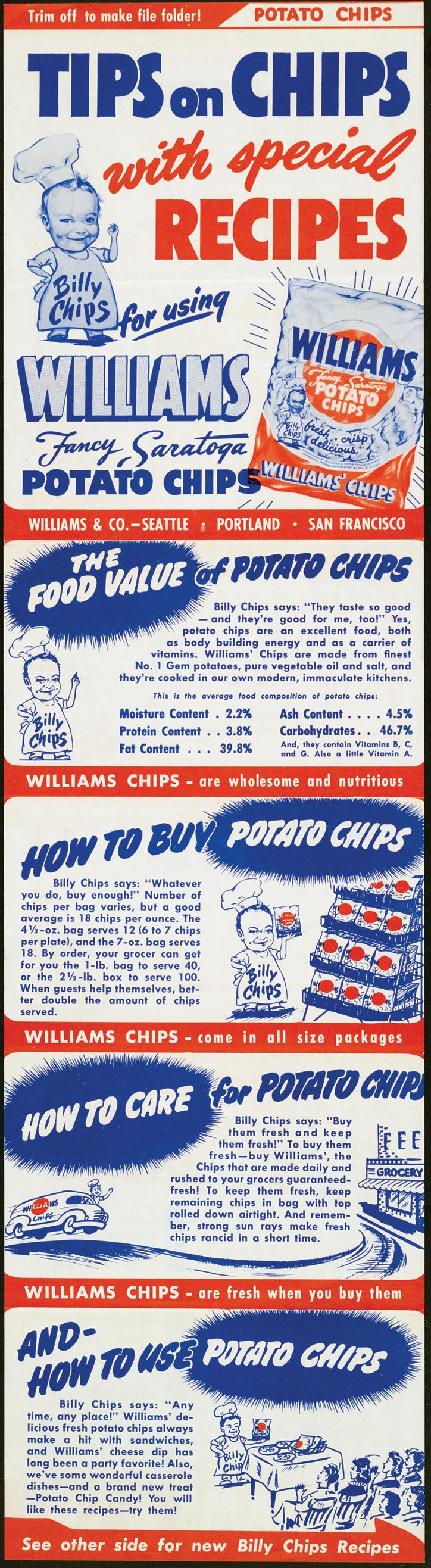
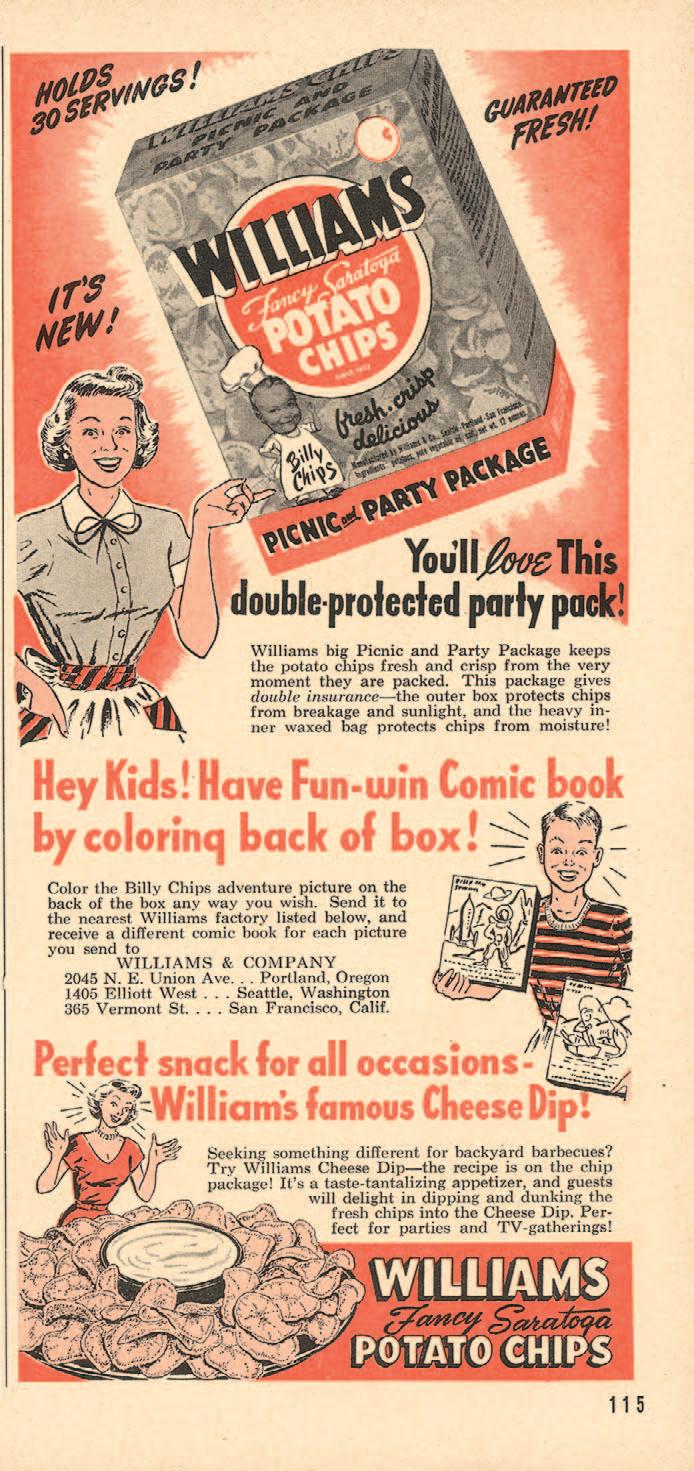
Williams Fancy Saratoga Chips Bag, Portland, Oregon 1950’s
Like most kids, Alan enjoyed his potato chips, but his Toga Chip Guy moniker came about much later in life. Born in Newark and ultimately settling in Clark, New Jersey, Alan’s childhood was all about baseball, football, the Good Humor Man, and everything else a great neighborhood filled with kids in the '50s and '60s was known for.
how many of us are guilty of arranging a layer of potato chips in our sandwiches to add a little crunch? Thought so.
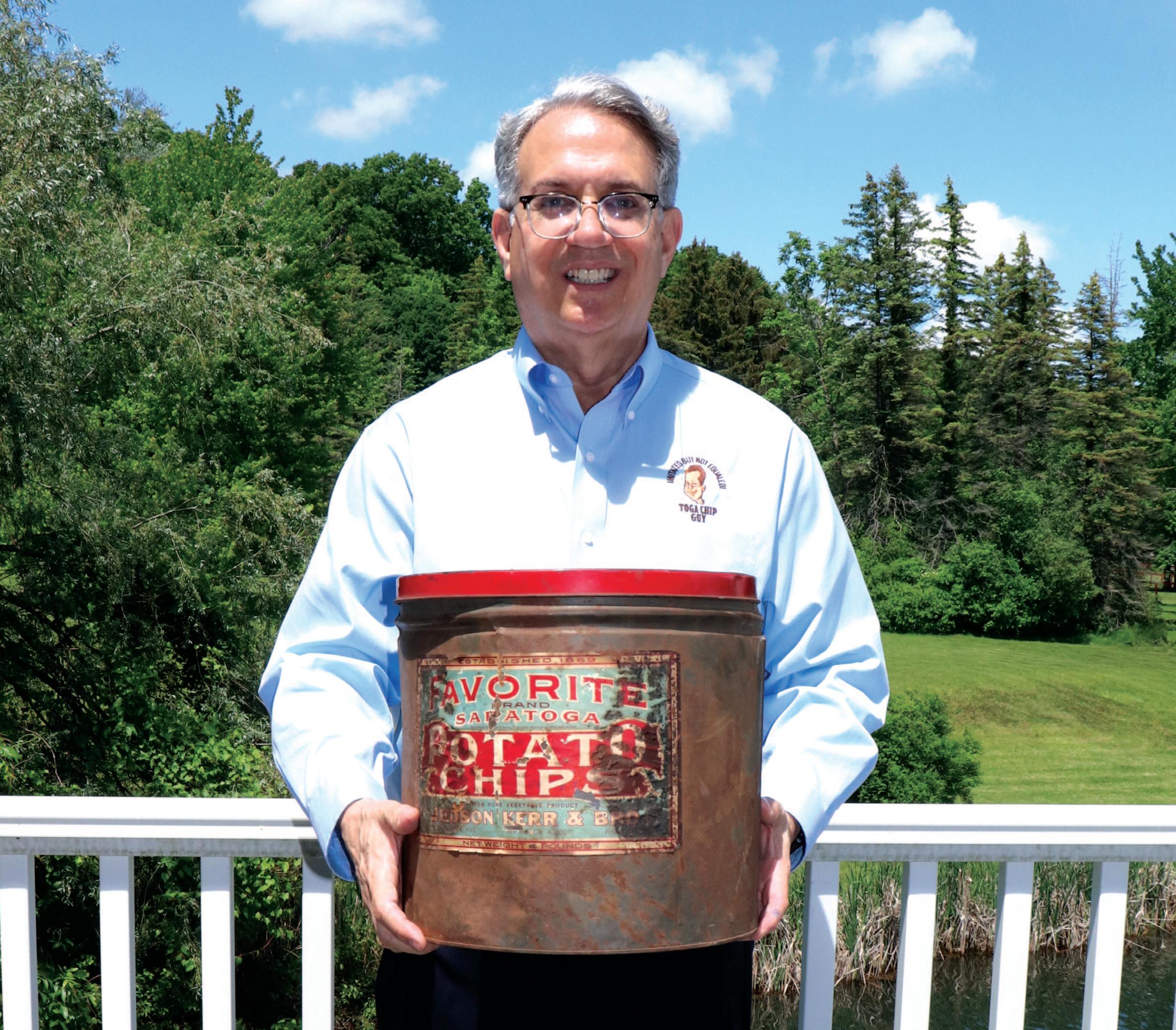
But the burning question is, how did the venerable potato go from mashed and baked to sliced, fried, and salted? Look no further than Alan Richer of Saratoga Springs, New York for the answers to that question and many other spud-related topics. Dubbed the Toga Chip Guy by former Times Union Reporter, Mark McGuire, Alan did not come by his potato chip expertise easily. It was only after persistence met serendipity that it morphed into his unexpected passion.
His father was a CPA, and his mother, a bookkeeper. It comes as no surprise then that he went on to make a career in taxes. His undergrad years were spent at Syracuse Uni versity where he was a triple major, graduating with a degree in Accounting, Risk Management and Insurance, and Communications. He was in the Honors Program for most of his classes in their MBA program and graduated first in the School of Management that year. After Law School, he took a job as a tax lawyer for Exxon in Texas and was later transferred to the world headquarters of the chemical divi sion in Darien, Connecticut.
While living in Connecticut, he serendipitously met his wife Jessie at a BBQ on July 20, 1984. He proposed five days later, and they married on September 1, 1985. He joined GE In 1990 which required that he and Jessie move to Albany, New York, and he has lived in upstate New York ever since. Following the death of his closest friend and colleague in 2012 and a terrible car accident in 2013 that miraculously left Alan unhurt but pretty shaken up, he decided to retire and focus on his other passions.
One of the tasks Alan took on right after buying the lake house in 2004 was finding artwork that depicted Saratoga Lake. He found plenty of Lake George but very little of Saratoga Lake. Alan was relentless in his search which ultimately led him to a woman, who sent him to her ex-boyfriend Michael Noonan, who knew of a guy named George Bolster It seems Bolster had a lot of stories to tell and was a photographer back in the day when there were two famous hotels in Saratoga Springs to
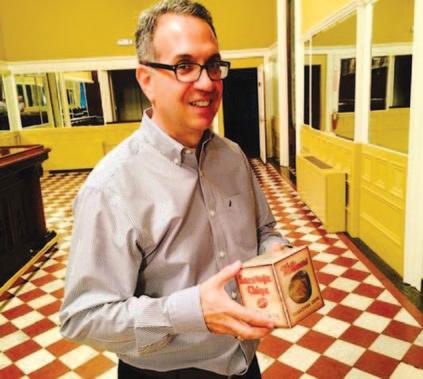
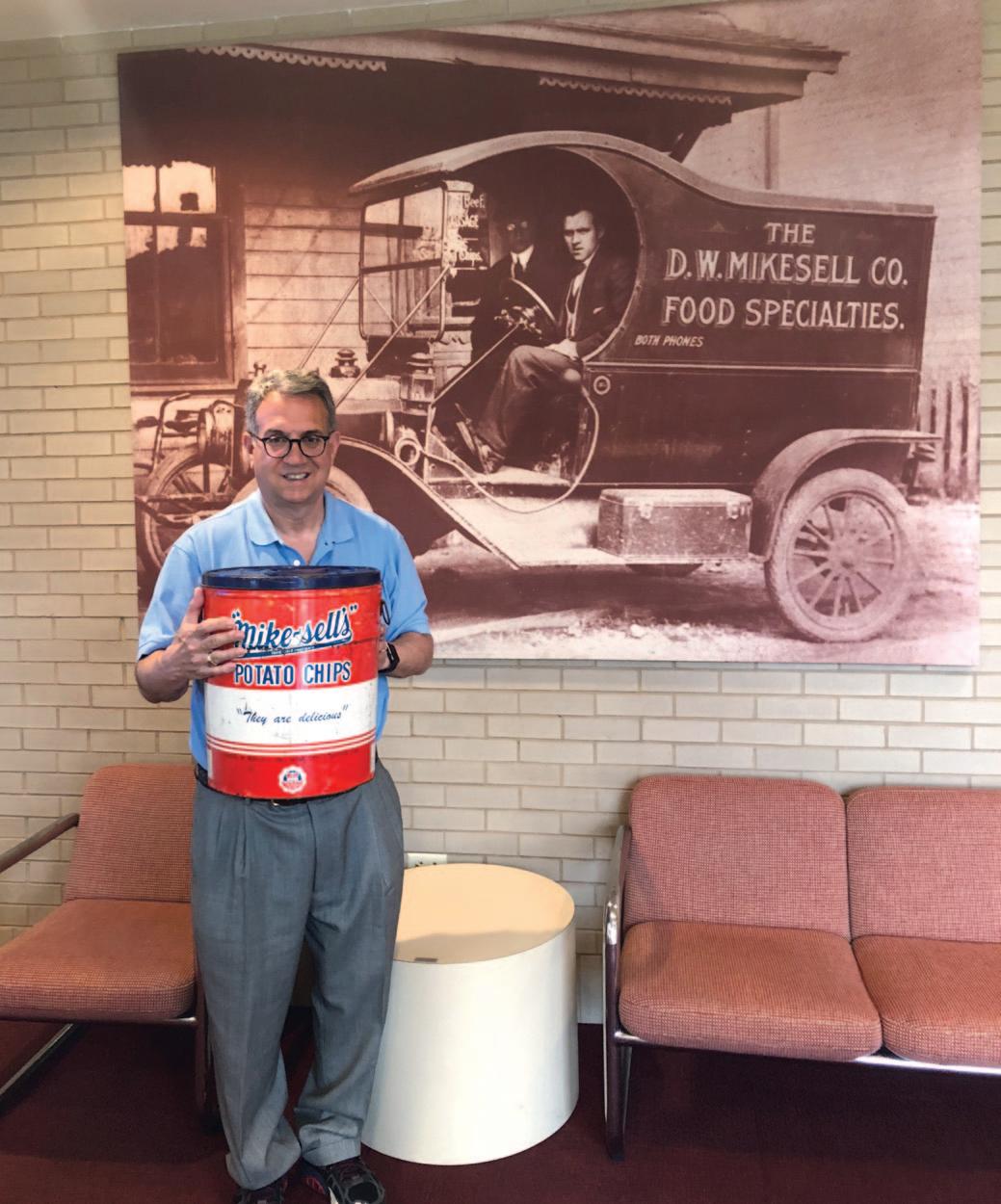
Alan B. Richer in Lobby of Mike-Sell's Potato Chip Company Headquarters, Dayton, OH (oldest established continuous run family potato chip company in the world)
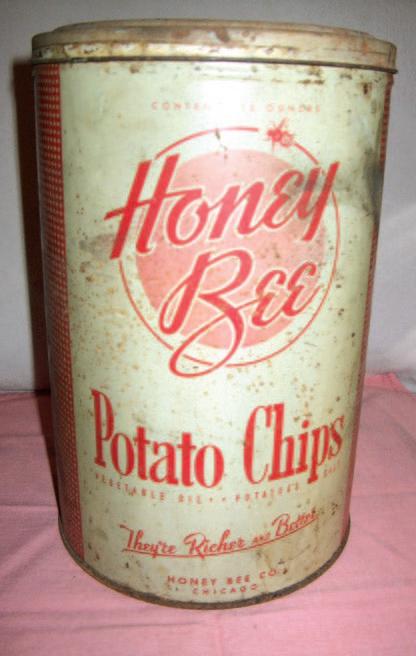
Honey Bee Potato Chip Tin Honey Bee Co., Chicago, IL 1940's-1950's
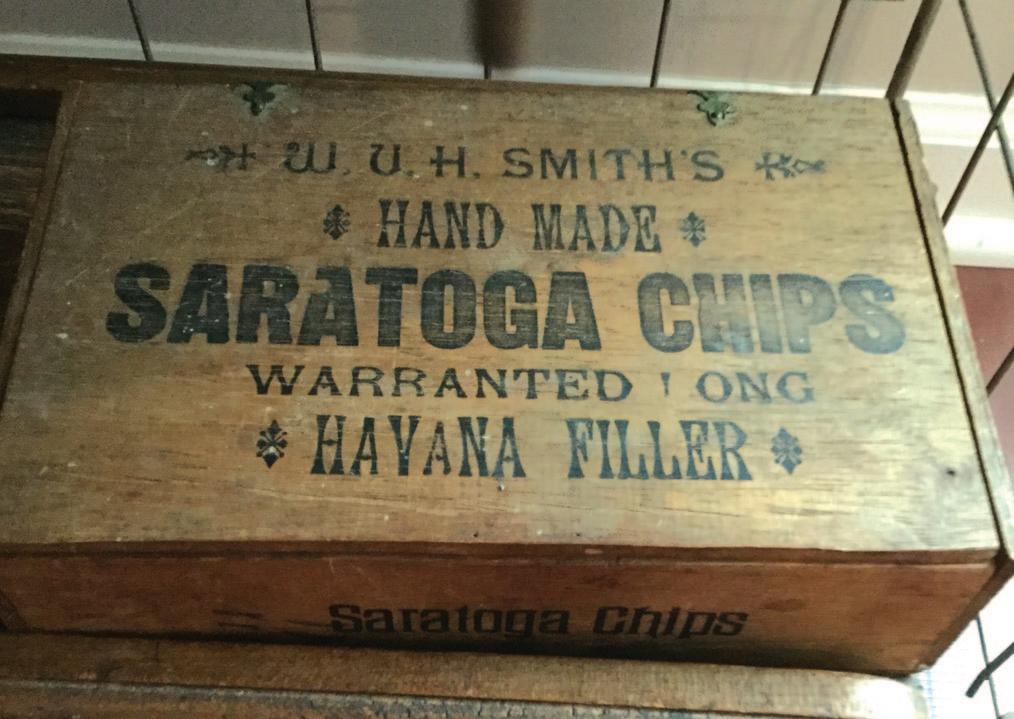
Box of Saratoga Chips Marylou Whitney discovered in the walls of a Vic torian home that was under renovation.
which the wealthy flocked in the summer months. It was during the puritanical era when people weren’t supposed to be taking vacations, so doctors wrote prescriptions for the wealthy to visit Saratoga Springs, drink the water from the fountains, and take long walks every day. But in reality, most of the visitors were cutting business deals for their companies and others were housing illegal poker games for the likes of Lucky Luciano, Meyer Lansky, and Frank Costello.
So, what does this have to do with potato chips? Well, Bolster purchased all the glass negatives from the other celebrity photographers that descended on the town in those summers and created the Bolster Collection, which he later donated to the History Museum in Saratoga
Springs. And it turns out Noonan was his protégé and proceeded to share many stories surrounding those Saratoga summers and the many myths and facts surrounding the invention of the potato chip with Alan. The Toga Chip Guy was hooked.
Saratoga Springs has always been known for the horses and as the summer destination for wealthy socialites, including Marylou Whitney, who was the Queen of Saratoga. One summer, Whitney learned about a discovery made in the walls of a Victorian home under renovation that piqued her curiosity. It was an old box of Saratoga Chips. She called Bolster and hired him to take pictures of the box so she could recreate it as a party favor for one of her renowned parties. It was Noonan who
actually took all the photographs and owned the originals, and he sold some of those Saratoga Chip photos to the Toga Chip Guy.
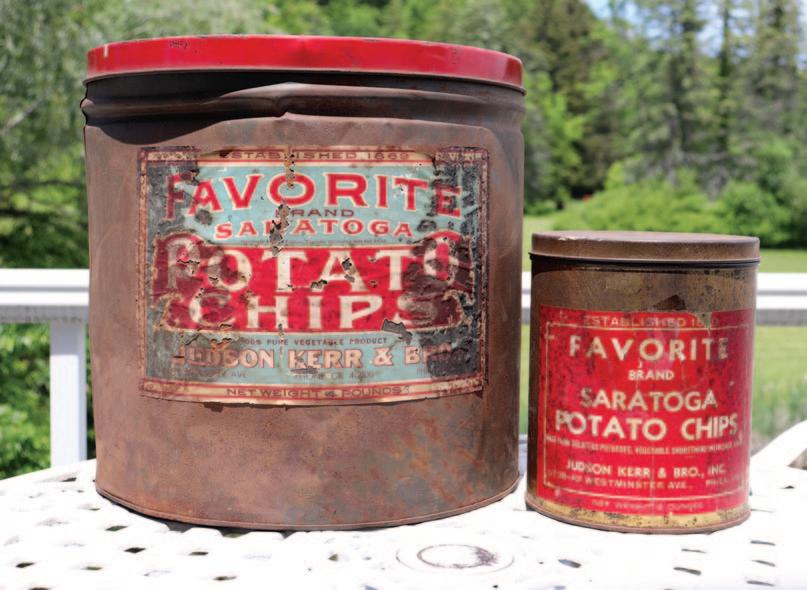
Alan’s fascination with the history of the potato chip grew, inspiring him to research and amass Saratoga Chip and potato chip-related memorabilia.In fact, he currently owns the largest collection of Saratoga Chip ephemera and memorabilia in the world and is known as THE potato chip expert and historian as well. His burgeoning collection currently fills a 10’x 20’, climate-controlled storage room.
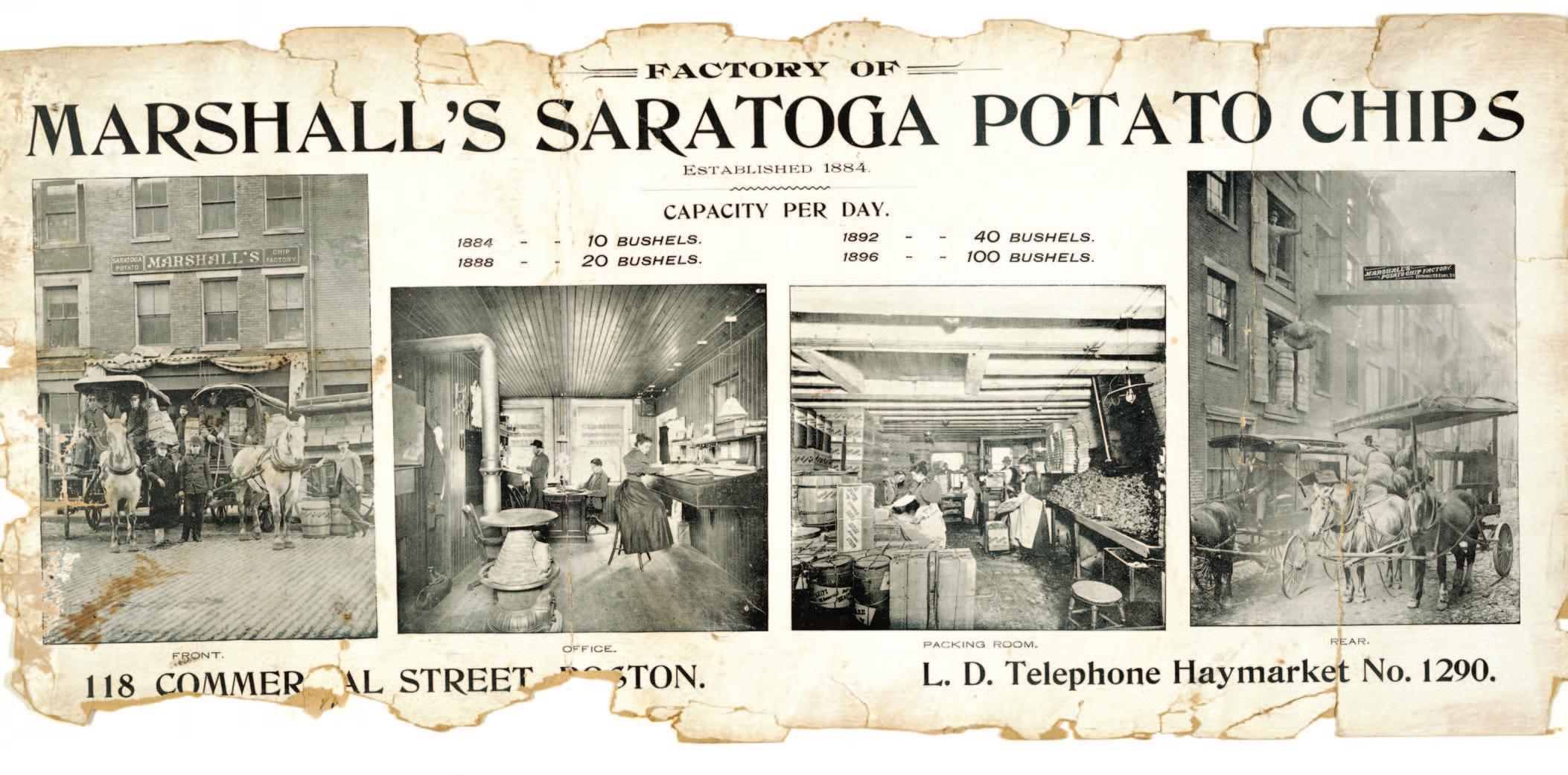
The words Saratoga Chips, once the generic name for potato chips, can be found on most of Alan’s potato chip memorabilia. He has tracked down and acquired countless flyers,
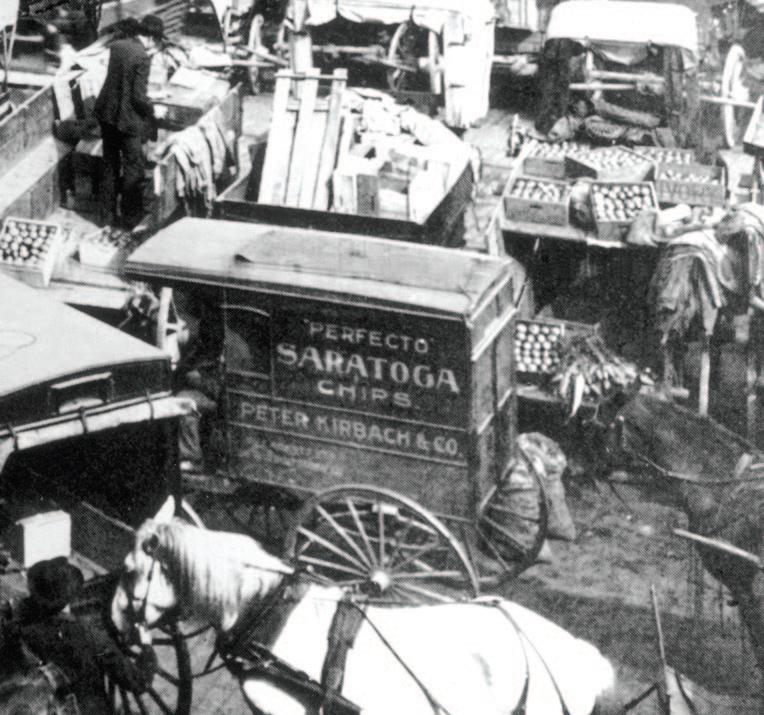
Perfecto Saratoga Chips Wagon at Chicago Haymarket Peter Kirbach & Co. Chicago, IL 1910-17
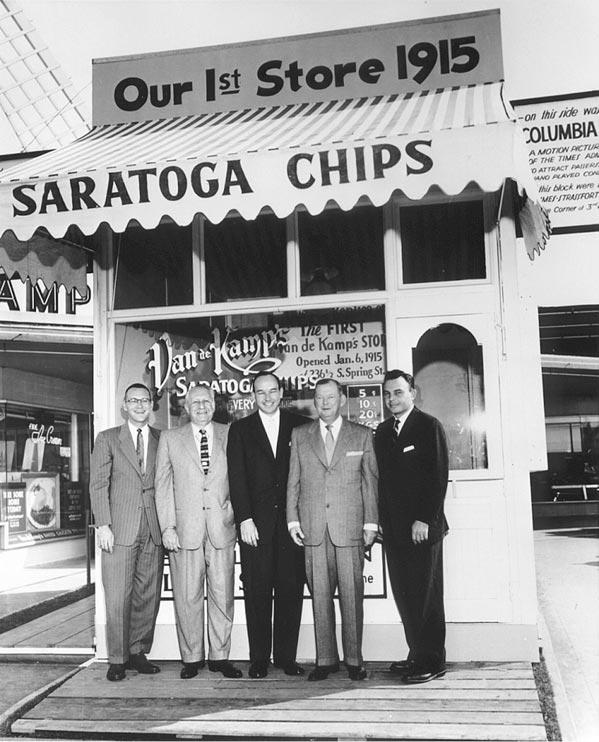
Van de Kamp’s Saratoga Chips Store Van de Kamp, Los Angeles, CA 1915
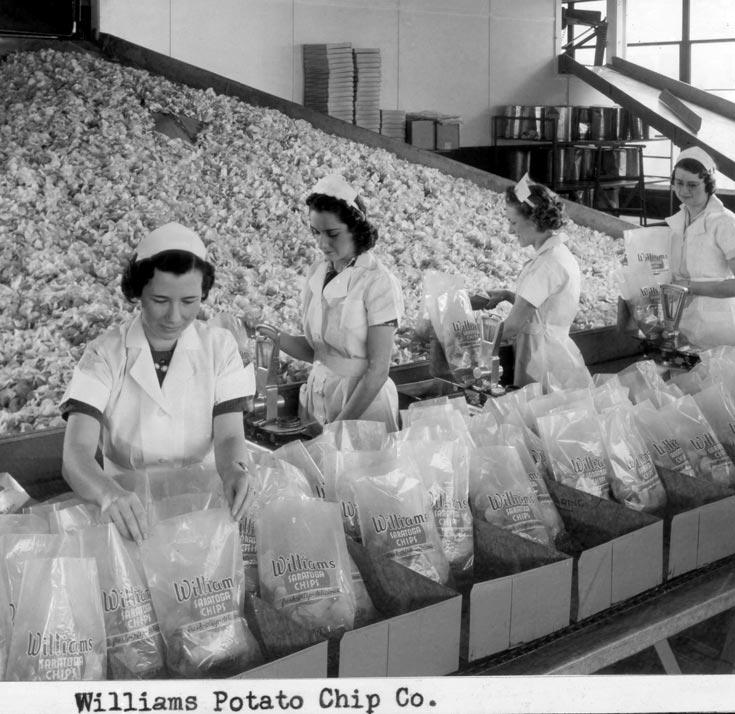
Women Bagging Williams Saratoga Chips Williams Saratoga Chips, Portland, Oregon 1939
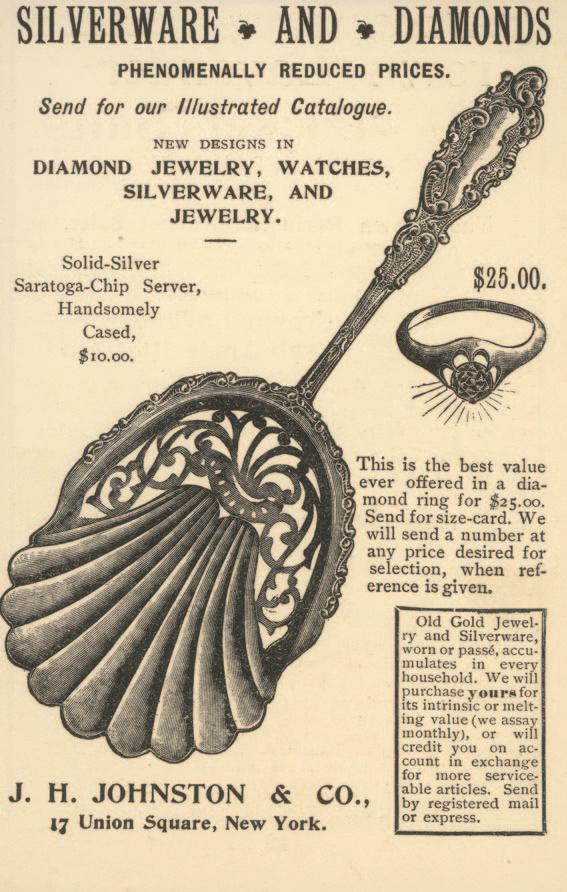
Saratoga Chip Server J.H, Johnson & Co, New York, NY 1895
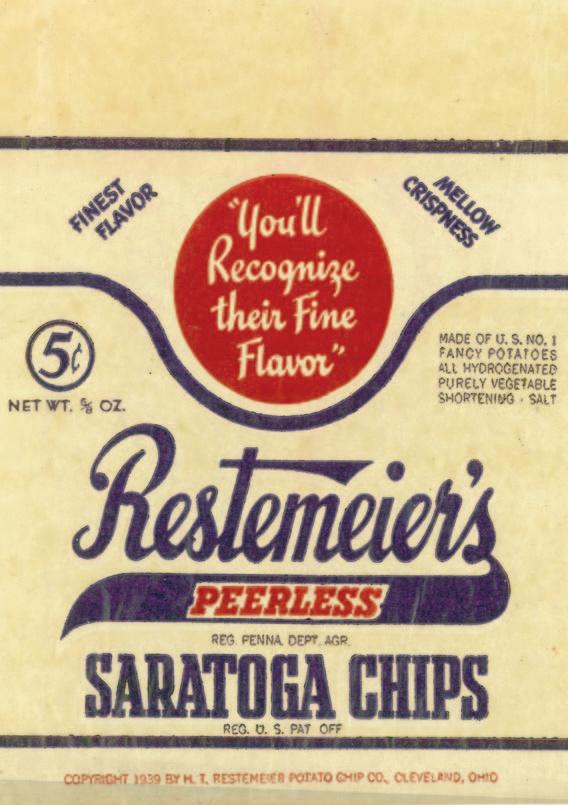
Restemeier’s Peerless Saratoga Chips Bag
Williams Saratoga Portland, Server Johnson Co, New NY Chips Bag
Restemeier Potato Chip Company Cleveland, OH 1910’s-1940’s
Restemeier Potato Chip Company Cleveland, OH
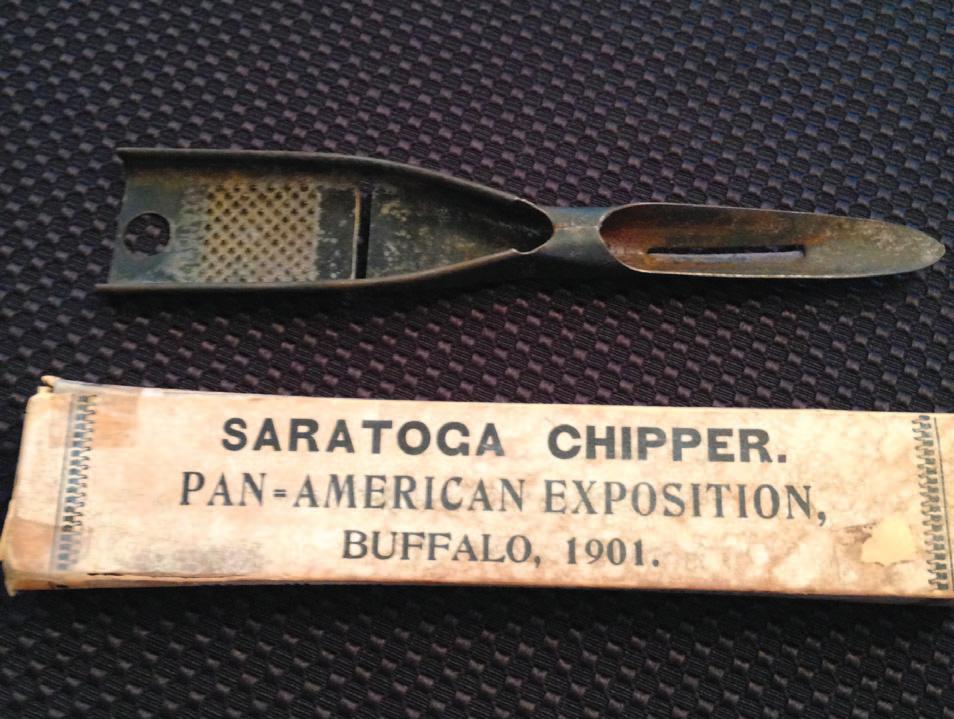
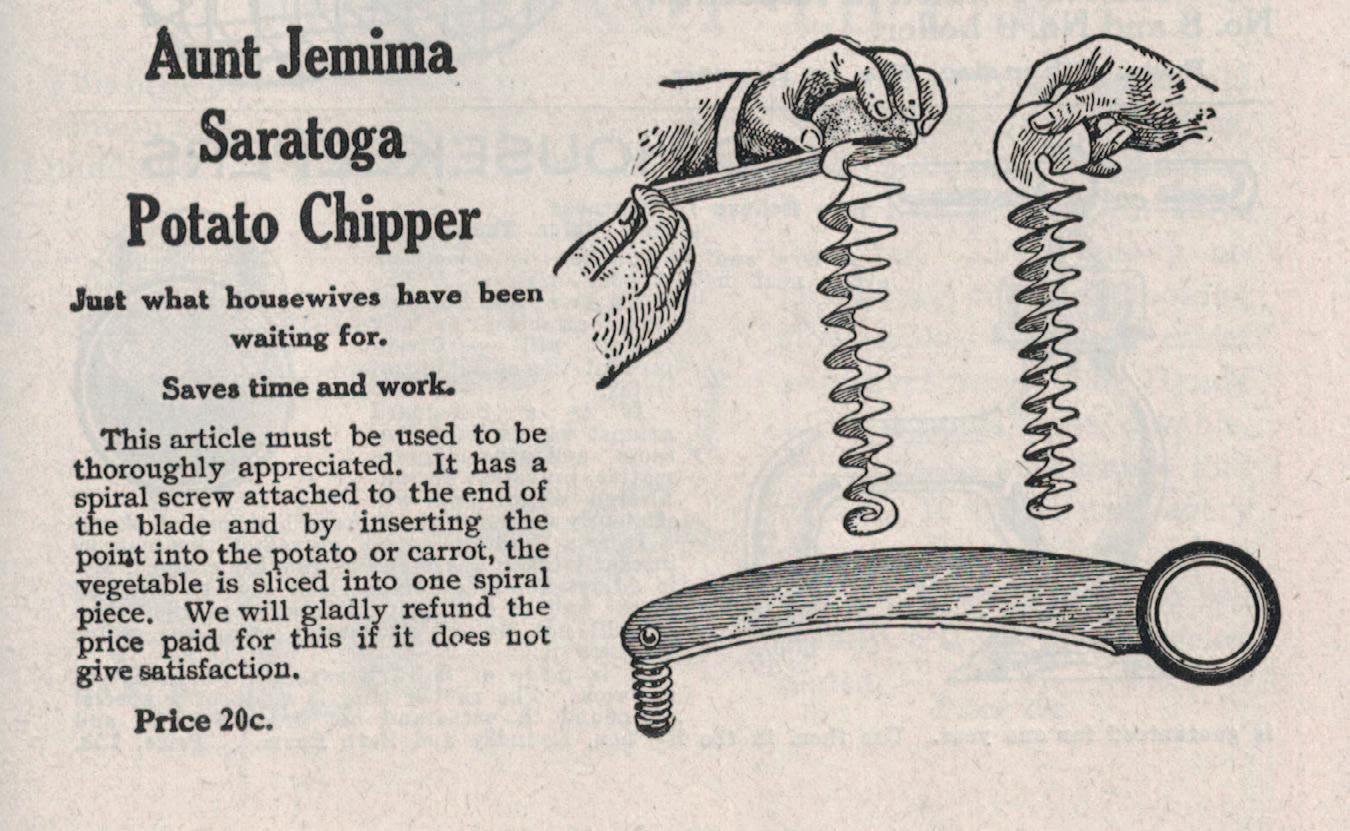
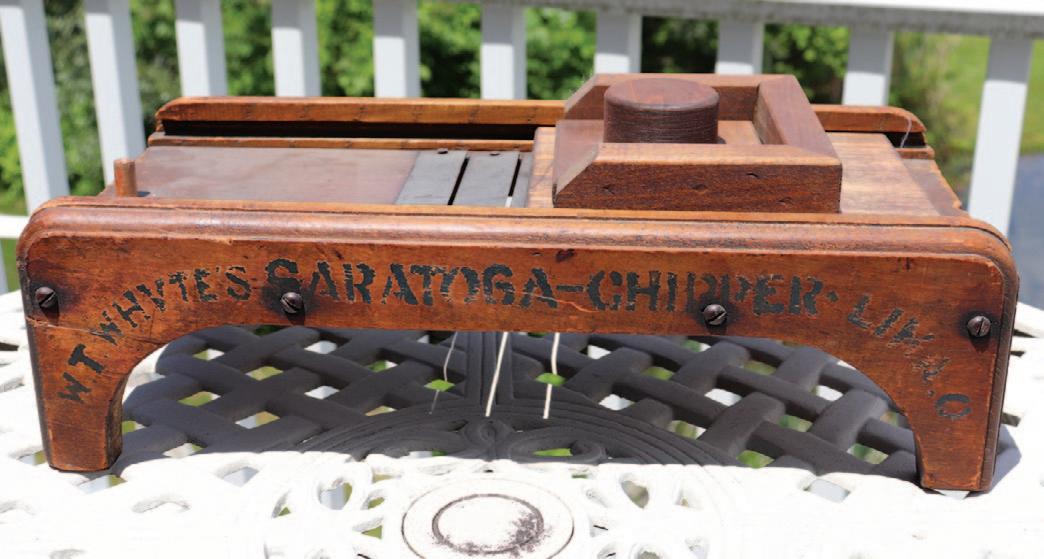
Aunt Jemima Saratoga Potato Chipper
The Keystone Supply Company Hanover, PA Circa 1900
Aunt Jemima Keystone Company Hanover, PA
containers, ads, photos, tools, and boxes, displaying those infamous words from across the US. He even has some sealed vintage bags still filled with the venerable chip!
One of his searches led him to SNAC International formerly known as the Snack Food Association. There he met Don Noss whose father, Harvey, started the organization. It seems that the Noss family owned a company called Num-Num, which was later sold to Frito-Lay in 1958. It was through Noss that Alan learned about the people who originally manufactured potato chips. They were known as the “chippers." Sadly, theirs is a disappearing generation, and their stories are disappearing with them. However, the chippers quickly began sharing their stories with Alan and entrusted him with their chip memorabilia. He has become their unofficial story keeper and con tinues to honor their history in his talks and writing.
These days, Alan is often called upon to speak to organizations and schools about Saratoga Chips. Even the History Channel has knocked on his door. He has put together an impressive, 400slide, PowerPoint presentation, and for every slide, he has at least one fas cinating story to tell!
His presentation includes the mystery surrounding the origin of the Saratoga
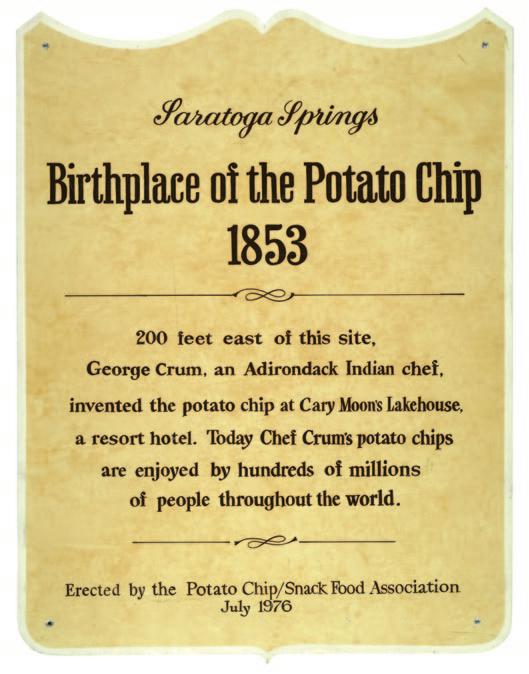
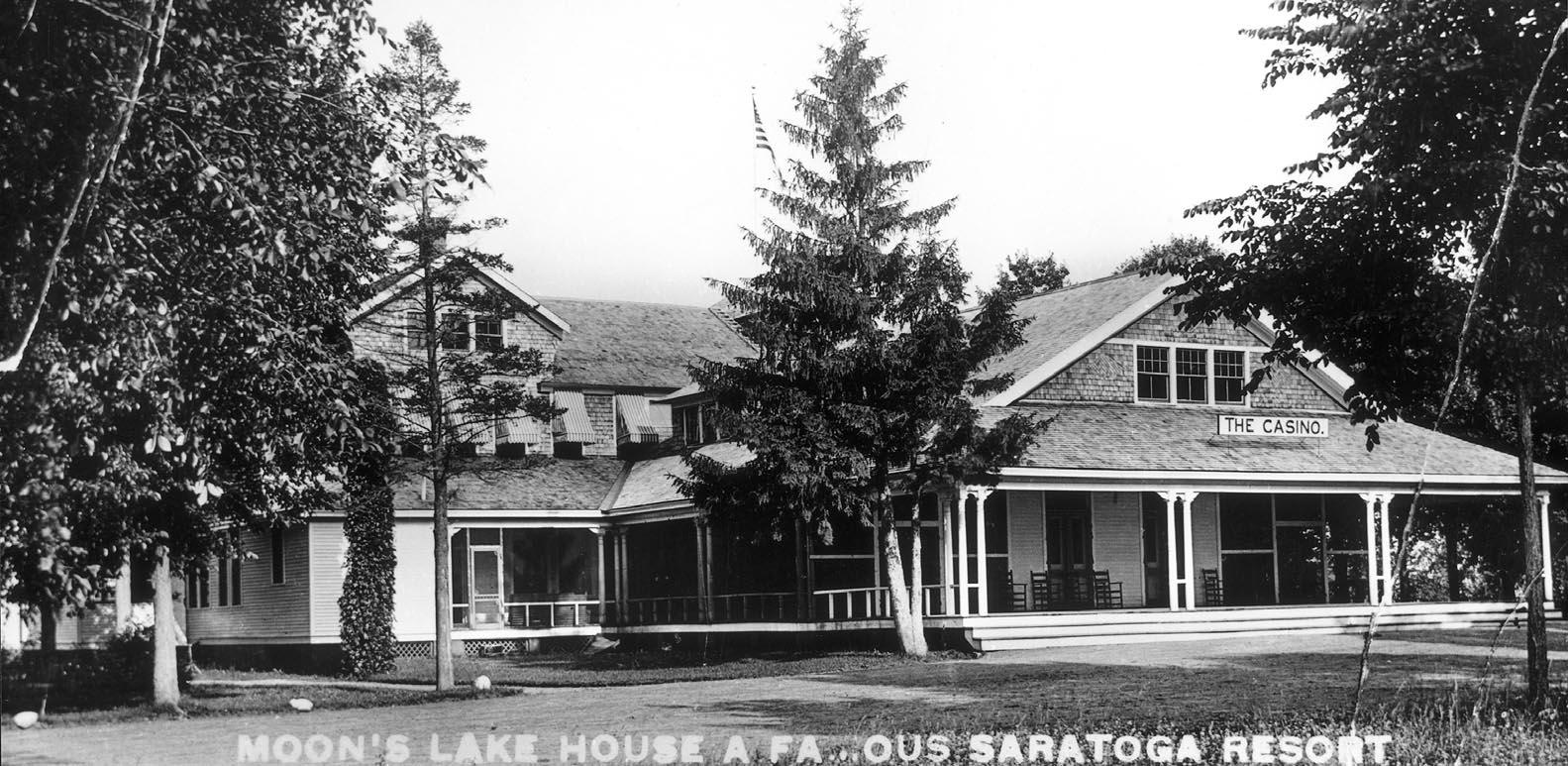
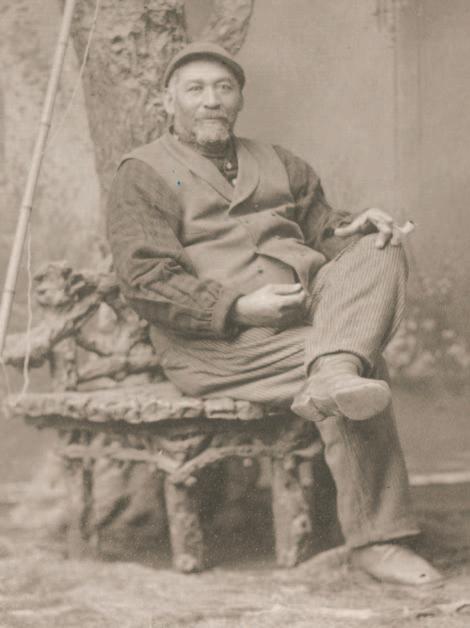
Chip. The story goes that the Saratoga Chip was invented by local chef, George Crum, at Moon’s Lakehouse in the mid-1800s; yet across the pond in London, it is said that a local optician had his own recipe for potato slices fried in oil that was published in 1817. So, which is it? According to Alan, “while the potato chip was not invented in Saratoga, it certainly was popularized here." Even Al Capone got in on the act after visiting Saratoga when he “informed” Leonard and Eugenia, the couple who made and supplied his speakeasies with candy and nuts, that they were now going into the potato chip business. They did.
Featured in Alan’s PowerPoint presentation are many slides of his im pressive collection, including a potato chip countertop display. The display is a square-shaped box made of glass and wood that held chips with a special scooper attached to it. It clearly reads “Saratoga Chips." There’s another that features a chip chute rather than a scoop, and besides display pieces, there’s a vintage mandolin potato chipper belonging to a chef in Tennessee that washed up onshore at the home of his grandmother in North Carolina. Rounding out his extensive collection of memorabilia are photos that show the eponymous words “Saratoga Chips” printed on bags, boxes, billboards, delivery trucks - even horse- drawn carriages from the mid-1800s.
Alan is currently looking for a permanent home for his potato chip col lection. He has approached the Smithsonian but still no word yet. In the meantime, he continues to collect, preserve, and record artifacts and stories for future generations of Saratogans.
And it’s safe to say, that along with the horses and the springs, the Saratoga Chip story is an important and salty slice of Saratoga history!
For more information, visit Alan Richer’s website at: www.togachipguy.com
Moon's Lake House Historic Marker, Potato Chip/Snack Food Association July 1976
George “Crum” Speck
Photo by J.S. Wooley
The Saratoga Chipper that washed up onshore in North Carolina
W.T. Whvte’s Lima, OH
INSTINCTIVELY DIFFERENT>>
JULY 1 - AUGUST 14
320 Broadway, Saratoga Springs, NY
BRIGHTEN THE CORNERS:
ART OF THE 1990s FROM THE TANG TEACHING MUSEUM COLLECTION
MICHAEL ASHKIN
NAYLAND BLAKE
WENDY EWALD
TIM ROLLINS AND K.O.S.
GLENN LIGON
KERRY JAMES MARSHALL
DONALD MOFFETT
FRANK MOORE
LARI PITTMAN
BEVERLY SEMMES
LORNA SIMPSON
KIKI SMITH
KATE ERICSON & MEL ZIEGLER
SPIRIT RAPPINGS:
SPONSORED BY SARATOGA ARTS
JUDY GLANTZMAN
BEN GOCKER
JEFFREY HARGRAVE
HELEN MACRO
Breaking the Mold
by Karen Richman
Aunt Harriet was a good woman. Maybe even the favorite relative of most of the family because she minded her own business, always had a smile on her face, and remembered everyone on their birthday or the holidays.
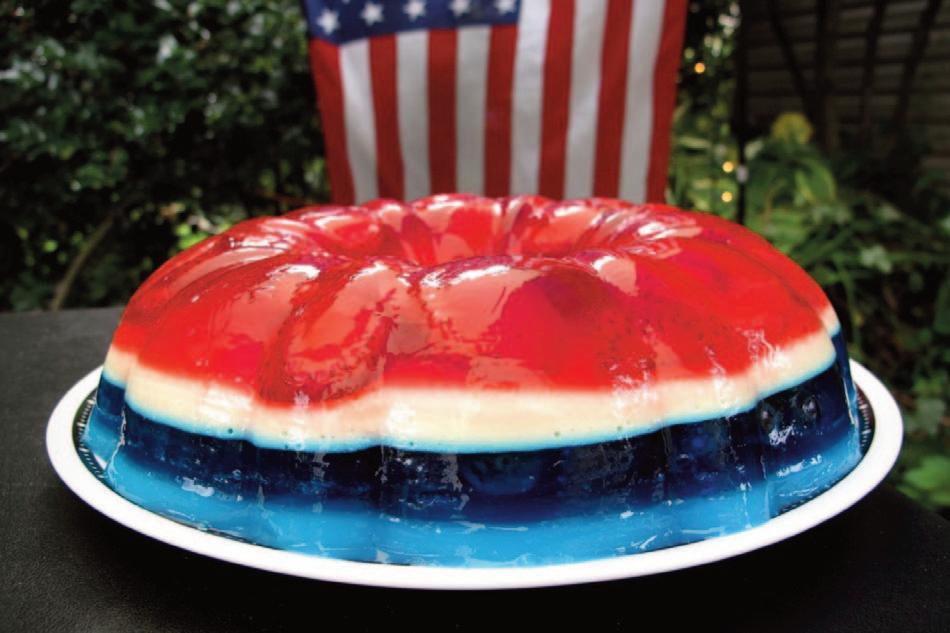
She also remembered every single holiday or time we had a cookout to bring what she called, "My famous jello mold." Aunt Harriet was of the firm belief that everyone loved the
rubber ring with different fruits, coconut, and walnuts buried deep within the colored layers that quite often bore the consistency of elastic.
Fact was, very few loved her jello molds, but we all took some to be polite. She tried very hard to vary the flavors and ingredients. So metimes they were green with lime flavoring, sometimes red or yellow, signifying
cherry or lemon, and sometimes they were two-tone, and no one could figure out what the heck it was supposed to taste like. But as sure as Thanksgiving came the fourth Thursday in November and Christmas al ways on December 25th, so did Aunt Harriet come with her "famous jello mold."
Summer meant a lot more family cookouts, especially on or about the July 4th holiday,
and each Independence Day Aunt Harriet strived to make a red, white, and blue jello mold. It was during those times that the family wished we had never gained our in dependence from the British and could feast on crumpets and meat pies instead.
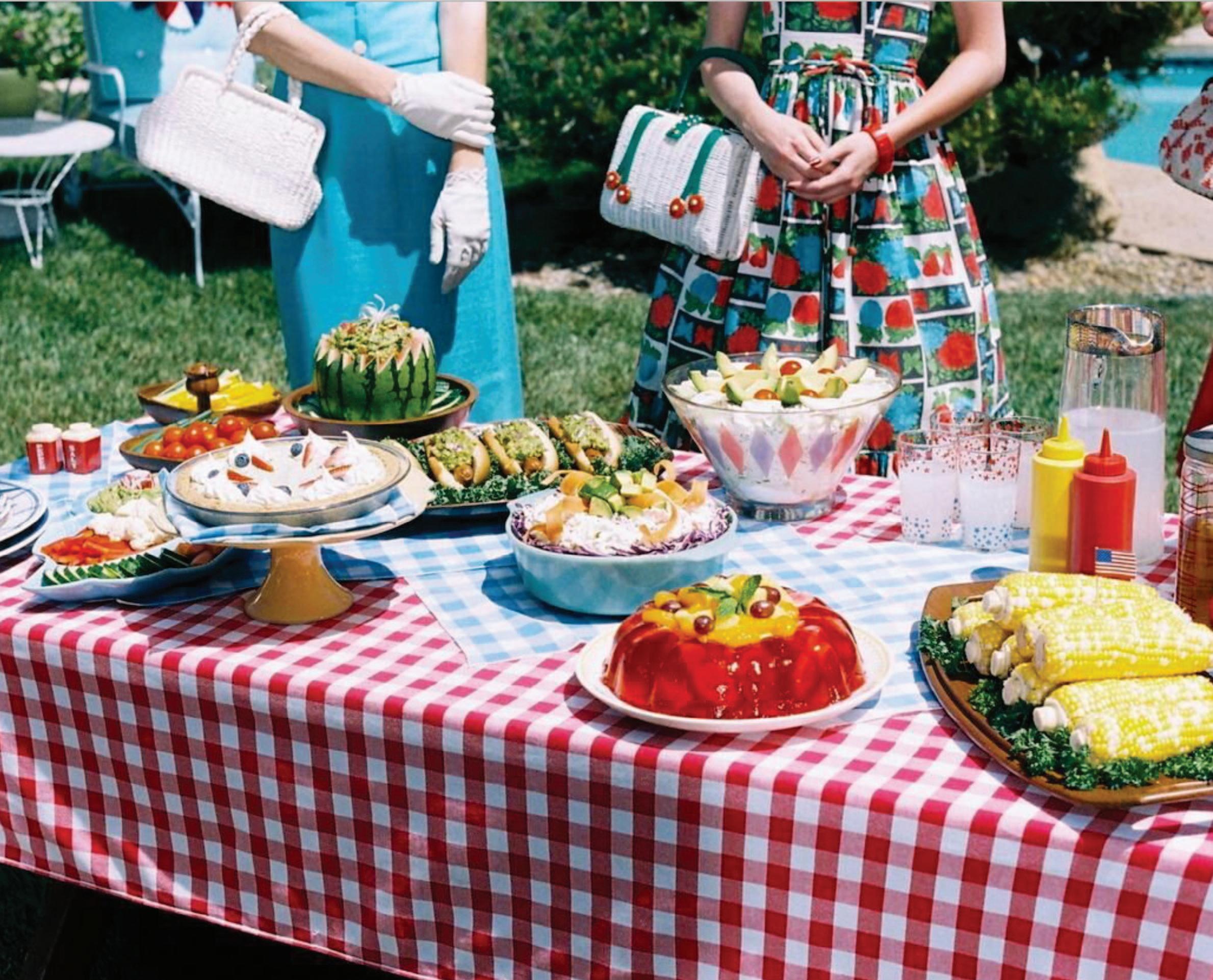
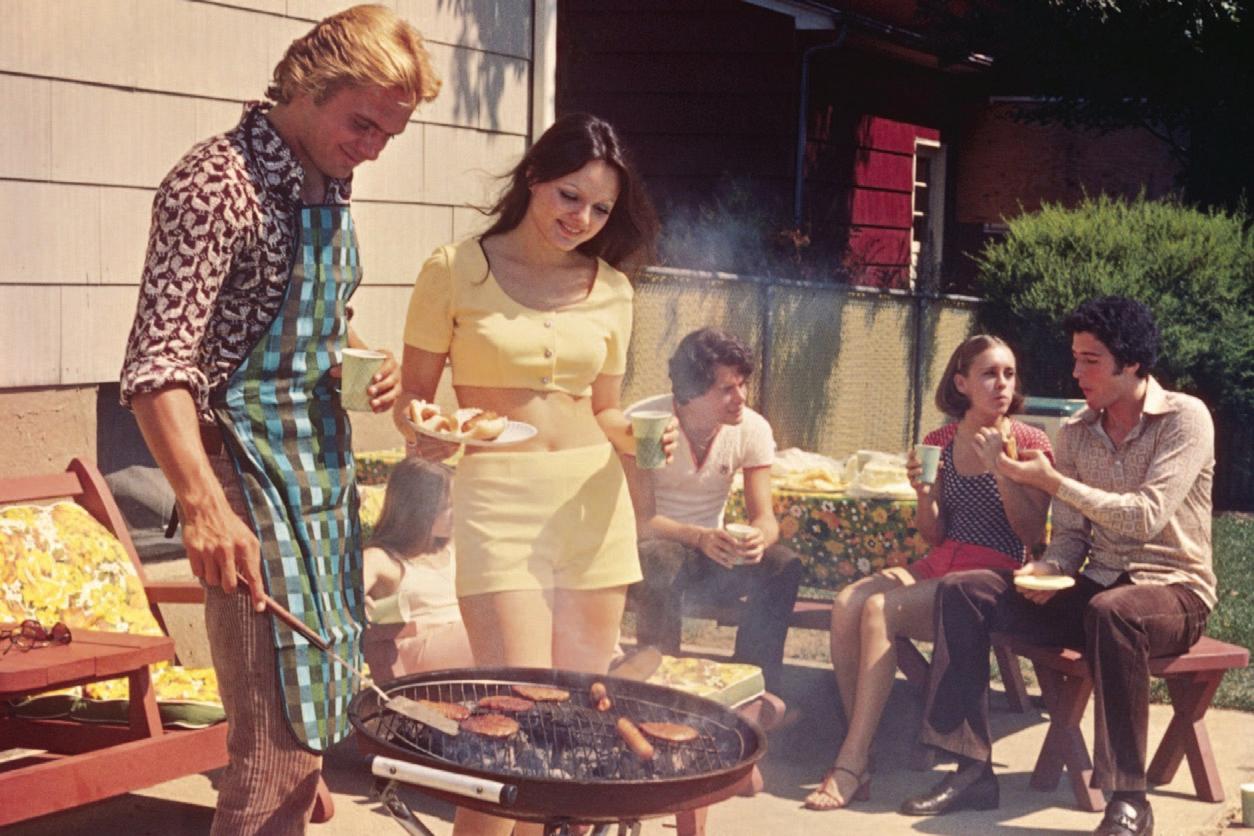
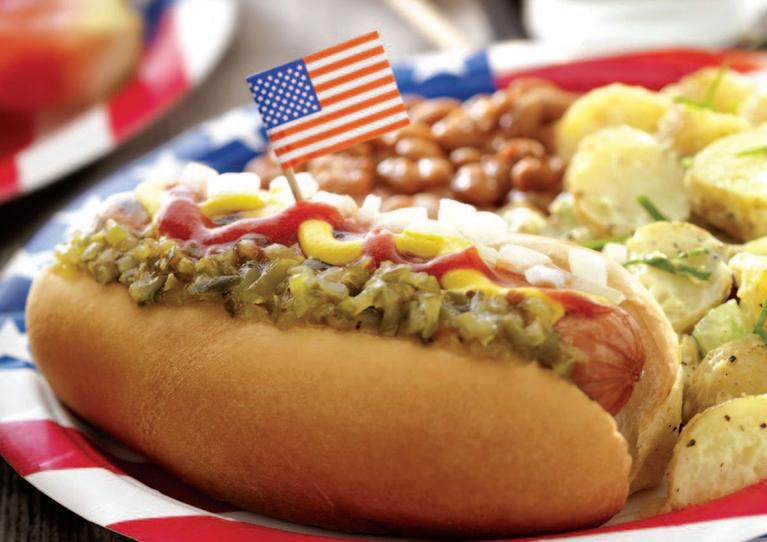
But July 4th was always a time of great tra dition. Back in the '50s and '60s before barbecues became upscale aided by gas grills and Big Green Eggs, they were simple grated affairs fueled by mounds of charcoal and ignited by a fluid that had a very dis tinctive odor which always seemed to hang behind and eventually flavored the food itself. There were no smokers or any thing else fancy, there was simply fire. You put the food on the grill, flipped it or pierced it a couple of times, and shoveled it onto a paper plate, loaded it with condi ments, threw on a handful of potato chips, and it was dinner.
So when Aunt Harriet was invited to the July 4th festivities, and she always was, she came prepared. Not only did she have her "attempt" at the red, white, and blue gelatinous side dish, but she also came with tiny American flags that she would proceed to stick in every dish that would support them. Little flags were in hot dog rolls, stuck atop pickles, and yes, even jammed into the jello mold. She also brought bug spray, and we had to gently point her away from the potato salad when she got caught up in a frenzy of mosquito protection.
But this is the stuff of memories, and it's those memories that make up the crazy quilts that cover the lives of every family member. It's what you remember when you sit on the back porch or at the kitchen table and tell those precious stories of family "characters."
One of those stories that has become not only a firm square in our family's quilt but a story that's told and retold every year is the
year Cousin Donnie broke the mold. It wasn't intentional, although cynical Cousin Bobby swears it was intentional.
While the burgers and dogs were being heated up on the grill the aunts were set ting the food out on the table, layering the checkered red and white picnic cloth with rolls, condiments, lettuce, tomato, raw onion slices, potato salad, coleslaw, macaroni salad, and potato chips until the old wooden table nearly groaned under the weight of it all. Aunt Corinne had Harriet's jello mold in one hand and a large container of napkins and utensils in the other, so she bent down and put the jello mold on the attached picnic seat for just a minute while she arranged the table to make more room.
It was at that very moment that Cousin Donnie who was playing touch football with the other boys ran for a wild pass, backed up, and sat smack down on Aunt Harriet's holiday creation. There was a long, single howl, and then it got real quiet.
Not everyone was immediately aware of what had happened because they weren't in close proximity to the picnic table, but when Donnie stood up, little chunks of pineapple hanging from his shorts, red, white, and blue jello melting in the hot July sun and running all over the seat, it soon became apparent. The long, single howl that had come from Aunt Harriet had turned into sobbing and cries of, "My mold! My beautiful jello mold is ruined!"
"Hey, we could all grab spoons and go scrape down Donnie's butt," offered the wisecracking Cousin Steve, but his father gave him a quick rap in the arm and he of fered no further suggestions. Members of the family started to wipe up what was a wet, sticky mess of gelatin, fruit, and coconut
while others set about trying to console Aunt Harriet who was fairly inconsolable.
Eventually, things quieted down as they al ways do when food is ready, and everyone grabbed a plate, filled it with their favorites, and found a seat. Even Aunt Harriet who had proclaimed between paroxysms of weeping that she wasn't hungry, was putting it away like the Martians were on Main Street and coming for her burger.
The conversation quickly turned to "other things" like who was ahead in the American League, who got a new Chevy Bel Air, and who had a new girlfriend or boyfriend. We all thought our July 4th cookout had been saved until that smart- mouthed Cousin Steve had to do it again. "Hey, every body!" he shouted loudly. "Cool cook out, great eats. Just too bad old Donnie here had to break the mold." Then he collapsed in laughter.
The only sound that could be heard once again was a single howl.
Color Psychology: What Colors
Your World?
By: Crystal Cobert Giddens, LE, INHC
This world of ours is filled with color. Color has the ability to change your mood and your behavior, your health and possibly even your diet! Before you redecorate, or serve your next meal, you may want to dive into a little color psychology.
First, let’s do a little experiment. Close your eyes and imagine: A blue sky, bright yellow sun, a crystal blue lake next to green grass and towering pine trees with butterflies and bluebirds singing. How does this make you feel? At peace? Calm?
Now imagine: Dark skies, rolling grey water, next to brown grass and trees that have lost their leaves. How does this make you feel? Unsettled? Anxious...like a storm is brewing?
Color and emotion go hand in hand, and the meanings we assign to those colors are all learned or developed over time. Children begin to develop associations with colors based on their environment and what they are taught. From childhood to adulthood, our language and culture reinforce the emotional m eanings we attach to color. We start to dis tinguish between sad colors and happy colors and we associate certain hues, like the warm colors of fall, with cozy sweaters, pumpkin pie and all things warm and fuzzy.
A simple Google search of the word LOVE will flood your screen with red colored hearts and red colored roses. Many people use words like passion and love to describe the color red. Some peo ple associate the color red to power, anger, danger and au thority. Think about our stop signs and traffic lights. Red means, “stop, don’t go, danger.”
do poorly on the test! Why? Red is the dreaded color of circled mistakes on school papers.
Athletes wearing a black uniform are more likely to receive penalties. College students were more likely to associate negative qualities with a player wearing a black uniform according to a study that looked at historical data of sports teams and their uniform colors.
Several ancient cultures, including the Egyptians and Chinese, prac ticed chromotherapy, or the use of colors to heal. Chromotherapy is sometimes referred to as light therapy or colorology. Colorology is still used today as a holistic or alternative treatment.
What about mood? To encourage feelings of optimism, life and growth, green was found to be the most uplifting and “hopeful" color. Green seems to make positive emotions stronger and negative emo tions weaker.
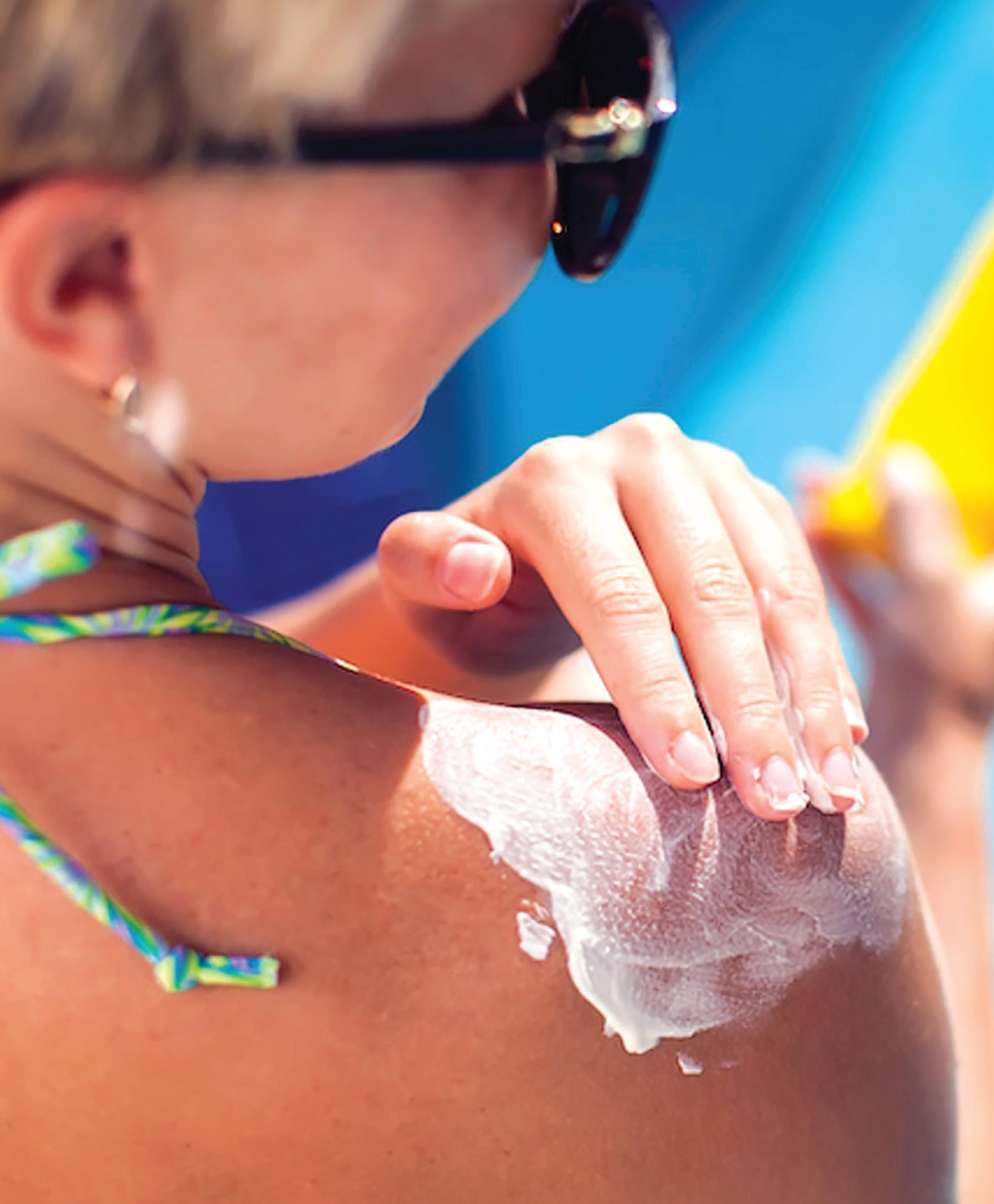
The color teal (or turquoise) is often associated with the feeling of calm. Teal reminds people of beach vacations...peaceful, beach bummy days lounging on the sand and relaxing in the sunshine (with your SPF of course.)
Color can influence performance. Researchers at the University of Rochester found that when students see even a flash of red before being tested, they associate the color with mistakes and failure. In turn, they
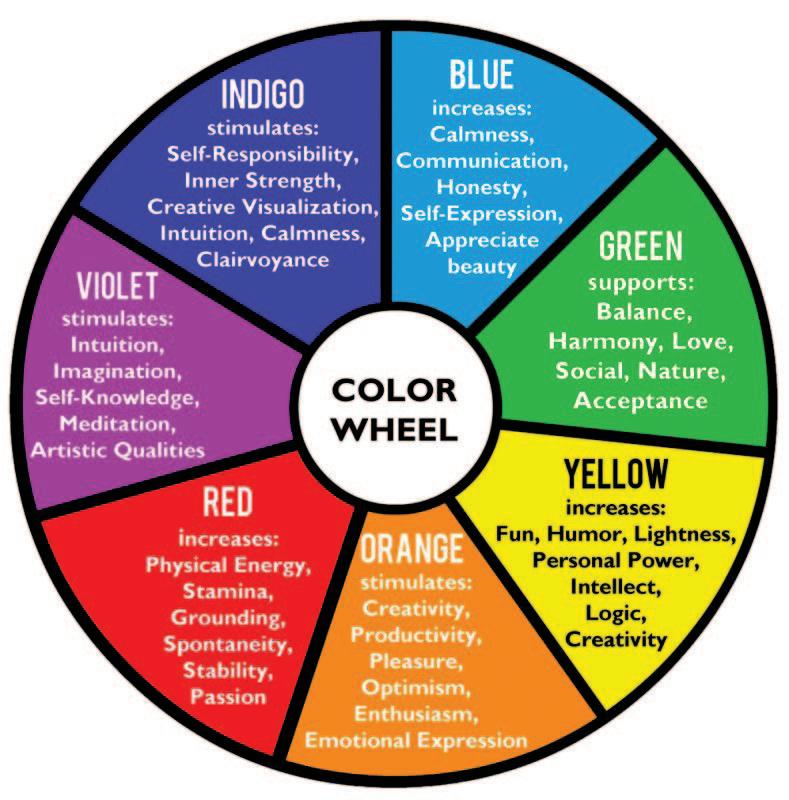
RED is used to stimulate the body and mind and to increase circulation.
YELLOW is thought to stimulate the nerves and purify the body.
ANGE is used to heal the lungs and to increase energy levels.
BLUE is believed to soothe illnesses and treat pain.
INDIGO SHADES are thought to help alleviate skin problems.
Modern scientists have found that a bright blue light may help set your circadian rhythm if it gets out of whack. Studies show blue has the biggest POS ITIVE impact of the physical, mental and behavioral patterns you go through every 24 hours.
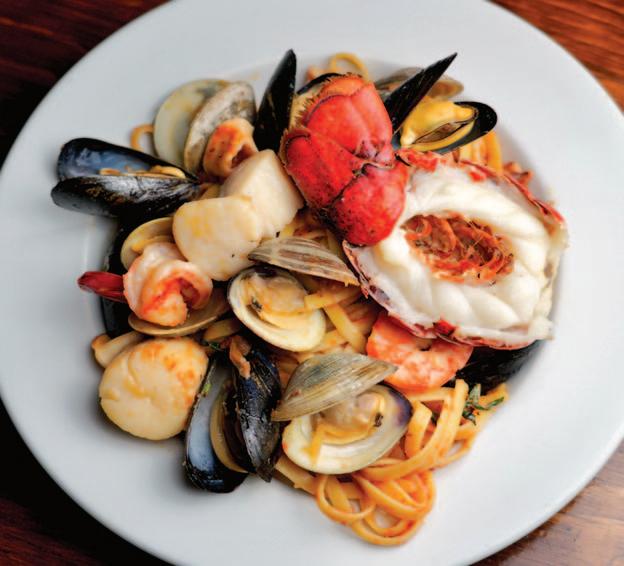
How can colors affect our choices in food? I’ve helped many clients transition to a salad plate if they have concerns over portion control. I recently learned that the color of your plate can actually affect how much you eat as well. I was always taught to plate a meal with a white plate. The contrast of vibrant food against a white dish is visually pleasing. Well, the difference in the color of your plate and the food you put on that plate can affect your portion control as well! A study showed that people will serve themselves about 30% percent more Fettuccini Alfredo if they were given white plates vs. red or black! It’s the same with Thanksgiving dinner. Light turkey, mashed potatoes and gravy (basically a bland colored dish) served on a white plates tends to make us take larger servings.
My dishes are white...I think I’ll be looking for new dishes soon.
Crystal Cobert-Giddens, LE, INHC FACES of Saratoga