Stephanie Sittnick - Director of Sales ( 860) 227-8199 advertising@518mag.com
CONTRIBUTORS
Carol St.Sauveur Ferris, Karen Richman, Rona Mann
Chandler Stevens, Lawrence White, Kirsten Ferguson, Susan Brink, Vanessa G. Ahern, Joseph Raucci, Adirondack Winery, Crystal Cobert Giddens, Nellie Ackerman-Vellano
COVER Lawrence White “ La Gran Pasion”
February reminds us of creative and special ways to show others that they are meaningful to us, that we appreciate them, and that they are loved. It is the month to show our big hearts and adoration for each other. Our Feb ruary issue is busting out of its bindery with exciting stories of just that!
This month, you’ll find all the love and passion that each of our stories hold. You’ll read about photographer Terri-Lynn Pel legri and her unique visual story that creates the language of life through food “Love Compost” COMPOSitions. Her creations stimulate dialogue and a powerful force for change. In an other story, you’ll find North Country Wild Care and wildlife rescuer Nancy Kimball. Her endless devotion and her love to care for all wildlife will nourish your soul. Then there’s The Rochester Mu seum, an explosion of sight, sound and wonder fo r all ages to enjoy. Last and definitely not least, we feature Shintaro Okamoto, the creator of Okamoto Custom Ice. His extraordinary artistry and vision sets him apart from the rest.
As always, our goal is to deliver authentic, and unique content about creative people and interesting places. We hope you enjoy this issue as much as we do.
Stephanie Sittnick Founder / Publisher
518 PROFILES
587 Grand Ave, Saratoga Springs, NY 12866
CENTER STAGE
ENCORE
Capturing Life in Compost Terri-Lynn Pellegri Photography pg. 4
Caring for Wildlife in the North Country pg. 12
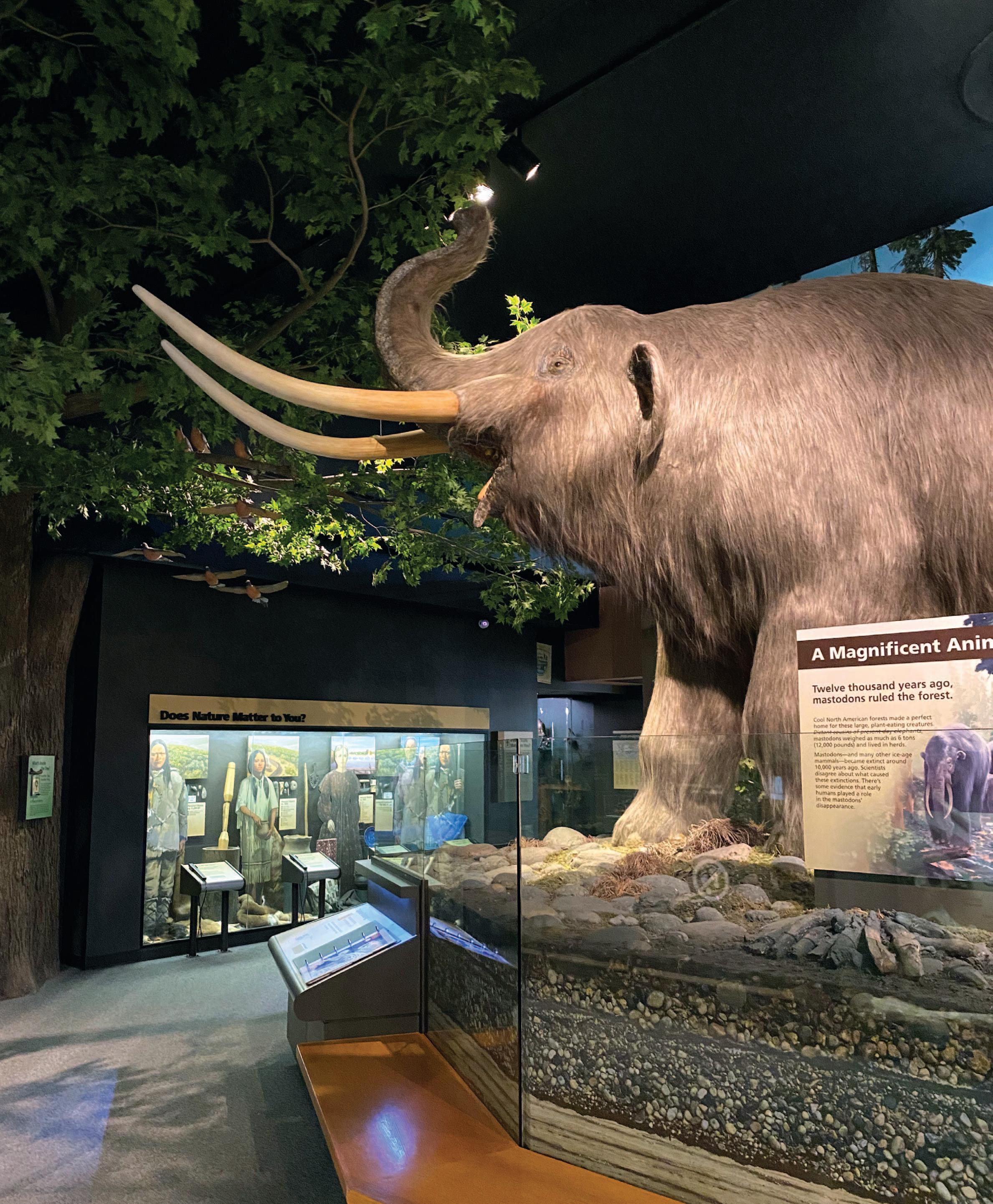
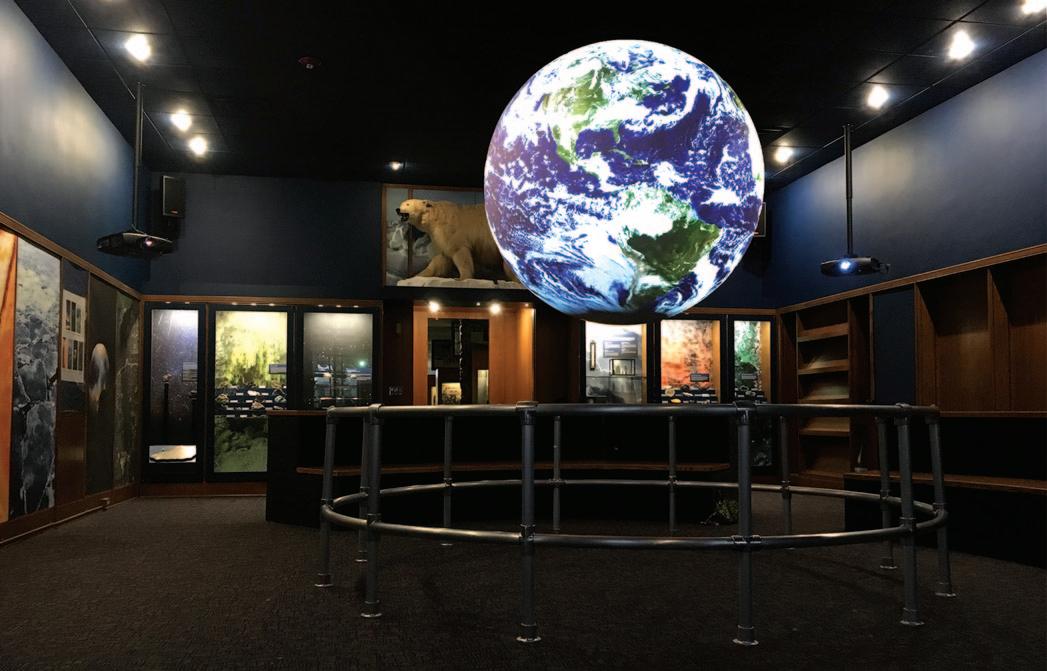
Curiosity ~ Exploration ~ Participation This is The Rochester Museum & Science Center pg. 20
“Living in the Moment of Ice” The Ephemeral Art of OKAMOTO Studio pg. 34
Capturing Life in Compost Terri-Lynn Pellegri Photography
by Carol St. Sauveur Ferris
An artist can be described as a multilayered, breathing composition made up of a lifetime of everyday experiences and dreams. You might say we all are. And that would be true. But artists deal with everyday experiences and dreams from a different perspective. They explore them. Deconstruct them. Reassemble them. They look in from the outside, then peer out from the inside. It’s a way of seeing the world that most of us are blind to, but because of artists, we are gifted with another point of view. You may see it in their sculptures, paintings, performance art, or graffiti, but fundamentally it is their world view or opinion on display for us to embrace or toss aside. Terri-Lynn Pellegri is one such artist.
Terri-Lynn spent her first 10 years of life in New Rochelle, New York surrounded by aunts, uncles, and cousins. Everyone she knew was born there, grew up there, and stayed
there. But at the age of 11, Terri Lynn’s Dad had a great job opportunity with E.J. Korvettes in Albany, so they pulled up stakes and moved nearby to Saratoga Springs. She has called it home ever since.
Growing up, Terri-Lynn was always interested in the arts which led her to SUNY Plattsburgh in Plattsburgh, New York. While pursuing a double major in Fine Art and Psychology with a concentration in Italian Renaissance Art History and Photography, she spent a se mester abroad in her junior year. Many college kids do that and have wonderful memories to share, but for Terri-Lynn, it was life-changing. Despite her parents’ objections, she said she made “one of her first adult de cisions” at the ripe old age of 20, deciding to board a plane for the very first time and fly overseas to Siena, Italy.
She chose Siena, Italy for its rich history of traditional Renaissance art and artists. It dovetailed perfectly with her studies. And coincidently, Italy had more to offer her. It was just outside the city of Parma where a large part of her Italian family still lived and where the grandfather she never knew was born. She met her extended family f or the very first time and formed lifelong rela tionships with many of them. Turns out that her grandfather was the only member of the Pellegri clan to ever leave the Parma area, let alone Italy. He courageously traveled across the Atlantic alone by boat to a foreign
"Caffe Lena"
country called the United States of America. It was an adventure only for the brave of heart and one he embraced. He eventually put down roots in Mamaroneck, NY and called it home. How ironic and poetic that his 20-yearold granddaughter, Terri-Lynn Pellegri, courageously crossed the same ocean, with the same sense of adventure and wanderlust. She quickly came to love Siena for its art and history, while opening her heart to her newfound family and Italian heritage in Parma.
F ollowing her exciting semester abroad filled with travel, family, and art, Terri-Lynn completed her studies and graduated in 1982 with her BS in Art and Psychology. Two years later, she and her Mom opened a woman’s boutique called Bedazzel that was lo cated off Broadway in Saratoga Springs. Following the decline in the 70’s, Saratoga Springs was slowly being revitalized, attracting a great se lection of restaurants, art galleries, and shops. And it was slowly and de liberately becoming a great place to live and visit as well. Bedazzel was an integral part of that revitalization for 11 years, as was Terri-Lynn.
In addition to partnering with her Mom in the boutique, Terri-Lynn was involved in the revitalization of downtown Saratoga Springs, serving on
committees and participating on a grassroots level promoting the vision for the area. In 1995, she closed Be dazzel and joined The Alpine Sport Shop team and has been there ever since. Besides doing marketing and promotions for the shop, TerriLynn took up skiing in her 30’s and has since had the enviable job of ski trip leader. The destinations are breathtaking and have included the Italian Alps, an area she is quite familiar with and one near and dear to her heart.
Her other professional pursuit is photography as art, which has been a constant throughout her life. She can be found photographing musicians, food, nature, weddings, and families when not working at the shop.
Being a successful, professional photographer requires serious technical expertise and expensive equipment, a trained eye with the ability to capture a moment, and an understanding of what a client ex pects. Terri-Lynn has all that, plus one. Her plus one is that extra sense that some photographers are blessed with that leads them down non-traditional paths in search of something undefined that resonates deep in their psyche. Should they choose to reveal that most personal discovery to us, we may laud them because we connect
and understand; perhaps criticize because we disagree or don’t understand; and at the very least we may look, shrug our shoulders, and move on.
Not long ago Terri-Lynn’s one thing caught her by surprise, spoke to her, and has since in spired the artist within. With natural light coming through her kitchen window, she saw
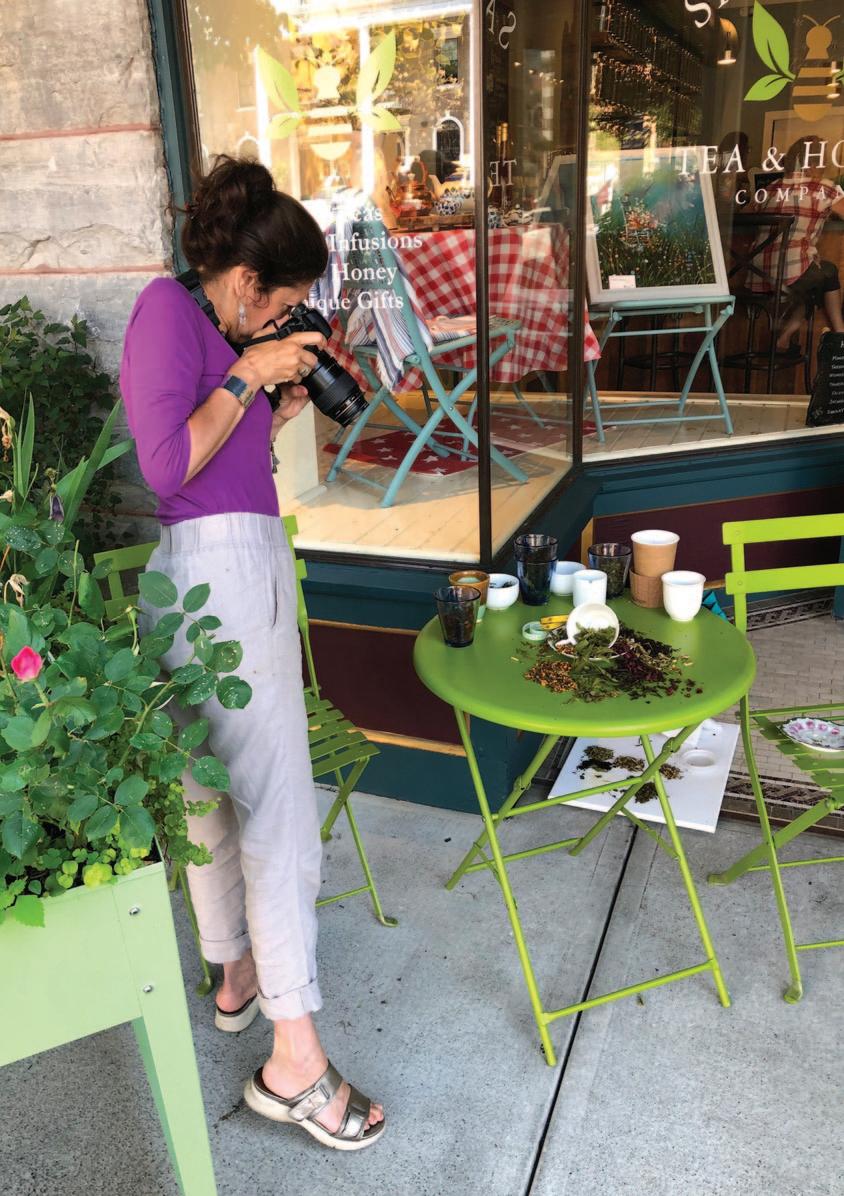
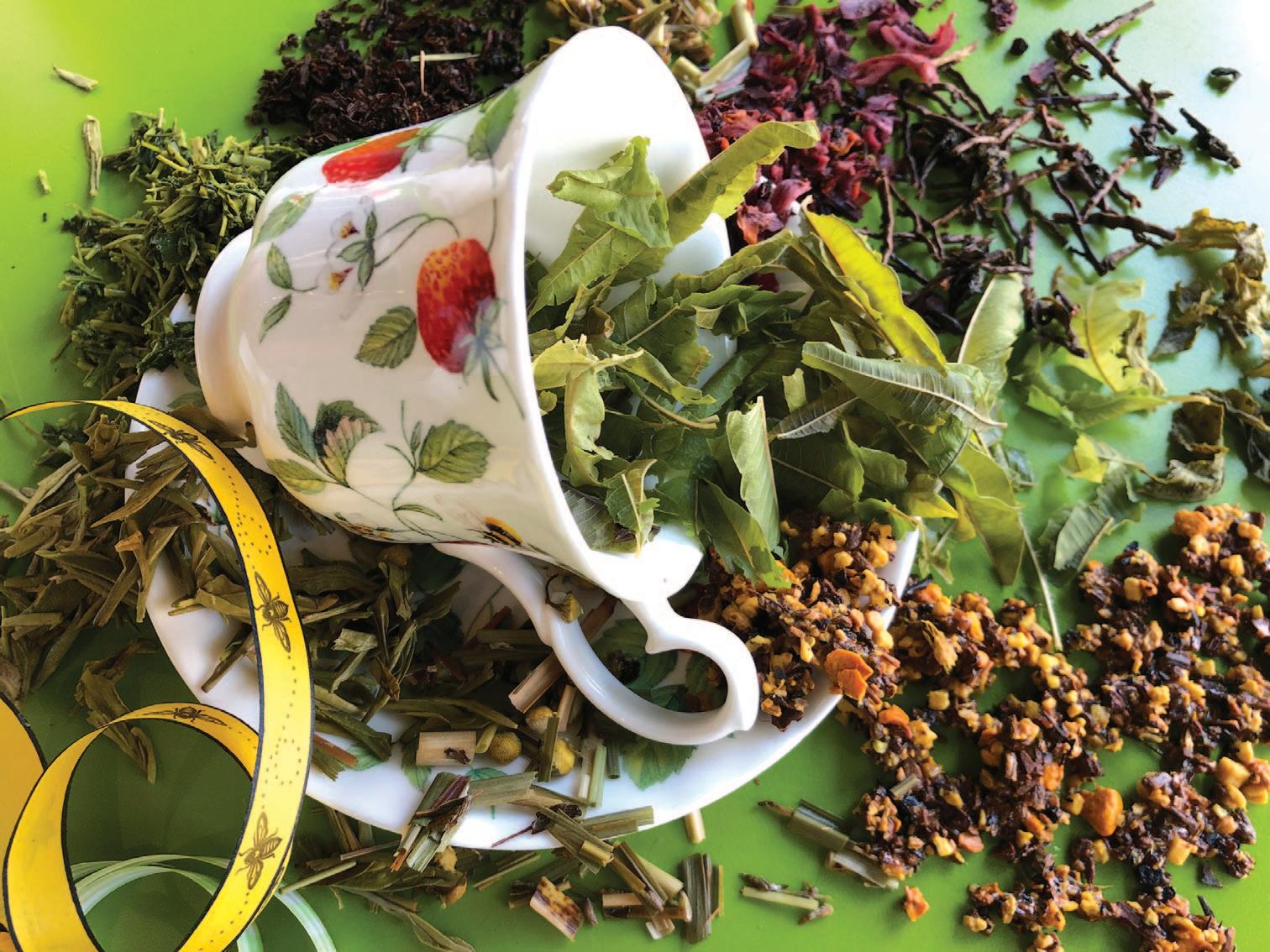
“Gratitude” created at Saratoga Tea & Honey Company with their “spent” tea leaves…and compostable ribbon!
Creating “Gratitude” photo credit AB Brown
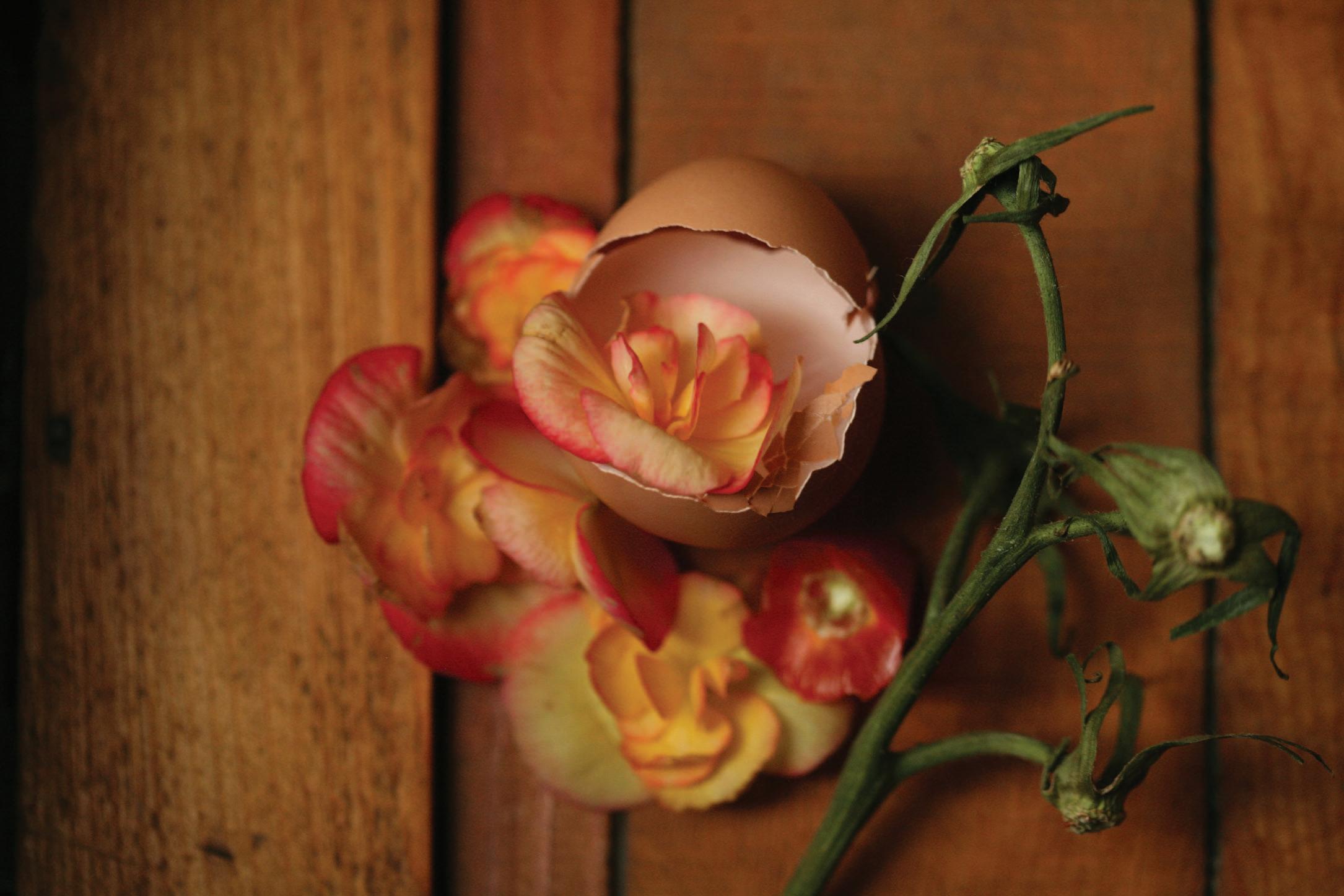
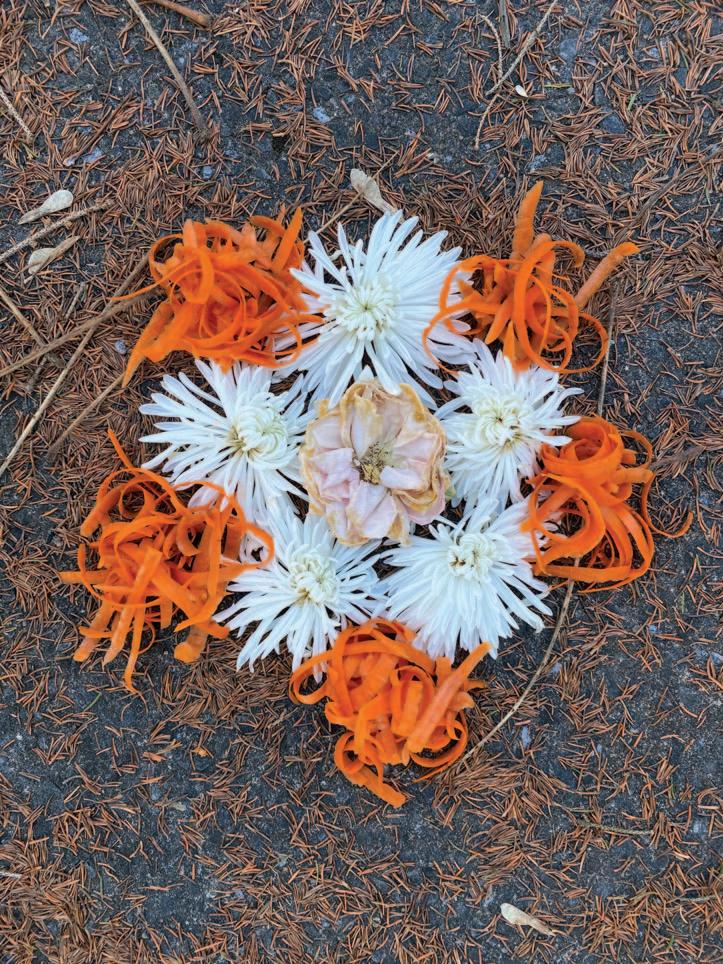
Birthday bouquet meets turkey soup on the way to the composter we have…….. “Joy”
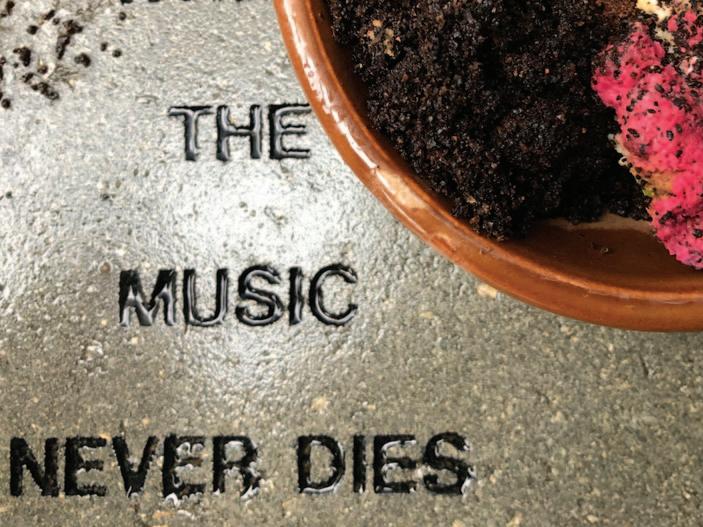
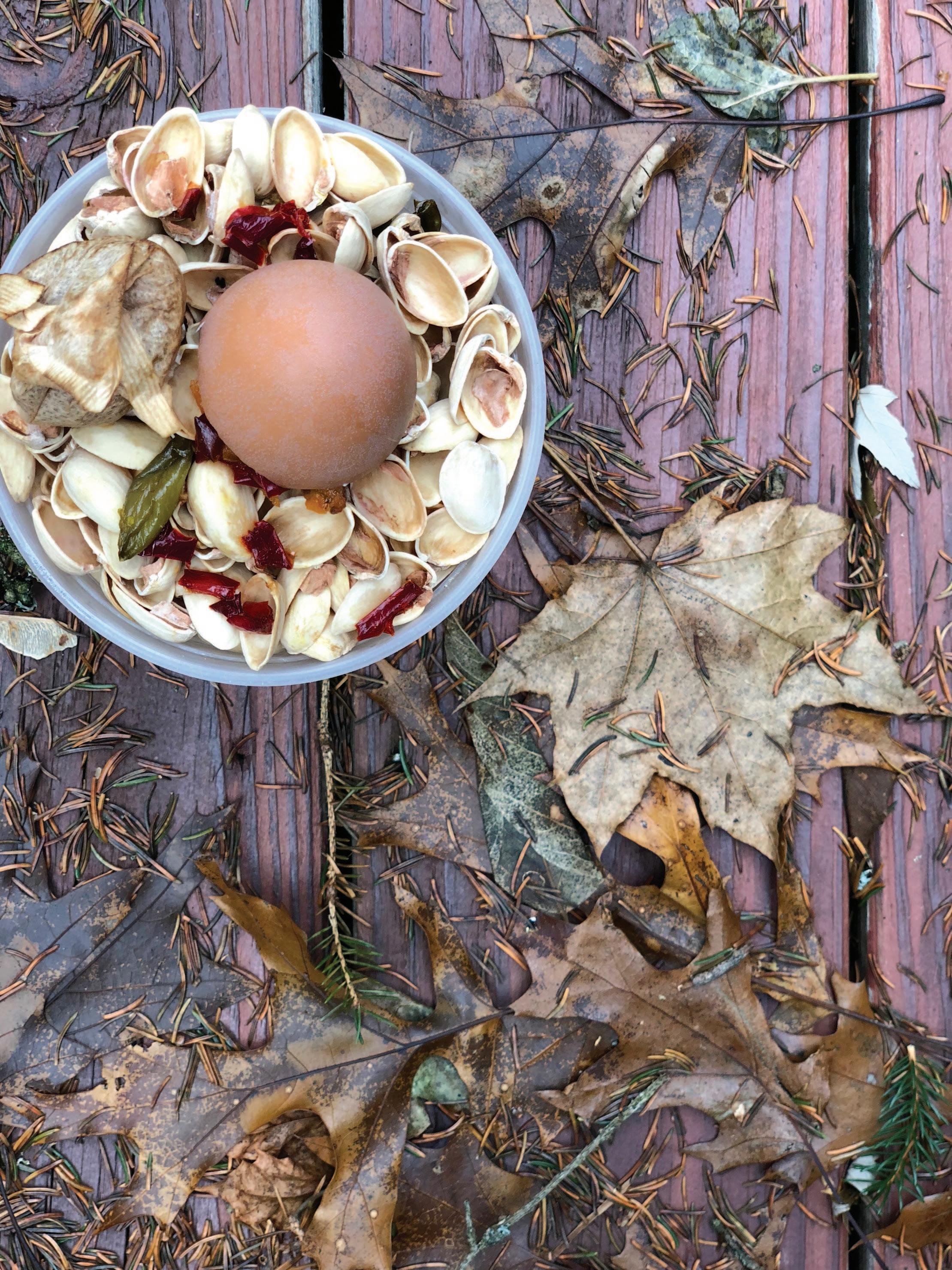
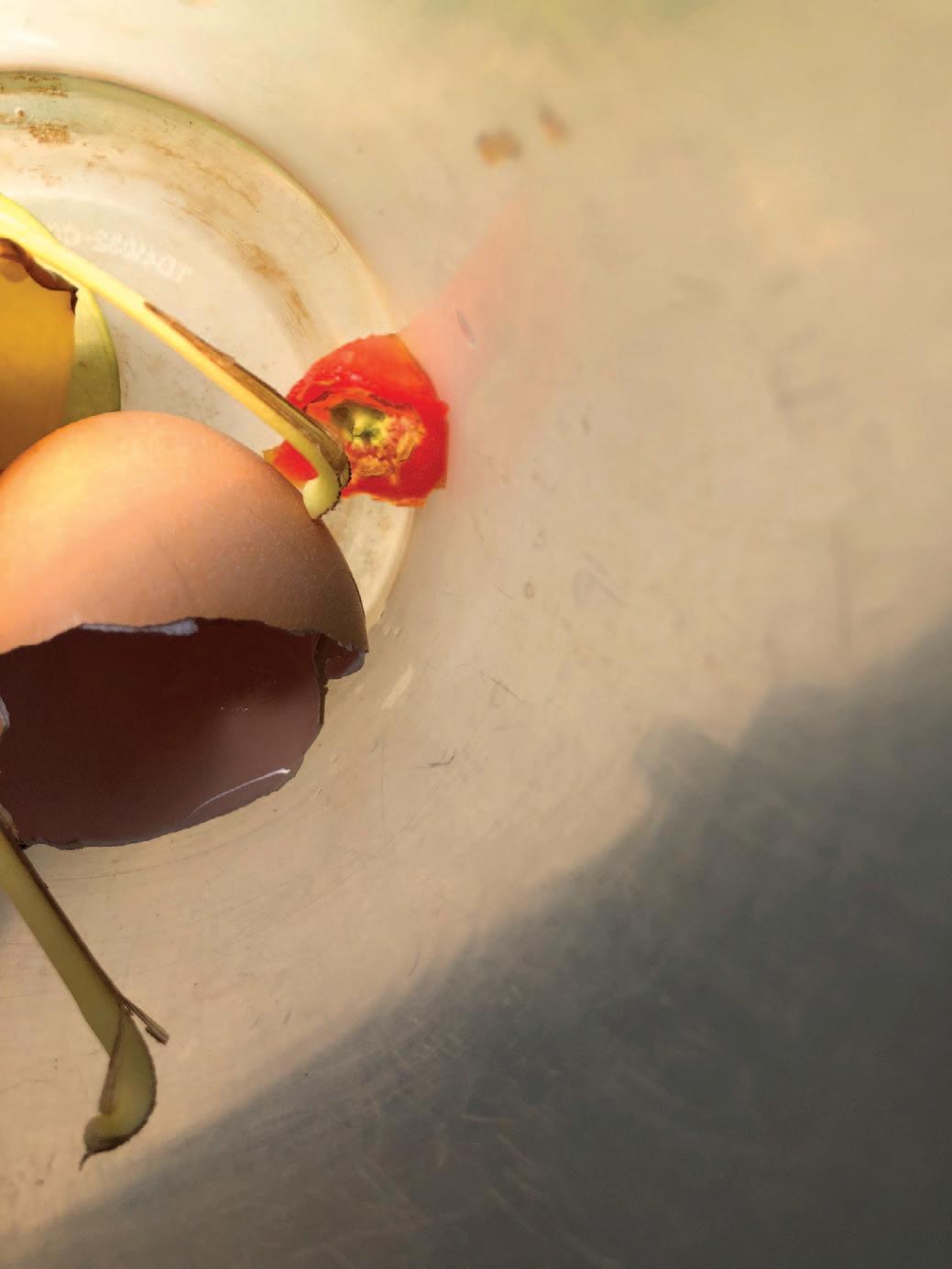
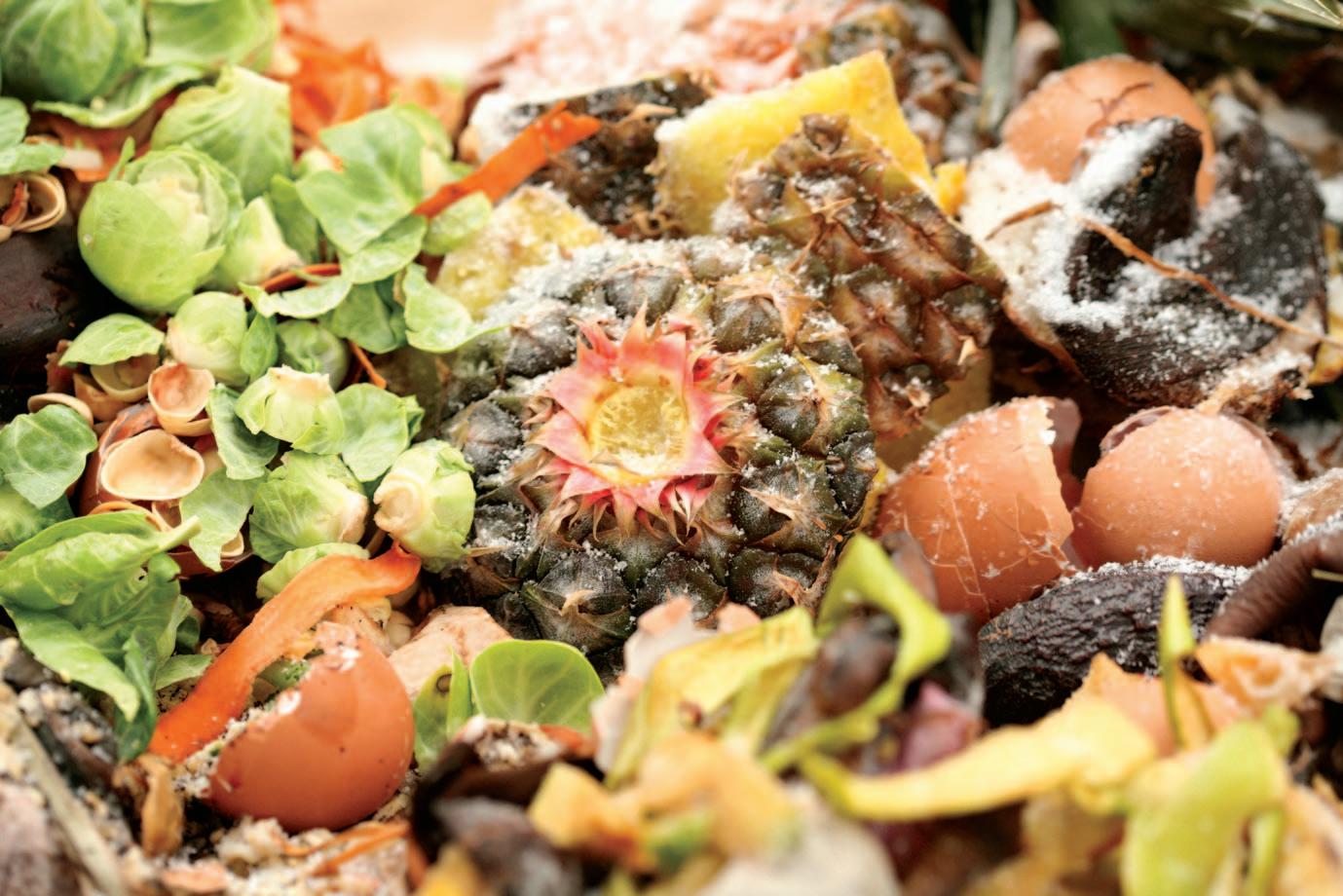
and photographed a composition that was nothing more than her everyday garbage destined for the compost bin. Yes, garbage. And according to Terri-Lynn, “she did not compose” the garbage for her photograph but simply saw it for what it was in its natural state. Her plus one simply opened her eyes and revealed the inherent beauty in these bits and scraps and the message they contained.
Her scraps spoke the language of life through food - how fields are tilled, how seeds are sown and grown, how plants are fertilized
and watered, how fruits and vegetables are picked, and how produce is washed, weighed, and sorted. They also revealed how produce is packaged, shipped, unloaded, and priced; then displayed, selected, purchased and brought to someone’s kitchen. And they ultimately disclosed how food is prepared, eaten, cleaned up, and disposed of. To Terri-Lynn, the energy that surrounds food and its life cycle is both moving and profound, yet most of us in the Western World have never given it much thought. When we have finished our meals, we simply toss the leftovers deemed inedible and move on. Sadly, nature’s pow erful cycle for nourishment is broken down with every toss over and over again. We all lose because of it.
Terri-Lynn intends to change that with each photograph she takes and bravely shares with us. Bravely because composting as art was an idea that she was compelled to pursue b ut reluctant to share for several years because it was far from mainstream art. Be fore revealing her passion, Terri-Lynn n eeded to be comfortable with it and committed to it. Being misunderstood is one thing but not being taken seriously is an en tirely different experience for an artist, so it’s a risk one needs to be ready to take.
Thankfully,Terri-Lynn took the risk and shared her passion with several respected res idents and supporters of the arts and cul ture in Saratoga Springs. They agreed that the raw, natural beauty of her photographs was meant to be seen and appreciated, while delivering the message of sustainability and
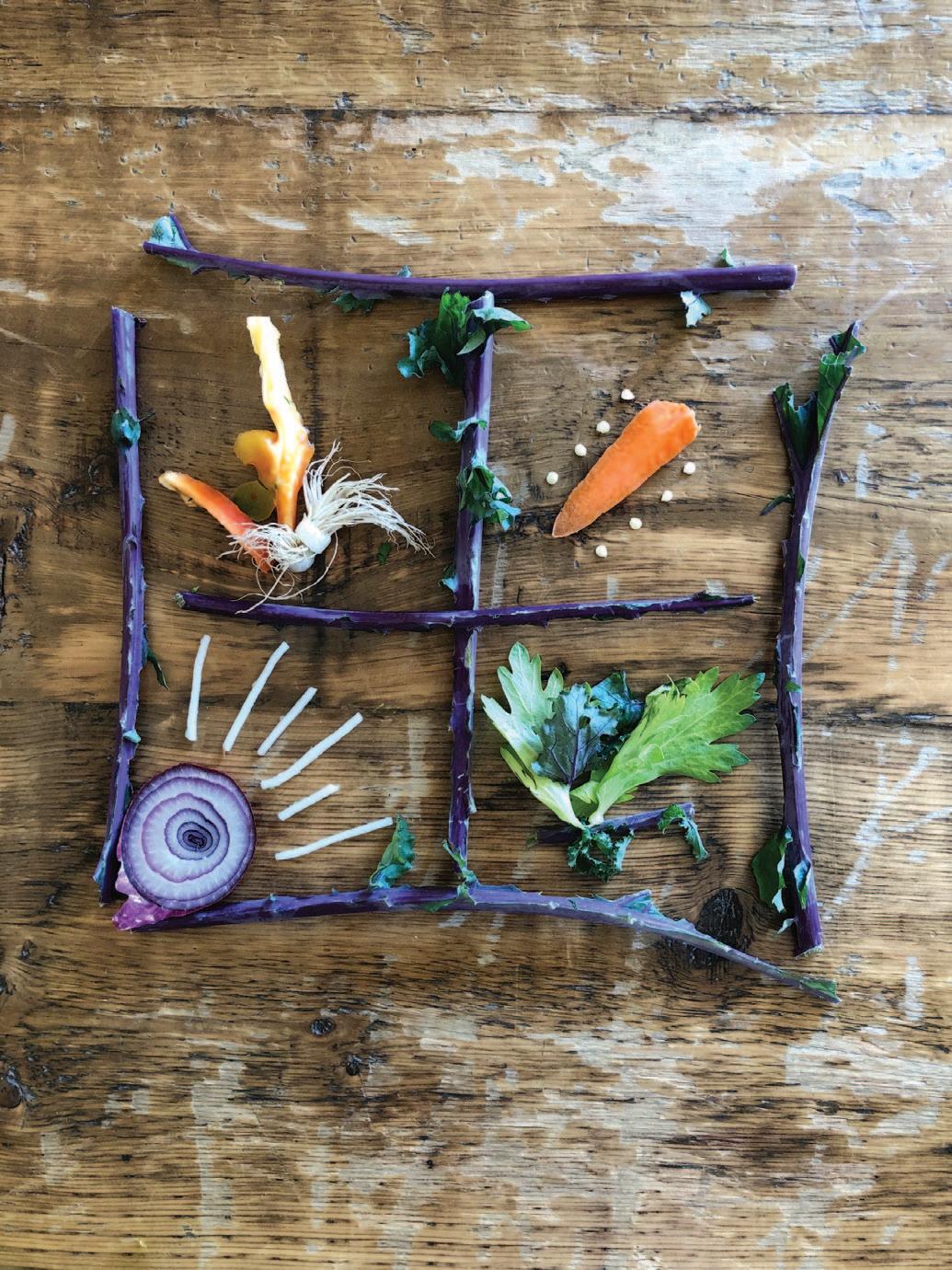
“Four Seasons Natural Foods Store” logo recreated using their own compost
“Morning Gift”
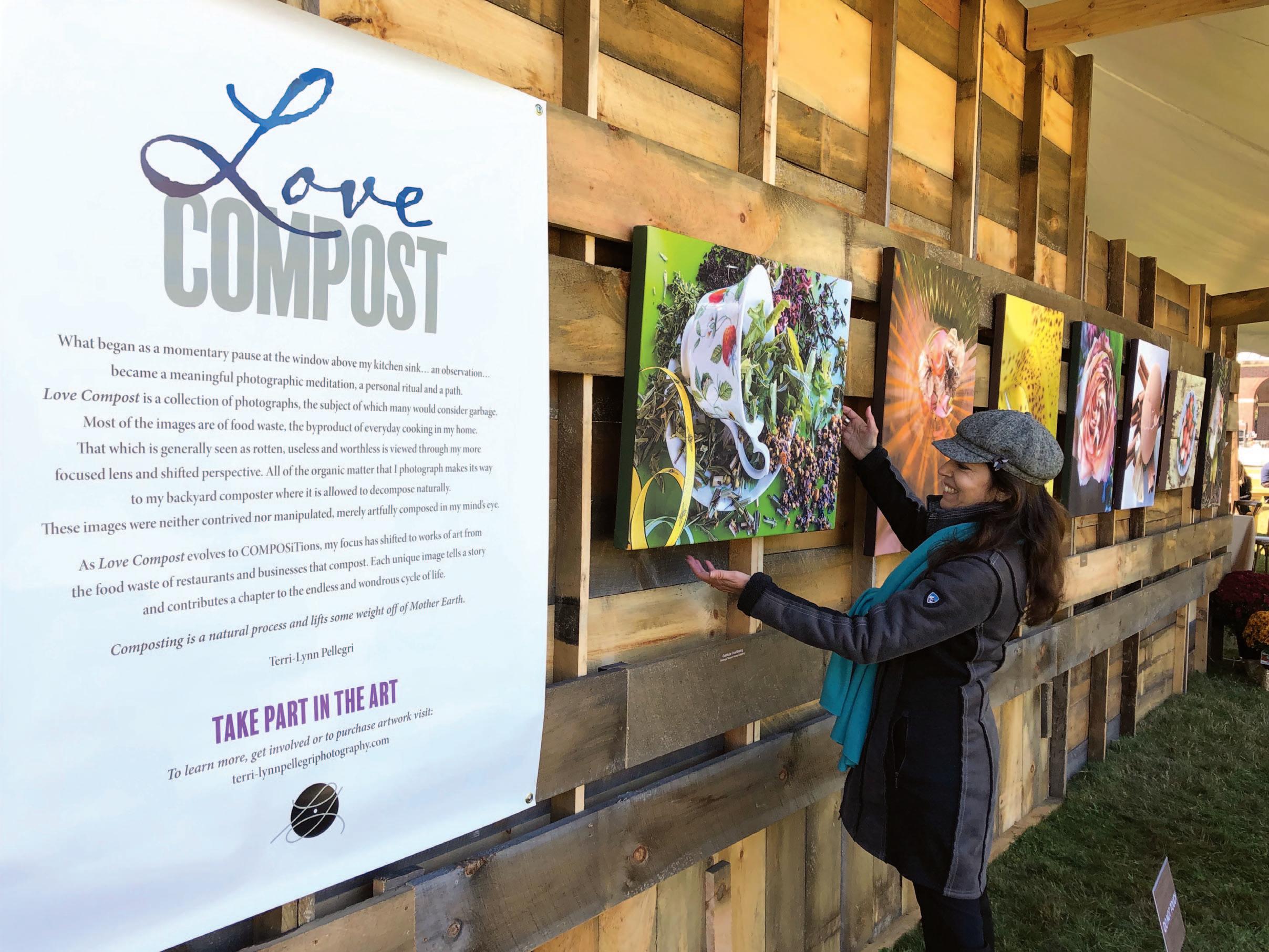
composting. Terri-Lynn’s exhibit entitled “Love Compost” was then fea tured on the walls of Uncommon Grounds in early 2019 and coin cided with International Compost Awareness Week. Her work was later featured at the October 2019 Saratoga Wine and Food Festival. According to SPAC President and CEO, Elizabeth Sobol, “the underlying ethos of the 2019 Festival" was “socially conscious cultivation and consumption.” Terri-Lynn’s compost exhibit of “Love Compost” photographs was unique, on point and well received.
Seizing every opportunity to bring more attention to composting and its numerous benefits, and at the suggestion of Sarah Craig, Executive Director of Cafe Lena, Terri-Lynn then reached out to area restaurants for permission to photograph their compostables. She calls these new pieces “COMPOSiTions”. So far, she has photographed the scraps and garbage unique to Four Seasons Natural Foods, Caffe Lena, Saratoga Juice Bar, Saratoga Tea and Honey Company, and Anne’s Washington Inn. And being the perceptive artist and photographer that she is, Terri- Lynn was able to perfectly arrange the Four Season’s Natural Foods’ compost to reflect their actual logo for their composition.
Today, Terri-Lynn’s goal for “COMPOSiTions” is to create a unique vi sual story that stimulates dialogue and becomes a powerful force for change. She believes that “Saratoga Springs is amazing but has become a community of tremendous consumption” and shows no sign of abat ing. Terri-Lynn goes on to ask, “Why can’t we be the model city for composting?” which begs the question, why not? Hopefully, its citizens will see it that way and act.
While “COMPOSiTions” is still a work in progress, the momentum has been slowed by the pandemic of 2020. Restaurants are currently facing immense hardship and struggling to survive, so she has temporarily stepped back from this project until the business climate improves.
But it should come as no surprise that Terri-Lynn Pellegri, artist and photographer, continues to love and photograph her very own compost just about every day!
You can stay up to date on “COMPOSiTions” and enjoy all of Terri-Lynn’s beautiful photography at www.terri-lynnpellegriphotography.com
“Love Compost” Gallery wall at Saratoga Wine & Food Festival 2019. Photo credit Mark Bolles
Alexandra Elise Photography
Caring for Wildlife in the North Country
By Lawrence White
“Those who wish to pet and baby wild animals 'love' them. But those who respect their natures and wish to let them live normal lives, love them more.”
All of us have seen wild animals in distress either near our homes or while on the road. The question that comes to mind is how do we help them? Taking wild animals into our homes is often illegal and finding a rescue center can be daunting if you do not know where to look.
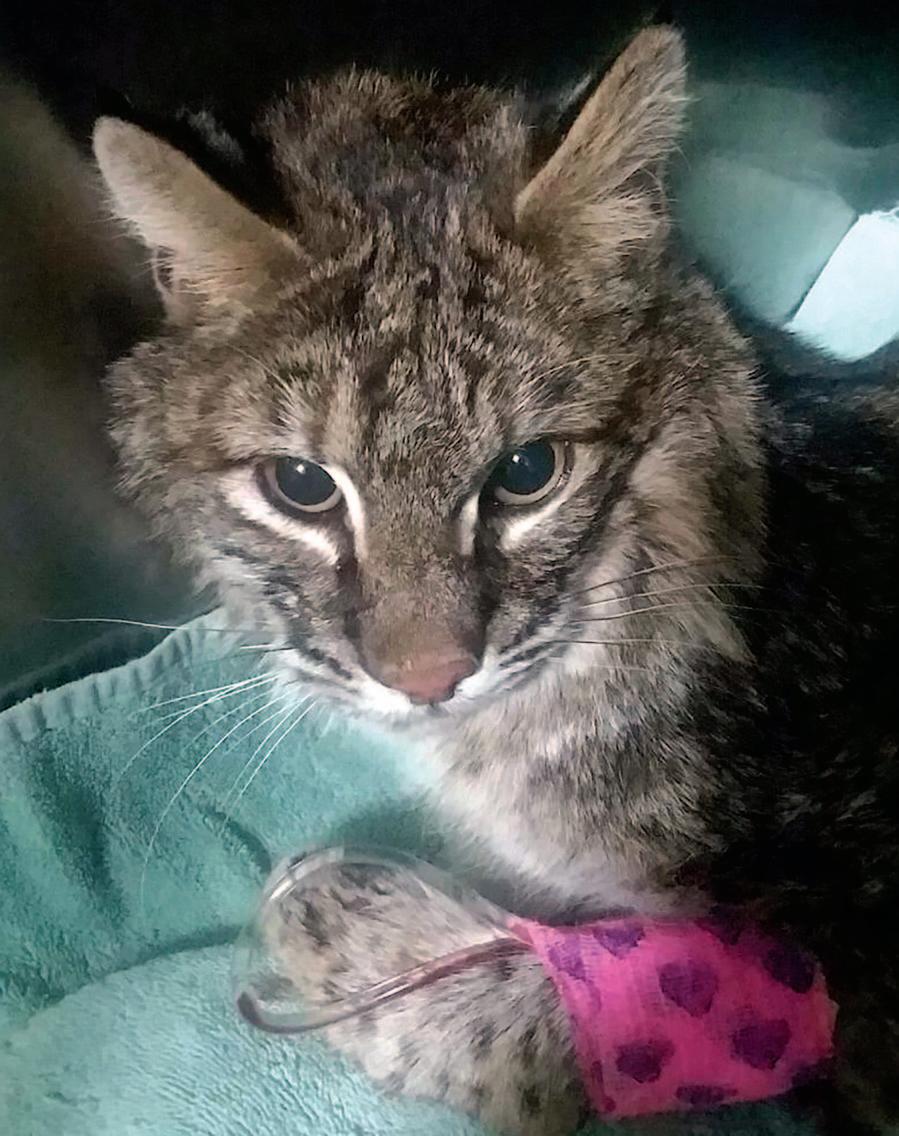
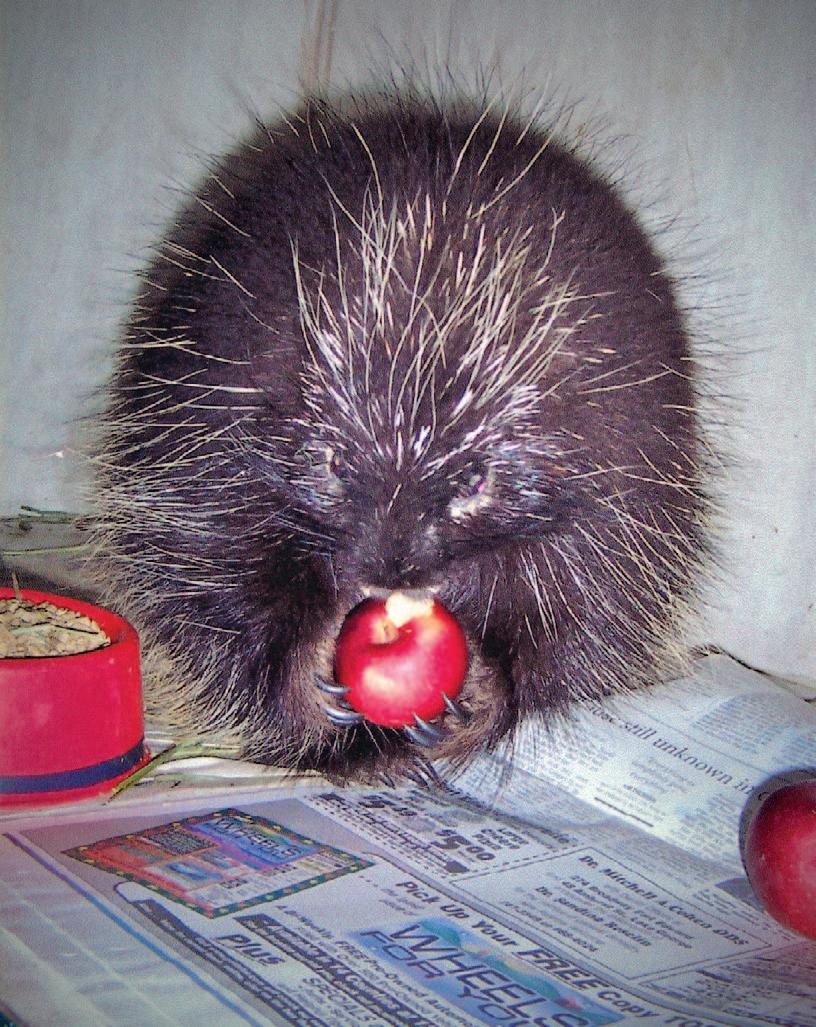
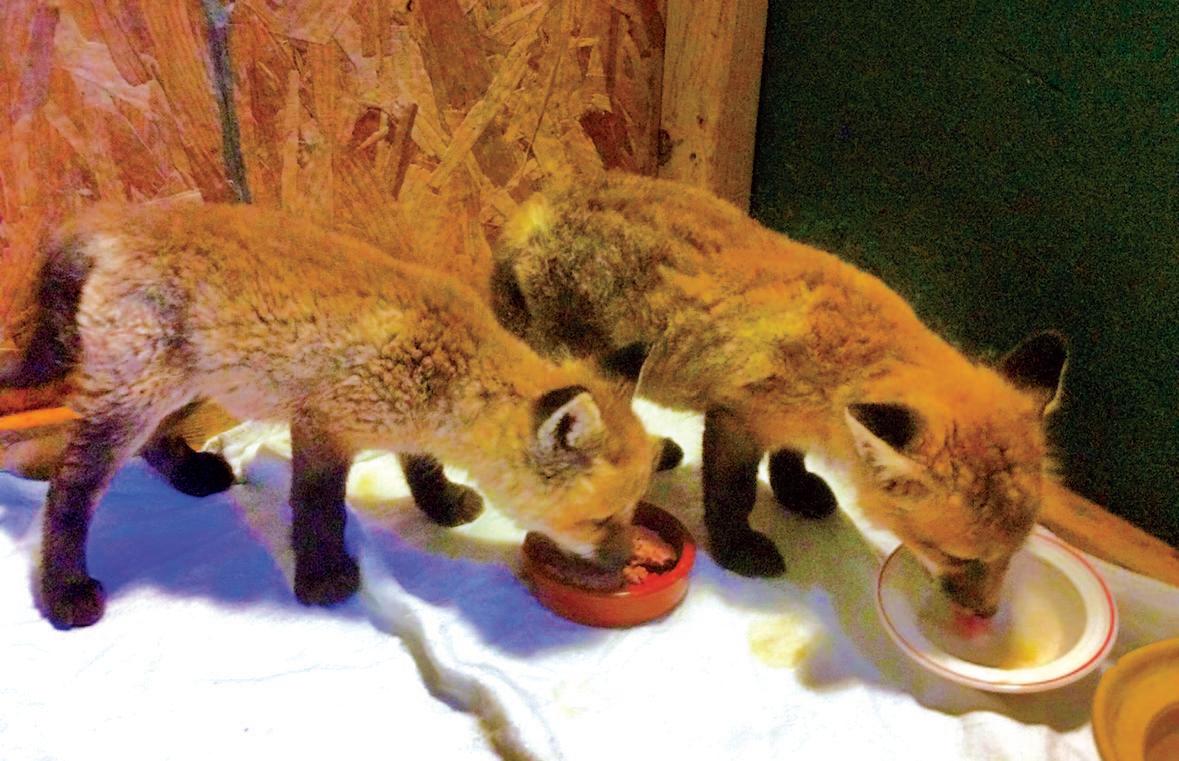
Fortunately, we have a great resource in our area with North Country Wild Care (NCWC). They rehabilitate wild animals and release them back into their natural habitat. In so doing, they work with a wide variety of creatures including squirrels, rabbits, deer, skunks, opossum, bobcats, fox, chipmunks, por cupines, and birds of all kinds including hawks, eagles, owls, hummingbirds, and more.
When I first heard of NCWC, I imagined a large central facility with satellite clinics or offices. I was wrong. North Country Wild Care is a network of individuals who have taken it upon themselves to study and volunteer before becoming licensed by the federal and state government to rescue and rehab wild animals on their own property. They have a 24-hour hotline number to report wild animals in distress and they respond quickly.
Naturalist Photographer, Edwin Way Teale
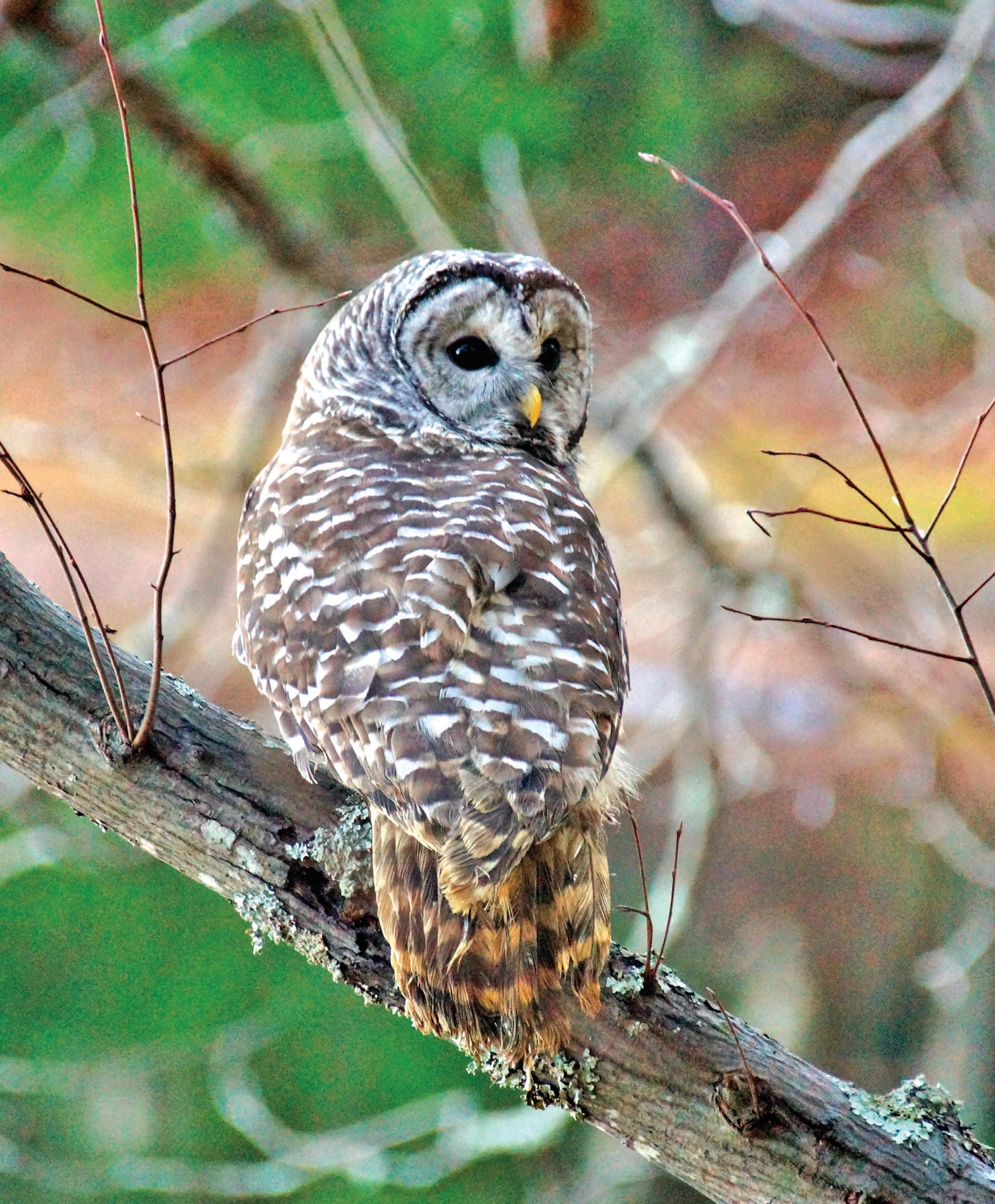
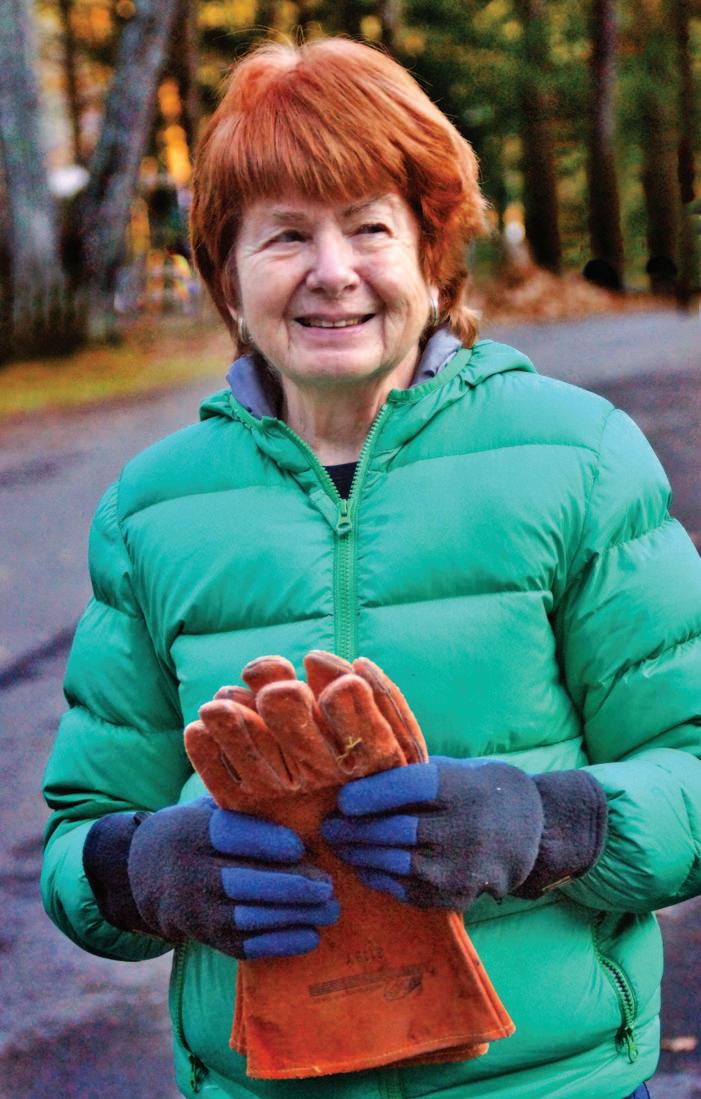
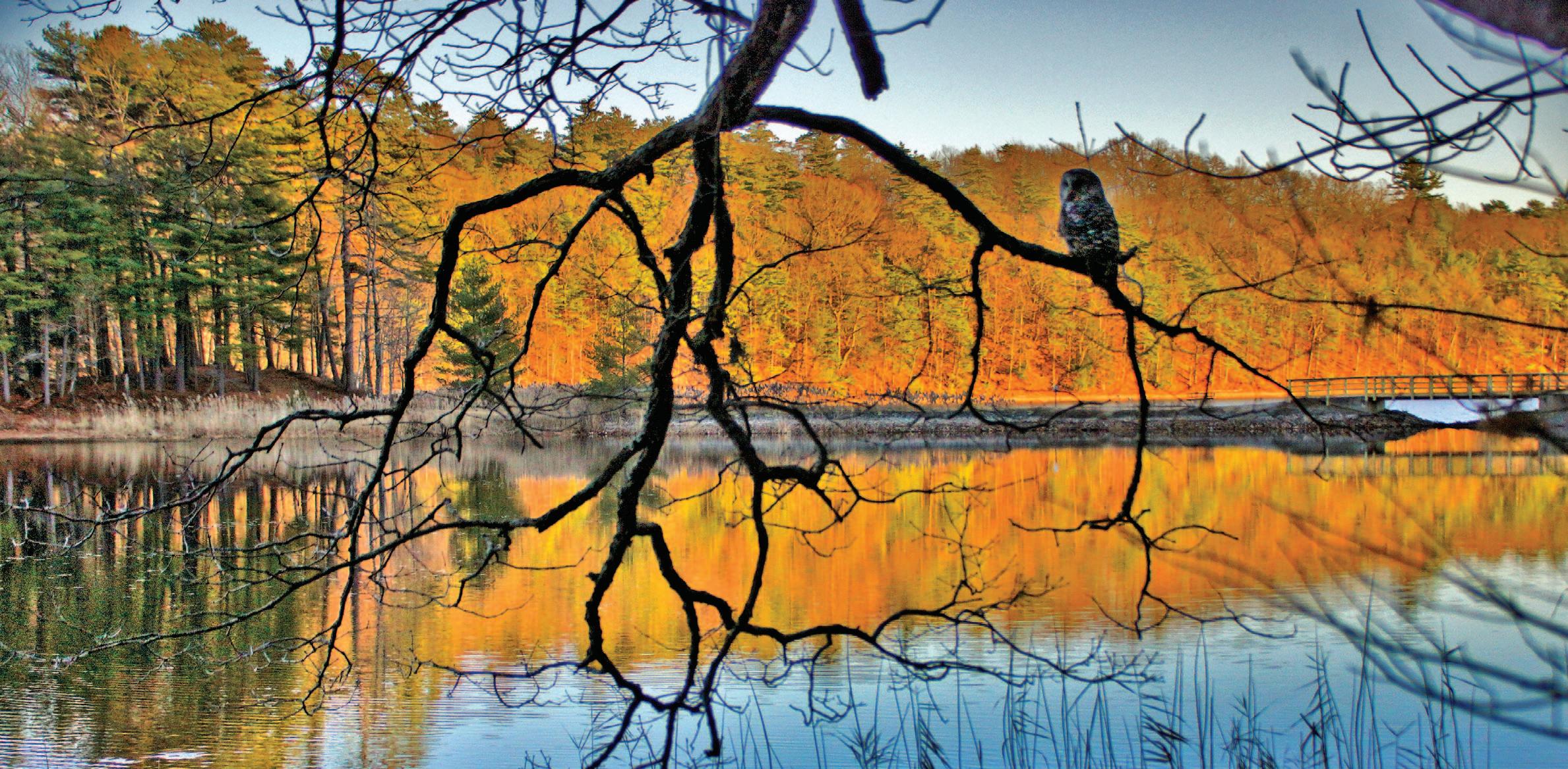
My introduction to NCWC was through a friend who notified me of the release of an adult Barred Owl at Lake Moreau. The bird had re covered from its injury and was ready to return to nature. The res cuer that housed and doctored the bird to health is Nancy Kimball who arrives in a car with “WILDCARE” license plates. Ms. Kimball is a diminutive and soft-spoken person, but her strength and resolve are quickly evident.
It is interesting to note that several others are in attendance. Ms. Kimball is highly regarded as a wildlife rescuer, and this release is something that will be very interesting to observe. The bird is quite large, and Ms. Kimball is not.
One of those in attendance is the Vice President of Friends of Moreau Lake, Paula Lomasney, who brought a mega package of paper towels. Ms. Kimball was thrilled to receive them. “There is always a use for paper towels in my business,” she exclaimed with smiling eyes.
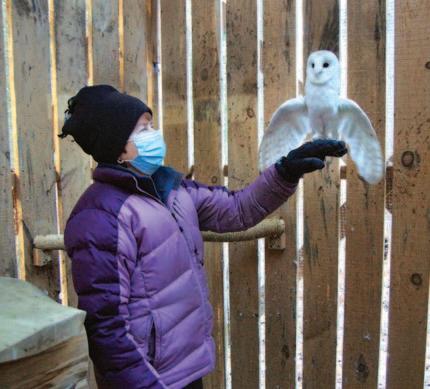
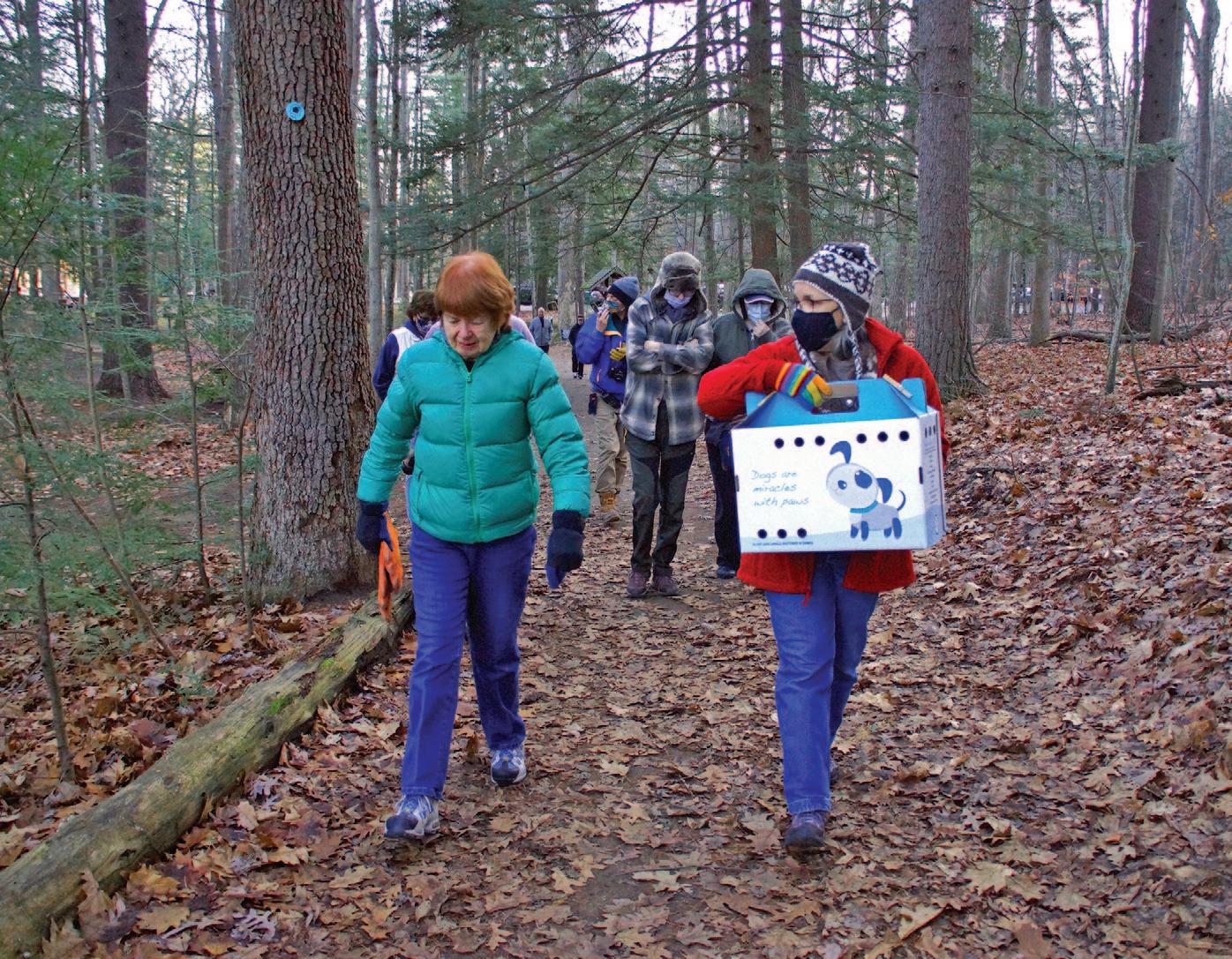
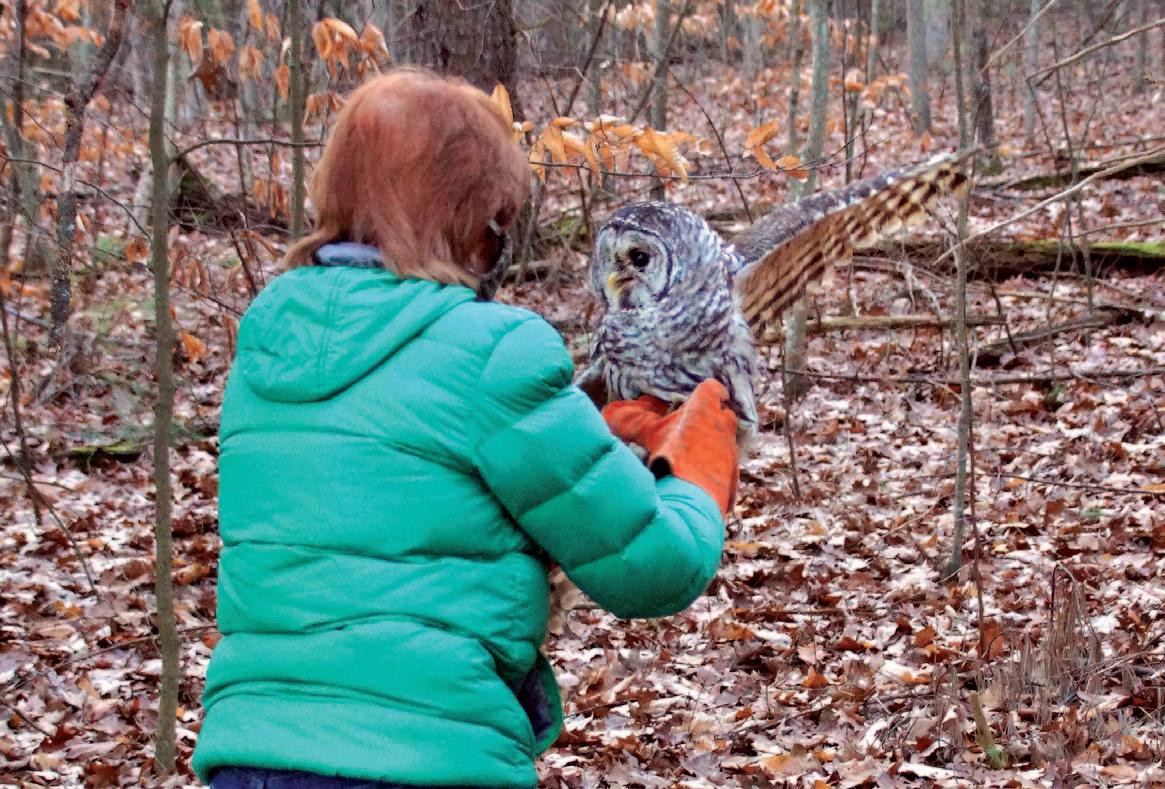
Our group soon heads into the woods with Ms. Kimball in the lead. The owl is in a large cardboard container and seems to be quite calm. When we reach an area with some open space that also has trees with exposed lower limbs, Ms. Kimball halts and puts on heavy leather gloves. It is quite impressive to watch as Ms. Kimball confidently reaches into the carrier and lifts the owl by grasping onto its legs. Even at this precarious moment, it is evident that the owl has trust in Ms. Kimball.
Then, in an instant, Ms. Kimball lifts her arms and opens her hands. The bird quickly senses its freedom and flies a few feet before landing in the deep leaves on the forest floor. There the owl rests momentarily before fully extending its wings to fly onto a limb that extends over the lake. The owl is still perched there as we walk away.
I ask Ms. Kimball how she was first motivated to take the re sponsibility of wildlife rehab and she responds, “I had no background in this sort of thing. I was retired and became
ac quainted with an officer from the Department of Environmental Conservation who had rescued an injured Screech Owl. I accompanied him to a rehabilitator, and that was when I decided this was what I wanted to do for the rest of my life. I was able to acquire all of the in formation from my friend to get started, and I have never stopped since.”
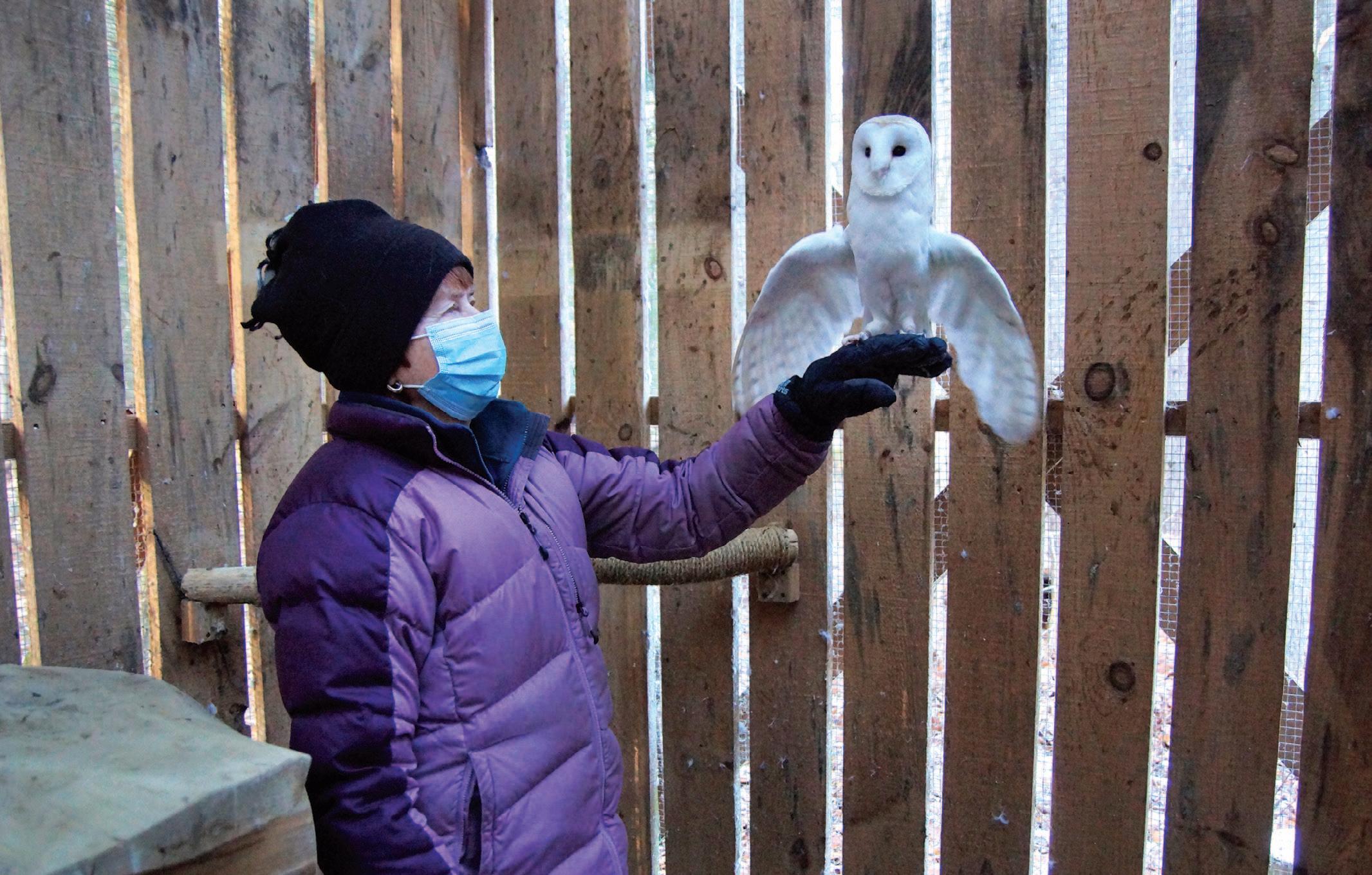
It is not easy to become qualified to do this good work. Ms. Kimball studied and passed the required tests to gain a total of four licenses on both the state and federal levels to rehabilitate and release several species of wild animals. This includes maintaining habitat for animals, particularly birds, that are not releasable due to their injuries. Ms. Kimball uses them for teaching wildlife and ecology.
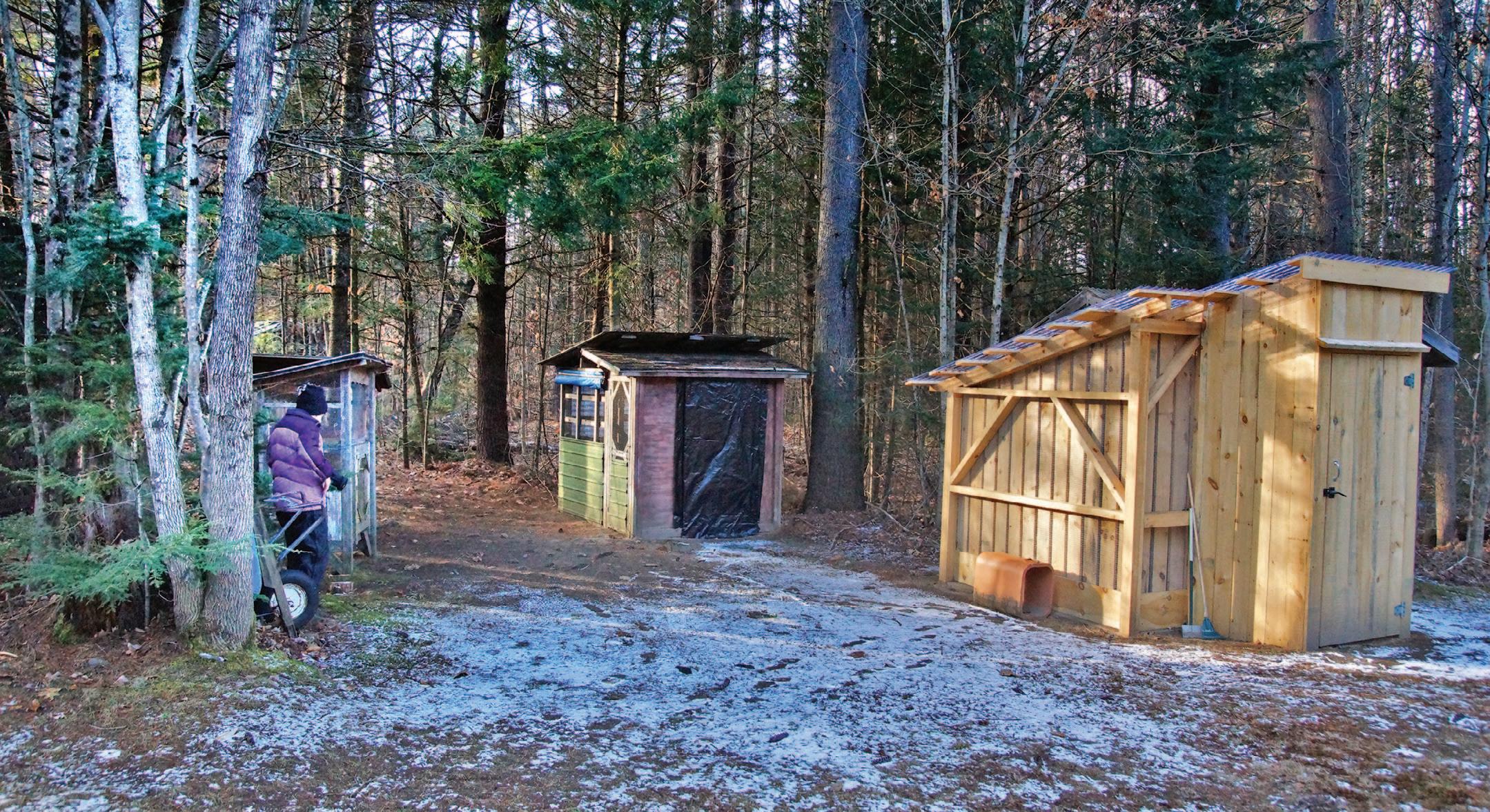
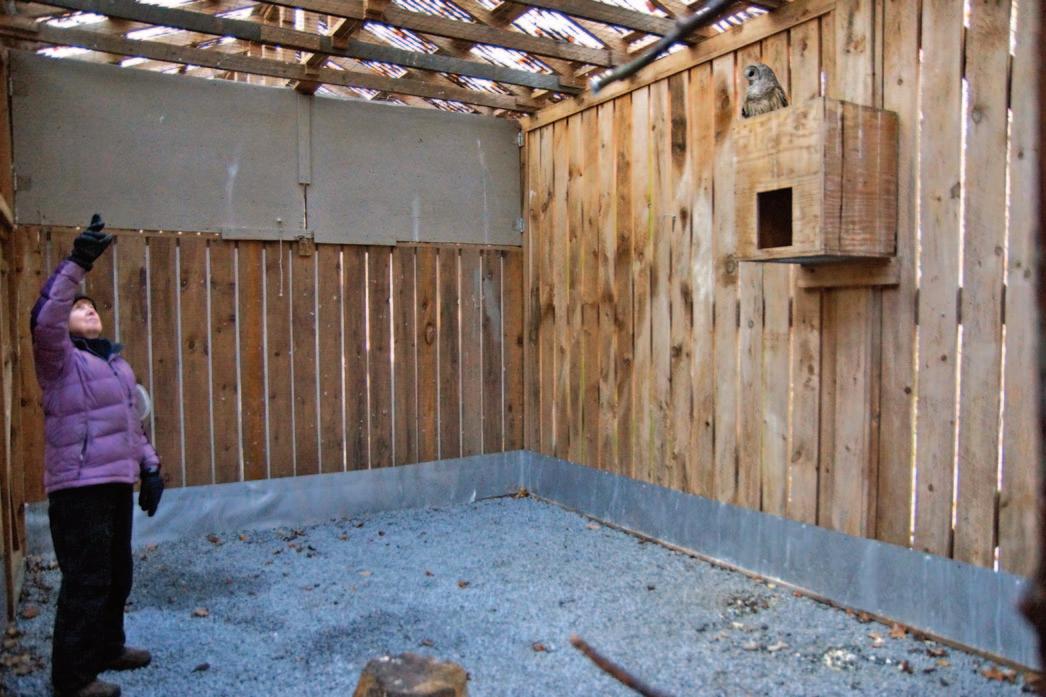
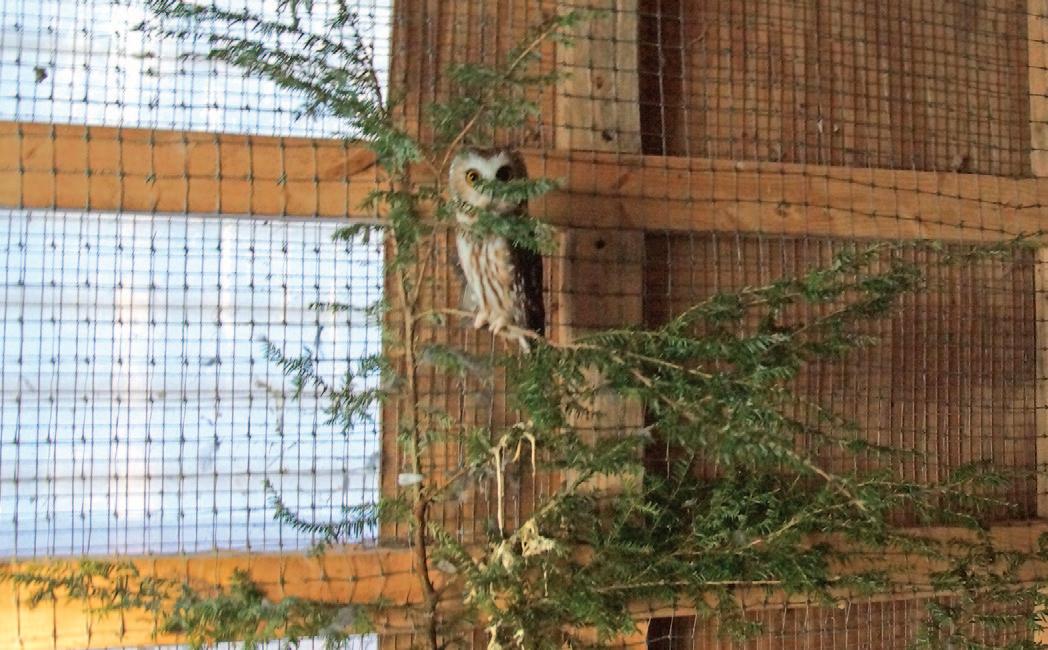
As I visit Ms. Kimball’s large, wooded property, I am struck by the design of the several aviaries she maintains. It is obvious that considerable thought went into creating these habitats, as they are simple in design yet highly effective in use.
“I selected only untreated wood so that there is no chance the birds can ingest toxins,” she explains as we walk through the structures. “I studied designs that other groups were using and modified them to my specifications.” She worked with a local carpenter to construct a series of walk-in habitats that were built over several years. Each one serves a purpose dependent on the status of the birds it houses. Some hold the birds that are unable to return to nature, while others provide space for flight therapy that is necessary for recovering birds.
The most impressive structure is one Ms. Kimball calls the “Owl Hilton.” It is 12ft wide, 30ft long, and 11ft. tall. It is divided by a wall with large hatches at the top that can be opened to create a more expansive flyway for recovering birds. The roofs of the habitats are translucent plastic, and the walls are slatted and spaced for ventilation and light. The birds feel free to fly from one end of the aviary to the other with several places to land or cling to as they build confidence and coordination that will be necessary to return to nature.
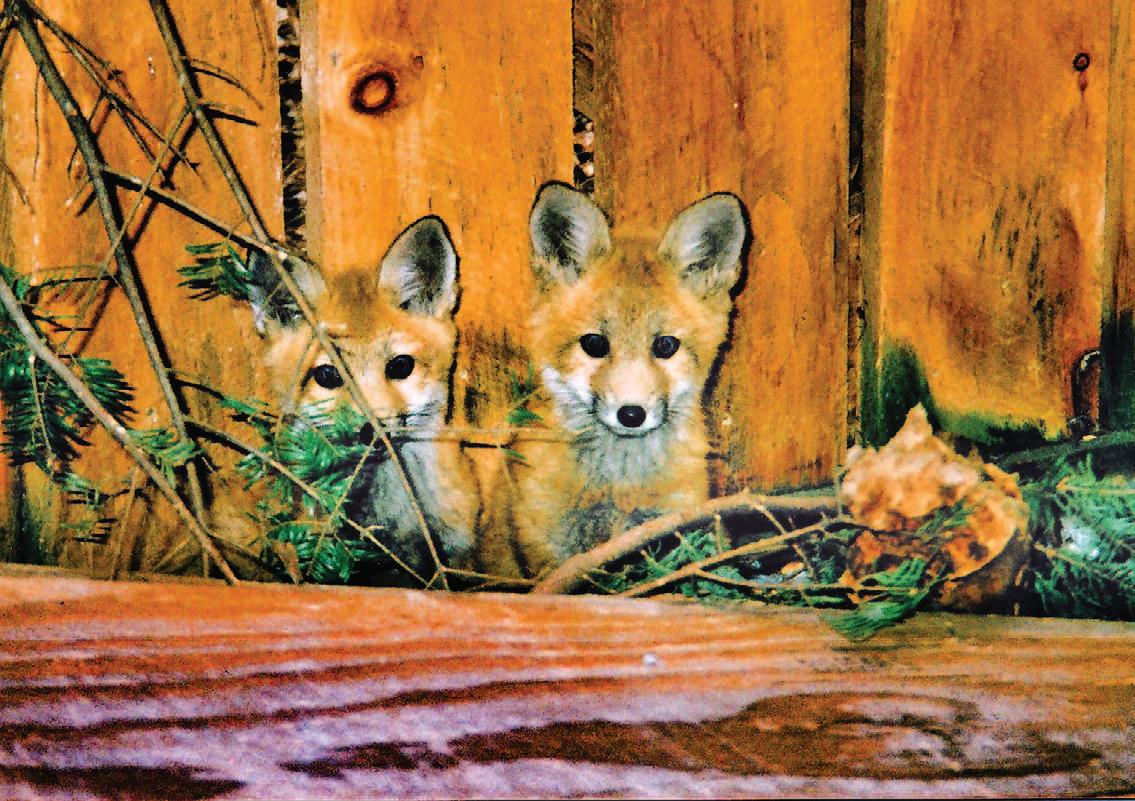
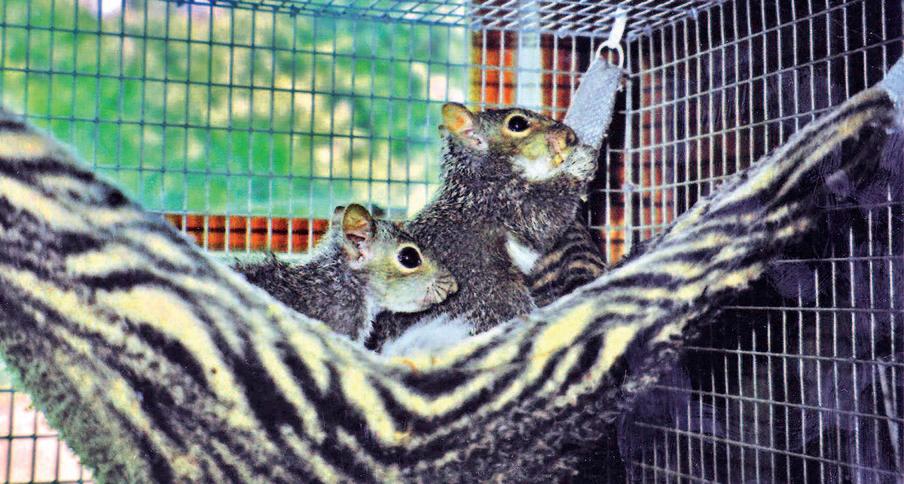
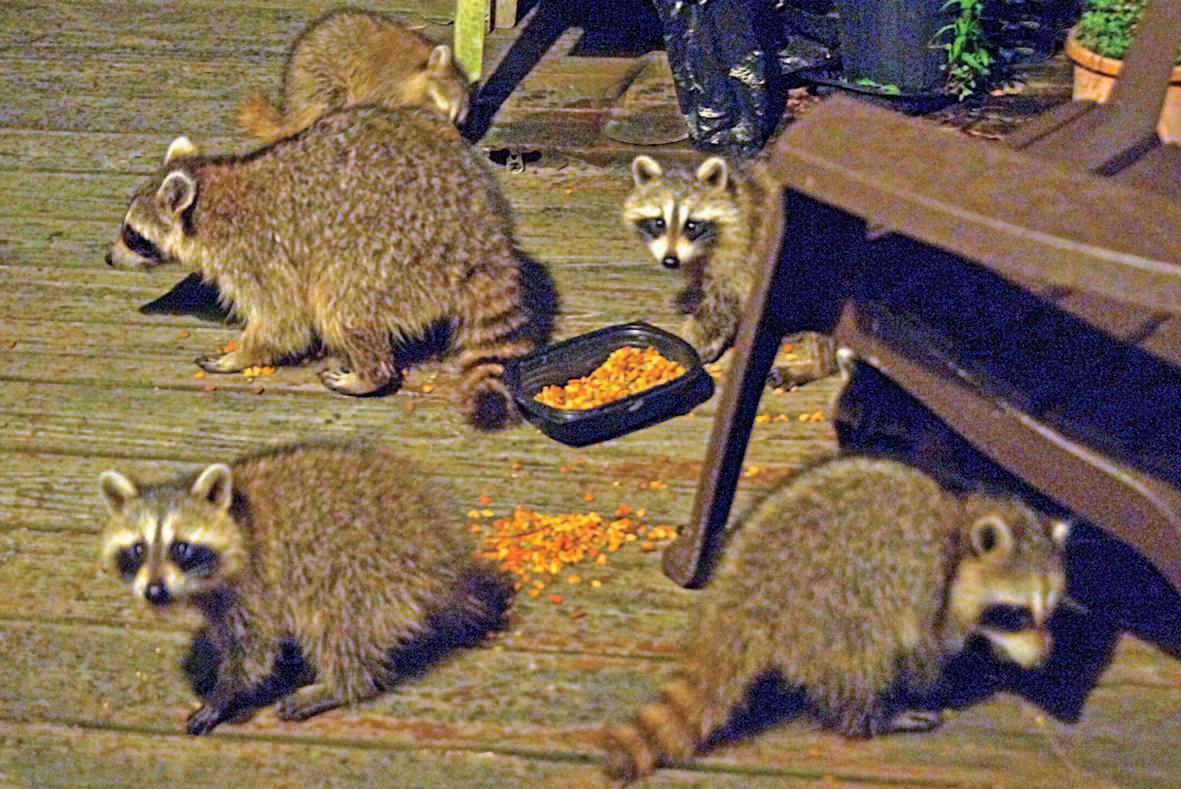
Ms. Kimball also accepts opossums, raccoons, squirrels, chipmunks, foxes, and so on. During winter months, some of the critters can recover in a space in her basement which is climate-controlled. A non-releasable female American Kestrel (the smallest U.S. falcon) lives in a climatecontrolled aviary in her garage.
“I started small, as most rehabbers do,” Ms. Kimball tells me. “I was taking in small mammals, squirrels, opossums, chipmunks, and so on. Fortunately, other local rehabbers in the network provided donations of cages and supplies. With their help, I started to expand and ended up with the structures on my property today. It has become a system that is very efficient for me and very effective for the animals.”
Of course, this does not come cheap. Caring costs. The medicines, dress ings, habitats, food, cleaning supplies, and so on are substantial. The food for the predatory birds is mice. They come frozen and must be thawed. Some of the recipes for the younger or injured birds and mammals
require the natural ingredients to be blended in specific amounts to create a nutritional solution. In addition, there is the chore of maintaining the structures and the paths to them. There is much more to it, but you get the idea.
When I ask NCWC board member, Sigrid Wallace how many others are practicing wildlife rehab in our area through their organization she tells me that as many as thirty are highly active. “The truth is that we network all over the state and all over the country with people who are involved in wildlife rehab. It is a very vibrant community.”
She goes on to add, “Due to the COVID situation, in three months this summer we had more calls on our hotline than we usually get in a year. In fact, we received over 12,000 calls." I ask Ms. Wallace about the essence of the calls and she responds, "We help people in many ways including instructing people how to place birds back into their nests and other small tasks. However, we do refer some with more complicated issues to our network of licensed rehabilitators who then take over. This can include larger animals. We had a call about a bear this year.”
Ms. Wallace emphasizes the point that their goal is not to make animals tame or to alter their nat ural habits. They simply wish to ease the suf fering and return to health as many wild ani mals as possible. After all, our society is not very friendly to wildlife. Only recently in our civ ilization did we even notice or care as we ex panded our cities, roads, and homes into their habitats with concrete, steel, and asphalt.
At this point, the wildlife rehab community is fac ing an uphill battle, but it is one that these car ing individuals can continue to affect in posi tive ways. Ms. Wallace explains, “We are all volunteers. No one gets paid other than parttimers who answer the phones over the summer.”
She continues, “Donations that come in go directly to the needs of the animals, and as you can see, there is plenty of need.”
Donations are not the only way for people to get involved. Volunteers can work directly with the various licensed rehabbers through NCWC by calling the hotline to get connected. In these times of great restric tions in our lives, this is an opportunity to embrace a meaningful activity at a level in which nearly anyone of any age can participate.
I ask Ms. Kimball how she feels when she sees one of the animals in her care return to the wild. She pauses a moment and thoughtfully responds, “Well, not all stories have a happy ending. There is heartbreak and there is joy. When the hard work results in a bird or mammal being restored to nature, it is a real fulfillment.” Then with a twinkle in her eye, she says, “It nourishes the soul, and that is something money cannot buy!”
North Country Wild Care Hotline - (518) 964-6740 northcountrywildcare.org
Curiosity ~ Exploration ~ Participation
This is The Rochester Museum & Science Center
by RONA MANN
“We used to build temples, and museums are as close as secular society dares to go in facing up to the idea that a good building can change your life.”
...Alain DeBotton
Remember when you were a child and were told you were going to a museum?
Maybe you went kicking and screaming because back then museums were dull and boring from a kid’s point of view, a place where you had to learn stuff just like in school.
It might have been an outing with your parents, with a scout or church group, or a school field trip. No matter who took you to that museum, the “rules” were the same. “Remember, no loud talking, no running, no spontaneous outbursts, you can look, but don’t touch.”
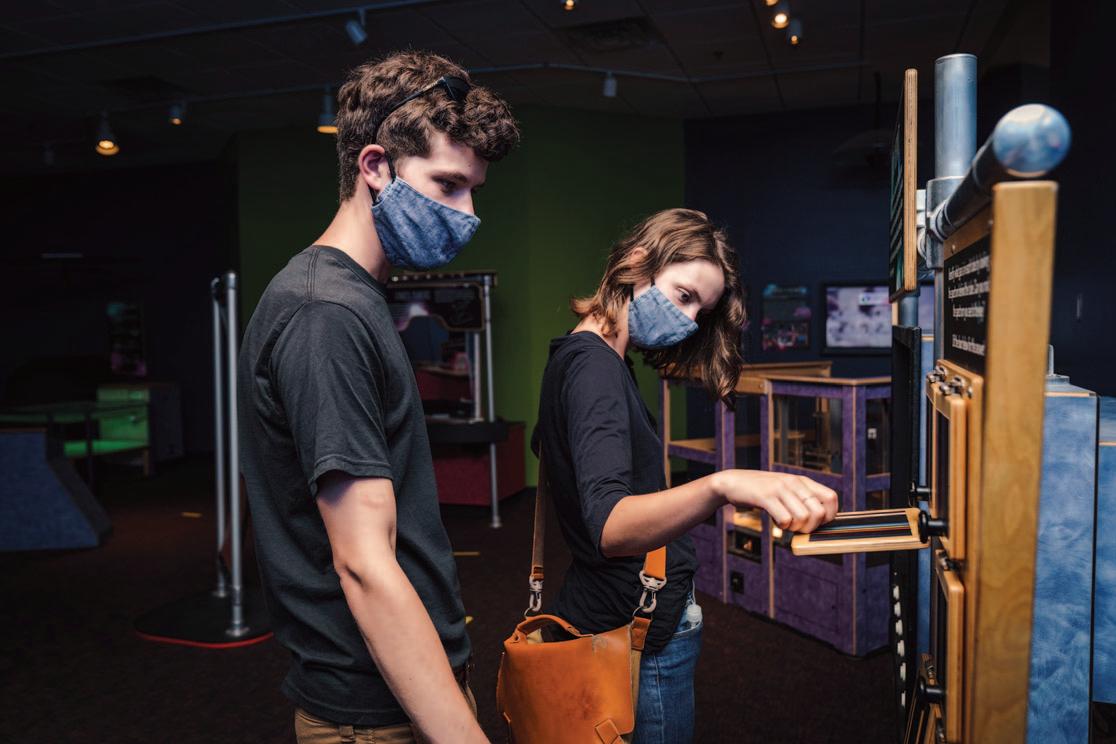
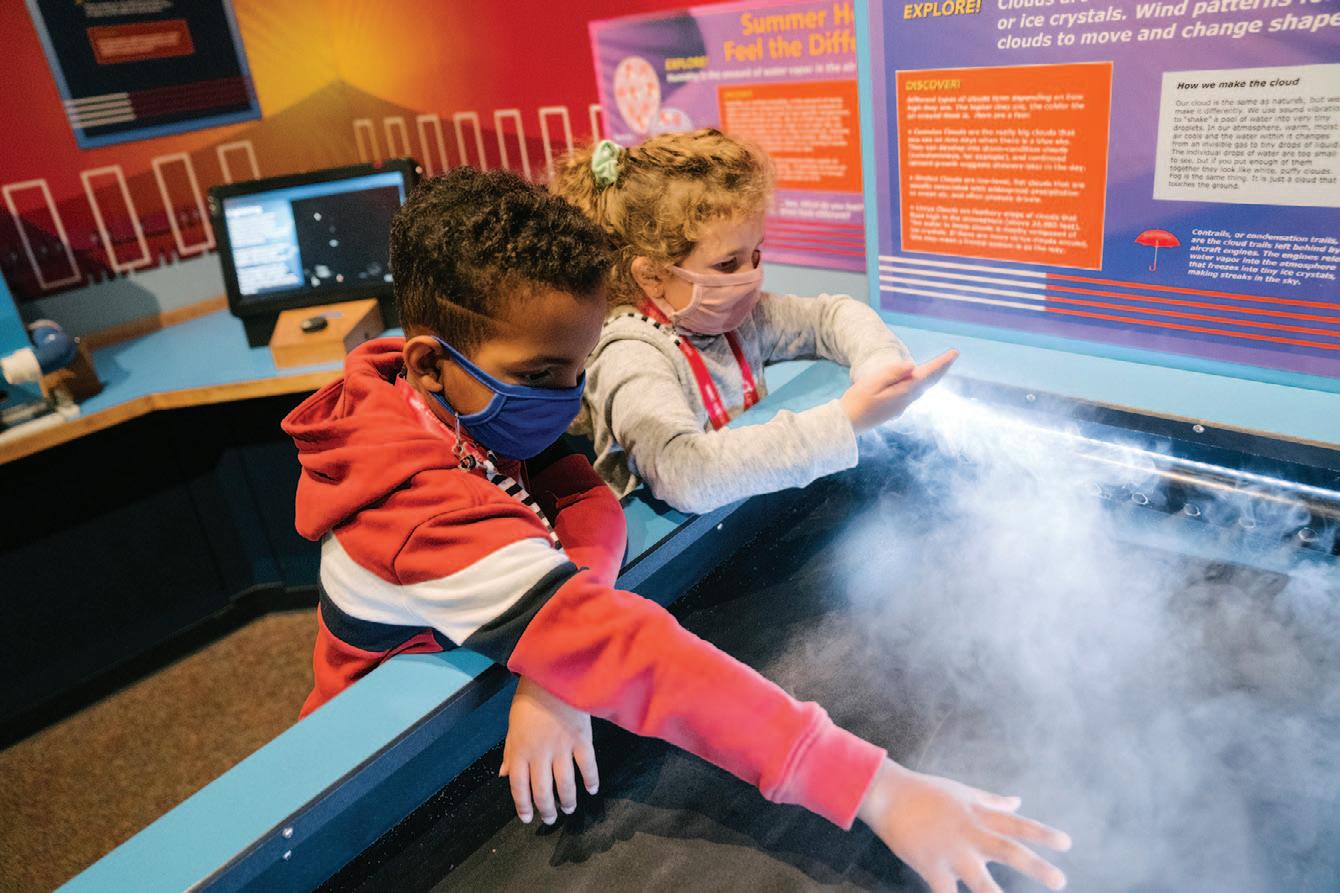
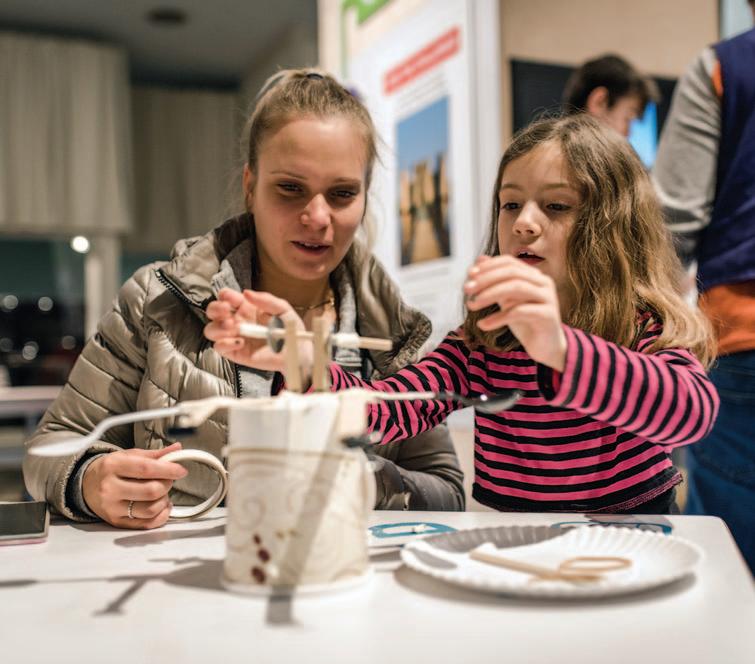
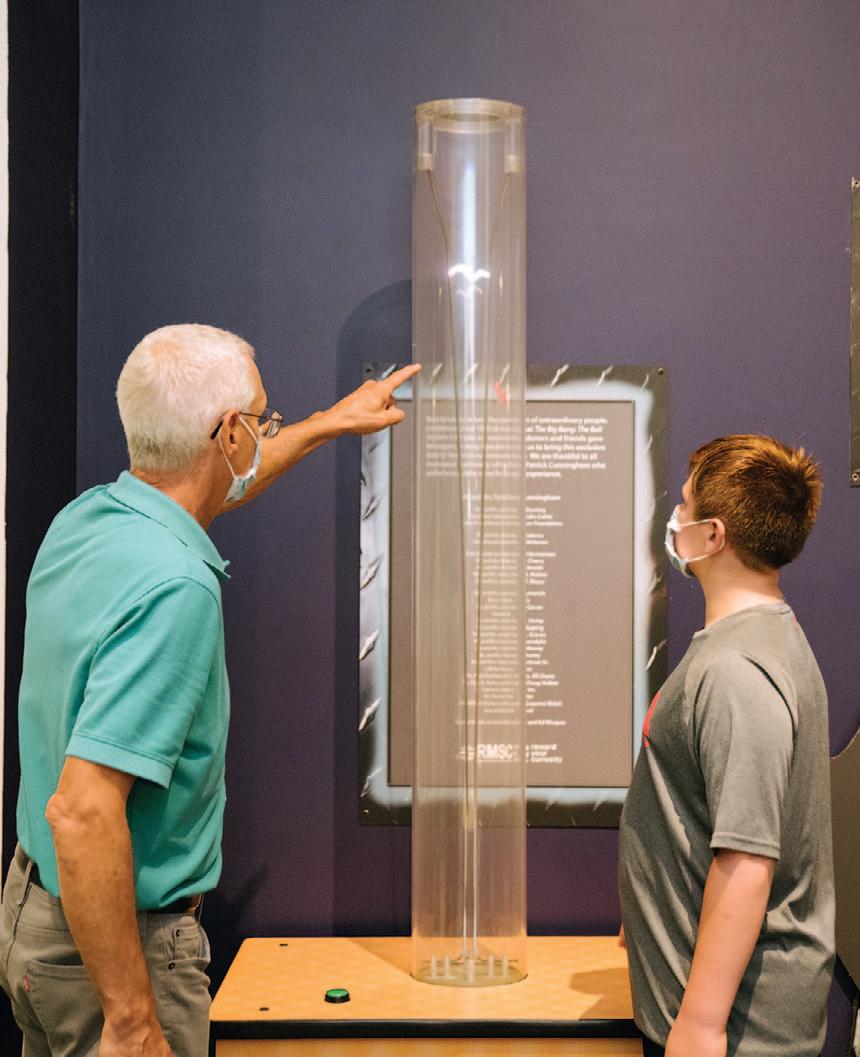
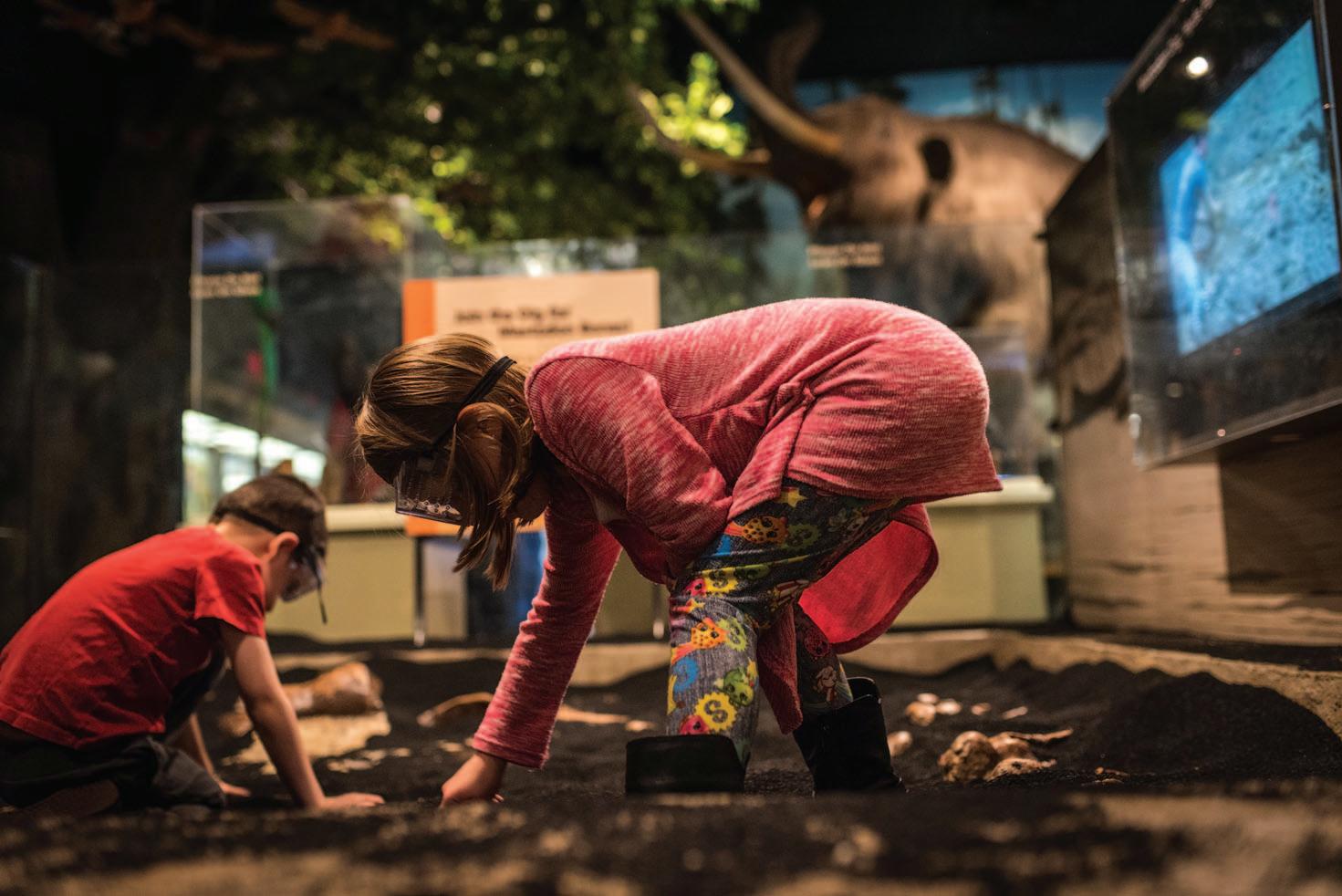
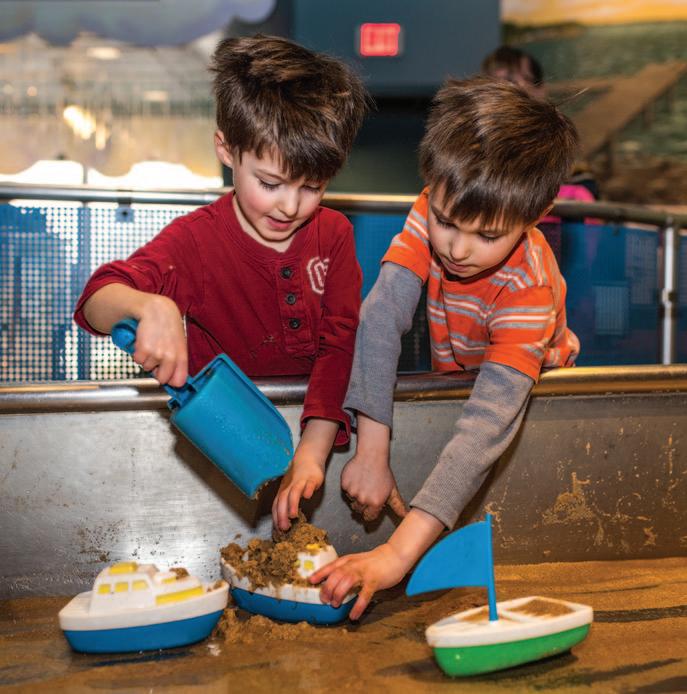
Not so at this place, for “this place” is an experience, an explosion of sight, sound and wonder, and an experience like this must be, well, experienced. At the Rochester Museum & Science Center (RMSC) you will quickly find out that the dusty, silent, no-touch museums of the past were then, but this is now! And now this positively wonderful,
humon gous, joyous experience is most definitely a place where sponta neous outbursts, loud talking, and even being encouraged to touch are the way it is every day for visitors from ages 3 to 100. This is not your grandfather’s museum, nor your dad’s, nor hardly any other museum you may have visited in the past, for The Rochester Museum & Science Center is the largest natural history museum within a day’s drive of any other museum statewide and well worth the ride because
this is not just a destination, but a series of individual delicious journeys just waiting for your arrival.
Hillary Olson, President and CEO of this magnificent experience, is positively delighted to have been at the helm for the past two years. “I am originally from Brockport, but
worked all over the country for 30 years with positions in Los Angeles, Philadelphia, Mil waukee, and Long Island. My parents live in Rochester, so this is the most perfect fit for me. Now I’m home and here to stay.”
Her enthusiasm palpable, Olson can hardly wait to show visitors, groups, schools, seniors,
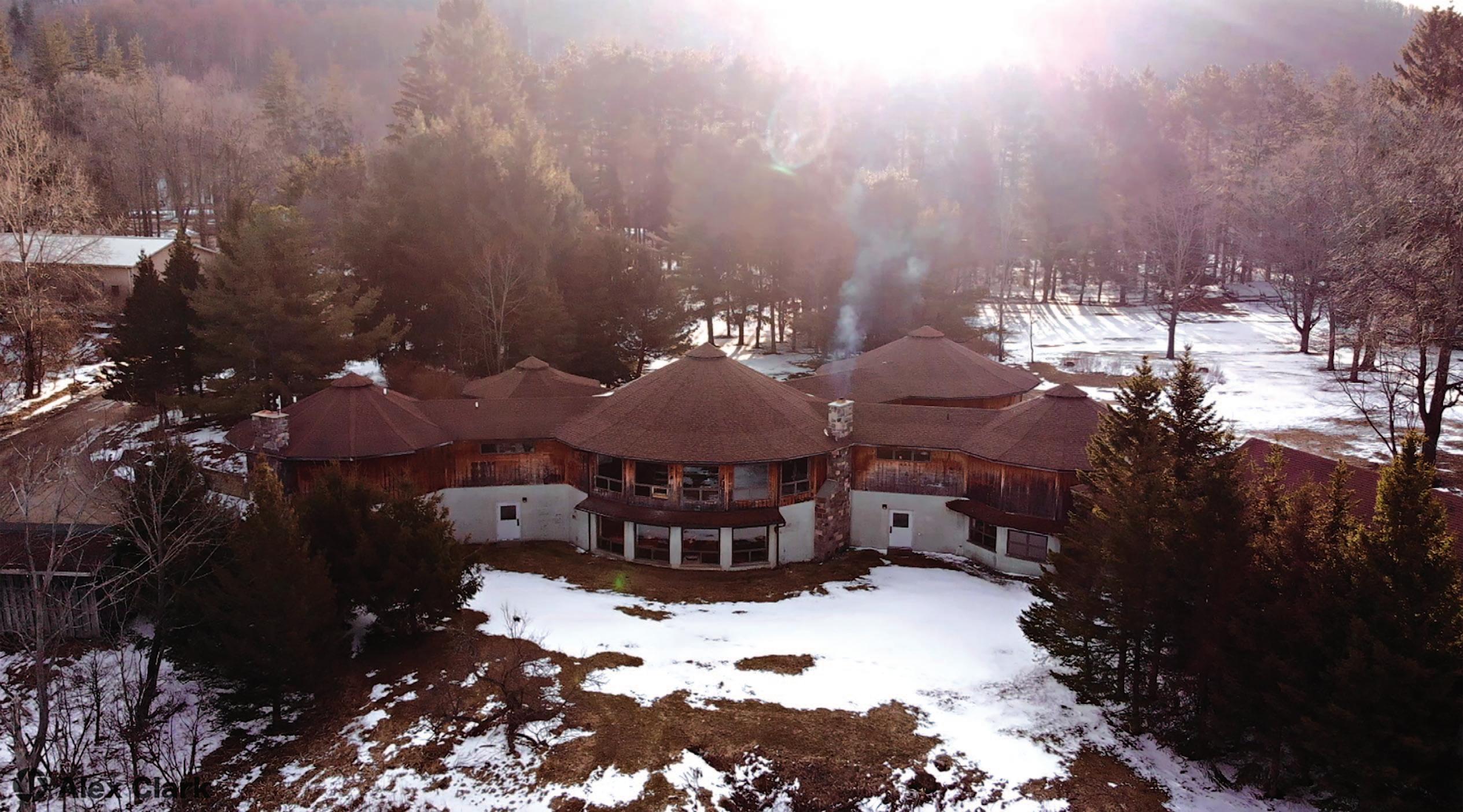
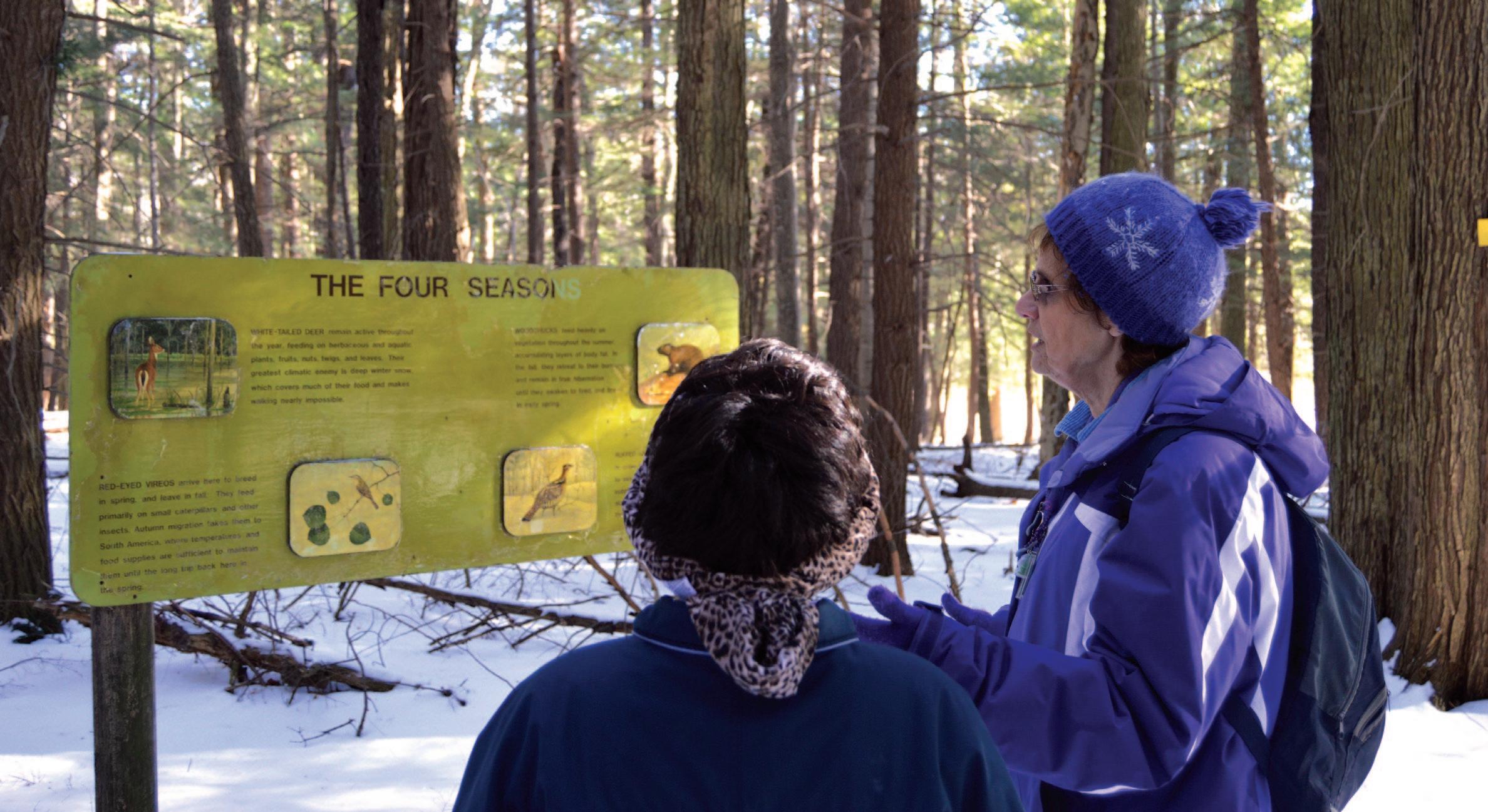
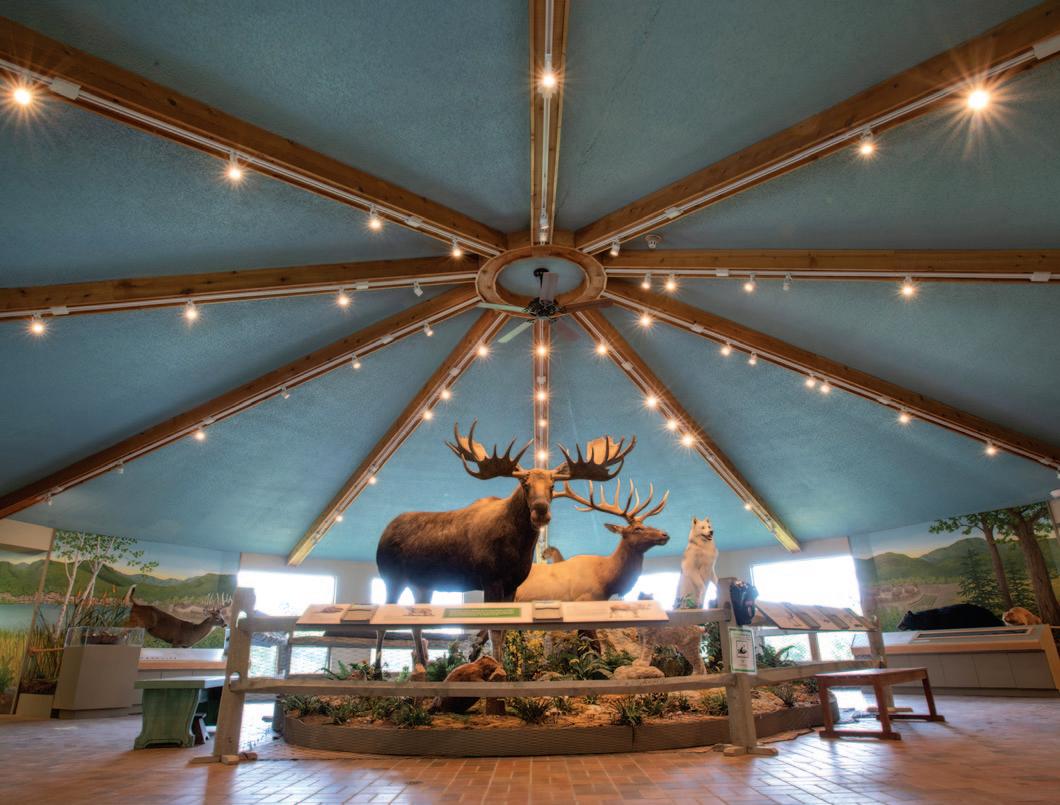
and everyone in between her pride in being “home.” The Rochester Museum and Science Center is a good deal more than one building. It includes the 900 acre Cumming Nature Center just 45 miles south of the main campus in Naples, where outdoor education and recreation take place 12 months a year, drawing visitors on an ongoing basis.
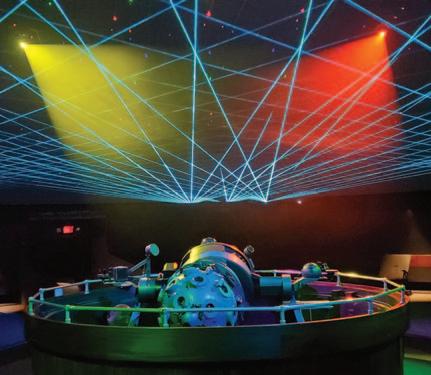
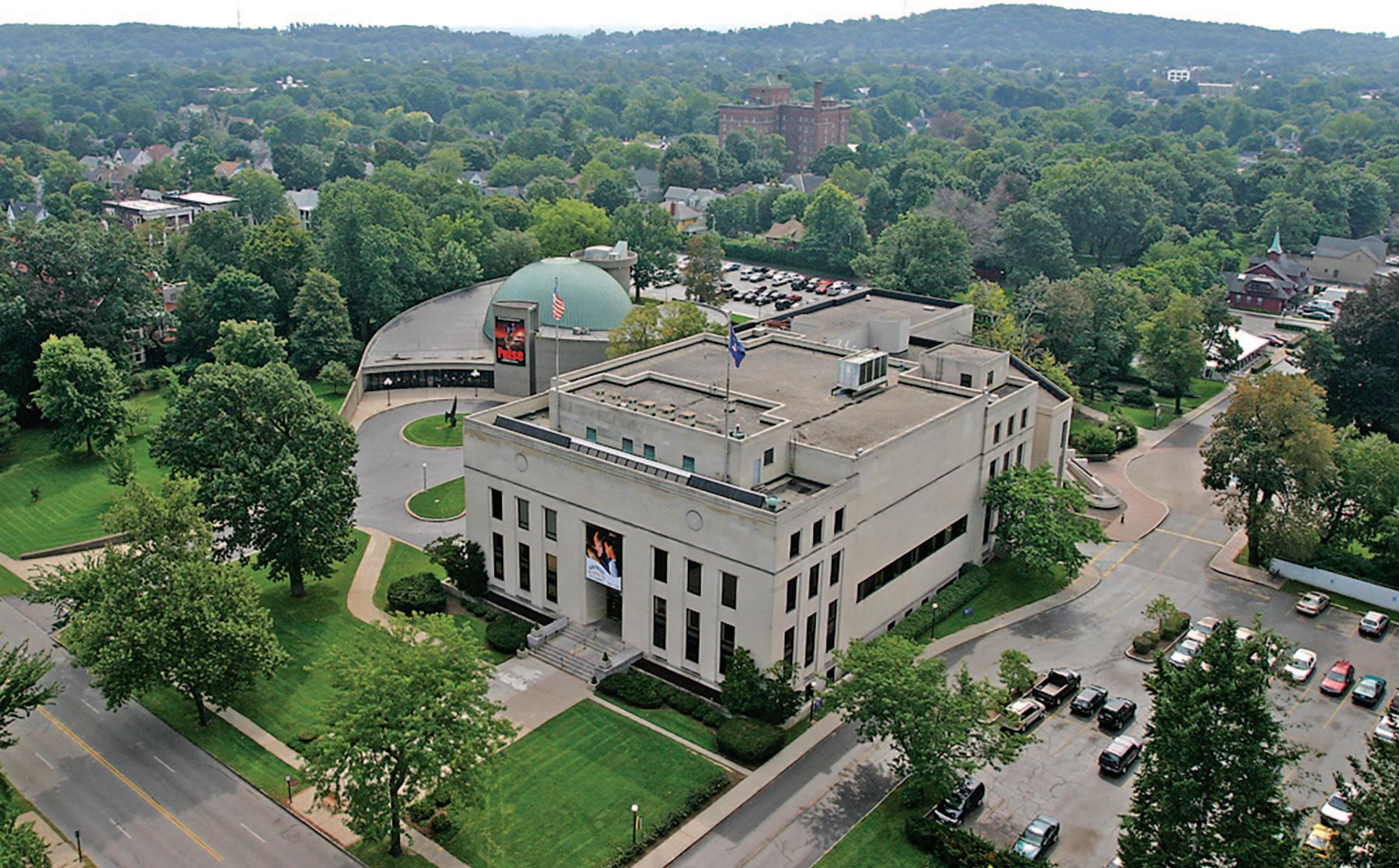
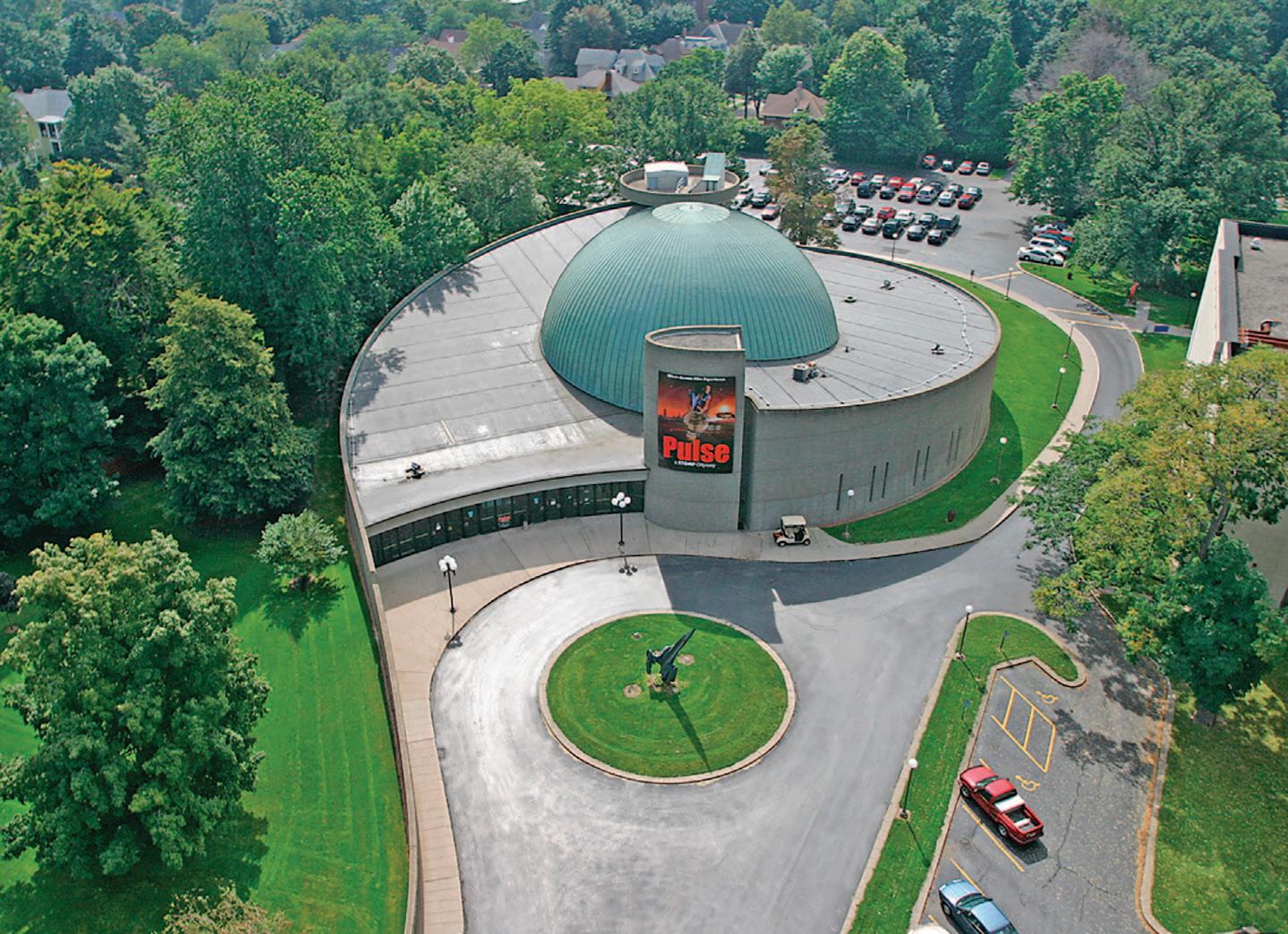
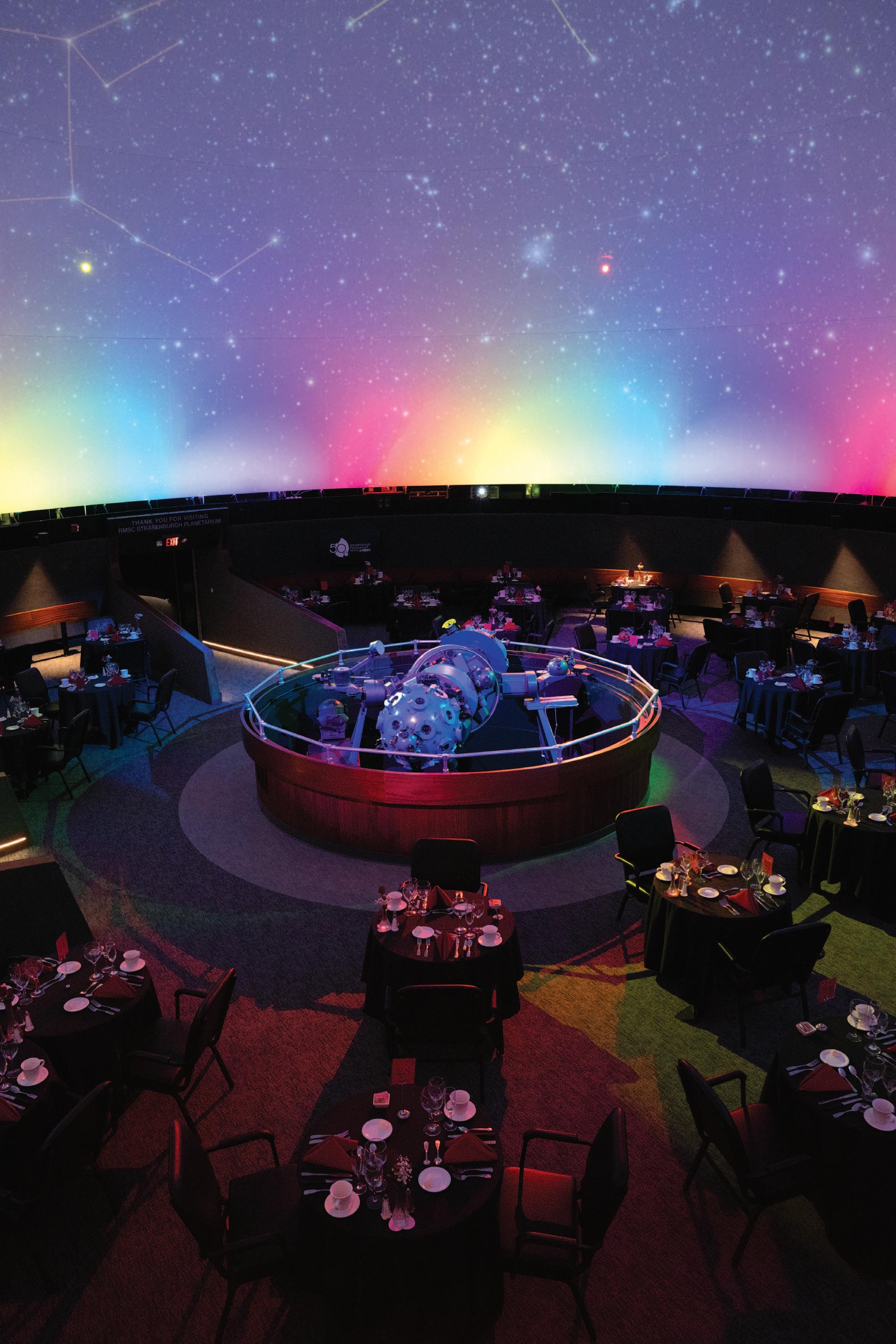
Adjacent to the RMSC is the Strasenburgh Planetarium, recently renovated and reopened in 2019 with a state of the art projection system not found in too many other planetariums. “It features a renowned Zeiss star projector such as the ones designed by Carl Zeiss,” says Olson. Zeiss projectors are a top of the line prototype of planetarium projectors first de signed and built in 1924 in Germany.
Now, with the Planetarium’s new digital pro jection system, shows are more vibrant than ever. “Our visitors can just lie back and zoom right into Saturn,” Hllary says. “Our information in supplied directly from NASA and is both accurate and up to date, so if they have it yesterday, we have it today.”
The museum contains a startling 62,000 square feet of exhibits, some of which are stationary, others rotate, still others are special and only on display for a limited time. Such an exhibit garnering much attention and acclaim at the
Cumming Nature Center
Strasenburgh
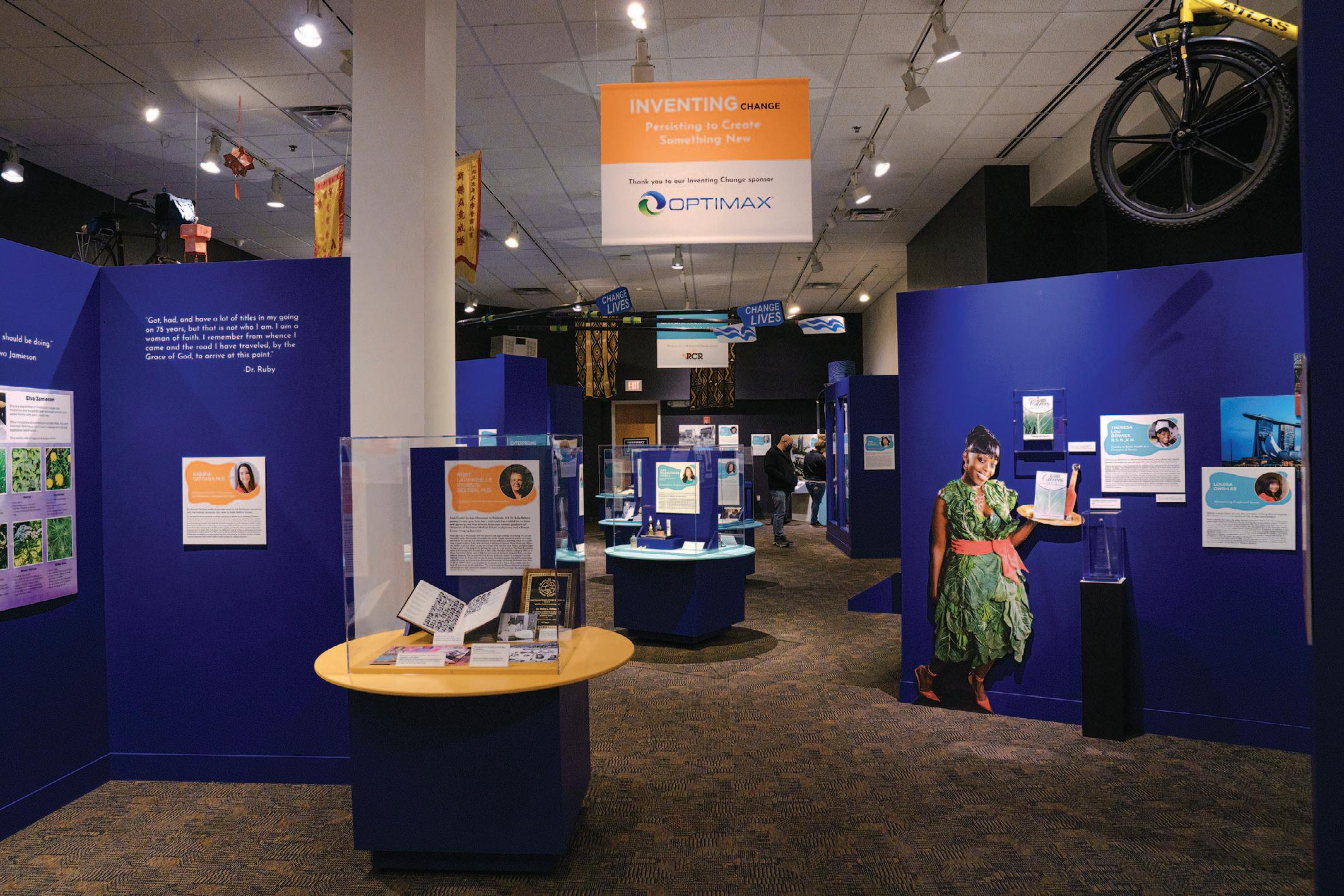
moment is “The Changemakers: Rochester Women Who Changed the World,” now being featured through early spring. “The Changemakers” celebrates Rochester women who changed the world in some fashion, both past and present. “As we started to research the many women and their contributions, some of which you might not have known, we just couldn’t eliminate anyone. So we are honoring more than 200 local women in this exhibit. They are artists and writers, former enslaved people, ballet dancers and scientists, women of industry and women of great vision.They also prominently feature 40 Indigenous women from the Haudenosaunee Confederacy (widely known as the Iroquois Con federacy in New York State and beyond). It’s no wonder then that the banner headline for this outstanding and popular exhibit is “They broke barriers so progress could rise.”
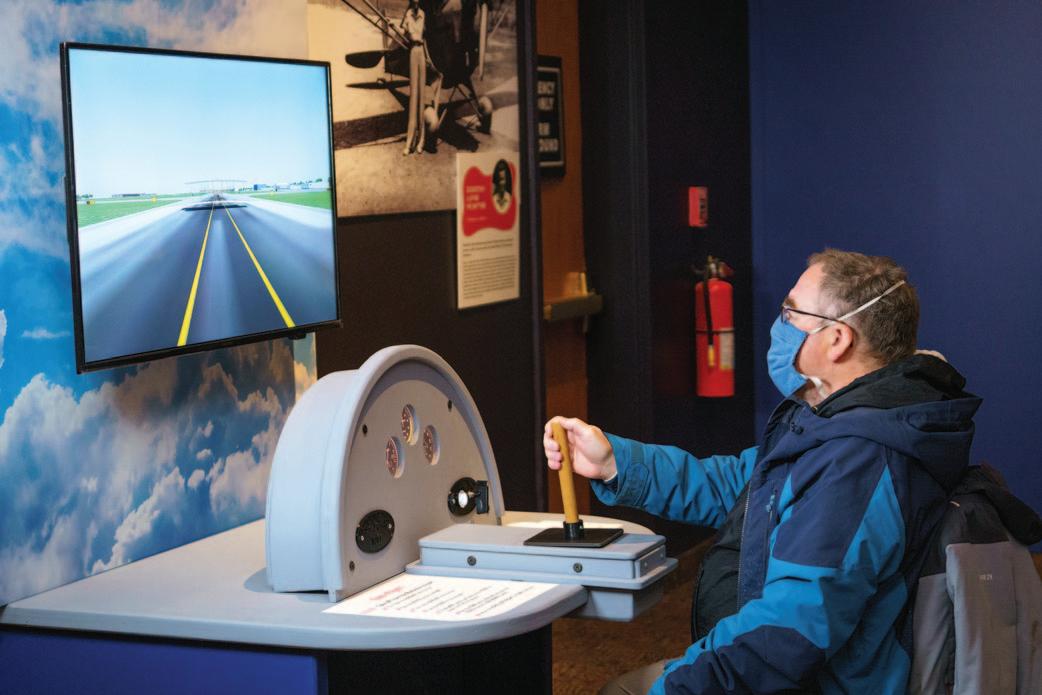
Visitors to “The Changemakers” will also have the thrill of an additional opportunity to climb into a flight simulator made by one of the honorees from a decommissioned Cessna aircraft.
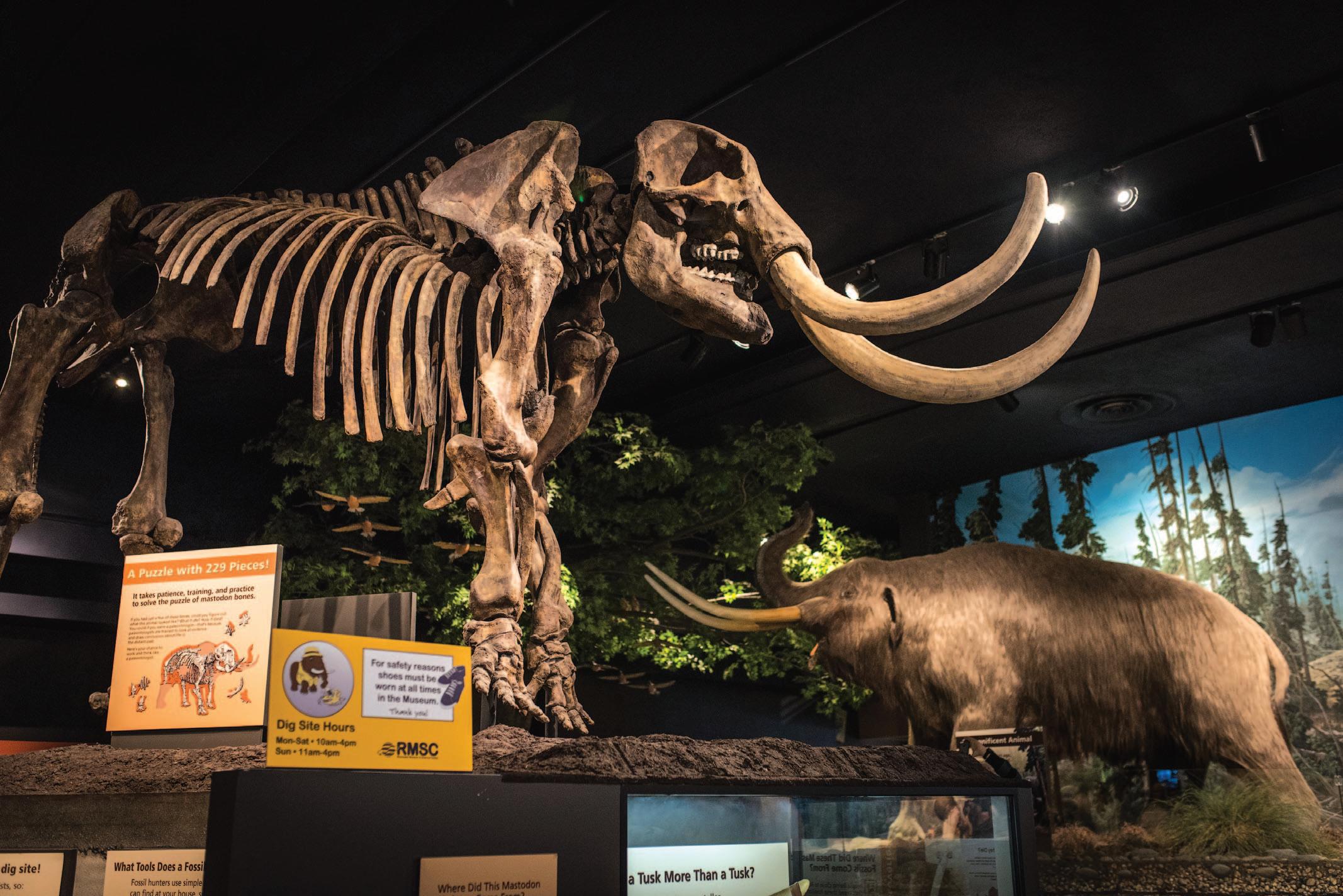
In all, The Rochester Museum & Science Center maintains a collection of 1.2 million objects ranging from giant trolley cars to very small arti facts, among them those of local pride featuring decades of Xerox printers and Kodak cameras.
Olson’s pride continues as she announces that a brand new building el evator is currently being installed at the Cumming Nature Center, making this venue along with all the others at the Museum and
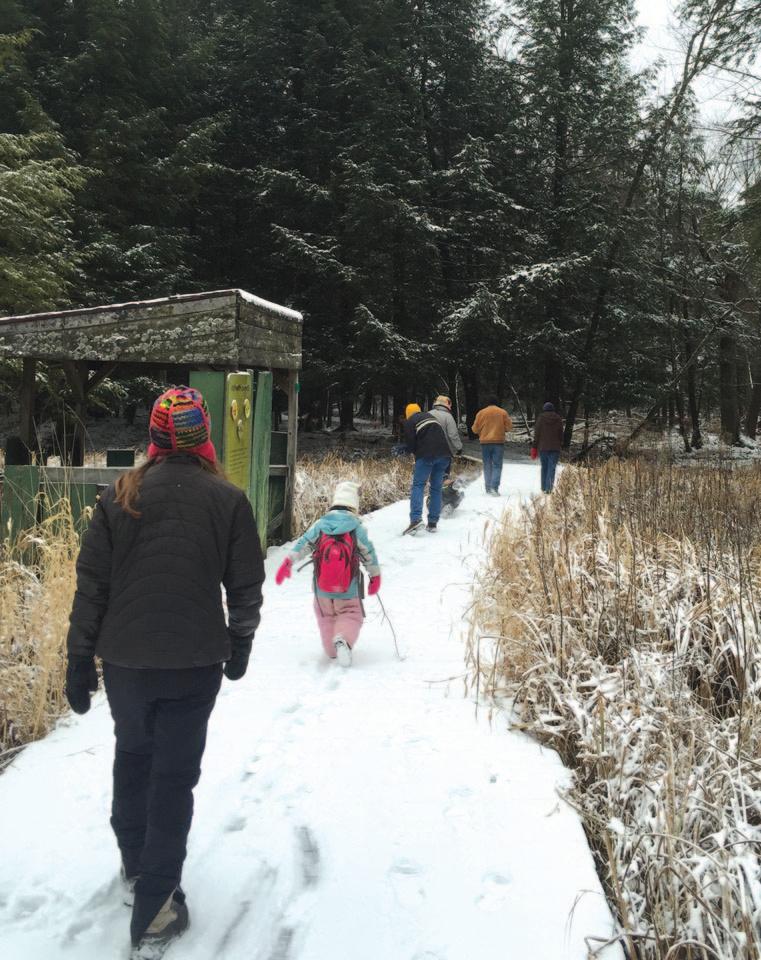
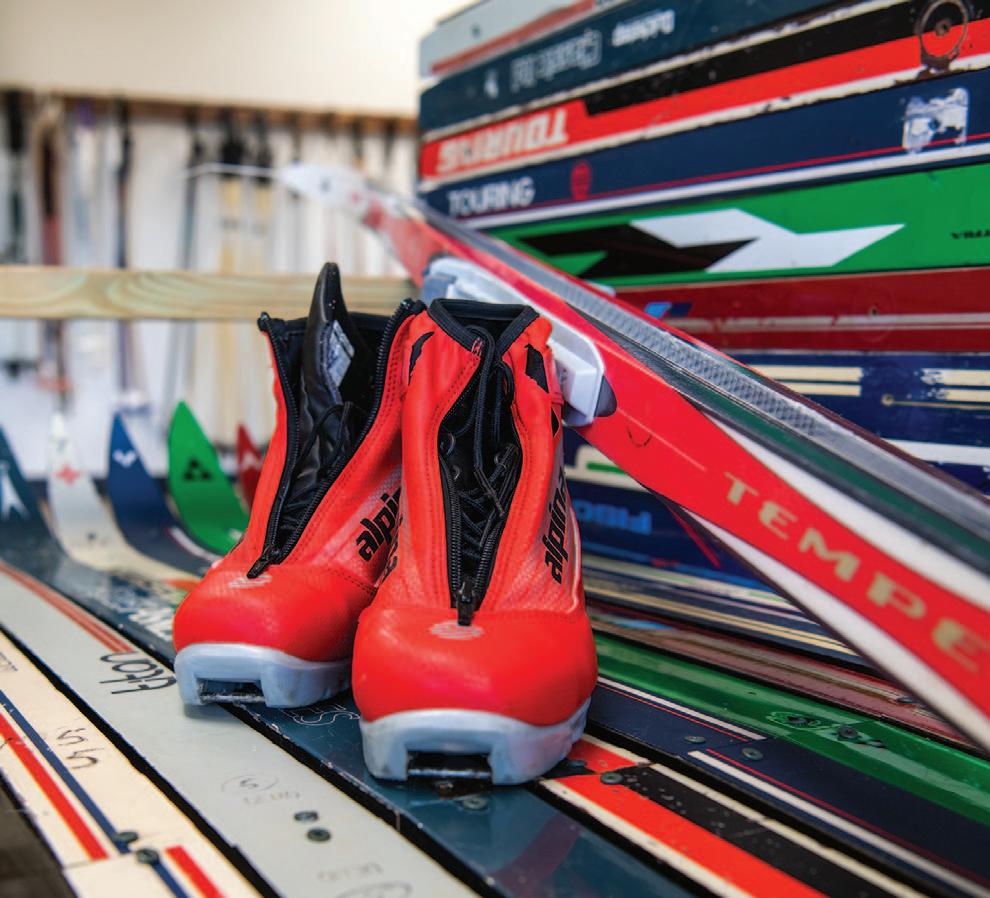
Plane tarium fully accessible. The Nature Center is always a popular destination, but in the winter months they rent snowshoes and cross country skis “for a very low price,” so visitors can enjoy the miles of fully groomed trails and observe nature up close and personal as they skim along the 15 miles of dedicated land for a snowy and personal experience.
In summer, a “huge summer camp program” takes place here, so whether you wish to visit merely for the exhibits and lectures or want to become an adventurer and glide across the land becoming one with it, the nature center never disappoints. There are ongoing programs for school children, scouts, and other groups and always something exciting for those who yearn for more. That’s why Olson allows that here, as well as in the museum and planetarium, there is always something to entice and draw the attention of the very young, the very inquisitive, the very active, and even the very seasoned of citizens. No one needs to feel left out because there are activities, learning ex periences, and accommodations for every age and every physical ability on every acre of the nature center and throughout the entire museum and planetarium.
The Rochester Museum and Science Center is one of those experiences for young people that makes them want to return again and again, to revisit an ex hibit or activity they enjoyed, or merely to see what’s new. Unlike those museums of the past, there’s nothing dull at RMSC, nothing boring...ever! Educators and parents alike will attest to the fact that when they bring a class or a group to RMSC the young people
don’t even realize how much they’re learning because they are much too occupied with having fun! Their curiosity is being encouraged, their de sire to explore is being fostered, their partici pation is being championed. It’s science, history, astronomy, nature, and the arts all rolled into one stunning adventure that cannot possibly be embraced in one day, so why try?
If you haven’t yet seen enough, here’s still another wonderful journey, one that the littlest ad venturers in your family could enjoy every day. It’s the Rochester Museum & Science Center Preschool, completely geared for toddlers three to five years old and offer ing what kids of that age adore: handson activity! An award-winning preschool by both the Rochester Business Journal and The Daily Record Reader Ranking Awards in 2018, the school is always wildly popular and therefore has limited openings, so if you are seeking further information or a tour, contact them.
While you can pay an admission fee each time you chase your journey, a membership to RMSC
makes the most sense, both financially and from the standpoint of repeat visits...and there will be many of those! This once a year membership fee allows free admission to the museum, the planetarium star shows, the nature center, member-only benefits and events, discounts on camps, birthday party privileges, and free or discounted admission to more than 300 other science museums worldwide. There are membership levels for individuals, families, and grandparents ac companied by grandchildren and guests that are without a doubt the best deal economically.
D uring the ongoing pandemic, the RMSC is pen as New York State COVID-19 regulations allow, whistle clean, and taking every precau tion to ensure the health and safety of all guests. Because of its enormity and the fact that it’s well spread out, social distancing rules are easy to comply with.
Now, do you see any reason why you shouldn’t make a trip to Rochester in the next week or so? Why wait? The holidays are over, the kids are getting antsy, you’ve run out of ideas, so c’mon up to the RMSC! They never run out of ideas – the RMSC is a place where one idea just spawns another, and you can never see it all, learn it all, or experience it all in one visit. If you’re coming from the Capital District or elsewhere and wish to stay overnight, just inquire at the museum There are a host of nearby hotels and accommodations and plenty of
restaurants; and after all we’ve been through, couldn’t you and your family use a mini-vacation where you can raise your voices, laugh out loud, be hands-on, and never worry about homework or grades?
“Nobody ever flunked a science museum” ...Frank Oppenheimer
The Rochester Museum & Science Center is located at 657 East Avenue (585) 271-4320 www.rmsc.org
With a population of only 796 in the small historic village of Round Lake, New York, almost 40,000 visitors were drawn to this quaint little community to dine on incredible New American Cuisine at Lake Ridge Restaurant last year.
Lake Ridge is that amazing restaurant that you would think every gastronome would know about, but it's truly a hidden gem in Up state NY. This establishment offers upscale fine dining in a warm and inviting farm house just down the road from a small lake enjoyed by kayakers in the summer and ice fishers in the winter.
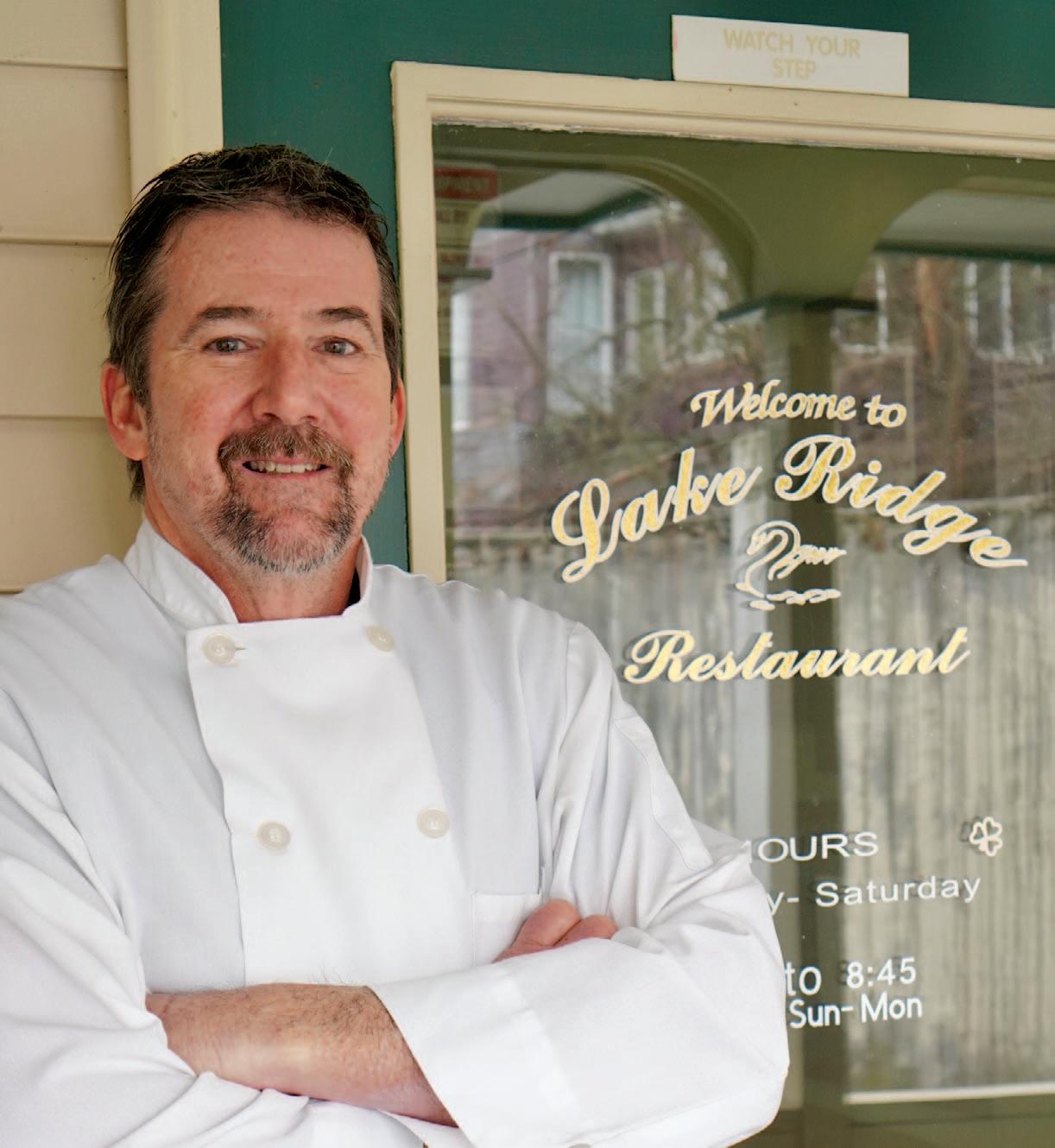
Owners, Bob McKenna and Chef Scott Ringwood opened Lake Ridge Restaurant over 19 years ago. Since then, Chef Scott Ringwood, also the head chef at Lake Ridge, has been creating their unique and delicious award-winning culinary dishes.
I was impressed to learn that Chef Scott is totally self taught. Starting as a restaurant dishwasher at 15, a year later wanting to cook, the owner allowed him into the kitchen. Since then, he has run many kitchens including Smith's, the Steuben Club, and the Old Dater Tavern where he was working for 11 years when he pur chased the building now known as Lake Ridge Restaurant. Lake Ridge has given Chef Scott the creative outlet that has allowed him to freely express who he is as a culinary artist.
When you first walk inside, you are greeted by Diana, their Man ager, who joined them only a month after they opened. If you have ever called to make a reservation, you have likely spoken to Diana and heard her very delightful voice. She holds the front of the house together and the regular guests adore her.
Once inside, you will find three dining rooms for seating guests and a beautiful bar made of mahogany where I prefer to sit for dinner.
Lake Ridge offers a nice wine menu and great beer selection, but as a tequila and bourbon drinker, I am impressed with their high-end selections of coveted bourbons and nice scotches, which are some of the best bottles you can serve.
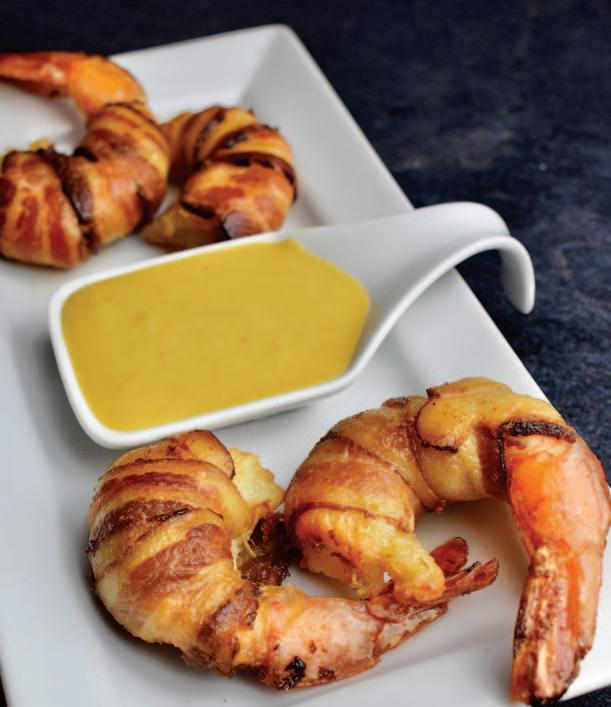
The first item I always order when I visit Lake Ridge is the Bostonian Shrimp. There is a reason this jumbo shrimp wrapped in bacon and served with maple Dijon horseradish dipping sauce is described as “A house favorite.”
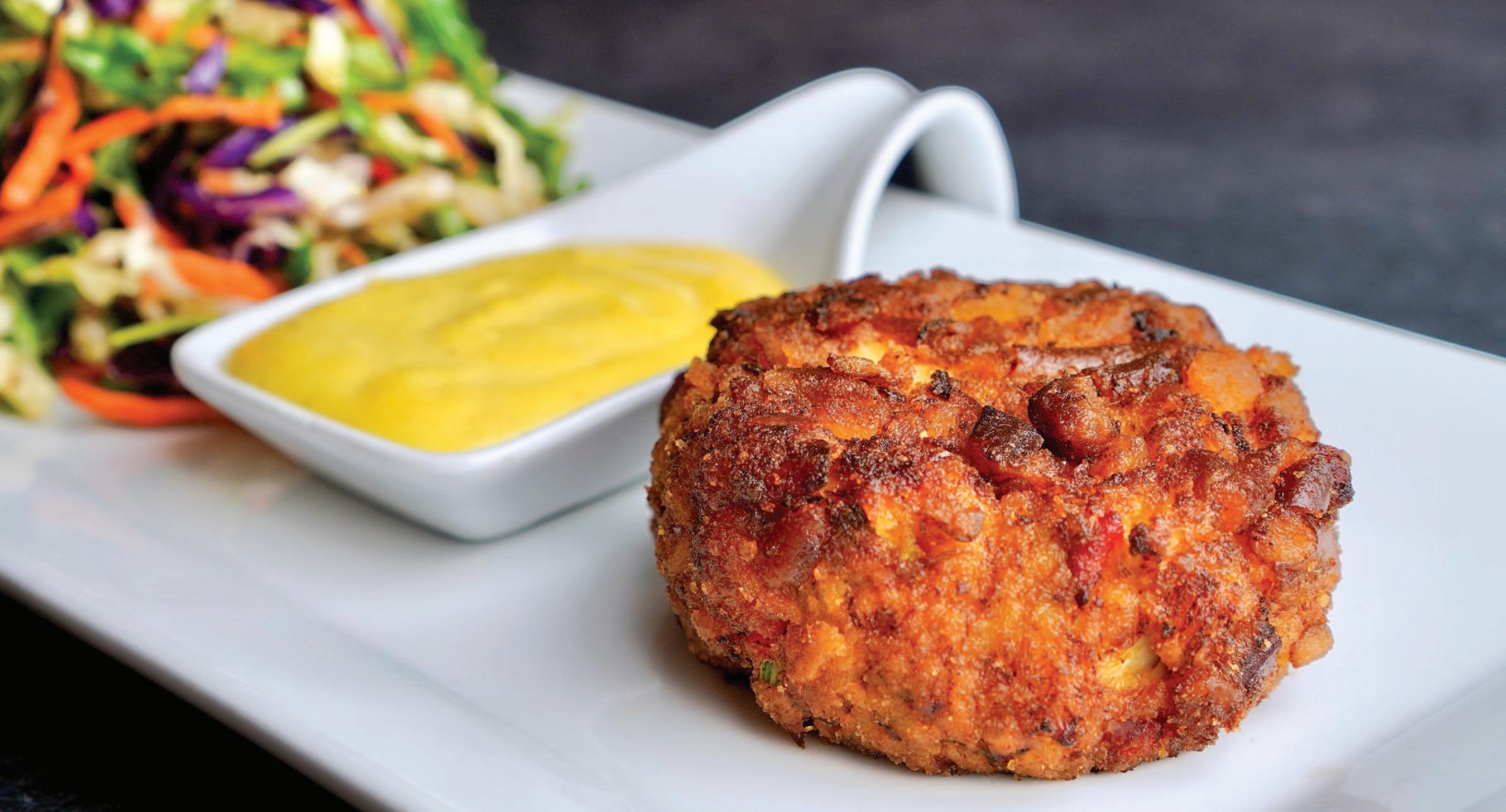
The Pretzel Crusted Crab cake & Lobster cake is a de licious collaboration of jumbo lump crab meat and lobster mixed with green onion, bell pepper, celery, and house seasoning, served with curry mango aioli.
The Lobster Betty is a butter poached lobster tail served over braised greens finished with a shallot sherry cream sauce offered as a starter, but could easily be satisfying as an entree.
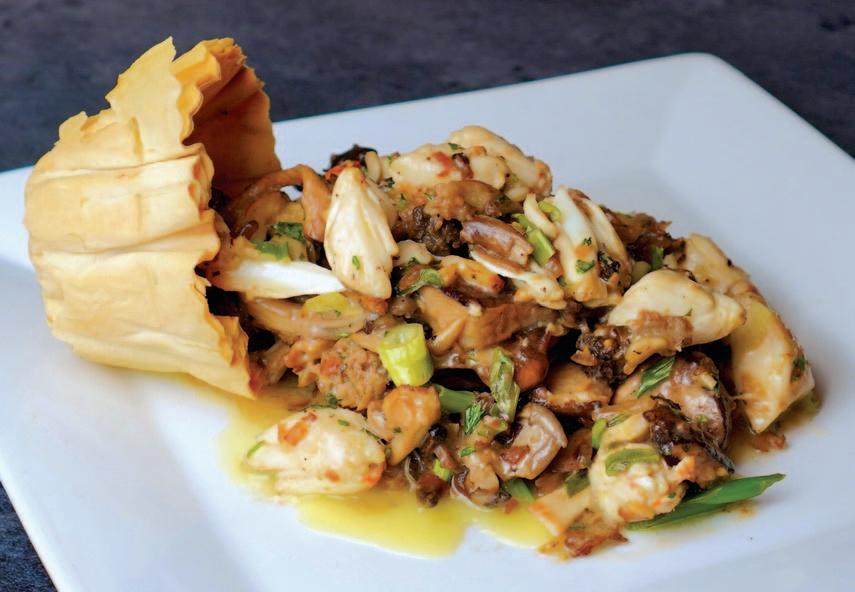
The Mushroom and Crab Phyllo Cup is not only visually delicious when presented, but the sautéed leeks, wild mushrooms and jumbo lump crab meat in a garlic sherry butter sauce truly "excites your senses,” as Chef Scott would describe.
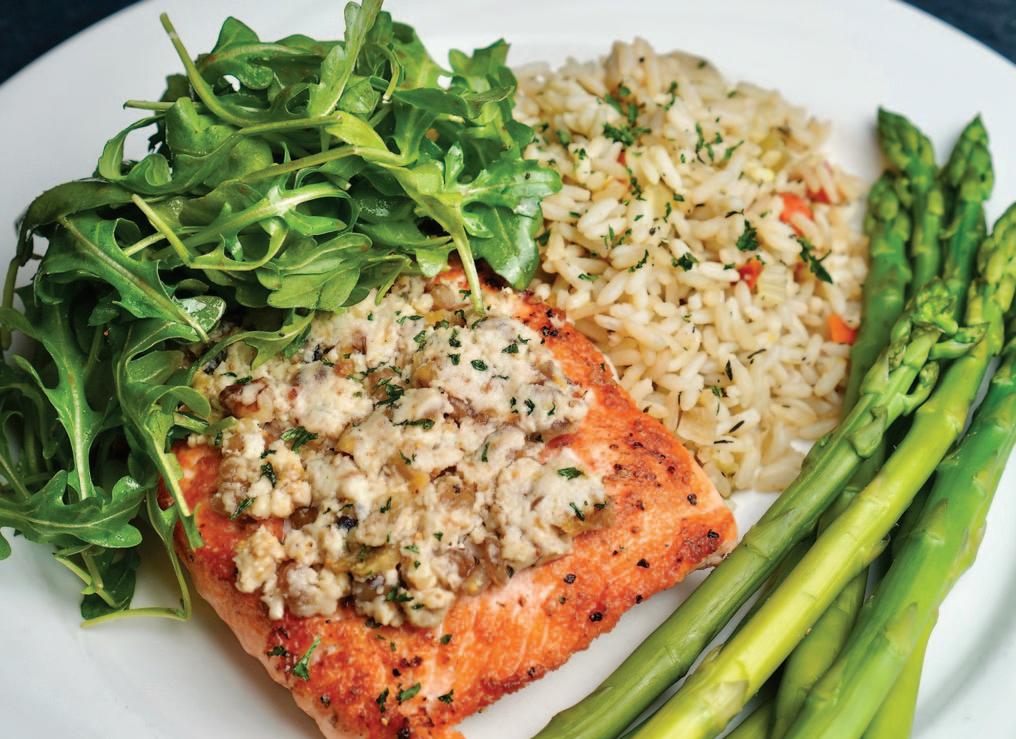
The Goat cheese, walnut, and fig crusted Salmon is incredible. I've en joyed this perfectly cooked oven roasted salmon, topped with goat cheese, walnuts, and dried figs finished with raspberry arugula vinaigrette, many times.
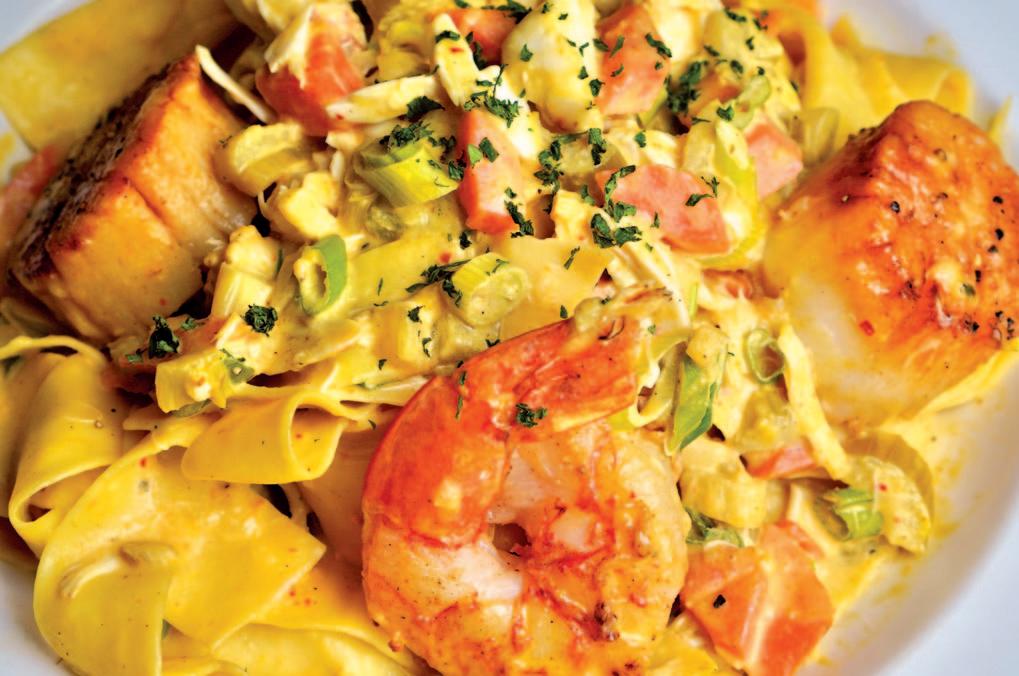
The Red Curry Seafood Bolognese may be my new favorite entree in the region. I’ve been served this dish two times in five days at this restaurant, and I have eaten the leftovers for the other three of those five days. The sautéed shrimp, perfectly cooked scallops, and lump crabmeat in a red curry Bolognese style sauce, tossed with pappardelle pasta are an incred ible flavor combination.
The Pecan Pork Chop is a favorite among their regular guests. This bone less 14 oz. pork chop encrusted in pecans, pan roasted, and finished with a tart cherry demi-glace was absolutely wonderful, beautiful, deli cious, and tender.
I have dined at Lake Ridge many times over the past several years, where the food & service are always excellent. I truly believe that you will have a wonderful dining experience here as well.
Happy Eating!
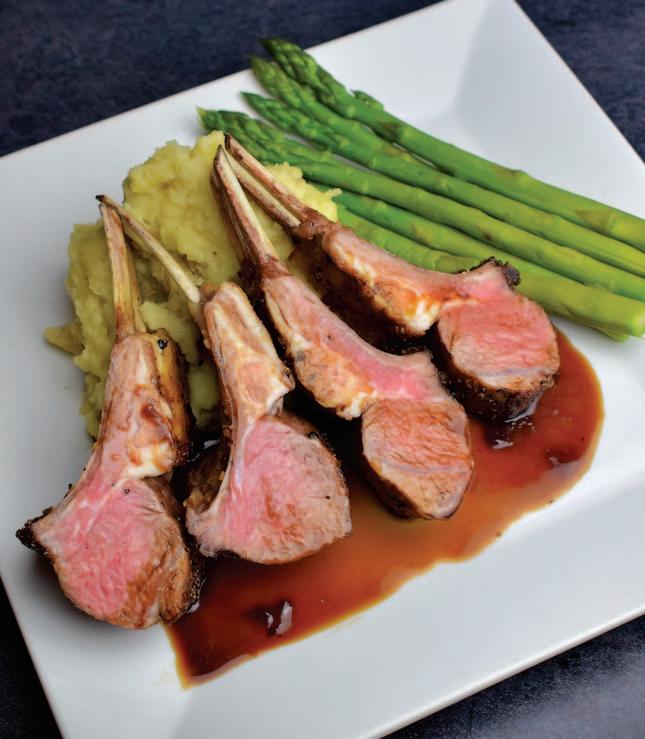
The Grilled New Zealand Lamb Rack, finished wi th a rosemary red wine demi-glace, is another well-executed entree that I have or dered several times.
Lake Ridge Restaurant is located at 35 Burlington Avenue, Round Lake, NY.
Due to COVID and an extended closure in 2020, The Laffer Gallery will be not be taking our annual winter hiatus. Instead, we will hold a special exhibit featuring all artwork in our inventory. The show will run from January 30 to March 14. Exhibited artwork will be offered at a 20 percent discount.
More than 70 artists are participating. Hundreds of paintings, sculptures, and pottery will be featured. The artists are as grateful for your support as we at the gallery are. This sale is our collective gesture of appreciation.
Inventory will be available for purchase online as well as in the gallery.
The Laffer Gallery
Tracy Helgeson
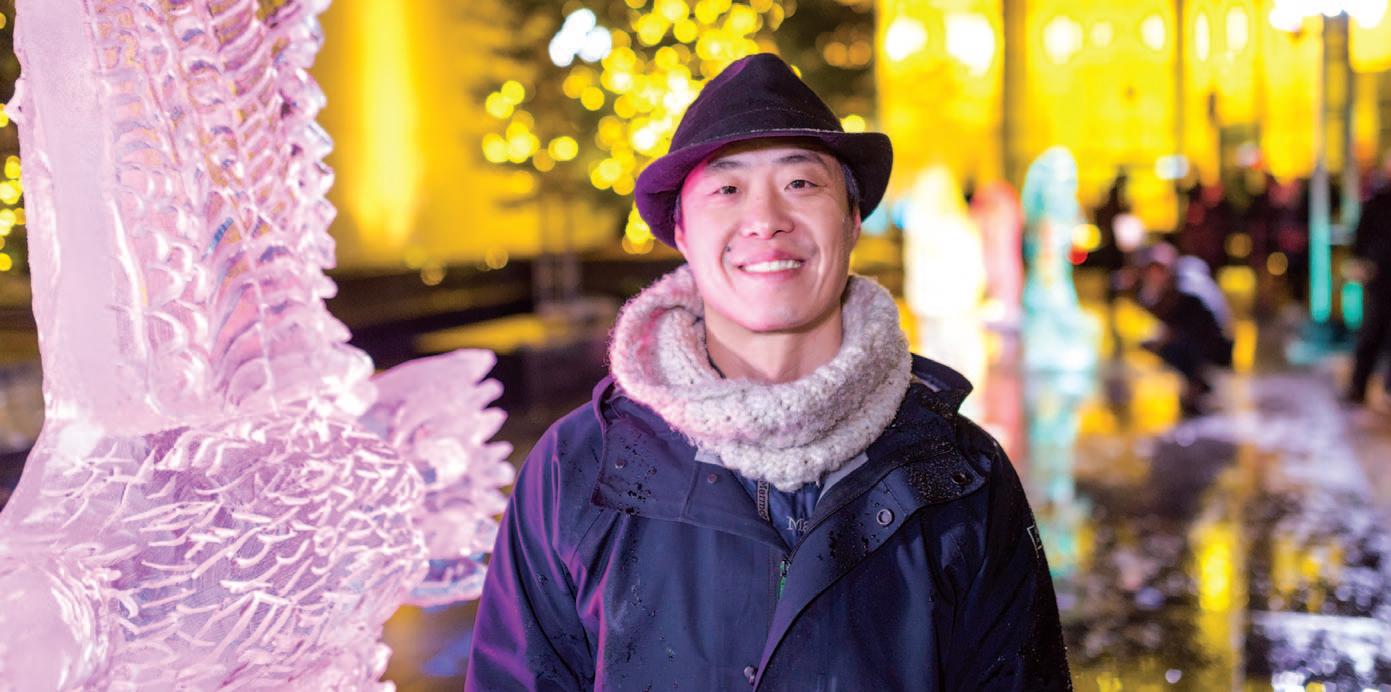
“Living in the Moment of Ice” The Ephemeral Art of OKAMOTO STUDIO
by Carol St.Sauveur Ferris
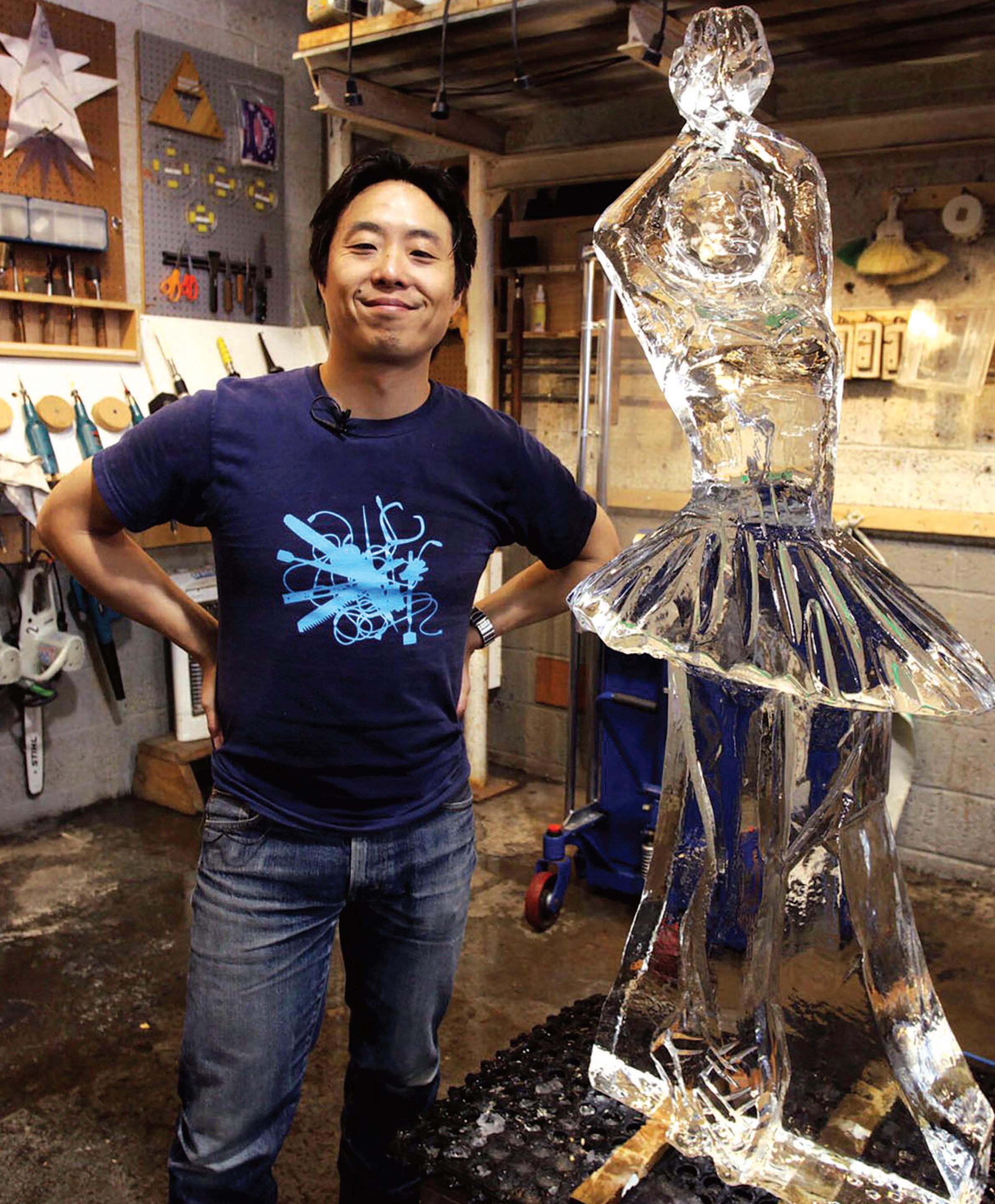
It is known that Japanese culture is steeped in tradition yet consistently remains at the fore front of innovation and technology. For the people of Japan, it is truly a cultural dichotomy with the past effortlessly intersecting with the future. Shintaro Okamoto is a perfect example of this, and he is as hip as he is humble. He recently spoke with great reverence and pride about his father, family, and education when sharing the journey that brought him to New York and to the forefront of ice sculpting.
Shintaro was born on April 5, 1974 in Fukuoka Prefecture in Japan. His father, Takeo Okamoto, had a huge influence on him. According to Shintaro, “He epitomized the Renaissance Man”. Takeo designed and built their family home and landscape with his own hands. He was an exceptionally talented painter and sculptor, and a professionally trained sushi chef as well.
When Shintaro was just nine years old, his fa ther moved the family to Anchorage, Alaska to take over and manage a sushi restaurant. He often helped his father at the restaurant and quickly learned the ins and outs of the hospitality industry and the value of good customer service. Dur ing his free time he ex plored his great love for animals and wildlife, which in spired and informed his extraordinary talent in drawing and painting throughout his young years.
At school, young Shintaro was fortunate to be embraced by an art teacher who recognized his gift and encouraged him to paint and draw. It came as no surprise to anyone when he went on to win an art competition before he could even speak English. And by the sixth grade Shintaro was chosen for a drawing internship, meeting and studying under a professional wildlife artist twice a week. In high school he took first place in
the National Foundation for the Advancement of the Arts (NFAA) competition. He was also selected as a US Presidential Scholar, one of the nation’s highest honors given in this country to students achieving ac ademic excellence. And as a US Presidential Scholar Shintaro had the privilege of visiting the White House in Washington, DC.
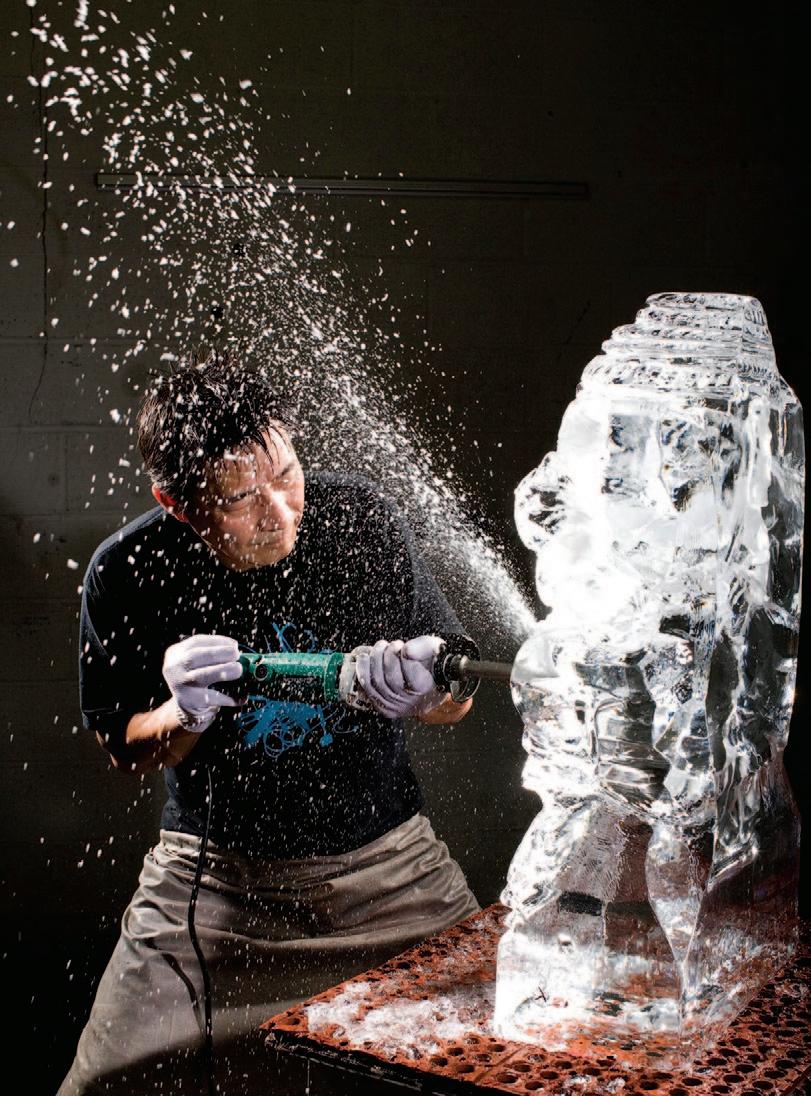
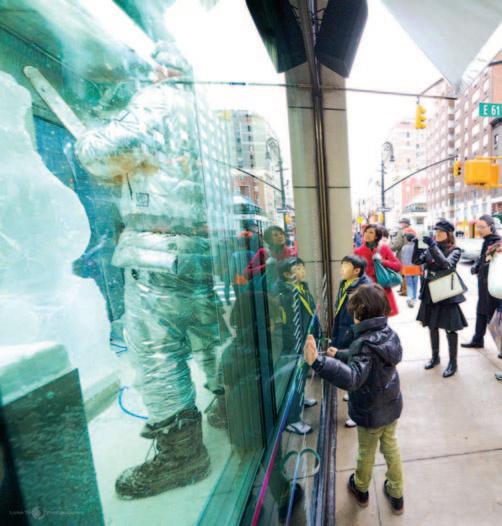
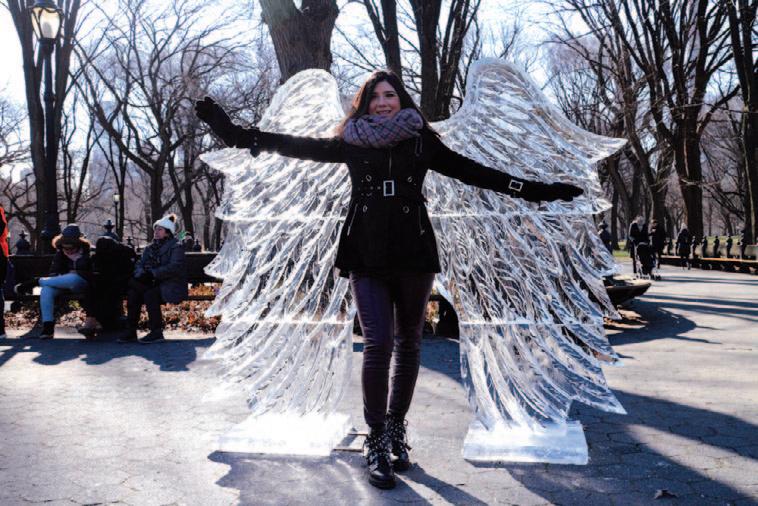
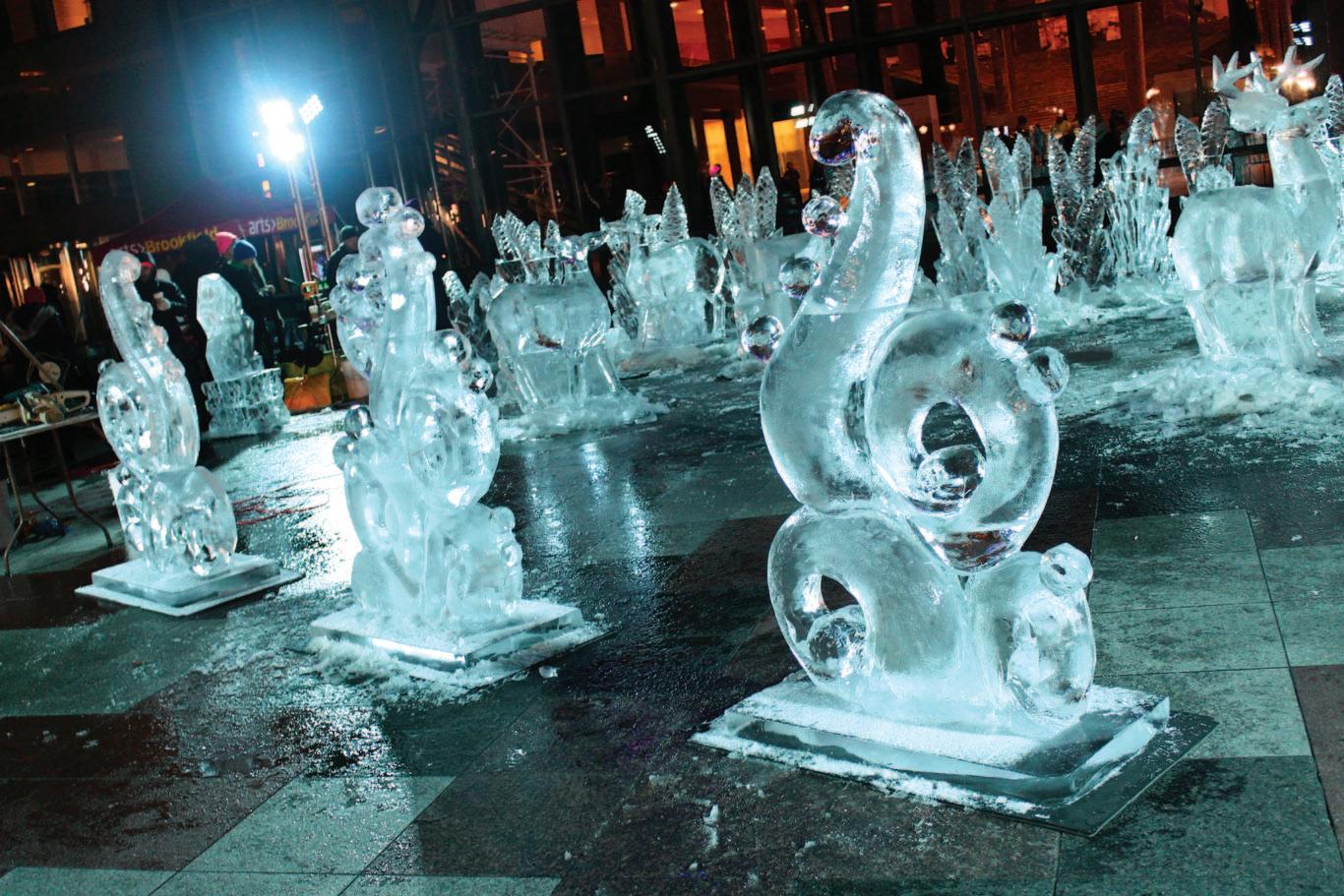
Above photos by Lizzie Munro
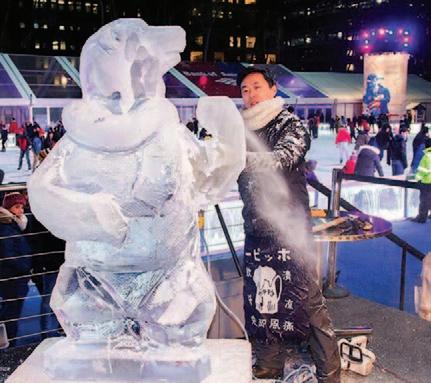
During his culinary career, Takeo’s skills and artistry found their way into ice sculpting. He embraced it and was a true pioneer in this novel and impermanent art form. In the early days he shared his sculptures with friends w hich eventually led him to creating e xtraordi nary sculptures for a wide range of events and par ties that he was catering. This then led to him competing in ice carving competitions as well. While Shintaro was still in grade school, he had the honor of being his father’s partner in one of the ice carving competitions but as it turns out, his only job was in the shadows, shoveling excess ice that fell away from the sculpture his father was carving. “It was tough work and very humbling”, according to Shintaro. Eventually he learned the skills needed for ice carving, was “promoted” to full partner, and traveled with his father in the United States and Eu rope for a number of competitions.
While in high school, Shintaro found he was interested in both art and medicine. He took night classes a t a community college and did an externship with a local plastic sur geon. He also had the unusual opportunity to shadow a general surgeon and draw medical illustrations for him which allowed Shintaro to observe his work. Upon graduation, Shintaro left Alaska for the East Coast to attend Brown University where he continued to study fine a rts and premed. Ulti mately his undergraduate degree was in fine arts followed by a masters from Hunter College in New York.
In 2003, while still attending graduate school at Hunter College, Shintaro opened OKAMOTO STUDIO Custom Ice in Long Island City, New York. His father, who had visited him on several occasions, closed his Alaskan sushi restaurant and moved to New York to join his son. Initially the Okamotos promoted their ice carving business on a very simple website and by giving away ice sculp tures to nonprofits for their galas. They also patiently built an excellent reputation with caterers by coming to their rescue at the last minute, creating and delivering beautiful ice sculptures just in time for an event. Slowly but
surely business grew and the expertise of OKAMOTO STUDIO was sought by high profile designers, event planners, celebrities and corporations for their special events. Having a shared background in the restaurant and hospitality business and a commitment to delivering good service, father and son made a wonderful team. Their extraordinary artistry and vision, with ice as their medium, set them apart from the rest.
Ice sculpting has evolved a great deal since its earliest days. The first know piece of sculpted ice is attributed to Auguste Escoffier in 1892. He was a famous French chef who carved an elegant swan to cradle his custom dessert cre ation called “Peche Melba”, for a dinner party held in New Orleans in honor of the opera singer, Nel lie Melba. It wasn’t long be fore ice carving became a major part of the culinary arts world with ice
sculptures be coming an expected feature in food presentation.
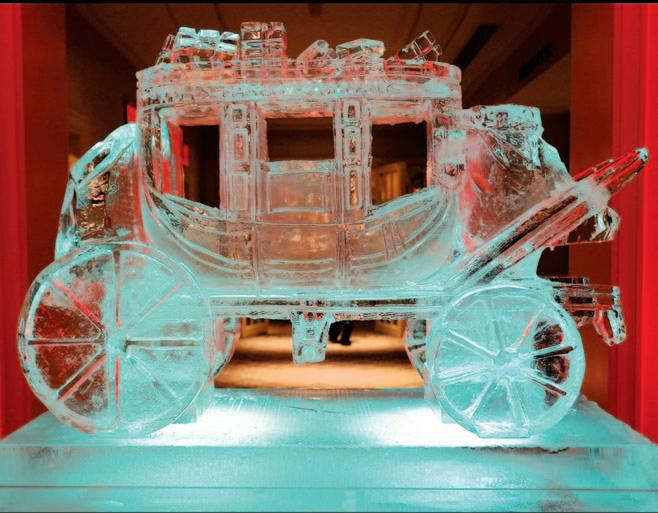
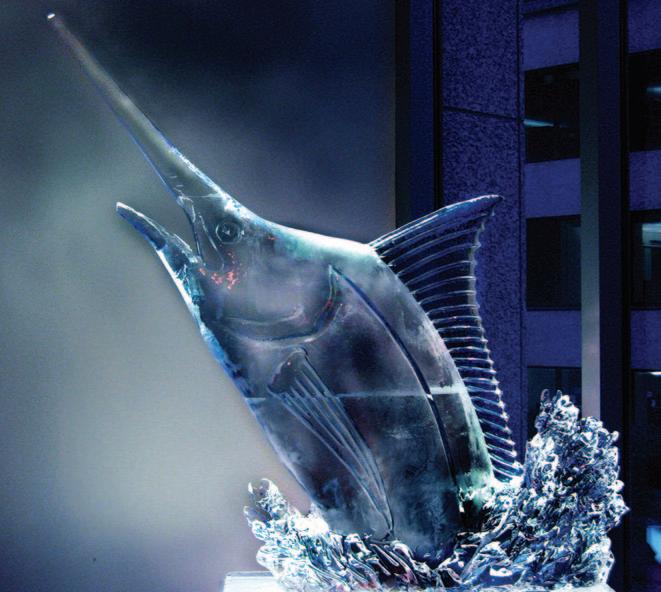
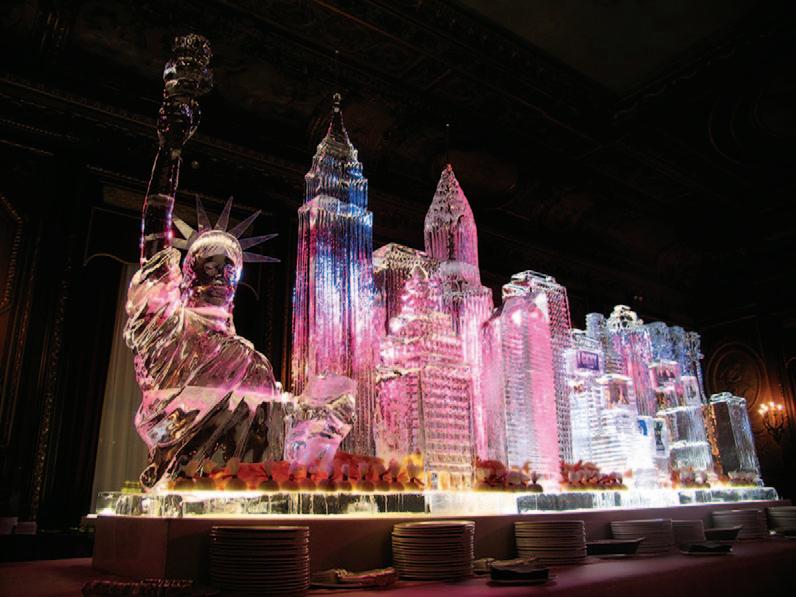
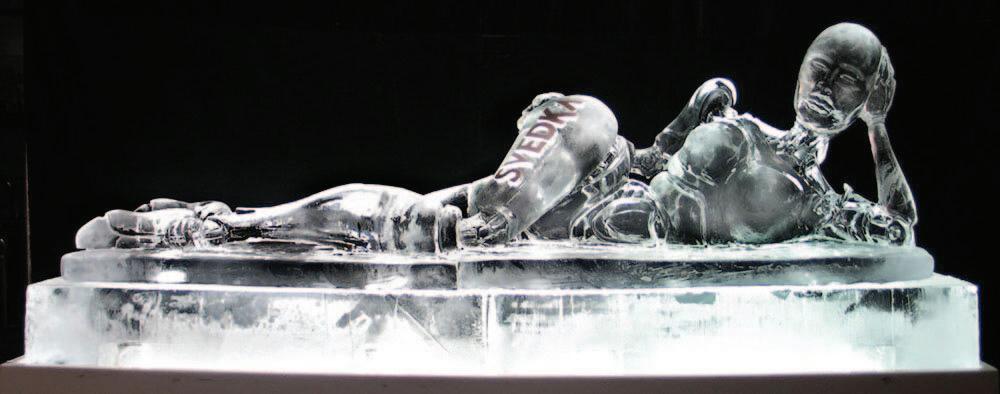
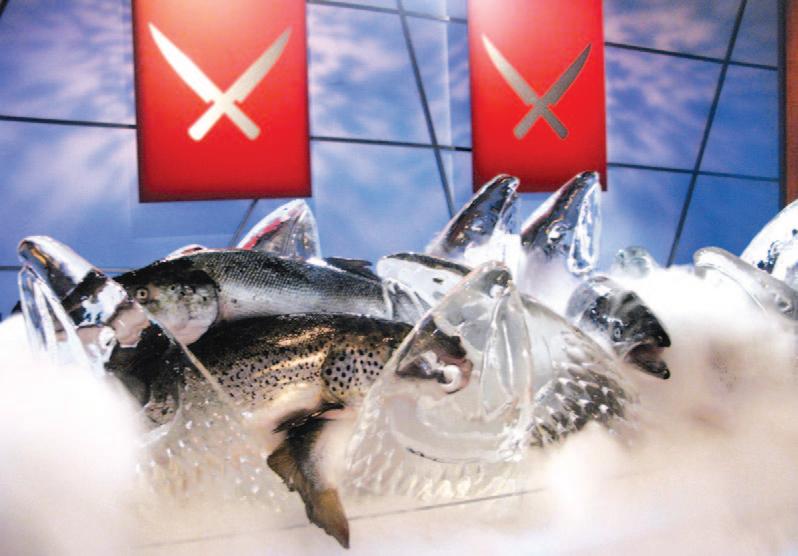
Iconic ice carved swans on the buffet table of the early days have long given way to elaborate ice sculptures depicting everything from ani mals, logos, automobiles, flowers and people. And those that carve these incredible pieces are specialists in their own right.
Shin taro and Takeo, New York’s ice-carving dream team, were gifted artists and meticulous carvers, universally admired for their uncanny ability to execute intricate details in ice. While their incredible talent separated them from other carvers, it was their value system and philosophy that grew their business and set them apart from the rest.
Today OKAMOTO STUDIO continues to build upon that early success by embracing and educating their clients from the very beginning of a new project. Initial consultations allow them to discover their vision and goals. In turn, clients discover that a simple block of ice
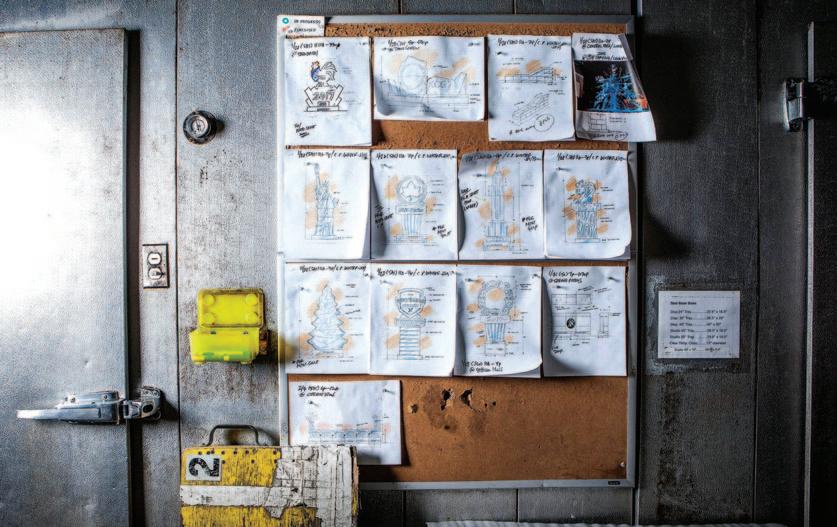
holds many design possibilities and begin to explore what those might be. The Okamoto team then confers and develops a conceptual design that represents their vision for the client. Once approved, plans are developed that detail how a simple block of ice will be transformed into a spectacular sculpture, care fully depicting the event’s theme and conveying the client’s message.
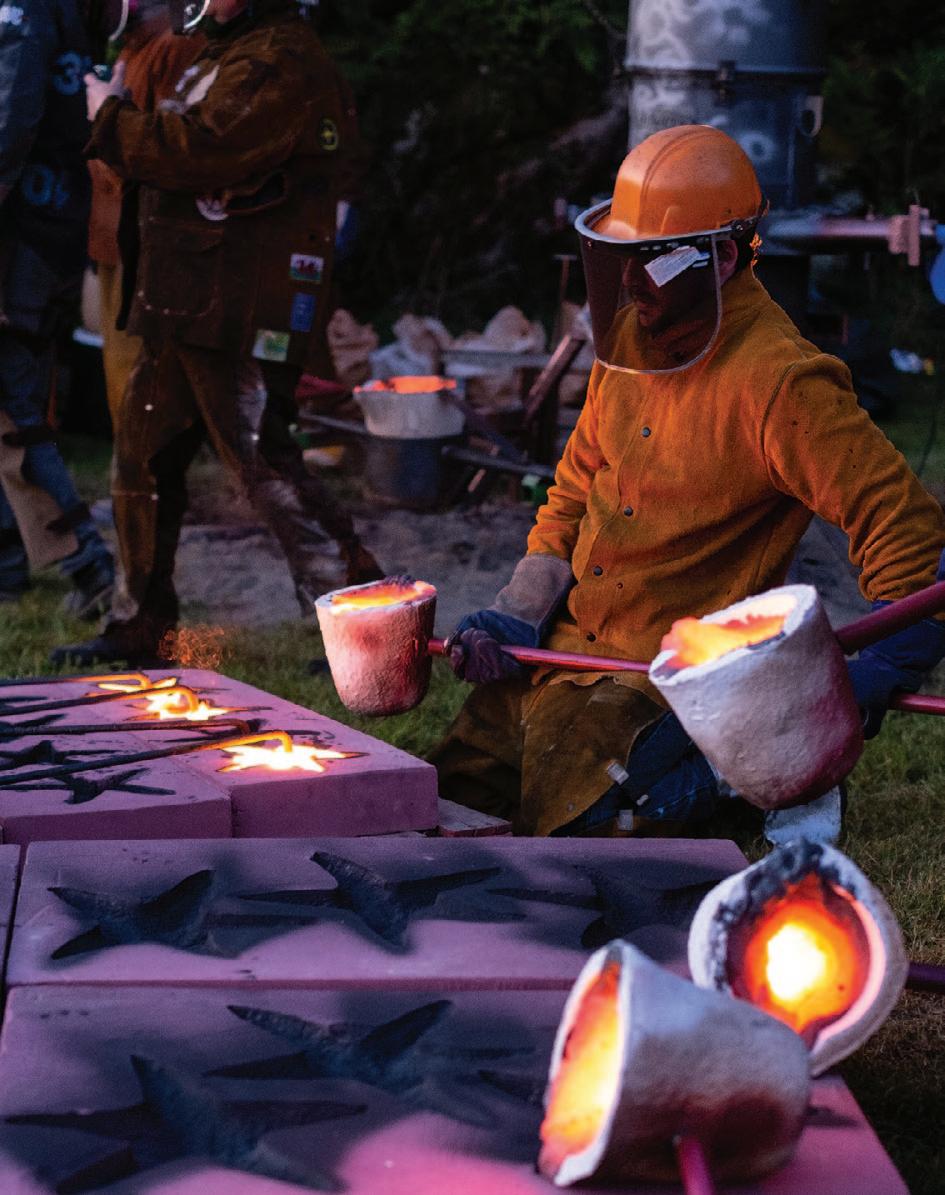
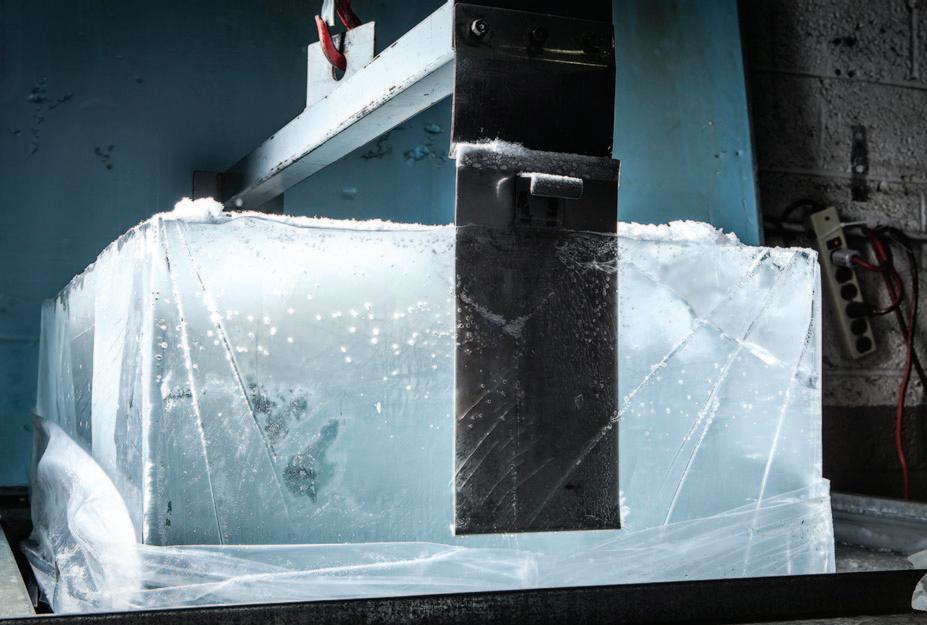
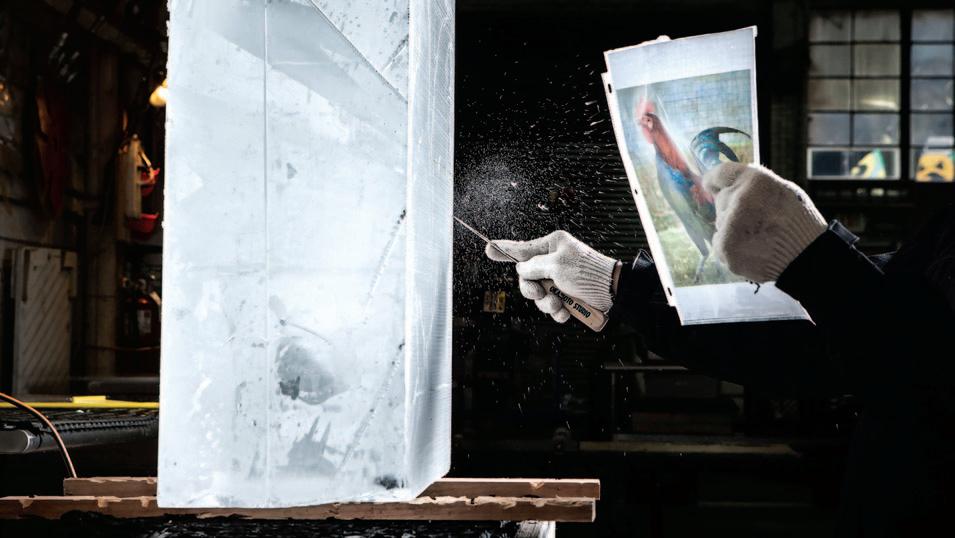
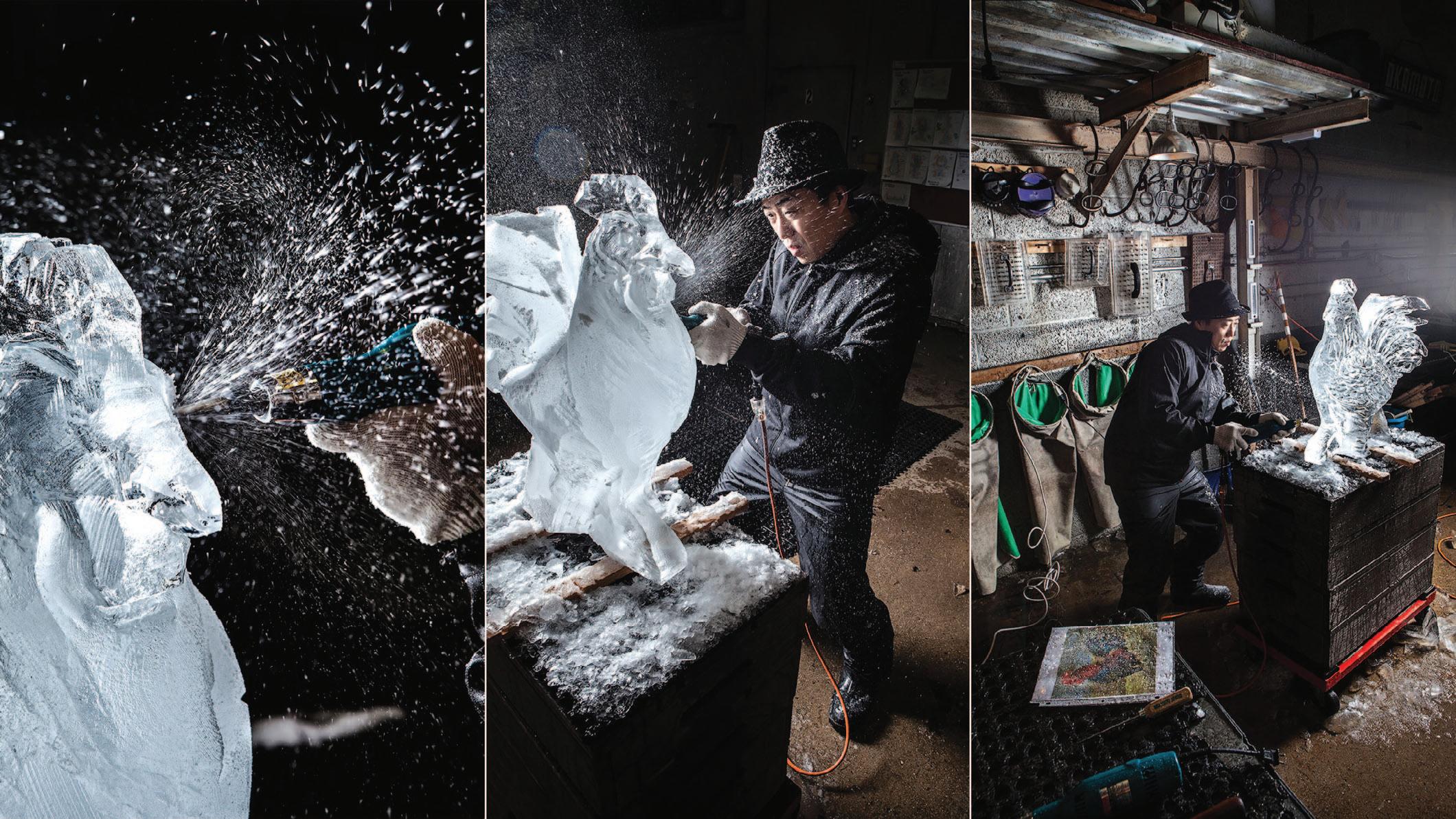
Back in the day, the ice carvers’ tool box in cluded ice picks, hammers, razor sharp chis els and handsaws. While these tools are still in the mix, today’s carvers’ also use a wide assortment of hand and power tools including chain saws, lathes, drills, and precision cutting CNC machines. And of course there’s the ice. The ideal block of ice is made from pure, clean water but in actuality, the freezing process has more to do with the final transparency of the ice. Clear ice can now be made using special machines that slow the freezing process while removing air bubbles and any impurities Once carved, ice takes on an opaque effect so the carver will often apply heat from a Propane or Mapp Gas cylinder to bring back the clarity of the ice. But the most important tools of all are not found in the tool box. Ice carvers who have the in stincts and abilities to interpret, create
and execute a breathtaking piece for a client are born with these exceptional tools and are called ice sculptors. The Okamotos are the very definition of ice sculptors.
To fully appreciate the depth and breadth of their work, a visit to the OKAMOTO STUDIO website is a must. It’s like taking a virtual field trip into a fantasy world of ice – exotic, thought provoking, remarkable, and breathtakingly beautiful. Gorgeous images of ice sculptures that they have created for a wide range of clients including titans of Wall Street and major corporations to the neighbor’s children about to become a bar/bat mitzvah or say their “I dos” fill their site. It’s clear that every
client is unique and as important as the other to the Okamotos.
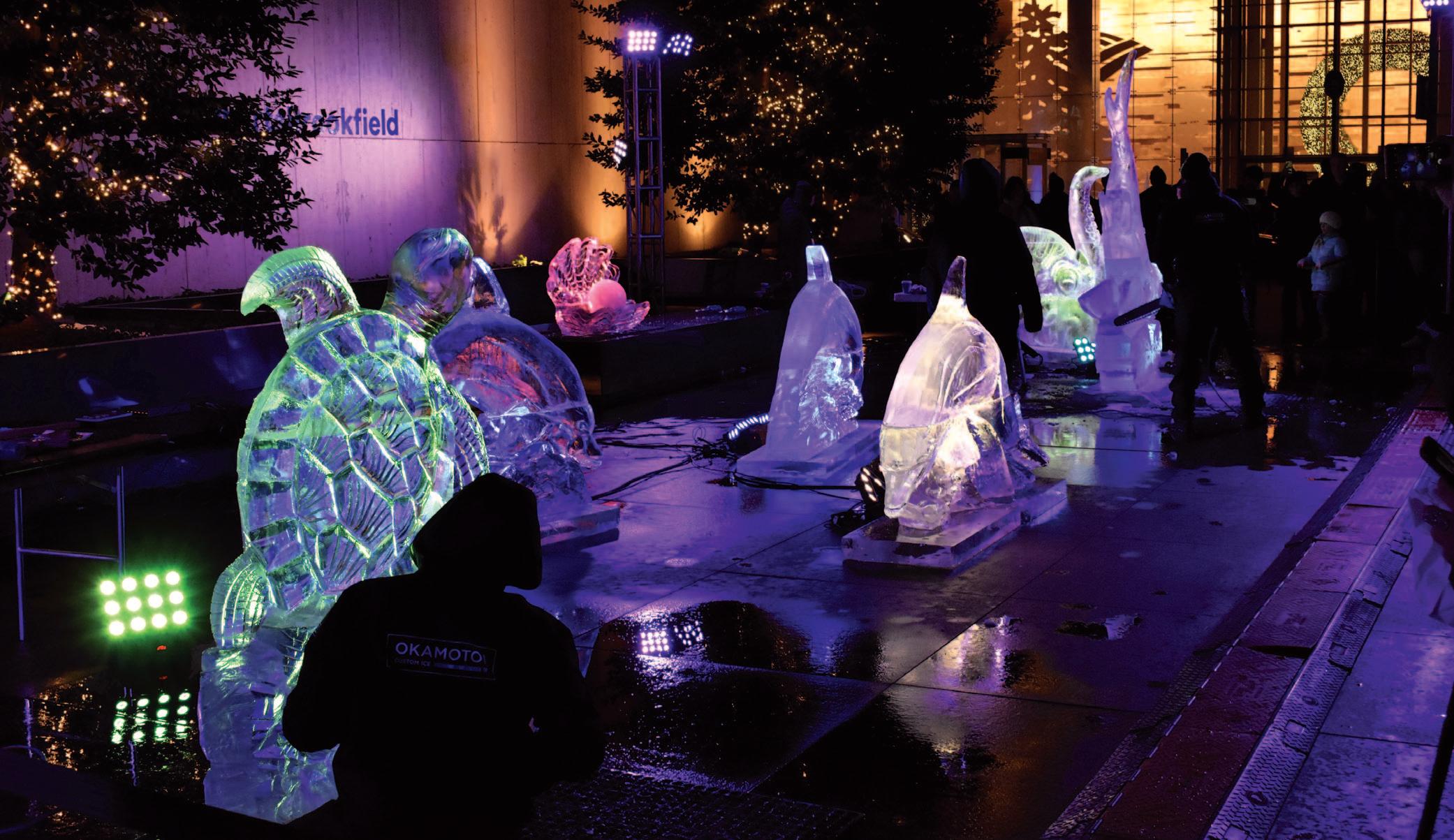
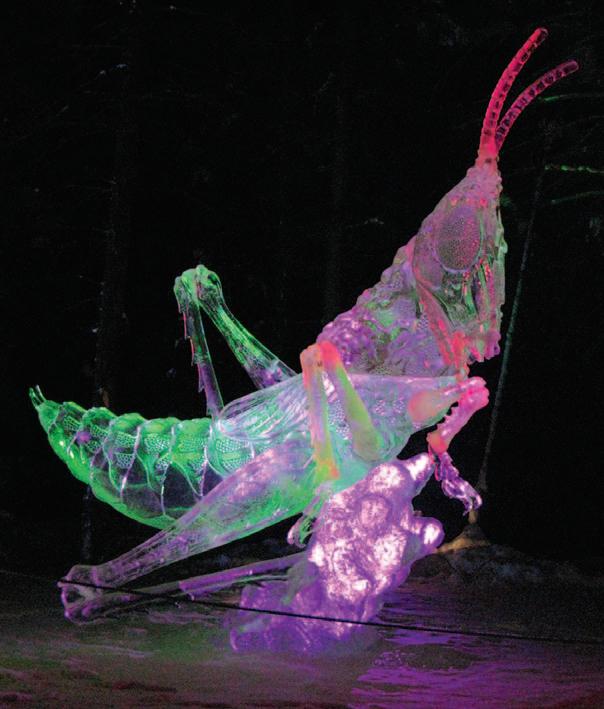
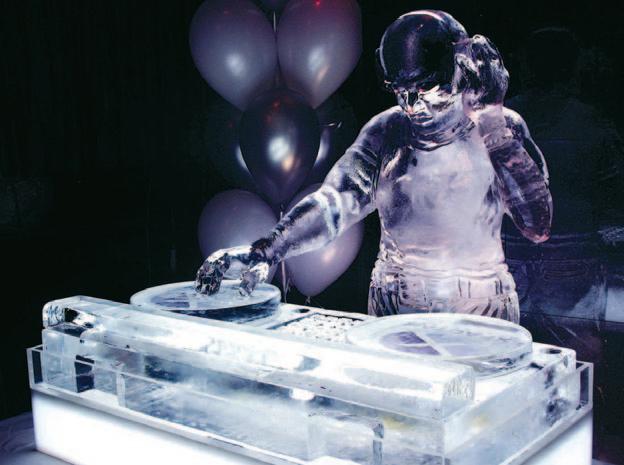
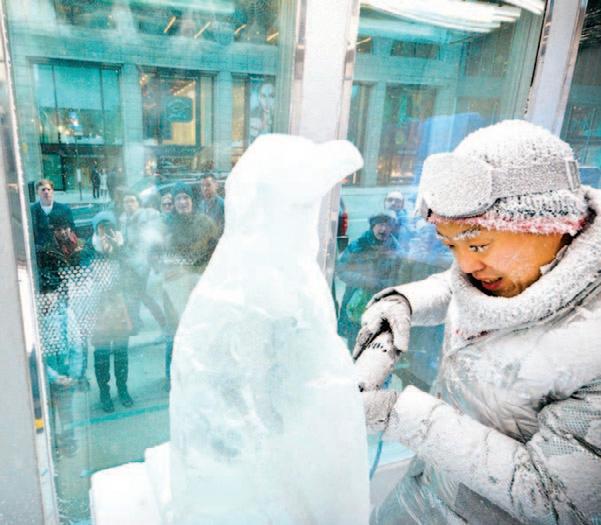
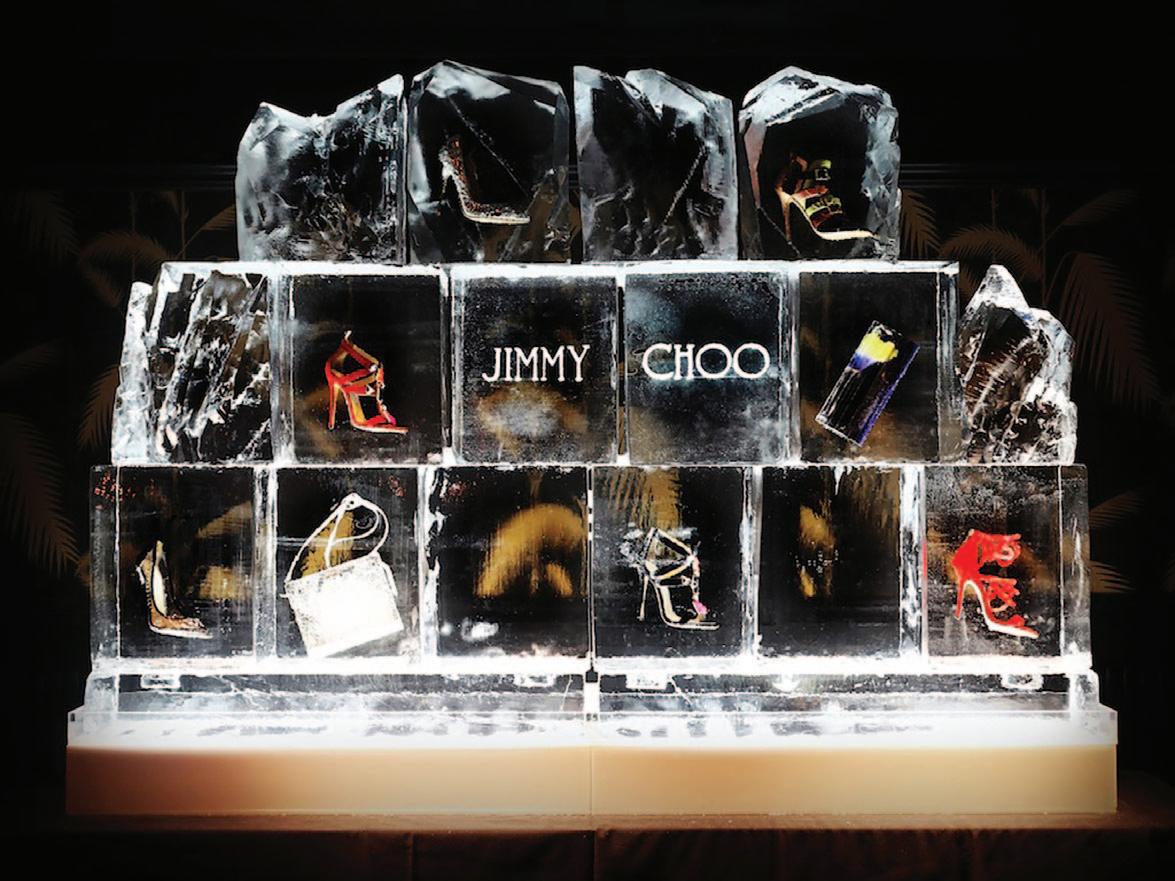
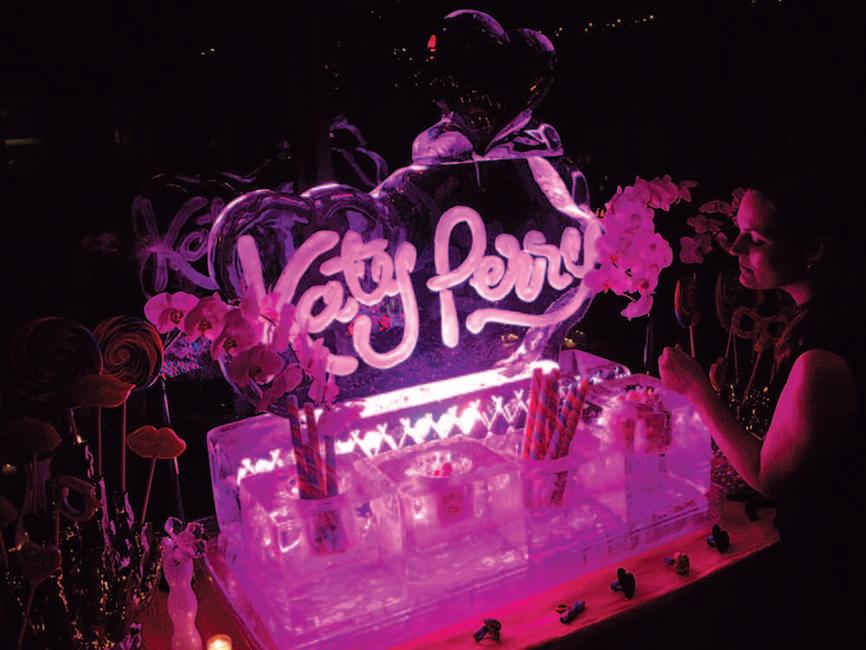
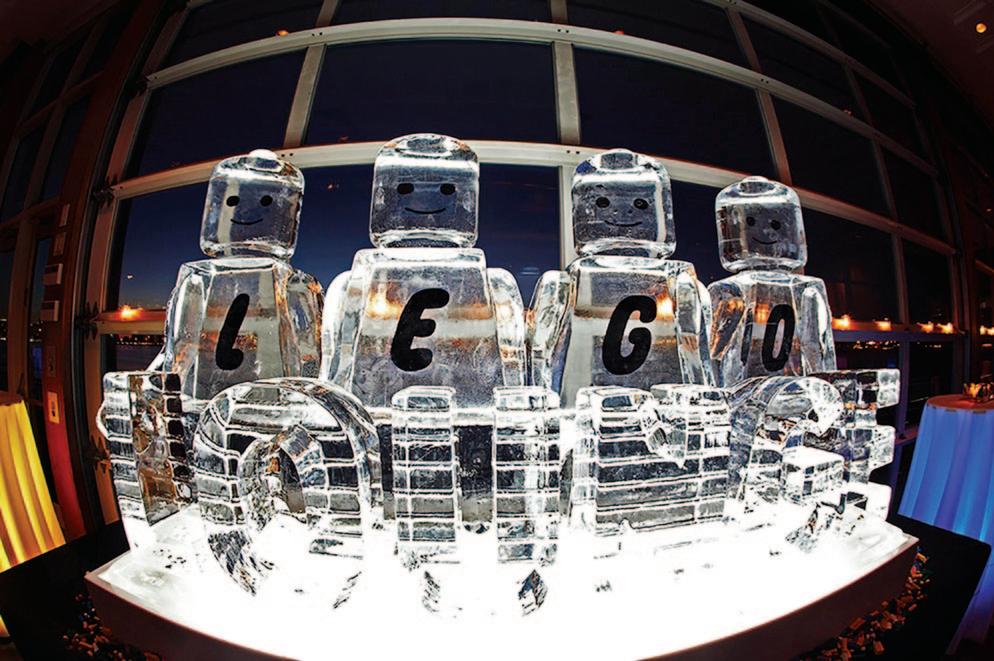
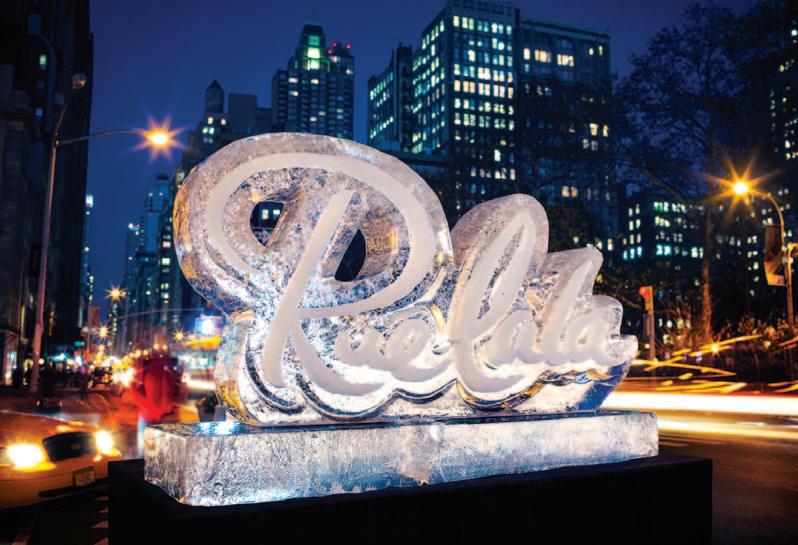
There’s a unique ice runway for Amer ican fashion designer Zac Posen; delicately carved polar bears for jewelry designer David Yur man’s holiday store windows; and a fun, freestanding dis play wall of Jimmy Choo handbags and shoes floating in stacked blocks of ice. There are images of sculpted logos en hanced with special lighting for corporate giants like LEGO, Ruelala, Yahoo, Spotify, and Embraer Airlines. And a cross-section of the sports, en tertainment and film industries are repre sented as well, including the New York Knicks, Def Jam Recordings, NBC, Warner Brothers, Notorious BIG and Katy Perry.
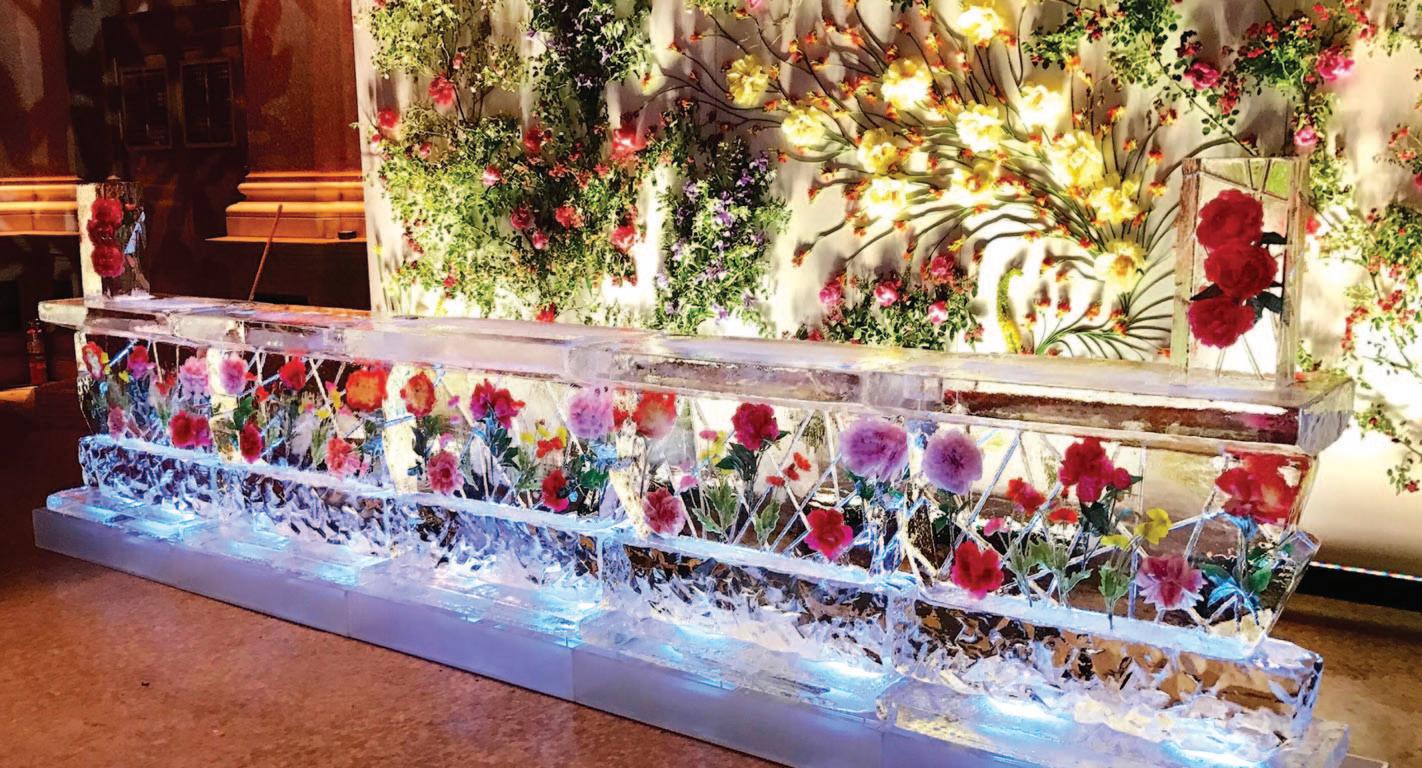
Pictures of colorful florals and spectacular in dividual flowers, seemingly floating in carved ice which have graced many wedding, gala, mitzvah and holiday tables as centerpieces are also featured on the site. And an ex tensive collection of images featuring contemporary ice bars with dedicated nooks for
top shelf liquor bottles and glasses; fun luges of all shapes and sizes that serve up icy cold, sig nature dri nks which are incredibly popular and a sophisticated take on the fun nel/siphon drinking days of frat parties; crystal clear cocktail ice branded for bars, restaurants and spe cial events; and all sorts of culinary ice sculptures custom designed for h oliday parties and more. It would seem that whatever a client can imagine, OKAMOTO STUDIO will create.
Sadly, in 2012, Shintaro’s fa ther passed away from cancer, but not before seeing OKAMOTO STUDIO Custom Ice achieve well-deserved recognition and success. The business values that Takeo imbued in Shintaro as a child including humility, hard work, exceptional customer service and a willingness to look beyond him self, are fundamental to the continuing success of the business. According to Shin taro, he “looks at the world at large, sees needs and opportunities that are relevant to the studio, then challenges himself”. And as a new father of a young son of his own, it is safe to say that Shintaro will teach him the same values he was taught, ensuring that the Okamoto legacy will live on.
More information on OKAMOTO STUDIO Custom Ice can be found at www.okamotostudionyc.com, on FB at facebook.com/okamotostudioice and on IG @okamotostudio.
INSTINCTIVELY DIFFERENT>>
Brule County Blues
South Dakota’s Brule County is not the best place to find yourself, unexpectedly, in the dead of winter. The sparsely populated county along the Missouri River is desolate before spring breathes some life into Chamberlain, the county seat. Troy musician Josh Coletto found this out the hard way after a cross-country road trip went awry during a traffic stop in Brule County, which led to a two-month stay in the county jail.
“When I first got pulled over, it was January and very bleak,” says Coletto over a recent Zoom call. But Coletto, a chef and co-owner of Nighthawks restaurant in Troy, made the most of his time in the Great Plains. The talented chef received a work release during the day to cook and rewrite menus for a nearby casino, which later tried to draft him after his jail stint was over. He also cooked for the small jail population, using his culinary skills to vastly improve the cannedgoods menu of chili and stew.
Most significantly, Coletto used his stint in the pokey to write hardluck tunes inspired by his time there. When he finally emerged and re turned to Troy, he named a new band after his South Dakota
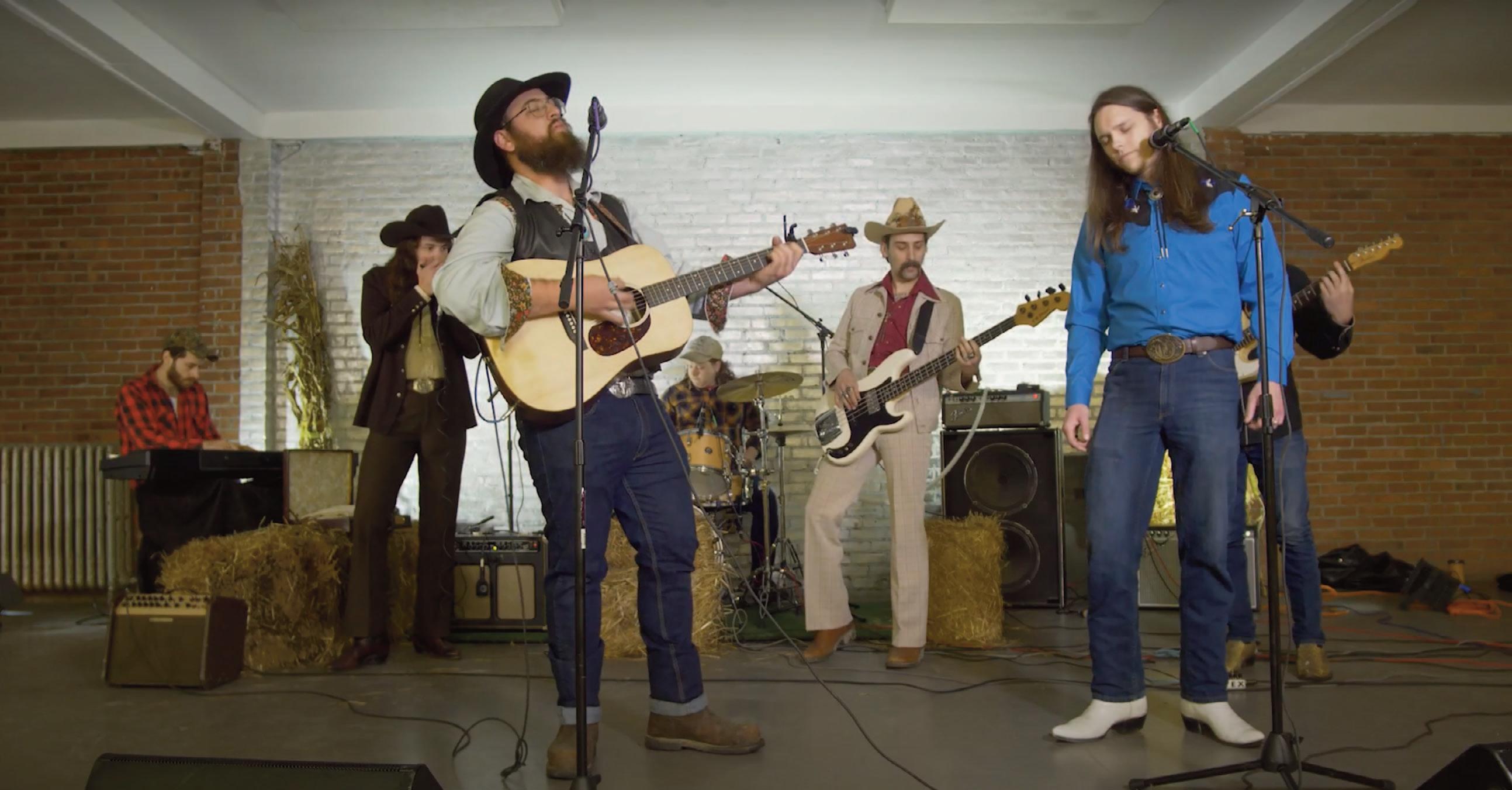
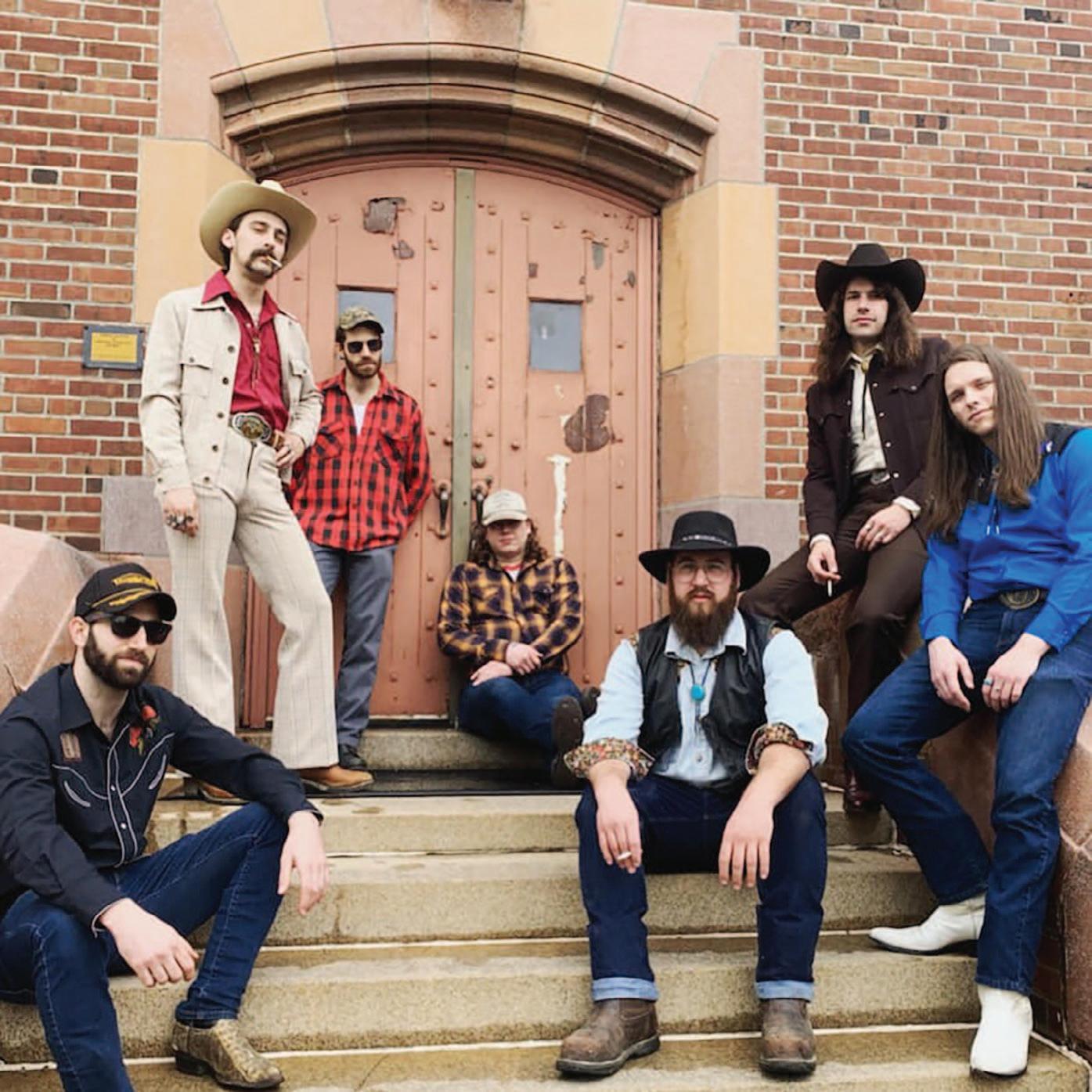
A run-in with the law led to a short stay in a South Dakota jail for Troy musician Josh Coletto—but it also launched his country band, Brule County Bad Boys, and a new album.
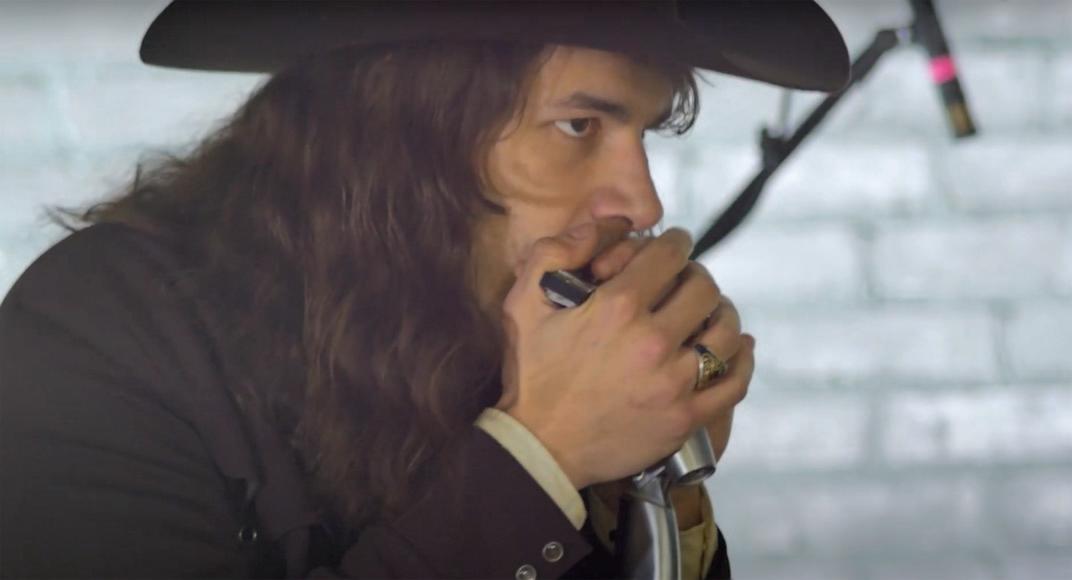
expe rience: Brule County Bad Boys, an out law and cosmic country group featuring Sean Secor (“Tex”) on bass, Robert Buckley on drums, Zack Cohen on guitar, and Ben Wessels on harmonica.
Before the pandemic struck, the band recorded an album, “Chamberlain,” based on the songs Coletto wrote in jail. “When I got in trouble in South Dakota, I spent a lot of my time writing, something I always liked to do,” says Coletto. “There was a lot of time to think with nothing going on. I ended up writing maybe 50 songs or poems that manifested themselves as country songs. As I wrote them, I sent them all to my friend Sam Wessels, who plays piano on the record.”
Coletto grew up playing drums in punk and metal bands like Girls of Porn and Sallow, but in the Brule County Bad Boys, he takes the lead on vocals and guitar to play music in the vein of country outlaw artists like Waylon Jennings, Buck Owens, Johnny Cash, and George Jones. “I’ve always been into country music,” Coletto says. “I appreciate the poetry of the words, which can be so sad over major keys, and the campiness of it can be really fun.”
Among the new songs—recorded at Soundcheck Republic in East Greenbush, New York,
and mastered at Galaxy Park in Boston, Massachusetts—is “Wall Drug,” a harmonicafueled rave-up written about the roadside tourist trap of Wall, outside Badlands Na tional Park. “Trustee” is a piano-driven honky-tonk number about Coletto’s experience cooking for his fellow inmates. The album is studded with guest stars from the local music world, including twang-guitar master Graham Tichy, steel guitarist Kevin Maul, electronic artist NXNES, and guitarist Kieran Robbins.
Plans to release the album on vinyl are on hold at the moment, given pandemic-related
economic stresses. But look for Brule County Ba d Boys at a venue like Hangar on the Hudson in Troy in better days, hopefully coming soon. Among the songs you’ll likely hear, “Chamberlain” is a twangy, pedalsteel-dri ven lament that sums up Coletto’s soul-searching, soul-crushing experience in Brule County. “Take me away, from South Dakota, where justice dies behind the prison walls,” Coletto sings in a deep croon that turns into a rousing chorus. “Bury me here, in South Dakota. I’ve already died, just let me be.”
Visit brulecountybadboys.bandcamp.com.
We Had Fun, But We Could Never be Peggy
by Karen Richman
Jane and I needed something to do.
It was after the holidays, that time when the world is gray, it gets dark by 4:30 every afternoon, and the cold and damp just seems to settle in. People as well are somewhat down because of the run-up to the holidays, and then comes the giant thud of a new year’s letdown bringing with it holiday bills mixed with expectations of resolutions and the knowledge that it’s going to snow a lot more before you ever see a crocus again.
We couldn’t play badminton in the driveway which was our favorite thing to do. The swim club with its outdoor pool was shuttered until Memorial Day, and we were just plain bored.
“Why don’t you try skating?” my mother offered. “When I was your age we spent hours from January through March making figure eights at the pond and then coming home to hot chocolate.” Hmmmn, maybe not bad, we thought.
So Jane and I checked our allowance savings, and coupled together with what we could weasel out of our parents, made our way to the sporting goods shop in town. In the 1960s most ladies’ ice skates all looked the same. They were white, had miles of laces, and silver blades. Men’s skates were black. There was nothing very fancy about them, although the “cool girls” at school often attached pom-poms or little bells to make them tinkle or something else adorable. Jane and I were not of that ilk. Oh, it’s not like I wouldn’t have liked pom-poms on my skates too, but I was not handy with anything, and within minutes, my pom-poms would have fallen off or worse yet would make me trip on the ice.
The outdoor pond lasted about 15 minutes. “It’s cold!” said Jane, trying desperately to lace up her skates against the north wind blowing directly at the pond. I didn’t even have my skates on yet when I decided that the “old-fashioned” skating experience was not for us.
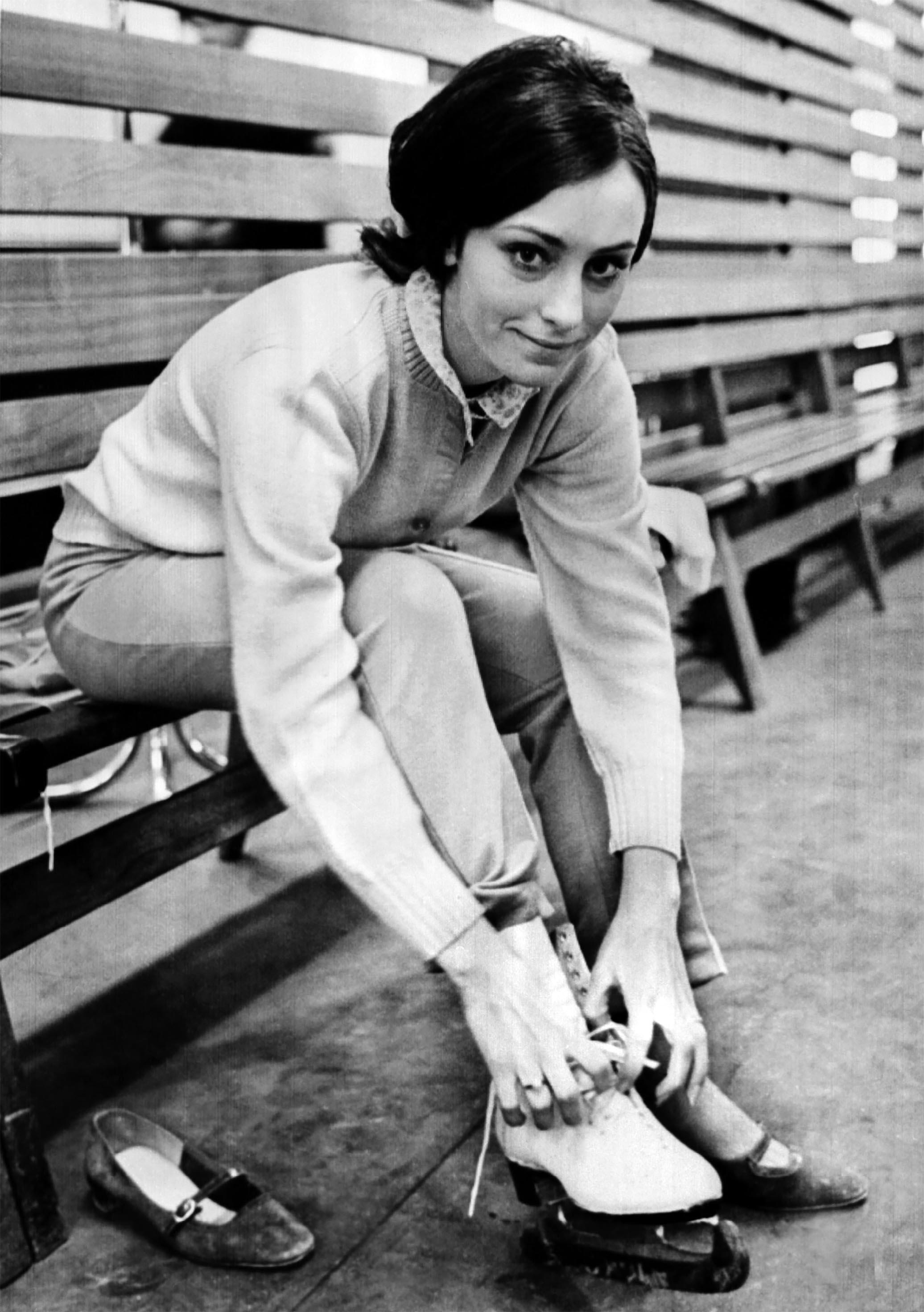
Fortunately, there was a huge indoor ice arena a few miles away and Jane already had her driver’s permit, so we made our way over to the behemoth that seated 2500 people and had an enormous ice rink. We found that lacing up our skates was not as easy as we thought, it was a process, but with the help of a man who worked there, we got them on. Then it was time to stand up and head for the ice. “How do people stand on one blade and walk?” I howled. “I dunno,” Jane replied, hugging the wall.
Somehow we made it out onto the ice where mercifully there was a rail ing all around the oval. While others were making figure eights, swirling and twirling and gliding effortlessly, Jane and I clung to the railing, taking short clumsy steps. That lasted a few minutes until I saw a sign for the concessions and smelled the hot chocolate. We didn’t have to wait till we got home!
We didn’t give up, though. Every Sunday afternoon like clockwork we made our way to the arena, laced up our skates, and made it onto the ice without falling, searching out the railing. So we plodded along, week after week, terrified of letting go of the railing, yet every now and then taking a chance and gliding. And falling. And trying to be graceful. And falling some more. But we thought ourselves very athletic ice queens until...Peggy came on the scene.
So we were content to just buy plain ice skates. “Do you know how to lace them up properly to protect your ankles?” the salesman asked. “Oh, sure,” I said with a cocky teenage attitude, although I had never before had a pair of ice skates on my feet. My experience with skating had been roller skates that you strapped over your shoes, and I wasn’t much good at that either as evidenced by my knees with their permanent scars.
So off we went to a nearby pond with my mother’s Hallmark movie memory in my head and the promise of hot chocolate swimming with marshmallows waiting for us at the end of the adventure.
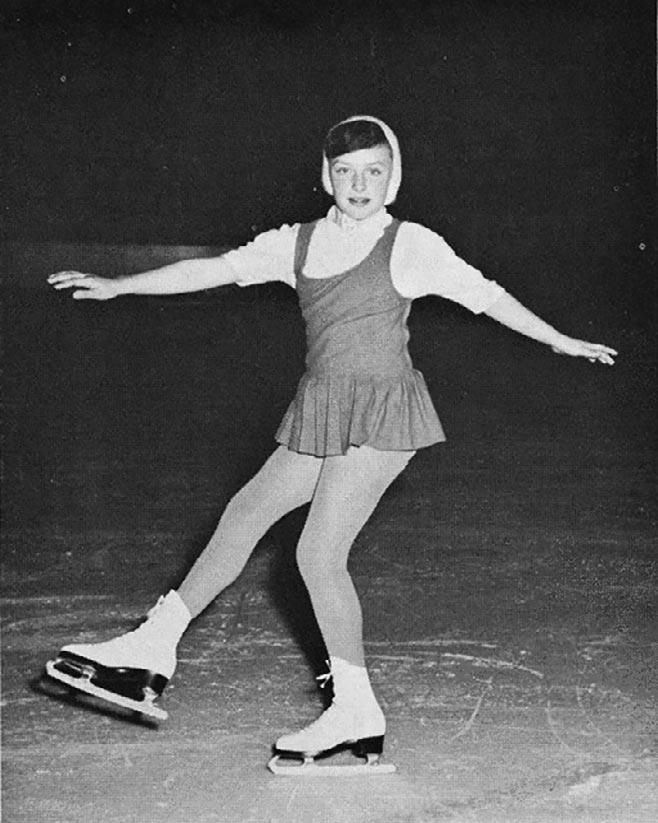
Suddenly a beautiful, tall, leggy figure skater named Peggy Fleming was everyone’s sweetheart and most definitely the subject of the day at the arena. She donned her first pair of skates at age nine, and from the outset, her trademark was one of quiet, effortless movement. She won her first competition at age eleven, and at age fifteen won the first of five consecutive U.S. championships, then world championships, and finally in 1968 at Grenoble, France captured the gold in the 1968 Olympics.
Jane and I both hated her and loved her. How could this fragile, graceful beautiful girl do what she did on ice when we could barely let go of the railing? When we asked the man at the skating arena he spoke of natural talent married with ongoing practice. When we complained to our parents, they spoke of dogged determination, years of getting up before the sun and practicing before school, then again after school. It was a life of sacrifice we were unwilling to even consider. But we couldn’t take our eyes off the woman who changed the sport of figure skating forever with her beautiful, balletic, elegant style.
Today Peggy Fleming is 72. She’s married, has a family, still works as a professional sports broadcaster reporting figure skating, and remains a name no one in the sport ever forgot. Today my ice skates are long gone, and my time on ice is usually relegated to spreading salt so I don’t kill myself on the walkway. But when I look back on those days nearly half a century ago I realize that Peggy taught us some valuable lessons: if you fall down, get right up; there is freedom and pleasure in learning to glide, so work until you do; and if you can ever learn to walk on even one blade, you’re way ahead of the game.
G W uest riter
The History and Power of Chocolate
BY: Crystal Cobert-Giddens
Conversation hearts, bon-bons and heart-shaped boxes of chocolates—these are the symbols of Valentine’s Day for most people around the world. The origin of Valentine’s Day goes all the way back to Roman times, but giving chocolate as a “sweets to the sweet” happened slowly over time.
Cacao was first developed as a crop in many ancient South American cultures. Researchers have found evidence of cacao based foods and drinks dating back thousands of years. The cacao bean was so important to those cultures, that it was used as currency in trade, given to warriors as a post battle reward and served during royal feasts.
When the Spaniards arrived in the new world, they quickly discovered the value of the local cacao crops and added their own ingredients: sugar and spices.
Chocolate drinks became wildly popular amongst the Spanish, who kept their production method from the Europeans for almost 100 years. When the Europeans finally got a taste of this drink, its popularity spread like wildfire. The French and the English reserved it for royalty. Special chocolate houses started popping up and would serve the drink to the social elite. The upper class hailed “hot chocolate” as delicious and healthy and it quickly gained a reputation as being an “aphrodisiac.”
But how did cacao become part of St. Valentine’s Day? The first mention of St. Valentine’s Day appeared in the writings of Chaucer in 1382. Kings and Ladies became obsessed with illicit, courtly love. Knights would give roses to their maidens and celebrate their beauty in song. However, sugar was still a precious commodity in Europe, and chocolate as we know it, was not available.
By the mid 1800’s, the idea of Valentine’s Day as a holiday to celebrate romantic love had taken over most of the English-speaking world. It was Cupid’s golden age: Victorians still adored the notion of courtly love and showered each other with elab orate cards and gifts.
Cadbury was established in 1824, by John Cadbury, a Quaker who sold tea, coffee and drinking chocolate. Richard Cadbury, John’s son, found a way to improve their chocolate making technique so as to extract pure cocoa butter from whole beans, pro ducing a more palatable drinking chocolate. This process resulted in an excess amount of cocoa butter, which Richard decided to use to produce new varieties of what was then called “eating chocolate.”
Richard needed a way to sell his new, aphrodisiac inducing chocolates, and he soon recognized a great marketing opportunity based on the tradition of gifting those elaborate cards and mementos. He designed and started selling his “solid” chocolates in beautifully decorated boxes. Cadbury marketed the boxes as having a dual purpose: When the chocolates had all been eaten, the box itself was so pretty that it could be used again and became a way to store mementos, from locks of hair, dried roses and love letters.
The boxes grew increasingly elaborate until the outbreak of World War II, when sugar was rationed and Valentine’s Day celebrations became “basic”. Victorian-era Cadbury boxes still exist, and many are treasured family heirlooms or valuable items prized by collectors.
Crystal Cobert-Giddens
FACES of Saratoga, 489 Broadway, Saratoga Springs, NY www.facesofsaratoga.com
CACAO Food of the Gods
In 1753, Carl von Linnaeus, a Swedish scientist, thought that cacao was such an important find, that he named the genus and species of this tree: Theobroma Cacao, which literally means “Cacao, the Food of the Gods.” Theobromine is an effective anti-bacterial substance that is naturally found in cacao.
Cacao also has the ability to widen blood vessels and improve circulation, while it lowers your blood pressure. Cacao is considered by many cultures to be a relaxing, soothing longevity medicine and is widely touted as a sleep remedy.
Cacao contains the highest concentration of antioxidants of any food in the world. These anti-oxidants contain polyphenols, catechins, and epicatechins, and by weight, cacao beans have more antioxidants than red wine, blueberries, acai, pomegranates, and goji berries COMBINED. There are over 25,200 a nti-oxidants in a single teaspoon of raw cacao powder!
Anandamide, a neurotransmitter, also known as The Bliss Chemical, is produced in the brain and has been found naturally in raw cacao. Your brain releases Anandamide when you are happy.
Dutch researchers found that dark chocolate contains four times the amount of catechin antioxidants than black tea, which is reported to protect our hearts against disease and possibly cancer.
~ Chromium is an important trace mineral that helps balance blood sugar. It also plays a significant role in detoxifying the liver from alcohols which build up during the fermentation process of sugars and starches when we eat too many sugary foods.
~ Cacao contains high levels of magnesium. Magnesium fights acid buildup, neutralizes toxins, calms sensitivity to pain, quiets nerves, builds strong bones and teeth and is essential for many other functions. Over 80% of Americans are deficient in magnesium. Cacao is believed to have the highest magnesium content than any other food!
~ Zinc is found in cells throughout the body and is needed for the body’s defensive system to properly work. It plays a critical role in cell division, cell growth and wound healing.
~ Phenethylamine (PEA): is found in abundance in raw cacao beans. PEA is the adrenal-related chemical that we produce in our bodies when we fall in love.
~ Tryptophan is an essential amino acid that is transformed into important stress-protective neurotransmitters including serotonin and melatonin.