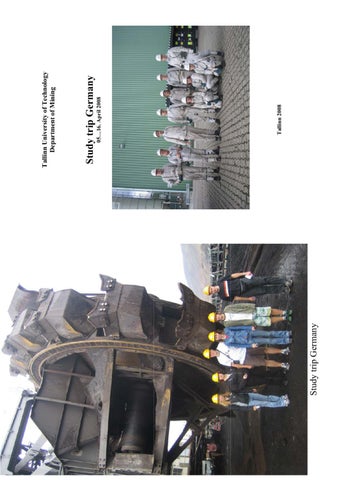
Study trip Germany
Tallinn University of Technology Department of Mining
Study trip Germany 05‌16. April 2008
Tallinn 2008
Study trip Germany
Study trip Germany
TUT Mining Department
Bergakademie Freiberg
TUT Student Council
Mining Society Study trip Germany 05…16. April 2008 ISBN Editor: Veiko Karu Special thank: Ave Õnnis Ingo Valgma Christian Buhrow Cover:
Estonian Oil Shale Company
Study trip Germany 2005 participants
Trükkimist toetab TUT Stüdents Council © Mining and geology science club
TUT Department of Mining
27
Study trip Germany
Study trip Germany
Environment Protection Students' Association of Eesti Maaülikool Estonian Students Society for Environment Protection „Sorex” Club of Sustainable Development in Tallinn University of Technology Student Council of Mining Department in Tallinn University of Technology
Purpose of the study trip
Contact WinterAcademy: info@talveakadeemia.ee
There is a strong demand for mining engineers and mining education in Estonia because of important role of oil shale mining for the Estonia’s and Baltic economy. Estonia has lots of other minerals currently being mined or being mineable, too, e.g. limestone, dolomite, phosphate, peat. Tallinn UT educates mining engineers and applied geologists. Especially mining engineers must have a global overview about mineral excavation technologies and environmental impacts of mining. In order to achieve this goal and to improve the mining engineering and applied geologists education in Estonia, trips to international mining sites are necessary. As the world biggest lignite mining country is Germany a very attractive destination for a student excursion. Moreover, Germany is selected because it has long mining history, a great number of large surface and underground mines, many world-leading companies for constructing mining machinery, well developed relations between TU Bergakademie Freiberg and Tallinn UT. During the trip are introduced to students coal, salt and ore mines; companies for mining equipment and machinery; also relations between Tallinn UT and TU Bergakademie Freiberg are strengthened. The trip will increase student’s competence and knowledge about practical aspects of German mining industry. Editor
TUT Department of Mining
26
TUT Department of Mining
3
Study trip Germany
Study trip Germany
Table of contents
International Student Week – ISW
Purpose of the study trip................................................................ 3 Excursion with students................................................................. 5 Tallinn University of Technology ................................................. 7 Mission ..................................................................................... 7 Statement of the Rector: ........................................................... 7 History ...................................................................................... 7 Basic Facts about TUT ............................................................. 8 Mining Department is part of Faculty of Power Engineering 11 Studies at TUT........................................................................ 12 Research and Development .................................................... 13 Academic activities................................................................. 13 Research activities .................................................................. 14 Student Council of Tallinn University of Technology................ 16 General information................................................................ 16 Science clubs .......................................................................... 16 Department of mining.................................................................. 17 Mining Research..................................................................... 17 Laboratory of mining design and planning ............................ 18 The laboratory of Mining Conditions..................................... 19 Doctoral school of energy and geotechnology ....................... 20 Estonia in European Masters Mineral Engineering Course (EMMEC) ............................................................................... 21 Cooperation between Mining Departments............................ 21 Society of Mining Professors (SOMP) / Societät der Bergbaukunde (SDB) ............................................................. 22 Society of Mining Students ......................................................... 23 IFMMS ................................................................................... 23 About IFMMS ........................................................................ 23 History of IFMMS .................................................................. 24 International Student Week – ISW......................................... 25 WinterAcademy...................................................................... 25
TUT Department of Mining
4
An ISW is as the name says an international student week. This is an opportunity to get to know the curriculum of other universities and also get to know the industry. But the most important thing is the social aspect and lifelong traditions in each country. The IFMMS Congress is arranged every year and all the members have the choice to participate at the congress or not.
WinterAcademy WinterAcademy is a student science conference held once a year and a network of students connecting them throughout the year. The overall aim of WinterAcademy is to inspire students to get involved in making science and innovation projects in the fields of sustainable development. The three-day conference gives possibility to bachelor and master degree students from all universities in Estonia to introduce their research projects to wider audience. Every year science article competition is organised to select the best works to be presented at the conference. Besides that, WinterAcademy brings discussion about most important problems related to balance between humankind and nature, allows participants to learn new practical skills in workshops and creates supporting environment for people to meet, share ideas and develop new projects. As conference takes place in different part of Estonia every year, away from main city centres it also helps to introduce Estonian countryside. WinterAcademy was founded by students from three main/biggest Estonian universities in 2003. While organising team consists of approximately 20 students (incl students of Tartu University) with different background every year, the Council of Winteracademy is run by following student organisations:
TUT Department of Mining
25
Study trip Germany
Study trip Germany
without religious, social, racial, national, sexual or other discrimination. Our aims are to serve mining, metallurgy, petroleum and geology students all over the world through our member organizations and to promote international cooperation in the fields designated in the political statements. The functions of the IFMMS are consolidation of the contacts among European mining universities, discussing of special problems in education and engineering, traditional international student weeks, etc. The highest authority and jurisdiction of the IFMMS is the annual congress, which is held every year. Besides the annual congress the regional boards are responsible for arranging international student weeks. This should introduce the participants to the special subject industry of the host country.
Excursion with students
History of IFMMS The history of the organization dates back to 1905 when a body called "The International Union for Mining Universities” was formed in Clausthal, Germany. They had their first meeting in Delft, Holland the following year and this was attended by 23 European and 3 American faculties. In 1947 this body merged with the Geological Society of Amsterdam to form a new organization called the International Federation of Students of Geology and Mining (IFSGM). This body functioned for a number of years but sadly interest was lost. The organization re-named the IFMMS was established in Delft 1961, but again this only functioned for a few years and in 1969 was no longer. The idea to re-establish the IFMMS came initially from the students at the Mountain Universität in Leoben, Austria in 1986. For a number of years now, even before the re-formation in 1986 a number of institutions have hosted International Student Weeks (ISW) where invitations were extended to 2 representatives from other institutions. These weeks while being mainly social and cultural have a serious side, which often involve visits to related industry and lectures from qualified persons in these fields.
TUT Department of Mining
24
Subsequent drafted agenda: Day 1 (Sat.): Arrival in Rostock by ferry, journey to Rüdersdorf (close to Berlin), visit of the Rüdersdorf quarry (chalk), afternoon: guided tour through Berlin, Day 2 (Sun.): Journey to Freiberg, Visit of “Himmelfahrt Fundgrube” (educational and research mine of TU Bergakademie Freiberg, afternoon: guided tour through Freiberg, Day 3 (Mon.): visit of the mine Hermsdorf (GEOMIN; underground marble mine), afternoon: guided tour through the mineralogical collection of TU Bergakademie Freiberg, journey to Vacha Day 4 (Tue.): Visit of the potash mine “Unterbreizbach” including its backfilling operations, afternoon: visit IBS GmbH, roadheader manufacturer (close to Fulda) Day 5 (Wed.): Visit of quarries of Basalt Nickel GmbH (close to Gießen), afternoon: visit of VDMA (German Association of machine manufacturerers), mining machinery branch, Frankfurt, Day 6 (Thu.): Visit of underground slate mine “Margareta” (I. B. Rathscheck GmbH & Co. Kg, Mayen), afternoon: visit of open pit “Frechen”, Quarzwerke GmbH, Frechen, Day 7 (Fri.): Visit of open pit “Hambach” (RWE Power), afternoon: visit of power station Niederaußem (RWE Power), Day 8 (Sat.): Visit DSK’s training mine (Recklinghausen), afternoon visit to DSK’s coking plant “Prosper”, Day 9 (Sun.): Visit of DBM (German Mining Museum), Bochum,
TUT Department of Mining
5
Study trip Germany
Study trip Germany
Day 10 (Mon.): Visit of underground hard coal mine “Ost”, DSK, Hamm, afternoon: visit of DBT – Mining machinery manufacturer, Lünen,
Society of Mining Students
Day 11 (Tue.): Visit of gas production and purification, EMPG – Exxon Mobile Production Germany GmbH, Großenkneten + Dötlingen, Day 12 (Wed.): journey to Rügen, afternoon: visit of the chalk quarry, evening departure from Rostock.
Mäering is a organization of geology and mining students in Tallinn University of Technology. We have 46 members. Our purpose is to introduce mining companies to the students and also take care of the entertainment. Traditional events are: sauna party, winter camp, spring excursion, conversation evenings and others. Our roots belong back to the year 1947.
IFMMS IFMMS is an international organization for mining, metallurgy, petroleum and geology students. Every year a congress is arranged to discuss the latest issues for the federation. In addition to the congress the members arrange international student weeks where the visitors gets to know the structure of education and companies in the country visited. The IFMMS counts 20 members as of november 2003 divided in 16 countries.
About IFMMS IFMMS is an independent federation of mining, metallurgy, petroleum and geology students. The federation pursues its aims
TUT Department of Mining
6
TUT Department of Mining
23
Study trip Germany
Study trip Germany
make this vivit successful and useful for both, German and Estonian participant.
Tallinn University of Technology
Society of Mining Professors (SOMP) / Societät der Bergbaukunde (SDB) The Society of Mining Professors/Societät der Bergbaukunde is a vibrant Society representing the global academic community and committed to make a significant contribution to the future of the minerals disciplines. The main goal of the Society is to guarantee the scientific, technical, academic and professional knowledge required to ensure a sustainable supply of minerals for mankind. The Society facilitates information exchange, research and teaching partnerships and other collaborative activities among its members.
Mission The mission of Tallinn University of Technology is to support Estonia’s sustainable development through scientific creation and science-based higher education in the field of engineering, technology, natural and social sciences.
Statement of the Rector:
SOMP AGM will be held in Estonia in 2010 2008 Annual General Meeting The 2008 meeting will be held in Aachen, Germany. 2009 Annual General Meeting The 2009 meeting will be held in Sydney, Australia. 2010 Annual General Meeting The 2010 meeting will be held in Estonia. 2011 Annual General Meeting The 2011 meeting will be held in Arequipa, Peru.
With its eight faculties, four colleges and R&D institutions, Tallinn University of Technology (TUT) is a national university of technology, internationally renowned, known as a reliable partner at different levels of collaboration networks. We are serving our nation as a hothouse of engineering and technology professionals and a driving force for the development of a knowledge-based economy. TUT fosters integration of technical and related natural and social sciences and humanities that create a basis of higher technological education and advancement of Estonia’s economy. We are committed to collaboration in the networks of the countries of the Baltic Sea region, Europe- and worldwide. TUT is seeking international institutional accreditation in the next years. Professor Peep Sürje
History Expressed by learned community in the early twentieth century, the need for engineering specialists trained nationally became urgent. Until then, young people from Estonia had received their specialist
TUT Department of Mining
22
TUT Department of Mining
7
Study trip Germany
Study trip Germany
education in St. Petersburg, Germany or Riga. Opportunities had to be sought for engineering-minded people to acquire Estonian-based education adapted to local conditions and needs.
Aadu Paist Professor Phone: +372 620 3901 Fax: +372 620 3901 E-mail: apaist(at)sti.ttu.ee
On 17 September 1918, the Estonian Engineering Society managed to open an Estonian-based engineering school named Special Engineering Courses. That date has been recognised as the founding date of Tallinn University of Technology. Programmes were offered in mechanical, electrical, civil and hydraulic engineering, shipbuilding and architecture. In 1919, the school became the private Tallinn College of Engineering, which in 1920 was declared a state institution. Teachers' efforts to develop Estonian terminology for science and technology proved fruitful and the first engineering books were published. In 1923, the first engineering graduation theses were defended in Estonia. In the same year, a State laboratory of Materials Testing opened for research work. By the 15 September 1936 Act of the Head of State, the school was granted the status of University, named Tallinn Technical Institute. The institute had two faculties: civil and mechanical engineering and chemistry and mining. In 1938, the name - Tallinn Technical University - was effective. In 1940 the Faculty of Economics, in 1958 the Faculty of Power Engineering and in 1965 the Faculty of Control Engineering were founded.
Basic Facts about TUT The official colours of the University are steel grey and cerise. Grey stands for the tenacity and stamina of our students in their pursuit of knowledge and cerise is for their vitality and joy in life. These colours are represented on the University flag and student caps. The middle white stripe on the cap symbolises peace, progress and high morals. The official student cap was in use from the sixties to the nineties, and after a short break in tradition, it was reinstated in the spring of 2001. Each first-year non-distance learning student is awarded this cap in a festive ceremony after the completion of the
TUT Department of Mining
8
Estonia in European Masters Mineral Engineering Course (EMMEC) Otsida infot
Cooperation between Mining Departments Cooperation between Department of Mining of Tallinn University of Technology and Institut f端r Bergbau und Spezialtiefbau TU Bergakademie Freiberg and other related Institutions in Germany First mining and excursion supported by DAAD was organised in 07..23.07.2001 with help of Clausthal TU. This was great cuccess and after that several actions have been taken. Clausthal TU vivited us and ou mining industry in Estonia in 2004. Since that connections between our Department and German Mining institutionas have been growing. Six of our studens have been studing in Germany for 2 months. Our professors have been giving quest lectures every year in both Universities. Freiberg TU visited us in Poland, Estonia and Finland for getting to know our culture and industry. We are attending and organising professional conferences and are working together in professional workgroups since that. In addition to Aachen TU we have strongest relation with Institut f端r Bergbau und Spezialtiefbau TU Bergakademie Freiberg (Professor Christian Buhrow) We organised similar excurion in germany in 2005. This year, after discussing potential international courses of mineral resources in our institutions and professional excursion to German Mining Industry that is strongly related to similar problems in Estonian industry, Professor Buhrow recommended to ask support from DAAD to
TUT Department of Mining
21
Study trip Germany
Study trip Germany
Field laboratory 1. Point load test 2. Schmidt hammer 3. GPS systems 4. Water probe pump MP1 5. Noise meter 6. Radioactive radiation meter PAKRI-E 7. Water level measurement devices 8. Water flow measurement propeller 9. Vibration meter
first examination session, at the beginning of the second semester of studies. The motto of TUT is Mente et Manu (with the hand and the mind). It is inscribed on TUT awards, Letters of Appreciation, student caps and publications. The Tallinn University of Technology has: • 8 Faculties • Faculty of Civil Engineering (letter designation E) • Faculty of Power Engineering (letter designation A) • Faculty of Humanities (letter designation H) • Faculty of Information Technology (letter designation I) • Faculty of Chemical and Materials Technology (letter designation K) • Faculty of Economics and Business Administration (letter designation T) • Faculty of Science (letter designation Y) • Faculty of Mechanical Engineering (letter designation M)
Doctoral school of energy and geotechnology Department of electrical Dirves and Power Electronics Juhan Laugis Professor Phone +372 620 3702 Fax +372 620 3701 E-mail laugis(at)cc.ttu.ee
• 33 Institutes, 2 Research Centres, 6 Centres and 3 Research and Testing Laboratories • 109 Chairs and 6 Teaching Divisions
Department of Electrical Power Engineering Heiki Tammoja Professor Phone +372 620 3752 Fax +372 620 3751 E-mail heiki.tammoja(at)ttu.ee
• 3 Colleges • Tallinn College of TUT • Kuressaare College of TUT • Virumaa College of TUT
Department of Fundamentals of Electrical Engineering and Electrical Machines Kuno Janson Assistant Professor Phone +372 620 3802 Fax +372 620 3800 E-mail kunojanson(at)staff.ttu.ee
• 7 R&D Institutions • TUT Institute of Geology • TUT Institute of Cybernetics • TUT Institute of Marine Systems • TUT Technomedicum
Department of Mining Alo Adamson Professor Phone +372 620 3852 Fax +372 620 3696 E-mail alo(at)cc.ttu.ee Department of Thermal Engineering
TUT Department of Mining
• TUT Library • TUT Institute of Sustainable Technologies • TUT Certification Centre
20
TUT Department of Mining
9
Study trip Germany
Study trip Germany
Following world most used mining modelling software has been set up in the laboratory: 1. Gemcom Minex – modelling stratified deposits 2. Gemcom Surpac – modelling mining processing and workings 3. Visual ModFlow; AquaChem- groundwater flow and quality modelling 4. MapInfo Professional, Discovery, MapBasic - GIS 5. Vertical Mapper- spatial modelling 6. Encom Discover- spatial modelling for mining environment 7. AutoCAD Civil 3D- planning 8. FLAC- rock massive modelling 9. PLAXIS- geotechnical spatial modelling 10. Mining specific software (parameters of pillars, productivity, mining equipment cooperation and fleet calculations, Caterpillar and Mining Department of TUT)
The laboratory of Mining Conditions Laboratory of mining design and planning and laboratory of mining conditions. Website: http://mi.ttu.ee/labor The laboratory of Mining Conditions ( http://mi.ttu.ee/maelabor ) is meant for testing rock and environment with applied geological, civil engineering and mining mechanical methods. The laboratory is equipped with modern equipment as following: 1. Press for compressive strength 2. Los Angeles Test for aggregate quality 3. Full set of seaves 4. particulate analyse system WipFrag 5. Polarisation Microscope Preparation equipment: 1. Rock saw 2. Boring machine 3. Sander 4. Owen
TUT Department of Mining
10
TUT Department of Mining
19
Study trip Germany
Study trip Germany
Evaluation of the quality and supply of natural resources and working out the express-methods of quality assessment.
Mining Department is part of Faculty of Power Engineering
Hydrogeology The hydrogeological study of mines and the impact of mining activities to the environment. The hydrogeological parameters changing at mining activities. The hydrogeology of construction sites. The influence of groundwater consumption on the environment. Hydrogeological monitoring.
The Faculty of Power Engineering commenced its study and research activities in 1918 and has since become the leading centre of research and training in its field in Estonia. In addition to study programmes at home, we also offer study and working practice opportunities abroad. Considerable demand for our Faculty’s graduates exists both in Estonia and abroad.
Engineering geology and geotechnics Study of soil and rock properties and their use in geotechnical calculations. Geotechnical monitoring of buildings. Study of slopes stability. Environmental geotechnics. Landfills, Piles and pile foundations. Micropiles.
The Institute of Electrical Power Engineering is specialised in the field of optimal and safe production, transmission and distribution of electrical power. Its new priorities are the planning of power systems development, analyses of the energy market, the harnessing of alternative energy sources and the optimisation of large systems. The technical and economical aspects of power plants, grids and systems and their optimal management are the traditional research and study areas of the Institute.
Applied Geology and Rock Mechanics Mining technology and rock mechanics problems. Sability analysis and prognosis. Risk assessment, risk mitigation. Computer planning and design of mines by MGIS. Groundwater flow modelling (Visual Modflow). Tectonics and structural analysis. Tectonic jointing of bedrock.
The Institute of Electrical Drives and Power Electronics concentrates its efforts on studying the conversion of electrical energy into mechanical motion, light, heat etc. Its research areas also include the supply of power to customers, industry automation and robotics. Key research areas are energy-saving electrical drives and power electronic converters and their application in Estonia’s power engineering, industry and electric transport. The Institute of of Electrical Machinery and the Fundamentals of Electrical Engineering focuses on the theory of electrical circuits and machines, electrical technology, electrical measurements, electromagnetic compatibility and fields. The Institute also investigates the problems of energy saving, reactive power compensation, network-friendly power supplies, and special-purpose electrical machines.
Services: consulting, research, expertises, development of new equipment and systems, mine design.
Laboratory of mining design and planning The purpose of the laboratory of mining design and planning is applying mining software sytems, testing and developing them in scientific and teaching process. The laboratory contains from software, databases, methods, hardware with necessary equipment (scanners, printers, plotters, savers, presenters, servers).
The research interests of the Institute of Mining lie in applied geology and mining of mineral resources. The main directions of research are Estonia's geology and mineral economics. The Institute’s core subjects of study include mining technology,
TUT Department of Mining
TUT Department of Mining
18
11
Study trip Germany
Study trip Germany
controlled detonation, mining economics and geoeconomics, underground constructions and mine reclamation. Research is focussed on environmentally friendly mining.
Department of mining
The Faculty of Power Engineering comprises of four Institutes: the Institute of Electrical Power Engineering, the Institute of Electrical Drives and Power Electronics, the Institute of Fundamentals of Electrical Engineering and Machinery, and the Institute of Mining.
Studies at TUT The main academic objectives of TUT are to ensure the efficiency and high quality of TUT study programmes as well as the competitiveness of our graduates in the Estonian and international labour markets alike. In order to achieve this, TUT studies must be based on internationally recognised and accredited curricula, informed by the priorities of the Estonian economy. They must be facilitated by qualified teachers, a modern working and study environment and flexible study regulations. The central principles guiding the design of TUT curricula are parity, ease of implementation and a broad foundation, all of which converge on a single common goal—quality. The parity that we have worked so hard to secure in collaboration with the Helsinki University of Technology today enables our students to successfully participate in student exchange programmes and pursue their studies for a Master’s or a PhD in any of the world’s famous universities. Thanks to the broad foundation of our curricula, TUT students are well placed to develop a solid base from which they can go on to a variety of different specialisations, fleshing out their particular foci of interest in Master’s studies or advanced speciality courses. The ease of implementation of curricula that is ensured at the curriculum design stage, in cooperation with employers and professional and trade bodies, makes it easy for TUT graduates to secure posts permitting them to achieve their potential and earn a good salary.
Contact: Professor Ingo Valgma, ingo.valgma@ttu.ee Head of Mining Department, Professor Tallinn University of Technology Ehitajate tee 5, VII-205, 19086 Tallinn, Estonia Phone: Direct +372 620 38 51; Mob: +372 55 22 404; Fax: +372 620 36 96 http://mi.ttu.ee/mining
Mining Research Most of our mining research is related to Oil Shale mining. Additionally we have experiences on hard limestone mining and rehabilitation of mined out areas. We are open for cooperation in all Mining related topics. Prominent fields in scientific research in the Department of Mining are the following: Mining engineering and mining geology The influence of geological factors on mining technologies and the rehabilitation of mine areas. Studying the properties of natural resources, the evaluation of calculation parameters.
Students can gain a Bachelor’s degree at TUT in three years.
TUT Department of Mining
12
TUT Department of Mining
17
Study trip Germany
Study trip Germany
Student Council of Tallinn University of Technology
However, to obtain a professional qualification and an engineer’s diploma, a further two years of study (at Master’s level) are required. The curricula of the Faculty of Civil Engineering are designed to take five years and lead to a Master’s degree. Applied higher education curricula take three to four years to complete and provide graduates with the practical skills that are in considerable demand in the labour market. Those interested may pursue their studies further by enrolling for a Master’s and, after that, for a PhD. Since autumn of 2003, TUT has also offered some of its programmes in a distance learning format. Another recent development is the addition of curricula taught in English.
General information TUT Student Council is formed by an elected company of active and wilful TUT students, who stand for TUT being the best place in Estonia to become an engineer and find new friends. We help many student clubs in their activities, for example cultural club “Ollallaa”, TUT Student Theatre and movieclub “Tatikas”. We fend for university to take into consideration the opinions of students. We help new and old students to get started at the beginning of each schoolyear. We also try to evolve and better our university on our own initiative. Good examples would be the new basketball square at the 6th house of the main building and a bicycle parking area with camera surveillance for enviromental-conscious students.
Research and Development
Juulius, a lifelong TUT student who symbolises TUT student body and who holds the Guiness record on containing most amount of beer in one’s tummy, is present on almost all of our organized events. He wears a TUT college cap that should be in the standard equipment of every proper TUT student and which history goes beyond many decades. The colours of the cap are cherry red (symbolizing joy of living, will to act and glow), steel gray (stands for the steel persistence of out students and single-mindedness in pursuing knowledge) and white (for peace, progress and high moral).
The aim of TUT R&D activities is to conduct high-level fundamental and applied research of practical significance for Estonian society. These aims include forging better links between fundamental and applied research, solving specific R&D problems, providing for knowledge and technology transfer, and implementating R&D results and know-how in teaching and in the economy. A central role of R&D is the direction of TUT as an entrepreneurial-oriented university. It continues to cultivate close ties between TUT, the public and in particular the business sector. The University strives to keep the public informed about significant scientific breakthroughs and to expand its applied R&D programmes considerably. As befits a business-orientated University, we intend to improve our domestic and international scientific cooperation and contribute to the development of Estonia’s innovation support structure as well as the transfer of technology and know-how. We will also take steps to facilitate the implementation of TUT research results and shape a network of accredited testing facilities.
Science clubs
Academic activities
Siia vaja kirjutada midagi
TUT offers a wide variety of educational degree programmes in the bachelor, master and doctoral level, which include both traditional and new fields of modern technology, economics and business.
TUT Department of Mining
16
TUT Department of Mining
13
Study trip Germany
Study trip Germany
Courses meet high academic standards and give a comprehensive overview of each science.
Research and development activities are arranged through departments, research centres and R&D institutions: Institute of Geology, Institute of Cybernetics, Institute of Marine Systems, Estonian Institute of Energy Research.
The student body of TUT approximates 10,000, with female student ratio amounting to one third. Instruction is conducted in Estonian, however, during the first two years, Russian-based general studies are possible. Selected courses are delivered in English. The most popular study fields include public administration, national economy, business administration, gene technology, logistics, information technology, chemical and environment protection technology, computer systems and telecommunications. TUT is a highly internationally oriented university. Following the Bologna declaration, signed by a large number of European countries, TUT transferred to the 3+2 year programme (three years of bachelor and two years of master studies). These five-year engineering curricula promote development of quality and effectiveness. To provide an opportunity to international students to become part of the University, TUT is increasing the number of International Degree Programmes taught in English.
The University has its strategic research areas: innovative industrial technologies of the information society, chemistry and materials sciences, bio- and gene technology, energy saving and sustainable environmental technologies, and socio-economic research. In order to promote economy a spin-off programme has been developed at TUT, which aims at commercialising research and development products and creating favourable conditions and motivation for promoting economy. The programme is carried out in co-operation with the TUT Innovation Centre. TUT is an initiator in developing research-intensive enterprise environment. It is in the process of setting up the Technology Park and Technopolis in Mustam채e, Tallinn. Open to international cooperation, TUT participates in several European Union programmes, is involved in international research and development agreements, and has acquired over a hundred individual research grants from different foundations and organizations.
Research activities TUT, the only university of technology in Estonia, is committed to high level basic and applied research significant on the global and national scale, implementable in teaching and promotion of innovation. The University aims at enhancing its contribution to Estonia's science policy, based on key international trends and local industry needs and social and economic changes in the society. Major co-operation partners in Estonia are Eesti Energia, Eesti P천levkivi 1 and Norma.
1
Eesti P천levkivi is the biggest mining company in Estonia
TUT Department of Mining
14
TUT Department of Mining
15