AN INFRONT BLUEPRINT
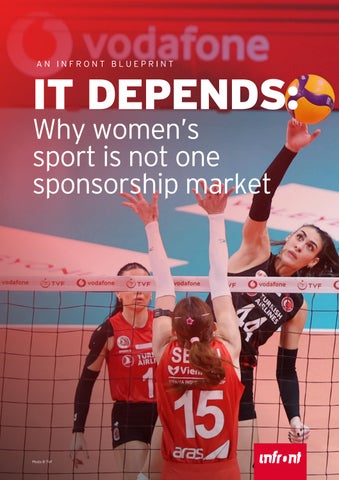
IT DEPENDS: Why women’s sport is not one sponsorship market
Photo @ TVF
AN INFRONT BLUEPRINT
THE MISCONCEPTION Photo @ 2026 Kevin Voigt
There is something unusual about the way the sports industry talks about women’s sport. Nobody seriously discusses “men’s sport sponsorship” as a single commercial category. A brand would not assess football, biathlon, basketball, handball or ski jumping simply because the athletes are men. Each has its own markets, media environment and commercial model. Yet women’s sport is often bundled into one conversation when it comes to assessing its value and place in the future of the industry. There have been countless panel discussions, podcasts, articles and deep dives on how brands should approach a truly broad commercial proposition. There is good reason for the attention. Revenues generated by women’s sport reached $1.88 billion in 2024, almost double the previous year’s total, and were forecast to exceed $2.35 billion in 2025. Sponsorship across women’s leagues has also been growing faster than across men’s leagues, while 91% of sports executives surveyed by PwC expect women’s sport revenues to achieve double-digit growth over the next three to five years. (Source: PwC Global Sports Survey 2026)
The direction of travel is difficult to dispute but treating it as one commercial market can produce sweeping conclusions. Women’s sport is untapped, offers better value, reaches a different audience and needs greater visibility. Brands should invest in women’s sport. All these statements lack nuance. Which is why the answer to almost any question asked about it is: it depends. It depends on the property, its maturity, the market, the sporting product and the audience
That makes the starting question for brands a different one. Instead of asking “Should we invest in women’s sport?”, ask: “Which property, in which market, and what do we want it to achieve?”
CHAPTER 1
A spectrum of properties
Photo @ Piroschka Van De Wouw
AN INFRONT BLUEPRINT
Women’s sport properties have developed in fundamentally different ways. Consider alpine skiing and biathlon. In markets such as Germany, there is little distinction in the commercial conversation between men’s and women’s competition. Brands buy the sporting property and reach rather than gender drives much of the valuation. The picture changes where men’s and women’s properties have developed separately. Team sports frequently have different calendars, venues, organisers, media agreements and levels of professionalisation. That makes them separate commercial products even when the name of the sport is the same.
But that aggregate gap tells a sponsor little about an individual property, where distribution can range from a fundamental constraint to an established broadcast proposition. Geography can also overturn almost any generalisation. Take the example of women’s volleyball. In Turkey, the women’s game has substantial sporting and commercial importance beyond that of the men’s side. A global brand asking whether women’s volleyball represents an “emerging opportunity” is therefore asking the wrong question. Emerging where? For which competition? Among which audience? It depends.
“In Alpine or in Biathlon, the brands are making no difference... because the media reach is the same, the budget is the same, the competition is the same.”
Even the way rights are packaged can evolve. FIBA currently sells flagship men’s and women’s properties together but has considered whether growing demand warrants greater segmentation.
Rapid overall growth also doesn’t mean every part of the market is developing at the same rate. Women account for around 40% of global sports participants, yet women’s sport receives only around — Martin Skrodzki, Director Marketing Sales, Infront 15% of sports media coverage (Source: PwC Global Sports Survey 2026).
Market leaders for women's football (soccer) % of consumers who have watched the following leagues & events live on TV channel/streaming service, a watched highlights/followed news
FIFA Women’s Football World Cup
52%
UEFA Women’s Champions League
9%
17%
24%
22%
17%
42%
28%
52%
UEFA Women's EURO
Sweden Germany
Portugal
Ghana
Sweden
Source: GWI Core Q2 2024 Base: 239,225 consumers aged 16+
Brazil
Portugal
Spain
Türkiye
AN INFRONT BLUEPRINT
Photo @ Piroschka Van De Wouw
GWI’s 2024 research found Sweden leading engagement with UEFA Women’s EURO, Ghana with the FIFA Women’s World Cup and Portugal with the UEFA Women’s Champions League (Source: GWI Core Q2 2024)Nor should “women’s sport” be treated as shorthand for “female audience”. GWI research across 18 markets found that 57% of women’s sports fans were male and 43% female in 2024. (Source: GWI Sports Q2 2024 The commercial question is less about whether a brand wants to reach women, but whether the audience of a particular property matches the consumers it wants to reach.
Gender is only one part of that audience profile. The more useful analysis for sponsors looks at factors such as income, life stage, education and location alongside interests, attitudes and purchasing behaviour. Two properties with a similar gender split can therefore offer very different commercial audiences. This is another reason why broad claims about the “women’s sport fan” are of limited use. A brand needs to understand what distinguishes the audience around the specific property: what else they care about, what they value, how they consume sport and where the property fits within their wider interests.
A bird’s eye view of women’s sports fans % of women’s sports fans who identify as the following Male
Female
GenZ
Millenials
GenX
Baby Boomers
5% 31%
26% 43%
57%
38%
Source: GWI Sports Q2 2024 Base: (1,454) women’s sports fans in 18 markets aged 16+
CHAPTER 2
What turns attention into long-lasting value? Is the attention sustainable?
Photo @ Goran Strand
AN INFRONT BLUEPRINT
Visibility dominates many conversations about women’s sport. More broadcast hours, better scheduling and greater media coverage are often presented as the route to commercial growth. But visibility cannot compensate for a lack of competitive depth. Women’s ice hockey offers a useful example, where there is a seemingly large gap between the United States and Canada and much of the international field. Obviously this is not unique to women’s sport. Predictable men’s competition faces the same commercial problem. A compelling sporting product can also gain attention when it has recognisable stars. Caitlin Clark’s WNBA debut for the Indiana Fever attracted 2.3 million viewers across ESPN platforms, making it the league’s most-watched game in two decades (Source: Apollo Global, The Financing Gap in Sports). Her arrival formed part of a 2024 season in which average WNBA viewership increased 170% year on year (Source: Kearney, From Passion to Profit: Unlocking Value in Sports, 2025).
“If it’s not going to be a good competition, I think in general, people aren’t going to want to tune in.” — Katie Reynolds, Associate Director Media Sales, Infront
“When a star sort of transcends the sport, it really does help push the sport while they are active... but when they leave the sport... there will be a correction.” — Megan McGuire, Director Media Sales, Infront One athlete can rapidly change how audiences, broadcasters and brands reassess a property. But personality-led attention rarely remains at its peak, so the tougher task is to convert that audience interest into sustained engagement with the wider property. Retaining attention requires investment in the underlying product as competitive depth cannot develop in isolation. Funding remains the biggest barrier to women’s sport according to 85% of professionals surveyed for the 2026 Sport Industry Report. The relationship between sporting quality and commercial value is circular. Audiences attract broadcasters and sponsors, which attracts investment. Investment improves coaching, athlete development, event presentation, production and distribution, all of which can improve the sporting and media product. For brands assessing an opportunity, today’s audience is only part of the picture. The conditions that can sustain that audience matter too. Competitive depth, product quality and continued investment provide a better indication of whether attention can become durable commercial value rather than a temporary peak.
CHAPTER 3
Sponsors can be enablers, not just advertisers
Photo @ NEMESHPHOTO
AN INFRONT BLUEPRINT
One advantage many developing women’s properties can genuinely offer is the noticeable impact a sponsor has on the story a sport or event is trying to tell. One advantage many developing women’s properties can genuinely offer is the noticeable impact a sponsor has on the story a sport or event is trying to tell. In a mature, crowded sponsorship market, even a substantial investment can buy relatively little ownership of the story. The leading properties already have long-standing partners, established category hierarchies and premium prices. A developing property can look very different, and women’s sport can be a potentially cost-effective route to clear positioning as the sponsorship environment can be less congested. Fewer competing brands can mean greater visibility and a stronger association between sponsor and property. The development of women’s ski jumping helps illustrate this point. Investment can contribute towards professional structures, athlete conditions and the overall development of a competition. In that environment, the brand can credibly describe itself as an enabler because its contribution has a visible effect on what the sport can deliver. This is where the description of women’s sport as “untapped” needs qualification. Some properties are not untapped at all. Some are already sophisticated, competitive commercial products. Some have strong audiences but limited available inventory.
“You can be an enabler of the sport... you are really pushing the sport, and your impact is much higher than other sports.” — Martin Skrodzki, Director Marketing Sales, Infront
“Putting women’s sport on the map is one thing. Following through is another. If an organisation wants to talk about its commitment, that commitment has to show up in what it invests, activates and delivers.” – Nathalie Taylor, Director of Marketing Implementation at FIBA Marketing Others remain underdeveloped for good reasons, whether that is weak competitive depth, limited media distribution or insufficient local interest. But there are properties where the commercial environment is still being built. For the right brand, that creates an opportunity unavailable in mature sport: the possibility of helping create the value it ultimately wants to capture. That distinction matters because simply attaching a brand to women’s sport does not automatically make it an enabler. As investment in the sector has grown, so too has the number of organisations positioning their involvement as evidence of a wider commitment to women’s sport. Credibility therefore depends on what follows the announcement: activation, resources and a clear understanding of what the property actually needs. Turkish volleyball’s work with Vodafone is a good example, showing what a meaningful activation looks like in a market where women’s volleyball already has genuine sporting relevance, rather than treating the sponsorship as an exercise in supporting an underdeveloped property.
AN INFRONT BLUEPRINT
The opportunity to help develop an event can also extend beyond the sporting product itself. Ahead of the FIBA Women’s Basketball World Cup 2022, Google became FIBA’s first-ever Global Partner of Women’s Basketball, in a partnership brokered by Infront. The partnership connected Google’s investment directly to increasing the visibility of the women’s game. Google and FIBA worked with ESPN to expand distribution of the World Cup in the US, while the brand also supported content and tournament activations. The event ultimately attracted more than 145,000 spectators in Sydney, with broadcast audiences increasing compared with the 2018 edition. For brands, the example shows what an enabling role can look like in practice. Google gained association with a major global property, but its involvement also addressed one of the conditions that could increase the property’s future value: getting more people to see it. Whatever the maturity of the property, effective activation still matters. GWI’s research suggests that women’s sports fans respond particularly strongly to tangible benefits, with more than half saying the chance to win tickets or signed merchandise would make them more likely to buy from a sponsor, compared with 38% of sports fans overall. Similar gaps appear for experiences, discounts and exclusive partner offers (Source: GWI Sports Q2 2024). The strongest partnerships are clear about the role a sponsor can realistically play. In a developing property, that might mean addressing constraints around production, content or competitive depth. In a mature one, the sponsor may simply be buying access to a high-quality sports audience. The same principle applies beyond sponsorship. Sustainable commercial growth also depends on who is making decisions within sport. Greater representation of women across rights holders, federations, agencies, broadcasters and brands can influence which properties receive attention, investment and resources in the first place. It can also broaden the perspectives shaping how those properties are developed, packaged and brought to market. ‘Enabler’ is an opportunity and not a template.
Connecting sponsorships to the fans %of consumers who say the following benefits would make them more likely to buy or use a competition/team partner’s product or service
All sports fans
Women’s sports fans
Chance to win event/teamrelatedprizes (e.g. tickets, signed merchandise)
38%
Exclusive offers and deals ofthepartner’s product/service
36%
51%
48% Chance to win event/teamrelated experience (e.g. meet & greet with players, private event tour, hospitality packages)
35%
Event/team-related giveawaysordiscount codes for shop/merchandise
33%
47%
45%
CASE STUDY
VODAFONE AND TURKISH WOMEN'S VOLLEYBALL Vodafone's partnership with the Turkish Volleyball Federation covers the women's national team and the top domestic competition, the Vodafone Sultans League. Its activation has included digital content, fan engagement and technology rather than simply branding around matches. The results illustrate the scale already available in that market. Vodafone Turkey's Instagram and TikTok content generated 57.6 million video views, its Olympic activation reached 42.2 million people and the Vodafone Sultans League Instagram account generated a reach of 25.1 million. Read the full case study here
AN INFRONT BLUEPRINT
6 1 2 3 4 5 6
points to assess the opportunities in women’s sport “Itdepends” shouldnot mean “anything goes”. Forbrands, thevariables can be narrowed down tosixquestions:
Property What are we actually buying, and how mature is its commercial proposition?
Market How relevant is this sport and property in the markets that matter to us?
Product Is the competition compelling, and does it have the depth to sustain audience interest?
Audience
Who actually follows it? What do we know about their demographics, interests, values and behaviours, how do they consume the sport, and does that audience match who we want to reach?
Moment What is changing? Is an athlete, team, tournament or new competition creating a different commercial opportunity?
Role What can our sponsorship realistically do? Are we buying reach from an established property, or can our investment meaningfully contribute to its development? And are we prepared to activate and support that role beyond the initial rights investment? But most importantly, the ultimate question should be: what are we trying to achieve? Reach, brand positioning, market relevance, audience engagement andassociationwith the development of a property are different objectives. The right opportunitydependsfirst on being clear about which of them matters.
Ask better qustions
Women’s sport is not one market and should not be assessed as one. The opportunity lies in understanding the property: where it is mature, where it is changing, what audience it offers and what role a sponsor can credibly play. For brands, “it depends” is not an inconclusive answer. It is the starting point for a better investment decision.
Stay connected infront.sport Infront Sports & Media @infront @infrontspor ts_