MARKET INSIGHTS | FINANCIAL EDUCATION | ETHICAL INVESTING | PROPERTY | PERSONAL FINANCE
FINALIST IN THE MINDFUL MONEY AWARDS 2025
Best media reporting on ethical and/or impact investment
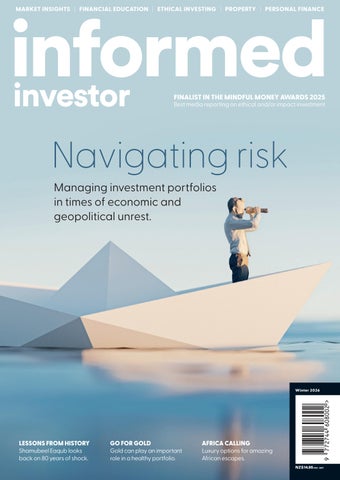
Navigating risk Managing investment portfolios in times of economic and geopolitical unrest.
Winter 2026
LESSONS FROM HISTORY Shamubeel Eaqub looks back on 80 years of shock.
GO FOR GOLD Gold can play an important role in a healthy portfolio.
AFRICA CALLING Luxury options for amazing African escapes. NZ$14.95 INC. GST
Anyone can have a good year. We’ve had a good decade. Our Focused Growth KiwiSaver fund has consistently ranked in the top three of its category for 10-year performance.* Generate’s team of expert KiwiSaver advisers are dedicated to helping you reach your long-term performance goals. And you can get advice where and how you like, whether it’s in person around New Zealand, on the phone or on our website.
Join us at GenerateKiwiSaver.co.nz
NZ Gold Medallists and Generate Ambassadors, Finn Butcher and Dame Lisa Carrington. *Morningstar KiwiSaver Survey March Quarter End 2026. The Generate Focused Growth Fund ranked 2nd out of 10 funds in NZ Multi Sector Aggressive Category, for a period of 10 years to 31/03/2026. © 2026 Morningstar. All Rights Reserved. The information contained herein: (1) is proprietary to Morningstar and/or its affiliates or content providers; (2) may not be copied, adapted or distributed; (3) is not warranted to be accurate, complete or timely. Past performance does not guarantee future returns. Investment involves risk and returns can be negative as well as positive. A copy of the Generate KiwiSaver Scheme Product Disclosure Statement, our Financial Advice Provider Disclosure Statement, and advertising disclosures can be found at www.generatekiwisaver.co.nz/disclosures The issuer is Generate Investment Management Limited.
Contents WI NTE R 2 0 2 6
IN THIS ISSUE UP FRONT
06 Meet some of our contributors 08 What we like
12
Garden design, long-lasting lipstick and a go-anywhere speaker.
FEATURES
12
Risk profile
18
History never repeats
22
Crypto’s identity crisis
Oliver Mander on the top risks facing NZ investors in 2026.
The patterns of history can create rhythms that can teach us lessons, writes Shamubeel Eaqub.
Is crypto risky speculation or an emerging financial infrastructure?
26 Risky business
Peter Bale on investing in times of crisis.
30 Good as gold
Gold can play a useful role in portfolios.
34
Patience is a virtue Patience is easier to practice when you have an investment strategy that fits the job it’s supposed to do, writes Liv Lewis-Long.
36
Artificial Intelligence New Zealand’s AI adoption rate is among the highest in the world. But are we skilled enough to capture it?
INVESTMENT
18 44
38
Risk mitigation
42
Risk assets
44
Anatomy of crisis
Chris Smith from CMC Markets explores the psychology and practice of managing risk in your portfolio.
Matt Hardwick on how geopolitical turmoil reinforces the importance of distinguishing disruptions from genuine structural change.
Every crisis feels different – but often follows a familiar path.
PERSONAL FINANCE
46 Hidden risk
Playing it safe with KiwiSaver may actually be a risk in itself.
48
The keyway in Dawn Toughey is on a mission to demystify finance.
50 Insurance
Why it’s more important than ever to consider your insurance coverage.
52
World snapshot
Contents 56
PROPERTY
54
Cotality
56
It takes a village
58
All about strategy
A sustained house price upturn has probably been delayed, writes Kelvin Davidson.
Scott Cracknell, principal at Context Architects, on creating a functional future in Auckland.
Effective property management is about strategy, writes Stefan Nikolic from Zodiak Management.
60 Funding the future of housing
Williams Corporation Capital provides wholesale investors with four property-backed investment funds, which have a proven track record of success.
70
62 Risk management
PMG’s approach to managing risk and supporting long-term value through volatile times.
64 Nothing like Monopoly
Scott O’Neill, CEO of Rethink Investing, on how residential and commercial differ from the popular game.
66 Property-backed lending
Giving retail investors access to property-backed lending opportunities without the responsibilities of sole ownership.
68 Real estate private credit
Real estate private credit is gaining increasing attention in New Zealand as an alternative income option.
70 Pets rules
A crash course on implementing the new pet rules for rental properties.
INVEST IN YOURSELF
72 74
74 78
I N F O R M E D I NVESTO R 2
76 78
Fashion update Winter 2026 update.
Mercedes-Benz GLA From boxy and awkward to stylish and sleek.
Empower Her Community Why backing yourself is the best investment you can make.
Africa calling Top luxury African destinations.
Exclusive Wholesale Investment Opportunities with Williams Corporation Williams Corporation offers four tailored wholesale investment funds, each with unique criteria, strategies, and securities. Designed exclusively for wholesale investors under the Financial Markets Conduct Act 2013, these opportunities provide access to sophisticated investment options not available to retail investors.
www.williamscorporationfunds.co.nz
EDITOR'S LET TER
Lessons of history Published by: Opes Media
WE ARE LIVING in a risky time – but looking back at earlier crises may provide us with valuable lessons. Informed Investor As Split Enz accurately surmised, history never repeats. Economic shocks, wars, 33 Federal Street,on the era inflation spikes and political upheaval all leave their mark differently depending they take place in. Auckland Central, Auckland. But while the causes may vary, investor behaviour tends to follow familiar patterns. Fear rises, confidence falls, safe havens strengthen, and markets begin searching for www.informedinvestor.co.nz stability. That pattern is once again playing out. The to lastmake 60 years have delivered no shortage of major disruptions: the oil shocks of the de to money, but it work for us it’s 1970s, the 1987 sharemarket crash, the Asian financial crisis, the global financial crisis, relate to it. the Covid-19 pandemic, and now renewed geopolitical instability involving Iran and wider Middle East tensions. Informed Investor is an investment and develop over our life, and explains how has flown For New Zealand investors, these developments can feel distant. But small economies magazine published quarterly by people can develop better relationships with ’m not one rarely operate in isolation. International conflict influences oil prices, shipping costs, Opes Media. You need Informed money. business confidence and currency movements. Those ove a bit inflation, effects eventually flow into written permission us summer mortgage rates, construction costs, consumer spending andInvestor’s property values here at home. We’ve also modified a quiz taken from Lynda’s to reproduce any part of the The current environment is unusually complex. Inflation remains stubborn in many website (moneymentalist.com) so you can magazine. economies, interest rates are still elevated compared to the ultra-low settings of the past discover your own “money personality”. It’s ard look statements and geopolitical risksbut are itbecoming harder to isolate.Advertising Investors are no longerand quick, easy, and a bit of fun, should also e shopping decade, editorial opinions in Informed a single crisis. get youwith thinking. This is a great Christmas bsessions), dealing Investor reflect the views of But times liketo this canwith be educational; opportunity to understand holiday activity share friends andoffering investors the ble in the how they respond to uncertainty. the advertisers and editorial family over a glass (or bottle) of bubbly. er) I make During strong economic periods, markets tend to rewardcontributors, growth and risk-taking. not Informed Investor although Amy Hamilton delves into another During unstableChadwick periods, priorities shift toward resilience and preservation and its staff. of capital. ertainly sort of money personality issue: themarkets. That shift is already visible this across global Informed Investor’s content Historypessimist. may not repeat exactly, it does leave patterns investors ignore at their financial If you’ve beenbut stung comes from sources that Informed own risk.it makes sense that you’d be cautious before, ed for Investor considers accurate, but In this winter issue Investor, around investing. But of as Informed Amy explains, fearwe explore how risk is impacting investors. oundly we don’t guarantee its accuracy. Our lead story by Oliver Mander,paralysis”) CEO of New Zealand Shareholders’ Association, takes a of doing anything (or “analysis s. Charts in in 2026 Informed Investor are granular approach to the risk-related issues facing New Zealanders – from inflation can prevent you from embracing a brighter visually indicative, not exact. The money. and interest rates, to economy, geopolitics and market volatility. financial future. content of Informed Investor is ood It’s not all negative – risk is the flipside of opportunity. Recent events have highlighted intended as general Weimportance also check out the new convertible Mini, to touch the of resilience in investment portfolios, but this should not be newsinformation for only, and you use it at your own the importance of goal andlong howgame. of factors long-term investors. It’s setting, part of the risk: Informed Investor magazine electric cars are changing transport imistic or We also investigate the role of goldeconomy in portfolios. As investors sought tangible, is not health liable to anybody in any way worldwide.stable opportunities during and after the international money work seemingly shock of Covid-19, all.isInformed does not we relate gold values boomed. There has been an easing this year, but at gold definitelyInvestor an overlooked We really hope you find inspiration in the contain financial advice asset – NZ Mint is keen to raise awareness around how it can fit effectively within a as defined pages of our magazine and wish you all the by the Financial Advisers Act diversified portfolio. very best for this festive season. “money 2008.and Consult suitably qualified We hope that you are all remaining well in this colder weather enjoyawhat we have o our financial adviser before making on offer in the pages of Informed Investor’s winter issue. which we Take care and happy holidays. investment decisions. Take care
Time ction
e contents with nto our s change
vestor.co.nz
Joanna Mathers Publisher Joanna Mathers Managing editor Editor
Joanna Mathers – joanna@informedmedia.co.nz Design director Sally Fullam – sally@informedmedia.co.nz Resident economist Account manager Ed McKnight Joanna Mathers – joanna@informedmedia.co.nz Printer Subscriptions Webstar Sally Fullam – subs@informedmedia.co.nz Retail Distributor Are Direct
Informed Investor magazine does not give any representation regarding the quality, accuracy, completeness or merchantability of Subeditors the information in this publication SÍana Clifford or that it is fit for any purpose. Mike Deacon To advertise in Informed Investor, Printer you must accept Informed Investor Webstar magazine’s advertising terms and conditions. Please contact Retail distributor Are DirectStephanie@informedinvestor.co.nz about advertising. Informed Investor is printed on
responsible This magazine is subject to NZ Media Council procedures. A complaintenvironmentally must first be directed in writing, within one month of publication, to the email address, joanna@informedmedia.co.nz. If not satisfied with paper. The paper is produced the response, the complaint may be referred to the Media Council PO Box 10-879, The Terrace, Wellington pulp, using elemental chlorine-free 6143; info@mediacouncil.org.nz. Or use the online complaint form at www.mediacouncil.org.nz. Please sourced from sustainable and include copies of the article and all correspondence with the publication.
ouncil procedures. A complaint must first be directed in writing, mail address, stephanie@informedinvestor.co.nz. I N F O R M E D I NVESTO R 4 mplaint may be referred to the Media Council PO Box 10-879, diacouncil.org.nz. Or use the online complaint form at de copies of the article and all correspondence with the publication.
legally harvested farmed trees. The magazine is recyclable.
PRINT ISSN 2744-6085 DIGITAL ISSN 2744-6093
Informed Investor PO Box 40128, Glenfield, Auckland 0747 informedinvestor.co.nz
Me
Informed Investor is an investment magazine published quarterly by Informed Media. You need Informed Investor’s written permission to reproduce any part of the magazine. Advertising statements and editorial opinions in Informed Investor reflect the views of the editorial contributors and advertisers, not Informed Investor and its staff. Informed Investor’s content comes from sources that Informed Investor considers accurate, but we don’t guarantee its accuracy. Charts in Informed Investor are visually indicative, not exact. The content of Informed Investor is intended as general information only, and you use it at your own risk: Informed Investor magazine is not liable to anybody in any way at all. Informed Investor does not contain financial advice as defined by the Financial Advisers Act 2008. Consult a suitably qualified financial adviser before making investment decisions. Informed Investor magazine does not give any representation regarding the quality, accuracy, completeness or merchantability of the information in this publication or that it is fit for any purpose. To advertise in Informed Investor, you must accept Informed Investor magazine’s advertising terms and conditions. Please contact joanna@informedmedia.co.nz about advertising. Informed Investor is printed on environmentally responsible paper. The paper is produced using elemental chlorine-free pulp, sourced from sustainable and legally harvested farmed trees. The magazine is recyclable. PRINT ISSN 2744-6085 DIGITAL ISSN 2744-6093
y
Want a 6.5 x better Property Management service?
Armed with top-tier tech, proven expertise, and a forward-thinking mindset, we don’t just meet expectations - we exceed them. Ready to elevate your property management experience? Contact us today and let’s make it happen! Graph illustrates Net Promoter Score (NPS. Industry standard Perceptive Research 2024 Property Brokers Net Promotor Score 2024 based on 5397 respondents. Licensed REAA 2008.
Scan me, call 0800 367 5263 or visit pb.co.nz/manage
UP FRONT C ONTRIBUTORS
Meet some of our contributors SHAMUBEEL EAQUB
STEFAN NIKOLIC
Shamubeel is chief economist and head of policy at Simplicity, and a thought leader who is unafraid to take a contrarian view.
Stefan is the founder and managing director of Zodiak Management. His growing team strategically manages over 100 rental properties in Auckland CBD and neighbouring areas.
PETER BALE
OLIVER MANDER
Peter Bale is a journalist and media consultant who has worked for the Wellington Evening Post, Reuters, The Ft Group, the Times of London, and CNN Europe. He co-hosts award-winning podcast Hoons with Bernard Hickey.
Oliver is the CEO of NZ Shareholders’ Association. He is as a strategic thinker, focused on transformative solutions, developing and implementing business strategies so that they come to life for organisations. He believes that a strategy means nothing without delivery.
GREG SMITH
VICTORIA BAHADOOR & CHARLOTTE CLARK
Is an investment specialist at Generate. He’s a CFA Charterholder and has over 20 years of experience in the business/finance media. He is a well-recognised market commentator, appearing on the Mike Hosking show on Newstalk ZB each week, and has also featured regularly on TVNZ, RNZ, the NBR. I N F O R M E D I NVESTO R 6
Charlotte (right), a branding strategist and alignment coach, and Victoria (left), a personal brand photographer and ADHD coach, empower women to build impactful businesses with confidence. Through their global community, they create opportunities for connection, growth, and visibility in a space where women feel truly seen and supported.
ors KELVIN DAVIDSON KELVIN DAVIDSON
LIV LEWIS-LONG
Kelvin joined CoreLogic Kelvin joined Cotality in Marchin 2018 as senior research 2018March as senior research analyst, before moving analyst, before moving into into his current role of chief his current role of chief economist. He brings economist. He brings with with him wealthof ofexperience, experience, having him aa wealth spent 1515 years working largely having spent years working in private sector economic largely in private-sector economic consultancies in New consultancies in both bothZealand New Zealand andUK. the UK. and the
Liv is a passionate finance educator, writer and podcaster, and set up Simplicity’s Money Made Simple podcast to help level up financial literacy in NZ. She also heads up its marketing team, with over 15 years’ experience in brand, communications and storytelling.
RORY DIVER KENNINGHAM ANDREW
SCOTT CRACKNELL
Rory Andrew is investor isrelationships the chief Europe manager at PMG.for HeCapital brings economist considerable financial services Economics.He was previously experience having previously an economic adviser for the worked for KPMG and as United Kingdom Foreign an auditor for BNZ in Exchange. commercial banking.
Scott Cracknell is a Principal at Context Architects and a participant in the University of Auckland’s Open-Source Housing: The Granny Flat project.
MATT HARDWICK SAM STUBBS Matt joined Octagon Asset Sam is the founder Management in 2022 andand is MD of Simplicity, New Zealand’s responsible for the firm’s businessonly low-cost,go-to nonprofit development, marketfunds manager. Previously from the banking world strategy and client services. He having worked for Goldman Sachs has over 20 years’ experience in andrelations, NatWestfundraising Markets in London investor and and Hong Kong,support Sam believes the corporate transaction for finance industry should be multiple companies in London, as much forceEuropean for good as a Singapore andaacross source of profit. emerging markets.
JASON CHOY Jason is the senior portfolio manager at InvestNow.
I N F O R M E D I NVESTO R 7
U P F R O N T W H AT W E L I K E
Pop star Logitech is known for its stylish tech solutions and its Pop Icon Keys are a perfect example. The keyboard looks great and with its quiet typing, custom Action Keys, and pop of colour, it makes productivity fun. The Pop Icon Keys are $119.95 logitech.com.
What we like Garden design, long-lasting lipstick and a go-anywhere speaker.
Return to tailoring
Pocket rocket
Kiwi women are done with the shapeless smock and are moving into an era of structural intent and uniform dressing. They’re investing in sharp tailoring, excellent fabric compositions, and pieces that offer pragmatic romanticism.
The Ultimate Ears Miniroll is a pocket-sized speaker that goes wherever you go – strap it to a golf bag, hang it in the shower, or loop it onto your bike. It’s wonderful to take the music with you – have it in your bag for those occasional sunny winter walks that turn into fish and chips on the beach.
twenty-seven names is known for their immaculate tailoring and they are an obvious anchor to this. Because they’re proudly made in Aotearoa, they have the ethos that Kiwi women are looking for. For the upcoming season, they are ditching the slouch and embracing the 2026 palette with structured coats, textured fabrics, and tailored cuts to ground everything in timeless navies, deep reds, and cloud dancer adjacent ivories. Visit twentysevennames.co.nz to explore the collection. I N F O R M E D I NVESTO R 8
It retails for $129.95, ultimateears.com.
WEALTH, ENGINEERED SOPHISTICATED INVESTORS REQUIRE... STRATEGY. PRECISION. EXPERT GUIDANCE. Rethink Investing helps investors grow and protect their wealth through bespoke commercial property strategies, delivering sustainable, long-term returns.
Ready to Rethink your portfolio?
CONTACT US
U P F R O N T W H AT W E L I K E
Good morning Early mornings call for a little glow. The under-eye wake up call 24k Gold Hydrogel Eye Masks from Boost Lab deliver instant cooling relief, helping to de-puff, smooth and revive tired eyes in minutes. With caffeine, collagen and adenosine, they leave skin looking fresh, firm and well rested. A luxe yet practical pick. $44.95, boostlab.co.nz
All-day comfort If you are looking for a hardworking lipstick that looks great whatever the time of day, here’s our pick. MAC MACximal Silky Matte Lipstick lasts all day, no touch-ups required. MAC’s iconic Velvet Teddy delivers a rich beige tone, a silky matte finish and all-day comfort and it’s a winner. Retailing for $46 at maccosmetics.com, mecca.com and farmers.co.nz
Outdoor excellence With 15 years of building experience, Jacob Simpson has built a reputation for creating high-quality outdoor spaces that combine practical craftsmanship with strong design appeal. Specialising in decks, retaining walls, fencing, landscaping, garden beds, outdoor steps, cladding repairs and general building work, he is particularly passionate about designing and building outdoor living areas. What sets Jacob apart is his eye for design and meticulous attention to detail, ensuring every project is both functional and visually striking. As a design-and-build specialist, he works closely with clients to deliver outdoor spaces that enhance both lifestyle and property value. Jacob Simpson Builders, phone 027 215 6228, jakeandrewsimpson@gmail.com I N F O R M E D I NVESTO R 1 0
Your Auckland Rental Property Needs Strategy
Luxury Short-Term Rental Management
Effortless Hosting. Exceptional Guest Experience
Adaptive Medium-Term and Corporate Accommodation Rental Management that Maximises Demand
Long-Term Rental and Tenancy Management
Long-Term Tenants. Consistent Income
One Partner. Every Strategy. Maximum Potential Get your free rental appraisal. Contact us at 0800 333 325 • sales@zodiak.co.nz • zodiak.co.nz
F E AT U R E S N A V I G AT I N G R I S K
Navigating risk OLIVER MANDER, CEO of New Zealand Shareholders’ Association, explores the risks of 2026 – and how Kiwi investors should navigate them.
I N F O R M E D I NVESTO R 1 2
IT HAS BEEN a tough post-Covid reality check for the New Zealand economy, an underlying theme that is reflected in the performance of many of our consumerfacing listed companies. Many local companies remembered the difficulty they had in attracting staff in earlier periods of economic benevolence, following cutbacks made during economic gloom. So most have held back from taking drastic action, looking to “survive to 25”. It was only late in the year that things began to turn for the better, with a new mantra of “fix in 26”. Sure enough, underlying economic performance and business sentiment began to turn in late 2025. More recently the United States and Israeli attacks on Iran, and the resulting energy-price shock, have now interrupted that nascent recovery. The irony is that many New Zealand investors have performed well over the last five years, despite our local economic performance. That’s been fuelled by increasing investment in international shares and/or funds, with investors receiving the benefit of a boom in AI-related investments and the relatively stronger economic performance of other countries compared to New Zealand.
Currency impacts
That latter point has provided an additional tailwind for New Zealand
Dollar (NZ$) investors. A country’s currency can act as a barometer of global expectations, reflecting relative growth prospects, interest-rate settings, commodity exposures and broader risk appetite. In the same way that a share price reflects future expectations of value, the NZ$ reflects the future value of NZ Inc, relative to other countries. As our economy has performed less well than many others, so our currency has declined in value against other major benchmarks. As the chart below shows, that trend was already evident before the emergence of the underlying interest rate gap between New Zealand and relevant countries (more on that later). Our economic recovery may have suffered a setback thanks to the Iranian war; but unlike other New Zealandspecific factors, the impact of the subsequent energy price shock will be felt by all economies. The value of the NZ$ is not within the control of any single investor. So while Kiwi investors have received a sort of positive “double-whammy” effect from a falling currency, they should be mindful of the potential for that currency effect to unwind over the next two-to-three years should our currency increase in value. Note that this is not an argument against global diversification. But it is an argument for investors to better understand the options available to
reduce currency risk, such as hedging, fund selection and analysing the underlying geographic dispersion of corporate revenues.
Investor resilience
There is much to impact New Zealand investors beyond currency. The next two-to-three years are unlikely to be defined by a single market event. They are more likely to be shaped by the interaction of several forces. As well as currency normalisation that has the potential to unwind previous gains, investors’ returns will also be influenced by global inflation that refuses to disappear quietly, interest rates that may stay higher than investors had hoped, a domestic economy still searching for momentum, reduced consumer demand in international economies, and a global environment in which geopolitical risk is again at the fore of investor sentiment and asset pricing. That is not a signal for investors to retreat. It does mean they need to be more conscious of the assumptions sitting underneath their portfolios. Investors are now more likely to be facing a world in which the cost of capital remains elevated while household and business demand remains subdued – a sharp change from core assumptions only six months ago.
I N F O R M E D I NVESTO R 1 3
F E AT U R E S N A V I G AT I N G R I S K
Inflation and interest rates
Inflation remains a core risk for investors, particularly when coupled with its impacts on global demand. While governments the world over focus on energy security following the attacks on Iran by the United States and Israel, there is little they are able to do when it comes to oil pricing. De-carbonisation means that a rising oil price should hold less fear than it did back in the 1970s, but the impact of oil prices is still felt keenly throughout the global economy. New Zealand has already seen the “first-order” effects, with price increases obvious to anyone filling up at their local service station. More tellingly, however, the Reserve Bank of Australia cited “second-round effects on prices for goods and services more broadly” as a factor in its May 5 decision to increase the Australian Cash Rate Target – equivalent to New Zealand’s Official Cash Rate (OCR) – to 4.35 per cent. That means oil price increases are now finding their way into the broader economic supply chain, with an impact on everything from the price of groceries to clothing. The increase is meant to dampen consumer spend, to offset inflationary behaviour. Trouble is, for most households and businesses, it is extremely hard to avoid an increase in oil price. For households, that means cutting back discretionary spend elsewhere, reducing demand in the underlying economy. For businesses, that might mean raising prices or reducing staff; again, leading to reduced economic demand. If inflation remains strong despite underlying increases, thanks to elevated oil prices, the combination of stubborn inflation and reduced demand results in stagflation – a nightmare scenario for businesses and their investors. In New Zealand, the most recent decision by the Reserve Bank of New Zealand (RBNZ) in early April held the OCR at 2.25 per cent. While it warned of inflationary impacts, it also noted that it did not want to over-react to oil price inflation and hamper New Zealand’s economic recovery. Nonetheless, most are forecasting an increase in New Zealand rates by July. With New Zealand inflation forecast to rise to 4.2 per cent in June, we should be under no illusions. Increasing interest rates are also likely to have an impact on investors. Higher interest rates mean that your money has to work harder to generate a commensurate, risk-adjusted return. In a general sense, that is why share prices fall as interest rates increase, to ensure
I N F O R M E D I NVESTO R 1 4
that the expected yield falls into line with the re-aligned return expectations of investors. The chart opposite shows both the stimulatory intention of the interest rates of New Zealand, Australia and the United States heading into the Covid-19 period, as well as the sharp increases until 2024 as the world grappled with increasing inflation. It’s notable that Australia did not increase rates as hard or as fast as New Zealand or the United States. For New Zealand, this arguably helped to create the conditions for the sluggish economy that reached its nadir during 2024. Since then, the RBNZ has lowered rates (with a positive impact on economic growth), to the point where the cost of money in New Zealand is now markedly lower than those of both our nearest neighbour and the world’s largest economy. One has to go back to 1999 to find the last time the New Zealand OCR was below that of both these countries for an extended period. Lower domestic interest rates may provide support for New Zealand asset prices relative to Australia and the United States, while income investors could look to Australia as a strong source of fixed income or yield-based returns. But low interest rates do not guarantee higher returns. Investors still need to weigh the benefit of lower discount rates against weak domestic demand, earnings pressure and currency risk.
Economy and geopolitics
In terms of New Zealand, Stats NZ reported 0.2 per cent GDP growth in the December 2025 quarter, following 0.9 per cent growth in September, and Westpac’s May commentary supports a 0.8 per cent March-quarter forecast. Westpac also reflects low and, in some quarters, negative growth for the remainder of the year as a result of the oil price shock. That tells investors something important: the recovery was present, but fragile, with a likelihood of further deterioration created by geopolitical impacts. A weak domestic economy does not affect all listed companies equally. Exporters, infrastructure operators, banks, retailers, construction-exposed businesses and consumer services companies each experience the cycle differently. But investors should be careful about assuming that a broad New Zealand-based earnings recovery will simply follow from lower inflation. Earnings require demand, operating leverage and confidence, not just lower headline interest-rate expectations.
F E AT U R E S N A V I G AT I N G R I S K
Oil price impacts have the potential for significant second-order effects in New Zealand, as they do in other countries. The conflict has the potential to disrupt global supplies of fertiliser, an essential ingredient that feeds New Zealand’s economic well-being. Globally, investors have also seen the impacts of key investment themes associated with AI, defence, space exploration and critical minerals. These extend beyond media headlines; all are products of geopolitical influences. For investors, the need to build investment resilience through interpreting the politics has never been higher.
Volatility
With this context, it is perhaps surprising that investors’ perceptions of risk and volatility have not increased. This is exemplified by the CBOE Volatility Index (VIX), a widely followed “fear gauge” that reflects expected near-term volatility in the S&P 500. While the “spike” associated with the attacks by the United States and Israel on Iran is evident in late March, investors appear to have absorbed the shock more calmly than might have been expected. Even the high point of VIX associated with this event (31.05 achieved on March 27) is not significantly in excess of “baseline” risk in the immediate postCovid period of 2021-22, with the investor risk perceptions well below their fears at the time of Trump’s tariff announcements in March 2025. As a broad observation, that tells us that investors are adopting a cautious view to the underlying risks they face, despite the geopolitics that surround them. At the same time, the level of the index does not indicate complacency, as seen in the immediate period ahead of Covid-19.
I N F O R M E D I NVESTO R 1 6
The upside
Macro events should always form the backdrop for investor decision-making. Within the shifting sands of economic and geo-political information, there will be oportunity for investors to create their own investment story. From a New Zealand perspective, we should not take our own investment foundations for granted. Our legislation, legal framework, government institutions (such as the Financial Markets Authority) and various market stakeholders (including auditors, supervisors and capital market participants) are all aimed at supporting confidence in New Zealand’s investment markets. We should not take these institutions for granted. Nor should we take our ability to invest overseas for granted; as investors, we benefit from the free flow of international capital, the ability to accept risks and to organise our own affairs to mitigate them.
With risk comes opportunity
As investors, we are seeking to maximise our returns given a risk environment. From an investment perspective, that remains the foundation of our society. While recent events have highlighted the importance of resilience in investment portfolios, this should not be news for long-term investors. For long-term investors, resilience is not a defensive posture. It is the discipline of understanding what risks are being taken, where returns are likely to come from, and which assumptions may no longer hold. The next few years may reward investors who remain diversified, currency-aware and alert to the interaction between inflation, interest rates and geopolitics. That does not mean retreating from markets. It means investing with eyes open. T
Exploring alternatives to term deposits?
See how property-backed lending works. Sign up instantly. Invest from as little as $1,000 per loan. Learn more www.golend.co.nz Go Lend is a peer-to-peer lending service licensed by the FMA under the Financial Market Conduct Act 2013.
History never repeats Shamubeel Eaqub looks back over decades of global conflict and shock, and discovers that while history doesn’t repeat, it sometimes rhymes.
I N F O R M E D I NVESTO R 1 8
F E AT U R E S H I S T O R Y L E S S O N
While history doesn’t literally repeat, the lessons learned through times of conflict and strife can be useful when navigating present shocks.
ARE WE IN unprecedented times? Not really. History doesn’t tend to repeat, but it rhymes. It’s “precedented” if we look at the past with curiosity and humility and consider our investment strategies in that light. The lessons of history are less black and white, and more nuanced and confusing than one might assume. The world is currently dealing with trade wars, regular wars, naval blockades, and an oil shock. Despite all of this, share markets have powered to record highs. But gold prices are high too, as are bond yields. Share markets are signalling good times; gold and bonds are signalling difficult times. I believe the world is at a hinge moment, a regime shift where the current rules of thumb are fraying. If these rules are changing, the further past is a better guide than the recent past. So, I went looking.
Tracking history
When I look back over the last 80 years of global conflicts and shocks, today’s confusing market signals aren’t so unusual. What happens in the real economy – jobs, inflation and activity – and what happens in financial markets, have not always moved consistently. Most global shocks had a measurable impact on either New Zealand financial markets or the real economy. Some didn’t. About one in five major global shocks bypassed New Zealand entirely. What jumped out is how different the outcomes were. Some had big impacts on bonds, others on shares. Some delivered roaring inflation, some cratering activity, others soaring unemployment. Often a combination. I N F O R M E D I NVESTO R 1 9
F E AT U R E S H I S T O R Y L E S S O N
Don’t despair – economic shocks are nothing new. It’s important to remember that the market is not a mirror of the economy. Keep your eyes on long-term goals and don’t make rash decisions about your portfolio, even when the news seems bleak.
The Great Depression, World War II, the 1971-74 rupture, the 1987-90 banking crisis and reforms, the GFC, Covid and the Russia-Ukraine war all hit both markets and the wider economy here. Those were the big shocks. The Suez crisis in 1956, the Asian Financial Crisis (AFC) in 1997, and 9/11 hit share markets, but the real economy was mostly insulated. During the AFC, shares fell sharply, but the economy only saw a short, sharp slowdown, bouncing back within a year. The second oil shock in 1979 and the US-China trade war from 2018 onwards hit our economy through inflation and unemployment. Financial markets, on the other hand, were largely fine. The Iraq war, the Eurozone crisis, and Brexit had little impact on New Zealand at all. The Korean War is a good example of how counterintuitive this can get. The wool boom that came with this war lifted New Zealand commodity prices so violently that inflation hit 12 per cent, and our share market got hit harder than the I N F O R M E D I NVESTO R 2 0
US, in volatility terms, on the way up and the way back down. When a shock did affect the economy, recovery periods were uneven. The typical recovery time for the economy was one-to-two years before New Zealand was opened up in the 1980s. Since then, recoveries from recessions have taken longer. Share markets tend to feel impacts later. Earnings are lagged, and recoveries from long shocks can take 7-10 years – something we haven’t had to witness in the last decade. The pattern across the century is intriguing. The economy is sturdier than the share market. It feels the pain first, and recovers. Share markets take their hit second, but they can stay knocked down for longer. History may not repeat, but it may rhyme.
A confusing legacy
Confused? Me too. I had expected to find clearer patterns of economic and investment consequences from global events. There is no tidy formula for global shocks and their investor impacts. Nevertheless, two takeaways stand out. First, New Zealand isn’t always in the firing line. Some global shocks bypass us. But avoiding them usually requires local policy responses to insulate us. Domestic policy can amplify or attenuate global
shocks. Copious monetary and fiscal stimulus insulated New Zealand during the pandemic. Conversely, if the RBNZ raises interest rates in an oil shock, it can amplify the economic and investment pain. Time will tell, as we enter a new one. The two cases where New Zealand share markets never fully recovered before the next shock arrived were the 1929-33 Great Depression and the 1987-90 banking crisis. Both events saw domestic policy disasters layered on top of a global shock. The damage was largely homemade. Second, not all shocks affect markets and the real economy in the same way. Markets are not a mirror of the economy; they are a selection of businesses that may reflect different investment signals. Right now, big tech companies are roaring away, apparently unfazed by war and an oil shock.
Implications for investors
So, what does it mean for you and me? A few insights stand out based on history. First, think carefully about inflation exposure. Of the global shocks that did affect New Zealand, more than half saw inflation peak above 5 per cent. Several pushed into double digits, including World War I, the Korean War, the 1970s twin oil shocks, and the 1987-90 banking crisis.
The current backdrop, with trade wars, oil disruption and fragmenting supply chains, looks more like those decades than the deflation-prone 2010s. Holding too much in conservative assets during high inflation can punish you twice – once on the principal, once on buying power. Shares can be a hedge. But of course, one needs to proceed with caution in any case. Second, set a realistic investment horizon. Global shock impacts are measured in years, not days or weeks. The short end might be one-to-two years. The long end is seven-to-nine years. No one can predict what kind of impact, if any, New Zealand will feel from current events. This means having realistic liquidity for the things you want to do within shorter time frames. Third, watch for policy mistakes. Governments and central banks around the world are dealing with contrasting demands: inflation, national security, political fracturing – all amid an uncertain outlook. Policy choices will diverge across countries, and some will inevitably get it wrong. As our own history shows, global events matter, but local policy mistakes matter even more.
‘The investor qualities that seem critical in these times are simple to name and hard to live by. Discipline, so you don’t sell at the trough. Balance-sheet resilience, so you aren’t a forced seller’ Fourth, watch for the channel mismatch. The biggest investor mistakes tend to come when the headline story doesn’t match the actual transmission. The Eurozone crisis terrified share markets here even though New Zealand’s real economy was barely touched. The same happened with Iraq and Brexit. Pricing geopolitics correctly means betting against the noise as often as betting on it. The investor qualities that seem critical in these times are simple to name and hard to live by. Discipline, so you don’t sell at the trough. Balance-sheet resilience, so
you aren’t a forced seller. That requires understanding your goals, your risk appetite, your investment horizon and your liquidity needs. These are hefty and fundamental decisions, but in this changing world, the lesson of history is to revisit the fundamentals. T The information provided and personal opinions expressed in this article are intended for general guidance only and not personalised to you. These materials do not take into account your particular financial situation or goals and are not financial advice or a recommendation.
BLUE PACIFIC’S
INVESTMENT READINESS TOOLKIT Work with our neighbours in the Blue Pacific Continent. Invest in vital, worthwhile, cornerstone enterprises across all industry sectors.
For Investors — Find key insights and resources significant to the Pacific region and access to exciting investment opportunities.
For businesses based in the Pacific Islands — Fast track your journey to becoming Investment Ready and connect with Investors.
Access the toolkit at https://shorturl.at/e75dX Contact Investment Administrator Linda Kaua linda.kaua@pacifictradeinvest.com +64 9 529 5165 +64 21 342 169
An agency of Pacific Islands Forum Secretariat (PIFS) and funded by New Zealand’s Ministry of Foreign Affairs and Trade (MFAT). Supporting the 16 Forum Island countries and territories with investment facilitation.
www.pacifictradeinvest.com
Crypto’s identity crisis Is crypto risky speculation or emerging financial infrastructure? Paul Quickenden, wyftx NZ country manager, unpacks the issue.
I N F O R M E D I NVESTO R 2 2
F E AT U R E S C R Y P T O
CRYPTO STILL HAS an identity problem. Despite billions flowing into Bitcoin ETFs, the largest fund managers and banks in the world building blockchain-settlement infrastructure and increasing use cases in payments and tokenisation, the sector is still commonly framed as little more than speculative risk. Thankfully, the evidence to the contrary is starkly different and this framing is now outdated.
Bitcoin is not ‘crypto’
One of the biggest mistakes people make is treating all digital assets as one homogeneous category. Bitcoin (a decentralised store of value and monetary network) is not the same as Ether (which is variously called a decentralised super computer, world computer or digital oil), or other projects like Ripple (payments) or Solana (DeFi). Stablecoins (tokens pegged to fiat currencies like the US dollar) are not the same as tokenised assets (real-world assets such as shares, property or bonds represented digitally on blockchain infrastructure). Then, like all markets, there are the more speculative options such as memecoins (the “penny stocks” of crypto driven by internet culture and hype) and NFTs. Different projects carry different levels of risk, utility and long-term potential. Like any asset class, investors need to do their research and know what they are getting into. The distinctions matter because while parts of the crypto ecosystem remain speculative, other parts are not so quietly becoming the new financial infrastructure and traditional finance is openly embracing blockchain technology. Large institutions are actively deploying tokenisation, blockchainsettlement systems and digital-asset custody. Stablecoins are increasingly being used for cross-border payments because they can move value faster and more efficiently than some traditional rails. Banks are talking tokenised deposits and the largest fund managers in the world
are digitising government bonds, property and equities. The conversation is shifting from “does this technology matter?” to “how will it integrate?”
The market still prices crypto like it’s 2021
Public perception, however, still tends to anchor crypto to its past. For many people, crypto remains associated with volatility and speculative trading behaviour. That volatility still exists and investors absolutely need to understand the risks involved – but volatility alone does not determine whether something has long-term value. Technology markets often go through speculative cycles before the infrastructure layer becomes obvious. The internet experienced that exact dynamic during the dot-com era and many companies disappeared, but the underlying infrastructure transformed the world anyway. Take a look at today’s AI market and make your own conclusions. Crypto is going through a similar
transition. It’s now going by its grown-up name – digital assets – and its technology is being actively embedded in payments, central banks and fund managers. You have AI markets doing millions of transactions a month. This isn’t a fringe cult, it’s here.
Correlated … until it isn’t
Another interesting part of the discussion is how Bitcoin behaves within a broader investment portfolio. Bitcoin has experienced periods where it moves closely with traditional risk assets and other periods where it behaves quite differently. That combination of correlation and non-correlation is part of why some investors see value in it as a diversification tool. Advisers will often say that when designing a robust investment portfolio, one of the main goals is diversification through assets with low or negative correlation. In simple terms, when one asset class performs well, another may be flat or declining, helping balance overall portfolio risk.
F E AT U R E S C R Y P T O
Because of its ability to decorrelate, Bitcoin can sometimes make a diversified portfolio less volatile overall – maximising returns while managing risk. In simple terms, many traditional assets like stocks and bonds have historically shown relatively low correlation with Bitcoin. This means that even a small allocation can potentially improve diversification outcomes and risk-adjusted returns over time.
Understanding the Sharpe ratio
This is where concepts like the Sharpe ratio (albeit relatively technical) become useful. The Sharpe ratio evaluates the return of an investment relative to the amount of risk taken to achieve that return. Put simply: do the returns justify the volatility? Historically, Bitcoin has often maintained a surprisingly strong Sharpe ratio despite its reputation for volatility. Fidelity previously noted Bitcoin holding a strongly positive Sharpe ratio of 0.96, reinforcing the idea that the asset’s longterm returns have often compensated investors for the risk involved. I N F O R M E D I NVESTO R 2 4
(Rolling 52-week Sharpe ratio data also continues to support this trend and remains publicly available.) That obviously does not eliminate risk. Relative to many other asset classes, crypto remains volatile and investors should absolutely do their own research. It does, however, challenge the simplistic idea that volatility automatically equals poor investment quality.
Infrastructure hiding inside speculation
Right now, crypto sits in an awkward middle phase. Retail speculation still dominates headlines; the next hyped-up trends still generate irrational behaviour; regulatory uncertainty still creates hesitation. At the same time, institutional adoption continues building quietly underneath the surface. This all creates a strange contradiction where parts of the sector still look chaotic, while other parts are increasingly becoming financial infrastructure. As we said at the very beginning, crypto is not homogenous. For investors, businesses and policymakers, the real
challenge is separating noise from signal. If tokenisation, blockchain-settlement and digital-asset infrastructure continue integrating into traditional finance, then crypto may stop looking like a standalone speculative category and start looking more like another layer of the global financial system. Dare we say – it might just be starting to look like a proven asset. That does not mean crypto suddenly stops being risky and it certainly does not mean every project succeeds. Volatility, speculation and poor projects are part of every landscape and will be in the crypto space for some time yet; but the broader conversation around risk may need to mature alongside the sector itself. The real question is no longer whether crypto carries risk because every emerging technology category does. The question is whether the market is still assessing digital assets primarily through the lens of past speculation rather than recognising the infrastructure, institutional adoption and financial integration now steadily developing underneath it all. T
informedinvestor.co.nz/subscribe
Stay Info Under $3 Subscribe here
Informed Inv investment a English your
It covers the KiwiSaver, pe and all the g invest wisely.
Stay informed
4. Summer 2023 - Money Personalities.indb 51
Informed Investor is New Zealand’s only dedicated investment magazine. Every quarter we dive deeply into the world of investing, economics, ethical investment, small business, world events and property – with a dash of fashion, luxury goods and cars thrown in for good measure.
1 year (4 issues) $49 (SAVE 18% off RRP) 2 years (8 issues) $79 (SAVE 34% off RRP)
F E AT U R E S G E O P O L I T I C S
I N F O R M E D I NVESTO R 2 6
Risky business Peter Bale on investing in a time of geopolitical crises.
RISK IS VERY much in the eye of the beholder for ordinary investors: some fear the impact of crises beyond their control; others want to capitalise on opportunities created by risk. Anyone who has filled out broker risk questionnaires knows that they are quite personal – surely, we all want to be adventurous – but they also give us pause when we think about time frames. Are we really that old and can we put our capital at risk? Geopolitical risk – an unexpected war against Iran that triggers an oil crisis, a spike in global inflation, a novel virus that generates a worldwide pandemic – are by nature impossible to plan for, but the risk of the unexpected is why advisers urge us to hold diversified portfolios. However, shocks also offer opportunity. No ordinary investor should believe they can time or beat the market, but you may profit from your own analysis of the impact of a given crisis. Shares in Chinese electric car manufacturer BYD rose as much as 23 per cent in the run up to the US-Israel attacks on Iran. Battery maker CATL was up 27 per cent in a similar period. US arms maker RTX, formerly Raytheon, rose 13 per cent at the start of the war. The key seems to be doing your best to defend your portfolio against unpredictable risks, being honest about your appetite for risk and your time frames, and keeping on top of events enough to consider opportunities that may allow you to profit from crises.
Defining risk
“How we define risk is; you have systematic risk, which is the stuff you can’t diversify away from, and then non-systematic, firm, specific risk which you can diversify away from,” says Harry
James, an investment adviser at Pāua Wealth Management. A genuinely diversified portfolio – with exposure to shareholdings, commodities, fixed income, and funds – may yet offer the best protection from unexpected events. Global crises such as the Iran war fall in the systematic category – an event of impact that is almost impossible to anticipate or hedge other than holding a classically diversified portfolio. It is also worth remembering that cash itself – often in low-interest term deposits prone to falling behind inflation and subject to what crypto bros call debasement – can be a risk. “If you’re sitting in cash for a long time trying to wait for these geopolitical events to subside or continue, and you’re fearful of partaking in the markets because it’s all a bit overwhelming because you’re bombarded with headlines . . . just think about your objectives and an appropriate allocation based on your capacity to take risks,” said James. “It’s your adviser’s responsibility to try and marry up that sort of willingness versus that capacity.” Pāua, says James, services wholesale clients – those with experience of investing and often a significant sum – and invests with fund managers whose products best suit client needs based on individual objectives as well as preferences such as ethical investing. While you may put the bulk of your investments – especially those intended to provide future retirement income or other long-term objectives – into what James calls an “engine room”, some investors may wish to have a less critical pot of money set aside to invest against their instincts or reading of the markets or global trends or events. I N F O R M E D I NVESTO R 2 7
F E AT U R E S G E O P O L I T I C S
‘In volatile times the formula might be; get informed, talk to your adviser, be honest about your risk profile, protect your engine room, experiment where you can afford to’ “If you have a strong interest in markets and follow them, and can afford to follow markets, and you have some insight into research, which, by the way, will likely be available to all other market participants, then yes, by all means [invest directly]. It’s a good way to stay informed and try and take bets on convictions that you have.” (As a sidenote and for full disclosure, your writer made a couple of tactical share investments last year when President Trump announced the United States government would take a stake in Intel and talked of bringing chip-making back to the United States. Intel has nearly tripled in that time. Yet a bet on digital design firm Figma has been a disaster, down 75 per cent. Both investments were individual and direct, not my retirement “engine room”. I looked up my last risk questionnaire in November last year, from Craigs which manages some of my investments, and I was “moderately aggressive”. It might be time for a review.) Mark Lister, investment director at Craigs Investment Partners, says investors are in a turbulent period where geopolitical risk is a part of decisionmaking: “I think it is an unavoidable I N F O R M E D I NVESTO R 2 8
dynamic that will continue and will probably grow. You have to consider it . . . you have to try and do your best to manage all of those risks as best you can.” He too says it is the role of your investment adviser to balance risk against objectives. “You can’t time it and you can’t completely take that risk away and I guess that’s the same for any risk. As investment advisers, the best we can do is reduce risk and try at least protect people from risk, but you can’t completely mitigate that risk or avoid it.”
Interconnected world
In an increasingly interconnected world, an investment portfolio needs exposure to a wide set of assets from fixed income, shares, funds, property, and commodities – perhaps including direct or indirect investment in minerals – and, for some investors, crypto assets. “Everything’s so interconnected these days – bond yields, wholesale interest rates. You’ve seen mortgage rates going up because of what’s happening overseas and what’s happening with the oil price. I think people are much more exposed to all these changing dynamics than they probably realise,”
says Lister. That means investors need to maintain a dialogue with whoever is managing their money – and stay on top of developments. It may also be important to remember that whether you are 35 or 60, you may still be trying to build wealth and therefore to stay invested and to keep investing incrementally. “There’s a lesson in there for the for the less experienced investor whose immediate reaction is to freak out, hunker down, and pull back,” said Lister. “The lesson for them is to remind themselves there’s always opportunities to do well. If you’re if you’re 30 or 40 or 50 or even 60, you are still in that wealth-building phase of your investment journey. You know you’re not in the wind down ‘I’m spending my pile of money and hoping that it lasts’.” It seems in volatile times the formula might be; get informed, talk to your adviser, be honest about your risk profile, protect your engine room, experiment where you can afford to. Here are a couple of resources to stay on top of geopolitical risk: - Gzero World podcast by Eurasia Group - Ones & Tooze podcast by economist Adam Tooze T
Creating your future wealth is our focus
At Octagon Asset Management, we’re driven by one purpose — helping to create enduring wealth. Established in 2021, Octagon is a boutique fund manager, with experienced teams based in Wellington, Auckland, and Queenstown. Our commitment is personal — our people invest alongside you, sharing in the journey and the results. With Octagon, your investments are guided by seasoned experts. Each of our funds is built around a distinct strategy and objective, offering the structure, oversight, and flexibility of managed funds. Whether you invest in a single fund or build a diversified portfolio, you benefit from thoughtful design, disciplined management, and a partner who’s truly invested in your success.
Forsyth Barr Investment Management Limited is the issuer, and Octagon Asset Management Limited the investment manager, of the Octagon Investment Funds. A copy of the Product Disclosure Statement for the Funds is available from www.octagonasset.co.nz/disclosure-information/, by contacting your Financial Adviser, or by calling 0800 628 246.
0800 628 246
|
octagonasset.co.nz
F E AT U R E S G O L D
Good as gold Joanna Mathers chats with Vedran Babic, CEO of New Zealand Mint, about the important role gold can play in an investment portfolio.
I N F O R M E D I NVESTO R 3 0
MIKETEA | ISTOCK
FOR CENTURIES, GOLD has served as a store of value during periods of economic uncertainty and market stress. And while it’s often viewed as niche – or the preserve of the ultra-wealthy – in modern portfolios, it can play an important diversification role. Anyone with even a cursory interest in investment will have read the headlines – 2025 saw a gold-rush of historic levels. Prices increased by around 50 per cent between 2024 and early 2026; topping out at over US$5,000 (NZ$8,397) an ounce in late January this year. While there has been a slight dip – at the time of writing the gold spot price sat at US$4,706 (NZ$7,905) – when viewed over a five-year period, the precious metal has increased in value by approximately 160 per cent. Vedran Babic is chief executive officer at New Zealand Mint, the only privately owned mint in Aotearoa. He says that the exponential value growth of this precious metal is based on a number of factors. “Inflation, geopolitical uncertainty, and the overprinting of fiat currencies has shone a new spotlight on bullion,” he says. “Gold has been one of the strongestperforming assets of recent years, and demand is rising from both central banks and private investors.”
‘Gold has been one of the strongestperforming assets of recent years, and demand is rising from both central banks and private investors’
Going for gold
Kiwis have not, traditionally, been drawn to gold as an investment. In countries such as United States, Germany and India, cultural traditions and religious practices around gold translated into strong investment habits, Babic shares. “While in New Zealand, the gold-rush of the 19th century brought the asset into sharp focus, with the wealth generated creating towns and infrastructure. But once this had passed, property became our national obsession,” he continues. The limited awareness around gold-asinvestment was reflected in the results of a survey that New Zealand Mint ran in 2023.
“While gold is seen as a premium, safehaven asset, it still plays a limited role in New Zealand’s financial services sector,” says Babic. “Financial advisers rarely recommend it, platforms don’t make it easy to integrate into portfolios, and investors often see it as niche or inaccessible. Bullion here retains a ‘secret society’ feel – respected, but not yet mainstream.” Babic believes that this reticence is due, simply, to lack of education. “Education is the missing link. By demystifying bullion, making it easier to access, and showing its role in financial security, we can help build a new Kiwi tradition – one where gold is a vital part of […] our future.”
F E AT U R E S G O L D
Reflective phase
While the past 18 months have been typified by sharp rallies, heightened volatility and relentless headlines, the gold market appears to have entered a steadier phase. Prices have stabilised and investors are contemplating what lies ahead. The head-rush of 2025 has passed – gold prices have entered a consolidation period. This can allow for an in-depth consideration of what is shaping the market and how gold can be incorporated into long-term portfolios. Global interest rates, particularly in the United States, are playing a major role in the performance of gold. It does not generate income or yield, unlike bonds or cash investments, and it does not pay interest. So when bond yields rise, gold can become less attractive in relative terms because investors are rewarded more generously for holding incomeproducing assets. Earlier in the year, expectations of lower interest rates supported gold prices, helping fuel strong upward momentum. However, as US Treasury yields began moving higher again, gold’s rally lost some momentum. Rising yields place downward pressure on gold, while falling yields tend to support it. This does not necessarily undermine the long-term investment case for gold. But it reflects the fact that shortterm price action is often driven by macroeconomic conditions.
Geopolitical risks
While interest rates may underpin shortterm market movements, geopolitical tensions offer ongoing support for gold. Precious metals are one asset that has benefited from global instability. Middle East conflicts, trade tensions, political uncertainty and energy security concerns have reinforced gold’s role as a safe-haven asset. I N F O R M E D I NVESTO R 3 2
At the time of writing, markets have been experiencing some de-escalation, with sideways movement in gold prices. But the risks have not disappeared. The Middle East remains a key source of uncertainty, given its importance to global energy supply chains. The Strait of Hormuz, through which a significant portion of the world’s oil supply passes, is a flash point. Supply chain disruption could have major implications on global inflation and financial markets. Any rise in oil prices is likely to reignite inflation concerns and potentially increase demand for safehaven assets, such as gold. During times of major geopolitical disruption, markets can experience an initial liquidity and cash rush. But once things settle, gold is likely to resume its traditional role as a store of value. Accordingly, many institutional and long-term investors continue to maintain exposure to precious metals. Earlier this year, gold experienced speculative inflows as traders and short-term investors entered the market. While this accelerated price gains, it also increased volatility. When the conditions became more uncertain and prices fluctuated more sharply, many speculators began to exit, resulting in a reset in market sentiment. Babic says the market appears more balanced: speculative trading activity has moderated; volatility has eased from recent highs; and price movements have become less extreme. Gold is now responding more directly to fundamental economic and geopolitical developments. Frustrating for those traders seeking quick gains, but it can be positive for investors focused on longer-term wealth preservation and portfolio resilience.
What comes next?
As mentioned, the gold market appears
to be in a holding pattern, with investors waiting for clearer signals around interest rates, inflation and global risk. Several potential scenarios could shape the next phase of the market. If higher interest rates persist for longer than expected, gold may continue to trade within a relatively narrow range as bond yields compete for investor attention. But any significant geopolitical escalation or energy supply disruption could push precious metals higher as investors seek defensive assets. And if global economic conditions stabilise further, it could reduce safe-haven demand and cause some easing in precious metals prices. The most likely outcome appears to be continued volatility within a broad range rather than a clear directional breakout.
Why gold still matters
Despite the current pause, the core investment case for gold remains intact. Periods of consolidation are a normal and necessary. Sharp rallies are rarely not indefinitely sustainable. For long-term investors, the current environment reinforces several enduring themes: · gold can provide diversification during uncertain periods · precious metals may help protect purchasing power over time · market volatility often strengthens the case for holding defensive assets. Short-term price fluctuations will continue, as they always do. But the broader role of gold within an investment portfolio remains consistent. In a world still shaped by inflation concerns, geopolitical instability and shifting monetary policy, gold continues to hold a unique position – not simply as a commodity, but as an asset that provides resilience when markets are uncertain. T
Making commercial property investment accessible
Oyster helps New Zealanders grow wealth through commercial property investment. Our specialist team targets long-term asset performance through a disciplined investment strategy that delivers both regular income today and capital growth tomorrow. Quality assets. Strong tenants. Active management.
1.8B
20+
21+
33+
364+
ASSETS UNDER
YEARS HELPING
MANAGED
PROPERTIES
TENANTS ACROSS
MANAGEMENT
NEW ZEALANDERS
FUNDS
MANAGED
OUR PORTFOLIO
“Investing with Oyster Group has been seamless and rewarding. Their expertise in high-quality commercial properties delivers strong capital growth and solid monthly returns. With expert management, I can ‘bottom drawer’ my investment, set it and forget it - while reaping the benefits.” — Rashid, Investor
If you’d like to participate in our next opportunity, contact Jordan Jennings
+64 9 281 4460 OYSTERGROUP.CO.NZ
F E AT U R E S M A R K E T V O L AT I L I T Y
Patience is a virtue Patience is easier to practice when you have an investment strategy that fits the job it’s supposed to do, writes Liv Lewis-Long.
IT’S NO SURPRISE many investors feel uneasy right now. We’re seeing trade tensions, war in the Middle East, oil shocks, sticky inflation concerns and a steady stream of unsettling headlines. When markets swing and the economic outlook looks murky, it’s natural for people to feel nervous. This often comes with a strong urge to act – to switch, to move to cash, or to wait on the sidelines just “until things feel calmer”. That reaction is human. But it also brings up an important concept: investor patience isn’t just about temperament; it’s often about preparation. I know it’s all too easy to say investors should stay calm during periods of volatility. This becomes really hard in practice, if the money might be needed soon, if risk levels were never well understood in the first place, or if short-term market movements are being mistaken for long-term failure. In reality, patience – and by patience, I don’t mean doing nothing, but more sticking to your plan – is often less about personality and more about whether an investment approach “fits” the job it’s meant to do. That brings us to what “fit” means in this context.
Long-term fit vs short-term cycles
By fit, I mean does it match your longterm plan? So why focus on long-term planning, rather than current market issues? Because uncertainty is anything but unusual in markets. Every cycle seems to come with its own reasons to feel that this time is especially precarious – war, inflation, recession, interest rates, banking stress, political upheaval, or something else entirely. The details change, but the experience is familiar. Markets are rarely predictable, and periods of volatility are part of long-term investing. That can be uncomfortable, especially when balances fall, or headlines become more dramatic by the day. But discomfort and danger are not always the same thing. I N F O R M E D I NVESTO R 3 4
A market decline may feel alarming in the moment, yet for a long-term investor, could well sit within the normal range of what you’d expect to see for that type of asset or fund. This is where fit matters. One of the biggest factors is the investment time horizon. Money that may be needed soon will generally have a different role or fit from money being invested for a goal many years away. When short-term money is exposed to too much market volatility via higher-risk investments, patience becomes challenging because you may not have the time to see a recovery after a crash. By contrast, even while uncomfortable to see, a longer timeframe can make it easier to absorb short-term market swings. In this case, there’s more time for ups and downs to play out. This doesn’t remove risk, it just changes the context.
Are you truly comfortable with risk?
Risk is another part of the equation that often gets more acceptance in theory than in practice. Many people are comfortable with the idea of higher-return assets – but only when markets are rising. It’s during a downturn that risk starts to hurt. Seeing returns drop isn’t just a technical feature of investing; it can be an emotional rollercoaster. If someone is in an investment mix that leaves them feeling unable to cope when markets fall, it’s often a sign the settings were not right for them to begin with. Diversification matters here too. It can’t prevent losses during every downturn and doesn’t make portfolios immune to global shocks. But spreading investments across many companies, sectors, markets and asset types can help reduce the damage that comes from any single area running into trouble. The truth is, no one knows in advance which part of the market will be hit next, or which part will recover fastest.
Another often-overlooked part of patience is having some liquidity. It’s easier to leave long-term investments alone during a rough patch when there’s separate money available for short-term needs and unexpected costs. Without that buffer, investors can end up in the uncomfortable position of needing to sell growth assets at the wrong moment, not because their long-term goals changed, but because life happens. In that sense, cash savings and emergency buffers are not separate from investment discipline. They’re a part of what makes it possible.
Patience does not equal passivity
This is why patience is probably better thought about as preparation, rather than just being passive. It’s not necessarily about ignoring the news, claiming markets always bounce back quickly, or simply doing nothing when it comes to your investments no matter what. It’s about recognising that volatility will happen (including downswings), that uncertainty is common, and that an investment
approach should be built with that in mind. This won’t remove stress altogether but can make it less likely that short-term fear leads to long-term regret. There is also some humility involved. Market shocks are easy to describe after the fact, and very hard to navigate in real time. Investors trying to jump in and out of markets don’t just have to make one decision about when to leave; they also must decide when to get back in. Getting both right consistently is difficult, and periods of peak fear aren’t often the clearest moments for good decision-making.
GALEANU MIHAI | ISTOCK
Act based on your plan, not the markets
None of this means people should never review their settings, goals or importantly, tolerance for risk. Sometimes circumstances genuinely change. But reacting to a scary market environment isn’t the same thing as making a thoughtful long-term decision. This distinction is worth
‘A market decline may feel alarming in the moment, yet for a long-term investor, could well sit within the normal range of what you’d expect to see for that type of asset or fund’ keeping in mind during times like these. The world may remain unsettled for a while. I think we’re likely to see more volatility ahead. This means more opportunities to feel nervous, before things calm again. But that’s not a reason to question your investments. Often, the more useful question is not whether markets feel uncomfortable right now, but whether the investment approach, timeframe and liquidity settings were designed with uncomfortable periods
in mind. And if in doubt, speak to an (independent) expert. Because patience is much easier when your plan fits. T The information provided and personal opinions expressed in this article are intended for general guidance only and not personalised to you. These materials do not take into account your particular financial situation or goals and are not financial advice or a recommendation. I N F O R M E D I NVESTO R 3 5
F E AT U R E S A R T I F I C I A L I N T E L L I G E N C E
‘Research shows that effective AI use can close 75 per cent of the performance gap between your highest and lowest performers’
The AI investment that works twice as hard New Zealand’s AI adoption rate is among the highest in the world. That’s tens of billions in economic opportunity. But are we skilled enough to capture it?
“OUR COMPETITIVE EDGE in an AI-driven world depends on how quickly organisations build the right skills to use these technologies responsibly and confidently,” says Frances Valintine, founder of academyEX. The adoption is there but our capability is still catching up. Only 36 per cent of New Zealand workers feel skilled to use AI. That gap is where the opportunity lives, and where the smart money is going. Many New Zealand businesses are still at the tool-buying stage. The pay-off only arrives when organisations invest in the thing that makes the technology I N F O R M E D I NVESTO R 3 6
work: their people. Research shows that effective AI use can close 75 per cent of the performance gap between your highest and lowest performers. But only if everyone’s in the room. AI for Business from academyEX is built around that insight. Designed specifically for Kiwi organisations, the platform delivers four structured courses, a resource hub updated weekly with the latest tools and thinking, and local business case studies that reflect how New Zealand teams work. A hands-on playground gets teams working with leading AI tools through everyday use
cases – building confidence in the context of their own roles, not hypothetical ones. The platform is already powering AI Bootcamp for Business, a national initiative developed in partnership with ASB and Xero to help thousands of small New Zealand businesses build AI confidence and capability. And for academyEX, accessible means something broader than your headcount. Every licence unlocks the same training for a New Zealand charity for free through the “buy one, give one” model. It’s a model built on a straightforward conviction – that the organisations doing the most important work in our communities deserve the same access to AI capability as everyone else. As businesses race to build AI skills, the gap between the corporate and charity sectors is widening. New Zealand has thousands of community organisations delivering essential work with no clear pathway to the capability that’s fast becoming a baseline expectation everywhere else. Charities are already stretched. AI, used well, helps them do more with less: better communications, smarter operations, more time for the work that matters most. Early partners including Ronald McDonald House and Canteen have already validated the platform in not-for-profit environments, helping academyEX ensure the content works for organisations where every resource counts. “Businesses are investing in AI capability for their teams, but many charities and community organisations simply don’t have the same resources. AI for Good allows businesses to build their own capability while helping extend those skills to organisations doing important work in the community,” says Valintine. T Find out more: academyex.com/ai-for-business
I N V E S T M E N T R I S K M I T I G AT I O N
The risk factor
SVETAZI | ISTOCK
Chris Smith from CMC Markets explores the psychology and practice of managing risk in your portfolio.
I N F O R M E D I NVESTO R 3 8
‘While markets are driven by data, performance, and global events, outcomes for individual investors are just as heavily influenced by behaviour, discipline, and emotional intelligence’ RISK IS OFTEN framed in technical terms – volatility, asset classes, macroeconomic forces. But at its core, risk management in investment begins with the investor themselves. How well you know yourself, and your risk appetite, will determine your investment behaviour. Some people are born risk averse, some people are drawn to risk – there is no right or wrong. While markets are driven by data, performance, and global events, outcomes for individual investors are just as heavily influenced by behaviour, discipline, and emotional intelligence. Understanding risk is not just about markets – it’s also about understanding yourself.
The human factor
Investors are not exempt from human emotions – fear, greed, impatience. And these emotions often dictate decisions about investment. This behavioural dimension of risk may be underestimated. The ease of modern trading is a game-changer in many ways,
enabling trading at the tap of a screen. But for some investors who are prone to knee-jerk reactions, this can enable impulsive behaviour. If there is a unifying principle in effective risk management, it is preparation. Markets are inherently unpredictable, but investor responses do not have to be. Here’s an analogy: some daring types may choose to do backflips on motorbikes, but not consider it risky because they have done so much training. The same logic applies to investing. What appears risky to one investor may be entirely manageable to another – if they have the right knowledge and experience. If you jump into high-risk shares without understanding the market, you are far more likely to fail. Preparation, in this sense, needs to go beyond basic financial literacy. It involves actively engaging with investments: reading annual reports, tracking performance, and staying alert to changing conditions. I N F O R M E D I NVESTO R 3 9
I N V E S T M E N T R I S K M I T I G AT I O N
‘This approach reflects a broader principle: the purpose of an investment should dictate its risk profile. Growth-focused portfolios can tolerate higher volatility, while income or capitalpreservation strategies demand stability’ Aligning risk with objectives
Growth-focused portfolios can tolerate higher volatility, while income or capital-preservation strategies demand stability. You need to understand your aim for investment. Do you want retirement security, or are you financially able to withstand high risk for quick gains? If you understand your aim, you will be able to ride out times of uncertainty more effectively. Without this clarity, investors risk adopting mismatched strategies – chasing high returns with low tolerance for losses, or settling for conservative assets that fail to meet long-term goals.
Strategies for managing risk
While psychology plays a role in assessing risk appetite, investment strategies are essential for managing risk. Diversification is one of the most widely accepted tools. By spreading investments across asset classes, sectors, and geographies, investors reduce the impact of any single underperforming asset. However, diversification is not without debate. Some of the richest people in the world have put all their money into stock picking and limited businesses. Again, it’s all about your end goal and risk appetite. Diversification mitigates risk – but concentration can amplify returns for those with the expertise to pursue it. Asset allocation is equally important. Adjusting the balance between equities, bonds, and cash allows investors to tailor risk exposure to their tolerance and objectives. Regular portfolio review ensures that allocations remain aligned over time. Market movements can shift weightings, inadvertently increasing risk if left unchecked. Another approach, which is favoured by some financial advisers, is dollar-cost averaging. By investing fixed amounts at regular intervals, investors smooth out market volatility and reduce the risk of poor timing. Hedging, through instruments like options or futures, can provide protection against downside risk, though it typically requires more sophisticated knowledge. And liquidity management is often overlooked but critical. It’s important to understand liquidity risk. Property syndicates, for example, are hard to get out of, and there needs to be a regular risk premium payment to make up for this.
SVETAZI | ISTOCK
Risk tolerance is not static – it evolves over time and should align with an investor’s goals. Take KiwiSaver, for example. It makes sense to invest in higher-risk funds when you are younger, as you have a longer time horizon to absorb fluctuations due to market volatility and maximise long-term growth potential. But as you approach retirement age you may want to become more conservative to reduce exposure to sudden market declines. This approach reflects a broader principle: the purpose of an investment should dictate its risk profile.
I N F O R M E D I NVESTO R 4 0
Finally, maintaining an emergency fund ensures that investors are not forced to liquidate long-term investments during downturns.
Lessons from experience
Experience remains one of the most effective teachers of risk. About 20 years ago, I invested in hot IPOs that pumped and dumped. I didn’t invest too much money, so the losses weren’t significant, but it provided me with some great lessons. There can be value in learning through controlled exposure – taking risks, but within limits that allow for recovery. Today’s investors face an additional challenge: the influence of social media. Trending sectors – whether cannabis, artificial intelligence, or electric vehicles – can generate intense interest and inflate valuations. Listen to the chatter, but temper your expectations and don’t be tempted to heavily invest based on hype.
Activity in volatility
While volatile geopolitical environments can give investors cause to pause, some thrive on such risk. CMC Markets clients (who use contract for difference (CFD) to speculate on asset price movements) often increase their activity during volatility, viewing it as an opportunity. These traders are experienced and engaged – therefore able to effectively read the data and make informed decisions. Risk is subjective. What matters is not whether volatility exists, but whether the investor is equipped to navigate it. It requires a combination of selfawareness, education, strategic planning, and ongoing discipline. Investors who master these elements are better positioned to withstand market fluctuations and achieve their long-term objectives. T *Disclaimer: The information in this article is of a general nature and not intended to be personalised financial advice.
Risk Types Market risk
The risk that the whole market drops, pulling down most investments.
Inflation risk
The risk that rising costs reduce the real value of your returns.
Interest rate risk
The risk that investments (especially bonds) lose value when interest rates go up.
Credit risk
The risk that a borrower can’t repay their debt or interest.
Liquidity risk
The risk that you can’t sell an investment quickly without lowering its price.
Concentration risk
The risk of having too much invested in one area, making you more exposed to losses.
Behavioural risk
The risk of making poor decisions based on emotions, like panic selling or overtrading.
I N F O R M E D I NVESTO R 4 1
I N V E S T M E N T O C TA G O N A S S E T M A N A G E M E N T
Risk assets in times of war Matt Hardwick on how geopolitical turmoil reinforces the importance of distinguishing disruptions from genuine structural change – and behaving accordingly.
PERIODS OF GEOPOLITICAL turmoil test investors in many ways. They challenge portfolio valuations and emotional resilience, but they also require investors to look through the short-term noise and evaluate the investment possibilities of long-term structural change. When conflict escalates in strategically important regions, such as the war in Iran, financial markets tend to react immediately. Oil prices rise, currencies adjust, equity markets reprice risk and volatility spikes. History shows that markets aggressively price uncertainty at the outset of geopolitical events, however, I N F O R M E D I NVESTO R 4 2
most shocks do not cause lasting damage to the global economy. Geopolitical events can create near-term volatility, but they rarely undermine long-term corporate profitability. This reinforces the importance for investors of distinguishing between temporary disruptions and genuine structural change.
War, asset prices and your portfolio
The most immediate economic risk during this, and previous Middle Eastern conflicts, is an energy price shock. The region remains critical to global oil and
gas supply and even the perception of disruption to shipping routes or production capacity can push energy prices higher. Any oil supply-chain disruption feeds quickly into transport, manufacturing, agriculture and consumer goods creating cost-push inflation. Businesses facing higher input costs raise prices to defend margins. Eventually consumers will face higher prices. The probability of higher inflation from the Iran war has certainly complicated monetary policy. Central banks that were preparing to cut interest rates may now pause. In Reserve Bank New Zealand (RBNZ)’s case, they may now see the need to tighten policy earlier than anticipated. Mortgage rates have already moved in advance of any change in RBNZ monetary policy. Bond markets can also struggle if inflation expectations, rise and equity markets are sensitive to rising interest rates, creating the uncomfortable scenario where both equities and fixed income assets experience pressure on returns simultaneously. Finally, currency markets shift. The US dollar (USD) remains the world’s primary reserve and funding currency and during
global stress events capital tends to flow into US Treasuries and dollar liquidity. As a result, the USD often strengthens. In contrast, smaller currencies such as the New Zealand dollar (NZD) tend to decline as global growth expectations are weakened. For New Zealand-based investors holding unhedged offshore assets, this currency movement can act as a natural stabiliser. If global equity markets fall but the NZD weakens, the drop in NZD can partially offset portfolio declines. Global investment diversification therefore provides an often underappreciated layer of defence during global shocks. It does not eliminate volatility, but it can soften the portfolio impact. Despite these risks, geopolitical volatility does not completely eliminate opportunity. Periods of indiscriminate selling can create attractive entry points in high-quality assets. Companies with strong balance sheets, durable earnings, and pricing power may see their share prices fall simply because investors are reducing overall risk exposure. For long-term investors with adequate liquidity, these moments can provide buying opportunities.
DOUGLAS RISSING | ISTOCK
Safe-haven assets
At times of geopolitical strife, safe-haven assets attract renewed attention. A safe-haven asset is generally defined as an asset that preserves capital and provides diversification when other risk assets fall sharply. Gold has historically fulfilled this role; it carries no counterparty risk and it is not the liability of any government or corporation. It has often performed well during periods of currency debasement, falling real interest rates or systemic financial stress. However, recent speculation in precious metals took the gold spot price to record levels in late 2025 and early 2026. In a case of ‘selling your winners’ many investors and central banks have been selling gold; hence we have seen the unusual case of falling gold prices during political upheaval. As for Bitcoin, the new ‘digital gold’, it has not fared any better. The USD functions as a safe-haven asset and is usually strongest when the source of instability is external to the United States. It benefits from deep liquidity, institutional trust (albeit some investors are questioning this long-held view), and the sheer size and liquidity of the US Treasury market. During global liquidity crises, the demand for US dollars typically increases. This can add defensive characteristics to globally diversified portfolios, particularly for investors outside the United States.
‘Geopolitical events can create near-term volatility, but they rarely undermine long-term corporate profitability. This reinforces the importance for investors of distinguishing between temporary disruptions and genuine structural change’
History doesn’t repeat, but it does rhyme
During the Gulf War in the early 1990s, markets fell sharply in anticipation of military action but began recovering once uncertainty diminished. After the 9/11 attacks, equities dropped heavily, yet regained ground over subsequent months. During the global financial crisis and again in the early stages of the Covid-19 pandemic, markets experienced severe declines. In each case, investors who exited near the lows crystallised temporary paper losses into permanent capital losses. Those who remained invested participated in powerful recoveries that often began while headlines were still negative. Market recoveries are frequently faster and more forceful than declines. They begin when uncertainty starts to reduce, not when geopolitical conditions are fully normalised. This makes emotional discipline critical. The greatest risk for many investors during geopolitical turmoil is not asset allocation, it is behaviour. Selling immediately after a sharp decline locks in losses and removes the opportunity to participate in any recovery.
Long-term strategy over short-term volatility
Ultimately, geopolitical turmoil increases uncertainty, and markets reprice uncertainty very quickly. Energy shocks, inflation risks, currency movements, and valuation compression all contribute to volatility for investors. Yet long-term equity returns are driven by cash flows, productivity, innovation, and economic growth. Most conflicts, while human tragedies and economically disruptive in the short term, do not permanently impair corporate earnings power. Despite efforts to move away from fossil fuels, the global economy is still
highly dependent on oil and investors need to evaluate if this latest geopolitical shock will permanently impact oil’s primacy as the key energy commodity that drives the global economy. New Zealand’s response to the oil shocks of the 1970s were the ‘Think Big’ projects. While not all those projects can be considered a success, those policy decisions have delivered long-term, renewable hydro power for current and future generations and reduced (but not eliminated) our reliance on hydrocarbons. Time will tell if the current crisis, and how it has exposed the fragile nature of the energy supply chain in one of the world’s most hotly contested sea lanes, will change global energy policy towards alternatives like solar, wind, geothermal and, in some instances, nuclear power. Investors do not have to predict every geopolitical development. Rather aim to construct portfolios robust enough to withstand them and take advantage of any new technology and policy shifts that result. Diversification across asset classes and currencies coupled with appropriate liquidity to meet near-term obligations and disciplined adherence to a long-term strategy remain the most reliable defences. Periods of turmoil do not reward those who attempt to outguess headlines; they reward preparation, patience, and perspective. T Matt Hardwick is business development manager for Octagon Asset Management. This article has been prepared in good faith based on information obtained from sources believed to be reliable and accurate. This article does not contain financial advice. Octagon Asset Management is the investment manager for Octagon Investment Funds and the Summer KiwiSaver scheme.
I N F O R M E D I NVESTO R 4 3
I NVESTM E NT I NVESTN OW
The anatomy of a crisis Every crisis feels different – but often follows a familiar path, as Jason Choy, InvestNow Senior Portfolio Manager, explains.
EVERY MARKET CRISIS feels unique in the moment. The headlines are alarming, the causes seem unprecedented, and uncertainty can make even experienced investors wonder whether “this time is different”. Yet history tells us something important: while every crisis has a different trigger, the pattern often rhymes. By looking at events like the global financial crisis, COVID-19, and today’s Middle East tensions and fuel market volatility, we can identify a familiar sequence of stages that many crises follow. Understanding them can help investors separate genuinely important signals from short-term noise. I N F O R M E D I NVESTO R 4 4
Stage one: The trigger
Every crisis begins with a catalyst that suddenly changes how markets perceive risk. In 2008, it was the collapse of Lehman Brothers. In 2020, it was the rapid global spread of COVID-19. In 2022, Russia’s invasion of Ukraine triggered a global energy shock. Today, escalating tensions in the Middle East and concerns around oil supply disruptions through the Strait of Hormuz have created similar fears around energy prices and inflation. This stage is defined by surprise. Markets dislike uncertainty more than bad news itself, and the initial reaction is often sharp and sudden.
Stage two: Repricing
Markets move before the economy does. This is often the first stage investors experience themselves – sharp sharemarket falls, surging volatility, and a “flight to safety” into assets like cash, gold or government bonds. Between February and March 2020, the S&P 500 fell by roughly a third before many economies had even fully shut down. More recently, global markets sold off rapidly amid fears of prolonged fuel price shocks linked to Middle East instability. At this point, markets are reacting more to expectations and fear than actual economic damage.
Covid-19, central banks and governments moved aggressively to support economies and financial markets. In today’s environment, policymakers have focused on stabilising energy markets and containing inflation pressures, while diplomatic efforts to negotiate a permanent end to the war remain ongoing. This stage is important because it signals whether authorities view the crisis as temporary or systemic.
Stage five: Stabilisation
One of the most misunderstood parts of any crisis is that markets often recover before the economy does. During the Global Financial Crisis, markets bottomed months before unemployment peaked. During COVID-19, markets rebounded while lockdowns were still in place globally. We’ve seen similar behaviour recently, with markets recovering despite ongoing geopolitical uncertainty. Markets are forward-looking. They don’t wait for conditions to become perfect, only for the outlook to become less bad than feared.
The danger of reacting
ALONES CREATIVE | ISTOCK
Stage three: The economic transmission
The crisis begins flowing into the real economy. Higher fuel prices start feeding into transport costs, groceries and inflation. Businesses delay hiring. Consumers pull back spending. Confidence weakens. This is where the crisis stops being just a “market story” and becomes something people feel in their day-to-day lives.
Stage four: Policy response
Governments and central banks step in to stabilise conditions. Historically, this has included interest rate cuts, emergency stimulus or coordinated interventions. During
Navigating a crisis always feels easier in hindsight. In real time, sharp falls can trigger the urge to “do something”. But moving to cash during volatility carries a hidden cost: investors must correctly time both when to exit and when to re-enter markets. Very few get both decisions right. Research from the Wells Fargo Investment Institute found that over the last 30 years, missing just the 30 best days in the S&P 500 would have reduced annual returns from 8.4 per cent to 2.1 per cent. Importantly, the best market days often happen during periods of extreme volatility. In March 2020 alone, several of the market’s strongest and weakest days occurred within the same two-week period. That’s what makes market timing so difficult. Investors trying to avoid the worst days often miss the recovery too.
Staying focused
Understanding the anatomy of a crisis is only half the battle; the other half is applying that knowledge to your own portfolio. This is why one of our core principles at InvestNow is: Stay informed, but don’t react to the noise. Major changes to your personal goals or investment strategy matter. Headlines designed to trigger fear usually don’t.
For KiwiSaver investors with decadeslong time horizons, periods of volatility are typically temporary episodes within a much longer journey. Switching to lowerrisk investments during downturns can lock in losses and reduce exposure to the eventual recovery. History has repeatedly shown that markets endure wars, recessions, pandemics and geopolitical shocks, yet continue moving forward over the long term. While there are never guarantees in the short term, long-term investors have consistently been rewarded not for avoiding volatility, but for enduring it. Volatility is often the price investors pay for long-term returns. Staying diversified, disciplined and focused on your long-term plan remains one of the most powerful decisions an investor can make. T InvestNow www.investnow.co.nz contact@investnow.co.nz Disclaimer: This information is provided by InvestNow Saving and Investment Service Limited (“InvestNow”). The information and any opinions in this publication are based on sources that InvestNow believes are reliable and accurate. InvestNow, its directors, officers and employees make no representations or warranties of any kind as to the accuracy or completeness of the information contained in this publication and disclaim liability for any loss, damage, cost or expense that may arise from any reliance on the information or any opinions, conclusions or recommendations contained in it, whether that loss or damage is caused by any fault or negligence on the part of InvestNow, or otherwise, except for any statutory liability which cannot be excluded. All opinions and market commentary reflect InvestNow’s judgment on the date of this publication and are subject to change without notice. This disclaimer extends to any entity that may distribute this publication. The information in this publication is not intended to be financial advice for the purposes of the Financial Markets Conduct Act 2013, as amended by the Financial Services Legislation Amendment Act 2019. In particular, in preparing this document, InvestNow did not take into account the investment objectives, financial situation and particular needs of any particular person. Professional investment advice from an appropriately qualified adviser is recommended before making any investment decision. All investments involve risk. Examples of specific fund performance are for illustrative purposes only and are not intended as a recommendation. Past performance is not a reliable indicator of future results.
I N F O R M E D I NVESTO R 4 5
PERSONAL FINANCE OPINION
The hidden risk Why playing it safe with KiwiSaver may actually be a risk in itself, writes Greg Smith, investment specialist at Generate.
KIWISAVER WAS BUILT on a straightforward premise: contribute consistently, gradually reduce risk over time, and reach retirement in a relatively secure position. It’s a framework designed to limit the impact of major market downturns later in life, where sharp losses can be hardest to recover from. But that definition of risk – focused largely on short-term volatility – doesn’t tell the whole story. When you place New Zealand’s approach alongside what’s happening in the United States, a more nuanced picture emerges. Many KiwiSaver investors may be managing one type of risk effectively, while taking on another that is less visible but potentially may result in lower long-term returns over time: the risk of being too conservative for too long.
Target date funds
In the US, retirement investing is largely dominated by “target-date” funds offered by major providers such as Vanguard, BlackRock, Schwab and J.P. Morgan. These funds automatically adjust their asset mix over time, shifting between
I N F O R M E D I NVESTO R 4 6
growth assets like shares and more defensive investments such as bonds and cash, based on an investor’s expected retirement date. What stands out is how long these funds remain tilted toward growth. It’s not unusual for US target-date funds to maintain around 90 per cent exposure to shares throughout an investor’s 20s, 30s and even into their 40s. Even at retirement, many still hold between 30 per cent and 50 per cent in growth assets. While higher exposure to growth assets can improve long-term return potential, it also increases the risk of short-term losses. Growth-oriented funds can experience significant declines in value during market downturns, and periods of underperformance. These types of investments may not be suitable for all investors, particularly those with shorter time frames or lower tolerance for volatility. By comparison, KiwiSaver settings tend to become more conservative much earlier. Balanced funds – often seen as a middle ground or used as default options – typically sit closer to 50-60 per
cent in growth assets. That means some investors in their 30s or 40s may already have significantly less exposure to higher-return investments than their US counterparts. At a glance, that difference might not seem significant. Over time, however, it can have a substantial impact.
Impact over time
Long-term investing is driven by compounding, and even small differences in annual returns can produce dramatically different outcomes. A gap of half a percent or 1 per cent doesn’t feel meaningful in a single year, but over decades it becomes decisive. Take a simple hypothetical example. For illustration only, an investment of $100,000 earning 6 per cent annually – broadly in line with a diversified portfolio that gradually reduces risk – could grow to about $574,000 over 30 years, and around $1.84 million over 50 years. Increase that return to 6.5 per cent, which could reflect maintaining a higher allocation to growth assets, and the figures rise to approximately $661,000 over 30 years and $2.33 million over 50 years. That’s a difference of roughly half a million dollars over a 50-year period. Importantly, that gap isn’t the result of stock picking or market timing. It largely comes down to one decision: how long an investor remains meaningfully exposed to growth assets. While many KiwiSaver options lean toward caution, there are local exceptions that take a different approach. One example is Generate’s Stepping Stones Growth fund, which maintains a higher
allocation to growth assets – often between 75 per cent and 90 per cent, for a longer portion of an investor’s lifetime. Rather than reducing risk aggressively at predetermined stages, the allocation is adjusted more gradually, allowing investors to remain in higher-return assets well into later years. Some providers offer either highgrowth funds or lifecycle-style strategies, but fewer combine both. In that sense, this approach more closely resembles US target-date funds, and in some cases can be even more growth-oriented. When modelled over long time frames, the implications become clearer. A portfolio returning closer to 6.5 per cent – reflecting higher and more sustained exposure to growth assets – could deliver noticeably stronger outcomes than one tracking nearer to 6 per cent. Over 30 to 50 years, that difference compounds into something material. This suggests that New Zealand investors are not inherently limited by KiwiSaver itself. Comparable structures exist locally that can produce similar-or potentially better-long-term outcomes. The difference lies in how funds are designed and how risk is managed over time.
Why conservatism?
So why does conservatism remain so prevalent? Part of the explanation is behavioural. Investment providers are acutely aware that many investors struggle during periods of market volatility. Sharp downturns can trigger panic decisions, such as switching funds or withdrawing at the wrong time. By reducing volatility
earlier, providers aim to keep investors comfortable and reduce the likelihood of those costly reactions. There’s also a reputational and regulatory dimension. Large short-term losses, even if temporary, can lead to complaints and erode trust. Smoother return patterns are often easier to defend, even if they come at the expense of long-term growth. In that context, conservatism isn’t necessarily an oversight – it’s often a deliberate design choice. None of this is to suggest that a higher-growth approach is always better. Greater exposure to shares brings increased volatility. Investors in growthoriented funds should expect larger fluctuations in value, particularly during downturns. A strategy that delivers stronger results over decades can still involve uncomfortable periods along the way. US target-date funds attempt to balance this by gradually reducing risk as retirement nears. Many KiwiSaver funds go further, prioritising stability earlier in the journey. The more relevant question is whether that shift toward caution is happening too soon.
Power of compound interest
For someone in their 20s or 30s, with decades before retirement, short-term market movements are generally less important than long-term compounding. Moving away from growth assets too early can mean missing out on some of the most powerful years of portfolio growth. Defaults and balanced funds still play
an important role, particularly for those who prefer a steadier ride or are less engaged. But for investors willing to take a longer-term view, there may be a case for reassessing whether their current settings align with their timeframe. Ultimately, KiwiSaver remains a strong and effective system for retirement savings. The question isn’t about the structure itself, but how risk is defined and managed within it. If many investors are guided toward more conservative allocations earlier than necessary, the trade-off may not be immediately visible, but over time, it can become significant. Because in long-term investing, the most obvious risk isn’t always the most important one. Volatility is visible and immediate, but often temporary. The more enduring risk is failing to capture enough growth over time, missing the compounding that turns small differences in returns into hundreds of thousands of dollars. T Generate is a New Zealand-owned KiwiSaver and managed fund provider managing over $9 billion on behalf of more than 190,000 New Zealanders. This article is intended for general information only and should not be considered financial advice. All investments carry risk, and past performance is not indicative of future results. To view Generate’s Financial Advice Provider Disclosure Statement or Product Disclosure Statements, visit www.generatewealth. co.nz/advertising-disclosures. The issuer is Generate Investment Management Ltd.
P E R S O N A L F I N A N C E K E Y W AY F I N A N C E
The keyway in Dawn Toughey, owner and founder of Keyway Finance, is on a mission to demystify finance.
AFTER TWO DECADES behind the scenes and across the counter of New Zealand’s financial services industry, Dawn Toughey has built something rare – a practice that puts the client’s understanding first. There are people who fall into the financial world, and then there are those who spend 20 years learning every corner of it before deciding the time is right to go out on their own. Dawn Toughey is firmly the latter. The founder of Keyway Finance didn’t launch her advisery practice on a whim – she built it on a foundation that most advisers simply don’t have. “I started in the financial services industry in 2006, beginning as a personal assistant,” she says. What followed was a career that moved steadily through the operational backbone of the industry – office manager, regional operations supervisor, before transitioning into client-facing advisery roles. “That foundation gave me a really strong understanding of how the financial services industry operates behind the scenes before I moved into advisery roles.”
Unique perspective
That behind-the-scenes perspective is precisely what sets Keyway Finance apart. Toughey has worked across banking, financial advice businesses, and alongside accountants giving her a deep understanding of how the wheels of businesses turn. Add hands-on experience handling ACC claims, and what emerges is an in-depth 360-degree view of risk, and the structures clients need to protect themselves. Toughey offers clients something increasingly scarce in today’s advice landscape: genuine breadth. Keyway Finance covers both mortgage finance and insurance. She has noticed a telling pattern among her clients - many arrive seeking help with one, and will return for the other. It’s the kind of trust that isn’t manufactured; it’s earned conversation by conversation. I N F O R M E D I NVESTO R 4 8
“I want to empower my clients, give them options that fit their needs, their lifestyle, and their risk profile.”
Simple mission
Toughey launched Keyway Finance in 2025 with a deceptively simple mission: to simplify the process, and guide clients to decisions they both understood and felt confident about. In a market increasingly crowded with advisers offering one-size-fits-all solutions, her emphasis on personalised, empowering advice is a deliberate departure from the norm. The clients walking through her door reflect a New Zealand property market in flux. Toughey is seeing a surge in clients navigating relationship separations – a population that requires careful, considered guidance as they reassess their financial positions from the ground up. At the same time, she’s witnessing something more encouraging: a generational shift in financial literacy. “I’m also seeing a noticeable shift with younger buyers, more of them are engaging earlier, becoming financially literate, and really understanding their numbers before stepping into the market,” she says. It’s a trend she welcomes. A third cohort is also emerging: new New Zealanders, those who have recently gained residency or citizenship and are eager to establish themselves through home ownership.
National reach
Based in Nelson, Toughey works with clients the length of the country. She values the richness of face-to-face connection with clients in her own region, but she’s equally at home advising someone in Auckland or Invercargill via video call. Technology, she says, has been transformative: what once required a client to travel, or an adviser to be local, now simply requires a good conversation and a reliable connection. For Toughey, that’s not a compromise – it’s an opportunity to serve New
Zealanders wherever they are in life, and wherever they happen to be on the map. What ties her clients together is not their circumstances, but their need for clarity. In an industry that has too often prioritised product over people, Toughey’s approach is a quiet corrective – built on two decades of knowing exactly how the system works, and a firm conviction that clients deserve an adviser who helps them understand it too. At Keyway Finance, the goal isn’t just to get clients across the line. It’s to make sure they know exactly why they’re there. T
Dawn’s advice for prospective buyers 1. Know your numbers early.
Understanding your income, expenses, and savings position before you start house hunting puts you in a much stronger negotiating position than you might expect.
2. Don’t assume you’re not ready.
Many clients come to Toughey convinced they’re years away from buying – and discover they’re far closer than they think. Get the conversation started sooner.
3. Structure matters.
How your lending is structured affects not just your repayments today, but your flexibility and options for years to come. It’s worth understanding your options and getting it right from the start.
I N F O R M E D I NVESTO R 4 9
PERSONAL FINANCE INSURANCE
Reshaping the insurance landscape There are many reasons why insurance matters more than ever in New Zealand.
INSURANCE HAS ALWAYS been a financial product that New Zealanders hope they will never need. Yet as economic pressures rise, healthcare costs increase, and households face growing financial uncertainty, insurance is becoming less of an optional extra and more a critical part of protecting what matters most long-term. “For many New Zealanders, the conversation is shifting from protection to preservation: how to maintain financial stability and ensure access to the right support as health and financial needs evolve across a personal lifetime,” says Kristy Redfern, chief risk officer and executive manager of legal at Asteron Life in New Zealand. For investors, and everyday households, the conversation around risk is changing. Insurance is no longer just about protecting physical assets after a natural disaster or accident. Increasingly, I N F O R M E D I NVESTO R 5 0
it is about protecting income and health and financial resilience in a world where uncertainty has become the norm. Redfern, who has worked across Australia, United Kingdom, the Middle East and New Zealand, is of the opinion that the risks facing New Zealanders today are far broader and more complex than they were a decade ago. Medical costs continue to rise, mortgage commitments remain high, and many Kiwi families rely heavily on two incomes to meet everyday expenses. At the same time, people are living longer, but often there are longer recovery periods following illness or injury. These trends are reshaping the insurance landscape.
Affordability factor
One of the biggest challenges facing the sector is affordability. Across New Zealand, households are under pressure
from inflation, higher interest rates and increased living costs. Insurance premiums have also risen in many areas. For many people, the temptation is to reduce cover or cancel policies altogether in order to save money in the short term. But financial advisers warn that doing so can expose households to significant long-term risk. “We are seeing some people are scaling back cover due to affordability challenges. While understandable, this can create significant risk exposure. A more balanced approach might be adjusting excesses, or optional add ons to optimise affordability rather than removing cover entirely,” says Redfern. The reality is that unexpected events can derail even well-structured financial plans. Serious illness, disability, injury, or loss of income can create financial pressure almost overnight. Mortgage repayments, rent, food,
Insurance is increasingly focussed on prevention and well-being – with insurers offering a range of tools to ensure that clients remain fit and healthy.
support app, and expert guidance.” The rise of preventative health reflects another important trend: people are taking greater responsibility for managing their own risk.
Financial advisers
For financial advisers, the challenge is helping clients understand that insurance is not simply another cost – it is a form of protection that underpins broader wealth strategies. Building wealth is not only about growing assets. It is also about protecting what has already been built. A well-structured investment portfolio can take years to establish, but an unexpected accident, or major financial shock can significantly undermine long-term goals if adequate protection is not in place. This is particularly relevant for self-employed people and small business owners, many of whom may not have access to employer-funded sick leave or workplace insurance support. If they are unable to work, income can stop immediately while expenses continue. In this environment, insurance becomes part of a wider financial resilience strategy. It provides breathing room during difficult periods and can help prevent short-term disruptions from turning into long-term financial setbacks.
Conversation around insurance
utilities, and childcare costs continue regardless of whether someone is able to work. “While the majority of people insure their property, far fewer Kiwis insure the income that sustains it,” says Redfern. “Underinsurance in New Zealand is very real, and it tends to widen during periods of financial strain. For example over 90 per cent of Kiwis have home and car insurance, while only 41 per cent of Kiwis have life insurance, and as low as 20 per cent have income protection insurance.*” That is why income protection and health insurance are increasingly being viewed as core financial tools. The Covid-19 pandemic was a turning point for many New Zealanders. It highlighted how quickly circumstances can change and forced people to reconsider the importance of financial resilience. Since then, awareness around health, well-being, and personal risk has grown significantly.
Mental health
Mental health has also become a major focus within the sector. Conditions such as anxiety, depression, and burnout are now more openly discussed. Insurers have responded by expanding support services. This shift reflects broader societal changes. Insurance is increasingly being linked to preventative health and well-being, rather than simply reacting after something goes wrong. Some providers are now incorporating wellness programmes, preventative healthcare initiatives, and digital health support into their offerings such as the Connected Care support from Asteron. Complementary with an Asteron Life policy, Connected Care provides customers access to global medical professionals, a speciality mental health advice, support with nutrition and fitness, as well as Heart Coach offering a specialised care plan, cardiac
Importantly, the conversation around insurance is also becoming more personalised. Consumers want policies that reflect their individual needs, lifestyles, and financial situations rather than one-size-fits-all products. That includes flexible cover options, clearer communication, and greater transparency around exclusions and claims processes. Trust remains central to the industry. Insurance works effectively when customers understand what they are covered for and have confidence that support will be available when needed. As New Zealand continues to navigate economic uncertainty, healthcare pressures, and climate-related challenges, the importance of insurance is likely to grow further. For investors and households alike, the key issue is no longer whether risk exists – it is how prepared people are to manage it. Insurance cannot prevent unexpected events from happening. But it can help reduce the financial impact when they do. In an increasingly unpredictable world, that protection may prove to be one of the most valuable investments of all. T *Financial Services Council Money & You: Taking Cover and Managing Risk 2026 reports.
I N F O R M E D I NVESTO R 5 1
WORLD SNAPSHOT
World snapshot Business and investment news from around the world.
INDIA
CHINA
JAPAN
AUSTRALIA
India is attracting global manufacturers that are seeking alternatives to China, particularly in electronics, renewable energy, and semiconductor production. This is leading to an outperformance of many world economies, with strong domestic demand, digital innovation, and infrastructure investment.
China’s economy remains under pressure from weak consumer confidence, declining property investment, and sluggish retail spending. Beijing is attempting to stabilise growth through infrastructure spending and manufacturing incentives, but economists warn the country’s long-running property downturn continues to weigh heavily on the broader economy. China is increasingly relying on exports and advanced manufacturing to maintain momentum.
The Bank of Japan has begun moving away from loose monetary policy, marking one of the most significant economic shifts in the country in decades. The country has been experiencing sustained price growth and stronger wage negotiations, after decades of low inflation and stagnant wages.
Australian energy company, Fortescue, has released plans to expand a green hydrogen projects across Western Australia. The move is aimed at targeting future exports to Asia and Europe and can be seen as part of Australia’s broader push to become a global leader in renewable energy innovation and low-emissions industrial development.
I N F O R M E D I NVESTO R 5 2
SAUDI ARABIA
ENGLAND
FRANCE
GERMANY
As the world moves away from oil, Saudi Arabia is investing in tourism, renewable energy, entertainment, and technology. This is part of its Vision 2030 economic transformation programme, with massive state-backed projects aimed at reducing the long-term dependence on oil revenues, while attracting foreign investment and global talent.
Backed by investors including Alphabet and Temasek, London-based biotech company Isomorphic Labs has raised US$2.1 billion to accelerate the use of artificial intelligence in pharmaceutical development. It is using AI to predict protein structures and design new medicines faster and more accurately than traditional methods. AI is becoming one of the most significant investment offerings in healthcare and biotechnology, as this result reflects.
French company Mistral AI’s CEO, Arthur Mensch, is warning that Europe has only a short time in which to develop and produce its own AI infrastructure, before it becomes dependent on American tech firms. Europe is seeing a flood of investor interest as capital is poured into AI platforms, data centres, and chip infrastructure across the continent.
Ongoing industrial weakness, caused by high energy costs, continue to affect manufacturers in Germany. The country has traditionally been dependent on cheap Russian gas, but its economy is now undergoing a major industrial transition, with significant investment in renewable energy, battery technology, and automation.
I N F O R M E D I NVESTO R 5 3
P R O P E R T Y C O TA L I T Y
f utors
e
omist
ars.
n of r e. ancial
New
ed he Opes e nce nd
KELVIN DAVIDSON Kelvin joined CoreLogic in March 2018 as senior research analyst, before moving into his current role of chief economist. He brings with him a wealth of experience, having spent 15 years working largely in private sector economic consultancies in both New Zealand and the UK.
More delays likely ANDREW KENNINGHAM
Andrew is the chief Europe economist for Capital Economics.He was previously an economic adviser for the United Kingdom Foreign Exchange.
IRYNA SPULAK | ISTOCK
ging
A sustained house price upturn has probably been delayed … writes Kelvin Davidson from Cotality. SAM STUBBS Sam is the founder and MD of
DESPITE A SLUGGISH start to the only round price pressures, where inflation Simplicity, New Zealand’s nonprofit funds manager. year for property saleslow-cost, volumes and expectations lift and wage demands rise Previously from the banking world the breakout of the Iran conflict (with having worked for Goldman Sachs too. This embeds inflation in the system and NatWest Markets in London associated adverse effects on fuel prices, and is something the RBNZ will strongly and Hong Kong, Sam believes the inflation, confidence, the economy, andbe try to avoid. At this stage, an OCR rise finance industry should as much force for good as a mortgage rates), values havea managed isn’t likely in May, but July or September source of profit. to edge higher. The Cotality Home Value are live. Index shows that the national median Either way, mortgage rates have already ($809,101) in April was 0.6 per cent higher started to rise anyway, and economic than January. indicators are turning downwards, most Most parts of the country have shifted prominently both business and consumer into modest growth mode, with only confidence. Rising interest rates alongside 30/11/23 4:46 PM Hawke’s Bay and Manawatū-Whanganui a weaker economy, and potentially rising seeing falls of 0.5 per cent or more. On unemployment, are obviously restraining the flipside, increases of at least 1.5 per influences on house sales and prices. cent have been seen in Southland, Otago, 2024 and 2025 again Gisborne, and Northland (and 1.4 per cent As such – and just like we saw after in Canterbury). mini-upturns in property values over But let’s not lose the wider context. the first few months of 2024 and again These increases remain modest, and in 2025 – the recent modest lift in the nationally we’re still down around 17 per housing market looks set to peter out in cent from the early 2022 peak. Moreover, the coming months and potentially go there are clear challenges ahead. slightly into reverse again. In other words, Inflation: first round the long-awaited and more sustained and second round upturn in property values is probably on For now, the Reserve Bank is happy to hold again. “look through” the initial or first-round That will be disappointing for some inflation effects of the conflict, namely people, such as property owners looking higher fuel prices for households and to recoup some lost equity (on paper businesses. But they’re vigilant (in their at least) and current sellers looking for words) to the emergence of second a strong price. But others will be less I N F O R M E D I NVESTO R 5 4
concerned – namely first-home buyers who feel confident about their job security and ability to withstand higher mortgage rates, as well as some mum-and-dad investors. That being said, anecdotal evidence suggests that some would-be property investors remain on the sidelines, concerned about weak rents across many parts of the country, rising costs (insurance and council rates), as well as having an eye on November’s election and the possibility of higher property taxes in 2027 if we see the government change.
A long-term mindset shift?
All in all, having shown tentative signs of a turnaround so far in 2026, it would not be a surprise to see property values soften in the coming months. Another sluggish year seems to lie in store. Beyond that, there’s also a sense that more people are beginning to question the assumption that house prices will always rise at an average pace of 6-7 per cent over the long term. After all, we have DTIs now, land supply is opening up, the tax system seems to be shifting, and mortgage rates can’t trend too much lower either. Something to ponder – investors may need to accept lower returns or perhaps focus more on the income/yield side of the equation to keep returns up. T
Average property value
Northland
$709,022 2.0%
Cotality Home Value Index Percentage change last three months
Bay of Plenty
$852,351 0.8%
Auckland
$1,049,650 0.2%
Gisborne
Waikato
$606,102 1.9%
$780,154 1.1% Taranaki
$635,028 -0.1% Manawatū-Whanganui
Hawke’s Bay
$544,456 -0.6%
Tasman
$683,387 -0.5%
$879,250 1.0%
Wellington
$769,646 0.3% Nelson
$737,586 0.7%
Marlborough
$672,277 0.9%
West Coast
$446,266 -0.2%
Canterbury
$720,170 1.4% Southland
$529,155 1.6%
Otago
$714,630 1.7%
New Zealand Average
$809,101 0.6% I N F O R M E D I NVESTO R 5 5
PROPERTY ARCHITECTURE
It takes a village Scott Cracknell, principal at Context Architects, on creating a functional future in Auckland.
THERE’S NOTHING QUITE like a fuel crisis to lay bare the folly of urban sprawl. And it’s fair to say that no one does it quite like Auckland. Our battle with sprawl is by no means a uniquely modern phenomenon. Tāmaki Makaurau – literally “desired by many” – was originally coveted by countless tribes for its rich natural resources, particularly its fertile soil and mahinga kai. The cause of attraction may have changed over time, but the demand to live here has remained undimmed, bringing with it the need for ever more housing. So far, this need has been met more based on where it could fit, than how it might work. Therefore, while other major cities around the world have grown up, we have grown out, paradoxically delivering intensification around Auckland’s periphery rather than its centre. We know that concentrating more central intensification along transport corridors is now essential. But for us to I N F O R M E D I NVESTO R 5 6
achieve truly sustainable solutions to the problems of sprawl, solutions that create a better-connected, more fuel and energyefficient Auckland, the key answers respond not just to the question of what we should do, but rather how we should do it.
Go means green
Before we get into the architectural detail and function of the modern home, we first need to consider the environment into which we’re placing it. Counterintuitive as it may sound, more urban homes need more urban nature – and our architecture can be visually cleaner and calmer within the context of a greener urban realm. Auckland continues to lose its trees at an alarming rate. Street trees and the greening of Auckland’s stream network can create public amenity that also reduces carbon and flood risk. Beyond this, they also give us a connection to our historic desirability and retain a strong
link to what makes Auckland Auckland. The importance of this is magnified when you consider that we are just custodians. All cities are inherited and ultimately bequeathed. The challenge facing us in our time is how to accommodate Auckland’s growing and changing population, without robbing it of its soul.
One size does not fit all
Since the Unitary Plan came into effect, this has been a conundrum that I think we can all agree we have failed to adequately solve. We’ve seen intensification delivered predominantly through terracing and townhouses – all seemingly developed from the same feasibility spreadsheet – and any defense we’ve mounted against this uniformity has been decorative rather than architectural. Furthermore, by seeking to solve the modern problem of not enough
LEFT The Kerepiti Kerewhenua Development in Hobsonville, where the collective impact of building orientation to maximise sunlight in living areas, energyefficient external shading and heating systems, and rainwater harvesting delivered a development with sustainable, affordable homes. ABOVE AND RIGHT McLennan Park in Takanini delivers cost efficiency through repeated typology, visual interest though cladding colour change and landscaping, and energy efficiency through external shading.
homes, we’ve (somewhat ironically) engineered out many of the simple architectural solutions that were already in place to manage the demands of our unique climate. Conspicuous now only by its absence, the eave has traditionally been a fundamental, functional architectural detail. Without it, alongside the loss of side windows to promote crossventilation, we have designed out the ability to naturally regulate the home’s thermal environment. This is particularly significant given that for the modern home temperature gain in summer is now a greater issue than loss through winter. Even within the constraints of townhouse or terrace development, by looking at orientation, window size and openings, glass specification and external shading, we can still design these homes to avoid over-reliance on energy-hungry mechanical ventilation to achieve the right comfort levels. Good development shouldn’t just focus on limiting reliance on air conditioning, though. Carbon modelling, covering both development (embodied) and occupation
(operational), enables us to understand the full economic and environmental implications of the building life cycle. This, in turn, can result in development decisions that bring meaningful benefit – from managing carbon and cost savings, through earthworks contributing to the betterment of the local context into which it is being built. It would therefore be helpful, for now and for our future, for financial mechanisms to be put in place that encourage rather than discourage this.
So, about that village …
No one doubts that intensification and more judicious land use is a good idea for Auckland. But within this one overreaching idea are a series of smaller, inter-connected ideas that need to be synthesised – and therefore it essentially takes a village to create a functioning, compact city. The good news is that we have this village already. Just last month, we helped bring together public and private stakeholders from across Auckland’s planning, architecture and development community to discuss one such idea:
open-source design solutions for the newly legislated granny-flat additions. Led by University of Auckland Professor of Architecture, Anthony Hōete, the core purpose of this BRANZfunded study is to give optimal effect to the social, economic and environmental opportunities enabled by progressive legislative change. Our particular interest is a focus on robust, repeatable, environmentally efficient architectural design options that can be delivered with a lighter touch than traditional construction. However, successful, sustainable outcomes will require the collaboration of councils, funders, planners, architects, builders, engineers, specifiers and homeowners themselves – which is why it’s important that the kōrero between us has started now. It is worth putting this project into context though. While these additions of up to 70m2 may be well-suited for homes in those outer suburbs that are yet to be woken from their quarter-acre dream, the reality is that for much of Auckland, this space has already been taken – or if not, viewed as more valuable if used differently. It’s therefore how we treat the intensification of these spaces, harnessing this same collective enthusiasm to seek the right balance between environmental, economic and architectural imperatives, that will have the greatest influence on how future generations get to experience this great city – and how they reflect on our time as custodians of it. Scott Cracknell is a principal at Context Architects and a participant in the University of Auckland’s Open-Source Housing: The Granny Flat project. I N F O R M E D I NVESTO R 5 7
PROPERTY ZODIAK
All about strategy Effective property management is about strategy, writes Stefan Nikolic from Zodiak Management.
REAL ESTATE INVESTMENT generally splits into two routes: a buy-and-hold method that bets on longterm capital appreciation, and an incomefocused approach that targets immediate rental yields. While the first relies on the unpredictability of market timing, the second often proves to be a more effective route for building sustainable wealth. But passive ownership of rental properties rarely leads to maximum gains. The real value lies in the ability to transition average properties into toptier performers. This is where property management becomes a strategy.
Strategic value addition
In 2017, I launched Zodiak Management in Auckland, sparked by my own experience hosting on Airbnb. What started as a specialised co-hosting service for shortI N F O R M E D I NVESTO R 5 8
term stays has since evolved into a fullscale property-management operation. Our growing team now manages over 100 rentals across Auckland CBD and neighbouring areas. We have earned the confidence of property investors by moving beyond basic oversight and toward the inclusion of value-added services designed to maximise asset performance. The results speak for themselves: a 20-30 per cent boost in short-term rental revenue, occupancy levels held steady at 75 per cent or higher, and a near-perfect 4.8-star guest rating. Our numbers do not come from merely handling check-ins or processing bills. They are the product of strategic value inclusion. For example, to maximise exposure and secure high rental income, we combine listing optimisation and intentional marketing. This is paired with dynamic
pricing algorithms that adjust in real-time to capture peak nightly rates based on market demand. A guest-experience team available at any hour drives positive reviews and repeat bookings, while specialised housekeeping, inspection, and maintenance teams work behind the scenes to safeguard the longterm capital value of every property under our management.
Adaptive rental strategy
Short-term rentals are a magnet for property investors because they generate some of the highest incomes and yields in the rental market. However, this high-earning potential comes with a caveat: these assets are inherently tied to cyclical risks due to season-driven demand patterns. The winter months of June to August represent a traditional low point for the
is to invest more in business tourism by hosting business events. Government data showed that international business travellers spend $175 more per day and often arrive in the off-peak period between March and November. Moreover, aside from attendees of business events, the demand for extended stays remains stable among professionals relocating to the country for work, those on temporary assignments, and families or individuals in transition between properties.
Strategical alignment
New Zealand tourism and accommodation segments. Demand often trails peakseason levels by as much as 30-40 per cent. This shift is almost entirely driven by the cyclical decline in inbound international leisure travel. Experienced short-term rental owners and operators are no strangers to the predictable retreats in leisure travel. Most of them simply accept thinned margins during the off-season as an inherent cost of the trade. However, for Zodiak Management, these seasonal troughs provide an opportunity for tactical adjustments. Our company has introduced a new layer to our strategic model with the launch of their adaptive medium-term rental management service. As a first-ofits-kind solution in the market, this service dynamically pivots properties between
short-term and medium-term stays based on seasonal shifts, effectively stabilising and enhancing occupancy rates year-round. Hence, when winter arrives, our managed properties acclimatise, and our marketing and sales activities pivot to target the more reliable demand for corporate accommodation and extended stays, thus effectively bridging the seasonal gap in occupancy and protecting rental yields from cyclical volatility. This innovative service is aligned with broader industry trends. Part of the Tourism Growth Roadmap of New Zealand
The stability of long-term rentals continues to appeal to people seeking a secure approach to property investment. This rental configuration thrives on the reliability of consistent income and the reduced operational friction of stable tenancies. Banks and lenders also often favour the stability of long-term rental income during mortgage assessments. A longterm or fixed-term lease provides financial institutions with more confidence in the ability of a property investor to service a loan than the seasonal booking calendar of short-term rentals. Our company understands that every investor operates with a unique risk appetite and a specific set of financial objectives. While some owners prefer the singular focus of long-term tenancies, others seek a diversified portfolio spread across varying rental structures. Furthermore, the appetite for traditional rentals remains robust nationwide, underpinned by consistently strong net migration. Accordingly, alongside our short-term and adaptive medium-term models, we have rounded out our suite of services with long-term rental and tenancy management. This expansion allows us to align with the specific preferences of every investor while simultaneously tapping into the diverse spectrum of rental demand across the market. Effective property management is an exercise in strategy at its core. This means including value-added services to enhance rental value, addressing risk through service innovation, and offering a more comprehensive management solution designed for the evolving and diverse demands of the market. T
Zodiak Management provides comprehensive property management services for premium short-term and medium-term rentals to long-term rental properties. Phone: 0800 333 325. Email: sales@zodiak.co.nz. Web: zodiak.co.nz I N F O R M E D I NVESTO R 5 9
Funding the future of housing Williams Corporation Capital provide wholesale investors with four property-backed investment funds, which have a proven track record of success.
WILLIAMS CORPORATION, ONE of New Zealand’s largest privately owned residential builders, has become a significant player in the housing sector since its inception in 2011. Founded by Matthew Horncastle and Blair Chappell, the company has grown into a trusted name in property development, delivering high-quality, affordable homes across the country. With over $1.2 billion in sales and 2,100-plus homes delivered, Williams Corporation’s impact on New Zealand’s housing market is undeniable. Central to the company’s ability to scale and meet the growing demand for affordable homes is Williams Corporation Capital Limited, the wholesale finance entity that provides crucial funding for its developments. This funding source allows Williams Corporation to continue building homes that align with its vision of a more liveable country, helping address the ongoing housing shortage in New Zealand.
Essential component
Williams Corporation Capital serves as an essential component in the company’s financial ecosystem, offering investors the opportunity to achieve strong returns while contributing to I N F O R M E D I NVESTO R 6 0
the construction of affordable housing. Investors in Williams Corporation Capital are provided with a gross (pretax) 10 per cent annual return, with dividends paid out on a quarterly basis. The lending operations of Williams Corporation Capital are backed by property securities and guarantees, ensuring a secure and reliable investment option for those looking to support New Zealand’s housing market. Investor funds play a key role in the ongoing success of Williams Corporation, allowing the company to identify and seize opportunities for future developments. With a track record of profitability and stability, Williams Corporation Capital offers investors the chance to be part of an innovative and sustainable business model that continues to grow and evolve.
Fine-tuned build process
Williams Corporation has fine-tuned its build process over the years, delivering transparent and efficient project costings and predictable timeframes for all developments. The in-house team of designers and project managers work closely with a large network of reputable contractors and suppliers to manage the entire build process. This handson approach ensures high standards of
quality and reliability at every stage. One of the key features of Williams Corporation’s approach is its use of set plans featuring consistent internal fit-outs and a selection of 12 exterior finishes. This standardised approach allows for faster construction times and a more streamlined workflow, ensuring homes are delivered on schedule without compromising on quality. The company also employs marketleading technology and software to monitor developments, ensuring accurate tracking of costs, progress, and timelines. This commitment to efficiency ensures that each project is completed on time and within budget, making Williams Corporation a trusted partner for investors and homeowners alike.
Sales strategy
The demand for Williams Corporation homes is robust and consistent, thanks to the company’s targeted marketing strategies and a database of over 300,000 individual contacts. Williams Corporation nurtures relationships with potential customers across its target markets, ensuring a continuous stream of sales opportunities. The company’s marketing team uses cutting-edge techniques to generate a high volume of daily inquiries, which are then
P R O P E R T Y W I L L I A M S C O R P O R AT I O N C A P I TA L
Williams Corporation Capital is underpinned by Williams Corporation’s high-quality new builds.
expertly managed by a high-performing sales team. A notable example of their success is the sold-out development at 180 Marine Parade, where the sales team secured 344 contracts for 37 townhouses within 24 hours of the release. This level of demand demonstrates the effectiveness of Williams Corporation’s marketing strategy and the growing appetite for the high-quality homes the company delivers. With strong sales performance and a clear understanding of market needs, Williams Corporation continues to build homes that are highly sought after by both homeowners and investors.
Governance and investor confidence
At the heart of Williams Corporation’s operations is a commitment to strong governance and prudent decision-making. The company is governed by directors Horncastle and Chappell, who bring their deep expertise in property development to the management of Williams Corporation Capital. Both founders come from well-established property families and have used their experience to shape the company’s success over the past decade. Williams Corporation Capital operates under strict and transparent procedures, ensuring that investor funds
are well managed. Funds raised through investment are held in a account, which acts on behalf of Williams Corporation Capital. When a Williams Corporation Group entity requires funding for a development, the relevant loan and security documentation is completed, and the loan is accessed to cover the costs of completing the development. This disciplined financial structure ensures that investor funds are used efficiently and in accordance with the company’s strategic goals.
Track record of success
Williams Corporation has built a proven track record of success, having delivered more than $290 million in investor funding, and paid out $56 million in dividends since its inception. This financial stability, combined with a strong commitment to quality and customer satisfaction, has established Williams Corporation as a leader in the New Zealand property development market. The company’s commitment to delivering high-quality homes on time and within budget is a core part of its business model. This dedication to excellence has garnered significant demand for its homes and continues to attract investors looking for secure, high-return opportunities.
Looking to the future
With its proven business model, efficient build process, and commitment to quality, Williams Corporation is well-positioned for continued growth. The company’s focus on delivering affordable homes in high-demand areas, combined with its strong investor support, ensures that Williams Corporation will remain a key player in New Zealand’s housing market for years to come. As Williams Corporation continues to build new homes and expand its operations, the company remains dedicated to its vision of creating a more liveable country—one home at a time. For those interested in supporting the development of affordable housing in New Zealand and earning attractive returns, Williams Corporation Capital provides a secure and profitable investment opportunity. The company’s strong track record, governance, and commitment to quality make it an ideal choice for investors looking to be part of a high-performing and growing business. T For more information, see www.williamscorporationfunds.co.nz
I N F O R M E D I NVESTO R 6 1
Managing risk in commercial property investment With the impact of geopolitical instability being keenly felt in New Zealand already, PMG’s head of investor relationships, Rory Diver, shares their approach to managing risk and supporting long-term value through volatile times.
WHETHER YOU OWN a share in a single building or a portfolio of many, effective risk management is at the heart of successful commercial property investment – and it is a discipline that needs to be applied across the entire life cycle of ownership.
The acquisition
When looking to purchase a property, headline sales data will rarely tell the full story, so you should dig deeper to understand how it performs beyond the existing tenancy agreement within the context of its environment: physically, operationally and commercially. Questions you should be able to answer include the following. I N F O R M E D I NVESTO R 6 2
· Is it fit for purpose for current and future tenants? · Does its structure and design align with modern standards and tenant expectations? · Where are the vulnerabilities, and can they be addressed in a commercially sensible way? These considerations will directly influence tenant retention and/or attraction, operating costs and the ability to hold on to assets through market cycles.
Tenancy management
At PMG, one of our core fundamentals of risk management on behalf of our
investors is scale. Providing exposure to commercial property through diversified funds rather than standalone properties help us – and them – to absorb unforeseen but inevitable bumps in the road. Some of these bumps, like sudden vacancies, you need to be agile enough to roll with; others you can proactively mitigate. Residential property owners are often told not to strike up relationships with their tenants; to keep things “strictly business”. Given the built-in protection offered by the robust structure of commercial tenancies, here the opposite advice applies. PMG’s in-house property team, for example, works closely with tenant businesses from the moment they sign to understand their pain points and provide
PROPERTY PMG
based capital decisions intended to support the integrity and longevity of assets to ensure regular income and long-term growth for investors.
Further reducing the risk of volatility
As outlined already, investing in commercial property through a diversified managed fund rather than a single building is in itself a significant hedge against risk. But within this you can choose between listed and unlisted fund options. The performance of listed funds or REITS, which are traded on the equity markets, can be influenced heavily by prevailing market sentiment. Therefore, irrespective of the quality of the portfolio, these can be subject to greater volatility, which can bring periods of extreme highs and lows. Distributions from unlisted funds, on the other hand, are derived uniquely from a combination of property value, occupancy, rental growth and tenant quality, so by nature are subject to less volatility and more consistently reflect the quality of the portfolio. For many income-focused investors with a long-term view, the reduced liquidity that comes with unlisted funds can be a premium worth paying for a smoother ride.
LEFT Level 1, 46 Spring Street, Tauranga. ABOVE 213 Tuam Street, Christchurch.
‘Ongoing geopolitical tension around the globe has already helped position our markets as a potential safe haven to preserve value and generate returns’
premises that are designed to support their ongoing success. It also enables us to better manage potential risks should a tenant’s business face difficulties. By staying close to our tenants we can pick up warning signs early, allowing us to first see if we can support them to turn around performance, and if not, then put steps in place to minimise vacancy between tenancies.
Building integrity
Just as important as maintaining the operational integrity of a property is ensuring its physical and structural strength. Across large parts of our portfolio, we have undertaken targeted programmes of seismic assessment and
strengthening. Not only has this improved building performance and safety and reduced disruption risk for our tenants, it’s given us greater certainty around long-term ownership costs and stronger alignment with lender and insurer expectations. Of course it’s not just earthquakes we need to protect against. Climate exposure, natural hazards and infrastructure constraints all need to be considered and managed at a site-specific level. Addressing these risks progressively rather than deferring them until they become critical can avoid significant additional cost and disruption. These aren’t cosmetic enhancements we’re talking about, rather they are risk-
A final word
Kiwis will often choose property as a preferred vehicle for the safety of a “bricks and mortar” investment, but it’s important to remember that all investment carries risk. As tangible assets, buildings require careful stewardship to remain relevant, resilient and investable. In an environment where certainty matters, active management is one of the most important tools investors have to protect momentum and support sustainable returns. T Disclaimer: The information in this article is of a general nature and was current as at June 2026. It is not intended to be regulated financial advice for the purpose of the Financial Markets Conduct Act 2013 and does not take your individual circumstances and financial situation into account. As with any investment, commercial property carries risks, including the risk of loss of capital. Past performance is not a guarantee of future results. PMG does not provide financial advice about whether an investment in one of its funds is right for you. Please seek advice from a licensed financial advice provider before making any investment decisions.
I N F O R M E D I NVESTO R 6 3
Is property investment really like Monopoly? Scott O’Neill, CEO of Rethink Investing, on how residential and commercial differ significantly – and how neither are really like Monopoly. PROPERTY INVESTING GETS compared to Monopoly all the time. Buy assets, collect rent, reinvest, repeat. It’s a simple framework and, at a very high level, it’s not wrong. The Monopoly system is broadly how wealth gets built in property, but the problem is people often stop their thinking there and that is where the analogy starts to fall apart. Monopoly assumes every asset behaves the same way, but real property doesn’t. I N F O R M E D I NVESTO R 6 4
Not even close. Once you move beyond that simplification, residential and commercial start to look less like different version of the same game and more like completely different strategies.
Where the Monopoly comparison stops working In Monopoly, property values are relatively linear. You buy more, you earn more. The outcome is mostly about accumulation. A hotel on Mayfair is just
“better” than a house on Old Kent Road in a predictable way. In the real world, the gap between assets is not linear. A residential investment property might return a gross yield of 3-5 per cent in many Australian and New Zealand markets, often with limited control over rent growth and ongoing exposure to vacancy, maintenance, and tenant turnover. By contrast, a well-located commercial property might return 5.5-7.5 per cent or higher, with lease structures that often include fixed annual increases, longerterm agreements, and tenants responsible for most outgoings. That difference alone changes the maths significantly over a 10to 15-year period, but, more importantly, the way value is created is different. In residential, value is largely driven by market sentiment and comparable sales. In commercial, value is directly tied to income. A simple lease review that increases net rent by $20,000 per year at a 6.5 per cent yield can add roughly $300,000 in capital value without changing the physical asset. That is not a Monopoly-style “own more tiles” outcome, it is a real operational lever that feeds straight into valuation and affects how your portfolio functions. A recent example highlights how this works in practice. A client purchased an industrial property in Christchurch for $2.4 million on a passing rent of $157,000, reflecting a 6.5 per cent yield with a short lease term remaining. Following settlement, the tenant indicated their intention to vacate at the next renewal. The property was re-leased prior to vacancy at $200,000 on a new five-plus-five year lease and subsequently revalued at approximately $3.2 million within six months. Monopoly also assumes the rules stay the same – no interest rate cycles, no tax changes, no policy shifts, and no structural changes in demand. Real property investment is the opposite of that. Right now, residential investors are operating in an environment where policy risk is no longer theoretical. Conversations around capital gains tax, land tax, and rental regulation are becoming more frequent and more direct with the election coming into focus later this year. Whether or not every proposal gets implemented, sentiment alone impacts pricing behaviour and investor appetite. Commercial property sits in a different part of that policy landscape. It is not immune to economic cycles, but the structural framework is more anchored to contractual income rather than sentiment-driven valuation swings.
P RO P E RT Y R ETH I N K I NVESTI N G
Residential vs commercial is not the same strategy
One of the biggest misunderstandings in property investing is that residential and commercial are just different entry points into the same wealth-building game, but they’re not. Residential property is, for most investors, a capital growth strategy. The expectation is that time, population growth, and market cycles do most of the work. Rent supports holding costs, but in many cases, it does not meaningfully move the needle on wealth creation. For example, a $1,000,000 residential property yielding 4 per cent generates $40,000 per year in gross rent before costs. After interest, rates, insurance, and maintenance, that figure can quickly tighten, especially in higher interest rate environments. The strategy relies heavily on capital appreciation over time to justify the hold. Commercial property flips that structure. Income becomes the driver, and the capital value follows income. A $1,000,000 commercial asset at a 6.5 per cent yield generates $65,000 in net income. If lease terms include fixed 3 per cent annual increases, income growth is embedded into the asset without requiring market uplift. Over a 10-year period, that compounding income difference becomes material. More importantly, value responds directly. At a 6.5 per cent yield, a $10,000 increase in net income adds approximately $154,000 in capital value. That is a direct translation from income to asset value that residential rarely offers in the same way. In a recent Auckland example, a client acquired an under-rented industrial property in a tightly held, low-vacancy precinct. One tenant is expected to exit early, creating the opportunity to re-lease at market rent, with that single change projected to generate approximately $380,000 in equity uplift without any capital expenditure. The tenant structure also reinforces the difference. Commercial tenants often sign five- to 10-year leases, sometimes longer, with built-in rent reviews and renewal options. They are responsible for most outgoings including insurance, maintenance, and often rates. That creates a far more predictable income stream compared to residential tenancy cycles of six-to-12 months. It doesn’t remove risk entirely, but it changes its nature. Instead of frequent turnover and variable pricing, risk is concentrated in tenant quality and lease structure.
Why investors start to shift their thinking
Most investors don’t start with commercial property. They usually begin with residential because it’s familiar to them, easy to access, and what most people think they should be doing. The shift tends to happen once scale exposes limitations in the model. One of the most common triggers is cash-flow pressure. A portfolio of three-to-five residential properties, each negatively geared by $5,000 to $10,000 per year, can quickly turn into a $20,000 to $50,000 annual holding cost. At that point, the reliance on capital growth becomes more pronounced, and the risk profile starts to shift. Another trigger is equity inefficiency. It is not uncommon for investors to hold $400,000 to $800,000 in usable equity across residential assets without a clear reinvestment strategy. At a 4 per cent residential yield, that equity might only be producing $16,000 to $32,000 in gross income if redeployed internally. The same capital deployed into commercial at 6.5 per cent yield could generate $26,000 to $52,000, often with more stable lease structures. The third trigger is time and complexity. As portfolios grow, management load increases disproportionately. More tenants, more maintenance events, more refinancing cycles. Commercial consolidates that complexity into fewer, longer-term assets. Instead of managing five tenancies every six-to-12 months, investors may manage one tenant over five-to-10 years.
It’s mythbusting time
Despite growing awareness, commercial property is still misunderstood in several important ways. The first misconception is that it is only for cashed-up investors or those with multi-million-dollar portfolios. While large-scale assets exist, entrylevel commercial properties often sit in the $500,000 to $2,000,000 range, with structured lending allowing investors to enter with as little as $150,000 to $300,000 in equity in some cases. The second misconception is that vacancy risk is inherently higher. Vacancy risk is not a function of asset class alone. A poorly located residential property and a poorly located commercial property both carry risk. However, a well-leased commercial asset with a strong covenant can remain occupied for 10 years or more without turnover, which is significantly different to residential leasing cycles. The third misconception is that residential is safer because it is more
familiar. Familiarity does not reduce volatility. It simply makes it easier to ignore. Residential property is increasingly exposed to policy and regulatory change, while commercial operates more within negotiated contractual frameworks between business entities. That creates a different type of risk profile, even if both are ultimately tied to broader economic conditions.
It’s not about replacing residential
This is not about declaring one asset class better than the other. Residential property still plays an important role in wealth creation for many investors and continues to perform in certain market conditions. The issue is efficiency at scale. At a certain point, investors begin to question whether residential is still the most effective use of capital, equity, and time. Commercial property offers a different approach. Less reliance on sentiment, more reliance on contractual income. Less exposure to frequent turnover, more stability in lease structure. Less indirect value creation, more direct link between income and valuation. That shift is less about asset class preference and more about strategy evolution.
The bigger picture
The Monopoly analogy definitely works at the beginning of an investor’s journey because it simplifies something complex enough to feel overwhelming. It helps people take action, but it becomes less accurate as the stakes increase. Real property investment isn’t just about accumulating assets, it’s about understanding yield, risk, income structure, tenant quality, leverage, and policy exposure all at the same time. Residential and commercial are not different versions of the same game. They operate on different mechanics entirely, with different levers driving returns. One relies heavily on external market movement and sentiment over time. The other is more directly tied to income, lease structure, and asset-level decisions that investors can actively influence. Neither is universally superior, but they’re not interchangeable either and recognising that difference is often the point where investors move from passive participation to more deliberate strategy. At its core, property investment is not really like Monopoly – it only looks that way at the beginning. Once you zoom out and start comparing actual income, yields, and value drivers, the differences become too material to ignore and that’s usually where commercial property starts to make more sense. T I N F O R M E D I NVESTO R 6 5
PROPERTY GO LEND
Unlock the power of property lending Go Lend is giving retail investors access to property-backed lending opportunities without the responsibilities of direct ownership, from as little as $1,000 per loan.
RESIDENTIAL PROPERTY HAS long been the default investment for New Zealanders. Housing seems tangible, in a way that shares, bonds or managed funds may not. Traditionally, Kiwi property investors could see their asset and rely on a familiar formula of rental income plus and long-term capital growth. But property investment has shifted dramatically in the past decade. Rising interest rates, Healthy Homes standards, higher insurance and maintenance costs, and ever-changing tax rules have forced many investors to reassess their portfolios. At the same time, softer house price growth has challenged the assumption that capital gains I N F O R M E D I NVESTO R 6 6
will be worth accepting sometimes negative returns. Sadly, there is growing group of investors sitting in a middle ground: they still believe in property as a secure asset class when it comes to capital preservation, but increasingly question whether buy-and-hold delivers the same balance of risk and return that it once did. For some, the answer has been to reduce debt or sell underperforming properties. Others have moved capital to term deposits waiting for market conditions to improve. Yet many investors remain reluctant to walk away from property-backed investments altogether. That gap between wanting property
exposure with less hard graft is helping drive interest in alternative property investment structures – including short-term property-backed lending.
Property-backed lending
Platforms such as Go Lend are positioning themselves to meet that demand by giving retail investors access to propertybacked lending opportunities. Rather than managing tenants, repairs, rates and compliance, investors can participate in short-term loans secured against property, often over six-to-24-month terms. The appeal’s easy to understand. Liquidity and flexibility matter more than they did during the low-interest-rate
Go Lend: the numbers 550 active investors. $56,019,073 of property loans funded.
0% default rate on current loans.
Investors are increasingly demanding clear information about the underlying asset, the loan structure and the risks involved. Platforms operating in this space need to provide detailed information on individual loans, including loan-tovalue ratios, valuation details, security arrangements and expected loan terms. Retail investors are becoming more selective about where they allocate capital. It’s no longer just about access to property as security; but for investments that are transparent, flexibility and offer a clear understanding of risk. That does not mean property-backed lending is without risk. As with any investment, returns are tied to market conditions, borrower performance and asset values.
Adapting to market
era, and shorter investment terms are becoming increasingly attractive. Those wary of locking capital away for years may prefer the ability to reassess their position more regularly as interest rates, property values and economic conditions evolve. Accessibility is also reshaping the market. Traditionally, many private-credit and property-lending opportunities have been reserved for wholesale investors – typically requiring large minimum investments and a higher tolerance for complexity and risk (being an unregulated market). Retail investors have often been excluded from these opportunities. Go Lend’s model reflects a shift toward opening private-credit-style investments
to everyday investors. Through its licensed peer-to-peer lending marketplace, investors can participate in individual property-backed loans from as little as $1,000 per loan. That lower entry point allows investors to spread funds across multiple loans rather than concentrating capital into a single investment.
Clear information
Transparency has also become increasingly important as investors look beyond traditional property ownership models. Many investors are no longer satisfied with placing money into opaque structures where they have little visibility over how their funds are deployed.
New Zealand’s property investors are adapting to a market where leverage is more expensive, compliance is more demanding and capital gains can no longer be taken for granted. In that environment, property-backed lending may increasingly appeal to investors seeking a middle path – one that maintains exposure to property-related security, but without the complexity and costs of direct ownership. For many investors, the future may not be about owning more property. It may instead be about finding smarter, more flexible ways to participate in the sector they still understand best. Go Lend Limited (FSP Number: FSP1007269) is licensed by the FMA to provide Peer-to-Peer Lending Services. GLG Trustees Limited (FSP Number: FSP1007373) acts as the Platform’s lender of record (bare trustee) and is registered on the FSPR to provide credit under a credit contract and to provide a client money or property service.
I N F O R M E D I NVESTO R 6 7
An income strategy worth understanding As wholesale investors look to rebalance and optimise their portfolios to meet the evolving market conditions, real estate private credit is gaining increasing attention in New Zealand as an alternative income option.
What is real estate private credit? Broadly speaking, private credit refers to loans provided by lenders other than traditional banks. It’s a rapidly expanding market – globally, private credit has grown to around US$3.5 trillion in assets under management, and BlackRock projects it will reach US$4.5 trillion by 2030*. Real estate private credit is a specific I N F O R M E D I NVESTO R 6 8
category within that market – non-bank lending platforms providing loans to fund property-related activity, secured against physical real estate across both residential and commercial assets. Borrowers pay interest on the loans, and that interest flows back to investors as income. Borrowers in this market can typically include developers, real estate investment firms, large private companies and well-
capitalised individuals. These are quality borrowers – seeking flexibility, shorter approval time frames, and bespoke structuring that traditional banks may not be positioned to provide. In return, the lending platforms – and the investors backing them – earn a premium over cash rates or term deposits. For wholesale investors, the appeal is straightforward: regular income, shorter
P RO P E RT Y OYSTE R
investment time frames than direct property investment, and exposure to real estate without having to take an ownership stake. Depending on the structure, real estate private credit can also act as a strategic hedge – providing returns that move with market conditions while maintaining a consistent premium to cash rates, meaning investors can benefit in both rising and falling interest rate environments. Importantly – real estate private credit is not a single product. It covers a broad range of structures and risk profiles. Understanding where any investment opportunity sits on that spectrum is essential.
downside. At 65 per cent LVR, the property would need to lose more than a third of its value before the loan itself is at risk. At 80 per cent LVR, that buffer shrinks to one-fifth.
3. Asset type
Wholesale investors evaluating any fund should understand five key risk levers – and why each one matters.
Conservative lenders tend to lend only against completed assets that can be valued as and where they stand. Higher risk lending strategies can extend into construction lending, speculative land, or development positions where the asset being used as security doesn’t yet exist in its final form. Why it matters: A completed asset has an established value and can be marketed for sale if needed. Construction and development positions carry execution risk – cost overruns, delays, market shifts – and may leave the lender with an incomplete asset that’s harder to recover value from.
1. Mortgage ranking
4. Diversification
What to look for – and why
Where a loan sits in the order of repayment is a major indicator of risk. At the more conservative end, real estate private credit provides access to first-ranking mortgage loans secured against residential and commercial real estate. The loans sit first in line for repayment if the borrower defaults and the security property is sold. Further along the risk spectrum are second-ranking and mezzanine loans, which generally carry a higher level of risk in exchange for potentially higher returns. Other subordinated structures sit further down again, with returns typically getting higher as the risk profile increases. Why it matters: The further back in the security queue a loan sits, the more layers of repayment ahead of it – and the more risk to an investor’s ability to recover capital if a borrower defaults.
2. Gearing
Loan-to-value ratio (LVR) is another clear risk measure in property lending – it tells you how much of a property’s value is being lent against. Conservative lenders operate with lower gearing – typically capping LVR at 65 per cent or below. Higher-risk, highergearing lenders may push individual loans toward 75–80 per cent LVR or beyond. Why it matters: Lower gearing means more cushion before investor capital is exposed – the borrower’s own equity sits between the loan and any market
Lower risk real estate private credit funds spread exposure across a diversified portfolio of loans, borrowers, property types, and geographies. Higher risk investment offerings are more concentrated. Why it matters: Diversification reduces the impact of any single loan underperforming. A concentrated portfolio or a single load can deliver strong returns, but it also magnifies the impact of a single default or market shock.
5. Governance
Some funds and lending platforms will often operate alongside a senior bank lender, who may provide funding into the loan structure and perform independent loan-by-loan due diligence before each loan is approved. Other structures may rely entirely on the fund’s own internal credit team and investment committee, without any external backing. Why it matters: A senior bank lender at the table is a meaningful governance test – a second, independent pair of eyes on every loan they co-fund. It also signals the lending discipline meets the standards of a regulated institution.
The Oyster Credit Fund
Oyster Property Group is a New Zealand unlisted property fund and asset manager currently overseeing a diversified portfolio valued at approximately $1.8 billion. The Oyster Credit Fund gives wholesale investors access to the benefits of well-structured private real estate credit – with an open-ended portfolio of short-term, first-mortgage loans secured over residential and commercial real estate in New Zealand’s main metropolitan centres. The portfolio maintains a loan-to-value ratio of 65 per cent or below. Borrowers hold meaningful equity in every deal – equity that sits ahead of the Fund in any downside scenario. Loans are also secured exclusively against completed assets. No construction loans. No unfinished developments. No speculative positions. The fund targets a floating return that is currently around 7 per cent per annum pre-tax, paid monthly. Investor returns are driven by interest paid by borrowers. Investor returns are calculated by adding a fixed 4.5 per cent margin to the 30-day Bank Bill Benchmark Rate (BKBM) – New Zealand’s primary wholesale floating rate benchmark. Senior funding from a leading New Zealand bank adds an additional layer of credit oversight. The bank performs independent loan-by-loan due diligence on every loan it co-funds, before approval. T The Oyster Credit Fund is now open to wholesale investors. To learn more, contact the Oyster Property Group investor team at investor@oystergroup.co.nz. *IMF Global Financial Stability Report, 2024: BlackRock 2024 & “On the Record. Today’s private credit opportunity”; BlackRock October 2025 WHOLESALE DISCLOSURES. Investors must qualify as a wholesale investor under the Financial Markets Conduct Act 2013, with a minimum investment of NZ$250,000. Any offer to invest in the Oyster Credit Fund is made solely under, and subject to, the Information Memorandum, including the risks, terms and conditions described in that document. Prospective investors should read the Information Memorandum in full before making any investment decision. References to investment returns or capital outcomes are indicative only and not guaranteed. See the Investment Memorandum for further detail.
The Oyster Credit Fund offers income diversification through attractive returns at a consistent premium to cash or term deposit rates. I N F O R M E D I NVESTO R 6 9
PROPERTY PET RULES
Risk elimination vs risk pricing A crash course on implementing the new pet rules for rental properties, by Sarina Gibbon.
FOR ALL THE breathless headlines, that Christchurch Labrador puppy case is ... remarkably unremarkable. And that’s the point. Parliament’s intent has always been clear: these rules are about enabling tenants to have pets without dumping disproportionate risk on landlords. Principal adjudicator Carter didn’t go rogue; he just did his job. The architecture is simple. When a tenant asks for a pet, the default is yes – or yes with conditions – not no. You can still get to a no only when you have run out of choices. It is no longer something you can justify with a generic what-if fears. When it comes to pet consent, the real fault line isn’t between pet-lovers and pet-haters, but between a hard-earned yes and a lazy no. A hard-earned yes is work. It forces you to ask: what conditions make this pet acceptable? Extra bond, deck mats and barriers, temporary fencing, supervision in common areas, end-oftenancy cleaning and flea treatment. You design a set of constraints that line up the interests of the tenant, yourself and the insurer. A lazy no is, at its core, an attempt to hang on to the old “no pets” entitlement in a world where that entitlement no longer exists. It’s the reflex of skimming the new rules and grabbing any example that feels vaguely relevant (e.g. the dog might bark, wow, tell me more) and using that as a fig leaf to say no. This tribunal decision is I N F O R M E D I NVESTO R 7 0
a clear reminder that that era is over: if you operate a rental business, you need to get over the fact that blanket bans are gone, you are now expected to actively manage pet risk with conditions and pricing. And when you cast the investment lens on the matter, you will soon see that this isn’t about cats and dogs. It’s about the difference between eliminating risk and pricing risk. “No pets, ever” feels like you’re derisking the asset. That’s fragile under the current settings. When your decision is built on hypotheticals rather than evidence and conditions, you invite exactly what happened here: the tribunal steps in, overrides your refusal, and bolts its own riskpricing model onto your property. You don’t just lose the case; you lose control of the terms.
Pricing risk
Sophisticated investors know how to price risks sharply. And the pet rules facilitate that: a dedicated pet bond of up to two weeks’ rent, tenants on the hook for all pet damage beyond fair wear and tear, and the right to attach reasonable conditions to consent. On paper, it’s elegant and seems fair. But in practice, you should be very honest with yourself about who is paying at the end of the day. Legal liability is theory, collectability is reality. Making the tenant legally liable to recarpet a whole property doesn’t all
of a sudden conjure $8,000 into their bank account. Most renters don’t have the balance sheet to fund major remedial work. If your risk plan is “the tribunal will order them to pay”, you’re not managing risk, you’re fantasising. Get back to basics; ask yourself: does my landlord insurance respond to pet damage, on what terms, with what exclusions and excesses? Don’t underestimate your property manager, they are very much part of your risk engine. They are the ones fielding pet requests, making judgement calls, drafting conditions, and leaving an email trail that will either signal hard-earned yes or lazy no. If your property manager is still in lazy no mode, they’re doing nothing but manufacturing avoidable legal risk, vacancy, reputation damage on your behalf and interruptions to your P&L. There are lots of opportunities sitting within these new pet rules. We are just scratching the surface. Take this tribunal order as a reminder to upgrade your risk- management approach from vetoes to pricing. Align your legal entitlements with your insurance and property manager’s processes. Pets on premises aren’t the threat. Running a seven-figure asset with a three line “no pets” clause and a lazy no mindset? That’s the real problem. T Sarina Gibbon, Tenancy Advisory Limited, 021 842 374
I N V E S T I N YO U R S E L F
Fashion update Cool-weather clothing for the stylish and discerning.
1 3
2
7 9 4
6
8 5 1. CAMILLA AND MARC Pique short sleeve shirt, RRP $420 2. Kowtow Illustrate dress misty floral, $419 3. Bared Black Chauna loafer, $329 4. CAMILLA AND MARC Malik mini skirt tan herringbone, 420 5. CAMILLA AND MARC Rhys leopard pump, $900 6. Kowtow Montage skirt flower book, $189 7. Kowtow cardigan 07 patchwork melange, $289 8. Kathryn Wilson Rose heel blossom calf, $359. 9. Kowtow Fold skirt nasturtium stripe, $299 I N F O R M E D I NVESTO R 7 2
1
2
3
4
5
7
6
9 8
1. Levi’s trucker jacket Million Dollar T, $169 2. Levi’s Barstow Western Standard long sleeve shirt, $139 3. R.M.Williams Loxton twill 5 pocket, $229 4. R.M.Williams Farrier zip tote chestnut, $699 5. R.M.Williams Akubra traveller hat loden, $379 6. Birkenstock Boston softbed mocha, $380 7. R.M.Williams Louth T shirt salt, $89 8. R.M.Williams craftsman boot caramel pull-up leather, $849 9. adidas Superstars II mens shoes, $189 I N F O R M E D I NVESTO R 7 3
Mercedes-Benz electrifies GLA compact SUV From boxy and awkward to stylish and sleek, Liz Dobson loves the electric new Mercedes-Benz GLA.
AH, MERCEDES-BENZ GLA, how you have evolved. From a boxy, awkward compact hatchback, you are now a stylish, sleek SUV that’s top in technology … and now there is an electric version. In its second-generation, the GLA is a premium compact SUV version of the A-Class hatchback. When Mercedes-Benz launched the first A-Class in 1997, it was a radical departure for the brand. It was tall, compact and had a boxy appearance. While not typical of the rest of the Mercedes-Benz fleet, it introduced the brand to a younger buyer. Over the years, the A-Class evolved from quirky hatchback into a genuinely premium small car, spawning a whole family of vehicles including the CLA, B-Class, GLA and GLB.
2026 GLA 250 e to its line-up, with the SUV offering a plug-in hybrid technology, premium design and genuine electric-only capability. With a WLTP-tested electric range of up to 65km, the GLA 250 e enables everyday trips to be completed using purely electric power. When more range is required, the 1.3L turbocharged petrol engine with 120 kW output, ensures seamless transitions and extended travel. In reality, most Auckland commuters could complete their daily drive entirely on electricity if they charge regularly at home or work. The 250 e sits price-wise halfway in the five-model GLA line-up, with the 200 priced from $78,000 and topping off with $114,900 for the Mercedes-AMG GLA 35 4MATIC. The 250e costs from $93,200.
Technology and luxury
Clever styling
The GLA model is popular with New Zealanders wanting a smaller version of the Mercedes SUVs, but not giving up the technology and luxury feel. Now Mercedes-Benz has added the I N F O R M E D I NVESTO R 7 4
Visually, the GLA 250 e strikes a clever balance between city-friendly compactness and premium SUV styling. It is still relatively small by SUV standards, but the proportions are much
better than before. The higher roofline, upright stance and wider track give it a genuine SUV presence, while the smooth surfacing and flowing body lines keep it elegant rather than rugged. At the front, the grille and LED daytime running lights now mirror the styling language seen across newer Mercedes models. Inside, the GLA 250 e feels unmistakably Mercedes-Benz. The cabin design is dominated by the twin-screen layout that merges the digital driver display and infotainment screen into one seamless panel. Even several years after its introduction, the dashboard still looks modern and expensive. Ambient lighting, turbine-style air vents and metallic trim create a cabin atmosphere that many competitors still struggle to match. Mercedes has also managed to make the GLA feel larger inside than its compact footprint suggests. Front-seat comfort is excellent, and rear passenger space is respectable for a small luxury SUV.
I N V E S T I N YO U R S E L F D R I V I N G
The boot is slightly compromised by the hybrid battery placement, but it remains practical enough for daily family use. The facelift has also improved software functionality and smartphone connectivity.
Hybrid powertrain
What makes the GLA 250 e special, however, is its plug-in hybrid powertrain. This is not merely a fuel-saving version of the standard GLA – it fundamentally changes how the vehicle can be used day-to-day. Around town, the GLA moves away silently and smoothly, giving it a refined character that suits the Mercedes badge. Instant electric torque makes the car feel quicker off the line than the numbers suggest, while transitions between electric and petrol power are generally smooth. Performance is strong rather than outright sporty. A 0-100km/h time of around 7.9 seconds is brisk for this class, and overtaking performance feels effortless thanks to the hybrid system’s torque
delivery. The eight-speed dual-clutch transmission works well most of the time, although it can occasionally hesitate at lower speeds. Handling is similarly well judged. The GLA 250 e is not designed to be a sharp driver’s SUV like a BMW X1, but it delivers secure and confident road manners. Steering is light yet accurate, and the suspension strikes an excellent compromise between comfort and body control.
Softer edge
That softer edge actually suits New Zealand roads well. The GLA absorbs poor urban surfaces impressively, making it a comfortable long-distance cruiser while still maintaining enough composure through corners to feel premium. The added battery weight does increase overall mass, but it also lowers the centre of gravity slightly, which helps stability. My main issue was that once you used the electric range, the hybrid option held
the revs too long, while the sports mode was too powerful for around town, so instead I used the Battery Hold option. Another concern was that the steering is cautious and more comfort-focused than sporty. But most buyers in this segment prioritise refinement and efficiency over outright cornering precision. In New Zealand, the GLA 250 e competes in an increasingly crowded premium compact SUV segment. Its main rivals include the BMW X1 xDrive30e, Audi Q3 45 TFSI e and Volvo XC40 Recharge Plug-in Hybrid. For buyers wanting a luxury compact SUV that can genuinely reduce fuel usage without sacrificing long-distance convenience, the GLA 250 e is one of the most compelling premium plug-in hybrids currently available in New Zealand. T Liz Dobson is founder of AutoMuse.co.nz and has just launched a car consulting business, AutoMuse ProAdvice. Go to her website for more information. I N F O R M E D I NVESTO R 7 5
I N V E S T I N YO U R S E L F E M P O W E R H E R C O M M U N I T Y
The risk that changed everything Charlotte Clark and Victoria Bahadoor, co-founders of Empower Her Community, on why backing yourself is the best investment you’ll ever make.
I N F O R M E D I NVESTO R 7 6
EVERY INVESTOR KNOWS that without risk, there is no real return. You can play it safe, keep everything exactly as it is, and stay comfortable. Or you can back something you believe in, accept the uncertainty that comes with it, and open the door to far greater possibilities. Starting a business is exactly that kind of risk. And for most women, it is the biggest one they will ever take. We know, because we have both done it. We left the security of corporate careers in the UK, moved to New Zealand, and started over with no clients, no local network, and no guarantee of anything. Scary as hell does not quite cover it. You are stepping into the unknown, learning to back yourself without a salary at the end of the month or a manager telling you you’re on the right track. There is just you, your belief, and the decision to go for it. That decision changed everything for us. And we have watched it change everything for hundreds of women since.
Not taking the risk is also a risk
Staying put is not the safe option – it just feels like one. Every year you wait, every month you put it off until the timing is better or you feel more ready, is time you are not getting back. And the life you actually want keeps sitting just out of reach. So many women we work with have spent months, sometimes years, waiting. Waiting to have it all figured out. Waiting for the perfect moment. But nobody starts a business feeling ready. You start because you are done waiting. Both of us stayed in the safety of employment longer than we needed to. The consistent income, the structure, the security, it felt responsible. But the cost of that safety was invisible until we finally stepped away from it. The confidence we did not know we were capable of. The authority we had never been given room to grow into. The freedom to decide how we spend our time and to actually be present for our children, none of that was available to us while we stayed where we were. The return on that risk has paid off tenfold. Not just financially, but in ways we could never have put a number on when we made the decision to go for it.
Following your passion is a strategy, not a luxury
Here is where business risk gets interesting, and where it parts ways with traditional investing. When you put money into a fund or a property, the asset does not care how you feel about it. But when you are building a business, the energy you bring to it changes everything. Many women start a business for
‘The biggest risk is not the one you take. It is staying in something that no longer fits and calling it safe’
freedom and end up back on the money chase, grinding in a direction that no longer feels right. The passion that started it all gets buried. And suddenly the freedom they were chasing has quietly disappeared. But what we have seen, over and over again, is this: when a woman backs what she genuinely believes in, when she returns to the work that actually lights her up, something shifts. The right clients appear and the sales follow. Not because the strategy changed, but because the alignment did. The energy she brings is completely different, and people feel it. This review or recalibration in business is one of the smartest risk-management moves a business owner can make. The biggest risk is not the one you take. It is staying in something that no longer fits and calling it safe.
How to back yourself without going it alone
No smart investor goes all in without doing their research first. They look at what has worked. They learn from people who have been in the market longer. They seek out advisers who have already navigated the terrain they are stepping into. They do not eliminate risk, but they go in informed. The right community does exactly this for women in business. Inside Empower Her Community, we watch it happen constantly. A woman is sitting on an idea – maybe she wants to leave her job, launch something new, or completely change direction, and she sees another woman who has already done it. Someone who left corporate, started from nothing, wrote the book, built the membership, launched the podcast. “If she can do it, maybe I can too.” That is research in the most human form. You are not going in blind. You are learning from real women who backed themselves and came out the other side. You are borrowing their proof until you build your own. We have both experienced this firsthand. When we met, we were both
rebuilding; new country, no local clients, starting from scratch. What changed everything was finding someone who believed in what the other was building before there was much to show for it. That mutual belief, right at the beginning, altered the trajectory of both of our businesses. One person genuinely backing you can do that.
The return is bigger than you expect
Inside Empower Her Community, we create a platform where women can step into visibility. Through speaking opportunities, member-led masterclasses, collaborations, and being actively championed as the expert they already are. Because being seen is part of how the risk pays off. Opportunity finds the women who are visible. And the returns we see are not only financial. We watch women go from hesitant founders to confident leaders. We see them land media features, speaking stages, and clients they never thought were within reach, all because they put themselves in the right rooms and backed themselves enough to show up. These are the kind of returns that don’t show up in a spreadsheet.
The risk is worth it
Risk, in business as in investing, is not something to be feared. It is something to be understood, managed, and ultimately embraced. Because without it, real growth simply does not happen. You do not need to feel ready. You do not need to have it figured out. But you do need to make sure you are not doing it alone. That you have the right people around you, women who have already walked the road you are standing at the start of, and who will back you when your own belief wobbles. Back yourself, find your people, and trust that the return, in all the forms it takes, will be worth every bit of the risk. T empowehercommunity.com; welcome@empowerhercommunity.com I N F O R M E D I NVESTO R 7 7
Africa calling Linda Calder, founder of Getaway Safari, shares her top luxury destinations and experiences in Africa.
I’VE SPENT THE past two decades immersed in Africa and its beauty. I lived and worked there with my husband Rowan for six years, and since then, I’ve travelled back more times that I can count, booking and guiding New Zealand’s discerning travellers into the continent’s most exclusive corners. I just can’t get enough of Africa – it’s always in my heart, and literally not a day goes by where I’m not thinking of my return to this magical place. When the world feels uncertain and frightening, Africa is a respite. It offers pristine wilderness, dramatic landscapes, and a feeling of joy and freedom I haven’t experienced anywhere else on the planet. And there’s much more to see than the well-trodden paths of the Maasai Mara and the Serengeti, although they too are incredible. Luxury travel specialists I N F O R M E D I NVESTO R 7 8
are now directing their premium clients towards emerging destinations that offer unparalleled exclusivity and access to wildlife you will hold close for a lifetime.
Botswana: the gold standard for exclusive safari
Botswana’s private concessions represent the pinnacle of safari experiences, including the luxury of space and the advantage of not being shoulder-toshoulder with 100 other travellers. Typically spanning between 50,000 and 150,000 hectares, these enormous tranches of wilderness are leased from the local community-run concessions, who in turn benefit from these arrangements by way of employment, tourism levies, park fees and concession fees. What you get is a true safari experience, far from crowds and viewing wildlife in an unhurried and
uninterrupted way. You won’t overhear someone’s conversation or listen to the whirr of 50 cameras clicking. It’s something very special. The Okavango Delta is Botswana’s crown jewel, with its annual flood creating the most incredible lush conditions and a vibrant ecosystem that supports diverse wildlife. Botswana’s commitment to high-value, low-impact tourism means you can stay in the Delta in absolute luxury, mesmerised by elephants, leopards and hippos. Sustainability is also a key focus for many of the camps in Botswana – growing their own vegetables, harnessing solar energy, using fuel efficient generators. Naturally, it’s also a favourite with members of the UK royal family who have been known to jet into Maun and then chopper directly into one of the prestige camps in the area.
I N V E S T I N YO U R S E L F T R AV E L
CLOCKWISE FROM TOP LEFT Aerial view of elephants, Okavango Delta, Botswana, Himba women dressed in traditional style in Namibia; day trip on the Okavango Delta Botswana, cheetah on a wildlife safari drive, Linda Calder on safari in Botswana.
Namibia: dramatic landscapes abound
Namibia presents a different offering for luxury travellers, focused more heavily on geological wonders and vast landscapes. It doesn’t have the intensive wildlife viewing opportunities of some of its neighbours, so might not be right for a safari first-timer – but it’s perfect for those interested in incredible scenery and huge open spaces and seeking something very special. You’ll see sand dunes that tumble down to meet the ocean, enjoy cultural immersion opportunities and encounters with the Himba and Herero tribes and marvel at the visual contrast of this spectacular country. For travellers who have a few weeks to take in Africa, I’ll often combine two weeks in Botswana with another two in Namibia for a truly immersive and diverse experience.
The Republic of Congo: primate paradise
For intrepid travellers, the Republic of Congo offers an entirely different African experience. This is the home of the lowland gorillas and seeing these primates up close is one of the most thrilling encounters you’ll ever have. You’ll travel through humid rainforest and thick jungle, so visitors need to be comfortable
in both environments (don’t forget your travel shots) – and because the Congo is less developed, there are very few lodges, giving you the ultimate exclusivity. Spend 12 days with the threatened mountain gorillas, as well as chimpanzees, buffalo, hippos and thousands of butterflies, African grey parrots and giant kingfishers, on one of the most remote places on earth. It’s unforgettable. I N F O R M E D I NVESTO R 7 9
I N V E S T I N YO U R S E L F T R AV E L
Zambia: authentic safari for the adventurous
For a more authentic, adventurous safari, I love Zambia. You’ll enjoy wonderful diversification within the country, including the Lower Zambezi, which is a photographer’s dream – here, you can canoe down the river and watch elephants play as the hippos grunt nearby. You might even try your luck catching a tiger fish. South Luangwa is home to walking safaris – a quieter and more intimate way to experience the bush. Walking isn’t for every traveller or ability, but the guides in Zambia are incredibly well-trained, and you’ll be accompanied by an armed park ranger at all times. Here, you will feel like you are the only person in the world, as you enjoy a cold beer overlooking this world-famous river. You will see incredible wildlife in all the parks in Zambia, and they don’t have the high tourism numbers of some other parts of the continent – yet. In fact, it’s the ideal time to enjoy the absolute beauty of Zambia.
Exclusive accommodation and experiences
Modern luxury safari lodges have evolved far beyond traditional camping. Suites are more akin to entire homes – several rooms, luxury amenities, and often with private butlers, five-star dining and total privacy. My number-one recommendation and I N F O R M E D I NVESTO R 8 0
favourite spot to stay is Duba Plains – a private concession and famous for its lion and buffalo interaction. The suites are stunning and the food is of Michelin standard. It is wild and exclusive and a wonderful addition to any Botswana itinerary. I also love Amanzi Camp on Zambia’s Lower Zambezi for phenomenal leopard sightings – it’s small, private and the wildlife come to you. And Kwessi Dunes in the Namib Desert, for unparalled views and a night sky like you have never seen before.
safaris with enquiries up around 25 per cent, which makes availability at some of Africa’s more premium lodges extremely limited. If you’re thinking of travelling, consider booking your safari and accommodation 12-15 months in advance – well before you secure flights. Africa is still very much perceived as a safe haven in a volatile world. Choose a reputable company offering excellent guides and an authentic experience and it really is the most wonderful place to be. I’m already looking forward to my next visit. T
When to go? Soon is good
To find out more or book your African experience, see.getawaysafari.com
I’ve seen a massive spike in African
Invested in making deals happen We assess loans based on the LVR and the individual deal. We require first mortgage security over the property and a clear exit strategy.
No Reg. valuation required
Residential, commercial and rural
Any location in New Zealand
Loan terms up to 24 months
No consumer lending
No SOP or financials required
Capitalised interest available
09 520 0373 | lending@finbase.nz | www.finbase.nz *Lending criteria, fees and charges apply. Images are for generic purposes and are not of specific properties.