Session 2
You are wasting your energy on matters where you have little to no influence over. Covey calls this being reactive.
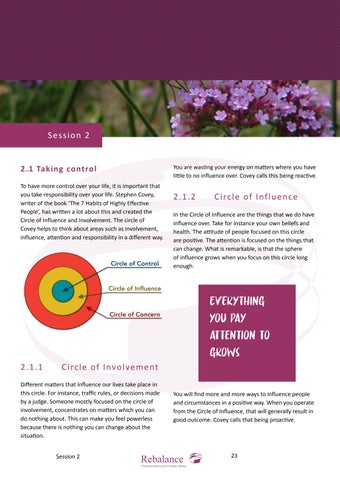
2.1 Taking control To have more control over your life, it is important that you take responsibility over your life. Stephen Covey, writer of the book ‘The 7 Habits of Highly Effective People’, has written a lot about this and created the Circle of Influence and Involvement. The circle of Covey helps to think about areas such as involvement, influence, attention and responsibility in a different way.
2. 1. 2
Ci rc l e of I nf l u en c e
In the Circle of Influence are the things that we do have influence over. Take for instance your own beliefs and health. The attitude of people focused on this circle are positive. The attention is focused on the things that can change. What is remarkable, is that the sphere of influence grows when you focus on this circle long enough.
Everything you pay attention to grows 2 . 1. 1
Circl e o f Invo l ve m ent
Different matters that influence our lives take place in this circle. For instance, traffic rules, or decisions made by a judge. Someone mostly focused on the circle of involvement, concentrates on matters which you can do nothing about. This can make you feel powerless because there is nothing you can change about the situation. Session 2
You will find more and more ways to influence people and circumstances in a positive way. When you operate from the Circle of Influence, that will generally result in good outcome. Covey calls that being proactive.
Rebalance
Personal coaching and couples therapy
23
2.1.3 Centre of Attention
But there are also matters that you might have an opinion about, and that you can influence, but that are not your responsibility. Are you willing to take that responsibility? The answer is crucial. This conscious choice can make you proactive. And that is exactly the difference between people who lead themselves and experience fun, peace and balance. And people that get overworked, do too much and eventually become out of balance. Which of the two do you want to be? If you want to belong to the first category, then you should focus only on the things you carry responsibility for and make conscious choices in specific situations whether you want to take the responsibility.
The most effective way to use your time and energy is mostly in the inner circle: The Centre of Attention. Within this circle lie matters which you are involved in and you can influence. Often these matters are in one line with our mission. When you set and realise goals in the Centre of Attention, you are maximizing the use of your time and effort. Exercise 1. See for yourself where you spend your time in the Circle of Covey. • • •
Near which circle did you write the most? Is this working for you? How would you like and be able to do it differently?
2.2. From drama triangle to victor ’s triangle To get more insight into yourself and to discover how you can take control, I now show you to the drama triangle. This drama triangle, also called Karpmantriangle, is a model for communication and collaboration. This model was invented by Stephen Karpman and was published in 1968. With it, he won the Eric Berne Memorial ‘Scientific’ Award. Karpman is a pupil of Carl Jung. The model describes common behaviour that strongly interferes with communication and collaboration.
2.1.4 Circle of Responsibility The Circle of Responsibility lies in your Circle of Influence. Because you do not have to manage everything you have influence on. And that can give you so much peace, freedom and breathing space. That is why you can think for yourself, the moment you notice you can influence something, if it is something you are responsible for. If the answer is ‘yes’, then you will have to manage it. Maybe you are getting paid for it?
Session 2
Rebalance
Personal coaching and couples therapy
24
Dramatriangle
2.2.1
Winnerstriangle
Roles in the drama triangle
The roles in the drama triangle have a set, negative dynamic towards each other. •
• •
The rescuer likes to give a lot, and unsolicited advice. ‘Come, let me do it’. He takes the responsibility from someone else, and as a result he makes other dependent on him and makes himself essential. The victim acts helpless, reacts preferably out of powerlessness: ‘It is always me they’re after’. If he does it pitiful enough, the leader will feel involved. If he provokes irritation, the persecutor will be challenged. The persecutor likes to point out other people’s weaknesses, to hide his own weakness. ‘You really don’t get it, do you?’. Others will feel guilty, and this will give him a sense of self-worth.
The consequences of the drama triangle
• • • • •
Session 2
Costs energy. Has a repetitive pattern. ‘Here we go again’. Consists of unequal roles, one feels less or more than the other. It is a game of transactions with concealed purposes and hidden messages. The outcome is predictable and afterwards, everyone has the well-known bad feeling.
Rebalance
Personal coaching and couples therapy
25
2.2.2 Taking responsibility within the drama triangle In the drama triangle, nobody takes responsibility for their own behaviour. The alternative for helpless victim behaviour is starting by getting realistic. Stop complaining and start asking.
REALITY CHECK SESSION 2
•
Take responsibility for your own behaviour, thoughts, feelings and needs. Ask: “Do you want to help me for a bit?”
1. 2. 3.
Instead of choosing for rescuer behaviour and a caring attitude: show commitment to the other and to yourself.
4.
•
• • •
Accept that others can take care of themselves. Set clear agreements about what the other will do themselves. Ask: “Can I help you with anything?”
Aggressive persecutor behaviour stops with an assertive attitude. • •
Set limits. Say what you really think. Start sentences with: “I think…; I feel…; I want…” without hurting the other.
Session 2
Rebalance
Personal coaching and couples therapy
Where do you stand now, if you look at the following four big life areas? Health: physical and mentally. Relations: love, family and friendships Work: study, volunteering, caring for children Financial situation
Draw four circles with these life areas: 1. 2.
3. 4. 5. 6. 7.
Describe in which circle you have the most influence, and in which the least What thoughts do you have about the areas which you don’t have influence over? How can you increase your influence? What are you willing to do for it? What would you do or think differently? Would you want to something new or different? How would you feel?
26