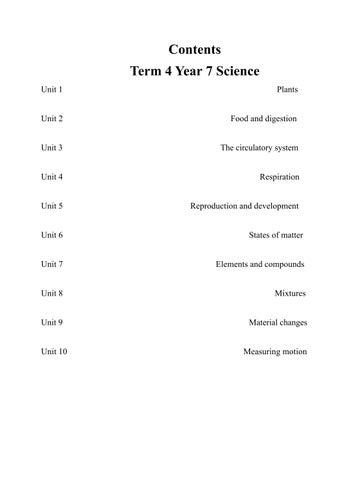
Contents Term 4 Year 7 Science Unit 1
Plants
Unit 2
Food and digestion
Unit 3
The circulatory system
Unit 4
Respiration
Unit 5
Reproduction and development
Unit 6
States of matter
Unit 7
Elements and compounds
Unit 8
Mixtures
Unit 9
Material changes
Unit 10
Measuring motion
2
1.1 Photosynthesis Plant organs Where do you get your energy from? Your energy comes from the food that you eat. Energy is passed from one organism to another along a food chain. Every food chain begins with a plant. Plants capture energy from light, and transfer some of the energy into the food that they make. When we eat food, we get some of that energy. In this unit, we will look at how plants use energy from light to make food.
grass
cricket
spider
small bird
The arrows in a food chain show the energy passing from one organism to another.
Making with light ‘Photo’ means to do with light. ‘Synthesis’ means ‘making’. So ‘photosynthesis’ means ‘making with light’. Photosynthesis is the way that plants make food, using energy from light.
This forest in New Zealand is a giant food factory. Questions
1 Think of two more words that begin with ‘photo’. What does each of your words mean? 2 In the food chain above, at which point does photosynthesis take place? 6
1 Plants
hawk
3 CUP CP Bio 8 plant schematic.ai
1.1 Photosynthesis
What else do plants need for photosynthesis? • Plants use water in photosynthesis. They get the water from the soil. • Plants use carbon dioxide in photosynthesis. They get the carbon dioxide from the air.
energy from light
You already know that plants make food by photosynthesis. But they also make a very important gas – oxygen. We can summarise photosynthesis like this: Water and carbon dioxide are changed into food and oxygen, using energy from light.
carbon dioxide
Biomass Plants use the food that they make in photosynthesis to make new cells and tissues. Material that is made of living cells and tissues is called biomass.
water
Activity 1.1 Plants and light SE
You are going to find out what happens to plants that do not get light. 1 Sow some small seeds on damp filter paper, in two identical dishes. Leave them in a warm place to germinate. Make sure that they do not dry out. 2 When the seeds have germinated, put one set into a dark cupboard, or into a closed cardboard box. Leave the other set in a light place. Keep giving them both a little water. Try to make sure that the temperature is the same for both sets of seedlings. 3 After two days, compare the appearance of the two sets of seedlings. You could also make labelled drawings of a seedling from each set. Questions
A1 Explain why it was important to keep one set of seedlings in the light. A2 Explain why it was important that the temperature was the same for both sets of seedlings. Summary Summary • There is still a lot that we do not know about the human • Photosynthesis is the way that plants make food, using energy from light. body and how it works. • Some of the food that is made becomes new biomass in the plant. • Many different kinds of scientists do research into the human • Plants use water and carbon dioxide in photosynthesis. body, to find out things that we do not yet know or understand. • Plants make food and oxygen by photosynthesis.
1 Plants
7
4
1.2 Leaves In most plants, the leaves are the organs that carry out photosynthesis.
Chlorophyll Most leaves are green. This is because they contain a green pigment called chlorophyll. (A pigment is a coloured substance.) Chlorophyll is essential for photosynthesis. Chlorophyll captures energy from light. The leaf can then use this energy to make food. Leaves capture energy from light. Questions
1 Think about what you know about the structure of cells. What is the name of the part of a plant cell – also beginning with ‘chloro’ – that contains chlorophyll? 2 Suggest why leaves are green, but roots are not. 3 Think back to Activity 1.1, where you grew some seedlings in the dark. What happened to the chlorophyll in them?
A+I A+I
The structure of a leaf The picture shows the different parts of a leaf. The veins carry water to the cells in the leaf. They also help to support the leaf and hold it out flat.
The leaf looks green because its cells contain chlorophyll.
The leaf stalk attaches the leaf to the plant.
Most leaves are very thin, so light can reach all the cells inside them. How a leaf is adapted for photosynthesis.
8
1 Plants
5
1.2 Leaves Inside a leaf The diagram on the right shows what a leaf looks like if you cut it across, and then look at the cut edge.
A waxy layer on the leaf surface stops the leaf cells from drying out.
The upper epidermis protects the cells inside the leaf. The palisade layer contains cells that do most of the photosynthesis.
Leaves are so thin that it is difficult to imagine they contain several layers of cells. It is the cells in the middle of the leaf that carry out photosynthesis. A vein carries water to the cells in the leaf.
The lower epidermis protects the cells inside the leaf.
The spongy layer has lots of air spaces. The cells in the spongy layer do a small amount of photosynthesis. A stoma (plural: stomata) is a tiny hole in the lower epidermis. These holes let carbon dioxide from the air get into the leaf.
Activity 1.2 Which surface has the most stomata? SE
Take a fresh, green leaf. Push the leaf into some warm water. Watch carefully to see where air bubbles appear on the leaf surface. Questions
A1 On which surface of the leaf did most bubbles appear? A2 The bubbles contained gas that came out from inside the leaf. Which part of the leaf do you think the gas came from? (Look at the diagram of the inside of the leaf above.) A3 Suggest how the gas got out of the leaf. A4 Use what you know about the effect of heat on gases to explain why the gases came out of the leaf when it was put into warm water. Summary • Leaves are adapted to carry out photosynthesis. • Leaves are green because they contain the green pigment chlorophyll, which absorbs energy from light. • Leaves have tiny holes in their lower surfaces, called stomata, which allow carbon dioxide to get into the leaf from the air.
1 Plants
9
1.3 Investigating photosynthesis How can we tell if a leaf is photosynthesising? One of the simplest ways is to check if it is giving off (releasing) oxygen gas. This is easiest to do if the leaf is under water, because the oxygen gas makes bubbles.
Activity 1.3A Collecting the gas produced in photosynthesis SE
The diagram shows the apparatus you need to set up for this experiment. You can use any plant that grows under water. You can usually get pond weed at a pet shop, because people buy it to put into fish tanks. If you live near the sea, you can use seaweed instead.
gas collecting test tube
Leave the apparatus in a place where the plant will get plenty of light. If it is very warm and sunny, you may see the gas collecting quickly. If it is colder and not so bright, you may need to leave it for a day to give time for the gas to collect.
beaker pond water upside-down funnel water plant block to support funnel
When you have collected about half a test tube of gas, you can test it to see if it is oxygen, like this: 1 Put your hand into the water in the beaker, and hold the test tube near its opening. Put your thumb over the opening, taking care to keep the test tube under water. 2 Keeping the tube open end downwards, take it out of the water. 3 Get a partner to light a wooden splint, then blow it out so that it is just glowing. 4 Now gently take off your thumb, to let the water fall out of the tube. 5 When all the water has fallen out, quickly but carefully put the glowing splint into the tube. Try not to touch the wet sides, or you will put it out! 6 If the gas is oxygen, it will make the glowing splint burst into flame. Questions
A1 Explain why you needed to use a water plant for this experiment. A2 Explain why you needed to leave the apparatus in a light place.
10
1 Plants
6
7
1.3 Investigating photosynthesis
Activity 1.3B Investigating the rate of photosynthesis SE
You are going to plan and carry out an experiment to investigate this question: Is there a correlation between light intensity and the rate of photosynthesis? A correlation is a relationship. If there is a correlation between light intensity and photosynthesis, then we would expect that changing the light intensity will result in a change in the rate of photosynthesis. 1 Write out your plan for your experiment. Here are some ideas you can use. • You can use a water plant like the one that you used for Activity 1.3A. • To measure the rate of photosynthesis, you can measure how much gas the plant gives off in a certain length of time. For example, you can measure the depth of gas that collects in the test tube in one hour. For a quicker experiment, you can count how many bubbles the weed gives off in one minute. If you do that, then you don’t need a funnel or test tube to collect the gas. • To give the plant a high light intensity, you can place a lamp close to the plant. For a lower light intensity, place the lamp further away. • Think carefully about all the variables that you must keep the same in your experiment. • Decide whether you should do several repeats for each light intensity, so you can calculate a mean for each one. 2 Predict the results you expect to get, and explain why. 3 Check your plan with your teacher before you begin. 4 Now carry out your experiment. Make changes to your plan if you think you can improve it. 5 Record and display your results so someone else can easily understand them. 6 Write down a short conclusion to your experiment, and compare your results with your predictions. Summary • A good way to find out if a water plant is photosynthesising is to see if it gives off bubbles of oxygen. • If photosynthesis is happening at a faster rate, then more oxygen is given off per minute.
1 Plants
11
8
1.4 Roots Roots are usually underground, so we often do not notice them. But, for many plants, the roots take up just as much space as the above-ground parts of the plant.
Functions of roots The roots of a plant have several functions. • Roots absorb water and minerals from the soil. These are then transported to all the other parts of the plant. • Roots anchor the plant firmly in the ground, so it is not pulled out when the wind blows strongly, or when an animal pulls on the leaves. • Some plants store food in their roots. • When conditions are difficult – for example, in a cold winter, or a dry summer – some plants allow their aboveground parts to die. Only the underground roots continue to live. New shoots (above-ground parts) grow from the roots when conditions become better.
For a plant, its roots are just as important as its leaves.
Activity 1.4A Roots for food We make use of many roots that store food. The plant stores the food for its own use, but we can also eat this food. Choose two different roots that humans eat as food. For each root, find out what the complete plant looks like. Make a labelled drawing of the plant. Describe how we use the root for food.
How roots absorb water and minerals Soil is made up of tiny rock particles. There is usually water in the spaces between the particles. There are minerals dissolved in the water. You may remember that special cells called root hairs grow out of the surface of roots. Root hair cells provide a really big surface through which water and minerals can be absorbed.
12
1 Plants
Roots are good sources of food for humans.
9
1.4 Roots
moist soil particles
root hair cell
A root hair cell.
cells inside root
Questions
A+I A+I
1 Explain how the absorption of water by roots helps photosynthesis to take place. 2 Suggest why most plants die very quickly if their roots are cut off. 3 Explain how root hairs help plants to absorb a lot of water in a short time.
Activity 1.4B
This photograph of a root was taken using a microscope. You can see that it is covered with thousands of tiny root hairs.
CUP CP 8 2011 1.4E bean gas jar.ai
Which way up? SE
1 Take a tall glass jar. Roll up a piece of strong absorbent paper so that it fits inside the jar. Add a little water and allow it to soak into the paper. 2 Take three soaked bean seeds. Carefully put them between the paper and the side of the jar. Place each one a different way up. 3 Put the jar in a warm place. Check it each day to see if it needs more water – it is important to keep the seeds moist but not too wet. 4 When all of the seeds have grown roots, make drawings of them. Questions
A1 What do you notice about the directions the roots have grown in? A2 Suggest how this would help a bean plant to survive.
Summary • Roots absorb water and minerals from the spaces between soil particles. • Roots anchor a plant in the ground. • Roots can store food for the plant. • Roots can sometimes survive harsh conditions that kill the above-ground parts of the plant.
1 Plants
13
1.5 Transporting water and minerals We have seen that the roots of a plant absorb water and minerals. How are these transported from the roots to all the other parts of the plant?
Activity 1.5A Transport in a celery stalk SE
1 Collect a stalk of celery. If possible, choose one that has some leaves at the top. 2 Put some water containing a coloured dye into a beaker. Stand the celery stalk in the dye. Make sure you stand the stalk the right way up. 3 Every now and then, look at the stalk. You should be able to see the coloured dye moving up inside it. (This can sometimes happen very quickly and sometimes very slowly, so be prepared!) 4 When the dye has reached the top of the stalk, take the stalk out of the dye and wash it in clean water. 5 Carefully cut across the stalk. Look at the cut end using a hand lens. Make a drawing of what you can see. Questions
A1 Suggest why it is important to wash the celery stalk before cutting across it. A2 Flowering plants, such as celery plants, contain long tubes called xylem vessels. (You pronounce the ‘x’ in xylem as though it is a ‘z’.) These vessels transport water and substances dissolved in the water. Use your results to describe where the xylem vessels are in a celery stalk.
Activity 1.5B How does temperature affect the rate at which water is transported in a celery stalk? SE
You are going to plan and carry out an experiment to try to answer the question in the title. Think about the following questions. • What variable will I change? How will I change it? • What will I measure? How will I measure it? When will I measure it? • What variables will I try to keep the same? How will I keep them the same? • Are there any safety risks in my experiment? If so, how can I keep safe? • How will I record my results? Can I draw a graph? If so, what will I put on the graph axes? • What do I think the results will be? Why? When you have written your plan, check it with your teacher. After you have done your experiment, identify the trends and patterns you can see. Compare your results with your predictions. 14
1 Plants
10
11
1.5 Transporting water and minerals Xylem vessels When you did Activity 1.5A, you saw that the coloured dye did not soak into all of the celery stalk. It stayed inside the xylem vessels. Xylem vessels are long, hollow tubes that carry water and minerals from the roots of the plant to its leaves. In a tree, the xylem vessels reach all the way up the trunk and to the very tips of the branches. The xylem vessels continue inside the leaves.
The position of xylem vessels in a root.
Xylem vessels are very tiny. The spots that you saw in the celery stalk each contain several xylem vessels. The diagrams show where the xylem vessels are in a root, a stem and a leaf. The dark blue areas show where xylem vessels are found. Xylem vessels have very strong, hard walls. This means that they help to support the plant, as well as transporting water and minerals.
The positions of xylem vessels in a stem.
The wood in a tree trunk is made up of xylem vessels. If you are working at a wooden desk, you may be able to see the xylem vessels that make up the wood.
The positions of xylem vessels in a leaf. In a leaf, the xylem vessels are inside the veins.
This is a piece of wood seen with a powerful microscope. Each hole is the cut end of a xylem vessel.
Summary • Water and minerals are transported from a plant’s roots to its leaves inside long, hollow tubes called xylem vessels. • The veins in a leaf contain xylem vessels. • Wood is made up of xylem vessels.
1 Plants
15
12
Unit 1 End of unit questions 1.1
The words below all have something to do with photosynthesis. Choose the correct word to match each description. You may use each word once, more than once or not at all. air carbon dioxide chlorophyll chloroplast oxygen palisade layer soil stomata veins a b c d e f
1.2
epidermis
This gas is used by plants in photosynthesis. This gas is made by plants in photosynthesis. Plants get their water for photosynthesis from here. This green pigment absorbs energy from sunlight. This tissue in a leaf is where most photosynthesis takes place. These tiny holes in a leaf allow gases to move in and out.
The photograph shows the upper surfaces of leaves from two different plants. The leaves are both shown life-size.
Construct a table that you can use to compare the structure of the two leaves. Then complete your table to show at least five differences between the leaves.
16
[6]
1 Plants
[6]
13
1 End of unit questions 1.3
Anurag did an experiment to compare the rate of photosynthesis of two types of seaweed. The diagram shows the apparatus he used.
measuring cylinder beaker seawater upside-down funnel seaweed
1.4
a b c
What variable should Anurag change in his experiment? List three variables that Anurag should keep the same. What should Anurag measure in his experiment?
[1] [3] [2]
a b
Describe how a plant obtains water. Describe how water is transported to the leaves of the plant.
[2] [2]
1 Plants
17
14
2.1 Nutrients Everyone enjoys eating tasty food. Food gives us pleasure. It also gives us the nutrients that we need to stay healthy. Nutrients are substances in food that the body uses: • to provide energy • to provide materials for making the chemicals that are needed to make cells and other parts of the body. Different kinds of food contain different nutrients.
These foods are good sources of protein.
Protein, carbohydrate and fat The nutrients that we need to eat in the largest quantity are protein, carbohydrate and fat. Protein is used for making new cells. Protein is also used for making many important chemicals in the body, such as enzymes (see pages 28–29) and antibodies (see page 37). Cells can use protein to supply energy. Carbohydrate is used to provide energy. Starch and sugar are two kinds of carbohydrate.
These foods are good sources of starch (a type of carbohydrate).
Fat also provides energy. Fat can be stored in the body. Fat stores underneath the skin provide insulation. Fat is needed to make new cell membranes.
Vitamins and minerals Vitamins and minerals are nutrients that we need in only very small quantities. They do not provide energy. There are many different kinds of vitamins and minerals that we need to eat. Fruit and vegetables are a good source of some of them. There is more information about two vitamins and two minerals on page 20.
These foods contain a lot of fat.
Fibre and water Fibre (roughage) helps to keep food moving easily through the digestive system. We get fibre from fresh fruit and vegetables, and also from foods made from whole seeds such as brown rice or wholemeal bread. Water is sometimes considered to be a nutrient. Between 60% and 70% of the body is made up of water. 18
2 Food and digestion
These foods contain a lot of fibre.
15
2.1 Nutrients
Questions
1 Explain the difference between food and nutrients. 2 The headings on the previous page contain the names of the seven kinds of nutrients. List them all. 3 Which three nutrients provide the body with energy?
Activity 2.1 Testing foods for carbohydrates SE
Starch and sugar are two types of carbohydrate. You can find out if a food contains starch using iodine solution. You can find out if a food contains sugar using Benedict’s solution. 1 First, test each food for starch. • Put a small amount of the food onto a white tile. • Add a drop or two of iodine solution. If the iodine turns blue-black, there is starch in the food. 2 Next, test each food for sugar. • Chop or crush a small amount of the food, and put it into a boiling tube. Add a little water and stir or shake it well. • Add enough Benedict’s solution to make the mixture look blue. • Put the boiling tube into a water bath at about 80 °C. Leave it for about 5 minutes. • If there is sugar in the food, the colour will no sugar change as shown on the right. 3 Record your results in a results table like the one below. Add as many more rows as you need. Food
Colour with iodine solution
Did it contain starch?
a small amount of sugar
Colour with Benedict’s solution
a lot of sugar
Did it contain sugar?
Summary • We need to eat seven different types of nutrients – protein, carbohydrate, fat, vitamins, minerals, fibre and water. • Different kinds of foods contain different combinations of nutrients.
2 Food and digestion
19
16
2.2 A balanced diet Your diet is the food that you eat each day. Your diet should provide you with enough of each kind of nutrient. It should also give you the right amount of energy.
Bread, pasta and rice contain a lot of starch and some protein.
Fruit and vegetables contain a lot of fibre and vitamins.
A diet that provides all the different kinds of nutrients, and the right amount of energy, is called a balanced diet.
Nutritional deficiencies If a person does not eat enough of a particular nutrient, their body may not be able to work properly. They may have a nutritional deficiency disease. For example, a child who does not have enough protein in her body may not be able to make enough new cells. She will not grow properly. The table shows information about two vitamins and two minerals, and the deficiency diseases that develop if they are lacking in the diet. Nutrient Example Good sources vitamins vitamin C citrus fruits
Dairy foods contain a lot of protein and fat. Sweet things contain a lot of sugar.
This photograph shows approximately how much of your diet should be made up of each of the five food groups.
Function in the body helps to make strong skin vitamin D dairy products needed to make bones and teeth minerals iron red meat, dark green needed to make vegetables haemoglobin, which carries oxygen in the blood calcium dairy products, fish needed to make bones and teeth
2 Food and digestion
Fish, meat, eggs, nuts and pulses contain a lot of protein.
Deficiency disease scurvy – the skin becomes weak, so sores develop rickets – the bones are weak, so the legs may become bent anaemia – the blood cannot carry enough oxygen, and the person feels very tired the bones and teeth become weak
17
2.2 A balanced diet Not too much There are some nutrients that you should avoid eating too much of. Too much sugar can make your teeth decay. Too much fat in the diet can increase the risk of developing heart disease when you are older. Eating too much fat and carbohydrate may mean that you take in more energy each day than you use. The body stores these extra nutrients as fat. Everyone needs some fat stores, but it is not good to have too much. Being seriously overweight can cause damage to joints, and increase the risk of developing heart disease and diabetes.
What should I eat? These students are giving some good guidelines for eating a balanced diet.
Don’t eat too much ‘fast food’.
Don’t eat too much food containing a lot of fat.
Make sure you eat enough food to keep you strong and fit. Eat plenty of fresh fruit and vegetables.
Eat a wide variety of foods, including something from each of the food groups in the photograph, each day.
Question
1 The sentences below are reasons for the pieces of advice the students are giving. Match each reason with the piece of advice. a This means you will get some of each kind of nutrient, including the different vitamins and minerals. b These contain fibre and lots of vitamins. c This often contains a lot of fat, and very few vitamins or minerals. It is fine to eat some of it, as long as you eat plenty of other kinds of foods as well. d Not eating enough food will prevent the cells, tissues and organs in your body having enough energy to keep healthy. e When you get older, it can increase your risk of getting heart disease or diabetes. Summary • A balanced diet contains some of all the types of nutrients, and about the same amount of energy that your body uses each day. • A diet that is missing a particular nutrient can cause a nutritional deficiency disease. • A good diet has plenty of foods containing protein, vitamins and minerals, but not too much fat or sugar.
2 Food and digestion
21
18
2.3 Digestion and absorption The alimentary canal Your mouth is the entrance to a long tube called the alimentary canal. The other end of the tube is called the anus. The diagram summarises what happens to the food that an animal eats, as it travels through this tube. 2 As it passes along the canal, tiny food particles are able to get out of the canal and into the body. This is called absorption.
1
Food is taken into the mouth and begins its journey along the alimentary canal.
3 All the food that could not be absorbed passes out of the anus, as faeces.
What happens inside the alimentary canal.
Absorption and digestion The food inside the alimentary canal can only reach your body cells if it can get out through the walls of the tube. This process is called absorption. Protein, starch and fat are important nutrients. Each of these nutrients is made up of large molecules. A molecule is the tiniest particle of a substance that can exist. Molecules of protein, starch and fat are so big that they cannot get through the walls of the alimentary canal. So, in order to get these nutrients to your cells, the big molecules have to be broken down into much smaller ones. Then the small molecules can be absorbed. This is what digestion is. Digestion is the breakdown of large molecules into small ones, so that they can be absorbed. a starch molecule
A starch molecule can be broken into many sugar molecules. 22
2 Food and digestion
many sugar molecules
19
2.3 Digestion and absorption
Activity 2.3 A model of absorption SE
Visking tubing is similar to the walls of the alimentary canal. It has tiny holes in it – much too small for you to see – that will let small molecules go through, but not big molecules. 1 Collect a piece of Visking tubing. Moisten it with water. Rub it between your fingers until it opens up into a tube. 2 Tie a knot in one end of the tube. 3 Very carefully, using a dropper pipette, fill your Visking tubing with a ‘meal’ of starch solution and sugar solution. When it is nearly full, use cotton to tie it very tightly around the top. 4 Rinse your tubing in water, to wash off any starch or sugar that got onto the outside of it. 5 Put your tubing into a beaker. Add enough water to the beaker to cover the tubing. Leave it for about 15 or 20 minutes. 6 Now take a sample of water from the beaker and test it for starch. Record your results. 7 Take a second sample of water from the beaker and test it for sugar. Record your results.
Visking tubing
water
cotton tied round one end
knot tied in one end
mixture of starch, sugar and water
Questions
A1 A2 A3 A4
Explain why it was important to tie both ends of the tubing very tightly. Explain why it was important to wash the outside of the tubing. Which nutrients – starch or sugar – were able to get out of the tubing? Use what you know about starch molecules and sugar molecules to suggest an explanation for your results. A5 Imagine you have eaten a meal containing starch and sugar. Do both of these nutrients need to be digested inside your alimentary canal? Explain your answer. Summary • Nutrients cannot be used by body cells until they have been absorbed through the walls of the alimentary canal. • Only small molecules can pass through the wall of the alimentary canal. • Digestion is the breakdown of large molecules of nutrients to small molecules, so that they can be absorbed.
2 Food and digestion
23
2.4 The human digestive system
20
The diagram shows the human digestive system. The digestive system is made up of the alimentary canal, plus the salivary glands, liver and pancreas.
mouth salivary glands
oesophagus liver stomach gall bladder pancreas large intestine small intestine
appendix anus
An X-ray image of part of the alimentary canal. Can you work out which parts are shown?
The human digestive system. Questions
1 After it has been swallowed, food moves along through the space inside the alimentary canal. Write down, in order, the name of each part of the alimentary canal that food passes through as it travels from the mouth to the anus. 2 Name three organs, shown in the diagram, that food does not pass through. 24
2 Food and digestion
21
2.4 The human digestive system Functions of organs in the digestive system Mouth Teeth chew food into smaller pieces. Saliva starts to break down starch to sugar. Oesophagus Food just passes through here without changing.
Large intestine All the food that could not be digested and absorbed passes through here. A little more of the water in it is absorbed. The undigested food collects up and forms faeces.
Stomach Hydrochloric acid kills micro-organisms in the food. Stomach juices begin to break down protein to amino acids.
Liver The liver makes bile. The bile is stored in the gall bladder. Bile flows into the small intestine, where it helps with fat digestion.
Small intestine Juices from the pancreas finish breaking down starch, protein and fat to small molecules. These small molecules are then absorbed through the walls of the small intestine. Water, vitamins and minerals (which are already made of very small particles) are also absorbed.
Pancreas The pancreas makes pancreatic juice. Pancreatic juice flows into the small intestine, where it helps to digest protein, starch and fat.
Summary • The alimentary canal is a long tube that runs from the mouth to the anus. • Inside the alimentary canal, nutrients are first digested and then absorbed. • Digestion happens inside the mouth, stomach and small intestine. Absorption happens inside the small intestine and large intestine.
2 Food and digestion
25
22
2.5 Teeth The mouth is the first part of the alimentary canal. Inside your mouth there are four different kinds of teeth – incisors, canines, premolars and molars. Incisors are chiselshaped, with a sharp edge. They are used for biting off small pieces of food so that you can take the food into your mouth.
Canines are more pointed than incisors. In humans, they are used in the same way as incisors.
Molars are like premolars, but sometimes a bit bigger. They are also used for crushing and grinding food.
Premolars have broad surfaces with ridges on them. They are used for crushing and grinding food when you chew.
The four kinds of human teeth. Questions
A+I
1 ‘Canine’ means ‘dog tooth’. What do dogs use their canine teeth for? 2 Explain how the shape of incisors helps them to carry out their function. 3 Explain how the shape of molars helps them to carry out their function.
The structure of a tooth The diagram shows what an incisor tooth looks like if it is cut in half. The diagram also shows the gum and jawbone. Teeth are held in the jawbone by strong fibres.
enamel – a very hard covering, containing calcium crown
dentine – a layer containing living cells, not as hard as enamel gum pulp cavity – containing blood vessels and nerves
root
fibres – help to hold the tooth in the jawbone jawbone blood supply to the tooth
The structure of an incisor tooth. 26
2 Food and digestion
23
2.5 Teeth Caring for your teeth The enamel on your teeth is very strong. However, it can be dissolved by acids. If that happens, you may get a hole in your tooth. This can be painful when the hole reaches the pulp cavity, where there are nerve endings. This means that drinking lots of acidic fizzy drinks (like cola or lemonade) can harm your teeth. Even if you don’t eat or drink acidic things, you may still get acid in your mouth. This is because bacteria in your mouth break down food remains left on and between your teeth – especially sugary things. The bacteria make acid when they break down the food remains. To avoid getting holes in your teeth: • Don’t drink fizzy drinks, or eat sugary food, all day long. • Clean your teeth thoroughly after breakfast and before you go to bed. • Use a toothpaste containing fluoride. Fluoride helps to strengthen the enamel on your teeth. CUP CP CB8 2011 2.3D Visking tube beaker.ai
Activity 2.5
How do fizzy drinks affect teeth? SE
You’ll only be able to do this activity if you can find two teeth. Your teacher may be able to provide these. 1 Tie a piece of strong cotton around each tooth, long enough to hang over the edge of a beaker. Tie the other end around a small stone or weight. 2 Pour some fizzy drink (for example, cola) into one beaker. Pour the same depth of tap water into the other beaker. 3 Hang one tooth in the fizzy drink, and the other tooth in the water. 4 Observe the teeth at least once a week for several weeks. Write down your observations and conclusions.
Summary • Teeth break down large pieces of food into small pieces. • Humans have four types of teeth – incisors, canines, premolars and molars. • Teeth have an outer covering of very hard enamel, which contains calcium. Inside the tooth are the dentine and the pulp cavity, which contain living cells. • Enamel can be dissolved by acids.
2 Food and digestion
27
24
2.6 Enzymes We have seen that large molecules of nutrients must be broken down into small molecules, so that they can be absorbed. Teeth break down big pieces of food into small pieces. But they don’t have any effect on the molecules of the different nutrients that make up the food. The large nutrient molecules are broken down into small molecules by chemicals called enzymes.
Digestion as a chemical reaction Digestion changes a substance made up of large molecules into a new substance made up of small molecules. When one substance is changed into a different substance, we say that a chemical reaction has taken place. The diagram shows a chemical reaction that happens during digestion.
starch
→
sugar
Starch is changed to sugar by a chemical reaction.
Questions
1 Explain why digestion by enzymes is a chemical reaction. 2 Do teeth cause a chemical reaction to take place? Explain your answer.
A+I
Catalysts The enzymes inside the alimentary canal make these chemical reactions happen. The enzymes are not changed themselves. They just help to speed up the reactions. A substance that speeds up a chemical reaction, but is not changed itself, is called a catalyst. So enzymes are biological catalysts.
Part of a starch molecule.
enzyme
The starch molecule slots into the enzyme molecule.
The enzyme molecule makes the starch molecule split apart into sugar molecules.
dent in enzyme
How an enzyme makes starch molecules break down to sugar molecules. 28
2 Food and digestion
The sugar molecules leave the enzyme molecule. The enzyme molecule has not been changed.
25
2.6 Enzymes
Questions
3 Teeth help to break down large pieces of food into lots of smaller pieces. Suggest how this can help enzymes to digest the food faster. 4 A protein molecule is made up of a long chain of smaller molecules called amino acids. Draw a series of diagrams showing how an enzyme digests protein molecules to amino acid molecules. Use the diagram at the bottom of the previous page as a starting point.
Activity 2.6 Using an enzyme to digest starch SE
The enzyme that digests starch is called amylase. 1 Label two test tubes A and B. 2 Put 5 cm3 of starch solution into each of tubes A and B. 3 Add 5 cm3 of amylase solution to tube A. Add 5 cm3 of water to tube B. Leave both tubes in a warm place for about 20 minutes. 4 Using a clean dropper pipette, take a small sample of liquid from tube A. Put it onto a white tile, and add some iodine solution. Write down the result. 5 Repeat step 4 with a sample from tube B. 6 Using a clean dropper pipette, take another sample from tube A. Put it into a boiling tube, and add some Benedict’s solution. Place the boiling tube into a water bath at about 80 °C. Leave it for two or three minutes, then write down the result. 7 Repeat step 6 with a sample from tube B. 8 Record all of your results clearly, and try to explain them.
starch solution and amylase solution
starch solution and water
Summary • When one substance is changed into a different substance, a chemical reaction has taken place. • Digestion is a chemical reaction in which a substance made of large molecules is changed into a substance made of small molecules. • Enzymes are molecules that act as biological catalysts. Enzymes help reactions to take place quickly. The enzymes are not changed themselves.
2 Food and digestion
29
26
Unit 2 End of unit questions 2.1
Copy and complete these sentences, using words from the list. You may use each word once, more than once or not at all. atoms
large
molecules
pieces
small
Teeth break down large lumps of food into smaller ................... . Then, enzymes break down the large ................... of the nutrients in the food into small ................... . This allows the nutrients to pass out of the alimentary canal through the wall of the ................... intestine. 2.2
The table shows the carbohydrate content of ten foods. Food apple banana beans biscuits bread grilled chicken coconut egg fish mutton rice
a b c d
30
[4]
Carbohydrate content / g in 100 g of food 9 20 17 66 45 0 4 0 0 0 30
Which food contains the most carbohydrate? Bolormaa ate 50 g of biscuits. How much carbohydrate did she eat? Rice does not contain sugar. What kind of carbohydrate does rice contain? What do the four foods that do not contain carbohydrate have in common?
2 Food and digestion
[1] [1] [1] [1]
27
2 End of unit questions 2.3
The diagram shows part of the human alimentary canal.
E
A B
D
a b c 2.4
C
Name parts A and D. Give the letters of two labelled parts where protein digestion takes place. Give the letter of one labelled part where digested nutrients are absorbed.
[2] [2] [1]
Rhianna tested two different foods using iodine solution and Benedict’s solution. These were her results. spaghetti – went blue-black with iodine solution, went blue with Benedict’s solution honey – went orange-brown with iodine solution, turned brick red with Benedict’s solution a b c
Describe how Rhianna tested the foods with Benedict’s solution. Construct a results table and fill it in to show Rhianna’s results clearly. What conclusions can Rhianna make from her results?
[2] [3] [4]
2.5
Nakula investigated the effect of heat on amylase. Amylase is an enzyme that makes starch molecules break down into sugar molecules. P Q • Nakula put some amylase solution into two boiling tubes, P and Q • He boiled the solution in tube P. He did not heat tube Q. • He waited until the solution in tube P had cooled down to room temperature. • He added equal volumes of starch solution to tube P and boiled amylase amylase tube Q. and starch and starch • After 10 minutes, he tested both tubes for sugar. • Nakula found that there was sugar in tube Q, but not in tube P. a What was the variable that Nakula changed in his experiment? [1] b State two variables that Nakula kept constant in his experiment. [2] c Nakula wrote this conclusion to his experiment: ‘My results show that boiling destroys amylase’. Explain how Nakula’s results support his conclusion. [3]
2 Food and digestion
31
3.1 The human circulatory system Sit very still and quiet. Put your fingers on your neck, just underneath your chin. Can you feel your pulse? Each pulse that you can feel is caused by one beat of your heart. All through your life, your heart keeps on beating, pushing blood around your body. The blood travels round the body inside tubes called blood vessels. The diagram shows the basic plan on which the blood vessels are arranged. The heart and blood vessels together make up the circulatory system.
brain
lungs artery to lungs
vein from lungs
artery to rest of body
vein from rest of body heart digestive system other organs other organs The human circulatory system. Questions
Look at the diagram to answer these questions. 1 In which direction do arteries carry blood – away from the heart, or towards the heart? 2 In which direction do veins carry blood – away from the heart, or towards it? 3 The circulatory system is like a one-way traffic system. Describe two different routes by which blood in the left side of the heart can get to the right side of the heart. (Remember – the person in the diagram is facing you.)
A+I A+I A+I
32
3 The circulatory system
28
29
3.1 The human circulatory system Oxygenated and deoxygenated blood One of the most important functions of the circulatory system is to supply oxygen to all the cells in the body. Oxygen enters the blood as the blood passes through the lungs. The oxygen diffuses from the air inside the lungs, into the blood. When blood contains a lot of oxygen, it is bright red. We say that the blood is oxygenated. Oxygen leaves the blood as the blood passes through tissues where the cells are using up oxygen. The oxygen diffuses from the blood, into the body cells. When blood has lost most of its oxygen, it becomes a more blueish-red. We say that the blood is deoxygenated. Question
4 Look at the diagram of the human circulatory system. Which side of the heart contains oxygenated blood?
You can see blood vessels inside the elephant’s ear.
Activity 3.1 Modelling the circulatory system Design and make a model to show the human circulatory system. Your model should include something to represent: • the heart, with the two sides joined together but not allowing blood to move directly from one side to the other • the blood vessels that run between the heart and the lungs • the blood vessels that run between the heart and the tissues in the rest of the body. You might be able to add something that moves to your model, such as red and blue beads to represent the blood. Summary • The heart and blood vessels make up the circulatory system. • Blood flows out of the heart inside arteries, and back into the heart inside veins. • Blood picks up oxygen as it passes through the lungs, and releases oxygen as it passes through the tissues in the rest of the body.
3 The circulatory system
33
30
3.2 The heart The diagram shows where your heart is. It is just under your ribs, slightly to left of centre of your body. Your heart is about the same size as your clenched fist. It is made of very strong muscle. The muscle in the heart contracts and relaxes over and over again, all through your life. However tired you are, your heart still keeps beating.
The structure of the heart The diagram shows what the inside of the heart looks like. artery to lungs
lung and ribs removed to show the heart
The position of the heart in the human body. artery to body
vein from body vein from lungs upper chamber valve
valve
lower chamber deoxygenated blood right side
left side
oxygenated blood
The structure of the heart. Question
A+I
1 The heart has four chambers – an upper and lower chamber on the left, and an upper and lower chamber on the right. a Into which chamber does blood from the lungs flow? b Out of which chamber does blood flow, on its way to the rest of the body? c Which two chambers contain oxygenated blood?
How the heart works The heart is made of muscle. This muscle contracts and then relaxes. When muscle contracts, it gets shorter. This makes the walls of the heart chambers squeeze inwards. This pushes blood out of the heart. There are valves between the upper chambers and the lower chambers. The valves only let the blood flow from the upper chamber to the lower chamber. There are 34
3 The circulatory system
31
3.2 The heart also valves in the big arteries coming out of the heart. These valves only let the blood flow out, not back into the heart. This is what happens during one heart beat: • The heart muscle contracts, pushing blood out into the arteries. • The heart muscle relaxes, allowing blood to flow into the heart from the veins.
contracting
valve closed
relaxing
valve open
How the heart pumps blood.
Activity 3.2 Investigating the effect of exercise on pulse rate Each time your heart muscle contracts, it sends blood surging through your arteries. You can feel this surge of blood if you put your fingers on a place where there is an artery near the surface of the body. The diagrams show two good places to try. Each surge of blood is called a pulse. Your pulse rate is the number of pulses in one minute. 1 Read through what you are going to do. Draw a results table, ready to write in your results as you collect them. 2 Work with a partner. Ask them to sit very still and relaxed for a few minutes. Then count their pulse rate. 3 Now ask your partner to do some exercise for two minutes. Your teacher will suggest a good exercise to do. 4 As soon as your partner has finished exercising, count their pulse rate again. 5 Continue to count their pulse rate every two minutes for ten minutes. 6 Draw a graph to display your results. 7 Use your results to write a short conclusion. Summary • The heart is made of muscle, which contracts and relaxes to pump blood around the body. • The heart contains valves to make sure the blood always flows in the right direction.
3 The circulatory system
35
32
3.3 Blood Everyone knows that blood is a red liquid. But if you look at blood under a microscope, you may get a surprise. The liquid part of blood is not red at all – it is a very pale yellow colour. What makes blood red is the cells that float in this liquid.
red blood cell white blood cell
Question
A+I
1 Look at the photograph of blood. a Approximately how many red blood cells are there for each white blood cell? b Describe two ways in which white blood cells look different from red blood cells.
platelet plasma This is what human blood looks like under the microscope. The white blood cells have been stained with a dye, to make it easier to see them.
Plasma Plasma is the liquid part of blood. It is mostly water. Plasma contains many different substances dissolved in it. For example, sugar is transported around the body dissolved in the blood plasma. The sugar is absorbed into the blood in the small intestine, and is carried all over the body to the cells that need to use it for energy.
Red blood cells Most of the cells in the blood are red blood cells. Red blood cells are unusually small cells. They are red because they contain a red pigment called haemoglobin. When blood flows through the lungs, oxygen diffuses into it. The oxygen combines with the haemoglobin inside the red blood cells. The haemoglobin becomes oxyhaemoglobin. This is a very bright red. When the blood flows through the body tissues, the oxygen separates from the haemoglobin. The oxygen diffuses out of the red blood cells and into the tissues. The oxyhaemoglobin becomes just haemoglobin again. This is a dull blueish-red.
36
3 The circulatory system
the lungs Oxygen diffuses into the blood from the lungs.
the tissues
Oxygen diffuses out of the blood into the tissues.
33
3.3 Blood White blood cells White blood cells are larger than red blood cells, and they always have a nucleus. White blood cells help to defend us against bacteria and viruses that get into the body.
white blood cell
bacterium
Some kinds of white blood cells put out ‘fingers’ that capture the bacterium. The white blood cell then produces enzymes that kill and digest the bacterium. Other white blood cells produce special molecules that attach to the bacteria and kill them. These molecules are called antibodies.
Some white blood cells take in bacteria and kill them.
Platelets
Platelets produce chemicals that cause fibres to form in the blood.
Platelets are little fragments of cells. If a blood vessel gets damaged, the platelets help the blood to clot and seal the wound.
Red blood cells get trapped in the fibres. A photograph of a blood clot, taken using an electron microscope. Question
2 Copy and complete this table. Component of blood red blood cell white blood cell platelet plasma
What it looks like
What it does
Summary • Blood is made up of different kinds of blood cells floating in a liquid called plasma. • Red blood cells transport oxygen. • White blood cells destroy invading micro-organisms. • Platelets help blood to clot. • Plasma transports dissolved substances such as sugar.
3 The circulatory system
37
34
3.4 Blood vessels The tubes through which blood flows are called blood vessels. We have three main kinds of blood vessels in the body.
artery
capillary
vein
• Arteries carry blood away from the heart. • Veins carry blood back to the heart. • Capillaries connect the arteries to the veins. They carry blood close to every tissue in the body. Capillaries carry blood from arteries into veins. Questions
A+I
1 Kareena says, ‘Arteries carry oxygenated blood, and veins carry deoxygenated blood.’ Explain why she is wrong. (Page 32 will help you.) 2 Suggest why you can feel your pulse in an artery, but not in a vein.
A+I
Arteries Arteries have very thick, strong, elastic walls. They need to be strong because they have to withstand the strong forces as the heart pumps blood through them. Their elastic walls are able to expand and spring back as the blood surges through. You can feel this happening when you feel your pulse. thick, elastic wall The structure of an artery.
Capillaries Capillaries are very tiny. The smallest ones can only be seen with a microscope. They are just big enough to allow red blood cells to get through them. Capillaries have thin walls, made up of only one layer of cells. This means that substances in the blood – such as oxygen and sugar – can easily get out. The function of capillaries is to supply cells with things that they need, and take away their waste products. 38
3 The circulatory system
thin wall, made of a single layer of cells The structure of a capillary.
35
3.4 Blood vessels Veins Veins are a similar size to arteries. However, their walls are much thinner, and the space inside them is larger. Veins do not need thick walls, because by the time blood flows into the veins it has lost most of the force that the heart gave it. They do not need very elastic walls either, i 011 s.a 8 2 in because the blood is flowing smoothly rather than CB in ve P i 1 P C es CU 4 valv 8 201eins.a in surges. B v 3. P C in Veins contain valves, which only let the blood flow one way – towards the heart. Question
3 Construct a table to summarise the structures and functions of arteries, capillaries and veins.
P C es CU 4 valv 3.
thinner wall than an artery valves to keep blood flowing in one direction
The structure of a vein.
Activity 3.4 Circulatory system poster Design and make a poster to show information about the human circulatory system. Begin by deciding what you will try to show. Include no more than one or two of the following: • a plan of the circulatory system • the heart and how it works • blood – what it contains and what it does • the different kinds of blood vessels. You may be able to use books and the internet to find out extra information about the topics that you choose. For example: • What makes blood flow upwards in the veins from your feet to your heart? • How is the heart muscle supplied with oxygen and sugar? Summary • Blood vessels are tubes that carry blood around the body. • Arteries carry blood away from the heart. Veins carry blood towards the heart. Capillaries carry blood between arteries and veins. • Arteries have thick, elastic walls to withstand the strong surges of blood. Capillaries are tiny, with very thin walls. Veins have thinner walls than arteries. Veins contain valves.
3 The circulatory system
39
36
Unit 3 End of unit questions 3.1
Copy and complete these sentences using words from the list. You may use each word once, more than once or not at all. blood
contracts
muscle
stretches
tubes
valves
The heart is made of ................... . This muscle ................... and relaxes rhythmically, pumping blood around the body. There are ................... inside the heart that make sure the blood keeps flowing in the correct direction. 3.2
[3]
The diagram represents the circulatory system.
brain F E D
A
right side of heart pumps blood to lungs and back
left side of heart pumps blood to all organs, other than lungs, and back B
digestive system muscles other organs
a b c d
40
C
Write down three letters that show arteries. Write down one letter that shows capillaries. Write down two letters that show veins. Write down three letters that show vessels containing deoxygenated blood.
3 The circulatory system
[2] [1] [1] [2]
37
3 End of unit questions 3.3
Krystyna investigated how a person’s pulse rate changes when they exercise. She tested four of her friends. Belinda and Jasmina do a lot of sport. Jade and Mara prefer to read books and play computer games. Krystyna measured the four girls’ pulse rates, in beats per minute, when they were relaxing. Then she asked them to run up two flights of stairs, and measured their pulse rates again. These are her results. Belinda 65, 102 Jasmina 72, 105 Jade 70, 110 Mara 74, 120 a b c d
3.4
Draw a results table, and fill in Krystyna’s results. Remember to label the rows and columns of your results table fully. Display Krystyna’s results in the way you think is best. Write down one conclusion that Krystyna can make from her results. Krystyna decided that she did not have enough evidence to decide whether being fit affects a person’s pulse rate. Was she right? Explain your answer.
[4] [5] [1] [2]
The diagrams show two blood cells.
a b c d e
Make a copy of the drawing of the red blood cell. Label the cell membrane and the cytoplasm. Name one structure that most cells have, but that red blood cells do not have. Describe one other way in which red blood cells differ from most other cells in the human body. Explain how red blood cells are adapted to carry out their function. Describe the function of white blood cells.
3 The circulatory system
[2] [1] [1] [2] [2]
41
38
4.1 The human respiratory system Every cell in your body needs a supply of oxygen. The cells use the oxygen for respiration. They produce carbon dioxide as a waste product.
CUP CP 8 2011
The oxygen from the around you. About 20% of the air is oxygen. 4.1Acomes lung hum gasair exchange syst.ai The carbon dioxide that your cells produce goes back into the air around you. About 0.04% of the air is carbon dioxide. The organs that help to get oxygen from the air into your blood, and to get rid of carbon dioxide, make up the respiratory system. When you breathe in, air flows through the trachea and then into the two bronchi, which carry it deep inside the lungs. When you breathe out, air flows back in the opposite direction. Inside the lungs, oxygen passes from the air into the blood, and carbon dioxide passes out of the blood into the air. This is called gas exchange. You will find out more about this in the next topic.
voicebox (larynx) windpipe (trachea)
bronchus (plural: bronchi) lung muscles between ribs diaphragm air sacs The structure of the human respiratory system.
42
4 Respiration
39
4.1 The human respiratory system
Question
1 Write a sentence to describe the function of each of these parts of the human respiratory system. a trachea b bronchus
Activity 4.1 Measuring the volume of air you can push out of your lungs 1 You need a large, plastic bottle – preferably one that can hold at least 3 dm3 (3 litres) of water. First, you need to mark a scale on the bottle to show the water level when it holds different volumes. In your group, discuss how you can do this. Then mark the scale carefully on the bottle. Your scale should go all the way to the top of the bottle. 2 Fill the bottle right to the very top with water. Put the lid on. 3 Put water into a large bowl until it is about half full. Turn the bottle upside down, and stand it in the water in the bowl. Carefully remove the top. All the water that you put into the bottle should stay inside it. (If it doesn’t, start again!) 4 Slide a piece of tubing into the bottle. Take a deep breath in, then breathe out as much air as you can through the tubing. Your exhaled air will go into the bottle and push out some water. 5 Use the scale on the bottle to find the volume of air you breathed out. 6 If you have time, repeat steps 2 to 5 two more times. Use your three results to calculate a mean value for the volume of air you can push out of your lungs.
4.1B plastic bottle breathing.ai
4.1B plastic bottle breathing.ai
Summary • The respiratory system includes the trachea, bronchi, lungs, diaphragm and the muscles between the ribs.
4 Respiration
43
40
4.2 Gas exchange Air sacs in the lungs The photograph on the right shows what your lungs look like inside, magnified about 300 times. You can see that they are full of spaces. These spaces are called air sacs or alveoli, and they are full of air. You cannot see them in the photograph, but there are lots of very tiny blood capillaries in the living tissue between the air sacs (which looks brown in the photograph).
How gas exchange takes place The diagram on the right shows one of these air sacs and a nearby blood capillary.
Part of a human lung, seen using a powerful microscope.
blood flowing from the heart
The blood inside the capillary has come from the heart. Before that, it came from the organs of the body. The cells in these organs used up oxygen and produced carbon dioxide. So this blood contains only a little oxygen, and a lot of carbon dioxide.
thin wall of blood capillary
The air inside the air sac has come from outside the body. It contains a lot of oxygen and very little carbon dioxide.
blood plasma
Oxygen therefore diffuses from the air sac into the blood capillary. It diffuses into the red blood cells. (You can read about diffusion on page 70). Carbon dioxide diffuses from the blood inside the capillary into the air sac.
blood flowing towards the heart
thin wall of air sac
red blood cell air inside air sac Gas exchange in an air sac.
Questions
1 Name the red pigment inside red blood cells that helps to carry oxygen. 2 Name the large blood vessel that carries blood from the heart to the lungs. 3 Using what you know about particle theory, explain how oxygen diffuses from an air sac into the blood. 4 The walls of the air sacs and the capillaries are both very thin. Suggest how this helps gas exchange to take place quickly.
A+I A+I
44
4 Respiration
diffusion of oxygen
diffusion of carbon dioxide
CUP CP CB 8 2011 5.2C petri cork borer Gasdish exchange
41
4.2
Activity 4.2 Why are air sacs so small? SE
CUP CP CB 8 2011 5.2C petri dish cork borer
Your teacher will give you two Petri dishes filled with agar jelly. 1 Use a cork borer with a diameter of 10 mm to make 8 holes in the jelly in one dish. Space the holes evenly over the dish. 2 Use a cork borer with a diameter of 5 mm to make 32 small holes in the jelly in the second dish. Try to space the holes evenly over the dish. 3 Using a dropper pipette, carefully fill each hole in both dishes with a solution of a coloured dye. Record what happens after five minutes and after half an hour.
Questions
A1 Describe your observations in each dish. A2 The holes you made in the jelly represent the air sacs in the lungs. The coloured dye represents oxygen in the air sacs. Explain how your observations help to show what happens to oxygen in the lungs. A3 The total volume of the liquid in the 8 large holes is the same as the total volume in the 32 small holes. Use your results to explain why it is better to have a lot of very tiny air sacs in your lungs, rather than a few big ones. Summary • Gas exchange is the diffusion of gases into and out of the body. This happens inside the air sacs in the lungs. • Oxygen diffuses from the air sacs into the blood. Carbon dioxide diffuses the other way. • Air sacs are very tiny, have very thin walls, and have blood capillaries lying closely alongside them. This helps gas exchange to take place quickly.
4 Respiration
45
B 8 2011 4.3 Aerobic respiration iration summary.ai
42
CUP CP CB 8 2011 4.3.C respiration summary.ai Living cells need energy to stay alive. They get their energy from nutrients, especially glucose.
oxygen glucose
Glucose contains chemical potential energy. Inside cells, glucose takes part in a chemical reaction called respiration. In this reaction, the glucose combines with oxygen. The chemical potential energy in the glucose is released, so that the cells can use it.
energy released
glucose + oxygen → carbon dioxide + water The oxygen that combines with the glucose in this reaction comes from the air. So this is sometimes known as aerobic respiration. We can define aerobic respiration like this:
water
carbon dioxide
Aerobic respiration takes place inside cells.
Aerobic respiration is the release of energy from glucose by reacting it with oxygen inside living cells.
Questions
1 Name the two new substances that are made when glucose reacts with oxygen inside a cell. 2 Use what you know about digestion and the human circulatory system to describe how glucose gets to a cell in a muscle. 3 Use what you know about gas exchange and the human circulatory system to describe how oxygen gets to a cell in a muscle. 4 Explain the difference between respiration and breathing.
Respiration and heat production Some of the energy that is released from glucose during respiration is heat energy. Everything that respires releases heat energy.
Questions
5 Which are the hottest parts in the photograph? How can you tell? 6 Explain why these parts are hotter than their surroundings. 46
4 Respiration
This photograph is called a thermogram. It shows objects with different temperatures in different colours. Black is coldest, then purple, red, orange, yellow and finally white.
43
4.3 Aerobic respiration
Activity 4.3 Respiring peas SE
All living things respire, even seeds. Seeds respire especially quickly when they are germinating. You can make pea seeds start to germinate by soaking them in water for about an hour. 1 Set up your apparatus as in the diagram. Take care to make everything exactly the same for the two pieces of apparatus, except that one contains dead peas and the other contains live, germinating peas. 2 Take the temperature inside each flask, and record the two temperatures in a results table. 3 Continue to take the temperature inside both flasks at regular intervals. Your teacher will suggest when you can do this. 4 Draw line graphs to show how the temperature in each flask changes over time. Put time on the x-axis and temperature on the y-axis. Draw both lines on the same pair of axes. Remember to label the lines to say which is which.
thermometer 100
100
90
90
80
80
70 60
70
cotton wool
60
50 40 30 20 10 0
50
insulating material wrapped round the outside
40 30 20 10 0
flask dead peas
live, germinating peas
Questions
A1 A2 A3 A4
What was the variable that you changed in this experiment? What was the variable that you measured in this experiment? State two variables that you kept the same in this experiment. Suggest an explanation for the results that you obtained.
Summary • Cells need energy, which they obtain from nutrients such as glucose. • Cells obtain energy from glucose by a chemical reaction called respiration. • In aerobic respiration, oxygen combines with glucose. Carbon dioxide and water are produced.
4 Respiration
47
44
4.4 Keeping fit How fit are you? A fit person can do moderate exercise easily, without getting too tired too quickly. For most of us, we just need to be able to run for a bus, to go for a cycle ride or to climb a few flights of stairs. A professional athlete – such as a footballer, tennis player or racing car driver – has to be fit enough to do really vigorous exercise for a long time.
A professional tennis player has to be very fit to be able to play a match that might last up to five hours.
Energy for muscles When you are exercising, your muscles need energy. Inside the muscle cells, energy is released from glucose, by respiration. The energy is transferred to movement energy in the muscles. The harder your muscles work, the faster they respire. So hard-working muscles need really good supplies of the two reactants in respiration – glucose and oxygen. Glucose and oxygen are brought to the muscles in the blood. This is why your heart beats faster when you exercise. The heart pumps blood more quickly to the muscles. You also breathe faster when you exercise. Faster breathing moves air in and out of the lungs more quickly. This means that more oxygen can get into the blood from the air sacs each minute. The heart pumps quickly, to send blood to the leg muscles.
Blood containing glucose and oxygen flows quickly to the leg muscles.
Energy is supplied to muscles by combining glucose with oxygen.
An ice hockey player’s muscles use a lot of energy. 48
4 Respiration
Oxygen diffuses into the blood from the air inside the lungs. The breathing muscles work quickly, to bring extra air into the lungs.
45
4.4 Keeping fit
Activity 4.4 Investigating the effect of exercise on breathing rate SE
Plan and carry out an experiment to find out how a person’s breathing rate changes when they do exercise. You could use Activity 3.2 on page 35 to give you some ideas. Check your plan with your teacher before you do your experiment. Record your results in a results table. Display your results as a graph. Write a short conclusion for your experiment.
Diet and fitness Doing regular exercise will help you to keep fit. Exercise helps your heart and breathing muscles to get strong, so they can work hard for you when you need them to. Exercise also strengthens your muscles. What you eat also affects your fitness. If someone eats too much and gets very overweight, they will become unfit because: • the extra mass of their body means that more energy is needed to move it around • the heart has to work much harder to push blood around the larger body • the space inside the arteries may get narrower, because fat deposits build up inside them.
A good diet can help you to feel fit and energetic.
Questions
1 Explain why each of the effects described in the bullet points above would make it more difficult to do energetic exercise. 2 Explain why a professional sportsperson often has a diet that contains: a plenty of protein on most days b carbohydrate (such as rice or pasta) just before a competition. Summary • Being fit means that you can do moderate exercise easily, without tiring too quickly. • A fit person has a circulatory system that can get oxygen and glucose to the muscles quickly. • Regular exercise and a good diet will help you to keep fit.
4 Respiration
49
46
4.5 Cigarettes and health One of the easiest ways to make yourself unfit, and to make your lungs and heart work less well, is to smoke cigarettes. The World Health Organization estimates that, each year: • 4.2 million people will die early as a result of smoking cigarettes • cigarettes kill half of all the people who smoke them regularly • smoking kills more people each year than all the deaths from HIV/AIDS, drugs and road accidents added together. People who do not smoke cigarettes themselves may get ill if they breathe in other people’s cigarette smoke. Children are especially at risk, adults in their home CUP CP CB 8if2011 regularly smoke cigarettes. 4.2A cigarette.ai
What is in cigarette smoke?
Nicotine Nicotine is a drug. A drug is a substance that changes the way the body works. Some drugs – for example, aspirin and antibiotics – are useful. However, nicotine is a harmful drug. Nicotine is addictive. This means that, once your body has got used to it, it is very difficult to stop taking it. Nicotine makes blood vessels get narrower, so the heart has to work harder to push blood through them. Smokers are much more likely to develop heart disease than non-smokers. Tar Tar in cigarette smoke causes cancer. Cancer is a disease in which some cells divide uncontrollably, forming a lump called a tumour. Many cancers can now be treated, but it is still very difficult to treat cancer in the lungs. Smoking cigarettes increases the risk of developing all types of cancer, but especially lung cancer.
Carbon monoxide reduces the oxygen-carrying capacity of the blood. Tar causes lung cancer and other kinds of cancer. Nicotine is addictive.
Particulates damage the lung’s surfaces. The components of cigarette smoke.
Carbon monoxide Carbon monoxide is an invisible gas. It combines with the haemoglobin inside red blood cells. This means that they cannot carry as much oxygen. Particulates Particulates are tiny particles of soot and other substances. They get into the lungs and damage the cells. The thin walls of the air sacs may break down. This makes it much more difficult for oxygen to get from the air sacs into the blood. 50
4 Respiration
These photographs were taken using a microscope, both with the same magnification. They show lung tissue from two different people. The one on the left is from a healthy person. The one on the right is from a smoker.
47
4.5 Cigarettes and health
Questions
A+I
A+I
Nicotine is addictive.
1 Explain why smokers find it very hard to give up smoking. 2 Some people smoke low-tar cigarettes. Discuss whether or not this is a good idea. 3 Compare the appearance of the lung tissue in the two photographs on the previous page. 4 Most professional sportsmen and sportswomen do not smoke. Explain why.
Tar greatly increases the risk of getting lung cancer and other cancers. Carbon monoxide reduces the amount of oxygen carried in the blood.
Particulates damage air sacs in the lungs.
Nicotine makes the heart work harder than it needs to.
How cigarette smoke affects the body.
Activity 4.5 Smoking questionnaire Construct a questionnaire to investigate one or more questions about smoking. For example, you could try to find out: • why people have chosen to smoke or not to smoke • what people know about the ways in which cigarettes affect health. People are more likely to answer your questionnaire if it is quite short and easy to complete. Show your questionnaire to your teacher before you try it out. Your teacher will give you guidance about how you can use it.
Summary • Nicotine is a drug in cigarette smoke. It is difficult for smokers to give up smoking because nicotine is addictive. • Smoking increases the risk of getting heart disease and cancer. • Smoking reduces the amount of oxygen transported in the blood. • Smoking damages the air sacs so it is difficult to get enough oxygen into the body.
4 Respiration
51
Unit 4 End of unit questions 4.1
4.2
4.3
Respiration is a chemical reaction that happens inside cells. a Copy and complete the word equation for respiration. glucose + ...................... → carbon dioxide + ........................ b This reaction is known as aerobic respiration. Explain why it is described as ‘aerobic’. In each of these groups of statements, only one is correct. Choose the correct statement and write down its letter. a A Every living cell respires. B Only animal cells respire. C The way in which plant cells respire is called photosynthesis. b A Expired (breathed out) air is carbon dioxide. B Expired air contains more carbon dioxide than inspired (breathed in) air. C Expired air contains more oxygen than inspired air. c A Respiration means moving your muscles to draw air into the lungs. B Respiration means the diffusion of gases between the air sacs and the blood. C Respiration means the release of energy from glucose, inside cells.
[2] [2]
[1] [1]
[1]
The diagram shows an air sac and a blood capillary.
a Copy the diagram. Label: • the blood capillary • the wall of the air sac. b Draw two red blood cells in the correct place on your diagram. c Draw an arrow to show the direction in which oxygen diffuses. Label your arrow O. d Draw another arrow to show the direction in which carbon dioxide diffuses. Label your arrow C. e The blood leaving the lungs in the capillary travels to another blood vessel and then to the heart. What are the names of the blood vessel and the part of the heart it will first enter? 52
48
4 Respiration
[2] [1] [1] [1] [2]
49
4 End of unit questions 4.4
Emile did an experiment to compare the rate of respiration in woodlice (small crustaceans) and maggots (the larvae of houseflies). The diagram shows how he set up his experiment. Limewater isCUP a clear It CB goes cloudy when carbon dioxide is present. CP CB 8liquid. 2011CUP CP 8 2011 test tubes maggots hydrogencarb.ai testwoodlice tubes maggots woodlice hydrogencarb.ai
bung test tube live woodlice
gauze platform live maggots
limewater
A
B
C
D
a Suggest why Emile used four tubes in his experiment, rather than two. b Describe three variables that Emile needed to keep the same in his experiment. c Emile timed how long it took for the limewater to go cloudy in each tube. These are his results. A B C D
[2] [3]
6 minutes 6 1/2 minutes 8 1/2 minutes 9 minutes
Draw a results table, and write in Emile’s results. d Write a conclusion that Emile can make from his results.
[4] [1]
4 Respiration
53
50
5.1 Gametes Your body is made of millions of cells. But you began your life as a single cell. That single cell was made when two very special cells joined together. The special cells were an egg cell and a sperm cell.
cell surface membrane cytoplasm, containing food reserves
Egg cells and sperm cells are called gametes. Gametes are cells that are adapted for reproduction.
Chromosomes Every cell has chromosomes in its nucleus. Chromosomes are long, thread-like structures. They are made up of the genetic material, which contains information about how the cell will develop.
nucleus, containing 23 chromosomes A human egg cell.
You have 46 chromosomes in every cell in your body. But gametes have only 23 chromosomes.
Egg cells and sperm cells Egg cells are the female gametes. They are bigger than most other cells. They are about the size of the full stop at the end of this sentence. Egg cells need to be quite large to make space for food stores in their cytoplasm. Sperm cells are the male gametes. They are smaller than most other cells. They have only a tiny amount of cytoplasm. They have a long tail, so that they can swim.
Photograph of a human egg cell, magnified 180 times.
nucleus, containing 23 chromosomes tail, which produces swimming movements
cell surface membrane
small amount of cytoplasm
A human sperm cell.
54
5 Reproduction and development
Photograph of a human sperm cell, magnified 1760 times.
51
5.1 Gametes
Questions
1 List three ways in which an egg cell differs from other cells in the human body. 2 List three ways in which a sperm cell differs from other cells in the human body.
Fertilisation When a sperm cell meets an egg cell, the head of the sperm cell goes into the egg cell. The nucleus of the sperm cell and the nucleus of the egg cell join together. This is called fertilisation. The new cell that is produced is called a zygote.
head of sperm cell enters the egg cell Fertilisation.
nucleus of the sperm cell and nucleus of the egg cell fuse together
This photograph shows a sperm cell about to enter an egg cell and fertilise it.
Questions
3 How many chromosomes will there be in a human zygote? 4 Explain why it is important that an egg cell and a sperm cell have only half the normal number of chromosomes. Summary • Gametes are special cells adapted for reproduction. They have half the number of chromosomes that other cells have. • Egg cells are female gametes. They are large and contain food stores in their cytoplasm. • Sperm cells are male gametes. They are small and have a tail for swimming. • Fertilisation happens when the sperm cell nucleus fuses with the egg cell nucleus. The cell is now called a zygote.
5 Reproduction and development
55
5.2 The human reproductive system The male reproductive system The diagram shows the male reproductive system. seminal vesicle
prostate gland
sperm duct
testis urethra
penis
The male reproductive system.
Sperm cells are made in the testes (singular: testis). They travel along the sperm duct, into the urethra. The seminal vesicles and the prostate gland make a sugary fluid for the sperm cells to swim in. The sugar helps to give the sperm cells energy to swim. Question
1 Name the part of the male reproductive system that has each of these functions: a makes sperm cells b carries sperm cells from where they are made, into the urethra c makes a sugary fluid for sperm cells to swim in. 56
5 Reproduction and development
52
53
5.2 The human reproductive system The female reproductive system The diagram shows the female reproductive system. oviduct
ovary uterus
uterus lining
vagina
The female reproductive system.
Egg cells are made in the ovaries. In an adult woman, one egg cell leaves one of the ovaries approximately each month. This is called ovulation. The egg cell goes into the oviduct. Tiny hairlike structures on the oviduct walls, called cilia, move the egg cell slowly along the oviduct. This is where fertilisation can happen, if there are any sperm cells there. The zygote that is formed by fertilisation carries on travelling down the oviduct, until it gets to the uterus. This is where it will develop and grow into a baby. Question
2 Name the part of the female reproductive system that has each of these functions: a makes egg cells b where fertilisation happens c where the zygote develops into a baby. Summary • Sperm cells are made in the testes. They travel along the sperm duct into the urethra. • Egg cells are made in the ovaries. They travel along the oviduct, where they may be fertilised. The zygote travels into the uterus, where it develops into a baby.
5 Reproduction and development
57
5.3 What happens to the egg cell? After the egg cell is fertilised The diagram shows what happens to an egg cell, if it meets a sperm cell in the oviduct.
2 The egg cell is fertilised in the oviduct. The cell is now called a zygote.
1
An egg cell leaves the ovary.
3 The zygote divides to make a little ball of cells. This is called an embryo.
4 The embryo enters the uterus. It sinks into the lining and starts to develop into a foetus.
What happens if an egg is fertilised.
The moment at which the zygote is formed is called conception. It is the start of a new life. It takes several days for the zygote to become an embryo, and to travel into the uterus. When the embryo has sunk into the wall of the uterus, the woman is pregnant. It takes about nine months for the tiny embryo to develop into a foetus and then a baby. You can read about this in the next topic. Questions
1 Name the part of the reproductive system in which fertilisation happens. 2 What is an embryo? 3 Where does the embryo develop into a foetus, and then a baby? 58
5 Reproduction and development
54
55
5.3 What happens to the egg cell? If the egg cell is not fertilised
1
Most egg cells are not fertilised. They just carry on travelling along the oviduct and eventually die. We have seen that, on average, one egg cell is released from an ovary each month. The uterus has to get ready, just in case the egg cell is fertilised. The lining of the uterus becomes thick and spongy, ready to receive the embryo.
An egg cell develops in an ovary. The lining of the uterus starts to grow thicker.
2 The egg cell is released from the ovary. The lining of the uterus becomes thick and spongy.
If the egg cell is not fertilised, this thick lining is not needed. It breaks down, and is lost through the vagina. In an adult woman, this takes about five days and happens about once a month.
3 The egg cell was not fertilised, so it just travels on into the uterus and dies.
The loss of the uterus lining through the vagina is called menstruation, or a period. The monthly pattern of the thickening and loss of the uterus lining is called the menstrual cycle.
4 The thick, spongy lining of the uterus breaks down and is lost through the vagina.
The menstrual cycle. Questions
4 Why does the uterus lining start to grow thick and spongy, as an egg cell develops in an ovary? 5 What happens to the uterus lining if the egg cell is not fertilised? 6 How often does an egg cell leave an ovary, in an adult woman? 7 How often does menstruation happen, in an adult woman? Summary • If an egg cell is fertilised, the zygote divides to produce an embryo. The embryo travels to the uterus where it sinks into the uterus lining and develops into a foetus. • If an egg cell is not fertilised, it dies. The thick, spongy uterus lining is not needed, so it breaks down and is lost through the vagina. This is called menstruation.
5 Reproduction and development
59
5.4 From embryo to baby The embryo sinks into the thick, spongy lining of the uterus. This will be its home for the next nine months. It is safe here, protected by its mother’s body.
The placenta and amnion When it sinks into the uterus wall, the embryo is only the same size as the egg cell from which it was formed. It has not grown at all. However, it is now made up of many tiny cells, rather than one big cell. These little cells were made as the zygote divided, over and over again. The food stores in the egg cell provided energy for it to do this. To grow and develop, the embryo now needs more food. A special organ develops that allows it to obtain food and oxygen from its mother’s blood. This organ is the placenta. The embryo is attached to the placenta by the umbilical cord. embryo umbilical cord placenta uterus lining amnion amniotic fluid
A developing embryo inside the uterus.
The little embryo floats in its own private pond, containing amniotic fluid. This fluid is made by a bag called the amnion, which grows around the embryo. The amniotic fluid supports the embryo, and protects it from bumps and knocks. Questions
1 In which part of the body does the growing embryo develop? 2 Explain how the growing embryo obtains food. 3 What is the amnion, and what is its function? 60
5 Reproduction and development
56
57
5.4 From embryo to baby Foetal development By the time it is 6 weeks old, the embryo is about 4 mm long. All its major organs have begun to grow. At 8 weeks old, the embryo is about 13 mm long. It is already beginning to move.
6 weeks
At 11 weeks old, all the body organs have developed. The embryo has now become a foetus. It is about 50 mm long. It is moving quite vigorously now. From 11 weeks onward, the foetus grows steadily. Most foetuses have finished growing and developing about 38 or 39 weeks after fertilisation happened. The baby is now ready to be born.
8 weeks
11 weeks
Birth A few days before it is born, the baby usually turns so that it is lying head downwards. The muscles in the wall of the uterus contract (get shorter). They make the opening of the uterus wider, so that the baby can pass through. Then the muscles contract in a different way, to push the baby out through the opening of the uterus, and through the vagina. Questions
4 How long after fertilisation does an embryo become a foetus? 5 How long after fertilisation are most babies born? 6 Describe how the muscles in the uterus wall help a baby to be born. Summary • The placenta is the growing embryo’s life support system, allowing it to obtain food from its mother’s blood. • The amnion is a bag surrounding the embryo, containing fluid which supports and protects it. • The embryo’s organs have all developed by 11 weeks after fertilisation. It is now called a foetus. • Birth happens when the strong muscles in the uterus wall push the baby out through the vagina.
5 Reproduction and development
61
58
5.5 Growth and development Growth Soon after fertilisation, the zygote begins to divide. The single cell divides to form two cells, then four and so on. As the embryo grows into a foetus, and the foetus grows into a baby, this cell division continues. Each cell grows, then divides, grows, then divides – over and over again. This carries on all through childhood, until a person has reached adulthood and stops growing.
A single cell divides into two.
Each cell grows.
The cells divide again.
Each cell grows.
Growth takes place as cells grow and divide.
Development The change from a zygote to an adult does not involve only growth. It also involves development. As the tiny embryo develops, its organs gradually form. For example, it develops a heart, lungs and a brain. When a baby is born, it has all of its organs. But development continues. Its muscles become stronger as it learns to crawl, walk and run. Its brain develops, as it learns to talk and play with toys. Each person is an individual. Each of us develops in slightly different ways, and at a slightly different pace. The chart shows the main stages in development that everyone passes through. Notice that there are no sharp changes from one stage to another.
baby age in years
0
toddler 1
2
3
child 4
5
6
7
8
adolescent 9
10 11
12 13 14 15 16 17 18 19 20
The main stages in a person’s development. Questions
1 You have millions of cells in your body. Where did they all come from? 2 Look at the chart. By what age have most people become adults?
A+I 62
5 Reproduction and development
adult
59
5.5 Growth and development Adolescence At around the age of 12 or 13 in boys, and 10 or 11 in girls, a big step in development takes place. The reproductive organs and the brain undergo quite large changes. There is often a growth spurt (a sudden, rapid period of growth) at this time. This time of change from childhood to adulthood is called adolescence. Changes in the reproductive organs In girls, menstruation begins. Hormones produced by the reproductive organs cause changes in body shape, as breasts develop and hips widen. Hair begins to grow in the armpits and other parts of the body.
The brain gets better at learning complex things during adolescence.
In boys, sperm production begins. Hormones produced by the reproductive organs cause body shape changes, as shoulders broaden. The voice becomes deeper. Hair begins to grow on the face, armpits and other parts of the body. Changes in the brain The brain does not grow any larger during adolescence. But there is quite a lot of reorganisation in the brain, which makes a person think and feel differently from when they were a child. • The person becomes better at making decisions and planning ahead. The ability to think logically improves. This is a time when many people find they can learn more quickly. • Emotions may become stronger. People may worry more. They may begin to have romantic feelings. They become more self-aware. • During adolescence, there is often a strong need for approval by friends and others. Young people may want to be like a role model. This can be stressful if they set themselves impossible standards, perhaps trying to be like someone they see on television.
Adolescence can be a time of new and confusing emotions.
During adolescence, many young people want to be part of a group of friends who approve of them.
Summary • Growth happens as cells grow and divide repeatedly. • Adolescence is the time when a child gradually develops into an adult. Changes take place in the reproductive organs and the brain.
5 Reproduction and development
63
60
5.6 Lifestyle and health Everyone is different. Some of these differences are the result of the genes that we inherit from our parents. Each of us – unless we have an identical twin – has a different set of genes from everyone else. You will learn more about genes in Stage 9. There are many other things that affect the kind of person you are, and that make you different from everyone else. For example, your appearance and personality are affected by what you eat, any illnesses that you have, or any drugs that you take.
Enjoying life to the full is easier if you take care of your health.
Questions
1 Think about the work that you did on diet in Unit 2. Imagine that one two-year-old child has a diet with plenty of protein, and another has a low-protein diet. How might their growth differ? 2 Think back to the work that you did on diet and fitness in Unit 4. Imagine that one man eats too much and is overweight, while another eats a balanced diet. How might their ability to play football differ? 3 Think back to the work that you did on smoking in Unit 4. Imagine that one woman smokes, and another woman does not smoke. How might their likelihood of getting lung cancer differ?
Drugs and health A drug is something that affects the way that the body works. Some drugs are very useful. For example, antibiotics kill harmful bacteria in the body. Without antibiotics, many more people would die of diseases caused by bacteria. Some drugs are not necessary for health, but are not really harmful either, if taken in moderation. For example, many people enjoy drinks like coffee and cola, which contain caffeine. Caffeine can make you feel more alert and awake. Some drugs are harmful. For example, nicotine in cigarette smoke has many damaging effects on health. 64
5 Reproduction and development
The seeds of the coffee tree contain caffeine.
The leaves of tobacco plants make nicotine, which kills insects that try to eat them.
61
5.6 Lifestyle and health Effects of nicotine When tobacco was first discovered, no-one knew that it was harmful to health. Now, research continues to discover more and more different damaging effects of nicotine on the body. • Men who smoke tend to produce less healthy sperm than men who do not smoke. Smoking also reduces a woman’s chance of getting pregnant. Both of these effects are caused by nicotine. • Women who smoke before they get pregnant are more likely to have problems during pregnancy, even if they stop smoking then. • When a pregnant woman smokes, the nicotine gets into her foetus’s blood. This makes the foetus likely to grow more slowly. It is more likely to have a low birthweight – that is, to be smaller than usual when it is born. • A foetus that is exposed to nicotine is more likely to develop diabetes when it grows up. This is also true for a baby that is breast-fed, if its mother smokes. • The brain of a foetus that is exposed to nicotine may not develop normally.
Many pharmacies, like this one in Egypt, will help people to give up smoking.
Question
4 The bar chart shows the percentages of babies with a low birthweight born to mothers who smoked different numbers of cigarettes per day. a What percentage of babies born to mothers who do not smoke have a low birthweight? b Calculate the percentage of babies born to non-smoking mothers which do not have a low birthweight. c What is the effect of smoking during pregnancy on the chance of having a baby with low birthweight?
10 8 percentage of babies 6 born with low birthweight 4 2 0
none
less than 15
15 or more
number of cigarettes per day smoked by mother during pregnancy
Summary • Diet, drugs and disease affect every stage of a person’s life. • Nicotine is an example of a harmful drug. It has damaging effects on conception, growth, development and health.
5 Reproduction and development
65
62
Unit 5 End of unit questions 5.1
Copy and complete each sentence, using words from the list. You may use each word once, more than once or not at all. egg ovary a b c d
5.2
embryo oviduct
fertilisation uterus
gametes
Sperm cells and egg cells are ..................... . The joining together of the nucleus of a sperm cell and the nucleus of an egg cell is called ..................... . A zygote is formed in the ..................... . A zygote divides repeatedly to form an ..................... .
[4]
The graph shows the mean mass of girls at different ages. 60
50
40 mean mass / kg 30
20
10
2
4
6
8
10
12
14
16
18
20
age / years
a b c d 66
What is the mean mass of girls when they are 2 years old? By how much does the mean mass increase between 2 years and 10 years old? Between which ages does growth take place most rapidly? Does the graph show that most girls have stopped growing by the age of 20? Explain your answer.
5 Reproduction and development
[1] [1] [1] [1]
63
5 End of unit questions 5.3
In some countries, pregnant women are able to have an ultrasound scan, to check that their baby is growing properly. The picture shows an ultrasound scan of a foetus in the uterus, 12 weeks after fertilisation.
a b c d
The foetus is floating in a fluid, which looks black in the picture. What is the name of this fluid? What is the function of the fluid? Name the organ that connects the foetus to its mother’s uterus, and through which it obtains its food and oxygen. When it is fully developed, the baby will be born. Describe how a baby is born.
[1] [1] [1] [3]
5.4
An experiment was carried out to find out how nicotine affects the production of sperm cells in rats. 40 male rats were divided into three groups. One group was given no nicotine, another group was given a low dose of nicotine each day and the third group was given a high daily dose of nicotine. This continued for 30 days. The researchers then studied the rats’ sperm cells, and counted how many sperm cells were not normal. The table shows their results. dosage of nicotine percentage of abnormal sperm cells
a b c d
none 6.87
low dose 19.88
high dose 32.89
Draw a bar chart on graph paper, to show these results. Write a conclusion that the researchers can make from their results. Suggest why the researchers gave no nicotine to one group of rats. Suggest two variables that the researchers should have kept the same in their experiment.
5 Reproduction and development
[4] [1] [1] [2] 67
64
6.1 Particle theory Using particle theory Scientists use the idea that all matter is made of particles to explain the properties of solids, liquids and gases. In Stage 7 you learnt about the arrangement of particles in these three states of matter.
The particles in solids are arranged in regular rows with the particles touching each other.
The particles in liquids are arranged with the particles touching each other but not in a pattern of rows.
The particles in a gas do not touch each other.
The particles in solids are held firmly in place by forces of attraction. The particles can only vibrate – they cannot move or change places. The particles in liquids are held together by weaker forces of attraction. The particles can move past each other. The particles in a gas are not attracted to each other and they can move freely. In order for particles to move or vibrate, they need energy. The more energy they have, the more they can move or vibrate. Questions
A+I A+I
1 Explain why a solid expands when it is heated. 2 Explain how the liquid in a thermometer changes so that it can be used to measure a temperature. 3 Use particle theory to explain why solids and liquids cannot be compressed (squashed into a smaller volume). 4 Use particle theory to explain why liquids and gases can flow.
A+I A+I 68
6 States of matter
6.1 Particle theory
65
Changing state Matter exists as solid, liquid or gas. Particle theory can explain changes of state from solid to liquid, liquid to gas, liquid to solid or gas to liquid. For example, when a solid is heated, the particles vibrate more, because some of the energy is transferred to the particles. The particles may have enough energy to escape the strong forces holding them together in their places. The particles can now move past each other. The solid has melted to form a liquid.
melting
boiling
freezing
condensing
The diagrams show how the arrangement of the particles changes when there is a change of state.
A+I A+I A+I
Questions
5 Explain, using particle theory, how a liquid changes to a gas. 6 Explain, using particle theory, how a liquid changes to become a solid. 7 Explain, using particle theory, what happens when steam in the bathroom hits a cold surface, such as a mirror. 8 Copy the flow chart. The arrows represent the processes involved when matter changes state. Add the name for each process to your flow chart. solid solid
A D
liquid liquid
B C
gas gas
Summary • All matter is made up of particles. • Particle theory can be used to explain the properties of the three states of matter. • Particle theory can be used to explain the changes between the states of matter.
6 States of matter
69
66
6.2 Diffusion Explaining diffusion If you very carefully put a drop of food dye into a glass of water, you can see the dye very slowly spread out. Eventually the dye spreads throughout the water.
before
dye added
You can explain this using particle theory. The particles in the food dye and in the water are free to move. The particles of food dye and water move randomly, bumping into each other and changing direction. After some time, these random movements cause them to become evenly spread. This is called diffusion.
after 1 hour
after 5 hours
water particle dye particle
Question
A+I
1 Predict what would happen to the speed at which the food dye diffuses if you warm the liquid. Explain your prediction.
Diffusion happens because of the random movement of particles.
Diffusion in gases Diffusion also happens in gases. Gas particles move more freely than the particles in liquids. Bromine forms a yellow-brown coloured gas. Oxygen is a colourless gas. If they are placed together, you can watch as they diffuse into each other. 1
A gas jar containing oxygen is placed on top of a gas jar containing bromine.
2 The particles diffuse and spread out through the gas jars.
bromine particle oxygen particle
Particles of oxygen and bromine are moving about quickly. 70
6 States of matter
The spaces between the particles allow the gases to mix together.
The particles are now evenly spread between the two gas jars.
6.2 Diffusion
A+I
67
Question
2 Why is diffusion faster in a gas than in a liquid?
Activity 6.2 Showing diffusion In this experiment you can see diffusion taking place. Your teacher will give you a dish containing a jelly called agar, which has been made using water and Universal Indicator solution.
cork borer
Petri dish agar stained with Universal Indicator solution
Carefully cut a circle from the jelly in the centre of the dish. Use a dropper pipette to place a small amount of sodium hydroxide solution in the hole you have made. Questions
A1 What is Universal Indicator solution used for? A2 What does the colour of the jelly tell you? A3 Record what happens over a period of time. You may find it useful to draw diagrams. A4 Explain what is happening in terms of particles.
Summary • Diffusion happens because particles move about randomly. • Diffusion happens more quickly in gases than in liquids.
6 States of matter
71
68
6.3 Investigating diffusion CUP CP CB8 2011 6.3A teapot.ai
Using diffusion To make tea in a teapot, you pour boiling water onto the tea leaves. Particles from the tea leaves diffuse into the hot water. You can make the tea stronger and darker by leaving the tea leaves in the pot for a longer time. You can make the tea stronger by using more tea leaves. You can stir the tea leaves to make your tea stronger more quickly. To make a drink using fruit syrup, you add water to the concentrated syrup. When you add water from a tap, the water particles and fruit syrup particles get mixed up. If you add the water slowly and very gently you have to wait for the syrup to diffuse through the water.
Activity 6.3A What are the factors that speed up or slow down diffusion? SE
Different factors affect the rate at which particles diffuse. 1 Discuss in your group the factors that might be involved. Some things to think about might be: the size of the particles; the mass of the particles; the state of matter; temperature. Make a list of these factors. 2 In your group, discuss and make a prediction about how each of these factors affects diffusion. For example: I think that if we increase the temperature diffusion will be quicker. 3 In your group, discuss and explain your prediction for each of the factors. For example: I think diffusion will be quicker if we increase the temperature because the particles will have more energy and can move more quickly. Planning an investigation needs a lot of thought.
Which variables will you keep the same? What equipment will you need? What safety precautions will you take? What will you measure? How many readings will you take?
72
6 States of matter
C What are you tniopkcehC PUWhat are you 52/10/0going 1 trying to find out? to do? senoJ ronaelHow E Which variable will you will you change? record your data?
How will you present your results? How will you be able to tell that your results are reliable? How can you explain your results?
C3.6 g
6.3 Investigating diffusion
69
Activity 6.3B SE
CUP CP CB8 2011 Investigating how temperature affects diffusion 6.3B test tubes thermometer clock.ai You will use water and ink or food dye. You will very carefully place a drop of ink into a test tube of water and time how long it takes until the water is completely coloured. You will do this with water at different temperatures. 1 Make a prediction about what will happen in your investigation. Explain the reasons for your prediction. 2 Make a list of the equipment you will need. 3 How many different temperatures will you use? 4 What are the highest and lowest temperatures you will use? This is the range of temperatures. 5 What interval will you use in temperatures between the highest and lowest? The interval is the step between one temperature and the next. Will you go up in 1 °C, 5 °C or 10 °C steps? 6 Which variables will you keep the same? 7 Explain how you will make your investigation a fair test. 8 Explain how you will ensure your results are reliable. Reliable means that you would get the same results if you repeat your experiment. 9 Draw a results table. When you have had your work checked by your teacher you may carry out the investigation. Questions
A1 Plot a graph of your results. Put the temperature along the horizontal axis and the time along the vertical axis. A2 What do your results show? A3 Do you have enough results to form a conclusion? A4 Was your prediction correct? A5 Explain your results.
Summary • The rate of diffusion can be affected by a number of factors such as changes in temperature, concentration and size of particle.
6 States of matter
73
70
6.4 Brownian motion Particle theory helps us to explain how diffusion happens. Gases and liquids are made up of tiny particles that move about all the time, bumping into each other and changing direction. Eventually, the random movement of the particles causes them to spread out evenly. Particle theory can also help us to explain why bigger things – such as pollen grains – jiggle about.
Moving pollen grains Flowers produce pollen grains to help them to reproduce. Pollen grains are very small, but you can easily see them with a microscope. They are much, much bigger than the tiny particles that are involved in diffusion. Pollen grains cannot move by themselves. They are carried around by air currents, or on insects. If you put some pollen grains onto a drop of water on a microscope slide, they float. When you look through the microscope, you will see that the pollen grains are moving about. They jiggle about in random directions. You will see the same effect if you sprinkle some dust on the water.
Pollen grains from a sunflower, seen through a microscope.
But we know that pollen grains and dust cannot swim or move by themselves. What makes the pollen grains and dust move? We can explain the random movement of the pollen grains and the dust using the particle theory. The drop of water is made up of millions and millions of tiny water particles. These are much too small to see. The water particles are always moving. When they bump into the much bigger pollen grains or dust grains, they make them move. 1
Invisible water particles strike the pollen grain. 2 The pollen grain is knocked this way.
3 More invisible water particles strike.
pollen grain 4 The pollen grain is knocked this way. A pollen grain being hit by tiny water particles that are too small to see, making it jiggle about in a random way. 74
6 States of matter
6.4 Brownian motion
71
Discoveries about Brownian motion Robert Brown was a Scottish biologist. In 1827, he watched pollen grains jiggling about under the microscope. He was the first scientist to describe this motion. It was given the name Brownian motion. Robert Brown was puzzled by what he saw. He tried to think of an explanation. He thought that the pollen grains might be moving around actively, swimming in the water. To test his idea, he watched some flecks of dust in water. The dust moved around just like the pollen grains. Brown knew that the dust was not alive, so he knew that his first idea was wrong. At the time that Robert Brown lived, no-one knew that substances are made up of tiny particles in constant motion, so they could not explain Brownian motion. The particle theory of matter was first put forward in the 1870s. Only then could scientists explain what was causing Brownian motion.
Robert Brown (1773–1858).
Questions
1 Describe the observation Robert Brown made. 2 How did Robert Brown explain what he saw? 3 How did he know his explanation was wrong? 4 Use particle theory to explain each of these observations: a Pollen grains jiggle about faster when the temperature is higher. b Pollen grains move about jerkily, in random directions. Robert Brown’s drawings of the motion of three pollen grains, as he watched them through the microscope.
Summary • When viewed through a microscope, pollen grains and dust in water can be seen moving about randomly. This is called Brownian motion. • Brownian motion is caused by tiny particles bumping into the pollen grains and dust.
6 States of matter
75
72
6.5 Gas pressure Particles in a gas The particles in a gas are spread out far away from each other. The particles move about randomly all the time. They move very freely. If the gas is inside a container, then the particles hit the walls of the container as they move around. Each time a particle collides with the wall, it causes a tiny force. There are huge numbers of particles colliding with the wall, and all these tiny forces add up. We call this gas pressure.
Less space, more pressure What happens if you squeeze the gas particles into a smaller space? There are the same number of gas particles, but they will now hit the walls of their container more often. This makes the gas pressure greater. The same thing happens when you squeeze more gas particles into a space. This is what happens when you inflate a football. You push more air into the space inside the football. There are more air particles inside the football, so there are more particles and more frequent collisions with the walls of the football. This increases the pressure inside the football.
The particles move randomly in all directions. They bounce off all the walls of the container equally. So there is the same pressure on the side walls, the bottom and the top.
If a gas is squeezed into a smaller space, its particles hit the walls of the container more often, so the gas pressure increases.
Higher temperature, more pressure If you warm a gas, the particles have more energy so they move about more quickly. They hit the walls of their container more often. This increases the pressure. flask containing air
Questions
1 What causes gas pressure? 2 If a gas is forced into a small space what happens to the pressure? 3 Describe what you think will happen to a balloon that has been fully inflated and is put into a hot place. Explain your prediction.
A+I
76
6 States of matter
Warmth from your hands makes the air particles move around faster, causing more pressure. The gas forces its way into the water and you can see the bubbles.
6.5 Gas pressure
73
The collapsing bottle experiment You cannot feel them, but the particles of air around you are bumping into your skin. These moving air particles cause pressure on you and on everything else on Earth. If you use a vacuum pump to pump air out of a plastic bottle, there are fewer air particles inside the bottle. The frequency of collisions of particles with the walls on the inside of the bottle is less. On the outside of the bottle there are lots of air particles colliding with the walls of the bottle. The pressure on the outside is greater than the pressure on the inside, so the walls of the bottle are pushed inwards.
plastic bottle
A vacuum pump removes air from the bottle.
Questions
A+I A+I
4 You can buy bottled gas to use for cooking. This gas is squeezed into a small space and is sold in containers that are very strong. a Explain why the containers need to be very strong. b Explain why the containers are heavy. 5 Bottled gas is stored outside buildings because there is a danger if they are in a fire. Explain what can happen to full gas bottles if they are involved in a fire.
More frequent collisions outside cause the bottle to collapse.
Summary • Gas particles move all the time. • When gas particles bump into the side of their container they cause pressure. • In a certain amount of space, the pressure is higher when there are more particles and when the temperature is higher.
6 States of matter
77
74
Unit 6 End of unit questions 6.1
The picture shows a balloon containing air.
a b c
Explain how the particles of air inside the balloon create pressure. The air in the balloon is heated up by leaving it in a warm place. Give two effects that this has on the air particles. Describe one way in which the balloon changes when it is left in a warm place.
[2] [2] [1]
6.2
Hydrochloric acid produces a gas. So does ammonia solution. These two gases react when they meet to form a white solid called ammonium chloride. Some cotton wool soaked in hydrochloric acid was placed at one end of a glass tube. CUP CP CB8 2011cotton wool soaked in ammonia solution was placed at the other end. Some 6.6B tube.ai The diagram shows what happened. cotton wool soaked in hydrochloric acid
a b c
78
white band of ammonium chloride formed when the gases meet
cotton wool soaked in ammonia solution
What is the name of the process by which the gases move along the tube? Explain how this process takes place. The particles of hydrochloric acid have a greater mass than the particles of ammonia. Suggest why the ammonium chloride is formed nearer to the hydrochloric acid end of the tube than the ammonia solution end.
6 States of matter
[1] [2] [2]
6 End of unit questions
75
6.3
Sunita carries out an experiment to investigate diffusion. She uses water and a food dye to find out how the volume of water used affects the time the dye takes to spread evenly through the water. Her prediction is that the more water she uses, the longer the time needed for the dye to spread through it. a Which variable will she change? b Which variable should she measure? c State two variables that she will need to keep the same. d How will she ensure her results are reliable? e Draw a suitable results table for Sunita. f Sketch a graph to show what the results will look like if Sunita’s prediction is true. Label the axes.
6 States of matter
[1] [1] [2] [1] [3] [2]
79
76
7.1 Atoms What are atoms? Over 2000 years ago a Greek philosopher called Democritus suggested that everything was made up of tiny pieces. Democritus suggested that, if you could keep on cutting up a substance into smaller and smaller pieces, you would eventually end up with a very small piece that could not be cut up any more. Democritus called his tiny pieces of matter atoms. ‘Atom’ means ‘cannot be divided’. We now know that atoms really do exist. Today, we can even see some of the larger kinds of atoms, using very special microscopes called scanning tunnelling microscopes. The photograph shows the atoms in some carbon nanotubes. (‘Nano’ means very, very small.)
Carbon atoms seen with a scanning tunnelling microscope. Each little round bump is a single carbon atom. The photograph is magnified millions of times.
Different kinds of atoms There are many different types of atoms. Scientists have discovered 94 different kinds of atoms that occur naturally in the Universe. Another 24 kinds of atoms have been made in laboratories. Some substances are made up of just a single kind of atom. A substance that is made of just one kind of atom is called an element. For example, carbon is made only of carbon atoms. Gold is made only of gold atoms. Silver is made only of silver atoms. Carbon, gold and silver are examples of elements. Each type of atom has different properties. This is why different elements have different properties.
These Roman coins are made of pure gold.
If we could see some of the atoms in a coin, they would look something like this.
Questions
1 What are atoms? 2 If there are 94 different kinds of naturally occurring atoms, how many different naturally occurring elements are there? 80
7 Elements and compounds
7.1 Atoms
77
Atoms joining together Some substances are made up of individual atoms. For example, a piece of gold is made up of millions of individual gold atoms. Neon – which is a gas – is made of individual neon atoms.
Atoms of neon.
Other substances are made up of little groups of atoms. The atoms join together in groups of two or more. A group of atoms joined tightly together is called a molecule. Some elements are made up of molecules. For example, in oxygen the atoms are joined together in pairs. A molecule of oxygen is made from two atoms of oxygen joined together.
Molecules of oxygen.
Sulfur molecules are made up of eight sulfur atoms joined together. They can be joined in slightly different ways. This sulfur molecule is made of eight sulfur atoms.
Activity 7.1 Modelling oxygen molecules 1 Imagine that you and all the other students in your class are oxygen atoms. 2 Form into an oxygen molecule by linking arms with a partner. 3 You are a gas so spread out among the other oxygen molecules and behave as gas molecules at room temperature. 4 Imagine the temperature has dropped so low that the oxygen has become a liquid. Change your arrangement and behaviour to model this. 5 Imagine that the temperature is even lower and that the oxygen has solidified. Change your arrangement and behaviour to model this. Questions
A1 Describe and explain how molecules of oxygen gas behave when the room temperature falls. A2 Describe and explain how molecules of oxygen behave when the temperature is so low that the oxygen becomes a liquid. A3 Describe and explain how molecules of oxygen behave when the temperature is so low that the oxygen solidifies.
Summary • All substances are made of small particles called atoms. • Elements are made of one type of atom. • Molecules are particles made of two or more atoms joined together.
7 Elements and compounds
81
78
7.2 Atoms and elements Chemical symbols We have seen that there are more than 100 different elements (including those that have been made in laboratories). Chemists use a shorthand way of referring to them. They have given each element a symbol. • Sometimes the symbol is the first letter of the English name of the element. For example, the symbol for oxygen is O. • Sometimes the symbol is the first letter of the English name of the element plus another letter from its name. For example, the symbol for helium is He. • Sometimes the symbol is taken from the name of the element in another language. For example, the symbol for sodium is Na, from the old Latin name ‘natrium’. • The first letter of the symbol is always upper case. The second letter, if there is one, is always lower case.
A flask of chlorine gas, Iodine crystals, symbol Cl. symbol I.
Mercury, symbol Hg.
The four photographs show four different elements and their symbols.
aluminium, Al
Elements on Earth Some elements, such as copper and gold, have been known for thousands of years. Others, such as radium and aluminium, have only been discovered more recently.
iron, Fe
silicon, Si
calcium, Ca others
Some elements are very abundant (common) on Earth, and some are rare. The pie chart shows the approximate proportions of the various elements that are found in the Earth’s crust. oxygen, O Questions
A+I A+I
1 Which is the most common non-metal found in the Earth’s crust? 2 Which is the most common metal found in the Earth’s crust? 82
7 Elements and compounds
Sodium, symbol Na.
7.2 Atoms and elements
79
Activity 7.2 Researching an element Choose one element. Your teacher may suggest some good ones to choose. Find out some facts about your element. For example: • When was the element first discovered? Who discovered it, and how? • What is the symbol for your element? Why does it have this symbol? • Where is this element found? Is it rare or abundant on Earth? • Do humans make use of the element? Make a short presentation about your element, which you can give to the rest of the class.
Is water an element? People believed that water was an element until about 1800. It was only then that a scientist passed electricity through water and found that it split up into two gases – hydrogen and oxygen. hydrogen
water
oxygen
+ −
+
− battery
Electricity can be used to split water into the elements hydrogen and oxygen.
A+I A+I
Questions
3 Suggest why people used to believe that water was an element. 4 Explain why the experiment shown in the diagram proves that water is not an element. 5 a Name two gases that are found in air. b Is air an element? Explain your answer. Summary • Each element has its own chemical symbol. • Some elements are very abundant on Earth, and other elements are rare.
7 Elements and compounds
83
80
7.3 The Periodic Table Arranging the elements Scientists have developed a very useful way of arranging the elements. This is called the Periodic Table. The full Periodic Table, containing all of the 118 known elements, is very large and complex! (You may have one on the wall of your science laboratory.) For now, we will look at just the first 20 elements. metals non-metals
H
He
hydrogen
Li
Be
lithium
beryllium
Na
Mg
K
Ca
sodium magnesium
helium
B
C
N
boron
carbon
nitrogen
Al
Si
P
aluminium silicon phosphorus
O
oxygen
S
sulfur
potassium calcium
Questions
1 What are the names of the elements with the symbols Mg, Be, Li and N? 2 Find the symbols for the elements aluminium, boron, fluorine and potassium.
Groups and periods The Periodic Table is organised in rows and columns. The rows are called periods. The columns are called groups. The atoms are organised so that, as you read across each row (period) from left to right, the atoms increase in mass. Hydrogen atoms have the smallest mass, then helium atoms, then lithium atoms. Questions
3 Which element has atoms with the smallest mass? 4 Which of the first 20 elements in the Periodic Table has atoms with the greatest mass? 5 Give the names (not symbols) of two elements in the same period as magnesium. 6 Give the symbols (not names) of two elements in the same group as helium. 84
7 Elements and compounds
F
fluorine
Cl
chlorine
Ne
neon
Ar
argon
7.3 The Periodic Table
81
Metals and non-metals The Periodic Table is organised so that elements with similar properties are close together. In the diagram of the Periodic Table on the opposite page, all the elements that are metals are in yellow boxes. All the elements that are non-metals are in blue boxes. Questions
To answer these questions, you will need to think back to your earlier work on metals and non-metals. 7 Describe two properties that the elements in the first two columns of the Periodic Table share with one another. 8 Describe two properties that the elements in the last two columns of the Periodic Table share with one another. 9 The photographs show six different elements. For each photograph, decide whether the element is a metal or non-metal. Give a reason for your choice. A
B
C
D
E
F
Summary • The elements are arranged in the Periodic Table. • The elements are arranged in order of the mass of their atoms. • Metals are towards the left hand side of the table, and nonmetals on the right hand side.
7 Elements and compounds
85
82
7.4 Compounds What is a compound? We have seen that some substances are elements. An element is made up of only one kind of atom. Many substances are made up of more than one kind of atom. If the different sorts of atoms are joined tightly together, then the substance is a compound. The chemical term for two atoms joining tightly together is bonding. In a compound, two or more different kinds of atoms are bonded. For example, when sodium atoms bond with chlorine atoms, they form the compound sodium chloride.
Properties of elements and compounds A compound is very different from the elements from which it is made. Once two different elements are bonded, they completely lose the properties of the individual elements. The compound has totally new properties. The first two photographs show the two elements, sodium and chlorine. The third photograph shows the compound that is made when sodium atoms and chlorine atoms bond together. This compound – sodium chloride – is not at all like either sodium or chlorine.
sodium
chlorine
You may have eaten some sodium chloride today. Sodium chloride is common salt. You would not want to eat any sodium or chlorine, though. sodium chloride Questions
1 Describe two ways in which sodium chloride is different from sodium. 2 Describe two ways in which sodium chloride is different from chlorine.
Naming compounds Each compound has a chemical name. The chemical name usually tells us the elements that the compound is made from. There are some important rules to remember when naming compounds. • If the compound contains a metal, then the name of the metal comes first in the name of the compound. 86
7 Elements and compounds
7.4 Compounds
83
• If the compound contains a non-metal, the name of the nonmetal is usually changed. For example, the compound made from sodium and chlorine is not sodium chlorine, but sodium chloride. • When two elements form a compound the name often ends in ‘ide’. Questions
3 Which two elements are combined in sodium chloride? 4 Which two elements are combined in hydrogen sulfide? 5 Which two elements are combined in magnesium oxide? 6 A student wrote this name for a compound made of calcium and sulfur: sulfur calcium. What is wrong with this name? Write the correct name for the compound. Some compounds contain two different elements, plus a third element – oxygen. These compounds often have names ending with ‘ate’. For example, a compound of calcium, carbon and oxygen is called calcium carbonate.
These are crystals of copper sulfate. Copper sulfate is a compound made up of copper, sulfur and oxygen.
Questions
7 Which three elements are combined in calcium nitrate? 8 Which three elements are combined in magnesium carbonate? 9 Which three elements are combined in lithium sulfate? O
Sometimes, the name of a compound tells us how many of each kind of atom are bonded together.
C
O
A molecule of carbon dioxide.
Carbon dioxide is made up of molecules in which one carbon atom is joined to two oxygen atoms. ‘Di’ means ‘two’.
C
Carbon monoxide is made up of molecules in which one carbon atom is joined to one oxygen atom. ‘Mon’ or ‘mono’ means ‘one’.
O
A molecule of carbon monoxide.
Summary • A compound is formed when atoms of two or more elements bond together. • A compound has completely different properties from the elements from which it is made.
7 Elements and compounds
87
84
7.5 Formulae Particle models It is easy to decide if a substance is a compound by looking at a particle diagram or model. If there are different kinds of atoms bonded together, then it is a compound. H O
C
H
O
O
H
A molecule of water, H2O.
A molecule of carbon dioxide, CO2.
O
O
A molecule of oxygen, O2.
C H
Using formulae Every compound has a chemical name. For example, the compound of sodium and chlorine is called sodium chloride. Some compounds also have everyday names. For example, sodium chloride is also known as common salt. Every compound also has a formula. The formula contains the symbols of the elements that are bonded together in the compound. The table shows the chemical names and formulae of five compounds. Chemical name
Formula
What the compound contains
calcium oxide
CaO
one calcium atom bonded to one oxygen atom
carbon dioxide
CO2
one carbon atom bonded to two oxygen atoms
carbon monoxide
CO
one carbon atom bonded to one oxygen atom
hydrogen sulfide
H2S
two hydrogen atoms bonded to one sulfur atom
calcium carbonate
CaCO3
one calcium atom, one carbon atom and three oxygen atoms bonded together
Be very careful reading the symbols of the elements. For example, you do not want to confuse the symbol for carbon, C, with the symbol for calcium, Ca.
88
7 Elements and compounds
H
A molecule of methane, CH4.
Carbon dioxide, water and methane are all compounds because their molecules are made up of different kinds of atoms. Oxygen is an element because the atoms in the molecule are both oxygen atoms.
The little number written below and to the right of some symbols tells you how many atoms of each element are found in one molecule of the compound. If there is no number, that means there is just one atom of that element.
H
7.5 Formulae
A+I A+I
A+I
A+I
85
Questions
1 Which of these substances are elements, and which are compounds? Explain your answer. NaCl Al Ca CaCl2 H2 K O2 2 The formula for sulfur dioxide is SO2. a How many different elements are combined in sulfur dioxide? b How many atoms of oxygen are combined with each atom of sulfur? 3 The formula for water is H2O. a Which two elements are combined in water? b What does the formula tell you about the numbers of each kind of atom that are combined together? 4 The compound with the formula CO is called carbon monoxide. Suggest why it is not simply called ‘carbon oxide’. 5 Suggest the names of the compounds with these formulae: a MgO b NaCl c CaCl2
Hydroxides There is one more kind of compound that you need to know about. These are the hydroxides. You may remember learning about sodium hydroxide and potassium hydroxide when you studied acids and alkalis. Hydroxides are alkalis. Sodium hydroxide and potassium hydroxide are both strong alkalis. When they dissolve in water, they form solutions that can neutralise acids. The formula for sodium hydroxide is NaOH. The formula for potassium hydroxide is KOH.
Why do you think bottles of chemicals usually have both their chemical name and their formula on the label?
Questions
A+I
6 Which two elements are contained in all hydroxides? 7 What is the name of the compound with the formula LiOH? 8 How many different elements are combined together in LiOH? Summary • Each compound has its own chemical formula. • The formula tells you which elements the compound contains and how many atoms of each element are combined together.
7 Elements and compounds
89
Unit 7 End of unit questions 7.1
Choose the correct word from the list to match each description. atom group
7.2
compound molecule
A substance made up of only one type of atom. The tiniest particle of an element that can exist. A group of atoms bonded tightly together. A substance made of more than one kind of atom bonded together. A column in the Periodic Table. A row in the Periodic Table.
a
Give the symbols for the following elements.
b
oxygen boron
[1] [1] [1] [1] [1] [1]
hydrogen [5]
Name the elements with these symbols. C
90
element period
a b c d e f
magnesium calcium
7.3
86
Na
K
Cl
Si
[5]
c d
Explain why scientists use symbols for the elements. Explain why some symbols – for example, Cl and Si – have two letters.
[1] [1]
a b c d
Suggest a name for a compound containing potassium and chlorine. Which elements are present in the compound aluminium sulfate? Suggest a name for a compound containing calcium, carbon and oxygen. What is the difference between a molecule of carbon dioxide and a molecule of carbon monoxide?
[1] [1] [1]
7 Elements and compounds
[2]
7 End of unit questions
7.4
87
Here are the formulae of four substances. MgSO4 H2O N2 O2 a b c d
7.5
Name the element that occurs in three of these substances. Name the element present in these substances that is a metal. Give the chemical symbols for magnesium and hydrogen. List the types and numbers of the atoms in one molecule of H2O.
The following chemicals are either elements or compounds. Copy the table and tick one box for each substance, to show which it is. The first one has been done for you. Name and formula of substance Element water, H2O sulfur dioxide, SO2 sodium, Na carbon, C hydrogen, H2
7.6
[1] [1] [2] [2]
Compound ✓
[4] The diagrams show the atoms in four different substances. Each circle represents an atom. A
B
D
C
Copy and complete the table, to show which diagrams represent elements and which diagrams represent compounds. Elements
Compounds
[4]
7 Elements and compounds
91
8.1 Compounds and mixtures
88
We have seen that, when atoms of elements bond tightly together to form compounds, the properties of the compound are completely different from those of the elements that it is made from. For example, iron is a metal. It is hard, coloured grey, strong, conducts heat and electricity and is magnetic. Sulfur is a non-metal. It is yellow, brittle, does not conduct heat or electricity and is not magnetic. When these two elements are heated they combine together to form the compound iron sulfide. Iron sulfide is not magnetic and does not conduct heat or electricity. sulfur atom
The iron is shown here as small pieces called filings.
iron atom
When iron and sulfur are heated together, iron atoms and sulfur atoms bond together to form the compound iron sulfide.
Activity 8.1A Mixing iron and sulfur SE
Safety: Do not touch your face or eyes after touching the iron filings. The pieces have sharp edges and can damage your skin and eyes. Wear safety glasses. 1 Place some iron filings in a beaker. 2 Add some yellow powdered sulfur. 3 Stir the mixture. You now have a mixture of iron and sulfur. The iron and sulfur still have their properties. They have not been changed chemically in any way. The different properties of the two elements can be used to separate them from the mixture. 4 Use a magnet to remove the iron filings from the sulfur. 92
8 Mixtures
The sulfur, shown here as powder, is yellow and not hard.
89
8.1 Compounds and mixtures
Activity 8.1B Making a compound from iron and sulfur SE
1 Make a mixture of iron and sulfur. Safety: Wear safety glasses. Carry this out in a well-ventilated room. 2 Heat some of the iron and sulfur mixture in a boiling tube, as in the photograph on the opposite page. Stop heating as soon as the mixture starts to glow. The iron and sulfur will combine together and form iron sulfide. 3 Leave the tube to cool. 4 Test with a magnet. Questions
A1 Describe the appearance of: a a mixture of iron and sulfur b the iron sulfide. A2 Could you remove the iron from the iron sulfide using a magnet? Explain your answer.
Air is a mixture When you mix iron and sulfur together, you are making a mixture of two elements. Mixtures can also contain compounds. For example, air is a mixture of several different elements and compounds. Air contains nitrogen, oxygen, carbon dioxide, water vapour and small quantities of some other gases.
carbon dioxide
nitrogen Questions
Look at the particle diagrams of the gases in air to answer these questions. 1 List the formulae of the four different gases shown in the diagrams. 2 Which of the gases in air are elements? Explain how you can tell. 3 Which of the gases in air are compounds? Explain how you can tell. 4 Explain why air is a mixture, not a compound.
oxygen
water
Summary • Mixtures contain different elements and/or compounds that are not joined together chemically (bonded). • A compound has different properties to the elements from which it is formed. In a mixture, each element or compound still has its usual properties.
Particle diagrams of some of the gases in air.
8 Mixtures
93
8.2 More about mixtures
90
In science the word ‘pure’ describes something only containing a single substance. Pure water contains just water, with no other substances mixed with it. A mixture is not pure. It is made up of different kinds of particles that are mixed together. The mixture may be of elements, compounds or both. There are solids, liquids and gases that are mixtures. Question
1 The diagram on the right shows some particles in air. The orange circles represent oxygen atoms. The blue circles represent nitrogen atoms. The white circles represent hydrogen atoms. The black circles represent carbon atoms. a Which is the most common element in air? b How many different kinds of molecules are shown in the diagram? Can you name them all?
Air is a mixture of several elements and compounds.
Metal mixtures Metal mixtures are called alloys. Alloys are made by mixing different metals together and then melting them. The atoms of the different metals mix together, but they do not bond together to form a new compound. Bronze is an alloy made by mixing copper and tin. Bronze is harder than either copper or tin. Steel is an alloy, but a rather odd one because one of the elements in the mixture is not a metal. Steel is a mixture of iron and carbon. Sometimes chromium and nickel are also added to steel. This type of steel does not rust and is used for cutlery.
People learnt to melt copper and tin together to make bronze a very long time ago. This bronze helmet was made in what is now Iraq, more than four thousand years ago.
Questions
2 Explain what an alloy is. 3 Give two examples of alloys. 4 If you had some copper and tin, how would you make bronze? 5 Suggest why a helmet made of bronze is more useful than a helmet made of copper or tin.
A+I
94
8 Mixtures
8.2 More about mixtures
91
Mineral water is a mixture If you look at the label on a bottle of mineral water, you will see that many minerals are listed. There is more than just water in the bottle. The bottle contains a mixture of water and other substances. These minerals are dissolved in the water. The mineral water is a solution. A litre of water may have about 0.5 g of minerals dissolved in it. You will find out more about solutions on pages 100–103. Question
6 Look at the picture of the mineral water label. List the three most abundant minerals in this bottle of mineral water.
The label shows the minerals found in mineral water.
Activity 8.2 Is it a mixture? SE
Your teacher will give you a container of water. Your task is to discover if there is any other substance mixed with the water. 1 Place the water in an evaporating basin and heat until it boils. Safety: Wear safety glasses. 2 Continue to heat gently. Safety: The solution may start to spit. 3 When you have evaporated off some of the water (or the solution starts to spit) remove from the heat and leave the evaporating basin to cool. Safety: Do not touch the evaporating basin with your hands – use tongs. The water may take a day or two to evaporate completely. It will depend on the temperature. Questions
A1 A2 A3 A4
Use ideas about particles to explain why the water evaporated. What was left in the evaporating basin? Where has this substance come from? Was the water you were given pure water, or was it a mixture of water and other substances? Explain your answer. A5 Why did you need to wear safety glasses? Summary • Alloys are mixtures of metals. • Mineral water and sea water are mixtures.
8 Mixtures
95
92
8.3 Separating mixtures Making mixtures If you put some coloured ink or food dye into some water, you have made a mixture. If you pour some dried peas and some rice into a pan you have made a mixture. Mixtures contain different substances that are not combined together chemically. For example, if some iron filings are mixed with powdered sulfur, you can see the pieces of grey iron and yellow sulfur. If powdered carbon is mixed with table salt, you can see the black carbon powder and the white salt. Question
A+I
A mixture of rice and peas.
1 How could you separate the rice and peas?
How can we separate mixtures? Mixtures can be separated quite easily because the different substances in the mixture have not combined together to make a new substance. They still each have their own properties. To separate the iron and sulfur mixture in Activity 8.1A, you used a magnet to pick up the iron because iron is magnetic and sulfur is not. The evaporating dish in the diagram contains a mixture of water and copper sulfate. If it is left in a warm room the water evaporates into the air and leaves the copper sulfate behind in the dish.
Separating food dye and water A mixture of food dye and water can be separated using a piece of apparatus called a condenser. It is used to separate mixtures of two liquids.
The water evaporates and leaves the copper sulfate in the evaporating dish.
The water and food dye mixture is heated and boils. The liquid water changes to a gas (steam) and this travels along the tube into the condenser. The cold water that is circulating around the outside of the condenser cools the gas down. This makes the gas condense back to liquid water, which is collected in the beaker. The food dye remains in the heated container. water out The steam cools and condenses as water.
100 °C The water in the red solution evaporates as steam. mixture of water and red food dye
condenser heat
cold water in
Separating water from a mixture of food dye and water. 96
8 Mixtures
pure water
8.3 Separating mixtures
93
Questions
2 Explain how the water in the flask changes to a gas. 3 Explain how the steam changes back into a liquid inside the condenser.
Activity 8.3 Separating sandy, salty water SE
Your teacher will give you a mixture of water, salt and sand. Your task is to separate the mixture. 1 Prepare a filter paper and place it in a filter funnel. Place the filter funnel in a conical flask. Pour the mixture into the funnel. Take care to add it slowly so that the mixture does not go down the outside of the filter paper. Do not disturb the wet filter paper – it easily tears. When you have filtered all the mixture, leave the filter paper in a warm place to dry. 2 Place the clear liquid (filtrate) from the conical flask in an evaporating basin. Heat this gently. Wear safety glasses. When this liquid starts to spit remove it from the heat and leave in a warm place to evaporate.
filter paper sandy, salty water clear liquid
filter funnel conical flask
Separating the sand.
Questions
A+I
A1 Suggest why the sand remains in the filter paper. A2 One group of students thought their mixture was taking too long to filter so they used a pencil to stir it up while it was in the filter paper. Explain why this is not a good idea. A3 What safety precautions should you take when heating the salty water? A4 How could you obtain the water from your mixture? A5 The salt left in the evaporating basin is often a little dirty. Suggest what you could do to get cleaner salt.
Summary • The properties of the different substances in a mixture can be used to separate them.
8 Mixtures
97
94
8.4 Chromatography What is chromatography? Black ink looks as if it is just one colour. In fact, it is a mixture of different colours. You can separate out the different colours using a technique called chromatography. Special paper, rather like filter paper or blotting paper, is used. Here a small drop of ink has been placed on the paper. The water in the beaker has soaked up into the paper. As the water moves up the paper, the colours in the ink separate out.
The resulting paper is called a chromatogram. The colours separate because the water dissolves the ink. As the water moves up the paper, it carries the particles of ink with it. Different kinds of ink particles are carried different distances before they get left behind on the paper. Some ink does not dissolve in water – for example, the ink in a permanent marker pen. To separate the colours you have to use a liquid that the colours do dissolve in – for example, alcohol.
Using chromatography
A chromatogram showing the colours in felt tip pens.
Chromatography is used to study the dyes used in food. Some food dyes contain only one substance. Others contain a mixture of different coloured substances. Questions
1 Which food dyes in the diagram on the right only contain one colour? 2 Which food dye contains three colours? 98
8 Mixtures
blue
brown yellow
Chromatography results for some food dyes.
8.4 Chromatography
95
Activity 8.4 Separating the colours in ink SE
1 Take a strip of chromatography paper. 2 Draw a pencil line about 1 cm from the end of the paper. 3 Place a spot of the ink on the pencil line. The spot should be as small as possible. Dry the spot and then add a little more ink. 4 Place about 2 cm depth of water in the bottom of a beaker. 5 Hang the paper over a spill or glass rod so that the end with the ink spot is just in the water. Make sure that the ink spot stays above the level of the water. 6 Watch what happens as the water moves up the strip of paper.
7 Remove the strip of paper carefully before the water reaches the top. 8 Allow the strip to dry and then stick it into your book. You can try this with all sorts of coloured liquids. Different inks and food dyes, especially from sweets or fruit syrup, are very good. Questions
A1 Why did you use a line drawn in pencil on the paper? A2 Why was it important not to let the ink spot be under the level of the water? A3 Why was it important to remove the strip of paper before the water level reached the end of the strip? A4 Describe your results.
Summary • Mixtures of different coloured dyes or inks can be separated using chromatography. • Chromatography has a wide range of uses.
8 Mixtures
99
96
8.5 Solutions When you place a lump of sugar or some salt in water it seems to disappear. This is called dissolving. You get a colourless solution. The substance that dissolves is called the solute. The substance that it dissolves into is called the solvent. A solution is a mixture. A sugar solution is a mixture of water and sugar. Although the sugar seems to disappear, it is still there. The sugar molecules have simply spread out among the water molecules.
Sugar is the solute.
Water is the solvent.
The sugar and water mixture is the solution.
The diagrams below show what happens to sugar molecules when they dissolve.
The sugar crystal is visible because the molecules are tightly packed together.
The water molecules bump into the groups of sugar molecules and separate them.
The water molecules separate all the sugar molecules. The molecules are too small to be seen so the solution looks transparent.
If you dissolve a coloured salt such as copper sulfate, the solution formed is coloured. All solutions are transparent. This means you can see through them. A liquid like milk is not a solution because it is not transparent.
Copper sulfate forms a solution. It is transparent. 100
8 Mixtures
Milk is not a solution. You can tell this because it is opaque.
8.5 Solutions
97
Activity 8.5 Dissolving SE
1 Place a watch glass or piece of paper on a top pan balance and find its mass. Add some salt. This is the solute. Find the mass of the salt. Record the mass. 2 Remove the salt. Now place a beaker of water on the top pan balance and find the mass of the water and beaker. The water is the solvent. Record the mass. 3 Add the salt to the water and find the mass. Questions
A1 A2 A3 A4
What was the mass of the salt used? What was the mass of the water and the beaker? What was the mass of the solution and the beaker? What does this tell you about the salt solution?
When salt is added to water and it dissolves, it has not disappeared. The salt particles are still in the water. The mass of a solution equals the total mass of the solute and the solvent. This is true for any solution. mass of solute + mass of solvent = mass of solution No mass has been lost. This is called conservation of mass. Questions
A+I
1 In a solution of sugar and water, which is the solvent and which is the solute? 2 What mass of salt solution is made when 9 g of salt is dissolved in 50 g of water? Explain how you worked out your answer. 3 A green powder was placed into a beaker of water. After it was stirred the water looked cloudy and lumps of powder could still be seen. Has a solution been formed? Explain your answer.
Summary • A solute dissolves in a solvent to form a solution. • A solute does not disappear when a solution is formed. The particles of the solute have been separated and are so small that they cannot be seen. • Mass is conserved when a solution is formed.
8 Mixtures
101
98
8.6 Solubility Solutions, solvents and solutes A solution is made when a solute is dissolved in a solvent. A concentrated solution has more particles of the solute dissolved in it than a dilute solution.
sugar molecule
A solid that dissolves in a solvent such as water is said to be soluble. Sodium chloride (common salt) and sugar are soluble.
water molecule
A solid that will not dissolve in water is insoluble. Iron filings are insoluble.
A concentrated solution of sugar has a lot of sugar particles.
If you keep on adding a soluble solid to a beaker of water, there comes a point when no more of the solid will dissolve. You have made a saturated solution. Some soluble substances are more soluble than others. If you have 100 cm3 of water, you would be able to dissolve a lot of sodium chloride in it, but only a tiny bit of lead chloride. Sodium chloride has a greater solubility than lead chloride.
A dilute solution of sugar has fewer sugar particles.
Activity 8.6 Solubility in water SE
In this activity you will use the various solutes provided and investigate their solubility in water. You will use water at room temperature. 1 Place a measured volume of water in a number of test tubes. Use a different test tube for each of the solutes. 2 Add the first solute to the water. Count how many spatulas you add until no more will dissolve. 3 Repeat for the other solutes. 4 Record your results in a table. Questions
A1 Which was the most soluble of the solutes you used? A2 Which was the least soluble of the solutes you used? A3 In this investigation you used spatulas as a measure of the quantity of solute added. Suggest another way of measuring the solute used which would improve the accuracy of the results.
102
8 Mixtures
8.6 Solubility
99
Solubility To compare the solubility of different solutes you must measure how much of each solute will dissolve in 100 g of the solvent. Solute sodium chloride copper sulfate calcium chloride potassium chlorate lead chloride
Solubility / grams of solute in 100 g of water at 20 °C 36 32 74 7 1
Questions
SE
1 What is a saturated solution? 2 How much potassium chlorate would dissolve in 200 g water at 20 °C? 3 Use the data in the table to draw a bar chart to show the solubility of the various solutes in water at 20 °C.
Temperature and solubility Most solutes will dissolve more quickly and easily in hot water than in cold water. You can also dissolve a greater mass of the solute in hot water than in the same volume of cold water. In other words, as temperature increases, the solubility of most solutes also increases. For example, if you have 100 g of water at 20 °C, you can dissolve 204 g of sugar in it. If you heat the water to 80 °C, you can dissolve 362 g of sugar in it. Questions
4 How much sugar can be dissolved in 250 g of water at 20 °C? 5 How much more sugar can be dissolved if the 250 g of water is heated to 80 °C? Water is not the only solvent. Some substances that are insoluble in water will dissolve in other solvents. Some types of ink are soluble in alcohol but not water. Summary • Solubility is a measure of how much of a solute will dissolve in a solvent. • A saturated solution is one that can have no more solute dissolved in it. • Solubility is affected by temperature.
8 Mixtures
103
100
8.7 Solubility investigation Dissolving salt in water These students are discussing ways to investigate how temperature affects the amount of salt that will dissolve in water. They are trying to think of the different things that could affect the results. These are the variables.
SE
Questions
1 Which variables have the students identified? 2 How do you think the volume of water will affect the results if it is not kept the same? Explain your answer.
SE
Salt dissolves faster in hot water than it does in cold water.
We can count the number of spatulas of salt that we add.
We need to be sure we only change the temperature of the water.
The volume of water will make a difference.
Carrying out the investigation The students decide to count the number of spatulas of salt that will dissolve in 50 cm³ of water. They will repeat the experiment at different temperatures from 20 °C to 80 °C. The variable they change is the temperature of the water. They will count the number of spatulas of salt that will dissolve. This is the variable that depends on the water temperature.
The volume of water is kept the same. 50
40
50
50 30
50
30
50
40
40 20
40
The volume of water is a variable that the students keep the same so that the test is fair.
20
40
30
30 10
30
10
30
20
20 20
0
0
20
10
The variable you change is called the independent variable. The variable you measure as the result is called the dependent variable. The variables you keep the same are called the control variables.
50
40
10 10
0
10 0
0
0
The temperature is changed. 50
40 50
Plotting a graph of your results When you plot a graph of your results the independent variable always goes along the horizontal axis. The dependent variable always goes up the vertical axis. 104
8 Mixtures
30
50 40
spatula
20
40 30 10
30 20 20
0
10 10 0 0
The number of spatulas used is measured.
8.7 Solubility investigation
SE SE SE SE
101
Questions
3 Which variable is the independent variable in the students’ experiment? 4 Which variable is a control variable in the students’ experiment? Is there any other variable that needs to be controlled? (Hint: think about the spatula.) 5 Which is the dependent variable in this experiment? 6 What would be the label on the vertical axis of a graph of the results of this experiment?
Activity 8.7A Planning an investigation SE
You are going to investigate the effect of changing the temperature of water on the amount of salt that can be dissolved in it. Discuss in your group the plan for your investigation. You need to consider the variables. You need to consider: • how you will change the temperature of the water and keep it at that temperature while you add the salt. • the range of temperatures you will use. (The highest and lowest temperatures you will use.) • the interval between the temperatures. (Will you use 10 °C gaps between the temperatures or 5 °C?) What will you do to keep safe as you do your investigation? You need to prepare a table for the results. Discuss the plan with your teacher before you carry it out.
Activity 8.7B Carrying out the investigation SE
1 Carry out the investigation. 2 Record the results in a suitable table. 3 Plot an appropriate graph. 4 Explain what you have found out. Summary • The independent variable is the variable you change. • The dependent variable is the one you measure. It changes as a result of the change in the independent variable. • A control variable is one that you keep the same, to make the investigation fair.
8 Mixtures
105
102
Unit 8 End of unit questions 8.1
The diagrams in the boxes show different arrangements of particles. A
B
C
D
Give the letter of the diagram which represents: a molecules of a compound b molecules of an element c atoms of a mixture d atoms of an element 8.2
[1] [1] [1] [1]
Copy and complete these sentences using words from the list. You may use each word once, more than once or not at all. dissolve mixture solvent
dissolves evaporates filtrate saturated solid solute temperature volume
insoluble solution
Two or more substances mixed together are called a .........a......... . A solute is a solid that .........b......... in a liquid. The liquid that it dissolves into is called a .........c......... . Together they make a .........d......... . A solid that does not dissolve in a liquid is called .........e......... . If a solution is left for a few days the water .........f......... and a .........g......... is left in the container. If a solid is added to a liquid until no more of the solid will dissolve a .........h......... solution is formed. The solubility of a solid measures how much of the solid will .........i......... . When you measure the solubility of a solute you must use the same .........j......... and type of the solvent at a given .........k......... .
106
8 Mixtures
[11]
8 End of unit questions
8.3
The table below gives the colours and solubility in water of four compounds. Name sodium chloride zinc carbonate iron sulfate copper carbonate
Colour white white green green
Solubility soluble insoluble soluble insoluble
The compounds were added to separate beakers of water. There was enough water to completely dissolve the soluble compounds. The contents of each beaker were filtered. a One of the compounds left a white solid in the filter paper. What is the name of this compound? b What would be the colour of the filtrate from this beaker? c Describe how you would obtain pure crystals of iron sulfate from a mixture of copper carbonate and iron sulfate. 8.4
103
[1] [1] [3]
Ibrahim and Emmanuel have been investigating the amount of copper sulfate that can be dissolved in water at different temperatures. They added copper sulfate until no more would dissolve and they carefully measured the mass of the copper sulfate they added. Here are their results.
a b c d e f
Temperature of water / °C
20
30
40
50
60
70
80
Mass of copper sulfate dissolved / g
22
24
28
32
30
46
58
What is the range of temperatures that the boys used? What interval did they use for the temperatures? Name a variable the boys should have kept the same. Which is the independent variable? Plot a graph of their results. What conclusion can the boys make from their results?
[1] [1] [1] [1] [5] [1]
8 Mixtures
107
9.1 Physical and chemical changes Physical changes When liquid water freezes it becomes a solid. When liquid water evaporates it forms a gas. These are changes of state. They are physical changes. In a physical change, no new substances are formed. The solid water can be changed back to a liquid by heating it. The gaseous water can be changed back to a liquid by cooling it. All of the time it is still water. It looks different, but it is still the same substance.
liquid to solid liquid to gas
Chemical changes In a chemical change, new substances are formed. For example, when iron is heated with sulfur, a new substance – iron sulfide – is formed. You learnt about this on pages 92–93.
iron
+ sulfur
→
iron sulfide
The iron and sulfur have reacted together to form a new substance. A chemical reaction has taken place. The iron atoms have bonded with the sulfur atoms. We can show what happens in a reaction using a word equation: iron + sulfur → iron sulfide In the equation, the arrow represents the chemical reaction. The reactants are the substances that react together. The products are the new substances that are made in the reaction. reactants → products Questions
1 Imagine that you drop a glass beaker and it breaks. a Has a new substance been formed? b Is this a physical change, or a chemical change? 2 In the reaction between iron and sulfur, what are the reactants and the products? 108
9 Material changes
104
9.1 Physical and chemical changes
105
Another chemical reaction In the reaction between iron and sulfur, two reactants join together to form a product. We say that the iron and sulfur combine to form iron sulfide. In some chemical reactions, a substance breaks apart to produce two or more new substances. On page 83, you saw how electricity can be used to make water split into hydrogen and oxygen.
water
→
oxygen
+
hydrogen
Chemical reactions in living organisms Chemical reactions happen everywhere. They happen in the garden inside plants when they grow and when leaves decay. They happen inside your body to keep you alive – for example, reactions to digest food (see page 22).
Questions
3 Inside your digestive system, protein molecules are broken down to amino acid molecules. (You can read about digestion on page 28.) a Has a new substance been formed? b Has a chemical reaction taken place? 4 Respiration is a chemical reaction. You can see the word equation for respiration on page 46. a What are the reactants in the respiration reaction? b What are the products in the respiration reaction? 5 Can you name a chemical reaction that happens in plants, but not in animals?
Summary • In a chemical reaction, new substances are formed. • We can show what happens during a chemical reaction using a word equation. • The substances at the start of the reaction are the reactants. The new substances that are formed are the products.
9 Material changes
109
106
9.2 Burning Burning is a chemical reaction. When something burns, it reacts with the oxygen in the air. Sometimes, ashes are formed. The ashes contain new substances. The new substances in the ashes are oxides. When magnesium metal is burnt a white powder is formed. This powder is magnesium oxide. A new substance has been formed from magnesium and oxygen. Magnesium and oxygen are the reactants. Magnesium oxide is the product.
magnesium
+
oxygen
→
When charcoal burns, ash is left behind.
magnesium oxide
Activity 9.2 Burning magnesium SE
1 Set up a Bunsen burner on a heat-proof mat. Wear safety glasses. 2 Take a small piece of magnesium ribbon and place it in some tongs. 3 Hold the tongs at arm’s length and place the magnesium ribbon in the Bunsen flame. 4 Once the magnesium ribbon has caught fire remove it from the flame. Whilst the magnesium is burning do not look directly at the flame. Magnesium burns very brightly and the light could harm your eyes.
Magnesium ribbon.
Burning magnesium ribbon.
Questions
A1 A2 A3 A4
Describe what happens to the magnesium ribbon. Describe what has been formed. Name the reactants in this chemical reaction. List all the safety precautions you need to take while carrying out this experiment.
Magnesium oxide. 110
9 Material changes
9.2 Burning
107
Looking at the reactants and products The table compares the properties of the reactants and product when you burn magnesium. You can see that the properties of the product are different from those of the reactants.
Element or compound?
Magnesium (reactant)
Oxygen (reactant)
element
element
State at room temperature solid Appearance soft, shiny, malleable Conducts electricity? Melting point / °C
yes 651
gas colourless, has no smell no −214
Magnesium oxide (product) compound solid white, powdery no 2800
Questions
1 Compare the melting points of magnesium, oxygen and magnesium oxide. 2 Find one similarity between magnesium oxide and one of the reactants. 3 For each of the photographs below, say if it is a physical change or a chemical reaction and explain why you think this.
a Making toast.
b Melting chocolate.
c Fireworks going off.
d Ice melting.
e Coal burning.
f
Copper roof turning green.
Summary • Burning is a chemical reaction. The substance that is burnt combines with oxygen. • The products formed in a chemical reaction have different properties from the reactants.
9 Material changes
111
108
9.3 Reactions with acids Reactions between metals and acids When magnesium is placed in hydrochloric acid, bubbles of gas are given off. The gas is hydrogen. magnesium + hydrochloric acid → magnesium chloride + hydrogen Other metals and acids can react together in the same type of reaction zinc + sulfuric acid → zinc sulfate + hydrogen
Magnesium in acid.
Questions
1 What are the reactants in the first word equation above? 2 What are the products formed when you react zinc with sulfuric acid? hydrochloric acid
Testing for hydrogen When we see bubbles forming during a chemical reaction, we know that a gas is being produced. But we cannot tell what kind of gas it is. The diagram shows how you can test a gas to find out if it is hydrogen. Hydrogen gas burns with a squeaky pop. To carry out the test you light a splint and place it in the mouth of the tube. You need to keep your finger over the end of the test tube until the last moment or you will have no hydrogen left to test. This is because hydrogen gas is a lot lighter than air.
magnesium
When the hydrogen pops, it is reacting with oxygen in the air, to form water. hydrogen + oxygen → water
Activity 9.3 Metals and acid SE
1 Put a small piece of each of the metals you are given into a different test tube. 2 Take one tube at a time, and add hydrochloric acid so that the test tube is half full. 3 If you see bubbles given off, test for hydrogen gas. 4 Record your observations and findings in a table. Questions
A1 Write a word equation for each of the reactions you carried out. A2 List any safety precautions you took. A3 Explain how you tested for hydrogen gas. Comment on any difficulties you had doing this test.
112
9 Material changes
pop
splint
109
9.3 Reactions with acids
Reactions between carbonates and acids In Stage 7, you learnt that limestone is affected by hydrochloric acid. The calcium carbonate in the limestone reacts with hydrochloric acid. The products are calcium chloride, water and carbon dioxide. The word equation shows what happens when calcium carbonate reacts with hydrochloric acid.
limestone and acid
calcium carbonate + hydrochloric acid → calcium chloride + water + carbon dioxide
There is the same pattern of reaction when you use other carbonates. Green copper carbonate powder reacts with hydrochloric acid. There is a lot of fizzing as carbon dioxide gas is given off. The equation for this reaction is:
copper carbonate and acid
copper carbonate + hydrochloric acid → copper chloride + water + carbon dioxide
Testing for carbon dioxide You can also test for carbon dioxide with a lighted splint. Carbon dioxide will make the splint go out. An even better way to test for carbon dioxide is to use limewater. Carbon dioxide makes limewater go cloudy.
limewater
Questions
3 List the reactants when limestone reacts to produce calcium chloride, water and carbon dioxide. 4 Which products are the same in both the copper carbonate and the calcium carbonate reactions shown above? 5 Write a word equation for the reaction between magnesium carbonate and hydrochloric acid. Summary • Some metals react with acids, producing hydrogen gas. • Carbonates react with acids, producing carbon dioxide gas.
9 Material changes
113
110
9.4 Rearranging atoms What happens in a chemical reaction? In a chemical reaction, atoms form new combinations. Atoms that are on their own may join together with other atoms. Atoms that are bonded with other atoms may separate, forming new combinations with other atoms. In the reaction between iron and sulfur, the iron and sulfur atoms that were there at the start of the reaction are still there at the end. They have just rearranged themselves. iron
+
sulfur
→
iron sulfide
In a chemical reaction, no atoms are lost. No new atoms are produced. The atoms are simply rearranged into new combinations. When you look at any of the equations for the reactions in this topic you can see that the elements that are present in the reactants are also present in the products. Here is the equation for the reaction between magnesium and hydrochloric acid.
magnesium + hydrochloric acid → magnesium chloride + hydrogen
Magnesium metal is a reactant. The magnesium is still present in the products as part of the compound magnesium chloride. The element hydrogen is present in the reactants as part of the compound hydrochloric acid. In the products, it is present as hydrogen gas. This is an important idea. No element that is present in the reactants disappears from the products. No new element appears in the products. Questions
1 Look back at the reaction between calcium carbonate and hydrochloric acid, on page 113. a Which product of this reaction contains the element calcium? b Which reactant contains the element hydrogen? c Which product contains the element hydrogen? d Which reactant contains the element carbon? e Which product contains the element carbon? 2 Look at the reaction in which water is broken down to hydrogen and oxygen, on page 83. a What kind of atoms are present at the start of the reaction? b How many of each kind of atom are present at the start of the reaction? c What kind of atoms are present at the end of the reaction? d How many of each kind of atom are present at the end of the reaction? 114
9 Material changes
9.4 Rearranging atoms
111
Conservation of mass Atoms have mass. If no atoms are gained or lost during a chemical reaction, then no mass is gained or lost either.
hydrochloric acid
Brad, Rafaela and Tian-ning carry out the reaction between calcium carbonate and hydrochloric acid. They place some calcium carbonate in a flask, add the hydrochloric acid and place a stopper in the top of the flask. They place the flask on a top pan balance. They each have different ideas about what will happen to the CUP Checkpoint mass theCUP flaskCheckpoint as the reaction takes place. CUPofCheckpoint Fig 9.4DFig Rafaela, Tian-ning and Brad Fig 9.4D Rafaela, Tian-ning 9.4D Rafaela, Tian-ning and Bradand Brad I think the mass will I think the mass will 10/01/25 10/01/25 10/01/25 decrease because one increase because there EleanorEleanor Jones Jones Eleanor Jones of the products is a gas are two reactants and and gases are very light.
Rafaela
three products, so there are more products.
calcium carbonate
I think the mass will stay the same because there is a stopper in the top and no atoms can enter or leave the flask.
Tian-ning
Brad
When the three students carry out the reaction they find that the mass has not changed. Brad’s idea was correct and so was his reason. In chemical reactions the elements you begin the reaction with are the ones you end the reaction with. Nothing is added or taken away. The mass you begin with is the mass you end with. This important idea is called the conservation of mass. A+I
Question
3 a Chinua reacts 37 g of magnesium with 150 g of sulfuric acid. What will be the total mass of the products of this reaction? b If Chinua starts with 10 g of magnesium, how much magnesium will be present in the magnesium sulfate? Summary • When a chemical reaction takes place, no new atoms or elements are formed or lost. • The total mass of the reactants equals the total mass of the products.
9 Material changes
115
9.5 More about conservation of mass When you add calcium carbonate to hydrochloric acid, there is a chemical reaction.
Mariam places a flask of hydrochloric acid on a top pan balance and carefully adds calcium carbonate. She measures the mass of the flask and the contents at the beginning of the reaction and after ten minutes. These are her results: Time / minutes 0 10
Mass of flask and contents / g 250 207
Not what you expect? The law of conservation of mass tells you that there must be the same mass at the end of a reaction as at the start. But in Mariam’s experiment the mass appears to decrease. Why is this? The word equation for this reaction is: calcium carbonate + hydrochloric acid → calcium chloride + water + carbon dioxide The carbon dioxide gas escapes into the air because the flask is open. You then cannot measure its mass. So it appears as if the mass decreases as the reaction continues. The elements present in the reactants are all present in the products. Remember that water is made from hydrogen and oxygen atoms. Questions
1 In the reaction between calcium carbonate and hydrochloric acid: a Which one of the reactants contains the element oxygen? b Which two of the products contain the element oxygen? c Where does the element hydrogen in the water come from in this reaction? 2 Explain why the mass decreased in Mariam’s experiment. 116
9 Material changes
112
9.5 More about conservation of mass
113
Another surprising result Here is another reaction that produces a result which is a surprise to some people. Some magnesium is placed in a crucible, and the mass of the crucible with the magnesium is recorded. The crucible is then heated very carefully. The lid of the crucible is lifted from time to time during the heating to allow the air in. After heating, the mass of the crucible with contents is found again. A reaction takes place when the magnesium is heated. After the reaction, the crucible contains white ashes. The mass of the ashes is more than the mass of the magnesium at the start of the reaction.
crucible heat While heating the magnesium, lift the lid to allow the oxygen in.
Some people think that the ashes will be lighter because the ashes look smaller than the magnesium. They see flames escaping from the crucible, so they think something has been lost. However, the word equation explains the situation. magnesium + oxygen → magnesium oxide There is an increase in mass because oxygen from the air has combined with the magnesium. A French scientist called Antoine Lavoisier carried out this experiment in 1772. He repeated it many times and found he had an increase in mass every time. He could not explain why this happened. Finally he came up with the idea that when something burns it combines with a gas from the air. He also found that the gas from the air that is involved in burning is involved in respiration as well. He named this gas oxygen. Question
Antoine Lavoisier.
3 What type of change takes place in the crucible experiment described above?
Summary • Sometimes results in experiments are unexpected. • Finding explanations for unexpected results can lead to new ideas about science.
9 Material changes
117
114
9.6 Detecting chemical reactions In a chemical reaction, new products are formed from the reactants. How can you tell this has happened? There are a few clues you can look out for that might mean a reaction has taken place.
A colour change Gently heating black copper oxide with sulfuric acid produces a blue solution of copper sulfate. copper oxide + sulfuric acid → copper sulfate + water (black) (blue)
Copper oxide reacting with sulfuric acid.
A gas is given off When magnesium is placed in hydrochloric acid, bubbles of hydrogen gas are given off. magnesium + hydrochloric acid → magnesium chloride + hydrogen Magnesium reacting with hydrochloric acid.
Heat is produced When potassium is placed in water, hydrogen gas is given off. The reaction produces so much heat that the gas burns. The word equation for this reaction is: potassium + water → potassium hydroxide + hydrogen
Potassium reacting with water.
A change in pH If you add potassium to water that contains Universal Indicator, you see the indicator change colour from green to purple. This shows that the solution has become alkaline. The pH has changed.
hydrochloric acid
When an acid is used to neutralise an alkali, there is also a change in pH. This is a type of reaction called a neutralisation reaction.
sodium hydroxide
The neutralisation reaction between sodium hydroxide and hydrochloric acid can be described by the word equation: sodium hydroxide + hydrochloric acid → sodium chloride + water 118
9 Material changes
In this reaction, sodium chloride and water are produced.
9.6 Detecting chemical reactions
115
A precipitate is formed If you mix solutions of silver nitrate and calcium chloride, a chemical reaction takes place. In the reaction, an insoluble solid is formed. This is called a precipitate. The solid is silver chloride. silver nitrate + calcium chloride → silver chloride + calcium nitrate You might have used limewater to detect carbon dioxide. Limewater is a solution of calcium hydroxide. Carbon dioxide makes limewater turn cloudy because a precipitate of calcium carbonate forms. calcium hydroxide + carbon dioxide → calcium carbonate + water
When silver nitrate and calcium chloride react a precipitate is produced.
As carbon dioxide is bubbled into the limewater a precipitate is formed. Questions
A+I
1 Name two things you might look for to see if a chemical reaction has taken place. 2 Potassium is called an ‘alkali metal’. Suggest a reason for this. 3 What is the name of the compound formed when oxygen reacts with magnesium? 4 Suggest what happens when carbon burns in oxygen. Write a word equation for this reaction.
Activity 9.6 Has a chemical reaction taken place? SE
You will be given a series of experiments to do. Your aim is to carry them out according to the instructions, and to observe and record what happens. Pay attention to any safety instructions. For each experiment decide if there is a chemical change or a physical change. Give a reason for your choice. Summary • A chemical reaction could be indicated by a colour change, gas being produced, a change of temperature, a change in pH, or the formation of a precipitate.
9 Material changes
119
116
9.7 Rusting A lot of chemical reactions are useful – for example, cooking and the reactions that happen inside your body. But some reactions are not very useful. An example of a reaction that is not useful is rusting. When iron is left out in damp air it rusts. Iron reacts with substances in the air to form an orange-brown solid. This new iron horseshoe is shiny.
What is rust? Rust is formed when iron reacts with oxygen in the air. The product is iron oxide, which is commonly known as rust. iron + oxygen → iron oxide This means that the iron changes and no longer has the same properties. A strong iron girder can become rusted and fall apart. This could mean that a building collapses. Rust is only formed when both oxygen and water are present. Water is not part of the equation above but it is needed for the reaction to happen.
The iron sheets in this old bush hut have rusted.
What causes iron to rust? A new iron nail is placed in each of four test tubes, as in the diagram to the right. Test tube 1 contains nothing apart from the nail, and is open to the air. Test tube 2 contains water and the nail is half in the water. The tube is open to the air. So this tube has water and air. Test tube 3 has calcium chloride in the bottom. The calcium chloride absorbs water so the air inside the tube is dry. There is no water in this tube. The tube is stoppered. Test tube 4 has water that has been boiled to remove as much dissolved gas as possible. On the top of the boiled water is a layer of oil. This stops any air entering the water. The tube is stoppered.
Changes in all metals, such as when a copper roof turns green, are chemical changes but they are not called rusting.
After a few weeks the experiment looks like this.
Tube 1 Tube 2 Tube 3 Tube 4 120
9 Material changes
Tube 1 Tube 2 Tube 3 Tube 4
9.7 Rusting
Tube number 1 2 3 4
Contains moist air water and air dry air boiled water covered with oil, no air
117
Result nail is rusted nail is very rusty no rust small amount of rust
Questions
1 What conditions are needed to prevent iron from rusting? 2 Which test tube and which conditions caused the iron nail to rust most quickly? 3 Why is the same type of nail used in all test tubes? 4 How is the air in tube 3 dried? 5 How is the air in tube 4 kept out of contact with the nail?
How can iron be protected? There are ways that the iron can be protected so it does not rust. • The iron can be painted. This stops the oxygen in the air reaching the iron. • The iron can be galvanised. This means covering the iron with a layer of zinc. This again prevents the oxygen reaching the iron.
The layer of zinc on this fence stops it from rusting.
The paint on this park gate stops it from rusting.
Summary • Some reactions are not useful. • Rust is formed when iron reacts with oxygen in damp conditions.
9 Material changes
121
Unit 9 End of unit questions 9.1
118
The diagram shows an experiment where zinc metal is added to sulfuric acid.
sulfuric acid
zinc
a b c d e 9.2
9.3
What is the name of the gas given off in this reaction? How do you test for this gas? What products are formed in this reaction? How do you know when all of the acid has reacted? Write the word equation for this reaction.
For each of the following, state if it is a physical change or a chemical reaction. a burning a piece of wood b melting chocolate c cooking an egg d heating glass and bending it e baking a cake.
[1] [2] [1] [1] [2]
[5]
Magnesium ribbon burns in air.
magnesium burning in air
a b c d
122
Write the chemical symbol for magnesium. Name the element in the air that reacts with magnesium when it burns. Name the compound formed when this element reacts with magnesium. Magnesium also reacts with chlorine. Write the word equation that describes this reaction.
9 Material changes
[1] [1] [1] [2]
9 End of unit questions
9.4
Rust is found on a garden fork that has been left outside.
a
Which of the following metals has the main part of the garden fork been made from? zinc
[1]
What is the chemical name for rust? Suggest one way of preventing the fork from rusting.
[1] [1]
aluminium b c 9.5
119
iron
copper
Look at the following equations. A carbon + oxygen → carbon dioxide B sodium hydroxide + hydrochloric acid → sodium chloride + water C potassium + water → potassium hydroxide + hydrogen D copper carbonate → copper oxide + carbon dioxide Write the letter for the equation that: a produces a metal oxide b is a neutralisation reaction c is a burning reaction.
[1] [1] [1]
Copy and complete the following equations: d sodium + water → ................. + hydrogen e copper carbonate + sulfuric acid → ................. + ................. + water f sulfur + ................. → sulfur dioxide
[1] [2] [1]
9 Material changes
123
10.1 How fast? – Measuring speed
120
The traffic in the photograph is moving along a busy motorway. The drivers have to be careful to avoid collisions. Some vehicles move faster than others. They have different speeds. Drivers on a motorway must obey the speed limit. There are signs along the motorway which show the speed limit. The sign in the photograph shows that the speed limit is 130 kilometres per hour in dry weather. A+I
Question
1 a Look at the speed limit sign in the photograph. What is the speed limit in wet weather? b In Stage 7, you learnt about forces and motion. Use what you learnt to explain why cars should travel more slowly in wet weather.
Traffic on a motorway.
What is speed? Speed is the quantity that tells us how fast something is moving. For example, we might say: ‘The car’s speed was 50 kilometres per hour when it hit the wall.’ Remember that, when we give a measurement, we give its value including the unit. In this example, the unit is kilometres per hour, usually written as km/h. A speed of 50 km/h means that the car would travel 50 km in one hour if it kept moving at that speed. In science, we usually measure speed in metres per second (m/s).
A speed limit sign on a motorway.
So we might say: ‘The sprinter’s speed was 10 m/s.’
Distance and time How can we measure a runner’s speed? There is a clue in the units. We need to find how many metres a runner travels in each second. So we need to measure two quantities: • distance travelled (in metres, m) • time taken (in seconds, s). The trainer checks how quickly the athletes can run 100 m. 124
10 Measuring motion
121
10.1 How fast? – Measuring speed
Then we calculate speed like this: distance travelled average speed = time taken Or simply: distance speed = time We have to say average speed because the runner’s speed may be changing as they run – they may be speeding up or slowing down.
Calculating speed Here is an example. A runner completes a 200 m race in 25 s. What is her average speed? The distance travelled is 200 m and the time taken is 25 s. So: 200 m distance = = 8 m/s speed = 25 s time Questions
2 A car travels 100 m in 5 s. What is its average speed? 3 A red car travels 400 m in 20 s. A blue car travels 660 m in 30 s. Which car has the greater average speed?
Activity 10.1 The speed of runners In this activity, you are going to measure the average speed of a runner. They will run between two marked points. Your task is to make measurements so that you can calculate their speed. • You can measure the distance between the two points using a tape measure. • You can measure the time taken using a stopwatch. When you have made your measurements, calculate the runner’s average speed. Next, think up some other speeds you can measure. Check your ideas with your teacher before you carry them out. Summary • Speed is a measure of how fast an object is moving. distance travelled • average speed = time taken
10 Measuring motion
125
122
10.2 Speed check Road traffic must obey the speed limit, for the safety of everyone. Speed cameras may be used to check that drivers are not going too fast. A speed camera stands at the side of the road. It measures the speed of each vehicle as it passes. It takes a photograph of any car which is speeding (going faster than the speed limit). Then the driver can be identified from the registration number. One type of camera works like this: • There are two detector strips in the road. They are a known distance apart. CUP CP 8 2011 • The camera detects the car as it passes over each strip. A timer in 11.2 speed camera car.ai the camera measures the time taken by the car to travel from one strip to the next. • A mini-computer calculates the speed of the car. If the car is speeding, the camera takes a photograph of it.
This speed camera detects any cars that are travelling faster than the allowed speed, and photographs them.
timer
detector 1
10 m
detector 2
10.0 m = 24 m/s 0.42 s A speed camera calculates the speed of each passing car. speed =
Question
1 a A car is detected by a speed camera. The two detectors are separated by 5.0 m. The car travels this distance in 0.2 s. What is its speed? b If the speed limit is 22 m/s, is the car travelling too fast?
CUP CP 8 2011 11.2C dynamics trolley light gates timer.ai
Light gates In the laboratory you can use light gates to measure the speed of a moving object. A light gate is similar to a speed camera on the road. The picture shows one way to use two light gates to measure the speed of a moving trolley. 126
10 Measuring motion
light gate
timer
One light gate starts the timer. The other stops it.
123
10.2 Speed check
Each light gate has an invisible beam of infrared light. When anything breaks the beam, the light gate sends a pulse of electricity to the timer. CUP CPof8 2011 • One light gate is connected to the START terminal an electronic timer. 11.2D dynamics • The other light gate is connected to the STOP terminal. trolley light gates timer.ai
The picture shows a trolley running past the light gates. It breaks the first beam; this starts the timer. Then it breaks the second beam; this stops the timer. The timer shows how long it took for the trolley to move between the two light gates. We can measure the distance between the two light gates. Then we can calculate the trolley’s average speed: distance speed = time
distance
start terminal
trolley about to break the second beam
stop terminal
Fractions of a second Light gates are useful because they can measure very short time intervals – less than a second. You cannot use a stopwatch to measure times less than one second. Light gates can be connected to a computer instead of a timer. Then the computer can calculate the speed of the moving object. Before it can do this, you need to tell it the distance between the two light gates. Question
2 The distance between two light gates is 12.0 cm. A trolley passes between them. The timer shows that it takes 0.60 s. What is its speed? Give your answer in cm/s.
Activity 10.2 Using light gates In this activity, you are going to find out more about using light gates to measure the speed of a moving object. • You can measure the speed of a moving trolley or toy car. • You can measure the speed of a falling object. • You can find out how to measure the speed of an object using a single light gate. Summary • Light gates can be used to measure the time taken by an object to move between two points. • If we know the distance between the two points, we can calculate the object’s speed.
10 Measuring motion
127
10.3 Speed calculations Skidoo racing is a popular sport in many countries. It takes about 5 minutes to travel 8 km along the track. We can use this information to calculate the skidoo’s speed. Take care! We need to work in the correct units – metres and seconds. distance travelled = 8 km = 8000 m time taken = 5 minutes = 300 s distance 8000 m = = 26.7 m/s speed = time 300 s A skidoo race. Question
1 In the Olympic Games, a female athlete ran 5 km in 14 minutes. What was her average speed during the race?
How far? The faster you run and the longer you run for, the farther you will get. You can work out how far using the equation for speed. The equation must be rearranged like this: distance travelled
= average speed × time taken
Or simply: distance = speed × time Here is an example: A bus is travelling along a road. Its speed is 25 m/s. How far will it travel in one minute (60 s)? distance travelled = speed × time taken = 25 m/s × 60 s = 1500 m So the bus will travel 1500 m (1.5 km) in one minute.
A bus carrying pilgrims in India.
Question
2 A migrating bird can travel at a speed of 30 m/s. How far will it travel in 25 minutes at this speed? Give your answer in metres (m), and in kilometres (km). 128
10 Measuring motion
124
125
10.3 Speed calculations How long? You can also use the equation for speed to calculate the time a moving object’s journey will take. The equation must be rearranged like this: distance travelled time taken = average speed Or simply: distance time = speed Here is an example: An aircraft flies at an average speed of 250 m/s. How long will it take to fly between two airports 750 km apart? 750 000 m distance travelled = = 3000 s time taken = 250 m/s average speed So the aircraft will take 3000 s, which is 50 minutes.
A passenger aircraft like this can fly at 300 m/s.
Question
3 A cargo ship travels at an average speed of 12 m/s. How long will it take to travel between two ports which are 600 km apart?
Activity 10.3 Speedy sums Make up three questions like the ones in this topic. • In one question, you need to calculate average speed. • In one question, you need to calculate distance travelled. • In one question, you need to calculate time taken. Make sure that you can answer the questions. Keep your answers secret. Exchange your questions with a partner. Solve each other’s questions. Do you get the same answers?
Summary
distance time • distance = speed × time • speed =
• time =
distance speed
10 Measuring motion
129
10.4 Patterns of movement The train in the photograph is moving. You can tell this because it looks blurred. The grass is not blurred because it is stationary. The train looks blurred because it takes the camera a fraction of a second to take the picture. During this time, the train moves. Question
1 A photographer takes a picture of a train which is travelling at 40 m/s. If the camera takes 0.01 s to take the picture, how far does the train travel in this time?
A fast-moving train.
Constant speed, changing speed The next photograph shows an owl flying. There is only one owl, not five. The camera has taken five pictures, one after the other. They were taken at equal intervals of time. From the photograph, you can tell that the owl is flying from left to right. You can also tell that it is flying at a constant speed, because the pictures are equally spaced.
An owl flying at a steady speed.
The next photograph shows a steel ball bearing rolling down a slope. The images of the ball bearing get farther apart as it runs down the slope. This shows that the ball bearing is speeding up. A ball bearing rolling down a slope.
So equal spacings tell us that an object is moving at a steady speed. Increasing spacings tell us that it is speeding up. Question
2 Imagine that you are able to take a photograph of a rolling ball which is slowing down. What pattern would you expect to see? Make a sketch to show your idea.
130
10 Measuring motion
126
127
10.4 Patterns of movement
Activity 10.4 Ticker timer A ticker timer is a piece of apparatus which records how something is moving. The moving object pulls a long paper tape behind it. The ticker timer prints dots on the tape at equal intervals of time. Use a ticker timer to record the motion of some moving objects. Make tapes that show the patterns of movement of objects which are travelling at a steady speed, speeding up, and slowing down.
Distance/time graphs Another way to show how an object is moving is to draw a distance/time graph. Distance is shown on the y-axis and time on the x-axis. If an object is moving at a steady speed, the graph will be a straight line sloping upwards – see Graph A. This shows that the object’s distance from the starting point increases at a steady rate. It is travelling equal distances in equal times. Graph B shows the distance/time graphs for two cars. The red car is going faster than the blue one. Its graph line slopes upwards more steeply, because it travels a greater distance in each second. Graph C is for an object which is speeding up. Its distance/time graph curves upwards. A
B
C red car
distance
distance
distance blue car
time
time
time
Distance/time graphs for some moving objects.
A+I
Question
3 Imagine that you are walking along slowly. Then you start to run fast. Make a sketch of a distance/time graph to represent this movement. Summary • We use a distance/time graph to record the pattern of movement of a moving object.
10 Measuring motion
131
128
10.5 Distance/time graphs The car and the truck in the picture pass the lamp-post at the same time. After 1 s, the car has travelled 15 m. The truck has travelled 10 m. CUP CP 8 2011 11.5A car lorry.ai
car and truck pass the lamp-post
1 second afterwards 10 m 15 m
70 60 50
The car is moving faster than the truck. distance / m
Question
1 a Copy the distance/time graph for the car. On the same graph, draw a distance/time graph for the truck. It travels 10 m every second. b From your graph, work out how long it takes the truck to travel 50 m.
10 0
4 6 time / s This distance/time graph shows that the car is travelling 15 m every second.
We can draw a distance/time graph to represent a journey. Here is an example.
Flat
A cyclist rode up a steep hill and then down the other side. The journey is divided into five sections, A–E. The table shows how far he had travelled at the end of each stage. The information in the table has been used to draw the graph.
2000
Section of Time journey /s
1000
Start A B C D E 132
0 50 150 200 250 300
0 500 900 900 1000 2000
10 Measuring motion
distance / m
30 20
Drawing distance/time graphs
Distance /m
40
A
0
2
Uphill
Rest
Push
Down
C
D
E
B
E
1500 D
C B
500 0
A 0
50
100
150 time / s
200
250
300
129
10.5 Distance/time graphs Using distance/time graphs We can use a distance/time graph to answer questions about an object’s movement. Here is an example. The graph shows the movement of a runner in a race. 100 80 distance / m
60 40 20 0
0
1
2
Distance/time graph for a runner.
3
4
5
6
7 8 time / s
9
10
11
12
13
14
Question 1: How far has the runner travelled after 10 s? Find 10 s on the time axis. Draw a line straight up from this point until it reaches the graph line, as shown. Now draw horizontally across to the distance axis. The answer is 80 m. Question 2: How long does the runner take to travel 100 m? Find 100 m on the distance axis. Draw a line horizontally from this point until it reaches the graph line, as shown. Now draw vertically down to the time axis. The answer is 12.5 s.
Activity 11.5 Journey graphs 1 Here is some information about Mina’s journey to the market. Use the information to draw up a table showing how far she had walked at different points in the journey. Then draw a distance/time graph. Mina left home, walking slowly. After 10 minutes, she had walked 1000 m. Then she met a friend. They stood and talked for 4 minutes. Mina realised she might be late. She ran the next 2000 m to the market and arrived there 30 minutes after leaving home. 2 Draw a distance/time graph for a journey similar to Mina’s. It might be a journey on a bus or plane. Swap your graph with a partner. From your partner’s graph, draw a table of distances and times for the journey. Then write a description of the journey, in words. Summary • A distance/time graph can be used to find out distances travelled and times taken during a journey.
10 Measuring motion
133
Unit 10 End of unit questions 10.1 a
A red car travels 120 km in one hour. A blue car travels 130 km in the same time. Which car has the greater average speed? b Runner A takes 45 s to run 400 m. Runner B takes 48 s to run the same distance. Which runner has the greater average speed? c A bus travels a distance of 100 km in 2.5 h. Calculate its average speed. Give your answer in km/h. 10.2 A driver can work out her average speed using the instruments in her car. The picture shows the clock and the distance meter at the beginning of a CUPatCP 2011The distance meter gives the total distance travelled journey, and the8end. 11.6A mileometer clocks.ai by the car in its lifetime, in kilometres. beginning
end
beginning
end
22462
22582
130
[1] [1] [1]
clock
distance meter
a b c
How much time has passed between the beginning and end of the journey? How far has the car travelled in this time? Calculate the car’s average speed during the journey. Show your working.
10.3 A train is travelling at an average speed of 150 km/h. a How far will it travel in 2.4 hours? Show your working. b How long will it take to travel between two stations 525 km apart? Show your working.
134
10 Measuring motion
[1] [1] [2]
[2] [2]