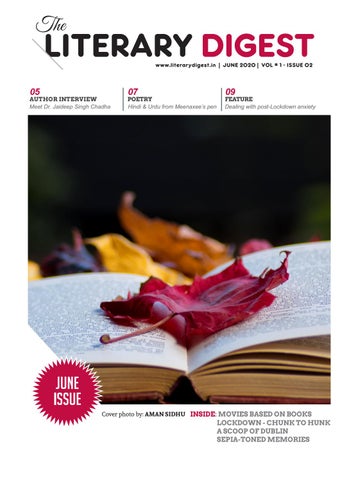
LITERARY DIGEST www.literarydigest.in | JUNE 2020 | VOL # 1 - ISSUE 02
05
07
09
AUTHOR INTERVIEW Meet Dr. Jaideep Singh Chadha
POETRY Hindi & Urdu from Meenaxee’s pen
FEATURE Dealing with post-Lockdown anxiety
JUNE ISSUE Cover photo by: AMAN SIDHU INSIDE: MOVIES BASED ON BOOKS
LOCKDOWN - CHUNK TO HUNK A SCOOP OF DUBLIN SEPIA-TONED MEMORIES
CONTENTS 03 What our readers had to say?
11 Sepia toned memories
05 Author Interview
12 Chunk or a Hunk
07 Meenaxee Raj’s exquisite poetry
14 Punjabi@
08
16
The WHAT-Pad Understanding Firearms.....
Poetree
10
17
What the fear?
Covid 19 & Fashion
18 A scoop of Dublin.....
All the opinions and views expressed in the articles stories/features etc., belong to their respective authors and DO NOT reect the views of the Literary Digest or Intyoutive Ventures. Any Brand/Movie/Publishing House names mentioned in the magazine are ONLY used for representational purposes and the copyright/trademark is the property of their respective owners. The brands, if and where mentioned/used are not associated with us in any manner. All disputes are subject to the exclusive jurisdiction of the Courts/Forums/Tribunals in Chandigarh (India) only. The Literary Digest is an online publication of Intyoutive Ventures. Any content of this publication may NOT be reproduced duplicated, republished or featured (in any form) without seeking prior consent and written permission of Intyoutive Ventures. Intyoutive Ventures reserves the right to accept or reject submitted articles/features/poems etc.
What our readers had to say? We are overwhelmed with the response that we received for our inaugural issue. Many of you called, messaged, emailed and told us how much you loved our magazine. Thank you all very much for your support. We promise to try and exceed your expectations.....always!! Saguna Jain / Hardeep S. Chandpuri / Shona Singh Co-Founders
NEENA SINGH Social Entrepreneur, Poet & Former Banker
Congratulations to the Founder-Editors for such a power-packed Literary Digest. The presentation is crisp & beautiful. Thoroughly enjoyed reading all the articles and features. I hope the quality will be maintained in the future and this Digest will ďŹ ll an existing lacuna in the literary world.
NISHTHA SHUKLA ANAND Director - Shoolini University Founder - TechThirsty.com
Kudos on the inaugural edition of the Literary Digest! The art of the written word seems to be fading, so this step is much needed. It was crisp, so well curated and perfectly edited. Do continue your efforts to encourage native writers, so literature has a much larger impact on society.
Aruti Nayyar HIMANI GALHOTRA TEWARI Founder Touchstone Interiors
The content of the magazine seems so genuine that I do not want to miss on any of the next issues. Seems that in the making of this magazine, you have taken a community of like-minded people and created a family. Would always like to be a part of it as your loyal reader. Wishing you the best blessings in life.
G S AUJLA Former DGP (Punjab)
Congratulations on your very welcome initiative of starting The Literary Digest. The triumvirate of Hardeep, Saguna & Shona have a lot of potential and talent to raise the bar with every issue. Like all your endeavours this is going to be another feather in your cap. We shall be eagerly looking forward to it from month to month.
3 LITERARY DIGEST / June 2020
MANDEEP CAUR
NAVEEN SONI
JYOTSNA M.
MANDEEP RAI
Head-Quality & Experience eduVelocity Global
Celebrated Author & Former IRS officer
Vice-President Leading Telecom Co.
Chartered Accountant
The Literary Digest is an intelligent, informative, interesting magazine & has something for everyone - of all ages. I thoroughly enjoyed going through it and am looking forward to the next issue. I am also very confident that they will continue to serve us with unique content as they have showcased in the debut issue. Upwards & Onwards.
The Literary Digest has come as a much-needed breath of fresh air. The brilliant trio of Saguna, Hardeep & Shona have a passion to break new ground in the encouragement and appreciation of the ‘written word’. There is a magical effect on each page of the inaugural edition which draws in the reader, setting the spirits soaring. They have broken new ground and I am confident they will make a mark & get a much wider readership.
The Founders of the magazine have embraced the digital platform & launched this wonderful initiative by weaving together various genres. Really appreciate the Team’s effort for putting this excellent e-mag together in no time. And my special wishes to the emerging writing talent who are able to express themselves so eloquently, at such a young age. Look forward to the next edition, hopefully with some multimedia content.
I think the team of Literary Digest has worked tirelessly for quite sometime in creating content that will fill the void that was waiting to be filled for a very long time. We are living in a world, in which we are bombarded with irrelevant content, so reading this Digest was a sight for sore eyes. We hope that more young writers join the bandwagon and the experienced ones can also mentor them.
The Founders Saguna Jain started her career with Times of India way back in 1992 but soon moved to Chandigarh where she started teaching journalism in the Deptt of Mass Communication, Panjab University. Went on to own and manage the first event management company in the ‘City Beautiful’ called Event it Right! Then she turned a consultant for events, business development & media. Fundamentals Consultancy Group, her consultancy firm in association with her new venture Intyoutive, that she is a partner in, works on three verticals - design and publish in-house magazines, offer consultancy to start ups and organise literary workshops and events. Daily post, one of the newspapers that she was a consultant with carried her weekly column on parenting for over five years. A mother to two boys, aged 23 and 20, Saguna is an ardent golfer and believes in the simple mantra - we all live and learn!!! Hardeep Singh Chandpuri is a media professional with a keen interest in the ‘written word’ and started writing weekly columns for ‘The Tribune’, called ‘Popthrob’ and ‘Jukebox’ while still in college, which were a huge hit with the youth. He completed his Masters in Mass Communication from Panjab University, Chandigarh. After studying in Australia, USA & Canada, he moved back to India in 2001 and started ‘Radio Buzz’ in the year 2002. He is a renowned broadcaster and trainer having hosted more than 8000 radio shows in India and abroad. He is often credited for revolutionising the radio scene in North India. A proud Limca Record Holder, for his brand ‘Academy of Broadcasting’ he is also the Founder of Ferntree Publishing, the Gen Secy of Chandigarh Literary Society and co-Founder of Inkspire. He is also jointly launching a print magazine this year.
Shona Singh is a Masters in Journalism from the University of Westminster, London and also a holder of a Diploma in Freelance Journalism from UK. She did her schooling from Convent of Jesus and Mary, Shimla. She has had an exceptional career in media, starting out with the Indian Express and as a golf columnist for the Financial Express, New Delhi and is currently a special golf correspondent for The Tribune. An experienced golfer and a regular contributor to Golf Digest, she also extensively covered golf in Europe for the Golfing Yours. Her passion for writing and golf also led to regular contributions while travelling on the Asian Tour. A Press Officer at the IMG run Indian Open and BILT Open, India's biggest professional golf tournaments, she used her vast experience to set up the media office of the players’ initiated Professional Golf Tour of India.
How a
GHOST
?
forced me to write my rst book
I
was born into a nomadic army family, and groomed to be a sportsman. Destiny drafted me into Medicine and later into English literature. My father was posted to a new city every three years. Despite being a rolling stone, I gathered enough moss as a sportsman. I excelled in Badminton where I basked in the limelight by winning tournaments, reaching national levels and dabbled in many more games. Studies were not a priority for me. I realized that to excel in any field one has to be in love with himself and his chosen work. By that definition, one has to be a narcissist. I was one too. I thanked God constantly for creating me and I thanked myself for creating my books and the way I played my game. I was in love with my work. I had to be if I had to get it published and pass it on to my readers. In my eyes, only I could do what I did. Other authors wrote as best as they could. But, I limited my narcissism. We are all different. There is an incident where I was sitting with my father in the balcony of our flat in Kanpur. My father espied a lonely buffalo sitting in the middle of the road and chewing cud with single-minded dedication, not bothered about the heavy traffic that was passing all around it. My father said, "You know there is no difference between you and that animal." I was young and at that age one takes umbrage to issues very quickly. So I asked him about the comparison. He informed me that he was spending a lot of money on my education. Instead of concentrating on my studies, I was whiling my time on badminton, cricket and marbles! I was an educated ‘bewakoof’ (idiot) while the buffalo was an uneducated ‘bewakoof’. Some things hit you in the solar plexus. This sentence did, hard, and I did not even realize it. But I began to read any and every book that had the temerity to cross my nose. I did not give up badminton though. Breezing through school and intermediate college, I landed in IG Medical College, Shimla. After passing through MBBS and winning the Himachal Badminton Championships, I ended up as the Captain of the Himachal State and the Himachal University teams. I did my MD in Internal Medicine from PGI, Chandigarh and soon left for Nigeria to work as a Senior Medical Officer in Kwara State College of Technology, Ilorin.
What were the books/authors that influenced you? After the ‘buffalo’ incident, the first books I read were ‘The King's General’ and ‘Rebecca’ by Daphne Du Maurier and all books by Leon Uris, Wilbur Smith, Dominique Lapierre and Larry Collins. And of course PG Wodehouse. I was convinced that his style and humour was matchless. I also met Sardar Khushwant Singh on many occasions and found him an interesting person. In fact he mentioned me in The Tribune in an article titled ‘Human Bulldozer’. That article, along with President George Bush Sr's letter of appreciation for my book ‘The Other Side of Golf’ remain my all-time favourite treasures.
How was the transition from being a Doctor to an author? All this while, I carried on reading compulsively. I just had to read. It was an obsession. One day, the inevitable happened. A voice inside me said that I had read enough books and I was ready to write my own. Around that time, I had my first encounter with a ghost. My classmate and dear friend Dr Davinder Singh died in an accident. His ghost latched on to
Tell us about your other books? ‘Vinculum’ published in 1991 went into the second edition, each run being 2000 books. Everyone loved it. By then, I had studied the game of golf very closely and saw the level of chicanery in a so called Gentleman's game. I was angry but then humour can be generated out of anger. Thus, ‘The Other of Golf’, was born, as a humorous book. A copy was sent to President George Bush Sr. He was fighting the Gulf
Dr. Jaideep Singh Chadha
me and wanted me to write his story. Wrong Choice, I said. My last and only effort at creative writing was an essay titled ‘A Rainy Day’. In medical college, it got restricted to sentences like ‘Patient came with pain in chest. ECG did not reveal any cardiac event.’ But the ghost persisted in it's choice of it's biographer. It did not let me sleep for seven years till the book was completed. I succumbed and since there were no computers at that time, I had to type and retype the manuscript repeatedly. I completed ‘Vinculum’, a story of four adolescents and their journey through a place as fascinating as a medical college in an environment as romantic as the ‘Queen of the Hills’, Shimla. In return he gave me the gift of writing. Once the book was out, the ghost never ever bothered me. I churned out book after book on a yearly basis, though there was a gap of 16 years between ‘Vinculum’ and my next book. There was no transition from one profession to another because I continued my medical practice, as I kept reading and writing and launching my books. I still practice medicine despite falling prey to diseases and multiple interventions and visits to the ICU .
LITERARY DIGEST / June 2020
war from his golf cart. His letter of appreciation is my prized possession. I had also coined an abbreviation for Golf Geriatic Organization of the Lame and Feeble. Your biggest success has been ‘Please Mom! It's my Life’, Tell us something about it? Since I had a general practice, I got an opportunity to see all kinds of patients. A large segment was children. Mothers of young children always had their own unique set of complaints against their wards. A consultation of ten minutes would go on for 30-45 minutes. The complaints were mainly against unacceptable behaviour and revolt. At that time, I was also the Medical Officer for GBA Asia Ltd, a German company making knitting needles. The Vice-President of the HR department came to me one day and said, “Doc, my boys know everything about making knitting needles and nothing about life. Kindly take lectures for them and teach them what life is all about." So I started taking batches of 50 workers and soon realized that what I was telling children and what I was telling the workers was almost the same. Greed crept in and I wanted to reach more people. So I put everything in a book form. The publisher loved it. Soon I was getting letters from all over the country, from children as small as nine years old to Principals of convent schools, even Doon School, Dehradun. I wasn't aware but the publisher had sold the rights to another publishing house for the book to be translated into Marathi. Then I received a letter from Eduardo, a young boy of 18, from Mexico. He had read the Spanish translation. At that point of time, he confessed that he was contemplating suicide. He had changed his decision and wanted to be my Facebook friend! There were other younger children, who said that I had changed their lives, while others felt this was the best book ever and still others wanted me to write more books of this kind! The book ‘Please Mom! It's my Life’ has gone through many more editions. The 8th edition has just been published but been held back because of the corona pandemic. Each edition has three or four new chapters on popular demand. The latest edition has chapters on Sam Cawthorn, Inspector Ram Dayal, who are an inspiration for children. Otherwise the book has many stories appealing to parents and grandparents. Some grandmothers took copies abroad saying they wanted their grandchildren to read about Indian culture and traditions. Some Merchant Navy Captains also took the book for their ship's library. There is a chapter on Nation First, Rape and Molestation in the eight Edition, since I felt that the readers were maturing and they needed to know more about life. Another title for the book could have been Understanding life at the right time. Why do all your books have Chandigarh as the setting? All my books have Chandigarh as the setting, because this is where I grew up and I am very familiar with the environment. Though ‘Bashir’ was basically conceptualized in Chandigarh, I did go into unknown territory of Kashmir, POK, Amritsar etc. ‘Why are we like this only?’ goes through Kanpur, Jabalpur and Chandigarh, cities my father was posted in. ‘From the
Window of Gelato’ is based purely in Chandigarh because the book is about real stories generated from this ice cream parlour.
How was the support from family and friends? I have been very lucky for the support I got from my family and friends. Even my mother would not interfere knowing how much time I was spending on the computer and the expenditure. Not every author rakes in the moolah. I believe people like Shobha De and Chetan Bhagat do. My wife helped a lot in editing and going through my books. I don't know what she thought about them, but after reading ‘Bashir’, she wrote excellent, and mind you she is the Principal of a large Public School in Chandigarh. My friends were some thing else. All my books were discussed in the coffee shop, ideas exchanged, scenes and dialogues changed and so on. How do you balance work, home and writing? Most writers do not have the luxury of being full-time professional writers for they have to earn a living too. In the Indian scenario, writing is more of a hobby. It does become difficult at times to work, write and look after the home, but if you are like me who has been blessed with 36 hour days, then there is no problem.
2
MEENAXEE RAJ
1 4
3
Meenaxee Raj is an officer with the Haryana Administrative Services, presently posted as Joint Transport Commissioner and Chief Vigilance Officer, HAFED, Haryana. She has previously been a judge in Haryana and Rajasthan for about three years. She pursued her BA (Hons) Sociology from Govt College for Girls, Sector 11, Chandigarh and LLB from Delhi University. She has been the only woman SDM of Ferozepur Jhirka, a remote sub-division of Mewat. Besides, she has served the Education Department Haryana as Joint Director, Joint Secretary to the Governor and Joint Director Urban Local Bodies, Haryana. She is the youngest civil servant in the country to have been a member of a Govt of India Committee along with sitting High Court judges. The Committee gave its recommendations to Govt of India on international parental child abduction, an issue of imminent international relevance. She has an Urdu poetry book to her credit in the name of ‘Paighaam-e-Sukhan’, which was released in 2017 by Hon’ble Justice Anil R Dave (Retd Judge-Supreme Court of India).
7
UNDERSTANDING FIREARMS FOR UPCOMING WRITERS
What is a Pistol?
I
t is a handgun that uses one or more stationary chambers (the round space inside a gun where the cartridge sits waiting to be fired). Types: Single-shot Semi-automatic Fully automatic (sometimes called Machine Pistols) Fiction writers seem to possess some affinity for the above, and that’s why in this issue of Literary Digest, we thought that we should educate our wannabe writers to their correct usage. Most of us confuse Pistols with Revolvers, but it is very important to understand that the Pistol has no relation whatsoever with the Revolver. However, another word that can get you by in the world of writing is Handgun which can be interpolated in place of Pistol. We have to keep ourselves clear in the mind that Pistol ammunition is always stored in a detachable magazine that slips in and out of the Handle or the Grip. Sometimes people call it the ‘Clip’, but the correct word is ‘Magazine’. We have to understand that the function of a ‘Clip’ is to bundle ammunition together for insertion into the ‘Magazine’. A ‘Magazine’ is a particular area that holds ammunition and is either detachable or built into a firearm. A semi-automatic Pistol simultaneously ejects and reloads one shell after each shot. When writing, you’ll most likely want to use one of the two semi-auto actions, kindly go through them carefully:
Inaccurate Example: “You’re going to tell me what I need to know right now,” said Sumit Wadhera. He popped a fresh ‘clip’ into the business end of his Glock and aimed at Private Investigator, Vishesh Sood. “When you get to be my age, hindsight is fifty-fifty,” remarked Sood, the pistol barrel only inches away. “I have no idea
where are your papers.” Wadhera cocked the hammer on the Glock. “I saw you go through my dirty clothes at the Laundromat,” he said.“I was searching for evidence. And some money. But I didn’t take your papers, you %$#@,” Sood said. Meanwhile, Wadhera switched the Pistol’s safety off with his thumb.“This is your last chance before I blow your brains out,” he thundered. Accurate Example: “You’re going to tell me what I need to know right now,” said Sumit Wadhera. He popped a fresh ‘magazine’ into the grip of his Glock and aimed at Private Investigator, Vishesh Sood. “When you get to be my age, hindsight is fifty-fifty,” said Sood, into the Pistol barrel, only inches away. “I have no idea where you lost your papers.” Wadhera racked the slide on the Glock. “I saw you go
The
WHAT-PAD
through my dirty clothes at the Laundromat,” he said.“I was searching for evidence. And some money. But I didn’t take your damn papers, you %$#@,” Sood said. Wadhera pressed the barrel into Sood’s nostril, indenting the detective’s peach-like nose.“This is your last chance before I blow your brains out,” he thundered. Where did we wrong? Let’s go through this one chronologically. Sumit popped a “fresh clip” into the Glock in the inaccurate example. We need to understand that Semiautomatic Pistols use detachable magazines, not Clips. He also inserted the clip into the “business end” of the Pistol which is a slang term for the barrel. Sumit should have stuck the Magazine into the handle/grip instead. Usually, some Pistols have external hammers that a shooter would cock, but Glocks do not. They also don’t possess safety switches. Also, Glock is sometimes used as a generic term to describe any modern semi-automatic Pistol. Please don’t do that. Glock is a specific brand that offers unique Pistols. Sumit’s process of loading the Glock in the corrected version is a great example of how to get most semi-automatic Pistols ready. Put a magazine in and rack the slider, then pull the trigger when ready to shoot. A bit of research ahead of time would’ve taken care of those aviodable errors. So always remember, as a writer, it is very important to do in-depth research; otherwise, one can end up making a fool of oneself in front of our well-informed readers.
Dealing with Post-Lockdown
W
orld over, March 2020 became synonymous with certain terms people weren't familiar with-pandemic, panic buying, COVID-19, lockdown, quarantine and social distancing, just to name a few. Uncertainty gripped the nations and it all seemed like a blur. The blaring news of rising COVID positive cases in the background added to the mayhem and didn't make it easy for anyone to calm down and organize their thoughts. Surprisingly, we all adapted rather quickly to this humongous change and while the earth was busy reclaiming itself, we took to technology to resolve most of our problems, whether these were related to the problem of buying groceries, keeping kids busy with online classes or switching to the 'work from home' mode. But now, as the lockdown begins to ease in most countries, it has been quite unsettling for many to even imagine how life after lockdown would feel like. Psychologists report of people experiencing a new kind of anxiety called the “Post-Lockdown Anxiety”, which they define as the fear or worry of returning to normal life after lockdown. What would the 'new normal' look like? Will it be easy to adjust to the new normal? Will it come with the assurance of safety for us? The Post-Lockdown Anxiety is a real thing as the economic slow-down and fear of health crisis looms large when we think about stepping outside the safety of our homes. More than ever, the time is NOW to make our resolve for sound mental health even more firm. Try these tips to deal with the Post-Lockdown Anxiety: Dismiss the Denial: Begin by accepting that we are all living in tough times and feeling worried and anxious is completely normal. Accept the fact that wearing a mask and sanitizing regularly are a new normal. Denying these realities will only delay the calmness and peace you've been seeking. Live in the Now: Instead of ruminating about your future or feeling overwhelmed and drained because of uncertainty, focus on living mindfully each day. Take it one day at a time.
Anxiety Remember, you have successfully managed to overcome so far, this too shall pass. Take a break from the News: Staying constantly exposed to grim news of rising coronavirus cases isn't going to make things any better. Limit your intake of news and statistics related to COVID-19. Get your updates from reliable news sources about once or twice a day and stave off discussions related to it on whatsapp groups or calls. Control your negative thoughts: Your incessant apprehensions pertaining to the pandemic haven't been able to stop it. So why not be kinder to yourselves by avoiding getting into the rabbit hole of negative thoughts. Cope with it: Engage your mind in thinking which positive coping strategy would work best for you. Exercising, adopting a hobby, journaling your thoughts, eating healthy and getting proper sleep have proven benefits as far as managing emotions is concerned. Seek help: If anxiety persists despite your efforts to get rid of it, speak about what bothers you to a family member or a close friend. Don't keep your feelings bottled up. Consult a professional or a therapist in case nothing works. Human beings have been blessed with this beautiful attribute called resilience. From time immemorial, it has helped us cope with floods, tsunamis, earthquakes, bereavement and other traumas. Pandemics are no exception. Maya Angelou must have referred to resilience in her famous quote, which is also the title of her book, “And still I rise”. This is the time to develop resilience, to cope relentlessly and to emerge stronger than ever.
Contributed by:
ADITI AHLUWALIA Psychologist and Counsellor
What the Fear...??
F
or over three months, we all have been living a life dictated by fear. Fear of stepping out of our homes, fear of eating out, fear of other humans. A certain amount of fear is advised, for it is the fear of the unknown that keeps us from running amok and maintains our sanity. As important it is for one to fear the unknown, it is equally important to face that fear and dive into it headfirst. Be it Christopher Columbus, Francis Drake or Vasco Da Gama, they sailed into the unknown (literally) and emerged from the depths as legends. We too find ourselves in a similar spot. None of us know what the future has in store for us but, is that really a bad thing? There is a certain excitement in not knowing what lies ahead. It gives us that much more opportunity to make a future more acceptable to us. The coronavirus has offered all of us a remarkable opportunity to reassess our life goals. It has given us that chance to realise what it is that one really expects of their lives and are they close to LITERARY DIGEST / June 2020
that expectation. If the answer is yes, then one can continue the same as before while implementing the learnings acquired in these past months. If the answer is no, then you are one of the lucky ones. You have been presented with a unique gift in the form a second chance. You can start afresh and live a life dictated by your terms and your terms alone, doing what you love every single day. As the age old adage goes, 'Do what you love… love what you do.' Sure you might fail. If you do, the only thing you can do is pick yourself up and try again. As Thomas Edison said, when asked about his failed attempts to make the light bulb, “I didn't fail 1000 times, I learned 999 ways how not to make a light bulb.” With that kind of attitude, failure is not an option. This takes us back to the start. The fear of the unknown. The explorers did not know what lay ahead of them, Thomas Edison had no way of knowing if his inventions would be successful. They however took that leap of faith, faced their fears and drowned out all the
naysayers. The rest is history (literally). The coronavirus pandemic is behind us. We need to get on with our lives. The ball now lies in our court; do we go back to our old life, which is absolutely alright to do, or do you live the first day of your new life where the first order of business is your happiness. One lifetime is too short to be filled with sorrow and regret. As Robert Frost so eloquently puts it, “Two roads diverged in a wood and I took the one less travelled by, and that has made all the difference.” So make that leap into the unknown, take the road not taken and see the difference that it makes.
Contributed by:
MANAN JAIN Student at ULIS Panjab University, Chandigarh
sepia-toned
Memories Photos provided by writer
P
hotographs play an important role in everyone's life. But very few people value them while others permanently dump them in worn-out trunks. The sad part is, people do not share them with their near and dear ones. I am a Genealogist and often come across different natured relatives. Some voluntarily show me their albums and help me to record them in my family tree. But there are also other relatives, who do not share family pictures. A close friend working on a project needed photographs of relatives, but has not succeeded as yet. The only answer she gets in response to her request is that its very hot now or it’s very cold. There are also many like me who are very prompt. Photos connect us to our past, they remind us of people, places, feelings, and stories. They tell a lot about who we are. Photos give insight into the time when they were clicked. In the fifties, the size of photographs was very small then slowly the size increased. In the early eighties, coloured photographs were developed and they attained the zenith. Now again winds have changed direction towards black and white photographs. The older the photograph, more its value. The first reason why we think you should make time for family pictures is that you only see their true value, if they get destroyed or if there is a death in the family. Secondly, family portraits boost your children's self-esteem! Through them children can go back in time and see what their grandparents looked like when they were young. Family photos connect us to those who came before. By letting your kids see your photos from the past and the
present, they form a connection to their own story. They get to know about family members and ancestors who came before them and helped shape the world and the persons they are today. My grandmother expired at a very young age. And she left our family yearning for her picture. Our family studio which had a collection of our family photographs, had by then shifted to Delhi. But my uncle went all the way to Delhi in the late sixties, traced the Studio and got back some photos that we value to this day. This is the true love for photos. With photography being such a powerful tool in the world today, you have the opportunity to capture wonderful family portraits and relive them all throughout your future. When it comes to the love of your family, there is certainly nothing more important than always remembering the bond and excitement that you share with one another. I appreciate those who have adorned their house walls with ancestors’ photographs rather than those of horses or sceneries. There are people who feel saddened when they see old pictures or are reminded of some unpleasant times. However, overall pictures are so interesting and help one connect to near and dear ones and fill the void left by someone's departure from this world.
By:
OPINDER K. SEKHON (Historian, Writer & Masters Athlete Winner 100m, 200m, Shot-Put, Discus Throw) 11 LITERARY DIGEST / June 2020
Post-Lockdown a
CHUNK
or a
hunk
Fitness is the new high. Two kinds of people have emerged from the lockdown. Those who completely chilled out and gave in to every temptation and craving, as they indulged in cooking, baking and drinking and others who seem to have forgotten the lockdown was a way to slow down as they posted videos of one feat after another. But there is always a happy medium and Raghav Lohia, fitness professional, takes us down that path.
What is functional training? And why is it necessary? Everywhere you go, you are bombarded with the word functional training, be it gymnasiums or some fitness and wellness centres. Formed by two words - functional meaning practical and of everyday use, training meaning the action of teaching. When you convert your everyday activates like picking up heavy objects, sitting down, climbing stairs or even jumping into an efficient form of workout, you call it functional training. Of course, the objects under training will be different like kettle bells and barbells to vary the loads, but the objective is always the same. To perform movements, which are multi-joint (using more than one joint in the body) and from the core to extremity (engaging the muscles of core to their potential). Any sort of physical training is a necessity but there is an advantage that you get with functional training. 1. You are training your body in a way it’s supposed to move. 2. Your entire body gets to reap the benefits and you don’t have to work on different parts on a specific day. 3. It’s more beneficial since your body is able to provide a better metabolic response because
multiple muscles are involved at the same time. 4. You engage more muscles and as a result you burn more calories. 5. You can lift heavy weights and that feels good. 6. You don’t have to stick to a specific regimen (like body building), you can tweak the workouts and get the most out of your training. What is that one factor that sets you apart from the rest who are into functional training? If the intensity of the workout is good enough and you take optimum rests, your workout won’t last more than an hour. That one hour is what you need to get the most out of your strength training and conditioning workout. And each one of us is capable of doing that. But as far as overall health is concerned you are left with 23 more hours in your day and if you deduct seven to eight hours of sleep you are still left with 15 hours in which your choices depict the results you will obtain. By choices, I mean the quality and quantity of food that you eat. Your choice of food are the deciding factor in your overall health and physique. And if you are hogging on food then you are missing out on the most important part of the workout. Why is there no point of training
if you don’t have an optimum nutrition? We are well aware of the fact that grinding our body in the workout leads to muscle breakdown and to repair those muscles we need fuel and the quality of the fuel depicts how well you repair the broken down muscles.The main nutrient that helps in building up muscles is proteins. If the quantity of the proteins is not adequate then you might end up losing muscle. Loss of muscle means decrease in the metabolic rate. Decrease in the metabolic rate results in decrease in the total daily energy consumption there by leading to decrease in the amount of calories burned therefore decrease in the fat loss. And you might end up gaining fat which was not the result you desired. Protein is not the only factor determining your physical results. There are two other macro nutrients too which play a major role in your diet. And those are carbohydrates and fats. Their quality and quantity matters a lot. Carbohydrates help in providing energy to the body and fats help in insulating the organs from outside temperatures. Each of these nutrients help in the normal functioning for the body and hence we cannot give priority to one.
Fat is also the carrier of Vitamins A, D, E and K and also provides energy for long duration aerobic activities (half marathons, marathon etc). Each of these nutrients helps in the normal functioning of the body and hence we cannot give priority to one against the other. You might say, “Since my goal is only to gain lean muscle mass, why don’t I increase the quantity of protein and decrease the quantities of carbohydrates and fats?" And my answer would be as per mathematics, it would be totally valid. But our bodies are very intelligent. They convert the excess into usable forms of energy. Let’s say you had 50 grams of extra proteins in one day, our body converts that extra protein into glucose by a process called as ‘Gluconeogenesis’ and puts it into use. This also means that you cannot gain extra muscle by eating extra proteins. That’s the reason you hear experienced trainers telling you to stay consistent all the time, be it in your workouts or your diet because those consistent efforts will get you the results. Those small efforts that you make everyday are the chisel that helps in carving out your desired body. And this also means that those 4-6 week plans present out there are a fad because your body needs some time to adapt to a new routine, similar to running a new vehicle at an average speed for a few days then ramping up the performance slowly and steadily. Most people have been following a bad diet routine for most of their life - say from when they were 15-20 years old. Yet they go to the gym and expect to shed
that excess fat in 4-6 weeks. Then only God can help you because trainers can’t perform such miracles. What to do in order to get maximum benefits out of your functional training Program? First and foremost, choose a good nutrition plan. And if you have a physical trainer ask him or her for some suggestions regarding the changes you can make in your diet structure, so that you recover fast and are prepared to nail the next session. Start small: meaning always start with changing one small thing in your diet, like cutting sugar in your morning tea and once you are able to manage that successfully then add another change. This change might seem negligible, but trust me the compounding effects will be exponential. And once you have your diet on point then the only thing that you need to focus on is your workouts and achieve your goals. In conclusion... Whatever workout you choose the visible effects will only be noticeable once you get your diet on point. After all, we are what we eat. The foods we consume are the major source of how we feel throughout the day. Yes, your workout will make you feel good but in order to enhance that feeling add a little extra dose of good food and you are all set on the path to looking good and feeling more confident. One of the most important lessons you can learn is that your body did a lot of hard work to save that excess fat and keep you functioning, even though you had crazy amounts of unhealthy food (processed, junk, artificial
sugars). So to change it, you have to let your body adapt to the new regime (good food choices and workouts) and that takes time. You might be able to shed fat in those 4-6 weeks but your body is more comfortable with the old you and it will do everything to get you, where you were before (unhealthy and stressed). So by small consistent efforts you are challenging your body to change. And change always takes time. You will have a lot of relapses but ultimately you will achieve what you set to achieve. And functional training might be the key to ramp up that adaptation process.
Raghav is a former engineer turned Crossfit Trainer. He is fascinated with training people and athletes to make them strong.
13
ਪੰਜਾਬੀ
@
Rupinder Singh Aulakh is a Design Engineer based in Seattle (USA). He calls himself an ardent observer and art enthusiast. He firmly believes that art saves us from our own negativity and acts as a mode of absorption and contentment. His passions include writing, and promoting punjabi culture through creative photography and Punjabi calligraphy.
14 LITERARY DIGEST / June 2020
MOVIESYOU THOUGHT WERE NOT BASED ON
BOOKS
Bruce Willis’ high-octane action film is based on the book ‘Nothing Lasts Forever’ which was a sequel to ‘The Detective’, and made into a 1966 movie starring Frank Sinatra. They made a few changes to the story, so it wouldn't clash with the original movie and in doing that they changed the main character's name from Joe Leland, to John McClane. Not many people knew about the novel ‘Forrest Gump’ till it became the hugely successful, Oscarwinning movie. It was also pretty different. In the book by Winston Groom, Forrest uses profound language, and the author originally wanted him to be played by John Goodman. Closer home in Bollywood, even Aamir Khan is making its Hindi version. Robin Williams won hearts and admiration in the highly awaited film adaptation of Madame Doubtfire. The movie follows Anne Fine's young adult novel ‘Madame Doubtfire’ pretty closely – with one important exception. In the book, the two eldest children immediately recognise their new nanny as their father in disguise. Only their younger sister and mother are convinced it's actually Madame Doubtfire. We will agree that the ‘Master of Chill’ - Alfred Hitchcock's movie is without a doubt the most famous iteration of ‘Psycho’, Robert Bloch's novel was actually the original. Its said to have been based on the crimes of serial killer Ed Gein. ‘Psycho’ is now considered one of Hitchcock's best films and praised as a major work of cinematic art by international film critics and scholars.
Touted as one of the best tales based to have come out of World War II, ‘The Bridge Over the River Kwai’ by Pierre Boulle is a fictional tale remembered by all and sundry. The bridge is fictional, but after the Academy Award winning film’s release, tourists flocked Thailand to see the one used for shooting , causing major problems for the Thai people. However, the film was mostly shot in Sri Lanka. The names of the movies & books are used for representational purposes only.
How must I go? There's nary a way to still a tide, nor a way to shush the seas. Not for men to straddle stars, nor Gods to foster peace. But there's many a way to stem a breath. So many a way to die. Were it that the haughty heavens, would have me cast the die. Would I be slain, by the misty moon, sheathed in pain, and charred by night. Scarred by the silence of a loveless sky. Or stung by the loss of a lover's sigh, an empty caress to nurse at night. Braided by breath, yet barred by life. Perchance the sea would steal my eyes, for coveting a wave; soak my breath and sweep it away. The skin would sink, but the heart wouldn't shy. For it knew, not a way to live, but found a way to die.
16
POETREE Divya Bansal is a spiritual counsellor who guides with Tarot Cards, Psychic Healing, NLP, Various Medita ion Techniques. She expresses herself by wri ing ar icles and poems, pain ing and community service ac ivi ies.
Riju Mehta is a personal finance journalist working with the Economic Times Wealth. She has a passion for poetry and cooking, and has been an avid traveller. She has earlier worked with India Today and The Indian Express.
तलाश िदल का हाल जो करदे बयान, वो श
कह से लाऊ ँ ,
करदे तेरे करीब मुझे जो, वो शाम कह से लाऊ ँ , िबन पीये तो हो जाए तेरा नशा, ऐसा वो जाम कह से लाऊ ँ , िमल जाए तेरी बाह क प ा, तुझ जैसी वो मूरत कह से लाऊ ँ , पूरी करदे जो तू मेरी अनंत क
ास,
ऐसा वो िनमल जल कह से लाऊ ँ , मेरी आ ँ ख से जो बह जाए ँ मोती, वो ऐसी तेरी ीत कह से लाऊ ँ , एक बात तो बता... इतना जो म चाँ तुझको
ारे,
ारे म तुझको कह से लाऊ ँ
Impact of Covid-19 see a serious impact on the global economy, on not to mention the furloughing or
F T
he Covid-19 pandemic has had a colossal effect on almost every i n d u s t r y, w h e t h e r t h a t b e unprecedented pressure on health services, non-essential businesses shuttering, or supermarkets needing to consider their restocking tactics and opening hours. And so, it follows that the fashion industry has also been experiencing the effects of a global health crisis. Though it has been dismissed as frivolous - if compared directly with the front line service industries fighting to keep people alive and fed - the fashion industry is both a creative ‘Mecca’ and one of the world's most significant fiscal heav y weights. Time seems to be suspended, and all the main design events have been postponed, but collaborations are still going on, even if they’ve been reorganized to suit more digital conditions. The fashion industry's deterioration would
unemployment status of millions of artists, designers, seamstresses and more. Necessity is the mother of invention, new habits are already being put to test and these are the times when designers should come together as a unit under the fashion fraternity and create an ecosphere of cooperation rather than competition. Artists and designers tend to traffic in creativity, and there’s no greater opportunity to be creative than in a crisis. It’s a unique time to think about how conceptual design can be seen as more than “just a rendering”, to reconsider, re-plan, reinvent, strategize, audit, and restart. It also gives an opportunity for the designers to completely wipe the slate clean and ask themselves “What can be done differently and better than what they’ve ever done before?” It is the break that we’ve got to reconcile with nature and think of more sustainable ways of working and living. It is a time that will go down in history. It is a time to become more sensitive to the planet, make changes and become more relevant. It is time to share and care on a planet that we are just visitors on. It is “time” that we all suddenly have! It’s time for change; it’s time to make a difference.
By: NIRBANI
SODHI
Student - Fashion and Lifestyle Accessory Design NIFT, New Delhi LITERARY DIGEST / June 2020
H
olding my passport in one hand and a tiny bag in the other, I stepped out of Dublin International Airport. Looking around like a lost puppy, I eventually dragged myself to the nearest taxi stand. Like any busy city, one can opt for rented cars or buses, from the comfort of the cozy airport. Finally leaning back into the leather seat in my high-end BMW taxi, (yes that’s quite normal here) I looked out across the evergreen shrubs and trees. The main city is about 35 minutes from the Airport and the traffic is quite a menace especially during the rush hours. As we negotiated it, my well groomed, silver haired driver with impeccable English told me all about the city and the places that I should visit during my stay here.
A SCOOP OF DUBLIN
The Temple Bar
with sprinkles of Limerick!
After shelling out 26 euros for the ride, I made my way into a little boutique hotel ‘Kilronan House’. Right in the heart of the city with everything at a walkable distance, it offers rooms at various prices. Cheaper ones with an option of shared bathrooms or the normal ones ranging between 55 to 80 euros. That is the norm here and works pretty well for travellers. After settling down in my pretty little room, off to explore Dublin. The city is encircled with low rise buildings and houses, so one does not find a lot of skyscrapers. Greater part of the city was built during the British era and looks absolutely breathtaking thanks to the
slanting roofs and dreamy windows. A few of the houses have been converted into offices while some into restaurants or bars. But the most attractive thing about this place are the fancy doors that are painted in red, green, yellow and other vibrant colours. They add so much character and life into the city. Walking around the town, I stumbled upon my first bar, completely crowded since it was a Friday night. So after a lot of excuse me's and sorry’s as I made my way to the bar, I ordered my first glass of the famous Irish Whiskey, Bush Mills Black Bush. The construction is quite old, more like an ancient
courtroom converted into a bar, the sparkling lights and the decor definitely added a magical touch to the setting. Bustling music and the vibrant crowd set my mood for the evening and soon I walked out of Dublin House and continued scouting for more. The transport system is pretty efficient. Taxis, buses and the tram system are all very well-organised and quite economical. The tram system runs within the city and helps you reach anywhere and everywhere in no time. My next stop was the ‘Jervis Shopping Centre’. Built in the form of a palace, once inside you are transported into a heaven of international brands and fine dining. Figuring my way through
the Mall, I bought a little snow globe as a souvenir and carried on. Since I wanted to explore the area named ‘Temple Bar’, quite ironic as the name goes, I walked for about 25 minutes and I was in the land of beers and music. Thorugh a narrow stoney path, situated at the south bank of River Liffey, mounted with a huge number of bars and a sensational night life, one can hop in and out a dozen number of times and still not get done with the street, the highlight of course being the bar called as ‘Temple Bar’. A red brick building, looks absolutely stunning the minute you see it and this is where I walked to next. I loved every second I spent there, meeting people, shouting on top of my voice to get my order, dancing and enjoying Dublin the way it should be enjoyed. The icing on the cake were the traditional Irish musicians playing their music which added so much zest and life to this place. The city usually sleeps around nine, restaurants and bars being the only exception. The next morning, I was greeted by a super chilly day but after filling myself up at the breakfast counter, I was ready to
explore. Little roadside restaurants that look super cozy and full of life dot the streets. The early morning smell of coffee and pancakes waft in the air. It was soon time to pack my bags and head to my next destination, Limerick. Buses run at regular intervals and the fare is quite economical. The journey transports you into Bollywood icon Yash Chopra’s, movies. Cattle grazing over the boundless green slopes, small cottages and endless blue sky dominate the view. A little under four hours and I was in Limerick. The Shannon river flows through this city and is a major attraction, with bridges built over it. You can stroll around or just sit by the benches and enjoy the sunset or the sunrise. ‘King John’s Castle’ is the famous landmark. Like the name suggests, it is an 800 year old castle that just begs to be explored and seen. Old but very well-maintained stoned walls and endless passages lead from one corner to the other. After an interesting history lesson at the Castle, I made my way into the city. ‘The Buttery’ was my first stop and like the name suggests everything there was soft and
yum. The coffee was simply out of the world with the right amount of cream and sugar and I teemed it up with their ever-so-buttery croissant. Limerick is a small city, but definitely worth visiting. It is much calmer compared to Dublin, so one can opt for some fun in Dublin along with a peaceful day at Limerick. Biding adieu to this beautiful and breathtaking country, I made my way back to India. It was time to strike Ireland off my bucket list.
By: PREETI
TALWAR
Always on the go! She loves sharing her travel tales through her blogs and articles.
CHECKLIST COPY EDITING AND PROOFREADING TIPS FOR A NEW WRITER
• Read the proof word for word against the original copy (if provided). • Check the date/day/time/international time zones etc. • Check the headers, footers or other headings that contain standard information. • Check the page numbers. • Check the copyright statement, if applicable. • Check chapter titles or article titles (and page numbers) against the table of contents. • Check chapter and/or section numbering. • Check figure and table numbering. • Check subheads for consistency. Also check their format (e.g., indention & font) and numbering. • Check proper names to be sure they are consistently spelled and capitalised. • Place a check mark next to any verified proper names (when editing on paper). • Check superscripts against footnotes or endnotes to be sure they correspond and that none are missing. • Check every jump and cross-reference (e.g., “See Figure 3”). • Check parentheses to be sure that all are paired and that there are no parentheses within parentheses. • Check running heads. • Check any captions. • Check quotation marks to be sure that all are paired and that there are no double quotation marks within double quotation marks. • Check arithmetic, such as columns of numbers, graphs and pie charts. • Check for widows (a single word at the beginning of a page) and orphans (a single word at the end of a paragraph). • Check for stacked breaks (more than two consecutive lines ending with hyphens). • Check series of words or phrases for parallel structure. • Check paragraph indents for consistency. • Watch for font and size changes. • Run a detailed spell-check on the file. • In justified copy, watch for excessively tight or loose lines. • Make sure paragraphs have ending punctuation. • Search for wrong-word errors - correctly spelled words that are actually typos of the intended word (e.g., ‘polices’ rather than ‘policies’, or ‘mange’ in place of ‘manage’). • Check repeated information (e.g., facts that appear in more than one place: Do they say the same thing?). • Repeat the whole process all over again. Double check again. 20 LITERARY DIGEST / June 2020
Remeing..... BALBIR SINGH Sr. 1924 - 2020 Three-time Olympic Hockey Gold winner India’s first Padma Shri Awardee for sports
Citizens share their memories with the great hockey player
This is the
WRITE
NOVELBUNCH L I T-T H U S I A S T S
time to get published
What doesn’t kill you, makes you stronger. We want to take your positivity to the world. Share with us an optimistic story of your experiences, not exceeding 2000 words, and we will publish it in our upcoming series of books to be titled
“EMPOWERED TO THE CORE” Let’s make this world bond over words. Send your entry to: info@literarydigest.in Last date: 21st July 2020
SUBMISSION GUIDELINES For Articles & Poetry
Fiction and Creative Non-fiction: Maximum 2000 words (Languages accepted English, Hindi and Punjabi)
If you would like to receive this magazine regularly, please contact us on:
info@literarydigest.in www.literarydigest.in
Poetry: Please submit one poem in either English, Hindi or Punjabi. All submissions should be attached as a Microsoft Word document with your name, short bio & photograph. Photography and art submissions should be attached as a high-quality JPEG. They should be an original image either clicked or bought by you. If you have sourced it from a free image website, then you have to give credit to the photographer and the website. Email all submissions to: submission@literarydigest.in
The Literary Digest is released for the public on the third Thursday of every month.