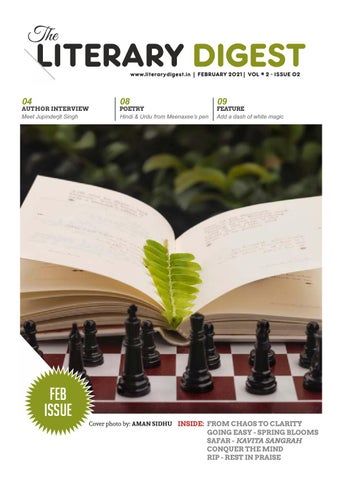
LITERARY DIGEST www.literarydigest.in | FEBRUARY 2021 | VOL # 2 - ISSUE 02
04
08
09
AUTHOR INTERVIEW Meet Jupinderjit Singh
POETRY Hindi & Urdu from Meenaxee’s pen
FEATURE Add a dash of white magic
FEB ISSUE Cover photo by: AMAN SIDHU INSIDE: FROM CHAOS TO CLARITY
GOING EASY - SPRING BLOOMS SAFAR - KAVITA SANGRAH CONQUER THE MIND RIP - REST IN PRAISE
The FOUNDERS SAGUNA JAIN She started her career with the ‘Times of India’ way back in 1992, but soon moved to Chandigarh, where she started teaching journalism in the Deptt of Mass Communication, Panjab University. Went on to own and manage the first event management company in the ‘city beautiful’ called Event it Right! Then she turned a consultant for events, business development & media. Fundamentals Consultancy Group, her consultancy firm in association with her new venture Intyoutive, that she is a partner in, works on three verticals - design and publish inhouse magazines, offer consultancy to start ups and organise literary workshops and events. Daily post, one of the newspapers that she was a consultant with carried her weekly column on parenting for over five years. A mother to two boys, aged 23 and 20, Saguna is an ardent golfer and believes in the simple mantra - we all live and learn!!!
HARDEEP S. CHANDPURI He is a media professional with a keen interest in the ‘written word’ and started writing weekly columns for ‘The Tribune’, called ‘Popthrob’ and ‘Jukebox’ while still in college, which were a huge hit with the youth. He completed his Masters in Mass Communication from Panjab University, Chandigarh. After studying in Australia, USA & Canada, he moved back to India in 2001 and launched ‘Radio Buzz’ in the year 2002. He is a renowned broadcaster and trainer having hosted more than 8000 radio shows in India and abroad. He is often credited for revolutionising the radio scene in North India. A proud Limca Record Holder, for his brand ‘Academy of Broadcasting’ he is also the Founder of Ferntree Publishing, the Gen Secy of Chandigarh Literary Society and coFounder of Inkspire. He is now jointly launching a print magazine this year.
SHONA SINGH She is a Masters in Journalism from the University of Westminster, London and also a holder of a Diploma in Freelance Journalism from UK. She did her schooling from Convent of Jesus and Mary, Simla. She has had an exceptional career in media, starting out with the ‘Indian Express’ and as a golf columnist for the ‘Financial Express’, New Delhi and is currently a special golf correspondent for ‘The Tribune’. An experienced golfer and a regular contributor to ‘Golf Digest’, she also extensively covered golf in Europe for the ‘Golfing Yours’. Her passion for writing and golf also led to regular contributions while travelling on the Asian Tour. A Press Officer at the IMG run Indian Open and BILT Open, India's biggest professional golf tournaments, she used her vast experience to set up the media office of the players’ initiated Professional Golf Tour of India.
CONTENTS 04 Author Interview
07 From chaos to clarity
08 Meenaxee Raj’s exquisite poetry
09
13 Abir’s Photography
14 Safar - Kavita Sangrah
15 Punjabi@
Add a dash of White Magic
16 11
Conquer the mind to fulfill your dreams
Going easy with your Spring blooms
All the opinions and views expressed in the articles stories/features etc., belong to their respective authors and DO NOT reflect the views of the Literary Digest or Intyoutive Ventures. Any Brand/Movie/Publishing House names mentioned in the magazine are ONLY used for representational purposes and the copyright/trademark is the property of their respective owners. The brands, if and where mentioned/used are not associated with us in any manner. All disputes are subject to the exclusive jurisdiction of the Courts/Forums/Tribunals in Chandigarh (India) only. The Literary Digest is an online publication of Intyoutive Ventures. Any content of this publication may NOT be reproduced duplicated, republished or featured (in any form) without seeking prior consent and written permission of Intyoutive Ventures. Intyoutive Ventures reserves the right to accept or reject submitted articles/features/poems etc.
“
Take praise with a pinch of salt and criticism with a spoonful of candy Author - JUPINDERJIT SINGH and Kashmir besides, some were based on my travels abroad. The third book is ‘Discovery of Bhagat Singh's pistol and his Ahimsa’. It is a fascinating tale of how I discovered the lost pistol of the great martyr, Bhagat Singh and how he advocated non-violence in his own way. What kind of books influenced you in your early years? Initially, I read whatever I could lay my hands on. Later, I developed fascination for detective and romantic novels besides history, and historical fiction.
I am currently working as a Special Correspondent with The Tribune. My expertise is in crime reporting though I cover politics as well. Besides covering Punjab, I have been state correspondent for The Tribune at Rajasthan and JammuKashmir. I have headed different Bureau teams and have been in the core team that launched different editions. I have worked for The Indian Express and The Hindustan Times in the initial years of my career. I have now almost 25 years of experience in Journalism.
What was your fascination with Bhagat Singh? Like any Indian or especially a Punjabi, I grew up hearing & reading tales of his valour. I was always in awe of his bravery, raw courage and the supreme sacrifice he made for the country.
Were you inspired by him? My real inspiration began when I started investigating about the whereabouts of the lost pistol of the great martyr. While looking for clues about the weapon, I read several books about him, besides his own Tell us about the books you have written? writings and court documents about his trial. I realised I just had an idea about I have authored three books. The first one Bhagat Singh and his contribution, but the was ‘Justice for Jassi’, which was based on enormity of his acts and sacrifice, the the real-life incident of the honour killing invaluable impact if had on the freedom in Punjab, of a Canadian-born Indian girl struggle had escaped me. It was only while Jassi. The second was an anthology of researching about him I realised the true short-stories titled ‘Years later, on Facebook’. It contained some of my Middles potential of his intellect, his vision and his analysis of India's slavery to the British and published in The Tribune and some shortbesides India's own social and economic stories as well. These talked about life on the Indo-Pakistan border in Punjab, Jammu differences showed me a new way. I was
astonished to note that Bhagat Singh had not just read more than 350 books in jail, but also made notings and wrote a number of essays and speeches based on them. All those are so universal and timeless. His words that India does not just have to get freedom from the British but from the system where poor and meek are exploited. His idea of socialism, communal brotherhood and tolerance for our diverse cultures are so relevant today. At the same time, he cautioned the revolutionaries and the youth saying bombs and pistol do not bring a revolution but an ideology can. What sowed the seed in your mind to find his pistol? In 2005-06, I read some articles about the missing articles of Shaheed Bhagat Singh. Those were stuff in his possession when he surrendered to the British police after throwing a smoke bomb in the Delhi Assembly. One of those was his pistol- a US make .32 semi-automatic. It was said that the pistol was kept at the Punjab Police Academy, Phillaur. However, some news articles claimed that the pistol was not at Phillaur. I was covering the Phillaur Academy as an additional duty of my posting as crime reporter in Ludhiana. I made enquires but could not get a lead. In 2016, The Tribune carried a fresh series about the artefacts related to the martyr. One of those talked about the pistol and
even mentioned its number. That was an important clue. I started making fresh inquiries and soon the mystery unfolded. The journey took me to Phillaur, Amritsar, New Delhi and Indore, where I finally found the pistol. What were the challenges that came in the way while writing it? The research and investigation was more challenging than the writing part. I had made the blue print about the book during my return airflight from Indore. I wrote the book in about ten days. But to do that, I read several books about his life and his court trial. The challenging part was to weave the investigation leading to the discovery of the pistol with Bhagat Singh's life and teachings. Hope the readers would like it. How did you go about researching the book? I have helped a number of writers with their manuscripts. Language is one thing but the soul and flow of any book is of paramount importance. You can use highsounding flashy and ornamental words, but if the soul is hollow and content is weak then no embellishment can help your book. I was pretty clear about the outline of the book. The research included reading almost all the major books about Bhagat Singh, corelating the facts and using the content as per the context of my book without any
compromise on historical accuracy and facts. What was the kind of support you got from the Govt authorities/Police etc.? The book would not have been possible without the help of the police department. The-then Director General of Police, Mr Suresh Arora, ADGP-cumDirector of the Punjab Police Academy Phillaur, Mr Kuldip Singh gave me full
freedom to research about the pistols in police records. DIG Ravcharan Singh Brar personally sifted through registers in Academy police records to help me in the research. Describe your emotions when you saw the pistol for the very first time? It is indescribable. I was overjoyed. I was numb. I would say that was the most cherished moment of my life, the most defining. I held the same pistol which was with Shaheed Bhagat Singh- a tool of our
freedom struggle. Tell us about your journey into the book world? It has been an exciting one. Once my first book was out, I met such wonderful writers and book enthusiasts. I became member of some book clubs and writing critique groups, which enriched my understanding of literature. I was invited by writing groups, book fairs and book festivals even in South India. The book world helps you cross borders and break barriers. Though the publishers in India are yet to give a good financial deal to writers, besides honest and transparent accounts of sales, writers do get recognition. My books are being translated in Hindi, Punjabi and Telugu, which shows a piece of literature is accepted and appreciated in diverse communities, regions and cultures. Your message to upcoming writers? Don't write to impress but to express. A writer hides nothing, is honest with his story, plot and characters. I feel it is cathartic and helps one in cleansing one's soul. It makes us understand the Universe and humanity better. But before writing, one must read a lot. Reading helps us in learning expressions and coining our own. And never be disappointed if your writing does not get immediate appreciation and recognition. Keep working on it. Take praise with a pinch of salt and criticism with a spoonful of candy.
From Chaos to Clarity
Take a look around you. And now, examine your mind. Do you see clarity and order? If you do, kudos! You need not read this article any further. But, if you're like the millions out there, struggling to sort things out, this write-up is just for you. There's already so much going on around us- the pandemic, the protests and protocols; I wonder if there's room for more chaos. So, while it would be enormously challenging to overhaul and bring about order in the world, a super idea would be to make a humble beginning with yourself.
Save money: With this newlyfound passion to be a minimalist, imagine the amount of money you can save for better pursuits. And now that you're all convinced that decluttering should be your new lifestyle, here's how to begin: Small-start= Smart: If you're new to decluttering, I recommend that you make a small start, like just a 5–10-minute tidy-up regimen, and then slowly build momentum. Begin with clearing your bed in the morning, or that drawer of your night stand, which hasn't seen the light of day for ages!
Make charity your hobby: Your trash could be someone else's treasure! Give away your old clothes that don't fit you anymore, your old books, magazines, jewelry, your outdated documents, your child's old toys. These have just been De-junking has many proven benefits. Read on to occupying space in your home, but could be of great use to the needy and underprivileged. know: And before you aim to tidy- up your mind of unnecessary, irrelevant, anxiety-provoking thoughts, you know what would actually work? Decluttering the physical spaces around you!
You'll have more space: I strongly advocate minimal lifestyle and clear spaces. They have an instant positive effect on our minds. Cluttered spaces not only look chock-ful, they could even be meddling with your mind, disabling you from thinking clearly.
Embrace more space: Make a firm resolve to adopt this practice of decluttering regularly. More space around you, more of it inside you! There's a stress-free mind and freedom hiding behind that clutter that is simply gathering dust and cobwebs.
You'll have less to clean and organize: In our super-paced lives, I'm sure we all could use lesser Go get rid of it before it creates more chaos in your chores. And with so little to clean and organize, all life. those labels of 'work-shirker' or 'procrastinator' would be taken off. No more stress: Try the decluttering hack to even manage your emotions. Clear spaces possess the power to calm our minds and pave way for us to feel less stressed, agitated or frustrated.
Contributed by:
ADITI AHLUWALIA Psychologist and Counsellor
Meenaxee Raj is an officer with the Haryana Administrative Services, presently posted as Joint Transport Commissioner and Chief Vigilance Officer, HAFED, Haryana. She has previously been a judge in Haryana and Rajasthan for about three years. She pursued her BA (Hons) Sociology from Govt College for Girls, Sector 11, Chandigarh and LLB from Delhi University. She has been the only woman SDM of Ferozepur Jhirka, a remote subdivision of Mewat. Besides, she has served the Education Department Haryana as Joint Director, Joint Secretary to the Governor and Joint Director Urban Local Bodies, Haryana. She is the youngest civil servant in the country to have been a member of a Govt of India Committee along with sitting High Court judges. The Committee gave its recommendations to Govt of India on international parental child abduction, an issue of imminent international relevance. She has an Urdu poetry book to her credit in the name
MEENAXEE RAJ
of ‘Paighaam-e-Sukhan’, which was released in 2017 by Hon’ble Justice Anil R Dave (Retd Judge-Supreme Court of India).
ADD A DASH OF WHITE MAGIC When does white not look super classy?
T
imelessly chic and endlessly adaptable, white interiors have been popular throughout history – from period interiors through to glossy m o d e r n a r c h i t e c t u r a l s p a ce s a n d Scandinavian minimalism. White brightens up any space and helps your room look stylish. White on white is taking this season by storm, and the result is light, bright and surely white. Some of you may be fearful of light colors, but don’t be afraid! Research your
materials and you’ll soon find plenty of stain resistant and cleanable fabrics on the market. Accent white rooms with dark wood and natural tones here and there, to mix it up and keep the eye moving around the room. Go white all over in the striking and bold, yet simplistic and calming minimalist design frenzy. It is a fad that has lasted and will continue to endure the test of time. Choosing to cloak a room in all white does not equate to it
being boring anymore. White walls, floors, or decor can bring in a bright and cheery feeling because of the way they reflect light throughout a space. This could be especially helpful in small areas of the house, and its magnitude is felt in really large areas that incorporate a lot of white decor. White, ivory, pale grey, and beige are all colours usually associated with our harsh Indian summer. But, neutral colours are gorgeous all year round, which is why they're one of the biggest interior design trends for 2021. The thing about neutrals is that they give you an excellent backdrop for whatever colour scheme you want to switch over to as time goes by while also holding their own with ease. White couches and gauzy drapes never go out of style, shades of grey and the lovely beige work exceptionally well for bedroom decor . If you want to incorporate a bit of colour into your decor at any given point, it becomes relatively straightforward. All you have to do is switch out accents like throw pillows, blankets, rugs, and vases as your tastes keep evolving. Your neutral furniture will do a great job of providing the backdrop for those hues. The latest trend for white interiors is a textural, layered look. Kashmir rugs, thick knitted blankets, linen sofas and striking artwork can create the perfect place to relax. White works just as well for both ‘minimalists’ & ‘maximalists’ – whether you want to achieve chic understatement or give the perfect blank canvas to display a collection of beloved furnishings and artwork.
Contributed by:
Himani Galhotra Founder
Touchstone Interiors
Going easy with your
spring blooms T
he very first and enticing thing that comes to my mind on change of season is colorful blossoming flowers. Some of the best winter/spring flowering annual and seasonal plants that we can grow in pots and home garden are Petunia, Calendula, Chrysanthemum, Cineraria, Zinnia, Antirrhinum, Marigold, Salvia, Dahlia, Daisy , Dianthus, Clarkia and Asters etc and Alliums, Bluebell, Crocus , Daffodil, Lilly assorted, Hyacinth and Winter aconite etc. The variety is tremendous in colour, size and form, grows fast and takes less time in covering the garden and the advantage is all varieties are easy to replace. The best time to plant/sow your winter flowers in containers is autumn or early winter and spring blooms is at onset of warmth in passing winters.
Preparing Potting mix for flowers:
An ideal mixture needs to be prepared with good moisture retention capacity, high nutritional value, optimum PH and better drainage.
Proportion to keep in mind: 1 part soil/good earth + 1part coco peat/ coir +1 part perlite or plot sand (granular sand) + 1 part organic manure / cattle dung + 1 table full spoon of NPK = you are ready with your potting mix to grow your flowery plant. Perlite is easily available in plant nurseries and online purchase is also possible. Perlite can be substituted by taking granular sand or plot sand that will do the same good to plant by providing better aeration.
Once you are ready with your potting mix , you need to prepare your pots/containers for your flowery plants to grow healthy. Steps to keep in mind while preparing pots: 1. Pots should have drainage in place to prevent plants sitting in water. Broken & old clay pots /tray pieces or corks can be placed at the bottom of the pot before filling the pot with potting mix for proper drainage. If possible, also raise the pot on feet, some stand/frame or bricks for increased drainage. 2. Fill the pot (half or more) with potting mix, place the root balls of your plants in order to achieve your flowering height and then fill the pot by firming the plants in gently. Work from one side of the pot to the other. Filling the pot completely at once and then digging out for plantation is not an good idea. 3. Once done with your plants in place, lifting the pot and tapping it slightly to surface its placed on two or three times to settle the stuff and to knock out any hollows or air gaps. Correction can be done, if found, by pouring more potting mix in hollows anywhere.
plants acts as pest repellants and can be grown or placed in arrangement to achieve the purpose such as Lavender, Citrus lemon grass, marigolds, nasturtiums & mums. Citronella & Rosemary are excellent insect repellants. 2. Smoke from charred rosemary can help a lot in making your garden ideal for sitting. 3. You can use Neem oil to control pests including aphids, Japanese beetles, spider mites, moth larvae , mealy bugs, white fly & scales. Neem Oil is easily available at various Ayurveda pharmacies or can be bought through online shopping sites. 4. Camphor oil if bought cold pressed is also very effective against a wide range of pests. 5. Powder mix of turmeric & cloves acts as an excellent insect repellent. 6. Simple dilution of soap & water also works if sprayed on leaves of plants to keep not so stubborn pests & insects away. I hope the information provided by me is useful to you all. HAPPY GARDENING Remember: The most enticing imagination is always the blossoming seasonal flowers.
4. Water regularly, but let the potting mix nearly dry out in between, avoid over watering. 5. Place your pots in a place where they get ample sunlight.
Contributed by:
SEEMA SHARMA
6. Do compost but avoid overdoing it. Keeping your plants pest free: 1. Going the organic way to repel pests, certain
A Masters in Ecology & Environment and Diploma holder in Landscape & Horticulture from University of Canberra, Australia. Seema has designed and executed prestigious projects like Airtel Campus Gardens, IT Park Chandigarh, Infosys, DLF Valley (Kasauli, Amravati, Hyde Park) etc and she is the founder of Merry Mind Landscapes.
Abir Hiranandani, an international student in Melbourne, is an aspiring filmmaker and cinematographer. Studying Media and Film at The University of Melbourne, Abir is passionate about visual storytelling, world travel, international student life and sport. His ultimate aim is to be a real and relevant professional in the world of media.
SAFAR (a Kavita Sangrah) by Dr. Param Preet Ghuman released
“A collection of soul-stirring poetry......”
A
collection of poetry written by the highly
talented poet Dr Param Preet Ghuman was
released on 21 Feb 2021 at a glittering
function at the Tagore Theatre, during the prestigious SikhLens Festival. Dr. Ghuman a doctor by profession touches many a chord with her pen, as she is able to paint myriad hues across the rainbow with her words. “Ever since I was in school I was interested in Hindi poetry and wrote all these poems right from those days till recently. They are all based on my experiences from both personal and professional life. I am sure many of the readers would be able to relate to them”, she remarked. It is pertinent to mention that she dedicated the book to her husband Dr. Avtar Singh, who also is a Doctor by profession. Her daughter is an acclaimed actor while her son is a senior police officer in Punjab. She also recited her poetry at the event amidst a huge round of applause and appreciation. The book is available on all major online platforms.
RUPINDER SINGH AULAKH is a Design Engineer based in Seattle (USA). He calls himself an ardent observer and art enthusiast. He firmly believes that art saves us from our own negativity and acts as a mode of absorption and contentment. His passions include writing, and promoting Punjabi culture through creative photography and Punjabi calligraphy.
CONQUER THE MIND TO FULFIL YOUR DREAMS means, by drifting away from the original, spiritual quality of positive living as desired by Almighty God. They prefer to replace this positivity by acquiring negative and evil ways of earning through foul, cut-throat mentality and various other underhand methods. In n today's world where everything is later life, they suffer from their own selfhappening at a superfast speed, we are subjected to vast amount of information. created miseries. Hence, in order to achieve the dreams or objectives of life, it is We are always under stress to process all this information, maintain relationships, maintain imperative to create awareness of positive thinking. our health and fulfil our aspirations. To enable us to live a peaceful and content life in You will be surprised to know that we mostly modern times, we need to harness the utilize 6 to 8 percent of our brain's total spirituality within our minds. capacity and 92 to 94 percent goes to waste. Only very few Rishis and Yogis attain the Underutilised capacity of the mind: power to utilize the maximum power of their In my previous article "Self -awareness of the individual minds. It all happens because the Mind", I had elaborated about the various conscious mind starts dominating life after characteristics of the human mind. God has one reaches the age of adulthood. Its blessed us with the most powerful mind influence keeps increasing with the having the additional qualities of thinking advancement of age as the wants and desires (self-consciousness) and taking independent keep multiplying. A tendency of the conscious decisions (free will), which no other creature mind is to drag you towards the negativities on this earth is so lucky to possess. Like two of life. If you're unable to discipline or control faces of the same coin, your mind also has this “monkey mind”, it can create miseries in two opposite faces which are positive and the long journey of your life. negative. Positive thinking can create In order to maximise the use of your miracles into your life while negative thinking mind you need to learn how to stay positive can burden you with miseries. Everyone is spiritual by birth and spirituality teaches you and try to minimise the tendency of our conscious mind wandering into the past or to always stay positive throughout the long future. We need to learn to focus our mind to journey of life, but as one starts growing in stay in the present moment of time and try to age, the influence of society, particularly silence any noise created by thoughts of past parents, plays a very crucial role. Especially and future. This is the best way to interact during childhood and adolescent age. The with the super-conscious mind and reach the effects of this influence continue during adulthood and later part of life. Today's youth higher potential of your mind's capabilities to fulfil the objectives or dreams of your life. are seeking happiness through materialistic
I
Developing your mind using Laws of Farming: It is well known proverb "What you sow so shall you reap". When the farmer sows the seeds to yield a particular crop/fruit in the fertile land, after a few days saplings of the seeds come above the land and start growing. Occasionally, he needs to water and add fertilizer into the soil to keep the plants/trees healthy. In the initial few days, weeds will also start germinating and growing alongside the plants, for which no one had even put the seeds into the soil. My experience is that if you don't remove these weeds in the initial stage, they can end up causing great harm to the growing crop. You need to work hard to safeguard the plants from weeds and pests as you reach the final yield. In a similar way, you need to keep sowing the seeds of positive thoughts into the fertile land of your mind to enable you to yield the desired crops in the long journey of life. Remember, the conscious mind manifests the thoughts and it is very prone towards the negativities of life. Based on the “Natural Law of Polaris”, positive can't exist without negative, hence the weeds of negativity are bound to germinate alongside positive thoughts. These negative thoughts can be in the form of hatred, anger, anxiety, worry, frustration, rage, repentance, revenge, isolation, depression, regret and so on. Let me tell you, if you happen to ignore them blindly, these weeds will grow very fast and silently like termites will destroy your life. So, you need to be very careful from the beginning and like a farmer you need to destroy them at the earliest and use the fertile mind to grow positive and constructive thoughts.
society. They together help to groom and keep the divinity, spirituality and moral values intact and teach you to keep following them in the future too. After reaching the age of adulthood, it becomes your responsibility to follow your original positive attributes and keep following the moral values groomed in you by your parents, extended family members and teachers. Let me tell you that it is easier to tame a horse than taming the conscious mind of a human being. In my opinion, educational institutions like universities, schools and
colleges play very important roles to groom our younger generation. Our academics and educationists must revamp our educational system to include self-improvement subjects such as self-management, management of thoughts and emotions. These subjects must be taught at school and university levels. Let us empower our universities to not only teach facts, but also use them for training the mind to Taming the Mind think positive. Our youth must understand in Similar to training a horse, you need to start addition to the importance of Intelligence taming your very powerful and fast Quotient (IQ), Emotional Quotient (EQ) and “conscious mind” (which may even be called Social Quotient (SQ) are equally important. “racing mind” or “monkey mind”), at a very Bringing EQ and SQ within the curriculum will young age. Till one becomes an adult, God has ensure the student to achieve success in every assigned this responsibility to parents, aspect of life. extended family members, teachers and
How to strengthen positive force within you? First and foremost, try to understand that spirituality is always guiding you to stay in a positive, conscious state of mind. No other person, regardless of how close he/she may be, can provide spiritual solutions in your personal life. However, a few guidelines laid down by some spiritual gurus, saints and experienced persons, will definitely enlighten you and help you to learn how to stay positive all the time even in times of adversity. Self-awareness is the first step which can be achieved by self-introspection and meditation. Identify your own positive and negative qualities. As you know every negative has its opposite positive side, so in order to eliminate negative qualities you need to start strengthening the opposite positive. For example, if you want to eliminate or counter 'hatred', start strengthening your energy of love, and slowly the energy of hatred will start diminishing. Finally one day you will be able to conquer it completely. In order to stay positive, strengthen your moral values and personal principles such as w i l l p o w e r, s e l f- t r u s t , s e l f- l o v e , s e l fresponsibilities, self-respect, self-confidence, principles of forgiveness, detachment, acceptance, and so on. In addition to self-prayer, yoga and meditation, affirmation and visualisation play a great role to silence your “monkey mind” and achieve the state of positivity. Company of positive people will also enhance your positive state of mind. The most important principle of staying positive is conveying our gratitude to God for innumerable blessings showered on us. Be grateful to your parents, nears and dear ones, teachers, friends and all others who have helped you out to live a comfortable and fulfilling life. Miracles of Positive Consciousness: The moment you succeed in controlling and disciplining your “monkey mind” and make it
silent, you will get empowered to approach the higher power or super-conscious mind. Superconscious mind will create favourable situations and opportunities for you to achieve your dreams through intuition, guts etc. Let me tell you that there is an abundance of everything lying in the Universe for you, but you must learn the skill to approach the higher power by staying positive. Your positive thoughts/beliefs combined with positive actions can create anything on this earth. Whatever you imagine, can happen in life. Positive thinking can create miracles in your life. Positive thinking has the inbuilt power to strengthen your spiritual, mental, physical, intellectual, emotional, financial and social aspects of life, which will balance your inner and outer life and enable you to lead a fulfilled and happy life. It is rightly said "Think big to become big, think rich to become rich, think healthy to improve your health, think positive to enhance spirituality”. In other words, think positively to attain what all you want to be in life.
.
Contributed by:
Lt. Col. SURJAN S. RANDHAWA Author, Industrialist and Retd. Army Officer
e c a e p n i t s e R – RIP also stands for Rest
W
ith the availability of data on the internet, one cannot befool anyone about anything, as one can search for every tid-bit on smallest smartphone in your hand and that too by a single gentle touch on the screen. As of now, I was aware about RIP – the acronym mostly written when someone dies to show sympathy with the family and praying for his soul to ‘Rest In Peace’. But today, when I was searching in detail about this acronym over Google, it showed Routing Information Protocol – RIP, which is said to be one of the oldest distancevector routing protocols which employ the hop count as a routing metric. RIP prevents routing loops by implementing a limit on the number of hops allowed in a path from source to destination. So much for technology. Phew..... With another click, I could get the commonly used acronym as RIP – Rest in Peace – a short epitaph or idiomatic expression wishing eternal peace to someone who has died. The expression typically appears on headstones, often abbreviated as RIP. Most people know that RIP stands for Rest in Peace. But mostly, we simply use RIP as a short hand, not for Rest In Peace, actually, but rather a quick way to say, I am sad this person died! Some are of the view that its blatant use should be stopped because this showcases our laziness and non-seriousness and not really what we actually mean. Recently, I happened to attend a memorial service on the death of a close friend's uncle. Since it was a hot sunny day with unbearable heat, I overheard a conversation between two ladies about the person who had died. I did not know them, but could not help but wonder, if my ears were hearing what they were actually discussing. In a huge gathering and my restricted visits
in Praise
to the family, I did not know the two ladies and their relations with the family, but one thing was certain, which I could presume from what they murmured to each other, that they were not closely related to them and were surely attending the funeral, merely a formality. I too believe that everyone whosoever has taken birth on this planet Earth, has to leave some day. The only thing that needs to be seen is, as to how you spend this long or short span of life between birth and death. As you sow, so shall you reap befits well to know about someone's character or standing in society, after his death, when you overhear conversations at the cremation ground or in your own group. Frankly speaking, I could not believe as to what I was hearing because on one side, the two ladies were all praise for the dead person they were discussing, while on the other they complained about his demise on one of the hottest days of the year in June, when it was practically unbearable to attend any cremation. I have noticed when someone departs, saying a few compliments about him, which is a sort of insurance - even if he was not – to be returned on such an occasion and we all must do. If we do, others might also say, what I personally believe about RIP actually being - Rest in Praise instead of Rest in Peace.
Harish Monga is a renowned social activist and was recently conferred with the 'Social Worker Award' by His Excellency, Hon'ble Governor of Punjab, V.P. Singh Bandore. He is presently contributing to society through his pen as a freelance journalist.
NOVELBUNCH L I T-T H U S I A S T S
SUBMISSION GUIDELINES For Articles & Poetry Fiction and Creative Non-fiction: Maximum 500 words strictly (Languages accepted English, Hindi and Punjabi) Poetry: Please submit one poem in either English, Hindi or Punjabi. All submissions should be attached as a Microsoft Word document with your name, short bio & photograph. Photography and art submissions should be attached as a high-quality JPEG. They should be an original image either clicked or bought by you. If you have sourced it from a free image website, then you have to give credit to the photographer and the website. Email all submissions to: submission@literarydigest.in
If you would like to receive this magazine regularly, please contact us on:
info@literarydigest.in www.literarydigest.in The Literary Digest is released for the public on the third Thursday of every month.