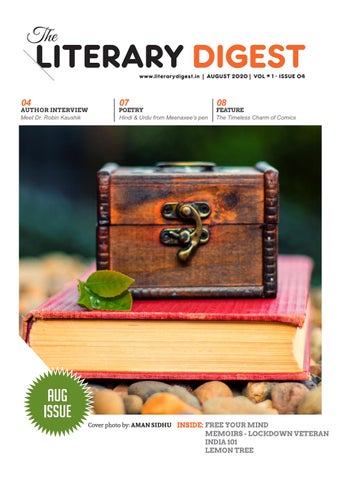
LITERARY DIGEST www.literarydigest.in | AUGUST 2020 | VOL # 1 - ISSUE 04
04
07
08
AUTHOR INTERVIEW Meet Dr. Robin Kaushik
POETRY Hindi & Urdu from Meenaxee’s pen
FEATURE The Timeless Charm of Comics
AUG ISSUE Cover photo by: AMAN SIDHU INSIDE: FREE YOUR MIND
MEMOIRS - LOCKDOWN VETERAN INDIA 101 LEMON TREE
SAGUNA JAIN
The FOUNDERS
She started her career with the ‘Times of India’ way back in 1992, but soon moved to Chandigarh, where she started teaching journalism in the Deptt of Mass Communication, Panjab University. Went on to own and manage the first event management company in the ‘city beautiful’ called Event it Right! Then she turned a consultant for events, business development & media. Fundamentals Consultancy Group, her consultancy firm in association with her new venture Intyoutive, that she is a partner in, works on three verticals design and publish in-house magazines, offer consultancy to start ups and organise literary workshops and events. Daily post, one of the newspapers that she was a consultant with carried her weekly column on parenting for over five years. A mother to two boys, aged 23 and 20, Saguna is an ardent golfer and believes in the simple mantra - we all live and learn!!!
HARDEEP CHANDPURI He is a media professional with a keen interest in the ‘written word’ and started writing weekly columns for ‘The Tribune’, called ‘Popthrob’ and ‘Jukebox’ while still in college, which were a huge hit with the youth. He completed his Masters in Mass Communication from Panjab University, Chandigarh. After studying in Australia, USA & Canada, he moved back to India in 2001 and launched ‘Radio Buzz’ in the year 2002. He is a renowned broadcaster and trainer having hosted more than 8000 radio shows in India and abroad. He is often credited for revolutionising the radio scene in North India. A proud Limca Record Holder, for his brand ‘Academy of Broadcasting’ he is also the Founder of Ferntree Publishing, the Gen Secy of Chandigarh Literary Society and co-Founder of Inkspire. He is now jointly launching a print magazine this year.
SHONA SINGH She is a Masters in Journalism from the University of Westminster, London and also a holder of a Diploma in Freelance Journalism from UK. She did her schooling from Convent of Jesus and Mary, Simla. She has had an exceptional career in media, starting out with the ‘Indian Express’ and as a golf columnist for the ‘Financial Express’, New Delhi and is currently a special golf correspondent for ‘The Tribune’. An experienced golfer and a regular contributor to ‘Golf Digest’, she also extensively covered golf in Europe for the ‘Golfing Yours’. Her passion for writing and golf also led to regular contributions while travelling on the Asian Tour. A Press Officer at the IMG run Indian Open and BILT Open, India's biggest professional golf tournaments, she used her vast experience to set up the media office of the players’ initiated Professional Golf Tour of India.
CONTENTS 04 Author Interview
11 Gurjot’s New Song
06 Free your mind
13 India 101
07 Meenaxee Raj’s exquisite poetry
15 The Homecoming
08 The Timeless Charm of Comics
17 Punjabi@
10
20
Memoirs of a Locked-Down Veteran
Optimystical
22 An ode to Miniatures
All the opinions and views expressed in the articles stories/features etc., belong to their respective authors and DO NOT reflect the views of the Literary Digest or Intyoutive Ventures. Any Brand/Movie/Publishing House names mentioned in the magazine are ONLY used for representational purposes and the copyright/trademark is the property of their respective owners. The brands, if and where mentioned/used are not associated with us in any manner. All disputes are subject to the exclusive jurisdiction of the Courts/Forums/Tribunals in Chandigarh (India) only. The Literary Digest is an online publication of Intyoutive Ventures. Any content of this publication may NOT be reproduced duplicated, republished or featured (in any form) without seeking prior consent and written permission of Intyoutive Ventures. Intyoutive Ventures reserves the right to accept or reject submitted articles/features/poems etc.
Dr. ROBIN KAUSHIK
A THRILLING RIDE FROM AKBAR’s COURT TO THE ANDAMANS Tell us something about yourself? I was born and brought up in Chandigarh. For my medical studies, I went to the Armed Forces Medical College in Pune for MBBS and to DMC Ludhiana for my Masters in General Surgery. I was an avid cricketer and musician (guitar), and was lucky to get the opportunity to represent my college both, on the cricket field and on stage for various performances. Presently, I have 'retired' from the cricket field and am trying to pick up golf and catching up on reading and writing apart from my professional commitments as a surgeon. How was the transition from being a Doctor to an author? Frankly, I don't feel that there has been much of a transition. As a doctor and a teacher, writing research papers is part of the job description - I have been doing that for the past many years and have even authored a few books in my subject. So, it
was just a matter of shifting the focus of my writing to another field – the problem for me, really, is of getting time out for researching and writing fiction. What books influenced you in your earlier years? I used to read a lot, and at that time, there were not a lot of Indian authored books available for reading, as is the situation today. Including English language classics, I must have read almost all the books by Enid Blyton, the Hardy Boys series, the Three Investigators series, Alistair MacLean, Agatha Christie, Erle Stanley Gardner, PG Wodehouse, James Hadley Chase, Tom Sharpe, Isaac Asimov, Robert Ludlum, JRR Tolkien, Saki, Mark Twain, cricket autobiographies and books by many, many more authors across multiple genres. Probably I was most influenced by Isaac Asimov's Foundation Trilogy, Harper Lee's To Kill a Mockingbird, JD Salinger's Catcher in the Rye, and the Lord
of the Rings series by Tolkien. Why does your book seems like the Indian version of the Da Vinci Code? I take that as a compliment, thank you, but I leave it to the reader to decide whether this is true or not. What inspired you to write this book? Of late, I have become more and more interested in Indian history, philosophy and mythology. We were once a cradle of civilization and have a rich heritage across all time periods and religions – there is so much history available and just a simple thought of having a story based in the present but weaved into our history and mythology with a lot of 'artistic liberty' slowly developed into a fully-fledged novel. What was the response to the book? The response was mixed - some people really liked it, but there
were a few who didn't; I guess that is true for everything. For me, it was the fruition of an idea that had been on my mind for quite a few years, and just being able to put that down was what really mattered. Tell us about your journey into the world of writing? As I mentioned earlier, writing (research) has always been a part of my job profile, but I always wanted to write non-research stuff as well. Once the plot in my mind became a proper story, I couldn't stop thinking about it and really wanted to get it down on paper. Unfortunately, the lack of time due to my professional commitments made it difficult to do so, and I spent a lot of time procrastinating and looking for writing software on the internet that would help me. However, I soon realized that writing a novel isn't such a simple job, and like any other profession, a lot of elbow grease is required. I finally got down to writing a few pages a day, and I think it took me over a year to finally complete the novel - it took me a much longer time than what someone else would have taken because I could only write after office hours. But when I look back, yes, it was fun, deciding twists and turns and how and when to bring out various clues so that the whole plot would somehow make sense. What kind of support did you get from family and friends? I never told anyone what I was up to, mainly because I was not sure if I would be able to finish the book! My family always thought I was playing games on
my laptop (truth be told, I did that a lot), and when I finally published the novel, they were extremely happy. Now, I am often asked when my next novel will come out.
How do you strike a balance between writing, home and work especially working in Covid times? To be honest, it's difficult! During work, it's just impossible and at home, there are so many distractions going on that it is easy to just turn the laptop off and be part of whatever is happening at the moment. I'm still planning my next novel, and I don't know when I'll be able to write it! With the Covid situation and the restrictions caused by it, I probably have more time now at home than before. But then, again, the house is full and the distractions are equal if not more than before. More than anything, I think that discipline is as important in writing as in any profession and keeping a bare minimum daily target of words or pages is what is needed to get the job done.
ABOUT THE BOOK Rumours have always existed of a large, hidden treasure from ancient Indian times, based on the legend of Vyamana the Accursed – the tragic legend of how a great King lost everything, his kingdom and his unimaginable wealth in an attempt to conquer the three worlds; a tale lost in the mists of time, long forgotten, an enigma to historians and researchers, some of whom believe that the events described in the story are real. A renowned historian and his friends have spent their lifetime trying to prove the legend is real, in an attempt not only to rewrite the history of the modern world, but also to find his hidden riches. As they sift through clues in Indian history, right from the times of Ashoka the Great to Emperor Akbar, and especially those left behind by the hidden 'jewel' in Akbar's court, they become more and more convinced that the riches accumulated by Vyamana exist, but its final resting place still remains unknown. A secret group of influential persons plan a coup against the present system of government, aiming to overcome the decay and corruption of the present times in their efforts to restore the lost glory of India, and this treasure is their means for funding their goal to establish a new order. Unfortunately for them, the historian is accidentally murdered when they try to extort information from him. The historian's daughter is caught up in the events, and with the help of an ex-army man, tries to unravel the reason behind her father's murder. From the mountains of the Himalayas to the islands of the Andamans, they rush, not only to find the treasure, but also to expose the murderers as well as this plot against the very fabric of democratic India. Unfortunately, the trail is littered with dead bodies and double crosses, and they do not know whom to trust…
FREE YOUR
MIND W
e're fortunate that we've had the opportunity to witness another year of independent and free India. Congratulations to all of us! Without a doubt, the price paid for this freedom has been enormous in terms of sacrifices made and challenges faced by our freedom fighters. By all means, therefore, we should treasure and cherish this freedom. And now that we are free and independent, it's time to look at our independence from another perspective. Let me explain. As a counselor, I see freedom a bit differently. I speculate that even as we have come a long way in our journey of claiming our rights and expressing our freedom in the society in many creative ways, we haven't achieved much when it comes to freeing our mind from the negative thoughts and distorted thinking patterns that it keeps harboring. Nagging worries, trivial matters, grudges, boredom, envy- you name it! Such thoughts have a distinct nature… the more you want to NOT think about them, the more bothersome they become.
Don't believe me? Try this: DON'T think about the red-faced angry emoji. I know! You're now stuck with the image of this emoji in your head. But don't worry, there are ways to free your mind from all such unwanted thoughts and engage in other better, nobler thoughts. Here a list of things you could try: · Let go of the past. Don't be trapped in things that have no relevance for you today. · Forgive often. It helps you in moving on. Have no place for grudges in your heart. · De-clutter. Less clutter around you, lesser of it inside you! · Get rid of regrets. Talk your feelings out with a friend/confidant and deal with regrets. Don't let them grow on you. · Be open-minded. Chuck the superstitious and prejudiced cognitions away. Allow flexibility in thinking. · Stop catastrophizing. You'll only feel more pain while imagining worst case scenarios over and over in your mind. Stay grounded to reality. · Imbibe gratefulness. 'Counting your blessings' really helps in finding purpose and beauty in daily life. Applying these ideals in life on a regular basis will help elicit the true essence of freedom and independence inside and out, thereby making this world a better place for all of us!
Contributed by:
ADITI AHLUWALIA Psychologist and Counsellor
वो क र े इ के िदखाता है बफ़-िनगाहो ं से िदल जलाता है वो मुझको ब िबठाता है और रक़ीबो ं से िदल लगाता है फ़ासले दरिमयाँ बढ़ाता है और ाबो ं म चला आता है ँ पशोपेश म जाऊँ या नही ं वो मुझे इस तरह बुलाता है
ँू बे िफ़ ँ म ,है िफ़ मंद ज़माना िफ़ क़ैद बा मश त है , कोई बताना तुमने ज़मी ं पे जो दे खा उसको ही सच माना दे खा कहाँ है तुमने फ़लक का तहख़ाना
MEENAXEE RAJ
नज़ रए को ूँ बनाते हो मदाना - ज़नाना क़दरत ने तो हमको फ़क़त इनसां ही था ु माना हर शाम की तरह जब हो फ़ र ो ं का आना साज़ ओ सामाँ से नही ं उनको ऐमाल से मनाना ऐमाल - deeds
Meenaxee Raj is an officer with the Haryana Administrative Services, presently posted as Joint Transport Commissioner and Chief Vigilance Officer, HAFED, Haryana. She has previously been a judge in Haryana and Rajasthan for about three years. She pursued her BA (Hons) Sociology from Govt College for Girls, Sector 11, Chandigarh and LLB from Delhi University. She has been the only woman SDM of Ferozepur Jhirka, a remote sub-division of Mewat. Besides, she has served the Education Department Haryana as Joint Director, Joint Secretary to the Governor and Joint Director Urban Local Bodies, Haryana. She is the youngest civil servant in the country to have been a member of a Govt of India Committee along with sitting High Court judges. The Committee gave its recommendations to Govt of India on international parental child abduction, an issue of imminent international relevance. She has an Urdu poetry book to her credit in the name of ‘Paighaam-e-Sukhan’, which was released in 2017 by Hon’ble Justice Anil R Dave (Retd Judge-Supreme Court of India).
THE TIMELESS CHARM OF
HOW TO USE THEM TO ADD CHARM TO YOUR HOME?
T
he foremost memory of our childhood, other than our tantrums and endless scolding from our parents is our 'escape route', a paper-paved pathway peppered with heroes, superheros, antiheroes, super girls, detectives or even a cheeky ‘Cheeku’ the rabbit. How can we forget Superman (originally from the fictional planet Krypton) flying over skyscrapers in Metropolis, the magic of Mandrake, 'Kreegah' the eponymous sound of Tarzan, the 'Ghost who walks' Phantom, or Archie chasing Veronica and Betty chasing him instead. The creatively named Semiautomatix (Fulliautomatix's son) from Asterix and 'Ten Thousand Thundering Typhoons' blabbering-but-lovable Captain Haddock from Tintin. Closer home, we have wondered as to how Saboo came to India from Jupiter and how come Chacha Chaudhary's 'dimaag' is faster than the fastest computer. They have all collectively wowed us and taken us on a joyride, to take a peek into distant lands that otherwise would have been tough to navigate. I guess now its payback time. BACK TO THE FUTURE: Their origin dates back to 18th century Japan but they gained popularity in US and UK in the 1930s. Basically comics are a medium used to express ideas in form of illustrative panels, textual devices, and narratives. The first modern comic book, 'FAMOUS FUNNIES' was released in US in 1933. Originally, comics were colored by cutting out films of various densities in the appropriate shapes to be used in producing color-separated printing plates. CMYK codes were written on the page to indicate the final printed colors, and these hand-colored pages were used as guides by the engraver. Over the years, we have all treasured our comic collections. Some of these wonders may not have been able to bear the brunt of time, but still most are salvageable. Now is the time to dig in, find them, dust them and I assure you that these pieces of comic art, can now be turned into something that wows you and astounds everyone that sees them. In this piece, I will share with you some ideas as to how you can use comic art to give a creative look and appeal to your home.
FULL-B
ODY M
FRAMED DISPLAY
WALL COLLAGE
OUNT
THICK COMIC BOOK CUTOUT PHOTO HOLDER
STREET ART
COMIC STRIP CUT-OUT COLLAGE WALLPAPER
Contributed by:
HIMANI GALHOTRA Founder Touchstone Interiors
CUSHION COVER
MEMOIRS OF A LOCKED DOWN VETERAN The Lady Of the House (LOH) has a strong sixth sense. The moment the first COVID address by the PM ended, she put locks on the two gates to our house. “But, he asked us for a self curfew day after?' I pleaded.” We need to be proactive. It is no entry and no exit”. With this unilateral move of hers, the LOH imprisoned two families of 'live in' house helps, my 85 year old mother and yours sincerely. Lucky ones who escaped the agony was my son at sea and our daughter in law and their son who fortunately had left for a vacation with the other set of her parents. I am a sixty year old army veteran, an extrovert and afflicted with almost all minor vices that are expected of a gentleman. It is thirteen years since I hung my spurs after a satisfying 27 years in the Indian army, a disciplined force which brings you up in an environment of restraint, righteousness and a strict regimen. In fact, these traits get ingrained for life, making yearning for freedom futile but the effort continues, never the less. At home, I am amidst a preponderant environment dominated by women of all ages, moods and idiosyncrasies. My mother who is paranoid that she is losing command of the ship to her daughter in law, my daughter in law who is learning the tricks of the trade, a maid who considers herself indispensable, 85 year old friend of my mother and a front door neighbor who is Omni present with intellectual doses and of course the LOH who is one woman army. That leaves me, a lone warrior in the line of fire. I did manage to plan a reasonable escape everyday in a manner to provide self succor and also ensure a cosmetic presence at home. Mind you, the LOH and me are two ends of a pole. Each time despondence sets in, she has Albert Einstein to the rescue,' opposite poles attract', we laugh and proceed. With this background, my lockdown commenced along with all other veterans country wide. My daughter who is safely locked down at salubrious Wellington with her fighter pilot husband and a chirpy one year old was first to ignite, “Papa, willy nilly you are 'in a pickle'…ab aaya oont pahaar ke
niche”. One may have matured, but the ego of a veteran remains infallible. In a quest to be an atta boy, I announced after breakfast, “Allow me to make a weekly bill of fare”, there was a prompt rebuttal from LOH, “Leave the kitchen matters to me”, that was that to my first well meaning initiative during trying times. Similarly, all suggestions worthy of my stature of a thinker and planner were shot down summarily. “Why don't you catch up on reading and TV” was her nail in the coffin, making my existence symbolic. My son called up in the evening, “Whassup, Dad”. The sarcasm was evident. 'I can envision three possible scenarios with your mother. one, either of us shall survive. Two, legal recourse to call it a day and three, inseparable for the next seven lives! “ Well, the days that followed were a revelation. LOH had stocked up essentials in anticipation. Everything seemed to function with military precision. Meals were served on time, initial apprehension led to chats, gossip, mutual praises, regular sessions of paploo, venga and so on. There was surprisingly no dichotomy on choice of web serials. Her not minding my guest existence initially seemed irritating only to convince me it was for real albeit with a twin message,” Peace and realization are mutually condescending and Newton's law applies to physics not love”. Quite early into what I initially called Auschwitz concentration camp of second world war, life seemed akin to an upscale resort at the island of Honolulu. “So Dad which of the three scenarios you envisioned on 24 march 2020, apply today” Our son was eager to know. The answer, though on the tip of my tongue stopped short of speech, again thanks to the wretched ego of a veteran! But I couldn't help announcing it , when the LOH in all sincerity exclaimed,” Mian ..how I wish you hit the Golf Course earliest.. I know that is your second love!”. And she winked. Blessed to be locked down for the next seven lives!
Contributed by:
Col Avnish Sharma Columnist & Writer
GURJOT’s SONG TOUCHES AN EMOTIONAL CHORD
A
fter the success of ‘My Hero Farmer’ and ‘Dil Se Salaam’, Gurjot S Kaler has released his third t r a c k ‘ B a n d ey a ’. H i g h o n sentiments, the song highlights a very common issue of parents being neglected and left at old age homes by their kids, as they fail to take care of the hands who made them capable of making an identity. The video of the song shows how a son leaves his mother at an old age home, and couldn’t care any less about her well being or wish. Nonetheless, soon he realizes his mistake, when he sees a young boy being pampered by his mother. It makes him recall his childhood, and he wastes no time in reuniting with his mom. This song-with-amessage has music by the highly-talented B Praak while the lyrics have been penned by the ever-favourite Jaani, the
name behind the success of many songs. Arvinder Khaira impresses everyone as the Director. “I’ve always been passionate about spreading social awareness through my passion projects. This is a topic that I feel very strongly about. Music is the best way to reach out to a larger audience and there’s nothing bigger than disseminating important messages through my songs. With Bandeya, I want to convey
t h a t n o m a t t e r w h a t yo u achieve in life, you must never stop loving and respecting your parents.” Besides being an author of the best-selling book ‘New India - The Reality Reloaded’ and a writer of repute, Gurjot is also a serving Superintendent of Police with Punjab Police and is presently in England pursuing a one-year course in Police Studies.
The STORY GRID
As those pages pile up, many a times you'll
the local time—this helps in keeping the
find yourself weeks, months, maybe years
story in proper time sequence order as it
away from having written that opening
goes to various towns around the world in
lines. That's where your organizing skills
different time zones.
will come in handy. You have to keep track
(Tip: USA alone has nine different time zones
of your characters, locations, facts and the
while Russia has eleven. Also you have to
action, to make sure it all fits. To make
factor in ‘daylight saving time’ as it is used in
your life easier and more organised it is
many parts of the world.)
best advised to use a document also known
7. The exact location of the action.
as the ‘Story Grid’ which comes in very
8. A brief description of the action so I can
handy to keep track of all that. This
easily find it.
document is not just an outline, but
It also helps to keep a number of
something one fills in while continuing to
properly indexed files/folders with all the
write. This helps the writer to keep a track
research material close at hand. This helps
of what all he has written. It is also very
in saving a considerable amount of time
useful when you need to go back and look
and helps in easily locating for what you
up a specific part or replace something.
are looking for. All these factors help you in controlling the pace of the story and
MAJOR COMPONENTS OF A STORY GRID:
more details assist you creating more
1. The chapter number.
options for your plot.
2. The start page number for that chapter.
While writing it is imperative for you
3. The end page number for that chapter.
to tighten your subplots and this is where
4. The date the event takes place on.
the ability to organize is extremely
5. The local time.
important in keeping your story tight and
6. The Greenwich Mean Time equivalent of
fast paced.
India 101 W
e've all been privy to certain stereotypes about our country. Some of them are true, some partly true but most of them are downright baseless and more often than not insulting. These stereotypes show the “Real India” to be poor, filthy, living in slums, defecating in the fields and extremely backward in their ways. The truth of the matter however is that while all these things might have held true 50 years back, things really have changed. Gone are the days of an old woman sitting in solitary in a candle-lit mud house. Now-a-days, even the most remotest of villages have a satellite dish atop their houses, the inmates gathered around a television set watching Virat Kohli smash a 50-ball ton or watch Amitabh Bachchan asking a lucky contestant the Million Dollar Question. Open defecation has stopped almost entirely with only 1.4% of the people still without proper sanitisation. There has been a vast shift in professions, from agriculture and mining to relatively newer industries such as IT (approximately $143 Billion Revenue generated yearly) and Medical Tourism (almost 650,735 tourists visit India to seek medical care), the Indian economy is the fifth largest in the world and it also ranks fifth in the countries with the most billionaires ( yes there is a list for that ). The hordes of tourists who visit India every year (approximately 10.04 million) however come with certain set stereotypes of what they expect the country to be like. They expect widespread poverty, poor sanitisation and hygiene, cows to freely roam the streets, a strict moral police, math prodigies and head-bobbing submissive people who almost always work in Tech Support. Movies like Slumdog Millionaire, Outsourced, Million Dollar Arm or shows like The Simpsons or the recent Netflix Special, Indian Matchmaking
confirm these stereotypes in a bid to captivate their audience, or portray an image of the good-life, apparently lacking in the Indian Subcontinent. As a result, the tourists come looking for these things and are genuinely surprised with the wealth and prosperity of the majority of the Indian cities. Thus, rural tourism, wherein one stays on a farm in a village away from the hustle of the city has been developed to satisfy the traveller from the West and fulfil his wish to experience his notion of the “Real India”. If one has to travel for 5 hours in a bus on an unpaved road, passing through countless towns and cities along the way to reach a small place in the middle of nowhere, ignoring everything else and calling that small place the “Real India”, sounds a bit superficial to me. The westerners picture of the “Real India” might have held true in the past decades, it's time however that we as Indians say not anymore. So, people of the world, India has the largest English speaking population in the world, it is the inventor of many innovations such as Mathematics, Yoga and Ayurveda . Many of the world’s leading companies such as MasterCard, Microsoft, Pepsi, Deloitte and Google have Indians at the helm of their affairs and the Indian space program is making leaps to get itself recognised as one of the participants in the global space race. This is what the “Real India” stands for and is what truly makes my India, Incredible! Contributed by:
MANAN JAIN Student at ULIS Panjab University, Chandigarh
The HOMECOMING As the first Shramik Express chugs from Jalandhar to Jharkhand, Visarat, our live-in gardener cum household help now, turns hopeful and then lets a deep sigh escape his lips. His eyes twinkle as I read him the news from the morning paper. He is happy for the migrant labourers who were stranded in the state but will now be able to go back home, to their loving families. “Bahut accha kiya sarkar ne!” He chuckles with delight, finding happiness in this fulfilment of wishes of others whom he considers his brethren. Visarat belongs to Karmaula village of Motihari district, Bihar. The youngest sibling amongst four brothers he moved to Punjab to find work. After having digs as farming help in the fields to working as a labourer in the industry he finally found his peace with us. He has been with my in-laws for many years now. I have known him since the day I got married. Every year he makes twice a year sojourn to his native state, Bihar. He boards train from Jalandhar to Patna, later on a tempo from Patna to Motihari and goes by foot the rest of the way. Before the onslaught of the deadly virus, he was all set to go. He has a granddaughter for whom he fondly takes a bag full of knickknacks and toys. We contribute to his kitty by presenting frilly frocks and books with alphabets and numbers. This year his bag packed to the brim, awaits homecoming. With the imposition of lockdown and later on curfew in the state his plans have been shelved.
He keeps abreast of all the developments in his home state. He touches base with his family every day instructing them to safe guard themselves against the contagious disease by taking precautions. But he does not want to go home yet. He is staying put with us waiting for this pandemic to die down or flatten its curve before he ventures out. His work though has multiplied manifold. Apart from managing the garden work, he is helping us in the kitchen with washing utensils, cutting veggies and dusting the house, mopping the floor. I am grateful Visarat pitched in, for it would have been a chaos without his timely help. Though he is cheerful, doesn't complain that he misses home, tells us that we are his second family, that he is safe, somewhere deep down his heart there is immense sorrow which he does not wants to uncover. As he watches late night news with us, the story of the lone lady, part of the migrant labour work force, who walked on foot carrying an infant in her arms, from Agra to Pragyaraj, moves him to tears. He wipes his eyes with the end of his sleeve yet gives me a rueful smile. His heart reverberates with pain and sadness of all the people who live and work away from home. People who propel life of others with comfort, enduring hardships and shunning joy of being with their loved ones. No matter whether they are working as household help, in industry or fields they are always far removed from fragments of love and care. This state is not their own yet is their temporary home and they long to go back to their loved ones whenever they get a chance. The migrants are going back to their villages in hordes, the wheels of the train start chugging once again. Visarat thumps his head to an imaginary beat. His wait for homecoming will perhaps end soon. He is playing the melody of a blissful union in his heart. His journey will start one day, there will be no retreat, a home is calling, its time to bid adieu.
Contributed by:
RANA PREET GILL Veterinary Officer & Author
NYCTOPHILIA
POETREE
A moribund day clad in all the hues of oblivion. A solemn shroud befalls And within;
PERNASI MALHOTRA is a 23 year old Doctor from New Delhi. She enjoys writing and has been published in two short story anthologies and two poetry anthologies.
A nestled “Yesterday”. Overhead, An onyx coloured sky
खलौना...
Withholding an array of myriad constellations. Looming in the distance, The silver of the cedar trunks, Bleached by the blows of time.
नंगे पाँव चलने पर मजबूर कर िदया लाचारो ं को सड़को ं पर बेसहारा छोड़ िदया,
In the vastness of her forest
इनकी लाचारी पर कई आँ सू िनकले
Before the fresh drizzles of “Tomorrow”
मगर हर बूंद से खुद के फायदे िनकले,
Landed like dews on the heath,
सफर िकतना लंबा है उसकी िफ
The children of the dusk and the dark And the moon
नही
मगर मंिज़ल की आस म चला मीलो ं कई,
Sit beneath the Sitka Spruce
िज़ गी का कोई भरोसा नही कब साथ छोड़ दे
Telling tales of resplendent blooms,
मगर अपनो ं के खाितर जान हथेली पर रख चल िदए,
Braiding night-flowers in each other's hair, Singing in voices quivering with soliloquy,
ये ख
ा नया नही ं कई रोज़ पुराना है
An eventide ballad, oh so magnificent.
और नेताओ ं के पास इनका िलए एक ही बहाना है ,
And meanwhile a hooded mist,
उ ोन ं े कभी चाहा नही ं इनकी खै रयत का
Quiet like an eclipse, Intoxicated. Precarious. Slow.
बस खलौना समझा और खेल-खेल म तोड़ िदया..
Rolling onward and reaching With an outstretched hand To drunkenly gulp From the forbidden goblet of gold. And like an alcoholic running back to ale With every sip of the amber speckled honey dew She held onto the last dredges of the night But; Slowly, and then all at once She threw the goblet against the twilight And the day did break With a loud deafening shatter.
SHANTANOO MISHRA Student of Journalism Studies
ਪੰਜਾਬੀ
RUPINDER SINGH AULAKH is a Design Engineer based in Seattle (USA). He calls himself an ardent observer and art enthusiast. He firmly believes that art saves us from our own negativity and acts as a mode of absorption and contentment. His passions include writing, and promoting punjabi culture through creative Photography and Punjabi calligraphy.
@
I SHOT THE ‘SERIF’ Old Style serif fonts date back to the 1400s, and were inspired by the calligraphy of the day. The connection to the scribes can be seen in the rounded strokes and thick to thin lines. The serifs are placed at an angle, which makes it an easy-to-read typeface.
S
ome historians claim the word originated in 18th century Dutch “schreef” (marks of the pen), while others believe it to be a backformation from “sanserif.” Serifs were not acknowledged much by designers until they began to be removed and sans serif (from French, sans meaning “without”) typefaces began their ascendancy in the late 19th century. I sometimes wonder if “serif” might be etymologically linked to the Urdu word “sharif,” which means “cultured and refined.” Physically, serifs originated in the flourishes of the calligrapher’s wrist. In calligraphy, the art of handdrawn lettering, serifs serve two purposes. They help a writer gain control over mark-making momentum, the arm shifting pressure and angles to form curves and modify the thickness of strokes. Serifs are to a calligrapher what a run-up and follow-through are to a fast bowler in cricket. Over time, through practice and perfection, what was once mechanical necessity evolved into expressive ornamentation that made writing appear individualistic and intricate. Serifs give the eye a curve to hug. When carved into stone, serifs allow words to appear aligned. Hence, the Victorians used serifs in all of their typefaces, and they were common in
Italian Renaissance architecture. They were seen as “Roman.” Today, the names of computerized fonts (Times New Roman, Comic Sans, etc.) and the shape of the letters themselves encapsulates the history of human civilization. In the times of Gutenberg (1450 and thereabouts), paradoxical as it may sound, printed text was made to look handwritten. Printing was seen as something sinister — a frightening and impersonal new technology. It didn’t help that printers were small groups of Masonic men who worked late into the night, developing carefully guarded trade secrets with ink and metal in foul-smelling foundries. Typesetting employed mirroring: the letters were done backward and looked nonsensical, but when applied to paper, the result, almost like a form of magic, was perfectly legible text. At this point, all typefaces in commercial use were adorned with serifs. Examples include Times New Roman, Caslon, Garamond, Georgia, Century, Rockwell etc.
LEMON TREE HATS-OFF TO YOU
A “This is dedicated to my late younger son”
Lemon Tree you are beyond compare. As you stand there so cheerful and sweet, I marvel at your strength within. Good God! You managed to ward off the battalion of termites that threatened your very existence. I had many a sleepless night, as I thought of the garden without you. However, I had underestimated your will power, the will to spread your goodness, your fragrance and your happiness. The gardener and I attacked the termites, we flooded them in water, we choked them with gemaxene and left the rest to God and you. You battled your way through, you shook off the termites and as we clipped away your damaged branches, we wondered what lay ahead. However you emerged stronger than ever before and as the monsoon showers poured their clear waters on you, you sprouted brand new green leaves. What a sight to behold! My lovely lemon tree had begun life anew. You truly are immortal. The blazing sun may have scorched you, the termites may try to destroy you, but your soul (your seed within) shall never die. It will renew itself with every passing season, sending out a message loud and clear – the forthright, the pure at heart and unblemished ones live on forever. I love you, Lemon Tree. Contributed by:
OPINDER S. SINGH
OPTIMYSTICAL: DECODING THE MYSTERY OF OPTIMISM
H
ow many of you have worn a mask just because you might get challaned and not because of the fear of the contagious virus? If you have done something of this sort, you are prey to a psychological trap called Optimism Bias(OB). Optimism bias is a cognitive bias due to which people tend to overestimate the probability of positive events and underestimate the possibility of negative events. When it comes to play, the person acts panglossian and believes that he is bound to witness only positive outcomes and not the other way round. The key to OB is that people tend to disregard the gravitas of the reality and are under a fallacy that they are excluded from the negative consequences when compared with others. When the world is beset with a pandemic, its all the more important to understand this concept better. Bihar's super-spreader wedding definitely yearns for our attention here. The wedding hosted 400 guests, two days after the nuptials, the groom kicked the bucket and his cremation was then attended by 200 mourners. The groom was suspected to be COVID-19 positive as he showed symptoms and more than 100 people consequently trodden their journey to positivity in tow with him. The eight-fold increase than the prescribed number of guests clearly depicts the overconfidence and over-enthusiasm of the people. This is just one instance where people acted optimistically biased, there are a zillion of others. “Corona hamara kuch nahi bigaad sakta” or “Aise kuch nahi hota” are some clichéd preposterous platitudes that we might have heard at some point. But the absurd reality is “Jo darr gya woh bach gya”. It's advisable not to be overzealously brave. Under a fit of this “illusion of invulnerability”, people tend to foolishly engage themselves in risky behaviours leading to blunders. An optimistically biased person will have a poor-decision making which will give him motivation to flout preventive measures. Not going very far away, an incident was reported from my city where a man was to observe a 14-days self-quarantine as he had a travel history to a red zone and his reports were awaited. Meanwhile, when the report result was positive, he was found roaming
in the market buying groceries. So, not only did this person risk his own life but so many other people were exposed to the peril. “A million deaths is a statistic. But one death is a tragedy”, aptly quoted Joseph Stalin. The statistics pertaining to the infections and deaths is merely a numerical figure for most of us, but to those who have lost even one person, its equivalent to perdition. So, this means that perhaps a million deaths may not affect us but a single death of someone we know will certainly do because we get to attach a name, relation, story and narrative of that person that emotionally impacts us, whereas we may act indifferent to all the other deaths. So, its better to be cautious beforehand rather than lamenting later. It's high time that we realize that slightest of our mistakes can cost the lives of our near and dear ones. Author Hector Gracia in his book 'Ikigai: The Japanese Secret to a Long and Happy Lifeʼ has laid stress on the importance to have a raison d'être in ones life. I read an inspiring story of Dr.Victor Frankl, an Austrian Neurologist and survivor of holocaust who later developed logotherapy. While he was in German concentration camps, not many prisoners could survive till end. The psychiatrists confirmed that the prisoners with the greatest chance of survival were those who had things they wanted to accomplish outside the camp, those who felt a strong need to get out of there alive. This story forced me to ponder and believe that even we can get through this pandemic if we possess the 3Ps - Positive attitude, Perseverance and Patience. All we need to do is to slow down, take good care of ourselves and work on our goals that we wish to accomplish after this pandemic ends. Having a positive attitude is indeed great but unrealistic optimism is dangerous. When the situation is calibrated minutely, risk minimization and rationalisation can be done with our disciplined attitude. When your mind is prepared that you are as much susceptible to the virus as any person who is battling with it, then as an autoschediastic response, it helps you take precautions in order to guard your body against the dangerously small enemy. Hence, be optimistic that we shall get through this situation safely but do not let the OB set in to ruin your plans. Stay Positive, Test Negative. Be Optimistic, not Panglossian. Stay close to your family, away from stress, anxiety and worry.
Contributed by:
SUPRIYA AGGARWAL Student pursuing BA. LLB, from UILS, Panjab University.
All photographs by Abir
Abir Hiranandani, an international student in Melbourne, is an aspiring ďŹ lmmaker and cinematographer. Studying Media and Film at The University of Melbourne, Abir is passionate about visual storytelling, world travel, international student life and sport. His ultimate aim is to be a real and relevant professional in the world of media.
AN ODE TO
MINIATURES
T
he world of miniature paintings is a kaleidoscope of history, scriptures and the lives of people through the ages. The name is derived from the minium, or red lead, used by the medieval illuminators. Indeed, the word 'miniature' comes from the Latin word 'mini’.Organic and natural minerals like stone dust, real gold and silver dusts are used to create the exquisite colours. Even the paper used is special; polished with stone to render a smooth non porous surface. The paintings considered to be as miniature paintings must cover less than 25 square inches or 100 square cm; Subjects are depicted in 1/6 actual size. Miniatures were first painted to decorate and illustrate handwritten books. Portrait miniatures first appeared in the 1520s, at the French and English courts. miniature paintings originated in India around 750 AD, when the Palas ruled over the eastern part of India. These paintings were done on palm leaves, they had to be miniature in nature because of space constraint. Around 960 A.D, similar paintings were introduced in the western parts of India by the rulers of the Chalukya Dynasty. During this period, miniature paintings often portrayed religious themes. With the rise of the Mughal Empire, miniature paintings started growing . Because of Akbar’s love for art, Indian miniature paintings combined elements of Persian style of painting, to give rise to the Mughal style of painting. Even after the decline of the Mughal Empire, miniature paintings and artists were patronized by the Rajput rulers of Rajasthan. Though influenced by the Mughal style of painting, the miniature paintings of Rajasthan had their own distinct features and often depicted the royal lifestyle and mythological stories of Lord Krishna and Radha. Most of these miniature paintings depicted the lifestyle of kings and queens and also narrated their tales of bravery.The actual, miniature painting started taking form in the Western Indian
Himalayas during 17th century AD. Initially they were done on Palm leaves and later the work was done on paper. The themes of Miniature paintings are Krishan Lila (sports of Krishna), Raga Raginis (Musical melodies), Nayika Bheda (different classes of heroines on which Sanskrit and Hindu writers on love, classified women), Ritu Chitra (seasons), Panchatantra. The paintings give an insight into the life of the royals and the common man, the beauty of their womenfolk and the inspirations and devotions of the artists themselves. With the advent of Mughals, the Indian miniature paintings shifted to the portraits and richness of colour effects with the unique Persian flavour. Miniature painting also flourished in Punjab. But it had parallel growth and decline with fresco paintings. This art came from west but Royals of Punjab as well the well to do families adopted and cared this . Though the artists were migrants, but the paintings got inspiration from Punjab. Miniature paintings were developed in centres at Amritsar, Patiala, Kapurthala, Jind and Nabha. The ruling chiefs of these States patronised miniature painting during the 19th century in the fashion of Mughal emperors. Today, a lot of the preserved miniature paintings are found in museums and in old Rajasthani forts. The art is still practiced in a few regions in India, sometimes under the patronage of royal families, but not with the same level of detail as the original paintings. Defined by delicate brushwork, a mélange of colours, and graceful forms, miniature paintings are so delicate, that even today, with so much modernization, squirrel hair is used to create the brushes used in this art form. Each painting abounds with fine photographic details, capturing even the hair on a character.
Contributed by:
OPINDER K. SEKHON (Historian, Writer & Masters Athlete Winner 100m, 200m, Shot-Put, Discus Throw)
Sherlock Holmes Arthur C. Doyle (1893)
Prof. MORIARTY
CAPTAIN HOOK Peter Pan - JM Barrie (1904)
Uncle Tom’s Cabin Harriet Beacher Stowe (1852)
bill sykes
LITERATURE
SIMON LEGREE
COUNT DRACULA Bram Stoker (1897)
Oliver Twist - Charles Dickens (1838)
LONG JOHN SILVER Treasure Island - RL Stevenson (1883)
UNFORGETTABLE villians from English
This is the
WRITE
NOVELBUNCH L I T-T H U S I A S T S
time to get published
What doesn’t kill you, makes you stronger. We want to take your positivity to the world. Share with us an optimistic story of your experiences, not exceeding 2000 words, and we will publish it in our upcoming series of books to be titled
“EMPOWERED TO THE CORE” Let’s make this world bond over words. Send your entry to: info@literarydigest.in Last date: 21st Sept 2020
SUBMISSION GUIDELINES For Articles & Poetry
Fiction and Creative Non-fiction: Maximum 500 words strictly (Languages accepted English, Hindi and Punjabi)
If you would like to receive this magazine regularly, please contact us on:
info@literarydigest.in www.literarydigest.in
Poetry: Please submit one poem in either English, Hindi or Punjabi. All submissions should be attached as a Microsoft Word document with your name, short bio & photograph.
The Literary Digest is released for the public on the third Thursday of every month.
Photography and art submissions should be attached as a high-quality JPEG. They should be an original image either clicked or bought by you. If you have sourced it from a free image website, then you have to give credit to the photographer and the website. Email all submissions to: submission@literarydigest.in