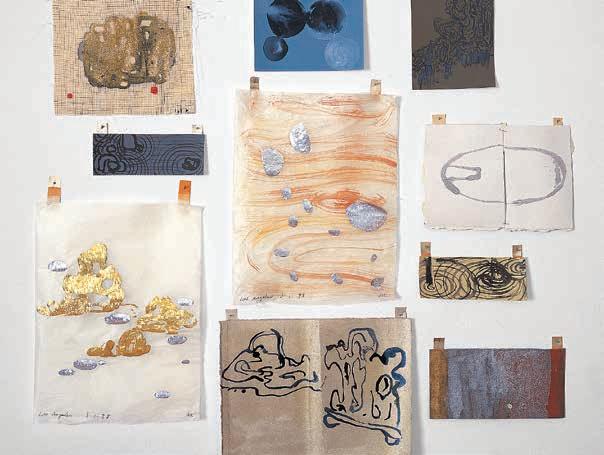
and postmodernist American and European painting. This new love differed in scale and sensibility from the meticulous, often miraculously wrought Japanese objets d’art with which she was familiar. It is not surprising, then, that both impulses are present in the artist’s work reformulated and reconciled; Lorenz merges fine art with craft, abstraction with representation, painting with relief, Eastern techniques and motifs with Western ones to create her own, singular, cross-pollinated oeuvre. Lorenz makes no attempt to hide her almost obsessive handiwork; she does not believe that instantaneity necessarily guarantees expressive, original art. She seems to take deep, even perverse, pleasure in the slowness of her process, spending innumerable hours creating her astonishingly intricate work, as if spellbound.
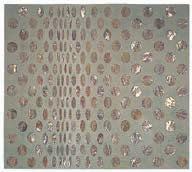
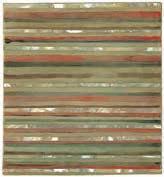
additional color that glows through, to affixing them one by one onto the surface of the panel, to repeatedly burnishing the many layers of shellac. Related to Color Field painting here, in earlier works she has been inspired by Agnes Martin’s minimalist paintings and Bridget Riley’s optical explorations.
10001
tel: 212.564.7662 f A x: 212.564.8193
1014 mA dison Avenue, hird floor, n e W york, ny 10021 tel: 212.535.5767 f A x: 212.794.2454 WWW
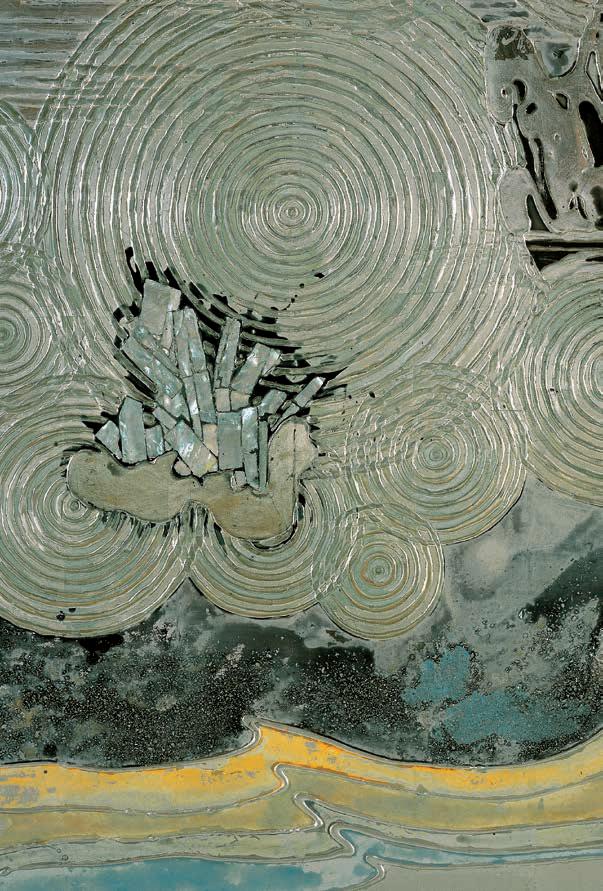
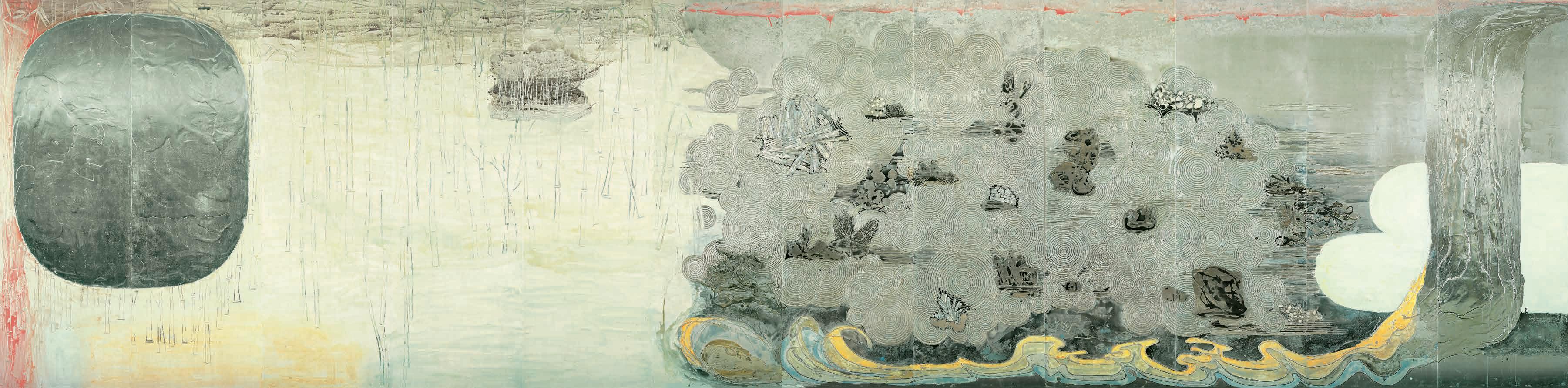
Opposite side: Rock Garden Room, 2004, silver leaf, mother-of-pearl, pigment, gesso and shellac on panel. 12 panels, 3 feet each; 36 feet overall.
Front and Back covers: Detail from Rock Garden Room, 2004 Photography: John Lamka Design and production: Tomo Makiura and Paul Pollard, M, Inc.
An ardent advocate of fine craftsmanship, Nancy Lorenz has long admired traditional Japanese art and its refinement, an admiration hardwired by a formative five-year stay in Japan during her adolescence. Lorenz found the national reverence for beautifully made objects—ceramic bowls, tea implements, inlaid lacquer boxes and gilded screens, for instance—enormously sympathetic to her own sense of beauty. The Japanese place great value on the so-called minor arts and, often produced by celebrated artists, have designated many of them national treasures. Even now, when Japan has succumbed—like so much of the world—to the blandishments of mass culture, it is still style-obsessed, if in different manifestations.
When Lorenz returned to the United States in the early 1980s, what she studied—and fell in love with—was the sweeping, large-scale abstractions of modernist
For this two-part exhibition, Lorenz has created resplendent installation for JG Contemporary’s Chelsea gallery and show of about a dozen moderately sized, equally rich, single-panel works in its uptown space. All pieces are fashioned out of her signature materials: lacquer mixed with pigments and inset with translucent mother-of-pearl, like pinpoints of light. The compositions of the single panels consist of loops, spirals and cascades that recall jeweled constellations, showers of falling stars or celestial maps, with drifts of color sealed beneath the sheen of shellac. Her images make you think of early Ross Bleckner, Vija Celmins or opulently hued galaxies viewed through the remarkable lens of the Hubble Space Telescope. A kind of court art might be one way to think of Lorenz’s production. Hers is a painstaking, time-consuming, artisanal process, from cutting the mother-of-pearl into tiny circles, ovals and dashes, which she often paints on the reverse side for
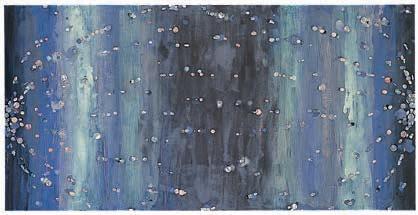
fig. 1 Drawings at the artist’s studio in New York City.
fig. 2: Untitled, 2002, mother-of-pearl, pigment and shellac on panel, 16 18 inches.
fig. 3: Untitled, 2002, mother-of-pearl, pigment and shellac on panel, 6 inches.
fig. 4: Efflorescence, 2002, mother-of-pearl, pigment and shellac on panel, 36 72 inches.
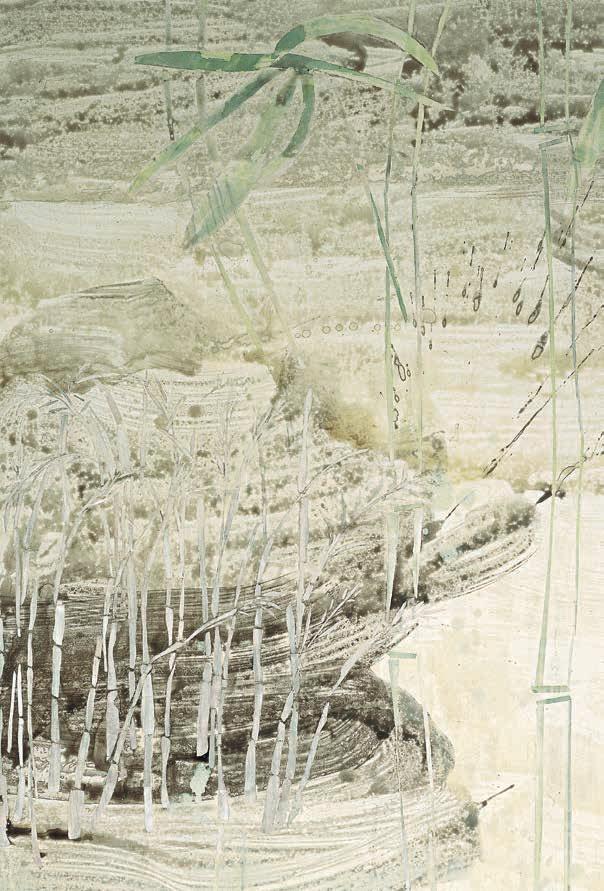
For G Contemporary’s Chelsea gallery, Lorenz conceived something related to Whistler’s Peacock Room at the Freer Gallery of Art in Washington, D.C., although on a more intimate scale and with a blonder palette. The Chelsea gallery walls are faced with nine-foottall lacquered panels that are leafed in gold and silver, blushed by color here and there—a streak of vermilion, a cool green, a rose—and polished to a mirrored sheen. Iride-scent fragments and slivers of mother-ofpearl picture what might be a scholar’s garden bathed in lunar radiance. One panel depicts a bamboo grove with mother-of-pearl stalks and leaves. Another describes a rock garden, the raised, distressed, concentric rings reference to the rakings in sand at such sacred sites as Ryoanji in Kyoto. Yet another contains waterfall. Water is an important subject for the artist and the flickered, mercurial shine of the metallic leaf and mother-of-pearl provide a further illusion of fluidity. The viewer who walks into the space is reflected in the room’s gleaming surfaces, ghostly image in Nancy Lorenz’s perennially golden garden, a passing guest in the timeless realm of her earthly paradise where gorgeous is the reigning aesthetic.
Lilly Wei
Lilly Wei is New York-based independent curator, essayist and critic who writes for several publications both in the United States and abroad. A frequent contributor to Art in America, she also contributing editor at ARTnews and Art Asia Pacific.