






To list your group’s event on a space available basis, please send your event notice with date, time, place w/city and state, contact name, and phone number to: Calendar, In Flight USA, P.O. Box 5402, San Mateo, Calif. 94402, or email vickie@inflightusa.com.
Note: Calendar includes only information available by our press date. Confirm the status before attending.
May 1-3: Red, White and Blue Airshow, Monroe, LA, F-35A Lightning I| Demonstration Team, Dacy Airshows, GhostWriter Airshows, Titan Aerobatic Team, Younkin Airshows, Inc.
2-3: JBSA’s “The Great Texas Air Show”, San Antonio (Randolph AFB), TX, U.S. Air Force Thunderbirds, F-22 Raptor Demonstration Team, U.S. Army Parachute Team Golden Knights, Ace Maker Airshows, Tora Tora Tora, jbsatoday.com/event/the-great-texas-airsho/ 2-3: Charleston Airshow “Heroes of Flight”, JB Charleston, SC, U.S. Navy Blue Angels, jbcharleston.com/airshow
8-10: Valdez May Day Fly-In and Air Show, Valdez, AK, Undaunted Airshows, valdezflyin.com
9-10: Air Dot Show Fort Lauderdale Fort Lauderdale, FL, U.S. Air Force Thunderbirds, F-22 Raptor Demonstration Team, fortlauderdaleairshow.com
9-10: MCAS Cherry Point Air Show MCAS Cherry Point, NC, U.S. Navy Blue Angels, F-16 Viper Demo Team, USMC F-35B Lightning I, USMC MV22 Osprey, cherrypointairshow.com
15-16: US Aircraft Expo, Nashville, TN, usaircraftexpo.com
15-17: Vero Beach Air Show, Vero Beach, FL, U.S. Navy Blue Angels, Franklin’s Flying Circus & Airshow, veroairshow.com
15-17: Oregon International Air Show, Hillsboro, OR, F-35A Lightning II Demonstration Team, USMC F-35B Lightning II, oregonairshow.com
15-17: 11th Annual TBM Avenger Reunion and Salute to Veterans, Peru, IL
16-17: Mountain Home AFB Airshow, Mountain Home AFB, ID, U.S. Air Force Thunderbirds, Brad Wursten Airshows
16-17: Wings Over Shellharbour, Sydney, AU
17-18: Golden Isles Airshow, Brunswick, GA, US Navy Blue Angels, hgoldenislesairshow.com
20: U.S. Naval Academy Air Show/ Graduation Flyover Annapolis, MD
20-21: Operation Skyhook Fly-in Pine Bluff, AR, bpapilots.org
23-25: May Air Dot Show Central PA, Harrisburg (Middletown), PA, U.S. Navy Blue Angels
23-24: Hyundai Air & Sea Show
Miami Beach, FL, U.S. Air Force
Thunderbirds, U.S. Army Parachute Team Golden Knights, USMC F-35B Lightning I, usasalute.com |
28: U.S. Air Force Academy Graduation USAF Academy, CO
29-31: 2026 Atlantic City Air Show
Atlantic City, NJ, F-22 Raptor Demonstration Team, USMC F-35B Lightning ||, 10g Aerosports/ Tryg Aviation, American Airpower Museum - Cockpit USA, Paul Bennet Airshows, Thom Richard Airshows, U.S. Air Force Heritage Flight, visitatlanticcity.com/ soarandshoreairshow
June 5-6: US Aircraft Expo, Bozeman, MT, usaircraftexpo.com
5-7: 35th Annual World War II Weekend - A Gathering of Warbirds Reading, PA
6: Cannon AFB Airshow Clovis (Cannon AFB), NM
6: Chickasha Wings & Wheels Chickasha, OK, shorturl.at/40ZX3
6-7: Spirit of St Louis Air Show & STEM Expo St. Louis (Chesterfield), MO U.S. Navy Blue Angels, Canadian Forces Snowbirds, F-22 Raptor Demonstration Team, Skip Stewart Airshows, Titan Aerobatic Team, U.S. Air Force Heritage Flight, Younkin Airshows, Inc.
6-7: Fairchild Skyfest Spokane (Fairchild AFB), WA
10: Armed Forces Day North Bay 2026 North Bay, ON
27: AEDC 75th Anniversary Open House, Arnold Air Force Base, TN
12-13: Moses Lake Airshow, Moses Lake, WA, U.S. Air Force Parachute Team, Microjet Airshow, Ryan Dembroski - Airshow Announcer
13-14: CenterPoint Energy Dayton Air Show Dayton, OH, U.S. Navy Blue Angels, F-22 Raptor Demonstration Team, daytonairshow.com
19-21: NJ Air Show, West Milford, NJ, GhostWriter Airshows, Greg Koontz Airshows, Luke Carrico, Air Show
Announcer, Mini Jet Airshows , NextGen Eagles, Northern Stars Aeroteam, Warbird Thunder Airshows, njairshow. com





At Vista Air Inc., a long-standing flight school based at Whiteman Airport, aviation training continues to serve as both a gateway to aviation-related careers and a community fixture in the northeast San Fernando Valley.
A new name is taking flight in the world of aircraft sales and acquisitions.
touted by community officials as one of the best flight schools in the area with many affordable options by which to gain pilot training through advance certificates.
lationships rather than one-time deals.
Southern California airspace.
Whether you want to go into recreational flying or start a career in aviation, it all begins with obtaining your private pilot license. It’s an accomplishment that holds a practical value and separates you from the crowd. Your license represents a positive accomplishment, and from there, your options are nearly limitless.
Arcadia Jets, headquartered in Phoenix, Arizona, officially launched in January 2025 with a bold mission: to make an immediate, positive impact on the business aviation industry through a combination of integrity, innovation, and giving back.
Founder Adam Hahn, with more than 20 years of experience in aircraft brokerage and acquisitions, Arcadia Jets was built on a simple but powerful philosophy — put the client first and do business differently.
Doing Things Differently
Founded in 1990 and operating for more than three decades, Vista Air has built a reputation as a full-service aviation-training provider, offering instruction from private pilot certification through advanced commercial ratings. The company is located at 10000 Airpark Way in Pacoima and serves students across the greater Los Angeles region.
At a recent press conference regarding Whiteman Airport, Vista Air was
From day one, Arcadia Jets set out to stand apart from traditional brokerage firms. Every transaction is handled with transparency, data-driven market analysis, and a focus on long-term re-
The school operates out of Whiteman Airport, a general aviation hub often favored for training due to its lower traffic compared to major regional airports. This allows student pilots to gain experience without the delays and congestion typical at larger facilities, while still operating within complex
“We wanted to create a company that clients could truly trust,” said Hahn, CEO/Founder of Arcadia Jets.
“Our goal is to combine expert market knowledge with genuine, personal service — ensuring that each client feels valued and confident through every
ing an off-market opportunity, Arcadia Jets tailors its strategy to each client’s
Arcadia Jets believes that aviation can be a force for good — both in business and in the community. To reflect that, the company pledged that for every aircraft sold, whether through a
Vista Air provides a range of services beyond flight instruction, including aircraft rental, FAA-approved testing, and access to pilot supplies through its on-site store. The company is also an authorized testing location for Federal Aviation Administration (FAA) exams, positioning it as a one-stop shop for aspiring aviators working toward certification.
client acquisition, sale, or off-market transaction, a donation will be made to Angel Flight West.
Angel Flight West is a nonprofit organization that arranges free, non-emergency air transportation for people facing medical and humanitarian needs throughout the western United States.
Cost estimates for training vary depending on the program and pace of instruction, with some advanced certifications reaching several thousand dollars. The company notes that expenses can be reduced through block-rate pricing for prepaid lessons.
“We built philanthropy into our business model from the beginning,”
Leslie Mogensen, Director of Business Development continued. “Our partnership with Angel Flight West ensures that every deal we complete also helps someone in need. It’s our way of giving back through the gift of flight.”
Vista Air also emphasizes accessibility for newcomers, offering introductory “demo flights” that allow prospective students to experience flying before committing to a full training program.
Rapid Growth and Expansion
EAA Chapter 40 based at Whiteman Airport, the second most active in the
In its first year, Arcadia Jets has already begun expanding its team and capabilities. The company recently wel-
Continued on Page 12
comed Hunter Yahya, an experienced Director of Aircraft Market Research, a role dedicated to gathering market data and providing analysis and intelligence using advanced data tools and proprietary systems to bring clients the most up to date information and data to ensure they are making the best possible
Additionally, three new aircraft sales professionals will be joining the company, strengthening its presence in key markets and ensuring that clients continue to receive top-tier service and
Arcadia Jets is proud to bring together a team whose collective expertise spans every corner of the aviation market. Their newest members contrib-
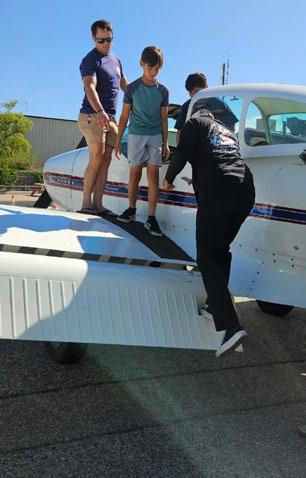
EAA Chapter 40 based at Whiteman Airport, the second most active in the world, has hosted more than 13,000 Young Eagles throughout the years. Pilot Estevan Roth is hosting these Young Eagles.
Continued on Page 9









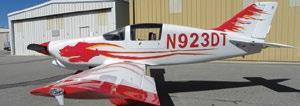
AirplanesUSA Aircraft Sales proudly presents this 2008 Tango II to market. The Tango II is a composite two place aircraft with performance comparable to the RV-8 and Glasair I model aircraft. The fuselage, wing and horizontal spars are factory built, resulting in ease of construction and reliable quality control. This beautiful Garmin equipped speedster is owned and operated by 2 test pilots and is now ready for a new home. Export and worldwide delivery are available.All trades considered..........................................................................$139,900






AirplanesUSA proudly presents this one-of-a-kind T-28B. This aircraft completed a frame-up restoration in 2021 by Draken International. Over $600,000 invested. Modern Garmin avionics complement this unbelievable warbird. This is a once-ina-lifetime opportunity to own a truly unique, historical aircraft. Export and Worldwide Delivery are Available. All trades considered.....................................................................$399,900
1976
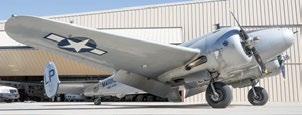
1953 Beechcraft C-45H

AirplanesUSA proudly presents this better-than-new Cessna U206F. This is such a craft. Garmin Full Glass Panel Avionics, Low time TCM IO-520, new interior and like-new paint serve to separate this example from


Confidence: A state of trust, firm belief or assurance of oneself, lacking doubt or fear.
Arrogance: An attitude of superiority shown by excessive confidence, exalting in one’s ability to perform.
Yes, some word cherry picking has been employed, but note the elements of similarity between these two definitions. What has been left out of these definitions is that a confident person is viewed as a nice guy, whereas an arrogant person is viewed as a jerk. The problem is that a person exhibiting commanding confidence can appear to be arrogant. An arrogant person exhibiting true skill can appear to be confident. The line between these two behaviors can shift quickly, with disastrous results. At this point, we could delve into the goodness of Aeronautical Decision Making (ADM). ADM is covered in Chapter 2 of the Pilots Handbook of Aeronautical Knowledge and is a major topic in the oral portion of a check ride. But let’s skip the academics and look at these related behavioral traits as they might manifest themselves in real life and, just for fun, toss in a couple of pop quizzes. With some level of embarrassment, it is this writer that managed to exhibit both behaviors in a single flight!
The early 1960’s were an exciting time in the growth of General Aviation. A major Los Angeles airport sported an impressive Cessna sales and training center, complete with modern flight school (30-plus training aircraft) and a spectacular sales showroom. At the other end of this large airport was a famous Beechcraft dealership, equally impressive with aircraft sales and flight training. This writer, having just slipped into my 20th year, had about 600-plus hours of flying time and was on the Cessna end of the airport as a CFI. Being very lucky, that 600-plus hours included a remarkably wide variety of airplanes,
from the simple Aeronca Champ to war surplus round engine machines, with about everything else manufactured during the 1940s and 50s thrown in for fun. A couple of prewar biplanes even made the list! I considered myself a pretty good “stick.” POP QUIZ … grade that last statement as “confidence or arrogance.”
This well-rounded level of experience made me popular with the sales department. While the sales staff could sell water to a fish, they were famously lacking in pilot skills. It was a standard procedure for a salesman who felt uneasy demonstrating an airplane to a prospective customer to call on one of the CFIs to handle the demo flight. Very often, it was this writer. I would happily put on a sales face and fly whatever needed to be flown… with an extra 25 bucks coming my way for helping. A great deal!
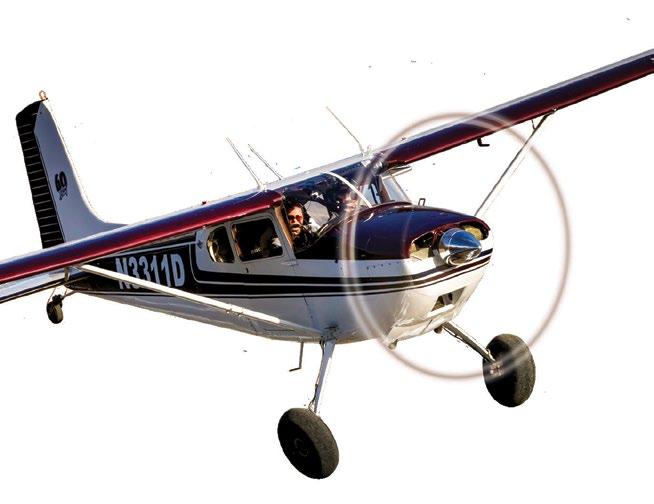
Taking a “trade in” was common for the sales department, and one customer, stepping up to a Cessna 310, had traded in his Cessna 195 which sported the big 300 hp Jacobs engine. Having flown all the Cessna taildraggers up to that point in time except the C-195, I was tagged to conduct a demo flight in this classic airplane… well … sort of classic.
In today’s world, the Cessna 190/195 is a revered classic, deservedly so, but when I was a kid instructing in C-150’s, it was just an out of production beater in average condition sporting a really big engine that would challenge my skills. I was ready to take a crack at it. POP QUIZ … grade that last statement as “confidence or arrogance.”
With the prospective buyer scheduled to visit the showroom the next day, I consulted one of our mechanics familiar with the C-195 as to how to start the engine and what power settings to use. With no flight manual (computer search engines had not
Continued from Page 6
been invented), I could only trust instrument markings to figure out critical speeds. Keep in mind, current regs requiring a variety of endorsements did not exist at this time. I had been good at doing this drill many times before in many other planes. I cranked up the “Shake ‘n Jake,” and spent about 30 minutes in the practice area, teaching myself how to “fly the beast.” POP QUIZ …Grade that last statement as “confidence or arrogance.” I did note some fluctuations in the pitot static instruments and asked that our maintenance shop take a quick look to make sure all was good. Other than that, I was ready for the next day’s demo flight.
The prospective customer showed up on time and I, wearing a salesman’s suit and sporting a salesman’s smile, introduced the customer to what is truly a large and impressive airplane. Details, like the retractable entry step,
the spacious rear seat that would comfortably seat three abreast (more room than modern airliners) and legroom that makes airline first-class seating seem cramped, all became selling points. One enters trough a large rear door and “walks” up to the captain and copilot seats, much like today’s cabin class airplanes. The Cessna 195 was truly designed for executive comfort! The customer was not tailwheel qualified, so I helped taxi to the runway, making it look easy. With a lot of tail-wheel time in my logbook (actually, most of my time), I decided to let the customer initiate the takeoff, knowing my superior CFI skills would be “at the ready,” if needed. POP QUIZ … grade that last statement as “confidence or arrogance.”
With the prop in fine pitch and throttle fully advanced, we accelerated quickly, but as the tail came up, I noted a sudden loss of RPM. Quick -
Continued on Page 9












Continued from Page 7
ly looking at the engine instruments, RPM was going down and manifold pressure was going up. We are now well into the short take-off roll and I see that the vernier prop knob is winding back into a course pitch, all by itself! About to go airborne, I instinctively slap the prop knob full forward and hold it with my hand. The engine surges with power and we are airborne. The customer has not really noticed what has happened, having never flown with a variable pitch propeller. Now for Act II.
The surging engine causes a rapid acceleration, and the entire instrument panel falls into the cabin, landing on top of the Y style control yoke. This was noted by the customer. With one hand occupied with the prop knob and the other hand trying to control the plane with a yoke jammed by the entire instrument panel, I had run out of hands. It was time to employ what years later became known as Crew Resource Management (CRM). I asked the customer (calmly, of course) to hold the prop knob full forward while I (still climbing) use one had to fly and the other to push the instrument panel back where it belonged. I later learned that the shock mounted instrument panel (with all the flight and engine instruments) could be easily removed for maintenance by simply releasing a few fasteners. Engine and prop controls, along with fuel selectors, various switches and glove boxes (very civilized) were mounted on a lower panel built into the airframe.
I now asked the customer to hold the prop knob full forward, and with his other hand, hold the panel in place. I took on the throttle and control yoke. With a quick call to the tower, we stayed in the pattern for an immediate landing, my second one in this plane. In my best and most convincing sales voice (remembering there were 25 bucks to be earned), I assured the customer that this was simply a mild maintenance issue, that this plane was a great buy and that we were in no difficulty. POP QUIZ … grade that last statement as “confi-
dence or arrogance.” With an acceptable landing completed, the customer politely said he was late for a meeting and would contact the salesman later that day. That contact was never made, and I was out 25 bucks.
A postmortem of the adventure disclosed that a mechanic had just completed a check of pitot/static connections behind the panel and had temporarily fitted the instrument panel back in place while obtaining fresh fasteners. I had grabbed the plane for the demo flight, thinking all was good. The mechanic returned to find the plane missing. I never learned why the vernier prop knob failed, but it did get repaired. As the years have passed, this writer has often thought of this incident, asking perhaps a rhetorical question. Did I manage this situation to a successful conclusion due to skill and cunning, or did I just get lucky? In order to maintain a high degree of self-esteem, the conclusion is clear. I had good skills then and even better now, so all will always go my way. POP QUIZ … grade that last statement as “confidence or arrogance.”
Here is the tricky part about telling the difference between confidence and arrogance. When one goes a bit deeper into the definitions, the big difference is in how one presents themselves to others. The confident person is kind, considerate of others and polite. The arrogant person is pushy, demanding, often rude. In the events just remembered, this writer was the consummate “salesman,” smiling and cheerfully explaining that all was well, while hoping I would not have to change my underwear. Now, for the last POP QUIZ, is such behavior an indicator of confidence or arrogance? The bottom line is that “confidence is considered good, while arrogance is considered bad.” What kind of score did I get? As a last shared thought, what is my final opinion of the Cessna 195 with the big Jacobs engine? I gave that airplane multiple opportunities to kill me, and it didn’t. When asked today, “What is your favorite airplane?” The Cessna 190/195 makes into the top five.


Many of our readers may have fond remembrances of the “good old days.” For aviation fans, this means thinking of times when owning an airplane was within reach, learning to fly was significantly less expensive and flying for the pure pleasure of aviating was considered reason enough to be a pilot. Becoming a purely recreational pilot who departs the earth on occasion just for the pure joy of flying was accepted and envied by earthlings stuck with crowded highways, weekend trips that barely left their home county or airlines beset by labor issues, government delays, inhuman airport hubs with plane changes, and a middle passenger seat crammed between two 300-pound professional wrestlers that sweat.
In today’s world, it is almost as though “enjoying” flying is passé, not sufficiently relevant, or just plain wasteful. Unless you fly a megabuck plane with digital systems that would

make the average 16-year-old geek weep with envy, flying is a bore. In the “good old days” of flying, owning an airplane did not disrupt the national debt and flying for relaxation and fun was the objective. One did not need to justify airplane ownership by hurtling through the air at speeds approaching Mach numbers to big city locations for powerhouse meetings with fellow captains of industry.
This writer remembers those “good old days” well, having lived them. While many may be thinking that flying for the pure joy of it is simply a concept that has died, think again! Believe it or not, the FAA has opened the door of a time machine. For anyone considering learning to fly, or existing students or certified pilots who may have been overwhelmed by huge airplane purchase costs, outrageous rental rates and training demands that can take months, if not years, to complete, a time machine
awaits you. While many reading the following opinions may not wish to avail themselves of our time machine, please do pass this on to friends who might just enjoy a nudge towards flying fun.
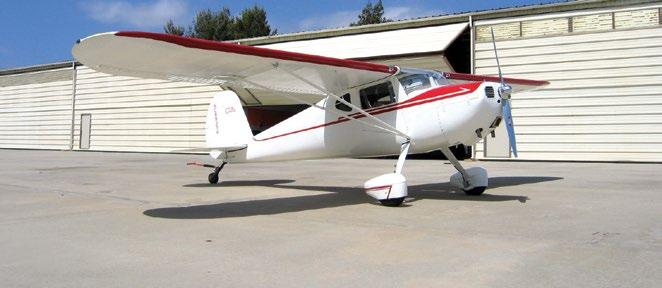
Let’s take a trip back to 1955, when a very successful and hard working criminal lawyer, Frank Kingston Smith, found the stress of serving in combat during WWII, his present life of running a law firm and the challenges of raising three sons while, at the same time, being a responsible husband, was taking a toll on his physical and mental wellness. Having his personal doctor tell him to, “Relax, take some time off, get a hobby,” did not help. Having tried the preceding options, Frank happened to pick up an outdated copy of a popular flying magazine in the doctor’s office and read an article about a priest that had bought a $2,000 Cessna 140, learning to fly in his own plane. The






priest was even using his plane in support of youth programs.
This caught Frank’s attention. “Gosh,” thought Frank, “if a priest can afford to do something like this, so can I.” With just over $2K in Frank’s personal bank account, Frank queried his law partner (known to be taking flying lessons) if he knew anything about any $2K Cessna 140s at the local airport. The partner, enthusiastically involved in flying lessons, immediately dragged Frank to the airport, introduced Frank to the FBO owner and within minutes, was looking at a $2k Cessna 140 in the back corner of a large hangar.
Frank was suddenly caught in the world of wonder that many readers may have experienced. To quote Frank, using his words that became the first chapter in his 1957 book “Week-End Pilot,” … “So, I bought


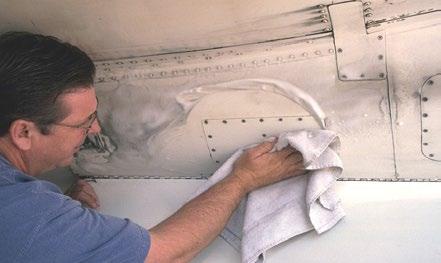











gear

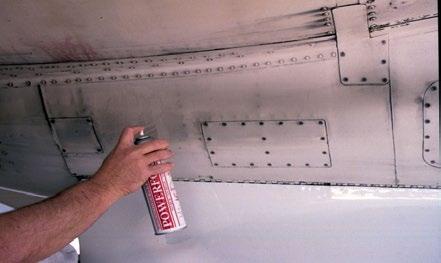
or any other surface covered with heavy accumulations of






























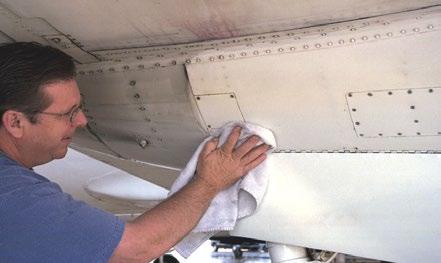

is also great for cleaning food and drink stains on hard surfaces, while disinfecting the





























Continued from Page 4
world, has hosted more than 13,000 Young Eagles throughout the years. Young Eagles offers airplane rides to introduce young people to aviation, aviation careers and build on STEM educational skills. Many have been inspired by these rides to pursue a career in aviation.
Vista Air’s customer reviews and industry listings suggest the school maintains a strong local reputation, with praise for its instructors, aircraft maintenance, and customer service. The operation includes a fleet of training aircraft and a team of instructors with diverse aviation backgrounds.
As demand for pilots continues to grow nationwide, regional training schools like Vista Air play a critical role in developing the next generation of aviators. From hobbyists to future airline captains, the Pacoima-based school remains part of the broader aviation pipeline — helping students take their first steps into the skies.
Unfortunately, Whiteman Airport finds itself at the center of controversy where some county officials want to close the airport. At a press conference held on April 27, current and former members of the Los Angeles Aviation Commission made several key points indicating that the county cannot legally close the airport without FAA authorization, which is both unlikely to occur and extremely complex to navigate.
Whiteman Airport must remain open under FAA grant assurances, and it must be safely maintained. LA Aviation Commissioners said the airport is safe but county officials are not using available federal funds to maintain it, which is illegal.
The airport is an enterprise that functions without any tax dollars. Ironically, the only tax dollars ever used by the county with regard to the airport is the $1.9 million for a closure study – a closure that is illegal. The county knows this.
Another key factor is that Whiteman Airport supports firefighting, medical and disaster responses. This is critical to the county and Los Angeles basin.
According to commissioners, the county needs to answer the following:
• Why is the County conducting a closure study when the FAA has ultimate authority over the airport?
• What and where will firefighting, medical and disaster response teams be relocated, if they are relocated, while LA County is vulnerable without these services based at Whiteman?
• Why are critical safety upgrades not being pursued at Whiteman despite the availability of federal funding and the existence of known infrastructure risks?
The Whiteman Airport Coalition is playing a major role in supporting the vital life of the airport and its community. In a statement following the April 27 press conference, the Coalition emphasized their request of the County: “We’re asking for something straightforward from Supervisor (Lindsey) Horvath, who represents the Third District where Whiteman is located: unfreeze federal funding, invest in safety, and follow federal obligations.
“And to the full Board of Supervisors: why is closure being studied at all? What would replace this critical emergency infrastructure? And why has available federal safety funding been left on the table for years?
“The public deserves direct answers to these questions.”
To learn more about the Whiteman Airport Coalition, visit their website at https://whiteman-airport-coalition.beehiiv.com/.
To learn more about EAA Chapter 40 based at Whiteman, visit eaachapter40.com.
Meanwhile, Vista Air continues to provide top-notch pilot training and FBO services in a well-maintained, clean and safe environment. To learn more, visit Vista Air, Inc. at vistaair. com or contact them at 818-896-5224.
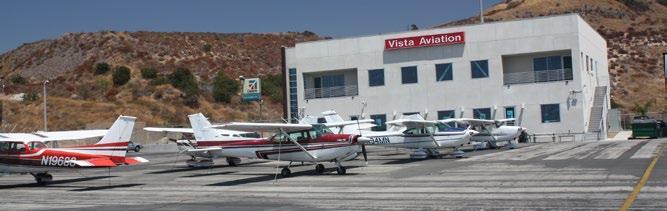
Founded in 1990 and operating for more than three decades, Vista Air has built an excellent reputation as a full-service aviation-training provider. (Courtesy Whiteman Airport Coalition)
By Larry E. Nazimek
Editor’s Note: Larry E. Nazimek was an Aerospace Engineer in the Propulsion Department for the Spartan ABM, at the McDonnell Douglas Astronautics Co.
With the proliferation of nuclear weapons during the Cold War, the major powers conducted negotiations (Strategic Arms Limitation Talks) to limit the number and types of these weapons. The SALT 1 Treaty was signed in 1972, although talks continued.
One aspect of the talks was the limitation of anti-ballistic missiles. Although these missiles were defensive in nature, in the event of an attack, they would defend the ICBMs from being destroyed in the very start of the war. The original agreement was to limit each country to two sites, with one defending that country’s national capitol and the other defending a section of its ICBM fields. That was later reduced to only one site. The Soviet Union deployed its ABMs around Moscow, while the U.S. put its ABMs in northeastern North Dakota, protecting its Minuteman ICBMs.
With all of the Minutemen and
B-52s at Grand Forks and Minot AFBs, it was said that if ND were to secede from the Union, that it would be the world’s third largest nuclear power.
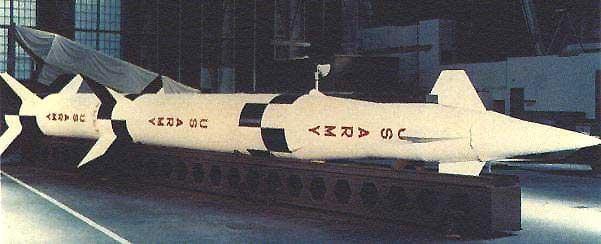
Our defensive system was called “Safeguard,” consisting of the shortrange Sprint and the long-range Spartan missiles. The Sprint was a 26.9-foot long cone-shaped two-stage missile with a low yield nuclear warhead. The Spartan was a 55.2 foot three stage follow-on to the Nike Zeus, with a 5-megaton thermonuclear warhead.
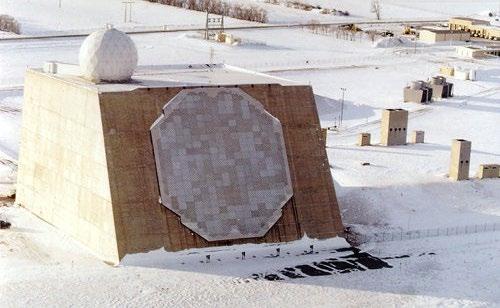
A large solid state phase array radar was constructed near Concrete, ND, 19 miles south of the U.S.-Canadian border. This long-range radar, looking toward Hudson Bay, was known as the Perimeter Acquisition Radar (PAR), Enhanced Perimeter Acquisition Radar Attack Characterization System (PARCS), Ballistic Missile Early Warning System (BMEWS), Concrete (named for the nearby town of Concrete) Missile Early Warning System (CMEWS), and others. It is now part of the Cavalier Space Force Station.
A smaller pyramid-shape Missile
Continued on page 14












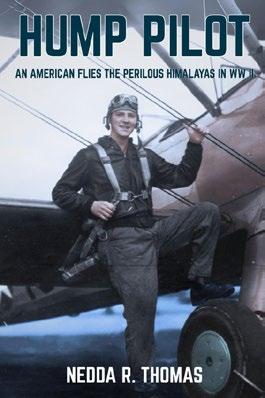
"Hump Pilot is as engaging a read as it is informed and informative. A first-class military aviation history!"
– Midwest Book Review
"Hump Pilot provides an entertaining window into what it was like to fly cargo over the world's most dangerous air route, in the worst flying conditions imaginable. A spirited account!"
– Aviation History

“Descriptions are vivid and engaging, adding a human face to the drama created by perilous missions over a vast mountainous wasteland. Well worth reading.”
– WWII History
"By telling this story in readable language anyone can appreciate, Nedda Thomas conveys how dangerous it was. You don't have to be a military veteran or an aviation buff to love this fantastic true account."
– Robert F. Dorr, Mission to Tokyo, etc.
"Thomas has written a dramatic history centered on her father (whose) brassy dedication and decency come across. However, the truly engrossing tale is the amazing Hump drama that ensures the book does a winner's barrel roll overall."
– Asia Sentinel
Continued from Page 13
Site Radar was just outside of Nekoma, ND, at the Stanley R. Mickelsen Safeguard Complex, along with the Spartans and Sprints. There were three other Sprint sites in northeastern ND.
The solid propellant missiles were in underground silos that could be launched and headed to their targets in moments. Their acceleration was far faster than the large rockets we are accustomed to seeing in launches from Cape Canaveral. Tests of the Spartans involved launching them from Kwajelein Atoll against Minutemen fired from Vandenberg AFB, CA. Of course, actual warheads were not used.
The doors for the Spartans were designed to move sideways, with a “gas generator” (generating gas by burning a solid propellant) providing the force to move them. Naturally, a computer program studied the opening time for these doors. This program, consisting of a large deck of punch cards in the FORTRAN language, used a mathematical model of snow, since snow covers the ground for a large part of the year in North Dakota. For the first amount of movement, it was assumed that the snow on the doors was being compressed to a certain point, upon which force would be needed to break the compressed snow, and after that, it was a matter of moving the doors with the weight of the snow on top.
Just as the site became operational, it was decided that it would not be used. Pres. Richard M. Nixon wrote a letter in Dec. 1972, posted on the bulletin boards of those involved with all aspects of the missiles, notifying them of the deactivation, thanking them for giving him a “bargaining chip” for the SALT talks.
The site, named for former Army General Stanley R. Mickelsen, has remained unused. With the exception of those who live in the area or who were involved with it, relatively few people are aware of it, including the Air Force members stationed at Grand Forks or Minot AFBs. It would have made sense to have designated it as a historical site, but that has not happened. It has been sold to a private company that will probably put a data center at the site. A mockup of the Spartan ABM is on display at the Cavalier Space Force Station along with a historical marker.




































By EAA Staff
Last month, the FAA issued two continuing airworthiness notices regarding common general aviation aircraft. Neither is mandatory, but both merit attention by affected operators.
Airworthiness Concern Sheet for Piper Wing Spar Corrosion
The Airworthiness Concern Sheet (ACS) (https://drs.faa.gov/ browse/excelExternalWindow/DRSDOCID174384018820260402172503.0001?modalOpened=true) requests information from the field regarding “corrosion on the forward wing spars, attachment fittings, and rivets of PA-28, PA-32, PA-34, and PA-44 airplanes.” This follows a discovery of severe corrosion on a PA-28 and a Piper service bulletin recommending inspection of this area.
An ACS is a means for the FAA to share information with the operational community, collect data for further dissemination, and identify safety concerns in the fleet. They are an important part of the continuing operational safety system.
Special Airworthiness Information Bulletin on Shoulder Harnesses
The NTSB has flagged several accidents involving the failure of shoulder harnesses, leading the FAA to issue a Special Airworthiness Information Bulletin (SAIB) (https://drs.faa.gov/ browse/excelExternalWindow/DRSDOCID130960597520260415151611.0001?modalOpened=true) on the subject.
One particular accident discussed by the SAIB involved the failure of the pilot’s shoulder harness in an Aeronca 7AC following impact with terrain in 2014. The pilot was seriously injured in the accident, the passen-
ger was killed. Subsequent analysis of the failed shoulder harness indicated it broke below the maximum loads specified in the current Technical Standard Orders (TSOs) for these restraints.
The SAIB recommends that aircraft owners inspect their restraints and ensure that they meet TSO-C114 for shoulder harnesses and TSO-C22g for lap belts, dated 1987 and 1993, respectively. Like most TSO equipment, conforming devices are clearly labeled as such. Safety belts should also be inspected and replaced periodically per the manufacturer’s directions.
As an additional note for EAA members, long-time EAAers may remember that the organization was an early advocate for the equipage of shoulder harnesses in homebuilts and other GA aircraft. EAA membership applications in the early days of the organization in the 1950s contained the “Shoulder Harness Pledge”:
“I hereby promise to install and wear shoulder harness and safety belts in my private built aircraft to protect myself, passenger and the good name of the association. Air Force and Navy tests have proved that a 20G harness will eliminate 90% of aircraft accident injuries.”
Head injuries continue to be a leading cause of preventable fatalities in GA aircraft. EAA continues to urge its members to install, use, and maintain the best restraint system possible in their aircraft, and this SAIB contains quality information for keeping these systems updated to current standards.


By Annamarie Buonocore
Here at In Flight USA, it is always a pleasure to revisit past stories. Just like at AirVenture 2019, we had the opportunity to sit down with Mark Palm of Samaritan Aviation at this past year’s AirVenture to
learn more about their organization and get an update on the great work they’re do-ing.
From the quiet halls of his father’s church to the untamed wilderness of Papua New Guinea, Mark Palm’s life has been a journey marked by two abiding
� Available in both Qref® Book, Card and new iPad editions
� Over 50 years of professional experience in every checklist
� Written by Master CFIs with workflow and ease of use in mind
� Professional design, rugged construction
Beechcraft Bonanza A36 285HP1968-1983
Beechcraft Bonanza C/D 35 1951-1953
Beechcraft Bonanza J/K/M 35 1958-1960
Beechcraft Bonanza N/P 35 1961-1963
Beechcraft Bonanza V35 A/B 1966-1982
Cessna 150 1959-1977
Cessna 152 1978-1986
Cessna 172 Universal Universal
Cessna 172M 1973-1976
Cessna 172N 1977-1980
Cessna 172P 1981-1986
Cessna 172R 1998-2006
Cessna 172RG 1980-1985
Cessna 172S 1998-2006
Cessna 172S G1000 2005+
Cessna 177RG 1971-1978
Cessna 182P 1972-1976
Cessna 182R 1981-1986
Cessna R182 Skylane RG 1978-1986
Cessna 182RG Turbo 1979-1986
Cessna 182T Analog Gauges 2001+
Cessna 182T/G1000 2004+
Cessna 210N Centurion 1979-1984
Cessna Turbo 182T 2001+
Cessna Turbo 182T/G1000 2006+
Cessna Turbo 206H 1998+
Cessna Turbo 210M Centurion1977-1978
Cirrus SR20 Analog Gauges 2000-2003
Cirrus SR20 G1-G2 2003-2007
Cirrus SR20 G3 2007+
Cirrus SR20 Perspective 2008+
Cirrus SR22 G1-G2 2003-2007
Cirrus SR22 G3 2007+
Cirrus SR22 Perspective 2008+
Cirrus SR22 G3 Turbo 2007+
Cirrus SR22 Turbo Perspective 2008+
Diamond DA20 C1 1998+
Diamond Star DA40 2001+
Piper Archer II PA-28-181 1976-1994
Piper Archer III PA-28-181 1995-2002
Piper Arrow 180 PA-28R-180 1967-1971
Piper Arrow II PA-28R-200 1969-1976
Piper Arrow III PA-28R-201 1977+
Piper Arrow III Turbo PA-28R-201T1977-1978
passions: the desire to help people who are hurting and the love of flight, which he gained through his grandfather’s military pilot background. Growing up as a pastor’s son, he was no stranger to ministry and service — but it was the chance to soar above life’s hardships that ultimately
charted his course for decades to come. His calling began to take shape in 1994, when at 19, he traveled with a friend to Papua New Guin-ea. There, amid lush green valleys and rivers that carved through dense jungle, he witnessed com-munities isolated by both geography and a lack of medical access. The trek to the nearest hospital — dayslong by canoe — meant that any medical emergency could turn fatal.












Piper Arrow IV PA-28RT-201 1979-1982
Piper Arrow IV Turbo PA-28RT-201T1979-1990
Piper Cherokee 140 PA-28-1401964-1977
Piper Cherokee 150 PA-28-1501961-1967
Piper Cherokee 160 PA-28-1601961-1967
Piper Cherokee 180 PA-28-1801963-1973
Piper Dakota PA-28-236 1979-1994
Piper Cherokee Lance PA-32R-3001976-1978
Piper Navajo PA-31-310 B/C 1972-1980
Piper Navajo Chieftain PA-31-3501973-1984
Piper Saratoga SP PA-32R-3011980-1992
Piper Saratoga SP Turbo PA-32R-301T1980-1987
Piper Tomahawk PA-38-112 1978-1982
Piper Warrior 151 PA-28-151 1973-1977
Piper Warrior II PA-28-161 1976-1986
MANY MORE MODELS COMING SOON!

Driven by compassion and equipped with faith, Mark returned home and began building the skills he’d need to make a difference. He studied aviation technology at Miramar College, earned his commercial pilot’s certificate with IFR and seaplane ratings, and gained an FAA A&P mechanics license.
In 2000, with vision and grit, he co-founded Samaritan Aviation. It took a decade of perseverance and fundraising to acquire the first floatplane and launch full-time operations in Papua New Guinea in 2010. That first flight — carrying a pregnant mother in distress — was more than a medical evacuation; it was a tangible breakthrough: turning a three-day canoe journey into a one-hour flight.
Acts of Hope in the Sky
Over the years, Mark has flown more than 1,500 life-saving missions along the Sepik River — into remote villages often seeing airplanes for the very first time. What began with a single plane has expanded into a fleet of three amphibious Cessna 206s, with a fourth en route, delivering hun-dreds of thousands of pounds of medicine, medevac flights, vaccines like polio and COVID-19, and spiritual hope to hundreds of thousands of isolated residents. Unlike most aviation charities, Samaritan capitalizes on the use of seaplanes to reach remote villages, further giving a vote of con-fidence to the seaplane community in the U.S.







Avidyne Entegra
Garmin G1000 Non-WAAS
Garmin G1000
Garmin G1000 WAAS
Garmin G600/G500
Cirrus Perspective by Garmin
Bendix/King KLN 89
Bendix/King KLN 90B
Bendix/King KLN 94
Garmin GMX 200
Garmin GPS 400
Garmin GNS 430




Garmin GNS 480
Garmin GNS 530
Garmin GTN 750/650
Garmin GX Series
Garmin MX 20
Garmin 300XL/250XL
AnywhereMap ATC
AvMap EKP IV / IV Pro
AvMap EKP V (coming soon)
AvMap Geopilot II / II Plus
Bendix/King AV8OR
Bendix/King AV8OR Ace
Garmin GPSMAP 96
Garmin GPSMAP 195
Garmin GPSMAP 196
Garmin GPSMAP 295
Garmin GPSMAP 296
Garmin GPSMAP 396
Garmin GPSMAP 495
Garmin GPSMAP 496
Garmin GPSMAP 696/695
Garmin Aera Series
Lowrance Airmap 2000C/1000
Lowrance Airmap 500/600C

For communities facing malaria, tribal conflict, childbirth complications, or snakebite emergencies, these flights are nothing short of life-giving. Beyond the critical logistics, each flight carries the message of God’s love—and the nurses, supplies, and words of encouragement that walk along-side it.
Trials in the Mission Field



Yet the journey hasn’t been without its challenges. In 2019, while raising awareness in the U.S., Mark was diagnosed with B-cell lymphoma. His treatment — chemotherapy and radiation — took place as the world grappled with the onset of COVID-19. If ever there was a moment to feel the fragility of life, that Continued
Continued from Page 18
was it.
That health crisis deepened his empathy for the very people he serves — those with no access to life-saving care. Thankfully, today he is in remission, his passion stronger than ever.
A Family United in Mission
Mark’s journey has always been a partnership. His wife, Kirsten, who holds a Master’s in Cross-Cultural Education, has been by his side since the very beginning. Together, they navigated the ear-ly days of ministry — she driving the ambulance, calling weather reports, and raising their children in a life of service.
They have three children — Sierra, Drake, and Nolan — with whom they lived in California and then moved to PNG for full-time operations. Today, their family continues the mission, splitting time between their home and the skies over Papua New Guinea.
The organization has grown to include hundreds of volunteers, including students, church mem-bers, pilots, and those who simply want to help the cause.
Continuing the Mission Samaritan Aviation now serves nearly 700,000 people across the Sepik and Gulf provinces — where days-long journeys are exchanged for hour-long flights. Mark’s vision continues to grow: expanding into new provinces, training local staff, building hangars and training
centers, and scaling operations to serve even more people. Every flight re-mains tethered to the underlying mission — to offer not just healthcare, but both hope and access through the love of Christ. For more information, visit www.samaritanaviation.org.

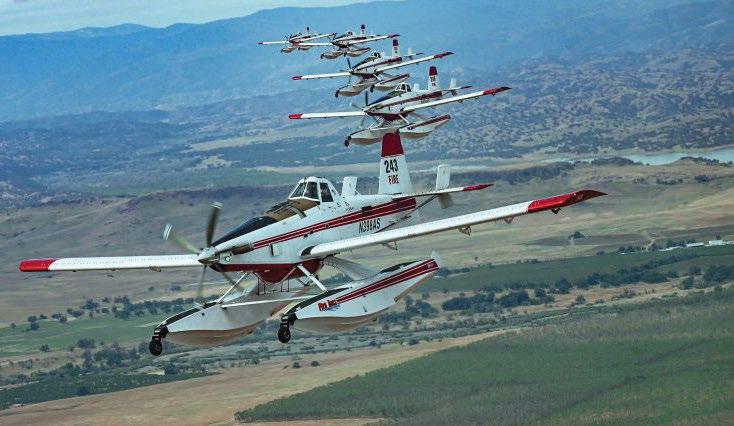
At Samaritan Aviation, their mission goes beyond responding to emergencies. They are working to help remote communities in Papua New Guinea with a fleet of four amphibious Cessna 206s, be-come more self-sufficient, starting with something as simple and essential as access to basic medi-cine before a crisis hits. (Photo courtesy Samaritan Aviation)


Seaplane access should be allowed here in Colorado.
We have made great strides by establishing two charted seaplane bases in Colorado (the first ever), planning and managing several splash-in events (the first ever), establishing an invasive species inspection and decontamination program for seaplanes (the first), and becoming the first ever pilot to receive all the training and obtaining certification totally within the State of Colorado (yep, you heard it right, the first).
Despite these successes, our battle rages on. The state is still adamantly opposed and so we are continuing the fight. There is no level of problem that imagination and creativity cannot overcome. And so, we must continue to be the first with solutions.
We must demonstrate by example the strength and resolve of an idea whose time has come!



By Carl E. Chance
STEM education, Science, Technology, Engineering and Math, is definitely a ‘hot button’ throughout the Midwest aviation industry and in cooperative ventures with area schools and industry. Wichita and the State of Kansas has been a well known aircraft engineering and development center going back to the days of Stearman, Cessna, Beech, Boeing, Learjet and now Bombardier, AirBus Wing Design, Spirit AeroSystems and Textron Aviation.
Business & Science Partner
Two of the leaders taking a big step to get STEM education in focus, are the Wichita Independent Business Association (W.I.B.A.) and Exploration Place, the Sedgwick County Science and Discovery Center. The Science Center has a major commitment to education that involves adults, home schooling, parents, scouts, teachers, teens and youth organizations programs. Visit the website “exploration.org” and checkout the roles they play with their heavy commitment to Science Education. Both W.I.B.A. and Exploration Place have partnered to provide fun science education to sixth grade science classes at Brooks Magnet Middle School, this semester.
The class educators had developed methodology in hands-on activities which were thematically-based where students were at stations working in teams and self-directed. The daily lesson plans complimented the science curriculum and could be adapted or modified to fit various student needs. The goal is to continue the classroom program two or more academic years in following the 6th graders into their 7th and 8th grade years. The plan then will be to demonstrate the impact of the program for both students and teachers.
A program on the outcome and success of the STEM classes to date, was presented at a recent W.I.B.A. meeting, presented by Jan Luth, President at Exploration Place and Beth Rohrig, Educator at Exploration Place. One of the W.I.B.A. members, Carl Chance was recognized as a volunteer educator who had assisted in the sixth grade class of Ms. Moshiri recently and is a past middle and high school educator with the USD259 Wichita School System.
An Individual Initiative

In the years previous, Chance had developed an individual interest in creating www.wingsoverkansas.com an aviation website, and had developed an aviation education page for the site through a grant proposal from the Wolf Aviation Fund. The page is titled, “Flying Into The Future On The Wings of Education.” There are on that dedicated page, 23 aviation education lesson plans written around aviation and aerospace pioneers. The page on the website serves as a resource base for schools nationwide and is being utilized by middle and high school educators in support of history and science curriculum’s. The lesson plans include integration of the subjects of history, language arts, and technology. Each lesson plan includes Learning Objectives, Educational Standards, Procedures, Activities, and Suggestions for Extensions to the lessons. The theme, ‘Link & Learn’ also utilizes this page as a resource for Aviation Continuing Education, locating colleges and universities, scholarship sources, Kansas Starbase, FAA aviation education, AOPA aviation education and much more.
The STEM Adventure Continues
Recently, the Wichita Public Schools Proposed the First High School ‘Aviation Pathway’ In Kansas. It’s a program to create new aviation industry options for high school students. The plan is for the Wichita Public Schools, WSU Tech and Textron Aviation to partner with the aviation industry and Kansas State Department of Education to launch ‘Aviation Pathway.’ It would be the state’s first aviation technical education pathway.
The Aviation Pathway Concept
Recently Textron Aviation had introduced a high school education concept to the Wichita Public Schools and to WSU Tech that offered great potential benefit to area students, the aviation industry and to the Wichita community as a whole. Various directions to take the concept were explored and the program was one not to be ignored. The total values were quite obvious to the students. This new program was focused on today’s high-tech, fast-paced aviation industry.
With additional input from the aviation industry along with the approval by the Kansas Board of Education, the Wichita Public Schools are planning to launch this program as soon as developed, in four Wichita public high schools: North, Northwest, Southeast and West high schools. What this means is, with educators and business working together, this new program will match industry needs and students with knowledge and career opportunities. The Aviation Pathway program will feature two distinct paths, Aviation Production and Aviation Maintenance. Planned Program Outline/Process
The plan is for students to take classes at the student’s home high school and at WSU Tech’s National Center for Aviation Training campus. The students would also shadow or complete their programmed internships with employers during their final year of study.
Current plans would give students options such as sub-sections within Aviation Production and Aviation Maintenance.
In Aviation Production, students would study such topics as aerostructures, composites and mass production
principles.
Or, for Aviation Production: CATIA, students would learn many of the same principles plus CATIA, a computer-aided engineering design program widely used in aviation.
For Aviation Maintenance: Avionics, students would study topics such as electronics, microprocessors, integrated circuits and drones.
Or, in Aviation Maintenance: Aviation Engine, the student in this subsection, topics could include hydraulics and pneumatics and aviation engine performance.
Of interest to the student, the Kansas State Department of Education (KSDE) has 16 career and technical education pathways. Following approval of this program, creation of the first aviation pathway in Kansas would be born. The next step in the process includes industry input to a proposed curriculum.
Working with the aviation industry, WSU Tech has already developed curriculum that they are using as a starting point for the program.
Working with industry leaders like Textron Aviation is part of the overall vision for Kansas education. It is timely to now bring together, Kansas schools and businesses in support of efforts to help students explore career opportunities that they may have never thought of. Students need to know that not every career requires a four-year plan of study. They need to know and understand their many options.
The Needs Of Industry
Expectations will be that many thousands of job positions will be open and will develop in the next five years as the aviation industry continues to grow with employees as they enter the workforce or retire.
Similar programs to what Kansas is doing as the above STEM Education program explains, is certainly a pathway that many other states could create and develop for future economic growth and development across the country.
Learn more at the Wings Over Kansas website, wingsoverkansas.com
Sources: Wichita Independent Business Association; Exploration Place; wingsoverkansas.com; Wichita Public Schools; WSU Tech; Textron Aviation; and the Kansas State Dept. of Education.
So the FAA quack, excuse me, “doctor” in Oklahoma City denied my application for a special issuance third class medical for the second time. Why? Who knows. The denial letter did not say why they (apparently) ignored the last submission, which covered all of the FAA’s legitimate concerns – and everything they asked for this time around.
But along the way, I’ve sleuthed out an interesting detail. The real abbreviation for the Federal Aviation Administration is not FAA; the real abbreviation has four letters. The second letter is “U”.
Think about it.
* * * *
It was time to get my hearing tested, not that there was anything wrong that I could tell, but then again, hearing loss is so gradual that you won’t recognize it until it’s too late.
And, to use the vernacular of small children, I’m now 76 years old. And a half. Probably time enough to have suffered some hearing loss after a 52-year flying career, even with foam earplugs back in the day – I’ve still got half a box full – and later, headsets and then noise cancelling headsets.
Last year at AirVenture, Lightspeed was showing their latest headsets with frequency range compensation to boost certain segments of the audio spectrum,
as indicated when you test your hearing using a built-in function on the headset. Built in hearing aids, as it were. No surprise, their test setup showed that I have a slight hearing loss at the high end. Predictable for us old, bold pilots.
What’s insidious about hearing loss is that your brain adapts. After too much hearing loss for too long a time, the brain forgets how to process those frequencies and hearing aids won’t help.
Other phenomena that I hadn’t heard of are that when you lose high frequency, in a restaurant you will hear conversations from other tables, busboy noises, all kinds of things that make you think that your hearing is great. And hearing loss can lead to or aggravate senility, too.
So… I got tested, and my hearing was about as expected. A little loss at the high end, but the first surprise was that it was really good in the midrange. The second surprise was that I have a little hearing loss at the low end, but this could be due to congestion or allergies.
Overall, my hearing was graded 100 percent in each ear individually and together, but still, not totally perfect.
My medical plate is full with the flying medical these days, so I’m not going to take any action immediately,
but I know what’s in my future in the next year or two.
And on a related note, my eye doctor has told me that I’ll need cataract surgery, sometime between six months and six years from now. He’s been saying that for years, now.
* * * *
I have a drone license, never used it, but it’s coming up for renewal next month. Being a “real” pilot, all I have to do is take the refresher course online. And, a change from two years ago, the refresher courses are free for drone-only pilots.
I found about this on the Saturday Morning Coffee and Wings broadcast on YouTube, 9 a.m. Central time. I found out about them when they invited me to present.
Their speakers and material have consistently been excellent, and I highly recommend them. But better hurry if you want to see mine, as the presentations only stay up for six months!
* * * *
I keep telling myself that it’s better to quit flying a year too soon than a day too late, and that’s what I’m in the process of doing. The wonderful RV-9A is for sale on the web, everywhere I can think of, and I’m working on getting my medical back and going to BasicMed, just to keep future options open.
What’s interesting to observe is that
my skills are not degrading (much), but endurance, attention span, and multi-tasking are. Adrenaline compensates, of course, but is not reliable. Maintaining situational awareness at an airport full of flight training aircraft, bizjets, and airliners is no longer an easy background task but requires conscious attention.
Part of these phenomena is due to age; part is inadequate recent experience due to recovery from medical procedures, anesthesias, and ailments; and part is unavailability of CFIs to fly with me while I’ve had no medical. A recent epidural handled chronic lowgrade pain that I was unaware of, and that relief improved multiple aspects of life, including flying. That tempts me to postpone retirement from aviating, but then I think back to the first sentence, above.
And I will probably retire from most forms of online aviation news and social media, as well. I’ll miss keeping up with friends, and some industry news, but there’s a lot of weak journalism I’ll not miss, not to mention snarky commentators who don’t know what they don’t know, and the ubiquitous political trolls and malcontents. But, hey, I’ve had a great ride in aviation, all the way back to early childhood. No complaints, just gratitude.
By EAA Staff
The FAA transitioned its legacy Notice to Airmen (NOTAM) systems to the NOTAM Management Service (NMS) on April 18, 2026. The transition should be transparent for end users. Users are not expected to experience any outages, nor will they see an initial change in how NOTAMs are accessed or presented.
The NOTAM system has long been a target for modernization, with the an-
tiquated nature of the current system being highlighted on Jan. 11, 2023, when an outage led to the FAA directing airlines to pause all domestic departures. The 90 minute disruption became a national news story and brought significant attention to the need to prioritize NOTAM system modernization.
According to the FAA’s NMS Portal (https://nms.aim.faa.gov/), the system is securely hosted in the cloud, providing “near-real-time data exchange, enabling efficient data flows and better
stakeholder collaboration.” In September 2025, the FAA announced that it had deployed the first stage of NMS, beginning with limited operations to

early adopter stakeholders enabling testing and validation.
While end users will not see any initial differences in how NOTAMs are presented, the implementation of the new system is intended to eventually support improvements in how pilots receive and use NOTAMs.
NOTAM systems transitioned to the NOTAM Management Service (NMS) on April 18, 2026. (Image is AI created)


The Mapmaker: A Novel of World War (Knox Press) is author Tom Young’s fictionalized telling of the period just before D-Day and the Allied landing at Normandy, where Nazi Germany and their Vichy confederates ratcheted up savagery and cruelty against the men and women of the French Resistance who were in a life-and-death struggle to gather information about enemy activity.
Author Young filters this tale through two protagonists: Charlotte Denneau, a talented artist who uses her artistic skills to draw geographic locales to help the Allies focus their strategic attacks. The other is Philippe Gerard, a French pilot flying for the British Royal Air Force whose aviation skills and small aircraft provide a stealth but risky method to deploy and extricate members of the Resistance.
Author Young was nice enough to conduct an email interview about his latest wartime aviation thriller where he spins a dramatic and romantic take on a mostly unknown and underreported chapter of World War II.

Tom Young (Photo courtesy Tom Young)
In Flight USA: How did the Mapmaker come to be?
Author Tom Young: The lesser-known corners of World War II history have always interested me, especially the air operations. So when I learned about the Special Duties Squadrons of the British Royal Air Force, I knew I could get a good story out of that. These units flew small aircraft such as the single-en-
gine Westland Lysander in support of the Resistance in Nazi-occupied Europe. They’d navigate visually, by the light of the moon, to clandestine airfields –perhaps a pasture owned by a patriotic French farmer. They’d bring in ammunition and supplies, and they’d pick up Resistance agents and fly them back to Britain for consultations. All this was arranged through coded radio transmissions and secret authentication signals.
The pilots and their passengers used painstaking tradecraft. Sometimes a pilot wore French peasant clothing under his flight suit, so if he was forced down, he could peel off the flight suit and blend in. Before departing Britain, every passenger’s baggage and clothing were checked to make sure nothing indicated they’d come from England: No clothing tags from Savile Row, no Earl Gray tea or English biscuits in the rations.
Upon arrival in France, the pilots would look for proper light signals to indicate it was safe to land and that the field had not been brulee, or burned, which meant discovered by the Gestapo. Fascinating stuff.
IF USA: The novel is set against the backdrop of the French Resistance. Were there any surprises for you in researching this chapter of WWII history?
TY: One surprise was realizing how the Resistance was largely an amateur force, pitted against the best-trained police in the world, the Gestapo. The Resistance did have help from the British Special Operations Executive (SOE) and the American Office of Strategic Services (OSS), and some agents did receive specific training. But for the most part, the resistants were whoever had the guts to fight against terrible odds. They knew if they were captured they’d face torture and execution, and some carried suicide pills to avoid that fate. Another surprise – though perhaps it shouldn’t have been a surprise – was the importance of women in the Resistance. Because they were not subject to German labor conscription, they could travel more freely than men and not stand out. My character Charlotte was inspired by real-world figures such as Virginia Hall, Violette Szabo, and Charlotte Delbo.
IF USA: What advantage (or not) is it to have a two-character dynamic in a historical thriller such as this?
TY: Multiple main characters allow you to explore different aspects of the same story, to see problems through different eyes. For example, there’s a scene in The Mapmaker where a Lysander attempting to take Charlotte out of France enters severe icing. I described this scene from the passenger’s point of view as she watches the pilot try to handle the

situation. At first, Charlotte doesn’t realize how much trouble she’s in. She finds out when the aircraft crash lands. Then she hears the pilot second-guess himself about whether he should have flown on another night. Downed in occupied France, he must do what he’d never wanted to do: burn his aircraft and try to evade capture.
Later, my pilot character, Philippe, suffers a devastating personal loss. Rather than describing that from Philippe’s point of view, I show it through Charlotte’s eyes. She finds him drunk and despondent. She’s never seen him like that, so his alcohol-soaked state reveals the depth of his despair.
Memos from Gestapo officer Klaus Barbie appear between some of the chapters. Through these memos, I show the reader how the Nazis view Charlotte and others in the French Resistance. I made up those memos, but Barbie is all too real. Known as the “Butcher of Lyon,” he was eventually convicted of war crimes and sentenced to life in prison. The memos reveal his frustration at not capturing her.
To borrow a concept from air navigation, if you show events from different points of view, you get a richer picture through ‘triangulation.’
IF USA: In your estimation, what are the keys to writing an effective action scene such as when Phillipe and Charlotte have to ditch their plane after being hit by German fire?
TY: I try to imagine myself in that situation: How would it feel? How would I react? Am I cold? Am I burning up? Does it hurt? Do I feel exhausted? It helps to call on any similar experience from
my own life. Fortunately, I have never ditched an aircraft. But when I wrote that scene, I extrapolated from an experience in an Air Force water survival course. At a large indoor pool at Fairchild Air Force Base in Washington state, a mockup of an aircraft fuselage sat at one end of the pool. At the other end, instructors placed a life raft. They said we had to jump out of the fuselage and swim to the raft. I thought, ‘That’s it? That’s too easy.’ Then they turned off the lights and turned on the fire hoses – to simulate ditching at night in a storm. I made it to the raft – but you can’t imagine the power of a fire hose until one hits you while you’re trying to swim and breathe.”
IF USA: In many war time cinema and novelistic thrillers there seems to be a kind of ironic element of romanticism built into the fabric (Casablanca, The Third Man, Alan Furst’s novels and so on). In your thinking, what is the connection?
TY: The classic definition of romanticism in literature involves rejecting society’s norms, and instead emphasizing individual virtues, personal emotions, and personal imagination and creativity. In a war story, that sets up a natural conflict: Your society, your country, has sent you to war. It’s not about you; it’s about what you can do for the greater good, up to and including giving your life. But you still need to hold onto some part of yourself, and to find beauty and hope in the midst of war – the ultimate ugly, hopeless situation. And World War II, especially from the French point of view, serves as a classic example. For the French, their years of Nazi occupation must have seemed completely hopeless. They must have wondered if their way of life was gone forever.
IF USA: This is your ninth novel. How has your writing evolved up until this point?
TY: I like to think I’m getting better at channeling my characters, strange as that may sound. When I sit down to write, I try to get into a mental space where I become the characters, see what they see, think what they think, feel what they feel. Ask myself: What would I do in this character’s place? What does he or she most want? What does he or she most fear? Like anything else, that gets easier the more you do it.
When you really get into that groove, the characters feel like real people. It becomes almost like you’re not making up the story; the characters are talking to you and telling you the story.
IF USA: Thank You.
For more on Tom Young and his work check out his website www.tomyoungbooks.com.










By EAA Staff
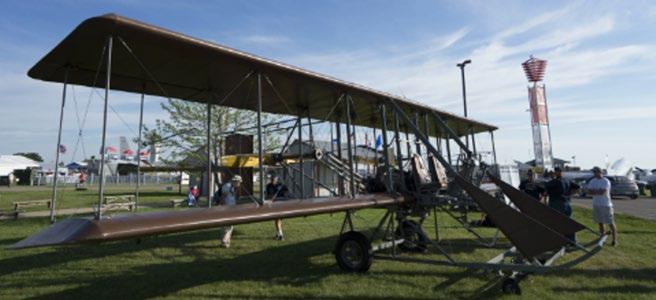
Discover aviation history at Oshkosh this year, as two aircraft reproductions that commemorate major aviation milestones will join the growing number of aircraft participating in the Pioneers of Flight display in the Vintage aircraft area at EAA AirVenture Oshkosh 2026.
A first-time visitor to Oshkosh will be the Seattle II, a replica built a decade ago to commemorate the famed Douglas World Cruiser aircraft that made the first successful global circumnavigation flight in 1924. The reproduction was completed in 2013 and first flown in 2014.
After the airplane is transported to Oshkosh, it will be mounted on its floats to match the original 1924 configuration and placed in the Pioneers of Flight area for AirVenture week. After the fly-in, the airplane will be displayed on loan in the EAA Aviation Museum.
Returning to Oshkosh will be the Wright B Flyer based at the Nation-
al Aviation Heritage Area in Dayton, Ohio. This design from 1910 honors the development of the Wright brothers’ designs in the short period following the successful 1903 inaugural flights at Kitty Hawk, North Carolina.The Wright B will also re-create the earliest days of powered aviation with flights during the AirVenture afternoon air shows on Tuesday, July 21, and Thursday, July 23. These flights will take place with weather and operational considerations permitting.
The Pioneers of Flight display at AirVenture 2026 features original and reproduction aircraft from the first 25 years of flight that followed the Wright brothers’ initial success in December 1903. The group that will be based in AirVenture’s Vintage aircraft area represents innovations by American and international designers.
Advance tickets for AirVenture 2026 are now available at EAA.org/ Tickets, with early-bird discounts currently in effect.

By EAA Staff
The 2025-26 cycle of EAA Aviation Foundation scholarships gave 127 students a financial boost toward pursuing their aviation goals. With the support of donors, the scholarships total more than $800,000 in value.
Scholarships are awarded to students pursuing flight training or post-secondary education. For flight training, this can cover costs associated with a glider certificate, private pilot certificate, sport pilot certificate, flight ratings, and endorsements. Post-secondary scholarships can be applied to tuition costs at colleges, universities, or trade schools, for majors such as aviation management, aerospace engineering, airframe and powerplant (A&P) maintenance, and more.
“Over the past three years, the
EAA Aviation Foundation has tripled the number of scholarships we are able to award to students,” said Rebecca Greskoviak, EAA Aviation Foundation’s scholarship and fund stewardship coordinator. “We are grateful for our donors who contribute to our goal of helping more students achieve their aviation dreams.”
In addition to these scholarships, EAA will also be awarding more than 50 camperships to students attending EAA’s Air Academy Camp this summer.
These scholarships offset the tuition cost for the multi-day camps in Oshkosh that feature hands-on activities and unique aviation experiences.
More information about EAA Aviation Foundation scholarships is available at EAA.org/Scholarships.


One of the truly great things about being an aviation buff is the number of “Goodies and Gadgets” available to play with. Here In Flight USA has collected a few new ones worthy of your consideration.
Aircraft Spruce & Specialty Co. has been the supplier that aircraft builders, owners, pilots, and aviation businesses have depended on since 1965. They carry a wide selection of aircraft parts, building materials, avionics, and pilot supplies, all of which are offered on their website (www.aircraftspruce.com) and in the famous Aircraft Spruce catalog, now over 1,000-pages available for download or for free in print. You can depend on Aircraft Spruce for prompt shipping and competitive pricing on all orders.
Springtime is a great time to take to the skies but only when the weather is cooperating. When not flying, take a little time to freshen up the ‘ole hangar or organize a new flight bag. Might be a good time to link up with a brand new hightech smartwatch. All of the ideas below will get you in shape for beautiful flying adventures this spring and summer. Visit Aircraft Spruce for these products and literally thousands more at www. aircraftspruce.com.
Take a look at Aircraft Spruce’s event calendar, as well. Their team sets out for fly-ins, conventions and conferences around the country to meet with clients in person.
One more note, check out their passion for flying heroes… Aircraft Spruce has recently partnered with Dream Flights, dedicated to honoring military veterans and seniors through the unparalleled gift of flight.

Garmin D2™
D2™ Mach 2 Pro is the ultimate Garmin aviator smartwatch, with built-in inReach® technology for satellite and LTE connectivity to keep you connected between flights (active subscription required; coverage limitations may apply; some jurisdictions regulate or prohibit the use of satellite communication devices).
From your wrist, access voice calls and LiveTrack™ location sharing when you’re connected to an LTE network. Or utilize two-way messaging and interactive SOS from either an LTE or satellite link — with emergency SOS message support from Garmin ResponseSM, a 24/7-staffed international coordination center. Get convenient tools for every phase of flight, including on-device advanced aeronautical maps, HSI and Direct-to navigation. Access NEXRAD, METARs and TAFs with an LTE connection, plus set personal minimums to stay ahead of the weather.
Premium touches include a durable DLC-coated titanium bezel, sapphire lens, bright 1.4-inch AMOLED
touchscreen display and built-in LED flashlight. Advanced health and fitness features help you keep fit to fly. And with up to 24 days of battery life in smartwatch mode, D2 Mach 2 Pro is powered for life on the go.
The Garmin D2 Mach 2 Pro Aviator Smartwatch sells for $1,549.99.
Turbine Oil Quart Can Lid
This lid has been designed to far surpass anything available on the market. Fitting turbine oil or other fluid/chemical 1-quart cans. Not only does it fit exceptionally tight but we have integrated a groove with this lid for the addition of a zip tie for an even tighter grip.
This lid is printed from TPU95A material with makes it flexible yet extremely durable. It is Manufactured here in the U.S.

Each lid sells for $19.95.

29.92 Bravo Flight Bag
You’re 7,500 feet above the rolling hills of Appalachia. The golden hour paints the horizon in hues of fire and silk. You reach down, instinctively, and there it is, right where you left it.
The 29.92 Bravo Flight Bag doesn’t just hold your gear; it holds your confidence. It knows the rhythm of pre-flight checks, the scent of jet fuel at dawn, the way your fingertips trace the embroidered wings as you await takeoff. Made from water and stain-resistant materials, it shrugs off the unexpected. With intelligently designed compartments, everything has its place: your logbook, your headset, your lucky aviator’s pen (the one that’s written every flight plan
since your first solo).
Lightweight enough to carry without effort. Rugged enough to last through 10,000 landings. Backed by a lifetime warranty, because some things should never be left to chance.
Where are you flying next?
The 29.92 Bravo Flight Bag - The adventure is waiting. Each unit sells for $179.95 and comes in three different color choices: stealth, lilac or navy.
Aircraft Spruce & Dream Flights: A Partnership Honoring Our Heroes

At Aircraft Spruce ® & Specialty Co., our legacy is built on a deep passion for aviation. For decades, we’ve supplied the parts that empower builders, maintainers, and pilots to achieve their dreams in the sky. But beyond the components and catalogs, our heart has always been with the people who make aviation extraordinary – especially those who have used their skills and courage in service to our nation. It is with immense pride and gratitude that we announce our official partnership with Dream Flights, a truly remarkable organization dedicated to honoring military veterans and seniors through the unparalleled gift of flight.
A Shared Mission, Rooted in Aviation
This collaboration is more than just a partnership; it’s a natural alignment of shared values and a commitment to giving back. Dream Flights takes to the skies with a fleet of beautifully restored Boeing Stearman biplanes, iconic trainers from the Golden Age of aviation, and particularly, World War II. These magnificent aircraft become time machines, transporting veterans back to an era of daring and dedication, allowing them to relive cherished memories or experience the thrill of open-cockpit flight for the very first time.
For many veterans, especially those who served in aviation roles, the experience of soaring in a Stearman is profoundly moving. It’s a moment of pure joy, recognition, and often, a powerful catalyst for sharing stories that might otherwise
remain untold. It’s a tangible “thank you” for their sacrifice and service, delivered with the roar of an engine and the wind in their hair.
Maintaining a fleet of vintage aircraft like the Boeing Stearman is a complex and continuous endeavor. It requires meticulous attention to detail, skilled maintenance, and access to the highest quality parts. This is where Aircraft Spruce steps in. Our expertise in sourcing and supplying everything from engine components to airframe materials becomes a vital asset for Dream Flights. By ensuring they have the best possible support for their aircraft, we help keep these historical treasures flying safely and reliably. This allows Dream Flights to focus their energy on what they do best: creating those unforgettable “magic moments” for our heroes.
“Aircraft Spruce has always been deeply ingrained in the fabric of the aviation community, and we hold immense respect for the men and women who have served our country,” says Jim Irwin, President of Aircraft Spruce. “Dream Flights offers a unique and incredibly impactful way to honor our veterans. We are not just supplying parts; we are supporting a profound mission that connects the past with the present, celebrates freedom, and expresses gratitude in the most exhilarating way possible. We are truly honored to be official partners in this endeavor.”
Aircraft Spruce will continue to support Dream Flights not only through essential supplies but also through advocacy and community engagement within the general aviation world.
Learn more about Dream Flights at www.dreamflights.org.
Aircraft Spruce on the Go
Look for Aircraft Spruce at upcoming airshows and events around the country.
May 2-3: Great Alaska Aviation Gathering, Palmer, AK, Raven Hall, booths 412-413.
July 20-26: EAA AirVenture, Oshkosh, WI, Hangar A, booth 1022.
Oct. 20-22: NBAA Convention, Las Vegas, NV, booth 1431.
Oct. 27-29: Regional Cargo Carriers Assoc. Convention, Scottsdale, AZ.

By Jay Wiles, AOPA
The Lakefront Airport Preservation Partnership (LAPP) met with FAA Associate Administrator for Airports Daniel J. Edwards on April 21 to express unified opposition to Cleveland Mayor Justin Bibb’s proposed closure of Burke Lakefront Airport.
In the meeting — attended by AOPA, the National Business Aviation Association, NATA, and Signature Aviation — Edwards said that safety will be the top priority when examining any potential closure.
“We appreciate Associate Administrator Edwards for taking the time to hear our serious concerns about the proposed closure of Burke Lakefront Airport,” said AOPA Great Lakes Regional Manager Kyle Lewis. “Mayor Bibb’s proposal to eliminate this important reliever airport, serving 50,000 flights each year, is both unprecedented and a waste of taxpayer resources.
“The mayor’s staff and the North Coast Waterfront Development Corporation have misled the public and Cleveland City Council for months — and we learned they have also taken their false claims to FAA leadership,” added Lewis. “The mayor’s office has said that other local airports can take on
50,000 more operations each year, that operators at Burke are willing or even excited about moving their operations to other airports, that consolidating much of this traffic at Cleveland Hopkins International Airport would make airspace safer, and that a large number of other public officials support the closure. All of these claims are false and undermine the mayor’s credibility.”
In the meeting, the LAPP emphasized that it is open to compromise and has continually encouraged the city to work with the FAA to develop an airport master plan.
“Developing an airport master plan would not only explore all possible uses for the site but also create a pathway toward making that a reality,” said Lewis. “Much of Burke Lakefront sits on an old landfill and cannot be used for anything other than an airport. The master planning process would not only take those challenges into account, but we believe it would prove what we have said all along — the best outcome for Cleveland is keeping the airport open while exploring the possibility of opening compatible land for new development.”
The April 21 meeting comes six days after the Cleveland City Council Transportation and Mobility Committee concluded

its fourth hearing on the mayor’s proposed closure of Burke Lakefront, where the North Coast Waterfront Development Corp. presented a survey that claimed most residents want the airport to close.
“Cleveland taxpayers should be appalled,” said Lewis. “When you organize a survey and have a clear agenda, it’s easy
to make the results paint the picture that you want. Even city council members didn’t seem to buy the survey results, and Cleveland taxpayers shouldn’t either. The corporation and the mayor’s staff have repeatedly misrepresented the statements and positions of others and continue to take any
Continued on Page 43








By EAA Staff
Two legendary World War II-era aircraft have been confirmed for the EAA AirVenture Oshkosh 2026 lineup on July 20-26, as the Commemorative Air Force’s B-24 Diamond Lil will be joined by a Consolidated PB4Y-2 Privateer on the flightline during the week.
Diamond Lil is a return visitor
to Oshkosh, coming from the CAF’s B-29/B-24 Squadron based in Dallas, Texas. The airplane dates back 85 years as the 25th B-24 Liberator out of nearly 20,000 of the model built through all its variants. The CAF obtained the aircraft in the late 1960s, and it has been flying with its current markings for more than a decade, including on regular national tours with the CAF’s B-29 FIFI.
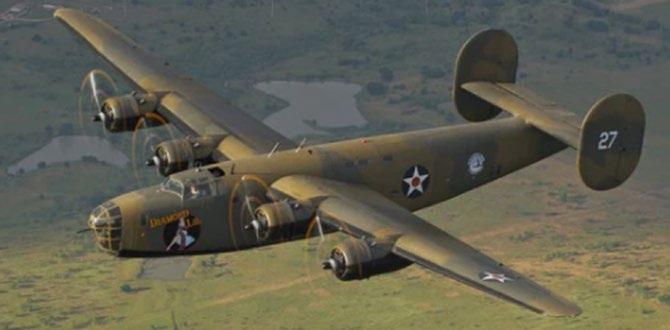
The PB4Y-2 was restored by GossHawk Unlimited in Casa Grande, Arizona. The Privateer is a derivative of the B-24, with the U.S. Navy optimizing the airframe for maritime patrol. This particular aircraft was used as a fire bomber until the early 2000s, when it was obtained and restored with U.S. Coast Guard markings that represent its post-WWII service.
The two aircraft will be parked on Boeing Plaza during the week as part of AirVenture’s celebration of America’s 250th anniversary and more than a century of aviation leadership. They will also participate in the evening air show on Wednesday, July 22.
Learn more and purchase AirVenture tickets at EAA’s website, eaa.org.

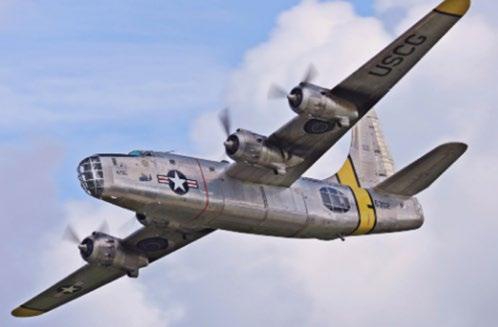





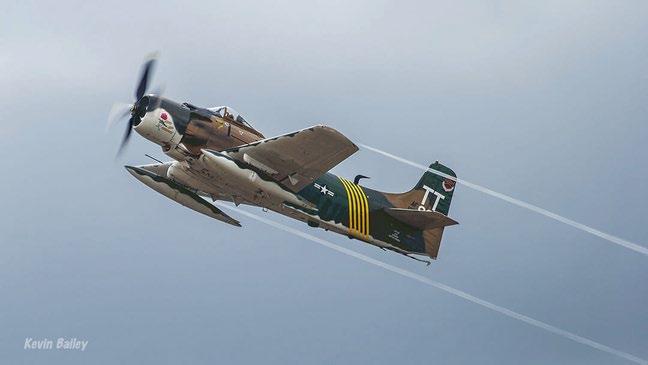
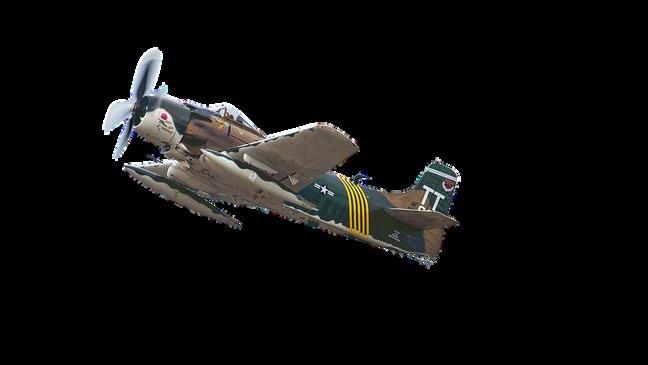






• Nearly 860 exhibitors from 50 nations
• 95,000 m2 (1,022,571 square feet) gross area
• AERO showcases the full spectrum of general aviation, from ultralight aircraft to long-range business jets
From Friedrichshafen, AERO 2026 (April 22–25) opened its 32nd edition of the world’s leading trade fair for general aviation, air sports, and business aviation, which covers the entire showgrounds, and hit a new height. Around 860 exhibitors from 50 countries welcomed visitors over the four days of the show. That’s about 100 more exhibitors than last year, which already saw a record-breaking AERO.
Tobias Bretzel, AERO Show Director at Fairnamic GmbH, said: “Business aviation, with its dynamism, is driving AERO’s strong growth. However, one of AERO’s key strengths lies in showcasing the full spectrum of general aviation and air sports. Visitors saw this for themselves in the static display and across the 12 exhibition halls.”
At AERO 2026, exhibitors showcased a record number of novelties, ranging from new aircraft models and systems to new accessories. During the
AERO Media Tour held the day before AERO 2026, media representatives were able to get an exclusive preview of some of the show’s premieres and highlights.
One of the stops on the tour was Volocopter. The company is exhibiting Europe’s first eVTOL, which, as an EASA-certified air taxi, is set to transport passengers in major cities starting in 2027. With more than 2,500 successful unmanned and piloted test flights worldwide, Volocopter is currently the first and only eVTOL company in Europe to have reached this stage of development.
Lico Stahl- und Kunststofftechnik GmbH from Unterhaching, Germany, presented a true innovation in the field of ground handling for the first time worldwide with the HANGARTAXI: an omnidirectional, electrically powered transport system for helicopters with skid landing gear. The system was developed specifically for use in confined hangar environments and enables the precise, safe, and efficient movement of helicopters — even in the tightest of spaces.
Evocopter GmbH also unveiled a true world premiere: AERO 2026

marks the first public appearance of the Evocopter ClassiX ultralight helicopter. The ClassiX is a completely newly developed ultralight helicopter that achieved German type certification through the German Ultralight Aviation Association (DULV) in a record time of just five years.
The ClassiX is the only helicopter in its class to feature the Lycoming O-360 engine. Evocopter has optimized the Lycoming with an electronic dual ignition system, a lightweight starter, and a lightweight generator. It is constructed almost entirely of high-strength carbon fiber. The numerous load tests required
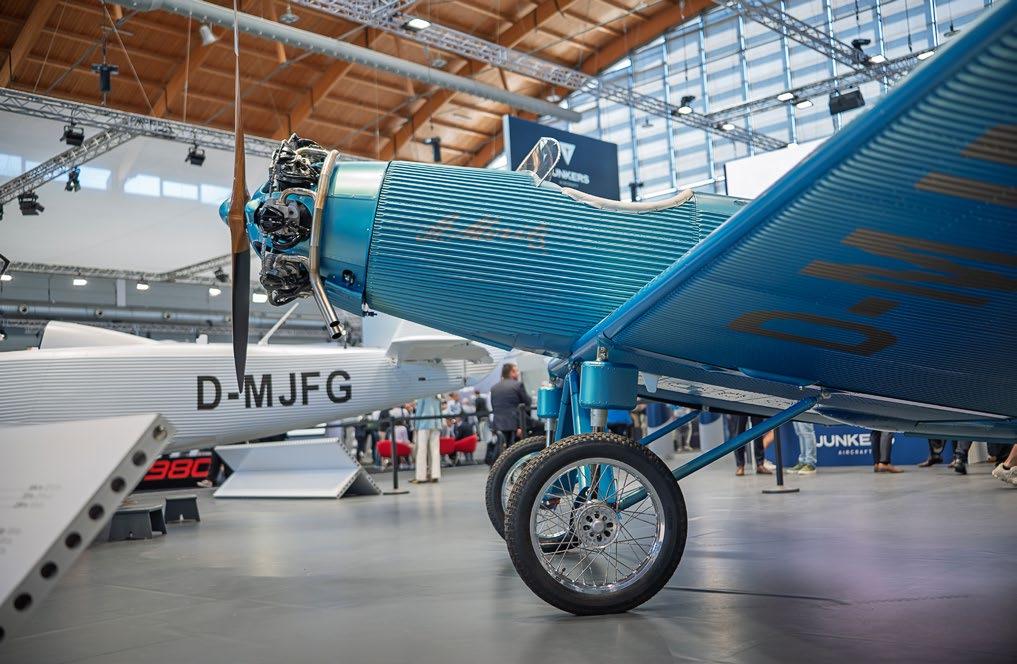
for certification —conducted under limit, safety, and ultimate-load conditions — have demonstrated the airframe’s exceptional stability.
Kaelin Aero Technologies GmbH also presented a world premiere with the B-100C — a basic trainer that is more than just an ultralight aircraft. The B-100C is designed as a training aircraft that accompanies pilots from a structured introduction to training through to demanding training profiles. Its performance, design, and interior convey the feel of a super sports car — focused, high-quality, and uncompromisingly designed for dynamics, precision, and the flying experience. With the further development of the MOSAIC regulations, an initial application range up to 780 kg MTOW is opening up, and in the future even in a weight segment well above one ton.
No other trade show in Europe this year will feature more business aircraft than AERO 2026 in Friedrichshafen. Business Aviation had its own exhibition area with an innovative event concept that offered high-quality networking, short distances, and attractive conditions. In addition to two exhibition halls (A2 and A3), the enlarged, spectacular Business Aviation Dome once again formed the centerpiece of this industry segment.
Aircraft manufacturer Piaggio Aerospace presented the “Next Era” concept for the first time as part of the company’s development strategy, in which not only the latest version of the successful P.180 Avanti family — the Avanti Next — is set to lead the company into the future, but customer service is also at the center of this new chapter.
By Katie Pribyl, AOPA Acting Co-President
I became an airline pilot in 2001. Back then, we carried books with charts into the cockpit, GPS-based RNAV approaches were new, and iPads and electronic flight bag apps hadn’t even been invented. As pilots, we have benefited from enormous technological improvements that enhance our safety and make our flying more efficient. More than 20 years have passed since my company closed its doors and I left the airlines for general aviation, so it’s unsettling to think that some of the newer equipment air traffic controllers use today was installed when I was flying a Canadair CRJ–200 up and down the East Coast. Worse, other ATC equipment has been in use longer than I’ve been alive.
We have the busiest and most complex airspace in the world, and there’s no question that our air traffic system needs to be modernized. The good news is that we’re starting to see progress, but we have to remain on guard to make sure modernization isn’t conflated with privatization.
A year ago, Transportation Secretary Sean Duffy laid out his vision for a brand-new, state-of-the-art air traffic control system — the most ambitious attempt at modernization yet. One year in, we see there are encouraging signs of progress. In July, Congress approved $12.5 billion toward this effort as a “down payment.” Duffy and FAA Administrator Bryan Bedford have said it will require another $20 billion to finish the job. AOPA estimates it could be $30 billion or more.
In December, Duffy and Bedford announced Peraton as the “prime integrator” — the company that will lead this transformation. They also announced several improvements completed in 2025: converting one-third of the copper-wire infrastructure to fiber, satellite, and wireless; the deployment of surface awareness systems at 44 airports; and the introduction of electronic flight strips at 13 towers, including
Ronald Reagan Washington National Airport (DCA) — which has been at the center of aviation safety concerns since the tragic midair collision last January.
In February 2026, AOPA helped secure a provision in a government spending bill that prevents the use of any funds to “plan, design, or implement” privatizing the ATC system — which AOPA has consistently and strongly opposed. That success did not come overnight.
For more than a year before this modernization effort began, AOPA worked to unite the aviation industry in opposing ATC privatization. That laid the groundwork for the Modern Skies Coalition, a group of more than 50 aviation companies, airlines, and organizations that supports modernization without privatization. But there are still some who want to see the system privatized. They are quick to point out that many countries around the world have at least a partially privatized system. But most of those countries have a fraction of our air traffic. Some of the busier ones include Canada and the United Kingdom. In the U.K., GA pilots have
access to far less airspace than they did prior to privatization, and in Canada, GA pilots face more fees than ever before. In both countries, rural communities and pilots have been negatively affected.
The privatization proponents have also argued that privatization would insulate air traffic controllers from missing paychecks, as they did during the 43-day federal shutdown. While that may be true, there are better ways to protect our controllers. Privatization would put our entire National Airspace System at risk. During the COVID-19 pandemic, when the number of flights sharply declined, reducing revenue generated, the U.K. and Canada stopped training new controllers and dismissed those in training. Nearly one-fifth of the Nav Canada workforce — including controllers — were laid off because of pandemic-driven revenue losses. Can you imagine if that had happened here? Our controller shortage would be far worse than anyone could imagine, crippling the aviation industry — not just here, but around the world.
Handing control to a private entity

would replace our transparent framework with an entity whose motivations and deliberations would easily become opaque and often based on economic determinations. The result would be a system governed more by stakeholders with commercial power than by the broader users of the system. Privatization is not, and should never be, the path forward for our National Airspace System. We’re pleased that Congress, Secretary Duffy, and the entire industry agree on that.
Pilots from across the globe envy the access and freedom we have here. That freedom is no accident — it’s the result of hard work and constant vigilance. AOPA will continue to represent you in the halls of Congress, at FAA headquarters, and with lawmakers in cities and states across the country. We are not resting on our laurels. Our work is not done.
Acting Co-President KATIE PRIBYL is an airline transport pilot and CFII who owns a 1956 Cessna 180 Skywagon and learned to fly in Montana while in high school.
Continued from Page 10
this airplane.” Yep, no family consultation, knowing nothing about airplanes and admittedly fearful of flying, Frank Kingston Smith ended up being an expert aviator and legal advocate for AOPA and hundreds
of pilots that needed legal help. His book won the hearts of an entire generation of pilots, becoming a required first read for anyone thinking about flying… that means you… visit Amazon.
With remarkable humor and honesty, the adventures contained within
this classic text are as relevant today as they were more than 70 years ago. This writer began flying only one year after Frank in an Aeronca Champ but took my Private Pilot Check ride in a Cessna 140. Many years later, I owned a Cessna 140, which my wife learned to fly in, and obtain her Private certificate. Flying for the love of flying

was possible and affordable back in Frank’s days. The regulations were much simpler, there was no night flying required, no instrument training and no complex airspace to deal with.
Learning to fly was all about “stick and rudder” skills. Airspace was simple and “advanced technology” consisted of a current sectional chart (paper), an E6-B “computer” and a plastic plotter, which would happily melt in strong sunlight. “Advanced” avionics might include a simple transmitter, with perhaps 12 transmit frequencies and tunable receiver. A low frequency AM navigation radio was sufficient to tune in a four-course radio range. Radar service was almost non-existent, and nobody had any idea of what a “satellite” was. A really fancy plane might have a war surplus turn indicator installed. Artificial horizons (today’s attitude indicator) and a gyrocompass were reserved for airliners. A cross-country flight meant to “dead reckon” your way over the horizon and disappear into the abyss. Now for a pop quiz. How many readers just realized that the preceding description (swap out the low frequency radio for an old VOR) of a well-equipped Cessna 140 would be perfect for modern Sport Pilot training and recreational flying? Welcome to the time machine!
Today we are entering into a society which borders on the availability of electrically powered flying taxi cabs, slick plastic airplanes that are weather capable and auto-flight systems that can do everything but make coffee (a coming option, I am sure). Automatic systems will now fly you into the traffic pattern and, if desired, land the plane. Dual electrical systems power multiple navigation displays, with satellites commanding our every move. ATC can follow your flight from take-off to landing using satellite technology. You are never alone over the mountains with only a paper chart to guide you. The big flight schools start off a new pilot in “trainers” that cost more than a million dollars, resulting in rental rates of up to $300 dollars per hour. A Private Pilot certificate can run anywhere from $10K to well over $15K, but when your training is done and check-ride complete, you may land at airports used by airliners, having all the amenities needed to support fleets of Boeing and Airbus giants. In today’s world, one feels compelled to “justify” learning to fly with finan -
NBAA President and CEO Ed Bolen took the keynote stage on opening day of the 2025 NBAA Business Aviation Convention & Exhibition (NBAABACE) for “an absolute celebration of business aviation” and its role not only in driving economic growth and technological innovation, but also in inspiring future generations to aim higher.
cial rationale. Flying just for the love of it is a thing of the past, gone with hooped skirts, Friday night at “Bob’s Bigboy” restaurant and airplanes that cost $2,000. But here is the surprise ending: Those “good old days” are closer than one might think, as the FAA unleashes the new Sport Pilot standards. Just take a stroll through the Sport Pilot time machine and you may get the same feeling Frank experienced back in 1955.
“We’re a vital link in the global transportation system,” Bolen said. “We create jobs. We help companies be efficient and productive in an intensely competitive global marketplace. We provide humanitarian assistance to those in need, and we are on a mission to net-zero. It is great to be part of a great industry.”
courses. Sales folks will walk you to the flight line and proudly show you “reasonably” priced used airplanes, just waiting for a new home, for only $300K to $500k.
a brand-new air traffic control system,” Bolen said. “Airlines, airports, labor, all of general aviation [and] alignment between the president, the secretary of transportation, both houses of Congress and a public demanding that we build a new ATC system.”
Bolen emphasized that safety also remains of paramount importance not only in the business aviation community but throughout all other industry sectors following a series of high profile, fatal accidents earlier this year.
“We saw the entire aviation community coming together on the plan to build
If learning to fly has finally rid you of all common sense, and the thought of owning your own plane could lead to the first chapter in your book being titled, “So I Bought This Airplane,” then all hope is not lost. In the present world of advanced technology and belief that an airplane must do all things… be fast… long range… have at least four seats... be equipped with the geekiest technology available and able to fly in all weather… you will be welcome at the upper end flight schools with $15,000 Private Pilot
Bolen also recognized in the audience the two most recent enshrinees to the National Aviation Hall of Fame, aviation safety consultant and former NTSB member John Goglia and NBAA Chair Emeritus Gen. Lloyd “Fig” Newton. “We’ve gotten to our point today by standing on the shoulders of giants,” he said.
Steuart Walton: Aviation is a Tool to ‘Connect, Meet and See What’s Going On’
That doesn’t sound much like Frank’s $2,000 Cessna 140, does it? But believe it or not, that $2,000 plane that can teach you to fly, become a beloved family member and transport you to weekend adventures is still out there… sort of. Ask yourself, what is $2,000 in 1955 dollars worth today? According to the great AI mind of GROK, it comes to about $25K, a good start! Really, an airplane for $25K? Probably not the plane that most readers would want, meaning something like a classic T-Craft, Aeronca or even Ercoupe (terrific little plane!).
Aviator, entrepreneur and business leader Steuart Walton then joined Bolen to receive NBAA’s Meritorious Service to Aviation Award, the association’s highest honor.
In addition to serving as a director
But keep in mind, good financing is now available, which did not exist in 1955. Are there that many Cessna 140s still around that are worth buying? Yes, even though it may not be called a “140.” The Cessna 120/140 morphed into the ubiquitous Cessna
for Walmart, Walton is the co-founder and chairman of Game Aerospace and a prominent leader in fostering the development of advanced air mobility (AAM) aircraft. He also restores and flies a variety of vintage aircraft, some of which are on display during NBAABACE at the NBAA Aircraft Connection at Henderson Executive Airport (HND).
Those aircraft, along with Walton’s work to make Thaden Field (VBT) in Bentonville, AR, a hub of community activities both related to aviation and not, serve an important purpose in his life.
150 and then the Cessna 152. Combined, an incredible 40,000-plus twoplace Cessnas were manufactured up through 1985, one of the most successful aircraft designs in aviation history. This writer has seen prices ranging from a “pattern beater” for $25K up to some very nice machines in the $50K to $60K range. Grab a good financing deal, and that could mean, “So I Bought This Airplane” happens for you at around $300 to $500 per month. Do the math: With flight lessons (instructor and rental) ranging from a low of about $150 per hour up to $300 per hour, your flight lessons could end up paying for themselves by using your own plane.
“Aviation is just an absolutely unparalleled platform for inspiration to young folks, or people looking for the opportunity to find a new career,” said Walton. “The more you can tell that story about what aviation is and what it can be, you open people’s eyes to it. And the more people that come into it, the stronger it gets.”
ties. Looking back in time to one of this writer’s favorites, the four-place Piper PA-22 Tri Pacer is a unique value, often priced between $40K to $100K (for a like-new restoration).

NBAA President and CEO Ed Bolen. (Photo courtesy NBAA)
Another great weekend pilot option is the ever-popular Piper Cherokee 140 series, with more than 10,000 having been built. A quick survey shows these two-place Piper (minimal four-place) gems going for between $55K and $80K, many well equipped. Keep in mind, a newer entry-level plane will probably have more gadgets and some nice ameni-
Business aviation has also played a
continue to gain in value. Many of these weekend flyers not only hold their value but may appreciate faster than that last “hot stock” you bought. Such entry-level planes often turn into permanent family members once owners realize just how functional they are. They are for everyday recre ational flying and weekend trips that can take you 500 miles from home in a third of the time it would take to drive… and what a view! This writer has made many two-day weekends feel like a three-day holiday! Bottom line, let the plane you own pay for your flying in savings from rental cost! The “secret sauce” to affording a plane is KEEP IT SIMPLE! This writer has seen many airplane ownerships fail because the buyer overbought and underused.
vital part in Walmart’s growth, from the early days when Steuart’s grandfather, Sam Walton, flew a two-seat Ercoupe to visit stores, to now operating one of the largest business aircraft fleets in the world.
Continued on Page 38





By Tom George, AOPA
The National Weather Service (NWS) is working on a plan to migrate from using radio beacons to using airports to define the boundaries of weather forecasts and alerts.
The proposed change includes significant meteorological information, airmen’s meteorological information, center weather advisories, and meteorological impact statements issued across the country, including Alaska.
The change is being driven by the national reduction of VHF omnidirec-
tional range (VOR) navaids as GPS becomes the dominant way to navigate our airspace. Weather products that up to now have defined boundaries with reference to a distance/direction from a VOR (for example: BRG-100ESE) would instead use a three-letter airport identifier as the reference point (such as 10SE-BUF).
While weather products are often viewed as graphics, when communicating via phone or airborne by radio, we still need a means to convey the boundaries of forecast information, such as areas of severe thunderstorms.
AOPA is part of a national working
group that spent considerable time exploring this issue and identifying airports to fill gaps. “We expect this list of airports maintained in NWS computers will provide a more dense network of points for forecasters to use, particularly in Alaska where VORs are few and far between,” said AOPA officials. NWS is soliciting comments on this proposed change through May 15.
Learn more at AOPA’s website, aopa. org or directly at https://www.weather.gov/ media/notification/pdf_2026/pns26-16_ Updated_Transition_ReferencePointsAviationWeatherProducts.aaa.pdf .
As the FAA decommissions legacy navaids in favor of performance-based navigation (GPS), the National Weather Service is shifting from navaids to airports to define forecast and alert areas. (Photo by David Tulis, courtesy AOPA)
By Seth Robbins, Embry-Riddle Aeronautic University
With goggles strapped on and a cream-colored pilot scarf around its neck, Amelia Bearhart looked every bit the parachutist. That proved appropriate when the teddy bear was dropped from a plane flying about 200 feet in the air at roughly 85 knots.
Against a clear sky, the bear tumbled to the ground. With just 20 feet to go, a plastic parachute opened. Then Bearhart drifted down safely and landed within 18 feet of her intended target.
“It really came down perfectly,” said Luke Wadsworth, a sophomore Aeronautical Science student and member of the Embry Riddle Aeronautical University Eagles Flight Team, who gave the bear its name and released it into the sky.

The Eagles Flight Team at the Daytona Beach Campus does not usually drop teddy bears from its aircraft. Members train to release message containers onto a target for an event at a national collegiate aviation competition.
“We try and hit a barrel at the competition, and we usually get within 30 feet of the target, which is remarkable,” said Carson Ruhnke, a sophomore Aerospace Engineering student who is the team’s assistant chief pilot. “It’s an event we train especially hard for and not a lot of other schools do it.”
But the team set aside time from their intense practice to collect teddy bears for Kada’s Promise, a Florida non-profit that delivers the toys to children in foster care, hospitals and shelters.
James Hanover, the flight team’s head coach, worked with Jennifer Capri and her 12-year-old daughter Gianna, ambassadors for the organization, on the project for April’s National Child Abuse Prevention Month.
“The Eagles flight team is some of the best and brightest students at Embry Riddle,” said Capri, who works as quality assurance manager in the Flight Training Department. “I hope this will inspire them to continue community service no matter where they land in life.”

On April 4, nearly 30 members of the flight team gathered with the Capris at Massey Ranch Airpark in Edgewater, Florida, to parachute several bears as part of an effort to raise awareness about Kada’s Promise.
“This is a great way for us to engage with each other and still do everything we love using airplanes while also helping the local community,” said Jak Kalvin, the team’s chief pilot.
Team members dropped the bears, including a giant pink one, from two aircraft. They captured photos and videos of their descent to Earth.
“I designed the parachutes, and I’m impressed,” said Kalvin, who earned
his bachelor’s degree in Aeronautical Science and is now pursuing his MBA. “I was not expecting it to work as well as it did.”
The students also signed certificates with their bears’ names. The Capris plan to deliver some 50 teddy bears to Devereux Advanced Behavioral Health in DeLand, where they will be given to foster children. They will also provide them with photos and the certificates, so the children will know how the bears reached them.
“I love stuffed animals. It was exciting to see,” said Gianna. “I’m glad they came out to support us.”

Continued from Page 36
But isn’t learning to fly a lot more difficult today than back in 1955, given complex airspace and technology? Nope! About 85 percent of all public use airports do hot have control towers, and those that do have towers are typically local community airports that do not require fancy equipment. Every plane previously mentioned is super qualified for Sport Pilot use. Flying as a Sport Pilot, you stay out of the FAA medical nightmare, skip the IFR training and learn to fly at night only if you want to. These great little airplanes offer simplicity that shortens training time but builds solid “stick and rudder” skills.
It is somewhat frightening to read new regulations that now permit pilots to “manage” their plane versus grab hold and actually fly it. The emphasis in Sport Pilot training is making good “hands-on” pilots, who navigate with their heads, not a tablet or flight display giving instructions the pilot simply follows. Piloting decisions are based upon flying skills, not button pushing. Importantly, the new version of Sport Pilot has been upgraded so if that high-powered, retractable gear, long-range wonder catches your fan -
cy, you simply take instruction and get an endorsement. Sure, there are some limitations, but few that would be restrictive to the average weekend pilot.
Flight schools are now full of young instructors who only want to fly fancy planes and build hours that will lead them to an airline career. Don’t let the well-intended, but misguided enthusiasm of your instructor convince you that a full-up Cessna 172 with a Garmin avionics suite, or perhaps a spiffy, new, air-conditioned Cirrus is the only way to go. There will usually be a C-150/152/ Piper Cherokee snuggled away in the corner of a hangar just waiting for someone who read “Week-End Pilot” by Frank Kingston Smith and wants to be able to say, “So I Bought This Airplane.” Frank has flown west, but Frank’s angel will smile and you will begin the adventure of your life.
Of course, there is a lot more to learn about aircraft ownership not covered in this editorial. The Aircraft Owners and Pilots Association (www. AOPA.org) is a great resource for you, including a new Aircraft Valuation Tool available to members. Have a look at the following link, Buying an aircraft - AOPA. There is a lot to be learned!
Continued from Page 36
Daher Aircraft and Rheinland Air Service (RAS) showcased two firsts: for the first time outside the United States, they exhibited the two single-engine turboprop aircraft, the TBM 980 and the Kodiak 900, at a trade show. Daher Aircraft unveiled the TBM 980 to the public in January of this year as the newest member of its successful TBM aircraft family.
Daher Aircraft had introduced the robust high-wing Kodiak 900 as an extended version of the Kodiak 100 in the summer of 2022. The fuselage is 1.10 meters longer than that of the Kodiak 100. But the new version not only offers its users more space, but also better flight performance thanks to the more powerful PT6A-140A turboprop engine. The Kodiak 900’s maximum cruise speed is 210 knots (True Air Speed), compared to 174 knots for the Kodiak



100. The EASA (European Union Aviation Safety Agency) had already certified the model in the spring of 2023.
JUNKERS Aircraft celebrated a special milestone at AERO: On AERO Media Day, the DULV (German Ultralight Aircraft Association) presented the manufacturer with the type certificate for its latest model, the JUNKERS A60.
In addition, JUNKERS also exhibited the JUNKERS A50 Junior at AERO, a 600-kg ultralight aircraft inspired by the historic 1929 model, which combines classic design with the latest technology. With the JUNKERS A50 Heritage, the company from Oberndorf-Hochmössingen, Germany, presented a reconstruction of the historic 1920s model that closely follows the original. Unlike the A50 Junior, the Heritage version features a seven-cyl-




Three FBOs ready to serve your needs:

• No ramp fees!
• Competitive fuel prices
• Maintenance assistance on any aircraft
• Advance reservations for rental cars
• 24/7 service at MSN


inder radial engine (Verner Scarlett 7U, 124 hp/91.2 kW). Combined with a wooden propeller and analog round instruments, it offers an authentic retro flying experience.
This year, the Cessna Citation Longitude and Cessna Citation Ascend made their AERO Friedrichshafen show debut alongside a legendary lineup of Cessna, Beechcraft and Pipistrel aircraft. It also marks the European show debut for the Citation Ascend.
In addition to the Citation Longitude and Citation Ascend, the following aircraft were on display at the Textron Aviation static display at Messe Friedrichshafen: Cessna Citation M2 Gen2 with Garmin Autothrottles, Beechcraft King Air 260, Cessna Grand Caravan EX with a new Saddle Sport executive interior scheme and a McCauley propeller, Cessna Turbo Stationair HD
with a McCauley propeller and a Pipistrel Virus SW.
Textron Aviation holds a strong position in business and general aviation in Germany and the surrounding area, with more than 1,700 turbine aircraft in region. More than 850 Cessna Citation business jets, 450 Beechcraft King Air turboprops and 175 Cessna Caravan turboprops are based in Europe. Please find further information at: https://www.aero-expo.com/ and https://www.linkedin.com/showcase/ aeroshow .
• Follow AERO at LinkedIn: https:// www.linkedin.com/showcase/aeroshow .
• Follow AERO at Instagram: https:// www.instagram.com/aerofriedrichshafen .
• Follow AERO at Facebook: https:// www.facebook.com/AERO.FN .



Continued from Page 30
opportunity to twist the truth to fit their own narrative.”
Councilman Charles Slife, who chairs the Transportation and Mobility Committee, invited the LAPP — which includes local businesses, schools, and pilots, in addition to AOPA — to a fifth hearing so council members can hear from airport users and supporters.
“We appreciate Councilman Slife’s invitation to participate in a fifth hearing to
set the record straight,” said Lewis. “We look forward to helping Cleveland residents understand how closing Burke Lakefront would do nothing more than hurt the local economy, delay lifesaving care and organ transplants, rob students of life-changing educational opportunities, and — in the end — waste taxpayer dollars that could be spent creating jobs and inviting needed investment into the city.”
Learn more at AOPA’s website, aopa. org.
By EAA Staff
EAA on April 16 joined eight other aviation organizations in sending letters to Ohio’s congressional representatives that urged maintaining Cleveland Burke Lakefront Airport (BKL) as a vital link in the city’s and state’s transportation infrastructure.
The aviation groups appreciated the contact with the congressional offices and said any closure of Burke would “undermine the national transportation system, degrade aviation safety and efficiency, harm Cleveland’s local economy, and eliminate opportunities for advanced air mobility.” Cleveland mayor Justin Bibb has proposed closing Burke for redevelopment.
The letters further explain that Burke is a key link in emergency and humanitarian efforts, including organ donation flights; an essential reliever for Cleveland Hopkins International Airport; and a location for the next generation of air transportation, including air taxis. In addition, elimination of Burke would cause the demise of the annual Cleveland National Air Show on the lakefront, as its organizers have no other viable location for the event that brings $18 million in economic impact to the city.
The letters further state, “We share a desire for increasing economic growth and opportunity for the citizens of Cleveland; however, Mayor Bibb’s proposed concept lacks consideration of major factors: environmental remediation costs, federal and state financial obligations, jobs and economic loss, and safety and airspace congestion impacts.”
EAA chapters in Ohio have also expressed their support for Burke and have contacted their elected officials on the issue.
EAA joined the letters authored by the National Business Aviation Association along with the Aircraft Owners and Pilots Association, General Aviation Manufacturers Association, International Council of Air Shows, National Air Transportation Association, Northeast Ohio Pilots Association, Ohio Regional Business Aviation Association, and Vertical Aviation International.

Lakefront Airport
(LAPP)
with FAA Associate
on April 21





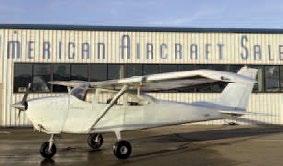

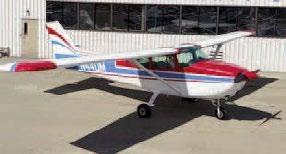



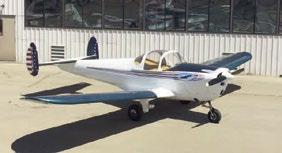


AIRCRAFT FOR SALE
American Aircraft Sales, Livermore Airport, CA, americanaircraft.net, cell (510) 783-2711, (925) 449-5151. 3/13
From Trade-ins to Aircraft Management, financing and appraisals. T.J. Aircraft Sales, Novato, CA, (415) 898-5151, tjair.com. 3/13
AirplanesUSA Aircraft Sales, San Carlos, CA, Airport, (650) 394-7610, airplanesusa.com. 1/16
Quality aircraft since 1948. Volare Air, a TECNAM dealership, (940) 800-8020, volareair.aero. 1/23
Historically significant 1950s-era aircraft for sale or trade. All in restorable condition with minimum corrosion. Inventory includes a Piasecki XHJP-1 and a Sikorsky S-55. American Helicopter Museum, West Chester, PA. Contact info@ americanhelicopter.museum for more information. 231000.TFN
1968 Nanchang CJ-6 Chinese warbird. Reliable Day/VFR, light weight. Apollo GX-65 nav/com, Digital Xpndr., intercom, Delco alternator. New seat cushions and canopy glass. Includes all support equipment, wing jacks, manu- als, spare parts. Much more! $70,000. Located N. Calif., text/cell (530) 957-9760, dennis@ nickson.biz. 24900:11
1966 Piper PA30 Twin Camanche for sale near Oceanside, CA. Call for pricing. Andrew Wignot, (760) 717-0640. 241100:12
Small Manned Aerial Radar Target, Model 1. Tiny jet aircraft, long-range tank. SMART-1, Tucson, AZ, (202) 2132400, smart-1.us. 5/21
SPORT/ULTRALIGHTS
RV12i5. Total performance perfected. Easy to build, fly and own. Van’s Aircraft www.vansaircraft.com. 11/18
Bristell LSA 915 Turbo, 180 mph @18,000. Bristell Aircraft, (516) 6581847. bristellaircraft.com. 2/24
STOL
The STOL Super Breezy with fully covered fuselage. Yakima Aerosport, (509) 453-3412, superbreezy.com. 5/23
AIRCRAFT SALES AIDS
Aviation Sales & Marketing by ABCI.
Ideal for a startup or side hustle in the aviation industry. (702) 987-1679 or aviationsalestraining.com/startup. 1/21
FLIGHT INSTRUCTION
Sunshine Flyers. Flight & tailwheel instruction, rentals, mountain flying, and aerobatics., Auburn, CA, (530) 820-3442, sunshineflyersaviation@gmail.com. 3/20
Arizona Type Ratings
CE-500/CE-525 type ratings or recurrent. Insurance approved, staff examiner. arizonatyperatings.com, (602) 614-7994.
9309:TFN
Recurrent pilot training and services. L/D Aerospace, Grace Passmore, (916) 790-0501, ldaerospace.com. 1/22
Fly for fun or career. Discovery flights, pilot training, AOPA Distinguished Flight School & Cessna Pilot Center. Smith Aviation, Napa County Airport, (707) 3456526, mikesmithaviation.com. 4/22
Come fly with us! CFIs encouraged to apply. For more information, call Sue Clark/RV to the Rescue at 925-997-4778
XL Aviation - Aircraft Maintenance.
Custom-tailored programs for all aircraft. Livermore, CA, (925) 961-6135, xlaviationtailwheel.com. 8/20
Iconic Aircraft Restoration. Repairs, refurbishments, parts fabricated, consulting at reasonable rates. The Wright Experience, (540) 379-9092. 8/21
Custom aircraft & high-quality composite parts. Aviation Composites, Sandersville, GA, (937) 243-7303. 1/22
Serving the GA Community since 1981. Wisconsin Aviation, Watertown Municipal Airport, WI, (920) 261-4567, WisconsinAviation.com. 3/13
World’s largest network of FBOs with over 200 locations offering consistent, exceptional service. Signature Flight Support, signatureflight.com. 4/23
Full-service center. Vista Aviation, Whiteman Airport, Pacoima, CA, (818) 896-5224, vistaair.com 9/23
Avionics for Every Mission. All major brands. Airtronics, Calaveras County Airport, CA, airtronicsavionics.com, (209) 736-9400. 11/14
Basic installs to complete panel and glass retrofits. Pacific Coast Avionics, (800) 353-0370, PCA.aero. 7/15
Update your avionics. FAA-Certified repair station. Treasure Coast Avionics, Ft. Pierce, FL, (772) 464-3148, treasurecoastavionics.com. 2/23
AIRCRAFT PARTS
Keeping “classic” aircraft flying since 1946. Univair Aircraft Corp., Aurora, CO, (888) 433-5433, univair.com. 3/21
Iconic Aircraft Restoration for all the classics. Reasonable rates. The Wright Experience, (540) 347-1909. 2/23
Wingtips with total lighting solutions, aveoengineering.com. 9/23
Aviation wood, composite or metal propellers. Sensenich, (813) 752-3711, (717) 569-0435 or sensenich.com. 4/21
OXYGEN SUPPLIES
Cannula or Mask? For aircraft service ceil- ings to FL180 & FL250. Ask “The Oxygen Lady,” info@aviationoxygen.com 4720:TFN 2/23

FUEL
Fuel Cells. Repair, overhaul or new with 10-year warranty. Hartwig Aircraft Fuel Cell Repair, hartwigfuelcell.com. 2/09
Home of GAMIjectors® fuel injectors! STCs and PMAs on over 300 different engine models! General Aviation Modifications, Ada, OK, (888) 359-4264, (580) 436-4833, gami.inc. 3/23
AVIATION SAFETY
Innovative aviation safety solutions and Parachute Recovery Systems for a variety of aircraft, including for sport, UAVs, more. AviationSafetyResources.com. 2/22
Get ahead of your daily in-flight risks with SAFETYLINQ flight risk assessment. argus.aero/safetylinq. 1/22
AIRCRAFT FINANCING
Get Top Retail Value for Your Aircraft! Sell now! Find your dream aircraft! Shop now! Become an area broker with one of the largest networks in the U.S.! Visit our USA Aircraft Brokers page on Facebook or visit usaaircraft.com. 9/23
Specializing in personal, business and charter aircraft. Best price, cover- age & customer service. Zanette Aircraft Insurance Center, (650) 593-3030, (888) 7233358. 10/06
Insurance solutions for all aviation-related services. Business Aviation Insurance, bizavins.com, (925) 825-1900.7/20
AVIATION CONSULTANTS
Informed, accurate aircraft appraisals. jetvaluesjeremy.com, (636) 751-3987. 7/20
Complete Aviation Sales & Marketing Services. Use Promo Code “INFLIGHT” to save 10%. AviationBusinessConsultants.com/Lab, (702) 987-1679. 4/23
No cheap imitation watches at HME! Special pricing on ATP series multi- functional watches with Altimeter. To order or for information, (323) 464-6660 or hmewatch.com. 11/16
Aircraft Spruce & Specialty. Free 700page catalog, Corona, CA, & Peachtree City, GA, aircraftspruce.com. 10/06
Protective covers for every make and model. Bruce’s Custom Covers, Morgan Hill, CA, (800) 777-6405, (408) 738-3959, aircraftcovers.com.10/19
Apparel as unique as your journey. Discounts to members. AOPA Pilot Gear, aopapilotgear.com. 9/21
Mountain Bike, Full-size, pilot-friendly, rugged. FLATBIKE, flatbike.com. 10/18
AVIATION
Emergency services, group trips, consulting services. BizAvJets, Inc., Business Aviation Services, bizavjets.com, (702) 465-2027. 10/20
Wherever business takes you. Navigate It. (575) 615-2091, vatit.com. 10/21
Scheduling Software that connects to your flight department. Simple, affordable. airplanemanager.com. 9/22
PROFESSIONAL SERVICES
Aero & Marine Tax Pros
Legally avoid sales tax on your aircraft purchase. In El Grove, CA, (916) 691-9192, aeromarinetaxpros.com. 18500:TFN Left Seat Pilot Medical Solutions. A confidential solution for pilot medical certification. Free FAA medical consultations. Left Seat, (800) 699-4457. 1/21 Global Aircraft Group. USPAP bank values for all aircraft, aircraft management, insurance claims & certified aircraft appraisals. Mark Parry, (855) 6GBL- AIR, (413) 335-7507. 4/22
At Thirty1 Hybrid, we help aviation companies, including flight schools, manufacturers, mechanics, brokers, and more, build a cohesive website that positively impacts their bottomline. And it’s not just a website — it’s an Experience.
We’ll take your prospects on a journey they’ll love (and you’ll love, too — because the final destination is a new client and more money in your pocket). It’s a win-win for everyone! Contact us today at hello@thirty1hybrid. com or by visiting thirty1hybrid.com. 24500:6
HANGARS/TIEDOWNS
One-piece doors. Hydraulic or bifold. Schweissdoors.com,(800)746-8273. 1/15
Aviation Building Systems, custom de- signed hangars. R&M Steel Co., Caldwell, ID, (208) 454-1800, aviationbuildingsystem.com, (866) 454-1800 51217:TFN
HOMES/AIRPARKS
New Runway & Taxiway Homesites
Available in amentity-rich community, Granbury, TX. From $179,900. Pecan Plantation, AviationHomesites. com, (833) 273-2159. 2/24
BUSINESS OPPORTUNITIES
Become an Aircraft Broker — #1 Largest USA Network of Aircraft Start with USA’s proved system for listing and selling everything from high-performance single-engine airplanes, cabin class through jets, and helicopters & jet fractional shares. Includes multi-million-dollar inventory to start. Complete turnkey proved system. No experience necessary. Will train. Licensed USA Aircraft brokerage. Call (504) 723-5566 or visit Business Opportunity Section at usaaircraft.com. 4208:TFN
Free avgas 100LL and free tie-down parking in exchange for help with projects for an airport in Southern California. Email: wignot@hotmail.com. 23600:TFN
ART/VIDEOS/GIFTS
Specializing in aviation photography. horizontalrain.com. 1/15
Need a gift? Give a ride in an open cockpit biplane. WACO Air Museum, Troy, Ohio, wacoairmuseum.org, (937) 3359226. 20601:TFN
Fly By Wire Air, a one-stop site for aviators.flybywireair.com. 4/21
Aces High Aviation & Military Art. (800) 528-0887, aceshighgallery.com. 10/21
Shirts Made to Fly. Unique, original fabrics embedded with your sectional chart. Save 20% with “INFLIGHT20” code. PilotQuarters.com. 2/24
Avionics Checklists & Quick Reference guides. Available in book, card & new iPad editions. qref.com. 8/14
SEAK, Expert Witness Directory, by Bert Botta for aviation accidents and incidents. (415) 320-9811, bert@bertbotta. com, bertbotta.com. 4/22
“Ghosts,” Phil Makanna’s legendary warbird calendars are back! Visit ghosts. com, (800) 331-8231. 2/23
New Pocket guide to avoid pain & stiffness during travel by a leading pain expert. “Pain-Free Vacation/Travel,” (980) 785-8128, goptfirst@gmail.com. 2/4
PILOT POSITION WANTED
SoCal pilot desires Turbine/Jet SIC time. Comm/Instru/Multi-Eng with SIC for Gulfstream G-IV and scores of hours in the Citation V560. Many years of aircraft design/flight test/aerospace industry experience. Willing to travel as needed (and for repositioning). Contact Paul at (562) 714-6686 or ptglessner@ aol.com. 23700:TFN
HELP WANTED
IN FLIGHT USA, the leading source of general aviation news, seeks writers and photographers to cover all aspects of aviation. Send an SASE for writer’s guidelines to: In Flight USA, P.O. Box 5402, San Mateo, CA 94402. TFN
Oakland Aviation Museum recruiting volunteers. Oakland, CA, (510) 638-7100, oaklandaviationmuseum.org. 12/23
NOW HIRING: A&P Instructor
AvTech Exams is looking for a motivated and knowledgeable A&P Instructor to join our team! If you’re passionate about aviation and enjoy helping others succeed, this is an opportunity to make a real impact by guiding students toward achieving their Airframe & Powerplant certification.
�� Now hiring for:
Our current Riverside, CA location Our new Las Vegas location (coming soon)
What we’re looking for: ✅ Current A&P Certification with General Aviation experience
Strong communication and instructional skills
Real-world aviation maintenance experience
A passion for teaching and mentoring
What you’ll do: �� Prepare students for written, oral, and practical exams Provide hands-on instruction and guidance Support students throughout their certification journey
Join a team dedicated to student success and be part of changing lives through aviation.








Unlike FAA Medical Examiners or other pilot groups, Pilot Medical Solutions activates our exceptional team of experts to confidentially support and resolve your FAA Medical certifications challenges.
Pilot Medical Solutions is the only service which collaborates with private physicians to produce documentation required by the FAA. Other services typically only list FAA requirements, Pilot Medical Solutions helps you comply with them.




"The professionals at Pilot Medical Solutions provide superior, pilot-focused services and help during your time of need. I would, without hesitation, recommend their services to an airman in need."
– Anthony Ison, Aviation Attorney
"Because they assist you in getting your records properly prepared and walking the information through the FAA, they can often accomplish in days what may take months for other sources, including your AME, to do."
– Erwin L. Samuelson, M.D
"I can strongly recommend Pilot Medical Solutions for consideration because they are sympathetic to pilots with medical certification problems. Pilot Medical Solutions also organizes the records which supports the FAA’s requirements."
– Bob Hoover
“They do
They are


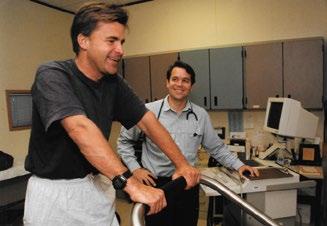
F l i g h t s d e p a r t f r o m o u r C h i n o A i r p o r t
l o c a t i o n f o r a 2 0 - m i n u t e f l i g h t t h a t y o u ’ l l
r e m e m b e r f o r y e a r s t o c o m e . F o r c o m p l e t e i n f o r m a t i o n v i s i t o u r w e b s i t e t o d a y .