
March 2026



March 2026
To list your group’s event on a space available basis, please send your event notice with date, time, place w/city and state, contact name, and phone number to: Calendar, In Flight USA, P.O. Box 5402, San Mateo, Calif. 94402, or email vickie@inflightusa.com.
Note: Calendar includes only information available by our press date. Confirm the status before attending.
March 14: Yuma Airshow 2026, MCAS Yuma, AZ, USMC F-35B Lightning II, USMC MV-22 Osprey, AAHF/Sky Soldiers, Ace Maker Airshows, Air Oshinuga, Commemorative Air Force, KC Flight Formation Team, Matt Jolley, Airshow Announcer, Planes of Fame Air Museum, Precision Exotics, Smoke-nThunder Jet Shows, Tora Tora Tora 14: NAF El Centro Festival of Flight, NAF El Centro, CA, elcentroairshow. com
20-21: Bluebonnet Airshow, Burnet, TX
21-22: Luke Days Air Show and Open House, Luke AFB, AZ, U.S. Air Force Thunderbirds
21-22: NAS Lemoore Air Show 2026, Lemoore, CA, Blue Angels, https:// lemoore.navylifesw.com/lemooreairshow
21-22: Space Coast Warbird Airshow, Titusville, FL, Valiant Air Command
27-28: US Aircraft Expo, Houston, TX, usaircraftexpo.com
28: Fiesta of Flight Laughlin AFB, TX F-35A Lightning I, Demonstration Team, Ace Maker Airshows, www.laughlin. af.mil/Fiesta-of-Flight-2026/
28-29: Shaw Air & Space Expo, Shaw AFB, SC, US Thunderbirds
28-29: NAS Meridian Air Show, NAS Meridian, MS U.S. Navy Blue Angels, F-22 Raptor Demonstration Team, U.S. Army Parachute Team Golden Knights, wingsovermeridian.com
28-29: Warbirds Over Scone, Scone, NW, AU
April 3-4: Wings Over North Georgia Rome, GA, U.S. Air Force Thunderbirds, GhostWriter Airshows, Kyle Fowler Aerosports, Ladies for Liberty, LLC, Quick Silver P-51 Airshows, Scott Farnsworth Aerosports, Starlight Aerial Productions, The Chuters, Vertigo Airshows, Wild Horse Aviation, wingsovernorthgeorgia.com
3-5: Warbirds Over Wanaka, Wanaka, NZ
7-12: FIDAE Airshow 2026, Santiago, CL
10-11: US Aircraft Expo, Manassas, VA, usaircraftexpo.com
11-12: Gulf Coast Salute Air Show, Panama City Beach, FL U.S. Air Force Thunderbirds, U.S. Army Parachute Team Golden Knights, USMC MV-22 Osprey, Ace Maker Airshows
11-12: Salute to America in Space
250, Cocoa Beach, FL U.S. Navy Blue Angels, F-16 Viper Demo Team
14-19: SUN ‘n FUN Aerospace Expo, Lakeland, FL, U.S. Air Force Thunderbirds, F-22 Raptor Demonstration Team, www.flysnf.org
17-18: 2026 WASP Homecoming, WASP WWll Museum, Sweetwater, TX, waspmuseum.org
17-19: Wings Over South Texas Air Show, NAS Kingsville, TX U.S. Navy
Blue Angels, Brad Wursten Airshows, Brian Correll Airshows, Erik Edgren Airshows, Microjet Airshow, Tora Tora Tora
18: Thunder Over Louisville, Louisville, KY F-16 Viper Demo Team, Ace Maker Airshows, thunderoverlouisville. org
18-19: Wings Over South Texas Air Show, NAS Kingsville, TX, U.S. Navy Blue Angels, Tora Tora Tora
18-19: Holloman AFB: Legacy of Liberty, Holloman AFB, NM F-35A
Lightning I, Demonstration Team, U.S. Army Parachute Team Golden Knights, www.holloman.af.mil
24-26: Carolina Beach Airshow
Carolina Beach, NC, Warbird Thunder Airshows
25-26: Wings Over Solano, Travis Air Force Base, CA, USAF Thunderbirds, www.WingsOverSolano.com
25-26: Vidalia Onion Festival Air Show, Vidalia, GA, U.S. Navy Blue Angels, Ace Maker Airshows
26: 2026 Pacific Coast Dream Machines, Half Moon Bay, CA
MAY
May 1-3: Red, White and Blue Airshow, Monroe, LA, F-35A Lightning I| Demonstration Team, Dacy Airshows, GhostWriter Airshows, Titan Aerobatic Team, Younkin Airshows, Inc.
2-3: Charleston Airshow “Heroes of Flight”, JB Charleston, SC, U.S. Navy Blue Angels, jbcharleston.com/airshow/



By Lea Buonocore
assistance, or professional oversight to travel safely and with dignity.
A new name is taking flight in the world of aircraft sales and acquisitions.
Arcadia Jets, headquartered in Phoenix, Arizona, officially launched in January 2025 with a bold mission: to make an immediate, positive impact on the business aviation industry through a combination of integrity, innovation, and giving back.
Founder Adam Hahn, with more than 20 years of experience in aircraft brokerage and acquisitions, Arcadia Jets was built on a simple but powerful philosophy — put the client first and do business differently.
Doing Things Differently
From day one, Arcadia Jets set out to stand apart from traditional brokerage firms. Every transaction is handled with transparency, data-driven market analysis, and a focus on long-term re-
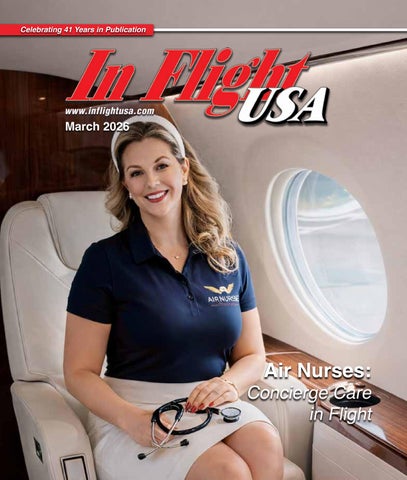
In Flight USA had the pleasure of interviewing Ericka Essington, Founder and Chief Executive Officer of Air Nurses. Air Nurses is a flight nurse-led service built specifically for private aviation, placing board-certified air ambulance flight nurses onboard private aircraft as a medical service. Air Nurses does not operate aircraft; they provide the concierge-style clinical oversight and bedside-to-destination support that travels with the client. Essington is a board-certified flight nurse, flight paramedic, medical transport executive, and first responder (BSN, RN, NRP, CFRN, FP-C, CMTE) with extensive experience in aviation medicine and critical care transport. Her organization hires expert, board-certified flight nurses to support travelers who are medically cleared to fly, but still require medical support, monitoring, mobility
lationships rather than one-time deals.
“We wanted to create a company that clients could truly trust,” said Hahn, CEO/Founder of Arcadia Jets.
Our interview walks readers through how Air Nurses works and why the company was built to help families, flight departments, and brokers solve a problem that has historically had very few options.
In Flight USA: Can you please explain what Air Nurses does?
Ericka Essington:
“Our goal is to combine expert market knowledge with genuine, personal service — ensuring that each client feels valued and confident through every step of their aircraft transaction.”
Whether handling an acquisition, listing a client’s aircraft, or facilitating an off-market opportunity, Arcadia Jets tailors its strategy to each client’s unique needs and goals.
A Commitment to Giving Back
Arcadia Jets believes that aviation can be a force for good — both in business and in the community. To reflect that, the company pledged that for every aircraft sold, whether through a
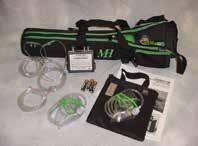
Air Nurses is a non-emergent medical support option for private aviation travelers. We take board-certified flight nurses from the air ambulance industry and provide them as an onboard service to clients in private aviation, whether it’s a charter flight or their own aircraft. This gives clients medical oversight while they travel. Air Nurses is trusted by families, family offices, and flight departments who want a higher standard of care while preserving the privacy and comfort
private aviation is known for. We also partner with hospital case managers and discharge planners to coordinate safe private travel for patients who are medically cleared to fly, but not safe to travel without clinical support.
client acquisition, sale, or off-market transaction, a donation will be made to Angel Flight West.
Angel Flight West is a nonprofit organization that arranges free, non-emergency air transportation for people facing medical and humanitarian needs throughout the western United States.
Our clients are typically stable and do not need an air ambulance, but they still want someone there to monitor them, assist with mobility and medications, support comfort, and respond appropriately if something changes in flight. The simplest way to understand Air Nurses is: we’re the care onboard.
IF USA: Is this an organization/company or are you a non-profit?
“We built philanthropy into our business model from the beginning,” Leslie Mogensen, Director of Business Development continued. “Our partnership with Angel Flight West ensures that every deal we complete also helps someone in need. It’s our way of giving back through the gift of flight.”
EE: We are a company. In the future we would love to build a philanthropic component, as we know how much the service is needed. We have been in business for two years and right now we are focused on continuing to grow
Rapid Growth and Expansion
Arcadia Jets is proud to bring to gether a team whose collective expertise spans every corner of the aviation market. Their newest members contrib-
Continued on Page 16
In its first year, Arcadia Jets has already begun expanding its team and capabilities. The company recently wel-


Continued on Page 9
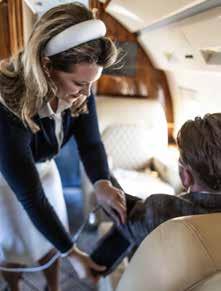
Air Nurses provides medical services to clients with several kinds of needs, including seniors who can’t travel commercially or alone, executives who want medical support or anyone needing medical repatriation (medical support for non-critical patients). (Photo courtesy Air Nurses)





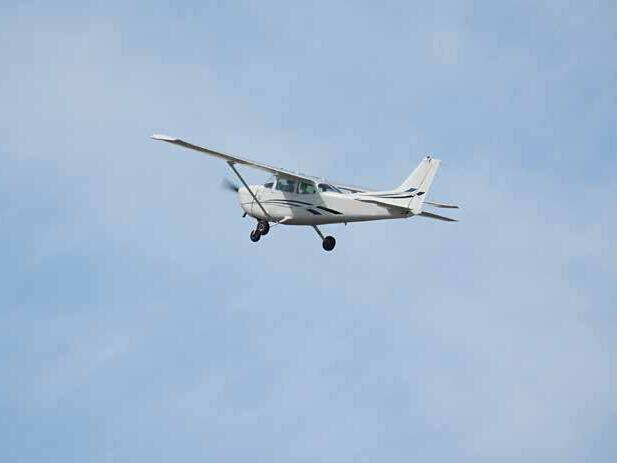










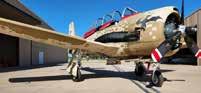




You all remember the Greek philosopher Archilochus… right? I think I had him in one of my classes on “how to fly with wings of wax.” There is an old story about a village in ancient Greece that was about to be attacked by bad guys. Some village dude though his buddy, Archilochus, might have some thoughts on the matter. The leader of this village was not too concerned, as his citizens were very keen on their lifestyle and would most assuredly rise to the occasion and successfully defend against the impending attack. Sadly, for our prideful politician (“politician” comes from the Greek word “politikos”), good old Archilochus disagreed. Archilochus set a dignified pose in his toga (yes, Greeks had toga’s first, the Romans copied the style) and proclaimed, “we do not rise to the level of our expectations, we fall to the level of our training.” At that point, our guy in the toga got on the next stage out of town. Nobody remembers what town was involved because it was burned to the ground. While this old CFI no longer teaches flight with wax wings (according to the NTSB, they melt when one flies too close to the sun), I do teach the principles of Archilochus. Let’s go back to the mid 1970’s for an example of how the Archilochus (let’s just call him “Archi” for short) principle worked in real life. This writer was in flight management with a major airline that operated a fleet of Jurasik Jets (Boeing 727s), with a handful of DC-10’s in the mix for some international routes. We were hiring like crazy, mainly military pilots just coming out of the Viet Nam war. Keep in mind, these were the days when airliners were flown be three pilots. You had the traditional left seat Captain, the right seat First Officer (F/O) and a Flight Engineer (F/E). The Captain and F/O got to play with the flight controls and raise and lower the landing gear, but virtually all systems and checklist management fell to the F/E who, in airline slang, sat “side saddle” with a panel of dials and switches that looked like something out of a 1950’s science fiction movie.
As readers can imagine, the new-
hire pilots were experienced military “sticks,” but many had never flown a complex multi-engine plane and did not have ATP, Type of F/E ratings. So, the drill was that a new-hire fighter pilot would start out as an F/E, with further training needed to obtain the ATP and then a Type rating for the “three howler.” Veterans’ benefits helped with the ATP training, which this writer conducted in Lear Jets… great fun!
F/E and type ratings were provided by the airline. The new-hire might spend several years as an F/E, then more years as an F/O and finally, as hair turned grey (or thinned), reach the exalted title of Captain. F/E training was crucial and detailed. Given that this writer held a turbojet F/E rating, I was tagged to conduct extensive “side-saddle” training. So, what’s the punch line?
It was a dark and stormy morning at one of the airports we served, with freezing rain and snow piling up on the B-727’s wings and flight surfaces. The de-icing truck had made several rounds at the terminal to de-ice planes. The F/E made a final “walk around” to make sure all surfaces were clean. Good to go! But a departure delay took place due to problems at the ticket counter and the F/E ordered another de-ice “squirt” just to make sure all surfaces were clear.
The ground crew called “all clear” and a quick taxi was followed by a rolling take off. An alert Flight Attendant happened to look out a window just as the take-off roll began and, to her horror, noted a pile of snow and ice had not drained off the wing during the last de-icing, but had gathered at the right wing root. She tried to alert the crew, but it was too late. Upon rotation, the pile of show sluffed off the wing, good news, but then flew back, slamming into the number three engine… very bad news. The number three engine disintegrated… violently ripped off the plane. Compressor blades punctured the fuselage with hydraulic lines, pressurization connections, and primary electrical leads torn apart.
Although mortally wounded, the
Continued from Page 6
tough old Jurassic Jet continued to climb, unable to return and land immediately in that the departure airport was below landing minimums. As is required in the airline world when a “return and land” is not possible, a take-off alternate airport had been established. The two “front seaters” battled the stricken B-727 towards the nearby alternate airport for an emergency landing. The big question, could the new-hire F/E keep the busted bird alive long enough to get to that alternate airport? All A/C electrics had tripped, hydraulics were failing, a manual gear extension would be needed, and fuel was spewing from severed fuel lines. Working as a welltrained crew, the three pilots teamed up for the next 20 minutes to contain the bleeding and get the busted bird on the ground safely. Our new-hire had expertly triaged the failing systems. So, where does Archi’s Principle come into the picture? As it turned out, the new-hire was one of my guys. I
was asked to de-brief my former student to see what we at training might have done better. When asked to detail the various steps he had taken to contain the damage, his response (from this writer’s old memory) went something like this, “I can’t remember all the details as everything happened so fast. It was as if I had left my body and was standing behind my seat, watching me work. I remember thinking… how in the heck is this guy remembering all that needs to be done? With no time to pull out a checklist, I watched me make all the right decisions at just the right time. I just relied on my training to make my hands move to the right controls and my eyes see the correct indications.” Sounds a lot like Archi’s Principle, doesn’t it? Needless to say, I was very proud of my student and glad that I was working for an airline that insisted on “old school” training for aircraft systems, a policy completely abandoned by most airlines today.
How about you, the reader? While we (the training industry) do some
Continued on Page 9












By Jay Wiles, AOPA
NTSB Chairwoman Jennifer
Homendy
voiced support for the Pilot and Aircraft Privacy Act (PAPA) in an exchange with Sen. Ted Budd (R-N.C.) during a Feb. 12 Senate Commerce, Science, and Transportation Committee hearing on aviation safety and the midair collision between a military helicopter and regional jet in January 2025 that killed 67 people.
PAPA was introduced to address growing concerns over the misuse of ADS-B, an aircraft collision avoidance technology, by some airports across the country to collect fees from pilots. It was introduced by Budd and Rep. Bob Onder (R-Mo.), who are both active general aviation pilots.
During the hearing on Feb. 12, Budd also voiced support for ADS-B technology, but highlighted PAPA, which would close a needed gap as some airports are using this technology for revenue generation. During the hearing, Budd asked Homendy if the use of ADS-B Out data to assess landing fees “aligns with the intent of ADS-B?”
Homendy responded directly: “Absolutely not. ADS-B is a safety tool and it should be used for safety, not as a revenue generator to charge... general aviation pilots and others ramp fees or landing fees.”
Homendy later said she believes ADSB-derived fees could discourage pilots from installing or using ADS-B. On PAPA, Homendy added, “I hope it moves because I think it should be prohibited.”

NTSB Chairwoman Jennifer Homendy testified Feb. 12 before the U.S. Senate Commerce, Science, and Transportation Committee in support of legislation that would end the use of ADS-B for fee collection. (Photo courtesy of Commerce Republicans via YouTube and AOPA)
At the same time, AOPA is preparing to issue a second call to action to members — urging them to contact their members of Congress to cosponsor PAPA.
“Many AOPA members reached out to their congressional representatives with our first call to action a few weeks ago,” said AOPA Senior Vice President of Government Affairs and Advocacy Jim Coon. “I cannot thank them enough, but members of Congress need to continue to hear our collective voice on this issue just like they did with third class medical reform and stopping ATC privatization. It makes a huge difference. ADS-B technology should be used for safety purposes and not airport economics.”
Learn more at AOPA’s website, aopa.org.
Continued from Page 7
training regarding engine failure, do you know the “fuel, fire and air” drill? A recip engine needs all three to run. How about your knowledge as to where these three essentials come from? For example, given an engine failure after a significant bird strike, would you assess that the ram air input to the carburetor (or fuel injection manifold) might be blocked? Would you think to pull on the carb heat or alternate air source to bypass the ram air input? Given a failure of the pitot static instruments or air data computers, do you know how to select alternate air? Does the alternate air on the plane you fly correct both the air data system and back-up instruments? Suppose you lose pitch control, like a jammed elevator. Have you ever tried controlling pitch with trim only, all the way through the landing?
Can your autopilot help if controls are jammed? Can you perform a manual gear extension without a checklist… in the dark? Keep in mind, a full up electrical failure kills the cabin lighting, and in many airplanes, the landing gear. See where this is going? Would you feel comfortable stepping out of your body, trusting your alternate self to make all the right moves?
Let’s take one last look at Archi’s Principle, “we do not rise to the level of our expectations, we fall to the level of our training.” Just give this principle one other consideration. The next time you are hoisting a few in the pilot ready room, celebrating your skills and importance, turn to your buddy and say, “Hey Buba, does your autopilot control pitch through the elevator or trim … or perhaps both?” See if you can get a “what if” jam session going… it can be fun!


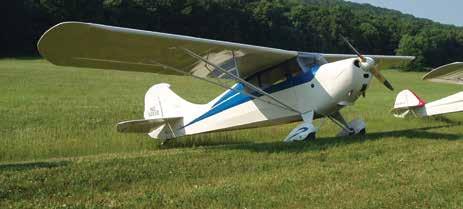
As a journalist, the title of “ROTOR” vs. “ALERT” is a tough subject to sell as a good read. These acronyms deal with two proposed congressional acts that are competing with one another. This is the kind of topic that legal geeks might track, but certainly not normal folks, like pilots. Bottom line… pick the wrong acronym and you could end up flushing $10K (or more) into your plane for supposed safety technology that will probably not achieve the goals being sought and may worsen an already bad safety problem. Got your interest? Conclusion… contact your Federal Senate and House representatives (they have contact info on their web sites) and indicate your support for “ALERT”… and do it now! Please do keep reading so the preceding recommendation actually makes sense.
An unthinkable tragedy occurred at approximately 8:47 p.m. on the night of Jan. 28, 2025. A PSA Airlines regional passenger jet was struck by a U.S. Army Blackhawk helicopter over the Potomac

River while the airliner was flying the RNAV (GPS) Runway 33 approach to Ronald Reagan Washington International Airport (KDCA). Sixty-seven lives were lost and many times that number of lives have been left with emotional scars that will never heal. Media broadcasts and countless “talking heads” pondered over how such an event could take place, given an air traffic control system and pilot training that should have guaranteed such a thing could never happen. After all, shouted media and supposed aviation experts, doesn’t ATC guarantee that aircraft will always have positive separation?
As media coverage consumed TV news time, this writer immediately pulled up a favorite web site, www.skyvector. com, to review the airspace structure around DCA. Having served as a contract pilot instructor involved in recurrent training with the Air Force 89th Airlift Wing at Andrews AFB (Johnson administration), and later, as a lobbyist for the airline industry in Washington D.C. for
four years (Reagan administration), this writer has more than a passing knowledge of DCA airspace.
SkyVector provided immediate access to the Washington Sectional Chart, the Baltimore Washington Terminal Area Chart, the Baltimore Washington VFR Fly Way Chart, the DC Heli Chart, the DC Heli Insert and all DCA approach charts, including the runway 33 GPS approach. It is sad to note that much of this superbly charted data (available for all Class B airspace) is not taught to pilots by under-informed CFI’s even though available in popular tablet formats. Even more disturbing is that these chart resources are not covered adequately in FAA written exams or by the appropriate FAA Airman Certification Standards. One cannot but wonder if the pilots of the collision aircraft would have operated differently, perhaps with more awareness if the story told by the DCA charts had been better understood.
In only minutes, it became clear to



this writer that the airspace construct around DCA, especially with respect to the coordination between civil and military operations, was devoid of safety margins commonly in place at other Class B airports. This writer immediately noted that the approach to DCA Runway 33 was a GPS procedure until arriving at IDTEK waypoint, just 1.4 NM from the touch down zone. The PSA Airliner had approached DCA from the South, flying North up the Potomac, using typical GPS resources.
Upon arriving at IDTEK the procedure calls for an almost 90-degree left turn (from left base to final) to visually pick up the PAPI for visual glide scope guidance. This is a visual approach once past IDTEK, rolling out onto a short final approach of 1.4 mile. There is no electronic guidance on the short final, either lateral or vertical. There are no approach lights, but Runway 33 does have Runway End Identifier Lights (REILS) and medi-
Continued on Page 18










”



1. Removes corrosive contaminants.

2. Preserves paint and finish.


3. Turns cleaning time into a valuable inspection.

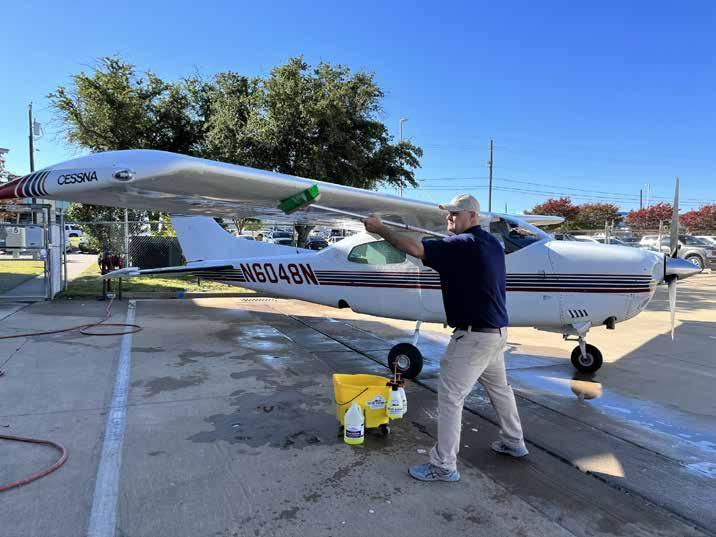















Safely remove exhaust residue, salt, dirt, deicing fluid and industrial fallout with Jet Stream s Wet Wash System ” products.













By Engineer Feras Shakhatreh Executive Overview
Aircraft maintenance sits at the intersection of operational reliability and aviation safety.
While aircraft design, regulation, and training systems have advanced significantly, maintenance activity remains exposed to human error, procedural deviations, and information gaps. These challenges persist across fleets and regions, particularly as aircraft systems become more complex and maintenance environments more demanding.
Against this backdrop, Augmented Reality (AR) has begun to move beyond experimental trials and into practical application. What was once viewed as an emerging technology is now being evaluated, and in some cases adopted, as a safety-support tool for real maintenance operations.
This essay explores how AR is being used in aircraft maintenance today, how it supports safer task execution, and what conditions are necessary for successful, safety-driven adoption.
Maintenance Safety: A Persistent Industry Challenge
To understand why AR is gaining attention, it is first necessary to revisit the nature of maintenance risk.
Modern commercial aviation has achieved remarkable safety levels. However, maintenance-related events continue to occur, reminding the industry that safety improvements are incremental rather than final. Industry analyses consistently show that maintenance factors contribute to a small but persistent share of accidents and incidents.
At the core of many of these events are human factors.
Technicians routinely operate under time pressure, at night, and in physically constrained spaces, while relying on complex documentation and system knowledge. Even with established procedures and Safety Management Systems (SMS), errors can occur when instructions are misinterpreted, steps are missed, or inspections fail to capture subtle defects.
These realities have driven operators to look for solutions that support technicians directly at the point of work, rather than relying solely on procedural controls.
What Augmented Reality Brings to the Hangar Floor
This is where Augmented Reality enters the conversation.
AR overlays digital information onto the physical aircraft environment using

smart glasses, tablets, or head-mounted displays. Instead of requiring technicians to alternate between the aircraft and technical documentation, AR places relevant information directly within the technician’s field of view.
In practical maintenance terms, this changes how tasks are executed.
Procedural steps can be visually aligned with the actual component. Fasteners, connectors, and inspection points can be highlighted in real time. Warnings can be issued when task sequences are incorrect or steps are omitted, all while allowing technicians to keep their hands and attention on the job.
By reducing task interruption and cognitive switching, AR supports situational awareness and procedural discipline, two foundational elements of safe maintenance.
The impact of AR becomes even more apparent when applied to training.
Training has long been recognized as a critical defense against maintenance error, particularly for complex or infrequently performed tasks. AR-based training tools extend traditional classroom and on-thejob instruction by allowing technicians to interact with procedures in a visual, immersive manner.
Through AR training environments, technicians can rehearse tasks before touching the aircraft.
Internal structures become visible, system interactions are easier to understand, and task sequencing can be practiced repeatedly without operational pressure. Research consistently shows that this approach improves knowledge retention, reduces learning time, and builds confidence.
As a result, technicians arrive at the aircraft better prepared, reducing the like-
lihood of errors during first-time task execution.
Training benefits alone, however, are not enough to justify operational adoption.
Maintenance organizations require evidence that AR delivers tangible improvements during real maintenance activity. Over the past several years, multiple industry and military trials have begun to provide that evidence.
In U.S. Air Force evaluations, ARbased technical guidance replaced paper documentation and led to measurable reductions in procedural errors. Similar outcomes have been reported in civil aviation studies.
For example, AR guidance used during aircraft access panel and fan cowl door operations improved task accuracy and reduced the risk of secondary damage. Mixed Reality applications that combine voice commands with visual overlays have also demonstrated reduced mental workload during complex maintenance tasks on transport-category aircraft.
European research initiatives have reached comparable conclusions.
By visually clarifying inspection instructions, AR systems helped technicians detect discrepancies that might otherwise have gone unnoticed. Together, these trials suggest that AR can positively influence both task execution and inspection quality.
Beyond operational feedback, AR deployments have produced measurable performance data.
Studies report faster access to correct technical information, reducing delays and decision pressure during maintenance tasks. Improvements in task execution efficiency
are particularly evident during complex or unfamiliar procedures.
Training metrics reinforce these findings.
Significant reductions in time to competency, combined with higher procedural accuracy, directly support safer maintenance outcomes. While efficiency gains alone do not guarantee safety, they reduce workload and time pressure, well-established contributors to human error.
In this way, efficiency and safety improvements reinforce each other rather than compete.
Despite encouraging results, AR is not without risk.
Introducing any new tool into maintenance operations requires careful evaluation, and AR is no exception. Hardware durability, battery life, and display performance must be sufficient for hangar and line environments.
Equally important is how information is presented.
Poorly designed interfaces can overload technicians or distract them at critical moments. In addition, registration accuracy and tracking reliability are essential. Misaligned overlays or outdated data can erode trust and introduce new hazards.
For this reason, AR must be managed like any other safety-related maintenance tool, through validation, configuration control, and continuous monitoring.
Enablers for Safe and Effective Adoption
The difference between success and failure often lies in implementation.
Organizations that view AR as a standalone innovation risk missing its safety potential. Instead, AR should be integrated into existing maintenance, quality, and SMS frameworks.
Human-centered design is a key enabler.
Interfaces must be intuitive, task-focused, and aligned with approved maintenance data such as ATA iSpec 2200 standard which has developed by the Air Transport Association (ATA). Just as importantly, technicians must be involved throughout development and deployment.
When end users contribute feedback and see their input reflected in system design, acceptance improves, and so does safety performance.




Coast Avionics, Inc. is the original FAA Certified Repair Station for Avionics at Treasure Coast International Airport (KFPR) in Fort Pierce, Florida. We have been serving pilots and aircraft owners in the Southeastern United States since 1990. Treasure Coast International Airport (KFPR), 3800 Saint Lucie Blvd., Fort Pierce, FL 34946 Phone: 772-464-3148 • Fax: 772-464-3197 • Se Habla Español tcavionics@gmail.com • www.treasurecoastavionics.com
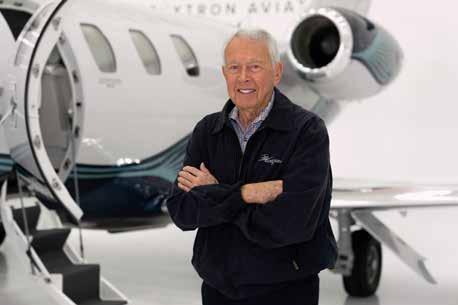
The Textron Aviation team is deeply saddened to learn of the passing of Russell W. “Russ” Meyer Jr., the longtime chairman and CEO, and Chairman Emeritus, of Cessna Aircraft Company. Meyer passed away March 4, 2026 in Wichita at the age of 93 after a brief illness.
Meyer was an aviation legend, leading Cessna for nearly 30 years and overseeing the development and launch of Citation business jets. He played a key role in stabilizing the industry through the General Aviation Revitalization Act of 1994, and earned top aviation awards including two Collier Trophies, the Wright Brothers Memorial Trophy and induction into the National Aviation Hall of Fame.
He believed in using aviation to help others, founding the Special Olympics Airlift — which has transported athletes to the Games for forty years — and supporting workforce development by starting Wichita’s 21st Street Training Program to create career opportunities for underserved residents. His passion for youth development extended to many important charitable organizations and causes.
“Russ was a remarkable human being and one of the most respected
leaders I have ever known. I held Russ in the highest regard, not only for his extraordinary business acumen, but for the integrity, humility and genuine care he showed for people at every stage of his life. He led with conviction, compassion and an unwavering belief that leadership carries a responsibility to serve something greater than oneself,” said Ron Draper, president and CEO, Textron Aviation. “On behalf of the entire Textron Aviation team, I extend my deepest condolences to Russ’s family, friends and all who had the privilege of knowing and working with him. I was truly privileged to know Russ as a colleague, a mentor and a friend.”
Russ leaves an enduring legacy of innovation, advocacy and service. He shaped our company, our industry and the Wichita, Kansas, community in ways that will be felt for generations to come.
For more information on his incredible legacy, please reference the Russell W. “Russ” Meyer Jr. Fact Sheet at (https://d21buns5ku92am.cloudfront.net/69280/ documents/61775-1772738472-TxtAv%20-%20Russ%20Meyer_ Fact%20Sheet-5500bf.pdf). Or, visit the Textron website at Textron.com.
By Lea Buonocore
After a recent visit to California’s Mendocino Coast, I had the pleasure of sitting down with Carl Shaffer, Airport Manager of Fort Bragg International Airport. During a tour of the hangar — which has become a hub of aerial photography, classic cars, vintage planes, and a favorite hangout for owners’ grandchildren discovering their love of flying — Carl shared the fascinating story of this hidden gem. With a rich six-decade history and a unique community spirit, this little airport truly offers something special. Make your next flying destination Fort Bragg, California.
Lea Buonocore: How did the Fort Bragg Airport get started, and what’s the history behind it?
Carl Shaffer: It was actually started around 1958-59, and there was one person who flew out of here — Steve Baxman. He owned a sand and gravel business, and in the early 1960s, he paved the runway. It’s 10 feet wide by 1,800 feet long, and we’ve got 60 feet wide of grass right next to that. The airport that was in Fort Bragg before was a little grass field that closed in about 1960, so this is the only airport in town now.
It’s great to have a little private airstrip like a mile and a half from town. There are about eight properties that each own a little piece of the runway. I own a big chunk of it, my neighbor owns a piece, and so forth all the way down. It’s just been a real handshake deal for all these years. It’s worked out really well. We take turns mowing the field.
Just recently, I didn’t realize that Caltrans holds the permits for all the airports in California. A guy from Caltrans showed up and said, “Well, we have the permit for your airport.” I said, “Well, we’re private. We don’t have a permit.” He looked and said, “No, you’re right. You don’t. But we control all the airports.” Well, all these years since the 1960s, they thought we were one owner, and we’re multiple owners. He said, “Oh, you have to be special use.”
So it took a year and a half to take some trees down, provide some more clearances, and jump through a few hoops. Now we’re a special-use airport. It’s still private, but we’re actually called special use now. We still have the same identifier, 82CL. We don’t do any flight instruction out of here, no wheel-watching — just private individuals flying off our own land. It’s been great. I’ve been here since 1976 myself.
LB: Is there any military affiliation with the Fort Bragg Airport?
CS: There isn’t any. Fort Bragg was named after a general from way back — I don’t really know the exact history. It was called Fort Bragg after General Bragg.
I don’t think it’s the same guy that Fort Bragg in North Carolina was named after. So there’s really no military affiliation with our airport here. It’s actually called Virgin Creek Airport, but they also call it the Fort Bragg Airport.
LB: What is your role as manager of the airport, and what responsibilities do you have?
CS: Every year, for tax purposes, we list all the aircraft that are based on the field for the tax assessor. There’s insurance — we all pay into an insurance fund for liability to protect the owners. We keep the airport mowed several times a year, probably three or four times.
The Coast Guard flies in to do training with the boats down in the harbor, and occasionally CalSTAR will fly in here — the REACH helicopters —when it’s too foggy to land at the hospital. For me, I just kind of keep things going and answer questions. I get calls constantly from people who want to fly in here. Sometimes the answer is yes, and a lot of times it’s no, depending on their pilot ability and short-field experience. It’s only 1,800 feet long, so it’s a little tricky to get into if you’re not used to it.
In fact, on Christmas, it was great. The Coast Guard came in with a helicopter with Santa Claus hanging out the side for the kids, for the Coast Guard families down in the harbor. That was really fun.
That’s pretty much my duties — just keeping things rolling along. We’re very conscientious neighbors. We don’t have any noise complaints. We don’t have any safety issues. We’ve been going along safety-free for six decades, so we feel real good about that.
LB: How does the airport support special operations missions?
CS: We allow emergency personnel to come in here and use the field as they need. The Coast Guard uses it, and every once in a while, the sheriff’s department will when they have something really important going on here along the coast. There have been a few in-flight emergencies where people have landed here instead of having to land in a field or on the beach. But I think that’s pretty much it for special operations.
LB: Are there any opportunities for people who are interested in learning to fly or learning about aviation at Fort Bragg?
CS: No, other than just stopping by and talking and getting experience from the pilots here on the field. We don’t have any flight school or flight training. There’s no ground school here. My father years ago did a ground school here, but he’s since passed away.


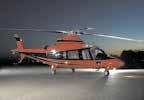






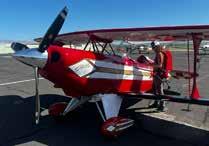
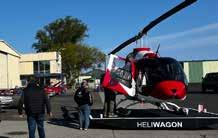
On Feb. 18, the General Aviation Manufacturers Association (GAMA) released the 2025 General Aviation Aircraft Shipment and Billing Report during its annual State of the Industry Press Conference. Overall, when compared to 2024, the business jet and piston airplane segments saw increases in shipments and preliminary aircraft deliveries were valued at $35.7 billion, an increase of 14.6 percent.
“The state of the general aviation manufacturing industry remains steadfast. We continue to see robust numbers of total aircraft delivered as well as annual billings eclipsing $35 billion, the highest it has ever been. While some segments are seeing marginal declines in deliveries, they are all still above 2019 levels. As manufacturers work hard to meet the challenges and demand of today, they remain focused on advancing safety and
innovation for the future of the entire aviation industry,” said James Viola, GAMA President and CEO.
Airplane shipments in 2025, when compared to 2024, saw piston airplanes increase by ten units to 1,782, turboprops decline slightly by 5.1 percent with 594 units, and business jets increase 11.8 percent with 854 units. The value of airplane deliveries for 2025 was $31.0 billion, an increase of 16.1 percent.
Helicopter shipments in 2025, when compared to 2024, saw piston helicopters at 206 units, and preliminary turbine helicopters at 732 units, a decrease of four and 14 units respectively. The preliminary value of helicopter deliveries for 2025 was $4.7 billion, an increase of approximately 5.5 percent.
GAMA’s complete 2025 year-end report can be found at gama.aero.
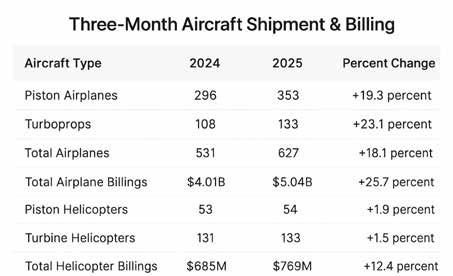
(*) Leonardo Helicopters fourth quarter data was not available at the time of publication. Leonardo Helicopters will release year-end results next week. GAMA excluded 2024 fourth quarter data for Leonardo in the comparison table.
A second report was released by GAMA last month. PwC (PricewaterhouseCoopers) was engaged by the General Aviation Manufacturers Association to quantify the contribution of general aviation to the U.S. national and state economies in 2023.
In addition to GAMA, the general aviation industry associations include: the Aircraft Electronics Association, Aircraft Owners and Pilots Association, Experimental Aircraft Association, National Air Transportation Association, National Association of State Aviation Officials, National Business Aviation Association, and Vertical Aviation International. General aviation is defined as the manufacture and operation of any type of aircraft that has been issued an airworthiness certificate by the Federal Aviation Administration (“FAA”), other than aircraft used for scheduled commercial air service or operated by the military. For this study, the general aviation industry is defined to include aircraft and component manufacturing, flight operations, maintenance, and other activities. The economic contribution of the general aviation industry is measured in terms of employment, labor income, output, and gross domestic product (“GDP”) for 2023, the most recent year for which a full, consistent set of national and state-level data is available.
Some highlights include:
• Nationwide 371,900 full- and part-time workers were directly employed in general aviation in 2023.
• General aviation supported 1.3 million jobs, generated $107.5 billion in labor income (including wages and salaries and benefits as well as proprietors’ income), produced $339.2 billion in output, and contributed $178.1 billion to GDP.
• Overall, the total GDP contribution attributable to general aviation amounted to approximately $529 per person in the United States in 2023.
• At the national level, each direct job in the general aviation industry supported 2.6 jobs elsewhere in the economy.
• General aviation contributes to the economies of all 50 states and the District of Columbia.
• At 146,600 jobs California has the largest number of total jobs, including direct, indirect, induced, and enabled contributions, attributable to the general aviation industry.
• The top 10 states ranked by the total number of jobs attributable to general aviation in 2023 were California, Florida, Texas, Georgia, Arizona, Illinois, Ohio, New York, Kansas, and Pennsylvania.
• Combined, these 10 states accounted for 52 percent of the total jobs attributable to general aviation in the U.S. in 2023.
• Total sales of new U.S.-manufactured general aviation aircraft amounted to $12.9 billion in 2023.
• Accounting for 12.5 percent of shipments, jet-powered airplanes represented the majority of sales (nearly 80 percent) of new U.S.-manufactured general aviation aircraft. Turboprop airplanes had the second highest share of salesin 2023 (9.5 percent), followed by piston-powered airplanes (7.3 percent).
• In addition to the manufacture of new aircraft, U.S. manufacturers also produce a variety of parts and components for use in the manufacture, repair, and upkeep of general aviation aircraft around the world, including aircraft engines and engine components, aircraft assemblies and subassemblies, aircraft parts (such as propellers, wheels, tires, brakes, aircraft interiors, and lighting), and avionics and other electrical components. Aircraft component manufacturers produce parts for both new aircraft and for use in repairing and refurbishing existing aircraft.
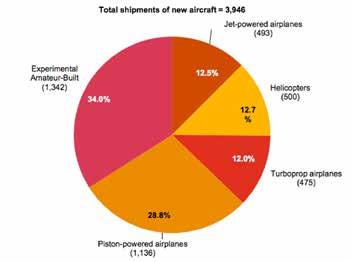
This graph shows shipments of new U.S.-manufactured general aviation aircraft, 2023. (Source: PwC estimates based on data from GAMA’s 2023 Year End General Aviation Aircraft Shipment Report, the EAA, and the FAA aircraft registry.)
• PwC estimates that total sales of U.S.-manufactured general aviation aircraft components for both new and existing aircraft were approximately $37 billion in 2023.
• Nationwide, 48,600 full- and part-time workers were employed in the manufacture of general aviation aircraft in 2023.
• Another 74,700 workers were employed in the manufacture of components for general aviation aircraft, for a combined direct employment contribution of 132,800 jobs.
• These workers earned $14.5 billion in labor income in 2023, an average of $109,028 per job.
To see the complete 71-page PwC report, visit the GAMA website, gama.aero or find the PDF file directly at https://gama.aero/wp-content/uploads/General-Aviations-Contribution-to-the-US-Economy_Final_021925.pdf.




























a reliable, high-trust service.
IF USA: How did your organization get started?
EE: It started with my professional background, and then it became personal.
When I was in nursing school, instructors told me I should consider flight nursing. It became a goal of mine. After graduating, I gained the required experience in the ER and ICU, and as soon as I met the 3-year requirement I started interviewing for flight nurse positions. I’ve spent the majority of my career in aviation medicine, and it is still my absolute passion.
As I grew into leadership roles, I recognized increasingly that we were flying many non-critical patients on air ambulances because there often wasn’t another safe option especially for people who were stable but still needed medical support in transit. It became very personal when my grandmother, at 92, needed to travel to Italy for a family wedding and she required some medical oversight.
mission of your organization?
EE: Our mission is to help provide clients an option to travel whether it’s a family event, getting home, or getting to needed care by bridging the gap between commercial medical escorts and air ambulances. We make private aviation safer and more accessible for people who are non-critical but still need oversight or support.
IF USA: How do you go about hiring nurses? Is there a specific skill set or experience you seek?
EE: Yes. To become a flight nurse in the air ambulance world, you generally need three to five years of ER or ICU experience, and then you sit for the board certification exam. This is a specialized exam that validates a registered nurse’s expertise in flight and emergency medicine and caring for patients safely in the aviation environment. We specifically recruit these air ambulance experienced nurses. These aren’t brand new nurses. They’re seasoned clinicians with aviation medicine experience as certified flight registered nurses (CFRN) who understand the unique demands of caring for someone at altitude. Along with various other medication certifications they go through additional emergency procedures training as well as crew resource management, which. Is important as this allows them to communicate effectively with the flight crew in case of an emergency.
ing is our on-demand service, often referred to as medical repatriation. These are non-critical patients who don’t need an air ambulance, but they still need a medically supported way to get home or get to a hospital for surgery or specialty care. They may have been injured while traveling or become ill and need to travel on short notice. Commercial flying often isn’t appropriate. A number of these clients don’t normally fly privately, but pairing a charter aircraft with an aviation-trained nurse can be a much more comfortable option for the client and their family, and often far more cost-effective than a dedicated air ambulance aircraft. We often work directly with hospital case managers, discharge planners, and concierge medicine teams to coordinate these trips and make sure the plan is safe from bedside to destination.
Many of the families we serve are used to a high level of care in every other part of life this is simply making sure medical travel meets that same standard, quietly and respectfully. Ultimately, our goal is providing care to clients who are traveling and need the right solution. We even have specialized flight nurses for pregnant mothers and newborn babies

stabilize, and coordinate escalation if needed, while maintaining discretion and comfort for the traveler. All our equipment like oxygen and monitors is FAA-approved, so families and flight departments can have peace of mind while traveling.
IF USA: What types of aircraft do you fly?
Continued on Page 21 Continued from Page 4
Commercial travel wasn’t realistic especially a 12-hour flight with mobility limitations. Our family began looking at private aviation because it offered more comfort, privacy, and control while allowing us all to travel together. What surprised me was that when I started interviewing nurses, companions, and helpers to travel with us, many had minimal medical knowledge and little understanding of the in-flight or aviation environment. They carried little to no medical equipment. I kept thinking: What happens at altitude if something changes? Would they understand how flight affects the body, oxygenation, or medication response? Would they know what to do? That experience made it clear to me: we could do better. What started as a solution for my grandmother quickly became something bigger because if my family was struggling to find the right level of support, I knew other families were facing the same gap with even fewer options. I created Air Nurses so families wouldn’t be forced into extremes, but could choose travel with calm, aviation-trained nursing care onboard.
Air Nurses was created to bring this clinical expertise into private air travel, using seasoned air ambulance, board-certified flight nurses who know how to assess, stabilize, and coordinate care in flight, while keeping the experience calm and discreet giving families peace of mind.
IF USA: So can you capsulize the
IF USA: Can you describe typical patients that you have? What does your average patient look like?
EE: We generally serve three types of clients.
The first type is clients like my grandmother most often seniors who can’t travel commercially and need support, monitoring, or assistance during travel, especially when families don’t feel comfortable having them fly alone. Sometimes it’s mobility issues or fatigue. Sometimes it’s mild dementia, oxygen needs, or managing medications and hydration. And sometimes it’s simply, “We just want someone qualified with them so they can travel safely.” We also support families in very tender seasons, including hospice or comfort-focused travel, when the goal is a peaceful, supported journey to be with loved ones.
The second type is executives traveling on corporate aircraft or chartered aircraft who want medical support onboard sometimes for known medical needs, sometimes for general wellness support, and sometimes as proactive risk mitigation.
The third type by far the fastest grow-
Air Nurses brings the medical capability appropriate to the case and the mission. Our nurses operate under physician medical direction with ACLS-level readiness. Think of us equipped like a crash cart discreetly packed into a rolling medical kit. Our clinicians are trained to assess,
EE: Air Nurses is a flight nursing service, so we do not have our own aircraft. We fly with people who either own their own aircraft or access private charter through a broker or flight department. Because we are not tied to one aircraft or one operator, we can support clients across a wide range of private aviation solutions. This allows us to help a larger amount of people and preferences from those who never fly private and are looking for a cost-effective solution, to clients who travel private regularly and want a bespoke



Compelling content -


Professional Branding & Graphics
Powerful Web Sites & SEO
Social Media Management
Engaging Podcasts
Profitable Webinars
On-Site or Virtual Services
Studio Time Available in SLC
Sales Process Consulting & Tools articles, videos, and posts.
from Page 11
First, enhanced training strengthens baseline competence. Second, real-time procedural guidance reduces omissions and sequencing errors. Third, improved inspection support increases the reliability of defect detection. Finally, AR systems generate valuable data.
� Available in both Qref® Book, Card and new iPad editions
� Over 50 years of professional experience in every checklist
� Written by Master CFIs with workflow and ease of use in mind
� Professional design, rugged construction
Beechcraft Bonanza A36 285HP1968-1983
Beechcraft Bonanza C/D 35 1951-1953
Beechcraft Bonanza J/K/M 35 1958-1960
Beechcraft Bonanza N/P 35 1961-1963
Beechcraft Bonanza V35 A/B 1966-1982
Cessna 150 1959-1977
Cessna 152 1978-1986
Cessna 172 Universal Universal
Cessna 172M 1973-1976
Cessna 172N 1977-1980
Cessna 172P 1981-1986
Cessna 172R 1998-2006
Cessna 172RG 1980-1985
Cessna 172S 1998-2006
Cessna 172S G1000 2005+
Cessna 177RG 1971-1978
Cessna 182P 1972-1976
Cessna 182R 1981-1986
Cessna R182 Skylane RG 1978-1986
Cessna 182RG Turbo 1979-1986
Cessna 182T Analog Gauges 2001+
Cessna 182T/G1000 2004+
Cessna 210N Centurion 1979-1984
Cessna Turbo 182T 2001+
Cessna Turbo 182T/G1000 2006+
Cessna Turbo 206H 1998+
Cessna Turbo 210M Centurion1977-1978
Cirrus SR20 Analog Gauges 2000-2003
Cirrus SR20 G1-G2 2003-2007
Cirrus SR20 G3 2007+
Cirrus SR20 Perspective 2008+
Cirrus SR22 G1-G2 2003-2007
Cirrus SR22 G3 2007+
Cirrus SR22 Perspective 2008+
Cirrus SR22 G3 Turbo 2007+
Cirrus SR22 Turbo Perspective 2008+
Diamond DA20 C1 1998+
Diamond Star DA40 2001+
Piper Archer II PA-28-181 1976-1994
Piper Archer III PA-28-181 1995-2002
Piper Arrow 180 PA-28R-180 1967-1971
Piper Arrow II PA-28R-200 1969-1976
Piper Arrow III PA-28R-201 1977+
Piper Arrow III Turbo PA-28R-201T1977-1978
When integrated with SMS processes, this data enables organizations to identify trends, refine procedures, and continuously improve training and risk controls. Together, these elements form a closed-loop safety framework.
Industry Outlook
With these foundations in place, attention is turning toward the future.
AR is steadily transitioning from pilot projects to operational use, particularly in training, inspections, and high-risk maintenance tasks. However, widespread adoption will depend on regulatory clarity, standardization, and demonstrated return on investment.
Industry groups and authorities have begun exploring guidance for digital maintenance tools.











Piper Arrow IV PA-28RT-201 1979-1982
Piper Arrow IV Turbo PA-28RT-201T1979-1990
Piper Cherokee 140 PA-28-1401964-1977
Piper Cherokee 150 PA-28-1501961-1967
Piper Cherokee 160 PA-28-1601961-1967
Piper Cherokee 180 PA-28-1801963-1973
Piper Dakota PA-28-236 1979-1994
Piper Cherokee Lance PA-32R-3001976-1978
Piper Navajo PA-31-310 B/C 1972-1980
Piper Navajo Chieftain PA-31-3501973-1984
Piper Saratoga SP PA-32R-3011980-1992
Piper Saratoga SP Turbo PA-32R-301T1980-1987
Piper Tomahawk PA-38-112 1978-1982
Piper Warrior 151 PA-28-151 1973-1977
Piper Warrior II PA-28-161 1976-1986
MANY MORE MODELS COMING SOON!

As AR matures and integrates with digital twins, predictive maintenance, and AI-driven analytics, its role in maintenance safety is likely to expand further.
Augmented Reality is no longer a distant concept for aircraft maintenance.
When thoughtfully implemented, it offers a practical means of reducing human error, strengthening procedural compliance, and supporting technicians where it matters most, at the aircraft.
The message for operators is balanced but clear.
AR does not replace experience, judgment, or sound maintenance practices. Instead, it enhances them. As the technology continues to mature, AR has the potential to become a durable component of safer, more resilient maintenance operations.










Avidyne Entegra
Garmin G1000 Non-WAAS
Garmin G1000
Garmin G1000 WAAS
Garmin G600/G500
Cirrus Perspective by Garmin
Bendix/King KLN 89
Bendix/King KLN 90B
Bendix/King KLN 94
Garmin GMX 200
Garmin GPS 400
Garmin GNS 430

Garmin GNS
Bendix/King




~ My Services ~
• AVIATION/TRAVEL INDUSTRY Content Creation
• GHOSTWRITING
• YOUR STORY TOLD w. AI’S Powerful Emotional Content
• INFORM & ENGAGE your CUSTOMERS with Blog Posts, Case Studies, Personal Profiles, E-books, Newsletters ~ More Contact Info ~
Whether you fly floats, dream of flying them, or simply love being around remarkable machines and the people who operate them, June 4–8, 2026 is a week worth putting on your calendar. The 2026 Clear Lake Splash In brings together seaplane pilots, aviation families, car enthusiasts, and Lake County neighbors for five days of flying, learning, and community — and there is a place in it for you. Seaplane pilots: capacity is limited to 20 aircraft, and seats at the ramp fill fast. Register now at https://tinyurl.com/2nvshk4y before your spot is gone.
Facebook: https://www.facebook.com/BertBotta1
Email: mailto:botajet@gmail.com
Website and blog: https://www.bertbotta.com
LinkedIn profile: https://www.linkedin.com/in/bertbotta/
“Thank you for your very thoughtful and touching essay published in Aviation International News. It had a very deep impact on me, something that doesn’t happen often.
In 1937, Clear Lake earned a place in California aviation history: Pan American Airlines designated it as an alternate landing area for its Boeing 314 Clipper flying boats whenever San Francisco Bay was socked in. During World War II, Navy PBY Catalinas and Martin PBM Mariners trained on these waters. The Martin JRM Mars — the largest production flying boat ever built — operated from Clear Lake as well.
Jim Holahan is the only other person in the aviation field who can write lime that.
That heritage lives on in the 2026 Clear Lake Splash In — the West Coast’s premier seaplane gathering.
Hats off to you.”
Janice K
Barden
President,
Aviation Personnel
International
NetJets Pilots & F/A Facebook page: https://www.facebook.com/groups/44775 5025256768 Your
A Lake Worth Flying To Clear Lake is California’s largest natural freshwater lake, sitting in Lake County about 100 miles north of San Francisco. At only 1,320 feet elevation, it offers yearround flying conditions that coastal pilots can rarely count on, surrounded by hills, wineries, and small communities with a long and warm relationship with aviation. Clear Lake is also recognized as one of the premier largemouth bass fisheries in the world, regularly hosting professional tournament circuits and drawing anglers from across the country — yet another reason this corner of Northern California rewards a visit from the air.
In June, the weather is reliably beautiful — long days with calm mornings ideal for flying, and warm evenings made for dining under the stars.
Seaplane operations are based at Skylark Shores Resort on the Lakeport lakefront. The resort offers both dock space and ground parking, but seaplane capacity is strictly limited to 20 aircraft on a first-come, first-served basis through advance registration. Seaplane pilots who
Continued on Page 43

(415) 320-9811 • botajet@gmail.com Website & Blog: www.bertbotta.com https://www.facebook.com/BertBotta1 https://www.linkedin.com/in/bertbotta/ NetJets Pilots & F/A Facebook page: https://www.facebook.com/groups/447755025256768
Cell: 1-415-320-9811
E-mail: botajet@gmail.com
Website: www.bertbotta.com

(API) Never Hire an Aviation Writer! (Who Doesn’t Know the Language or Hasn’t Walked the Talk!) Your Brand is Your Story You Need an Aviation Expert to Tell it Exceptionally Well! ~ My Services ~ • Ghostwrite your Book or Articles • Engage your customers with • Gifts of short, attentiongrabbing Ebooks
Seaplane access should be allowed here in Colorado.
We have made great strides by establishing two charted seaplane bases in Colorado (the first ever), planning and managing several splash-in events (the first ever), establishing an invasive species inspection and decontamination program for seaplanes (the first), and becoming the first ever pilot to receive all the training and obtaining certification totally within the State of Colorado (yep, you heard it right, the first).
Despite these successes, our battle rages on. The state is still adamantly opposed and so we are continuing the fight. There is no level of problem that imagination and creativity cannot overcome. And so, we must continue to be the first with solutions.
We must demonstrate by example the strength and resolve of an idea whose time has come!



Continued from Page 16
service experience.
IF USA: Who are your pilots? Do you have any specific pilots that you use or how do you find your pilots?
EE: We don’t operate aircraft, so we do not have any of our own pilots. We primarily work through Part 91 aviation departments, charter brokers, and aircraft operators. Many of our referrals come from Part 135 operators and broker partners who arrange aircraft, and we integrate as the medical component of the trip.
We also work directly with hospital case managers and discharge planners who are coordinating travel for patients who are stable but need clinical support during the journey. They often bring us in early so we can confirm the right level of service, align on timing, and coordinate with the family and care team.
It is important to us that when a client needs help even if we are not the right solution, we do our best to help them through our network of medical transport options. We are a complete concierge solution, door to destination. For instance, if a client needs help sourcing an aircraft, we can coordinate through trusted aviation partners, but ultimately our role remains the same: providing clinical support onboard.
IF USA: Do you have any noteworthy experiences that you would like to share? Has your organization had any interesting experiences that you would like our readers to know about?
EE: So many of our missions are meaningful because for many clients, we’re the only way they can travel safely and get the medical attention they need.
One story close to my heart involved transporting a police chief. He had an infection while traveling and ended up in the ER far from home and needed urgent attention. He was trying to get home for surgery, and the commercial flights had been canceled multiple times. Time was becoming a serious factor. I was in Houston and he was in Dallas, and the call came in the middle of rush hour, so we mobilized quickly to support him. We flew up to Dallas and boarded the aircraft all together at the FBO. We were able to keep him comfortable in flight with pain and nausea medication while monitoring him in flight. When we landed in New Jersey around 1 a.m., I accompanied him to the hospital, and he was able to transition directly into surgery. He’s doing well now, and it’s one of my favorite stories because I was able to help a fellow first responder in a moment when he needed a safe solution fast.
IF USA: Are there any other services Air Nurses provide that have not been mentioned?
EE: Yes. Our core service is in-flight nursing care and medical oversight, but we also support certain executive travelers with wellness-focused services, such as IV hydration and vitamin protocols for jet lag and travel fatigue especially on long-haul flights where the time onboard can be used efficiently.
IF USA: Is there anything else you would like to add, that our readers should know?
EE: Yes. In a crisis, people often don’t know what level of transport they need or who to call first. Air Nurses was built to bring clarity and a safe option to that “in-between” space.
Continued from Page 13
Little River Airport is 14 miles south, but again, they also don’t have flight instruction. The closest airport for flight instruction is Ukiah. It’s too bad because we get people constantly who want to learn how to fly and take lessons. I’ll give people rides for free, of course, and sit and talk with them and point them in the right direction for ground school and where they could go to get some flight time. We’ll talk about aviation to the best of our knowledge, but as far as being able to show up here and get into a program, we don’t have anything like that.
LB: Are there any public events where people can come and explore or learn more?
CS: Several times a year we do the

(Photo courtesy Air Nurses)
One of the reasons I built Air Nurses the way I did is so people can call someone and get the help they need. We can mobilize quickly, within a matter of hours. Many other services require a long lead time, but our model is designed for aviation-style readiness. What sets Air Nurses apart is that our clinicians are board-certified flight nurses with an air ambulance background—trained for real-world inflight scenarios, not just routine bedside care. We can often respond within hours, and we coordinate closely with brokers, flight departments, and care teams so families aren’t navigating it alone. Air Nurses was built exclusively for private aviation.
At the end of the day, Air Nurses exists because I know what it feels like to look at someone you love and think,
“How do we get them there safely?” We built this so families have an option that protects dignity, preserves privacy, and brings calm into an overwhelming moment because people don’t just need a flight. They need someone who will care for them all the way through it.
IF USA: Thank you so much for talking to us about this important and vital service.
To learn more about Air Nurses, visit airnurses.com
Young Eagles flights, if you’re familiar with that. We do that twice a year. Sometimes it’s at Little River Airport, and we have a plane display. A lot of our aircraft here are vintage aircraft. Mine and my neighbors — we have some vintage airplanes here that we’ll put on display down at Little River Airport. Maybe once or twice a year, some of the schools bring their classes up here to show them the airport and show them some airplanes and talk about aviation in general. Nothing’s definitely scheduled. They’ll call us up and say, “Hey, we’ve got a class we’d like to bring by,” and we say, “Sure.” So we’ll come over and get some airplanes out and sit and talk with the class and pass on the information that we have.
LB: Are there any notable aircraft or specific ones that are really special at the airport?
CS: My neighbor’s got the oldest Cessna 180 flying — the second one ever built. It’s a 1953 Cessna 180, the first one ever sold. That’s a special airplane. I have a 1962 Super Cub set up for flying in Alaska with balloon tires and such. There’s a nice Murphy Moose on the field — that’s an Alaskan homebuilt, a big, powerful bush airplane. Then we have some Cessnas and some homebuilts. I think that’s about it.
LB: Are there any other community events where people can come and walk around?
CS: No, nobody’s ever approached us
for anything like that. Since we’re a private airport, we haven’t put any events out for people like that. Not too much in the way of that going on. We have six or seven airplanes that fly out of here, probably four on a regular basis. So we’re not a very large operation.
LB: Is there anything you’d like our readers to know or understand about the airport?
CS: Fort Bragg’s a great place to live and raise your kids. The airport here is kind of unique because we have a 60-foot-wide grass runway next to the 10 feet wide of pavement. That’s kind of rare to find — there are hardly any grass runways in Cali-
Continued on Page 42

Managing risk in aviation goes hand in hand with evaluating hazards, threats and errors. Excellence in performing these tasks is a prime characteristic exhibited by any robust Safety Management System (SMS). Hazards can be thought of as existing conditions, objects, or activities with potential to cause harm. Threats are dynamic events or errors that increase vulnerability to hazards, while risk is a composite assessment of the likelihood of an event’s occurrence and the severity of its consequences. Risk and these related concepts will always require management and most often mitigation as well.
Pilots play a crucial role in managing both present and future risk and by mitigating their consequences in order to ensure flight safety. Arguably, the pilot’s job could be described, in part, as continuously evaluating, managing, and mitigating all risk on every flight.
This month, CALLBACK presents reported incidents in which pilot responses to risk were critical. Consider each narrative. Search for the hazards, threats, and errors; then evaluate risk, the mitigating actions, and outcomes. You will, no doubt, recognize some timeless examples of risk that was managed well or may have been managed better.
Part 91 – There I Was…
Risks from multiple sources were processed by this RV10 solo pilot and Flight Instructor during an IFR flight. ■ I was on an IFR flight plan with ZZZ Center and came across an icing situation. There was a system moving west to east moving over ZZZ, and [I] was currently what I thought far enough east of the system while flying my route. While in the zone, I was monitoring my wings for collection of ice, but no collection. I was ready to ask for lower while looking at Foreflight flight planning, but I saw no ice accumulate on the wings. One thing I failed to do was to turn on pitot heat, which caused an issue…. The pitot accumulated icing conditions and dropped the autopilot out, which started the airplane in an aggressive descent. The airplane probably lost up to 600’ and I immediately notified
ATC [that] I accumulated icing and was correcting for altitude loss. If I remember correctly, they gave me a lower altitude to get out of the icing, which it did. At this time, I started to incur moderate turbulence from the system moving west to east, which made [it difficult] controlling the aircraft straight and level. ATC gave me a heading to fly to get out of the turbulence, but I still had to deal with the weather system. Airplane was difficult to hand-fly, as I was being tossed around losing/gaining altitude and speed. I discussed with ATC what was going on and just tried to maintain heading and altitude as best as I could. They asked if I needed assistance, and I told them no, I just needed to concentrate on flying the airplane. I was asked a couple times what heading to my destination and told them unable to give them the answer due to maintaining the airplane. ATC was awesome, working with me giving me heading and altitude changes, which eventually led me out of harm’s way, which made me happy. I did…my research for the flight and continued to monitor weather progress during the flight. It was moving faster than expected, which changed [the] course of my flight plan…. Bottom line: I did lose altitude more than is given for an IFR flight plan and lateral deviation, but was in contact with ATC during this portion of the flight. I’m not saying I was 100% perfect in my execution, but I did get out of the mess and hopefully didn’t cause too many issues for ATC.
This Challenger 300 air taxi Captain faced unlikely and unexpected risk from inside the flight deck.
■ [We were] departing…with the First Officer (FO) as pilot flying…. Takeoff roll and initial climbout through gear and flap retraction were normal. Shortly thereafter, the FO reduced pitch attitude and began to accelerate. I became uncomfortable with the rising terrain and my PFD’s terrain display being predominantly red. “We need to climb,” I stated. The FO continued as before with no response to my concern. Again, I ad-
vised the FO that we “need to climb at a faster rate,” to which he responded, “I’m accelerating to 250 knots.” As I was then preparing to take control of the aircraft…Tower…advised us of a low altitude alert, and only then did the FO increase his pitch attitude and climb rate. The remainder of the climbout was uneventful.
A B777 Captain related the events that transpired and the mistakes that were made during a night weather departure.
■ Upon taking the runway, Tower asked if we could maintain SID profile to ZZZZZ on departure. We observed the radar and said we would request right of course, as there was a cell over ZZZZZ. Tower said unable. She then asked again if we could maintain SID to ZZZZZ. We accepted the clearance with the intent to request vectors prior to ZZZZZ. Two aircraft departed prior to our departure on the same path with no PIREPs reported. Approaching ZZZZZ, and entering the cell, airspeed began increasing slowly. After 30 seconds, the airspeed decreased rapidly and we received a LOW AIRSPEED EICAS, followed by a momentary stick shaker. First Officer maintained control. We then requested multiple vectors to avoid further buildups. ATC insisted we take a turn north prior to what we had requested due to ZZZZ airspace. Cause: weather and ATC suggestions; ZZZZ Departure would not allow any deviation from the SID, which caused us to fly into the weather that resulted in AIRSPEED LOW caution with momentary stick shaker. In hindsight, we should have requested priority handling and deviated from the SID to go around the weather. Do not let ATC drive you into a dangerous situation.
This ERJ175 crew had conducted a stable night approach until short final when risk required mitigating action.
From the Captain’s report: ■ I was PM, FO was PF. The weather was CAVOK and calm. Upon initial call-up with Approach, I requested from the Approach Con-
troller vectors to final for the ILS XXR and was told to expect that. PF maintained level 3 automation until approximately 200 feet above minimums while established and stabilized on the approach. After disconnecting the autopilot, the PF announced, “I’m going to go 3 red, 1 white,” which was something not briefed during the approach briefing. The runway has a long, displaced threshold; I looked at the approach plate notes to see if there was any guidance about the height above the threshold in reference to the visual glideslope and did not find any. I thought that I would have to debrief with the FO about this decision after we landed and parked. Very soon afterwards, I realized that we were 4 red on the visual glideslope; we were approximately 200 feet above the field and our screen height was close to the end of the runway. I called, “Glideslope, glideslope” whilst simultaneously the EGPWS sounded an audible alarm, “GLIDESLOPE, GLIDESLOPE” as the vertical track depicted flashing yellow. The FO replied, “Clear my flight director.” I immediately replied, “My controls.” I advanced the thrust levers to TO/ GA, and flew the airplane at approximately an 8 degree pitch up attitude. I told the FO to advise ATC of our go-around, and called, “Flaps 2, gear up.” I called for heading, but the FO did not give me heading on the guidance panel. Tower asked for the reason for the go-around; I said, “Unstable.” The FO replied on radio, “Unstable.” Reaching 2000 feet I called out, “Climb sequence, After Takeoff Checklist,” and “1000 to go.” We returned to 3,000. I commanded the FO to rebuild the approach, get new landing numbers based on our new fuel amount, briefed the approach a second time, called for After Takeoff Checklist, Descent Checklist, and then flew the aircraft on localizer, on glideslope, all the way to the touchdown markers, landing approximately 1,200 feet past the threshold, and vacated the runway at taxiway F. Upon the debrief, I allowed the FO to debrief the flight as to what he saw…and he
Continued on Page 30















Where Aviation Legends Come to Life: Oakland Aviation Museum Seeks Community Support to Preserve Bay Area’s Rich Flying Heritage
Tucked away on historic North Field at Oakland International Airport (Calif.) stands a remarkable time capsule of American aviation history. The Oakland Aviation Museum, housed in the original 1939 Boeing School of Aeronautics hangar, is calling on the aviation community and history enthusiasts to help ensure this vital institution continues its mission of preserving the legacy of West Coast flight for future generations.
This isn’t just another aviation museum struggling to keep its doors open. This is the guardian of the very ground where Amelia Earhart began her final, fateful 1937 journey. It’s the keeper of stories from the largest municipal airport in the United States during aviation’s golden age. And it’s home to one of the most extraordinary aircraft collections on the West Coast, including the crown jewel – a rare Short Solent Mark III flying boat once owned by Howard Hughes himself.
A Living Monument to Aviation’s Golden Age
The museum’s significance extends far beyond its impressive collection of more than 30 vintage and modern aircraft. The building itself is a piece of history. When Boeing established its School of Aeronautics on Sept. 16, 1929, they chose Oakland Municipal Airport specifically because it represented the future of American aviation. Here, in Building 621, Boeing trained the pilots and mechanics who would go on to shape the industry during its most transformative decades.
Walk through the museum’s hangar today, and you’re walking where the U.S. Army Air Corps and U.S. Navy personnel trained during World War II. You’re standing on the same tarmac where the Wright Brothers’ Model EX “Vin Fiz” completed the first transcontinental flight in 1911, where innovation and courage intersected to push the boundaries of what was possible.
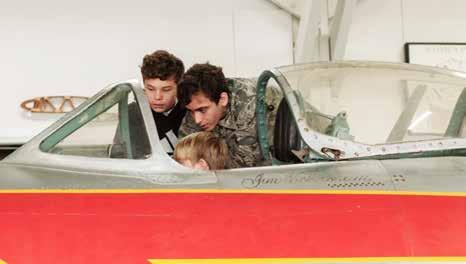
Open Cockpit Days at the Oakland Aviation Museum are scheduled for the following Sundays: March 15, June 21 (Father’s Day) and Sept. 20. (Photo courtesy Oakland Aviation Museum)
The Oakland Aviation Museum doesn’t simply display aircraft – it preserves the dramatic, inspiring stories of the people who built, flew, and maintained them. Its exhibits honor Women in Aviation, Black Americans in Aviation, the 8th Air Force, General James Doolittle, and pioneering airlines like Transocean Air Lines and World Airways that helped connect the world.
Among the museum’s treasures:
• A replica of the Wright EX “Vin Fiz” that made history in 1911
• Military aircraft showcasing aviation’s role in defense and peacekeeping
• The magnificent Short Solent flying boat, offering rare Friday, Saturday, and Sunday tours that transport visitors back to the glamorous era of luxury air travel
• Interactive exhibits
The museum has maintained a proud partnership with the Port of Oakland and Oakland International Airport, serving as an educational resource with connections to STEM programs.
Since its founding in 1981 as the Western Aerospace Museum, this non-profit organization has operated
with a clear mission: to educate the public about the important role of historic North Field and preserve East Bay’s flight legacy. In 2007, the organization refined its focus and became the Oakland Aviation Museum, doubling down on its commitment to local aviation heritage.
Today, the museum offers affordable admission ($18 for adults, with significant discounts for seniors, military, students, and children), Open Cockpit Days where visitors can climb into historic aircraft, and specialized tours of the flying boat that make aviation history tangible and accessible.
But preserving history requires resources. Aircraft restoration demands specialized expertise and materials. Climate-controlled storage protects irreplaceable artifacts. Educational programs need funding to reach the next generation of aviation enthusiasts and potential aerospace professionals.
The Oakland Aviation Museum represents something increasingly rare: an authentic connection to aviation’s pioneering spirit, housed in a building that witnessed aviation history firsthand. It’s a place where children discover their passion for flight, where veterans reconnect with their service, where engineers find inspiration, and
where communities come together to honor the extraordinary achievements of those who dared to fly.
Supporting the Oakland Aviation Museum means investing in education, preservation, and inspiration. It means ensuring that the stories of Amelia Earhart, the Tuskegee Airmen, women aviation pioneers, and countless others who shaped aviation history remain accessible to future generations.
For those who love aviation, who understand the importance of preserving our technological heritage, or who simply believe that extraordinary stories deserve to be told – now is the time to act. The museum that has served the community for over four decades needs the community’s support to continue its vital mission.
Visit, Support, Preserve
The Oakland Aviation Museum is located at 8252 Earhart Road, Oakland, CA 94621, open to visitors who want to experience where aviation truly comes to life. For information about donations, membership, volunteer opportunities, or simply to plan a visit, contact the museum through their website at oaklandaviationmuseum.org.
In the words engraved in aviation history: those who dare to fly deserve to be remembered. Help ensure their stories continue to inspire for generations to come.
Founded in 1981, the Oakland Aviation Museum is a 501(c)(3) non-profit organization dedicated to preserving and presenting the rich aviation heritage of Oakland’s historic North Field and the surrounding East Bay area. Housed in the original 1939 Boeing School of Aeronautics hangar, the museum features more than 30 aircraft, extensive exhibits, and educational programs. The Museum is available for corporate events, weddings, celebrations, and graduations.
The museum is located at 8252 Earhart Road
Oakland, CA 94621. Visit oaklandaviationmuseum.org for more information.

One of the truly great things about being an aviation buff is the number of “Goodies and Gadgets” available to play with. Here In Flight USA has collected a few new ones worthy of your consideration.
Aircraft Spruce & Specialty Co. has been the supplier that aircraft builders, owners, pilots, and aviation businesses have depended on since 1965. They carry a wide selection of aircraft parts, building materials, avionics, and pilot supplies, all of which are offered on their website (www.aircraftspruce.com) and in the famous Aircraft Spruce catalog, now over 1,000-pages available for download or for free in print. You can depend on Aircraft Spruce for prompt shipping and competitive pricing on all orders.
Get Ready for Spring Flying with Aircraft Spruce
Spring is in the air… almost. This is a great time to freshen up or upgrade tools of the flying trade, whether it be a new ADS-B unit or simply a new flight bag. Aircraft Spruce has your covered… with tens of thousands of items. Aircraft Spruce & Specialty Co. has been the supplier that aircraft builders, owners, pilots, and aviation businesses have depended on since 1965. They carry a wide selection of aircraft parts, building materials, avionics, and pilot supplies all of which are offered on their website (aircraftspruce.com) and in the famous (and free) Aircraft Spruce catalog. Order it online or by calling 1-877-477-7823.
The SwitchBox 4G Remote Control
The SwitchBox
The easiest and safest way to remote control any electrical device.
For Pilots:
No more driving to the airport hours before a flight. Turn on your Engine Heater from your cell phone, and simplify your cold flying routine! TIP: Activate a second device like a Cabin Heater for your sensitive avionics, or a Coffee Maker before you arrive!
For General Use:


Appareo Stratus 4 Portable ADS-B / AHRS / GPS Receiver With Touchscreen
Stratus 4 brings critical flight data, real-time alerts, and complete freedom so you’re always ahead of the weather, the traffic, and the unexpected. Made in the USA and works with Apple Find My.
Features:
• Effortless Control - Navigate key settings and status info easily with a crisp, full-color touchscreen
• Apple Find My Integration - stratus is never lost, even if it gets left behind
• Your Cockpit, Your Apps - Use the EFB you prefer—Foreflight, Garmin Pilot, Stratus Insight, and all other major apps
• Long-lasting Rechargeable Battery - 8 hour run time, user replaceable, or plug in for nonstop use, no tools required
Now includes a protective carrying case. Each unit sells for $849.
Extreme Simple Green Aircraft Cleaner
the keys to performance. This equals fast cleaning and no-redeposition, but Extreme Simple Green is also able to go into oil/water separators and have oil break from solution.
Extreme Simple Green’s safety upon aircraft materials and precision cleaning surfaces comes from a combination of proven anti-corrosion agents. The components of Extreme Simple Green are all low-toxicity compounds and the product contains no “solvents.” This leads to an excellent worker’s safety environment. All of the components are biodegradable. It also contains no Clean Air Act Hazardous Air Pollutants (HAPs), nor is it a RCRA hazardous waste in and of itself when disposed.
Simple Green comes in a 32-ounce spray bottle for $14.95, one-gallon jug for $22.75, five-gallon container for $91.75 or a 55-gallon drum for $716.00.
Stahlwille Wire Twisting Pliers
Wire twisting pliers L.230mm or L.280mm Header burnished, polished Handles burnished.
Features:
• For twisting wires up to Ø 1.6 mm (0.06-inch)
• With cutters
Your new ‘Smart Home’ with the easy automation from SwitchBox. Remote control your heating, lighting and air conditioning from anywhere in the world. TIP: Turn On the A/C before you get home, or check to see if you left the lights On and turn them Off. Save Money!
The 4G system is currently on sale for $289.95 and the 4G with full system is $425. To learn more, watch a video on the Aircraft Spruce website (aircraftspruce.com) under the item listing. Notes: Switchbox Control can operate within Canada and United States. Once receiving your new Switchbox, contact support@switchboxcontrol.com to activate your device and receive your unique phone number.
Extreme Simple Green, Simple Green’s new aircraft and precision cleaning product, cuts through tough, built up grease, oil, dirt, pollution, insect residue and impact soils.
Extreme Simple Green gets its superior cleaning from a unique “triple play” cleaning formula. Two high performance surfactants and a new generation grease lifter/cutter combine to get the soil away from the aircraft surface quickly and then keep it away so that it can be cleanly rinsed away.

Extreme Simple Green’s speed of grease cutting and its high capacity to hold grease, oil and soils in solution during cleaning and rinsing time are
• Secure grip thanks to special serration design
• Cutting jaws bevelled by 40°
• For both clockwise and counter-clockwise rotation
• With automatic return
• Chrome Alloy Steel, head and handles burnished
Stahlwille wire twisting pliers come in a variety of options: Length 230 mm or 280 mm; return of automatic or manual, direction of right, left, right and left or right and left with lead catcher. Depending on your selection, the pliers start at $255.95.
29.92 Bravo Flight Bag
You’re 7,500 feet above the rolling hills of Appalachia. The golden hour paints the horizon in hues of fire and silk. You reach down, instinctively, and there it is, right where you left it.

The 29.92 Bravo Flight Bag doesn’t just hold your gear; it holds your confidence. It knows the rhythm of pre-flight checks, the scent of jet fuel at dawn, the way your fingertips trace the embroidered wings as you await takeoff.
Made from water and stain-resistant materials, it shrugs off the unexpected. With intelligently designed compartments, everything has its place: your logbook, your headset, your lucky aviator’s pen (the one that’s written every flight plan since your first solo).
Lightweight enough to carry without effort and rugged enough to last through 10,000 landings, this bag is backed by a lifetime warranty, because some things should never be left to chance.
The bag comes in three color options, stealth (dark gray), lilac or navy and each sells for $179.95.
Aircraft Spruce on the Go Look for Aircraft Spruce at upcoming airshows and events around the country.
March 9-12: Verticon, Atlanta, GA, booth B9023.
March 23-26: AEA International Convention & Trade Show, Dallas, TX, booth 408.
April 14-19: Sun ‘n Fun, Lakeland, FL, Hangar B, booths 1-9.
April 21-23: Aviation Week MRO Americas, Orlando, FL, booth 2159.
April 22-25: AERO Friedrichshafen, Friedrichshafen, Germany, booth in hall A4, #102.
May 2-3: Great Alaska Aviation Gathering, Palmer, AK, Raven Hall, booths 412-413.

Continued from Page 22
said that I took the controls before he could do the go-around himself. I replied that both I and the airplane were calling for you to correct the deviation and you did not say ‘correcting,’ or ‘going around,’ but instead said, ‘clear my flight director.’ I reminded the FO that night EGPWS aural warnings cannot be disregarded and that…he did not take immediate action to correct the unstabilized approach, but rather indicated that he chose to continue by stating, “Clear my flight director.” I reminded the FO we cannot cross the threshold at less than 50 feet screen height and that dipping below the visual glideslope to shorten the runway landing distance reduces our margins of safety and is unacceptable, and that the displaced threshold on the runway is there for a reason. Cause: The FO’s poor judgment to not correct the deviation before it got worse. The FO decided to deviate from the standard operating
procedures and violated the stabilized approach criteria, did not recognize the risk of flight, and failed to execute a go-around on his own. Suggestions: We need to continue stressing to the pilots the importance of maintaining vertical approach guidance all the way to the touchdown markers. As this event proves, the normalization of deviance when it comes to flying lower than the glideslope is a serious risk of safety amongst the fleet, and it needs to be stopped immediately.
From the First Officer’s report:
■ …Suggestions: To avoid this or similar issues like this in the future, I will place special emphasis on maintaining the aircraft on the indicated glideslope until closer to the runway and ensure a safer approach.
The reports featured in CALLBACK are offered in the spirit of stimulating thought and discussion. While NASA ASRS does not verify or validate reports, we encourage you, our readers, to explore them and draw your own conclusions.






Join aviation’s most famous voice as he interviews pilots about cockpit experiences that come with a lesson for all of us. Every second Thursday in your inbox.







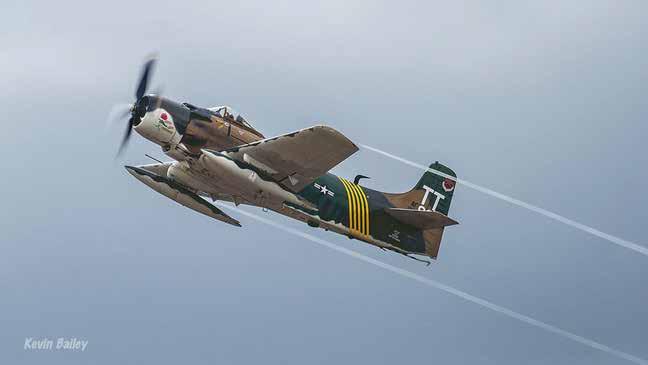
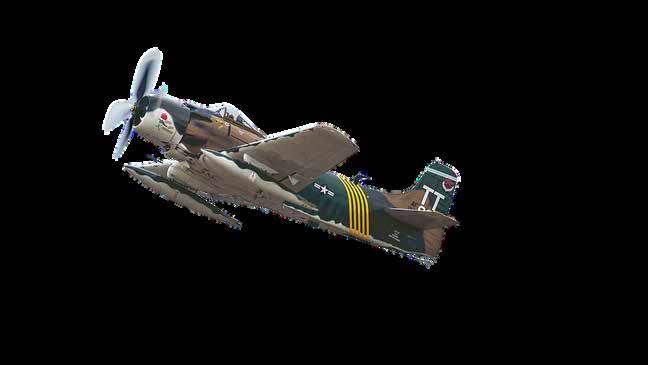


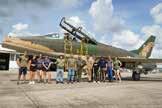





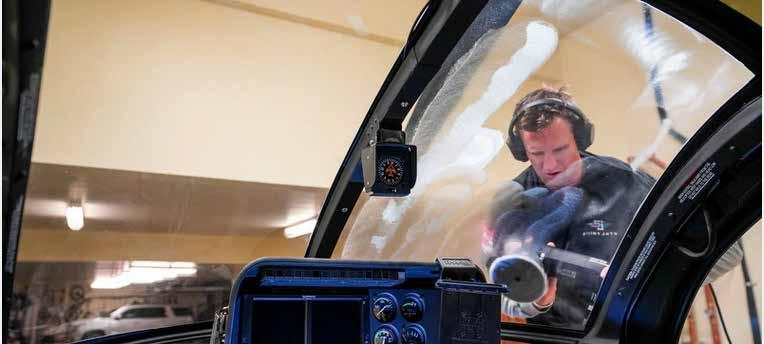
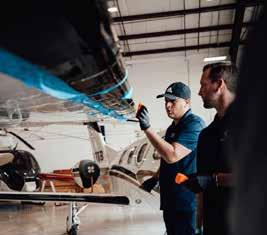
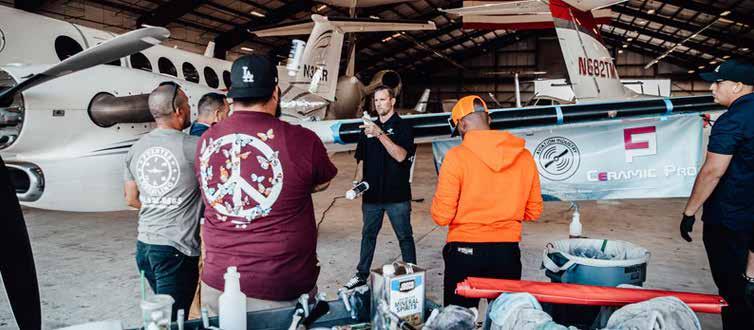

By AOPA Pilot Staff
On Feb. 4, 2026, the AOPA Board of Trustees announced a leadership transition with Darren Pleasance no longer acting as AOPA president and CEO, and the board initiating a search for AOPA’s next leader.
“We are grateful for former CEO Darren Pleasance’s contributions to AOPA, his energy and his commitment to serving pilots and aircraft owners,” said Jim Hauslein, chairman of the AOPA Board of Trustees. “We also recognize his important efforts to engage with AOPA members across the country.”
AOPA’s day-to-day operations will temporarily be led by Chief Financial Officer Jill Baker and Senior Vice President of Membership Strategy and Growth Katie Pribyl, who are serving as acting co-presidents during this interim period. Both are members of AOPA’s executive leadership team — with 16 years of combined AOPA experience — and will lead the organization’s operations, staff, and strategic execution, ensuring continuity of leadership and decision-making across the association.
Pribyl graduated from Embry-Riddle Aeronautical University in Prescott, Arizona, and became an airline pilot at the age of 21 when she flew the Canadair Regional Jet for a United Express carrier. She remains an active pilot and CFI, and logs most of her time in her 1956 Cessna Skywagon, which she lands at the airstrip she and her dad built on their ranch in Montana.
Early in her tenure, Pribyl led the transformation of AOPA’s events strategy, shifting from a single annual convention to a nationwide series of regional fly-ins that brought thousands of pilots and aviation enthusiasts to GA airports across the country. She later started the AOPA
Foundation’s successful You Can Fly program, including the High School Aviation STEM Curriculum, which has now reached more than 130,000 students across the country.
Baker (no relation to previous AOPA President Mark Baker) joined AOPA in 2024 and oversees many parts of the organization including AOPA’s Aviation Finance group, enterprise risk management, technology infrastructure, accounting, finance, human resources, and various administrative functions. She also leads the AOPA Pilot Information Center, Member Services, and Medical Certification Services team.
Prior to joining AOPA, Baker worked for IMARK, an international distributor’s cooperative group consisting of 10 corporations, as group chief financial officer. During her 11year tenure with IMARK, she served as the strategic advisor to the board of directors and the key contact for more than 2,000 member corporations. Baker had responsibility for functions such as finance, accounting, human resources, and technology. She also
has prior experience in mergers and acquisitions, and corporate banking. Baker earned her MBA from the University of North Florida and is a certified public accountant.
AOPA’s leadership team and staff remain fully focused on the work pilots rely on every day, including advocacy at all levels of government, advancing aviation safety and training, and delivering trusted member programs and services.
The AOPA Board of Trustees, who will select the next president and CEO, comprises experienced general aviation pilots who have been longterm members of AOPA. All own general aviation aircraft (or are between aircraft) and volunteer their time to serve on the board.
The AOPA board is led by Jim Hauslein, who has served on the board since 2012 and was elected chairman in December 2024. He has more than 2,500 flight hours and has owned a variety of airplanes including a Cessna 172, a Beech Bonanza A36, and several Cessna Citations.

Other experienced board members include Bill Trimble, Larry Buhl, Matt Desch, Amanda Farnsworth, Luke Wippler, and Will Hudson.
In order to ensure there is a mix of experience and fresh ideas on the AOPA board, four new members have joined the board within the past 23 months: Austin Stephens, Bill Roberts, Charlie Lynch, and Dale Klapmeier.
The search process for AOPA’s next president and CEO “will be designed to be thoughtful, inclusive, and aligned with the long-term needs of AOPA’s members and the general aviation community,” said Hauslein. “We understand that leadership transitions can prompt strong reactions, particularly in an organization with such a loyal and engaged membership. One thing that I can assure you of is this: we will work through this transition, and the AOPA staff will continue to serve our members with pride.”
Continued from Page 10
um Intensity Runway Lights (MIRLS).
The short base to final would have had both pilots looking to the left to establish runway alignment, not at their nav displays, with less than a mile to get everything lined up by the time the left turn was completed. The PSA crew had no
chance to see the Blackhawk approaching from their right, along the east bank of the Potomac.
By following the charter helicopter route, if flown properly, the vertical separation between the two aircraft would have been less than 400 feet. By comparison, simultaneous parallel ILS ap-
proaches at major airports require at least a mile separation between the runways and a-mile-and-a-half spacing between aircraft in trail. These simultaneous approaches have the parallel aircraft talking on the same tower frequency from the final approach fix to landing.
Does less than 400 feet separation, as a “normal procedure sound like a good

idea? It became immediately obvious to this writer that DCA operations had a “zero” safety margin, but having been in place for years, had become “normal.” As pointed out in the 50 recommendations just released by the NTSB, systematic management on both the part of the FAA and Department of Defense played a huge role in the tragic results of incompetent airspace management. Know that this is not criticism of the ATC staff who were forced to endure the decisions of incompetent management but were probably well aware of just how bad the system was.
As always, the media and politicians get involved. Having read my previous comments, you are now much better informed than most of those making headlines with safety recommendations. What the uninformed think they do know, is that “technology can solve all problems,” so let’s look for safety gadgets that can add to a pilot’s workload to prevent such a tragedy from occurring again.
In a race to prove that our elected representatives are doing their job by “ensuring this will never happen again,” Senate Bill S.2503, Rotor Operations Transparency and Oversight Reform (ROTOR) Act was introduced by Sen. Ted Cruz on July 29, 2025. This was before the final NTSB report had been issued. ROTOR was supported by the NTSB, DOD, the full Senate, and victim families. ROTOR became the headline of the day. Yes, politicians had now joined the media in the conclusion that all would be safe if only all aircraft operating in the National Airspace System had ADS-B with both OUT and IN. The uninformed conclusion is that we aviators spend all of our time with our heads down, looking at a nav display. This writer actually contacted Senator Cruz’s office, offering to teach his staff which prepared this bill how the National Airspace System and airport operations actually work. As with many politically motivated “solutions,” the real reasons for the DCA collision were glossed over. Also glossed over, actually ignored, is what most readers already know. While the installation of ADS-B OUT is a relatively simple (but expensive) process, ADS-B IN requires a digital display which, as a retrofit, will probably need a full Supplemental Type Certificate (STC) process, adding up to cost that can easily exceed $10K.
The IN and OUT capability would be required for all aircraft operating in Class C and B airspace, in addition to Class E airspace above 10,000 ft. MSL. Sadly, safety solutions based upon headlines and politics versus facts almost ensure that the event in question will happen
Continued on Page 37
Aircraft Spruce & Specialty Co., the global leader in aircraft parts and aviation supplies, is proud to announce an official partnership with Dream Flights, a non-profit organization dedicated to honoring military veterans and seniors with the flight of a lifetime.
NBAA President and CEO Ed Bolen took the keynote stage on opening day of the 2025 NBAA Business Aviation Convention & Exhibition (NBAABACE) for “an absolute celebration of business aviation” and its role not only in driving economic growth and technological innovation, but also in inspiring future generations to aim higher.
veterans and the golden age of flight.”
a brand-new air traffic control system,” Bolen said. “Airlines, airports, labor, all of general aviation [and] alignment between the president, the secretary of transportation, both houses of Congress and a public demanding that we build a new ATC system.”
Since 2011, Dream Flights has provided free “magic moments” in the sky to nearly 8,000 senior veterans in 49 states. By using authentic WWII-era trainers, the organization offers a powerful, sensory experience that connects veterans to their past and their community.
“We’re a vital link in the global transportation system,” Bolen said. “We create jobs. We help companies be efficient and productive in an intensely competitive global marketplace. We provide humanitarian assistance to those in need, and we are on a mission to net-zero. It is great to be part of a great industry.”
This partnership aligns two organizations deeply rooted in the aviation industry with a shared goal: preserving aviation history and giving back to the men and women who served in the U.S. Armed Forces. Through this collaboration, Aircraft Spruce will provide ongoing support to help Dream Flights maintain its fleet of restored Boeing Stearman biplanes, ensuring these historic aircraft remain flight-ready for veterans across the country.
Bolen emphasized that safety also remains of paramount importance not only in the business aviation community but throughout all other industry sectors following a series of high profile, fatal accidents earlier this year.
Bolen also recognized in the audience the two most recent enshrinees to the National Aviation Hall of Fame, aviation safety consultant and former NTSB member John Goglia and NBAA Chair Emeritus Gen. Lloyd “Fig” Newton. “We’ve gotten to our point today by standing on the shoulders of giants,” he said.
for Walmart, Walton is the co-founder and chairman of Game Aerospace and a prominent leader in fostering the development of advanced air mobility (AAM) aircraft. He also restores and flies a variety of vintage aircraft, some of which are on display during NBAABACE at the NBAA Aircraft Connection at Henderson Executive Airport (HND).
About Aircraft Spruce & Specialty Co. Founded in 1965, Aircraft Spruce & Specialty Co. is the world’s largest supplier of aircraft parts and components. Serving homebuilders, maintenance shops, and pilots globally, the company carries over 100,000 products across its regional distribution centers in the U.S., Canada, and Australia. For more information please visit: https:// www.aircraftspruce.com/catalog/stpages/dreamflighsorg.php
Haircuts, and a number of national partners and corporate and individual donors. Follow @DreamFlightsOrg and visit www.dreamflights.org.
“Aircraft Spruce has always been more than just a parts supplier; we are a part of the aviation family,” said Jim Irwin, President of Aircraft Spruce. “Dream Flights does incredible work bringing joy and a sense of freedom to our nation’s heroes. We are honored to stand with them as partners and contribute to a mission that celebrates both our
“We saw the entire aviation community coming together on the plan to build
“The Boeing Stearman is one of the most iconic training aircraft in aviation history, and for many WWII veterans, it was where their military journey began,” said Darryl Fisher, founder of Dream Flights. “Every detail — from the open cockpit to the radial engine — is preserved to deliver an authentic flight experience. Partnering with Aircraft Spruce ensures these historic aircraft receive the care and craftsmanship they deserve, ensuring they remain safe, airworthy, and true to their legacy.”
Those aircraft, along with Walton’s work to make Thaden Field (VBT) in Bentonville, AR, a hub of community activities both related to aviation and not, serve an important purpose in his life.
Steuart Walton: Aviation is a Tool to ‘Connect, Meet and See What’s Going On’
Aviator, entrepreneur and business leader Steuart Walton then joined Bolen to receive NBAA’s Meritorious Service to Aviation Award, the association’s highest honor.
In addition to serving as a director
The partnership marks a long-term commitment by Aircraft Spruce to support the Dream Flights mission through technical resources and community outreach within the general aviation sector.
“Aviation is just an absolutely unparalleled platform for inspiration to young folks, or people looking for the opportunity to find a new career,” said Walton. “The more you can tell that story about what aviation is and what it can be, you open people’s eyes to it. And the more people that come into it, the stronger it gets.”
Business aviation has also played a
About Dream Flights Based in Carson City, Nev., Dream Flights (formerly Ageless Aviation Dreams Foundation) is a 501(c)(3) nonprofit organization dedicated to honoring the service, sacrifice, and stories of America’s senior veterans. The organization provides life-changing experiences through free, open-cockpit flights in fully restored WWII-era Boeing Stearman biplanes. These flights — piloted by professional volunteer pilots, many of whom are retired military aviators — are made possible through the generosity of Dream Flights’ primary partner SportClips

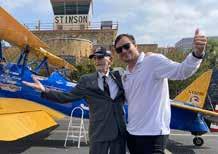


Dream Flights is dedicated to honoring military veterans and seniors with the adventure of a lifetime: a flight in a Boeing Stearman biplane. Now in partnerships with Aircraft Spruce, the company will provide ongoing support to help Dream Flights maintain its fleet of restored Stearman biplanes, ensuring these historic aircraft remain flight-ready for veterans across the country. (Photo courtesy Dream Flights)
vital part in Walmart’s growth, from the early days when Steuart’s grandfather, Sam Walton, flew a two-seat Ercoupe to visit stores, to now operating one of the largest business aircraft fleets in the world.
Continued on Page 38



Continued from Page 35
again. Nonetheless, the media loves the ROTOR Act and even the families of victims became convinced that ROTOR is a just and technically sound way to make sure safety will be restored. While full enactment of ROTOR would not take place until 2031, it is clear that unless another option emerged, thousands of aircraft would require expensive retrofits of both ADS -B technology and the primary flight displays required to utilize the perceived safety gains.
The fact that the Blackhawk had ADS-B but did not have it turned on was not addressed, nor was the fact that the involved aircraft were operating on different comm frequencies, making it
impossible for each pilot to know of the existence of the other. ROTOR is based upon the uninformed view that the only thing that keeps airplanes from running into each other is ATC radar and technology. The concept of “visual flight” (especially as an IFR procedure) is not understood and is ignored. On the whole, while a seemingly adequate pacifier and bragging point, ROTOR is not a good plan.
Now, enter the House of Representatives. As required in our U.S. Constitution, legislation passed by either House of Congress must receive a vote of approval from the other House. The Senate-created ROTOR Act was voted upon in the House of Representatives on Feb. 24, 2026. ROTOR did not secure the needed two-thirds vote. This failure to gain
approval was not the typical “us versus them” type situation. A large number of republicans joined Democrats in voting the ROTOR Act down. This is not unusual, as typically the side of Congress that voted “no” to something will then negotiate a compromise.
However, in this case, the House of Representatives has an alternative bill to offer, the Airspace Location and Enhanced Risk Transparency (ALERT) Act. Given the final report issued by the NTSB regarding the DCA collision, the House Transportation, and Infrastructure Committee (chaired by pilot and knowledgeable aviation authority, Representative Sam Graves) and the House Armed Services Committee worked together to come up with the ALERT Act, which spe-
cifically addresses the 50 concerns and recommendations made by the NTSB. While ADS-B certainly figures into the ALERT plans, it is not primary and more practically deals with complex airspace that we now know as Class B and C. It does not categorically state that “all aircraft must have ADS-B OUT and IN.” It also allows for alternative methods of displaying “IN” data through the use of tablet technology. While this writer is not a fan of having one’s “head down” in crowded airspace when simply looking out the windscreen might be more effective, the alternative display option does permit significant stakeholder input and innovative technology.
Continued on Page 40

The scenario is every traveler’s nightmare: you’ve landed in paradise, ready to begin your long-awaited holiday, but your luggage hasn’t made the journey with you. As thousands of bags are reported delayed or mishandled each month at airports worldwide, an increasing number of passengers are discovering that the real challenge begins not at the baggage carousel, but in the days that follow.
For travelers arriving in destinations like Hawaii or the Bahamas, the dream vacation can quickly turn into a stressful ordeal. Without essential belongings, passengers face an immediate challenge—but the greater frustration often lies in the communication void that follows once they leave the airport.
The Post-Airport Black Hole
“Once passengers walk out of the airport terminal, they enter what we call the communication black hole,” explains Anne Linda, founder of Flight Bag Rescue. “They’re left trying to reach airline call centers with long wait times, navigating automated systems, and receiving vague or conflicting information about where their bag is and when they might see it again.”
The impact extends far beyond inconvenience. Travelers find them-
selves spending precious vacation time on hold, making repeated calls, and struggling to get concrete answers while trying to enjoy their trip. Many discover that without someone physically present at the airport to advocate for them, their case becomes just another file in an overwhelmed system.
Without specialized intervention, resolving a lost luggage situation can take several weeks — time that can eclipse an entire vacation period.
Consider the case of a passenger who arrived for a two-week holiday only to find her luggage missing. Over the following days, her repeated attempts to contact the airline yielded little progress. As days turned into a week, the stress of being without her belongings compounded the frustration of unclear communication and no definitive timeline for resolution.
This type of situation has become increasingly common, affecting hundreds of travelers who find themselves in limbo between airline systems, airport handling teams, and logistics coordination.
The Solution: Professional Advocacy
Flight Bag Rescue addresses this gap by stepping in to manage the entire process on behalf of the passenger.
The service takes over communication with airports and handling teams, tracks luggage status across airline and airport baggage systems, and provides passengers with clear, regular updates.
“We speak the language of the airport systems and know exactly who to contact and how to navigate the process efficiently,” says Anne Linda. “Our role is to take that burden off the passenger so they can focus on their trip instead of chasing their luggage.”
In the case of the two-week holiday traveler, once Flight Bag Rescue was engaged, the team coordinated directly with the relevant airport, located the bag, and arranged both pickup and delivery — transforming weeks of potential wait time into a resolved situation.
With a growing number of satisfied customers, the service has proven particularly valuable for those traveling to remote or resort destinations where leaving the vacation area to pursue luggage claims simply isn’t practical.
For travelers facing lost luggage situations, Flight Bag Rescue (www. flightbagrescue.com) offers a lifeline — allowing them to reclaim not just their belongings, but their peace of mind and vacation time. Flight Bag Rescue liaises with airline baggage services and airport handling teams across major airports.

Whale Watching Season Takes Flight on the Mendocino Coast
March marks one of the most exhilarating times to visit Northern California’s rugged Mendocino Coast. As gray whales migrate along the Pacific shoreline, dramatic ocean vistas become the stage for one of nature’s most captivating spectacles — and few places offer a better vantage point than Little River Inn.
Overlooking the Pacific, just two miles south of Mendocino Village, the historic inn has welcomed travelers for generations with sweeping ocean views, warm hospitality, and effortless access to the coast’s most iconic experiences. During whale migration season, the second weekend of March brings added excitement with the annual Little River Whale Festival, part of Mendocino County’s month-long celebration of the gray whale.
Festival highlights include guided Whale Walks at nearby Spring Ranch, where docents lead visitors to prime coastal lookouts for spotting migrating whales. Back at the inn, guests can join the festive Margarita Madness competition — a spirited afternoon of handcrafted cocktails and friendly competition overlooking the Pacific. The Mendocino Coast Chamber of Commerce also hosts a Mocktail Trail, offering creative nonalcoholic tastings throughout the community.
For those seeking a deeper encounter with the migration, Little River Inn’s seasonal packages make it easy. The “Whale of a Sale” offers a third night free when booking two, while the Whale Watching Tour Package includes a complimentary whale watching excursion for two with a two-night March stay — bringing guests directly onto the water for an unforgettable perspective.
Beyond the festivities, the inn itself embodies the relaxed elegance of coastal Northern California. Oceanview guest rooms, private walking trails, a nine-hole Audubon-certified golf course, spa treatments, and an acclaimed restaurant overlooking the sea invite visitors to linger.
For private pilots and aviation enthusiasts, Little River Inn is conveniently located just minutes from the private Little River Airport, making it an ideal fly-in coastal escape. The Little River Airport (LLR) is a small, public-use airstrip located at 43001 Airport Road, less than a mile from the Little River Inn. The airport features a 5,250-foot runway, operates Thursday–Monday, and offers FBO services via Air Galore, including vehicle rentals, making it a convenient, direct access point for visitors to the coastal Mendocino area.
Whether viewed from a blufftop
bar, a coastal headland, or the deck of a charter boat, the gray whale migration offers a reminder of the wild beauty that defines this stretch of California shoreline — and March is the perfect time to experience it.
Learn more and book a stay at the Little River Inn online at littleriverinn.com or telephone (toll free) 1/888-937-5942.


If you want to get around Alaska, your best bet is by air. The vast majority of the state isn’t reachable by road, making flying a necessity. There are over 9,100 licensed pilots in Alaska, the most pilots per capita than anywhere else in the United States.
To serve these pilots, Alaska has a massive system of airports, airstrips and landing spots for aircraft; more than 760 recorded landing areas. Nearly 400 are public-use airports, while the rest are owned by private entities or the military.
One such privately owned airport is Airkat Airpark 9AA9, located outside Haines. Owned and operated by George and Lynette Campbell, the current runway is approximately 1,100 feet long and 130 feet wide. Airkat also had a brand new hangar, about 60 feet by 80 feet, with many nice features, including
a liftstrap bifold door from Schweiss Doors, measuring 55 feet by 15 feet.
“We’re not big into buying expensive cars or going on cruises,” says Lynette. “That just doesn’t suit us. So, we decided if we’re going to build a hangar, let’s build a really nice hangar.”
Both Lynette and George have long careers in Alaska aviation. Lynette, now retired, worked for the Alaska Department of Transportation Aviation Division, managing airport lands in southeast Alaska. George is a bush pilot, flying various types of aircraft throughout the state. He has offered flight tours of glaciers, fishing and bear watching as well as providing air taxi services.
“Both of us come from aviation, him from the pilot side and me from the management, operations side,” Lynette says.
Continued from Page 37
The NTSB has withdrawn its support of ROTOR, as has the DOD. Many of the aviation “alphabet” groups (AOPA, EAA, NBAA and others) now support ALERT. ALERT specifically addresses the shortfalls related to FAA and DOD management and the “culture of safety” that did not exist when the fatal procedures were in place. It addresses the development of new collision avoidance technology. With each concern expressed in ALERT, time is given to responsible agencies to submit proposals to the House Aviation Subcommittee for review and then allowed time to use the full Notice of Proposed Rulemaking (NPRM) process in implementing system or Technical changes.
The NPRM process ensures that public comment is considered before new rules are enacted. Yes, this slows the process, but the end result can be effective and lasting. In spite of the current media blast that “politicians are voting down aviation safety,” practical and incremental recommendations made in the ALERT Act are in keeping with the present administration commitment to upgrade the entire ATC system.
But what about the immediate future? Can’t something be done? Not only can it, but much has already taken place. The primary cause of the DCA collision was an FAA policy to “cram and jam” at DCA in order to please high-level travelers that do not wish to deal with the antiquated
Dulles International Airport. Political power makes more noise than safety concerns. The FAA wished to accommodate the complex needs of military travel in the DC area. Accommodation and special considerations eroded safety margins to zero. Those attitudes no longer rule the day. Arrival and departure rates have been diminished, even though some politicians and high-level bureaucrats may be inconvenienced.
In reviewing current DCA helicopter routes for the purpose of writing this opinion, this writer noted that considerable modifications have been made to keep rotorcraft operations well clear of all DCA approach procedures. While previously accustomed to operating without ADS-B systems activated (unlike all civil aircraft), the military now uses ADS-B as standard ops unless security is an issue. If security is a risk, ATC implements special procedures. Keep in mind, ADS-B presents a double-edged sword. ADS-B technology is a great improvement over old radar, but it is easily tracked by those who may wish to do harm… or send you a bill for flying in airspace that some idiot airport commission or country manager thinks belongs to them. AOPA is fighting hard on this issue.
Back to the beginning of this editorial… Contact your Federal Senate and House Representatives (they have contact info on their web sites) and indicate your support for “ALERT” … and do it now!
At one point, the couple owned a home near a glacial river where they would clear some space on the bank to be used as a landing strip for George. However, with the glacial rivers always changing and washing away the landing area, the couple decided to find a spot where they could build a more permanent setup.
They also wanted to create a landing area that could be used by other pilots in case of an emergency, such as a low-fuel incident or bad weather. Alaska’s small, rural airports and landing strips act a lot like a gas station does in the rest of the United States. The Campbells decided to register their landing strip with the Federal Aviation Administration as an airport, so it would be part of the larger network.
“You want to strategically place air-
Continued on Page 42

Airkat1: When George and Lynette Campbell decided to build a new airstrip and hangar on their property in Haines, Alaska, the couple knew they wanted to install a Schweiss Doors bifold door on the hangar. The couple believed it was the best door to withstand the challenging conditions in Alaska while also being low maintenance and easy to use.


Continued from Page 40
ports along the way, to fill in gaps so a pilot is never more than a few hours away from one,” Lynette says. “This airport does help fill a hole in the aviation system in the state. I’m real passionate about Alaska and Alaskan aviation and I feel like this is my contribution.”
Like the majority of building projects, what started as a simple runway soon turned into a much larger project.
“As we talked about what this would look like, it got more and more elaborate,” Lynette says, adding that work is continuing to extend the runway to 2,300 feet.
The hangar has a bunk room for visiting aviators to use and a more complete apartment above the hangar floor that may eventually be used to lodge visitors for extended visits. The building is clad in dark metal sheeting and includes several windows to let in the natural light.
An important piece of the Airkat hangar is the door. The Campbells knew they wanted a high-quality door that would be easy to operate while also standing up to Alaska’s challenging environment. With their aviation background, Lynette and George knew exactly which company could provide what they were looking for – Schweiss Doors.
“I’ve seen a lot of different types of door configurations in my career and always the people that put in a Schweiss door were the happiest with it,” Lynette says.
The bifold door had many features that made it the right choice for Airkat. First, it allowed the couple to maximize their hangar and apron space, since the door folds up and out of the way. Lynette says the hangar aprons in Alaska are usually on the small size so not having to worry about a door being in the way is a major positive.
Lynette is also a fan of Schwiess Doors’ patented liftstraps. Instead of using outdated cables to lift the door, the bifold door from Schweiss uses
Continued from Page 21 fornia anymore, very few. They’d always be welcome to call or come by and talk, and we’ll show them around and talk about airplanes and aviation. These little airports are getting harder and harder to come by, as you know. You get an airport that’s been there forever, then a housing development moves in around it, and next thing you know, they shut it down.
nylon straps which are stronger, safer, quieter and longer lasting than cables. Since many Alaskan towns are coastal, having straps means not having to worry about metal cables rusting or deteriorating in the damp, salty air.
The Campbells also wanted a hangar door that was well made and strong. Living in Alaska means dealing with nature at its most unpredictable. Weather can change quickly; high winds are common; and the area can even be impacted by earthquakes.
“I didn’t want to deal with door issues for the rest of my life,” Lynette says. I just wanted to put in a door that was going to work and be no hassle. The Schweiss door was constructed in a way that fits the environment to be very stable and last.”
The only worry Lynette and George had about choosing a Schweiss door for their hangar was whether they’d even be able to get one delivered to their location. While Haines can be reached by air, water and road, it can still be a challenge having something delivered and shipping charges can be hefty. Luckily for the Campbells, Schweiss came through. Schweiss Doors is no stranger to delivering doors to all corners of the globe. The Airkat Airpark door was shipped up to Haines by truck, on a load of several doors heading to Alaska and Canada. It also helped that the Campbells weren’t in a rush and could wait to have their door shipped on this load.
“We were the last on the truck,” Lynette says. “It was great! They just drove up and we had the equipment to take the door off the truck.
John Floreske of Northern Construction Inc., of Haines, was the contractor for the hangar project and installed the bifold door. Lynette says the door installation was handled with the same care a focus as the rest of the project.
“This is a hangar that he is so proud of,” Lynette says. “It’s been a really great partnership. His work is impeccable and he is building this hangar like it’s his own.”
From start to finish, the Campbells
had a positive experience with Schweiss Doors, with the ordering process going smoothly. Lynette says anytime she made a call to Schweiss someone was available to answer the phone and answer her questions. She says she would recommend Schweiss Doors to anyone looking for a hangar door.
“I can’t think of another element that went any better in our hangar than the Schweiss door,” she says. “We’ve told people, just do it. Spend the mon-
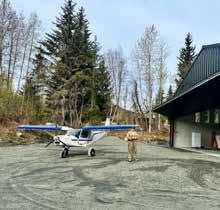
ey, get a Schweiss door. You won’t have any regrets.”
Schweiss Doors is the premier manufacturer of hydraulic and bifold liftstrap doors. Doors are custom made to any size for any type of new or existing building for architects and builders determined to do amazing things with their buildings, including the doors. Schweiss also offers a cable to liftstrap conversion package. For more information, visit www.bifold.com.

One of the major selling points of the bifold door for the Campbells were the nylon liftstraps. Straps are stronger, quieter and last much longer than cables. In a climate that can be wet, not having to worry about cables rusting is a major plus.

With so much of Alaska inaccessible by road, flying plays a very important role in getting people and supplies where they need to go. George Campbell has spent decades flying as a bush pilot in Alaska, while Lynette worked for the state transportation department, managing state owned airport lands.
We’ve been fortunate to be in a place where all the neighbors don’t mind us. We’re conscientious about how we fly, and we don’t have any complaints. The public is always welcome to come by and talk with us anytime.
I live right here next to the runway, so I’m always available.
LB: You mentioned you’ve been flying since you were young. Can you tell us about that?
CS: When I was 13, I joined the Civil Air Patrol. At 15, I started working at the little airport for flying lessons. I soloed three airplanes on my 16th birthday. I had like 40 or 50 hours of flight time on that day. I got my private license on my 17th birthday with about 200 hours, because that was the minimum age. I’ve been doing it ever since. My dream was to always live at the airport. I started flying out of here in 1976, and back in the early 90s, I bought my part of
the airport and have been here ever since. It’s like the pilot’s dream — to live at your airport and have your hangar right there at your front door. It doesn’t get any better. I feel real fortunate.
Fort Bragg International Airport (Virgin Creek Airport)
Identifier: 82CL
Location: Fort Bragg, California
For pilots: This is a special-use private airport. Short-field experience required. Contact the airport manager before visiting.
Continued from Page 19
register receive a special gift bag including a bottle of Lake County fine wine along with gifts and coupons from event supporters.
Land plane pilots are welcome too. Transient parking is available at nearby Lampson Field Airport (1O2), and transportation will be provided to the resort and to our traditional welcome dinner.
The week opens on Friday, June 5 with the traditional welcome dinner hosted at the beautiful Lakeport residence of Tom and Ruth Lincoln. It’s the kind of evening that sets the tone for everything that follows — pilots swapping stories, new friendships forming, and the easy camaraderie that defines the water-flying community at its best.
A Program That Goes Far Beyond the Ramp
The 2026 Clear Lake Splash In features one of the richest educational programs in the event’s history. Ray Hawkins, Director of the Colorado Seaplane Initiative, will present on his organization’s pioneering work to expand seaplane operations in Colorado. Additional sessions will cover aquatic invasive species — a topic every seaplane pilot operating on Clear Lake must understand, as a $20 inspection sticker is required — and a panel discussion about the best places to fly seaplanes in Oregon.
The program also includes videos and presentations on the leading edge of seaplane innovation: the electrification of aircraft and the expanding role of seaplanes in aerial firefighting. As wildfires reshape the landscape of the American West, water-based aircraft are drawing renewed attention from operators and policymakers alike. These sessions will give attendees a look at where the technology and the mission are heading.
Multiple seminars qualify for FAA WINGS Pilot Proficiency Program credit.
A Journey Across America — In Photographs
The 2026 Clear Lake Splash In will also feature an exhibit of photographs documenting an extraordinary cross-country adventure: a ferry flight of a 1946 Taylorcraft BC-12D on Edo 1320 straight floats from Rising Sun Seaplane Base in Indiana to Clear Lake. That journey — threading rivers, reservoirs, and lakes across the American interior — is the subject of the forthcoming book The Horizons Calls: A Journey Across America by Seaplane. The photographs bring the trip to life and offer a rare window into the experience of flying light floatplanes across a continent.
A Cornerstone Commitment to Young Aviators
If there is one dimension of the 2026 Clear Lake Splash In I am most proud of, it is our youth aviation program. Under the leadership of Jill Rothstein, Director of the 2026 Clear Lake Splash In Youth Program, we are creating experiences designed to show Lake County young peo-
ple what aviation careers actually look like — not through brochures or videos, but through real interaction with seaplane pilots and their aircraft.
Rothstein frames the mission simply: “What we’re trying to do is close the distance between a young person looking up at an airplane and imagining themselves in it.”
And she believes the seaplane setting gives that mission a particular advantage. “Seaplanes are magical to young people in a way that even regular airplanes aren’t,” she says. “There’s water involved — it’s unexpected, it’s exciting. That sense of wonder is a powerful thing to build on.”
Activities include a flight simulator, model airplane displays by the Clear Lake Modelers club, and meet-the-pilots sessions at the aircraft ramp where kids can climb into cockpits and begin to imagine themselves in the seat.
The academic foundation is the AOPA High School STEM Aviation Curriculum, implemented at Lakeport Unified School District and supported by the Clear Lake Flying Club. Our event is designed to make that classroom pathway tangible.
Community Woven Into Every Detail
The Clear Lake Splash In has always been as much a community event as an aviation event. The awards dinner on June 6 will be prepared and served by the Lakeport Lions Club and the Kiwanis Club of Lakeport. Members of the Rolls Royce Owners Club Northern California Chapter will display Rolls Royce and Bentley vehicles at the resort.
The 2026 Clear Lake Splash In has something specific to offer you — whoever you are.
Seaplane pilots: Twenty spots. First registered, first on the water. Go to https:// tinyurl.com/2nvshk4y today.
Parents and educators: Bring a young person who has ever looked up at an airplane and wondered. Our youth program is designed for exactly that moment. Contact herb@aerialarchives.com to learn how to get your student involved.
Car enthusiasts: The Rolls Royce Owners Club Northern California Chapter will be on the grounds. Come for the Bentleys, stay for the flying boats — you may find the two communities have more in common than you’d expect.
Lake County neighbors: The awards dinner on June 6 is a community event, prepared and served by the Lakeport Lions Club and the Kiwanis Club of Lakeport. This is your event too.
Full details at clearlakesplashin.com.
About the Author Herb Lingl is the Coordinator of the Clear Lake Splash In and the Education Director of the Clear Lake Flying Club, Inc., a California nonprofit, which produces the event in partnership with Skylark Shores Resort in Lakeport. He is the author of the forthcoming book The Horizons Calls: A Journey Across America by Seaplane (horizonscalls.com).













AIRCRAFT FOR SALE
American Aircraft Sales, Livermore Airport, CA, americanaircraft.net, cell (510) 783-2711, (925) 449-5151. 3/13
From Trade-ins to Aircraft Management, financing and appraisals. T.J. Aircraft Sales, Novato, CA, (415) 898-5151, tjair.com. 3/13
AirplanesUSA Aircraft Sales, San Carlos, CA, Airport, (650) 394-7610, airplanesusa.com. 1/16
Quality aircraft since 1948. Volare Air, a TECNAM dealership, (940) 800-8020, volareair.aero. 1/23
Historically significant 1950s-era aircraft for sale or trade. All in restorable condition with minimum corrosion. Inventory includes a Piasecki XHJP-1 and a Sikorsky S-55. American Helicopter Museum, West Chester, PA. Contact info@ americanhelicopter.museum for more information. 231000.TFN
1968 Nanchang CJ-6 Chinese warbird. Reliable Day/VFR, light weight. Apollo GX-65 nav/com, Digital Xpndr., intercom, Delco alternator. New seat cushions and canopy glass. Includes all support equipment, wing jacks, manu- als, spare parts. Much more! $70,000. Located N. Calif., text/cell (530) 957-9760, dennis@nickson.biz. 24900:11
1966 Piper PA30 Twin Camanche for sale near Oceanside, CA. Call for pricing. Andrew Wignot, (760) 717-0640. 241100:12
Small Manned Aerial Radar Target, Model 1. Tiny jet aircraft, long-range tank. SMART-1, Tucson, AZ, (202) 2132400, smart-1.us. 5/21
SPORT/ULTRALIGHTS
RV12i5. Total performance perfected. Easy to build, fly and own. Van’s Aircraft www.vansaircraft.com. 11/18 Bristell LSA 915 Turbo, 180 mph @18,000. Bristell Aircraft, (516) 658-1847. bristellaircraft.com. 2/24
STOL
The STOL Super Breezy with fully covered fuselage. Yakima Aerosport, (509) 453-3412, superbreezy.com. 5/23
AIRCRAFT SALES AIDS
Aviation Sales & Marketing by ABCI. Ideal for a startup or side hustle in the aviation industry. (702) 987-1679 or aviationsalestraining.com/startup. 1/21
FLIGHT INSTRUCTION
Sunshine Flyers. Flight & tailwheel instruction, rentals, mountain flying, and aerobatics., Auburn, CA, (530) 820-3442, sunshineflyersaviation@gmail.com. 3/20
Arizona Type Ratings
CE-500/CE-525 type ratings or recurrent. Insurance approved, staff examiner. arizonatyperatings.com, (602) 614-7994. 9309:TFN
Recurrent pilot training and services. L/D Aerospace, Grace Passmore, (916) 790-0501, ldaerospace.com. 1/22
Fly for fun or career. Discovery flights, pilot training, AOPA Distinguished Flight School & Cessna Pilot Center. Smith Aviation, Napa County Airport, (707) 3456526, mikesmithaviation.com. 4/22
Come fly with us! CFIs encouraged to apply. For more information, call Sue Clark/RV to the Rescue at 925-997-4778
XL Aviation - Aircraft Maintenance.
Custom-tailored programs for all aircraft. Livermore, CA, (925) 961-6135, xlaviationtailwheel.com. 8/20
Iconic Aircraft Restoration. Repairs, refurbishments, parts fabricated, consulting at reasonable rates. The Wright Experience, (540) 379-9092. 8/21
Custom aircraft & high-quality composite parts. Aviation Composites, Sandersville, GA, (937) 243-7303. 1/22
Serving the GA Community since 1981. Wisconsin Aviation, Watertown Municipal Airport, WI, (920) 261-4567, WisconsinAviation.com. 3/13
World’s largest network of FBOs with over 200 locations offering consistent, exceptional service. Signature Flight Support, signatureflight.com. 4/23
Full-service center. Vista Aviation, Whiteman Airport, Pacoima, CA, (818) 896-5224, vistaair.com 9/23
Avionics for Every Mission. All major brands. Airtronics, Calaveras County Airport, CA, airtronicsavionics.com, (209) 736-9400. 11/14
Basic installs to complete panel and glass retrofits. Pacific Coast Avionics, (800) 353-0370, PCA.aero. 7/15
Update your avionics. FAA-Certified repair station. Treasure Coast Avionics, Ft. Pierce, FL, (772) 464-3148, treasurecoastavionics.com. 2/23
AIRCRAFT PARTS
Keeping “classic” aircraft flying since 1946. Univair Aircraft Corp., Aurora, CO, (888) 433-5433, univair.com. 3/21
Iconic Aircraft Restoration for all the classics. Reasonable rates. The Wright Experience, (540) 347-1909. 2/23
SAVAGE Magneto Service since 1946. Hayward, CA, (510) 782-7081, 2/23
Wingtips with total lighting solutions, aveoengineering.com. 9/23
Aviation wood, composite or metal propellers. Sensenich, (813) 752-3711, (717) 569-0435 or sensenich.com. 4/21
OXYGEN SUPPLIES
Cannula or Mask? For aircraft service ceil- ings to FL180 & FL250. Ask “The Oxygen Lady,” info@aviationoxygen.com 4720:TFN 2/23

Fuel Cells. Repair, overhaul or new with 10-year warranty. Hartwig Aircraft Fuel Cell Repair, hartwigfuelcell.com. 2/09 Home of GAMIjectors® fuel injectors! STCs and
AVIATION SAFETY
Innovative aviation safety solutions and Parachute Recovery Systems for a variety of aircraft, including for sport, UAVs, more. AviationSafetyResources.com. 2/22
Get ahead of your daily in-flight risks with SAFETYLINQ flight risk assessment. argus.aero/safetylinq. 1/22 AIRCRAFT FINANCING
Get Top Retail Value for Your Aircraft! Sell now! Find your dream aircraft! Shop now! Become an area broker with one of the largest networks in the U.S.! Visit our USA Aircraft Brokers page on Facebook or visit usaaircraft.com. 9/23
Specializing in personal, business and charter aircraft. Best price, cover- age & customer service. Zanette Aircraft Insurance Center, (650) 593-3030, (888) 7233358. 10/06
Insurance solutions for all aviation-related services. Business Aviation Insurance, bizavins.com, (925) 825-1900. 7/20
Informed, accurate aircraft appraisals. jetvaluesjeremy.com, (636) 751-3987. 7/20
Complete Aviation Sales & Marketing Services. Use Promo Code “INFLIGHT” to save 10%. AviationBusinessConsultants.com/Lab, (702) 987-1679. 4/23
No cheap imitation watches at HME! Special pricing on ATP series multi- functional watches with Altimeter. To order or for information, (323) 464-6660 or hmewatch.com. 11/16
Aircraft Spruce & Specialty. Free 700page catalog, Corona, CA, & Peachtree City, GA, aircraftspruce.com. 10/06
Protective covers for every make and model. Bruce’s Custom Covers, Morgan Hill, CA, (800) 777-6405, (408) 738-3959, aircraftcovers.com.10/19
Apparel as unique as your journey. Discounts to members. AOPA Pilot Gear, aopapilotgear.com. 9/21
Mountain Bike, Full-size, pilot-friendly, rugged. FLATBIKE, flatbike.com. 10/18
AVIATION RESOURCES
Emergency services, group trips, consulting services. BizAvJets, Inc., Business Aviation Services, bizavjets.com, (702) 465-2027. 10/20
Wherever business takes you. Navigate It. (575) 615-2091, vatit.com. 10/21
Scheduling Software that connects to your flight department. Simple, affordable. airplanemanager.com. 9/22
PROFESSIONAL SERVICES
Aero & Marine Tax Pros
Legally avoid sales tax on your aircraft purchase. In El Grove, CA, (916) 691-9192, aeromarinetaxpros.com. 18500:TFN
Left Seat Pilot Medical Solutions. A confidential solution for pilot medical certification. Free FAA medical consultations. Left Seat, (800) 699-4457. 1/21 Global Aircraft Group. USPAP bank values for all aircraft, aircraft management, insurance claims & certified aircraft appraisals. Mark Parry, (855) 6GBL- AIR, (413) 335-7507. 4/22
At Thirty1 Hybrid, we help aviation companies, including flight schools, manufacturers, mechanics, brokers, and more, build a cohesive website that positively impacts their bottomline. And it’s not just a website — it’s an Experience. We’ll take your prospects on a journey they’ll love (and you’ll love, too — because the final destination is a new client and more money in your pocket). It’s a win-win for everyone! Contact us today at hello@thirty1hybrid. com or by visiting thirty1hybrid.com. 24500:6
One-piece doors. Hydraulic or bifold. Schweissdoors.com,(800)746-8273. 1/15
Aviation Building Systems, custom designed hangars. R&M Steel Co., Caldwell, ID, (208) 454-1800, aviationbuildingsystem.com, (866) 454-1800 51217:TFN
HOMES/AIRPARKS
New Runway & Taxiway Homesites Available in amentity-rich community, Granbury, TX. From $179,900. Pecan Plantation, AviationHomesites. com, (833) 273-2159. 2/24
Become an Aircraft Broker — #1 Largest USA Network of Aircraft Start with USA’s proved system for listing and selling everything from high-performance single-engine airplanes, cabin class through jets, and helicopters & jet fractional shares. Includes multi-million-dollar inventory to start. Complete turnkey proved system. No experience necessary. Will train. Licensed USA Aircraft brokerage. Call (504) 723-5566 or visit Business Opportunity Section at usaaircraft.com. 4208:TFN
Free avgas 100LL and free tie-down parking in exchange for help with projects for an airport in Southern California. Email: wignot@hotmail.com. 23600:TFN
ART/VIDEOS/GIFTS
Specializing in aviation photography. horizontalrain.com. 1/15
Need a gift? Give a ride in an open cockpit biplane. WACO Air Museum, Troy, Ohio, wacoairmuseum.org, (937) 3359226. 20601:TFN
Fly By Wire Air, a one-stop site for aviators.flybywireair.com. 4/21
Aces High Aviation & Military Art. (800) 528-0887, aceshighgallery.com. 10/21
Shirts Made to Fly. Unique, original fabrics embedded with your sectional chart. Save 20% with “INFLIGHT20” code. PilotQuarters.com. 2/24
Avionics Checklists & Quick Reference guides. Available in book, card & new iPad editions. qref.com. 8/14
SEAK, Expert Witness Directory, by Bert Botta for aviation accidents and incidents. (415) 320-9811, bert@bertbotta. com, bertbotta.com. 4/22
“Ghosts,” Phil Makanna’s legendary warbird calendars are back! Visit ghosts. com, (800) 331-8231. 2/23
New Pocket guide to avoid pain & stiffness during travel by a leading pain expert. “Pain-Free Vacation/Travel,” (980) 785-8128, goptfirst@gmail.com. 2/4
PILOT POSITION WANTED
SoCal pilot desires Turbine/Jet SIC time. Comm/Instru/Multi-Eng with SIC for Gulfstream G-IV and scores of hours in the Citation V560. Many years of aircraft design/ flight test/aerospace industry experience. Willing to travel as needed (and for repositioning). Contact Paul at (562) 714-6686 or ptglessner@ aol.com. 23700:TFN
IN FLIGHT USA, the leading source of general aviation news, seeks writers and photographers to cover all aspects of aviation. Send an SASE for writer’s guidelines to: In Flight USA, P.O. Box 5402, San Mateo, CA 94402. TFN
Oakland Aviation Museum recruiting volunteers. Oakland, CA, (510) 638-7100, oaklandaviationmuseum.org. 12/23
MUSEUMS








Unlike FAA Medical Examiners or other pilot groups, Pilot Medical Solutions activates our exceptional team of experts to confidentially support and resolve your FAA Medical certifications challenges.
Pilot Medical Solutions is the only service which collaborates with private physicians to produce documentation required by the FAA. Other services typically only list FAA requirements, Pilot Medical Solutions helps you comply with them.


"The professionals at Pilot Medical Solutions provide superior, pilot-focused services and help during your time of need. I would, without hesitation, recommend their services to an airman in need."
– Anthony Ison, Aviation Attorney
"Because they assist you in getting your records properly prepared and walking the information through the FAA, they can often accomplish in days what may take months for other sources, including your AME, to do."
– Erwin L. Samuelson, M.D
"I can strongly recommend Pilot Medical Solutions for consideration because they are sympathetic to pilots with medical certification problems. Pilot Medical Solutions also organizes the records which supports the FAA’s requirements."
– Bob Hoover
“They do all the
and the
They are