Celebrating 40 Years in Publication
August 2025
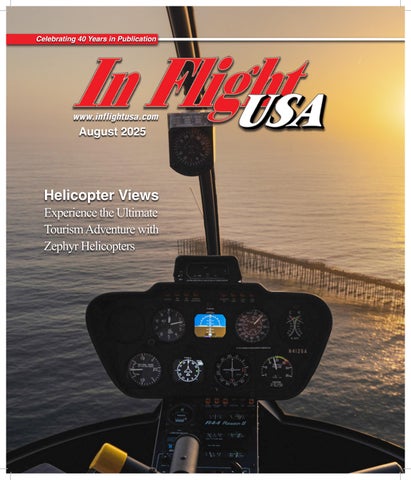
Helicopter Views
Experience the Ultimate Tourism Adventure with Zephyr Helicopters
O N E O F TH E M OS T A M E N IT Y- R I C H CO M M U N ITI E S I N TE X A S
NEW RUNWAY & TAXIWAY HOMESITES AVAILABLE
Highly Coveted Fly-in Living from $189,900 An Ideal Setting for Aviation Enthusiasts • Located in Granbury, Just 35 Miles from Fort Worth • Runway Frontage & Taxiway Access Homesites • 3,100 ft. Paved Runway, Concrete Taxiways & Fuel Station • Paved Roads, Electric, Water, Sewer & High-Speed Internet • All Amenities Complete • Full Service Clubhouse & Activity Center • Pools, Golf Courses, Tennis Courts & Marina • Riverside Parks & Shopping Village • Access to Lake Granbury • Excellent Financing & Low Down Payment (WAC) • Low HOA & No Time Limit to Build
Schedule Your Private Property Viewing Today! (833) 273 - 2159 I AviationHomesites.com Patten Properties of Texas, LLC, Broker. Equal Housing Opportunity.
August 2025
www.inflightusa.com
3
Calendar of Events
To list your group’s event on a space available basis, please send your event notice with date, time, place w/city and state, contact name, and phone number to: Calendar, In Flight USA, P.O. Box 5402, San Mateo, Calif. 94402, or email vickie@inflightusa.com.
Note: Calendar includes only information available by our press date. Confirm the status before attending.
Thunder Airshows & Chris Thomas Airshows. August 1-3: Boeing Seafair Air Show, 6-7: CAF High Sky Wing Airsho, MidSeattle, WA, U.S. Navy Blue Angels, land, TX, facebook.com/airsho www.seafair.org 6-7: Northern Illinois Airshow 2-3: Wings Over Marquette, Marquette, MI, Warbird Thunder Airshows & Chris Waukegan, IL F-16 Viper Demo Team, www.northernillinoisairshow.com Thomas Airshows 10-14: National Championship Air 9-10: Rumble Over the Redwoods, Humboldt County Airport, rumbleover- Races Roswell, NM, airrace.org 13-14: North Alabama Airfest theredwoods.com Decatur, AL, U.S. Army Parachute 9-10: Marine Corps Base Hawaii Air Team Golden Knights, Titan Aerobatic Show, MCAS Kaneohe Bay, HI 9-10: Gary Air Show, Gary, IN, U.S. Air Team, flydcu.com/north-alabama-airfest 19: US Aircraft Expo Denver, CO, Force Thunderbirds • Warbird Thunder Sheltair Aviation, Scottsdale, AZ usairAirshows & Chris Thomas Airshows, craftexpo.com/denver2025 southshorecva. com/air-show 19: Angel Flight West 2025 Golf Clas12-12: Pensacola Beach Air Show Pensacola Beach, FL U.S. Navy Blue Angels sic, Dana Point, CA angelflightwest.org/ golf 15-17: Pacific Airshow Gold Coast 19-21: Fabric Piper Restoration SemGold Coast, AU, Aarron Deliu inar, Aurora, CO. Univair Aircraft 16-17: Wings Over Camarillo, CamarilCorporation. www.univair.com. lo, CA wingsovercamarillo.com 20-21: The Great Colorado Air Show 16-17: Props and Pistons Festival, AkLoveland, CO, U.S. Air Force Thunderron, OH, www.flyohio.org birds, greatcoloradoairshow.com 22-23: Airshow of the Cascades 21: Hayward Airport Open House, Madras, OR, 10g Aerosports/MKT Aer- Hayward, CA, haywardairportopeobatics Ltd, Patriots Jet Team nhouse.com 22-24: Columbus Air Show, Columbus, OCTOBER OH, F-16 Viper Demo Team, columbusairshow.com Oct 3-5: Pacific Air Show Huntington 23-24: Quad City Air Show, Davenport, Beach, pacificairshowusa.com IA, U.S. Air Force Thunderbirds, www. 3-5: California International Airshow quadcityairshow.com Salinas, CA, U.S. Navy Blue Angels, 23-24: Air Dot Show New York, MontF-16 Viper Demo Team, www.salinagomery, NY, F-22 Raptor Demonstration sairshow.com Team 4: War Birds Over the Beach, Virginia 23-25: 2025 Festival of Flight Air, Car, Beach, VA, militaryaviationmuseum. & Tractor Show, Toughkenamon, PA, org www.newgardenflyingfield.com/event4-5: Rose City Airfest, Tyler, TX Adam list/festival-of-flight Baker Airshows, Commemorative Air 30-Sept. 1: Branson Wings of Pride Force, ExtremeFlight, www.rosecityairAirshow, Branson, MO, U.S. Navy Blue fest.com Angels, F-22 Raptor Demonstration 10: U.S. Aircraft Expo San Diego, Team, bransonwingsofpride.com Carlsbad, CA, usaircraftexpo.com/sand31-Sep 1: Cleveland National Air Show, iego2025/ 10-12: San Francisco Fleet Cleveland, OH, U.S. Air Force Thunder- Week, San Francisco, CA, F-35A Lightbirds, www.clevelandairshow.com ning II Demonstration Team • Growler Airshow Team, fleetweeksf.org SEPTEMBER 11-12: Air Dot Show Atlanta Peachtree 2-4: Commercial UAV Expo, Caesars City, GA U.S. Air Force Thunderbirds, Forum, Las Vegas, NV, Commercial air.show/atlanta/ Drone Exhibits and Demonstrations NOVEMBER www.expouav.com 5-6: Thunder Over the Waves, WildNov 15: Crystal Eagle Award & Scholwood, NJ, NJ arship Awards Dinner, San Carlos, 6-7: Sky High Aerospace Expo and aeroclubnocal.org Fly-In Maxton, NC, AnnouncerSolution. com, Quality Airshow Sound, Warbird AUGUST
NEW TANKS -
QUOTES ON: Cherokee Tanks Fuel Cells & Metal Tanks Repair, overhauled & new Technical Information or Free Fuel Grade Decals
10 YEAR WARRANTY
MONARCH PREMIUM CAPS Premium Stainless Steel Umbrella Caps for your Cessna 177 through 210 info@hartwig-fuelcell.com
www.hartwig-fuelcell.com
Keeping aircraft in the air since 1952
US: 1-800-843-8033 CDN: 1-800-665-0236
INTL: 1-204-668-3234 FAX: 1-204-339-3351
M H M H Mountain FLY HIGH HIGH with with
Mountain Mountain High High
Made USA Madeininthe the USA the USA
Since Since Since 1985 1985 1985
Aviation Oxygen Systems Aviation Oxygen Systems Aviation Oxygen Systems
MOUNTAIN HIGH MOUNTAIN HIGH MOUNTAIN HIGH Equipment & Supply Company Equipment & Supply Company Equipment & Supply Company
TM GA and Rotorcraft with Pulse-Demand GA Pilotsuse useMH MHOxygen OxygenSystems Systems with Pulse-DemandTMTM GAand andRotorcraft RotorcraftPilots Oxygen Systems with Pulse-Demand Makes and comfortable sss sss flying atthe thehigher higheraltitudes altitudessafe safe and comfortable Makesflying flyingat altitudes safe and comfortable sss sss sssMakes sss
MH XCP MH XCP XCP MH 1-4 Place 1-4 Place Place 1-4 Cross-Country Cross-Country Cross-Country 0ILOT 0ILOT 0ILOT System System System
TM Systems Portable Pulse-Demand TMSystems Portable Pulse-Demand Portable Pulse-DemandTM Systems
EZ BreatheTM TM Cannulas EZ EZBreathe BreatheTM Cannulas Cannulas
s
FAA/CAMI
www.MHoxygen.com s sssales@mhoxygen.com Tested FAA/CAMI FAA/CAMI www.MHoxygen.com www.MHoxygen.com ss sales@mhoxygen.com sales@mhoxygen.com Tested Tested
In Flight USA Celebrating 40 Years
4
August 2025
COVER STORY
The California Coastal Perspective from a Helicopter
The Entrepreneurial Story of Jacob Newman and Zephyr Helicopters
The Robinson R44 is perfect for panoramic tours and very comfortable for Zephyr Helicopters’ guests. (Photo courtesy Zephyr Helicopters)
By Annamarie Buonocore Here at In Flight USA, it is always a pleasure to feature stories of aviation entrepreneurship. This story has a particularly scenic appeal. Jacob Newman, a young San Diego native with a passion for helicopters, has founded his own tourism business, offering breathtaking tours of the Southern California Coast. The up-and-coming business owner and family man is looking to grow his fleet and offer a helicopter for every vacation and life occasion. This is his story and a business to consider the next time you visit the San Diego area. In Flight USA: I understand you do helicopter tours in the San Diego area. What kind of tours do you offer and what do you hope guests will gain from them? Jacob Newman: We offer a wide variety of helicopter tours around San Diego and the surrounding coastal ar-
Attention West Coast Pilots! Coming Soon to an Airport Near You, GAMI’s G100UL® High Octane Unleaded Avgas.
STCs Now Available at www.G100UL.com
Rebates and Incentives Available for Early Adopters!
eas — think scenic like downtown San Diego, Mission Bay, and the Coronado Bridge. We also offer romantic sunset flights and adventure tours… whatever the customer wants. Our objective is for people to gain a unique perspective on the Southern California coast and see how beautiful it is from the sky. We want people to feel the thrill of flying and experience the region in a completely different way. We offer beautiful tours from the sky that they wouldn’t ordinarily see from the ground. IFUSA: How old is your business? How long have you been doing this? JN: The tour operator has been in business for more than 10 years. We recently rebranded about two years ago, and the helicopter business itself has grown out of a real passion — for aviation and for showcasing San Diego’s beauty.
We’re a small operation that’s starting to grow, so more locals and visitors can come along. We wanted to offer something that combined sightseeing with top-tier safety, and that’s how we started. IFUSA: Are you a sole owner or are you in a partnership? JN: No, I am a sole owner. IFUSA: What got you interested in helicopters? JN: I started at a young age, around 18, and I’ve been flying for 10 years now. Honestly, I’m not sure why I chose it, but it’s the best decision I’ve made. It just grew as a passion — and it’s a great feeling to share it with people who’ve never experienced it before. Very exciting! IFUSA: Do you only offer tours, or do you also provide other services like instruction? Continued on Page 9
August 2025
www.inflightusa.com
5
Table of Contents Volume 41, Number 12
650-358-9908 • Fax: 650-358-9254 • E-mail: vickie@inflightusa.com • www.inflightusa.com
Cover Story
Photo Feature
The California Coastal Perspective from Zephyr Helicopters By Annamarie Buonocore Page 4
Dayton Air Show Kicks Off the Next 50 Years By Ed Wells & Mike Heilman Page 16
News
Features
Sport Class to Pause Participation in Roswell Races............. 6 Sect. Duffy Announces MOSIAC, Improvements to LSA Sector....................................................................................... 7 AirVenture Recap: Records Set, Highest Attendance Ever....12 H55 B23 Energic: Fist Two Years of Production Sold Out....14 AOPA Backs Legislation to Stop ADS-B Misuse................ 21 48th Annual Air Race Classic Results.................................. 32 Purdue Research Embarks on Expedition to Find Earhart’s Plane....................................................................................... 34 ERAU Introduces Air Traffic Management Associate Degree............................................................................. 40 Sect. Duffy Announces Georgia School to Offer ATC Training Program.................................................................................. 45
Editorial Special Review: MOSIAC, New Opportunities By Ed Downs..................................................................10 From Pavement to the Skies: Entrepreneur Aaron Greear Builds FBO By Annamarie Buonocore...............................................13 Doc Highlights 2025 CenterPoint Energy Dayton Air Show By Ed Wells and Mike Heilman.....................................16 Apogee Air is Born: Cynthia Wheatley Glenn Creates Unique Aviation Co-Op By Annamarie Buonocore...............................................26 DBT Aero Unveils New Aircraft at AirVenture By Annamarie Buonocore...............................................33 The Miracle of Saint-Nazaire By John Dekhane............................................................36 Next Decade to See Commodization of Drone Technology By Justin Call..................................................................37
June 2025
Columns Homebuilder’s Workshop: AirVenture 2025: I Made It There! By Ed Wischmeyer.......................................25 Goodies & Gadgets: Gearing Up With the Gear You Need........................................................28 Departments Calendar of Events................. 3 Classified Advertisements.... 44 Index of Advertisers............. 46
INSURING THE AVIATION COMMUNITY SINCE 1989 For the past 35 years, Zanette Aviation Insurance Service has offered impeccable service to pilots and aviation-related businesses in the San Francisco Bay Area and beyond. Contact us today for your aviation insurance needs.
Light Aircraft * Charter Operations * Non-Owned * Flight Schools * Repair & Service * UAS * New Technology -- and more EMAIL US: ZANETTE@ZANETTEAVIATION.COM | CALL US: (650) 593-3030 VISIT US: 1720 S. AMPHLETT BLVD. STE. 258, SAN MATEO CA 94402
In Flight USA Celebrating 40 Years
6 2017 Socata TBM 930
1983 Gulfstream 2017 Socata 690D/900-10 TBM 930
1975 Cessna U206F
1954 North American T-28B 1975 Cessna U206F
AirplanesUSA proudly present this amazingly capable Gulfstream 900. Nine-seat configuration, Garmin avionics, -10 engines and MT five-bladed propellers make this an absolute AirplanesUSA proudly present this one-of-a-kind T-28B. This dream for family or executive travel. 2017 Socata TBMProfessionally 930 main- aircraft completed 1975a frame-up Cessna U206F restoration in 2021 by Draken tained by Gulfstream service center manager. All ADs comInternational. Over $600,000 invested. Modern Garmin aviplied with. Current annual/150-hour inspection. Exceptionally onics complement this unbelievable warbird. This isPiper a once-in- Lance 1994 Commander 114B 1977 fast and efficient, this aircraft must be seen to be appreciated.. a-lifetime opportunity to own a truly unique, historical aircraft. Export and worldwide delivery are available. All trades conExport and Worldwide Delivery are Available. All Trades Considered...................................................................$1,499,000 sidered.....................................................................$399,900
1953 Beechcraft C-45H
1976 Cessna 337G
1994 Commander 114B
1977 Piper Lance
AirplanesUSA proudly present this classic WWII-era twin Beechcraft C-45H. The lowest airframe time of any flying Beech 18 in existence. Frame up restoration completed 2020. All new or rebuilt components from tailwheel to spinners! Originally AirplanesUSA Aircraft Sales proudly presents this gorgeous built as a Beech AT-11 bombardier trainer, the aircraft returned Piper Lance Cessna 337G1977 Skymaster to market. Beautiful cosmetics are to Beech1994 in 1953 Commander and was remanufactured114B and emerged as a Steve Feldman • Sales Manager complimented by a damage free, low time airframe and a C-45H. No expense spared in the restoration, maintenance highly capable IFR panel including Aspen Evolution PFD and operation of this remarkable aircraft. This is(650) a rare op-394-7610 • steve@airplanesusa.com and Dual Garmin WAAS GPS capability. Dual instruction, portunity to own a piece of aviation and Beechcraft history. worldwide delivery are available. trades con- 94070 Export and worldwide delivery are available. All Carlos trades considSan Airportexport • 620and Airport Way • San Carlos,AllCalifornia sidered...................................................................$110,000 ered.…..........................................................................$399,900
Steve Feldman • Sales Manager www.airplanesusa.com (650) 394-7610 • steve@airplanesusa.com
San Carlos Airport • 620 Airport Way • San Carlos, California 94070
www.airplanesusa.com Steve Feldman • Sales Manager (650) 394-7610 • steve@airplanesusa.com
San Carlos Airport • 620 Airport Way • San Carlos, California 94070
www.airplanesusa.com
Founder .......................................................................................Ciro Buonocore Publisher/Editor ...................................................................Victoria Buonocore Managing Editor .............................................................Annamarie Buonocore Production Editors ...................................................Matt DuBois, Steve Pastis Associate Editors...... Nicholas A. Veronico, Sagar Pathak, Paul T. Glessner Staff Contributors ..............S. Mark Rhodes, Larry Nazimek, Lea Buonocore Columnists...Eric McCarthy, Ed Wischmeyer, Denise DeGregoire, Ed Downs In Flight USA is published each month by In Flight Publishing. It is circulated throughout the continental United States. Business matters, advertising and editorial concerns should be addressed to In Flight USA, P.O. Box 5402, San Mateo, Calif. 94402 or by calling (650) 358-9908–fax (650) 358-9254. Copyright © 2008 In Flight Publishing. In Flight USA is not responsible for any action taken by any person as a result of reading any part of any issue. The pieces are written for information, entertainment and suggestion – not recommendation. The pursuit of flight or any action reflected by this paper is the responsibility of the individual and not of this paper, its staff or contributors. Opinions expressed are those of the individual author, and not necessarily those of In Flight USA. All editorial and advertising matter in this edition is copyrighted. Reproduction in any way is strictly prohibited without written permission of the publisher. In Flight USA is not liable or in any way responsible for the condition or airworthiness of any aircraft advertised for sale in any edition. By law the airworthiness of any aircraft sold is the responsiblity of the seller and buyer.
August 2025
Sport Class to Pause Participation in 2025 National Championship Air Races in Roswell The Reno Air Racing Association (RARA), producers of the National Championship Air Races (NCAR), on July 19 announced that the Sport Class has withdrawn its participation in the 2025 races, scheduled to take place in Roswell, New Mexico from Sept. 1014. The decision was reached following weeks of cooperative discussion and work between RARA and the Sport Class Air Racing Association to explore solutions to some logistical and operational concerns that arose for the Class during this year’s practice and evaluation sessions at the Pylon Racing Seminar in May. Both organizations have worked diligently and were hopeful that all concerns could be resolved. However, the Class determined there simply is not sufficient time before September to effectively address the complex and unique requirements specific to their needs. While it was always RARA’s intention to welcome all seven racing classes to the inaugural races in Roswell, the organization understands and respects the decision to stand down this year, as it aligns with both organizations’ unwavering commitment to the highest standards of safety and operational excellence. “As one of the most diverse and technically demanding classes in our lineup, the Sport Class has distinct operational needs,” said Fred Telling, Chairman and CEO of RARA. “Though we are disappointed they won’t be flying in Roswell this year, we continue to share a common vision that the Sport Class is an important part of the National Championship Air Races, and we look forward to working together toward their return in 2026.” “We greatly appreciate RARA’s openness and transparency throughout this transition,” said Bob Mills, President of the Sport Class Air Racing Association. “This was not an easy decision for our Sport Class Board, but stemmed from the complexity of our class, which races a wide speed range of aircraft on three different courses. We feel this decision is the right one for 2025, and feel it shows our commit-
Sport Class winner in 2022 – Mathias Haid in “Clas Thunder One” – faced fierce competition in Reno. This was the most packed class of racers in the air at that time. Sport Class has withdrawn its participation in the 2025 races for operational and logistical reasons. Sport Class Air Racing Association says the class will be back in 2026. (Photo courtesy AirRace.org/National Championship Air Races) ment, along with RARA’s, to a culture of safety and long-term success. We’re confident this extra time will allow the operational and logistics concerns we have to be overcome which will allow Sport Class to consider a return to NCAR in 2026.” NCAR’s move to a new home has presented a number of exciting opportunities while also navigating the problem-solving that is to be expected with the relocation of a world-renowned event. The organization is incredibly proud of the tireless work and collaboration across all racing classes, the FAA, and its Roswell partners. This shared commitment will ensure an amazing inaugural event this September. Fans can still expect an unforgettable first year in Roswell, with six thrilling race classes and a dynamic lineup of performers bringing the New Mexico skies to life. The passion, speed, and spirit of air racing remain firmly in flight, and the Sport Class remains an essential part of NCAR’s future. We look forward to seeing our September Family in Roswell September 10-14, 2025 — and the return of the Sport Class in 2026. Follow news and information, including tickets for this year’s race, at AirRace.org.
August 2025
www.inflightusa.com
U.S. Transportation Secretary Sean P. Duffy Announces Improvements to Recreational Aviation Safety, Expansion of Light-Sport Sector U.S. Transportation Secretary Sean P. Duffy on July 22 announced a new Federal Aviation Administration (FAA) rule to remove outdated regulations that have impeded innovation and safety in the growing recreational Light Sport aviation sector. “I can’t think of a better place than at the largest general aviation airshow (EAA AirVenture in Oshkosh, Wisc.) in the U.S. to announce that we’re unleashing American ingenuity. This new rule will promote better designs, safer materials, and upgraded technology in the recreational aviation sector,” said Duffy. “”Our recreational pilots and plane manufacturers have correctly noted outdated regulations were inhibiting innovation and safety. No more. Let’s bring this industry into a new age!” “This landmark rule aims to in-
crease the availability of safe, modern, and affordable aircraft for recreational aviation, flight training, and certain aerial work,” said FAA Administrator Bryan Bedford. “It enables industry to meet the growing demand for more versatile aircraft with higher performance capabilities while maintaining high standards of safety.” “For over a decade, pilots around the country, including myself, have been advocating for MOSAIC to become a reality. This is a huge win that will fundamentally transform general aviation. It will ensure light sport aircraft are more versatile and accessible, foster innovation in the light sport aircraft category, and make it easier for more people to become pilots. That’s why I included a requirement in the FAA Reauthorization Act of 2024 for
KEEP YOUR HEAD IN THE CLOUDS.
Continued on Page 20
BYpKpwqXPq wm b pYPcNqÙ
;/, @6<;/ 67769;<50;@ 796.9(4! 667777669;;<<50;@ 7799966.9(4!
ˇ˘˔˖˛˘˦ ˬˢ˨˧˛ ˧ˢ ˔˜˥˕˥˨˦˛ ˢˡ ˔ ˦˞˔˧˘ ˗˘˖˞ ˧ˢ ˕˨˜˟˗ ˖ˢˡ˙˜˗˘ˡ˖˘ ˔ˡ˗ ˦˞˜˟˟˦ ˦ˢ ˧˛˘ˬ ˖˔ˡ ˠˢ˩˘ ˢˡ ˧ˢ ˠˢ˥˘ ˖ˢˠˣ˟˜˖˔˧˘˗ ˣ˥ˢ˝˘˖˧˦ʡ
We’ll be your feet on the ground. Being a member of AOPA is more than a huge list of pilot benefits. Joining AOPA empowers general aviation with a louder voice, keeping skies safer and open to pilots everywhere. ǏnjǎNj e,ff, ¸,ǧ ǦǍǏ Y£ £ ¸ ]],¿Ǣ ǔǍǐNjǔ ,e J]ǡ ¿ȹ@] n ǧn A Gnf,ǡ ǵǔǐnjǶ ǑǓǎǹǍǎNjǔ
˪˪˪ʡ˙˟˔˕ˢ˕˔˜˥ˣˢ˥˧ʡˢ˥˚
Amplify your power to fly. Join AOPA today.
AOPA.org/Join
7
In Flight USA Celebrating 40 Years
8
October 2024
August 2025
www.inflightusa.com
33
www.premieraircraft.com
ńłńŇ ðņ [
ńłńŅ =ʼnŇʼnÕ
ńłńŅ ÜŊŋŇî
ńłńŅ =ńʼnŃ "
ńłńł =Ń<"
ńłńł =ŃʼnňO
ńłŃŋ =ńŋň6
ńłŃʼn =ʼnŇpp
ńłŃň =Ņņʼn R
ag ga' a ` D ͥ
ͫ äʼnő ÁĢà ěÁŅúäʼnő ʼnäěäÚőĆĩĢ ͫ ŅĩàŖÚő ėĢĩūěäàúä ÁĢà äŰłäŅĆäĢÚä ͫ ĩġġĆőġäĢő őĩ ĩŖŅ ÚěĆäĢőʼn ͫ äʼnő ĆĢ ÁĆŅÚŅÁùő ʼnäŅŪĆÚä ÁĢà ÚÁłÁÙĆěĆőű ͫ`ĩŅä ùÁÚőĩŅű ÁŖőĂĩŅĆŹäà ʼnäŅŪĆÚä ěĩÚÁőĆĩĢʼn őĂÁĢ ÁĢű ĩőĂäŅ àäÁěäŅ
Z <'
'Z' Hga OF
# ̮̪
ga ͢
August 2025
www.inflightusa.com
9
Zephyr Helicopters Continued from Page 4
JN: We offer tour services, and we regularly organize charity events such as golf ball drops, gender reveals, flower drops, and custom photography. We do many things like that. IFUSA: Are you originally from San Diego? JN: Yes, I was born and raised here. I’ve worked here nearly 10 years, and every time I fly, I find something completely new. The houses around here are absolutely beautiful. Every flight we do, we see wildlife like dolphins — and sometimes, if we’re lucky, whales during their season. It’s so beautiful. Stuff will change, and you’ll feel it. IFUSA: What is your favorite type of tour, and who is your ideal customer? JN: We love to take anyone up who wants to fly, but our favorite flight is definitely the sunset flight –– that one gets booked almost every night during the summer. We do a champagne add-on, and we often fly for engagements. Sunset tours are our most popular. IFUSA: Do offer the service all year round? JN: Yes, 365 days a year! IFUSA: How old should a guest be before they fly? JN: We accept infants and those small enough to sit on an adult’s lap. I suggest being around two years old or older. They can sit on a parent’s lap until age two; after that, they need their own seat. And they really light up when we take them. They enjoy it so much. It’s such a thrill. IFUSA: What kinds of helicopters do you have in your fleet? JN: Yes, we have a Robinson R44; it only has 15 hours of flight time. It’s considered the #1 helicopter in the world. It’s absolutely perfect for panoramic tours and super comfortable, especially with all the interior branding and design. IFUSA: How many do you have? JN: We have one right now, but we’re looking to add another one soon. We want to work on this one as much as we can while planning for expansion. IFUSA: How many people do you have working in this operation? Is it just yourself? JN: We’ve got a few pilots currently. I’ve got a baby on the way, so we’ll be adding another. I’ll be stepping back from flying hands-on but still staying involved behind the scenes. We’ve also got maintenance staff who are amazing. They go above and beyond to make sure everything is safe and top tier. Every single person plays a crucial role in the company. We share responsibilities as much as possible.
IFUSA: You mentioned you would be expanding in October — to where? JN: Yes, we’re expanding to Ocotillo Wells, out by Borrego Springs. IFUSA: Are you looking to hire new pilots as you expand? JN: No, not right now. Our goal is to work with our current team as much as possible. IFUSA: That is awesome — and congratulations! JN: Thank you! IFUSA: What do you like about being at the Oceanside Airport? JN: Oceanside is really a hidden gem. It’s convenient, less congested than bigger airports, and you don’t have to deal with multiple helicopters in the air at the same time. That makes it smoother, more relaxed, and much more enjoyable for our guests. We are perfectly positioned by the coast. It allows you to get gas so you can get in the air quickly, ride very smoothly, and we have our own hangar here on site. IFUSA: This is very cool. What are your future plans for the operations? JN: Our plan is to expand our business eventually. We definitely want to ramp up and get as many helicopters as we can up in the sky and get as many people up in the air as possible. The beauty of the area is unbelievable, and we plan to start tours from Anquetil Wells very soon. There is an off-roading area located near Borrego Springs. It is less congested and very smooth right there on the beach, and we pick up right there with a golf cart. IFUSA: We have a lot of people who think we have a shortage of pilots and as the generations are aging, some think we are losing people to drones. What is your idea on keeping the interest in aviation going? JN: Yes, people always bring up the shortage. In reality, even with drones, you can’t really pick up the photography pixelation with the drones. They’re good for small stuff, but if you want to blow it up for a large picture as big as your wall or turn it into something for TV or cinematography, you need a helicopter. When it comes to a big TV, you need big. No one wants to carry a big heavy camera. A professional knows when to get the camera before and have the eye. Drones are helpful in some areas, but they’re very small and will never surpass the human brain and eye. With the pilot shortage, what I see happening now is a lot of the younger generation is ecstatic about flying. They are more ecstatic than what I
For all of your oil cooler needs, call us at:
909-839-9079
Univair Has Aeronca Parts We carry hundreds of quality FAA-PMA approved and original factory parts specifically for the Aeronca 7 and 11 Series, Champion, Bellanca, Citabria, Decathlon and Scout. We also have distributor parts such as tires, batteries, tailwheels, and much more. Since 1946, Univair has been here to serve the parts needs of “classic” general aviation aircraft. Visit our website to request your free Univair catalog. Foreign orders pay postage. FREE SHIPPING ON QUALIFYING ORDERS! SEE OUR WEBSITE FOR DETAILS.
Toll Free Sales: 1-888-433-5433 Shop Online: www.univair.com
AIRCRAFT CORPORATION Continued on Page 45
2500 Himalaya Road • Aurora, Colorado • 80011 Info Phone .................................303-375-8882 Fax ................. 800-457-7811 or 303-375-8888 Email ..................................... info@univair.com
ALL MERCHANDISE IS SOLD F.O.B., AURORA, CO • PRICE AND AVAILABILITY SUBJECT TO CHANGE WITHOUT NOTICE • 07-10-25
In Flight USA Celebrating 40 Years
10
August 2025
Editorial By Ed Downs www.PCA.aero/IF | 800.353.0370 AERA 760 PORTABLE GP
FLIGHT INSTRUMENTS
AERA 760 7” Touchscreen GPS..............................$1549 AERA 660 5” Touchscreen GPS $849
G5/PFD (TSO) ........................................................$2725 G5/HSI.....................................................................$3715 G5/PFD (Exp).........................................................$1575 GI 275/MFD............................................... From $3395 GI 275/HSI................................................. From $4195 GI 275/EIS................................................. From $5245
AUDIO PANELS $349 $1150 $495 GMA 342 ........................................................................$1815 4-PL Stereo Intercom • 3D Audio 3.5mm Aux Input • Voice Recorder
$299 $1195 $485
GMA 345........................................................................$1995 Bluetooth • USB Port • 3D Audio 6-PL Stereo Intercom • Voice Recorder
$1199
FTA-850L Color Handheld Com/Nav IC-A16 COM IC-A25C COM* IC-A25N NAV/COM/GPS* FTA-450 COM CALL FOR SPECIALS
FREE SHIPPING! IC-A220 COM................................................$1299.95
$1299 $1045
*Prices may be changed at any time without notice*
WEST COAST’S LEADING AVIONICS DEALER
Basic installs to complete panel & glass retrofits. Call the leader in experience, service, & pricing.
30 YEARS OF GIVING PILOTS THE BEST PRICING AND SERVICE
July 2024.indd 1
MOSAIC, New Opportunities? “MOSAIC,” as defined by Google is, “A combination of diverse elements forming a more or less coherent whole.” “MOSAIC,” as defined by the FAA is “MOdernization of Special Airworthiness Certification. Google has it right. And in this case, the “whole” defined by Google is great news for the recreational flying, pilot training and aircraft manufacturing. The final version of the “MOSAIC” rule was signed into law by the FAA and submitted to the Federal Register on July18. This was announced by the FAA at the 2025 EAA AirVenture show and will probably serve as the “start date” for all that is covered by MOSAIC. Technically, the Federal Register could make some edits and move that date a bit. The “pilot and mechanic” part of the Rule goes into effect 90 days after Aug. 18, 2025, and the aircraft certification part of the Rule goes into effect 365 days after Aug. 18. At this point in time, readers have probably seen a number of summaries of MOSAIC, most focusing on the “significant changes” to the existing Sport Pilot Rule and Sport Pilot limitations. The fact is, MOSAIC is not about Sport Pilots, nor is it a single “rule.” Like our friends at Google say, MOSAIC is a combination of elements, affecting eleven sections of Title 14 CFR (Code of Federal Regulations, what we call FAR’s), with each section having multiple updates, corrections, and changes. Keep reading! This editorial is not going to try and summarize all 717 pages of MOSAIC but will focus on the main points, which affect existing pilots and those in initial pilot training or thinking of becoming a pilot. More editorials will follow as the “MOSAIC” goes into practice. When all of these elements are put together, a semi-coherent result is that Sport Pilot privileges end up being changed. In other words, what is a Sport Pilot allowed to fly and what privileges are Sport Pilots allowed to exercise as a byproduct of MOSAIC. First and foremost, MOSIAC defines a new category of flying machine and all the support and certification structure that goes along with it. That new category is “Light Sport Aircraft.” This means “Light Sport Aircraft” joins the ranks of those aircraft categories listed on the backside of a Private Pilot Certificate, such as Airplane, Rotorcraft or Glider (there are more). This is a very big deal; it is the first time a category has been added since 1955.
Well, gosh, one might think, the definition of a Light Sport Aircraft (LSA) was codified in 2004, wasn’t it? What’s the big deal? Did you note the word “definition?” An “LSA” was never an aircraft category, just a definition in FAR 1.1. By upgrading an LSA to a formal category, the FAA chose to make the category much more attractive to aircraft manufacturers but is allowing the certification of new designs that are much more useful than the old LSA definition. This new category can go faster, weigh more, and perform better. It can be stronger and, best of all, it can be certified through the Consensus Standard protocols, not the difficult and lethargic FAA Type Certification Certificate process. In fact, a newly designed and produced LSA (under MOSAIC) receives a Special Airworthiness Certificate and is almost identical to about 80 percent of the most commonly owned airplanes and airplanes used by flight schools. MOSAIC also upgrades maintenance availability by redefining Repairman Certificates. Those who wish to bring new flying machines into the market will love MOSAIC! So far, so good, but the reader may rightfully ask, “what’s in it for me?” This editorial will not go into the aircraft manufacturing side of MOSAIC, maybe to be covered in editorials to follow. Here is the bottom line of the certification story. A specifically certified LSA under the new MOSAIC standard is virtually identical to about 80 percent of all single engine light aircraft now in service. If you are a Sport Pilot, or exercising the privileges of a Sport Pilot, you do not have to buy or rent a brand new LSA as defined by MOSAIC to get the benefits of the new certification rule. You can just go out to the existing contemporary new or used aircraft market and buy (or rent) one of the many existing flying machines that meet the certification standards of the new LSA category. Virtually all Normal Category single engine aircraft (like the Cessna 172 or Piper Cherrokee line) are good to go. Even older Bonanzas and other such planes, with retractable gear and controllable pitch propellers, may qualify under the new Sport Pilot privileges resulting from MOSAIC. No weight limit, but a speed limit of 250 knots CAS. The stall speed clean (Vs1) cannot exceed 59 knots. Night flying could end up being restricted and no IFR flying. Continued on Page 22
August 2025
www.inflightusa.com
DBT 2-Seat Ready-to-Fly and Kits
Speed — Safety — Luxury Reserve your spot in the future of aviation Learn more at www.dbt2lx.com
Sept 2025••| 11 11 a.m. toto 44p.m. March 6, 7, 2022 Noon to p.m. June 15, 2025 a.m. 4 p.m. Open Cockpit is when the museum’s visitors can view our famous aircraft including Open Cockpit is when the museum’s visitors can view our famous aircraft including A-3 Skywarrior, Skyhawk, A-6 Intruder, A-7can Corsair, Harrier jump-Jet T-39 Saberliner, Open isA-4 when the museum’s visitors view our famous aircraft including Open Cockpit is when the museum’s visitors can view our famous aircraft including A-3Cockpit Skywarrior, A-4 Skyhawk, A-6visitors Intruder, A-7 Corsair, Harrier jump-Jet T-39 Saberliner, OpenA-3 Cockpit is when the museum’s can view our famous aircraft including Mustang P-51 ¾ scale, Cessna 0-2 and a Mig-15. March 6, 2022 • Noon to 4 p.m. Skywarrior, A-4 Skyhawk, A-6 Intruder, A-7 Corsair, Harrier jump-Jet T-39 Saberliner, A-3 Skywarrior, A-4 Skyhawk, Intruder, Harrier jump-Jet, Mustang P-51A-6 ¾ scale, CessnaA-7 0-2 Corsair, and a Mig-15. A-3 Skywarrior, A-4 Skyhawk, A-6 Intruder, A-7 Corsair, Harrier jump-Jet T-39including Saberliner, Short Solent Flying Boat walk through tour for an additional fee. Open Cockpit is when the museum’s visitors can view our famous aircraft P-51 ¾ scale, Cessna 0-2 and Hiller UH-12 E Helicopter,T-39 Saberliner, Mustang P-51 3⁄afor 4Mig-15. scale, Cessna and Mig-15. Short Solentthe Flying Boat walk through tour anfamous additional fee.0-2, Open Cockpit isMustang when museum’s visitors can view our aircraft including A-3 Skywarrior, A-4 Skyhawk, A-6 Intruder, A-7 Corsair, Harrier jump-Jet T-39 Saberliner, Mustang P-51 ¾ scale, Cessna 0-2 and a Mig-15. Short Solent Flying Boat walk through tour for an additional fee. Open Cockpit is when the museum’s visitors can view our famous aircraft including Solent Flying Boat tour for an additional fee. A-3Short Skywarrior, A-4 Skyhawk, A-6walk-through Intruder,can A-7 Corsair, Harrier jump-Jet T-39 Saberliner, OpenA-3 Cockpit is when the museum’s visitors view our famous aircraft including Activities during Open Cockpit include: Mustang P-51 ¾ scale, Cessna 0-2 and a Mig-15. Skywarrior, A-4 Skyhawk, A-6 Intruder, A-7 Corsair, Harrier jump-Jet T-39 Saberliner, Short Solent Flying Boat walk through tour for an additional fee. Activities during Open Cockpit Mustang P-51include: ¾ scale, Cessna 0-2 and a Mig-15. A-3 Skywarrior, A-4 Skyhawk, A-6 Intruder, Corsair, Harrier jump-Jetfee. T-39 Saberliner, Short Solent Flying Boat walk A-7 through tourand foraan additional Activities during Open Cockpit include: Mustang P-51 ¾ scale, Cessna 0-2 Short Solent during Flying Boat walk through tourDay forMig-15. an additional fee. Activities Open Cockpit include: • Color Guard. Mustang P-51Boat ¾ scale, a Mig-15. Short Solent Flying walk Cessna through0-2 tourand for an additional fee. Activities during Open Cockpit include: • Color Guard. • Color Guard during Open Cockpit include: Santa Clara Masonic Lodge will offer refreshments purchase. ••Activities Color Guard. Short Solent Flying Boat walk through tour forfor anfor additional during Open Cockpit include: •Activities Santa Clara Masonic Lodge will offer refreshments purchase.fee. • Alfredo’s Catering will be offering refreshments for purchase. during Open Cockpit include: • Santa Live music by The Friends ofwill Ken Band. •Activities Clara Masonic Lodge offer refreshments for purchase.
• Color Guard. • Live music by The Friends of Ken Band. • Live music by The Friends of Ken Band Color Guard. European Train Enthusiasts exhibit. Activities during Open Cockpit include: •••Live music by The Friends of Ken Band. • European ColorAirport Guard. •Clara Train Enthusiasts exhibit. • Oakland Fire Department Display. • Santa Masonic Lodge willwill offer refreshments for purchase. Santa Clara Masonic Lodge offer refreshments forfor purchase. ••••European Color Guard. Southern Alameda County Radio Controllers RC aircraft display. Train Enthusiasts exhibit. • Santa Clara Masonic Lodge will offer refreshments purchase. • Southern Alameda County Radio Controllers RC for aircraft display. • European Train Enthusiasts Exhibit • Live music by The Friends of Ken Band. • Live music by The Friends of Ken Band. • Santa Clara Masonic Lodge will offer refreshments purchase. • ORCA Ham Radio exhibit and demonstration. • Southern Alameda County Radio Controllers RC aircraft display. • Color • ORCA Live music by The Friends of Ken Band. •Guard. Ham Radio exhibit and demonstration. • Southern Alameda County Radio Controllers Model Aircraft Exhibit • European Train Enthusiasts exhibit. European Train Enthusiasts exhibit. ••••ORCA Live music by The Friends of Ken Band. Simulators available for an additional fee Ham Radio exhibit and demonstration. • European Train Enthusiasts exhibit. • Santa Masonic Lodge offer refreshments for purchase. • Mercedes Car Club Display •Clara Simulators available forwill an additional fee RC aircraft Southern Alameda County Radio Controllers display. ••Simulators European Train Enthusiasts exhibit. • Southern Alameda County Radio Controllers RC aircraft display. • available for an additional fee • Southern Alameda County Radio Controllers RC aircraft display. • Live music by The Friends of Ken Band. • Ham Radio Demonstration • ORCA Ham Radio exhibit and demonstration. • Southern Alameda County Radio Controllers RC aircraft display. • ORCA Ham Radio exhibit and demonstration. Open Cockpit day is a isGROUPON Blackout daydaydemonstration. • ORCA Ham Radio exhibit and • Simulators available for an additional fee Open Cockpit day a GROUPON Blackout • European Train Enthusiasts exhibit. • Simulators available for an additional fee • ORCA Ham Radio exhibit and demonstration. Open• Cockpit day is a GROUPON Blackout • Simulators available for an additional fee fee Simulators available for andayadditional • Southern Alameda County Radio Controllers aircraft display. 8252 Earhart Road, Oakland, CA 94621 oaklandaviationmuseum.org • Simulators available for an additional fee ••RC 8252 Earhart Road, Oakland, CA 94621 oaklandaviationmuseum.org • ORCA Ham Radio exhibit and demonstration. Open Cockpit dayday is a isGROUPON Blackout dayday Open Cockpit a GROUPON Blackout Open Cockpit day is a GROUPON Blackout day Open Cockpitavailable day is a GROUPON Blackout day • Simulators for an additional fee
8252 Earhart Road, Oakland, CA 94621 • oaklandaviationmuseum.org
11
In Flight USA Celebrating 40 Years
12
August 2025
AirVenture Recap: Records Set At 54 Years of Manufacturing Excellence Buy Factory Direct!
Technology has changed. Have your avionics?
Avionics Circa 1980
Avionics 2000-2010
Avionics Today
Treasure Coast Avionics, Inc. is the original FAA Certified Repair Station for Avionics at Treasure Coast International Airport (KFPR) in Fort Pierce, Florida. We have been serving pilots and aircraft owners in the Southeastern United States since 1990.
Treasure Coast International Airport (KFPR), 3800 Saint Lucie Blvd., Fort Pierce, FL 34946 Phone: 772-464-3148 • Fax: 772-464-3197 • Se Habla Español tcavionics@gmail.com • www.treasurecoastavionics.com
World’s Greatest Aviation Celebration Forums, Workshops, and PresenEAA AirVenture, held in Oshkosh, tations: More than 1,600 sessions hostWis., July 21-27, saw the highest total ed during the week at 65 venues. attendance on record with approximateSocial Media, Internet and Moly 704,000. The previous record, set bile: More than 21.2 million people just last year, was 686,000. EAA CEO were reached by EAA’s social media and Chairman Jack Pelton said, “We channels during AirVenture, with enfound ourselves revising our initial atgagement of 2 million; Total social tendance estimate upward once all the media video views: 20.3 million (up 19 final weekend’s numbers were in, inpercent over 2024); Nearly 44,000 socluding from a tremendous day on Satcial media followers gained. urday, July 26. This year’s success is a International guests: A total of credit to our 6,000 volunteers, our staff 2,305 attendees registering at the Inmembers, and our partners as they conternational Visitors Tent from 94 countinue to raise the bar on what’s possible tries outside as we bring the U.S., the aviation including world to Oshthe first-evkosh.” er registered With revisitor from gard to the Senegal. As overall Aira significant Venture event, number of Pelton coninternational tinued, “Our visitors do theme of ‘One not officialWeek – End- EAA’s home page the week following Airly register at less Possibili- Venture showing gratitude to the more than the tent when ties’ certainly 700,000 visitors, setting a new attendance was true at Os- record. Planning has already begun for AirVen- they arrive, the actual inhkosh in 2025. ture 2026. (Photo courtesy EAA AirVenture) ternational Whether it visitor total is much higher. was aviation history or innovation or The Gathering shines: The EAA camaraderie, it was present in countless Aviation Foundation’s annual event to ways during the week. This year’s highsupport its aviation education programs lights and activities also set the founattracted more than 1,000 people and dation for what’s to come in the world raised $2.49 million dollars that will be of flight, and that is perhaps the most focused on EAA’s mission of growing exciting development of all.” participation in aviation. Initial numbers from AirVenture Media: 901 media representatives were announced on July 28 as follows: on-site, from six continents. Total aircraft: More than 10,000 Economic impact*: $257 million aircraft arrived at Wittman Regional for the five counties in the Oshkosh reAirport in Oshkosh and other airports gion (Winnebago, Outagamie, Fond du in east-central Wisconsin. At Wittman Lac, Calumet, and Brown). * - based on alone, there were 16,246 aircraft opera2025 University of Wisconsin Oshkosh tions in the period from noon CDT July economic impact study for 2024 event. 17 to noon CDT July 28, which is an What’s ahead for EAA AirVenaverage of approximately 108 takeoffs/ ture Oshkosh 2026 (July 20-26, landings per hour when the airport is 2026)? Comment from Pelton: “There open. is never a shortage of ideas from EAA Total showplanes: 2,543 including: members, AirVenture attendees, our 995 vintage aircraft, 910 homebuilt partners, and from inside our own aircraft, 361 warbirds, 101 ultralights volunteer corps and staff. We’ll take a and light planes, 75 aerobatic aircraft, little time to enjoy this year’s accom74 seaplanes and amphibians, 18 rotorplishments but will soon start planning craft, and 9 balloons. for next year’s edition of The World’s Camping: More than 15,000 sites Greatest Aviation Celebration.” in aircraft and drive-in camping acMore information, including vidcounted for more than 40,000 visitors. eo’s from this year’s AirVenture airVolunteers: Approximately 6,000 shows, are available on the EAA webcontributing nearly 300,000 hours. site: www.eaa.org/airventure. Commercial exhibitors represented: 962 (record number).
August 2025
www.inflightusa.com
13
From Pavement to the Skies: Young Entrepreneur Builds World Class FBO in a Small Town By Annamarie Buonocore Here at In Flight USA magazine, we see many stories of persistence, grit, and innovation. Those are the stories that make aviation the great industry that it is. But it is not everyday when you meet a young entrepreneur who has started businesses in other industries and found his way to aviation as a pilot, aircraft owner, and now FBO developer. The story of Aaron Greear of Ellensburg, Washington is alive with the American spirit of old-time aviators yet is progressive with new technologies and ideas. His FBO is located at Bowers Field in Kittitas County, Washington and is called Mount Stuart Aviation (formerly Aviation Services LLC). Check out his story below and visit his airport’s website at https://www. co.kittitas.wa.us/airport/default.aspx . In Flight USA: What got you interested in aviation? Aaron Greear: I don’t have any background in aviation. I didn’t really come from a family in aviation or grow up next to an airport. But through watching movies like most kids, I would say that I wanted to fly, and then my career led me to a point where I had the time and the money to explore it. I watched a lot of YouTube videos. Trent Palmer’s channel is one of the YouTube channels that I watched a lot. He does a lot of flying, and like me, he had no connection to aviation. He took the path of drones and got into aviation, and he kind of broke down how he did it. That was kind of the epiphany moment when Trent talked about his desire to become a pilot. That was when I thought I could do this too. So, that is what got the spark started, and then I went down to Florida to a fast-track flight program. It was about two and half weeks, and I got my private pilot’s license. Right after that, I bought the plane and just started flying and kept getting ratings. Now I am commercial, multi-engine, and instrument rated. I want to get my seaplane rating and rotor license. I’ve got about 1,100 hours or so. IFUSA: Two and half weeks is amazing. Good for you! So, a lot of people get the bug to fly, but you went as far as building an FBO. Tell me what got you interested in doing that? AG: Yes, so there is kind of a short version. My brother and I came out of college. I was a mechanical engineer, and he was a construction management major. We started a paving company, and we started buying land and building industrial property. So, that is my background in construction, and then I gave you my
background in aviation. I have also spent my whole life in Ellensburg, Wash. I am 30 now, and when I bought my first plane, I needed a hangar and there were no hangars available here. When I approached the county, I was like, “I want to build a hangar,” and they showed me the land available. The land that was available had been reserved for a future FBO. So, with my background in construction and my passion for the community and aviation, I was like, “Well, I will build the FBO.” We started working on how it was going to work. We needed fuel sales to help fund operations. And we tried to assess what the county was looking for in an FBO. It was kind of by necessity for our airport, my passion for aviation, and my success outside of aviation that this all came together. At this point, we don’t make any money, but the goal has always been to not lose any money. As long as we are not losing money, I will be happy. IFUSA: That is good, and I am glad to hear that. You have a background in construction, and your family business is in construction. Tell me a little bit about that and what you like about construction work? AG: Yes, so my brother, father, and I are business partners in all of our ventures, and we all, to put it simply, like building things. We like building things for ourselves because we have full control, even though there is a lot more risk involved, but there is also a lot more reward. So, we just kind of by circumstance got into the asphalt construction business. My dad had an apartment complex that needed some parking lot work, and we couldn’t really find a good contractor, so we did it ourselves, and then a bunch of friends started asking us to pave their driveways or parking lots. We just kept doing that and growing that, and that started when I was probably 15 or 16. Back then, we would do it in the summer, so it was a good summer gig because after all, most construction is during the summer time when we were off from school, so we did that and paid tuition to go through college. My brother and I both graduated and decided we wanted to continue to pursue it, and it is a very similar story to how we got into building construction. We bought some land and built ourselves a shop for the construction company, and somebody approached us and asked us to build a building that they could rent, and we just kept building buildings, and now we are up to probably about to 30,0000 square feet of buildings that we have built, and we lease them out. We just love Continued on Page 18
Presents
Planes and Coffee
Fly into Gnoss Field here in Marin County just north of San Francisco on the last Saturday of every month to see some airplanes and classic cars here at the SkyShare terminal. There are complimentary coffee and doughnuts along with a 35 cent avgas discount on both our truck and self-serve!
Dash Phillips
General Manager (KDVO) w: 415.897.2403 m: 408.250.1683
skyshare.com
In Flight USA Celebrating 40 Years
14
August 2025
A Gyroplane First: GWS on the AR-1 SilverLight Aviation announced on June 26, the addition of a Gyroplane Warning System (GWS) as a standard to its flagship gyroplane, the American Ranger 1, also known as AR-1. This makes the AR-1 the first production gyroplane equipped with a GWS as standard equipment. “With the AR-1 becoming the first production gyroplane with a Gyroplane Warning System included as a standard, this will give trained pilots a warning in time to do something about developing a dangerous trend, like unloading the rotor or retreating blade stall on takeoff or incorrect stick position on takeoff or getting behind the curve,” said Abid
Farooqui, President and Founder of SilverLight Aviation. “This allows the pilot to correct the situation and possibly avoid a disaster.” While the AR-1 is well known for being a safe gyroplane, SilverLight Aviation’s intention is that including a GWS as standard equipment will help further reduce gyroplane accidents, and makes the AR-1 gyroplane a highly desirable primary trainer. When a situation triggers the GWS, it emits an audible warning, such as “Stick position,” “Behind the curve,” “Max power descending,” and “Low G bunting risk.” “We are dedicated to continuing to set the bar for safety in the gyroplane
industry,” said Farooqui. “The addition of a GWS as a standard in all AR-1s going forward reflects our commitment to our pilots and their students and passengers.” Established in 2012, SilverLight Aviation manufactures light sport aircraft with an emphasis on the Recon airplane and AR-1 gyroplane, built and assembled in Zephyrhills, Florida. SilverLight aims for high standards in aircraft, aviation components, and hardware, and offers both quick-build kits and a builder’s assist service at our facility and with partners. For more information visit SilverLightAviation.com.
Silverlight Aviation American Ranger 1 (AR-1) has become the first production gyroplane with Gyroplane Warning System (GWS) as standard. (Photo courtesy SilverLight Aviation)
H55 B23 Energic: First Two Years of Production Sold Out H55, the Swiss electric aviation pioneer born from the Solar Impulse program, on June 26, reported that its Bristell B23 Energic completed more than 50 demonstration flights with potential buyers at Palo Alto Airport (KPAO) and turned multiple on-site visits into purchase agreements. These new commitments have already filled the production planning for the first two years. The Palo Alto campaign demonstrated two key advantages. First, the B23 Energic’s negligible energy cost and minimal maintenance profile substantially reduce operating expenses for training operators. Second, pilots consistently praised the aircraft’s smooth, vibration-free flight characteristics, underscoring the superior training experience delivered by electric propulsion. This immediate, first-hand validation converted casual ramp-side curiosity into signed orders, signalling that the U.S. market is ready for electric flight training today. André Borschberg, Executive \ Chairman & Co-Founder of H55 commented on the company’s experience in Palo Alto: “Flying Solar Impulse around the world proved that electric propulsion could conquer the skies; the B23 Energic proves it can conquer the business case. We are now at an important turning point in our growth as we start to generate product revenue on top of engineering revenue. Our battery pack qualifications will be completed this summer, full aircraft certification will follow shortly thereafter, and our order book is filling fast. Our Across
H55’s California tour logs over 50 flights — up to eight per day — at Palo Alto and San Carlos (in the San Francisco Bay area) accelerating demand for the all-electric trainer. (Photo courtesy H55) America program is showing a clear message: electric aviation has moved from the future to the present tense.” The B23 Energic: Transition from Visionary Concept to Everyday Commercial Reality For flight-training operators, the B23 Energic replaces fuel burn, engine overhauls and noise complaints with overnight charging, minimal scheduled maintenance and near-silent circuits. Its 80-minute endurance at the end of the life of the battery (for the first aircraft deliveries in the USA), combined with negligible energy draw during taxi, runup and pattern work — delivers block times comparable to legacy piston trainers while enabling additional daily sorties at noise-sensitive airports. “The Palo Alto stopover confirmed — yet again — that flight schools and aero-clubs are no longer just curious about electric training; they are ready to buy,” said Gregory Blatt, H55 Co-Founder & Mission Director. “In just a few days we logged more than 50 sorties, with eight flights per day. We
welcomed dozens of walk-up visitors and converted that interest into firm purchase agreements on the spot. Operators told us the math is undeniable: a five-dollar energy bill per flight hour, virtually no engine maintenance, and the freedom to fly extra evening circuits without disturbing the neighborhood.” De-risked Growth Opportunity and Validating H55’s Roadmap With its first- and second-year production slots sold out and all CAPEX already funded, H55 is primed for rapid, cost-efficient expansion. Imminent certification, a broadening customer roster, and validation from industry leaders such as Pratt & Whitney and CAE underscore the company’s readiness to deliver decarbonized aviation propulsion and battery systems at scale. The tour stops also reinforced H55’s broader technology roadmap. Building on lessons learned from the Solar Impulse circumnavigation, the B23 Energic showcases a battery technology and architecture that is identical to the platform selected for RTX’s 1 megawatt
Dash 8 Hybrid-Electric Flight Demonstrator. The shared system proves scalability from CS-23 two-seat trainers to future CS-25 regional airliners, setting the stage for commercial electric aircraft of up to 80 seats. Next Stops on the Across America Tour The B23 Energic continued its eightstate journey with public showcases in Centennial, Colorado (July 5-12) and Oshkosh, Wisconsin (EAA AirVenture, July 21-27), and is expected to be in East Hampton, New York (Aug. 6-10). These stops have and will continue to engage aviation enthusiasts, industry leaders, and communities, furthering H55’s mission to scale sustainable aviation. Details: https://across-usa.h55.ch/. H55 is a Swiss-based company founded by the former Solar Impulse management team: André Borschberg, Sebastien Demont, and Gregory Blatt. Dedicated to revolutionizing the aviation industry, H55 provides certified electric propulsion and battery management systems tailored to a diverse range of aircraft, aiming to achieve sustainable air travel. H55 supplies certified electric propulsion systems with full airplane integration solutions for general aviation and regional transport aircraft. Through its pioneering legacy and commitment to certified solutions, H55’s team of visionary engineers and aerospace experts are at the forefront of driving the aviation industry, setting new standards and pushing the boundaries of electric aviation. Learn more at https://h55.ch/en/.
August 2025
www.inflightusa.com
• Free Shipping Over $350 Via UPS Ground • Aviation’s Best Website With Same Day Shipping • Stocking over 150,000 Aviation Products
ORDER YOUR FREE 2025-2026 CATALOG!
1000+ PAGES OF PRODUCTS!
www.aircraftspruce.com Call Toll Free 1-877-4-SPRUCE
15
In Flight USA Celebrating 40 Years
16
August 2025
Doc Highlights 2025 CenterPoint Energy Dayton Air Show By Ed Wells & Mike Heilman The 2025 CenterPoint Energy Dayton Air Show hosted a rare and iconic airplane, a Boeing B-29 “Superfortress” known as “Doc.” Josh Wells, the Executive Director for the B-29 commented, “Doc is one of only two airworthy B-29s still flying today just out of the 4,000 that were built. Of these airplanes, 1,644 were built in Wichita, Kansas and Doc is one of those built
there. It’s pretty special to us because that’s where we’re from.” Doc was built in 1944 and delivered in 1945, staying stateside as part of a radar calibration squadron trainer. Wells explains the history: “Doc was part of a Radar calibration squadron in upstate New York from 1951 to 1956, towed targets, so this is how it looked. It was the Snow White squadron so to speak, there were nine airplanes, Snow White, the seven dwarfs, and the wicked witch so that’s kind of the backstory behind Doc.” In 1955, Doc was reassigned to tow targets, then in 1956 Doc was set in the Mojave Desert for target practice by the United States Navy for 42 years. In 1987, Tony Mazzolini found Doc and it took him until 1998 to gain possession of the B-29. “The airplane was rescued and brought back to Wichita on seven flatbed trailers in the year 2000 where it went under a 16-year 450,000-hour volunteer restoration project and so you know it was pretty special to come back to the air capital of the world,” said Wells. “The B-29 production really put Wichita on the map as the air capital of the world. We were already building
Planes4Kidneys.com Planes4Kidneys.com
Donate your Plane, Car, Truck, RV, Planes4Kidneys.com Boat, or Real Estate to help people needing Donate your Plane, organ transplants on
Donate your Plane, Car,Truck, Truck, RV,RV, MatchingDonors.com Car,
Boat,or or Real Real Estate Donate your Plane, 1-800-385-0422 Boat, Estate Car, Truck, RV, to help people needing Every is to help people needing Boat, ordonation Real Estate organ transplants on totax helpdeductible! people needing organ transplants on MatchingDonors.com organ transplants on
MatchingDonors.com MatchingDonors.com
1-800-385-0422 1-800-385-0422
1-800-385-0422 Every donation is tax deductible!
Every donation is tax deductible!
The B-29 “Superfortress” known as “Doc” making several passes at the 2025 CenterPoint Dayton Air Show. (Photo courtesy Mike Heilman)
The cockpit view of the B-29 “Superfortress” known as “Doc”. (Photo courtesy Mike Heilman) airplanes here, Stearman and Boeing and others but really that production for B-29 around-the-clock production, height of production in Wichita, Kansas, they were building 4 1/2 complete B-29s per day. To put that into perspective, you know that same factory still exists today, that same factory builds Boeing 737 fuselage for Spirit Arrow Systems,” added Wells. Doc returned to Wichita, Kansas, where Doc’s journey began in 1944. The project was a massive effort to retore Doc to flying condition. Doc returned to the skies in July 2016 and flew at its first air show in April of 2017. Doc was a training mission airplane. It was built with turrets, but it was modified because it was a trainer, so the turrets were removed. Most of Docs service life was without turrets, so that’s the way the organization restored it. The airplane is owned and operated by a non-profit organization called Doc’s Friends, Incorporated. There are 12 on the Board of Directors, primarily Wichita-based board members. The man who founded it, found the airplane in the desert and really worked to get it out; Tony Mazzolini is on the board directors. “We do not have a single benefactor. We don’t have anyone writing a check. It is a non-profit, but we are running it like a for-profit business, so the airplane is the business plan. The airplane moves across the country, generates its own between ride flight operations, ground and cockpit tours, airshow appearances fees, T-shirts, hats, and all that’s part of our mix and how we generate revenue,” said Wells. Doc’s Friends mission statement is
to Honor, Educate and Connect. Executive Director Wells said, “Anyone can go to museum right, and museums are great, but those airplanes are not going to fly and most of the time you can’t touch them, you can’t crawl inside, I mean there are two very famous B-29s, the Enola Gay and Boxcar that are meticulously cared for and they are wonderful artifacts and we have great relationships with the United States Air Force Museum and with the Smithsonian. They tell one side of the story.” Wells continues, “With B-29 Doc and other war birds that are out at airshows, we’re telling the other side of the story. We’re telling the living side of the story where we can show these machines still moving and working and churning and giving people an opportunity to climb inside history and learn about what they’ve seen in museums and what they’ve read about in textbooks. We’re allowing people to climb inside, take a ride; you’ll see it, smell it, touch it and hug it.” Doc’s team estimates that they put from 100 to 150 hours of flight time on the airplane every year. Wells explains, “Every hour we put on the airplane, it’s about 100 hours of maintenance, a lot of that preventative maintenance. We lean in and we invest a lot of time, money and effort into preventative maintenance.” Wells credits the large pool of volunteers who keep Doc flying: “About 150, I would say probably 150 to 200 volunteers, and we see probably a third of them every week back in the hangar when there. The volunteers are the Continued on Page 21
August 2025
www.inflightusa.com
17
Complete Aviation Sales & Marketing Services Compelling content articles, videos, and posts. Professional Branding & Graphics Powerful Web Sites & SEO Social Media Management Engaging Podcasts Profitable Webinars On-Site or Virtual Services Studio Time Available in SLC Sales Process Consulting & Tools
Use Promo Code "INFLIGHT" to save 10%
Visit AviationBusinessConsultants.com/Lab Or Call 702-987-1679
In Flight USA Celebrating 40 Years
18
August 2025
Pavement to the Skies Continued from Page 13 building. I have this airport project, which is kind of a little passion project of mine, and we have some other stuff coming up. We will hopefully be building an indoor recreation facility for the city of Ellensburg, which is kind of our local town, and we just love building stuff. IFUSA: That is great and very im-
pressive! How can we connect FBOs and airports to the public? What are some steps we can take to get the public interested in flight operations? AG: It’s funny because I grew up here, and we are small town of about 15,000 people, plus a college of about another 10,000, and until I was 19, I did not realize we even had an airport. That is because they had an autocross event,
which is essentially just racing around cones, and I came out and participated in my little sport car, and that is when I first learned about our airport. Historically, our airport has (had a certain) exclusiveness. So my goal is, if you picture a town like back in the day, I am building the church, which is a gathering spot where we can be a hub for the community to come and have a roof over their head and different
Trusted. �
�
Available in both Qref® Book, Card and new iPad editions Over 50 years of professional experience in every checklist
�
�
Written by Master CFIs with workflow and ease of use in mind Professional design, rugged construction
Best-Selling Aircraft Checklists Beechcraft Bonanza A36 285HP
1968-1983
Cessna 210N Centurion
Beechcraft Bonanza C/D 35
1951-1953
Cessna Turbo 182T
Beechcraft Bonanza J/K/M 35
1958-1960
Cessna Turbo 182T/G1000
2006+
Beechcraft Bonanza N/P 35
1961-1963
Cessna Turbo 206H
1998+
Beechcraft Bonanza V35 A/B
1966-1982
Cessna Turbo 210M Centurion
Cessna 150
1959-1977
Cirrus SR20 Analog Gauges
2000-2003
Cessna 152
1978-1986
Cirrus SR20 G1-G2
2003-2007
Cessna 172 Universal
Universal
Cirrus SR20 G3
2007+
Cessna 172M
1973-1976
Cirrus SR20 Perspective
2008+
Cessna 172N
1977-1980
Cirrus SR22 G1-G2
Cessna 172P
1981-1986
Cirrus SR22 G3
2007+
Cessna 172R
1998-2006
Cirrus SR22 Perspective
2008+
Cessna 172RG
1980-1985
Cirrus SR22 G3 Turbo
2007+
Cessna 172S
1998-2006
1979-1984 2001+
1977-1978
2003-2007
Cirrus SR22 Turbo Perspective
2008+
2005+
Diamond DA20 C1
1998+
Cessna 177RG
1971-1978
Diamond Star DA40
2001+
Cessna 182P
1972-1976
Piper Archer II PA-28-181
1976-1994
Cessna 182R
1981-1986
Piper Archer III PA-28-181
1995-2002
Cessna R182 Skylane RG
1978-1986
Piper Arrow 180 PA-28R-180
1967-1971
Cessna 182RG Turbo
Cessna 172S G1000
1979-1986
Piper Arrow II PA-28R-200
1969-1976
Cessna 182T Analog Gauges
2001+
Piper Arrow III PA-28R-201
1977+
Cessna 182T/G1000
2004+
Piper Arrow III Turbo PA-28R-201T
1977-1978
Piper Arrow IV PA-28RT-201
1979-1982
Piper Arrow IV Turbo PA-28RT-201T
1979-1990
Piper Cherokee 140 PA-28-140
1964-1977
Piper Cherokee 150 PA-28-150
1961-1967
Piper Cherokee 160 PA-28-160
1961-1967
Piper Cherokee 180 PA-28-180
1963-1973
Piper Dakota PA-28-236
1979-1994
Piper Cherokee Lance PA-32R-300
1976-1978
Piper Navajo PA-31-310 B/C
1972-1980
Piper Navajo Chieftain PA-31-350
1973-1984
Piper Saratoga SP PA-32R-301
1980-1992
Piper Saratoga SP Turbo PA-32R-301T
1980-1987
Piper Tomahawk PA-38-112
1978-1982
Piper Warrior 151 PA-28-151
1973-1977
Piper Warrior II PA-28-161
1976-1986
MANY MORE MODELS COMING SOON!
Best-Selling Avionics Quick Reference
FAA FITS ACCEPTED
Avidyne Entegra
Garmin GNS 480
Garmin GPSMAP 96
Garmin G1000 Non-WAAS
Garmin GNS 530
Garmin GPSMAP 195
Garmin G1000
Garmin GTN 750/650
Garmin GPSMAP 196
Garmin G1000 WAAS
Garmin GX Series
Garmin GPSMAP 295
Garmin G600/G500
Garmin MX 20
Garmin GPSMAP 296
Cirrus Perspective by Garmin
Garmin 300XL/250XL
Garmin GPSMAP 396
Bendix/King KLN 89
AnywhereMap ATC
Garmin GPSMAP 495
Bendix/King KLN 90B
AvMap EKP IV / IV Pro
Garmin GPSMAP 496
Bendix/King KLN 94
AvMap EKP V (coming soon)
Garmin GPSMAP 696/695
Garmin GMX 200
AvMap Geopilot II / II Plus
Garmin Aera Series
Garmin GPS 400
Bendix/King AV8OR
Lowrance Airmap 2000C/1000
Garmin GNS 430
Bendix/King AV8OR Ace
Lowrance Airmap 500/600C
WRITTEN BY MASTER CFIs
www.Qref.com Order direct or from your favorite pilot supply
organizations can have events. We plan to do some stuff for the community. I don’t think Ellensburg has had a fly-in during the history that I have known. So, we can be the host of a fly-in, and we would love to have a plane event where we can take an old plane and put it outside on the street side of the airfield so kids can come out and play (on) it. It would be one where no one is worried in case they hit the wrong switch. We can get something that is not airworthy so that we can help get that spark started with kids and they can actually come and sit in the plane and move the controls. We are still new, and I have many irons in the fire, so I can’t spend as much time facilitating that stuff, but I built the building, and I very much encourage and look after other people who have the spirit and the time to do stuff and use our facilities. IFUSA: Well, very good! Do you think they will offer flight training at your FBO? What are some of your ideas about getting more pilots in the air and more mechanics on the ground? AG: Yes, we have a flight school right next door. It is a Part 144 program run by the university, and they have around 200 students, and they fly 15 or 16 planes, so we have a quite saturated flight training (environment), and there are one or two pilots on the field who do private training. One of them has an office here in our building. We are a pretty small town, and all the towns around us have flight training operations, so I am not sure how much of a market there is for the flight training. Like for myself, when I did my flight training, I went to Florida. Where I am, the weather can be pretty crappy in the winter, and that is when I had free time. I am very open to it expanding (our flight training here), and I hope we can get more. We have the 16 college planes that are flying around our little valley, so a lot of the flight training market is pretty saturated, but I would love to be like I said, the spark in the community where we can get the kids out, and they can develop a passion for aviation while they do their training here, or they can do it elsewhere because that is something that I wish I would have had as a kid. The thought of being able to touch a plane, watch planes, and just get involved, because that was the hardest part for me – to get involved. I didn’t know anybody, so I started cold-calling people. I would like to make that process easier for our community. IFUSA: You have a relationship with Phillips 66. Tell me more about what sets your FBO apart? AG: From other FBOs in general, I don’t think we reinvented the wheel in any way. I think what makes us a little unique is that I have about 600 or 700 hours of cross-country time in which I Continued on Page 19
~
a1
August 2025
www.inflightusa.com
19
Pavement to the Skies
Aaron Greear approached Kittitas County (Washington) officials, asking to build a hangar. The land that was available had been reserved for a future FBO. So, with his background in construction and passion for the community and aviation, he said, “Well, I will build the FBO.” (Photo courtesy EAA) Continued from Page 18 probably stopped at around 100 FBOs. Most of the time they were not big FBOs in class C or D airports; they were mom and pops, and as I visited these FBOs, I took notes and pictures. I tried to take note of the best FBOs I saw and then also make sure we included all of these services that
anybody might need. We are the only FBO at our airport, and to some extent, we have a monopoly. We are the only source of services. We try to make sure that we have it all and that our customers are satisfied, which I don’t think is unique to us, but we really just look at what we
Never Hire an Aviation Writer!
(Who Doesn’t Know the Language or Hasn’t Walked Talk!) Yourthe Brand is your
Story: You Need an Your to Brand is Your Story Aviation Expert You an Aviation Expert to Tell it Exceptionally Well! TellNeed it Exceptionally Well!
~ My Services ~
ta/
4775
Bert Botta
• Ghostwrite your Book or Articles • Engage your customers with • Gifts of short, attentiongrabbing Ebooks
TWA/N320-9811 etJets (ret) Avi•atbotajet@gmail.com ion (415)
Expert/W& ritBlog: er/Copywww.bertbotta.com writer/ Website Marketing & Brand https://www.facebook.com/BertBotta1 Consultant https://www.linkedin.com/in/bertbotta/ NetJets Pilots & F/A Facebook page:
https://www.facebook.com/groups/447755025256768 Cell: 1-415-320-9811 E-mail: botajet@gmail.com Website: www.bertbotta.com
are to this airport. We might have way more of an FBO than this airport needs, but I wanted to build it, and I wanted to build it right. I wanted to build it once. I built the FBO and in 10 or 20 years from now, I think it will be appropriate. It is my dream that businesses will come out here. IFUSA: So, you are up in Washington State and the Pacific Northwest. That area has a lot of aviation interest, but it does get a little foggy and cloudy. Tell me what you love about being in the Pacific Northwest? AG: I grew up here, but I have travelled quite a bit. I haven’t been to the Northeast, but I have been South and Southeast, and I am a big fan of the mountains, the trees, and the water. We are just east of the Cascades, so if I look to the west, I have mountains and trees. If I look to the east, I have plains and rivers. I get the full spectrum. It was 100 degrees here one day this summer, and in the wintertime, it will be negative degrees. We get some snow, we get some rain, and a whole lot of wind here, and that is particularly what we are known for. I can never find a reason to leave amongst all my travels. We are not great at anything, but we are good at everything. I am close enough to Idaho, the backcountry where there is a Cessna 182 that I love flying to all those strips, and that is two hours away. I do the Reno Air Races, and I have a bunch of buddies down in Reno, which is only four or five hours away. You are not far from anything that you might want to see. IFUSA: That sounds nice! So, is Ellensburg is closer to Seattle or Spokane? AG: We are dead center between Seattle and Spokane. It is about a two-hour drive to Seattle and the Cascades and a two-and-a-half-hour drive to Spokane over the plains. We are right on I 90 between Seattle and Spokane. IFUSA: What are your future plans for the FBO and your company? AG: So, at the end of the day, money and the market will drive everything, and our only income is essentially field sales, but we are also developers, and I would love to build more hangar space, but we need planes and businesses to occupy those hangars. Currently, we’re just doing outreach, networking, and trying to find other folks to base their operations here, whether it is a flight school, a repair shop, or a lot of the jets and corporate jets that are over in Seattle. Those jets are getting pushed out of the bigger airports as Boeing takes up more space. The billionaires are pushing out the millionaires, and we are hoping to capture some of that jet traffic because if we get the jet traffic, not only do we get the hangars, but we get income from the fuel sales, and we can start having opportunities to add more
mechanics. We don’t have any mechanics now, but we can start staffing mechanics, pilots and other service providers, but we need that jet traffic first so we can get the activity so we can get more funding from the FAA. We can get a longer runway because that is probably our biggest inhibitor right now. We have 3,400 feet and 5,000 is the magic number where we can get pretty much any jet, so it is kind of a long-term (goal) to drive traffic and get the jets, get the funding, get the runway, and it will hopefully feed itself. Parallel to that we can get more helicopter operations, whether it is the military with the Blackhawks or if it is fire prevention. Fire has all kinds of different stuff. We are in a wooded and dry area, so we do get lots of fires. Fire operations are another kind of target of ours. IFUSA: Great! It sounds like you can really expand up there. You are part of a family business. Do your dad and your brother also take an interest in aviation or are any other family members involved? AG: Yes and no. They like it, but they are not involved as much. My brother does have his private pilot’s license, and he flies here and there but not very much. They support what we are doing out here, but they are not as involved. I am the primary driver behind it. We are in a family business, but we have enough going on where we don’t need to work together too much. When running a family business, it is good to have some separation. Largely, my brother kind of heads the paving company, I head the aviation stuff, and my father heads some of the development stuff. IFUSA: Do you have anything else you would like to add? Perhaps you can talk more about your relationship with Phillips 66. AG: We say in construction, if you want a construction crew to work together to build something, the less they talk, the better of a crew they are, and it is because they are doing their jobs and everything goes as planned. I don’t have anything extravagant to say about Phillips 66, but that in-and-of-itself is extravagant. It was easy to get on board with them. They were very helpful, especially because I am not coming from a background in aviation, being that I never had an FBO, and I have never sold fuel, that is pretty basic, but you know the set up was good, and the help they provided with resources were great. I call for fuel, it shows up on time, and the quality is good. I honestly love the branding. The logo is great. We have a big sign up. There is nothing eventful, but that is also why it is great, because there are no hiccups or anything that extraordinary. It just works. IFUSA: Thank you.
In Flight USA Celebrating 40 Years
20
August 2025
Sean P. Duffy Announces Continued from Page 7 the FAA to issue this final rule. I want to thank Secretary Duffy and Deputy Administrator Rocheleau for carrying out this requirement so promptly. I commend them for their commitment to improving our aviation system – from modernizing the air traffic control system and boosting the hiring of air traffic controllers, to moving forward with actions that are critical to general aviation in America,” said U.S. Representative Sam Graves (R-MO), Chairman of the House Transportation and Infrastructure Committee. What it does: The Modernization of Special Airworthiness Certification (MOSAIC) final rule makes sweeping changes to the Light Sport Aircraft (LSA) category and to Sport Pilot privileges, expanding a safe alternative to experimental amateur-built aircraft by: • Removing the weight limit, which allows for more safety features and safety-design flexibility • Encompassing aircraft with higher speeds, more seats and retractable landing gear • Allowing for new types of propulsion and modern avionics • Allowing aerial work with LSA such as infrastructure and forest inspections, photography/filming, and agricultural surveillance • Allowing pilots operating under Sport Pilot privileges to fly a broader range of aircraft • Reducing regulatory requirements by expanding the types of aircraft that qualify as LSA and the types of aircraft pilots can fly under Sport Pilot privileges EAA administrators released the following statement: “MOSAIC is done. After more than a decade of work by EAA, the FAA, and numerous others, MOSAIC (Modernization of Special Airworthiness Certification) is now a final rule. The rule was announced by U.S. Secretary of Transportation Sean Duffy on Tuesday afternoon at EAA AirVenture Oshkosh 2025. A generation after the creation of the original sport pilot and light-sport aircraft (LSA) rules, today we celebrate Sport Pilot 2.0 and LSA 2.0. Ninety days from now, about three-quarters of the general aviation fleet will be accessible to sport pilots and those exercising sport pilot privileges. One year from now, new and modern aircraft will begin entering the
AOPA Welcomes Release of MOSAIC, Expanding Access to General Aviation
The Zenith CH 750 CRUZER is an economical all-metal two-seat cross-country cruiser that you can build yourself and fly with your Sport Pilot license. It is one of the top five LSAs on the market today but limitations being lifted by the MOSIAC final rule, announced at AirVenture last month, are expected to change the marketplace in the coming months and years. (Photo courtesy Zenith Aircraft) fleet with minimal certification costs.” Learn more about EAA and their reaction at eaa.org/MOSAIC. The National Air Transportation Association (NATA) President and CEO Curt Castagna made the following statement: “The MOSAIC rule promises transformative benefits for the general aviation community — unlocking the full potential of the Light-Sport category, encouraging innovation, and expanding opportunities for industry participation. By creating more accessible pathways for new industry participants and supporting those seeking to sustain their careers, MOSAIC strengthens both the future pipeline and the retention of experienced aviation professionals.” For more information about NATA, visit www.nata.aero. General Aviation Manufacturers Association (GAMA) president and CEO, James Viola, released the following statement regarding the announcement of the rule: “While we will need to review the final rule in more detail, GAMA deeply appreciates the efforts of Secretary Duffy, the U.S. Department of Transportation, FAA and the U.S. Congress for their efforts to continuously improve safety and innovation in general aviation and bring MOSAIC to fruition. The MOSAIC rule expands the scope of light sport aircraft category, reducing regulatory burden consistent with the FAA safety continuum that will in turn support opportunities to improve certification processes for Part 23 aircraft. This rule plays a crucial role to ensure the U.S. regulatory structure is better designed to advance safety, innovation and the utility of general aviation. To-
day’s announcement is an essential step forward for advancing the future of the general aviation industry.” Learn more about GAMA at www.GAMA.aero. Background: LSAs are small, lightweight aircraft that are easy to fly. They include airplanes, gliders, powered parachutes, weight-shift-control aircraft, helicopters, gyroplanes, balloons, and airships. A pilot can operate most LSAs with a Sport Pilot certificate, which is easier to earn than a private pilot certificate but comes with more limitations. The FAA created the LSA category and the Sport Pilot certificate in 2004 to enable the manufacture and use of safe and economical aircraft for recreation and flight training. The solid safety record of LSAs showed that the FAA could safely expand this aircraft category. The FAA proposed the MOSAIC rule in July 2023 and evaluated more than 1,300 public comments on it. The agency made key changes based on the comments, including higher stall speeds for LSA, higher stall speed limits for Sport Pilots, and voluntary manufacturer compliance with FAA noise standards. Next steps: Changes for sport pilots and light-sport repairmen take effect 90 days after the final rule publishes. Changes for LSA certification take effect 365 days after the final rule publishes. Visit the FAA website (faa.gov) for more information. For a copy (PDF) of the MOSAIC final rule, go to www.faa. gov/newsroom/MOSAIC_Final_Rule_ Issuance.pdf .
The Aircraft Owners and Pilots Association (AOPA) on July 22 celebrated the Federal Aviation Administration’s release of the final MOSAIC (Modernization of Special Airworthiness Certification) rule at EAA AirVenture 2025. This change will significantly increase access to general aviation by expanding the scope of light-sport aircraft and sport pilot privileges and bringing higher performance, newly manufactured aircraft into the light sport arena. “MOSIAC reflects the extraordinary vision and technological innovation of small aircraft manufacturers across the country,” said AOPA President and CEO Darren Pleasance. “By expanding the kinds of aircraft sport pilots can fly — including many popular four-seat legacy aircraft—and by simplifying certification pathways, we are opening the door for more people to experience the freedom and joy of aviation.” AOPA worked with the Experimental Aircraft Association (EAA), the National Business Aviation Association (NBAA), and the National Air Transportation Association (NATA) to submit 22 pages of comments to the FAA that helped expand the performance envelope for special light sport aircraft and sport pilot privileges. Among the most notable changes is that light sport aircraft will no longer be classified by weight, but by stall speed. Under MOSAIC, a sport pilot can fly most aircraft that have a stall speed up to 59 knots. Pilots holding a private pilot certificate or above can fly most light sport aircraft that have a stall speed up to 61 knots. MOSAIC will be phased in over the next year. “This rule reflects years of hard work and persistence from AOPA and our industry partners to move general aviation forward into the next generation of flying,” said AOPA Senior Vice President of Government Affairs and Advocacy Jim Coon. “This is an amazing opportunity for existing and future aviators. It’s a great time to be in aviation.” For more, visit AOPA’s website, aopa.org.
August 2025
www.inflightusa.com
21
AOPA Backs Legislation in Congress to Stop ADS-B Misuse
The bills, S.2175 and H.4146, were introduced June 26 by Sen. Ted Budd (R-N.C.) and Rep. Bob Onder (R-Mo.), respectively, to, among other things, prohibit the use of ADS-B data to assist in the collection of fees from pilots and aircraft owners. (Photo by Mike Fizer, courtesy AOPA) On June 26, U.S. Senator Ted Budd (R-NC) and U.S. Representative Bob Onder (R-MO) introduced legislation, the Pilot and Aircraft Privacy Act, S. 2175 and H.R. 4146, respectively. The companion bills seek to address growing concerns about the misuse of Automatic Dependent Surveillance-Broadcast (ADS-B) data, which has been increasingly used by some airports and state governments to collect fees from pilots. “On behalf of AOPA, I want to thank Senator Budd and Representative Onder for leading on this important aviation safety issue. Both are active private pilots and understand that using ADS-B data for economic reasons clearly undermines the FAA’s 2020 ADS-B safety mandate intended to provide situational awareness of an aircraft’s position for air traffic control purposes,” said AOPA President and CEO Darren Pleasance.
“ADS-B is a critical safety technology mandated by the FAA and more accurate than radar. Abusing this technology to levy unfair, sometimes duplicative fees and threatening pilots with legal action will keep some general aviation pilots grounded, which is a loss for America’s economy, emergency response, and the aviation community at large,” said Sen. Budd. Senator Budd was joined by Senator Dan Sullivan (R-AK) and Senator Tim Sheehy (R-MT) with the introduction of S. 2175. “As a pilot with years of experience using ADS-B technology, I understand the game-changing impact it has had on aviation safety,” said Congressman Onder. “By communicating an aircraft’s identification, airspeed, heading and altitude, ADS-B has dramatically improved situational awareness for pilots,
as well as the real-time data air traffic controllers need to keep pilots and passengers safe. Unfortunately, some third parties have taken advantage of this data to impose and collect exorbitant third-party landing fees and frivolous lawsuits targeted at general aviation pilots and travelers. These uses of data for purposes other than air traffic safety act as a deterrent for pilots to equip their aircraft with this potentially life-saving technology.” AOPA represents more than 300,000 pilots and aviation enthusiasts across the country. The organization advocates daily to help protect and promote airports and works with airport managers and leaders to help find ways to diversify revenue streams and communicate effectively with those who use our public-use airport system. General aviation pilots spent more
than $600 million dollars complying with the FAA’s 2020 safety mandate and were assured that ADS-B would only be used for improving safety and efficiency in the National Airspace System. Montana’s Governor, Greg Gianforte, recently signed into law legislation that would prevent airports in Montana from using ADS-B data to collect landing fees. This legislation was championed by State Representative Shane Klakken. Similar legislation has also been introduced in the Minnesota legislature. “We appreciate the recognition this issue is receiving at the state level, but we do want to avoid a patchwork of laws across the country and that is why these bills in Congress are so important,” added Pleasance. The bills seek to do the following: • Prohibit the use of ADS-B data to assist in the collection of fees from pilots or aircraft owners. • Clarify that ADS-B data may only be used for its intended purposes of air traffic safety and efficiency. • Give the Secretary of Transportation the discretion to authorize other uses of ADS-B data. • Expand, to all federal, state, and local entities, a provision in the FAA Reauthorization Act of 2024 preventing investigations from being initiated based solely on ADS-B data. • Require public-use airports to make transparent the impact of any new fees on general aviation and businesses and require any imposed landing fees be used for airside safety improvements. To learn more, visit www.aopa.org.
Doc Highlights 2025 Continued from Page 16 real heroes; they do the work, they turn wrenches, they polish, you can see the guys here wipe the oil making sure everything looks good as it comes back. It really is a labor of love.” Wells also credits being in the Wichita area that provides a lot of expertise, “with Wichita being the airplane capital of the world. I mean we’ve got people that retired from Boeing, Spirit and Air-
bus and Bombardier and Leer Jet, and Textron. I like the joke that their wives get tired of them when they retire so they say, you’ve got to find a hobby, you’ve got to find a place to go. We get all this talent.” “We want to give people an opportunity to learn about the greatest generation and the men and women who designed and built these airplanes, and then the ones who continue to protect
our nation today. It doesn’t really matter which side of the political spectrum you are on, I think we can all agree that it’s our nation’s history and we’ve got to make sure that we preserve that. With Doc, that’s what we do across the country, give people an opportunity to see it, to get up close and personal,” concluded Wells. To get more information on Doc visit www.b29doc.com.
The B-29 “Superfortress” all volunteer crew flew the WW II Bomber at the 2025 Dayton Air Show. (Photo courtesy Mike Heilman)
22
In Flight USA Celebrating 40 Years
August 2025
MOSAIC, New Opportunities? Continued from Page 10 The real bummer (and still being argued by many) is that if exercising the privileges of a Sport Pilot, you can fly with only one passenger, a truly dumb limitation. At this point you may again be thinking “what’s in it for me” as I am not a Sport Pilot. I am a Private Pilot, or maybe a Commercial Pilot or ATP. Wrong! All you have to do is let your FAA class medical (or Basic med) expire, and you may now exercise the privileges of a Sport Pilot if you have a current, valid driver’s license. Assuming you have already had a Complex Aircraft Endorsement, it is time to walk out to that trusty C-172, kick the tires and light the fires. No flight test, no written exam. As the reader has probably noticed, the big change is that you are not required to have a Class medical or Basic Med. Basic Med is a good thing, but a Class medical can cost you everything you have put into your flying, virtually at the whim of bureaucrats (not practicing physicians) through the denial process, which kills all flying with any certificate without any form of appeal process other that engaging the Federal Court system. It is the Class medical that is the elephant in the room, and the issue that is most discussed in the Sport Pilot world, be it a new student just getting into flying or a pro that needs to defend a career. Let’s go “pet” that elephant! Given the 717-page document, less than 50 pages (if you combined them together) specifically address regulatory changes. The remainder address the many inputs that were received during the nearly two year comment period. This is a normal part of the Notice of Proposed Rule Making (NPRM) process that all federal bureaucracies must follow. Many individuals, alphabet groups and companies submitted comments, including this writer. This is a good system, although designed to favor bureaucratic views. A topic frequently covered was the need to insert a Class medical into this process, specifically with night flying and the ability to carry more than one passenger. As it now stands, to utilize the provisions of Basic Med, one must have undergone at least one Third Class Medical exam given by an FAA approved Aeromedical Examiner (AME), retroactive to 2006. The same is true regarding flying at night under Sport Pilot privileges. What this means is that an entire Federal Bureaucracy (FAA AeroMed) is funded (millions, perhaps billions of dollars) to conduct what might be a once in a lifetime medical examination. The FAA defends this rule by claiming that the physical and mental demands to fly a C-172-like aircraft are so extraordinary that regu-
lar medical professionals (your personal doctor, who probably spent at least six years in medical school and additional years as a specialty intern) are unqualified to conduct the typical 3rd Class medical exam, which takes about 20 minutes, often administered by a medical assistant, not the AME. Somehow, the FAA overlooks the success of Basic Med. Unlike a flight test, written exam, poorly performed Flight Review, failed IPC or even accidental regulatory violation, there is no retake or negotiation. A medical denial is final and flying comes to an end… for life. The only option is court action through the NTSB, a long and expensive process. When addressing the fact that pilots are now almost required to “lie, omit or self-medicate” to save their pilot certificates, the FAA comments responded with a threat of Federal legal action involving fines and/or jail time, the only such reference in the entire rule. Even NTSB Chair Jennifer Homendy recently commented at an EAA AirVenture Forum that the FAA medical system needs significant revisions, “it is like back to the 1950’s.” The bottom line is a hostile FAA medical system bent on regulatory enforcement, not good health. The original Sport Pilot rule was viewed as having been created so pilots could avoid a class medical. That view is completely wrong, but it has stuck. It is no wonder that this writer, an active CFI, has joined thousands of other aviation educators in advising those with medical concerns to simply let the Class medical expire and get proper care through their personal medical professional, using MedExpress or Sport Pilot Privileges, avoiding the threat of an AeroMed denial. But in the past, the Sport Pilot option meant being restricted to a small, twoplace airplane. That restriction is now gone! Sliding into Sport Pilot is a viable option for avoiding medical bureaucracy. A person making this choice would likely lose little in flying privileges if flying a typical light aircraft for general travel and fun. Of course, we all strongly point out FAR 61.53, which prohibits flying an aircraft with known medical conditions that could prevent safe operation, no matter what medical compliance is being used. As a historical note, while the FAA comments in this Rule use the success of the legacy Sport Pilot rule (2004) and Basic Med to support MOSAIC, the original 2004 version of Sport Pilot was rigorously opposed by FAA Aeromed and written by industry consensus, not the FAA. Basic Med was also rigorously opposed by FAA Aeromed but forced upon the FAA through the Congressional Reauthoriza-
tion Act of 2015. Let’s end our elephant petting adventure with a note to Secretary of Transportation, Sean Duffy. “Dear Secretary Duffy, Know that at least one of the pilots flying the commercial or military airplane you travel in are in violation of federal law, having lied or omitted data on their FAA MedExpress form and that at least one of the FAA controllers managing your flight has done the same. Self-medication to avoid FAA medical issues is common. Isn’t it time to learn from the good health and education model of Basic Med and totally revamp the FAA AeroMed system? By now, people around the world should have learned that deep state, unmonitored bureaucracies do not prevent medical crises. They may, in fact, cause them. I give you COVID.” As more CFI’s become familiar with MOSAIC, we may find that the Sport Pilot certificate replaces the Private Pilot certificate for entry-level flying. When seeking a Private Pilot license, one is required to enter the FAA medical bureaucracy by applying for at least a Third Class medical certificate (through an AME) before a solo flight can be authorized. No such requirement exists for Sport Pilot training. Sport Pilot training can now be done in aircraft that are operated by almost all flight schools. The main advantage to starting as a Sport Pilot is that the FAA minimum hours of training is reduced from the 40 hours for a Private Pilot Certificate to only 20 hours total time for a Sport Pilot Certificate. Of course, in the real world, both certificates take many hours more than the minimum, but in the end, the new Sport Pilot will be spending half what it takes to become a Private Pilot. Common sense does kick in, with the minimum-hour Sport Pilot being restricted from flying into complex airspace (Class B, C and D) or operating a plane with retractable landing gear or a controllable pitch prop. But once the initial Sport Pilot Certificate is achieved, the new pilot can now obtain additional training for complex airspace privileges, more complex aircraft or night flying authority. The additional training must be endorsed by an authorized CFI, but there is no additional written exam or flight test involved. This “cafeteria” approach to expanding skills as they are needed work well if flying in rural areas but will probably be incorporated into initial training (with an endorsement for each privilege) in areas of congested airspace. The basic initial Sport Pilot Certificate requires a minimum of 20 hours total time, divided into 15 hours of dual instruction, 5 hours of solo, 2 hours of
cross-county training with 10 landings at an airport involving a traffic pattern. One solo cross-country must be flown with a landing at an airport more than 75 miles from the departure airport, incorporating landings at two locations that are more than 25 nautical miles apart. For those who are shuddering at these minimum standards, keep in mind that the Sport Pilot Airman Certification Standard (ACS, flight test skills) requires the Sport Pilot applicant to demonstrate skill very similar to a current Private Pilot. The low hourly requirement means, as a CFI, one can train to a performance standard, without having to comply with arbitrary hourly requirements. All Sport Pilot flying hours are applicable to all higher certificates. This writer hopes that flight schools and independent CFI’s, often locked into traditions of the past, will get a clue, and take advantage of this terrific opportunity to increase training. Start your customer with an economical Sport Pilot certificate and then crank them up to Private, IFR, commercial and ATP as the need arises, but lock the customer in with the lower initial cost. Refer to the following new regulations for details. • 61.313 Sport Pilot training experience needs, Page 679 of the rule. • 61.316 Plane that a sport pilot may fly, Page 684 of the Rule. • 61.321 Adding an additional category of class, Page 685 of the Rule. • 61.329 Obtaining privileges to operate an aircraft at night, Page 687 of the Rule. • 61.331 Obtain privileges to operate an aircraft with retractable landing gear or an airplane with a manual controllable pitch propeller, Page 687 of the Rule One last technical issue regarding MOSAIC has been causing some confusion in summaries that are appearing. As a Sport Pilot, one may fly an airplane with a stalling speed no greater that 59 knots Vs1 (Clean, stall speed with no high lift devices). For an airplane to be certified under MOSAIC (Category, Light Sport Aircraft), it must have a stalling speed no greater than 61 knots Vso (dirty, stall speed with flaps and gear down). This weird difference means a Cirrus SR-20 could be certified as a LSA (not likely) but could not be flown by a person exercising Sport Pilot privileges. More weirdness will probably be exposed as this MOSAIC enters common use. Had enough… this editorial has covered about 10 pages of the 717 page MOSAIC rule. More fun to come!
August 2025
www.inflightusa.com
351 Airport Road #3 Novato, CA 94945 415-898-5151
23
Fax: 415-898-5155 www.tjair.com Email: tjair@tjair.com
The The Trinidad Trinidad Center Center 1956 BEECHCRAFT E50 TWIN BONANZA Price Reduced! If a classic, big, brawny, powerful, roomy, impressive, easy to fly plane with convenient entry interests you, we've got one. Shows very well inside and out.
19
1973 GRUMMAN/AMERICAN GENERAL AA5 TRAVELER A STEAL at 69.9K! Great performing 160 HP airplane with 884 lbs of useful load. Sharp interior and sporty exterior.
2004 LANCAIR IV-PT INCREDIBLE PERFORMANCE! Super fast. Super high-flying in pressurized turbineengine comfort with 750 horses. What happens when you buy a jet? You have to sell your turbo-prop. Even a gorgeous one like this.
1941 PORTERFIELD LP-65 A breath-taking total restoration of a classic WWII era primary trainer. Fly solo from the front seat. An absolute hoot to fly. Comes with a spare overhauled pickled engine. Add $2,500 to price with electric start.
TJ Aircraft Sales can help with your aircraft needs. We are a full service aircraft sales business operating in Marin County, CA, since 1986. We principally represent single-engine piston airplanes and are Socata specialists. We also provide help in setting up partnerships, consulting, appraising, purchasing/renting hangars, repossessions and more. Please call us with your aircaft questions. All specifications and representations are believed to be accurate to the best knowledge of the seller. However, it is the buyer’s responsibility to verify all information prior to purchase.
T. J. Neff
Phone: 415-898-5151
www.tjair.com
Email: tjair@tjair.com
24
In Flight USA Celebrating 40 Years
August 2025
August 2025
www.inflightusa.com
25
AirVenture 2025: I Made It There! As my body ages with all those unpleasant symptoms, there was a question as to whether I’d make it here this year, etc. I’m glad I did. The RV-9A had an unhappy spark plug that was still unhappy after one round of attention from the mechanics, the weather has been unflyable, so I was not fully prepared to fly up here. Even so, the FAA still hadn’t given me a special issuance medical certificate, so airlines it was. Airlines took me to Madison, Wis., about 90 minutes from Oshkosh, and I got to see the upper Midwest at its summertime best. Corn everywhere, tidy houses and farms, really nice. When I got to AirVenture Saturday afternoon, while the exhibits were still being set up, I snuck in to the American Bonanza Society tent and had a great visit with Tom Turner, the executive director. We talked about training and flight safety, two of my favorite topics. Sunday was moseying around, saying hi to friends at the Pilot Proficiency Center, and then attending the Garmin media briefing. They had no announcements for the experimental market, but I had a great talk with two of the presenters afterwards. My volunteer job gives me access to two scooters and a golf cart, but a clumsy, quick ride on the scooter convinced me to take it back and park it before something untoward happened. That was an indication that this year might, alas, be my last. Monday started with two forums. Rich Stowell, the Spin Doctor, gave the first one and acknowledged me in the audience. The second was by Katie Bosman, formerly of Garmin tech support, who recognized my name from all the calls I made. She said that I was always asking about things they hadn’t thought about. She is now a member of the EAA
Homebuilt Aircraft Council, which has done a big study on homebuilt aircraft accidents. Part of their work was studying 600 NTSB reports in detail, an ugly task. And here I thought I was the only one crazy enough to do such things. Then I got in the medical line at the FAA engineering and had a great chat with them. They looked-up my application for a Special Issuance medical and requested it be moved to the top of the stack to see the cardiologist. Out on the grounds was the Spirit Engineering SE1 single-seat airplane, a Special Light Sport Aircraft. What’s most amazing of the many features was that they flew four of these in from the factory in western Colorado, over a 13,000-foot pass, burning 88 gallons of fuel for all four combined. But back to the airplane: It looks like a design from the 1930s with wheel spats, a partial windshield tilted back, folding wings, and a graceful cowling up front. That cowling hides their own engine design, a direct drive V-twin of 40 horsepower or so, and supposedly sounds like a Harley. All that’s enough for a 100 MPH cruise at 2 GPH. You always see interesting planes at AirVenture, and although I wasn’t wandering around nearly enough, I saw a Prescott Pusher and a pair of Christen Eagles doing an aerobatic display. One of them landed fast in a wheel landing, looking great as it scooted down the runway. Wanting to conserve energy, I didn’t do anything before my Tuesday forum. I gave it an unexciting title, but the audience of five was wonderfully receptive. Later that day, Cirrus graciously gave me an interview with their Chief Pilot, Rob Haig. My initial question was, given that the industry as a whole is seeing a decline in stick and rudder skills, is Cirrus seeing that, too, and
what are they doing about it? Rob told me of some of their impressive initiatives that they’re not ready to publicize, but Rob and I hit it off really well, sharing many thoughts and opinions. That interview was in Cirrus’ “tent,” a large structure filled with shoppers, the jam-packed Cirrus owners area at the back, and well stocked with Cirrus staffers. Impressive. Wednesday morning was threatening to storm and I was lined up for a demo flight in a JBM VL3, which will get its own article. The storm morphed into a different shape and we got in a half-hour demo flight. By special compensation, I got to fly some rather than just a ride along. A really sweet bird. While we were taxiing out, I saw a WWII Douglas Dauntless dive-bomber. The real giveaway was the airbrakes visible on the top of the wings, but from a distance, it looked much like a T-6. The engine sounds much more potent, though. FlightDesign announced the newest version of their two-seater, the F2. This
The front of the SE1, showing air intakes for cooling the two cylinders. (Photo courtesy Ed Wischmeyer) is, in fact, an entirely new airplane, even though the external shape imitates the previous version. This one has a 53-inch wide cabin, almost big enough for a pickle ball court, and is larger in every way but only 50-pounds heavier. Continued on Page 26
EEh> KZ D ^< ͍ d, d /^ d, Yh ^d/KE͘ ;&KZ /Z Z &d ^s />/E'^ dK &>ϭϴϬ Θ &>ϮϱϬͿ
^< ͞d, Kyz' E > z͟Π The prototype RV-4, which arguably got Van’s Aircraft going. (Photo courtesy Ed Wischmeyer)
The EAA Concert Band, a whole lot better than the picture. (Photo courtesy Ed Wischmeyer)
/E&KΛ s/ d/KEKyz' E͘ KD
In Flight USA Celebrating 40 Years
26
August 2025
AirVenture 2025: I Made There! Continued from Page 25 It’s also faster (!). Part of that minimal weight increase is because of new layup techniques, which save 100 pounds. In the cockpit are dual Garmin G3X Touch screens, all the avionics you could ask for. The FAA announced MOSAIC, all 717 pages of it, which will permit an increase in gross weight. I wasn’t sure but maybe I recognized the FlightDesign speaker, and sure enough, I had flown a press flight with him in Florida decades before. He remembered the flight because we had a split flap condition on landing. Of the earlier CT model, 400 are flying in the U.S. and 2,000 worldwide. The four-seat F4 development is paused while getting the F2 into production. The more powerful Rotax 915/916 versions are under development. Meanwhile, out of Boeing Plaza, a huge 747SP (the short fuselage version) loomed over everything. This one has an extra engine pylon behind the right cockpit window, and is used for testing new engines. Wednesday afternoon, the rejuvenated EAA Concert Band performed and they were really good! There were 90 musicians, all EAA members. Theater in the Woods acoustics didn’t do them any favors, but if you listened closely, you could hear all the parts.
The snare drum did cut through the acoustics, and I talked with one of the drummers who played magnificently — accents, dynamics, phrasing, all those things that you never think of snare drummers doing. Turns out she hadn’t played in 20 years, and practiced like mad before coming to Oshkosh. Of course, several pieces had the de rigeur afterburner accent. The poor musicians were holding their instruments and couldn’t hold their ears… Driving in to the airport from the south on Thursday morning at 6:30, the departing planes looked like fireflies with their landing lights on. Having those lights on sounds like a good idea, of course, but with all the planes head to tail, all headed the same way, nobody could see them. Except me. Thursday morning was the Tech Counselor / Flight Advisor breakfast, and I got a well-deserved if mild comeuppance. I’m mildly proud of my low EAA member number, in the low five digits, but the man across the table at breakfast had a number that was 500 lower than mine, good for a chuckle from both of us. The tasty breakfast was catered by La Seur’s, as it seems to have been since forever. One of the ladies said that they were working double shifts… Out on the flight line, many planes were gone by Thursday. AirVenture is
really two shows, the first part of the week for the hardcore pilots and the tail-end for the more casual enthusiasts. Van’s Aircraft had a presentation on the high-wing RV-15, an extremely well thought out design. It is designed as a back country airplane, maybe like a Cessna 180, but not a rompin’, stompin’, land amid the big rocks and compete at Valdez kind of airplane. Along those lines, they made with no leading edge devices because those would require the plane to land at a high deck angle, with no view over the nose. Instead, they just made the wing a little longer. Their discussion included comments on other airplanes, and it’s clear that they did their homework in the design phase and have pursued development diligently. Van’s took orders for wing kits starting on Monday, and as of Friday morning had taken orders for a pleasing number of kits at a price just under $20 grand. Expected price for all the kits will be $85K. For those who don’t want the expensive IO-390 engine, a less expensive and lighter IO-360 can be installed, but it will require a different, longer cowling and motor mount. And in the discussion, it came out that somebody has built or assisted in more than 60 RVs… The big news, of course, was MOSAIC, the massive FAA rules change,
allowing, among other things, pilots to fly lots of common light planes, day/ VFR, with only a driver’s license. The rule making is 717 pages (!), and will take effect in 90 days. All of Van’s aircraft will meet the stall speed requirements except the RV-10 and RV-14. Friday came with no Special Issuance medical from the FAA. They did say to expect it in 2 - 3 weeks, though. Oh, well… EAA Founder Paul Poberezny used to say that folks came for the airplanes and stayed for the people. With my spine and legs acting up, I’ve been way light on paying attention to the airplanes, but I’ve serendipitously met old friends and have also had great conversations with new ones.
Pedal planes, but no tailwheel or float endorsement required. (Photo courtesy Ed Wischmeyer)
Apogee Air is Born: The Journey of Cynthia Wheatley Glenn from Drone Pilot to Aviation Co-Op Owner By Annamarie Buonocore As seasoned aviation professionals, it is always great to meet an aspiring aviator or student pilot with big dreams, but it is certainly not everyday that you meet a pilot so fascinated with aviation that within a five-year timeframe, they excel through the ranks and go from “getting their feet wet” by earning their drone certificate then move on to start a unique aviation cooperative. This is the story of Bay Area local, Cynthia Wheatley Glenn, who ended up in aviation as a result of boredom during the 2020 pandemic. She is now a private pilot working toward her instrument rating, aircraft owner, and entrepreneur starting a unique aviation business that gives advanced pilots focused training, as well as providing both pilots and aircraft owners quality customer service. In Flight USA: Congratulations on
becoming a pilot and starting your own career, so the desire to fly lay dormant for business! Tell me about the business you many years. I actually started my aviation are planning and working to start. training with my mentor and current avionics guy, Cameron Rolfe. He assists me Cynthia Wheatley Glenn: First, a lot on the mechanI’ll tell you a litical side of things. tle bit about my IFUSA: Yes, we background. I know him well. was bitten by the CWG: He’s “aviation bug” been my encouragat age 17 when I er and cheerleader. was picked up at Honestly, he’s been Buchanan Field great — between (KCCR) in Conhim and my huscord, Calif., to band, I have the fly to the old Nut best support team. Tree restaurant at the Nut Tree Air- Cynthia Wheatley Glenn is a unique en- My husband isn’t a pilot, but Cameron, port (KVCB) for a trepreneur, having just opened Apogee who’s been a pilot double date. At the Air at the Hayward Airport in the San for 50 years, knows time, girls were Francisco Bay Area. Apogee focuses and connects with not highly encour- on training pilots working on advanced everyone. He’s a aged to enter such certificates and ratings. (Photo courtesy real connector — he a male-dominated Cynthia Wheatley Glenn)
always points me to the right people at just the right time. He’s truly been a godsend in helping this business get off the ground. He even found my first airplane for me! I earned my certificate last year, and of the reservations I made as a newly-minted private pilot, eight out of ten were canceled due to maintenance issues or other conflicts. I realized that wasn’t sustainable. So, with Cameron’s help, I bought my first plane — a C182P — and I just love it. She’s currently down at T & P Aero Refinishers at the Salinas Airport (KSNS), getting repainted. And since I now have two planes, the next one is scheduled for a paint job this coming January. So yes — we’ve become a company. I came to Hayward in June of last year, having started building the business Continued on Page 30
August 2025
www.inflightusa.com
27
Photo taken during piloted flight testing at Turweston Aerodrome, UK.
The future of flight is here. Features include: Skyfly’s Axe is a VCA (vertically capable aircraft) , able to take off and land vertically or depart conventionally using • Fully electric propulsion with zero CO2 emissions in flight less than a 100ft. takeoff roll. Battery powered, it efficiently cruises like a fixed wing giving it extended range. It’s canard • Whisper quiet take-off and landing (Inaudible from 2000ft) wing design gives it an extraordinary ability to glide while the ballistic recovery system adds an additional measure of • Fully Electric a range of 100 miles (300+ miles with a hybrid option). safety. • Fully redundant propulsion and flight control system with mechanical aerodynamic surfaces Pre-order now at:
421
www.skyfly.aero/order Phone: +1 (615) 979-5559
In Flight USA Celebrating 40 Years
28
August 2025
One of the truly great things about being an aviation buff is the number of “Goodies and Gadgets” available to play with. Here In Flight USA has collected a few new ones worthy of your consideration. Aircraft Spruce & Specialty Co. has been the supplier that aircraft builders, owners, pilots, and aviation businesses have depended on since 1965. They carry a wide selection of aircraft parts, building materials, avionics, and pilot supplies, all of which are offered on their website (www.aircraftspruce.com) and in the famous Aircraft Spruce catalog, now over 1,000-pages available for download or for free in print. You can depend on Aircraft Spruce for prompt shipping and competitive pricing on all orders.
Aircraft Spruce Geared Up with the Gear You Need Aircraft Spruce Geared Up with the Gear You Need As summer flying is at it’s peak, Aircraft Spruce is well-stocked with needed avionics and necessary gear to make flying safer and more fun! Check out some of the latest and greatest items featured by Aircraft Spruce.
uAvionix tailBeaconX TSO ADS-B Transponder – Certified The next era of global ADS-B. Compatible with space and ground-based ADS-B surveillance systems, tailBeaconX is a Mode S Extended Squitter ADS-B transponder and WAAS GPS integrated into an LED rear position light. With global compliance, tailBeaconX is the key to limitless destinations. Transponder Redefined • Mode S ADS-B OUT Transponder: Mode S + ADS-B OUT Transponder meets airspace requirements worldwide. • Integrated Certified GPS Receiver: tailBeaconX includes a certified SBAS GPS receiver and antenna. No additional GPS is required. • Aireon Compatible: The tailBeaconX with integrated dipole antenna is specifically designed to maximize performance when tracked by the Aireon space-based ADS-B satellite constellation. • LED Lighting: The integrated 20,000 hour rated LED position light ensures the tailBeaconX draws less power than your old incandescent bulb. Think Outside the Airframe tailBeaconX is the world’s first transponder designed as a rear position light replacement. The 1090MHz Mode S ADS-B OUT transponder satisfies the requirements for all existing and inevitable ADS-B regulations worldwide, especially those leveraging space-based ADS-B. Fly knowing no matter your destination, tailBeaconX will keep your aircraft connected. World-Wide Coverage tailBeaconX embraces the future, providing precision ADS-B data to the Aireon satellite network without the need for diversity antennas. When it comes to terra firma, tailBeaconX also exceeds the performance of traditional panel installed transponders that use belly mount anten-
nas. Less Ground Time - Easiest Install tailBeaconX mounts in place of your existing rear position light. The GPS, space-based, and ground-based antennas are integrated in to the lens housing. No new holes or pentetration of pressure vessels are required making tailBeaconX the lowest-hassle easiest install period. More Than A Mandate The AV-20-E and AV-30-E have been upgraded to include transponder control functionality! The tailBeaconX combined with the AV-30-E or AV-20-E multiplies your cockpit functionality while future-proofing your ADS-B system to meet current and inevitable mandates worldwide. Note: Control head required. tailBeaconX-can be controlled by either an EFIS or the uAvionix AV-30-C. Each unit sells for $2,499 or purchase a unit with AV-30-C EFIS for $4,598.
Honeycomb Alpha Yoke + Bravo Throttle Quadrant + Charlie Rudder Pedals Flight Simulation Bundle The Honeycomb Flight Simulation bundle combines an Alpha Flight Controls Yoke & Switch Panel with the Bravo Throttle Quadrant and the Charlie Rudder Pedals to provide an all-in-one cockpit system. This combination provides the most advanced flight simulation system, which is available to simmers, flight students and pilots. The Alpha yoke has a realistic full 180-degree yoke rotation and a solid steel shaft with dual linear ball bearings that provide smooth control with a dampened, self-centering mechanism and no center detent or dead zone. The base includes a Switch Panel with master, alternator, avionics and light switches as well as a five-position ignition switch. The left and right handles feature one eight-way hat switch, two vertical and two horizontal two-way rocker switches, three buttons and a push to talk button. The Dual Mounting Solution allows for full use with or without clamps. Two heavy duty clamps made of steel, attach firmly and secure the yoke. For thicker tabletops, a large 3M Micro-Suction Pad that produc-
es 40 pounds of tensile strength can be used for a clamp free solution. The Bravo Throttle Quadrant provides six general aviation and six commercial levers that can be arranged from single-engine general aviation all the way up to four-engine commercial aircraft. The commercial levers include flaps, spoilers, and functional thrust reversers while the general aviation levers include power, prop, and mixture and can engage thrust reverse for turbo props as well. The throttle also features multiple cockpit components including an autopilot panel with backlit buttons, annunciator panel with 14 warning lights, Gear Lever with landing gear indicator lights, general aviation flap lever and a trim wheel. The throttle also comes with Honeycomb’s dual mounting system which includes two heavy-duty steel clamps and a large 3M Micro-Suction Pad that can be used as a clamp-free solution. The Honeycomb Bravo Throttle Quadrant was designed to ensure the most versatile flight simulation experience possible. The Charlie Rudder Pedals brings the final piece to complete the full Honeycomb Flight Simulation Setup. The pedals are made with real alloy metal and can adjust to different angles for the best comfort while flying. The pedals use a specialized drive train system for travel with no center detent. The base includes large rubber grip pads and reversible carpet spikes for non-movement use giving you confidence and skill in your approaches and landings. The bundle sells for $949.97 and qualifies for free ground shipping in the lower 48 states. Note that the three items in the bundle can be purchased separately through Aircraft Spruce, as well.
Garmin Aera 660 Touchscreen Portable GPS This compact five-inch capacitive touchscreen boasts a bright, sunlight readable display complete with rich, interactive maps and a built-in GPS/GLONASS receiver that can be viewed in portrait or landscape modes for optimum customization. The Aera 660 encompasses many of the features of the renowned Aera and GPSMAP aviation portable series,
adding Connext wireless capabilities, Garmin WireAware wire-strike avoidance technology and more. Cost-effective database options along with built-in WiFi database updating capabilities allow customers to more easily access the most up-to-date data, including daily U.S. fuel prices. Bluetooth supports the display of ADS-B “In” traffic and weather1 from a variety of sources, including the GDL 39/ GDL 39 3D, Flight Stream and the GTX 345 ADS-B transponder. Features at a glace: • 3D Vision • Wireless Database Updating • Garmin WireAware™ • Connext® • TargetTrend™ (When paired with compatible devices) • TerminalTraffic™ (When paired with compatible devices) • Smart Airspace™ • Preloaded Garmin FliteCharts® • Animated NEXRAD (When paired with compatible devices) • SafeTaxi® • Fuel Prices • VIRB® XE Control Each Garmin Aera 660 sells for $899. See Aircraft Spruce’s website (aircraftspruce.com) for complete details.
Scheyden Fixed Gear Liberator Sunglasses The “Liberator” is a titanium version of the iconic aviator sunglasses, originally developed during the WWII era. This timeless, fashionable, and incredibly durable frame is perfect for those who demand the highest level of precision and quality. Anti-Reflective, Anti-Glare and 100 percent protection from UVA & UVB. Select from Bronze or Gray lens colors. Each pair sells for $289. Look for Aircraft Spruce at the following events: • Sept. 30 - Oct. 2 – Regional Air Cargo Carriers Association Show, Scottsdale, AZ. • Oct. 14-16 – National Business Aviation Association (NBAA) Convention, Las Vegas, NV. • Nov. 17-20 – NAAA AG Aviation Expo, Reno, NV.
August 2025
www.inflightusa.com
29
In Flight USA Celebrating 40 Years
30
August 2025
Apogee Air is Born Continued from Page 26 a month earlier, in May. There’s a real shortage of high-performance airplanes in the Bay Area and with Cameron’s help, he encouraged me to focus on that market. Honestly, it made perfect sense. We’re not a flight school nor a flight club, but we do offer excellent CFIs, CFIIs, and MEIs who can train experienced pilots working to earn advanced certificates and ratings. That’s the technical focus of the company — Apogee Air is the name we’re using moving forward. From the ground up, our mission is to help people advance. Our mission is to help casual flyers become the safest pilots they can be as general aviators, or to move up the ranks so they can reach the ATP level for commercial airlines. IFUSA: So, you don’t provide private training for beginner pilots? CWG: No, we don’t provide pilot training for student pilots. But here in Hayward, we’ve got the perfect partner — Flight Dogs. If you haven’t reached the 200-hour requirement of working with us at Apogee Air, we’ll take you over to Flight Dogs so they can assist you in earning your PPL or necessary “bump” in hours to begin your advanced training with us. They’re just across the ramp. The beauty of our partnership is it works both ways. When Flight Dogs gets students who are ready to go for advanced certificates or ratings, they’ll walk them over to us and Apogee Air will help take them get to the next level. Flight Dogs has a fantastic team and offer a great simulator training package. In fact, I’m currently earning my instrument rating with help from Flight Dogs’ AATD GTX27773 PFC simulator. Here’s how it works: If you already have your PPL and 200 hours and want to work toward your instrument rating, you and your Apogee Air instructor go over there and use their sim to help build your hours. When you’re ready to begin in-flight instrument training, you come back and fly in Apogee Air aircraft. So, while I’m not a flight school, I collaborate closely with one. We focus exclusively on advanced training — not primary instruction. I have two C182s, one with long-range fuel tanks and the other with standard tanks. They’re aerodynamically identical; both have partial glass cockpits and autopilots, so there’s great conformity between the two. If you train in one, you’re essentially trained in the other. That makes it easy for pilots to meet their prerequisites. If you’re aiming for becoming an ATP pilot, you will need a minimum of 10 hours of high-performance/complex flight time. You would start with an in-person interview that is free so we could learn of your goals and aspirations and help point you in the direction you want to go. Paperwork would be filled out, as well as completing a Know Your Aircraft/Know Your Airport form for the planes and basic flight information at KHWD. After that, we would have you schedule a checkout flight at a
reduced rental rate. Depending on your experience, that might take an hour — or if you’ve never flown high performance, it could take up to 10 hours. We tailor that process individually. Once you’re checked out, you’re cleared to rent the aircraft and continue building time. Right now, we’re specializing in high performance planes, but I want to branch into multi-engine, with CFI, CFII, and MEI-certified instructors — whatever you need to move forward. Whether you’re training to become an ATP pilot for a major airline or just want to fly to Tahoe and cruise at 17,000 feet, I’m really excited about what we’re building. IFUSA: That’s really exciting — what differentiates you from a flying club? CWG: It’s definitely different because there are no dues involved. As Apogee Air grows, our aircraft cooperative will provide a line of only high-performance/complex aircraft. Pilots will have a greater selection of aircraft to fly that are based on the same line. Each cooperating aircraft owner will set their own contracts, rates, and rules. This is a new concept — at least in California. I asked around, and no one had heard of something like this. Here’s the idea: I have my own aircraft, but if you’ve got a high-performance or complex aircraft and you’re too busy to fly it or, God forbid, you’ve lost your medical and aren’t quite ready to give up your beautiful plane, you can place it on my line. You still handle the maintenance, your flight instructors, and everything else. Apogee Air will manage your maintenance reminders and help you make passive income. For a monthly fee, my team and I handle the admin side — but it’s still your plane, your contract, and your people. The only requirement from my insurance broker is that if you want to place your plane on Apogee Air’s line, you must submit your insurance paperwork to her. She’ll determine whether it meets the coverage requirements to fall under the umbrella of Apogee Air. I would be sent a general list of the insurance coverage you have but I am never made privy to the costs involved; that is totally under your control. I don’t get involved in your finances or maintenance. You can use your own mechanics. I’m happy to point out to you great insurance options, trustworthy mechanics, and other helpful clubs or schools — but it’s still your operation. Apogee Air is simply here to help support. IFUSA: How is it different from a leaseback program? CWG: No, it’s not a leaseback. If it were, I’d have more say in how your plane is used. IFUSA: So, owners maintain complete control? CWG: The way it works is simple: I’m not managing other people’s planes for them. What I am doing is helping you stay ahead of the game. Let’s say your an-
nual inspection is 50 hours away — I’ll be your nudge. I’ll let you know, give you the heads-up. But ultimately, it’s your plane and your responsibility. If a cooperative aircraft owner wants to put their students in my planes, those pilots must be checked out per my procedures. And the same goes the other way: I can’t send my pilots to fly your plane unless they’re approved under your terms. If your contract requires a checkout, they’ll follow it. You’ll choose whether to act on it. The plane is yours; the responsibility is yours. What we are is a high-performance, complex aircraft rental and management company. My focus is on supporting the rental and operational side — not acting as a flight school, club, or maintenance shop. We deal strictly with rental logistics and optional backend support. IFUSA: So, it’s like a car rental service for planes? CWG: Right. It’s the rental side. It’s still your operation. If you want to put your plane — or planes — on my line, I’ll handle the headache stuff for you. IFUSA: If they don’t keep up with the maintenance or follow the rules, are they out? CWG: Well, because I’m not responsible for their aircraft, the only real issue arises if someone puts an unauthorized person in one of my planes. My insurance has clear parameters. If one of my pilots or anyone else places someone in an Apogee Air aircraft without getting proper approval, they risk losing access to the platform. If they want to put their pilots in my planes, those pilots must be checked out per Apogee Air’s procedures. And the same goes the other way: Apogee Air can’t send my pilots to fly your plane unless they’re approved under your terms. If your contract requires a checkout, they’ll follow it. It places all parties involved in a great spot. IFUSA: Got it. So, you currently own two planes. Those are both single-engine pistons, right? I know you are looking for high-performance aircraft. Do you want to get into jets also? CWG: Jets? No, too fast for what I want to do. I want to specialize in high performance, complex aircraft — single-engine pistons, definitely, and eventually twins. Multiengine aircraft are really limited around here. There are a few in the Central Valley, maybe one in Napa. Palo Alto might have a couple, but access is tough and pretty expensive. The South Bay airspace is crowded, and provides valuable experience for any pilot in training. That’s why Hayward is such a great place — it’s local, it’s central, and it’s highly accessible. I just learned there are five freeways that intersect right here in Hayward. IFUSA: The Hayward Airport needs more general aviation. A lot of GA companies moved out to the Central Valley, and it has leaned more in a jet direction. Tell me a little more about your experience here — it sounds like it has been a positive one?
CWG: Oh yes, I love it here. The folks at APP Jet Center treat me so well — kind, professional, friendly, and genuinely interested. They take excellent care of my aircraft and me. For example, during those intense windstorms we had a few weeks ago — I knew I couldn’t fly so I stayed away from the airport, but they went out and re-tied the aircraft, really secured it down. They chocked the wheels, added extra support... belt and suspenders, as they say. And since I’m not a particularly large woman, tugging is hard for me — but they’re always quick to lend a hand. All I have to do is ask, and they’re there. Once, I had a communications failure upon landing at Livermore (KLVK). I left the plane for my aviation guy to fix the problem, and took BART back to Hayward. One of the line guys from APP picked me up at the Bayfair station — no hesitation. Another time, they drove a ferry pilot working with me to a local restaurant where he and his co-pilot could eat, then picked them up an hour later and drove them to the airport. Everyone with whom I’ve worked at APP go above and beyond like that. ATC at KHWD has also been very good to me, very kind and patient as I learn the ropes of being a still relatively new pilot. I’m building nice relationships with many of the tenants here on campus. Occasionally, I have the opportunity to provide a bit of ground school — and yes, I still offer that service. Sometimes even seasoned pilots need refreshers or review courses. I just added IGI to my certified ground certificate, so I’m now an Advanced Ground Instructor and an Instrument Ground Instructor. I can support anyone needing a refresher. There’s a real variety among instructors. Some are deeply involved in ground theory — they live for the formulae and love explaining every nuance. Others are more about hands-on experience. I’ve met instructors who’ll say, “Let’s work through the math,” and others who just say, “Use your hands and your eyes.” IFUSA: There are definitely a lot of different styles out there. It seems like you need a balanced approach — especially when it comes to technical material like weather and navigation. CWG: Exactly. You have to understand the material at a deep enough level to teach it effectively — and that’s where my background helps. I’m a professional educator and researcher, with a PhD in Education Psychology; learning theory is my area of expertise. For me, I would want to dig in the weeds and for others they might not want to know everything. All pilots need to know about weather, but you need to stick to the basics and delve deeper into the students’ areas of interest as it is warranted and welcomed. For me, it’s not just about going through the motions. I want students to dig into the material, to really understand it. Now, that doesn’t mean every student wants Continued on Page 31
August 2025
www.inflightusa.com
31
Apogee Air is Born Continued from Page 30 that level of detail but it does mean the instructor needs to meet them where they are. What matters most is this: you don’t just teach. You teach in a way that ensures the student is actually learning. There’s a big difference between being taught something and truly understanding it. IFUSA: Yes, you have to make it sink in. How about passing the written test? CWG: Yes — absolutely imperative. But here’s the thing: I don’t just teach to the test. When it works best, it’s like a marriage — when theory and application come together, something clicks. You build confidence. You see progress. And that’s when it sticks. Aviation is the only thing that’s challenged and captivated me to this degree. Honestly, this has been the hardest thing I’ve ever done — and also the most rewarding. It tests you mentally, emotionally, and physically... but it also transforms you. IFUSA: It’s great that you came into aviation later in life. Did you decide to do it after hanging out with Cameron? CWG: Oh, yeah — it was one of COVID’s unexpected gifts to me. Cameron suggested I take the written drone test to “get my feet wet in aviation.” So, I studied for the drone test, passed it, and he told me, “You’re already halfway to becoming a pilot. Go ahead and take the PPL written test.” I took and passed that test too, so at his urging, I continued working toward my Basic, then Advanced Ground Instructor certificate. Since I had completed all but the IGI theory by that point, Cameron told me, “Well, I can teach you how to fly.” Since he’s a CFI, he took me up for about 15 hours. Then he pretty much patted me on the head and told me to begin my formal training. I’ve continued my flight training since. The biggest challenge I faced? I had way too many instructors. They kept leaving to work toward their ATP certificate or to go fly for the airlines. IFUSA: That is a challenge. How do you plan to combat the departing-airline-instructor issue in your business? CWG: I understand their issue, and that’s fine — they’ve got to chase their dreams and work toward careers that are pretty amazing, yet it was really challenging for me. Every time one left, I lost momentum, lost money, and basically had to start over again. It’s been really expensive — yes — but nothing has been wasted. Every step of this has helped me become a better instructor and a better pilot. I’ve learned from so many perspectives — different people teaching the same concept in different ways — and that kind of exposure is invaluable. As a classroom teacher for 30 years, I’ve always believed it’s not about me. If I’m teaching a concept to second graders and bring out toy trains, and the students hate trains — but love dinosaurs — then I’m going to teach with dinosaurs. It’s al-
ways about the student. And coming back to what you originally asked — it takes a village. The aviation community is small. I’ve learned that only about one percent of the population are pilots. That’s crazy small. Which is why I believe it serves no useful purpose to speak unkindly or unprofessionally about anyone — students, instructors, anyone. Just as a general rule, it’s a bad idea. On the flip side, it’s incredibly important to me to involve people who are committed to my same standards — high ethics, deep knowledge, always an eye on safety, and real professionalism. Apogee Air is the name of my company. And the foundation of our business is built on safety, integrity, and professionalism. IFUSA: Oh, very nice. So, you look for people who bring that same mindset to your business. CWG: Exactly. IFUSA: What sets your flight instructors apart? CWG: Firstly, none of them are employees or contractors. They operate independently. I’m not responsible for them directly, they’re not on payroll. But I do recommend them to charge the going rate for instruction in this area, and I let supply and demand dictate how many students they choose to take on. And so that’s what it all comes back to. I’m not a flight school, not a flight instructor — I’m strictly in the business of renting aircraft. If someone wants to put their plane on my line, great. It’ll be featured on my website and reservation system. But even then, it’s still their business. That’s the beauty of what I’m doing and what I’ve been told makes this model so unique. IFUSA: It’s not just a company—it’s an organization. CWG: Actually, it’s a cooperative. I have an aircraft cooperative. And going back to your earlier question about instructors: I’ve had conversations with each one. We’re building a culture of transparency. Take one of my guys, for example — he wants to work for a major airline, but he’s only applying to jobs that keep him based locally. Why? Because he loves teaching. Another one already flies commercially for a corporate operator — he’s not trying to become an Air Transport Pilot. His hat is in the ring too, and I’m counting on him to stay engaged with our group. A few others have their eyes on airline careers, and that’s great. I’m not quite there yet — we’re planning to officially open on Aug. 1 — but open communication is key. Between me, the instructors, and the pilots with whom we work, as well as future cooperative aircraft owners who place their equipment on our line, I want everyone to have clarity. If a pilot has to step away, I want there to be someone ready to step in. My renters should never feel stranded. Funny enough, the very type of pilot I cater to — the ones who need to build hours to get to regional, corporate or commercial
airlines — are often the same type who used to teach me. Most of them only need 10 hours in a high-performance complex aircraft, which they can complete in just two or three flights. And what I’m counting on is that when they see how beautiful the aircraft are, how meticulously maintained and clean they are, and how welcoming the FBO is… they’ll want to stick around. We’ve got a quiet conference room, a coffee bar, food, a large, comfortable lobby, and really kind people. Down the road, I’ve even got my eyes set on my own hangar on campus. That’s the environment I want — professional, friendly, and high-caliber. My goal is to support pilots in transition, helping them move to the next level. The tagline on my website “Elevate Your Journey.” The home page shows a pilot with two stripes on their uniform. That’s who I’m speaking to — those who want to turn two stripes into four. IFUSA: So, what is the website? CWG: Yes, the website is apogee-air. com — we’re still getting it finalized. Honestly, technology isn’t my thing, but I’m working hard to have the site up and running within the next couple of days. And surprisingly, even without a fully live site, I’ve already had about 140 people peek at our Coming Soon website — those looking to level up, to meet their flight-hour requirements, and then… they’ll get here and go, “Wow, this is a great setup. These are great people. There’s so much integrity. The aircraft are beautiful. Everything’s maintained to a high standard.” I’ve got a pilot who wants to rent a plane for a week to fly to Seattle. Others just want to visit LA for a few days. That’s what excites me, it’s not just transportation; it’s trust, safety, flexibility. It’s adventure. It’s a wonderful source of income. But what I’m most excited about now is the next part of the dream. IFUSA: Oh? CWG: You touched on it. I want to open an A&P school right here in Hayward. And I want to cater specifically to transitioning military veterans. That’s a huge need. IFUSA: Absolutely. That’s such a big field. CWG: Thank you. We could really do something special. My passion for this is deeply personal. The husband of one of my surrogate daughters transitioned out of the military without proper guidance. He struggled severely and ultimately took his own life — leaving behind his wife of five years and two young children. There are so many veterans like him. They have valuable hours in aircraft maintenance from their service but no one told them how to convert that experience into FAA certification. There’s very little guidance, and they’re struggling, not just professionally, but mentally and emotionally too. They can’t find jobs. They fall through the cracks. It’s such a tough niche but we can change that. The FAA
had stepped away from internships for a while, but they’re back. And I currently have an A&P mechanic working with me who’s interested in helping exiting vets and others transition into civil general aviation. He’s wonderful: thoughtful, skilled, hardworking. People like him inspire me to keep going. Even at APP, many of their fuelers are student pilots. And I think that’s so cool! They want to be mechanics too. You just must know where to find people who believe in this kind of work. This might break your heart — in a good way — but it’s the truth. I went to one of the conferences you told me about, and I met this person-in-an-angel-suit. I shared my dream, and he asked me, “How much money are you looking for?” I said, “Ten million.” He wanted to talk about it, and I was just thrilled. IFUSA: How have you been dealing with the shortage of DPE pilot examiners? CWG: I’ve met a lot of people who can help. There’s a woman in San Francisco with a flight school based out of Houston, and she’s got a hangar in Watsonville. We’ve become friends. And luckily, the FAA just approved — I believe — five new DPEs in this area, including one for helicopters. AOPA is very involved in addressing the shortage. The FAA is finally responding and beginning to certify more examiners. I’ve got a couple of names in my pocket I can call. Let me tell you, when I was trying to schedule my checkride, it took me 15 months. It was a nightmare. What finally made it happen was pure serendipity. One of my contacts was sitting on a commercial aircraft waiting to taxi, and struck up a conversation with the woman seated next to her, who happened to be a DPE. That connection led to an introduction. I called and left a voicemail — I was at the edge. I said, “You’ve got to help me. I can’t keep doing this. I’m going crazy. I can’t afford to wait anymore. Please help me.” She called me on Sunday and said, “How about tomorrow?” And that was it. IFUSA: That’s incredible. It’s like this network — these concentric circles. One person is connected to another, and then to Cameron, and so on… CWG: Exactly. I’ve been so lucky to be connected to organizations like The Ninety-Nines, EAA, and more. Every checkpoint in this journey, I’ve had exactly the right person, exactly the right help, right when I needed it. And I want to pay that forward. Right now, my focus is on renting and managing high performance, complex, and eventually multi-engine aircraft. But maybe it’ll evolve into an A&P training center. Or maybe something more benevolent — something different from what already exists. Like Angel Flight West, or the Air Force Auxiliary, or Paws for Pets — something charitable, something with heart. I don’t know exactly what it’ll become yet, but I know it’s going to be something really cool. Something that matters. IFUSA: Wow. That’s beautiful. Truly.
In Flight USA Celebrating 40 Years
32
August 2025
48th Annual Air Race Classic Results From June 17-20, 2025, 40 teams comprising over 90 women pilots took off from Fairhope, AL, on a historic race to Spokane, WA. In keeping with the 96year rich history of women’s air racing and the 48th race of its kind, the pilots of this year’s Air Race Classic were met with challenges surrounding weather, decision-making, aircraft performance, and strategy. After the judges reviewed each team’s GPS tracking data, the teams were scored accordingly. The winning teams from the Competition Class and Intercollegiate Class are as follows: Competition Class Top Finishers: 1. Team 41 – “Skybound Scotts” piloted by Lauren Scott and Rebecca Carroll in a Cessna 182P 2. Team 12 - “Freakin’ Awesome” piloted by Lin Caywood and Susan Beall in a Cessna 182T 3. Team 16 - “Is This Heaven?” piloted by Minnetta Gardinier and Brenda Frye in a Cessna 177B 4. Team 13 - “The Skunks” piloted by Annabelle Kellogg and Gretchen Jahn in a Mooney M20E 5. Team 9 - “Sight Seein’” piloted by Teresa Camp and Denise Robinson in a Mooney M20J Intercollegiate Class Top Finishers: 1. Team 22 – “UND Frozen Force” piloted by Helena Lind, Charlotte Fuller, and Caroline Kelley in a Piper Archer TX, from the University of North Dakota 2. Team 36 - “Liberty Belles I” piloted by Megan Cotter, Ashley Asselin, Isabella Hauri in a Cessna 172S, from Liberty University
On To Next Year: St. Louis Regional Airport To Host Air Race Classic 2026
“Skybound Scotts” piloted by Lauren Scott and Rebecca Carroll, Team 41, in a Cessna 182P took first place in the 48th annual Air Race Classic. (Photo courtesy Air Race Classic) 3. Team 63 - “War Eagle Women Orange” piloted by Campbell Glasgow, Emily Brutko, and Maggie Peacock in a Cessna 172S, from Auburn University The Air Race Classic would like to extend our heartfelt appreciation to all our Stops and Sponsors for the 2025 Air Race Classic. The financial and logistical support provided by the Stops and Sponsors was instrumental in making the 2025 Air Race Classic an unforgettable experience for which our organization and racers are deeply grateful. Air Race Classic Inc. is an all-volunteer, nonprofit 501(c)3 organization with a mission of encouraging and educating current and future female pilots, increasing public awareness of general aviation, demonstrating women’s roles in aviation, and preserving and promoting the tradition of pioneering women in aviation. For more information, go to airraceclassic.org. Follow Air Race Classic, Inc. on Facebook. On Instagram: @airraceclassicinc
St. Louis Regional Airport was selected by Air Race Classic, Inc. to host the 49th Annual Air Race Classic Start event in June 2026. Occurring annually, the Air Race Classic is an all-female piloted aviation race, which provides upwards of 60 teams from around the country the opportunity to fly a pre-determined route over a four-day period. Competitors are judged on their cross-country flying skills as they visit ten different airports enroute to the Terminus. Averaging around 100 participants each year, teams consist of two to three pilots flying in single engine, general aviation aircraft. As a result, this event brings an estimated direct economic benefit of $180,000. Directed by all volunteers, the Air Race Classic, Inc. is a nonprofit organization dedicated to encouraging and education current and future women pilots; increasing public awareness of general aviation; demonstrating women’s roles in aviation; preserving and promoting the tradition of pioneering women in aviation. As the host and Start airport for the event, race officials and participants will descend upon St. Louis Regional Airport and the surrounding communities for several days of pre-race preparations which include detailed event briefings, aircraft safety inspections, and celebratory gatherings all leading to the take-off event on the morning of Tuesday, June 23, 2026. Look for future information to be shared on public viewing opportunities during the take-off event. Sponsorships are available for promotion during the event. Any media wishing to cover the Air Race Classic at St. Louis Regional Airport are encouraged to contact Danny Adams (dadams@stlouisregional.com) or 618259-2531. For more information about Air Race Classic Inc. or the Air Race Classic event, visit www.airraceclassic.org. The St. Louis Regional Airport (ALN), classified as an FAA Reliever Airport, provides more than 1,500 jobs with an annual economic impact of $480 million. With two runways capable of handling a variety of aircrafts, the Airport serves a diverse clientele from private aviators to Fortune 500 companies, and regional aircraft maintenance, repair, and overhaul customers. For more information, visit www. stlouisregional.com or follow on Facebook: St. Louis Regional Airport.
The Fastest People in the Skies By Cameron Rolfe After almost 60 years of air racing, the Reno Air Races, which started in 1964, has moved to Roswell, New Mexico. “RTAA (the Reno-Tahoe Airport Authority’s) concerns around challenging economic conditions, rapid area development, public safety, and the impact on the Reno-Stead Airport and its surrounding areas” were “some of the contributing factors” behind the decision. Make plans now for Sept.
10-14. These are the dates for NCAR (National Championship Air Races) at Roswell Air Center (ROW) if you plan on attending. Learn more at the National Championship Air Races website, airrace.org. The Hiller Educational and Aviation Museum at San Carlos Airport (SQL) has recently opened an exhibit honoring some of the fastest (and record holding) pilots from those races. The dedication ceremony included many local pilots. Learn more at www.hiller.org.
Photo Caption: Ed Dutreaux, Vicky Benzing, Dave Morse, Willie Turner, Bruce Wallace, Jeffrey Lo, Matt Moore, and Clay Lacy (center). (Photo courtesy Cameron Rolfe)
August 2025
www.inflightusa.com
33
DBT Aero Unveils New Aircraft at EAA AirVenture 2025 By Annamarie Buonocore Perhaps one of the most innovative and dynamic aviation startups in the U.S. is DBT Aero. Since our last interview with Michael Duke and team in 2024, the company has built a new aircraft, has expanded substantially, and had a new unveiling at EAA AirVenture Oshkosh 2025. It was a pleasure to sit down with this team once again and learn about the new items on the horizon. In Flight USA: I know you have come a long way since our last interview, so give us an update on how things are going. Refresh the minds of our readers and tell us about your unique geometry. DBT Aero (Michael Duke): I’ll let Ben jump in here because he actually wrote a white paper about our aircraft and its geometry, but the output of our geometry is that we end up with more knots per horsepower of energy expended than any other geometry. It’s all about efficiency. We can have a smaller engine and go the same speed or use the same engine and go faster because of the geometry of the plane. In aviation, everything is a tradeoff. You can use the same amount of energy to go faster, or you can use that energy to carry more payload. You can also go higher with lift. It’s all in terms of the mission and what you would like to do. With this configuration, you can get more out with putting less in. Whether it’s electric, hydrogen, or traditional carbon fuels, you have the same amount of energy. IFUSA: What is the new plane you unveiled at AirVenture? DBT Aero (Michael Duke): We previously built four proofs of concept. The first was an un-manned drone. We also built an 11-foot wingspan RC and a five-foot wingspan 3D printed drone that was the focus of the last article. Then we have our manned aircraft designed for five passengers. We received the airworthiness certificate for this one last year. To get to market more quickly and more cheaply, we felt that the MOSIAC was the way to go. At AirVenture, we announced our two-seat MOSIAC Aircraft. We brought a two-seat aircraft, both as a ready-to-fly plane and as a kit. The original followers of the project were most interested in homebuilt kits. But we also brought a ready-to-fly aircraft. It is a two-seat aircraft, so it is not as large as our previous five-seater. It will be a two-seat aircraft with great performance. The performance will be over 200 knots and less than nine gallons per hour. It should carry up to 800 pounds of useful load. It will have a full-speed propeller. IFUSA: Will it come in a variety of
At AirVenture, DBT Aero unveiled the DBT 2LX, a 2-seat, side-by-side, double box tail aircraft that redefines luxury and performance. Engineered to leverage the FAA’s transformative MOSAIC regulations, the DBT 2LX delivers a cruise speed of over 200 knots, a 1,000 nm range, and nearly 800 lbs. of useful load, all wrapped in bespoke craftsmanship and cutting-edge technology. (Photo courtesy DBT Aero) colors? DBT Aero (Michael Duke): It will certainly come in a number of paint schemes. We have red and white right now. Our goal at AirVenture is to announce the aircraft and begin taking orders. We will sell serial numbers and delivery slots. This way, those interested in getting one can get in line. The prototype will be on display in summer of 2026, hopefully for AirVenture. Deliveries are slated for 2027. We’re approximately two years out. IFUSA: Tell us about your unique aerodynamics. DBT Aero (Ben Neivert): Yes, we’re very focused on the aerodynamics. This airplane, the two-seater, will have two options for propulsion. One will be a traditional piston propeller, and the other will be a small turbine. The turbines and the pistons will drive the battery, and the battery will drive the engine. The batteries will have a 45-minute reserve, if we decide to go that way. There are a lot of unique capabilities that that gives us in the aircraft. What’s unique about it is that we are focused on the efficiency of the airframe. We’ll work and partner with people who will give us the right propulsion. We think that by combining four different aerodynamic principles, we can create an airframe that is uniquely efficient and scalable. We’re interested in scaling. We’ll start with two seats, but we’ll go to five, seven, and then to a regional carrier, which would have nine seats. We’re really interested in creating a family of aircraft to capitalize on efficiency. We can be a drone carrying medication or a 19-seat or even larger jet, all of which are very efficient. And we won’t have to worry about charging infrastructure because we have batteries that can charge themselves and drive the piston or turbine. This makes us stand out against the competition.
We understand that buyers have to be able to purchase and operate the aircraft. We’re looking to manufacture in a very integrative way to keep the costs down and the operations simple. All of the pieces of manufacturing have to come together. IFUSA: What makes this aircraft fun for the pilot? DBT Aero (Ben Neivert): It has some unique characteristics. One of them is that it is fast. If you’re looking at buying another aircraft, this airplane is faster and burns less fuel, making it more affordable. It’s also surprisingly docile. It’s almost impossible to stall and spin. It has a lot of very interesting flight characteristics that make it a very good plane for somebody who wants a fast and fancy airplane. It’s smooth in flight because it acts like it has a bigger wing than it does. The wing-span we deliver acts like it’s almost double, so it has a lot more stability. It’s also structurally rigid, so it doesn’t flex and bend the way most aircraft do. Like in a sports car, bending and flexing frames do not do well on the track. You want a good rigid design and a stiff frame. As we look at new fuels such as hydrogen, it’s difficult to put hydrogen in the wings when the wings are flexing. Because of the wing rigidity, it’s easier to make a hydrogen fuel-cell version with large storage tanks. It’s the same with batteries. It has a very good roll rate and feels quite aerobatic. The handing is not twitchy. In many configurations, you need a computer to maintain the stability of flight. You don’t have slip-stream, you don’t have the noise, and it’s much quieter inside and out. It also has really great visibility. You have visibility, speed, low cost, it’s aerobatic yet docile, and does not have spin or yaw issues. Most people spend a lot of time on the rudders. You don’t need that much rudder control with this design. With
the elevons up high, you don’t have issues with relative wind and better control over the direction of the aircraft. DBT Aero (Paul T. Glessner): They have really improved the rigidness of their aircraft, so that one knows what to expect from their airplane. It’s different when you fly it than being in the wind tunnel. It’s really rigid. When you have a cylinder that’s holding the hydrogen and you encase that with the body, that thing can flex and what have you. They are building it as one unit, which is a win-win, and you have that much more sturdiness. DBT Aero (Ben Neivert): It’s naturally rigid, and we don’t have to build a lot of extra structure to get the rigidity that we desire. This means less drag, more lift, and better aerodynamic principles. You don’t have to add struts to get more rigidness. Struts just add drag. We don’t have to create a negative impact to keep the balance. It’s very efficient. The wing has almost no moving parts. It’s a lighter, cheaper airframe with less material. That’s why you can go faster with less energy. It’s very synergistic and very sustainable. These ideas are not new, but we combined these principles and put them into an airframe. That is the unique aerodynamic structure. IFUSA: Besides your big splash at Oshkosh, are you doing any other local events to unveil the aircraft? DBT Aero (Michael Duke): We did a soft launch with a couple of local EAA chapters last month. We brought them in to see the five-seat size proofof-concept aircraft and airworthiness certificate. We showed them design, and they were very excited about getting a ready-to-fly version or a kit. Many of them are homebuilders, so they were very excited about the kit. I’m sure we’ll continue to visit local events, but we don’t have anything else on the calendar at this time. We will be attending various small airshows, answer questions, meet with people, and talk about the designs. IFUSA: Do you want to add anything else about your future plans? DBT Aero (Michael Duke): As Ben said, we are looking to produce a family of aircraft, starting with the two-seater. We then plan to have a larger general aviation aircraft, like a Cirrus, that is a five-seater. Then we’re looking at a nine-seater, like a Kodiak. The design can scale up to commercial airliners. It’s sad to see that some of the regional aircraft of disappeared, and it’s because of economics. If you have less material, less energy, and better economics, you can get an aircraft of that size back onto the regional routes. Our goal is to scale up to these larger airContinued on Page 45
In Flight USA Celebrating 40 Years
34
August 2025
AOPA’s Air Safety Institute Releases Early Analysis on Cirrus Crash in North Carolina The Aircraft Owners and Pilots Association Air Safety Institute (ASI) released a new video in its Early Analysis series providing an initial examination of a recent aviation accident in Sanford, North Carolina. On July 7, 2025, at around 2 p.m. local time, a Cirrus SR22T GTS G3 crashed while on final approach to Runway 3 at Raleigh Executive Jetport (KTTA). The flight took off from Merritt Island Airport (KCOI), east of Orlando, and the pilot, who was traveling with his wife and two children, reported electrical and communications issues to Jacksonville Center early on. His stated intention was to continue to his destination without radios. He asked air traffic controllers to pass on that information as he continued up the coast toward Raleigh. In an initial statement, the National Transportation Safety Board (NTSB) said that as he approached Raleigh, the pilot reported unspecified engine issues to the airport’s FBO, leading to speculation he may have had an alternator failure. The wreckage of N5656M was located about four nautical miles south of the field. There were no survivors. AOPA Air Safety Institute experts Mary Kuehn, FIRC Program Manager and Chief Flight Instructor, and Rob Geske, Senior Manager for Aviation
Safety Analysis, discuss what they know so far, what could have gone wrong on this flight, and what pilots can learn to prevent this type of accident. Both are certificated flight instructors and, together, have several thousand hours of flight time, including extensive experience in Cirrus SR20 and SR22 aircraft. “In Early Analysis: Cirrus Crash in Sanford our ASI experts sort through the information we have available so far, and try to make sense of this accident,” AOPA ASI Senior Vice President Mike Ginter said. “The pilot had a non-emergency situation — radio trouble — that appeared to have turned into an emergency later in the flight. His choice to press on despite clear indications of electrical problems likely made the difference between a successful outcome and this very tragic one.” “The SR22 is equipped with two alternators, two batteries — in fact, it has a series of redundancies that can lure pilots into a false sense of security,” Geske said. “The pilot elected to continue the flight, and then we see the beginnings of a cascading failure that’s going to be more challenging to deal with.” It appears that the alternator failure led to an engine failure shortly before the aircraft reached its destination.
“The fuel gauges in the Cirrus are electrically powered, so if he did lose his electrical system and the gauges, he’s not going to see how much fuel is in each tank,” added Kuehn. In addition, it is notable that the Cirrus Airframe Parachute System (CAPS) did not appear to be deployed. That could also have been due to the depleted batteries, Kuehn said.
The NTSB will look at all of these issues, as it begins its investigation into the accident, and a preliminary report can be expected within a month. View the video on YouTube at https://www.youtube.com/watch?reload=9&v=faijeV9Oblg . To learn more about ASI, visit ASI at www.airsafetyinstitute.org. To learn more about AOPA, visit www.aopa.org.
AOPA Air Safety Institute experts Mary Kuehn, FIRC Program Manager and Chief Flight Instructor, and Rob Geske, Senior Manager for Aviation Safety Analysis, discuss the crash of a Cirrus SR22T GTS G3 while on final approach to Runway 3 at Raleigh Executive Jetport (KTTA). (Image courtesy YouTube, AOPA ASI)
Purdue Research Foundation And Archaeological Legacy Institute To Embark On Expedition To Identify Amelia Earhart’s Missing Plane On the 88th anniversary of her mysterious disappearance, Purdue Research Foundation (PRF) and Archaeological Legacy Institute (ALI) announced a remarkable joint effort to locate Amelia Earhart’s lost aircraft and help complete the heroic journey she began almost a century ago. The search, named the Taraia Object Expedition, will begin when a field team organized by ALI visits, by sea, the Pacific island Nikumaroro in November 2025 to confirm whether a visual anomaly known as the Taraia Object, seen in satellite and other imagery in the island’s lagoon, is what remains of Earhart’s plane. Nikumaroro is approximately halfway between Australia and Hawaii. “What we have here is maybe the greatest opportunity ever to finally close the case,” said Richard Pettigrew, ALI’s executive director. “With such a great
amount of very strong evidence, we feel we have no choice but to move forward and hopefully return with proof. I look forward to collaborating with Purdue Research Foundation in writing the final chapter in Amelia Earhart’s remarkable life story.” Earhart worked for Purdue University after Purdue President Edward Elliott became concerned that the women enrolled at the university were not completing their educations. He hired Earhart to live in the new women’s residence hall for a few weeks of the semester, serve as a counselor on careers for women, advise Purdue’s aeronautical engineering department and enjoy access to the resources of Purdue’s new airport — the only one, at that time, at a U.S. college or university. “About nine decades ago, Amelia Earhart was recruited to Purdue, and the
university president later worked with her to prepare an aircraft for her historic flight around the world,” said Purdue President Mung Chiang. “Today, as a team of experts try again to locate the plane, the Boilermaker spirit of exploration lives on.” As part of Purdue University’s pioneering efforts in aeronautical research, PRF funded the “flying laboratory” Lockheed Electra 10E airplane through the Amelia Earhart Fund for Aeronautical Research. Purdue trustee and benefactor David Ross gave money, and further donations were received from J. K. Lilly; Vincent Bendix; and the Western Electric, Goodrich and Goodyear companies. Earhart used the plane, which was specifically outfitted for long-distance flights, in her attempt to circumnavigate the globe and set a record for the longest-distance
flight. “Purdue Research Foundation began its commitment to Earhart’s aeronautical explorations in 1935,” said PRF president and CEO Chad Pittman. “By embarking on this joint partnership with ALI, we hope to come full circle on our support of Earhart’s innovative spirit, solve one of history’s biggest mysteries, and inspire future generations of aviators, adventurers, innovators and Boilermakers.” In recognition of PRF’s contribution, Earhart intended to give the plane to Purdue upon her return, where it would be used to further scientific research in aeronautics. Although she never returned, the Purdue-Earhart connection remains strong. Honoring her legacy as a valued faculty member, she’s remembered across campus through facilities, proContinued on Page 35
August 2025
www.inflightusa.com
35
Purdue Research Continued from Page 34 grams, and clubs. Additionally, in 2024 construction began on the approximately 10,000-square-foot Amelia Earhart Terminal at Purdue University Airport that has resumed commercial passenger services to the country’s first university airport.
“Both Earhart and her husband and manager, George Putnam, expressed their intention to return the Electra to Purdue after her historic flight,” said Steven Schultz, senior vice president and general counsel of Purdue University. “Based on the evidence, we agree with ALI that this expedition offers the best
chance not only to solve perhaps the greatest mystery of the 20th century, but also to fulfill Amelia’s wishes and bring the Electra home.” The Electra, which disappeared on July 2, 1937, has never been recovered, but a vast amount of circumstantial evidence has been amassed, largely by The International Group for Historic Aircraft
HMEWatch ATC Analog Flight Watch
ATC3500B
Was $650 - Now $179.95
ATC2250X
Was $465 - Now $119.95
ATC2200B
Was $450 - Now $119.95
HMEWatch is offering excellent prices on their long established Professional Flight Watch line. They are offering an excellent clearance sale to make room on new models coming out later this year. Take advantage of these high-quality models while they last at really great pricing. There are a number of different models and colors offering both, Metal Bracelet models starting at a low $139.95, as well as high-quality Rubber/Neoprene bands at only $119.95. The ATP model is an all digital multi-function watch offering multiple alarms, stopwatch, as well as countdown time, multiple city “World-Time” covering every time zone on the planet, and a ATC3255W thermometer, as well as an altimeter/barometer. These popular Was $585 - Now $139.95 full-featured models are newly priced, starting at $74.95! There are four versions of the “ATP,” a larger all black plastic with either a regular LCD display or a reverse LCD display; the other, slightly smaller, offers a metal case and yellow rubber strap. The HMEWatch A.T.C. (Aviator Timepiece-Chrono) Aviator watch is an all analog, high-quality aviator watch offered in multiple styles. This model features a 60- minute chronograph, date window and a second-hour indicator to show a constant display of a second time zone whether it be your home, destination or as most use it, G.M.T./Zulu Time. This second large hand is a 12hour hand teaming up with a 24-hour Subdial indicator. ATP1200W There is also a simple, optional instant-reset for the Chrono, Was $129.95 - Now $74.95 where an instant push of the lower right mode button resets the chrono; no more having to stop the chrono before resetting it if that is your wish. In addition, there is also a functional E6B calculator Bezel on each model. The A.T.C. comes in either all-stainless with a stainless steel bracelet or a stainless steel body with a polyurethane strap. HME Watch offers all models, including the P.U. strap model with a deploy clasp instead of the lower price “Tang-Buckle” found on most watches. In keeping up with styles today, this is a fairly large watch, at 43mm diameter by 13mm thick. Weight is about normal for a stainless steel model. Take advantage of these special prices while stock lasts. Also, they are offering prices well under retail on Citizen Eco-Drive Pilot watch models. ATP21200B Contact HME at 323-464-6660 or go to www.hmewatch.com to Was $139.95 - Now $78.95 view their fine line of aviator timepieces.
Contact us @ 323.464.6660 or on the web @ www.HMEWatch.com
Recovery over nearly 40 years, supporting the Nikumaroro hypothesis. This idea posits that Earhart and her navigator, Fred Noonan, did not crash at sea but instead landed and were marooned on an uninhabited island and subsequently perished there. The hypothesis, as updated by ALI with new evidence for the Taraia Object, is based on documentary records, photographs and satellite images, physical evidence, and personal testimony, including these highlights: • Radio bearings recorded from radio transmissions at the time by the U.S. Navy, the U.S. Coast Guard and Pan American World Airways, which converge on Nikumaroro • A 2017 analysis of human bones discovered on the island in 1940, which determined Earhart’s bone lengths were more similar to the discovered bones than 99 percent of individuals, strongly supporting the conclusion they belong to Earhart • Artifacts including a woman’s shoe, a compact case, a freckle cream jar and a medicine vial — all dating to the 1930s • The Bevington Object, a photographic anomaly captured just three months after the plane’s disappearance, which appears to represent one of the Electra landing gear on the Nikumaroro reef • The Taraia Object, located in 2020, which has been in the same place in the lagoon since 1938 The expedition is planned to embark from Majuro in the Marshall Islands on Nov. 5, spend five days on Nikumaroro inspecting the Taraia Object, and return to port on Nov. 21. ALI plans to post project updates, beginning soon, on its subscription video platform, Heritage Broadcasting Service. If the initial expedition proves successful in confirming the identity of the aircraft, PRF and ALI plan to return for larger excavation efforts in 2026 to uncover and help return what remains of Earhart’s plane. Join the mission: https://amelia.prf. org/ About Purdue Research Foundation Purdue Research Foundation is a private, nonprofit foundation created to advance the mission of Purdue University. Established in 1930, the foundation accepts gifts; administers trusts; funds scholarships and grants; acquires and sells property; protects and licenses Purdue’s intellectual property; and supports creating Purdue-connected startups on behalf of Purdue. The foundation operates Purdue Innovates, which includes the Office of Technology Commercialization and Incubator. The foundation manages PurContinued on Page 36
In Flight USA Celebrating 40 Years
36
August 2025
Purdue Research Continued from Page 35 due Strategic Ventures, Purdue Research Park, Discovery Park District, Purdue Technology Centers and Purdue for Life Foundation. Learn more at prf.org. About Archaeological Legacy Institute Archaeological Legacy Institute is a 501(c)(3) nonprofit based in Eugene, Oregon, and organized to share the human cultural heritage widely through the use
of cutting-edge media technology. ALI’s core project is The Archaeology Channel (http://www.archaeologychannel.org), a free streaming-media website featuring video and audio programs on archaeology, indigenous peoples and cultural heritage. This combines with news site Archaeologica.org, the social media site ArchaeoSeek.com, and subscription video-on-demand platform Heritage Broadcasting Service (heritagetac.org) to form a unique constellation of online
services and resources for those keen to learn about and enjoy cultural-heritage information, events, programming, and discussions. Through TAC Tours, ALI also organizes in-person group visits to significant cultural heritage sites worldwide, which have included Stonehenge, Machu Picchu, Chichén Itzá, Uxmal, Newgrange, Persepolis, Carnac, the Ness of Brodgar, the Malta prehistoric temples, and many others.
Amelia Earhart on the nose of her Lockheed Electra, March 12, 1937. (Photo courtesy Purdue Research Foundation)
The Miracle Of Saint-Nazaire By John Dekhane During World War II, the skies over Europe were a brutal battleground where death and devastation were constant companions. Day after day, countless Allied airmen climbed into their bombers, fully aware they might never return from their missions. In total, more than 26,000 members of the U.S. 8th Air Force were killed in combat,
and over 47,000 were wounded. The average life expectancy of a bomber crew rarely exceeded 15 missions. On Jan, 3, 1943, all signs pointed to Staff Sergeant Alan Eugene Magee’s name joining the long casualty lists drawn up after each mission over Nazi-occupied territory. But what happened instead defied all logic and reason. This extraordinary tale became one of the most remarkable stories to
Peninsula’s Premier Directory for Older Adults Annamarie Buonocore, CSA, CDP Publisher of Born To Age & Senior Care Consultant
As a Certified Senior Care Consultant, I can help you make decisions for the care your loved ones need. For more information, contact: annamarie@borntoage.com 650-504-8549
emerge from the chaos of World War II. On that fateful day, Magee — a 24-year-old ball turret gunner from Plainfield, New Jersey — was aboard a B-17 Flying Fortress nicknamed “Snap! Crackle! Pop!” During a daylight bombing run over the German-occupied port city of Saint-Nazaire, France, his aircraft was hammered by relentless German anti-aircraft fire. The ball turret, where Magee was stationed,
had been rendered inoperable, so he rushed to retrieve his parachute. But before he could reach it, another round of enemy fire tore through the plane, and an explosion sent Magee tumbling into the open sky. As the ground fell away, Magee had one thought, a desperate plea that demonstrated the profound sense of fear and uncertainty that filled his mind: “I don’t wish to die because I Continued on Page 40
August 2025
www.inflightusa.com
37
Why the Next Decade Will See the Commodization of Drone Technology By Justin Call, Contributed Guest Article, Uncrewed Insights, International
The Path to Commodization Movie. We’ve all seen this movie before. A technological innovation becomes so cheap and ubiquitous that it’s a commodity. Everyone has it. Everyone needs it. And no one can remember a time when the world existed without it – or even when the technological innovation was so special that only a few could afford it. First, what is “commodization”? Generally speaking, it’s when products from multiple manufacturers converge on the same look and feel and set of features and functionality – and most importantly the price drops dramatically to enable mass-market adoption.
Dozens of industries have followed this well-worn and predictable “path to commodization” – Computers, airlines, large-screen TVs to name a few. The Four–Step Path to Commodization. So, what does this “path to commodization” look like? Let’s use the automotive industry as an example. Step 1: Pioneer Stage. Ever hear of the Pope Manufacturing Company? How about Hupp Motor Car Company? What about Duesenberg? Baker Motor Vehicle Company? Stanley Steamer? Don’t worry. Few do. But these companies were pioneers in the car industry and there were dozens like them building what we would consider crazy designs and powertrains. Steam–powered cars. Diesel designs burning anything you can imagine. There were even battery–powered cars. That’s what defines the pioneer stage. It’s a time when dozens (if not hundreds)
of manufacturers all try and promote different product designs. Almost all fail. Why? Well, in the automotive industry the failing designs have two common traits: (1) expensive and (2) limited range. And those combined meant there couldn’t be mass–market adoption, which is a big part of the next stage. Step 2: Adoption Stage. At this stage, two things happen: (1) the market starts selecting the standard designs and features that will define the product category for years to come and (2) a feature is developed that will drive costs down so that everyone can afford it. Two examples: • Configuration (vs Customization). It seems super obvious now that a car is configured with a steering wheel operated by your hands, a gas pedal operated by your right foot, and a brake pedal located in the middle (and a clutch oper-
ated by your left foot). This configuration is ubiquitous today but that wasn’t always the case. Many car designs in the early 20th century had hand levers for braking, dials for accelerating, and knobs for turning the wheels. Cadillac changed all of this with its 1916 Types 53, the first car with the steering wheel, gas pedal, brake pedal configuration. It was so much easier to operate that within a few years it was adopted by all the car manufacturers and became, as we all know, the standard configuration. • Powertrain. We all know that gas engines were the powertrain winners. But why did gas engines win? And why did electric and steam–powered cars lose? Well, if you were a betting person in the early 20th century, you wouldn’t have picked gas engines, especially since at that Continued on Page 38
ge 42
38
In Flight USA Celebrating 40 Years
August 2025
Commodization of Drone Technology Continued from Page 26 time electric and steam outsold gas–powered cars by a wide margin. That’s because gas engines had many, many faults. They were noisy, smelly, and they were dangerous. You had to manually crank the engine and so, if the engine started while you were still holding the crank, your wrist had a seriously good chance of becoming broken. Electric cars were far more user friendly – and quiet and less wrist–breaky. And steam–powered cars were quieter and super–efficient. But once the electric starter motor was invented in 1912 (thanks again to Cadillac), this made gas–powered cars far safer. Then it quickly became all about range and cost. Gas engines were cheap and had excellent range. Stories abound at the time of early gas–powered cars crossing continents. Not bad influencer marketing. Electric cars were way more expensive and had very limited range. And steam cars were extraordinarily expensive. (However, to be fair they arguably had the same range as gas–powered, but they were just ridiculous to maintain and operate. Just like a steam locomotive, it required fanatical attention to the boiler to keep it going.) The net/net here is this: yes, electric and steam were better in many (maybe even most), but it didn’t matter because at the time neither of those technologies were cost effective enough for mass–market adoption. Step 3: Consolidation Stage. In the Adoption Stage we see that in order to get mass–market adoption, there needs to be a design feature (or features) that inherently reduces the cost of the product. In the Consolidation Stage, mass production becomes a key focus. And this is when Henry Ford and the Model T enter the story. We all know that mass production and the economics of scale result in an even more massive decrease in cost, which in turn results in more mass–market adoption, which in turn decreases costs as production volumes increase, etc. This is the virtuous loop of all mass production but Henry took it to another level. The cost of a new Model T in 1910 was about $800 but was $300 in 1920. Think about that for a minute: a more than 50 percent reduction in cost in a 10-year period. That’s nothing short of staggering in its implications. The average annual income was $3,269 in 1920, so a new car only cost 10 percent of that income. That’s the equivalent to a brand-new car costing $5,000 today (n.b., the average new cost in 2024 is close to $50k). There is another key component of the Consolidation Stage. The initial pioneer companies start dying off (or they are pushed into very small niche application markets) and a small number of companies dominate the market, which in the case of the automotive industry, were General Motors, Ford, and Chrysler. Why the die off? The virtuous loop of increasing production leading to lower prices, etc. requires a lot of capital. If a
Modovolo is a start–up that’s launched the Lift, an endlessly configurable modular drone platform of Lift Pods and Utility Pods that are clicked together like Legos to build the right drone for every application. (Image by Cottonbro Studio (Pexels), courtesy Modovolo) company doesn’t scale fast enough, then they miss the virtuous loop and are priced well above market. They then lose sales, which means that they can’t raise money to scale and then they lose more sales. It becomes a doom loop instead of virtuous loop. To recap, the magic formula here is: (i) key feature (like the gas–powered engine) and mass production at scale drive costs down and (ii) range matters. A lot. Step 4: Disrupter Stage. As the Consolidation Stage takes hold, true innovation generally declines because there isn’t a huge incentive to do so. Once investments have been made in factories and in developing the processes to design and build something, the cost of change to adopt radical innovation is just too high. Instead of innovating, the dominant companies enter a bucolic stupor focused on incremental feature improvements. And by the 1970s, those dominant companies (i.e., GM, Ford, and Chrysler) had entered into that bucolic stupor, at which point they were quasi–disrupted by Japanese and German car firms, but GM, Ford, and Chrysler managed to stay the course (i.e., continue their bucolic stupor) because of import restrictions and a market preference for large truck–like things called Sport Utility Vehicles (SUVs). Today, the bestselling car in the U.S. is the Ford F–150 pickup truck. But then enter Tesla and other EV manufacturers, which have a truly new business model and product. Will the disrupter prevail? As of now, it looks like yes. GM and Ford are tripping over themselves with electric car design and production. The Ford 150 Lightning EV truck is now finally being promoted and Chrysler is barely trying. Where are Drones in the Path to Commodization? This really depends on the category of drone. We see two distinct categories. Category #1: Personal and Light Commercial Use. This category of drone has clearly entered at least the late Adoption Stage and arguably has entered the Consolidation Stage. We’re talking about drones like the DJI Mavic and Autel EVO that can perform real estate photography, weddings, and smaller commercial inspection jobs.
Convergence of Features. The spec sheets for Category #1 are very redundant across manufacturers and drone designs are essentially the same (rectangle center and four retractable arms with propellers) – a sure sign that there has been a convergence of features that the market expects (which proves that Category #1 is at the Adoption Stage). The feature–convergence now is mostly focused on the camera: a 4k is a base configuration and 6k or 8k are becoming standard plus a suite of software to improve the quality of the imaging and assist in post processing. While flight time is meager at about 40 minutes max, it’s more than adequate for the vast majority of jobs. Emergence of Dominant Firms. While data on the product–level market share of the DJI Mavic and Autel EVO are not available, we think that it’s safe to make the presumption that the overall drone market share numbers of DJI, at about 70% and Autel at about 10% probably translate favorably to the DJI Mavic and Autel EVO models. This means that there are two dominant firms with the majority of the market share. That’s another solid data point that Category #1 is in the Consolidation Stage. No Financial Benefit to Incremental Improvements. Just like the car industry at the Consolidation Stage, the overall drone design has been standardized and big–time innovation has largely stopped. The focus now is instead on incremental technology improvements. For example, the DJI Mavic 3 and the Mavic 4 are essentially the same drone. Sure, the Mavic 4 is a better drone (because it has discernable improvements over Mavic 3), but it is not an innovative leap. The Mavic 3 is an iPhone 15, and the Mavic 4 is an iPhone 16. There is another aspect of the Consolidation Stage that we didn’t touch on above in the car example: there are no real financial benefits (or competitive advantages) to DJI or Autel for incremental improvements in the technology. These dominant firms need to do just enough to stay at relative parity with each other and keep costs low. Let’s look at smartphones (an industry that is deep in the Consolidation Stage) to see why.
As is typical for any industry in the Consolidation Stage, there are two dominant firms, Apple and Google, and there have been no major breakthroughs in innovation for over a decade. Just small incremental improvements – mostly in camera technologies. Sound familiar? The last big “innovation” was Apple’s cinematic mode that debuted in Q3 of 2023 in the iPhone 15 Pro. Yes, it’s an impressive technology but it’s still just an incremental improvement over previous camera technologies. The result? Other than perhaps maintaining market share, there is no financial benefit in developing cinematic mode. The iPhone global market share was about 27 percent before and after cinematic mode’s release. Why is that? Well, Apple and Google are developing features that are more and more narrowly focused on smaller segments of the smartphone market. For example, cinematic mode is only going to appeal to a small number of people because most users of a smartphone just don’t need a camera that has the professional quality of cinematic mode. So, consumers aren’t going to pay for it and it’s not enough for an Android user to justify switching. The unfortunate bottom line here is: an additional $1 spent in R&D in creating more and more advanced features doesn’t yield an additional $1 in market growth. The same is certainly true with drones. Just like with smartphones, the camera technologies have been incrementally advanced. But will market share shift just because Autel creates a slightly more advanced 8K camera? No. Sure, these are important technologies but, just like cinematic mode in the iPhone 15, these aren’t technologies that apply to all drone users. These are incremental improvements more and more narrowly focused on smaller segments of the market. What about advanced autonomy and obstacle avoidance? Will these technologies take the same path? As of right now, just like the early camera technologies in smart phones, these technologies are relevant for most if not all drone users. For example, everyone needs a RTH. We’ve all been there as drone pilots. Your drone takes an unexpected path home and perhaps wasn’t set at a sufficient height. Obstacle avoidance literally saves the drone. But nearly every drone manufacturer will have obstacle avoidance as a feature in the near future (i.e., on the path to commoditization) and pilots will become accustomed to having it and might forget that the impetus is on them to avoid obstacles if flying a drone that doesn’t have it. Asset inspections truly benefit from advanced autonomy, particularly with edge processing to update programmed autonomous flight plans when they see a signature of typical wear in the asset they are inspecting. The drone can fly closer and gather more diagnostic information Continued on Page 43
August 2025
www.inflightusa.com
39
In Flight USA Celebrating 40 Years
40
August 2025
The Miracle Of Saint-Nazaire Continued from Page 36 know nothing of life.” The 22,000-foot fall was long, terrifying, and unforgiving. Magee plunged through the sky at a harrowing speed, his life flashing before him. Each second stretched endlessly as he descended, powerless to stop the inevitable. But fate had one miraculous twist in store for him. As he fell, Magee smashed through the glass roof of the SaintNazaire railroad station, shattering the surface and plunging to the ground. The glass helped to dissipate the force of his fall, cushioning his impact enough to prevent a fatal crash. When the Germans arrived at the scene, they couldn’t believe their eyes. The American airman, seemingly sent by some otherworldly force, was still alive. Despite the unimaginable fall, Magee was still breathing, though gravely injured. He suffered 28 shrapnel wounds, a broken nose, fractured bones, a punctured lung, kidney damage, and his right arm was nearly torn off. His injuries were horrific, but the very fact that he survived a 22,000-foot fall was nothing short of a miracle. The German soldiers who found Magee were stunned and speechless. In a war where life often hung by a thread, they just couldn’t fathom how
this young American airman had survived such a fall. The medical care that followed was a reminder that even in humanity’s darkest hours, there was still room for compassion. Magee later expressed gratitude to the German military doctor who treated him, acknowledging the kindness and care he received during his captivity. After his miraculous survival, Magee was taken as a prisoner of war. Despite his severe injuries, he endured the hardships of being a POW with a remarkable will to live. His injuries were grave, and his recovery was long and painful, but his spirit never broke. Magee’s strength, both physical and mental, allowed him to survive the remainder of the war. He was eventually liberated in May 1945, and upon his return to New Jersey, he was awarded the Purple Heart and the Air Medal for his bravery and meritorious conduct. Following the war, Magee earned his pilot’s license and worked in the airline industry in a variety of roles. He retired in 1979 and moved to northern New Mexico. While Magee’s survival was a miracle, it was also a tragedy. The other members of his crew — First Lieutenant Arthur I. Adams, Second Lieutenant Michael L. Libonati, Second Lieutenant Gene A. Witterstetter, Tech-
nical Sergeant Dennis C. Hart, Technical Sergeant Alfred M. Union, Sergeant Marvin L. Milam, and Staff Sergeant Edward W. Durant — did not survive the bombing raid. Their deaths were a heartbreaking reminder of the price of freedom, and Magee, the lone survivor, carried the weight of that loss with him for the rest of his life. In 1993, on the 50th anniversary of his fall, Magee returned to Saint-Nazaire to inaugurate a memorial to honor his fallen crewmates. The memorial, a six-foot-tall tribute, was erected by the grateful people of Saint-Nazaire, who had long recognized the miraculous nature of Magee’s survival and the sacrifice of his crew. The town, deeply moved by Magee’s incredible story, ensured that their memory would never fade. Amazingly, Alan Magee was not the only airman to survive a miraculous fall without a parachute during World War II. British Flight Sergeant Nicholas Alkemade, a tail gunner in the Royal Air Force, experienced a similarly incredible ordeal. On March 24, 1944, his Lancaster bomber was struck by German flak, and caught fire, rendering his parachute unusable. Surrounded by flames, Alkemade chose to jump from about 18,000 feet, preferring a quick death to being burned alive. Incredibly, he landed in a pine tree and deep snow, which broke his fall and saved his life. He emerged with only a sprained leg
— another astonishing case of survival against impossible odds. Alan Magee passed away on Dec. 20, 2003, in San Angelo, Texas, at the age of 84. The story of the Miracle of Saint-Nazaire will forever be remembered as a moment when fate, chance, and the power of human strength converged in the most unlikely of ways. It serves as a reminder that even in the most unimaginable circumstances, miracles can still happen, and that sometimes, even when all hope is lost, life finds a way.
S. Sgt. Alan Mcgee miraculously survived a 22,000-foot fall out of B-17 Flying Fortress “Snap, Crackle, Pop.” (Photo courtesy John Dekhane)
Embry Riddle Introduces Air Traffic Management Associate Degree Program to Strengthen Controller Workforce To increase the air traffic controller pipeline, Embry Riddle Aeronautical University has launched a pioneering associate degree program that provides an accelerated hiring path for students seeking rewarding careers in safeguarding the nation’s air traffic system. The new Associate of Science in Air Traffic Management program — set to debut in August 2025 — has been approved to be part of the Federal Aviation Administration’s Enhanced Air Traffic Controller Training Initiative (AT-CTI). The Enhanced AT-CTI program allows students to bypass training at the FAA’s academy in Oklahoma City, Oklahoma, and proceed directly to facilities for on-the-job training, provided they pass the same rigorous written and simulator evaluations upon earning their Embry Riddle degrees. Embry Riddle’s new associate degree program is in addition to the university’s Bachelor of Science in Air Traffic Management, which was approved for the FAA training initiative late last year and
has already produced its first graduates. The two-year associate degree program is currently focused on Tower training, whereas Embry Riddle’s four-year bachelor’s degree program combines En Route and Terminal operations, which includes Tower training. The FAA has approved the associate degree program for its Terminal Tower track through the Enhanced AT-CTI program. Students must also pass the Air Traffic Skills Assessment (ATSA) exam and meet the medical and security requirements to fulfill the requirements of the Enhanced AT-CTI program. “This unique program will prepare students to be safe and effective air traffic controllers at a critical time for aviation,” said Embry Riddle President P. Barry Butler, Ph.D. “Embry Riddle is proud that this new associate degree program will provide an additional avenue to get well-trained controllers into the workforce now and for years to come.” Based in the Department of Applied Aviation Sciences on the Daytona Beach
Campus, the associate degree program offers a high-level curriculum adapted from Embry Riddle’s Bachelor of Science in Air Traffic Management (ATM). The program’s expert faculty, with over 150 years of experience in air traffic control, will serve as instructors, and students will train on Embry Riddle’s cutting-edge simulators in the university’s air traffic control labs. These advanced systems feature dynamic, immersive air traffic technology, including AI-assisted voice recognition and high-fidelity visualizations. “Our Air Traffic Management graduates set the gold standard for reliability, safety and excellence,” said Dr. Alan Stolzer, dean of the College of Aviation on the Daytona Beach Campus. “This program will maintain that same standard for excellence when educating these students to serve in our nation’s air traffic control facilities.” In an effort to boost the air traffic control workforce, U.S. Transportation Secretary Sean P. Duffy has announced a su-
percharged hiring campaign for air traffic controllers — a campaign that is expected to continue over the next several years. The profession is well-compensated, with a median salary for air traffic controllers at nearly $145,000, according to the Bureau of Labor Statistics. According to the FAA, the average certified professional controller makes over $160,000 per year. The supercharged hiring campaign will “allow more of the best and brightest candidates to get into air traffic facilities sooner and on the job faster,” according to a Department of Transportation news release. “Air traffic control is an exciting, dynamic and lucrative profession, said Dr. Mike McCormick, associate professor and Air Traffic Management program coordinator. “The field attracts outstanding students who want to serve and safeguard pilots, crew and the flying public while having meaningful careers.” Learn more at Embry-Riddle’s website, erau.edu.
August 2025
www.inflightusa.com
41
In Flight USA Celebrating 40 Years
42
August 2025
Dayton Air Show Kicks Off The Next 50 Years By Ed Wells & Mike Heilman
Headlining the Dayton show were the United States Air Force Thunderbirds in their F-16C “Fighting Falcons.” The Thunderbirds closed out the show each day with their demonstration of the capabilities of the F-16C. The United States Marine Corp performed a demonstration of their CH-53E “Super Stallion” heavy lift helicopter. The demonstration team was from the Marine Heavy Helicopter Training Squadron 302 (HMHT) known as the “Phoenix” and is based at Marine Corp. Station New River, NC. The United States Army Golden Knights Parachute Demonstration Team opened each day with several parachute jumps. The FighterJets Jet Demonstration Team made their first appearance at the 2025 Dayton show.
The team of Randy Ball, Bill Culberson and Michael Terfehr performed a threeship demonstration of the Soviet Union era MIG-17s. The MIG-17 was the first production jet fighter in the world with an afterburner. The MIG-17 was the main aircraft United States pilots faced during the Vietnam War. The Dayton show hosted one of only two airworthy B-29s still flying today. This B-29, known as “Doc” is owned and operated by a non-profit organization, Doc’s Friends Incorporated. The B-29 “Doc” travels to cities across the United States to allow aviation enthusiasts a chance to see Doc up-close and pay to fly in the iconic bomber. Boeing’s B-29 Superfortress was the most high-tech propeller-driven bomber of World War II and the first bomber to have pressurized crew compartments. One of the most recognized aircraft in the world, the Goodyear Blimp, made an appearance at the 2025 air show. The Goodyear Blimp is celebrating its 100th anniversary this year. The blimp flew a demonstration and was also on static display so the spectators could get an up-close view of this historic aircraft. While the Goodyear Blimp was the largest act appearing at the show, Tom Larkin from Mini Jet Airshows was certainly the smallest act as he performed in the mini SubSonex Jet. The Mini Jet weighs 500 pounds, is fully aerobatic, and is capable of 300 mph. The Red Bull Air Force demonstrated various aspects of aviation with an aerobatic helicopter, Extra 300 aircraft, and skydivers routine at the show. Aaron Fitzgerald performed an aerobatic routine in his Bo-105C Helicopter and Kevin Coleman flew a high-powered show in his Extra 300. Also, the team performed with skydivers jumping from the Red Bull helicopter. Bob Carlton from Vertigo AirShows performed a graceful routine in his FoxJet Sailplane. The FoxJet is powered by PBS Tj-100 jet engines.
A Red Bull Air Force skydiver opens the Red Bull show while jumping from the teams helicopter. (Photo courtesy Mike Heilman)
The T-34 Association made their Dayton Air Show debut this year with a thirteen-ship flyby demonstration. (Photo courtesy Mike Heilman)
In 2024, The CenterPoint Energy Dayton Air Show celebrated 50 years of air shows at Dayton, Ohio International Airport with a massive event. The theme for the 2025 Dayton show was “The Next 50 years of air shows.” The two-day event drew a crowd of 75,000 spectators, which was down from last year’s show of 85,000. The organizers still considered the show an enormous success despite the near record heat for both days.
The United States Marine Corp. CH-53E “Super Stallion” heavy lift helicopter flew a demonstration in front of the large crowd at the Dayton Air Show. (Photo courtesy Mike Heilman)
Mini Jet Airshows SubSonex (JSK003) is capable of 300 mph and is fully aerobatic. (Photo courtesy Mike Heilman)
Third Strike WingWalking performed a two-person wing walking act at the 2025 show. (Photo courtesy Mike Heilman)
Air show veteran Brian Correll flew his highly modified Pitts S2S biplane at the 2025 Dayton show. Correll showed the crowd the capabilities of the Pitts S2S with a fast-paced aerobatic routine. When not flying at air show, Correll is an Air Force Reserve instructor pilot on the KC-46. Third Strike Wingwalking, owned and operated by Canadian Carol Pilon, performed a solo and dual wing walking act at the show. The T-34 Association returned for the second year in a row. The T-34 Association flew a 13ship formation both days of the show. The Dayton show was successful despite the high heat for both days because organizers planned and had water stations and misters available throughout the air show grounds to help spectators deal with the heat. According to Kevin Franklin, Executive Director of the Dayton Air Show, “heat and Mother nature tried to throw us some curve balls. Starting off with the rain and then getting into the heat dome.” The show did have 120 cases of heat-related issues during the two-day event but none of the cases were serious. Planning for next year’s show has already begun according to Chairman
of the Board of Trustees for the Dayton Air Show, Scott Buchanan, who said, “We already know the dates for next year. We know we have the Blues on a certain date. They set those dates a year in advance. We are already applying for demos.” The Dayton Air Show is one of the premier shows in the United States and attracts unique acts like the Goodyear Blimp and the B-29. There is no doubt that the show will bring another world-class lineup in 2026. The 2026 Show will be held June 13-14 featuring the United States Navy Blue Angels.
The Thunderbird diamond performs maneuver the teams calls the “Right Echelon” at the 2025 Dayton Air Show. (Photo courtesy Mike Heilman)
Two U.S. Air Force F-35 “Lightning II” from Luke Air Force Base were on static display at the Dayton show. (Photo courtesy Mike Heilman)
August 2025
www.inflightusa.com
Commodization of Drone Technology Continued from Page 38 (higher resolution data, more of it) where it detects those signatures. There are many routines now in the commodity phase. Lawnmower patterns and point–of–interest missions can now be done easily with every drone and it’s hard to even see where there is room for even incremental improvements in those applications outside of the edge processing mentioned above. Category #2: Heavy–Duty Commercial Uses. For many commercial and military applications, the drone industry is still in the Pioneer Stage. Just like in the early 20th century when there were dozens of car companies producing dozens of different designs, there are dozens of drone companies likewise producing dozens of different designs, some with more success than others, but no clear winners yet. Let’s look at two verticals. • Agriculture. Crop–spraying drones are starting to become more widely used across the country. But farmers and drone operators will tell you that drones are a far from ideal solution for crop spraying. They’re cumbersome. They’re relatively expensive. And the flight time is just atrocious – often less than 10 minutes. This means that drones can’t replace the large tractor spray units for general application spraying. Recall our car example earlier in the article where we found that the magic formula (for there to be mass market adoption) two things needed to happen: the gas–powered engine (which was a key feature that reduced cost and also increased range) and Henry Ford’s mass production (also reducing cost). For drone crop–spraying that magic formula hasn’t happened yet. No one has figured out the “gas–powered engine” feature or the mass production technique, clear signs that we’re in the Pioneer Stage. So, what might the future look like to get to the Adoption Stage for agriculture? What will be the “gas–powered engine” feature that will unlock (just like in early cars): (1) way longer flight time (range) and (2) a feature that will dramatically reduce cost? There is another factor here though. For environmental and cost reasons, farmers want to move away from general application spraying and move to targeted spraying. For example, suppose there is a nutrition deficiency has been identified in part of the field and so, instead of spraying the entire field, drones are used to target that area. And that may well be the future: instead of trying to replicate general application spraying, using drones to identify that problematic area and then applying the spray only to that area. That’s not going to be easy but the technologies to solve the identification problem are in development and in some cases are being deployed. That will certainly lessen the need for a radical “gas–powered engine” feature but not eliminate it. The drone that can deliver on long flight time and low cost will win. • Delivery. The delivery vertical is a
little schizophrenic because in some ways it’s in the Pioneer Stage and in other ways it’s in the Adoption Stage. Evidence of Pioneer Stage. Drone delivery is still very much in its infancy. There are only a handful of areas in the U.S. that have it (so very Pioneer). And it’s not clear what business model, software, and other technologies are going to win here. The cost per drone delivery is somewhere near $50 (so too expensive, also very Pioneer) and no one believes anyone can be profitable for anything over $10 per delivery. Evidence of Adoption Stage. Yet despite that lack of clarity on what it will take to win, the nascent drone delivery industry has converged on a VTOL design (as if it is in the Adoption Stage) with pretty much the same set of features: it has two horizontal booms with motor / propellers bolted on top for hovering and then a wing with motor / propellers for flight. On some level this makes sense. It is a simple design that, despite its clear aerodynamic tradeoffs, ostensibly has decent flight range in horizontal flight. But it’s an odd Frankenstein because the very act of hovering kills its flight time. That’s not a recipe for success if you need to drive down the per delivery cost. What is the future specific to what customers want (and will pay for?)? Again, recall the car example and the magic formula. It’s all about range and cost (i.e., delivery cost). Imagine if FedEx could only do just one delivery per FedEx van and that when the FedEx van was parked for a delivery, it was idling at a rate that consumed most of the gas in the tank. It doesn’t work or make any sense, but this is the current drone delivery model. A drone flies all the way from the distribution center (often several miles), makes one delivery and consumes most of its battery capacity while hovering, and then flies back. The answer is clear. There needs to be a platform that can efficiently hover, do multiple trips on one charge, and make more than one delivery per flight. Conclusions. It’s easy to say that the drone industry will experience commoditization. It’s really a question of predicting the timing of it – and that’s the key. In some industries like cars, it took decades to run through the first three steps and then decades more to get to the fourth step – well over a century in total. In other industries, it has taken mere years. What about drones? We think that for some verticals like agriculture it’s about 10 years away and for delivery and other BVLOS verticals it’s about 5 years away. Let’s calendar that and check in then to see how far off that prediction was! About the Author and Modovolo: Justin Call is the CEO of Modovolo, a start–up that’s launched the Lift, an endlessly configurable modular drone platform of Lift Pods and Utility Pods that are clicked together like Legos to build the right drone for every application, with hours of flight time, and at a price orders of magnitude less than anything on the market. Learn more at modovolo.com.
43
American Aircraft Sales Co. 70 YEARS IN BUSINESS–NEW LOCATION LD
SO
1991 Beechcraft F33A Turbo
1994 Beech A36 Turbo Normalize
2100 TTSN, 400 Victor SMOH, Garmin Panel..….........................................SOLD
1977 Grumman Tiger AA5-B
10 SFRMAN, 3000 TTSN, Garmin 750 GPS, one owner.......................................$249,950
1967 Beechcraft Bonanza V35
760 SMOH, 6212 TTSN, Nice hangar kept Garmin updated IFR panel, super sharp condition............................................$110,000 Tiger.................................................$129,950
LD
SO
1960 Cessna 182C Skylane
1966 Cessna 172 Skyhawk
180 HP, 434 since factory new engine.... 4495 TTSN, 1045 SMOH, Nice original condition, .......…............................................SOLD hangar kept – California airplane............$79,950
1970 Citabria 7KCAB
1979 Piper Warrior II PA 28-161
Well maintained and looks great,1800 SMOH, 2363 TTSN, 537 SMOH, fresh annual.....$49,950 14000 TTSN...............................................$79,950
1980 Cessna 172RG Cutlass
Five 152's Available
1977 Piper Warrior 161
429 SMOH, IFR, super nice condition and well maintained….........................$99,950
1946 Ercoupe 415-C
2093 TTSN, 1277 SMOH, super nice, hangar 3900 TTSN, 1900 SMOH, Garmin IFR....$79,950 kept.............................................................$29,950
AIRCRAFT WANTED! Robert Coutches Cell - (510) 783-2711 • (925) 449-5151 550 Airway Blvd. • Livermore, CA 94551• Livermore Airport (KLVK)
www.americanaircraft.net
In Flight USA Celebrating 40 Years
44
August 2025
IN FLIGHT USA CLASSIFIEDS (ALL ADS RUN FOR 2 MONTHS)
CLASSIFIED AD RATES: $45° FOR THE FIRST 20 WORDS, $75 FOR EACH ADDITIONAL 10 WORDS, PHOTOS $75 EA.
PHONE: (650) 358-9908 FAX: (650) 358-9254
AIRCRAFT FOR SALE American Aircraft Sales, Livermore Airport, CA, americanaircraft.net, cell (510) 783-2711, (925) 449-5151. 3/13 From Trade-ins to Aircraft Management, financing and appraisals. T.J. Aircraft Sales, Novato, CA, (415) 898-5151, tjair.com. 3/13 AirplanesUSA Aircraft Sales, San Carlos, CA, Airport, (650) 394-7610, airplanesusa.com. 1/16 Quality aircraft since 1948. Volare Air, a TECNAM dealership, (940) 800-8020, volareair.aero. 1/23 Historically significant 1950s-era aircraft for sale or trade. All in restorable condition with minimum corrosion. Inventory includes a Piasecki XHJP-1 and a Sikorsky S-55. American Helicopter Museum, West Chester, PA. Contact info@ americanhelicopter.museum for more information. 231000.TFN 1968 Nanchang CJ-6 Chinese warbird. Reliable Day/VFR, light weight. Apollo GX-65 nav/com, Digital Xpndr., intercom, Delco alternator. New seat cushions and canopy glass. Includes all support equipment, wing jacks, manu- als, spare parts. Much more! $70,000. Located N. Calif., text/cell (530) 957-9760, dennis@nickson.biz. 24900:11 1966 Piper PA30 Twin Camanche for sale near Oceanside, CA. Call for pricing. Andrew Wignot, (760) 717-0640. 241100:12
JETS Small Manned Aerial Radar Target, Model 1. Tiny jet aircraft, long-range tank. SMART-1, Tucson, AZ, (202) 2132400, smart-1.us. 5/21
SPORT/ULTRALIGHTS RV12i5. Total performance perfected. Easy to build, fly and own. Van’s Aircraft www.vansaircraft.com. 11/18 Bristell LSA 915 Turbo, 180 mph @18,000. Bristell Aircraft, (516) 658-1847. bristellaircraft.com. 2/24
STOL The STOL Super Breezy with fully covered fuselage. Yakima Aerosport, (509) 453-3412, superbreezy.com. 5/23
AIRCRAFT SALES AIDS Aviation Sales & Marketing by ABCI. Ideal for a startup or side hustle in the aviation industry. (702) 987-1679 or aviationsalestraining.com/startup. 1/21
FLIGHT INSTRUCTION Sunshine Flyers. Flight & tailwheel instruction, rentals, mountain flying, and aerobatics., Auburn, CA, (530) 820-3442, sunshineflyersaviation@gmail.com. 3/20
Arizona Type Ratings CE-500/CE-525 type ratings or recurrent. Insurance approved, staff examiner. arizonatyperatings.com, (602) 614-7994. 9309:TFN Recurrent pilot training and services. L/D Aerospace, Grace Passmore, (916) 790-0501, ldaerospace.com. 1/22 Fly for fun or career. Discovery flights, pilot training, AOPA Distinguished Flight School & Cessna Pilot Center. Smith Aviation, Napa County Airport, (707) 3456526, mikesmithaviation.com. 4/22 Come fly with us! CFIs encouraged to apply. For more information, call Sue Clark/RV to the Rescue at 925-997-4778
MAINTENANCE/INSPECTIONS XL Aviation - Aircraft Maintenance. Custom-tailored programs for all aircraft. Livermore, CA, (925) 961-6135, xlaviationtailwheel.com. 8/20
RESTORATIONS Iconic Aircraft Restoration. Repairs, refurbishments, parts fabricated, consulting at reasonable rates. The Wright Experience, (540) 379-9092. 8/21 Custom aircraft & high-quality composite parts. Aviation Composites, Sandersville, GA, (937) 243-7303. 1/22
FBOS Serving the GA Community since 1981. Wisconsin Aviation, Watertown Municipal Airport, WI, (920) 261-4567, WisconsinAviation.com. 3/13 World’s largest network of FBOs with over 200 locations offering consistent, exceptional service. Signature Flight Support, signatureflight.com. 4/23 Full-service center. Vista Aviation, Whiteman Airport, Pacoima, CA, (818) 896-5224, vistaair.com 9/23
AVIONICS Avionics for Every Mission. All major brands. Airtronics, Calaveras County Airport, CA, airtronicsavionics.com, (209) 736-9400. 11/14 Basic installs to complete panel and glass retrofits. Pacific Coast Avionics, (800) 353-0370, PCA.aero. 7/15 Update your avionics. FAA-Certified repair station. Treasure Coast Avionics, Ft. Pierce, FL, (772) 464-3148, treasurecoastavionics.com. 2/23
AIRCRAFT PARTS Keeping “classic” aircraft flying since 1946. Univair Aircraft Corp., Aurora, CO, (888) 433-5433, univair.com. 3/21 Iconic Aircraft Restoration for all the classics. Reasonable rates. The Wright Experience, (540) 347-1909. 2/23 SAVAGE Magneto Service since 1946. Hayward, CA, (510) 782-7081, 2/23 Wingtips with total lighting solutions, aveoengineering.com. 9/23
PROPELLERS Aviation wood, composite or metal propellers. Sensenich, (813) 752-3711, (717) 569-0435 or sensenich.com. 4/21
OXYGEN SUPPLIES Cannula or Mask? For aircraft service ceil- ings to FL180 & FL250. Ask “The Oxygen Lady,” info@aviationoxygen.com 4720:TFN 2/23
AVIATION SAFETY Innovative aviation safety solutions and Parachute Recovery Systems for a variety of aircraft, including for sport, UAVs, more. AviationSafetyResources.com. 2/22
Get ahead of your daily in-flight risks with SAFETYLINQ flight risk assessment. argus.aero/safetylinq. 1/22
AIRCRAFT FINANCING Get Top Retail Value for Your Aircraft! Sell now! Find your dream aircraft! Shop now! Become an area broker with one of the largest networks in the U.S.! Visit our USA Aircraft Brokers page on Facebook or visit usaaircraft.com. 9/23
INSURANCE Specializing in personal, business and charter aircraft. Best price, cover- age & customer service. Zanette Aircraft Insurance Center, (650) 593-3030, (888) 7233358. 10/06
Insurance solutions for all aviation-related services. Business Aviation Insurance, bizavins.com, (925) 825-1900. 7/20
AVIATION CONSULTANTS Informed, accurate aircraft appraisals. jetvaluesjeremy.com, (636) 751-3987. 7/20
Complete Aviation Sales & Marketing Services. Use Promo Code “INFLIGHT” to save 10%. AviationBusinessConsultants.com/Lab, (702) 987-1679. 4/23
PILOT SUPPLIES No cheap imitation watches at HME! Special pricing on ATP series multi- functional watches with Altimeter. To order or for information, (323) 464-6660 or hmewatch.com. 11/16 Aircraft Spruce & Specialty. Free 700page catalog, Corona, CA, & Peachtree City, GA, aircraftspruce.com. 10/06 Protective covers for every make and model. Bruce’s Custom Covers, Morgan Hill, CA, (800) 777-6405, (408) 738-3959, aircraftcovers.com.10/19 Apparel as unique as your journey. Discounts to members. AOPA Pilot Gear, aopapilotgear.com. 9/21 Mountain Bike, Full-size, pilot-friendly, rugged. FLATBIKE, flatbike.com. 10/18
AVIATION RESOURCES Emergency services, group trips, consulting services. BizAvJets, Inc., Business Aviation Services, bizavjets.com, (702) 465-2027. 10/20 Wherever business takes you. Navigate It. (575) 615-2091, vatit.com. 10/21 Scheduling Software that connects to your flight department. Simple, affordable. airplanemanager.com. 9/22
PROFESSIONAL SERVICES
FUEL Fuel Cells. Repair, overhaul or new with 10-year warranty. Hartwig Aircraft Fuel Cell Repair, hartwigfuelcell.com. 2/09 Home of GAMIjectors® fuel injectors! STCs and PMAs on over 300 different engine models! General Aviation Modifications, Ada, OK, (888) 359-4264, (580) 436-4833, gami.inc. 3/23
Aero & Marine Tax Pros Legally avoid sales tax on your aircraft purchase. In El Grove, CA, (916) 691-9192, aeromarinetaxpros.com. 18500:TFN Left Seat Pilot Medical Solutions. A confidential solution for pilot medical certification. Free FAA medical consultations. Left Seat, (800) 699-4457. 1/21 Global Aircraft Group. USPAP bank values for all aircraft, aircraft management, insurance claims & certified aircraft appraisals. Mark Parry, (855) 6GBL- AIR, (413) 335-7507. 4/22
At Thirty1 Hybrid, we help aviation companies, including flight schools, manufacturers, mechanics, brokers, and more, build a cohesive website that positively impacts their bottomline. And it’s not just a website — it’s an Experience. We’ll take your prospects on a journey they’ll love (and you’ll love, too — because the final destination is a new client and more money in your pocket). It’s a win-win for everyone! Contact us today at hello@thirty1hybrid. com or by visiting thirty1hybrid.com. 24500:6
PILOT POSITION WANTED SoCal pilot desires Turbine/Jet SIC time. Comm/Instru/Multi-Eng with SIC for Gulfstream G-IV and scores of hours in the Citation V560. Many years of aircraft design/ flight test/aerospace industry experience. Willing to travel as needed (and for repositioning). Contact Paul at (562) 714-6686 or ptglessner@ aol.com. 23700:TFN
HELP WANTED
IN FLIGHT USA, the leading source of general aviation news, seeks writers and photographers to cover all aspects of aviation. Send an SASE for writer’s guidelines HANGARS/TIEDOWNS to: In Flight USA, P.O. Box 5402, San MaOne-piece doors. Hydraulic or bifold. teo, CA 94402. TFN Schweissdoors.com,(800)746-8273. 1/15 Oakland Aviation Museum recruiting volunteers. Oakland, CA, (510) 638-7100, Aviation Building Systems, custom de- oaklandaviationmuseum.org. 12/23 signed hangars. R&M Steel Co., Caldwell, ID, (208) 454-1800, aviationbuildMUSEUMS ingsystem.com, (866) 454-1800 Rowland Freedom Center 51217:TFN Vacaville, CA, (707) 449-3402, rowlandfreedomcenter.org HOMES/AIRPARKS Castle Air Museum New Runway & Taxiway Homesites AvailAtwater, CA, (209) 723-2178 able in amentity-rich community, Grancastleairmuseum.org bury, TX. From $179,900. Pecan PlanAmerican Helicopter Museum tation, AviationHomesites. com, (833) West Chester, PA, (610) 436-9600 273-2159. 2/24 americanhelicopter.museum Florida Air Museum BUSINESS OPPORTUNITIES (Aerospace Discovery) Lakeland, FL, (863) 904-6833 Become an Aircraft Broker — floridaairmuseum.org, flysnf.org #1 Largest USA Network of Aircraft War Eagles Air Museum Start with USA’s proved system for Santa Teresa, NM, listing and selling everything from (575) 589-2000 high-performance single-engine airwareaglesairmuseum.com planes, cabin class through jets, and heWarhawk Air Museum licopters & jet fractional shares. Includes Nampa, ID, multi-million-dollar inventory to start. (208) 465-6446 Complete turnkey proved system. warhawkairmuseum.org No experience necessary. Will train. National WASP WWII Museum Licensed USA Aircraft brokerage. Avenger Field, Sweetwater, TX Call (504) 723-5566 or visit Business Op(325) 235-0099, portunity Section at usaaircraft.com. waspmuseum.org 4208:TFN Hiller Aviation Museum Free avgas 100LL and free tie-down San Carlos Airport, CA parking in exchange for help with proj(650) 654-0200, hiller.org ects for an airport in Southern California. Owls Head Transportation Museum Email: wignot@hotmail.com. 23600:TFN Owls Head, ME (207) 594-4418, ART/VIDEOS/GIFTS owlshead.org Planes of Fame Air Museum Specializing in aviation photography. Chino, CA, (909) 597-3722 horizontalrain.com. 1/15 planesoffame.org Need a gift? Give a ride in an open cockpit biplane. WACO Air Museum, Troy, Palm Springs Air Museum Ohio, wacoairmuseum.org, (937) 335Palm Springs, CA 9226. 20601:TFN (760) 778-6262, Fly By Wire Air, a one-stop site for aviapsam.org tors.flybywireair.com. 4/21 Aces High Aviation & Military Art. (800) 528-0887, aceshighgallery.com. 10/21 Shirts Made to Fly. Unique, original fabrics embedded with your sectional chart. Save 20% with “INFLIGHT20” code. PilotQuarters.com. 2/24
PUBLICATIONS Avionics Checklists & Quick Reference guides. Available in book, card & new iPad editions. qref.com. 8/14 SEAK, Expert Witness Directory, by Bert Botta for aviation accidents and incidents. (415) 320-9811, bert@bertbotta. com, bertbotta.com. 4/22 “Ghosts,” Phil Makanna’s legendary warbird calendars are back! Visit ghosts. com, (800) 331-8231. 2/23 New Pocket guide to avoid pain & stiffness during travel by a leading pain expert. “Pain-Free Vacation/Travel,” (980) 785-8128, goptfirst@gmail.com. 2/4
DONATIONS Needed! Non-profit youth aviation program teaching High School kids to build a Zenith 750 Cruzer — then learn to fly in it! It’s 70% completed. Need a usable O-200 engine to make kids’ dreams come true! Full value tax benefit. Bill (818) 634-9762. MAINTENANCE INSPECTIONS: John Reed Annual Inspections Specializing in Cessna 172 models Livermore, CA. Call 510/846-5844 or Email: Jreedmx@ gmail.com
August 2025
www.inflightusa.com
45
Transportation Secretary Sean P. Duffy Announces First Georgia School to Join Enhanced Air Traffic Controller Training Program U.S. Transportation Secretary Sean P. Duffy on July 2 announced that the Federal Aviation Administration (FAA) has signed an agreement with Middle Georgia State University to become the next school for the Enhanced Air Traffic – Collegiate Training Initiative (ATCTI). Expanding the number of AT-CTI schools allows more young Americans to get into air traffic facilities and on the job faster. The FAA has authorized eight programs at seven schools to provide the same thorough curriculum and advanced training technology offered at the FAA’s Air Traffic Controller Academy in Oklahoma City. This is the first program authorized in Georgia. “We need more of the best and brightest in our towers to make our nation’s air traffic system the envy of the world,” said U.S. Transportation Secretary Sean P. Duffy. “Enhanced AT-CTI programs like the one at Middle Georgia State University are key to building a next-generation workforce, reducing delays, unlocking the future of aviation.” “As Georgia’s flagship aviation
The FAA has authorized eight programs at seven schools so far to provide the same thorough curriculum and advanced training technology offered at the FAA’s Air Traffic Controller Academy in Oklahoma City. (Image courtesy FAA) school, we take seriously the responsibility of equipping students with the knowledge, skills, and credentials needed for safe and efficient air travel,” said Dr. Christopher Blake, president of Middle Georgia State University. “Our commitment to our core value of Adaptability ensures our programs stay current with technological advances and industry changes, preparing graduates who can thrive in dynamic aviation environments.” The AT-CTI initiative is one piece of Secretary Duffy’s efforts to supercharge the air traffic controller hiring pipeline, which has already qualified and referred
more than 8,320 candidates to the Air Traffic Skills Assessment (ATSA). Secretary Duffy also announced a package to boost the controller workforce, including financial incentives for graduates and new hires for completing initial training milestones, and those who are assigned to hard-to-staff facilities. The FAA has a nationwide shortage of roughly 3,000 air traffic controllers. Enhanced AT-CTI school students must pass the ATSA, meet the FAA’s medical and security requirements, and pass performance verifications to receive an official endorsement certificate. After meeting these requirements,
these graduates report directly to an FAA facility to begin their training. This is different than the Standard AT-CTI, where graduates go to the FAA Academy but can bypass the introductory Air Traffic Basics Course. The FAA also has a year-round hiring opportunity for experienced controllers from the military and private industry and are enhancing training with modernized simulators to help get new hires through more efficiently. The FAA will continue to take aggressive action to get the best and brightest to join our team and increase our controller workforce. Controllers’ work is critical to meeting our safety mission, and we’ve made the hiring process more efficient than ever. Schools interested in becoming an Enhanced AT-CTI school can continue to submit applications online yearround. To learn more, visit the FAA website at faa.gov or for more information about the AT-CTI program, go to https://www.faa.gov/air_traffic/air-traffic-collegiate-training-initiatives-cti .
DBT Aero Unveils New Aircraft Continued from Page 33 craft, whether we build them ourselves or partner with an Embraer or a Boeing. For propulsion systems, still the best bang for the buck is an internal combustion engine, like a piston or a turbine. Burning carbon fuels is still the best way for traveling longer distances. We are certainly more sustainable using the same engine. Because of the geometry, we use less fuel, but as new systems come into play, we’re propulsion agnostic. We’re talking to people
for ducts, fans, and batteries. There are many propulsion systems that are out there, and we’d like to integrate these into our designs, no matter what energy people want to use. DBT Aero (Ben Neivert): The future for us is three areas. One, we’re really interested in building this family of aircraft from drones to airliners to medevac ambulances. Aerodynamically it’s very efficient. We’re designing it to use any propulsion. Hydrogen
is an option, electric is an option, and we want to work with whatever works. Then we want to manufacture it affordably. A lot of regional airlines buy used aircraft because they just can’t afford to buy a new aircraft. This is why many manufacturers have gone out of business because people are not buying new aircraft. If we can manufacture effectively and keep the aircraft under control, we can produce new aircraft that is just as cost effective as used aircraft.
If we can develop in all three of these areas, we think we can really change the game. That is one of our goals. IFUSA: Paul, do you have anything you’d like to add about your experiences as a pilot and aerodynamicist? DBT Aero (Paul T. Glessner): This is very aerodynamic and responsive. I’m very excited to be on board and cannot wait for the new design to come out. IFUSA: Thank you! Learn more at DBT Aero’s website, dbt.aero.
simply top-tier. IFUSA: Is there anything you would like to add? JN: I’d like to add that we are extremely passionate about what we do, whether it is a guest’s first or 100th helicopter ride. We want every guest to feel the magic of flying, and we make California our home. We love this state and want everyone to experience its beauty. We love sharing the sky with everyone who wants to experience it.
IFUSA: Do you offer photography services? JN: I do photography and real estate surveys. I do these things as an individual, but we don’t do it as a company because we don’t have a Part 135 certification. IFUSA: Thank you! For more information, visit zephyrhelicopters.com or call 760/703-8411.
Zephyr Helicopters Continued from Page 9 have seen before, but it is going to take years to get them up to where they need to be. I think the pilot shortage comes and goes and will eventually be fixed entirely. IFUSA: I’m glad you have a positive outlook on that. And about the maintenance… Do you have maintenance at your airport? JN: We use Creative Motor Co. They
are the number one rotarcraft maintenance company in Southern California. They have five hangars up at the Chino Airport and do a phenomenal job. IFUSA: It’s great to hear you have a trusted maintenance partner, especially since many companies and airlines are currently facing maintenance challenges in aviation. JN: Absolutely. They maintain the sheriff’s helicopters, PG&E helicopters, and many others — they’re
In Flight USA Celebrating 40 Years
46
AD INDEX AUGUST 2025 ABCI....................................... 17 Aerox Aviation Oxygen.......... 39 Aircraft Spruce........................ 15 Airplanes USA Aircraft............. 6 Altisky/Skyfly......................... 27 American Aircraft Sales.......... 43 AOPA........................................ 7 Arcadia Jets............................. 36 Arcadia Jets............................. 48 Aviation Oxygen/Airport Shoppe.. 25 Bert Botta................................ 19 Born to Age............................. 36 Bruce’s Custom Covers........... 41 CB SkyShare........................... 13 Cielo Blu/Threshold................ 24 DBT Aero................................ 11 Flabob Airport........................... 7 GAMI........................................ 4 Hartwig..................................... 3 HME Watch............................. 35
August 2025
July Crossword Answers
Left Seat Pilot Medical Solutions....46 Matching Donors.................... 16 Mike Smith Aviation............... 29 Mountain High Oxygen............ 3 Oakland Aviation Museum..... 11 Pacific Coast Avionics............. 10 Pacific Oil Cooler...................... 9 Pecan Plantation........................ 2 Planes of Fame........................ 47 Premier Aircraft........................ 8 QREF Media........................... 18 R&M Steel Co........................ 12 Schweiss Doors....................... 16 TJ Aircraft Sales...................... 23 Treasure Coast Avionics.......... 12 Univair...................................... 9 USA Aircraft Brokers.............. 13 USA Aircraft Brokers Franchise.....4 XL Aviation............................. 37 Zanette Aviation Insurance....... 5
PILOT MEDICAL SOLUTIONS
Our Team Approach Offers a Confidential Solution to Your Pilot Medical Certification "The professionals at Pilot Medical Solutions provide superior, pilot-focused services and help during your time of need. I would, without hesitation, recommend their services to an airman in need." – Anthony Ison, Aviation Attorney Unlike FAA Medical Examiners or other pilot groups, Pilot Medical Solutions activates our exceptional team of experts to confidentially support and resolve your FAA Medical certifications challenges. Pilot Medical Solutions is the only service which collaborates with private physicians to produce documentation required by the FAA. Other services typically only list FAA requirements, Pilot Medical Solutions helps you comply with them.
Dr. Silberman CAMI FAA Manager* * Former
Dr. Parmet Aeromed Professor
Jeff Admon Aviation Attorney
Dr. Johnson FAA Cardiac Panel Head*
"Because they assist you in getting your records properly prepared and walking the information through the FAA, they can often accomplish in days what may take months for other sources, including your AME, to do." – Erwin L. Samuelson, M.D
Contact Pilot Medical Solutions for a free FAA Medical consultation.
"I can strongly recommend Pilot Medical Solutions for consideration because they are sympathetic to pilots with medical certification problems. Pilot Medical Solutions also organizes the records which supports the FAA’s requirements." – Bob Hoover “They do all the work while we get the credit and the thanks from the pilot. They are knowledgeable, quick, well known to the FAA Aeromedical structure and make the special issuance process a breeze.” – Dr. James Butler, Senior AME Board Certified Aerospace Medicine
Dr. Barson FAA Regional Flight Surgeon*
Dr. Butler Aeromed Specialist
Pilot Medical Solutions helps pilots get timely FAA medical certification.
Contact us at 1-800-699-4457 or info@leftseat.com to confidentially discuss your FAA medical issues.
August 2025
www.inflightusa.com
Take a Flight Into History
Ride in a P-51D “Mustang” Warbird at Planes of Fame Here’s your chance to experience the thrill of a lifetime – a flight in a World War II-era warbird. Book your ride today for our Living History Flight Experience in a North American P-51D “Mustang.” Flights depart from our Chino Airport location for a 20-minute flight that you’ll remember for years to come. For complete information visit our website today.
47
Jet Broker
In Support of a cause we believe in, we make a donation with every Aircraft we sell
wwww.arcadiajets.com
1-888-660-6511