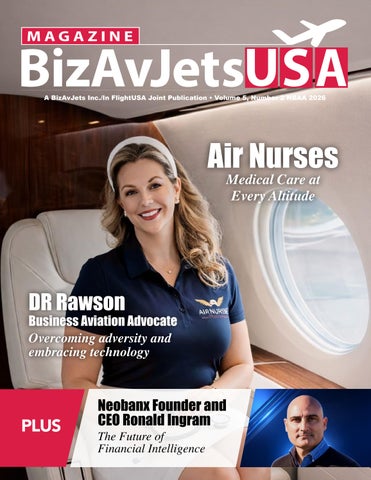
A BizAvJets Inc./In FlightUSA Joint Publication • Volume 5, Number 2 NBAA 2026
Air Nurses Medical Care at Every Altitude
DR Rawson
Business Aviation Advocate Overcoming adversity and embracing technology
PLUS
Neobanx Founder and CEO Ronald Ingram The Future of Financial Intelligence
NBAA 2026
3
www.bizavjetsusa.com
A Letter from the Publishers Welcome to the NBAA 2026 issue of BizAvJets USA Magazine. Business aviation is built on relationships, sound decisions, and people who see an opportunity to serve others. Those threads run through the stories in these pages. Air Nurses founder Ericka Essington explains how trained flight nurses can support passengers whose medical needs call for more than a routine flight but less than an air ambulance. We also speak with Shifa Precision about its vision for preventive healthcare, and with DR Rawson about leadership, character, and the value of staying curious throughout a career. This issue looks at the business aviation market through reports from IADA and Mente Group, while Private Jet Club shares its approach to connecting Bermuda with the wider world. In our conversation with Ronald Ingram, we explore Neobanx, BROK, and the questions that come with using artificial intelligence to support financial decisions. The people behind this industry matter just as much as its technology and transactions. Jerry Whetstone’s conversation about hearing health addresses a concern familiar to many aviation professionals. Our feature on Ben Ingram and Warriors In Need highlights the purpose, skills, and opportunity veterans can carry into civilian aviation careers. As you read, we hope you discover an idea worth discussing or a person worth getting to know. Thank you to our contributors, advertisers, and readers for helping us connect the business aviation community. Warm regards,
The BizAvJets USA Magazine Team
P.O. Box 5402, San Mateo, CA 94402 (650) 358-9908, Fax (650) 358-9254
Annamarie Buonocore Co-Publisher
Eli Stepp Co-Publisher
Vickie Buonocore Managing Editor
Jerry Whetstone Advisor/Associate Editor
Matt DuBois Production Editor
Business matters, advertising and editorial concerns should be addressed to In Flight USA, P.O. Box 5402, San Mateo, CA 94402 or by calling (650) 358-9908–fax (650) 358-9254. Copyright © 2008-2021 In Flight Publishing. BizAvJets USA is not responsible for any action taken by any person as a result of reading any part of any issue. The pieces are written for information, entertainment and suggestion – not recommendation. The pursuit of flight or any action reflected by this publication is the responsibility of the individual and not of this publication, its staff or contributors. Opinions expressed are those of the individual author, and not necessarily those of BizAvJets USA. All editorial and advertising matter in this edition is copyrighted. Reproduction in any way is strictly prohibited without written permission of the publisher. BizAvJets USA is not liable or in any way responsible for the condition or airworthiness of any aircraft advertised for sale in any edition. By law the airworthiness of any aircraft sold is the responsibility of the seller and buyer.
4
www.bizavjetsusa.com
NBAA 2026
Air Nurses Founder Ericka Essington (Photo Courtesy of Air Nurses)
Bridging the Gap Between Air Ambulance and Private Aviation Medical Support Interview by Eli Stepp, BizAvJets USA Co-Publisher
Business Aviation is well respected for safety and outstanding passenger experience. BizAvJets USA Magazine is pleased to highlight one area that may be less known to business aviation travelers, which is medical readiness at altitude. Air Nurses provides medical services which fill a gap between routine flights and air ambulance situations. Founded by Ericka Essington, the company provides board-certified flight nurses specifically trained to support passengers traveling on private aircraft who may not require an air ambulance but still benefit from professional medical oversight during flight. Whether assisting post-surgical travelers, supporting senior passengers, accompanying executives managing health concerns, or helping families move loved ones safely across the country, or internationally. Air Nurses delivers a concierge-level solution tailored to the realities of private aviation operations. Working alongside charter operators, corporate flight departments, brokers, hospitals, and families, the team helps bridge an important space between traditional medical escort
services and full air ambulance transport bringing confidence and capability to missions where comfort alone isn’t enough. A Conversation with Ericka Essington, Founder of Air Nurses
BAJUSA: We met at NBAA-BACE last year and immediately knew this would be a great story for our readers. To begin, could you share a little about your background before launching Air Nurses? AN: Absolutely. I’m a nurse and a paramedic, and my entire background has been in air medical transport. I went to nursing school, saw a helicopter land one day, and immediately knew that was what I wanted to do. I’ve now been a nurse for almost 20 years and involved in aviation for about 17. I’m a board-certified flight nurse and paramedic, and I’ve worked across helicopters, turboprops, and jets throughout the United States and internationally. Later in my career I moved into leadership roles and became a division director Continued on Page 10
NBAA 2026
5
www.bizavjetsusa.com
THE POSSIBILIST: DR RAWSON ON LEADERSHIP, CHARACTER AND BUILDING WHAT OTHERS CALL IMPOSSIBLE A conversation about overcoming adversity, leading more than 30 companies, embracing technology and leaving a values-centered legacy Interview by Eli Stepp, BizAvJets USA Co-Publisher | Edited for clarity and length DR Rawson’s career does not fit neatly into one industry or title. He has served in the U.S. Air Force, worked with early mainframe computers, built and advised companies across many industries, written books, spoken to large audiences and developed initiatives centered on character and leadership. Today, he calls himself “The Possibilist,” someone who looks beyond obstacles and asks what can be created or improved. He is a business aviation advocate, and his story carries themes familiar to business aviation: disciplined decisions, technical competence, trust, accountability and anticipation. In this conversation, Rawson discusses his path from childhood hardship to entrepreneurship, lessons from military service, why character comes
before reputation and how artificial intelligence should support, not replace, human judgment. BAJUSA: Your life and career cover an unusually broad range of experiences. How do you introduce yourself today? DR: I describe myself as a possibilist. I have been an entrepreneur, executive, consultant, inventor, author, publisher, speaker and teacher, but titles explain only part of a person. The more important question is: How can I be helpful? I have started or led more than 30 companies across many industries. Each experience taught me about people, systems, leadership and problem-solving. Today, I am focused less on titles and more on using what I have learned to help others and Continued on Page 6
6
www.bizavjetsusa.com
THE POSSIBILIST Continued from Page 5
build something that can continue beyond me. BAJUSA: Could you share about any difficulties in your early life? DR: My childhood was difficult. Homelessness and financial hardship were experiences I faced early in life. Those experiences taught me not to wait for rescue. I decided my past would not hold my future hostage. That does not mean denying what happened; it means learning from it without accepting permanent limitations. Those experiences gave me empathy, but also a strong belief in responsibility, action and possibility. BAJUSA: What role did military service play in your development? DR: I joined the U.S. Air Force in 1965. The military introduced me to structure, discipline and the importance of completing a mission correctly. It also gave me exposure to technology at a time when computers were still mysterious to most people. I learned to program IBM 360 mainframe systems. That experience taught me how to break down problems into smaller parts, understand a sequence, anticipate errors and produce a useful program. Those skills transferred into business leadership. Like a technical system, a company needs clear processes, dependable people and accountability. BAJUSA: You entered entrepreneurship at a relatively young age. What did you learn from your first ventures? DR: I learned that opportunity often appears disguised as a problem no one else wants to solve. One of my early companies became involved in supplying underground plumbing during the construction of Walt Disney World. It happened because I listened, understood the need and figured out how to deliver. Entrepreneurship is not simply having an idea. It is accepting responsibility for making it useful and standing behind the result. Cash flow, timing, relationships and execution matter as much as enthusiasm. BAJUSA: You have worked across technology, insurance, healthcare, manufacturing, oil, communications, publishing and media. How were you able to move between industries? DR: Products and terminology change, but business fundamentals remain. Every organization has customers, employees, processes, risks and a need to create value. I entered new industries by asking questions and finding people who understood what I did not. A leader need not be the smartest technical person in every room.
NBAA 2026
The leader must recognize expertise, assemble the right people and ensure accurate information reaches the decision-maker. Curiosity matters, but so does humility. BAJUSA: You have described yourself as both an inventor and an operator. What is the difference between having an idea and building a business around it? DR: An idea is only the beginning. The business begins when you identify who needs the solution, how it will be produced, what it will cost, who will sell it and how the customer will be supported afterward. Inventors naturally focus on what could exist. Operators must focus on what must happen Monday morning. The strongest ventures connect both ways of thinking. Creativity opens the door, but systems, capital, people and follow-through keep the door open. I have learned not to fall in love with an idea so deeply that I stop listening to the market. BAJUSA: How do you decide whether to persist with an idea or change direction? DR: Persistence is valuable, but stubbornness can be expensive. I look for evidence. Are customers responding? Is the team learning? Are the obstacles temporary, or do they reveal a fundamental flaw? Sometimes the mission remains valid while the method must change. A leader has to separate personal pride from the decision. Closing, selling or redirecting a venture is not automatically failure. Failure is refusing to learn while resources, time and trust continue to disappear. The goal is not to prove that the original plan was perfect. The goal is to create a useful and sustainable result. BAJUSA: Business aviation is a safety-critical industry built on trust. What leadership principles do you believe translate directly to aviation? DR: Character, integrity and credibility translate into every industry, but they are especially important where lives depend on decisions. Character is who you are and the values you choose. Integrity is whether your actions align with those values, especially under pressure or when no one is watching. Credibility is what others grant you after seeing consistency between your words and actions. In aviation, credibility cannot be manufactured with a slogan. It is built through preparation, honesty, competence, documentation and speaking up when something is wrong. BAJUSA: Why did you choose Character, Integrity, and Credibility (CIC) a central part of your work? DR: I have seen excellent businesses fail because trust disappeared, and people with limited resources succeed because others believed their promises. CIC is not a phrase for a wall; it is an operating standard. Character influences the decision. Integrity determines whether you follow through. Credibility is the Continued on Page 7
NBAA 2026
www.bizavjetsusa.com
THE POSSIBILIST Continued from Page 6
accumulated result. Without trust, transactions become more expensive, relationships more fragile and mistakes harder to recover from. BAJUSA: How should leaders respond when they make a mistake? DR: Tell the truth, accept responsibility, correct what can be corrected and learn enough to prevent repetition. Too many leaders protect an image instead of solving the problem. People understand that humans make mistakes; denial, concealment and blame destroy trust. Accountability does not make a leader smaller. It can increase credibility because people see that truth matters more than ego. BAJUSA: You have spoken about artificial intelligence. What are your thoughts regarding AI utilization? DR: Artificial intelligence will become increasingly integrated into business, education, media and daily life. It is a tool which can be utilized to improve human understanding. AI is a great resource for information organization, pattern identification, efficiency, and revealing new ideas. Human judgement is required with AI, or any tool for that matter. In aviation, technology should strengthen awareness and decision quality, not excuse us from thinking. We must ask who is accountable, what data was used and whether the result makes sense. BAJUSA: You are also involved in media through The Las Vegas Television Network. What attracts you to television and digital media? DR: Media can entertain, preserve stories, introduce ideas and connect people who might never meet. Las Vegas is known globally, yet many meaningful local stories receive little attention. The opportunity is to create programming reflecting the city’s range such as business, entertainment, community, innovation and achievement. Content should give audiences useful information, encouragement, perspective or a reason to act. BAJUSA: Another major initiative is Tiny Tales Land. How did a seasoned business executive become involved in children’s stories? DR: The future is shaped long before someone enters a boardroom. It begins when children learn kindness, courage, honesty, resilience and responsibility. Tiny Tales Land uses short stories and characters to make those traits memorable. Children often absorb principles more naturally through imagination than lectures. The stories are concise, but the conversations among children, parents and teachers can be much larger. This
7
is leadership development at its earliest stage. BAJUSA: After building so many ventures, how do you evaluate a new idea? DR: I start with the problem. Is it real? Who experiences it? Is the solution useful enough that people will change behavior or pay for it? Then I evaluate the people involved. A good idea with the wrong team can become an expensive disappointment. I also ask whether it fits my larger purpose. I do not need to chase every opportunity; I want work that creates value, helps people and builds legacy. BAJUSA: What advice would you give aviation entrepreneurs or professionals who want to start a business? DR: Learn the industry deeply, but do not confuse technical knowledge with business readiness. Understand customers, costs, regulations, insurance, contracts, cash needs and sales. Build relationships before you need them. Never promise what you have not proven you can deliver. In aviation, credibility takes years to build and one careless decision to damage. Start with a real need, test the solution, listen to those doing the work and maintain enough discipline to survive the learning period. BAJUSA: You have accomplished a great deal. How do you define success now? DR: Success is not the number of companies, books, speeches or projects attached to my name. Those can disappear. Success is whether people were better because I was there, whether I kept my word, used my abilities responsibly and passed along something useful. Legacy is built through daily choices, private decisions and how we treat people who can do nothing for us. BAJUSA: What do you hope readers of BizAvJets USA Magazine take away from your story? DR: Do not let your beginning dictate your ending. Learn something new, even late in life. Ask how you can be helpful. Protect your credibility; it is among your most valuable assets. Use technology without surrendering judgment. Possibility is not fantasy. It requires action, discipline, people, timing and persistence. The future is not guaranteed, but what we build today can influence it. For DR Rawson, the line connecting military service, technology, entrepreneurship, publishing, media and children’s education is the belief that people can create a different future by combining imagination with responsibility. His career offers a lesson especially relevant to business aviation: innovation earns lasting value only when supported by competence, integrity and trust. BizAvJets USA Magazine offers sincere thanks to Mr. Rawson and wishes him all the best in his future endeavors.
8
www.bizavjetsusa.com
NBAA 2026
Please repeat that again; I didn’t hear you! Interview by BizAvJets USA Advisor Jerry Whetstone
The saying you don’t know what you don’t know is often said when talking about knowledge. This rings true also in the hearing world, you don’t hear what you can’t hear. Business aviation personnel are keenly aware of potential hearing loss. BizAvJets recently spoke with Catie Coyle, Board Certified-Hearing Aid Specialist, with Premier Hearing Healthcare Center, LLC, in Dayton, Ohio about concerns many ignore. BAJUSA: Tell us a little about the ear…what’s in there, how does it work? CC: The human ear is truly a sophisticated system. It converts sound waves into electrical signals through the outer, middle, and finally, inner ear. This process begins when the outer ear funnels sound vibrations down the ear canal which causes the tympanic membrane (eardrum) to vibrate. These vibrations are amplified along the ossicular chain (the 3 smallest bones in the human body most commonly known as the hammer, anvil, and the stirrup)! That energy is then passed in the fluid filled cochlear. The cochlea contains roughly 15,000 hair cells that translate that fluid movement into nerve impulses which are communicated to the brain via the auditory nerve, where they are interpreted as the sounds we recognize. BAJUSA: We know there are different tones we hear. Are there concerns of losing them? What decibels start to affect the hearing? CC: Humans can generally hear tones between 20Hz and 20,000Hz. Losing our ability to hear tones in this frequency range is very concerning because it significantly impacts quality of life by making communication difficult, increasing risk of social isolation, and contributing to cognitive decline over time. BAJUSA: As we age, the environment we work in probably affects what we are able to hear, why do individuals resist having their hearing checked? CC: This is such a good question! It’s so important to recognize why we behave the way we do, especially when that behavior is so counterproductive. There are certainly some perceived social barriers that may discourage someone from pursuing a hearing test like the general age stigma associated with hearing loss. I also think that because hearing loss often happens gradually, our brain does its best to adapt. It becomes easier to blame others for “mumbling” or “not enunciating”, when often, it’s our own hearing that is making communication more difficult. We also recognize that hearing aids can be a
significant investment. I understand that many people may avoid a hearing test because they fear being unable to afford the treatment for correcting their loss. BAJUSA: Is hearing loss more prevalent in men than women? With loss, does our balance or coordination become affected? CC: Hearing loss is more common in men, some studies suggesting twice as common for men than for women. However, as the disparity between sexes is changing as many lifestyle variables are disappearing. While men statistically engage in louder occupations and hobbies than women, that is changing. And yes, hearing loss and balance are highly interconnected. People with even mild hearing loss are three times more likely to experience a fall. BAJUSA: As individuals fly, you hear the statement, “I need to pop my ears.” What happens on take off, what is the best method to relieve this feeling, and is there any damage occurring when one does “pop” their ears? CC: The “pop” you feel is a wonderful tool used by the body to prevent our from damage while we transition from one layer of atmosphere to another. Before take off, the air pressure in your middle ear is the same as the air pressure outside. But when we move upward, the pressure outside decreases and that air in our middle ear starts to push on the eardrum. Our eustachian tubes react to this change in pressure and work to equalize the pressure. When we hold our nose shut and force air into the eustachian tubes, it results in a “pop” feeling. This “popping” technique is called the Valsalva maneuver. “Popping” one’s ears in this manner is generally considered safe but there are always some small risks involved, so gentler methods of coaxing the Eustacchian tubes open might be preferred. One tried and true option is chewing gum! BAJUSA: What are some of the social and psychological impacts or hearing loss? CC: Hearing loss can be heavily isolating. Those suffering with untreated hearing loss are much more likely to suffer from anxiety and depression and are much more likely to self isolate and withdraw from social interactions. BAJUSA: We know the decibels during take off can exceed 90-109 decibels inside the plane. How can one assist in hearing protection during the take off? CC: There are many options for ear protection Continued on Page 19
NBAA 2026
9
www.bizavjetsusa.com
Jocko Podcast Featuring Ben Ingram, Founder of Warriors In Need Presented by BizAvJets USA Magazine
BizAvJets USA Magazine has had the pleasure of featuring Ben Ingram, founder of Warriors In Need organization. In a recent episode of the Jocko Podcast, retired Navy SEAL Jocko Willink sat down with Marine veteran Ben Ingram for a powerful conversation about overcoming adversity, military transformation, veteran transition struggles, and the creation of Warriors In Need. The discussion focused heavily on purpose after military service, aviation career pathways, leadership, and helping veterans rediscover mission and direction in civilian life. We feel such a worthy cause is well worth featuring in our publication(s) again. Below is a summarized Q&A-style interview inspired by the discussion for readers of BizAvJets USA Magazine. BAJUSA: Ben, during the podcast you spoke openly about growing up on a destructive path before joining the Marine Corps. Looking back now, how important was military service in changing the direction of your life? Ben Ingram: It changed everything. Before the military, I lacked discipline, structure, and direction. The Marine Corps gave me accountability and purpose. It taught me standards, responsibility, and how to operate as part of a team. A lot
of veterans will tell you the military saved their life in one way or another, and honestly, that was true for me. BAJUSA: One thing that stood out in the interview was your honesty about personal struggles. Why do you think that message resonates so strongly with veterans? Ben Ingram: Because a lot of veterans understand struggle. Many people enter the military carrying baggage from difficult backgrounds, bad environments, or poor decisions. The military gives you structure and a mission bigger than yourself. When veterans hear honest stories instead of polished speeches, they connect with that because they’ve lived it themselves. BAJUSA: After military service, you became involved in aviation. What attracted you to the aviation industry? Ben Ingram: Aviation still has that mission-oriented environment. There’s accountability, teamwork, safety, attention to detail, and professionalism. In aviation maintenance especially, people depend on you to do your job correctly every single day. A lot of veterans naturally fit into that Continued on Page 25
10
www.bizavjetsusa.com
NBAA 2026
Bridging the Gap Continued from Page 4
managing a medical transport team for a large healthcare organization in Houston. That leadership experience helped me recognize the opportunity that ultimately became Air Nurses. BAJUSA: What led you to create Air Nurses? AN: I recognized that many patients being transported by air ambulance didn’t actually require ICU-level transport. Air ambulances are flying intensive care units which are designed for critical patients. Yet we were transporting many people who didn’t need that level of care. The idea became personal when my grandmother needed to travel to Italy for a family wedding. She couldn’t fly commercially, but an air ambulance was far more than she required as well as extremely expensive. That’s when I began exploring how private aviation combined with qualified flight nurses could bridge that gap. I realized there wasn’t a service providing properly trained flight nurses specifically for private aviation. So, I built one. Air Nurses provides board-certified flight nurses who are professionals trained to deliver care at altitude, without requiring the cost and infrastructure of an air ambulance. We bridge the gap between commercial medical escort services and full air ambulance transport. Private aviation solves many travel challenges. Medical readiness during flight was one area that had not been fully addressed, and that’s what we set out to solve. BAJUSA: Walk us through how clients typically engage Air Nurses. AN: We work directly with corporate flight departments, Part 91 operators, Part 135 charter operators, brokers, hospitals, case managers, assistants, and families. When someone contacts us, we begin with a medical screening to determine whether the patient is safe to fly. If they are not appropriate for private aviation medical escort, we refer them to an air ambulance provider. If they are appropriate, we move quickly. Once arrangements are confirmed, we can deploy a nurse within hours, often within two hours. We built Air Nurses like an EMS agency without the aircraft. We deploy rapidly and integrate seamlessly into the private aviation environment. BAJUSA: Do patients ever contact Air Nurses directly? AN: Yes, very often. Some clients already fly private and connect us with their operator or broker. Others have never flown private before but need medical support for
Air Nurses Providing Onboard Medical Care (Photo Courtesy of Air Nurses) travel, such as patients traveling for cancer treatment or returning home after hospitalization. In those cases, we manage everything. We arrange the aircraft if needed, coordinate ground transportation, provide the nurse and equipment, and oversee the entire process door-todestination. Our goal is to remove stress and provide peace of mind during a difficult time. BAJUSA: Can you give an example of a typical situation where someone might need Air Nurses? AN: One recent example involved a traveler hospitalized with pneumonia while visiting family. He needed supplemental oxygen to fly safely at altitude but didn’t require an air ambulance. We escorted him home on a private aircraft, monitored his oxygen levels in flight, adjusted support as needed, and ensured he traveled safely and comfortably with his whole family. We escorted him all the way home and were able to handover care to a private nurse waiting for our arrival, never having a gap in care from the hospital all the way home. That’s exactly the type of situation our service was designed for. Continued on Page 14
NBAA 2026
www.bizavjetsusa.com
11
Mente Group Surpasses $1 Billion in 2025 Aircraft Transactions, Positioned for Continued 2026 Growth
DALLAS (April 27, 2026) — Moving into the second quarter of 2026, Mente Group has the momentum from a record breaking 2025, with more than $1 billion in aircraft transactions, to execute another record year. Mente, a leading global business aviation advisory and aircraft brokerage firm, has recently hired and promoted several key sales executives forecasting a buoyant 2026. Mente Group achieved its highest annual transaction volume and greatest number of deals closed in company history in 2025. The milestone caps a year of accelerated growth and reinforces the firm’s trajectory heading into 2026. “2025 was Mente Group’s strongest year yet, both in total transaction value and number of deals closed,” said Brian Proctor, president and CEO of Mente Group. “These results underscore the confidence our clients place in us to guide critical aviation investment decisions. We’re grateful to our clients, partners, and team for their roles in this success,” he added. The company has strengthened its leadership team in 2026 with several key appointments and promotions. Steve Main has joined as Chief Revenue Officer, and Kyle Bonda has been named Senior Managing Director. Jay Bushouse has been promoted to Senior Managing Director, Brent Hanson to Managing Director, and Rich Ropp has also been appointed Managing Director. Mente Group reports strong sales activity in 2026, supported by a robust pipeline of aircraft transactions and advisory engagements across multiple categories. This performance reflects continued demand for the firm’s core services, including aircraft transactions, asset advisory, consulting, appraisals, and valuations for corporations, high-net-worth individuals, and aviation stakeholders worldwide. Founded in 2009, Mente Group has evolved into a full-service aviation advisory firm providing independent, data-driven guidance across the lifecycle
of aircraft ownership and operations. Through its history the firm has conducted business with nearly half of the Fortune 100, advising clients on complex, high-value aviation assets with a focus on maximizing value and minimizing risk. The company’s 2025 results build on a multi-year growth trend driven by increased demand for business aviation, shifting fleet strategies, and sustained interest in both new and pre-owned aircraft. Mente Group’s advisory-led model and market intelligence capabilities continue to help clients navigate dynamic market conditions with confidence. About Mente Group
Mente Group is a leading business aviation advisory and aircraft brokerage firm specializing in aircraft transactions, asset management, and strategic, operational, and technical consulting. The company serves corporations, growth companies, and high-networth individuals worldwide, delivering independent advice backed by deep market intelligence and industry expertise. Since its founding in 2009, Mente Group has advised on billions of dollars in aircraft transactions and partnered with many of the world’s largest companies and aviation stakeholders. Mente Group is a member of the International Aircraft Dealers Association (IADA), the National Business Aviation Association (NBAA), the National Aircraft Finance Association (NAFA) and the American Society of Appraisers (ASA). For more information, visit Mente Group – Private Jet Brokerage and Consulting Firm Located in Dallas, TX: www.mentegroup.com.
12
www.bizavjetsusa.com
NBAA 2026
Shifa Precision: Building the Future of Preventive Healthcare Through AI and Molecular Intelligence Interview by BAJUSA Co-Publisher Eli Stepp
One of the most revolutionary genetic healthcare platforms of the modern era is being developed by Shifa Precision, a pioneer in predictive intelligence utilizing artificial intelligence to power preventive, proactive medicine. Founded in 2022 by geneticist and former Harvard Professor, Dr. Neena Haider, the company is creating an AI-powered “Molecular TwinTM” platform designed to help clinicians predict health risks, personalize treatments, and potentially prevent chronic disease before symptoms appear. During an exclusive conversation with BizAvJets USA Magazine, founder Neena Haider and advisor Von Cameron discussed how Shifa Precision’s Oasis AI engine combines genetics, microbiome analysis, biomarkers, environmental exposures, and lifestyle data into a comprehensive precision-health platform aimed at improving patient outcomes, military readiness, veteran care, and long-term wellness. Shifa Precision’s healthcare efforts enhance and improve mission-critical industries such as business and commercial aviation. Q&A Interview BAJUSA: Could you give our readers a short background about yourself and your journey into this field? SP-NH: I was part of the Human Genome Project and spent much of my academic career understanding how the body functions at the molecular level. I ran a gene therapy lab at Harvard where I developed gene therapies to treat multiple forms of blindness. One of the
major themes throughout my work has been understanding how we can use the enormous amount of biological data now available to improve human health and medicine. BAJUSA: When was Shifa Precision founded? SP-NH: Shifa Precision was founded in 2022. We have thoughtfully developed an enterprise-level AI platform engineered specifically to address the massive, unmet demand for predictive, preventive, proactive healthcare at scale BAJUSA: Your company describes itself as an advanced AI diagnostic platform. Help our readers better understand exactly what that means. SP-NH: We have reached a unique technological convergence where AI is both immensely powerful with capability to analyze the complexity of human biology. We leverage the power of AI for intelligence synthesis to organize and analyze massive amounts of verified health science information that includes genetics, microbiome data, biomarkers, environmental exposures, nutrition, lifestyle factors, and social determinants of health. Our proprietary AI engine, called OASIS AI, is engineered to perform molecular level patient data analysis with strong guardrails to preserve data accuracy Continued on Page 13
NBAA 2026
www.bizavjetsusa.com
Shifa Precision Continued from Page 12
and integrity. OASIS delivers real-time intelligence support with evidence-based knowledge, empowering clinicians with clear insights for proactive care. BAJUSA: Walk us through how the process works for a patient. SP-NH: Patients would work through participating hospitals, clinics, or healthcare systems that integrate Shifa into their electronic health records system. A patient would provide a blood and stool sample for processing DNA, microbiome, and biomarker analysis, and answer lifestyle-related questions through an AI-guided intake process. That information along with what is in the patient’s health records already is analyzed by OASIS, which then produces two major outputs. The first is a streamlined clinician report that helps doctors quickly understand key health insights. The second is what we call the “Molecular Twin,” which is essentially a digital representation of your molecular health profile. The Molecular Twin allows clinicians to simulate how a patient may respond to medications, nutrition plans, or other treatments before beginning them. The goal is prediction and prevention with proactive care rather than disease management or waiting until disease progresses. BAJUSA: So, this becomes a powerful support tool for physicians rather than replacing them? SP-NH: Exactly. We are not diagnosing or prescribing treatments. We provide highly validated scientific knowledge in a concise and transparent format so healthcare providers can make more informed decisions. Every insight is weighted evidence and is traceable back to verified scientific data sources. BAJUSA: One thing that stood out to me is the possibility that lifestyle changes could potentially reduce the need for medication in some situations. SP-NH: Absolutely. Sometimes the right intervention may involve nutrition, environmental changes, or lifestyle modifications instead of prescription medication. Many chronic conditions are influenced by how genetics interact with environment and lifestyle. If we can identify those interactions early enough, we can help people reduce risk before disease manifests or progresses.
13
BAJUSA: You also mentioned military and veteran applications. That seems especially important. SP-NH: It is extremely important. We believe every service member should have a molecular baseline established when entering military service and then updated periodically throughout their career and after separation from active duty. Many chronic conditions exist long before symptoms appear. Military personnel are also exposed to environmental stressors, toxins, extreme operational conditions, and trauma that can impact long-term health. Our precision medicine could help improve readiness, accelerate recovery, and reduce chronic disease burdens for veterans later in life. SP-VC: That’s one of the reasons I became involved with Shifa Precision. I’m an Air Force veteran and have spent years in technology and business development. What impressed me most was how this technology could help people proactively manage their health rather than waiting until problems become severe. I truly believe every person should eventually have a Molecular Twin. For military members especially, it could dramatically improve readiness, treatment accuracy, and long-term healthcare outcomes. BAJUSA: The aviation industry also comes to mind here, pilots, maintenance professionals, and others working in high-performance environments. SP-NH: Absolutely. Aviation professionals often operate under high stress and exposure environments where health optimization matters tremendously. One important thing to understand is that molecular analysis can also identify positive genetic traits, what I call “superpowers.” For example, some people may have genetic advantages related to stress resilience, cognitive clarity under pressure, or improved recovery. The goal is not to create fear about health risks, but to empower people with knowledge that helps them perform better and stay healthier long-term. BAJUSA: The demonstration you showed was incredibly impressive. This really feels like something out of science fiction. SP-NH: The future is here. What excites me most is that we now have the technology and the science to move healthcare from reactive treatment to proactive prevention. That has the potential to improve quality of life for millions of people worldwide.
14
www.bizavjetsusa.com
Bridging the Gap Continued from Page 10
BAJUSA: What about oxygen equipment and aviation compliance? AN: All equipment we bring onboard is FAAapproved for flight. That includes oxygen concentrators and AEDs. Operators often ask whether our presence changes the regulatory classification of the flight, it doesn’t. We remain with passengers onboard while providing medical oversight. We specialize in understanding what equipment can safely be used in aviation environments and how altitude affects patients physiologically. BAJUSA: Are injuries also common use cases? AN: Yes. We’ve assisted clients with injuries such as broken legs from ski accidents who needed help
Air Nurses Founder Ericka Essington (Photo Courtesy of Air Nurses)
NBAA 2026
traveling home safely. We also support executives who travel frequently and want ongoing health monitoring to manage fatigue and jet lag. We work alongside a lot of executive protection teams as well. Our services range from injury support to wellness-focused medical travel accompaniment. BAJUSA: Why does Air Nurses deploy boardcertified flight nurses rather than paramedics? AN: Licensing flexibility is a key reason. Nursing compact licenses allow practice across most U.S. states, which supports rapid deployment nationwide. Paramedic licensing is more state-specific. More importantly, flight nurses are specifically trained to operate independently at altitude with limited equipment, exactly the environment encountered in private aviation. BAJUSA: How quickly can your team typically deploy? AN: We’re usually able to have a nurse at the patient’s bedside within about six hours from the time of the request. That rapid deployment capability is one of our core strengths. BAJUSA: Where are your nurses positioned geographically? AN: We maintain nurses in several major deployment hubs including New York, Florida, Houston, California, and Phoenix. That allows us to respond quickly nationwide rather than requiring extended positioning delays. BAJUSA: What types of aircraft are most commonly used? AN: We frequently operate on midsize and larger aircraft mostly because many trips involve longer distances. However, we work across all aircraft categories depending on client needs, from light jets, turbo props, large-cabin aircraft or larger. BAJUSA: How active is the medical escort segment of the industry today? AN: It’s a large and growing sector. The global medical escort market is projected to reach approximately $3.2 billion by 2026–2027. Healthcare itself is shifting toward concierge-style services, and travel is part of that transition. Our goal is to ensure that business aviation receives properly trained aviation-experienced clinicians. not just hospital-based nurses unfamiliar with the flight environment. Flight nursing is highly specialized. Operating at altitude with limited equipment requires a very different skill set. BAJUSA: Do you partner with charter providers? Continued on Page 15
NBAA 2026
www.bizavjetsusa.com
Bridging the Gap Continued from Page 14
AN: Yes. We regularly coordinate with operators and brokers. We partner with aviation professionals for aircraft sourcing and coordination for example Paraflight Aviation. Paraflight, in particular, understands the urgency of medical transport operations because of their experience supporting organ transplant logistics. Our focus is medical expertise. We also have a number of other medical partnerships to help assist clients such as in boarding if needed or with concierge nursing services that support clients on the ground for more longer term oversight. This provides the client with a complete care solution while traveling all in one place. We want to make it easy. BAJUSA: How do you recruit flight nurses? AN: We only recruit experienced air ambulance nurses. Most work 24-hour rotations and typically work six to eight days per month, which allows them flexibility to participate in missions with Air Nurses. Our clinicians remain actively engaged in critical care transport. That means clients are supported by professionals who were flying trauma patients just days before their assignment, not clinicians removed from the field. BAJUSA: What differentiates Air Nurses from traditional medical escort services? AN: We are exclusively focused on private aviation. We do not provide commercial airline medical escort services. We carry our own equipment, operate under physician medical direction, and function under EMSstyle treatment protocols. That allows us to administer medications and provide care beyond what many escort services can legally provide. Most importantly, our nurses train in emergency procedures and crew resource management so they integrate seamlessly with flight crews. We function as part of the aviation safety ecosystem. Ultimately, Air Nurses provides a risk-mitigation solution for operators, corporate flight departments, and families traveling with medically sensitive passengers. BAJUSA: BizAvJets USA extends our sincere thanks to Ericka Essington and we wish all the best to everyone at Air Nurses.
Air Nurse providing onboard oxygen assistance (Photo Courtesy of Air Nurses)
15
16
www.bizavjetsusa.com
NBAA 2026
IADA Reports Strong Start to 2026 as Business Aircraft Market Stabilizes at Elevated Levels LOS ANGELES (April 27, 2026) – The International Aircraft Dealers Association (IADA) reported the business aviation market remained fundamentally strong in the first quarter of 2026. The organization’s First Quarter Market Report, featuring perception surveys and actual performance data, signaled continued demand outpacing supply and stable pricing across most categories, leading to generally positive expectations for the year ahead.
The number of aircraft under contract declined slightly to 235 from 250, and exclusive sell agreements eased to 188 from 203, suggesting a modest normalization following elevated activity levels in 2025. Price reductions dropped significantly to 26 from 43, indicating continued pricing resilience, even as deals that fell apart increased to 49 from 37, reflecting a more cautious buyer base and the impact of external uncertainties.
Survey respondents described a market defined by resilience and discipline, even as geopolitical uncertainty and macroeconomic risks introduce a more measured outlook compared with late 2025. Overall sentiment reflects steady performance with underlying strength in demand, constrained inventory, and sustained transaction activity.
Supply and Demand Dynamics
“The prevailing tone across respondents is one of measured confidence,” said John Odegard, Chair of IADA and Co-Founder and Partner of 5X5 Trading, an IADA-Accredited Dealer. “The business aviation market remains fundamentally healthy, demand continues to outpace supply, values are holding firm, and buyer interest remains broad. However, a growing undercurrent of geopolitical and macroeconomic uncertainty is tempering enthusiasm somewhat heading into mid-2026.” Market Performance and Five-Year Trend
First quarter 2026 IADA activity reflects continued strength in transaction volume and dealer engagement, with several key indicators showing year-overyear growth compared with the first quarter of 2025. Closed deals rose to 333 in Q1 2026 from 316 in Q1 2025, extending to five years a trend of incremental first quarter increases and reinforcing sustained demand across the business aviation market. Acquisition agreements also increased to 167 from 134, signaling a stronger pipeline of future transactions, while dealer inventory purchases more than doubled, rising from 29 to 65, driven in part by a sharp increase in March activity. At the same time, other indicators point to a more balanced and evolving market environment.
Inventory levels remain historically tight across nearly all segments, from turboprops through large-cabin jets. While the surge of transactions in the fourth quarter of 2025 pulled forward significant deal volume, supply constraints persist and continue to support pricing. Late-model, well-maintained aircraft, particularly those with clean maintenance histories, continue to command premium pricing with minimal negotiation flexibility. Demand remains strong and globally diversified, with activity across North America, Latin America, Africa and other regions. However, respondents noted a shift toward a more measured pace, with some buyers adopting a “wait-and-see” approach in response to geopolitical developments. Projection Analysis: Pricing, Supply, Inventory and Demand
IADA’s first quarter member survey provides a detailed outlook across key market indicators: •
Pricing: Expected to remain stable to slightly lower overall, with mid-size and large-cabin aircraft showing the greatest potential for modest increases.
•
Supply: Projected to remain predominantly stable, with variation depending on aircraft category.
•
Willingness to Inventory: Anticipated to increase slightly, reflecting growing confidence among dealers and brokers.
•
Demand: Expected to remain stable to slightly Continued on Page 17
NBAA 2026
17
www.bizavjetsusa.com
IADA
Continued from Page 16 higher across all segments. 12-Month Outlook
The first quarter of 2026 reflects a business aviation market that is stabilizing at elevated levels of activity. Strong demand, limited supply and supportive financial conditions continue to define the landscape, while geopolitical and economic uncertainties shape a more measured outlook. Industry participants broadly expect the market to remain stable through the next 12 months, with potential for improvement as conditions evolve. In response to the question, “Over the next 12 months, do you expect the market to soften, remain stable, or improve?” survey respondents indicated expectations for a stable market. Market Drivers and Risks
Key factors supporting the market include: •
Reinstatement of 100% bonus depreciation in the United States
•
Lower interest rates supporting financing and buyer confidence
•
Extended OEM backlogs sustaining demand for preowned aircraft
•
Strong underlying economic fundamentals
At the same time, respondents identified several ongoing risks: •
Geopolitical instability, particularly in the Middle East
•
Maintenance, repair and overhaul (MRO) bottlenecks and parts shortages
•
OEM production delays and quality concerns
•
Continued uncertainty surrounding global tariff policies
For the complete report visit https://aircraftexchange. com/market-report.
Member Perspectives on Current Market Conditions
IADA members provided the following insights into current market conditions: “Favorable towards growth with the potential for sustained geopolitical and economic uncertainty as the primary risk factors.” — Don Walsh, Eldridge Capital Management // IADA Verified Products and Services Member “Stable. Supply is still pretty low and demand is still decent and possibly increasing due to security concerns. Obviously tariffs and oil may impact this.” — Lee Thomas, Eagle Aviation // IADA Accredited Dealer “Many segments of the market still appear to be sellers’ markets coming into the year, and that momentum has continued, particularly for models that remain in active production. Overall, that has kept pricing elevated across much of the market. However, I do expect we’ll start to see some normalization in certain segments as the ability for U.S. buyers to purchase international aircraft without the concern of tariffs returns. With that barrier removed, more international inventory can compete in the U.S. market again, which should help bring additional balance to supply and demand over time.” — Michael Barber, jetAVIVA // IADA Accredited Dealer “The current markets are stable but international conflicts are negatively impacting the processes involved in the transactions.” — Luis Flores, Aerolineas Ejecutivas S.A. de C.V. // IADA Verified Products and Services Member “Overall stable, but some cause for concern regarding costs of engine overhauls for non-programmed aircraft as well as availability of good inventory.” — Bryon Mobley, Wetzel Aviation Inc. // IADA Accredited Dealer “Pre-owned aircraft demand remains solid — and for dealers, current market conditions present real opportunities to source quality inventory.” — Jayson Hatt, Hatt & Associates // IADA Verified Products and Services Member “OEM backlogs have been pushing new deliveries out further and further while helping drive up valuations in the pre-owned market as sellers carry assets Continued on Page 18
18
www.bizavjetsusa.com
IADA
Continued from Page 17 that can be delivered to buyers who wish not to wait. Well-maintained mid, super mid and especially large cabin assets are benefitting from the supply-side shortage.” — Mark Bearden, First American Equipment Finance, an RBC / City National Company // IADA Verified Products and Services Member “General market conditions are good in our territory, central and south Africa.” — Neil Howard, Absolute Aviation // IADA Accredited Dealer “New deliveries are up and backlogs continue to extend, which constrains the flow of pre-owned inventory. The replacement cycle drives the secondary market — owners sell when they have a new aircraft to transition into, and buyers on the pre-owned side can’t move until that inventory surfaces.” — Jonathon Gardner, West Elk Aviation // IADA Accredited Dealer “I see some bifurcation in the market: younger, quality aircraft are in higher demand with low inventory. Older, legacy aircraft have higher inventory with sellers competing on price.” — Jeff Agur, VanAllen // IADA Verified Products and Services Member “There is a lot going on in the world right now, however the markets seem strong for new aircraft commitments to OEMs and also a lot of early-year activity taking place today in pre-owned.” — Geoffrey Carlyle, Skyservice Business Aviation Inc. // IADA Accredited Dealer “The environment today is one where buyers are ready to go, but unwilling to part with current planes until a suitable replacement is identified.” — Colby Creger, West Elk Aviation // IADA Accredited Dealer “Today’s market is disciplined and more sophisticated than it was a few years ago. We’re no longer in the extraordinary post-pandemic surge, but we are also far from a downturn. Globally, flight activity remains strong, OEM backlogs are still extended, and inventory levels in the pre-owned market remain below long-term historical averages.” — Adolfo Nieto, Wulf Aviation // IADA Accredited Dealer
NBAA 2026
“Inventory across both the turboprop and light-tolarge cabin jet markets remains historically tight, which is continuing to drive strong transaction activity. Lower interest rates are helping support buyer confidence, but the rise in global conflicts and geopolitical uncertainty is creating a layer of caution for some operators.” — Daniel Gizzi, Aircraft Executives // IADA Accredited Dealer “Crisis with reduced airline service will strengthen business aviation.” — Hans Doll, Atlas Air Service // IADA Accredited Dealer “In Q1 2026, the business aviation market has continued to transition into a period of stabilized growth in spite of uncertainty related to tariffs and other geopolitical events. High-quality, late-model aircraft are maintaining firm residual values, bolstered by strong OEM backlogs and the return of favorable tax incentives like 100% bonus depreciation in the United States. Optimism prevails.” — Shawn Holstein, Holstein Aviation Inc. // IADA Accredited Dealer “Inventory remains very low following a red-hot fourth quarter. While demand is still strong — encouraging sellers to hold firm on Q4 pricing — buyer urgency, as is typical in the first quarter, has begun to ease, creating a slight cooling effect on the market.” — Frank Janik, Leading Edge Aviation Solutions // IADA Accredited Dealer “The industry is entering a period of sustained growth as more leaders recognize that business aviation is not a luxury, but rather a critical tool for operational control and time management.” — Stan Kuliavas, Levaero Aviation // IADA Accredited Dealer “In what is typically a slower, catch-your-breath quarter, we have seen the market be extremely resilient. Continued demand and limited supply in most key markets continues to be the theme of the day.” — John Odegard, 5x5 Trading // IADA Accredited Dealer “Our facilities are full and the customers we talk to see no slowdown.” — Phil Stearns, Stevens Aerospace and Defense Systems // IADA Verified Continued on Page 19
NBAA 2026
www.bizavjetsusa.com
IADA
Continued from Page 18 Products and Services Member “While ‘stability’ is the industry’s current buzzword, it masks a genuine need for pre-owned aircraft with a high degree of provenance. The market has become dependent on OEM delivery schedules to flush high-quality pre-owned assets back into the ecosystem.” — Troy Lawson, West Elk Aviation // IADA Accredited Dealer “Younger aircraft markets will remain with strong demand and stable or contracting supply, while older segments will see growing inventory.” — Andrew Young, AMSTAT // IADA Verified Products and Services Member
19
delaying any meaningful asset depreciation.” — David Monacell, CFS Jets // IADA Accredited Dealer About IADA
The International Aircraft Dealers Association (IADA) is a professional trade organization that sets the standard for excellence in the aircraft resale industry. IADA members are among the most experienced and respected professionals in the field, committed to maintaining the highest levels of integrity, transparency, and expertise. IADA-Accredited Dealers undergo rigorous vetting and continuous reaccreditation, ensuring that they meet the highest standards of professional conduct and service. IADA Products & Services members are verified to assure the highest ethical standards and levels of experience. For more information, visit https://iada.aero. About AircraftExchange.com
IADA’s AircraftExchange marketing search portal is the only site where every aircraft listed for sale is represented by an IADA-Accredited Dealer. AircraftExchange enables users to create a confidential dashboard of business jets for sale, filtered based on their features and amenities, class size, age, and price. “Following the year-end activity flurry, Q1 volume is Users can browse through data rich listings of availholding inventory levels at bay. Continued demand is able business aircraft. For more info go to https://aircraftexchange.com. “The new and preowned market runway looks strong for the remainder of 2026, with the caveat that disruption is possible due to global conflict and policy uncertainty.” — Jim Riner, Wetzel Aviation Inc. // IADA Accredited Dealer
Please repeat that Continued from Page 8
that can be used on a plane including noise canceling headphones and pressure regulating earplugs. BAJUSA: What is the best type of ear protection for use? CC: There are so many personal preferences to take into account, but headphones with active noise canceling are a popular favorite for good reason. BAJUSA: What are the advances made recently in hearing assisted devices or other devices used in hearing loss detection? CC: We have seen a fairly massive shift away from simple amplification to truly integrated health monitoring and neural processing units that more closely mimic how the brain processes sound. Like many other fields, hearing healthcare has also been heavily benefited by the introduction of artificial intelligence.
BAJUSA: Should it be required to have a hearing test done annually? CC: A full hearing evaluation is recommended for anyone over the age of 60 but regardless of age, you should schedule a hearing test immediately if you notice ringing in the ears, difficulty understanding speech, turning the TV up to a level that bothers other people, etc. An annual hearing test is also recommended for individuals of any age that work in noise. BAJUSA: Does Premier Hearing Healthcare Center do onsite hearing tests or are individuals scheduled through your office? CC: Thanks for asking! We do all hearing evaluations at one of our three locations: Dayton, Springboro, and Troy, Ohio. **Hearing loss among aviation personnel varies widely based on their exact role, age, and military vs. civilian service. Studies indicate that between 22% to 57% of aviation personnel experience noise-induced healing loss (NIHL) or suspected hearing damage (National Institutes of Health.gov).
20
www.bizavjetsusa.com
NBAA 2026
Introducing Private Jet Club: Private Aviation with an Island Touch
For an island at the centre of global business, Bermuda faces a simple travel challenge: reaching the world quickly is not always straightforward. Private Jet Club (PJC) was created to offer a more refined answer, one based on local sensitivity, which actually provides the basis for a compelling international private jet service. Established in late 2022, PJC has emerged as a leading Bermuda and Caribbean specialist private jet service. Through a membership model and global network of aircraft operators, the company sources aircraft for journeys of any distance, from regional trips to the Caribbean and U.S. to long-haul flights all around the world. What sets Private Jet Club apart is its Bermuda focus on service rather than scale. While larger international providers often approach the island as another market, PJC was designed with Bermuda residents and connected people and businesses at its core. That local affinity combined with global reach allows the business to uniquely respond to the island’s quieter culture and distinct travel patterns. PJC members benefit from traditional private charters and a distinctive suite of off-market opportunities including: paired flights whereby both legs in and out of a destination are sold eliminating repositioning surcharges; exclusive empty leg flights where repositioning flights themselves are offered at reduced rates; shared flights among its members; and dedicated conference and pet-friendly flights. PJC also provides a concierge service to enhance travel. Services include organising ground transport and providing privileged access to top-tier hotels, prestigious golf courses and premium yacht charters, as well as hard-to-get-assets including hospitality boxes at sporting events and reservations at soughtafter restaurants.
Private Jet Club was co-founded by Bermudian Becky Ezekiel and her father, David, who arrived on the island in the 1970s and quickly became an international business leader. Drawing on their own experiences, they saw an opportunity to create a locally-focused private jet service. Becky met her husband George (Scott) while in London — he later joined the business to help professionalise and scale the operation. Ezekiel and Scott’s primary mission is to build a private aviation brand that resonates with Bermuda and Caribbean audiences. Then comes its purpose to connect Bermuda to the world through low-tech physical relationships that larger rivals can’t easily manage. And the evidence is that its model is working well. As demand for private aviation continues to grow, Private Jet Club is focused on strengthening its leadership in Bermuda and the Caribbean — expanding its membership base, broadening service coverage, and deepening its presence across the private aviation ecosystem. “Our ambition is to offer the most trusted private aviation service available to Bermuda” says Ezekiel. “Bermuda is a truly global hub for business and entrepreneurship, yet travel to and from the island can still be surprisingly complex. We saw an opportunity to create a service designed for local lifestyles, one that combines global aircraft access with a highly personalised service. Private Jet Club was built with an idea that flying private should feel effortless, and we’re proud to be building a brand that helps our community travel more directly and efficiently. We see our peers in the Caribbean as an extension of our island family which we can support with the same understanding and service.” For more information, go to: https://www.pjcbermuda.com/
NBAA 2026
21
www.bizavjetsusa.com
Neobanx, BROK & the Future of Financial Intelligence
A conversation with Neobanx founder and executive chairman Ronald Ingram Interview by Eli Stepp, BAJUSA Co-Publisher | Edited for publication Banking, artificial intelligence and business aviation may appear to occupy different worlds, but Ronald Ingram sees a common thread: better tools can give leaders more time, clarity and control. Ingram, founder and executive chairman of Neobanx, has worked across traditional banking, bank ownership and artificialintelligence development. His newest project, BROK, is intended to bring specialized financial and operational decision support to entrepreneurs, executives and other users through a conversational interface. In this edited interview with BizAvJets USA Magazine, he discusses why private flight can sharpen strategic thinking, how explainable AI could help people evaluate complex business choices, and why Neobanx paired BROK with a Solana-based utility token. He also outlines a broader vision for digital banking, persistent AI memory, and a potential banking innovation zone in Las Vegas. The conversation has been condensed and edited for clarity and length.
DISCLAIMER: BROK is an early-stage AI financial decisionsupport platform developed by Neobanx Software. It combines conversational AI, business-planning tools and a Solana-based utility token. The product is live, while many of its broader banking, credit-scoring and enterprise capabilities remain under development. BROK is software not a bank, investment adviser, or insured financial institution. $POCK is a speculative digital asset. BAJUSA: To begin, what is the short version of your professional background? Neobanx: I have spent much of my career in banking, but I have also been an inventor and an early builder of artificial Continued on Page 22
22
www.bizavjetsusa.com
Neobanx
Continued from Page 21 intelligence. About 22 years ago, I launched an AI project called Buddha Bots. It was deliberately ambitious and taught me a great deal about what intelligent systems might become, even though the technology had not yet caught up with the vision. On the banking side, I have worked with large and small institutions and became an owner of a 75-year-old bank in Iowa. Those two tracks, banking and AI, have guided me to this point. BROK brings them together: the practical discipline of a highly regulated industry and the ability of modern AI to organize information, examine alternatives and help people make decisions. BAJUSA: You have flown privately. What does business aviation mean to you? Neobanx: I have a profound appreciation for air travel, especially when it creates room to think. Many of my best ideas, or at least the clearest versions of them, have come while traveling quietly at altitude. There is something about elevation and perspective that seems to encourage insight. In private aviation, comfort is important, but so are the uninterrupted time, the ability to work and the efficiency when you arrive. That is why I see it as much more than a luxury. For executives and entrepreneurs, it can be a serious productivity tool. I sometimes summarize the idea as, “elevation equals inspiration.” I am also an inventor with a broad range of interests, and I have kept a few aerospace concepts in my notebooks, so aviation is not merely a passing interest for me. BAJUSA: What is BROK, in practical terms? Neobanx: The simplest description is a digital financial assistant, although I believe that understates the goal. BROK was initially designed around the work required to operate and oversee a bank: analyzing information, supporting underwriting, reviewing policies and procedures, and helping management or a board evaluating complicated choices. I then saw the opportunity to make that kind of structured assistance available to many more people. An entrepreneur could use it before meeting a banker or investor; an executive could use it to examine financials, a
NBAA 2026
prospectus or an acquisition; and a small-business owner could use it to develop a plan. My concise definition is that BROK is a sovereign, multi-agent AI banker designed to support explainable business, banking and operational decisions from end to end. BAJUSA: How is that different from a general-purpose AI chatbot? Neobanx: General-purpose models must cover almost everything, which makes them useful but broad. BROK is concentrated primarily on wealth-related subjects: business, banking, accounting, finance, contracts, investments and operations. Behind the single BROK interface are specialized agents intended for different tasks, so the user does not have to know which specialty to call. The system can help examine financial statements, review a business opportunity or organize due diligence while keeping one consistent point of contact. I describe the intended range as “from the kitchen table to the boardroom.” The objective is not to replace licensed lawyers, accountants or investment professionals. Outputs need appropriate disclaimers and human judgment. The value is rapid research, analysis, and a better framework for asking informed questions. BAJUSA: Why is explainability so important in financial AI? Neobanx: Banking and aviation are both highly regulated, and neither industry can responsibly accept “the computer said so” as the reason for a consequential decision. A banker has to be able to explain why a loan was approved or declined, what information mattered and how the result fits policy. That led me to create the Ingram Evaluation Matrix, which organizes complex information into four main categories with supporting subcategories. The aim is to make an AI-assisted conclusion auditable, manageable and understandable. The same discipline is useful outside banking. Any owner or executive facing a high-stakes decision should be able to ask the system why it reached a conclusion, test the assumptions and compare alternatives. Users should hold AI accountable rather than follow it blindly. BAJUSA: Who do you expect will benefit most from BROK? Neobanx: Continued on Page 23
NBAA 2026
www.bizavjetsusa.com
Neobanx
Continued from Page 22 The audience is intentionally broad because nearly everyone has a financial life. A first-time founder can use the platform to move from an idea toward a business plan. A serial entrepreneur can review projections, a merger or a prospective investment. A chief executive may use it as a second set of eyes on work prepared by a CFO, accountant or auditor. It can also help creative professionals examine contracts before they seek qualified counsel, and it may help older users recognize suspicious financial approaches or scams. Veterans are another group I would like to serve, particularly those interested in starting or expanding a business. The common denominator is access: giving an individual or a smaller organization analytical capacity that would otherwise require a much larger team. BAJUSA: You also mentioned long-term memory. Why does that matter? Neobanx: Many AI systems compress or lose earlier context as a conversation grows. That becomes a limitation for serious financial work because decisions rarely exist in isolation. A business owner may want the system to remember prior-year tax returns, earlier forecasts, policies or the reasoning behind a previous decision. BROK is being built with a proprietary memory structure that separates short-term and longer-term information. For subscribers, the intent is to preserve relevant history so the assistant can develop with the user rather than start over each time. Persistence can make relationships more useful, but it also raises the importance of privacy, security, and user control. Values that are central to how we think about the product. BAJUSA: What parts of the BROK experience are available now, and what is still evolving? Neobanx: The conversational product is live, and we are iterating continuously. At launch, the emphasis was on giving users immediate access to business and financial analysis rather than promoting a concept that had not shipped. We have added multilingual capability and voice interaction, and the platform can guide a user through structured questions to produce a concise business analysis. The roadmap is much larger: deeper banking workflows, more specialized agents, expanded
23
enterprise uses and tools for additional communities. Some experimental features also address personal research topics, including wellness information, but those outputs are not medical advice. The important distinction is between what people can use today and the broader system we intend to build. Early users should expect the product to change as we test, learn and refine it. BAJUSA: How does the $POCK token fit into the platform? Neobanx: $POCK, pronounced “Spock,” is a Solana-based utility token connected to use of the BROK ecosystem. The idea is to give the token a practical function rather than make it only a piece of marketing. Users can obtain tokens and spend them on platform services, including analytical tools. Tokens may also be transferred to another user. We linked the subscription concept to $POCK because many people have subscription fatigue: they pay monthly fees and lose whatever value they do not use. Under our model, unused platform value can remain as tokens rather than simply expiring. That does not remove market risk, promise appreciation or make the token an investment product. It is a speculative digital asset, and users should understand the technology, pricing and risks before acquiring it. BAJUSA: What problem are you trying to solve in the digitalasset experience? Neobanx: For many newcomers, buying or moving a token is confusing. They may have to choose a wallet, complete identity checks, copy addresses and learn unfamiliar terminology before they can do anything useful. In our early tests, people were interested but the process itself was a barrier. Neobanx therefore launched a wallet experience alongside BROK with the goal of making initial access and token use more straightforward. Users who later want to move assets or convert them through third-party services still need to understand outside wallets, exchanges, fees, custody and tax consequences. BROK can provide educational guidance, but it is not a substitute for a regulated financial institution or professional advice. Simplicity should help adoption without disguising the fact that digital assets can be volatile and technically demanding. BAJUSA: What does “neobank” mean in the way you use the term? Continued on Page 24
24
www.bizavjetsusa.com
Neobanx
Continued from Page 23 Neobanx: In its simplest form, a neobank is digital banking. Sometimes a financial-technology company partners with a chartered bank to deliver a digital experience; sometimes an established bank creates its own digital branch. I began using the term around 2000 to describe the direction I believed banking would take. The important point is not the label but the ability to use technology to make services more accessible and efficient. Digital delivery can help community banks compete with much larger institutions, but the underlying responsibilities do not disappear. Compliance, security, sound underwriting and human accountability still matter. BROK is not itself a bank. It is a software gateway to decision-support tools that may eventually work alongside banks and other enterprises. BAJUSA: You have advocated for a “Vegas Banking Zone.” What is the opportunity? Neobanx: Las Vegas has an opportunity to diversify its economy and become a center for financial innovation. Gaming, hospitality and private banking already share a connection because resorts attract entrepreneurs, investors and global wealth. My concept, what I call the Vegas Banking Zone or “Monaco West,” would create an environment where banking technology, digital assets, and new service models could be developed responsibly. The high desert also offers a different creative atmosphere from congested coastal technology centers. AI gives innovators access to expertise and information without requiring everyone to occupy the
NBAA 2026
same physical cluster. The idea will require support from civic leaders, regulators, financial institutions and the technology community. It is an advocacy project, not an accomplished fact, but I believe it could create jobs and a new economic pillar for the region. BAJUSA: What principles guide Neobanx as these products evolve? Neobanx: We reduce our core values to five ideas: privacy, security, self-sovereignty, community and innovation. By self-sovereignty, I mean individual freedom, property rights and the ability to control one’s information and choices. Community means thinking globally while acting locally using a project in one place to demonstrate how a larger system might improve. Innovation depends on having room to create, but that does not mean ignoring responsibility. Financial technology must earn trust through transparency, usable safeguards and results. BROK is live and we continue to iterate, add capabilities and improve the experience. The broader vision is to combine human judgment with specialized, explainable intelligence so people can make better business decisions. Readers can explore the current product at brok.neobanx.com and should evaluate it with the same care they would apply to any early-stage financial technology. Our sincere thanks to Neobanx and Ronald Ingram. We also thank our readers for joining us as we continue exploring the people, technologies and ideas shaping business aviation and the industries connected to it. To learn more about BROK, visit brok.neobanx.com, and discover additional interviews and features at BizAvJetsUSA.com. We look forward to the future of Neobanx and the $Pock token success and availability. Our best wishes to Mr. Ingram and the entire Neobanx team.
NBAA 2026
www.bizavjetsusa.com
Jocko Podcast Continued from Page 9 environment because it feels familiar. BAJUSA: How did the idea for Warriors In Need begin? Ben Ingram: I started seeing too many veterans struggling after transition. Some had incredible skills and work ethic but lacked direction, support, or opportunity. Others were battling isolation, financial hardship, depression, or lack of purpose. I realized we needed an organization that could help veterans rebuild stability while creating pathways into meaningful careers — especially aviation careers. BAJUSA: For readers unfamiliar with the organization, what exactly is Warriors In Need? Ben Ingram: Warriors In Need is a nonprofit focused on helping veterans transition successfully into civilian life. We work to combat veteran suicide and homelessness while helping veterans pursue careers and opportunities that restore confidence and purpose. Aviation has become one of the strongest pathways we use because the industry offers long-term careers where veterans can thrive. BAJUSA: Your organization strongly promotes aviation maintenance careers. Why is aviation such a good fit for veterans? Ben Ingram: Veterans already understand responsibility and mission focus. Aviation maintenance requires precision, discipline, troubleshooting skills, teamwork, and accountability. Those qualities already exist in many veterans. The aviation industry also needs skilled workers right now, so it creates a great opportunity for veterans to build stable careers. BAJUSA: One of your organization’s slogans is “From the Front Lines to the Flight-Line — Let Them Work.” What does that phrase mean to you? Ben Ingram: It means veterans still want purpose after service. They still want to contribute. Many veterans don’t want sympathy — they want opportunity. They want to work, provide for their families, and continue serving in meaningful ways. Aviation gives many veterans that opportunity. BAJUSA: During the podcast, the importance of brotherhood came up several times. Why is that so critical for veterans after transition?
25
Ben Ingram: Because many veterans lose that sense of belonging after leaving the military. In the military, you’re surrounded by people who understand sacrifice, mission, and teamwork. After separation, many veterans suddenly feel isolated. Organizations like Warriors In Need help rebuild that sense of connection and support. BAJUSA: What challenges do veterans commonly face when trying to enter civilian aviation careers? Ben Ingram: Sometimes it’s certifications, sometimes it’s finances, sometimes it’s simply not knowing where to start. Many veterans already have the technical ability but need guidance navigating FAA requirements or civilian hiring processes. Mentorship makes a huge difference. BAJUSA: How important is mentorship in helping veterans’transition successfully? Ben Ingram: It’s critical. Veterans need people who understand both military culture and civilian industry. Sometimes all it takes is someone opening a door, answering questions, or helping a veteran believe in themselves again. Mentorship can completely change someone’s future. BAJUSA: What message would you like to send to aviation companies regarding veterans entering the workforce? Ben Ingram: Invest in veterans. Give them opportunities. Many veterans are highly dependable, adaptable, and missiondriven employees. The aviation industry needs skilled workers, and veterans bring tremendous value into aviation operations, maintenance departments, and leadership roles. BAJUSA: Finally, what message would you give directly to veterans currently struggling with transition? Ben Ingram: Don’t isolate yourself. Don’t think your service is over or your value is gone. There are still missions ahead for you. There are organizations, industries, and people who want to help. Sometimes the next chapter of your life becomes even more impactful than the first one. Final Thoughts The Jocko Podcast interview with Ben Ingram was far more than a conversation about military service. It was a discussion about redemption, purpose, leadership, and helping veterans find a path forward after transition. Through Warriors In Need, Ben Ingram is helping veterans move from uncertainty toward opportunity by connecting them with mentorship, aviation careers, and renewed purpose. His story is a reminder that while military service may end, the mission to serve others can continue for a lifetime.