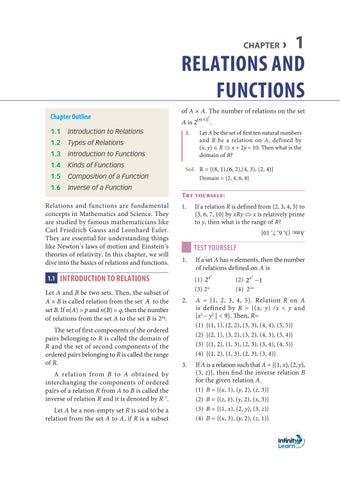
RELATIONS AND FUNCTIONS
of A × A. The number of relations on the set
A is (() )2 2 nA .
1. Let A be the set of first ten natural numbers and R be a relation on A , defined by (x,y) ∈ R ⇒ x + 2y = 10. Then what is the domain of R?
Sol: R = {(8, 1),(6, 2),(4, 3), (2, 4)}
Domain = {2, 4, 6, 8}
Try yourself:
1. If a relation R is defined from {2, 3, 4, 5} to {3, 6, 7, 10} by xRy ⇔ x is relatively prime to y, then what is the range of R?
Ans: {3, 6, 7, 10}
TEST YOURSELF
1. If a set A has n elements, then the number of relations defined on A is
(1) 2 2n (2) 2 21 n (3) 2n (4) 22n
2. A = {1, 2, 3, 4, 5}. Relation R on A is defined by R = {( x,y ) / x < y and |x2 – y2 | < 9}. Then, R=
(1) {(1, 1), (2, 2), (3, 3), (4, 4), (5, 5)}
(2) {(2, 1), (3, 2), (3, 2), (4, 3), (5, 4)}
(3) {(1, 2), (1, 3), (2, 3), (3, 4), (4, 5)}
(4) {(1, 2), (1, 3), (2, 3), (3, 4)}
3. If A is a relation such that A = {(1, x), (2, y), (3, z )}, then find the inverse relation B for the given relation A
(1) B = {(x, 1), (y, 2), (z, 3)}
(2) B = {(z, 1), (y, 2), (x, 3)}
(3) B = {(1, x), (2, y), (3, z)}
(4) B = {(x, 3), (y, 2), (z, 1)}
4. If R = {( x,y )/ x,y ∈ Z , x 2 + y 2 ≤ 4} is a relation in Z, then the domain of R is (1) {0, 1, 2} (2) {0, –1, –2} (3) {–2, –1, 0, 1, 2} (4) {0, 1, 2, 3}
Answer Key (1) 1 (2) 4 (3) 1 (4) 3
1.2 TYPES OF RELATIONS
Relations in Mathematics can be categorised into various types: equivalence, symmetric, and transitivity. Partial orders denote a relationship with reflexivity, antisymmetry, and transitivity.
1.2.1
Void, Universal, and Identity Relations
Let A be any non-empty set. We know that ,AA φ ⊆× and so, it is a relation on the set A. This relation is called void or empty relation.
Let A be any non-empty set. We know that AAAA ×⊆× , and so, it is a relation on the set A. This relation is called universal relation.
Let A be any non-empty set. A relation () {} ,; A IaaaA =∈ defined on the set A is called identity relation.
2. Let A = {1, 2, 3, 4, 5, 6} and R be a relation defined on the set A as () {} ,:0Rabab=−≥
Check whether the relation R is universal or not.
Sol: Given: 0 aRbab⇒−≥ for all , abA ∈
Observe that each element of the set A is related to every element of A. It means, R=A×A
Therefore, the relation R is a universal relation.
Try yourself:
2. Check whether the relation R = {(1,1), (2, 2), (3, 3), (1, 2)}on the set A = {1, 2, 3} is identity or not.
Ans: No
1.2.2 Reflexive Relations
A relation R on the set A is said to be reflexive, if every element of A is related to itself, i.e., for all a ∈ A, if (a,a) ∈ R, then the relation R is reflexive.
Thus, R is reflexive on the set A⇔(a,a) ∈ R for all a ∈ A
Important points to remember about reflexive relation:
1. Every identity relation is reflexive, but every reflexive relation need not be an identity relation.
2. The minimum number of elements in the reflexive relation R on the set A is n(A).
3. Universal relation on any non-empty set is a reflexive relation.
4. If R is a reflexive relation and S is any relation, then R ∪ Sis a reflexive relation.
5. Number of reflexive relations defined on set A is 2n(n–1)
3. Let A = {–4, –3, –2, 0, 3, 4} and a relation R is defined on the set A as R = {(x, y): x, y ∈ A, y = |x|}. How many ordered pairs need to be added to R to make it reflexive on the set A?
Sol: Given: R = {(x, y): x, y ∈ A, y = |x|}
The roster form of the relation R is R = {(–4, 4), (–3,3), (–2,2), (0,0), (3,3),(4,4)}
To make the above relation reflexive, add the ordered pairs (–4, –4), (–3, –3), (–2, –2)
Hence, the new relation is ()()()()() ()()()() 4,4,4,4,3,3,3,3,2,2, 2,2,0,0,3,3,4,4
This is reflexive relation.
Try yourself:
3. Check whether the relation R = {(1, 1), (2, 2), (1, 4), (4, 1), (3, 2)} defined on the set A = {1, 2, 3} is reflexive or not.
Ans: No
1.2.3 Symmetric Relations
A relation R on the set A is said to be symmetric, if (a,b) ∈ R implies(b,a) ∈ R, for all a,b ∈ A
Every identity relation is symmetric, but every symmetric relation need not be an identity relation. The minimum number of elements in the symmetric relation R on the set A is 0. Universal relation on any non-empty set is a symmetric relation.
Important points to remember about symmetric relations:
1. A reflexive relation need not be a symmetric relation.
2. A void relation is a symmetric relation.
3. A relation R is symmetric if and only if R = R–1
4. If R and S are any two symmetric relations then RS ∪ and RS ∩ are also symmetric relations.
5. Number of symmetric relations defined on the set A is () 1 2 2 nn + .
6. Number of non-symmetric relations defined on the set A, having n elements, is () 2 1 2 22 nn n +
7. Number of symmetric and reflexive relations defined on the set A is
2 2
8. The number of symmetric relations that are not reflexive is ()() 2 1 2 22 nn nn + .
4. Let A be the set of all straight lines in a plane and a relation R is defined on the set A as () {} ,:,,is parallel to RxyxyAxy =∈
Check whether the relation R is symmetric or not.
Sol: The given relation is () {} ,:,,is parallel to RxyxyAxy =∈
If x is a parallel line to y, then y is also parallel to x, so that () , xyR ∈ implies () , yxR ∈ Hence,
()() ,, xyRyxR ∈⇒∈ for all , xyA ∈ .
∴ the relation R is a symmetric relation on the set A
Try yourself:
4. Check whether the relation ()()()() {} 1,3,2,3,3,1,3,2 R = defined on the set {} 1,2,3 A = is symmetric or not.
Ans: Yes
1.2.4 Transitive Relation
A relation R on the set A is said to be transitive, if ()()() ,, and ,, abbcRacR ∈⇒∈ or ()() ,,, abRbcR ∈∉ .
Important points to remember about transitive relations:
1. Every identity relation is transitive, but every transitive relation need not be an identity relation.
2. Universal relation on any non-empty set is a transitive relation.
3. If R and S are any two transitive relations, then RS ∪ is need not be a transitive relation.
5. Let A be the set of all triangles in a plane and a relation R is defined on the set A as () {} ,:,,is similar to RxyxyAxy =∈ . Check whether the relation R is transitive or not.
Sol: The given relation is () {} ,:,,is similar to RxyxyAxy =∈
If x is a similar triangle to y and y is similar to z , then, x is similar triangle to z
Hence, ()()() ,,,, xyRyzRxzR ∈∈⇒∈ for all , xyA ∈
⸫The relation R is a transitive relation on the set A.
Try yourself:
5. Check whether the relation R = {(1,1), (2, 2), (3, 3), (1, 3), (3, 1), (3, 2)} defined on the set {} 1,2,3 A = is transitive or not.
Ans: No
1.2.5 Equivalence Relation
A relation R on the set A is said to be equivalence relation, if it is reflexive, symmetric, and transitive on the set A.
The identity relation and universal relation on any non-empty set are equivalence relations.
Important points to remember about equivalence relations
1. If R is an equivalence relation, then its inverse is also equivalence relation.
2. Intersection of two equivalence relations is an equivalence relation
3. Union of two equivalence relations need not be an equivalence relation.
4. Identity relation defined on a non-empty set is equivalence relation.
5. Universal relation defined on a non-empty set is an equivalence relation.
6. Equivalence class: suppose that an equivalence relation R is defined on a non-empty set A . The equivalence class of an element a ∈ A is denoted by [a] and
is defined as { b ∈ A : aRb}. Equivalence classes partition the set A into disjoint subsets, and each element of A belongs to exactly one equivalence class.
7. Number of equivalence relations defined on a finite set: The number of equivalence relations is equal to the number of partitions and is giv en by ()()() ,1,11,. SnkSnkkSnk =−−+−
Here, n is the number of elements in a set and k is the number of elements in a subset of partition, with initial condition ()(),1,1SnSnn==
To find the number of equivalence relations, use the Bell’s triangle.
(A)
For example, if n(A) = 5, then the number of equivalence relations defined on the set A is 52.
6. For any two real numbers x and y , we define xRy ⇔ 22 sincos1. xy+= Check whether the relation R is equivalence or not.
Sol: Given: xRy ⇔ 22 sincos1 xy+= Since 22 sincos1 xx+= for any real values of x, xRx. Hence, the relation R is reflexive. Suppose that ( x,y ) Є R. Hence,
It implies that, yRx . So, xRyyRx ⇒
Hence, the relation is symmetric.
Suppose that , xRyyRz
Hence, sin2 x + cos2 y = 1 and sin2 x + cos2
z = 1
Adding the above two equations, we g et 22 sincos1 xz+= .
So, , xRyyRzxRz ⇒ . Hence, the relation is transitive.
Therefore, the relation is equivalence relation.
Try yourself:
6. Find the number of equivalence relations defined on the set {} ,,, pqrs .
Ans: 15
1.2.6 Anti-symmetric Relation
A relation R on the set A is said to be antisymmetric, if () , abR ∈ and () , baR ∈ implies a = b.
If () , abR ∈ but () , baR ∉ , then the relation is anti-symmetric relation
Identity relation on a non-empty set is anti-symmetric relation.
Universal relation defined on a set having at least two elements is not anti-symmetric relation.
A relation that is not symmetric need not be an anti-symmetric relation.
7. If A is a non-empty set, check if the relation ⊆ on the power set of A is anti-symmetric or not.
Sol: Given: A is a non-empty set. Let R be a relation defined as ⊆ on the power set of set A
Suppose that (X, Y), (Y, X) ∈ R; it implies X ⊆ Y and Y ⊆ X. Hence, X = Y.
It means ()() ,,, XYYXR ∈ implies XY = for all () , XYPA ∈
Therefore, the relation R is anti-symmetric relation.
Try yourself:
7. Is () {} ,: Rababab =+=+ on a set {} 0,1,2 anti symmetric or not?
Ans: No
1.2.7 Partial Order Relation
A relation R on the set A is said to be partial ordered relation on the set A if it is reflexive, anti-symmetric, and transitive.
8. For , xyI ∈ , the relation R is defined by xRyxy ⇔≤ . Show that R is partial ordered relation.
Sol: Given: R is a relation defined on the set of integers such that xRyxy ⇔≤ Observing the relation, it is reflexive and transitive.
Suppose that () , xyR ∈ and () , yxR ∈ . It implies that xy ≤ and yx ≤
So, xy =
Hence, the relation is anti-symmetric relation. Therefore, the relation R is partial ordered relation.
Try yourself:
8. Check whether the relation ⊆ on the power set of a non-empty set A is partial order relation or not.
Ans: Yes
TEST YOURSELF
1. If P = {(x,y)/ x ∈ R, y ∈ R, x2 + y2 = 1}, then P is (1) reflexive (2) symmetric (3) anti-symmetric (4) equivalence relation
2. Let L denote the set of all straight lines in a plane. Let a relation R be defined on L by xRy ⇔ x is parallel to y. Then, R is (1) only symmetric (2) only transitive (3) anti symmetric (4) equivalence relation
3. On the set of integers Z , relation R is defined as mRn ⇔ ‘ m’ is an integral multiple of ‘n’. then, R is (1) reflexive, symmetric (2) reflexive, transitive (3) symmetric, transitive (4) equivalence relation
4. If A = {a,b,c,d}, then a relation R = {(a,b), (b,a), (a,a)} on A is (1) symmetric and transitive only (2) reflexive and transitive only (3) symmetric only (4) transitive only
5. The relation R = {(1, 1), (2, 2), (3, 3)} on the set {1, 2, 3} is (1) symmetric only (2) reflexive only (3) transitive only (4) an equivalence relation
6. Which of the following is not an equivalence relation on set of integers ?
(1) aRb if a + b is an even integer (2) aRb if a – b is an even integer (3) aRb if a < b (4) aRb if a = b
7. The number of equivalance relations defined on set A = {a,b,c,d,e}
8. The number of relations on the set A = {1, 2, 3, 4} that are reflexive and symmetric but not transitive is ___.
9. Let A = {1, 2, 3, 4, 5}. The number of reflexive relations on A is 2 λ . Then, λ equals ____.
Answer Key
(1) 2 (2) 4 (3) 2 (4) 3
(5) 4 (6) 3 (7) 52 (8) 49
(9) 20
1.3 INTRODUCTION TO FUNCTIONS
A relation f from a set A to the set B is said to be function or mapping, if every element of set A is associated with unique element in set B and it is denoted by f:A → B.
The relation () {} ,:, RabaAbB =∈∈ is said to be a function if and only if there exists bB ∈ such that () , abR ∈ for all aA ∈ , and if ()() ,,, abacR ∈ , then bc =
Let f:A → B be a function. Then, A is called domain and B is called the codomain of the function f.
The range of a function ()fx , denoted by ()fA , is a subset of B.
1.3.1 Real Function, Domain, and Range of Some Special Functions
Let : fAB → be a function and, if AR ⊆ , BR ⊆ , then the function ()fx is called a real function.
Domain and Range of Some Functions
The following table shows the domain and range of some standard functions.
S. No.
1. loga x (a ≠1; a > 0) R+ = (0, ∞) R = (– ∞, ∞)
2. ax (a > 0) RR+ = (0, ∞)
3. [x] R Z
4. {x} = x – [x] R [0, 1)
5. |x| R [0, ∞)
6. xR+ ∪{0} [0, ∞)
7. sin xR [–1, 1]
8. cos xR [–1, 1]
9. tan x (21), 2 RnZ π π
10. cot xR – {nπ/ n∈Z} R
11. sec x (21), 2 RnZ π
(–∞, –1]∪ [1, ∞)
12. cosec xR – {nπ/ n∈Z} (–∞, –1]∪ [1, ∞)
9. For xR ∈ , if () 10 3 log fxx x = , then what is the domain of ()fx ?
Sol: Given: () 10 3 log fxx x =
Clearly, f (x) is defined, if 10 3 log0 x x ≥
and 3 0 x x > Hence, 3 1 x x > and 3 0 x x < . So, 3 0 2 x <≤
Therefore, the domain of the function () 10 3 log fxx x = is 3 0, 2 x ∈
Try yourself:
9. If f : [2, ∞) → R is defined by f (x) = x2 – 4x+ 5 () 2 45fxxx=−+ , then find the range of f (x).
Ans: [1,) ∞
1.3.2 Even and Odd Functions
A function : fAR → is said to be even function, if ()() fxfx −= xA∀∈
1. The graph of an even function is symmetric about y-axis. y
2. If ( x , y ) is a point on the graph of even function, then (– x , y ) is also a point on the graph.
3. Every constant function is an even function.
A function : fAR → is said to be odd function, if ()() fxfx −=− xA∀∈ .
1. The graph of an odd function is symmetric about the origin, and it is symmetrical in opposite quadrants. y
()()() () 1 2 gxfxfx =+− is an even function and ()()() () 1 2 hxfxfx =−− is an odd function.
10. If f (x)and g(x) are two functions, with all real numbers as their domains, then show that
h(x) = { f(x) + f(–x)} { g(x) – g(–x)} is an odd function.
Sol: Given:
h(x) = { f(x) + f(–x)} { g(x) – g(–x)}
Consider, ()()(){}()() {} {()()}()() {} () hxfxfxgxgx fxfxgxgx hx −=−+−− =−+−−− =−
Therefore, the function h(x) is odd function.
Try yourself:
10. The function () 1 2 1 x fxxx e =++ on R – {0} is ______ function.
Ans: vene
TEST YOURSELF
1. Let f: R → R defined by 2 2,if1 if11 2,if1 (), xx fxx xx x
2. If ( x , y ) is a point on the graph of odd function, then (–x, –y) is also a point on the graph.
3. Even power of even function or odd function is always an even function.
4. Every function can be uniquely expressed as a sum of even and odd functions, i.e., f (x) = g (x) + h(x), where
Then, th e value of f ( –1.75) + f (0.5) + f(1.5) is (1) f (0) (2) f (2) (3) f (1) (4) f (3)
2. If g = {(1, 1), (2, 3), (3, 5), (4, 7)} is described by the formula g(x) = αx + β, then (α, β) = (1) (2, 1) (2) (–2, 1) (3) (–2, –1) (4) (2, –1)
3. 32 21 : 43 x xRR xxx ∈∈= ++
(1) R – {0}
(2) R – {0, 1, 3}
(3) 1 0,1,3, 2 R
(4) R – {0, –1, –3}
4. If f ( x ) is an even function and g ( x ) is an odd function, then f(x) ⋅ g(x) is____ function.
(1) even (2) odd (3) neither even nor odd (4) either even or odd
5. If f : R → R is given by () x x fxa aa = +
∀ x ∈ R, then 1
(1) 997 (2) 998
(3) 1997 (4) 1998
6. If f ( x ) = ax 5 + bx 3 + cx + d is an odd function, then d = (1) 0
(2) 1
(3) –1
(4) Any real number
7. Let () 22 sincos 22 fxxx =+ and
g(x) = sec2x – tan2x. The two functions are equal over the set
(1) φ
(2) R
(3) ()21, 2 RxxnnZ π
(4) R – {0}
8. If the domain of ()() 3 2log1fxx=−− is (k, 10], then k is ___.
9. The number of solutions of the equation |x| = cosx is ___.
Answer Key
(1) 3 (2) 4 (3) 4 (4) 2 (5) 2 (6) 1 (7) 3 (8) 1 (9) 2
1.4 KINDS OF FUNCTIONS
Functions can be categorised based on their mappings. One-to-one functions assign each domain element to a unique codomain element, avoiding duplication. Many-to-one functions map multiple domain elements to one codomain element. Onto functions cover the entire codomain, ensuring every element has a pre-image. Into functions leave some elements in the codomain unmapped. Bijections combine injectivity and subjectivity, establishing a one-to-one correspondence between domain and codomain.
1.4.1 One-to-One Function
A function : fAB → is said to be a one-to-one function or an injection, if different elements of A have different images in B . Thus, : fAB → is one-to-one, ()() abfafb ≠⇒≠ for all , abA ∈ . If : fAB → is one-to-one function, then ()() fafbab =⇔= for all , abA ∈ . Suppose that a function is given in the form of ordered pairs. If two ordered pairs do not have same second element, then the function is one-to-one function.
If a fun ction ()fx is s trictly increasing or strictly decreasing in its domain, then the function is one-to-one function.
Let : fAB → be a function, such that () 0 fx′> or () 0 fx′< for all xA ∈ . Then, the function is one-to-one function.
If the continuous graph of a function ()yfx = intersects every horizontal line (parallel to the x axis) at most once, then the function is one-to-one. This property ensures that each input value corresponds to a unique output value, making it a one-to-one function. This is called horizontal line test
i. Suppose that ()() fxfy = Using algebraic properties, show that x=y.
If ()() fxfyxy =⇒= , then the function is one-to-one, if not, it is not one-to-one. (or)
ii. Prove that function is a strictly increasing or decreasing function. (or)
iii. Use the horizontal test to check if the given function is one-to-one function or not.
Number of one-to-one functions:
If () ,nAm=()nBn = , then the number of one to one functions defined from the set A to the set B is ,nP m when mn ≤ , If mn > then the number of one-to-one functions from A to B is zero.
11. Check if the function : fNN → , defined by () 2 1 faaa=++ , is one-to-one or not.
Sol: Given: () 2 1 faaa=++
Let , abN ∈ , such that ()() fafb = It implies that ()() () () 22 22 11 0 10 0 aabb abab abab ab ++=++ −+−= −++= −=
Hence, ()() fafbab =⇒= Therefore, f(x)is one-to-one function.
Try yourself:
11. If A and B are two sets such that n(A) = 15, and n(B) = 20, then what is the number of injections from the set A to the set B?
To check whether the given function is oneto-one or not, follow the following steps, given below:
Ans: 20 15P
1.4.2 Many-to-One Function
A function : fAB → is said to be a many-toone function if two or more elements of set A have the same image in B
Thus, : fAB → is a many-to-one function, if there exists two distinct elements , xyA ∈ , such that ()() fxfy = . If the function : fAB → is not one-to-one, then it is manyto-one function.
12. Let () 4 nA = and () 5 nB = . Find the number of all possible many-to-one functions from A to B
Sol: Let () 4 nA = and () 5 nB = Number of all possible many-to-one functions from A to B. ()()()() nAnB nAnBP=− 45 4 5 P =− = 505
Try yourself:
12. Is the function 11 :, 22 fR → defined as () 2 1 fxx x = + , injective?
Ans: No
1.4.3 Onto Function or Surjection
1. Every constant function whose domain has more than one element is many-toone function.
2. All even functions, and all polynomial functions of even degree are many-to-one functions.
3. Polynomial functions of odd degree are either many-to-one or one-to-one functions.
4. If a function is given in the form of a set of ordered pairs and the second element of at least two ordered pairs are same, then the function is many-to-one.
5. If the graph of y = f ( x ) is given and the line parallel to x –axis cuts the curve at more than one point, then the function is many-to-one.
6. All periodic functions are many-to-one functions.
A function f : A → B is onto if each element of B has at least one pre-image in A . If there exists a ∈ A for every b ∈ B, such that f(a) = b, then the function is onto.
f
If the range of ()fx is same as the co-domain of ()fx , then the function is onto.
If there is any element in B which has no pre-image in A , then the function ()fx is not onto, it is called into function
A function f : A → B is bijective function, if it is one-to-one, i.e., ()() fxfyxy =⇒= for all , xyA ∈ , and it is onto, i.e., for all yB ∈ , there exists xA ∈ such that () fxy =
Number of onto functions:
■ If n(A) = m, n(B) = n, and ()() 1 nBnA≤≤ , then the number of onto functions from A to B is ()() 12 12...mmm CC nnnnn−−+−−
■ If ()() nAnB < , then the number of onto functions is zero.
■ If () nAm = and () 2 nB = , then the number of onto functions from A to B is 22 m .
■ If n(A) = m, n(B) = n, and 1 nm≤< , then the number of into functions from A to B is ()()() 123 123... mmm CCC nnnnnn −−−+−
13. Is ) :0,fR →∞ defined by () 2 fxx = onto?
Sol: Yes, the function is onto because for every positive real number y , there exists a real number x such that () fxy = , where 2 yx =
Try yourself:
13. If () 4 nA = and () 3 nB = , then find the number of onto functions from the set A to the set B
Ans: 36
1.4.4 Bijection
A function f : A → B is a bijection if it is oneto-one as well as onto.
x1 y1
x2 y2
x3 y3 AB f
If A and B are two finite sets and f : A → B is bijective function, then n(A) = n (B). The number of bijective functions from A to B is n(A)!
14. Is the function, f:R → R defined as () 3 51fxxx=++ , bijective?
Sol: Given: () 3 51fxxx=++
Now, () '2350, fxxxR =+>∀∈
()fx is strictly increasing function. It is one-to-one.
Clearly, ()fx is continuous function and also in creasing on R.
() x Limfx →−∞ =−∞ and () x Limfx →∞ =∞
So, ()fx takes every value between −∞ and ∞
()fx is onto function.
∴ f is bijection
Try yourself:
14. Is the function, : fRR → , defined as () 3 fxx = , bijective?
Ans: Yes
TEST YOURSELF
1. The number of one one functions that can be defined from A = {1, 2, 3, 4, 5} into B = {a,b,c,d} is (1) 120 (2) 24
(3) 20 (4) 0
2. If f : R → R defined by () 25,if0 , 32,if0 xx fx xx +> =−≤ then f is (1) a function (2) one one
(3) Onto (4) One one onto
3. If f : R → R is defined by f(x) = x + 2 x , then f is
(1) An injection (2) Onto (3) A bijection (4) Only function
4. Set A has 3 elements. Set B has 4 elements. The number of surjections that can be defined from A to B is (1) 144 (2) 12 (3) 0 (4) 64
5. A = {x: –1 ≤ x ≤ 1}. f : A → A defined by f(x) = x|x|. Then f is (1) A bijection
(2) An injection but not surjection (3) A surjection but not an injection
(4) neither an injection nor a surjection
6. If f ( x ) = | x – 1| + | x – 2| + | x – 3|, f : (2, 3) → R, then f is
(1) An onto function but not 1–1
(2) 1–1 function but not onto (3) bijection
(4) Neither 1–1 nor onto
7. If f : R → R defined by f(x) = x for x ≥ 2 and f(x) = 5x – 2 for x < 2, then f is
(1) One – one (2) Onto only
(3) One – one onto (4) Neither one – one nor onto
8. Strictly monotonic function is (1) onto definitely (2) bijection
(3) one – one definitely
(4) neither one – one nor onto
9. Let R be the set of real numbers. If f : R → R is a function defined by f(x) = x2, then f is
(1) injective but not surjective
(2) surjective but not injective
(3) bijective
(4) neither injective nor surjective
10. The number of surjections that can be defined from {1, 2, 3, 4, 5} onto {a,b} is
11. Let n(A) = 4 and n(B) = k. The number of all possible injections from A to B is 120, then k =____.
Answer Key
(1) 4 (2) 2 (3) 4 (4) 3 (5) 1 (6) 2 (7) 2 (8) 3 (9) 4 (10) 30 (11) 5
1.5 COMPOSITION OF A FUNCTION
If : fAB → and : gBC → are two functions, then the composite function of f and g is : gfAC → , will be defined as () ()()()gfxgfx = for all xA ∈ .
The function () ()gfx is simply the g– image of f ( x ) , where ()fx is f image of element xA ∈ . The function gf will exist only when the range of f is the subset of domain of g. The function fg does not
exist if the range of g is not a subset of domain of f x
BC f(x) g(f(x)) gof
Important points to remember about composition of function:
1. The functions fg and gf may not be always defined.
2. If both ()fx and ()gx are onto functions, then gf is onto, if exists.
3. If gf is one-to-one function, then ()fx is one-to-one function.
4. If gf is onto function, then ()gx is onto function.
5. If : fAB → is any function, then . AB fIIff ==
6. If f and g are even functions, then fg is also an even function.
7. If f is even and g is an odd function, then f ° g is an even function.
8. If f is odd and g is even function, then f ° g is even function.
9. If f and g are odd functions, then f ° g is odd function.
10. Composition of two functions is not commutative. It means that f ° g ≠ g ° f
11. Associative property holds good in composition of functions. ( f ° g ) ° h = f ° ( g ° h)
15. If () 1 1 fxx x = + , then find ()ffx .
Sol: Given, () 1 1 fxx x = + ()()()ffxffx = (() ) 1 1 ffxfx x = + 1 1 1 1 1 1 1 1 x fxx xx x
= + + + () ffxx =
Try yourself:
15. For () 23fxx=+ and () 2 1 gxx=−+ , then find () ()fgx . Ans: 2 25 x −+
TEST YOURSELF
1. If () 2 1 fxx x = , then () ()fffx = (1) 2 3 13 x x (2) 2 2 14 x x (3) 2 13 x x (4) 2
2. The domain of () 3 2 5 log 5 1024 fxxx xx =−+ −+ is (1) (4, 5) (2) (6, ∞ ) (3) (4, 5) ∪ (6, ∞ ) (4) (4, 5] ∪ (6, ∞ )
3. The domain of 2 4 log 1 x x + is
(1) (–2, 2) (2) (–1, ∞ )
(3) [–1, 2 ] (4) (–1, 2 )
4. If f(x) = logx and g(x) = x3 then f(g(a)) + f(g(b)) is
(1) f(g(a) + g(ab)) (2) f(g(ab)) (3) g(f(ab)) (4) g(f(a) + f(b))
5. If f (x ) = | x – 2| and g (x ) = f (f (x )), then for x > 20, g(x) = (1) –x (2) x (3) x – 4 (4) 4 – x
6. The domain of function log10 log10 log10 log10 log10x is (1) (104, ∞ )
(2) (1010, ∞ ) (3) () 1010 10, ∞ (4) (10100, ∞ )
7. If f : [–6, 6] → R is defined by f(x) = x2 – 3, then ( f°f°f)(–1) + ( f°f°f)(0) + ( f°f°f)(1) = k, w here k = ___.
8. If f(x) = sin2x + 2 sincoscos 33 xxx ππ +++ and 5 1, 4 g = then () ()gfx = ____.
9. For x ∈ R – {0, –1, –2}, let f 1( x ) = 1 x , f 2( x ) = 1 + x and 3 1 () 1 fx x = + be three func tions. If a function j ( x ) satisfied j(x) = (f1 ° f2 ° f3)(x), then by j(1) =___.
Answer Key
(1) 3 (2) 3 (3) 4 (4) 2 (5) 3 (6) 3 (7) 29 (8) 1 (9) 0.66
1.6 INVERSE OF A FUNCTION
Let : fAB → be a function defined by ()yfx = such that ()fx is both one-toone and onto. Then, there exists a unique function : gBA → such that () () , gfxIA = and () () fgxIB = . The function ()gx is called the inverse of ()fx and it is denoted by 1 gf =
1. The condition for the function f(x) to be invertible is that f(x) must be both oneto-one and onto.
2. If f ( a ) = b , then g ( b ) = a and vice versa when g = f–1
3. If g = f–1, then the range of f(x) is domain of g(x) and the domain of f(x) is the range of g(x).
4. The graph of y = f ( x ) and y = f–1( x ) are symmetric about y = x.
5. If the graphs of y = f ( x ) and y = f– 1 ( x ) intersect, then they intersect on the line y = x, where f(x) = f–1(x) = x
6. Working rule to find the inverse of a function:
i. Check whether the function f ( x ) is invertible or not, i.e., check whether f(x) is bijective.
ii. Let f : A → B be a bijection, put f ( x ) = y . Solve the equation y = f ( x ) to obtain x in terms of y. Interchange x and y to obtain the inverse of f(x)
7. If f : A → B and g : B → C are two bijections, then g ° f : A → C is a bijection and (g ° f )–1 : f–1 ° g –1
8. If fggf = then either 1 fg = or
1 gf = . In this case, ()() fgxgfxx == .
16. If the function :[1,)[1,) f ∞→∞ is defined by ()() 1 2 fxxx = , then find () 1 fx .
Sol: Given: ()() 1 2 fxxx =
Suppose that () 1 2 xx y = Apply logarithm on both sides
() 2 1log xxy −=
It implies that 2 2 log0xxy−−=
Therefore, 2 114log 2 y x ++ =
Try yourself:
16. Find the inverse of ()() 1 5 6 fxx =−
Ans: 5 6 x
TEST YOURSELF
1. Domain of tan–13x is
(1) (– ∞ , 0) (2) , 22 ππ
(3) (– ∞ , ∞ ) (4) R+
2. If f : [1, ∞) → [2, ∞) is given by f(x) = x + 1 x , then f–1(x) =
(1) 2 4 2 xx+−
(2) 2 1 x x +
(3) 2 4 2 xx
(4) 2 34 2 xx
3. If f : R → R is defined by f(x) = x – [ x], then the inverse function f–1(x) =
(1) 1 xx
(2) [x] – x
(3) x + [x]
(4) not defined
4. Let f(x) = sinx + cosx, g(x) = x2 – 1. Then g(f(x)) is invertible for x ∈
(1) ,0 2 π
(2) , 2 π π
(3) , 44 ππ
(4) 0, 2 π
5. Let f : [–1, ∞) → R be given by f(x) = (x + 1)2 – 1, x > –1, then f–1(x)
(1) 11 x −++
(2) 11 x −−+
(3) does not exists because f is not 1 – 1
(4) does not exists because f is not onto
Answer Key
(1) 3 (2) 1 (3) 4 (4) 3
(5) 4
CHAPTER REVIEW
Introduction to Relations
1. R is said to be a relation on the set A if ⊆× RAA
2. Let A and B be two non-empty sets consisting of m,n elements respectively, then the number of relations defined from the set A to the set B is 2mn
3. The number of relations defined on the set A having n elements is 2 2n
4. Let R be any relation, its inverse relation denoted as R – 1 . Domain of R equal to Range of R–1. The domain of R–1 is equal to the range of R
Types of Relation
5. Let A be the set, the set φ is subset of × AA is called void relation on the set A . This is also called empty relation. The relation × AA is called universal relation defined on the set A . The relation () {}=∈ ,: A IaaaA defined on the set A is called identity relation and it is denoted by IA
6. Let A be non-empty set and R is a relation defined on the set A
• For every ∈ aA , if () ∈ , aaR then the relation R is called reflexive relation.
• If ()()∈⇒∈,, abRbaR for every ∈ , abA then the relation R is called symmetric relation
• If ()()∈∈,,and , abRbaR implies that = ab then the relation R is antisymmetric relation.
• If (a,c) ∈ R, (b,c) ∈ R then (a,c) ∈ R, the relation R is called transitive relation.
7. If the relation is reflexive, symmetric and transitive relation then that relation is called equivalence relation.
8. A relation is an ordered relation if it is transitive but not equivalence.
9. Let ()= nAn then the number of
• Relations defined on the set A is 2 2n
• Reflexive relations defined on the set A is 2 2nn
• Symmetric relations defined on the set A is + 2 2 2 nn
• Reflexive and symmetric relations on the set A is 2 2 2 nn
• Use the bells triangle to find the number of equivalence relations.
• The number of equivalence relations on a set A containing n elements is {()()} ∑−−+−− 12 1 1 12... ! n nrnn r r rCrCr r
Introduction to functions
10. The number of functions defined from the set A to the set B is ()() nA nB
11. Number of functions defined on the set A consisting of n elements is n n
12. Number of constant functions defined on the set A is ()nA
13. Number of identity functions defined on the set A is 1
Kinds of functions
14. One to one function
• A function → : fAB is said to e one to one function if ()()=⇒= fxfyxy for all ∈ , xyA
• The number of one to one functions from the set A to the set B is () () nB nAP
• If ()() < nAnB the number of one to one functions defined from the set A to the set B is zero.
• The number of one to one functions defined on the set A is () ! nA
• Any function, which is entirely increasing or decreasing in its whole domain is a one-to-one function.
• If any horizontal line cuts the graph of the function not more than one point, then that function is one to one function.
15. Onto function
• A function → : fAB is said to be onto if for every ∈ yB , there exists at least one element ∈ xA such that ()= fxy
• Let ()()== , nAmnBn and ()()≤≤ 1 nBnA then the number of onto functions from A to B is ()() −−+−− 1212...mnmm n nCnCn
• If ()= 2 nB , then the number of onto functions from the set A to the set B is () 22 nA
• If ()() > nBnA then the number of onto functions from the set A to the set B is zero.
16. Bijective function
• A function is said to be bijective, if it is both one to one and onto
• The number of bijective functions defined from the set A to the set B is () ! nA where ()() = nAnB
• If ()() ≠ nAnB then the number of bijective functions from the set A to the set B is zero.
Composition of functions
17. If → : fAB and → : gBC are two functions, then the composition of functions is defined → : gfAC as ()() =() gfxgfx , This exist only when the range of ()fx is subset of the domain of ()gx
18. If ()() , fxgx are odd functions then only fg is odd function, in all other cases the function fg is even function.
19. Composition of functions is not commutative but associative
Inverse of a function
20. If → : fAB and → : gBC are two bijective functions then → : gfAC is bijective function, and () 1 11 : gffg
21. If = fggf then one function is inverse of the other, in this case ()()== fgxgfxx
Exercises
JEE MAIN LEVEL
Level – I
Introduction to Relations
Single Option Correct MCQs
1. Let A be a set of the first ten natural numbers and R be a relation on A, defined by (x,y) ∈ R ⇒ x + 2y = 10. Then, range of R is
(1) {1, 2, 3,....., 10}
(2) {2, 4, 6, 8}
(3) {1, 2, 3, 4} (4) {2, 4, 6, 8, 10}
2. If A = {1, 2, 3}, B = {1, 4, 6, 9}, and R is a relation from A to B defined by ‘x is greater than y’. The range of R is
(1) {1, 4, 6, 9} (2) {4, 6, 9}
(3) {1} (4) None of these
Numerical Value Questions
3. Let A and B be two sets containing 2 and 4 elements, respectively. The number of subsets of A × B having 3 or more elements is ___.
Types of Relations
Single Option Correct MCQs
4. In the set Z of all integers, which of the following relations R is not an equivalence relation?
(1) xRy : if x ≤ y
(2) xRy : if x = y
(3) xRy : if x – y is an even integer
(4) xRy : if x = y (mod 3)
5. Let R be a relation defined in the set of real numbers by aRb ⇔ 1 + ab > 0. Then R is (1) equivalence relation
(2) transitive
(3) symmetric
(4) anti-symmetric
6. Let N denote the set of all natural numbers and R be the relation on N × N defined by (a,b) R(c,d) if ad (b + c) = bc (a + d), then R is
(1) symmetric only
(2) reflexive only
(3) transitive only
(4) equivalence relation
7. Let L denote the set of all straight lines in a plane. If a relation R is defined on L by XRY ⇔ X ⊥ Y; X,Y ∈ L, then R is (1) only reflexive
(2) only symmetric (3) only transitive
(4) equivalence relation
8. Consider the non-empty set consisting of children in a house, consider a relation R; xRy. If x is brother of y, then R is (1) symmetric but not transitive
(2) transitive but not symmetric or reflexive
(3) neither symmetric nor transitive
(4) both symmetric and transitive
9. For x,y ∈ R, a relation R is defined by xRy if and only if 2 xy−+ is an irrational number. Then, R is (1) an equivalence relation
(2) symmetric
(3) transitive
(4) reflexive but neither symmetric and transitive
10. Let W denote the words in the English dictionary. The relation R 's defined by R = {(x,y) ∈ W × W; the words x and y have at least one letter in common}. Then, R is (1) reflexive, symmetric, but not transitive
(2) reflexive, symmetric, and transitive
(3) reflexive, but neither symmetric nor transitive
(4) not reflexive, but symmetric, and transitive
11. If N is the set of natural numbers and R is a relation on N × N defined by ( a,b ) R(c,d) if and only if a + d = b + c, then R is (1) only reflexive
(2) only symmetric
(3) only transitive
(4) equivalence relation
12. R is a relation over a class of n × n real matrices A and B as “ARB if there exists a non-singular matrix P such that PAP–1 = B”. Then, which of the following is true?
(1) R is symmetric and transitive but not reflexive
(2) R is reflexive and symmetric but not transitive
(3) R is an equivalence relation
(4) R is reflexive and transitive but not symmetric
13. Let R be a relation in N defined by R = {(1 + x, 1 + x2) : x ≤ 5, x ∈ N}. Which of the following is false?
(1) R = {(2, 2), (3, 5), (4, 10), (5, 17), (6, 26)}
(2) Domain of R = {2, 3, 4, 5, 6}
(3) Range of R = {2, 5, 10, 17, 26}
(4) Range of R = {2, 3, 4, 5, 6}
14. Let ‘R’ be a relation defined on set of real numbers and aRb ⇔ a < b 3 . Then, the relation is
(1) reflexive (2) symmetric (3) transitive (4) not transitive
15. Let X be a non-empty set and P(X) be the set of all subsets of X . For A,B ∈ P ( X ), power set of X,ARB if A ∩ B ≠ ϕ, then the relation is
(1) only reflexive
(2) only symmetric
(3) only transitive
(4) equivalence relation
16. If R = {( P , Q )| P and Q are at the same distance from the origin} is a relation, then the equivalence class of (1, – 1) is the set
(1) () {} 22 ,|2Sxyxy=+=
(2) S = {(x,y)| x2 + y2 = 2}
(3) S = {(x,y)| x2 + y2 = 1}
(4) S = {(x,y)| x2 + y2 = 4}
17. Among the relations S = {( a,b ) : a,b ∈ R–{0}, 2 + a b > 0} and T = {(a,b): a,b ∈ R, a2 – b2 ∈ Z}, (1) S is transitive but T is not (2) both S and T are symmetric (3) neither S nor T is transitive (4) T is symmetric but S is not
18. Let 1111 ,,,,1,2,3,4,5 5432
. If the relation R is defined on A such that R = {(x,y)/ logy x ≥ 0}, then R is
(1) reflexive (2) symmetric
(3) transitive
(4) equivalence
19. If A = [–2, 2], then the relation R = {(x,y)∈
A × A/ 2222 1,1 9449 yyxx +≤+≤ } is
(1) reflexive and symmetric
(2) symmetric only
(3) symmetric and transitive
(4) equivalence relation
20. Let R = {(3, 3), (6, 6), (9, 9), (12, 12), (6, 12), (3, 9), (3, 12), (3, 6)} be relation on the set A = {3, 6, 9, 12}. Then, the relation is (1) reflexive and transitive
(2) reflexive and symmetric
(3) equivalence relation
(4) symmetric and transitive
21. Let N be the set of natural numbers and a relation R on N be defined by R = {(x,y) ∈ N × N: x3 – 3x2y – xy2 + 3y3 = 0}. Then, the relation R is (1) reflexive and symmetric, but not transitive
(2) reflexive but neither symmetric nor transitive
(3) symmetric but neither reflexive nor transitive
(4) an equivalence relation
Numerical Value Questions
22. If N is the number of anti-symmetric relations on a set A = {x|x is prime number ≤ 10}, then the number of divisors of N is______.
23. If the number of equivalence relations defined on set A = {a,e,i,o,u} is k then the sum of the digits in k is ___.
24. If R is a relation “less than” from A = {1, 2, 3, 4} to B = {1, 3, 5}, i.e., (a,b) ∈ R if a < b, then number of elements in R ° R–1 is (where R–1 is inverse relation of R) ___.
25. If A = {1, 2, 3}, the number of reflexive relations in A is k. Then, 4 k is ____.
26. The number of equivalence relations that can be defined on set A = {1, 2, 3, 4} is ____.
Introduction to Functions
Single Option Correct MCQs
27. The domain of 2 2 1 312xx xx +−− is (1) 1 ,1 2
(3) 1 ,1 2
(2) 1 ,1 2
(4) 1 ,1 2
28. The domain of () 2 43fxxx=−+ is
(1) (– ∞ , 3]
(2) [1, ∞ )
(3) (– ∞ , –3] ∪ [–1, ∞ )
(4) (– ∞ , –3] ∪ [–1, 1 ) ∪ [3, ∞ )
29. If f ( x ) + g ( x ) = e –x, where f ( x ) is an even function and g(x) is an odd function, then f(x) = (1) 2 x e (2) 2 xx ee + (3) 2 xx ee (4) 2 x e
30. If f(x) is an even polynomial function, then sin (f(x) – 3x) is (1) an even function (2) an odd function (3) neither even nor odd (4) a periodic function
31. If f(x + y, x – y) = xy, then the arithmetic mean of f(x, y) and f(y, x) is
(1) x (2) y (3) 0 (4) xy
32. If f(x) = ax7 + bx3 + cx – 5, a, b, c are real constants, and f(–7) = 7, then the range of f(7) + 17cosx is
(1) [–34, 0] (2) [0, 34]
(3) [–34, 34] (4) None of these
33. The range of x 2 + 4 y 2 + 9 z 2 –6 yz –3 xz – 2xy is
(1) φ (2) R
(3) [0, ∞ ) (4) (– ∞ , 0)
34. The range of () 2 4 sin1 1 x fx x
= + is
(1) R (2) [–1, 1]
(3) {0, 1} (4) {0}
35. If f(x) = cos[π2]x + cos[–π2]x, where [x] is the step function, then
(1) f(0) = 1 (2) 2 4 f π = (3) 1 2 f π =−
(4) f(π) = 1
Numerical Value Questions
36. Let f(x) be a polynomial of degree 4 with leading coefficient 1 satisfying f(1) = 10, f(2) = 20, f(3) = 30, where f(12) + f(–8) = 3968λ. Then the value of λ is ___.
37. If f(3x +2 ) + f(3x + 29) = 0 ∀ x ∈ R, then the period of f(x) = ___.
Kinds
of Functions
Single Option Correct MCQs
38. y = f(x) = 1 x x + , x ∈ R, y ∈ R is
(1) one – one
(2) onto but not one – one (3) one–one but not onto (4) neither one–one not onto
39. If f : R → (0, 1] defined by () 2 1 1 fx x = + , then f is
(1) Not one – one (2) Not onto (3) Not one – one but onto (4) One – one but not onto
40. If f : R → R defined by f ( x ) = x 2 – 2 x – 3, then f is
(1) A function (2) One one (3) Onto (4) One one onto
41. If f : R → R is defined by () 2 2 4 1 fxx x = + , then f(x) is
(1) one – one and not onto. (2) one – one and onto.
(3) not one – one but onto.
(4) neither one – one nor onto.
42. If A = { a 1, a 2, a 3,…, a 10} and B = { b 1, b 2, b3,…, b10}, then the number of bijections that can be defined from A to B is
(1) 1010 (2) 10! (3) 103 (4) 109
43. The function f : R → R defined by f(x) = x – [x], x ∈ R is
(1) one–one (2) onto (3) both one–one and onto (4) neither one–one nor onto
44. Let the function f : R → R be defined by f(x) = 2x + sinx for x ∈ R. Then, f is (1) one-to-one and onto (2) one-to-one but not onto (3) onto but not one-to-one (4) neither one-to-one nor onto
45. () 2 2 430 :, 818fRRfxxx xx ++ →= −+ is (1) one–one and onto (2) many–one and onto (3) one–one and into (4) many–one and into
Numerical Value Questions
46. If n ( A ) = 4, n ( B ) = 5, then number of functions from A to B such that the range contains exactly 3 elements is k, then the value of 60 k is __.
47. The number of constant functions that can be defined from {1, 2,…, 100} to {a,b,c,…z} is ____.
Composition of a Function
Single Option Correct MCQs
48. If f : R → R and g : R → R are defined by f(x) = x – [x] and g(x) = [x] for all x ∈ R, then f(g(x)) is (1) x (2) 0 (3) f(x) (4) g(x)
49. If g(x) = 1 + x and f(g(x)) = 3 + 2 x + x, then f(x)= _____.
(1) 1 + 2x2 (2) 2 + x2 (3) 1 + x (4) 2 + x
50. If g(x) = x2 + x – 1 and (g ° f)(x) = 4x2 – 10x + 5, then 5 4 f is equal to
(1) 1 2 (2) 1 2 (3) 3 2 (4) 3 2
51. If, for x ∈ [0, ∞), g[f(x)] = |sinx|, f[g(x)] = (sin x )2, then
(1) f(x) = sin2x, g(x) = x (2) f(x) = sinx, g(x) = |x|
(3) f(x) = sin2x, g(x) = sin x
(4) f and g cannot be determined
52. The domain of the function () 2 111 fxx =−−− is
(1) {x| x < 1} (2) {x| x > –1}
(3) [0, 1] (4) [–1, 1]
Numerical Value Questions
53. Let A = {1, 2, 3, 4}. The number of functions f : A → A, satisfying f(f(i)) = i, ∀ i ∈ A, is ___.
54. If () 2010165 ,0, 1652010 fxxx x + => and 2010 165 x ≠ then the least value of f(f(x)) + f(f( 4 x )) is______.
Inverse of a Function
Single Option Correct MCQs
55. The domain of () 1 3 sin 42sin fx x =
+ is (1) 5 , 63 ππ
(3) , 6 π π
(2) 7 , 66
(4) , 22
56. The domain of () 1 31 sincossin 2 x x + is
(1) [–1, 1] (2) 1 ,0 3
(3) (0, 1] (4) 1 ,1 3
Numerical Value Questions
57. f : [0, ∞) → [4, ∞) is defined by f(x) = x2 + 4 then f –1(13) = ______.
58. If f : R → R, g : R → R are defined by f(x)= 5x – 2, g(x) = x2 + 3, then (g ο f –1)(3) = ______.
59. If a non-zero function f(x) is symmetrical about the line y = x, then the value of λ (constant) such that f 2( x ) = ( f –1( x )) 2 –λxf(x)f –1(x) + 3x2 f(x) ∀ x ∈ R+ , is ____.
Level–II
Introduction to Relations Single Option Correct MCQs
1. Let X = {4, 5, 6}, Y = { a,b,c }, and Z = { l,m,n }. Consider the relation R 1 from X to Y and R 2 from Y to Z . If R1 = {(4, a), (4, b), (5, c), (6, a), (6, c)}, and R2 = {(a,l), (a,n), (b,l), (b,m), (c,l), (c,m), (c,n)}; then, (R2oR1) =
(1) {(4, l ), (4, n ), (4, m ), (5, l ), (5, m ), (5, n), (6, l), (6, m), (6, n)}
(2) {(4, l ), (4, n ), (4, m ), (5, l ), (5, m ), (5, n), (6, l), (6, m)}
(3) {(4, l), (4, n), (5, l), (5, m), (5, n), (6, l), (6, m), (6, n)}
(4) {(4, l ), (4, n ), (4, m ), (5, l ), (5, m ), (6, l), (6, m), (6, n)}
2. If the relation R : A → B where A = {1, 2, 3, 4} and B = {1, 3, 5} are defined by
R = {( x,y ) : x < y , x ∈ A , y ∈ B }, then R ° R–1 =
(1) {(1, 3), (1, 5), (2, 3), (2, 5), (3, 5), (4, 5)}
(2) {(3, 1), (5, 1), (3, 2), (5, 2), (5, 3), (5, 4)}
(3) {(3, 3), (3, 5), (5, 3), (5, 5)}
(4) {(3, 3), (3, 4), (4, 5)}
3. Let R be a relation in N defined by R = {(1 + x, 1 + x2) : x ≤ 5, x ∈ N}. Which of the following is false?
(1) R = {(2, 2), (3, 5), (4, 10), (5, 17), (6, 25)}
(2) Domain of R = {2, 3, 4, 5, 6}
(3) Range of R = {2, 5, 10, 17, 26}
(4) None of these Numerical Value Questions
4. Let A be the set of the first 10 natural numbers and let R = {( x,y )/ x ∈ A , y ∈ N, and x + 2y = 10}. Then, n{dom(R–1)}
____.
Types of Relations Single Option Correct MCQs
5. Two sets A and B are as A = {(a,b) ∈ R × R : |a – 5| < 1, |b – 5| < 1} and B = {(a,b) ∈ R × R : 4(a – 6)2 + 9(b – 5)2 ≤ 36}. Then,
(1) A ⊂B
(2) A ∩B=∅
(3) neither A ⊂B nor B ⊂A
(4) B ⊂A
6. The minimum number of elements that must be added to the relation R = {(1, 2), (2, 3)} on the set {1, 2, 3} so that it is an equivalence relation is
(1) 3 (2) 5 (3) 6 (4) 7
7. Two points P and Q in a plane are related if OP = OQ, where O is a fixed point. This relation is
(1) partial order relation
(2) equivalence relation
(3) reflexive but not symmetric
(4) reflexive but not transitive
8. Let R be a real line. Consider the following subsets of the plane R × R. S = {(x,y) : y = x + 1 and 0 < x < 2}, T = {(x,y) : x – y is an integer}. Which one of the following is true?
(1) Neither S nor T is an equivalence relation on R.
(2) Both S and T are equivalence relations on R.
(3) S is an equivalence relation on R but T is not.
(4) T is an equivalence relation on R but S is not.
9. Given below are two statements. Let R be the set of real numbers.
Statement I: A = {(x,y)∈R × R: y – x is an integer} is an equivalence relation on R.
Statement II: B = {(x,y) ∈ R × R : x = αy for some rational number} is an equivalence relation on R.
(1) Both statement I and statement II are correct.
(2) Both statement I and statement II are incorrect.
(3) Statement I is correct but statement II is incorrect.
(4) Statement I is incorrect but statement II is correct.
10. Let R be a relation on Z × Z defined by (a, b)R(c,d) if and only if ad – bc is divisible by 5. Then, R is
(1) reflexive and symmetric but not transitive
(2) reflexive but neither symmetric nor transitive
(3) reflexive, symmetric, and transitive
(4) reflexive and transitive but not symmetric
11. Let R be a real line. Consider the following subsets of the plane R × R : S = {(x,y) : y = [x], 0 < x < 4}
T = {(x,y) : x – y is an integer}
Which of the following is true? (Where [.] represent greatest integer function)
(1) T is equivalence relation on R but S is not.
(2) Both T and S are equivalence relations.
(3) Neither T nor S is an equivalence relations.
(4) S is an equivalence relation but T is not.
Numerical Value Questions
12. If A = {1, 2, 3, 4} and R be a relation on the set A × A defined by R = {((a,b), (c,d)) : 2a + 3b = 4c + 5d}, then the number of elements in R is ___.
13. If n(A) = 5, then the number of relations that are both reflexive and symmetric is
14. Let R = {(a,b), (b,c)} be a relation defined on the set A = {a,b,c}. The least number of ordered pairs to be included in R, so that it may be an equivalence relation on A, is ________.
15. Consider set A = {1, 2, 3}. Number of relations that can be defined on A containing the ordered pair (1, 2) and (1, 3), which are reflexive & symmetric but not transitive, is _____.
16. Supposes relation R = {(1, 2), (2, 3)} on the set A = {1, 2, 3}. The minimum number of ordered pairs which when added to R make it an equivalence relation is ____.
Introduction to Functions
Single Option Correct MCQs
17. If f(x) and g(x) are two functions with all real numbers as their domains, then h(x) = [f(x) + f(–x)][g(x) – g(–x)] is
(1) always an odd function
(2) an odd function, where both f and g are odd
(3) an odd function, where f is even and g is odd
(4) always an even function
18. A function whose graph is symmetrical about the y-axis is given by
(1) ()() 2 coslog1fxxx=++
(2) () 44 34 seccosec cot fxxx xxx + = +
(3) f(x + y) = f(x) + f(y) ∀ x,y ∈ R
(4) () 44 34 seccosec cot fxxx xxx =
19. If f is an even function defined on the interval [–5, 5], then the real values of x satisfying the equation () 1 2 fxfx x + = + are
(1) 1535 , 22 −±−±
(2) 3545 , 22 −±−±
(3) 2545 , 22 −±−± (4) 4515 , 22 −±−±
20. The range of the function () 2 4 1 fxx x = + is
(1) 1 0, 2
(2) 1 0, 2
(3) [0, ∞ )
(4) [0, 2]
21. If f(x) is a polynomial function such that ()()11fxffxf xx
and f(3) = –80, then () 1 fxf x −=
(1) 4 4 1 x x + (2) 4 4 1 x x (3) 4 4 1 x x (4) 4 4 1 x x
Numerical Value Questions
22. If f(x) = sgn(x2 – 2x + 3), then the value of f(x) is ____.
23. If f 3(x) – 3f 2(x) + 3f(x) –1 = x6, then the value of f(3) is ____.
Kinds of Functions
Single Option Correct MCQs
24. If f : R → R is defined by () 2 2 4 1 fxx x = + , then f(x) is (1) one–one and not onto (2) one–one and onto (3) not one–one but onto (4) neither one–one nor onto
25. f : R + → R , defined by f ( x ) = log e x , x ∈ (0,1), f(x) = 2loge x, x ∈ [1, ∞) is (1) onto (2) one–one (3) not one–one (4) a bijection
26. If f : R → R is defined by () 22 22 xx xxfxee ee = + , then f is
(1) one–one but not onto (2) not one–one but onto (3) one–one and onto (4) neither one–one nor onto
27. The function f:(–∞, –1) → (0, e5], defined by () 3 32fxexx−+ = , is (1) many one and onto (2) many one and into (3) one–one and onto (4) one–one and into
28. If for real x, f(x) = x3 + 5x + 1, then (1) f is one–one but not onto on R (2) f is onto on R but not one–one (3) f is one–one and onto on R (4) f is neither one–one nor onto on R
29. f : N → N, where f(x) = x – (–1)x, then f is (1) one-one and into (2) many-to-one and into (3) one-one and onto (4) many-to-one and onto
30. f : R+ → R defined by f(x) = 2x , x ∈ (0, 1), f(x) = 3x , x ∈ [1, ∞) is (1) onto (2) one–one (3) neither one–one nor onto (4) one–one and onto
31. f : R → R is a function defined by () . xx xxfxee ee = + Then f is (1) one – one and onto. (2) one – one but not onto. (3) onto but not one – one. (4) neither one – one nor onto.
32. Let N be the set of all natural numbers, Z be the set of all integers, and s : N → Z be defined by () ,ifiseven 2 1 ,ifisodd 2 n n n n n σ
(1) s is one–one but not onto. (2) s is into but not one–one.
(3) s is one–one and onto. (4) s is neither one–one nor onto.
Numerical Value Questions
33. The function f : [2, ∞) → Y defined by f(x) = x2 – 4x + 5 is both one-one and onto if Y = [a, ∞). Then the value of a is _____.
34. Let f : R → [2, ∞) be a function defined as f(x) = x2 – 12ax + 15 – 2a + 36a2. If f(x) is surjective on R , then the value of 2a is ______.
35. Let f be a one-one function with domain {x,y,z} and range {1, 2, 3}. It is given that exactly one of the following statements is true and the remaining two are false: f(x) = 1, f(y) ≠ 1, f(z) ≠ 2. Then, f(y) is ____.
Composition of a Function Single Option Correct MCQs
36. If () 1fxx x α = + , x ≠ –1, then the value of α, for which f(f(x)) = x, is (1) 2 (2) 2 (3) 1 (4) –1
37. If f ( n ) = (–1) n–1( n – 1), G ( n ) = n – f ( n ) for every n ∈ N, then (GOG)(n) = ___. (1) n (2) n – 1 (3) 1 (4) 2
38. If f(x) is defined on [0, 1] as () ,if 1,if fxxxQxxQ ∈ =−∉ then
(f ° f)(x)= ___. (1) 1 (2) x (3) 1 – x (4) 1 + x
39. Let ()()() 2 1 ,; 1 x fxffxfx x + == ()()() 3 , fffxfxffffx = = f 4(x).....then f 2008(x) = ___.
(1) x (2) f(x) (3) 0 (4) 1 x
40. The range of f(x) = ()()() 1cos1cos1cos.... xxx −−−∞ is
(1) [0, 1] (2) 1 0, 2
(3) [0, 2] (4) 1 ,1 2
Numerical Value Questions
41. The functions f : R → R and g : R → R are defined as () 0whenisrational 1whenisirrational x fx x
1whenisrational 0whenisirrational x gx x
=
then (f ° g)(π) + (g ° f)(e) + 10 = ___.
42. A continuous function f satisfies the property f ( f ( x )) = 1 – x . The value of 13 44ff
+
is ___.
Inverse of a Function
Single Option Correct MCQs
43. If ()(){} 1 4 3 1 , sin36fxx=−− then f –1(x) =
(1) 4 3 63sin x ++
(2) 4 3 63sin x +−
(3) 4 63sin x ++
(4) 4 63sin x +−
44. Let f be an injective map with domain { x,y,z } and range {1, 2, 4} such that exactly one of the following statements is correct and the remaining are false:
f(x) = 1, f(y) ≠ 1, f(z) ≠ 2. The value of f –1(1) is
(1) y
(2) x (3) z
(4) 0
45. Let f : R → R be given by f(x) = (x + 1 )2 – 1, x ≥ –1. Then the set of values of x, for which f(x) = f –1(x), is given by
(1) {0}
(2) {–1, 0}
(3) {–1}
(4) {0, 1}
46. If f : R → R and g : R → R are defined by f(x) = 3x – 4, g(x) = 2 + 3x and 2(g–1 ° f–1)(x) > (f–1 ο g–1)(x), then x ∈
(1) (1, ∞ ) (2) 1 , 2 ∞
(3) 1 , 2
(4) (14, ∞ )
Numerical Value Questions
47. If f : {1, 2, 3,…..} → {0, ±1, ±2,…..}is
defined by f(n) = if is even 2 1 if is odd 2 n n n n
then f –1(–100) is ______.
48. Let f be a real–valued invertible function
such that 23 2 fx x
= 5x –2, x ≠ 2.
Then the value of f –1(13) is ______.
Level-III
Single Option Correct MCQs
1. Let A be the relation defined on the set {(21):} 2 RnnZ π −+∈ , where R is the set of all real numbers such that A = {(x,y) : sec2x – tan2y = 1}, then A is
(1) reflexive and symmetric but not transitive.
(2) reflexive and transitive but not symmetric.
(3) symmetric and transitive but not reflexive.
(4) an equivalence relation.
2. Consider the relations R = {(x,y) | x,y are real numbers and x = wy for som e rational number w }; S = { , mp nq
| m, n,p and q are integers such that n,q ≠ 0 and qm = pn}. Then
(1) R is an equivalence relation but S is not an equivalence relation.
(2) neither R nor S is an equivalence relation.
(3) S is an equivalence relation but R is not an equivalence relation.
(4) R and S both are equivalence relations.
3. If Let f : R → R is defined by f(x) = 2x3 + 2x2 + 300x + 5sinx, then f is
(1) one–one onto (2) one–one into (3) many one and onto (4) many one and into
4. Which of the following functions is not injective?
(1) f(x) = |x + 1|, x ∈ [–1, ∞ )
(2) ()() 1 ,0,gxxx x =+∈∞
(3) h(x) = x2 + 4x –5, x ∈ (0, ∞ )
(4) k(x) = e–x , x ∈ [0, ∞ )
5. The function y = f ( x ), satisfying the condition 3 3 11 , fxx xx
is (1) f(x) = x2 (2) f(x) = x2 – 2 (3) f(x) = x2 + 2 (4) f(x) = x3 – 3x
6. If f(x) = cos(logx), then f(x2)f(y2) () 2 22 2 1 2 fxyfx
(1) –2 (2) –1 (3) 1 2 (4) 0
7. If f(x) = sinx + cosx, g(x) = x2 – 1, then g(f(x)) is invertible in the domain
(1) 0, 2 π
(3) , 22 ππ
(2) , 44
(4) [0, π]
8. Let f : R → R be a function defined by f(x) = x3 + x – 1 and ‘g’ be the inverse of f. Then, the value of () () 9 9 g g ′ is ( g' is the dervative of g)
(1) 26 (2) 32 (3) 11 (4) 17
9. If the graph of f(x) = ||x – 2| – a|–3 has exactly 3 –intercepts on x-axis then the sum of all values of a ∈ [–10, 10], where and a is an integer is (1) 4 (2) 27 (3) 3 (4) 49
10. Let f : [–10, 10] → R , where () 2 sin fxxx a
, be an odd function. Then the set of values of parameter a is (Where [.] represents GIF)
(1) (10, 10)– {0} (2) (0, 10) (3) [100, ∞ ) (4) (100, ∞ )
11. Let f(x) = |x – 2| and (() () ()) () () ntimes gxffffx =
If equation g ( x ) = k , k ∈ (0, 2) has 8 distinct solutions, then the value of n is equal to (1) 3 (2) 4 (3) 5 (4) 8
12. If (() )()(()) 1 7 7 ln11ln1 fxx +=−+ , then f(f(cosx)) is equal to
(1) cos(ln(1 + |x|)) (2) cos7(ln(1 + |x|)) (3) cosx (4) cos7x
13. The number of integer values of ‘x’ for which (){} 2 3 log4log x xx −+ is real is
___. ([ ] denotes GIF, { } denotes fraction part).
(1) 4 (2) 1 (3) 2 (4) 3
Numerical Value Questions
14. Let :, 36 fB ππ → be defined by () 2 2cos3sin21fxxx =++ , where B = [a,b] such that f –1(x) exists. Then a + b is _____.
15. A function is defined as srk(x –a) ()
20242022
++
20242022 20242023 57 , 379 sgn 2020,, xx xa xx xxxa
where [.] is greatest integer function and sgn( x ) means signum function. If the number of real value(s) of ‘x’, where x ∈ [0, 3) satisfies the equation x(srk(x –0) – srk(x – 1)) – srk(x – 1) + 3srk(x – 2) = 2 394 2 xx−+ is ‘ λ’then the value of λ λ is _____.
16. If ()()32 47 35 3 a fxxaxx =+−++ is one-to-one, where a ∈ [l, m], then the value of | l – m | is _____.
17. For x ∈ R, x ≠ 0, x ≠ 1, let f0(x) = 1 1 x and f n + 1 (x ) = f 0( f n( x )), n = 0, 1, 2,.... Then, the value of () 1001 2 23 3 32fff ++ i s equal to ______.
18. If () 1 7 47 1 4cos2cos2cos4 2 gxxxxx =−−− , then the value of g(g(100)) is _____.
THEORY-BASED QUESTIONS
Very Short Answer Questions
1. What is the number of relations defined on a set having five elements?
2. What is the number of reflexive relations defined on a set having four elements?
3. Write the domain of the relation R defined on a set of integers as () 22 , 16 abRab∈⇔+≤
4. Let A = {3,5,7} and let R be a relation defined on the set A as (x, y) ∈ R ⇔ x is relatively prime to y, then find R–1 .
5. Write the identity relation on the set A = {0,1}.
6. If n(A) = p and R is an equivalence relation, then what is the minimum number of ordered pairs in R.
7. If n(A) = 5 and n(B) = 2, then what is the number of onto functions defined from the set A to the set B?
8. Is the function f(x)odd or even function, where f(x) = f(–x)?
9. The graph of even function is symmetric about which axis?
10. If n ( A ) = 4, then what is the number of one-to-one functions defined on the set A?
11. If n ( A ) = 2, then what is the number of onto functions defined on the set A?
12. What is the number of bijective functions defined on the set of vowels in English?
19. If f is a function such that f(x) + 2f(1–x) = x2 + 1, then the value of f(3) is ______.
13. If A = {0, 1, 2} and the function f : A → B, defined by f(x) = x2 – 2, is an onto function, then find B.
14. Let there be a set A consisting of 4 elements. What is the number of functions from the set A × A to A?
15. What is the condition for f ° g = g ° f, where f(x) = ax + b and f(x) = cx + d
Statement Type Questions
Each question has two statements: statement I (S-I) and statement II (S-II). Mark the correct answer as
(1) if both statement I and statement II are correct,
(2) if both statement I and statement II are incorrect,
(3) if statement I is correct but statement II is incorrect,
(4) if statement I is incorrect but statement II is correct.
16. S-I : Nu mber of reflexive relations, defined on A= {a,b,c} is 64.
S-II : Number of reflexive relations defined on a singleton set is only one.
17. S-I : If a relation R= {(1,2), (2,1)} is defined on A = {1, 2, 3}, then R is not transitive.
S-II : If ( a , b ) ∈ R, ( b , c ) ∈ R implies (a,c) ∈ R for all a,b,c ∈ A, then the relation R is transitive on the set A.
18. S-I : If n ( A ) =p and R is symmetric relation and not void, then the minimum number of ordered pairs in R is one.
S-II : If n(A) =p and R is transitive relation and not void, then the minimum number of ordered pairs in R is one.
19. S-I : Number of equivalence relations on the set A= {1, 2, 3} is 5.
S-II : Number of symmetric relations on the set A= {1, 2, 3} is 64.
20. S-I : The number of equivalence relations on a finite set is equal the number of partitions of A.
S-II : Congruence modulo m is always equivalence relation
21. S-I : If a relation R= {(1,2), (2,1)} is a defined on A= {1, 2, 3}, then R is a symmetric relation.
S-II : If a relation R= {(1,2), (2,1), (1,1)} is defined on A= {1, 2, 3}, then R is a transitive relation.
22. S-I : The derivative of odd function is an even function.
S-II : The derivative of an even function is an odd function.
23. S-I : If n(A) < n(B), then the number of onto functions from the set A to the set B is zero.
S-II : If n(A) > n(B), then the number of one–one functions from the set A to the set B is zero.
24. S-I : The function f : R → R, defined as f(x) = x + 12, is a surjection.
S-II : The function f : R → R is defined as f(x) = x + 12 is a bijection.
25. S-I : If f : A → B and g : B → C are two bijections, then g ° f = A → C is bijection and (g ° f )–1 = f –1° g –1
S-II : If f ° g = g ° f, then either f –1 = g or g–1 = f; in this case, f ° g (x) = g ° f (x) = x
Assertion and Reason Questions
In each of the following questions, a statement of Assertion (A) is given, followed by a corresponding statement of Reason (R). Mark the correct answer as (1) if both (A) and (R) are true and (R) is the correct explanation of (A), (2) if both (A) and (R) are true but (R) is not the correct explanation of (A),
(3) if (A) is true but (R) is false, (4) if both (A) and (R) are false.
26. (A) : If n ( A ) = 4 , then the number of relations on the set A that are not symmetric is 63(210).
(R) : The number of relations on the set B that are not symmetric is + 2 2 2 22 pp p , where n(B) = p
27. (A) : If n ( A ) = 5, then the number of relations on the set A that are not reflexive is 31(220).
(R) : The number of relations on the set B that are not reflexive is 22 22, ppp where n(B) = p
28. (A) : If n ( A ) = 3 , then the number of relations on the set A that are symmetric but not reflexive is 56.
(R) : The number of relations on the set B that are symmetric but not reflexive is 22 2222 pppp +− where n(B) = p
29. (A) : If a relation R is defined on the set of lines in a plane as R= {(x,y) : x ⊥ y}, then the relation R is symmetric but not reflexive.
(R) : No line is perpendicular to itself.
30. (A) : If R and S are reflexive relations defined on a set A, then R ∩ S and R ∩ S are also reflexive relations on the set A
(R) : If R is reflexive, then (a,a) ∈ R for all a ∈ A
31. (A) : If R and S are symmetric relations defined on a set A, then R ∪ S is also a symmetric relation on the set A.
(R) : If R is symmetric, then ()() ,, abRbaR ∈⇒∈ for all a ∈ A.
32. (A) : If R and S are equivalence relations defined on a set A, then R ∩ S is also an equivalence relation on the set A.
(R) : If R is an equivalence relation, then R is reflexive, symmetric, and transitive.
33. (A) : Identity relation is both a symmetric and an anti-symmetric relation.
(R) : Identity relation is a relation defined as () {} ,:for all IaaaA =∈
34. (A) : If A= {a, b, c, d} and B= {2, 3} then the number of onto functions from the set A to the set B is 14.
(R) : The number of onto functions defined from the set A to the set B is () 22, nA where n(B) = 2.
35. (A) : The domain of the function () 2 9 fxx x = is (–3, 3).
(R) : Denominator value must not be equal to zero and the value under the root must be non-negative, so that 2 90 x −>
36. (A) : The range of the function f : R → R given by () 2 2 fxx x + = + is (–1, 1).
(R) : |x + 2| is equal to either x + 2 or x – 2 only.
37. (A) : Every function can be expressed as the sum of an even function and an odd function uniquely.
(R) : (()() ) 1 2 fxfx +− is an even function and (()() ) 1 2 fxfx an is odd function.
38. (A) : The function f : R → R, defined as () 2 , 1 fxx x = is not a one–one function.
(R) : () 4 4 17 f = and 14 417 f
39. (A) : The function f : R → R, is defined as () 3 1, fxx=+ is a bijective function.
(R) : Every polynomial function defined on the set of real numbers is a bijective function.
40. (A) : If a function is a strictly increasing function, then that is one-to-one function.
(R) : Any line parallel to the x-axis does not intersect the continuous graph of increasing function at more than one point.
JEE ADVANCED LEVEL
Multiple Option Correct MCQs
1. Let N denote the set of all natural numbers and R be the relation on N × N defined by (a,b) R (c,d), if ad (b + c) = bc(a + d). Then, R is
(1) symmetric
(2) reflexive
(3) transitive
(4) not an equivalence relation
2. Let A = {1, 2, 3} B = {a,b,c,d} and let S = {s = (P,Q)/P ⊆ A, Q ⊆ B}. If a relation R is defined on the set S, satisfying sRt
⇔ n ( P 1 ) < n ( P 2 ) and n ( Q 1 ) < n ( Q 2 ), where s = ( P 1 , Q 1 ) and t = ( P 2 , Q 2 ), then the number of elements in the relation R do not lie in the interval (n(T) means number of elements in set T)
(1) (2020, 2040)
(2) (2040, 2050)
(3) (2050, 2080)
(4) (2080, 3000)
3. In the set Z of all integers, which of the following relations R is an equivalence relation?
(1) xRy : if x ≤ y.
(2) xRy : if x = y.
(3) xRy : if x – y is an even.
(4) xRy : if x – y (mod 3).
4. If a relation R is defined on Z as R = {(a, b)/ 2a2 + 3b2 = 35, a,b ∈ z}, then
(1) domain = { ±1, ±2 }.
(2) domain = { ±2, ±4 }.
(3) range = {0, ±1, ±2, ±4, ±9}.
(4) range = {±1, ±3}.
5. If I is the set of integers and if the relation R is defined over I by aRb ⇔ a – b is an even integer, a,b ∈ I, then the relation R is
(1) reflexive
(2) symmetric
(3) transitive
(4) equivalence relation
6. Let :, 22 fR ππ
−→
be given by f(x) = (log (sec x + tan x))3. Then,
(1) f(x) is an odd function
(2) f(x) is a one–one function
(3) f(x) is an onto function
(4) f(x) is an even function
7. Let f : (–1,1) → R be such that () 2 2 cos4 2sec f θ θ = for 0,, 442
. Then, the value of 1 3 f is (1) 3 1 2 (2) 3 1 2 + (3) 2 1 3 (4) 2 1 3 +
8. If f(x) = sin x + cos x, g(x) = x2 – 1, then g(f(x)) is invertible in the domain
π
(1) 0, 2
ππ
(2) , 44
ππ
(3) , 22
(4) [0, π ]
9. Let f be a function defined by () 5 , 3 fxx x = x ≠ 3, and 2 f k(x) denotes the composition of f with itself taken k times i.e., f3(x)=f(f(f(x))). Then,
(1) f2012(2009) = 2009
(2) () 2009 2005 2010 2007 f =
(3) () 2009 1002 2009 1003 f =
(4) f2012(2012) = 2012
10. Let f(x) = ln(2x – x2)+sin 2 xπ . Then,
(2) f(2006) = f(2010)
(3) f(2006) = f(2002)
(4) f(2006) = f(2018)
12. f ( x ) = x 2 – 2 ax + a ( a +1), f : [ a , ∞ ) → [ a , ∞ ). If one of the solutions of the equation f(x) = f –1(x) is 5049, then the other may be
(1) 5051 (2) 5048
(3) 5052 (4) 5050
13. Consider the function y = f(x) satisfying the condition () 2 2 11 0. fxxx xx +=+≠
Then the (1) domain of f(x) is R (2) domain of f(x) is R-(–2,2) (3) range of f(x) is [–2, ∞ ) (4) range of f(x) is [2, ∞ )
14. If ()() , 0, and , 0, , fxxxQxQ gx xQxxQ
()() , 0, and , 0, , fxxxQxQ gx xQxxQ
(1) graph of f is symmetrical about the line x = 1
(2) graph of f is symmetrical about the line x = 2
(3) maximum value of f is 1
(4) minimum value of f does not exist
11. Let f : R → R be a function defined by ()() () 5 1. 3 fxfxxR fx ∀ +=∈ Then, which of the following st atements is/are true?
(1) f(2008) = f(2004)
then f – g is (1) one–one and into (2) neither one–one nor onto (3) many–one (4) one–one and onto
15. For real x, let f(x) = x3 + 5x + 1. Then, (1) f is one–one but not onto R (2) f is onto R but not one–one
(3) f is one–one and onto R (4) f is neither one–one nor onto R
16. Let f be the greatest integer function and g be the modulous functions. Then,
(1) () 5 1 3 gffog
−−=
(2) (f+2g)(–1) = 1
(3) () 5 0 3 gffg
−=
(4) (f + 2g)(1) = 1
17. If f : R + → R + is a polynomial function satisfying the functional equation f(f(x)) = 6x – f(x), then f(17) is equal to (1) 17 (2) –51 (3) 34 (4) –34
Numerical/Integer Value Questions
18. A relation R is defined from {2, 3, 4, 5} to {3, 6, 7, 10} by xRy ⇔ x is relatively prime to y. Then, the number of elements in the domain of R is ____.
19. Let A be the set of the first 10 natural numbers and let R = {( x,y )/ x ∈ A , y ∈ N, and x + 2y = 10}. Then n{dom(R–1)} = _____.
20. Let A= {1, 2, 3, 4}. A relation is R on A is defined by R = {(x,y)/ x < y, |x2 – y2| < 9, x, y ∈ A}. The number of elements in R is _____.
21. Let R = {(2, 3), (3, 4)} be relation defined on the set of natural numbers. The minimum number of ordered pairs required to be added in R so that enlarged relation becomes an equivalence relation is ____.
22. Suppose A and B are two finite sets. If the number of relations that can be defined
on A is 496 more than the number of relations that can be defined on B, then the elements in A = ____.
23. If ()() + =∈− 10 ,10,10 10 fxx ex x and f(x) = k 2 200 100 fx x + , then 2k = ______.
24. f : {1,2,3,4} → {1,2,3,4} such that f ( i ) = even if i is even and f(i) ≤ f(j) ∀ i < J. If the number of such functions possible is n, then the sum of the digits in n ______.
25. If () 2010163 ,0 1652010 fxxx x + => and 2010 165 x ≠ , then the least value of (() ) 2 2 16 1sin 5 1sin ffxff x ++− + is ______ (where [.] denotes greatest integer function).
26. If () 1 log, 1 fxx x + = –1 < x < 1, and 3 22 32 131 xxxff xx + ++ = Mf ( x ), then the value of M is _____.
27. If the range of the function ()() ()24 3 11xxx fx x +++ = when x > 0 is [k , ∞ ), then 3 k += ______.
28. Let g(x) = 1+x–[x], [x]is the greatest integer not greater than x. If () 1,0 0,0, 1,0 x fxx x −< == >
then for all x, f(g(x)) = ______.
29. Number of positive integers in the domain of the function () 2 loglog0.56 4 fxxx x + = + is _____.
30. The function () 3 1 1 fxx x + = + can be expressed as the sum of even function g ( x ) and odd function h ( x ). The value of |g(0)| = ______
31. If f ( x ) is odd function, f (1) = 3 and f(x + 2) = f(x) + f(2)then f(3) = _____.
32. Let f:[–5,6] → R be a real valued function whose graph is as given blow. Then, the number of solutions of f ( f ( f ( x ))) = 3 is ____.
relations is 2n(n – 1), and number of symmetric relations is () 1 2 2 nn + .
35. If A = {x/x is a prime number less than 10}, then the number of reflexive relations in A is
(1) 290 (2) 2110 (3) 212 (4) 220
36. If A = {x/x2 + 3x – 4 = 0}, then the number of relations from A to A is
(1) 16 (2) 0 (3) 32 (4) 2
37. If A = {x / x is a factor of 10}, then the number of symmetric relations in A is
(1) 210 (2) 212 (3) 28 (4) 216
(Q.38–39)
The total number of relations that can be defined from a set A to set B is the number of possible subsets of A × B. If n(A) = p and n ( B ) = q, then n ( A × B ) = pq and the total number of relations is 2pq
38. If n(A) = 2, n(B) = m, and the number of relations from A to B is 64, then the value of m is
(1) 6 (2) 3 (3) 16 (4) 8
33. Number of solutions of the equation 2[ x ] = x + { x } is _____ (where [ ] is greatest integer function, { } is fractional point).
34. Let f ( x ) be a real valued function such that () 2024 2023 2023, 2024,' fxxxQ
If f(f(x)) = 2025 a + b2025x, then the sum of distinct real value(s) of b is _____.
Passaged-based Questions (Q.35–37)
If R is relation from A to A, n(A) = n, then the number of relations is 2 2n , number of reflexive
39. If R is a relation from a finite set A having n elements , then the number of relations from A to A is
(1) 2n (2) 2 2n
(3) n (4) n4
(Q.40–42)
Let f :R → R be a function satisfying f(2–x) = f(2+x) and f(20–x) = f(x) ∀ x ∈ R.
For this function f, answer the following.
40. If f(0) = 5, then the minimum possible number of values of x satisfying f(x) = 5 for x ∈ [0, 170] is _______
(1) 21 (2) 12 (3) 11 (4) 22
41. The graph of y = f(x) is not symmetrial about
(1) x = 2 (2) x = 10 (3) x = 8 (4) none of these.
42. If f(2) ≠ f(6), then the (1) fundamental period of f(x) is 1 (2) fundamental period of f(x) may be 1 (3) period of f(x) cannot be 1 (4) fundamental period of f(x) is 8 (Q.43–44)
Let ()() 2 log1 e fxxx=++ domain of f is where f(x) is defined for real values of x. If f is bijective, then f –1(x)exists
43. f –1(x) is defined on (1) (0, ∞ ) (2) (– ∞ , ∞ ) (3) [0, e] (4) (– ∞ , 0)
44. The inverse of f is positive on (1) (0, ∞ ) (2) (– ∞ , ∞ ) (3) [0, e] (4) (– ∞ , 0)
(Q.45–47)
A function f from a set X to Y is called onto if every y ∈ Y, ∃ x ∈ X, such that f(x) = y. Unless the contrary is specified, a real function is onto if it takes all real values. Otherwise, it is called an into function. Thus, if X and Y are finite sets, then f cannot be onto, if Y contains more elements than x . Now answer the following questions.
45. The polynomial function
f(x) = a0xn + a1xn–1 + a2 xn–2 + ..... + a n, where a0 ≠0 is onto, for (1) all positive integers n (2) all even positive integers n (3) all odd positive integers n (4) no positive integer
46. The function () 2 2 2 43 fxxxc xxc ++ = ++ is onto, if
(1) 0 < c < 2 (2) 0 < c < 4
(3) 11 22 c << (4) 0 < c < 1
47. Which of the following is not true?
(1) A one–one function from the set {a, b, c} to { α , β , γ } is also onto.
(2) An onto function from an infinite set to a finite set cannot be one–one.
(3) An onto function is always invertible.
(4) The functions tanx and cotx are onto.
(Q.48–50)
Let () 2 2,1 31 xax fxbxx
and
48. g(f(x)) is not defined if
(1) a ∈ (10, ∞ ), b ∈ (5, ∞ )
(2) a ∈ (4, 10), b ∈ (5, ∞ )
(3) a ∈ (10, ∞ ), b ∈ (0,1)
(4) a ∈ (4, 10), b ∈ (1,5)
49. If the domain of g(f(x)) is [–1,4] then
(1) a = 1, b > 5 (2) a = 2, b > 7
(3) a = 2, b > 10 (4) a = 0, b ∈ R
50. If a = 2 and b = 3, then the range of g(f(x)) is
(1) (–2, ∞ ) (2) (0, ∞ )
(3) [4, ∞ ) (4) [–1, ∞ )
(Q.51–52)
For x ≠ 0,1, define f1(x) = x, f2(x) = 1 x , f3(x) = 1–x, 4 1 () 1 fx x = , f5(x) = 1 x x ,
f6(x) = 1 x x .
This family of functions is closed under composition that is, the composition of any two of these functions is again one of these.
51. Let G be a function such that GOf 3 = f 6 Then, G is equal to
(1) f5 (2) f4
(3) f3 (4) f2
52. If H is a function such that f4OH = f5, then H is equal to
(1) f6 (2) f4
(3) f5 (4) f3
(Q.53–55)
f : A → B is said to be injective if distinct elements in A have distinct images in B and surjective if f(A) = B. Now answer the following.
53. If f : A → B defined by () 1cos2 2 fxx + = is injective, then A can be
(1) [0, π ]
(2) [– π , π ]
(3) ,0 2 π
(4) [– π , 0]
54. If the function f : R → B defined by () 2 fxx = is surjective, then B is
(1) [– ∞ , 0) (2) [0, ∞ )
(3) (0, ∞ ) (4)
55. If the function f : R → B, defined by f ( x ) = [ x ] + [– x ], (where [.] is GIF) is surjective, then B =
(1) R (2) [0, 1]
(3) [–1, 0] (4) {–1, 0}
Matrix Matching Questions
56. Let f : R → R and g : R → R be functions such that f(g(x))is a one–one function.
List I List II
(A) g(x) I) must be one–one
(B) f(x) II) may not be oneone
(C) If g(x) is onto, then f(x) III) may be many–one
(D) If g(x) is into, then f(x) IV) must be many–one
(A) (B) (C) (D)
(1) I II,III I II, r
(2) I II III IV
(3) II III I IV
(4) II I III IV
57. List I gives functions and List II the nature of the functions. Choose the correct option.
List I List II
(A) f :[0, ∞)→ [0, ∞), () 1 fxx x = + I) one–one onto
(B) f: R–{0}→R, () 1 fxx x =− II) one–one but not onto
(C) f: R–{0}→R, 1 () fxx x =+ III) onto but not one–one
(D) f : R→R, f(x)=2 x+sinx IV) neither one–one nor onto
(A) (B) (C) (D)
(1) I II III IV
(2) II III IV I
(3) III II I IV
(4) I IV III II
58. Match the following functions in List I with their inverse function in List II
List I List II
(A) () 2 xx xxfxee ee =+ + I) 2 1 (114log) 2 x ++
(B) f : (2,4) → (1,3) defined by () 2 fxxx
=−
(C) f : [1,∞)→[1,∞) defined by f(x) = 2x(x–1)
II) x+(–1)x–1
(D) f : N→N defined by f(x) = x+(–1)x–1 IV) x+1
(A) (B) (C) (D)
(1) IV III II I
(2) III IV II I
(3) II III I IV
(4) III IV I II
59. let R denote the set of all real numbers and R + denote the set of all positive real numbers. For the subsets A and B of R define f : A → B by f(x) = x2 for x∈A observe the two lists given below.
List I List II
(A) f is one–one and onto if I) A = R+ , B = R
BRAIN TEASERS
1. The possible values of a such that the equation x2 + 2ax + a = 2 11 , 1616 ax+−− x ≥ –a has two distinct real roots are given by
(B) f is one–one but not onto if II) A = B = R
(C) f is onto but not one–one if III) A = R, B = R+ {0}
(D) f is neither one–one nor onto if IV) A = B = R+
(A) (B) (C) (D)
(1) IV I III II
(2) I II III IV
(3) III IV II I
(4) IV III II I
60. Let () 1 log 1 fxx x + = and () 3 2 3 13 xx gx x + = + , then match List I with List II.
List I List II
(A) 1 1 foge e + I) 3
(B) 1 1 gofe e + II) –3
(C) fog(0) III) 0
(D) 1 1 foge e + IV) 1
(A) (B) (C) (D)
(1) I II III IV
(2) II IV III I
(3) III II I IV
(4) I III II IV
(1) [0, 1] (2) 3 , 4 ∞
(3) [0, ∞ ) (4) [– ∞ , 0)
2. If 4x – 2x+2 + 5 + ||b – 1| – 3| = |siny| ; x,y, b ∈ R, then the sum of possible values of b is ______.
wher e
3. Let N be the set of all natural numbers and f : N → N be such that 1990 < f (1990) < 2100 and satisfies the equation ()()1990, 1990 xfxxfx
[ y ] denotes the greatest integer less then or equal to y. Then the number of possible values of f(1990) is
(1) 1 (2) 2
(3) 3 (4) 4
4. If f(x)= () 2 1 2 32 2log68,21 341,13 xx xxxx λλ −+−+−≤<−
, then the sum of all possible positive integers in the range of λ, such that f(x) has smallest value at x = –1, is _____.
5. If [ p,q ) is the exhaustive interval of values of x satisfying the equation
2 2 11 , 1 1 xxx xxx +−−
where [.] denotes the greatest integer function, then 2 1 2 qp
is equal to _____.
6. Let f : [1, ∞ ) – {2} → B, ()()21 4 2 fxxx x = is an onto
FLASHBACK (P revious JEE Q uestions )
JEE Main
1. Let S = {l, 2, 3, ... , 10}. Suppose, M is the set of all the subsets of S . Then, the relation R = {( A,B ) : A ∩ B ≠ ϕ; A, B ∈ M} is (27th Jan 2024 Shift 1)
function, then sum of all integers in set B is equal to ______.
7. If f : R + → R + is a polynomial function satisfying the functional equation f ( f ( x )) = 6x – f(x), then f(17) is equal to _____.
(1) 17 (2) –51 (3) 34 (4) –34
8. f(x) and g(x) are both defined as R → R are two nonconstant continuous functions. Now, read the following statements.
Statement 1: If g(x) is periodic, then f(g(x)) is also periodic.
Statement 2: If g ( x ) and f ( x ) are both aperiodic, then f(g(x)) is aperiodic.
Statement 3: If g ( x ) is periodic with fundamental period T, then f(g(x)) is not periodic.
Statement 4: If g ( x ) is periodic with fundamental period T, then f(g(x)) is also periodic with period T.
Which of the above statements are true?
(1) 1 and 4 (2) 1, 3, and 4 (3) 3 and 4 (4) 1, 2, 3, and 4
9. Let f be defined on the natural numbers as f(1) = 1 and for n > 1, f(n) = f[f(n – 1)] + f[n – f(n – 1)] then the value of () 20 1 1 30 r fr = ∑ is l . Then, 7 λ is ______.
(1) symmetric and reflexive only
(2) reflexive only
(3) symmetric and transitive only
(4) symmetric only
2. Let R be a relation on Z × Z defined by (a,b) R(c,d), if and only if ad – bc is divisible by 5. Then, R is (29th Jan 2024 Shift 1)
(1) reflexive and symmetric but not transitive
(2) reflexive but neither symmetric nor transitive
(3) reflexive, symmetric, and transitive (4) reflexive and transitive but not symmetric
3. If R is the smallest equivalence relation on the set {1, 2, 3, 4} such that {(1, 2), (1, 3)} ⊂ R, then the number of elements in R is
(29th Jan 2024 Shift 2) (1) 10 (2) 12 (3) 8 (4) 15
4. Consider the relations R1 and R2 defined as aR1 b ⇔ a2 + b2 = 1 for all a,b, ∈ R and (a,b)R2(c,d) ⇔ a + d = b + c for all (a,b), (c,d) ∈ N × N. Then
(1 st Feb 2024 Shift 1)
(1) only R1 is an equivalence relation (2) only R2 is an equivalence relation (3) R1 and R2 are both equivalence relations (4) Neither R 1 nor R 2 is an equivalence relation
5. The number of symmetric relations defined on the set {1, 2, 3, 4} that are not reflexive is _____.
(30th Jan 2024 Shift 2)
6. Let A = {1, 2, 3, 4} and R = {(1,2), (2,3), (1,4)} be a relation on A . Let S be the equivalence relation on A such that R ⊂ S and the number of elements in S is n. Then, the minimum value of n is ______.
(31st Jan 2024 Shift 1)
7. Let A={1,2,3,…….100}. Let R be a relation on A defined by (x,y) ∈ R if and only if 2x = 3y. Let R1 be a symmetric relation on A such that R⊂R1 and the number of elements in R1 is n. Then, the minimum value of n is ______.
(31st Jan 2024 Shift 2)
8. Let A= {1, 2, 3, . . 20}. Let R1 and R2 two relation on A such that R1 = {(a,b) : b is divisible by a} R2 = {(a,b) : a is an integral multiple of b}. Then, number of elements in R1 – R2 is equal to _______.
(1st Feb 2024 Shift 1)
9. Let A = {1, 2, 3, 4,…, 10} and B = {0, 1, 2, 3, 4}. The number of elements in the relation R = {(a,b) ∈ A × A: 2(a – b)2 + 3(a – b) ∈ B} is ______. (6th Apr 2023 Shift 1)
10. Let A = {0, 3, 4, 6, 7, 8, 9, 10} and R be the relation defined of A such that R = {(x,y) ∈ A × A: x – y is odd positive integer or x – y = 2}.The minimum number of elements that must be added to the relation R, so that it is a symmetric relation, is _______.
(8th Apr 2023 Shift 1)
11. Let A = {1, 2, 3, 4, 5, 6, 7}. Then the relation R = {(x,y) ∈ A×A : x + y = 7}, is (8th Apr 2023 Shift 2)
(1) An equivalence relation
(2) Transitive but neither symmetric nor reflexive
(3) Reflexive but neither symmetric nor transitive
(4) Symmetric but neither reflexive nor transitive
12. Let A = {2, 3, 4} and B = {8, 9, 12}. Then the number of elements in the relation R = {((a1, b1), (a2, b2)) ∈ (A × B, A × B): a1 divides b2 and a2 divides b1}, is (10th Apr 2023 Shift 2)
(1) 36 (2) 24 (3) 12 (4) 18
13. Let A = {1, 3, 4, 6, 9} and B = {2, 4, 5, 8, 10}. Let R be a relation defined on A × B such that, R = {(a1, b1), (a2, b2)): a1 ≤ b2 and b1 ≤ a2}. Then the number of elements in the set R is
(11th Apr 2023 Shift 2)
(1) 160 (2) 52 (3) 180 (4) 26
14. The number of relations, on the set {1, 2, 3} containing (1,2) and (2,3),
which are reflexive and transitive but not symmetric, is _______.
(12 th Apr 2023 Shift 1)
15. Let A = {–4, –3, –2, 0, 1, 3, 4} and R = {(a,b) ∈ A × A: b = |a| or b2 = a + 1} be a relation on A. Then the minimum number of elements, that must be added to the relation R so that it becomes reflexive and symmetric, is ______.
(13th Apr 2023 Shift 2)
16. The relation R = {(a,b) : gcd(a,b) = 1, 2a ≠ b, a,b ∈ Z is
(24th Jan 2023 Shift 1)
(1) reflexive but not symmetric
(2) transitive but not reflexive
(3) symmetric but not transitive
(4) neither symmetric nor transitive
17. The minimum number of elements that must be added to the relation R = {(a,b), (b,c), (b,d)} on the set {a,b,c,d} so that it is an equivalence relation is ______.
(24th Jan 2023 Shift 2)
18. Let R be a relation defined on as aRb if 2a + 3b is a multiple of 5, , ab ∈ . Then R is (29th Apr 2023 Shift 2)
(1) an equivalence relation
(2) transitive but not symmetric
(3) not reflexive
(4) symmetric but not transitive
19. The minimum number of elements that must be added to the relation R = {(a,b), (b,c)} on the set {a,b,c} so that it becomes symmetric and transitive is:
(30th Jan 2023 Shift 1)
(1) 4 (2) 5 (3) 7 (4) 3
20. Let R be a relation on N × N defined by (a, b)R(c,d) if and only if ad(b – c) = bc(a – d).
Then R is
(31 st Jan 2023 Shift 1)
(1) transitive but neither reflexive nor symmetric
(2) reflexive and symmetric but not transitive
(3) symmetric but neither reflexive nor transitive
(4) symmetric and transitive but not reflexive
21. Let R be a relation on , given by R = {(a, b): 3a – 3b + 7 is an irrational number},
Then R is (1st Feb 2023 Shift 1)
(1) reflexive and symmetric but not transitive
(2) reflexive and transitive but not symmetric
(3) reflexive but neither symmetric nor transitive
(4) an equivalence relation
22. Let P ( S ) denote the power set of S = {1, 2, 3,….., 10}. Define the relations R1 and R2 on P(S) as AR1B if (A ∩ B C) ∪ (B ∩ AC ) = ϕ and AR2B if A ∪ B C = B ∪ AC , ∀ A,B ∈ P(S). Then:
(1st Feb 2023 Shift 2)
(1) both R1 and R2 are equivalence relations (2) both R 1 and R 2 are not equivalence relations
(3) only R2 is an equivalence relation (4) only R1 is an equivalence relation
23. Let R 1 and R 2 be relations on the set {1, 2,…. , 50} such that R 1 = {( p,p n ): p is a prime and n ≥ 0 is an integer } and R2 = {(p,pn ): p is a prime and n = 0 or 1}. Then, the number of elements in R1 – R2 is ________. (28 th Jun 2022 Shift 1)
24. Let a set A = A 1 ∪ A 2 ∪ … ∪ A k , where Ai ∩ A j = ϕ, for i ≠ j, 1 ≤ i, j ≤ k. Define the relation R from A to A by R = {(x,y): y ∈ Ai if and only if x ∈ Ai, 1 ≤ i ≤ k}. Then, R is: (29 th Jun 2022 Shift 1)
(1) reflexive, symmetric but not transitive
(2) reflexive, transitive but not symmetric
(3) reflexive but not symmetric and transitive
(4) an equivalence relation
25. For α ∈ N, consider a relation R on N given by R = {(x,y): 3x+ ay is a multiple of 7}.
The relation R is an equivalence relation, if and only if
(28 th Jul 2022 Shift 1)
(1) α = 14.
(2) α is a multiple of 4.
(3) 4 is the remainder when α, is divided by 10.
(4) 4 is the remainder when α, is divided by 7.
26. Let R be a relation from the set {1, 2, 3,…, 60} to itself such that R = {(a,b): b = pq, where p,q ≥ 3 are prime numbers }. Then, the number of elements in R, is (29th Jul 2023 Shift 1)
(1) 600 (2) 660
(3) 540 (4) 720
27. The function f : N – {1} → N ; defined by f(n)= the highest prime factor of n, is :
(27th Jan 2024 Shift 1)
(1) both one–one and onto.
(2) one–one only.
(3) onto only.
(4) neither one–one nor onto.
28. Let 1 : 2 fRR −→
and 5 : 2 gRR
−→
be defined as () 23 21fxx x + = + and () 1 25 x gx x + = + Then the domain of the function f ο g is:
(27th Jan 2024 Shift 2)
29. If () 22,10 ; 1,03 3 xx fxx x +−≤< =−≤≤
() ,30 , ,01 xx gx xx −−≤≤
=<≤
then range of (f ο g(x)) is (29th Jan 2024 Shift 1)
(1) (0,1] (2) [0,3) (3) [0,1] (4) [0,1)
(1) 5 2 R
(2) R (3) 7 4 R
(4) 57 , 24 R
30. If () 432 , 643 x fxx x + =≠ and ( f ο f ) ( x ) = g(x), where 22 : 33 g
, then
(g ο g ο g) (4) is equal to (31st Jan 2024 Shift 1)
(1) 19 20 (2) 19 20 (3) –4 (4) 4
31. Let f : R → R and g : R → R be defined as () log,0 ,0 e x xx fx ex >
and () ,0 . ,0 x xx gx ex ≥ =< Then, gοf : R → R is (1st Feb 2024 Shift 1)
(1) one–one but not onto (2) neither one–one nor onto (3) onto but not one–one (4) both one–one and onto
32. If the domain of the function ()() 2 2 25 4 fxx x = +log10(x2 +2x –15) is
(–∞, α) ∪ [β,∞),then α2 + β3 is equal to: (1st Feb 2024 Shift 2)
(1) 140 (2) 175
(3) 150 (4) 125
33. The number of integral solutions x of 2 7 2 7 log 0 23 x x x +
, is (11th Apr 2023 Shift 1)
(1) 7 (2) 5 (3) 6 (4) 8
34. The domain of the function () 2 1 310 fx xx =
, is (wher e [ x ] denotes the greatest integer less than or equal to x). (11th Apr 2023 Shift 2)
(1) (– ∞ , –3] ∪ (5, ∞ )
(2) (– ∞ , –2) ∪ (5, ∞ )
(3) (– ∞ , –2) ∪ [6, ∞ )
(4) (– ∞ , –3] ∪ [6, ∞ )
(1) 136 (2) 46 (3) 45 (4) 135
35. For x ∈ , two real valued functions f(x) and g(x) are such that, g(x) = x + 1 and () 3.fogxxx =+− Th en f (0) is equal to (13th Apr 2023 Shift 1) (1) 5 (2) 1 (3) –3 (4) 0
36. Let f(x) be a function such that f(x + y) = f(x) . f(y) ∀ x,y ∈ N. If f(1) = 3 and () 1 n k fk = ∑ = 3279, then the value of n is (24th Jan 2023 Shift 2) (1) 6 (2) 8 (3) 7 (4) 9
37. If () 2 2 2 , 22 x x fxxR =∈ + , then
202320232023
is equal to (24th Apr 2023 Shift 2) (1) 2011 (2) 2010 (3) 1011 (4) 1010
38. Let f : (0, 1) → be a function defined by () 1 , 1 fxx e = and g(x) = (f(x) – f(x)).
Consider following two st atements
(I) g is an increasing function in (0, 1) (II) g is one-one in (0, 1) Then, (25th Jan 2023 Shift 1)
(1) Only (I) is true.
(2) Both (I) and (II) are true.
(3) Neither (I) nor (II) is true.
(4) Only (II) is true.
39. The number of functions f : {1, 2, 3, 4} → {aZ : |a| ≤ 8} satisfying f(n) + 1 n f(n + 1) = 1, ∀ n ∈ {1, 2, 3}, is (25th Jan 2023 Shif t 2)
(1) 1 (2) 3 (3) 2 (4) 4
40. Let f(x) = 2xn + λ, λ∈R, n∈N and f(4) = 133, f(5) = 255.Then, the sum of all the positive integer divisors of (f(3) – f(2)), is (25 th Jan 2023 Shift 2)
(1) 60 (2) 58 (3) 61 (4) 59
41. Let : f → be a function such that () 2 2 21 1fxxx x ++ = + . Then
(29th Jan 2023 Shift 1)
(1) f(x) is one–one in (– ∞ , ∞ )
(2) f(x) is many–one in (1, ∞ )
(3) f(x) is many–one in (– ∞ , – 1 )
(4) f(x) is one–one in [ 1 , ∞ ) but not in (– ∞ , ∞ )
42. The domain of ()()()() 1 2log log2 , 23 e x x x fxx ex + =∈ −+ , is (29th Jan 2023 Shift 1)
(1) (–1, ∞ ) – {3} (2) (2, ∞ ) – {3}
(3) {} 3 (4) {} 1,3
43. Consider a function : f → satisfying f (1) + 2 f (2) + 3 f (3) +....+ xf ( x )
= x ( x + 1) f ( x ); x ≥ 2 with f (1)=1. Then
()() 11 20222028ff + , is equal to (29th Jan 2023 Shift 2)
(1) 8100 (2) 8000 (3) 8200 (4) 8400
44. The range of the function () 32 fxxx =−++ is:
(30th Jan 2023 Shift 2)
(1) 2,7 (2) 5,10
(3) 22,11
(4) 5,13
45. If the domain of the function () 2 , 1 x fx x
= + where [x] is greatest integer ≤ x, is [2, 6), then its range is (31 st Jan 2023 Shift 1)
(1) 52 , 265
(2) 52 , 375
(3) 52927189 ,,,, 265291098953
(4) 52927189 ,,,, 375291098953
46. The absolute minimum value of the function
f(x) = |x2 – x + 1| + [x2 – x + 1], where [ ] denotes the greatest integer function, in the interval [–1, 2] is: (31 st Jan 2023 Shift 2) (1) 3 2 (2) 1 4 (3) 5 4 (4) 3 4
47. The sum () 2 1 234 2! n nn n ∞ = ∑++ is equal to: (01st Feb 2023 Shift 2) (1) 117 22 e e + (2) 135 4 44 e e +− (3) 117 4 22 e e +− (4) 135 44 e e +
48. Let f : R – {0, 1} → R be a function such that () 1 1 1 fxfx x +=+ . Then f (2) is equal to (1th Apr 2023 Shift 2) (1) 9 2 (2) 7 4 (3) 7 3 (4) 9 4
49. Let R = {a,b,c,d,e}and S = {1, 2, 3, 4}Total number of onto functions f : R → S such that f (a) ≠ 1, is ______. 8th Apr 2023 Shift 2)
50. The number of elements in the set {n ∈ : |n2 – 10n + 19| < 6}, is (10th Apr 2023 Shift 1)
51. Let A = {1, 2, 3, 4, 5} and B = {1, 2, 3, 4, 5, 6}. Then the number of functions f : A → B satisfying f(1) + f(2) = f(4) – 1 is equal to ______.
(11th Apr 2023 - Shift 2)
52. For some a,b,c ∈ N , let f ( x ) = ax – 3 and g(x) = xb + c, x ∈ R. If ()() 1 3 1 7 2 fogxx = , then (f ο g)(ac) + (g ο f)(b) is ______. (25th Jan 2023 Shift 1)
53. Suppose f is function satisfying f(x + y) = f(x) + f(y) for all x,y ∈ and () 1 1 5 f = . If () () () 1 1 1212 m n fn nnn = = ∑++ , the n m is _______. (29th Jan 2023 Shift 1)
54. Let S = {1, 2, 3, 4, 5, 6} Then the number of one–one functions f : S → P(S), where P(S) denote the power set of S,such that f(n) ⊂ f(m) where n < m is _____. (30 th Jan 2023 Shift 1)
CHAPTER TEST – JEE MAIN
Section – A
1. Which of the following is an equivalence relation on Z?
(1) xRy ⇔ x<y (2) xRy ⇔ x>y (3) xRy ⇔ x–y is divisible by 5 (4) xRy ⇔ x divides y
2. Among the relations
S = {(a,b): a,b ∈ R–{0}, 2+ a b >0} and T = {(a, b) ∈ R, a2 –b2 ∈ Z},
(1) S is transitive but T is not, (2) T is symmetric but S is not, (3) Neither S nor T is transitive, (4) Both S and T are symmetric.
3. Let R be a relation on R, given by R = (a, b ): 3 a -3 b + 7 is an ir rational number. Then R is
(1) reflexive but neither symmetric nor transitive
(2) reflexive and transitive but not symmetric
(3) reflexive and symmetric but not transitive
(4) an equivalence relation
55. Let () 1 323 , 232 x fxxR x +− =∈− + , For n ≥ 2, defin e fn ( x ) = f 1 ο fn –1 ( x ) If () 5 , fxaxb bxa + = + gcd(a,b) = 1, then a + b is _____. (30th Jan 2023 Shift 1)
4. Let R be a relation defined by R = {(a, b) /a ≥ b ; a,b ∈ R}, then R is (1) only reflexive (2) both reflexive and transitive (3) symmetric transitive but not reflexive (4) neither transitive nor reflexive but symmetric
5. Let R = {(3,3), (6,6), (9,9), (12,12), (6,12), (3,9), (3,12), (3,6)} be a relation on the set A = {3,6,9,12}, then if is (1) an equivalence relation (2) reflexive and symmetric only (3) reflexive and transitive only (4) reflexive only
6. The domain of ()sincos x
(1) 2,2, 2 nnnI π ππ +∈
(2) 2,2, 2 nnnI π πππ ++∈
(3) 3 2,2, 2 nnnI π πππ ++∈
(4) 2,2, 22 nnnI ππ ππ −+∈
7. Let f : R → R be defined as f (x) = 2x – 1 and g: R–{1} be defined as () 1 2 1 x gx x = , then the composite function f ( g ( x )) is defined as (1) both one–one and onto (2) neither one one nor onto (3) one one but not onto (4) onto but not one one
8. Let x denote the total number of one–one functions from a set A with 3 elements to a set B with 5 elements and y denotes the total number of one – one function from the set A to be set A × B, then (1) y = 91x (2) 2y = 273x (3) y = 273x (4) 2y = 91x
9. The domain of the function
1 2 4 2 21 3 9272193 x fxxx
(1) [–3, 3] (2) [3, ∞ )
(3) 5 , 2 ∞ (4) [0, 1]
10. The domain of the function () 102142 fxxx =−− is
(1) [5, ∞ )
(2) 21,21 (3) {}5,2121,50 −−∪∪
(4) (– ∞,-5 ]
11. Domain of the function
()() (() () ) 2 2423 loglogloglog423fxxx =+− is
(1) (–8, 4)
(2) ()() ,84, −∞−∪∞
(3) (–4, 8)
(4) ()() ,48, −∞−∪∞
12. The range of () 1 xx fx xx = −+ , (where [ ] is GIF) is
(1) 1 0, 2
(3) 1 0, 2
(2) [0, 1]
(4) 1 0, 2
13. Let f : R→R defined by () 22 22 xx xx fxee ee = + , then f(x) is
(1) one–one but not onto (2) neither one–one nor onto (3) many-one but onto (4) one-one but not onto
14. If f ( x ) is an even function and satisfies the relation ()() 2 1 2 xfxfgx x ⋅−⋅= , where g(x) is an odd function, then the value of f(5) is
(1) 0 (2) 37 55
(3) 4 (4) 5
15. If )):1,2, f ∞→∞ is given by () 1 fxx x =+ then () 1 fx = (1) 2 3 4 xx±− (2) 2 4 2 xx±−
(3) 2 4 2 xx+− (4) 2 4 2 xx
16. The domain of ()() {} 2 1010 log1log516fxxx =−−+ is
(1) (2, 3) (2) (0, ∞ )
(3) [1, 3] (4) [2, 3]
17. If (() )2 3 1 ,1,1 1 x fxfxx x =≠− + and
f(x) ≠ 0, then {f(–2)} = ______. Here {x} represents fractional part of x
(1) 2 3 (2) 1 3 (3) 1 2 (4) 0
18. If a ∈ R and the equation –3( x –[ x ]) 2 + 2( x – [ x ])+ a 2 = 0 (where, [ x ] denotes the greatest integer ≤ x) has no integral solution, then all possible of a lie in the interval.
(1) ()() 1,00,1−∪ (2) (1, 2)
(3) (–2, –1) (4) ()() ,22, −∞−∪∞
19. Given below are two statements.
Statement I : f:[0,3]→[1,13] Let is defined by f ( x ) = x 2 + x +1, then inverse is fxx 1 14 3 2 ()
Statement II: Many one function is not invertible.
In light of above statements, choose the correct answer the from the options given below.
(1) Both statement I and statement II are correct.
(2) Both statement I and statement II are incorrect.
(3) Statement I is correct, but statement II is incorrect.
(4) Statement I is incorrect, but statement II is correct.
20. Let g(x) = tan–1|x|–cot–1|x|, [] (){},()|(())| [1] x fxxhxgfx x == + , w here
{x} denotes fractional part and [x] denotes an integral part of x, then which of the following is true.
(1) (0) 2 h +π = (2) (0) 2 h π =−
(3) (0) 2 h π = (4) (0) 2 h +π =−
Section – B
21. The number of equivalence relations defined on set A = {a, e, i, o, u} is k then the sum of the digits in k is _______.
22. The minimum number of elements that must be added to the relation R = {(a, b),(b, c),(b, d)}on the set {a, b, c, d} so, that it is an equivalence relation, is ______.
23. If A = {1,2,3}, the number of reflexive relation in A is k, then 4 k is _____.
24. The minimum number of elements that must be added to the relation R = {(1,2),(2,3)} on the set of natural numbers so, that it is an equivalence relation is equal to ______.
25. The number of non–surjective mappings that can be defined from A = {1, 4, 9, 16} to B = {2, 8, 16, 32, 64} is _____.
CHAPTER TEST – JEE ADVANCED
2023 P1 Model
Section – A
[Multiple Option Correct MCQs]
1. The value of x in [–2 p , 2 p ], for which the graph of the function 1sin sec 1sin x yx x + =− and 1sin sec, 1sin x yx x =−+ + coincide are:
(1) 33 2, ,2 22
(2) 33 ,, 2222 ππππ
(3) , 22 ππ
(4) 3 2,2, 22
2. Consider the function () 2 1,fxxx =+− then which of the following is/are correct?
(1) range of f(x) is 1,2
(2) f is neither even nor odd
(3) f is either even or odd.
(4) range of f(x) is identical to range of () 2cos 4 gxx
3. If f : R + → R + is a polynomial function satisfying the functional equation f(f(x)) = 6x – f(x), then f(17) is equal to (1) 17 (2) –51 (3) 34 (4) –34
Section –B [Single Option Correct MCQs]
4. If {} 22 : ,:11 55 AxxByy π =≤≤=−≤≤ B ={y: –1 ≤ y ≤1} and f(x) = cos(5x+2) then the mapping f:A → B is (1) one–one but not onto (2) onto but not one–one (3) both one–one and onto (4) neither one–one nor onto
5. Let g : R → R be given by g(x) = 3 + 4x. If g n(x) = gogo.....og(x)(n) times, and g n(x) = A + Bx, then A and B are (1) 2n+1–1, 2n+1 (2) 4n–1, 4n (3) 3n, 3n+1 (4) 5n–1, 5n
6. Let A = {1, 2, 3....10} and f : A → A be defined as () 1 if is odd if kis even kk fkk + = , then the number of possible functions g: A → A such that gof = f is (1) 10C5 (2) 55 (3) 105 (4) 5!
7. f : R → R is a function defined by () . xx xxfxee ee = + Then f is (1) one–one and onto (2) one–one but not onto (3) onto but not one–one (4) neither one–one nor onto
Section – C
[Integer Value Questions]
8. f(x) is a real valued function satisfying 2 f ( xy ) = ( f ( x )) y + f ( y )) x ; x,y ∈ R and
() 1 1, 2 f = then determine the value of () 1 i fi ∞ = ∑ ______.
9. For some a,b,c ∈ N, let f(x) = ax – 3 and g(x) = xb + c, x ∈ R. If ()() 1 3 1 7 2 fogxx =
then ( f ο g )( ac ) + ( g ο f )( b ) is equal to _____.
10. Let f ( x ) = 2 x (2– x ); 0 ≤ x ≤ 2, then the number of solution of (() () ) 2 fffxx = is _____.
11. The number of integral solution(s) of the equation given by 2222 1cos1cos xxxx −+−=− is _____. (Given α is a positive solution of x2 = cos2x)
12. Let 13 :,,, 24 f −∞→∞
defined by () 42 2 1 , 1 fxxx xx ++ = −+ then the number of possible values of x satisfying () 143 2 fxx−+− = is ______.
13. Let f be defined on the natural numbers as follows: f (1) = 1 and for n > 1, f(n) = f [ f(n–1)]+f[n–f(n–1)]. If the value of () 20 1 1 30 r fr = ∑ is l then 7 λ is ______.
Section – D [Matrix Matching Questions]
14. Match the following List I and List II
List I List II
(A) f(x) = {(sgnx)sgnx}n; x≠0, n is odd integer I) odd function
(B) () 1 2 1 x fxxx e =++ II) even function
(C) () 0, if xis rational 1, if xisirrational fx = III) neither odd nor even function
(D) f(x) = max{tanx, cotx} IV) periodic
(A) (B) (C) (D)
(1) II I III IV
(2) III IV I II
(3) I II II IV
(4) IV II III I
15. If f: R → R is defined by () 4for4 32for44 4for4 xx fxxx xx +<− =+−≤< −≥ , then the correct matching of List I and List II is.
List I List II
(A) f(–5) + f(–4) I) 14
(B) f(|f(–8)|) II) 4
(C) f(f(–7) + f(3)) III) –11
(D) f(f(f(f(0)))) + 1 IV) –4 V) 1 VI) 0
(A) (B) (C) (D)
(1) I IV II IV
(2) III IV II V
(3) III V II IV
(4) III V II IV
16. Match the following and choose the correct option.
List I List II
(A) 2 2 1 x xx e ++ I) Constant function
(B) () 2 log1 xx++ II) Identity function
(C) For 3 < x < 5, the function |x – 2| + |x – 3| + |x – 5| III) Even function
(D) f(x) = 2023 IV) Odd function
(A) (B) (C) (D)
(1) II IV I III
(2) III I IV II
(3) IV II III I
(4) III IV II I
ANSWER KEY
– I
17. Match the following and choose the correct option.
List I List II
(A) f(x) = e2x, g(x) = logx, then (fog)(x) = I) (– ∞,1) (3,∞)
(B) f(x) = 2x–3, g(x) = x3+5, then (fog)–1 (x) II) {0}
(C) Domain of log(x2 – 4x +3) III) 1/3 7 2 x
(D) Range of () 2 sin 1 x fx x π
[.] represents G.I.F IV) x2
(A) (B) (C) (D)
(1) IV III II I
(2) I III IV II (3) IV III I II (4) II IV III I
Level – III (1) 4 (2) 3 (3) 1 (4) 2 (5) 4 (6) 4 (7) 2 (9) 1 (10) 4 (10) 4 (11) 2 (12) 3 (13) 3 (14) 4 (15) 3 (16) 6 (17) 1 (18) 100 (19) 0
Theory-based
Questions (1) 225 (2) 212 (3) {±4, ±3, ±2, ±1, 0} (4) {(3, 5), (3, 7), (5, 3), (5, 7), (7, 3), (7, 5)} (5) {(0, 0), (1, 1)} (6) p (7) 30 (8) even (9) y– axis (10) 4! = 24 (11) 2 (12) 120 (13) {–2, –1, 2} (14) 416 (15) ad–bc=d–b (16) 1 (17) 1 (18) 1 (19) 3 (20) 3 (21) 1 (22) 1 (23) 1 (24) 1 (25) 1 (26) 1 (27) 1 (28) 1 (29) 1 (30) 1
JEE Advanced Level
(11)
Brain
Teasers (1) 2 (2) 2 (3) 2 (4) 12 (5) 1.25 (6) 6 (7) 2,3
Flashback
Chapter Test – JEE Main
Chapter Test – JEE Advanced