
STRUCTURE OF ATOM CHAPTER 2
Chapter Outline
2.1 Discovery of Sub-atomic Particles
2.2 Atomic Models
2.3 Developments Leading to Bohr’s Model of Atom
2.4 Bohr’s Model for Hydrogen Atom
2.5 Towards Quantum Mechanical Model of Atom
2.6 Quantum Mechanical Model of Atom
Dalton proposed that matter was made up of extremely small, indivisible particles called atoms. However, it was established that atom was not the smallest indivisible particle, but it had a complex structure made up of still smaller particles. There are many subatomic particles in the atom. Among them, three particles, namely electron, proton, and neutron, are regarded as fundamental particles.
2.1 DISCOVERY OF SUB-ATOMIC PARTICLES
All atoms except hydrogen (protium) atom are composed of three basic sub-atomic particles, namely electrons, protons and neutrons. These three are regarded as fundamental particles, because they are the main constituents of all atoms.
It is now known that more sub-atomic particles, such as positron, neutrino,
antiproton, pions, and mesons, have been discovered. Many of them are unstable and exist for a fraction of a second only.
2.1.1 Discovery of Electron
Based on experiments on electrical discharge through gases, an insight into structure of atom can be known.
An electron is a subatomic particle which carries a unit negative charge. It was discovered by Thomson during the study of cathode rays in a discharge tube, as shown in Fig. 2.1 . Sir William Crookes designed this discharge tube.
Pump
Gas at very low pressure
High voltage
Anode
2.1 A cathode ray discharge tube
1. A cath o de to be coming from cathode. Electrons are removed from an atom which will move from cathode to anode as they have negative charge.
2. The cathode rays are invisible but their behaviour can be observed with the help of a fluorescent material, such as zinc sulphide, so that a strong fluorescence is produced when the surface is bombarded by electrons. Cathode rays can also produce phosphorescence.
Example: Television picture tube
3. The cathode rays travel in a straight line in the absence of electric or magnetic field.
4. The cathode rays are deflected towards the positively charged plate in the presence of an electric field and south pole in the magnetic field. This shows that the cathode rays consist of a stream of negatively charged particles, called electrons. The name ‘electron’ was suggested by Stoney
5. The Cathode rays are independent of the nature of the cathode material and the nature of the gas present in the cathode ray tube. Hence, electrons were considered as constituent particles of all atoms.
6. X-rays are produced effectively when cathode rays strike a heavy metal target.
2.1.2 Charge to Mass Ratio of Electron
J.J. Thomson determined the ratio of the electrical charge to the mass of the electron using a cathode ray discharge tube, as shown in Fig.2.2. Cathode Anode
with the increase in the electrical voltage and on the strength of the magnetic field. When a magnetic field alone is applied, then electron strikes the cathode ray tube at point C. Similarly, when an electrical field alone is applied, then the electron strikes at point A. When both the magnetic and electric fields are off or when they are balanced so as to cancel each other’s effects, the electron strikes at point B.
Thomson determined the value of charge to mass ratio as
111
1.75882010 C kg m where m e is the mass of electron in kg and e is the magnitude of the charge on the electron in coulomb, ‘C’.
2.1.3 Charge on the Electron
The charge on the electron was determined by Millikan with his famous experiment, the oil drop method.
Fig. 2.2 The apparatus to determine the charge to mass ratio of electron
Thomson applied both electrical and magnetic fields in perpendicular direction to each other and to the path of electrons.
The extent of deviation of the particles from their path in the presence of electrical and magnetic fields depends upon the following:
1. The magnitude of the negative charge of the particle: Higher the magnitude of the charge on the particle, higher is the interaction with the electric or magnetic field and, thus, greater is the deflection.
2. Mass of the particle: Lesser the mass of the particle, greater is the deflection.
3. Voltage or field strength: The deflection of electrons from their original path increases
Millikan found the charge of the electron to be –1.6022 × 10⁻¹⁹ C because he found that the charge on the oil drop was always an integral multiple of charge of electron i.e., q = n e, where n is the number of electrons (n is 1, 2, 3, ....) and e is charge on electron, i.e., 1.6022 × 10⁻¹⁹ coulombs.
Knowing the values of e/m e and charge of electron, it is possible to calculate the mass of electron,
T his mass is termed as the rest mass of electron. It has been found that the mass of an electron is approximately (1/1837) th the mass of a hydrogen atom. The mass of electron in relative units is 0.0005486 amu.
The mass of moving electron =
He re, v is the velocity of electron and c is the velocity of light. If velocity of electron increases, its mass of increases and specific charge (e/m e) of electron decreases. When v becomes equal to c , mass of the moving electron becomes infinity.
Millikan’s Oil Drop Experiment
In this method, oil droplets in the form of mist, were allowed to enter through a tiny hole in the upper plate of electrical condenser. The downward motion of these droplets was viewed through the telescope.
In chamber, the forces acting on oil drop are gravitational, electrostatic, and viscous drag forces.
By measuring the rate of fall of these droplets, Millikan was able to measure the mass of oil droplets. The air inside the chamber was ionised by passing a beam of X-rays through it.
The electrical charge on these oil droplets was acquired by collisions with gaseous ions.
The fall of these charged oil droplets can be slowed down, accelerated, or made stationary, depending upon the charge on the droplets and the polarity and strength of the voltage applied to the plate.
By carefully measuring the effects of electrical field strength on the motion of oil droplets, Millikan concluded that the magnitude of electrical charge ‘ q ’ on the droplets is always an integral multiple of the electrical charge ‘ e ’, that is, q = n e, where n = 1, 2, 3... (Fig. 2.3)
1. When an oil drop has the charge equal to 1.93 × 10⁵ coloumbs, due to only electrons, how many electrons are expected to be in the drop to make the charge?
Sol. 1.6022 × 10⁻¹⁹ C charge = charge of one electron 1.93 × 10⁵ C charge = 5 24 19 1.9310 1.210 1.602210 × =× ×
2. Mass of electron is not always constant. Is it true? Explain.
Sol. Yes, the mass of electron depends upon its velocity. When the velocity of electron is increased, its mass increases.
2.1.4 Discovery of Proton and Neutron
A proton is a subatomic particle which carries a unit positive charge. The name ‘proton’ was suggested by Rutherford.
The positive rays or canal rays were discovered by Goldstein using a perforated cathode in the discharge tube. The characteristics of positively charged particles are:
1. The positive rays or anode rays travel in opposite direction to that of cathode rays.
2. The deflection of anode rays in electric and magnetic fields is in opposite direction to that of cathode rays.
3. The anode rays are attracted towards the negative plate in the electric field and towards north pole in magnetic field. This means that these rays consist of positively charged particles.
4. Unlike cathode rays, the charge to mass ratio of positive rays depends upon the nature of the gas taken in the tube.


5. The e/m of positive rays is considerably smaller than that of cathode rays. The e/m value of positive rays was determined by Thomson. It varies with the nature of the gas. It is maximum when lightest gas hydrogen is taken in the discharge tube. The value has been found to be 9.58 × 10⁷ C kg–1
For example, when the gas in the discharge tube is hydrogen, the mass of positive charge particle is almost identical to that of hydrogen atom. If the gas in the tube is oxygen, the positive charge particle has a mass almost identical to that of oxygen atom.
The lightest positive ions are produced when the gas in the tube is hydrogen. Just as the unit of negative charge is the electron, the unit of positive charge is the proton. So, the unit of positive charge is that associated with H+ ion. The unit of positive charge is called proton. The name proton is derived from protium. A proton has a charge of +1.6022 × 10⁻¹⁹ C. The electric charge on the proton has the same magnitude as that of an electron but is positive in sign.
Proton is formed when nitrogen-14 is bombarded with alpha particle. This is the first transmutation carried out by Rutherford.
The mass of proton in relative units is 1.007276 amu. The mass of proton is 1836 times the mass of electron and is nearly equal to the mass of a hydrogen atom.
A neutron is a sub-atomic particle which carries no charge. Since neutrons have no charge, it is difficult to detect and characterise them. Neutron was discovered by James Chadwick by bombarding lighter elements
with a -particles.
Neutrons are formed when beryllium-9 is bombarded with alpha particles.
The mass of neutron has been found to be1. 675 × 10–27 kg or 1.008665 amu. It is 1838 times the mass of electron and is very slightly heavier than a proton. The properties of fundamental particles are listed in Table 2.1
3. Sodium atom has 11 protons, 11 electrons, and 12 neutrons. If 12 more electrons are added to the atom, by how many times does its mass increase, compared to its initial mass?
Sol. There is no change in its mass, because the mass of electron is negligible. Thus, number of electrons are added to the atom does not increase its mass.
4. Arrange electron, proton, and neutron particles in increasing order of their specific charge.
Sol. Charge of neutron = Zero
Hence, its e/m = 0
The mass of electron is much less than that of proton, hence, e/m of proton is less than that of electron.
Therefore, the order is Neutron < Proton < Electron.
TEST YOURSELF
1. The increasing order of masses of electron (e-), proton (p), neutron (n), and α-particle is
(1) a < n < p < e– (2) e– < p < n < a
(3) e – < n < p < a (4) p < n < e– < a
2. Which of the following statements is wrong about cathode rays?
(1) They travel in a straight line towards cathode.
(2) They produce heating effect.
(3) They carry negative charge.
(4) They produce X-rays when they strike with a material having high atomic mass.
3. The increasing order of e/m values for electron, proton, neutron, and alpha particle is
(1) e, p, n, α (2) n, p, e, α
(3) n, p, α, e (4) n, α, p, e
4. Which one of the following particles has maximum value of specific charge?
(1) Proton (2) Electron
(3) Neutron (4) Alpha particle
5. A proton is heavier than an electron by how many times?
(1) 2 times (2) 1837 times
(3) 1/1837 times (4) 1/3 times
Answer Key
(1) 2 (2) 1 (3) 3 (4) 2
(5) 2
2.2 ATOMIC MODELS
The arrangement of electrons, protons and neutrons in an atom is pictured by atomic models. The first atomic model was proposed by Thomson. An atom is electrically neutral. It contains positive charges as well as negative charges. Thomson assumed that an atom is a sphere of positive electricity in which
the electrons are embedded like seeds in a watermelon or plums in a cake. The seeds or plums represent the electrons and the red fibrous material as the massive positive charge. Thomson’s model was called the watermelon model.
An important feature of this model is that the mass of the atom is assumed to be uniformly distributed. This model of the atom explained the electrical neutrality of the atom but it failed to explain the experimental results obtained by Rutherford.
2.2.1 Rutherford’s Alpha Ray Scattering Experiment
The idea that the atom has a nucleus is the result of Rutherford’s a -ray scattering experiment. This experiment is shown in (Fig. 2.4).
Moveable screen
- particles Gold foil
Radioactive substance (polonium)
Lead plate
De ected α particles
Fig. 2.4 Rutherford’s alpha ray scattering experiment
In this experiment, a small amount of a radioactive element is taken in the cavity of a lead block. A thin beam of alpha particles is allowed to fall upon a gold foil of thickness 100 nm. The thin gold foil has a circular fluorescent zinc sulphide screen around it. When an alpha particle strikes the screen, a scintillation is produced. By arranging the screen around the gold foil, the scattering of
alpha particles in all directions can be noticed. Observa tions from Rutherford’s alpha ray scattering experiment:
(i) Most of the alpha-particles (99%) passed through the gold foil without any deflection from their original path.
(ii) A few of the alpha particles are deflected fairly at large angles while some are deflected through small angles.
(iii) A very few a-particles, one in 20,000, returned back in the same direction deflected at nearly 180°.
Conclusions: The above observations allowed Rutherford to make certain conclusions regarding the structure of the atom.
It is known from the experiment that the atom has largely empty space as most of the a-particles passed through the foil undeflected. The scattering of a -particles in all directions further reveals that there is heavy positive charge at the centre of the atom, which causes repulsions, as illustrated in Fig. 2.5.
6. In Rutherford’s experiment, why do most of the a–particles pass through the gold foil without making any deflection?
Sol. Atom has larger empty space, as compared to the positive portion of the atom. Hence, a–particles went straight, without making any deflection.
2.2.2 Rutherford’s Nuclear Model
On the basis of the a-ray scattering experiment, Rutherford proposed a model of the atom, called nuclear model of atom. Features of this model are stated below.
1. An atom is spherical and mostly hollow, with a lot of empty space in it.
2. It has a small positively charged part at its centre, known as nucleus. The entire mass of the atom is concentrated in its nucleus.
3. The nucleus is surrounded by electrons. The electrons revolve round the nucleus with very high speeds in circular paths called orbits.
4. The number of extranuclear electrons is equal to the number of units of positive charge in the nucleus. Therefore, the atom is electrically neutral. Electrons and the nucleus are held together by electrostatic forces of attraction.
5. Rutherford’s model has resemblances with the solar system. Just as planets revolve around the Sun, the electrons revolve round the nucleus. This model of the atom is also known as planetary model of the atom.
The positively charged part at the centre of the atom is known as nucleus. The entire mass of the atom is concentrated in the nucleus.
5. When a–rays hit a thin gold foil, very few a–particles are deflected back. What conclusion one can make from this observation?
Sol. There is a very small massive body present at the centre of the atom, called nucleus.
X-ray investigations have revealed that the nucleus has a diameter of the order of 10–13 cm (fermi) and the atom has a diameter of the order of 10–8 cm (A0). The size of the atom is 104 to 105 times the size of the nucleus.
8 5. A 13 n r 10 10 r 10 ==
The nucleus is smaller in size than that of an atom. The volume of an atom is 1012 to 1015 times greater than that of the nucleus.
In a very small volume, a large number of nucleons are present. Hence, the density of nucleus is very high and the value is 10 14 g/ cc or 1011 kg/cc.
There is an empty space around the nucleus, called extranuclear part. In this part, electrons are present. As the nucleus of the atom is responsible for the mass of the atom, the extranuclear part is responsible for its volume.
Drawbacks:
1 According to the electromagnetic theory of Maxwell, when a charged particle moves under the influence of attractive force, it loses energy continuously in the form of electromagnetic radiation. This feature does not exist for planets because they are uncharged. Therefore, an electron in an orbit will emit radiation.
As a result of this, the electron should lose energy at every turn and move closer and closer to the nucleus following a spiral path.
The ultimate result is that it will fall into the nucleus, thereby making the atom unstable. Thus, Rutherford’s model cannot explain the stability of the atom.
2. If the electrons lose energy continuously, the spectrum is expected to be continuous but the actual observed spectrum consists of well defined lines of definite frequencies. Here, the loss of energy by the electrons is not continuous in an atom.
3. Rutherford failed to explain how electrons are distributed around the nucleus and also the energies of various electrons.
Atomic Number (Z)
Moseley derived a method to determine the unit positive charges on the nuclei of several elements by making use of their X-ray spectra. When a metal target, called anticathode, is placed in the path of cathode rays in a discharge tube, X-rays characteristic of that metal are emitted from the metal target.
Moseley proposed a simple relation between the frequencies of the characteristic X-rays given by an element and its atomic number (Z).
Moseley’s relation is: υ = a (Z – b),
‘a’ stands for slope = tan q and ‘b’ stands for intercept, where u is the frequency of the characteristic X-rays emitted. a and b are constants having definite values for that element. The value of Z is termed as the atomic number or the proton number. As the value of ‘Z’ increases, frequency of X-rays also increases.
Mass Number (A)
The mass number is the total number of protons and neutrons present in the nucleus of an atom of an element and indicated as A.
Protons and neutrons present in the nucleus of an atom are collectively known as nucleons. Therefore, the mass number is also known as nucleon number.
Mass number (A) = Number of protons (Z) + Number of neutrons (n)
The number of neutrons (n) in an atom is equal to the difference between the mass number and the atomic number.
n = A – Z
For example, the mass number of fluorine is 19 and the atomic number is 9. Thus, the number of neutrons in an atom of fluorine is 19 – 9 = 10. It is to be noted that all the three quantities, atomic number, number of neutrons and mass number, are positive
integers. The accepted way to denote the atom of an element X is as follows:
A Z X , where X is the symbol for the element with superscript A and subscript Z, both on the left-hand side.
The mass number of sodium is 23 because the nucleus of sodium atom contains 11 protons and 12 neutrons. The atomic and mass numbers of sodium can be represented as 23 11 Na
The atomic mass of an element in amu is corrected to the nearest whole number is its mass number.
Example:
Atomic mass of P = 30.975 amu
Mass number of P = 31
Isotopes, Isobars, and Isotones
Isotopes: The atoms of the same element which have the same atomic number but different mass numbers are called isotopes.
Examples:
a) 1 1 H 2 1 H and 3 1 H
b) 35 17 Cl and 37 17 Cl
c) 238238 92 92 UandU
Isotopes are atoms of the same element, with same number of protons and electrons but different number of neutrons of the element.
As electrons decide the chemical properties, isotopes have same chemical properties but different physical properties,
1 1 H or protium is the only atom which will not have a neutron in its nucleus.
Generally, mass number is a whole number whereas atomic mass or weight is a fractional value due to presence of isotopes.
Atomic weight of naturally occuring elements fractional due to the existence of isotopes.
Atomic weight is the average of mass numbers of all isotopes of the element as per their isotopic abundance.
Chlorine has atomic weight of 35.45 (or) 35.5 due to presence of 2 isotopes 35Cl and 37Cl, where their abundance in nature is 74.8% and 25.2%, respectively. So, their average atomic weight is calculated as follows: ()() 3574.83725.2
×+×
35.504 100100
Isobars: The atoms of different elements which have the same mass number but different atomic numbers are called isobars.
Examples:
a) 14 6 C and 14 7 N
b) 4040 1819Ar,K and 40 20 Ca
Isobars have same number of nucleons. Isobars are not alike chemically because the chemical characteristics depend upon the number of electrons which are determined by the atomic number.
Isotones: Isotones are the atoms of different elements which have the same number of neutrons.
Examples:
a) 3031 32 1415 16 Si,PandS b) 14 16 68CandO
c) 23 24 11 12 NaandMg
Isotones show different physical and chemical properties.
7. 40 18 Ar is an isobar of A Z X. If X is calcium, find the number of neutrons in the metal.
Sol. Since Ar-40 is isobar of X, the mass number of X is also 40. Z of Ca = 20. Hence, its number of neutrons = A – Z = 40 – 20 = 20.
8. The atoms x and y are isobars. They contain 37 nucleons. The x – contains 11.1% more neutrons than the electrons. What is the atomic number of x?
Sol. Since x and y are isobars, the number of nucleons in x = 37. If the number of electrons in the x –ions = e
The number of neutrons
11.1
eee0.111e1.111e 100 +=+=
37 = p + n = (e–1) + 1.111e 2.111e – 1 = 37 e = 38/2.111e = 18.
Hence, proton number or atomic number of x = e –1 = 18–1 = 17
Try yourself
1. What is the property of gold metal that is responsible for its use in Rutherford’s experiment?
Hence, gold, being the most malleable metal, was selected for the experiment.
Answer: The property is its high malleability. Rutherford needed a metal which could be as thin as possible.
TEST YOURSELF
1. Which one of the following is an isobar of 14 6 C?
(1) 13C6 (2) 12C6 (3) 14N7 (4) 15N7
2. In which of the following, protium, deuterium, and tritium atoms do not differ?
(1) Neutron number
(2) Nuclear charge
(3) Number of nucleons
(4) Physical properties
3. Read the following and choose the option with the correct statement.
(A) Atom whose nucleus contains 20 protons and 15 neutrons
(B) Atom whose nucleus contains 18 protons and 21 neutrons
(C) Atom whose nucleus is contains 18 protons and 17 neutrons
(D) Atom whose nucleus contains 19 protons and 20 neutrons
(1) B and C are isobars.
(2) B and D are not isobars.
(3) A and C are isobars.
(4) A and D are isotones.
4. Choose the correct statement about the given pairs.
Pair (A): 30 32 14 16 SiandS
Pair (B): 76 76 32 34 GeandSe
(1) ‘A’ represents isotopes and ‘B’ isobars
(2) ‘A’ represents isobars and ‘B’ isotopes
(3) ‘A’ represents isobars and ‘B’ isotones
(4) ‘A’ represents isotones and ‘B’ isobars
5. How many different molecular hydrogen are possible to exist with all the isotopes of hydrogen?
(1) 10 (2) 6 (3) 4 (4) 7
Answer Key
(1) 3 (2) 2 (3) 3 (4) 4
(5) 2
2.3 DEVELOPMENTS LEADING TO BOHR’S MODEL OF ATOM
James Maxwell suggested that when an electrically charged particle is accelerated, alternating electric and magnetic fields are produced and transmitted in the form of waves, which are called electromagnetic waves or electromagnetic radiations.
Two theories were proposed to explain the nature and propagation of light–wave theory of light and corpuscular theory of light (by Newton).
2.3.1 Wave Theory
According to Huygen’s, light travels in the form of waves from a luminous object in all directions. Maxwell proposed that the electrical and magnetic fields produced by oscillating charged particles are perpendicular to each other and perpendicular to the direction of propagation of the wave. Light and other forms of radiant energy propagate through space in the form of waves. Maxwell theoretically showed that electromagnetic wave has an electric field component and a magnetic field component. These two components have the same wavelength and frequency and, hence, the same speed, but they travel in mutually perpendicular planes, as shown in Fig.2.6.
is characterised by the following properties. The fundamental particles of a wave can be illustrated as shown in Fig.2.7.
Fig. 2.6 Electric and magnetic components of electromagnetic radiation
The vertical component of the wave indicates the change in the strength of the electric field. The horizontal component of the wave indicates the change in the strength of the magnetic field. In practice, only vertical component of the wave is considered.
The point of maximum upward displacement is called crest, while the point of maximum downward displacement is called trough. Thus, the waves may be considered as disturbances which originate from some vibrating source and travel as a continuous sequence of alternating crests and troughs. Unlike sound waves or water waves, electromagnetic waves do not require any medium for their propagation. They can move even in vacuum. Electromagnetic radiation
Wavelength
The distance between two successive crests, troughs, or between any two consecutive identical points in the same phase of a wave is called wavelength. It is denoted by the Greek letter, l (lamda).
The wavelength is measured in terms of metres (m), centimetres (cm), angstrom units (A°), nanometres (nm), picometres (pm), and also in millimicrons (m m ).
The SI unit of wavelength is metres (m)
1A0 = 10–10 m or 10–8 cm
1nm = 10–9 m or 10–7 cm = 10A°
1pm = 10–12m or 10–10 cm =10-2A°
10–6m is denoted as ‘micron’.
Frequency
The number of waves that pass through a given point in one second is known as frequency of radiation. It is denoted by the Greek letter v (nue).
The frequency of radiation is measured in cycles per second (cps) or reciprocal seconds (s –1) or Hertz (Hz). SI unit of frequency is Hertz.
1 cps = 1Hz = 1s–1
A cycle is said to be completed when a wave consisting of a crest and a trough passes through a point.
An important property of a wave travelling through space is its speed. The distance travelled by the wave in one second is called velocity or speed of the wave (C).
Multiplying the wavelength of a wave in metres (m) by its frequency in reciprocal seconds (s –1) gives the speed of the wave in metre per second (ms–1).
The velocity of all electromagnetic radiations in vacuum is a constant value, commonly called the speed of light, and it is denoted by ‘c’. It is one of the most accurately known physical constants, with a numerical value of 2.99792458 × 10 8 ms–1. It is usually rounded off to 3 × 10 8 ms–1.
Wavelength × Frequency = Speed
This can be written as, λ= ν c or ν= λ c
The above equation indicates that frequency and wavelength are inversely proportional to each other. Electromagnetic radiation with longer wavelength has a lower frequency and radiation with a shorter wavelength has a higher frequency.
Wave Number
The number of waves that can be present at any time in unit length is called wave number. It is denoted by ν (numbar). It is the reciprocal of wavelength.
Wave number = 1 wave length () ν=λ= λν 11 or
The wave number is expressed in centimetre inverse (cm–1) or metre inverse (m–1). The SI unit of wave number is m –1 .
1 cm–1 = 100 m–1
Wavelength l , wave number ( ν ), frequency ( n ), and velocity (c) are related as =λ×νν=ν corc .
Energy
Energy of light is directly proportional to its frequency ( n ).
∝ν E
E = hv, where ‘h’ is Planck’s constant
ν==ν λ c c =ν==ν λ hc Ehhc
Unit of E: The unit is kcal/mol or kJ/mol. SI unit is J/mol.
Amplitude
The h eight of the crest or the depth of the trough of the wave is called amplitude of the wave. It is denoted by A.
The amplitude determines the strength or intensity or brightness of radiation.
Electromagnetic Spectrum
There are many types of electromagnetic radiations which differ from one another in wavelength and, therefore, in frequency. The arrangement of different types of electromagnetic radiations in the order of increasing wavelengths or decreasing frequencies is known as electromagnetic spectrum. It is shown in Fig. 2.8.
Applications of Electromagnetic Radiation
106 Hz - Radiofrequency, used for broadcasting 1010 Hz - Microwave, used for radar 1013 Hz - Infrared region, used for heating 1015 Hz - Visible region
10 16 Hz - UV region, component of suns radiation
X-rays are not deflected by electric and magnetic fields and have very high penetrating power. Because of this, X-rays are used to study the interior of objects.
Gamma rays have the shortest wavelength and highest frequency. Radio waves have the longest wavelength and the lowest frequency. Each type of radiation is spread over a specific range of wavelengths.
Visible radiation: Visible light constitutes only a small portion of the total electromagnetic spectrum. It is only this part which our eyes can see.
Visible light is produced from the stars, arc lamps, and glass enclosed tungsten electric filament. It lies in a narrow range of wavelengths, between 380 nm to 760 nm.
A white light is composed of seven different colours. Violet colour corresponds to a radiation of maximum frequency (7.5 × 10¹⁴ Hz) and minimum wavelength (380 nm). Indigo colour corresponds to the wavelength of 430 to 460 nm. Blue colour corresponds to the wavelength of 460 to 500 nm. Green colour corresponds to the wavelength of 500 to 560 nm. Yellow colour corresponds to the wavelength of 560 to 595 nm. Orange colour corresponds to the wavelength of 595 to 620 nm. The red colour corresponds to the radiation of minimum frequency (4 × 10¹⁴ Hz) and maximum wavelength (760 nm).
Particle Nature
According to Newton, light is propagated in the form of corpuscules, i.e., minute particles which are invisible. After the advent of wave theory of light, the corpuscular theory of light was ignored.
The electromagnetic wave theory of radiation could successfully explain the phenomenon of reflection, refraction, polarisation, diffraction, and interference, but it failed to explain the following:
1. The nature of radiation emitted by a hot body (i.e., black body),
2. Ejection of electrons from the surface of a metal when a radiation strikes it (i.e, photoelectric effect),
3. Change of heat capacity of solids with temperature and 4. Line spectrum of atoms
9. The wavelength of a light wave having frequency, 5 × 10⁹ s–1 is _______ m.
Sol. 81 2 91 C310ms 610m. 510s × λ===× ν×
10. Yellow light emitted from a sodium lamp has a wavelength of 580 nm. Its wave number is _____ m–1.
Sol. 61 9 11 1.7210m 58010m ν===× λ×
Black Body Radiation
When a radiant energy falls on the surface of a body, a part of it is absorbed, a part of it is reflected and the remaining energy is transmitted.
All the incident radiant energy is not absorbed completely by a body, because ordinary bodies are not perfect absorbers of radiant energy. However, an ideal body is
e xpected to absorb completely the radiant energy falling on it. Such a body is known as a black body. A black body is not only a perfect absorber but also a perfect emitter of radiant energy.
A hollow sphere coated inside with a platinum black, which has a small hole in its wall, can act as a near black body.
The radiation emitted by a black body kept at a high temperature is called black body radiation.
A black body radiation is the visible glow that a solid objects gives off when heated.
When an iron rod is heated with increasing temperature, the following colour changes are observed. First it terms dull red, then more and more red further heating makes it white and finally blue at very high temperature.
Emitted radiation goes from a lower frequency to a higher frequency as the temperature increases.
The reddish glow from the heating element in an electric stove and the white light emitted by the hot filament in an electric bulb are two examples of black body radiation.
A graph is obtained by plotting the intensity of radiation against wavelength, as shown in Fig.2.9
A study of the curve reveals the following:
1. The nature of radiation depends upon the temperature of the black body.
2. The radiations are due to vibrations of charged particles (electrons) of atom.
3. At a given temperature, the intensity of radiation increases with the wavelength, reaches maximum, and then decreases.
4. The intensity of radiation is greatest at the middle wavelengths and least at the highest and lowest wavelengths. The l, where intensity is maximum, is known as ‘ l max’.
5. As the temperature inc reases, the maximum intensity of l shifts towards the shorter wavelength.
These experimental results cannot be explained satisfactorily on the basis of wave theory of light. According to classical wave theory, wavelength of emitted radiation should have remained the same. However, intensity might have changed with rise in temperature. If the energy emitted is continuous, the curve should be as shown by the dotted lines.
11. A block body is taken at temperatures, T 1 and T2. At these temperatures, the maximum intensities are I1 and I2, and the corresponding wavelengths are l 1 and l 2 , respectively. Compare their magnitudes.
Sol. When T1 < T2, I1 < I2. Then l 1 > l 2
Try yourself:
2. At the temperature 5900 K, if the radiation of sun shows the maximum intensity, what will be its corresponding wavelength? [Assuming the radiation obeys the equation, T l max = 2.9×10⁻³ m-K]
Answer: 4.9 × –710 m
2.3.2 Planck’s Quantum Theory
I n order to explain black body radiation, Max Planck presented a new theory known as quantum theory of radiation.
Postulates of Planck’s Quantum Theory
1. The emission of radiation from a hot body is due to the vibrations of the charged particles in the body.
2. Radiation is associated with energy.
3. The radiant energy is emitted or absorbed by a body, not continuously but discontinuously, in the form of small packets of energy, called quanta. It is directly proportional to the frequency of light.
E ∝n or E = h n , where ‘h’ is known as Planck’s constant.
The value of ‘h’ is 6.6256 × 10 –34 Js or 6.6256 × 10⁻²⁷ ergs.
4. The total amount of energy emitted or absorbed by a body will be some whole number multiple of quantum, E = nh n , where n is an integer, such as 1,2,3 . . . . This means that a body can em it or absorb energy equal to h n , 2h n , 3h n . . . or any other integral multiple of h n . This is called quantisation of energy.
5. The emitted radiant energy is propagated in the form of waves.
Photoelectric Effect
The idea that the electromagnetic energy is quantised rather than continuous received further support when Albert Einstein used it to explain photoelectric effect.
The phenomenon of ejection of electrons from the surface of a metal, when a light of suitable frequency strikes on it, is called photoelectric effect.
The emitted electrons are called photoelectrons. The photoelectric effect was discovered by Hertz. Photoelectric effect is illustrated in Fig. 2.10.
Light of a particular frequency strikes a clean metal surface in side the vacuum chamber. Electrons are ejected from the metal and are counted by a detector that measures their kinetic energy.
Explanation of Photoelectric Effect
The results observed in this experiment are as follows:
1. It was found that as soon as the light of suitable frequency strikes the metal surface, photoelectrons are ejected.
2. Threshold frequency is the minimum frequency of light needed to cause photoelectric effect. When light of less than this frequency is used, the photoelectrons cannot be ejected. Therefore, when the frequency of light ( u ) greater than the threshold frequency ( u 0 ) is used, photoelectrons are also ejected with maximum possible kinetic energy.
3. The number of electrons e jected is proportional to the intensity of light striking the metal but does not depend upon the frequency of light.
4. The kinetic energy of the ejected electrons depends upon the frequency of the light used but not the inte nsity of light.
It is observed that violet light is able to eject electrons from potassium but red light shows no effect. Because threshold frequency of potassium is greater than the frequency of red light but less than that of violet light.
Einstein explained the photoelectric effect by assuming that a beam of light behaves as if it were composed of a stream of particles, called photons. A photon has a definite amount of energy.
The energy of photon, E, is related to its frequency, n, by the Planck’s equation, E = h n . If the frequency or energy of the photon striking a metal is below a minimum value, no electron is ejected. When a photon of energy, hn, strikes a metal surface, some of its energy, called threshold energy, is used up to remove the electron from the surface. The remaining is imparted to the ejected electron as kinetic energy ( KE ). The threshold energy also is called work function ‘w’.
E = E 0 or w + KE
h n = w + KE
If the threshold frequency is n 0 , the threshold energy or work function,
w = h n 0
hv = h
or KE = hv – h n 0
If the frequency of striking radiation is more than the threshold value ( v > v 0), the excess energy, h v – h v 0, is imparted to the ejected electrons as kinetic energy. As the frequency of radiation increases, the kinetic energy of the electron increases.
When the frequency of incident radiation (above threshold frequency) is doubled, the kinetic energy of photoelectron is more than doubled because work function remains constant.
The metal with a lower work function is widely used in photoelectric effe ct. (Table 2.2)
E ach photon can eject one electron. On increasing the intensity of light of a given frequency, the number of photons striking the surface is increased but kinetic energy of electrons remains unchanged. Consequently, greater the intensity of light, higher is the number of electrons ejected.
Stopping Potential
The minimum potential required to stop electron which has maximum kinetic energy is called stopping potential.
According to law of conservation of energy,
12. Energy of a photon is 3 × 10–12 ergs. What is its wavelength in nm? (h = 6.626 × 10⁻³⁴ Js)
13. Calculate the kinetic energy of the electron ejected in joules, when yellow light of frequency 5.2 × 10¹⁴ s–1 falls on the surface of potassium metal. (Threshold frequency of potassium is 5 × 10¹⁴ s–1)
Sol. KE of electron ()==−=− 2 00 1 mhhh 2 ννννν = 6.625 × 10⁻³⁴ js (5.2 × 10¹⁴ – 5 × 10¹⁴)s–1 = 6.625 × 10–34 × 0.2 × 1014 = 1.325 × 10⁻²⁰ joules
Try yourself
3. Among the metals, which one can be best used in photoelectric cells?
4. How many photons of light of wavelength 7000 A° can make an energy of one joule?
(because of its low ionisation
2.3.3 Spectra and Atomic Models
The image recorded when radiant energy is passed through a prism or grating is called a spectrum. The device used to record spectrum is called spectrograph or spectrometer.
Emission Spectrum
When a substance (solid, liquid, or gas) is heated, the electrons in the atoms will be excited. When these excited electrons return to their normal energy states, they give light of a characteristic colour. When this light is allowed to pass through a prism, we get an emission spectrum. It contains as bright lines on a dark background. The spectrum of a radiation emitted by a substance in its excited state is called as emission spectrum.
To produce an emission spectrum, energy is supplied to a substance by heating it or irradiating it and the wavelength or frequency of emitted radiation is recorded.
Continuous Spectrum
The light that we see from the Sun or from an incandescent filament lamp is white light. A white light is composed of seven component colours, namely violet, indigo, blue, green, yellow, orange, and red (VIBGYOR), as shown in Fig. 2.11.
When a narrow beam of white light is passed through a glass prism, it is observed that the wave with shorter wavelength (violet) bends more than one with a longer wavelength (red). The white light is thus separated into its component colours, ranging from red at long wavelength end (700 nm) to violet at the short wavelength end (400 nm) of the spectrum. It is called dispersion of white light. When it is taken on a photographic plate, the colours from red to violet occur on it without a gap between them. This type of spectrum is known as a continuous spectrum.
A solid, when heated to a very high temperature, becomes incandescent and emits white light. This gives a continuous spectrum when passed through a prism. Gases, however, give discontinuous spectra.
Spectra are broadly divided into two types:, i.e., absorption and emission spectra.
Absorption Spectrum
When white light is passed through unexcited atomic hydrogen, and then through a slit and prism, the transmitted light is lacking in intensity at some wavelengths and these appear as dark lines on a bright background.
The dark lines or the missing wavelengths are due to absorption of the corresponding radiation by the atoms or molecules present in the gas. Generally, absorption spectrum is like the photographic negative of emission spectrum taken for a substance. The differences between absorption and emission spectra are given in Table 2.3.
Table 2.3 Differences between absorption and emission spectra
Absorption spectrum
1. The spectrum produced by absorption of radiation is called absorption spectrum.
2. The absorption spectrum contains dark lines on the bright background.
3. The absorption spectrum corresponds to the radiation absorbed in exciting an electron from lower to the higher energy levels. When white light is passed through vapour of sodium, we get dark lines in the absorption spectrum at 589 nm and 589.6 nm in the yellow region.
4. The spectrum is discontinuous.
Line Spectrum
When the vapour of an element is kept in a discharge tube and subjected it to a high potential, a line spectrum is obtained.
A discontinuous spectrum consisting of distinct and well defined lines with dark areas in between is called a line spectrum. It is also called atomic spectrum. Line spectrum is due to excitation or de-excitation of electrons in free gaseous atoms.
For example, sodium gives two bright lines of wavelengths 5890 A 0 and 5896 A 0 in the yellow region. They are separated by a dark space. Such a spectrum is a line spectrum.
Inert gases, metal vapours, and non-metals in atomic state give line spectra. Each element has a unique emission line spectrum. No two elements can have their line spectra exactly similar.
The characteristic lines in ato mic spectra can be used in chemical analysis to identify
Line spectrum
1. The line spectrum has sharp, distinct, well defined lines.
2. The line spectrum is characteristic of atoms and is also called atomic spectrum.
3. The line spectrum is due to transition of electrons in an atom.
4. The line spectrum is given by inert gases, metal vapours, and atomised non-metals.
Emission spectrum
1. The spectrum produced by emitted radiation, of a heated body is called emission spectrum.
2. The emission spectrum contains bright lines on the dark background.
3. The emission spectrum corresponds to the radiation emitted when an excited electron returns to the ground state. The emission spectrum of sodium vapour consists of two bright lines at 589 nm and 589.6 nm in the yellow region.
4. The spectrum may be discontinuous.
the unknown atoms in the same way that fingerprints are used to identify people. Robert Bunsen was one of the first investigators to use line spectra to identify elements. Thus, the elements Cs, Rb, Tl, In, Ga, and Sc were discovered by using their characteristic line spectra. Helium was discovered in the Sun by spectroscopic method.
Band Spectrum
The emission spectrum consisting of a series of very closely spaced lines is called band spectrum
Band spectrum is characteristic of molecules. Hence, it is also known as molecular spectrum. The band spectrum is due to vibrations and rotations of atoms present in a molecule.
Distinction between line spectrum and band spectrum is presented in Table 2.4.
Band spectrum
1. The band spectrum has many closed lines.
2. The band spectrum is characteristic of molecules and is also called molecular spectrum.
3. The band spectrum is due to vibrations and rotations in a molecule.
4. The band spectrum is given by hot metals and molecular non-metals.
Hydrogen Emission Spectrum
Hydrogen emission spectrum is a line spectrum. It is the simplest of all atomic spectra. When an electric discharge is passed through hydrogen gas at low pressure, a bright light is emitted by hydrogen atoms. This light can be studied with a spectrometer and is found to comprise a series of lines of different wavelengths.
Some of the lines are present in the visible region while the others are in ultraviolet and infrared regions. The hydrogen spectrum consists of several series of lines named after their discoverers.
The first of these series was discovered by Balmer in the visible region. Hence, it is called Balmer series. There are four prominent coloured lines in Balmer series of hydrogen spectrum, as shown in Fig.2.12. These lines are designated as H a, H b, H g and H d
The lines become increasingly close together as the wavelength decreases until the continuum i s reached. H a line is a red line with a wavelength of 6563 A0. Hb line is a blue-green line with a wavelength of 4861 A0 H g line is a blue line with a wavelength of 4340 A0 and Hd line is a violet line with a wavelength of 4101 A0
where n = 3,4,5,6
R is Rydberg constant. The value of Rydberg constant for hydrogen, RH = 1,09,677 cm–1 or 1.09677 × 10⁷ m–1.
The wave numbers of different lines in the series are obtained by substituting n values.
When n = 3, the spectral line in the Balmer series is called H a line. For H a line,
22
Fig. 2.12 Prominent lines of Balmer series
Balmer showed that the wave number of any line in the visible region can be expressed by a simple empirical equation, which is given as
11945R RR 3636 23
11945R RR 3636 23
The limiting wavelength (series limit) of the Balmer series is obtained by taking n as infinity ( ∞) 1
The limiting wavelength, l ∞ = 3648A°.
Lyman observed some more spectral lines of the hydrogen emission in ultraviolet region. Paschen, Brackett, and Pfund observed separately, three different series of lines in the infrared region.
Different spectral lines of hydrogen emission are shown diagrammatically in Fig. 2.13. and summarised in Table 2.5.
Fig. 2.13 Transition lines of hydrogen spectrum
Table 2.5 Different series of spectral lines in hydrogen emission spectrum
T he wave numbers of all the lines in all the series can be calculated by the Rydberg equation.
Sol. It is Balmer spectral line, hence, n 1 = 2. 1
where n1 and n2 are whole numbers, n2 > n1.
For one electron species, like He+, Li2+ and Be3+ , the value of R is 109677 cm –1 × z2, where z is the atomic number of the species.
The wave number for any single electron species, like He + , Li 2+ and Be 3+ , can be calculated from the equation
15. What is the wave number of limiting line emission spectral line of hydrogen spectrum in Paschen series?
Sol. For Paschen series, n1 = 3. For limiting line in the series, n2 = ∝
14. When an electron in H atoms jumps from 3rd orbit to ground state, Balmer spectral line of x cm–1 of wave number is emitted. The value of x is ________.
Try yourself
5. The shortest wavelength transition in the Paschen series of Li +2 spectrum occurs at 91.2 nm. At what wavelength does it occur in hydrogen spectrum?
Answer: 9 × 91.2 = 820.8 nm
TEST YOURSELF
1. Which of the following properties of a wave is independent of the other three? (1) Wave number (2) Wavelength (3) Frequency (4) Amplitude
2. The energy of a photon is 3 × 10-12 ergs. What is its wavelength in nm? (h = 6.62 × 10⁻³⁴ J-s) (1) 662 (2) 1324 (3) 66.2 (4) 6.62
3. If the threshold wavelength (λ0) for ejection of electrons from a metal is 330 nm, then work function for the photoelectric emission is
(1) 1.2 × 10⁻¹⁸ J (2) 6 × 10⁻¹⁰ J (3) 6 × 10–19 J (4) 3 × 10–19 J
4. Kinetic energy of photoelectrons is independent of ________ incident radiation. (1) wavelength (2) wave number (3) frequency (4) intensity
5. The wavelength of electromagnetic radiation is 400 nm. Thus, the wave number will be
(1) 2.5 × 104 cm–1 (2) 2.5 × 103 cm–1 (3) 2.5 × 105 cm–1 (4) 2.5 × 102 cm–1
6. The frequency of an EMR is 6000 kHz. Number of waves formed in 100 km distance is
(1) 2 (2) 1 (3) 20 (4) 10
7. Consider the electromagnetic radiations:
(a) Visible light (b) IR light
(c) UV light (d) Micro waves
The correct order of their increasing energy is
(1) a > b > c > d (2) a < b < c < d (3) d < b < a < c (4) b < c < d < a
8. The correct relation about the velocity of any photon is
(1) dependent on its wavelength (2) depends on its intensity (3) equal to cube of its amplitude (4) independent of its wavelength
9. The correct order of wavelength is (1) IR >Visible > UV
(2) UV > IR > Visible
(3) Visible > IR > UV
(4) Visible > UV > IR
10. The ratio of energies of two photons of wavelength 2000 and 4000 A° is (1) 1 : 4 (2) 4 : 1 (3) 1 : 2 (4) 2 : 1
11. The energy of one mole of photons of a radiation of wavelength 300 nm is (h = 6.63 × 10⁻³⁴ Js; NA = 6.02 × 10²³)
(1) 321 kJ/mol (2) 325 kJ/mol
(3) 399 kJ/mol (4) 435 kJ/mol
Answer Key
(1) 4 (2) 1 (3) 3 (4) 4
(5) 1 (6) 1 (7) 3 (8) 4
(9) 1 (10) 4 (11) 3
2.4 BOHR’S MODEL FOR HYDROGEN ATOM
In an attempt to overcome the objections of Rutherford’s model and to explain the origin of lines in hydrogen spectrum, Niels Bohr proposed his model of the atom.
Bohr’s model is based on the application of quantum theory of radiation for revolving electron around the nucleus. In this model, the concept of atomic nucleus, as proposed by Rutherford’s planetary model, is retained.
2.4.1 Postulates of Bohr’s Theory
1. Electrons in an atom revolve around the nucleus with definite velocity in certain fixed, closed, circular paths called orbits or shells. These shells are numbered as 1, 2, 3, 4 or termed K, L, M, N, from the nucleus.
2. Out of the infinite number of possible circular orbits around the nucleus, an electron can revolve only in those orbits
whose angular momentum is an integral multiple of the factor h/2 p , where h is Planck’s constant. This is Bohr’s quantum condition for angular momentum.
ν= π h mr 2 n ,
where m = mass of electron, v = velocity of electron, r = radius of the orbit and ‘n’ = 1, 2, 3, 4 . . . , called principal quantum number.
Note: Angular momentum is the product of moment of inertia (I) and angular velocity ( w ). For an electron of mass me moving in a circular path of radius r around the nucleus, angular momentum = I × w
Since I = m e r2 and w= v/r, where v is the linear velocity.
∴ Angular momentum = mer2 × v/r = m e vr
3. Each stationary state is associated with a definite amount of energy. As long as an electron is revolving in an orbit, it neither loses nor gains energy. Hence, these orbits are called stationary states or stable orbits.
4. The energy of an electron changes only when it moves from one orbit to another. Outer orbits have higher energies while inner orbits have lower energies. Energy is absorbed when an electron moves from inner orbit to an outer orbit. Energy is emitted when an electron jumps from an outer orbit to an inner orbit.
The amount of energy emitted or absorbed in a transition is equal to the difference between the energies of the two orbits ( E 2 – E 1). The energy emitted or absorbed is in the form of quanta.
E2 – E1 = ∆E = h v
Here, E 1 and E 2 are the energies of the lower and higher allowed ene rgy states.
∆ υ== EE21 E hh is called Bohr’s frequency rule.
5. T he centrifugal force of the revolving electron in a stationary orbit is balanced by the electrostatic attraction between the electron and the nucleus.
Radius of Hydrogen Atom
Consider an electron of mass ‘ m’ and charge ‘–e’ revolving around the nucleus of charge ‘+ze’ in a circular orbit of radius ‘ r ’. Let ‘ v ’ be the tangential velocity of the electron, as shown in Fig.2.14.
Fig. 2.14 Forces acting on the electron of Bohr’s atom
As per Coulomb’s law, the electrostatic force of attraction between the moving electron and the nucleus is –ze 2/ r 2. This coulombic force of attraction tends to pull the electron towards the nucleus. For the atom to be stable, an equal centrifugal force must act away from the nucleus. This centrifugal force is equal to mv2/r, where ‘m’ is the mass of electron and ‘ r’ is the radius of the orbit.
Thus, in a stationary orbit, 22 2 Zemν = r r 2 2 Ze m =ν r . . . . (1)
As per Bohr’s quantum condition, h m 2 ν= π r n ∴=⇒= ππ 22 2 222 hh vv 2m 4m nn r r
Substituting the value of v 2 in equation (1), we get
Radius for ‘nth’ orbit,
22
n 22 h n 4me = π n
Substituting the values of constants
h = 6.625 × 10⁻²⁷ erg-s, 1
mass of electron m = 9.1095 × 10 –28 g, and charge on electron e = 4.802 × 10⁻¹⁰ esu, we get radius of nth orbit
2 8
n 0.52910cm z =×× n r or
2
n = 0.529 A z ×° n r .
T h e radius of the first orbit is 0.529 A 0 or 0.0529 nm or 52.9 pm. This value is known as Bohr’s radius. Normally, the electron in hydrogen atom is found in first orbit (i.e., n = 1). As the value of n increases, the radius of the orbit increases. In other words, the electron will be present away from the nucleus.
Similarly, for hydrogen-like ions (He + , Li2+ and Be3+), the radii may be given by the expression
Radius
2 0.529 A Z × = ° n ,
where z is the atomic number of the species. Distance between two successive orbits x and y in hydrogen-like spe cies
() 0.529 A Z = ° xy +
Energy of Electron in Hydrogen Atom
The energy of an electron at an infinite distance, where it is not attracted by a nucleus of an atom, is considered zero. When it approaches the nucleus, its energy decreases and, hence, the energy of an electron always has a negative sign. The total energy of electron in a hydrogen atom is the sum of kinetic and potential energies.
Kinetic ener gy (KE) due to motion of electron is 1 2 mv 2 , where m is the mass of electron and v is its velocity.
KE = 22 22 1 22
Potential energy (PE) = 2 e r
The potential energy of an electron is 2 times the kinetic energy of an electron and kinetic energy has positive sign but potential energy has negative sign.
The total energy is always negative and kinetic energy is always positive and both have same magnitude.
Example: If an electron has +13.6 eV as KE, then PE = – 27.2 eV and TE = –13.6 eV
Total energy of electron, E n = KE + PE
Substituting the value of r, we get energy of electron in nth orbit,
Except n , all the terms in the above expression are constants in hydrogen atom.
Hence, 2 K E = n n
Here, K is a constant, π
Substituting the values of m, e, h, and p in the equation,
atom
or 2
E = n n eV per atom
or 2
E = n n kJ mol–1
or 2
E = n n kcal mol–1
Energy expression for hydrogen like ions (He+, Li2+ and Be3+) is
electron in an atom should be less than zero, i.e., negative. Hence, the energy of an electron is always negative.
Derivation of Rydberg Equation
Radius and energy of electron in nth orbit of hydrogen atom can also be calculated in SI units.
According to Bohr’s theory, an electron neither emits nor absorbs energy as long as it stays in a particular orbit. When a gas is subjected to an electric discharge or heated by a flame, the electrons in the ground state of the atom absorb energy. They are promoted to higher quantum states. As they are not stable in these states, they emit energy and return to ground state or any other lower quantum states. The emitted radiation appears in the form of a line in the atomic spectrum.
If E2 is the energy of the higher quantum state, E1 is the energy of the lower quantum state and n is the frequency of emitted radiation, E2 – E1 = h n.
where e0 is permittivity of air and it is equal to 8.854 × 10⁻¹² Farad metre–1 K = 9 × 10⁹ N–m2 c–2
(In CGS units K=1 dyne cm 2 esu–2)
The energy of electron can be only certain discrete restricted values depending upon the value of n. This is called quantisation of energy of electron. The principal quantum number determines the radius of the orbit and the energy of the electron in the orbit.
It is important to note that the energy of electron has a negative sign and is inversely proportional to square of principal quantum number. As the value of ‘n’ increases, radius of orbit increases and the absolute value of energy of electron increases. When n = ∞, the energy becomes zero. This is the maximum energy that an electron can possess in an atom. This corresponds to an ionised atom, where the electron and the nucleus are infinitely separated. The electron in an atom is more stable than a free electron. As the energy of free electron is taken as zero, the energy of
If the principal quantum numbers of the higher and lower quantum states are n2 and n1, respectively,
This equation is similar to Rydberg equation.
Rydberg constant R should be equal to π = 24 3 2me R Ch
Substituting the values, we get
RH= 1,09,681 cm-1 .
This value is almost equal to Rydberg’s constant 1,09,677 cm–1. There is an excellent agreement between the two values.
The frequencies of the spectral lines in the hydrogen spectrum calculated by using Bohr’s equation are in excellent agreement with the experimental values.
Thus, the velocity of electron in the first orbit of hydrogen atom is 2.18 × 108 cm s–1. As the value of n of the orbit increases, the velocity of the electron decreases.
The velocity of electron in one electron species He+, Li2+, and Be3+ is given as
8 1 2.1810 v Zcms × =× n n
Number of revolutions or orbital frequency of an electron in hydrogen like species
Velocityofanelectron
Circumferenceoftheorbit ν=
2 15 1 3 6.5510Sec Z ν=×× n
This is a concrete proof of the soundness and validity of Bohr’s theory of hydrogen atom.
Calculation of the Velocity of Electron
The velocity ( v ) of electron in n th orbit of hydrogen atom is given by the expression, 2e2 v h π = n n hh mvrorv
Time period of revolution (T n) = n circumferenceoftheorbit T velocityofanelectron 3 16 2 2r 1.510s V z π ==×× n n
2.4.2 Explanation of Hydrogen Spectrum
Bohr’s theory successfully explains the origin of lines in hydrogen emission spectrum. Hydrogen atom has only one electron. It is present in K shell of the atom ( n = 1). When hydrogen gas is subjected to electric discharge, energy is supplied. The molecules absorb energy and split into atoms. The electrons in different atoms absorb different amounts of energies. By the absorption of energy, the electrons are excited to different higher energy levels.
Substituting the values of p, e, and h in the above expression,
8 1 2.1810 v cms × = n n
Atoms in the excited state are unstable. Therefore, the electrons jump back into different lower energy states in one or several steps. In each step, the energy is emitted in the form of radiation.
Though hydrogen atom has only one electron, the hydrogen spectrum consists of several lines. Each line has a definite frequency and thus the emission spectrum of hydrogen has many spectral lines.
The brightness or intensity of lines depends upon the number of photons of same wavelength emitted or absorbed.
The spectral lines in Lyman series are obtained in UV region, when an electron returns to the ground state from higher energy levels 2, 3, 4, 5 ......... and so on.
The lines in Balmer series are obtained in visible region when an electron returns to second energy level from higher energy levels 3, 4, 5, 6, and so on.
The lines in Paschen series are obtained in near infrared region, when an electron returns to third energy level from higher energy levels 4, 5, 6 .... and so on. The lines in Brackett series are obtained in mid infrared region, when an electron returns to fourth energy level from higher energy levels 5, 6, 7 . . . and so on.
The lines in Pfund series are obtained in far infrared region, when an electron returns to the fifth energy level from higher energy levels 6,7… and so on. The maximum number of lines produced when electrons jump from nth level to ground level is equal to, ()() 21 1 or 2 ∑− nn nn
The Possible lines produced when electrons jump from n2 to n1 orbit = () ()2121 1 2 −−+nnnn
No. of Lyman lines = n – 1
No. of Balmer lines = n – 2
No. of Paschen lines = n – 3
No. of Brackett lines = n – 4
No. of Pfund lines = n – 5
If the electron comes back from energy level which has energy E2 to energy level which has
energy E1, then the difference may be expressed in terms of photon as E2 – E1 = ∆ E = hv
S ince ∆ E can have only definite values depending on the definite energies of E2 and E1, frequency will have only fixed values.
The different spectral lines in the spectra of atoms correspond to different transitions of electrons from higher energy levels to lower energy levels. This is shown in Fig. 2.15.
series
series Pfund series P O N M L K
Fig.2.15 Formation of different lines in the hydrogen emission spectrum
Advantages of Bohr’s Model
1. Bohr’s model explains the stability of the atom. The electron revolving in a stationary orbit does not lose energy and, hence, it remains in the orbit forever.
2. Bohr’s theory successfully explains the atomic spectrum of hydrogen.
3. This theory explains hydrogen spectrum but also the spectra of one electron species, such as He+, Li2+ and Be3+, etc.
4. The experimentally determined frequencies of spectral lines are in close agreement with those calculated by Bohr’s theory.
5. The value of Rydberg constant for hydrogen calculated from Bohr’s equation tallies with the value determined experimentally.
Limitations of Bohr’s Model
1. Bohr’s theory fails to explain the spectra of multielectron atoms.
2. It could not explain the fine structure of atomic spectrum obtained by a spectroscope of high resolving power.
3. It does not explain the splitting of spectral lines into a group of finer lines under the influence of a magnetic field (Zeeman effect) and an electric field (Stark effect).
4. Bohr’s theory predicts definite orbits for revolving electron. It is against the wave nature of electron.
5. Bohr’s theory is not in agreement with Heisenberg’s uncertainty principle.
6. It could not explain the ability of atoms to form molecules by chemical bonds.
16. In an electron transition, in hydrogen atom, electron experiences change of distance from nucleus is 8r 1 (r 1 is radius of first orbit of H-atom). Between which two orbits may this transition occur?
Sol. From Bohr’s theory, radius of n th orbit in H-atom, r n = r1 × n2
22 21 8, −=nn
Hence, transition will be from 3rd to 1st orbit.
17. The velocity of electron moving in 3 rd orbit of He+ is v. What is the velocity of electron moving in 2nd orbit of Li+2?
Sol. Velocity of electron in n th orbit is given by 1 =× n z vv n (here, v1 = velocity of electron in 1st orbit of H-atom.
Velocity of electron in 3rd orbit of He+, () 31 2 He 3 vvv + =×= (given)
Hence, 1 3 2 vv =
Velocity of electron in 2nd orbit of Li+2 () 2 21 333 Li 222 v vv + =×=× = 9 4 v
Try yourself
6. Why does the energy level of an electronic shell, that is closer to the nucleus, have a lower energy compared to one that is father away?
At an infinite distance from the nucleus, the energy of a free electron is zero, i.e., infinityE = 0. When a free electron approaches closer to the nucleus, it has to loose some energy due to the electrostatic interactive forces. More the closeness of the electron to the nucleus more is the loss of its energy. Thus, the one closer to the nucleus has the lower energy compared to the one that is farther away from it.
Ans:
TEST YOURSELF
1. The ratio of wavelengths of first line of Lyman series of H-spectrum to second line of Balmer series of H-spectrum is
(1) 1 : 2 (2) 2 : 1
(3) 1 : 4 (4) 4 : 1
2. The ratio of radii of first orbits of H, He + , and Li+2 is
(1) 2:3:5 (2) 1:2:3
(3) 6:3:2 (4) 1:1:1
3. An electronic transition in hydrogen atom occurs from sixth level to first excited state in all possible ways. The number of spectral lines observed in Paschen series is (1) 5 (2) 4 (3) 3 (4) 6
4. If the radius of the first orbit of H-atom is x. Circumference of 4th orbit in H-atom would be
(1) 32 p x (2) 64 p x
(3) 16 p x (4) 128 p x
5. If the shortest wavelength of H atom in Lyman series is X, then the longest wavelength in Balmer series of He + is
(1) 9x 5 (2) 36x 5
(3) x 4 (4) 5x 9
6. If the first ionisation energy of hydrogen is E, the ionisation energy of He + would be (1) E (2) 2 E (3) 0.5 E (4) 4 E
7. The ratio of the energy of the electron in ground state of hydrogen to the electron in first excited state of Be 3+ is
(1) 1:4 (2) 1:8
(3) 1:16 (4) 16:1
Answer Key
(1) 3 (2) 3 (3) 3 (4) 1
(5) 1 (6) 4 (7) 1
2.5 TOWARDS QUANTUM MECHANICAL MODEL OF ATOM
As there a re limitations in Bohr’s model, attempts were made to develop a suitable atomic model. There are two important developments in the formulation of the new model of atom.
2.5.1 de Broglie’s Wave Theory
Light exhibits different properties, such as diffraction, interference, photoelectric effect, Compton effect, reflection, and refraction. The phenomenon of diffraction and interference can be explained by the wave nature of the light. But the pheonomenon of photoelectric effect and Compton effect can be explained by the particle nature of the light. Thus, light has dual nature. de Broglie proposed that matter, like radiation, should also exhibit dual behaviour.
Any material particle in motion is a wave. All microparticles, like electrons, protons,
atoms, and molecules, moving with high velocities are associated with wave nature.
This is de Broglie’s equation,
==
For wavelength of a particle, / v hp m
‘ l ’ is the de Broglie’s wavelength or material wavelength or particle wavelength, ‘m’ is the mass of the moving particle, and ‘h’ is Planck’s constant. Thus, a moving electron is associated with a definite wavelength.
Momentum (p) is given as product of mass and velocity.
Here, l signifies wave nature and P signifies particle nature.
de Broglie Equation – Derivation
1. From Einstein’s generalisation of Planck’s theory, hc
Eh=ν= λ
2. From Einstein’s mass–energy relationship, E = m c 2 (here, m is mass equivalent to energy).
From the above, 2 hc h
Emc mc ==∴λ= λ
The wavelength of macrobodies, like a cricket ball or a bullet, are quite small in magnitude and they may be ignored. The wavelength associated with electron in motion is considerable and cannot be ignored. The electron moving with high speed possesses both the particle nature and the wave nature. The waves associated with material particles are known as matter waves or particle waves.
The wavelength of a particle in motion is inversely proportional to its momentum. The wave property of electron was proved experimentally by Davission and Germer. The wave property of electron is utilised in the construction of electron microscope, which is a powerful tool in modern scientific research.
de Broglie’s concept and Bohr’s theory: Two types of waves are possible for an electron moving around the nuclues in the circular path:
1) A standing or stationary or non-energy radiating wave
2) A non–stationary or energy radiating wave
If the two ends of the electron wave meet to give a regular series of crests and troughs, the electron wave is said to be in phase. It means there is a constructive interference of electron waves.
The necessary condition to get an electron wave in phase is that the circumference of the Bohr’s orbit is equal to the integral (whole number) multiple of the wavelength of the electron wave.
i.e., 2 p r = n l
2r π λ=∴= n n
() integer or whole number
We know that, h2rhh mvr mvmv2 π λ=⇒=⇒= π n n
de-Broglie wavelength of an electron in a given orbit for hydrogen like atoms is
o 3.33Aλ=× n z
Circumference of orbit = 2 o A 3.33 × n Z
de Broglie’s wavelength = λ= h 2mE
where m = mass of particle
For a charged particle like electron acclerated with potential, V.
E = kinetic energy of particle = qV (for charged particles)
∴λ= h 2mqV
where q = charge of particle and V= accelerating potential
For electron 12.27 A V λ=°
Hence, de Broglie’s theory and Bohr’s theory are in agreement with each other, i.e., de Broglie’s concept supports the postulate of Bohr that the angular momentum of an electron in an orbit is quantised.
In case the circumference of the electron orbit (2 p r) is bigger or smaller than n l , the electron wave is said to be out of phase. Then, there occurs destructive interference of electron waves, causing radiation of energy. Such an orbit cannot exist, as shown in Fig.2.16.
(in phase) (out of phase)
Fig. 2.16 de Broglie’s electron waves in an orbit
18. What is the de Broglie wavelength of a particle with mass 1 g and velocity 100 m/s ?
Sol. v h m λ=
m = 10–3 kg, v = 100 m/s, h = 6.63 × 10⁻³⁴ J-s. l = 6.63 × 10⁻³³ m
2.5.2 Heisenberg’s Uncertainty Principle
The uncertainty principle is one of the basic principles of wave mechanics. It is the consequence of dual behaviour of matter and radiation. The uncertainty principle was formulated by Heisenberg.
To view any object, a light of shorter wavelength than its dimension is to be focused on it and the reflected beam of light should be observed. As electron is an extremely small particle, a light of extremely shorter wavelength (higher energy) is required. By absorbing this higher energy, the velocity
or momentum of electron increases further, which automatically changes its position. Due to this, simultaneous determination of position and momentum or velocity of an electron cannot be done accurately. Based on this, in 1927, Werner Heisenberg stated the uncertainty principle.
The uncertainty principle states that “ it is impossible to determine simultaneously and accurately the exact position and the exact momentum or velocity of a sub-atomic particle, like electron, in an atom.”
If one can determine the position of a particle very accurately, then the determination of its velocity becomes less accurate. Similarly, if one can determine the velocity of a particle very accurately, then the determination of its position becomes less accurate. The certainty in one factor introduces the uncertainty in another factor.
If the uncertainty in the determination of the position of a small particle is given by ∆ x and uncertainty in its momentum is ∆p, then () () h xp ∆∆> π n
where, n = 1,2,3,4.........
For an electron revolving around the nucleus in an atom, the value of n is nearly 4.
Thus, Heisenberg’s principle can also be stated as the product of uncertainty in position and momentum of an electron like microparticle moving with high speed cannot be less than h/4 p .
Heisenberg’s equation can also be written as, () () ∆∆ν≥ π h x 4m , where m is the mass of the particle and ∆ n is uncertainty in velocity.
Other forms of Heisenberg’s uncertainty principle are
(E= energy, t = time)
If the position of the particle is known exactly ( ∆ x = 0), ∆ v becomes infinity ( ∞ ) and vice versa.
The product of uncertainties is inversely proportional to mass of the partic le () () 1 v x m ∆∆∝
If A and B are two particles,
Heisenberg’s uncertainty principle is not applicable to those objects which cannot change their position by themselves when light falls on them.
Significance of Uncertainty Principle
1. Uncertainty principle rules out the existence of definite paths or trajectories of electrons and other similar particles.
2. This principle is significant only for motion of microscopic objects and is negligible for that of macroscopic objects.
3. In dealing with milligram size or heavier objects, the associated uncertainties are hardly of any real consequence.
In view of Heisenberg’s principle, Bohr’s theory of definite orbits for electron has no meaning at all. It is not possible to know the exact position of an electron, as implied by Bohr’s theory.
Case-I: Consider a particle of mass 1mg. The product of uncertainty in position and velocity can be given as 34 6 6.62510 .v 43.14110 x × ∆∆= ××× = 0.527 × 10⁻²⁸ m2 s–1 This value is almost insignificant.
Case-II: If we consider microscopic particles, like electron, then the product of uncertainty in position and velocity c an be given as
6.62510 .v
x × ∆∆= ××× = 5.8 × 10⁻⁵ m2 s–1
Therefore, if one tries to find the exact location of an electron, say only 1 × 10⁻⁸ m, then the uncertainty in velocity is 5.8 × 10 3 ms–1
The value is so large that classical picture for electron moving in Bohr’s orbit (stationary orbit) cannot hold good. Therefore, we have to consider the probability of finding electron at a given position with a certain momentum. This leads to quantum mechanical model of atom.
19. In an atom, an electron is moving with a speed of 600 ms –1 with an accuracy of 0.005%.
Certainty with which the position of the electron can be located is _______. Sol. h xp 4 ∆⋅∆= π
TEST YOURSELF
1. A hydrogen molecule and helium atom are moving with the same velocity. Then, the ratio of their de Broglie wavelength is ______
(1) 2 : 1
(2) 2 : 3
(3) 1 : 3
(4) 3 : 5
2. For an electron to have the same de Broglie wavelength as that of a deuteron, its velocity should be x times that of deuteron.
The value of x is ________
(1) 1836
(2) 1/1836
(3) 3672
(4) 1/3672
3. Which of the following is responsible to rule out the existence of definite paths or trajectories of electrons?
(1) Paul’s exclusion principle
(2) Heisenberg’s uncertainty principle
(3) Hund’s rule of maximum multiplicity (4) Aufbau principle
4. The graph between momentum p and deBroglie wavelength l of proton is
Try yourself
7. If uncertainty in position and velocity are equal, then what is the uncertainty in momentum?
(4)
5. Decreasing order of uncertainty in velocity, when ∆ x is same, is (1) n > e – > p (2) e – > p > n (3) p > e – > n (4) p > e – > n
Answer Key
(1) 1 (2) 3 (3) 2 (4) 3 (5) 2
2.6 QUANTUM MECHANICAL MODEL OF ATOM
The classical mechanics ignores the concept of dual behaviour of matter, especially for subatomic particles, and the uncertainty behaviour. The branch of science that takes into account this dual behaviour of matter is called quantum mechanics.
It deals with both wave–like and particle–like properties of microscopic objects. This was developed independently by Werner Heisenberg and Erwin Schrodinger.
2.6.1 Schrodinger’s
Wave Equation
T he atom consists of a positively charged nucleus surrounded by a stationary electron wave which extends around the nucleus in Bohr’s circular orbit. The basis for the wave mechanical model is wave equation. The wave equation describes the electron in motion as a three dimensional wave travelling in the electric field of positive nucleus. Schrodinger ‘s differential wave equation is given by
E = Total energy of the electron (KE + PE)
V = potential energy of the electron (PE)
y = wave function of the electron
Using the symbol ∇ instead of the three partial differentials, the wave equation is shortened to
8m
Here x, y, z are Cartesian coordinates of the electron.
m = Mass of electron; h = Planck’s constant
∇ is Laplacian operator.
2 2 2 h EV 8m
For an atom or molecule, whose energy does not change with time, Schrodinger’s equation is ψ=ψ ˆ HE , ˆ H is Hamiltonian operator. −∇ π 2 2 2 h ˆ 8m H=V
As the space around the nucleus is spherically symmetric the behaviour of an electron should not only be viewed in radial distance terms but also in angular parameters. Hence, the Cartesian coordinates are to be taken in terms of polar coordinates that describe the angular placement of electron fig.2.17 Z q ϕ r Y X
Fig.2.17 Cartesian coordinates in terms of polar coordinates
x = r sin 0 cos ϕ
y = r sin 0 sin ϕ
z = r cos 0
The Schrodinger equation converted in terms of polar coordinates is solved imposing the boundary conditions to obtain wave functions of electrons as a product the three parts varying with r, 0 and ϕ.
()()()() r,,Rr.. ψθφ=ΘθΦφ
R(r) represents the radial part that describes the variation of wave function only on the basis of radial distance from nucleus.
()() Θθ⋅Φφ (Angular wave function) represents the dependence of Ψ on the angular orientation of electron in the spherical space.
Boundary Conditions
The wave equation derived by Schrodinger is solved for H-atom and many solutions for wave function of electron are obtained based on the potentials supplied into the equation as a function of distance of electron from the nucleus. Schrodinger equation has several solutions for Ψ but most of them are imaginary, hence are not valid. Values of Ψ are valid if the following conditions are obeyed.
1. Wave function must be finite and continuous.
2. It must be sigle valued, i.e., at a given point, there cannot be more than one value for Ψ
3. Ψ must become shall at large distances of r from the nucleus in order to depict bound stationary state, where the electron is held close to the proton.
4. It is normalised, i.e., 2 dr1
Values of ‘ Ψ ’ which are valid are called eigen functions and values of E corresponding to valid ‘ Ψ ’ values are called eigen values. The
well-behaved wave functions were found to be characterised by a set of three integers, denoted by n, l, and m; known as the quantum number.
Significance of y
y is a wave function. It gives the amplitude of the electron wave. y is expressed in terms of coordinates x, y and z. The wave function may have positive or negative value, depending upon the values of coordinates.
The value of amplitude increases and reaches the maximum, which is indicated by the peak in the curve. The value of amplitude decreases after reaching the maximum. y is +ve in the region above the x-axis. y is zero along the x-axis. y is –ve in the region below the x-axis.
The variation of amplitude y or the field strength is shown in Fig. 2.18.
Fig. 2.18 Wave function
The main aim of Schrodinger’s equation is to give a solution for the probability approach. When the equation is solved, it is observed that for some regions of space, the value of y is positive and for other regions, the value of y is negative. But the probability must always be positive and it cannot be negative. It is thus proper to use y 2 in favour of y.
The acceptable solutions of the wave equation are called eigen wave functions, denoted by y . The probability of finding an electron at a point in space is given by y 2 (x, y, z), where x, y, and z are Cartesian coordinates.
The intensity of light is proportional to the square of amplitude ( y 2). Light consists of photons. Just as y 2 indicates the density of photons in space, y 2 in case of electron wave denotes the probability of finding an electron in the space around the nucleus or electron density around the nucleus. y 2 is directly proportional to electron density. y 2 is a probability function. It indicates the probability of finding the electron at a given point or in an infinitesimal volume of space around the nucleus. If y 2 is maximum, the probability of finding the electron is also maximum (95%).
Important Features of Quantum Mechanics
1. The electrons in an atom can have certain specific values only, i.e., quantisation of energy.
2. The existence of quantised electronic energy levels is a direct result of the wavelike properties of electrons and is allowed solutions of Schrodinger’s wave equation.
3. The orbital wave function (y) contains all the information about electrons in an atom and it can be extracted from y by using quantum mechanics. It has no physical meaning.
4. The path of the electron can never be determined accurately. Therefore, we find only the probability of the electron at different points in space around the nucleus.
5. The square of orbital wave function (y2) at a point is proportional to the probability of finding the electron at that point. Hence, y 2 is known as probability density and is always positive.
The wave functions which satisfy the boundary conditions are called eigen functions. The energy values corresponding to eigen functions are called eigen values.
According to the statistical interpretation given by Max Born, electron is still considered as a particle and the value of y2 at any point is the probability of finding the electron at that point at any given instant.
The three dimensional space around the nucleus where the probability of finding the electron is maximum, to the extent of 90-95%, is called an atomic orbital.
Orbital is different from the orbit. The distinction between an orbit and the orbital is represented in Table 2.6
2.6.2 Shapes of Orbitals
A three dimensional surface, drawn enveloping the space of existence of probability of the electron, is termed as the shape of the atomic orbital.
Qualitatively, these orbitals can be distinguished by their size, shape, and orientation. This means that there is more probability of finding the electron along tcertain directions.
Boundary surface diagrams of constant probability density for different orbitals gives a fairly good representation of the shapes of the orbitals.
The probability of finding an electron in a small radial volume around the nucleus is called radial probability or D-function.
Radial probability = D-function = 4 p r 2 . dr. y 2, where dr is the thickness of subshell.
The curves showing the variation of radial probability with the radial distance of an electron from the nucleus are called radial probability distribution curves.
The point or the space around the nucleus where the probability of finding the electron is zero is called a node or radial node or nodal region, ( y 2 = 0)
The number of nodal points or number of radial nodes present in an orbital = (n – l – 1).
Table 2.6 Differences between orbit and orbital
1. An orbit is a well defined circular path around the nucleus in which the electron revolves.
2. An orbit represents the movement of electron in one plane.
3. In an orbit, the position as well as the velocity of the electron can be known with certainty.
1. An orbital is the region of space around the nucleus where the probability of finding the electron is maximum (95%).
2. An orbital represents the movement of electron in three dimensional space.
3. In an orbital, it is not possible to find the position as well as velocity of electron with certainty.
4. Orbits are circular or elliptical in shape. 4. Orbitals have different shapes. s-orbital is spherical and p-orbital is dumbbell shaped.
5. Orbits do not have directional characteristics.
6. An orbit can have a maximum number of 2n2 electrons.
It is (n–1) for ‘s’ orbitals, (n–2) for p-orbitals, (n–3) for d-orbitals and ( n–4) for f-orbitals.
Example: Number of radial nodes in
1) 1s - orbital = 1 – 0 – 1 = 0
2) 2s - orbital = 2 – 0 – 1 = 1
3) 3p - orbital = 3 – 1 – 1 = 1
4) 3d - orbital = 3 – 2 – 1 = 0
The plane in which the probability of finding the electron is zero is called nodal plane or angular node. Number of nodal planes present in an orbital = l, where n and l are the principal and azimuthal quantum numbers, respectively.
s, p, d and f-orbitals of any shell contain 0, 1, 2 and 3 nodal planes, respectively.
In the radial probability distribution curves, radial nodes appear as minimas, i.e., number of minimas in the curve is equal to the number of radial nodes.
Similarly, number of peaks in radial probability distribution curve = (number of nodes + 1)
= n – l – 1 + 1 = (n – l)
Shape of an orbital can be drawn from the
5. Except s-orbitals, all other orbitals have directional characteristics.
6. An orbital can accommodate a maximum of only two electrons.
graphs showing the variation of y2 with radial distance of an electron from the nucleus.
s-orbital
s-orbital can accommodate electrons with l = 0 and these orbitals are present in every orbit starting from 1 st orbit.
The orbital in which the electrons with n = 1 and l = 0 are present is called 1s orbital.
All s-orbitals are spherical in shape and the size of sphere increases with ‘n’ value. s-orbitals are spherically symmetrical because the probability of finding the electron around the nucleus is same in all directions, as shown in Fig. 2.19 . Radial probability distribution curves for 1s, 2s, and 3s orbitals are shown in Fig. 2.20.
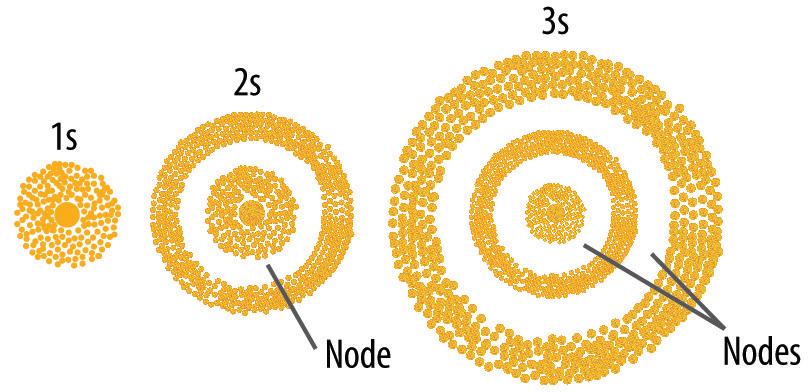
The following points can be drawn from the above curves:
1. In each case, the probability of finding the electron in the nucleus is zero as r = 0.
2. The maximum in the curve indicates the most probable value and the corresponding distance from the nucleus is called distance of maximum probability ( r0).
3. r 0 increases with increase in the value of n
4. r0 for 1s orbital is 0.53 A0 , r0 for 2s orbital is 2.6 A0 , r0 for 3s orbital is still greater.
5. The size of the orbital increases in the order 1s < 2s < 3s < 4s . . . . .
6. The total number of peaks appearing in the curves for ‘s’ orbitals is equal to ‘ n’.
7. In the curve for 2s orbital, the lower maximum is at 0.53 A 0 and the higher maximum is at 2.6 A0 .
8. The probability of finding a 2s electron at 0.53 A0 is low, and it is high at 2.6 A 0
9. The bottom line of zero probability for 2s orbital is at a radial distance of 1.1 A 0 This indicates the radial node.
10. The curve for 3s orbital contains 3 peaks and 2 minimas.
Variation of orbital wave function y against the distance of an electron from the nucleus (r) for 1s and 2s orbitals is shown in Fig. 2.21.
2.21 Variation of orbital wave function
Variation of probability density y2 against the distance of electron from the nucleus ( r) for 1s and 2s orbitals is shown in Fig. 2.22.
Fig. 2.22 Variation of probability density
For 1s orbital, the probability density decreases sharply as we move away from the nucleus.
For 2s orbital, the probability density first decreases sharply to zero, and then starts increasing. After reaching a small peak (maxima), it decreases again as ‘ r’ value increases.
The region where the probability density function reduces to zero is called ‘nodal surface’ or radical node, where the probability of finding an electron becomes zero.
‘1s’ orbital has no radical node. ‘2s’ orbital has one radical node. Similarly, ‘3s’ orbital has ‘two’ radical nodes.
The electron probability density is represented by the density of dots in Fig.2.23 and no dots for nodes.
p-sublevel
p-sublevel begins from 2nd orbit. For p-sublevel, l = 1, indicating that each p-sublevel contains three orbitals with ‘m’ values –1, 0, +1. These are designated as px, py and pz, depending on the axis in which electron density is present.
For example, in case of px-orbital, electron density is concentrated along the x -axis.
p-orbitals have dumbbell shape. Each p-orbital has two lobes separated by one nodal plane. The probability density function is zero on the plane where the two lobes touch each o ther. The nodal planes for px, py, and pz orbitals are yz, zx, and xy-planes, respectively.
The three orbitals present in a given p-sublevel will have same shape, size, and energy but different orientations (differ in m value). The ‘ m’ values assigned for different ‘p’ orbitals are : ± for px, for py and 0 for pz
These three orbitals are perpendicular to each other and the angle between any two p-orbitals is 90o .
Radial probability distribution curves for 2p, 3p, 3d, 4s, 4p and 4d orbitals is shown in Fig.2.24. 3
Penetrating power of orbitals
This diagram illustrates the order of penetrating power of the orbitals: 4s > 4p > 4d > 4f.
d-sublevel
d-sublevel begins from 3rd orbit (n = 3). For d sublevel, l = 2, indicating that each d sublevel contains five orbitals with ‘ m’ values –2, –1, 0, +1, +2. These are designated as dxy, dyz, dzx, 22 xy d and 2 z d
For 2 z d orbital, conventionally, ‘m ’ value is taken as zero.
All the d orbitals (except 2 z d ) have double dumbbell shape. Each d orbital has four lobes separated by two nodal planes (or angular nodes). 2 z d orbital has one dumbbell (with 2 lobes) in z-axis and small ring or collar or tyre in xy plane.
In case of d xy , dyz, and dzx– orbitals, lobes or electron density are present between the corresponding axes, i.e., between x and y-axis, in case of d xy orbital. Whereas, in 22 xy d and 2 z d orbitals, lobes are present along the axes. d xy orbital contains yz and zx as nodal planes. d yz and d zx contain xy , zx , and xy , yz planes as nodal planes, respectively. 22 xy d orbital contains two nodal planes perpendicular to each other, which make an angle of 45 o with respect to x - and y -axis. 2 z d -orbital does not contain nodal planes. Number of radial nodes and nodal planes of orbitals are given in Table 2.7.
Table 2.7 Nodes and nodal planes of orbitals
The five orbitals present in a given d- sublevel will have same energy in the ground state.
Like p - orbitals, d - orbitals are similar in shape but energy and size differ as ‘n’ value increases.
Radial probability distribution curve for 3d orbital is shown in the Fig.2.25.
f-sublevel
f-sublevel begins from 4th orbit. For f-sublevel (l = 3) indicating that each f-sublevel contains seven orbitals with m values -3, -2, -1, 0, +1, +2, +3. f orbitals have complex shape.
The boundary surfaces of 1s, 2p, 3d orbitals are given in the Fig.2.23.
2.6.3 Quantum Numbers
The behaviour of an electron in an atom is described mathematically by a wave function or orbital. Quantum mechanics tells us that quantum numbers are required to distinguish atomic orbitals precisely.
The first three quantum numbersprincipal, azimuthal, and magnetic quantum numbers - can be deduced as solutions of Schrodinger’s wave equation but not the spin quantum number.
Principal Quantum Number (n)
This quantum number was introduced by Niels Bohr to explain the line spectrum. It is donated by ‘n’. It is a positive integer. Its values are n = 1, 2, 3 . . . . ∞.
It gives the following information:
1. It indicates the shell or main energy level to which the electron belongs. These shells are represented by letters also.
Table 2.8 Names of Orbits
Principal Quantum Number (n) Shell
1. 1st or K-shell
2. 2nd or L-shell
3. 3rd or M-shell
Fig.2.25 Boundary surfaces of various orbitals
The order of energies of different sublevels of a shell is s < p < d < f.
4. 4th or N-shell
2. It specifies the size of the shell. With the increase in the value of n, the size of the shell increases.
3. It determines the energy of the shell. Higher the value of n , greater is the magnitude of energy of the shell.
4. It governs the maximum number of electrons that can be present in the shell or orbit. It is given by 2 n2 .
Electrons in nth Shell Shell
Table 2.9 Names of Subshells
0 s Spherical
1 p Dumbbell
2 d
Double dumbbell (except 2 z d )
3 f Complex
Magnetic Quantum Number (m)
This quantum number was proposed by Lande to explain Zeeman effect and Stark effect. It is denoted by m or m .
8 18 32
3 4 Maximum number of electrons
Azimuthal Quantum Number () or Subsidiary Quantum Number or Orbital Quantum Number
This number was introduced by Sommerfeld to explain the fine structure of spectral lines. It is denoted by ‘ ’.
In an energy level, n, the possible values of = 0, 1, 2 . . . . ( n–1), totally, n values.
It gives the following information:
1. It designates the subshells to which the electron belongs.
2. The energy of subshells increases with increase in value of (except for hydrogen atom). The energy order of subshells present in nth shell: s < p < d < f
3. It governs the shape of orbital.
4. It determines angular momentum of an electron.
This is given by
This quantum number describes the behaviour of electron in magnetic field.
Under the influence of external magnetic field, the electrons of a subshell can orient themselves in certain preferred regions of space around the nucleus. The number of m values gives the number of preferred orientations of the electron in a subshell or the number orbitals in the subshells.
The values of m in a subshell, = – to + , including zero. Thus total number of orbitals in ‘ ’ subshell = 2 + 1
The subshells and the corresponding m-values are as follows:
Table 2.10 Subshells and Orbitals
Three
Five
Seven
Spin Quantum Number (m
s)
This number was proposed by Goudsmit and Uhlenbeck to explain line spectra observed as
doublets (two closely spaced lines) and triplets (three closely spaced lines) of multi-electron atoms.
It is denoted by ms or s.
The m s values +− 11 and 22 .
The electrons that have different m s values are said to have opposite spins; they are clockwise spin and anti-clockwise spin. The two values of s are equal in magnitude but opposite in direction. They are represented by ↑ (upward) and ↓ (downward) arrows.
The total spin of an atom = × 1 n 2
The spin angular momentum of an electron is given by ()() h ss1ss1 2 +=+ π
Spin-only magnetic moment of an atom or ion is given by ()µ=+ s nn2 B.M,
n = number of unpaired electrons with parallel spin.
20. In 4th orbit of an atom, a maximum of how many electrons can exist?
Sol. In an n th orbit, the maximum number of electrons is given by 2n2. Therefore, in 4th orbit, the maximum number of electrons = 2 × 4 2 = 32.
21. Among 4s, 4p, 4d, and 4f subshells of multi electronic atoms, which one has the highest energy?
Sol. For 4s, 4p, 4d, and 4f subshells, n value is 4. Their l values are 0, 1, 2, 3 and 4, respectively. Since energy increases with the increase in the value of l, the 4f subshell has the highest energy among the given subshells.
Try yourself:
8. For which of the orbitals of p and d subshells, value of ml = 0?
For zp and d z 2 orbitals, the value of ml = 0.
Ans:
2.6.4 Electronic Configuration of Multi-electron Atoms
The distribution and arrangement of electrons in the main shells, subshells, and orbitals of an atom is called electronic configuration of the element.
The electronic configuration of different atoms can be best represented in two ways:
a) nlx method
b) Orbital diagram method
nl x method is a way of representing the electronic arrangements in an atom. Here, n is principal quantum number which represents the main energy level. l is azimuthal quantum number expressed in terms of s, p, d, or f, and x is the number of electrons in the given value of l
The filling of electrons into the orbitals of atoms takes place according to the Aufbau principle, the Pauli’s exclusion principle, and Hund’s rule of maximum multiplicity.
Aufbau Principle
Aufbau is a german word which means ‘building up’ or ‘construction.’ The building up of orbitals means the filling up of orbitals with electrons.
“In the ground state of the atoms, the orbitals are filled in order of their increasing energies.” In other words, electrons first ocupy the lowest energy orbital available to them and enter into higher energy orbitals only after the lower energy orbitals are filled.
The relative energy of an orbital is given by (n+l) value. As (n+l) value increases, the energy of orbital increases.
The orbital with the lowest ( n+l) value is filled first. When two or more orbitals have the same (n+l) value, the one with the lowest ‘ n’ value or highest ‘l’ value is preferred in filling.
Consider two orbitals, 3d and 4s. The n + l value of 3d = 3 + 2 = 5 and of 4s = 4 + 0 = 4. Since 4s has lowest ( n + l) value, it is filled first before filling taking place in 3d.
Consider the orbitals 3d, 4p, and 5s.
The (n + l) value of 3d = 3 + 2 = 5
The (n + l) value of 4p = 4 + 1 = 5
The (n + l) value of 5s = 5 + 0 = 5
These three values are same. Since the ‘n’ value is lower to 3d orbitals, the electrons prefer to enter in 3d, then 4p and 5s.
The order of increasing energy of atomic orbitals is:
1s < 2s < 2p < 3s < 3p < 4s < 3d < 4p < 5s < 4d < 5p < 6s < 4f < 5d < 6p < 7s and so on.
The sequence in which the electrons occupy various orbitals can be easily remembered with the help of Moeller’s diagram, as shown in Fig. 2.26.
Pauli’s Exclusion Principle
Electrons which have the same spin strongly repel each other and tend to occupy different regions of space. This is a result of a fundamental law of nature, known as Pauli’s exclusion principle.
Pauli’s principle may be stated as follows: “No two electrons in an atom can have the same set of values for all the four quantum numbers.”
This means that two electrons in an orbital may have the same n, same l, and same m, but differ in spin quantum number. In an orbital, if one electron has clockwise spin, the other has anti-clockwise spin. It follows that an orbital can hold a maximum of two electrons with opposite spins.
For example, helium atom has two electrons in its 1s orbital. Quantum numbers for first electron are n =1, l = 0, m = 0 and s = +1/2. Quantum numbers for second electron are n =1, l = 0, m =0, s = –1/2.
The two electrons have the same values for ‘ n’, ‘l’, and ‘m’ but differ in ‘s’. The maximum capacity of a main energy shell is equal to 2n2 electrons and that of a subshell is equal to (4 l + 2).
Pauli’s principle is useful in the determination of the maximum number of electrons that can be accommodated in an orbital, a subshell, and a main shell.
An orbital cannot have more than two electrons. If two electrons are present, their spins should be in opposite directions
2.11
Hund’s Rule
The arrangement of electrons in degenerate orbitals is explained by Hund’s rule of maximum multiplicity. “Pairing of electrons in the orbitals belonging to the same subshell (p, d, or f) does not take place until each orbital belonging to that subshell has got one electron each with the same spin, i.e., all the orbitals are singly occupied.”
Since there are 3, 5, and 7 orbitals in p, d, and f subshells, pairing in these subshells starts with 4th, 6th, and 8th electrons, respectively.
The following examples explain Hund’s rule of maximum multiplicity.
i) Boron has atomic number 5. Its electronic configuration is
1s 2 2s 2 2p1 x
5B:
C: 6
1s 2 2s 2 2p2 2p 1 x 2p 1 y
Similarly, for nitrogen and oxygen, the configurations are given below: 1s 2 2s 2 2p3
O: 8
Electronic configuration of fluorine (Z = 9) is given as
F: 9
1s 2 2s 2 2p5 2p 2 x 2p 2 y 2p1 z
Electronic configuration is often written in a shortened form using noble gas core.
Na (Z =11) 1s22s22p63s1 or [Ne] 3s1
The configuration of argon is also given as Ar
(Z = 18), 2, 8, 8. This is called shell representation. K shell of Ar has 2 electrons, L shell has 8, and M shell has 8 electrons.
In case of potassium (Z = 19) and calcium (Z = 20), electrons will enter 4s orbital as it has lower energy than 3d. From scandium ( Z = 21) onwards, electrons will enter 3d orbitals.
Table 2.11 gives the ground state electron configuration of 110 elements.
Stability of Atoms
Extra stability is associated with atoms in which degenerate orbitals are either half filled or completely filled due to (1) symmetrical distribution of electrons and (2) exchange energy.
The amount of energy released when two electrons with similar energy and same spin exchange their position without the change in electronic configuration is called exchange energy.
Greater the exchange energy, greater is the stability. The number of exchange pairs is maximum when the given subshell is either half filled or completely filled.
The presence of half filled and completely filled degenerate orbitals gives greater stability to atoms. It is for this reason that the electronic configurations of Cr and Cu are represented as [Ar] 4s1 3d5 and [Ar]4s1 3d10, respectively.
This can be explained on the basis of lowering of energy for a set of two electrons with parallel spins. Two electrons with parallel spin remain farther apart than two electrons with opposite spin. Consequently, the coulombic repulsion energy is lowered between the electrons when their spins are parallel. The extra stability of a parallel spin configuration is given by exchange energy (Eex).
Here, N is the number of electrons having identical spins. As the number of identical spins increases, the exchange energy also increases.
The exchange means the shifting of electrons from one orbital to another in the same subshell. This can be easily illustrated by considering chromium as an example.
If the configuration is 3d4 4s2, N is taken as 5 and 5C2 pairs of electrons, equal to 10, is possible. The exchange energy is 10 K. If the configuration is 3d5 4s1, N is taken as 6 and 6C2 pairs of electrons, equal to 15, is possible. The exchange energy is 15 K.
The number of exchanges in 3d 5 4s 1 configuration is more than that in 3d 4 4s 2 configuration. Therefore, greater exchange energy is responsible for the extra stability of 3d5 4s1 configuration. Similarly, it can be seen that the exchange energy for d10 configuration is more than for d9 configuration for copper.
Configuration of Ions
Ions are of two types. Anions are negatively charged ions and are formed by the addition of one or more electrons to neutral atom. Cations are positively charged ions and are formed by the removal of one or more electrons from neutral atom.
Electronic configuration of anions is written in the same method of writing configuration of neutral atoms. Oxide ion is O2– and is formed by the addition of two electrons to neutral oxygen atom. Configuration of oxide (10 electrons) is 1s2 2s2 2p6.
Chloride ion is Cl– and it is formed by the addition of one electron to neutral chlorine atom. Configuration of chloride (18 electrons) is 1s2 2s2 2p6 3s2 3p6
Electronic configuration of cations is also written in a similar method. For the transition metal cations, the electrons in the ultimate shell are to be removed first.
Ferrous ion is Fe 2+ and is formed by the removal of two electrons of neutral iron atom. Electronic configuration of Fe 2+ is 1s2 2s2 2p6 3s2 3p6 3d6
A set of atoms or ions with same electronic configuration is called isoelectronic species.
An isoelectronic group of 2 electrons is
H–, He, Li+, and Be2 + .
An isoelectronic group of 8 electrons is
N3–, O2–, F–, Ne, Na+, Mg2+, and Al3+ .
An isoelectronic group of 18 electrons is
P3–, S2–, Cl–, Ar, K+, Ca2+, and Sc3+ .
An isoelectronic group of 28 electrons is Cu+ and Zn2+
Magnetic Properties of Species
1. Paramagnetic nature: Any species with unpaired electrons show paramagnetic nature. G reater the number of unpaired electron greater will be the paramagnetic.
Examples: Cl, O2, Na . . . . etc
2. Diamagnetic nature: Species with pairs of electron will be diamagnetic in nature.
Examples: Na+, Cl–, Ne . . . . etc.
22. An atom has 18 electrons in M shell and one electron in N shell (outermost shell) in its ground state. In which shell does it have symmetrical electron distribution?
Sol. Its electron configuration is 3s2 3p6 3d10 4s1. In this way, its 3rd shell or penultimate shell has symetrical electron distribution.
23. What is the maximum number of electrons in an atom that can have the quantum numbers, n = 4, m = +1?
Sol. 4s electron cannot have m = +1 two 4p, two 4d and two 4f electrons can have m = +1. Thus, totally, six electrons can hav e these values.
24. Corresponding to n = 3, l = 2, m = 0, what is the maximum number of electons possible?
Sol. When n = 3, l = 2, m = 0, the possible atomic orbital is 3d z 2. It is with maximum two electrons.
TEST YOURSELF
1. For which of the orbitals, m = 0 for all orbitals?
(1) s, px, and d xy
(2) s, pz, and dz2
(3) P y , d xy , and dzx
(4) pz, d xy , and dzx
2. Which quantum number is different for the unpaired electrons of carbon atom?
(1) n value
(2) ml value
(3) l value
(4) s value
3. For which orbital, there are two radial nodes and sum of radial and angular nodes is five?
(1) 5d (2) 6d
(3) 6f (4) 4f
4. Which of the following sets of quantum numbers is not valid?
(1) 1 n3,l2,m2,s 2 ====+
CHAPTER REVIEW
Discovery of Sub-Atomic Particles
■ Dalton’s atomic theory successfully explains the law of conservation of mass, law of constant composition, and law of multiple proportions.
■ In discharge tube experiment, cathode rays are produced by passing an electric discharge through gases at low pressure (0.01 mm) and high voltage (10,000 volts).
■ The nature of cathode rays is independent of the gas in the discharge tube and on the cathode material. Specific charge (e/m ratio) of cathode rays is constant and it was calculated by J.J. Thomson.
(2) 1 n2,l0,m0,s 2 ====−
(3) 1 n4,l2,m1,s 2 ===−=+
(4) 1 n4,l3,m4,s 2 ====−
5. Number of nodal planes present in s, px, py, pz, respectively, are
(1) 0, 1, 1, 1
(2) 0, 2, 1, 1
(3) 0, 2, 2, 2 (4) 0, 0, 0, 0
6. Which of the following orbitals is not possible?
(1) 4d (2) 5g (3) 3f (4) 2s
7. How many electrons are possible with n=3, l = 1, s = + 1/2?
(1) 18 (2) 9 (3) 6 (4) 3
Answer Key
(1) 2 (2) 2 (3) 3 (4) 4 (5) 1 (6) 3 (7) 4
■ Goldstein observed positive rays by using perforated cathode in discharge tube.
■ The nature of positive rays depends on the nature of gas in the discharge tube.
■ Specific charge of positive rays is not constant. It is maximum when hydrogen gas is taken in the discharge tube.
■ It was predicted by Rutherford and discovered by Chadwick.
■ Atomic number (Z) is the number of protons in the nucleus.
■ Mass number (A) is the sum of number of protons and number of neutrons in the nucleus.
■ Number of Neutrons =
Mass number (A) – Atomic number (Z)
■ Atoms with identical atomic numbers but different mass numbers are known as isotopes.
Examples: 1231213143537 11116661717 HD,T;C,CC;ClCl
■ Atoms with same mass number but different atomic number are called isobars.
Examples: 14 40 6 20 C,Ca,K,Ar 14 4040 7 1918 N; Atomic Models
■ The existence of the nucleus was discovered by Rutherford by the a -ray scattering experiment.
■ Rutherford’s atomic model cannot explain the stability of atom, electronic structure of atom, and line spectrum.
Developments Leading to Bohr’s Model of Atom
■ Light exhibits interference and diffraction, which indicates that lig ht has wave character.
■ The distance between two successive points in a wave which are in the same state of vibration (two successive crests or two successive troughs) is called the wavelength. It is indicated by l .
■ The number of waves crossing through a given point in one second is called the frequency of the radiation. It is indicated by J
■ The reciprocal of wavelength is called wave number. It is indicated by ϑ .
■ Wave number indicates the number of waves contained in unit length of the wave form.
■ The distance travelled by the electromagnetic radiation in unit time is called velocity; it is 3×1010 cm/s. in vacuum or air.
■ All electromagnetic radiations travel with same velocity.
■ The visible region consists of radiations with wavelength from 3800A 0 to 7600A0
■ Planck’s theory successfully explains blackbody radiation.
■ The plot of intensity of radiation against wavelength indicates that, at any temperature, the intensity increases with the wavelength, reaches a maximum, and then decreases.
■ As temperature increases, the peak of the curve shifts towards lower wavelengths.
■ The energy is emitted or absorbed by a body in integral multiples of small packet called quantum.
■ One quantum of energy, E = h n , where n is frequency of the radiation.
■ Planck’s constant (h) is given as, 6.6256 × 10⁻³⁴ J s or kg m2 s–1
■ Energy of radiation is directly proportional to wave number or frequency, but inversely proportional to wavelength.
■ An ideal black body is a hollow sphere coated inside with platinum, black, and having a small hole.
■ When light is incident upon metals like potassium and rubidium, they emit electrons. This is known as photoelectric effect.
■ For a ny metal surface to emit electrons, light of a certain minimum frequency is required. This is called the threshold frequency.
■ Threshold frequency is less for alkali metals and, hence, they are good photoelectric metals.
■ With an increase in the frequency of light, the velocity of the emitted electron increases.
■ With an increase in the intensity of light, the number of electrons emitted increases.
■ The pattern of colours or lines obtained due to dispersal of light is called spectrum.
■ Incandescent solids give continuous spectrum.
■ Line spectrum is characteristic of atoms. Line spectrum is also known as atomic spectrum.
■ Band spectrum is characteristic of molecules.
■ The absorption spectrum contains dark lines at the same places where there are bright lines in the emission spectrum of the element.
■ Hydrogen emission spectrum is a line spectrum.
■ Balmer first studied the spectral lines in the visible region of hydrogen spectrum. Later, other series of lines were identified.
■ There are five series of lines in the spectrum of hydrogen.
■ Lyman series is in ultraviolet region; Balmer series is in visible region; and Paschen, Brackett, and Pfund series are in infrared region.
■ The wave numbers of the spectral lines in the hydrogen spectrum for any series is given by the Rydberg’s equation, where n1 and n2 are integers.
■ The wave number of the limiting line (last line) in any series can be obtained by taking n2 as infinity.
■ The Balmer series of lines in the hydrogen spectrum are designated as H a , H b , H g , and H d lines. For the H a line, n2 = 3, for the H b line, n2 = 4, and so on.
Bohr’s Model for Hydrogen Atom
■ According to Bohr, the atomic electrons revolve around the nucleus only in certain fixed, discrete, circular paths known as orbits or energy levels.
■ Bohr orbits satisfy the quantum condition that the angular momentum of the electron is an integral multiple of h/2 p.
■ When energy is supplied to an atom, the electron jumps from a lower energy level to a higher energy level by absorbing the difference in energy of the two levels in the form of heat, light, or electricity.
■ Electron in the first orbit can only absorb energy but not emit energy.
■ When the electron drops from a higher energy level to a lower energy level, the difference in energy between the two levels is emitted by the electron in the form of a light ray of only one frequency. E2 – E1 = ∆ E = h n
■ The radius of the orbit is given in terms of m (mass of the electron) and e (charge on the electron) as
= π 22 22 nh r 4mze
■ If r1 and r2 are the radii of two orbits whose principal quantum numbers are n1 and n2, then = 2 11 2 2 2 rn r n
■ For the hydrogen atom, the radius of any orbit is given by r = n 2 × 0.53 A0
■ The velocity of the electron in any orbit is given by π = 2Ze2 V nh
■ In the case of the hydrogen atom, the velocity of the electron in any orbit is × = 2.18108 V n cm/s.
■ Kinetic energy of the electron (KE) = Ze2 2r
■ Potential energy of the electron (PE)= Ze2 r
■ Total energy of the electron =+= 222 ZeZeZe r2r2r
■ The energy of the electron is given by −π = 224 n 22 2Zem E nh × z2
■ Energy in case of hydrogen is E n =− 2 1312 kJ/mole n = 2 13.6 n eV/atom
■ With an increase in the radius of the orbit, the kinetic energy of the electron decreases but the potential energy increases.
■ The total energy of the electron, however, increases with increase in the radius of orbit.
■ When the electron jumps from the infinite orbit to a given orbit, its energy decreases from zero to a negative value.
■ The amount of energy required to remove the electron from the outermost orbit, i.e., to take it to infinite distance, is known as ionisation energy or ionisation potential.
■ Electron in a hydrogen atom can absorb only specific amounts of energy, like 10.2 eV, 12.1 eV, 12.75 eV, etc.
■ When the electron in the hydrogen atom is excited to the ‘nth’ orbit, the number of spectral lines expected to be emitted is ()nn1
2 .
■ Bohr’s model of atom can explain the spectrum of one electron species, like hydrogen, He+ , and Li+2
■ Bohr’s model cannot explain the spectra of multi-electron atoms or ions.
■ Bohr’s model cannot explain the splitting of spectral lines in the fine spectrum, Zeeman effect, Stark effect, and the ability of atoms to form molecules by chemical bonds.
Towards Quantum Mechanical Model of Atom
■ According to de Broglie, any moving material particle has wave character. These waves are called matter waves.
■ The wavelength of matter waves is given by λ==hh mvp
■ Here, p is momentum of the particle and l is called the de Broglie wavelength.
■ The circumference of an orbit, 2 pr = nl, where r = radius of the orbit and n = 1,2,3,4,5.
■ The electron in an atom is a standing wave extending over a circle whose circumference is equal to an integral
number of wavelengths; otherwise, the electron wave destroys itself by destructive interference.
■ The number of electron waves in any orbit is equal to the principal quantum number ‘n.’
■ It states that the position and the momentum of an electron cannot be determined simultaneously with equal accuracy.
■ If ∆ x is uncertainty in position and ∆ p is uncertainty in momentum,
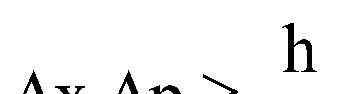
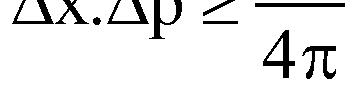
■ Bohr’s postulate of fixed orbits is not in agreement with Heisenberg’s uncertainty principle.
Quantum Mechanical Model of Atom
■ To describe the wave character and particle character of the electron, Ervin Schrodinger derived wave equation for the electron.

■ The term y in the equation is known as amplitude function or wave function. y 2 is known as the probability function. y2 is also referred to as an atomic orbital.
■ Radial probability distribution curves are plotted between D–function and distance from nucleus.
■ The radial probability function (D) is equal to 4 p r2dr y 2 .
■ ‘s’ orbitals are spherical. They have spherical symmetry.
■ The region in an orbital where the probability of finding the electron is zero is called a node.
■ Number of radial nodes in any orbital is given as n – l – 1.
■ A nodal plane is an imaginary plane in the orbital passing through the nucleus in which the probability of finding the electron is zero.
■ Number of nodal planes in an orbital is equal to its azimuthal quantum number.
■ p-orbitals are dumbbell shaped and d-orbitals are double dumbbell in shape.
■ A p-orbital has one nodal plane. p–orbital consists of two lobes on either side of the nodal plane extending along the axis.
■ The d xy , d xz and d yz orbitals contain four lobes at an angle of 450 to the respective axis.

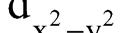

■ The orbital consists of four lobes along the x-axis and y-axis.
■ The d z 2 –orbital consists of two lobes along the z-axis and the orbital also extends like a smoke ring in a plane perpendicular to the z-axis.
■ According to quantum mechanical model, the principal quantum number determines the energy of the electron in the case of the hydrogen atom.
■ The azimuthal quantum number or the orbital angular momentum quantum number is a measure of the orbital angular momentum of the electron.
■ Azimuthal quantum number indicates the shape of the orbital.
■ Azimuthal quantum number ‘l’ can have integral values from 0 to (n–1).
■ Values of l are represented by s, p, d, f, and g, corresponding to l = 0, 1, 2, 3, and 4.
■ Magnetic quantum number was proposed by Lande.
■ The magnetic quantum number (m) indicates the spatial orientation of the orbital.
■ ‘m’ can have only integral values ranging from –l to +l, including zero.
■ The total number of values of ‘m’ indicates the number of spatial orientations of the orbital.
■ For the p-subshell, l = 1. So, ‘m’ has three values, –1, 0, and +1.
■ A p–subshell contains three orbitals, namely p x, p y, and p z orbitals. These are known as degenerate orbitals.
■ Degenerate orbitals refer to orbitals of equal energy in the absence of an external magnetic field.
■ For the d-subshell, l = 2. So, ‘m’ can have values –2, –1, 0, +1, and +2.
■ There are five orbitals in the subshell. They are d xy , dxz, dyz, , and dz 2

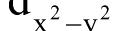
■ p-orbitals are triply degenerate and d–orbitals are five-fold degenerate.
■ For the f-subshell, l= 3. So, the values of ‘m’ are –3, –2, –1, 0, +1, +2, and +3.
■ There are seven orbitals in the f-subshell.
■ For each value of ‘l,’ there are (2l+1) values for ‘m.’ It indicates that there are (2l +1) different spatial orientations for the orbital.
■ To explain the duplets and the multiplets in the spectral lines and the magnetic properties of atoms, Uhlenbeck and Goudsmidt proposed that the electron spins around itself.
■ The spin quantum number indicates the direction of spin of the electron.
■ Spin quantum number can have only two values, +1/2 (clockwise) and –1/2 (anticlockwise).
■ Maximum number of orbitals in a given subshell is (2l+1).
■ Maximum number of electrons in a given subshell is 2(2l+1).
■ Pauli’s exclusion principle states that no two electrons in the same atom can have all the four identical quantum numbers.
■ The maximum number of electrons that an orbit can accommodate is 2n2, where ‘n’ is the principal quantum number.
■ Aufbau (means to build up) principle states that “the electrons in an atom occupy the available lowest energy levels.”
■ Hund’s rule states that “when degenerate orbitals are being filled, pairing of electrons takes place only after all the orbitals are half filled.”
■ If the (n+l) values of two energy levels are equal, then the energy level for which ‘ n’ is less is the lower energy level.
■ The 1s orbital of a hydrogen atom has higher energy than the 1s orbital of helium atom, because the energy of the orbital decreases with an increase in the atomic number.
■ Atoms with half filled orbitals and fully filled orbitals have extra stability.
■ Electronic configuration is given usually in nlx method.
■ Chromium and copper do not obey Aufbau principle.
■ The anomalous configurations are given as Chromium → [Ar] 4s13d5 and Copper → [Ar]4s13d10
■ The extra stability of half filled and completely filled subshell is due to
(i) relatively small shielding
(ii) smaller coulombic repulsion energy, and
(iii) larger exchange energy and symmetrical distribution of electrons.
■ Due to presence of unpaired electron in a species, it moves from weak field to strong field. It is called paramagnetic substance.
■ Absence of unpaired electron in any species, moves itself from strong field to weak field, is called as Diamagnetic substance.