the Retailer Q4: 2026 | Quarterly magazine
REPRESENTING AG, CONSTRUCTION AND OUTDOOR POWER EQUIPMENT DEALERS ACROSS IOWA AND NEBRASKA
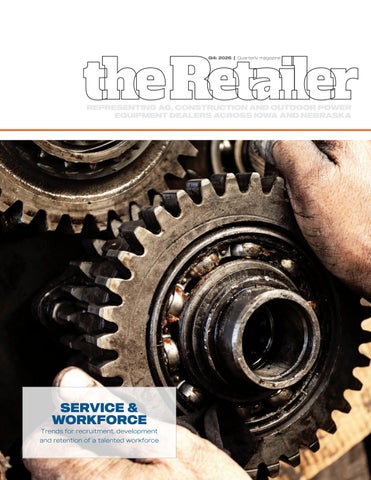
SERVICE & WORKFORCE Trends for recruitment, development and retention of a talented workforce
We Look forward to getting to know YOU.
Custom Cust Retirement Planning om Custom Retirement Planning Cust o d r i d ve n b y y o r u r n e e d s i v e n b Custom Retirement Planning Custom Retir d r i ve d n b y yo u r r needs i v e n dd r iAt veTax nr bAt y yio u v r n e ee d swe serve n b y y o u r Favored Benefits, T as a ax F av
Atpartner Tax Favored Benefits, we serve as a At T ax F av partner in helping individuals, families in Atpartner Tax Benefits, wefinancial serve as a At T ax Favored Bene in helping individuals, families partner in andFavored businesses and achieve busine partner insuccess. helping individuals, families in helping partner in and businesses achieve financial and busin success. and businesses achieve financial and businesses achi success. success. success. success. Our experienced Our professionals are exper Our experienced professionals are Our expe supported supported by world-class resources, Our experienced professionals are Our experienced pro supported by world-class resources, supporte providing providing a full suite of financial, supported by world-class resources, supported by worldproviding a full suite of financial, providing investment, investmen and retirement planning providing ainvestme full suite of financial, providing a full suite investment, retirement planning services services toand clients nationwide. to investment, and retirement planning investment , and reti services to clients nationwide. services t services to clients nationwide. services to clients na We focus, We first and foremost, on helping focus, We focus, firstyour and foremost, on helping focus We you achieve you personal financial achiev We focus, first andfocus, foremost, on helping We first and fo you achieve your personal financial you achie goals. goals. As fiduciary professionals, we As f you achieve your interest personal financial you achieve your pe goals. As fiduciary professionals, goals. As put your put best first, at allwe times your b goals. As fiduciary professionals, we goals. As fiduciary p put your best interest first, at all times put your and in and all situations. We succeed when in all s put your best interest first, at all times put your interes and insucceed. all situations. We succeed when best and in all you you succe and insucceed. all situations. We succeed when and in all situations. you you succe you succeed. you succeed.
Interested in learning more about how we can help you achieve your financial goals? Contact us to get started.
VANCE S. WENTZ, CFP® | CEO Tax Favored Benefits, Inc.
We Look forward to We Look to We RepresentatiWe vgetting es offers products and servito cforward es know YOU. get th We Look forward We to Look f to YOU. get using the folgetting lowing busiInterested ness names:inTaxlearning Favoredknow more about how I n t e r getting to know getting YOU. to we can help you achieve your financial wI e c innanci learning more about how n t e Benefits, Inc. – inInterested surance and fi a l servi c es goals? Contact us to get started. g o a l s we can help you achieve your financial w e S. WENTZ, CEO Interested in learning more about how I n t e r e s VANCE ted in l e aCFP® r n i| n g goals? Contact us to get started. g o a | Ameritas weInvestment Company, LLC ( A I C ) , can help you achieve your financial we can hel you ac hie VANCE S.pWENTZ, CFP® | CEO Inc. goals? Contact us to get started. g o a ls? C Tax o nFavored t a c t Benefits, us to VANCE S. WENTZ, CFP® | CEO Member FINRA/SIPC – securities and investments Benefits, 4801 W. 110 Tax Street,Favored Suite 200, Overland Park, KSInc. 66211 Tax Favored Benefits, Inc. phone: 913.648.5526 | fax: 913.648.6798 4801 W. 110 Street, Suite 200, Overland Park, KS 66211 | TFB Advisors, LLC or Ameritas Advisory Services dbw@tfbusa.com phone: 913.648.5526 | fax: 913.648.6798 4801 W. 110 Street, Suite 200, Overland Park, KS 66211 (AAS) – investment advisory services. AIC and dbw@tfbusa.com phone: 913.648.5526 | fax: 913.648.6798 dbw@tfbusa.com AAS are not affiliated with Tax Favored Benefits, Inc. or TFB Advisors, LLC
4801 W. 1 0 Street, Suite 200, Overland Park, KS 66211 phone: 913.648.5526 | fax: 913.648.6798 dbw@tfbusa.com
Representatives offers products and services Representatives o th using the following business names: Tax Favored using the following Benefits, Inc. –offers insurance and financial services Benefits, Inc. – ins Representatives products and services Representative th | Ameritas Investment Company, (AIC), | Ameritas Inves using the following business names: TaxLLC Favored using the followi Member FINRA /SIP Member FINRA/SIPC – securities andservices investments Benefits, Inc. –offers insurance and financial Benefits, Inc. – i Representatives offers products and ser Representatives products and services th | Advisors, LL C TFB Advisors, LLC or Ameritas Advisory ServicesTFB || Ameritas Investment Company, (AIC), | Ameritas Inv using the following business names: Tax F using the following business names: TaxLLC Favored (AAS) – investmen (AAS) – investment advisoryand services. AIC and Member FINRA /S Member FINRA/SIPC – securities investments Benefits, Inc. – insurance and financial se Benefits, Inc. – insurance and financial services AAS are not affiliat are notLLC affiliated with Tax Favored Benefits, | TFB Advisors, LL TFBAAS Advisors, or Ameritas Services | Advisory Ameritas Investment Company, LLC (A || Ameritas Investment Company, LLC (AIC), Inc. or Inc. oradvisory TFB Advisors, LLCAIC and (AAS) – investm (AAS) – investment services. Member FINRA/SIPC – securities and inves Member FINRA/SIPC – securities and investments AAS not affil are notLLC affiliated with Tax Favored Benefits, | Advisors, LLCare or Ameritas Advisory S | TFBAAS Advisors, orTFB Ameritas Advisory Services Inc. o Inc. oradvisory TFB Advisors, LLCAIC and (AAS) – investment advisory services. AI (AAS) – investment services. AAS are AAS are not affiliated with Tax Favored Benefits, Inc. or TFB Advisors, LLC
not affiliated with Tax Favored Inc. or TFB Advisors, LLC
Be
O .
CONTENTS
3
6
8
EXECUTIVE INSIGHT
LEGISLATIVE UPDATE
INNOVATION FUTURE
INEDA CEO, Mark Hennessey, shares his perspective on how workforce trends are changing and how dealers will need to recruit, develop and retain the people who keep customers.
Several reasons outline why right to repair legislation is unnecessary moving forward.
The future of agriculture has a lot of questions, which is why innovation will continue to be at the forefront of Nebraska and Iowa Ag Expos.
10
16
OAR DISTRIBUTION
CAREER EXPLORATION EVENT
Effective leadership in a dealership isn’t about rowing harder than everyone else. It’s about making sure everyone else has an oar.
The Nebraska Ag Expo has always been a place to see where agricultural equipment and technology are headed, but it is also becoming a place where students can begin to see where they might fit into that future.
TABLE OF CONTENTS | 1
CONTENTS
OFFICERS:
Kevin Clark Chairman, Lincoln, NE Dave McCarthy Vice Chairman, Waterloo, NE Jay Funke Past Chairman, Edgewood, IA
DIRECTORS:
Bruce Bowman Mark Placek Paula Radke Rob Hinton
24
30
DEALER LEGACY
MARKETING VIEW
For 58 years, Star Equipment has adapted to a changing construction equipment industry while staying grounded in the relationships, service and people that built the family business.
Ankeny, IA Alliance, NE Alta, IA Bancroft, IA
STAFF: David Adelman Phil Erdman Cindy Feldman Mark Hennessey Andy Tank Tim Keigher Cara Jicinsky Jamie Mertz Gwen Parks Maria Schussler
Marketing Director, Cindy Feldman, details how a rebrand can sometimes look like a simple exercise in changing colors, fonts or a logo. But a logo is only one piece of a much bigger brand experience.
America’s Most Forward-Looking Ag Expo
IA Legislative Director Dir. of Dealer & Gov’t Rel. Marketing Director President/CEO Expo Director NE Legislative Director Administrative Assistant Dir. of Dealer & Gov’t Rel. Finance Director Ag Expo Coordinator
CONTACT INEDA: 8330 NW 54th Ave. Johnston, IA | 50131-2841 E: info@ineda.com | W: www.ineda.com P: 515.223.5119 | F: 515.223.7832 TF: 800.622.0016.
SUBSCRIPTION INFORMATION: CELEBRATING 20 YEARS
SANDHILLS GLOBAL EVENT CENTER
LINCOLN, NE 2 | TABLE OF CONTENTS
SPONSORED BY
DECEMBER 8-10, 2026
Individual subscriptions are available without charge to Association members. One-year subscriptions are available to all others for $30.00 (4 issues). Contact INEDA for additional information. This publication is designed to provide accurate and authoritative information in regard to the subject matter covered. It is furnished with the understanding that the Iowa-Nebraska Equipment Dealers Association, the publisher, is not engaged in rendering legal, accounting, or other professional services. Changes in the law may render the information contained in this publication invalid. Legal advice or other expert assistance should be obtained from a competent professional.
Service and Workforce: Trends Reshaping the Dealership The service department has always been critical to the success of an equipment dealership. But as we look ahead, several workforce trends are changing how dealers will need to recruit, develop and retain the people who keep customers running.
executive insight
The technician shortage along with attracting talent to rural communities is becoming a long-term workforce issue. Competition for skilled employees extends well beyond our industry. Construction, transportation, manufacturing and other skilled trades are pursuing many of the same people. For dealers, finding qualified and talented service professionals in rural areas is compounding the scarcity issue – especially with the migration from rural America to urban. The definition of a technician is changing. Today’s equipment combines hydraulics and engines with electronics, GPS, sensors, software, connectivity and advanced diagnostic systems. Tomorrow’s technicians will increasingly need to be as comfortable with a laptop as they are with a wrench. That creates an opportunity to introduce our industry to young people who may never have considered themselves interested in a traditional mechanical career.
Chief Executive Officer
Retention is becoming as important as recruitment. With fewer skilled employees available, losing an experienced technician can be expensive. Compensation will always matter, but employees are increasingly evaluating the entire employment experience—leadership, flexibility, workplace culture, training, career advancement and whether they feel valued by the organization. Our recent compensation survey shares the latest insights on these employment/benefit issues. Technology will change jobs, but it won’t eliminate the need for talented people. Artificial intelligence, remote diagnostics, telematics and automation will allow dealerships to identify problems faster and potentially resolve some issues without sending a technician into the field. Rather than simply replacing employees, these technologies are more likely to change how employees spend their time and increase the value of people with advanced technical and problem-solving skills. Finally, workforce development is becoming a strategic responsibility. Dealers can no longer rely solely on finding experienced employees in the marketplace. Increasingly, successful dealerships will need to build their own talent pipeline—recruiting young people, providing internships and apprenticeships, investing in training and creating visible career paths from entry-level positions into senior technical and leadership roles. The common thread among these trends is simple: service may be powered by technology, but it will continue to be driven by people. As you read this issue’s focus on Service and Workforce, consider one important question: “Are we creating a workplace where talented people want to come, grow and stay?” Considering the high profitability impact that service has to equipment dealerships, the answer may have as much influence on the future of our dealerships as anything else we do.
EXECUTIVE INSIGHT | 3
GOVERNMENT AFFAIRS
Data, Trust, and the New Rules of Equipment Connectivity PHIL ERDMAN Director of Dealer and Government Relations [phile@ineda.com]
Today’s business is data-intensive and in todayʼs agricultural operations tractors, combines, planters, and sprayers are integral along with weather stations, grain systems, and farmmanagement platforms. Together they routinely create information about field boundaries, planting rates, input applications, yields, machinery performance, fuel use, maintenance needs, and operator activity. Used well, that information can make a farm more productive, more efficient, and more resilient. Who controls the data generated? That question has gained urgency as equipment manufacturers add cloud-connected platforms, remote diagnostics, automation, and artificial intelligence. A customer can use machine and field data to identify yield variability, document practices, coordinate custom work, share prescriptions with an agronomist, monitor equipment remotely, and make repair decisions before a breakdown interrupts a narrow planting or harvest window. Modern equipment may transmit fault codes, location, engine hours, fuel consumption, machine settings, implement performance, and telemetry that helps dealers or manufacturers support maintenance and uptime. The benefits can be substantial. A combined equipment-and-field record can help a producer compare hybrids across soil zones, evaluate whether a particular setting improved harvest performance, verify completed work, or spot a machine problem before it becomes a failure. Data-sharing can also make collaboration easier: a grower may choose to give an agronomist access to a field layer, allow a dealer to view
4 | NEBRASKA LEGISLATIVE UPDATE
diagnostics, or connect a trusted third-party platform through an application programming interface, or API. Data sharing, under current customer agreements, are purposeful rather than automatic. Customers are in the driver’s seat to determine what information is shared and who has access to it and for how long. In 2026, Nebraska passed legislation, with the assistance of INEDA members and staff and manufacturers, to reinforce the protections currently in place for equipment and apply those principles more broadly across the ag industry. This legislation follows established principles and policies for personal, health, and financial data. Nebraska’s Agricultural Data Privacy Act (LB 525) establishes producer “ownership” and control of covered agricultural data, restricts sales without express written consent, requires reasonable security practices, and makes key contract provisions effective January 1, 2027. • The producer controls agricultural data originating from the producer’s farm, land, device, or equipment; controllers and processors have limited, nonexclusive rights needed to provide services, maintain equipment, or conduct authorized processing. • The statute broadly covers agronomic, climate/ weather, land, livestock, management, and sustainability data when linked or reasonably linkable to an identifiable producer. Publicagency data, aggregated data, and derived data are excluded.
• A sale requires the producer’s express written consent through a clear, conspicuous disclosure separate from the main terms of service or datause agreement. • Entities must maintain reasonable administrative, technical, and physical safeguards. The Attorney General has exclusive enforcement authority and the law provides for notice and a 45-day cure period. Additional Customer Solutions and Support In September 2026, John Deere introduced “JD”, an AI assistant within John Deere Operations Center. JD is designed to answer plain-language questions using the customer’s own historical machine, field, and operational information rather than generic public data. John Deere also published a 10-point Farmer Data Commitment to reaffirm its core promise that the producer controls farm data and reaffirming its long-standing policies to not sell individual customer farm data, let customers decide which third parties can receive their information, and allow them to stop the flow of data to third parties at any time. Specifically, they state: • Customer farm data and aggregated, anonymized data is used to improve equipment performance, develop services, and create decision-support value for customers. • Farm data for agricultural commodities is not and will not be used in trading or speculation. • Customers should receive clear value from their data. • Customers using Operations Center can access, download, and delete their data and sharing permissions. John Deere is not alone in putting data control at the center of its connected-equipment message. Case IH, a CNH brand, has recently highlighted secure collaboration and customer control through its FieldOps platform. FieldOps is a centralized platform that connects machines, fields, and agronomic information, while allowing users to share files, prescriptions, as-applied maps, and other information with agronomists, dealers, advisers, and service providers they trust.
Case IH states that their platform offers a secure environment in which the producer remains in control of their data. It emphasizes that customers can use linked accounts or API partnerships to grant access to trusted advisers, rather than treating farm information as something that must be broadly available across a supply chain. AGCO—which includes brands such as Fendt, Massey Ferguson, and Gleaner—maintains a formal privacy statement governing how it handles personal information collected through its websites, applications, and connected devices. The company’s current U.S. privacy statement identifies AGCO Corporation and its affliates as the entities covered by the policy and provides a privacy contact channel for customers and provides customers with access to submit questions and requests. Manufacturers and the dealers who sell and support their products are empowering customers with connected-data tools while controlling sharing, providing cybersecurity, and facilitating practical value. The Bottom Line Ag data supports better decisions, improves machinery uptime, and increasingly powers automation and AI tools. The strongest approach is not to reject connected agriculture; it is to use it on clear terms. John Deereʼs new Farmer Data Commitment offers some of the most explicit recent public assurances from a major manufacturer: growers control their data. John Deere has made it clear they don’t and won’t sell farm data and thirdparty sharing can be shut off. Case IH similarly emphasizes secure, producer-controlled sharing through FieldOps. As other manufacturers and industries expand digital platforms, customers expect the same standard: transparency, practical portability, revocable permissions, meaningful cybersecurity, and a clear benefit flowing back to the farm or business that generated the data. Dealers are standing beside our customers and behind our protections to ensure the solutions we are offering today are based in the timeless principle of trust.
NEBRASKA LEGISLATIVE UPDATE | 5
GOVERNMENT AFFAIRS
Right to Repair?
Why There Is No Need for Legislation in 2027
JAMIE MERTZ Director of Dealer and Government Relations [jamiem@ineda.com]
The term “right to repair” has been floating around for more than 15 years. It started with cell phones, moved to wheelchairs, and for the past decade has been pushed heavily in the ag equipment space. States like South Dakota, Minnesota, and Iowa all saw bills introduced this year—and all of them were defeated. That didn’t happen by accident. It took a lot of work and a lot of education to help legislators understand that farmers and independent repair shops already have the ability to repair their own equipment. The phrase “right to repair” grabs attention because it sounds like farmers and independent shops are being denied something. They aren’t. Dealers and OEMs want farmers and independent shops to be able to work on their own equipment. They already provide the same parts, tools, and manuals to farmers and independent shops that dealers themselves use. Over the counter parts sales average around 60% at most dealerships— which tells you farmers are still doing a lot of their own repairs. The problem isn’t the idea of repair. It’s the legislation. Most of the bills introduced at both
6 | LEGISLATION UPDATE
the state and federal level go far beyond giving farmers access to parts and tools. They include language that would force manufacturers to give up intellectual property and require them to sell parts directly to farmers and independent shops at a fixed margin. Neither of those things is necessary for anyone to repair equipment. State mandated price controls would crush dealer margins. That’s not an exaggeration—it would put many dealers out of business. And if a dealership can’t keep its doors open, here’s what happens next: parts inventories shrink, labor costs climb, whole goods margins have to increase to make up for lost revenue, and farmers end up with fewer trained technicians, fewer stocked parts, longer wait times, higher equipment costs, higher labor rates, and more downtime. None of that helps farmers or independent repair shops. On top of that, OEMs already offer software access tools that customers can purchase—the same way dealers do—with annual subscriptions that allow farmers and independent shops to hook into equipment just like a dealership technician.
So why is there no need for right to repair legislation moving forward? A few reasons: • Farmers and independent repair shops already have access to software, parts, special tools, diagrams, and service manuals through the dealership — the same channel dealers use with the OEM. • The FTC settlement with John Deere covers everything that has been in right to repair legislation except engineering software and parts at cost — both of which were extreme asks that went well beyond repair access. • The MOU signed by John Deere, CNH, AGCO, and Kubota with American Farm Bureau guarantees farmers and independent repair facilities access to codes, data, tech manuals, and diagnostic connectivity on fair and reasonable terms. • The FTC settlement lasts 10 years and ensures farmers and independent repair providers receive the same repair resources, software, and diagnostic tools that Deere provides to authorized dealers. These tools include reading, clearing, and resetting fault codes, reprogramming components, restarting machines after emissions related shutdowns, and accessing tech manuals, troubleshooting guides, DTAC solutions, and PIPs. • Any new repair tools rolled out to more than 50% of authorized dealers must also be made available to farmers and independent repair providers.
Between the MOU, the FTC settlement, and what manufacturers already provide today, the need for “right to repair” has already been met. Farmers and independent repair shops have the access they need. Legislation isn’t going to add anything useful
— but it would create a long list of unintended consequences that hurt dealers and farmers alike. Manufacturers have answered the call. It’s time to move on to issues that will actually help the farm economy and boost profitability for farmers.
LEGISLATION UPDATE | 7
Innovation and the Future of Ag in the U.S.
ANDY TANK Expo Director [atank@ineda.com]
During his 33 years with INEDA, Tom Junge witnessed tremendous change in agriculture, including the rapid growth of new technologies in recent years. As I step into the Expo Director role, I look forward to building on his work and keeping innovation at the forefront of the Nebraska and Iowa Ag Expos. The future of Ag has a lot of questions marks to be answered, and we will look to innovation and collaboration as we move forward into the unknown. Several points from Brett Sciotto’s CropLife article, “What’s the Future of Ag in the U.S.?,” stood out to me: The agricultural organizations built to serve the world that existed must evolve quickly to serve the world that is coming. In my 25 years of advising American agriculture, three convictions continue to be reinforced: 1. We are the world’s great agricultural innovators and we should embrace, not fear, moving on from the status quo. 2. Collaboration is our most powerful tool and most organizations I have worked with are very open to partnering. 3. This work is never only about economics. It is about national security. The first two points connect directly to the Innovation Hubs at our Expos: 1. Innovation: Our Innovation Hubs showcase emerging technologies and help producers and dealers explore how these solutions could fit into their farms and dealerships. 2. Collaboration: Each Expo brings innovators, producers, dealers, and investors together, creating opportunities to see technology firsthand, ask questions, and discuss its practical applications. The Nebraska Ag Expo, December 8–10 in Lincoln, Nebraska, plans to feature the following exhibitors in its Innovation Hub:
TERRACLEAR: The TerraScout autonomous vehicle for continuous scouting day or night, and real-time map generations. Combine advanced imaging, machine vision, and field-ready robotics to turn raw data into clear, actionable prescriptions you can put to work. TerraClear also has AI-powered rock mapping to reveal more rocks, helping you pick more, pick faster and get back to farming.
INNERPLANT:
STRONGBO:
Creates plants that communicate so farmers can make the best management decisions possible with data tied directly to plant physiology. Crops communication within hours when stressed. InnerPlant detects optical signals and translates signals into actionable recommendations for growers.
Automated Livestock Weighing System: Automated and hassle-free weighing; Animal data at your fingertips; Easily identify high/low performing animals and Tough animal tested design.
We invite you to visit the Nebraska and Iowa Ag Expos and be sure to explore the Innovation Hub to collaborate with the exhibitors and technology. 8 | INNOVATION FUTURE
Global to see the big picture. Local to understand it. Providing clarity. Building confidence.
forvismazars.us Assurance | Tax | Consulting
Why Dealer Leaders Must Be Oar Distribution Business
Harves
10 | FEATURE OAR DISTRIBUTION
e in the
Written by: ZACH HETTERICK sting Potential Coaching & Consulting
One of the biggest misconceptions about leadership in equipment dealerships is that strong leaders “jump in and do whatever needs to be done.” It sounds admirable. It feels supportive. It even feels like leadership. There is a time and place for that. However, dealer leaders should be steering the boat instead of doing all the rowing. When leaders constantly grab the oars themselves, they unintentionally create a team that waits instead of rows. Employees begin to assume that when things get difficult, someone above them will step in and solve it. Decisions move upward. Accountability becomes unclear. The leader works harder, but the organization doesn’t necessarily move faster. Strong leaders and dealerships operate differently. In reality, effective leadership in a dealership isn’t about rowing harder than everyone else. It’s about making sure everyone else has an oar. Strong leaders are in the oar-distribution business. Their job is to ensure every seat in the boat has the clarity, responsibility, tools, and expectations needed to contribute to the direction of the dealership. Because when everyone rows, the boat moves. When only the leader rows, the boat struggles. A clear example of this shows up in training sessions with dealership managers. Problems always come up, but you can quickly see who left a capable team behind and who didn’t. Some stay in the room and keep learning. Others miss half the training because they are out in the hallway on the phone, dealing with issues back at the dealership, like someone calling off or a customer problem.
Everyone Has to Be in the Boat Alignment begins with a shared understanding of where the dealership is headed and what success actually looks like. Too often, leadership teams assume the organization understands the plan simply because it was discussed in a leadership meeting or presented in a quarterly review. But if technicians, parts managers, salespeople, and support staff cannot clearly articulate the dealership’s priorities, alignment doesn’t truly exist. Dealership leaders improve this by: • Clearly communicating priorities and success metrics so every employee understands what winning looks like. • Translating strategy into relevance for each department and role. A parts specialist needs to understand how inventory accuracy supports uptime. A service advisor needs to see how scheduling efficiency strengthens customer relationships. • Creating space for questions and discussion so people understand not just the what, but the why behind the direction. People will get in the boat when they know where the boat is going.
FEATURE OAR DISTRIBUTION | 11
No Passengers, Everyone Needs an Oar In a dealership, an oar represents responsibility and ownership. Every seat on the boat matters. Sales generate opportunity. Service protects uptime and customer trust. Parts support both. Administration keeps the entire operation functioning. But clarity around expectations determines whether those functions move together or drift apart.
• Addressing performance gaps directly early, often and respectfully before they become accepted behavior. After behavior becomes a habit is it much harder to change. • Protecting high performers from consistently carrying extra weight. When everyone rows, the boat moves faster. When only a few people row, the boat eventually stalls.
Dealership leaders strengthen alignment by:
People Rowing in Different Directions
• Defining clear role expectations with measurable outcomes.
Sometimes the bigger problem isn’t that people aren’t working, it’s that they’re working in different directions.
• Eliminating role ambiguity that allows work to fall between departments. • Addressing performance issues directly instead of allowing them to persist. When someone doesn’t have an oar, someone else eventually has to row harder.
When Someone Isn’t Rowing, the Whole Boat Pays Every dealership has experienced it: one person disengaged, unclear, or underperforming while others compensate to keep things moving. Over time, this creates two problems. Performance drops and morale drops even faster. High performers begin to feel like their effort is being used to cover for someone else’s lack of contribution. Eventually, they either burn out or disengage themselves. Effective leaders prevent this by: • Establishing clear accountability rhythms, priorities, performance dashboards and regular check-ins.
12 | FEATURE OAR DISTRIBUTION
In equipment dealerships, misalignment often shows up between departments: • Sales pushing volume that service capacity cannot support • Parts inventory decisions that don’t align with service demand • Service scheduling that creates friction for both customers and technicians People can work incredibly hard and still move the dealership sideways. Leaders prevent this by: • Aligning KPIs and incentives across departments so teams support one another rather than compete with one another. • Reinforcing cross-department understanding of how decisions affect the entire dealership. • Simplifying priorities so teams focus on what truly matters. Rowing harder doesn’t help if everyone is rowing in different directions. If the team is misaligned, the boat will go in a circle while everyone is still rowing.
Rowing in the Same Direction Requires Rhythm
Dealership leaders steer effectively by:
Alignment is not a one-time event created during a strategy meeting. It requires rhythm.
• Making course corrections when indicators suggest drift.
Just like a rowing team moves most efficiently when strokes are synchronized, dealership teams perform best when communication and accountability happen consistently.
• Protecting the organization’s focus by saying no to distractions that pull energy away from the plan.
Strong leaders create rhythm by: • Establishing regular leadership and departmental alignment meetings. • Reviewing priorities and performance indicators on a predictable cadence. • Reinforcing behaviors that strengthen teamwork across the dealership. Consistency creates coordination.
The Leader Steers While the Team Provides the Power The leader’s role is not to sit idle, but it also isn’t to grab every oar. Leadership is about steering. That means paying attention to what’s ahead: market conditions, staffing needs, service capacity, inventory levels, and manufacturer expectations. It means making adjustments early instead of reacting late.
• Looking forward rather than constantly reacting.
The team provides the power. Leadership provides the direction.
Go Give Everyone an Oar Leadership in equipment dealerships isn’t about rowing harder than everyone else. It’s about making sure every seat in the boat has an oar. When everyone understands their role, rows in the same direction, and works within a clear rhythm, the dealership moves faster with less wasted effort. And when that happens, leaders are free to focus on steering the course instead of doing all the rowing themselves. Sounds simple, but is it happening in your dealership?
(This article is Part 1 of a 2 Part series)
FEATURE OAR DISTRIBUTION | 13
Image by Roman Zaiets, Shutterstock
New Report Shows That the Equipment Industry Needs More Technicians The Associated Equipment Distributors Foundation has released its 2026 Technician Shortage Research Report, offering a new look at the workforce challenges facing the equipment industry. Building on the Foundation’s 2016 study, the report examines the technician shortage from multiple sides of the industry. For the first time, researchers gathered perspectives from equipment dealers, original equipment manufacturers, technical schools and technicians themselves, providing a broader picture of the factors contributing to the workforce shortage and the challenges of recruiting and retaining skilled technicians. The report confirms the technician shortage remains one of the greatest obstacles facing equipment dealers across North America. Agriculture and construction equipment dealers continue to face a shortage of approximately
14 | INDUSTRY NEEDS TECHNICIANS
10,000 diesel technicians annually, costing the industry an estimated $7 billion each year in lost shop and parts revenue. “For more than a decade, the AED Foundation has made workforce development its highest priority because the future of our industry depends on it,” said Ron Barlet, chairman of the AED Foundation and president of Bejac Corp. “This report confirms the technician shortage remains one of our greatest challenges, but it also provides a roadmap for how dealers, manufacturers, educators and industry partners can work together to build a stronger workforce across North America.” Compared with the Foundation’s landmark 2016 workforce research, the technician shortage has grown significantly. A decade ago, the shortage was estimated to cost equipment dealers approximately $2.4 billion annually in lost shop and parts revenue. Today, agriculture and
construction equipment dealers face a shortage of approximately 10,000 diesel technicians each year, resulting in an estimated $7 billion in annual lost shop and parts revenue. The impact is evident across the industry, with 77 percent of dealers saying the shortage is hindering business growth, 72 percent reporting increased costs and operational inefficiencies, and 80 percent unable to meet customer demand because of a lack of qualified technicians. Beyond documenting the challenges, the report identifies common priorities shared by dealers, manufacturers, educators and technicians, including expanding career awareness, strengthening industry-education partnerships and increasing work-based learning opportunities. It concludes with six industry priorities designed to help stakeholders address the technician shortage through coordinated, long-term action. “The AED Foundation has made it a priority to connect industry with education,” said Sean Fitzgerrel, vice president of the AED Foundation. “Research helps us understand the challenge, but our mission is to help solve it. Through accredited college programs, recognized high school partnerships, instructor development, career awareness initiatives and relationships with dealers and manufacturers, we’re building a stronger workforce pipeline that will support the equipment industry for years to come.”
While the report highlights the growing workforce shortage facing the equipment industry, the AED Foundation continues to make measurable progress in strengthening the talent pipeline across North America. The Foundation has achieved significant milestones toward its 2027 goals, including: • 106 Accredited Colleges across North America, with a goal of reaching 120 by 2027. • 155 Recognized High School Programs, with a goal of expanding to 200 by 2027. • More than 5,000 certified technicians, surpassing the Foundation’s 2027 certification goal ahead of schedule. • 8,590 workforce entries into the equipment industry, closing in on the goal of 10,000 by 2027. • More than $10.2 million raised to support workforce development initiatives, exceeding the Foundation’s $10 million fundraising goal ahead of schedule. The AED Foundation continues to lead workforce development across North America through its College Accreditation Program, Recognized High School Program, instructor development initiatives, career promotion efforts and industry partnerships — helping educational institutions meet industry standards while connecting students with rewarding careers in the equipment industry.
(This post appeared first on AGDAILY.)
Image courtesy of AED INDUSTRY NEEDS TECHNICIANS | 15
Opening Care
Walk through the Nebraska Ag Expo and it quickly becomes apparent that agriculture is about much more than tractors and combines. Behind the equipment on display are technicians who diagnose increasingly sophisticated machines, sales professionals who help customers find the right solutions, managers who lead growing businesses, marketing teams who build relationships with customers and communities, and technology specialists working with precision agriculture, data, automation and other tools shaping the future of farming. The Nebraska Ag Expo Career Exploration Event is designed to help students see those career possibilities for themselves. Held annually at the Sandhills Global Event Center in Lincoln, the event brings middle school, high school and college students onto the Expo floor for an up-close look at the careers, equipment and technology driving modern agriculture. The next Career Exploration Event will be held December 8–10, 2026 at the Nebraska Ag Expo.
16 | CAREER EXPLORATION EVENT
Rather than simply telling students that agriculture offers rewarding career opportunities, the program puts them in the middle of the industry.
From the classroom to the Expo floor One of the distinctive aspects of the Career Exploration Event is the opportunity for students to tour the Nebraska Ag Expo with employees from a local equipment dealership. That local connection matters. Students aren’t simply walking through a massive trade show looking at equipment. They are meeting people who work in their communities and learning what those jobs actually look like. Conversations can cover everything from day-to-day responsibilities and career paths to wages, benefits, training and the skills employers are seeking. From there, students can visit major manufacturer exhibits—including John Deere, Case IH, AGCO, New Holland and Bobcat—to see the equipment and technology firsthand.
g Doors to eers in Agriculture: Nebraska Ag Expo Career Exploration Event gives students a firsthand look at the people, technology and opportunities behind today’s equipment dealerships For a student who enjoys working with machines, solving problems or understanding how things work, a look inside a modern dealership can open an entirely new career path. And those opportunities extend well beyond the service department.
More than turning wrenches Today’s equipment dealerships are technology-driven businesses, and the Career Exploration Event intentionally highlights the wide range of positions available. Career paths featured through the program include: • Technicians: Apply mechanical and technical skills to increasingly advanced agricultural equipment. • Sales: Build customer relationships, understand farm operations and help customers find equipment and technology solutions. • Management: Lead people, make decisions and help guide the growth of an agricultural business. • Marketing: Combine communication, creativity and digital skills to connect dealerships with customers and communities.
CAREER EXPLORATION EVENT | 17
• Information Technology: Support dealership systems, equipment technology, data and digital tools. • Human Resources and Administration: Help manage the people and organizational systems that keep dealerships operating. That diversity is important because not every student interested in agriculture wants to become a farmer—and not every student interested in technology realizes there is a place for those skills in an equipment dealership. The Career Exploration Event helps make those connections visible.
Connecting education with opportunity Another component of the program is helping students understand how two-year education programs can provide a direct pathway into agricultural careers. Students can learn about Nebraska’s community colleges and the value of technical education, including opportunities for tuition reimbursement. They can also learn about the Andrew Goodman Scholarship Program, which can provide up to $3,000 toward training. For equipment dealers, that connection between education and employment can be especially valuable. Dealerships need employees who understand both the fundamentals of their trade and the increasingly sophisticated technology found in today’s equipment. The result is a career pathway that can look very different from the traditional image of agricultural employment.
Meeting a real workforce need The emphasis on career exploration comes at a time when equipment dealerships are actively looking for the next generation of employees. According to a 2025 Nebraska Ag Expo press release, Nebraska equipment dealers faced an estimated 350 to 400 open positions, with that number projected to more than double over the following five years because of retirements and industry growth. That makes workforce development more than an industry talking point. It is a business necessity. The Iowa-Nebraska Equipment Dealers Association (INEDA), which owns and manages the Nebraska Ag Expo, has made workforce development part of that larger effort. The Career Exploration Event is one piece of that initiative, along with programs such as the Andrew Goodman Scholarship Program. In the 2026–2027 period, INEDA reported awarding $100,000 in scholarships to 85 students across Nebraska, Iowa, Colorado and Wyoming pursuing careers with member dealerships in Iowa and Nebraska. Since 2008, the start of the Andrew Goodman Scholarship program, INEDA has awarded more than $1,034,129 to 895 students through the program.
18 | CAREER EXPLORATION EVENT
Seeing the future up close For students, perhaps the greatest value of the Career Exploration Event is simple—exposure. A student may arrive knowing they like agriculture but not know where they fit. Another may enjoy working with computers or technology but never have considered an equipment dealership. Someone else may be interested in business, marketing or management but have no idea that those skills are needed in agriculture. With more than 800 companies exhibiting across 9.2 acres of indoor exhibit space, students encounter an industry that combines agriculture, engineering, technology, business and customer service under one roof. For equipment dealers, it is an opportunity to introduce the industry before students have made their career decisions. For students, it is an opportunity to ask questions, meet people doing the work and begin imagining themselves in those roles. And for agriculture as a whole, it is an investment in the people who will keep the industry moving forward.
“ Rather than
simply telling students that agriculture offers rewarding career opportunities, the program puts them in the middle of the industry. _
“
Walking through the Nebraska Ag Expo can change that.
The Nebraska Ag Expo has always been a place to see where agricultural equipment and technology are headed. Through the Career Exploration Event, it is also becoming a place where students can begin to see where they might fit into that future.
CAREER EXPLORATION EVENT | 19
Leasing Strategies for Managing Tight Profit Margins Helping customers lower payments and preserve capital As producers navigate high interest rates, lower trade-in values and rising equipment costs, leasing continues to be a strategic option for managing cash flow and equipment decisions. “Leasing can be used to manage deteriorating used equipment values, especially when working through trade-ins with little or no equity,” says Chris Stout, AgDirect territory manager in Arizona and California. “It also helps manage rising equipment costs by allowing customers to pay for the ‘use’ of the equipment rather than taking on the risk of ownership.” Other leasing benefits include reduced upfront costs compared to a loan, and predictable payments, which can be beneficial for cash flow and balance sheet management during periods of margin pressure.
Key Questions When Considering Leasing vs. Loans or Cash When helping customers evaluate whether to lease, take out a loan or pay with cash, Stout suggests asking a few key questions to ensure the financing option supports their operational and financial goals. • How close are they to planting or harvest? • Do they need to conserve cash heading into the season? • Is it more cost-effective to buy the machine or pay for its use through a lease? • Which option will keep the customer in warranty for the duration of use?
Evaluating Lease Types and Terms AgDirect, a leading equipment financing program offered by participating Farm Credit Associations, offers multiple lease types to help customers preserve working capital, manage cash flow and take advantage of potential tax benefits. FPO – Fixed Purchase Option • Considered a true-tax lease • Customer writes off lease payment, doesn’t depreciate asset • Also known as a “Walk Away Lease”
20 | LEASING STRATEGIES
• Customer has the option to purchase, trade or surrender (walk away) asset Best Suited For: Customers who want the “use” of an asset rather than ownership and prefer to roll into new equipment at the end of the term instead of trading in. PRO – Purchase or Renew Only • Considered a true-tax lease • Customer writes off lease payment, doesn’t depreciate asset • Customer has option to purchase, trade, or renew lease (no walk away option) • Residuals are 5-10% higher than FPO lease Best Suited For: Customers who are looking for lower payments than an FPO, and plan to purchase, refinance or renew at the end of the lease term. This lease type may also appeal to customers seeking similar tax advantages to an FPO. PUT – Purchase Upon Termination • Considered a conditional sales lease • Customer is obligated to purchase or trade asset (no walk away or renewal option) • Customer takes depreciation on asset, doesn’t write off lease payment • Residuals are 5-10% higher than FPO lease Best Suited For: Customers who are looking for lower payments than an FPO, and plan to purchase, refinance or renew at the end of the lease term. This lease type may also appeal to customers who want to depreciate the asset on their balance sheet.
Additional Leasing Strategies and Support AgDirect also offers creative financing options, such as purchase leasebacks, to help customers recapture working capital. “When a customer pays cash for machinery but later could use the capital required to buy the equipment, we can purchase it from the customer and lease it back to them with a purchase leaseback,” Stout explains. “It’s a great strategy for year-end planning that allows customers to spread out the need for capital and use it in their operations longer.” Resources like the AgDirect leasing calculator along with expert support from territory managers and the internal sales team are available to help dealers and their customers evaluate their leasing options. “With equipment pricing way up, leasing can be a smart strategy to help your customers lower their payments. At the same time, used equipment values are down, so if a customer has little or no trade equity, leasing may be a more attractive option than purchasing,” says Stout. “Interest rates are still high compared to three to five years ago, and leasing can minimize interest expenses while giving customers full access to the equipment they need for only the hours they use it. And because leasing typically requires less cash upfront, it allows customers to preserve capital for other areas of their operation.” Apply online, check rates, quote payments and compare options at agdirect.com or using the free AgDirect Mobile app available for download from the App Store and Google Play*. Or learn more about AgDirect equipment financing by locating the nearest AgDirect territory manager or contacting the AgDirect financing team at 888-525-9805. *Your mobile carrier’s messaging data rates apply. The App Store is a service mark of Apple, Inc. Google Play is a trademark of Google, Inc.
LEASING STRATEGIES | 21
HOUSE PASSES “FASTER LABOR CONTRACTS ACT” By: JERRY L. PIGSLEY, WOODS AITKEN LLP [jpigsley@woodsaitken.com]
On June 9, 2026, the U.S. House of Representatives passed the Faster Labor Contracts Act (H.R. 5408) (FLCA) by a 230-193 vote, with 20 Republicans joining Democrats in support of the bill. Important caveat: the FLCA has passed the House, but it is not yet law. The bill remains subject to Senate consideration and, if amended, further congressional action before it could be presented to the President. If enacted, the FLCA would amend the National Labor Relations Act, which governs most private-sector employers, to impose deadlines for first-contract negotiations and to require binding interest arbitration when negotiations do not produce an agreement within 120 days. Current law requires good-faith bargaining but does not require the parties to reach a first contract by a fixed deadline. The FLCA cites a 2021 study finding that the average time between a vote in favor of union representation and the parties’ first contract was 465 days. As proposed, the FLCA would require an employer to meet and begin bargaining within 10 days after receiving a written request for collective bargaining from the newly certified or recognized union. If the parties do not reach agreement after 90 days of bargaining, either party could notify the Federal Mediation and Conciliation Service (FMCS) that a dispute exists and request mediation. If the parties do not reach agreement within 30 days after the mediation request, the FMCS would refer the matter to binding interest arbitration.
22 | FAST LABOR CONTRACTS ACT
The arbitration panel would include one member selected by the union, one member selected by the employer, and one neutral member agreed to by both parties.
Panel members would have to be selected within 14 days after the FMCS referral. A majority of the three person arbitration panel would then issue a decision resolving the dispute, and that decision would be binding on the parties for two years.
uncertain, and the bill may not have sufficient support to overcome a filibuster. Employers should monitor developments, but should not treat the FLCA as enacted law unless and until Congress completes the legislative process.
The three-person arbitration panel would base its decision on factors including: (1) the employer’s financial status and prospects; (2) the size and type of the employer’s operations and business; (3) employees’ cost of living; (4) employees’ ability to sustain themselves, their families, and their dependents on the wages and benefits they earn from the employer; and (5) wages and benefits provided by other employers in the same business.
If enacted, the FLCA would put employers on an accelerated path either to negotiate a first collective bargaining agreement or to present their position to a three-member arbitration panel. The resulting two-year arbitration award could establish wages, benefits, and other contract terms without the parties’ mutual agreement.
Similar legislation has been introduced in the Senate, positioning the FLCA for further consideration. At this stage, however, Senate prospects remain
• Review union-readiness plans and train frontline supervisors on lawful communications and organizing response.
Recommended action items for INEDA members include:
• Identify the management team, decisionmakers, and outside advisors who would lead first-contract negotiations if a union is certified or recognized. • Assess wage, benefit, scheduling, and operational data that could be relevant in bargaining or, if required, interest arbitration. • Develop a bargaining timeline and documentretention plan that would allow the employer to respond promptly to a union’s written request to bargain. • Continue monitoring Senate action before making policy changes based solely on the FLCA. Editor’s Note: This article is not intended to provide legal advice to our readers. Rather, this article is intended to alert our readers to new and developing issues and to provide some common sense answers to complex legal questions. Readers are urged to consult their own legal counsel or the author of this article if the reader wishes to obtain a specific legal opinion regarding how these legal standards may apply to their particular circumstances. The author of this article, Jerry L. Pigsley, can be contacted at (402) 437-8500, jpigsley@woodsaitken.com, or at Woods Aitken LLP, 301 S. 13th Street, Suite 500, Lincoln, NE 68508-2578.
FAST LABOR CONTRACTS ACT | 23
STAR EQUIPMENT: BUILT TO LAST
DEALER FEATURE
For 58 years, Star Equipment has adapted to a changing construction equipment industry while staying grounded in the relationships, service and people that built the family business. CINDY FELDMAN, Marketing Director [cindyf@ineda.com]
In September 1968, Max and Beverly Bowman opened the doors to Star Equipment with a vision for a different kind of construction equipment dealership—one focused on light to general construction equipment and the contractors who depended on it. Nearly six decades later, that vision continues through four Iowa locations and generations of Bowman family leadership. The equipment has changed. Technology has changed. Customer expectations have changed. The ways contractors research, rent and purchase equipment have changed. But some things haven’t. Star Equipment still believes customers want to know who they’re doing business with. They want good products, knowledgeable people, responsive service and to be treated fairly. For a dealership that has spent 58 years navigating change, those enduring relationships may be its most valuable piece of equipment.
Star Equipment in the early 1970’s
Max and Bev Bowman 24 | DEALER LEGACY
SEEING AN OPPORTUNITY Before starting Star Equipment, Max Bowman had worked for other construction equipment dealers, primarily on what he describes as the heavy-iron side of the business. Along the way, he saw an opportunity for something different. He recognized a product made by the Melroe brothers and began to see the potential for a dealership focused more heavily on light to general construction equipment and the contractors working in that market. That vision became Star Equipment. Over the decades that followed, the dealership would become involved with products and technologies that eventually became commonplace on Iowa construction sites. Max Bowman and his son Brad helped bring skid loaders to the forefront of the Iowa construction market. They were early in introducing construction lasers and helped bring telehandlers into broader use. At the time, however, these products weren’t necessarily obvious choices for contractors. Many customers simply didn’t know what they were or what they could do for them. Star Equipment demonstrated the technology and showed contractors how equipment could make their work easier and more productive. Rather than simply putting a machine on the lot and waiting for someone to buy it, the dealership helped create awareness and demand.
TIMELINE:
58 YEARS OF BUILDING RELATIONSHIPS 1968 — Star Equipment is founded
Max and Beverly Bowman establish Star Equipment in September, creating a dealership focused on light to general construction equipment and the contractors working in that market.
The early years —
A family business takes shape The Bowman sons grow up around the dealership, working wherever they are needed and learning the business alongside their parents and a loyal group of employees.
Growing with the industry —
New technology, new opportunities Star Equipment helps introduce and expand the use of products such as skid loaders, construction lasers and telehandlers in the Iowa construction market— demonstrating their value to contractors rather than simply putting them on the lot.
The industry evolves —
Internet and rental reshape the market Customers gain access to more information, more manufacturers and more equipment choices. Rental becomes an increasingly important part of the construction equipment industry.
Today — Four Iowa locations
Star Equipment operates locations in Des Moines, Cedar Rapids, Waterloo and Ames.
58 years and counting —
Construction Association Star Equipment Belongs to: AGC of Iowa MBI of Iowa, ABC of Iowa, NUCA of Iowa, LICA of Iowa, and ICPA
Preparing for the next generation The Bowman family continues working through succession planning with a focus on the long-term health of Star Equipment, its employees and the customers who depend on the company.
DEALER LEGACY | 25
Today, those products seem completely normal on a construction site. That experience reflects a lesson the Bowman family still carries with them: some of the best opportunities in the equipment business come from recognizing something that can genuinely help customers before everyone else recognizes it.
FROM HEAVY IRON TO A CHANGING MARKET The construction equipment industry that Star Equipment entered in 1968 looks very different from the one dealers operate in today. There are more competitors, more manufacturers and far more specialized and niche products. But two developments, in particular, have had a profound effect on the dealership: the internet and the growth of rental. Before the internet, the dealer was often the customer’s primary source of product information. A contractor who wanted to understand a machine or compare equipment frequently depended on the dealer’s knowledge and guidance. Today, customers can arrive at a dealership already knowing a tremendous amount about a machine. They may know a tremendous amount about a machine before they ever walk through the door or call a salesperson. That doesn’t eliminate the dealer’s role. Instead, it changes it. The same is true of rental. Rental has become a much larger and more important part of the construction equipment industry, giving contractors more choices in how they acquire equipment and manage their fleets. For dealers, that means continually adapting to the way customers want to do business while finding ways to provide value beyond simply supplying a machine. In many ways, that is an old challenge in a new form. The technology has changed. The business model has changed. The customer has more information and more options. But the fundamental question remains the same: How can a dealer help a customer solve a problem?
Ames location. 26 | DEALER LEGACY
“The tools have changed, but what customers expect from the relationship really hasn’t.” THE EXPECTATION THAT HASN’T CHANGED Despite all the changes in the industry, the Bowman family doesn’t believe customers’ core expectations have changed very much. Customers still want a dealership they can rely on. They want good products and knowledgeable people. They want someone who can help solve a problem. And they want to be treated fairly. They don’t necessarily want to call a 1-800 number and talk to somebody several states away. They want to know who they’re doing business with. That philosophy has helped shape Star Equipment’s identity as a service-oriented dealership. What has changed is the speed at which customers expect those things. Everybody needs it now—a part, a rental machine, a service answer or information about a piece of equipment. The response time expected by customers today is dramatically faster than it was in earlier generations. Face-to-face conversations and telephone calls remain important, but they now share space with email, text messages, websites and other forms of digital communication. The tools have changed. The relationship has not.
“HANG ON AND STEER THE SHIP” Every long-running business eventually faces difficult economic periods. For Star Equipment, the approach has been relatively straightforward.
“Hang on and steer the ship the best you can!”
Cedar Rapids location.
There is humor in the answer, but there is also a philosophy behind it. The dealership tries to operate conservatively from a financial standpoint. At the same time, the Bowman family recognizes that no business owner can anticipate every downturn or make every decision perfectly. One of the things that has helped Star Equipment navigate difficult periods is listening—to customers, to what is happening in the market and, perhaps surprisingly, to competitors.
“You can compete hard for business without being a bad member of the industry.”
The equipment business has historically included strong relationships between dealers—even among companies competing for the same customers. The Bowman family still values those relationships. There are times when dealers can help each other, share perspectives or work through an industry issue without compromising their own businesses.
THE HARD LESSONS OF LEADERSHIP Running a family business for nearly six decades also means learning that leadership isn’t always about making the easy decision.
That philosophy reflects a broader belief about the equipment industry: relationships matter. And they matter even more when times get difficult.
One of the hardest lessons is understanding that sometimes difficult decisions have to be made for the good of the overall company. Those decisions can be particularly difficult in a family business, where employees may have worked alongside the family for years—or even decades.
COMPETING WITHOUT BURNING BRIDGES That idea also informs the advice Star Equipment would give to someone entering the dealership business today. • Choose good-quality products and align yourself with good manufacturers. A dealer’s reputation is attached to the products it represents, making those relationships critical.
The relationships are personal. The consequences can affect careers and livelihoods. But leadership also carries a responsibility to the majority of employees and to the long-term health of the company.
• Become involved in industry associations. Organizations such as INEDA and AED can provide opportunities to learn from other dealers, build relationships and gain access to information and resources that a dealer might not have independently.
Sometimes leadership means making the decision you don’t necessarily want to make because you know it’s what the business needs in order to move forward.
THE NEXT GENERATION
• Be a good competitor. Dealers can compete hard for business while still respecting the people and companies they compete against.
Des Moines location.
The industry is smaller than it may appear. The dealer you’re competing against today could be someone you need to work with tomorrow. Treating people fairly and maintaining relationships doesn’t prevent a company from competing aggressively. Instead, it helps strengthen the industry as a whole.
At Star Equipment, the answer to succession is simple: “We’re working on it.” For a family business approaching six decades, succes-
Waterloo location. DEALER LEGACY | 27
2nd Generation - Brad Bowman, Brett Bowman, Bruce Bowman. 3rd Generation - Rem Lawyer
sion isn’t viewed as one conversation or one document. It is a process.
For Star Equipment, being a community business has always meant more than simply doing business there.
The goal is to make decisions that are right for the long-term health of Star Equipment, its employees and the people who depend on the company.
THE PEOPLE BEHIND THE EQUIPMENT
After nearly 60 years, there is a responsibility that comes with preparing the company to continue beyond any one person or generation. The Bowman family is taking that responsibility seriously and working through the process.
It is the industry—and the people.
It is another example of how the dealership’s history and future are connected. The company was built by one generation, carried forward by another and is now being positioned for whatever comes next.
GIVING BACK WITHOUT MAKING A SHOW OF IT Star Equipment’s connection to its communities extends beyond construction equipment. The company has remained active in industry associations while also supporting organizations and causes throughout the communities it serves. That support has included Variety – the Children’s Charity, Ronald McDonald House, Blank Children’s Hospital, local food banks, the Animal Rescue League, Sleeping Angels Foundation, the Boy Scouts, Americans for Independent Living (AFIL), the American Heart Association, local high school booster clubs and many others. But the company isn’t particularly interested in making a spectacle of that involvement. The Bowman family says it participates because it believes it is the right thing to do. The communities have supported Star Equipment, its employees and the Bowman family for generations. Giving back is part of the responsibility that comes with being part of those communities.
Ask what keeps someone excited about coming to work after nearly six decades in the industry, and the answer isn’t a particular machine or product. Construction equipment continues to change. There is always another product, another challenge, another project or another problem that needs to be solved. That keeps the work interesting. But the people are what make the difference. Star Equipment has employees who have spent significant portions of their careers with the company. It has customers with whom the dealership has worked for generations. And it has developed friendships throughout the equipment industry that extend well beyond buying and selling machines. For someone who has spent most of a lifetime in the business, those relationships become a major part of the reason to keep coming back. That may be the clearest thread running through Star Equipment’s 58-year history. The company began with Max and Beverly Bowman recognizing an opportunity in the equipment market. Their sons grew up immersed in the business, learning from their parents, employees and customers. The dealership adapted as new products and technologies emerged. It adapted to the internet. It adapted to rental. It adapted to changing customer expectations and faster communication. And it continues to look ahead to the next generation. Through all of those changes, the business has remained grounded in something much less complicated than technology or equipment specifications. Relationships.
“Equipment is what we sell, but the people are what make the business worthwhile.” 28 | DEALER LEGACY
I T’S A L L A B O U T T H E
S T R ATE GY We work together to create INNOVATIVE & STRATEGIC SOLUTIONS
We a re y o u r FULL SERVICE MARKETING C O N S U LTA N T • Brand Development • Website Development • Digital Marketing • Social Media • Streaming • Content Creation • Video Production
Ag
IN PARTNERSHIP WITH
CONTACT A SALES REP FOR MORE DETAILS 800.888.1380
MARKETING VIEW CINDY FELDMAN, Marketing Director [cindyf@ineda.com]
MARKETING
When Your Brand Evolves, Your Customer Experience Should Too There’s something fitting about celebrating 20 years by looking ahead. That’s what we’re doing with the Nebraska Ag Expo this year. As the Expo celebrates its 20th anniversary, we’re also introducing a new logo and completely redesigned website—two highly visible changes that reflect how the Expo has grown and how the experience of attending, exhibiting and doing business at an agricultural trade show continues to change. A rebrand can sometimes look like a simple exercise in changing colors, fonts or a logo. But a logo is only one piece of a much bigger brand experience. For the Nebraska Ag Expo, the goal was not to walk away from 20 years of recognition. It was to build on it.
Twenty Years of Building a Brand The event that began as the Nebraska Power Farming Show in 2007 has grown into the secondlargest indoor agricultural show in the United States. Today, nearly 810 companies will exhibit across five buildings and 9.2 acres of innovation. That growth creates an interesting marketing challenge: How do you make an established brand feel current without losing the recognition and equity it has built over two decades? The answer isn’t necessarily to start over. The new Nebraska Ag Expo logo retains some of the visual elements people already recognize, including the outline of Nebraska and the established red,
30 | MARKETING VIEW
black and white color palette. But the typography and overall design have been updated to create a cleaner, more contemporary identity. That’s an important distinction for any established business or organization considering a brand refresh. Your history has value. Recognition has value. The goal is to make sure those assets continue to work for you rather than allowing the brand to become stuck in the past.
The Logo Is Only the Beginning The more significant change for customers may actually be the one they don’t see hanging on a sign—the redesigned website. Today’s customers expect to be able to find information quickly, from whatever device they’re using. Exhibitors want easy access to resources. Sponsors want visibility and clear information. Attendees want to know who’s exhibiting, what they’ll see, when events are happening and how to get tickets before they ever arrive at the show. The new NebraskaAgExpo.com was designed around those expectations.
The site puts more emphasis on the audiences the Expo serves, with dedicated sections for Attend, Exhibit and Sponsor. It provides easier access to tickets, show information, floor plans, event details and exhibitor information, while also putting a greater spotlight on the Innovation Hub, ExpoEDU AgTalks and what’s happening across the show floor. The objective wasn’t simply to make the website look better. It was to make it more useful. That’s an important distinction for dealers, too. A website redesign shouldn’t be undertaken simply because the existing site looks old. The better question is: What does our customer need to accomplish when they come to our website—and can they do it easily?
Your Brand Is Every Customer Interaction It’s easy to think of a brand as a logo, color palette or advertising campaign. In reality, your brand is the sum of the experiences people have with your business. For a dealership, that might be your website, a salesperson’s follow-up email, the service department, a parts counter interaction, a social media post, your signage or the way a customer is greeted when they walk through the door. The Nebraska Ag Expo’s new identity and website are simply two pieces of that larger experience. As marketers, we’re often focused on how something looks. But the more important question is how it works. Can someone find what they need?
Looking Ahead
The timing of these changes makes them particularly meaningful. Twenty years is long enough to establish a strong identity. It’s also long enough to recognize that the next 20 years won’t look like the first 20. Agriculture continues to change at a remarkable pace. The 2026 Nebraska Ag Expo will showcase advances in equipment, precision agriculture, automation, robotics, drones, crop production, livestock technology and artificial intelligence. The Innovation Hub alone brings emerging technologies, startups and companies developing new solutions directly into the Expo environment. The brand should reflect that same sense of forward movement. That’s ultimately what the new Nebraska Ag Expo identity is about. It’s not about changing for the sake of change. It’s about recognizing what has been built, understanding how the audience has changed and creating an experience that is ready for what’s next. For dealers, that may be the bigger marketing lesson. Don’t change your brand just to make it look new. Change it when the business, the customer or the market has moved—and make sure the experience you provide moves with it.
Can they understand what you offer?
After 20 years, the Nebraska Ag Expo has plenty of history to celebrate.
Can they take the next step?
But we’re even more interested in what’s ahead.
Does the experience match the quality and professionalism you want your organization to represent? Those questions are just as relevant to a dealership as they are to an agricultural trade show.
MARKETING VIEW | 31
WORKFORCE DEVELOPMENT
2027–2028
Andrew Goodman Scholarship Invest in your future at an Equipment Dealership The Iowa-Nebraska Equipment Dealers Association (INEDA) is pleased to announce the availability of a limited number of Andrew Goodman Scholarships to help train current and potential Iowa and Nebraska equipment dealership employees. INEDA will provide matching scholarships up to $1,500 for the 20272028 academic year, which means if a dealer commits $1,500 in funding, INEDA will match the scholarship with $1,500, for a grand total of $3,000. INEDA’s scholarship program was created to address the shortage of dealership personnel and to attract and nurture homegrown talent. This dealer-driven scholarship program helps dealers financially support and train those aspiring toward management, technical, sales, or administrative positions within the dealership. The program helps dealerships develop talent while giving students financial support as they work toward a career in the industry.
Who can apply Applicants must be current or prospective employees of a participating equipment dealership. The dealer principal must approve the proposed training and agree to provide matching funds. Applicants must be accepted or enrolled full-time in an approved two- or four-year program that meets the dealership’s needs. First-time applicants need a minimum cumulative 2.0 GPA. Renewal applicants need a minimum cumulative 3.0 GPA. All applicants must submit their most recent transcript. Learn more about the Andrew Goodman Scholarship program: https://ineda.com/wp-content/uploads/2026/05/2027-Scholarship-Program-Guide.pdf
Key dates Application deadline: April 15, 2027 Awards announced: By May 1, 2027 Complete an application at: https://ineda.com/2026-2027-andrew-goodman-scholarship/ to be considered for the 2027-2028 academica year
Questions Contact Phil Erdman at phile@ineda.com.
32 | SCHOLARSHIP AWARD
Remember the Six D’s of Physical Security ■ Deter — Make security measures clear with lighting and signage. ■ Detect — Utilize monitored sensors, alarms, and cameras.
RISK MANAGEMENT SOLUTION FOR EQUIPMENT DEALERS Theft Prevention Federated® has observed an alarming rate of preventable thefts. A single act by criminals can leave your business scrambling the next day. The key to preventing thefts is to focus on proactive and strategic ways to discourage criminals from targeting your locations.
This publication is intended to provide general information and recommendations for risk prevention only. The recommendations herein may help reduce the risk of loss but is not a guarantee of the elimination of any risk of loss. This is not provided as a substitute for any regulatory standards that may apply, nor should it be considered legal or other expert advice regarding your unique needs. Qualified counsel should be sought regarding questions specific to your circumstances.
■ Deny — Tether and lock smaller equipment together. Use control keys for larger equipment. ■ Delay — Install fences, gates, and locks. ■ Device Tracking — When allowed by law, adding tracking devices to larger equipment can help law enforcement locate units. ■ Defend — Involve law enforcement and trained security.
In addition to physical security, maintain an equipment inventory record detailing year, manufacturer, model, serial number, and other identifying information. This can help improve the odds of recovering equipment if it is stolen. Federated is committed to helping clients develop loss prevention strategies, prepare training sessions, and support your organization’s risk management efforts. For assistance or more information, contact the Risk Management Resource Center at 1-888-333-4949.
Federated Mutual Insurance Company and its subsidiaries* | federatedinsurance.com 25.14 Ed. 6/25 *Not licensed in all states. © 2025 Federated Mutual Insurance Company
Iowa-Nebraska Equipment Dealers Association 8330 NW 54th Ave. Johnston, IA 50131-2841
CHANGE SERVICE REQUESTED
Presorted Std. U.S. Postage PAID Des Moines, IA Permit No. 4271
MORE WAYS TO
CLOSE THE DEAL. With AgDirect®, you get competitive financing and decisions made in seconds. More flexible options, more ways to help your customers find a deal that’s smart for them. Fast, simple, sold. And backed by the power of Farm Credit. For more info, visit agdirect.com or call (888) 525-9805 *Subject to approval. AgDirect is an equipment financing program offered by Farm Credit Services of America and other lenders, including participating Farm Credit System Institutions.
Simple 10-minute application Fast credit decisions As low as $0 down* Ag-friendly terms and competitive rates
AGD_PRINTAD01_0926
Fast, easy equipment financing.