Raleigh | Durham | Chapel Hill November 18, 2026
Homegrown
BY ANDREA RICHARDS
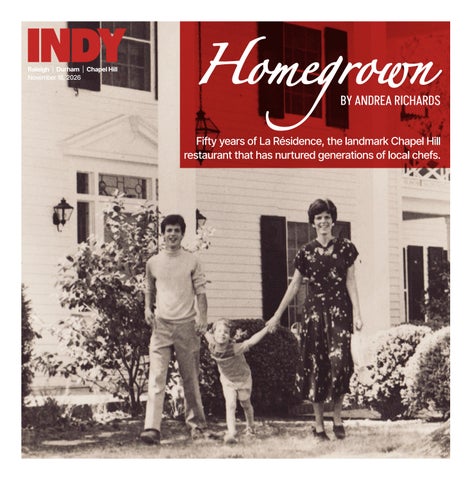
Fifty years of La Résidence, the landmark Chapel Hill restaurant that has nurtured generations of local chefs.
Raleigh | Durham | Chapel Hill Vol. 43 No. 22 | November 18, 2026
Contents News 6
A Durham teen needed help when she delivered her baby at 31 weeks. She ended up facing criminal charges unlike any others filed in the state so far. BY ANNE BLYTHE
8
How Democrats flipped two House seats in Wake. BY CHLOE COURTNEY BOHL
10
Half of Durham Public Schools' teacher vacancies are special education positions. BY TORI NEWBY
12
After sitting unused for 35 years, a historic school property in Durham may be razed and sold. BY TORI NEWBY
14
A first look at proposed data center rules for Durham. BY JUSTIN LAIDLAW
Culture 16
“Mettlesome exists because we want to be here. We want to tell our story. We want to do it in our voice,” says co-founder Ashley Melzer. BY RUSS CAMPBELL
18
Across 50 years, Chapel Hill restaurant La Résidence has been fertile ground for nurturing great Southern chefs. BY ANDREA RICHARDS
20 A guitar by the late, self-taught luthier Freeman Vines is on display at the Gregg
Museum of Art. BY ANDREA RICHARDS 22
This year, downtown Raleigh Artspace turns 40. BY JASMINE GALLUP
24
It's been a banner season for Hiss Golden Messenger. Let us count the ways. BY JED PHILLIP COHEN
Regulars 3
Backtalk
4
Op-Ed
26
Calendar
30 Classifieds
Cover La Résidence co-founders Bill and Moreton Neal with their son, Matt, at Fearrington Village in 1976 PHOTO COURTESY OF MORETON NEAL
Bill and Moreton Neal started La Résidence in 1976 (see story on page 18) COURTESY OF MORETON NEAL
We Made This Publisher John Hurld
Editorial Editor-in-Chief Sarah Willets Wake County Editor Jane Porter Culture Editor Sarah Edwards
Staff Writers Lena Geller Justin Laidlaw Tori Newby Report For America Corps Reporter Chloe Courtney Bohl Contributors Jasmine Gallup, Desmera Gatewood, Elliott Harrell, Brian Howe, Glenn McDonald, Cy Neff, Andrea Richards, Barry Yeoman, Russ Campbell, Colony Little, Shelbi Polk, Ryan Cocca, Lauren Wingenroth
2 INDYweek.com November 18, 2026
Copy Editor Brian Howe Editorial Intern Bridgette Nally
Creative
Advertising Publisher John Hurld Director of Revenue Mathias Marchington
Creative Director Nicole Pajor Moore
Director of Operations Chelsey Koch
Production Design Specialist Ellie Bruno
Sales and Marketing Associate Lauren Boyle
Circulation
Berry Media Group
Membership/ Subscriptions John Hurld Mathias Marchington
INDY | indyweek.com
Advertising sales
P.O. Box 1772 Durham, N.C. 27702
sales@indyweek.com 919-666-7229
919-666-7229 support@indyweek.com To reach INDY staff directly: tips@indyweek.com Contents ©2026 ZM INDY, LLC All rights reserved. Material may not be reproduced without permission.
BACKTALK
In an October 26 article, INDY’s Justin Laidlaw reported that the Durham City Council had received an update on the status of the city’s tree canopy—the portion of private and public landed covered by trees, as seen from above—which has, according to the report, “held at over 50% since an assessment was last conducted in 2016, even as the city limits have expanded to incorporate new developments.” Readers (and tree-lovers) weighed in.
SAMANTHA KROP, Neuse Riverkeeper at the nonprofit Sound Rivers, responded with an op-ed, which you can find online: “To Safeguard Its Water Supply, Durham Must Do More To Protect Its Forests.” In the op-ed, Krop wrote: The recent INDY article, “Despite Development, the City of Durham’s Tree Canopy Continues to Grow,” celebrates the city’s reported increase in tree canopy coverage. It highlights an impressive 15,000 trees planted over the past decade, including a commendable investment in historically underserved neighborhoods. But the headline tells only part of the story. And the story it leaves out is one of accelerating forest loss on Durham’s developing outskirts. The problem is that planting many young trees is not the same thing as forest conservation. A satellite image can register a newly planted street tree and a 100-year-old hardwood forest as tree cover. But these landscapes are not interchangeable. A mature forest is an entire functioning ecosystem: its roots stabilize soil; its organic layers absorb rainfall; its canopy moderates temperatures; and its vegetation provides habitat. These functions take decades or centuries to develop. Clearcutting removes them immediately, increasing erosion and runoff, destroying habitat, and warming streams. There is another major problem with the way Durham’s canopy statistics are being presented: they do not tell us enough about the forestland being lost as development pushes outward.
But there is a glaring omission: Much of the land annexed into the city has either been cleared since 2024 or is already slated to be cut for development. Because the areas with the highest remaining tree canopy are also where the most annexations are happening, the city is systematically absorbing heavily forested land right before it gets stripped. Furthermore, it can take years after a property is annexed for it to actually be cleared and graded, creating a lag time that masks the true impact of growth. A more honest analysis would account for the tree loss that is already baked in simply because those properties have been annexed for development— even if the bulldozers haven’t arrived yet. Measuring conservation success by looking at a snapshot of standing trees ignores the massive losses already queued up in the pipeline.
Sat, Jan 16 | Baldwin Auditorium User @BRUTAL_BRITT wrote: “Are they native trees though? Not to be THAT person, but all I see planted is non native trash trees” User @LUVTHEBULLCITY wrote: “Duke Energy is zealously disfiguring the canopy. There’s a difference between trimming trees and amputating them.”
Grammy-nominated a cappella group known for their viral bare-bones stairwell performances. Their music is simply a balm to the soul—R&B and soul intertwined with bursts of gospel.
Upcoming Highlights include... Dec 13 | Page Auditorium
An Evening with Renée Elise Goldsberry Jan 10 | Baldwin Auditorium
WANT TO SEE YOUR NAME IN BOLD? indyweek.com backtalk@indyweek.com @INDYWeekNC @indyweek
Learn more
dukearts.org
Pacifica Quartet
November 18, 2026 INDYweek.com 3
OP-ED Durham Central Park PHOTO BY JUSTIN COOK
Improving Durham’s Parks Will Take All of Us Improving Durham’s parks—and its ParkScore ranking—will require government, businesses, philanthropic organizations, and the community to work together. BY DAVID GREEN AND DONNA STANEK backtalk@indyweek.com
Z
ack Czajkowski’s recent INDY op-ed, “Durham Parks Are Literally the Worst,” raises an important issue. Durham finished at the bottom of Trust for Public Land’s 2026 ParkScore rankings, and that’s a result we should take seriously. But as volunteer leaders of the Durham Parks Foundation, a nonprofit that raises funds, builds partnerships, and advocates for Durham’s parks and open spaces, we believe the rankings also deserve some context. Durham has added more than 75,000 residents since 2010, with significant growth in areas that look very different from our older, more walkable neighborhoods. Because ParkScore places considerable emphasis on whether residents live within a 10-minute walk of a park, those development patterns matter. The rankings offer a useful benchmark, but they don’t tell the whole story of our parks system or the challenges of keeping pace with a rapidly growing city. None of that diminishes the need for improvement. We share Czajkowski’s concern about the need for greater investment in our parks and a clear plan for moving forward. But we also see an opportunity for a broader conversation about what Durham’s parks could look like in the years ahead, and what it will take to get there. Consider three cities near the top of the 2026 ParkScore rankings. 4 INDYweek.com November 18, 2026
• In third-ranked Minneapolis, the Minneapolis Parks Foundation raised $18.1 million through its RiverFirst campaign to support major improvements to public spaces. • In fourth-ranked Saint Paul, the Saint Paul Parks Conservancy has raised approximately $4 million for local park projects and programs. • And in fifth-ranked Cincinnati, the Cincinnati Parks Foundation has contributed more than $100 million to park projects, programs, and conservation over the past three decades. These examples do not establish that philanthropy caused these cities’ high rankings. They do show how foundations contribute to the public spaces and opportunities residents enjoy. Trust for Public Land’s investment measure includes public and private spending on publicly accessible parks. Understanding a city’s investment therefore requires looking at the broader network of organizations supporting its parks. For Durham, that starts with meaningful public investment. The City has a responsibility to maintain safe, accessible, and well-funded parks, and it has implemented a coordinated investment strategy to make this happen, including adoption of a Comprehensive Parks and Recreation System Plan, development of a Land Acquisition Strategy and an Investment Priority Indica-
Donna Stanek PHOTO BY DURHAM PARKS FOUNDATION
David Green PHOTO BY DURHAM PARKS FOUNDATION
tor, approval of the $85 million Parks and Recreation Bond, and continued Capital Improvement Program investments in playgrounds, park infrastructure, accessibility, and recreational facilities. Residents should expect the Durham City Council to back DPR’s existing plans and budget requests to continue this work. But public funding shouldn’t define the limits of our ambition. Private philanthropy, business involvement, and community partnerships can help accomplish more, from improving neighborhood parks and expanding recreational opportunities to supporting projects that might otherwise never get off the ground. The Durham Parks Foundation already provides a vehicle for this work. Founded in 2015, our volunteer-led organization raises funds, builds partnerships, and advocates for the expansion, accessibility, and improvement of Durham’s parks and open spaces. Our Community Fund offers grants of up to $5,000 for neighborhood-driven park projects and events, giving residents a direct role in shaping the spaces they use. Growing this work requires broader par-
ticipation from Durham’s businesses, philanthropic institutions, and residents. It also requires directing resources toward neighborhoods with the greatest unmet needs. A neighborhood’s ability to raise money should never determine whether its children have a quality place to play. We support the DPR’s Comprehensive Plan, which sets out measurable goals, and the need for reliable public funding. We also invite the community to help strengthen the philanthropic partnerships that can advance those goals. Durham deserves better parks. The experience of leading cities offers a practical direction: Invest consistently, build lasting partnerships, and give residents a meaningful voice in the work. The Durham Parks Foundation is ready to help turn that shared responsibility into results. W David Green and Donna Stanek serve as volunteer leaders of the Durham Parks Foundation, which is hosting the New Year’s Bull Drop on December 31 in downtown Durham, with proceeds benefiting the foundation’s Community Fund.
MAKE IT YOUR NATURE The outdoors is really a reflection of you. It’s up to all of us to do our part to help preserve the natural beauty of our state. Join us in following the 7 Outdoor NC Leave No Trace Principles, so our spaces can remain beautiful and enjoyable for years to come. PLAN AHEAD AND PREPARE STICK TO TRAILS AND OVERNIGHT RIGHT TRASH YOUR TRASH LEAVE IT AS YOU FIND IT BE CAREFUL WITH FIRE KEEP WILDLIFE WILD SHARE OUR TRAILS
November 18, 2026 INDYweek.com 5
NEWS
Durham
Body of Evidence Criminal charges for pregnancy outcomes have been rare in North Carolina. Advocates worry a recent attempt to prosecute Durham teens could instill fear of arrest and lead to delays in getting care. BY ANNE BLYTHE backtalk@indyweek.com
ILLUSTRATION BY ELLIE BRUNO
D
urham District Attorney Satana Deberry has been clear for years that she believes a woman has the right to make decisions about her own body. She has posted on social media about it and joined elected prosecutors across the country in a statement when the U.S. Supreme Court overturned Roe v. Wade in 2022, vowing not to use “limited criminal legal resources to criminalize personal medical decisions.” “Criminalizing personal health care decisions around abortion creates untenable choices for women—particularly those experiencing sexual assault and domestic violence— and undermines trust and fairness in our criminal legal system,” Deberry tweeted a month before the landmark 5-4 decision in Dobbs v. Jackson Women’s Health Organization, which turned decisions about abortion back to the states. So it was perhaps unsurprising when Deberry dismissed charges filed this summer against two Durham teens after the pregnant mother allegedly took abortion pills sometime close to 31 weeks of gestation and gave birth to a baby just under 5.5 pounds on a toilet. About a week later, Durham police charged 18-year-old Syeisha Johnson with assault; she and her 19-year-old boyfriend Elijah Speight also faced child abuse charges. What some in the legal profession found puzzling was that the charges were brought at all—especially in Durham, a politically progressive city with Deberry as top prosecutor. 6 INDYweek.com November 18, 2026
T
he Durham case is the first of its kind in North Carolina since the Republican-led legislature restricted access to most abortions after 12 weeks in 2023, said Susanna Birdsong, general counsel at Planned Parenthood South Atlantic. It started with a call to emergency dispatchers. Johnson found out at a doctor’s appointment in June, the same month she turned 18, that she was 20 weeks pregnant, according to Durham police reports and warrants. She allegedly ordered pills from Virginia to induce an abortion, according to warrants. The exact timeline of events is not clear in public documents, and efforts to reach the district attorney, Durham police, and the attorneys who represented Johnson and Speight have been unsuccessful. In an application for a warrant, Durham detective M.S. Supernaw alleges that Johnson began taking the pills several days before giving birth. On July 28, the detective wrote, Johnson began having abdominal pain and cramps, which had not subsided by the next day. “She sat on the toilet and gave birth to a child,” Supernaw wrote. “The child was left in the toilet.” At least one call to 911 was made, by Speight, according to court documents. The fire department was the first to arrive, and medics initiated cardiopulmonary resuscitation. When police arrived, the child had a pulse. Johnson and the newborn were transported to Duke
Hospital. Child Protective Services quickly launched an investigation. The same day, the Durham detective went to the hospital with a search warrant, seeking any phones or computer tablets. He also sought a warrant that day to search the Johnsons’ bathroom, saying “probable DNA from within could show the manner and conditions in which the incident took place.”
F
our days later, Durham police issued arrest warrants for Johnson and Speight. They were jailed on felony charges, and media picked up the story with headlines like “North Carolina Teen Parents Charged After 18-Year-Old Allegedly Took Abortion Pills While 31 Weeks Pregnant,” “Legal Battle Over Abortion Pills in Durham After Baby Found in Toilet.” “There’s a lot that we don’t know about the specifics of this case, but what we do know is that someone is being criminally charged for pregnancy outcomes,” Jillian Riley, director of public affairs at Planned Parenthood South Atlantic, said at the time. “We shouldn’t be using the criminal justice system to address situations like this. Anyone who is pregnant should be able to get the help and support they need rather than be thrown in jail.” In addition to restricting most abortions to the first trimester, North Carolina law requires anyone under 18 to get parental consent or a judicial waiver. And while medication abortions are permitted, providers
Stop cleaning-out your gutters this season
Debris Buildup Stands No Chance ED
U L E YO U R
IN
Heavy leaves
Pinecones
Acorns
Pine needles
Seed pods
Storm debris
N
With LeafFilter
I
O
disregard for human life” after the baby was born—and in fact, Speight’s 911 call suggested the opposite, Deberry wrote. Moreover, the baby was released to the care of Johnson’s mother—with whom both new parents live—and, according to Deberry, are allowed unsupervised visits. Planned Parenthood’s Birdsong was surprised by the statutes cited in the charging documents, and the implication that abortion medications could be considered deadly weapons in the assault charges. Assault on an unborn child occurs when someone assaults the mother and in the process harms the unborn child, Birdsong also noted. There’s an exemption in state law for the mother. While Birdsong has seen an increase in abortion- and pregnancy-related criminal charges in other states, that has not been the case in North Carolina—until this summer, that is. Two weeks before the Durham case, a 36-year-old woman was arrested in Buncombe County and charged with misdemeanor child abuse and feloniously exposing a child to a controlled substance related to fentanyl use, according to court documents. District Attorney Todd Williams, who also signed the prosecutors’ statement postDobbs, dropped the charges on July 27, citing similar reasoning. But prosecutors from 23 states have initiated at least 902 cases related to pregnancies since 2022, according to Pregnancy Justice, a reproductive rights nonprofit. The majority of the charges alleged some form of child abuse, neglect, or endangerment, with most involving substance use during pregnancy, they found. State Rep. Marcia Morey, a former Durham district court judge, said she was surprised to see the charges brought in Durham and was not surprised they were dismissed. Law enforcement officers have discretion, Morey added. “A lot of times, if [charges are] serious or controversial, I would think that they would consult with the DA to see if they would actually prosecute it. … Usually, there’s better coordination between law enforcement and the DA.” Even though the charges were ultimately dismissed, both advocates and legal analysts have pointed out the potential effect the felony charges could have in discouraging women from calling 911 in emergencies, or pushing them to resort to unsafe pregnancy termination methods rather than going to the doctor. “The damage has been done,” Morey said. “This was very delicate, I think, and involving teenagers. So I think that probably goes to show there should be better communication.” W
SCH
are required to examine the patient in person and provide counseling, then wait 72 hours before another in-person or telehealth visit to administer the pills. The widespread rollback of abortion rights, however, has led to increased online sales of these medications. This method has become the most common way to terminate a pregnancy since the U.S. Food and Drug Administration approved mifepristone in 2000. In 2023, 61% of abortions in North Carolina were done using medication, per KFF data. The protocol typically requires two drugs: mifepristone, which blocks the hormone required to sustain a pregnancy, and misoprostol, which is typically taken 24 to 48 hours later to induce uterine contractions. They are intended for use up to 12 weeks into a pregnancy. On August 5, the day after the teens were jailed, they made their first appearance before a Durham judge. Johnson was charged with assault inflicting serious bodily injury on an unborn child, assault with a deadly weapon with intent to kill, and negligent child abuse inflicting serious bodily injury. Speight was accused of negligent child abuse inflicting serious bodily injury. Bond was set at $1,000, and they posted bail after the hearing. Deberry told a gaggle of reporters in a courthouse hallway that day that she has been “on the record, over and over again” about her belief “that a woman has the right to choose and has the right to making decisions about her own body.” On October 27, the day before the teens were scheduled to return to court for another hearing, Deberry laid out her reasons for dismissing all the charges in a memo to Barbara Lagemann, a Durham County public defender who represented Johnson, and LiBria Stephens, a private attorney who represented Speight. “Ms. Johnson is alleged to have used mifepristone and/or misoprostol as deadly weapons,” Deberry wrote. “Both medications are commonly used in obstetrics and gynecology. The impact of both medications differs greatly depending on the dose, route, and gestational age at which they are administered.” It was not possible to determine those details from medical records and other information Johnson’s counsel provided, Deberry added. “While it is clear that Johnson delivered the child preterm,” Deberry wrote, “it was also unclear whether the substances she ingested were the probable cause of preterm delivery.” “Spontaneous preterm labor and delivery are not uncommon,” Deberry continued. “It is especially not uncommon in young black teens with ongoing financial and social stress, such as faced by Ms. Johnson.” No medical information supported the allegation either parent showed “a reckless
SPECT
Stainless Steel Micromesh uPVC Frame Custom Fit To Your New or Existing Gutters
EXPIRES: 11/30/2026
AN ADDITIONAL
25% OFF + 10% LeafFilter
Discount For Seniors + Military
*
Get a FREE full gutter inspection and estimate:
1-855-625-8979 Promo: 285
*Promotional offer includes 25% off plus an additional 10% off for qualified veterans and/or seniors. Cannot be combined with other offers. See representative for full warranty details. DC 420223000087, AZ ROC 344027, AR 0366920926, CA 1035795, CT HIC.0671520, FL CBC056678, ID RCE-51604, IA C127230, LA 559544, MD MHIC164488, MA 213292, MI 262300331, MI 262300330, MI 262300329, MI 262300328, MI 262300318, MI 262300173, MN IR2025-810524, MT 266192, NE 50145-24, NV 0086990, NJ 13VH13285000, NM 408693, ND 47304, OR 218294, PA PA179643, RI GC-41354, TN 10981, UT 10783658-5501, VT 174.0000871, VA 2705169445, WA LEAFFLH763PG, WV WV056912, WI 537-DCFRR
November 18, 2026 INDYweek.com 7
NEWS
Wake County
Blue Wake Democrats flipped two state House districts in Wake County. How powerful will the county’s legislative delegation be in a Democrat-led state House and narrowly divided state Senate? BY CHLOE COURTNEY BOHL chloe@theassemblync.com
Signs for rival legislative candidates in Wake County PHOTO BY SARAH MICHELS / CAROLINA PUBLIC PRESS
D
emocrats trounced Republicans in Wake County in the midterm election, flipping two state House seats by wide margins and helping to wrest control of the chamber from the GOP for the first time in 15 years. In southern Wake, Democratic newcomer Winn Decker beat three-term Republican incumbent Rep. Erin Paré. In northern Wake, Democrat Evonne Hopkins won her rematch against freshman Republican Rep. Mike Schietzelt. Decker and Hopkins both won by about 10 points, far outperforming predictions that their races would be some of the closest in the state. Political scientist David McLennan, who recently retired from Meredith College, chalked their victories up to a combination of changing voter demographics in suburban Wake County and a forceful rebuke of Republican politics. Both of the districts slightly favored Republicans when the incumbents won two years ago, but this year, they were rated true tossups by the Civitas Partisan Index. “More and more people that favor Democratic politics are living in those areas,” McLennan told the INDY on Wednesday. “So I think there’s a structural change 8 INDYweek.com November 18, 2026
happening there that’s going to be more permanent. And, the large margins clearly were the repudiation of Trump and state Republicans.” Decker, an education policy consultant, said in a statement that his campaign “focused on making sure families in Southern Wake County can afford to live here, our public schools have the resources they need, and our communities have the infrastructure and opportunities to thrive.” “An election is only the beginning,” he added. “District 37 deserves a representative who listens, works across differences, and never loses sight of the people and communities we are here to serve.” Hopkins, a family law attorney, thanked her voters, campaign team, and volunteers in a statement. “I have spent my career helping people through some of the most difficult moments of their lives,” she said. “I know how much families need stability, safety and someone willing to stand up for them.” Wake County Democratic Party chair Wesley Knott credited Decker’s and Hopkins’ wins to “overwhelming” turnout
among Democrats and unaffiliated voters. He’s still crunching the final numbers, but he estimated a turnout percentage in the high 60s among registered Democrats, which would be unprecedented for a midterm year. Wake County’s overall turnout was 60%. “This has been a long time coming,” Knott said. “We’ve been canvassing and talking to voters and phone banking and organizing in our competitive districts for several years now.” He said the county party worked hard to remind voters that Districts 35 and 37 were some of the most competitive and how much their vote mattered. “That kind of voter education over time, even for people who aren’t super politically engaged ... I think it gets buy-in,” he said. With Paré and Schietzelt unseated, Wake’s legislative delegation will be composed entirely of Democrats. Had Republicans retained control of the state House, that might have boxed Wake County out of important discussions and funding opportunities. But as it stands, Decker and Hopkins will be sworn in as part of a new Democratic majority.
“For years, during the Republican majorities in both chambers, the metropolitan areas got hurt a little bit because of their large Democratic delegations,” McLennan said. The new balance of power will “give counties like Wake ... more voice in terms of budget issues and any other kind of legislation,” he said. “They’ll still have to work with the Republicans to some degree to get things through the Senate. They’ll need one or two senators to come over with them. But I don’t think that’s impossible.” (Democrats broke Republicans’ Senate supermajority but fell just short of capturing the majority there.) The new House majority’s first priorities, according to presumptive Speaker Robert Reives, will be education funding and economic relief—two issues Decker and Hopkins campaigned heavily on. In her statement, Hopkins promised to fight for lower costs, strengthen public schools, and “protect our freedom to quality, affordable healthcare.” She also said she would work to hold Duke Energy accountable on behalf of families struggling with their energy bills.
Evonne Hopkins COURTESY PHOTO
Winn Decker COURTESY PHOTO
Knott said elected Democrats need to deliver on their campaign promises if they want to hold on to their newfound power. “[Will] it look different with two years of a Democratic majority in the House than it did with a Republican supermajority? If it doesn’t, I think it’s going to be really difficult to cling on to the progress that we’ve made,” Knott said. “But if we are insistent that we’re going to use the power in our hands to make people’s lives better, I think that they’re going to reward us with more power.” The House District 37 race in particular represents a major loss for state Republicans, who spent hundreds of thousands of dollars on ads for Paré, one of their rising stars. McLennan said she was a quality candidate, and her resounding loss just goes to show how decisively southern Wake has turned against Republicans. “This is a case where even a relatively good candidate on the Republican side ... still didn’t produce the results they wanted,” he said. During the final few months of her campaign, Paré received tens of thousands of dollars in donations from corporate political action committees, including Duke Energy, Dominion Energy, UnitedHealth Group, Amgen, and Novartis, as well as interest groups like the NC Home Builders Association, NC REALTORS, and the Carolinas chapter of the Associated General Contractors of America. McLennan says he’ll be watching where those groups take their money next since their preferred investment didn’t pay off. “You wonder, will they shift their invest-
ments to Decker in the future, or are they just going to get out of politics? I don’t know,” he said. “That’ll be interesting to look at in a couple of years.” Paré conceded to Decker in a social media post on election night. “The results of this election are in and I wish Winn Decker the best,” she wrote. But she couldn’t resist lashing out at him one last time about his status as a renter, not a homeowner, a criticism she raised frequently during the campaign to suggest he wasn’t sufficiently rooted in southern Wake: “Now is a great time for him to become a permanent resident in House District 37.” Paré wrote that she’s proud of her accomplishments from the past six years and is “looking ahead to future opportunities to serve our state, (stay tuned).” McLennan said based on the results, Republicans will have a hard time winning in Wake County from now on. “Seats are going to be really difficult to come by in Wake County. So where does someone like Paré go?” he asked. “Does she keep running in her district? Does she look for something different? Does she run statewide? It’s going to be a tough environment to run in.” McLennan noted that Democrats also dominated in local races, like school board and county commission, that can be a stepping stone to higher office. “So where does a young—meaning young to politics—Republican go in Wake County?” he said. “It’s a real challenge for them.”
We offer affordable multifamily apartments, duplexes and houses in the Raleigh and Durham area. Se Habla Español.
FIND AVAILABLE PROPERTIES br-apartments.com
November 18, 2026 INDYweek.com 9
NEWS
Durham
Christy Patterson is an exceptional children’s teacher at Carrington Middle School. PHOTO COURTESY OF CHRISTY PATTERSON
Teacher Shortage Nearly half of Durham Public Schools’ teacher vacancies are in special education. A new program aims to get teachers trained and hired full-time within a year. BY TORI NEWBY tnewby@indyweek.com
M
ore than two months into the school year, Durham Public Schools was still looking for 68 more teachers. Which isn’t so bad, district administrators told the school board this fall—it’s an improvement from last year, thanks to new recruiting strategies and a fully staffed human resources department. But reflecting a nationwide trend, nearly half of those vacancies are in special education, which North Carolina calls Exceptional Children’s (EC) classrooms. District leaders cited burnout as a major reason why; EC teachers cater to students with 10 INDYweek.com November 18, 2026
high needs, while their out-of-class time is often consumed by related paperwork and meetings, in a state notorious for low teacher pay. To help fill these vacancies, DPS has entered an agreement with contracting agency Unlimited Instruction to bring teachers into the classroom as they work on getting provisional special education licenses from the state. The goal is for them to then be hired full-time by DPS and complete their licensing. “It is a new and—I’ll be very honest with you—an unproven approach—that’s the rea-
son why we find ourselves in a position where we would be willing to try something like this,” Deputy Superintendent Nicholas King told the INDY. “It’s because we really find ourselves in a really challenging environment as it relates to identifying teachers who can fill these important classroom spaces.” As of October 30, DPS had 28 EC teacher vacancies and 329 EC teachers on staff. The contract with Unlimited Instruction could make a significant dent in the vacancy count by getting up to 20 teachers in the hiring pipeline.
The contract, if Unlimited Instruction sources 20 teachers, costs DPS $1.5 million, but the district will only pay for the instructional hours delivered. Unlimited Instruction pays the teachers—who operate like longterm substitutes—and helps them get a provisional EC teaching license throughout the year, so they are eligible to get hired by DPS at the end of their contract. Unlimited Instruction says it will save the district money; King estimated the contract is costing DPS about $300,000 less than it would to pay full-time teachers in those positions.
“You would think with the grants supporting students, we would be hopefully busting at the seams, but not so much.” - Maureen Short
“Unlimited Instruction’s pricing should be evaluated not only against salary and benefits, but against the district’s fully burdened employment cost,” a memo to the school board reads, “and the operational value of reducing recruiting pressure, onboarding demands, administrative workload, compliance responsibilities, coverage gaps, and turnover disruption.” As of the end of October, Unlimited Instruction has matched five teachers to classrooms, with seven more in the pipeline (the program began September 24 and goes through June 30). Meanwhile, the remaining EC vacancies are filled with instructional assistants or substitute teachers. Sometimes, EC teachers have to fill in on their planning periods or add to their caseloads of students, which can qualify for extra duty pay. EC teachers are required by federal law to create Individualized Education Programs (IEPs) for each of their students, which outline the services the student needs. Teachers must update the IEPs each year and have a formal annual review with parents and service providers. Kadeidra Smoots, senior executive director of human resources for DPS, said the vacancies can be a strain on the EC teachers who have to step in for meetings and extra paperwork on behalf of instructional assistants or long-term substitutes who are not licensed for certain tasks.
Smoots said some long-term substitutes, unprepared for the difficulty of the job, don’t last long. And similar to long-term substitutes and instructional assistants, the Unlimited Instruction contractors are not yet licensed and are learning on the job. “It’s not so much of the immediate problem solved,” said Kristin Bell, executive director of EC programming at DPS. “It’s an investment, with the hope that at the end of this period of time we’ll have had them in our classrooms, they’ll have a lot of our training, they’ll know our policies and procedures, and they’re honing their skills over the course of the year.”
‘You’re Never Just Teaching’ Christy Patterson, an EC teacher at Carrington Middle School, began as an instructional assistant eight years ago in a classroom without a teacher. Within 30 days, Patterson got a provisional license and was hired as the lead teacher. Over the next three years as Patterson worked toward her certification, she had to “swim or sink,” she said. Patterson modifies curricula for the sixth-, seventh-, and eighth-graders that she teaches, in addition to managing their IEPs and mentoring beginning teachers. Patterson said she has mentored strong early-career teachers, yet none of them have stayed longer than a year—opting for other school districts or private schools. Patterson said she had to add 20 students to her caseload at one
point due to vacancies in her school. Patterson, who is vice president for the Durham Association of Educators, said additional guidance and support from the district could help retain teachers. “What DPS has failed to realize is, if you show a little support and appreciation to the ones you got, and give them a little more for the extra work they’re doing—just a little appreciation—you will be surprised what people will do for you,” Patterson said. Hannah Hribar, who leads EC programming for DPS elementary schools, was an EC teacher in Orange County through the first year of the pandemic. She said the online and hybrid teaching model at the time took an emotional toll and led her to pursue a job in leadership at DPS. Besides the meetings and paperwork, EC teachers often have to engage with social workers and counselors to address students’ needs outside the school system. “You’re never just teaching,” Hribar said. “There’s always a bunch of other things you’re doing that are outside what the job description might say, and I think it does lead to a lot of burnout.” Hribar said in her four years overseeing EC programming, she’s observed more early-career teachers moving between schools and leaving teaching altogether after only a few years. “It does seem like we’re having folks come through and just cycling through, and then we’re seeing our veteran teachers not growing in numbers,” Hribar said. About 80% of the 28 EC teacher vacancies in DPS are in self-contained classrooms for students with more severe disabilities, often with one lead teacher and multiple instructional assistants. The remaining vacancies are for EC resource teachers, who pull students out of their general education classrooms for specialized instruction. (Outside of the EC teacher vacancies, there are about 30 more openings for EC-related staffing, including licensed therapists, psychologists, and instructional assistants.) Smoots said EC teachers need to be highly trained and specialized to teach students with a variety of needs, who may experience behavioral or emotional crises. “The kicking, the biting—for most teachers, especially new ones coming in, that’s not something that’s attractive for them,” Smoots said. North Carolina is ranked notoriously low for teacher pay and per-pupil spending from the state, and while EC teacher turnover has always been a challenge, it worsened across the country after the pandemic.
King, the deputy superintendent, said it has been particularly challenging in the last decade to staff EC positions and that he is seeing fewer interested and qualified candidates than he used to. At North Carolina Central University, Maureen Short has been training master’s students in special education for 15 years, and she said the field has always been hard to staff. Just before the pandemic, NCCU’s special education master’s program hired its own recruiter for the first time to raise the program’s numbers. Short received a federal grant in 2022 to train special education teachers, with the first cohort set to graduate with their master’s degrees this fall. The program—which covers tuition, books, and about $600 worth of licensing exams—can accommodate 150 aspiring teachers and currently has about 100. “You would think with the grants supporting students, we would be hopefully busting at the seams,” Short said. “But not so much.” The teachers from the grant-funded program are funneled into jobs in Wake and Chatham counties; NCCU has separately partnered with DPS since 2019 to train instructional assistants to be licensed EC teachers, but currently doesn’t have any in its program. Short said completing the four licensing exams required to work as an EC teacher can be a deterrent for aspiring teachers, in addition to entering a field with low pay. North Carolina does not offer a salary bump for teachers with master’s degrees, but some counties, including Durham, fund pay increases instead. The NCCU grant-funded program offers students a stipend as they complete their degrees. “That is to offer an incentive and encourage folks to get into special education,” Short said. “But unfortunately, even with that in place, we don’t have very many takers.” For those that do join the EC teacher workforce and stick with it, it’s a labor of love. Patterson said her career is a “gut calling.” She conducts home visits with social workers and organizes field trips—some of her students have never left Durham, she said. “The common denominator are these children,” Patterson said through tears. “And if we are all working to provide the best for these children, whether you say yellow and I say green, and we might have different opinions and different ways to get to it, I don’t care. We know our goal is to provide the best for these children.” November 18, 2026 INDYweek.com 11
NEWS
Durham
Boarded Up The historic Lowe’s Grove School building has sat empty and decaying for 35 years. Now, the school district is facing citations from the city and a time crunch to tear the school down and likely sell the property. BY TORI NEWBY tnewby@indyweek.com
Durham Public Schools has been cited by the city of Durham multiple times for failing to repair or demolish the 100-year-old Lowes Grove School building PHOTO BY TORI NEWBY
V
ines snake up the brick and past the boarded-up windows. Old theater seats and rotting wood sit in what used to be the auditorium, ruined by decades of rain that’s come through the gaping hole in the roof. Graffiti covers the peeling walls in the cafeteria, and exposed metal hangs from the ceiling where the tiles have fallen away. Nestled between I-40 and NC-54 and just a few miles from the growing Research Triangle Park, the historic Lowe’s Grove School building is sitting on a prime piece of land. But after nearly a century of operation, Durham Public Schools shuttered the school’s doors in 1989 and left it to rot. Only now, after decades of decay earned DPS a citation from the City of Durham, is the district planning for the site’s future. The likely course of action seems to be demolishing the building and selling the land for retail or housing, based on recommendations the school board heard from a consultant on October 8. A previous plan to build affordable housing for teachers on the property, introduced in 2017, stalled for years pending approval from the General Assembly. In the meantime, DPS continues to incur costs for property upkeep and threats of city fines, prompting the school board to move forward with a new plan for the site. “There’s no need for us to continue to deal with that building being there in the condition that it is in, and there is liability possible that we can run into,” board member Wendell Tabb said at the October meeting. “So, I am for demolishing that building tomorrow.” The UNC-Chapel Hill School of Government’s Devel12 INDYweek.com November 18, 2026
opment Finance Initiative (DFI), the consultant that DPS hired to conduct a feasibility study outlining possible development options for the site, will return to the board later this fall with cost estimates. DFI is still in early phases of developing recommendations but has found demand for some retail, single-family homes, and affordable housing, all of which would require DPS to tear down the building and sell the land either to the county or a developer. The board could choose to restore and reuse the building, but it would be expensive and there isn’t much that could be preserved. The decaying building needs to be gutted and requires new foundation and floors, DFI found. It is no longer eligible for historic tax credits, which are state and federal subsidies that help fund rehabilitation of historic buildings. The city cited the district several times over the past few years for failing to take care of the building or demolish it. But the city agreed to pause any related fines as long as the district had its consultant involved, and that extension lasts through January 8—putting DPS in a “time crunch,” Chief Operating Officer Kenneth Barnes warned the school board at the October meeting. The city first cited the property in October 2023 for wall, roof, and window damage, after receiving a call about teenagers playing in the building. The district did not take corrective action and failed multiple re-inspections. The city ordered DPS in February 2024 to repair or demolish the building by May of that year, finding that the cost of repairs would exceed half of its value. DPS failed to comply again. DPS sought demolition bids the following September, and
the city formally condemned the building as unsafe a few months later. Director of School Planning Devan Mitchell said she’s not aware of any fines the district has paid the city, considering they’ve received multiple extensions to complete the feasibility study. DPS is also incurring minimal costs to keep up the property, including resecuring the building after break-ins. The fence currently has gaping holes, and the grass and vegetation is completely overgrown. It’s easy for anyone to get inside, proof being trash strewn about the property. Barnes said at the meeting that with winter approaching, people might take shelter in the building—a liability for the district considering the hazardous conditions. But the price to demolish the building has doubled since the last time DPS asked for a quote in 2024. School board member Millicent Rogers told the INDY the board was holding out hope that the state legislature would authorize affordable housing for teachers in Durham, and the district could preserve some of the school building for that “as an homage to what has been.” The district decided to undertake a feasibility study last year to develop a long-term approach to the site, Mitchell said. “I wish we had taken action previously on the building,” Rogers said. “Demolishing that building doesn’t mean that we are no longer invested in having affordable teacher housing or moving that plan forward. But that site is in such disrepair, and I don’t know that the board was aware that the site was in such disrepair that it was no longer a feasible location.”
Elementary students at Lowes Grove in the 1970s PHOTO COURTESY OF WILSON KIC STATION
The old Lowes Grove building is no longer elibgle for historic tax credits due to its condition PHOTO BY TORI NEWBY
Before it could put the property on the market, the district would have to deem it unnecessary for school purposes and give Durham County the option to buy it. Because of the site’s proximity to Research Triangle Park and other amenities, the DFI consultants found it’s likely competitive for federal affordable housing tax credits. They also found there’s demand for single-family homes and retail. (DFI’s analysis covers the school and 13 surrounding acres.) Similar feasibility studies were conducted in the early 2000s, ahead of the South Regional Library’s opening in 2010 on part of the old school property. Now, the library’s windows directly face the old school building, which is the last of six still standing.
‘Lowe’s Grove School Was Here’ Lowe’s Grove School first opened in 1896 as a Sunday school, in what was deemed the “dark corner” of Durham County because it lacked a school or a church. The Sunday school gave way to a one-room schoolhouse, and the county added more buildings over the next few decades. The school was called Lowe’s Grove Farm Life School, as it was funded by a federal grant that taught the boys agricultural skills and the girls “domestic science,” and the school had a farm on its property. An
all-brick building remaining today opened in 1925. An issue of the school newspaper, called the Lowe’s Grove Reflector, reported at the time that “the new building will in every way be adequate for the long-felt need of our growing community.” The school, restricted for white students until county schools integrated in 1970, developed a loyal alumni base. But over time, the original campus was saddled with maintenance needs, and a 1985 report recommended closing the “dilapidated” buildings. The DPS superintendent at the time said the site may become too valuable to continue operating a school, the Durham Morning Herald reported, considering it was in a “prime area for commercial development.” A group of parents and community members presented a petition to the school board with nearly 600 signatures, begging the district not to sell the building. About 35 area residents created the Historical Committee to Save Lowe’s Grove School. “I can see 10 years from now the highway department will put up a plaque that will say, ‘Lowe’s Grove School was here,’” a resident named Miss Godwin told a News & Observer reporter in December 1988, just months before the school closed. “That’s not enough. That’s not fair.” Students were transferred to Pearsontown and Southwest elementary schools in the fall of 1989, and the 1925 building was
declared eligible for the National Register of Historic Places. There was some discussion of selling the property to a historical developer or renovating it for retail, the N&O reported. But likely to Miss Godwin’s dismay, the DFI consultants found that the building is no longer eligible for the national historic register due to neglect and decay. Caitlin Avinger, executive director of advocacy group Preservation Durham, said she pushed for the district to do “whatever possible to save the building.” But after DFI’s feasibility study made clear that the building has lost much of its historic integrity and wouldn’t be eligible for historic tax credits, Avinger said the building is probably at the end of its useful life. “The bigger question is why the building sat there for 35-plus years in its current state, without more of a plan to try to find a secondary use,” Avinger said. She said DPS should have plans for its buildings before they are vacated and consistent maintenance on empty properties. DPS is preparing for the Durham School of the Arts campus to be vacant once the new building is complete in 2028, and the old Northern High School building is sitting empty and ready for a new use. DFI has also been contracted for feasibility studies on those two sites. The district is also considering closing
some aging elementary schools, including Club Boulevard and George Watts Montessori—properties that the district could sell and generate revenue from “if it’s done right,” Avinger said. “So many of these buildings are part of the fabric of what make Durham visibly Durham,” Avinger said. “The goal is to balance preserving and protecting the buildings that show our character at the same time as updating as we need to.” The DFI consultants have engaged some community stakeholders—including the neighboring library, a preschool, a church, and Research Triangle Park—and will ramp up engagement as they narrow down more realistic options for the old Lowe’s Grove School site. Rogers said confronting the future for Lowe’s Grove is an opportunity for the board to create a policy on addressing DPS properties when they’re no longer used for students; she anticipates the board voting on such a policy in the next year. “I wish our predecessors had set the standards to do so,” Rogers said. “... Our board now has the opportunity to set the precedent, and create policies and systems that will far outlive our term on the board, to help future boards be able to determine when is the right time to offload property.” W November 18, 2026 INDYweek.com 13
NEWS
Durham
ILLUSTRATION BY NICOLE PAJOR MOORE
Data Point Durham officials are working on proposed guidelines regulating where data centers can be built and how big ahead of the city and county’s moratoriums expiring next year. BY JUSTIN LAIDLAW jlaidlaw@indyweek.com
A
fter the City of Durham and Durham County passed moratoriums on new data center construction earlier this year, the Durham Planning Department has brought forth new recommendations for how the city and county should regulate data centers going forward once those moratorium periods have ended. The proposal suggests requiring all data centers to go through an approval process that would include neighborhood meetings and public hearings. Developers would also be required to report detailed information on water, 14 INDYweek.com November 18, 2026
wastewater, and power usage and associated resource demands like generator power. Under the proposed regulations, data centers would be restricted to a limited number of zoning districts— industrial, light industrial, university and campus, and science and research park—and a maximum square footage. Data centers would also be required to be a certain distance from residential areas, churches, and schools, as well as other data centers. Staff left open the possibility for further limitations based on recommendations
from leadership. On November 4, members of the Joint City-County Planning Committee (JCCPC) received a presentation from Robin Schultze, principal planner and arborist with the Durham Planning Department, on Durham’s current land use guidelines and proposals for how to effectively legislate future data center requests. Currently, data centers are not a specific use listed in the Unified Development Ordinance, Durham’s collection of land use laws. Schultze said the department sought input from a
wide range of experts and stakeholders, including the UNC School of Government, Central Pines Regional Council, Durham’s Environmental Affairs Board, and community advocates. Based on those discussions, staff recommended further restrictions like prohibiting data centers from using groundwater, limiting permissible noise levels, and requiring standards for generator use. City Councilmember Matt Kopac applauded the recommendations, which he said were uncommon from what he’s seen in other communities. “I appreciate that you’re really trying to have this be a leading approach that reflects what you’ve heard from us and folks who have given input into the process,” Kopac said. The rapid expansion of data centers in the last few years has raised the alarm for residents who view them as harbingers of job loss, increased costs, and environmental degradation. In Durham, residents pushed local officials to implement moratoriums on the development of data centers, following a national trend, until the community had an opportunity to advocate for stronger restrictions. “These data centers have huge impacts on quality of life,” said Mayor Pro Tem Javiera Caballero. During the staff presentation, committee members and staff discussed which metrics to use to distinguish between data centers that should and shouldn’t be allowed. The county’s moratorium allows for construction of data centers under 100,000 square feet. City Councilmember Nate Baker, chair of the joint committee, noted that using square footage as a measure of a data center’s impact is “imperfect” but that it’s one of the few tools the planning department has to evaluate them. Hyperscale sites, which tend to be 100,000 square feet or larger, have drawn particular ire from the public. Companies like Microsoft, Amazon, and OpenAI use hyperscale centers for feeding generative AI development. Schultze said that it’s hard to know what a data center is used for from the outside, making it difficult to legislate out specific uses, but that based on recent studies, the correlation between size and generative AI is a fair one to make, likening the comparison to a familiar geometry lesson about squares and rectangles. “Generally, yes, AI data centers are larger, but not all large data centers are for AI,” Schultze explained. Schultze offered another metric that could be used, called redundancy, which calculates how much backup power a
system has for use during a power outage—ranging from no backup system to a fully independent second power source with its own cooling infrastructure and fuel storage. But data centers with a smaller footprint could consume more resources than larger ones. These uncertainties about individual data centers are a major reason why advocates pushed local leaders to create a more stringent process for data center construction compared to other developments. “I feel like we really need to understand, what does the state-of-the-art data center look like today?” said County Commissioner Wendy Jacobs. “Like everything else in Durham, we should be striving for what is best practice out there right now.” Committee members agreed that the industry is evolving exponentially, and that managing data center growth will likely be an ongoing process, but that shouldn’t stop them from putting together the best possible plan for what they have to deal with right now. “Right now, ‘data centers’ is a bad word, and that’s unfortunate because every single company that anybody here works for uses some sort of data retrieval or storage, and we have to make sure that we’re not inadvertently cutting those off,” said County Commissioner Mike Lee, who works for agentic AI company Avalara. As planning staff finalizes its recommended data center ordinances, Baker said the city and county will likely need slightly different guidelines to govern each jurisdiction given the types of industries that operate within each border, and the available land suitable for data center construction. Most of Durham’s current data center footprint is in the county’s jurisdiction at Research Triangle Park (RTP). Given the required distances from residences, schools, and churches being proposed, industrial areas like RTP are also the most likely sites for future data center projects. But the park will have to wrestle with its desire to reimagine RTP into a full-fledged multipurpose community through its RTP 3.0 blueprint, which introduces more residential and commercial uses into the park and could complicate where data center construction is allowed. Planning staff will present a full draft of data center ordinances and guidelines at the next JCCPC meeting in December. The Durham City Council and Board of County Commissioners would vote on final regulations ahead of the moratoriums expiring in May 2027. W November 18, 2026 INDYweek.com 15
STAGE
Broken Records, Mettlesome’s inaugural improvised musical house team, hits a high note PHOTO BY METTLESOME THEATER
Staying Power A packed schedule, a tenth anniversary, an alumnus with a new gig as a Saturday Night Live writer—it’s all in kind for Mettlesome, Durham’s dynamic, community-minded theater. BY RUSS CAMPBELL arts@indyweek.com
T
en years ago, Mettlesome Theater wasn’t a theater at all. It was a group of friends shuffling folding chairs from a garage into a driveway. “Our very first show was in our garage,” co-founder Jack Reitz recalled. “We got some of our friends, put some chairs in the driveway, and put up a show. It was really fun.” Reitz and his wife, Ashley Melzer, first met doing comedy. They knew each other for several years, including a period when Reitz lived and performed in New York City, before they began dating and he returned to the Triangle full-time. Reitz studied and performed improv since 2004, training at DSI Comedy Theater in Chapel Hill and later at Upright Citizens Brigade and Magnet Theater in New York. Melzer, a filmmaker, writer, and improviser with a background in folklore and documentary storytelling, shared his interest in 16 INDYweek.com November 18, 2026
creating original comedy rooted in performers’ experiences. That modest experiment grew into one of Durham’s busiest comedy institutions. Today, Mettlesome operates from Golden Belt, producing roughly 30 performances monthly with more than 100 regular performers and a payroll exceeding 25 people. Improvisational comedy remains the heart of its programming, from ensemble performances built around audience suggestions to original sketch productions and classes that train the next generation of comedians. The theater also hosts plays, literary readings, music, and experimental productions. In August, its ambitious 10th- anniversary celebration featured 81 acts across two weekends, including Mettlesome alumni who returned from across the country to perform. Yet in talking with Reitz, co-founder Ashley Melzer, and
operations director April Dudash, these numbers seem secondary to something harder to quantify. By building a community around the conviction that diverse and adventurous art can thrive in Durham, they didn’t have to wait for validation. “We’ve learned over the decade making art in Durham that art functions best when we are working in community with other artists,” Melzer said. Before finding a permanent home, the Mettlesome collective performed wherever space was available, including Fullsteam, the Pinhook, Manbites Dog Theater, which closed in 2017, and a tiny theater behind Motorco that eventually disappeared beneath new development. Reitz and Melzer joke that much of theater is simply moving chairs. During the pandemic, when performances paused, company mem-
bers continued gathering online for improv and weekly trivia nights. Many still perform and teach at Mettlesome. “I think we always knew we had a community,” Melzer said. “It’s incredible how much that community has grown.”
“It’s not just a theater that I’m popping in to do a show at. … It’s really a place where I made my home.” - Brandon Alston That growth has accelerated. Mettlesome doubled its class offerings over the past year, attracting hundreds of students.
Dudash regularly hears from newcomers who enroll simply to meet people, only to discover friendships, creative collaborators, and a sense of belonging. But Mettlesome isn’t merely a social club with a stage. Its founders approach comedy as a serious artistic discipline, comparing improvisation to jazz that requires practice, studied collaboration, and technical skill. “Our school is teaching people to be better comedians,” Reitz explained. “Confidence and friendships follow, but they are byproducts of developing the craft.” That commitment has helped Mettlesome evolve from an indie upstart into an institution with a growing national reputation. Performers like Craig Cackowski (Community) and Judah Friedlander (30 Rock) have approached the theater about appearing there, while Saturday Night Live senior writer Bryan Tucker has mentored performers and collaborated on productions. The connection became particularly meaningful when Brandon “Bam” Alston, a Raleigh native and Mettlesome performer, instructor, and board member, joined Saturday Night Live’s writing staff in 2026. Alston previously helped create Bullish, a Mettlesome sketch production directed by Tucker.
For Alston, who returned to the Triangle in 2021, Mettlesome offered more than a stepping stone to a larger comedy market. “Mettlesome is just such a great place to grow with a group of people that take comedy seriously,” he said. “I think it’s a wonderful thing to be able to find such high-quality programming in your backyard.” He remembers joining Well Seasoned, an all-Black improv house team led by the late Josh Rowsey, as a turning point. The group gave him a community within a community. “They care about inclusivity, and they care about great programming, and they cared about me,” Alston said. “And then I think from there, I was really all in.” Alston became a writer, performer, improviser, teacher, and board member. “It’s not just a theater that I’m popping in to do a show at and then going home and waiting for the next one,” he said. “It’s really a place where I made my home.” For Mettlesome, that recognition matters because it has been earned without abandoning Durham. The theater’s history parallels the city’s transformation, including the disappearance of affordable performance spaces as development reshaped downtown. The founders understand the contradiction: Artists help make neighborhoods
desirable, then struggle to remain as those neighborhoods become more expensive. “People love Durham because Durham is weird and because Durham has art and culture and scrappiness and grit,” Reitz said. That commitment to place also informs Mettlesome’s distinctly Southern identity. “We kind of have a chip on our shoulder about being Southern artists,” Melzer said. “Mettlesome exists because we want to be here. We want to tell our story. We want to do it in our voice.” For Melzer, who grew up near the Florida-Georgia-Alabama border, Southern comedy should not rely on exaggerated accents or familiar stereotypes. It’s about allowing performers to draw on their actual experiences. “Who you are and your perspective as a Southerner matters,” she said. Looking ahead, the founders hope to expand sustainably without losing the experimentation that defined their first decade. Success, they suggest, isn’t simply a bigger theater or greater national recognition. “In 10 years,” Reitz said, “I want Durham to be a place that people are moving to make art and not a place that people feel like they need to move away from in order to make art.” W
November 18, 2026 INDYweek.com 17
FOOD & DRINK
The Home Front This year, landmark Chapel Hill restaurant La Résidence celebrated fifty years in business. It’s been an origin point for generations of chefs for just as long. BY ANDREA RICHARDS food@indyweek.com
Moreton Neal and Bill Smith in the La Résidence kitchen PHOTO BY RICK ROBINSON; COURTESY OF MORETON NEAL
P
icture it: a cozy, historic house with a beautiful garden— full of flowers and, depending on the season, herbs and vegetables. Inside the house, a series of intimate, candlelit rooms unfold, furnished with dining tables and banquettes among other antiques. There’s even a New Orleans–style enclosed patio, should you choose to dine outside. It’s the late ’70s, maybe the early ’80s. Among the wellheeled diners—a veritable who’s who of university elite— are William and Ida Friday, as well as Kay and Georgia Carroll Kyser (their daughter Carroll even helped decorate the restaurant). Dean Smith, another regular, sits at his table in the corner, his back against the wall. His order? Either the sweetbreads or the kidneys. The kitchen keeps kidneys on the menu just for him. There might be some out-of-towners too—even Hollywood stars, like Robert Wagner, Natalie Wood, and Christopher Walken, who all showed up multiple times in 1981 while filming Brainstorm nearby. Over the years, many other luminaries, from Bill Murray to Cokie Roberts, all made dining stops at Chapel Hill’s La Résidence—or as locals and regulars call it, La Res. The writer V.S. Naipaul, in town once while researching his 1989 book A Turn in the South, befriended the chef (Bill Smith at the time) after eating there every night for a week. This was La Résidence in its peak swank era, when the little blue house on Rosemary Street was a center of culinary and cultural change in a quaint college town. With a focus on sourcing high-quality ingredients straight from farmers (and its own garden) and changing the menu in accordance with seasonality, La Res ushered in the local era of farm-to-table. Berkeley might have Alice Waters and Chez Panisse, but in Chapel Hill, we had Bill and Moreton Neal, two visionaries bringing new foods and old techniques to town, serving it all up with a big side of chic. Little did they know then that La Res’s tiny kitchen would 18 INDYweek.com November 18, 2026
become a training ground and creative wellspring for some of the South’s most lauded chefs.
T
he first incarnation of La Res began not on Rosemary Street but in Pittsboro’s Fearrington Village, which was still being developed when the restaurant opened in 1976. “It was so far out—that was the end of the earth,” said Moreton Neal of the then-remote location, recalling a time when she had to drive into town to buy butter. “You couldn’t find butter in Pittsboro—every store had margarine at that time. Butter was not a thing in the early ’70s,” Neal said. “We ran out of butter, so I had to go into town to get it at Fowler’s, [a grocery store] which was about a 20-minute drive in my un-air-conditioned Volkswagen Beetle. By the time I got back, it was all melted—it was July.” Moreton and Bill Neal met as undergrads at Duke University—fittingly, in a French class. The two shared a love for food, and while both thought they would become teachers, they began catering and working in restaurants while still in school. While Bill Neal was in graduate school, Moreton Neal worked at Durham’s Hope Valley Country Club, cooking under the French chef Jacques Condoret, while Bill Neal stayed home with their first child, Matt. Cooking his way through Julia Child’s Mastering the Art of French Cooking at night, Bill Neal undertook his own version of the film Julie & Julia but with a baby. “We became good friends with Jacques and his family and would go eat dinner with them on Monday nights,” said Neal. “Bill saw Jacques as a role model. He, by then, loved to cook as much as I did.” Bill Neal wanted to move the family to France, but lacking the finances, he got a job at the Villa Teo, at the time the fanciest restaurant in Chapel Hill. Under chef Henry Schliff, Bill Neal learned to cook what was then known as “conti-
nental cuisine.” Eager to practice and expand their skills, the Neals were part of a cooking group that included Jenny Fitch; this is how they met R.B. Fitch, the developer of Fearrington Village. He suggested the couple lease the farmhouse there and turn it into a restaurant. Selling their home to finance the venture, the Neals moved into the farmhouse’s second story, opening the restaurant below. While Moreton Neal wanted to name it Artichoke, after her favorite vegetable, the name La Résidence made more sense—after all, it was their home. The menu wasn’t strictly French, but it was mostly French, with some room to adapt local and fresh ingredients. One of La Res’ core principles was seasonality—a new principle in these parts, but typical in France—and, of course, using French techniques, even if with butter beans. “We weren’t fancy, fancy French,” said Bill Smith, who worked in La Res’ kitchen for 15 years, some of them under Bill Neal. “We were like cuisine de grand-mère—the good household cooking of France is what they were aiming for.” Moreton Neal concurs, adding that the couple initially never even planned to open a French restaurant. “We wanted to open more of a New Orleans–style restaurant because I grew up eating in New Orleans,” said Moreton Neal, whose destiny may have been sealed at birth—her mother went into labor with her at Galatoire’s, a fine-dining institution. “I grew up eating good Creole food.” Moreton Neal made the desserts and acted as general manager, Bill Neal served as chef, and whatever you wanted to call it, La Résidence made fabulous, faraway-sounding food that wasn’t readily available in the Triangle—trout amandine, pissaladière, bouillabaisse, sweetbreads, and a chocolate soufflé cake called the kaluga that became legendary. After two years, the Neals decided to move the restaurant into Chapel Hill: Alcohol sales were still illegal in Chatham
County, so they couldn’t sell wine, which for any restaurant, especially a French one, is a necessity. Plus, living at work was starting to wear on the family. In 1978, they moved La Res to an old house at 220 W. Rosemary St. (the restaurant would later move down the street to its current location at 202 W. Rosemary)—and it was here where things really got cooking.
T
hat two of Chapel Hill’s most famous chefs are both named Bill (Bill Neal, Bill Smith) and worked in the same two restaurants (La Res, Crook’s Corner) can be confusing. But rather than an instance of lightning striking twice, it’s a paradigmatic example of how being in the right place at the right time with the right people makes all the difference. That kind of good timing makes a scene. “My mom made La Res a really nice, attractive, comfortable, elegant space, full of grace and style and charm. And I think she was really well liked and looked up to by her staff,” said Matt Neal, the oldest of the Neals’ three children, who worked on-and-off in the family businesses for years and later ran his own restaurant, Neal’s Deli, in Carrboro. “I know that my dad did a great job as chef there—I’m proud of both of them,” Neal continued. “I’m also very proud of Bill Smith—he had a decade there where he was doing a fantastic job. It [La Res] was a fun, exciting restaurant when I was a young adult in the early ’90s—it was a really cool place. ... People might say, oh, it’s a fancy French restaurant, but there was nothing stuffy about it. It felt a little bit hip and swinging.” Before starting at La Res, Bill Smith was one of the original owners of the Cat’s Cradle. As he tells it, he “lived in a big group house, like everybody did back then,” and was roommates with a La Res waitress. In need of a day job, he started in the kitchen “at the bottom of the ladder, chopping parsley, peeling potatoes and shrimp.” “It suited me,” said Smith. “I began to learn things and moved up, learning different stations. ... It was like a school almost. ... We were learning as we were going. We learned a lot of basics—stockpots, the basic sauces, the proper treatment of vegetables.” This culinary education was supplemented with food magazines, an all-but-gone media product: “We’d read about these things, and if someone was going to New York, we’d say, ‘bring us arugula,’ or sun-dried tomatoes and pancetta,” said Smith. In this era—before arugula was available at most grocery stores and farmers markets weren’t de rigueur—La Res was a beacon of creativity and innovation. But it wasn’t just the menu items that felt new. “You didn’t have to be strict about menu and stuff—you should be open to trying new things. If you didn’t like them, don’t do them
again, but, you know, poke around. Don’t be stuck in your ways,” said Bill Smith. When a shift was over, Smith and others who worked in the kitchen were back at the Cat’s Cradle, “flying across the street every night to go see bands.” It was this culture that cultivated the talents of so many of the folks who worked there—that, and some strong tutelage from the head chef. “Bill Neal was an excellent teacher. He really had a gift for it,” said Moreton Neal. The Neals worked together until 1982, when their marriage and business partnership ended—Moreton Neal staying on at La Res, and Bill Neal starting Crook’s Corner alongside Gene Hamer. (Decades later, Moreton Neal compiled recipes and stories from Bill Neal’s career into a cookbook published with UNC Press—after their marriage and business partnership ended, the two remained friends.) At Crook’s, Bill Neal went from local legend to national name, thanks in large part to an article by Craig Claiborne in The New York Times. His career was cut short: In 1991, Neal passed away at 44, a victim of AIDS. By then, he’d evolved into a charismatic poster boy for Southern cooking; his enthusiasm, skill, and strength of influence put shrimp and grits on menus not just across the South, but around the country. Neal’s influence on generations of chefs in North Carolina and beyond began with those he taught directly or through other chefs who had logged time in the kitchens of one of his restaurants. Protégés include many of the South’s most acclaimed chefs. There was Bill Smith, of course, but also Robert Stehling (Hominy Grill), John Currence (City Grocery), Kevin Callaghan (Acme Food & Beverage Co.), and Cheri Klein (The Hilltop). Then, there were the chefs who came through La Res after Bill Neal left, who worked for Moreton Neal, including, again, Bill Smith, Ben and Karen Barker (Magnolia Grill), and, by the transitive property, Rick Robinson (Mondo Bistro, Rise Biscuits & Donuts), who worked for the Barkers at Magnolia Grill. Finally, you have the folks who came through the La Res kitchen after Moreton Neal left in the 1990s—Devon Mills (Babette’s), Graham Heaton (Table 16), and Andrea Reusing (Lantern). It’s easy to lose track of the number of James Beard Award winners or nominees on this list—and that’s not even taking into account the number of chefs who were Neal admirers, like Frank Stitt (Chez Fonfon) or individuals inspired by his seminal cookbooks about Southern cuisine. Suffice it to say, in its 50 years of existence, La Res has been fertile ground for nurturing great Southern chefs. “[La Res] sort of set the town up to be open to all kinds of good restaurants and new
Bill Smith (pictured at home in 2019) got his start in the La Res kitchen PHOTO BY ALEX BOERNER
foods—that was probably the most important thing it did,” said Bill Smith.
O
ver the course of half a century, La Res has changed alongside Chapel Hill, as decades of downtown development have reshaped the landscape—and some say the vibe—of the town. As the high-rises continue to shoot up like weeds and parking spaces shrink in favor of underground garages, La Res endures, adapting. By the 1990s, La Res had a lot more competition in town—thanks, in part, to the restaurant’s role in growing an audience for more adventuresome dining. People had more choices, and La Res, which has always been seen as a special-occasion restaurant, slowed down. “We’d have 500 people call for a reservation on Saturday night and nobody in the dining room on a Tuesday or Wednesday,” said Smith. In 1992, current owners Frances and Tom Gualtieri took over—they’d been investors, and their children grew up alongside the Neals’ kids, working in the restaurant as teens. “It was a very family environment,” said
Andrea Reusing, who worked in the kitchen at La Res in the late 1990s, and remembered the Neal children’s presence. “Frances’ sister, Jackie, was the pastry chef when I was there. ... Like Frances, she was a great gardener. Jackie did this whole composting thing—this is like kind of pre-composting in restaurants— where she’d, like, bring scrap food home for her chickens and compost. That was cool.” Reusing, now a leader in the sustainable food movement, was apparently taking notes. Another aspect of the La Res kitchen that stayed with her was the sense of community, a value Bill Smith found too. “I learned a tremendous amount, and I got to see the inner workings of, like, a real serious restaurant with an incredible legacy of recipes and history,” Reusing said. “There’s an office upstairs that has part of Bill Neal’s cookbook collection, which is incredible. All these old French cookbooks, in French—so there was a lot of history there and a lot of people that really knew the history of the culinary world in the South and in Chapel Hill. ... It was this, like, magic, kind of storybook place.” Continued on page 23 November 18, 2026 INDYweek.com 19
ART
COMMUNITY STORIES: SUSTAINING NORTH CAROLINA BLACK HERITAGE TITLE
Through February 27, 2027 | The Gregg Museum of Art & Design; Raleigh
Spirit and Sound A Gregg Museum of Art & Design exhibit this fall features a hanging tree guitar by the late Freeman Vines, a North Carolina artist and luthier. Displaying the piece called for a conscientious, collaborative community process. BY ANDREA RICHARDS arts@indyweek.com
Freeman Vines at work PHOTO BY TIMOTHY DUFFY; COURTEY OF THE MUSIC MAKER FOUNDATION
N
ishani Frazier, a professor of history and the director of public history at North Carolina State University, first heard about Freeman Vines, the Black artist, blues musician, and guitar maker, through what she jokingly calls “the Devil’s Network”—aka social media. She’d seen an Instagram post from the actor Billy Porter about a short documentary film he was executive producing on Vines, a self-taught luthier who died in late 2025. Co-directed by filmmakers André Robert Lee and Tim Kirkman, Freeman Vines offers an intimate portrait of the North Carolina artist near the end of his life, forgoing the conventional biographical treatment for a deep, lingering look at Vines at work in his shop. One thing Frazier didn’t know when she first started planning the documentary screening event, which took place on October 22, was that the Gregg Museum of Art & Design holds one of Vines’ guitars in its permanent collection. Entitled “Skull Guitar,” the work is currently included in the exhibition Community Stories: Sustaining North Carolina Black Heritage, on display through February 27, 2027—and there are many stories about how it got there, only one of which will be told here. In Lee and Kirkman’s 14-minute documentary, Vines, then 82 and undergoing chemo for multiple myeloma, talks about his philosophy of life and art while hand-carving one of his distinctive guitars, which he would create from a variety of reclaimed and discarded materials—old wood, broken instruments, and other found objects. While his arthritic hands could no longer play the guitar, they could still sculpt one, and the film captures him as he continues his lifelong quest 20 INDYweek.com November 18, 2026
to make a guitar that has a particular sound, one that Freeman Vines once heard and hasn’t been able to replicate since. It was a sound that Vines would follow till his end, creating hundreds of guitars in his lifetime—and refusing to sell any, although he often discarded them as soon as he realized the sound wasn’t there. Some of these guitars—his “hanging tree guitars”—were crafted out of wood salvaged from the tree used in the brutal execution of Oliver Moore, a Black man who was lynched before a crowd of 200 people in Vines’ hometown of Fountain, North Carolina, in 1930. These hanging tree guitars are the subject of a book about Vines entitled Hanging Tree Guitars, published by the Music Maker Foundation, which features photographer Timothy Duffy’s images alongside text written by folklorist Zoe van Buren with Freeman Vines. That these guitars are both works of art and relics of horrific racial violence is a reality that can be hard to hold. Vines himself thought there was something supernatural about the wood, warning folks that you wouldn’t want to play these guitars too long. “Sometimes when the spirit calls you to do something, it allows the other things to fall into place,” Frazier said of her decision to screen the film at the Gregg, inviting not only the film’s directors but also Vines’ sister, Reverend Alice Vines, who appears with her brother in the film. (Their backand-forth sibling dynamic, plus Reverend Vines’ spontaneous onscreen singing, are highlights of the film.) “Skull Guitar,” the work exhibited at the Gregg, is one of Vines’ hanging tree guitars. Frazier urged care with its display. “I said immediately, ‘That has to be cleansed before you
put it on exhibit,’ Frazier said. At a pretty quick pace, Frazier led the museum through a process that would allow the care and display of “Skull Guitar” to be rooted in and reflect African American cultural practices of mourning, of memory, and of protecting the spirit or imbued energy of the piece. Frazier knew it would be an impossible ask to complete the requirements of a full cleansing because of general conservation expectations. Community members decided on a private ritual of supplication, using a collection of ceremonial objects which would be placed alongside the guitar (these objects are housed in a glass box, located immediately below “Skull Guitar,” almost like an altar) to “honor, protect, and sometimes cleanse unrestrained spirit force”—as the wall label explains. These ceremonial objects—flowers, honey, incense—are usually forbidden in a gallery due to the possible hazards (bugs, smoke alarms), but for this ritual they were non-negotiable. To make it work, compromises were made in accordance with ancestral input. “The ancestors were directing us what to do; it was by no means a suggestion,” said Frazier. Translating those directions within the context of the museum’s needs became a balance that required the museum to adapt its practices and expectations to meet the community’s requirements and not vice versa. “The question in decolonizing museums is when to balance and when to overturn those expectations,” Frazier said of the process of working with the Gregg. For years, art museums have been grappling with how to reshape their collections and dismantle the Eurocentric dominance baked into most. It’s a long-haul process
that involves everything from repatriation and examining the biases of their curatorial narratives to institutional change at all levels. Moving away from extractive practices and toward community-based engagement with collections is part of the decolonization process for museums. In this case, community engagement transformed not just the content of an exhibition, but how art is cared for and displayed, allowing community values and tradition to dictate how the art appears and is interacted with. “I give the Gregg credit for this—it was not an easy process. A lot of museums do lip service, and I think it’s powerful they found a way to find a balance between conservation and collection practices,” said Frazier.
C
ommunity Stories is one of two concurrent exhibits at the Gregg that focuses on Black heritage. It culls historical photographs, artworks, and ephemera from community partners to illuminate and reflect on memory, creativity, and the generational spiritual resilience of Black communities across the state. It is a localized accompaniment to another current exhibition, Crafting Sanctuaries, which features Depression-era photographs taken by the Farm Security Administration of rural Black communities across the South. Similarly in dialogue is a third exhibition, held in a satellite space at the university’s African American Cultural Center Art Gallery. You Are Here: Geolocating the Self Through the Familiar in the Midst of the Unfamiliar, in which digital artist ariana Farquharson responds to Maya Freelon’s immersive installation Grounded, which also just opened at the Gregg. In late February, when Community Stories closes, “Skull Guitar” will return to storage. Because of this collaboration between the museum and the community, when it is moved, it will be in an archival box that has been specially prepared and lined with protective salt. Frazier points out that such storage allows for both an acknowledged African American cultural tradition of spiritual protection and the necessary institutional practices of museum conservation. “You find the best of both worlds,” she said. While the safety of “Skull Guitar” is assured, the safety of Black people is not—as we see far too often, racial violence and American terror are not in the past, but fully present today. In September, Congresswoman Ayanna Pressley led a congressional delegation in calling for
Freeman Vines with the crew of the documentary Freeman Vines PHOTO COURTESY OF ANDRÉ ROBERT LEE
“Skull Guitar” by Freeman Vines PHOTO COURTESY THE GREGG MUSEUM OF ART & DESIGN
a federal investigation into the numerous incidents of Black people found hanging across the country—at least 10 reported lynching deaths just this year. “I think the success of a lynch mob is silencing people,” said Freeman Vines co-director André Robert Lee, who lives in Philadelphia and identifies as “the descendant of refugees from the Jim Crow South.” “Just having Oliver Moore’s name said and recognized is a victory in the face of people trying to erase his existence with the lynching,” said Lee. For Lee, Freeman Vines “is a pushback hard against that demand to be silenced, because they can’t silence us. ... I begged my great-grandparents to talk about their flight from South Carolina, and they just couldn’t talk to me. They wouldn’t—they would tell me to go away and stop bothering them, and ‘We don’t talk about that, and that’s in the past.’ And I never understood it as a kid.” “As I got older, I thought, ‘Oh, I think I get it now,’” he continued. “It’s just too painful. It’s too hard to discuss. ... With projects like this, I’m looking for answers. I’m looking for myself. I’m looking for my family. And I’m looking to stand up against that violence that is still present.” November 18, 2026 INDYweek.com 21
ART
The Big Picture In a changing city, Artspace has remained an anchor of the Raleigh arts scene. This year, the nonprofit celebrates forty years since its founding. BY JASMINE GALLUP arts@indyweek.com
Exterior of Artspace (2024) PHOTO BY MOZAIC MEDIA Visitors participate in a painting activity during Open Studio (2023) PHOTO BY DANNY PEÑA
W
andering through the sun-drenched halls of Artspace in late October, one can find a handful of artists quietly at work. One woman bends over a large canvas with oil paints. Another sits in front of a machine for precision carving, preparing to start on a tiny skull-shaped ornament for a bracelet—a Halloween commission. Artspace’s studios, open to the public, remain a unique highlight of downtown Raleigh. Stepping inside feels a lot like stepping away from the relentless grind of everyday life, into a space where any small spark of creativity can thrive. The nonprofit started in 1980 as a mere concept: an arts center that would revitalize the surrounding streets, including Fayetteville Street and City Market. “There were two things that came together,” Sally Bates, the first executive director of Artspace, said in a 40th-anniversary video posted to the organization’s website. “There was the artist community wanting to have a bigger say, a bigger face, a bigger presence. And then there were the business leaders that wanted to see the downtown revitalized.” At the time, downtown was riddled with 22 INDYweek.com November 18, 2026
empty storefronts. Growth in the capital city had slowed in the 1970s, as commercial activity moved toward Research Triangle Park and the suburbs. At one point, the city attempted to revitalize the area by converting Fayetteville Street into a pedestrian mall, an effort that ultimately failed. If all that sounds familiar, it should. Today’s downtown core faces many of the same challenges: a smattering of empty storefronts; slowed growth as commercial activity moves away from the downtown core to places like the Warehouse District and North Hills. Artspace, unlike some other downtown businesses, has endured, surviving the COVID-19 pandemic, seismic shifts in arts funding, and rising operational costs. For decades, it has continued to exhibit art, educate children, and support working artists while other organizations come and go. On November 14, the organization will hold its annual Art Bash fundraising event, with a special nod to the 40th anniversary with a live art bid, an ’80s-themed after-party, a ruby raffle, and other activities. Reaching this milestone is no small feat. Still, as organizers reflect on 40 years and look toward the future, that collective origi-
nal dream of a vibrant downtown arts district remains unfulfilled.
A Look Back In 1980, a group of artists and business leaders approached the Raleigh City Council with the idea for an arts center downtown, and it rapidly gained momentum. The Raleigh Arts Commission formed a subcommittee to study the proposal, and soon suggested forming a nonprofit to build and manage an arts center in the old Sanders Ford building. “They wanted a space that was going to be similar to the River Arts District in Asheville,” Carly Jones-Barstow, the executive director of Artspace, told the INDY. “They looked at a lot of different models, and they were very inspired by the Torpedo Factory [Art Center, in Virginia].” The Sanders Ford building, spanning 30,000 square feet, is one of Raleigh’s older structures. It was originally built in 1911 to house horses, back when carriages were the best way of getting around. Later, the building became the Sanders Ford car dealership, which eventually outgrew the
space and moved out. By the 1980s, the historic building had been completely abandoned and was home mostly to pigeons, recalled Leni Newell, one of Artspace’s first studio artists. But as Artspace embarked on a mission to renovate the space, the organization had “tremendous support from many different stakeholders,” Bates said in the video. “It was universally agreed that the arts were the magnet that would bring people downtown,” Bates said. “And if the artists came, the people would come, and if the people came, the restaurants would come, and it would all be symbiotic and good.” In a letter from 1981, then-mayor Smedes York wrote about how artists could “bring people and activity into an area that has been devoid of both” by “occupy[ing] buildings that have been empty for years.” Artist and architect Thomas Sayre— perhaps best known locally for his monumental sculpture “Gyre” at the North Carolina Museum of Art—took charge of the renovation alongside architect Steve Schuster. In 1986, Artspace opened to the public, with 23 individual studios for artists.
Present In many ways, Artspace has been an overwhelming success. For decades, it has given working artists studio space downtown, where they could gain exposure and build business. “It really kick-started everything,” Newell said. “Buyers would come through from other gallery spaces and businesses, looking to buy art. You don’t get that when you’re just in your home studio. I made a lot of sales.” Moments from Artspace’s history have become staples of downtown life, like Raleigh’s monthly First Friday event, which started as the First Friday Gallery Walk in 1990. Artspace collaborated with the City Gallery of Contemporary Art to create and market the event, which still brings thousands of people downtown each month. The giant copper-and-steel acorn that is lowered in downtown Raleigh each New Year’s Eve was crafted at Artspace by sculptor David Benson. And of course, there are the years of summer camps, classes, and field trips Artspace has offered K-12 students. Jones-Barstow, in fact, was a summer camper at Artspace before becoming executive director years later. Under Jones-Barstow, the organization has also added an artist residency program for graduates of Historically Black Colleges and Universities (or HBCUs), in addition to its regional emerging artist and universal access artist residencies (the latter of which supports artists with disabilities). “Part of what I have done since being here is trying to bring more equitable opportunities in the arts to folks,” said Jones-Barstow. “Making space for artists that may have been left out of the story in the past or not given opportunities at the same level. It’s very important to keep a variety of perspectives.”
Looking Forward Years of institutional history give Artspace some armor against the challenges other arts organizations are facing. The organization is well known across the Triangle and has had time to refine a unique funding model that works for them, according to Jones-Barstow. But that doesn’t mean it’s smooth sailing. Artspace’s historic building requires constant maintenance, including a roof replacement within the next few years, said Jones-Barstow. And while “we have lots of incredible funding for programs,” donors are less excited about giving money to utility projects like fixing the HVAC or the roof, she added.
Costs like this, rising rents, and less foot traffic have created major funding problems for arts organizations. In September, the Contemporary Art Museum of Raleigh (CAM) announced plans to sell its building in the Warehouse District, citing ongoing financial challenges. Some organizations, like VAE Raleigh, have been forced to hop around different buildings downtown, which makes it difficult to survive, much less grow. Others have simply closed, as artist-founders moved on from projects that required incredible time commitments. The City Market Artist Collective closed in 2025, after founder Paris Alexander decided to reclaim his time in the studio, and in August, artist Bill Thelen closed grassroots gallery Lump (though a new arts collective, plum, is now using the space as part of a year-long pilot, with Lump funding rent and utilities). What could a vibrant arts district look like in Raleigh? Posed the question, Jones-Barstow said she envisions a vibrant mix of creative spaces, from art studios and galleries to performance venues and small businesses. “It should be a destination for the city and a home base where artists of every discipline find resources and each other,” Jones-Barstow wrote in an email to the INDY. “You should be able to walk through on any day, see art being made, and maybe also make some yourself.” The Triangle already has a highly active and collaborative artist community, as the demand for Artspace studios shows. Bringing these people and organizations together in one place can both help that community grow and create a destination that enriches downtown, according to Jones-Barstow. A stable home also gives less conventional artists “room to take risks” and can bring new forms of art to the Triangle, she added. When it comes to the logistics of making this dream happen—it’s not easy, Jones-Barstow said, but there are options. Keeping creative spaces open in the long term is key, which requires a “long-term affordable space, funding that lasts beyond a single grant cycle, and a plan that artists, galleries, nonprofits, and the city [of Raleigh] build together.” “There are ways to do it, but it takes, number one, for everyone to want it bad enough to invest,” Jones-Barstow said. “It’s not that we don’t have the talent here, but we have to have the financial backing. Not just from government, but also from our lovely startups and corporate entities that are moving to the Triangle.” “At some point it does take the will of the community, the funding community, as well as the government.”
La Résidence celebrated its 50th anniversary this year PHOTO COURTESY OF LANE WURSTER
Continued from page 19 For Frances Gualtieri, sustaining a business that could provide jobs for the community—and her family—was important. “Our goal when we bought into La Res was to engage the community,” said Gualtieri. “All of our kids and their friends have worked here over the years.” Today, La Res remains family-owned, and two of her sons, Dieter and John Gualtieri, serve as the general manager and chef. Working together, they got the restaurant through the COVID-19 pandemic and have continued to sustain the restaurant despite challenges—parking, downtown construction, the general economic slowdown. “I have two daughters, and my brother has two sons. We would like to be successful enough to pass the restaurant on to them, and [they can] have the same experience that we had working in a place that’s so full of so many different people and so many different challenges—every day it’s something new,” said Dieter Gualtieri. During the Gualtieri era, the menu moved away from French country cuisine to lighter, new American fare, a shift that continues as appetites—and pocketbooks—change. Smaller, shareable plates, rather than standard courses, are on the menu. “We’re switching to more of a lighter offering, so it costs less, but people have more choices,” said Frances Gualtieri. The restaurant added brunch service and is a popular late-night destination, which helps introduce a new audience to the landmark. And they continue to host many special events, both for the university and for the community: weddings, parties, and other celebrations. The atmosphere— full of fresh flowers (Frances does all the
arrangements herself) and vibrant artworks by local artists—remains charming with a warm, sophisticated, and bohemian flair. As Dieter Gualtieri puts it, La Res is “not just food, but the fellowship and meaning, the act of eating more than a meal—enjoying each other’s company and sitting down. We always sat down for dinner growing up.” Not only does La Res’ legacy span geography, it also now encompasses generations, as many of the cooks who trained under Neal or Smith or worked with Moreton Neal are old enough to have children of their own. The Barkers’ son, Gabe, owns Carrboro’s Pizzeria Mercato, which sources most of its menu from the farmers market across the street. And Matt Neal and Sheila Dalton ran Neal’s Deli together until 2011. The Neal family is still making food— Moreton Neal and her daughter are in a new, intergenerational cooking group now. (“Everybody died out in the old one.”) Recently, the theme was French. “We cooked out of my own cookbook, which I rarely use—I probably haven’t touched it for 30 years,” said Moreton Neal. “But we cooked some of the old favorites— apple celeriac soup and gnocchi verdi—and I have to tell you, they were delicious.” Over the summer, the entire Neal family went on a trip to France that inspired them to do Thanksgiving differently this year—it’s going to have a French theme. Matt Neal is already planning to make La Res’s potatoes gratin. The trip also influenced his son, who is away at college, to cook too. “Occasionally he’s calling me up and having me talk him through cooking some things at his apartment,” said Matt Neal. “I used to do that with my dad.” November 18, 2026 INDYweek.com 23
MUSIC
HISS GOLDEN MESSENGER: I’M PEOPLE TOUR
Saturday, November 21 & Sunday, November 22 | Cat’s Cradle, Chapel Hill
Durham musician M.C. Taylor performs as Hiss Golden Messenger PHOTO BY @MIKEDUNNUSA
In the Multitude Earlier this year, Durham musician Hiss Golden Messenger released his 13th album, I’m People. The record is just the tip of the musical iceberg. BY JED PHILLIP COHEN music@indyweek.com
M
.C. Taylor is nothing if not consistent. Since his arrival in the Piedmont nearly 20 years ago, Taylor, who performs as Hiss Golden Messenger, has averaged an album every two years; embarked on annual tours that have taken him from the Pacific Northwest to Central Europe and many points in between; and posted regular dispatches via whatever the social medium du jour (Hiss-story buffs take note: Taylor’s Blogspot is still online). The highs have been numerous: appearances on Late Night with Seth Meyers and CBS Saturday Morning, stages shared with legends like Mavis Staples and John Prine, a Grammy nomination for his 2019 record Terms of Surrender. At a glance, Taylor’s recent activities are in keeping with past practice. There’s a new album and a national tour, which closes with a two-night stand at Cat’s Cradle, November 21 and 22. Scratch the surface, though, and 24 INDYweek.com November 18, 2026
one discovers that the last seven or so months in the auric world of Hiss Golden Messenger, inhabited as it is by initiates and old hands, poets and politicians, have been some of the musician’s brightest yet. Let me count the ways.
The Album After Jump for Joy, Hiss Golden Messenger’s exuberant 2023 release, Taylor was, by his own admission, “fried.” “I didn’t even understand how far I had drifted from dry land,” Taylor wrote in an essay posted to his Substack. “So I’ve spent the last few years paddling back, recalibrating, remeasuring.” The upshot of this psychical spadework is the indelible I’m People, Hiss Golden Messenger’s 13th album (excluding
collaborations and compilations) and his first for legendary British label Chrysalis Records. Recorded last year and released this May, I’m People finds Taylor in a vulnerable spot—the self-described “lone wolf” recognizing, perhaps just in the nick of time, that “the only way out is through, and with, people.” The result is a joyous paean to togetherness, a reminder that—as Taylor sings on the title track—“nobody makes it alone.” Underscoring that point, the album features an array of special guests, including Marcus King, Sara Watkins, and Bruce Hornsby, the chameleonic pianist and singer-songwriter who has seen a recent renaissance thanks to his indie-inflected new album, Indigo Park. Hornsby sits in on the final song of the album, “Depends on the River,” as well as “Pontiac,” a track left off the album but released as a single. According to Taylor, the affinity between him and Hornsby is as much attitudinal as musical. “The people I always feel connected to are poets at heart, whether or not they’re into the medium of poetry,” Taylor said. “Hornsby is like that. He’s as quirky and musical as you would hope anyone of that stature would be.”
The Tribute For all of Taylor’s loner inclinations, he’s cultivated an immense—and immensely talented—web of friends and collaborators over the years. One such confrere is Brandy Schultz (who is married to the Lumineers’ Wesley Schultz), who approached Taylor over the summer about participating in a passion project of hers: a tribute album dedicated to The Felice Brothers, a criminally un-blown-up folk band that has been making music since 2006. “There’s something really special about what [the Felice Brothers] do,” said Taylor. “They’ve created their own universe, populated by characters they’ve created. I think every
AMERICAN TOBACCO CAMPUS (DURHAM) 12/2 WED
Fust
W/ JEANNE JOLLY & THE MISTLETOES
FREE SHOW!
MOTORCO MUSIC HALL (DURHAM)
11/18 WED
Donny Benét W/ OTNES
11/19 THU
The Bad Plus
11/20 FRI
A Hiss Golden Messenger show PHOTO BY @JORDANAUGUSTPHOTO
Chase Petra
W/ JER, LEISURE HOUR, THE SEWING CLUB
11/21 SAT
caroline W/ GIANT CLAW
11/22 SUN
heavens to betsy W/ PINK FLAG
11/27 FRI
Will Backerman W/ EMMA FOLEY
12/2 WED
Pretty Sick W/ SEX WEEK
12/4 FRI
Kaira Ba W/ LIPBONE REDDING
STANCZYKS (DURHAM) songwriter hopes they can create a world like that.” If the murderer’s row of contributors to Felice County Fair is any indication, Taylor’s assessment is spot-on. Released last month, the record features spirited interpretations of The Felice Brothers’ catalogue from the likes of Bright Eyes, Brandon Flowers, Old Crow Medicine Show, and Phoebe Bridgers, among others. Hiss’ missive, a beguilingly funky recasting of the Animals-esque “Helen Fry,” includes a few choice nuggets for the trivia collector. For one, the track features just two musicians—Taylor and longtime bandmate Chris Boerner. (That’s Taylor on drums.) For another, the accented upbeats that give the song its hypnotic pulse are courtesy of a traditional Brazilian drum called a cuíca. “It’s sort of a running joke,” Taylor said. “If you ask anyone I make music with, they’ll eventually say, ‘Mike is always trying to get this cuíca on the record.’”
The Production Credit After Taylor accepted the invitation to participate in Felice County Fair, he still needed to figure out which song to cover. So he turned to multi-hyphenate artist and “devout” Felice Brothers fan Chris Frisina, who makes music under the name Lou Hazel, for suggestions. (Frisina also has a track on the record, a shape-shifting version of “Red Mustang” that slides from barrelhouse piano to swampy blues and back
again.) Taylor and Frisina met about five years ago, when Frisina took the photograph that appears on the cover of Taylor’s 2021 album Quietly Blowing It. Since then, Frisina has become a close friend as well as a mainstay of the HGM universe, touring with the band as a guitar tech and, more recently, a supporting act. The two have been tag-teaming Frisina’s new material for years, so when it finally came time to record, Taylor was the natural choice for the producer’s chair. “It’s one of those instances that’s rare for me,” Taylor said, “where I thought, ‘I know exactly what I would do with these songs.’” Recorded over four days in March in Taylor’s basement studio, the album—whose name Frisina is still mulling—is, in many ways, a Hiss-family affair. On drums and bass, respectively, are Matt McCaughan and Cameron Ralston, current touring members of HGM; Chris Boerner is engineering the record. “It was a huge blessing for me,” Frisina says of working with Taylor. “I wasn’t paying for a studio, and [Taylor] wasn’t asking me to pay him a daily rate because we were in the basement. So it saved me a lot of money, and it was really fun to do.”
The Rally Last month, ahead of the election, Roy Cooper held a get-out-the-vote event in Carrboro. Its attractions were multiple, with
appearances by Governor Josh Stein, Justice Anita Earls, and Cooper himself, alongside a first glimpse of the Cat’s Cradle expansion, an as-yet-unchristened 1,100-person-capacity hall on Brewer Lane (TL;DR: It’s sick). The event also featured a festival-level lineup of homegrown musical acts, including Davie Circle, Wednesday’s Karly Hartzman, Watchhouse, and Viv & Riley. Also appearing on the bill was a kind of curio: The Hiss Golden Messenger String Band. “It was a little bit in jest,” Taylor said. Hiss Golden Messenger had just finished the first leg of its fall tour, and with the tour bus—gear included—parked in Nashville, the band needed to be flexible with instrumentation. “But it’s also something I’m interested in. Maybe it’s the season change, but something about the acoustic nature of the stuff is speaking to me right now.” At the Cooper event, Taylor was backed by stalwarts McCaughan on drums and Boerner on mandolin, as well as some fresh faces: fiddler Omar Ruiz-Lopez and bassist Elijah Taylor (Taylor’s son). After an introduction by Justice Earls and some technical squaring-away, Taylor stepped to the mic. “This is the inaugural version of the Hiss Golden Messenger String Band,” he announced to the thousand-plus rallygoers. “We’re about to see if it works.” He paused for a moment, then added, “If it gets Roy Cooper elected to the Senate, this band worked.” I guess we have our answer. W
11/18 WED
Dave Hause and the Mermaid W/ HOT BRAINS
11/20 FRI
The Heavy Heavy W/ THE POINT.
11/28 SAT
Leanna Firestone W/ SYDNEY SPRAGUE
12/5 SAT
Schooner/The Sames/Erie Choir/ Summer Set
12/11 FRI
Jacoozy W/ RANFORD ALMOND
12/14 MON
ILUKA
12/16 WED 12/17 THU
Lady Radiator
W/ HELEN 55, UPON YOUR DEAD BODY
SOLD OUT!
TRSH W/ ADJUST THE SAILS, DEAR MARYANNE, DEAR CINCINNATI
THE PINHOOK (DURHAM) 12/19 SAT
Angela Autumn W/ CLOVER-LYNN
FUZZY NEEDLE (DURHAM) 12/4 FRI
Beauty World W/ GIBSON & TOUTANT
LOCAL 506 (CHAPEL HILL) 12/6 SUN
The Mainliners W/ THE NU-VILES
CAT’S CRADLE (CARRBORO) 12/8 TUE
Eliza McLamb
KINGS (RALEIGH) 12/3 THU 12/13 SUN 12/19 SAT
Procelain W/ TREASURE PAINS, APPLEFIELD The Casualties
W/ BULLSHIT DETECTOR, THE GUNLINE
Dylan Earl W/ DOWSERS
more shows listed at
andmoreagainpresents.com November 18, 2026 INDYweek.com 25
C U LT U R E C A L E N D A R WED 11/18
THU 11/19
LIKE TO PLAN AHEAD?
FRI 11/20
SAT 11/21
MUSIC
MUSIC
MUSIC
STAGE
MUSIC
The Bends, Fudge 8 p.m. Cat’s Cradle, Carrboro.
Die Spitz, Faetooth 8 p.m. Cat’s Cradle, Carrboro.
Alla Prima 7 p.m. Rubies on Five Points, Durham.
Bluegrass In The Back Room 8 p.m. Cat’s Cradle Back Room, Carrboro.
Jazz Vespers: A Service of Thanksgiving 7 p.m. Duke Chapel, Durham.
The Bipeds present “Learn to Make Your Own Ghost” 7 p.m. Shadowbox Studio, Durham.
Akeem Ali: The Texture Tour with Kendrik P 8 p.m. Lincoln Theatre, Raleigh.
Blue Cactus, Ramona and the Holy Smokes 7 p.m. The Pinhook, Durham.
Dollyweird Art Show 7:30 p.m. The Fruit, Durham.
Carbon Leaf 8 p.m. Cat’s Cradle, Carrboro.
A Drag Queen Christmas 8 p.m. DPAC, Durham.
Angela Bingham with Jim Ketch Quintet 7 p.m. Sharp 9 Gallery, Durham.
Dead Rat Disco with The Rufftons, Lot Lizards, and Manic Third Planet 8 p.m. Local 506, Chapel Hill.
The Harry Show Fridays at 10 p.m. ComedyWorx, Raleigh.
Cairo Jag 8 p.m. Rubies on Five Points, Durham. Dave Hause & The Mermaid 8 p.m. Stanczycks, Durham. Makari x Kurt Travis 7 p.m. Local 506, Chapel Hill.
Snide / Pretty Baby / Treasure Pains 8 p.m. The Pinhook, Durham. STAGE Harold Night 7:30 p.m. Mettlesome Theater, Durham.
Periphery: A Pale White Dot US Tour 5:30 p.m. The Ritz, Raleigh.
Jewels Nov. 19-22, various times, Martin Marietta Center for the Performing Arts, Raleigh.
Joe Newberry 6 p.m. Flyleaf Books, Chapel Hill.
NUTCRACKER! Magical Christmas Ballet 7 p.m. DPAC, Durham.
Keith Waters and Scott Sawyer Quartet play the music of Kenny Wheeler 7 p.m. Sharp 9 Gallery, Durham.
She Returns From War, Maddie Medley, Big Guy & The Very Large Men 8 p.m. The Pinhook, Durham.
Please Don’t Destroy: LIVE 8 p.m. The Carolina Theatre, Durham.
Liana Flores, Allie Sandt 8 p.m. Cat’s Cradle Back Room, Carrboro.
True Story: Live Storytelling Showcase 7 p.m. Eno House Artist’s Den, Hillsborough.
The War and Treaty, Butter and Grit 8 p.m. Haw River Ballroom, Saxapahaw.
STAGE Daniel Sloss: BITTER 7 p.m. The Carolina Theatre, Durham. Knock Knock Nov. 18-Dec. 4, various times. Raleigh Little Theater, Raleigh.
The Heavy Heavy 8 p.m. Stanczycks, Durham.
Hush Hush Fridays at 9 p.m. Mettlesome Theater, Durham. The Monti: Dirty Little Secrets 8 p.m. The Carolina Theatre, Durham. SCREEN
Carter Minor & Scott Sawyer 7 p.m. Succotash, Durham. DJ J’Mar, DJ 9ine, DJ Jimmie V 10:30 p.m. The Pinhook, Durham. HEYZ 9 p.m. The Fruit, Durham. Hiss Golden Messenger: I’m People Tour with Sam Amidon 8 p.m. Cat’s Cradle, Carrboro.
The Rocky Horror Picture Show 11:55 p.m. The Rialto, Raleigh.
PAGE “Blood and Politics”: A Discussion of Leonard Zeskind’s Book 5:30 p.m. Flyleaf Books, Chapel Hill
Our Town by Thornton Wilder Nov. 18-Dec. 6, various times. PlayMakers Repertory Company, Chapel Hill. Die Spitz performs at Cat’s Cradle on November 19. PHOTO COURTESY OF CAT’S CRADLE.
26 INDYweek.com November 18, 2026
Imminence: Axis Mundi Tour 6:30 p.m. The Ritz, Raleigh. Living in Y2K Dance Party 10 p.m. Stanczycks, Durham. L’Rain, April + VISTA 8 p.m. Cat’s Cradle Back Room, Carrboro. Night! Night! with Heat Disaster and Seahagg 8 p.m. Local 506, Chapel Hill. Weymouth, ColorMeKrazy!, Snowblinder, Holloway Drive 7 p.m. The Pinhook, Durham.
SUN 11/22 STAGE
Mundi
Alex Edelman: What Are You Going To Do Raleigh. 8 p.m. The Carolina Theatre, Durham. ce Party Durham. The Bipeds present “Learn to Make Your Own Ghost” TA 7 p.m. Shadowbox Studio, Back Durham.
Heat agg hapel
C U LT U R E C A L E N D A R
FIND OUR COMPLETE COMMUNITY CALENDAR AT INDYWEEK.COM/CALENDAR
The ComedyWorx Show Matinee Saturdays at 4 p.m. ComedyWorx, Raleigh.
Newt Work Comedy MeKrazy!, Presents: Gobble Mia! oway 8 p.m. Mettlesome Theater, Durham. Durham. The Rialto Revue 8 p.m. The Rialto, Raleigh.
MON 11/23
TUE 11/24
WED 11/25
FRI 11/27
MUSIC
MUSIC
MUSIC
MUSIC
MUSIC
10 Years of 6LACK Tour 7 p.m. The Ritz, Raleigh.
Sunday Cruise, Dino Gala, Friend, Latchkey Kids 7:30 p.m. The Pinhook, Durham.
Mary Lambert 7:30 p.m. The Pinhook, Durham.
The Old Soul Sessions One Year Anniversary 7 p.m. Lincoln Theatre, Raleigh.
20 Watt Tombstone 8 p.m. Local 506, Chapel Hill.
Bach Cantata Series: Odes & Oratorios 5 p.m. Duke Chapel, Durham. Ben Youngblood Trio 3 p.m. Sharp 9 Gallery, Durham. A Farewell To Kings: AF2K Rush Tribute 6:30 p.m. Lincoln Theatre, Raleigh. Hiss Golden Messenger – I’m People Tour 8 p.m. Cat’s Cradle, Carrboro. Lords of Lightning with Ace McAteer’s Sonic Apocalypse and Hazen Rowe 8 p.m. Local 506, Chapel Hill. TYM Fall Orchestra Concert 5 p.m. Martin Marietta Center for the Performing Arts, Raleigh.
Moral: “Lost In Catharsis” Tour 7:30 p.m. Local 506, Chapel Hill. North Carolina Jazz Repertory Orchestra 7:30 p.m. Sharp 9 Gallery, Durham. STAGE Criminal Presents: Don’t Worry with Phoebe Judge 8 p.m. Martin Marietta Center for the Performing Arts, Raleigh. SCREEN Planes, Trains and Automobiles 7 p.m. The Rialto, Raleigh.
Pouya - The Foreverglades Tour 7 p.m. The Ritz, Raleigh. STAGE Giant Robot Fight Club SPANKS-GIVING 8 p.m. Stanczycks, Durham. Twas the Night Before... by Cirque du Soleil Nov. 25-Dec. 6, various times. DPAC, Durham. SCREEN
Algorhythm Trio 7 p.m. Succotash, Durham. DJ Shazad: Crunked Up, Snapped Out 10 p.m. Rubies on Five Points, Durham. Friendsgiving Featuring Duck & friends 7:30 p.m. Lincoln Theatre, Raleigh. The IPod World Tour 7 p.m. Red Hat Amphitheater, Raleigh.
The Last Waltz 9 p.m. The Rialto, Raleigh.
Lovell Bradford Quartet 7 p.m. Sharp 9 Gallery, Durham.
Planes, Trains and Automobiles 6 p.m. The Rialto, Raleigh.
R&B Music Experience 7 p.m. Lenovo Center, Raleigh.
STAGE Gabriel Iglesias: The 1976 Tour 8 p.m. Lenovo Center, Raleigh.
Liana Flores performs at Cat’s Cradle Back Room on November 20. PHOTO COURTESY OF CAT’S CRADLE.
The War and Treaty performs at Haw River Ballroom on November 20. PHOTO COURTESY OF HAW RIVER BALLROOM. November 18, 2026 INDYweek.com 27
C U LT U R E C A L E N D A R SAT 11/28
LIKE TO PLAN AHEAD?
SUN 11/29
MON 11/30
TUE 12/1
STAGE
MUSIC
STAGE
MUSIC
MUSIC
MUSIC
The Harry Show Fridays at 10 p.m. ComedyWorx, Raleigh.
Beaux Monde - Speakeasy Vintage Swing Jazz 7 p.m. Succotash, Durham.
The ComedyWorx Show Matinee Saturdays at 4 p.m. ComedyWorx, Raleigh.
Crazy Chester: A Very Carrboro Tribute to The Band and The Last Waltz 50th Anniversary Tour 8 p.m. Cat’s Cradle, Carrboro.
Christmas Together with Amy Grant, Michael W. Smith, and CeCe Winans 7 p.m. Lenovo Center, Raleigh.
Ernest Turner Trio 7 p.m. Sharp 9 Gallery, Durham.
Hush Hush Fridays at 9 p.m. Mettlesome Theater, Durham.
Laurenicole and Hemlock Theory, Lady Jane Grey, Lydia Saint George 8 p.m. Local 506, Chapel Hill.
The Racket: Indie Comedy ft. Chatty Yeti & Spaghetti Warehouse 8 p.m. Mettlesome Theater, Durham. SCREEN I Hope They Serve Soda In Heaven 6:30 p.m. The Fruit, Durham.
Golden Age Presents: Home for the Holidays 9 p.m. Mettlesome Theater, Durham.
Moses & Tennishu 3 p.m. Sharp 9 Gallery, Durham.
The Holiday PUN-CH Bowl Competition 6 p.m. Mettlesome Theater, Durham.
A Motown Christmas 3 p.m. Martin Marietta Center for the Performing Arts, Raleigh.
DIAVLA, VELLE, CHANY BLAZE, GOKU 10 p.m. The Pinhook, Durham.
ODDVILLE 6 p.m. The Fruit, Durham.
Syd: Beard Tour 7 p.m. The Ritz, Raleigh.
The Racket - Indie Comedy ft. All My Beautiful & Out to Lunch 5 p.m. Mettlesome Theater, Durham.
STAGE
Eric Williams Sextet 7 p.m. Sharp 9 Gallery, Durham.
Crucial Fiya 8 p.m. Lincoln Theatre, Raleigh.
Leanna Firestone 8 p.m. Stanczycks, Durham. PhilStock ‘26 6:30 p.m. Cat’s Cradle Back Room, Carrboro. R&B ONLY LIVE 6:30 p.m. The Ritz, Raleigh.
Show And Tell ft. Show Us Your Teeth 7 p.m. Mettlesome Theater, Durham. SINGamajig 4 p.m. Mettlesome Theater, Durham.
Story Of The Year & Silverstein: CAMP SCREAMO TOUR 6 p.m. The Ritz, Raleigh.
Professor Brian Cox Emergence 7:30 p.m. Martin Marietta Center for the Performing Arts, Raleigh. PAGE Sampson Starkweather: Honey in the Tape Deck 3 p.m. Shadowbox Studio, Durham.
PAGE Inger Sigrun Bredkjær Brodey: “An A-Z Guide to Jane Austen” 4 p.m. Flyleaf Books, Chapel Hill.
The Ben Youngblood Trio performs at Sharp 9 Gallery on November 22. PHOTO COURTESY OF SHARP 9 GALLERY. 28 INDYweek.com November 18, 2026
SAT 12/12 @ HAW RIVER BALLROOM SAT 11/21 @ CAT'S CRADLE BACK ROOM
L'RAIN
THU 12/10 @ CAT'S CRADLE
FRIENDSHIP
CHATHAM COUNTY LINE WINTER WILDER TOUR
SAT 12/12 @ CAT'S CRADLE BACK ROOM SAT 12/05 @ CAT'S CRADLE
THE OLD CEREMONY
TEMPLES
NOVEMBER
APRIL 2027
11/18 WE: THE BENDS W/ FUDGE
11/28 SA: PHILSTOCK 2026 (10TH YEAR!) RATTLETRAPS, UNIONTOWN, HONEY PUMPKINS, SHEMP, WYATT EASTERLING
4/6 TU: ALT BLOOM/ DOUBLECAMP
CAT'S CRADLE
FRI 11/20 @ CAT'S CRADLE
CARBON LEAF
SOLD OUT
11/19 TH: DIE SPITZ W/ FAETOOTH 11/20 FR: CARBON LEAF 11/21 SA: HISS GOLDEN
MESSENGER
I’M PEOPLE TOUR W/ SAM AMIDON
MARCH 2027 SOLD OUT
11/22 SU: HISS GOLDEN MESSENGER I’M PEOPLE TOUR W/ SAM AMIDON 11/28 SA: CRAZY CHESTER
(CARRBORO TRIBUTE TO THE BAND AND THE LAST WALTZ) W/SUGAREE STRING SOCIETY
FRI 11/20 @ HAW RIVER BALLROOM
THE WAR AND TREATY
DECEMBER 12/3 TH: HARVEY STREET W/TOBACCO ROAD, WIM TAPLEY 12/4 FR: WESTON ESTATE BENEFIT CONCERT W/THE WALLABIES 12/6 SU: GRRLBANDS SHOWCASE
HISS GOLDEN MESSENGER I'M PEOPLE TOUR
12/10 TH: FRIENDSHIP W/CHARLOTTE CORNFIELD, MORE EASE 12/12 SA: SOUTHERN CULTURE ON THE SKIDS W/DEAD RAT DISCO 12/13 SU: JOLLY DOLLY: THE LIFE AND MUSIC OF DOLLY PARTON 2:30 P.M. 2/18 FR: HE IS LEGEND'S HOLIDAY HOOTENANNY + GUESTS MAYLENE & THE SONS OF DISASTER, VANNA, VALLETTA, BRONCO
LUCINDA WILLIAMS AND HER BAND
12/4 FR: HOLLER CHOIR
12/12 SA: CHATHAM COUNTY LINE WINTER WILDER TOUR
3/28 SU: CAROLINE ROSE
12/5 SA: FIFTH FLOOR W/ BEDROOM DIVISION, BLANKSTATE.
12/19 SA: JAKE XERXES FUSSELL
3/29 MO: HAKEN, THANK YOU SCIENTIST,
EARLY SHOW
APRIL 2027 4/6 TU: CLAP YOUR HANDS SAY YEAH 4/10 SA: MEI SEMONES W/ ARON! 4/20 TU: BEACH BUNNY W/ DAISY GRENADE
JANUARY 2027
5/6 TH: SLOMOSA
1/16 SA: LIAM ST JOHN W/ IZZY MANOUBI
107 BREWER LN, CARRBORO FEBRUARY 2027 2/4 TH: SNOCAPS + SAM +
SOLD OUT
2/5 FR: SNOCAPS +
SOLD OUT
2/24 WE: LUCINDA WILLIAMS AND
HER BAND
CAT’S CRADLE BACK ROOM
2/19 FR: MICO
SOLD OUT
12/19 SA: JOHN HOWIE JR AND THE ROSEWOOD BLUFF W/ IDLE COUNTRY,
CHARLES LATHAM AND THE BORROWED BAND
3/27 SA: SUPERCHUNK W/ LAMBCHOP AND TANNER YORK (ON SALE NOV 20, 10 AM)
2/18 TH: DINOSAUR JR W/ STARCRAWLER
12/12 SA: THE OLD CEREMONY W/ KELLY REIDY
MAY 2027
JANUARY 2027
2/15 MO: MARIAN HILL ACT TWO: THE TOUR
12/11 FR: THE ONLIES W/ TATIANA HARGREAVES
4/21 WE: DIIV W/ SHE’S GREEN
MARCH 2027
FEBRUARY 2027
SOLD OUT
12/8 TU: ELIZA MCLAMB LATE SHOW
4/2 FR: ALMOST MONDAY
YEAR'S EVE BASH 2027
KARAOKE
1/22 FR: RAYLAND BAXTER
12/6 SU: LA SECURITE W/ CDSM 12/8 TU: ELIZA MCLAMB
3/31 WE: CORNELIUS
STAR MOLES
2/5 FR: PENELOPE ROAD W/ ARTS FISHING CLUB
SAT 11/28 @ CAT'S CRADLE
3/23 TU: DESTROY BOYS W/ ILLUMINATI HOTTIES
12/30 WE: COSMIC CHARLIE DARK
1/8 FR: CRANK IT LOUD/ EMO NT
4/15 TH: TANNAHILL WEAVERS
HAW RIVER BALLROOM (SAX): 11/20 FR: THE WAR AND TREATY W/ BUTTER AND GRIT
LOUISE SULLIVAN
12/ 31 TH: COSMIC CHARLIE NEW
FREE!
FREE SHOW / DONATIONS ENCOURAGED, FOR ALS RESEARCH
4/10 SA: VEAUX THE HYPERDEATH TOUR
DECEMBER 2026
12/19 SU: DILLON FENCE W/WHAT PEGGY WANTS AND CY & I
SIDE OF THE DEAD
WED 2/24 @ 107 BREWER LANE
3/10 MO: MISSIO W/ FIFTEEN0EIGHT 3/19 FR: GUS DAPPERTON LIFE TOUR
EINAR SOLBERG
12/5 SA: TEMPLES W/GIFT
SAT 11/21 (SOLD OUT) + SUN 11/22 @ CAT'S CRADLE
2/27 SA: KELLER WILLAMS W/ COASTAL CURSE
NOVEMBER 11/18 WE: BLUEGRASS IN THE BACK ROOM: BILL MOORE AND HIS SECRET ADMIRERS, CAROLINA BLUEGRASS BAND 11/20 FR: LIANA FLORES W/ ALLIE SANDT 11/21 SA: L'RAIN W/ VISTA
SOLD OUT
FEBRUARY 2027
3/13 SA - 14 SU: SUZANNE VEGA W/ FLYING WITH ANGELS
MOTORCO (DURHAM) 12/16 WE: KING BUFFALO W/ IRATA 3/15 MO: MIDRIFT W/ MODERN COLOR, BLEARY EYED 4/13 TU: JOHN SPLITHOFF 5/5 WE: HUDSON FREEMAN W/ HIDING PLACES 5/29 SA: XANA
KINGS (RALEIGH) 2/15 MO: THE LAST REVEL W/ THE LAST WILD BUFFALO
2/7 SU: ANDMOREAGAIN PRESENTS:
THE RITZ (RALEIGH)
2/11 TH: THE BACK ALLEY
5/14 FR: MICHAEL SHANNON & JASON NARDUCY AND FRIENDS PLAY R.E.M.’S DOCUMENT
GOOD BOY DAISY
2/12 FR: BROWN HORSE
LOCAL 506 (CHAPEL HILL)
2/18 TH: LARRY CAMPBELL &
3/19 FR: WORLDPEACE DMT
TERESA WILLIAMS
2/20 SA: AMELIA DAY
STANCZYKS (DURHAM)
2/26 FR: BRONWYN
4/14 WE: RICKSHAW BILLIE’S BURGER PATROL CA$H GRAB TOUR W/ MKULTRA
MARCH 2027 3/2 TU: WILD PINK W/ WHY BONNIE 3/5 FR: AUBORY BUGG 3/6 SA: ANDMOREAGAIN PRESENTS: THE BRAYMORES W/ THE BAND SOLSTICE 3/10 WE: THE CRITICALS 3/11 TH: RADIO FREE ALICE 3/24 WE: DUG
CATSCRADLE.COM • 919.967.9053 300 E. MAIN STREET • CARRBORO
CRAZY CHESTER
November 18, 2026 INDYweek.com 29
PUZZLES CROSSWORD
RELEASE DATE—Sunday, November 15, 2026
To download a pdf of this puzzle or view its solution, visit indyweek.com/puzzles-page
Los Angeles Times Sunday Crossword Puzzle Edited by Patti Varol
86 Shriek following 118 The Blue Jays, in box scores a squeak 119 “You missed a 87 More than __” unkind 88 “Maestro” actor 120 Visby native ACROSS Bomer DOWN 1 Downside of 89 Old Milwaukee 1 Hip-hop brewer an open-door pioneers Run-__ 92 Couples policy? 2 Map line 94 Loses color 6 President 3 __ Domini 95 Make dramatic between 4 “Star Wars” changes in the Roosevelt and bounty hunter garden? Wilson who wears 100 Prerelease 10 Reggae kin Mandalorian software version 13 Tree-climbing armor Australian canine 102 Correspondence 5 Magnate that uses colons 18 Funds 6 Like some ads 103 Pesky plant 19 Halted 7 Timetable abbr. 105 Chutney fruit 21 Cauldron 8 Leather goods 109 Far from contents company obstinate 22 Is unable to founded in 110 Catchy wield forks? Massachusetts advertisement 24 Group after in 1863 for a paving Zoomers 9 Italian company? 25 URL end for playhouse many nonprofits 114 Storybook sister 10 Motionless 115 Versatile 26 Citation abbr. 11 Actor Watanabe ovenware 27 Divide fairly 12 Drink suffix 116 Hall of Famer 28 Gave the nod 13 National Farm Rod who was an 30 Knock over the Workers MLB All-Star for chicken coop, Association 18 consecutive perhaps? co-founder seasons 33 Songwriter Huerta 117 Like cornstalks Leonard 37 Raptor’s claw 39 Part of LED 40 Cameo shape 41 Grocery section 42 Snatch 43 Drinks gingerly 47 No time to enjoy pickles? 53 Actor Corddry 55 Puts up 56 Put away or wear away 57 Dim sum brew 58 Desertlike 59 Dish prepared in a terrine 60 Brand name said with a quack 63 Chum, e.g. 64 “Aw, rats!” 65 Fantasy trilogy, initially 66 Task for the “Planet of the Apes” wardrobe department? 68 Deep black 69 Jai __ 70 Cheer (up) 71 Severe 72 Clever plan 73 Category for the uncategorizable, for short 74 Sleeve 75 Feel less than tip-top 76 Himalayan ethnic group 78 Flour for some flatbread 79 Playlist for making soup? 84 Some fish in the anguilliform group
“I ONLY HAVE EYES FOR YOU” BY MARK CARLSON & DEREK HINSEY
www.regulatorbookshop.com
720 Ninth Street, Durham, NC 27705 10-6 Daily SUDOKU
Difficulty level: MEDIUM
There is really only one rule to Sudoku: Fill in the game board so that the numbers 1 through 9 occur exactly once in each row, column, and 3x3 box. The numbers can appear in any order and diagonals are not considered. Your initial game board will consist of several numbers that are already placed. Those numbers cannot be changed. Your goal is to fill in the empty squares following the simple rule above.
If you’re stumped, find the answer keys for these puzzles and archives of previous puzzles (and their solutions) at indyweek.com/puzzles-page or scan this QR code for a link. Best of luck, and have fun! 30 INDYweek.com November 18, 2026
11/15/26
14 Crash responder, briefly 15 Chinese greeting 16 Kids on a farm 17 Beginning 20 Wood application 21 Made a peeling 23 Genesis boat 27 Vietnamese soup 29 Surrealist Salvador 31 Dutch cheese 32 Inhabitants of the highest plateau in the world 33 Detour guide 34 Accommodating to a fault 35 “Try some!” 36 Potentially shocking? 38 Short, for short 41 Govt. lawyers 42 “__ so fast!” 44 Torn 45 Supernatural 46 Prospector doll voiced by Kelsey Grammer in “Toy Story 2”
85 Ready to unwind 48 Line on a map: 90 Cherub or Abbr. seraph 49 __ of faith 50 Ralph of “Cobra 91 “Lemonade” star, familiarly Kai” 92 Shard 51 Horse sound 93 Tips off 52 Name on four 94 Loses one’s British art cool galleries 95 Award on a 54 Provocative scout’s sash 60 “Don’t be __!” 61 Mattress quality 96 Best Picture Oscar winner 62 Texter’s “I’ll wait starring Mikey to hear from Madison you” 97 Sprint entrant 63 Saloon 98 Top-tier 65 Spiritual leader 99 Pet’s human for 32-Down 66 IRS form experts 101 Blues guitarist __ Mahal 67 50% 104 “The Idol” 72 Letter after actress Lilyupsilon Rose 75 Petition 106 Chew (on) 76 Oft-protected 107 Big brute personal ID 77 The “A” in many 108 Dog-powered vehicle degrees 110 Chicago winter 80 Fathoms hrs. 81 Brief “I can’t 111 “Caught you!” unhear that” 112 East Asian 82 Oregano, for principle one 113 Manchego 83 Legal right of source way
©2026 Tribune Content Agency, LLC. INDY CLASSIFIEDS CLASSY@INDYWEEK.COM
ANSWER TO TODAY’S PUZZLE
nd
CL ASSIFIED EMPLOYMENT Senior Data Scientist III Senior Data Scientist III sought by RELX Inc dba LexisNexis USA in Raleigh, NC to contribute to new product development by proposing data-driven solutions for complex customer challenges using advanced analytical techniques & become subject matter experts. Minimum of Master’s degree or foreign equivalent in Computer Science, Computer Engineering, Information Systems, or rltd + 3 yrs exp in job offered or rltd occupations required. Employee reports to LexisNexis USA office in Raleigh, NC but may telecommute from any location within US. Interested candidates should send email to ResumesICT@RELX.com. Ref job code: R119639 ($179,025.00 to $192,300.00/yr + standard corporate benefits) Manager Manager, PF Project Delivery sought by Project Farma, LLC to be responsible for the technical performance of projects that range from facility builds to retrofits and expansions, including largescale capital projects. Support clients on complex biologics, gene, mRNA, radioligand and other novel therapies as well as the business development expansion of services at partner accounts. Reqs: Bachelor’s degree or equiv. & 6 yrs exp. in CQV engineering, cGMP facility startup, and project management; Developing solutions to engineering and business problems. May be required to work at various unanticipated client sites throughout the United States. Telecommuting permitted. Job Site: Raleigh, NC. Req# REQ058783. If interested apply online at https://projectfarma.com/careers/ & reference the job title of the role & requisition number. No phone calls. EOE. System Engineer III First Citizens Bank seeks Syst Engr III in Raleigh, NC to lead functional support & service in the installation & testing of software, patches, & upgrades to system products. Reqs: BS in CS, CIS, Eng, Math or rel + 5yrs or MS in CS, CIS, Eng, Math or rel +3yrs. Remote role. Base pay gen b/w $146,870 to $194,173/yr. For more info & to apply, go to https://jobs.firstcitizens.com/jobs & ref Job #2026-36241
Sr. Associate Software Developer SAS Institute Inc. seeks a Sr Assoc SW Dev, Risk Engine in Cary, NC to design, develop, & debug SW of diverse scope for new & existing products. Reqs: BS in CS, Fin Math or rel quant. field + 2yrs. Remote role per SAS’ Flexible Work Program. For full reqs & to apply visit sas.com/careers & reference Job #2026-45979 Field Service Technician Syntegon Technology Services seeks a Field Service Technician in Raleigh, NC: Install, maintain, diagnose, & repair packaging equipment. Provide tech support & training. BS+5 req’d. U.S. & int’l travel req’d 75% of the time. Telecommuting permitted. Email resume to USTalent.Acquisition@syntegon.com. Must ref title & code FST-VDS in subj line. Early Childhood Caregiver The Learning Experience Holly Springs seeks an Early Childhood Caregiver to work in Cornelius, NC 28031. Please email resume to jill.bellucco@gsgholdings.com.
LAST PRINT ISSUE’S CROSSWORD SOLUTION
RECYCLE THIS PAPER
C.
YWEEK.COM CLASSY@INDYWEEK.COM INDY CLASSIFIEDS
November 18, 2026 INDYweek.com 31
ANDREA CARLSON A CONSTANT SKY
OPENING DEC 12, 2026 Andrea Carlson: A Constant Sky is organized by the Denver Art Museum. It is presented with generous support from The Andy Warhol Foundation for the Visual Arts, The Christensen Fund, the National Endowment for the Arts, the donors to the Annual Fund Leadership Campaign, and the residents who support the Scientific and Cultural Facilities District (SCFD). Promotional support is provided by 5280 Magazine and CBS Colorado. At the Nasher Museum, this exhibition is made possible by the Trent A. Carmichael Exhibitions Fund, Wallace Fowlie Endowment, Frank Edward Hanscom Endowment, Prakash & Anjali Melwani Fund for the Nasher Museum of Art, J. Horst & Ruth Mary Meyer Fund for the Nasher Museum, Nancy A. Nasher & David J. Haemisegger Family Fund for Exhibitions, A. Courtney Shives Endowment, K. Brantley & Maxine E. Watson Endowment, and The Derek & Christen Wilson Fund for the Nasher Museum of Art.
nasher.duke.edu
Andrea Carlson (b. 1979), Exit, 2018. Edition of 20. 21-layer screenprint on White Coventry Rag paper; 34 ½ x 47 ¾ in. Published by Highpoint Editions, Minneapolis. Collection of the artist. © 2018 Andrea Carlson, courtesy of the artist and Highpoint Editions.