May 20, 2026

May 20, 2026
By Justin Laidlaw, p. 12
Durham's tennis community has deep roots. Players say courts aren't keeping up with the growing sport.
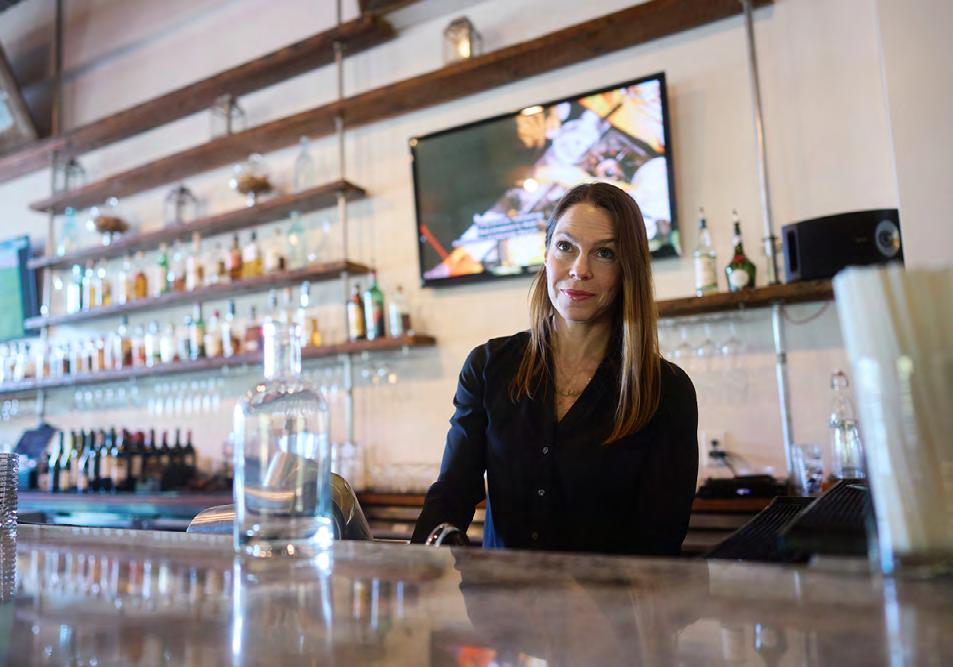
4 Durham County is proposing a property tax increase, in part to give Durham Public Schools more money—though not as much as the district wants. BY JUSTIN LAIDLAW
5 Hundreds of federal workers in the Triangle lost their jobs due to funding cuts. A year later, those workers—scattered across jobs related and unrelated to their former fields—are still picking up the pieces. BY ABRAHAM KENMORE
8 As western Wake County grows, Apex has lost 15% of its tree canopy. BY JASMINE GALLUP
10 How a 72-year-old Raleigh Amazon worker's face ended up projected on the side of Jeff Bezos' Manhattan penthouse. BY LENA GELLER
12 Players say tennis court improvements in Durham—where the sport has a rich history and a growing demand—are long overdue. BY JUSTIN LAIDLAW
15 On debut LP Win Some, Lose Some, Raleigh band Long Relief works through political disillusionment with ragged sunstruck indie rock. BY BRIAN HOWE
16 Former Carrboro Poet Laureate Fred Joiner's new collection dazzles with finetuned attention to art and music. BY BRIAN HOWE
18 An animating exhibit at the Gregg Museum of Art & Design draws together work from Native American artists connected to North Carolina. BY ANDREA RICHARDS
21 Lunch money: A two-dog combo at a smoothie stand in the Flow Volkswagen of Durham parking lot. BY LENA GELLER
22 Five can't-miss performances coming to Triangle stages this summer. BY LAUREN WINGENROTH
Publisher
John Hurld
Editorial
Editor-in-Chief
Sarah Willets
Wake County
Jane Porter
Culture Editor
Editor
Sarah Edwards Staff
Lena Geller
Justin Laidlaw
Report For America Corps Reporter
Chloe Courtney Bohl
Contributors
Jasmine Gallup, Desmera Gatewood, Elliott Harrell, Brian Howe, Glenn
McDonald, Cy Neff, Andrea Richards, Barry Yeoman, Russ Campbell, Colony Little, Shelbi Polk, Ryan Cocca, Lauren Wingenroth
Copy Editor Iza Wojciechowska
Editorial Interns Kennedy Thomason
Creative
Creative Director Nicole Pajor Moore
Mathias Marchington
Chelsey Koch
Sales and
Lauren Boyle















With limited new revenue and support from the state, the Durham County manager is proposing a 2-cent property tax increase and a Durham Public Schools budget increase that’s less than half of what the district asked for.
BY JUSTIN LAIDLAW jlaidlaw@indyweek.com
Dwindling revenue sources and increasing service needs are putting Durham County Manager Claudia Hager and her staff between a rock and a hard place as budget season ramps up.
“Durham County is navigating a new and challenging environment,” Hager said during her presentation of the proposed 2026–27 fiscal year budget last week.
With limited funding options available, Hager is proposing a 2-cent property tax increase and a Durham Public Schools budget increase that’s less than half of what the district asked for.
“The proposed budget continues a delicate balancing act between limited resources, resident economic stress, and nearly infinite needs,” Hager said.
Hager’s total budget proposal comes in at $1.045 billion, a marginal 0.67% increase from the current year’s budget, which eclipsed the billion-dollar mark for the first time in the county’s history due in part to a growing population of taxpayers. The county is experiencing significant stagnation in “natural” revenue growth—new revenue without a property tax increase— starting the 2026–27 budget process with less than $1 million in added revenue, compared to the $68 million in new funding requests from various county departments.
“Nearly all of those funding requests were ultimately not able to be supported,” Hager’s proposed budget reads. In an effort to close the remaining gap, departments made $6 million in cuts, and the proposed property tax increase would generate an additional $17.6 million in revenue.
Uncertainties at every level of government make this year’s budget negotiations more difficult to balance. Inflation and rising gas prices are driving up everyday costs, and the
state legislature has not passed a budget in over two years, straining local government services that are partially funded by the state, none more than public education.
Education remains the county’s biggest expenditure, which includes funding for Durham Public Schools (DPS) and Durham Technical Community College. During a school board meeting in March, the DPS Board of Education set its budget request at a massive $28.5 million increase compared to last year. The Durham Association of Educators, the district’s majority-member union, is pushing the school board and the county to invest in classroom equipment and a higher minimum wage, and building improvements, among other things. County commissioners and staff have said the request is untenable due to the myriad of other budget demands.
Hager still recommended a nearly $11 million increase in funding for DPS over the current year’s budget, bringing the total county funding for public schools to $235,428,901. An additional $1.27 million was recommended for pre-K funding.
“While we have made substantial progress with these funds, I am aware of the remaining funding gaps within the district,” Hager said. “But there are also limits to what the county can annually fund for DPS without either significantly limiting available resources for other county services or needing to increase the property tax rate every year.”
Public education relies on an increasing proportion of its funding from the county; for six straight years, the county has increased school funding by over $10 million. Advocates say the state legislature continues to underfund public schools, forcing the county to fill in the gaps for things like teacher wages and other programs.
DAE doesn’t seem to be dropping its push for higher wages.
“DAE members are calling on Durham County Commissioners to fully fund the DPS budget request in order to match Durham County’s minimum wage, and to take a step towards a true living wage for DPS workers,” the group wrote in a press release last week.
In a statement after the budget presentation, DPS Superintendent Anthony Lewis thanked commissioners for their ongoing support and collaboration but said “there is a missing link.”
“When the state fails to fully invest in public education, it is our children who pay the price,” Lewis said. “I’ll repeat what I’ve said before: Now is the time for leaders at every level to decide whether we will stand up for public education or stand by as it is slowly dismantled.”
“It is time that we stop playing politics on the backs of our children,” he continued. “They deserve more than promises. They deserve action.”
Without more financial support from the state and federal government, the county has limited options for bolstering its coffers. Hager said raising taxes this year could alleviate some of the county’s revenue woes—each 1 cent per $100 of assessed value would raise about $8.8 million—but residents are already feeling squeezed by property tax increases. Last year, the county lowered the property tax rate from 79 cents to 55.42 cents to mit-
igate a spike in tax bills that occurred following a county-wide property revaluation.
The county tax administration office saw a higher-than-usual number of appeals of those new values this year, many from commercial properties, which had an adverse impact on the county’s revenue.
“I would like to remind the board and residents that the property tax rate is the primary revenue source controlled by the board, and it is the only significant way to raise additional revenue to address pressing needs,” Hager said.
The state legislature could wrangle that control away from county governments across North Carolina. The Republican-led state House recently proposed a constitutional amendment to limit the ability for local governments to raise property taxes, which would further hinder how counties generate revenue.
In addition to investments in education and public safety, the recommended budget includes half a million dollars to support a joint city-county Homeless Strategic Plan and $250,000 for a Violence Reduction Plan.
Hager also said the county plans to make improvements in transportation by expanding travel options with programs like Central Bus Rapid Transit.
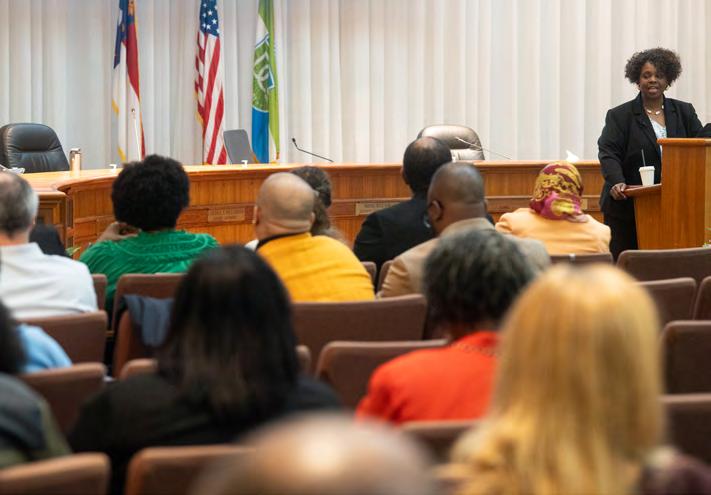
The public will have the opportunity to raise its own two cents at the May 26 budget public hearing. The county commissioners are scheduled to vote to approve the 2026–27 fiscal year budget on June 8.
Hundreds of federal workers in the Triangle lost jobs in the Trump administration’s early cuts. A year later, the future still seems uncertain.
BY ABRAHAM KENMORE backtalk@indyweek.com
Hundreds of careers across the Triangle were abruptly derailed a year ago as the federal government made sweeping cuts—offering buyouts to civil servants, eliminating grants, and dismantling organizations like the United States Agency for International Development (USAID). In the congressional district hardest hit by federal grant cuts, there’s no clear way to measure the impact or where all those workers ended up. But the sense of loss is real.
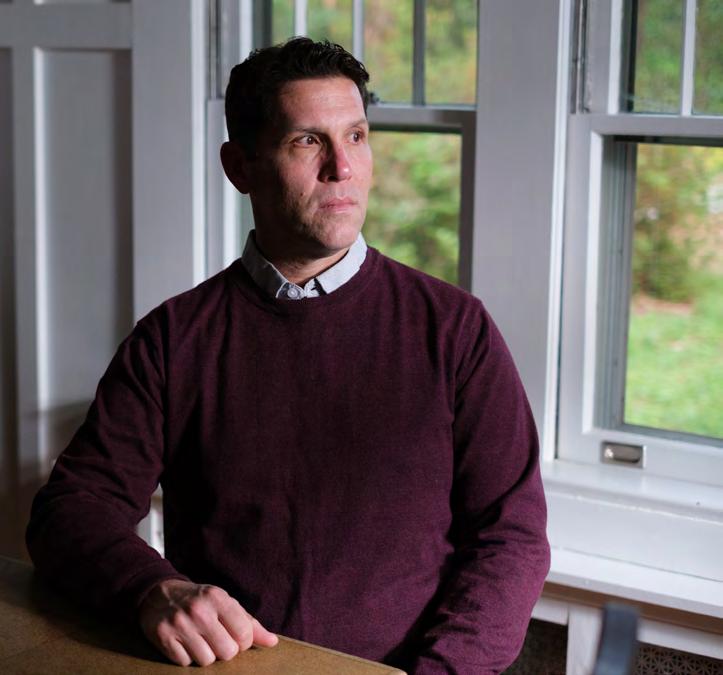
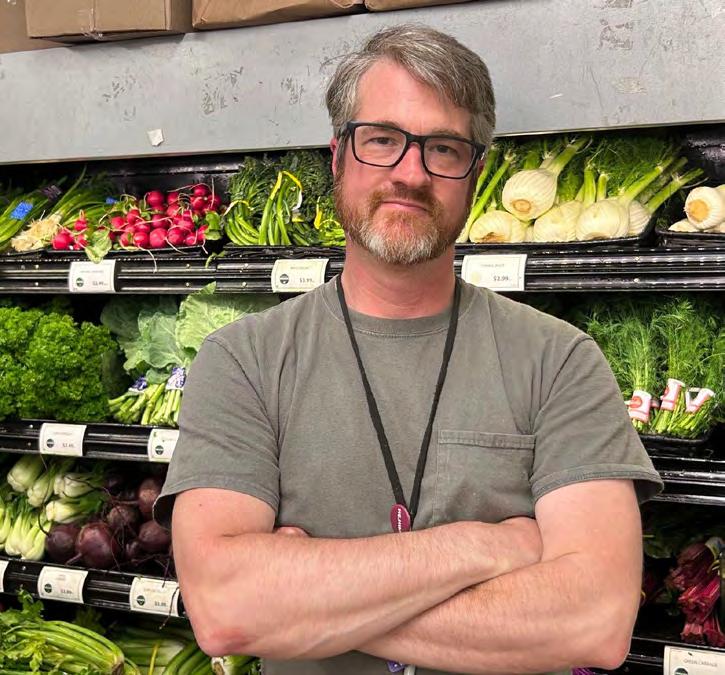
John Nicholson, 48, spoke to the INDY during a break from his job at Weaver Street Market in Carrboro, where he has worked since last June. In some ways he sees it as a continuation of his 20-year career in international development, working to build a more resilient community, just on a hyperlocal scale rather than global.
“That’s one of the things that I actually really liked about it,” he said. “Here it was very hands-on ... of course, the jobs are vastly different, but I like that too.”
Across the Triangle, the federal workforce dropped by about 12% between January 2025 and January 2026, according to an INDY analysis of federal job data. Hundreds more lost jobs in the private sector as federal contracts and grant dollars abruptly ended. A recent report by Axios showed that the Durham-Chapel Hill area lost about 3,800 jobs while Raleigh-Cary grew by around 13,000 jobs—a discrepancy likely due to federal cuts.
“We are the brains of this country, and we are being attacked by this dumb administration,” Durham Mayor Leo Williams told INDY. “And we are seeing it at the dinner table, we are seeing it in the confidence of some of our most competent people, we’re seeing it just trickle down and ripple through our local economy.”
Net job numbers give a glimpse of the impact, but the scale and nature of the cuts mean it is impossible to know exactly how many people were impacted. Lawmakers, gov-
ernment agencies, experts, and local chambers—no one has a hard number.
But the cost is undeniable. The INDY analyzed public data and spoke to former federal workers, union leaders, advocates, and elected officials to see where the Triangle’s federal workers went after the cuts. Some asked not to be named, as they are still actively looking for jobs.
Nicholson spent about two decades at John Snow, Inc. (JSI), a Boston-based consulting firm, where every one of his projects was government funded. On his last project, he served as the knowledge management and communications director for a program helping countries digitize, share, and track health data.
Nicholson knew his job might be in danger after the 2024 election. He took his family to Disney World that Christmas while he still could. On February 14, 2025, he lost his job.
He’s now doing some consulting again—as much as 30 hours a week—for a project out of the Netherlands, working on policy measures to improve diet and health. That’s on top of a full-time job at Weaver Street, which provides insurance and gives him a chance to salvage local food for Food Not Bombs, another organization he became involved with after losing his job.
“It was important to me, especially, to demonstrate for my kids that, you know, when you get knocked down, you pick yourself back up,” he said. “ And it doesn’t mean that you necessarily start where you left off.”
At the end of January 2025, there were 8,805 federal workers in Durham, Wake, and Orange counties. About half of them worked for the Veterans Health Administration. By the end of January 2026, that number had dropped 12%, to 7,752.
The relatively stable VA workforce, however, masks even steeper declines in other areas. The Environmental Protection Agency, for example, lost 26% of its local employees, dropping from 1,403 to 1,042. The agency’s Research Triangle Park campus included a number of staff of the now-shuttered Office of Research and Development. In Durham, the immigrant rights organization Siembra NC has asked local officials to study the full impact of the cuts on the city.
“It actually takes me back to the pandemic when there were folks who had never been unemployed and they would reach out to our office for assistance,” said state Sen. Natalie Murdock, who represents parts of Chatham and Durham counties.
In March Murdock visited Capitol Hill with the organization OXFAM, advocating to keep funding for international aid in the budget—she was invited, she said, because North Carolina has been so deeply impacted by federal aid cuts.
A representative of the American Federation of Government Employees (AFGE) Local 3347, which represents EPA employees, said that union membership has dropped from about 1,000 people to 700. The union said most of those people took buyouts rather than being laid off.
Heather Hughes, president of AFGE Local 3509, which represents Social Security Administration employees in North Carolina and surrounding states, said a number of people took the offer of the deferred resignation program last April, which offered the option of receiving pay for several months before departing the civil service. More followed in December. A freeze on hiring has meant those who remain are stretched even thinner.
“People didn’t [stop] having babies and needing Social Security numbers and needing replacement cards, so the work increases, the staffing decreases,” Hughes said.
Then there’s the unknown number of workers who lost their jobs when federal contracts or grants ended abruptly. Some, like Nicholson, worked for organizations based out of state, making it nearly impossible to track.
One of his colleagues who was also laid off, Kate Sheahan, 48, said that of the 20 to 30 JSI employees who worked in the Triangle, only three kept their jobs. Sheahan said her family income dropped by two-thirds after the layoff; she’s only recently picked up part-time work that matches her professional background.
“I knew in sixth grade that I wanted to be a Peace Corps volunteer and that I wanted my career to be in public health,” said Sheahan, who has a doctorate from the University of North Carolina at Chapel Hill. “And so I knew that my identity was going to go through the ringer, and that my mental health and everything was going to be a mess.”
Within a day of the layoff she reached out to a triathlon coach, determined to find some positive outlet for her pas-
Data shows all federal workers with a listed job site in Durham, Orange, or Wake County
sion. She completed the Wilmington Ironman last October.
“It literally, honestly saved me,” she said. “And then in the background, I applied for a lot of jobs. I started waiting tables just to make money. ... I’m still waiting tables at Venable in Carrboro.”
As of last September, cuts at Research Triangle Institute International had impacted over 400 people in North Carolina. FHI 360 in Durham filed notice of 144 layoffs, while the American Institutes of Research filed notice of 19 layoffs as a result of grants and contracts being cut. UNC-Chapel Hill lost 97 federally funded projects, totalling $39.5 million. Despite efforts to move workers into different roles, 140 people were laid off as a result, a university spokesperson said. Duke University, North Carolina State University, and North Carolina Central University did not respond to requests for comment regarding the job impact.
Not every local federal agency has seen a mass exodus. There’s about the same number of TSA workers at Raleigh-Durham International Airport as a year ago, said Mac Johnson, president of AFGE Local 449, which represents TSA staff. This is despite the “emotional roller coaster” of repeated government shutdowns, he said.
U.S. Rep. Valerie Foushee, a Democrat who represents the 4th Congressional District, said she has seen the damage of the cuts.
“People either don’t have their calls answered, don’t have their questions answered, don’t have their needs met, even services that are due them, because the people who perform the services aren’t available,” she said.
Federal Emergency Management
Center for Disease Control
Food and Drug Adminstration
National Institute of Health
Veterans Benefit Adminstration
Veterans Health Adminstration
Environmental Protection Agency
Social Security Adminstration
Federal Aviation Adminstration
Agricultural Research Service
Animal and Plant Health Inspection Service
Internal Revenue Service
Patent and Trademark O ce
Other
SOURCE: OPM
Finding where people are now is even harder than tallying the total number of lost jobs. Unemployment rates and the total labor force have remained fairly steady, according to state data and information from the Greater Durham Chamber of Commerce.
In the place of hard data, everyone has anecdotes: the friends and former colleagues doing administrative work for an actuary, waiting tables, starting a travel agency, chasing the vanishingly few international development jobs available alongside other overqualified candidates.
“I think it’s pretty hard for people who haven’t experienced it to imagine everything changing on a dime, and not only losing your job ... but then all of your job prospects elsewhere disappearing as well,” said Brianna ClarkeSchwelm, executive director of North Carolina Global Health Alliance.
Through public layoff notices and her own personal network, Clarke-Schwelm has confirmed 625 North Carolinians who lost jobs due to USAID cuts. She declined to name any specific companies, but many of them were likely at places like Research Triangle Institute International. Still, she said that is an undercount due to the number of people who were working remotely.
“All of those people were people who had committed their lives to service, had committed their lives to making the world a safer place, a healthier place,” she said.
Some have been able to pivot very successfully, finding research work or jobs with local governments. Some left the state or even the country. Others managed to keep a
job but are now underemployed.
Emily Kochetkova, 44, still works for Inclusive Development Partners, a small women-owned business with expertise in inclusion, particularly of people with disabilities, in development work. USAID funded about 90% of the company’s projects. The company initially laid everyone off, then hired a few back as contractors to finish the non-USAID projects.
Kochetkova still has the same title—senior technical adviser and program manager—but she’s a part-time contractor now instead of a full-time employee. She freelanced before, but it’s harder now.
“The consulting field and opportunities are just so much more competitive because everybody’s trying to do it now,” she said. “People that lost their jobs, who want to stay in this work, who are passionate and skilled, they’re all applying for the same small batch of independent consultancies.”
Some just decided it was time to retire.
Nina Frankel, 67, was also employed remotely for JSI, one of several organizations she worked for over her 30-year career in international development. In that time she worked on reproductive health, contraception, HIV, immunization, refugee health—“whatever came my way.” But when she lost her job last February, she decided she was done.
“It was my life, and I was just gonna do it until I couldn’t do it anymore, because I loved it so much,” she said. But “the idea of starting looking for a job, and looking for a job in a sector that no longer existed, you know, it was kind of daunting and I was of age, I could retire.”
In the wake of the cuts, workers have found ways to support each other. Frankel and Kochetkova both found others experiencing the same thing. “It’s been a really neat, supportive community,” Kochetkova said.
And some have pushed to be reinstated. Dr. Tom Luben, 52, is unusual among the people let go from the EPA locally because he did not take the deferred resignation offer. After 18 years with the EPA’s Office of Research and Development, he signed a protest letter in late June after hearing the division might be shuttered, which it later was.
Within days of signing the letter, Luben was placed on a two-week administrative leave, which then stretched into months of limbo before he was officially fired last October.
“I just couldn’t believe that because I signed this letter at home on my couch, on my phone, well within my First Amendment rights, that I was being fired,” he said.
He has appealed through the federal Merit Systems Protection Board and his case is ongoing. In an unattributed response to the INDY, the EPA press office said it does not comment on ongoing litigation.
Last December, Luben started a remote position as a senior research scientist at the University of Michigan, a job that lets him stay in Durham, where he and his wife have lived since 2005. But he still wants to return to the EPA.
“My best-case scenario is that I would be reinstated,” he said. “I would like to say, ‘into my old job at EPA,’ but that no longer exists.”
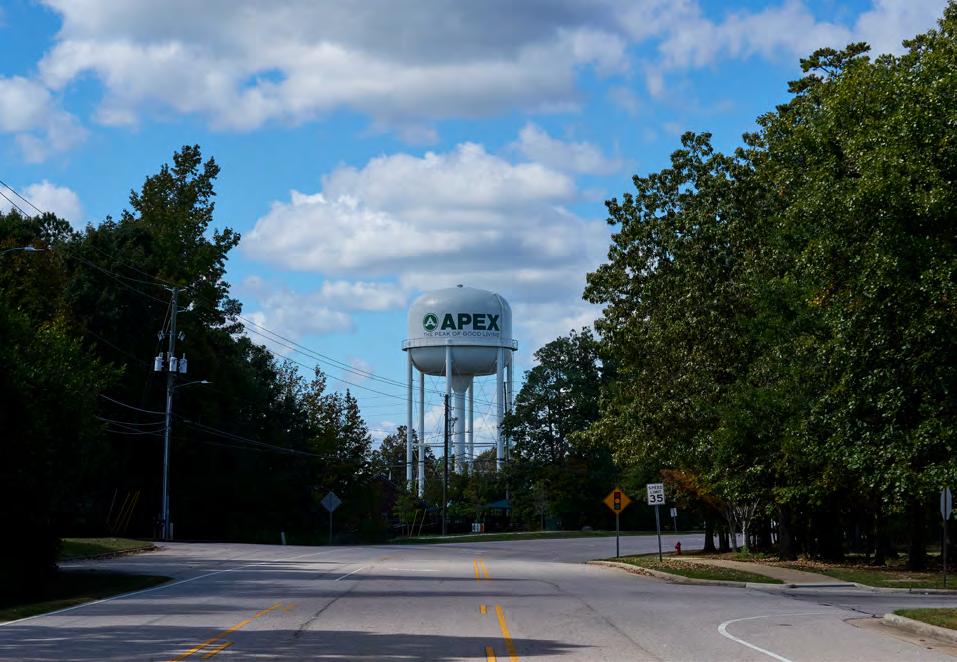
Tree canopy loss in Apex is among the highest in Wake County. The Town Council is discussing new restrictions for development to protect the town’s trees.
BY JASMINE GALLUP backtalk@indyweek.com
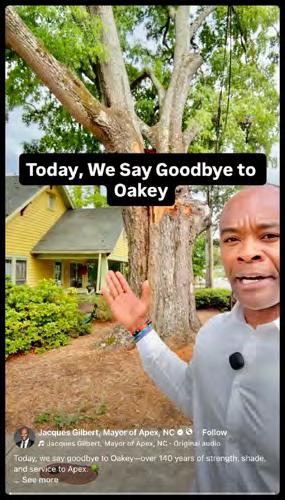
Apex residents said goodbye to local landmark “Oakey” last week, a 140-year-old oak tree off of Hunter Street. The city was forced to fell the aged tree because of its condition: It was no longer “structurally sustainable,” according to Mayor Jacques Gilbert. In other words, the tree, which stood only a few feet from the sidewalk, with branches arching over a road in the heart of downtown, was at risk of falling.
It’s clear the tree was important to Apex residents. Gilbert’s social media post on April 30 drew more than 400 likes and 50 comments. Later that same day, coincidentally, the town’s Environmental Advisory Board (EAB) encouraged council members to enact stricter tree protections, similar to those in Durham or Charlotte.
While Oakey was forced to come down because of age and related safety concerns, other trees across western Wake County are being felled prematurely as the area con-
tinues to develop rapidly. At an Apex Town Council workshop on April 30, staff presented a suite of 10 recommendations for amendments to the town’s Unified Development Ordinance (UDO), or land use rules, which would help preserve and expand the town’s tree canopy.
The town’s current UDO includes several protections for existing trees, especially in conservation and buffer areas. The proposed amendments would strengthen some of those requirements and apply them to developments across town.
Recommendations include designating and protecting champion and heritage trees, expanding protections for critical root zones, and requiring a “resource management plan” for development projects over 2 acres “to ensure existing trees are accurately identified and protected early in the design process,” the presentation stated.
“The goal of this is to design the project around the exist-
ing environmental conditions to preserve as much of it as possible,” Planner Bruce Venable said during the workshop.
The EAB also proposed creating a dedicated tree mitigation fund based on Charlotte’s program, which collects money to preserve the existing tree canopy and plant new trees. Charlotte’s tree ordinance allows developers to contribute money to the fund in lieu of preserving trees for certain development projects.
The EAB also pitched an incentive program for developers that would allow them to build with more density or reduce setbacks for projects that preserve 25% of the existing tree canopy or more. The current zoning code has a very limited incentive that allows developers to reduce parking space to preserve existing trees.
Finally, staff recommended hiring a full-time urban forester to oversee tree protection and planting efforts. Cary, Charlotte, Durham, Morrisville, Raleigh, and Wake Forest each already have dedicated urban forestry staff, according to the presentation.
Apex Town Council members were enthusiastic about the recommendations, coming up with additional ideas for tree protection. Councilmember Terry Mahaffey said staff should be “very” aggressive when it comes to developing new policies to protect the town’s trees.
Currently, the Town Council can only ask and incentivize developers to preserve tree canopy beyond what is required in the UDO. Council members suggested look-
ing at the feasibility of implementing more widespread requirements for developers to preserve tree canopy and charging fees to get out of those requirements like Charlotte does.
“Basically, I think these are all great ideas, especially some of these long-standing EAB recommendations that we routinely implement for rezonings,” Councilmember Arno Zegerman said.
“To incorporate those as UDO practices makes a lot of sense,” he added, citing a proposal to require more species diversity in landscaping for new developments. Council members also favored planting more trees in the town center, where more pavement and buildings create urban heat islands.
Western Wake County saw some of the county’s biggest losses in tree canopy from 2010 to 2020, according to a countywide assessment conducted in 2023. Morrisville saw a roughly 22% decrease in total tree canopy during that time, compared to a countywide average of 3%. Other western Wake towns also sustained significant losses, including Apex (-15%), Holly Springs (-10%), and Cary (-7%).
Losses greater than 10% were also seen in Raleigh and “areas of recent growth and development to the northeast and southeast of the city,” the report stated (including Wake Forest).
These losses are especially consequential as local towns
and cities see worsening impacts from climate change. Trees capture stormwater and reduce runoff, which is crucial as extreme rainfall is expected to become more frequent and intense across North Carolina, according to the 2020 N.C. Climate Science Report.
“The past decade have been the hottest years on record, and that trend is only continuing,” Apex’s environmental programs coordinator, Nora Skinner, said during last month’s workshop, citing the report. “The urban heat island effect is going to be magnified because of these rising temperatures and because of our expanding growth.”
While Wake County’s tree canopy assessment was based on a “snapshot of conditions” in 2010 and 2020, growth and development haven’t slowed in recent years. Wake County, Raleigh, and Cary are consistently rated as some of the fastest-growing areas in the nation, according to the U.S. Census Bureau data. In the last 10 years, more than 200,000 new residents moved into Wake County, according to Wake County’s interactive data dashboard.
Across the county, trees are being cut down as developers build new apartment towers, suburban neighborhoods, and shopping centers. The amount of new construction has risen in parallel with population growth. According to data from the U.S. Census Bureau, from 2019 to 2024, the number of residential building permits issued in Wake County jumped from around 9,700 to more than 15,000.
72-year-old Mary Hill has spent years organizing Amazon’s RDU1 warehouse in Garner. To protest the Met Gala, activists played a now-viral video of her on the side of Jeff Bezos’ penthouse.
BY LENA GELLER lgeller@indyweek.com
One of the flashiest critiques to emerge from the recent firestorm over Jeff Bezos cosponsoring the Met Gala came from Raleigh resident Mary Hill, a 72-yearold Amazon worker.
On the eve of the gala—an annual display of wealth that critics found particularly grating this year with Bezos and his wife Lauren at the helm—an anti-billionaire activist group projected a video onto the side of the Bezoses’ palatial Manhattan penthouse that showed Hill addressing Bezos directly. She did not mince words.
“Shame on you, Jeff Bezos,” Hill said, her bespectacled face and yellow hoodie towering stories tall above Fifth Avenue. “The people that need to be being celebrated at

the Met Gala are the workers—people like me.”
Hill went on to remind Bezos that “ordinary people” made him his billions and issued a warning: “If we built it, we can tear it down.”
Footage of the stunt has racked up more than 10 million views on Instagram and inspired a BuzzFeed listicle.
“It seemed to resonate with a whole lot of people,” Hill told the INDY. “Workers all across this country are sick and tired of being invalued and treated like we’re fungible.”
Hill, who has worked at Amazon’s RDU1 fulfillment center in Garner for the past five years—and did two years at the company’s Durham facility before that—told the INDY that neither she nor the activist group, Everybody Hates Elon, knew how the video was going to be used when it was filmed. The group captured the footage while assembling a series of anti-Bezos actions ahead of the Met Gala and eventually floated the idea of projecting it onto the penthouse. Hill thought it was genius.
“I said, ‘Heck yeah, I wish I could say it to him face-toface,’” Hill said.
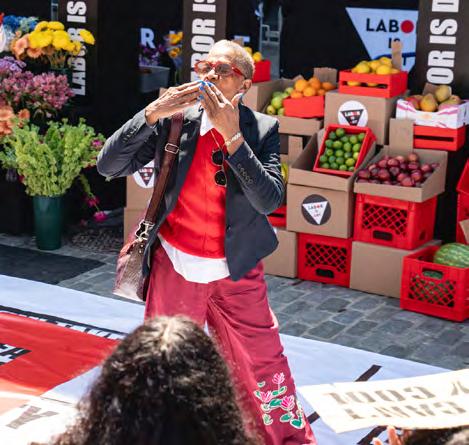
Short of that, she did get to see her message land on the penthouse with her own eyes—she was in New York the night it went up, having traveled to walk the runway the next morning at the “Ball Without Billionaires,” a worker-centered fashion show staged as a counterprotest to the Met Gala. The ball featured workers from Amazon and Whole Foods as well as former journalists from another Bezos holding, The Washington Post, which recently underwent historic layoffs.
This was not Hill’s first rodeo on the labor action front. Since 2022, when she spearheaded a unionization effort at RDU1 with her then-co-worker Ryan Brown, she’s
helped build Carolina Amazonians United for Solidarity and Empowerment, or C.A.U.S.E., into one of the most galvanizing union efforts in the South. She’s taken on an even weightier leadership role after Brown was fired in late 2024 for reasons C.A.U.S.E. maintains were union related. (Brown remains involved with C.A.U.S.E. from outside the warehouse.)
Last February, C.A.U.S.E.’s work—advocating for higher wages and safer conditions—took a blow when RDU1 workers voted nearly three-to-one against unionizing. Organizers attribute the loss largely to an aggressive anti-union campaign by Amazon, though they’ve also used the year since to reflect on what they could do differently—chiefly, broadening the fight beyond a single warehouse.
Hill had no formal organizing background before launching C.A.U.S.E., which is hard to square with how naturally the scrap of it seems to come to her. She chalks her instincts up to a life that’s required a lot of fighting: She grew up in Jim Crow Louisiana, will mark 13 years of sobriety next month, and has beaten cancer three times.
One of Hill’s most defining skills as an organizer is her ability to steer any conversation back to what she’s fighting for. It’s a kind of inversion of celebrity red carpet chatter: Instead of deflecting away from politics, she reliably routes toward them.
Asked about her Ball Without Billionaires runway outfit—a scarlet-red ensemble designed by the label Labyrinthave—Hill obliged briefly, noting that the designer had read her as “feisty” and colored the get-up accordingly. Then, swiftly, she returned to the bigger picture.
“Most of my co-workers at RDU1 work two jobs,” Hill said. “Make that make sense.”



Durham’s tennis players are lobbying the city to upgrade its courts to match a vibrant and growing community.
BY JUSTIN LAIDLAW jlaidlaw@indyweek.com
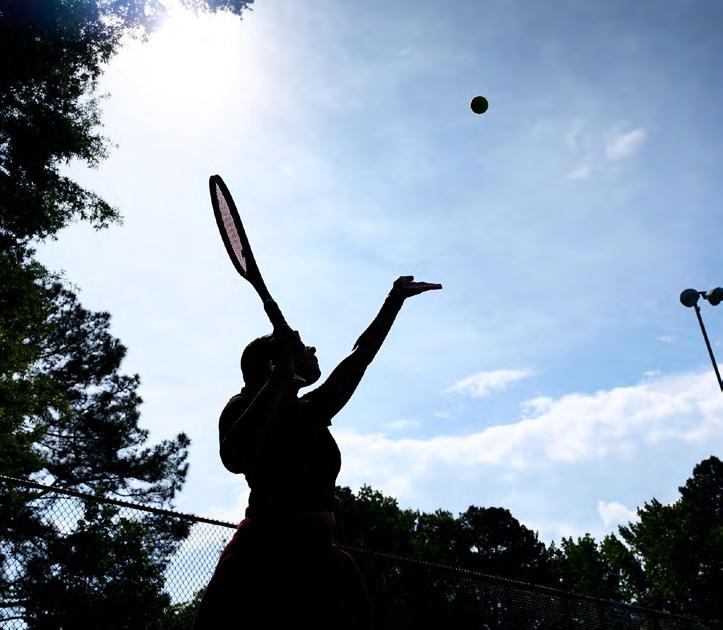
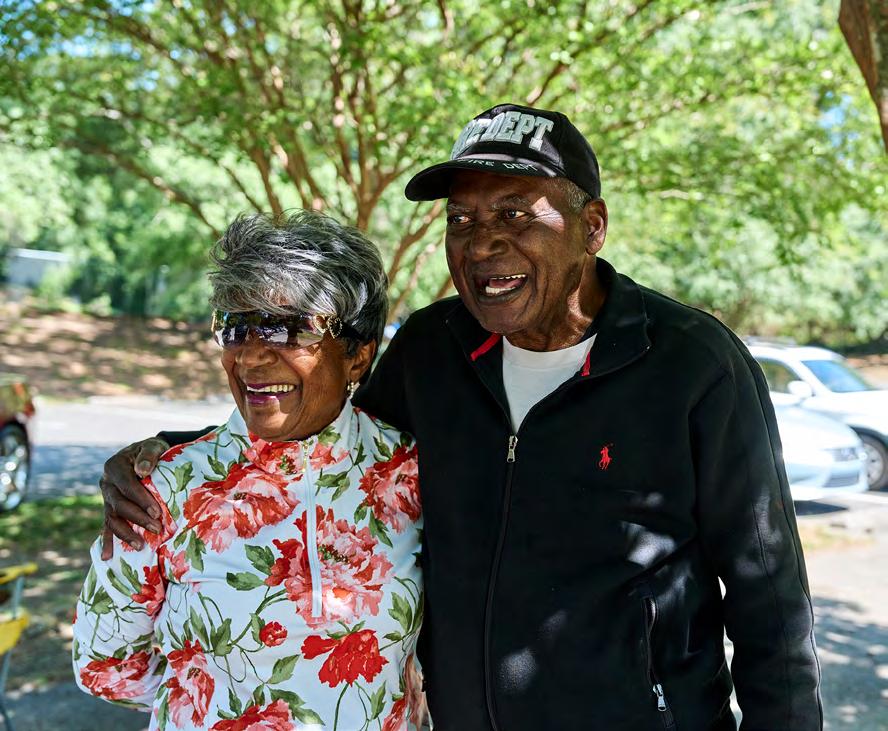
On Saturday mornings, dozens of eager tennis players descend on the courts at Elmira Avenue Park in East Durham for intense competition and lighthearted camaraderie, a tradition that dates back decades. Some players, like 86-year-old LaVerne Harper, have played at Elmira since it was built in 1978.
On one such recent day, Bruce Parker, another regular at Elmira, demonstrated Harper’s age and dedication to the game by pinching dirt between his fingers: “You see this stuff right here? He ain’t quite as old as that.”
When players aren’t hitting volleys across the net, they’re sending friendly barbs back and forth at each other about their performance on the courts. For hours, they sit in lawn chairs and gossip with snacks and refreshments in hand as they serve up stories about their lives in Durham.
“Every weekend is an event,” Harper said.
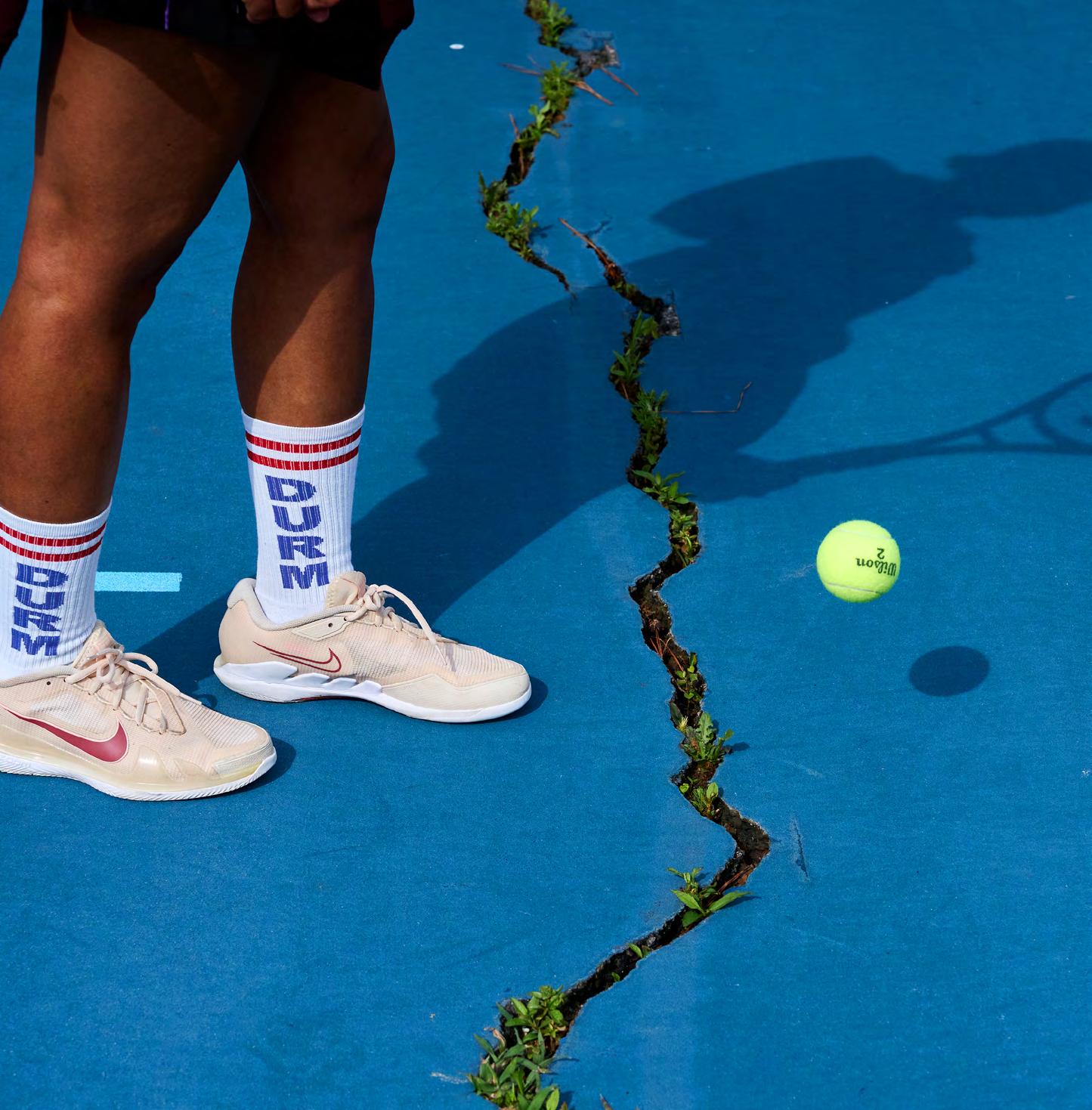
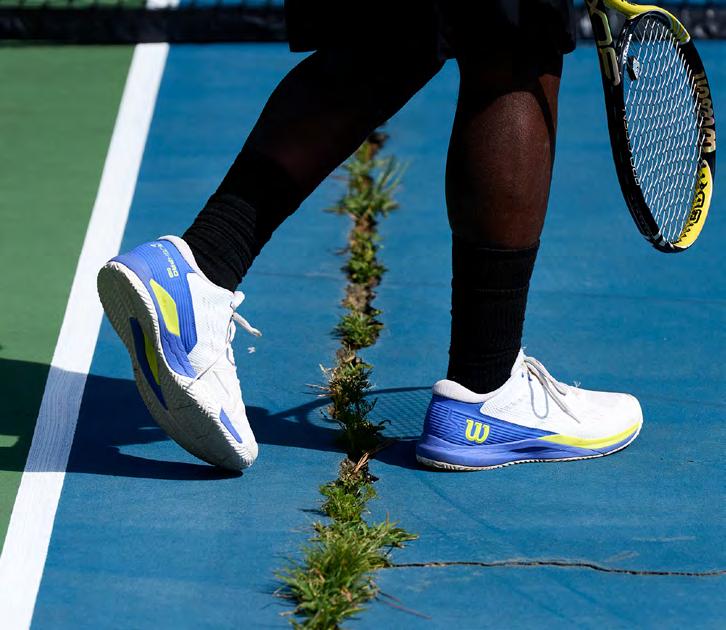
Most of the group is made up of older Black residents who adopted Elmira Avenue Park as their “home court,” after it was opened in the 1970s, when courts where Black players felt welcome were more limited. Nowadays, the eight courts at Elmira are well loved but increasingly difficult to play on, with gaping fissures and warped surfaces from water damage and poor drainage that make it more precarious for everyone, especially the older players, to navigate. The tennis courts at Elmira aren’t the only ones in need of a facelift, either.
Durham tennis players, spearheaded by the Eno Community Tennis Association (Eno CTA), have been advocating for updates to the city’s tennis courts for years, arguing that upgrades would not only benefit local players but also attract regional and national tournaments that bring in significant tax revenue for the host city.
Based on their advocacy, Durham Parks and Recreation (DPR) recommended $7 million to address a backlog of tennis court improvements. The city manager’s proposed budget—presented on May 18 with tennis players present in the audience—fell short, with $3 million included for general athletic court improvements. The city council is expected to approve a budget in mid-June.
“It is just so important to us that we continue to develop the community around [tennis],” Adrianne Charleston, a regular at the Elmira Park tennis courts, said at a March public hearing alongside her 8-year-old son, Lightning.
“Every weekend, me and my mom go to Elmira Park to play tennis and hang out with our friends called the Old Man Crew,” Lightning said at the same hearing. “When we don’t play tennis, we sit under a tree and laugh, crack jokes, and talk each other’s heads off.”
Tennis has steadily grown in the Triangle area in recent years, according to the North Carolina chapter of the U.S. Tennis Association (USTA), the nonprofit which oversees the competition circuit throughout the country, culminating in its signature event, the U.S. Open Championship. Matches and tournaments are administered by local USTA chapters like Eno CTA—which took over administering USTA matches from DPR in 2024 and is the primary organizer for most of the recreational tennis in Durham. The results allow players to see how they stack up across other regions and players of all skill levels, including the likes of world-class professionals Coco Gauff and Naomi Osaka, though don’t expect to see them on a court in Durham anytime soon.
In 2015, 375 teams were participating in USTA’s five main leagues in Durham. Ten years later, that number had risen to 640 teams, encompassing more than 8,000 registered players. Since 2023 alone, Triangle-wide program registrations for leagues and events have increased by 9.7%. Durham has experienced the biggest growth in registration, 18.5%.
But dozens of Durham’s courts, including Elmira Avenue Park, haven’t been upgraded recently, even as demand rises. Facilities aren’t always fully functional—lights don’t work, nets are down, courts have cracks—which can cause scheduling issues when groups like Eno CTA are coordinating matches, said Eno CTA board President Mary Long, a longtime Durham resident who picked up tennis during the COVID-19 lockdown.
Zack Czajkowski, vice president of the Eno CTA, said the
group will occasionally partner with private schools and tennis clubs to use their courts, but maintaining the network of public courts is the top priority.
“We’ve got great public court infrastructure,” Czajkowski said. “We’d love to get new courts built, but right now, people are just begging to get the lights fixed and the crater, if you will, squared away.”
Durham’s parks and recreation department manages 57 courts in total across 12 parks. All but two—Northgate Park and Oval Drive Park—have lights for folks to play into the evening hours. The city has made some recent investments in tennis infrastructure: Tennis courts at Southern Boundaries Park and Forest Hills Park were resurfaced in 2024, and in 2025, new outdoor lighting was installed at W.D. Hill Recreation Center. At the end of 2023, a dozen courts were built at Piney Wood Park exclusively for pickleball, a frenemy of tennis, and additional pickleball courts were added at Sherwood Park.
Money for court improvements has been included in the city’s Capital Improvement Plan, which lays out long-term infrastructure projects. But, according to DPR Business Services Analyst Emilie McIntosh, the extent of the repairs needed has historically been underestimated—and in turn underfunded—leading to a backlog.
“The city recognizes that we’ve had this money to resurface courts in the [Capital Improvement Plan] but haven’t always budgeted properly, and so we sort of end up not completing projects,” said Durham City Councilmember Carl Rist, an avid tennis player himself. “I think they realized, ‘We got a big backlog, we just need to do this all one year and get caught up.’”
Throughout the 20th century, segregation and racism kept Black players out of most tennis facilities, especially in the South. Long before two Black sisters from Compton, California, became the faces of tennis worldwide, Black players were barred from participating in the highest levels of competition. It wasn’t until 1950 that world-class tennis pro Althea Gibson broke the color barrier, becoming the first Black player to compete in the U.S. Open, later winning her first U.S. Open in 1957. A decade later, in 1968, tennis legend Arthur Ashe became the first Black male athlete to win the tournament.
During their rise, Gibson and Ashe would travel to Durham for tournaments at the Algonquin Tennis & Social Club—a Fayetteville Street facility (now the site of W.D. Hill Recreation Center) established in 1922 by Durham’s Black residents determined to have a space of their own for recreation, business and political meetings, and socializing. In 1935, this was where the group now known as the Durham Committee on the Affairs of Black People was formed.
Durham didn’t just play host to out-of-town talent. Hillside High School, an all-Black school at the time, mounted an impressive run of success in the 1950s and ’60s— both the men’s and women’s teams dominated high school tennis in North Carolina. Hillside’s boys’ team won eight straight state singles titles from 1953 to 1960, led by coach Carl “Bear” Easterling.
Among Hillside’s illustrious tennis alums: Irwin Holmes, who won the 1956 state singles title and doubles title (alongside a 16-year-old Harper), went on to become the team captain at North Carolina State University and the
school’s first Black graduate. Joe Williams, winner of the 1960 state title, touts an impressive win over Ashe during their young careers. John Lucas II, son of titanic educator John Lucas, was an All-American tennis and basketball player at the University of Maryland after graduating from Hillside. And Bonnie Logan, a three-time girls’ singles champion from 1965 to 1967, became the first Black player to join the Virginia Slims professional women’s tour in 1971. Harper remembers the humble beginnings from which he and the other Hillside standouts came. Each time they played at the Algonquin Tennis Club, they were responsible for rolling out the clay courts and relining its boundaries. Before they could afford tennis rackets, an engineering professor in the neighborhood made them wooden paddles. The kids would practice their forehands by hitting tennis balls against the back wall of the club.
Now an elder in the tennis community, Harper serves as a mentor and inspiration to young upstarts like Charleston and Lightning, who live in the neighborhood next to Elmira Avenue Park. Harper and others who play there have become a found family for the mother-son duo. Charleston and Lightning even received a coveted invitation to the 80th birthday party for Elmira Park’s most fashionable tennis player, Bernadette “Ms. Bernie” David-Yerumo. Lightning first picked up a racket four years ago when Charleston signed him up for group lessons at the park. One of the other parents convinced Charleston to grab a racket, too. Lightning, a multisport athlete, enjoys playing
tennis in part because of his mom’s newfound love for the sport. He said he wants his mom to keep getting better and can only beat her “when she’s very tired.”
For Charleston, involvement in tennis now expands far beyond Elmira Park. In 2022, she became the chair of the DEI committee for USTA NC, working with partners across the Southeast to make the sport more accessible, especially for Black colleges and universities.
Growing up, Charleston used to drive an hour and a half from her hometown of Granite Quarry to Durham and volunteer for Habitat for Humanity. She’s now turned her penchant for public service toward building a stronger, more diverse tennis community.
“In order to be able to offer suggestions, you need to have a seat at the table,” Charleston said.
Based on feedback from players, DPR had proposed over $7 million in repairs and upgrades at six parks: Whippoorwill, Rock Quarry, Morreene Road, W.D. Hill, Garrett Road, and Elmira. Needed repairs include resurfacing and lighting, as well as tree pruning and drainage to support overall court stability. Immediately after the city budget presentation on May 18, details on how much of the $3 million proposed for athletic courts would go to tennis facilities specifically and which parks would see upgrades
were unclear.
While courts are awaiting repairs, casual players have fewer options. They can book a court with surfacing issues, like Elmira, or if they’re lucky, find one in good condition that isn’t reserved by Eno CTA, which needs playable courts for official USTA games. Eno CTA spends about $60,000 annually on court rentals and lighting fees to host USTA-sanctioned tournaments and other events.
Public courts increase accessibility to the sport by offering more affordable fees than private courts and programs that help reduce the costs associated with equipment and lessons. A player’s essential needs are a decent racket and a good pair of tennis shoes, which most folks wear everyday (groups like Eno CTA and the Durham-Orange Community Tennis Association give away secondhand rackets to beginners, and the Try Tennis program from USTA NC offers $50 beginner clinics for children and adults).
“That’s why we need robust and open public courts, especially if there’s enough where you don’t have to reserve them, or don’t go through the city to pay that extra fee,” Czajkowski explained. “If you can just show up and walk on, it saves money, gives a little bit more access, and makes it more accessible broadly.”
Czajkowski and others are also quick to emphasize the health benefits of playing tennis, which one study says can add nearly 10 years to your life compared to a more sedentary lifestyle or even other sports like soccer. Harper and David-Yerumo, both in their 80s, point to the habit of weekly tennis as a major contributor to their quality of life, though Harper said he avoids playing against the young up-and-comers like Elmira’s rising 8-year-old tennis star, Lightning.
Players say improvements could also help Durham attract regional tournaments, which can bring in millions of dollars in court rental fees and sales tax revenue to host cities. Currently those events—and that money—are going to places like Raleigh and Cary.
In Wake County, the 24-acre Cary Tennis Park hosts 32 public courts, boasting electronic scoreboards and permanent seating at the park’s premier court. Construction began in 2002. Since then, the town of Cary has continued to invest in upgrades and new features that attract hundreds of thousands of visitors and allow Cary to host dozens of tournaments, bringing in $3 million in annual economic impact, according to the town of Cary’s website.
“Every meaningful city outside of Durham in North Carolina has the core capacity to do a state tournament and bring that revenue in,” Czajkowski said, calling out much smaller cities like Goldsboro and Hickory. “And so we are costing ourselves as a city money by not having a regular maintenance schedule, by not taking care of the courts.”
As Harper, Charleston, and others who gather at Elmira Avenue Park await updates to their home court, their weekly tradition doesn’t seem to be deterred.
“Twenty-seven million people in this country play tennis, and they’re not all members of country clubs,” Czajkowski said. “Most tennis in the United States is happening on public courts. And there’s a rich history, you know, from Arthur Ashe to Jimmy Connors to the Williams sisters. We can continue that legacy if we continue funding it and investing in tennis around the country, and specifically in Durham.”
LONG RELIEF: WIN SOME, LOSE SOME
Aware Records | Record release show: Saturday, June 13, 8 p.m. | Kings, Raleigh
Even when trying to just sing indie rock, Long Relief’s Paul Blest keeps reporting news.
BY BRIAN HOWE music@indyweek.com
W
hen Raleigh’s Long Relief debuted with the EP No Growth in 2023, there was no mistaking where the band was from—and not just because they nailed that ragged, sunstruck Triangle rock sound.
“They put bars on the benches in Moore Square / The experts say it’s happening everywhere,” the first words blare out on “Moore Square.” The rest of the EP is more abstractly emo, but that first track, a clarion anti-“revitalization” anthem that names names, might say the most about its author.
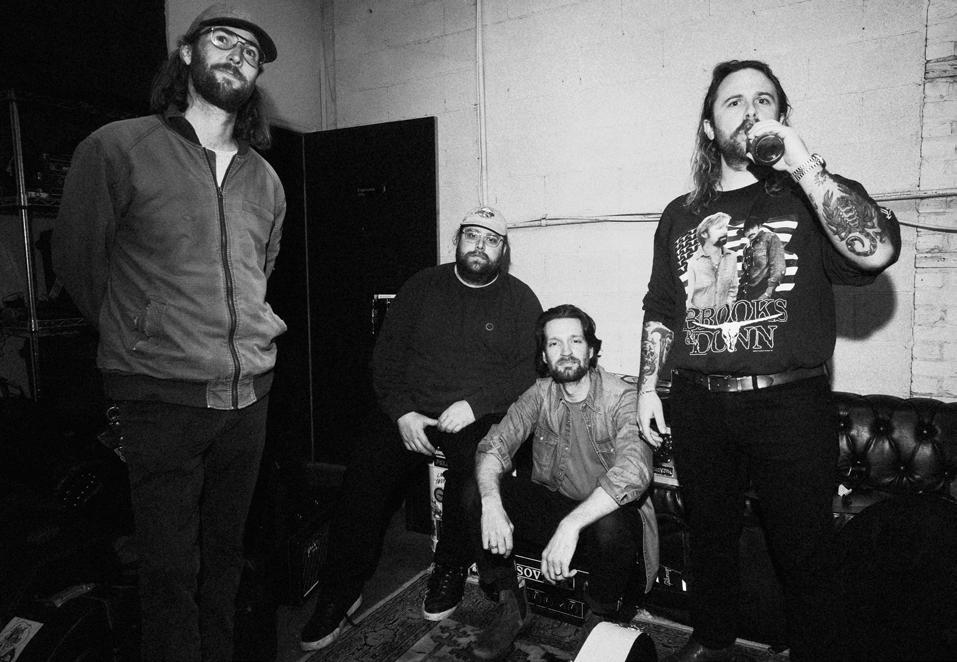
Long Relief’s debut LP, Win Some, Lose Some, has about the same political-to-personal ratio—but when your life is the news, what’s the difference? Paul Blest, the band’s 36-yearold singer, songwriter, and guitarist, is a video producer for More Perfect Union, an advocacy journalism nonprofit that focuses on working-class issues. Before that, he was a political news reporter at places like VICE and the INDY.
“Working in journalism, you can’t say everything you’re feeling,” Blest conceded from his home in East Raleigh. Sneaking progressive news into indie rock wasn’t really his goal, “but when you spend so much time with something and aren’t able to articulate your feelings in a full way, it’s going to leak into other parts of your life.”
Blest grew up booking hardcore and emo shows in Delaware, where he sang in a folk-punk band. But music took a back seat to starting his journalism career, and he left off writing songs until 2019, four years after he moved to North Carolina. Settled in the Raleigh punk scene, he played a show covering songs by the screamo band Thursday with Chris Carr, who would become Long Relief’s second guitarist. This was also around the time that Blest’s old friend Greg Hughes moved to Raleigh, just in time to fill the drummer’s seat and bring in bassist Jeremiah Sloop.
Recorded by Greg Elkins at Raleigh’s Pershing Hill Sound,
Win Some, Lose Some is fuller and more deliberate than the EP. Blest worked with vocal coach Anne-Claire Cleaver to open his voice beyond punk’s straining yelps, crafting something more reflective of influences like the smartypunk Canadian band The Weakerthans, with their agile vocal melodies, or the brainy bar rock of Drive-By Truckers. Listening to Sharon Van Etten and Angel Olsen inspired him to rethink the musical scope, leading to several tracks with trumpet by Franny Starlight, saxophone by Joshua Duncan, and cello by Kaitlin Grady. “They did an incredible job of making a bigger vision come to light,” Blest said.
The album opens with the gleaming, cresting riffs of “False Spring,” which Blest conceived in the style of popular hardcore band Fucked Up. “But listening to the chorus and thinking about where the saxophone could go, I thought of a Springsteen song,” Blest said, “and Josh just came in and knocked it out of the park.”
“Perfect Thing” is a self-contained love song about a relationship 12 years in, but elsewhere, politics stay in the picture. “Earnest, Scared, Stupid” was built around that catchy chant, a pun on the Jim Varney movie title. (“Eventually I went back and realized it was about Joe Biden,” Blest said.) The single “Ghost Protocol” is about going home and recognizing less and less, which means it’s about aging—but also, gentrification.
“Can We Count on You” is an outlaw-country outlier, like a Phil Ochs protest song by way of Billy Bragg. It flings back the shibboleth from DNC fundraising spam: “Wrote my congressman a letter / It took him a month to reply / From the automated system / That tells you to fuck off and die.” And “Bad Faith” inveighs against anonymous internet extremists, while “Traffic Circle” is a cry for all the journos trading W-2s for 1099s.
“I didn’t set out to make the most depressing record of all time,” Blest said, laughing. “But I can hear what I was feeling after Trump got elected the second time—the disillusionment with the old, the horror with the new. It’s something I’m still working through.” Us too, which makes Win Some, Lose Some so cathartic.
Hearing jazz and seeing art the Fred Joiner way, with a poetry debut 50 years in the making.
BY BRIAN HOWE arts@indyweek.com
Side A: Music You Can See
When Fred Joiner was a kid in the ’80s, his father was a house musician at Philly soul hot spot Sigma Sound Studios.
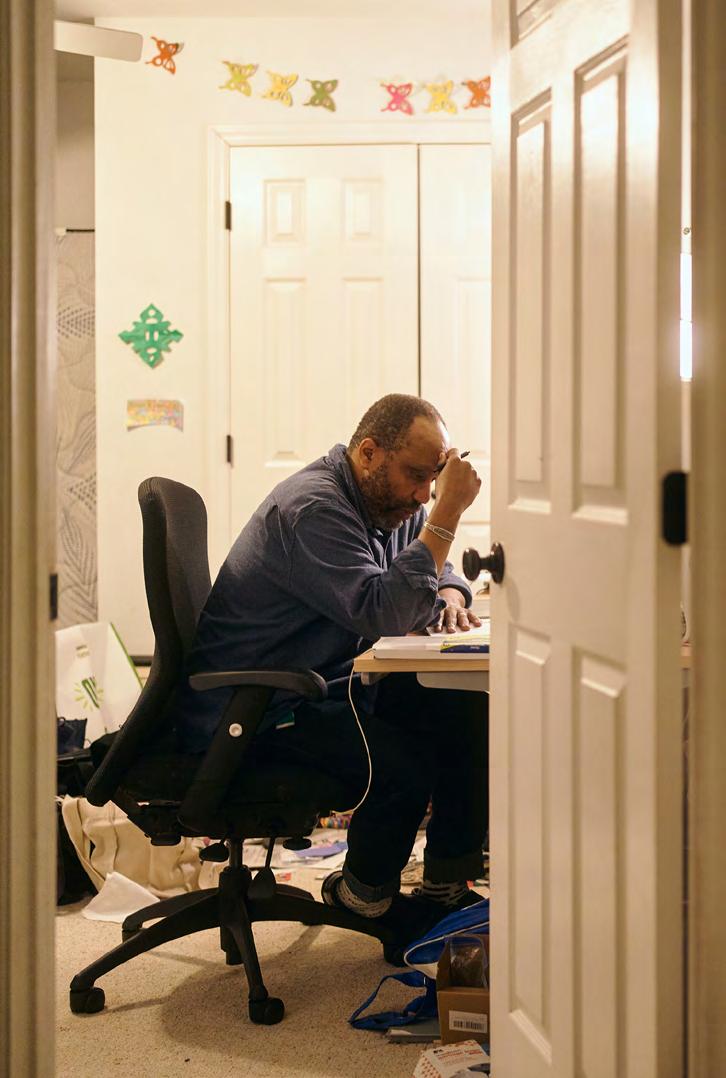
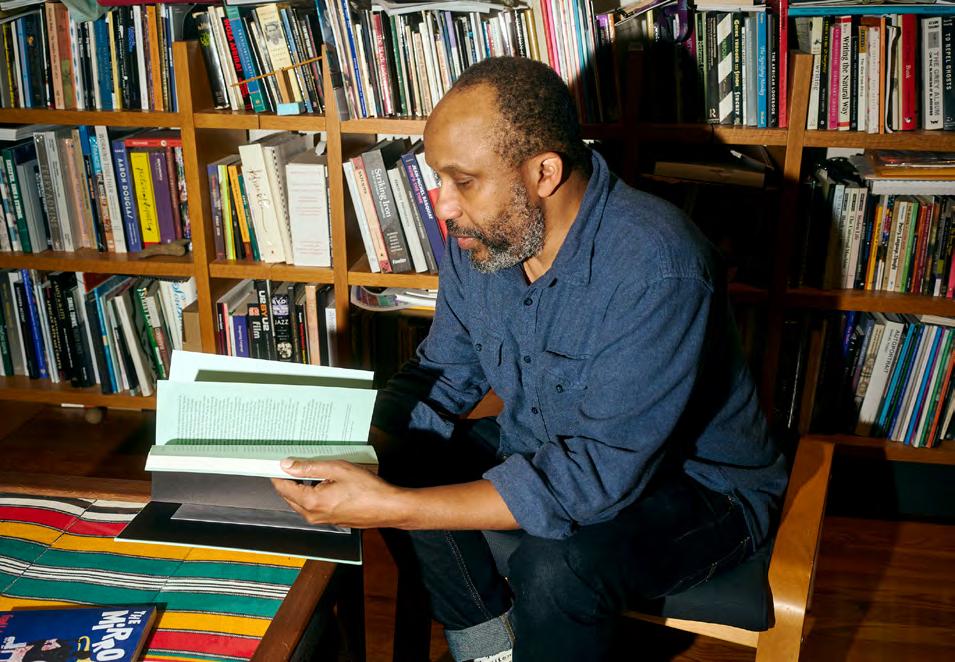
“Basically any music that came out of Philadelphia, if there was trombone, my dad was probably on it,” Joiner says, sitting in his book-stuffed living room in Carrboro. At age 51, the former Carrboro poet laureate finally has his own tome in the stacks: The Mirror in Our Music, a collection recently published by Raleigh small press Birds, LCC.
“My father has a very distinctive sound,” Joiner goes on, in his soft, warm, even rasp. “He once told me, ‘You want to play the center of the note.’” His parents happen to be in the next room, a kitchen full of yellow balloons from his younger daughter’s 10th birthday. “The emotional center. When you hear a musician who’s hitting it, it’s transformative.”
Like father, like son. The poems in The Mirror in Our Music are spare and elemental, seldom longer than a few etched stanzas. Restlessly broken lines snap and curl on the page, like reliefs on a gallery wall. Spacing guides the eye, not the breath.
“I view my poems as a visual art as much as a literary art,” Joiner says. “A lot of what I do is collage.”
Reading straight across, one poem, “On why Duke did not win the Pulitzer Prize in Music,” clearly pursues its theme: “perhaps because / some note / refuse to be flattened / some only exist / in the hot moment, / the crash / of breath & bone.” But the lines are riven in two columns, pulling the eye downward, hinting at secret mazes of meaning.
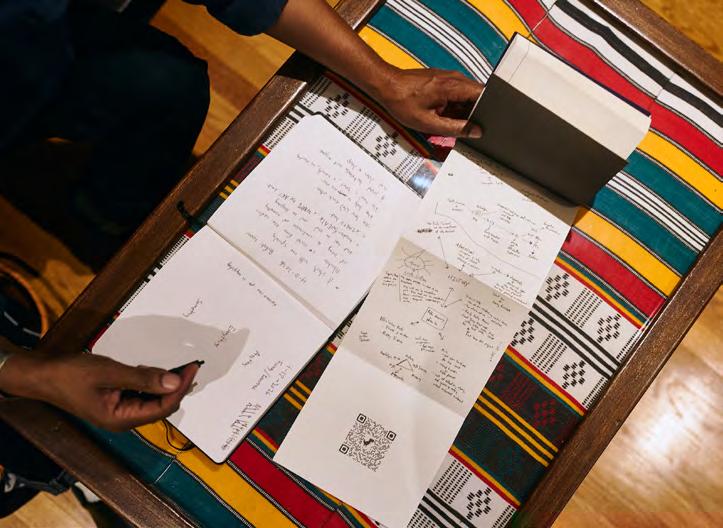
The writing dazzles, but The Mirror in Our Music contains so much more. Joiner encrusts his poetry with color photos, drawings, essays, epigraphs, and annotations. Done up in square trim like a vinyl record, the book has an A-side, THE MIRROR
which grew out of Joiner’s graduate-school thesis. You flip it for the B-side, which features his ekphrastic writing—poetry responding to other works of art—an interest he curates on his website Black Ekphrastic. The B-side crackles with vernacular photographs from an Ackland Art Museum exhibit and powerful self-portraits by photographer Ewané Samuel Nja Kwa.
“What do I want people to know about me?” Joiner considered while assembling the collection. “Well, I want them to know that I have a love for African diasporic culture and music, and that I’m adept at collaboration—that I’m open.”
So the book is about jazz and moves like jazz. It’s about the mysteries of art, how “the grayscale song of a camera’s / eye says what our words cannot.” It’s an atlas of everywhere Joiner has lived or visited, from the nation’s capital to North Carolina, Ireland to Africa; an ode to every artist, teacher, and ancestor that made a mark on him—the ones he makes marks for.
Most of all, it’s a hymn to community and collaboration. Almost every page is to, for, or about another person, or intimately dialoguing with their art.
“There was a lot of ground to cover and people to include, and I think that’s the heart of it,” says Chris Tonelli, the founder of Birds, LLC. “Fred is a selfless, generous, open human being, and the book is ultimately a thank-you note— not an opportunity to shine a light on his own work, but to lift up his friends and family and the artists who have shaped him.”
“Poetry, for me, is about the people who’ve poured into me,” Joiner says. “This book doesn’t happen without music. It doesn’t happen without art. It doesn’t happen without any of that.”
You flip it writing—poetry curates on with verMuseum exhibit Ewané SamJoiner conwant them culture and I’m open.” It’s about camera’s of everynation’s capital every artist, him—the ones collaboration. person, or to include, Tonelli, the generous, open thank-you note— work, but who have his library
Joiner published his first poem in the magazine of his Quaker middle school. All he remembers is that it was called “Gabriel’s Horn.” Each contributor also included a poem that inspired them, and he chose a spoken-word piece called “Silenced” by the straight-edge hardcore band Uniform Choice.
Punk rock was his bedrock then—as a church kid in suburban New Jersey, as a high schooler at a rigorous college-prep academy in Connecticut, and as a dazzled newcomer to Washington, D.C. Bands like Bad Brains and Minor Threat went with his passion for skateboarding. It’s easy to picture him hammering handrails, his stance low and rolling like a boxer’s.
“My parents are going to hear this, but I’m sure they know,” Joiner says. “We would get on the train and go into Philly to skate, and they had all-ages, middle-of-the-day punk rock shows.” The genre’s epigrammatic defiance still lingers below the blue notes and improvisatory flights of his poems: “hands up do not / always mean surrender, / sometimes it is a call to arms.”
Living in D.C. blew his world open. Studying math at American University, he buried himself in poetry and art classes and the cultural life of the city.
“I would go to readings, slams, open mics, art shows, everything,” he remembers. “I would go to a hip-hop open mic and the next day be at the Folger Shakespeare Library.”
Here, Joiner and his friend Jati Lindsay founded a website
called Divine Cipher to promote poetry and music events. It grew popular enough that The Roots, whom they followed around like Deadheads, once recognized them in line at a New York show and pulled them to the front.
At a Nikky Finney reading on U Street, Joiner made a lifelong friend in the poet and children’s book author Tony Medina, who wrote the introduction to Joiner’s book.
“He was responsible for making me share my work out in the world,” Joiner says. Medina was just a few years older but occupied the role of a mentor: hailed as the heir apparent of the Black Arts Movement, freshly appointed as a creative writing professor at Howard University.
“We called Fred ‘Da Mayor,’” says Medina, speaking by phone from D.C. “He was one of those people who was everywhere and connected everybody together. He started crashing my class, and then he put the word out and everyone started crashing my class. That’s how serious he was about poetry—but he was also serious about jazz.”
Of his friend’s book, Medina says, “It’s like the tire on the bicycle has all these different spokes coming out of it—personal stuff, social stuff, political stuff. But the center of the wheel is always the music.”
When Joiner moved to North Carolina in 2016, he was a well-established curator in D.C. He had brought major writers to his Intersections reading series, with Jon West-Bey of the American Poetry Museum, and worked with institutions like the Smithsonian and the Library of Congress. He also wrote an essay on “learning to look and see” for the Phillips Collection’s centennial catalog. “I’m an extrovert and outgoing,” Joiner says. “The poetry gave me something to pour myself into and perform and render.”
He’d also lived in Mali from 2013 to 2016, which planted many roots that flourish in The Mirror in Our Music, starting with the striking covers by artist Amadou Sanogo. His wife Melanie Joiner’s antimalarial work had taken them to

Bamako while he was completing his creative writing MFA in a low-residency program at Lesley University.
Today, Joiner sits on the Carrboro Town Council, the latest in a string of civic engagements.
When Melanie’s job brought them here in 2016, Joiner hit the ground running. At the West End Poetry Festival, Carrboro poet laureate Gary Phillips took a shine to him. Soon, Joiner was serving on both the Carrboro Poets’ Council and the Orange County Arts Commission’s artist advisory board, and Phillips urged him to apply for poet laureate. His tenure (2019–22) was constrained by COVID-19, but it had a big impact: Joiner received a laureate fellowship from the Academy of American Poets. The same went to North Carolina poet laureate Jaki Shelton Green, former Maryland laureate Grace Cavalieri, and Adrian Matejka, Joiner’s mentor from his MFA program.
“It was the perfect convergence,” Joiner says. “My new life in North Carolina, my graduate school life, and my life in the D.C. metropolitan area were all converging in this fellowship. I’m glad that Miss Jaki and I were on it together.”
So the story isn’t why Joiner’s first book is being published now—it’s why it took so long.
“Self-doubt. Imposter syndrome. Battling the blank page, man, it’s a fight,” Joiner says. “I think being in North Carolina changed that, because people I thought very highly of were looking to me as a resource. I started to think about the tradition of Black poetry, and how would I honor my teachers if I didn’t showcase what they taught me? So I started to gather all the things that fed me. This is the community that created this poet that created this book.”
Fred Joiner doesn’t just live and breathe music, poetry, and art; he deeply respects them, and he had to be sure he could rise to meet the reverence he holds them in. “Miles Davis had this thing he said,” he offers. “It takes you a long time to sound like yourself.”
STORIES TOLD BY BREATH: NATIVE AMERICAN VOICES IN NORTH CAROLINA
Through September 26 | Gregg Museum of Art & Design, Raleigh
A wide-ranging new exhibit draws together work from Native American artists connected to North Carolina, showcasing the ways ancestral knowledge animates the stories of today.
BY ANDREA RICHARDS arts@indyweek.com
Preparing work for her first group show at a major museum just as her tribe was finally receiving federal recognition was an incredible moment for artist Karina McMillan.
“I had no words,” she said. “We’ve been fighting for this for such a long time.”
McMillan, one of more than 55,000 members of North Carolina’s Lumbee Tribe, had originally agreed to show 10 pieces in North Carolina State University’s Gregg Museum of Art & Design’s exhibit Stories Told by Breath: Native American Voices in North Carolina. Inspired by the moment, she created an 11th before the opening.
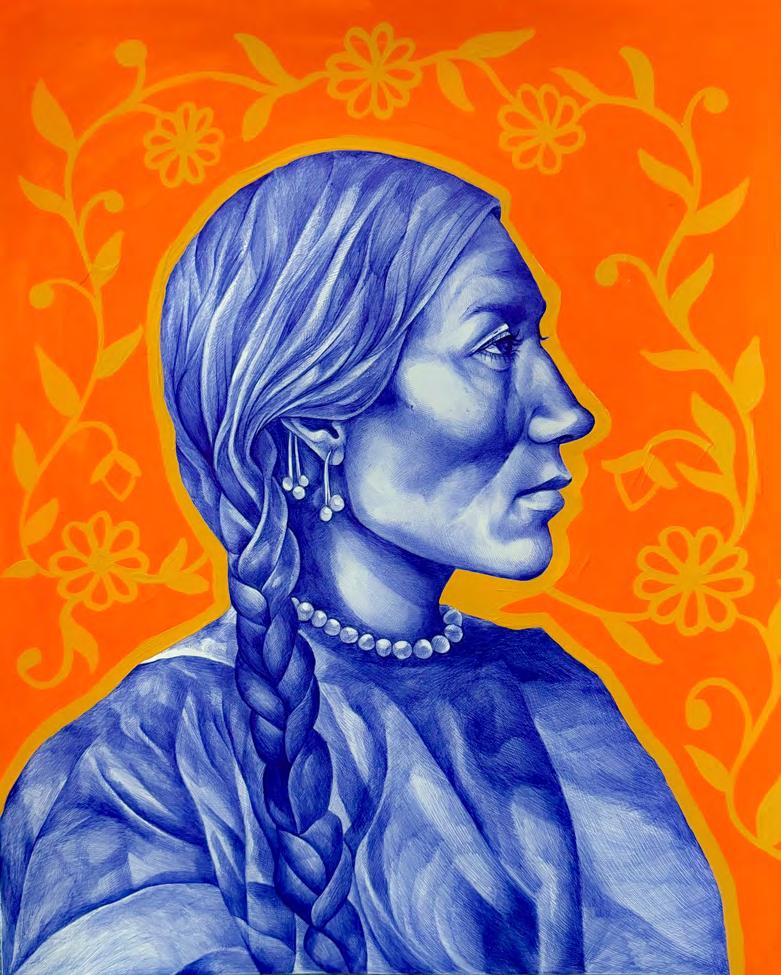
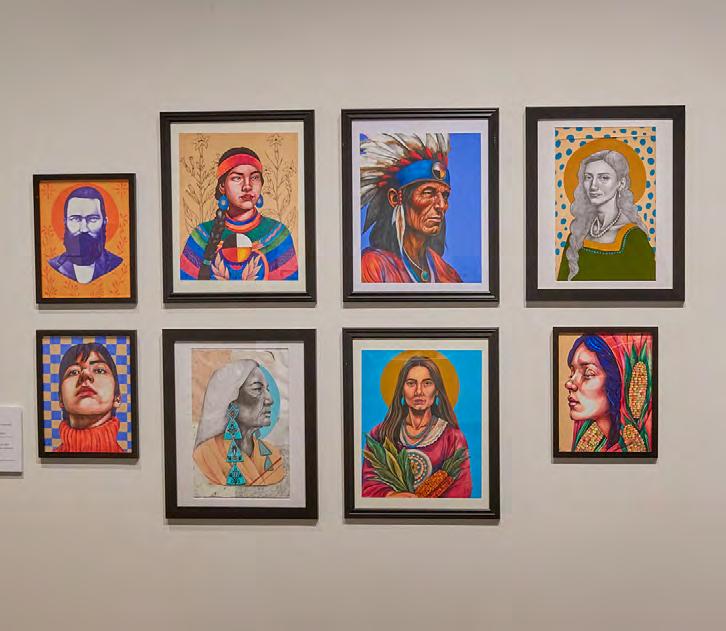
Like many of McMillan’s other colorful portraits, intricately drawn with Bic pens and finished with acrylic paints or colored pencils, this work depicts a Lumbee woman. She’s drawn in profile, a bright red and fuchsia shawl wrapped around her head.
Three ears of corn are embedded in the shawl, each composed of hatch marks in vibrant jewel and neon tones— easily the most beautiful ears of corn I’ve ever seen, with the “push and pull” between their green husks and the red shawl elevating the colorful corn to the surface of the canvas. There’s more: Within the ears, some of the individual kernels bear the number 575 written in gold.
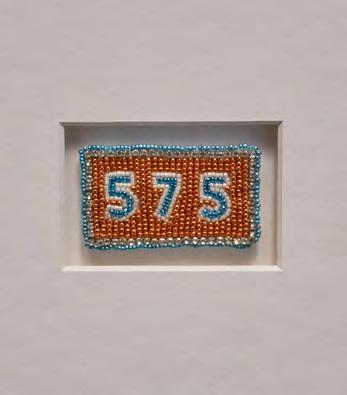
The number, which also serves as the painting’s title, is, like the corn it depicts, heavy with meaning; with the passage of the Lumbee Fairness Act in December, the Lumbee Tribe of North Carolina became the 575th recognized tribe in the U.S.
That it took 137 years for the federal government to recognize the largest Native American tribe west of the Mississippi is, of course, a part of the painting’s story. And
it’s not the only work in the exhibition that highlights this historic moment—“575” is also the title and subject of a beautiful beadwork by artist Ashtyn Thomas, a current N.C. State student who served as Miss Lumbee in 2023 (her beaded crown, made by her, is also on display).
Thomas and McMillan are among the youngest artists of the 15 included in the exhibition, which features some of the state’s most prominent Indigenous artists, including master potters Senora Lynch (Haliwa-Saponi) and Bill Harris (Catawba), jewelry designer Timo Locklear (Lumbee), and interdisciplinary artist Rhiannon Skye Tafoya (Eastern Band of Cherokee and Santa Clara Pueblo), whose works use printmaking, digital design, and basketry techniques.
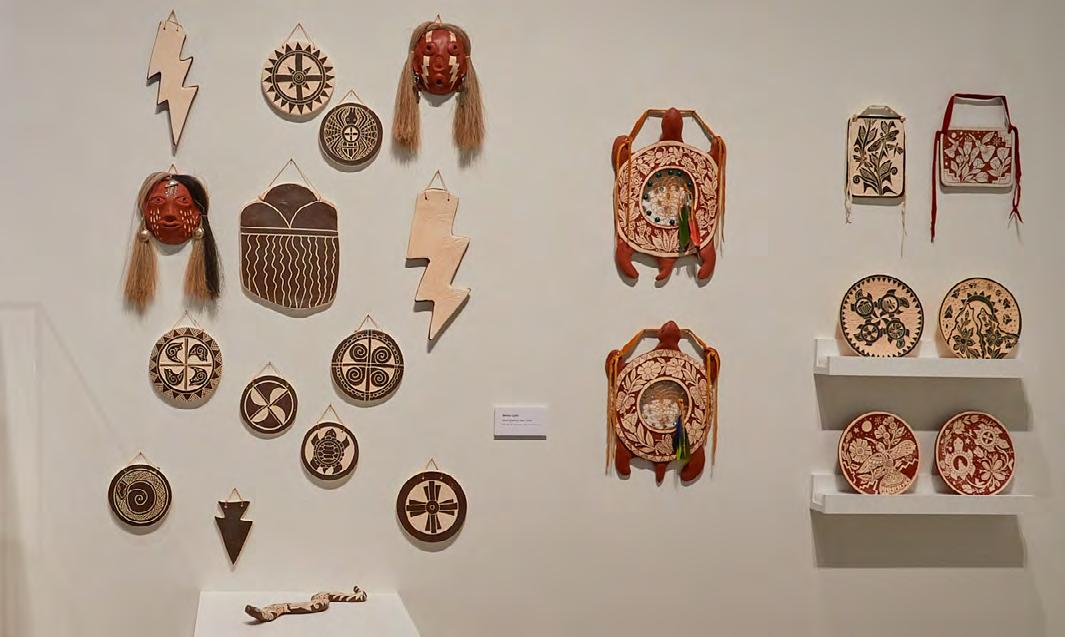
Meant to showcase works from both emerging and established artists, the Gregg show encompasses a wide array of mediums, including beadwork, printmaking, sculpture, textiles, and regalia. Such a range, especially all in one gallery, could prove challenging, but the thoughtful presentation offers ample space to engage individual works and learn about the artists behind them.
None of this was accidental—from the selection of the artists to the display choices, Gregg Director Sara Segerlin and her curatorial team sought as much community input as possible. The process was, as Gregg Curatorial Assistant Meredith Osborne recounted, “all about building relationships and connections.”
emerging and encompasses a wide printmaking, sculpall in one thoughtful presenworks and selection of the Sara Segerlin community input
Assistant relation-
“I enjoyed getting to know each individual artist,” she said. “That really helped with designing the layout and gathering their materials for the text—hearing their community stories of where they came from.”
Osborne, a former intern at CAM Raleigh, first encountered McMillan’s work there, when the artist created a window mural based on one of her works for the building. While working on the Gregg show, Osborne and the rest of the curatorial team traveled to UNC Pembroke’s Museum of the Southeast American Indian to see the annual 9|9 Native South Art Show curated by Nancy Chavis. One of McMillan’s paintings won first prize there, and the show itself served as an inspiration for what Osborne identifies as “an openness to different mediums.”
“Often with Native art, you may see beadwork, wood carving, textiles, fashion. However, the way in which [the art] is presented doesn’t necessarily tell much about the artist, their lives, and their perspectives on the world,” Segerlin explained. “For Stories Told by Breath, we wanted to lean into the very human aspect of being an artist as well as the challenges that Native artists face.”
Segerlin, who began her role as director of the Gregg in July 2024, said she is committed to “curation through a community-centered practice, which is all about building relationships and leaning into stories.”
“When I first came, the challenge was that we know we’re a ‘hidden gem,’ and that’s a good thing, but we don’t want to be hidden. We want to be well known. We want to be a gathering space,” said Segerlin, who is hoping that exhibits like Stories Told By Breath will open the Gregg’s collection to more communities and new audiences.
Through its many mediums and voices, Stories Told by Breath evidences two things: one, that contemporary Native art is vibrant and manifold and, two, that the work of many of the featured artists is in direct conversation with preceding generations. Cultural traditions and ancestors are in the work, whether or not the art looks “traditional” (whatever that means—or as McMillan succinctly put it during an April 8 panel event: “Native art is more than tepees”). Indeed, the show spotlights the varieties of expression in contemporary Native art—a category as big as the land of Turtle Island itself.
But for every artist in the show, there’s an act of claiming, or reclaiming, a link from their practices today to the ancestral knowledge of the past. These ancestors are not passive characters but integral to the story—stories that aren’t simply ancient or contemporary but instead alive and animate in daily life.
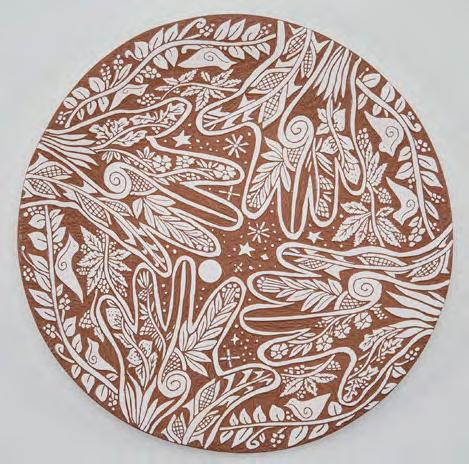
“I always say that the clay gave me a voice, and the voice that it gave me was for all those people who had only heard of the Cherokees [to have] an opportunity to hear about the Haliwa-Saponi, because I represent my people—I represent my tribe,” said Lynch, speaking from her dining room table in Warrenton. “We’ve always been here, but the history books have not always told it. I believe that [my ancestors] are speaking this out of me: We are the original potters. We are the original ones from the dirt, from the land, from the earth, from the plants, and I’m honored to be able to carry this. ... I truly believe my grandma, my grand-
mother’s mother’s mother’s mothers are speaking to me.”
“Sometimes I say I hope I don’t make any enemies trying to say what my grandma wants me to say,” Lynch continued. “She was a sweet person, but she also knew her history.”
Lynch’s first memory of pottery comes from her grandfather, who had a piece of pottery and showed her the texture, which had been created by rolling a corncob back and forth. Today, her hand-coiled pots and other clay works incorporate intricate etching of corn and other symbolic plants and animals, like turtles, dogwood flowers, and tobacco.
The corn isn’t just a symbol; it’s a thread, and Lynch’s mention of it calls me back to the colorful pieces of corn in “575.”
“As long as I can remember, I’ve been drawing,” McMillan said. “One of my core memories is my dad telling me, ‘If you can’t spell it, draw a picture.’”
Stories Told by Breath is in conversation with the other two exhibitions currently at the Gregg, both of which center Native art and themes of reclamation.
In the gallery next door is a solo show of works by Bobby C. Martin (Muscogee Creek), A Creek in Carolina, that explores, via family photos and archival materials, the pathways between ancestral Mvskoke homelands and the Indian Territory, where Indigenous tribes were forcibly removed to during the Trail of Tears. His works expand

the scope geographically from Stories Told by Breath, which is focused on Southeastern tribes.
Martin’s show has a haunting proximity and is hardly a backdrop—I found the two shows to reverberate the power of the art in both rooms—hearing from the ancestors of the people who never left, and from those whose ancestors were forced to, all living survivors of colonial genocide. It made the artistic revelry and reverence of Stories Told by Breath even more remarkable.
The third show at the Gregg, Through Our Eyes, in Our Hands: Prioritizing Indigenous Knowledge in Museums, examines the process of repatriation and foregrounds Native perspectives on how artworks and cultural belongings in museum collections should be cared for—opening the museum’s processes up for community dialogue. For Segerlin, repatriation is about doing the work beyond the legal requirements to address the museum’s collection and be transparent about its choices.
“It’s important to share this process with the public, whether through publications in our exhibitions or labels,” Segerlin said, adding that she hopes the exhibit can spark conversation about what ethical stewardship and care for objects can look like in the future.
For a working artist, Lynch spends a lot of time in schools, volunteering as an educator. (Her artwork is also literally in schools—the University of North Carolina at Chapel Hill’s American Indian Center has her work “The Gift” installed in its building.)
She takes her pots and explains their stories and the process of making them to schoolchildren across the state.
“It’s crazy, the stereotypes and ideas that they have of Native Americans,” Lynch said. “We always say we walk in two worlds anyway, in our Native world and in this modern world. So [the kids] have ideas of the past and don’t hardly know that we’re still here.
“I’ll ask, ‘Are there any American Indians in your school?’ And they’re like, ‘We don’t know.’ They’re never exposed to or see American Indians, even though we have the highest population in North Carolina on this side of the Mississippi. But, you know, because of the history books, they don’t know. Or they’ll say that all the Indians left and went to Oklahoma. And I’ll say, ‘Well, why am I still here?’”
It’s a rhetorical question that works— the physical presence of the artist reclaim-
ing the space history has written her out of. But here’s the deal: It was her place all along, and just because it’s been actively erased for centuries doesn’t mean it hasn’t existed all along—this long, generational connection, rooted in the earth. We have ample evidence, of course, but the very pot Lynch passes around to the children tells the story.
What Lynch does with her work in schools is what the Gregg’s exhibit does for the museum: It is a physical reminder of the wealth of Indigenous knowledge that is still very much alive and present today, represented here in powerful and dynamic art.
“I’m blowing away the dust, but I’m also putting my breath into that piece of artwork,” said Lynch, who recounted how title discussions went “around and around,” as she considered “what it means to put your inner self on the outer self, to blow art into existence.”
Ultimately, Lynch’s process of blowing on the pottery inspired the title’s exhibition.
“We blow it from nowhere sometimes. Puddle of clay and chunk of paint that’s nothing but a chunk until you put it on your canvas,” she said. “Our breath is carried on through art and into the future.”
written her out place all been actively it hasn’t generational We have the very children work in exhibit does remindknowledge and present powerful and but I’m also piece of arthow title around,” as put your blow art blowing on exhibition. nowhere someof paint until you said. “Our art and Thomas, “575”
Chips, a large lemonade, and a twodog combo at the Flow Volkswagen of Durham parking lot.
BY LENA GELLER lgeller@indyweek.com

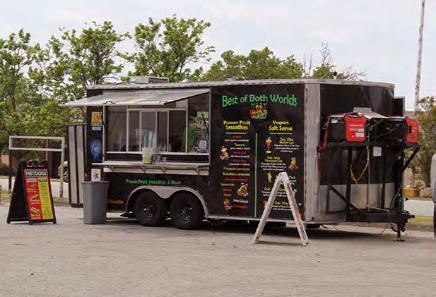
When the Durham concession stand Tropical Delights is up and running in its usual spot—the Flow Volkswagen parking lot off 15-501—it sometimes flies a willowy flag from an easement by the road, advertising HOT DOGS to cars streaming past.
Other times, it goes flagless. One such day, I pull up with the sense of being in on a secret—without the flag, there’s no indication that Tropical Delights serves food as well as sweet treats. The trailer’s exterior, rendered in the oceanic neon wave of a boogie board, bears a menu of just lemonades, smoothies, and Dole Whips™. Painted in blue text above the menu, the business’s tagline, “The Original Pineapple Guys,” is also decidedly beverage-coded, as is its logo, a hollow pineapple goblet with two pineapple rings hooked on the rim like arms slung over the edge of a hot tub (the “guys,” perhaps).
From the curb, then, Tropical Delights is drinks all the way down. But I know otherwise. I used to live nearby, and
one afternoon when the flag was out, I picked up a footlong hot dog and took it back to eat by the pool at my old apartment. It became something of a summer ritual. (The drinks operation and the hot dog operation do feel a little at odds with each other, yes, but there’s also a sort of structural logic; a hollowed-out pineapple is an edible vessel for a smoothie the same way a bun is for a dog. Is a hot dog a sandwich bread bowl?)
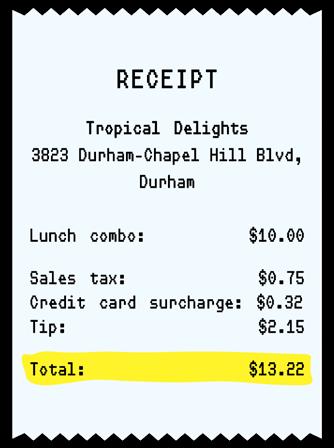
You’ll see the dog menu on a sandwich board when you park and walk up. The options are a footlong for $8, two standard dogs for $7, or a thicker “big dog” for $9, all of them all-beef and available with unlimited free toppings. There’s also a lunch combo: two standard dogs, a large lemonade, and chips for $10. That’s what I’m going for today.
I ask the man behind the register—his name is Reggie— for a topping recommendation. Reggie points to the prebuilt combinations on the menu, which run from a simple Boy Scout (ketchup and mustard) to a fully loaded Carolina Dog (housemade chili and slaw, plus onion, ketchup, mustard). He says the Carolina is his favorite. I like that he’s steering me to the most bang for my buck.
“That one, please,” I say.
Reggie also encourages me to add a flavor to my lemonade, so I go with strawberry. He hands it down a few seconds later in a giant cup, fresh pieces of strawberry and pineapple floating on top. My total comes to $13.22 with tax and tip.
While I wait for my food, I ask Reggie about the “Original Pineapple Guys” tagline. He tells me he’s been running this business since the ’90s, and that he was one of the first vendors around to serve a smoothie inside a hollowed-out pineapple. He actually didn’t start serving hot dogs until the pandemic, he says, when he was regularly setting up
in the Sam’s Club parking lot, and customers kept asking him if he had any.
I nod along, wondering what the connection is between the pandemic and people wanting hot dogs but too sheepish to ask in case the answer is obvious. Later, I realize Sam’s Club shuttered its café for months during the pandemic, so shoppers who’d come to count on a $1.50 hot dog on the way out were left empty-handed. Tropical Delights answered the call and became their oasis.
A minute later, Reggie passes a box down through the window. When I open it, the word that comes to mind is finesse. The contents are stacked into flat tiers like a napoleon, with two generously topped dogs on the bottom, then a square of foil, then a napkin the same size, then a bag of Lay’s sitting on top.
I dig in and remember why hot dogs are so satisfying: The bite is prearranged for you. You’re not chasing a piece of chicken and a green bean and a dab of sauce around a plate, trying to get a little of everything onto your fork. Every component is already pressed into the same square inch. I get the salt of the dog, the coolness of the slaw, the hot sag of the chili, and zippy hits of onion all at once. Even compared to other foods built around the idea of delivering everything in one mouthful, like burgers or pizza, a hot dog has superior architecture for the job, with everything lined up in a trough rather than bunched between two buns or strewn across a wide expanse of cheese.
Sitting right up against each other, individual flavors also come through stronger, sharpened by contrast. In my Carolina Dogs, alongside the salt and tang, I can pick out sweetness, coming from both the chili and the slaw. Which figures—at Tropical Delights, even the savory thing on the menu has some sugar in it.
Camille A. Brown at the American Dance Festival, a final performance of My Name Is Rachel Corrie, and other must-see shows around the Triangle this summer.
BY LAUREN WINGENROTH arts@indyweek.com
This summer, the movie theater is not your only air-conditioned cultural refuge from the heat (though it remains a good one). Support your local theater company or dance festival with some of the many engaging performing arts events on the docket this June and July throughout the Triangle, featuring both big names from out of town and talents from within our communities. Find five of the INDY’s favorite options below, including highlights from a packed American Dance Festival (ADF) season, which runs May 27 through July 25 in Durham, and two standout local theater productions.
The Justice Theater Project | Umstead Park United Church of Christ, Raleigh | June 5-21
Have you heard? There’s a rumor in the Triangle—something about a Romanov daughter who somehow survived the Bolsheviks.
Sadly, the Anastasia conspiracy theory most likely doesn’t have legs. But the beloved 1997 film and more recent stage musical adaptation it inspired sure do, with earworms like “Once upon a December,” “Journey to the Past,” and yes, “A Rumor in St. Petersburg.” Raleigh’s Justice Theater Project mounts the show, which touchingly explores what “home” means and how we find it. Though it doesn’t have the obvious social justice angle that the troupe is known for, it’s likely that The Justice Theater Project’s penchant for addressing social issues in insightful ways will come through— maybe just not in the way we expect.
American Dance Festival | Reynolds Industries Theater, Durham | June 17
Jesse Factor has a bit of a thing for divas. The choreographer and performer’s work often channels, exalts, and excavates larger-than-life women, like in his RELIC, which is set to an old Joan Crawford interview on loop. But the diva at the center of his latest work, which comes to the American Dance Festival in June, is one with whom he has an especially personal relationship: the seminal choreographer Martha Graham, whose work Factor performed as a member of Graham’s eponymous company and whose distinctive technique always seems to be present in his movement. In The Marthaodyssey, that’s especially true, as Factor plumbs the Graham canon—and some Madonna songs—in a modern dancemeets-drag show extravaganza that’s both reverent and riotous.
Burning Coal Theatre Company, Raleigh | June 17
For the past 10 months, Raleigh’s Burning Coal Theatre Company has been hosting monthly readings of My Name Is Rachel Corrie, which is based on the journals and emails of the titular American activist, who was run over and killed by an Israeli Defense Forces bulldozer in 2003 while trying to protect a Palestinian neighborhood. June 17 will be your final chance to catch the play, which was written by the late actor Alan Rickman and journalist Katharine Viner. Though originally conceived as a one-per-

son play, Burning Coal’s series features multi-actor casts drawn from local communities. Past readings have included artistic directors from local theaters, military members, and educators; Corrie’s parents have also attended one of the shows. For the last reading, readers will be, somewhat puzzlingly, agents from a local real estate office. Still, the performance marks the end of what has been both a unique model of community-engaged theater and a captivating telling of an all-too-timely story. Admission is free with a $10 donation, which goes to Doctors Without Borders or other international aid organizations feeding Palestinian civilians in Gaza.
I AM American Dance Festival | Reynolds Industries Theater, Durham | June 20
With her latest work, I AM, New York City-based choreographer Camille A. Brown is telling us who she is—in all caps. Based on the rest of her visionary oeuvre, and her status as one of our country’s most important contemporary dancemakers, it’d be a good idea to pay attention. Coming to ADF for two performances on June 20, I AM is an exploration of Black joy, drawing from a multitude of African diasporic dance genres and powered by a vibrant percussive score, performed live. In addition to her work for her own company, which often investigates and celebrates aspects of Black identity and culture, Brown has in recent years become one of Broadway’s
most in-demand choreographers, including for the forthcoming revival of Dreamgirls, which she will also direct. But in I AM, we’ll get to see something more personal— and likely, something transformative.
American Dance Festival | Rubenstein Arts Center von der Heyden Studio Theater, Durham | July 7-10
Whether she’s leading a dance tour of the Metropolitan Museum of Art, physicalizing the stories of This American Life alongside collaborator Ira Glass, or staging a cringey mock office party in finance bro drag, the work of choreographer Monica Bill Barnes tends to be unexpected, funny, and intimate. Her highly narrative works, which are often as based in text as they are in movement, are hard to categorize, but it’s usually safe to expect that the line between audience and performer will blur, the fourth wall will not be a sound structure, and some form of antics will take place.
Her Many Happy Returns, which comes to ADF July 7-10, checks all those boxes in the form of what the company calls “a dance version of a memory play” centered around a woman having a sort of midlife crisis. Barnes, who has a way of moving that can be both deeply emotive and borderline vaudevillian, performs as the woman’s body; Barnes’ longtime collaborator and the show’s writer, Robbie Saenz de Viteri, will be the character’s mind.
MUSIC
Boris Lurie: Echoes of Memory 1 p.m. NCMA, Raleigh.
Distant w/ Tracheotomy
7 p.m. Local 506, Chapel Hill.
Future Islands, Jenny Besetzt 8 p.m. Cat’s Cradle, Carrboro.
The New Pornographers, Will Sheff (of Okkervil River) 8 p.m. Haw River Ballroom, Saxapahaw.
STAGE
Dancing With The Carolina Stars: Celebration 5:30 p.m. The Carolina Theatre, Durham.
Hamilton May 20-Jun. 14, various times. DPAC, Durham.
PAGE
Hannah Thurman: Mercy Hill 6:30 p.m. Quail Ridge Books, Raleigh.
THU 5/21
MUSIC
Hiding Places, Verity Den, Supermutt 8 p.m. Cat’s Cradle Back Room, Carrboro.
Liquid Mike and PONY 8 p.m. Local 506, Chapel Hill.
Rachel Sumner & Traveling Light 7:30 p.m. The Cary Theater, Cary.
Robber Robber 7:30 p.m. The Pinhook, Durham.
Thursday Night Music Club: Rachel Sumner and Traveling Light 7:30 p.m. The Cary Theater, Cary.
Elizabeth Brunot 7:30 p.m. Goodnights Comedy Club, Raleigh.
JB Smoove May 22-23, various times. Goodnights Comedy Club, Raleigh.
Movie Loft presents “Wolfman” 8 p.m. Shadowbox Studio, Durham.
PAGE
Jayne Anne Phillips: Small Town Girls 5:30 p.m. Flyleaf Books, Chapel Hill.
FRI 5/22
MUSIC
Algorhythm Trio: Straight Ahead Jazz 7 p.m. Succotash, Durham.
ATLiens 7 p.m. The Ritz, Raleigh.
DapYP / BrassiousMonk + DJ Wicked 8:30 p.m. The Pinhook, Durham.
Cold 8 p.m. Motorco Music Hall, Durham.
Iration 6 p.m. Red Hat Amphitheater, Raleigh.
Lovell Bradford Quintet: The Music of Mingus with Sean Jones and Stacy Dillard 7:30 p.m. Sharp 9 Gallery, Durham.
Marisela 8:30 p.m. Martin Marietta Center for the Performing Arts, Raleigh.
The Secret Sisters 7:30 p.m. Martin Marietta Center for the Performing Arts, Raleigh.
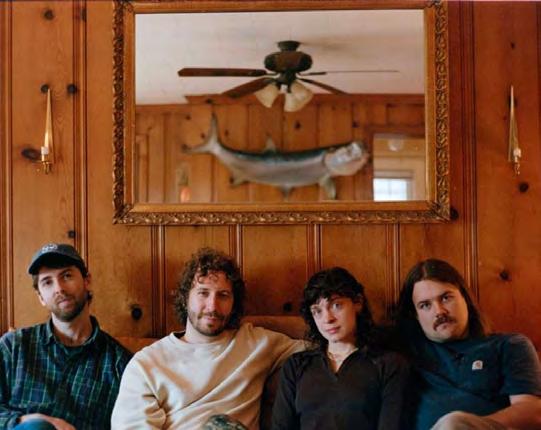
Sluice, Peter Horses 8 p.m. Cat’s Cradle Back Room, Carrboro.
Smile On the Sinner and Thin the Herd with Ireveri and In Memory 7:30 p.m. Local 506, Chapel Hill.
Tacoma Park album release + Unsaved + Oiil 8 p.m. Shadowbox Studio, Durham.
The Velvet Feast Song Swap: Jess Klein, Dawn Landes, Skylar Gudasz 5 p.m. Eno House Artist’s Den, Hillsborough.
World Goth Day: Idol Talk, Desolation Colony 9 p.m. Rubies on Five Points, Durham.
ZZ Top & Dwight Yoakam: Dos Amigos Tour 7 p.m. Koka Booth Amphitheatre, Cary.
STAGE
The ComedyWorx Show Fridays at 8 p.m. ComedyWorx, Raleigh.
The Harry Show Fridays at 10 p.m. ComedyWorx, Raleigh.
Hush Hush Fridays at 9 p.m. Mettlesome Theater, Durham.
Chris O’Connor May 22-24, various times. Goodnights Comedy Club, Raleigh.
JB Smoove May 22-23, various times. Goodnights Comedy Club, Raleigh.
MUSIC
Adulting: 90s/2000s edition with DJ VSPRTN 7 p.m. Rubies on Five Points, Durham.
Candlelight Concert: Adele 8:45 p.m. The Rialto, Raleigh.
Candlelight Concert: Hans Zimmer 6:30 p.m. The Rialto, Raleigh.
Carrboro Bluegrass Festival 3 p.m. Cat’s Cradle Back Yard, Carrboro.
EWO X Maw: Berzerk 8 p.m. Local 506, Chapel Hill.
Hardgroove: Faster, Faster 10 p.m. The Fruit, Durham.
Husbandos (and friend) 8 p.m. Shadowbox Studio, Durham.
Renaissance Disko: Future Function with DJ VSPRTN 11 p.m. Rubies on Five Points, Durham.
Shrek Rave 7 p.m. The Ritz, Raleigh.
Tea Cup Gin: Indie, Jazz, Blues 7 p.m. Succotash, Durham.
Tchaikovsky Piano Concerto No. 1 8 p.m. Koka Booth Amphitheatre, Cary.
Those Dogs / Peach Rings / The Dead Ringers 6:30 p.m. The Pinhook, Durham.
STAGE
The ComedyWorx Show Matinee Saturdays at 4 p.m. ComedyWorx, Raleigh.
SUN 5/24
MUSIC
An American Celebration: The Music of John Williams 7 p.m. Koka Booth Amphitheatre, Cary.
Music for Mental Health: Caleb Caudle, Laurelyn Dossett, The Vagabond Saints’ Society 7 p.m. Cat’s Cradle Back Room, Carrboro.
One After 919, a Beatles Tribute 6:30 p.m. Rubies on Five Points, Durham.
STAGE
Jimmy Dore 5:15 p.m. Goodnights Comedy Club, Raleigh.
Nara’s Room 7:30 p.m. The Pinhook, Durham.
Sydney Castillo 7:30 p.m. Goodnights Comedy Club, Raleigh.
MON 5/25
MUSIC
King Garbage / C.Shreve The Professor / OC 8 p.m. The Pinhook, Durham.
TUE 5/26
MUSIC
Alcantara, Country Fetish, Snide 8 p.m. Cat’s Cradle Back Room, Carrboro.
North Carolina Jazz Repertory Orchestra
7:30 p.m. Sharp 9 Gallery, Durham.
SCREEN
A Love Letter to Handsome John 7 p.m. The Rialto, Raleigh.
PAGE
Bob Crawford: America’s Founding Son 5:30 p.m. Flyleaf Books, Chapel Hill.
WED 5/27
MUSIC
Buckethead 8 p.m. Lincoln Theatre, Raleigh.
CPH Music: A Birthday Bash for Bob Dylan 6 p.m. Flyleaf Books, Chapel Hill.
Lennon KC with Frog Machine 8 p.m. Local 506, Chapel Hill.
Wage War: It Calls Me By Name Tour 6:30 p.m. The Ritz, Raleigh.
STAGE
Dinosaur! May 27-Jun. 14, various times. Raleigh Little Theater, Raleigh.
PAGE
Annabel Monaghan: Dolly All the Time 6:30 p.m. Quail Ridge Books, Raleigh.
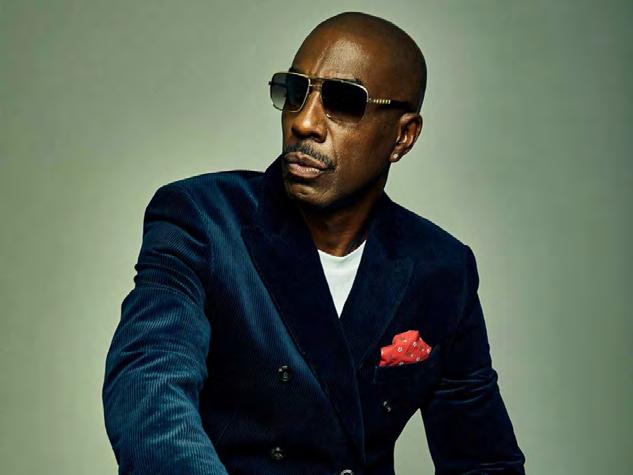
THU 5/28
MUSIC
Grace Givertz 7 p.m. The Carolina Theatre, Durham.
An Evening with The Infamous Stringdusters 8 p.m. Lincoln Theatre, Raleigh.
From Irving Berlin to Louis Armstrong: Celebrating the Jewish Songwriters and African American Performers Who Shaped American Music 7 p.m. NCMA, Raleigh.
Highly Suspect And The Tour Of Yellow Roses 7 p.m. The Ritz, Raleigh.
No Quarter! Brass Band w/ Boom Unit Brass Band 7 p.m. The Pinhook, Durham.
Old Crow Medicine Show & Marty Stuart and His Fabulous Superlatives
7 p.m. Koka Booth Amphitheatre, Cary.
Paprika with COGS and Buck Swope 8 p.m. Local 506, Chapel Hill.
Hex Files, Soul Meets Body, Mr. Piss 7:30 p.m. Rubies on Five Points, Durham.
STAGE
Bulldog Ensemble Theater Presents: Laughs in Spanish May 28-Jun. 7, various times. Mettlesome Theater, Durham.
Britton Emert 8 p.m. Goodnights Comedy Club, Raleigh.
Cam Bertrand 7:30 p.m. Goodnights Comedy Club, Raleigh.
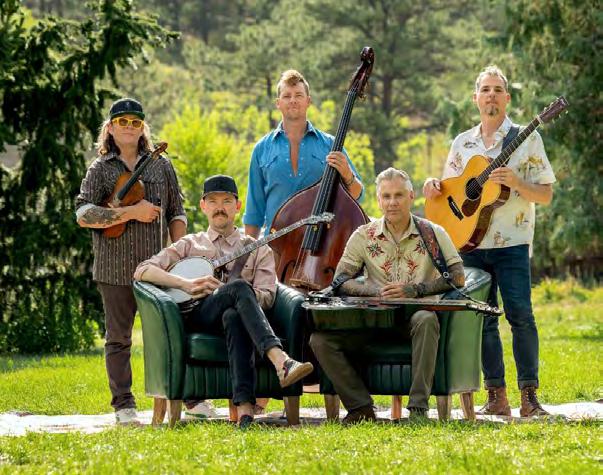
FIND
Big Mistake, Sloping, Glowr 6:30 p.m. Rubies on Five Points, Durham.
Club Paradise 10 p.m. Rubies on Five Points, Durham.
The ERs 7:30 p.m. Sharp 9 Gallery, Durham.
Night! Night!, RIBS, Oil 8 p.m. Cat’s Cradle Back Room, Carrboro.
Zealotrous *Final Show* with WolvesX4, Narsick, and Blab School 8 p.m. Local 506, Chapel Hill.
The ComedyWorx Show Fridays at 8 p.m. ComedyWorx, Raleigh.
The Harry Show Fridays at 10 p.m. ComedyWorx, Raleigh.
Hush Hush Fridays at 9 p.m. Mettlesome Theater, Durham.
JC Currais May 29-31, various times. Goodnights Comedy Club, Raleigh.
Lavell Crawford May 29-31, various times. Goodnights Comedy Club, Raleigh.
The Rocky Horror Picture Show 9 p.m. The Rialto, Raleigh.
Ben Folds & A Piano Tour with special guest Lindsey Kraft 8 p.m. Martin Marietta Center for the Performing Arts, Raleigh.
Cirque du Sol-Rave 9 p.m. The Fruit, Durham.
Donnie Deneil, AZUL, Husbandos 7 p.m. Rubies on Five Points, Durham.
Eric Williams Quintet: Miles & Coltrane @ 100 May 30-31, various times. Sharp 9 Gallery, Durham.
In the End - Linkin Park Experience 7 p.m. The Ritz, Raleigh.
Janna Badalian 7 p.m. Succotash, Durham.
Lynn Blakey: A Celebration of Her Life and Music 8 p.m. Cat’s Cradle, Carrboro.
Sex on Decks presents Bass Kink with Ver 10 p.m. Rubies on Five Points, Durham.
Sub Empty, Lose/Lose, The Punching Bags 6:30 p.m. The Pinhook, Durham.
The WHY PARTY 10:30 p.m. The Pinhook, Durham.
Withered with Xenobile 8:30 p.m. Local 506, Chapel Hill.
Yasmin Williams, Tre. Charles 8 p.m. Cat’s Cradle Back Room, Carrboro.
Young the Giant: Victory Garden Tour with Cold War Kids and Almost Monday 6:30 p.m. Red Hat Amphitheater, Raleigh.
STAGE
The ComedyWorx Show Matinee Saturdays at 4 p.m. ComedyWorx, Raleigh.
Golden Age 9 p.m. Mettlesome Theater, Durham.
Josh Gates Live! An Evening of Legends, Mysteries, and Tales of Adventure 8 p.m. The Carolina Theatre, Durham.
Still. Moving: Zonal Harmonic 170,000 and Zonal Harmonic 220,000 11 a.m. and 1 p.m. NCMA, Raleigh.
MUSIC
Celaris, We Used to Cut The Grass, Somnium, and Lofield 8 p.m. Local 506, Chapel Hill.
Insane Clown Posse 6 p.m. The Ritz, Raleigh.
Sunday Set with DJ Jarvis 5 p.m. The Durham Hotel, Durham.
Tommy Prine, Brad Goodall 8 p.m. Cat’s Cradle Back Room, Carrboro.
MUSIC
Ernest Turner Trio 7 p.m. Sharp 9 Gallery, Durham.
High Fade “Twice As Nice Tour” 8 p.m. Lincoln Theatre, Raleigh.
PAGE
Ben Fountain: Rasputin Swims The Potomac 5:30 p.m. Flyleaf Books, Chapel Hill.
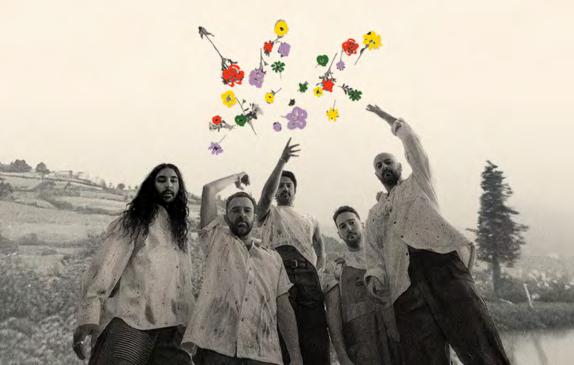


RELEASE DATE—Sunday, May 17, 2026
Edited by Patti Varol

There is really only one rule to Sudoku: Fill in the game board so that the numbers 1 through 9 occur exactly once in each row, column, and 3x3 box. The numbers can appear in any order and diagonals are not considered. Your initial game board will consist of several numbers that are already placed. Those numbers cannot be changed. Your goal is to fill in the empty squares following the simple rule above.

Data Eng II
First Citizens Bank seeks a Data Eng II in Raleigh, NC for designing, building, & maintaining data platforms that support data integrations. Reqs: BS in CS, IT or rel + 5yrs or MS in CS, IT or rel +3yrs. Remote role in NC, GA or AZ. Base pay gen b/w $143,250 to $187,070/yr. For more info & to apply, go to https://jobs.firstcitizens.com/jobs & ref Job #2026-33835
DB Engr. Cnslt.
First Citizens Bank seeks a DB Engr. Cnslt. in Raleigh, NC to assist the dvlpmt & support of infrastructure that supports Bank’s database tech. Reqs: BS in IT or rel + 8yrs. Remote role in NC or MA. Base pay gen b/w $136,448 to $205,061/yr. For more info & to apply, go to https://jobs. firstcitizens.com/jobs & ref Job #2026-33992
Marketing Specialist
Marketing Specialist. Conduct mkt rsrch & anlyz user behavior & media trends; dsgn & implmnt surveys & data anlys; eval digital mktg performance; prep reports & presentations; collab w/ teams on mktg strats; monitor ind trends & competition. Master’s degree in Marketing, Communications, or rltd req’d. Send resume to: YellowPink, LLC, 3511 Shannon Rd, Durham, NC 27707.
26 __ turtle
27 Fills with love
29 Queen singer played periodically by Rami Malek?
31 “Come on now!”
33 In the past
35 Takes a rideshare
36 MLB stat
Sr. Laboratory Technician
38 Flavor of many a bright green martini
Sr. Laboratory Technician (Durham, NC) In office M-F: Conduct RUO preprocessing of DNA/ RNA samples for drug development studies, utilizing microtomy, H&E staining and digital scanning. Perform nucleic acid extraction and quality assessment, including quantification and integrity checks. Operate, maintain and calibrate microtome and other laboratory equipment. H.S. diploma or equivalent and 3 years experience as Laboratory Technician. Experience must include, precision sectioning of paraffin-embedded tissue blocks using rotary microtomes; assessment of yield, purity, and integrity of RNA/DNA using spectrophotometry, fluorometry and electrophoretic methods; processing tumor tissue samples for molecular diagnostics, including adherence to chain-of-custody and contamination prevention standards; RNA/DNA isolation from FFPE and fresh tissue, with knowledge of downstream applications such as PCR, qPCR, and NGS library preparation; CAP (College of American Pathologists) and CLIA (Clinical Laboratory Improvement Amendments) requirements for specimen handling, documentation, and assay validation. Email resume to Robert Keck at robert.keck@almacgroup.com at Almac Diagnostics LLC.
41 Baking ware that’s only used periodically?
46 Cary Grant film that airs periodically on classic movie channels?
51 Due-in hr.
52 Parroted
54 Swimmer’s wear
55 Midsize car
56 Word
58 Clutched
59 Must pay
62 Pagoda instrument
63 Fancy tie
65 Tyler of “Whose Line Is It Anyway?”
67 Anise aperitif
69 Advantage in some situations, or an alternate title for this puzzle
75 Beauty aisle brand
76 Dorm digs
77 Coins of the realm?
80 Basketball stuff
83 Civil rights icon Mandela
86 Olaf’s creator in “Frozen”
Sr. Software Dev
__ Quixote
Bee keeper
“Rocky III” actor
SAS Institute Inc. seeks a Sr. Software Dev in Cary, NC to design, develop, & debug software. Reqs: BS in Comp Sci or rel + 8yrs or MS in Comp Sci or rel +6. Remote role per SAS’ Flexible Work Program. For full reqs & to apply visit sas.com/careers & reference Job #2026-42041
Dickens novel that’s only read periodically?
SW Eng Cnslt
First Citizens Bank seeks SW Eng Cnslt in Raleigh, NC to work on Gitlab pipelines to drive all Microservices. Reqs: BS in CS, ECE, ITM, or rel + 5yrs. Remote role in NC, CA, AZ or TX. Base pay gen b/w $194,275 to $222,583/yr. For more info & to apply, go to https://jobs.firstcitizens.com/jobs & ref Job #2026-33978
Tech Lead
First Citizens Bank seeks Tech Lead in Raleigh, NC to drive the enterprise data and analytics strategy. Reqs: BS in Comp Sci, Info Sys, Data Analytics, or rel + 8yrs. Remote work EST biz hours. Base pay gen b/w $150,000 to $199,974/yr. For more info & to apply, go to https://jobs.firstcitizens.com/jobs & ref Job #2026-33969

Veterinarian
Veterinarian - Cary, NC. Examine & diagnose disease conditions in companion animals. Provide treatment & surgery as needed. Prescribe & administer drugs & vaccines. Dvlp treatment plans. Discuss treatment plan w/ pet owners. 2 yr. Exp. Req. Salary: $86,819/yr. DVM - Doctor of Veterinary Medicine, NC Veterinary License Req. Mail or email resume to: Sarah Vaan Staalduinen, Administrative Director - Cary Animal Care PLLC dba Walnut Street Animal Hospital
702 Cary Towne BLVD Cary, NC 27511 or sarahvs.management@gmail.com.
5/6/26
Winning INDY's "Best of the Triangle" Readers’ Poll has been a coveted honor for the past 25 years.
The contest is organized in rounds throughout the year by region: Orange & Chatham Counties, Durham County, then Wake County. At the end of the year, the winners of each region go head-to-head to claim the title of “Best of the Best of the Triangle”.
DURHAM WINNERS WILL BE PUBLISHED JULY 1
In print and online!
WAKE COUNTY VOTING OPENS JULY 22
Make sure to vote for your favorite bar, veterinarian, bookshop, museum, or other neighborhood treasure.
Orange & Chatham County winners and more info online at: