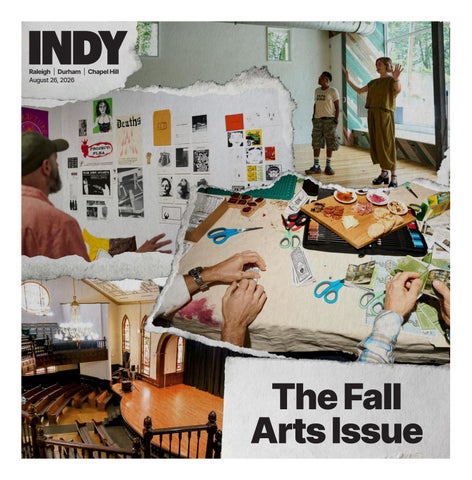
Raleigh | Durham | Chapel Hill August 26, 2026
The Fall Arts Issue
Raleigh | Durham | Chapel Hill Vol. 43 No. 16 | August 26, 2026
Contents
News 4
Wake County stands to lose millions in property tax revenue thanks to a small industry helping developers make use of a tax exemption intended to help nonprofits build affordable housing. BY JASMINE GALLUP
8
Durham Public Schools is launching express stops and a partnership with GoDurham to improve bus arrival times this school year. BY TORI NEWBY
10
The Olympics for student athletes is coming to the Triangle. BY JUSTIN LAIDLAW
Culture 12
Character Study: Cary artist Tiki McIntyre channels spirit guides to paint. BY REGAN BUTLER
14
The Carrack nurtured a generation of Durham artists. Fifteen years later, Boardinghouse Arts aims to help them take the next step. BY BRIAN HOWE
16
With new leadership and 50 years under its belt, the Hayti Heritage Center looks toward the future. BY SARAH EDWARDS
22
"If you could live inside the world of a NCMA painting, which would it be?" and other questions for outgoing director Valerie Hillings. BY EMILY CATANEO
24
Hyperlocal is making zines to connect people to place—and each other, too. BY ANDREA RICHARDS
27
Since 1996, Lump Gallery has been Raleigh’s mainstay for experimental art. On August 31, owner Bill Thelen is closing its doors for good. BY SARAH EDWARDS
29
Fall arts and culture dates to bookmark. BY SARAH EDWARDS
Regulars 3
31
Backtalk
Calendar
38 Puzzles / Classifieds
Cover Clockwise from bottom L: The Hayti Heritage Center (Photo courtesy of the
Hayti Heritage Center); Bill Thelen at Lump Gallery, Boardinghouse Arts founders Shirlette Ammons and Laura Ritchie, participants compile Hyperlocal Durham zines (photos by Matt Ramey)
Artwork by Critter, a member of TeamLump, at Lump Gallery in Raleigh. (see story on page 27) PHOTO BY MAT T RAMEY
We Made This Publisher John Hurld
Editorial Editor-in-Chief Sarah Willets Wake County Editor Jane Porter Culture Editor Sarah Edwards
Staff Writers Lena Geller Justin Laidlaw Tori Newby Report For America Corps Reporter Chloe Courtney Bohl Contributors Jasmine Gallup, Desmera Gatewood, Elliott Harrell, Brian Howe, Glenn McDonald, Cy Neff, Andrea Richards, Barry Yeoman, Russ Campbell, Colony Little, Shelbi Polk, Ryan Cocca, Lauren Wingenroth
2 INDYweek.com August 26, 2026
Creative
Advertising
Creative Director Nicole Pajor Moore
Publisher John Hurld
Production Design Specialist Ellie Bruno
Director of Revenue Mathias Marchington Director of Operations Chelsey Koch Sales and Marketing Associate Lauren Boyle
Circulation
Berry Media Group
Membership/ Subscriptions John Hurld Mathias Marchington
INDY | indyweek.com
Advertising sales
P.O. Box 1772 Durham, N.C. 27702
sales@indyweek.com 919-666-7229
919-666-7229 support@indyweek.com To reach INDY staff directly: tips@indyweek.com Contents ©2026 ZM INDY, LLC All rights reserved. Material may not be reproduced without permission.
BACKTALK
In her latest Lunch Money column, Lena Geller visited a Durham mainstay, Cosmic Cantina, and mused on the makings of a satisfying burrito and the role nostalgia plays in shaping what foods we love. Readers had very strong opinions on the column (part of an ongoing series on trying to dine out locally for under $15) and the restaurant.
From reader BRIAN VAUGHN by email: The Cosmic column deserves celebration for its obsession with nostalgia. Climbing on roofs, rolling through late nights after revelry (or a Red Eye to Raleigh), and debates in the student paper become immediately relatable when the words “Veggie Deluxe” are uttered. At one point, the author posits “I’m more worried that my sentimentality is going to undermine my ravings about the food.” And yet with Cosmic, the sentimentality is the point. How could you not be sentimental about a place that transcends phases of life, and is so utterly consistent? RE: Disdainful comparison of other burritos, I have and will forever compare every burrito I eat to the Chapel Hill Cosmic’s red mole veggie burrito, which sustained and delighted me for years. You may have convinced me to skip Moe Monday’s and head for 9th Street for lunch today. From reader RANDY REED by email: I very much enjoyed most of Lena Geller’s musings about our local fantastic Cosmic Cantina but leaving out any mention of the wondrously explosive green jalapeño sauce was a bit like writing about the Chelsea Cinema and not mentioning their small screens. From Reddit user THESE-TONIGHT-1672: Cosmic is ass - use to be ok if you needed a mountain of food for 10 bucks but I’d rather just eat cans of beans honestly
WANT TO SEE YOUR NAME IN BOLD?
An excerpt from Reddit user MIAMICUTLERRIDGE305: It has to be pure nostalgia. Tons of better options price, quality and taste wise … Go down 9th Street, make a right on Club, and once you get to Roxboro you’ll have plenty of better options. Super Taqueria, El Huarache, Guanajuato, La Superior which is the best imo From reader KEENAN JENKINS by email: May blessings rain down upon Lena Geller and her entire bloodline for this article about Cosmic, which perfectly captures its essence -- nostalgic but still as delicious as ever. “...every element spread so evenly that they all turn up in the same mouthful...” -- so true and well written!! Additional blessings for mentioning Ox & Rabbit, whose old chalkboard milkshake menu I have owned since they closed in 2014. It has been hung up in every apartment and house I’ve had since then! I’ll forever miss their lavender vanilla milkshakes. The planned route for Western Wake Bus Rapid Transit—which will connect Raleigh to RTP—will circumvent the town of Morrisville, Chloe Courtney Bohl reported online earlier this month. Disappointed town officials plan to send a letter to the regional transit planning authority but aren’t standing in the way of the project. One reader wrote in urging the town to plan for housing and transit around the route now.
indyweek.com
From reader CHRIS PERELSTEIN by email: I was excited to read Chloe Courtney Bohl’s article and see Morrisville’s Town Council wrestling seriously with how Western Wake BRT will serve its residents. Their concern is fair. The planned route misses many of Morrisville’s core residential areas, even though Morrisville is the Triangle’s densest municipality by 2020 Census population density. Density is not enough by itself, but it is the foundation that makes frequent transit, especially BRT or rail, more viable. The most important part of this debate may be the timeline. BRT is not expected to reach downtown Cary until 2030, and the extension through Morrisville is planned for 2035, assuming no delays. That gives Morrisville something valuable: time to plan around transit before it arrives. The town already has good ideas in its transit-oriented development rules, including buildings closer to the street, parking to the side or rear, mixed uses, and better pedestrian connections. Morrisville also allows many missing middle forms in parts of town. Around future stations, it can build on that progress by allowing more duplexes, townhomes, cottage courts, and other compact housing with small setbacks and less land devoted to parking. Durham offers useful examples. Expanding Housing Choices broadened small-scale housing options, with its duplex reforms receiving clear majority support in public outreach. Simplifying Codes for Affordable Development reduced setbacks and expanded small lot possibilities. Durham also eliminated parking minimums before North Carolina moved to restrict them statewide. Morrisville can pair those land use changes with planning for how people will actually reach BRT. It can reserve space now for stations, greenways, sidewalks, safe crossings, and direct bike and pedestrian connections before redevelopment makes those connections expensive or impossible. A successful BRT corridor needs more than buses. Transit works best when the origins and destinations it connects are built for people, and when people can safely reach them without a car.
backtalk@indyweek.com
@INDYWeekNC
@indyweek
Raleigh | Durham | Chapel Hill November 27, 2024
It’s no secret: physical media is disappearing.
A Little Respect
Online is convenient, we get it. We have archives, newsletters, even our crosswords on our website (did you do this week’s?)
A new campaign asks, “Does Duke respect Durham?” by Justin Laidlaw, Erin Gretzinger, and Ren Larson, p. 10
Digital news is the wave, but it’s important not to neglect its roots. As a print reader, you know we’ve put out a physical newspaper for decades, and we’ve never charged a dime for it. You can hold it in your hands, flip through the pages of award-winning coverage, and check out the (responsibly-sourced) ink-printed cover illustrations made by our amazing creative team. You can spare your eyes from screens for a precious few moments. And you can do it all for free—or you can keep print alive. By joining the INDY Press Club, you can be one of the readers that keeps our coverage in publicly available stands across the Triangle. Don’t let physical media be a thing of the past. Hold the news in your hands, preserve a piece of history. Keep it INDY, keep it real—join the Press Club today. Membership is about more than just support. You get perks like special updates, access to events, plus an exclusive decal that lets everyone know you’re in our club. Explore Press Club membership at indyweek.com/join.
With $5 a month, you’ll join 1,500+ members already making an investment in the INDY. We’d love for you to join us. —The INDY
Scan this QR code to join the Press Club today!
August 26, 2026 INDYweek.com 3
NEWS
Wake County
Tax Broken A small group of lawyers, real estate brokers, and registered nonprofits are profiting from a tax break designed to support affordable housing, some raking in hundreds of thousands of dollars a year, an INDY investigation found. BY JASMINE GALLUP backtalk@indyweek.com
ILLUSTRATION BY ELLIE BRUNO
L
ast August, Wake County Tax Administrator Marcus Kinrade was working on annual property tax bills when he noticed something strange. In just one year, more than $770 million worth of property had become exempt from county taxes. In some cases, tax bills had dropped from hundreds of thousands of dollars to zero. At first, Kinrade thought it was a mistake. “I began digging through our database and applications to make sure we didn’t make some sort of significant error,” he told the INDY. But it quickly became apparent that a tax break historically used by nonprofit developers to build affordable housing was now being used by dozens of private developers across Wake County to reduce their tax bills. A legal loophole established in 2013 by the N.C. Court of Appeals case In re Blue Ridge Housing of Bakersville LLC opened the door for developers to take advantage of the tax break. And a small industry of nonprofits, lawyers, and real estate brokers has formed to walk them through it. Under the current law, nearly all (up to 94%) of Wake County’s apartments, duplexes, condos, and other multifamily units could potentially qualify for the tax 4 INDYweek.com August 26, 2026
break as affordable housing, nonprofit SelfHelp Credit Union told North Carolina legislators in January. Depending on the rents charged, property owners could use the tax break to significantly boost their profits. “I can only describe that as a lightning bolt moment,” Kinrade said, referring to the Self-Help presentation. “My jaw dropped, and I realized the Blue Ridge case was now a full-blown loophole that was being completely exploited.” A bill filed earlier this year in the North Carolina House would close the loophole by limiting eligibility to property that is either 100% owned and operated by an affordable housing nonprofit or supported with government funding (like Low-Income Housing Tax Credits, or LIHTCs). But it hasn’t advanced in more than two months. Some private developers argue that with the financial stresses facing them right now (insurance rate hikes, rising interest rates, increased operating costs), the Blue Ridge tax break is an invaluable tool for preserving affordable workforce housing. “By reducing operating costs, the exemption enables property owners to keep rents affordable while continuing to reinvest in their communities,” Graham Whitaker, government affairs director for the Triangle
Apartment Association, wrote in a statement to the INDY. “Our goal is to strike the right balance by closing the loophole for bad actors while preserving the incentive for responsible housing providers who deliver long-term affordability.” But in the meantime local governments across the state, like Wake County, scrambled to adjust their budgets this year as they faced millions in lost property tax revenue. And they may face an even worse deficit next year.
Opening the Floodgates The General Assembly created the affordable housing tax break in 1975 to give financial leniency to property “used for charitable purposes.” That includes “nonprofit organization[s] providing housing for individuals or families with low or moderate incomes,” the statute reads. For years, the county used it to support affordable housing built by longtime nonprofit developers: projects that were typically 100% owned by nonprofits and used LIHTCs, making them subject to strict requirements on rent prices. The loophole was created when the N.C.
Court of Appeals ruled that properties didn’t have to be wholly owned by a nonprofit to qualify. The property that was the subject of the case, an apartment complex in Mitchell County, was 99.9% owned by a for-profit partnership. Since then, private developers have been able to get the tax break by meeting a few simple conditions outlined in the Blue Ridge case, including handing over at least 0.01% of their company to a registered nonprofit. The size of the tax break that properties receive depends on how much affordable housing they offer. An apartment complex in Northwest Raleigh, for example, Conclave Glenwood, only qualified for a 53% exemption. That’s presumably because only about half of the apartments there are considered affordable, while the rest are market rate. Before 2023, Kinrade saw only two or three applications per year for the tax break in Wake County. But in 2024, that number shot up to more than 20, and it has continued to rise. This year, the county received 170 applications. That’s a more than 500% increase in just two years. As long as properties meet all the criteria, North Carolina counties have no choice but to grant them a tax exemption. Since 2024,
Wake County has denied only two applications out of hundreds, Kinrade said. The denials stemmed from applications dealing with vacant land allegedly for future affordable housing development, although the developers had no history of building affordable housing. The massive spike in property tax exemptions has left the county in an increasingly difficult financial position. Earlier this year, officials contended with the loss of millions in revenue and struggled to fund essential services like education and public safety. “It’s fairly egregious from my perspective. It’s just not right,” Kinrade said, adding that the loss of revenue increases the tax burden on Raleigh homeowners. “The people who live here and own residential property, they’re having to subsidize these for-profit investors who are taking advantage of this loophole.”
Affordable or Not? To receive a tax exemption, property owners must offer rents that are affordable for people making at or below 80% of the area median income (AMI). But because Wake County is home to some of the highest earners in the state, property owners can charge rents that are out of reach for many residents and still qualify. According to numbers from the U.S. Department of Housing and Urban Development, a one-bedroom apartment in Raleigh could cost up to $1,900 per month — including rent and utilities—and still qualify for the tax break. For a two-bedroom, the costs could climb to $2,300 per month and still be considered affordable. Depending on where an apartment complex is located, those limits can fall hundreds of dollars above the average, market-rate cost of an apartment in Raleigh. Many of the one-bedroom apartments that received the tax break this year offer rents starting around $1,000 per month. But those numbers don’t take into account the cost of utilities or mandatory fees, which can push apartments into the realm of unaffordability for some residents. People making less than $50,000 a year face the biggest affordable housing shortage by far, according to county data. In contrast, Wake County has a slight surplus of rental housing affordable for people making more than 80% AMI—around $74,000 per year for a single person. “If you’re earning $75,000, $100,000, $150,000, it’s scarce, but there are some units available within our community,” Morgan Mansa, director of Wake County’s Housing Affordability and Community Revitalization Department, told the INDY.
Milner Commons in Raleigh on August 5, 2026. PHOTO BY MATT RAMEY
“It doesn’t mean we stop building for those price points, because more than 60 people are moving to our community every day,” she continued. “But in full transparency, the saturation of need is on the lower end of the income band.” Several of the nonprofits that benefit from the tax break state online that they are helping preserve valuable workforce housing, meaning those who earn more than 60% AMI—an income band, the nonprofits argue, that is less supported by government programs while also being priced out of the market. But unlike past projects supported by the tax break, there’s no requirement these properties remain affordable long-term. Rent price restrictions can be changed at any time, and apartments can return to market rate, but would no longer receive the tax break. LIHTC projects like Milner Commons, on the other hand, are subject to complex federal requirements that ensure the housing built will be affordable for years to come. Milner Commons, an apartment complex for low-income seniors, was built in 2024 by DHIC (formerly the Downtown Housing Improvement Corporation), a longtime affordable housing nonprofit. Milner Commons was also eligible for Wake County’s property tax exemption, which “really makes the projects we’re developing finan-
cially feasible,” said Yolanda Winstead, president and CEO of DHIC. With the help of tax breaks, Milner Commons apartment rents are as low as $500 per month to low-income seniors. The homes are guaranteed to be affordable to people making 30%-60% AMI, with rents dependent on income. Unlike Milner Commons, many of the properties that have received the tax break in the last two years are not touting affordability in their advertising. Words like “premier” and “boutique” pop up on many websites. Village at Broadstone Station, an apartment complex in Apex, advertises “luxury living,” complete with a “saltwater pool and cabanas, fully-equipped fitness center, [and] expansive dog park.” The entire property was exempt from county taxes starting in 2025, after it was sold in 2024 to a real estate investment group based in California. The owners avoided paying more than $300,000 in property taxes by keeping rents affordable to people making 80% AMI. As of July, available one-bedrooms started at around $1,300 per month, according to the website. Winstead is alarmed by the trend, she said, since private developers could pass those property tax savings along to investors, rather than using the money to cover operational costs and keep rents low.
Behind the Curtain While dozens of Wake County properties have received tax breaks in the last two years, a handful of law firms and nonprofits were involved in securing them, an INDY investigation found. “There is a whole niche industry that has been carved out relative to this [tax break] in the last three years,” said Kinrade. “We saw these out-of-state nonprofits and a few local law firms really increasing their efforts to make this part of their business model. They started actively advertising their services and promoting this.” Often, developers or their nonprofit partners will hire lawyers to help them restructure the businesses and ensure the application’s approval. In some cases, nonprofits spent tens of thousands of dollars on legal services helping property owners secure the Blue Ridge tax break, according to IRS filings. In 2024, for example, the nonprofit Southeast Affordable Housing Administration (SAHA) paid $115,000 to Anthony Thompson for “legal counsel,” per IRS records. He is a former Nelson Mullins lawyer, a firm involved in many tax break applications, and current SAHA general counsel. Thompson did not respond to requests for an interview, but did share a written statement with the INDY. August 26, 2026 INDYweek.com 5
The Village at Broadstone Station in Apex is one of the properties that has benefitted from the tax exemption. PHOTO BY MATT RAMEY
Wake County has seen a more than 500% increase in applications for the Blue Ridge tax exemption since 2024. PHOTO BY MATT RAMEY
“SAHA exists to protect affordability for the families already living in North Carolina’s older, naturally occurring affordable housing — the apartments that were never part of a federal program and can quietly lose that affordability one unit at a time,” he wrote in part. “The property tax exemption is the tool that makes that affordability possible.” IRS records show that SAHA, founded in 2021, earned around $2 million in 2024 from its work partnering with properties to “implement tax abatements” across both North and South Carolina. The organization spent about $400,000 of that money on “tenant rent relief,” including services for tenants like case management and a credit-building program, as well as community activities like back-to-school drives. In the same year, SAHA spent more than double that (around $900,000) on “consulting, legal & organizational, and marketing” support services from Affordable Upstate, a multifamily real estate investment firm based in South Carolina. The firm is helmed by Mario Brown, son of SAHA’s executive director, Dolores Brown. Affordable Upstates owns and manages many of the properties that SAHA has helped qualify for the tax break, CEO Mario Brown told the INDY in a phone interview.
across North Carolina, including Village at Broadstone Station. While the majority of FFAH V’s revenue went back into the operation and maintenance of its properties, company officials also made a significant amount of money.
6 INDYweek.com August 26, 2026
The company works with SAHA to support tenants and provide rent payment programs and security deposit alternatives. Much of that work is enabled by the tax break, according to Thompson. SAHA also pays the firm “to go out and originate partnerships with other [property] owners,” Brown said. In other words, to find property owners interested in partnering with SAHA to qualify for the tax break. Affordable Upstate educates property owners interested in affordable housing on how the incentive works and assists with compliance, according to Brown. “The nonprofit itself doesn’t have the ability to go out and canvas the market,” Brown said. Several of the nonprofits helping properties qualify for tax breaks experience direct benefits of their own. The Foundation for Affordable Housing (FFAH), a registered nonprofit based in Oregon and incorporated in California, helped clients with property in Wake County qualify for $3 million in tax breaks this year, according to the INDY’s analysis—half of the property tax revenue Kinrade expects Wake County to lose in 2026. FFAH operated through one of its many subsidiaries, the Foundation for Affordable Housing V. It partnered with properties
“We’re grateful that this is affordable today, but will it be affordable in a year? Will it be affordable 10 years from now, 20, 30?” - Morgan Mansa In 2024, President and CEO Darrin Willard took home around $850,000 in compensation from “related organizations,” according to IRS filings. And in 2022, FFAH cofounder and former FFAH V President
Deborrah Willard received a $2.5 million bonus on top of her $500,000 salary. Neither Darrin Willard nor Deborrah Willard could be reached for comment, despite multiple attempts by the INDY across several weeks. Opportunity South Carolina (OSC), a registered nonprofit based in Greenville, is another major player helping North Carolina property owners qualify for tax exemptions, the INDY found. Founded by real estate investor Mark Elliott, OSC helped companies with Wake County property save some $1.1 million in taxes in 2025 and qualify for another $600,000 of property tax exemptions in 2026. Elliott did not respond to requests for an on-the-record interview. Industry regulation and oversight are limited given how quickly it’s grown. In one 2026 case, the INDY found that the same people who owned the properties receiving the tax break also created the nonprofit that allowed them to financially benefit from it. The N.C. Affordable Community Housing Organization, which saved property owners some $50,000, was formed in December 2025, just two months before applications for the tax break were due to Wake County. National law firm Nelson Mullins (with offices across the Southeast) was responsible for about half of the applications Wake
County received for the tax break in 2024, according to data Wake County provided to the INDY. Parker Poe, a well-known firm in Raleigh, submitted about 20% of applications that year. Those law firms continued to be heavily involved in 2025, with Nelson Mullins submitting around 60% of the applications and Parker Poe submitting around 26%. This year, more law firms joined in, including Spilman Thomas & Battle, bringing the total law firms involved to 13 (compared to only seven in 2024).
What’s the Outlook? The private developers and nonprofits using the Blue Ridge tax break argue that it is an essential tool for preserving existing affordable housing. By saving on property tax, property owners could avoid passing on costs to renters, shutting down entirely, or selling to companies that will renovate and raise rents. “There’s no way to beat inflation,” Brown, of the SAHA-linked real estate investment firm Affordable Upstate, told the INDY. “Every cost incurred by the owner is passed to the resident via rent. So what SAHA really provides to us, and the rest of its partners, is a lifeline.” But the question remains: Should the county and state offer such a strong financial incentive to private developers that, in many cases, provide little affordability? Unlike the county’s longtime partners, some of the companies now taking advantage of this tax break are not aligned with the Wake County government’s affordability mission, said Mansa. And under the current law, they don’t have to ensure the housing is affordable long-term or meet certain accountability requirements. “We’re grateful that this is affordable today, but will it be affordable next year? Will it be affordable 10 years from now, 20, 30?” Mansa said. “If we are going to incentivize the private market, there need to be appropriate safeguards in place,” she added, “so that we can identify the private developers who are doing this in alignment with the mission of the county ... versus the other ones who see this as ‘The market is softening, this is a really great way to make the numbers work for us.’” As a private developer, Affordable Upstate is accountable to both its lenders and its equity investors, who expect a return on investment, Brown said. The tax break, in addition to enabling the firm to invest in the property and its tenants, also helps the company pay back its bank loans and pay investors, Brown added. Otherwise, the company could lose the property, or be subject to a
lawsuit or lien from investors, he continued. State Rep. Erin Paré, who cosponsored the bill to close the Blue Ridge loophole, told The News & Observer in July that the policy change “didn’t make the cut” during negotiations around the state budget that was approved earlier in July. Advocacy from SAHA was one of the reasons the bill stalled, according to a statement posted on the nonprofit’s website in July by Lauren Deyo, SAHA’s deputy general counsel. The organization also hired a lobbyist following the introduction of the bill, according to the North Carolina General Assembly Lobbying Directory. “SAHA’s general counsel met directly with state senators and members of the Senate Finance Committee, arguing that a measure aimed at abuse should not sweep away compliant, mission-driven partnerships or force sound properties to requalify against a shifting standard,” Deyo wrote. Thompson, in the statement sent to INDY, wrote that SAHA “would welcome changes to the underlying statute,” such as more frequent compliance reporting or lower affordability requirements to qualify. Brown also said he is in favor of additional safeguards aimed at bad actors, saying that the rules as written, in both North and South Carolina, “leave a little too much room for interpretation.” In the meantime, Wake County is still struggling with the huge influx of applications and exemptions. Now that Paré’s bill is unlikely to come back under consideration before next year, Kinrade is concerned the county will be left in an impossible financial position. If applications for the exemption continue to increase, the county could be facing the loss of millions more in revenue next year. Property owners only have to apply for the exemption once to continue receiving it year over year, according to Kinrade. And they are responsible for informing the county if a detail in their original application, like the number of affordable units, changes. In the past, exempt properties were typically under additional oversight because they received federal government funding. Now, with the huge increase in exemptions, Kinrade is worried the county will have to start conducting audits every year. And at the moment, the department simply doesn’t have enough manpower to do that. “We’re definitely not equipped for it. We’re not staffed for it, we don’t have a budget for it,” Kinrade said. “So we’re trying to determine, is there an opportunity for us to get more auditors or do we need to hire a company to help us? How often do we need to audit them? We’re starting from ground zero and trying to build it up.” August 26, 2026 INDYweek.com 7
NEWS
Durham
Bus or Bust Half of Durham Public Schools buses were late to high schools in the spring. With two new transportation initiatives, the district says it is leaving its bus troubles “in our past” this school year. BY TORI NEWBY tnewby@indyweek.com
ILLUSTRATION BY NICOLE PAJOR MOORE
H
alf of Durham Public Schools buses arrived late to high schools in the spring, and DPS is hoping to change that. It is physically impossible for many of these buses to bring students to school on time, according to Anthony White, executive director of auxiliary services at DPS. That’s because buses are making stops all across the county to bring students to magnet schools and drop nonmagnet students at alternate stops requested by parents. Because high school has the last start time, delays from earlier in the morning trickle to later in the day. DPS plans to partner with GoDurham to increase bus service to several high schools, aligning the public transit arrival times with school start times. The district has also launched “express stops” for Durham School of the Arts (DSA) and the Brogden Middle School dual-language program this fall, cutting the number of daily stops and requiring students to meet at central locations rather than receive door-to-door bus service. “The goal is to allow students some optionality in how they get to school,” White said to the city council, county commissioners, and school board at a joint meeting on August 11. “We want to make sure that our yellow buses are getting there early and on time, and in the event that a student chooses to not get on the yellow bus, they can choose GoDurham.” There is not yet a date for implementation, he said. 8 INDYweek.com August 26, 2026
The district collected data from April 7 to 10, tracking the percentage of buses that arrived on time to school. That number was between 92 and 95% for elementary schools, at which buses are expected to arrive by 7:35 a.m. But at middle schools, with buses supposed to arrive at 8:20 a.m., 75% of the buses arrived on time. And in high schools, that number fell between 42 and 55% of buses arriving before 9:05 a.m. The expected arrival times allow for a 10-minute buffer before the start of the school day. The pilot express stops will improve arrival times, White said, as DSA is the biggest factor that reduces on-time performance. Buses going to the magnet school were making 563 stops across the county, and the express stops will reduce that to 71, White said in an April work session. Parents pushed back at that meeting, citing equity concerns for families with less flexibility to take their child to a bus stop further away. Students in specialty high schools and career and technical education programs already use express stops. The board initially proposed expanding express stops to DSA, Rogers-Herr Middle School, and the School for Creative Studies in December 2024 but halted the proposal later that school year to avoid further complicating the busing system. The tardiness reflects longstanding issues with DPS’ busing system. DPS bus drivers and mechanics went on strike in January
2024, after the district had taken back a promised pay raise for the district’s classified employees. At the start of the following school year, DPS was short 30 bus drivers, leaving students waiting for hours and causing headaches for parents. The district then implemented temporary rotational bus service, where groupings of schools took turns without bus service for one day per week. Rotational bus service was replaced in January 2025 with “family responsibility zones,” 1.5-mile zones around certain schools in which the board voted to take bus service away to alleviate some of the strain on the transportation services. Prior to this change, any family in the district would be granted bus service if they requested it. White told the school board on August 11 that DPS is leaving the bus crisis “in our past” with bus staffing now in a better place than two years ago. He said there are 140 bus drivers covering all 138 routes, and the district seeks an additional 10 in order to be fully staffed. Since the 2024 bus crisis, the district has worked to increase compensation for bus drivers. This year, drivers will get paid $20.22 per hour with a $200 monthly supplement, in addition to a $150 monthly bonus for perfect attendance. “You have to continue recruiting,” White said to the board. “There’s not a time where you stop.” The partnership with GoDurham that White introduced at the August 11 meeting will focus primarily on
older students who can take public transit independently, he said. The goal is to increase transportation options, and DPS buses will still continue to operate as usual under this program. The district is likely to pilot the program at Northern High School, White said, which is already accessible by transit stops. The goal is to adjust existing transit lines to increase the frequency of buses. In 2024, GoDurham increased its services to Northern and Riverside high schools from one bus an hour to every thirty minutes, said Sean Egan, the city’s transportation director. In 2025, bus service at Southern School of Energy and Sustainability increased from 60- to 30-minute frequency in 2025, and Jordan High School was added to a 15-minute service route. As of August 22, two days before the traditional school year started, GoDurham began 15-minute bus service to Northern High School. The district’s plan will entail working with GoDurham to ensure the arrival times are consistent with the school schedule. “Two years ago at this time, Riverside and Northern high schools were served one bus per hour,” Egan said. “Southern High School was served by one bus per hour. So even if that bus is on time, if somebody gets there three minutes after that bus departs, they’re waiting about an hour for the next bus, and that’s going to be really disruptive to students and teachers and educators.” Mayor Pro Tem Javiera Caballero said it’s important to prioritize city infrastructure near schools as an investment in the future of public transit. “High school students taking GoDurham isn’t just about safety and getting to class on time,” Caballero said. “It’s about increasing ridership for GoDurham. Long term, we want as many Durham residents to use our transit system, and the easiest way for folks to do that is to grow up riding the bus.” Leaders hope that improving transportation will also address chronic absenteeism in the district, where more than half of the students missed at least 10% of school in the first six months of the 202526 school year. Durham leaders attended the Greater Durham Attendance Summit on August 7 to discuss the root causes of absenteeism and identify ways to improve student attendance. “Our principals and our teachers are working feverishly to make sure that our students are getting everything that they need, and our job is to eliminate the barri-
ers so that learning can take place,” White said in an interview with the INDY. DPS is also making changes to its crossing guard staffing and speed enforcement in school zones. White said schools have seen greater foot and car traffic since implementing family responsibility zones, due to more students walking, biking, and getting dropped off at school. The district added nine crossing guard positions to six elementary schools in the 2025-26 school year and will continue with most of those positions in the fall. DPS currently partners with the Durham Police Department for help staffing crossing guard positions, and it is considering hiring an outside agency, per White’s presentation to the board. To address speeding in school zones, DPS is considering utilizing cameras to enforce speed limits in school zones and cars stopping for school buses. The district is on track to select a company to work with by October and install cameras by January, with a public information and community engagement campaign to follow. If a car is speeding through a school zone, at a certain amount above the speed limit to be later determined by the district, the camera will take a photo of the license plate and mail a citation to the registered vehicle owner. Speeding tickets will not affect license points, and White said there will likely be a several-month testing period where drivers receive warnings rather than tickets. Egan said speeding is an issue across Durham, and making school zones safe is a “critical goal.” He added that speed cameras in other cities have been widely effective in reducing speeding, with San Francisco seeing an 80% decline one year after cameras were installed. Several council members raised concerns about these cameras, which would be installed on the “stop” arms of school buses and roadside in school zones. The City Council approved a contract with Axon Enterprises in June to add in-car cameras and a drone fleet to the Durham Police Department and later passed a resolution to safeguard against sharing data with third parties, following public concern over privacy. White said his team is working with potential speed enforcement technology vendors to ensure privacy protection. “If we are able to move forward with this, our community has to know that riding past school is not something that’s going to put them in danger,” White said. “I don’t want families to be scared of schools and school zones as we try to move through this.” W August 26, 2026 INDYweek.com 9
NEWS
Triangle
Let the Games Begin In 2029, the Triangle and parts of the Triad will play host to the World University Games—the world’s largest event for student-athletes. BY JUSTIN LAIDLAW jlaidlaw@indyweek.com
ILLUSTRATION BY ELLIE BRUNO
S
ports are an inextricable touchstone of culture in North Carolina. N.C. universities tout some of the most successful collegiate sports programs in the nation, especially in the Triangle. Duke University and the University of North Carolina at Chapel Hill are perennial powerhouses, notably in men’s basketball and women’s soccer, with rabid fanbases at home and abroad. The region’s professional teams also are a major draw. The Durham Bulls are one of baseball’s most storied franchises, with massive success on the field and on the big screen with the 1988 movie Bull Durham. And just this past June, the Carolina Hurricanes of the National Hockey League won their second Stanley Cup, with tens of thousands of fans storming the streets of Raleigh in celebration. But three years from now, those events may feel like your kid’s tee ball league compared with the international takeover coming this way. In 2029, the Triangle, and parts of the Triad, will play host to the World University Games—the world’s largest event for student-athletes and the second-largest multisport competition on the planet behind only the Olympics. “This is an opportunity to step us out onto the world stage,” Hill Carrow, chairman and CEO of the North Carolina Local Organizing Committee for the World University Games, 10 INDYweek.com August 26, 2026
told the INDY. The scale is hard to overstate. Over 12 days, more than 7,000 athletes and officials from 150 countries representing 600 universities will compete in 15 core sports that largely mirror the Olympics: track and field, swimming, basketball, and water polo, among others. Organizers project roughly 600,000 spectators—nearly double the population of Durham—with a worldwide broadcast audience topping 300 million. The bidding process for the 2029 games began in 2018. Two potential hosts from the U.S. were put forward for the first round of national voting: North Carolina and Texas. North Carolina’s successful bid involved more than 1,000 people and organizations, with Carrow, a former swimmer at UNC-Chapel Hill who has a long career in organizing large-scale sports championships across the country, at the helm. (As CEO of the Triangle Sports Commission, he also led efforts to recruit USA Baseball from Arizona to Cary in the early 2000s.) One of the region’s primary advantages, according to Carrow, was the more than 100 competitive sports facilities already in place across the Triangle and Triad. Organizers plan to leverage on-campus facilities at schools like Duke, NC State and UNC Greensboro, as well as public-owned complexes like First Horizon Coliseum in Greens-
boro and Durham County Memorial Stadium. “We don’t have to build anything,” Carrow said. “We’ve got a lot of really good assets. The rest of the world doesn’t build their universities like we do. In Germany, where the games were last summer, not a single event took place on a university campus. Most of the athletes stayed in hotels, whereas we can house them right on campus and live up to that whole name—university games.”
Warming Up With three years to go, organizers are already hard at work. Sixteen universities, seven counties and nine municipalities, along with dozens of other organizations, are responsible for collaborating on the games, Carrow said, in addition to thousands of volunteers and local staff who will be integral to the event’s success. Securing the athletic facilities was just a piece of the puzzle. Participants will need housing and transportation as well as on-site medical staff and security in and around the events. Utilizing the school campuses keeps a large portion of the operation—housing, dining, and competition—centrally located. But that doesn’t mean there isn’t a laundry list of logistics to consider before and during the two-week long event. Organizers
will have to work as a team to clear each of those hurdles, which could lead to more collaboration in the future. “This allows us to dream and think about our capacity, our infrastructure, what it takes to win a bid, and what we can do collectively to host these types of events moving forward,” Marcus Manning, executive director of the Durham Sports Commission since 2020, told the INDY. The Durham Sports Commission, the primary recruiter and organizer of major sporting events in the Bull City, has led the charge on preparing for Durham’s hosting duties, coordinating with local partners like the Durham Bulls, Duke University, and North Carolina Central University (NCCU), all host sites for the games. Louis Perkins, NCCU’s athletic director, said the event is a huge opportunity to showcase the historic campus on an international stage. The school will host basketball, bringing thousands of fans inside McDougald-McLendon Arena, many for the first time. “It’s a chance to accentuate all the positives you have,” Perkins said. “You only get one chance to make a first impression.” Perkins is acquainted with the rigors of being a college athlete. He served as a four-year captain of the NCCU tennis team and earned Academic All-American honors. Nothing in his career as a student-athlete or
athletic director rises to the level of expectation he and others have for the World University Games. “I’ve been to NCAA championships, but never on a campus where 100 different countries are represented,” Perkins said. “To have that many people flowing through Durham and then coming down Fayetteville Street, I find it to be exciting, and I’m so glad that as an institution and community, we’re embracing it.” Hosting an event at this scale won’t be cheap: Organizers estimate it will cost roughly $100 million to operate through private, state, and local funding. But Carrow and others expect the boost to the local economy to exceed triple that figure—nearly $370 million—and are positioning the event as a long-term investment in the region’s profile as a sports tourism destination, not just a 12-day competition. “When we first won the bid, we talked about how we have a five-year window to really leverage and utilize the World University Games as a commercial to talk about sports tourism and the collective effort that it takes to really be successful and have sustained success with sports tourism,” Manning said.
A Global Event The modern version of the games traces back to 1959, when the Fédération Internationale du Sport Universitaire (FISU)— known in English as the International University Sports Federation—held the inaugural competition in Turin, Italy. The event has run more than two dozen times since, most recently in Germany’s Rhine-Ruhr region last year. The U.S. has hosted the games only once before, in 1993 in Buffalo, where American athletes brought home 74 medals, 30 more than second-place Canada. Sprinter Kevin Lyles won gold in the 4x400-meter relay there before retiring from competition—four years before the birth of his son, Noah, who would go on to become one of the fastest sprinters in American history. In last year’s games in Germany, 11 athletes with ties to North Carolina competed in a variety of events. Bomin Kim, a rising sophomore at Duke University, is a worldclass martial artist who took home the gold at the 2022 Junior World Championships, and Sarah Harper is a Raleigh native and rising sophomore on UNC-Chapel Hill’s rowing team who founded her high school’s triathlon club (which really makes you question what you’re doing with your life). A future World University Games competitor could be among us, but we likely won’t know until the final days before the event starts. The
deadline for final rosters is 30 days before the games begin in July 2029. “It’s a generational type event,” Manning said. “These types of events don’t happen often in your backyard, and it brings the entire state together in a lot of ways. The cool thing is we’re talking about this collectively, and we’re representing the United States at home, and it’s happening here in our region.” Carrow and Manning hope the games can replicate some of the magic from the World Cup earlier this summer, when cultures from around the world descended on North America and instigated a powerful, and possibly ethereal, moment of human connection that transcended competition. Algerians made their base in Lawrence, Kansas; the Scots drank the entire city of Boston under the table; and Mexican-South Korean kinship gave us the chant, “Coreano hermano ya eres Mexicano!” (“Korean, brother, you are now Mexican!”) Many spectators also found ways to connect the World Cup on and off the field, adopting favorite players because of their personal journeys or participating in postgame rituals like the Norwegians’ Viking Row. Thanks in part to the Research Triangle and the university system, North Carolina has a growing population of non-English speakers; about 1 in 9 North Carolinians speak a language other than English at home. Even residents who aren’t sports diehards can take pride in cheering on their home countries as they strive for greatness. Carrow, who lives in Morrisville, said his neighborhood is a melting pot of folks from places like China, India, and Norway, and he has encouraged them to participate in the festivities. “We have a lot of folks in North Carolina that, if they haven’t directly moved here from other countries, they have family there, and so, yes, we want to encourage the kind of things that happened around the World Cup, even on a more modest scale,” Carrow said. “That would be fantastic to motivate all the different populations across North Carolina and other parts of the country that hopefully will come here as well as the international folks to cheer on their team.” Ultimately, Carrow sees success not just in medals or hotel stays but in what the event does for the region’s reputation abroad and its ability to show that local universities, cities, and counties can function as a single, unified team. “I’d really like to see everybody afterwards saying, ‘Hey, the sum was really greater than the individual parts. We all came together, and look at what we are able to do when we all joined forces.’” W
SATURDAY, SEPT 12 DURHAM, NC
A BENEFIT CONCERT FOR
THE ENO PURA FÉ & CARY MORIN JAKE XERXES FUSSELL TRE. CHARLES
Sound poetry collaborations by:
Cortland Gilliam & Brian Howe Beverly Scarlett & Special Guests CULTURE/HISTORY EXHIBIT & LIMITED-EDITION MERCH
CAROLINA THEATRE
DOORS 6:30PM
TICKET PROCEEDS BENEFIT THE ENO RIVER ASSOC.
FREE COMMUNITY CELEBRATION AT DPLEX PLAZA 1-5PM PAPERHAND PUPPET DUO D'ANTAN DURHAM LABOR CHOIR ROWDY SQUARE DANCE WITH FIVE POINTS ROUNDERS + SIMONE FINE Scrap Exchange, Luke Vandergriff, NC Herpetological Society, Live Mural Painting by Serendib Creative, and the "Little Big Top" Merch Tent
TICKETS
August 26, 2026 INDYweek.com 11
Character Studies
AN INDY SERIES ABOUT FAMILIAR FACES AROUND THE TRIANGLE— AND THE STORIES YOU MAY NOT KNOW ABOUT THEM.
Tiki McIntyre, the Cary Artist Who Channels Spirit Guides The owner of Ikigai Studios & Gallery draws on her own intuition and experiences to create and helps others do the same. BY REGAN BUTLER backtalk@indyweek.com PHOTO COURTESY OF THE SUBJECT
W
hen first I arrived at Ikigai Studios & Gallery in downtown Cary to interview artist Kathryn “Tiki” McIntyre, she was giving an impromptu tour to a man who had wandered into her studio. He was drawn in by the vibrant neons and pastels splashed across her paintings he could see through the window, he said. It was a fitting first impression; most find McIntyre because her work’s striking colors catch their eye at a community art show. Or because, after wandering away from Bond Brothers Eastside, the neighboring brewery and live music venue, they discover McIntyre painting in her studio late at night. Then, people come back for more of McIntyre’s artwork but also for the studio events she hosts, including paint & sips, date-night-paint-nights, bellydancing, poetry readings, summer camps, and interactive commissions. McIntyre begins her creative process by meditating or praying to tap into what her guardian angel and spirit guides are urging her to put on the canvas. She also draws from dreams and memories, which is why it makes sense that nearly all of her pieces are abstract. (She explained this all while I was fighting a glance at the Dolly Parton and Taylor Swift standees looming on a tall ledge above where we sat.) “It’s like something happens in my 12 INDYweek.com August 26, 2026
hands, and they just do their own thing. It’s the weirdest thing, kind of, ever,” she said. McIntyre said one of her favorite abstract pieces is “St. Michael,” which she got up to paint one night after the prayer of St. Michael the Archangel was roaring in her mind on repeat. The painting resembles a pair of gold wings, which McIntyre said encapsulates the protective energy of the prayer—and though she is a Catholic, she said she had never memorized it. “I usually paint very bright colors, but that painting is creamy colors, pale blues, golds. Which, I don’t know how that happened. Except that I didn’t do it,” she said, explaining that her process involves channeling energy rather than making deliberate, conscious choices. McIntyre, a Duke University-licensed health and well-being coach, said she got into wellness working in her father’s hardware store as a kid in the ’80s, where they sold the nutritional supplement BarleyLife. She’s been hooked on it since and still swears by it for pain relief and energy. Hailing from New Orleans, McIntyre studied exercise physiology and art at Louisiana State University after discovering those passions in middle and high school. She went on to work as a personal trainer for 17 years but started taking art classes again after having her two daughters in
her early 40s (a feat she credited to her affinity for wellness). “That was my time for me, you know, to just get back into it,” McIntyre said. But McIntyre said she needed her own space. After moving to the Cary area in 2022, she began the search for a studio “that wasn’t the third floor of my house with the four feral cats that traveled with us here.” She found a landlord with the help of her friends at the Fine Arts League of Cary. But McIntyre paused before describing how she got her little spot off East Chatham Street. “So I had a dream the night my mom died,” she began. It wasn’t clear where this was going. She set the scene: a large, festive family party, with her grandfather busy moving their belongings about the place. “And people are teasing him and saying, ‘Robert, come enjoy the party.’ He’s like, ‘I have to take care of one more thing before this all happens,’” she recounted. She called her sister to describe the dream, only for her to inform McIntyre that their mother had died a few hours ago. McIntyre retold her dream again at her mother’s funeral and told me she experienced another bout of divine timing—or intervention—later that day. “It’s so funny because my phone rang, and it was the landlord for this place,”
she said, gesturing to her studio. “I was sitting down with my aunts, just talking. I answered the phone and then said, ‘Oh my God, the landlord just offered me the space.’ They said, ‘No, that was your mom.’” Ever since her mother died, McIntyre said fondly, “It’s like she’s all over the place” in her studio. She wiped a couple of tears from her face and pointed to a nearby photo of her mother. These are the kinds of experiences that drive McIntyre to create, she said, and inspire her to memorialize those of others with her “Canvas of Memories” commissions. Customers come to her studio with their loved ones, bringing notes, ticket stubs, toys, photos, or whatever they want the painting to encapsulate. They put them on the canvas and paint alongside McIntyre, and then she finishes the piece by layering more paint atop it with their intentions in mind. McIntyre said she does these commissions because she wants to help others understand themselves and their life experiences, a kind of meditation which she said has culminated in her favorite works. And she thinks it’s serendipitous that she gets to do it in the studio her mother blessed her with. “I strongly believe that everything happens for the good,” she said.
LE—
HE SUBJECT
o. “I was t talking. said, ‘Oh fered me was your
McIntyre over the a couple nted to a
nces that said, and e of othies” comer studio otes, tickever they ate. They nt alongishes the op it with
commislp others life expewhich she te works. that she r mother
hing hap-
E H T N R TU ME UP! U L VO AUG 27, 2026 – JUL 11, 2027 Turn the volume up! is organized by Xuxa Rodríguez, PhD, Patsy R. and Raymond D. Nasher Curator of Contemporary Art, with support from Julianne Miao, Curatorial Associate. This exhibition is made possible by the Mary Duke Biddle Foundation, the Janine & J. Tomilson Hill Family Fund, the Nancy A. Nasher and David J. Haemisegger Family Fund for Exhibitions, the Frank Edward Hanscom Quasi Endowment, and the John & Anita Schwarz Family Endowment.
nasher.duke.edu
ART
BOARDINGHOUSE ARTS OPEN HOUSE W/ MYKKI BLANCO
703 W. Trinity Ave., Durham | www.boardinghousearts.org | September 19, 4–7 p.m.
Same Soul, New Shape
Boardinghouse Arts picks up where iconic community gallery The Carrack left off—but with a different model for a different Durham. BY BRIAN HOWE arts@indyweek.com
(From left) Laura Ritchie and Shirlette Ammons PHOTO BY MATT RAMEY
O
f all the Durham galleries that have come and gone, the Carrack Modern Art holds a special place in my heart, and I’m sure many people would say the same. Partly it’s because of the malleable moment that the Carrack was born into, in a creaky upstairs storefront on Parrish Street in 2011: a city in flux between revitalization and gentrification, a downtown riddled with empty space for artists to fill until prices climbed. But mainly it’s because of how the Carrack met that moment. A volunteer-run community gallery that took no commission fees, it featured more than 1,000 artists and some 150 exhibits in less than a decade. For many, it was their first real show, or a steppingstone to the next level. The Carrack’s inclusive philosophy, busy social calendar, and embrace of performing arts like dance and poetry bred a rare vitality. It was the place to be on Third Friday art walks. Both anchor and lightning rod, it gave a developing art scene a place to figure itself out. Saba Taj will tell you. Today her CV lists dozens of exhibitions, honors, and residencies. But when she first met Carrack director Laura Ritchie 15 years ago, Taj was toting around burned CDs of her paintings, feeling at the latches of the art world. “Having a solo show at the Carrack was a big step in my career and in entering the Durham art scene, which felt both tight-knit and big to me,” Taj said by phone from her 14 INDYweek.com August 26, 2026
home in Chapel Hill. “The work I was creating got bigger because of the comfort I had with that space and with Laura, who I trust as a whole human. It just feels like a big part of my story.” Not only did Taj become a Carrack regular, but when Ritchie chose to step down in 2018, Taj stepped up, running the space with the artist-activist collective Durham Artists Movement. By then the magic window had closed; the Carrack had left the heart of downtown for a building near Golden Belt in 2016, when a countywide revaluation raised property prices by almost 10%. “Even really gracious landlords were suddenly looking at much higher bills, so a model like the Carrack didn’t work in the new Durham,” Ritchie said. The gallery closed in 2019. But its legacy will resume this fall, when Taj becomes the first artist to have a solo exhibit at Boardinghouse Arts, opening on Trinity Avenue in September. It represents Ritchie’s return to a public role in art after eight years away, this time partnered with her wife, Shirlette Ammons, the widely celebrated poet, musician, and Peabody-winning producer. In fact, all four of the currently scheduled exhibits come from Carrack staples, casting a warm glow of continuity over the endeavor. But like the Carrack, Boardinghouse Arts is trying to meet Durham where it is now— meaning that in some ways, it won’t be like the Carrack at all.
O
n a tour of the big, cheery pink box at 703 West Trinity Ave., Ritchie is bouncing on her heels. Sure, she’s excited about the impending opening, five years in the making. But really it’s because she’s cradling May, whom Ammons keeps cooing over midsentence. Their 3-month-old daughter smiles sleepily for a little while and then promptly conks out while we explore the three levels of the building. The basement will contain a surprising thing to find in an art gallery—a recording studio. “This is basically my domain,” Ammons said, stepping into a concrete hallway where soundproof doors divide recording spaces from an open live room, with plans for a speakeasy in one corner. “It’s quaint, but it’ll be, for lack of a better word, boutique,” said Ammons, who is designing the studio in consultation with pros like Chris Boerner, of Hiss Golden Messenger and Sound Pure Studios. “Everything will be hand-selected, from synths to highend mics. Our goal ultimately is to do music education and make this available to people who don’t have the bread to pay $500 a day at a big-name studio.” Ammons also wants it to be used as a listening room, and for poetry readings, and for recording podcasts, a world she ventured into with Tending via the Southern Foodways Alliance, exploring USDA discrimination against Black farmers. She hopes to inaugurate the studio with her next album,
the follow-up to 2024’s acclaimed Spectacles. (“Lord willing, the creek don’t rise, that’s the idea,” she said.) The top floor, connected by an elevator and a metal stairway that winds upward through a spacious, newly built balcony, contains 10 studios for rent to all kinds of creative professionals, from artists to architects. These will not only provide a steady revenue stream but also infuse Boardinghouse with another layer of life. “There’s space for performances that originate in the basement to happen up in the gallery, or artists working upstairs to access audio equipment in the basement,” Ritchie said. “We’re hoping that there’s a lot of blending happening across the three floors.” The gallery is on the main floor, where big picture windows are framed in colorful stripes of reclaimed wood and the expected pressed tin ceiling stretches above white walls. The century-old building originally had a grocery downstairs and a boardinghouse upstairs, furnishing the gallery’s name. “We liked the idea of a place where people from different backgrounds, working in different disciplines, can find home and come together and collaborate, to historically gather around a table,” Ritchie said. The building has been vacant for decades. Ammons and Ritchie bought it in 2021 and began renovations with architect Mor-
gan Strider Haynes. It was a COVID project: Ritchie had finished her Duke master’s degree in liberal studies, with a focus on artist communities and gentrification, and Ammons’ gig work had dried up. “We were like, if the world is going to end, let’s go down building,” Ritchie said. “Let’s build the thing we can uniquely build, try to make the life that we want, and provide the resource we’ve been advocating for.” They thought they could open in a year, but “God willed and the creek rose,” as Ammons said. When they had the basement dug out, they knew the site was built on contaminated soil, but they didn’t realize the extent of the excavation they faced. Every time the pit filled up with rain, they had to pay to have the water pumped out and trucked away, in order not to pollute surrounding areas. “We safely removed over 568 tons of soil and 42,855 gallons of contaminated water,” Ritchie said. That alone ate up a year. But this was about doing things right—about laying the foundation for something that would last.
B
oardinghouse Arts opens on September 19 with national hip-hop and performance artist Mykki Blanco as DJ, an example of the possibilities bred by Ammons’ music connections. The premiere exhibit will be drawn from Ritchie and Ammons’ personal collection, representing artists likely to have solo shows in the future. “Just to seed the culture of collecting, and to introduce ourselves to the community,” Ritchie explained. “Saying, look, this is the kind of work we’ve already invested in.” Taj’s show will follow in late October. Taj is known for large, iconic-looking paintings that blend figurative and surrealist imagery at the nexus of Islam, femininity, and queer expression. But she says her new work, which we’ll see at Boardinghouse, is probing into subtler, more open-ended terrain. She’s still developing her exhibit but expects its loose theme to be memoir and memory in the digital age. “I started out really telling stories in a very legible language,” Taj said. “A Muslim woman with a hijab is pretty like, OK, I know what we’re talking about. Over time, it feels to me that I can tell a true story if it’s not static, if it remains in motion, if it’s not fully clear-cut.” Next will be a duo show by interdisciplinary artists Antoine Williams and Meg Stein, both Carrack regulars; Stein is also connected to Taj and Ritchie through the social justice-focused activist group Art Ain’t Innocent. Then comes New York’s Gracelee Lawrence, a favorite of Ritchie’s from the old days. That fills the calendar through May, because unlike the Carrack’s rapid two-week
turnover, Boardinghouse shows will last six to eight weeks. “That comes from asking artists in the community,” Ritchie says. “People I worked with at the Carrack who 10 years later are showing outside of Durham, making their way into museum collections, and people aspiring to that.” And unlike the Carrack, Boardinghouse will take commission fees, providing services in return: writing, pricing, installation, and the like. “The Carrack was never set up as a financially viable business, and artists were expected to do all the work,” Ritchie said. “It worked for as long as it did because there were a ton of people who believed deeply in it. Here, I do think it makes sense for us to be mutually invested in financial success, as well as emotionally and spiritually.” Taj remembers the freedom and nurturing that came with the Carrack, but also the overwhelming labor of staging shows in addition to making art. If the Carrack helped a generation of artists find their footing, Boardinghouse aims to help those same artists take the next step. “We need people in the artistic ecosystem not trying to extract from artists but to support them with the same vigor they’re putting into their work,” Taj said. “The longer exhibits are going to give more people time to come out, and it feels good for there to be a high but not unreachable bar for artists.” As Ritchie and Taj both point out, Durham artists are nothing if not resourceful, and the Carrack spirit has lived on in places like perfect lovers, Shadowbox Studio, PS37 (now BOOM Club), and NorthStar Church of the Arts. “We have some great spaces, and we need more,” Ritchie said. After serving as the Carrack’s self-effacing steward, she’s keen to take on a more direct curatorial role. She’s earned it. “I feel like I have something to say,” she conceded. “There will be times when we open it up and do wild floor-to-ceiling community shows, and I also plan to invite in guest curators. But I’m excited to be the creative leader of this exhibition center. I hope it creates a place for community the way the Carrack did—and we’ll still have a lower-end commission rate, just because that’s how we roll.” So Boardinghouse is not the Carrack in that it’s built to last. “Me and Laura have been part of the arts community in Durham for decades, and we have this little one now,” Ammons said, peeking down at May. “So this is just our way of putting down roots in a place that’s just nurtured us so much.” “Because this is the community that raised us,” Ritchie added.
Boardinghouse Arts is the new venture from Laura Ritchie and Shirlette Ammons in Durham PHOTO BY MATT RAMEY
Artist studios line the top floor of Boardinghouse Arts PHOTO BY MATT RAMEY
August 26, 2026 INDYweek.com 15
STAGE
The Present Continuous With new leadership and a fiftieth anniversary under its belt, Durham’s Hayti Heritage Center positions itself to nurture future generations of artists and thinkers. BY SARAH EDWARDS sedwards@indyweek.com
Hayti Heritage Director Tarryn Henry; the Hayti Heritage Center PHOTO BY JOHN KORNEGAY; COURTESY OF THE HAYTI HERITAGE CENTER
F
or any driver coming up Exit 3A, off N.C. 147, the eight-mile artery connecting the Research Triangle Park to central Durham, one building stands out. Located at the corner of Fayetteville Street and East Lakewood Avenue, across from a smattering of homes and beside a duo of hair studios, the red brick shoulders of the Hayti Heritage Center transmit a sturdy gravitas to a neighborhood that has seen more turmoil than any other in Durham. This is the view that Tarryn Henry, the Hayti Heritage Center’s new executive director, has in mind when she thinks to three years from now, when the multisport 2029 World University Games—which will see more than 7,000 international athletes and officials and a projected 600,000 spectators—will take place in the Triangle, with the nearby North Carolina Central University campus slated to house student-athletes. “How are we welcoming people to Durham when they come off 147 and pass through the Hayti District to get to NCCU?” Henry said. “What does investment in our area look like? What do we need to do now to get ready for 2029? None of these things happen overnight.” Last year, the center celebrated its gold16 INDYweek.com August 26, 2026
en anniversary—50 years since it was established as a nonprofit arts and education center. Since then, it has been a place people seek out for culture—to see jazz greats, from Dexter Gordon to Branford Marsalis, and attend annual events like Jambalaya Soul Slam and the Hayti Heritage Film Festival. Each year, its seasonal programming blends local and national talent. “The role that we play is to, yes, highlight the history of Hayti and Black brilliance in Durham and in North Carolina,” said Monèt Marshall, the center’s artistic director, “but then also to be a space where Black artists, thinkers, and culture workers can make the history today that we’re looking back on in 50 years.” Henry was appointed interim director in February, following the departure of longtime executive director Angela Lee in May 2025; when I spoke with her in July, right after her new role officially began, the nonprofit was about to announce its new season. Programming was on her mind, then, but also she was thinking about the future—about what an event like the World University Games could mean for Hayti, and what role the nonprofit has in leading conversations about those changes. “The center and the church—if we go
back to 1891, into 1920, into 1950—we have always been a convener,” said Henry. “We have been a gathering place for the community to come and to have discussions about anything related to us. We still see ourselves as that convening place.” While the center’s official origin dates to 1975, its history goes deeper—all the way back to 1868, when the land it sits on was purchased by Edian Markham, a formerly enslaved person and AME missionary, who then formed a congregation and erected an open-air “brush arbor” as its first worship site. In 1891, the foundation of St. Joseph’s AME was laid. The building then bore witness to decades of change: reconstruction and the Civil Rights movement; the rise of a prosperous “Black Wall Street;” and destruction of that prosperity when N.C. 147 was constructed through the heart of Hayti in 1968, cutting the neighborhood off from downtown and displacing over 4,000 families and 500 businesses. Across decades, residents have waited for the structural wrongs of the past to be righted, watching as various stakeholder groups have advocated for the neighborhood’s economic revitalization and development proposals (such as the controversial Heritage Square shopping center rezoning
last year) have come and gone. In 2024, the city allotted $10 million to the longplanned Fayetteville Street Corridor project with money earmarked for things like street improvements and historic preservation. References to N.C. 147 are not offhand—the freeway is deeply symbolic, and its history is in the background as the nonprofit thinks ahead to the World University Games, an event with a potential local impact that has been compared, at a scaled-down level, to that of the 1996 Olympics on Atlanta. “Are we, as an institution, capitalizing on the investment that’s coming from corporate, from the city, from the county, from the state, to make sure that even after the games are gone, our residents are still able to feel and have access to the investment that’s here?” Henry said. “What needs to happen with our streets, our sidewalks? What needs to happen with the lighting from [N.C.] Central all the way to downtown?” Cultural memory looms large in Hayti. Community elders can still remember back to a time when the neighborhood was a lodestar that drew in national leaders and nurtured musicians, doctors, and lawyers. The center plans to have programming
during the 2029 games, Henry said, that “provides a comprehensive entry point for the visiting athletes, their families, and fans.” She draws a connection between sports and the arts in Durham, noting that Ernie Barnes, one of the most famous figures to come from Hayti, was the official artist for the 1984 Olympics. “We’re not just a place of preserving what was but also preserving what is, right?” she continued. “How do we support the next Ernie Barnes? How do we support the next Baba Chuck?”
I
n the present moment, though, there’s plenty to keep Henry and her colleagues at the center busy. On August 19, the season informally launched with an event featuring National Book Award winner Ta-Nehisi Coates. The talk sold out a month and a half in advance. Attendees, dressed up for the night, packed the pews on the main floor and filled the balcony. While speaking about his latest book, The Message—whose longest essay recounts a trip to the West Bank and compares Israel’s treatment of Palestinians to Jim Crow segregation—Coates said he felt at home in Hayti, comfortable enough to speak hard truths. In response, Ajamu Dillahunt-Holloway, one of the evening’s moderators and an assistant professor of African American History and Public History at NC State University, told Coates it was no surprise he felt at home, noting that Durham in 2018 became the first U.S. city to end police training with Israeli forces. “It’s a legacy of people fighting here,” Dillahunt-Holloway said. Such events are in keeping with Durham’s reputation for drawing in Black changemakers, over the years, to cultural spaces like the Ar-Razzaq Islamic Center, NorthStar Church of the Arts, and the Hayti Heritage Center. “Everyone made a point to stop in Durham and to stop, specifically, in Hayti,” Henry said, listing off such luminaries as Malcolm X, Martin Luther King, Jr., Zora Neale Hurston, and W.E.B. Du Bois. “Sometimes it was White Rock Baptist Church, right across the street, and sometimes it was at St. Joseph’s.” In this next season audiences can expect other household names, like Deesha Philyaw and Phonte Coleman, alongside programming that includes a four-part jazz and poetry series, a live recording of the popular podcast Our Ancestors Were Messy, and the Aggie Eagle Gospel Classic, a gospel showcase in which NCCU and North Carolina A&T face off. (Henry and Marshall are graduates of each school, respectively—“Tarryn
and I are a house divided,” Marshall jokes.”) Then there’s Steps@Hayti, a free event held Thursday nights in September, in which the center’s parking lot will transform into an outdoor dance hall featuring tutorials from across the African diaspora. The season’s programming is themed around the idea of “cross-pollination,” Henry said, and this blending—local and national, pedigreed and parking lot—reflects that. “This is the way that we exist in the Black community. We have people from all over the world who have moved to the United States, whether it was 50 or five years ago” said Henry, who herself moved to the U.S. from Antigua when she was 7 years old. “We want that to be reflective, not just in the programming, but also in the ways that we communicate out to the community—the ways that we invite people in, the ways that we treat them when they’re here.” Marshall said that the programming is also reflective of how the nonprofit seeks to ensure it’s “living and breathing … not just a place that people talk about in a past tense.” A multidisciplinary artist, Marshall has lived in Durham for more than a decade and knows firsthand the challenges that cultural workers face in trying to make a living. This background has fed into the center’s Artist Membership program, launched last spring. It offers amenities like workshops and ticket discounts, but its primary facet is access to work space—something increasingly hard to come by—at a sliding scale of $10-$35 a month. “Our city has changed so much,” Marshall said. “A big challenge is knowing where we can go. We’ve lost so many theaters and spaces. I think the major challenge is like, where do we make our work now?” Marshall is on the creative engagement team for the Durham Cultural Roadmap, a city initiative to help shape future arts funding and programming. She says the need for more arts funding—alongside promotion opportunities and space to both work and perform—has come up consistently. With new arts spaces like Boardinghouse Arts and Skin and Bones Theater slated to open this fall, the tide may be turning. The real story, Marshall emphasizes, is that these changes come from within. “These are artists making artist spaces,” Marshall said. “It’s folks who have been here for 10, 15, 20 years or more who are tired of having the same conversations. Many of us have stayed and been like, ‘I’m actually really invested in this place.’” “We are very excited about our world neighbors that will come for the games,” she added. “I’m also thinking about our dayto-day neighbors.” W August 26, 2026 INDYweek.com 17
2026-27 Season
Our Common Home
dukearts.org
Explore our full season on the next page
Curated by Tift Merritt
Wednesdays at 6:30 PM | September 9–30, 2026 Sep 9 | 6:30 PM
Sep 16 | 6:30 PM
Sep 23 | 6:30 PM
Sep 30 | 6:30 PM
Patty Griffin
Ken Pomeroy
Free
Kaia Kater
Madison Cunningham
Duke Arts Presents 2026–27 Season SEPTEMBER
NOVEMBER
Thu, Sep 17 | Page Auditorium
Sun, Nov 1 | Baldwin Auditorium
Awadagin Pratt
shirlette ammons: Language Barrier at 10
America 250
Featuring Lizz Wright, Phil Cook & More
Sun, Oct 4 | Baldwin Auditorium
Fri, Sep 18 | Reynolds Industries Theater
Camerata Nordica
Created by Matthew Rushing & Du’Bois A’Keen
Tue, Oct 6 | von der Heyden Studio Theater
Sun, Sep 20 | Baldwin Auditorium
Thu, Oct 15 | Duke Chapel
Sacred Spaces
An Evening with Ari’el Stachel
Salix Piano Trio
VOCES8
Lead Me Home
Tue, Sep 22 | Page Auditorium
Oct 17–18 | von der Heyden Studio Theater
Mo Amer
Falling: a disabled love story
Written & Performed by Aaron Pang Tue, Oct 27 | Reynolds Industries Theater
Christian McBride & Ursa Major
OCTOBER Oct 2–Nov 5 | Duke Chapel
Día de los Muertos Ofrenda
Free
Fri, Oct 2 | Reynolds Industries Theater
MAJOR
by Ogemdi Ude / Akunna Material
As part of We the People, Duke Arts Presents’ 2026–27 season brings together artists whose work reflects the many stories, histories, and perspectives that shape the United States.
Fri, Nov 6 | Baldwin Auditorium
Schumann Quartett
Sun, Nov 8 | Baldwin Auditorium
Ciompi Quartet and Robert Sims, Baritone
Free
Follow Me
Fri, Nov 13 | Baldwin Auditorium
An Evening from the Queer Songbook by Taylor Mac & Matt Ray
DECEMBER Sun, Dec 13 | Page Auditorium
An Evening with Renée Elise Goldsberry
= We the People Associated Event
Learn more wethepeople.duke.edu
Thu, Sep 17 | 7:30 PM Page Auditorium
shirlette ammons: Language Barrier at 10 Featuring Lizz Wright, Phil Cook & More For one night only, Durham’s own shirlette ammons performs her album Language Barrier from top to bottom, featuring some of the best in the industry, including acclaimed jazz singer Lizz Wright, Phil Cook, Cyanca, H.C. McEntire, and more.
JANUARY
Sun, Feb 28 | Baldwin Auditorium
Ciompi Quartet and Friends Appalachian Spring
Sun, Jan 10 | Baldwin Auditorium
Pacifica Quartet
Thu, Jan 14 | Page Auditorium
An Evening with Sutton Foster
MARCH FEBRUARY
Tue, Mar 2 | Duke Chapel
with special guest Megan McGinnis
Feb 5–6 | von der Heyden Studio Theater
Sat, Jan 16 | Baldwin Auditorium
Kings Return
Jan 25–Feb 19 | Various Locations
Our Common Home
Free
Free
Tenebrae
Parched
Fri, Mar 5 | Baldwin Auditorium
Created by Official Puppet Business
Quatuor Van Kuijk
Sun, Feb 7 | Reynolds Industries Theater
Sat, Mar 20 | Reynolds Industries Theater
National Geographic Live: Incredible Animal Athletes
HopeBoykinDance: Troubled No More
Lucy Hawkes
Feb 12–13 | von der Heyden Studio Theater
Gathering
by Yaa Samar! Dance Theatre Jan 29–30 | Reynolds Industries Theater
TREES
Directed & Performed by Sam Green Sun, Jan 31 | Baldwin Auditorium
Escher Quartet with pianist, David Fung
Thu, Feb 18 | Motorco Music Hall
Gabriel Kahane
Every love song is a protest Sun, Feb 21 | Baldwin Auditorium
Sphinx Virtuosi
APRIL Sun, Apr 11 | Baldwin Auditorium
Anthony McGill, clarinet and Conrad Tao, piano
America250: Sounds Of Unity Fri, Feb 26 | Baldwin Auditorium
Jeremy Denk
Save up to 20% when you book four or more shows in the season!
Book today at dukearts.org
Fri, Oct 2 | 7:30 PM Reynolds Industries Theater
MAJOR
“real and loud, Ude accomplished something unimaginable...” —The New York Times
by Ogemdi Ude / Akunna Material Five dancers take the stage in MAJOR to explore the power, memory, and physicality of majorette dance, a form that originated in the American South within Historically Black Colleges in the 1960s.
MAJOR is presented in partnership with American Dance Festival.
Save 20%
with a Pick-4 Subscription
Experience. Create. Explore with us. Sign up for our newsletter!
Save 20% when you book tickets to four or more shows in the 2026-27 Duke Arts Presents season.
dukearts.org
Stay up to date with upcoming Duke Arts events
@dukearts
ART
The Big Picture A conversation with Valerie Hillings, outgoing director of the North Carolina Museum of Art, about her eight-year tenure and what lies next for legacy arts organizations. BY EMILY CATANEO arts@indyweek.com
I
n the early 1990s, the North Carolina Museum of Art had been in its Blue Ridge Road location in West Raleigh for several years, but many of its iconic features had yet to be built: the outdoor theater, or the art installations across campus. Cows from NC State still grazed on the grounds, and a youth correctional center still sat on adjoining land. During this era, as an undergraduate at Duke University studying art history, Valerie Hillings often ventured to Raleigh to visit the museum. Upon graduating, Hillings maintained ties to North Carolina, even as she embarked on a curatorial career that brought her from New York’s Guggenheim Museum to all five continents. When longtime NCMA museum director Larry Wheeler stepped down in 2018, Hillings threw her hat in the ring. The museum’s collection “enchanted” her, she said, and she was impressed by how the institution had blossomed. Now, after eight years at the NCMA, Hillings is departing to helm the new Guggenheim Abu Dhabi in the United Arab Emirates. Under her tenure, the NCMA has continued its evolution—it weathered the pandemic and rolled out new resources for educators and kits for schoolchildren at libraries, executed the largest fundraising campaign in its history, broke ground on capital improvements on its two campuses, and saw the addition of iconic installations, like Raleigh’s whimsical musical swings and interactive kinetic benches. Notably, the museum also underwent a concerted effort to deepen its ties statewide, especially with its Winston-Salem campus, and launched a reimagining of its permanent 22 INDYweek.com August 26, 2026
collection, the “People’s Collection.” “We’re so proud that the welcome center and the swings are sitting in the shadow of the smokestack,” Hillings said, referencing infrastructure from the correctional center that has since been transformed into public art. “This space has gone from one of incarceration to welcome—institutionally, we’re very proud of that.” After Hillings’ departure, deputy director Katherine White will step into the role of interim director while the museum embarks on a search for its new permanent leader. In advance of Hillings’ move to the Middle East, the INDY spoke with Hillings about the role of regional museums, the NCMA’s biggest challenges going forward, and, of course, her favorite painting in the collection. This interview has been edited for length and clarity
INDY: You shepherded the NCMA through the pandemic. How did the museum’s role change during that time? What lessons or practices from that era have stuck around? VALERIE HILLINGS: We were very lucky: We are a state museum with a park, not a state park, and that helped us stay open during that period. We tipped a million visitors, the park became better known, and actually, more people came through our doors when we reopened. The pandemic also forced us to think about reaching people through online content. We were one of the pioneers of doing virtual tours, for schools and such. It’s more customary for museums to do that now, but the NCMA was an early pioneer. We
Valerie Hillings PHOTO COURTESY OF NCMA
designed online offerings thinking about the collection belonging to the people of North Carolina. The Internet also allowed us to add new hybrid context to our collection: For example, we’d post artwork and share music or a poem that was similar. It got us thinking about interesting questions, like, what happens when a dancer looks at a sculpture and imagines it as motion? Six years later, that spirit of cross-medium collaboration is still with us, and we’re still thinking about ways to incorporate it into our programming.
Your career has taken you to famous international arts hubs. How do you view the role of a fine arts museum in a place like Raleigh as distinct from the role of a museum in, say, London? I had been working on a lot of conceptual art, but the NCMA is a center that brings attention to North Carolina artists and brings attention to art types that might not be used by other modern and contemporary museums. In North Carolina, I started to realize how great pottery, glasswork, fiber art are. A regional museum has the opportunity to be the platform for and celebration of the artists in and around its location. It doesn’t mean that they’re not seen elsewhere, but
not in this volume. Here, you can highlight that, say, Beverly McIver is a great portraitist alongside any other artist.
Over the past few years, the Triangle’s local arts ecosystem has seen some big closures and shake-ups. How did you see the NCMA’s role in that local arts scene? Do you think the museum could have done more to prop up the ecosystem? We regularly partner with different arts organizations, from Artspace to individual artists. We’ve done a lot of work with the local communities, and we see ourselves as an entity that supports local institutions, like the popup we did at CAM in 2022. Another example is, while the N.C. Museum of History is closed, NCMA is hosting their festivals. We also have artists in the community teach our workshops, and we want to continue to support that.
During your tenure, the NCMA has undergone a campaign to become more accessible, including to a statewide audience. Why do you think that’s important? How does the relationship between the Raleigh and Winston-Salem campus play into that accessibility?
There was not a lot of knowledge when I arrived that Winston-Salem had a big campus. I developed this notion of place when I worked at the Guggenheim, and I knew that Winston-Salem couldn’t be a replica of Raleigh: They’re a contemporary art center, while we’re the whole history of art. In Winston-Salem, we introduced programming such as book clubs or lounges where people played their records, and it’s been so successful. It has its own personality, and now we’re reciprocally giving each other ideas. We’re also embarking on an initiative in the seven counties adjacent to Forsyth County, to engage with those communities, so that the collection can be used for teaching. In terms of reaching everyone in North Carolina: We want to be the state art museum, and a lot of that has had to do with how we engage with schools. Teachers can come to Raleigh and receive teaching opportunities around American art. We also offer online courses and virtual tours for people who can’t bring their students to the museum.
Last year, the NCMA successfully executed the largest fundraising campaign in its history. What doors have opened because of that campaign?
The campaign had different pillars: arts, community, campus, and then general support. Under the community pillar, we were able to launch two major programs: the Artist Innovation Mentorship Program and the NCMA To-Go Activity Kits, which we distribute to libraries throughout the state. We piloted that in COVID, started to use those in engagement in schools, and now we can support them in the long run. Under the campus pillar, we were able to increase accessibility in both Raleigh and Winston-Salem as well as to design capital projects that bridge indoor and outdoor space. A lot of those projects have to do with social space, making sure we lean into connecting the parks to the museums in Raleigh, and the same thing in Winston-Salem. We asked ourselves, what does that relationship between nature and art look like? In Raleigh, we found so much interest in conservation, which is how we keep art alive. Plus, it has science and mystery. So we’re redoing the second conservation lab we have to optimize for the work that our team does. We’re also putting a gallery that we piloted in the West Building into the East Building, where people can watch conservation happening.
What are the biggest challenges that your successor will need to tackle? In general, what are legacy arts organizations’ biggest challenges in 2026?
and state entity. That is our superpower. That doesn’t mean we don’t do masterpieces and things like that, but if you don’t do that, then you’re not doing what the museum was created to do.
It’s not a bad challenge, but we’re in the process of finishing those capital projects. Raleigh’s will be completed by the spring. In Winston-Salem, it’s getting the construction off the ground, and there’s still fundraising to be done there to make those projects optimal. We’re two years away from the next gubernatorial election. We’re part of a department that’s tied to a governor, and that can bring about change. It might not be a challenge, but it’s a reality: Who will our new secretary be? The financial needs of institutions don’t tend to get smaller.
Two fun questions to finish us off. If you could live inside the world of any piece of art in the museum, which would it be and why?
What are you most proud of from your eight years at the museum? I am proud of the way we’ve centered our service mission during my tenure. We were featured in a New York Times article in 2022 talking about the importance of regional museums, and that’s truly what we are. We have owned our community partnerships and our role as a regional
(Laughing): Mickalene Thomas’ Three Graces. Those ladies are so fabulous, in their bedazzled dancing mode, in their Cubist landscape. I think that would be a fun one.
And finally, as a parting gift, would you like to give our readers a fun fact about the NCMA? In the 1990s, when Thomas Sayre made Gyre [the iconic three rings statue on the Raleigh campus], people kept asking him, surely you found all these treasures digging into the land! And he said, we found one thing. An old fork. We wished there had been more finds to inform them about the land and its history. But there was just a fork.
August 26, 2026 INDYweek.com 23
ART
Group Project In Durham, a community has formed around Hyperlocal zines— DIY booklets that compel readers to be more curious about the local history, ecology, and people around them. BY ANDREA RICHARDS arts@indyweek.com
Kelsey Graywill, creator of the Hyperlocal Durham zine vending machine, poses for a portrait in the Durham Food Hall PHOTO BY MATT RAMEY
B
efore I even sat down to interview Kelsey Graywill about her zines, Perse Van Ort, the barista ringing us up at The Daily, recognized her and complimented Graywill’s coffee zine. “It inspired my sense of curiosity after moving here from Chicago,” Van Ort said, “It’s so warm and joyful.” Made in collaboration with local shops, the “Hyperlocal Durham Coffee Passport” includes a map of places to get coffee in Durham and is formatted like a scavenger hunt, encouraging users to get stamped at each venue. (There’s a bonus stamp if you bike to the spots.) When she created the zine, back in 2023, Graywill also crafted an individual stamp for each shop, engraving each at the Durham County Library’s Makerspace. Graywill first moved to Durham in 2014 as an undergraduate at Duke University, where she first began making zines. Short for “fanzine,” zines are usually small, self-published booklets made by hand, often consisting of only a single sheet of paper that is smartly folded and cut into pages. Long a part of DIY culture, the low cost and easy access of zine making allows creators to share art, experiences, and knowledge outside of traditional media. 24 INDYweek.com August 26, 2026
After graduating, Graywill moved to London to pursue a master’s degree. When it came time to move to a new city, again, she chose Durham and moved back in 2023. “The zines started for me as a way of trying to find my place here,” said Graywill, who has since organized a network of creative makers called Hyperlocal Durham. The inspiration for both her work and the collective, she says, is a desire to better understand and contribute to her new home in meaningful ways. “My experience living in Durham as a working-class adult was much different than as a student—when I was in college for four years in Durham, I wasn’t living in Durham. I was living at Duke,” Graywill said.“When I moved back, I really had to reassess, ‘What does it mean to be a good member of a community? A community that you didn’t grow up in, that you don’t really have a tether to through family or childhood or anything?’” Since returning, Graywill has made about a zine a month for her “Hyperlocal Dispatch” series, many of which are available for sale in a customized vending machine she created that is located in the Durham Food Hall. Each zine highlights a highly specific aspect of life in the Bull City, from where to forage figs to good spots
in the city to cry (to name a few such spots: Queeny’s podcast studio, the Carolina Theatre, the Corcoran Street parking deck). Some look at Bull City history through a particular lens, often revealing untold—or at least underreported—stories about particular communities, like the ice cream one, or another work about the indigenous history of Durham entitled “Before It Was Durham It Was Adshusheer.” There are also several of her zines focused on transit and cycling, including a heartbreaking guide that maps the city’s “ghost bike” memorials, places where bike riders lost their lives. Alongside the “dispatch” zines, about local history, culture and ecology, which are created solely by Graywill, the vending machine carries some of Hyperlocal’s passports, like the coffee one, which are collaborations with local community organizations and meant to be easy ways to explore the city as users move from place to place collecting stamps along the way. All of the passport-style zines are open-source and available online to print from home for free. (Graywill cautions that not all of the spots are still doing stamps.) A partnership with Preservation Durham created a “Queer History Tour”
Queeny’spassport of LGBTQ+ landmarks; Corcorananother, with Discover Durham, yielded 2026’s “Love Durham” zine, a guide particularto supporting the city’s unique character erreport-and culture. e the ice Graywill is a researcher at heart—her nous his-master’s degree is in cognitive neuroscim It Wasence—and documents what she calls the s focused“the seasonal rituals and rhythms” of the ing guidecity via biking and walking. (She doesn’t s, placesown a car.) “That’s really the essence of Hyperlostory, cul-cal—I have a small life,” Graywill said. Graywill, But a visit to the downtown vending al’s pass-machine that stocks the Hyperlocal zines ions withshows how one small life can grow into a be easyhub of community appreciation and activity. place toAlongside her zines, the machine distributes the pass-the work of other zinemakers and limited online toedition prints by local artists, essentially actat not alling as a micropress for Durham creators. ship with The volume and depth of the subjects covory Tour”ered in the material reveal how dynamic life in
PHOTOS BY MATT RAMEY
Durham is, and the zine format allows for all kinds of lo-fi fun. Artist Marina Fela-Castillo, for instance, created a zine of recommendations of affordable things to do around the city that users are meant to color in. Engineer Meredith Biechele’s zine about how to “dumb cellphones”—e.g., temporarily block distracting apps like social media —includes a list of local spots to enjoy screen-free and a 3D printed brandless “brick,” a physical device that blocks the Internet when you touch your phone to it. “I don’t believe or subscribe to the notion that you have to buy your way into a community,” Graywill said. “And so another part of this practice has been like, ‘How can I find ways of helping other people and also helping myself to discover the community in ways that don’t just involve spending money?” “She’s a public historian who’s working through zines as her principal medium,” said Adam Rosenblatt, a comic artist, anthro-
pologist, and professor at Duke who often invites Graywill into the classroom to mentor his students. “With her zines and mapmaking, Kelsey’s doing what some people call like critical cartography—I could put all these serious labels on it, but the other magical thing about Kelsey that’s so great is she does these very serious subjects, like looking at Durham’s unknown indigenous histories, or the ‘Queer History’ zine, with a lot of humor. And I think that’s also a really important way to bring people into public history.” Rosenblatt teaches a community-engaged class called “Death, Burial and Justice in the Americas,” where students learn about burial grounds in the area, like the historic Geer Cemetery, by reaching out to the communities that care for them. Working in teams, the students transform their research into zines—some of which might become part of the “Durham Cemetery Zine” series Rosenblatt is currently developing for Hyperlocal.
“You are a local when a place and its people recognize you as accountable to them, and you recognize yourself as accountable to them.” - “Hyperlocal Habit” August 26, 2026 INDYweek.com 25
Zine enthusiasts work on zines at The Daily on Tuesday August 4, 2026. PHOTO BY MATT RAMEY
Kiimara Baker helps fold Hyperlocal zines with other enthusiasts at The Daily PHOTO BY MATT RAMEY
A
couple days later, we’re back at The Daily where about a dozen folks have gathered, pushing tables together to create a space for folding Hyperlocal’s newest zine, a passport conceived of in collaboration with local bookstores. Louise Farrell, a bookseller from Letters Community Bookshop, approached Graywill wanting to collaborate on a zine; she now sits beside me, patiently modeling how to properly cut and fold the paper into the tiny booklet. When complete, the zine resembles a book’s spine and, as Graywill points out excitedly, makes for an ideal bookmark. Kimora Baker, from The Regulator Bookshop, is also at the table folding—both stores will stock copies of the zine. Along with the booksellers, there are friends and other longtime collaborators of Graywill’s in attendance, including Rosenblatt and Fela-Castillo, all chatting and working. As we work, someone jokes that Hyperlocal should start a dating service—one couple formed while using the coffee zine to bike around together—elsewhere, there’s playful ribbing of Graywill for all the free labor being provided. The event reflects Hyperlocal’s ethos of creating participatory spaces and 26 INDYweek.com August 26, 2026
Graywill’s ability to connect people. It also embodies what the zines, no matter what the subject, are also about: finding people with shared values. While Hyperlocal started with Graywill, its expansive mission has grown beyond her, too, and that’s by design. As she wrote in an email, “Part of the work has been figuring out how to invite others into the work—and literally into the vending machine.” While she’s still very much at the helm curating, publishing, and distributing works under the Hyperlocal umbrella, she’s also been approached by other cities who want to replicate the kind of platform for sharing local stories she’s created in Durham. “For me, it has always been about trying to balance the whimsy and the fun of learning with things that are heavier and harder to digest and are often more complicated than a zine can really even convey,” Graywill said. “Trying to figure out how to be an entry point for people into discovering more, or thinking about the city in a different way—or thinking about the way that they move through any city in a different way–is really the higher-level goal of a lot of it.”
Some of the selections in the Hyperlocal Durham zine vending machine PHOTO BY MATT RAMEY
That aspiration is apparent in another new zine entitled, “Hyperlocal Habit: A Practical Guide to Finding Belonging Anywhere,” a collaboration with Ashley Hernandez, an urban studies scholar at the University of North Carolina at Chapel Hill. Before moving to Durham, Hernandez’s research centered on anti-gentrification activism in her hometown neighborhood of Boyle Heights in Los Angeles. “In that work, there’s a lot of art that’s made and a lot of zinemaking, stickermaking, you know, different ways of getting your opinion and voice out,” Hernandez said. When she moved to Durham three years ago, one of Hernandez’s neighbors saw her biking and gave her a Hyperlocal zine by Graywill about how to safely bike around Durham. Immediately a fan, Hernandez ran into Graywill (at The Daily, of course) and a friendship and ongoing working relationship formed around a shared interest in community support and concern about the displacement of Durham’s long-term residents. Hernandez invited Graywill to speak to her “Inequality in Cities” class about zines and their role in placemaking, and Graywill asked Hernandez to help her make
the Hyperlocal zine that deals directly with gentrification. “You are a local when a place and its people recognize you as accountable to them, and you recognize yourself as accountable to them,” a cartoon illustration of Hernandez says in the “Hyperlocal Habit,” as the zine discusses who gets to be a local in any given community. But beyond just being local, the zine encourages individuals to break down what that means and why it matters so much to tune in, connect, and contribute to the place you inhabit. Hyperlocal is baked in with this philosophy—for all the fun illustrations and great colors, there’s a rigor to the zines that demands self-reflexivity of its readers, especially the “Hyperlocal Habit.” Whether it’s as simple as encouraging readers to notice the smells around them and the time that certain fruits ripen, or step-by-step instructions for how to build a habit of belonging, Hyperlocal is not just revealing the cool places or hidden stories of our city, it’s teaching a process of opening ourselves up to inhabit the city in newly vulnerable ways—interconnected, responsible, and, yes, sometimes even whimsical.
ART Bill Thelen poses for a portrait Lump Gallery, the contemporary art space he opened on South Blount Street in 1996 PHOTO BY MATT RAMEY
Long Live Lump Artist Bill Thelen is closing Lump Gallery—the small, scrappy space that has been Raleigh’s experimental mainstay since 1996. It’s been a good run. BY SARAH EDWARDS sedwards@indyweek.com
B
ill Thelen loves to draw. Hamburgers, crabs, knobby knees, limp wrists, chairs, snails, torsos—everyday life, in its most specific form, is Thelen’s muse. In projects over the years, the medium with which these forms are depicted has varied—sharpie, floss, embroidery, shoelaces pinned to a wall—though the end result almost always has the loose, kinetic feel of a drawing. For 30 years now, Thelen has lent that conceptual sensibility to Lump, the grassroots gallery he founded in 1996 on South Blount Street in Raleigh. With a small footprint, offbeat hours, Lump never set out to be the biggest or splashiest gallery in the Triangle, but it has embodied all the things it endeavored to be: idiosyncratic, anti-commercial, and earnestly engaged with the ideas of the artists it showcased. Or, as its Instagram bio puts it: an “anti-capitalist artist’s space” that is “not dead yet.” Like many arts spaces, the gallery has had many iterations: In 2016, 20 years into his tenure, Thelen handed the curatorial reins to Kelly McChesney, who merged her
gallery at the time, Flanders Gallery, with Lump. When McChesney was hired as the public art director at the city’s Office of Raleigh Arts in 2018, the gallery’s management changed hands, hot-potato-style, between several different artists, from across the Triangle and Triad—all trying to make it work on a small budget, all making variously unsustainable commutes—before Thelen stepped back into the role in 2023. Over the years, with its cerebral sound installations and politically conscious shows, the cinder block gallery has helped launch the careers of numerous local artists, all the while offering a counterpart to what Thelen describes, delicately, as “weekend painter” art. But taking it back on, he said, was always a temporary solution: At the end of the day, he’d done his time helping to keep Raleigh’s experimental art scene afloat and was ready to get back to his studio to draw. In June, he announced that Lump would, for real this time, close at the end of the summer. “I turned 60 in May,” Thelen said. “I’ve been there for 30
years. I started it in 1996, I thought: ‘Synchronicity with numbers.’” Even with this turn, the space is still not quite “dead yet.” After Lump closes on August 31, plum, a new interdisciplinary arts space will take over the building—which remains owned by Thelen’s partner, Med Byrd—for an initial yearlong pilot. plum is helmed by Madeleine Lyon, Mary Beth Eisenstadt, and Marty Rogers (a former gallery Lump gallery assistant); the Raleigh trio plan to use one half of the building as a flexible events space meant to hold exhibits, workshops, and performances; the other half will host Mend Mother, Lyon’s clothing repair and alterations business. Thelen welcomes the transition. “I’m just ready to go,” he said. “They’re all in their 30s or younger and it felt good. The best part about it is that all the people involved are from Raleigh. They’re living close and connected. And that makes it more sustainable.” Thelen has an open call out for submissions for Last Rites, an ‘evolving, social monument’ to the gallery to the gallery and the art that has come through it, which may end up in an exhibit—or book, or VR experience, or something else entirely. On the occasion of the closure, the INDY spoke with Thelen about his reflections on Lump and what lies next. This interview has been edited for length and clarity.
Could you share a little bit about your memories of the Raleigh art scene, when you first started Lump? What was the ecosystem like back in 1996? The City Gallery of Contemporary Art was there putting on amazing shows—it was their last couple of years before they closed and then refigured, l later. There was a lot to see, and also I was very interested in UNC’s [MFA] program at that time. I had made a lot of connections at that school, in the art department, and all the galleries. There were good things happening, I just didn’t know a lot of artists at the time. ArtSpace was happening, and they had their own scene, and Antfarm was starting out then. There was a store on Glenwood Avenue that sold art supplies, Askew-Taylor Paints, which was amazing. I met so many people by going into that store. I found a home there, and I loved Askew Taylor’s aesthetic—you had to dig through stuff, upstairs in old bedrooms filled with art supplies. It was the best place on earth. August 26, 2026 INDYweek.com 27
What has the relationship between the MFA programs and Lump been like? I got my MFA at UNC-Chapel Hill in visual art. I wanted to develop a connection there, and everything going on there was a lot more conceptual. It changed the direction of Lump, after the first three years. We were doing these painterly installations, more street savvy work, and then after I went to grad school we made a big shift and lost a lot of people because they didn’t like that new work. That’s when Lump really bloomed, having these super conceptual shows where there was no price list or anything. Because we shifted, we then got a lot of people who were interested in doing work that were not local—it became not really about the Raleigh scene, but more Chapel Hill and Durham, and even further, around Greensboro. Lump has gone through a lot of different phases and the MFA programs added a nice perspective to Raleigh and the Triangle area that, maybe, we weren’t seeing that much of because it was so isolated at the schools—these schools have amazing programs. I thought grad students were a good untapped audience to work before their MFA show. We did a lot of shows with the first-year MFAs at UNC—and that was me getting to know that department and going to all their lectures. They had all the artists I wanted to hear and gave talks.
I’d love to hear your bird’s eye perspective on the Triangle art scene. I can’t speak to today’s things as much because I’m kind of out at sea and isolated. I was only filling in the last three years just to keep [Lump] going. I did try to develop some community there but I’ve just been out of the game. I could say that our core audiences were people interested in art that’s going to push a little bit more at the boundaries— there’s a core group of people post- or outside of academia that are really interested in that. I’m very happy to just leave the art world and focus on my own work. I never got any support for my own work here, because I never showed at the gallery—just a little bit here
Left and center: Bill Thelen shows a collection of art made by TeamLump over the years PHOTO BY MATT RAMEY 28 INDYweek.com August 26, 2026
and there. I thought that was a conflict of interest.
I would say that’s a pretty noble stance. I’m a very idealistic person and art is my number one love in my whole life. That’s all I think about all the time, and I said if I can’t keep that as pure as it is, I might as well just give up. And so I’ve had to look otherwise, because a lot of people here don’t even consider me an artist. Even though I have my MFA, it’s always been a conflict for me. I thought I’d get shows locally, but it never came to be.
What’s it been like to see things roll in for Last Rites? Last Rites is a casual approach. TeamLump was in town— our collective, which always has been part of Lump. It’s not like I was doing it all by myself. TeamLump helped us keep going. We did an anniversary in May, and started thinking about what we were going to do for the rest of the summer, ‘til August, and then TeamLump came back in town and brought a lot of things—ephemera, and all the different stuff that we put up. It’s been nothing but really good feelings about using that space for 30 years. It’s all been very positive for me—it’s not been a sad thing at all. It just feels good, giving these younger people a chance to try something out. Lump has always been like, “We’re going to take a lot of risk, and some things can fail, some things can succeed.”
In reflecting on the space and the art scene in Raleigh, what are you hoping for? There’s a lot of younger artists, like Marty, that are very much involved in the DIY culture—which is what we really started out in, as this do-it-yourself space. In some ways, we still are, because there’s a lot that falls on the artist. There’s no handlers. Of course, we will help people out as much as we can, and so that’s the one thing that’s been hard in the current format. It’s hard to get a lot of people to work on other people’s things—everybody’s working so hard in their regular lives.
[Younger artists] are finding ways to bring people back in and form these collective strategies to make exhibitions. So I’m excited about that—people are like, you know, fuck the museums and whatever. We’re just gonna do it ourselves. I only can think about what I know of for plum, [but] what they have planned is very exciting. It’s an interdisciplinary space that sometimes doesn’t even show art. That’s what the community really needs—we’ve been finding that the thing we’ve had a lot of success in, the last two, three years, is doing a lot of sound, music, performance, theater, dance, poetry [shows]. Interdisciplinary space is something that Raleigh doesn’t have a lot of. Durham has better spaces—they are looking at perfect lovers as a good example, and Shadowbox. They’re hoping to maybe be that place in Raleigh.
It seems like people are really responsive to that right now—having elasticity. It’s also a way of incorporating being an active participant in an art-making process, whereas going to an exhibition sometimes is not. You’re just looking at the work. In some ways, I think having an exhibition, a white cube or whatever— it’soutdated and needs to evolve a little bit more. In the last couple three years, I’ve noticed a need for places for people to create and respond.
What about your own work? What’s next? Oh God! Well, I don’t know. Part of me is not that interested in the art world as much as I am committed to making work. I’ve done a lot with my art career, whatever that means. I love to draw without thinking I’m making a drawing. Being engaged in the art-making process and living an artful life. Selling any amount of work isn’t going to make me a better artist, so I don’t feel like I’m going to head down that path. I just make stuff because it’s close to my worldview. I’m a social artist. I love creating, with drawing room projects, where it’s not about me sitting down making a drawing for people to sell, but creating this drawing community where we can get together and do these interesting projects. That’s what I’m all about right now. W
Lump Gallery in downtown Raleigh PHOTO BY MATT RAMEY
STAGE PERFORMANCES TO BOOKMARK
FESTIVALS TO BOOKMARK
Oedipus: King/Colonus
Beats N Bars Music Festival
PlayMakers Repertory Company, Chapel Hill
The Fruit, Durham
SpeakerBox: Phonte Coleman
Hopscotch Music Festival
Hayti Heritage Center, Durham
Downtown Raleigh
The Velocity of Autumn
BEYOND: The Cary Film Festival
The ArtsCenter, Carrboro; Skin & Bones Theater, Durham
The Cary Theater, Cary
September 9-27
September 18
September 17 - 20 (Carrboro); September 26-27 & October 3-4 (Durham)
Ogemdi Ude / Akunna Material: MAJOR
September 5-6
September 10-12
September 10-13
CenterFest
October 2
September 19-20
Duke Reynold’s Industries Theater, Durham
Downtown Durham
Diversion
Carrboro Music Festival
North Raleigh Arts and Creative Theatre, Raleigh
Carrboro
Travesties
Raleigh Wide Open Music Festival
Burning Coal Theatre, Raleigh
Downtown Raleigh
Unframed Voices: Art. Theater. No Boundaries
The Click! Photography Festival
North Carolina Museum of Art, Raleigh
Various venues, Triangle
Gravity & Other Myths: Ten Thousand Hours
Good Moon Festival
NC State’s Stewart Theatre, Raleigh
Various venues, Durham
Renée Fleming: Voice of Nature: The Anthropocene
Southern Doc Fest
UNC’s Memorial Hall, Chapel Hill
Durham Arts Council, Durham
Falling: a disabled love story
Durham FRINGE Festival
Duke’s von der Heyden Studio Theater, Durham
Various locations, Durham
October 2-18
October 8-25
October 9
October 10
October 13
October 17 & 18
September 27
October 1-3
October 3-4
October 8-10
October 10
October 30-November 8
August 26, 2026 INDYweek.com 29
ART EXHIBITS TO BOOKMARK From This Valley We Will Soon By Leaving Through September 27 Artspace, Raleigh
Shift Change
September 2-October 4 Peel Gallery, Carrboro
Common Threads: The Art of Charles Joyner Sam van Strien, “Traces of Displacement II.” Part of the From This Valley We Will Soon Be Leaving exhibition. PHOTO COURTESY OF ARTSPACE
Through October 18
Randy Hussong, “Bi-Partisan Person.” Part of the Explosion! Bay Area Punk exhibition. COLLECTION OF
NCCU Art Museum, Durham
THE NASHER MUSEUM OF ART AT DUKE UNIVERSITY. PHOTO BY BRIAN QUINBY
Park Billboards: Jalen Jackson Through November 1
North Carolina Museum of Art, Raleigh
A Place to Call Home: Celebrating 250 Years of the American Home November 5-30
Gallery C, Raleigh
saba taj: ephemera October 22-December 20 Boardinghouse Arts, Durham Jalen Jackson, “Middlesex.” Part of the Park Billboard: Jalen Jackson exhibition. COURTESY OF JALEN JACKSON AND NORTH CAROLINA MUSUEM OF ART
Explosion! Bay Area Punk
Through January 3, 2027 Nasher Museum of Art at Duke University, Durham
Nancy Baker Cahill: Ecologies of Scale September 26-January 31, 2027
North Carolina Museum of Art, Raleigh
Grounded
October 29-May 29, 2027 NC State’s Gregg Museum of Art & Design, Raleigh Bruce Davidson, “Time of Change.” Part of the Turn the volume up! exhibition. COLLECTION OF THE NASHER MUSEUM OF ART AT
Turn the volume up!
DUKE UNIVERSITY.
Through July 11, 2027
Nasher Museum of Art at Duke University, Durham Maya Freelon, “Bright Me.” Part of the Grounded exhibition. COURTESY OF NC STATE UNIVERSITY’S GREGG MUSEUM OF ART & DESIGN
30 INDYweek.com August 26, 2026
C U LT U R E C A L E N D A R
FIND OUR COMPLETE COMMUNITY CALENDAR AT INDYWEEK.COM/CALENDAR
WED 8/26
THU 8/27
FRI 8/28
SAT 8/29
MUSIC
MUSIC
MUSIC
STAGE
MUSIC
Adeem The Artist, Chicken Ranch Road Show 7 p.m. The Pinhook, Durham.
The Barons 8 p.m. Kings, Raleigh.
Billy and the Jets: An Electrifying Tribute to Billy Joel and Elton John 8 p.m. Lincoln Theatre, Raleigh.
The ComedyWorx Show Fridays at 8 p.m. ComedyWorx, Raleigh.
An Aching Back Sunday Pop-Punk Party 8 p.m. Kings, Raleigh.
Dan Docimo Aug. 28-30, various times. Goodnights Comedy Club, Raleigh.
Amos Hoffman Quartet 7 p.m. Sharp 9 Gallery, Durham.
Ben Kenney 8 p.m. Local 506, Chapel Hill. Mustard Service 7:30 p.m. Motorco Music Hall, Durham. Slow Teeth (Tour Kickoff Show) 8 p.m. Cat’s Cradle Back Room, Carrboro. STAGE COMMITTED: The Musical Aug. 13-30, various times. The Fruit, Durham. Once Aug. 13-30, various times. Burning Coal Theater, Raleigh. Twinkle, Twinkle, Little Star Aug. 26-Sept. 13, various times. Raleigh Little Theatre, Raleigh. PAGE Cory Lavalette:Perfect Storm 6:30 p.m. Quail Ridge Books, Raleigh.
Destructo Disk, Reveri3, Tenderqueer 7:30 p.m. The Pinhook, Durham. Eslabon Armado:Amor Nocturno 7 p.m. The Ritz, Raleigh. Ghalia Volt 7:30 p.m. Lincoln Theatre, Raleigh. Sweethome 7:30 p.m. Rubies on Five Points, Durham. Weight Shift with Scrape and Beyond the Portal 8 p.m. Local 506, Chapel Hill. STAGE Shawn Gardini 7:30 p.m. Goodnights Comedy Club, Raleigh. SCREEN Cool Boy’s Tapes (VHS night) 8 p.m. Shadowbox Studio, Durham. PAGE Mark Anthony Neal:Save a Seat for Me: Notes on American Fatherhood 5:30 p.m. Flyleaf Books, Chapel Hill.
Blues Traveler/Gin Blossoms with Spin Doctors 6 p.m. Koka Booth Amphitheatre, Cary. Emo Night Brooklyn 9 p.m. Motorco Music Hall, Durham.
Kiki Wynns, Jim Payne, E-Man 8 p.m. The Cary Theater, Cary.
The Fox Fires with Professor Twang & The Honky Tonk Review and Kirk Stirland 8 p.m. Local 506, Chapel Hill.
Paperhand Puppet Project 2026 - The Wild Wisdom of the World Aug. 7-Sept. 27, various times. The Forest Theater, Chapel Hill.
Secret Monkey Weekend 8 p.m. Stanczyks, Durham.
Paula Poundstone 8 p.m. The Rialto, Raleigh.
Slow Teeth (Tour Kickoff Show) 8 p.m. Cat’s Cradle Back Room, Carrboro.
Usama Siddiquee Aug. 28-30, various times. Goodnights Comedy Club, Raleigh.
Lie Heavy, Smoke, Iguanahead, Doomsday Profit 7:30 p.m. The Pinhook, Durham. Luxe Posh 10 p.m. Rubies on Five Points, Durham.
FREAK-A-THON 10 p.m. The Fruit, Durham. No Visa Presents: Dance Parties are for Dancing 9:30 p.m. Rubies on Five Points, Durham.
Attracting The Fall 8 p.m. Stanczyks, Durham. Ben Quad, Macseal 7:30 p.m. Cat’s Cradle, Carrboro. Blanket, The Missing Peace, Day Aches 6 p.m. The Pinhook, Durham. Can’t Feel My Face: 2010s Dance Party 7 p.m. The Ritz, Raleigh. Chance the Rapper: Coloring Book Ten Year Anniversary Tour 7 p.m. Red Hat Amphitheater, Raleigh. The Dead Ringers Album Release Show 6:30 p.m. Rubies on Five Points, Durham. Hazel Album Release Show with Reveri3 and Gavin Kelly 8 p.m. Local 506, Chapel Hill.
Pilar Zorro & Nicolás Castañeda 7:30 p.m. The ArtsCenter, Carrboro. Queernik Dance Party 9:30 p.m. The Pinhook, Durham. Sincere Engineer: The Probable Claws Tour 8 p.m. Cat’s Cradle Back Room, Carrboro. WAR 7 p.m. Koka Booth Amphitheatre, Cary. Young Bull 8 p.m. Motorco Music Hall, Durham. STAGE Ira Glass: Stories for a Saturday Night 7:30 p.m. DPAC, Durham.
Paul Creel Trio featuring José Beviá and Donovan Cheatham 7 p.m. Sharp 9 Gallery, Durham. Scivic Rivers 6:30 p.m. Rubies on Five Points, Durham. West 22nd: Places To Be 8 p.m. Cat’s Cradle, Carrboro. August 26, 2026 INDYweek.com 31
C U LT U R E C A L E N D A R SUN 8/30
MON 8/31
WED 9/2
LIKE TO PLAN AHEAD?
THU 9/3
FRI 9/4
SAT 9/5
MUSIC
MUSIC
MUSIC
MUSIC
MUSIC
MUSIC
“Anthem of the Sundays” feat. Bring Out Yer Dead 6 p.m. Lincoln Theatre, Raleigh.
Jake McKelvie, Rodes Baby 7 p.m. The Pinhook, Durham.
Big D and The Kids Table, Matamoska, The Unsustainables 7 p.m. The Pinhook, Durham.
Dani-Rae Clark, John Rodney 7:30 p.m. The Pinhook, Durham.
Anne-Claire Album Release 8 p.m. Cat’s Cradle Back Room, Carrboro.
The 4411:’Haven’t Seen You In So Long’ Tour 7:30 p.m. Local 506, Chapel Hill.
Chloe Moriondo 6 p.m. Sarah P. Duke Gardens, Durham.
Gary Clark Jr. 7:30 p.m. DPAC, Durham.
Lynne Rothrock More Short Stories 3 p.m. Sharp 9 Gallery, Durham.
The Kehlani World Tour: North America 6:30 p.m. Coastal Credit Union Music Park at Walnut Creek, Raleigh.
School of Rock Chapel Hill’s End of Season Showcase 12 p.m. Cat’s Cradle Back Room, Carrboro. Snowship with Times Tables and Stray Owls 8 p.m. Local 506, Chapel Hill.
TUE 9/1 MUSIC Ernest Turner Trio 7 p.m. Sharp 9 Gallery, Durham. Husbandos with Tambem and Dan Davis 8 p.m. Local 506, Chapel Hill. Jutes: Smile You’re On Tour 7 p.m. Lincoln Theatre, Raleigh. Meltt 8 p.m. Motorco Music Hall, Durham. SCREEN Arthur Elrod: Desert Cool 7 p.m. The Rialto, Raleigh. PAGE Emily W. King:The Neurodivergent Learner 5:30 p.m. Flyleaf Books, Chapel Hill.
32 INDYweek.com August 26, 2026
Myka Lace, Sam Thorn, Chris Chism, Eric Lee Hardt 8 p.m. Cat’s Cradle Back Room, Carrboro. Zeruel 8 p.m. Stanczyks, Durham. STAGE
The Monsters 8 p.m. Local 506, Chapel Hill. Social Distortion 6:30 p.m. The Ritz, Raleigh. TopOppGen 8 p.m. Lincoln Theatre, Raleigh.
Bill Squire 8 p.m. Goodnights Comedy Club, Raleigh.
Will Slater & The 53, Jackson Slater and the Revelators 8 p.m. Cat’s Cradle Back Room, Carrboro.
Tee Sanders 7:30 p.m. Goodnights Comedy Club, Raleigh.
STAGE
PAGE
Greg Capra & Carey James 8 p.m. Goodnights Comedy Club, Raleigh.
Sarah Addison Allen:Paper Ghosts 6:30 p.m. Quail Ridge Books, Raleigh.
Winston Hodges 7:30 p.m. Goodnights Comedy Club, Raleigh.
Doom Scroll and Hans Gruber & The Die Hards with Ruler! 8 p.m. Local 506, Chapel Hill. Mostley Crue:A Tribute to Motley Crue 8 p.m. Lincoln Theatre, Raleigh. Orchestra Noir: Culture 2000 Tour II 8 p.m. Martin Marietta Center for the Performing Arts, Raleigh. REZN 8 p.m. Stanczyks, Durham. Ryan Hanseler Trio featuring Gabrielle Cavassa 7 p.m. Sharp 9 Gallery, Durham. Stringapalooza 7 p.m. The ArtsCenter, Carrboro. STAGE Alvin Kuai Sept. 4-6, various times. Goodnights Comedy Club, Raleigh. The ComedyWorx Show Fridays at 8 p.m. ComedyWorx, Raleigh. Tony Baker Sept. 4-5, various times. Goodnights Comedy Club, Raleigh.
BLAT, Homeostasis, The Band “&” 8:30 p.m. The Pinhook, Durham. Earther: Album Release & Farewell Show 8:30 p.m. The Pinhook, Durham. Grupo Frontera:Triste Pero Bien C*bron Tour 8 p.m. Red Hat Amphitheater, Raleigh. Hipnotized: A Musical Celebration of All Things Classic 9:30 p.m. Lincoln Theatre, Raleigh. Jesse & Joy:El Despecho Tour 8 p.m. Martin Marietta Center for the Performing Arts, Raleigh.
FIND OUR COMPLETE COMMUNITY CALENDAR AT INDYWEEK.COM/CALENDAR
CAT’S CRADLE (CARRBORO) 8/29 SAT
MON 9/7
TUE 9/8
W/ TIFFANY STRINGER, MACY TODD
LOCAL 506 (CHAPEL HILL) 9/14 MON
Labor of Love Fest: Day Party + Concert 4:30 p.m. The Fruit, Durham. Live Band Karaoke with The Blind Tigers 8:30 p.m. Rubies on Five Points, Durham Melissa Etheridge 8 p.m. The Carolina Theatre, Durham. Overdrive Fest 7 p.m. The Fruit, Durham.
MUSIC
MUSIC
MUSIC
Crud 8 p.m. Kings, Raleigh.
Spike Hellis, NUXX 7:30 p.m. The Pinhook, Durham.
Sonidero Cuir: Communal Dancing feat. Salsa, Bachata, Cumbia y mas 7 p.m. The Pinhook, Durham.
Duke Symphony Orchestra: Pops Concert 6 p.m. Baldwin Auditorium, Durham. Empire of the Sun:Ask That God: Afterlife North American Tour 7:30 p.m. Coastal Credit Union Music Park at Walnut Creek, Raleigh. STAGE
REM Tribute to Lifes Rich Pageant 8 p.m. Stanczyks, Durham.
I Said What I Said 8 p.m. Stanczyks, Durham.
Schur 8 p.m. Cat’s Cradle Back Room, Carrboro.
Karen Rontowski 6 p.m. Goodnights Comedy Club, Raleigh.
Rum Jungle 8 p.m. Cat’s Cradle Back Room, Carrboro.
9/16 WED
The Some Of It All 7 p.m. Sharp 9 Gallery, Durham.
Missouri Executive Order 44 W/ SNIDE, COVENANT EYE
Kids Table W/ POWELL HOUSE, HORIZON
KINGS (RALEIGH) SO
8/28 FRI
LD Solya W/ TELE NOVELLA OUT!
9/14 MON
Black Marble W/ PUBLIC CIRCUIT
9/16 WED
Max Fry W/ AWANNABE
9/17 THU
Red Shahan
MOTORCO MUSIC HALL (DURHAM)
PAGE Eleanor Goymer: Ask Me What I’m Reading 5:30 p.m. Flyleaf Books, Chapel Hill.
W/ AREN’T WE AMPHIBIANS, MOVING BOXES
Willow Avalon
9/9 WED
SUN 9/6
Ben Quad/MacSeal
8/26 WED
Mustard Service
W/ PITY PARTY (GIRLS CLUB), MANWOLVES, CHICANO MOSH
Meltt W/ LOS ECLIPSES
9/1 TUE 9/13 SUN 9/16 WED 9/19 SAT
Wind Walkers
W/ IF NOT FOR ME, TRUE NORTH
SOLD OUT!
Criminal Podcast Oakwood
W/ CAMPING IN ALASKA, EMPTY PARKING LOT
STANCZYKS (DURHAM) 9/2 WED
Zeruel W/ ASKYSOBLACK, NOCTURNE’S KISS
9/4 FRI
REZN W/ LOCKSTEP, HILT
9/10 THU
Dr Bacon W/ MY GAL MONDAY
9/12 SAT
Horse Feathers
W/ RYAN AND HALLI OF RIVER WHYLESS
9/13 SUN
Sparta W/ PUBLIC OPINION
9/15 TUE
The Local Honeys W/ REBECCA PORTER
9/17 THU
Remo Drive/Sports W/ COMPUTER
9/18 FRI
Flamingosis
THE PINHOOK (DURHAM) 9/2 WED
Big D and The Kids Table
W/ MATAMOSKA!, THE UNSUSTAINABLES
9/10 THU
Anna Graves
9/13 SUN
Alex Cameron W/ JOSH DA COSTA
9/14 MON
Acopia W/ LILLY FLOWER
DANCE PARTIES IN DURHAM
Paperhand Puppet Intervention performs The Wild Wisdom of the World at The Forest Theatre in Chapel Hill through Sept. 27. PHOTO COURTESY OF PAPERHAND PUPPETS.
8/28 FRI
Emo Night Brooklyn (AT MOTORCO)
9/11 FRI
DEBÍ TIRAR MÁS FIESTAS I The Bad Bunny Party (AT MOTORCO)
9/19 SAT
Broadway Rave (AT STANCZYKS)
more shows listed at
andmoreagainpresents.com August 26, 2026 INDYweek.com 33
THU 9/17 @ CAT'S CRADLE SAT 9/5 @ CAT'S CRADLE BACK ROOM
SCHUR
CIRCLE JERKS CAT'S CRADLE AUGUST
8/28 FR: WEST 22ND W /HOTEL FICTION
11/7 SA: THE AFGHAN WHIGS
9/13 SU: TWO RUNNER
11/13 FR: JACOB SHARP MIDDLE KID ALBUM RELEASE SHOW
9/12 SA: BRING OUT YER DEAD
11/9 MO: JULIA JACKLIN
9/17 TH: CIRCLE JERKS / MUNICIPAL WASTE W/ NEGATIVE APPROACH
9/22 TU: MARGARET GLASPY W/ ANNA TIVEL 9/25 FR: REVEREND HORTON HEAT W/ MESSUR CHUPS 9/26 SA: SAWYER HILL 9/27 SU: CARRBORO MUSIC
FESTIVAL OCTOBER
10/1 TH: THE FORMAT W/ THE GET UP KIDS
SOLD OUT
10/2 FR: FROG AND WOODS 10/3 SA: KEVIN ATWATER W/ JESSE MAZIN
11/12 TH: CHARLIE PARR
11/14 SA: PROTOMARTYR W/J.R.C.G. 11/15 SU: FRUIT BATS W/ SARAH KLANG
10/8 TH: WHITNEY
9/14 MO: DEVON GILFILLIAN W/ SNACKTIME
9/17 TH: BITCHIN BAJAS 9/18 TH: LEAH MOORE W/ CAROLINA JUNEBUGS, JESSE FOX
AX AND THE HATCHETMEN W/ JOHN ROBERT
11/17 TU: THE WLDLFE W/ LANDON CONRATH
9/24 TH: DAMIEN JURADO, ST YUMA 9/25 FR: BEBE STOCKWELL W/ GABRIELLE HOPE
10/16 FR: THE LINDA LINDAS W/ GRACE BOWERS 10/17 SA: THE BROOK & THE BLUFF
9/26 SA: CARRBORO MUSIC FESTIVAL
10/18 SU: EVAN HONER W/ ZACH SEABAUGH
11/18 WE: THE BENDS W/ FUDGE 11/19 TH: DIE SPITZ W/ FAETOOTH
SOLD OUT
11/20 FR: CARBON LEAF 11/21 -22: HISS GOLDEN MESSENGER I’M PEOPLE TOUR 11/28 TH: CRAZY CHESTER
(CARRBORO TRIBUTE TO THE BAND AND THE LAST WALTZ) W/SUGAREE STRING SOCIETY
DECEMBER
12/10 TH: FRIENDSHIP W/CHARLOTTE CORNFIELD, MORE EASE 12/12 SA: SOUTHERN CULTURE ON
THE SKIDS
KICKOFF EVENT
9/27 SU: CMF HIP HOP SHOWCASE 9/29 TU: COLE BARNHILL
OCTOBER
MOTORCO (DURHAM) 9/10 TH: CHEEKFACE W/ CATBITE
10/7 WE: PALMYRA
10/1 TH: RYAN DAVIS AND THE ROADHOUSE BAND W/ STYROFOAM WINOS
10/11 SU: RAFAEL GREEN PERFORMS
PINK MOON GEORGIA MOON PERFORMS BLUE
10/7 WE: ROBERT LESTER FOLSOM W/ LIZ COOPER
10/12 MO: OPEN MIKE EAGLE
10/26 MO: DEV LEMONS
10/15 TH: GUARDIN
11/8 SU: DEER TICK
10/17 SA: THE WHOM, THEM PANTS,
11/5 SU: GREG FREEMAN
KNOCKOUT ARTIST
SOLD OUT
10/22 TH: YHWH NAILGUN
10/23 FR: WINYAH W/ FOXTIDE 10/27 TU: THE HAILS DUCKPOND TOUR 10/31 SA: CAT'S CRADLE + ANDMOREAGAIN PRESENT: SAXSQUATCH
11/20 FR: THE WAR AND TREATY
10/6 TU: THE TAKES W/MORRISEY BLVD
10/19 MO: AFTER
12/19 SU: DILLON FENCE
11/11 WE: THE JAYHAWKS 11/15 SU: JOY OLADOKUN W/ NAT MYERS
10/4 SU: SIX FOOT BLONDE
3/10 MO: MISSIO W/ FIFTEEN0EIGHT
10/18 SU: BENJAMIN TOD & LOST DOG STREET BAND W/ TOMMY PRINE
10/2 FR: LUCERO W/ JOELTON MAYFIELD 10/4 SU: LUNA W/ SISTER RAY DAVIES
10/11 SU: MORE SOUVINEERS FROM
10/17 SA: QUADECA W/ DERBY, OLEKA
HAW RIVER BALLROOM (SAX): 9/20 SU: SON VOLT W/ SHANNON MCNALLY
10/15 TH: THE TALLEST MAN ON EARTH
10/21 WE: AJ LEE & BLUE SUMMIT W/ THE CODY SISTERS
10/14 WE: BRIGITTE CALLS ME BABY
11/21 SA: L'RAIN
9/23 WE: SON LITTLE W/ KAM FRANKLILN
MARCH 2027
PARADISE: A TRIBUTE TO JOHN PRINE
11/14 SA: GILLA BAND 11/20 FR: LIANA FLORES
11/16 MO: ANDMOREAGAIN PRESENTS:
PAINKILLERS / TIM BARRY
10/10 SA: BRIAN FALLON & THE
(OF DE DANNAN)
9/19 SA: LOVE SPELLS W/ ORCA
12/5 SA: TEMPLES W/GIFT
10/9 FR: RIVER SHOOK (FULL BAND SHOW)
SIDECAR
9/16 WE: EVENING ELEPHANTS W/ JACKSON MARSHALL
11/13 FR: DEERHOOF W/ MEAN HABIT, HEX FILES
W/ LILY SEABIRD
10/7 WE: RUSSIAN CIRCLES W/ PELICAN
AND THE HOLY SMOKES
9/15 TU: STEPHEN DAWES W/ JOJOMBER
12/3 TH: HARVEY STREET W/TOBACCO ROAD
10/6 TU: THEO KATZMAN
34 INDYweek.com August 26, 2026
11/8 SU: SLOW PULP W/ SNUGGLE
10/5 MO:
BLACK COUNTRY, NEW ROAD
DEVON GILFILLIAN
THE TUBS
11/10 TU: TILLIE
9/9 WE: ANDMOREAGAIN PRESENTS: WILLOW AVALON W/ TIFFANY STRINGER AND MACY TODD
9/20 SU: WHITEY MORGAN & THE 78s W/ ROB LEINES
MON 9/14 @ CAT'S CRADLE BACK ROOM
GOODCALL
11/12 TH: EAST NASH GRASS
9/19 SA: THE MILK CARTON KIDS W/ PAPER WINGS
SON LITTLE
11/8 SU: ANDMOREAGAIN PRESENTS:
9/10 TH: DAVIE CIRCLE, WINTERTEETH,
REVEREND HORTON HEAT
9/12 SA: HORIZON, KICKING BIRD,
9/18 FR: MILITARIE GUN SOFTCULT, SHADY NASTY, DAZY
WED 9/23 @ CAT'S CRADLE BACK ROOM
MUSIC, WEAKENED FRIENDS 11/5 SU: HARBOUR 11/6 FR: THE STEWS
9/8 TU: RUM JUNGLE W/ BEE MILLION
CHEEKFACE
W/ TOMORROW’S PROBLEM
SEPTEMBER
SAT 9/19 @ CAT'S CRADLE
11/3 TU: MENZINGERS, HOT WATER
FRI 9/25 @ CAT'S CRADLE
11/11 WE: FRANKIE GAVIN
W/ AREN'T WE AMPHIBIANS?
THE MILK CARTON KIDS
11/1 SU: THE ARCADIAN WILD
THU 9/10 @ MOTORCO MUSIC HALL
9/11 FR: GRAND Y’ALL OPRY + RAMONA
BEN QUAD + MACSEAL
RUM JUNGLE
POPSICLE FEST FT. THE CONNELLS NOVEMBER
SOLD OUT
8/29 SA: ANDMOREAGAIN PRESENTS:
TUE 9/8 @ CAT'S CRADLE BACK ROOM
SAT 10/24 @ CAT'S CRADLE BACK YARD
12/16 WE: KING BUFFALO
CAT'S CRADLE BACK YARD
CAT’S CRADLE BACK ROOM
10/25 SU: KARINA RYKMAN
10/24 SA: POPSICLE FEST THE CONNELLS, YOUNG FRESH FELLOWS, SUPERDRAG, THE MAYFLIES USA, THE POPES, & MORE
AUGUST
10/29 TH: MAGOO W/ SUNS OF STARS 10/30 FR: DANA AND ALDEN
LINCOLN THEATRE (RALEIGH)
8/26 WE: SLOW TEETH W/ ROD SMITH, NO ONE MIND 8/28 FR: FOREVER THIS WAY: EMO NIGHT 8/29 SA: SINCERE ENGINEER
SOLD OUT
8/30 SU: SCHOOL OF ROCK-CH
SHOWCASE
SEPTEMBER 9/5 SA: SCHUR W/ FAI LACI
11/17 TU: TINY HABITS
NOVEMBER
W/MARIE DRESSELHUIS
11/1 SU: TABITHA MEEKS
KINGS (RALEIGH)
11/4 WE: SAM SHACKLETON
10/24 SA: PORCH LIGHT
11/5 TH: MICHIGANDER W/ WILDERNESS 11/6 FR: AARON LEE TASJAN W/ MADELEINE KELSON 11/7 SA: YANA
CATSCRADLE.COM • 919.967.9053 300 E. MAIN STREET • CARRBORO
SEPTEMBER 11-13, 2026 Join us for the 3rd edition of JLF North Carolina three days of ideas, storytelling, and conversation
A Caravan of Stories in the American South!
Come see our 2026 line up featuring: Cheetie Jaki Shelton Kumar Green
Shashi Tharoor
Karan Mahajan
Vijay Seshadri
James Beard Finalist
Author & Former UN Official
National Book Award Finalist
Pulitzer Prize Winner
NC Poet Laureate
Bob Crawford
Author & Musician, The Avett Brothers
And many more! LEARN MORE AND REGISTER: jlflitfest.org/north-carolina/city-registrations
jlflitfest.org/northcarolina
VOLUNTEER WITH US:
www.signupgenius.com/go/10C04 45A9A92BAAFBC70-64399718-jlfnc#/
Jlfinternational
jlflitfest
This Fall at Burning Coal Theatre...
Travesties By Tom Stoppard Directed by Flora Bare October 8th -25th , 2026
The
Seafarer
By Connor McPherson
Directed by Jerome Davis December 3rd - 20th , 2026 For more info, visit burningcoal.org 919.834.4001 info@burningcoal.org August 26, 2026 INDYweek.com 35
36 INDYweek.com August 26, 2026
September 17
October 3
October 8 - 10
October 30 - November 1
November 25 - December 6
December 29 - January 3
Hurry for Best Seats
August 26, 2026 INDYweek.com 37
PUZZLES CROSSWORD
RELEASE DATE—Sunday, August 23, 2026
Los Angeles Times Sunday Crossword Puzzle
To download a pdf of this puzzle or view its solution, visit indyweek.com/puzzles-page
91 Having four sharps 92 Bad look 93 Start of a ACROSS religious title 1 Purple or green 94 In hot water? herb 97 Country known 6 Discovery org. for its devotion 10 “Bye-bye!” to a General 15 Electronic music Mills cereal? duo __ Punk 99 Currency of 19 Skybox setting Vietnam 20 North __ Sea: 100 Kung __ tofu Kazakh lake 101 Sargasso Sea 21 Finnish tech fish giant 22 Finnish currency 102 Bert’s favorite bird, on 23 Cowboy boots, “Sesame saddles, etc.? Street” 25 Linen-lined 105 Doozy outerwear? 110 Icelandic saga 27 Feed adequately 114 Charon? 28 Drama 116 High-strung produced in a Latin ruler? recording studio 30 Birds associated 118 Father 119 All fired up with the 120 “Can’t argue Egyptian god with that” Thoth 121 Comic-Con 31 Part of BTW event 33 South, south of 122 Name in the border a Chinese 34 Broccoli part American dish 35 Child’s complaint to Father Time? 42 “So helpful!” 46 Wee bits 47 Backless slippers 48 “Pretentious? __?” 49 Roman moon goddess 50 Get ready 51 Entourage 52 Transparent layer in the eye 55 Swine 56 Unit of corn 57 “I need to install brighter lights later”? 60 Reacted to a chill 62 Fragrant chain 63 Unwanted giveaway? 64 D-backs, in box scores 65 Not in favor 69 Printer supply 70 West Indies country also known as the “Island of Spice” 74 Produce, as an egg 75 “Unfortunately, yes” 80 Common finds in a salmon smokehouse? 84 Mender’s target 85 Furisode sash 86 Field with a trolley problem 87 Decided 88 Window shade 89 Howler with four legs and teeth
“GENERATION X” BY YIJING CHEN
www.regulatorbookshop.com
720 Ninth Street, Durham, NC 27705 10-6 Daily SUDOKU
Difficulty level: MEDIUM
There is really only one rule to Sudoku: Fill in the game board so that the numbers 1 through 9 occur exactly once in each row, column, and 3x3 box. The numbers can appear in any order and diagonals are not considered. Your initial game board will consist of several numbers that are already placed. Those numbers cannot be changed. Your goal is to fill in the empty squares following the simple rule above.
If you’re stumped, find the answer keys for these puzzles and archives of previous puzzles (and their solutions) at indyweek.com/puzzles-page or scan this QR code for a link. Best of luck, and have fun! 38 INDYweek.com August 26, 2026
8/23/26
Edited by Patti Varol
123 Superhero who says, “For the honor of Grayskull!” 124 Some tennis shots 125 Gave one’s word
DOWN 1 Softball clubs 2 Geographic region 3 Exchange heated words? 4 Certain close-up 5 Cantopop star Andy 6 Cabbage variety called “big white vegetable” in Chinese 7 Three-time AL MVP in the 2000s 8 South Asian wrap 9 Palo __, California 10 Mass arrival 11 Grinding tooth 12 “All right” 13 Jam
14 Dish served in a sizzling skillet 15 __ point 16 Arctic seabirds 17 Available for a meeting 18 Kiddos 24 Grade before grades, for short 26 Lie for, say 29 Trident-shaped letters 32 Possesses 34 Waxes, maybe 35 “Holy cannoli!” 36 Marine Corps cry 37 Ultrasound targets 38 Be theatrical 39 Can’t-miss activity 40 Otherwise 41 Oracle 42 Like favorite jeans 43 Schoolkid 44 “One Piece” medium 45 Pilsner, for one 48 Pluck 51 Green gem
52 Stage signals 90 Ships overnight, 53 Like last in a way month’s deals 92 Wearing 54 Discordant, 47-Across, musically perhaps 57 Badger 93 Expected 58 Fallingwater 95 [And it’s gone!] architect Frank 96 Some belly __ Wright buttons 59 Polynesian 97 GoPro product carving 98 Spanish “but” 61 Converse rival 100 Less polluted 66 Spot 102 Furtive 67 Chef’s collection “C’mere!” 68 Speedy fish 103 “For real?” 70 Exhibits 104 Greek wrap brilliance 105 Mammoth 71 K9 of “Doctor 106 Like some LAX Who,” for one flights 72 Cast out 107 Roman emperor 73 Like postafter Claudius marathon 108 Wormlike larva muscles 109 Holiday 76 French brother precursors 77 “This is not a 111 James Bond’s __!” first movie foe 78 Exodus mount 112 Trail cam 79 Eye-related regular 81 Mattress choice 113 Soap Box Derby 82 Fillet’s lack rod 83 Peak 115 Cry of 88 Cutter with four exasperation legs and teeth 117 __ and downs
©2026 Tribune Content Agency, LLC.
INDY CLASSIFIEDS CLASSY@INDYWEEK.COM ANSWER TO TODAY’S PUZZLE
CL ASSIFIED EMPLOYMENT Junior Consultant Emendo, Inc. seeks a Jr. Consultant for Construction Management in Raleigh, NC. Provide proj mgmt. support for projs, incl construction, validation, eng, & proj ctrls. Reqs Bachelors in Construction Mgmt, Civil Eng, or rel & 2 yrs rel exp. To apply, go to https://emendo.com/ careers/?jobid=317232 IT Professionals Entry Lvl to Sr. Lvl (Multiple Positions) of Sftwr Dvlprs, Data Engnrs are needed for our Durham, NC office. Must be willing to travel to set up systems for various clients at unanticipated locations across the nation. Pls send resume, cover letter & salary reqmt to Metabytes Technologies Corporation at 2206 Page Rd, Ste 101, Durham NC 27703. Software Developers Morrisville, NC & various unanticipated locations throughout US: Invlv in SDLC. Anlyz, dsgn, dvlp & implmt sw apps. Dvlp scripts to crte db obj & transfr data btwn dbs. Set up & mnge CI/CD for automtd testng & dplymt. Prfrm code rvw & dbug prototype dsgns. Trbleshot, idtfy dfects, & rslve issues. Skills req’d: Java, J2EE, Python, AWS, Oracle, GIT, Jira & SQL Server. Bachelor’s in Sci, Tech, or Engg (any) w/1 yr exp in job offrd or rltd occup req’d. Mail resume: HR, Express Logic LLC, hr@express-logic.com Lead Data Engineer First Citizens Bank seeks Lead Data Engr in Raleigh, NC to be responsible for all phases of data processing system projects. Reqs: BS in CS, IS, or rel + 6yrs or MS in CS, IS or rel +4yrs. Remote role hired in NC, NJ. Base pay gen b/w $157,248 to $223,487/yr. For more info & to apply, go to https://jobs.firstcitizens.com/jobs & ref Job #2026-35218
CLASSY@INDYWEEK.COM INDY CLASSIFIEDS
Senior Technical Analyst Senior Technical Analyst (Raleigh, NC) (Hybrid/Remote work environment) Lead the implementation, configuration, and customization of BusinessNext CRM solutions tailored for credit unions and community banks. Analyze existing business processes, conduct stakeholder interviews, and gather requirements to design efficient, future ready workflows across CRM modules such as Lead Management, Case Management, Customer 360, and Account 360. Demonstrate expertise in system integration, SQL database management, and legacy data migration to ensure seamless data flow and platform security. Integrate with core banking systems to enable real time, reliable synchronization. Produce detailed technical documentation including process flows, configurations, APIs, and customizations to support ongoing maintenance and audits. Master’s Degree or foreign degree equivalent in Computer Science, Information Technology, Management Information Systems or related field and 3 years exp in job offered or related occupation. Academic training or work experience in the following: Data analysis & reporting, Agile Methodology & Scrum Framework, Azure DevOps, System Integration & API Knowledge, MS SQL Programming. Send resume to Tisha Christensen at BusinessNext, Inc at tisha.c@businessnext.com and include Senior Technical Analyst in the subject line and reference job code J3626-00006.
LAST PRINT ISSUE’S CROSSWORD SOLUTION
Configuration Analyst (Multi) RevSpring, Inc. seeks Configuration Analyst (Multi) in Nashville, TN. May work remotely 100% anywhere in US. Travel to office in Nashville, TN not req’d. Req: Bach (US/frn eqv) in comp sci, data sci, tech, or rel tech or engg field; 2 yrs exp w/ software dev &/or QA testing software apps; exp coding & revewing HTML/HTML 5; exp ETL/ Data Warehouse; thorough knowl of SDLC; able to write & execute SQL queries; & ability to mng multi projects, responsibilities, & competing priorities in fast-paced envnrmnt. To apply, email csimon@revspringinc.com.
August 26, 2026 INDYweek.com 39
ncient A ubia N Excavating Treasures of the Nile
From the Museum of Fine Arts, Boston
October 17, 2026–January 10, 2027 ncartmuseum.org/Nubia
Ancient Nubia: Excavating Treasures of the Nile is organized by the Museum of Fine Arts, Boston. El-Kurru - royal tomb of the Nubian king Tanwetamani in Sudan; Photo: Adobe Stock/robnaw
Join us at the NCMA this fall for a royal tomb and augmented reality Nancy Baker Cahill
ECOLOGIES OF SCALE September 26, 2026– January 31, 2027 FREE
ncartmuseum.org/Nancy This exhibition is made possible by the generous support of the Hartfield Foundation and Libby and Lee Buck. Nancy Baker Cahill, Carbon 1 (large detail), 2025, digital animation still, dimensions variable, Courtesy of Nancy Baker Cahill