NoLikePlace Home
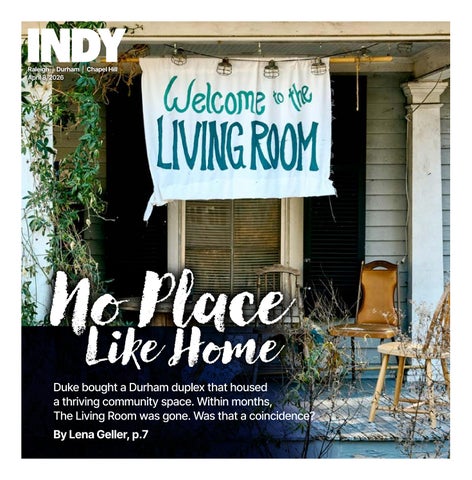
Duke bought a Durham duplex that housed a thriving community space. Within months, The Living Room was gone. Was that a coincidence?
By Lena Geller, p.7

Duke bought a Durham duplex that housed a thriving community space. Within months, The Living Room was gone. Was that a coincidence?
By Lena Geller, p.7
5 Growing up in a Quaker meeting, older men guided me through registering as a conscientious objector. In a new era of American warfare, I can pass along this knowledge. BY JOSEPH TERRELL
6 This generation’s obligation is to protest and resist the government as it erases the lives of precious children at home and abroad. BY DESMERA GATEWOOD
7 Before it shuttered in February, The Living Room was a wholesome hub for plant swaps, workshops, and activist meetups, like the Durham Ceasefire Chorus's monthly song circle. BY LENA GELLER
12 Residents of a Cary mobile home park facing displacement are asking the community and developers with plans for the land for help. BY JASMINE GALLUP
14 Durham Public Schools' budget request has been described as "more than we have available" and "literally not possible.” BY CHASE
PELLEGRINI DE PAUR
Culture
16 On eponymous release The Sistering, four Durham jazz artists come together for a project rooted in shared wisdom. BY COLONY LITTLE
18 Psychological puzzler Exit 8, Steven Soderbergh’s The Christophers, Full Frame Documentary Film Festival, and more. BY GLENN MCDONALD
19 A profile of Champ, the hardest working dog in Durham. BY STORMS REBACK
20 Steal This Story, Please!, a new documentary on Amy Goodman screening at this year's Full Frame Documentary Film Festival, makes a clear-eyed case for independent journalism. BY SARAH EDWARDS
Publisher John Hurld
Editorial
Editor-in-Chief
Sarah Willets
Wake County
Jane Porter
Culture Editor
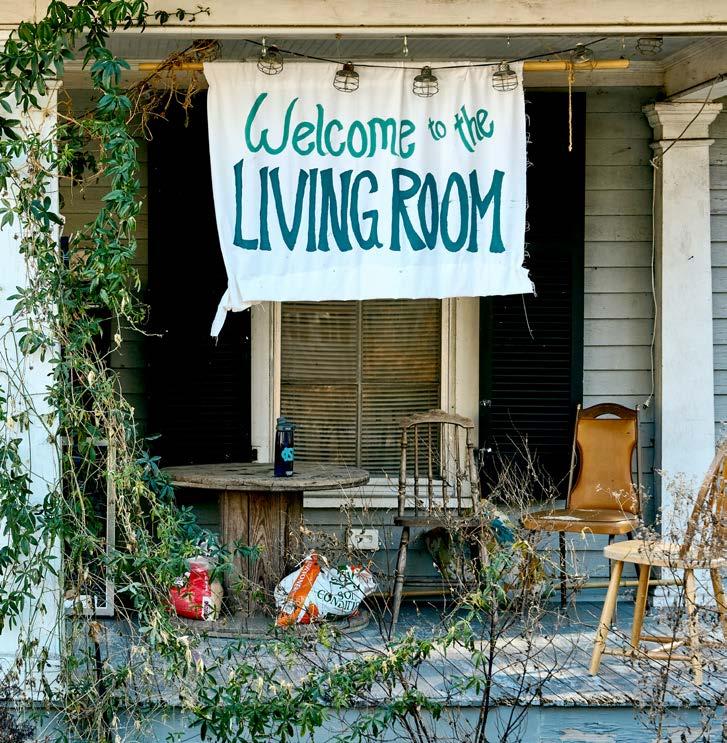
A sign reading “Welcome
Sarah Edwards Staff
Editor
Lena Geller
Justin Laidlaw
Chase Pellegrini de Paur
Report For America Corps Reporter
Chloe Courtney Bohl
Contributors
Mariana Fabian, Jasmine Gallup, Desmera Gatewood, Tasso Hartzog, Elliott Harrell, Brian Howe, Jordan Lawrence, Elim Lee, Glenn McDonald, Nick McGregor, Gabi Mendick, Cy Neff, Andrea Richards, Barry Yeoman

Editor Iza Wojciechowska
Editorial Interns Kennedy Thomason
Creative
Creative Director Nicole Pajor Moore
Graphic Designer Annette Winter
Publisher John Hurld
Mathias Marchington
Director
Chelsey Koch
Account Representative Jessica Schell
Advertising sales
sales@indyweek.com
919-666-7229






Durham County officials are warning that their ability to meet Durham Public Schools’ growing budget needs without tax increases is waning, Chase Pellegrini de Paur reported online (and on 14 page of this paper). Readers shared their thoughts.


From Facebook user DAVID DWIN:
Generously funding DPS is very important, but most Durham homeowners just had a huge tax increase. Mine went up almost 20% last year! Additional tax increases now will absolutely drive me out of Durham.
From reader K. ANDERSON by email:
Another impactful consideration for DPS and other surrounding potential school closures—election voting sites. Where will county boards of election relocate voters if schools are closed?
Thank you for the indepth coverage on this issue which has broader ramifications.
Elsewhere in the Triangle, Chloe Courtney Bohl reported late last month, Wake County school officials’ proposal to cut $18 million in funding for special education to make budgetary ends meet was met with backlash, prompting the superintendent to revise his proposed budget.
From reader IAIN BURNETT by email:
This issue is a symptom of a chronic issue that Wake County has to come to terms with. This is not the first year that the School Board and WCPSS asked the County Commissioners for less money than they need. Reminds me of the Wayne Gretzky quote that you miss 100% of the shots you don’t take.
Underfunding operations, services, and staffing now is not “fiscal responsibility”—it is kicking the bill down the road (plus interest) and doing a disservice today to the students and staff that WCPSS is supposed to be serving above all others. The Board’s ideas to shift the budget cuts to administrative and operations staff that are already strained is just another bad idea that will get less community opposition.
It’s probably hard for people who grew up here to realize that Wake County property tax rates are significantly less than the median or average American county, and low compared to similar fast growing metro areas around the South. We all know how bad the school funding problem is in North Carolina, and it seems foolish to keep counting on the state or federal governments to make up the funding difference for us. If you equate spending per student with how much we care about our children’s future, what does it say about our school board that they cannot even ask our county government to fund what they know is necessary? Even more, what does it say about us as tax-paying residents that we are okay with slowly killing our public school system and all the benefits it provides to employment, home values, and quality of life here? Wake County doesn’t have to run with the pack—we can pull ahead and have our public schools rise up to the high quality that we experience in so many other aspects of life here.
WANT TO SEE YOUR NAME IN BOLD? indyweek.com backtalk@indyweek.com @INDYWeekNC @indyweek










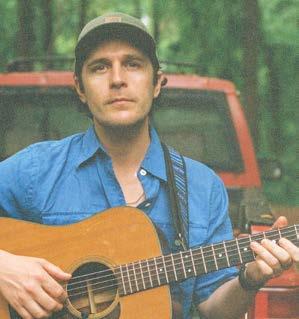
Growing up in a Quaker meeting, older men guided me through registering as a conscientious objector. In this new era of American warfare, young men should understand their right to refuse to engage in government-sponsored violence.
BY JOSEPH TERRELL backtalk@indyweek.com
I remember getting two things in the mail on my 18th birthday: a free razor from the Gillette corporation and a letter on official U.S. government letterhead compelling me to register for the military draft. Commerce and war, this was my inheritance as a newly minted American man. It was 2008, the Iraq War was in full swing, and I chose to register as a conscientious objector. I believe more young men should understand this right to refuse to engage in acts of government-sponsored violence against other human beings.
Federal law requires all males to register with the Selective Service System upon reaching their 18th birthday. To refuse to register, I read in my letter, is “a Federal crime punishable by a fine of up to $250,000 and up to 5 years imprisonment, or both.” The form attached to the letter gave me two options: to register for the draft or to declare my exemption status (I am female; I am currently on active
duty; I am confined in a penal institution). In reality there is a third option: to register as a conscientious objector (CO), one who refuses to bear arms on moral grounds. Although mandatory military conscription, with its lotteries and draft cards, may be a relic of 20th-century conflict, seeking CO status remains the only process allowing a young person to formally declare their opposition to war.
Growing up in a Quaker meeting, my exposure to acts of civil disobedience started early. I came of age in the 21st-century post-9/11 frenzy of anti-Muslim hatred and jingoistic propaganda, an era future historians will now certainly extend through the present day. Older men in my Quaker meeting who had registered as conscientious objectors during World War II and the Vietnam War taught me the process of registering as a CO. In this new era of active American warfare, I can pass along the knowledge to other young men who are interested. Religious affiliation is not
a requirement, and CO status is available to atheists and members of all the world’s religions and denominations. The process is simple and satisfyingly low-tech. First you find the checkboxes for “Exemption Statements” at the bottom of your form, and beneath them you draw and check your own box. Beside it you write your own statement of conscience. Mine said, “I am a conscientious objector, lifelong Quaker, and pacifist.” (I also enclosed an essay on how I arrived at my pacifism.) And then—this is the fun part— you photocopy and mail the form to yourself so that the completed form receives a U.S. postmark to date and validate its existence. An elderly man, my grandmother’s first cousin who performed government-mandated “alternative service” as a conscientious objector in the 1940s, explained to me how this crafty bit of documentation would prevent local draft boards from claiming that CO forms had been lost. Then you mail the original back to the Selective Service System, PO Box 94633, Palatine, Illinois.
In Quakerly fashion, this process was quiet and matterof-fact—but radical nonetheless. I found inspiration in the powerful feeling of changing an official government contract with my own handwriting. I loved that all the sweet uncles and grandfathers in my peaceful community—with special assistance from my own mother—were teaching me to oppose the U.S. government. And I loved the feeling of making a theoretical, moral idea into an action, a choice, a tangible piece of paper. I believe it was the only time in my young life I was asked to promise, in writing, that I believed in something deeply enough to act upon my conscience, even if it meant breaking the law.
I recognize that becoming a CO is largely a symbolic act. I doubt I’ve ever in my life so much as inconvenienced the American war machine, but I am grateful I registered as a CO because it planted a seed in my young mind. I noted well that resistance to war and imperialism—and our quotidian slide toward outright fascism—can come from small, private acts of refusal. I tend that seed to this day. If any of y’all are turning 18 soon, I encourage you to do more research on the process. Note that CO status is not a personal Get Out of War Free card; your reason for refusing service “must not be based on politics, expediency, or self-interest.”(1) In past drafts, COs were given domestic alternative service that was often very difficult and dangerous. Many have been denied by local draft boards and sent overseas to fight anyway.
As an 18-year-old you cannot end this war, but it is your right as an adult male American citizen to refuse to participate in violent conflict in the name of your government. I found the process of officially declaring my conscientious objection to be a lot more meaningful than buying shaving cream for my new razor.
Joseph Terrell is a songwriter living in Pittsboro. He is a member of the band Mipso.
O n September bombs 16th Street Alabama. executed bers resulted Black girls, blast had Addie Mae Cynthia Carole Carol Denise were murdered, supremacists that day they’d most weren’t wrong. The first bombing FBI had had executed those listed much as until 2002, the last sentenced. For 40 roaming sion-free, blood of ine that Carol’s families tered by the as they learned derous white tected, and cent, adorable, Sixty-three blood of
Like my elders and ancestors, this generation’s obligation is to resist a government, unapologetically draped in white supremacy, as it erases the lives of children at home and abroad.
BY DESMERA GATEWOOD backtalk@indyweek.com
On September 15, 1963, at 10:22 a.m., bombs blasted and tore through the 16th Street Baptist Church in Birmingham, Alabama. The terrorist attack planned and executed by four known Ku Klux Klan members resulted in the deaths of four little Black girls, who only moments before the blast had been preparing for Sunday school.
Addie Mae Collins
Cynthia Wesley
Carole Robertson
Carol Denise McNair were murdered, simply because white supremacists decided that they should die that day and those murderers knew that they’d most likely get away with it. And they weren’t wrong.
The first arrest in connection with the bombing wasn’t until 1977, although the FBI had concluded in 1965 that the KKK had executed the murders. In 1994, one of those listed as a suspect died without so much as an interrogation. It wouldn’t be until 2002, almost 40 years later, that the last of the four would be tried and sentenced.
For 40 years there were white men roaming the streets, living life repercussion-free, with hands dripping with the blood of four little Black girls. I can imagine that Addie’s, Cynthia’s, Carole’s, and Carol’s families and neighbors were shattered by the insulted injury they’d endured, as they learned that four vicious, evil, murderous white men were more valued, protected, and cherished than their four innocent, adorable, little Black girls.
Sixty-three years have passed since the blood of those little girls spattered against
the backdrop of the evils of American white supremacy. Now in Iran, the souls of 160 little girls, blasted and bombed by an American Tomahawk missile on February 28, 2026, as they attended school at the Shajareh Tayyebeh girls’ elementary school in Minab, must wait to see how long it will be before even one repercussion exists, if at all. The elementary school was struck at least once more in the minutes following the initial strike, all but guaranteeing a jarring three-digit death toll. This cowardly act of terrorism is only an extension of who America had proven itself to be in 1963. The climate that emboldens Israel and America to join forces and kill at will in 2026, without any significant repercussion, is no less soulless than the climate that emboldened four members of the Ku Klux Klan to kill at will in 1963.
It wasn’t just the KKK who violated humanity in the 16th Street bombings; it was the entire American system that encouraged them before the murders and protected them thereafter. For the American monster that is white supremacy shows no mercy. A little Black American girl in Sunday school, a little Iranian girl in elementary school—they have no systemic power and therefore no value to the state.
In 2018 I went to the West Bank, Palestine. A Palestinian man from the territory showed me empty tear gas cans thrown by Israeli soldiers that he picked up from a playground close by; they read “Made in Philadelphia.” Like the U.S. Tomahawk missiles launched at the girls’ school in Iran, the bombs and tear gas cans launched at
children on playgrounds in Palestine, and the explosives planted at the church on 16th Street, there is no shortage of violence against children that is “Made in America.” Bombing four little girls or bombing 40 times that number, this is who America has proven itself to be, a critical manufacturer in crimes against children. From the American Indigenous children abused and killed in assimilation schools and massacres and the Latine babies rounded up and traumatized during violent ICE raids to the Palestinian babies whose genocide America funds with military aid to Israel and the Black children who were murdered and bruised from the days they were piled onto slave ships— the killing, maiming, abusing, and discarding of babies under white supremacy, veiled as freedom patriotism, is who America has been and continues to be. It will continue to be that America so long as its people remain docile and complacent.
Like my elders and ancestors who put their lives on the line to resist, protest, and defy a murderous government, infiltrated by white supremacists and the KKK, this generation’s obligation is to resist, protest, and defy a government, unapologetically draped in white supremacy, as it violates and erases the lives of precious children at home and abroad.
From the civil rights movement to the present, I can proudly attest that my home state of North Carolina has seen no short-
age of people throughout history who were willing to risk their reputation and freedom to send a message of resistance to this guilty system—from the Wilmington 10 who protested America’s war on Black people to the demonstrators who fill Moore Square in Raleigh, protesting the wars on Iran and Lebanon. From the 1957 Royal Ice Cream sit-in in Durham, where Black people refused to leave a segregated ice cream parlor, to the 2026 disruption of a U.S. Senate hearing on Capitol Hill, where Brian McGinnis, a U.S. Army veteran and firefighter from North Carolina chanted out, “America does not want to send its sons and daughters to war for Israel!” North Carolina has positioned itself as a leader and trendsetter in times when resistance and mobilization are needed.
The screams and cries of those murdered little girls, from Alabama to Iran, echo in the silence of a society that refuses to make righteous noise. They are forever entitled to our resistance and our rage.
I pray that the souls of all of the precious little girls, whose blood stains the American flag, may one day rest in peace. And I pray that my own little girl, who sees that flag each day she enters school, may one day live in peace.
Desmera Gatewood is a neurodivergent, Black, non-binary writer, organizer, and organization development practitioner.
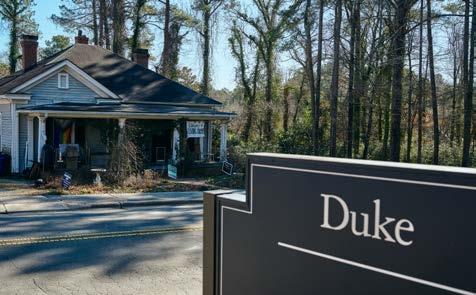
Duke bought a Durham duplex that housed a thriving community space. Within months, the space was gone. Was that a coincidence?
BY LENA GELLER lgeller@indyweek.com
When you’re a kid, there’s something about a vacant space that announces itself as a clubhouse; it couldn’t be more apparent that the shed in the backyard needs a rug and a password and a sign on the door.
Most people lose that impulse somewhere along the way. Kelly Creedon never did. A few years after the now 48-yearold moved into the left half of a duplex at 407 Swift Avenue in Durham, the right unit went vacant and Creedon proposed converting it into a community gathering space that she could subsidize by booking it on Airbnb one week a month. Her landlord agreed, and over the next six years the space grew to become The Living Room, a wholesome hub for plant swaps, potlucks, and activist meetups that ran on the scrappy goodwill of a little free library.
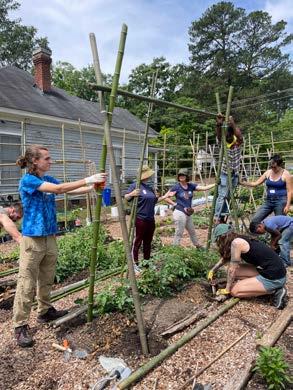
On a given evening you might’ve walked up to the duplex to find a comedy troupe mid-rehearsal, or a yoga class stretching under string lights, or 15 people learning to build
a trellis in the side yard while someone inside led a writing workshop. A few projects even got their start at The Living Room, like a monthly song circle called the Durham Ceasefire Chorus and a community garden that in summertime grew thick with radishes, tomatoes, okra, beans, peppers, and mini watermelons.
By last year, the space was hosting gatherings nearly every other day, and Creedon and other organizers had started thinking bigger: exploring grants, sketching out an infrastructure with other grassroots spaces around Durham.
Then, in September, Creedon got a text from her landlord, Canu DiBona.
Duke University was interested in buying 407 Swift Avenue, DiBona wrote. Officials would be coming by for a walkthrough the following week.
Creedon’s stomach dropped. She’d long been aware that
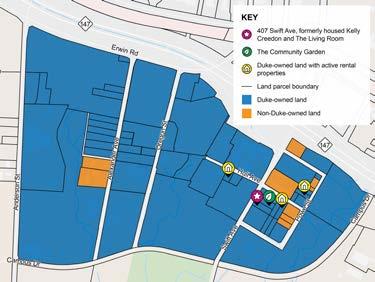
Duke had its sights set on the property, which sat amid swaths of Duke-owned land on the edge of the university’s Central Campus. But DiBona had always told her he wasn’t interested in selling to Duke, and so his text carried with it the particular sting of news you’ve taught yourself not to worry about.
Creedon texted back to ask if DiBona would consider selling to her. It wasn’t an idle question; she’d expressed interest in buying the property multiple times during her 10 years as a tenant. And the two had a record of easy collaboration: When Creedon asked to switch to a monthto-month lease she felt afforded her more flexibility, for instance, DiBona obliged.
This time was different. After years of Duke pressing him to sell, DiBona had finally said yes, and Duke had come back with an offer DiBona told Creedon he didn’t think she could match. (DiBona did not respond to multiple requests for comment.)
Duke’s visit the next week made clear the sale was well underway. Officials arrived with a home inspector and property management.
The deal closed on October 31. Duke paid $575,000 for the property, which in the spring had been valued at close to $526,000 by tax assessors.
There is nothing unusual about Duke buying up property in its backyard. Its Central Campus—a long triangle of land with vertices at Duke’s medical campus, the Nasher Museum of Art, and a small residential pocket off Swift Avenue—is the product of a land-banking strategy that has, over decades, swallowed much of the surrounding neighborhoods.
But at a moment when Duke is particularly invested in its image as a good neighbor to Durham, the way the university navigated its brief role as a landlord to Creedon—and in turn The Living Room—feels incongruous with its stated commitments to community partnership.
In late September, two weeks after the Duke contingent’s first visit, Duke Director of Real Estate Julie Siegmund returned to 407 Swift to talk to Creedon about her options as a renter.
Creedon could keep renting if she wanted to, Siegmund said. But the duplex’s roof, HVAC, and electrical panels were nearing the end of their useful lives, she said, citing an inspection report—and Duke, which has no specific plans for the block but intends to someday redevelop it, was not interested in making long-term investments in a 1919 build it did not intend to keep standing. (Creedon, a documentary filmmaker, recorded the conversation. In North Carolina, only one party needs to consent to a recording.)

Siegmund offered Creedon a six-month lease at her existing monthly rate of $950 with an option to renew, but made clear that the arrangement would “kind of limp along” until something broke that Duke was not willing to address.
“I don’t want to be in a situation where I have to give a tenant a 30-day notice to vacate,” Siegmund said. “You don’t want it from a planning perspective, either.”
Creedon told Siegmund she hadn’t been experiencing any issues. Siegmund agreed nothing major needed replacing immediately but reiterated concern about what could go wrong down the line, telling Creedon she didn’t want to be a “bad landlord.”
“I don’t want you to be dealing with a roof that can’t be fixed and an owner that’s not going to replace it,” Siegmund said.
Creedon did not feel that any of this added up to a real offer to stay. She signed the six-month lease but only after ensuring it included a provision allowing early termination without penalty. As soon as she found new housing, she left, relocating
to Northgate Park in February. She’s paying about the same rent as she was at 407 Swift, though she has a roommate now.
In a statement to the INDY, a Duke spokesperson emphasized Creedon had moved out voluntarily and said the sixmonth lease offered “more security” than the month-to-month deal she’d had with DiBona. The spokesperson also noted that Duke had made repairs to keep the property “safe and habitable” for Creedon, referencing a handful of minor fixes.
Creedon was, per city directories, the latest in an unbroken line of largely working-class renters at 407 Swift stretching back more than a century: machinists, textile workers, postal clerks, waitresses, painters, students. Her departure means one of Durham’s increasingly scarce parcels of naturally occurring affordable housing has seen its last tenant.
It also means The Living Room is gone. The space shut down in February, when Creedon moved out.
It was important to Creedon that Duke
understood The Living Room’s legitimacy as a community institution. When officials came for their initial visit, Creedon pointed them toward the firepit where community members gathered for song circles and the rooms where groups held workshops and retreats. The space had hosted more than 100 events so far that year.
“It’s been a very collaborative model and a lot of folks are invested,” Creedon told Siegmund.
Siegmund was receptive to hearing about it. But she did not indicate that the presence of a community space would change Duke’s willingness to invest in the property.
Creedon came away feeling deflated about Duke’s “math.”
“They’re talking about this frame of potential financial costs,” Creedon told the INDY. “But they’re not weighing that against the very real human and community costs of losing a community space.”
By all appearances, The Living Room simply hadn’t factored into how Duke
chose to handle the property. Unless, of course, it had.
In his 1989 book The Great Good Place, the late sociologist Ray Oldenburg coined the term “third places” to describe informal gathering spots, distinct from home and work, where people go to decompress and find connection.
Oldenburg stressed that third places are not merely an escape from the rat race but something with their own positive gravity: “an essential element of the good life,” he wrote, where “community is most alive and people are most themselves.”
Based on criteria articulated by Oldenburg, few spaces have embodied the concept as fully as The Living Room did.
Oldenburg contended that the best third places are shaped almost entirely by the people who use them—a model that’s difficult to achieve, because most gathering spaces are businesses, and bottom lines tend to limit what a space can become. The Living Room pulled it off. Creedon
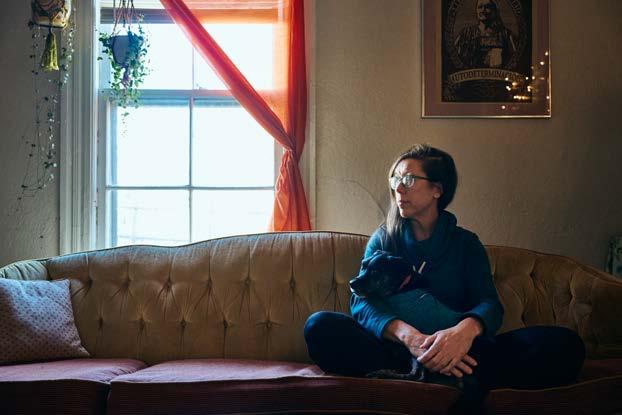
and an early collaborator, Ligaiya Romero, kept things intentionally vague when launching the space: they threw a housewarming, asked people to bring furnishings, and didn’t prescribe much else. Over time, the space took form as a sliding-scale venue that sometimes served as temporary housing for people in transition. Creedon managed event bookings and cleaned up after Airbnb guests, but with no incentive to turn a profit, the place required little else in the way of active management.
The Living Room also captured what Oldenburg considered a paradox of the best third places: It had all the trappings of a home—a full kitchen, a foldout couch, a big backyard—yet it was not anyone’s actual home, sparing visitors what Oldenburg described as the inevitable feeling of intrusion that comes with entering someone else’s space. That ease showed in the range of things people felt comfortable doing there: Spanish-English interpreter trainings, a monthly Jewish kids’ meetup, a resource share called Free Coffee for a
Free Palestine, performance art rehearsals, writing groups, film screenings, and book packing for incarcerated women, among dozens of other activities.
Oldenburg ascribed two more qualities to third places that resonate with what went on at The Living Room. He wrote that they nurture a kind of amateurism, compelling visitors to discover personal capacities that the rigid social roles of everyday life tend to bury. And he considered them “political fora of great importance,” where people realize the collective power essential to democracy.
The Durham Ceasefire Chorus—one of the projects that The Living Room truly incubated—bore both traits out. Most of its members were not trained musicians. Rather, they were people who discovered, through the act of sitting in a circle and singing together, that music could be both a salve and a form of resistance.
Jess Dickerson came across an Instagram post about the chorus in 2024 and showed up to what turned out to be the
group’s very first meetup.
“I never thought there was a place for my music,” Dickerson told the INDY. “But I realized there is a place for it here.”
Dickerson fell into the rhythm of the chorus’s regular gatherings, and they found something deeper when the chorus carried that music out into the world, singing at demonstrations for Palestinian liberation and other causes.
Last year, Dickerson ruptured their Achilles tendon and encountered another phenomenon Oldenburg attributes to third places: mutual aid. For three months, Ceasefire Chorus members showed up at Dickerson’s door with meals, cleaned their house, and sang to them.
“It was just this next-level form of community,” Dickerson said.
Even in 1989, Oldenburg warned that third places were vanishing on a large scale, for a few reasons.
They tend to occupy old buildings, which makes them perpetually vulnerable to redevelopment. And their natural role as polit-
ical gathering places has a way of putting them at odds with powerful institutions.
Within a few hundred feet of 407 Swift, Duke owns three other century-old houses—all of which currently have tenants in them.
One Duke has owned since 1997. The other two it acquired within the past two years. During one of her September visits, Siegmund offered to check whether any were available for Creedon (they weren’t). It’s hard to know what condition those houses were in when Duke bought them relative to 407 Swift. Siegmund described them as being in better shape than the duplex but indicated that that was at least partly a result of investments Duke had made—including replacing HVAC units and installing a new roof.
A tenant living in one of the houses Duke purchased within the last two years told the INDY in March he’d been there about six months and was not aware Duke owned the property; he’d only dealt with
a third-party management company. He described the house as old, with water spots on the ceiling, but said he’d had no trouble getting repairs done.
Aerial imagery suggests that repairs were made to the roof of that house in fall 2024, a few months after Duke bought it. Roof repairs were something Siegmund adamantly told Creedon that Duke would not be willing to make at 407 Swift, speculating during one visit that Creedon could end up with “pots and pans holding up the roof.” Was 407 Swift in that much worse shape than this other property?
A Duke spokesperson told the INDY that “every property has its own maintenance challenges” and “whenever Duke invests in real estate, we work cooperatively and in good faith with any tenants.”
Several noted critics of Duke’s land use practices speculated whether dimensions beyond the condition of the duplex could have influenced the university’s approach to 407 Swift.
“The Living Room was a space that
especially elevated the voices of the oppressed, including the Palestinian struggle,” said Durham City Council Member Nate Baker, noting the duplex’s prominently placed Free Palestine yard sign and the political activities the space hosted. “Was that a motivation for Duke to shutter The Living Room? I don’t know. It would not be out of character from what universities across the country have done to silence recent anti-genocide and anti-apartheid campaigns.”
“Duke has three priorities,” John Schelp, a former Old West Durham neighborhood president who spent years negotiating land use agreements with Duke, told the INDY. “Number three is sports and academics. Number two is money. And number one is image. If there is a house that they just bought that is creating a headache, they will protect their image, first and foremost.”
A Duke spokesperson told the INDY that “any activity hosted in or near this space had no bearing on Duke’s decisions
regarding the property.”
Whether or not politics played a role, Oldenburg might argue there’s a kind of accountability either way. The democratic cost of losing a third place is the same whether or not anyone set out to cause it.
“Is the result any less negative without the intent?” he wrote.
The closure of The Living Room comes at a conspicuous moment for Duke.
At once one of Durham’s largest landowners and exempt from property taxes on most of its holdings, the university has faced sustained pressure in recent years to contribute more directly to city and county tax bases. While private universities are legally entitled to tax exemption on academic properties, critics argue that Duke’s stature makes it a poor fit for the standard carveout; its $12 billion endowment puts it among the wealthiest universities in the country, and Durham, where affordability is a growing crisis, is straining under the lost revenue, critics say.
The Duke Respect Durham coalition thinks Duke should cough up as much as $50 million a year to make up for the forgone tax revenue. There is some precedent for such payments in lieu of taxes, albeit smaller ones, at peer institutions including Yale, Brown, and Cornell.
Duke has responded, in part, with a messaging blitz touting its existing contributions to Durham. In the fall, its “Duke For Durham” campaign—splashed on yard signs, Facebook ads, and fact sheets—highlighted its employee benefits, the infrastructure it maintains at its own expense, and the property taxes it pays on non-academic properties, like the land it has banked in the Central Campus area.
The university has also opened its wallet. Duke last month announced “HomeGrown,” a $203 million initiative that over the next three years aims to direct more spending into the Triangle, including $38 million in deposits with financial institutions that fund affordable housing.
But groups like Duke Respect Durham
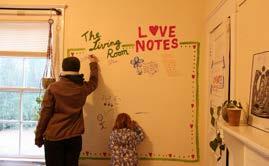
PHOTO BY MATT RAMEY
say philanthropy isn’t a real proxy for contributing to the tax base. As long as Duke controls when and how it gives back, the university’s relationship with Durham remains lopsided, critics argue.
The debate takes on added weight given the history of Duke’s growth. Roughly 450 houses once stood on the land that now accommodates Duke’s Central Campus and parts of Highway 147. Home to workers at the nearby, long since defunct Erwin Cotton Mills, the houses formed a string of communities from the white-working class West Durham to the historically Black Brookstown and Hickstown.
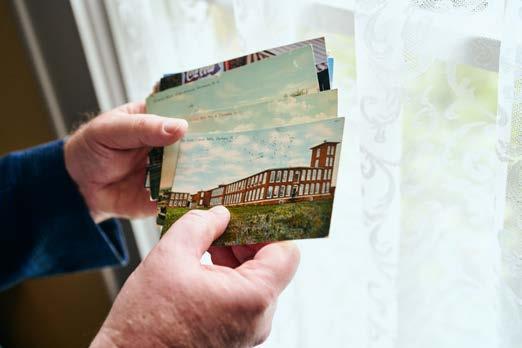
Most were destroyed in two waves. Schelp, who has spent so long immersed in the history of the mill village that he has an Erwin Mills-themed bathroom, traces both to Duke. In the mid-1960s, the university purchased the former Erwin Cotton Mills property, including worker housing, and over the next decade cited minor defects to get the city to condemn the houses and tore down scores of them
to build student apartments, Schelp said. Not long after, more houses were razed for construction of Highway 147—a project that then-Duke President Terry Sanford supported “without reservation,” per a letter he wrote to a member of the state transportation board.
Today, granite curbs from the old mill village line the paths around the lake at Duke Gardens. On Central Campus, stone steps still rise into vacant lots where houses used to stand.
Much of Central Campus feels emptied out. The student housing Duke built atop the mill village land was torn down in 2019. A handful of institutional buildings dot the area—the Freeman Center for Jewish Life, an international enrollment office—along with a block of luxury student apartments and surface parking lots. But the prevailing impression is of space waiting to be filled.
Duke plans to overhaul the area eventually but has offered few details. When the university appeared before Durham
firepit. The community garden fanned out beside them, dormant for the winter save for some carrots and greens.
The garden sits on land that Duke has owned all along. DiBona negotiated permission for Creedon to use it back in 2020, and over the years it grew into a bustling operation with weekly workdays and workshops on native plants. Over the past two seasons it drew 150 volunteers and produced over 750 pounds of produce, some of which helped stock community fridges around Durham.
This is the one tangible outgrowth of The Living Room that Creedon and other organizers are fighting to keep alive. They decided against trying to relocate the space itself—finding an affordable equivalent space wasn’t realistic—but the garden, they believe, has a shot at surviving where it is. They’re in talks with Duke about how to do so.
It won’t be simple; the duplex is being scheduled for demolition, per a recent communication between Creedon and Siegmund, and once it’s torn down, there will be no water hookup and nowhere for volunteers to use the bathroom. But both parties seem cautiously optimistic that there’s a way to make it work. Duke told the INDY it wants to enable the garden “to continue for the foreseeable future, while also meeting our obligations to maintain the safety and accessibility of the property.”
City Council in 2024 seeking to rezone 10 parcels, it brought no development plans—just a request for broad latitude to build without further approval. The council approved the rezoning 5-2.
During one of her visits to 407 Swift, Siegmund told Creedon that her job is to “buy opportunities.” Duke told the INDY it’s still assessing its plans for the property.
In February, The Living Room hosted its final event, a closing ceremony.
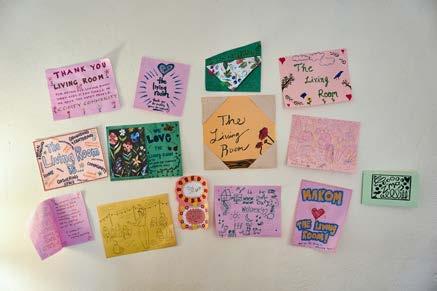
The ceremony played out as a kind of inversion of the housewarming party that had launched the space six years prior. Back then, people had scribbled ideas for what the place could become on butcher paper tacked to the walls. Now they Sharpied goodbyes straight onto the wall itself. All the furnishings that were donated at the housewarming were laid out by the door for people to take.
Attendees eventually ended up out in the backyard in folding chairs around the
Among the garden’s earliest volunteers was Jadyn Ward, who started showing up for workdays when the garden was still just a couple of beds. They liked that they didn’t need to bring any expertise or be on time.
Ward said the thing about The Living Room was that it could hold whatever you brought to it. After their mother died unexpectedly of cancer in 2023, they held her funeral in the space, hanging fabric from the ceiling to the floor to create a kind of womb.
“I can’t imagine having that service anywhere else,” Ward said.
At the closing ceremony, Ward and a friend guided attendees in a grieving exercise around the firepit to mourn the space itself.
“Rub your hands together,” they said, “and visualize the ball of energy that the space has given you.”
The group spent the following hours sharing memories. It was frigid, but as the afternoon wore on no one left. Instead they drew closer and closer to the fire until more than half were sitting in a tight circle on the ground, shoulders pressed together against the cold.
April 8, 2026 INDYweek.com
Residents of a Cary mobile home park have less than three months to relocate in an expensive housing market. They’re asking developers with plans for the site and the community for help.
BY JASMINE GALLUP backtalk@indyweek.com
More than $15,000 has been donated to a relocation fund to assist residents of a Cary mobile home park facing displacement since they held a press conference calling for support in mid-March.
The fund, run by nonprofit NeighborUp, raised about $43,000 as of April 6 but is still short of its quarter-ofa-million-dollar goal. Advocates estimate it will take even more money to relocate all 144 families currently living in Chatham Estates.
With only a couple of months left to find new homes, residents of Chatham Estates are demanding that companies with plans to redevelop the property contribute $2 million to the ongoing relocation effort.
The property, home to more than 700 people, was put up for sale in 2023 by owner Curtis Westbrook Sr. Then, in January of this year, families got the news they were dreading: a notice to vacate by June 30. Although Cha-
tham Estates was still owned by Westbrook as of this story, it is expected to be sold to a developer around the June 30 deadline.
A proposal to redevelop the site was initially submitted last year by Toll Brothers Apartment Living, a division of luxury home developer Toll Brothers. That division, however, was later acquired by real estate investment company Kennedy Wilson, which has taken charge of the project. The proposal, currently under review by town staff, shows plans to build 330 new multifamily units and 97 new town homes on the site.
None are likely to be within the price range of Chatham Estates families, most of whom are currently paying about $400 per month to rent the land their mobile homes occupy.
“We are here today to say our lives are not only construction debris,” said Chatham Estates resident Abigael Dawah
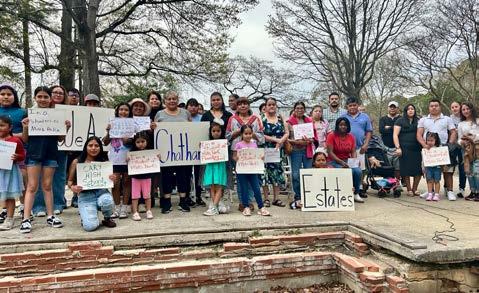
Residents of Chatham Estates held a press conference on March 21, 2026, to call on developers and the community to help families facing displacement
during the press conference. “If Toll Brothers can afford to build million-dollar houses, then they can afford to make sure that they don’t leave about 600 people homeless in the process.”
“To a billion-dollar developer like Toll Brothers, $2 million is like pocket change,” Dawah added. “To us, this money is the difference between a future and a complete disaster. It’s the cost of moving our homes, security, keeping our children in their schools, in their neighborhood, with their friends.”
The Chatham Estates Neighborhood Association, led by Dawah and other residents, is also demanding a face-toface meeting with the developers or their legal representatives, who have yet to communicate directly with residents. They are also asking the developers to build new affordable housing on the site. (The INDY reached out to Toll Brothers and Kennedy Wilson for comment, but has not yet received a response)
Moving, already a difficult process, is a nearly impossible prospect for Chatham Estates families. Many would like to move their mobile homes, which they’ve poured money into renovating and improving. But the majority of the homes are too old to move, and the cost of moving newer homes is around $15,000-$25,000.
The other option, finding a new apartment or home to rent in Cary, is just as difficult. As of 2024, the median rent in Cary was $1,820 per month, according to the U.S. Census Bureau—about four and a half times what most Chatham Estates families are currently paying. For Cary homeowners with a mortgage, the median monthly cost was $2,477.
At the press conference, some 40 families, mostly Latino and working class, pleaded for help in Spanish. Accompanied by their children, several people broke down in tears as they described being forced to leave the neighborhood where they have raised their children and enjoyed a sense of safety.
“We keep going on with our lives—continuing to work, taking the children to school, doing the shopping, going to church—but we also carry the added pressure of finding a new place to live,” said Emidia Roblero in a speech that
was translated into English.
“Those of us who can’t move our homes will lose everything we have invested: the money we used to buy them and what we spent on improvements,” she continued. “Our neighborhood will be gone and our sense of community gone with it.”
Seventeen-year-old Leidy Diaz Morales, who has lived in the community for seven years and attends Cary High School, said at the press conference that some residents face losing jobs nearby when they have to move away.
“This situation, it’s not only our household, it’s our financial stability,” she said. “Our lives are here in Cary, it’s our home, and it’s very painful to think about having to leave it.”
In an effort to help Chatham Estates families, the Cary Town Council created a new program in 2024 dubbed Stable Homes Cary. Nonprofit NeighborUp has been charged with managing the program under the direction of Ande Curry, senior director of community services.
Curry has said that the $800,000 Cary allocated to the program will be used to help Chatham Estates residents with moving costs, including paying security deposits and the first month of rent. But with 144 families in need, it isn’t enough.
“The news that the mobile home park was going to be redeveloped was devastating,” Cary Town Council member Michelle Craig, who represents District B and Chatham Estates, said at the press conference. “There is nothing we can do at this point to make these families whole. ... There’s nothing we can do to make it OK. This is not going to be OK,” she added, her voice breaking.
“We need the community to step up,” Craig said. “There are almost 200,000 people in Cary. If we all could give $1 that would bring our $800,000 up to $1 million.”
Carissa Kohn-Johnson, an at-large Town Council member who lives only a few blocks away from Chatham Estates, also entreated Cary residents to donate to the relocation effort.
“I grew up in a mobile home community,” she said. “I ask that anybody here in Cary who grew up without much and now has a lot, to remember what that feels like. Go out and donate. If you can do $20, that’s fantastic. But a lot of us are doing a heck of a lot better, and we can do better than that.”
To donate, visit https://neighborup.org/ chathamestates.

NCDOT HOSTING A PUBLIC OPEN HOUSE A PROPOSAL TO REPLACE THE BRIDGES ON FORESTVILLE ROAD OVER HARRIS CREEK AND OVER HODGES MILL CREEK IN RALEIGH

RALEIGH - The N.C. Department of Transportation is hosting a public meeting to discuss the proposal to replace the bridges on Forestville Road over Harris Creek and over Hodges Mill Creek. The purpose of this meeting is to provide interested citizens with information on the project and gather public input on the proposed design.
Project details and maps can be found on NCDOT’s project input website at publicinput.com/forestvillerd-bridges. The information will be available at the meeting allowing for one-onone discussions with NCDOT staff, but there will be no formal presentation.
The meeting will be held from 4 to 7 p.m. on April 21 at Wake Cross Baptist Church, 3328 Forestville Road, in Raleigh.
People may also submit comments by phone at 984-205-6615 project code 1863, email forestvillerd-bridges@publicinput. com, or mail at the address shown below by May 5, 2026
By Mail: Lisa Bullard-Gilchrist, EI
NCDOT Highway Division 5 –Bridge Program Manager 2612 N. Duke Street Durham, NC 27704
NCDOT will provide auxiliary aids and services under the Americans with Disabilities Act for disabled people who wish to participate in this meeting. Anyone requiring special services should contact Tony Gallagher, Environmental Analysis Unit, at 1598 Mail Service Center, Raleigh, NC 27699-1598, 919707-6069 or magallagher@ncdot.gov as early as possible so arrangements can be made.
Those who do not speak English, or have a limited ability to read, speak or understand English, may receive interpretive services upon request prior by calling 1-800-481-6494.
Aquellas personas no hablan inglés, o tienen limitaciones para leer, hablar o entender inglés, podrían recibir servicios de interpretación si los solicitan llamando al 1-800-481-6494.
Durham Public Schools is seeking $28.5 million more in funding than last year. County officials warn that their ability to fund DPS’ needs without tax increases “has all but dissipated.”
BY CHASE PELLEGRINI DE PAUR chase@indyweek.com
The Durham County government has spent the last month and a half practically begging the Durham Public Schools (DPS) Board of Education to lower its expectations for county funding.
Take DPS’ $11 million continuation request—the funding increase that administrators say would do nothing except maintain DPS services at their current level: “That’s already more than we have available revenue to support,” county Budget Director Keith Lane told a recent county commission and school board meeting, noting the county only has $8.7 million in new revenue to go around if commissioners don’t raise taxes.
On March 26, the school board nonetheless asked the county for that $11 million increase. And for another $15 million in an expansion request for new initiatives like raising classified staff pay. And for another $3 million for student laptop and classroom projector replacements.
In total, DPS is asking Durham County for a $28.5 million increase in its budget compared with last year, which would push the county’s share of DPS funding to $252 million, including capital outlay.
The school board is well aware that its request puts the county commission in a pretty tough spot this spring.
“They are going to face some impossible choices,” longtime school board member Natalie Beyer said at the March 26 meeting. And County Commissioner Wendy Jacobs had some harsh words for the request even before the school board made it official: “Obviously, [the request that] could be coming from Durham Public Schools—it’s not fundable,” Jacobs told the school board at a meeting last month. “And I know that there’s a lot of demands on you all that have
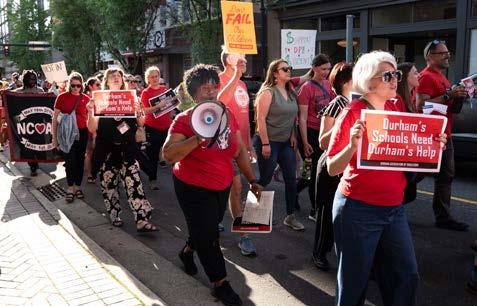
come out of the meet and confer process, but we also have to be realistic. And as you can see it’s just literally not possible.”
That’s because, as Lane has pointed out, sales tax revenue has stalled, leaving the county commissioners to decide how much, if at all, to raise property taxes to support DPS.
DPS’ sizable requested increase is not a surprise, as the school board generally asks the county for more than it expects to receive. The bulk of this year’s expansion request would help move DPS minimum wage from $17.15 an hour to match the county’s current $19.22. That pay bump has been pushed by the district’s majority-member union, the Durham Association of Educators (DAE), throughout the district’s new meet and confer process.
With all that pressure from their workers, there’s really no reason for the school board not to request such a large increase, even in the face of all of the county’s warnings. And as school board member Jessica Carda-Auten noted at a county meeting in March, funding of public education is an early investment in the county’s people by a progressive government.
“You’re providing people with the skills and the abilities to go out in their community and get the jobs that they need to build a successful economy. You’re making them healthier citizens that will rely on health care services less. You’re making them less reliant on things like SNAP benefits and other social services. You’re going to eventually reduce your jail population because you have people who are now in the workforce,” Carda-Auten said.
But the county commissioners—with the power to tax and the duty to hear from the residents whose tax bills
keep going up—live in a very different political reality from their school board counterparts. In recent years, the commission has dramatically increased its support of DPS by bringing in more property tax revenue but has warned DPS that there is a limit.
“The ability to [support DPS] using natural growth and revenue has all but dissipated,” Lane said at a county commission meeting before the budget vote. “And we’re at the point of needing property tax rate increases every year potentially just to handle some things that we used to be able to in the past handle with natural growth.”
“The big question for everyone is,” Lane said, “is that type of increase sustainable?”
If the county wants more money—say, with which to fund schools—each 1¢ per $100 of assessed value would raise about $8.8 million.
“So that’s how you find $20 million or $30 million,” said Lane at a recent meeting. But, because the county already needs to raise taxes to pay for construction bonds authorized by voters in 2022, there’s already a several-cent increase “that we’re going to have to do over the next couple of years,” said Lane.
The DAE has already started to shift its focus to the county commission ahead of the county manager’s May 11 budget unveiling.
“[The school board] listened to what workers feel will make their jobs better for the students that they’re serving,” DAE President Mika Twietmeyer told the INDY after the vote. “So I think this is definitely a win, and now we just have to work to have the county see that it’s critical for DPS that we get this funding.”
Who are the winners and losers of the DPS budget request?
• Inflation: Because most everything, including DPS, costs more.
• Charter schools: Which automatically get about 20% of any money that the county gives to DPS.
• DAE, at least right now: The union put the classified pay increase, which makes up the bulk of the expansion request, at the center of its meet and confer conversations with top administrators this year. But they’ll have a tougher time convincing the county commission.
• DPS CFO Jeremy Teetor: Whose coolheadedness has served him well in cleaning up a series of financial messes while serving as a key contributor to the meet and confer process. This year’s lateMarch budget request approval, while still behind schedule, puts the board a month ahead of last year’s vote.
• State legislators who want to shift the burden of education to local government: As the state lags on increases in teacher pay, districts like Durham are increasingly picking up the slack.
• Durham County commissioners: Who now will have to balance pressure from the DAE (who want funded as much as possible of the $28.5 million increase) and from angry residents (who don’t want their taxes to increase again).
• Local taxpayers: Because North Carolina ranks dead last in the country in public school funding.
• Public school students: Who seem unlikely to see all of their needs met, in this budget or any other in North Carolina.


On their eponymous debut, Durham quartet The Sistering draws from a lifetime of shared wisdom and community building.
BY COLONY LITTLE music@indyweek.com
On a recent Sunday afternoon, the guests gathered at Durham’s NorthStar Church of the Arts for a concert sang and stomped their feet as four women on stage led a most unconventional chorus:
“She’s wearing combat boots and glass slippers, drinks champagne or brown liquor…”
Accompanied by a wailing guitar riff, the song is both a rallying cry and my new personal anthem—and judging by the number of fans who jumped to attention at the behest of songwriter Lenora Zenzalai Helm, I was in good company.
The song the quartet was singing, “Combat Boots,” is a track on the debut release from The Sistering, a jazz, gospel, and folk supergroup made up of Durham musicians Helm, Lois Deloatch, Nnenna Freelon, and Kate McGarry. The Sistering’s eponymously named album was released via Helm’s independent label, Zenzalai Music,
on March 20.
Listening to the group’s performance, at the NorthStar release event evoked the feeling of sitting at a dining room table filled with women breaking bread with one another, creating a validating space for support, encouragement, and belonging.
The Sistering formed in 2023, when Deloatch, Freelon, and McGarry hosted a tea party and artist conversation to celebrate Journeywoman, Helm’s latest album release. As they spoke about music, the joyous social event evolved into a cultural imperative.
“It was an aha moment,” said Freelon. “We said, ‘look at us, we are all here ... Why don’t we do something together? Why don’t we celebrate each other?’”
Days later, at Helm’s home, the women gathered around her grand piano and began writing and composing the album’s first song.
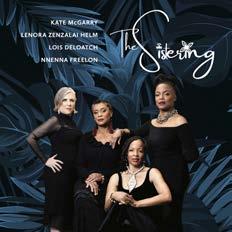
“Composing together was such an exciting way to bring a pot to the party or a potluck,” Helm said. “We each are whole women who have whole lives and careers. This legacy project galvanizes everything that we are and have done, and the sum of the parts are enriched by each other.”
Beyond its familial meaning, “sistering” is also a carpentry term that refers to support beams that are placed alongside a beam to reinforce it.
“Sistering, being that support, that anchor for each other in a variety of ways, is more than a title—we are a collective,” said Freelon. “It’s almost like our lives named our group.”
For years, the group members’ musical careers orbited each other. Helm is a vocalist and composer, as well as a conductor of the Tribe Jazz Orchestra and the Dean of Professional Education at her alma mater, the Berklee College of Music. Grammy-nominated artist Freelon built her decades-long musical career on stage, traveling the world while building community in the arts in Durham. Vocalist and songwriter Deloach, meanwhile, grew up in rural Northampton County with a strong gospel music foundation, and attended UNC-Chapel Hill and later, Duke University, immersing herself in the local jazz scene of the late 1970s and 80s before releasing her own music. McGarry, finally, studied at the University of Massachusetts Amherst under the tutelage of NEA Jazz Masters Billy Taylor and Max Roach, cutting her musical teeth over two decades in LA and New York City before moving to Durham in 2009.

In addition to the artist’s individual accomplishments, they shared connections through Durham’s robust, supportive jazz community, counting as mutual friends luminaries like Billy Taylor, Robert “Bob” Tapp, Branford Marsalis, Dave Finucane of Sharp 9 Gallery Jazz Club, and the inimitable Yusuf Salim.
“The anchors of the music here were what drew me to jazz,” said Deloach. “It was not difficult to immerse myself in it, build partnerships, and be a part of a community around the music.”
The twelve songs on The Sistering reflect the group’s respective journeys in music and life, traversing seasons of love and loss with a deftness guided by grace and wisdom.
The album begins with “River Song,” a melodic piano ballad that melds singing with spoken word, gently guiding listeners through moments of sorrow, encouraging listeners to find and lean on support systems.
“All of us have a commitment to guide generations coming after us,” said Helm. “When we were exploring the music for “River Song,” I remember discussing the need for an ancestor to whisper to you, to soothe and to guide you, through the grief process.”
“Hold on, dear one, this night can’t last forever…there’s room enough for friends to join you.”
In “Circle,” written by McGarry, the singer pays tribute to her late parents, recalling the life lessons they passed down that continue to guide her in the wake of their passing. “Dying Season,” written by Deloach, is a haunting song about the ravages of COVID19 and its reverberations of loss. “Follow


the Stream” is a counterpart to that song, embodying the process of moving through seasons of joy and pain.
“Part of the power of coming together is that we are all of a certain age, and we’ve all experienced everything in life—loss, heartache, joys, triumphs,” said McGarry.
“We’re creating spaces where the full range of human experiences is welcomed and embraced into a container where people can gather, remember, feel, and heal.”
Deloach approaches memory cultivation through a different lens.
“I often say we’re documentary artists,” she said. “People think of documentary artists as filmmakers, but we are documenting through our music, our experiences, and our vision.”
As the Sunday concert drew to a close inside NorthStar’s warm space, that March afternoon, the four vocalists held a question-and-answer time. One audience member asked if there was a word or phrase that the artists felt described the emotions of the event. Without missing a beat, each responded with: “gratitude” (Deloatch), “gathering” (McGarry), “grounding” (Helm), and “belonging” (Freelon).
The Sistering is ultimately a manifesto—a love letter to Durham’s jazz community and an empowering, personal call to action.
“You start, you meet yourself where you are, and you give yourself permission to speak, to dream, and to sing,” says Freelon.
“That requires a certain kind of fearlessness—we have to silence those voices that would have us not speak our whole truth. This delves into an authentic life story of women who have chosen to come together and share their collective wealth.”






Psychological puzzler Exit 8, Steven Soderbergh’s
The Christophers, and more new films coming to theaters around the Triangle.
BY GLENN MCDONALD arts@indyweek.com
Here’s some trivia: The old maxim “Variety is the spice of life” actually comes from 18th-century English poet William Cowper. The exact quote: “Variety’s the very spice of life / That gives it all its flavour.” Go forth with this knowledge and prosper.
The sentiment has endured these many long years, and it’s a good theme for movie hunting this month. There’s an uncommonly wide variety of films playing locally in April, including some interesting indies and imports on the art-house circuit.
To wit: director Genki Kawamura’s J-horror mind twist Exit 8, which should appeal to audiences beyond the usual scary movie crowd.
Drenched in urban dread, Kawamura’s psychological puzzler follows an unfortunate commuter stuck in the existential labyrinth that is the Tokyo subway system. No matter which way he turns, the Lone Man (Japanese superstar Kazunari Ninomiya) finds himself back where he started. Events begin to repeat themselves, except when they don’t, and every corner brings another creepy development. Crying babies in a wall of storage lockers, say.
Based on a popular indie video game from a few years back, Kawamura’s adaptation introduces some clever storytelling twists to take advantage of the cinematic medium. The Lone Man, it seems,

brings his own problems into those tunnels. Exit 8 takes a kind of game-theory approach to the horror genre, and audiences have responded with “you must see this” enthusiasm.
Moving from Tokyo to London, The Christophers is the latest from eternally restless filmmaker Steven Soderbergh, and it’s a solid bet for those who like their comedies smart, dark, and character-driven.
Ian McKellen headlines as Julian Sklar, a once-brilliant London painter who has degenerated into bad behavior and trash television. (He’s a panelist on a reality TV show called Art Fight.) The veteran British star Michaela Coel plays Lori Butler, an art restorer recently hired as Julian’s personal assistant.
Also in play: Julian’s estranged adult children, a set of valuable paintings (those are the Christophers), and a forgery scheme that probably needs some revision. The real action here is the relationship between Julian and Lori, which provides the two formidable actors their own canvas on which to work.
Structurally, The Christophers is an old-fashioned two-hander—intimate and tightly focused, like a stage play. But you can always bet on Soderbergh to stresstest the boundaries of format, visually, and screenwriter Ed Solomon is an old pro. Reviews from last year’s Toronto Interna-
tional Film Festival bode well, too. Finally, April is always a good month for variety in the Triangle, thanks to the annual Full Frame Documentary Film Festival. Slated for April 16 to 19 this year, Full Frame will bring 49 films from 31 countries to the Carolina Theatre and other venues in downtown Durham.
For the uninitiated, Full Frame is a high-profile and truly international film festival, one of the most important yearly events in the global documentary film industry. The good news for locals is that festival organizers have developed a ticketing system that’s friendly for drop-ins and day-trippers. Check the festival website for details.
Point being, you don’t have to buy a festival pass in advance to catch great films at Full Frame. It just takes a few clicks to figure out the various film series and seating policies. You can purchase individual tickets online, on the phone, or on-site at the Carolina Theatre box office. It’s easier than you think. Be unafraid!
Michaela Coel is also onscreen this month with Mother Mary , the latest from the always-interesting director David Lowery (A Ghost Story). The story is being
billed as a psychosexual thriller with Anne Hathaway as a pop star in trouble, Coel as an old frenemy, and some unsettling metaphysical incidents. Jack Antonoff, Charli XCX, and FKA Twigs provide the songs. The animated feature Animal Farm, directed by Andy Serkis, is the third film adaptation of George Orwell’s 1945 novella. Also in the voice cast: Seth Rogen, Glenn Close, Laverne Cox, Steve Buscemi, and Woody Harrelson. Early reviews suggest that we can expect some relevant updates to the story’s political allegory. Bob Odenkirk continues his action-movie career reboot with Normal, playing a stubborn sheriff who goes up against a small town’s entire criminal underground. We don’t get many old-fashioned romantic comedies in the multiplex anymore, so be gentle with You, Me & Tuscany, starring Halle Bailey, Regé-Jean Page, and some swoony location shooting at an old Italian villa.
Saturday Night Live creator Lorne Michaels gets the full biography treatment in the documentary Lorne, which promises exclusive footage from the SNL vaults plus celebrity interviews with Tina Fey, Conan O’Brien, Chris Rock, Maya Rudolph, Mike Myers, and Paul Simon. Oh, and the director is Academy Award winner Morgan Neville (20 Feet from Stardom). This one can’t miss.

Despite all the game day distractions, Champ, the highly trained Durham Bulls bat fetcher never fails to delight fans and demonstrate that he is indeed a very good boy.
BY STORMS REBACK
backtalk@indyweek.com
Champ’s job might sound easy: Whenever a Durham Bulls player gets a hit in the first three innings during one of Champ’s scheduled games, he sprints to the batter’s box, retrieves the baseball bat, and returns it to his handler, Michael O’Donnell. Now think about all the distractions the amiable black Lab must manage—fans screaming, lights flashing, the smell of chili cheese fries wafting through the air—yet Champ never flubs an assignment.
Such discipline doesn’t come easy. Every day, after wolfing down his breakfast and jumping into the front seat of Michael’s car, Champ spends nearly three hours working on long-distance retrieves at the Apex branch of All-Star Dog Training, which Michael and his wife Melissa founded last year. After Michael throws an object, points to it, and says, “Back,” Champ runs after it, picks it up with a “soft bite” (an essential skill when retrieving the Bulls’ wooden bats), and returns it to Michael.
Champ, who turns 3 in April, is rarely fazed by the variety of things Michael asks him to retrieve, a list that includes bats, bumpers, balls, and even eggs. “Michael could throw a potato out there,” said Melissa, “and Champ will go get it.” Champ has been working on his retrieving skills since he was 8 weeks old. He started with little plastic baseball bats and gradually worked his way up to regular-sized ones. His reward for a successful retrieve? “Love and affection,” said Melissa, “because you can’t always have a pocketful of treats. Champ just wants to please Michael.” She adopted the voice of an overeager puppy. “Champ’s like, ‘You’re my dad! You’re my best friend! Let’s do this! Let’s go have fun!’” Champ’s training never fully ceases, even at home. If asked, he will sit on a “place cot,” a training device resembling a small trampoline, and stay for as long as 30 minutes. Of course, he wants to lie down, jump off, or run around, anything but continue to sit there, but he doesn’t. AN INDY SERIES
Such self-control comes in handy when Champ goes for walks with Michael around their South Raleigh neighborhood without a leash. A tiny dog with a Napoleon complex can bark and lunge at him, and Champ will remain glued to Michael’s side.
Champ brings the same self-discipline with him to Durham Bulls Athletic Park (DBAP), where he’s scheduled to appear on opening day and every Saturday (except July 4 and September 12) this season. Bulls fans often acknowledge Champ’s efforts with the same enthusiasm they give home runs and regard him as a mainstay of the team— even though Champ was named bat dog much earlier in his career than expected.
Heading into last season, the plan was for Champ to split the job with Ripken, the Bulls’ bat dog since 2021, for one year before Ripken retired. But Ripken’s unexpected death on New Year’s Day 2025 forced Champ to take sole possession of the job. Champ looks so much like Ripken—they come from different litters but have the same parents—that casual Bulls fans might not have even noticed the switch.
There is one area where Champ is going to have a hard time matching Ripken, and that’s posing for photos. “Champ is still learning how to sit and look cute,” said Melissa. “He tilts his head, and his lip’s all cocked up, or he’ll turn his head, or he won’t sit still. He’s just so excited because he loves all the love and attention he’s getting.” She adopted the puppy voice again. “He’s like, ‘Oh, my God! I love you! Oh, my God! Oh, my God! Oh, my God! Yes! Hug me! Yes! Yes! I love you! Thank you!’”
In addition to his job with the Bulls, Champ also retrieves kicking tees for North Carolina State University’s football team. Witnessed by thousands of people in the Triangle, his work has made him a local celebrity. At DBAP, the demand for his “paw-tograph”—Michael signs Champ’s name with a paw print next to it—is so great it often takes Champ three or four innings to get from the field, where he retrieved bats, to club level, where he likes to relax and cool off after work.
As if trying to raise the bar this season, Champ will be working at five of the six Bark in the Park games, when Bulls fans are allowed to bring their dogs. To the long list of distractions Champ must face inside DBAP, you can add barking, howling, and growling.
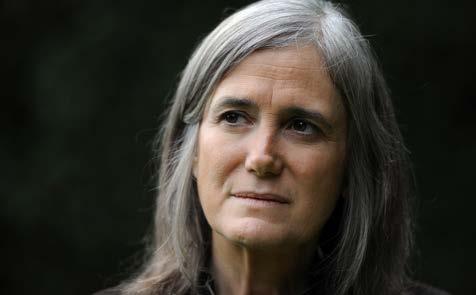
Steal This Story, Please!, a new documentary about Democracy Now! host Amy Goodman, is an energizing look at the possibilities of independent journalism.
BY SARAH EDWARDS sedwards@indyweek.com
Amy Goodman is bounding up the stairs at a United Nations climate summit, quick on the heels of the Trump administration official ignoring her questions. Amy Goodman is winding after him through hallways. Another hallway, another set of stairs.
“Can you tell me what you think about President Trump saying climate change is a hoax? Can you explain why the U.S. joined with Saudi Arabia in watering down language around the UN report?”
“Are you not speaking to the press while you’re here?” Amy Goodman is having a door shut on her face.
So goes the opening scene of Steal This Story, Please! a new documentary from veteran filmmakers Tia Lessin and Carl Deal that traces the career of independent news journalist Goodman, host of the global news program Democracy Now! The documentary opens in select the-
aters nationwide on April 10 and will screen at Durham’s Full Frame Documentary Film Festival on April 16.
Democracy Now! launched in 1996 as a scrappy news hour airing on just nine stations. Today, the program—which has managed to stay listener-funded, without corporate sponsorship, government funding, or advertising revenue— reaches a network of 1,500 public television and radio stations. It’s become known for reporting on grassroots movements like Arab Spring and Occupy Wall Street; in recent years, it has been one of the only media platforms where listeners could expect to hear consistent death toll updates from Israel’s war on Gaza.
Lessin was part of Goodman’s team covering the Republican National Convention in 2000, where the journalist was “chasing after politicians and billionaires and asking the hard questions.”
Journalist Amy Goodman
“She was covering it like an athletic event,” Lessin said with a laugh.
Lessin and Deal made their Full Frame debut in 2008 with Trouble in the Water, an Oscar-nominated documentary about the survivors of Hurricane Katrina, and were most recently at the festival in 2013 with Citizen Koch, an investigation into 2010’s Citizens United v. FEC Supreme Court ruling and its dire impact on campaign finance. (The documentary was dropped from PBS after pressure from financier David Koch.)
They are also frequent collaborators with Michael Moore—in fact, Deal recalls his first memory of Goodman was when he was with Moore, a figure who normally drew onlookers, at a protest during the Iraq War. The crowd was clustered elsewhere, and “nobody was coming to Michael,” Deal told the INDY. He looked around for the source.
“It was Amy. Amy was drawing the crowd away, because she was out there talking about media complicity and the media control measures being implemented by the Pentagon, at that time, and the Bush administration,” said Deal. “I saw her, and she was the rock star.”
For anyone who also looks up to Goodman’s dogged advocacy journalism, as I do, this is the documentary you didn’t know you’d been waiting for. It offers a refreshing portrait of a persistent value system, with a look at Goodman’s upbringing, as the granddaughter of an Orthodox rabbi in a family that embraced both social justice and curiosity as a lifelong practice.
“It came from my Jewish education that you asked questions and that you take nothing for granted,” Goodman says in the film. “And the way you deal with the world is with intense curiosity and not being afraid to stand by your principles.”
“It’s in Amy’s nature to care about the other person,” said Deal. “I didn’t ever assume she didn’t, but I understand it really profoundly, after I sat with her and her story for the last couple of years, seeing how deeply she cares about other people .... She doesn’t have to agree with you to be deeply interested in who you are, where you come from, and what you have to say.”
The film offers a glimpse of Goodman’s crunchy grind, with scenes of visits with her 105-year-old grandmother and bopping around the city with her dog, Zazu, a woven cross-body bag in tow. She has energy and “a lot of lightness,” according to Lessin, “and off-camera, she does like to find joy.”

Steal This Story, Please!, though, ultimately isn’t a character study, nor is it, as goes the usual line for legacy wonk documentaries, a “love letter to the profession.”
The film’s most profound insights about the industry are merely a reinforcement of its most basic principles: that those most impacted by harm should have their voices heard, and that those who hold the most power are responsible to answering questions from those who hold the least. As the film trawls through the 90s into the 2000s, it identifies consolidations of power, initiated across party lines, that have gotten us where we are today. Where is that? There’s not enough space to list the existential threats to independent media and the degree to which the Trump administration has silenced and stomped out the press. But while our present crisis is a specter in Steal This Story, Please!, Deal and Lessin’s primary focus is on the ways mainstream media has long capitulated to power, put profit first, and shied from tough questions. This focus doesn’t minimize the challenges of today, but it does help us understand them better. Scenes of newsroom challenges from twenty and thirty years ago feel eeri-
ly familiar, reminding viewers that corporate and political pressure has always been powerful, and that, as the Mark Twain quote goes, “history doesn’t repeat itself, but it often rhymes.” There are fascinating callbacks to moments like the Telecommunications Act that President Bill Clinton signed into law in 1996, which weakened guardrails against media monopolies and which, as Goodman’s Democracy Now! colleague Juan González observes in the film, “led to the privatization of the internet.”
The title Steal This Story, Please! nods to Goodman’s ethos that change happens when stories spread—and that, as Lessin said, “it’s a success if her stories are copied or taken up by other outlets.” That challenge moves beyond journalists to anyone looking to preserve their humanity: In an era where we’re visually inundated with images of war and disaster, every time we punch in a phone passcode, there’s a call to metabolize information before it flickers out of sight—and maybe even to do something with it.
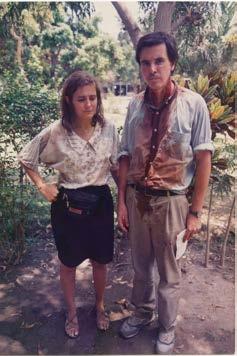
Early on, as Goodman rifles through a box of photos and press badges, she holds up a photo of herself and her bloodied colleague Allan Nairn. It was taken in East
Timor, where Goodman and Nairn happened to be on assignment, in 1991, the day the Indonesian army opened fire on a crowd of thousands of Timorese civilians, killing at least 271. The violence was not a one-off; during Indonesia’s occupation of Timor, between 1975 and 1999, as many as 200,000 people were killed by a regime “armed, financed, and trained” by the United States, as Goodman emphasizes.
“It would change us forever, and it taught me how critical it was that we expose what is done in our name,” Goodman says in the documentary.
Here is another essential part of Goodman’s practice: An insistence on the discipline of context, of helping viewers understand how events came to be. When Goodman and Nairn published coverage of the event, nationwide protests erupted. A little less than a year later, in November 1992, the House finally voted to cut off military funding for Indonesia.
“Her motto is, go to where the silence is,” said Lessin. “She is not interested in pundits. She doesn’t want experts to opine on whatever is happening. She’s interested in the people who are experiencing the fallout of foreign policy and the people, as
she says, at the trigger end of the gun, or the target end of the bomb.”
She also isn’t—as one very fun scene evinces—interested in giving presidents special treatment or letting their position get in the way of a good interview.
The year is 2000. It’s Election Day and Clinton is making a round of get-out-thevote calls. Unannounced, and perhaps ill-advised, he places one to the Democracy Now! studio. The team scrambles to get the conversation live, as Goodman picks up the phone.
“Hello, Mr. President,” Goodman says, and then, without missing a beat, begins: “What do you say to people who feel that the two parties are bought by corporations and that their vote doesn’t matter?”
This is followed by questions about Israel. Questions about NAFTA and the prison system and the state of the Democratic Party. Clinton calls her combative and hostile. But for more than 30 minutes, he also stays on the phone.
In another scene, Goodman is asked about the secret to her interview technique.
“It’s just showing up,” Goodman says, “and asking the questions nobody has bothered to ask.”
4/8
MUSIC
Drug War Delusions: From Colombia to the Carolinas 4:30 p.m. Flyleaf Books, Chapel Hill.
The Golden Hours, David Wax Museum, Lowland Hum 7 p.m. The Pinhook, Durham.
KBA Jazz Series: Kate McGarry, Keith Ganz Quartet 5:45 p.m. Koka Booth Amphitheatre, Cary.
Moonchild: Waves Tour 8 p.m. Carolina Theatre, Durham.
Tigers Jaw, Hot Flash Heat Wave, Creeks 7 p.m. Cat’s Cradle, Carrboro.
STAGE
Bill Burr Live 7:30 p.m. and 10:30 p.m. DPAC, Durham.
THU 4/9
MUSIC
BLENDR, CARCRASHERS, Möfle 9 p.m. The Pinhook, Durham.
Britain’s Finest: The Beatles Experience 7 p.m. Martina Marietta Center for the Performing Arts, Raleigh.
Jordan Smart, Willy Tea Taylor 8 p.m. Cat’s Cradle Back Room, Carrboro.
PAGE
Lisa Graves: Without Precedent 5:30 p.m. Flyleaf Books, Chapel Hill.
STAGE
Nick Offerman: Big Woodchuck 7 p.m. DPAC, Durham.

The Price by Arthur Miller April 9-12, various times. The ArtsCenter, Carrboro.
Knot Your Kind: A Tribute To Slipknot 8 p.m. Lincoln Theatre, Raleigh.
Nailah Porter 7:30 p.m. Sharp 9 Gallery, Durham.
MUSIC
Arrival From Sweden: The Music of ABBA 8 p.m. DPAC, Durham.
Billie Marten 8 p.m. Cat’s Cradle, Carrboro.
Cameron Whitcomb 7 p.m. The Ritz, Raleigh.
The Floor, Emelcie, Prodi-g, Facesblur 10 p.m. Rubies on Five Points, Durham. FRI 4/10
NC Symphony presents: Mozart “Great” Mass April 10-11, 8 p.m. Martina Marietta Center for the Performing Arts, Raleigh.
Ranger Trucco 9 p.m. The Fruit, Durham.
Snarky Puppy 8:30 p.m. The Carolina Theatre, Durham.
Telescreens, The Wallabies 8 p.m. The Pinhook, Durham.
Well, I Declare: America at 250 7:30 p.m. Martina Marietta Center for the Performing Arts, Raleigh.
Wild Party 8 p.m. Cat’s Cradle Back Room, Carrboro. STAGE
The ComedyWorx Show Fridays at 8 p.m. ComedyWorx, Raleigh.
The Harry Show Fridays at 10 p.m. ComedyWorx, Raleigh.
MUSIC
2nd Annual Study Hall Music Fest 6 p.m. Cat’s Cradle

Bass
9
Bertha: Grateful Drag 8 p.m. Lincoln Theatre, Raleigh.
Cardi B: Little Miss Drama Tour 7:30 p.m. PNC Arena, Raleigh.
Celebrating America’s Playlist: The 250-Year Soundtrack of Freedom and Peace 7 p.m. Martina Marietta Center for the Performing Arts, Raleigh. SAT 4/11

Jason Foureman Quartet with Harry Pickens 7:30 p.m. Sharp 9 Gallery, Durham.
Kattam and his Tam Tams 11 a.m. The Carolina Theatre, Durham.
Paradox: A 90s Rave Experience 10 p.m. Rubies on Five Points, Durham.
STAGE
Dan Soder: The Golden Retriever of Comedy Tour 8 p.m. The Carolina Theatre, Durham.
Hannah Berner 7:30 p.m. DPAC, Durham.
Tara Z. Mullins: The Wind Machine 11 a.m. NCMA, Raleigh.
SUN 4/12
MUSIC
Bedrumor, O Key (ATL), Jupiter 2 7 p.m. Rubies on Five Points, Durham.
ECU Jazz Faculty 4:30 p.m. Sharp 9 Gallery, Durham.
Femtanyl 8 p.m. Motorco Music Hall, Durham.
Field Medic 8 p.m. Cat’s Cradle Back Room, Carrboro.
Juveniles Boiling Point Album Release Tour 7 p.m. The Ritz, Raleigh.
STAGE
Churchill 2 p.m. Martina Marietta Center for the Performing Arts, Raleigh.
MON 4/13
MUSIC
Sheer Mag, Daniel Romano’s Outfit, Fast Kids 8 p.m. The Pinhook, Durham.
TUE 4/14
MUSIC
Bush: The Land Of Milk and Honey Tour 7 p.m. PNC Arena, Raleigh.
Dance for Cuba Fundraiser 7 p.m. The Pinhook, Durham.
Mei Semones 8 p.m. Motorco Music Hall, Durham.
Sarah Kinsley 8 p.m. Cat’s Cradle, Carrboro.
The Braymores, echo plum 8 p.m. Cat’s Cradle Back Room, Carrboro.
PAGE
Emily Matchar 6:30 p.m. Quail Ridge Books, Raleigh.
STAGE
The Naked Magicians 7:30 p.m. DPAC, Durham.
WED 4/15
MUSIC
3 Chambers: A Wu-Tang Experience 7 p.m. The Pinhook, Durham.
Baby Keem: The Ca$ino Tour 7:30 p.m. The Ritz, Raleigh.
The Band Of Heathens 8 p.m. Lincoln Theatre, Raleigh.
KBA Jazz Series: Peter Lamb & The Wolves 5:45 p.m. Koka Booth Amphitheatre, Cary.
PAGE
Carrboro Bluegrass Festival: Bluegrass In The Backroom 8 p.m. Cat’s Cradle Back Room, Carrboro.
Kishi Bashi: Sonderlust 10th Anniversary Tour 8 p.m. Cat’s Cradle, Carrboro.
Voices of Refuge: Music, Language, Silence, and Belonging in Cambodian America 4:30 p.m. Flyleaf Books, Chapel Hill.
STAGE
Theresa Caputo 7:30 p.m. DPAC, Durham.

Aviana Gedler Quartet
7:30 p.m. Sharp 9 Gallery, Durham.
Azul, Matty Frank 8 p.m. The Pinhook, Durham.
Chris Stapleton and Eric Church Tribute Bands
8 p.m. Lincoln Theatre, Raleigh.
Hippie Sabotage: Give and Take Tour 7 p.m. The Ritz, Raleigh.
Lamb of God, Kublai Khan TX, Fit For An Autopsy, Sanguisugabogg 6:30 p.m. PNC Arena, Raleigh.
Martin Sexton: Live Wide Open Tour 2026 8 p.m. Cat’s Cradle, Carrboro.
Never Ending Fall 8 p.m. Cat’s Cradle Back Room, Carrboro.
Snide, Napalm Cruiser, Psychic Scream, The Coyotes 7:30 p.m. Rubies on Five Points, Durham.
SCREEN
Full Frame Documentary Film Festival April 16-19, various times. Carolina Theatre, Durham.
The Rocky Horror Picture Show 11:55 p.m. The Rialto, Raleigh.
Alice Phoebe Lou 8 p.m. Haw River Ballroom, Saxapahaw.
Beas, Richard and the Bootcut Boys 7 p.m. Rubies on Five Points, Durham.
Fading Signal, Get Wise, Guard Dog, Circle Five, No Reason Why 7:30 pm The Pinhook, Durham.
Harvey Street, The Wallabies 8:30 p.m. Lincoln Theatre, Raleigh.
The HillBenders Present Beatlegrass: A Bluegrass Tribute to the Beatles 7:30 p.m.. Martina Marietta Center for the Performing Arts, Raleigh.
its murph: Weightless Tour 7 p.m. The Ritz, Raleigh.
NC Opera: Il Trovatore April 17 and 19, various times. Martin Marietta Center for the Performing Arts, Raleigh.
Only1brewski presents: Mutant and Proud, DJ Professor X 10 p.m. Rubies on Five Points, Durham.
Rex Richardson Quintet 7:30 p.m. Sharp 9 Gallery, Durham.
Wallice 8 p.m. Cat’s Cradle Back Room, Carrboro.
STAGE
Bert Kreischer: Permission to Party April 17 and 18, 7 p.m. DPAC, Durham.
SAT 4/18
Boys Like Girls 6 p.m. The Ritz, Raleigh.
Charlie Berens: The Lost and Found Tour 8 p.m. Martina Marietta Center for the Performing Arts, Raleigh.
The ComedyWorx Show Fridays at 8:00 p.m. ComedyWorx, Raleigh.
Cut Worms 8 p.m. Motorco Music Hall, Durham.
Danny Brown 8 p.m. Lincoln Theatre, Raleigh.
Eliza McLamb – Good Story Tour 8 p.m. Cat’s Cradle, Carrboro.
Firestarter Fest: A Celebration of Queer/Trans Black & Brown Alternative Aesthetics 10 p.m. The Pinhook, Durham.
The Harry Show Fridays at 10 p.m. ComedyWorx, Raleigh.
Lightnin’ Wells 7:30 p.m. The ArtsCenter, Carrboro.
Nicole Mitchell’s Black Earth Ensemble 7:30 p.m. Sharp 9 Gallery, Durham.
Only1brewski presents: Bow Before Doom 10 p.m. Rubies on Five Points, Durham.
Rec Hall 8 p.m. Cat’s Cradle Back Room, Carrboro.
Starjunk 95 9 p.m. The Fruit, Durham.
STAGE
An Evening with David Sedaris 8 p.m. Martin Marietta Center for the Performing Arts, Raleigh.
SUN 4/19
MUSIC
David and Tamela Mann 7 p.m. DPAC, Durham.
Delicate Steve 8 p.m. Cat’s Cradle Back Room, Carrboro.
Frank Longino Trio 3 p.m. Sharp 9 Gallery, Durham.
St. Paul and the Broken Bones 7 p.m. The Ritz, Raleigh.
MON 4/20
MUSIC
Ex Iguana, Big Girl, Charlie Paso 7 p.m. The Pinhook, Durham.
The Moss 8 p.m. Cat’s Cradle, Carrboro.
The Red Pears and Together Pangea 8 p.m. Motorco Music Hall, Durham.
Snail Mail 8 p.m. Haw River Ballroom, Saxapahaw.
TUE 4/21
MUSIC
Caroline Kingsbury 8 p.m. Cat’s Cradle Back Room, Carrboro.
Concrete Boys: It’s Us –Vol. 2 Tour 8 p.m. Lincoln Theatre, Raleigh.
Durham Jazz Workshop Showcase 6 p.m. Sharp 9 Gallery, Durham.
PAGE
Bill Link: Righteous Warrior 5:30 p.m. Flyleaf Books, Chapel Hill.
Maria Semple 6:30 p.m. Quail Ridge Books, Raleigh.
STAGE
The Remember Balloons 1 p.m. The Carolina Theatre, Durham.



RELEASE DATE—Sunday, April 5, 2026
Edited by Patti Varol

There is really only one rule to Sudoku: Fill in the game board so that the numbers 1 through 9 occur exactly once in each row, column, and 3x3 box. The numbers can appear in any order and diagonals are not considered. Your initial game board will consist of several numbers that are already placed. Those numbers cannot be changed. Your goal is to fill in the empty squares following the simple rule above.


Consulting/Principal Software Engineer
Consulting/Principal Software Engineer sought by LexisNexis USA in Raleigh, NC to develop/ lead large multifunctional software development activities, solve complex technical problems, write complex code for computer systems, provide assistance/input to management, serve as senior source of expertise. Minimum of Bachelor’s degree or foreign equivalent in Computer Science, Computer Engineering, Information Technology, or rltd + 7 yrs exp in job offered or rltd occupations required. Employee reports to LexisNexis USA office in Raleigh, NC but may telecommute from any location within US. Interested candidates should send email to ResumesICT@RELX.com. Ref job code: R107252 ($174,030.28 to $203k/ yr + standard corporate benefits)
Software Engineer II
Software Engineer II sought by RELX Inc d/b/a LexisNexis USA in Raleigh, NC to contribute to research/design for software development assignments in Agile development environment for specific software functional areas & product lines. Minimum of Master’s degree or foreign equivalent in Computer Science, Computer Engineering, Information Technology, or rltd + 1 yr exp in job offered or rltd occupations required. Employee reports to LexisNexis USA office in Raleigh, NC but may telecommute from any location within US. Interested candidates should send email to ResumesICT@RELX.com. Ref job code: R107250 ($113,547 to $119,400/yr + standard corporate benefits)
Risk Analyst III
First Citizens Bank seeks a Risk Analyst III in Raleigh, NC to provide complex support & expertise to business units through research, developing, data gathering, & executing risk procedures. Reqs: BS in Fin, Eco, Stat, Math, Eng, or rel + 5yrs or MS in Fin, Eco, Stat, Math, Eng, or rel + 3yrs. Remote role. Base pay gen b/w $132,475 to $152,490/yr. For more info & to apply, go to https://jobs.firstcitizens.com/jobs & ref Job #2026-33418
Senior QA Analyst
Senior QA Analyst; Labcorp Holdings. 3x/ wk in Durham, NC & remote in U.S. 2x/ wk. Devlp, exct, & mntn detaild test plans, test cases, & test scrpts based on product reqs, specifictns & user stories. Must have bach or equiv in Comp Sci, Info Tech, or rltd & 5 years progressive exp as Software Quality Analyst or rlt role (OR mast+3yrs exp). Must have 3 yrs exp w/: using sftwre quality tools to facilitate testing or hands-on lab exp w/ respective lab systems; sftwre dev lifecycle, w/ exp in Agile & Waterfall mthdlgies; testing web apps, APIs, & databases; defect tracking tools; manual & automated testing tools; scripting langgs for test automation. Salary range=$128,794$166,400/yr. Resume to resumes@labcorp.com & reference Job Code MB032026.
Senior Quality Assurance Analyst
Senior Quality Assurance Analyst/Software; Labcorp Hldngs. Hybrid-3x/wk Durham, NC; remote 2x/wk. Prfm rqmnt analysis, test scenario prep & test case design. Must have master’s or equiv in Sftwre Eng’g, Cmptr Apps, CompSci or rltd & 3 yrs exp as Sftwre Eng, Sftwre Qualty Test Anlyst or rltd (or BA+5 yrs exp). Must have 3 yrs exp w/: Java prgrmmng; automtn, incldng eClipse IDE, Jenkins, CICD prcess; Splunk SFTP; Jira; LAPI usng devlpmnt tools; batch procssng & Schedlr; SQL pg admnstrtr; Chrome, Edge, Firefox devlpr tools; MQ transprt layer; Agile methdlgs; Oracle SQL devlpr databse; Postman, Soap UI, Soap/ wsdl; Docmnt Storge Valdtn; HL7 & CSV, & JSON Data formts; & 2 yrs exp w/ Amazon Web Servcs. Resume to resumes@labcorp.com & reference Job Code BA032026.
Java App Architect
Java App Architect; Lab Corp of Amrca Hldngs. Durham, NC. Lead tech desgn, plnning & mng dev of UI & backend servcs. Must have at least bach or equiv in CompSci, Comp Eng’g or rltd & 10 yrs progrssve exp as Entrprse App Dvlpr or rlt role. Must have 7 yrs exp w/: Java 7+ entrprse dev; Java, Spring Core, Spring Boot, Spring MVC & Spring Security; Java concrrncy & thread safety; 5 yrs exp w/: Cloud-native techs & other AWS services; JAX-RS & JSON; RDBMS w/ Java integrtn usng Spring Data, JPA & Hibernate; CI/CD pipeline automtn using Maven, Git, SonarQube, Jenkins & UCD w/ quality gates & automtd deplymnt stratgies. Resume to resumes@labcorp.com & reference Job Code JM032026.

Celebrate 20 �ears of bold vision at the Nasher Museum of Art with Ever�thing Now All at Once—a d�namic anniversar� exhibition featuring landmark works.
Ever�thing Now All At Once is organized b� Xuxa Rodríguez, Ph.D., Pats� R. and Ra�mond D. Nasher Curator of Contemporar� Art, with support from Julianne Miao, Curatorial Associate.
This exhibition is made possible b� The Nanc� A. Nasher and David J. Haemisegger Famil� Fund for Exhibitions and the Mar� Duke Biddle Foundation.
Barbara Chase-Riboud, Malcolm X #5 (detail), 2003. Polished bronze and silk with steel support, 76 1/2 × 29 × 27 inches (194.31 × 73.66 × 68.58 cm).
Collection of the Nasher Museum of Art at Duke Universit�, Durham, NC. Gift of Nigel and A�odele Hart, 2017.22.1. © Barbara Chase-Riboud. Photo b� Peter Paul Geoffrion.