How Industrial Companies Can Improve Procurement Efficiency With an Online Suppliers Directory
Procurement plays a central role in the success of industrial businesses. Manufacturers need a consistent supply of raw materials, components, machinery, and technical services to maintain production and meet customer expectations. When procurement teams struggle to find suitable suppliers, purchasing decisions can take longer, production schedules may become difficult to manage, and businesses may miss opportunities to improve costs or product quality. An organized supplier discovery process can help companies make more informed decisions and improve the efficiency of their purchasing activities. Traditional supplier research often involves searching general websites, contacting existing business partners, attending trade exhibitions, and requesting recommendations from industry contacts. These methods can be useful, but they may require considerable time and may not reveal every suitable supplier. Companies entering new markets or searching for specialized manufacturing capabilities can find the process particularly challenging. An industrial suppliers directory provides an alternative starting point by bringing together information about manufacturers, component providers, engineering
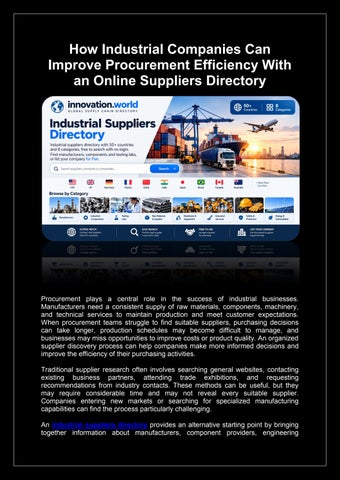
companies, equipment suppliers, and testing laboratories. Procurement professionals can explore relevant industrial categories, identify potential suppliers, and create a shortlist for further evaluation. This approach helps organize the initial research process and reduces dependence on a limited network of existing contacts. Innovation.World offers a Worldwide Suppliers Directory covering more than 50 countries and eight industrial categories. The platform allows users to search for industrial suppliers without registration or login, while companies can list their businesses for free. It is designed to help businesses discover manufacturers, components, technical services, and testing providers across international markets. Procurement teams can begin exploring available suppliers at innovation.world. One of the most effective ways to improve procurement efficiency is to establish clear purchasing requirements before searching for suppliers. A company purchasing custom metal components, for example, should identify the material grade, dimensions, tolerances, surface finish, order quantity, and expected delivery
schedule. A business sourcing electronic components may need to specify manufacturer part numbers, electrical ratings, operating temperatures, and compatibility requirements. Clear specifications make supplier research more focused because procurement teams can determine which companies are relevant to the requirement. They also help suppliers prepare more accurate quotations. When buyers provide incomplete information, suppliers may need to request clarification, resulting in unnecessary delays and inconsistent offers that are difficult to compare. An industrial suppliers directory can support the next stage by helping buyers discover companies that specialize in the required products or services. Manufacturing and production services may be relevant for custom fabrication, while OEM components and hardware can help businesses identify potential sources of parts used in larger assemblies. Engineering and design services may be useful
when a purchase requires technical development, and testing and compliance providers can support inspection or verification requirements. Using relevant categories makes the initial search more manageable, but businesses should avoid selecting suppliers based on category descriptions alone. Once a shortlist has been created, each company should be evaluated according to its technical capabilities, quality procedures, production capacity, delivery performance, and commercial terms. The directory helps identify potential candidates; the procurement team remains responsible for determining whether those candidates meet the business's requirements. Comparing quotations is another important part of procurement efficiency. Requesting offers from several suitable suppliers can help businesses understand available pricing and manufacturing options. However, quotations should be based on the same specifications, order quantities, delivery locations, and acceptance criteria. Otherwise, a lower price may reflect a different product specification or a narrower scope of service rather than better value. The total cost of procurement includes more than the price shown on a quotation. Shipping, packaging, tooling, customs duties, taxes, inspection, inventory storage, and payment conditions can all influence the final expense. A supplier offering a lower unit price may become less economical when transportation costs or minimum order quantities are considered. Evaluating the full purchasing cost provides a more accurate basis for decision-making. Delivery schedules also affect procurement performance. A component that arrives late can delay assembly, disrupt production planning, and affect customer commitments. Procurement teams should confirm stock availability, manufacturing lead times, shipping arrangements, and the supplier's ability to meet expected delivery dates. For critical components, businesses may need to identify alternative suppliers or establish suitable inventory buffers. International sourcing can provide additional opportunities for procurement teams. A manufacturer may discover a specialist supplier in another country that offers a production process or technical capability unavailable locally. Companies may also want to explore alternative sources for materials, components, or industrial equipment to improve sourcing flexibility. Innovation.World's coverage across more than 50 countries provides a starting point for researching these possibilities. However, international procurement requires careful attention to logistics and commercial considerations. Import regulations, customs procedures, exchange rates, transportation costs, and differences in communication practices can influence the final purchasing decision. Businesses should evaluate these factors before selecting an overseas supplier and confirm that the proposed arrangement is practical for their production schedule. Supplier diversification can improve procurement resilience as well. Businesses that rely heavily on a single supplier may face difficulties if that company experiences a production interruption, material shortage, or unexpected increase in demand. Identifying additional qualified suppliers gives procurement teams more options
when conditions change. Any alternative source should be evaluated and approved before its products are introduced into production, particularly when components have strict technical or safety requirements. Digital supplier discovery can be especially valuable for small and medium-sized businesses. Smaller organizations may not have dedicated sourcing departments or the budget to use expensive procurement research platforms. A free industrial suppliers directory allows them to explore potential suppliers without paying for directory access. The ability to search without logging in also reduces the time required to begin researching available options. Startups can use the same approach when preparing for commercial production. A new business may need to identify prototype manufacturers, raw material suppliers, component providers, and testing laboratories before launching a product. Exploring potential partners early helps founders estimate production costs, understand minimum order quantities, and identify technical requirements that could influence product design. Procurement efficiency also depends on maintaining accurate supplier information. Businesses should record relevant details about potential and approved suppliers, including contact information, technical capabilities, quotation terms, delivery lead times, and qualification status. Keeping these records organized reduces repeated research and makes it easier to revisit suppliers when new requirements arise. A supplier directory can support the discovery stage of this process, while the company's internal procurement records can be used to track the results of its evaluations. Together, these practices help purchasing teams maintain a clearer view of available sourcing options and avoid restarting the research process every time a requirement changes. Quality management should remain a priority throughout procurement. Buyers should confirm that suppliers understand the required specifications and can provide consistent products or services. Depending on the application, verification may involve sample inspection, certificates, test reports, production audits, or other evidence of technical competence. Businesses should also establish procedures for managing defective products and resolving delivery or specification problems. Communication between buyers and suppliers can significantly influence the speed of procurement. Clear inquiries, complete technical documentation, and prompt responses help both parties understand the purchasing requirement. Buyers should explain important deadlines and acceptance criteria, while suppliers should provide realistic information about availability, production capacity, and potential limitations. Written confirmation of key details helps reduce misunderstandings. Industrial suppliers can contribute to procurement efficiency by presenting their capabilities clearly in online directories. A company listing that accurately describes products, manufacturing processes, supported materials, and relevant technical services helps buyers determine whether the supplier is suitable. Clear contact information and a professional website make it easier to request quotations and continue the evaluation process.
Innovation.World offers free company listings, allowing manufacturers and industrial service providers to present their businesses without paying a directory listing fee. This can be useful for smaller suppliers seeking additional visibility among procurement professionals. Although a listing does not guarantee inquiries or sales, it provides another opportunity for buyers to discover the company through a specialized industrial resource. The directory's eight industrial categories cover manufacturing and production services, OEM components and hardware, engineering and design services, raw materials and chemicals, testing and compliance, tooling and industrial equipment, and research and development support. This broad coverage can help procurement teams investigate multiple requirements through one supplier discovery resource rather than relying entirely on separate searches. Businesses should nevertheless treat an online directory as the beginning of procurement research, not a substitute for formal purchasing controls. Supplier verification, contract review, technical approval, quality assurance, and commercial risk assessment remain important. The appropriate level of due diligence depends on the product, industry, purchase value, and potential consequences of supplier failure. Procurement efficiency ultimately comes from combining organized research with disciplined evaluation. By defining requirements clearly, discovering relevant suppliers, comparing complete costs, confirming delivery capabilities, and maintaining accurate records, businesses can make sourcing decisions more consistently. These practices can reduce avoidable delays and help procurement teams respond more effectively to changing operational needs. For organizations seeking an accessible way to discover industrial suppliers, the Innovation.World Suppliers Directory offers a useful starting point. Its international coverage, organized categories, free search access, and free company listings support the discovery of potential manufacturing partners and technical service providers. When combined with careful supplier qualification and effective procurement management, the directory can help businesses improve their sourcing process and build stronger industrial supply relationships.