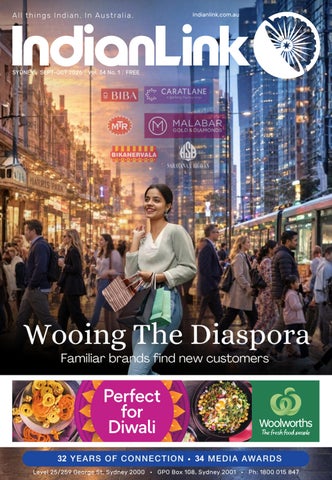
All things Indian. In Australia.
SYDNEY
SEPT-OCT 2026
Vol. 34 No. 1
indianlink.com.au
FREE
Perfect for Diwali 32
34
Level 25/259 George St, Sydney 2000 • GPO Box 108, Sydney 2001 • Ph: 1800 015 847
2 SEPT-OCT 2026
www.indianlink.com.au
SEPT-OCT 2026 3
4 SEPT-OCT 2026
www.indianlink.com.au
EDITORIAL
When pessimism looks for someone to blame
All things Indian. In Australia.
PUBLISHER Pawan Luthra EDITOR Rajni Anand Luthra CONTRIBUTORS Torrsha Sen, Lakshmi Ganapathy, Apoorva Tandon, Harini Sridhar, Harsheni Maniarasan, Diya Mehta, Swagata Sen, Satendra Nandan, Gaurav Masand, Kerren Lumsden, Minal Khona, Charmaine O’Brien, Sruthi Sajeev
SALES AND MARKETING Charu Vij GRAPHIC DESIGN Shailesh Tinker
Indian Link is a monthly newspaper published in English. No material, including advertisements designed by Indian Link, may be reproduced in part or in whole without the written consent of the editor. Opinions carried in Indian Link are those of the writers and not necessarily endorsed by Indian Link. All correspondence should be addressed to:
INDIAN LINK MEDIA GROUP Level 25 / 259 George St, Sydney 2000 GPO Box 108, Sydney 2001 Ph: 02 9279-2004 Email: info@indianlink.com.au
BY PAWAN LUTHRA
T
here is a worrying mood taking hold in Australia: not simply concern about migration, housing or the cost of living, but a growing sense that the country is heading in the wrong direction and that “foreigners” are somehow to blame. Australians are entitled to ask whether migration levels are sustainable, infrastructure has kept pace and housing is affordable. These are legitimate questions. But when anxiety about Australia’s future becomes anxiety about the people who came here to build it, we should all be concerned. One Nation has understood something the major parties have been slow to grasp: fear is politically powerful when people lose confidence in the future. Its proposed 750,000 cut in migration over three years, including major reductions in international students and zero family visas for skilled migrants, turns economic anxiety into a simple proposition: housing is expensive, services are stretched, therefore there are too many people. Reduce migration and life will get better. Except the real world is considerably more complicated.
History offers a warning. During the Great Depression, prolonged economic deterioration did more than empty pockets; it eroded confidence in political institutions and created fertile ground for extremist movements. Research across 28 countries has found a link between longerterm economic decline and support for right-wing anti-system parties. Germany is the most chilling example. The Depression did not inevitably produce Hitler, but economic insecurity helped fracture confidence in the existing political order. Australia is obviously not Weimar Germany. But the lesson remains: when people lose confidence in the future, politics can become a search for someone to blame rather than an argument about what to build. And here lies the failure of Australia’s major parties. Labor and the Coalition have spent enormous political energy arguing about the number of migrants while offering far too little of the bigger story: what can Australia become? One Nation has filled that vacuum with a politics of reduction. The major parties need to fill it with a politics of possibility. The opportunities are enormous. Australia has some of the world’s largest deposits of critical minerals needed for batteries, defence and clean-energy technologies. The clean-energy transition offers opportunities in renewable energy, batteries and green
manufacturing, creating jobs from regional Australia to our major cities. Beyond resources lies the digital economy: artificial intelligence, cybersecurity, advanced services, health and aged care – industries where Australia’s skills, institutions and multicultural connections can become competitive advantages. These are not opportunities for migrants instead of Australians. They are opportunities for Australians – including migrants and their children – to build together. This is where the political conversation needs to change. One Nation has succeeded in making people look backwards: at numbers, borders, outsiders and what Australia supposedly cannot afford. Labor and the Coalition need to make Australians look forward. Australia’s story has always been one of reinvention, with successive waves of newcomers part of that story. The danger of pessimism is not simply that it makes us anxious, but that it can make us turn on each other. The antidote is not blind optimism, but a credible, ambitious vision of what Australia can become – and political leadership willing to make the case that the future is not a smaller Australia fighting over a shrinking pie. It is about building a bigger pie.
SEPT-OCT 2026 5
CONTENTS SPECIAL FEATURES SPORT
Jairaj Rajaram: Riding high on polocrosse
20
28
30
32
20
GANDHI
Gandhi, Patrick White and Australia: A race possessed of understanding?
SAVOUR
Chhurpi and Brie: Indian cheese on the global stage
TRADITIONS
Navratri: Nine nights, many Indias
WANDERLUST
A ‘clueless’ gori’s India travel diary
6 SEPT-OCT 2026
23 28 30 32
COVER STORY Wooing the diaspora Indian brands Down Under
10
www.indianlink.com.au
Happy Diwali S A V E DRIVE AWAY FROM
$1,500
$22,490
*
*Offer is an instant rebate off the normal XUV 3XO AX5L drive away of $23,990. Offer ends 31st October 2026. Applicable only on 2025 Built Stock.
S A V E U P TO DRIVE AWAY FROM
$10,000
$29,990
*
*Offer is an instant rebate off the normal XUV700 AX7 drive away of $39,990. Offer ends 31st October 2026. Applicable only on 2025 Built Stock.
MAHINDRA.COM.AU
SEPT-OCT 2026 7
YOUR SAY
WHEN A COMMUNITY PRAYED TOGETHER As families waited desperately for news after the Nepal floods, PAWAN LUTHRA’s interviews prompted an outpouring of prayers, hope and support. I will not stop looking for Rishabh until the day I die: Sarada Viswanathan. Shantha Viswanathan wrote: Dear Sarada, we are continuing to pray for the safe return of all those missing. We will never stop our prayers and hope that all those missing are reunited with their families before long. You are so admirable. God bless you my dear. Anju Joshi wrote: I hope he is found safe and sound. Zubeda Christian wrote: Praying for your healing and for success. Usha Thirumeni wrote: Praying for a miracle, Sarada. Only wish our search team had left earlier. Chitra Iyer wrote: Dear Sarada, if we lose hope, we lose everything. I pray everyday for all of their safe return. Keep hoping, keep searching. Vijaya Rajan Molloy wrote: I’ve been thinking of you and the I yers every day Sarada, what a wonderful strong woman you are, prayers for a miracle. Ram Kishore wrote: Praying for a miracle. R Sunder wrote: Sad! Really hope she finds them, and soon! Prayers for their well being. Inside Myarmour wrote: Indeed a terrible, tragic situation. Sending prayers. Fazal Ponani wrote: All our prayers. Naan-Stop Aussie wrote: Continue to remain hopeful we will hear from them soon. Smitha Melkote wrote: Praying for the missing families to be back in Sydney safely. Miracles do happen. Jayanthi wrote: The government of Australia could have done much more than humanitarian aid. The progress of rescue operations have been pretty slow and only after people started voicing their worries did the Nepal government allow Indian rescuers. It’s a developing country and it’s understandable that technology may be scarce. Australia should have stepped in (sooner). We are all praying that our loved ones are safe somewhere and help will reach them today. Moms Connect Official wrote: Be strong. Our prayers are with you. Just Hrishi wrote: Which location were they when they went missing? We're looking for our family as well who were at the Friendship Bridge when they went missing. Aishwarya Ayyer wrote: We are all praying and waiting for miracle come our way. Appreciate your hard work and efforts you are supporting to find our family. Hats off, Sarada. Loads of love and hugs. Stay strong; we are all with you and eagerly waiting for Roopa, Shreedhar, Athimbar, Rishabh and Rudra to come back soon. Jayanthi wrote again: We are also hopeful and waiting for good news. God is omnipresent and we are praying for a miracle. We want our loved ones back and we are praying for their rescue and return soon. Hellop27852 wrote: Such an awesome partner she is!! So active, so concerned… Sad this happened to Rishabh. Nickbomb26 wrote: I am praying for the safe return and will continue my prayers every day. Stay blessed, ma. Uashicv wrote: Praying for their safe return. Daksha Dee Patel wrote: Staying hopeful for a miracle Vibha Nadkarni wrote: We pray for the safe return of all. Ramanathan Eswaran wrote: Sarada you are very brave and strong. Praying all for a safe return, be positive. Gudwani V wrote: Thank you Sarada for your efforts! It actually helps the entire trek group and I am desperately praying for my close friend too! Rhea Saxena wrote: You’re very strong Sarada, keep holding on, praying for their safe return. Seema Dar wrote: Very inspired by your strength and determination. Keep going. We are with you. With prayers and blessings Aji Siva Kathir wrote: Listening to you gives us a renewed sense of hope. Vani Naidoo wrote: I really hope they are found soon. Subramaniam Iyer wrote: We all pray for the safe return. Our best wishes. Daya Nanda wrote: You are doing wonderfully well under the circumstances. I am sure that Australian political powers will assist in the process and bring your loved ones home. We are with you and share your pain and hope. 8 SEPT-OCT 2026
Namratha Dave wrote: Praying for all the families affected by this unprecedented tragedy - as difficult as it may be, stay strong. There is strength in unity. We are all behind you Sarada, we will not lose hope or give up until they safely return. Jolene Juliet Govender wrote: Miracles do happen. Praying they’re all found. Akila Ramarathinam wrote: Om Namashivaya. All of you please return home soon. Ruban Thirugnanam wrote: Our prayers are with you for safe return of your relatives and others. Hope they all are saved. God, please look after them. Jess Gordon wrote: They are in my thoughts always. Hoping they are found safe. Divya Pandya wrote: Our prayers and thoughts are constantly with them, you and everyone who is working effortlessly to bring them back. Abdul Gafoor wrote: Dearest Sarada, your incredible strength and unwavering spirit inspire us all every single day. We keep you and every missing loved one in our constant thoughts, holding onto faith that brighter days and joyous reunions lie just ahead. God bless you always. Chandra Subramanian wrote: Hope for the best by God’s grace. Meera Sankar wrote: We are all praying for their safe return. Let's be positive. Amanda Fenech wrote: Praying for their safe return. Renuma Narayan wrote: I hope they return home safely. Stay strong as you are, which can be very difficult at times but keep the hope going, don’t give up. In my thoughts and prayers. Madan Murthy wrote: Praying for a miracle. Poompavai Arasu wrote: Praying Rishabh and all others return safely. Priya Nagarajan Subramanyan wrote: Miracles can and do happen. Georgina Smith wrote: Prayers for you, dear. Don't lose hope. God bless. Usha Srinivas wrote: Thanks Pawan for bringing us these updates. Hopefully Almighty will soon hear our prayers. Renga Rajan wrote: Our thoughts and prayers for early return to Sydney. Jocelyn Marimuthoo wrote: Praying with you guys. Stay strong and keep the hope alive, stay in faith believing for your loved ones. Anupama Vijendran wrote: Praying for their safe return. Devina Gherao wrote: Prayers for your search. Anuradha Roy Anandamayi wrote: Prayers for miracles and safe returns. Anjali Isaacs wrote: Continuing to pray for all involved. Malini Somaskanthan wrote: Om Namashivaya all of you please come home soon. Moganambal Gounden wrote: Praying for a miracle. Usha Balachandra Menon wrote: Praying. Roshni Naicker Raghuber wrote: Praying for you, dear. Keep hope alive. Geetha Narayan wrote: Stay strong, Sarada. Prayers. Renosha Ramdutt Ramphal wrote: Praying with you. Sherida D'souza wrote: Prayers and blessings. Devage wrote: Praying for a miracle to happen! Ramila Purshotam wrote: Prayers for you, dear, God bless. Kakoli Chatterjee wrote: God bless you. Ranjini Ayyar wrote: What an articulate and strong young lady you are, Sarada. Such an inspiration. We will all continue to pray for all the families out there who have been listed as missing. Miracles do happen. Srividhya Senthilkumar wrote: We are praying for their safe return every day, ma. Don't give up. Arni Narendran wrote: Prayers from Mumbai Chembur Murugan temple for all the missing families. Nirmala Diana wrote: Dear friends, please pray for everyone who is missing. Be strong, Sarada. God bless you. Ayushi Shah wrote: Our prayers for Iyer family. Madan Murthy wrote: Supporting you, Sarada! We are rooting for the family to come home safely. Let us know how we can help. Uma Chandrasekaran wrote: Praying for their safe return. Shreya Joshi wrote: Supporting you, Sarada. Praying for their safe return. Dhiraj Patel wrote: Hope for the best and stay strong, sending love. Sangeetha Ayyar wrote: All our thoughts and prayers are with you, dear Sarada. May they all return safely. Sasi Rajan wrote: Praying for their safe return home. Sonal Kabra wrote: Praying for their safe return. Mon Coughtrey wrote: Well spoken, sweet. Keep pushing please! Blanka Béres wrote: My heart hurts for all people and animals affected on this massive flash flood. Dia Adhikari wrote: Prayers for their safe return. Parveen Sedha wrote: Praying for everyone to come back to their families safely. It’s hard to hear, and see the destruction. Gopal Iyer wrote: Thanks Sarada. We are praying for the safe return of Sridhar Lakshmi Rishabh and Rudra. Shalini Dubey wrote: Keeping everyone in our prayers. Monika Varma wrote: I pray them to come them here safely. Ritu Sharma wrote: Praying for their safe return. Denise Neelam Lata wrote: Stay strong and keep hope alive. Janelle GV wrote: Hoping for you all. Ramani Martin wrote: Praying for you. Aishwarya Ayyer wrote: (The phone ping) is really a big positive development. We are all praying and waiting eagerly for Roopa, Shridhar Athimbar, Rishabh and Rudra. Radha Ashwini wrote: Prayers. Nat Was-here wrote: Such a well-spoken and diplomatic interview. My thoughts
www.indianlink.com.au
are with you all. Mon Coughtrey wrote: Whose phone was it that pinged?
The hardest part is trying not to speculate too much: Akash Venkataraman. Jaishree Shankar wrote: Amazed and proud of your courageous and calm response. Your message to not speculate and wait for a positive outcome shows your maturity. You are an inspiration to all youngsters. We pray for the safe return of your parents. Shantha Viswanathan wrote: Akash shared something which really is what we need in any situation... about not speculating. Our heartfelt prayers are with you, your brother and your paati, and with all those impacted. Sougata Dasgupta wrote: I pray for them but I salute your patience and calmness while you speak in a situation where your parents are missing. Pon Raj wrote: What a mature approach, Akash. I am sure Chithra Venkat would be proud of your way of handling things. Pallavi Ritesh Dharmsey wrote: Prayers for their safe return. Love the positive attitude – I’m sure they will be back safe and reunite with you all. D Sarwate wrote: Hope they are safe and will be back home soon. Sumathi Krishnan wrote: Heartfelt prayers for the boys. Seevaratnam Haridharan wrote: (What a) courageous young man, to face this interview. I sincerely hope and pray your parents return home safely soon, Akash. Madhu J Clicks wrote: Praying for their safe return. Stay strong. Chitra Iyer wrote: A mature outlook and patience in one so young. Praying for the safe return of all the missing. Vijaya Rajan Molloy wrote: Prayers for the safe return of all those affected. Garima Tiwari wrote: Praying for their safe return. Priya Kalai wrote: Prayers for reunion of the family, soon. Vidya Varma wrote: Our prayers for their safety and for reuniting with them soon. The Saree Shop wrote: Stay strong; we will pray together. Pallavi Grandhi wrote: Praying for you Akash, stay strong. Namita Gupta wrote: Blessings and strength to you, young man. Hope and pray for your parents’ safe return. Mala Mehta wrote: Sending you Akshay and Alamelu Swaminathan love and strength. Praying for their safe return, you're not alone. Vaidehi Devadhirajan wrote: God bless you Akash. You are strong. Sashi Prashanth wrote: Sincerely praying for their safe return. You are super brave, Akash. All our blessings for their safe return. Vijayalakshmi Shanker wrote: Praying for his parents’ safe return. Ranjani Venkatesh wrote: So courageous. Such a great outlook towards life. Sorna Subbu wrote: Prayers for Chitra and her husband to reunite with their boys. Aruna Shankar wrote: Blessings and strength to you, young man. Prayers for your parents’ safe return. God bless. Poonam Chhugani-Bhamgara wrote: You are surely making your parents proud. So proud of you. God bless. Jocelyn Marimuthoo wrote: Praying for your parents’ safety. Anu Shivaram wrote: Prayers for their safe return and for all others impacted. Prasanna Upendran wrote: Praying for safe return. Be strong, Akash. Take care of your brother and paati. Rukmini Ramaswamy wrote: Sending positive energies and prayers your way. Sharan V Nathan wrote: Praying to God for their safety. Please stay strong. God bless your family. Shyamala Hiriyanna wrote: Dear Akash and family, we are praying for their safe return. Take care, all of you. Chet Falcon wrote: Hats off to your calmness and courage, brother. Praying for their safe return. Neeta Salaria wrote: Hoping for the best outcome in this difficult situation. Stay positive and God bless. Poornima Madhukar wrote: Heartbreaking. Prayers for the missing ones to return safe. Steve McLeod wrote: They sure are a jokey family. Venkat is a wonderful man. Saba Zaidi Abdi wrote: Praying that they return safe. Sundaram Sambamoorthy wrote: Praying for their safety and return Chandrika Subramaniyan wrote: Praying. Rajeeva Moturu wrote: Praying for your parents. Hopefully they are safe and will return soon. Shanthi Chandrasekar wrote: They will return to Sydney. Shivani Chaudhary wrote: Prayers for safe return of Chitra and Venkat and all missing. Thulsi Rajan wrote: Our continued prayers for their safe return, God bless. Usha Srinivas wrote: Excellent interview. We pray to God for their safe return. Looking forward to seeing more thoughtful broadcasts and interviews by Pawan Luthra. Shantha Viswanathan wrote: Sending all, our collective energy and prayers for their safe return and wellbeing. God bless. Namita Matani wrote: Sending positive energies and prayers Carol Thorpe wrote: May God protect them. Arni Narendran wrote: Prayers for Akash's family. Geetha Narayan wrote: Akash and Akshay stay strong– you will reunite with them soon. Yogi Moor wrote: Sending love to this young man. May our prayers find you on the other side of the world.
A LEGACY WITH PAWS You liked TORRSHA SEN’s reel about Ratan Tata’s legacy of compassion for Mumbai’s street dogs. Sanjay Khanna wrote: Some stories just liven up the day. This is the one for today. Rahul Menon wrote: It's so heartwarming to see this wonderful legacy of the Tatas. Mi Carol wrote: Dogs are man's best friend because of their long history of loyalty, companionship, and deep bonds with humans. Paul D'souza wrote: Mr Ratan Tata to me was a living saint. He was not only softhearted towards the poor, but also towards the voiceless animals. Purnima Barrow wrote: How I wish this legacy of the Tatas is spread over the entire country. Priya Ramesh wrote: Ratan Tata was an iconic human. Loved dogs and provided them shelter. You see the same at ACTREC Tata Memorial Hospital in Kharghar. Anil Verghese wrote: I have walked into Bombay House and seen this myself. Absolutely right information. Denise Anklesaria wrote: Please let his legacy continue. Ratan Tata and JRD are giants among men. They always put compassion before profits. But they profited anyway. Richard Monteiro wrote: Great work. Thank you to all who care for the dogs. Neeru Desai wrote: He was a true Ratan. Wish we had more sensitive people like him. God bless him wherever he is. Raju Ali wrote: I hope the Indian government recognises the compassion Mr Tata showed towards our strays, and honours his legacy by protecting their wellbeing. Zenobia Mehta wrote: Thank you for sharing. Ratan Tata was an adorable human being. Alex Alva wrote: Some build empires. A few build trust. Ratan Tata built both - and won hearts along the way. Mayuri Ranjan wrote: There will never be another Ratanji. Ruth Gomez wrote: You know the heart of a person by the way he treats animals. Uday Prabhakar wrote: Legend Tata - a noble man. Josephine Valles wrote: God bless all the care takers. Ratan Tata, we will never get another like you. Sanu Kumar wrote: Love this video, thank you for sharing. Devanand Krisnan wrote: Such a beauty. Khurshid Raghebi wrote: Beautiful soul! William Palmer wrote: Outstandingly beautiful!! What a kind heart. Celia D Silva wrote: Great personality, Ratan Tata. J Horus wrote: It's the lion's command - topic over! Dinaz Howe wrote: How wonderful. Jyoti Marwah wrote: Yes definitely it's a legacy that many must emulate. Loved this post. Thanks Krishna Hettiaratchi wrote: What a noble gesture! Absolute respect. Chittaroopa Palit wrote: Deeply human legacy. Rita Kapur wrote: Ratan Tata was a great soul. Claudette Brown Dsouza wrote: God bless him Virginia Barnes wrote: Beautiful and precious. Surinder Singh Sahni wrote: Love this post. Jerry Drozario wrote: Love Ratan Tata - may his soul rest in peace. Jillian Brown wrote: So beautiful to see. Sayidevi Rao wrote: So beautiful. Priti Arya wrote: Wow, wow, wow, this is awesome! Sandra Lazarus wrote: I love this gentleman. God bless him. Malcolm Aranha wrote: Thanks for this beautiful post. Patricia Chandrashekar wrote: Wonderful. Wish more companies would do this. Sinu Khush wrote: Good job - all states should follow this. Anila Malkani wrote: We need more initiatives like this for our animals. Robin Pereira wrote: A great soul, a legacy of love for Mumbai's strays. May he rest in peace. Rethna Malar wrote: There are good people in the world. Krupa Sethuram wrote: Heartwarming video! Wish there were more people like the great Tatas. Pris Augustin wrote: A person who is close to God is always close to animals. God Bless TATAs. Nergish Guzder wrote: Wonderful post. Great legacy of Tatas.
Get the best of Indian Link straight in your inbox. Scan the QR code to sign up to our weekly enewsletter
SEPT-OCT 2026 9
COVER STORY
Wooing the diaspora Gold jewellery. Kurtas. Dosas. Indian brands set up shop in Australia to court the community. It’s a slow shift, great, but will it last?
BY TORRSHA SEN
M
TR aka Mavalli Tiffin Room opened its first Australian restaurant in Sydney in late September. The 102-yearold Bengaluru institution, known for its dosas, filter coffee and the rava idli it is credited with inventing, arrives with chefs who spent close to a year training in its original Lalbagh kitchen. For many IndianAustralians, it is one more eatery that hit home. BIBA, a traditional Indian clothing brand opened its first Australian store in Melbourne, also in September. SouthIndian jewellery brands Joyalukkas opened Sydney and Melbourne showrooms
10 SEPT-OCT 2026
www.indianlink.com.au
in April, following Malabar Gold & Diamonds, which arrived in Sydney in 2024 calling itself the first Indian jewellery retailer here. Chennai-based restaurant chain Saravana Bhavan has opened its tenth Australian outlet in Sydney’s CBD; well-known Indian snack brand Bikanervala has opened in Adelaide, and pan-Indian diamond jewellery brand, Tataowned called CaratLane just launched a dedicated Australian online store. Add the Indian grocery stores popping up in most suburbs, and a pattern takes shape: not isolated openings, but a shift worth reading two ways – what it says about money, and what it says about belonging.
The economics: The diaspora, the target group
Behind the rush of Indian brands into Australia is an increasingly compelling customer base: the Indian diaspora. As of June 2025, India-born residents numbered 971,020, making them Australia’s largest overseas-born group for the first time on record – up from 411,000 a decade earlier. And that doesn’t count Australian-born generations who have grown up with the same food, fashion and cultural touchstones – and may still want a proper masala dosa on a Sunday. For South Indian jewellery brands, Sydney’s sizeable South Asian population offered an obvious market of customers already familiar with their names. Joyalukkas has also pointed to the Australia-India Economic Cooperation and Trade Agreement (ECTA) as helping create favourable conditions for its Australian entry. But look at how these brands are actually arriving, and another important factor emerges: local Indian-Australian entrepreneurship. BIBA’s Melbourne store is run by local founders, while Saravana Bhavan’s expansion is being driven by a local managing partner. The Adelaide operator behind Bikanervala recalled people back home describing it as “the KFC and Burger King of India”: in Australia, that familiarity became a business opportunity. CaratLane, meanwhile, has taken a different route, entering the market online first. The different approaches reflect the economics of each business. For food brands, franchising is the favoured route. MTR’s Sydney outlet is its first international franchise, while Bikanervala trained its Adelaide team up to the brand’s standards before handing operations to local management. The Indian parent provides the name, recipes and systems in return for fees and royalties; the Australian partner invests in the lease, fit-out and staff and assumes much of the day-to-day risk. For the brand, it is a relatively low-cost entry into a distant market. For the local operator, it is a business with a name many customers already know and trust. Jewellery requires a different model. Gold means costly inventory and a business heavily dependent on trust, so the major jewellers have arrived with large flagship showrooms and senior executives from head office. Then there is the online-first approach. A dedicated Australian website allows a
brand to test demand, pricing and delivery before committing to bricks and mortar. Three models, one underlying bet: that recognition built in India will translate into loyalty – and repeat custom – in Australia.
Methods to woo
The location is the story, not only the store. For decades, Indian retail here meant a strip in Harris Park, Dandenong or Parramatta, spaces we built for ourselves, largely invisible to everyone else. Malabar Gold and Diamond did set their foot into that world, in Harris Park’s Little India. Two years on, the newer arrivals are betting on Westfield and the CBD instead: BIBA near Target, and Saravana Bhavan serving CBD workers dosas at lunch. It shows up, too, in who cuts the ribbon: the Joyalukkas store launch drew state and federal MPs and India’s Consul General. Even the chosen faces say something – while one brand had Brett Lee open its Sydney showroom, the other brought in Bollywood bigwig Kajol Devgn to grab eyeballs. A small but revealing split in who each brand thinks it’s talking to.
Now the harder part
Arriving isn’t the same as belonging. So far, these brands are mostly selling nostalgia to people who already know them, a sound opening move for sure, but a ceiling. Japanese and Korean brands won here by making ramen and skincare part of everyday life for everyone, not just their own diasporas. Indian brands need to do the same: a kurta besides linen shirts for a Melbourne summer, filter coffee holding its own in a city that takes coffee seriously. There’s a responsibility with scale, too: our community has been vocal about workplace exploitation in migrant-run businesses. The brands that thrive longterm will pay their staff appropriately and treat Australian workplace law as nonnegotiable.
What comes next?
Industry observers expect more Indian fashion, beauty, jewellery and lifestyle brands to consider Australia, and of course they’re right. Bikanervala’s choice of Adelaide, not Sydney, for its first address is telling: brands now see this community as national, not a two-city story. For the Australian economy, this is a clear plus. Every showroom and restaurant means leases signed, local staff hired, suppliers paid and tax collected, with much of the profit staying with local partners. But let’s be honest: courting the diaspora is not the same as going mainstream. Outside the community, few Australians would recognise most of these names, and their customers are still overwhelmingly Indian. Until that changes, these are Indian brands in Australia, not yet Australian favourites, and they have a long way to go.
So far, these brands are mostly selling nostalgia to people who already know them, a sound opening move for sure, but a ceiling. Japanese and Korean brands won here by making ramen and skincare part of everyday life for everyone, not just their own diasporas. Indian brands need to do the same. SEPT-OCT 2026 11
IABCA
IABCA 2026 And the winners are… From robotics and critical minerals to education, sport, sustainability and media, the 2026 India Australia Business & Community Alliance (IABCA) Awards celebrated the people and organisations building new connections between Australia and India. Meet the winners across 14 categories. AUSTRALIA INDIA IMPACT AWARD – INDIVIDUAL: PROFESSOR MOHAN YELLISHETTY
A leading critical minerals expert at Monash University, Professor Mohan Yellishetty has strengthened Australia–India collaboration across research, industry and policy. His work, including the Australia–India Critical Minerals Research Hub, connects researchers, industry and policymakers to advance sustainable development and bilateral knowledge exchange.
AUSTRALIA INDIA IMPACT AWARD – ORGANISATION: ADDVERB
India-headquartered Addverb combines robotics, warehouse automation and software to transform supply chains. Its growing Australian operations bring together Indian engineering and R&D with local delivery, including a DHL Truganina deployment capable of sorting more than 1,100 parcels an hour.
SCIENCE, RESEARCH & DEVELOPMENT AWARD: RENEW IT & UNSW SMART CENTRE
Renew IT and the UNSW SMaRT Centre are giving discarded hard plastics a new life. Their commercially operated Plastics Filament MICROfactorie™ in Sydney transforms plastics otherwise destined for landfill into valuable 3D-printer filament, bringing together waste reduction, recycling and advanced manufacturing.
MANAGING DIRECTOR | BUSINESS LEADER OF THE YEAR: NEIL SALIGRAMA
Founder and CEO Neil Saligrama has grown Compare & Connect into a major digital utility comparison and connection platform, facilitating more than 350,000 residential connections annually. His journey from international student to technology entrepreneur reflects innovation, ambition and sustained business leadership. 12 SEPT-OCT 2026
BUSINESSWOMAN OF THE YEAR: LINA ASHAR
Founder of Dreamtime Learning, Kangaroo Kids and Billabong High, Melbourne’s Lina Ashar has built her career around reimagining education. Her work champions child-centred, experiential learning, with a strong focus on emotional wellbeing, self-mastery and helping young people learn in ways that work for them.
EMERGING LEADER OF THE YEAR: RUSHI VYAS
Through What’s On! Campus, founder Rushi Vyas is helping international students navigate life in Australia. Working across universities, government, industry and community, the platform connects students with practical information, opportunities and support while helping them build stronger networks and a sense of belonging.
www.indianlink.com.au
EXCELLENCE IN INNOVATION: INQUIK BUILDING SYSTEMS
Australian infrastructure technology company InQuik is transforming bridge construction with its modular system combining prefabricated steel and concrete. Now entering India through a partnership with Tata Steel, its first modular bridge component was installed on the Varanasi–Kolkata Expressway in January 2026.
LARGE BUSINESS OF THE YEAR: ORICA
EXCELLENCE IN CREATIVE & SPORTING ECONOMY – ORGANISATION: WINSHER SPORTS EXCELLENCE IN TRADE, INVESTMENT & PARTNERSHIPS: CUMI AUSTRALIA CUMI Australia combines Indian manufacturing and R&D with Australian engineering, technical expertise and customer service. Serving more than 1,000 customers across mining, mineral processing, power generation and heavy industry, it demonstrates the commercial and technical opportunities created by deeper Australia–India collaboration.
Australian sports equipment company Winsher Sports has built a thriving business around handcrafted inflatable balls, including AFL footballs, soccer balls and basketballs. Strong grassroots growth has seen the company supply more than 20 global sporting brands as well as thousands of Australian clubs.
With more than six decades in India, Orica has built a significant two-way platform spanning technology, manufacturing and talent. Recent investments of more than $40 million include expanded manufacturing and a Global Technology Centre in Hyderabad, creating more than 200 skilled jobs.
SME OF THE YEAR: DoxAI
Australian enterprise DoxAI combines local business expertise with Indian engineering capability to deliver intelligent automation solutions. Its technology spans document processing, fraud detection and secure workflows, helping organisations improve productivity, strengthen compliance and accelerate digital transformation.
LIFETIME ACHIEVEMENT AWARD: RAJNI AND PAWAN LUTHRA, INDIAN LINK MEDIA GROUP
For more than three decades, Indian Link founders Rajni and Pawan Luthra have chronicled, championed and challenged the Indian-Australian community. From a pioneering publication to a multimedia platform spanning print, digital, radio and podcasts, their work has helped give the community a stronger voice in Australian public life.
EXCELLENCE IN CREATIVE & SPORTING ECONOMY – INDIVIDUAL: ALPA ANAND SONIGRA
Through Alps Fitness, Alpa Anand Sonigra has developed a purposedriven approach to health and wellbeing that brings together fitness, mindset, education and community. Her work uses wellness not simply as a personal goal, but as a vehicle for wider community impact.
MICRO BUSINESS OF THE YEAR: LITTLE GROWLING CAFÉ AND RESTAURANT
Founders Rashi and Divyang have grown Little Growling Café and Restaurant across two Wyndham locations, Mambourin and Tarneit. The local favourite has built its following around good coffee, hearty breakfasts, gourmet sandwiches, indulgent desserts and a strong connection with its community. SEPT-OCT 2026 13
Mirvac reputation and quality attract buyers at Everdene, Mulgoa
T
he trust factor has been a dominant theme amongst buyers at Mirvac’s newest masterplanned community Everdene, Mulgoa, where around 1200 homes, sports fields, parks, walking trails and regenerated bushland will be developed over several years. The first lots released late last year and due to settle shortly were eagerly snapped up by previous Mirvac purchasers, a sign of confidence in the integrated property group whose reputation for quality and integrity has stood the test of time and has built thousands of new homes for owner occupiers and investors alike. Mirvac’s General Manager Residential Development NSW, Warwick Bible, said the high level of customer loyalty is the result of more than 50 years creating homes and communities of enduring quality. “People who’ve experienced Mirvac quality know that they can trust us to deliver what we promise,” said Mr Bible. “At Everdene we were delighted to see so many returning customers, including a significant number of first and second generation Australian Indians, making us all the more determined to reward their loyalty by creating a place they will be proud to call home.” The opening of Western Sydney International Airport, located just 15 minutes from Everdene, Mulgoa, is also generating excitement amongst purchasers who see the potential for
14 SEPT-OCT 2026
future economic growth, employment and travel. “Our Everdene purchasers see Western Sydney International Airport as a catalyst for future investment and growth in population and jobs in the area,” said Mr Bible. “Many of them own or work in businesses that will benefit from this major boost to the local economy and have chosen Everdene as the place to build their forever home. “Even those with no direct links to the airport recognise that investment in infrastructure frequently translates into strong property price growth. They’ve witnessed this occurring in other parts of Western Sydney, particularly the northwest, and are keen to gain a foothold in the early stages of the growth cycle.” Since breaking ground late last year, construction of the Eucalyptus precinct at Everdene has progressed at a rapid pace with streets completed, electricity
connected and sewer connections underway. Construction will soon also begin on the District Park which forms the community and social heart of Everdene. Mr Bible said early delivery of amenity was crucial to building trust amongst buyers. “At Mirvac we make it a priority to deliver community amenity early in the life of a project,” said Mr Bible. “It gives residents a place to gather and get to know their neighbours, helping to build a sense of belonging and neighbourhood pride. Too often amenity is delivered in the final stages of a project or not at all. “We have put enormous resources into creating fantastic amenity for our residents and the wider public to enjoy. The fact that the District Park is soon to begin construction and scheduled for completion when the first residents move in boosts the confidence of existing and future purchasers.
“Amongst our Everdene purchasers we have many who bought land and built homes at The Village Menangle, another Mirvac masterplanned community where Rotolactor Park is not only central to their enjoyment but also helped to establish the estate as the area’s premium address.” Everdene boasts 23 hectares of green space and includes a junior AFL and cricket field that will double as a village green, two hard courts for tennis and basketball and two soccer fields. The proposed children’s playground (currently in the DA process with Penrith Council for approval) will include custom-designed play equipment and a water play zone with sculptural elements and natural rock outcrops that form a chain of ponds, bubbling ponds and water spouts. Overlooking the play zone is a proposed community hub with a café where families will be able to enjoy leisurely weekend meet-ups or a quick coffee on the go. Landscaped walking trails provide links through the community via the 15 hectares of regenerated natural bushland to the District Park and other amenity to be delivered in the local area such as a school and village centres. Regular lots at Everdene range from 300sqm to 700sqm with a collection of large rural lifestyle lots starting from 2,000sqm. The Everdene sales office at 2337 The Northern Road, Mulgoa, is open daily from 11am to 4pm. For more information and to register for future land releases, visit everdene.mirvac.com
www.indianlink.com.au
SEPT-OCT 2026 15
YOUTH
Revant Pandey, Geelong’s 16yo AI innovator
R
Winning the 2026 Geelong Youth Award for Innovation, this Year 11 student is ready to solve big problems with AI and programming.
evant Pandey can trace his love of programming back to a Bangalorebound flight six years ago, where he sat next to a passenger building something on Scratch, a free block-based programming site. “I was looking at their screen like, oh my God, what is this? They could create all these graphics, all these games and stuff, and I was really interested in that,” Pandey recalls. “My mum asked them for the link and how I could get started, and from there, I started to make my own small little programs and stuff.” Pandey soon wanted to make more complex applications, teaching himself Python, JavaScript and C++. These days, the 16-year-old experiments with programming to solve practical problems in his community, receiving the 2026 City of Greater Geelong Youth Awards’ Innovation Award for his efforts. “It was a pleasant surprise. Being recognised like this is a big honour,” Pandey tells Indian Link. “I feel more motivated to bring change to people’s lives and make new things.” For Pandey, improving someone’s life and cracking a tough problem are enough to persevere through challenges. “Since a problem has not been solved yet, it means there must be some difficulty involved – I take that as a challenge. It’s that
16 SEPT-OCT 2026
curiosity that motivates me,” he reveals. One of Pandey’s notable innovations is an adaptive traffic light system, which uses AI-powered vision to detect congestion and optimise traffic light timing. “I always noticed traffic lights would just be green on one side where there are no cars at all, making us waste time waiting – I wondered if there was a better way to solve it,” Pandey says. “I thought, what if a human could look at the traffic lights and control it? The downside of that is, of course, we need a human, so what if we could replace a human with cameras and have an AI system looking over that?” The invention won him the 2025 Australian Defence Force Future Innovators Award, and Pandey now hopes to take his proof of concept to traffic authorities to deploy at scale. “The concept of being able to control things in real life with software is very attractive to me; what I want is to make new machines which can automate stuff,” he says. “For example, one of my science fair projects was glasses for the blind which had ultrasonic sensors that detect [some] distance in front. Whenever the blind people were
approaching something [dangerous], it could alarm them.” Passionate about STEM, Pandey is also cocaptain of his school’s robotics team, which placed third at the RoboCup, and volunteers with Vinnies to teach younger children mathematics and problem-solving skills. Originally from Delhi, the Geelong-based Pandey is in Year 11, studying Systems Engineering, Specialist Mathematics and Business Management. He hopes to pursue computer science after finishing his VCE. “I want to first work in the industry with companies and help them grow, and then later on, I want to open my own business, maybe make new stuff which can have a
measurable impact on the community,” he hopes. Pandey is particularly excited about integrating Artificial Intelligence into his work. “I really like the concept of machines being able to think and act like humans, and being able to automate a lot of things,” he says. “I’ve already started including AI into my personal projects as well– that is the route I want to go down in the future.” Pandey is aware of how contentious the technology is, but is optimistic AI can be managed responsibly. “Right now, I agree, AI progress has been rapid, especially recently with increased computing power, but I think people are too scared of it. What we’re scared of is artificial super intelligence, where it supersedes human intelligence – I think there’s a bit of time till that happens,” he shares. “By that time, we will have hopefully established safeguards on AI’s capabilities. So right now, I think it’s much more profitable and efficient to look at AI as a tool and an opportunity rather than fearing it and avoiding it.” Lakshmi Ganapathy
www.indianlink.com.au
SEPT-OCT 2026 17
18 SEPT-OCT 2026
www.indianlink.com.au Photos: Anna Kucera; Benjamin Tiger La
THEATRE
BY DIYA MEHTA
W
ith her new play Laila is Missing, Bina Bhattacharya is asking a deceptively simple question: does the art we make in Australia reflect who Australians actually are? A hundred years ago, the average Australian was a 24-year-old man. In 2026, she is a 38-year-old woman living in a major city, with at least one parent born overseas. Australia has changed dramatically. But have our films, plays and music - particularly the work that finds mainstream audiences and public support - changed with it? Bhattacharya doesn’t think so. And she’s doing her bit to shift the dial, creating work that reflects the multicultural, multiethnic Australia we live in today. Laila is Missing is her latest contribution to that endeavour. The play was commissioned by the NSW Department of Education, as part of their efforts to support theatre for multicultural classrooms. As Bhattacharya herself recounts, the Australian drama curriculum can be limited in its embrace of non-European work. “There was no option to study drama from the non-European world,” she tells Indian Link. “There was Australian theatre, and you could do Russian, Brecht, and Meyerhold. But I don’t remember ever being taught, ‘Let’s study Nautanki, let’s study Indian folk theatre’. Most school plays assume an Anglo identity as the invisible default.” Written in the style of a ‘modern melodrama,’ Laila is Missing is set in the cut-throat world of an all-girls high school (modelled on Bhattacharya’s own experiences in a similar environment), one whose quotidian rhythms of teenage backstabbings and grade anxieties are punctured when a classmate, Laila, goes missing. From there, the girls attempt to
‘Laila is Missing’: Theatre for multicultural classrooms Sydney playwright Bina Bhattacharya’s new work gives multicultural students stories in which they can see themselves.
piece together the circumstances of Laila’s disappearance, finding out a lot more than they bargained for about Laila, and their own community, as the mystery unravels. While writing the play, Bhattacharya was cognisant of the need for versatility. It was important to write a play that could be staged in all kinds of schools, by all kinds of students. “I wanted a play that my old school, Strathfield Girls High, could do, but also Bankstown Girls or Cabramatta High,” she reveals. “The play works as a complete 22-to-30-minute piece, but it was designed with standalone monologues, duologues, and ensemble scenes so any class size - from eight students at an all-girls school to 28 at a co-ed school - could perform it.” The play also pushes back on some of the most common themes in Australian theatre. By setting her play in the world of an all-girls high school, Bhattacharya hoped to provide students with a work that reflected their lived
experience. Thus, the play is a rejection of some of the more commonly explored settings and themes of Australian theatre, which often idealises the rural or ‘bush’ setting. As Bhattacharya argues, “There’s an absolute reluctance to look at what our country actually is: a multicultural country where most people live in big cities with entire suburbs of non-white people who are highly educated and ambitious at school. That was completely missing from the curriculum.” It also aims to expand the scope of what is considered ‘good’ Australian theatre. Bhattacharya speaks eloquently as to the influence of the Western canon on the taste of Australian audiences, and how it restricts their ability to appreciate art that exists outside these strictures. “For example, Indians use a lot of music and dance in our storytelling, but that’s seen as a less legitimate form of theatre. The more Anglo your work is in sensibility - things like
naturalism, specific humour, and subject matter - the more people will understand it.” This is not Bhattacharya’s first work to explore the Indian diaspora. She is an established producer, playwright and filmmaker, whose films have been selected for the Sydney Film Festival, the Queer Screen Mardi Gras Film Festival, and acquired by SBS. Telling stories, through film and theatre, has always been in her blood. “I’ve just always wanted to be a storyteller and a filmmaker,” she smiles. “There’s a video of me on my seventh birthday - it’s on my Instagram - where I’m just bossing my friends around and telling them where to stand. So I think I just came out of the womb with an interest in telling stories and telling people what to do.” However, it was not always an easy path. Discouraged by her experiences studying theatre in high school, she became a public servant for 10 years. It was only after a long period of creative unfulfillment that she wrote her first film. As she herself describes, “I’ve had a pretty amazing career, but it’s very sideways, and my journey says a lot about how backward the industry is, particularly for South Asians.” Now her work aims to represent her own community, the Indian-Australian diaspora, as well as the swathe of migrants in this country in a way that is true-to-life. Bhattacharya is creating theatre, film and storytelling for all those that feel they have not seen themselves depicted thoughtfully on screen or stage: “You’ll go crazy trying to write a work for everybody. I just wrote this work for Little Bina and the girls I went to school with.” SEPT-OCT 2026 19
POLOCROSSE
Riding high on poloc BY SWAGATA SEN
J
airaj Rajaram can trace his love of horses back to a single, unlikely source: the legendary Hindi film Sholay. He says while he was watching the film as a toddler, his mother noticed something odd. “I was quiet when there was a horse on screen, and the moment the horse left the screen, I would start crying,” Rajaram recounts. It was the first clue to a life that would eventually be centred around horses. Spanning four countries, Rajaram has built a career in equine dentistry, and widespread recognition as the only Indian-origin player of Australia’s native equine sport, polocrosse.
A LIFE IN THE COMPANY OF FOURLEGGED FRIENDS
For as long as he can remember, Jairaj Rajaram preferred being around horses. His journey into polocrosse started with more conventional equine pursuits when he was growing up in India. 20 SEPT-OCT 2026
Rajaram’s first rides started when he was about seven; visiting his uncle in Kodaikanal, a hill station in southern India, he would ride horses around the lake every year. “After a while, I didn’t even need supervision,” he recalls. By the age of ten, in the early 1980s, he’d enrolled at a riding school in Chennai. Within a few years he was competing in show jumping, dressage and gymkhana races, and representing his Indian state in all forms of equine sports including polo.
“When I was not doing these would spend my time with peop worked with horses, from the v to the caretakers. I wished to k everything about taking care of says Rajaram. Now, he is living that wish. R currently owns seven horses on expansive outer Melbourne pro three of which are home-bred. H polocrosse companion Ashwem after the Hindu ritual of Ashwa Yajna), gave him a filly (young f horse), Tulip, who, in turn, has
www.indianlink.com.au
crosse
e, I ple that vets know f them,”
Rajaram n his operty, His early m (named amedha female s birthed
Polo and Sage. He dotes on the three generations of horses, and currently plays polocrosse on the two-and-a-half year old Sage. Rajaram also has a retired thoroughbred – Kate, and two stock horses – Morgan and Keljay. “The horses have made me what I am today. They’ve shaped my behaviour. You have to be calm and composed with them, you can’t be rough or they won’t respond to you,” Rajaram says.
DENTISTRY DURING THE WEEK, POLOCROSSE ON WEEKENDS
Polocrosse was invented in Australia in 1938 and is popular in Queensland, NSW, WA and Victoria. The sport is a cross between polo and lacrosse, with elements of rugby and netball thrown in. Like polo, it’s played on horseback, and like lacrosse, players wield a stick with a net at its end. Unlike polo, where one has to hit the ball all the way to the goalpost, a polocrosse goal is scored by throwing the ball between two goalposts from behind a marked semi-circle. Each team comprises six players, with three at a time taking turns to play three chukkas (periods) of six minutes each. Polocrosse currently holds national competitions and an International World Cup every two years, with eight
Equine dentistry has taken Jairaj Rajaram across four countries; polocrosse has put him in a league of his own as its only Indian-origin player
countries participating. Australia often leads the charge in these competitions, although it is also a popular sport in South Africa. Since 2011, Rajaram has been playing at the club level in Mornington on weekends. His early years of playing polo in Chennai have helped him pick the game easily, but he says there was a steep learning curve. He also coaches young players at the local pony club and those with a disability. During the week, Rajaram is never far from his favourite animal. Ranked among Australia’s best equine dentists, he now treats close to 3,000 horses a year across Victoria, Northern Territory and Tasmania. He studied dentistry in New Zealand and upskilled in Tamworth, NSW, a few years ago. For decades, Rajaram held conventional jobs to fuel and fund his love for horses. As a young man in India, he worked in port operations while training with an Indian cavalry unit to sharpen his horsemanship. He spent time in Oman in the Middle East, the highlight of which, he says, was riding the majestic Arabian horses of the Sultan’s royal stables. In 2002, he migrated to New Zealand, working as a banker but earning his first equine coaching qualifications in his own time. In 2008,
he moved with his wife and daughter to Melbourne, and built his dream home on a farm. “The three of us do everything for the horses and our other pets, from feeding them to brushing their coats,” says
Rajaram. “It is a lot of work, but it’s a labour of love.” Three years ago, he committed to dentistry as a fulltime career. He is the only equine dentist of Indian origin in Australia. “[My work] extends to diagnosing decay, extracting retained baby teeth, and correcting bite alignment so horses can carry a bit comfortably,” he explains. Whether playing polocrosse or solving dental problems, Jairaj Rajaram’s life will continue to be dedicated to all things equine. “Horses will always be with me,” he says, “till the end of my breath.” SEPT-OCT 2026 21
MEDIA GROUP
Diwali Art Competition DESIGN
INDIAN LINK’S DIWALI CARD WIN
PRIZES!
TWO categories: Kids up to 7 years, and Kids 8-12 years. WIN book vouchers valued at $75 and $50 in both categories. PLUS: The winning entry will be designed into Indian Link’s Diwali cards for the year 2026. Colour in or paint the pattern presented here. Photocopy the pattern if you need to. Send in your work, along with your name, age, address and phone number, to:
Indian Link, GPO Box 108, Sydney 2001 Last date for submission 16 October 2026 For more details, ring the Indian Link office on 1800 015 847, or email editor@indianlink.com.au Winners will be announced on Indian Link’s social media channels
22 SEPT-OCT 2026
www.indianlink.com.au
GANDHI
Gandhi, Patrick White and Australia: A race possessed of understanding? From Gandhi’s experience of racial exclusion to Patrick White’s vision for Australia, a reflection on our unfinished journey towards understanding others
BY SATENDRA NANDAN
I
n 9 June 1958, I arrived in Sydney, a teenager from Nadi on my way to study at Delhi University. I had been awarded one of three scholarships to India and was the first in my family to step outside the island of Viti Levu. My four grandparents had made a very different journey. Transported from India to Fiji as indentured labourers, they served their Girmit for a decade. My parents were born in Fiji, as were my six siblings. And now, one generation later, I was on my way to Mother India. From Sydney I boarded the P&O liner Strathnaver, bound for Bombay. I consoled myself that my grandparents had endured far longer voyages from Calcutta to Fiji, many encountering the sea and a ship for the first time. I arrived in Delhi in the heat of July 1958, barely a decade after Indian independence and the assassination of Mahatma Gandhi. But something else happened that year that has stayed with me.
A race possessed of understanding
In April 1958, just weeks before I passed through Sydney, Patrick White published his remarkable essay The Prodigal Son. One phrase remains in my mind. White imagined the possibility of Australians becoming “a race possessed of understanding”.
Nearly seven decades later, those words still speak to contemporary Australia. White had published his first novel, Happy Valley, in 1939, with an epigraph drawn from Gandhi’s writings on suffering. In later years he would again invoke Gandhi, particularly in his opposition to nuclear weapons and advocacy for a more humane society. Looking back, there is something striking about the coincidence of 1958: Patrick White was imagining what Australia might become while a young Indo-Fijian grandson of indentured Indian labourers was passing through a country still shaped by the White Australia policy. I did not understand the significance then. Today, I cannot miss it.
Gandhi, the outsider
On 2 October this year, we mark Mahatma Gandhi’s 157th birth anniversary. Gandhi himself knew what it meant to be an outsider. On 7 June 1893, the 23-year-old Londontrained lawyer was famously removed from a first-class railway carriage at Pietermaritzburg in South Africa despite holding a valid ticket. That experience of racial discrimination became one of the defining episodes of his life. Gandhi spent some 21 formative years in South Africa. It was there that he developed satyagraha – resistance grounded in truth and non-violence – a transformative weapon which he would later carry into India’s freedom struggle. While deeply religious, he lived and worked among Hindus, Muslims, Christians,
Jews, Parsis and Jains. His political consciousness developed among migrants, merchants and indentured labourers occupying very different places in the racial and economic hierarchies of their time. It was there that the political became personal. Gandhi discovered that human dignity could not depend upon race, caste, religion or social position. The experience of exclusion enlarged rather than narrowed his idea of belonging. Gandhi, the great outsider, grew into the deepest insider of the human soul.
Australia’s journey
Australia, too, has travelled an extraordinary distance. When I passed through Sydney in 1958, immigration policy still privileged a White Australia. The country I encountered then could scarcely have imagined the Australia of today. India-born people are now one of Australia’s largest migrant communities – contributing across medicine, education, business, technology, sport, the arts, public service and political life. Families who once might have found Australia’s doors difficult to enter are helping shape what Australia is becoming. Yet demographic change alone does not create understanding. That remains the more difficult journey. This is where Gandhi and Patrick White continue to speak to each other across time. Both, in very different ways, asked us to look beyond the boundaries we construct around ourselves.
For Gandhi, the lesson emerged through racial humiliation and resistance. For White, it came through his dissatisfaction with an Australia he believed could become culturally and imaginatively richer. Both understood that a nation is more than territory. Its deeper character lies in how it sees those who appear different – the migrant, the outsider, the stranger.
An unfinished journey
Today, communities are again being divided by race, religion and nationalism. Migrants can easily become symbols of wider anxieties. Technology connects us instantly, yet understanding does not necessarily follow. This is why Gandhi’s example, for all his complexities and human flaws, remains worth revisiting. His Hind Swaraj, written in 1909 during a sea voyage, asked not merely how India might become independent, but what freedom itself should mean. Freedom without humanity could simply replace one form of domination with another. Nearly 70 years after my first journey through Sydney, I find myself returning to Patrick White’s words – imagining Australians as “a race possessed of understanding”. His aspiration remains sadly unfinished. Perhaps that is why Gandhi still matters. His life reminds us that understanding does not begin when others become more like us. It begins when we recognise our shared humanity in those who are not. A race possessed of understanding? We are still becoming one. SEPT-OCT 2026 23
LGBTQ
hidden identities
Mish Kumar-Jonson, a mental health social worker and founder of The Iceberg Foundation, is the first non-binary person of colour to be inducted into the Victorian Honour Roll BY LAKSHMI GANAPATHY
F
or Mish Kumar-Jonson, being inducted into the Victorian Honour Roll of Women is about ‘coming back to the communities they represent’. “There’s so many non-binary people of the global majority who do incredible work - being the first is ridiculous. I'm really hoping this heralds a change,” they told Indian Link. “This is how we create history…we are language-ing into reality the history of our peoples.” Growing up in Oman, Kumar-Jonson gave up a career as a professional tennis player to pursue social work after reflecting on the slow, intentional caregiving of their maternal ancestors. “I think athletes live above the world a bit, especially back then. World issues are not seen as something athletes are supposed to be part
24 SEPT-OCT 2026
of. Play your sport, essentially. I didn't want that for myself,” Kumar-Jonson considers. “I wanted my life to look like my grandmother's, which was around community building… she did a lot of healing and sitting with community.” Having encountered the mental health and family violence sector first-hand, they wished for a place where folk with intersectional identities could be met fully, rather than the flattened, fragmented caricature the system asked them to present to access care. “One of the things I had wished [for] was someone who hadn't seen me for just the brownness, for example, or the
queerness. I was getting so annoyed…I once told a therapist I'm a queer person, and she went, ‘oh, you're queer and Indian, of course it was going to happen because your parents don't accept you’,” Kumar-Jonson remembers. “That caricature, being reduced to that one memory that people have; I wanted a space where people could share their story and be supported, not from other people's imaginings of them, but from the truth of who they are.” The desire to hear and honour their community’s truth led to them founding The Iceberg Foundation, a community-
driven mental health organisation providing equitable access to therapy for LGBTQIA+, multicultural and neurodivergent individuals. Now running for three years, The Iceberg Foundation offers a welcoming and affirming space for people to journey back to their authentic self. The name ‘Iceberg’ encapsulates this mission, representing the rich individuality obscured under the demands of society. “We are interested in what’s underneath the surface,” Kumar-Jonson says. “A lot of people who come to work with us here only know 10% of themselves because it's been shaped by the normativity of our society. We want people to be able to connect to who they are under that and reclaim their authentic selves.” At the heart of this entirely queer and neurodivergent-led service is a collectivist approach, shaped by liberatory, decolonial values and the need to embody the change they wish to see. “When you come here, you don't have to constantly explain your story. That’s not to say just because we're part of the community we know your story, but that you are believed because we are also here - that Zulu philosophy of ‘I am because we are’,” Kumar-Jonson explains. This aim is visible in initiatives like the Manaya Pride Program, where forcibly displaced LGBTQIA+ folk can connect over monthly dinners and access free counselling. “We come from collectivist cultures… it's [about] coming back to who we are and the roots of liberation practice. Over centuries, how we've been able to liberate ourselves has never been to do it individually,” they say. Driven by a sense of generosity, for Kumar-Jonson, seeing their organisations’ radical compassion transform people’s lives is payment enough. “A lot of people struggle with why we don't do it for profit; so many people go ‘but you could make so much money’. Great – and then what has changed in the world?” they reveal. “Someone said the other day, I didn't want to get up off the couch, but I came to this dinner because I knew I'd be seen and held here. People have said, ‘I'm finishing up therapy because I'm living my life the way I want.’ I think that's huge.” Kumar-Jonson hopes being inducted to the Victorian Honour Roll for Women will encourage the wider community to see difference as a strength and recognise the vibrant contributions of non-binary folks. “I think it’s a step into understanding it’s not ‘women can do this and men can do this’ - there are many humans that come in all shapes, sizes, genders, sexualities that can do incredible work within, by, and for their community,” they conclude. “This [honour roll] is the longest standing celebration of women and non-binary people in the country. I think there is something special about that - it means we are moving towards seeing non-binary folks as peoples with culture, history, joy and passion.”
The Iceberg Foundation offers a welcoming and affirming space for people to journey back to their authentic self. The name ‘Iceberg’ encapsulates this mission, representing the rich individuality obscured under the demands of society. “We are interested in what’s underneath the surface,” Kumar-Jonson says. www.indianlink.com.au
Making your home electric is Easy as Switching to electric could save you over $2,000 a year on your energy bills. Calculate your rebates and savings, compare appliances, and find local tradies – all in one place. Take control of your energy costs and save on bills.
Visit
easyelectricsec.com.au
Authorised by the Victorian Government, 1 Treasury Place, Melbourne
SEPT-OCT 2026 25
CULTURE CRUSH
The BUZZ What we’re obsessed with this month By SRUTHI SAJEEV
Books
How do you accurately portray a town - through facts or personal testimony? Writer Anjum Hasan suggests it’s through the latter. Her latest work Hometown: Shillong in the World draws upon scholarship, her own experiences and the personal testimonies of the residents of Shillong to add a new perspective to this storied and complex city. Once a hill station, it has since been transformed by its young people, its music scene and by political tensions. Described by the people who know and love the place the most, this book shines a light on one of India’s most overlooked cities.
Beats
RnB, Carnatic music and soul…Gayathri Krishnan has mastered them all. Nowhere is this clearer than in her latest album Never Too Lost, Too Found, which highlights her singular ability to balance classical techniques with contemporary sounds while never sounding contrived. In her title track, these competing yet complementary sounds drive home the message that our cultures live on within us regardless of where we are. Conversely, her song “Self-Esteem” may just be the most melodious diss-track ever released. This album, through its playfulness and experimentation, deserves a place in the mainstream. 26 SEPT-OCT 2026
Binge
This highly awaited film adaptation of Kazuo Ishiguro’s beloved novel may just be the film we need as AI has now becomes deeply embedded into our personal lives. Scream queen Jenna Ortega stars as Klara, the humanoid robot selected to be the “artificial friend” of Josie (played by British-Indian actress Mia Tharia). Essentially a toddler, but forced into the world of adulthood, one of her many challenges is to grapple with the concepts of human loneliness, tragedy and mortality. Director Taika Waititi infuses this somewhat tragic story with his signature comedy, promising a film that truthfully captures the human condition.
Bites
The Kingston Biscuit trend has totally thrown the high-effort-equals-high-reward equation out of the window, and Desi foodies were quick to notice. Behold the Chai Kingston Pear Bake; the brainchild of Melbourne-based business Prana Chai. Step 1: Combine the syrup of canned pears with chai leaves, and let that simmer a bit. Step 2: Pour the concoction over Arnott’s Kingston Biscuits and pop that into the oven for 25 minutes at 180 degrees celsius. Step 3: Let the dish rest for just a min, add a scoop of ice-cream and dive right in.
www.indianlink.com.au
with Lakshmi Ganapathy NEHA KALE is a Walkleynominated writer, journalist and art critic who has written for publications including The Guardian, The Sydney Morning Herald, and The Saturday Paper. She released her debut book Foreign Return: On Art and Inhabitation in September. Your book blends art criticism with memoir. How does art help you understand or frame your own life experience? I've always been really interested in art; I loved drawing as a kid. I've written about art for most of my professional life, but I didn't study art history. I came to it from a love of the visual, I think. In the book, I'm really interested in what art can do or say that language can't, and what language can say that art can't. I realised a couple of years into writing it…[my book’s] grappling with absence, and how objects and artworks can serve as placeholders or help me fill in these gaps of what I'm searching for. Also art, for me, is this practice of paying attention to the world, looking very closely. I think we've lost that practice, you know? We live in a culture where we always think we know what we feel and think about everything, and there's not enough time to sit and feel contradictory things. The process of writing this book was about paying close attention to things that seem ordinary but are very extraordinary...there's so many extraordinary ideas and questions underneath the surface of everyday life I wanted to look at.
You’ve said previously you want to write a book that ‘stands the test of time’. What makes a work timeless for you? I was thinking a lot about that when I was writing; it was difficult to do because I had to think about saying something truly original. It's very difficult when you think everyone’s said something about everything. But for me, [timelessness] is what makes a book worthy of being reread at a sentence level, so a reader can come back to it, sit with it, find multiple points of entry. Great literature that has changed my life in the past
has done that, given me a completely new way of seeing the world – that’s what I wanted to achieve with this book. I wasn't even sure if I could write a book that did that, but I really tried. That's what I think for me, timeless books are: ones that say something no other book has said in that way before.
reclaim that [space], and how to make it feel like everyone has a place in these conversations.
What is the point of an art critic?
I’m back to reading for pleasure; I’m reading Walking on the Ceiling by Ayşegül Savaş. She's a Turkish writer who writes beautifully about this thing I'm interested in as well, psychic dispossession - not a physical loss of home, but that sense of what we lose when we migrate. It’s a coming-of-age story set across Istanbul and Paris, about mothers and daughters - beautiful book.
I think very much about my position as a woman of colour, a migrant; the typical vision of an art critic is a man who has authority, but people like me have never had authority. So I think about it as subversive to be a critic. I think about criticism as how you connect an artwork with the wider world, with cultural conversation. How do you bring the reader in rather than shut them out? Art and culture is for everyone – all our civilizations have this [artistic] history that is part of our lives. But the modern, Western art world often divorces us from that. A lot of my work is about how to
What’s something that you’re currently listening to, reading, playing, or watching?
What’s a word that you like in a South Asian language and what does it mean? There’s a Konkani/Marathi phrase potaachi bhas which means the language of the stomach – the language that one uses to feed themselves or you require for your livelihood. English is the language that I love, that I write in, a language I've inherited because of colonialism. But it's interesting thinking there's certain languages you use to survive and prosper in the world, and then there are other languages that maybe have other purposes.
And finally: Soan Papdi or Papdi Chaat? Papdi chaat, definitely. Papdi chaat has tamarind, which is one of my favourite things, and I'm a sucker for anything really textural. Indian street food in general is an incredible invention that doesn't really have a precedent in wider culinary culture. There's complexity and play of flavours, the sour, the sweet and the crunch.
SEPT-OCT 2026 27
SAVOUR
Chhurpi & Brie
Indian cheese on the global stage From colonial-era Bandel to indigenous Chhurpi, demand for cheese and cheesemaking is taking India by storm
While all these cheese styles originate from Europe or the Mediterranean, Indian versions of these cheeses have unique taste characteristics as the milk used carries flavours of local fodder and breeds. Indian cheesemakers also avoid using animal rennet to curdle milk as this would render the cheese unacceptable to the country’s vegetarian population.
BY CHARMAINE O’BRIEN
E
28 SEPT-OCT OCTOBER 2026
Feta chilli garlic
expectedly delicious combination. To make Chhurpi, buttermilk is curdled with whey, and the resulting curd then cooked over a low fire until it forms a stringy mass. This is then wrapped in cloth, pressed to remove residual water and hung to harden above the kitchen stove. At a farm stay in Sikkim, I ate Ningro, soft Chhurpi cooked with fiddlehead ferns, onion, green chillies and local turmeric. It was somewhat like Ricotta in texture, with a mild tangy flavour. Soft Chhurpi is made by cooking buttermilk until it forms a soft mass, which isplaced in muslin and hung up to drain.
Image: Jain Cheese Coffee House Delhi
Indian cuisine isn’t noted for much cheese besides paneer, which is probably why these cheesemakers mostly produce European styles. But I was surprised to find more indigenous cheeses existed on my travels! In remote high altitude Spiti in Himachal Pradesh, I was served Churadis, boiled barley dumplings dressed in sugar and melted ghee, topped with shavings of Chhurpi, a pungent hard cheese, not dissimilar to Parmesan - an
Darima Farms cheese
But cheese education is contributing to a burgeoning demand; in 2021, Käse collaborated with Indian winemaker Fratelli to develop a range of ‘Vineyard Inspired Cheese’ to pair with Fratelli’s wines. As cheese platters become increasingly commonplace in Indian homes, demand may soon outpace what local producers can supply. When I visited Darima Farms, an artisanal cheesemaker in Uttarakhand, co-founder Arvind Chawla said consumer growth expectations for cheese are such that small producers are concerned they might not be able to access enough local milk to meet it! Imported cheeses are well placed to fill that gap - and Australian cheesemakers will undoubtedly be watching this growing appetite with interest.
Paneer and mango sandwich
price, making them elite foods. Bandel originated 500 years ago in a Portuguese trading settlement on the Hooghly River, where tropical conditions did not allow for a natural slow cure of the cheese. Instead, the cheese was quickly preserved with salt or smoke, producing a very hard product which requires soaking to soften it and remove the salt before eating. Famous’ Kalimpong cheese, a mild Gouda style, is named after the hill town in West Bengal where Swiss missionaries made the cheese in the nineteenth century. Both cheeses are still produced in the same regions, but most production is sent to metropolitan vendors such as Kolkata’s New Market; my Delhiite partner recalls Dr Choudhery’s Cheese Bazaar in Greater Kailash selling these cheeses when he was younger. India is the world’s largest producer of fresh milk – but crafting it into cheese turns this milk into a high value product. The stronger tastes of hand-crafted European cheeses can be a bit unusual at first for the Indian palette, with most consumers having enjoyed mild processed Amul cheese for sixty years.
Image: The Rumbling Spoons, Dimapur
Kumbhalgarh Camel Dairy, Rajasthan
Indigenous cheese
Image: Kase Cheese, Chennai
leftheria? In Greek, this word means ‘freedom’. But in Mumbai, two thousand miles from the Aegean, it’s the name of a company who’ve produced the first Indian cheese to win an international award - Eleftheria Brunost, a soft caramelised Norwegian style which took the gold medal at the 2021 Guild of Fine Foods (UK) World Cheese Awards. Subsequent awards followed for their Goat's Milk Feta and Tomme, a soft natural rind cheese, and this year, Eleftheria Gulmarg Brie won a World Cheese Championship gold medal in Brazil. The number of artisan (small scale) cheesemakers in India has grown over the past decade, including Kodai Cheese (Kodaikanal), Begum Victoria (Bengaluru) and Pancal Dairy (Gujarat). Chennai-based Käse has also been internationally lauded for its Swiss style cheese. All use local milks cow, sheep, goat and yak - to produce Brie, Belper Knolle, Gouda, Cheddar, Parmesan, Tomme, Brunost and Emmental. Kumbhalgarh micro-camel dairy in Rajasthan makes Feta and Halloumi from camel’s milk.
My enthusiastic appreciation of Ningro resulted in it appearing again for my breakfast, this time cooked with onion, red chilli and turmeric. Chhurpi is an everyday food in homes across the trans-Himalayan region, from Himachal to Arunachal Pradesh. But this humble indigenous cheese has also made it out of the home, with Nordic Farms in Ladakh winning a gold medal at the 2026 World Cheese Championships for their soft Chhurpi. In Jammu, there’s Kalari, a full-fat milk stretched curd cheese originating with nomadic pastoralist communities in the region. Cooked in thick slices on a hot grill, it becomes gooey and stringy like Mozzarella. It’s often bought from street vendors wrapped in a kulcha, and definitely worthy of global acclaim. Bandel and Kalimpong are Indian cheeses of European invention - these colonial origins added a ‘cosmopolitan’ allure and a high
Churpi
www.indianlink.com.au
Feasting while fasting What culinary restrictions? Navratri food is creative celebration!
F
asting during Navratri (the festival of nine nights dedicated to the feminine principle of nature) has created almost an alternative cuisine of its own. Depending on tradition, devotees may avoid grains, pulses, meat, eggs, onion, garlic and regular salt, turning instead to ingredients such as kuttu (buckwheat), singhara atta (water-chestnut flour), rajgira (amaranth), sama/ samak rice (barnyard millet), sabudana (tapioca pearls), potatoes, dairy, fruit and nuts. Ordinary table salt is often replaced by sendha namak (rock salt). The paradox? A cuisine built around restriction has become remarkably inventive - and often rather indulgent, inspiring special dishes at home and dedicated restaurant menus.
BY GAURAV MASAND
SAMA HALWA Ingredients n
n n n n n
1 cup sama/moraiya or barnyard millet ¼ cup ghee ½ cup crushed almonds 3-4 cardamom pods 1 cup powdered jaggery 3 ½ cups water
Method n
n
n
n
n
n
pan. Add ghee, cardamoms and crushed almonds. Roast for another 2-3 mins. Add jaggery and mix well. Cook for 2 minutes. Add water and let mixture boil on a medium flame. Keep stirring the mix till the water evaporates and a semi-solid consistency is achieved. Turn off the heat. Serve hot.
Dry roast sama for 5-7 minutes in a
BUCKWHEAT CUTLETS Ingredients n n n n n n n n n
½ cup buckwheat 2 large boiled potatoes 1 small piece of ginger 3 cups of water 1 tbsp dried mango powder 1-2 chopped green chillies Salt to taste Oil for frying Few sprigs of mint
n
n n
n
n
Method n
Boil buckwheat in 3 cups of water.
n
Once cooked, drain the excess water and keep aside. Take half of the boiled buckwheat and grind to a coarse mixture. Mash the boiled potatoes. Add spices and buckwheat (both crushed and whole) to the mashed potatoes. Make small cutlets or croquettes out of this mixture in desired shape. Heat oil in a pan and shallow fry on both sides until cooked. (Deep fry if you prefer). Serve hot with mint or date chutney.
NAVRATRA JEERA (CUMIN) COOKIES Ingredients n n n n n
4 ½ cups kuttu atta (buckwheat flour) 1 ½ cups unsalted butter 1 cup sugar Sendha namak (rock salt) to taste 2 tbsp cumin seeds
Method Preheat oven to 180 degree C. Cream butter and sugar together till light and fluffy. n Sieve the kuttu flour and mix salt. n Lightly toast cumin seeds. Add to flour and mix. n Fold flour mix into creamed butter gradually. Let it stand between 1-4 degree C for 60 minutes. n Roll cookie mix and cut into desired shape. n Bake at 180 degree C for 15-20 mins. Thank you to reader Tia Sharma for sharing this recipe. n n
SEPT-OCT 2026 29
NAVRATRI
Nine nights, many Indias Dance, fasting, dolls, flowers and fire: a journey through the many ways Indians honour the goddess
N
avratri means "nine nights," and the name is about the only thing that stays fixed. Across India the festival celebrates the feminine principle of nature (by honouring the goddess in her many forms), but each region does it differently. In some places people dance, in others they fast, and elsewhere they build, pray at or walk to a temple. Move a few hundred kilometres and the same nights have a different sound, smell and rhythm. In Gujarat, Navratri is danced. Every evening, women in mirror-worked chaniya cholis and men in kediyus form wide circles around a garbo, an earthen pot pierced with holes and lit from inside by a single lamp. The garba starts slowly and builds. Later the dandiya sticks come out, clacking in pairs, and the circles keep turning well past midnight. In Bengal, the last five days carry the festival as Durga Puja. It really begins earlier, at dawn on Mahalaya, when households switch on the
Northern India
30 SEPT-OCT 2026
BY TORRSHA SEN radio recitation that has announced the goddess for generations. Then the pandals (makeshift temples) open. Some are temples of bamboo and cloth, others elaborate art installations. Evenings bring dhunuch inaach, men dancing with smoking clay censers balanced in their hands. The Bengali Puja ends with sindoor khela. On Dashami, the last day, married women smear vermilion on the goddess's forehead, offer her sweets, and then turn and colour each other's faces red. The mood is joyful and sad at once. Hours later the idols are carried to the river, drums beating, as everyone calls out for her to return next year. Odisha shares Bengal's devotion to Durga but adds its own craft. In Cuttack, the city's silver filigree workers dress the goddess and her pandals in shimmering chandimedha, intricate silverwork that draws crowds from across the state. Some neighbourhoods have done this for decades, and each tries to outshine the next. The city glints for a week. Tamil Nadu brings the festival indoors. Families set up the Golu, an odd-numbered flight of steps crowded with dolls: gods, saints, wedding processions, village scenes, and sometimes a cricket team. Each evening
women visit one another's homes to admire the display. They leave with kumkum, betel leaves and a small packet of sundal, a spiced chickpea dish made fresh every night. In Karnataka, Mysuru turns Navratri into a royal spectacle. The palace is lit with nearly a hundred thousand bulbs, and on Vijayadashami the Jamboo Savari procession winds through the city. Its centrepiece is an elephant carrying the goddess Chamundeshwari in a golden
Chhatisgarh
howdah. The tradition goes back to the Vijayanagara kings, and the city still treats it as a state occasion. Telangana celebrates with flowers. During Bathukamma, women stack
Northern India
www.indianlink.com.au
Gujara
at
Bengal
seasonal blooms, including marigold, celosia and the yellow tangedu, into tall conical towers on brass plates. In the evenings they gather in circles, clapping and singing folk songs to Gauri. On the final day the flower towers are floated on lakes and ponds, and the water turns bright with colour. Kerala marks the end of Navratri as a festival of learning. Books, tools and instruments are placed before Saraswati for Pooja Vaypu, and no one studies or works until the goddess releases them. On Vijayadashami, at Vidyarambham, small children trace their first letters in a plate of rice, with a grandparent or teacher guiding their finger. For a Malayali, it is where
Telangana
education begins. Maharashtra begins with Ghatasthapana: an earthen pot is installed at home, seeds are sown around it, and they sprout over the nine days. Pilgrims crowd temples at Tuljapur and
Kerala
Odisha
Kolhapur. In Mumbai, many people dress in a different assigned colour each day of Navratri. Offices, local trains and newspaper front pages all quietly follow the colour of the day. Across Uttar Pradesh and much of the north, Navratri builds towards Dussehra through Ramlila. Neighbourhood stages present the Ramayana night by night. At Ramnagar, near Varanasi, the performance lasts a month and spreads across the town, with the audience walking from one scene to the next. On the tenth day, Ravana's effigy goes up in flames and fireworks. In Punjab, Delhi and Haryana, Navratri is often a festival of fasting. Kitchens switch to
Tamil Nadu
Diaspora
Himachal
kuttu (buckwheat) flour, sabudana (sago) and rock salt, and onions and garlic disappear for nine days. On Ashtami or Navami, families hold kanjak, inviting young girls home as forms of the goddess. Their feet are washed,
a red thread is tied on their wrists, and they are served halwa, puri and black chana. Himachal's Kullu Valley begins Dussehra just as the rest of India ends it. On Vijayadashami, hundreds of village deities are
Maharashtra
carried down mountain paths in decorated palanquins to pay respects to Raghunath, the valley's presiding god. For a week, the Dhalpur grounds fill with the gods, their bands of drums and long horns, and the people who walked down with them. Chhattisgarh's Bastar Dussehra is something else again. It stretches over roughly seventy-five days, is among the longest festivals anywhere, and has nothing to do with Ravana. It honours the local goddess Danteshwari, and tribal communities lead its rituals. A huge wooden chariot, rebuilt each year by hand, is pulled through Jagdalpur by the villagers. The diaspora has carried all of these with it. In Sydney and Melbourne, community halls fill with garba circles on Saturday nights, Bengali associations build pandals in school gymnasiums, and Tamil families set up Golu steps in suburban living rooms. The details shift with each region, and the goddess takes a different form in each, but every version comes back to the same nine nights.
Karnataka
SEPT-OCT 2026 31
WANDERLUST
Not so bewildering
Detail on Qutb Minar
Travel diary of a clueless gor KERREN LUMSDEN finds her feet in India’s capital, one monument, market and unexpected encounter at a time
W
hen I was younger I never had any desire to travel to India. I imagined it was a largely povertystricken country full of scruffy looking Hippies sitting around trying to align their chakras. I didn’t think it was a place I would enjoy visiting or feel safe in. And I was convinced that if I did travel there, I would end up catching some terrible disease. I was wrong. In recent years, after watching movies such as The Best Most Exotic Marigold Hotel and Slumdog Millionaire, as well as various documentaries about India, I developed a curiosity for the country. Last year I finally took a leap of faith and my husband AKA Big Bald Bugger (BBB), and I booked a tour of the Golden Triangle in Northern India. This is how it went.
Delhi, we like you already We arrived in Delhi about 10pm and were
met by a local guide who took us to our hotel. Driving in Delhi is certainly not for the fainthearted. Drivers constantly blow their horns, and lane markings are largely ignored. It is fascinating how they manage to turn a six-lane road into 15 lanes and not have an accident. Cars, motorcycles, tuktuks and trucks just merge together and play chicken with one another, but surprisingly there is no road rage.
Just take my money
Our first full day was a designated “Shopping Day”, and trust me, I made the most of it! I have been researching for months. We had a really nice driver who took us on a bit of a tour before taking us to Khan Market where he just waited in the car until we were finished… several hours later. He then drove us back to the hotel and the whole trip cost about A$30! I called him about an hour later for my second assault on the shops - this time to the Cottage Emporium which is a government-run shop
Peak Delhi. Literally
32 SEPT-OCT 2026
with fixed prices but no tax, and then back to Khan Market for another lap! I had expected Delhi to be dirty and polluted but it is actually cleaner than many Asian cities that I have visited. Our hotel is situated in the area where all the diplomatic missions are located so probably a better part of town, but even so, the streets are relatively clean and lined with nice gardens that are well looked after. I was taking precautions regarding safeguarding our possessions so that we wouldn’t get mugged, and made my BBB wear the “man bag” that I bought him for Xmas. I had been inspired by a friend of ours who looked really cool with his leather crossbody bag. The nylon one that I bought? Not so much. The BBB said he thought that he looked like an absolute “ponce”. That was the one and only time that we went out looking like tourists expecting to be mugged. After the “man bag” fiasco we just dressed and acted normal and took the usual precautions of securing our
money, without strapping it to our chests. I have loved our first day here. The city is vibrant, the people so incredibly polite and friendly, and the shops did not disappoint. Thatnight we booked to eat at the rooftop poolside restaurant, but it was a bit chilly up there so we changed our plans - but not before I bought a warm pashmina from the shop in the hotel just in case!
Grand sights, unexpected company
The next day we were taken past all the Government buildings, India Gate and other official and historic sites before going to the Gandhi Museum and the place where he died - well to be specific, was assassinated. It was a very interesting tour, I found the museum itself very moving and it brought me to tears. I haven’t done a group tour since the early ‘80s so it is a bit of an adjustment moving as part of a “pack” but in India, at our age, I think it is essential. So far, I am loving India. Today for the first time I saw a couple of cows - standing in the middle of a 6-lane road blocking traffic. I also saw lots of monkeys. So
Just looking. Famous last words: Khan Market
www.indianlink.com.au
Image: Nayak Arts Humayun’s Tomb Image: Kaansa Restaurant
Delhi dining, dressed to impress
Shawl we?
ri Part 1 - Delhi things are starting to get interesting. We are still in the “newer” part of Delhi and haven’t yet experienced the city chaos, but I think things are about to change. Can’t wait!
Old Delhi: Into the beautiful chaos
Today we saw the other side of Delhi which was vastly different to the area where our hotel is located. Old Delhi is chaotic, crowded, dirty, full of street hawkers, some beggars, many homeless and the rich melting pot of all aspects of Indian life. Today we learnt all about Mughals and Muslims and the history of Delhi. We visited Humayun’s Tomb and the Qutb Minar. Both were fascinating and I found learning about Indian history very interesting and we are lucky to have a local guide who is very knowledgeable. There were lots of school groups on excursion at the Tomb and they loved saying hello and giving us High Fives. The air quality is a lot better than I expected so the only time that I have worn a
Where Gandhi walked his final steps
face mask was when I went to a public toilet, to act as a barrier from the overwhelming smell. For some reason my husband and I were approached not once, but twice, to have our photo taken with the locals:now I know what it feels like to be a celebrity. We went to a great Mediterranean restaurant for lunch that was filled with extremely well-dressed locals, mostly women - it looked like a scene from “The Real Housewives of New Delhi”! Next to the restaurant was a boutique selling the most incredibly beautiful wedding attire that I have ever seen. In my next life I want to come back as an Indian bride. Either that or ditch the BBB for a Maharaja in this life. By now, Delhi was beginning to feel a little less bewildering - though I’m not sure I was any less clueless. And there was plenty more India waiting to test that.
Next in Diary of a Clueless Gori: Varanasi and Agra
Hands-on Delhi
SEPT-OCT 2026 33
ENTERTAINMENT
cineTALK
Worth waiting for? You decide!
HARSHENI MANIARASAN has three words for October’s film line-up: high-octane, passionate, spirited
DRISHYAM: THE CONCLUSION (In cinemas)
OM – CHAPTER 1: UDHIRAM (THE BLOOD WOOD) (In cinemas)
The ultimate cat-and-mouse game reaches its gripping finale. Vijay Salgaonkar will do anything to protect his family, but the grieving Meera Deshmukh and a relentless investigator threaten his flawless web of alibis. Moving beyond the franchise’s signature slow-burn, this absorbing final chapter delivers nerve-wracking mental warfare as Vijay tries to outsmart the system one last time. Releasing 2 Oct
Set in the forests of Tiruvannamalai, a routine arrest erupts into full-on, uncontrollable jungle war. When 20 innocent woodcutters are captured, a lone rebel fights to demolish a corrupt, systemic empire. Caught between violent police forces and an international kingpin, he must navigate a perilous maze of red sandalwood trafficking, agony and sudden betrayals. This is no ordinary mission – it’s a rebellion for survival. Releasing 16 Oct
JAILER 2 (In cinemas) The iconic “Tiger” is back to finish what he started. Retired prison warden Muthuvel Pandian returns to action when a global syndicate turns prisons into war zones, pitting him against a dangerous new crime lord. Swapping slow-burn suspense for explosive action and dark comedy, this pulsing sequel promises a nerve-shredding battle for justice. Releasing 15 Oct
MATRIMONIALS
SEEKING GROOM SATVIK - 36-year-old woman seeking a life partner who also follows a Satvik diet and lifestyle. Must be PR or AU citizen. Please call : 0430 025 516. 34 SEPT-OCT 2026
www.indianlink.com.au
BATHTHA (In cinemas) It’s 1986 in Madras, and a timid eight-year-old accidentally traps a feared gangster in a school toilet. Hunger and isolation spark an unlikely bond that changes them both. Contrasting a gritty underworld with gentle family dynamics, this gripping period drama looks beyond criminal reputations to reveal how sudden tragedy can push ordinary people into desperate circumstances - and how there’s often more than meets the eye. Releasing 1 Oct
SIGMA (In cinemas) The life of Guru, on ordinary radio host, takes a high-stakes turn when he accidentally gets embroiled in a criminal underworld. Hand-inhand with his partner Sam, Guru must navigate a dangerous labyrinth of traps, gambling rings, and countless double-crossers to take down a ruthless syndicate. Fast-paced and packed with adrenaline, watch as Guru breaks every rule in the book in this all-or-nothing adventure. Releasing 2 Oct
YEZHU KADAL YEZHU MALAI (In cinemas) One 8,000-year-old immortal. One Everyman. One train rat. Put them together on a train ride and you get a bizarre quest spanning centuries. Trippy and unorthodox, this genre-bending thriller swings between present day and history, as an immortal chases closure for an ancient emotional wound. Releasing 1 Oct
DUPAHIYA SEASON 2 (Prime Video) Dhadakpur’s coveted “crime-free” streak is officially dead. The eccentric Jha family lands a lucrative mobile-tower deal, only for villagers to blame it for everything from tsunamis to typhoid. Add a man masquerading as a viral female influencer, a sevenday academic scam and a rogue investigator, and you have a volatile, unhinged small-town satire packed with laugh-out-loud chaos. Releasing 1 Oct
AADARSHA KUTUMBAM (AK 47) (In cinemas)
POOJA MERI JAAN (ZEE5)
Chittibabu and Swarna are a typical middle-class couple battling debt, stress and domestic chaos. A move to a fully furnished bungalow (No. 47) seems to transform their fortunes - until a dark secret emerges. Forced to protect his family, gentle Chittibabu turns unlikely action hero, AK-47 included. Sharp comedy, explosive action and family emotion collide in this appearance-versus-reality thriller. Releasing 9 Oct
When Pooja rejects close friend Aniket’s proposal, his suicide plunges her into legal horror. Accused of abetment, she faces public scrutiny, blame and dangerous obsession. Enter sharp defence lawyer Sana, who must navigate conflicting accounts and deep-rooted prejudices to uncover the truth. Tense and hard-hitting, this courtroom thriller explores the disturbing line between love and fixation. Releasing 2 Oct
#LOVE SEASON 1 (Netflix)
PREM KEETANU (In cinemas)
UDTA TEER (In cinemas)
Rival dating-app founders Tara and Matthew launch a 60-day challenge to test their theories about interpersonal attraction: deep compatibility versus raw chemistry. But as competition heats up, so do unexpected emotions. Authentic and feel-good, this romcom explores digital-age dating in all its chaos, warmth, intimacy and distance - and whether love can really be cracked by an algorithm. Releasing 2 Oct
Welcome to Prem Keetanu: underachieving college friends juggling career stress, parental expectations and messy heartbreaks. When Vishal falls for Suhani, he finds himself competing with Ranjeet for her love. Breezy yet bittersweet, this relatable romcom captures young love, mistakes, self-acceptance, societal pressures and the sheer madness of growing up. Releasing 2 Oct
Pakistan’s top spy Bilal gets amnesia mid-mission and wakes up shouting “Bharat Mata Ki Jai”, convinced he’s an Indian counter-terrorism officer. Soon, he’s working against his own Pakistani handlers, egged on by a fellow operative. With the tagline “He remembers patriotism, he just forgot the country,” this riotous spy comedy serves up sharp political satire. Releasing 9 Oct SEPT-OCT 2026 35
34
36 SEPT-OCT 2026
32
www.indianlink.com.au
FORETELL
OCTOBER 2026 BY MINAL KHONA
Minal Khona has been reading tarot cards for the last two decades. She uses her intuition and connect with the cards mostly to help people.
ARIES
TAURUS
TAROT GEMINI
CANCER
MARCH 21 - APRIL 19
APRIL 20 - MAY 20
MAY 21 - JUNE 20
JUNE 21 - JULY 20
A major arcana indicates pre-destined events. If you find yourself outgrowing a job, a relationship or a mindset, be aware it is part of your soul’s journey. Singles won’t find the depth they seek in their current dates. Property matters get resolved, and a confrontation about money will end in your favour. A dilemma at work will force a resolution and digital media could be involved. Slow down before your body forces you to. Walk away from drama on all fronts.
A difficult month as things could go wrong in multiple ways – but they are divinely ordained. A divorce, trust issues in a relationship or a money crunch could come along. A betrayal could lead to a break-up for some. Watch out for road accidents - if recovering from one, you will receive compensation. When the Tower card appears, it is the universe deep-cleansing your circle or environment. Let go of whatever leaves at this time. Despite disturbing circumstances, stay calm and confident.
Strike a balance this month between expenses and income. In a relationship, both parties are upset but talking about it can help. At work, approach an idea from a different perspective and it will get accepted. Expect things to get more difficult all around before settling down. A new person entering your life brings positive changes but could lead to stress related ailments. Your current challenges are temporary and will get resolved soon, so stay calm and maintain balance in all your affairs.
The focus is on celebrations, healing, pets and self-love. Singles could be thinking of getting married, and a personal problem will be resolved sooner than expected. Your pet’s health could be a cause for concern. Communications will be all over the place so be careful with your words. Avoid bingeing on food or alcohol. Payments due to you will come in. Your contacts and social circle could lead to profitable deals. Work on your ideas and don’t let self-doubt bog you down.
LEO
VIRGO
LIBRA
SCORPIO
JULY 21 - AUG 22
AUG 23 - SEP 22
SEP 23 - OCT 22
OCT 23 - NOV 21
You draw the card for Aries but in reverse, which could mean that your actions could produce results a bit slower. In a relationship, don’t clam up but communicate for best results. Defer a decision to later, no matter which area of your life you are asking about right now. Money comes in from repeated business and new projects. Stress related headaches and backaches need a different approach. If you’ve outgrown a person, a job or a relationship, move on.
A time to build a stronger foundation for whatever you are creating. Singles will soon meet enough people they will be spoilt for choice. At work, you’ll be motivated with a bonus, a new project or rewards for past efforts. Stepping out of your comfort zone will make you uneasy. Others will help you sort out your problems, and an offer of financial help will considerably ease tension for you. Lie low and be grateful for small wins.
Office politics, someone talking behind your back or deceiving you – any of this could happen to Librans in their birth month. An ex or an old friend could reappear in your life. No matter how tempting, don’t compromise at work or take on more than you can handle. Watch who you open up to because not everyone is on your side. Slow down, strike a balance between work and rest, and stop looking for perfection in everything.
Success is assured in your ventures as the universe rewards all your efforts. Singles might meet someone younger than them. You can expect support in your personal and professional life from family and friends. Take a break from work to pursue a hobby for a while. In a dispute, a payment is on the way to you. Helping others will help you too. Despite challenges, follow your dream, the rewards are guaranteed. An earlier idea or project you dropped could suddenly take off.
SAGITTARIUS
CAPRICORN
AQUARIUS JAN 20 - FEB 18
PISCES
FEB 19 - MARCH 20
A certain situation has stalled and is causing you anxiety. Singles will prefer to be alone than face disappointment again. Another source will guide you to turn a negative condition into a positive one. Anxiety can lead to fatigue and narrow your bandwidth so pick your battles accordingly. Money may be tight right now, but the situation will improve. Avoid unnecessary risks and focus your energy on your goals. Believe in your ability to succeed.
Avoid taking on too many responsibilities this month as you could feel the strain. Singles could get ghosted, so it is better to move on. Avoid wasting time on a dead-end relationship. Additional burdens could be placed on you at work or by family; stand your ground and say no. Some of you may look for a different line of work; finish pending errands before starting anything new. If you feel run down, go slow and give your body the rest it needs.
The cards say to take that leap of faith towards what you desire. New goals beckon and the universe is working on your behalf. Singles will be unsure about making a commitment or holding back for a while. A manifestation will appear, possibly before you voice it. Be thorough with paperwork. Money you expect will start coming in. Renewed confidence gives you the ability to drop what no longer serves your best interests. Let go and let God.
Knights are fast moving energy and they indicate that change is on the way. In this case, the way you think has to shift because it is causing unnecessary conflicts. Singles could get involved in a very passionate affair. A new person enters your life who could substantially help boost your career. Someone you know could be unwell. A new business opportunity that increases your income is on the anvil. Start new projects but avoid being argumentative.
NOV 22 - DEC 21
DEC 22 - JAN 19
SEPT-OCT 2026 37
BACKCHAT
Moth-er of all seasons Australia's bogong moths have learned what the festive season involves, and the migration is looking shaky. BY APOORVA TANDON
A
ustralia's bogong moths have entered a period of severe instability after learning that humans are about to begin something called 'the festive season'. The trouble started when one moth, sheltering on a wall during an otherwise routine migration, overheard somebody mention a “festival of lights”. The moth looked up. “A what?” “Festival.” “OF LIGHTS?” Witnesses say he fell off the wall. After recovering, he demanded to know whether “lights” meant actual lights or the more disappointing human use of the word to mean hope, healing or tax-deductible community engagement. He was told there would be actual lights. Candles. Lanterns. Fairy lights. Rows of them. Potentially whole streets. The moth stared at the speaker. “Oh my God. I haven’t been this excited since somebody left the IKEA lighting section on overnight.” Within hours, moths that had spent the week discussing alpine weather, wind conditions and migratory routes had abandoned the conversation entirely, forwarding grainy screenshots of festive displays with no accompanying text. It was only then that the wider population learned this first event was called Diwali and that it would be followed, almost immediately, by Christmas. The second revelation caused a fresh round of panic. “Hold on,” said one moth. “So there’s a festival of lights, and then shortly afterwards people start putting even more lights around their houses?” A calendar was produced. There was an audible intake of breath. One moth whispered, “They’ve stacked the quarter.” No formal alterations have been made to the traditional migration towards the Australian Alps, although several moths have begun describing the route as “non-binding”. "We are absolutely still migrating," said Trevor, a spokesmoth. "We've simply become aware of some fairly significant scheduling conflicts." Asked whether moths were considering staying in the cities through Christmas, Trevor said there were "no plans at this stage" while closing a spreadsheet titled DECEMBER LIGHTS - PRIORITY SUBURBS. The festive discovery has already exposed a generational fault line. Veteran city moths have warned younger members not to squander themselves on ordinary domestic lighting before the season has properly begun. “You cannot give your best flutters to a
38 SEPT-OCT 2026
hallway bulb,” said one elder. “There has to be some discernment.” Younger moths have responded by inventing the term 'pre-luming,' meaning to gather around lower-stakes lighting before a major illumination event. Older moths consider the phrase evidence of cultural decline. “We had porch lights,” said one. “One porch light. You circled it until somebody went to bed and you were grateful.” The argument becomes even uglier around LEDs. Older moths remain committed to open flame, which they describe as warmer, more authentic and “capable of ending the evening decisively”. Younger moths prefer range. “LEDs last longer, come in eight modes and one of them flashes,” said a 19-day-old moth. “Why would I settle?” Traditionalists were appalled. “This generation has no relationship with a flame.” One father reportedly told his son he did not migrate nearly 1,000 kilometres across Australia for the boy to orbit a USB-powered neon cactus. The son accused him of romanticising combustion and is now bunking with friends
behind a gaming laptop. A small leisure industry has meanwhile emerged around the excitement. Unofficial operators are offering evening lighting tours through suburbs with strong decorative reputations. Basic packages include front-yard lights and respectable shopfronts. Mid-range options add chandeliers and extended exposure to warm white. The premium package culminates at the famously illuminated Phantom Street. (Nirimba fields,NSW). Exact details are being withheld "to preserve the experience", although leaked photos have circulated widely enough to cause what one organiser called "premature wing activity". One moth who saw these photos gripped the edge of the table and booked two tickets, despite being single. He may not be single for long. The festive season has begun to reshape moth dating culture, with profiles increasingly reading "Looking for something casual, preferably flammable" and "Attracted to bright personalities". One moth has begun seeing a candle and insists it's nothing serious. Friends are less convinced, though they concede "she's hot".
Public safety advice has been equally blunt. Moths have been reminded that if a bright blue light is surrounded by several of their dead peers, this should probably be read as a warning rather than an exclusive underground party. Entomologists, meanwhile, maintain that artificial light can disorient bogong moths during migration but the moth community continues to regard the word “disoriented” as defamatory. "We are not disoriented," said Trevor, while headbutting a closed window about 4 centimetres from an open door. "We know exactly where we're going." The Alps remain the official destination, although "official" is now doing considerably more work than it was before anyone mentioned Diwali, Christmas and several suburbs apparently willing to light up every available hedge. Asked when the migration would resume, Trevor said there was no reason it wouldn't proceed as normal. He then asked when Christmas lights usually go up. The meeting was nearly over when a moth at the back raised a wing. "Sorry," he said. "I heard about Vivid." "How far away is that?"
“Hold on,” said one moth. “So there’s a Festival of Lights, and then shortly afterwards people start putting even more lights around their houses?” A calendar was produced. There was an audible intake of breath. One moth whispered, “They’ve stacked the quarter.” www.indianlink.com.au
SEPT-OCT 2026 39
40 SEPT-OCT 2026
www.indianlink.com.au SYDNEY EDITION