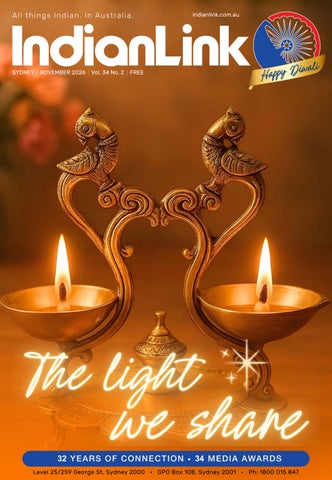
All things Indian. In Australia.
SYDNEY
NOVEMBER 2026
32
Vol. 34 No. 2
indianlink.com.au
FREE
34
Level 25/259 George St, Sydney 2000 • GPO Box 108, Sydney 2001 • Ph: 1800 015 847
2 NOVEMBER 2026
www.indianlink.com.au
NOVEMBER 2026 3
YOU NEED TO SEE IT SYDNEY Men’s International Aus V Eng Sunday, 29 November | SCG
Aus V NZ 4 – 8 January | SCG
Scan for tickets
4 NOVEMBER 2026
www.indianlink.com.au
EDITORIAL All things Indian. In Australia.
A brighter Australia, together
PUBLISHER Pawan Luthra EDITOR Rajni Anand Luthra CONTRIBUTORS Torrsha Sen, Lakshmi Ganapathy, Apoorva Tandon, Harsheni Maniarasan, Darshak Mehta, Harini Sridhar, Sruthi Sajeev, Ruhie Vaidya, Sandip Hor, Minal Khona
SALES AND MARKETING Charu Vij GRAPHIC DESIGN Shailesh Tinker Indian Link is a monthly newspaper published in English. No material, including advertisements designed by Indian Link, may be reproduced in part or in whole without the written consent of the editor. Opinions carried in Indian Link are those of the writers and not necessarily endorsed by Indian Link. All correspondence should be addressed to:
INDIAN LINK MEDIA GROUP Level 25 / 259 George St, Sydney 2000 GPO Box 108, Sydney 2001 Ph: 02 9279-2004 Email: info@indianlink.com.au
BY PAWAN LUTHRA
L
ook around our suburbs and workplaces, and it's clear that Diwali has come a long way in Australia. Once, celebrating Diwali at work meant bringing a box of mithai to work, and explaining why you were dressed for a wedding on a Tuesday. Today, we have corporate Diwali functions, landmarks lighting up, politicians sending greetings, and colleagues who know the difference between a samosa and a jalebi. Once, Australians asked what Diwali was. Today, they ask whether there's a dress code! And that tells us how much Australia has changed. When many of us first arrived, being Indian was something we often had to explain. Gradually, Australia has discovered that we bring more than curries, cricket and colourful festivals (although those are three excellent contributions). I was reminded of this recently when I interviewed Opposition Leader Angus Taylor. I expected to discuss the economy, migration and Australia's relationship with
India. What I didn't expect was to discover an Indian connection in his own family! A reminder that our connections sometimes run deeper than trade statistics and diplomatic statements. Sometimes, they're sitting right there in our family trees. Yet turn on the news or scroll through social media, and you might imagine our two communities are suspicious of one another. In our daily lives, we work together, build businesses together, and increasingly marry into each other's families. Of course, prejudice exists. But the loudest voices online don't necessarily represent the majority. Social media amplifies our differences. Real life reveals our connections. If social media accurately reflected Australia, some of us would have stopped speaking to one another years ago. Fortunately, real life has better manners! Indian-Australians contribute far more than jobs, skills and economic growth. We bring relationships, perspectives, cultural understanding and different ways of solving problems. And Australia has changed us, too. We haven't simply transplanted India here. We've created something new: an Indian-Australian identity, with its own humour, habits and contradictions. Our children might eat Vegemite at breakfast and achar at dinner, then carry that wonderfully mixed perspective into their working lives.
That's not a contradiction. It's an advantage. Australia's multicultural success isn't simply that we've learnt to tolerate differences. It's that we've started borrowing the best bits. We're no longer just living alongside one another. We're becoming part of one another's lives and futures. Which brings us back to Diwali. Diwali celebrates light overcoming darkness, knowledge overcoming ignorance and hope overcoming despair. Sometimes, the darkness between communities isn't intolerance. It's simply not knowing enough about one another. And the light needn't be a grand gesture. It can be a conversation, a friendship, a business partnership or an invitation to share a meal. So this Diwali, let's celebrate not just the traditions we've brought to Australia, but the future we're building together - one where heritage and home aren't competing loyalties, and diversity becomes a source of opportunity and understanding. Perhaps Diwali's promise in Australia isn't simply that we light up our homes and public buildings. It's that, little by little, we light up each other's worlds. May the year ahead bring happiness, health and prosperity to you and your families - and may our friendships grow brighter.
NOVEMBER 2026 5
CONTENTS SPECIAL FEATURES
08
14
18
23
INTERVIEW
“You won’t get racism from me.” Angus Taylor, Leader of the Opposition
08
OPINION
They’re bidding for our votes with our visas What should Indian-Australian voters do?
12
VIC VOTES
14
Image: Sujatha Hukkeri
The ‘orange wave’ is coming. Are the major parties moving fast enough to float?
KIDDIE DIWALI
Mandalas by little artists Our winners in the Diwali Kids’ Art Contest
18 COVER FEATURE
CUTTING CHAI
Neha Madhok Community organiser and co-founder of Democracy in Colour
23
10 OBJECTS, 10 DIWALIS Ten little windows into people's Diwali lives
16
On behalf of Cumberland City Council, I would like to wish you a Happy Diwali. May your Diwali be filled with light and laughter and bring joy, peace and good health to you and your family.
Proudly funded by
Clr Joseph Rahme Mayor Join us on Saturday 31 October from 5pm to 9pm and Sunday 1 November from 1pm to 8pm at Station Street, Wentworthville. For more info, visit: www.cumberland.nsw.gov.au/diwali Mayor Joseph Rahme Cumberland City Council 16 Memorial Avenue, PO Box 42, Merrylands NSW 2160 0418 603 783 mayor@cumberland.nsw.gov.au
6 NOVEMBER 2026
www.indianlink.com.au
Wishing you and your family a very
HAPPY DIWALI! Anthony Albanese
Richard Marles
Penny Wong
Jim Chalmers
Jason Clare
Prime Minister, Member for Grayndler
Deputy Prime Minister, Minister for Defence, Member for Corio
Minister for Foreign Affairs, Senator for South Australia
Treasurer, Member for Rankin
Minister for Education, Member for Blaxland
Tanya Plibersek
Murray Watt
Dr Anne Aly
Andrew Giles
Matt Thistlethwaite
Minister for Social Services, Member for Sydney
Minister for the Environment and Water, Senator for Queensland
Minister for Small Business, Minister for International Development, Minister for Multicultural Affairs, Member for Cowan
Minister for Skills and Training, Member for Scullin
Assistant Minister for Immigration, Assistant Minister for Foreign Affairs and Trade, Member for Kingsford Smith
Shayne Neumann
Rob Mitchell
Alison Byrnes
Dr Carina Garland
Jerome Laxale
Member for Blair
Member for McEwen
Member for Cunningham
Member for Chisholm
Member for Bennelong
Mary Doyle
Ash Ambihaipahar
Claire Clutterham
Gabriel Ng
Kara Cook
Member for Barton
Member for Sturt
Member for Menzies
Member for Bonner
Member for Aston
Sue Lines
Karen Grogan
Varun Ghosh
President of the Senate, Senator for Western Australia
Senator for South Australia
Senator for Western Australia
Authorised by P Erickson, ALP 5/9 Sydney Ave, Barton ACT 2600.
ADVERTISEMENT
NOVEMBER 2026 7
INTERVIEW
“You won't get racism from me.”
Federal Opposition Leader Angus Taylor talks to Pawan Luthra about his vision for Australia, his plans to slash migration, the Coalition's positioning against One Nation, concerns within the Indian-Australian community and why he believes Australia needs to rediscover its sense of aspiration Australia is facing a cost-of-living squeeze, a housing crisis and a heated debate about migration. Labor is under pressure, the Coalition is fighting to regain trust, and One Nation is challenging the established parties. You have taken over the leadership of the Liberal-National Coalition at a particularly challenging time. Angus Taylor, what would Australia look like under your leadership? My first and most important priorities would be to fix our economy and protect our way of life. I firmly believe our economy is not serving Australians as it should. Small businesses, in particular, are under enormous pressure. Small business has traditionally been one of the great pathways for Australians to get ahead, and we need to restore that. That means cutting taxes that are getting in the way of Australians succeeding, including income tax, capital gains tax, trust taxes and taxes on small businesses. We also need to cut government waste and red tape. We would repeal the taxes introduced in the May 2026 Budget, including those affecting capital gains, negative gearing, small businesses and trusts. We would go further by reducing income taxes and introducing a tax-back guarantee so Australians are not paying more simply because inflation pushes them into higher tax brackets. The second priority is affordable and reliable energy. Our energy system is not delivering that at present, and it is hurting manufacturing and industry. We also need to bring housing and immigration into alignment. Finally, we need to put Australia and Australians first, including properly defending our country against growing security threats.
You’ve just turned 60. What goals have you set yourself at this stage of your life? My goal has always been to do my bit to ensure Australia remains a strong country. I believe Australia is the greatest country on Earth. It has given more people the opportunity to realise their aspirations, work hard and get ahead than almost anywhere else.
That might not be how everyone feels at the moment. Is the message about Australia's opportunities getting lost? There is a sense of pessimism, and it is the job of leaders to restore optimism. I think most Australians still believe we live in the greatest country on Earth, but too many no longer feel that the opportunities are there for them. 8 NOVEMBER 2026
properly, migration can strengthen our country.
Do you believe integration and diversity go hand in hand? We need to ensure that people coming to Australia share our values: parliamentary democracy, the rule of law and our basic freedoms. People who do not believe in those things have plenty of other places to live. They do not need to come to Australia.
One of your proposals is social media screening of prospective migrants. How does that sit with Australia's traditional commitment to freedom of speech?
The key to Australia is the belief in a fair go: that if you work hard, aspire and strive, you should have a genuine chance of succeeding. A young Australian should be able to start a business, raise a family and buy a house. That was the aspiration I grew up with. Today, too many Australians are questioning whether they can achieve those things. We need to restore that hope.
alternatives. But I also worry that Australia is becoming too zero-sum, where one person can only succeed if somebody else loses. That is not what Australia is about. When a small business grows from one employee to 10 or 20, it benefits its employees, customers, community and the nation. That is how prosperity is created. We need more enterprise.
You studied game theory, including the work of John Nash, at Oxford. Is Australian politics becoming a Nash equilibrium, with Labor reacting to the Coalition, the Coalition reacting to One Nation, and voters left without a genuine alternative? How do you break that cycle?
I can hear the traditional Liberal values in that answer. But why is it that the Liberal Party and One Nation increasingly sound similar on some issues?
We are offering a genuine alternative. Our positions on taxation, energy, housing and defence are significantly different from Labor's. When I became leader, I felt it was important that Australians have a real choice. We resolve differences in this country through debate and by giving people
I don't think they are similar at all. I grew up in Cooma, in southern NSW, a town that welcomed many migrants after World War II. People who had been at war with each other came together and built shared lives in Australia. I grew up with these people. They were magnificent Australians. We need to recapture that spirit. I don't know what One Nation believes about migration. I know what I believe. If done
Freedom of speech and thought are fundamental Australian values. But seeking to undermine our democracy goes well beyond the exercise of free speech. If someone wants to come to Australia and does not believe in our system of law, they should not be here. I would point to the terrible Bondi Beach terror attack. One of the attackers was not an Australian citizen and was here on a visa. If someone believes that murdering Jewish Australians is acceptable, there are serious questions about why that person should be here. That is a reasonable position to take. My own family background is diverse. My uncle was Indian, through marriage, and my step-grandmother was Italian. I understood from a very young age that the diversity people like them brought to Australia was a wonderful thing. The issue is not race or religion. It is whether people accept the basic institutions and foundations of this country.
Does having an Australian passport make someone more Australian than a permanent resident who has lived here for decades? No. The point is that if someone has come to Australia or is here on a visa, it remains open to Australia to say that if they do not share our fundamental values, there are serious questions about whether they should be here. That should only happen where someone does not believe in our basic institutions, our system of law and our freedoms. It is not about other things. It is about the foundations of this great nation.
Let's turn to your migration policy. You want to bring net overseas migration down to 100,000 a year, while retaining permanent skilled migration at around 185,000. Where does the apparent 85,000 difference come from?
www.indianlink.com.au
Australia needs breathing space after migration numbers reached unprecedented levels. We have seen around 1.5 million people arrive over four years. That is beyond anything we have experienced before, and our housing, infrastructure and services have struggled to keep up. Australia has been successful as an immigration nation because we have historically managed migration at levels that the country could absorb. We have made sure we have the houses, infrastructure and services to accommodate people. We need to return to that approach. In the medium to longer term, we can accommodate significant permanent migration, particularly skilled migration, but we need to give housing construction and infrastructure time to catch up.
Communist Party is becoming more aggressive. Threats can take many forms today. Cyber threats are very real and are likely to intensify with artificial intelligence. We need to properly fund our Defence Force and ensure our military has the capability to deter bad behaviour internationally.
You previously worked with former NSW Premier Barry O'Farrell, who recently told Indian Link that political parties lose when they move too far to the right or left, and win when they occupy the centre. Is the Coalition losing touch with moderate Australians?
So where exactly will the reduction come from? There are two visa categories that we believe are not working properly. The first is bridging visas, where people move from one visa category to another. If someone wants to apply for a secondary visa, they should do so from overseas or their home country. The second is automatic temporary graduate visas. We want to disconnect education from the automatic allocation of visas. There will be many international students who should be offered skilled visas after completing their education, but that should happen because Australia needs their skills, not simply because they have studied here. Universities should be selling world-class education, not visas. The reduction would be implemented over approximately four years, primarily through changes to bridging and temporary graduate visa arrangements. It is a calibrated approach that will give housing supply time to catch up.
What is the breakdown of your skilled migration intake? How many construction workers, IT professionals, health professionals and other skilled workers would Australia actually bring in? It would be a mix. The important point is that people coming through those other visa categories contribute significantly less in terms of income and tax than someone arriving on a skilled visa. I am a very strong believer in skilled migration. When someone arrives in Australia with skills we need, they can immediately get into a job, contribute to the economy and help their family get ahead. They can also start businesses, employ people and make a significant contribution to the country. That is the model that has worked for Australia over a long period.
International education earns Australia billions of dollars annually. Wouldn't restricting post-study work opportunities risk undermining one of our biggest export industries? I think you have this wrong. We are not touching university student visas. We are talking about temporary graduate visas. Universities should be selling education. That is their product and service. If they provide world-class education, they will attract students to Australia. If someone graduates and has skills that Australia needs, we want them to be able to get a skilled visa.
That is a pathway we believe in. But it should be driven by the national interest and the skills Australia needs, not simply by the interests of a university.
But if you reduce the number of available workers, particularly in construction, health and other industries already experiencing shortages, could that push wages and inflation higher? I don't believe so. The important point is that we are skewing migration towards people who can make a bigger contribution, pay more tax and expand the supply side of the economy. If you expand the supply side of the economy more than demand, that puts downward pressure on inflation. Australia has seen far and away the highest levels of immigration over four years that we have ever experienced, and that has been associated with high inflation. The idea that bringing those numbers back closer to what we have experienced historically would necessarily be inflationary makes no sense.
I want to bring this back to the IndianAustralian community. Many people I speak to are increasingly disillusioned with Labor. But they also feel the Coalition is drifting dangerously close to One Nation, a party they regard as racist. They feel politically homeless. What’s gone wrong? I don't agree with that assessment. We would never, ever accept discriminatory immigration based on race or religion. We will make distinctions about whether someone accepts our democracy, our system of law and our basic freedoms. But not race or religion, ever. That is deeply embedded in my DNA. It is what I grew up with and what my family believed in. Australia has succeeded because, much of the time, we have got immigration right. But Australians will only continue to accept immigration if it is done well. If it is done badly, the public will reject it, and that is the worst possible outcome. We need to get the numbers right, the skills right and the standards right. We are also a party of small business and enterprise. Small businesses are under enormous pressure, and we need to fix that quickly by removing Labor's taxes and red tape.
If the Coalition needs One Nation's support to form government after the next election, would you do a deal with them? We are focused on one thing and one thing only, which is winning in our own right. I have said repeatedly that we will not form a coalition with One Nation. That is clear.
But the Indian community is also watching a toxic political battle over immigration, where racism is never far from the surface. What will you and your party do to counter that rhetoric and dog-whistling? You won't get racism from me. You won't find it in what I believe, and it is not what the Liberal and National parties believe in. This is a country that offers incredible opportunities to people from all parts of the world if they are prepared to accept our basic beliefs and values. It is not a high threshold, but it is an important one: our democracy, our system of law and our freedoms.
Let me remind you of Senator Jacinta Nampijinpa Price's comments about Labor importing Indian migrants specifically to secure their votes. Those remarks hurt the Indian community. She has not apologised to the community, yet you have promoted her to the frontbench. Do you believe she should apologise? I disagree with your suggestion that she has not dealt with the issue. She has dealt with that. But I want to make very clear that we are not a party that discriminates based on race or religion, and we won't under my leadership. It is not in my DNA, my background or my beliefs, and it never will be.
I have enormous respect for Barry. I think he was a great premier, perhaps for not long enough. I think the Liberal Party is absolutely in touch with its beliefs right now: lower taxes, lower energy costs, ensuring young Australians can get into a home and making sure our country is strong. I do think we have wandered away from some of those things in recent times. What matters now is getting back to our beliefs: small business, aspiration, hard work and rewarding people for hard work. I think those are the things that matter to hardworking Australians.
Let's look further ahead. What would Australia look like in 2046 under your leadership and vision? I don't think there is any bigger picture than people being able to live the lives they want to live. It is about freedom, but it extends beyond that. It is about a country where you can work hard, raise a family, buy a house, get ahead, start a business and build a career. And, importantly, knowing that your children and grandchildren can do the same. That is the Australia I believe in. It is the Australia I want back.
Finally, you recently met Prime Minister Narendra Modi. How did that meeting go? It was wonderful. He is a charismatic character, and we talked about many things. We discussed the progress India is making on a number of fronts, including energy and its digital payments system, which is incredible and something Australia could learn from. We also discussed the Indian diaspora here and the importance of the connections between our two great countries. There needs to be government-togovernment engagement and business-tobusiness connections, but people-to-people connections are equally important. He is a big believer in those connections, as am I. I think they are important for both our countries.
Angus Taylor, thank you for your time. Affordable energy is also high on your agenda. What changes would you bring? We would scrap net zero and remove the taxes embedded in our economy through policies that are not delivering results. We are spending tens of billions of dollars on programs such as green hydrogen that have failed to deliver. The safeguard mechanism, for example, has become a tax on manufacturing. Removing these costs would ease pressure on businesses, taxpayers and consumers.
You have spoken about Australia's security threats, particularly from China. Are you suggesting Australia is under attack?
Good to be with you. Thank you.
This interview has been edited for length and clarity.You can hear the full interview on The Pawan Luthra Podcast, or by scanning the QR code below
There is no question that the Chinese NOVEMBER 2026 9
10 NOVEMBER 2026
www.indianlink.com.au
NOVEMBER 2026 11
OPINION Behind every one of those numbers is somebody. Think of a young accountant from Pune who comes to study, waits tables on weekends, graduates, and lands a job at a firm that couldn’t find a local. Ten years on she’s a citizen, paying tax and coaching her daughter’s netball team. The auction sees a number to be brought down.
The Liberal question
They’re bidding for our votes with our visas
As Labor and the Liberals compete to out-Hanson Pauline on migration, what should Indian-Australian voters do? Someone has to be blamed BY DARSHAK MEHTA
P
auline Hanson told Parliament in 1996 that Asians were swamping the country. Thirty years on, One Nation is polling above a fifth of the vote, and Labor and the Liberals are falling over each other to out-Hanson her. Victoria votes on 28 November, NSW in March, and the federal election follows in May 2028. For IndianAustralians, a community approaching a million, that is a lot of ballot papers with one question attached: do we help keep the country we chose in one piece, or watch it come apart? Trouble is coming from two sides. One Nation has spent thirty years dividing Australians by race. Labor and the Liberals, meanwhile, are running an auction, each bidding to show it will cut migration harder than the other.
Australians are rattled, and rattled people look for someone to blame. Prices are up, rents are still rising, and if you don’t own a place you’ve seen no relief at all. The convenient culprit is the immigrant. We take the jobs. Or we’re on the dole, the weakest argument going, given that most temporary visa holders can’t claim most welfare. And we’re why the trains are full, the schools crowded and the hospital waiting lists long. None of that survives a look at who’s been running things. Governments of both colours spent years not building enough homes, hospitals or public transport. Pollsters running focus groups say voters bring up mortgages, rent, power bills and doctor waits, and immigration rarely comes up. Even among One Nation voters, apparently only 28 per cent call it their number one issue. Blaming us is easier than blaming the people in charge.
How the bidding is going
Labor, nervous about One Nation, has told most new international students they can’t bring family along, with exceptions for PhD students and those from ASEAN and Pacific countries. It wants net overseas migration down to 245,000 this financial year and 225,000 the next. Angus Taylor has promised an even deeper cut, reportedly to 100,000 in his first year, tied to housing. One Nation says its plan is about numbers, not race. Judge it by what it says and does. Hanson’s Press Club speech attacked multiculturalism itself, not just the intake. Its plan would cut the temporary migrant population by 750,000 over three years, international students first, which is the very pathway many of us took. And its 130,000 cap is softer than it sounds: one of its MPs said it sits alongside at least 100,000 more people on rotating work programs, a claim Hanson publicly disputed. If he’s right, that means fewer of us allowed to settle and more people brought in to work and sent home. To my mind, that is racism dressed up as arithmetic.
Some of us have always felt at home with the Liberals: small business, owning a home, looking after the family. Fair enough. But look at Farrer. The Liberals put One Nation ahead of an independent on their how-to-vote cards, One Nation won, and one analyst reckons those preferences decided it. The Victorian Liberals did the same in Nepean. Their leader, Jess Wilson, has ruled out an alliance with One Nation but hasn’t said where her preferences will go in November. In a preferential system your second and third choices count as much as your first, so a Liberal vote can end up helping One Nation along. That doesn’t make Liberal voters racist. It does mean you should ask every candidate where your preferences are going, and number every box yourself. Labor gets no free pass. It turns up at our festivals and temples, then tightens the screws on students and families. We don’t vote as a bloc and we shouldn’t. Ask all of its leaders for policy, not photo ops.
Speak up
Voting isn’t enough. Nobody respects a community that stays quiet, and the demonising won’t stop because we’re polite. We should be on talkback and in the letters pages, at candidate forums, in our MPs’ offices and on social media. Tell our story: the doctors, nurses, engineers, cab drivers, aged-care workers and shop owners who keep this place running. We’re the lawabiding guys and gals minding our own business while others try to make us the villains. This isn’t a fight just for the newly arrived. The people shouting about migrants don’t check whether you’ve been here three years or thirty. Nor should we do it alone: Chinese, Filipino, Vietnamese, Pacific Islander and other communities are in the same sights, and the Greeks, Italians and Lebanese were there before us. Start now. Before 28 November, find out who’s standing in your seat and where each party’s how-to-vote card sends its preferences. Ask the candidates, by email or at a street stall, where they stand on student and family visas. Tell your friends what they say, and tell Indian Link and your local paper. On the day, number every box yourself instead of following a card. We chose this country, and we’re not going anywhere. It’s time we said so, loud and proud.
Three parties, one migration bidding war 12 NOVEMBER 2026
www.indianlink.com.au
NOVEMBER 2026 13
Source: ECCV
VIC ELECTIONS
From L to R: ECCV Chairperson Silvia Renda, Parliamentary Secretary for Multicultural Affairs Iwan Walters, Victorian Greens spokesperson Anasina Gray-Barberio, Shadow Minister for Multicultural and Multifaith Affairs Evan Mulholland, ECCV CEO Farah Farouque, Guardian Vic political correspondent Benita Kolovos.
The ‘orange wave’ is coming.
Are we ready for it? In Victoria, One Nation’s ‘orange wave’ is not a distant possibility, but something coming in weeks. Are the major parties moving fast enough to float? BY LAKSHMI GANAPATHY
W
ith weeks till what Antony Green calls the most consequential state election in his lifetime, the haze is slowly clearing on voting intentions here in Victoria. The Victorian Electoral Commision expect 60 percent of voters to cast their ballots early, meaning the race to persuade could be shorter than expected. Roy Morgan’s latest findings say a result is still ‘too close to call’ – but what should be most concerning here is the cloud of orange impinging on the outer-suburbs of Melbourne, signalling One Nation’s growing appeal is no longer contained to ‘traditional rural strongholds’. In the outer north-western seats of Melton, Sunbury and St Albans, One Nation look poised to strike, having named these electorates on their ‘hit list’, and they’re sure to make some headway with Labor-weary mortgage holders desiring better infrastructure.
14 NOVEMBER 2026
At the Ethnic Communities’ Council of Victoria ECCV’s Election Forum in October, the looming orange wave was the elephant in the room, multicultural leaders unsettled by the divisive rhetoric it was already enabling. The speakers for the evening, Parliamentary Secretary for Multicultural Affairs Iwan Walters, Shadow Minister for Multicultural and Multifaith Affairs Evan Mulholland, and Victorian Greens spokesperson Anasina Gray-Barberio, seemed equally perturbed. As three committed multiculturalists, they were all able to speak cogently to the priorities raised on the night, including intercultural connection, rising hate, the fate of Multicultural Victoria, supporting ageing migrant populations, and investing in growth corridors. Many such concerns are mentioned within the ECCV’s Election Platform, but all three speakers remained tight-lipped on directly endorsing these recommendations. Labor’s Iwan Walters approached the discussion with the party’s trademark, pluralistic brand of multiculturalism, pointing to tightened anti-hate laws and $750m of investment in festivals and
infrastructure projects over their tenure. “We don’t just tolerate diversity, we embrace it, and we back it with action and investment,” he said in his opening remarks. “But multiculturalism isn’t something you win once and keep. You have to defend it.” Representing the Greens, Anasina Gray-Barberio’s lens was informed by anti-colonial, social justice frameworks, hitting out at wealth inequality and conditional ‘good migrant, bad migrant’ multiculturalism. “We’re tired of being welcomed into our home,” she asserted. “We are more than just our food and our festivals.” Finally, as the grandson of Italian migrants who has invested hours in on-theground engagement, Liberal representative Evan Mulholland espoused conservative, hegemonic multiculturalism, citing the diverse candidates standing for the party and the need to invest in growing suburbs. “You can’t be what you can’t see…it’s about making sure culture is passed on,” he told the room. When it came to the issue of One Nation, however, jaws collectively clenched. All three acknowledged underlying
economic stress had led to voter alienation and strained social cohesion. “I partially blame it on the lack of service delivery, healthcare and infrastructure… We’ve seen consistently governments fail to deliver the infrastructure in growth communities,” said Evan Mulholland, when asked about tackling the rise in racism. “Multicultural communities have signed up for the Australian way of life, and communities in Donnybrook and Tarneit deserve the same level of infrastructure as Box Hill.” Anasina Gray-Barberio went further, highlighting the exploitation of this economic pain in the form of vilification and scapegoating. “This is rhetoric [One Nation] have been using for 30 years…we need to stop using our multicultural communities as political footballs,” she said. “It’s being emboldened everywhere…We can’t just be shrugging our shoulders and sending out media releases – we need to be out there fighting the rise of the far-right.” But it was Iwan Walters who articulated best the immediacy of One Nation’s threat. “The populist rhetoric clearly has a resonance with people beyond those who are ‘hardcore’…that means it needs to be challenged and confronted by everyone,” he noted. “We’re talking about 46 days to an election, where there’ll be a point in time where there could be One Nation members elected. That would inevitably, profoundly reshape the nature of discourse and the direction of policy.” With polling showing support divided, and a minority government looking increasingly possible, any preference or power-sharing deals done between minor and major parties will have critical consequences. But the Liberals have been reticent to clarify what their how-to-vote cards will look like. Jess Wilson hasn’t moved beyond her script when asked to rule out a deal with One Nation – “The only deal is between the Victorian Liberals and the Nationals, and we are running to form majority government.” Certainly, it’s not in their interests to alienate a party who may end up having the balance of power, but voters deserve a clear answer. Likewise, there needs to be greater consideration of the aftermath of this election, once One Nation’s ideology gains further legitimacy in the form of seats. How will each party reinspire jaded two-party voters who have turned to One Nation? Can they address the economic conditions they have identified as feeding into One Nation’s popularity? Where do they stand on implementing key multicultural strategies, such as the AHRC’s National Anti-Racism Framework? To this extent, both parties cannot continue to view One Nation as a hurdle to be crossed in the distant future. If the Farrer and Secret Harbour by-elections are anything to go by, major political change is already happening, and we can’t afford to consign Victoria to the fate of orange petri dish. Multicultural communities are already grappling with the harm caused by One Nation’s rhetoric, and attacks on social cohesion will only deepen once seats are inevitably won at the state election. The opportunity instead, is to meet it head on, and protect multiculturalism from the further erosion it is set to experience. The orange wave is coming, but it’s up to us whether we start swimming.
www.indianlink.com.au
NOVEMBER 2026 15
DIWALI
CHILDHOOD DIWALI
SENSORY DIWALI
Recipe Book
Fragrance
Harsheni Maniarasan
Nidhi Sampat
E
T
very Diwali, my Malaysia-based pathi brings out a threadbare blue notebook containing generations of family recipes. Its yellowed pages, filled with handwritten instructions, hold everything from peanut and suji cookies to murukkus and flowershaped aachi murukkus. For my cousins and me, spotting that notebook on the table was like winning the lottery. Delicious treats were coming, and portion control was going out the window! The notebook predates my birth. As children, we watched my amma and periamma carefully follow its recipes. Eventually, we donned our own aprons, learning to recreate Pathi's signature treats. Today, those pages hold more than recipes. They're filled with memories of baking together, sharing jokes and enjoying the warmth of family. Even now, I can picture myself on the swing at home, a plate of sunflower-shaped pineapple jam tarts beside me, savouring the flavours of Diwalis past.
SPIRITUAL DIWALI
hirteen years in Australia, and every Diwali I still miss home. Not just the people, but the feeling. The light, the warmth, the familiar scents of a house preparing for celebration. For years, I searched for that feeling here. Eventually, I began recreating it. Mitti & Myrtle is an Australian scent studio I built around two landscapes - one inherited, one inhabited. The scent ‘Deodar Myrtle’ holds both. Deodar is the inherited: sacred Himalayan cedarwood and black pepper, warm and grounding, the scent of family and memory. Myrtle is the inhabited: anise myrtle, lemon myrtle and buddha wood from the Australian bush we now call home. It’s my favourite fragrance. To me, this essential oil diffuser represents two homes coming together, rather than choosing between them. This Diwali week, as the fragrance filled my Australian home before my guests arrived, it brought back that ghar wali feeling. Home isn't always somewhere we return to. Sometimes, it's something we create.
INHERITED DIWALI
Homemade Prayer Book
Puja Platter
Rajni Anand Luthra
Aparna Dave
W
hen my Australia-born children were little, they would sit bewildered through our annual Diwali puja (worship), listening to Sanskrit prayers they couldn't understand. I wanted them to participate, not merely observe. So I made a prayerbook explaining the rituals, the significance of Lakshmi and Ganesha, and the meaning of the prayers we recited. It included the Gayatri Mantra, Ganesh Shloka, Lakshmi Gayatri Mantra and my favourite, the beautiful Shanti Paath. Each Diwali, I would recite the Sanskrit verses while the children took turns reading the English translations. Suddenly, the ritual became accessible, meaningful and, I hoped, spiritually resonant. That tradition continues to this day. Both now young adults, they join our Diwali puja virtually from wherever in the world they happen to be, reading their parts. I'd like to think they've discovered what I hoped to share: the simplicity and universality of prayers seeking enlightenment, wisdom and peace.
M
y favourite Diwali object is my puja thali, a family heirloom passed down by my mother in Mumbai. Made of kaansa, a traditional Indian bell metal, it holds the deities and lamps for our worship rituals. On it sit silver ornaments, earthen diyas and idols of Lakshmi, Ganesha, Krishna, Nandi and Saraswati. Each is precious, not just for its spiritual significance, but because the idols were passed down by my mother-in-law, who passed away recently. In the days before Diwali, I polish the thali and ornaments, decorating them with fresh flowers and leaves from my garden. Each evening, I light the lamps and offer prasad - fruit, sheera (halwa) or other sweets. On Diwali night, the lamps move to our doorways to welcome auspiciousness into our home. After the festivities, the thali and ornaments are cleaned, wrapped in tissue, and stored in airtight containers until next year.
NEXT GEN DIWALI
Giving, Reimagined
G
Manan Luthra
rowing up, Diwali meant new clothes, endless mithai and the excitement of family gatherings. I still love it all, but as I've grown older, I've started thinking differently about what it means to celebrate. Diwali is about bringing light into people's lives. So I decided to make that idea a little more practical. Now around Diwali, I book an appointment to donate blood, plasma or platelets to the Red Cross Lifeblood. I've encouraged my friends to join me too. We follow it up with a meal together, so it has become our own little Diwali tradition. I've also found other ways to give back, from volunteering with an organisation I care about to reaching out to someone spending Diwali alone. I haven't given up the diyas, the sweets or the celebrations. I've simply added another ritual. For me, that's what Diwali looks like: keeping the traditions, but finding new ways to share the light.
16 NOVEMBER 2026
www.indianlink.com.au
Some are treasured heirlooms, others everyday objects that take on special meaning once a year. From prayer plates and recipe books to playing cards and blood donations, ten readers share the objects that define their Diwali celebrations – and the memories, traditions and personal stories they hold. ARTFUL DIWALI
MINDFUL DIWALI
Rangoli Powder Box
Clay Diyas
Sujatha Hukkeri
Torrsha Sen
A
E
s a child, I made rangolis with powders my mother kept in a compartmentalised craft box. I learnt by watching her and our neighbours, practising designs in my notebook. I still cherish my childhood memories of waking up early, cleaning the front yard, sprinkling water and creating beautiful Rangoli patterns with my mother. Rangoli is more than decoration. It symbolises prosperity, positivity, happiness and welcoming Goddess Lakshmi into our homes. Moving to Australia, my powders lived in their packets in old biscuit tins, then graduated to plastic containers and glass jars. Today, I use squeeze bottles, perfect for creating fine lines and intricate patterns. My patterns have grown more intricate and colourful. As I’ve grown older, I’ve realised that rangoli is a beautiful connection to our culture, family and roots. Its designs may eventually disappear, but the happiness, memories and traditions remain forever. Some traditions are meant to be lived, cherished and passed on.
SOCIAL DIWALI
very year after Diwali, my mother washed our clay diyas, dried them in the sun and packed them away in an old shoebox. As a child, I thought it was thrift. Now I think it was wisdom. My first Diwalis away from home came from the shopping centre: plastic lanterns, batteryoperated fairy lights, mithai in boxes inside more boxes. The morning after, the recycling bin overflowed and the celebrations felt oddly hollow. Now, older and wiser, I’ve gone back to the shoebox and practically everything sustainable. My diyas are terracotta and a little chipped. Each evening for Choti and Badi Diwali I refill them with oil and cotton wicks I roll myself. Sweets go to the neighbours in paper boxes. Gifts are put in recycled brown paper to be handed out. None of it feels like a sacrifice. It feels closer to the festival I grew up with, when nothing was made to be thrown away.
RADIANT DIWALI
Pack of Cards
Mum’s Saree
Monty Sachdeva
Ekta Sharma
D
iwali is the one time of year when a weeknight is no excuse to stay home. Work tomorrow? School lunches to pack? Too bad. There's a Diwali party to attend! In my family, Diwali means friends, food, laughter and, inevitably, taash. The playing cards come out, the stakes are mostly symbolic, and everyone suddenly becomes a fiercely competitive card player. There's always someone explaining the rules, someone accusing someone else of cheating, and someone who's far more interested in the snacks than the game. The food keeps coming, the music gets louder, and the evening stretches well beyond anyone's sensible bedtime. Over the years, our Diwali gatherings have become a tradition of their own. Friends have become family, children have grown up together, and the same old jokes somehow remain funny. My pack of cards may be ordinary, but the memories it deals out every Diwali are anything but.
E
very Lakshmi puja, one of my fondest possessions makes its annual appearance: the orange Rajasthani lehariya saree that my mum gifted me 12 years ago. It had been hers before it became mine, and there's something special about wrapping myself in a garment that once belonged to her. Its fiery orange and red hues seem to capture Diwali itself - the glow of diyas, the warmth of family and the joy of celebration. There's a funny story behind it, too. I brought it to Australia completely unaware that I had neither a blouse nor an underskirt to go with it! It took another trip to India, months later, to complete the outfit, and that's where I finally wore it for the first time. Today, it drapes beautifully, its colours as radiant as ever. Look at me in the photo – you can tell I feel like a million bucks, wrapped in Mum’s love.
WORKING DIWALI
Sweetmaker’s Tools
E
Helly Raichura
very Diwali, while everyone else is getting dressed up and preparing to celebrate, I'm in the kitchen at my restaurant Enter Via Laundry, surrounded by trays of mithai. And I wouldn't have it any other way. My favourite Diwali object is my mithai mould. It's a small, unremarkable thing, but in my hands, it transforms a simple mixture of milk, sugar and nuts into something beautiful. In a fine-dining restaurant, presentation is everything. But there's something especially satisfying about making traditional Indian sweets. Each piece carries memories of home, family gatherings and childhood Diwalis. The days leading up to Diwali are among our busiest. There's barely time to sit down, let alone celebrate. Yet I love knowing that something we've made will find its way onto someone's festive table. For me, Diwali isn't just about the sweets we share with our own families. It's about the joy of helping other families celebrate theirs.
NOVEMBER 2026 17
KIDS’ DIWALI
JIYA MERAI (POINT COOK, VIC)
SRESHTA MEDURU (PARRAMATTA NSW)
Feathers and flowers
Peacocks, gardens and plenty of imagination! Meet the young winners of Indian Link's Diwali Kids Art Contest 2026 on colouring more evenly this time. Her favourite part was the middle, “as it looked beautiful.” For Jiya, Diwali means light, colours and sweets, best captured in red, orange and yellow. Her next Diwali artwork, she claims, will show families celebrating together with diyas, rangoli, lanterns and sweets. The win comes as a big surprise to the Merai family, and the celebrations will wait for Diwali itself. No doubt it will be a special Diwali– seeing little Jiya’s designs on Indian Link’s official Diwali card for 2026. And yes, Jiya's entering again next year!
BY TORRSHA SEN
E
very spring, the Indian Link Diwali Art Contest turns our newsroom into a gallery of colour, each mandala a reminder that the Festival of Lights is best seen through young eyes. This year's mandala was bigger and more intricate than before, and our young artists rose to the challenge. Standing out for their colour sense, patience and Diwali spirit were Year 7 student Sreshta Meduru of Parramatta High School NSW, winner in the 8–12 years category, and Jiya Merai from Point Cook VIC, who takes out the 7-years-and-under category for the second year in a row.
A garden of greens
Sreshta Meduru is no stranger to these pages. A finalist in last year's contest, this year she has gone all the way. “This looks very detailed, but it would look so beautiful once it is coloured!” she remembers thinking when she first saw the design. Unsure where to begin, she tested colour combinations on a separate sheet of paper. One colour was non-negotiable. “I particularly wanted to include green because it is such a vivid and vibrant colour,” she tells Indian Link. Layering its many shades became her favourite part, giving her winning piece a lush, living quality. Beyond that, she let instinct lead, choosing colours as she went and trying not to overthink it. The news of her win came with a twist. Her mum first told her she had made the Top 10. “I thought, 'Oh, okay!'” Sreshta laughs. Then came the reveal: Mum was joking, Sreshta
The runners-up
had won the competition. The budding artist’s love of colours began at about seven, and art classes, which she started last year, have sharpened her technique. Since then she has been recognised in some 30 colouring and design competitions across Australia, including as a State Winner in the ABC News in Your Neighbourhood Art Competition and the 2025 Royal Life Saving Colouring Competition, and a State Finalist in the OzHarvest Food Waste Design Competition. Closer to home, her story about a special object was selected for Powerhouse Parramatta's Guardians of the Dark competition, and will be exhibited for three years. “I want my art to reflect my own personality rather than copy anyone else's style,” says Sreshta, who dreams of one day exhibiting at the Louvre, no less. “For me, Diwali means love, happiness and
togetherness - and its colours are yellow and orange for the glow of diyas, and purple for joy.”
Khushaal Agarwal of Craigieburn VIC, and Razel Puri of Point Cook VIC, took the runner-up awards in the 8–12 years and 7-years-and-under categories respectively. Khushal was last year's winner in the older kids’ category.
Twice as bright
A festival of light and colour
Last year, a five-year-old Jiya Merai charmed us with a neat mandala in pink, purple and green. This year, the Year 1 student at Melbourne’s Featherbrook P-9 College has done it again. Did last year's win give her confidence? “Yes!” comes the instant reply. Still, she wasn't counting on a repeat. “This year, I thought just to participate, and did not expect to win again," she says. The bigger design meant room for more colours, and inspiration came from a family visit to a temple where she saw peacocks. “I really wanted to use peacock feather colours,” she says. The result is carefully planned: reds, yellows and oranges glowing at the centre, ringed by blue, gold and purple, much like the eye of a peacock feather. She also worked
The Indian Link Diwali Art Contest has become a much-loved tradition, and this year proved that young artists keep coming back, growing bolder and more skilful each time. Both of last year’s winners are back among this year’s prize-winners, and one of last year’s finalists now tops her category, a sign of how much these young artists put into every stroke. The last word goes to our winners. “May this festival of lights fill your homes with happiness, your hearts with love and your lives with peace and prosperity,” says Sreshta. Jiya keeps it simple: “Happy Diwali! Enjoy this festival with friends and family.” We congratulate all participants for bringing the Festival of Light to life, one colour at a time.
Solution to Sudoku The Playground Pg 36
18 NOVEMBER 2026
www.indianlink.com.au
NOVEMBER 2026 19
7 YEARS & UNDER
KAMAKSHI PRAKASH
AADHYA ILAVENIL
KIARA AGGARWAL AATISH JAIN
WINNER JIYA MERAI
RITIKA TAKLE DIA KUMARARAJA
RUNNER-UP RAZEL PURI 20 NOVEMBER 2026
DIYA KUMARAPPAN RUDHRA VARUN www.indianlink.com.au
8-12 YEARS
AARAV JAIN MANASVI SHARAD
WINNER SRESHTA MEDURU
DARSHJOT SINGH
OROBA AL KHAMAS
REYANSH SHAH KEERTHANA MAROJU
RUNNER-UP KHUSHAL AGGARWAL
What a riot of colour!
YUWON GUPTA MAAHI MENDA
Our annual Diwali Art Contest has once again brought out the imagination, creativity and artistic flair of our youngest readers. A huge round of applause for every little artist who picked up their colours and gave us something to smile about! Top honours go to Sreshta Meduru of Parramatta NSW (8–12 years) and Jiya Merai of Point Cook VIC (7 years & under), who each win a $75 book voucher. Hot on their heels are runners-up Khushal Aggarwal of Craigieburn VIC (8–12 years) and Razel Puri of Point Cook VIC (7 years & under), each receiving a $50 book voucher. Look out for our annual Diwali card, featuring Jiya’s winning artwork! To all our young participants: keep colouring outside the lines, dreaming big and making the world a little brighter. NOVEMBER 2026 21
Happy Diwali!
DIASPORA elections, exams or infrastructure affect him as much as his neighbours. They also note that diaspora money and investment are welcomed because of emotional ties to India. It is difficult, they say, to ask people to stay invested while discouraging them from raising concerns. Peaceful participation, in this view, is a sign of engagement, not hostility.
The case for restraint
The vote goes with the passport. Does the voice too?
Actor Imran Khan's detention in the Mumbai CJP protest puts a spotlight on what OCI holders can, and cannot, say. BY TORRSHA SEN
W
hen Imran Khan joined a CJP protest at Mumbai's August Kranti Maidan on 10 October, he was one face in a crowd demanding the resignation of India's Chief Election Commissioner Gyanesh Kumar. He was also among those detained by Mumbai police. The actor had earlier backed the CJP’s student protests over the NEET paper leak, and his presence on the ground drew cameras. It also drew attention to his passport. Khan was born in Madison, Wisconsin, and is a US citizen. He has lived in India for most of his life and built his career in Mumbai. But by law, he is a foreigner. His detention has revived a question many in the diaspora carry quietly: when you give up Indian citizenship, what exactly do you give up?
The bargain
Indian-born Australians number roughly 916,300 by official estimates, making them one of the country’s largest migrant communities. Many send money home, own property in India and invest in Indian businesses. India receives well over $125 billion in remittances a year, more than any other country. Because India does not allow dual citizenship, Indians who become Australian 22 NOVEMBER 2026
No Bollywood script: The arrest of Indian actor Imran Khan
give up their Indian passports, usually taking an Overseas Citizen of India card in their place. The card offers a lifelong visa and many economic rights, but no vote and no public office. Since 2021, holders have also needed permission for activities such as journalism, missionary work, research and more. For most, this is a considered trade: security, mobility and a better quality of life in exchange for a formal say in India. Few dispute that the vote goes with the passport. The harder question is whether the voice goes too.
Where the line is drawn The Indian Constitution itself makes
a distinction. The freedoms of speech and peaceful assembly in Article 19 are guaranteed to citizens. The right to life and personal liberty in Article 21 extends to every person in India. Foreign nationals, including OCI holders, therefore take part in protests under the terms of their visa or card rather than as a constitutional right, and those terms can be enforced.
The case for voice
Those who favour more room for noncitizens argue that speaking up about the country you live in, or are deeply tied to, is part of belonging rather than a privilege of paperwork. Someone like Khan lives, works and pays taxes in Mumbai. Decisions about
Others see a clear logic in the current position. Giving up citizenship is a choice, and with it comes the status of a guest, however welcome. Most countries, Australia included, expect visa holders to respect their conditions and reserve a full political role for citizens. There is also the question of foreign influence. Australia passed foreign interference laws in 2018 out of concern that diaspora communities could be used to advance other governments’ agendas, and India has similar concerns about activism directed from abroad. From this view, limits on non-citizen political activity protect the integrity of domestic debate rather than suppress it. India applied this principle in 2019, when foreign nationals who joined protests against the Citizenship Amendment Act were asked to leave. Supporters of restraint also point out that OCI holders are not silenced. They can write, speak publicly and comment online. What is limited is organised political activity on Indian soil.
How social media changed participation
For Indian-Australians, the question is no longer mainly about who turns up at a maidan. A generation ago, engagement ran through community associations in Parramatta and Melbourne’s west, consulate events and the community press. Today a protest in Delhi or Mumbai can be watched live in Harris Park, shared within minutes and debated in the comments. The farmers’ protests of 2020–21 showed how far this reaches, bringing rallies and car convoys to Australian cities. The CJP agitation followed a similar pattern, and Khan’s own move from posts to physical presence shows how thin the line between commentary and participation has become. That reach brings both opportunity and scrutiny. Social media gives the diaspora a voice that formal channels do not, but online activity is also visible to authorities, and some commentators abroad have reported losing their OCI status. Misinformation, meanwhile, travels as quickly as solidarity.
Finding the line
Neither side argues in bad faith. One sees voice as part of belonging; the other sees limits as a fair consequence of a choice freely made. Suggestions for a middle ground include clearer published guidelines on what OCI holders may do, a distinction between peaceful expression and organised political campaigning, and formal channels for diaspora concerns to reach government. For Indian-Australians weighing a passport decision, the practical point is that an OCI card is a visa, not a vote, and the rules around it can change. Whether it should also carry a voice is a question India will keep returning to, as cases like Imran Khan’s show.
www.indianlink.com.au
with Lakshmi Ganapathy NEHA MADHOK is a community organiser and co-founder of Democracy in Colour, an organisation working to dismantle systemic racism and build the leadership of people of colour in movements for justice. We’ve seen a rise in threats towards politicians, including the Helen Haines incident. How did we get here? The pathway to where we are now - acts of violence towards politicians - has been brewing for a few years. In Australia, we have primarily had peaceful political action, and that’s the envy of the world. What has changed is the way political extremism is being expressed. You can trace it back to 2016 when the algorithm came in. At the same time, there was an offline movement as well. For the first time in our lives, Nazis were publicly and openly organising in Europe and North America, a British MP was shot, and then there was the election of Trump. Those things together have led us to this point and have been growing for the last decade. People are, understandably, also really upset, experiencing inequality we haven't seen in our lifetime. I'm a millennial – our entire life, we were promised if you just work hard, you'll get what our parents had. That's not how it works. We try to do things the way our parents did, and we don’t get the same results. I completely understand, then, why young people are revolting all around the world. Why wouldn't you? So we have this huge existential crisis across the West where people are going, I don't know what my future looks like. At the same time, you've got these algorithms, people spending more time on their own and on screens, and they're getting riled up. Of course that combination is going to lead to violence; that doesn't excuse the horrible thing that happened, but it explains how we got here.
Why are people so frustrated with politics and how do we fix that? Since the Rudd-Gillard era, we’ve seen what political commentators are calling ‘managed decline’; if you look at the primary vote for Labor and the Liberal Party, it's basically a downward cliff. Simultaneously, around the world we're starting to see the minor party votes increase. More so we've been seeing it on the right, but slowly we’re starting to see it with say, the Greens. The real reason behind this is people feel both the major parties have not done enough to deal with the problems at hand. There are many diagnoses for this, but the way I look at it is, both parties have operated on three-year election cycles, and they've just been trying to win the next election rather than the long-term
leadership we saw from prime ministers in the ‘80s and the ‘90s. During the native title debate, instead of just copping it from the community, Paul Keating was happy to lead. He was saying, this is the right thing to do, this is why I'm doing it. He went on to talkback radio - which back in the ‘80s, was where you went to have a political conversation - and he spoke to voters and he let them yell at him. Can you imagine Anthony Albanese or Angus Taylor doing that? We are no longer seeing leadership from our governments. We're seeing governments who are happy to follow. They want advocates, people in the community to go do the work of building a majority behind an issue, and then they're happy to tick box and say yes. Otherwise, they're happy to do what people call ‘tinkering around the edges’…the government will announce, we're doing XYZ - I often see the state government announcing ‘300 new homes that are social housing’ – and you go, yes, but I know that in the community, the need is somewhere closer to 3,000 or 300,000. That is where people are getting frustrated because the solutions they come up with are relatively small, for a small group of people, when the solutions need to be large scale, systemic, nationwide.
You've said it's important to 'get curious' about why voters are drawn to
parties like One Nation. What’s that look like in practice? The first thing you want to do is get offline and actually talk to people that you know. The chances of changing someone's mind through a comment debate online is very low, because the people commenting are either already very rusted on or they're bots. People don't do talkback radio or read the news anymore but still need to get their information from somewhere and make their decisions. Increasingly, we're seeing people doing that based on people they know. Particularly those drawn to the far right (we're seeing this in all the research that's coming out) trust people they know. That gives all of us an amazing opportunity to change hearts and minds immediately - we all know people, we all have family, friends, colleagues. Have these conversations face to face or on the phone - you want to be able to get tone and body language. Most importantly, it has to be a conversation between two people who want to find shared understanding. That comes from when you actually care about the other person. The reason our political debate has become like this is because we're not looking each other in the eye and saying these things. It's easy to say they're horrible and deserve awful things when you're not looking at a fellow human being and trying to find understanding with them.
What’s something you’re currently listening to/reading/ playing/watching? I’m currently reading Desi Girl by Sarah Malik; picked it up from the library last weekend. It’s the story of a working-class girl from Western Sydney who had the exact same life experience as me, but Muslim - she went to a public school, got into UTS, did a communications degree. [It’s about] the experience of racism and being South Asian in Australia.
What’s a word that you like in a South Asian language, and what does it mean? I’m going with a simple one because I’m hungry – roti. It can mean literally roti, it can mean a meal, it can mean everything. It’s how your parents show you love, by making you round rotis by hand.
And finally: Soan Papdi or Papdi Chaat? Papdi Chaat. I don’t like NOVEMBER 2026 23 crumbly [food].
BOOKS
Different is not something to hide Neha Jain’s debut children’s book is a joyful, rhythmic and lyrical proclamation of identity that can be embraced by kids and parents alike
BY SRUTHI SAJEEV “My roots run deep – my worlds are two. Both feel like home, and both feel true.”
N
eha Jain’s children’s book Standing Proud: A Laddoo & Lamington Story, teaches Indian-Australian children how to fully embrace their dual cultural backgrounds. Infused with warmth and positivity, this lyrical story asks readers to be proud of what makes them different and to find joy in their uniqueness. “The core message at the heart of this book is that your culture does not define you,” Neha tells Indian Link. “Who you are in essence defines you. Even if you have a dual background, you don’t necessarily have to assimilate or pick one culture over the other.” Each sentence of this book reads like an affirmation through which the unnamed character embraces the foods, music and stories of India and Australia. In this young girl’s household, it’s typical to see laddoos and lamingtons side by side on the dining table, to celebrate both Christmas and Diwali, and to pair jhumkas with a t-shirt. For Neha, it was important that she accurately represented this hybridisation of
24 JANUARY NOVEMBER 2024 2026
cultures which is characteristic of so many Indian households, including her own. “I find, as a parent, that my Indian culture is something I really have to make the time and effort to incorporate into my life…and I really wanted my children to grow up with access to both cultures,” she says. A firm believer in the idea that “you can’t be what you can’t see,” Neha, as a young parent, had scoured bookstores for a children’s story that authentically reflected her child’s experience as a second-generation immigrant. “Sandhya Parappukkaran’s book The Boy Who Tried to Shrink His Name was really beautiful and I loved it,” she reveals. “But it was hard to find similar books which showed children how their cultural background can enrich their lives.” Wanting to capture her daughter’s experience as an Indian growing up in Australia, she decided to write her own children’s book. “My daughter played a big role in the book’s formation,” Neha reveals. “She would point out what she liked and what she didn’t like. In the end, her reaction to the book was ‘this is me. I know what you are talking about’.” Central to bringing this story to life are the lively illustrations by Elise Gow. Based in Victoria, the illustrator was one of the few who was able to craft a character which, in line with Neha’s vision, was obviously and unapologetically Indian-Australian.
Motivated by her experiences as a primary school teacher, Neha firmly believes in the relationship between good representation and the development of a positive sense of self. “How children learn to navigate their differences shapes the way they see themselves and their place in the world as adults. The first eight years are particularly important in developing a healthy sense of self, as this is a period of rapid brain development when crucial neural connections are formed,” she says. At the same time, she hopes the book will be empowering to parents - especially those who grew up in Australia and did not have access to accurate representations of their culture. “I think a lot of parents will heal from this book, and it is important that they do. If they don’t address the shame and insecurity they might have felt as a young child about their culture, there’s a risk they could pass it onto their children,” she explains. Having recently earned Miles Franklin Awardwinning novelist Shankari Chandran’s stamp of approval (she’s even asked for four copies, one for each of her children), this joyful labour of love has the potential to become a staple of Australian classrooms. Standing Proud may seem like a simple story, but its message to children is profound: embrace what makes you different, take pride in who you are, and remember, “I don’t have to shrink. I don’t have to hide. Everything I am shines bright from inside.”
www.indianlink.com.au SYDNEY EDITION
CULTURE CRUSH
The BUZZ What we’re obsessed with this month By SRUTHI SAJEEV
Books
Hanif Kureishi’s dazzling follow-up to his first memoir Shattered reflects on his journey to adapting to a “new normal,” after a horrific injury that left him paralysed. Utterly dependent on his loved ones, Kureishi wrestles with his own fears, his ego and the new dynamics which emerge within his family as a result. Brutally honest, yet lightened by his characteristic humour, what shines through this autobiography is his unbelievable resilience as he refuses to let go of the one thing which gives him agency: writing.
Beats
W.i.S.H is the Indian girl group we wish we had growing up. Modelled off the K-Pop formula, the group boasts high intensity dance breaks and catchy tunes which could rival that of KATSEYE. Their recent releases “Doori” and “Kasoor” may follow the mainstream pop formula beat by beat, but each member adds their own twist. Both songs exude girl power through playful lyrics and powerful vocals. Influenced by the West, yet firmly rooted in their culture, it’s clear the group is carving out a niche for themselves that could see them become an international sensation.
Binge
Already with its fair share of sceptics and fans, Nitesh Tiwari’s imagining of the Ramayana is going to be the most talked about film of November, regardless of whether it’s a hit or flop. With a star-studded cast, music from legends A.R. Rahman and Hans Zimmer, VFX by DNEG (Blade Runner, Dune, Spider-Man) and a whopping Rs 2000 crore budget (just for Part 1), the film has already broken records on multiple fronts. If the values of this epic are brought to life as beautifully as the flying elephants seen in the trailer, then it might just make history.
Bites
Add spice to your Diwali sweet spread with Master Chef winner Justin Narayan’s barfi-spiced caramel slice. The twist in this dish lies in the indulgent caramel layer where vanilla, cardamom and nutmeg are added to a mixture made of condensed milk, butter and sugar. This is then stirred on the stove until it turns into a golden-brown colour and added to a shortbread base. Add a layer of chocolate, let it chill in the fridge, serve and then witness your unwitting guests try and put a finger on why the dish tastes so familiar. NOVEMBER 2026 25
26 NOVEMBER 2026
www.indianlink.com.au
ACCOLADES
Unapologetically Bengali Fresh from winning the Bill Granger Trailblazer Award, Kolkata Social's Ahana Dutt on putting West Bengal on Sydney's plate to make a very good khasta kochuri dough. It takes as much skill as rough puff pastry. Same with shondesh or roshogolla. The chhena has to be the perfect consistency, and all of it is instinctive.” Ahana wants Indian food seen as more than cheap takeaway, but won’t look down on the restaurants that built that image. “That would take away from the people who came before me, when times were much harder,” she says. “They had no option but to put butter chicken and naan on the menu, because that’s what sold. As a brown person in a different country, you had to give in, for your safety more than anything. For me to do this, as hard as it still is, is a big privilege.” Firedoor also introduced her to native ingredients. Davidson plum often stands in for tamarind, and desert lime and native pepperberry feature too. Ahana insists Kolkata Social is still a young restaurant working to fill its tables. “This award has come at a very nice time, but it’s not a culmination. We’re not on cruise control now. It is so far from it.” Her bigger picture is a Sydney where Bengali restaurants sit beside many other regional Indian ones. “We need more people to collaborate with, so we can keep pushing things forward.”
BY TORRSHA SEN
W
hen Ahana Dutt’s mother flew in from Kolkata for the opening of Kolkata Social, the aroma from the kitchen stopped her. Onions frying in ghee, rice folded through, a fine birista pulao. Dutt had put the dish on her first menu because her mother made it on days she didn’t want plain dal-bhaat. “She smelt it and said, ‘Oh yeah, your Dida (Grandmum) used to make this for me when I didn’t want plain rice,'” Dutt recalls. “She had no memory of making it for me. Her memory was of my grandmother making it for her. It really blew my mind.” Three generations, one pan of rice. It sums up what Ahana is doing in Sydney: cooking the food of West Bengal as it is eaten at home, and giving it the respect diners give French or Italian food. That effort has now earned her the Bill Granger Trailblazer Award 2026, named for the late Sydney chef. The award is a pause, not a finish line. “You’re so in the trenches that you don’t often have time to look up,” she says. “An award like this makes you stop and acknowledge that even though there’s still a long way to go, you’re on the right path,” she tells Indian Link. Winning it with Bengali food matters more. “That’s the whole point of this restaurant. I’m a very proud Indian, a very proud Bengali.” But Bengal is a door, not the destination. “India is such a big, diverse country. For a handful of dishes to represent the entire country feels like such a shame.” Kolkata Social opened about 18 months ago in partnership with the social enterprise Plate It Forward. Ahana has since bought out her partners, but kept a social mission of her own: diversity and representation in hospitality. “Oftentimes, being a South Asian woman in a restaurant, you might be the only one,” she says. Her team includes staff from India, Singapore and Nepal. “Inclusivity is the norm. Show up, be interested, and we’ll give you the tools to do the rest.” “When you move to a different country, you’re constantly being told to assimilate,” she adds. “You can be proud of being Australian while celebrating being Indian. You don’t always have to assimilate to be accepted.” Ahana moved to Australia to study in 2014 and spent around six years at Firedoor, Lennox Hastie’s Surry Hills restaurant, where everything is cooked over fire. Hastie shaped her approach to seasonality and suppliers, though none of it felt new. “Those are the same things I grew up with. We go to the bajar (market) every Sunday. You have your ‘shaak-wala’ (vegetable vendor) and your ‘maach-wala’ (fish vendor). That’s exactly what Firedoor was doing, and that’s what I do now.” Hastie’s real lesson, she says, was humility: “He’s one of the best chefs in Australia, and he never stops learning.” Early on, some diners were confused at
Kolkata Social. “People said, ‘You’re a Bengali restaurant; why is there Indian food on the menu?’ They didn’t know West Bengal existed,” Ahana says. The assumptions ran deeper. “They want Indian food to be cheap. They want it to be spicy. And of course, the butter chicken of it all.” There is no butter chicken on her menu, and no delivery. Ahana has held her ground. “If your foundation is strong, people don’t really have an option but to come around. This comes from pride, not ego. There are, I don’t know, a hundred Italian restaurants in Sydney. So why can’t there be more than one regional Indian restaurant?” Her front-of-house staff are trained to tell a dish’s story without lecturing. “No one wants a history lesson over dinner,” she says. “It’s the stories that resonate.” She takes quiet pride in seeing kosha mangsho, aloor dum and shingara in a Good Food review. “That’s vocabulary that didn’t exist in the Sydney dining scene before. Even the distinction between a shingara and a samosa is such a big deal.” Ahana’s cooking philosophy comes largely from her mother and grandmother, and with it comes a duty. “For most so-called ethnic cuisines, people aren’t writing recipes down. I’m only here because of everyone who came before me.” She wants that skill credited. “It’s not easy
Ma’s got her back
NOVEMBER 2026 27
Wishing you all a Happy Diwali from Ku-ring-gai Council
krg.nsw.gov.au
28 NOVEMBER 2026
34
32
www.indianlink.com.au
RACING
Pre-race auct ions, lucky draw at the Melbour s ne Cup Calcut ta
the Australian colonies. They carried tea, cricket and, it seems, a fondness for a well-run auction on a horse race. Somewhere along the way, the word stopped referring to a city and became a noun in Australian English.
What’s Calcutta got to do with the Melbourne Cup? Is it a horse, a jockey or a racecourse? Discover the curious tradition of Calcutta sweepstakes and how they became part of racing culture BY TORRSHA SEN
O
n the first Tuesday of November, Australia does something few countries manage. It stops. Offices empty into pubs, bowling clubs fill by lunchtime, and for a little over three minutes the entire country watches a horse race at Flemington. The Melbourne Cup, first run in 1861, is about as Australian as a ritual gets. Yet tucked in it is the term that every Indian will recognise. In clubrooms from Hobart to Darwin, the most popular way to have a stake in the race is not a betting app. It is a “Calcutta”. Few punters stop to ask where the name comes from. For the Indian diaspora, the answer is a reminder that the threads between Kolkata and Melbourne run older and deeper than flight routes and student visas.
A sweep with a twist
Pic: Wikimedia Commons
A Calcutta is part lottery, part auction. It begins like any office sweep. Participants draw tickets, and each ticket corresponds to one of
the horses in the Cup field. Then the fun starts. Once the draw is done, an auctioneer, usually a club regular with a loud voice, puts each horse up for bidding. Anyone in the room can bid. The person who drew a fancied runner may sell it, or may outbid everyone to keep it. Every dollar raised at auction goes into a single pool. After the race, that pool is paid out to whoever holds the winner and the placegetters. In a busy club, it can add up to a tidy sum. Rules vary from room to room. Some clubs pay only the winner, while others share the pot among the top three or four, sometimes with a token prize for the horse that runs last. Many keep a small slice of the pool to cover costs or support a local cause. The appeal is social as much as financial. The auction turns a three-minute race into an afternoon of banter, bluffing and rivalry between tables. A quiet bowling club on any other Tuesday becomes a trading floor.
Born on the banks of the Hooghly
The name is no accident. The format traces back to the Calcutta sweepstakes of the British colonial era, when the city was the capital of
British India and the empire’s busiest port in the East. Horse racing was central to the social life of colonial Calcutta. The Maidan’s racecourse drew officials, merchants and planters, and sweepstakes on the big races became a fixture of the city’s club circuit. Over time the Calcutta sweep grew famous well beyond India, and its name travelled with the format. At the centre of it was the Royal Calcutta Turf Club, which ran racing on the Maidan and became one of the grand institutions of the Raj. Its sweeps drew entries from across the empire, and at their height the prize pools were said to rival any in the world. A ticket was a prized possession, passed from hand to hand in clubs, offices and regimental messes. One name keeps turning up in that story: Lord William Beresford. An Irish cavalry officer and Victoria Cross recipient, he spent years in India as military secretary to successive Viceroys, and was a dominant figure on the Calcutta turf. Some accounts credit him with starting the club’s Derby draw as a private sweepstake in 1887, the seed of the famous Calcutta Sweep. It was a natural export. The same networks of administrators, soldiers, traders and their families moved constantly between India and
Royal Calcutta Turf Club today, and in the 1900s
The sweep is not the only Calcutta connection that survives in Melbourne. There is a quieter one on Collins Street. The Melbourne Club, one of Australia’s oldest gentlemen’s clubs, holds a formal reciprocal arrangement with the Bengal Club in Kolkata. Both are heritage institutions from the 19th century, with leather armchairs, long dining rooms and dress codes to match. Under the arrangement, members of one club can use the facilities of the other when travelling. A Bengal Club member in Melbourne for Cup week can sign in at the Melbourne Club, and a Melbourne member visiting Kolkata can find a familiar kind of welcome on Russell Street. It is a small, formal courtesy. But it reflects a relationship between two cities that was once part of the same imperial web, and that has outlasted it.
A term worth claiming
The format has since travelled far beyond the racecourse. In the United States, a “Calcutta” is a familiar fixture at golf member-guest tournaments, fishing competitions and college basketball pools, where players or teams go under the hammer just as horses do in Australia. This year’s Cup runs on Tuesday 3 November. Across the country, IndianAustralians will be in those clubrooms too: as members, as bar staff, as first-timers dragged along by colleagues, as the person who unexpectedly holds the winning ticket. For many in the diaspora, the Melbourne Cup can feel like a tradition to be learned, a piece of Australian culture to study and absorb. The Calcutta suggests it is also partly theirs. A word from Bengal sits right at the heart of the race that stops a nation. The history behind it is not simple. It belongs to an empire that shaped both countries, and not always kindly. But the word has outlived that world and taken on a life of its own, carried by ordinary people from one coast to another. So when the auctioneer calls for bids this year, there is a small piece of India in the room. It is worth knowing, and worth telling the table about between bids.
Pic: Wikimedia Commons
Pic: Club Bombala
Two clubs, one handshake
Lord William Beresford
NOVEMBER 2026 29
FIRST PERSON
Finding my way back to Garba RUHIE VAIDYA stopped going to Garba after her dad died. Her children brought her back
L
ast weekend, I watched my children dance Garba. Familiar music filled the air, bright colours and shimmering fabrics swirled across the dance floor, and hundreds of people moved together in loose concentric circles. My kids were caught up in it all, dancing and laughing as they tried to follow the steps. And, as happens every year now, I found myself watching them and thinking about my dad.
30 NOVEMBER 2026
He would have loved this. Growing up, Garba was one of the highlights of our family calendar. My parents loved it. They were often among the first people on the dance floor and the last ones standing. Dad would shamelessly brag about having more stamina than people half his age. I’m not sure I ever saw him more joyful or more full of life. My parents’ love of Garba rubbed off on my
sister and me. Every year during Navratri, we would join hundreds, sometimes thousands, of other Garba enthusiasts. Even here in Australia, halfway across the world from Gujarat, where my family comes from, we went all out. It was one of my favourite times of the year. Then Dad died. My experience of Garba was so inextricably linked with him that it felt as though some of its magic had disappeared with him. It felt wrong to dance and have fun when he no longer could. The thought of being somewhere he should have been, feeling his absence in every song, every dance, every familiar ritual, was too painful. So I stopped going. It was my children who eventually brought me back. As they grew older, I became conscious of their relationship with their Indian heritage, and my role in shaping it. I was born and raised in Australia, and I know the balancing act that can come with growing up between cultures. Australia has always been home. But inside our home was another world too: Gujarati food, Bollywood movies, family traditions and celebrations. I loved that world, but I was also conscious of the ways it made me different. There were times I downplayed my Indian background because I wanted to fit in. I don’t want that for my children. But as another generation removed from India, their connection to that part of themselves won’t happen automatically. We have to nurture it. So I wanted to take them to Garba. I wanted them to dress up, hear the music and try to learn the steps. I wanted them to experience the food, the noise, the colour and the feeling of being part of something bigger than themselves. And over time, I realised Garba was giving them something else too: a connection to my dad. My eldest was six months old when Dad died. My younger two never met him. They know him through us. Through photographs and videos and the stories we tell them. Sometimes I worry about what
version of him they’re piecing together from those fragments. Dad spent his final years living with motor neurone disease. My children know their Dada was sick. They know he is someone their mum misses terribly. But I don’t want that to be all they know of him. I want them to know the Dad I knew before he got sick. The one who loved a party. Who danced for hours. Who was endlessly social and full of energy. Taking them to Garba gives me a way to introduce them to that version of him. I can point to the dance floor and say, “Dada loved this.” And suddenly he is a little less abstract. He becomes not only the grandfather they know through illness and loss, but a person who once stood in a room like this one, doing exactly what they are doing now. For a long time, I avoided Garba because I thought returning would mean confronting everything that was missing. I hadn’t realised it could also be a way of keeping something alive. When my parents raised my sister and me in Australia, this was one of the traditions they gave us. Something from their childhoods, their culture and their home that became part of ours. Now I get to give it to my children. I know it won’t mean the same thing to them as it did to me. They’re growing up in a different generation, in a different Australia. Their relationship with their Indian heritage will be their own. But perhaps that’s how traditions survive. By being carried forward and made meaningful again by the people who inherit them. That doesn’t mean going back to Garba has stopped hurting. There are moments when Dad’s absence hits me with surprising force. Each round we dance, each diya we light, each arti we sing, I keep thinking: he should be here. But somewhere along the way, Garba has become joyful again. Not in the uncomplicated way it once was, but in a new way that makes room for both his absence and his memory. Last weekend, as I watched my children dance among the crowd, I thought about how far this tradition had travelled. From India to Australia. From my parents to my sister and me. And now to the next generation. I used to think taking my children to Garba was about making sure they didn’t lose a piece of where they came from. Now I realise it’s also a way of showing them who they come from.
www.indianlink.com.au
NOVEMBER 2026 31
WANDERLUST
Haridwar holy dip; evening ritual riverside
Where the Ganga flows, faith follows From Haridwar’s bustling ghats to Rishikesh’s tranquil retreats and Devprayag’s sacred confluence, a journey through India’s spiritual heart BY SANDIP HOR
A
s I stepped into Haridwar, the ancient temple city of India, I was enveloped by a profound sense of sanctity. The air was fragrant with flowers and burning incense. Bells from countless temples rang out over the gentle murmur of the River Ganga, as devotees, pilgrims and curious travellers gathered on the sacred steps on the banks, known as ghats, to take part in age-old rituals of faith. There was a palpable energy in the air – something that seemed to transcend religion and reach into the very heart of India’s spiritual heritage. Haridwar (literally the ‘Gateway to God’), is one of Hinduism's seven holiest cities. Located at the foothills of the Himalayas in the North Indian state of Uttarakhand, it’s the pious conclave where the sacred River Ganga emerges from the Himalayan glacier and begins her long journey across the nation’s plains. At the spiritual heart of the city lies Har Ki Pauri, one of its most sacred riverfront sites. Hindus believe this is where Lord Vishnu, one of the three principal deities of the Hindu trinity, left his footprint. Pilgrims flock here to take a holy dip in the Ganga, seeking spiritual purification and liberation from the cycle of rebirth. Every twelve years, Haridwar hosts the Kumbh Mela, one of the world’s largest religious gatherings, drawing millions of devotees to its sacred waters. I imagine it takes a particularly adventurous
32 NOVEMBER 2026
Devprayag: Where the bubbly Bhagirathi meets the calm Alaknanda
spirit, or deep religious devotion, to brave the crowds during the festival. But even on an ordinary day, Har Ki Pauri teems with thousands of visitors. As dusk approaches, the crowds swell further for the daily Ganga
Aarti, a ritual honouring the river, revered in Hinduism as a goddess. As twilight descends, priests clad in saffron robes raise blazing brass lamps in synchrony, while devotional hymns echo across the water.
Countless diyas, set afloat by worshippers carrying their prayers and hopes, turn the river into a shimmering ribbon of light. Watching this age-old ritual unfold, surrounded by thousands of fellow spectators, was a deeply moving experience. Two other notable attractions are the ancient Mansa Devi and Chandi Devi temples, perched on separate hilltops overlooking Haridwar. Both offer sweeping views of the city and the River Ganga, beautifully illustrating the close connection between nature and spirituality that defines this sacred destination. But Haridwar is more than its sacred rituals. Like Varanasi, another of India's ancient holy cities, it is a place where life unfolds in all its raw, unfiltered glory. I discovered this while wandering its narrow, bustling lanes alongside saffron-clad monks, pilgrims, locals and visitors from around the world. Shops selling flowers, incense, sweets, handmade souvenirs and Ayurvedic remedies jostled for space, while the irresistible aromas of freshly fried samosas, kachoris and jalebis mingled with those of creamy lassi. Everywhere, life was playing out in full view. People laughed, cried, shouted, bargained and begged. Some sold their wares; others offered food and clothing to those in need. Amid the noise and chaos, I found myself captivated by this extraordinary display of humanity in all its contradictions. It was life at its most vibrant and unvarnished, a reminder that I was not merely observing it, but very much a part of it. An hour's drive upstream from Haridwar lies Rishikesh, another sacred city dotted with temples, where spirituality takes on a gentler, more meditative rhythm. Often called the Yoga Capital of the World, Rishikesh sits on the banks of the Ganga and has long drawn saints, spiritual seekers and travellers in search of inner peace. The town gained international fame in 1968 when the Beatles arrived to study Transcendental Meditation under Maharishi Mahesh Yogi. George Harrison, in particular, was deeply drawn to Indian spirituality and spent several weeks at the ashram. Their stay proved remarkably productive, inspiring numerous songs, many of which found their way onto the band's legendary White Album. Today, the ashram remains a place of pilgrimage for Beatles fans, a reminder of the unlikely meeting of Eastern spirituality and Western pop culture. With the Ganga flowing through it and mountains rising around it, Rishikesh offers more than spiritual nourishment. Adventure
www.indianlink.com.au
Prayers to Mother Ganga, and homage to water as one of the five elements of nature
From the calm of yoga to the thrill of whitewater rafting, Rishikesh offers a balm for body and mind with a dash of adrenaline.
seekers can enjoy the thrills of white-water rafting, rock climbing and rappelling, while riverside cafés serve wholesome vegetarian fare, herbal teas and international cuisine, reflecting the town’s cosmopolitan yet deeply spiritual character. Despite its growing popularity, Rishikesh retains a sense of serenity, inviting visitors to slow down, breathe deeply and reconnect with themselves. From Rishikesh, I ventured deeper into the Garhwal Himalayas, following winding
mountain roads through dense forests, past steep cliffs and breathtaking scenery, until I reached Devprayag. Here, a remarkable natural spectacle unfolds: the emerald waters of the Alaknanda meet the darker, swifter currents of the Bhagirathi. Their confluence marks the official beginning of the River Ganga, making Devprayag a place of immense spiritual significance and extraordinary natural beauty. Standing at the confluence, I was mesmerised by the sight of two rivers merging into one powerful current, each steeped in centuries of mythology and reverence. In Hindu tradition, this sacred meeting point is associated with sages and deities, and pilgrims believe that bathing here purifies both body and soul. I waded knee-deep into the water, and as the holy water was sprinkled upon me, I felt an unexpected rush of exhilaration. On the journey back, I realised that these three sacred places are far more than destinations on a map. They are living chapters in India’s timeless spiritual story, where every bend of the river revealed another layer of faith, culture and breathtaking natural beauty.
TRAVEL NOTE BOOK Getting there Fly Air India (www.airindia.com) to Delhi from where Haridwar is less than four hours by road. Stay Hotel Bhagirathi by Atishay (www.bhagirathibyatishay.com) Tour Operator Exotic Journeys Pvt Ltd (www.antaracruises.com)
NOVEMBER 2026 33
ENTERTAINMENT
cineTALK
Worth waiting for? You decide!
HARSHENI MANIARASAN on the majestic epics, gritty thrillers and pulse-pounding survival sagas taking over our screens this November
RAMAYANA: PART 1 (In cinemas) Before the epic war comes the ultimate test of devotion and righteousness. This mega multilingual, the first of a two-part retelling, follows Prince Rama (Ranbir Kapoor) from his warrior training to his marriage to Sita (Sai Pallavi). Betrayal forces Rama into 14 years of exile, before Ravana abducts Sita, setting the stage for a cosmic battle between good and evil. Releasing 5 Nov
STUDENT OF THE YEAR: AFTER DARK (JioHotstar) Forget candy-floss glamour. The SOTY universe turns deadly when St. Teresa’s queen bee Aayesha Malik (Shanaya Kapoor) dies mysteriously. Refusing to believe it was an accident, her twin Aditi (Kapoor again) goes undercover in the cut-throat Student of the Year competition to find her killer. Amid sinister roommates, bitter exes and treacherous friends, this adrenaline-fuelled Hindi thriller delivers a deadly campus whodunnit. Releasing 13 Nov
MYSAA (In cinemas) A daughter’s promise. A warrior’s rage. An unfaltering battle. With a blood-soaked spear in her hand and an unyielding ache for answers in her chest, fierce Gond tribal warrior Mysaa (Rashmika Mandanna) transforms into a one-woman army to shield herself and her people from external predatory forces. Packed with vigorous combat and raw emotions, this sleek pan-India epic brings a powerful war for survival where resilience is forged in fire. Releasing 27 Nov 34 NOVEMBER 2026
MOOKUTHI AMMAN 2 (In cinemas) When gods, demons and a 2000-year-old royal secret collide, humanity faces annihilation. From an ancient queen’s sacrifice to a present-day town terrorised by mythical demons, a dark force threatens Earth in this multilingual film. Enter a hilariously timid cop (Nayanthara) who inadvertently becomes humanity’s unlikely saviour, alongside the fierce Goddess Mookuthi Amman (Nayanthara again), descending to unleash divine fury and destroy evil. Releasing 6 Nov
AAKASAMLO OKA TARA (In cinemas) Kalpana (Satvika Veeravalli) is done serving tea. She wants to launch rockets. This uplifting Telugu sci-fi comedy follows a small-town rebel defying her traditional family to pursue her astronaut dreams. Cheered on by her biggest supporter, husband Krishna (Dulquer Salmaan), she battles obstacles and self-doubt in this multilingual feel-good story of love, ambition and reaching for the stars. Releasing 20 Nov
PRATAP (In cinemas) Mumbai’s deadliest protector becomes its most hunted prey in this Hindi thriller when a leaked custody-death video implicates celebrated encounter specialist Pratap Ranade (Amit Sadh) in murder. Stripped of his badge and imprisoned alongside criminals he once arrested, Pratap faces betrayal, family turmoil and a sinister state conspiracy. To survive, he must confront a dark secret from his past and expose a corrupt system. Releasing 20 Nov
SCENE (In cinemas) No badge. No backup. No sanity. Eccentric ex-DSP Inbaraj (Suriya) is illegally hired to track down a rogue officer, assembling a wildly unqualified crew to crack the case. Their investigation plunges them into the criminal underworld, where they encounter Eeswaran (Naslen), a psychopath hiding behind an innocent face. Outwitting him will take Inbaraj’s most chaotic mind games - and sheer madness. Releasing 6 Nov
SURYAA: ANT SE AARAMBH TAK (In cinemas) A dead body never lies. For retired cop Suryaa (Sunny Deol), his ex-wife’s sudden death and daughter’s life-threatening illness reveal a chilling connection: a multimillion-dollar organ-harvesting racket concealed within a seemingly flawless hospital system. Forced out of self-destructive isolation, Suryaa races against time to expose the truth in this gritty, gut-wrenching investigative Hindi thriller about corruption, loss and justice. Releasing 20 Nov
KAALI KHETI (In cinemas) They say the soil remembers every crime. In this unsettling Hindi folk-horror thriller, a weathered patriarch (Jackie Shroff) guards farmland cursed by generations of tragedy. When a menacing outsider (Sharad Kelkar) arrives, long-buried secrets and sinister agricultural rituals surface, shattering the village’s fragile peace. Steeped in ancestral folklore and dread, the film reveals that some land grows more than crops. Releasing 20 Nov
www.indianlink.com.au
NOVEMBER 2026 35
THE PLAYGROUND
SPOT THE TEN DIFFERENCES
SUDOKU
Answers on Pg 18
36 NOVEMBER 2026
www.indianlink.com.au
FORETELL
NOVEMBER 2026 BY MINAL KHONA
Minal Khona has been reading tarot cards for the last two decades. She uses her intuition and connect with the cards mostly to help people.
ARIES
TAURUS
TAROT GEMINI
CANCER
MARCH 21 - APRIL 19
APRIL 20 - MAY 20
MAY 21 - JUNE 20
JUNE 21 - JULY 20
Singles should be clear about their intentions before pursuing romance; friend-zoning and love rarely mix. Those seeking better career opportunities should start applying, while a passion project could bring financial rewards. Unexpected support may come your way, professionally or personally. Work through your inner turmoil and don’t hesitate to seek help. Consider a second opinion on health concerns. Those hoping to marry may face further delays, but patience will serve them well. Clarity and self-awareness will help you navigate the weeks ahead.
A month of abundance awaits Taureans. Singles may meet someone through work or social gatherings. Finances improve, with prospects of a better-paying job and opportunities to showcase your work. Those recovering from a breakup should channel their energies into work to ease loneliness. Avoid excessive drinking and substance abuse. Using your talents to help others will bring long-term rewards. Recognise your weaknesses, build on your strengths and make the most of the promising opportunities coming your way this month.
Knights signify fast-moving energy, so expect decisions or events to unfold sooner than anticipated. Those planning a move may relocate closer to their childhood home, while singles could encounter someone with soulmate potential. Business support arrives even before you seek it. Difficult colleagues may cause temporary stress, but don’t let them affect your mood or energy. Income flows from multiple sources, bringing financial stability. Avoid rushing important decisions or anticipating problems before they arise. Trust the timing of events and stay grounded.
A stressful month lies ahead, but you’ll forge ahead regardless. New romance may blossom, while a fresh idea at work receives appreciation. Family disputes could finally end. Make time for yourself, unplug digitally and meditate to calm an overactive mind; many worries may be unfounded. Watch fluctuating energy levels and consider supplements if needed. Self-employed individuals may adopt new ways of working. Some longstanding issues will find resolution, while others persist. Stay resilient and focus on what you can control.
LEO
VIRGO
LIBRA
SCORPIO
JULY 21 - AUG 22
AUG 23 - SEP 22
SEP 23 - OCT 22
OCT 23 - NOV 21
Drawing the card representing your zodiac sign doubles the intensity of its message. Spiritual pursuits, social gatherings and encounters with like-minded people feature prominently. Singles may find unexpected romance, or a secret admirer could reveal their feelings. Professionals and the selfemployed can expect a boost at work, while troubled relationships may end. Avoid impulsive spending. Your manifestation powers are strong, so dare to dream big. Believe in yourself, make that wish and trust the universe to help bring it to fruition.
Drawing the Aquarius card brings out Virgo’s practical, rational side. Weigh the pros and cons carefully before making decisions, and trust logic over emotion. Singles may meet an Aquarian or someone from a creative field. Drive cautiously and keep unnecessary expenses in check. Your mind is your greatest asset this month, so use it wisely and avoid letting feelings cloud your judgement. A recurring mild infection may respond to alternative therapy, but seek medical advice if symptoms persist.
Singles may meet someone who brings excitement back into their lives, while someone you know could reunite with an ex. Professionals and the self-employed feel motivated as past efforts bring rewards and fresh ideas emerge. Planning a family gathering may prove stressful. Avoid excessive sun exposure. Finances improve modestly, while a willingness to learn promises long-term benefits. Be patient rather than forcing change; circumstances will gradually improve. Trust the process and allow things to unfold at their own pace.
Unstable circumstances call for caution. Your pursuit of perfection may not always be appreciated at work, where office politics and underhand dealings could cause stress. Prioritise tasks and tackle them systematically. Singles remain firm about their expectations in a partner. Be discerning about whom you trust and keep professional progress private. Stay alert to breast lumps and seek medical advice for any changes. Rest can ease aches and pains. Clear thinking and a measured approach will help resolve problems.
SAGITTARIUS
CAPRICORN
AQUARIUS JAN 20 - FEB 18
PISCES
FEB 19 - MARCH 20
This month calls for planning your next career move and upgrading your skills. Singles should tread carefully, as a new romantic interest may already be married. An ex could seek reconciliation, while a mentor or secret admirer may bring unexpected opportunities. Family disagreements begin to ease, and the selfemployed can expect higher profits. Eat well to maintain energy levels. Trust your instincts if an offer feels questionable. Do your homework, avoid hasty decisions and move forward with caution and confidence.
Wishes you’re manifesting could materialise by next spring. A family announcement involving an engagement, marriage or pregnancy may bring joy. Address lingering emotional wounds through inner child healing, and examine recurring patterns to avoid self-sabotage. Your ideas at work receive well-deserved recognition, while side hustles could boost your income. Stay open to fresh opportunities and embrace new ways of thinking. With self-awareness, optimism and a willingness to change, you’ll move closer to fulfilling your dreams.
What must you release, and which patterns keep repeating? An unexpected event may prompt you to reassess your values and actions. You’ll find the strength to navigate sudden upheavals, while opportunities for financial gain emerge. Marriages may face challenges, and jobseekers could receive promising offers. Prioritise rest and distance yourself from people who drain your energy. Reflect on what no longer serves you, embrace change with grace and surrender to a higher power. Trust your resilience to see you through.
November brings stress from unfinished tasks, unresolved conflicts and possible betrayal or relationship breakdowns. Before blaming others, examine your own actions and confront uncomfortable truths. Acknowledging mistakes and making amends, especially where you’ve hurt someone, will bring clarity. Some may face job losses, so build your savings as a precaution. The self-employed can expect profits despite challenges. If circumstances feel overwhelming, don’t lose hope.
NOV 22 - DEC 21
DEC 22 - JAN 19
NOVEMBER 2026 37
HUMOUR
How to launder a laddoo B y the end of Diwali, the average Indian father is 20% water and 80% assorted mithai. He belongs to an old and wellfed syndicate known as the sugar daddies. They control the family’s mithai supply, purchase the children’s silence with kaju katli, and oversee the disappearance of several kilos of sweets while maintaining they’ve barely had a bite. Over generations, what many think of as the occasional greed has been refined into the sophisticated art of laddoo laundering. Like any laundering operation, it starts with a legitimate front. The sugar daddy pays full price for two kilos of premium stock and grumbles about inflation until the shopkeeper agrees with him. On his way out, he accepts a complimentary laddoo as compensation for the distress of paying retail. This is his first undeclared acquisition of the season. Next, the sweets must be introduced into circulation. A man eating from a box is indulging himself, but a man eating from a tray is a gracious host, even if the guests haven’t arrived. He offers generously and insists that reluctant visitors take another piece. Any refusal creates surplus inventory which he is legally obliged to absorb. He also specialises in distressed assets. Broken barfi, chipped kaju katli and laddoos that have lost their structural
AI generated image
The sugar daddies' guide to Diwali
integrity cannot be presented to respectable company. Occasionally he must break a perfectly good piece to check that the rest are firm enough. He has rescued entire boxes from the embarrassment of being served imperfectly. The real skill, however, is in layering. The sugar daddy has perfected a system in which four quarters need not add up to one. A quarter of a laddoo disappears before anyone wakes up, another over tea, a third during an unrelated walk past the fridge, and the last because leaving a quarter of
a laddoo in a box is frankly ridiculous. By evening, the asset has been fully liquidated, and he remains pleased with his portion control. Certain transactions are exempt altogether. Anything eaten standing up was merely encountered, not consumed. Anything taken from a child’s plate is an act of parental responsibility, even if the child is now thirty-two. He has also ruled that the last piece in any box does not count, since somebody had to finish it. Prasad is particularly easy to account
for, since it would take an ungrateful man to question the nutritional content of a blessing. When his wife, the resident dissenter, points out that he has already had four, he finds it rather presumptuous of her to impose a limit on divine generosity. He takes care not to leave a paper trail. Boxes are flattened, wrappers vanish, and crumbs are removed with a thoroughness rarely extended to his own dishes. Eventually, someone notices that a box which was full yesterday is now half empty. But the sugar daddy advises against jumping to conclusions. Guests may have visited, children may have helped themselves, and he has noticed that a kilo isn't what it used to be. He finds it sad that a festival of generosity has come down to counting laddoos. The dissenter remains unconvinced, having spent years watching him deny eating things while still chewing them. Unfortunately, it is difficult to accuse a man of stealing sweets he paid for, especially when his proposed solution is to buy two more kilos. As the festivities draw to a close, so does the racket. The sugar daddy can now return to ordinary life, where he is once again a firm believer in living within one’s means. His Diwali accounts remain unaudited, though the gains are becoming difficult to button up. Apoorva Tandon
Happy
Diwali
Angus Taylor Leader of the Opposition Member for Hume
Jane Hume Deputy Leader of the Opposition Shadow Minister for Employment and Industrial Relations Shadow Minister for Productivity and Deregulation Liberal Senator for Victoria
Julian Leeser Shadow Minister for Indigenous Australians Shadow Minister for Education Member for Berowra
Melissa McIntosh Shadow Minister for Families and Social Services Shadow Minister for the NDIS Shadow Minister for Women Member for Lindsay
Andrew Bragg Shadow Minister for Housing and Homelessness Shadow Minister for Environment Liberal Senator for NSW
Maria Kovacic Shadow Assistant Minister for Women Shadow Assistant Minister for Productivity and Deregulation Liberal Senator for NSW
Dave Sharma Shadow Assistant Minister for International Development and the Indo-Pacific Shadow Assistant Minister for Citizenship and Multicultural Affairs Liberal Senator for NSW
Alex Hawke Member for Mitchell
Paul Scarr LNP Senator for Queensland
Wishing you and your family a prosperous and joyful Diwali.
Authorised by L.Folo, Liberal, Cnr Blackall and Macquarie Sts, Barton ACT 2600.
38 NOVEMBER 2026
www.indianlink.com.au
THE NSW LIBERALS WISH YOU A HAPPY DIWALI!
NATALIE WARD MLC Deputy NSW Liberal Leader, Shadow Minister for Transport and Infrastructure, and Sport
KELLIE SLOANE MP NSW Liberal Leader, Member for Vaucluse
MARK COURE MP Shadow Minister for Multiculturalism, Roads, and South Western Sydney, Member for Oatley
MONICA TUDEHOPE MP
TIM JAMES MP
JORDAN LANE MP
JAMES WALLACE MP
Shadow Minister for Finance, and Western Sydney Member for Epping
Shadow Minister for Fair Trading, Work Health and Safety and Building, Veterans, Shadow Special Minister of State Member for Willoughby
Shadow Parliamentary Secretary for Multiculturalism, the Cost of Living, Home Ownership and Rental Affordability Member for Ryde
Shadow Minister for Industrial Relations and Government Procurement Member for Hornsby
TINA AYYAD MP
STEPHANIE DI PASQUA MP
RAY WILLIAMS MP
TANYA DAVIES MP
Shadow Parliamentary Secretary for Education, Families and Communities, Youth, and South Western Sydney Member for Holsworthy
Shadow Parliamentary Secretary to the Leader of the Opposition, Shadow Parliamentary Secretary for Jobs and Small Business, Transport, and Mental Health Member for Drummoyne
Member for Kellyville
Member for Badgerys Creek
MOHIT KUMAR
KALVIN BIAG
GEORGINA VALJAK
PETER GANGEMI
Liberal Candidate for Riverstone
Liberal Candidate for Prospect
Liberal Candidate for Winston Hills
Liberal Candidate for Castle Hill
Authorised by Mark Neeham, Liberal Party of Australia, NSW Division, Level 2, 131 Macquarie Street, Sydney NSW 2000.
NOVEMBER 2026 39
40 NOVEMBER NOVEMBER 2026 2026
www.indianlink.com.au SYDNEY EDITION