All things Indian. In Australia.
SYDNEY
AUGUST 2026
31
Vol. 33 No. 11
indianlink.com.au
FREE
33
Level 25/259 George St, Sydney 2000 • GPO Box 108, Sydney 2001 • Ph: 1800 015 847
2 AUGUST 2026
www.indianlink.com.au
Making your home electric is Easy as Switching to electric could save you over $2,000 a year on your energy bills. Calculate your rebates and savings, compare appliances, and find local tradies – all in one place. Take control of your energy costs and save on bills.
Visit
easyelectricsec.com.au
Authorised by the Victorian Government, 1 Treasury Place, Melbourne
AUGUST 2026 3
ADVERTISEMENT
15 AUGUST 2026
Happy Independence Day
Anthony Albanese
Prime Minister, Member for Grayndler
Michelle Rowland
Attorney-General, Member for Greenway
Andrew Giles
Minister for Skills and Training, Member for Scullin
Alison Byrnes
Member for Cunningham
Zaneta Mascarenhas
Member for Swan
Richard Marles
Deputy Prime Minister, Minister for Defence, Member for Corio
Tanya Plibersek
Minister for Social Services, Member for Sydney
Susan Templeman
Special Envoy for the Arts, Member for Macquarie
Sally Sitou
Member for Reid
Varun Ghosh
Senator for Western Australia
Penny Wong
Minister for Foreign Affairs, Senator for South Australia
Murray Watt
Minister for the Environment and Water, Senator for Queensland
Anne Stanley
Member for Werriwa
Dr Carina Garland
Member for Chisholm
Kara Cook
Member for Bonner
Jason Clare
Minister for Education, Member for Blaxland
Dr Anne Aly
Minister for Small Business, Minister for International Development, Minister for Multicultural Affairs, Member for Cowan
Jerome Laxale
Member for Bennelong
Mary Doyle
Member for Aston
Gabriel Ng
Member for Menzies
Authorised by P Erickson, ALP 5/9 Sydney Ave, Barton ACT 2600.
4 AUGUST 2026
www.indianlink.com.au
EDITORIAL All things Indian. In Australia.
PUBLISHER Pawan Luthra
This Independence Day, let’s fix India’s broken ladder
EDITOR Rajni Anand Luthra CONTRIBUTORS Lakshmi Ganapathy, Apoorva Tandon, Harsheni Maniarasan, Harini Sridhar, Prutha Chakraborty, Torrsha Sen, Nikhil Kulkarni, Sruthi Sajeev, Charmaine O’Brien, Sandip Hor, Minal Khona SALES AND MARKETING Charu Vij GRAPHIC DESIGN Shailesh Tinker Indian Link is a monthly newspaper published in English. No material, including advertisements designed by Indian Link, may be reproduced in part or in whole without the written consent of the editor. Opinions carried in Indian Link are those of the writers and not necessarily endorsed by Indian Link. All correspondence should be addressed to:
INDIAN LINK MEDIA GROUP Level 25 / 259 George St, Sydney 2000 GPO Box 108, Sydney 2001 Ph: 02 9279-2004 Email: info@indianlink.com.au
BY PAWAN LUTHRA
E
very 15 August, India celebrates freedom. The flags go up, the tricolour flies from balconies, schoolchildren sing Vande Mataram and political leaders remind us of how far the country has travelled since 1947. And there is much to celebrate. India is a global economic power, a technological force, and increasingly confident about its place in the world. But Independence Day should also be a time to ask an uncomfortable question: who gets to climb the ladder of opportunity? Because for millions of young Indians, the ladder is broken. The problem is not simply unemployment - but the absence of a pathway from talent and hard work to a better life. Across South Asia, young people are sending a similar message to their governments. Nepal, Bangladesh and Sri Lanka have all seen youth uprisings, different in nature, but all asking the same question: “Where is our future?” That is why the idea of a “broken ladder” matters so much for India. Anirudh Krishna, Professor of Public
Policy and Political Science at Duke University, argues that India has invested heavily in the top of the ladder - institutions such as the IITs and IIMs - while neglecting many of the rungs below. India can produce extraordinary success stories: global CEOs, unicorn founders, scientists, doctors and Olympic champions. But what about the talented child in a rural government school? The graduate who cannot find meaningful work? The young person whose only pathway to economic security is leaving India? Families spend their life savings educating their children because they believe education would provide upward mobility. When that promise fails, frustration is inevitable. A genuine ladder of opportunity is not about turning every child into an IIT graduate. It means creating systems that discover talent wherever it exists and give people somewhere to go. Prof. Krishna points to Jamaica’s sporting system, Haryana’s wrestling ecosystem and Chennai’s chess network as examples of how local institutions can identify talent and create pathways to success. India needs thousands of such ladders for sport, technology, skilled trades, music, entrepreneurship, science and the creative economy. They cannot all be built from
New Delhi. Government has an important role, but communities, schools, universities, businesses and civil society must build them from the ground up. As Krishna argues, these cannot simply become another government scheme where the bureaucrat ticks the boxes and moves on. There is another crucial ingredient: a soft landing. If only one superstar succeeds while the other 99 return home with nothing, the next generation will decide the climb is not worth the risk. A successful ladder creates opportunities at every rung for coaches, teachers, administrators, commentators, technicians, entrepreneurs and professionals. That is how talent becomes an economy. India’s great challenge over the next 25 years should not simply be to become a bigger economy; it should be becoming a country where a child’s birthplace does not determine how high they can climb. That would be real independence. The promise of 1947 was not merely that Indians would govern themselves; it was that Indians would have the opportunity to build better lives for themselves and their children. So this Independence Day, let’s celebrate how far India has come but also acknowledge what remains unfinished and start fixing broken ladders.
AUGUST 2026 5
CONTENTS SPECIAL FEATURES JOE FREEMAN SPEAKS HINDI ‘Fayde hi fayde when we connect to language’
15
16
20
27
15
SAVING FEARLESS NADIA
The homecoming of Australia’s Mary Ann Evans, Bollywood stuntwoman
16
PHOTO CONTEST
The framing of heritage Winning portraits in the #myIndianlink competition
20
SCIENCE & TECH
New research on restoring farmlands, mosquito buzz, freight trains
EDUCATION
24
Interview: PV Jayashree Building UNSW’s India campus
COVER STORY The Inheritance of Freedom How family stories have preserved the memories of 1947
27
10
ADVERTISEMENT
HAPPY INDIAN INDEPENDENCE DAY
Andrew Charlton MP MEMBER FOR PARRAMATTA 1/25 Smith Street, Parramatta 2150 PO Box 395, Parramatta NSW 2124
(02) 9689 1455 Andrew.Charlton.MP@aph.gov.au
DrAndrewCharlton www.andrewcharlton.com.au
Authorised by Andrew Charlton, ALP, 1/25 Smith Street Parramatta NSW 2150.
6 AUGUST 2026
www.indianlink.com.au
AUGUST 2026 7
YOUR SAY AUSTRALIA'S INDIAN DIASPORA REACTS TO THE CJP PROTESTS Far from home but not far from anger: TORRSHA SEN on the demonstrations in the Indian community in Australia in support of the student protests in Delhi. Jaya Jayachandran wrote: Students came to Australia to study, not to be engaged in politics or protests. Those who wish to support (CJP) should be in Jantar Matar Delhi. Derrick Dsouza wrote: People with honour and integrity will support the students, those selfishly thinking about themselves may not. It’s a choice! Prarthaba Devi wrote: Students come to Australia primarily to study, and their parents often invest thousands of dollars in their education. Their main focus should be on their studies. It can be very difficult to achieve good grades if their attention is divided elsewhere. The Australian education system is fast-paced and highly competitive. International students often face additional challenges as they compete alongside domestic students while adapting to a new academic environment and culture. Adarsh P wrote: And what is wrong in engaging politics? Most current generation politicians did engage in politics when they were in college/ uni. Gen Z won’t listen to you or other generations blindly. They are smart (and can) decide what is good for them. Arun Sharma wrote: Book your tickets back to India to support. Imtiyazuddin Shaikh wrote: Good numbers. Message well delivered. Liked the slogans and the energy. Good to see women and girls leading the protest. Ashok Nallasivam wrote: Don't make chaos in a peaceful country. Aban Kekobad wrote: Thank you students of Indian origin in Australia. Es Kay wrote: Hope the Indian govt is keeping track of the faces (of those in the Australia protests). Raj Kanwal Singh wrote: I am proud of these guys standing up for a cause and calling it a spade a spade.
Omar Borke wrote: Deport! Deport! Isha Aprajita wrote: To all those saying if you want to support, go to India: if you’re so happy with the Modi Sarkar why not be in India and enjoy the great benefits of the vishwaguru? We are here because we had to leave our beloved country for better opportunities. If these opportunities were available in India we wouldn’t have left. So we will support students who want better education and job opportunities instead of their future being wasted due to paper leaks. We get it. Nathan Scheti wrote: My take: Diaspora folks so obsessed with native politics back home - come on, you left that land for greener pastures. Try being good residents of your new society instead of dragging all that old baggage of prejudice and bias with you. Abu Isaac wrote: GenZ have made us proud and shown us how things can be done. Really happy! Sanjay Sood wrote: Protesting here is achieving nothing. Anoop Chatterjee wrote: I stand with the protesters. Kevin Patel wrote: Ministry of External Affairs, Government of India, take appropriate action against (these Australia-based protestors). If they have OCI, please take appropriate action to cancel it. Can You Hack Fb wrote: There is nothing wrong with supporting people back home. It's not like politics in a country outside Australia is not of interest to Australians, they frequently arrange protests for Ukraine and Israel. Australia is a democratic country that sees protest as a legitimate right. Thakurvik Thakur wrote: Send them back. Wilson Ohio wrote: Do you know how much parents borrow to send their children overseas because they feel the education system in India has failed them. Mani wrote: Politics in Australia is charged already. Indian Australians protesting about events in India or supporting Modi at events is making things worse for the rest of us who don't care either way. Pradeep GN wrote: To all those suggesting (to) people what to do (and) who to support, please understand each one of us has the right to dissent and the right to support. Please respect alternate views and opinions.
JOE SPEAKS HINDI Instagram simply cannot get enough of this Hindi-speaking Aussie, writes PRUTHA CHAKRABORTY. blessed_soul_on_a_quest wrote: Joe is such an amazing person! His efforts to learn Hindi and show his love for India is indeed commendable! shili.unleashed08 wrote: Amazing efforts, love it! aussie.english.with.amanda wrote: Mujhehindibhiaatihai sofiyka.magickal wrote: @joespeakshindi, your content is genuine and down-to-earth. I'm also a Hindispeaking fellow Aussie. But I'm just not the creator type, lol... lilani.jayshree wrote: Congratulations Joe. theunfilteredlawyer wrote: With all due respect, my favourite Australia who speaks Hindi is @aussie.english.with. amanda Archana Razdan Chibb wrote: You deserve such recognition, stay consistent in bringing smiles to people's faces. Will have to go through past life experiences, to ascertain your Indian roots! Gautham Patnaik, Raghav Sunith and Vips Swami also wrote notes of appreciation. 8 AUGUST 2026
www.indianlink.com.au
SYDNEY’S DELHI ROAD AND BOMBAY STREET Lost in the Lore: HARINI SRIDHAR and RAJNI ANAND LUTHRA on how some Sydney streets carry surprising connections to India’s history. Vibha Nadkarni wrote: That is beautiful information, thanks for sharing this now! Pheroza Daruwalla wrote: Love this, thank you. I always thought there was a Lord Del Hi somewhere in the story but happy to be set straight on the legend. Good old Dilli! Ruchi Lamba wrote: That’s so awesome! I didn’t know all these details. Puni Bhatt wrote: Good information. Melissa Monteiro wrote: Such great learning, thank you for sharing. Some amazing research there, well done! Poornima Menon wrote: There is a Pondicherry Road in Oran Park. Anu Shivaram wrote: Nice snippets - very unique and original. Enjoying them. SG Sonia wrote: I love this piece of history! Sumathi Krishnan wrote: Lovely! Like these snippets, thanks. Aparna Tijoriwala wrote: Thanks for sharing this history. Amrita Kohli wrote: Beautifully explained. Saraswathy Sathiah wrote: Interesting. Mala Mehta Oam wrote: You're doing great sharing this history, it's really inspiring! Veena Sashikumar wrote: Love this; so good to know the history.
THIS OR THAT Your last dessert on Earth: Halwa or gulab jamun? Samantha Gray wrote: Halwa all the way. Usha Thirumeni wrote: Halwa! Leyla Da Silva wrote: Gulab Jamun. Anuradha Narasimha wrote: Gulab Jamun. Smita Pawar wrote: Halwa. RJ Meenakshi wrote: Gulab jamun without any doubt. Noj Badal wrote: Halwa.
Get the best of Indian Link straight in your inbox. Scan the QR code to sign up to our weekly enewsletter
MUSAFIR CAFE REVIEW Reviewer TORRSHA SEN loved this Netflix series. Our readers? Let's just say opinions were anything but binge-worthy consensus. Ravalika Reddy wrote: No proper ending? Vandana Kanaujia wrote: Loved it. Tripti Parekh wrote: Beautiful series. Pallabi Sarkar wrote: Performance par excellence. Sandra Casey wrote: Loved it - watched it all in one sitting. Trusha Mehta wrote: Waiting for Season 2 Ayan Sen wrote: Amazing experience. Loved it. Some fabulous performances. Stays with you long after. Need to watch again to experience deeper. Namrata Pathania wrote: One of the most beautiful series ever. Ranjyoshna Latchan wrote: Loved it except for the ending. Jamila Dadarkar wrote: Brilliant story. Admire Vikrant. Both actresses have done impressive work. Will watch once again. Great job guys. Sarita Kashyap wrote: End left hanging… Sugandha Kotru wrote: Loved! Shiv Priya wrote: Waiting for Season 2. Gautam Joshi wrote: Superduper. Prema Hari Bhat wrote: Superb movie and great acting by all. Ashirwad Athawale wrote: Watched it, loved it! Meena Patole wrote: I loved watching it - zindagi bahot choti hai abhi jeelo. Thomas Paulose wrote: Acting was fake… stopped watching after Episode 2. Rekha Pahwa Jaisingh wrote: Loved it. Palak Shahi wrote: Five star. Manissha Kapoor Devlaliwalla wrote: Loved. Duru Chhabria wrote: Put off by ending. Girija Prasad wrote: Superb. Durba Ghosh wrote: Awesome series. Batul Motorwala wrote: Lovely. Prabha Vijaykrishnan wrote: Very good. Seema Sood wrote: Waiting for Season 2. Chitra AC wrote: Who gave 4 stars to this series???? Asok Sur wrote: Loved it very much. A lyrical love story and very controlled performances. Preetika Nandran wrote: Way too boring. Ruqayyah Noorally wrote: Loved it. Gunamanie George wrote: Loved it. Gunuru Prajwala wrote: Feel good series. Pranita Sonia Chawla wrote: Loved it! Sunil Gaba wrote: Very slow burner. Evina Govender wrote: Was awesome, very watchable and interesting and beautiful scenery. Did not understand the ending! Don't like being left hanging. Dolly Kapoor wrote: Disappointed at the end but otherwise lovely. Kalpana Fotedar wrote: Very nice, but please end next series (conclusively). Sanjeet Rai wrote: Garbage, waste of time. Anahita Irani wrote: So so slow... not enjoyable at all. Ending was abrupt Duru Chhabria wrote: Put-off. Nikki Genevieve Hyde Jackson wrote: 5 stars for Musafir Café. AUGUST 2026 9
COVER STORY
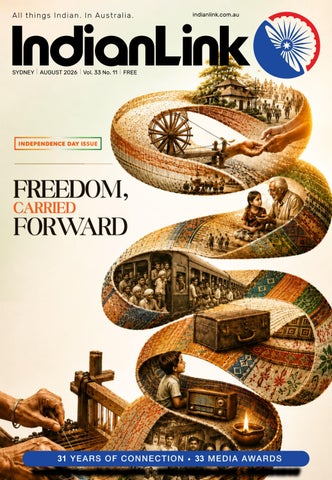
Freedom, carried forward The stories, memories and family legacies that have kept India's Independence alive across generations BY RAJNI ANAND LUTHRA
H
istory remembers dates. Families remember moments. For some, 15 August 1947 was the day a flag was raised. For others, it was the day they fled home forever. Some recall gathering around a crackling radio to hear Jawaharlal Nehru's Tryst with Destiny speech. Others remember stories passed down of prison cells, boycotts, Partition trains and impossible choices. As India marks another Independence Day, Indian Link asked readers one simple question: Where was your family on 15 August 1947? We also asked younger readers which stories of India's freedom movement had stayed with them.
THOSE WHO WERE THERE AND THOSE WHO REMEMBER
Some of our readers lived through India's Independence. Others grew up hearing first-hand accounts from parents and grandparents who witnessed history unfold. "To see the British leave my homeland
in 1947, my joy knew no bounds," Kailash Bhatnagar, 101, of Ryde NSW told Indian Link. As a student at Mahila College in Lucknow, she joined the freedom movement and was once arrested after leading 300 women in a protest. "The police loaded us onto buses while the boys stood by watching. We threw our bangles at them – a symbolic challenge to stop being passive. At the police station, we created such chaos that the police eventually let us go." Her activism was especially risky because her father worked for the British. Yet she was inspired by leaders including Motilal and Jawaharlal Nehru, Gandhi and Subhas Chandra Bose. "I was most impressed by Bose," she recalled. "Gandhi, on the other hand, seemed rather unremarkable!" Adelaide's LP (Laks) Ayer was 11 and living in the weaving village of Kallidaikurichi in Tamil Nadu, when India became independent. "It was a public holiday," he recounted. "We marched around the village waving flags and rejoicing. We were each given a bag of lollies – I'd never seen one before!" That evening, the village gathered around the municipality's radio to hear Jawaharlal
Nehru's historic speech. "That memory is etched in my mind," he said. In the months before Independence, newspapers arriving a day late by train carried news that freedom was near. Even their small village had a diverse group of freedom fighters – Brahmins, Muslims and weavers – united in the cause. Laks vividly remembers boycott bonfires where British
goods were burned. “Several local activists were jailed, and two later became Members of the Legislative Assembly”. Hamida Parkar of Castle Hill NSW recalled her family’s defining choice at the time of Partition. Her maternal grandfather, Prof. A.B. Dadarkar, a prominent Arabic scholar in Bombay, moved to Cape Town three months before Independence with his young family.
Laks Ayer: Nehru speech etched in memory
10 AUGUST 2026
Hamida Parkar with her parents: A l
www.indianlink.com.au
Wajihuddin Ahmed Parkar, who had worked with the All-India Muslim League, also chose to stay in India. He later joined the Indian National Congress and was elected to the Bombay State Legislative Assembly in 1952. As midnight approached on 14 August 1947, Hamida's family gathered around to hear Jawaharlal Nehru announce the birth of a new nation.
THE PRICE OF FREEDOM
Just prior, he had turned down a prestigious offer to relocate to Pakistan through an associate of Muhammad Ali Jinnah. "He believed in a united India," Hamida said. Unhappy in South Africa, the family returned to Bombay a few years later, where he lived until his death in 1990. Hamida's father Saeed Daud Parkar was seven and remembered the Independence celebrations. Another relative, Advocate
life-defining choice
Not every family gathered around a radio that night. In the north-west of the country, alongside the celebrations, the first tremors of Partition violence were already being felt. Among them was my father, then 13. The Anand family had lived in Talagang, near Rawalpindi, for generations. Hindus, Sikhs and Muslims were neighbours, bound by a shared Punjabi heritage. On 15 August 1947, there was uncertainty, but not fear. Crossing the newly drawn border seemed unthinkable. This was home. It wasn't until months later, in 1948, that
they were forced to leave. The departure came without warning. My grandfather and uncle were away in Karachi when word spread that the entire street had to evacuate immediately. My grandmother gathered her three children and fled with relatives, not knowing how to tell her husband they were leaving. They believed they were going into temporary shelter for a few days. They would never return to their ancestral home. In an overcrowded refugee camp in Jalandhar, my father arrived with only the clothes on his back, having lost his shoes somewhere in the chaos. The family spent three desperate months there - with rationed food and water - before my grandfather, who had searched camp after camp, finally found them. He had secured what he thought was a three-bedroom house. On arrival, they discovered each bedroom had been allocated to a different family. My grandfather quietly rebuilt their lives.
My grandmother carried the trauma for the rest of hers. Only later did my family fully appreciate that families travelling in the opposite direction had endured equally devastating losses. By the standards of Partition, my family's was one of the fortunate stories. They survived. Countless others did not. Trains crossed the border carrying the dead, families disappeared forever, and millions were displaced in one of the largest and bloodiest migrations in human history.
Kailash Bhatnagar: Arrested after leading a student protest
AUGUST 2026 11
COVER STORY
WHEN FREEDOM CAME HOME
One of the most remarkable aspects of India's freedom movement was that it wasn't confined to rallies, legislatures, prisons or famous leaders. Nationalism had turned into everyday behaviour. The movement shaped what people wore, bought, read, said – and even what they named their children. Khadi became a
symbol of self-reliance. Buying local through the Swadeshi movement was a patriotic duty. Everyday language filled with words like Swaraj, Swadeshi, Vande Mataram and Jai Hind. And parents named their children Swadesh, Swaraj and Azad, carrying the dream of freedom into the next generation. One of those children was my own mother. Named Swadesh – literally "my country" – she was born in Jalandhar in 1940 to journalist Nandlal Dhand and his wife Agya. Her name was more than a label; it was a declaration of hope, embodying the ideal of swaraj, self-rule. She spent part of her childhood in Lahore when her father moved there for work. At the time, it was no more remarkable than moving from Sydney to Melbourne, or Delhi to
Bombay. No one imagined that, within a few years, those cities would belong to different countries. Growing up in a newspaper editor's household, she absorbed current affairs almost by osmosis. At 19, she landed her 12 AUGUST 2026
first job as a Punjabi newsreader on All India Radio. More than six decades later, she still relishes a spirited political debate – proof, perhaps, that when your name is Swadesh, the country's story is never far from your own.
www.indianlink.com.au
HISTORY AT THE DINNER TABLE As the generation that witnessed Independence grows smaller, its memories are increasingly being preserved not in archives, but in family conversations. Every time a grandparent tells a child about the train they boarded, the flag they watched rise, or the home they left behind, history begins again. We asked younger readers about stories passed down in their families.
Torrsha Sen: Pakistan? Or India? My father told me this story recently, prompted by a film he had watched on the Partition. It stayed with me long after our conversation ended. In August 1947, his parents and extended family were living in Plassey (yes, the same Plassey from the famous Battle of Plassey), our native village. As the news of freedom broke, there was much confusion with violence and a Muslim majority around. They raised the flag of Pakistan. Nobody had told them otherwise. The border was still a line on a map somewhere, unconfirmed. Plassey sat close enough to the edge that its fate could have gone either way, and in that vacuum of information, the family made their best guess. For three days, that flag flew over their home. Three days of believing they belonged to a nation that, as it turned out, they never would. On 17 August, the Radcliffe Line was finally announced. Plassey fell on the Indian side. The flag came down, and with it, a strange, brief chapter of uncertainty that most official histories never bother to record. What strikes me about this story isn't just the confusion. It's how ordinary people were left to interpret the biggest political decision of their lifetimes with almost no information at all, drawing borders in their own minds days before the men in Delhi and London drew them on paper.
Manan Luthra: Gandhi's fasts as a form of protest Growing up, I heard my family talk about Gandhi's fasts. I couldn’t imagine fasting myself, but I learnt that it wasn't simply about going without food – it was a form of nonviolent resistance. For years I assumed hunger strikes belonged to history. Then, only weeks ago, I watched Sonam Wangchuk's 26day fast in New Delhi bring thousands of young Indians together. It told me that fasting still carries extraordinary moral force. A hunger strike says, "I will endure hardship until you listen," rather than "I will hurt you until you listen." That moral distinction is why fasting still holds such a unique place in India's political culture.
In the ancestral home that survived the turbulence of 1947
Harsheni Maniarasan: India's original "cancel culture" Boycotting brands feels like a very Gen Z idea. Turns out, India was doing it over a century ago. My Thatha taught me about the Swadeshi movement, when Indians rejected British goods after the 1905 Partition of Bengal, and instead bought local, wore khadi and backed Indian businesses. It was economic protest before hashtags existed. As a book lover, I also discovered that Rabindranath Tagore explored the movement's moral dilemmas in Ghare Baire, later adapted into a film by Satyajit Ray.
Harini Sridhar: Finding my own freedom heroes At school, the freedom movement often felt like the story of Gandhi, Nehru and Bhagat Singh. I asked my parents: where were the heroes from South India, our part of the country? That question sent me down a rabbit hole. I discovered Rani Velu Nachiyar, who defeated the British decades before 1857; Veerapandiya Kattabomman, who resisted the East India Company; V.O. Chidambaram Pillai, who challenged British trade; Subramania Bharati, whose poetry inspired a generation. The freedom movement suddenly felt much bigger than the textbooks. Every region had its own heroes. I just had to find mine.
THE STORIES WE CARRY
My father's memories of Independence were shaped by loss. My mother's, by hope. The stories our readers shared show that every family carries its own version of 1947. Every Independence Day, India raises the tricolour. But perhaps its most enduring act of remembrance happens far more quietly: when a grandparent tells a story, a parent explains a family tradition, or a child asks, "What happened in 1947?" One generation witnessed history. The next inherited it. Now it is our turn to carry it forward. As these stories travel across generations, oceans and continents, they remind us not only how India became free, but who we arenow because it did. AUGUST 2026 13
INDOPHILE Zoom meetings. When he eventually returned, he apologised, explaining that his child had fallen ill because the family had no access to clean running water. McClure says she was stunned. Coming from Australia, she had never imagined a family living without a tap inside their home. She immediately organised plumbing to be installed and says that moment became the beginning of an eight-year relationship with the family. Over time, she helped them move out of the slums, supported the children's education and watched their lives gradually transform. For her, it became the moment she realised she could make a meaningful contribution in India.
She builds women who build empires
‘With India, I belong’ Perth entrepreneur Terri McClure is immersing herself in Indian culture while using her platform to empower Indian women entrepreneurs BY PRUTHA CHAKRABORTY
I
t began with a comment on social media. Someone watched one of Terri McClure's videos about India and declared they would never visit the country. Rather than ignoring it, the Australian entrepreneur recorded a response that struck a chord with thousands. Her message was simple: don't judge India from afar. Having travelled to 39 countries, McClure argued that every nation has its share of poverty, inequality and imperfections. Yet, she said, India is often unfairly defined by those realities alone. The video, in question, garnered 80.1K likes and over thousands of reshares. Today, the Perth-based founder of health and wellness company PHATT (Putting Health At The Top) spends one to two months at a time in India, building her business, mentoring women entrepreneurs
and, increasingly, challenging the stereotypes she believes continue to shape global perceptions of the country. For McClure, India’s appeal goes far beyond business. “India isn't a place I visit, it's a feeling I step into,” she tells Indian Link. “When I travel, I see 39 countries through my eyes, but India is different. It's not the buildings, it's not the people alone, it's not the colour or the noise or the culture in isolation. It's all of it colliding at once, and what comes out the other side is this overwhelming emotion that just sits with me.” She pauses before adding what has become her most defining sentiment. “I don't just see it, I feel it. I can touch it. I can love it... That’s the difference between visiting a country and belonging to one, and with India, I belong.”
India calling
That sense of belonging has now found a business expression too. McClure introduced the PHATT program to India during a multi-city tour in May,
ahead of Partner.Co's official soft launch in the country on 26 June. While many businesses evaluate markets through economic indicators alone, McClure says what first captivated her was something less measurable: India's extraordinary culture of connection. “If I asked an Australian to bring 40 people to an event tomorrow, the answer would almost certainly be no,” she says, smiling. “But ask an Indian to bring that many people to an event, and the answer is yes.” She believes India's extensive family and diaspora networks create opportunities unlike anywhere else in the world, making it an ideal place to grow a people-focused business. She continues: “If you are networking and you are trying to create growth, India gives you the ability to touch every market in the world. That’s what makes it so exciting to me.” But it wasn't a business opportunity that first changed her perception of India. Just before COVID-19, one of her Indian associates disappeared from their regular
Sporadic living and working across India has also challenged many of her own assumptions. She laughs that the biggest adjustment has been learning to cope with Indian chilli, but says embracing unfamiliar experiences has become part of the journey. What surprised her most, however, wasn't the food. It was family life. “Sitting down as a family, sharing a meal, that ritual of togetherness, it is one of the most beautiful things I have witnessed in India.” McClure has also become increasingly outspoken online about what she sees as the world's tendency to reduce India to poverty alone. “India is often described as poor. As dirty. As uneducated. And none of that is the truth,” she says. While acknowledging that poverty exists, she argues that it should not define a nation experiencing rapid economic growth, technological advancement and rising global influence. Her admiration for India also extends to the women she works with. Through PHATT, McClure mentors women to build businesses, develop confidence and achieve financial independence. She says her approach has evolved since first arriving in India, recognising that empowerment must be understood within the country's own social and cultural context. Rather than trying to change traditions, she says her goal is to help women discover their own voice while respecting the values that shape their families and communities. “My role is to empower, not to disrupt, and to do that with deep respect for the culture I am so grateful to be part of.” She believes younger Indian women are increasingly willing to forge new paths while remaining deeply connected to their families, and says supporting that confidence is among the most rewarding aspects of her work.
With Freeda, autorickshaw driver 14 AUGUST 2026
www.indianlink.com.au
Written in the stars
here are food influencers. Travel influencers. Fashion, beauty, lifestyle. Even language creators. And then there’s Joe Freeman! On his Instagram page JoeSpeaksHindi, the Sydney-based Australian strolls through famous landmarks, recommends places to visit, cooks Indian food, plays old Hindi songs on the piano and occasionally spends an entire reel unpacking a single Hindi word. One day it’s ‘mehnat’. Another day it’s ‘nafrat’. Then comes ‘sharm’, or the proverb ‘sabr ka phal’. The videos are funny, thoughtful and unmistakably Indian in their cultural references – all delivered in fluent Hindi by a man who grew up on the Northern Beaches. Freeman made his Instagram debut in November 2025, but it is only in recent months that his videos have found a devoted audience. The comments are remarkably consistent: viewers marvel at his Hindi, thank him for embracing their language, and ask the same question over and over – how did an Australian become so effortlessly Indian in his cultural references?
Learning Hindi changed the way Freeman experienced India. When he first travelled there with his friend Kaushic, whom he describes as becoming “like an older brother” while they worked together in Hong Kong, he encountered a culture that was far more personal than anything he could have learnt from books. “My first impressions were that people were incredibly generous and welcoming.” India also challenged his understanding of culture, religion and family. He remembers Kaushic’s father asking them to turn back after a cat crossed their path, and another moment when Kaushic’s brother-in-law showed him a prayer shelf containing images from different faiths. “They had images from various religions because they respected all gods,” Freeman says. “This was very different to the religion I had grown up with…which taught us that sirf hamara dharm sahi hai aur baaki sab galat (only our faith is right, all others are wrong). Eventually, Hindi allowed him to move beyond being a visitor. Freeman spent a year living in a village in Rajasthan, working in a school and becoming part of the local community.
All roads lead to hindi
Hindi premi
BY PRUTHA CHAKRABORTY
T
The story began nearly three decades ago, when an adventurous 18-year-old boarded a plane to Hong Kong for a gap year. He was volunteering with a charity organisation that shipped aid materials to different parts of the world. “I think my parents brought me up to have a sense of adventure and we travelled regularly because they were immigrants and our relatives were all in England and other countries,” he tells Indian Link. Growing up in Sydney in the 1990s, he often felt there was a bigger world waiting beyond his own surroundings. “I read a lot as a child and mujhe laga ki (I felt that) there was a bigger world out there.” “The Northern Beaches was one of the least diverse parts of the city,” he continues. “As a teenager, I didn’t enjoy feeling pressured to fit in and that pressure suddenly lifted when I left the place where I had grown up.” In Hong Kong, he expected to immerse himself in Chinese culture. He learnt some Cantonese and loved the city, but the people who shaped his experience were often other migrants. “Many of the friends I made were immigrants from other countries, especially South Asia.” That experience changed how he viewed
Instagram cannot get enough of this Hindi-speaking Aussie That organisation was based in Hong Kong’s Chungking Mansions, a building that became a hub for South Asian communities. “There, I realised that many people from different places communicated in Hindi, even if it was not their first language.” Later, when Freeman was preparing to begin university in Australia, he discovered Hindi/Urdu was offered as a subject. “It seemed like destiny at that time.”
Freeman never planned to become a content creator. “I was very hesitant about making content,” he admits. The push came from his friend Chetan from Mumbai, who had been encouraging him for years. When Freeman eventually started posting, Hindi was not a gimmick or a strategy. It was simply the language that felt natural for telling different stories. Today, Freeman lives in Sydney after spending 19 years overseas in Hong Kong, London and Rajasthan. His professional life has also centred around communication and inclusion – he spent years teaching English and basic skills to adults and now works in training within a disability support organisation. For someone whose Instagram journey began with Sydney landmarks spoken about in Hindi, the next destination is still language itself. Because for Freeman, every new word is an invitation. “I hope that people realise that hum ko fayde hi fayde milte hain (there are nothing but benefits) when we make connections to other people and their language and culture. We don’t lose anything at all.”
Joe, in 2008, judging at a camel fair.
Joe with his mum and dad in Jaipur, 2023.
Joe Freeman’s reels prove that language can erase borders faster than passports ever could
migration. “I think this is something that naturally happens when you migrate because you have a lot in common with other immigrants, no matter what country they come from.” His first connection to South Asian languages was actually through Nepali friends. “At that time I started learning Nepali first and got involved with an organisation that was helping the Nepali community.”
Celebrating Holi (left) and Rakhi at Rajasthan.
AUGUST 2026 15
IND-AUS “Describing Fearless Nadia as a Bollywood star really doesn't do her justice,” he tells Indian Link. “She was India's first female action star who revolutionised the portrayal of women on the screen in India in the 1930s.” She performed her own stunts at a time when there were virtually no safety measures, challenged villains instead of waiting to be rescued, and reversed gender stereotypes nearly a century before conversations around representation became mainstream. “What makes her relevant even today is that her story anticipates almost every conversation we're still having about representation, women in action roles, and who gets to be the hero rather than the rescued. She was doing that in 1935,” he continued.
Restoring a legacy
Perth’s Mary Ann Evans as Fearless Nadia
The stuntwoman who cracked the whip, and the borders Ninety years after Fearless Nadia redefined the action heroine, India and Australia are joining forces to rescue the films that made her a legend BY PRUTHA CHAKRABORTY
S
he was Australian by birth, Indian by choice, and decades ahead of her time. Long before superheroes dominated cinema screens or female-led action franchises became box office staples, a blonde, blueeyed swashbuckling woman was leaping from speeding trains, cracking a whip at villains and rescuing men in Indian films. Her name was Mary Ann Evans, her stage name ‘Fearless Nadia’, and in the 1930s, she transformed what audiences thought a heroine could be. Now, nearly a century later, her remarkable story is bringing Australia and India together once again. Backed by the Australian Government's Maitri Grants Program, the National Film and Sound Archive of Australia (NFSA) and India's Film Heritage Foundation (FHF) are embarking on a multi-year collaboration to restore three of Fearless Nadia’s landmark films - Hunterwali (1935), Miss Frontier Mail (1936) and Diamond Queen (1940). All three were produced by Wadia Movietone, the pioneering Mumbai studio that turned
16 AUGUST 2026
Yet despite her extraordinary influence, time has not been kind to the films that made her famous. The surviving reels are incomplete. Original camera negatives no longer exist, and some reels have disappeared altogether. One complete print of Diamond Queen had to be sourced from the Library of Congress after a worldwide search through the International Federation of Film Archives network. “The grant came in just in time,” Singh says. “Else there was a chance that these films, with out restoration, would just survive as poor quality versions on YouTube and never return to the big screen.” For Dr Sophie Lewincamp, Director of Collection Engagement and Experience at the NFSA, the project represents something much larger than restoring old films. “What drew the NFSA to Fearless Nadia's story was not a single film or archival discovery, but the remarkable scale of her legacy and what it represents for both Australia and India,” she shares. Nadia occupies a unique place in the shared cultural history of both nations. Lewincamp believes her story transcends film history, opening conversations about gender, cultural diversity, performance and representation. “By preserving and celebrating Fearless Nadia's legacy, we're not only protecting important cultural assets, we're building new people-to-people connections between Australia and India and creating enduring cultural value that will extend well beyond the life of the project,” Lewincamp adds.
The Aus-India partnership
Nadia and filmmaker Homi Wadi, who wed in 1961
Nadia into India's biggest stunt star and helped define the country's action cinema in the 1930s and '40s. The project will also preserve the wider Wadia Movietone archive and train the next generation of film conservators.
The whip-wielding stuntwoman
For Shivendra Singh Dungarpur, founderdirector of the Film Heritage Foundation, Nadia’s significance extends far beyond her Australian roots.
Alongside restoring films, the partnership will deliver annual conservation workshops in Mumbai for early and mid-career professionals, helping build expertise in film, paper and photographic preservation while addressing common challenges faced by archives in both countries - from fragile analogue collections to increasingly difficult climate conditions. “The conservation training program is a key element of the project,” Lewincamp informs. “Through hands-on training, knowledge exchange, and collaborative learning, participants will explore practical approaches to preserving audiovisual heritage while building expertise in climateresponsive, sustainable collection care.” She hopes the initiative will foster lasting professional relationships between Australian and Indian preservation
www.indianlink.com.au
Dr Sophie Lweincamp (left) who leads the conservation and digitisation team
specialists long after the project concludes. Singh says that preserving the films is only one part of the mission. The Wadia Movietone archive - containing rare glass negatives, posters, scripts, diaries, lobby cards and other memorabilia - offers an invaluable record of one of India's pioneering studios and an era of filmmaking that has often been overlooked. “Indian film history tends to get told through its social dramas and its post-Independence auteurs," Singh explains. “The stunt and action cinema of the '30s is a less-preserved, less-told strand, even though it was hugely popular at the time.”
A second life
Restoring these films, however, is painstaking work. James Campbell of the NFSA explains that restoration is far more than digitally cleaning scratches. Each reel is first inspected by hand, cleaned, repaired and stabilized before being scanned frame by frame at high resolution. Conservators then spend hundreds of hours digitally repairing decades of damage while remaining faithful to the filmmakers' original artistic vision. "Each of these stages - physical conservation, digitisation and digital restoration - is labour intensive and can require hundreds of hours of careful work for a single reel of film," Campbell informs. Once complete, the restored classics won't simply return to archive vaults. The project includes public screenings, cultural exchange events, oral history interviews with the Wadia family, and hopes of taking the restored films to international festivals before introducing them to audiences across both India and Australia. For modern audiences discovering Fearless Nadia for the first time, the biggest surprise may be how contemporary she still feels. Long before the world coined terms like "strong female lead", Nadia had already become one. Almost 90 years later, her films are finally getting the second life they deserve.
It’s time to complete your Census.
Every answer matters If you know where you’ll be on Census night, Tuesday 11 August, you can complete the form for your household as soon as you get your instructions. Complete online, on paper or with help from us.
census.abs.gov.au/multicultural Film Heritage Foundation’s Shivendra Singh Dungarpur
Authorised by the Australian Bureau of Statistics, Canberra
AUGUST 2026 17
DISCOVER THE BEST OF THE GREAT OCEAN ROAD REGION THIS WINTER The Great Ocean Road is brimming with perhaps some of the most spectacular experiences in nature that this country has on offer. Whether you simply want to wind down and get away from the everyday, or you’re looking for that unique experience to share with loved ones.
WHALE SPOTTING
Be on the lookout anywhere along the coast for whales as they frequent these waters during their winter migration. At Logans Beach in Warrnambool, Southern Right Whale mothers with calves can shelter between the beach and offshore reef, and sometimes stay for days or weeks. Cape Otway Lightstation and Wildlife Wonders at Apollo Bay are ideal winter attractions for families, and for whale-watching vantage points.
WATERFALLS
Winter is the ultimate time to visit a waterfall – with higher rainfall, the cascades turn from a trickle to full flow. Venturing through dense, ancient rainforest to get to them is half the
18 AUGUST 2026
of Griffiths Island or Tower Hill (Koroitj) offer plenty of space to refresh the mind and recharge the body. The Surf Coast Walk begins in Torquay and stretches 41km to Fairhaven, passing through Anglesea and Aireys Inlet. From the Whites Beach East trailhead, the first 2km along the Torquay Esplanade to the town centre is accessible for users of all abilities and dog-friendly year-round, provided dogs are kept on leash. fun. In the Great Otway National Park near Beech Forest, a walk amongst The Redwoods and a visit to Hopetoun Falls is a must for an encounter with blissful nature. Near Lorne, take the easy trail to Sheoak Falls or continue on the full 7.5km return walk to the picturesque Lower Kalimna Falls.
WALKING TRAILS
Port Campbell Discovery Walk follows the picturesque bay for stunning coastal views, or venture further on the Poorpa Yanyeeng Meerreeng Trail, which links Port Campbell to Timboon. Around Port Fairy, long beach walks and gentle explorations
RELAX AND RECONNECT:
Book a 2-night package at participating accommodation properties this winter and receive a $100 experience card to spend on the region’s best activities and experiences Find out more and book at visitgreatoceanroad.org.au
www.indianlink.com.au
BE IN YOUR ELEMENT GREAT OCEAN ROAD 2 NIGHT PACKAGE DEALS The Sands Torquay
BOOK A 2 NIGHT BE IN YOUR ELEMENT WINTER PACKAGE*, AND GET A $100 EXPERIENCE CARD TO SPEND IN THE GREAT OCEAN ROAD REGION
Great Ocean Road Resort, Anglesea
Mantra Lorne
From
From
From
$499
$380
$408
Point of View Villas Apollo Bay
Anchors Port Campbell
From
$790
$800
Best Western Olde Maritime, Warrnambool
Lady Bay Resort Warrnambool
Basalt Retreat Killarney
From $560
$1040
From $468
The Caledonian Inn Port Fairy
From $349
Experience card only included in Be In Your Element packages and redeemable at these participating businesses. Prices shown include 2 nights' accommodation, a $100 experience card, plus extras. To find out more and book:
VISITGREATOCEANROAD.ORG.AU
AUGUST 2026 19
PHOTOGRAPHY
FRAMING INDIA'S H Winners in the #myIndianlink photogra 20 AUGUST 2026
www.indianlink.com.au
HERITAGE aphy contest 2026
Our winning images celebrate two enduring faces of India's heritage – the sacred and the built. BY RAJNI ANAND LUTHRA
P
hotography enthusiast Ankur Tambde has taken out first prize in Indian Link’s annual #myIndianlink Photo Competition. His black-and-white snapshot from a Hindu religious procession, using intentional motion blur to transform the dancers into a halo of movement, won the judges over. Saurabh Sirohiya claimed second place, with his capture of a fleeting moment where centuries-old craftsmanship meets everyday life. Ankur and Saurabh take home cash prizes worth $200 and $150 respectively. 272 entries made it to this year’s competition. An annual activity coinciding with Independence Day, the contest seeks images from participants that display their link to, or a feel of, India. Entrants use the #myIndianlink hashtag to post their photographs on social media, or email them directly.
Devotees Dance
The Dance of Devotees by Ankur Tambde
Ankur Tambde is quite pleased with the way his winning shot turned out. “I took some 2000 shots, over eight days, to find this one,” he told Indian Link. The image came from this July’s Pandharpur Wari pilgrimage near Pune. The Wari is a 700-year-old tradition in which devotees walk 21 days across Maharashtra to the temple town of Pandharpur to worship Vitthal, a form of Krishna. Beginning at the samadhis (shrines) of saint-poets including Tukaram and Dnyaneshwar, pilgrims carry palkhis (palanquins) bearing the saints' padukas (sacred sandals), singing their devotional poetry accompanied by traditional musical instruments. “I had hundreds of photographs already when I found myself at a high vantage point, just as the palkhi emerged from the temple into a sea of ecstatic devotees,” Ankur described. “Rather than freezing the moment, I chose a slow shutter speed.” The result: a swirling tapestry of movement, as the dancers lose their individual identities and dissolve into a single expression of faith. Rather than documenting the procession, the photograph captures its spirit. The Wari has been generous to Ankur. This is his second award from the pilgrimage. “A photo from last year’s event won me a Hindustan Times award - in the Indian Culture category. It was an indoors shot of the pilgrims. That award was presented to me by PM Modi.” Mumbai-based Ankur is a technical officer in the Central Government's defence sector, but away from work his camera is never far from his hands. A self-taught Continued on Pg 22 AUGUST 2026 21
PHOTOGRAPHY
Where Heritage Breathes by Saurabh Sirohiya
Continued from Pg 21 photographer since 2000, he has steadily honed his craft through workshops, countless hours behind the lens and an ever-evolving camera kit - though he still holds on to the Pentax that started it all. His interests span travel, nature, street and microphotography, with a particular fascination for capturing everyday life. Winning last year's competition prompted his General Manager to ask whether he had considered turning professional. "He congratulated me for making it on my own," Ankur recalled. "But I love both my passions - technology and photography. One allows me to serve my country; the other lets me indulge my creativity. I wouldn't want to give up either."
Where Heritage Breathes
Saurabh Sirohiya’s snapshot, set amidst intricately carved facades, celebrates architectural heritage. But more than an architectural photograph, it tells a story. The richly carved façades bathed in warm morning light dominate the frame, while the lone cyclist provides a human focal point
22 AUGUST 2026
and a sense of everyday life continuing through a place steeped in history. “I took this photograph in Bikaner, the historic old city of Rajasthan,” Saurabh told Indian Link. “I was exploring its architecture and looking for a moment where everyday life interacted with the magnificent havelis. I noticed this cyclist approaching through the street and waited for the right moment when he entered the frame.” The composition is a masterclass in perspective. Diagonal streets, layered architecture and an unbroken line of balconies create a striking sense of depth, leading the eye to a lone cyclist who brings scale, movement and humanity to the scene. Bathed in warm light, the image draws the viewer into the very heart of the old city. It’s the kind of photograph Saurabh likes taking. “I look for decisive moments where light, movement, emotion and composition come together naturally.” The Ahmedabad-based Saurabh is a graphic designer by trade, but a multiple award-winning freelance photographer and photojournalist who enjoys “travel, documentary, street,
cultural, editorial and drone photography.” His striking images give little hint that he is hearing-impaired. “Initially (my impairment) was a hindrance, but I took it as a challenge which over time I have overcome,” he divulged. “Photography is visual rather than vocal and normal communication. I rely strongly on observation, visual cues and written communication.” Has being hearing impaired changed the way he observes the world as a photographer? “Yes. I have to focus and concentrate on expressions, hand gestures/sign language, movement, light and small visual details. Perhaps I photograph the world differently because I experience it differently. My experience has made me especially sensitive to visual communication and the stories that can be told without words. There are practical challenges of course - mainly during communication with strangers or in crowded situations. I overcome this through messaging, lip reading, face reading, visual cues - and homework preparation.” Before we let him go, we asked what
advice he would offer someone with a hearing impairment who dreams of becoming a photographer. “Don't let your impairment limit your dreams,” he replied. “Learn your craft, observe deeply, practice constantly and develop your own visual voice. Your perspective and zeal can become your strength to overcome the difficulties.”
www.indianlink.com.au
MEDIA GROUP
Diwali Art Competition DESIGN
INDIAN LINK’S DIWALI CARD WIN
PRIZES!
TWO categories: Kids up to 7 years, and Kids 8-12 years. WIN book vouchers valued at $75 and $50 in both categories. PLUS: The winning entry will be designed into Indian Link’s Diwali cards for the year 2026. Colour in or paint the pattern presented here. Photocopy the pattern if you need to. Send in your work, along with your name, age, address and phone number, to:
Indian Link, GPO Box 108, Sydney 2001 Last date for submission 16 October 2026 For more details, ring the Indian Link office on 1800 015 847, or email editor@indianlink.com.au Winners will be announced on Indian Link’s social media channels
AUGUST 2026 23
SCIENCE & TECH
Restoring farms after mining
R
Prof. Mohan Yellishetty of Monash University will chair a new working group on restoring farmland after mining
estoring farmland after mineral sands mining is emerging as a major environmental challenge in regional Victoria, particularly in the Wimmera and Mallee, where agricultural productivity depends heavily on long-term soil health. Questions remain over whether mined land can be returned to its original agricultural use, even when rehabilitation is carried out in accordance with regulatory requirements. To address these concerns, the Victorian Government has established a new working group to develop clearer, evidence-based approaches to restoring agricultural land after mining. Indian-origin mining and sustainability expert Professor Mohan Yellishetty, of Monash University’s Department of Civil and Environmental Engineering, has been appointed to chair the Mineral Sands Agricultural Land Restoration Working Group. “We are making sure farmers have a seat at the table to tell us about their concerns and share their expertise,” Minister for Energy and Resources Lily D’Ambrosio said in a statement. The group includes representatives from the Victorian Farmers Federation, Agriculture Victoria, Catchment Management Authorities, local councils including Yarriambiack Shire and Horsham Rural City, and the Minerals Council of Australia.
Farmers at the table
Speaking to Indian Link, Prof. Yellishetty said the group would provide independent advice on restoring agricultural land affected by mineral sands mining. “The Mineral Sands Agricultural Land Restoration Working Group will provide independent, evidence-based guidance on restoring agricultural land post-mining,” he said.
collaborate with the region’s farmers to plan its delivery,” he said. One approach already used in the industry is progressive rehabilitation, in which sections of land are restored as mining moves across a site rather than only after the entire operation has ended. “This means operators do not wait until the end of mining to begin rehabilitation,” Prof. Yellishetty explained. “They restore areas once mining is finished in that part of the site. This helps reduce the amount of disturbed land and supports faster recovery.”
The soil challenge
Its mandate includes defining clearer rehabilitation requirements for mining companies and examining how soil productivity can be rebuilt and maintained over time. “Soils are a vital part of farming and are key to its productivity,” Prof. Yellishetty said. With mineral sands activity expected to increase across the Wimmera and Mallee, the group will also consider how quickly rehabilitated land can return to productive use. “This working group is about acting to better define mine rehabilitation requirements for farming areas in the Wimmera and Mallee, and will directly
address concerns from farmers about how soil productivity can be reliably restored, and over what timeframe.”
Progressive rehabilitation
A key part of the group’s work will be advising Resources Victoria on restoration practices during and after mineral extraction. Prof. Yellishetty said collaboration between mining operators and farming communities would be essential. “Restoring agricultural land in the Wimmera and Mallee following mineral sands development is a critical part of the mining process, and we’ll be helping miners
While progressive rehabilitation can reduce the area of land left disturbed, its long-term success depends largely on how well soil layers are removed, stored and reconstructed. Returning land to its original shape is only one part of the process. Agricultural productivity also relies on soil structure, biological activity, nutrient cycles and water retention, all of which can take years to recover after major disturbance. Across Australia, rehabilitation outcomes have varied. Some former mining sites have been successfully returned to productive use, while the long-term condition of others remains uncertain. The working group is expected to examine these gaps and recommend stronger, more consistent standards for agricultural regions where land carries both economic and ecological value. “Victoria has three per cent of the nation’s arable land but produces 25 per cent of the nation’s agricultural output,” said Victorian Farmers Federation Grains Director and incoming president Ryan Milgate. “It’s imperative that if this land is mined, we ensure it can be restored to its former condition.” Prutha Chakraborty
Turning mosquito hums into life-saving insights A handheld device, created by University of Wollongong India’s Dr Kiran Trivedi detects disease-carrying mosquitoes by their wing beats
T
he Indian monsoon arrives with its unmistakable soundtrack: the whine of mosquitoes, followed by seasonal spikes in malaria and dengue. Associate Professor Dr Kiran Trivedi, Head of Computing at the University of Wollongong India, has found a way to turn that familiar sound into an early warning system. He has developed a handheld device
24 AUGUST 2026
that identifies disease-carrying mosquitoes simply by listening to the sound of their wingbeats, making it easier to track malaria and dengue outbreaks. "Every mosquito has a fingerprint, a specific sound pattern, like how every human has a different voice," he says. Powered by Tiny Machine Learning (TinyML), the device records the insect's buzz through an onboard microphone before
a convolutional neural network classifies the mosquito species within seconds. With an accuracy of 88.3 per cent, the prototype offers a fast, low-cost alternative to traditional laboratory-based mosquito surveillance.
Listening for disease Malaria is spread by Anopheline mosquitoes, while Aedes mosquitoes
www.indianlink.com.au
Monash professor helping keep India's freight trains on track Prof. Ravi Ravitharan from Monash University’s Institute of Railway Technology will work with the Indian Government to enhance the world’s largest heavy haul network
W
hen we last wrote about Professor Ravi Ravitharan after his 2014 Railway Technical Society of Australasia (RTSA) Award, we called him 'The Railway Man', a fitting title for someone who grew up fascinated by trains. "We had railway lines close to our house – the sound you hear when it goes through the joints, the bouncing around – 'dig dig, dig dig, dig dig' – that's what I remember," Prof. Ravitharan recalls of his childhood in Sri Lanka. "At that time, I didn't think I'd work in railways. I was interested in engineering, and eventually I was fortunate to work in railways – I love the industry." Speaking to him twelve years later, you get the sense his passion has only gotten stronger; so too, his collaboration with the Dedicated Freight Corridor Corporation of India (DFCCIL). As Director of Monash University's Institute of Railway Technology (IRT), Prof. Ravitharan is leading a team helping India optimise its growing dedicated freight rail network, allowing heavy goods trains to move efficiently while easing pressure on busy passenger lines. "Previously, India used the same railway to carry passengers and freight. This isn't the most efficient way because passenger transport requires lower axle loads, while freight trains are much heavier and need stronger track," he explains. India's first dedicated freight route, the Eastern Dedicated Freight Corridor, stretching from Ludhiana to Sonnagar, became operational in June 2024. The Western Dedicated Freight Corridor, linking Dadri and Mumbai, was completed in April 2026. Together, the two corridors now carry an average of 403 trains a day, transporting
almost 4.4 million tonnes of coal, iron ore, cement and container freight each year. The long-term goal is for dedicated corridors to handle 45 per cent of India's freight, more than double the current share. Maintaining one of the world's largest heavy-haul rail networks, however, is a significant engineering challenge. That's where Monash IRT comes in. Australia is regarded as a global leader in heavy-haul rail technology, with the institute playing a key role in testing Rio Tinto's world-leading AutoHaul autonomous freight system in the Pilbara. Monash has now signed a commercial agreement with DFCCIL to help optimise the critical wheel-and-rail interface, improving efficiency, safety and reducing maintenance costs. "When I say maintenance, it's about shaping the rail - using heavy machinery to get the correct shape so the trains can run smoothly and not require maintenance as
frequently," Prof. Ravitharan explains. The project, expected to take around two years, will begin on the Eastern Corridor before expanding to the Western Corridor. Equally important is building the capability of Indian engineers so they can eventually manage the network independently. "In 1972, when Australia started heavyhaul operations, we could have kept relying on overseas expertise. Instead, we built our own capability, and now we are the experts in heavy-haul railway maintenance," he says. "We're trying to help India do the same thing." While Australia-India ties often focus on education, trade and cricket, Prof. Ravitharan believes rail engineering is an underappreciated area of collaboration as both countries build larger, better-connected cities. The partnership, he says, could one day become reciprocal. "If India develops strong heavy-haul capability, they might help us one day. We're
transmit dengue. Together, mosquito-borne diseases claim more than 700,000 lives worldwide each year, particularly among children under five. Current surveillance often involves collecting water samples, trapping mosquitoes for laboratory testing or relying on interventions such as insecticide-treated nets, vaccines and genetically modified mosquitoes. Dr Trivedi is approaching the problem from a different angle – using artificial intelligence rather than biology. "I always try to do something new and creative," he says."My aim is always to align with the United Nations Sustainable Development Goals, to make a better society." TinyML is an emerging branch of artificial intelligence that allows machine-learning models to run directly on small, low-power chips instead of internet-connected cloud servers. Dr Trivedi's device runs on an Arduino
Nano microcontroller, commonly used in products such as fitness trackers and digital clocks. The detector costs less than Rs 5,000 to build, making it practical for developing countries and remote communities with limited resources. "The best part is how it can help globally," he says. "Usually, once lots of people are affected by a disease, we start acting on the mosquitoes. Here, as soon as the sound is detected, governments can take action before any outbreak starts." Future versions could integrate with smart home devices to alert households when disease-carrying mosquitoes are nearby, or generate heat maps showing where mosquito activity is increasing. For now, the biggest challenge is the microphone. "If we can have a microphone highly sensitive to mosquito sounds, then the efficiency and accuracy would improve," he
says. "Right now, it's in the development phase, but the prototype is ready."
Prof. Ravi Ravitharan (left) signs agreement with Mr P K Rai, Director Project Planning at DFCCIL.
From babies to mosquitoes
Based at UOW's GIFT City campus (Gujarat), Dr Trivedi has been developing TinyML applications since 2020. Earlier versions of his technology identified bird calls and interpreted babies' cries, an idea inspired by visits to his paediatrician brother's neonatal ward. The mosquito project emerged while preparing an entry for the United Nations International Telecommunication Union Hackathon. "There were a lot of mosquitoes in my cabin," he recalls."The thought occurred to me that if mosquitoes are all different, there should be a difference in their wing sound too. It was just an assumption." Using a mosquito sound database from the University of Oxford, he trained his AI model to distinguish different species.
always short of engineers, and India produces a significant number of capable intellectuals." Home to 70 researchers and 170 industry partners, Monash IRT works with clients including Hong Kong's MTR, Singapore's MRT and Metro Trains Melbourne. Yet Prof. Ravitharan believes Australia has not fully utilised the institute's expertise, particularly in passenger rail. World leaders in freight rail we may be, but many improvements remain for Australia’s passenger rail networks, he says, pointing to the stagnating progress on the Melbourne to Brisbane Inland Rail and Melbourne Airport Rail. "We have been working in the rail space at Monash for 26 years and are regarded as experts, but domestically I think we've mainly been used when there's a problem," he says, pointing to the slow progress of those projects. As Australia works towards net zero emissions by 2050, he believes stronger rail networks will be essential. "For a while in Australia, we forgot about railways, but now we're revamping them," he says. "It's a cheaper mode of transport, and if you compare carbon emissions, high-speed rail produces less than 10 per cent of the emissions of flying. If we're serious about carbon neutrality, rail is one of the best ways to achieve it." India, he adds, also offers Australia valuable lessons in moving large populations affordably. "In India, most people travel by rail. If you're looking for an economical way of moving people, this is something we can learn from India. If we put in the effort, rail can become a much more significant form of transport in Australia." Lakshmi Ganapathy
The assumption proved correct. His invention won the 2021 ITU Hackathon, Designing a Sustainable Future using ICTs, beating thousands of entries from around the world. Since then, Dr Trivedi has refined the technology and presented it at this year's AI for Good Global Summit in Geneva. Despite the sophisticated technology, he says the underlying AI process is surprisingly simple. "Sometimes doing AI projects is like going to an Indian restaurant," he laughs. "You look at the menu – paneer tikka masala, paneer butter masala – (they’re different dishes) but the gravy remains the same. No matter what the dataset is, the process remains the same: processing the data, creating the AI architecture and deploying the model. It's all about your creativity and how you take it forward." Lakshmi Ganapathy
AUGUST 2026 25
OPINION
Gold in Glasgow. Billions in Ahmedabad.
BY NIKHIL KULKARNI
A
s Australian athletes topped the medal tally at the Commonwealth Games in Glasgow, the country’s sports industry has a US$130 billion reason to pay attention to Ahmedabad. The next Games go there, to the home state of Indian Prime Minister Narendra Modi. Prime Ministers Modi and Albanese used PM Modi’s recent visit to Australia to open a new chapter in Australia-India sports trade and collaboration. The IndiaAustralia Sports Collaboration Roadmap, launched at the MCG during Modi’s visit, covers sports training and capacity building, sports science and technology, and sports industry and investment. Modi himself said the partnership would extend beyond cricket to sports training, sports science and technology. It is a significant step forward. The question, and it is the right question to ask, is whether this roadmap will be ceremonial or commercial. Ahmedabad is not just hosting the 2030 Commonwealth Games. It is the centrepiece of India’s active bid for the 2036 Olympics, the Games that follow Brisbane 2032. The infrastructure spend is already underway. The Sardar Vallabhbhai Patel Sports Enclave alone, 350 acres of new sporting infrastructure, represents an investment of approximately A$830 million, with construction commencing this year. The broader 2036 Olympics blueprint
26 AUGUST 2026
Source: National Herald India
The India-Australia Sports Collaboration Roadmap, launched at the MCG in July, is welcome. But a document does not win contracts
well-intentioned, does not win contracts. The infrastructure decisions shaping CWG 2030 and the 2036 Olympics bid are being made now, and the window to influence them is closing. Sport also deserves attention on its own commercial merits. It sits in a uniquely clean lane in the bilateral relationship. Defence cooperation carries strategic complexity. Trade negotiations carry political risk. Critical minerals carry geopolitical weight. Sport is the one area both governments can move on quickly, cleanly and with genuine popular support on both sides. And unlike a one-off infrastructure handover, sports investment compounds. Venues need maintenance, technology needs upgrading, partnerships deepen with every season. The education export industry to India, now worth $9.4 billion annually, was built exactly this way, relationship by relationship, institution by institution, over decades. Sport is at that same inflection point, with a formal bilateral framework now attached for the first time. Making this roadmap count requires three specific things: a coordinated Australian sports industry trade mission to India before year’s end, one that brings together industry and government as a single Australian team; sports services made an explicit priority in the Comprehensive Economic Cooperation Agreement, the landmark free trade deal currently being negotiated; and both governments committing to outcomes that go beyond goodwill, in a way previous agreements did not. Australia topped the medals table in Glasgow. The real gold, though, for the Australian sports industry, is in Ahmedabad. Winning it will take more than a roadmap.
Vision for Sardar Vallabhbhai Patel Sports Enclave
runs to A$6-11 billion. And according to Deloitte and Google, India’s overall sports market will reach US$130 billion by 2030, encompassing infrastructure, technology, education and services, precisely the areas where Australia has proven, world-class expertise to offer. Australian companies are already on the ground, and have been for some time. Populous, whose Asia-Pacific base is in Brisbane, is on the design consortium for the Ahmedabad sports precinct. Catapult Sports, ASX-listed and Melbourne-founded, supplies athlete tracking technology to India’s national football and hockey teams and multiple professional league clubs. Deakin University and Victoria University are running sports marketing and sports science programmes with Indian partners. Each has found its own path into the Indian market. Which brings us back to the ceremonial versus commercial question. Australia and India signed an MoU on sports cooperation in 2014, renewed it in 2017 and again in 2023. Each time, the language was ambitious: sports science, athlete development, major event management. Each time, the commercial outcomes fell short of the opportunity. The roadmap announced during Modi’s visit is the fourth such framework in eleven years. It is welcome. But a document, however
Best wishes to India and the Indian-Australian community on India’s Independence Day. SENATOR DAVE SHARMA
LIBERAL SENATOR FOR NEW SOUTH WALES
SHADOW ASSISTANT MINISTER FOR CITIZENSHIP AND MULTICULTURAL AFFAIRS Suite 10, Level 21, 1 Bligh Street, Sydney NSW 2001 8289 9800
senator.sharma@aph.gov.au
davesharma.com.au
senatordavesharma
Authorised by Senator Dave Sharma, Liberal, Suite 10, Level 21, 1 Bligh St, Sydney NSW 2001.
www.indianlink.com.au
HIGHER EDUCATION
Building UNSW’s India campus After a global career in transnational education, Prof PV Jayashree returns to India to shape UNSW Bengaluru into a hub for global learning, innovation and future-ready graduates BY PRUTHA CHAKRABORTY
W
hen Professor Payyazhi Vadakkekara Jayashree was asked to lead the new UNSW Bengaluru campus as Rector, it was not simply another senior leadership appointment. For the academic who began her journey at the University of Delhi before building an international career in transnational education, the role represented something far more personal: a chance to return to India and help shape a new chapter in its higher education story. “It is deeply meaningful,” she says. “It is not often that one gets the chance to contribute to the founding of a campus of a top global university in India, at a time when India is reimagining the future of higher education, research, innovation and workforce capability.” After years working across international education systems, including in Dubai, Jayashree believes India is no longer only asking how many students can enter university. Instead, the country’s focus has shifted to a more ambitious question: what kind of higher education will prepare graduates for the future? That shift, she says, is what drew her to UNSW Bengaluru. “What made me say yes was the rare
combination of purpose, timing and possibility.” UNSW Bengaluru, which opened this month in North Bengaluru’s Manyata Business Park, will enable Indian students to earn a degree from a global top 20 university without leaving the country.
New campus, new beginning
Throughout her career, Prof Jayashree has worked in transnational education, but she rejects the idea that international campuses should merely replicate their home institutions overseas. “Transnational education is not about replication,” she says. “It must listen carefully to students, employers, regulators and communities within the ecosystem in which it operates, while continuing to maintain academic equivalence.” For Jayashree, UNSW Bengaluru offers the opportunity to build a campus that combines global academic standards with local relevance. Rather than viewing the
appointment as another executive role, she sees it as an institution-building exercise that connects UNSW’s strengths with India’s ambitions and Bengaluru’s innovation ecosystem. “I have seen how powerful it can be when it is done well – not as a simple offshore delivery model, but as a way of expanding access to high-quality education, strengthening transnational research and industry connections, building talent and teams, and creating genuinely global learning environments,” she shares.
Full circle moment
The move also brings Prof Jayashree’s career full circle. “India gave me my intellectual foundation. I studied at the University of Delhi, completed my PhD there, and began my academic journey in a system that shaped my sense of discipline, inquiry and public purpose.” Most recently she served as Dean and Full Professor of Management at the University
of Wollongong in Dubai. Returning to India now, she says, is both “personal and professional”. “There is something emotionally powerful about returning at this stage of my career. It allows me to connect the arc of my own life: being trained in India, building an international academic career in a transnational higher education context, and now helping to establish and scale a globally recognised university campus in India.” For decades, she acknowledges, studying abroad has been associated with quality, independence and stronger career opportunities. But that equation is changing as international universities establish campuses in India. “The proposition is not that staying in India is a compromise. The proposition is that students can receive a globally recognised education in India, provided the campus delivers on quality, experience, employability, research connection and international connectedness.” Remaining in India, she argues, also allows students to stay connected to the country’s economy, employers and innovation ecosystem while benefiting from global academic standards.
The future looks bright
For Prof Jayashree, culture at UNSW Bengaluru is the foundation on which everything else will rest. “Culture is not created by statements alone. It is created by everyday decisions, behaviours and practices.” She argues that inclusion, innovation and excellence are deeply interconnected, and that institutions can only thrive when people feel respected, supported and able to contribute diverse perspectives. Beyond the campus itself, Prof Jayashree sees higher education becoming one of the defining pillars of the Australia-India relationship. When the inaugural cohort graduates four years from now, Jayashree hopes they will remember more than their degree. “I hope they will say that they were part of something pioneering. I hope they will say they received a rigorous global education, but also felt seen, supported and challenged as individuals.” She hopes they leave not only with qualifications but with the confidence, relationships and sense of purpose to contribute as global citizens. And two decades from now, if the campus has fulfilled its purpose, she hopes its legacy will extend well beyond classrooms. “Twenty years from now, I would want UNSW Bengaluru to be remembered as a campus that helped redefine global education in India – by combining globally benchmarked academic standards, local purpose, applied research, inclusion, innovation and employability to nurture graduates, ideas and partnerships that advanced progress for all across India, Australia and the wider world.”
“Transnational education is not about replication,” she says. “It must listen carefully to students, employers, regulators and communities within the ecosystem in which it operates, while continuing to maintain academic equivalence.” AUGUST 2026 27
CULTURE CRUSH
The BUZZ What we’re obsessed with this month By SRUTHI SAJEEV
Books
Roshan Sethi, director of A Nice Indian Boy, has successfully made the leap into the literary world with his debut novel The Simp: A Novel without a Hero. The novel follows Raj Ladlani, a down-on-his-luck actor who takes a job as the personal assistant of a Hollywood director. A delightful mix of dark humour and bitter truths about Hollywood culture, this is a must read for fans of Riz Ahmed’s Bait, released earlier this year.
Beats
The once viral hit “Kalyani” has just received a revamp, reaching stratospheric heights on major music charts… and it’s all thanks to Shreya Ghoshal. Accompanied by a slick, mafia themed music video that celebrates South Indian music, this song is a soulful remake of the original. Ghoshal’s melodic part never feels out of place within the rap song, making what was once merely a party tune into a heartwarming piece. 28 AUGUST 2026
Binge
When a lovable gang of eccentric teachers takes charge of India's most chaotic school, every day is a new comedy of errors.. and every mistake somehow becomes a lesson. This is Adarsh Baal Vidyalaya, where attendance is optional, but mayhem is compulsory, and somewhere beneath all that laughter, the crew discover that sometimes even the most unlikely of people can make heroes – and perhaps, growth really is just messy, hilarious and rarely follows the lesson plan.
Bites
PSA to all mango lovers to check out the stuffed mango kulfi recipe by influencer @mariam_mkii. This reimagining of the traditional kulfi involves filling a whole mango with a mixture made from pistachio, almonds, milk and jaggery. Once frozen, peeled and sliced, you’re left with soft mango pieces with an indulgent kulfi at its centre. It’s a dessert that’s so easy to make that it’d be a shame not to give it a try.
www.indianlink.com.au
SAVOUR
Undivided tastes
The Partition drew a line across Panjab. Its cuisine never recognised it. BY CHARMAINE O’BRIEN
P
anjabis are one of Delhi’s dominant ethnic groups and Panjabi food a standard in many of the city’s restaurants. India’s capital is also my second home. Coming and going here for three decades meant Panjabi cuisine became commonplace and I had stopped paying it notice. But, when a restaurant called IKK Panjab, serving the food of “undivided Panjab”, opened in Connaught Place, that got my attention specifically the ‘undivided’ part.
How I found my way to Indian food
Before we get into IKK Panjab, there is a backstory with a detour to Australia where I was born and received my History education. When I decided to write about food history, my homeland held no appeal as a subject. The conventional story of early Australian cuisine is a bleak one. From 1788 onwards, non-Aboriginal settlers are said to have survived on a monotonous diet
of badly cooked meat, cabbage, damper (unleavened bread) and stodgy puddings. According to this narrative, things didn't improve until the late 1940s, when post-war migrants from Continental Europe arrived and, as the saying goes, "taught [AngloAustralians] how to eat." Having been schooled on this singular ‘legend’ of my country’s “terrible” early food, there seemed little worth exploring. Instead, I chose to study India’s foodways, quickly learning the popular idea that Indians ate a uniform national cuisine called
‘curry’, was a falsehood. This inspired me to re-examine the negative stereotypes of Australia’s food past and discover these were wildly exaggerated. In fact, there were good cooks and people with sophisticated palates in the Australian colonies - many of them enjoyed spices in their meals. The transformative impact of post-war European migrants on Australian society - and its food - is taught as a defining chapter in our national history. Yet the Partition of India, another cataclysm of the same post-war era, was never mentioned in my history classes. I only learnt of Partition in 1996 when I began studying India’s food. Writing on the history of food in Delhi, a city radically changed by Partition, I recognised broad parallels between India’s capital and Australia. In both places, mass movement of people had catalysed significant change in foodways, although the consequences of Partition were very different otherwise.
When Panjab was one table
On a recent winter afternoon in Delhi, writer Vernika Awal and I were talking over mathi chole and chai, about her Panjabi food heritage, when she said, “I can never go back to the place [in Pakistan] my family comes from”. This exile has not stopped
Vernika documenting and celebrating the living culture and social traditions of Panjab in her writing and as brand ambassador for IKK Panjab and the Heritage Gathering. My first visit to IKK Panjab was driven by the promise of discovering dishes from the divided regions of Punjab. But as I stepped through its lofty, lace-curtained doors, I was met by an unexpected wave of nostalgia. It felt like I was entering a home, a classic north Indian bungalow with terrazzo flooring, palms in brass planters, karigari furniture, cabinets displaying sports trophies and memorabilia. Owner Rajan Sethi later told me the interior was a purposeful recreation of the style and atmosphere of his grandfather’s residence. I did not grow up in an Indian home, and the fact I felt wistful for one when I entered this dining room speaks to the achievement of this ambition. Rajan, a graduate of Macquarie University, and his wife Deepika are veteran hospitality entrepreneurs and IKK Panjab is their passion project, rebuilding connections to what was lost in Partition and honouring an undivided Panjab. It is a project they intend to “spend the rest of [their] lives working on”. The menu at IKK Panjab draws on family memories and history and extensive research, including voice notes from people in Lahore and Swat, and continues to evolve in this way, sometimes inspired by the sharing of recipes by patrons. Dishes earn inclusion only after family elders taste test them against earlier memories of such foods. Amongst the chosen are makki ka shorba, winter soup of fresh corn, reflecting the significance of this crop across all Panjab; kunna gosht, claypot mutton from Chiniot, near Lahore; Multani paneer tikka; Peshwari khari, aka tomato meat; saji, spiced whole chicken from Balochistan; battered tandoor cooked quail from Patiala; Delhi butter chicken filled samosa and spring garlic jowar roti from Sind.
New custodians of old recipes
There is booming interest amongst Indians about their diverse foodways. People are documenting the food of family and community kitchens, taking deep dives into regions and researching historical archives. They are writing cookbooks, creating content, hosting supper clubs and opening eateries to share this. My decades of experience writing about India’s regional foods gives me good sense of this movement. IKK Panjab is one of the very best expressions of this; an invitation to experience inclusion, community and distinctive warm hospitality in celebration of living Panjabi heritage.
Masala banta soda
AUGUST 2026 29
INNOVATION
MBA at 18, Startup at 23 Kaushal Ottem, the founder of brain-sensing technology Neuroverse, has won the VIC 7NEWS Young Achiever Award for Tech Visionary BY LAKSHMI GANAPATHY
D
espite completing a master’s degree aged 18, Kaushal Ottem never really liked school. Temporarily bedridden at the age of seven after being hit by a bus, Ottem was cut off from his friends and education, and told he would have to repeat a year. Feeling the pressure of the Indian education system, and bored to tears by
30 AUGUST 2026
lying in his room all day, he turned to his computer, teaching himself how to code a rudimentary cricket game. “It became survival mode for me – I had to find different, out-of-the-box ways to ensure that I would be able to have a career or do what I like,” he remembers. Little did he know that game would be downloaded by over 3 million people, sparking a career in computer science that has gone from innovation to innovation. Having now won the 2026 7NEWS Young Achiever Award VIC for Luminary Tech Visionary, he reflects on his unconventional path to success, driven by
his own health struggles. “I also had my own health battle to overcome. To make this kind of progress, I had to make a lot of sacrifices, particularly around my diet and fitness, to make sure that I don’t cease,” says Ottem. After finishing his Masters in Computer Science at RMIT University, Ottem started to feel the aftershocks of his childhood accident, experiencing severe epileptic seizures that put him in hospital. It was here the idea for his latest startup, Neuroverse, emerged. “I had to undergo neurological rehabilitation, and it frustrated me that the process was largely unchanged from what
it had been 15 years earlier,” Ottem says. “There had been virtually no technological advancements, particularly in the area of preventative health.” “One in three people in their lifetime will go through a neurological condition, and there’s a significant aging population. That tells you how big that entire landscape is; I knew something had to be done.” Frustrated at the lack of accessible platforms to track neurological markers and monitor brain health, he set out to remedy this major healthcare gap. “It’s such a multidisciplinary field,” Ottem says, explaining why neurological technology has seen relatively little innovation. “Research has traditionally remained within universities, with very little translating into commercial products. The hardware was also bulky and clunky. But advances in machine learning have now made it easier for people in this space to commercialise that research and develop technologies that can make a real difference in people’s lives.” From strokes, to Parkinsons, to Cerebral Palsy, Neuroverse has the potential to transform patient recovery by making it easy to track the efficacy of intervention and rehabilitation efforts. “A rehabilitation centre would fit the device to a patient, after which both the patient and clinician can access the app to monitor indicators such as fatigue, tremor and muscle activation,” explains Ottem on how the technology works. “The technology can also provide insights into different brain regions and other biomarkers.” “One key advantage is that we test it in real-life simulations,” Ottem says. “This allows physiotherapists and clinicians to see, in real time, whether the exercises they’ve prescribed are activating the intended areas of the brain, enabling them to adjust treatment on the go.” With the ambition to eventually create an ‘alternative to the Apple watch that tracks neuro health’, over the last year Ottem has experimented heavily to reach a prototype, including flying to Asia to form hardware partnerships. “That’s just been the philosophy – you move fast, you fail fast, you learn faster,” he says. So far, he’s successfully created a less cumbersome piece of headgear which can be used without electrode gel, and he hopes to keep innovating towards a more discreet, wearable patch suitable for home care. “For me, this isn’t simply about bringing a new headgear product to market. It’s about developing meaningful, data-driven technology for a highly complex field,” Ottem says. “Instead of a startup, I like to call it more of a research idea. That’s how I would like to put it at this stage.” Having embraced the digital world around him, Kaushal Ottem encourages other young innovators to take advantage of the unlimited information available to them. “Whatever career path you choose, there are so many resources available online,” Ottem says. “You can start today - there’s very little standing in your way.”
www.indianlink.com.au
with Lakshmi Ganapathy PARVYN KAUR SINGH is a genre-defying Punjabi Australian singer songwriter, best known for her work in acclaimed psychedelic Bollywood rock band The Bombay Royale. Her debut solo album Sa received an ARIA and Australian Music Prize nomination, and her latest work Maujuda won Best Independent Jazz Album at the 2025 AIR Awards Your second solo album is called ‘Maujuda’ which means ‘present’. What’s the story at the heart of it? With the first record (Sa) it was songs I'd been writing for 10 years; it was a snapshot of my life up until that point. Once I got Sa out of the way - it was like my therapy album - I had the opportunity [to find what] to explore to know myself better - that was the story of migration. My grandparents on both sides left India around Partition and went to Malaysia; I have such an intrigue [for their journey]. There's a song called ‘Lay Awake’, and it’s about my dad’s grandparents taking the train from Punjab to the boat that took them to Malaysia, then getting on another train to this platform in the Malaysian jungle in the middle of the night. I just think of the bravery and the fear, or whatever it is they had, not knowing where they were going, but just thinking, okay, let's get on the move. So that's the main theme of the album. Then I have the song ‘Huna Lai Jio’, and it's about living for the moment; I've left my city, I don't know when I'm going back, but I'm just going to keep taking steps with care. That reflects the term Maujuda; it's not waiting to get to somewhere but enjoying the journey as you go.
Your work with The Bombay Royale was theatrical, but your solo work feels more intimate – what was this shift like for you? With The Bombay Royale, that was very much a theatrical party band. We started off doing covers of vintage Bollywood songs in that ‘70s, ‘80s Bollywood style. I was playing a character; my role was the Mysterious Lady, this persona of a secret agent, and I was infiltrating their band of dacoits, and the gang leader, the skipper, played the saxophone.
It was a musical theatre, acting kind of scenario. I had this pull to express myself. For a lot of artists, you have these words you want to say that come from the heart in a personal way. It is a very vulnerable style of singing and you really put it out there, but you do it in the hopes there are other people out there that feel the same things and will relate to the music you do. I also have more freedom stylistically; I don't stick to one genre. I don't really fit anywhere. I'm making this because there's this music in my head I haven't heard before and I can't find anywhere else, so I felt compelled to create it myself.
You’ve been in the Australian music industry your whole life. How has the understanding of Indian music changed over that time? I have organically progressed along with that understanding; I'm in the thick of it, so it's hard to see how it's changed. But it's interesting the difference between audiences. With my dad back in the ‘90s, we would perform in the Gurudwara and then we would go to a folk music festival or a festival like WOMAD in Adelaide… we would do the shows for the Sikh/ Indian community and then we would do the shows for the white Australian community. What I'm seeing [now] is a combination of those audiences - it's not tailored to one or the other. Everyone is getting to a point of cultural understanding where I can pitch [my music] in a way that is harmonious. That's cool, the combination of those cultures, both in the music and in the audiences enjoying it.
What’s something that you’re currently listening to/reading/ playing/watching? There's a Derren Brown book I'm reading now called Happy. Just trying to understand the psyche and how we can control our mind; I've been studying stoicism and those sorts of things.
What’s a word that you like in a South Asian language, and what does it mean? The word that's come to mind is ‘Sat’, and that's just truth; the foundation of my being and of Sikhi is just truth, Sat.
And finally – Soan Papdi or Papdi Chaat? Papdi Chaat. I don’t 2026 know, it’s AUGUST just what I 31 like.
WANDERLUST
Ranakpur Jain Temple, Rajasthan
Across a land where spirituality is woven into every landscape, and every faith finds a home.
BY SANDIP HOR
I
ndia is a land of remarkable religious diversity, where sacred shrines and monuments of different faiths stand as enduring symbols of spirituality, history, and cultural and architectural heritage. From the ancient temples of Hinduism, such as the revered Kashi Vishwanath Temple in Varanasi, Vaishna Devi Temple in Jammu and Balaji Temple in Tirupati, to the peaceful Buddhist pilgrimage sites
of Bodh Gaya and Sarnath, the country reflects centuries of spiritual traditions. Jainism is represented through magnificent shrines like the Dilwara Temples in Mount Abu, renowned for their architectural brilliance and deep religious significance. While Sikhism finds its spiritual heart in the Golden Temple at Amritsar, Islamic heritage is showcased through iconic mosques and dargahs, including the remarkable Jama Masjid in Delhi and the Ajmer Sharif Dargah, which attract devotees from all communities. Christianity and Judaism, which came to India with the European colonisers, have also left a lasting imprint through historic churches
and synagogues such as the Basilica of Bom Jesus in Goa and the Ohel David Synagogue in Pune. The ensemble of these sacred places highlight India's unique tradition of religious coexistence, attracting millions of pilgrims and visitors each year while preserving the nation's rich spiritual and cultural legacy for future generations. Based on my travels through India, I present here a compilation of religious monuments from various faiths. They may not be widely known, yet for enthusiastic travellers, they are worth exploring due to their religious, historical, or architectural significance.
O
ne of India's most celebrated Jain pilgrimage sites, this is located 95km away from Lake City Udaipur. Dedicated to Adinatha, the first Jain Tirthankara, the temple was built in the 15th century in the heart of the Aravalli Hills, using pale marble. Its most remarkable feature is the intricately carved 1444 pillars, each uniquely designed, ensuring no two are exactly alike. Light filtering through ornate domes, sculpted ceilings and delicately carved corridors create an atmosphere of serenity and devotion. The complex includes multiple assembly halls, subsidiary shrines, and richly sculpted spaces intended to symbolise the faith’s cosmological ideals and the celestial vision that inspired its creation.
Bhaja Caves, Pune
N Paradesi Synagogue, Kochi
A
lso known as Mattancherry Synagogue, this is one of India’s oldest active synagogues. Located in the city’s Jewish quarter, the synagogue was constructed in 1568 by migrant Spanish traders. It’s renowned for its hand-painted Chinese tiles, Belgian crystal chandeliers and centuriesold Torah scrolls. In 1662, Portuguese invaders destroyed the building but it was later renovated by Dutch colonisers. 32 AUGUST 2026
estled in the rugged hills near Pune, the Bhaja Caves are among India's oldest rock-cut Buddhist monuments, dating back to the 2nd century BCE. This remarkable complex of 22 caves showcases intricately carved chaityas, viharas, and ancient sculptures that reflect the simplicity and spirituality of early Buddhist life. The impressive prayer hall, with its distinctive horseshoe-shaped entrance and wooden ribbed ceiling, is a highlight for visitors. Surrounded by lush greenery and scenic trekking trails, the Bhaja Caves offer a fascinating journey into India's rich archaeological heritage while rewarding travellers with breathtaking views of the Western Ghats.
www.indianlink.com.au
Dakshineswar Temple, Kolkata
S
ituated on the eastern shore of the Hooghly River, Dakshineswar Temple in Kolkata serves as a significant spiritual site for devotees of Hindu Goddess Kali. Constructed in 1855 by the affluent widow Rani Rashmoni, the temple showcases traditional Bengali architectural style, featuring nine spires which can be spotted from a fair distance away. An intriguing story accompanies its establishment. It’s said that the night before embarking on a pilgrimage to Varanasi to worship Goddess Kali, Rashmoni experienced a vivid dream in which the Goddess appeared to her, instructing her to forgo the journey and instead build a temple near her home along the banks of the Hooghly, where she would reveal her presence. Believing this story, many Kali devotees travel to the sacred site to this day, believing the Goddess is present there. The temple is closely linked to the mystical saint Sri Ramakrishna Paramahansa, who is thought to have encountered the Goddess while serving as the priest there. A visit to Dakshineswar offers a memorable blend of spirituality, history, and Bengali cultural heritage. In contrast to other crowded Hindu shrines characterised by chaos and noise, the ambiance surrounding this temple is remarkably tranquil and serene, ensuring a peaceful visit to the temple.
St Francis Church, Kochi
S
tanding in the heart of Fort Kochi, St. Francis Church is the oldest European church in India and one of Kerala's most treasured heritage landmarks. Originally built by the Portuguese in 1503, the church has witnessed centuries of Portuguese, Dutch, and British rule, making it a living chronicle of colonial history. It is also famous as the original burial place of the Portuguese explorer Vasco da Gama, whose remains were later moved to Lisbon. With its simple architecture, peaceful ambience, and immense historical significance, St. Francis Church offers visitors a fascinating glimpse into Kochi's rich multicultural and maritime past.
Gurudwara Sri Hemkund Sahib, Uttarakhand
P
erched at 4329m in Uttarakhand’s Garhwal district on the banks of a Himalayan glacial lake, this is one of Sikhism’s highest and most revered pilgrimage sites. The name of the shrine comes from two Sanskrit words – ‘Hem’ meaning snow and ‘Kund’ meaning lake. The deep devotion of the shrine is rooted from a legend, which says Sikh Guru Gobind Singh meditated at this location in a previous life. Surrounded by snow-clad peaks, alpine meadows and crystal-clear waters, the site offers a breathtaking blend of spiritual devotion and natural beauty, but can only be reached by a challenging mountain trek between May and October. Those who make the journey, however, are rewarded with deep spirituality in a serene setting. The unforgettable Himalayan vistas are an added bonus.
Mosque of Two and a Half Steps, Bhopal
L
ake city Bhopal is often called the ‘City of Mosques’. There are over 400 of them scattered across the cityscape and that includes Taj-ul-Masajid, the largest Islamic shrine in India. Its colossal setting with lavish pink walls, white domes and towering minarets command awe. However, not many know, the city is also home to the nation’s – perhaps the world’s - smallest mosque. It’s perched on the top of a ruined stone turret, once part of an old fortress on the grounds of which now stands a modern hospital. Legend says it was built by an early Islamic ruler of the region for the fortress guards to pray during duty hours. Getting inside the shrine required a climb of two large and one relatively smaller flight of stairs. Hence the name! AUGUST 2026 33
ENTERTAINMENT
cineTALK
Worth waiting for? You decide!
Three words for this August’s film lineup: explosive, heartfelt, edge-of-seat. By HARSHENI MANIARASAN
OPERATION SAFED SAGAR (Netflix)
OHH MY DOG (In cinemas)
It’s the summer of 1999, the Kargil War has intensified – Pakistani forces have occupied strategic positions, forcing the Indian Army with an unprecedented obstacle. Enter Indian Air Force, leading to Operation Safed Sagar, the historic mission that rewrote the course of the conflict. Based on the IAF’s youngest squadron, Golden Arrows, this Hindi drama is high-stakes, intense and brimming with courage. Releasing 7 Aug
A young child in this Hindi adventure forms an unexpected connection with a stray dog. When his fur friend disappears, he sets out to find him. Unbeknownst to him, a much larger and sinister conspiracy looms ahead, as he uncovers an extensive dog-trafficking ring that has been orchestrating the disappearance of hundreds of local mongrels. Releasing 7 Aug
DC (In cinemas) Danger is the rule of the day in this Tamil crime drama of passion and peril. When fate unites rebel Devadas with Chandra in the violent underworld, he sets out to protect Chandra from cruel forces by shielding her with a dangerous lifestyle. However, love and loyalty are put to test, and bloodshed is the common price to pay. Releasing 7 Aug
MATRIMONIALS
SEEKING GROOM Seeking professionally qualified match for my daughter, Brahmin, doctor. Born, brought up and working in Melbourne, 34 year old, 5' 4". Expressions of interest by SMS or WhatsApp on +61488780516. 34 AUGUST 2026
www.indianlink.com.au
ARYABHATT KA ZERO (In cinemas) A tale of discipline and transformation, this Hindi drama is based on Brahamgupta Shrivastava, aka Baggu, a middle-class youth who lacks direction in life. After societal rejection, heartbreak and being labelled as a failure, Baggu decides to find his true purpose - channelling his determination towards becoming an IAS officer. The takeaway: success is within everyone’s reach through self-belief and perseverance. Releasing 7 Aug
VISHWANATH & SONS (In cinemas)
KJQ: KING JACKIE QUEEN (In cinemas) Set in the 1990s, this Telugu period drama plays a risky game where greed, ambition and the need for survival intersect in a tense and unsettling narrative. Two close friends somehow get embroiled in a layered conflict, forcing them to transform into fierce and bitter enemies risking their strong bond for good. The takeaway: circumstances shape our lives way more than we recognise. Releasing 7 Aug
KEU BOLE BIPLOBI KEU BOLE DAKAT (In cinemas)
Love a good rom com? Then this Tamil flick’s for you! Sanjay, an elite international pistol shooter, is fighting personal battles while simultaneously trying one final shot at global glory. Enter Maddy, whose carefree attitude turns Sanjay’s lonely, hyper-disciplined world upside down - inviting some major backlash. So what does Sanjay do: succumb to pressure or experience a love he has always yearned for? Releasing 14 Aug
Delving into the history of Bengal’s revolutionary past, this biopic set in the 1960s is based on the life of Bengali freedom fighter Ananta Singh. Once a passionate revolutionary, Singh turns into a fugitive, forced to assume multiple identities. Whether a resilient legend or a dangerous outlaw, this layered story effectively portrays the hefty price of a revolution. Releasing 14 Aug
BATWARA 1947 (In cinemas)
KHALIFA: PART 1 – THE INTRO (In cinemas)
Set against the heart-wrenching milieu of India’s Partition, this Hindi feature follows Sikander Mirza, a Muslim refugee who reaches Lahore with his family to start anew, only to find out that their allocated haveli is still home to Mai, an elderly Hindu who refuses to abandon her home. When local mobs try to force Mai out, Sikander takes a valiant decision to shield her. Expect some powerful performances. Releasing 14 Aug
Before gold, they say, there was blood. Plunging into the realm of the powerful Mambarakkal family, this Malayalam crime thriller follows Aamir Ali, an infamous criminal and international fugitive. As he inherits the empire and navigates gold smuggling operations, hidden secrets and a violent family past come to light. Brimming with explosive action, here’s a brutal crime saga where danger looms in all corners. Releasing 20 Aug
VADHANDI SEASON 2: THE MYSTERY OF MANI (Prime Video) The acclaimed Tamil thriller returns for a second season, once again following SI Moosa Raza, the lawman whose persistent pursuit for answers leaves him at odds with political pressure and his own vices. This season unfolds against the rich backdrop of the Jallikattu festival. When skeletal remains surface amid the inauguration of a major highway project, Moosa finds himself on the search for Mani, an elusive prisoner. Releasing 7 Aug
AWARAPAN 2 (In cinemas) Nineteen years after the events of the Hindi cult classic Awarapan, Shivam Pandit returns, the ghosts of his past never quite having left. Haunted by the sacrifices that defined his life, the battle-hardened Shivam is dragged back into the unforgiving belly of the underworld he tried to escape. Caught between shifting loyalties and a new romance, Shivam fights to protect what remains of himself. Releasing 14 Aug
I’M GAME (In cinemas) A fearless gambler's unwavering faith in luck draws him into a deadly game where every bet has consequences. When one reckless gamble spirals out of control, he is plunged into a world of crime, betrayal and suspense, facing a ruthless adversary. I'm Game is a high-stakes pan-Indian action thriller proving that sometimes bravery, not luck, decides fate. Releasing 20 Aug AUGUST 2026 35
36 AUGUST 2026
www.indianlink.com.au
FORETELL
AUGUST 2026 BY MINAL KHONA
Minal Khona has been reading tarot cards for the last two decades. She uses her intuition and connect with the cards mostly to help people.
ARIES
TAURUS
TAROT GEMINI
CANCER
MARCH 21 - APRIL 19
APRIL 20 - MAY 20
MAY 21 - JUNE 20
JUNE 21 - JULY 20
You picked the Cancer card, so expect a few mood swings. Working from home and focusing on financial goals will keep you busy. Singles may meet a few promising people, but high expectations could keep them searching. Watch emotional eating or drinking when you're feeling low. If you've been thinking of starting your own business, this is a favourable time, with support likely to appear. Stay true to your values, ask for what you want, and success will follow.
It may be a tense month for Taureans. A marriage could reach a breaking point, while a relationship separation is more likely to be temporary. Business moves ahead quickly, bringing welcome financial gains. A breakup may leave you feeling low, so take care of your emotional wellbeing. Watch for stomach-related health issues. A settlement or inheritance could bring extra money. What feels like a setback now may become a chance for personal growth. Don't force solutions; a fresh outlook will bring peace.
A fresh sense of clarity will help you see a situation differently. Singles may receive a message from a secret admirer or find the start of a new romance. If you're waiting for an answer, expect it within a month or by next winter. Your hard work will be noticed and appreciated. Family matters may bring some stress, and money could be delayed. Even so, you'll overcome these challenges. If you're self-employed, a chance to grow your business is likely.
You picked the Aries card, but in reverse, so things may not go as planned this month. Some of you could be planning a move closer to your birthplace, but expect delays. Tension in your marriage may come from keeping your feelings to yourself. Work will be productive, though a few challenges may arise, especially if you're in charge. It's time to let go of situations that no longer bring you happiness and make room for a fresh start.
LEO
VIRGO
LIBRA
SCORPIO
JULY 21 - AUG 22
AUG 23 - SEP 22
SEP 23 - OCT 22
OCT 23 - NOV 21
August brings a birthday month filled with nostalgia, new beginnings and moments that reconnect you with your inner child. Short trips may lift your spirits. Singles will finally open their hearts to new love. At work, your efforts are likely to be noticed and rewarded. Pay attention to any health concerns and deal with them early. If you're self-employed, you may earn more than expected. Trust your own path, follow your heart, and use your inner wisdom to guide you.
The Knight brings fast-moving energy this month. Singles may be swept off their feet by a new romance. Professionals could receive a promotion or pay rise. Avoid arguments with colleagues or family, even if you're strongly provoked. A new business idea has the potential to bring good profits. Overall, this is a lucky month. As old problems are resolved, you'll have the freedom to focus on new goals. Stay positive, picture what you want, and trust your path ahead.
To solve a problem, try looking at it from a different angle. Letting go of the need to control everything may make things easier. An unexpected chance to earn money could come your way, while the self-employed may see repeat clients. If you're in an unhappy marriage or job, you may feel stuck for now. Extra expenses could cause stress. Don't let worry take over. Trust the process, stay patient, and let life guide you towards the best outcome.
Scorpios may become quieter this month, or a long-kept secret could come to light. Trust your instincts if something doesn't feel right. If you're self-employed, business is likely to improve, especially after a slow period. In a relationship, the answer about whether you'll stay together or part ways is not clear just yet. Health concerns should begin to ease. A source of stress will fade, and the support you need will arrive at the right time.
SAGITTARIUS
CAPRICORN
AQUARIUS JAN 20 - FEB 18
PISCES
FEB 19 - MARCH 20
You may feel like spending more time on your own this month. A low mood could affect your relationships with others. An old flame may return, but don't expect the spark to last. Work-related travel is likely. Some may experience sadness or a sense of loss, but these feelings will pass. This may be a challenging month, with past choices shaping current events. Don't force solutions. Stay calm, act with grace, and trust that brighter days are on the way.
This is a month to plan your next move, especially in your career. If you're single and meet someone new, take your time and learn more about them before getting involved, as they may not be fully available. The self-employed and professionals are likely to do well, giving them a welcome boost in confidence. Think carefully before making important decisions. An old partner may return hoping for another chance. If an offer seems too good to be true, trust your instincts.
Aquarians could see themselves in leadership roles at work this month. You'll feel more confident, direct and bold, making you more attractive to others. Singles could meet someone worth getting to know, while others may receive a surprise call from an ex. The self-employed will have a spike of extra business coming their way. Some marriages may end as healthy boundaries are set. Keep believing in yourself - you are drawing the right people and opportunities into your life.
You picked your own sign's card, but in reverse, so expect a few delays this month. Projects may take longer than planned, and requests may not get the answer you hoped for. If you're in a relationship, you may be dealing with an immature partner. Singles could meet someone special through work. If you often take on other people's stress, your body may feel the strain. Don't overload yourself with work. Avoid taking on more work than you can handle.
NOV 22 - DEC 21
DEC 22 - JAN 19
AUGUST 2026 37
BACKCHAT
Please Like, Comment, and Overthrow the Empire A generation that fought an empire, reimagined as a generation that fights for reach
BY APOORVA TANDON
T
he British Empire ruled India for nearly two centuries. It took boycotts, marches, prison sentences, and we cannot stress this enough - zero access to Instagram Reels - to fight back. But what if it did? n Tilak's 'Swaraj is my birthright' would have been the first genuinely viral tagline in Indian history. It would have ended up on a tote bag within the week, then a phone case, then a badly stitched t-shirt sold on a sketchy Etsy page. n Freedom 'influencers' would have understood fast that mockery travels lighter than an army. A meme of a British officer slipping in an indigo field would have done more damage in an afternoon than a strongly worded op-ed could have done in a month. And when a colonial spokesperson tried to defend the Raj in the replies, he would have gotten ratioed into oblivion by a fourteen-year-old with a burner account and nothing left to lose. n Maybe Simon going back would have been a 3-part farewell vlog. n Bhagat Singh would have done a GRWM with a ten-step skincare routine and would have gotten flagged for 'graphic content' while the actual bomb cleared customs untouched. n Gandhi, meanwhile, would have logged the Salt March on Strava, and a wellness account would have reposted this as proof that manifestation works if you just commit to the bit for 390 kilometres. He'd have had a hydration flask sponsorship before Dandi and a Netflix deal before dinner. n Tagore, of course, would have had everyone reading him with their heads held high, in spirit, and held low, in practice, hunched over a phone at 2 am scrolling a 5-slide carousel. n Sarojini Naidu would have written one poem so devastating it would have become the default caption on every sad reel for the next hundred years and, in its final form, a WhatsApp good-morning text with a photo of a nightingale. n The Rowlatt Act would have been an 'Accept All Cookies' pop-up, and the Press Act your 'comment has been removed' notification. Colonial censors would have learned by now that you cannot ban a joke the way you ban a newspaper and, nothing kills a censorship strategy quite like an algorithm that only understands engagement, not empire. 38 AUGUST 2026
The Non-Cooperation Movement would have been, functionally, a mass unfollow. British cloth would have trended under a hashtag that roughly translates to 'we're so done,' and burning foreign textiles in the town square would have done double duty as protest and, unfortunately, extremely good content. n #QuitIndia would have trended worldwide within the hour, followed almost instantly by a government statement noting that 'conversations are ongoing' and 'all perspectives are being considered.' Not to be outdone, the East India Company would still be posting 'proud to announce our continued partnership with the subcontinent' well into 1946. n The INA trials would have run like micro-dramas, with a cliffhanger and n
‘follow for more’ before every recess. Comments would have split cleanly between 'free them now' and someone's great-uncle explaining, at unnecessary length, why the Empire technically had a point. n Netaji would have stayed dark through all of it, which should have kept him safe, except he'd have been geotagged, deepfaked, and turned into a conspiracy thread before the British could realise he was missing. n Somewhere in the middle of all this, Patel would have merged 562 princely states entirely through cold DMs, the single most aggressive networking arc in history, and the only man in the subcontinent whose response rate would have made LinkedIn recruiters weep. n And maybe we'd all have been mutuals
with Lord Mountbatten, hearting his sunset over the Viceregal Lodge posts right up until the week he decided to scribble on the map. n A minor royal would have launched a wellbeing podcast about 'letting go,' several continents too late. n Nehru's midnight radio address would have become a podcast episode instead, and the algorithm, sensing a captive audience at 12 am, would have served it up right after an ad for a mattress brand, because nothing sacred survives the mid-roll. n Independence wouldn't have gotten a speech so much as a nine-second cut of one, captioned 'he ate.' At the stroke of the midnight hour, when the world would have watched reels, India would have awakened to life, freedom, and a million reposts.
AN APPENDIX, FOR THOSE WHO ARE NOT CHRONICALLY ONLINE Strava – an app where you post your run for strangers to praise.
posts, usually explaining something at length nobody asked for.
of someone doing or saying something they never did.
GRWM – ‘get ready with me,’ a video of someone doing their routine while talking.
Ratioed – when the replies to a post outnumber and outshame the likes.
He ate – slang for ‘he did that exceptionally well.’
Thread – a long chain of connected
Deepfaked – digitally faked footage
Micro-dramas – I can only tell you if you follow for Part 2.
www.indianlink.com.au
SCAN HERE for more info
SPRING INTO THE SEASON WITH FAMILY FUN!
SATURDAY 5 SEPTEMBER
10AM TO 5PM STRATHFIELD PARK • Live music • Inflatable games
• Laser tag • Petting zoo and pony rides
F R E E E N T RY strathfield.nsw.gov.au
StrathfieldCouncil
StrathfieldMC
StrathfieldCouncil StrathfieldEvents
StrathfieldTV
AUGUST 2026 39
The Home of
HomeShopping
When you’re making one of life’s biggest purchases, you want to see your options, compare what’s available and feel confident you’re making the right choice. That’s what HomeWorld is all about.
Whether you’re buying your first home, planning a knockdown rebuild, upsizing for a growing family or simply dreaming about what’s next, HomeWorld makes it easier to find a home that’s right for you.
With hundreds of display homes from Leading Building Companies, HomeWorld gives you the opportunity to explore a wide range of home designs, floorplans, styles and inclusions across 5 locations.
When it comes to shopping for a home, nothing compares to experiencing it for yourself.
Walk through homes. Compare builders. Discover the latest trends. Gather ideas and inspiration for every stage of your building journey.
Celebrating 40 Years
40 AUGUST AUGUST 2026 2026
Box Hill, Leppington, Oran Park, Thornton and Warnervale.
All display villages are open 7 days – 10am-5pm. Visit today. HomeWorld. The Home of HomeShopping.
HomeWorld.com.au
homeworldaustralia
@homeworldaus
www.indianlink.com.au SYDNEY EDITION