• One - on- one suppor t from local Technical Advisors
Eligible corn and soybean farmers in 20 states: Delaware, Illinois, Indiana, Iowa, K ansas, Kentuck y, Mar yland, Michigan, Minnesota, Missouri, Nebrask a, New York , Nor th Carolina, Nor th Dakota, Ohio, Pennsylvania, South Dakota, Tennessee, Virginia and Wisconsin.
JULY 2026 | VOL. 19, NO. 5
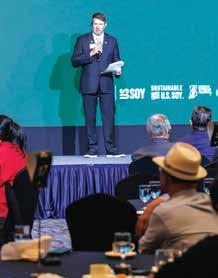
Innovation, trade, regulations themes at Livestock Summit
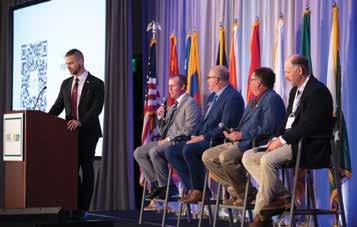
Corn and soybean farmers share many things in common with beef, pork, dairy and poultry producers. That’s why ISA and ICGA hosted the Livestock Summit in Indianapolis.
15
Soybean Oil Masters program graduates 73 global buyers
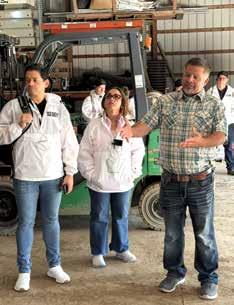
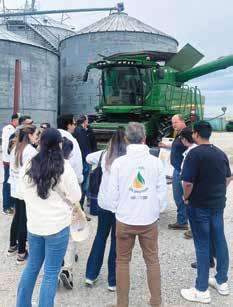
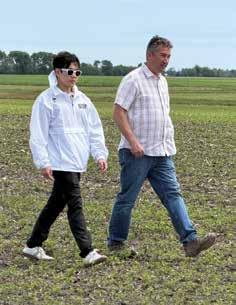
Seventy-three international soybean industry stakeholders visited Indiana farms, agribusinesses and Purdue University as part of the final phase of the Soybean Oil Masters program.
29 New ISA-funded discovery could improve soybean yields
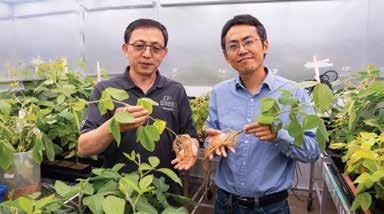
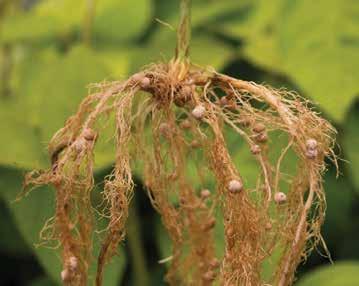
ISA-funded research discovered an evolutionary innovation in soybean plants that could improve crop yields if fine-tuned through alternative approaches such as gene editing.
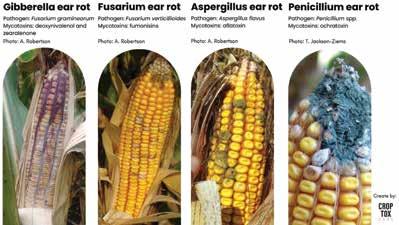
38 Managing systems for Gibberella Ear Rot and mycotoxins
Mycotoxin production is not a single event; it is a process that unfolds across the entire growing season and can continue stubbornly even after the combine leaves the field.
40 About the cover:
Posing in front of Chris Eck’s family home are three of the four generations who have lived in this red house. Front row from left are daughter, Abigail; son, Cash; mother, Bobbie; and daughters Andi Jo and Alli. For more, see the story on page 19.
(Amy Kelley photo)
ISA Membership & Policy Committee
Chair
David Hardin, Avon / D4
Dylan Christopher, Brookston / D1
Allen Buchanan, Fowler / D1
Kevin Kelley, Brookston / D1
John Peters, Monticello / D1
Denise Scarborough, LaCrosse / D1
C.J. Chalfant, Hartford City / D2
Carey McKibben, LaGrange / D2
Steve Phares, Albion / D2
Jenna Scott, Muncie / D2
Brian Warpup, Warren / D2
Mark Wenning, Cambridge City / D2
Directors
Philip Springstun, Boonville / D3
Mark Legan, Coatesville / D3
Derika Lynam-Spaetti, Richland / D3
Gary McDaniel, Boonville / D3
Larry Rusch, Vincennes / D3
David Ring, Huntingburg / D3
Andrew McDaniel, Waldron / D4
Kevin Burbrink, Seymour / D4
Chris Eck, Boggstown / D4
Roger Wenning, Greensburg / D4
Donald Schnitker, Seymour /D4
President
Secretary
Alan Dunn, Michigantown / D4 J.R. Roesner, Ferdinand / D8
Vice President
Tyler Everett, Lebanon / D7
Tom Murphy, Chesterton / D1
Phil Zicht, Winchester / D3
Scott Smith, Windfall / D5
Staff Credits
Editor / Dave Blower Jr. dblower@indianasoybean.com
Indiana Corn & Soybean Post® is published six times per year by the Indiana Soybean Alliance and the Indiana Corn Growers Association.
For address corrections contact: Indiana Corn & Soybean Post® 8425 Keystone Crossing, Suite 200 Indianapolis, IN 46240 Phone: 317-614-0376
Email: cornandsoybeanpost@ indianasoybean.com
Treasurer
Joe Tuholski, LaPorte / D2
Directors
Chris Cherry, New Palestine / D6
Tyler Pottschmidt, Crothersville / D9
For advertising information in the Indiana Corn & Soybean Post®, contact Dave Blower Jr. at 317-347-3620 or dblower@indianasoybean.com. Comments and statewide news articles should be sent to the above address. Advertising space reservations must be made by the first day of the month preceding publication. In consideration of the acceptance of the advertisement, the agency and the advertiser must, in respect of the contents of the advertisement, indemnify and save the publisher harmless against any expense arising from claims or actions against the publisher because of the publication of the content of the advertisement.
Soybean customers’ needs should also be Indiana farmers’ concerns
HDavid Hardin Chair ISA Membership and Policy Committee
ow many of us never give a second thought to what happens to that load of corn or soybeans once it leaves the farm? Is it going to end up as food, feed or fuel? Are those markets growing? Does it matter?
If Indiana farmers want to do more than hope for higher commodity prices and increased demand, we need to pay closer attention to what happens to those truckloads. This is not only about making sure that farmers have a favorable business and regulatory environment for our farm. We need to support our customers who are working for the same goal.
To Become A Member
In late June, the Indiana Soybean Alliance’s Membership and Policy Committee and the Indiana Corn Growers Association hosted the Indiana Livestock Summit in Indianapolis. Historically, livestock feed has been one of the largest markets for our crops.
The Summit brought groups from throughout the industry together to discuss challenges and opportunities that the animal protein markets face. We need to have conversations to ensure Indiana continues to have a favorable climate for growth, and that we are adaptable as conditions change.
Gov. Mike Braun spoke to the crowd at the Summit and stressed the need to be willing to change and look for new opportunities. The protein market is hot now due to the rise of GLP-1 drugs and initiatives like Make Indiana Healthy Again. Gov. Braun also talked about opportunities in regenerative agriculture.
Many food and consumer packaged goods (CPG) companies are looking to market their products’ sustainability to consumers. We need to take this chance to show our customers’ customers what conservation
practices we are using and monetize them to drive increased revenue on the farm.
Indiana row crop farmers have long complained about the unfair burden of property taxes. This year livestock and poultry farmers are feeling the pain as some of their barns have seen jumps in assessed value of more than 90 percent. We need to work together with other allied organizations to make sure that agriculture doesn’t bear an unfair share of the state’s property tax bill.
Sometimes shared goals outside of agriculture can lead to opportunities that we could never have imagined.
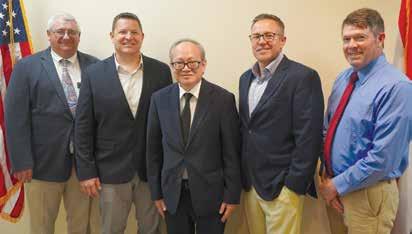
The Indiana Soybean Alliance (ISA) recently hosted a high-level delegation from Thailand, which is looking to increase its imports of U.S. agricultural products to decrease its trade surplus with the United States. Why would they consider Hoosier corn and soy instead of either generic U.S. agricultural products or soybeans from one of our neighboring states?
One answer might be that Indiana understands the interconnectivity of agriculture – and it shows up. Nearly all of Indiana’s agricultural leaders greeted Thailand’s ambassador to the United States at ISA’s office in Indianapolis. Ag leaders representing the state’s soybean, corn, poultry, pork, beef and dairy industries all shared Indiana’s competitive advantage, and the delegation from Thailand was impressed.
We understand everyone can’t pay attention to every issue around the world and draw a line to how it could impact demand and price for your commodities. That is why the Indiana Soybean Alliance’s Membership and Policy Committee is out there advocating on farmers’ behalf.
Game time: ICGA focused on winning farm bill, year-round E15 and aid votes
FAlan Dunn President Indiana Corn Growers Association
or an organization focused on ag policy, the coming weeks and months in Washington, D.C., represent the moment we’ve been working toward for months, and in some cases, years. It’s game time, as they say in the sports world, and ICGA is ready to play its role in that important and exciting process.
Before the end of this Congress in December, three extremely important matters directly impacting Indiana agriculture will be debated – the Farm Bill, year-round E15 and additional financial support for farmers. These issues are critical for re-establishing a sound financial footing for an industry that has been hit hard by political and weather events outside of its control.
Progress has been made with the U.S. House of Representatives having passed its version of a new Farm Bill and year round E-15 legislation earlier this year. As those bills were being considered, farmer leaders from both ICGA and the Indiana Soybean Alliance’s Membership and Policy Committee traveled to the nation’s capital to speak on your behalf about the need and urgency of passing these important bills.
We spoke not only to our Indiana representatives but also joined with other farmer leaders from across the Midwest to reach out to representatives from districts that are not traditionally ag-focused districts. My group visited with representatives from Hawaii, California and New Mexico. This effort was a positive experience, and I think it’s fair to say it resulted in an education going both ways.
Now the action moves to the U.S. Senate, where debate will begin prior to the August recess, likely culminating in a flurry of voting activity when the Congress returns after the mid-term elections in November.
Again, our farmer board leaders will visit Washington this summer to make the case for passage of these important bills. This is where the efforts of not just board members, but all our members who attend shop talks, respond to surveys, write letters to elected officials and attend policy events pay off.
To borrow a sports analogy, it’s the work you put in during the offseason that pays off when the game is on the line.
In sports there are certain strategic moments when a team decides it must get more aggressive in order to win the game. A baseball manager might call for the runner to steal a base, the football coach calls for a long pass, or the basketball team throws on a full court press.
In my view, we have reached that point where it’s time for ICGA to get more aggressive in our efforts to win. But we will need your help. If you see a call to action asking you to reach out to our senators, please act on it. Better yet, make an effort to visit with our elected officials when they are home over the August break.
ICGA will host Shop Talks with many of these federal lawmakers in August, and all have office hours available to meet with constituents. Together our efforts can help win the game for Indiana farmers.
MADE IN INDIANA
At POET, we’re rooted in rural America. For almost 40 years, we’ve been turning locally grown corn into homegrown bioproducts that fuel our economy and support the family farms that make our communities strong. By adding value to every bushel, we help ensure that rural families can continue to do what they love for generations to come.
There are five POET Bioprocessing facilities across Indiana: Alexandria, North Manchester, Portland, Shelbyville, and Cloverdale. | poet.com/grain
Celebrating an important birthday and looking to future of agriculture
BY LESLY WEBER McNITT, NCGA Vice President of Public Policy
During the week of July 13, we welcomed hundreds of corn farmers to Washington on the heels of an important milestone birthday for our nation.
Corn farmers and corn production have been a part of every one of America’s last 250 years, and we at the National Corn Growers Association are looking at the many ways that our farmers can continue to contribute to American life and innovation over the next two-and-a-half centuries.
This month, we released a new report outlining a strategy for securing new demand for American corn. And our work in Washington will play a major role in enacting the plan and eliminating policy and regulatory barriers that stand in the way.
This report provides a roadmap that could collectively unlock demand – for billions of additional bushels of corn annually. It identifies three new highgrowth markets where NCGA is looking to position American corn to compete:
• Maritime Fuels – Securing 10 percent of the global maritime fuel market fueled by corn-based ethanol would equate to 3 billion bushels of annual new demand.
• Sustainable Aviation Fuel
– Securing 10 percent of the global SAF market fueled by ethanol-to-jet technologies would represent 1.7 billion bushels of annual demand.
• Biobased Products and Biomanufacturing – Securing 10 percent of the global biochemical and biobased product market with cornbased feedstocks capable of replacing the petroleum in 10
percent of the world’s plastics would total 6.6 billion bushels of potential demand.
My colleagues and I are already laying the groundwork for these longer-term efforts, and that work will expand over the coming years. In the near-term, we are working to pass legislation in Congress that will allow consumers to access fuel with a 15 percent ethanol blend year-round. We secured a victory on this legislation in the U.S. House of Representatives, and we are lobbying for Senate passage to lower gas prices and increase corn demand. We are also strategizing for ethanol’s use beyond E15.
We continue to work on expanding foreign export markets and eliminating trade barriers, and we are working hard to ensure that the United States-MexicoCanada Agreement (USMCA) is renewed this year. And of course, none of this is possible if farmers can’t purchase affordable inputs or if their tools are too heavily regulated.
That’s why we are raising concerns about these issues, holding U.S. companies to account for bad practices and challenging trading partners who undermine our farmers.
These are but a few of the many efforts we are engaging in to ensure a brighter future for the nation’s corn growers. This work is extremely important to NCGA, because as many of our grower leaders often say, they are not farming just for the season, they are farming with the next generation in mind.
Passing year-round E15 in the House
On May 13, something miraculous and rare in modern legislative politics occurred. A standalone bill passed the U.S. House with a vote of 218-203. During that vote, 122 Republicans, 95 Democrats and one Independent voted to pass the Nationwide Consumer and Fuel
For more on NCGA
Retailer Choice Act (H.R. 1346), which would allow for a 15 percent ethanol-gasoline blend to be sold year-round.
This win is not only a step in the right direction for farmers, but it also provides a template for policymakers and other advocacy groups for bipartisanship in today’s polarized environment.
This is a niche issue to many, but to the farmers, ethanol producers, fuel retailers and the Midwest members of Congress who represent them, year-round E15 was more than a decade-long struggle. What it means in a tough economy for farmers and consumers is an opportunity to increase demand for corn and ethanol while also saving American drivers money at the gas pump.
Corn grower leaders have steadily built support for E15 legislation in Congress through the years.
But by 2026, corn farmers were running out of patience and intensifying pressure on policymakers. Meanwhile, House members from both parties, many of whom are facing close races, are battling for control of their chamber in upcoming midterm elections. These dynamics don’t typically lend themselves to progress, but E15 champions were undeterred.
House Democrats and Republicans wrote joint letters,
stood side-by-side on the House floor and at press conferences, and spoke passionately about the benefits E15 would deliver to their communities. They put the common good first. They lobbied their leadership, their colleagues, the press – anyone who would listen – about the importance of getting a vote on E15. They even held up votes on other bills until a vote on E15 was promised.
And then, with a rare and somewhat risky opportunity to get a vote on E15 as a single bill, these courageous legislators launched a full court press to whip “aye votes.” Numbers were looking good, despite a staunch opposition. Then came a last-minute procedural hurdle: a vote on a “motion to recommit,” which would have tanked the final vote on E15 in the eleventh hour and was introduced by a member of the majority – something that is typically unheard of.
Again, E15 champions were undeterred. With Agriculture and Energy and Commerce Committee chairs and ranking members aiding the push, the motion to recommit failed by a massive margin of 309-112. And finally, after years of failed attempts, late nights and endless hours of negotiations, Republicans and Democrats got their E15 vote, and it passed.
Farm bill, biofuels, crop production and more policy issues are advancing
BY BLAIR SHIPP, American Soybean Association
Several key agricultural policy issues have advanced in Washington in recent weeks, including the farm bill, biofuels, crop protection, fertilizer and trade. Throughout the activity, ASA has remained engaged with Congress, the administration, federal agencies and industry partners to advocate for policies that strengthen the farm economy, expand market opportunities and ensure soybean farmers have access to the tools they need to remain competitive.
A top priority for ASA continues to be advancing a strong, long-term farm policy that provides certainty for soybean farmers. In June, Senate Agriculture Committee Chairman John Boozman released a discussion draft outlining priorities for the next farm bill. ASA welcomed the framework, noting it includes several priorities for soybean growers, including investments in conservation, research, rural development and market opportunities.
The framework also includes provisions supporting fertilizer research, expanded conservation technical assistance, precision agriculture technologies, international food assistance programs, rural broadband and domestic market development through biobased products and renewable fuels. While additional work remains before Congress reaches a final agreement, ASA continues working with lawmakers in both chambers to advance a comprehensive farm bill that strengthens U.S. agriculture and provides farmers with the certainty they need to make long-term business decisions.
Recognizing the continued financial challenges facing agriculture, ASA also welcomed President Trump’s supplemental funding request to Congress. The association said the proposal would provide meaningful short-term support for soybean farmers facing tight margins and ongoing economic uncertainty as they prepare for harvest. ASA also reiterated the importance of continuing to advance
policies that strengthen farm profitability and provide long-term certainty for producers.
Expanding domestic demand
Expanding domestic demand for U.S. soy remains another major focus of ASA’s advocacy.
In late June, USDA published the final Regenerative Feedstock Rule, an important step in implementing the 45Z Clean Fuel Production Credit. The rule creates a framework for farmers using voluntary conservation practices, including cover crops and conservation tillage, to produce value-added biofuel feedstocks that can qualify for additional value under the tax credit.
ASA worked closely with USDA throughout development of the rule, including providing farmer feedback on the Feedstock Carbon Intensity Calculator. The association also successfully advocated for improvements to the 45Z tax credit that recognize North American feedstocks and better position U.S. soybean farmers to benefit from growing domestic demand for renewable fuels.
For soybean growers, stronger demand for soybean oil creates additional market opportunities and supports the long-term value of the crop. ASA continues urging Treasury and the Internal Revenue Service to finalize tax guidance so farmers can fully realize those opportunities.
Crop protection also remained at the forefront of ASA’s advocacy. In late June, EPA approved several new crop protection technologies that will provide soybean farmers with additional tools to manage increasingly difficult weed pressures, protect yields, and support conservation and regenerative farming practices. ASA welcomed the registrations, emphasizing that timely, science-based regulatory decisions help ensure growers have access to modern technologies while maintaining environmental stewardship.
ASA also welcomed the U.S. Supreme Court’s decision in Durnell v. Monsanto, which affirmed that federal pesticide labeling requirements under the Federal Insecticide, Fungicide and Rodenticide Act (FIFRA) preempt conflicting state failure-to-warn claims.
Learn more about ASA
Earlier this year, ASA joined a coalition of agricultural organizations in filing an amicus brief supporting a consistent, science-based federal regulatory framework. The Court’s decision reinforces regulatory certainty, supports EPA’s science-based authority over pesticide labeling, and helps preserve farmer access to essential crop protection tools
Managing production costs
Managing production costs has also remained a significant focus of ASA’s advocacy. In June, ASA applauded President Trump’s Executive Order suspending countervailing duties on imported phosphate fertilizer. The association has long advocated for more competitive fertilizer markets, arguing that reducing unnecessary trade barriers can help improve availability and lower costs for producers.
With fertilizer representing one of the largest annual production expenses on most soybean farms, policies that support competitive input markets remain an important priority for ASA.
ASA has also opposed a recent petition seeking antidumping and countervailing duties on glyphosate imports. Glyphosate remains one of the most widely used crop protection tools in soybean production, and ASA has consistently maintained that farmers benefit from affordable, reliable, and competitive access to agricultural inputs.
As the Department of Commerce reviews the petition, ASA will continue advocating for policies that protect farmers’ access to essential crop protection tools while maintaining a stable and affordable supply of agricultural inputs.
Importance of USMCA
International trade remains another cornerstone of ASA’s advocacy. In June, ASA Executive Committee member and Minnesota soybean farmer Jamie Beyer testified before the House Agriculture Committee on the importance of the United States-Mexico-Canada Agreement (USMCA).
During the hearing, she emphasized the agreement’s role in preserving duty-free market access, strengthening sciencebased trade rules, and providing certainty for soybean farmers. Canada and Mexico account for approximately $4 billion in annual U.S. soy complex exports, making the continued success of USMCA critical for soybean farmers who depend on reliable export markets. ASA continues advocating for science-based, rules-based trade policies that provide certainty for farmers and customers alike.
Congress has a limited legislative window before the August district work period begins, making the coming weeks important for advancing several of agriculture’s top priorities.
ASA will continue working with lawmakers, the administration and federal agencies to ensure soybean farmers have a strong voice in Washington and that federal policy supports a profitable, competitive, and resilient future for U.S. agriculture.
From property taxes at the Statehouse to the Farm Bill on Capitol Hill, the Indiana Ag Policy Podcast will share the latest from the biggest names in ag policy. Scan below to listen now!
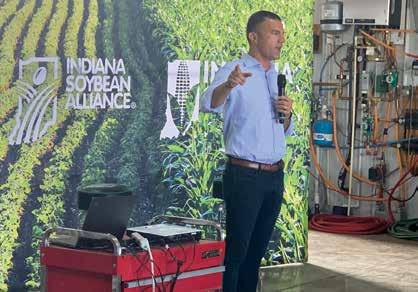
Lamb: ISDA’s working goals include conservation, bioscience and more
BY DON LAMB, Director, Indiana State Department of Agriculture
During the past three years as director of the Indiana State Department of Agriculture, I have been inspired by the work our staff carries out to promote, grow and advocate for Indiana agriculture.
It is a shared purpose where everyone is focused on creating value for others inside and outside of the organization. I’m excited to share some of the important efforts ISDA has been working on and as we look to the future, share a bit more about the five key pillars driving our work.
On conservation and farmland stewardship, the Division of Soil Conservation has been working diligently to develop new pathways for farmers to access capital for implementing conservation practices. We know that conservation practices are often some of the best investments producers can make, but installation costs can be a significant barrier.
To address this, the division piloted a new cost-share program called the Indiana Management of Agriculture Enhancements (IMAGE) Cost-Share Program for southwest Indiana producers looking to improve their soil health.
For ISDA’s new IMAGE program, the State Soil Conservation Board designated $500,000 to ISDA from the Clean Water Indiana Fund. The funding is designed to help agricultural producers implement projects that improve farm management, strengthen livestock operations and support responsible stewardship of Indiana’s natural resources.
It also helps advance the Indiana State Nutrient Reduction Strategy by keeping valuable soil and nutrients on the land while reducing sediment, phosphorus, nitrogen and other pollutants from entering Indiana waterways.
We know just as well as you do that the state’s economic engine is agriculture, driving economic development across the entire agricultural industry. That is why agriculture and agbioscience uniquely serve as key pillars of the BioHeartland announcement.
BioHeartland is Indiana’s shared identity for the bioscience ecosystem where human health, animal health and plant science innovation are invented, made and moved. ISDA, and specifically the Economic Development Division, has partnered in this messaging and branding effort to help advance production agriculture and ag bioscience.
A central mission of ISDA is to promote and advocate for Indiana agriculture which has historically struggled to have its voice elevated and understood. Created by recently passed legislation, ISDA is excited to participate in the Agricultural Promotion and Regulation Task Force later this interim.
This 18-member task force is charged with examining potential avenues to improve Indiana’s future promotion and regulatory functions for agriculture, and we are looking forward to working together to amplify our industry and Indiana’s agricultural footprint.
As we move into the future, we wanted to share with you the five pillars driving our work to further support Hoosier farmers and Indiana agriculture. Through industry and statewide partnerships, ISDA is committed to developing resilient markets, expanding local food access, supporting farmland stewardship, fostering innovation across farms and food systems, and supporting Indiana’s workforce development pipeline through Indiana FFA.
These pillars tie all our work together and echo our shared goals of strengthening Indiana’s agricultural economy, preserving our natural resources and supporting good policy. I’m encouraged by what lies ahead and proud to continue serving Hoosier farmers.
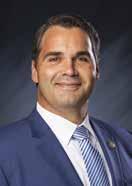
Yakym: America First policy starts with Indiana agriculture, farmers
BY U.S. REP. RUDY YAKYM (R-District 2)
If America First means anything, it has to start with American agriculture. For Hoosier families who’ve worked this land for generations, that’s not a slogan. It’s their livelihood and legacy.
When I visit farms across Indiana’s Second District, from Wabash County to Marshall County, I hear the same thing: This is one of the most challenging financial stretches in recent memory, and farmers need certainty as they plan for the next crop year.
Soybean farmers face some of their lowest prices in decades. Most row crops are under pressure. Input costs remain high, interest rates are squeezing family operations, and Hoosier farmers are competing on an uneven playing field after years of failed trade policy.
Rural America doesn’t ask for much, just a fair shot and a government that has their back. But too often, they’re left at the mercy of decisions made by people who’ve never set foot on a farm. That’s backwards. Farmers should guide the policy that governs their livelihoods, not the other way around.
That’s exactly how House Republicans approached the bipartisan 2026 Farm Bill. It wasn’t written for Washington; it was written for farmers, and I was proud to vote yes when it passed the House in April.
This bill strengthens crop insurance, conservation programs, and the research funding farmers depend on. It expands access to credit, supports precision agriculture, and prioritizes American commodities on the global stage.
I also recently voted to allow year-round sales of E15. The Trump Administration’s move to allow summer E15 sales was a meaningful step for Indiana corn growers. But farmers need more than a seasonal fix, because agriculture doesn’t run on short timelines.
A year-round E15 fix from Congress could create demand for more than 200 million additional bushels of Indiana corn, save Hoosiers up to 30 cents per gallon at the pump, and cut emissions equivalent to taking 99,000 vehicles off Indiana roads every year.
As a member of the House Ways and Means Committee, I’m tracking trade policy very closely. I am supportive of the Trump Administration’s efforts to open new markets to American corn and soybean exports. The U.S.-Mexico-Canada Agreement (USMCA) has also been important for corn and soybean exports, and its dispute mechanism process has defended market access for GMO corn in Mexico.
This year is the first time all three parties are reviewing the agreement. I support the USMCA’s extension but only after the U.S. secures market access that was promised but not delivered and addresses new irritants and barriers from Canada and Mexico.
I’ll always be fighting for Hoosier farmers in Washington, and for common sense policy. Through the Farm Bill, E15, and robust trade policy, we are putting farmers first in the America First policy.
U.S. Rep. Rudy Yakym (R-Dist. 2), above photo, speaks to a group of farmers during a Shop Talk meeting near Bremen, Ind., 2024.
Baird: Livestock Summit showcased a partnership of Indiana agriculture
BY STATE REP. BEAU BAIRD (R-District 44)
Once again, I am proud of the people and the leaders in Indiana. Whenever anyone asks me why I serve in the state legislature, I tell them it is to give back to the communities and industries that have helped shape my life. Rural communities and agriculture are incredibly important to the district I represent, and I am grateful for every opportunity to support their continued success.
Recently, I had the pleasure of attending the Livestock Summit, which was organized by the Indiana Corn Growers Association and the Indiana Soybean Alliance’s Membership and Policy Committee. You might ask, “Why would corn and soybean growers plan a conference about livestock?” The answer is simple. When soybean and corn farmers are successful, there is a safe, reliable, cost-effective food source available for Indiana livestock and poultry. When livestock producers are successful, there is additional demand for the corn and soybeans grown to feed cattle, hogs, chickens, and more.
Livestock and poultry are the No. 1 consumers of Indiana-grown soybeans and corn. Indiana farmers also understand that collaboration strengthens the agricultural value chain, connecting soybean and corn growers with producers of beef, pork, dairy, and poultry. When one part of agriculture succeeds, it creates opportunities throughout the entire industry.
organizations also participated, including the U.S. Dairy Export Council, the U.S. Meat Export Federation, and the USA Poultry and Egg Export Council.
Indiana businesses such as POET, Rose Acre Farms, Corteva Agriscience, and Lowe’s Pellets and Grain also contributed their expertise, demonstrating the broad partnerships that make Indiana agriculture so strong.
Of particular interest to me was a presentation by Indiana Pork’s Chad Martin and Leadery Global executive Byron Ernest regarding a workforce development pipeline that includes Indiana’s Department of Education. Their presentation highlighted something Indiana has embraced in recent years: Preparing students not only for college, but also for meaningful careers. Under Secretary Katie Jenner’s leadership, Indiana has placed a renewed emphasis on workforce readiness through career pathways, industry-recognized credentials, and work-based learning opportunities. Those efforts are helping connect students with high-demand careers while ensuring employers have access to a skilled workforce.
Agriculture offers tremendous opportunities for young Hoosiers, whether in production agriculture, animal science, agribusiness, food processing, logistics, engineering or veterinary medicine. Building stronger connections between our schools and these industries helps students discover rewarding careers while strengthening one of Indiana’s most important economic sectors.
All corners of Indiana agriculture were represented at the Livestock Summit, including the American Dairy Association Indiana, the Indiana Beef Cattle Association, Indiana Pork, the Indiana State Poultry Association, Indiana Farm Bureau, the Agribusiness Council of Indiana, and the Indiana State Department of Agriculture. National
Indiana succeeds because organizations, businesses, educators and policymakers are willing to work together toward common goals. The Livestock Summit was another reminder that when agriculture collaborates across commodities and industries, everyone benefits — from our farmers and livestock producers to consumers and the next generation entering the workforce.
That’s something every Hoosier can be proud of.
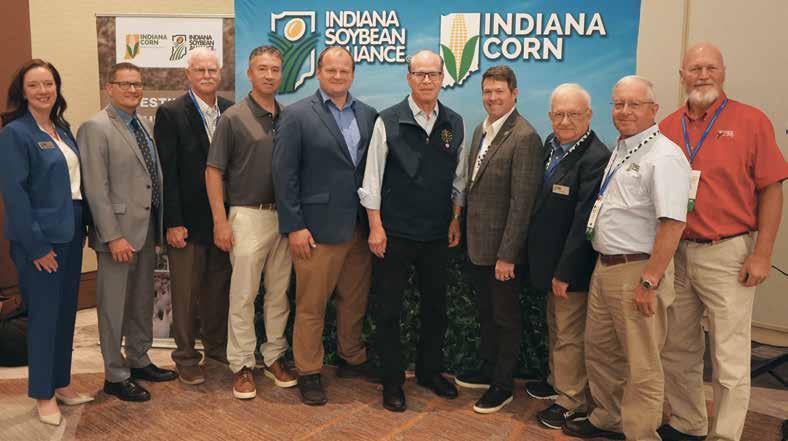
During the Livestock Summit on June 23, Indiana Gov. Mike Braun took time to meet and greet Hoosier farmers from across the state. From left are ISA, ICMC and ICGA CEO Courtney Kingery, Alan Dunn of Michigantown, Kevin Burbrink of Seymour, Alan Buchanan of Fowler, Tyler Everett of Lebanon, Braun, David Hardin of Avon, David Ring of Huntingburg, Steve Phares of Albion and Roger Wenning of Greensburg.
Innovation, trade and livestock regulations were themes at Indiana Livestock Summit
BY DAVE BLOWER JR.
Corn and soybean farmers share many things in common with beef, pork, dairy and poultry producers. That’s why the Indiana Soybean Alliance’s Membership and Policy Committee (ISA) and the Indiana Corn Growers Association (ICGA) hosted the Livestock Summit on Tuesday at the JW Marriott hotel in Indianapolis.
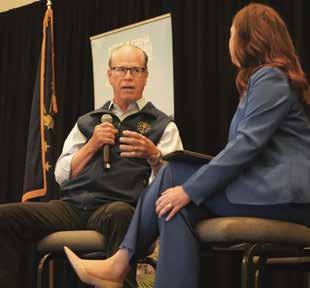
The Summit began with a chat between Indiana Gov. Mike Braun and Courtney Kingery, CEO of ISA and ICGA, and continued with presentations from several ag stakeholders throughout the day. The theme was working together and implementing innovation, diversification and entrepreneurship.
“Over and over during the Summit we heard about collaboration across the entire animal ag value chain,” Kingery said. “Gov. Braun summed it up by touting innovation, diversification and entrepreneurship. Through those principles during the past 30 years, we have realized a 50 percent increase in meat and milk production, a 30 percent increase in egg production, pork production is up 50 percent all while feed usage has only increased by 20 percent. That’s a great story of efficiency, sustainability and innovation.”
Gov. Braun said the state’s agriculture sector is crucial to Indiana’s economy. “The valuable role of agriculture in Indiana’s economy cannot be overstated,” Braun said. “It comes into play in every one of our counties. I’m committed to ensuring the future of this foundational industry is bright. That’s why I launched our state’s $1 billion life sciences initiative, which, in part, will ensure Indiana’s agriculture continues to feed, clothe and fuel America.”
Gov. Braun’s administration has promoted nutritional benefits through its Making Indiana Healthy Again efforts. This initiative may also include opportunities for Indiana’s farmers. “Indiana-raised pork, eggs, dairy, poultry and beef are some of the most nutritious foods in the world, and I think Make Indiana Healthy Again is an opportunity for agriculture to help write that story,” Braun said. “Healthy should be defined by nutrition, not by farm size or production model. Make Indiana Healthy Again includes pathways to get more, healthy Indiana produce into Hoosier homes and schools. My administration wants to be a partner with producers.”
Indiana Gov. Mike Braun, left, discussed the value of agriculture to the state’s economy with ISA, ICMC and ICGA CEO Courtney Kingery during the Livestock Summit in Indianapolis on June 23.
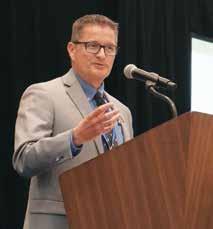
ICGA President Alan Dunn of Michigantown, Ind., tells the Livestock Summit audience that beef, dairy, egg, poultry and pork producers are the No. 1 customers for Indiana’s corn and soybean farmers.
Promoting collaboration
This Summit was focused on the collaborative efforts shaping the animal agriculture and feed industries. That collaboration strengthens the value chain to support corn and soy farmers and livestock producers.
“More than half of Indiana’s corn and soybean production goes toward feeding livestock,” said ICGA President Alan Dunn, a farmer from Michigantown, Ind. “That statistic alone tells an important story, namely, what is good for one is also good for the other. When row crop production is successful, we have a safe, reliable, cost-effective food source for our livestock partners. When livestock producers do well, we have additional demand for the corn and soybeans we produce.”
David Hardin is the chair of ISA’s Membership and Policy Committee and a farmer from Avon, Ind. In addition to growing soybeans and corn, he is also a pork producer who has served on the Indiana Pork Producers Association board and the Indiana Board of Animal Health. Hardin understands the need for collaboration from both sides of the farm fence.
“Agriculture faces a lot of challenges; I think that if we face them with a unified front, we will be able to withstand anything that’s thrown at us,” Hardin said. “This summit is an opportunity to have honest conversations about those challenges and opportunities that we’re going to see ahead. I want to thank you for being here and being part of that conversation. I hope that these discussions help prepare us as an organization to advocate better for all of you.”
Discussing the details
The Summit’s speakers and panel discussions covered the tactics improving farm profitability. For many years, farmers have relied on export markets to increase crop values. Megan Bixler is the International Trade Director for the Indiana State Department of Agriculture. Prior to a panel
discussion on growing export markets, Bixler said farm exports remain strong.
She stated, “In 2025, the U.S. exported $171 billion worth of U.S. agricultural products. That’s slightly down from the peak that we hit in 2022. That was a record at nearly $196 billion. This decline is mostly due to returning to normal levels after that post-COVID boom, strengthening U.S. dollar inflation and increased competition for key products.”
Kingery moderated a discussion on ag export opportunities that featured Ryan LeGrand of the U.S. Grain and BioProducts Council, John Hinners of the U.S. Meat Export Federation, Allison Thomas of the U.S. Dairy Export Council, and Shelby Watson of the USA Poultry and Egg Export Council. The panel concluded that global demand, evolving trade policy and expanding market access continue to shape the future of American agriculture.
Aaron Kuhn, a regional marketing manager for ethanol producer POET, led a panel discussion titled Feed Supply Resilience and Innovation. The experts included Trent Torrance of United Animal Health, Kristy Lowe of Lowe’s Pellets and Grain, and Charles Shininger of CSA Animal Nutrition. The panel said feed availability, input costs and supply chain reliability continue to play a vital role in the success of livestock operations across the country.
“There’s tremendous opportunity for livestock producers over the next 10 years when you talk about protein demand, innovation and feeding the world,” Torrance said. “I think when we look at challenges, we see the negative in that challenge. But there’s also a lot of opportunity in that. When we look at the global supply chain, it’s more difficult due to shipping problems around the world. But when we look at the demand for some of the ingredients, it’s also an opportunity to look inward and solve some of those other problems. So, I think there’s always going to be an opportunity to produce protein more efficiently, to feed the world more efficiently, and make the world healthier.”
Navigating regulations
The Summit’s programming also covered government regulations and how the livestock industry adjusts. Indiana State Poultry Association President Rebecca Eifert Joniskan led a panel discussion about how food safety and environmental regulations affect poultry producers.
The panel included Kim Rice of Rose Acre Farms, Jason Glenn of Maple Leaf Farms and Kate Borders of Miller Poultry. The group concluded that consumer expectations are driving regulations for chicken, turkey and duck producers.
Elanco Animal Health Executive Vice President Jose Simas and Kingery moderated a discussion about changes in animal health and how livestock producers respond.
The leaders in the program were Indiana pork producer Brian Martin, Dr. David Dixon of the Indiana Beef Cattlemen’s Association, Phil Seger of turkey producer Farbest Foods, and southern Indiana dairy producer Sam Schwoeppe. The livestock leaders determined that innovations in animal health, evolving regulations and critical partnerships with corn and soybean farmers support a strong and sustainable food system.
Here is a list of other featured speakers:
• Indiana Farm Bureau Senior Director of Government Affairs Ryan Hoff covered the state’s process of assessing property for tax purposes.
• Chad Martin of Indiana Pork and Dr. Byron Ernest of Leadery Global talked about a program to capture top talent from Indiana high schools for future careers in the pork industry.
• Michigan State University Researcher Dr. Daniel Morris explained his efforts to develop an artificial intelligence monitoring system to constantly observe swine behavior.
• Brian Rexing of Dairy Farmers of America and the National Milk Producers Federation discussed farm-to-food systems including labor, nutrition and producer collaborations.
The event’s sponsors included Alliant, American Dairy Association Indiana, Farm Credit Mid-America, Corteva Agriscience, Indiana Beef Cattle Association, U.S. Dairy Export Council, Indiana Corn Marketing Council, Indiana Dairy Producers, CSA Animal Nutrition, Indiana Farm Bureau, Indiana Pork, Indiana Soybean Alliance, Rose Acre Farms, Agribusiness Council of Indiana, Indiana State Poultry Association, Lowe’s Pellets and Grain, POET, Quality Roasting, United Animal Health and the U.S.A. Poultry and Egg Export Council.
For more about the Livestock Summit and other events this summer, visit incornandsoy.org/events
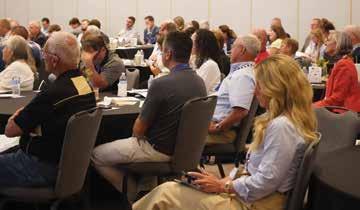
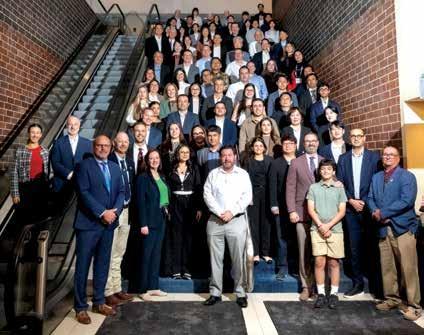
Nearly 200 farmers, ag industry stakeholder, state lawmakers and more attended the Livestock Summit on June 23 at the J.W. Marriott hotel in Indianapolis.
and
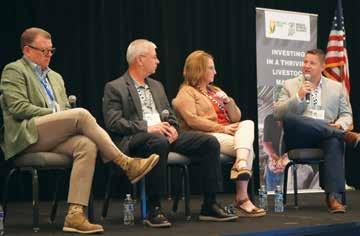
panel of experts discussing the potential of ag trade in global markets. The experts, from left, include John Hinners of the U.S. Meat Export Federation, Shelby Watson of the USA Poultry and Egg Export Council, Allison Thomas of the U.S. Dairy Export Council, and Ryan LeGrand of the U.S. Grains and BioProducts Council.
Aaron Kuhn, Regional Marketing Manager at POET ethanol, far right, discusses feed supply resilience and innovation during the Livestock Summit. The panel includes, from left, Trent Torrance of United Animal Health, Charles Shininger of CSA Animal Nutrition and Kristy Lowe of Lowe’s Pellets and Grain.
ISA, ICMC
ICGA CEO Courtney Kingery, far left, leads a
Take action to help Hoosier farmers
Become a lifetime member of Indiana’s corn and soybean policy groups
The Indiana Corn Growers Association (ICGA) and the Indiana Soybean Alliance’s Membership & Policy Committee (M&P) represent our state’s farmers in the legislative halls in Indianapolis and Washington, D.C. These organizations need your membership to influence federal and state lawmakers.
Indiana soybean and corn growers can now save money and eliminate the hassle of annual renewals by purchasing a LIFETIME MEMBERSHIP to both ICGA and M&P. For only $1,700, you can be a member of both ICGA and M&P for life!
Anyone interested in buying this membership, should contact Industry Affairs Outreach Manager Khyla Goodman by phone at 317-614-0377 or by email at kgoodman@indianasoybean.com. Or, you can go to our website, incornandsoy.org/membership, to join!
Lifetime Members
Phil Ramsey
Courtney Kingery
Matthew Lucas
Tyler Everett
David Gottbrath
Mike Sprinkle
Jeff Troike
Jim Douglas
Michael Steinbarger
Sam Caldwell
Mark Nigh
Alan Dunn
Mason Gick
Aaron Johnson
Nathan Luallen
Sam Mehringer
David Wenning
Mark Wenning
Creed Gunn
Andrew Fansler
Kent Burton
Russell Anderson
Troy Hattery
Mark Bacon
Ronald Sutherlin
Jordan Caldwell
Mike Shuter
John Baugh
Janice Peterson
Cullen Page
Don Wyss
John Peters
Bruce Herr
Lauren Tolle
Luke Roush
James Wood
Allen Buchanan
Matt Hart
Ron Hudson
Mark Tolle
Carl Kissel
Chris Eck
James Wenning
JR Roesner
William Roesner
Sarah Delbecq
Jim Geller Jr.
C.J. Chalfant
William Gerard
Carey McKibben
Neal Smith
Matthew Chapman Jim Flanders
Chris Cherry
Luke Mullet
Tom Murphy
Matt Hayden
Kevin Kelley
Douglas Matthys
Randall Matthys
Brian Warpup
Tom Weaver
Larry Rusch
Chad Chism
Troy Furrer
Brent Bible
Jeremy Mullins
Joe Stoller
Matt Wilson
Adam Sheller
Philip Springstun
Joe Steinkamp
Keevin Lemenager
Dylan Christopher
Craig Faut
Matthew Chapman, Springport, Ind.
“I believe it is a good idea to invest in our own future, and that’s why I became a Lifetime Member of the Indiana Soybean Alliance and the Indiana Corn Growers Association. We must help promote and protect our brand if we want the family farm to survive.”
Family and quality workers allow Eck to chase goals for agriculture
BY DAVE BLOWER JR.
As a verb, the word farm describes the work that is performed to produce a crop or commodity. Tilling, planting, cultivating and harvesting are a few of the verbs describing that work. There are also verbs like marketing, communicating and planning.
As a noun, a farm refers to the people, places and things that can make agriculture special. When many generations have worked the same farm for several decades, those nouns are tied to special memories. The land, a home, a family and people who make the workload lighter are the important nouns.
For Chris Eck, memories of a lifetime are tied to the farmhouse where he is raising his family. Eck is the third generation of his family to live in the red, brick home.
“I grew up in this house; I haven’t moved very far from the nest,” he said. “The house has been a part of my whole life. Growing up, living here, all of the action was here in my backyard. I farmed with my dad and my grandfather growing up. Those are special memories.”
Eck has taken the lessons learned from his family and applied them to his work on the Indiana Soybean Alliance (ISA). Eck is a lifetime member of ISA’s Membership & Policy Committee and the Indiana Corn Growers Association.
Defensive policy work
As a lifetime member of the policy organizations, Eck recognizes that some legislation is poor because of unintended consequences. He said there are federal and state lawmakers who try to solve a problem for one constituent but end up hurting someone else inadvertently. That’s why, he believes, that farmers need to pay attention and represent themselves in these discussions.
In 1955, Eck’s grandfather was looking for a larger farm for his family. He settled on the property the family still owns near Boggstown, Ind. “He sold the farm he owned to a neighbor and moved into this house right here,” Eck said of his grandfather. “When I was born, he bought another house, and my dad moved in here. When I got married, my wife and I lived on another farm for three or four years, but then I bought this off of my dad. All we’ve done is change the names on the ownership a few times.”
As his grandfather grew older, Eck and his father, Stephen, took on more responsibility with the farm. “My wife and I started farming with my parents,” he said. “We always farmed together until Dad passed away in 2012.”
“In my opinion, getting involved in politics, I’d say we are as defensive in our policy work as we are on the offensive,” Eck explained. “There are more bills out there affecting farmers negatively – even if not on purpose – than bills that are out there supporting agriculture. It’s like this: Some congressman will work on a bill to help out someone with a problem. What they don’t realize is that bill will hurt someone else – sometimes that other person is a farmer. If there is no one there to watch or to keep an eye on what’s going on, then farming can get inadvertently affected by a bill like this.”
Through his policy work, Eck said he’s gotten the opportunity to meet and talk with his representative in both state and federal government. Eck appreciates how most lawmakers respond in these meetings.
“You would think that a politician would go into a meeting with a farmer and do a lot of talking,” he said. “Really, they don’t. Mostly they just listen. Often, they have never met a farmer before.”
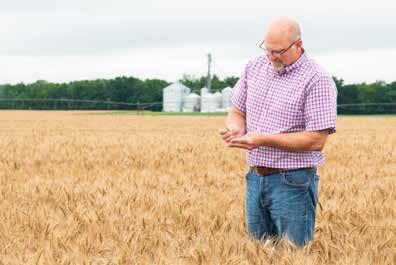
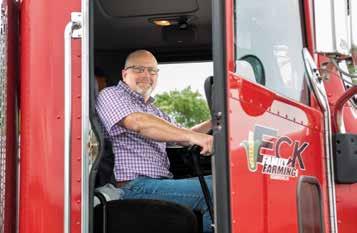
ISA Board member Chris Eck, a farmer from Boggstown, Ind., produces soybeans, corn, wheat and a variety of specialty crops on his farm in rural Shelby County.
Eck is pleased that farm policy groups will often work with other groups to achieve shared goals. These partners can come from economic development or pro-business groups.
“Between the expansion of the POET ethanol plant in Shelbyville and the expansion to Bunge in Morristown, we’ve had a lot of good ag-related business grow in our area,” he said. “In our county, this is just a big deal. Shelby County has the least amount of urban sprawl of the ‘donut counties.’ It’d be easy for the leaders around here to want to just build houses and clear land for some other purpose. But Shelby is an ag county, and getting those processors in here is a big deal. It’s a way to add value to every acre in the county.”
Adding value to every acre is also behind his work with the state’s soybean checkoff program.
Adding value to soybeans
Although he grows soybeans, corn and wheat, none of his corn goes to POET and none of his soybeans go to
Bunge. Eck grows high oleic soybeans that are taken to a plant in Frankfort, Ind., he grows seed corn and seed wheat. Eck’s farm produces a waxy corn that is used in food and beverage products. He grows green beans and cover crop seeds, and he will consider many other crops.
“I’ve spent 30 years chasing specialty contracts,” Eck admitted. “Everything from tomatoes to green beans to popcorn. I have been approached by companies wanting specific stuff grown. Nearly every acre is tied to a premium and a specific customer.
“This isn’t a proof of concept, but our name is out there enough that some companies realize here’s a farmer who is willing to put up with all of the headaches to get us the product that we need. And we’re capable of doing that job. We can deal with those companies, and we know we’ll do it right.”
Eck added that he has a limited amount of acres to farm. He said it’s about adding value to every acre on his farm, and he believes that is the overall mission for his work on the ISA Board of Directors.
Eck has been on the board since 2023. By promoting new products, searching for new markets and finding new ways to move soybeans around the world, he said ISA is adding value to Indiana soybean acres.
Eck has hosted soybean buyers from around the world on his farm, and he has traveled to meet them in various trade missions to China, Colombia, Vietnam and Thailand. He said this work has expanded his understanding of who his customers really are.
“Farmers think, ‘I sell my stuff to Cargill, ADM or Bunge, so that’s who my customer is,’” Eck explained. “Those are really logistics companies moving commodities to others. Our customers are the people who Cargill, ADM or Bunge sell to. When we go meet these customers, these buyers, we can tell them that we grow a better product, we can get it to you cheaper, and they get to know us. Those
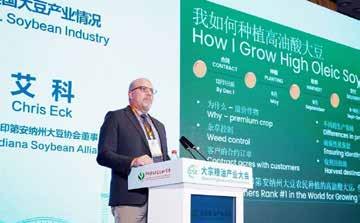
During the International Cereals and Oil Conference in China earlier this year, Chris Eck explained how Indiana farmers produce high oleic soybeans, and he explained their value.
Chris Eck and his wife, Lisa, have raised their family in the home that was purchased by grandfather in the 1950s. Eck was raised in the house by his parents.
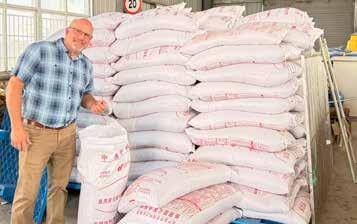
Chris Eck reviews the Shanghai Jinhai Processing Plant in China, where imported soybeans are processed into meal and oil, showcasing the importance of export markets for Indiana soybean farmers.
relationships are very important; to actually meet those customers is a big deal.”
He said farmers should never underestimate the value to talking to end users of products no matter where they live.
His family and the farm
Eck graduated from Purdue University in 1998 with a degree in ag economics. And although his future wife, Lisa, was also a Boilermaker on campus at the same time, he already knew her before heading to West Lafayette. In an unusual twist, Eck met Lisa when he was 16 while attending the wedding of his sister and Lisa’s brother. Eck’s brother-in-law operates a farm nearby. He said Lisa understands fully what farm life looks like. “Lisa’s dad farmed, he fed cattle, and he was a successful farmer in his own right,” Eck said. “There were no surprises for her when she came to the farm. I think she was fully aware of what she was getting into when she married me. I think she always wanted to marry a farmer but didn’t know if she’d ever have the chance. I think that was the one thing I had going for me.”
The couple raised three daughters and a son in their farmhouse. The oldest daughter, Abigail, is an attorney in Indianapolis. Their middle daughter, Alli, is a nurse at Riley Children’s Hospital. The youngest daughter, Andi Jo, is a junior at Purdue pursuing a degree in mental health
counseling. Their son, Cash, will be a junior at Triton Central High School this fall and enjoys participating in FFA.
Eck’s mother, Bobbie, also lives near and contributes to the family’s success.
He is grateful to have skilled employees who can keep the farm operating smoothly while he’s away on ISA business. His team includes Daniel “Junior” Stephen, Aidan Huffman, Corey Geesey and Jamey Hawkins, Dale Stump and Jason Woempner. “They all keep the farm moving,” Eck said.
“I couldn’t do anything that I’m doing on the ISA board without these guys,” Eck said. “You get out of a board what you put into it. To be an effective board member, I need to see and review the programs and projects we support to make sure they are making farmers more profitable. That takes time. My family and my team help me to serve as a better board member.”
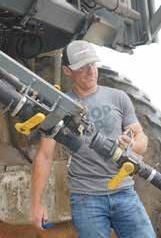
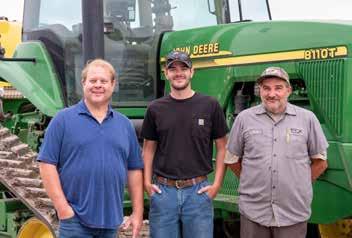
Chris Eck said he wouldn’t be an effective ISA Board member without the help he receives on the farm from his employees. At left, Corey Geesey connects a hose to load a sprayer. At right (or above), other employees are, from left, Jamey Hawkins, Aidan Huffman.
Chris Eck said his work with the Indiana Soybean Alliance is about adding value to every acre of soybeans grown in the state.
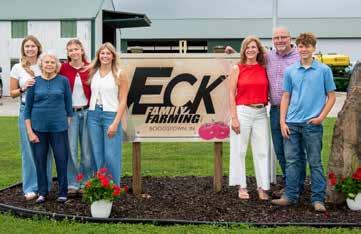
Chris Eck’s family poses by their farm sign. From left are daughter Abigail, mother Bobbie, daughter Alli, daughter Andi Jo, wife Lisa, Chris Eck, and son Cash.
USGBC promotes ethanol initiatives in Vietnam, Taiwan and Philippines
BY EMMA DOSTAL, U.S. Grains & BioProducts Council
The U.S. Grains and BioProducts Council (USGBC) has been busy expanding export markets for corn-based ethanol throughout Asia in recent months. Three projects with the biggest impact are in Vietnam, Taiwan and the Philippines.
growing cities, contributing meaningfully to the country’s climate commitments and public health goals.
The policy also supports the development of Vietnam’s emerging domestic biofuel industry, creating economic opportunities across the agricultural and industrial sectors.
In June, Vietnam completed a rollout of its E10 fuelblending policy, meaning all grades of gasoline sold in the country will now contain ethanol. The transition is a landmark achievement that reflects years of dedicated policy development, interagency coordination and steadfast commitment to the country’s energy, environmental and agricultural objectives.
“The U.S. Grains and BioProducts Council has been truly honored to support the Ministry of Industry and Trade (MOIT) and Vietnam’s fuel industry throughout this policy journey,” said Caleb Wurth, USGBC regional director for Southeast Asia & Oceania (SEA&O).
“Through technical assistance, industry engagement, policy advisory, international study missions and collaboration with Vietnamese government agencies and industry stakeholders, the Council has sought to contribute meaningfully to Vietnam’s ethanol policy framework and industry development. We are proud to have played a supportive role in reaching this milestone.”
The mandate positions Vietnam as one of the most progressive fuel ethanol markets in Asia, reducing vehicular emissions and improving urban air quality in Vietnam’s rapidly
The expansion of ethanol blending holds significant implications for the U.S.-Vietnam trade relationship. Vietnam’s gasoline pool approaches 3 billion gallons annually, and domestic production will need complimentary imports to meet the full blending policy requirements.
“Whether through technical capacity building, supply chain development, engagement with fuel standards bodies or facilitating connections between Vietnamese and U.S. industry stakeholders, the Council’s team in SEA&O remains fully committed to the success and continued growth of Vietnam’s fuel ethanol program,” Wurth said.
Ethanol in Taiwan
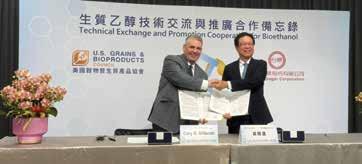
In May, the USGBC signed a memorandum of understanding (MOU) with the Taiwan Sugar Corporation (TSC) to jointly promote the development of ethanol in the region through mutual knowledge exchange and technical cooperation.
The U.S. Grains and BioProducts Council (USGBC) participated in a USDA trade mission to the Philippines. Pictured cutting the ribbon at a retail gas station carrying E20 fuel are USGBC Director of Global Ethanol Export Development Alicia Koch (far right); Growth Energy Director of Global Policy Emily Marthaler (second from right); Renewable Fuels Association Vice President of Government Affairs Ed Hubbard (third from right); USDA Under Secretary for Trade and Foreign Agricultural Affairs Michelle Bekkering (fourth from left); and USGBC Chairman Mark Wilson (third from left).
USGBC Vice President Cary Sifferath signed the document on behalf of the Council with USGBC Director in Taiwan Michael Lu, American Institute in Taiwan (AIT) Deputy Chief Steven Burgoon and AIT Economic Officer Ann Ku in observance.
“As TSC is Taiwan’s largest corporate pig farm, pork supplier and a user of U.S. corn, it maintains fermentation infrastructure and technical expertise for ethanol production, making it one of the few domestic entities capable
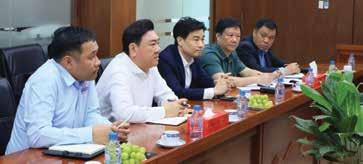
The U.S. Grains and BioProducts Council’s (USGBC) regional office for Southeast Asia and Oceania (SEA&O), including USGBC Vietnam Country Manager Tran Trong Nghia (far left) and USGBC Regional Ethanol Consultant Kent Yeo (second from left), is proud to have supported Vietnam’s recent rollout of E10 fuel blending in retail gas stations.
of doing so,” Sifferath said in his opening remarks.
“Through this collaboration, we aim to explore the potential of using imported U.S. corn as a feedstock for ethanol production in Taiwan, and the possibility of leveraging its storage capacity to import U.S. ethanol.”
Lu added that following the Council’s 2024 MOU with CPC Corporation, a major energy company in Taiwan, this new partnership with TSC marked another important step toward developing bioethanol applications in Taiwan.
After the signing ceremony, the delegations traveled to Tainan for a tour of TSC’s headquarters, including its ethanol testing and production facilities, to demonstrate the company’s leadership in Taiwan’s biofuel sector.
Sifferath and Lu also attended the Taiwan Sustainable Aviation Forum, where industry stakeholders discussed Taiwan’s aspirations to reach net-zero aviation emissions and how sustainable aviation fuel (SAF) can make that goal a reality.
“The Council will continue collaborating with both companies through technical exchanges, stable feedstock support and pilot projects to advance biofuel applications, strengthen Taiwan’s energy resilience and support its netzero transition goals,” Lu said.
Philippines trade mission
In April, the USGBC and member representatives joined a USDA Agricultural Trade Mission (ATM) to Manila, Philippines to maintain momentum for U.S. exporters in a young, growing economy.
USGBC Chairman Mark Wilson and USGBC Vice Chairman Jay Reiners were joined by USGBC Regional Director for Southeast Asia & Oceania (SEA&O) Caleb Wurth; USGBC Director of Global Ethanol Export Development Alicia Koch; USGBC Regional Ethanol Consultant Kent Yeo; and USGBC Philippines Consultant Marco Sardillo.
Council members from the U.S. ethanol industry also participated, including Eco-Energy Vice President of Global Trade Hagan Rose, Growth Energy Director of Global Policy Emily Marthaler and Renewable Fuels Association Vice
U.S. Grains and BioProducts Council (USGBC) Vice President Cary Sifferath (left) and Taiwan Sugar Corp. (TSC) Chairman Wu Ming-Chang (right) signed a memorandum of understanding (MOU) to signify the organizations’ collaborative efforts to increase the development and use of ethanol in Taiwan.
President of Government Affairs Ed Hubbard, underscoring USDA’s commitment to strengthening U.S. ethanol producers’ relationships in international markets.
“This ATM is the latest strong message from our partners at USDA that international market development for U.S. agricultural products, particularly ethanol, is a priority the Council is eager to be part of,” Wilson said.
The mission was headlined by the opening of a retail gas station in Manila carrying gasoline blended with 20 percent ethanol (E20), including a speech from USDA Under Secretary for Trade and Foreign Agricultural Affairs Michelle Bekkering and closing remarks from Wilson and Wurth.
The Philippines is the largest U.S. ethanol trading partner in Southeast Asia, with more than 101 million gallons of U.S. ethanol exported to the country in 2025. The Philippines E10 mandate, that began in 2013, has delivered a win-win outcome for the U.S.-Philippines economic partnership, and total gasoline demand in the country surpassed 2 billion gallons for the first time last year.
Ethanol production in the Philippines has increased by nearly 450 percent since the inception of the mandate, and U.S. ethanol now accounts for roughly 45 percent of the country’s total ethanol demand. This mutually beneficial trade relationship, forged through ethanol, helps stimulate further investment in the Philippines domestic ethanol industry, as U.S. ethanol imports help lower the average price of ethanol and gasoline in the country.
The Council’s team met with the Ethanol Producers Association of the Philippines (EPAP) afterward to discuss next steps in expanding E20 access to other regions of the country.
The program also included meetings at the Subic Bay Freeport and the Island Skies Alliance to discuss additional opportunities for ethanol as a transportation and energy industry tool.
“Consumer access to E20 fuel is another significant step forward for the environmental goals of the Philippines and for U.S. ethanol producers in what is already the ninthlargest export market for U.S. grains in all forms,” Wurth said.
Celebrating 35 years of the national Soy Checkoff
Celebrating 35 years of the national Soy Checkoff
Celebrating 35 years of the national Soy Checkoff
Celebrating 35 years of the national Soy Checkoff
Dear U.S. soybean community,
Dear U.S. soybean community,
Dear U.S. soybean community,
Dear U.S. soybean community,
For U.S. soybean farmers, the decision to come together 35 years ago and form the national Soy CheckoffSM was a defining moment that would reshape American agriculture for generations. Through collective investments into food, feed, fuel, industrial, exports and sustainable production, U.S. soybean production has grown from 1.8 billion bushels in 1990 to over 4 billion today. Because of what farmers have built together over 35 years, we’ve been able to create entirely new markets from the ground up like biodiesel, expand exports around the world to 90 countries and develop tools that protect yield on the farm. The partnership between farmers and the Soy Checkoff traces back to a pivotal moment in American agriculture. For many soybean farmers, the drought of 1988 exposed the need for a national checkoff. Soon
For U.S. soybean farmers, the decision to come together 35 years ago and form the national Soy CheckoffSM was a defining moment that would reshape American agriculture for generations. Through collective investments into food, feed, fuel, industrial, exports and sustainable production, U.S. soybean production has grown from 1.8 billion bushels in 1990 to over 4 billion today. Because of what farmers have built together over 35 years, we’ve been able to create entirely new markets from the ground up like biodiesel, expand exports around the world to 90 countries and develop tools that protect yield on the farm. The partnership between farmers and the Soy Checkoff traces back to a pivotal moment in American agriculture. For many soybean farmers, the drought of 1988 exposed the need for a national checkoff. Soon
For U.S. soybean farmers, the decision to come together 35 years ago and form the national Soy CheckoffSM was a defining moment that would reshape American agriculture for generations. Through collective investments into food, feed, fuel, industrial, exports and sustainable production, U.S. soybean production has grown from 1.8 billion bushels in 1990 to over 4 billion today. Because of what farmers have built together over 35 years, we’ve been able to create entirely new markets from the ground up like biodiesel, expand exports around the world to 90 countries and develop tools that protect yield on the farm. The partnership between farmers and the Soy Checkoff traces back to a pivotal moment in American agriculture. For many soybean farmers, the drought of 1988 exposed the need for a national checkoff. Soon
For U.S. soybean farmers, the decision to come together 35 years ago and form the national Soy CheckoffSM was a defining moment that would reshape American agriculture for generations. Through collective investments into food, feed, fuel, industrial, exports and sustainable production, U.S. soybean production has grown from 1.8 billion bushels in 1990 to over 4 billion today. Because of what farmers have built together over 35 years, we’ve been able to create entirely new markets from the ground up like biodiesel, expand exports around the world to 90 countries and develop tools that protect yield on the farm. The partnership between farmers and the Soy Checkoff traces back to a pivotal moment in American agriculture. For many soybean farmers, the drought of 1988 exposed the need for a national checkoff. Soon
after, farmer leaders on the American Soybean Association voted overwhelmingly to pursue one, making investments available for international and domestic marketing as well as dedicated research into new uses. USB Secretary and Minnesota soybean farmer Tom Frisch believes the opportunity for every soybean farmer in the country to pool their resources and make a collective impact remains just as important 35 years later. “We need to continue to work together as U.S. soybean farmers and not isolate ourselves. We, as U.S. soybean farmers, need to champion our industry every day, every month, every year,” says Frisch.
after, farmer leaders on the American Soybean Association voted overwhelmingly to pursue one, making investments available for international and domestic marketing as well as dedicated research into new uses. USB Secretary and Minnesota soybean farmer Tom Frisch believes the opportunity for every soybean farmer in the country to pool their resources and make a collective impact remains just as important 35 years later. “We need to continue to work together as U.S. soybean farmers and not isolate ourselves. We, as U.S. soybean farmers, need to champion our industry every day, every month, every year,” says Frisch.
after, farmer leaders on the American Soybean Association voted overwhelmingly to pursue one, making investments available for international and domestic marketing as well as dedicated research into new uses. USB Secretary and Minnesota soybean farmer Tom Frisch believes the opportunity for every soybean farmer in the country to pool their resources and make a collective impact remains just as important 35 years later. “We need to continue to work together as U.S. soybean farmers and not isolate ourselves. We, as U.S. soybean farmers, need to champion our industry every day, every month, every year,” says Frisch.
Qualified State Soybean Boards (QSSBs) have been there every step of the way, serving as the connective tissue between national strategy and on-theground reality. “When I view QSSBs, they are at the grassroots level navigating concerns and
Qualified State Soybean Boards (QSSBs) have been there every step of the way, serving as the connective tissue between national strategy and on-theground reality. “When I view QSSBs, they are at the grassroots level navigating concerns and
Qualified State Soybean Boards (QSSBs) have been there every step of the way, serving as the connective tissue between national strategy and on-theground reality. “When I view QSSBs, they are at the grassroots level navigating concerns and
after, farmer leaders on the American Soybean Association voted overwhelmingly to pursue one, making investments available for international and domestic marketing as well as dedicated research into new uses. USB Secretary and Minnesota soybean farmer Tom Frisch believes the opportunity for every soybean farmer in the country to pool their resources and make a collective impact remains just as important 35 years later. “We need to continue to work together as U.S. soybean farmers and not isolate ourselves. We, as U.S. soybean farmers, need to champion our industry every day, every month, every year,” says Frisch. Qualified State Soybean Boards (QSSBs) have been there every step of the way, serving as the connective tissue between national strategy and on-theground reality. “When I view QSSBs, they are at the grassroots level navigating concerns and
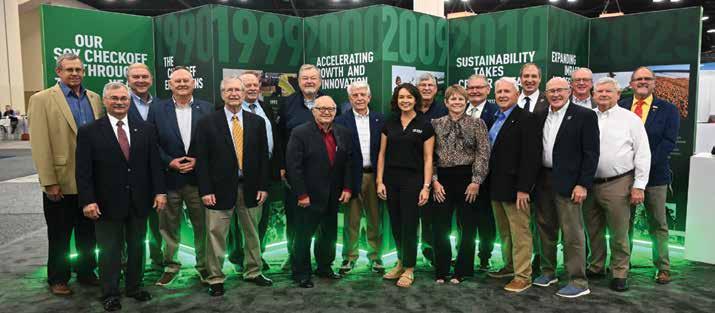
USB Past Chairs gather for a photo in the Soy Checkoff booth at Commodity Classic 2026 in Austin, Texas.
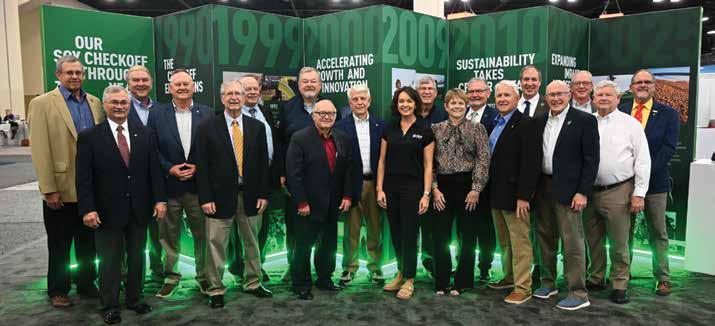
USB Past Chairs gather for a photo in the Soy Checkoff booth at Commodity Classic 2026 in Austin, Texas.
USB Past Chairs gather for a photo in the Soy Checkoff booth at Commodity Classic 2026 in Austin, Texas.
USB Past Chairs gather for a photo in the Soy Checkoff booth at Commodity Classic 2026 in Austin, Texas.
opportunities with their farmers across the state. They are in touch with their local agriculture community about what’s happening in their backyard,” says USB Past Chair and Mississippi soybean farmer Philip Good.
As the Soy Checkoff thinks about the next 35 years, every investment made aims to grow demand, improve resiliency of the soybean crop and bring additional revenue back to the farm.
opportunities with their farmers across the state. They are in touch with their local agriculture community about what’s happening in their backyard,” says USB Past Chair and Mississippi soybean farmer Philip Good.
opportunities with their farmers across the state. They are in touch with their local agriculture community about what’s happening in their backyard,” says USB Past Chair and Mississippi soybean farmer Philip Good.
“The Soy Checkoff isn’t just about dollars invested from the half-million U.S. soybean farmers — it’s about giving them the power to shape their own future and deliver lasting impact,” says Indiana farmer and USB Treasurer Don Wyss.
As the Soy Checkoff thinks about the next 35 years, every investment made aims to grow demand, improve resiliency of the soybean crop and bring additional revenue back to the farm. “The Soy Checkoff isn’t just about dollars invested from the half-million U.S. soybean farmers — it’s about giving them the power to shape their own future and deliver lasting impact,” says Indiana farmer and USB Treasurer Don Wyss.
As the Soy Checkoff thinks about the next 35 years, every investment made aims to grow demand, improve resiliency of the soybean crop and bring additional revenue back to the farm. “The Soy Checkoff isn’t just about dollars invested from the half-million U.S. soybean farmers — it’s about giving them the power to shape their own future and deliver lasting impact,” says Indiana farmer and USB Treasurer Don Wyss.
One example of how powerful this partnership has proven to be is the advancement of high oleic soybean research and farmer adoption. We’ve seen over a million acres of high oleic across states like Indiana, Ohio, Missouri and the Delmarva region with QSSBs helping promote premiums of $0.75 to $1.25 per bushel. And there’s potential to reach 5-7 million acres a decade from now. High oleic soybeans have returned nearly $400 million in premium payments to farmers — a direct return on the $130 million checkoff investment through 2025.
One example of how powerful this partnership has proven to be is the advancement of high oleic soybean research and farmer adoption. We’ve seen over a million acres of high oleic across states like Indiana, Ohio, Missouri and the Delmarva region with QSSBs helping promote premiums of $0.75 to $1.25 per bushel. And there’s potential to reach 5-7 million acres a decade from now. High oleic soybeans have returned nearly $400 million in premium payments to farmers — a direct return on the $130 million checkoff investment through 2025.
Another great example of partnership is the lower Mississippi River dredging project which added an additional $461 million in revenue to U.S. soybean farmers. Through checkoff investment in research, analysis and design, which kickstarted deepening the lower Mississippi
Another great example of partnership is the lower Mississippi River dredging project which added an additional $461 million in revenue to U.S. soybean farmers. Through checkoff investment in research, analysis and design, which kickstarted deepening the lower Mississippi
River from 45 to 50 feet allowed for an increase of 500,000 bushels per ocean vessel and saves 13 cents per bushel of freight. This investment spanned collaboration with USB, the Soy Transportation Coalition, U.S. Soybean Export Council, the American Soybean Association and multiple QSSBs. “Investing in the research and engineering side of that project was a new venture for us, but it encouraged strategic thinking of how we can use checkoff funds in unique ways to improve all soybean farmers’ bottom line,” says Good.
As the United Soybean Board celebrates its 35th Anniversary we are proud of the work we’ve accomplished for every single U.S. soybean farmer. With our continued partnerships with the QSSBs we look forward to what this next chapter brings for the U.S. soybean industry. Together we can continue to deliver sustainable soy solutions to every life, every day.
River from 45 to 50 feet allowed for an increase of 500,000 bushels per ocean vessel and saves 13 cents per bushel of freight. This investment spanned collaboration with USB, the Soy Transportation Coalition, U.S. Soybean Export Council, the American Soybean Association and multiple QSSBs. “Investing in the research and engineering side of that project was a new venture for us, but it encouraged strategic thinking of how we can use checkoff funds in unique ways to improve all soybean farmers’ bottom line,” says Good.
River from 45 to 50 feet allowed for an increase of 500,000 bushels per ocean vessel and saves 13 cents per bushel of freight. This investment spanned collaboration with USB, the Soy Transportation Coalition, U.S. Soybean Export Council, the American Soybean Association and multiple QSSBs. “Investing in the research and engineering side of that project was a new venture for us, but it encouraged strategic thinking of how we can use checkoff funds in unique ways to improve all soybean farmers’ bottom line,” says Good.
As the United Soybean Board celebrates its 35th Anniversary we are proud of the work we’ve accomplished for every single U.S. soybean farmer. With our continued partnerships with the QSSBs we look forward to what this next chapter brings for the U.S. soybean industry. Together we can continue to deliver sustainable soy solutions to every life, every day.
As the United Soybean Board celebrates its 35th Anniversary we are proud of the work we’ve accomplished for every single U.S. soybean farmer. With our continued partnerships with the QSSBs we look forward to what this next chapter brings for the U.S. soybean industry. Together we can continue to deliver sustainable soy solutions to every life, every day.
Here’s to the next 35 years of the U.S. soybean industry!
Here’s to the next 35 years of the U.S. soybean industry!
Here’s to the next 35 years of the U.S. soybean industry!
USB Chair
Brent Gatton Kentucky
USB Chair Brent Gatton Kentucky
USB Chair Brent Gatton Kentucky
USB Past Chair Sandy Ludeman participates in a Soy Checkoff town hall in 1992.
USB is formed from the publication of the Soybean Promotion and Research Order under the 1990 Farm Bill.
USB Past Chair Sandy Ludeman participates in a Soy Checkoff town hall in 1992.
USB is formed from the publication of the Soybean Promotion and Research Order under the 1990 Farm Bill.
USB Past Chair Sandy Ludeman participates in a Soy Checkoff town hall in 1992.
USB is formed from the publication of the Soybean Promotion and Research Order under the 1990 Farm Bill.
USMEF works to grow exports of Indiana corn through red meat by addressing access issues
In 2025, beef and pork exports accounted for more than 508 million bushels of U.S. corn usage. Nearly 32 million bushels of that came from Indiana, contributing about 13.5 percent of bushel value, or about 58 cents.
The U.S. Meat Export Federation (USMEF) continually works hand-in-hand with USDA, the Office of U.S. Trade Representative (USTR) and others to grow that demand by addressing beef access issues all around the globe. The past year has seen some notable steps forward in that effort.
U.S. beef regained duty-free access to the United Kingdom (UK) under a 13,000 metric ton quota that was included in the trade framework reached by the Trump administration in 2025.
USMEF hosted a pair of events in London to celebrate the arrival of the first U.S. beef shipments under the new quota, a reception and dinner at the U.S. Embassy and a dinner for the British trade at Smith & Wollensky steakhouse.
At the embassy reception, USMEF President and CEO Dan Halstrom noted that the new beef access in the UK could lead to $150 to $200 million in sales annually once it is fully implemented.
Beef access to China
Certainly the biggest challenge for beef access during the past year has been in China. Beginning in March 2025, the Chinese government refused to renew registrations for U.S. beef processing and cold storage facilities as required under the Phase One Trade Agreement reached during the first Trump administration.
That effectively locked U.S. beef out of the market for most of 2025 and into 2026. USMEF staff worked continuously with USTR to keep the beef access issue at the forefront of trade discussions. In May, the vast majority of beef establishment registrations were renewed.
While beef trade to China is slowly resuming, there are still access issues to be addressed, including technical barriers that led to the suspension of some establishments.
China beef trade is key, not only because of the size of the market ($1.6 billion in sales in 2024) but also because bids from buyers in China enhance the price U.S. beef cuts command in Japan, Korea, Taiwan and other Asian markets.
Nebraska Gov. Jim Pillen, left photo, speaks at the U.S. Embassy in London during an event to celebrate the return of duty-free U.S. beef access in the United Kingdom. At right, USMEF President and CEO Dan Halstrom discusses the value of the UK market to U.S. beef producers.
Indonesia offers potential
Indonesia is a potential $400 to $500 million export market for U.S. beef, and in February and agreement on reciprocal trade with Indonesia was announced by the United States.
This is a big step toward fully opening a market that has greatly underperformed due to its trade-limiting import licensing system and other restrictive policies.
Staff with USMEF’s Export Services office engaged the Indonesian halal accreditation authority to regain the key halal certification access for that country, ending a sixmonth lockout of U.S. beef access. Once implemented, the agreement includes a 50,000 metric ton annual beef purchase commitment.
Long-term growth in Africa
USMEF sees long-term growth potential in much of the African continent, but it is going to take development, including work on a number of access issues. Last spring, USMEF hosted the first red meat trade show in Accra, Ghana, bringing together buyers from across West Africa.
That was followed up by a beef tasting event for
restaurateurs and chefs in March. Both events provided what was for many their first opportunity to taste the quality of corn-fed U.S. beef.
But many African nations have non-scientific barriers to U.S. red meat products. USMEF is urging USTR to use the Africa Growth and Opportunities Act (AGOA) to address those trade restrictions.
The intent of AGOA is to incentivize two-way trade with African nations by designating countries for dutyfree treatment. AGOA is currently under review, and in public comments USMEF asked USTR to consider red meat import limitations when weighing trade benefits for countries under AGOA.
Free trade access has been key in building U.S. beef exports to nearly $10 billion annually, creating demand for more than $2 billion of U.S. corn. No trade pact has been more crucial than the U.S.-Mexico-Canada Agreement (USMCA).
Mexico bought more than $1.3 billion in U.S. beef in 2025, while Canada reached nearly $900 million. USMEF remains engaged in the discussions on the current review of USMCA to ensure that full access is maintained for U.S. farmers and ranchers.
USAPEEC touts global poultry demand creating strong market for Indiana corn
When Indiana farmers think about corn markets, they often look straight to the grain elevator, but one of its most valuable, high-value corn consumers doesn’t look like an industrial facility, at all. In fact, it has feathers.
Indiana is a powerhouse in both grain and livestock, ranking as the 5th-largest corn producer in the nation while simultaneously leading the pack in poultry as No. 1 in ducks, No. 3 in total egg production, and No. 4 in turkeys. This intersection of local grain production and poultry production creates a vital symbiotic relationship: the poultry industry consumes sizeable amounts of feed, and in turn, global appetite for U.S. poultry moves the corn pile right here at home.
The domestic poultry sector is a massive anchor for U.S. corn. In fact, roughly 35 percent of all U.S. corn meal is consumed by domestic broilers, turkeys, ducks and layers.
Locally, Indiana poultry and egg production utilizes approximately 92 million bushels of corn annually.
$5.96 billion in total value, creating a steady upward demand curve that supports longterm stability for corn producers.
Without these vital global poultry markets, the lack of export demand would cause U.S. corn prices to slide by 6 percent.
ICMC dollars at work
Because the connection between birds and bushels is so clear, the Indiana Corn Marketing Council strategically uses checkoff dollars to protect and expand international poultry demand. By partnering with the USA Poultry and Egg Export Council (USAPEEC), Indiana corn checkoff funds actively back promotional, technical, and tradebuilding projects in emerging highgrowth markets — specifically Mexico, Colombia, India and Vietnam.
It is estimated that completely eliminating poultry and egg production would trigger a staggering 45 percent decrease in U.S. corn prices, assuming all other market variables remained constant. While domestic consumption is massive, international trade is the true engine of growth. When foreign markets buy U.S. chicken, turkey, duck or eggs, they are fundamentally buying Indiana corn.
Nationally, poultry and egg exports account for 243.1 million bushels of U.S. corn usage. For individual corn growers, this international poultry movement contributes an estimated 5 percent of total bushel value — adding about 21 cents per bushel to the bottom line.
Overall, these poultry and egg exports represent over
In Mexico, programs focus on the “Mexicanization” of turkey products, creating everyday recipe options that integrate U.S. poultry into local, traditional family meals.
Colombian activities include retail campaigns and hands-on training seminars for hotel and restaurant operators to ensure the proper handling and preparation of frozen poultry.
Throughout India, checkoff funds help educate culinary stakeholders and consumers about the nutritional benefits and culinary versatility of duck meat in a rapidly expanding foodservice sector.
Lastly, our Vietnam marketing efforts include tailored workshops and young chef culinary competitions, building long-term familiarity with U.S. poultry products among the country’s future culinary leaders.
For Indiana corn growers, the lesson is simple: supporting a robust, globally competitive poultry market is one of the most effective ways to defend the value of the grain in your bins.
Chris Eck, a farmer from Boggstown, Ind., hosted a trade group interested in learning more about corn production in Central Indiana.
Soybean Oil Masters program graduates 73 worldwide buyers from 12 countries
BY DAVE BLOWER JR.
Seventy-three international soybean industry stakeholders visited Indiana farms, agribusinesses and Purdue University as part of the final phase of the Soybean Oil Masters program in late May. The program, a partnership between the U.S. Soybean Export Council (USSEC) and the Indiana Soybean Alliance (ISA) demonstrates why U.S.grown soybeans are the preferred choice for global buyers.
This program fosters connections internationally across the agricultural, trade and food business and food service sectors while providing global end users, crushers and influential groups in the food industry with a comprehensive understanding of U.S. soybean oil and, ultimately, to increase demand. The program covers various aspects including nutritional benefits, practical applications, production processes and the sustainability of U.S. soybean production.
This year’s Soybean Oil Masters class had 73 graduates from 12 countries. These graduates are buyers and endusers of U.S. soybeans.
Since the program was created in 2018, more than 1,500 soybean buyers from 20 countries have graduated. In addition to tours and technical learning, participants engaged with state leaders and experienced Indiana’s food and culture firsthand.
Indiana State Rep. Danny Lopez (R-Dist. 39) welcomed the Soybean Oil Masters group during a ceremony on May 22. Lopez highlighted Indiana’s leadership role in producing soybeans and many other farm products. “Indiana views
itself as a global player in many industries,” he said. “When it comes to agriculture, and the soybean industry, Indiana is second to none.”
Indiana is the leading producer in the world of high oleic soybeans, which are grown to create a healthier cooking oil that excels in frying and baking applications. To showcase the oil, participants sampled food prepared with it at Gainbridge Fieldhouse during a WNBA game featuring the Indiana Fever, as well as at Victory Field, home of Indianapolis Indians.
Soybean Oil Masters participants
This year the Soybean Oil Masters participants came from Chile, China, Colombia, India, Indonesia, Japan, Korea, Mexico, Morocco, Pakistan, Peru and Vietnam. The tours through Indiana included stops at ADM in Frankfort, Ind., Beck’s Hybrids, Pence Group, Fischer Food Grade & Seeds, Kroger supermarket in Fishers, Ind.; research sites at Purdue University; a chef-led hands-on culinary demonstration and several Indiana farms.
The purpose of these tours was to highlight soybean production practices in Indiana and to give international soybean stakeholders an opportunity to interact with farmers.
Among the graduates was Zhengyong Bai with Clara Futura Holdings Inc. in China. He said learning about Indiana farmers’ sustainability efforts to produce their crop is critical to his company’s buying decisions. “I’m looking for high-oleic soybeans, non-GMO soybeans, and organic
ISA and USSEC hosted a program in Indianapolis for Soybean Oil Masters participants. Seventy-three international soybean industry stakeholders visited Indiana farms, agribusinesses and Purdue University as part of the final phase of the Soybean Oil Masters program in late May.
McNair, leader of USSEC’s Oil and Soyfood Program, led a farmer panel during the Indianapolis event. The farmers, from left, are Mark Wenning of Cambridge City, Ind., Chris Eck of Boggstown, Ind., John Peters of Monticello, Ind., and Mike Koehne of Greensburg, Ind.
soybeans,” Bai explained. “We’ve been meeting with some good suppliers.”
USSEC said it appreciates the partnership and investment of Indiana soybean farmers in this global outreach program.
“The Soybean Oil Masters program provides a unique opportunity to immerse global buyers in learning about the U.S. Soy supply chain, from sustainable farm practices to oil refining and soy and human health,” said Will McNair, USSEC Director of Soyfoods and Oil and Global Team Development.
“For most attendees, this is the first time they have visited a U.S. soybean farm. I love seeing the excitement and curiosity as attendees learn directly from farmers, processors and other members of the supply chain.”
Hosting trade teams
The Hoosier farmers who hosted tours on their farms included Allen Buchanan, Fowler, Ind.; Adam Sheller, Noblesville, Ind.; Tyler Everett, Lebanon, Ind.; and Chris Eck, Boggstown, Ind.
“Hosting a tour on my farm was a great experience,” said Buchanan, who is a director on the ISA board. “The people on the tour asked good, thoughtful questions, and I believe they learned a lot. This is about building trust between people – between soybean growers and soybean customers.”
The program targets participants from across the soybean oil value chain, including importers, crushers, refiners, consumer goods companies, the hospitality and institutional sectors, chefs and nutritionists. The participants may understand their part of the value chain but lack a detailed understanding for the rest of it.
Eck explained that there is no substitute for building relationships.
“Trade visits are a chance to bring our global customers to the farm and show them the quality of the products we grow,” said Eck, also an ISA board director. “These tours are valuable to Indiana soybean farmers. We can show them exactly how the crop is grown, and we can build a relationship that makes them want to return. When we invest in bringing customers here to see how we grow our crops, they’re more likely to stay our customers for years to come.”
According to the USDA’s National Agricultural Statistics Service, Hoosier farmers intend to plant more than 5 million acres of soybeans this year. Indiana annually produces
Will
Adam Sheller, an ICMC Board member and a farmer from Noblesville, Ind., hosted one of the farmer tours during this year’s Soybean Oil Masters program.
Allen Buchanan, an ISA Board member and a farmer from Fowler, Ind., walks in a field on his farm with a Soybean Oil Masters participant from Korea.
Tyler Everett, an ICGA Board member and a farmer from Lebanon, Ind., explains the process of growing soybeans on his farm to Soybean Oil Masters participants.
more than 330 million bushels of soybeans worth more than $4 billion. Indiana is the fourth-largest soybeanproducing state in America.
Program history
Indiana’s soybean checkoff works to increase demand for the crop by developing new markets, supported by partners such as USSEC. The Indiana Soybean Oil Masters program began in Korea eight years ago, where more than 400 soybean oil industry representatives have graduated. Korea remains the leading importer of U.S. soybean oil and an early adopter of high oleic soybean oil.
USSEC works to maximize the utilization, value and access to markets of U.S. Soy around the world. With offices in more than 80 countries, USSEC supports a wide range of industries in utilizing U.S. Soy products.
In an effort to sell more soybeans, this year’s program featured two days of business-to-business meetings between exporters and importers at the ISA offices in Indianapolis. Seven exporters from this region met individually with representatives from 13 international companies during those meetings.
Visit www.ussec.org for details about U.S. Soy export efforts. For more information about ISA, visit w ww. incornandsoy.org.
Indiana farmers connect with Soy Masters in Korea
Indiana farmers connected with Soy Masters participants, a program similar to the Soybean Oil Masters but broader, and other U.S. Soy customers during a USSEC trade mission to South Korea in June. Three farmers represented Indiana:
• David Hardin serves as ISA Membership and Policy Chair and farms near Avon.
• Larry Rusch currently services as ISA treasurer and farms near Vincennes.
• Lori Cyr is an ICMC director who farms near Fowler.
The trio participated in Soy Day 2026, a market-specific USSEC event in Seoul for soy crushers, refiners, food and feed manufacturers, food service companies and others that produce or use soybeans, soybean meal, soybean oil and other soy ingredients.
Recognition of Soy Masters program graduates highlighted the event. The Indiana delegation presented certificates to graduates, and Hardin gave closing remarks.
“The Indiana Soybean Alliance is proud of its long-standing support of the Soy Oil Masters program,” Hardin said. “Investing in knowledge and industry leadership helps strengthen relationships and create opportunities that benefit everyone across the soy value chain. To our graduates, I encourage you to serve as ambassadors for U.S. Soy. Take the knowledge you have gained and share it with your colleagues, customers and partners throughout the industry. I would also like to recognize the strong and enduring partnership between the U.S. Soy industry and the Korean soy industry. Together, we have built a relationship based on trust, shared goals and a commitment to delivering quality products to consumers around the world. We look forward to continuing that partnership for many years to come.”
Before Soy Day, the team participated in the U.S. Soy Sustainability Conference. USSEC tailored the event for crushers, refiners and food and feed companies interested in sustainability and responsible sourcing.
The conference focused on how adoption of USSEC’s Sustainable U.S. Soy label on product packaging has boosted product sales for Korean companies. The Indiana farmers participated in a panel discussion about farmlevel sustainability practices that contribute to U.S. Soy’s low carbon footprint compared to soy of other origins.
ISA Board member Larry Rusch, a farmer from Vincennes, Ind., participates in a panel discussion during a Soybean Oil Masters program in Seoul, Korea. On the right are two more Indiana farmers: ICMC Board member Lori Cyr from Fowler, Ind.; and ISA Board member David Hardin from Avon, Ind.
ISA Board member David Hardin, a farmer from Avon, Ind., congratulates Soybean Oil Masters graduates during a ceremony in Seoul, Korea.
Good news for Indiana corn growers, POET to expand its Shelbyville plant
POET, the world’s largest producer of biofuels, celebrated the planned expansion of its ethanol plant in Shelbyville, Ind., with a groundbreaking ceremony on June 23. The expansion will nearly double the facility’s bioethanol production capacity from 98 million gallons to 193 million gallons.
This move aligns with the Indiana Corn Marketing Council’s mission to expand markets for corn within the state. ICMC Biofuels Director Megan DeVelvis said this expansion will likely boost Indiana from the sixth-largest ethanol-producing state to the fourth-largest state.
“This is really exciting because, of the 15 ethanol plants in Indiana, this one is the largest,” DeVelvis said. “So to double the largest plant capacity is exciting. It will guarantee a continued greater outlook for area farmers who take corn to that facility.”
As farmers deal with low commodity prices, access to stable domestic markets for grain is essential, she said. This expansion will create 32 million bushels of new demand for local farmers. The expansion also will improve access to new markets and emerging opportunities such as carbon capture, feed products and growing demand for E15 fuel across the United States.
produce corn for ethanol will still benefit from increased competition for the crop.
“I often tell the story of when I started farming in 1972. Indiana grew 303 million bushels of corn,” Gauck said. “Today, Indiana grows about 1.1 billion. So, we have to find markets for that corn. And this is a great way to accomplish that.”
Shelby County farmer Jim Douglas said ethanol accounts for nearly half of the state’s corn usage and continued growth remains critical. “Added revenue in any form helps in today’s economy, so this will be a big help,” he said. “If you’re a farmer, the closer you live to an end user, the better off you are.”
Gauck said the plant’s increased demand will require corn from farmers outside of Shelby County.
“They’re going to be drawing corn from the neighboring counties, which is good for our community,” he explained. “We have river markets, and it’s going to help basis there. So it’s going to be quite a benefit with the checkoff money working to see this happen, and there’s going to be a bump in prices from what we would normally get.”
“This $200 million investment is a major win for Shelby County and for Indiana agriculture. It creates stable, domestic demand for 32 million additional bushels of Indiana corn each year,” said U.S. Rep. Jefferson Shreve (R-Dist. 6).
The upgraded facility will also double its dried distillers’ grains (DDGs) and corn oil output and add 25 new full-time employees.
ICMC Board member Tim Gauck, a farmer from nearby Greensburg, Ind., said corn growers who don’t
Federal lawmakers continue to debate a U.S. Senate bill that would allow for year-round sales of E15. Gauck said this expansion will support additional opportunities that might come from that legislation. “We’re working to get E15 through the Senate now,” said Gauck, who is a paid member of the policy-focused Indiana Corn Growers Association. “And there’s other options for airline fuel and fuel in ships that would use ethanol. There’s lots of options if we can stay on the edge of getting those things done.”
Shreve added that he has been a supporter of yearround sales of E15 and voted for similar legislation in the U.S. House of Representatives earlier this year.
Political officials, POET executives and area farmers helped break ground on the new expansion of the POET ethanol plant in Shelbyville, Ind.
Delegation from Thailand visits Indiana to review farm products
Developing new markets for all Indiana-grown agricultural products is a never-ending effort for the Indiana Soybean Alliance (ISA) and the Indiana Corn Marketing Council (ICMC).
On June 29, a delegation from the Royal Thai Embassy in Washington, D.C., led by H.E. Dr. Suriya Chindawongse, Ambassador of Thailand to the United States, visited the ISA office in Indianapolis to learn more about the products that Hoosier farmers produce.
Thailand plans to purchase agricultural products, including feed corn, soybean meal and dried distiller grains with solubles (DDGs), worth an estimated value of $2.6 billion per year. The Thai private sector recently signed Memorandums of Understanding with the U.S. Grains & BioProducts Council (USGBC) and U.S. corn exporters to support imports of U.S. corn, in line with the Thai government’s annual import quota of up to 1 million tons.
“Indiana is one of the states I want to recommend having a relationship with as part of the $2.6 billion that we’re hoping to purchase from the United States,” the ambassador said. Indiana was the third state that this delegation has visited.
Led by ISA and ICMC CEO Courtney Kingery and Indiana State Department of Agriculture (ISDA) Director Don Lamb, leaders from nearly all of the state’s commodity programs met and talked with the delegation from Thailand. The Hoosier leaders include Indiana Pork Producers Association
CEO Josh Trenary, American Dairy Association Indiana CEO Jenni Browning, Indiana Beef Council Executive Vice President Brian Shuter, Indiana Poultry President Rebecca Eifert Joniskan, Agribusiness Council of Indiana CEO Melissa Rekeweg, ISDA Director of Economic Development Drew Sherman and other leaders.
Later, Ambassador Chindawongse talked with POET ethanol Regional Marketing Manager Aaron Kuhn, Fischer Seeds/Fischer Food Grade Co-owner Bryan Fischer, and ISA directors David Hardin, a farmer from Avon, Ind.; and Larry Rusch, a farmer from Vincennes, Ind.
Kuhn said he understood that the ethanol market may not be strong in Thailand, but POET also produces dried distillers’ grains (DDGs) that could be delivered in containers to ports that can’t handle larger ships.
Fischer told the ambassador, “We export soybean to several Asian countries that are used for soy drinks, soy sauce and tofu. We also export food-grade corn, both white and yellow.”
Hardin and Rusch discussed growing conditions this crop season and optimism of producing a strong crop.
Kingery thanked Ambassador Chindawongse and expressed an interest in meeting again.
“As we continue to have these foundational conversations, I thank you for your willingness to recommend Indiana to be one of those potential origin markets you’re considering,” she said.
ISDA Director Don Lamb, at left, and ISA and ICMC CEO Courtney Kingery offer an overview of Indiana agriculture to H.E. Dr. Suriya Chindawongse, Ambassador of Thailand to the United States, during a meeting in Indianapolis on June 29.
H.E. Dr. Suriya Chindawongse, Ambassador of Thailand to the United States, at center, met with (from left) ISA Board member Larry Rusch, POET ethanol executive Aaron Kuhn, Bryan Fischer of Fisher Seeds/ Fischer Food Grade and ISA Board member David Hardin.
Despite unfavorable planting conditions, the crop is in, nitrogen is getting applied
BY SCOTT GABBARD, Purdue On The Farm Senior Administrator
The corn is in the ground … now what? Giving credit where it is due, just getting the crop planted this year was a victory. While other columns will focus more on the damage of a wet spring on plant development, this column will focus a little more on what to watch out for as the corn crop does its best to rush towards the finish line.
when nitrogen is the limiting factor for yield. Was the bulk of your nitrogen applied before all the rainfall? Soil type, the presence of anaerobic (flooded) conditions, source of N, and several other variables come into play. For a succinct breakdown and some additional insights, review Issue 16 of the 2021 Purdue Pest & Crop Newsletter. As Dr. Dan Quinn has often stated, he will likely study Nitrogen management in corn his entire career. Nitrogen trials throughout Indiana with POTF partners will hopefully expedite this endeavor.
The May column was all about Spring Fever, the hopes and dreams of a new crop year. Then the reality of a wet planting season hit. Even so, the months of June and late May are always a good time to walk the fields. Farmers get to see how planting decisions and the struggle with the weather affect the harvest. When the crop was planted tells the story of timing.
As folks travel farther north in the state, just getting the seed in the ground the first time was a challenge due to wet field conditions. In the south and in pockets throughout Indiana, post-applied weed control applications became an issue. Replanting in poorly drained areas or bottomland was a frustration and, in some cases, abandoned.
Despite the conditions, give credit where it is due. The crop is up and nitrogen is going into the ground. Some good news is that if nitrogen is applied and the plant can incorporate it – assuming intact root and vascular structures – yields can approach or meet expected yields
In the coming weeks, educators throughout the state will begin to assess how the crop is doing as the pods begin to fill and as the corn blisters. The corn will enter the R2 Blister stage about 7-10 days after silking. It is preferred that fields are scouted by our team from Silk (R1) to Blister (R2). But with the reality of calendars, RT-R3 works.
Disease confirmations expected
With all the moisture received and now that humidity has settled in, more disease confirmations from the POTF Team are anticipated across Indiana. Remember, confirmation does not guarantee a particular disease is in your field.
That stated, these are developmentally very important stages for farmers as well because of Tar Spot. With the heat, moisture and humidity, scouting for Tar Spot is important. Why? The timing is important, especially if you have budgeted a one-pass application.
Continued on page 36 .
As the data surveys suggest, the crop is certainly behind in 2026, providing a different set of challenges for some compared to recent years. These photos from across Indiana show the height and maturity of the corn crop from throughout the state during the second and third weeks of June. The top left photo shows corn from Newton County on June 18. The middle and right photos are from two different fields in Randolph County on June 22.
Flooding and soil-waterlogging affect corn growth and yield in many ways
BY DAN QUINN, Purdue Extension Corn Specialist
Many areas of Indiana experienced excessive rainfall from mid-May through late June (Figure 1), with some locations receiving more than 1015 inches of rain between May 31 and June 29.
As a result, many corn fields that got off to a good start initially appeared healthy and uniform are now exhibiting symptoms of prolonged soil saturation and waterlogging, including uneven growth, stunting, leaf yellowing and necrosis (Pictures 1 and 2). These symptoms are typically most severe in poorly drained fields and finetextured, high-clay soils where excess water persists for extended periods.
As saturated conditions continue across much of the state, many growers are questioning how these conditions will affect corn growth, development, and yield potential. This article explains how flooding and soil waterlogging impact corn physiology and productivity, discusses the potential yield consequences, and highlights the key symptoms and recovery indicators to monitor throughout the remainder of the growing season.
Two primary factors determine the severity of corn injury and potential yield loss following flooding or soil waterlogging:
• The crop growth stage when saturation occurs.
• The duration of the saturated conditions.
In general, younger corn plants are more susceptible to flooding stress than older plants. Before the V6 growth stage (six collared leaves), the growing point remains below the soil surface, making developing plants particularly vulnerable to prolonged soil saturation. When soils become saturated, oxygen is rapidly depleted (often within 48 hours) reducing root respiration, growth, and overall function.
As root activity declines, the plant’s ability to absorb water and nutrients is impaired, resulting in the yellowing, stunting, and uneven growth commonly observed following excessive rainfall. Continued soil saturation further increases root injury, reducing water and nutrient uptake even after standing water has disappeared.
Consequently, corn plants may exhibit symptoms typically associated with drought stress, including leaf rolling and wilting, despite abundant soil moisture. These symptoms occur because damaged roots are unable to supply sufficient water to meet the plant’s demand.
Length of soil saturation
The length of time soils remain saturated is equally important. As the duration of flooding or waterlogging increases, the likelihood of plant injury and yield loss also increases.
Picture 1: This photo shows evidence of corn stunting, uneven growth and yellowing due to excessive rainfall and soil waterlogging in Dubois County, Ind. Photo was taken on June 2.
Picture 2: This photo shows standing water and flood damaged corn on June 23 in West Lafayette, Ind.
Continued from page 34 .
Dr. Darcy Telenko put together a great primer when the first sample was confirmed in Randolf County this year on June 9.
To check the climate favorability for Tar Spot, start with her story in Purdue’s 2026.12 edition of the Pest & Crop Newsletter ( https://extension.entm.purdue.edu/newsletters/pestandcrop/ issue/2026-12/ ).
There you will find multiple links for the tar spotter map, forecasting tools and fungicide efficacy tables so that you have a better idea of how long your application will affect tar spot spreading. You can also Google Search Pest and Crop 2026.12 and it should pop right up.
This is shaping up to be a year where the yields might be harder fought than usual. However, adaptive genetics, management, and the skills of our farm community are up to the challenge. We still have a long growing season to go. Management from now until harvest will have a large impact of how much ends up in the bins.
Continued from page 35 . . .
Research conducted in Missouri demonstrated that corn exposed to waterlogged conditions at the V6 growth stage for just one day experienced approximately a 10 percent yield reduction, while seven days of waterlogging resulted in a 36 percent yield loss. Overall, the authors estimated that waterlogging at V6 reduced yield by approximately 7-11 bushels per acre for each day soils remained saturated.
These findings highlight the importance of both crop growth stage and flooding duration when evaluating the potential impact of excessive rainfall on corn productivity.
However, these yield loss estimates are would be lower in older corn plants due to better tolerance of saturated conditions, while in younger corn this length of flooding would likely result in plant death. In addition, yield losses are going to vary based on soil drainage, soil type, and management practices.
Nitrogen loss from flooding
Additional concerns associated with flooding and waterlogged soils include nitrogen (N) loss through leaching and denitrification. These processes can substantially reduce N availability, particularly in fields that received large rainfall amounts during a short period.
As a result, N deficiency symptoms may become more pronounced as the season progresses. Fortunately, corn can often respond to supplemental or “rescue” N applications well into the growing season, with responses documented through the R1 (silking) and R2 (blister) growth stages when N deficiencies are present.
In general, corn plants with adequate N availability prior to flooding tend to be more resilient and experience less yield loss than plants that were already N deficient before saturated conditions occurred.
Figure 1: This map of Indiana shows accumulated precipitation (in inches) from May 31 through June 29. Data and figure generated from the Midwest Regional Climate Center (mrcc.purdue.edu/newclimate/ maps/gridded).
Flooding and prolonged soil waterlogging can have lasting effects on corn performance beyond the initial injury. Sediment deposits on leaves may temporarily reduce photosynthesis, while prolonged stress increases the risk of crown and stalk rots, late-season lodging, and drought stress later in the season due to compromised root systems. Although many corn plants recover well once soils dry, oxygen is restored, and root growth resumes, prolonged saturation can result in lasting reductions in root development and plant biomass that ultimately limit yield potential. As the season progresses, growers should continue scouting affected fields for persistent nutrient deficiencies, uneven growth, disease development, and standability issues, while evaluating whether supplemental nutrient applications are needed before the crop enters the reproductive growth stages.
Leonardo Bosche, a doctoral student from the Purdue Ciampitti Lab, takes corn samples for his nitrogen uptake and utilization work in one of the POTF partner fields in Shelby County.
ISA-funded research discovers soybean biomechanism that may increase yields
BY PURDUE NEWS SERVICE
Scientists have discovered an evolutionary innovation in soybean plants that might improve crop yields if fine-tuned through alternative approaches such as gene editing, according to a study published this month in the Proceedings of the National Academy of Sciences.
“Legume-based crops can pull nitrogen from the air to meet their needs for growth through a process called biological nitrogen fixation,” said Purdue University’s Jianxin Ma, professor of agronomy and the Indiana Soybean Alliance (ISA) Chair in Soybean Improvement.
Soybean establishes a mutually beneficial relationship with soil bacteria called rhizobia through forming nodules — specialized root structures within which the bacteria fix nitrogen.
“This study reports a new mechanism that promotes soybean nodulation, plant productivity and environmental resilience,” Ma said.
most of their protein from livestock, animals get their protein from plants such as soybeans. “Whether we eat meat or plants, nearly all protein that humans consume ultimately comes from plants,” Ma said.
In 2019, Ma and his team announced the discovery of a rhizobia-based mechanism that promotes soybean nodulation. They found that the bacteria produce tiny RNA fragments from their transfer RNAs. These fragments enter the plant cells, where they act like dimmer switches on certain plant genes — tuning them down to help the plant form more nodules where the bacteria reside throughout the soybean growing season.
Professor Jianxin Ma and research scientist Jingbo Duan, both of Purdue’s Department of Agronomy, with soybean plants in a growth chamber. Their latest soybean research appears in the Proceedings of the National Academy of Sciences. (Purdue University photo/Joshua Clark)
Ma co-led the study with Blake Meyers, a Distinguished Professor of Plant Sciences and director of the Genome Center at the University of California, Davis. Meyers described nodule formation (nodulation) in legumes as “hugely important for agriculture because of the elegant mechanism by which microbes supply accessible and necessary nitrogen for plant growth in exchange for the energy provided by the host plant via photosynthesis.”
Legumes, a large category of flowering plants, have evolved roughly 19,000 species over the last 60 million years. These include edible crops such as beans, lentils and peanuts. As a major protein source, soybeans play a critical role in global food security, Ma noted. Although people get
The discovery led researchers to suspect that soybeans must also have evolved mechanisms to promote nodulation. “In this new paper, we observed a complementary mechanism from the host plant side,” Ma said. That mechanism, acting like an accelerator pedal, promotes nodulation, enhances the nitrogen fixation capability, and, in turn, can increase soybean yield under low-nitrogen conditions.
Genetic circuitry
The new findings documented the genetic circuitry and communications relays that keep the soybean nodulation system balanced. Excessive nodulation imposes a high energy cost on the host plant. Too little nodulation under nitrogen-poor conditions starves the plant of vital nutrients. Previous work focused on one mechanism that limits the risk of runaway nodulation. “What was unknown until now was the mechanism that accelerates nodulation under low-nitrogen conditions,” Meyers said. The team showed
that two types of signaling molecules — small peptides and microRNA — coordinate and optimize nodulation.
“A peptide is a short chain of amino acids, which are the basic building blocks of protein, like beads on a string,” Ma said.
Soybeans produce this peptide within their roots. The plants move the small peptide from roots to shoots through their xylem, the tissue that also transports water and other nutrients to feed growth, to regulate the production of a specific microRNA.
The microRNA in the shoots, meanwhile, moves to the roots to suppress the expression of a specific soybean gene, forming a relay that coordinates nodulation.
“Signals are sent from leaves to roots and back again, communicating the situation and needs back and forth. With these insights, we may be better able to optimize a natural process of nitrogen fixation and reduce our dependency on expensive fertilizer, at least for soybeans,” Meyers said.
The researchers identified this microRNA biomechanism in a major species of soybean crop but found it lacking in two model species widely used by researchers in experiments. Other major legume crop species, however, including the common bean, do share this biomechanism. This suggests that researchers may be able to transfer the knowledge gained in soybeans to other legume crop species.
The mechanism represents an evolutionary innovation that arose after the lineages of the soybean crop species diverged from the model species millions of years ago. The study’s authors emphasized the importance of integrating insights from model legumes and crop species alike to better understand how nodulation and nitrogen fixation have evolved.
Gene-editing technology
Ma used gene-editing technology to modify the microRNA-mediated regulatory pathway for enhanced soybean nodulation and nitrogen fixation. With further testing, his technology, which has a patent pending, could complement two existing strategies that farmers already use in some regions: treating seeds with rhizobia before planting or spraying soybean fields with the beneficial bacteria after planting.
The soybean variety that Ma’s team used in this study, called Williams 82, was developed in the 1980s but is no longer used for crop production. The team observed that in this variety, modification of the biomechanism produces multiple benefits, including improved seed quality and higher protein content. Purdue’s Office of Technology Commercialization has signed multiple testing agreements with potential licensees to evaluate whether the technology can transfer such benefits to elite soybean varieties in crop production today.
Credited as co-first authors on the study were agronomy postdoctoral scientists Jingbo Duan, Jinbin Wang and Runze Guo. Also contributing were the University of Missouri’s Gary Stacey, along with W. Andy Tao and Natalia Dudareva, both professors in Purdue’s Department of Biochemistry. “This is truly a team effort,” Ma said.
Funding for the work came from the National Science Foundation, National Institutes of Health, United Soybean Board, Purdue AgSEED Program and the Indiana Soybean Alliance Inc.
“I’m particularly grateful to the soybean farmers in the U.S., including about 20,000 in Indiana,” Ma said. “We strive to convert their support into solutions that enhance farm profitability.”
Soybean root nodules on a soybean plant. These specialized root structures enable soybean plants to utilize atmospheric nitrogen, which promotes productivity and environmental resilience. (Purdue University photo/Joshua Clark)
This photo from 2023 shows ISA CEO Courtney Kingery, left, posing with new ISA Endowed Chair in Soybean Improvement Dr. Jianxin Ma along with ISA directors Denise Scarborough of LaCrosse, Ind., and Allen Buchanan of Fowler, Ind.
When walking your fields late in the season, spotting a moldy ear is always frustrating. However, from a management and marketing standpoint, not all ear rots develop equally. While some molds simply damage physical kernel quality, others introduce a hidden, costly threat – the mycotoxins.
associated colors and symptoms.
Mycotoxin production is not a single event; it is a process that unfolds across the entire growing season and can continue stubbornly even after the combine leaves the field. Understanding this timeline is key to mitigating contamination risk:
For Indiana growers, understanding which fungi produce these chemical compounds is essential for protecting grain safety, livestock feed quality and local market value. As a Research Assistant Professor in Mycotoxin Fungal Biology in the Department of Botany and Plant Pathology at Purdue University, I was appointed this past January to study mycotoxins.
Purdue is developing the “CropTox Care” program (ag. purdue.edu/department/btny/labs/nicolli/index.html), which is dedicated to safeguarding crop quality, supporting resilient production systems and delivering practical, science-based solutions for managing mycotoxins from field to storage.
Mycotoxin producing species
Certain fungal pathogens do double damage; they rot kernel tissue and contaminate it with dangerous toxins that pose severe health risks to livestock and humans. Crucially, ears do not have to look severely moldy to be highly toxic, also sometimes one single spot or even one single kernel can have a high levels of mycotoxins, which leads to sampling being a critical point. Mycotoxins can accumulate without obvious visual symptoms, often driven by lateseason stressors or insect damage. Figure 1 provides a detailed illustration of the most important mycotoxinproducing fungal species, highlighting their
• Silking (The Entry Point) – Infection begins at silking, which serves as the primary entry point for fungi like Fusarium and Aspergillus. Spores enter directly through the silks, and their success is amplified by insect damage or heat and drought stress that weaken plant defenses.
• Grain Fill (Accumulation Begins) – As kernels develop, fungi already present in the ear start producing mycotoxins if conditions turn favorable. Warm temperatures and drought-stressed plants are especially vulnerable. Toxins like deoxynivalenol (DON), zearalenone (ZEA), fumonisin (FB) and aflatoxin (AFLA) can actively accumulate during this stage, even in the complete absence of visible ear rot symptoms.
• Pre-Harvest (The Critical Window) – Late-season weather plays a massive role in determining final toxin levels. It is highly common for mycotoxin levels to surge right before harvesting, even if the infection occurred months earlier. Delayed harvest simply gives the fungi more time to grow and produce toxins.
• Post-Harvest and Storage (The Overlooked Stage) – One of the most frequently missed steps in risk management happens in the bin. If grain is stored with high moisture, warm temperatures or poor aeration, fungi remain active.
Problems that start as minor issues in the field can easily intensify into major financial losses once the grain is in storage.
Weather is ultimate risk driver
Every corn grower has seen it. One year delivers pristine grain, while the next brings unexpected ear rots and high mycotoxin dockage under the exact same
Figure 1: The four major ear rot diseases of corn associated with mycotoxin contamination.
management practices. What changed? The weather. While weather is the least controllable factor in agriculture, understanding how environmental conditions drive regional risk patterns can help you anticipate contamination.
Frequent heat and drought stress during flowering and grain fill heavily favor Aspergillus flavus, making aflatoxin a dominant threat in the southern United States.
In states like Indiana, temperate and humid conditions paired with frequent rainfall during silking create the perfect environment for Gibberella ear rot, leading to elevated risks of DON, also known as vomitoxin and zearalenone.
Fusarium ear rot thrives in moderate to warm temperatures during silking, backed by wet conditions prior to harvest. Furthermore, fields with heavy insect pressure routinely exhibit significantly higher fumonisin levels.
Proactive management
Farmers cannot change the weather, but corn growers can change how they prepare for it. Ear rot diseases and mycotoxin contamination are driven by the interaction of weather, pathogens and crop conditions throughout the growing season.
To move from reactive troubleshooting to proactive protection, growers can utilize advanced digital tools to assess risk before symptoms ever appear. For Gibberella ear rot, the Crop Protection Network (CPN) offers a free, data-driven forecasting tool to help growers decide if and when to apply a fungicide to manage mycotoxins.
CPN will guide farmers in data discovery:
• How it works – The tool utilizes live weather data based on the precise GPS location of each individual field.
• The Output – It calculates the estimated percentage risk of Gibberella ear rot occurring, giving farmers the potential risk of mycotoxin contamination.
Figure 2: In the site selection section, enter the GPS coordinates of a farm field. Alternatively, use the search bar at the bottom of the map to locate a field by address or coordinates. Multiple fields can be added and renamed within the “Site selection” window as needed. After that, select the weather data, based on the expected silking dates. In the final section, “Crop Risk Models,” chose “Field crops” under the group tab and “Gibberella ear rot/ DON (Corn)” under the Model tab. Then, select “All” in the “Show data range” panel. If multiple sites have been entered, they will appear stacked in the lower-right corner. The tool only evaluates the “Risk Period,” which corresponds to the silking window. Figure 3 shows an example from 2023, where the period from July 16 to August 6 was associated with high risk, reaching an 88 percent probability on July 18.
Figure 3: By clicking on the “Risk Period,” farmers can zoom in and identify the specific days within that period that have a high risk.
• Timing is Everything – To get an accurate forecast and make a timely management decision, farmers must utilize the tool 7-15 days prior to silking.
Farmers should check their fields and evaluate their regional risk soon by visiting the tool online at connect.doit. wisc.edu/cpn-risk-tool.
Integrated management strategies
Our program will continue evaluating the efficacy of commercially available fungicides and developing integrated management strategies to reduce mycotoxin contamination in Indiana corn.
Through a project submitted to the Indiana Corn Marketing
Council, titled Protecting Grain Quality: A Production-Based Strategy to Mitigate Mycotoxin Risks in Indiana Corn, and upon approval, we will conduct field research on hybrid resistance, fungicide efficacy, planting date, harvest timing and green silk applications; collect statewide metadata and grain samples to improve Indiana-specific mycotoxin risk prediction models; and establish a fungal collection to identify predominant Fusarium species and associated mycotoxins, including DON, fumonisins, zearalenone, and T-2 toxin.
Together, these efforts will generate science-based recommendations to reduce ear rot, improve grain quality, and increase grower profitability.
IANA: Time for late-season nutrient analysis, scouting
BY BEN WICKER, Executive Director, Indiana Agricultural Nutrient Alliance
Now that summer has officially arrived, analysis of remaining nutrients for cash crops can occur. As the crop approaches its reproductive stages, nutrient uptake increases exponentially, so a ready supply of nutrients in the soil is necessary to achieve optimal efficiency through grain fill.
may give some indication of how your nitrogen in moving through the soil profile. Plant tissue testing is a great way to assess nutrient availability in leaves and can be done any time in the season. Consult the testing laboratory’s sampling guide for proper procedure. Corn stalk testing at plant maturity can provide some information on any nitrogen left in the stalk.
Excessive rainfall in several areas of Indiana has led some to question if their applied nitrogen is still available and what options they may have to identify and address late season deficiencies. Some tools exist to help us estimate any remaining needs with the knowledge that machinery exists to provide rescue treatments.
Nitrogen in corn
Corn nitrogen uptake curves have been around for years with few updates needed. By the R3 (milk growth stage), 80 percent of the crop’s nitrogen has been taken up and partitioned within the plant. By R5 (dent), that number is almost 100 percent. Around 60 percent of the crop’s nitrogen needs occur in vegetative stages of growth.
However, by the time of black layer (full maturity), 60 percent of the full nitrogen need has been partitioned into the grain on the cob. Nitrogen can be a mobile nutrient – in the plant, soil and water –so timing its application with uptake in the plant can help avoid yield-robbing deficiencies.
Once the sidedress rig is parked, weather becomes the predominant driver in how much nitrogen remains plant available. The Pre-Sidedress Nitrate Test (PSNT) can provide snapshot of nitrate availability in the soil. Admittedly, only knowing nitrate values later in the season is a snapshot that may or may not have any action items that can come with it, but pulling at multiple depths
Very high or very low values of N left in the stalk will point toward overuse or underuse of nitrogen fertility and may be cause for considering management changes in future years. Crop and nutrient models may also provide insights to nitrogen availability and loss through the growing season.
Importance of scouting
Scouting for nutrient deficiencies is equally as important, however, especially now that high clearance equipment and drones are available for rescue treatments if economically justified. In many years, deficiencies can show toward the end of the season and cause early maturity of field crops. Even if a rescue treatment is not possible, it can inform management decisions for the next growing season.
More producers today are also looking at the 4Rs: right rate, right source, right time, right place, as a way to fine tune nutrient rates more often throughout the growing season with the benefit of likely losing less to heavier rains or inaccessibility for soil access to nutrients in droughts. With more precision nutrient management, the importance of scouting and soil/tissue testing increases. Volatility in fertilizer prices and weather can add layers of difficulty in managing our nutrients. Taking actions and utilizing tools at our disposal to keep our crops and pocketbooks healthy through sound 4R management. Visit nagnutrients.org for more information and resources.
Suspect red crown rot in soybeans? These tips will help manage threat
BY DARCY TELENKO, Purdue Crop Pathologist
Red crown rot of soybean, caused by Calonectria
Ilicicola, continues to be a concern in Indiana. Purdue University researchers identified the first symptoms in 2026 in a field that has had a previous history with soybeans at beginning pod (R3) growth stage.
There weren’t any foliar symptoms, but when the canopy was pulled back, the red discoloration at the crown or soil line could be seen. (Figure 1 B)
Figure 2 shows the map of Indiana counties where red crown rot has been confirmed in previous years. As the rest of the growing season moves ahead, Purdue researchers are actively surveying fields to better understand the distribution and prevalence of red crown rot across Indiana.
Grower participation is critical to this effort, and any farmer who suspects red crown rot is encouraged to report affected fields and submit samples to help document its occurrence.
What to look for
Red crown rot often occurs in patches within a field and can resemble other soilborne diseases such as sudden death syndrome (SDS) and brown stem rot. Early foliar symptoms include interveinal chlorosis (yellowing) and necrosis (browning) of leaf tissue, making diagnosis based on foliage alone difficult. (Figure 1A)
If these symptoms are observed, collect several affected plants and examine the lower stem and roots. Plants affected by red crown rot typically exhibit a reddish discoloration at the stem base near the soil line, often accompanied by small, red, spherical perithecia on the stem surface. (Figures 1 and 2)
When stems are split open, the pith may appear gray to dark gray, roots are often rotted, and plants can be pulled easily from the soil due to root deterioration.
Purdue is working with colleagues across the Midwest to track this disease. Samples of soybeans infected with red crown rot will greatly assist researchers in determining the distribution of red crown rot and guide future research.
Purdue appreciates the samples that have been received previously, and farmers are urged to get out and look at these suspect areas in their fields.
Any farmer who suspects damage from red crown rot should collect several plants showing the symptoms and send them to the Purdue Plant Pest Diagnostic Laboratory (PPDL). Please ship early in the week. Anyone sending samples from multiple locations should label the samples
Figure 1: A. Foliar symptoms of red crown rot (chlorosis, interveinal necrosis and chlorosis); B. Red discoloration at the crown of the soybean plants in the field; C. Red, spherical perithecia forming on crown and stem. (Photos Darcy Telenko)
Figure 2: This is a map of confirmed Indiana counties with red crown rot. This discolored patch of soybean plants infected by red crow rot, red discoloration at the soil-line and red, spherical perithecia forming on outer surface of soybean crown. (Photo Darcy Telenko)
and provide the date collected, variety, field zip code or county and previous crop.
The cost for that sample is covered by the Indiana Soybean Alliance (ISA). Information on how to submit a sample can be found at indianafieldcroppathology.com. Mail the samples to: Plant and Pest Diagnostic Laboratory
LSPS-Room 116, Purdue University 915 W. State Street West Lafayette, IN 47907-2054
Checkoff funding from the United Soybean Board and Indiana Soybean Alliance (ISA) are supporting this initiative and sample processing, therefore there will be no charge for soybean samples submitted to the clinic.
For several years, the Indiana Corn Marketing Council (ICMC) has sponsored the FFA vehicle, which runs on E85 – a blended fuel of 85 percent ethanol and 15 percent petroleum. This allows the FFA’s leadership team to promote corn-based ethanol fuel while traveling throughout the state.
ISA donates tires containing soybean oil for the FFA state officers’ vehicle
BY DAVE BLOWER JR.
Long-term investments often earn the greatest returns.
For many years, Hoosier farmers have given to the Indiana FFA as an investment in agriculture’s future.
Indiana FFA has more than 14,000 members, providing high school-aged students with challenging opportunities to develop leadership skills, problem-solving experiences and widening careers prospects. Founded in 1929, Indiana FFA has 233 chapters across the state and is led by a seven-member leadership team of recently graduated students elected during its state convention.
These young leaders will travel to FFA chapters throughout Indiana in a flex-fuel vehicle driven with the help of corn and soybean farmers.
For several years, the Indiana Corn Marketing Council (ICMC) has sponsored the FFA vehicle, which runs on E85 – a blended fuel of 85 percent ethanol and 15 percent petroleum. This allows the FFA’s leadership team to promote corn-based ethanol fuel while traveling throughout the state.
On June 16 during the Indiana FFA Convention in Noblesville, Ind., the Indiana Soybean Alliance (ISA) donated a set of Goodyear Eagle® Enforcer All Weather™ tires, made with soybean oil in the tire tread compound. Replacing petroleum-based oils with soybean oil gives the tire tread improved cold-weather flexibility with better traction in wet and snowy conditions.
This will also allow the FFA team to promote the versatility
of soybeans, which are an ingredient in many products, as well as co-products of soybeans, like soybean oil.
“We’re very happy to partner with Indiana FFA, and we’re very happy to share the message about the benefits of using soybeans,” said Muncie, Ind., farmer Jenna Scott, chair of ISA’s Sustainability and Value Creation Committee. “With more than 14,000 members in Indiana high schools, FFA can spread the message that soybean oil is a great replacement for many industrial items. Soybean oil makes these products more bio-based, and it increases the value of Indiana soybeans.”
Goodyear began exploring the use of soybean oil in select tires through a research partnership between Goodyear and the United Soybean Board (USB), the national soybean checkoff program. Partnerships like this can create demand for crops grown by Indiana soybean farmers. Goodyear tires containing soybean oil have been on the nationwide market since 2017.
“Goodyear’s use of soybean oil is an example of how the company is using sustainable materials in their products,” said Tom Griffiths, a Kendallville, Ind., farmer and a USB director. “With the use of soybean oil, they are replacing petroleum-based oils with a bio-based oil. The oil they are using is oil extracted from American-grown soybeans.”
FFA State President Kaitlyn Maruszewski, who is from a farm in Tipton County, is excited to share the soybean and corn story with chapters and members throughout Indiana.
Powell from Jasper FFA, at left, and Aubree Eldridge of Scottsburg FFA pose with one of the new Goodyear tires that contain soybean oil. More than one bushel of soybeans is used in the manufacturing of each tire.
“As state officers, we spend thousands of miles traveling to meet Indiana FFA members and partners across the state,” Maruszewski said. “Knowing the tires on our vehicle include soy-based technology is a powerful reminder of the innovation happening within Indiana agriculture. We’re thankful to the Indiana Soybean Alliance for supporting our travels and helping us share the story of soy with students and communities along the way.”
ISA Board Director David Ring, a farmer from Huntingburg, Ind., is a former FFA advisor at Southridge High School in Dubois County. Ring attended the tire
ISA Board member David Ring, a farmer from Huntingburg, Ind., is a former ag teacher and FFA advisor at Southridge High School. He said ISA enthusiastically endorsed the specials tires for the FFA vehicle.
donation ceremony at the Indiana FFA Convention.
“When this project came before our board, it wasn’t just a simple approval; it was an enthusiastic ‘yes’ from every farmer in the room,” Ring said.
“As growers, we pour our hearts into our fields, and seeing our crops utilized in cutting-edge industrial technology like Goodyear’s soy-infused rubber compounds. It is incredibly rewarding. By funding and approving this project, the ISA Board is proud to ensure that our young leaders could be riding on the very innovation their parents, neighbors and communities grow.”
Carson
Soy and Corn Will Hit It Out of the Park at This Year’s State Fair
The Indiana Corn Marketing Council (ICMC) and the Indiana Soybean Alliance (ISA) invite you to experience Indiana agriculture up close at the Indiana State Fair, August 7-23. This year’s theme, “Always a Hit,” celebrates baseball, and Indiana corn and soybeans will once again be featured throughout the fairgrounds. We hope you’ll join us!
One of this year’s newest attractions is the General Store inside Little Hands on the Farm, sponsored by ICMC. Visitors can explore a variety of corn-based foods and products while learning about Unleaded 88 and the many everyday uses of corn.
Keep an eye out for the ISA and ICMC- sponsored Indiana FFA Flex Fuel SUV in the daily parade. The vehicle showcases Unleaded 88, E85, and soy-based Goodyear tires, highlighting the many ways Indiana crops fuel innovation on and off the road.
Hungry? Stop by the FFA Pavilion or the Dairy Bar, where your snacks will be served with corn-based biodegradable cutlery. While you’re at the Dairy Bar, enjoy mozzarella sticks fried in high oleic soybean oil.
Be sure to visit the Indiana Soybean Glass Barn for virtual farmer chats held daily at 11 a.m., 2 p.m., and 4 p.m. Snap a photo at the new baseball-themed photo booth and play BeanGo for a chance to win the newly redesigned and alwayspopular Glass Barn hat. We’re also looking for volunteers to help staff the Glass Barn throughout the fair. Sign up at incornandsoy.org/glass-barn and help us share the story of Indiana agriculture with thousands of fairgoers.
Don’t miss our special farmer gathering on Friday, August 14 . Receive tickets to the fair, connect with fellow farmers, watch a live recording of Purdue’s Crop Chat podcast, and explore the Digital Ag Van. Registration details below.
We hope to see you at the Fair!
will receive this year’s hat featuring a vintage farm look.
Farmer Appreciation Event
AT THE INDIANA STATE FAIR
Friday, August 14
11:00 AM - 12:30 PM
HOSTED AT THE GLASS BARN
• ONE digital State Fair Ticket for every registrant.
• ONE food voucher to Pork, Beef, Dairy commodity tents
• ONE Raffle ticket with registration, chance to win Yeti Cooler
11:00 AM | Registration & Booths Open 11:15 AM | Live Purdue Crop Chat with Hoosier Ag Today
12:00 PM | Official Program & Remarks
12:30 PM | Raffle
The Glass Barn will welcome visitors of the Indiana State Fair August 7 - August 23, 2026
YOUR CHECKOFF DOLLARS MAKE THE GLASS BARN POSSIBLE.
Now, it’s more important than ever to showcase the hard work you do every day to provide safe food, fuel and fiber to a growing world. That’s why we will continue using the Glass Barn as an outlet to telling your story. Thank you for your contributions to the soybean checkoff and for supporting the Glass Barn. We truly believe it’s making a difference. For more information about the Glass Barn, visit glassbarn.org.
Here’s your opportunity to tell your farm story. You can volunteer for one or multiple days at the Glass Barn. You just need to be enthusiastic, friendly and love farming.
• 4-hour shift
• Ticket into the fair
• Meal from a commodity tent
• Free parking pass
• Air conditioning
• Bean Team t-shirt
• Make a difference!
Interested? Scan the QR code below for more information.
Scan the QR code to fill out a form and receive a redemption ticket for your free milkshake from the Glass Barn. Other options on the QR code include:
One of the most popular parts of the Glass Barn is the photo slideshow of Hoosier farm families!
Scan the QR code below and be one of our featured families. Send your family photo (on the farm if possible) along with your your name and hometown.
SeedIQ™
THE NEXT ERA OF YIELD STARTS NOW.
We’ve all seen it. Two farmers across the road plant the same hybrid, in the same soil, on the same day, yet their results are drastically different. Why? Because performance isn’t determined by genetics alone. It’s influenced by how that hybrid is managed throughout the season, including population, fertility, stress management, and fungicide timing.
Don’t Just Manage Your Fields. Master Your Product Management.