Indiana Soybean Alliance, 8425 Keystone Crossing, Ste. 200, Indianapolis, IN 46240
Presorted Standard U.S. Postage PAID Indianapolis, IN Permit No. 563
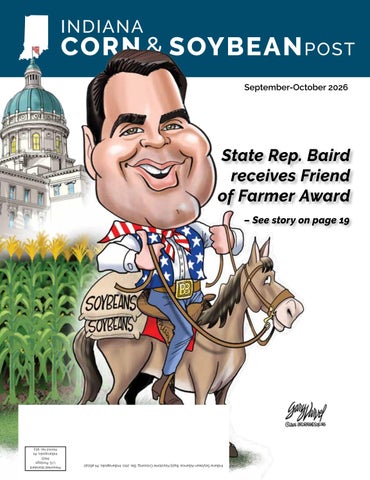
– See story on page 19
State Rep. Baird receives Friend of Farmer Award September-October 2026
CORN & SOYBEAN POST INDIANA
SUPPORT FOR EVERY PART OF FARMING BUILT BY SOYBEAN FARMERS. BACKED BY THE SOY CHECKOFF. READY WHEN YOU NEED IT.
Visit the Soy Farmer Support Hub to find resources for your fields, your operation, and you.
SCAN HERE TO CHECK IT OUT
SEPTEMBER-OCTOBER 2026
| VOL. 19, NO. 6 ISA Membership & Policy Committee
Electrical grids, future of biofuels top Ag Policy Summit The Ag Policy Summit explored how rising demand for electricity and the expanding role of biofuels become part of a reliable and domestically produced energy future.
16
Chair David Hardin, Avon / D4 Dylan Christopher, Brookston / D1 Allen Buchanan, Fowler / D1 Kevin Kelley, Brookston / D1 John Peters, Monticello / D1 Denise Scarborough, LaCrosse / D1 C.J. Chalfant, Hartford City / D2 Carey McKibben, LaGrange / D2 Steve Phares, Albion / D2 Jenna Scott, Muncie / D2 Brian Warpup, Warren / D2 Mark Wenning, Cambridge City / D2
Directors Philip Springstun, Boonville / D3 Mark Legan, Coatesville / D3 Derika Lynam-Spaetti, Richland / D3 Gary McDaniel, Boonville / D3 Larry Rusch, Vincennes / D3 David Ring, Huntingburg / D3 Andrew McDaniel, Waldron / D4 Kevin Burbrink, Seymour / D4 Chris Eck, Boggstown / D4 Roger Wenning, Greensburg / D4 Donald Schnitker, Seymour /D4
ISA hosts China delegation of soybean buyers in August ISA hosted more than a dozen soybean buyers from China in August for agricultural tours throughout the state after the delegation attended 2026 Soy Connext in Chicago.
30 Cover crops led to more conservation efforts for Dunn Following a wet spring in 2019, Alan Dunn planted his first cover crops on prevented-plant acres through a cost-share program. That was the beginning of a much larger change.
40 Hoosier-grown ethanol to power IndyCar racers in 2027 ICMC and ICGA will once again see Indiana-grown corn play a role in the Indianapolis 500 and the future of IndyCar racing through Shell’s updated 100 percent Renewable Race Fuel.
President Alan Dunn, Michigantown / D4
Secretary J.R. Roesner, Ferdinand / D8
Vice President Tyler Everett, Lebanon / D7
Treasurer Joe Tuholski, LaPorte / D2
Tom Murphy, Chesterton / D1
Directors Chris Cherry, New Palestine / D6
Phil Zicht, Winchester / D3 Scott Smith, Windfall / D5
Tyler Pottschmidt, Crothersville / D9
Staff Credits
For advertising information in the Indiana Corn & Soybean Post®, contact Dave Blower Jr. at 317-347-3620 or dblower@indianasoybean.com. Comments and statewide news articles should be sent to the above address. Advertising space reservations must be made by the first day of the month preceding publication. In consideration of the acceptance of the advertisement, the agency and the advertiser must, in respect of the contents of the advertisement, indemnify and save the publisher harmless against any expense arising from claims or actions against the publisher because of the publication of the content of the advertisement.
Editor / Dave Blower Jr. dblower@indianasoybean.com Writer / Amie Simpson asimpson@indianasoybean.com Writer / Anita Sharkey asharkey@indianasoybean.com Creative Director / Carol Johnson Indiana Corn & Soybean Post® is published six times per year by the Indiana Soybean Alliance and the Indiana Corn Growers Association. For address corrections contact: Indiana Corn & Soybean Post® 8425 Keystone Crossing, Suite 200 Indianapolis, IN 46240 Phone: 317-614-0376 Email: cornandsoybeanpost@ indianasoybean.com
Find us on Facebook Badge
CMYK / .eps
45 About the cover: State Rep. Beau Baird (R-Dist. 44) was presented with the 2026 Friend of Farmer award at the Indiana Ag Policy Summit on July 29 by David Hardin, Chair of the ISA’s Membership and Policy Committee, and ICGA President Alan Dunn. For more on the award and Rep. Baird, see page 19. (Gary Varvel illustration)
facebook.com/indianaSoybeanAlliance facebook.com/IndianaCornGrowers
@Indiana_Soy @IN_Corn
SEPTEMBER-OCTOBER 2026
3
PRESIDENT’S REVIEW
Fall is a time to assess farm goals and the goals of the corn industry Alan Dunn President Indiana Corn Growers Association
H
arvest time. Fall has always been my favorite time of year as farmers reap the rewards of another season of preparation and hard work. This year has definitely seen its challenges from areas of delayed planting to the historic rainfall in August. This has been a season with large swings in prices. Within an overall up-trending market, for the first time in years, there is reason for financial optimism as the combines roll. Fall is also a time to begin looking ahead to what comes next. On our farm, we take stock of the data provided by the current harvest to inform decisions about next year’s seed and fertilizer needs. As organizations, both the Indiana Corn Growers Association and the Indiana Corn Marketing Council also take stock of current market and policy conditions to inform decisions on how to best chart a path forward in the months ahead for our industry. For ICGA this means identifying 2027 legislative policy priorities in both Indianapolis and Washington. For ICMC, it means identifying the most impactful ways to invest our corn checkoff dollars to provide returns to us as corn growers. In previous columns I have shared some of the successes and challenges that our grower led organizations have faced in this multi-year downturn in the farm economy. I have challenged you to think of your farm as a part of a large and vibrant bio-manufacturing industry, and to look at how our industry invests back into itself in terms of research and development and market promotion.
4
INDIANA CORN & SOYBEAN POST
We learned of R&D investment successes that are providing real returns to farmers, and we learned of policy accomplishments that are putting more dollars into farmers pockets. Now comes the hard part. The part where we, as an industry, have to take stock and reflect on what we can do better. The simple fact of the matter is that we, as farmers, by our very nature, tend to keep our head down and work hard on our own farms, while letting “others” worry about the big picture. That is why both ICGA and ICMC exist as organizations, and why the dedicated group of volunteer farmer leaders serve – to monitor and influence this big picture on your behalf. But these organizations and these people can only advocate for our industry so much with the resources they are given. In a state with 20,000 corn growers, less than 1,000 chose to pay the nominal membership fee that supports the ICGA budget. We need Indiana corn growers to step up and become members. More members mean more income for the organization. More income means more ability to advocate on your behalf. It’s that simple. And it’s time to seriously consider whether we are investing enough in the R&D and market promotion of our industry. What that earlier industry comparison found was that we, as corn growers, are lacking in terms of investing resources in ourselves. We can do better. We must do better. Next time, I will share a vision for how we can do it.
BIOFUELS & BIOPRODUCTS
MADE IN INDIANA At POET, we’re rooted in rural America. For almost 40 years, we’ve been turning locally grown corn into homegrown bioproducts that fuel our economy and support the family farms that make our communities strong. By adding value to every bushel, we help ensure that rural families can continue to do what they love for generations to come.
POET purchases corn form local farmers to produce biofuels and bioproducts. There are five POET Bioprocessing facilities across Indiana: Alexandria, North Manchester, Portland, Shelbyville, and Cloverdale. | poet.com/grain
COMMITTEE CHAIR’S REVIEW
To Engage, To Lead, To Influence: Policy organization’s new pillars David Hardin Chair ISA Membership and Policy Committee
E
arlier this year, the Indiana Soybean Alliance (ISA) created a taskforce to look at how the organization developed policy and interacted with stakeholders while advocating on behalf of Indiana soybean farmers. Producers can face challenges from regulations that place a burden on their operations. The goal was to create a framework that makes the Membership and Policy Committee more proactive when it comes to the issues that affect your social license to operate. The taskforce identified three main pillars for this new framework to rest on.
To Influence We want to promote legislative and regulatory outcomes that are in the economic best interest of soybean farmers. The organization should have grassroots members, directors, or industry partners who are ready and able to advocate in To Become fast-moving policy environments. A Member The new strategy would also include more coordination with the American Soybean Association (ASA) to engage more Indiana members in calls to action on federal issues. We also want to explore ways to help legislators who have been friends of production agriculture.
To Engage We want to build an organization that draws its strength from an engaged membership. We need to build relationships with our members before an issue arises that we need them to lobby on. Communication will be important to make members aware of opportunities to engage in their local communities, not just at the Statehouse during the legislative session. It is also important for us to look for partners throughout the value chain and strengthen those relationships.
To Lead We want to be seen as the trusted authority when it comes to framing the discussion for soybean policy. The key will be having proactive and focused meetings with decision makers where they are. This may mean small group gatherings in district, or in the halls of the Statehouse. It is important that we don’t let other groups set the narrative for our issues.
6
INDIANA CORN & SOYBEAN POST
Membership driven Policy priorities can change as new technologies arise, or when there is a change in administration. This is why it is important for the organization to be nimble and review policy on a regular basis. The M&P Committee will conduct an annual survey to make sure our policy goals and the resources to achieve them are still aligned with the will of our membership. The Committee will focus its resources on the areas that could potentially have the highest impact on soybean farmers. All things in this new forward-leaning strategy require resources. It is now that I must remind you that not one cent of checkoff funds can be spent on lobbying. If you are not a dues-paying member of the Indiana Soybean Alliance, I ask you to become a member. If you are a member but haven’t taken the step of becoming a lifetime member, I ask you to take that step. If you are a lifetime member of the organization, let me say thank you for your support; and please ask your friends and neighbors to become members.
“WE CHOOSE U.S. SOY BECAUSE IT IS CULTIVATED TO MEET TRUE SUSTAINABLE STANDARDS.” Nhu Ngo of Vietnam-based Janbee Joit Stock Company on a tour of a U.S. Soy farm.
YOU GROW THE WORLD’S MOST SUSTAINABLE SOY. WE GROW DEMAND FOR IT. USSEC builds preference for U.S. Soy by bringing international buyers directly to American farms, where they can meet growers firsthand and see the care, consistency, and sustainable practices behind every harvest.
SCAN TO SEE HOW USSEC SHARES U.S. SOY’S SUSTAINABILITY WITH CUSTOMERS AROUND THE WORLD.
SEPTEMBER-OCTOBER 2026
7
Corn farmers need Congress to deliver a win, but legislative time is running out BY LESLY WEBER McNITT, NCGA Vice President of Public Policy home for the month of October, as the midThere’s nothing like term elections approach, leaving unresolved expecting to learn business to be addressed later in the year. the outcome of a summer cliffhanger While NCGA’s policy team is following all in September only to these twists and turns and political candidates find you may have to are out campaigning, it is not lost on us that wait until later in the corn growers are in the field harvesting and year before the story getting the job done. When Members of is resolved. Yet, that’s Congress return to Washington, they will need where we are this month when it comes to to act with the same intensity to deliver wins ethanol legislation important to the nation’s for farmers. corn growers. The time is now. And that is why corn For more on NCGA In early August, the Senate Committee on growers are taking time away from their fields Agriculture, Nutrition and Forestry had a vote on the and families mid-September to come to Washington, D.C., renewal of the Farm, Food and National Security Act of to make their voices heard and to ensure that House and 2026. The legislation was particularly important to corn Senate Members are harvesting wins before time runs out. growers because it contained language that would Not everyone can take the time away from their fields eliminate an antiquated regulatory clause preventing and families to make the trek east, but if you are able, I the summer sale of fuels with a 15 percent ethanol encourage you to look for opportunities to advocate closer blend, also known as E15 or Unleaded 88. to home when your elected officials are on the campaign The committee vote came on the heels of the May 13 trail. It’s a good reminder that your support must be passage in the House of Representatives of a standalone earned with more than promises. E15 bill. There appeared to be momentum, but then the Here is a list of key wins that must be harvested this year Senate hit a snag: A disagreement in the committee along to help corn farmers: party lines prevented the legislation from advancing. Pass year-round E15 legislation into law. Our expectation was that committee members Pass a bipartisan Farm Bill. would negotiate to consider Support the Biobased a compromise version of the Materials Investment and legislation after its summer Production Act recess. NCGA spent the better Pass legislation to tackle part of August preparing to push high input costs by restoring hard for passage of legislation transparency, fairness and when it resurfaced this month. As diversified supply to fertilizer of this writing, it’s still uncertain markets. whether the vote will take place The bottom line is farmers and whether it will have a different need wins that expand market outcome. opportunities and inject more Adding to the uncertainty is stability into the economics of the countdown clock to the end farming. The added benefit of of this Congress. The Senate is in many of these solutions is that session for only a few weeks this they deliver benefits far beyond month. Senators will then head the farm gate.
•
• • •
8
INDIANA CORN & SOYBEAN POST
Cheaper gasoline, cleaner ingredients for industrial and household products, rural jobs and stronger food supply chains are wins that touch the lives of many Americans. So, let’s get down to work and get those wins in the bin.
IRS provides clarity on 45Z The Internal Revenue Service in early September released its guidance for farmers looking for clarity on the future of the 45Z Clean Fuel Production Tax Credit, which was designed to incentivize the production of aviation fuel and other clean fuels. The guidance, in conjunction with the Sept. 8 updated Department of Energy GREET Model, will give safe harbor to previously recognized “on farm” practices in reducing the carbon intensity of qualifying fuels. Ohio corn grower and National Corn Growers Association (NCGA) President Jed Bower said many will benefit from this tax credit. “We are very pleased to see these agencies reaffirm the positive actions from the administration earlier this year, which recognized the importance of existing regenerative practices. We have been encouraged by the strong cooperation and emphasis on how this tax credit will benefit the individual farmer throughout the implementation process,” Bower said. “This guidance also codifies positive changes to the credit regarding indirect land use change. We look forward to working with the Treasury Department this fall as it looks to issue a final rule by November. NCGA would also like to see ‘book and claim’ acknowledged as a viable chain of custody methodology in the final rule.” Book and claim allows farmers to sell the environmental value of their low-carbon corn directly to biofuel producers digitally, eliminating the need to physically segregate and transport those crops to a specific facility.
From property taxes at the Statehouse to the Farm Bill on Capitol Hill, the Indiana Ag Policy Podcast will share the latest from the biggest names in ag policy. Scan below to listen now! presented by:
SEPTEMBER-OCTOBER 2026
9
Protecting and growing biofuel demand is among policy priorities this fall for ASA BY BLAIR SHIPP, American Soybean Association Fall is shaping up ASA welcomed those steps and is working to ensure farmers can benefit from the credit. to be a busy stretch A key priority is a flexible book-and-claim for agricultural policy system that would allow farmers who adopt in Washington. With qualifying practices to receive value without lawmakers facing requiring their soybeans to remain physically a short legislative segregated throughout the supply chain. window before leaving Getting implementation right could create new Washington ahead of value for farmers and strengthen the role of the midterm elections, U.S. soybean oil in domestic fuel production. the American Soybean Association is focused Learn more about ASA Keeping the Farm Bill moving on issues that could shape soybean demand and farm policy well beyond harvest. Biofuels The push for a new five-year farm bill is also are at the top of that list, alongside the farm bill, continuing this fall. The Senate Agriculture Committee trade and federal regulations. released its framework this summer, but the legislation did Late this summer, small refinery exemptions under not advance during an August committee markup. the Renewable Fuel Standard became a major focus for For soybean growers, the farm bill reaches beyond ASA and the broader biofuels industry. ASA learned the the traditional farm safety net. ASA priorities include administration was considering an approach that could conservation, agricultural research, international market have significantly reduced domestic biofuel demand by development, precision agriculture, rural energy, and other allowing more refineries to avoid their blending obligations programs that support farms and expand opportunities for U.S. soy. without fully making up the lost gallons. Soybean farmers joined other commodity groups in ASA estimated that failing to fully reallocate exempted Washington in September to take that message directly volumes could eliminate demand for roughly 500 to lawmakers. With limited legislative time before the million gallons of biomass-based diesel and result in midterm election recess, the focus is on returning to nearly $1 billion in lost value for soybean farmers. ASA, bipartisan negotiations and moving a comprehensive fivestate soybean associations, farmers, biofuel groups, year bill forward. and members of Congress quickly engaged with the administration to emphasize what was at stake. EPA ultimately announced decisions on small refinery exemptions for the 2025 compliance year and committed to a rulemaking process to address reallocation of the exempted volumes. ASA welcomed that commitment and is pushing for full reallocation. When gallons are waived, making up those volumes elsewhere is critical to preserving the demand intended under the Renewable Fuel Standard. There has also been progress on the 45Z Clean Fuel Production Credit. In September, the Department of Energy released updates to the 45ZCF-GREET model that recognize certain regenerative agricultural practices, while the IRS provided additional emissions-rate guidance.
10
INDIANA CORN & SOYBEAN POST
Maintaining markets for U.S. soy Trade is another major focus as the 2026-27 marketing year gets underway. China remains the largest export market for U.S. soybeans and has committed to purchase 25 million metric tons annually through 2028. Ensuring those commitments translate into soybeans moving to customers remains a priority. As of mid-September, ASA was looking ahead to an anticipated Sept. 24 meeting between President Donald Trump and Chinese President Xi Jinping. The meeting comes as China has stepped up purchases of U.S. soybeans, and ASA is looking for continued progress toward dependable, long-term market access for American farmers.
Closer to home, trade tensions between the United States and Canada have increased, with both countries imposing new tariffs on a range of products. U.S. soybeans have not been directly targeted in the latest round of Canadian retaliatory tariffs, but the dispute underscores the importance of stable trading relationships with our closest agricultural partners. That is particularly important as the United States, Mexico, and Canada move through the 2026 review of the U.S.-Mexico-Canada Agreement. Canada and Mexico accounted for $4 billion in U.S. soy complex exports in the 2024-25 marketing year, representing more than 13 percent of total U.S. soy exports. ASA has emphasized preserving duty-free access for soy and soy products, maintaining science-based trade rules, and providing long-term certainty through USMCA. ASA also strengthened its trade policy team in September with the addition of David Johanson as international trade advisor. Johanson brings extensive international trade and agriculture experience, including nearly 15 years at the U.S. International Trade Commission. His addition comes as ASA works to protect
established markets, navigate trade challenges, and expand opportunities for U.S. soy.
Seeking regulatory clarity Regulatory issues are moving as well. In September, EPA issued a supplemental proposal related to its definition of waters of the United States, or WOTUS, reopening discussion around key definitions used to determine which waters fall under federal jurisdiction. ASA supports a clear, workable definition that protects water resources while allowing farmers to understand which features on their land are subject to federal regulation. ASA is reviewing the proposal and will provide feedback to EPA as the rulemaking moves forward. The weeks ahead provide a narrow window to make progress on issues that matter to soybean farmers. Whether that means protecting domestic biofuel demand, opening doors for U.S. soy overseas, or moving long-awaited legislation forward, ASA will remain engaged in Washington to turn policy decisions into meaningful opportunities for soybean growers.
SEPTEMBER-OCTOBER 2026
11
Rep. Carson: I stand with Indiana farmers BY U.S. REP. ANDRE CARSON (D-District 7) with my colleague, Rep. Jim Costa, to partially restore I stand with Indiana farmers funding for this lifesaving program. as they navigate increasingly American agriculture is the most productive in the challenging market conditions, world, in large part because of continued innovation in especially for major crop science, animal health, biotechnology, precision commodities like corn and agriculture and farming practices. But this administration soybeans. is now proposing another cut that would hurt our This administration’s tariff farmers: Hatch Act funding, which supports agricultural policies have created chaotic research at universities and state agricultural experiment conditions for American farmers, stations. who need reliable markets. Indiana is well-positioned to lead this research, Nowhere is this clearer than in with Purdue University and companies like Elanco, our agricultural exports to China. China purchased $12.8 which recently opened its new global headquarters in billion in U.S. soybeans in 2024 but purchased only $3.1 Indianapolis. I oppose these cuts, and I support federal billion in 2025 because of President Trump’s trade war – investment that keeps American agriculture competitive a 75 percent decline that hit Indiana farmers hard. and brings research dollars – including hundreds-ofThat’s why I have consistently opposed the Trump millions from the CHIPS and Sciences Act – back to administration’s broad and unpredictable tariff policies, Indiana. particularly when they put U.S. exports at risk of Bringing investment retaliation. Farmers back to Indiana is should not be always at top of collateral damage in mind for me. Federal an endless series of dollars shouldn’t be haphazard trade fights. spent on tax breaks I support a more for billionaires. They stable, rules-based should be invested approach that keeps in the people and foreign markets open communities at the to American producers heart of our country, – and gives farmers including Indiana. the certainty they need Every day in to plan ahead. the Hoosier State, I am also pushing farmers, researchers, to protect Food for U.S. Rep. Andre Carson inspects a construction site in his district. universities and Peace, the United companies are moving our country forward. American States’ oldest and largest international food assistance agriculture is the best in the world because our farmers program. Established by President Eisenhower in 1954, and researchers continue to innovate. the program supports domestic farm products and Hoosier farmers face many challenges, but I’m feeds people who desperately need assistance. confident in their future. I will keep fighting against But under President Trump, this crucial funding for harmful tariffs and for federal investments that our farmers has fallen by more than $400 million, and strengthen this vital industry. the administration has now tried twice to eliminate the To Hoosier farmers: I will continue to support you program entirely. I know how important Food for Peace today and in the years to come. is for American agriculture, so I offered an amendment
12
INDIANA CORN & SOYBEAN POST
Houchin: Priorities are advancing Farm Bill and year-round E15 sales BY U.S. REP. ERIN HOUCHIN (R-District 9) Farming is more than an important part of our national economy – it is a way of life. Indiana farmers are more than agricultural producers; they are the cornerstones of our communities and stewards of a tradition that has shaped America. Their work reaches far beyond the farm into every sector of our economy, supporting manufacturers, small businesses, families and communities across our state and the entire country. That is why one of my priorities in Congress is making sure Indiana farmers have the tools and support they need to succeed. For too long, farmers have faced uncertainty from Washington. The last Farm Bill was signed into law in 2018, nearly a decade ago. Precision agriculture, seed sciences and technology have progressed exponentially since then. Our farmers cannot afford to wait any longer. So, I proudly supported the Farm, Food and National Security Act of 2026 (the Farm Bill) and will continue working with my colleagues to advance this critical legislation through the Senate. The Farm Bill touches nearly every aspect of agriculture, from crop insurance and commodity programs to conservation, rural development, and nutrition. Most importantly, it provides farmers with greater certainty as they make decisions that can affect their operations for years to come. But there are other challenges that Congress can address. We also need to ensure farmers have access to strong and reliable markets for their products. This is where the Nationwide Consumer and Fuel Retailer Choice Act comes in. I worked to secure a House floor vote on this legislation that would allow for year-round sales of E15 across all of America. Outdated regulations
should not be stifling opportunities for Indiana corn growers. This legislation passed the House, the first time we have voted on year-round E15 since I came to Congress. Bringing this legislation through the Senate and to the desk of President Trump will reduce costs for families while creating meaningful market opportunities for our farmers. In the Working Families Tax Cut Act, Congress also delivered historic tax relief for farmers by permanently increasing the federal basic estate, gift, and generation skipping transfer tax exemption to $15 million per individual, doubling it to $30 million for married couples. Our farmers have worked far too hard to have to give over the fruits of their labor to the government at the end of their working lives, and I am committed to protecting their investments for the future. Indiana farmers do not ask for much. They want a level playing field, a strong safety net and policies that give them the certainty to do what they do best: grow, produce, and feed the world. I am committed to bringing their voices to Washington and making sure our policies work for the people who keep America moving forward.
SEPTEMBER-OCTOBER 2026
13
Congressmen Stutzman, Yakym and Baird take part in August meetings with farmers BY EMILY McNIFF
T
he Indiana Soybean Alliance Membership and Policy (M&P) Committee and the Indiana Corn Growers Association (ICGA) hosted another Shop Talk and August meeting series, reaching more than 130 farmers, industry partners, community leaders and legislators. Indiana grain farmers and stakeholders engaged in candid conversations about trade relationships, labor, biofuels and the perpetual legislative limbo of the Farm Bill. U.S. Rep. Jim Baird (R-Dist. 4) met with a group of farmers and industry professionals at the Beck Agricultural Center at Purdue University on Aug. 3. Prior to the Congressman’s remarks, ICGA and M&P staff led a farmer U.S. Rep. Marlin Stutzman (R-Dist. 3), left, discusses farm policy issues panel discussing critical focal points for Indiana with local farmers Andrew Wyss and Bruce Stegmann following a Shop producers, including a streamlined approach Talk meeting at the Wyss farm in Allen County, Ind. farm labor under House Agriculture Committee Chairman Glenn “GT” Thompson’s Securing transition for certain experienced farmworkers to apply for Agriculture’s Workforce Act (SAWA). a temporary, non-immigrant work visa. Along with U.S. Rep. Marlin Stutzman (R-Dist. 3), Rep. Applicants must demonstrate that they’ve worked in U.S. Baird is a co-sponsor of the bill modernizing the H2A agriculture for at least 180 days in the last two years, pass temporary agricultural work program. During his remarks, a background check, and meet all other H2A eligibility Rep. Baird reiterated that the bill is not an avenue for requirements. Approximately, 250-300 operations in permanent legal status of citizenship, but a narrow Indiana utilize the program annually.
U.S. Rep. Jim Baird (R-Dist. 4), second from left, listens with other attendees to a farmer panel during a Shop Talk meeting at Purdue University in August.
14
INDIANA CORN & SOYBEAN POST
Yakym biofuels roundtable Joe Stoller, a Marshall County, Ind., farmer member, hosted a biofuels round table with Rep. Rudy Yakym (R-Dist. 2) on Aug. 17 with around 20 farmer leaders and members and biofuel industry leaders representing Indiana Ethanol Producers Association (IEPA), POET, Verbio, and South Bend Ethanol. Rep. Yakym voted in favor of the Nationwide Consumer and Fuel Retailer Choice Act (H.R. 1346) to allow the year-round sale of E15 that passed in the House. The proposal is now under consideration by the Senate, with companion bill S. 593, introduced by Sen. Deb Fischer (R-Neb.). U.S. Rep. Rudy Yakym (R-Dist. 2), at right, listens to Indiana farmer Randall Yakym shared with attendees that the Matthys during a biofuels roundtable at Joe Stoller’s farm in Marshall companion bill is the fastest route to passage County, Ind. of year-round E15, despite similar language being packaged into the Senate Farm Bill. He encouraged constituents to reach out to Senate members to continue the momentum and finally pass the important biofuel legislation.
Wyss farm hosts Stutzman Finally, Don Wyss and his family at Wyss Farm Enterprises, hosted the last Shop Talk of the season on Aug. 25 in Fort Wayne with more than 80 farmers, industry professionals and community leaders in attendance and Rep. Stutzman providing remarks and discussion. Conversations focused on the state of current federal trade negotiations, including the United States-MexicoCanada Agreement (USMCA) and President Trump’s executive proclamation to U.S. Rep. Jim Baird (R-Dist. 4) talks with temporarily waive tariffs on imported ground beef. While foreign imports allow for cheaper prices for consumers, domestic beef John Baugh. prices allow U.S. farmers to profit and rebuild operations after years of highinput costs. During the weekend prior to the meeting, the Trump Administration announced 50 percent tariffs on $20 billion worth of Canadian products and upcoming reciprocal tariffs on Sept. 8, raising questions about the future of USMCA. Rep. Stutzman was one of 168 House Republican signatures on a letter led by Rep. Yakym highlighting the benefits of USMCA. Other Indiana delegation members who signed the letter include, Rep. Baird, Rep. Jefferson Shreve (R-Dist. 6), Rep. Mark Messmer (R-Dist. 8) and Rep. Erin Houchin (R-Dist. 9). The Shop Talk season and other events hosted by the Indiana corn and soybean policy organizations offer opportunities for farmers and rural constituents to share concerns and ask questions of leaders representing them in Washington, D.C. and at the Statehouse in Indianapolis. Become a member of M&P and ICGA to stay informed of more opportunities to engage with Don Wyss, at left, a farmer from Fort Wayne, Ind., discusses legislators and their staff to discuss key issues. Contact concerns during a Shop Talk on his farm. Other panelists include Khyla Goodman at kgoodman@indianasoybean.com Phil Zicht, center, a farmer from Winchester, Ind., and Brian Warpup, for membership details. at right, a farmer from Warren, Ind.
SEPTEMBER-OCTOBER 2026
15
Electrical grid challenges, biofuels future and more highlight the Ag Policy Summit BY DAVE BLOWER JR.
M
nearly every major policy debate comes ore than 200 farmers, ag stakeholders back to the farm. We just don’t always call and federal and state policymakers it that. We call it food security. We call it attended the 2026 Indiana Ag energy. We call it infrastructure. We call it Policy Summit at The Commons in workforce development. We call it supply Columbus, Ind., on July 29. The Indiana chains. We call it national security. Sooner Ag Policy Summit is an annual policyor later, these conversations end up at the focused program presented by the Indiana farm gate.” Soybean Alliance’s Membership and Policy He added that Hoosier farmers are proactive. Committee (M&P) and the Indiana Corn “Indiana agriculture has never succeeded by Growers Association (ICGA). standing still,” Shreve said. “Each generation has found This year’s Summit explored how rising demand on new ways to produce more, conserve more, innovate more, Indiana’s electrical grid is creating new energy challenges and leave something stronger for the next generation. That for farmers and rural communities, while also highlighting same spirit carries through whatever challenges come the role of biofuels, such as higher blends of ethanol and next, and they are sure to come. This state has a strong, biodiesel as part of a reliable and domestically produced informed and consistent voice at the table. I will work to energy future. Also, USDA Under Secretary for Research, make sure that continues.” Education and Economics Dr. Scott Hutchins offered an Under Secretary Hutchins reiterated the congressman’s update. comments and added that USDA wishes to become a U.S. Rep. Jefferson Shreve (R-Dist. 6) opened the strong partner with Indiana farmers. Summit with comments regarding the value of energy, “I’m so pleased to be from biofuels and agriculture Indiana because I think to his district’s economic Indiana punches above health. Shreve’s district its weight class in almost includes Columbus and every way and leads the the surrounding area. The nation, I think, in terms of congressman said that ag being thought leaders for policy isn’t contained in an U.S. agriculture,” Hutchins ag committee. Farm issues said. “Today at this Summit, also appear in defense, I heard so much optimism, appropriations, labor and but I also heard opportunity. many other committees. Following my remarks, I hope “Agriculture has always been farmers have confidence more than just crop production; in the things we need it’s about innovation, it’s to do to improve USDA. about entrepreneurship. It’s We’re actively engaged in about science, it’s about improving the things that we stewardship, and it’s about need to develop for farmers building something that lasts,” and ranchers and for U.S. Shreve said. “I’m just about to U.S. Rep. Jefferson Shreve (R-Dist. 6) said that ag policy agriculture more broadly. We finish one term in Congress, isn’t contained in an ag committee. Farm issues also understand the priorities, and but that’s been long enough appear in defense, appropriations, labor and many other committees. we’re focused on impact.” to become convinced that
16
INDIANA CORN & SOYBEAN POST
Data centers and the electrical grid Offering a unique perspective on the debate about the state’s electrical grid and the expansion of data centers that power artificial intelligence and other online tools was Brandi Davis-Handy, President of AES Indiana, a Central Indiana power company formerly known as Indianapolis Power and Light. Davis-Handy said the issue isn’t about picking winners and losers in securing more energy for customers but seeing how all customers could benefit. “We want to have good growth for the state of Indiana,” Davis-Handy explained. “We also understand our obligation to ensure affordability and reliability, as we embark on the opportunity to power the needs of new customers, some of which are data centers. We are doing it with affordability, reliability, resiliency, top of mind. We are focused on bridging the gap between our communities and data centers. There’s just so many unknowns about data centers, what it means from an affordability standpoint, a reliability standpoint, and an environmental standpoint. All of those questions are reasonable, and they deserve good answers. It’s really going to take forums like (the Summit) where you have the utilities, you have policymakers, you have farmers, you have neighbors who are sitting down having the conversation of how we can go about this growth in the State of Indiana in a way that benefits all of us.” Courtney Kingery, CEO of the Indiana Soybean Alliance (ISA), the Indiana Corn Marketing Council (ICMC) and ICGA, moderated a “fireside chat” with Indiana Secretary of Energy and Natural Resources Suzanne Jaworowski and Indiana Utility Regulatory Commissioner Bob Deig. Both Jaworowski and Deig stressed that increased energy demand may create dynamic changes to the state’s energy policy. Increased demand due to data centers,
USDA Under Secretary for Research, Education and Economics Dr. Scott Hutchins explained that USDA wishes to become a strong partner with Indiana farmers.
During a panel discussion about energy policy, from left, Indiana Utility Regulatory Commissioner Bob Deig and Indiana Secretary of Energy and Natural Resources Suzanne Jaworowski spoke with ISA, ICMC and ICGA CEO Courtney Kingery, who moderated the talk. Both Jaworowski and Deig stressed that increased energy demand may create dynamic changes to the state’s energy policy.
expanding manufacturing and higher customer usage is all pulling more power from the electrical grid. “We’re at a time where a lot of our infrastructure is aging – gas lines, transmission lines for electric substations, poles – all of that costs money,” Deig said. “That’s brought a lot of the capital improvements and the cost increases to the rates. We need to find a way to make it more affordable and more reasonable for the consumer. I hope people understand they have control over the power they use. They have options to contact utilities and their co-ops to try to help them with peak demands and time of use for their grain storage, grain fans, their irrigation systems, and just make sure they can contact utilities and talk to them.” Jaworowski added that Indiana may have the opportunity for some of the capital improvements to the utilities to be funded by power companies looking to expand. “Right now, Indiana has one of the most important opportunities to develop additional generation and transmission by growth and that could help us to lower our cost of electricity,” Jaworowski explained. “We have a unique moment in time where there are companies willing and, by law, committed to helping build and pay for our new generation. It’s an opportunity for us to take advantage of that third party investment in Indiana.” Sarah Ash Simpson, Senior Director of Industry Affairs for ICGA and M&P, led an energy panel with Indiana State Sen. Gary Byrne (R-Byrneville, Ind.) and Indiana State Rep. Kendell Culp (R-Rensselaer, Ind.). Both work on agriculture, energy and environmental committees.
SEPTEMBER-OCTOBER 2026
17
Students from Columbus High School’s FFA chapter, led by advisor Adam Ulrich, assisted in ushering speakers and guests throughout the Ag Policy Summit.
Sen. Byrne said adding small nuclear power plants to Indiana’s electrical grid would help offset power demands at a lower cost. “Energy is important to farmers, but it’s important to the whole state, and we want affordable energy, and we want reliable energy,” Sen. Byrne stated. “I think the biggest thing I want Hoosiers to know is that we are working to make sure we have that reliability, and we’ve taken the lead on the push for the small modular nuclear. I think we’ll see Indiana being one of the first states to get those small modular nuclear reactors.”
Expanding biofuels opportunities The afternoon sessions zeroed in on opportunities for biofuels, such as ethanol and biodiesel, to be an energy solution for the transportation sector. Tim Phelps, Senior Vice President of the Indiana Ethanol Producers Association, lead a panel talk about biofuel opportunities with Matthew Ward, Senior Manager of Government Affairs at POET ethanol, Cathy Melton, Executive Director of Indiana Food and Fuel Association, and Bailey Arnold, Director of Healthy Air Solutions at the American Lung Association. Phelps said getting the U.S. House of Representatives to finish year-round E15 was an important legislative victory this year. “We’re trying to work with our federal partners to get done in the Senate now. If there’s one thing that we can get done that will help biofuels and ethanol, as well as Indiana’s ag economy, it’s getting year-round E15,” Phelps said. “I want people to know the vital nature of biofuels on
18
INDIANA CORN & SOYBEAN POST
our state’s rural economy. About half of all the corn grown in Indiana initially goes to one of the state’s ethanol plants. It’s one of the most important things that we do. Being able to find more markets for Indiana grain in Indiana ethanol is really at the core of what our state’s ag policy needs to be.” Arnold added, “I think there’s a great opportunity to help increase use of soybeans crushed here in Indiana, produced into biodiesel and other products that we use and have developed right here. I think there’s also, from our perspective, the Lung Association, a huge opportunity to help lower emissions and benefit community and public health. I’m really looking forward to continuing to share that message and work with our ag partners.” Also, Megan DeVelvis, Market Development Director for ISA, ICMC and ICGA, moderated a talk about new engine technology with Josh Garetson, John Deere Director of Renewable Fuels and Corporate Strategy; Dr. Greg Shaver, a professor of engineering at Purdue University; and Lawrence McCormack, Director of Government Affairs at engine-maker Cummins, Inc. “The ag community is coming together stronger than ever to push on biofuels as a great option, not only for farmers, but for consumers,” Garetson said. “I hope that farmers and policymakers see that collaboration needs to continue to get stronger. I hope that people are starting to think and continue to leverage this concept that biofuels aren’t just ethanol at a higher blend level in the car; it can be for many different things, and we need to continue to explore and find those.” McCormack said Cummins has advocated for better biofuels legislation at the Statehouse in recent years. “We’ve been working with legislators for a number of years now on a biofuels tax credit in the Indiana Statehouse,” he said. “We hope that we’ve given policymakers additional things to think about and reasons why they should support that in the upcoming session.”
Sponsors and membership The Ag Policy Summit cannot happen without its sponsors. This year’s sponsors include Farm Credit MidAmerica, Bayer Crop Science, Corteva Agriscience, FMC, POET, Indiana Food and Fuel Association, Valero, Indiana Ethanol Producers Association, First Farmers Bank and Trust, B20 Club of Indiana, Indiana Pork, Conexus Indiana, Halderman Real Estate and Farm Management, Beck’s Hybrids, Fischers Inc., and Lallemand Biofuels and Distilled Spirits. ICGA and M&P rely on sponsorship and membership dollars to advocate on behalf of Hoosier farmers. For details about membership or corporate partnerships, contact Khyla Goodman, Industry Affairs Outreach Manager for M&P and ICGA, at kgoodman@indianasoybean.com.
State Rep. Beau Baird is honored with 2026 Friend of Farmer award BY DAVE BLOWER JR.
S
which was adopted by Indiana’s General Assembly earlier tate Rep. Beau Baird (R-Dist. 44), of Greencastle, Ind., this year. That law would replace the federal soybean was presented with the 2026 Friend of Farmer award checkoff law if Congress ever eliminated the program. at the Indiana Ag Policy Summit on July 30 by David Baird said he has seen the benefits of checkoff program. Hardin, Chair of the Indiana Soybean Alliance’s Membership “Indiana Corn and Indiana Soybean are great participants and Policy Committee (M&P) and Indiana Corn Growers and great voices for Indiana agriculture – not only here in Association (ICGA) President Alan Dunn. Indiana but across the country and the world,” Baird said. “I The Friend of Farmer award is presented by ICGA and just got back from Taiwan, and I got to see first-hand some M&P to a policy leader who leads and advocates on issues of the soybeans that are being consumed over there. I know that benefit Indiana farmers. that it’s a direct result of Baird is the ninth the advocacy work that’s winner of the award. being done here at the Past winners include state level from groups Baird’s father, U.S. Rep. like ISA and ICMC.” Jim Baird (R-Dist. 4) who ISA Board member received the award in Mark Legan, a farmer 2024. Other winners from Coatesville, Ind., include former Purdue supported Baird’s University Director of nomination for the award. Agricultural Services and “I have known Beau Regulations John Baugh, Baird since his days of National Association showing 4-H animals at of State Departments the Putnam County Fair,” of Agriculture CEO Ted Legan said. “Beau is a McKinney, State Rep. Don true friend of the farmer Lehe (R-Brookston, Ind.), State Rep. Beau Baird (R-Dist. 44) of Greencastle, Ind., received in the state legislature. State Sen. Jean Leising the 2026 Friend of Farmer award from ICGA President Alan Dunn, He is always seeking to (R-Oldenberg, Ind.), U.S. left, of Michigantown, Ind.; Courtney Kingery, center, CEO of ISA, understand how policy Rep. Jackie Walorski ICGA and ICMC; and David Hardin, right, of Avon, Ind., chair of ISA’s issues affect agriculture. (R-Dist. 2), State Rep. Ed Membership and Policy Committee. The award was present during His willingness to carry Soliday (R-Valparaiso, the Indiana Ag Policy Summit in Columbus, Ind., on July 29. legislation supporting Ind.) and U.S. Sen. Joe Indiana producers is very much appreciated.” Donnelly (D-Ind.). Baird is among the leaders of the Rural Caucus in the Beau Baird and Jim Baird are the first father-son General Assembly, and he will continue to represent honorees of this award from M&P and ICGA. farmers and rural communities in the coming years. “This is just something that means a lot to me,” State “Working with Indiana farmers, to me, is probably the Rep. Baird said. “Over the years, I’ve watched so many highlight of my job,” Baird added. “As a state lawmaker, we tremendous people receive this award. I would never work with so many different people across many issues. consider myself in their caliber, so just to be a name within When Hoosier farmers come to the Statehouse, I know their ranks means more to me than I can express.” they’re there because they believe in what they do; they Courtney Kingery, CEO of ISA, ICGA and the Indiana have a passion for their family farms and their communities Corn Marketing Council (ICMC), and Sarah Simpson, Senior and for the products they produce. To be able to help them Director of Industry Affairs for M&P and ICGA, both said do what they love to do means a lot to me.” Baird’s advocacy for the soybean checkoff fallback bill
SEPTEMBER-OCTOBER 2026
19
Representing agriculture and rural communities inspires Baird’s work BY DAVE BLOWER JR.
A
lthough he was surprised to receive the Friend of Farmer award this summer during the Indiana Ag Policy Summit in Columbus, Ind., State Rep. Beau Baird (R-Dist. 44), of Greencastle, Ind., certainly positions himself as a friend to agriculture and rural communities. Baird has represented his west-central Indiana district since 2018. In the General Assembly, Baird is a member of the Agriculture and Rural Development Committee and the Rules and Legislative Procedures Committee. He is also the chair of both the Environmental Affairs Committee and the State Fair Advisory Committee in the Indiana House of Representatives. However, passing new laws and achieving legislative greatness are not his focus. The reason Baird decided to run for the state legislature eight years ago was he merely wanted to help the people of his mostly rural district. “The fear that I had is that rural Indiana has a shrinking voice at the Statehouse, and it’s going to continue to shrink as population shifts to Indianapolis and other urban areas,” Baird said. “Being able to be a voice for my community was something that really interested me. I didn’t think, even at that time, how much I would enjoy being a voice for my community. When people or the media talk about legislators, they often talk about how many bills they have passed. That was never of interest to me. I think we have too many laws on the books already.” Helping individual constituents motivates Baird. State Rep. Beau Baird poses with “Yesterday I got a call his Harvard graduate diploma. from a farmer because Baird attended three graduate schools at the same time. Highway 36 is going to
20
INDIANA CORN & SOYBEAN POST
State Rep. Beau Baird (R-Dist. 44) is just at home on his Quarter Horse ranch as he is advocating for farmers and rural communities at the Indiana Statehouse.
be closed near here between U.S. 231 to the county line,” he explained. “This farmer must cross 36 because half of his fields are on the other side. And he’s like, ‘what are we going to do?’ Because they started taking soybeans out this week. So, I called INDOT this morning at 8 a.m. and said, ‘Hey, I need to know what’s going on with this.’ I can call INDOT, and they will give me an answer. I enjoy that far more than working on legislation or scoring political wins. Being able to help somebody with something that affects their everyday life, that’s what I really enjoy.”
Family and education Baird followed his father, U.S. Rep. Jim Baird (R-Dist. 4), into the Indiana General Assembly. Beau Baird began serving as the Putnam County Republican Chair in 2017. When his father decided to seek a seat in Congress, Baird didn’t immediately plan to run for the state legislature. “At the time that Dad decided to run for Congress, I was in three master’s programs all at the same time,” said Baird, who earned graduate degrees international business from IMM Global, and MBA from Purdue’s Krannert School of Management, and a finance degree from Harvard University Graduate School. He was also working full-time as an executive with Indiana Home Care Plus, operating a large Quarter Horse Ranch at home, and helping his father’s campaign for Congress.
U.S. Rep. Jim Baird (R-Dist. 4), at right, and State Rep. Beau Baird, at left, is the only father-son duo to be honored with the Friend of Farmer award. In this photo, Jim Baird received his award at the farm of Kevin Kelley, at center, of Brookston, Ind.
While visiting the Poynter Family Farm, State Rep. Beau Baird chats with Brice Howell.
However, after talking to Republican leaders from other counties in District 44, Baird started to consider running. As he has for many subjects, Baird decided to ask his father for advice in December 2017. “This is the first time in my life that Dad never gave me advice,” he said. “I mean, Dad has always had an opinion on anything. And when I asked him, he wouldn’t even answer. He just said I had to make the choice for myself, and it had to be for the right reasons. Since he wouldn’t help me, I didn’t tell him my decision until he read it in the newspaper. That was comical. I think he knew where my heart was.” Baird was honored with the Friend of Farmer award, in part, for his efforts in getting a state soybean checkoff fallback bill passed earlier this year. That bill only goes into effect if the federal soybean checkoff program is ever rescinded by Congress. Nearly all soybean-producing states have similar laws. Baird has seen the benefits of soybean program market development during his world travels. Recently he traveled to Asia and made a note of soybeans in local diets. “While I was in Taiwan this summer, I saw people eating fried, crispy soybean strips, and I was in Cambodia recently and saw more fried soybean snacks,” Baird said. “While in Cambodia, I saw someone with an American Soybean Association (ASA) shirt, and I talked to him for a while and found out that they are trying to work more soybeans into the local diet.” ASA’s World Initiatives for Soy in Human Health (WISHH) program has offices worldwide attempting to encourage developing nations to buy more U.S. soybeans.
his mother, Danise, and her family. Although they mainly road Standardbreds in competition. Baird’s interest in Quarter Horses started in high school when he acquired a mare named “Jackie,” who he showed at the Indiana State Fair. He became a serious rider at that time and became the No. 1 rider in the nation. When he left for college at Purdue University, he participated on a horse judging team, and he would travel to Texas to ride horses in the summer. During one of those summer days, he came across a mare that he thought had excellent genetics for the future. “I just fell in love with that mare, and I asked the owner for a price; it was These yearling Quarter Horses peek far more than through a window on Beau Baird’s ranch. I could pay as a college student,” Baird said. “I thought that mare would be a producer, and I tried to buy it again but the mare was out of my price point. Later I’m back at Purdue, and I got a call from the mare’s owner asking me if I would still be interested. The price was substantially lower, but still not low enough. I told her ‘yes.’ I didn’t know how I was going to pay for it. I ended up selling stuff and made it happen. The first baby that I brought out of that mare was the No. 1 highest money earner of all time in our industry.” Whether in the Statehouse or the show ring, Baird is proving that his instincts have been accurate.
Passion for Quarter Horses Among Baird’s passions is owning and operating a Quarter Horse ranch. His love for riding horses came from
SEPTEMBER-OCTOBER 2026
21
Take action to help Hoosier farmers Become a lifetime member of Indiana’s corn and soybean policy groups The Indiana Corn Growers Association (ICGA) and the Indiana Soybean Alliance’s Membership & Policy Committee (M&P) represent our state’s farmers in the legislative halls in Indianapolis and Washington, D.C. These organizations need your membership to influence federal and state lawmakers. Indiana soybean and corn growers can now save money and eliminate the hassle of annual renewals by purchasing a LIFETIME MEMBERSHIP to both ICGA and M&P. For only $1,700, you can be a member of both ICGA and M&P for life! Anyone interested in buying this membership, should contact Industry Affairs Outreach Manager Khyla Goodman by phone at 317-614-0377 or by email at kgoodman@indianasoybean.com. Or, you can go to our website, incornandsoy.org/membership, to join!
Lifetime Members Phil Ramsey Courtney Kingery Matthew Lucas Tyler Everett David Gottbrath Mike Sprinkle Jeff Troike Jim Douglas Michael Steinbarger Sam Caldwell Mark Nigh Alan Dunn Mason Gick Aaron Johnson Nathan Luallen Sam Mehringer David Wenning Mark Wenning Creed Gunn Andrew Fansler
Kent Burton Russell Anderson Troy Hattery Mark Bacon Ronald Sutherlin Jordan Caldwell Mike Shuter John Baugh Janice Peterson Cullen Page Don Wyss John Peters Bruce Herr Lauren Tolle Luke Roush James Wood Allen Buchanan Matt Hart Ron Hudson Mark Tolle
Find Out More About Becoming a Lifetime Member
22
INDIANA CORN & SOYBEAN POST
Carl Kissel Chris Eck James Wenning JR Roesner William Roesner Sarah Delbecq Jim Geller Jr. C.J. Chalfant William Gerard Carey McKibben Neal Smith Matthew Chapman Jim Flanders
Chris Cherry Luke Mullet Tom Murphy Matt Hayden Kevin Kelley Douglas Matthys Randall Matthys Brian Warpup Tom Weaver Larry Rusch Chad Chism Troy Furrer Brent Bible
Jeremy Mullins Joe Stoller Matt Wilson Adam Sheller Philip Springstun Joe Steinkamp Keevin Lemenager Dylan Christopher Craig Faut Denise Scarborough Ralph Kauffman Tim Gauck Howard Halderman
Bruce Herr, Warren, Ind. “I became a lifetime member because I want to make sure my voice is heard for the next generation. I have two sons that are coming back to the farm in their early 20s. I want to make sure that the direction of agriculture is positive and enables them to have the opportunity to be successful.”
ICGA, ISA encouraged by farm bill passage in Senate Ag Committee
T
he Senate Agriculture Committee passed its version of the farm bill, the Agricultural Act of 2026, by a 12-11 vote on Sept 16. The bill moves to the floor of the U.S. Senate where 60 votes will be needed for passage. Once that happens, the Senate bill will go to a conference committee to sort out its differences with the Farm, Food and National Security Act of 2026, which is the U.S. House of Representative’s version of the farm bill. The latest extension of the 2018 Farm Bill officially ends on Sept. 30. If Congress fails to pass a final reauthorized bill or approve another short-term extension, then federal agricultural programs face disruption. Regardless of future concerns, the Indiana Corn Growers Association (ICGA) and the Indiana Soybean Alliance’s Membership and Policy Committee (M&P) are pleased with the progress and the result from the Senate Ag Committee. The Senate bill included year-round sales of E15, which is a blended fuel of 15 percent ethanol with 85 percent gasoline. “We appreciate the work of the Senate Ag Committee and our allies ICGA President Alan Dunn, a farmer from in Washington to advance the farm bill and E15 provisions moving Michigantown, Ind., said he is please the forward,” said ICGA President Alan Dunn, a farmer from Michigantown, Senate Ag Committee kept a provision Ind. “This step provides the long-term certainty farmers need and for year-round sales of E15, a blended expands E15 fuel of 15 percent ethanol with 85 percent access, which will gasoline. drive profitability across the industry.” He added that farmers must remain focused on the goal. “As the bill heads to the Senate floor or a preconference with the House, please reach out to your delegation and ask them to keep up the momentum and deliver a muchneeded, five-year farm bill and year-round access to E15 for Indiana’s corn farmers,” Dunn said. M&P Chair David Hardin, a farmer from Avon, Ind., also praised the progress in the Senate. “Thank you to the Senate Ag Committee and those working on our behalf in D.C. for moving the farm bill through this next crucial step,” Hardin said. “Advancing this bill will give soybean farmers the necessary legislative assurance while protecting crop insurance and trade programs that support our bottom line. Indiana farmers Maintaining crop insurance and foreign market need to reach out to their representatives and senators development funds in the Senate Ag Committee version as we move to the next stops in getting a new farm bill of the farm bill were important, said M&P Chair David passed.” Hardin, a farmer from Avon, Ind.
SEPTEMBER-OCTOBER 2026
23
U.S. soybeans: The sustainable alternative to petroleum U.S. Soy, powered by the Soy Checkoff, has been a trailblazer in the development of biobased products for decades. U.S. Soy offers a sustainable alternative to petroleum-based materials, including some linked to chemicals like PFAS, helping protect the environment while opening new markets for the crop farmers grow. Over the last 40 years, U.S. soybean production has more than doubled — which is exactly why the Soy Checkoff has funneled additional research and development dollars into industrial uses. More bushels means more product to move, and industrial applications give that product somewhere new to go beyond fuel, food and feed. Barry Alexander, a Kentucky soybean farmer, leads the industrial work group for the Soy Checkoff. His work group oversees these partnerships and decides where investments will be made in the research and development of industrial uses. “Our funding is basically a pipeline. We start funding on the research side, and then it rolls out to companies like BioSpan, DGP, Fuchs, Goodyear and a lot of our other partners,” Alexander says. “It truly
Barry Alexander is a soybean farmer from Western Kentucky who currently leads the Soy Checkoff ’s industrial work group.
works as a partnership.” Checkoff funding typically shows up early, in the unproven science that private companies aren’t yet willing to invest in. By the time a product like BioSpan’s Replay or PoreShield reaches market, farmers have already de-risked the hardest years of its development. That upfront risk-bearing is a key reason the return numbers run so high; the ROI reflects risk farmers absorbed long before a company ever turned a profit. Looking at the soybean oil market breakdown, industrial uses are still a small slice of the pie with 5% of soybean oil going towards industrial applications. But that sliver punches well above its weight, delivering a return of $42.88 for every dollar invested, based on a study by the National Oilseed Processors Association. Lindsey Hermes serves as CEO of BioSpan Technologies, a diversified chemical engineering firm dedicated to solving complex challenges in the built environment and energy sectors using biobased products. “BioSpan was founded with a simple vision: take something renewable, U.S. soybeans, and turn it into high-performance materials that can replace petroleum across the entire industry,” Hermes says. One of the company’s most popular products is Replay, a biobased pavement preservation solution designed to extend the life of asphalt surfaces. Soybean oil in polymers offers a low-cost, cleaner alternative for the rejuvenators and binding agents used in asphalt. According to the National Asphalt Pavement Association there are more than 2.7 million miles of paved roads and highways in the United States with 94% of them surfaced with asphalt. This makes the potential runway for soy-based pavement products enormous. Every mile of highway that gets
ADVERTORIAL
GoodyearTires, Tires,Sketcher’s Sketcher’sShoes, Shoes,and andSyn SynLawn Lawnare arejust justaafew few Goodyear soy-based products that the Soy Checkoff invests in. soy-based products that the Soy Checkoff invests in.
resurfacedwith withaasoy-based soy-basedrejuvenator rejuvenatorinstead insteadof ofaa resurfaced petroleumone oneisisaamile mileof ofrecurring recurringdemand, demand,since since petroleum pavement preservation is a maintenance cycle. pavement preservation is a maintenance cycle. ScottPorter Porterisisthe thefounder founderand andCEO CEOof ofDynamic Dynamic Scott GreenProducts Products(DGP), (DGP),which whichuses usessoybean soybeanoil oilto to Green formulate bar and chain oils, wire rope lubricants, formulate bar and chain oils, wire rope lubricants, drillingoils, oils,and andmaintenance maintenanceproducts productsfor for drilling professional and consumer markets. DGP estimates professional and consumer markets. DGP estimates thatthe theU.S. U.S.total totalloss losslubricant lubricantmarket market— —oils oilsand and that lubricants that by design can be used only once and lubricants that by design can be used only once and notrecovered, recovered,like likechainsaw chainsawbar baroil oil— —represents represents11 not billiongallons gallonsannually annuallythat thatcould couldbe bereplaced replacedwith with billion biobased alternatives. “Our mission as a company biobased alternatives. “Our mission as a company todevelop developsuperior superiorperforming performingproducts productsthat that isisto replace conventional petroleum, ” Porter says. replace conventional petroleum,” Porter says. Thattotal-loss total-losscategory categoryisisaanatural naturalfit fitfor forsoy soy That because this specific segment includes applications because this specific segment includes applications whichdon’t don’tallow allowused usedoil oilto tobe berecycled recycledor or which recovered. Biodegradability matters more thanin inaa recovered. Biodegradability matters more than closedlubrication lubricationsystem, system,making makingsoybean soybeanoil oilthe the closed bestoption. option. best The globalagricultural agriculturallubricants lubricantsmarket marketisis The global
BarryAlexander Alexandergives givesScott ScottPorter, Porter,CEO CEOof ofDGP, DGP,aatour tourof ofhis his Barry farm in Cadiz, Kentucky. farm in Cadiz, Kentucky.
projectedto togrow growto to$8.95 $8.95billion billionby by2031, 2031,aa projected $1.4billion billionincrease increasefrom from2026, 2026,according accordingto toaa $1.4 MarketsandMarkets report. Agricultural lubricants, MarketsandMarkets report. Agricultural lubricants, mineraloil-based, oil-based,synthetic syntheticand andbiobased biobased mineral formulations,are areessential essentialfor forreducing reducingfriction frictionand and formulations, extending the life of farm equipment. This represents extending the life of farm equipment. This represents anotheravenue avenuewhere wheresoybean soybeanoil-based oil-basedoptions optionscan can another compete directly with petroleum incumbents. compete directly with petroleum incumbents. Theseproducts productshave havethe thepotential potentialto tocreate create These meaningful new demand for soybeans, giving meaningful new demand for soybeans, giving farmersanother anothermarket marketfor fortheir theircrop. crop.Even Even farmers withmodest modestadoption, adoption,they theycan canexpand expandsoybean soybean with utilization, while broader market acceptance could utilization, while broader market acceptance could establishan anentirely entirelynew newdemand demandcategory categoryfor forthe the establish industry. That’s the difference between a niche industry. That’s the difference between a niche productand andaagenuine genuinenew newdemand demandcategory. category. product
DEWALTnow nowsells sellsaasoy-based soy-basedbiodegradable biodegradablebar barand andchain chain DEWALT oil in 1,300 Home Depot stores nationwide. oil in 1,300 Home Depot stores nationwide.
Theretail retailside sideisisalready alreadytaking takingshape. shape.Through Throughaa The partnership with the Soy Checkoff, DEWALT now partnership with the Soy Checkoff, DEWALT now sellsaasoy-based, soy-based,biodegradable biodegradableBar Bar& &Chain ChainOil Oil sells at retail locations nationwide, as well as through at retail locations nationwide, as well as through Bomgaars,Mac MacTools, Tools,Grainger, Grainger,and andAmazon Amazon— — Bomgaars, puttingaacheckoff-funded, checkoff-funded,farmer-backed farmer-backedproduct product putting directly into the hands of everyday consumers. directly into the hands of everyday consumers. Fromasphalt asphalthighways highwaysto tochainsaw chainsawbar baroil, oil,from from From firefighting foams to new paint formulations, the firefighting foams to new paint formulations, the throughlineremains remainsthe thesame: same:checkoff-funded checkoff-funded throughline research turns into commercial partnerships,and and research turns into commercial partnerships, commercialpartnerships partnershipsturn turnbushels bushelsinto intodemand demand commercial thatwouldn’t wouldn’totherwise otherwiseexist. exist.Industrial Industrialuses usesmay maybe be that a small percentage of the soybean oil market, but the a small percentage of the soybean oil market, but the returnon onthat thatinvestment, investment,and andthe theopportunity opportunityfor for return growth in categories like pavement preservation and growth in categories like pavement preservation and total-losslubricants, lubricants,makes makesthe thecase casefor forwhy whyfarmers farmers total-loss continue backing this pipeline, one dollar and one continue backing this pipeline, one dollar and one bushelat ataatime. time. bushel
ADVERTORIAL
CHECKOFF INVESTMENT
ICMC partners with USGBC to expand market access to Mexico and Taiwan be incorporated into feed formulations rather than treated as waste. This allows customers to maximize the value of every ton of U.S. corn while improving feed manufacturing efficiency. The result is measurable gains in efficiency. Field verification confirmed clear operational improvements. Average cleawwwwning efficiency rose from 72.62 percent to 77.0 percent, with the plant consistently exceeding 85 percent during the final three months of operation. Cleaner grain entering the roller mills improved process consistency and reduced foreign material in feed Grain handling program in Mexico production. Between August and December 2025, BCFM cleaning efficiency improved further, reducing impurities SuKarne is one of Mexico’s largest producers of from 2.65 percent to 0.59 percent — a 2.06 percentageanimal protein and a consumer of U.S. corn, using an point reduction. estimated 700 TMT per year, much of it in cattle feed. Under SuKarne’s operating conditions, these gains To demonstrate the value of U.S. corn beyond its market recovered approximately 1,704 metric tons of BCFM, price, the USGBC along with ICMC, implemented a worth an estimated $297,128 in market value. Because the technical program to improve grain handling efficiency recovered material retains nearly all of corn’s nutritional through better cleaning, screening and use of broken value, its effective feed value reached an estimated corn and foreign materials (BCFM). $288,214 — showing ICMC donated Carter that material once Day grain cleaning treated as a quality equipment under defect can become a Memorandum of a valuable feed Understanding signed ingredient. on July 28, 2022, and By serving as a the Council completed trusted technical installation and intermediary and commissioning in 2025, facilitating both the followed by a series of equipment investment trips to ensure proper and on-site validation, use and tracking. the Council helped The program demonstrate that quantified the U.S. corn delivers operational and superior economic economic value of value through better impurity removal, handling and use. This demonstrating that The U.S. Grains and BioProducts Council, in collaboration with the Indiana built buyer confidence recovered BCFM Corn Marketing Council, implemented a technical program to improve and helped protect retains 95 percent to grain handling efficiency through better cleaning, screening, and usen SuKarne’s 173 TMT 98 percent of whole of broken corn and foreign materials (BCFM). After the ICMC donation in annual U.S. corn corn’s nutritional and the installation of Carter Day grain cleaning equipment, the Council imports to its Mexicali implemented a series of trips to ensure proper use and tracking of BCFM. value — allowing it to The U.S. Grains and BioProducts Council (USGBC) submitted it’s 2027 Unified Export Strategy (UES) to the USDA in August. The UES is a grant application that details the Council’s market development plans and recaps recent successes from the previous year. USGBC submitted three success stories that included the participation and partnership of the Indiana Corn Marketing Council (ICMC). Due to this partnership, USGBC was able to expand U.S. corn market access and strengthen relationships in Mexico and Taiwan.
26
INDIANA CORN & SOYBEAN POST
facility, valued at $33.1 million, from South American competition. The Council expects to extrapolate these results across SuKarne’s full 700 TMT in annual U.S. corn use. The $119,000 combined investment from ICMC and USDA MAP funds generated a return on investment of $278 per $1 invested by protecting U.S. corn sales from competition — demonstrating how USDA-funded programs can attract U.S. industry investment to support and expand their impact.
U.S. Corn exports to Taiwan increase Taiwan remains one of the United States’ most dependable agricultural trading partners and one In September 2025, U.S. Grains and BioProducts Council Past of the largest export markets for U.S. feed grains. Chairwoman Verity Ulibarri (front, second from right) signed Through sustained MAP investments and strategic a letter of intent with the Taiwan Feed Industry Association, industry engagement, the USGBC strengthened signifying its intent to purchase more than $2 billion of U.S. corn U.S. corn’s competitive position in Taiwan and corn co-products between 2026 and 2029. throughout 2025, driving substantial export growth and reinforcing long-term bilateral agricultural management practices and sustainability initiatives. cooperation. The Council facilitated direct exchanges between U.S. In September 2025, Taiwan’s Agricultural Trade Goodwill industry leaders and Taiwan’s Ministry of Agriculture, Mission to the United States delivered a major milestone: grain importers and feed manufacturers — reinforcing Taiwan signed Letters of Intent committing to purchase confidence in the reliability and sustainability of U.S. grain more than $10 billion in U.S. ag products over four years, supplies. including 7.5 million metric tons of U.S. corn and 1 million Year-round, the Council sustained market intelligence metric tons of U.S. DDGS valued at approximately $2.12 through translated harvest and export cargo quality billion. reports, market publications and social media outreach, The delegation toured Arkansas, Ohio and Indiana, cementing its role as Taiwan’s most trusted source of meeting with U.S. farmers, grain exporters, university grain market information. researchers, members of Congress and state officials These coordinated efforts produced measurable to deepen mutual trust and expand cooperation on results. U.S. corn exports to Taiwan grew from 1.732 million agricultural innovation, sustainability and the circular MT in marketing year 2023-24 to 2.364 million MT in MY economy. 2024-25 — a 632,000 MT increase valued at approximately The Council backed these high-level trade gains with a $161 million. In 2025, the Council invested $117,764 in comprehensive market development program targeting MAP funding for corn promotion in Taiwan, generating an Taiwan’s livestock and feed industries. Partnering with the estimated return on investment of $1,367 in export sales National Animal Industry Foundation (NAIF), the Taiwan for every $1 of MAP funds invested. Feed Industry Association (TFIA) and other industry This success shows how sustained MAP-supported organizations, the Council delivered technical seminars technical outreach, trade missions and industry covering swine genetics, ultrasonic technology, poultry partnerships continue to expand demand for U.S. corn disease prevention, biosecurity and sustainable feed in Taiwan — strengthening commercial relationships formulation — while promoting greater use of U.S. corn and cementing the United States’ position as Taiwan’s and co-products in animal diets. preferred supplier of high-quality, sustainably produced Additional sessions for Taiwan’s hog and cattle sectors feed grains. covered global corn supply trends and sustainable feed The Council will continue working around the world to applications, helping producers boost efficiency and build promote the quality, reliability and value of U.S. coarse confidence in U.S. feed ingredients. grain products, co-products and ethanol. These The Council also supported the U.S. Corn Harvest Quality successes in Mexico and Taiwan with the support and Global Grain Market Outlook Symposium, drawing from ICMC makes it possible for USGBC to continue more than 100 leaders from Taiwan’s feed, livestock, its mission of developing markets, enabling trade and poultry and agribusiness sectors. International experts improving lives. shared the latest harvest quality data, market outlook, farm
SEPTEMBER-OCTOBER 2026
27
CHECKOFF INVESTMENT
Export diversification strategy dividends are highlighted during 2026 Soy Connext •
Egypt represents a market that has rapidly The U.S. Soybean Export Council (USSEC) expanded U.S. whole soybean imports, has increased its emphasis on global market increasing purchases 27 percent during diversification as the competitive focus for the past five years and nearly 68 percent U.S. Soy exports. That was fully displayed during the past 10 years. during Soy Connext 2026. “I have visited customers in Colombia, USSEC’s annual global conference China, Dubai, Guatemala, the Philippines, South Korea, gathers U.S. Soy customers, exporters, farmers, supply Thailand and Vietnam,” said Chris Eck, a Boggstown, chain members and industry experts. Soy Connext Ind., farmer who attended the event. Eck serves as the 2026 welcomed over 800 attendees from more than Chair of ISA’s Market Development Committee. “I’ve also 65 countries to Chicago, Aug. 4-7, thanks in part to the hosted trade teams from the Americas, China, Japan Indiana Soybean Alliance’s sponsorship. and Southeast Asia on my farm. I can see that knowing U.S. Soy remains the top agricultural export from the our customers leads to relationships that lead to more United States, despite declines this year partly due to profitable soybean sales.” trade tensions with China. Soy exports are projected to grow Besides China, U.S. Soy in the next marketing year (MY), October 2026 to September 2027, export increase recovering much of those losses. USSEC analysis shows that Two main factors drive the U.S. Soy exports to all markets projected increase in exports – besides China have increased increasing soy demand across more approximately 6.6 percent more markets and a projected return to than this time last year (through more normal trade relations with mid-August 2026), on top of China. Both of those factors were a record set in 2024. USSEC evident at Soy Connext. believes that is evidence that Indiana farmers participated in Soy Connext More than 30 customers from more countries are recognizing China attended, signaling U.S. 2026 alongside customers and exporters from the U.S. Soy advantages in around the world. Indiana farmers Mike Koehne, Soy’s value to the country. value, quality, reliability and from Greensburg, Ind., at center, and Larry The European Union has sustainability. Rusch, a farmer from Vincennes, Ind., listen to a increased U.S. soybean meal presentation. “We have found that U.S. imports nearly 500,000 Soy offers better digestibility, metric tons compared to especially for our chickens,” last year, and more than said Soy Connext attendee Amir 50 customers from EU-27 Boussouf, general manager of nations attended. Milavita, an integrated poultry The Soy Connext delegation and dairy operation in Algeria from Indonesia represented with its own feed mill. “We see a market where imports of digestibility problems with whole U.S. soybeans track soybean meal from soybeans of about 500,000 metric tons other origins, while we have zero ahead of last year. problems with U.S. Soy. So, we More than a dozen customers buy soybean meal from crushers came from Colombia, the Farmers had many opportunities to connect with when we know they are using U.S. third-largest importer of U.S. customers, exporters and other members of the soybeans.” soybean meal. global soy value chain at Soy Connext 2026.
• •
•
•
28
INDIANA CORN & SOYBEAN POST
At Soy Connext 2026, more than 800 attendees from 65 countries connected with others in the soy value chain and gained insight on global market dynamics, sustainability and trends, strengthening the soy supply chain.
Amir Boussouf, at center, a U.S. Soy customer from Algeria, attended Soy Connext as part of a delegation from North Africa. Boussouf has seen the value of feeding soybean meal from U.S. Soy to his poultry and dairy cattle.
The Soy Connext agenda reinforced those advantages with insights from industry experts, panel discussions and countless conversations across the supply chain. The Trade Team Invitational alone connected 134 key buyers and 42 exporter companies through one-on-one meetings to strengthen trade relationships and conduct business. Many attendees also participated in trade team tours before and after the conference. Following Soy Connext, Eck hosted a group of customers from China on his farm. The group also visited a Bunge facility, Fischer Food Grade & Seed, Everett Farms and Seed and the Indiana Corn and Soybean Innovation Center at Purdue University. “During Soy Connext, I talked with a non-GMO soybean importer from west Africa who had questions about quality and more,” Eck said. “It’s amazing to have access to so many buyers in one place, this close to Indiana.”
Meeting growing global demand Soy Connext emphasized the ability of U.S. Soy, including Indiana farmers, to meet growing global demand for protein and oil. Global soybean stocks are projected to Indiana Soybean Alliance tighten even as U.S. and global soybean production grows. sponsorship helped make Soy Domestic crush is also expanding, and Indiana has capacity to crush all of its 2025 Connext 2026 in Chicago a soybean crop of 320.4 million bushels. Yet the 2026 U.S. soybean crop is forecast success. at a record level of 4.5 billion bushels, with Indiana production estimated at nearly 26 million bushels more than last year. Plus, U.S. soybean meal exports totaled a record 16.3 million metric tons (MMT) in MY 2024-25. Through two-thirds of MY 202526, soybean meal exports track roughly 1.4 MMT ahead of that pace. “Market diversification benefits everyone,” Eck added. “If more of our neighbors are shipping soybeans elsewhere, that raises the basis for those raising commodity soybeans. Plus, diverse markets create more opportunities for specialty soybean growers.” Indiana farmers will continue to benefit from USSEC’s export diversification strategy and efforts to demonstrate the value, reliability, quality and sustainability of U.S. Soy. As global Exporters met with current and potential Indiana soy customers during the Trade Team Invitational and markets experience these advantages, demand for Indiana throughout Soy Connext 2026. soybeans will grow.
SEPTEMBER-OCTOBER 2026
29
CHECKOFF INVESTMENT
ISA hosts China delegation of soybean buyers BY DAVE BLOWER JR.
T
he Indiana Soybean Alliance (ISA) hosted more than a dozen soybean buyers from China in August for agricultural tours throughout the state. The Chinese delegation made their way to the Hoosier State after attending 2026 Soy Connext in Chicago, which is an annual export-focused conference organized by the U.S. Soybean Export Council (USSEC). Soy Connext attracts more than 800 attendees from over 60 countries every year. While in Indiana, the Chinese delegation visited Fischer Food Grade and Seed in Shelbyville, the Chris Eck family farm in Boggstown, and Bunge Soy Processing in Morristown. The tour ended with the delegation eating food cooked in high oleic soybean oil during a baseball game at Victory Field in Indianapolis. Eck, who is a volunteer director on the ISA Board, explained that there is no substitute for building relationships. “When trade is difficult and competitive, relationships become more important,” he said. “By having the delegation at our farm and local businesses, we’re able to show what we do best. We produce quality products, grown sustainably at a competitive price. The delegation was able to see it with their own eyes, and that matters in a competitive market.” Soy Connext is among the key export events by USSEC. This year’s event boasted record attendance of more than 800 international participants from 67 countries. Trade with China was a primary focus during this year’s conference with more than 30 Chinese customers represented. U.S. soybean exports – including whole soybeans, soybean meal and soybean oil – are projected to grow by 5 percent in the 2026-27 marketing year. This increase is being driven by increased demand across more markets
The delegation from China also visited Chris Eck’s farm. While there, representatives from USSEC gave a presentation on why U.S. Soy should be preferred by customers.
30
INDIANA CORN & SOYBEAN POST
The Indiana Soybean Alliance hosted more than a dozen soybean buyers from China in August for agricultural tours throughout the state. Among the stops was Fischer Food Grade and Seed in Shelbyville, Ind. The delegation had previously attended USSEC’s Soy Connext event in Chicago, Ill.
and a projected return-to-normal demand from China, historically the top customer for U.S. soybeans. The USDA’s World Agricultural Supply and Demand Estimate projects China’s soybean imports at 115 million metric tons in the 2026-27 marketing year, which would set a new record. We’re seeing China’s purchases return closer to normal and other destinations continuing to grow,” said USSEC CEO Jim Sutter. “This is a good place to be. That’s not a coincidence – it’s what happens when you keep showing up. Even when there were trade issues in various places, or in the worst case when trade stopped, USSEC never stopped engaging with our international partners. That persistence combined with the reliability, quality and value U.S. Soy delivers, kept the door open and is what’s driving this growth today.” According to the USDA’s National Agricultural Statistics Service, Hoosier farmers planted more than 5 million acres of soybeans this year. Indiana annually produces more than 330 million bushels of soybeans worth more than $4 billion. Indiana is the fourth-largest, soybean-producing state in America. ISA, Indiana’s soybean checkoff works to increase demand for the crop by developing new markets, supported by partners such as USSEC. With offices in more than 80 countries, USSEC supports a wide range of industries in utilizing U.S. Soy products. USSEC works to maximize the utilization, value and access to markets of U.S. Soy around the world.
Griffiths: Farmers benefit from working together BY TOM GRIFFITHS, USB Board Member The Declaration of Independence makes reference to “the pursuit of happiness.” The Declaration doesn’t guarantee happiness. Happiness is a continual quest. No one is going to lay it in your lap. It is no different than any success you have on your farm. It is an ongoing process. For nine years, I was a board member on the Indiana Soybean Alliance (ISA), our state’s soybean checkoff board. This year I will finish my ninth and final year on the United Soybean Board (USB), our national checkoff organization. I believe in the benefits of our checkoff programs. The checkoff can do things no individual farmer can do alone. The power of farmers working together has shown us how checkoff investments create value. We’ve all watched relationships turn into partnerships, ideas become technology, markets open that didn’t exist before, and farmers work on behalf of others who they may have never met. One thing I’ve always appreciated about Indiana is we understand success is a team sport. If you want to see a model of efficiency, look no further than Indiana. We have one soybean board for both policy and checkoff, and two corn boards run by one staff and one CEO. The ISA office is also the home of Indiana beef, pork and dairy offices as well as ag law firms and others. A strong culture is not built by organizations competing against one another. It’s built by each group working together. In Indiana, we are all on the field at the same time. That is something Indiana does exceptionally well, and it’s one of the reasons I’m proud to call Indiana my home. As I look back on my checkoff service, the greatest benefit of serving was never a vote or project or program – it’s the
people; the friendships; the relationships I will carry with me for the rest of my life. Agriculture needs new farmers to volunteer. I continue to see the same old faces reappearing on farm boards. You don’t need to know everything to serve. I know I didn’t. You just need to show up.
Partnerships and poultry I’ve had the pleasure of serving soybean growers for many years. During my time on the USB board, I was our representative on the USA Poultry and Egg Export Council (USAPEEC). This is another example of not knowing much to begin with but showing up and learning along the way. Poultry, because of its affordability, is usually the first meat protein in many countries. It’s cheap, readily available, and can be ramped up almost immediately to meet demand. It comes many varieties – turkey, duck, chicken, dark and white meat and even paws, if desired. And they all eat soybeans. Poultry also has an incredible partner – the egg. Shelled, liquid, frozen, powdered and a long shelf life, eggs offer a versatile, inexpensive, global protein source. USAPEEC has 16 offices around the world and operate efficiently with 40 staff. USAPEEC has active programs in 75 countries and more than 220 members. The challenge for USAPEEC is to promote U.S. poultry products in countries armed with tariffs, quotas, licensing requirements and sanitary regulations on production designed to protect their own poultry producers. USAPEEC appeals to consumers’ sense of quality and value – no matter where they live. Poultry producers, processors, packagers, cold storage warehouses, trading partners and shipping companies work together to fill whatever is needed to gain that consumer preference. USAPEEC is one of many partners that USB and ISA work with to benefit farmers. Ultimately, that is the goal of all farm groups – to help farmers to do what we do best.
Agriculture needs new farmers to volunteer. I continue to see the same old faces reappearing on farm boards. You don’t need to know everything to serve. I know I didn’t. You just need to show up.
SEPTEMBER-OCTOBER 2026
31
CHECKOFF INVESTMENT
Mexico lifts pseudorabies restrictions on U.S. pork
W
hen it comes to exports of U.S. pork, that was stopped.” no other market comes close to the After officials in Iowa quickly determined demand in Mexico. Through July, that the PRV incident was limited to the five Mexico has imported 665,886 metric tons (mt) infected animals, USMEF worked closely with of U.S. pork valued at more than $1.5 billion. USDA’s Animal and Plant Health Inspection That is nearly double any other market on Service (APHIS) to get the restrictions in Mexico either the value or volume side. Japan is second and elsewhere lifted. Normal trade on pork offal on value at $832 million, while China is second on the and variety meats resumed in mid-July. A key provision volume side at 241,826 mt. also allowed pipeline products that were processed While hams, loins and other muscle cuts are the before the restrictions were lifted to be shipped to Mexico. main export items, pork variety meats also make up Several other countries followed suit in lifting their own a substantial share of Mexican demand. Everything PRV-related restrictions including Colombia, South Korea from skins to ears and hearts are used in foodservice, and Chile. processing and home cooking. A recent ban on U.S. While China – the largest destination for U.S. pork pork offal related to the pseudorabies virus (PRV) had variety meat – did not formally impose PRV-related import a significant restrictions, impact on it did for a trade. period of Mexico time require was one of 100 percent a handful testing of offal of countries shipments, that placed adding delays restrictions and costs for on U.S. pork U.S. exporters. following the Those discovery of heightened PRV in five inspections boars in Iowa in were lifted April. at the end of “It had August. Fried pork jowls, above left, and grilled pork tongue tacos, above right, are examples of a really Even with casual dining dishes in Mexico that utilize U.S. pork variety meats. tremendous the temporary impact on trade the trade,” said U.S. Meat Export Federation (USMEF) Vice disruption, exports of U.S. pork are on a strong pace for President of Economic Analysis Erin Borror. “When you 2026. Through the first seven months of the year, pork think about products like skins and jowls, snouts, stomach, exports were 2 percent above the previous year’s pace tongues, hearts and also any head items like cheeks, at 1.73 million mt, valued at $4.86 billion (up 1 percent). those items are critically important for the Mexican Japan in particular is seeing strong growth with volume industry. And they rely on the U.S. as their dominant increased 16 percent from a year ago to nearly 219,000 supplier of these products. It’s also obviously critically mt, valued at $832.1 million (up 11 percent). important for the U.S. industry, where Mexico is our No. Much of that growth has come through finding new 2 variety meat market, second only to China. Every week merchandising opportunities for the pork loin – the largest that went by with these restrictions on U.S. offal exports to volume item for Japan and a key cut for building value for Mexico, we were looking at $6 million to $7 million in trade U.S. pork producers.
32
INDIANA CORN & SOYBEAN POST
SEPTEMBER-OCTOBER 2026
33
CHECKOFF INVESTMENT
Quinn named ICMC Purdue Extension Specialist BY STACEY MICKELBART Dan Quinn, assistant professor of agronomy, has been named the Indiana Corn Marketing Council (ICMC) Extension Specialist in Agronomy at Purdue University. ICMC recognized Quinn, who has served as Purdue Extension corn specialist since 2021, to support leadership in corn research, extension services and education conducted by the College of Agriculture. “The Indiana Corn Marketing Council believes that good, reliable research will lead to healthier fields, better crops, higher yields and more profitable farms,” said ICMC President Susan Brocksmith, a farmer from Vincennes, Ind. Quinn earned his bachelor’s and master’s degrees at Michigan State University and his doctoral degree at the University of Kentucky. He has an interdisciplinary research and extension program at Purdue to improve the overall production, profitability and environmental performance of Midwest corn systems. “Dan Quinn’s work exemplifies the impact Purdue faculty can have when connecting practical, science-based solutions directly to the needs of Indiana agriculture,” said Bernie Engel, Glenn W. Sample Dean of Agriculture and professor of agricultural and biological engineering. “We are grateful to the Indiana Corn Marketing Council and Indiana corn farmers for their investment, which recognizes the value of Dan’s applied research and extension efforts.” Quinn grew up working on farms in his home state of Michi-
ICMC Purdue Corn Specialist Dan Quinn answers questions from farmers during a filming of Hoosier Ag Today’s Crop Chat podcast in the Glass Barn at the Indiana State Fairgrounds on Aug. 13.
34
INDIANA CORN & SOYBEAN POST
Dan Quinn, assistant professor of agronomy, has been named the Indiana Corn Marketing Council (ICMC) Extension Specialist in Agronomy at Purdue University.
gan, which sparked his interest in agriculture and soil science. His research on corn and other crops consists primarily of field-scale research conducted at several of the Purdue Agricultural Centers and with farmers throughout the state. “ICMC funding allows my program to conduct applied field research that addresses some of the most pressing production challenges facing Indiana growers,” he said. “These projects generate the science-based data needed to answer practical questions about corn management and provide farmers and advisors with information they can use to improve productivity and profitability.” Quinn also acknowledges ICMC support for the Indiana Corn Research and Updates newsletter, featured on his website The Kernel; dissemination of research results from field research trials; and the development of the Corn Outreach and Research Network (CORN), a collaborative, multistate research and extension initiative established in partnership with the National Corn Growers Association. “This honor recognizes Dan’s commitment to rigorous, farm-based research integrated with forward-looking technologies to advance agricultural productivity and stewardship in Indiana,” said Laura Bowling, professor and head of the Department of Agronomy. Quinn considers the ICMC an essential partner in every aspect of his program, which provides education and research opportunities to undergraduate and graduate students. “This appointment is a tremendous honor for me; I believe it reflects the value and impact of my research and extension program,” he said. “Dan Quinn’s research has been practical and helpful as Indiana’s corn farmers work to produce an exceptional crop each season,” said Brocksmith. “ICMC is happy to invest in his work, and we know that good things will come from this.”
Late-season rainfall, flooding and cloudy weather impacts Indiana corn condition BY DAN QUINN, ICMC Purdue Extension Corn Specialist however, yield losses increased substantially as the duration of waterlogging increased. In that study, 8 and 10 days of waterlogging beginning at R3 reduced grain yield by approximately 16 percent and 25 percent, respectively. Prolonged R3 waterlogging also reduced leaf area, chlorophyll content, above-ground biomass and harvest index, while reductions in kernel weight were observed even with shorter periods of waterlogging. These results highlight that although corn becomes more tolerant of saturated conditions as it progresses into reproductive development, extended waterlogging during R3 and grain fill can still reduce plant photosynthetic output, kernel weight and ultimately grain yield. Overall, research indicates that flooding and waterlogging that persists for more than 4-5 consecutive days can reduce corn yield during late-season grain fill stages with percentage yield losses increasing as flooding duration increases and the earlier the flooding occurs during the grain filling period. However, it remains challenging to pinpoint exact yield losses because injury severity depends on several factors, including duration of saturation, crop growth stage, soil drainage and temperature. Overall, the primary problem associated with saturated soils is not simply too much water; rather, it is too little oxygen surrounding the corn root system. When soil pore space remains filled with water, oxygen availability declines rapidly, restricting root respiration, water and nutrient uptake and energy production. Soil temperature can further influence the Figure 1: This map shows how much severity of flooding injury, as warmer precipitation Indiana accumulated soils accelerate oxygen depletion; from Aug. 11-17th. The data and the map were generated by the Midwest therefore, flooding that occurs under Regional Climate Center. higher temperatures typically results in
During the week of Aug. 11, much of Indiana received excessive-torecord-setting rainfall (see Figure 1). Portions of eastern Indiana, for example, received more than 13 inches of rainfall, setting local rainfall records and producing conditions rarely or ever experienced in the region. The 2026 growing season continues to be characterized by highly variable and extreme weather events, particularly during the latter half of the growing season. These conditions have introduced questions about how excessive rainfall, saturated soils and extended cloudy weather may influence corn grain fill, yield, stalk quality and harvestability. Indiana corn farmers will need to pay attention to how these late-season weather events impacts their crop as harvest season approaches.
Excessive rainfall and saturated soils One small sliver of hope is that corn is generally less susceptible to waterlogging and saturation during reproductive development than during early vegetative growth, but prolonged late-season saturation and flooding is not harmless. A recent review on flooded corn reported that a six-day waterlogging period beginning 10 days after tasseling reduced corn grain yield by approximately 13 percent. Similarly, additional research similarly found that corn at the R3 (milk) stage was less sensitive to waterlogging than corn at growth stage V3, V6, or VT;
SEPTEMBER-OCTOBER 2026
35
For example, crop-model simulations cited in the same research estimated that reducing daily solar radiation by 46 percent for seven consecutive days during the R4 growth stage (dough) reduced corn grain yield by approximately 5.2 percent. This example is particularly relevant to prolonged cloudy weather because it demonstrates that even relatively short periods of substantially reduced radiation (7-10 days) can influence final yield when they coincide with active grain filling. The impact of reduced sunlight depends heavily on when it occurs. Near pollination and during early kernel development, reduced photosynthesis can interfere with kernel set and increase kernel abortion. However, once corn reaches growth stages R3 (milk) to R5 (dent), kernel number is largely established and yield increasingly depends on kernel dry matter accumulation and final kernel weight. Prolonged cloudy conditions later in grain fill are more likely to reduce kernel weight than kernel number. A previous field demonstration in Indiana by Pioneer further illustrates this relationship. Solar radiation was intentionally reduced by approximately 70 percent at different reproductive stages. Cloudy days and reduced Shading during pollination caused severe pollination failure, while shading during solar radiation R2 and early R3 increased kernel abortion. Persistent rainy weather often brings In contrast, shading during R4 and R5 another potential stress that is easy to primarily reduced kernel weight, resulting Picture 1: This photo shows mud and overlook and often difficult to quantify: sediment on late-season corn leaves in yield reductions of 51 percent and 21 persistent cloudy days and reduced following flooding in southwestern percent, respectively, while also reducing solar radiation (sunlight). From July Indiana in August. (Photo by Isaac stalk strength. 31 through Aug. 17, central Indiana Schroeder, Winfield United) However, these shade treatments were experienced approximately a 20 percent much more severe than typical cloudy reduction in daily sunlight compared weather and were conducted at a single location in one year. with the five-year average, with individual rainy days causing These yield-loss percentages should not be directly applied reductions of 60 percent to 80 percent (Figure 2). to Indiana fields experiencing cloudy conditions. Instead, This is important because solar radiation, along with water the results demonstrate the importance of adequate solar and nutrients, is one of the most important inputs needed for radiation throughout grain fill, and that prolonged reductions optimal grain fill and yield production in corn. Corn depends in sunlight during late summer have the potential to reduce on intercepted photosynthetically active radiation (about 50 kernel weight, final grain yield, and stalk strength. percent of the total solar radiation) to drive photosynthesis more rapid oxygen deprivation and greater plant stress. Maintaining root function remains important during lateseason reproductive development because the plant is still accumulating kernel dry matter and nutrients at grain fill. Therefore, prolonged saturation can reduce nutrient uptake, accelerate plant stress and senescence, and potentially limit the plant’s ability to maintain a healthy, photosynthetically active canopy which is required for optimal grain fill. Flooding can also create additional problems when water moves across fields. Mud and sediment deposited on leaves can reduce photosynthetically active leaf area if deposits remain for multiple days after the water recedes (Picture 1). Soil and debris deposited on plant tissues may also increase the potential for certain diseases. Furthermore, these concerns become even greater when floodwater reaches the ear. Submerged ears and persistent moisture and sediment within the husk can increase the risk of ear rot and kernel mold development as harvest approaches.
and produce the carbohydrates needed to support kernel development and grain fill. Cloudy weather can substantially reduce the photosynthetically active radiation reaching the crop canopy. Research from a recent weather stress review reported reductions in photosynthetically active radiation of approximately 23 percent during partly cloudy conditions, 52 percent during cloudy conditions and 62 percent during rainy conditions. A few cloudy days are unlikely to cause a significant or measurable yield penalty by themselves. Yet, the greater concern is persistent below-normal solar radiation lasting several days to a week or longer while the crop still has substantial grain fill remaining.
36
INDIANA CORN & SOYBEAN POST
Late-season stress on stalk quality Another important factor with persistent waterlogging and cloudy weather is the potential for poor stalk health heading into harvest. The developing ear represents a very strong carbohydrate sink. When the photosynthetically active canopy cannot produce enough carbohydrates to satisfy kernel demand, the plant can increasingly remobilize stored carbohydrates from stalk tissues to the developing kernels. In other words, the plant begins using some of its stored reserves to maintain grain fill. This process is often referred to as stalk cannibalization. Although this remobilization can help support kernel
Figure 2: This figure indicates the daily and mean solar radiation trends and comparisons from July 31 through Aug. 17, 20212026. The data was sourced from the Midwest Regional Climate Center and was collected from the weather station at the Agronomy Center for Research and Education in West Lafayette, Ind.
development when current photosynthesis is inadequate, excessive depletion of stalk reserves can weaken stalk tissues and reduce standability. This becomes important following extended periods of both wet and cloudy weather. Saturated soils may have already compromised root health and anchorage, while reduced photosynthesis caused by deposited sediment on the leaves and reduced sunlight increases reliance on stored stalk carbohydrates. This combination may leave areas in the state with weaker stalks above-ground and compromised roots below-ground, potentially increasing lodging risk as harvest approaches.
What to watch for as harvest approaches? Following extended wet and cloudy periods, scouting should shift toward evaluating how well plants are finishing grain fill and whether overall plant heath, stalk, root, and ear quality are beginning to deteriorate. It will be important to pay attention to fields that experienced prolonged ponding or saturation, especially those with poor drainage. Scout for premature leaf senescence, ear rots and kernel molds, disease development, weak stalks, and root deterioration. Fields where ears were partially or completely submerged deserve additional attention because prolonged moisture and contamination within the husk may increase yield and grainquality concerns. Stalk strength should be evaluated before harvest. Pinch lower stalk internodes or use a push test to identify plants that have lost structural integrity. Fields with substantial stalk deterioration or root lodging should be prioritized for earlier harvest, particularly if more wind or rainfall events are forecast.
Many factors to consider For corn in the mid- to late-grain fill stages during August and early September, occasional rainfall and cloudy days are generally not a major concern, and rainfall may be beneficial where soil moisture is limiting. However, the risk increases when prolonged rainfall keeps soils saturated while persistent cloud cover substantially reduces solar radiation. Under these conditions, several stresses can occur simultaneously. Saturated soils reduce oxygen availability and root function, potentially restricting water and nutrient uptake. Cloudy weather reduces incoming solar radiation and therefore the amount of photosynthesis occurring within the canopy. Reduced photosynthesis means less carbohydrate production to support kernel dry-matter accumulation. If kernel demand remains high, the plant may increasingly remobilize stored carbohydrates from the stalk, potentially reducing stalk strength. Continued rainfall can then delay field drying and harvest, extending the period that weakened plants must remain standing. The important question following prolonged wet and cloudy weather is not simply “How much rain did we receive?” Instead, consider how long soils remained saturated, how much solar radiation was reduced, what growth stage the crop was in, how much grain filling remains, and how well the plants maintain green leaf area, root function, and stalk integrity. An extended grain-fill period can be beneficial, but only when the crop has sufficient sunlight, water, nutrients and healthy leaf area. For fields subjected to extended saturation and reduced sunlight in late summer, careful scouting and monitoring of stalk quality, ear health and standability will be especially important as harvest approaches.
SEPTEMBER-OCTOBER 2026
37
CHECKOFF INVESTMENT
Corn residue distribution may have significant impact on soybean yields BY SHAUN CASTEEL, Purdue University Extension Soybean Specialist Start with the end in mind. This is one of the phrases that have stuck with me since high school. This is the idea of knowing what our goal is and how to get there. My daughter recently ran her first cross country race. The course was set up where the starting line was to the side of the finish line. She knew where she wanted to finish, but there were two laps of unknown trails that had gravel and grass in addition to hills and hollers. She persevered and finished the difficult course as best as she could. Farming is much the same way. We know where we want to end – a good harvest – but you do not know the obstacles that lie ahead during the growing season. In both scenarios, we are to train and prepare as much as possible to improvise, adapt and overcome. You might think I am talking about preparations for this harvest to finish the 2026 race. We certainly want to prepare for the best harvest possible, so we do not leave anything in the field due to poor settings of reel, sieves and concaves. Yes, we need to mindful of all of these and more to maximize our 2026 crop.
Figure 1: Soybean stand establishment, development and canopy closure are affected by uneven corn residue distribution. Lower stands show up directly behind the corn combine pass with limited canopy closure on the middle of that swath. Better stands, development and canopy closure of soybeans occur on the edge of the combine header. This photo was taken on July 11, 2025.
38
INDIANA CORN & SOYBEAN POST
However, I want to draw your attention the effects that this corn harvest – yes, corn. I did not mistype – can have on 2027 soybean crop. Proper combine settings and field management can have a cascading effect on soybean performance and even yield. It is not a secret that corn and soybean yields have been remarkable during the last few years. The high yields are accompanied by greater residue, which can be managed multiple ways depending on field history, soil type, latitude and more. My goal is for our combines to be set in the best possible arrangement for success in 2026 harvest – do not leave anything at the table – while setting up 2027 soybean crop with one less obstacle.
Soy after good corn year I have noticed for years that a soybean crop can be a little sluggish following good corn years. The direct connection can be drawn that as corn yield increases so does corn stover (i.e., residue). Now we couple that with earlier and earlier plantings of soybeans, we have created cooler growing conditions that may slow soybean development, limit mineralization of soil organic matter (such as supply of nitrogen and sulfur), and even raise potential development of disease. A number of factors come into how to manage this residue and the desire to plant earlier, which can start at the combine, follow with fall management (such as tillage, fertilizer, breakdown products) and end with planting operations (such as row cleaners, active down pressure, starter fertilizer). Those factors will be discussed at another time while we address simply uneven distribution of corn residue. We followed a soybean field in 2025 that had some uneven emergence that stemmed from the distribution of corn residue (see Figure 1). Soybean stands were slightly lower and a little delayed in development in the areas with more corn residue. The corn residue pattern of was consistent with the worse areas every 30 feet, which match up with the center of the combine passes (12-row head). Soybean population was reasonable (approximately 90,000 plants per acre) and there would not have been any benefit in overseeding more soybeans. Soybean population
was better ( about 105,000 plants per acre) in the areas with less corn residue (such as the outer edge of the 12-row header pass), but I would not expect any yield differences based on plant population alone. Soybean growth and canopy closure was more advanced in this same area, which was likely due to warmer soils that influenced soybean development and mineralization of nitrogen and sulfur.
Corn residue distribution We continued to follow this soybean field in 2025 and harvested it with our small plot combine that has a 5-foot header. The soybeans were slightly behind in maturity in the middle of the previous corn harvest and yielded 68.3 bushels per acre. We harvested 7.5 and 15 feet from the middle of the previous corn harvest, which also aligned with a moderate amount of corn residue and the least amount of corn residue, respectively. The soybean yields stair-stepped up to 74.4 and nearly 80 bushels per acre as we went further away from the center of the corn harvest. The yield difference was more than 6 and 11 bushels per acre due to residue levels or nearly 15 percent yield hit. I wager that most of us do not see this yield effect with our yield maps, because the gradient of yield differences is averaged across our soybean headers in 25- to 400-foot chunks. We might think that field should have been an
Figure 2: Soybean yields are affected by corn residue levels from the previous harvest. The center is directly behind the previous corn harvest, which had the highest amount of residue (see Figure 1). The next yield is 7.5 feet to the side of the previous corn harvest followed by the outer edge, or 15 feet, from the center. The percent of yield potential is represented within each bar.
80-bushel field, but something happened during seed fill to take about five bushels off the top end. Now that is possible, but maybe just maybe we need to look at residue distribution. I suggest that we start with the end in mind. Let’s take the time to set our combines for the best harvest for 2026 crop – corn and soybean – while preparing for the 2027 crop with better corn residue distribution.
Logistics is Your Partner in Feeding the World. Did you know? Indiana’s logistics industry moves nearly 200 million tons of agricultural goods through Indiana each year.
Learn more about the role logistics plays in Indiana at conexusindiana.com. Based on 2020 data from the Freight Analysis Framework (FAF) Version 5.
ICSP Ad 1/2 page.indd 1
11/2/23 3:15 PM
SEPTEMBER-OCTOBER 2026
39
CHECKOFF INVESTMENT
Experimenting with cover crops led to more conservation on Dunn farm BY ANITA SHARKEY For Indiana farmer Alan Dunn, conservation wasn’t always part of the plan. For years, he followed the same approach he had been taught: Till the soil in the fall, prepare a clean seedbed in the spring and plant into black dirt. With multiple moldboard plows on the farm, maximum tillage was simply the way he understood farming. That began to change after an unusually wet 2019 growing season. A nearby farmer using cover crops was able to get into the field several days before Dunn, challenging his assumption that cover crops would make fields slower to dry in the spring. That same year, Dunn planted his first cover crops on prevented-plant acres through a cost-share program. That was the beginning of a much larger change.
Start small, learn along the way In the years that followed, Dunn began testing cover crops on more acres through a Soil and Water Conservation District program. Early attempts with aerial seeding did not produce the results he wanted, so he adjusted his approach, worked with a custom applicator, and eventually invested in his own equipment. As his experience grew, so did the number of acres. What began as an experiment gradually became part of
Joe Rorick, at left, the On-farm Sustainability Programs and Research Coordinator for ISA and ICMC, discusses the conservation practices that Alan Dunn has added to his farm in recent years.
40
INDIANA CORN & SOYBEAN POST
the farm’s long-term management plan. Dunn found that incorporating cover crops did not result in the yield drag he had initially expected, allowing him to continue expanding the practice. The farm is now moving toward having cover crops across the entirety of the farm. Dunn has also incorporated strip-till into the system. Rather than tilling the entire field, strip-till creates a narrow, prepared strip where the cash crop will be planted while leaving the soil between the rows protected by residue and cover crops. For Dunn, that approach provides a balance between protecting the soil and maintaining productivity. His guiding principle is simple, “First, do no harm to the cash crop.” The goal is to improve soil health, reduce runoff and keep nutrients in the soil while continuing to produce corn and soybeans.
Seeing the difference in the soil Some of the most convincing evidence for Dunn has come from simply looking at what is happening beneath the surface. One example came through an FFA soil health demonstration known as the “underwear experiment.” Cotton underwear was buried in different fields and later dug up to see how much had broken down due to biological activity in the soil. In the field with cover crops, the cotton had nearly disappeared. The demonstration gave Dunn a tangible example of the biological activity developing in his soil. He has also noticed more earthworms and changes in how the soil handles water. Increased organic matter and biological activity can help improve the soil’s ability to hold and move water, something that has become increasingly important as intense rainfall events occur. Cover crops also provide an opportunity to keep living roots in the soil after the cash crop is harvested. Those roots can take up nutrients that might otherwise be lost during the fall and winter, allowing those nutrients to become part of the next crop’s growing system.
In his shop on his farm in Michigantown, Ind., Indiana farmer Alan Dunn explained that he turned to cover crops in the fall of 2019 after seeing how well neighbors performed following a wet spring.
Alan Dunn shares details with visitors how he uses equipment on his farm to add to his conservation practices.
Conservation as an efficiency tool
Starting small allows farmers to learn how the practice works on their own farm without changing everything at once. Cost-share and conservation programs can also help farmers test practices and offset some of the initial costs. Perhaps most importantly, Dunn encourages farmers to learn from those who have already made the transition. Connecting with other farmers or mentors can provide practical, real-world knowledge about equipment, timing, seeding and termination. Programs such as Farm Advisors, a farmer-led, peer-to-peer program supported by the Indiana Soybean Alliance and Indiana Corn Marketing Council, connect farmers with peers who have experience implementing conservation practices and can share lessons learned (farmadvisors.ag). Dunn’s own experience shows that conservation does not have to happen all at once. What started with curiosity, a wet year and a few experimental acres has grown into a long-term plan for the entire farm, one focused on building healthier soil, using resources more efficiently and keeping the farm productive for generations to come.
For Dunn, conservation is not simply about adding more practices. It is about finding ways to make better use of the soil and the inputs already going into the farm. Strip-till has allowed him to place phosphorus and potassium directly beneath where the next crop’s roots will grow. The farm has adjusted fertilizer rates based on the increased efficiency they expect from that placement. Dunn also sees biological activity as another part of the nutrient cycle. As soil organisms break down organic material, nutrients can become available in forms that plants can use. That creates more opportunities to manage nutrients through placement, timing and soil biology rather than relying solely on additional inputs.
Looking toward the future Dunn’s conservation journey is still evolving. He is interested in eventually incorporating more diverse, multi-species cover crop mixes and exploring interseeding options that could allow cover crops to be established earlier in the growing season. He is also thinking about how conservation practices could create additional economic opportunities for farmers, including potential premiums associated with lower-carbon corn production. But those potential returns are not the reason he is committed to the transition. For Dunn, the larger goal is long-term productivity and leaving the farm in better condition for the next generation. As a fifth-generation farmer, he sees conservation as part of the responsibility that comes with thinking beyond one growing season.
Advice for other Indiana farmers Dunn’s advice to farmers who are considering conservation practices is straightforward – start. He recommends keeping the first step simple, such as beginning with a single-species cover crop like cereal rye.
Alan Dunn grows corn and soybeans on his Clinton County farm. He said his guiding principle in adding conservation is to not hurt the cash crops.
SEPTEMBER-OCTOBER 2026
41
CHECKOFF INVESTMENT
Gary Lamie Scholarship winners study nitrogen application and computer tools BY CAROL WITT
T
hrough two scholarships to Purdue University graduate students, the Indiana Corn Marketing Council (ICMC) is conducting innovative research in technology, phenotyping and nitrogen management to find solutions for Indiana corn farmers. The Gary Lamie Graduate Student Corn Research Assistant Scholarship is an award that recognizes graduate student research dedicated to improving and advancing corn agronomy and industry practices. The scholarship was created in 2014, in memory of the late Gary Lamie, a former ICMC board member and president. The scholarship is awarded to two students who exemplify dedication and a dream of innovation in the future of corn production. Anywhere from 4-15 applications are received each year – making it a competitive award. The 2026 recipients are using research and technology to address challenges facing the corn industry and to advance precision agriculture. From artificial intelligence to nitrogen management, Purdue graduate students Leonardo Lemes Bosche and Pedro Henrique Magalhaes Cisdeli, are seeking solutions that will benefit Indiana corn farmers.
Better nitrogen management Bosche, is a doctorate student working under the supervision of Dr. Ignacio A. Ciampitti. Bosche’s connection to corn production began at an early age. Growing up in Brazil,
Leonardo Lemes Bosche is focusing on helping farmers make better nitrogen-management decisions, while improving both productivity and environmental sustainability.
42
INDIANA CORN & SOYBEAN POST
Bosche helped his father with planting, crop management and harvesting between the ages of 14 to 18. Bosche’s early exposure to the field provided him with first-hand experience for understanding the challenges that farmers face on a dayto-day basis. He went on to focus on corn breeding and field experimentation. He then attended Kansas State University, where he worked as a field coordinator before becoming a graduate student. After completing his graduate degree in 2025, Bosche joined Purdue’s Agronomy Department where he continues to study corn nitrogen management using crop physiology, sensing technologies and data analysis. At Purdue, Bosche is focusing on helping farmers make better nitrogenmanagement decisions, while Leonardo Lemes Bosche hopes to help improving both bridge the gap between fundamental productivity and crop research and practical applications environmental in digital agriculture. sustainability. His research brings together crop physiology, digital agriculture tools and advanced data analysis. Bosche utilizes on-farm experience, which has helped him develop a better understanding of the corn-sector while remaining committed to advancing sustainable, efficient and farmer-centered corn production. Bosche’s research began while he was at Kansas State. His focus is on improving precision nitrogen management in corn cropping systems with the goal of helping farmers be more informed on in-season N decisions that can maximize yield while minimizing the environmental impact. The research hopes to translate information about the diagnosis of corn N status into actionable decision and support tools.
Along with combining a strong understanding of corn physiology with advanced statistical and digital tools, Bosche aspires to pursue an academic career as an agronomy research professor with a focus on corn systems. He hopes to help bridge the gap between fundamental crop research and practical applications in digital agriculture. Bosche also wants to train the next generation of agronomists and agricultural scientists to think critically and address emerging challenges in food production.
Computer-aided applications The future of corn production will require more than one solution. While Bosche is working to better understand how corn uses nitrogen, Cisdeli is exploring how technology can help researchers and farmers better understand the science behind the crop. Cisdeli is a graduate student in agronomy also studying under Dr. Ignacio A. Ciampitti. Cisdeli is a computer scientist focused on bridging the gap between technology and agriculture in a way that is practical for farmers to adopt. He has spent the past three years working to Pedro Henrique Magalhaes develop machine-learning, Cisdeli’s goal is to continue computer-vision and datato develop practical driven tools designed to technologies that improve address challenges in corn maize phenotyping and production. yield production that can be Cisdeli is currently working adapted for use on farms. on SPIKE, which combines low-cost hardware and software to measure traits such as ear length, diameter, volume and grain count. The system uses 3D-printed components and inexpensive motors to standardize images that were captured of harvested ears. This hardware improves consistency and can be operated from a smartphone, making it more accessible to farmers and researchers. His research in agriculture began with AVYield, a webbased dashboard that aggregates current and historical yield data across multiple crops with a primary focus on corn. This platform can allow farmers and researchers to search their trials by year, hybrid and location. This enables fast comparison of hybrid performance. The goal of AVYield is to allow easier access to trial data and support more informed hybrid and management decisions. Cisdeli’s goal is to continue to develop practical technologies that improve maize phenotyping and yield production that can be adapted for use on farms. With
Pedro Henrique Magalhaes Cisdeli came to the West Lafayette, Ind., campus after working at Kansas State University in 2023-24.
a background in computer vision and machine learning, he hopes to create resources that would allow breeders to allocate their resources more effectively and advance promising material faster. Cisdeli also sees the value in working on farmer-facing technologies, in systems that assess crop conditions, field variability and yield potential to provide more information to producers.
History of scholarship The research being done by Bosche and Cisdeli highlight the different ways innovation can help address challenges in corn production. From improving nitrogen management to using technology to better measure and predict crop performance, their research is focused on finding practical solutions for challenges in the corn industry. ICMC supports the next generation of agricultural researchers through the Gary Lamie Corn Research Assistantship Scholarship, and it recognizes Purdue’s commitment to advancing corn research. This scholarship is used to inspire graduate students to think critically about how they can make a difference in the corn industry. More than a monetary award, this scholarship provides students with opportunities to expand their research, travel to conferences to present their findings, and build a strong foundation of what their future could look like in agriculture. Many recipients are selected for other leadership awards that further their ability to complete research. Past recipients have gone on to further their education, become professors at agricultural universities, or contribute to leading research companies while continuing to pave the path forward in corn innovation.
SEPTEMBER-OCTOBER 2026
43
CHECKOFF INVESTMENT
A higher percentage of soybean cyst nematode detected in surveyed fields BY SCOTT GABBARD, Purdue On The Farm Senior Administrator again during June rainfall events or remained Depending on where waterlogged for extended periods. you farm and when Then came August. Heavy rainfall returned you planted, we have with devastating effects in some regions. either reached the Certain areas received more than 600 seventh-inning stretch percent of normal August precipitation, while or are sitting through more than half the state recorded at least one more commercial 200 percent of normal rainfall for the month. break before harvest More than two weeks after the Aug. 11 rainfall begins. As with every event, standing water remains in some fields. growing season, 2026 While complete crop loss has occurred has been different from the one before it, in some locations, the fields that remain delivering more than its share of unexpected productive deserve immediate attention. challenges. Harvest plans and grain-handling strategies Most of the information arriving at this Search here for August should be reviewed now for flood-affected point in the season has been weatherweather-related data acres. Producers should prioritize scouting related, but we have also received results waterlogged fields before harvest to from our soybean cyst nematode (SCN) determine whether field conditions, crop survey. Reports of foliar diseases continue to health, or standability warrant adjustments to their come in and will likely increase as the final round of field harvest schedule. observations is completed. In corn, harvestability is a growing concern because This year, SCN eggs were detected in a higher of weakened stalks and root death resulting from percentage of surveyed fields than in either of the prolonged saturation. Growers in areas where ears were previous two years. Thirteen of the 17 samples processed submerged should also consider disease and grainin 2026 tested positive for SCN, compared with three of 25 quality risks during harvest and storage. Soybean fields samples in 2025 and two of 16 samples in 2024. face similar concerns. Premature root death caused by When interpreting these results, however, caution is oxygen deprivation can increase the likelihood of lodging, warranted. The most important consideration is how the particularly if strong storm systems move through before samples were collected. Soil was randomly sampled harvest. throughout each field using aggregated subsamples Wind, excessive rainfall, prolonged cloud cover, and collected from a depth of four to eight inches. We know even Canadian wildfire smoke have all contributed to this that SCN populations are often localized within a field and season’s roller-coaster growing conditions. Purdue faculty do not spread on their own. However, they can be moved and staff would like your input as we continue tracking rapidly within and between fields through soil movement the effects of these environmental stresses on Indiana caused by equipment, water or wind. Race testing was crops. You can participate by scanning the accompanying not conducted on the samples. Even so, SCN remains a QR code on this page. potential yield-robbing threat across Indiana and warrants If you have not already done so, we also encourage you continued vigilance through regular monitoring and to contact your local USDA Farm Service Agency office appropriate seed protection strategies. as soon as possible if your operation has been affected Weather, of course, has remained the dominant story by flooding. Reporting losses promptly can help ensure of the season. Conditions were generally favorable early, eligibility for assistance programs if additional disaster although some replanting was necessary in low-lying wet funding becomes available. areas. In many cases, those same areas were inundated
44
INDIANA CORN & SOYBEAN POST
Hoosier corn farmers applaud use of Indiana ethanol as IndyCar fuel BY HANNAH VORSILAK
T
he Indiana Corn Marketing Council (ICMC) and the Indiana Corn Growers Association (ICGA) are delighted to see Indiana-grown corn once again playing a role in the future of IndyCar racing through Shell’s updated 100 percent Renewable Race Fuel, which will debut during the 2027 NTT IndyCar Series season. The new fuel formulation will incorporate renewable ethanol sourced from Indiana, bringing together two of the state’s iconic industries – agriculture and motorsports. The announcement also highlights the important role Indiana ethanol plays in creating markets for corn grown by Hoosier farmers. “This is great news for Indiana farmers,” said J.R. Roesner, ICGA Board Member and corn farmer from Ferdinand, Ind. “Ethanol is a major industry in our state and accounts for more than 40 percent of our corn grind. It’s exciting to see a homegrown, renewable fuel from Indiana become part of the fuel powering IndyCar race cars.” On its website, IndyCar reported the updated Shell 100 percent Renewable Race Fuel is expected to deliver at least a 70 percent reduction in greenhouse gas emissions compared with the Renewable Fuel Standard average gasoline baseline. The fuel will continue to meet the performance and durability requirements of IndyCar and its engine manufacturers. For Indiana corn farmers, seeing their crop and its renewable products showcased in innovative competitions like motorsports is another example of the diverse markets created by Indiana’s corn industry. State Rep. J.D. Prescott (R-Union City), also an ICMC Board member, applauded Friday’s announcement. Nearly one year ago, Prescott called on IndyCar to source its ethanol from Indiana, urging the racing series to support American farmers and domestic ethanol producers.
“Racing is a part of Indiana’s heritage, so it makes sense that the fuel powering these incredible race cars should support Hoosier farmers and workers,” Prescott said. “I’m proud to see IndyCar make this change, bringing the purchase of ethanol back home. This decision will support Indiana’s corn farmers, strengthen our ethanol industry and benefit our state’s economy.” This result could not have happened without the combined efforts of ICGA and ICMC. While ICGA campaigned state and federal lawmakers for more opportunities to expand Indiana’s ethanol industry, ICMC worked with ethanol producers to site new bioprocessing facilities throughout the state. Indiana plants nearly 5.5 million acres of corn each year, and those acres yield more than 1 billion bushels. Indiana is the fifthlargest, cornproducing state in America. Corn farmers who work within 30 miles of one of the state’s 15 ethanol plant can realize an 18-23 cent per bushel premium on corn prices. At more than 1.4 billion gallons per year, Indiana is the fifth-largest U.S. producer of ethanol – accounting for nearly 8 percent of the total U.S. ethanol output. “Since its creation in 2007, the Indiana Corn Marketing Council has worked diligently in making sure the infrastructure was in place so that Hoosier farmers could benefit from the opportunities of an expanding ethanol market,” said ICMC President Susan Brocksmith, a corn farmer from Vincennes, Ind. “This announcement is another success story from that work. Without the efforts of bringing 15 ethanol biorefineries into Indiana, we may not have had the ability to fulfill the needs to supply IndyCar’s racing fuel needs.”
SEPTEMBER-OCTOBER 2026
45
CHECKOFF INVESTMENT
More than 110,000 visited Glass Barn at this year’s Fair BY LAUREN ARGOTTE
F
or each of the past 13 years, the Indiana Soybean Alliance (ISA) has welcomed tens of thousands of visitors from across the nation to the Glass Barn at the Great Indiana State Fair. This year, the Indiana State Fair’s theme was baseball, and its featured sponsor was the Indianapolis Indians minor league baseball team. During the State Fair, the Indians’ provided game tickets that were handed out at the Glass Barn during daily Farmer Chats and on Farmer Appreciation Day on August 14. In 2026, the Glass Barn welcomed 110,543 visitors, providing learning experiences for fairgoers to understand the importance of soybeans, how they’re grown and benefit Hoosier families. The Glass Barn offered many attractions to fairgoers: Bean-Go – Fairgoers hunt throughout the Glass Barn for clues to answer questions on their Bean-Go cards. After completing the card, visitors can receive a “Bean There, Done That” hat. This year, the Glass Barn handed out more than 18,000 hats. SoyMarket – From breakfast foods to concrete protection, soybeans are ingredients in many daily household products. Glass Barn visitors played an interactive market game and learned how soybeans influence their lives. Live Farmer Chats – Hosted daily at 11 a.m., 2 p.m., 3 p.m. and 4 p.m., these conversations allowed Glass Barn visitors asked questions about production, farm life and more. Speakers included soybean farmers, researchers and the Indiana State Fair Featured Farmer of the Day. Photo Booth – The Glass Barn featured two photo booths where visitors often get an annual photo commemorating their visit. With many backdrops to choose from, nearly 21,000 photos were taken this year. Glass Barn volunteer Sabrina Simpson Combine Simulator – Visitors had the opportunity to harvest soybeans in the helps kids prepare to search for Combine Simulator again this year. answers while playing the BeanGo game. Beyond the Glass Barn, ISA and the Indiana Corn
• • • • •
Marketing Council (ICMC) were involved in various partnerships around the fairgrounds. Here are a few: Corn-based straws and utensils – Corn-based products were available at the American Dairy Association Dairy Bar and the Indiana FFA Country Market. Little Hands on the Farm – ICMC sponsored the newly designed General Store, where children collected farm products and exchanged them for a corn-based snack. Indiana State Fair Recipe Trail – Fairgoers walked throughout the fairgrounds and collected recipes featuring corn and soybean ingredients. Shuttle – Fair visitors could travel the fairgrounds on trailers pulled by tractors that were powered by soybased biodiesel fuel. Planning for the 2027 Indiana State Fair and Glass Barn exhibits is underway. Watch for updates in this magazine or online at incornandsoy.org.
• • • •
46
INDIANA CORN & SOYBEAN POST
Indiana Soybean Alliance mascot Bennie the Bean receives a kiss on the nose from a young visitor to the Glass Barn during this year’s Indiana State Fair.
Indiana farmer Mark Legan is honored with AgriVision Award during State Fair
O
n Aug. 13 during the Indiana State Fair, Lt. Gov. environmental benchmarking initiative, which tracks and Micah Beckwith presented Mark Legan, owner improves environmental performance across the pork of Legan Livestock & Grain with the AgriVision sector. Award. For 20 years, the award has been presented as Legan’s leadership extends well beyond his farm gate. the state’s highest agricultural honor to individuals who He has served on the boards of Indiana Pork Producers have made significant contributions to the and the National Pork Producers Council, agriculture industry and their communities. contributing to committees focused on “Congratulations to Mark Legan on the Farm Bill, budgeting and competitive receiving this year’s AgriVision Award,” said markets. He also represents ISA on the U.S. Beckwith, who serves as the Secretary of Meat Export Federation. Agriculture and Rural Development. “His A proud Purdue graduate with a master’s lifelong dedication to Indiana agriculture is degree, Legan has served as a Purdue an example for us all.” Extension agent and continues to give Legan is a member of the Indiana Soybean back to his alma mater as a member of the Alliance’s Board of Directors. Dean’s Advisory Council. In recognition of His career in agriculture his lifelong contributions is defined by innovation, to agriculture and his leadership and a deep community, Purdue honored commitment to conservation him with the Certificate of and community. A firstDistinction in 2020. generation farmer, he Don Lamb, director of the built Legan Livestock & Indiana State Department Grain from the ground up of Agriculture (ISDA) said alongside his wife, Phyllis, in Legan is the embodiment of 1989. what the Indiana AgriVision Through the decades, he Award represents: An has grown the operation into innovative leader, a a thriving, multi-generational dedicated steward of the enterprise. Legan Livestock land, a builder of strong & Grain encompasses both agricultural communities, livestock and row crop and a mentor to the next Indiana Lt. Gov. Micah Beckwith presents Putnam County farmer Mark Legan, also an ISA Board member, with the production, producing generation. 2026 Indiana AgriVision Award, on Aug. 13 during the approximately 60,000 pigs “Mark’s story is one of Indiana State Fair. per year along with more building something than 1,000 acres of corn, lasting - not just a farm, soybeans and pasture for hay and horses. but a legacy rooted in integrity, family and stewardship Legan is a true pioneer in conservation and responsible of the land,” Lamb said. “He has spent his career farming. He has embraced no-till practices and cover mentoring the next generation of farmers while never crops to reduce erosion and improve soil health, losing sight of what matters most: doing right by his significantly outperforming statewide averages. land, his community and the people who will carry this He incorporates natural fertilization methods that work forward. Indiana agriculture is stronger because promote a more sustainable, circular approach to his of leaders like Mark.” operation and takes part in the National Pork Board’s For more about the AgriVision award, visit isda.in.gov.
SEPTEMBER-OCTOBER 2026
47
SeedIQ
™
THE NEXT ERA OF YIELD STARTS NOW. We’ve all seen it. Two farmers across the road plant the same hybrid, in the same soil, on the same day, yet their results are drastically different. Why? Because performance isn’t determined by genetics alone. It’s influenced by how that hybrid is managed throughout the season, including population, fertility, stress management, and fungicide timing.
Don’t Just Manage Your Fields. Master Your Product Management.
48
INDIANA CORN & SOYBEAN POST