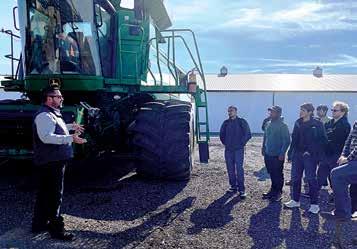
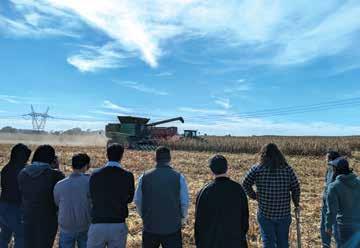
The 2026 Commodity Classic in San Antonio, Texas, was a record-breaking event with more than 12,000 attendees and the largest turnout for the event’s General Session.
International market development programs funded by the ISA and ICMC are designed with one goal: Creating long-term demand and stronger markets for Indiana farmers.
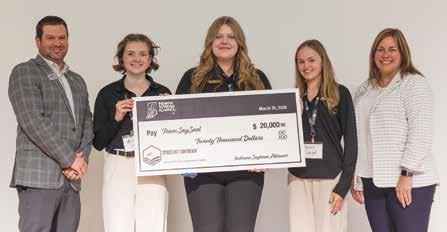
A 95 percent soybean-sourced adhesive tape, called SoySeal, earned the $20,000 grand prize in the 32nd annual Student Soybean Innovation Competition at Purdue University. 28 Conservation, no-till is foundation for Don Lamb’s family farm
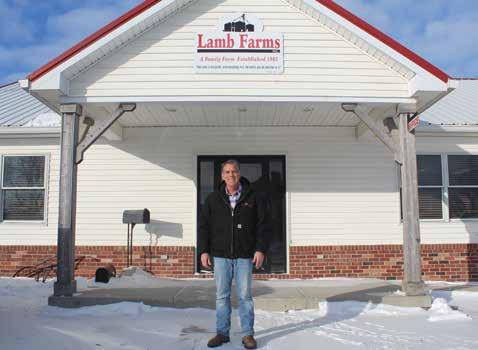
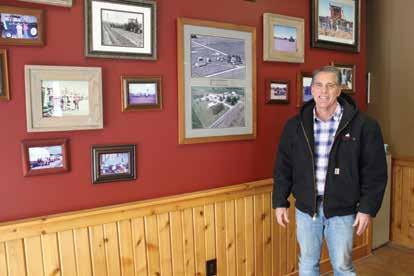
As a second-generation farmer and ISDA director, Don Lamb sees the industry from both the fields of his family’s farm and the corridors of the Indiana Statehouse.
36 About the cover:
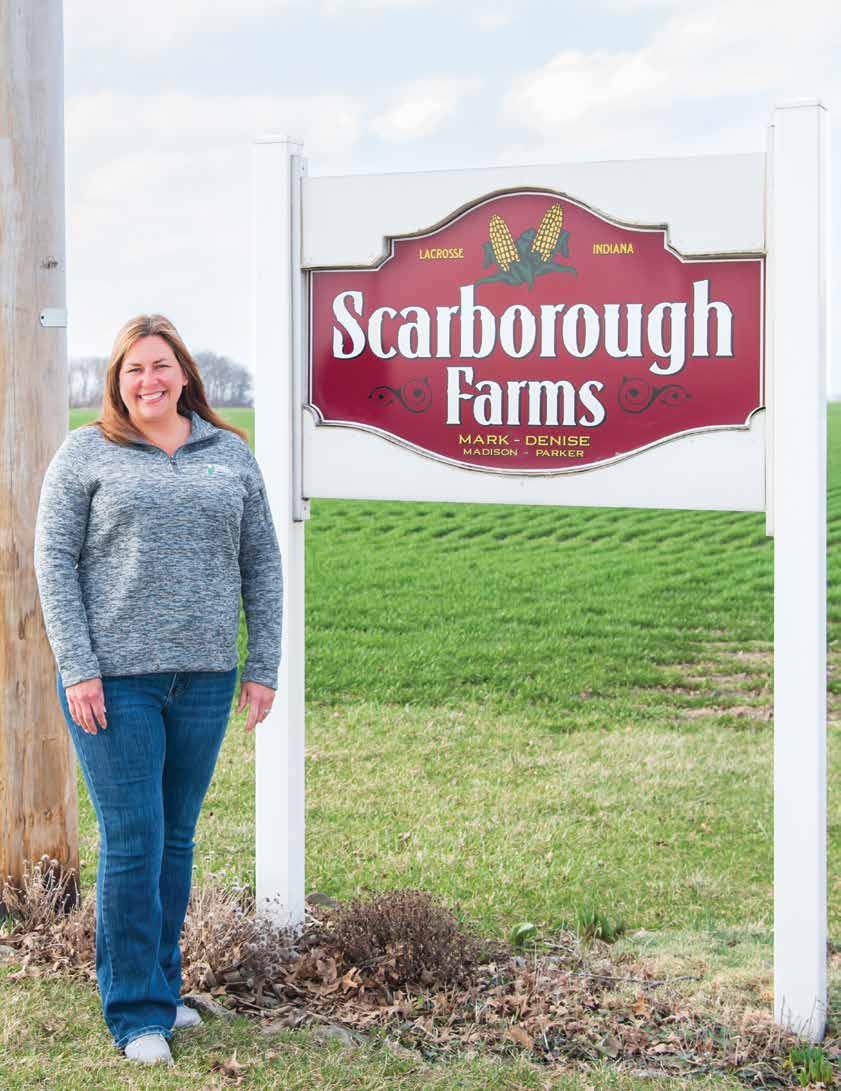
Denise Scarborough, a farmer from La Crosse, Ind., is the Chair of the Indiana Soybean Alliance. Later this year, she will complete her ninth and final year on the ISA Board. Scarborough works daily to raise her family, support her family’s farm and to advocate for Hoosier farmers through work with the checkoff and the American Soybean Association. (Amy Kelley photo)
ISA Membership & Policy Committee
Chair
David Hardin, Avon / D4
Dylan Christopher, Brookston / D1
Allen Buchanan, Fowler / D1
Kevin Kelley, Brookston / D1
John Peters, Monticello / D1
Denise Scarborough, LaCrosse / D1
C.J. Chalfant, Hartford City / D2
Carey McKibben, LaGrange / D2
Steve Phares, Albion / D2
Jenna Scott, Muncie / D2
Brian Warpup, Warren / D2
Mark Wenning, Cambridge City / D2
Directors
Philip Springstun, Boonville / D3
Mark Legan, Coatesville / D3
Derika Lynam-Spaetti, Richland / D3
Gary McDaniel, Boonville / D3
Larry Rusch, Vincennes / D3
David Ring, Huntingburg / D3
Andrew McDaniel, Waldron / D4
Kevin Burbrink, Seymour / D4
Chris Eck, Boggstown / D4
Roger Wenning, Greensburg / D4
Donald Schnitker, Seymour /D4
President Secretary Alan Dunn, Michigantown / D4
Vice President
Tyler Everett, Lebanon / D7
Tom Murphy, Chesterton / D1
Phil Zicht, Winchester / D3
Scott Smith, Windfall / D5
Staff Credits
Editor / Dave Blower Jr. dblower@indianasoybean.com
Indiana Corn & Soybean Post® is published six times per year by the Indiana Soybean Alliance and the Indiana Corn Growers Association.
For address corrections contact: Indiana Corn & Soybean Post® 8425 Keystone Crossing, Suite 200 Indianapolis, IN 46240 Phone: 317-614-0376
Email: cornandsoybeanpost@ indianasoybean.com
J.R. Roesner, Ferdinand / D8
Treasurer
Joe Tuholski, LaPorte / D2
Directors
Chris Cherry, New Palestine / D6
Tyler Pottschmidt, Crothersville / D9
For advertising information in the Indiana Corn & Soybean Post®, contact Dave Blower Jr. at 317-347-3620 or dblower@indianasoybean.com. Comments and statewide news articles should be sent to the above address. Advertising space reservations must be made by the first day of the month preceding publication. In consideration of the acceptance of the advertisement, the agency and the advertiser must, in respect of the contents of the advertisement, indemnify and save the publisher harmless against any expense arising from claims or actions against the publisher because of the publication of the content of the advertisement.
In Indianapolis and Washington, D.C., 2026 has been a busy legislative year
TDavid Hardin Chair ISA Membership and Policy Committee
his year has proved to be busy, so far, when it comes to advocating for Indiana’s soybean farmers.
At the Statehouse, we were successful in seeing the passage of Senate Bill 55 that provided a fallback state soybean checkoff in the event that the federal checkoff ceases to function. We are only waiting for Gov. Braun to sign it into law.
To Become A Member
With House Bill 1003, we saw the creation of the Agricultural Regulatory Task Force. This task force will look at what changes need to be made to the structure of the Indiana State Department of Agriculture (ISDA). When the department was created, several agencies that align with agriculture were left out, such as the Indiana State Chemist and the Board of Animal Health.
This was because many wanted to see the ISDA act as a cheerleader and promoter of agriculture, not a regulator. This may be the time to re-evaluate that decision and consider what will make ISDA the best advocate for the state’s agricultural industry.
The Indiana Soybean Alliance will have a seat on that task force to represent you.
We have seen movement in Washington, D.C., as well, but we are a long way from the finish line.
The House Agricultural Committee has voted its version of the 2026 Farm Bill out of committee. From a soybean farmer’s perspective, there are several things to like about the House version – including increased reimbursement rates for precision agriculture in the Environmental Quality Incentives Program (EQIP). There is new funding in the Conservation Stewardship
Program (CSP) for soil health initiatives.
The Energy Title helps lay out the groundwork for a strategy to grow demand and production capacity for sustainable aviation fuel. As this market takes off, it could be a huge win for soybean producers.
One summer in college, I had the pleasure of working for the Senate Agriculture Committee. That summer we spent a lot of time working on what would become the 1996 Farm Bill. I learned a lot that year. I learned the value of being engaged and advocating for your industry as I saw growers and lobbyists from every commodity walking the halls of Congress to push their messages.
I also learned about the “Grand Bargain,” the need to pair the titles important to most of us in production ag with the Nutrition title. For decades it was seen as critical to have this because it was argued that Ag alone wouldn’t have the votes in rural districts to get our bills across the finish line.
That bargain was broken last year, so we will have to see if this “skinny” farm bill will get across the finish line. It will be a challenge to get it done before the mid-term elections.
The Senate has yet to introduce their version of the farm bill. Sen. John Boozman (R-Ark.), chairman of the Senate Ag Committee, hasn’t laid out how his priorities will be different from the House’s version.
So, we will need to pay close attention to how the next steps in the process unfold and be ready to engage to make sure our voices are heard.
Research and development, marketing investments are small for most farmers
TAlan Dunn President Indiana Corn Growers Association
his past February I had the opportunity to attend the Commodity Classic in San Antonio, Texas. This event is the annual convention and trade show for the national corn, soybean, wheat and sorghum associations.
The Classic functions as an annual opportunity to conduct association business and to communicate the latest news and innovations in production agriculture to farmers from across the country and the world. I was proud to represent Indiana corn growers in the National Corn Growers Association (NCGA) Corn Congress, where NCGA discusses policy matters related to corn production at the federal level.
It was during these Corn Congress sessions that I was reminded of something that is readily apparent but not always front of mind. Each of our farms is part of an industry. Have you ever thought about your farm that way and what that means?
As corn growers, we should think of our farms as part of a large and vital bio-manufacturing industry. We purchase a few key raw material inputs like seed, fertilizer and crop protection, provide the labor to facilitate the production process, and create an end-product for sale – corn.
Thinking of your farm as a mechanism of a broader industry can offer a new and invigorating mindset as we consider how to position our farms to face the challenges in production agriculture today.
As individuals we are often challenged to benchmark our farms against published operational standards presented by Purdue University. But how does our bio-manufacturing industry stack up against other industries in certain key measures, namely research and development and market promotion?
Any industry that produces a product for sale wants to continually improve their product offering to find improved
versions or potential new uses. To do this, investments are made in research and development. According to data gathered by the National Science Foundation, the average U.S. manufacturing industry investment in research and development is around 3-4 percent of revenues.
Any industry that produces a product for sale also wants to promote that product in the marketplace, in both existing markets and potential new markets. We would commonly call this marketing, or what is more formally known as market promotion. A survey conducted by the research firm Gartner, Inc., showed that the average manufacturing industry budget for market promotion was approximately 5 percent of revenues.
So, how do we stack up as corn growers?
When you sat down this year to plan your crop budget, did you include line items for research and development and market promotion? If you are like me, the answer is almost certainly no.
But here is the good news. You do have a line item for these two services in the form of your contribution to the Indiana Corn Marketing Council, our state’s corn checkoff program. Chief among the primary purposes of this fund is research and development and market promotion for corn and corn-based products.
So now let’s do the math. According to the most recent USDA production report, Indiana produced an average of 204 bushels of corn per acre. Let’s assume that corn is worth $4.25 per bushel. Gross revenue would be $867 per acre. Indiana’s corn checkoff rate is one-half cent per bushel. The average checkoff contribution would be $1.02 per acre. That represents an investment rate of .12 percent of revenues.
To me, that is an eye-opening and humbling number. What do you think?
At POET, we’re rooted in rural America. For almost 40 years, we’ve been turning locally grown corn into homegrown bioproducts that fuel our economy and support the family farms that make our communities strong. By adding value to every bushel, we help ensure that rural families can continue to do what they love for generations to come.
POET purchases corn from local farmers to produce biofuels and bioproducts. There are five POET Bioprocessing facilities across Indiana: Alexandria, North Manchester, Portland, Shelbyville, and Cloverdale. | poet.com/grain
NCGA joins the U.N. to honor and advocate during International Year of Woman Farmer
BY LESLY WEBER McNITT, NCGA Vice President of Public Policy
When I first started working in agriculture policy, I did not see many women in the rooms I entered. It can be daunting to map out a future for yourself in an industry where you don’t see many people like you. The women –farmers, association executives, government officials and industry leaders – who I looked up to most were often the first to serve in their roles.
As my work took me all over the U.S. and the world, I sought out the women in agriculture, first subconsciously and then intentionally, to learn their stories. Visiting farms in wealthy countries like the United States and in developing nations in Asia and sub-Saharan Africa, I saw that women were always there – often in the background, unseen or uncounted.
They may not speak up in meetings or buy the seeds, or even credit themselves as “farmers,” but their contributions to our farms and our food system are very real and critical to its success.
Through the years, I have seen a real change. There are more women in food and agriculture, on the farm, in the lab, in the boardroom and in the halls of Congress. They’re being recognized, encouraged, counted and stepping forward to lead.
We have come a long way, and we have an opportunity to do more.
That’s why I am thrilled that the Food and Agriculture Organization of the United Nations has declared 2026 the International Year of the Woman Farmer. This declaration was years in the making, with the U.S. government leading the way. As part of this initiative, countries and stakeholder groups across the world are recognizing women’s contributions to our global food and agriculture system.
Here are some key facts about female farmers:
• They are essential in ensuring food security, improving nutrition and eradicating poverty.
• They contribute across all areas of food systems, engaging in crop production, forestry, livestock, fisheries and aquaculture, as well as in processing, value addition, distribution and trade.
• In 2021, they accounted for 41 percent of the global food and ag workforce. Yet, women in rural areas disproportionately face precarious jobs, poor working conditions and limited rights.
• Women farmers typically work on smaller plots of land than men.
• Women engaged in wage employment in our food system earn 78 cents for every dollar that men earn. This campaign aims to close the gender gap in farm productivity and wages, which could raise global gross domestic product by $1 trillion and reduce food insecurity for 45 million people. So, I invite you to join me and celebrate the many women in our lives and around the world who are powering food and farming. And if you’re an aspiring woman in agriculture, 2026 is a great year to get involved.
What can you do?
Here are four ways you can elevate this campaign and make a difference for women:
• Be Counted. Both men and women can take this survey, which will bolster our understanding of where gaps persist in the United States.
• Tell your story. Post #IYWF2026 messages and memes online. There is a treasure trove of images, videos and messages on the U.N. website and on the National Association of State Departments of Agriculture’s U.S. IYWF website.
• Pay it forward. I have benefitted immensely from incredible mentors – men and women. Encourage those in your network to apply for the
For more on NCGA
National Corn Growers Association Women & Mentors Retreat. The Retreat doesn’t end when attendees go home — they become permanent members of the Women & Mentors network, connecting them with a passionate community invested in advancing women’s leadership in agriculture.
• Get involved. Join one of the many events, including several online discussions, that are planned for the year ahead organize an in-person or online #IYWF2026 event.
Women have long been central to the farm economy both here in the United States and around the world. Yet, their work has often gone unnoticed, underappreciated or faced unique barriers. Let’s make the most of the International Year of the Woman Farmer. The work we do over the coming year and decade to advocate for them will determine whether the fields they toil in are on a level playing field.
Boost domestic demand for ethanol
The nation’s corn growers would benefit from increasing and creating new domestic demand for ethanol, Ohio farmer and NCGA President Jed Bower said on March 10
during testimony before the Senate Agriculture Committee hearing on increasing domestic consumption of U.S agricultural products.
During his testimony, Bower zeroed in on expanding consumer access to fuels with 15 percent ethanol blends, often called E15. Thanks to an obsolete clause in the Clean Air Act, the sale of E15 is prohibited during the summer months unless the Environmental Protection Agency issues a waiver.
“Year-round access to E15 is critical,” Bower said. “Aside from the economic boost it would provide to farmers, yearround E15 would lead to significant savings for American consumers and strengthen U.S. energy dominance at a time when geopolitics are increasingly complicating markets and supply chains.”
Grower leaders have pushed hard for passage of E15 legislation, but despite several promising opportunities, attempts to pass the legislation have fallen short.
The hearing comes as corn growers are experiencing a fourth consecutive year of financial losses. To make matters worse, input costs for fertilizers and crop protections are high and rising.
China trade, input costs, farm bill among priorities for ASA this spring
BY BLAIR SHIPP, American Soybean Association
The American Soybean Association (ASA) has remained active in Washington, D.C., throughout the winter, continuing to advocate for policies that support soybean farmers and strengthen the U.S. soy industry. In recent weeks, ASA leaders have been engaged with Congress, the administration and federal agencies on a range of issues including trade, input costs, biofuels policy and completion of the farm bill as work continues on priorities important to farmers ahead of the 2026 planting season.
Trade with China remains one of the most important issues for U.S. soybean farmers, and ASA recently urged President Donald Trump to prioritize soybeans in upcoming trade discussions with Chinese President Xi Jinping. In a letter to the White House, ASA called for additional purchases of U.S. soybeans and the removal of the remaining retaliatory tariff on U.S. imports into China, noting that predictable trade with the United States’ largest customer is critical to the farm economy.
China continues to be the largest export market for U.S. soybeans. In the 2024 to 2025 marketing year, U.S. farmers shipped more than 22 million metric tons to China, representing nearly $10 billion in sales. Historically, China imports between 25 million and 30 million metric tons of U.S. soybeans each year.
ASA leaders have stressed that maintaining strong export relationships is essential as farmers face rising costs and uncertain prices heading into the new crop year.
Input costs a major concern
Input costs are also a major concern. In March, ASA joined its 26 state affiliates, including Indiana, the National Corn Growers Association and other farm organizations in urging fertilizer manufacturers to withdraw support for countervailing duties on phosphate fertilizer imports from Morocco and Russia.
ASA has opposed the duties since they were first imposed in 2021, arguing they have significantly increased fertilizer prices for U.S. farmers.
ASA continued that effort by joining a coalition of agricultural groups in a letter to the U.S. Department of Commerce urging the agency to revoke the duties as part of the current sunset review. ASA noted that soybean farmers are already facing tight margins and rising input costs, and fertilizer remains one of the most critical and expensive inputs required to produce a crop.
Maintaining the duties limits supply, reduces market competition and places additional strain on farmers navigating volatile markets. ASA warned that elevated fertilizer prices continue to affect planting decisions and overall farm viability and urged Commerce to restore balance to fertilizer markets by removing the duties.
Farm bill remains a priority
Completion of a new farm bill remains another top priority. Congress made progress in March when the House Agriculture Committee advanced the Farm, Food, and National Security Act of 2026, but additional work is needed before a final bill becomes law.
ASA has been working closely with lawmakers to ensure the legislation includes strong crop insurance, risk management tools, conservation programs and research funding that soybean farmers depend on.
Soybean leaders reinforced those priorities during ASA’s March board meeting in Washington, where directors from across the country met with members of Congress, administration officials and federal agencies. Discussions focused on the farm bill, the overall farm economy, biofuels policy, trade and the need for science-based regulation of crop protection tools.
ASA emphasized that farmers are facing one of the most challenging financial periods in recent years and need certainty as they make decisions for the upcoming crop year.
Learn more about ASA
Biofuels help drive domestic demand
Domestic demand also remains a key part of ASA’s policy work. Biofuels continue to be one of the most important drivers of soybean value, and ASA is urging the administration to finalize Renewable Fuel Standard volumes and implement the Clean Fuel Production Credit in a way that supports U.S. farmers.
Growth in biodiesel, renewable diesel and sustainable aviation fuel markets provides important opportunities for soybean oil and helps reduce reliance on exports alone.
As planting season approaches, ASA will continue working with Congress, the administration and industry partners to strengthen markets, lower input costs and provide the policy certainty farmers need to remain competitive.
ASA appreciates the partnership of state associations, including the Indiana Soybean Alliance, as we work together to ensure the voice of soybean farmers is heard in Washington.
Soymeal in spotlight of March WASDE
The March World Agricultural Supply and Demand Estimates (WASDE) report showed soymeal supplies increased by 400,000 short tons to 62.3 million short tons on higher crush volumes. January 2026 soymeal yields hit 47.57 pounds per bushel, up slightly from December 2025 and setting a new high for January soymeal yields.
USDA expects the additional volume to be consumed entirely by domestic livestock units. The demand prospects led USDA to increase season average prices for soymeal by $5 per ton to $300 per ton for the 2025-26 marketing year.
The surge in domestic soymeal usage added strength to futures prices, as well. The May 2026 soymeal futures contract closed the March 10 trading session $1 per ton higher to $315.1 per ton.
Strong processing margins in the Eastern Corn Belt have largely driven the uptick in value of soymeal in the past four months.
From property taxes at the Statehouse to the Farm Bill on Capitol Hill, the Indiana Ag Policy Podcast will share the latest from the biggest names in ag policy. Scan below to listen now!
Coffee Shop Talks focus on issues at Statehouse
BY JENNIFER MAY
The Indiana Corn Growers Association (ICGA) and Indiana Soybean Alliance’s Membership and Policy Committee (M&P) continued their Coffee Shop Talks this winter with small-group discussions alongside Indiana state legislators.
Around 10 farmers, industry partners and staff gathered Jan. 30 at the Bee Hive in Danville, Ind., to meet with State Sen. Spencer Deery (R-West Lafayette), along with State Sen. Brian Buchanan (R-Lebanon) and State Rep. Beau Baird (R-Greencastle). Also in attendance were ISA M&P Chair David Hardin and additional farmer leaders.
The group discussed topics including the responsibilities and funding of the Indiana State Department of Agriculture (ISDA), the value of building relationships at the Statehouse and within the ag community, expanding international markets and advancing bio-based products.
Approximately 15 farmers, industry partners and staff gathered at Ann’s Restaurant in Franklin, Ind., to meet with State Rep. Robb Greene (R-Shelbyville). Attendees included farmer members and partners from Ingredion, Pioneer Seeds and ISDA.
The group discussed agricultural land use, farmland preservation and the importance of ensuring leaders with agricultural backgrounds have a voice at the Indiana Statehouse. Greene emphasized how much he and his colleagues value constituent input and encouraged farmers to visit the Statehouse and reach out directly when issues arise. First Farmers Bank and Trust sponsored the event.
Coffee Shop Talks provide an opportunity for farmers and policymakers to connect in a more personal setting, allowing for meaningful dialogue on issues impacting Indiana agriculture.
State Rep. Robb Greene (R-Shelbyville) speaks with farmers during a Coffee Shop Talk in Franklin, Ind.
Stutzman: Soil that sustains America does not belong to foreign countries
BY U.S. REP. MARLIN STUTZMAN, (R-District 3)
I have the great honor of representing northeast Indiana. Not only do we house the greatest concentrations of farms, but we also have some of the highestproducing farms in our state.
Indiana’s agricultural strength was built on generations of hard work, knowledge and innovation. We are skilled in growing crops efficiently while still preserving the health of the soil for years to come. This commitment to the craft of producing sustainable, high-quality food is what allows the United States to enjoy the most abundant and affordable food supply in the world.
I consider myself blessed to be a part of this great legacy. Coming from a fourth-generation family of farmers, I grew up understanding that agriculture is more than industry — it’s a way of life. It instills the values of responsibility, discipline and stewardship. Those lessons are why I am committed to preserving that way of life for future generations of Hoosiers.
hands of foreign nations, especially those that don’t have our best interests at heart.
This is why I am co-sponsoring the Protecting Our Farms and Homes from China Act. This legislation bans the sale of American farmland to corporations or individuals affiliated with the Chinese Communist Party and ensures that our farmland remains in the hands of those committed to our nation’s prosperity and security.
As a rural state, agriculture is the backbone of our economy. When our nation’s greatest geopolitical adversary purchases hundreds of thousands of acres of farmland, it undermines one of our nation’s great strengths — the ability to feed ourselves. This jeopardizes our sovereignty and independence.
Recently, however, there have been new threats to this rich legacy of ours. Foreign adversaries — primarily corporations and individuals affiliated with the Chinese Communist Party — have been buying up prized farmland across America’s heartland. Our farmland is more than simple real estate. The soil that sustains our nation doesn’t belong in the
Not only is the loss of U.S. farmland to a foreign adversary a threat to the integrity of our food supply, it also creates national security risks –especially when much of this land is close to sensitive military installations.
Safeguarding America’s farmland means strengthening our self-reliance and national security and preserving opportunity for U.S. farmers. It ensures that future generations will have the chance to work the land, provide for their communities, and continue the proud tradition of feeding our nation.
Indiana remains one of the leading states in agriculture. I am committed to supporting our farmers to ensure they have the resources, support and independence they need to continue feeding America — today and for generations to come.
As a rural state, agriculture is the backbone of our economy. When our nation’s greatest geopolitical adversary purchases hundreds of thousands of acres of farmland, it undermines one of our nation’s great strengths — the ability to feed ourselves.
U.S. Rep. Marlin Stutzman (R-Dist. 3), at right, speaks with ICMC board member Jerry Osterholt as corn farmers visited Indiana lawmakers in Washington, D.C., last year.
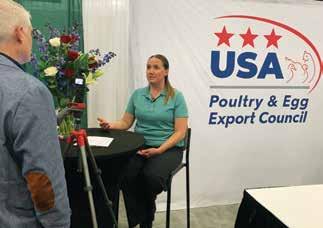
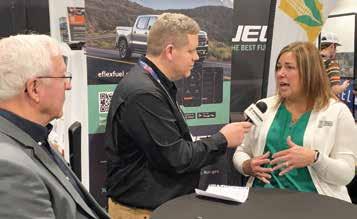
ISA Board member Jenna Scott, a farmer from Muncie, Ind., is interviewed by the media at the USA Poultry and Egg Export Council booth about an effort to expand the sale of Indiana-grown turkey in Mexico, which also expands markets for Indiana corn and soybean growers.
Rollins also emphasized USDA’s efforts to lock in permanent, year-round E-15 and to slash input costs.
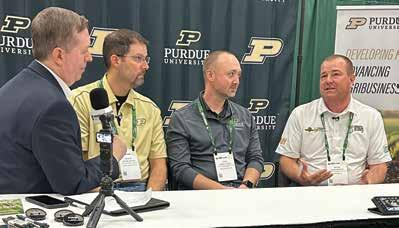
ISA Board member Brian Warpup, a farmer from Warren, Ind., far right, participates in the Purdue Crop Chat podcast during the Commodity Classic. Warpup explains, from left, to C.J. Miller, Purdue Soybean Specialist Shaun Casteel and Purdue Corn Specialist Dan Quinn, that research should be applicable to Indiana farmers.
“The tone of this year’s speech was so much different than the tone of last year’s speech,” said ICGA President Alan Dunn, a farmer from Michigantown, Ind. “Let’s cut her some slack. Last year, she’d been on the job a week when she spoke to this convention. But, this year, I felt like it was a much more realistic tone. She could talk about actual accomplishments that had happened in the last year and goals for the administration moving forward. There was a definitive list of actions that this administration wants to take and that was very encouraging.”
He appreciated that working for permanent, year-round E-15 was on her to-do list.
“I wanted to hear if she was going to bring up [year-round] E-15. Not only did she bring it up, she listed it as a priority item and called for Congress to get it done now, and that was music to my ears and music to the convention’s ears,” Dunn said. “I’ve come out of this thinking E-15 still has a pulse, and I’m hopeful that that we’ll have progress in the next two weeks.”
USDA to enhance data reliability
Undersecretary for Farm Production and Conservation Richard Fordyce told farmers at the Commodity Classic that accuracy of USDA reports is a priority.
“We’ve mentioned several times while we’ve been here, a technology modernization as it relates to acreage reporting and maybe production reporting for (the Risk Management Agency) RMA and how those advancements and how that may be more accurate acreage reporting, more timely,” he said.
Fordyce added that the department relies heavily on farmer-provided information.
“Farmers aren’t as good as they probably should be in
filling those surveys out,” he said. “So, my encouragement would be to, when you see that survey from National Agriculture Statistics Service, open the envelope, fill it out, send it back. That just helps inform the reports that they do.”
He said the goal is for the USDA to release timely and accurate information that is useful for farmers.
“I think they’re doing it the best that they can given the data they have access to and the timing of the data they have access to,” Fordyce explained. “Some of that can be difficult because when those reports come out, maybe all the data is not available, yet.”
The USDA said it will use the information to consider future program direction, new initiatives, and potential funding opportunities.
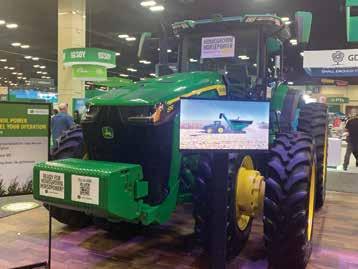
John Deere unveiled an E-98 ethanol-powered prototype tractor during the Commodity Classic. In a partnership with NCGA aimed at expanding corn demand and advancing ag sustainability, the John Deere prototype underwent field testing in 2025 on farms in Iowa and Illinois. John Deere said it has been researching alternative engine technologies for several years.
Take action to help Hoosier farmers
Become a lifetime member of Indiana’s corn and soybean policy groups
The Indiana Corn Growers Association (ICGA) and the Indiana Soybean Alliance’s Membership & Policy Committee (M&P) represent our state’s farmers in the legislative halls in Indianapolis and Washington, D.C. These organizations need your membership to influence federal and state lawmakers.
Indiana soybean and corn growers can now save money and eliminate the hassle of annual renewals by purchasing a LIFETIME MEMBERSHIP to both ICGA and M&P. For only $1,700, you can be a member of both ICGA and M&P for life!
Anyone interested in buying this membership, should contact Industry Affairs Outreach Manager Khyla Goodman by phone at 317-614-0377 or by email at kgoodman@indianasoybean.com. Or, you can go to our website, incornandsoy.org/membership, to join!
Lifetime Members
Phil Ramsey
Courtney Kingery
Matthew Lucas
Tyler Everett
David Gottbrath
Mike Sprinkle
Jeff Troike
Jim Douglas
Michael Steinbarger
Sam Caldwell
Mark Nigh
Alan Dunn
Mason Gick
Aaron Johnson
Nathan Luallen
Sam Mehringer
David Wenning
Mark Wenning
Creed Gunn
Andrew Fansler
Kent Burton
Russell Anderson
Troy Hattery
Mark Bacon
Ronald Sutherlin
Jordan Caldwell
Mike Shuter
John Baugh
Janice Peterson
Cullen Page
Don Wyss
John Peters
Bruce Herr
Lauren Tolle
Luke Roush
James Wood
Allen Buchanan
Matt Hart
Ron Hudson
Mark Tolle
Carl Kissel
Chris Eck
James Wenning
JR Roesner
William Roesner
Sarah Delbecq
Jim Geller Jr.
C.J. Chalfant
William Gerard
Carey McKibben
Neal Smith
Matthew Chapman
Jim Flanders
Chris Cherry
Luke Mullet
Tom Murphy
Matt Hayden
Kevin Kelley
Douglas Matthys
Randall Matthys
Brian Warpup
Tom Weaver
Larry Rusch
Chad Chism
Troy Furrer
Brent Bible
Jeremy Mullins
Joe Stoller
Matt Wilson
Adam Sheller
Philip Springstun
Joe Steinkamp
Keevin Lemenager
Brian Warpup, Warren, Ind.
“I became a lifetime member of M&P and ICGA because I’ve seen the importance of how policy can affect Indiana grain farmers. These groups give a voice to those of us who raise products for domestic use and global trade. What happens in Washington, D.C., and Indianapolis, ultimately impacts those of us in rural communities. Being able to speak for ourselves is key in maintaining our products movement in the market.”
Scarborough believes in growth, family and the future of farming
BY DAVE BLOWER JR.
Indiana Soybean Alliance (ISA) Chair Denise Scarborough, a farmer from La Crosse, Ind., will finish her nine years of service on the board later this year. In that time, she has promoted the creation of new items made from Indiana soybeans; she has signed agreements to ship soybeans to foreign customers; she has supported new sustainable techniques to grow row crops –among other accomplishments.
Also a wife, a mother and a farm loan officer at a community bank, Scarborough believes in getting the most out of every opportunity. Although she’s happy to give time to ISA, the American Soybean Association (ASA) and other farm groups, Denise admits that she receives just as much in return.
“The biggest benefit of being involved in organizations like ISA and ASA is the relationships – learning from other farmers, sharing ideas and improving what we do,” Scarborough added.
Denise was raised on a farm and enjoyed the experience. She made the most of her opportunity.
“Both my dad and my mom were very active on their farm,” Denise said. “My dad farmed full time, and my mom taught school. When my brother and I were little, my mom quit teaching and started working full time on the farm. My parents were adamant that I knew how to operate equipment and do those things. That has really helped in the long run. I’ve worked a lot of ground that Mark has planted.”
“I will say it is a lot of work to be on the ISA and ASA boards at the same time. I’ve always liked the political side and the different aspects of working for good farm policy. Both checkoff and policy work is built on solid relationships.”
Relationships build a farm, too
Denise and her husband, Mark, met while participating in 4-H as high school students, and they continued to date while attending Purdue University.
“I swore I would never marry a farmer, and I would never move back home,” Denise quipped. “And, yet, here I am.”
Mark replied, “You’re 30 miles from where you grew up, so you didn’t move back home.”
Similarly, after the Scarboroughs took more ownership of Mark’s family farm, he was able to quit his full-time job to focus on farming 13 years ago. They are the third generation of his family to work the farm. Their children, Madison, 17, and Parker, 13, represent the fourth generation.
Denise, who has a Purdue degree in agricultural economics, sales and marketing, works as a farm loan officer at a community bank. She appreciates those relationships, too.
“I enjoy my job,” Denise said. “It is interesting to be a lender in the community where you live. It’s nice being able to help neighbors purchase farms, purchase equipment or help them to expand their operations. The fun part of the job is being able to help people in either a time of need or in a time of success.”
In addition to family, the Scarboroughs have three employees – Kevin Ketchmark, Cory Brust and Zach Brust – who they said are “like family” today.
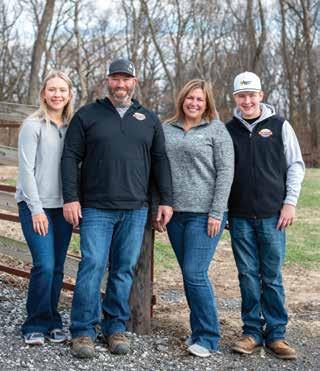
The third and fourth generations of the Scarborough family farm include, from left, Madison, Mark, Denise and Parker. (Amy Kelley photo)
Diversification and resilience
Mark’s family has owned their farm for nearly 100 years, but he said it has changed significantly through the years. The farm has produced everything from mint to seed corn, along with partnerships to grow vegetables like cucumbers, potatoes and tomatoes. Access to abundant water and well-drained sandy soils has allowed the operation to remain flexible and productive. Today, the farm produces soybeans, corn, wheat and seed corn along with double-cropped soybeans.
Recent opportunities have allowed the Scarboroughs to expand their operation to farm across a 25- to 30mile area. “That’s been a benefit,” Mark said. “When there’s drought in one area, it’s usually fine in a different field. The same applies when there’s too much or too little water. It helps manage risk.”
They’ve also adopted innovative practices, like interplanting soybeans into wheat ahead of wheat harvest to extend the growing window and improve double-crop soybean yields.
Sustainability practices have become a major focus, as well. “About 70 percent of our acres now use cover crops,” Mark noted. “We’ve moved toward reduced tillage, too.”
Denise was the chair of ISA’s Sustainability and Value Creation Committee in the past. She added that they have added many growing techniques that she has learned through her time on the ISA board.
Giving back to agriculture
Through their children, Denise and Mark have been involved in 4-H and FFA. They were also involved in Indiana Farm Bureau and the American Farm Bureau Federation’s Young Farmer and Rancher Committee. Denise was recruited to ISA from a pair of former board members.
“We were looking for the next things to do – the next way to continue serving agriculture,” Denise said. “When I was recruited to ISA, I didn’t really know what the checkoff did. I have learned a lot over the past nine years. ISA is a grassroots organization; it is farmer driven. We are very diligent with our checkoff dollars.”
She listed the Student Soybean Innovation Competition and the Glass Barn at the Indiana State Fair as two of ISA’s programs that she enjoys. The Student Soybean Innovation Competition invites Purdue students to create new products made with soybean ingredients. The Glass Barn is an interactive facility dedicated to teach non-farmers about agriculture. The Glass Barn attracts thousands of visitors each year during the Indiana State Fair, and Hoosier farmers from across the state volunteer during the fair.
“The Glass Barn is one of my favorite things, not only to walk through, but also to volunteer for,” Denise said. “My family has volunteered in the barn. I love seeing the things that we’ve been able to do through it, the amount of consumers that we reach year in and year out. I don’t know too many other states that do the type of outreach that we are capable of doing through the Glass Barn.”
ISA Chair Denise Scarborough poses with USDA Secretary Brooke Rollins on an Indiana farm last fall.
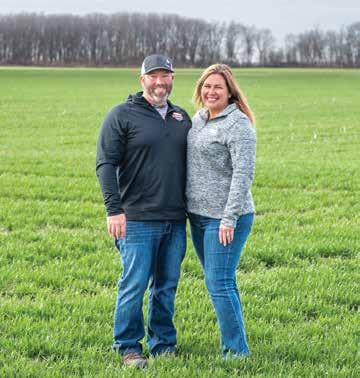
Mark and Denise Scarborough met while showing 4-H cattle at a county fair during their high school years. After graduating from Purdue University, the couple married in 2003.
ISA Chair Denise Scarborough, at right, is interviewed about the benefits of biofuels by Hoosier Ag Today’s Eric Pfeiffer during the Commodity Classic. At left is ICMC Board member Tim Gauck, a farmer from Greensburg, Ind.
From the farm to the world
Denise’s work extends beyond the farm gate. Through her involvement in soybean organizations and checkoff programs, she has participated in international trade missions — experiences that have reshaped her perspective.
“These aren’t vacations,” she said. “You’re traveling long hours and meeting directly with decision-makers who influence entire countries’ purchasing decisions.”
One trip to Dubai stood out. “We were sitting across the table from someone making agricultural decisions for Saudi Arabia,” she recalled. “Then we visited a facility and saw products connected back to crops grown here in Indiana. That was a full-circle moment.”
In Egypt, despite heavy security, the impact of relationshipbuilding was clear. “Those buyers want to know you. They want trust and consistency,” she said. “If we’re not there building those relationships, someone else will be.”
Last year, Denise signed a Letter of Intent with officials from Taiwan who agreed to buy $4.2 billion of U.S.
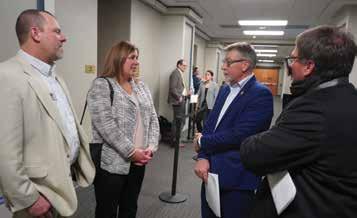
Indiana farmers advocate for good farm policy while at the Indiana Statehouse in January. From left are, ICGA Board member Joe Tuholski, ISA Chair Denise Scarborough, State Rep. Jim Pressel (R-LaPorte, Ind.), and ISA Board member John Peters.
soybeans from 2026 through 2029. She said farmers must work to develop these new markets because farmers are their best advocates.
“The quality of U.S. crops is important, but relationships and trust matter just as much,” she said.
Whether through trade missions or local organizations, Denise emphasizes that relationships are at the heart of agriculture’s future. As they look ahead, the focus remains clear: sustain the farm, support the next generation, and stay connected — to the land, to their neighbors, and to a global agricultural community that depends on both.
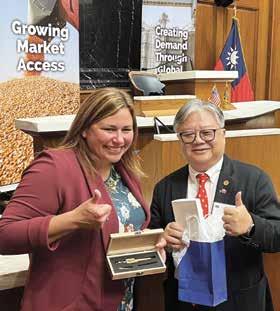
After signing a Letter of Intent with officials from Taiwan last year, ISA Chair Denise Scarborough exchanged gifts with the delegation from Taiwan. The Letter of Intent says $4.2 billion of U.S. soybeans will be purchased by Taiwan.
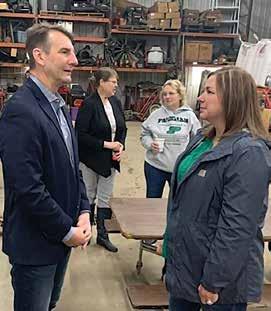
U.S. Rep. Frank Mrvan (D-Dist. 1) discusses various federal ag policies with La Crosse, Ind., farmer Denise Scarborough, who is also a board member for the American Soybean Association.
USSEC: strong relationships boost U.S. exports
BY COLBY PINKSTONE, USSEC Executive Director of International Strategy
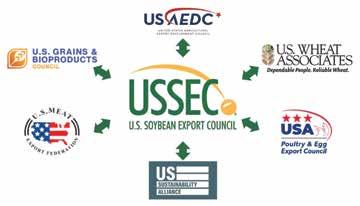
As an organization, the U.S. Soybean Export Council (USSEC) believes that working together elevates everyone. USSEC actively works with other agricultural export organizations, like the U.S. Agricultural Development Export Council, which aims to preserve, differentiate and expand American ag exports.
USSEC willingly serves as a leader for all U.S. agricultural exports, as CEO Jim Sutter demonstrated as chair of that council a few years ago.
Together, we address common issues and create a unified voice for U.S. agriculture. Encouraging international customers to purchase U.S. products benefits U.S. Soy – and Indiana farmers. Nourishing strong relationships with similar organizations allows USSEC to serve global customers better.
Commodity collaboration
For years, USSEC has teamed up with the U.S. Grains and BioProducts Council (USGBC), U.S. Wheat Associates, USDA Foreign Agricultural Service and others to host events around the world.
For example, in June 2025, a Cooperators Conference in Mexico focused on animal nutrition strategies for animal feed, aquaculture, poultry and swine companies in the Americas.
In September 2025, at least 400 leaders from more than 20 East Asian countries gathered in Indonesia to focus on food security, supply chains and long-term ag trade at another Cooperators Conference. In China, USSEC yearly co-hosts the U.S.-China Agricultural Products Trade Cooperation Forum with USGBC.
Event attendees often purchase multiple U.S. commodities, and they value connecting with all their U.S. suppliers in one place. Many participating U.S. exporters also sell multiple commodities, so they can discuss their entire portfolios. These events showcase the efficient logistics and abundant, sustainable supply of U.S. agricultural products.
Value-added U.S. exports
U.S. Soy gets exported as more than just soybeans, meal and oil. Domestically, animal agriculture consumes the most soy. U.S. meat and poultry exports add value to U.S. Soy before exporting it.
That leads USSEC to exciting opportunities to promote multiple U.S. exports.
USSEC works with other U.S. export organizations to promote all U.S. agricultural exports.
For example, in Vietnam, USSEC and the Indiana Soybean Alliance (ISA) collaborated with the U.S. Meat Export Federation (USMEF) to host a Traditional Cake Festival in Ho Chi Minh City. Teams competed to creatively make sticky rice cakes using U.S. pork ribs combined with 30 percent U.S. Soy in the filling.
When India reduced its tariff on turkey imports, USSEC teamed up with the USA Poultry and Egg Export Council (USAPEEC) to host a viewing of an International Cricket Championship finale in India. The menu featured U.S. turkey and U.S. soy nuts, highlighting the importance of protein in diets to participants from Bangladesh, India, Nepal and Sri Lanka.
Promoting U.S. sustainability
As a member of the U.S. Sustainability Alliance, USSEC highlights the documented sustainability of U.S. Soy and other commodities. The Alliance targets markets that prioritize that quality in their imports.
For example, a small U.S. delegation visited Denmark, Sweden and Poland in October 2025 to see how local farmers, industries and governments prioritize sustainability. They explained U.S. regulatory frameworks, conservation programs and industry-led verification systems that apply to U.S. Soy and other commodities.
Working with the U.S. Sustainability Alliance helps correct misperceptions about U.S. agriculture by delivering facts and regulation-focused information. As we demonstrate the depth of science, law and monitoring that supports U.S. sustainability programs, we strengthen the credibility of efforts like the U.S. Soy Sustainability Assurance Protocol, or SSAP, that verifies the sustainability of Indiana soybeans.
Working together, USSEC and other organizations are growing export markets for Indiana farmers.
USGBC’s 2025 Annual Report available for review
BY EMMA DOSTAL
The U.S. Grains & BioProducts Council’s (USGBC’s) 2025 Annual Report is now available to view on the Council’s website. The 2025 report features events and programs Council staff in its 10 offices around the world organized to deliver wins for U.S. producers of barley, corn, sorghum and their co-products, including highlights like Global Ethanol Summit 2025.
“Last marketing year saw record exports of U.S. corn and ethanol, showing that the time Is now for the U.S. agricultural industry to sustain and expand its success in international marketplaces,” said USGBC President and CEO Ryan LeGrand and USGBC Chairman Mark Wilson in a joint letter.
The Indiana Corn Marketing Council supported one of the top ethanol stories from 2025, a U.S.Philippine trade promotion mission in September.
The USGBC organized, in coordination with the Philippines Department of Agriculture (DOA), a trade mission to support the U.S. ethanol industry and Filipino ethanol supply chain as the country moves toward a policy allowing gasoline to be blended with 20 percent ethanol (E20).
corn and corn co-products,” Caleb Wurth, USGBC regional director for Southeast Asia & Oceania (SEA&O) said.
Within the current system, U.S. ethanol compliments local Philippine ethanol production to fulfill the country’s nationwide E10 mandate. A move to E20 would equate to 360 million gallons of total ethanol demand.
The annual report also recaps the Council’s name amendment, passed at its 65th Annual Board of Delegates Meeting in Grand Rapids, Mich., in July, that marks the next step in the Council’s constant effort to best serve its domestic membership and international customers, along with other commodity-specific stories from 2025.
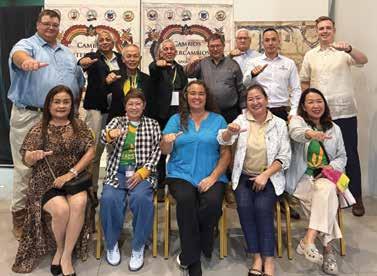
USGBC Regional Director for Southeast Asia & Oceania (SEA&O) Caleb Wurth (rear, second from right) poses with USGBC Deputy Regional Director for SEA&O Chris Market and USGBC members from the Indiana Corn Marketing Council; the Minnesota Corn Research and Promotion Council; and the Ohio Corn & Wheat Growers Association. This delegation traveled to the Philippines to support the country’s move toward an E20 blending policy.
The Council sought support from local stakeholders to move the country to E20 usage. The Government of Isabela in the Philippines expressed its desire for an expanded ethanol industry that promotes U.S. investments in the agricultural sector and facilitates U.S. feed grains to support animal production.
“The presence of Council grower members helped build stronger connections to the customers and government officials we spoke to on the program, paving the way for future collaboration and developing a trust and loyalty to U.S.
“The stories featured in this year’s annual report show the extensive work the Council does on behalf of its members and the U.S. agricultural industry and celebrates landmark export successes,” said Bryan Jernigan, USGBC director of communications. “We’re proud to have programs and wins from each of the Council’s offices illuminated in the annual report, representing just a sample of the around-the-clock work our staff undertook in 2025 and aims to improve even further in 2026.”
Each commodity the Council represents is showcased in its own section with select details and developments across a variety of regions and use applications. A full update on the Council’s financial standing is also available in the report.
The 2025 Year in Review provides comprehensive coverage of global grain markets, offering insights into production, trade and consumption trends across key commodities. To view the annual report, visit https://grains.org/2025-annual-report
USMEF to Mexican consumers: Eat pork at home
The U.S. Meat Export Federation (USMFE) is rolling out a new marketing strategy across parts of Mexico to encourage more people to eat pork at home.
The initiative, made possible with support from USDA and National Pork Board, is geared toward the end consumer and will include multiple different campaign strategies from social media to retail stores.
“We have great expectations for 2026 and 2027,” USMEF Regional Director for Mexico and Central America Gerardo Rodriguez said.
While Mexico’s pork consumption has soared in recent years, its popularity has lagged in personal kitchens across the country, particularly in the north. USMEF found just 12 percent of the total amount of pork consumed in Mexico is cooked at home.
“The percentage is lower than we thought,” Rodriguez said. Mexico imported nearly $3 billion of U.S. pork in 2025, with per-capita pork consumption exceeding 20 kilograms per year. But Rodriguez believes the low ratio of at-home preparation as an opportunity to expand the market further, if the U.S. industry can capitalize on consumers’ desire for convenience and help prepare dishes properly.
“It’s a great opportunity for us to grow in this niche,” he said.
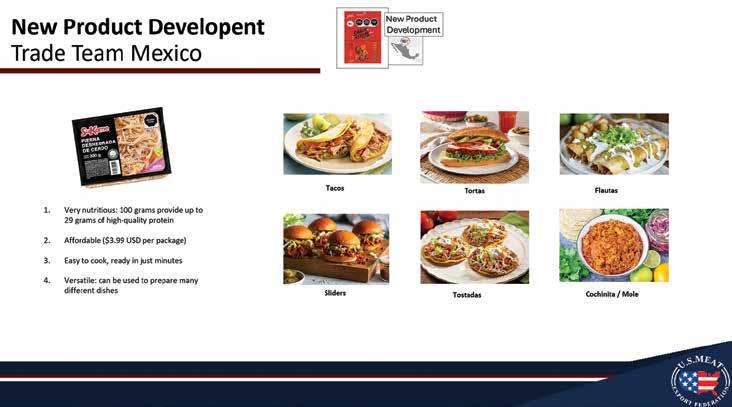
New Product Development Trade Team Mexico
In response, USMEF’s team in Mexico will devote resources to focus on promoting athome pork consumption during the next two years. Rodriguez believes it is the next step in growing overall demand for U.S. pork in Mexico. “If we grow the percentage of pork being cooked at home, I think that it’s going to move the needle in a tremendous way,” he said.
The first step in bolstering sales is figuring out why families are leaving pork off their shopping lists. According to Rodriguez, shoppers are skipping the pork aisle at grocery stores in favor of other proteins that are perceived as easier to work with at home.
“Price is not an issue. Availability is not an issue. The issue is education,” Rodriguez said. “The issue is they need to learn how to cook it correctly so we want to do a joint venture with kitchen appliance companies, and we can demonstrate to the consumer that cooking pork at home is very easy, very convenient and very versatile.”
USMEF has already seen success using food trucks to increase demand for U.S. pork products in the foodservice sector in Mexico by teaching chefs how to best utilize the meat in new and different ways, with a focus on grilling.
Rodriguez and his team will employ a similar strategy to encourage consumers to incorporate more pork and
(Continued on page 23)
Poultry exports mixed in 2025; turkey, eggs set record
For Indiana’s grain farmers, the “check” for their corn and soybeans is often written by a chicken.
With poultry remaining a primary driver of domestic feed demand, the latest 2025 trade data from the USDA Foreign Agricultural Service offers a roadmap for where Hoosier-grown feed is traveling — and where global competition is heating up.
The big picture? While the volume of some poultry exports dipped, the value of turkey and egg exports skyrocketed, signaling a resilient global appetite despite shifting trade routes.
Broilers: Navigating a shifting global map
Total U.S. broiler exports reached more than 3.1 million metric tons in 2025. While this represents a 3.4 percent decrease in volume and a slight 1.2 percent dip in value ($4.64 billion) compared to 2024, the story is one of market diversification.
Traditional heavyweights like China saw a massive 45.5 percent pullback in volume. However, Hoosier feed found its way to emerging markets that picked up the slack:
• Taiwan increased 23.4 percent.
• Philippines increased 30.3 percent.
• Canada increased 10.7 percent.
The Mexico Factor: Mexico remains the No. 1 destination for U.S. poultry despite increased competition from Brazil.
(Continued from page 22)
different cuts into their diets at home.
“What we are going to be doing now is to adapt those food trucks, and we are going to demonstrate how to cook pork with an Instant Pot or with a pan fryer,” Rodriguez said. “We’re going to be using the Thermomix and all of the common kitchen appliances. So, this is going to be giving us the opportunity to have the same key audience but to know that the same cut can be cooked in different ways.”
Aside from appliance partnerships, USMEF is also working with companies like SuKarne to develop quick, affordable and easy-to-cook dishes. One such product is a package of shredded pork that can star in a variety of familiar meals like tacos, sliders, mole and more.
Through the support of partners like the Indiana Soybean Alliance, USMEF works to move Indiana soybeans through pork exports around the globe. In 2025, pork exports accounted for consumption of nearly 7.5 million bushels of Indiana soybeans valued at $76.1 million.
Brazilian chicken exports to Mexico jumped 15 percent this year, creating a more crowded marketplace for U.S. product.
Turkey and eggs: Lower volume, higher value
The standout news for the 2025 data lies in the value of turkey and egg products. Even though fewer units were moved, they fetched a much higher premium — a trend that supports steady demand for high-quality feed.
Turkey export volume fell 12.5 percent, yet the export value surged 19.7 percent to $805.2 million. Mexico continues to be the lifeblood of this sector, accounting for nearly 80 percent of all U.S. turkey exports.
For table eggs, a similar trend played out in the layers. While volume dropped 24.6 percent, the value of those exports rose 28.2 percent to $256.9 million.
What is impact on Indiana farmers?
The poultry industry remains the “anchor tenant” for Indiana’s corn and soybean consumption.
While a 1.2 percent dip in broiler value and a drop in Chinese shipments might seem concerning, the “tremendous gains” seen in secondary markets like the UAE, Turkmenistan and the Dominican Republic, for example, suggest that global demand for U.S. protein — and the grain required to raise it — remains robust.
According to a study recently completed by the Juday Group, the total impact of exports to the Indiana soybean industry in 2025 was more than $339 million.
Through the support of partners like the Indiana Soybean Alliance, USMEF works to move Indiana soybeans through pork exports around the globe.
In 2025, pork exports accounted for consumption of nearly 7.5 million bushels of Indiana soybeans valued at $76.1 million.
From Mexico to Panama: Expanding poultry markets to benefit Indiana row crop farmers
BY ANITA SHARKEY
International market development programs funded by the Indiana Soybean Alliance (ISA) and Indiana Corn Marketing Council (ICMC) are designed with one goal in mind: Creating longterm demand and stronger market access for Indiana farmers.
By investing in partnerships overseas, supporting in-country promotions and engaging directly with global buyers, these programs help ensure Indianagrown soybeans and corn remain competitive and preferred in key export markets.
Two of the markets ISA and ICMC are working in to build demand are Mexico and Panama. Recent farmer engagement in Monterrey, Mexico, and Panama City, Panama, reinforced the importance of building connections for long term benefit.
Cultivating relationships that rive demand
While in Mexico, Indiana farmers met with Proboca, a food company, that has been building demand for Indiana turkey since 2016. Through the USA Poultry Egg and Export Council (USAPEEC), ISA and ICMC invest checkoff dollars into promotional activities that support companies like Proboca and help grow export demand for Indiana meat products.
Proboca markets value-added turkey products under its Dos Familias brand and has seen significant growth in demand as a result of these efforts. As turkey consumption rises in Mexico, so does demand for Indianaraised turkeys – driving increased use of Indiana corn and soybean meal used for feed.
That demand directly benefits companies like Farbest Foods, headquartered in Jasper, Ind. Farbest sources the majority of its corn and soybean meal locally and its growth – driven largely by exports to Mexico – has been substantial.
Production has expanded from fewer than 1 million turkeys annually in its early years to more than 15 million today. This growth has increased corn usage from roughly 1 million bushels per year to more than 15 million bushels annually, along with significant soybean meal demand sourced primarily from Indiana crushing plants.
Launched in 2016 in Monterrey, Dos Familias was created to position turkey as an everyday protein for Mexican households. With support from Indiana corn and soybean checkoff investments through U.S. poultry export programs, the brand has grown its retail footprint and product line.
In the first quarter of 2025, Special Ground Turkey accounted for 25 percent of total sales, followed by Herb-Marinated Turkey Arrachera at 15 percent, while Mezquite Pepper Turkey Arrachera and Turkey Breast Milanesa each represented 13 percent. New products, including Northern-style Turkey Meat al Pastor, continue to expand market share.
Strong local grain demand
For Indiana farmers, this growth means stronger local grain demand, expanded export markets, and long-term value tied directly to checkoff investments that begin with Indiana crops and end with consumers abroad.
To increase brand awareness and drive sales, Dos Familias conducts in-store activations at major retailers including Costco, Sam’s, Walmart, H-E-B and S-Mart. At Walmart alone, activations engaged more than 830 shoppers, distributed more than 90 promotional items, and generated sales increases of more than four times on activation days.
Complemented by retail promotions, digital marketing, and consumer education focused on recipes and nutrition, these efforts continue to expand demand for turkey products in Mexico.
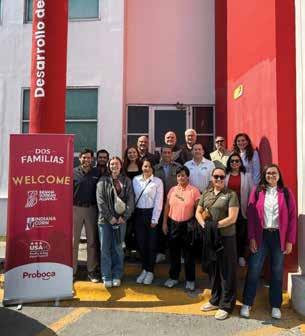
Indiana Soybean Alliance farmers and staff, USAPECC staff, and Dos Familias owners pose at the Proboca processing facility in Monterrey, Mexico.
“In the United States, turkey is typically seen as a lighter meat often associated with Thanksgiving, but in Mexico it is marketed differently as a darker protein used much like ground beef,” said ISA board director Jenna Scott, a farmer from Muncie, Ind. “Being in Monterrey allows us to see how the programs we support for U.S. meat and pork are making an impact. It is exciting to see our products in local stores and used in processing at facilities like Proboca.”
Retail tours and market visits provided additional perspective on consumer preferences. Understanding how products are marketed, sold, and consumed abroad helps farmer leaders and industry partners identify opportunities to remain competitive.
Expanding opportunities in Panama
Panama matters to Indiana farmers for two key reasons: Growing demand and global logistics.
As Panama’s middle class expands, so does consumption of meat and poultry. This is driving feed demand for U.S. corn and soybeans. Continued market development efforts in the region help protect and grow that demand, creating long-term opportunities for Indiana rowcrop farmers.
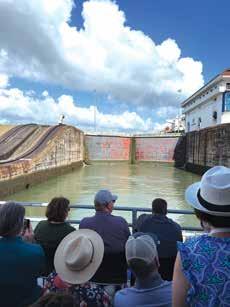
Panama is also home to the Panama Canal, a critical gateway for U.S. agricultural exports. Efficient canal operations keep transportation costs competitive and ensure Indiana corn and soybeans move reliably to customers in Latin America and Asia.
For Indiana farmers, Panama represents both a growing customer base and a vital link in the supply chain that connects their crops to global markets.
Face-to-face engagement
Face-to-face meetings during the mission turned conversations into commitments. International partners reaffirmed purchasing plans, discussed volume growth and aligned on continued promotions to expand feed use and retail distribution in their markets.
Farmer leaders also reinforced Indiana’s reputation for consistent supply and quality. These are key factors buyers consider when making sourcing decisions. Strengthening those relationships helps protect existing export business while positioning Indiana grain for future growth.
For Indiana farmers, the result is simple: Stronger trade partnerships, protected market access and clearer demand tied directly to checkoff-supported efforts.
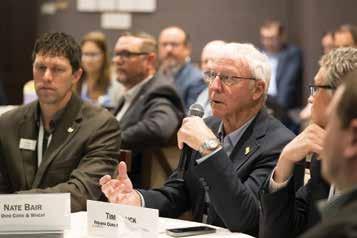
ICMC Board member and Greensburg, Ind., farmer Tim Gauck speaks during the USGBC’s Panama meeting.
At left, ICMC President Susan Brocksmith, a farmer from Vincennes, Ind., and ICMC Board member Lori Cyr, a farmer from Fowler, Ind., participate in the USGBC’s Panama meeting.
Learning how the Panama Canal moves large ships was part of an informative session in Panama.
Bringing agriculture to life through art is Kourtney Otte’s effect on young readers
BY JENNIFER MAY
At the Indiana Soybean Alliance (ISA) and Indiana Corn Marketing Council (ICMC), education and outreach play an important role in connecting consumers to the story of agriculture.
One of the most engaging ways this is happening is through children’s books, which are offered at no cost to farmers who request them for ag education and classroom activities. Two of the newest books offered by ISA and ICMC were illustrated by Purdue University graduate Kourtney Otte.
A 2025 graduate of Purdue University, Otte studied Agricultural Economics with a focus on agricultural law and policy. She is currently a Juris Doctor candidate at the University of Pittsburgh School of Law and hopes to bridge the gap between environmental regulation and the clients it impacts while also using her creativity to connect people to agriculture.
“Agriculture has always been a major part of my life. But the reality is it is a major part of all our lives,” Otte said. “No matter if you live on a farm or in the middle of a bustling city, agriculture is in everything we touch. But it is still an area that many people do not have direct access to.”
By combining her passion for the industry with her artistic talent, Otte has created meaningful learning
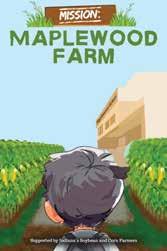
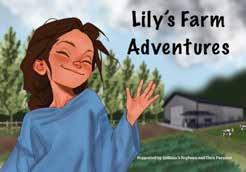
experiences for young readers. For ISA and ICMC, she illustrated both Lily’s Farm Adventures and Maplewood Farm, two books designed to introduce children to agriculture in a fun and approachable way. In addition to her illustration work, she is also an author, having written her own book, The American Farmer, while still a student at Purdue.
Lily’s Farm Adventures is created for Pre K through second grade students and invites readers to join Lily on her adventures on the farm. Maplewood Farm is recommended for second through fourth graders and follows Ella, Max and Liam as they learn how farming, conservation and technology help our planet.
Both books, along with other educational resources, are available on the website at www.glassbarn.org These resources make it easy for parents, teachers and communities to bring agriculture into everyday learning.
For Otte, illustrating these books is about building connection and understanding.
“By making it easier for someone to bring this industry into their lives and not only see what it looks like but feel the love those in this field share, we can bridge the gap between the consumer and the producer. That is the real value,” she explained.
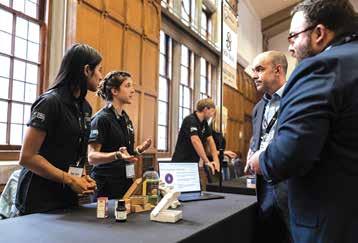
A95 percent soybean-sourced adhesive tape, called SoySeal, earned the $20,000 grand prize in the 32nd annual Student Soybean Innovation Competition during the awards ceremony on March 25 at the Purdue Memorial Union in West Lafayette, Ind. In the food track competition, a soybased bread product, titled MiSoy Pan, took top honors.
The Student Soybean Innovation Competition is a partnership between the Indiana Soybean Alliance (ISA), the state’s soybean checkoff program, and Purdue University. ISA awarded more than $35,000 to four teams that created new products in the industry track. In the soy-based food track, five teams earned a total of $11,000. To win these competitions, Purdue students must develop innovative applications for soybeans. This year, 59 students and 20 teams completed the competition through the two tracks.
SoySeal wins top prize for industrial soy product
Twelve teams of 36 students competed in this year’s industrial soy products competition.
SoySeal is a reliable, soy-based alternative to traditional petroleumbased packing adhesive tape.
Designed with an adhesive layer on one side and a soy-plastic on the other, SoySeal provides strength, durability and versatility while remaining environmentally responsible.
Team SoySeal, creators of a soybean-based adhesive tape, was the grand prize winner of the Student Soybean Innovation Competition. The winners of the competition were revealed during an award ceremony at the Purdue Memorial Union in West Lafayette, Ind., on Wednesday evening. Pictured, from left, are ISA Board member Andrew McDaniel, a farmer from Waldron, Ind., Team SoySeal members Elizabeth Heckaman, Jocelyn Erickson and Kasey Wright, and ISA Chair Denise Scarborough, a farmer from La Crosse, Ind.
“ISA looks forward to working with Purdue students each year and seeing what unique products they create,” said ISA Board Chair Denise Scarborough, a farmer from La Crosse, Ind. “The goal of this competition is to highlight the versatility of soybeans while seeking to solve a need in agriculture or the general public. The products developed by these students showcase new possibilities for how soybeans can be used and the value they can bring. We are excited about SoySeal and MiSoy Pan.”
SoySeal was created by Purdue University students Jocelyn Erickson, Elizabeth Heckaman and Kasey Wright. Erickson is a sophomore from Mechanicsville, Va., pursuing a degree in industrial engineering. Also a sophomore, Heckaman, from Claypool, Ind., studies biological engineering with a concentration in food and biological processes. Wright is a sophomore from Montgomery, Ohio, studying biological engineering with a cellular and molecular concentration.
In 2024, industry sources said the biodegradable tape market was valued at $1.2 billion, and it is projected to reach $2.8 billion by 2033. The adhesive tape market, at large, is an $80.2 billion industry that is expected to exceed $127.5 billion in 2032.
“By entering a high-growth, multi-billion-dollar space
with a 95 percent soy-derived alternative, our product unlocks a scalable opportunity in a high-value market while promoting Indiana’s soybean industry,” Erickson said. “At the same time, it addresses one of today’s most pressing environmental challenges, reducing the accumulation of microplastics in both our ecosystems and the human body.”
The SoySeal team said many biodegradable tape options struggle to maintain strong adhesion under wet or humid conditions. SoySeal remains sticky even after exposure to water and repeated hand washing. The team said SoySeal combines the environmental benefits of plant-based materials with the practical reliability expected from industrial-grade tape.
Each student said they were pleased with the experience of participating in the Student Soybean Innovation Competition.
“Participating in this competition has been an incredibly rewarding experience,” Heckaman said. “Co-creating SoySeal has helped me gain a deeper understanding of the business and marketing aspects of a project rather than solely focusing on technical skills. Being able to see our vision come to life in the lab and then working with my teammates to improve our prototype was such a gratifying process.”
MiSoy Pan earns first place in soy-based food contest
This was the second year for the soy-based food innovation track of the competition. This year’s competition required students to show how versatile soy can be as a baking ingredient. In total, eight teams of College of Agriculture students worked with the Purdue Food Science Department to create products made in the food-grade facilities on campus and to compete for the top prize.
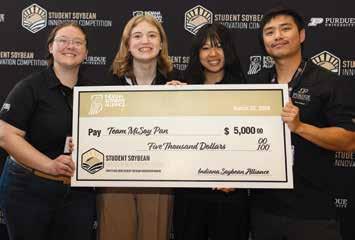
MiSoy Pan is a variation of a Japanese salt bread similar to shio pan, and it won the $5,000 top prize in the soy food track. Shio pan is a combination of buttery richness, a crispy exterior and an airy interior has helped it gain popularity as a hybrid between a croissant and soft milk bread. The MiSoy Pan team suggested that a soy-forward, vegan variation of shio pan could appeal to domestic and international customers. The MiSoy Pan team consists of Brooke Erwin, Jeff Chow, Bethany Champley and Emma Wu.
“MiSoy Pan is a vegan, soy-based, Asian-inspired, baked good that is best served within 3-6 hours after being baked to ensure peak texture and flavor,” Erwin said. “Our market strategy for selling our rolled dough as a frozen product for contract baking is to ensure the product is consumed within or near this time range. Because of this, key buyers of our product will be retailers, chains and specialty markets that look for contract baking manufacturers that
Top-prize winners of the food track of the Student Soybean Innovation Competition is Team MiSoy Pan, makers of an item that is similar to a Japanese salt bread. The team won $5,000 for first place and includes Purdue students Bethany Champley, Brooke Erwin, Emma Wu and Jeff Chow. This is the second year for the food track of the soybean innovation competition.
provide high convenience, niche and on-trend products, and a brand that aligns with values in sustainability.”
Dr. Rodolfo Pinal People’s Choice Award
In addition to the other prizes, the 400-plus attendees of the Student Soybean Innovation Competition Awards Ceremony each voted for their favorite product for the $500 People’s Choice award. This prize was officially renamed in honor Dr. Rodolfo Pinal, Associate Professor of Industrial and Molecular Pharmaceutics who passed away in December 2024. Pinal was a frequent faculty advisor for students in this competition, many of whom were prize winners, including the past two winning teams.
This year’s award went to Soyé, creators of a soybased menstrual pad. Soyé features three soy-derived layers: A top layer for moisture-wicking comfortability, an absorbent core engineered from a tofu byproduct, and an impermeable layer to prevent leakage. A commercialgrade adhesive to ensure the same functionality as conventional menstrual pads is also added. The makers of Soyé include Purdue students Marcia Kusumah of Jakarta, Indonesia; Eleanor Malinowski of Downers Grove, Ill.; and Chanyoung “Ivy” Moon of Seoul, Korea.
“The Student Soybean Innovation Competition allows ISA to connect with bright and creative students – some who may not be familiar with agriculture,” said ISA Board Director Mark Wenning, a farmer from Henry County, Ind., and vice chair of ISA’s Sustainability and Value Creation Committee. “One of ISA’s key strategic initiatives is funding research to create new uses for soybeans, helping develop higher value applications that support our farms.”
Industry working with students
The students involved in the competition represented a variety of majors including agronomy, biological engineering, animal science, pharmacy and environmental and natural resource engineering. Each team works with two faculty advisors who provide technical and market research support. Many advisors worked with more than one team of students.
This year’s industrial track judges included ISA board members: Dylan Christopher of Brookston, Ind.; Derika Lynam-Spaetti of Richland, Ind.; Andrew McDaniel of Waldron, Ind., and Roger Wenning of Greensburg, Ind. Also, four industry experts served as judges including Dr. Clayton Westerman of BioBond Adhesives; Brit Walker with ADM; Amie Osborn of First Farmers Bank and Trust, and Chad Strohl of Crafco.
The food track judges from ISA were Lynam-Spaetti and Jenna Scott of Muncie, Ind.; Three industry experts served as judges, as well, including Carlana Rodriguez with Grain Processing, Shuangyi Zhang with Egglife Foods and Patrick Nycz with Purdue Ag Economics.
“I was lucky to have had the opportunity to judge both competitions,” Lynam-Spaetti explained. “Seeing the student groups work so hard in such a short few months is astonishing. From product creation and development to the business plan, it is evident of the time, research and trials that went into each project. I am grateful ISA and Purdue collaborate on the Student Soybean Innovation Competition to provide this amazing experience and opportunity for students.”
Additional industrial track winners
Earning second place this year, and a $10,000 prize, were the creators of SoySlipSafe, a soy-based anti-
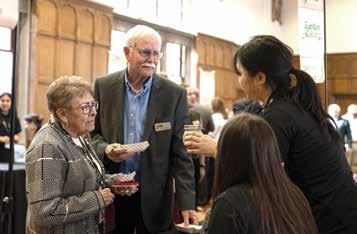
Kevin Burbrink, a farmer from Seymour, Ind., and his wife, Barbara, sample soy-based fare in the food track portion of the Student Soybean Innovation Competition.
icer that can be used on roads prior to snowfall or freezing precipitation. Traditional anti-icing products rely heavily on chloride salts as the primary freezing point depressant. While effective, chlorides are a major contributor to infrastructure corrosion, vehicle deterioration and environmental degradation. SoySlipSafe uses soybean-derived components to achieve the two primary functions of an effective anti-icer – freezing point depression and ice-bond reduction.
The SoySlipSafe team members include Taylor Helman, Marley Kakalia and Lucy Shepard. Helman is a mechanical engineering student with a minor in sustainable engineering. Kakalia is a biological engineering student hoping to pursue a career in food processing. And Shepard is a biological engineering student on a pre-physician assistant track.
Finishing third, and earning a $5,000 prize, were the creators of SoyLam, a soy-based plastic laminate
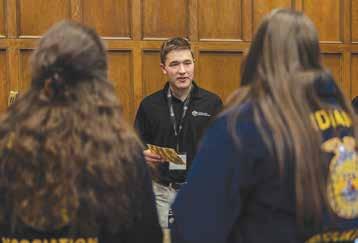
A Purdue student involved in the industry track of the Student
Innovation Competition explains his team’s new product to FFA students who attended the awards ceremony on March 25.
Indigenous Energy President Pete Probst and Bailey S. Arnold, Director of Clean Air Initiatives for the American Lung Association, review products in the industry track portion of the Student Soybean Innovation Competition.
Soybean
designed to replace current plastic lamination materials. Lamination is key to improving the mechanical strength and water resistance of paper – making it suitable for storage. SoyLam is fully biodegradable and made entirely from food-safe ingredients that could have uses in the food industry for storage of rice and other dry goods. The SoyLam team members are Elizabeth Rozzi and Erica Conley. Both are biological engineering majors. Rozzi is a sophomore, and Conley is a junior.
Additional food track winners
Garden Galette earned the $3,000 second prize. Galette, a French term, refers to high-end patisserie that is popular in modern artisan baking. These vegan galettes featured soy properties to create all four elements of their product: A puff pastry dough, ricotta cheese, beef crumble and a pesto sauce. The Garden Galette team members include Claudia Guillen, Nicolas Rosy and Natcha Ngaosuphanvongs.
Taking the $2,000 third prize was a plant-based macaron called Boba Macs. These treats are a creative fusion of an appraised macaron and popular boba tea. The macaron shell is 60 percent almond flour and 40 percent soy flour to effectively lower the fat content and to be more cost effective. The shells provide a subtle nutty taste to go with the sweet filling. Boba Macs creators are Sarah Richter, Rory Adrilk, Kara Macler and Sofia Hwang.
Indiana soybean farmers’ investment in finding new soybean innovations is not limited to the competition. The state soybean checkoff also funds the Soybean Utilization Endowed Chair at Purdue’s College of Agriculture, Dr. Nathan Mosier, to lead research into new uses for soybeans.
Go online to bit.ly/soycompetition for more details on ISA’s investment in soybean innovation. To watch the awards ceremony, go online to Purdue’s YouTube page at bit.ly/SSIClivestream
ISA Student Soybean Product Innovation Competition winners
YEAR ...... PRODUCT ................. TEAM MEMBERS
1995 . . . . Crayon . .
1996 Fire starter
. . . . . Jocelyn Wong, Thomas Chang and Don Rode
Amy Khal and Brian Beales
1997 Birthday candle Amy Khal, Rahul Nair and Adam Watkins
1998 .
Ski wax .
1999 Cereal
. . Ryan Howard and Faye Mulvaney
Aaron Davis, Jon Gray and Laura Zimmer
2000 Gel (tie) Ryan Howard and Faye Mulvaney
2000 . . . . Cracker (tie) .
2001 Heating fuel
2002 Marker
2003 . . . . No Contest
2004 Nail polish remover
2005 Pectin jam
2006 No Contest
2007 No Contest
2008 Waffle bowl (tie)
2008 Clay pigeons (tie)
2009 .
. Cupcake liners
2010 Soy Tabs excipient
2011 Denture cream
. . Amanda Zeltner, Melody Marshall and Markelle Grossman
Matt Peter, Louis Cassens and Bekki Kennedy
Brian Costigan, Mindy Durack, Rylie Vance and Amanda Stewart
Ruth Hegarty and Courtney Howard
Phil Dorroll, Courtney Howard and Ruth Hegarty Pinto
Brian Hunter, Clay Arnett and Todd Case
Benn Hall, John Mullen, David Conway and Adrien Boeh
. . Marcianne Colglazier, Victoria Horton, Erin Rosswurm and Anna Verseman
Danielle Carpenter, Krista Eakins, Ryan Fox and Brittany Phillips
Manaz Taleyarkhan, Ankit Gupta, Alvin Ang and David Barron
2012 . . . Flexible circuit board . . . . Aniruddha Kelkar, Carmen Valverde-Paniagua and Anand Venkatesan
2013 Fiber insulation
Anshu Gupta, John Grace and Solwoo Kim 2014 3D printer material
Carmen Valverde-Paniagua, Nicole Devlin and Yanssen Tandy 2015 . . . Air freshener
2016 Exfoliating bead
2017 Air filter
2018 Hydroseeding tech
2019 Drinking straws
2020 Herbicide
2021 Biostimulant
2022 Soy mulch
2023 StyroSoy
2024 SoySilk
. Evan Anderson, Sean Anderson and Sara Richert
Samuel Lewis, Steve Ferris, Alison Switzer and Ryan Pendergast
Anderson Smith, Andrew Huang, Sushant Mehan and Samaneh Saadat
Terence Babb, Susan Hubbard, Jacob Semonis and Christopher Stichter
Morgan Malm, Ruth Zhong and Natalie Stephenson
Alyson Chaney and Peyton Clark
Cai Chen, Nathaniel Nauman and Emmanuel Alagbe
Libby Plassard, Ethan Miller and Zuhal Cakir
Alyssa Choi, Amy Tang, Valeria Tellez Gallego and Louis Edwards Caceres-Martinez
Kyle Han and Ben Gottlieb 2025 . . . . SoyShield .
2026 SoySeal
. Leah Hartzell, Claire Eckhardt and Nicholas Emge
Jocelyn Erickson, Elizabeth Heckaman and Kasey Wright
The Data Mine at Purdue University is a model and tool for collaboration
BY AMIE SIMPSON
Indiana farmers face both opportunities and challenges when considering new conservation practices on their operations. With a growing number of programs available, it can be difficult to determine which options may be the right fit.
To address this, the Indiana Soybean Alliance (ISA) has partnered with Purdue University’s The Data Mine to begin developing a tool aimed at helping farmers navigate available information and evaluate potential options. The project is in its early stages and is not yet publicly available.
“Working with the students from The Data Mine has been an incredible experience,” said Ben Forsythe, ISA’s Sustainability and Value Creation Director. “As an organization, we have been able to share more about the challenges, scale and opportunity that production ag brings to the technology space, and they have given us valuable insights into the systems farmers use and ways to improve them.”
The Data Mine is an interdisciplinary learning community that connects students with corporate partners to solve realworld issues. In 2023, students created a web scraping tool that gathers information about USDA and Natural Resources Conservation (NRCS) programs and integrate it into a database for Indiana farmers. This year, they are refining features to make it more user-friendly.
Maggie Betz is the managing director of The Data Mine in Indianapolis. She said the ISA partnership has introduced students to emerging careers and technical demands in modern agriculture.
“Students who aren’t familiar with the industry don’t typically think of agriculture as tech-driven,” Betz said. “It’s exciting that this project is helping students see that they can apply the technical skills they’re learning at Purdue to fields and career paths they may have never considered.”
Evaluating new opportunities
While the project gives students a new perspective on agriculture, its broader aim is to support Indiana farmers as they evaluate conservation and sustainability opportunities.
Bryce Castle, corporate partners technical specialist with The Data Mine and a former student participant, serves as the liaison between industry partners and students.
He said the hands-on project gives students a clearer understanding of how technical skills translate to real-world agricultural challenges.
“There is a lot of information about different conservation programs that is fragmented across many websites. That makes it harder for farmers to know where to find the right opportunities quickly,” said Raja Allmdar Tariq Ali, a Purdue senior majoring in computer science. “This program has the goal of helping address that problem by creating a centralized and interactive platform for farmers.”
He has worked as a teaching assistant in The Data Mine supporting ISA for the past two years.
“Students are working on two main projects through the partnership. One focuses on improving access to programs and connecting farmers with grants and subsidies that may help lower barriers to entry and improve awareness of available resources,” Castle explained. “The second project looks at water quality, analyzing factors like nitrogen levels and how the state manages its water ecosystem. It’s more research-driven and open-ended, so students are exploring the data and identifying where additional sensors may be needed.”
The effort reflects a broader need seen across the agriculture industry. As sustainability programs continue to expand, many farmers are navigating an evolving landscape of opportunities.
Ben Forsythe, ISA’s Senior Director of Sustainability and Value Creation, talks with Purdue students about the Data Mine project.
Streamline data collection
Keystone Cooperative also recognizes this challenge and the importance of helping farmers better understand what programs may be available to them. Keystone Sustainability Infrastructure Lead Sina Parks said the cooperative has worked to streamline the data collection process for its sustainability programs so that farmers understand what they may be eligible for.
She added that collaboration across the agriculture sector is essential to long-term success.
“Coordinated efforts help the industry move forward more efficiently,” Parks said. “At the end of the day, everyone wants to see farms remain viable and profitable for the long term. By working together and building on existing resources, we can better utilize what’s already in place and accelerate progress.”
This interactive, online field map details boundaries and other information beneficial to Indiana farmers.
A model for collaboration
ISA’s participation in The Data Mine is more than a class project; it’s a model for collaboration. ISA is the state’s soybean checkoff program, and Purdue is the state’s leading agricultural research university.
“The students gain experience working with real data while collaborating with industry stakeholders. They gain technical skills along with time management and project management experience,” Raja said. “For the Indiana Soybean Alliance and Purdue University, the partnership continues to strengthen collaboration in support of the state’s farmers. And, for farmers, it helps improve access to conservation programs.”
For Indiana farmers weighing new conservation practices, the growing list of programs can feel overwhelming. This partnership aims to simplify access to information and explore ways to make conservation opportunities easier to navigate as the work continues.
Learn more about conservation in Indiana here: incornandsoy.org/conservation-case-studies/. Find out more about The Data Mine here: datamine.purdue.edu
This is the homescreen to the Data Mine and ISA Collaboration website.
Ben Forsythe tells a group of students and farmers that the Data Mine project attempts to provide farmers with valuable information to benefit Indiana farms.
A group of Purdue students watch as a combine moves through an Indiana field.
Purdue On The Farm is adjusting how data is presented to farmers
BY SCOTT GABBARD
The snow may come and go, but the march to spring is inevitable.
Robins were witnessed with almost a foot of snow on the ground. One cannot always see them due to their high flight patterns, but you may already hear the Sandhill Cranes, and they reverse course for their spring trek.
Look closely, and you might glimpse the buds on the trees holding this year’s leaves.
Farm fields are a little different, but the promise is still there. After the snow melts, cover crops and spooling winter wheat add some green to our otherwise brown landscape. While most change is incremental, it is still inevitable.
One change that we are making is how some of our data is being presented. For instance, in the past, we might have stated that we detected Gray Leaf Spot (Cercospora zeae-maydis) in 43 percent of the fields (12 out 28) we scouted while conducting Purdue On The Farm field surveys in 2025. The keyword in that statement was detected. That is not good enough.
Why? That’s the rest of the story. Of those 12 fields, eight of them were at a severity level less than or equal to 5 percent. Why is this important? At or below this level, research has shown that the yield loss is 0-2 percent.
Using easy math, 2 percent of 200 bushels is four bushels. Local cash corn bid at time of writing was $4.5. This turns out to be $18.
As written by Dr. Darcy Telenko almost seven years ago, “…fungicide applications add an additional cost to corn production.
Therefore, economic factors and other disease issues need to be considered before deciding to apply a fungicide to manage gray leaf spot.”
Since it could have been misconstrued that there was more disease in the fields walked than reality indicated. Additional information was required, an incremental but necessary change.
So, what does 5 percent even look like?
You can test yourself, copy and paste severity. cropprotectionnetwork.org into your web browser, and you can quiz yourself. If you would like to verify what your disease is yourself, check-off dollars will cover the cost of the analysis. Information on how to do this can be found at indianafieldcroppathology.com
This serves as a gentle reminder to not only read the fine print but also what is in simple black and white.
A phone conversation from a friend long ago went something like this: “Don’t call me when you see something in the field, call me when I need to do something about it.”
That unhappy phone call was made more than once. You learn to call with good news or no news to mix things up. Lesson learned. It was taken to heart, so this and other changes will occur moving forward.
After all, “The Rest of the Story,” is often the best part of the story. After all, change is often incremental, inevitable, and a story all its own.
The Purdue On The Farm program is adjusting how it presents information to Hoosier farmers so that corn and soybean growers can react more effectively to data regarding weeds such as Gray Leaf Spot.
The more we discover about soybeans, the more valuable they become. One innovative product, SoyFoam™, creates a new, sustainable use for your crop that protects firefighters and the planet.
See how your Soy Checkoff is unlocking new markets for soybeans at unitedsoybean.org
Conservation, no-till is the foundation for Lamb family farm in Boone County
BY AMIE SIMPSON
As a second-generation farmer and director of the Indiana State Department of Agriculture, Don Lamb sees the industry from both the fields of his family’s farm and the corridors of the Indiana Statehouse, a vantage point not many can claim.
“My appreciation for farmers has grown,” Lamb said. “When I stepped away from the farm for the first time in my life, I began to see just how much farmers carry every day. They’re too close to it to realize they get an incredible amount done while dealing with constant unknowns.”
His perspective has also widened beyond the farm gate. “I’ve gained a deeper appreciation for what I call ‘Team Ag Indiana.’ I try to shine a light on what ag organizations and companies are doing to support farmers across the state.”
Lamb’s roots are planted on the family farm in Boone County, where he grew up working alongside his dad, Bob, and his brother, Dean. Today, they continue to work together, joined by Dean’s two sons and a team of 10 full-time employees.
They grow corn, soybeans, wheat, and popcorn while blending expertise with careful stewardship of the land. “Reducing soil erosion and maintaining farmland for future generations is a priority,” Lamb said.
Conservation as a foundation
They started looking at no-till practices to lower input and labor costs. The farm has been practicing no-till farming since the early 1990s, starting with soybeans before moving to corn. “What does conservation look like on our farm? No-till is our foundation, followed by grassed waterways and cover crops to help prevent soil erosion, improve soil health, and reduce runoff,” he said. “We’ve been planting cover crops for about a decade and continue to make adjustments each year to improve.”
Conservation practices on Lamb Farms are supported not just by philosophy, but by precision technology that improves both efficiency and environmental impact.
Lamb said GPS-guided equipment allows for precision planting and fertilizer application.
“No till, for example, is already efficient, but then every pass is even more valuable because you’re not going to make very many passes across the field,” he said. “We make every pass count by keeping good records and being very specific about what we do on that pass across the field.”
While the return on investment isn’t always visible, Lamb said the results are clear over time.
“I can tell you that our soil is in better shape today than it was 10 years ago. We have better water infiltration, soil fertility and overall soil health,” he said. “The conservation efforts have flipped a switch to where the soil is constantly regenerating itself.”
As public perception and market pressures push agriculture toward sustainability, Lamb said ignoring
Conservation is one piece of the puzzle. Building a resilient farm business requires diversification, too. Lamb Farms has embraced diversification to strengthen its operation and explore new opportunities.
conservation could leave farmers unprepared for the future.
“There is a learning curve to implementing a new conservation practice. Go slow and start small,” Lamb said. “For example, try no- or minimum-till in soybeans before moving to corn. Then explore which cover crops work best on your farm, starting with just a few acres before expanding.”
Diversifying the operation
Conservation is one piece of the puzzle. Building a resilient farm business requires diversification, too. Lamb Farms has embraced diversification to strengthen its operation and explore new opportunities.
AgRecycle is a 10-acre compost manufacturing site that converts regional organic waste into nutrient-rich compost, helping build soil organic matter for area farms. Different kinds of manure, food waste, yard waste, woodchips and more eventually become fertilizer components on the farm. The fields they manage get a minimum of 5 tons of compost per acre each year.
They also operate Land Farms Agronomy and AgriStewards.
The agronomy department at Lamb Farms provides soil sampling and mapping, crop scouting and related services to farmers in the area.
“We’re not out competing for that business as much as we are collaborating with some neighbors,” he said.
AgriStewards is a non-profit that helps communities in third-world countries learn agricultural skills.
“It started in 2012 under the direction of AgriStewards Director Brian Smith,” Lamb said. “Brian has been in about 35 countries, and we’ve been able to network with people who are working in agriculture from a more biblical perspective. It’s been a great blessing to see what God has been able to do through that off the farm.”
Diversification shows up just as clearly in the fields, where crop choices are guided by premium markets. The family grows waxy corn for companies like Primient or Ingredion, seed soybeans for Pioneer, and popcorn for Weaver Popcorn Company along with their own brand.
“So, yes, we’re a corn, soybean and wheat farm for the most part, but we’ve also made it part of our DNA to clean a lot of combines and grow identity preserved crops to add a premium to whatever we do,” he said.
A first-generation legacy
The values guiding the farm today trace back to its beginning. Don’s dad, Bob Lamb, is a first-generation farmer. Don is proud of his dad and what he’s built from
growing up in Indianapolis to starting a farm that’s become a family tradition.
“My memories of growing up on a farm are really good –it’s been a blessing,” he said. “Because my dad is a firstgeneration farmer, my brother and I were the farm crew for most of our growing-up years.”
Some of his favorite memories revolve around cleaning hog lots with an old bobcat, an Oliver tractor and a manure spreader when they were just kids.
The farm where Lamb once spent Saturdays cleaning hog lots now sits in a county experiencing rapid growth and development. The shift has reinforced his belief that farmers must continue to share the story of how and why they care for the land.
“Because when you’re thinking about land use and development, agricultural land is not just this thing off to the side waiting to be developed,” he said. “Farmland has already been developed into a good system of raising crops, and part of that is because farmers have taken good care of the soil.”
That responsibility both to the land and the public shapes how Lamb approaches his role. Serving as a farmer and director of the Indiana State Department of Agriculture gives Lamb a front-row seat to the challenges and opportunities facing the industry. What energizes him is the people in the industry he represents.
“I’m a people person, and the agriculture industry has such great people,” he said. “There’s no better industry to talk about, no better industry to be part of, and no better industry to be proud of. For me, it’s just exciting because I get to be a part of telling agriculture’s story and that’s my sweet spot.”
Don Lamb’s roots are planted on the family farm in Boone County, where he grew up working alongside his dad, Bob, and his brother, Dean. Today, they continue to work together, joined by Dean’s two sons and a team of 10 full-time employees.
Timing of corn harvest is important and could impact kernel dry weight
BY EVAN COHAGAN, PURDUE GRADUATE RESEARCH ASSISTANT AND DAN QUINN, PURDUE EXTENSION CORN SPECIALIST
Each fall and winter, one common question that we often receive is specific to the idea of “phantom yield loss” or “invisible” reductions in harvested yield that occur when corn is left standing in the field after physiological maturity. In many cases, phantom yield loss is hypothesized as losses in yield due to losses in kernel dry matter caused by seed respiration as harvest is delayed.
This process is driven largely by environmental conditions and occurs at an average rate of about 0.5 percentage points of moisture per day, though this rate is often highly variable due to multiple factors. Dry down tends to be fastest in September, slows considerably in October, and becomes minimal by November as temperatures decline. Cool temperatures, high humidity, and limited solar radiation can further slow dry down and prolong the period corn must remain in the field until it is ready to harvest.
Early research conducted in Indiana suggested that kernel dry matter losses could occur during field dry down as corn grain moisture declined below approximately 25 percent (Nielsen, 1996). More recently, private and industry-led trials have continued to raise concerns about so-called “phantom yield loss,” often attributing perceived yield reductions to seed respiration during extended field dry down. (www.agweb.com/news/ crops/farm-journal-test-plots/farm-journal-test-plotsphantom-lurks-your-corn-fields)
In contrast, recent peer-reviewed research from Iowa has largely refuted these claims (Parvej et al., 2019). Given these contrasting findings and continued grower interest in this topic, we sought to re-examine the effects of harvest timing on kernel dry matter using current hybrids and modern management practices in 2025 to better understand how harvest decisions influence corn yield potential. This project is also supported by the Indiana Corn Marketing Council.
Corn physiological maturity (growth stage R6), commonly referred to as “black layer,” represents the point at which corn kernels reach their maximum dry matter accumulation. From a yield standpoint, this is important because grain yield is effectively fixed once black layer forms. Physiological maturity typically occurs 55 to 65 days after silking (R1 growth stage) and when kernel moisture is still relatively high, often near 30 to 35 percent. After R6, the primary change occurring in the crop is grain dry down.
In addition, hybrid genetics can also influence postmaturity dry down. Traits such as husk tightness, ear orientation, husk leaf number, and tip exposure can all affect the rate at which moisture can escape. In addition, longer-season hybrids often reach physiological maturity at higher moisture levels, which can delay harvest readiness even if they eventually dry at similar rates. These genetic differences help explain why harvest timing can vary substantially among hybrids planted in the same field.
Beginning in 2025, research trials were established in West Lafayette (ACRE) and Columbia City (NEPAC), Indiana to assess the impacts of harvest timing on kernel dry weight across different hybrids (Pioneer P1136AM, P0953AM, and Dekalb DKC105-35, DKC56-26) and with and without the inclusion of a foliar fungicide application at the R1 growth stage (Figures 1 and 2).
In this study multiple ears (15+) were sampled from each individual plot beginning at a grain moisture of 28 percent and finishing at a grain moisture of 16 percent, with additional targeted harvest intervals of 24 percent and 20 percent. Each individual ear that was sampled was assessed for sample moisture at the time of harvest and then dried to a consistent moisture and to assess total dry weight via a sub-sample of 1,000 kernels.
Across our 2025 research trials, we observed no relationship between targeted harvest moisture and kernel dry weight (Figures 1 and 2). Even examining both data figures presented in this article you can notice the “mess” of different colored points and lines which
represent different hybrids and the inclusion or exclusion of fungicide.
Overall, this data shows no significant relationship between harvest moisture and kernel dry weight across two Indiana locations, four different hybrids and different management practices in this study. Therefore, our preliminary results suggest that kernel dry weight is not being lost via “phantom yield loss” with the proposed primary mechanism of kernel dry matter losses via seed respiration as harvest is delayed.
This preliminary result tracks very closely with recent research from Iowa which showed across multiple years, planting dates, and hybrids there was no evidence found of kernel dry matter loss during in-field dry down, confirming that yield potential was not declining due to respiration or biochemical degradation of the grain. In addition, the researchers also found grain quality traits, including protein, oil, and starch concentration also changed very little between black layer and harvest, further supporting the conclusion that kernels themselves are not losing yield or quality as they dry in the field.
Therefore, recent research has shown that kernel dry matter remains stable after black layer and as harvest timing is delayed, meaning yield potential is preserved across typical harvest windows. However, harvest timing still matters because yield losses can occur through physical mechanisms rather than physiological ones.
As harvest is delayed, risks of stalk lodging, ear drop, disease development (e.g., ear rots and mycotoxin accumulation), insect damage, and harvest inefficiencies increase, particularly later in the fall. In addition, grain test weight generally improves as grain dries but reaches a plateau once grain reaches a moisture of 20-23 percent, after which further field drying provides limited grain quality benefit, while increasing exposure to potential weather-related losses.
Together, these findings further clarify that socalled “phantom yield loss” is likely not driven by kernels losing weight via seed respiration, but likely by reduced grain recovery due to a multitude of potential factors as corn stands longer in the field. From a management standpoint, the goal is to balance grain moisture, drying costs, and field loss risk.
In many cases, harvesting before grain moisture drops below approximately 20 percent, especially in fields with weak stalks or high disease pressure, can help protect yield and improve harvest efficiency.
ACRE - 1000 Kernel Weight at 15.5% by Hybrid and Fungicide
Color = Hybrid; Line type = Fungicide (linear regressions)
and kernel
at the Agronomy Center for Research and Education (ACRE) in West Lafayette, Ind. Kernel dry weights presented is a total dry weight of 1,000 kernels taken from sampled ears at each harvest timing and adjusted to a dry moisture of 15.5 percent. Each individually colored point and line represent an individual corn hybrid and whether or not the hybrid received a fungicide application at the R1 growth stage.
Color = Hybrid; Line type = Fungicide (linear regressions)
2. This diagram shows the relationship between corn grain harvest moisture and kernel dry weight at the Northeast Purdue Agricultural Center (NEPAC) in Columbia, City, Ind. Kernel dry weights presented is a total dry weight of 1,000 kernels taken from sampled ears at each harvest timing and adjusted to a dry moisture of 15.5 percent. Each individually colored point and line represent an individual corn hybrid and whether or not the hybrid received a fungicide application at the R1 growth stage.
Figure 1. This diagram shows the relationship between corn grain harvest moisture
dry weight
Figure
NEPAC - 1000 Kernel Weight at 15.5% by Hybrid and Fungicide
A HOME-GROWN LEGACY
A legacy of faith. A tradition of farming. A future rooted in both.