kulanu
A MAGAZINE THAT HIGHLIGHTS ALL OF US
OCTOBER AND NOVEMBER 2026 TISHREI-CHESHVAN-KISLEV 5787
IN THIS ISSUE: IHC AT 170 KEEPING OUR NEIGHBORS SAFE
A message from Rabbi Roxanne Shapiro OCTOBER/NOVEMBER 2026 TISHREI-CHESHVAN-KISLEV 5787
CONTENTS Justice and Judaism....................................................3 The IHC Foundation.....................................................4 170 Years of IHC.............................................................7 Mazel Tov.........................................................................8 Upcoming Events and IHC Circles..........................9 A Jewish Response to Homelessness.................10 Thanksgiving Stuffing: Kugel in Disguise...........13 Yahrzeit List...................................................................14
CONNECT Indianapolis Hebrew Congregation
@ihc.indy
Phone: 317.255.6647 ECC: 317.254.2186
www.ihcindy.org
SHABBAT AT IHC Kabbalat Shabbat Services 6:15 p.m. Fridays
Torah Study 9 a.m. Saturdays
Participate in person or visit ihcindy.org/online. Services, unless otherwise noted, will be live streamed at ihcindy.org/streaming.
Indianapolis Hebrew Congregation (IHC) is an inclusive Jewish community where all congregants matter, are inspired to action through Jewish values, and experience Judaism in a meaningful way.
When I began working at IHC more than seven years ago, I sorted through the books and materials left on the shelf in my office. I found “To 120 Years: A Social History of the Indianapolis Hebrew Congregation.” What a treasure to have this resource, all these decades later. Many times, I have turned to this book to find milestones in our congregation’s history, and we now share it with our Confirmation students as they spend time during their studies connecting with the history of IHC. 170 years ago, on November 2, 1856, 14 men assembled at the home of Julius Glaser. The Constitution and By-Laws of Indianapolis Hebrew Congregation were read and accepted by these men, establishing the first Jewish congregation in Indianapolis. The road has been long and filled with blessings and with struggles. The congregation has faced financial obstacles, questions on policy and membership, difficulties in leadership, and more over its 170 years. Yet, the congregation has not only endured but has blossomed, as we have celebrated births and marriages, educated thousands, fought for justice, and have had a large impact on the history of Indianapolis. If you have not already read this record of the history of IHC, I encourage you to visit the IHC library and begin reading. It is truly incredible to review the stories of those who walked the halls of our building and the buildings of our past, of those who sat in the pews, and of those who led our congregation. This collective story tells us where we have been and offers us a vision for our future. 170 years ago, there were fourteen families who gave their time, skills, and resources to create a community not only for themselves, but for the generations to come. We can only imagine what they must have dreamed of for the future of their new congregation. According to Pirkei Avot, Jewish tradition passed from Moses to Joshua, to the Elders, to the Prophets, to the Men of the Great Assembly … and now to us. We have not only received this tradition, but also the tradition(s) passed down through the generations of those dedicated to our spiritual home Indianapolis Hebrew Congregation. As we mark 170 years of our congregation’s history, let us dedicate our time, skill, and resources to fortifying the foundations of our congregation as we imagine what will be written about us and our time on the next pages of IHC’s history. Rabbi Roxanne Shapiro
IHCIndy.org | OCTOBER/NOVEMBER 2026 | 3
The IHC Foundation Growing our Future The IHC Foundation is excited to introduce three new giving opportunities to help secure our congregation's future. The Foundation Security Fund supports ongoing investment in physical security improvements throughout our facility. The Foundation Building Fund ensures the long-term maintenance and repair needs of our aging building are met for generations to come. The Jerry Litwak Youth Fund, created in memory of our beloved former President, will support and grow youth programming at IHC - carrying forward Jerry's lasting commitment to our young people. To give, call the IHC office or visit the Foundation page at ihcindy.org and click “Give Now” to be taken to ShulCloud. The funds will be available in the list.
IHC Foundation Security Fund Safety is foundational to everything we do at IHC. The IHC Foundation Security Fund supports ongoing investment in physical security enhancements throughout our facility, helping ensure IHC remains a safe place to worship, learn, and gather for years to come.
IHC Foundation Building Fund Our building is more than brick and mortar - it's the home of our community. The IHC Foundation Building Fund supports the long-term maintenance and repair needs of our aging facility, preserving IHC as a lasting home for generations of families. While not glorious, this investment could not be more important to the future resilience of IHC.
Jerry Litwak Youth Fund Established in memory of former IHC President and dear friend Jerry Litwak, the Jerry Litwak Youth Fund honors his enduring dedication to our congregation by investing in the next generation. Gifts to this fund support youth programming at IHC, helping our children build lifelong connections to their faith and community.
IHCIndy.org | OCTOBER/NOVEMBER 2026 | 4
A Place to Call Our Own Three Sacred Homes and 170 Years of Community By Blake Kraus On November 2, 1856, 14 men gathered at the home of Julius Glaser to sign the constitution and by-laws of the new Indianapolis Hebrew Congregation. The city itself was booming, growing from only around 600 residents in 1830 to around 15,000 in 1858. When IHC was founded, there were only around 100 Jews in the city and around 1,000 Jews in the entire state of Indiana.
It was here that the nascent community withstood the tribulations of the Civil War, hired its first clergy, and began a period of large community growth. Notably, it was from this small sanctuary that, in 1865, the members of IHC carried their Torah scroll to the State House while chanting the Mourner’s Kaddish, as President Lincoln’s body was laid there.
These 14 founders were well ahead of their time. Over the next century, the American Jewish population skyrocketed, thanks to mass migration from Eastern Europe. Many found their way to the Midwest, coming to call Indianapolis home. For the next 170 years, IHC would become the center of Jewish life in the center of the Hoosier state: a place for all Jews to call home.
By 1864, just eight years into its existence, IHC had outgrown its small space. Membership surged, and congregants recognized the need for a dedicated building and school. They began to raise funds to build what would become the Market Street Temple. On October 30, 1868, the building was complete. Rabbi Wise led the dedication as members processed from East Washington Street to their new communal home — an incredible scene. A group of Jews openly marching, lifting its Torah scrolls, and rejoicing. What a pleasant shock this must have been for those who fled the oppression of the old world? What a celebration of Jewish joy and pride!
They say that people make a house a home. That is certainly true of IHC. But a home still needs a building. In its lifetime, IHC has had three distinct temples, each with its own magnificent features. As the community grew and moved, so did IHC. These are the stories of the three locations and how they changed and grew along with the community. Market Street Temple Before IHC had a place to call its own, the community rented a small room downtown on East Washington Street starting in 1852. 5 | OCTOBER/NOVEMBER 2026 | IHCIndy.org
The choice of location was quite strategic. At the time, the city’s Jewish population lived within walking distance. The building served not only as a holy space, but as the center of the community, a place for meeting, socializing, and learning. Just 25 years later, the community
Rendering of the Market Street Temple
again outgrew its space. The neighborhood was changing, and the board was concerned about the temple being surrounded by “houses of ill-repute.” In 1894, the congregation began debating the construction of a new temple. Then, in 1898, IHC accepted a $10,000 offer from the Hungarian Hebrew Ohev Zedeck Congregation. The offer not only included the building, but all it contained: the pews, carpets, chandeliers, etc. It was time for IHC to build again.
10th Street Temple On June 5, 1899, the cornerstone of the new 10th Street Temple — which held a box of sealed contents to be opened later — was cemented to the ground (the contents would be opened in 1957). Sitting on the corner of Delaware and 10th Street, the congregation once again selected a location in the heart of the Indianapolis Jewish population. The building was grand, looking as though it could have been transported from Renaissance-era Europe and given a modern facelift. Three of its four square sides were adorned with large stained glass panels, outlined by triangular points reminiscent of a federal building. It was crested with a magnificent dome. A cavernous sanctuary with four great pillars sat under the dome. The pews were arranged in a semicircle around the bimah. Over time, the adornments grew, with the addition of a grand organ, two giant menorahs, and two large yahrzeit boards.
One of the ornate stained-glass windows caused a bit of controversy. In memory of her late husband, Moses, Emma Eckhouse donated a window installation depicting the biblical Moses descending from Mount Sinai. Some argued that there was no place for stained glass in a synagogue. That was an adornment typically found in a church. Others took issue with displaying an image of Moses, fearing that it violated the second commandment barring idolatry. This debate caused such a stir that it could not be settled by the congregation itself. Instead, the matter was brought to Dr. Isaac Mayer Wise, the first president of Hebrew Union College in Cincinnati, who took no issue with it. The window was installed.
taking a strong stand against the Klan and organizing resistance with fellow religious institutions. Sadly, the building itself would be destroyed by a massive fire in 1975.
Over the next 50 years, from its home at the 10th Street Temple, IHC contended with two world wars and the vast rise of the Ku Klux Klan in Indiana. And it was where Rabbi Morris Feuerlicht led the congregation for over 20 years, The “controversial” stained-glass Moses.
Recreation of the 10th Street Temple sancuary by Joyce Kleinman.
Rendering of the 10th Street Temple.
IHCIndy.org | OCTOBER/NOVEMBER 2026 | 6
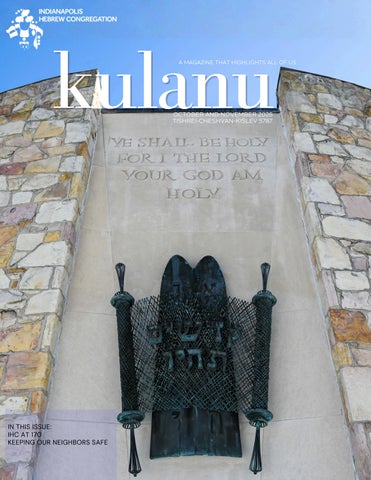
The Meridian Street Temple The postwar boom brought more people to the Midwest, including Jews whose families originally settled on the east or west coast. At the same time, many Jews, having found new affluence and opportunity, moved from city centers to the growing suburbs. Again, the congregation was outgrowing its space. In the late 1940s, IHC had to rent the Murat Temple downtown for the High Holy Days, deeming the 10th Street Temple a fire hazard if it were to play host. In 1956, fundraising began for a new, modern temple to be built on a large plot on Meridian Street. At the time, the plot sat just outside of Indianapolis city limits. The location again reflected the changing congregational demographics. Those who grew up near and attended the 10th Street Temple were now raising families of their own in the suburbs. This made IHC more accessible to the prosperous Jewish community that left the city. From a congregation of 33 families when the first Market Street Temple was proposed, the community now comprised of 600 families. It needed a space that could host large groups of people for services, events, and religious schooling, sometimes at the same time. On May 9, 1958, the new temple opened its doors; IHC still calls it home to this day. It is a modern building in the style of its time. Yet it displayed a remarkable nod to temples of yesteryear. A grand sandstone façade facing Meridian Street stands out to any passerby. It is adorned with the phrase, “Ye Shall Be Holy for I the Lord Your God Am Holy.”
7 | OCTOBER/NOVEMBER 2026 | IHCIndy.org
The theme of this temple was, and remains, holiness. Our ark is adorned with the phrase “kedoshim tihyu,” meaning ‘you shall be holy.’ The same phrase appears in the IHC logo. Around the building, the word ‘kadosh,’ meaning holy, appears everywhere. Our sanctuary wall is decorated with three depictions of the word: one made of wood, one of stone, and one of clay, to symbolize that holiness penetrates beyond the temple walls and all the way below the ocean and up above the trees. It was from this temple where Rabbi Maurice Davis departed for the south to march alongside Dr. Martin Luther King Jr. in Selma, Alabama. And from its bimah where Cantor Janice Roger played part in a new wave of women who changed what it meant to be clergy in the Reform Movement. Most important, it is here where generations have connected with their Jewish heritage, built community, and found a home. Within these walls, families have watched their children grow into Jewish adults and go on to raise their own kids.
Honoring Our History — 170 Years Later Since 1958, the current IHC building has changed and adapted to modern needs. The congregation continued to grow, necessitating a renovation and the addition of new office and educational spaces. Around the building, there are many reminders of our old homes. The stained glass above the chapel, representing the Ten Commandments, recalls the glass that surrounded the 10th Street Temple. A diorama of the 10th Street sanctuary, created by Joyce Kleinman, is proudly displayed next to the current one. The two giant yahrzeit boards that once hung in the 10th Street sanctuary still stand in the main entranceway; their lights honor those that came before. And that oncecontroversial stained-glass Moses now overlooks the south side of the IHC building. While the locations have changed, IHC’s values have remained the same. We are more than a house of worship; we are a home. A home for community, a home for tzedakah, a home for education, and a home for belonging. All are welcome at IHC. All have a place. All are holy, and all shall act holy, for our God is holy.
“Kadosh, Kadosh, Kadosh” artwork that hangs in the IHC sanctuary.
There is something special about IHC, the least of which is the building. Sure, there is much to love about the building. But it’s nothing without its people, tasked with caring for their house. For 170 years, it is the people who have, and continue to, make this house a home.
MAZEL TOV! B’nai Mitzvah
Mazel Tov to...
Callie Kerswick is excited to celebrate becoming a bat mitzvah on October 10.
Matt Segal, son of Carol and Elliott Segal, on being named corporate communications manager for GrayBar Electric, based in St. Louis.
Charlie Rich is excited to celebrate becoming a bar mitzvah on October 17. Emilee O’Hara is excited to celebrate becoming a bat mitzvah on November 14.
Bobby Segal, son of Carol and Elliott Segal, on being named Gibson County Coach of the Year as Gibson Southern High School varsity baseball coach.
Welcome New and Returning Members: Susan Klineman
Adam & Lisa Weinstein
Lonica Solomon
Lindsay & Michael Yaggi
Do you have someone you want to wish “Mazel Tov” to? Do you have an article, a story, an illustration, or anything else you want to share with the congregation? Reach out to us at communications@ihcindy.org, and you could be included in a future Kulanu! 8 | OCTOBER/NOVEMBER 2026 | IHCIndy.org
UPCOMING EVENTS & IHC CIRCLES MITZVAH STITCHERS
EUCHRE CIRCLE
MAHJONGG MAVENS
NEXT OPPORTUNITIES: Sunday, October 4; November 1 & 15 at 10 a.m. at IHC
NEXT OPPORTUNITIES: Monday, October 12 & 26; November 9 & 23MAIMONIDES at 10 a.m.
NEXT OPPORTUNITIES: Friday, October 2, 16, & 30; November 13 at 10 a.m.
Sunday, October 25 & November 22 at 10 a.m. at Hooverwood
Thursday, October 22 at 6 p.m.
- GUIDE FOR THE PERPLEXED
Friday, October 9 & 23; November 6 & 20 at 2:30 p.m.
EYE ON ISRAEL
The Sacred Work of the Chevra Kadisha Within Jewish tradition, few mitzvot are considered as sacred — or as selfless — as the work of the chevra kadisha, the "holy society" entrusted with preparing our dead for burial. This is a chesed shel emet, an act of true kindness, given to someone who can never repay it. The chevra kadisha performs taharah, the ritual washing and purification of the deceased, and stands watch (shmira) so that no soul departs this world alone. It is quiet, dignified work rooted in centuries of tradition, and it depends entirely on community members willing to step forward. As our community grows, so does the need for more hands to carry on this sacred practice. Whether you're curious about what taharah involves, drawn to the spiritual meaning behind it, or simply looking for a meaningful way to serve your community, we invite you to learn more about joining our chevra kadisha. Jennifer Nelson of Aaron-Ruben-Nelson Funeral Home will speak further on this topic at Friday night services on October 9, 2026 — please join us to learn about this beautiful mitzvah and how you can be part of it.
IHCIndy.org | OCTOBER/NOVEMBER 2026 | 9
SAFE PARK INDY: A JEWISH RESPONSE TO HOMELESSNESS BY ELIZABETH FRIEDLAND Every time a journalist interviews me about Safe Park Indy, I am asked some version of the same question: Why did you decide to do this? Why start a nonprofit in my spare time when I could have done something else? For a long time, I struggled to answer. The question itself almost felt offensive. Why wouldn’t I help? It wasn’t until I immersed myself in Jewish learning that I understood why the question always left me momentarily speechless. Judaism doesn’t frame caring for people as an optional act of kindness reserved for those with extra time or extraordinary compassion. It frames it as an obligation commanded to every single one of us. That realization has become the foundation of Safe Park Indy. Safe Park Indy is Indiana’s first and only safe parking program for people experiencing homelessness while living in their vehicles. Each evening, individuals and families drive to one of our secure overnight parking lots where they can sleep without fear of being ticketed, towed, harassed, or asked to move in the middle of the night. IHCIndy.org | OCTOBER/NOVEMBER 2026 | 10
They have access to restrooms, hygiene supplies, food and a community that recognizes their humanity. Vehicular homelessness is one of the fastest-growing forms of homelessness in America. As housing costs continue to rise faster than wages, more people are finding themselves unable to afford rent, even while employed. A vehicle becomes the last barrier between having at least some shelter and sleeping on the streets. People living in vehicles often remain invisible, even from traditional social service agencies and official counts of homelessness. Folks are often surprised at who our clients are; it bucks many of the stereotypes we have about “the homeless.” Nearly six in ten of the clients we serve are currently employed. More than half have attended college or technical school. Most are experiencing homelessness for the first time. Many became homeless within the past six months after a string of bad luck that could happen to any one of us. Our clients include professionals hiding their situation from even their closest friends and family. They could very well be your coworker – or sitting next to you in synagogue
The Torah repeatedly commands us to remember that our own security is never guaranteed, no matter how comfortable our present circumstances might feel. Our foundational stories are ones of displacement. Adam and Eve are expelled from the Garden of Eden. Abraham leaves everything familiar to journey into uncertainty. Jacob flees his home and Jacob’s family leaves Canaan for Egypt. The Israelites wander the wilderness for 40 years, carrying only what they need from place to place. After the destruction of the First Temple, our ancestors endure exile in Babylonia. Following the destruction of the Second Temple, the Jewish people spend nearly two millennia dispersed throughout the world. These experiences are not identical to modern homelessness of course, but they cultivate a collective memory of instability, uncertainty, and vulnerability. Again and again, Judaism reminds us what it feels like to be uprooted.
That memory reaches its fullest expression each year during Sukkot. For one week, we intentionally step outside the permanence of our homes into structures whose roofs allow us to see the stars – the sukkah, a temporary dwelling that reminds of our 40 years of wandering in the desert. The sukkah shows us that physical security is never absolute and that material possessions are ultimately temporary. Yet, Jewish tradition also insists that even these temporary shelters must preserve human dignity. The Talmud teaches that a sukkah must be fit for a person to “eat, drink, and sleep” within it, and that one should even bring one’s best dishes into the sukkah (Babylonian Talmud, Sukkah 28b). Even temporary shelter should allow people to live with dignity. That teaching often makes me wonder what our sages would think about people spending months or years cycling through emergency shelters -- or sleeping in parking lots with nowhere permanent to go
IHCIndy.org | OCTOBER/NOVEMBER 2026 | 11
.Jewish tradition also demonstrates remarkable concern for preventing homelessness before it begins. The Mishnah discusses lengthy notice requirements (anywhere from one to three years!) before tenants are be required to leave rental properties, with greater protections during the rainy season when displacement would be especially dangerous (Mishnah, Bava Batra 8:6). Sometimes people ask how we know someone truly deserves assistance. What if someone exaggerates their circumstances? What if they misuse a gas card or receive help they didn’t actually need? Jewish tradition has wrestled with those questions for centuries, too. In the Mishneh Torah, Maimonides rules that when a hungry person asks for food, we do not investigate whether the request is genuine. We feed them immediately (Mishneh Torah, Gifts to the Poor 7:6). The possibility that one person might deceive us does not outweigh the certainty that another person may truly be hungry. The rabbis consistently preferred compassion over suspicion. One midrash tells of a wealthy man who refused to help a poor person because he judged the man’s appearance, assuming he could not really be in need. God rebukes the wealthy man, asking, “Is it not enough that you have not given him anything of yours, but you must also cast an evil eye upon what I have given him?” (Leviticus Rabbah 34:7).
12 | OCTOBER/NOVEMBER 2026 | IHCIndy.org
The lesson feels remarkably contemporary. We still judge whether someone “looks homeless” or “looks poor enough.” If they have a newer car, do they really need our help? If they’re wearing the latest sneakers, can they be that needy? Judaism cautions us against appointing ourselves the arbiters of another person’s worthiness. Likewise, Deuteronomy instructs us: “You shall surely open your hand… and surely lend him sufficient for his need, in that which he lacks” (Deuteronomy 15:8). The rabbis understood this expansively -- not merely sustaining life at its bare minimum, but helping restore dignity and normalcy wherever possible. Our tradition also recognized that individual acts of tzedakah alone were insufficient. Ancient Jewish communities established organized systems of communal support, including the tamchui, which distributed daily food to those in immediate need, and the kuppah, a weekly communal fund that provided ongoing financial assistance. Caring for vulnerable neighbors was not left to chance or individual generosity alone. It was built into the structure of communal life; an ancient social safety net. That vision continues to inspire Safe Park Indy. Yes, we provide practical resources: safe parking, bathrooms, hygiene supplies, food, gas cards, and connections to housing and other services. But what we are really trying to provide is something deeper. We want every person who enters our lots to know that they matter. That they deserve safety and dignity. That they belong to a community that refuses to look away.
Sometimes, when I feel overwhelmed by the enormity of the homelessness problem, or uncertain if the small impact of Safe Park Indy is really doing enough, I’m comforted by Jewish wisdom. In Pirkei Avot, Rabbi Tarfon teaches: “It is not your duty to finish the work, but neither are you at liberty to neglect it.” (Pirkei Avot 2:21) The Mishnah declares: “Whoever saves a single life is considered by Scripture to have saved an entire world.” (Mishnah Sanhedrin 4:5) Judaism measures success differently than how society often does. It reminds us that one family sleeping safely tonight is not insignificant. One person finding stability is not a small victory. Every human being represents an entire world. Homelessness is often described as a housing problem, and it certainly is. But it is also a community problem. It asks whether we will see our neighbors’ suffering as someone else’s responsibility or our own. Judaism has already answered that question. We are obligated, not because solving homelessness is easy, and not because we alone can finish the work. But because every person created b’tzelem Elohim -- in the image of God -- deserves the chance to sleep safely tonight. If we can help even one person take the first step back toward stability, then, as our tradition teaches, we have helped save an entire world. Elizabeth Friedland is the founder of Safe Park Indy. Learn how you can get involved at safeparkindy.org
THANKSGIVING STUFFING: KUGEL IN DISGUISE By Blake Kraus
When you imagine a Thanksgiving meal, what comes to mind? Turkey? Pie? Stuffing? Certainly a very different landscape from the Passover or Rosh HaShanah table. Barring a pre-meal prayer or certain cultural and familiar spins on the meal, there may be no more secular holiday in America that is noodle kugel, a filling and cheap dairy united by a common menu. dish that could easily fit into a weekly kosher milchig repertoire. While it may not be Jewish in its roots, I am here to argue that one item on Much like stuffing, kugel can mean almost every Thanksgiving table is different things to different people. secretly Jewish. Yes, I have the Potato kugel is a parve option that was chutzpah to declare that stuffing is, another filling supplement for when indeed, secretly Jewish – a kugel who there was not enough meat to go practices in secret, as many of our around. It has very little in common ancestors did. with the noodle kugel, but is a kugel nonetheless. Somewhere along the The first noted appearance of stuffing line, during the waves of immigration comes from ancient Rome, where to the United States, the word kugel wheat, vegetables, and organ meat came to describe any sort of casserole were chopped up and used to in a Jewish context. supplement the main course. While there is no evidence that stuffing was Stuffing, similarly, has a wide range of present at the first Thanksgiving, by meanings. Today, stuffing tends to be the 1800s, stuffing meats with corn, bread heavy, while it was mainly chestnuts, oysters, and other local forcemeats in the past. To this day, ingredients became a popular way of some contain simply a loose mix of serving holiday meals. dried fruits and meats, while others are all about the carbs. Kugel, too, has origins as an ancient filler used to supplement a main Also similar to stuffing, kugel has a course. The word itself was coined by wide range of regional variants. Jews medieval European Jews to reference may mix different things into their the balls of bread dough that were kugel, like apples, raisins, fruit cocktail cooked in the weekly Shabbat cholent. in New York, and pecans in southern Egg noodles became a cheap and Jewish communities. Stuffing also popular side dish by the 1800s, thus contains a wide variety of regional birthing the noodle kugel. Though ingredients. In New England, local technically a side dish, the carb-heavy oysters and vegetables are favored. In kugel was almost a meal in and of itself, the south, it’s all about pork sausage. an affordable way to fill the family with minimal meat. Sounds a little like Thanksgiving? Sure, there is a turkey, but it is all about the sides. The rise of commercial sugar beet refining in Eastern Europe around the same time gave way to the sweet
Kugel can be topped with anything from Frosted Flakes and streusel for sweet, to crispy onions for savory. As for stuffing, in northern parts of the United States, classic white bread is the binder. In the south, it has to be cornbread. At a Jewish Thanksgiving table, perhaps it is leftover cubes of challah. Finally, both kugel and stuffing are custard-based dishes. Eggs and dairy are used to bind ingredients together. When baked, they produce a crispy top and silky interior, a perfect interplay of textures wrapped in one dish. There is one obvious difference. Kugel is not stuffed in anything. Stuffing, as its name suggests, is. Not so much anymore. At one time, stuffing was truly stuffed inside the bird. Modern food science suggests that baking on the side is a more sanitary option, ensuring that uncooked meat juices do not permeate the filling. Baking separately also allows the top to get nice and crispy, giving that great textural contrast. Most stuffings today are baked, just like any casserole – or kugel. Stuffing is not inherently Jewish. Every culture has its version of a casserole. But stuffing shares so many elements with kugel that it’s hard to ignore. No matter the stuffing at your table, whether a traditional American one or one with a Jewish flair. No matter if it is not even kosher – take pride in its Jewish resemblance! Take pride that, on the most American table of the year, there is a little piece of all of us represented. Some cultures show up as potatoes, others as corn. Some as squash, others as beans. Some as mac-and-cheese, others as pie. We show up as stuffing – kugel in disguise. IHCIndy.org | OCTOBER/NOVEMBER 2026 | 13
October Yahrzeits OCTOBER 1 Milton Firestone Illo Heppner Jack Koby Alexander Korthy Gail Mandell Sanford Rabin Joe Shaw Robert Simon Samuel Smulyan Jean Teixler OCTOBER 2 Gail Adamson Robert Berman Minnie P. Efroymson Harry Foster Eugene Glick Isidore Heimansohn David Herman William Lurvey Sam Mann Jim Mollin Mary Mossman Lorber Barbara Opperman Bernard Ress Harry Shampansky L. Milton Warshawsky OCTOBER 3 Geri Borne Eleanor Cohen Mace Hymson Joseph Kline Marcia Levin Helen Muir Dluz Roger Popp Richard Schornstein, Jr. Sara Segal Bill Wright OCTOBER 4 Arthur Barrett Sylvia Frisch Pamela Giles Gladys Goldstein Adrea Gordon Bergin Julie Hilton Mildred Rodenberg Hilda Seidman Harry Vogel OCTOBER 5 Edith Bodner Edna Engel Herschel Freeman Nancy Goldsmith Barker Gertrude Kline Dee Emma Oshrin Yetta Saperstein William Sider
OCTOBER 6 Sylvia Gertrude Bloom Sim Charlene Cox Mayme Goodman Christopher Hardesty Elaine Heller Ernest Heppner Robert Klein Marven Laskey Ida Likovsky Rose Mustin Fusako Penner Emily Thompson OCTOBER 7 Joseph Mendel Bassler Charlie Burnstein Irving Cohen Jacob Frankel Rubie Fruchtman Julian Glazer Morton Potasnik Clare Seleman Isadore Weinberg OCTOBER 8 Sol Eshowsky Joe Hantman Selma Hurwitz Samuel Kopelov Leonard Lurvey Ida Belle Marer Sidney Turetzky OCTOBER 9 Florence Arenstein Edith Bottigheimer Margaret Cooke Bliss Tess Karsh Fred Romer Mayer Rubenstein William Stiefler Bernard Vaprin OCTOBER 10 Rose Arkush Paula Berenbaum Frieda Buchholz Harriett Cooler William Glass Charles Herman Edward Kaplan Gertrude Karney Robert Lichtman Robert Allan Monat Jesse J. Mossler Ida Orenstein Bessie Spitzberg Georgia Strashun Max Weil
14 | OCTOBER/NOVEMBER 2026 | IHCIndy.org
OCTOBER 11 Lawrence R. Dee Sara Dorman Marcus Judith Firestone Jodie Ganz Beatrix Goodman Franklin Gloria "Glo" Greenstein Lawrence Greenwald Pearl Jaffe Miriam Joseph Fannie Kleiman Judith B. Lichtenberg Igor Mazyar Joseph Rubin Simon Sculler Bernice Silver Francis Slutzky Muriel Vogel Kenneth Wattam OCTOBER 12 Jennie Wolf Atlass Peter Berenbaum Pearl Eisenstein Himie "Bud" Greenburg Ken Krauss Betty Lehner Arlyne Pearl Albert Pearlman Julian Savesky Zelda Sklan Benjamin Franklin Yaunt, Jr. OCTOBER 13 Albert Cooper Michael Feuer Benjamin J. Fisher Lena Kaplan Alan M. Leff Sabina Medias Law Anthony Miceli Molly Gold Regenstreif Bernice Rubin OCTOBER 14 Michael Kile Arkadiy Korsunskiy Charlotte Margolis Kline Blanche Moss Marvin Moss Dennis Naughton Jack New Robert Peale Molly Tavel OCTOBER 15 Jack Bronicki Steve Dill Ben Domont Carol Dorothy Krosin Jacob Mansbach Reyza Rozenberg David Sklan Mitchell Thomas
OCTOBER 16 Larry Becker Walter Breisacher Edith Davis Grace Lyon Minnie Meyers Millie Morris Keller Flora D. Peale Roselyn A. Wechter OCTOBER 17 William "Bill" Campbell Natalie Effron Ed Greenberger Laura Jaffe Pauline Klineman Edward E. Levy Howard Lieberman Betty Livingston Bertha Lowenstein Dora Smith Ruth Talesnick OCTOBER 18 David Anderson Jack Bernstein Harold Bortz Celia Efroymson Blanche Friedman Stephen Hester Sylvia Katz Cohen Donna Krichiver Phillip Krosin Larry Langdon Pat Lerman OCOTBER 19 Robert Baron Mary Sue Branning Philip Cohen Joseph Frey Morris Glick Edgar Joseph Evelyn Krinsky Winograd Israel Samuel Lazerov Melvin Russell Lobb William "Pete" Rose Norma Schineman Theyson Max Shapiro Lillian Strashun OCTOBER 20 Max Apter Mathilda Getsug Beth Louise Goldberg Eva Jaffe Rose Budd Koffman Bernard M. Krichiver Sandi Simmons Hyman Harold Soshnick OCTOBER 21 Orval Alexander Robert Baldwin Hans Buchholz Murray Davidson Sara Hamer Rose Mages Leonard Mandell Lillian L. Oancea Irene Solomon Maurice Spasser
OCTOBER 22 Eloise Bell Bernerd Bogar Clyde Fishburn Marion Garmel Michael Bruce Halberstadt Lillie Herzog David F. Kahn Sylvan Perlov Lynn Wool OCTOBER 23 Henry J. Belle Albert A. Cohen William Ehrlich Herschel Freeman Louis Strashun OCTOBER 24 Morris Calderon Shirley Careskey Zelda Gall Carol Greenwald Maurice Lippman Patricia Ann Mantel Marian Rabin Jacob Roth Morris Scheer Tatiana Stern Janet Yosha OCTOBER 25 Esther Bartick Elizabeth Bodner Gloria Cook Rebecca Garelick William Greenberg David B. Kasper Rosemary Logan Ida Meiselman Glenna Wilkoff OCTOBER 26 John Adams Milton Bloom Barbara Freeman Sydney Getsug Diane Goldberg Rena Katz Jean Meltzer Leon Shorr Paul Sicanoff Molly Slabosky Nathan Swiss William Weisberger
OCTOBER 27 Richard Efroymson Flora Langsam Opie Meyer Lerman Arthur Levy Igor Lysogorsky Herman J. Penner Emanuel Pretzfelder Anna Rabb Lyudmila Zamorsky OCTOBER 28 Joan Fisher Irving Kopelson Joseph Modiano Fay Rubenstein Henry Weiner Stanley Werner OCTOBER 29 Marilyn Azoulay Amy Fisher Allan Goldburg Florence Gordon Irving Hamer Molly Harris Ben Linder Thomas Mantel, Jr. Ida Rose Miller Gerald Paul Dorothy A. Ristow Wendy Weidberg OCTOBER 30 Noel Becker Pauline Bratnick Marilyn Campbell Maurice Finkel Maurice Garfein David Hurwitz Celia Lessler Jennie Pactor Mary Parson Donnellon Irving Rodenberg Virginia Rosenbaum OCTOBER 31 Davey Lee Avenatti Gerald F. Cohen Myrna Fang Edgar Joseph Edward Krulewitch John Allen Lewis Charles Medias Boris Schulman *as of 07/30/26
November Yahrzeits NOVEMBER 1 Leon Calderon Clara Camhi Mary Cook Harry Herzog Annette Miroff Mollie Schiffer Mark Speyer Solomon Speyer Rae Wishne NOVEMBER 2 Esther Baerncopf Beatrice Baker Bonnie Bizer Judith Coleman Mildred Dansker Beatrice Fink Theodore Kaplan Renee Leffel Bass Lora Levenson Avery Helen Meyer William Pearl Lee Sachs Sarah Sider NOVEMBER 3 James Beam Phyllis Block Wolf Morton Greene Manuel Levin Louis R. Romer Jerome Shapiro David Slabosky Marc Walter NOVEMBER 4 Thelma Barcheck Naum Goldburt Beatrice Greenfield Max Levy Harold Minkus Julie Ohrn Flinchum Helen Rand Lenke Joann Sanders Louis Shonfield Herman Slutzky Hannah Sternfield Sarah Wolf Goodman NOVEMBER 5 Connie Braun Barbara Cohen Leon R. Cohen Bernard Dee Corrine Fuller Glaser Albert Hirsch Jack B. Kammins Suzanne Lake Angel Isadore Jebber Lehner Samuel Rubner Clare Schloss Florence Smith
NOVEMBER 6 Lois Ackerman Jill Bongiorno Edith Buchholz Arthur Fairbanks Janet Gangler Hertenstein Betty Lynne Glazer Arthur Goldstine Herbert Kasle Leon Kay Esther Mitchell Miriam Tannenbaum Virginia Wendelgass NOVEMBER 7 Charles "Chuck" Cohen Charles Philip Cohen Aaron Gitsis Max Robbins Adele Schafer Dorothy Schiller NOVEMBER 8 Ruth Adelstein Shmuel Amram Harry H. Atlass Edward J. Berman Rose Goldberg Nicholas Grossman Jack Larman Sara Rose Nides Patricia Sablosky Rae Schafer William Schwartz NOVEMBER 9 Ralph J. Berry Frank Bobele Juliet Duncanson Anna M. Friedman Fannie Lerman Fritz Lorch Harry Nelson Louise Ristow Serretta Smalbach Miriam Werner Carl Wolf Herbert Wolff NOVEMBER 10 Judith Baron Lavallee Sadie Barrett Berdye Brown Arlon Cohen Hermann Elkan Johanna Elkan Gertrude Goldberg Robert Silbert Harriette Wentico NOVEMBER 11 Louis Cohen Robert Dant Allen Freed Abe Goldberg Herbert Gordon Bessie Greenwald Samuel Jacob Kagan Julian Kaplan Ruth Levin Rose Magazine William Metz David B. Silbert Jane H. Zukerman
NOVEMBER 12 James "Jimmy" Baron Stanford Falender Albert Glaser Jessie Goldberg Pearl Kleiman Sally Klein Samuel Rivlin Rose Marie Romey Duffy Florence Weil
NOVEMBER 17 Marguerite Adamson Eric Berezin Jacob K. Berman Irwin E. Galan Leon Goldhamer Bernard Horwitz Adrienne Korr Kathy Simmons Mary Wilma Stewart Isadore Sussman Mary Wolf
NOVEMBER 13 Helen Beitman Waltraud "Wally" Hene Jill Hollett Sally Klein Goldene Kolstein Betty Linkon Anne Pollock Minnie Sapirie Harold E. Schwartz Sherman Stein E. Alan Turow
NOVEMBER 18 Herbert Abrams Esther Barnett David Cromer Martye Eshowsky Mable Grossman Isidor Hassan Leo Netzorg Kenneth Pearson Paul Smith
NOVEMBER 14 Abraham Arnold David Coraz Marvin Evans Gertrude Solomon Mary Adeline Thirtle NOVEMBER 15 Jean Davis Martha Fuldauer Molly Gold Aaron Goldman John Lawrence Gerald Mansbach Ruth Marder Miriam E. Millman Jerome Ossip Jack Peck NOVEMBER 16 Robert Albright Julius Cohen Theresa Feldman Shapiro Siegfried Jacobs Joseph Jay Levine Betty Levinson Marilyn Paxton Audree Potasnik Edward Rothschild Ethel Shmookler Spasser Stephanie Yarmo Boresow Mordechi Yosha
NOVEMBER 19 Richard Cohn Claribel Furscott Marjorie Goodman NOVEMBER 20 Sheldon Agriss Vivane Boas Marcella Burnsworth Michael Glazer Florence Goldsmith Samuel L. Kades Edmund Tilton Allen Wurzman NOVEMBER 21 John R. Collier Harry Gorshel Jennie Kroot Richard Hanauer Myers Charles H. Redish Marcia G. Schneider Pearl Shultz Lillian Ungar Michael Vogel
NOVEMBER 22 Arthur Buchholz Marilee Burrell Alvin Cohen Joseph Csillag Ernestine "Erni" Feeney Ida Fettner Renee Gorden Greta Haas George Norwood Lewis Kalah Reinschreiber Mitchell Shapiro Jonathan Stein Joseph D. Stock Sandra Wilson NOVEMBER 23 Henrietta Berman David Falender Thelma W. Gettig Lenora Giniger Samuel Gotlieb Anna Hertzman Rose Kreizvogel Barbara Proven David Silver NOVEMBER 24 William Allen Nathan Card Yetta Freeman Albert Goldberg David Grosfeld Dora Jacobson Joan Larman Ida Litwack Iosif Malyovanny Theda Paskoff Maurice Podaloff Herman Rosenheim Sidney Sapurstein Mark Scheinman Stein NOVEMBER 25 Gilbert Cohen Nancy Beth Felsher Sarah Goodman Rose Kramer Hayes Evelyn Krinsky Sylvia Leviton Goldsmith Walter Mitchell Ben Nortman Abe Schwartz Harry B. Stein Sarah Weinberg NOVEMBER 26 Sol Blickman Deb Breighner Theresa Burgheim Cohen Mae Hirsch John Jay Hurwitz Eli Jaffe Bernard Landman, Jr. Ida Leon
NOVEMBER 27 Samuel H. Abrams Alfred Ackerman Sol Baker Charles Bassler Sylvia Brodsky Abram Efroymson Max Gellman Anne Hewitt Irving Kleiman Walter S.G. Kohn Irene Noparstak Matilda Rubin Lev Vengerko Max Zabronsky NOVEMBER 28 Melvin Druker Clara Engelberg Doris Getsug Ruben Goldstein Joseph Heywood Greenberg Morris Greenberg Albert Greensberger Lisa Gross Seymore Kenis Bernard E. Levine Neil Levine Claire Lipman Myron "Bud" S. Wolf NOVEMBER 29 Barb Corcoran Jay Lofton Fihn Louise Garfein Frances Goldhamer Eleanor Graff Moe Kaufman Martha London Betty Rubner Richard Weiler Ina Welber NOVEMBER 30 Betty Braun Bernard Braun Anne Brown Leffel Constance Comins Morris Feuerlicht Lena Ginsberg Susan Goldstein Michael Haber James Kern H. Norman Kusnitz Lee Roy Lawson Leonard Libster Leo Miroff Rose Neubauer Stuart Paul Sobel Theodore Vernick *as of 07/31/26
IHCIndy.org | OCTOBER/NOVEMBER 2026 | 15
INDIANAPOLIS HEBREW CONGREGATION 6501 North Meridian Street Indianapolis, Indiana 46260 IHCINDY.ORG | 317-255-6647
CLERGY
Non-profit Organization US Postage PAID Indianapolis, IN Permit No. 819
SENIOR RABBI Brett Krichiver CANTOR Aviva Marer CANTOR EMERITA Janice Roger
EDUCATION DIRECTOR OF LIFELONG LEARNING Rabbi Roxanne Shapiro EARLY CHILDHOOD CENTER DIRECTOR Jodi Kaseff YOUTH ENGAGEMENT COORDINATOR Leah Matthys
ADMINISTRATION EXECUTIVE DIRECTOR Peter Smithhisler ACCOUNTING MANAGER Elaine Wells COMMUNICATIONS SPECIALIST Seth Tow CLERGY COORDINATOR Katie Borman ADMINISTRATIVE ASSISTANTS Kendra Steele Colleen King MAINTENANCE Gary Davis Joyce Patterson SECURITY Willard Mosley Nikki Boone Shawn Boone Hawaii Lee Kareem McGraw
BOARD OF DIRECTORS PRESIDENT Jennifer Vigran VICE PRESIDENT Jaclyn Grahl VICE PRESIDENT Jeff Rubenstein TREASURER Eric Simons SECRETARY Carly Traynor Immediate Past President Sarah Freeman Sisterhood President Elyse Chuvalas
MEMBERS AT LARGE Benjamin Abraham Lorraine Ball Steve Bulloff Kate Duffy Sim Ken Gould Matt Kaprove Stevie Pactor
Marci Price Julian Shepard Polly Spiegel Drew Soshnick Dodie Stein Carly Turow
Kulanu is published seven times per year by Indianapolis Hebrew Congregation. For more information, please call the Temple office at 317.255.6647. For most up-to-date information, make sure you’re receiving our weekly eNewsletter. Sign up on our website at ihcindy.org. All articles, graphics, and photos credited to Seth Tow unless otherwise noted.
@IHC.INDY