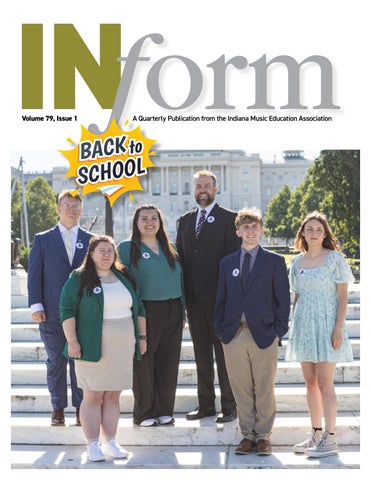
Volume 79, Issue 1
A Quarterly Publication from the Indiana Music Education Association
1
We love to travel . . . and so should you. MTC is a proud sponsor of
Unmistakably different travel experiences
www.musictravel.com 800.616.1112 #mtctravels AGINATION C IM A S PU M
2027
©Disney
G
SPORT OF
ER ED Y
ANN
RECO
NIZ
OUTH TRAVEL
PL
Official Student Travel Partner
THE ARTS
Preferred Travel Partner
Certified Member
VO L U M E
79
I S S U E
1
EDITORS JON NOWORYTA ABBY MEANS MICHELLE BRINKMAN IMEA EXECUTIVE COMMITTEE KEITH ZIOLKOWSKI President REBECCA HAMPTON President-Elect JOHANN SLETTO Immediate Past President AREA REPRESENTATIVES AREA 1 STEPHEN DEAN AREA 2 KYLE WEIRICH AREA 3 AUTUMN SMITH AREA 4 MICHELLE BADE AREA 5 ALYSSA ANDERSON AREA 6 JONATHAN EDWARDS AREA 7 ANDREA DRURY AREA 8 NICK SCROGGINS IMEA COLLEGIATE REPS ETHAN HACKER AUSTIN SIGLER RECORDING SECRETARY ALYSSA ANDERSON STAFF LANE VELAYO Executive Director ALICIA RANKIN Operations Manager CAROLINE WHITE IMEA Office Staff IMEA EXECUTIVE OFFICE 6510 Telecom Drive, Suite 370 Indianapolis, IN 46278 Phone (317) 342-4100 office@imeamusic.org
Facebook: facebook.com/INMusicEd X: @INMusicEd Instagram: imeamusic
T A B L E
O F
C O N T E N T S
Notes from the Editor . . . . . . . . . . . . . . . . . . . . . . . . . . . . . 4 President’s Message . . . . . . . . . . . . . . . . . . . . . . . . . . . . . . 5 Prelude . . . . . . . . . . . . . . . . . . . . . . . . . . . . . . . . . . . . . . . . . 6 National Assembly and Hill Day Recap 2026 . . . . . . . . . . 8 Amplifying Hoosier Voices: Indiana‘s Impact at NAfME Hill Day 2016 . . . . . . . . . . . . . . . . . . . . . . . . . . . 10 What Would You Do f It Happens To You: 10 Lessons Learned from an Unexpected Crisis . . . . . . . . . . . . . . . . . . 13 Say Hello! . . . . . . . . . . . . . . . . . . . . . . . . . . . . . . . . . . . . . . 15 MIOSM Is More Than a Month: Small Actions, Statewide Impact . . . . . . . . . . . . . . . . . . . . . . . . . . . . . . . . 16 One Beat, Many Schools: Building Community Through a District-Wide Orff Ensemble . . . . . . . . . . . . . 18 Work Life Balance . . . . . . . . . . . . . . . . . . . . . . . . . . . . . . . 21 Membership Spotlight . . . . . . . . . . . . . . . . . . . . . . . . . . . . 23 Article Submissions INform Magazine invites submission of articles by teachers on all aspects of music education. If you are interested in submitting an article, please contact a member of the editorial committee: Alicia Rankin (office@imeamusic.org).
3
N OT E S F R O M T H E E D I TO R : M I C H E L L E B R I N K M A N
Lessons From the Backyard ummer often offers a chance to slow down and notice the world around us. For me, that has meant spending a few quiet moments watching the activity just beyond my back door–the birds at my backyard feeders. A backyard filled with birds is never truly still! Individually, each species has its own song, purpose, and personality. Together, however, they create something far more remarkable—a vibrant, interconnected community where countless individual actions contribute to a thriving whole. The more I observe the birds that come to my backyard feeders, I notice the following: • Communication: Birds alert one another to danger. When Black-Capped Chickadees spot a predator, they give an alarm call that nearby birds—even other species—understand. Blue Jays will often loudly announce to other birds that a predator such as an owl, hawk, or snake is nearby. • Cooperation: Different species often benefit from traveling and feeding together. This past winter, I witnessed a flock of European Starlings completely decimate a feeder full of food in a matter of minutes! • Caring for each other: Northern Cardinals often form long-lasting pair bonds. I love watching several cardinal families feed and care for each other and their babies at my backyard feeders. • Belonging: Flocks provide safety, companionship, and resilience. American Goldfinches often feed together in small flocks. They communicate with soft calls while flying and feeding, helping the flock stay connected and allows them to move efficiently between feeding sites. • Unity in diversity: Birds with different abilities contribute to the success of the whole group. White-breasted Nuthatches frequently forage together with chickadees. Each species searches different parts of a tree, making food easier to find while increasing the number of eyes watching for danger. 4
The more I watch and learn about birds, the more I am reminded of our own music education community. Music educators come from different backgrounds, teach in diverse settings, and serve students with unique needs and aspirations. Like the birds in my backyard, no two of us are exactly alike. Yet each of us contributes to our music community. INform’s theme for this year, Community and Unity in Music Education, invites us to celebrate those connections. Throughout the issues, you’ll read stories of collaboration among colleagues, partnerships with families and communities, mentorship, advocacy, innovative teaching, and the countless ways music educators support one another across Indiana. Each article reminds us that while our classrooms may be separated by miles, our shared purpose unites us. This year will undoubtedly bring both challenges and triumphs. There will be moments that require creativity, resilience, and collaboration. Yet just as the backyard birds return each day—each contributing in their own way to the life of the flock and the rhythm of the season—we, too, can strengthen our community through encouragement, generosity, and a shared commitment to our students. Welcome to a new school year! May it be filled with meaningful connections, inspiring music-making, and a renewed sense of community and unity.
Michelle Brinkman Editor, INform Magazine B AC K T O S C H O O L 2026
P R E S I D E N T ’ S M E S SAG E : K E I T H Z I O L KO W S K I
elcome back to the beginning of an exciting year with the Indiana Music Education Association! With close to 3,000 music educators in our membership, I am excited to lead you through my second year as president. As I return from a powerful and invigorating NAfME National Assembly in Washington D.C. I am reminded that consistent advocacy, from all teachers, is our most powerful tool in earning and gaining access to music education to all students in our state. Speaking of advocacy, I want to introduce or reintroduce you to our fresh team of advocates. Shaina Liv Lescano, Advocacy Chair, and Oksana Komarenko, Music in Our Schools Month Chair had a wonderful work session during our summer meeting and developed a great plan to create a yearly cycle for IMEA Advocacy Work that includes state and federal level, but local, grassroots in your community. I ask that you read their articles on {insert article titles and pages here - editors], to see their plans and Shaina’s review of Hill Day 2026. I am very excited about what these two are doing, but they cannot do it alone. Are you a person that likes to speak up? Do you think you have made successful gains in your own program speaking with community leaders and administration? You can join this team by serving on our advocacy committee to promote how important music education is to all students. What were IMEA’s biggest gains in 2025-2026? • A record number of collegiates attended the conference with 271 attending collegiate night and the conference! • Significant growth in Circle the State with Song with 3,150 students participating and 244 schools! Major accolades to all the teachers involved in CSWS! Previous year - 2,800 students with only 200 schools. • A complete yearlong review of IMEA’s Constitution, By-Laws and Policies. • A successful Hill Day in recent memory, visiting all 11 congressional offices, speaking with two representatives, and having meaningful conversations with four other office’s staffers.
We want to congratulate several Indiana members of NAfME who were recognized at the National Assembly. • Ball State University - Chapter of Excellence for Recruitment - Aaron Robinson received on behalf of the chapter. • Ethan Hacker, University of Indianapolis - Personal Achievement Award and Shannon Kelly Kane Scholarship Recipient • Dr. Ann Hicks, Ball State University - Chapter Advisor for Excellence Award The Road Ahead for 2026-2027 As I traveled to Washington D.C for the National Assembly, it was disheartening to see many school corporations announce referendums, several for the first time, for November due to SEB 1. Every representative we talked to in D.C. was told the importance of funding education to its fullest potential and the effects of bad policy. At the time of writing this article, approximately 100 school corporations have announced referendums on the November ballot. To help our dedicated members decide on who they will be voting for, we will be working on questionnaires to candidates with a document ready near October 1st. We want our members to be informed and ready to go to the polls voting in their best interest. I would be remiss if I did not thank outgoing membership chair Katy Briel on her years of service to the IMEA board. As most are aware, Katy has started as ISSMA’s new Instrumental Education Director. We are so happy for her as she steps into this new role. Katy will still be involved in IMEA’s work in the future. Lastly, I want to encourage you to get involved in IMEA events, from the conference to Circle the State with Song, to the New and Developing Teacher Workshop - we continually redefine the experience for our members. We continue to look for new volunteers as well - current open board positions include Tri-M Chair, Membership Chair, Festival and Clinic Chair, Composition Competition, and an Administrative Representative. Don’t want to serve on the board, but want to help? Let us know and we will connect you with an event or activity. You may self-nominate or nominate someone you know! If nominating, please email president@imeamusic.org Have a safe, wonderful, and productive school year. Keith Ziolkowski President, Indiana Music Education Association 5
prelude:
MARK YOUR CALENDARS WITH THESE IMEA DATES! IMEA will continue to publish further details and information at https://www.imeamusic.org/ 2026 High School All-Region Choir • Registration Deadline: October 7, 2026 For more information visit:
circlethestate.imeamusic.org/registration Future Music Educators’ Colloquium (FMEC) • Recommendation Deadline: November 4, 2026 For more information visit:
www.imeamusic.org/future-music-educators-colloquium
Honor Ensemble Deadlines: • Elem/MS Honor Choir: October 7, 2026 • All State Handbells: October 7, 2026 • All State Percussion: November 4, 2026 • Honor Concert Band: November 4, 2026
Interested in serving in a volunteer leadership role? IMEA Board Openings • Composition Competition Chair IMEA Volunteer Opportunities • Area 7 Middle School Coordinator
For more information email the IMEA Office at
office@imeamusic.org
Beginning & Developing Teachers Workshop • November 18, 2026; Indianapolis For more information visit:
www.imeamusic.org/beginning-developing-teachers-workshop 2026 Circle the State with Song Festivals • Registration Deadline: December 9, 2026
For more information visit: circlethestate.imeamusic.org
2026 IMEA Professional Development Conference • January 14-16, 2027, in Fort Wayne • Early Bird Registration ends December 9, 2026
For more information visit: conference.imeamusic.org
Folk Dance Festival • Greenwood Middle School (Date TBD) • Mt. Vernon High School (Date TBD) For more information visit:
imeamusic.org/children-s-folk-dance-festival Composition Competition • Entry deadline is June 2, 2027 For more information visit:
imeamusic.org/composition-competition
6
B AC K T O S C H O O L 2026
https://in.gov/bmv
7
B Y K E I T H Z I O L KO W S K I I M E A P R E S I D E N T
National Assembly and Hill Day Recap 2026 ach year the Presidents of each state, divisions, and National Executive Board for NAfME convene in Reston, VA for 72 hours of advocacy work and review of NAfME. This short week is a highlight of any president’s term! We met from Tuesday June 23rd to Thursday June 25th with Hill Day happening on Wednesday June 24th on Capitol Hill. Tuesday This event is certainly a lot of sits and get, but the wealth of expertise and information in the room can be overwhelming at times. Tuesday, we started the morning with national updates and roll call of the association. It was great to hear from the different committees within NAfME as they gave their yearly reports (acronym city!) • Professional Learning Programming Committee (PLPC) • Society for Research in Music Education (SRME) • Society for Music Teacher Education (SMTE) • Equity Committee • Music Teacher Profession Advisory Committee (MTPAC) A key take away for me from most of these committees, is the shared work and responsibility being done through cochairs or a panel of 5 to 8 people that gather information and help with getting the job done. After the opening session I attended the divisional president meeting. If you did not know, NAfME is broken into six divisions that all have their own executive boards that come from members of that division. The six divisions are: Eastern, North Central, Western, Southwestern, Northwest, and Southern. IMEA is part of the North Central Division, and its current president is Clay Blackman from Nebraska. Clay will be at our conference this year! At the conclusion of this meeting the presidents of each state were able to have a roundtable discussion with the National Executive Board. This can always be a spirited discus8
sion with great ideas coming to the table. The downfall, like most nonprofits, is time and implementation. On Tuesday evening it was great to be in attendance for the NAfME National Awards. Indiana has been well represented the past three years that I have been in attendance, but this year was extra special. IMEA and the State of Indiana had several awards winners. • Ball State University - Chapter of Excellence for Recruitment - Aaron Robinson received on behalf of the chapter. • Ethan Hacker, University of Indianapolis - Personal Achievement Award and Shannon Kelly Kane Scholarship Recipient • Dr. Ann Hicks, Ball State University - Chapter Advisor for Excellence Award
NAfME President Cecil Adderley and Vivian Watts Congratulations to all our award winners! You have been selected because of your commitment to music education and the next generation of educators! It was also a pleasure to see NAfME President Cecil Adderley present the 2026 Music Education Champion Award to Delegate Vivian Watts from Virginia’s 14th House District. B AC K T O S C H O O L 2026
Wednesday - Hill Day IMEA’s Advocacy Chair, Shaina Liv Lescano, has written a wonderful review of Hill Day and the process leading up to it. I encourage you to read her article on [insert title and page editors] Thursday - Wrap Up and ALF On Thursday we were treated to a Keynote address by Dr. Lenora Helm Hammonds, Dean, Professional Education Division/Berklee College of Music. This gave inspiration to continue brief work on “Next Steps.” These topics covered Forging a More Productive Communication Pathway to Redefining Membership Value. I took ideas from some of these sessions to discuss with our board in the upcoming months. In the afternoon I was able to attend the Advocacy Leadership Force sessions with Shaina. This event was sponsored by NAfME, The Music Man Foundation, and CMA Foundation. This was an amazing experience to attend and see what other states are doing under better or worse circumstances from Indiana. Topics there were covered included: Demystifying Advocacy and Lobbying Compliance, Navigating Complex State Policy, Auditing Your State’s Political Climate, and De-
veloping Your 12-Month Plan. There was a lot of brainstorming and ideas for Indiana, and I can’t wait to help move some of those ideas forward. Keep an eye out for future emails concerning advocacy! Conclusion The experiences I had at Hill Day can’t be summed up in a short article. It is truly an amazing experience to be in such a historical place with so many talented and passionate educators from all walks of life. I would encourage any collegiate who is going to be a junior or senior next summer to attend the Collegiate Leadership Advocacy Summit. This three-day intensive program prepares you for advocacy and leading in the modern world. We have been thrilled that several collegiates from Indiana over the past few years have been able to attend on their own accord and finances. I continue to push others to get involved in IMEA at the largest or smallest level. Too busy to do a yearlong board role? That is okay, let’s find something you can do for one month! The states that are most successful in advocacy and other events really take on the idea of many hands making quick work. 9
B Y S H A I N A L I V L E S CA N O, I M E A A DVO C A CY C H A I R
Amplifying Hoosier Voices: Indiana’s Impact at NAfME Hill Day 2026 n June 24, 2026, nearly 300 music education advocates from across the country converged on Capitol Hill for the annual, invitation-only National Leadership Assembly. Their shared mission? To speak directly with members of Congress about the critical programs, funding, and policies that sustain music education for our students and educators. This year, Indiana was proudly represented by a dedicated six-delegate team: • Keith Ziolkowski (IMEA President) • Shaina Liv Lescano (IMEA Advocacy Chair and ALF) • Aaron Robinson (IMEA Board and Ball State Collegiate) • Emma Shea (IMEA Intern and Marian University Collegiate) • Jacob Clay (Marian University Collegiate) • Brenna McGaha (Marian University Collegiate)
gistical puzzle began a month in advance, with a mountain of emails and phone calls to congressional staff. The final itinerary wasn’t fully locked in until the week of Hill Day itself, but the persistence paid off with a fantastic schedule. The night before we headed to the Capitol, NAfME provided state delegations with dedicated time to map out a coordinated plan of action. We organized the customized folders for every single Indiana office. For the meetings we secured, these folders contained NAfME-provided briefing materials regarding Title Funding and current bills on the floor. For the offices we couldn’t meet with in person, we prepared drop-off folders to ensure our message was delivered regardless. Beyond the paperwork, I asked each Hoosier delegate to prepare one or two personal stories from the field. Congressional offices are incredibly fast-paced environments, and staff members meet with dozens of groups a day. A memorable, authentic impact story is what drives a formal “ask” for support forward and builds a lasting connection with an office.
Understanding the Advocacy Leadership Force (ALF) You might wonder, what exactly is ALF? The Advocacy Leadership Force is a national committee composed of representatives from every state. We meet monthly to engage in open discussions on vital advocacy topics, ranging from strategic advocacy development and political negotiating tactics to highlighting successful grassroots efforts in individual states. Serving on this force ensures Indiana stays at the cutting edge of national music education advocacy.
Hill Day Highlights 1. A Surprise Corridor Encounter We started our morning strong in the Dirksen Senate Building with an unexpected encounter. Aaron Robinson, our collegiate delegate from Ball State, spotted Senator John N. Kennedy (Louisiana) in the hallway. Seizing the moment, Aaron approached the Senator and broke the ice by sharing how much a family member appreciated his work. After thanking Aaron, Senator Kennedy asked our group what brought us to Capitol Hill. Aaron smoothly pivoted and led a brief, impactful conversation about NAfME and our music education advocacy efforts. Seeing a collegiate step completely out of his comfort zone to advocate in a busy hallway was a truly proud moment for our delegation!
Behind the Scenes: The Prep Work Serving as the State Captain for the Indiana delegation, I acted as the primary liaison between our delegates and the offices of our Indiana Senators and Representatives. The lo10
B AC K T O S C H O O L 2026
2. The Hoosier Huddle Next, we attended the “Hoosier Huddle,” a weekly tradition where Indiana Senators Todd Young and Jim Banks host small-group constituent gatherings. This unique format allowed us to connect directly with key staff. Our conversations were incredibly positive. The staffer we spoke with from Senator Young’s office grew up participating in show choir and musicals, which instantly sparked a warm, shared connection. Meanwhile, the staffer from Senator Banks’ office immediately recognized Keith Ziolkowski from last year’s Hill Day. This proves that consistent advocacy leaves a lasting impression! Senator Young also made an appearance for a photo opportunity, during which we discovered that he used to play the harmonica. (We already know what we’re getting him for Christmas this year!) 3. An Inspiring Capitol Tour Following the Hoosier Huddle, a congressional staffer from Senator Young’s office took our delegation on a phenomenal tour of the Capitol building. She possessed a wealth of historical knowledge. One of our favorite trivia takeaways: Did you know that the Statue of Liberty, without its base, can fit completely inside the Capitol Dome with room to spare? 4. Afternoon Meetings and Deliveries By the end of the afternoon, I am thrilled to report that our delegation made some form of contact with every single congressional district representative for Indiana. Our collegiate members did an outstanding job stepping up to lead discussions and tying their personal stories and experiences directly to a strong ask for legislative support, particularly for the Arts Education for All Act (H.R. 2485). • In-Person Staff/Representative Meetings: Rep. Rudy Yakym (IN-02), Rep. Jim Baird (IN-04), Rep. Victoria Spartz (IN-05), and Rep. André Carson (IN-07). Official Materials Delivered To: Rep. Frank Mrvan • (IN-01), Rep. Marlin Stutzman (IN-03), Rep. Jefferson Shreve (IN-06), Rep. Mark Messmer (IN-08), and Rep. Erin Houchin (IN-09). The ALF Convening: National Perspectives The day after Hill Day, the Advocacy Leadership Force members gathered for our annual in-person training. We dove into lobbying compliance and analyzed how advocacy operating models look across different state landscapes.
During the “Stories from the Field: Navigating Complex State Policy” session, four states presented highly instructive case studies: • Louisiana: Outlined how they successfully created a State Seal of Fine Arts by strategically guiding a House Bill through their state legislature. • Oregon: Shared their experience building a community advocacy toolkit during a sudden music education crisis. Though the immediate outcome wasn’t what they hoped for, they successfully established a resilient network of community stakeholders for the future. • Maryland: Discussed “Transforming Allies into Champions.” Through intentional partnerships with outside arts allies, they established their highly successful state-level advocacy day, “Maryland Arts Day.” • Wisconsin: Because their music education advocacy is already in a strong position, the Wisconsin MEA pivoted their legislative ask to align with other education groups, advocating for full funding for Special Education. Why? Because Special Education mandates must be funded; if the state underfunds them, school districts are forced to pull from general funds, which frequently results in budget cuts for arts programs. My Key Takeaway Finishing up my first year as your Advocacy Chair, the most impactful realization from this convening is that advocacy looks completely different for every state, every school district, and every individual. All these varied approaches must coexist because each plays a vital role in protecting our classrooms. Next Steps: “Massaging the Relationship” Advocacy doesn’t end when we leave Washington, D.C. Upon returning, all Indiana delegates sent handwritten thank-you cards to the legislators we met with. Keith and I also sent notes to the offices where we dropped off folders to keep that line of communication wide open. Looking forward, IMEA is focused on “massaging the relationship” with our elected officials year-round. In partnership with the IMEA Music In Our Schools Month (MIOSM) Chair, we have developed a combined MIOSM/Advocacy Calendar filled with monthly, “Doable Deeds.” These are small, manageable ways for Indiana music educators to share what is happening in their classrooms. 11
By collecting these entries from our members across the state, I will be compiling the Hoosier Note: an advocacy newsletter for state and federal legislators. When budget and policy votes come up, we can hand your representatives a direct record of how quality music programs are positively impacting their specific constituents.
3. Remember That Your Voice Matters: Your daily influence on your local community is immense. While our collective advocacy goes far when educators speak up, it becomes unstoppable when legislators start hearing directly from parents, voters, and local business owners about the profound impact your music program has on their children and the community at large. What Can IMEA Members Do? 1. Be an Engaged Member: Do not be afraid to celebrate your program’s successes, no matter how small. Take pictures, document achievements, and share them with us. We want to showcase music education in every single corner of Indiana.
2. Watch Your Inbox: Keep an eye out for updates from advocacy@imeamusic.org. You will receive details about our “Doable Deeds” calendar and upcoming Quorum Campaigns. Quorum Campaigns are fast, pre-written email templates that automatically route to your specific legislators based on your zip code (and you can easily customize them with your own text). For example, IMEA will soon provide a Quorum QR code that you can display in your concert programs, allowing audience members to send a quick, immediate message of support to their representatives right from their seats! 12
Thank you to our incredible 2026 delegation and thank you to every IMEA member working to keep music alive in Indiana schools! INFO: 2027 National Leadership Assembly June 21st - June 24th
Shaina Liv Lescano is the bilingual Orchestra and Mariachi Director at Belzer Middle School and teaches privately in northeast Indianapolis. She currently serves as the IMEA Advocacy Chair. Her leadership background spans state and national advocacy, including service on the Indiana State Teachers Association Board of Directors and the National Education Association Resolutions Committee. Rooted in her classroom experience, Lescano works across IMEA, NAfME, ISTA, and NEA to bridge middle school string education with legislative action, advocating for public schools and access to high-quality music education.
B AC K T O S C H O O L 2026
B Y A N D R E W M U T H , W E ST F I E L D H I G H S C H O O L
What Would You Do If It Happens to You: 10 Lessons Learned from an Unexpected Crisis o band director, teacher, or administrator begins the day expecting their program to become the center of a national media conversation. On April 22, the day began like any other. Before I left for school, a colleague sent me a screenshot of a social media post involving our winter percussion program. Within hours, our students, staff, and community found themselves at the center of criticism from one our state’s highest officials. Looking back, these are ten lessons we learned as a program in the face of unimaginable scrutiny. 1. Put students first…period! It may seem like common sense, but before addressing the media, social media, or even public perception, we focused on our students. They needed reassurance that they were safe, valued, and supported. Every decision we made put one question at the forefront: What is best for our students? 2. Communicate quickly, consistently and with purpose. In a rapidly changing situation, silence creates confusion, uncertainty, and worry. We provided constant timely communication to students, parents, staff, and administrators. Even when we didn’t have every answer, we let people know what we knew and what our next steps would be. By making parents aware of what steps we were taking we built trust in our process.
3. Work as one unified team. Teachers, administrators, booster leaders, and staff remained unified. We established clear roles, spoke through approved channels, and avoided speculation. We brought many voices to the table to carefully craft a unified message. After that message was created, we used a consistent form of disseminating our message. 4. Prepare your students for public attention, both good and bad. Many of our students suddenly found themselves seeing their performances and images shared thousands of times online. 13
One picture was shared over 50,000 times. We reminded them not to engage in online combativeness, encouraged them to abstain from social media when needed, and reinforced that their value was not determined by stranger’s opinions on the internet. Even this extremely difficult moment was a teachable moment and allowed us to train our students in demonstrating compassion, grace, and professionalism.
9. Never underestimate your students’ resolve. Our students were extraordinary. They showed resilience, kindness, and maturity beyond the expectation of a high school student. They continued rehearsing, performing, and supporting one another. They found renewed joy in the reason we were all in the room to begin with, to make music together. Trust your students and they will surprise you every time.
5. Protect your staff and your people. Crises affect adults as much as students. Often in difficult situations adults start playing the blame game. “What could I have done differently to prevent this from happening?” We created safe spaces for adults to process, have discussions, and work through the pain of the situation. Educators are nurturers by nature and often take care of themselves last. Making sure staff had the space to work through difficulty allowed them to support students and makes our program stronger
10. Remember what will last. The headlines eventually fade and social media moves on to the next breaking story. Outspoken/highly visible critics will eventually pick on another group. What remains in the minds of your students and parents is how they were treated. As the adult in the room you fortified with your students the idea that there are people that care about them without an agenda or a motive. You reinforced the idea that the high road is not easy to choose, but worth the reward.
6. Let your community help. One of the greatest gifts of this situation was the overwhelming support we received. Directors, alumni, parents, and complete strangers reached out with encouragement, donations, and kind words. The support we received not only strengthened our resolve as a program, but it allowed us to use our spotlight to highlight education, music education, and the power of students’ hard work. 7. Resist the urge to react emotionally. Teachers are public figures and with this comes public criticism, but most teachers have never experienced thousands of posts about their program and students. It would be impossible to not have the urge to fight back and take on every negative thought that was shared, but it was important to remember the microscope that was on us in that moment. We chose to refer to lesson 1- put students first. Every message and word supported that lesson. 8. Lead with your values. Every educator has heard the statement “what is your why?” I took the time to think about why I was there and it was simple-” to stand in the gap.” To me, that means stepping forward when others need protection, leading with integrity, and choosing courage over comfort. During difficult moments, your values become your north star. They guide you when you cannot see the path ahead.
14
No one expects to experience a crisis like this, but more educators may someday find themselves facing unexpected scrutiny. These ten lessons reminded me of the profound power of education and the amazing opportunity that all educators are given. The music program is about far more than performances or competitive success. It is a community built on trust, empathy, and shared goals. I am proud of how our students responded. I am grateful for the educators, administrators, parents, and larger music community who stood beside us. Above all I am thankful for the reminder of our greatest lesson as educators: stand in the gap when it matters most.
Andrew Muth has served as Director of Bands and Director of Performing Arts at Westfield High School since 2019, leading a comprehensive program recognized for excellence at the state and national levels. Under his leadership, Westfield ensembles have earned state championships and finals appearances, WGI World Championship and finals appearances, and consistent Bands of America Regional finalist honors. Through a commitment to artistic excellence, innovation, and student-centered education, the Westfield band program continues to provide exceptional musical and leadership opportunities for its students.
B AC K T O S C H O O L 2026
BY MICHELLE BRINKMAN
Say Hello! he beginning of the school year offers music educators a unique opportunity to establish a classroom culture rooted in belonging, collaboration, and joyful music making. As students return with a wide range of experiences, abilities, and linguistic backgrounds, thoughtfully selected repertoire and literature can help create meaningful connections while fostering an inclusive learning environment from the very first lesson. Say Hello! by Rachel Isadora (ISBN-13: 978-0545688215) is an engaging picture book that lends itself naturally to these goals. Through greetings shared by people from around the world, the story celebrates the many ways we communicate while highlighting our shared desire to connect with others. The inclusion of multiple languages makes the book especially valuable for multilingual learners, providing opportunities for students to hear and see diverse languages represented in positive and authentic ways. At the same time, all students are encouraged to develop cultural awareness and appreciation through shared musical experiences.
The lesson that follows uses the Orff approach to transform the story into active music making. Designed for the opening weeks of school, the sequence encourages students to explore, create, and collaborate while establishing routines for ensemble participation and musical independence. By centering the universal act of greeting one another, this lesson helps students build musical skills, strengthen classroom relationships, and experience the music room as a welcoming community where every child has a voice. This lesson uses Keetman’s Rhythmic Building Bricks to identify the rhythm. Students then use “hellos” in different languages to compose an eight-beat body percussion composition. The suggested grade levels for this lesson are K-2, but older students who are not familiar with the Orff approach would find the material engaging as well. Suggested Teaching Process: 1. Read Say Hello! by Rachel Isadora. 2. Ask students to identify the different ways the characters in the story say hello. 3. Create a list of hellos in different languages. 4. Display Keetman’s Rhythmic Building Bricks — Continues on page 17 15
B Y D R. O KSA N A KO M A R E N KO, I M E A M U S I C I N O U R S C H O O L S M O N T H C H A I R
MIOSM Is More Than a Month: Small Actions, Statewide Impact hen people hear Music In Our Schools Month®, they naturally think of March. But meaningful celebration and effective advocacy cannot be compressed into 31 days. Music education is built every day: in the first uncertain notes of a beginning musician, in marching-band rehearsals under the late-summer sun, in winter concerts and community performances, in ordinary classroom moments that reveal extraordinary growth. Those moments deserve to be seen and celebrated all year long. This year, MIOSM is joining forces with IMEA’s Advocacy team on a shared calendar of monthly “Doable Deeds”: small, manageable actions that fit into the work Indiana music educators are already doing. The goal is not to hand teachers another initiative to manage. It is to capture the stories already unfolding in our schools and turn them into sustained, visible evidence of music education’s impact. Building Momentum Month by Month August–September — Warm Up. We begin by looking back. Share a brief summer recap: a professional learning experience, a student achievement, or a moment that renewed your commitment to teaching music. October — Amplify Student Voice. Marching season and first concerts offer powerful opportunities to show why music matters. A student quotation or a photograph from a first performance communicates what statistics alone cannot. November — Advocate with Photos. Document a teacher workshop, partner with a local music store, or join our “Thankful for Music” campaign. Advocacy does not always begin with a formal speech; sometimes it begins with an image of the community, discipline, and joy inside a music classroom. 16
December — Give the Gift of Music. Holiday performances take our ensembles into the community. Share photos and stories of students using music to serve and connect with others. January — Thank a Decision-Maker. A brief note to a school board member, administrator, or legislator strengthens a relationship before an urgent request is ever needed. We will also celebrate awards and invite students to share musical goals for the new year. February — Share the Love. Rehearsal clips, classroom photographs, and preparations for local MIOSM proclamations, so everything is ready for the big month. B AC K T O S C H O O L 2026
March — Show Up and Speak Out. MIOSM itself, with Statehouse activities, local proclamations, student performances, and invitations for decision-makers to experience music education firsthand. Your Story Is the Evidence You do not need a professionally produced video or a major award to participate. Authentic stories are often more persuasive than polished promotional language. Your submissions will help shape the Hoosier Note, IMEA’s new advocacy newsletter for state and federal legislators. When funding and policy decisions arise, our representatives should have a record of what music education looks like in their own districts – our students, our concerts, and our communities. Participating takes only minutes. When something meaningful happens in your room – a beginner’s first note, a packed cafetorium, or a senior’s last downbeat – take a picture, share the story, and send it to okomarenko@bsu.edu. Watch your inbox for monthly prompts, ready-to-use social-media posts, and advocacy resources. We want to celebrate programs of every size and from every corner of Indiana. March may be the spotlight, but it is not the starting line. Through small, consistent actions, we can create a yearlong record of what Indiana’s music educators and students accomplish—and ensure that their voices are heard.
Dr. Oksana Komarenko is the Music In Our Schools Month Chair for the Indiana Music Education Association and an Instructional Consultant and Quality Matters Coordinator at Ball State University. A music educator, researcher, and classical vocalist, she brings 20 years of teaching experience across K–12 and higher education in Europe, the Middle East, and the United States. An award-winning performer, she has sung leading operatic roles and appeared at venues including the Dubai Jazz Festival. Her experiences as both an educator and performer shaped her research. Dr. Komarenko’s work on pre-performance rituals, emotional regulation, and student belonging has been published in Update: Applications of Research in Music Education, Psychology of Music, and the International Journal of Music Education. She continues to perform, teach, and work with educators on course design to support student learning.
— Continued from on page 15
qq nq qQ qn nn 5. Sort the “hellos” to fit the Keetman’s Rhythmic Building Bricks 6. Provide an example pattern. 7. Students discuss what they notice – How many beats? – How many different Hellos were used? – Did we repeat any words? 8. Students create their patterns using an Elemental Form. NOTE: Elemental music is pattern-based music built on natural speech and body rhythms, familiar melodic patterns, and simple forms that can be learned, created, understood, and performed without extensive technical or theoretical musical training. - Definition by Nick Wild
Elemental Forms – Each letter is replaced with one of the “Hellos.” • AAAB • ABBA • ABAB • ABAC 9. Students notate their composition on their worksheet. – Optional 10. Review four levels of body percussion. 11. Students add body percussion to their eight-beat “say hello” rhythm. Possible lesson extensions could include transferring the eight-beat “say hello” rhythms to unpitched percussion or as a starting point for improvisation or composition at the barred instruments. For a teacher resource to accompany this lesson, visit
https://www.westmusic.com/say-hello-teacher-resource-tr10044.
This resource includes 10 classroom visuals, PPT and PDF formats, student worksheets, and 2 downloadable card decks.
17
BY CRAIG BRINKMAN
One Beat, Many Schools: Building Community Through a District-Wide Orff Ensemble When students enter middle school in Westfield, they come from multiple elementary schools. As is the case in all districts across the state, each school has its own identity, traditions, and culture that makes it unique. While our elementary music team shares a common curriculum and collaborates regularly, our students still arrive at middle school with a variety of musical experiences and perspectives. While our district elementary schools already offer extracurricular choirs, I was interested in starting something different. As a trained percussionist and Orff Schulwerk educator, I found myself daydreaming about offering a district-wide Orff ensemble. Orff Schulwerk is a teaching approach developed by Carl Orff and Gunild Keetman that emphasizes active music making through speaking, singing, movement, playing, and creating. Those same teaching processes naturally extend to an Orff ensemble, where students collaborate to perform music using classroom instruments. I became fascinated with the possibilities of how kids from different schools and musical backgrounds could interact with one another and make meaningful music together. As I worked through the logistics, those ideas eventually became a reality in the form of a new district-wide Orff ensemble: Rhythm Rocks! The ensemble now brings together fourthand fifth-grade students from across the district. So where did this idea come from? In all honesty, it was becoming increasingly difficult to sustain the Orff ensemble that I had started within my building due to scheduling issues. I realized that operating an ensemble outside of the confines of my building’s schedule would create new opportunities. My first conversation was with Dr. Ryan Hoover, then our 18
district’s Director of Curriculum and Instruction (now Assistant Superintendent). I wanted to know if district leadership would support the idea before investing more time in it. Once I received approval from Dr. Hoover, I went on to discuss the idea with my elementary music team to get their blessing. It was very important to me that my team not view this idea as a threat to their programs. Since each elementary school already offered an extracurricular choir, I worried that a district-wide Orff ensemble would be seen as competing for students. I also didn’t want my team to think I believed their programs were somehow lacking. Thankfully, everyone embraced the idea. With district and team support, I still had questions in my mind about how this new venture could work. Kids would be coming to me with different musical backgrounds, some with little or no Orff experience. Could this work? There was only one way to find out! Looking back, I’m reminded that no program like this comes together alone. While the ensemble may have begun as an idea, it became a reality through the support of district leadership, my elementary music colleagues, our high school band program, the Band Boosters, and several parents. I am especially grateful to Mrs. Michelle Whitehead, whose encouragement, guidance, and willingness to connect me with the right people helped turn an idea into a reality. Once rehearsals started, I found that things were bumpy for a little while. While my own students were used to my teaching style and sense of humor, the others took time to warm up to my way of doing things. Naturally, I found that kids stuck with the kids from their home schools. Many were quiet when I asked questions, sought feedback, or even tried to make jokes. Kids adapted well to the teaching processes and even handled the creative movement opportunities that I gave them, though I could tell that many were a bit out of their comfort zones. B AC K T O S C H O O L 2026
Our first major performance was a holiday concert featuring our signature piece, an arrangement of Carol of the Bells. As you might imagine, this was a very ambitious piece given the circumstances of this group. As layered parts were added, the piece became increasingly complex, and for a while I wasn’t sure we’d finish it in time. I was really encouraged that the kids began practicing their parts at home. They really took ownership of their work. Our high school band director, Mr. Andrew Muth, was incredibly supportive of this group. He welcomed Rhythm Rocks! into the larger high school music program, connected us with the Band Boosters, and provided unique performance opportunities. We performed at the high school’s Holiday Festival and later at an Indiana Percussion Association competition, hosted by the high school. Thanks to Mr. Muth, we weren’t just an elementary school performance group anymore. We were a part of something bigger and soon the students in the group would see and feel it. For both the Holiday Festival and IPA Competition performances, I was incredibly encouraged not only by the work
that the kids in my group showcased, but also by the way that they were embraced by the high school students that engaged them. When we were backstage, many high school students cheered on my group, giving high fives, words of encouragement, and even congratulations on a job well done. The kids in my group were treated like they were an integral part of the show and family of performers. Though students were nervous prior to going on stage, they brought the house down! At intermission, so many parents and other audience members came to tell us how great we performed. After the show, there was even a community social media thread shared about them. At the percussion competition, we were slotted to perform right before the awards ceremony. This meant that the gymnasium would be filled with groups waiting for results. Amazingly, every group of high school students gave us a roaring standing ovation after each piece we performed! As fellow music teachers, you likely resonate with how powerful a standing ovation can be. Now, try to imagine getting a standing ovation after every single piece! After the perfor19
mance, we retreated to our warmup area. During our closing group time, I remember saying, “I think that they liked you!” At that moment, everyone laughed and agreed. The energy of the group was electric as they recalled what had gone on while they were performing. At our high school, band students receive a commemorative dog tag after each show season. It was so meaningful that one of the band parents wanted to begin this tradition with our group! This parent had a student in my group as well as an older student in the high school group. The high school student gave each kid in my group their dog tag as well as their sibling! That simple gesture confirmed something I had hoped from the very beginning. Rhythm Rocks! wasn’t just another extracurricular activity. It had become part of our district’s musical family. By the end of the season, it didn’t matter which elementary school they came from anymore. If you’re thinking about trying something like this, you’re probably wondering how the logistics work. Here are a few lessons I learned during our inaugural season. First, recruit wherever families already are through school events, newsletters, social media, and your fellow music teachers. Keep the rehearsal and performance schedule manageable, especially during the first year. I scheduled twice as many rehearsals as I should have, which made the season way too long. Once you have your schedule, don’t forget to consider how you’ll transport your equipment for your first performance. I would suggest considering your band boosters or district maintenance team — they may become invaluable partners in solving transportation challenges. Lastly, though there is some great 20
literature available, don’t be afraid to use your own strengths to meet the needs of your ensemble. I relied on purchased resources and staples of the Schulwerk, including the Music for Children volumes and Rhythmische Übung. As the ensemble has evolved, I have also found myself writing original arrangements tailored specifically to my students. When I first imagined this ensemble, I thought I was creating another extracurricular opportunity. Looking back now, I realize it became much more than that. Students who had never met before became teammates. They challenged one another musically, celebrated one another’s successes, and discovered that they belonged to something larger than their own elementary school. That’s an outcome I never anticipated when the idea first began. When students arrive at middle school, they still come from different elementary schools. My hope is that a few more of them now arrive already knowing one another — not just as classmates, but as fellow musicians.
Craig Brinkman teaches K–5 general music at Washington Woods Elementary School in Westfield, Indiana. He serves as the elementary music team leader for Westfield Washington Schools and directs the district-wide Orff ensemble, Rhythm Rocks! Craig is a certified Orff Schulwerk practitioner and is passionate about creating engaging musical experiences through creativity and collaboration. B AC K T O S C H O O L 2026
B Y C H R I S TAY LO R
Work Life Balance
t some point each summer, I receive a familiar letter from my school. I do not have to open it to know what it says. It reminds me that a new school year is about to begin and expresses excitement for another year of learning. I love teaching, and I genuinely love my job, but that letter always feels like a jolt. Why? Because it signals that my life—and, perhaps more importantly, my time—is about to change. Last year, I was invited to present a session on work-life balance at our collegiate leadership seminar. When I asked how long the presentation should be, I was told, “Ninety minutes.” My first thought was, there is no way I can fill that much time. Then I began preparing, and I quickly realized just how much there was to discuss. What started as a single presentation became a deeper reflection on one of the most important challenges facing educators today. We touch on work-life balance every year during our Beginning Teacher Workshop, but the topic deserves atten-
tion from educators at every stage of their careers. I could share statistics about teacher stress and burnout, but most educators do not need statistics to validate what they already know from experience. Whether you are preparing for your first year of teaching or your fiftieth, you will likely encounter seasons of exhaustion and burnout. Surprisingly, I do not believe burnout is always entirely negative. One of my favorite quotes says, “You don’t know what it’s like to be on fire if you’ve never been burned out.” While burnout should never become our normal, it often reminds us how deeply we care about our work. Passion and purpose frequently require sacrifice, but they also require wisdom. The goal is not to avoid hard work; it is to prevent our work from consuming every part of our lives. When we fail to maintain balance, the consequences become evident. Fatigue increases. Joy begins to disappear. Physical and mental health suffer. Relationships become strained. Creativity declines, and our effectiveness in the classroom diminishes. Most educators have experienced at least one of these challenges, if not several. As we begin another school year, one truth is worth remembering: you are more than your job. For music educators 21
especially, teaching can easily become part of our identity. We invest countless hours preparing rehearsals, organizing performances, fundraising, traveling, and supporting students outside the classroom. Those responsibilities matter, but they should never define our entire lives. It may be difficult to hear, but every educator is ultimately replaceable at work. We are not replaceable in our families, our friendships, or our most important relationships. Those people deserve our best just as much as our students do. One of the most effective ways to maintain balance is by establishing healthy boundaries. For me, that means communicating clear expectations with parents. I do not communicate through personal text messages or social media, and I make sure families understand the appropriate ways to reach me. Other educators choose not to answer emails outside school hours. Personally, I prefer to respond promptly, but I often wait until after my family has gone to bed so I can devote uninterrupted time to them during the evening. There is no universal formula for setting boundaries. The key is finding a routine that protects both your professional responsibilities and your personal life. Breaks, weekends, and vacations exist for a reason. If you are not required to be working, do not feel guilty about resting. Your students benefit most from a teacher who is healthy, energized, and fully present. Taking care of yourself is equally important. As many of us discover, self-care changes with age and different seasons of life. Adequate sleep, healthy eating habits, regular exercise, and attention to your overall health are essential safeguards against burnout. Will there be late nights, rushed meals, and fast food after football games or concerts? Of course. Those moments are unavoidable. However, small intentional changes—meal planning, maintaining a consistent bedtime when possible, or making time for regular exercise—can have a significant impact over the course of a school year. We also hear familiar advice every year: make time for yourself and cultivate interests outside of teaching. It may sound repetitive because it is true. Hobbies, family activities, faith communities, performing, reading, exercising, or simply enjoying quiet moments all help remind us that our identity extends beyond the classroom. For some educators, making personal time comes naturally. For others, it requires intentional planning. If that has been a struggle in the past, perhaps this is the year to make it a priority. One topic that deserves more attention is social media. It offers tremendous opportunities for networking, sharing ideas, and celebrating success, but it can also become a source of unhealthy comparison. How often have you scrolled through your feed and thought, Maybe I should be doing that, or I need to be doing more? 22
The reality is that social media offers only a glimpse into someone’s life and teaching. Some educators share every challenge, while many share only their greatest successes. Comparing your everyday reality to someone else’s highlight reel can create unrealistic expectations and unnecessary pressure. Social media itself is not the problem; our relationship with it can be. Setting healthy boundaries around when and how you engage with it can make a meaningful difference. If you have experienced burnout or an unhealthy work-life balance, begin this school year with a plan. Seek out mentors. Attend conferences. Expand your professional network. Read articles and books on educator wellness. Explore online resources dedicated to teacher self-care. Continue performing whenever possible. Keep a folder of encouraging notes and positive feedback from students and parents for the days when you need a reminder of your impact. You do not need to implement every strategy. Choose a few that fit your personality, your schedule, and your goals, and commit to following through.
Chris Taylor has been teaching for 26 years. He is currently the band director at Pendleton Heights High School. He is a past president of IMEA and currently serves as the Beginning and Developing Teachers Workshop chair.
B AC K T O S C H O O L 2026
Spotlights:
MEMBERSHIP
BENEFITS OF IMEA MEMBERSHIP
In each edition of INform, we will feature several IMEA members who have supported IMEA over the years. We asked each member why they choose to support IMEA and how long they have been involved. If you’re not yet a member or you need to renew your membership, let their stories inspire you to give back.
REBECCA HAMPTON
I have been a member of IMEA since 2005 when I started as a Collegiate NAfME member (was called MENC at the time).
IMEA is an invaluable resource for professional development, advocacy, and networking within Indiana’s music education community. I am proud to be a member and volunteer with this organization, supporting its mission and fostering its core value of “advocating for the best musical interests of all students.”
Keith Ziolkowski serves as the Orchestra Director at Creekside Middle School in Carmel, Indiana. He previously directed orchestras in Avon, Indiana—where he also served as the Grade 6–8 Music Coordinator—and served as Orchestra Director and Fine Arts Department Chair for Richmond Community Schools. A dedicated advocate for music education, Keith currently serves as President of the Indiana Music Education Association (IMEA). His extensive leadership with the Indiana Chapter of the American String Teachers Association (ASTA) included roles as Secretary, Webmaster, President-Elect, President, and Past-President. Recognized for his excellence in music education, Keith was named the Indiana ASTA Middle School Orchestra Teacher of the Year in 2017 and was selected for the prestigious Yamaha “40 Under 40” list in 2026. In 2015, he conducted the Avon Chamber Orchestra at the Midwest Clinic International Band and Orchestra Clinic. Keith graduated cum laude from Ball State University with a degree in Music Education, studying double bass under Dr. Hans Sturm. While at Ball State, he was recognized as a Theodore Presser Scholar, received the NAfME Certificate of Achievement for Commitment and Dedication to Music Education, earned the Ball State University Outstanding Future Music Educator Award, and was inducted into Pi Kappa Lambda. His double bass instruction also includes study with Darrel Tidabeck (Indiana University South Bend) and Ed Randles (South Bend Symphony Orchestra). An active musician, Keith performs with the Anderson Symphony Orchestra and has collaborated with notable double bassists, artists, and arrangers, including John Clayton, Frank Proto, Renaud Garcia-Fons, Cătălin Rotaru, Michael Cavanaugh, and the ensemble Time for Three. Originally from South Bend, Indiana, where he attended Washington High School, Keith resides in Carmel with his wife, Brittany, their two children, their Goldendoodle Murphy, and cat Luna. In his spare time, he enjoys family adventures, woodworking, model railroading, and exploring museums.
IMEA PRESIDENT-ELECT
I have been a member of IMEA since 2001 starting as a Collegiate NAfME at Anderson University. Rebecca Hampton is in her 22nd year of teaching elementary music and currently serves as the music educator at Pleasant View Elementary in Zionsville, Indiana. She holds both a BME and MME from Anderson University, where she graduated summa cum laude as a Presidential Scholar. Rebecca is also a Lilly Endowment Community Scholar. Rebecca is actively involved in music education leadership across Indiana. She serves as Past President of the Indiana Orff Schulwerk Association, President-Elect of the Indiana Music Education Association, and a member of the Teacher Advisory Board for the Indianapolis Children’s Choir. A frequent presenter at local and state conferences, Rebecca is also invited to serve as a guest conductor, clinician, and festival adjudicator. She contributes to curriculum development and mentors’ high school and collegiate music education students. Rebecca is also active in music ministry at College Park Church. She lives in Zionsville with her husband, Robby, and their two sons, Miles and Reid. In her spare time, she runs a photography business and enjoys traveling and spending time outdoors.
KEITH ZIOLKOWSKI
IMEA PRESIDENT
I support IMEA as a volunteer and member because I understand the importance of strength in numbers when it comes to advocating and networking on behalf of a student’s music education in the state of Indiana.
23
Bring the Joy of Music to Your Students With Sweetwater’s best-in-class Instrument Rentals Program 100% of rental payments apply toward rental purchase* Enhanced premium rental fleet with upgraded cases, bows, strings, and mouthpieces Lightning-fast shipping directly to student’s home Award-winning service with a single point of contact Advance-shipped exchanges limit repair downtime with the Instrument Protection Plan* Set your music program on the right track with best-in-class instrument rentals for your new and returning students. Shop a full range of method books, instrument care supplies, reeds, mallets, sticks, music stands, and more — all backed by the best customer support in the music education world. Whether you’re directing students to instrument rentals, recommending step-up instruments to assist advancing students, or preparing your classroom from A to Z, Sweetwater has you covered! *The terms and conditions for renting instruments on a rent-to-own basis vary depending on your state. Please carefully review the rental agreement terms and conditions for an explanation of your rights and obligations when renting an instrument on a rent-to-own basis. **Certain maintenance and repairs may be available to rental customers at no additional cost, depending on state of residence and/or participation in the Instrument Protection Plan.
SCAN
onlinerentals@Sweetwater.com | (888) 890-3365 24
to customize your rental program YOUR way.
B AC K T O S C H O O L 2026