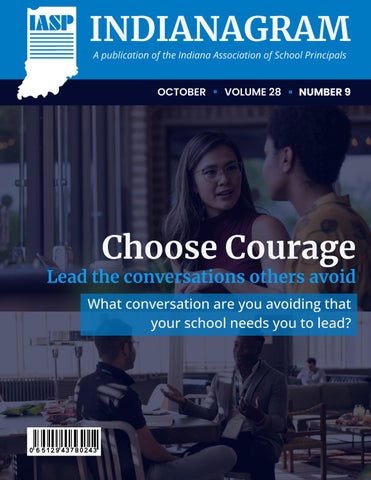
INDIANAGRAM A publication of the Indiana Association of School Principals
OCTOBER
VOLUME 28
NUMBER 9
Choose Courage
Lead the conversations others avoid What conversation are you avoiding that your school needs you to lead?
Indianagram OCT.
President’s Letter
3
LEADER LENS Courageous Feedback that Builds Capacity
5
From the IDOE
6
THE TOOLBOX Lead the Conversations Others Avoid
THE BIG IDEA
High Expectations Are an Act of Care
8 10
STUDENT SPOTLIGHT
Hobart Key Club Cleanup
13
One Skill, Three Ages
14
Riley Kids Caring & Sharing Update
16
LEGAL REVIEW KGR Law Briefing
18
THE LAST WORD From the Editor in Chief
21
VOLUME 28
NUMBER 9
The Indiana Association of School Principals leads in the advocacy and support of all principals in their commitment to every child.
EDITORIAL BOARD MEMBERS Dr. Tiffany Barrett Greg Bodie Kert Boedicker Julie Crone Rick Hunt
11025 East 25th Street Indianapolis, IN 46229 1-800-285-2188 or 317-891-9900 www.iasp.org tbarrett@iasp.org © 2027 Indiana Association of School Principals All rights reserved. Any duplication without prior written permission is strictly prohibited.
President’s Letter 5 CONSIDERATIONS FOR UNCOMFORTABLE CONVERSATIONS 1. Silence Speaks Avoiding conversations never makes them easier. Carrying the need to talk with a team member weighs more heavily than having the discussion. As leaders, we see, hear, and understand the big picture and how much impact the words and actions of students and staff members can have on the entire school's culture. Choosing NOT to have a difficult conversation is its own form of communication to the rest of your team, especially when the issue is well known. Silence speaks volumes, and our strongest staff members notice. For private situations, handle those confidentially behind closed doors. Praise in public; correct in private. 2. Relationships Matter The most compassionate step is to have the conversation. It's not our responsibility to control how the individual handles the information. It's our job to convey it in a professional, clear, and respectful manner. We must ensure the conversation takes place within an open, productive, and positive team culture. Having professional relationships with and valuing each staff member provides the foundation for constructive discussions, even when the topics are difficult. 3. Deliver Clearly Early in my career, I focused too much on making sure I was positive and supportive during these conversations. I did not balance the positive tone with the urgency or importance of the need to change, improve, or move forward on a different path. I learned that being clear, concise, kind, and direct, within the context of a constructive and collaborative relationship, is more effective. Keep in mind that sometimes our news is heartbreaking or difficult for anyone to handle well. In those moments, providing comfort and empathy is essential. 4. Coach, Don't Just Correct There can be different purposes for these types of conversations. Are we simply relaying a straightforward message to change behavior, correct a misstep, clarify an expectation, or address a disciplinary concern, or are we hoping to coach and develop professional growth through the conversation? Simply providing the correct answer or next step isn't always the best approach. Cultivating reflection, developing self-awareness, widening perspective, and strengthening efficacy through dialogue should be the ultimate goal of many of these uncomfortable conversations. Having difficult conversations is one of the best ways we can support others. When the stakes are high, we must lead through discomfort with calm, confidence, compassion, and curiosity, creating safety for others. Standing on this ground, we improve the outcomes for our students and the collective impact of our teams. 5. Look in the Mirror Finally, there are two additional, and equally difficult, conversations to consider. Do we need to have a conversation with a strong teacher or fellow administrator to encourage them to take the next step in their professional journey because of the potential we see in them? Is someone near you doing a great job, but you notice they are plateauing? As leaders, we should always be lifting others up and sometimes nudging them as they launch into new opportunities. Sometimes this means encouraging someone to take a step that ultimately leads to them leaving for a new opportunity or role. This transition is uncomfortable and more work for us, but it's ultimately best when each team member has the ability to thrive and move forward in their careers. How do we intentionally contribute to the success of others? Second, are we able to listen to hard conversations and receive challenging feedback ourselves? When someone tells us something difficult, do we get defensive, or do we receive the information with curiosity and appreciation, admiring the courage it took for them to share it and the care they showed in helping us improve? While starting a difficult conversation is uncomfortable, receiving corrective words probably requires the highest level of vulnerability. What conversation do you need to have today? Don't wait. Book Recommendation Crucial Conversations: Tools for Talking When Stakes Are High by Joseph Grenny, Kerry Patterson, Ron McMillan, Al Switzler, and Emily Gregory
Dr. Bret Bailey
IASP President Principal, Hamilton Heights Middle School
3
Sponsor Shoutout
THE INDIANAGRAM GUIDE Your guide to the sections and stories featured in each issue. Look for the colored labels throughout the publication to find the content that interests you most. THE BIG IDEA Featured leadership story
THE TOOLBOX Practical templates, checklists & resources
PRINCIPAL VOICES Perspectives from Indiana school leaders
TRY IT TOMORROW One actionable strategy
STUDENT SPOTLIGHT Student voice
AI CORNER AI prompt of the month
LEADER LENS Reflection and leadership insights
THE LAST WORD A closing reflection 4
LEADER LENS Michael B. Shaffer Associate Clinical Professor Ball State University COURAGEOUS FEEDBACK THAT BUILDS CAPACITY "This is the best elementary school in the district,” the teacher said. It was January, 2008. I was the mid-year replacement principal, meeting the staff for the first time, at a large urban elementary school that had not made Adequate Yearly Progress in any year since AYP existed. My boss had told me the truth before I walked in: enormous potential, no performance to show for it. I smiled and said something forgettable to the teacher about being eager to get started. What I learned? No school improvement plan, ever. No professional learning built on data — teachers had never examined an ISTEP score. "Collaboration" on the schedule meant common planning time, nothing more. And a phrase I heard more than once: the school used to be good, "before those students came." Pressure mounted that spring — the district desperate to shed its F rating and the stigma of a failed referendum the year before. The superintendent, to her credit, didn't scatter us to conferences. She brought national experts to us. It was the best training I ever received, and it came with teeth: "Show significant improvement." No threats, no fearmongering — just an expectation stated plainly and left there. Teachers started asking each other real questions: How did your students hit that standard when mine didn't? The culture moved from blaming the kids we had to planning for the kids we had. That summer, teachers spent less time decorating classrooms and more time deciding how to reach students who'd been written off. That fall, the superintendent gave every principal a directive nobody had tried before: stand in front of your parents at Back to School Night and show them the data. All of it.
We couldn't fit everyone in the gym, so we split the crowd and ran the presentation twice, teachers lined up behind me both times. I laid out exactly what the numbers said. Then I asked if there were questions. A man in the back stood. He asked what six hundred people were thinking and nobody wanted to say out loud: "Are you saying we're a failing school?" I'd hoped for that question. "Thank you for asking. I've never liked the term 'failing school' — it erases the work of you, your children, and the teachers standing behind me. We didn't meet the state's expectations. That's true. But these are the best teachers I've ever worked with, and here's what we're going to do." Eighteen years later, I still count that as the start of it. Three years later, same format, same teachers standing behind me, we told a different story: an A, the highest scores in the school's history. Parents stood and cheered. I didn't hide the tears nearly as well as I'd have liked. The courageous conversation? Not the one at the microphone. It was every one before it — the ones that made the microphone moment true.
JOIN US!
JOIN US! Assistant Principals Conference
Nov 16-17, 2026 | Sheraton at Keystone Fall Professionals Conference Nov 22-24, 2026 | JW Marriott
5
LEADER LENS
From the IDOE Dr. Katie Jenner Indiana Secretary of Education
ROLLING OUT THE RED CARPET FOR HOOSIER EDUCATORS One of the most meaningful nights of the year every year is the annual Educational Excellence Awards gala. This is a moment to celebrate our schools and the extraordinary educators whose passion and dedication shape students’ lives every single day. Each year, hundreds of guests attend the gala, from teachers, principals, and superintendents…to State Board of Education members and elected officials. So many people with so many unique roles…and the one thing that unites us all is an unwavering commitment to making education better for the students we serve. Many of Indiana’s most innovative, impactful accomplishments are happening because principals are boldly leading the charge. This year, we awarded more than $210,000 to schools and educators across the state, celebrating their powerful work and supporting them as they continue to grow their impact on students. The awards recognized schools that are excelling in key areas such as literacy (science of reading), STEM, high school innovation, community collaboration, and educator professional development. The event also recognized dedicated educators, support professionals, and other key partners whose work is expanding opportunities for students statewide, including: Indiana’s recent Milken Educator Award recipient – Kayleigh Fosnow, principal at New Palestine Elementary; The Indiana National Guard, for their partnership in creating new opportunities for students across the state through bold, innovative collaborations with local schools, including the new Enlistment and Service seals and cybersecurity pathway for students;
Chairman and CEO of First Internet Bank David Becker, for his work to transform student opportunities across the state through creative, forward‑thinking partnerships with local schools, including banking apprenticeship opportunities; and The second annual recipients of the prestigious Blue Ribbon Schools Designation Bethany Christian School – Led by Principals Juanita Hershberger and Lisa Melendez Brown Elementary School – Led by Principal Anne Lesko College Wood Elementary School – Led by Principal Kathy Olseen East Crawford Elementary School – Led by Principal Beth Cave Evansville Christian School Newburgh – Led by Principals Kennan Barnett and Brandon Kline Faith Christian School – Led by Principals Jonathan Lambeth, Cassie Weideman, and Tim Jones Frank H Wheeler Elementary School 4 – Led by Principal Dana Dietz Fred J Hums Elementary School – Led by Principal Jeffrey Yohe Kingsford Heights Elementary School – Led by Principal Holly Wireman Liberty Elementary School – Led by Principal Lisa Gayhart McKenney-Harrison Elementary School – Led by Principal Justin Hoard Memorial Elementary School – Led by Principal Haley Sarkisian Newburgh Elementary School – Led by Principal Kara Hartz Saint Paul Catholic School – Led by Principal Lisa Hughes South Bend Hebrew Day School – Led by Principal Chaya Tabor West Washington Elementary School – Led 6 by Principal Tom Rosenbaum
LEADER LENS Check out the complete list of 2026 Indiana Educational Excellence Awards Gala school/district and teacher recipients below!
Additionally, 19 outstanding educators and support professionals were awarded for the positive impact they continue to make for Indiana students.
Excellence in Community Collaboration Award $20,000 Logansport Community School Corporation
2026 and 2027 Indiana Teacher of the Year Finalists $500 each Andrea Bornino, Klondike Elementary School Martin Briggs, F.W. Crichfield Elementary Kasey Brubaker, Union County High School Derek Chastain, Columbus East High School Megan Cronkhite, West Clay Elementary Matthew Farrell, Harney Elementary School Craig Harper, Carmel High School David Harvey, Huntington North High School L.A. High, Schmucker Middle School Brianne Karazia, Bloomfield High School Cynthia LoGreco, Lake Hills Elementary School Amanda Ray, Custer Baker Intermediate Amelia Shaw, Columbus North High School Kristina Trusty, Hinkle Creek Elementary Samantha Willsey, Bremen Elementary/Middle School
Digital Innovation and Leadership Award - $20,000 Richmond Community Schools Excellence in Math Award - $20,000 Castle North Middle School – Led by Principal John Bertram Excellence in STEM Award - $20,000 William Penn Middle School – Led by Principal Chelsey Thompson Excellence in Literacy Award - $20,000 Caze Elementary – Led by Principal Kendra Renfrow Excellence in College and Career Award - $20,000 Indian Creek High School and Creek Cattle Company – Led by Principal Luke Skobel Enroll, Employ, Enlist Excellence Award - $20,000 Terre Haute South Vigo High School – Led by Principal Timothy Herrin Excellence in Professional Learning and Leadership Development Award - $20,000 Wa-Nee Community Schools Excellence in Innovation Award - $20,000 Eastern Hancock Community Schools and Microcollaborative Operational Excellence Award - $20,000 New Albany Floyd County Schools
2026 and 2027 Indiana Teachers of the Year - $1,000 each Megan Johnson, Central Elementary School Jason Witzigreuter, Homestead High School Indiana’s 2026 RISE Award Honorees - $500 each Josh Goodman, School Resource Officer, Linton-Stockton High School Brenda Sellers, Treasurer, New Palestine Elementary Congratulations to our 2026 recipients, and keep up the great work! As principals, you set the tone for every building, every classroom, every teammate, and every student. Thank you for the important work you lead daily for our communities, our state, and most importantly, our students!
Opening Keynote Speaker Opening Keynote Speaker IASP Fall Professionals Conference Meet our opening keynote speaker, Anne Marie Anderson! Watch the video to get to know the 3x Emmy-winning broadcaster and bestselling author before she takes the stage November 23. Haven’t registered yet? Join us November 22–24! Register today.
7
THE TOOLBOX
Al Remaly Director of Business Development Five Star Technology Solutions
LEAD THE CONVERSATIONS OTHERS AVOID Teacher evaluations are often viewed with a mixture of anxiety, routine compliance, and quiet apprehension. For decades, the standard evaluation process has frequently defaulted to a compliance exercise rather than a catalyst for genuine professional growth. However, when educators and administrators step into these critical moments with intentionality, teacher evaluations can transform from stressful obligations into powerful drivers of professional development and student success. Unlocking this potential requires a foundational commitment: choosing courage over comfort. The theme “Choose Courage” invites both leaders and teachers to approach evaluations not as a passive inspection, but as an active, brave dialogue. True professional growth rarely happens in safe, surfacelevel conversations where praise is vague and constructive criticism is completely bypassed. Real transformation occurs when administrators and educators actively lead the conversations others avoid. The Illusion of Comfort It is natural to crave comfort in the workplace. Delivering hard truths about instructional practices, classroom management, or student engagement can feel uncomfortable. Similarly, receiving critical feedback can feel personal and destabilizing. Because of this, evaluations frequently succumb to the path of least resistance: soft feedback, inflated ratings, and avoided topics. While avoiding difficult topics maintains short-term harmony, it comes at a steep price. It leaves struggling teachers without the targeted support they need to succeed, and it deprives exceptional educators of meaningful feedback that challenges them to reach new heights. Most importantly, avoiding these essential conversations ultimately impacts students, who deserve the highest quality instruction possible. Courage in Action Leading the conversations others avoid requires a mindset shift from judgment to partnership. Courageous evaluation conversations are defined by clarity, empathy, actionable insight, and a willingness to engage in shared inquiry. Courageous Clarity: Courageous leaders create the conditions for honest reflection, speaking with clarity and kindness while remaining open to listening, learning, and shared inquiry. Instead of relying on vague generalizations, they provide specific, evidence-based observations and frame feedback around its impact on learning rather than personal shortcomings. Psychological Safety: Courage is contagious. When evaluators create a safe environment where vulnerability is welcomed, teachers feel empowered to acknowledge their struggles, ask for help, and take intellectual risks in their teaching strategies. 8
THE TOOLBOX Two-Way Dialogue: Evaluation should never be a monologue. A courageous conversation encourages teachers to share their own perspectives, reflect deeply on their practice, and co-create actionable goals for improvement. Transforming School Culture When an educational institution commits to choosing courage in its evaluation process, the entire organizational culture shifts. Feedback stops being perceived as a penalty or a threat; instead, it becomes a valued tool for collective growth. Teachers begin to seek feedback proactively, recognizing honest dialogue and reflection as essential parts of continuous professional growth. Choosing courage does not mean eliminating discomfort. It means leaning into it for the sake of professional growth and student achievement. By stepping up to lead the conversations others avoid, educational leaders and teachers can build a culture rooted in trust, continuous learning, and instructional excellence.
9
THE BIG IDEA Julia Crone Assistant Principal Cascade High School IASP District 8 Vice President HIGH EXPECTATIONS ARE AN ACT OF CARE I’ve often heard the saying that elementary teachers love their students and high school teachers love their content. When I came to a new school last year as an assistant principal, I found teachers who clearly love both. They know their students. They celebrate their successes, worry about their struggles, and invest deeply in their school experience. They also care about their subjects and want students to see the possibilities within them. That combination is a strength. However, it also invites an important conversation: Can our desire to help students sometimes lead us to ask too little of them? When a student says, “This is too hard,” we have a choice. We can step in quickly, supply the answer, or simplify the task. We can also pause, ask questions, provide support, and give the student time to work through the challenge. For instance, when a student stumbles on a multi-step problem or complex passage, the quick rescue sounds like, "Let me break this down and show you how to start step two." Courageous support sounds like, "Tell me what you’ve tried so far, and where the process breaks down." The pencil stays in the student’s hand, and the cognitive heavy lifting stays on their shoulders. That second response can be uncomfortable. We do not enjoy watching students struggle. We know many carry burdens beyond our classrooms. But our care for them must include a commitment to what they learn and the opportunities that learning makes possible. Students deserve opportunities to explain their thinking, defend an answer, revise their work, and wrestle with questions that do not have an immediate solution. They need to experience the satisfaction of doing something they initially believed they could not do. “We can do hard things” becomes meaningful when we provide both the challenge and the support to meet it. As school leaders, we must be willing to engage even our strongest teachers in this conversation. We can begin by recognizing the relationships they have built and asking: Where could that trust help students take greater academic risks? Are students doing the thinking? When we step in, are we helping them move forward or doing the difficult part for them? Are we designing learning that moves students beyond DOK 1 thinking? We must hold ourselves to the same expectation. If we ask teachers to deepen learning, we owe them time, useful feedback, and support. In walkthroughs, observations, and PLC conversations, that means looking beyond whether students are compliant or engaged and asking: Who is doing the thinking? How rigorous is the task? What support allows students to persist without removing the challenge? 10
THE BIG IDEA Accountability belongs in this conversation, too. Following through, responding to feedback, and improving work are skills students need opportunities to practice. Compassion helps us understand barriers and respond thoughtfully while keeping learning at the center. The knowledge and skills students develop in your classrooms help shape the choices available to them. Their access to challenging content, meaningful feedback, and opportunities to grow matters. The conversation may begin with a simple question: Are we giving students enough opportunity to discover what they are capable of? Our love for students should be visible in our relationships, our support, and the depth of learning we invite them to pursue. High expectations, paired with dependable support, are an act of care. Leadership Reflection Questions: Where could existing teacher-student trust help students take greater academic risks? Are students doing the heavy cognitive lifting in the lesson? When stepping in to help, are we scaffolding progress or removing the challenge entirely? Resources Use these PLC activities, conversation starters, and leadership look-fors to bring this conversation into your building and help your team pair high expectations with meaningful support. PLC: Plan a task that challenges and supports PLC: Conversation Starters for Increasing Academic Challenge High Expectations Leadership Look Fors
11
JOIN US! JOIN US! Assistant Principals Conference Nov 16-17, 2026 | Sheraton at Keystone Fall Professionals Conference Nov 22-24, 2026 | JW Marriott
12
STUDENT SPOTLIGHT HOBART KEY CLUB CLEANUP Evelyn Gonzalez I The aftermath of the storm was incredibly noticeable. The park looked horrible at first, and the damage was so severe that most residents lost Wi-Fi for five days. Usually, when the internet goes out, the natural choice is to go outside and enjoy the park. However, the debris made it unsafe. We visited three different parks because we were uncertain about the location, but we all made it into a laughing moment. Five people assisted with the cleanup at Arbor Lane Park in Hobart. The participants were Evelyn Gonzalez, Koryn Wietbrock, Sofia Rocha, Matthew Peterman, Chloe Hosteler, Ryan Soderquist, and Emma McKee. We spoke to Justin, who guided us on where to collect the branches and where to leave them. We left them on the side of the grass near a road so a truck could come in and grab the branches. While we collected the branches, Justin used a chainsaw to cut smaller pieces of a large tree; sadly, the tree fell. We spent a considerable amount of time because of the number of trees.
After a break, we took a group photo. We had intended to go to the same gas station, but due to miscommunication, we accidentally separated and went to different locations. After the break, we resumed the cleanup and completed the task, finding it enjoyable and very rewarding. Thankfully, the Key Club came to clean up the area so no children would get hurt while playing. Right after we finished cleaning, a family arrived to play. Seeing them enjoy the safe space filled my heart with absolute joy! In conclusion, this cleanup highlights how a community can come together to turn a disaster into something beautiful. We truly hope all the residents living near the park are happy with the results. Thanks to the hard work of the Key Club, a hazardous area was transformed back into a vibrant, safe haven for local families to enjoy.
13
STUDENT SPOTLIGHT
Dave Strouse Assistant Executive Director The Indiana Association of School Principals (IASP) ONE SKILL, THREE AGES “Knowing yourself is the beginning of all wisdom.” - Aristotle. More than two thousand years later, that idea still sits at the center of good leadership. October is National Principals Month, a time to celebrate the people who lead our schools, and it is a fitting moment to look at how leadership grows in students and in the principals who guide them. Last month we shared that schools across Indiana are piloting new student leadership lessons built on the School Leader Paradigm. One of the most important design choices behind these lessons is that they are written separately for three grade bands: grades 3-5, 6-8 and 9-12. Leadership is not learned once. It is a set of skills that students return to again, and each time they come back, they are ready to go a little deeper. Take self-awareness, the skill where every grade level band begins. Leaders who understand their own strengths, values and habits make better choices and build stronger relationships. That is true for a nine-year-old and for a principal with twenty years of experience. What changes over time is the depth of the questions students learn to ask. In the elementary grades, leadership starts with noticing. Students learn to name what they are good at, what they care about and how their choices affect the people around them. They discover that leaders are not only team captains and adults.
A student who helps a classmate, listens during group work or speaks kindly to someone who is left out is already leading. At this age, the goal is to give students simple, everyday language for leadership and the confidence that they can practice it. In the middle grades, leadership becomes about authenticity. Middle school is about figuring out who you are, often while feeling pressure to be someone else. Students learn to look beneath the surface, both in themselves and in others. They explore the values and experiences that shape their decisions, practice staying true to those values when it is not easy and learn that every person has a story others cannot see. These lessons help students become more thoughtful friends, teammates and classmates. In the high school grades, leadership becomes a commitment. Students are ready to connect who they are with how they want to lead. They reflect on their values, consider how their decisions affect a team or a whole school, and practice giving and receiving honest feedback. Most importantly, they learn that the real test of leadership is not just saying what you value. It is whether your actions match those values when it counts. Across all three bands, students build the same core habits: knowing themselves, understanding others, making thoughtful decisions and helping shape the culture of the groups they belong to.
14
STUDENT SPOTLIGHT The skill stays the same. The questions get deeper. National Principals Month is a reminder that this growth does not stop at graduation. Principals practice these same habits every day. They notice how their tone sets the mood of a building, reflect on how they respond under pressure, and know when to lead from the front and when to step back and listen. Every day, principals show students what it looks like when a leader's actions match their values. To every principal reading this, thank you. Your willingness to keep growing is one of the clearest lessons your students will ever see.
As the pilot continues, we encourage you to look for places where these skills can grow in your building, whether that is a classroom, an advisory period, a student council meeting or a team practice. Leadership language spreads quickly when the principal speaks it first. Our mission at the Indiana Association of School Principals is All Principals/All Kids. This month, we celebrate the principals who show students, at every age, that leadership begins with knowing yourself.
15
STUDENT SPOTLIGHT Riley Children’s Foundation Youth Philanthropy Team Riley Kids Caring & Sharing RILEY KC&S UPDATE National ranked for the 19th consecutive year! Your school community's philanthropic efforts make an incredible impact on Riley Hospital for Children and children’s health in Indiana. In fact, we have news regarding national recognition that speaks directly to the kind of excellence your generosity helped make possible. Riley Children's Health has once again been recognized among the nation's leading pediatric hospitals by U.S. News & World Report. For the 19th consecutive year, Riley is nationally ranked and remains the #1 children's hospital in Indiana and the only nationally ranked children's hospital in the state. This year, Riley earned national rankings in all 11 pediatric specialties, placing it among just 18 children's hospitals nationwide recognized for excellence across the full spectrum of pediatric specialty care. These results reflect the extraordinary skill and dedication of the Riley care teams, as well as the support of generous donors who invest in the Riley mission. Philanthropic support helps fuel innovation, accelerate research, expand access to specialized care, and ensure more children across Indiana receive the best possible care when they need it most. It's an exciting reminder of what's possible when a community comes together on behalf of kids. Philanthropy resources for your school community’s Riley campaign coordinator In an effort to bring together and rally our Riley PK-12 school fundraising partners we created and shared our first Riley Youth Philanthropy Newsletter last month. Celebrating program impact and highlighting fundraising project ideas, we present program best practice information to help schools connect to the Riley mission and ignite planning for their 2026-2027 Riley fundraising. Please share with your school’s Riley fundraising coordinator. The Youth Philanthropy Guidebook is another helpful resource for your Riley campaign leaders. Why raise funds for Riley? How do we get started? What kind of things can we do to raise awareness and seek donations? Can we get Riley logo buckets for our campaign and how much do they cost? What is a Riley Dance Marathon? What is ExtraLife? What do we do with the money we raise? Who can we turn to for assistance? All of these questions and more are answered in this handy online guide. RCon participants hone leadership skills On September 27th, 131 student leaders and advisors from across Indiana gathered for RCON, our annual leadership conference that kicks off the Dance Marathon year. Through dedicated student and advisor learning tracks, participants explored leadership, communication, fundraising, cause connection, and program sustainability while building meaningful relationships with peers from schools across the state.
16
STUDENT SPOTLIGHT Students engaged in sessions focused on team operations, delegation, communication, peer engagement, and rallying their communities around a shared purpose. Advisors explored best practices for supporting student led programs, including navigating policy changes, identifying opportunities for external support, and understanding when to direct, coach, support, or delegate with their student leaders. Throughout the conference, attendees exchanged ideas, shared successes and challenges, and learned from one another, as well as from mentors representing Indiana's collegiate Dance Marathon programs. Participants also heard from Callista Dillion, Terre Haute South Dance Marathon alumna, 2025 Next Generation Philanthropist, and 2026 Riley Champion, whose story inspired attendees to lead with passion and purpose. The energy throughout the conference was unmatched as students and advisors returned home equipped with new skills, fresh ideas, stronger networks, and a deeper connection to Riley's mission. RCON served as an exciting launch to the year ahead, empowering programs to make an even greater impact in their schools, communities, and for the kids and families at Riley Hospital for Children.
17
LEGAL REVIEW
KGR Law Briefing Séamus Boyce KGR Law
Keith Butler KGR Law
KGR LAW BRIEFING: RESOURCES & HIGH ACUITY BEHAVIOR When pondering terrifying topics for October, we skipped over the cliché: ghosts in the hallways, zombie cheerleaders, and mysterious noises coming from the boiler room. Instead, we landed on what may actually keep school leaders awake at night: receiving notice that a student needs intensive behavioral supports and realizing the cost could dwarf your entire school budget. There are more and more articles about an increase in high acuity student behavior. This tracks with our anecdotal experience when engaging with school leaders. Thus, we thought it would be helpful to explain how schools are funded for special education students including those with high acuity behaviors that need significant behavioral support. Let’s start with what is likely a refresher. The state of Indiana is responsible for providing special education programs under the Individuals with Disabilities Education Act (IDEA) from age three (3) through the school year in which the student turns twentytwo (22), unless the student’s case conference determines the student will leave school earlier, for example graduate from high school. 511 IAC § 7-33-1. This includes the responsibility for public schools to provide students who qualify for special education with a free appropriate public education (FAPE). 511 IAC § 7-33-2(a). Public schools must have procedures to identify and evaluate students in need of special education who have legal settlement within the jurisdiction of the school or attend a nonpublic school within the jurisdiction of the school. 511 IAC § 7-40-1(a). This is true regardless of the severity of the disability. Id. One of the concepts of the IDEA is to the maximum extent appropriate school must educate students with disabilities with their nondisabled peers. This concept is known as educating the student in the least restrictive environment (LRE). 511 IAC § 7-42-10(a). However, part of the LRE concept is to ensure the availability of a continuum of placement options for qualifying students. The available options must include the following: 1.A general education classroom. 2.A resource room (to provide needed services outside of the general education classroom). 3.A separate classroom in a general education building. 4.A separate public or nonpublic nonresidential school or facility. 5.A separate public or nonpublic residential school or facility. 6.A homebound or hospital setting. 511 IAC § 7-42-10(b)(4). Therefore, it is ultimately the responsibility of the public school to provide FAPE to any student regardless of disability severity and regardless of funding from the state. The frightening part for school leaders is that the legal responsibility arrives first and the funding conversation comes second. That legal obligation exists whether the school's budget planned for it or not. Unlike many government programs, there is no annual cap, waiting list, or funding ceiling that allows a school to decline responsibility because the cost is excessive.
18
If the only school/program that could provide FAPE to a student is $1,000,000 per year then that’s what the public school is responsible to pay. The state recognizes that disabilities require greater resources. That's where Indiana's special education funding formula comes in. Indiana provides funding for schools based on the student’s eligibility category on top of per student foundation, the complexity index, and other grants. I.C. § 20-43-7-6. For the 2026-2027 school year, the school receives $11,634 for each student enrolled on December 1 who is eligible for services under orthopedic impairment, severe intellectual disability, autism spectrum disorder, traumatic brain injury, blind or low vision, deaf or hard of hearing, deaf and blind, emotional disability requiring full-time placement, or multiple disability. For students who are eligible under mild or moderate intellectual ability or emotional disability not requiring full-time placement the school receives $2,924 per student. The school receives $3,812 for students in developmental preschool. For communication disorders or students in homebound programs the school also receives $550. As described above, if the case conference determines it appropriate, the school is responsible for students who require intensive support including therapeutic day and residential placements. Indiana can, however, reimburse schools for the “excess costs” of educating students “whose disabilities are of such intensity as to preclude achievement in the existing local public school setting.” 511 IAC § 7-47-1(a). Approved services include a residential program “when services in a residential setting are necessary for the student to benefit from special education.” Id. Additionally, nonresidential services “necessary to enable the student to remain in the community without resorting to residential placement.” Id. These funds come from Indiana’s Special Education Excess Cost (SEEC or S5) fund is a finite amount of money (currently set at $29,070,000) per fiscal year. Once appropriated funds have been exhausted for the fiscal year, additional applications will not be approved. In other words, schools carry a legal obligation to provide FAPE even when the state's reimbursement dollars have run out. IDOE has a manual covering the rules and the application process. Schools are required to pay at least three (3) times the current state average per pupil amount, which is applied per student, before the state will fund excess costs. Think of it like a deductible. Prior to applying for SEEC funds, schools are responsible for researching and exhausting alternative intensive support and other sources of funding. IDOE specifically requires exploring funding through IDEA Part B, Medicaid, Title I, Title IV, McKinney-Vento, FSSA DMHA, DCS, and public health insurance. The school then must get consent from the parent to consult with potential service providers. If a provider is selected, the school must hold a case conference with the parents and chosen provider to develop an IEP to be implemented with the provider. The school cannot enter into a contract with the provider at the case conference. It must have a separate meeting with the provider to engage in the contract.
What is the legal lesson from this breif? If Halloween is about confronting things that go bump in the night, high-acuity placements may be the educational equivalent. Schools face a legal obligation to provide services, must navigate an extensive approval process, and often must commit significant local dollars before reimbursement becomes available. If you have a student with high acuity behavior that needs more support than the school can currently provide, accessing SEEC funds may be important to help cover the expense of appropriately serving the student. But it can also be a nightmare.
Need Help? We at the KGR Legal Help Desk are here to address these and any non-personalemployment legal issues for IASP members. Until the next KGR Law Brief, continue to be fearless leaders! 19
THE WE CONFERENCE IS BACK
Elevate WE Elevate Year two. Brighter than ever, and made for every woman in education.
SAVE THE DATE · FEBRUARY 17–18, 2027 CARMEL, INDIANA · DETAILS COMING SOON
Hosted by the Indiana Association of School Principals 20
THE LAST WORD FROM THE EDITOR IN CHIEF
IASP Executive Committee Dr. Bret Bailey President Dr. Jane Bitting President-Elect
COURAGE IS A LEADERSHIP PRACTICE Leadership asks many things of us, but perhaps one of the hardest is the courage to say what needs to be said. It is easy to lead when the conversation is comfortable, the decision is popular, and everyone around the table agrees. But courage shows up differently in leadership. It appears when we address what others have learned to work around. When we ask the question that may change the direction of the conversation. When we offer feedback because someone’s growth matters too much to remain silent. When we listen to a perspective that challenges our own. Those important leadership moments rarely arrive with a giant flashing sign telling us, This is your opportunity to lead. Instead, they simply arrive, and as they do, we have a choice to make. We choose comfort or courage. We choose avoidance or engagement. We choose silence or a conversation that might make something better.
Duke Lines Vice President Raimeka Graham NPA State Coordinator
The School Leader Paradigm reminds us that leadership begins with the Learning Leader. Our Personal Intelligence calls us to understand our own emotions, values, assumptions, and responses. Our Social Intelligence asks us to understand others and build the relational trust necessary for meaningful dialogue. And our Systems Intelligence helps us recognize that what we repeatedly avoid can eventually become part of the culture we unintentionally create. That is why courageous conversations are not separate from culture building. They are culture building. But courage does not require harshness. In fact, some of the most courageous leaders I know are also the kindest. That is why Brené Brown coined the phrase “Clear is kind.” They have learned that clarity and compassion can coexist. They can hold high expectations while preserving dignity. They can disagree without diminishing. They can tell the truth while making it unmistakably clear that the person sitting across from them still matters. Perhaps that is the kind of courage our schools need most. As you close this issue, consider the conversation you have been postponing. Not the one you need to “win,” but the one that, handled with care, could strengthen a relationship, improve a system, support someone’s growth, or make your school better for students. Maybe courage this month is not doing something bigger. Maybe it is simply refusing to walk around something that leadership is asking you to walk toward. Choose the conversation. Choose clarity. Choose compassion. Choose courage. Lead on, Indiana!
Dr. Tiffany Barrett Editor-in-Chief, Indianagram IASP Assistant Executive Director
21
How can we support you? Indiana Association of School Principals 11025 E. 25th Street Indianapolis, IN 46229 317-891-9900
iasp.org