Meaningful appreciation often flows from the simplest gestures, yet it carries profound consequences. In the rhythm of a school year, we must ask: Do we adequately express gratitude for student growth? Do we acknowledge the steady, quiet support of parents whose partnership outweighs the criticism of a vocal few? Do we recognize the team member who offers the right word at the precisely right moment?
Administrative assistants deserve particular focus. These professionals lead and endure the complexities of leadership transitions, maintaining a steadfast commitment to the district while navigating significant organizational pressure. Their stability ensures the continuity of our mission.
This culture of support extends beyond our hallways to associations such as IASP. Through the leadership of individuals like Todd Bess and his executive team, school leaders receive the programming and guidance necessary to keep student success at the forefront. While a simple "thank you" can feel insufficient, it is frequently the most meaningful response to such consistent influence.
The impact of written and spoken gratitude was evidenced during Plainfield's recent "Recognizing Outstanding School Employees" (ROSE) presentations. With over 3,500 nominations submitted, nearly every one of our 700 employees received a rose and a hard copy of their specific nominations. While the delivery of a rose by the Superintendent and the applause from students are powerful moments, the most lasting impact came from the printed nominating words of a colleague or student.
Our words of appreciation matter. As we conclude another academic year, let us prioritize these gestures of gratitude, recognizing that our collective success is built upon the individual contributions of many.
Andy Allen IASP President
As we enter the final stretch of the school year, May invites us to pause in a way that is both intentional and deeply meaningful. In a profession defined by constant motion, competing priorities, and the ever-present call to serve others, gratitude can sometimes feel like a quiet afterthought rather than a powerful leadership practice. This month, we shift that perspective. Hearts of Gold: Celebrating the Power of Gratitude is not simply a theme. It is an invitation to lead differently
Through the lens of the School Leader Paradigm, gratitude is not a soft skill. It is a strategic leadership move that strengthens each domain of our work. Within the Culture Domain, gratitude builds trust, fosters belonging, and reinforces the shared values that hold a school community together. When leaders intentionally recognize the efforts of their staff, celebrate student growth, and acknowledge the partnership of families, they create an environment where people feel seen, valued, and inspired to give their best.
In the Systems Domain, gratitude becomes a tool for sustainability. When we embed appreciation into our routines, whether through staff shout-outs, student recognition systems, or simple moments of reflection, we create structures that uplift rather than exhaust. Gratitude reminds us that systems are not just about efficiency. They are about people, and the experiences those systems create.
The Learning Domain calls us to reflect, and gratitude plays a critical role in that reflection. As leaders, we are constantly engaged in the Cycle of Inquiry, asking what is working, what needs to shift, and how we grow. Gratitude grounds that process. It allows us to recognize progress, honor effort, and approach challenges with a mindset that is both honest and hopeful.
Gratitude also strengthens our leadership intelligences. It sharpens our interpersonal awareness as we become more attuned to the contributions of others. It deepens our intrapersonal reflection as we consider our own leadership impact. It reinforces our ability to lead with purpose and intention.
As you engage with this month’s Indianagram, I encourage you to think about gratitude not as something you add on, but as something you lead with. Consider how you might intentionally pause to recognize a colleague who has gone above and beyond. Think about the student whose growth may not be captured in a data point but is evident in their confidence and persistence. Reflect on your own journey this year and the moments that have shaped you as a leader.
The work you do matters. The people you lead matter. And the way you choose to acknowledge both has the power to transform your school community.
Let this month be a reminder that leadership, at its core, is about connection. And gratitude is one of the most powerful ways we honor that connection.
With appreciation for all that you do,
Dr. Tiffany D. Barrett Editor-in-Chief, Indianagram
Future Indianagram themes
2025-2026 Themes
JUNE: Best of the Best: A Year to Remember
Share your thoughts on the Indianagram: https://forms.gle/2LaxqTUNUc5AdviF8
IASP Executive Committee Andy Allen President
Dr. Bret Bailey President-Elect
Dr. Jane Bitting Vice President
Dr. Holly Arnold Past President
Raimeka Graham NAESP State Representative
Dave Strouse
NASSP State Coordinator
Kristen Peterson Assistant Principal Liaison
IASP hosts events throughout the year to support the growth and development of Indiana school administrators and students. Each event is intentionally designed to encourage and engage all participants in the pursuit of learning!
Find A Full List Of Events at www.iasp.org/Events
Special thanks to our Sponsors:
From the IDOE
Dr. Katie Jenner Indiana Secretary of Education
Celebrating The Hard Work And Commitment Of Our School Teams
As a Hoosier by choice, I have to say—May is one of the greatest months of the year. From my roots with the Kentucky Derby (southern Indiana still celebrates this!)…to the Indy 500…to graduation season…it is one celebration or festivity after another! Our schools add to the excitement with academic awards nights, band, choir, and orchestra concerts, student art shows, athletic events, and so much more.
It’s also the perfect time to celebrate and reflect on the good work of our school teams over the past year. So, today, let’s take a look back at just a few of the school visits we made this year and highlight the Indiana principals at each of these schools, who are making education better for the educators, parents, and students they serve.
Central
Elementary School, Principal Ryan Setterlof
Last fall, Principal Setterlof helped us pull off what is always one of the biggest surprises of the year. He gathered the entire school for what they thought was a Raise Craze Convocation, celebrating a successful PTO fundraiser for the STEM lab, as well as the acts of kindness students had been practicing. It was the perfect set up to announce Mrs. Megan Johnson as the 2026 Indiana Teacher of the Year. In his recommendation, Mr. Setterlof emphasized how Mrs. Johnson goes above and beyond to build meaningful relationships with students, families, and colleagues that strengthen the learning environment.
New Palestine Elementary, Principal Kayleigh Fosnow
Before winter break, we had another major surprise. We visited New Palestine Elementary School for what most believed was a routine event— including Principal Fosnow herself. In reality, she was about to be completely surprised with the prestigious, national Milken Educator Award…and $25,000! Having started her career in the classroom, Principal Fosnow is intentional
about building trust and connections with students, families, and teachers. She empowers and uplifts teachers, ensures every team member is focused on student learning, and continuously engages parents to maximize student outcomes. She reviews data, celebrates wins, and identifies areas where students need additional support — and the results are clear: students are achieving impressive growth in both reading and math.
Gold Academy, Principal Janica Humphries During Severe Weather Preparedness Week, many schools across Indiana participate in the statewide tornado drill before the spring storm season begins. Many schools also use this week to teach students about different types of severe weather and what to do both before and during a storm to stay informed and safe. This includes Gold Academy in Decatur Township, where we joined Indiana Department of Homeland Security Director Jonathan Whitham to share with their third graders about the importance of planning and practice!
Valparaiso High School, Principal Dr. Verónica Tobón
During a recent visit to northwest Indiana, we spent the morning with educators and students at Valparaiso High School and Porter County CTE— seeing impressive work in life sciences, precision machining, robotics, aviation, and more. We met future teachers who shared what inspires them and how their school is helping them pursue their goals. Valparaiso’s commitment to preparing students for whatever path they choose—enrollment, employment, or enlistment—was evident, especially in how the school honors graduates serving in each branch of the military. It’s clear why Valparaiso is one of Indiana’s Purple Star Schools.
Eastern Hancock High School, Principal Adam Barton
Principal Barton welcomed us to Eastern Hancock High School on the first day back from spring break, which is always an unpredictable day! Students and staff proudly highlighted their growing list of local employer partners.
One-third of their juniors and seniors participate in work-based learning, and they are actively expanding this number through earlier career exploration in elementary school and increasing job-shadowing opportunities for freshmen and sophomores. Students leading the tour shared how valuable it is to experience careers firsthand, including one student pursuing speech-language pathology who said it helped her confidently choose her path forward. We also caught up with Silas, one of our emcees from the 2025 Educational Excellence Awards Gala, who showed us the greenhouse and barn where students grow plants with FFA and learn to care for animals. Many students told us their favorite part of school is studying agriculture starting as early as sixth grade.
Brookview Elementary, Principal Joshua Davis
Our visit to Brookview Elementary combined two of my favorite things: time with students and reading! It was the week before Teacher Appreciation Week, which was the perfect time to remind their third grade students of the importance of sharing their gratitude for the teachers who support them every day. Together, we read the book “Dear Teacher,” a heartfelt thank you letter to our difference-making educators. After the story, the students were eager to ask a number of tough questions, ranging from my favorite author to my favorite playground activity!
Belzer Middle School, Principal Kendra Randle
We recently had the opportunity to visit Belzer Middle School, and their new principal, Kendra Randle! In 2023, Principal Randle earned the prestigious Milken Educator Award, and continues to lead with the same commitment to ensuring that her students are in school and ready to learn each day. Even during the height of ILEARN testing, I had the chance to sit in on a band and orchestra class and hear the latest piece students were working on. As Principal Randle encourages her students to dream big, she continues to dream big herself, and will soon begin her doctoral journey.
These are just a few of the school visits from this past year…and these days are always the best days on the job! I already look forward to hitting the road again next school year!
To all of our Indiana principals: thank you for creating an environment where your staff and students feel valued, supported, and inspired to
reach their full potential. As we move through this final month of the school year, I hope you take a moment to celebrate your incredible teams. The growth happening in your buildings is only possible because of the hard work and commitment of the people you lead. They deserve to be recognized— and so do you.
As always, thank you for all that you do for Indiana students, and have a great, relaxing summer!
From the AP Lens: Appreciation of Others
to Men Club is but one example of this philosophy in action.
Mrs. Kristen Peterson Associate Principal Chesterton High School
IASP Assistant Principal Liason
Mr.
Kris Warner Assistant Principal Newburgh Elementary School
Our May Indianagram theme is Appreciation of Others, and this month, we’re excited to present the amazing work being done at Newburgh Elementary School!
Assistant Principal Kris Warner shares how their Boys to Men Club diligently prepares students who can benefit from developing confidence, responsibility, and strong values. This unique opportunity is a great chance to demonstration appreciation for others, as well as provide a meaningful connection between school and home. Thank you, Kris, for highlighting such a transformative program that has the ability to change lives!
The name Boys to Men likely stirs memories of an R&B group singing love songs in the eighties and nineties, but to two elementary schools in Warrick County, the name creates a positive reaction for different reasons. For Sharon and Newburgh Elementary Schools, where I am the assistant principal, the Boys to Men Club is a program that teaches a small group of fifth grade boys from each school what it means to be a true gentleman. In 2020 at Sharon Elementary, the program was created out of necessity by the male staff in the building. One boy in particular was the target audience, but others were included as it was believed that any student could benefit from the information being taught. In the six years since, the program has morphed into what it is today, and has since been adopted at Newburgh Elementary School as well.
At both schools, we believe when people know better, they do better. We have found that most of the time, misbehavior is not intentional, but rather representative of a missing skill. When students don’t know how to handle a situation in advance of it happening, they are forced to make quick decisions in the moment, which most often results in the student selecting the wrong one. Though there is a benefit in counseling students when they have made mistakes, there is incredible value in preparing students in advance so they don’t have to make them. We believe it is better to be proactive whenever possible. The Boys
The creed for the program is a poem titled “The True Gentleman” by John Walter Wayland written in 1899. It states, “ The True Gentleman is the man whose conduct proceeds from good will and an acute sense of propriety, and whose self-control is equal to all emergencies; who does not make the poor man conscious of his poverty, the obscure man of his obscurity, or any man of his inferiority or deformity; who is himself humbled if necessity compels him to humble another; who does not flatter wealth, cringe before power, or boast of his own possessions or achievements; who speaks with frankness but always with sincerity and sympathy; whose deed follows his word; who thinks of the rights and feelings of others, rather than his own; and who appears well in any company, a man with whom honor is sacred and virtue safe.“ Though the lyrics are written above a fifth grade reading level, what they describe exemplifies the values and character we want to instill in our boys. At the beginning of the program each year, we take the time to translate the eloquent verses into terms that are meaningful to our students. We want them to know this is what we are striving to achieve collectively and as individuals.
We try to keep the size of the group small (ten or less) in an effort to make a deeper connection and impact with the boys participating. We target young men who would benefit from developing confidence, responsibility, and strong values. We start off the year with a team building, service learning activity as a way of developing stronger relationships while learning the importance of giving back. This activity usually centers around building items out of wood that can be used by the school. We have built picnic tables, benches and swings for example. The boys love learning about and using power tools. This is often their favorite part of the program.
The core instruction of our program occurs during the school day. At the beginning of the year, we determine a timeline of the topics and the presenters who will create the lessons. In the beginning, the male staff of the building took turns presenting. In the years since, we have diversified the list of speakers to include female teachers in the school, our SRO, local pastors, and the high school football coach. It has been said that it takes a village to raise a child. This has become our village for our boys.
Around mid-February, we do an evening event called the Dinner Date with Mom. This is an opportunity for the boys to take the adult female in their life out to dinner, which is paid for by the program through fundraising. Leading up to this event, our presenters
teach the boys how to treat a woman, and how to “appear well in any company.” As part of that lesson, the boys learn to tie a tie, which they can wear that night as the attire is Sunday’s best. At the dinner event, we teach the boys and their dates about etiquette, and the importance of good conversation during meals. The event is a great opportunity for the boys to apply the lessons they have learned. The other important aspect of this evening is the opportunity to equip the parents. At Sharon and Newburgh Elementary Schools our desire is to partner with the parents. The challenge is the limited opportunities to meaningfully connect past the point of parents attending sporting events and musicals. Because of this, we are intentional with our time to share insights and wisdom with the parents that have the opportunity to make a quick, and potentially long-lasting impact on their family. The more you can equip and empower the parents, the larger the potential impact you can have on the families.
Through the years, we have witnessed great growth in our students as they continue on into middle school and high school. Obviously the Boys to Men Club is not solely responsible for the positive outcomes, but we are confident it did play a part. From the teachers, to the program assistants, from the custodians, to the coaches, every person plays a role in helping our students reach their potential, and become the best version of themselves. We all need to remember to focus on a student’s potential instead of the challenges they are facing. With educators in their corner believing
in them, and pointing them to a brighter future, they have the ability to overcome seemingly insurmountable obstacles. I know this to be true because I am living proof. If this program was around when I was a kid, I would have been a prime candidate. My dad was one who wouldn’t keep a job, and my wonderful mother came from a past filled with significant trauma. No one in the history of my family had been to college when I graduated from high school. It was only because of the educators and other community leaders that poured into me that I was able to obtain a bachelor’s degree, and eventually a master’s. If it weren’t for them showing me a different path for my future, I wouldn’t be able to write this article today as one of you. It is because of them that my life, and my kids’ lives, are forever changed for the better. I couldn’t have done that on my own. I needed others in my life to reach my full potential. The students in our schools are no different. Many of them are facing challenges that are overwhelming to them, but with your help, they can achieve more than what they even realize is possible. Just as others once changed the trajectory of my life, we now have the opportunity and responsibility to do the same for the next generation.
Leading with Gratitude Through the School Leader Paradigm
Dr. Tiffany D. Barrett IASP Assistant Executive Director Editor in Chief, IASP Indianagram
As we move into May, a season often filled with reflection, celebration, and transition, we are reminded of something deeply human at the core of leadership: gratitude. In the midst of busy schedules, end-of-year responsibilities, and the constant demands of leading a school, it can be easy to focus only on what still needs to be done. This month, we invite you to pause and consider the power of gratitude as a leadership practice.
Within the School Leader Paradigm, gratitude is not an add-on. It is woven into how we lead, how we build relationships, and how we grow ourselves and others. Gratitude strengthens our awareness, shapes our actions, and reinforces the culture we are working so hard to build in our schools. When leaders consistently model appreciation, they influence the tone of the entire organization.
Gratitude lives within each domain of the Paradigm. It shows up in the Culture Domain when we intentionally recognize and celebrate others. It is present in the Learning Domain when we reflect on growth and honor progress. It is grounded in the Systems Domain when we create structures that ensure appreciation is not left to chance but becomes part of how we operate.
As you lead through these final weeks of the school year, here are three actionable steps to embed gratitude into your leadership practice through the School Leader Paradigm.
1. Intentionally Name the Good in Others
In the Culture Domain, leadership is about relationships and trust. Take time each day to recognize something specific in a staff member, student, or team. Move beyond a general thank you and name the action and its impact. This builds clarity, reinforces expectations, and helps others feel seen. Over time, this simple act strengthens morale and deepens connections across your building.
2. Reflect on Growth Through the Cycle of Inquiry
Gratitude is closely tied to reflection. As you engage in the Cycle of Inquiry, pause to acknowledge progress before identifying next steps. What has improved this year? Where have you or your staff
grown in meaningful ways? Naming growth builds confidence and creates momentum. It reminds us that leadership is not just about solving problems, but also about recognizing how far we have come.
3. Build Systems That Sustain Appreciation
In the Systems Domain, effective leaders ensure that important practices are consistent. Consider how you can embed gratitude into your existing structures. This could be a standing agenda item in staff meetings, a weekly staff spotlight, or a simple process for sharing positive feedback. When gratitude becomes part of your systems, it no longer depends on memory or time. It becomes part of your culture.
Gratitude is powerful because it shifts perspective. It allows us to lead with intention, to center people, and to create environments where others feel valued and motivated. As you finish this school year, consider how your leadership can reflect a heart of gold. Not through grand gestures, but through consistent, meaningful actions that remind others they matter.
That is the kind of leadership that lasts.
Lead on, Indiana!
Bringing Up More Than Grades: The Lasting Impact of the B.U.G. Program
Amanda Bagwell Teacher Scottsburg Elementary School
Have you ever heard of the B.U.G.(Bring Up Grades) program? If not, I’d like to briefly share the wonderful benefits and impact this incredible program has had on my students for over twenty years. As an educator, I am so appreciative to have the special opportunity for my students to participate.
The Kiwanis B.U.G. program is invaluable not only to my students, but all 3rd grade students in Scott County Indiana. I’ve worked closely with the leaders of this program since the startup. The program was designed to encourage students to improve their overall academics. Third graders are at a crucial age in their mental development. This age is considered to be so important because students are now capable of goal setting and prioritizing their education.
Local leaders in the Kiwanis program visit my classroom at the beginning of each school year. They give an uplifting pep talk to the children about education. The importance of doing well in school and that hard work is essential are conveyed to students.
The B.U.G. program expectations are then clearly explained. The value of goal setting and academic growth is emphasized. Students learn they must bring up at least one grade in a subject area and not have any grades go down in that same grading period. Students that qualify are then rewarded with a special B.U.G. party at the end of that grading period.
These parties are always a huge celebration of student achievement! Students are greeted by several Kiwanis members and then receive a certificate including applause from their peers and community members. Students receive a cool B.U.G. t-shirt and even get their picture taken. Students are given a small prize and a tasty snack as well. Students beam with pride in knowing that they have met this important goal.
One of the features that I love about this program is the follow up. The Kiwanis leaders once again visit the classroom and encourage students that did not get to participate to work hard and meet this goal the next grading period. The students really want to attend this party. It is a big deal! The last pizza party of the year rewards all students that participated in the B.U.G. program throughout the entire school year. This party once again presses upon students the importance of education. I’ve seen students grow tremendously and work harder in the classroom because of this fantastic program. The B.U.G. program truly has a powerful impact on my students
IDOE Cambridge Math & Science Grant Opportunity
Indiana high schools have a valuable opportunity to expand access to high-quality courses through the IDOE Cambridge Math & Science Grant The application window is May 15–July 17. Click here to learn more.
The Indiana Department of Education has designated $500K in funding to support increased enrollment and improved student outcomes in math and science through Cambridge programs The grant provides up to $25,000 per school for implementation in 2026–27 or 2027–28, including teacher resources, professional development, program and exam fees (up to 3 per student), and implementation support
The Cambridge advantage in Indiana
● Cambridge success benefits both students and schools: Students gain preparation for higher education and career, while schools receive funding
● Accountability: Schools earn accountability points via Cambridge for college and career coursework and Honors Plus Seal via Cambridge AICE Diploma
● Core courses for SAT success: Data from a large district revealed that students taking any one of three Cambridge Advanced core courses show higher first-time SAT scores than their similar peers who did not
● Guaranteed college admission: IN students who earn the Honors Plus Seal with Cambridge AICE Diploma are guaranteed admission at ALL Indiana public colleges and universities
● Guaranteed college credit: Students earn college credit for passing exam grades on Cambridge Advanced exams at ALL Indiana public colleges and universities plus credit, recognition or placement at more than 1,000 U S colleges and universities
Meet with us:
Alan Bernstein, Senior School Development Manager alan.bernstein@cambridge.org
Aaron Mitich, School Development Manager, IDOE Grant Specialist aaron mitich@cambridge org
About Cambridge
Cambridge is part of the University of Cambridge and a global nonprofit education organization providing rigorous curriculum, assessments, teacher training, and instructional resources used in schools across the U S and in more than 160 countries We look forward to partnering with you as you explore how Cambridge can support your charter school’s goals and help you leverage this unique funding opportunity
Lean on Me: An Appreciation for the Principals and School Leaders Who Serve Indiana's Children
Tracy Cadell Assistant Clinical Professor Ball State University
Most people do not fully see what a principal does.
For many adults, the word principal still brings to mind an old image: someone in an office handling discipline or calling home when a student got in trouble. That may once have been part of the job, but it has never been the whole story. Today, principals do work that is broader, harder, and far more personal than many people realize. They are not just managing buildings. They are leading people, strengthening school communities, and responding to the needs that show up every single day.
Across Indiana, principals begin working long before the first bell rings. They are in the hallways, checking on staff, solving problems, and helping the day start well. They notice when a student seems unusually quiet, when a teacher is carrying too much, or when a family needs support. Much of that work happens quietly, before anyone thinks to give them credit for it. By the time most people see the school day in motion, a principal has often already handled several issues no one else will ever hear about.
And in Indiana, no two schools look exactly alike. A principal in a small town such as Rising Sun, Vevay, or Batesville may be dealing with long bus routes, a limited staff, and a community where everybody knows everybody. A principal in Indianapolis, Fort Wayne, Evansville, or South Bend may be leading a larger building with a different pace and a different set of pressures. In either case, the job asks the same thing: know your people, know your community, and help students succeed.
Sometimes the challenges are practical and immediate. In one community, students may arrive
after long rides on county roads before sunrise. In another, families may be juggling shift work, transportation issues, or housing instability. Some schools are growing. Most are trying to do more with fewer people and resources. Good principals understand these realities and respond with steadiness, patience, and good old Hoosier common sense.
The responsibilities are heavy. Principals oversee budgets, evaluate staff, respond to crises, support instruction, manage operations, work with families, and stay on top of state and federal requirements. They also carry the daily pressure of meeting expectations from superintendents, school boards, staff, and families. In many schools, they step in wherever they are needed, whether that means helping at dismissal, covering a classroom, or sitting down with a student who is having a hard day. At their best, they live out that Bill Withers classic, Lean on Me, offering steady support when students, families, or staff need help carrying the load.
Assistant principals deserve just as much recognition. They are often the ones handling the hardest moments of the day: resolving conflict, supporting students, mentoring teachers, and keeping things moving when the building feels pulled in five directions at once. Their work is not always visible to the public, but inside a school, it matters enormously.
School leadership also depends on support beyond one building. The Indiana Association of School Principals (IASP) has played an important role in strengthening school leadership across the state. That matters because this work can be deeply rewarding, but it can also be isolating. Strong
professional communities help principals and assistant principals stay grounded, supported, and connected to others who understand the job.
Of course, no principal does this work alone. Every good school depends on a team: teachers, assistant principals, deans, office staff, counselors, social workers, custodians, cafeteria workers, bus drivers, instructional aides, and others whose work keeps the school going every day. Good principals know leadership is about helping that team work well together, especially on the hard days.
At its best, a school is more than a building. It is a
community. Principals help shape that community every day through the standards they set, the support they offer, and the example they provide.
To the principals and school leaders serving Indiana's children: thank you.
Thank you for the early mornings, the difficult conversations, the unseen decisions, and the steady presence you bring to your schools. Your work matters, even when it feels unnoticed. It strengthens schools, supports communities, and makes a real difference for children across Indiana.
Kids Caring & Sharing Update
Susan Miles
Program Officer, Kids Caring & Sharing TM
Riley Children’s Foundation smiles@rileykids.org
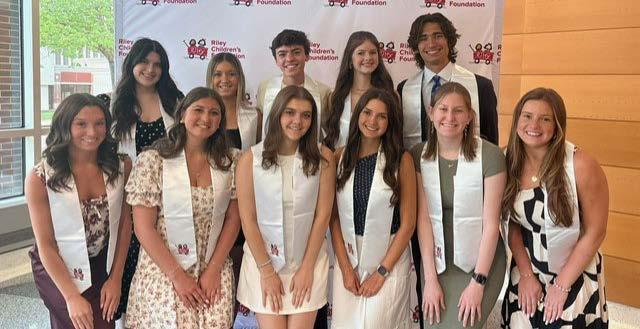
We can’t help but brag about Riley’s 2026 Next Generation Philanthropists
From their earliest forays into helping others through wacky spirit days and sporting events, coin wars and all manner of “thons”, Indiana K-12 students develop valuable leadership skills and citizenship traits that will carry them far beyond their school years.
Riley’s Next Generation Philanthropists are exemplary representatives of the hundreds of high school students who engaged in Kids Caring & SharingTM and Dance Marathon fundraising initiatives during the 2025-2026 school year. They are part of established Riley fundraising programs and play roles in creating new fundraising initiatives. They are Riley kids and Riley family members. They dedicate hundreds of hours toward raising thousands of dollars—all for the children and families who depend on Riley Children’s Health.
Riley Children’s Foundation is proud to announce the 2026 Class of Next Generation Philanthropists. These high school juniors and seniors displayed exceptional leadership and character through their contributions to their school’s Riley fundraising initiatives.
2026 Next Generation Philanthropists
Addison Wright, Carmel High School
Amber Ault, Seymour High School
Ella Bradway, Fishers High School
Ellen Volz, Westfield High School
Emerson Dierkes, Westfield High School
Emma MacDonald, Terre Haute North Vigo High School
Frankie Allen, Edgewood High School
Hadley Klein, Carmel High School
John Cason, Westfield High School
Molly O'Neil, Carmel High School
Samantha Francis, Hamilton Southeastern High School
Will Henning, Hamilton Southeastern High School
Please join us in congratulating these amazing young philanthropists. They are changemakers who will continue to lead us forward.
Riley High School Dance Marathons in April Making it Rain - $425,393.27!
4/02/2026 Norwell High School - $75,815.26
4/26/2026 West Lafayette High School - $8,294.34
4/04/2026 Bloomington South High School$80,563.26
4/10/2026 Herron High School - $21,447.26
4/10/2026 Plainfield High School - $7,809.14
4/11/2026 Delta High School - $15,522.75
4/11/2026 Yorktown High School - $20,733.26
4/12/2026 Bloomfield High School - $28,242.96
4/17/2026 Brebeuf Jesuit Preparatory High School$9639.26
4/17/2026 Terre Haute North Vigo High School$93,219.26
4/17/2026 Franklin Central High School - $6,058.09
4/18/2026 Brownstown Central High School$4,721.54
4/18 2026 North Daviess High School - $13,188,26
4/18/2026 Edgewood High School - $8,549.75
4/24/2026 Elkhart High School - $13,111.62
4/25/2026 Bloomington North High School$18,477.26
The fundraising forecast is bright for Riley kids and families with these Riley High School Dance Marathons on the horizon!
5/01/2026 Cowan High School
5/02/2026 Huntington North High School
5/02/2026 Pike Central High School
5/03/2026 Martinsville High School
5/08/2026 Harrison High School
5/08/2026 White River Valley High School
5/15/2026 Lawrence North High School
5/16/2026 New Palestine High School
5/16/2026 Lawrence Central High School
5/16/2026 Angola High School
Additionally, KCS schools throughout the state are moving into action in the final days of the school year to raise even more money to help Riley Children’s Health advance pediatric research, improve children’s mental and physical health, and make it easier for families to access Riley’s lifechanging care.
Please be sure to have your school treasurers send your Riley gift for 2025-2026 to our secure bank lock box by June 1. Riley Children’s Foundation, P.O. Box 3356, Indianapolis, IN 46206-3356, Attn: Youth Philanthropy
Who is your Riley Champion?
Some children turn their biggest challenges into their greatest strengths.
Riley Champions presented by Kroger is a program that honors Riley patients and families across the state who demonstrate courage and commitment to helping others while navigating medical obstacles.
Nominations for the next class are due no later than June 2, 2026.
KGR Law Briefing
“Top” 10 Mandates from the 2026 Indiana General Assembly Session
In our April article may be past the first of the month, we We’re in the month of May and you are racing to the finish line and maybe – just maybe - thinking about summer plans like enjoying the warm weather at the neighborhood pool, a nice family vacation, and catching up with leisurely reading. On that reading list, you probably should include catching up on the new mandates that our Indiana General Assembly bestowed on you via the 2026 session. But you’re in luck. We have taken the liberty of creating this “top” 10 list of mandates for you to get up to speed on and ensure compliance going into next school year. You’re welcome!
1. Bell-to-Bell Wireless Communication Device (WCD) Policy (SEA 78)
Indiana law now requires you to update and implement your “wireless communication devices” (WCDs) policy to prohibit WCDs during the entire school day, or “bell-to-bell.” “School day” means the entirety of the time a student is present on school property for a student instructional day. The definition for WCD has remained mostly the same from the prior instructional time ban except for a smartwatch being specifically added to the non-exhaustive list of examples. Schools can allow students to bring their own WCDs for instructional reasons until July 1, 2028, after which only school supplied devices will be allowed for instruction. The school must create one of the following policies: (1) a no device policy; or (2) a storage policy pursuant to which WCDs must be (a) stored away, (b) powered off, and (c) inaccessible to a student throughout the school day. Most school leaders have indicated a preference to go the “storage” route, but implementation will be where the rubber hits the road. If a school has lockers for each student, schools are most likely to require storage in the lockers. But what about when lockers for storage is not an option? That’s where start to hear discussion about various approaches. Some will permit storage in bags. Others will attempt to take the I-just-don’twant-to-see approach. Collecting phones in a classroom could be a viable option particularly in elementary schools that have students start and end their days in the same classroom. There is not a one-size-fits-all approach, but you would be wise to discuss and play out practical approaches to implement policy in common hypothetical situations. Like the previous prohibition, there are exceptions if a WCD is included in an IEP, 504, or necessary for the management of a documented medical condition pursuant to an order from a licensed health care provider. There are also exceptions for an “emergency” as determined by
the superintendent as well as if the WCD is necessary for translation for multi-lingual learners when a school device is not accessible.
Schools can, but are not required to, allow an exception for “unobtrusive audio recording devices (UARDs) used solely for notetaking or learning assistance.” UARDs cannot capture or transmit video, must be visible to the teacher, and must be provided for inspection upon request. If you permit UARDs, the policy must prohibit use for disciplinary, evaluative, or supervisory purposes against a student or school employee.
2. Immigration Enforcement Cooperation (SEA 76)
Prior to the passage of SEA 76, a school already had a statutory duty to comply with law enforcement on immigration matters. However, SEA 76 strengthened this mandate. Now both “written and unwritten policies” restricting enforcement of federal immigration laws are prohibited. Enforcement includes activity carried out by a federal, state or local law enforcement agency. The law also specifically adds “gathering information” if the request does not conflict with applicable “federal or state law or policy.” Therefore, compliance with requests to gather information cannot override the rights and protections in FERPA. You would be wise to anticipate requests for information from law enforcement and develop a consistent protocol for response. If what is requested is governed by FERPA and law enforcement has the requisite subpoena or court order, then you’ll need to follow the regulatory requirements of notice to the family. The caveat would be if there is language in the subpoena or court order prohibiting such notice.
SEA 76 gives the Indiana Attorney General’s office greater enforcement authority including the ability to seek from the court enjoining the activity and imposing up to a $10,000 civil penalty. The “knowingly or intentionally” standard for violations was removed. Violations are determined under a strict liability standard rather than including any mens rea standard.
Additionally, as an employer there is a ban on recklessly or intentionally hiring or employing an unauthorized alien. Work eligibility must be confirmed via E-Verify or through industry best practice.
3. Math Mandates ( SEA 239 & HEA 1266 )
SEA 239 adds to your list of “notice” mandates. If the school determines that a student is at risk of not achieving grade level proficiency in mathematics, the school must notify the parents within 15 days.
Séamus Boyce Keith Butler
HEA 1266 has language that effectively requires DOE to change math standards and thus change the math mandates. For K – 5 math standards, schools will be required to provide at least 60 minutes of Tier 1 instruction and 20 minutes of interventions. DOE has been tasked with creating a framework for implementing these interventions.
4. Provide “Good Citizenship Instruction” that includes the “Success Sequence”(SEA 88)
Schools are required to include the “success sequence” as part of their good citizenship instruction. The success sequence means following “research-based actions that data indicates result in economic prosperity: (1) obtaining at least a high school diploma and acquiring additional training in preparation for the workforce; (2) securing full-time employment; and (3) waiting until marriage to begin having children.” There is no specificity on what and where to plug this into class instruction. We’ve heard discussion among school leaders that varies greatly. Some think it would be most appropriate to incorporate into instruction on fiscal literacy in high school. Others have discussed including it in with much of the other “Good Citizenship Instruction” middle school.
5. Patriotic/Civic “Youth Organizations” & Military Access to Students (SEA 200)
SEA 200 mandates schools to allow youth organizations federally recognized under 36 U.S.C. that promote patriotism and civic involvement to meet once per year on a school campus or at a time where the majority of students and families will be present on school property. The organizations are from a federally designated list that includes specifically mentioned organizations such as the Boy Scouts, Girl Scouts, FFA, Big Brothers – Big Sisters of America, and Daughters of the American Revolution.
Additionally, SEA 200 mandates the allowance of military personnel an opportunity to provide information to students in the same manner that the school allows postsecondary institutions.
6. Venue Specific Emergency Action Plans for Sudden Cardiac Arrest (HEA 1004)
HEA 1004 is a very large piece of legislation. One small portion changes the mandates regarding AED placement at school. It requires an operational AED device be included in a venue specific emergency action plan for sudden cardiac arrest developed by the school. As a part of the plan, it also requires inclusion of the number and location of AEDs required to be present at events in which students have an increased risk of sudden cardiac arrest.
SEA 204 attempts to narrow the options to the existing requirement that at least 10% of a teacher’s increase be based on academic needs. Schools are prohibited from applying a factor uniformly across the bargaining unit or blending it with other permitted factors such as experience, degrees, or
leadership roles. While this provision is not effective until 2027, practically this means the differentiated pay increases must be based on defined student-need criteria or to shift compensation decisions into a more explicitly individualized framework. We know the intent of the legislation is to prohibit uniform “retention” bonuses to satisfy the “academic needs” factor.
HEA 1266 also addresses differentiation. It requires a differentiation between all teachers who possess a literacy endorsement versus those that do not. This expands the previous mandate by allowing teachers that voluntarily obtain the literacy endorsement to receive additional compensation even if they are not required by law to get the literacy endorsement.
8. Change to Mandated Alcohol, Tobacco, and Controlled Substance Education (HEA
1004)
HEA 1004 provides flexibility to the alcohol, tobacco, and controlled substance education mandate. Instead of the historic annual mandate, now the education on the topic must only occur at least two times in the range of grades K-8 and one time in the range of grades 9-12.
9. Battery Against School Employees (HEA 1249)
HEA 1249 adds school employees (who work directly with students) to the category of professionals for whom battery offenses carry enhanced criminal punishment. Additionally, schools will now be required to complete a biannual report to the Department of Labor detailing workplace battery incidents, regardless of whether charges were filed. Note that the overlapping employee injury reporting to DOE was repealed.
10. Technology Contracting Requirements (SEA 256)
SEA 256 now requires any contract for technological products or services—including new contracts and any amendments or renewals—include a provision for the contractor to certify that neither the contractor nor any subcontractor is a “prohibited person.” A prohibited person is an individual or entity with certain connections to China, Russia, North Korea, or Iran, or that is listed in 15 CFR 791.4 or IC 1-1-16-8, currently including Venezuela and Cuba. This includes individuals who are citizens of or domiciled in those countries, as well as business entities that are located in or organized under the laws of those countries.
Legal Lesson:
It is always difficult to come up with ideas for “top” mandates because we know you love them all. Regardless, we hope that our list makes the cut for your growing summer reading list, and you are confident going into next school year that you’re not in violation of new mandates gifted by the legislature. Need Help? The KGR Legal Help Desk is available to IASP members for support with these topics and any non-personal employment questions.
Until the next KGR Law Brief, finish the school year strong!