From Principal to Superintendent: A Year of Transition and Gratitude
Life looked a lot different one year ago. Around this time, I was accepting a new role with the Indiana Association of School Principals (IASP) while simultaneously wandering down a road toward a different leadership opportunity: transitioning to a superintendency. Throughout this journey, it has been an absolute honor and privilege to serve as a representative of our positions, our profession, and the IASP.
I am deeply grateful to Dr. Todd Bess, Dr. Bret Bailey, Dr. Holly Arnold, and many others who supported me. Special thanks to Andrew Enderle, IASP Board Member and Principal of Norwell Middle School. In his role as Director of the Indiana Association of Christian Administrators, Andrew introduced me and others to a most beneficial Wednesday morning Bible study. A consistent group of Christian school leaders rooted in faith is a powerful energy source.
Moving into the superintendent role has brought a wave of day-to-day reflections. Now, when I walk into buildings or lead specific meetings, my perspective is reinforced. Being a principal is a true calling. In most cases, it is the most difficult job at the building level. From my new vantage point, I see you clearly:
• The Pace: The relentless, exhausting speed at which you operate every day.
• The Dedication: The body language of wanting to simultaneously help and lead—all while trying to look interested in whatever the Superintendent is rambling on about in a meeting!
• The Commitment: A steadfast willingness to do whatever it takes to help the people in your building succeed.
• The Heart: A genuine care for the schools you serve, the students under your guidance, and the teachers you lead.
Our principals serve a vital, irreplaceable role in our schools.
While my daily duties have shifted, I will remain a member of IASP. I believe in the work led by Dr. Bess and his team to support not only principals, but the vital leadership you represent in your hallways and communities.
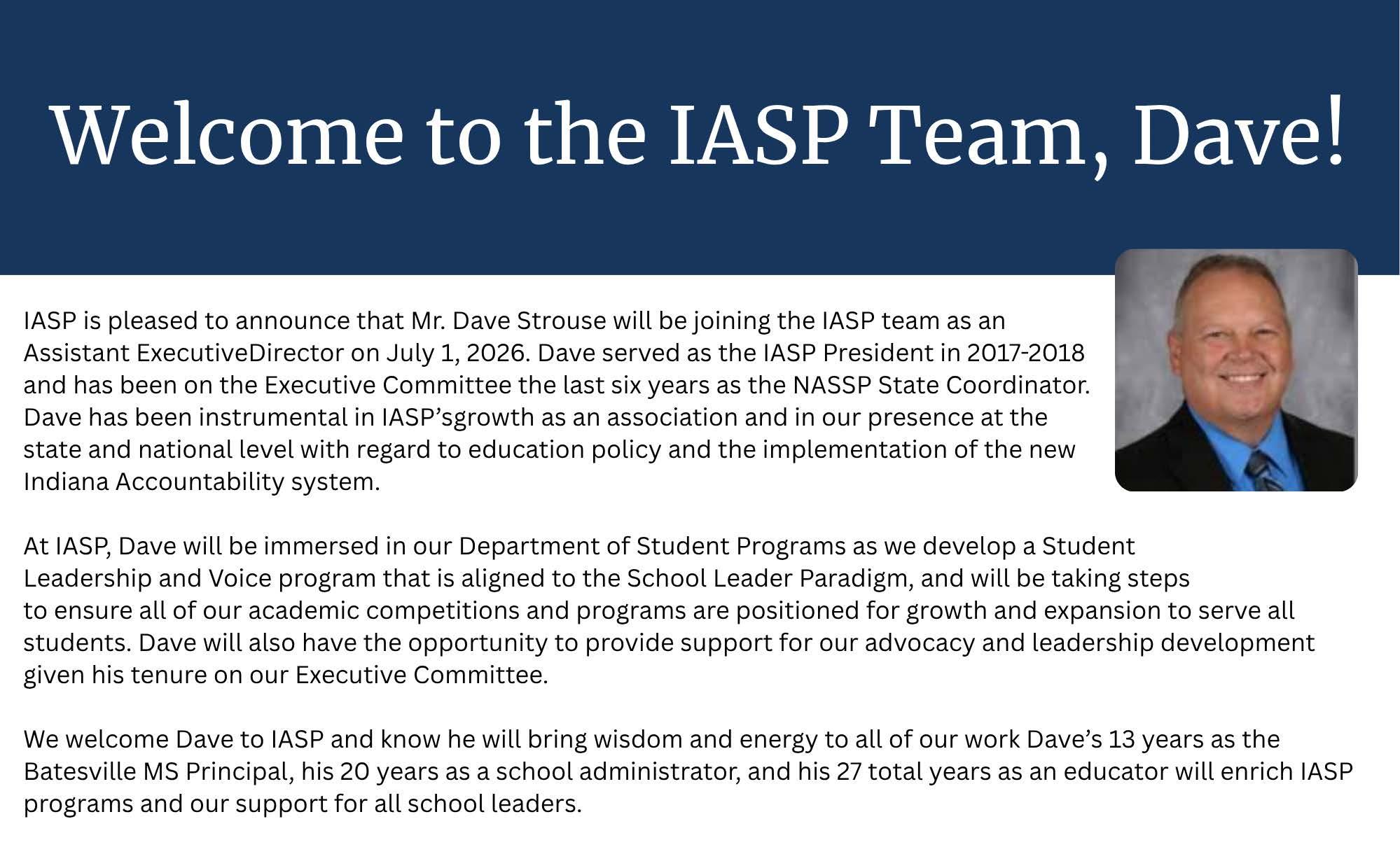
Congratulations to my good friend, Duke Lines, as he begins his tenure on the Executive Board. I also send my best wishes to Dr. Holly Arnold, a dear friend and a colleague I consider a true mentor. Most importantly, I know President Bailey will continue to lead with a servant’s heart, even allowing our newest Assistant Director, and my good friend, Dave Strouse, to attend the summer retreat yet again. Welcome back, Dave.
Most importantly, and thank you seem insufficient, Dr. Todd Bess continues to set the pace for school leadership as IASP remains a leading educational voice both in Indiana and nationally. Thank you for the honor of serving alongside you.
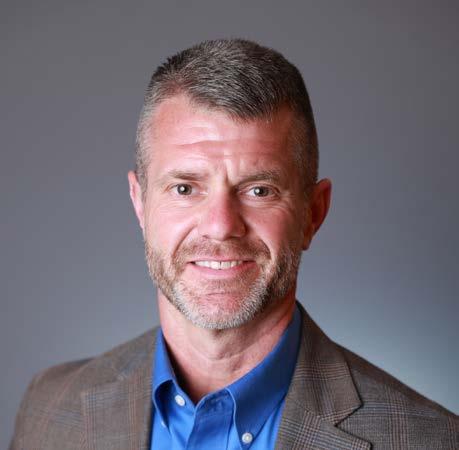
Andy Allen IASP President Superintendent
Plainfield Community School Corporation (317) 839-2578
As we turn the page to June, we find ourselves in a meaningful moment of reflection. The close of a school year always brings a mix of emotions such as pride, gratitude, exhaustion, and celebration. This edition of the Indianagram invites us to pause and truly honor what has been an extraordinary year across Indiana schools.
Throughout the 2025–2026 school year, you have led with purpose, navigated challenges with resilience, and created spaces where students and staff could grow, connect, and thrive. This issue, Best of the Best: A Year to Remember, captures just a glimpse of the impact you have made. Within these pages, you will find stories that highlight innovation, perseverance, and the powerful moments that define great leadership.
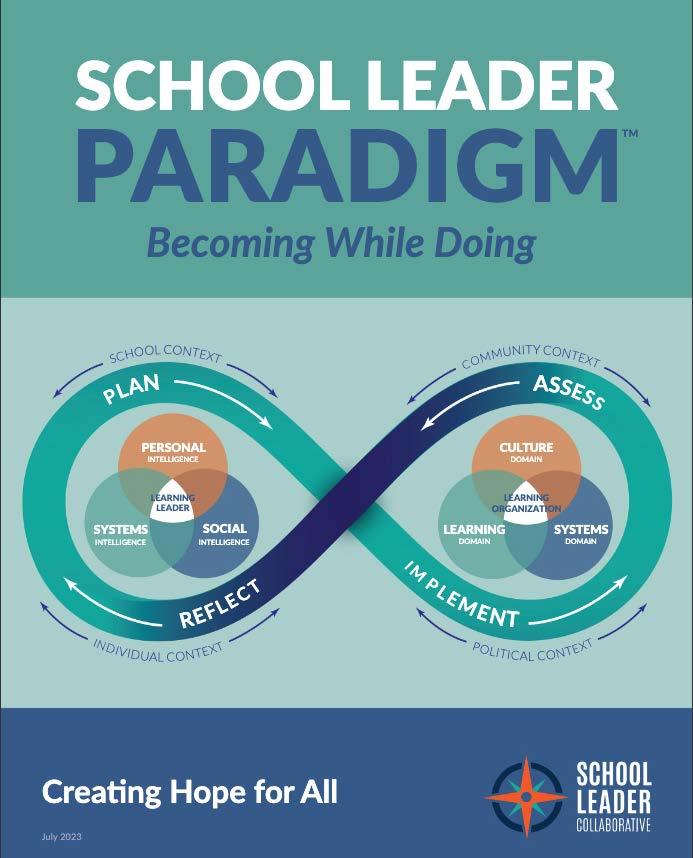
From student achievements and staff successes to creative programs and meaningful community connections, these highlights remind us that leadership is not defined by a single moment, but by the consistent and intentional actions we take each day. Through the lens of the School Leader Paradigm, we see this year not just as a collection of accomplishments, but as a journey of growth across the domains of culture, systems, and learning.
In the Culture Domain, we have witnessed schools intentionally fostering belonging, prioritizing relationships, and creating environments where every student feels seen and valued. In the Systems Domain, leaders have refined processes, implemented new strategies, and responded to evolving needs with clarity and purpose. In the Learning Domain, the commitment to continuous growth has remained unwavering, as educators modeled what it means to be true learning leaders.
What stands out most is not just what was accomplished, but how it was accomplished. Your leadership has reflected the Cycle of Inquiry in action by pausing to reflect, identifying needs, implementing with intention, and adjusting along the way. This continuous process has allowed schools across our state to not only meet expectations, but to exceed them in ways that matter most.
As you read through this issue, I encourage you to celebrate not only the stories shared, but also your own. Take a moment to reflect on the growth within your school, your staff, and yourself as a leader. Consider the small wins that added up to something significant, the challenges that strengthened your resolve, and the moments that reminded you why this work matters so deeply.
June is not just an ending. It is also a bridge to what comes next. The reflections you carry forward will shape your vision, your leadership moves, and the impact you will continue to make in the year ahead.
Thank you for the heart, dedication, and leadership you bring to Indiana schools each and every day. This year has truly been one to remember, and it is because of you.
Here’s to celebrating the best of the best and to the continued journey ahead.
Dr. Tiffany D. Barrett Editor-in-Chief, Indianagram
IASP Executive Committee
Andy Allen President
Dr. Bret Bailey President-Elect
Dr. Jane Bitting Vice President
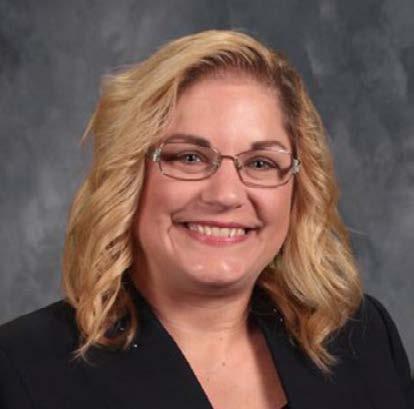
Dr. Holly Arnold Past President
Raimeka Graham NAESP State Representative
Dave Strouse NASSP State Coordinator
Kristen Peterson Assistant Principal Liaison
UPCOMING EVENTS
IASP hosts events throughout the year to support the growth and development of Indiana school administrators and students. Each event is intentionally designed to encourage and engage all participants in the pursuit of learning! Find A Full List Of Events at www.iasp.org/Events
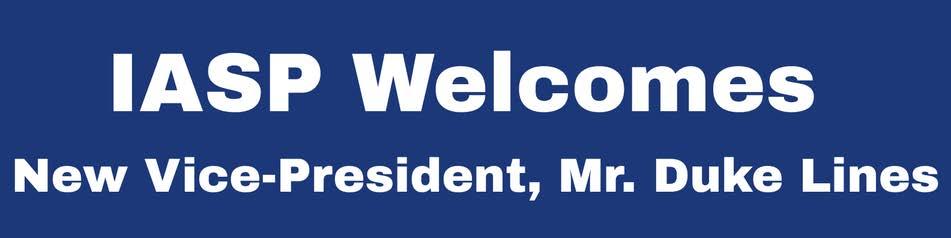
One of the greatest strengths of the Indiana Association of School Principals (IASP) is the dedicated group of school leaders who generously volunteer their time, talents, and expertise to serve members across Indiana . It is our pleasure to officially welcome Duke Lines, Principal of Whiteland Community High School , to the IASP Executive Committee as our newly elected Vice President
In this role, Duke joins a committed leadership team responsible for helping guide the direction of the association through strategic planning, policy development , advocacy, programming, budgeting, and member engagement . The Executive Committee works in close partnership with IASP staff to ensure we continue providing high-quality professional learning, meaningful resources, and strong support for school leaders throughout the state.
Duke has already begun making an impact in his new role. He recently joined members of the Executive Committee at the National School Leader Collaborative Symposium, where organizations from across the country gathered to share ideas, strengthen collaboration, and explore innovative strategies for supporting school leaders. Duke’s willingness to learn, lead, and advocate on behalf of Indiana educators reflects the commitment that defines IASP ’s leadership
On behalf of our members, Board of Directors, Executive Committee, and staff, we extend sincere gratitude to Duke for his service Leadership at this level requires time, dedication, and a deep commitment to advancing the profession. We are fortunate to have him serve in this important role. Please join us in welcoming Duke to the IASP Executive Committee and thanking him for his continued service to Indiana’s school leaders
From the IDOE
Dr. Katie Jenner Indiana Secretary of Education
Celebrating the Best of 2025-2026: Wins from Across Indiana
With the 2025-2026 school year officially wrapped, many of our schools are already gearing up for a strong start to summer learning, particularly in the areas of reading and math. Thank you to our school and district leaders, teachers, and other school staff for an incredible year, and for all the support you will continue to provide throughout the summer!
The start of summer is also a great time to celebrate and reflect on the good work of our school teams over the past year and to consider how we can continue to move the needle for our students. As you read this, remember the important role that you – our principals – play in driving our ongoing, shared success.
Improving Academic Outcomes
■ Expanded Indiana’s science of reading support for educators through the Indiana Literacy Cadre What began with fewer than 50 schools in 2022 has grown elevenfold with more than 560 schools served through Cohort 4.
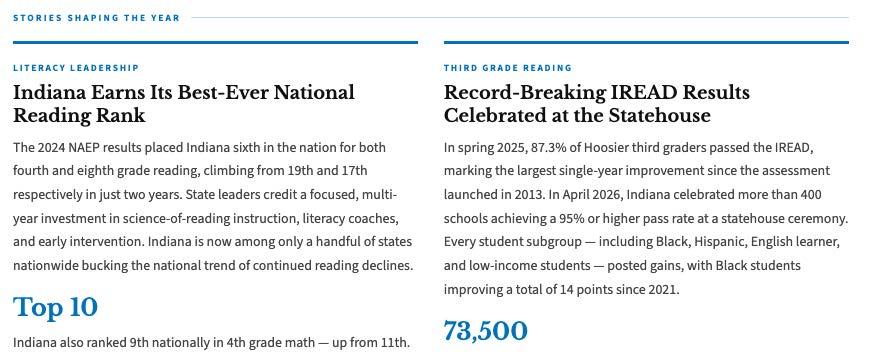
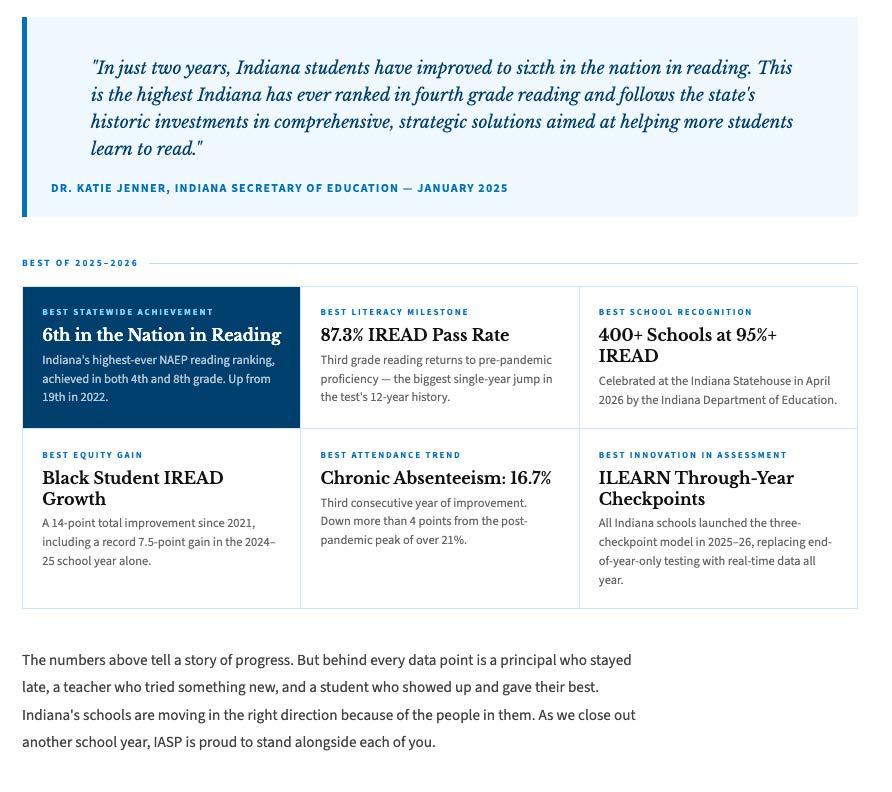
■ Ranked among the best in the nation in reading recovery (6th), according to the Education Scorecard, a national report released annually on district-level student growth in math and reading.
■ For the first time this school year, all schools participated in the ILEARN Checkpoints and shortened end-of-year assessment. In all, over 3 million checkpoints were administered, providing valuable data about where students are and where they may need additional learning support.
■ Continued to grow the number of students receiving free learning support and tutoring services through Indiana Learns, with a total of nearly 280,000 tutoring hours and over 25,000 students served
■ Unanimously adopted a new K-12 accountability model, which prioritizes academic proficiency for all students, while
ensuring the range of knowledge, skills, and experiences that matter for future success are transparently reflected in a school’s accountability grade.
Maximizing the Four Years of High School
■ New, innovative partnerships with higher education, business and industry, and the Indiana National Guard created valuable guarantees for students…just in time for the first cohort earning Indiana’s new readiness seals!
■ All seven of our state’s public colleges and universities and an increasing number of private institutions have guaranteed automatic acceptance for any student who earns the enrollment honors plus seal.
■ Students earning the employment honors or honors plus seal are eligible for direct entry into the Central Midwest Carpenters Union apprenticeship, with similar benefits being developed with Operating Engineers Local 150.
■ The Indiana Career Apprenticeship Pathway (INCAP) officially launched, providing paid, on-the-job training that allows students to apply what they have learned in the classroom through meaningful, real-world experiences.
■ Launched a first-of-its-kind initiative to build a strategic, military-aligned cybersecurity pathway connecting high schools, two- and four-year institutions, the National Guard, and employers, positioning Indiana as a national leader in cybersecurity education.
Celebrating Indiana Educators & Schools
■ Over 400 schools (more than one-third of all schools serving third graders!) were recognized at the Indiana Statehouse for meeting the state’s 95% reading goal on IREAD.
■ 11 schools earned the first-ever Indiana Blue Ribbon Schools designation. Indiana will continue to annually name a new cohort of designees, carrying on the recognition which was previously awarded by the U.S. Department of Education.
■ At the fourth annual Indiana Educational Excellence Awards Gala, many awards were provided to schools and educators in celebration of their work to support student learning, as well as being awarded nearly $270,000 to continue this good work.
■ Megan Johnson, a teacher at Central Elementary School in Plainfield, was named our 2026 Indiana Teacher of the Year.
■ Kayleigh Fosnow, a principal at New Palestine Elementary School, was surprised with the prestigious Milken Educator Award – a national award from the Milken Family Foundation –for creating a strong culture of learning and achievement.
Awards, Recognition, and Investment
■ A combined $75 million investment from Lilly Endowment Inc. and state funding is accelerating literacy, expanding high-quality summer learning, strengthening STEM pathways, modernizing and
THANKS TO OUR SPONSORS
expanding career advising, and sustaining critical learning tools for Hoosier students. This is in addition to the ongoing partnership between Lilly Endowment Inc. and the state of Indiana to invest more than $170 million in literacy.
■ An approximately $10 million grant from the U.S. Department of Education is expanding highimpact literacy tutoring in partnership with the University of Notre Dame.
All of this is possible because of educators (including each of you!), parents and families, as well as industry and community leaders who are working together to maximize opportunities for students.
Let’s continue to celebrate our wins, share our story, and most importantly, keep moving forward…together. As always, thank you for all that you do for Hoosier students, and have a great summer!
From the AP Lens: Best of ‘25-’26
Mrs. Kristen Peterson Associate Principal Chesterton High School IASP Assistant Principal Liason
Mr.
Neftali Sanchez Assistant Principal Frank H. Hammond Elementary
Our theme for May is "The Best of ‘25-’26." Frank H. Hammond Elementary Assistant Principal Neftali Sanchez writes about the growth and meaningful collaboration that occurred at his school this year, and he encourages all of us to pause and reflect on what we have accomplished as well. Neftali’s article includes details about the implementation of “learning walks”, and how that impacted both staff and students. Thank you, Neftali, for your contribution to this month’s Indianagram!
The 2025–2026 school year is coming to a close—and if you’re anything like me, you’re probably wondering how we managed to fit an entire lifetime into 180 school days. Somewhere between the laughter, PLCs, smiles, meetings (the ones that could’ve been emails and the ones that absolutely couldn’t), a few tears, and a whole lot of wins, we made it. And not just made it—we built something really special along the way.
At Frank H. Hammond Elementary, this wasn’t just another school year. This was a year of intention, of growth, and of pushing ourselves into something better. And strangely enough, part of that inspiration came from a place you might not expect: a TV show. Yes, Pitt. Stay with me here.
If you’ve ever seen it, you know it’s centered around a learning hospital—one where experienced doctors are saving lives while simultaneously teaching, questioning, mentoring, and growing the next generation of doctors. It’s fast-paced, it’s messy, and it’s intense. People are learning in real time, in real situations, with real stakes. There’s no “pause and reflect later”—the learning is embedded in the doing.
Now, clearly, no one at FHH was running down hallways yelling for a crash cart (although there were a few moments that felt close), but the core idea stuck: what if our school operated like that? What if we weren’t just a place where students learned, but a place where everyone learned—constantly, collaboratively, and courageously?
That became the goal: to move beyond being a school that teaches, into a true learning school.
Of course, a vision like that doesn’t just happen overnight. It’s built—layer by layer, year by year, with purpose and intention. Before this year ever began, the groundwork had already been laid. Our Instructional Leadership Team (ILT) had been growing and evolving, creating a network of teacher leaders who could help guide and support the work. Our Professional Learning Communities (PLCs) have been strengthened over time—not just as a scheduled meeting, but as a meaningful space for collaboration, reflection, and problem-solving.
And maybe most importantly, we had been working toward something that can’t be forced: trust.
Let’s be honest—having someone walk into your classroom can feel a little like someone reading your group chat out loud without any context. Even when you know you’re doing great things, there’s a vulnerability to it. Over time, though, that shifted. Doors opened. Walls (figurative ones…mostly) came down. What once felt uncomfortable started to feel normal—and eventually, even valuable. That foundation made what happened this year possible.
One of the most powerful shifts we saw was the rise of learning walks. These weren’t “gotcha” moments or checklist observations. They were opportunities. Invitations. Chances to step into each other’s spaces and see the incredible things happening across the building.
And this is where the magic really started.
Teachers began opening their classrooms not just out of obligation, but out of pride and curiosity. Colleagues walked in not to evaluate, but to learn. Questions naturally followed—authentic, thoughtful, and rooted in a desire to grow. “How did you get them to do that?” “What strategy are you using here?” “Can I try this in my room?” We pushed ourselves and we pushed one another to grow.
What started as same-grade teams visiting each other quickly expanded beyond those boundaries. Suddenly, first-grade teachers were stepping into fourth-grade classrooms—not because they had to, but because they wanted to. They were looking for new ideas, new strategies, new ways to reach their students, and as a result , upper-grade teachers found themselves reflecting on their own practices through fresh perspectives.
And yes, let’s acknowledge an important truth:
sometimes the learning wasn’t just about instruction. Sometimes it was about that perfectly organized library corner, that anchor chart that somehow made everything click, or that bulletin board that made you think, “Okay, I’m absolutely trying that next year.” Growth comes in many forms—and sometimes it’s laminated.
These learning walks became more than a strategy. They became a reflection of who we are becoming as a staff: open, collaborative, and committed to getting better together.
And somewhere along the way, something shifted.
Conversations got deeper. Collaboration became more natural. Questioning what was happening no longer felt like a personal attack. The idea of “my classroom” started to evolve into “our school.” There was a shared sense of ownership—not just over outcomes, but over the process of getting there.
As we close out this year, it’s important to pause and recognize what we’ve built together. Not just the measurable outcomes, though those matter. Not just the systems and structures, though those are important. But the culture.
A culture where people feel safe to try, to fail, to ask questions, and to grow.
A culture where doors are open—literally and
figuratively.
A culture where we show up for each other, even on the hard days.
Because there were hard days. Days when the energy was low, when the challenges felt big, and when the todo list didn’t seem to end. But even on those days, this team showed resilience. You showed up. You kept going. And you did it together.
That’s what makes this place special.
So as we head into summer, I hope you take a moment to reflect—not just on what you did, but on what you were a part of. The laughter in the hallways. The small victories in the classroom. The conversations that sparked new ideas. The risks that led to growth.
Thank you for your dedication, your flexibility, your sense of humor, and your commitment to our students and to each other. Thank you for leaning into something new, even when it felt uncomfortable. And thank you for helping turn this vision into a reality.
This year may be coming to an end, but what we’ve built is just getting started.
Closing Strong, Leading Forward: Reflecting on a Year of Impact
Dr. Tiffany D. Barrett IASP Assistant Executive Director Editor in Chief, IASP Indianagram
As the school year comes to a close, June offers us something we rarely give ourselves during the pace of the year—time to reflect. Not just to check a box or wrap up responsibilities, but to truly consider what this year has meant for you, your staff, and your students.
The 2025–2026 school year has been filled with moments worth celebrating. You have led through challenges, created opportunities, and made decisions that have shaped the experiences of those you serve. While the big milestones stand out, it is often the small, intentional leadership moves that have had the greatest impact.
Through the lens of the School Leader Paradigm, this is the time to pause and recognize that your leadership journey is not defined by isolated events, but by continuous growth across the domains of culture, systems, and learning. Reflection allows us to carry forward what worked, refine what did not, and enter the next school year with clarity and purpose.
As you think about your own “best of the best” moments from this year, here are three actionable steps grounded in the School Leader Paradigm to help you close the year strong and prepare for what comes next.
1. Capture and Celebrate What Worked (Culture Domain)
Take intentional time to identify and celebrate the practices, traditions, and moments that positively impacted your school culture. This could be a program that increased student engagement, a staff initiative that strengthened morale, or a simple routine that built stronger relationships.
Make this visible. Share these successes with your staff, your students, and your community. Consider creating a short reflection or highlight summary that captures these wins. When people feel seen and valued, it strengthens the foundation you will build on next year.
2. Refine One System for Greater Impact (Systems Domain)
Rather than trying to fix everything at once, choose one system that could be improved for greater efficiency or effectiveness. This might be communication structures, student support processes, or staff collaboration routines.
Use the Cycle of Inquiry to guide this work. Reflect
on what is currently happening, identify a clear area for improvement, and determine one actionable adjustment you can implement moving forward. Small, focused changes often lead to meaningful results over time.
3. Commit to Your Next Learning Move (Learning Domain)
As a leader, your growth sets the tone for your entire school. Take a moment to reflect on your own leadership this year. Where did you grow? Where do you want to grow next?
Identify one specific area of focus for your continued development. This could be deepening your instructional leadership, strengthening your ability to have difficult conversations, or expanding your understanding of student needs. Seek out a resource, a mentor, or a learning opportunity that will support this goal. When you model continuous learning, your staff is more likely to do the same.
As you close out this year, give yourself permission to feel proud of the work you have done. Leadership is complex, and the impact you make is often felt long after the moment has passed.
June is both a closing and a beginning. The reflections you take time to consider now will shape the leadership moves you make in the year ahead. Carry forward the lessons, the successes, and even the challenges, knowing they have all contributed to your growth.
This has truly been a year to remember.
Read the Paradigm
Some Indiana Highlights Throughout the Year!
Best Overall Outcome
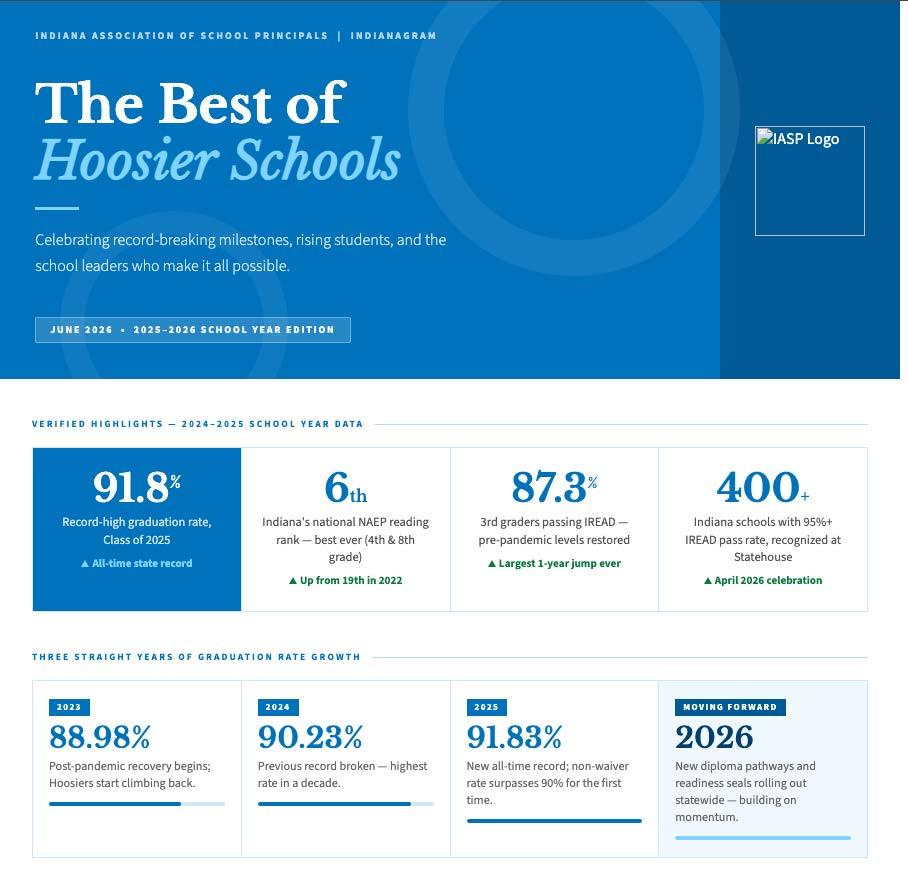
Graduation Success at an All-Time High
Indiana students achieved the highest graduation rate in state history.
Nearly 92 percent of Indiana’s Class of 2025 graduated, marking the third consecutive year of improvement and a 1.6 percentage point increase over the previous year.
Graduation rates increased for every student group statewide, including Black students, Hispanic students, English learners, students with disabilities, and students from low-income households.
Even more encouraging, the percentage of students graduating without waivers exceeded 90 percent, signaling stronger postsecondary readiness across the state.
[in.gov], [indianacap...onicle.com]
Best Academic Growth Story Math Gains Continue While Literacy Efforts Take Hold
Indiana students continued to show growth in math proficiency this year.
Statewide, 42.1 percent of students in grades 3–8 met or exceeded math proficiency standards, representing an increase of more than five percentage points since 2021. Several student groups experienced yearover-year math gains, including Black and Hispanic students and students receiving free or reduced-price meals.
While English and language arts performance remained relatively stable overall, third grade literacy showed the strongest gains, reflecting the long-term impact of early literacy investments and focused instructional strategies.
[in.gov], [wrbiradio.com], [indianacap...cle.com]
Best Attendance Turnaround More Students Showing Up and Staying Engaged
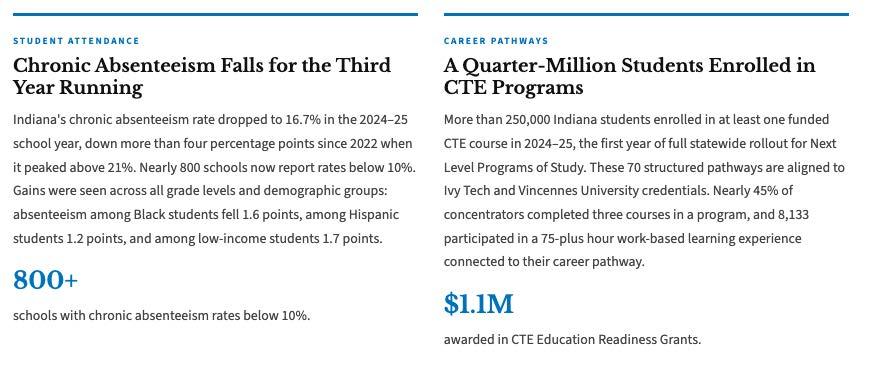
For the third straight year, Indiana reduced chronic absenteeism.
During the 2024–2025 school year, the statewide chronic absenteeism rate dropped to 16.7 percent, down more than four percentage points from its post-pandemic peak. Attendance improved across all grade levels and student groups, and nearly 800 schools reported absenteeism rates under 10 percent
Attendance continues to be closely linked to improved literacy, math performance, and college readiness scores, underscoring the power of consistent student engagement. [in.gov], [indianacap...onicle.com]
Best Credit Before Graduation Dual Credit Expands Opportunity
Best College and Career Momentum CTE Participation Reaches New Heights
Career and Technical Education continues to thrive in Indiana schools.
During the most recent school year, more than 250,000 Indiana students enrolled in at least one funded CTE course, reflecting sustained growth and strong demand. Nearly 45 percent of participating students became CTE concentrators, completing three or more courses within a program of study. Among CTE concentrators, one-third earned nine or more dual college credits, and thousands completed work-based learning experiences aligned to high-wage, high-skilled career pathways.
[cdn.learnm...ndiana.org], [wjts.tv]
Indiana’s dual credit ecosystem continues to give students a head start.
Thousands of high school students earned college credit at no cost through partnerships with Ivy Tech, Indiana University, and other postsecondary institutions. Programs like the Advance College Project alone enrolled more than 20,000 Indiana students this year, providing early college exposure and measurable cost savings for families. [acp.iu.edu]
Summer Recharge Mode: Activated!
As the school year winds down and summer begins, we want to encourage all of our incredible Indiana school leaders to take a well-deserved breath, soak up some sunshine, spend time with family and friends, and recharge for the exciting year ahead.
To support that summer reset, there will be no new editions of the Indianagram and no new podcast episodes released during July. We believe rest matters, and school leaders deserve time to reflect, renew, and refresh.
But don’t worry... there is still plenty of leadership inspiration waiting for you all summer long!
Take some time to revisit past editions of the Indianagram, conference resources, and other IASP publications through our publication library at IASP Publications Library
Looking for something to listen to while traveling, relaxing by the pool, walking the dog, or enjoying a summer drive? Explore previous episodes of both the IASP Leadership Podcast and the IASP Advocacy Podcast at IASP Podcasts.
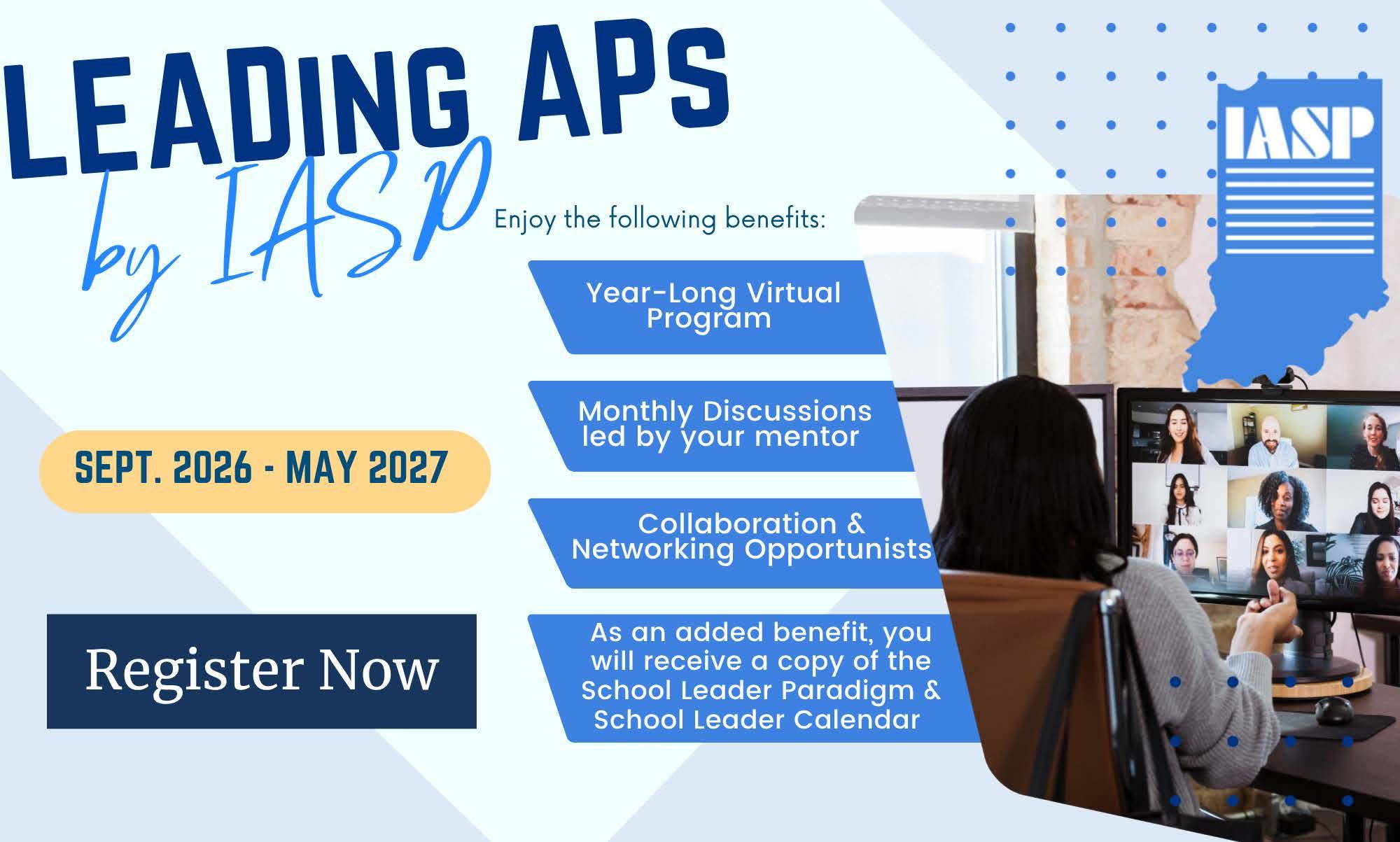
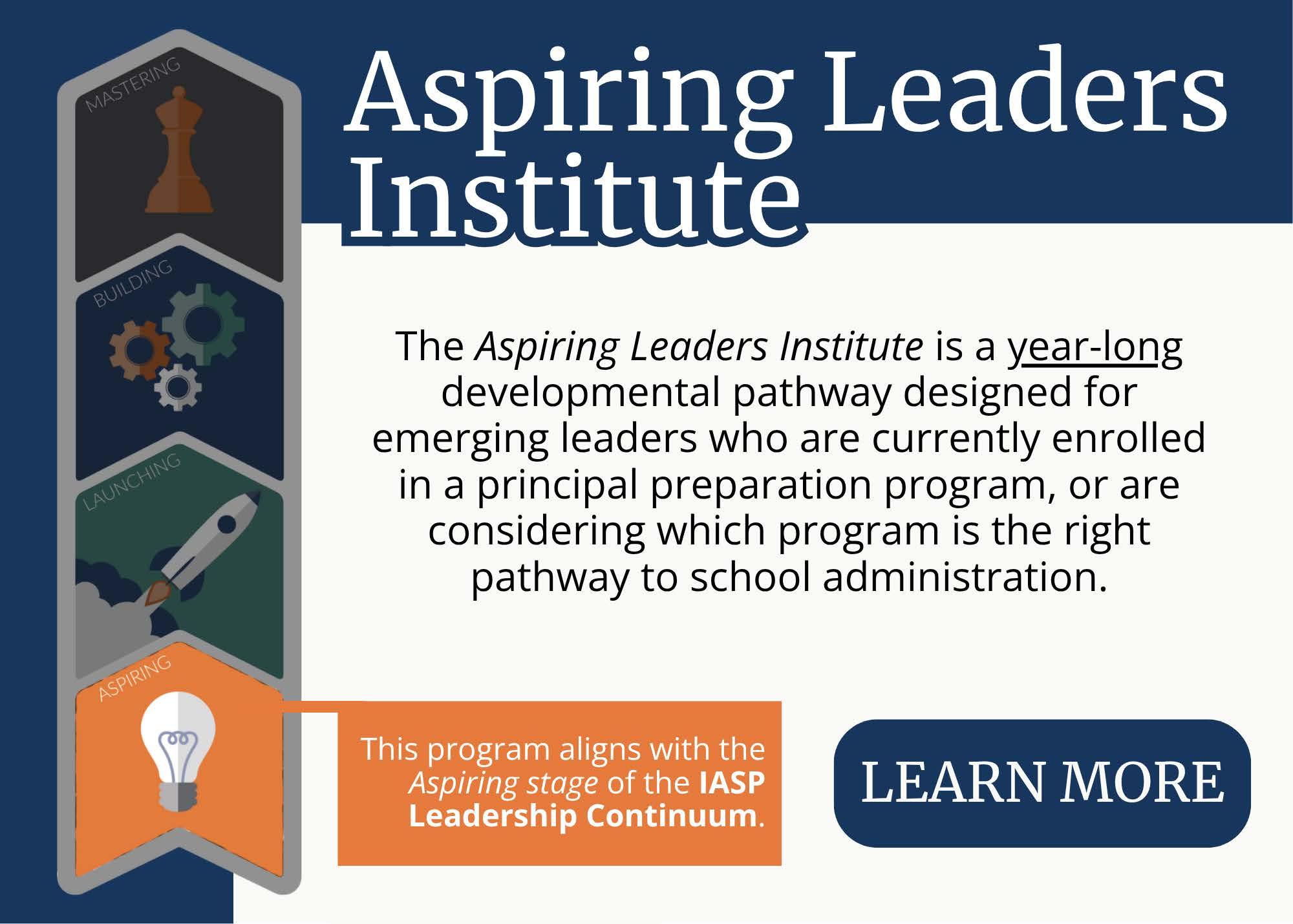
Summer is also the perfect time to explore our newly redesigned website, discover upcoming conferences and leadership programs, and begin planning your professional growth journey for the upcoming school year. Visit IASP Website to learn more about submitting a conference proposal, INALI, IPLI, LEADing APs, Aspiring Leaders, conferences, resources, and so much more.
Thank you for another incredible year of leadership, service, and impact across Indiana schools. We cannot wait to reconnect with you in August for another exciting year of learning, growth, and leadership together.
Until then... relax, recharge, and LEAD On Indiana!
Some Indiana Highlights Throughout the Year!
Best College Access Win FAFSA Completion Goal Achieved
Indiana officially met a long standing postsecondary access goal.
Approximately 60 percent of Indiana high school seniors completed the FAFSA for the 2025–2026 school year, meeting the statewide target for the first time. The state ranks among national leaders in FAFSA completion, and more than 72 percent of 21st Century Scholars filed, unlocking millions of dollars in federal and state aid.
This milestone reflects the impact of sustained school-level outreach, counseling support, and family engagement statewide.
[in.gov], [dailyjournal.net]
Best Big Picture Takeaway Confidence, Progress, and Purpose
What stands out most from this school year is not just one statistic or program. It is the consistency of growth and the breadth of success.
Indiana schools are graduating more students, keeping more students engaged, expanding paths to careers and college, and building momentum that reaches well beyond test scores. These outcomes reflect dedication at every level, from classroom teachers and principals to counselors, support staff, and community partners.
The best of Indiana schools is not a single achievement. It is the collective progress made every day on behalf of students.
Best of the Best: A Year to Remember Celebrating the Moments that Defined 2025–2026
Each June, we are given a rare and important opportunity to pause. Not to plan. Not to problem solve. But to reflect.
The 2025–2026 school year has been filled with moments that matter. Moments that shaped students, strengthened staff, and defined leadership across Indiana. While no single page can capture all that has taken place, this “Best of the Best” is a celebration of the impact we have collectively made.
Best in Growth
Across Indiana, schools have continued to prioritize early literacy, and that focus is making a difference. Many schools across the state once again reached high levels of success on IREAD, reflecting strong instructional practices and a deep commitment to ensuring every student can read.
Behind those results are teams of educators who collaborated, adjusted, and stayed focused on what matters most. Growth did not happen by chance. It happened through intentional leadership.
Best
in Student Success
This year, students across Indiana continued to show resilience and determination in their learning. Whether in the classroom, on the stage, on the field, or in leadership roles, students stepped forward in meaningful ways.
Graduation celebrations, academic milestones, and personal achievements all tell the same story. When students are supported by strong systems and caring adults, they rise.
Best in Innovation
Schools across our state embraced new ideas and strengthened existing practices to better serve students. From expanding career-connected learning opportunities to integrating technology in purposeful ways, leaders found ways to move forward while staying grounded in what works.
Innovation this year was not about doing more. It was about doing what matters better.
Best in Culture
Perhaps the most powerful stories from this year are found in the culture within our schools.
In classrooms where students felt safe to take risks.
In hallways where relationships were built one conversation at a time.
In staff cultures where support, trust, and shared purpose created something special.
These are the moments that define a school experience, and they are a direct reflection of intentional leadership.
Best in Resilience
Every school year brings its challenges, and this year was no exception. Yet time and again, leaders across Indiana responded with flexibility, problem-solving, and a commitment to doing what is right for students.
Resilience was not just demonstrated. It was lived out daily in decisions, actions, and unwavering dedication.
Best in Leadership
At the heart of every success story this year is leadership.
Through the School Leader Paradigm, we are reminded that great leadership is not one-dimensional. It is the balance of culture, systems, and learning working together to create meaningful outcomes.
You have led that work.
You have built relationships that matter.
You have strengthened systems that support.
You have modeled learning that inspires.
And because of that, schools across Indiana are stronger.
A Year to Remember
As you reflect on this year, take time to consider your own “best of” moments.
The student who found their confidence.
The staff member who stepped into leadership.
The challenge that pushed you to grow.
The decision that made a lasting difference.
These moments may not always be recognized publicly, but they are the foundation of great schools.
Looking Ahead
While this issue celebrates the past year, it also points us forward.
The work you have done this year becomes the starting point for what comes next. The relationships you have built, the systems you have refined, and the learning you have embraced will carry into the year ahead.
Because of your leadership, Indiana schools continue to move forward with purpose.
This has truly been a year to remember.
Building Leaders One Stripe at a Time: Inside the TIGERS Program at Harney Elementary School
Rachel Nyguyen Teacher
Harney Elementary School
Breanna Julien Teacher
Harney Elementary School
At Harney Elementary, leadership doesn’t begin in middle school or wait until adulthood, it starts now. Through the school’s TIGERS program, fifthgrade students are stepping into meaningful roles that shape both their character and their school community.
TIGERS Leader isn’t just a title; it’s a mindset! The acronym represents Lebanon Community School’s core values that students strive to embody each day: Teamwork, Integrity, Growth Mindset, Empowered, Responsible, and Supportive. We use these principles to guide our students as they become role models for younger peers and leaders within the building, while also following them to middle and high school.
In past years, Harney proudly implemented the C.L.A.S.S. program where we recognized student leaders as Ambassadors. These students represented their school with pride and responsibility, teaching and modeling lessons on various “Lifelines”. As the district has embraced a more intentional, positive behavior approach, we at Harney have thoughtfully evolved this leadership model into what is now TIGERS Leaders.
This shift reflects more than just a name change. By aligning with a shared district focus and adopting the TIGERS acronym, the program brings clarity, consistency, and a renewed sense of purpose to student leadership. It honors the foundation built through C.L.A.S.S. and Ambassadors, while expanding opportunities for students to actively practice and model positive behaviors in everyday school life.
A signature component of our TIGERS program is its six student-led, schoolwide convocations held throughout the year. We call them Cub
Connections. A time where our entire school, students and faculty come together to watch our leaders in action. Each celebration spotlights one TIGERS trait, bringing the values to life in ways that are engaging, memorable, and meaningful for all students.
During these assemblies, TIGERS leaders literally take center stage. They guide the school in understanding what each trait looks like, sounds like, and feels like in a real school setting. Through creative skits, students model both positive choices and learning moments, helping their peers clearly see what it means to not just say the TIGERS values, but to live them.
In each celebration, we also include a special moment of recognition, where students nominated by their teachers are honored for demonstrating the highlighted trait. This recognition reinforces that positive behavior is seen, valued, and worth celebrating within the Harney House.
To bring even more energy and connection, every one of our celebrations introduces a fun, schoolwide challenge, encouraging students and teachers to work together toward a shared goal. Whether it’s acts of kindness, teamwork challenges, or growth mindset goals, these experiences help build a sense of unity and excitement across the entire building.
The impact of these experiences is clear; not just in the leaders themselves, but in the students watching them. After a recent convocation, one fourth-grade student excitedly shared, “Wow, I think I do want to be a TIGERS Leader next year! ” It’s a simple statement, but one that captures the heart of the program: inspiring the next generation of leaders.
We intentionally built that sense of continuity is into our TIGERS Leaders program. At the end of the year, our fifth-grade leaders take time to reflect on their experiences and write letters to the future TIGERS Leaders who will take their place. In these letters, they share advice, encouragement, and what it truly means to lead with integrity and heart. It’s a meaningful tradition that connects one group of leaders to the next, ensuring that the values of TIGERS continue to grow stronger year after year.
Teachers and staff at Harney have seen firsthand how the TIGERS program transforms students. Quiet students find their voice. Hesitant learners step into leadership roles. And groups of individuals grow into a unified team that takes pride in making a difference.
Our program also reinforces a growth mindset,
encouraging students to learn from mistakes and continue striving to improve. TIGERS leaders understand that leadership isn’t about being perfect, it’s about being willing to grow, reflect, and lead by example.
Perhaps the most inspiring part of TIGERS is the culture it creates within the school. Leadership becomes something to aspire to. Younger students look up to TIGERS leaders and begin to imagine themselves in those roles one day. The ripple effect is undeniable, one group of student leaders helping to shape a positive, supportive school environment for all.
At Harney Elementary, the TIGERS program proves that leadership isn’t about age, it’s about action. And these students are showing every day what it means to lead with heart.
Indiana Principals Leadership Institute (IPLI): Investing in the Leaders Who Shape Indiana Schools
By Dr. Tiffany D. Barrett, Assistant Executive Director, Indiana Association of School Principals
Across Indiana, principals and assistant principals are leading through increasing complexity while balancing the needs of students, staff, families, and communities. Great school leaders do far more than manage buildings. They shape culture, strengthen instruction, support teachers, and create environments where students thrive.
School leaders are expected to carry tremendous responsibility while navigating daily challenges that often extend far beyond the school day. Supporting and retaining strong educational leaders has never been more important. That is why the Indiana Principals Leadership Institute, otherwise known as IPLI, continues to matter.
For years, IPLI has served as one of Indiana’s premier leadership development experiences for principals and assistant principals. Grounded in the Indiana Association of School Principals’ School Leader Paradigm framework, IPLI has been intentionally redesigned to strengthen leadership capacity, improve student outcomes, and create a statewide network of reflective and collaborative school leaders.
What Is IPLI?
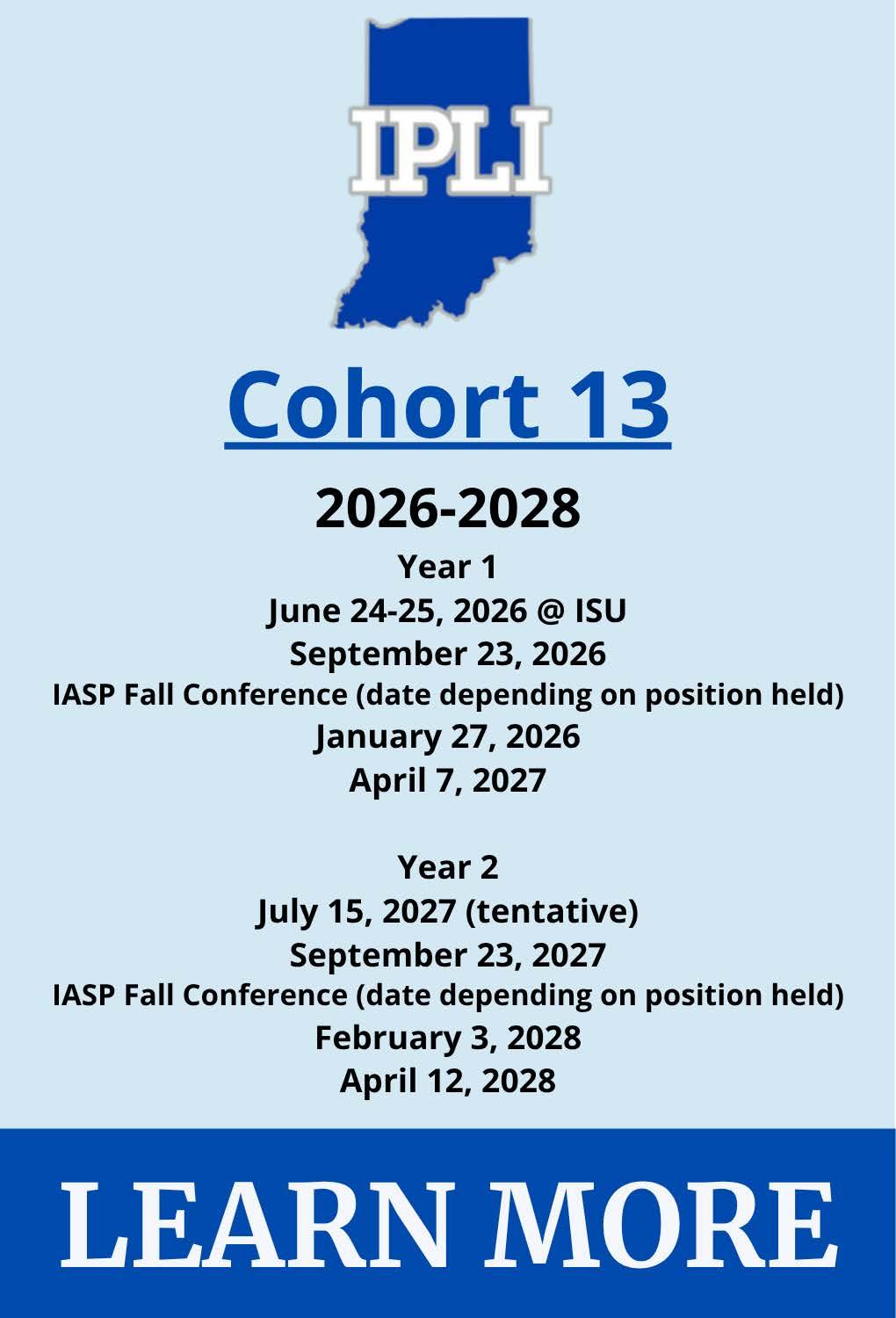
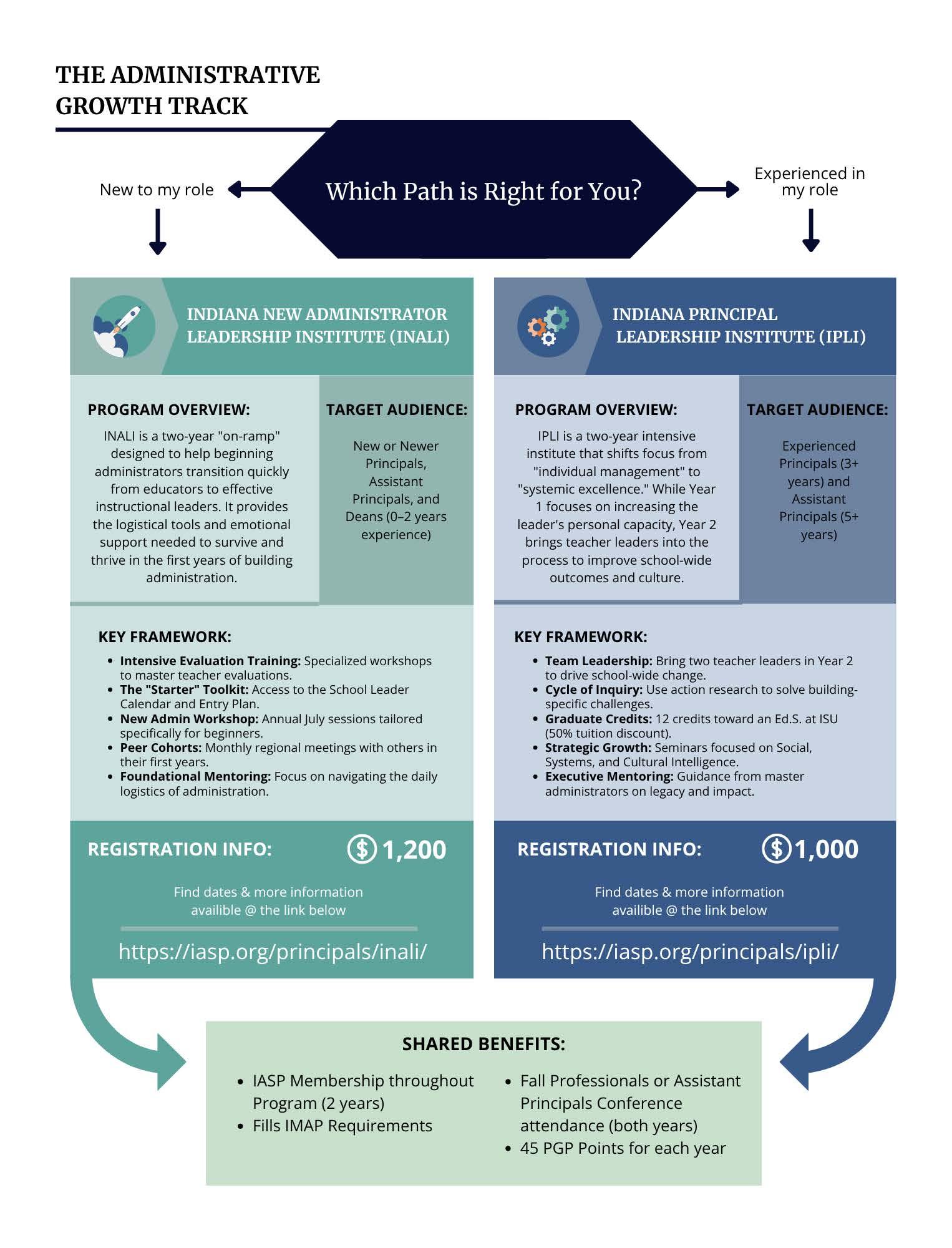
The Indiana Principals Leadership Institute is a highly engaging, research-based, two-year leadership development experience for Indiana school leaders who are ready to deepen their impact and strengthen their leadership practice. IPLI is designed for:
■ Principals with at least three years of experience in the principal role
■ Assistant principals with at least five years of building-level leadership experience who are heavily involved in instructional leadership, teacher development, school improvement, and systems leadership
The program uses a statewide cohort model that allows participants to collaborate, reflect, problem solve, and build meaningful professional relationships with educational leaders across Indiana. The 2026 IPLI Summer Seminar will take place June 24 and 25, 2026, in Terre Haute, Indiana, with additional seminars and learning experiences continuing throughout the two-year program.
More Than Professional Development
IPLI is not simply a conference series or leadership workshop. It is a transformational experience designed to support leaders over time through mentorship, collaboration, reflection, and practical application.
For only $1,000, participants receive:
■ Two years of leadership development
■ Two years of mentorship and coaching
■ Two years of statewide networking and collaboration
■ Two years of IASP membership
■ Two years of attendance at the IASP Fall Conferences
■ Access to experienced mentors and educational leaders from across Indiana
■ Leadership growth grounded in the School Leader Paradigm
The value of this investment extends far beyond the cost. Research from The Wallace Foundation continues to reinforce that principals are second only to classroom teachers among school-related factors that influence student learning. Effective principals create the conditions where teachers thrive, students succeed, and schools improve over time.
At the same time, districts across the nation are facing increasing administrator turnover. Research from the Learning Policy Institute estimates that replacing a principal can cost a school corporation approximately $75,000 when accounting for recruitment, hiring processes, onboarding, lost productivity, disruption to school improvement efforts, and the impact on staff morale and retention. High turnover creates instability for students, teachers, and communities, often interrupting academic momentum and long-term strategic goals.
IPLI directly helps to combat these challenges by investing in leadership development, mentorship, professional support systems, and collaborative problem-solving over an extended period of time. Research consistently shows that school leaders who feel connected, supported, and professionally developed are more likely to remain in their positions and
lead effectively. IPLI intentionally creates those support structures through mentorship, statewide networking, reflective leadership practices, and sustained professional learning grounded in the School Leader Paradigm.
The same research also demonstrates that principal turnover creates significant disruption for schools and districts. Replacing a principal can cost districts tens of thousands of dollars when considering recruitment, onboarding, lost momentum, and organizational instability. IPLI helps districts retain strong leaders by providing meaningful support systems and professional growth opportunities.
The Power of Connection and Mentorship
One of the greatest strengths of IPLI is the professional network that develops among participants and mentors.
IPLI Mentor, Ryan Langferman, shared:
“The relationships and professional connections built during the two-year IPLI experience continue long after the program ends, positively impacting not only the principals themselves, but also the schools and communities they serve.”
IPLI Mentor, Michael Pinto, explained:
“Many school leaders feel lonely. IPLI provides leaders a chance to connect.”
That support matters. Strong mentorship and collaborative support systems help school leaders remain reflective, confident, and student-centered. IPLI mentors work alongside participants throughout the two-year experience, offering encouragement, perspective, and practical guidance grounded in real leadership experience. The School Leader Paradigm’s focus on reflection and continuous improvement also helps participants strengthen their leadership identity and decisionmaking processes.
IPLI Matters for Indiana: By Supporting School Leaders, Strengthening School Teams and Improving Student Outcomes
Indiana schools deserve strong and well-supported leaders. IPLI helps build leadership capacity not only within individual administrators, but also within entire school systems. During the second year of the program, participants intentionally work to develop teacher leaders and strengthen leadership capacity within their buildings. This creates long-term impact that extends beyond a single administrator.
Brian Hagan described the ripple effect this way:
“IPLI’s impact does not stop at the principal’s office. It reaches every classroom in every school those leaders serve.”
At a time when districts across Indiana and the nation continue to face leadership shortages and increased turnover, investing in programs like IPLI is both responsible and necessary. Supporting school leaders strengthens schools. Strong schools strengthen communities. Most importantly, strong leadership improves outcomes for students.
An Invitation to Indiana School Leaders
IPLI is designed for educational leaders who are ready to grow, reflect, collaborate, and lead at a deeper level. It is an opportunity to strengthen leadership practice while building meaningful relationships with colleagues from across the state. Indiana’s students deserve exceptional leadership. IPLI helps make that possible.
Learn More and Register
Additional information about the Indiana Principals Leadership Institute can be found through the Indiana Association of School Principals.
Bartanen, B., Grissom, J. A., & Rogers, L. K. (2019). The impact of principal turnover. The Wallace Foundation. Grissom, J. A., Egalite, A. J., & Lindsay, C. A. (2021). How principals affect students and schools: A systematic synthesis of two decades of research. The Wallace Foundation. https://doi. org/10.59656/EL-SB1065.001 Kaufman, J. H., Gates, S. M., Harvey, M., Wang, Y., & Barrett, M. (2017). What it takes to operate and maintain principal pipelines: Costs and other resources. RAND Corporation and The Wallace Foundation. https://doi.org/10.7249/RR2078 Learning Policy Institute. (2017). Understanding and addressing principal turnover: How principal attrition affects schools and districts and what can be done to reduce it. Leithwood, K., Louis, K. S., Anderson, S., & Wahlstrom, K. (2004). How leadership influences student learning. The Wallace Foundation. The Wallace Foundation. (2019). What we’re learning about the impact of principal turnover and how to reduce it. The Wallace Foundation. (2021). How principals affect students and schools. Quotes from IPLI mentors and graduates used with permission.
Kids Caring & Sharing Update
Susan Miles Program Officer, Kids Caring & Sharing TM Riley Children’s
Foundation smiles@rileykids.org
Another generous year of giving With school gifts arriving daily as we approach the June 30 submission deadline for 2025-2026 recognition, Indiana K-12 schools have already donated over $1.8 million to benefit Riley kids and families! We appreciate your dedicated and generous support! Please know that your hard work is receiving notice beyond our Hoosier boundaries with Children’s Miracle Network hospital philanthropy programs across the continent asking about our Kids Caring and SharingTM and Riley Dance Marathon programs with an eye to replicating Indiana’s incredible 41 years of success in developing energetic and community-minded young philanthropists.
Stand out highlights from around the state Carmel High School Dance Marathon continued their nationally recognized giving legacy this year donating more than $479K and Westfield High School celebrated more than $126K in donations collectively from nearly every school in the Westfield-Washington School Corporation.
Terre Haute North High School combined Riley Dance Marathon and PS We Love You Tackle Childhood Cancer campaign efforts to raise more than $65K.
Celebrating our new Riley Dance Marathon programs, Danville High School returned to a dance marathon model fundraiser in 2025-26 with amazing results securing $11,437 for Riley kids. Bloomington-area Edgewood High School Dance Marathon raised $8,674 in a return to Riley fundraising while Angola High School and Muncie-area Cowan High School raised $7,625 and $5,096 respectively in their first-year Riley dance marathon efforts.
Goshen’s Fairfield High School hosted another successful Riley Royalty campaign leading their school corporation’s combined efforts totaling nearly $48K and Elkhart’s Concord High School gifted more than $20K through the 27th annual
Potter’s Marathon. Indianapolis North Central High School’s National Honor Society members raised $38K+ through 381 individual online giving pages in 38 active teams.
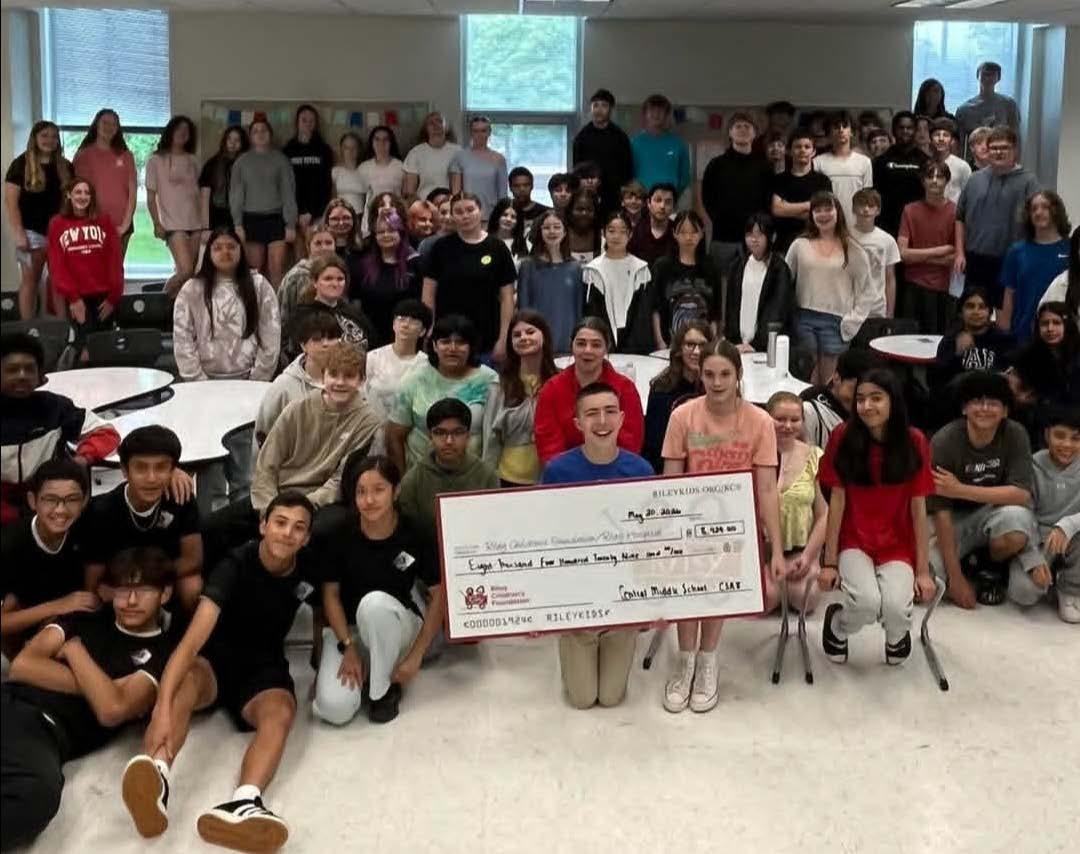
Columbus Central Middle School’s CSA 8 participants planned and executed another exciting end-of-year carnival to benefit Riley, raising nearly $8,500 and Fort Wayne North Side High School secured another Riley Red Wagon sponsorship with their $7K+ gift from their year-round and spring Dancing with the Stars fundraising events.
South Central Elementary School in Union Mills did not make their principal and school staff endure a slime fest this year while still raising an amazing $14K for Riley kids and families. Schererville’s Peifer Elementary students once again stuck it to their school administration while gifting $2,666 and Greenfield Intermediate and Harris Elementary School’s vied for bragging rights in a Riley Champion brothers fundraising challenge securing $1,502 and $1,885 respectively.
Sincere apologies to the incredibly generous and hard-working schools not mentioned whose students and staff dedicate themselves to supporting the Riley mission. There simply is not enough room to mention the hundreds of K-12 schools who participate each year in fundraising initiatives to benefit Riley, but you can see why others are watching Indiana school philanthropy very closely!
Before you “leave” for the summer
Please be sure to post your Riley donations 20252026 before June 30. You may send a check to our secure lock box. All school gifts postmarked after June 30, 2026, will be included in 2026-2027 Riley philanthropy participation recognition.
Riley Children’s Foundation
P.O. Box 3356
Indianapolis, IN 46206-3356
Attn: YPP/Susan Miles
Looking ahead to Youth Philanthropy Program initiatives for 2026-2027
School fundraising and recognition celebrations are already populating our 2026-2027 calendar. We will also begin building online campaigns for schools
and school corporation initiatives for live activity as of July 1. If your school or school corporation is considering adding or continuing a personalized online fundraising opportunity as part of your Riley campaign, please reach out to smiles@ rileykids.org and I can help you have that ready to go for the 2026-2027 school year.
Best wishes for a fun and revitalizing summer!
KGR Law Briefing
Greatest Legal “Hits” – 2025/26 Edition
After the end-of-term activities have wrapped up, you may be looking back at all the accomplishments your school has achieved. We too are proud of all the blood, sweat, and tears put into the IASP Law Briefing over the last year. (Tears from allergies. Sweat from back-toschool in July and August. Blood from the paper cuts from those of us that still use paper.) Whether it be a sense of pride or lack of a new “album” of material, we provide you this article with the greatest legal “hits” from the Gram articles since the 25/26 started. The first “track” comes from several cases interpreting the First Amendment.
First Amendment
In Mahmoud v. Taylor (2025), the Supreme Court of the United States of America (SCOTUS) ruled that a public school violated parents’ First Amendment rights by refusing to provide notice and opt-out options for elementary curriculum materials that contained LGBTQ-related content. Emphasized that parents had the right to direct their religious upbringing, the Court ruled that limited opt-outs do not amount to improper interference with curriculum decisions. A lesson from this SCOTUS is prioritize development and implementation of a consistent opt-out process for curriculum beyond just compliance with Indiana statute.
Our federal court of appeals, the Seventh Circuit, provided and decided on a case called Hedgepeth v. Britton (7th Cir. 2025) that provides some guidance for schools responding to controversial employee social media posts. The court upheld a public school’s decision to terminate a 20-year experienced teacher for controversial content posted on her Facebook page. The court determined that the posts caused significant disruption to the school environment, including widespread complaints, media attention, and concern about her ability to teach students effectively and properly. They applied the long-standing Pickering balancing test and found the disruption to school functions outweighed the teacher’s interest in speaking on this issue. The lesson is to be consistently cautious when responding to reports of expression that may be considered “off the clock.” Specifically, it is critical for school leaders to ensure there is contemporaneous documentation related to the disruption that is the basis for any employment action.
A different federal court of appeals addressed in Henderson v. Springfield R-12 School District (8th Cir.
2025) whether mandatory diversity training can violate the First Amendment rights of the school staff. In the underlying case, school staff members were required to affirm and “acknowledge” certain beliefs and complete training modules where only “correct” answers were accepted. When a staff member questioned a statement regarding the instructor claiming that “black people cannot be racist,” she was subject to “very hostile” statements from other staff, and the instructors did not intervene. The court found that there were constitutional violations under both chilled speech (the act of self-censoring due to fear of consequences) and compelled speech (the forced act of expressing views under threat of penalty). An important lesson from this case is that while schools can continue to require staff to teach specific curriculum, a court will highly scrutinize any mandate for employees to personally affirm beliefs, especially when employment action can arise from lack of compliance.
Employment Law
On the topic of employees, another “hit” from our Gram set list is the article on South Bend Community School Corporation v Grabowski (Ind. 2025). This Indiana Supreme Court case involved a teacher who resigned after being presented with a “last chance agreement” following an incident with a student that the school concluded was mischaracterized by the teacher. The teacher claimed she was provided the “last chance agreement” solely because of a potential workers’ compensation claim. Indiana’s at-will employment law means employers can generally terminate an employee at any time for any reason. However, there is a Frampton exception, named after a 1973 Indiana Supreme Court case. The Frampton exception is an employee cannot be fired “solely” for exercising a statutory right. In this case, the teacher was unsuccessful because even if she could show the workers compensation claim was a reason, it was not the sole reason. Another lesson reinforcing the importance of contemporaneous documentation to help defend against future allegations.
Special Education
A “greatest hits” list wouldn’t be complete without a few federal district court decisions out of New Jersey related to special education, right?! Regardless of how you answer that question, they made our list!
Great Oaks Legacy Charter School v. M.V. on behalf of N.W. (D. N.J. 2026) highlights the importance of precise terminology when applying exclusionary discipline for students with disabilities. The case involved a
Séamus Boyce Keith Butler
student with an IEP for their ADHD who brought ammunition to school. The school removed the student from school for the remainder of the school year. The school held a Manifestation Determination Review and found that behavior was not a manifestation of the student’s disability. However, they labeled the removal as placement in an “Interim Alternative Education Setting” (IAES). This decision proved critical. Under federal law, IAES placement is limited to 45 days. Since the school treated the action as a IAES placement, the court determined that it was legally bound by the 45-day limit. If the school had treated the discipline as a standard expulsion following a non-manifestation finding, it could have removed the student beyond the IAES day limitation. The lesson from this case? While schools may be eager to use the tools immediately available to them to address security threats, you should consider all options before deciding on which to use.
Mantua Township Board of Education v. E.K., on behalf of W.W. (D. N.J. 2025) underscores the importance of how schools respond to requests from parents for Independent Educational Evaluations (IEEs). When a parent of a student with a disability disagrees with the evaluation given by the school and requests an IEE, schools must decide within ten (10) business days to either pay for the IEE or defend their own evaluation by initiating administrative litigation, sometimes referred to as a “fight or fund” dilemma. The court in this case clarified that even when a school agrees to fund an IEE, it may still impose reasonable limits on cost, scope, and evaluator qualifications consistent with its own practices. The lesson here? It should remind us of the importance of legal timelines, particularly in special ed cases where doing nothing will waive the ability to question potentially costly expenses like IEEs.
Statutes & Mandates
During the 2026 (short) session, the General Assembly added to your plate of new mandates. These include a “bell-to-bell” policy requirement for wireless communication devices coming from SEA 78 (2026). SEA 76 (2026) expanded obligations to cooperate with immigration enforcement except when in conflict with law (like FERPA). There is a new math-related requirement to notify parents when a student is at risk of not achieving grade level proficiency, SEA 239 (2026), as well as a new mandate regarding lengths of instructional and intervention time via HEA 1266 (2026)
Schools are also mandated by SEA 88 (2026) to incorporate the “success sequence” (academic and workforce education, maintaining full time employment, and marriage before children) into citizenship instruction. They must provide expanded access for certain youth organizations and military recruiters as set forth in SEA 200 (2026)
As for teacher comp, SEA 204 (2026) tightens teacher compensation rules by requiring that any pay increases
tied to “academic needs” be based on clearly defined, individualized student need criteria rather than uniform or blended factors such as experience or retention bonuses. HEA 1266 (2026) further requires pay differentiation for teachers who hold a literacy endorsement, allowing additional compensation even when the endorsement is obtained voluntarily.
For those concerned about joining the mandate clean plate club, the Indiana General Assembly did provide the symbolic GLP-1 by removing some mandates from your plate. Teacher contracts no longer must specify hours. Schools are no longer required to consult with parents before developing a graduation plan. Finally, teachers can now enter a contract while already in an employment contract with another school. (Yes, that means you can no longer “hold” a teacher for 30 days who jumps ship right at the start of the school term.)
Special Education directors are no longer required to be employed under standard teacher contracts, but principals and assistant principals retain their existing contract protections unless they voluntarily agree otherwise. HEA 1004 (2026)
Schools are no longer required to report the following information:
■ Employee injuries to the Indiana Department of Education. HEA 1249 (2026)
■ Students who graduated before the spring count date. HEA 1004 (2026)
■ Additional adjunct teacher information already submitted to IDOE. HEA 1004 (2026)
■ Graduation rate data on the school website. HEA 1004 (2026)
“Greatest” Legal Lessons:
In the legal lessons from our articles over the last year, some themes are apparent:
■ Details matter! Across all these statutes and case law, small distinctions like how a disciplinary placement is labeled, whether disruption is documented, or how compensation factors are applied can directly impact a school’s legal authority and risk.
■ Repeat after us…contemporaneous documentation! Taking the time to develop and follow a system of contemporaneously documenting the details of communications and observations are often the best tool to defend against and prevail in legal disputes.
■ Greatest lesson of all? Prevention! Recognizing potential risk and taking prompt action often prevents damage from occurring altogether.
Need Help? The KGR Legal Help Desk is available to IASP members for support with these topics and any non-personal employment questions.
Until the next KGR Law Brief, relax/rinse/repeat for 2026-27!