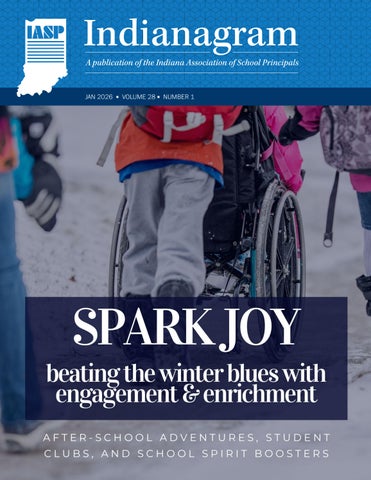
JAN 2026 ■ VOLUME 28 ■ NUMBER 1
TABLE OF CONTENTS
JAN 2026 ■ VOLUME 28 ■ NUMBER 1
The Indiana Association of School Principals leads in the advocacy and support of all principals in their commitment to every child.
Back to School Blast Spark Joy: Beating the Winter Blues with Engagement & Enrichment. . . . . . . . 3 From the IDOE . . . . . . . . . . . . . . . . . . . . . . . . . . . . . . . . . . . . . . . . . . . . . . . . . . . . . . . . . . 6 From the AP Lens: Building Learning That Matters: Community Engagement.8 SPARK JOY
Applying the School Leader Paradigm to Reflect, Celebrate, and Recharge.10
EDITORIAL BOARD MEMBERS Dr. Tiffany Barrett Kert Boedicker Greg Bodie Kellie Brotherton Sarah Gore Dr. April Holder Rick Hunt Wendy Ivey Kelly Storms
Clearing the Winter Blues: Clubs, Fun, and After-School Activities.. . . . . . . 11 LEADERSHIP DEVELOPMENT
IPLI Updates. . . . . . . . . . . . . . . . . . . . . . . . . . . . . . . . . . . . . . . . . . . . . . . . . . . . . . . . . . . . 12 Spark Joy: Beating the Winter Blues with Engagement & Enrichment. . . . . 14 SERVICE
Kids Caring & Sharing Update. . . . . . . . . . . . . . . . . . . . . . . . . . . . . . . . . . . . . . . . . . . 16
11025 East 25th Street Indianapolis, IN 46229 1-800-285-2188 or 317-891-9900 www.iasp.org tbarrett@iasp.org
LEGAL REVIEW
KGR Law Briefing. . . . . . . . . . . . . . . . . . . . . . . . . . . . . . . . . . . . . . . . . . . . . . . . . . . . . . . 18
Return to Table of Contents
© 2026 Indiana Association of School Principals All rights reserved. Any duplication without prior written permission is strictly prohibited.
PRESIDENT’S LETTER
Spark Joy: Beating the Winter Blues with Engagement & Enrichment As the days begin to grow longer, yes longer, and the Indiana sky settles into its familiar winter gray, it is easy for our collective energy to dip. The "winter blues" aren’t just a myth; they are a physiological response to the season. However, we can find a powerful blueprint for resisting this seasonal slump in an unexpected place: the historic run of IU Football in the College Football Playoffs. The Hoosiers' success this season is not just about talent; it is a masterclass in purpose and intentional leadership. We witnessed a culture built on teamwork and accountability, but the most striking element was the sharing of joy. True joy is not reserved solely for the final whistle of a playoff win. It was visible in the smaller, quieter moments: the way the entire sideline rallied around a player after a difficult play, the genuine celebration when a teammate received individual recognition, and the thunderous, unified singing of the fight song in the locker room or on the field. This brand of leadership proves when we intentionally create space for others to succeed, the entire group is elevated. To beat the winter doldrums, we must adopt a similar strategy of intentional engagement. In an educational setting, we often focus on professional development, but true "enrichment" involves learning and exploring diverse activities purely for the sake of growth and connection. Please allow for two suggestions to combat the notorious Indiana “winter blues” 1. Expand Your Circle: Look beyond your immediate department or the colleagues you sit with every day. Who brings you joy? Take the first step to invite someone new into a "small learning circle" or a casual after-school meetup. 2. The "Non-School" Agenda: This is the golden rule for winter wellness: eliminate school-related tasks from your joy agenda. Whether it’s a book club, a cooking class, or a local hiking group, the goal is to find enjoyment in a shared activity that has nothing to do with grading or lesson planning. By moving beyond the obvious and fostering new collegial relationships, we create a championship level support system. When we engage with others through enrichment, focusing on shared passions rather than shared stresses, we build the resilience needed to see us through until spring. This winter, don't wait for the sun to come out to feel better. For us native Hoosiers, we know the next time we see the sun we will also hear about “wind chill.” Be the intentional leader of your own well-being. Reach out, learn something new, and find your "fight song" activity.
Andy Allen IASP President
www.iasp.org
Return to Table of Contents
3
FROM THE EDITOR IN CHIEF
IASP Executive Committee Andy Allen President
Dear IASP Members, January often brings a unique mix of renewal and fatigue. While a new year invites reflection and goal-setting, the reality of winter, with shorter days, colder mornings, and the long stretch between breaks, can weigh on both adults and students alike. This issue of the Indianagram is designed to meet school leaders right where they are, offering practical ideas, encouragement, and inspiration to help spark joy, sustain engagement, and enrich the school experience during the heart of winter. The articles in this issue remind us that joy is not accidental. It is intentional. Whether through student activities, staff engagement, mindset shifts, or creative leadership strategies, each contributor offers thoughtful perspectives on how school leaders can proactively combat the winter blues and reenergize their school communities. Collectively, these pieces reflect the importance of staying grounded in purpose while remaining responsive to the needs of students and staff during this season. This theme aligns closely with the School Leader Paradigm, which emphasizes the importance of the Learning Leader, the Culture Domain, and the Cycle of Inquiry. As leaders, winter offers a powerful opportunity to pause, reflect, and ask meaningful questions: What is the current climate of our school? Where are energy and engagement strongest and where are they fading? What small, intentional actions can we take to re-ignite connection and momentum? When leaders lean into reflection and intentional action, even the most challenging seasons can become opportunities for growth.
Dr. Bret Bailey President-Elect Dr. Jane Bitting Vice President Dr. Holly Arnold Past President Raimeka Graham NAESP State Representative Dave Strouse NASSP State Coordinator Kristen Peterson Assistant Principal Liaison
This January issue is also a moment to celebrate and express gratitude. As we begin a new year, we recognize Kelly Storms for her dedicated service on the IASP Editorial Board from its inception in 2021 through her retirement on January 2, 2026. Kelly’s thoughtful insight, attention to detail, and steady commitment to excellence helped shape the Indianagram into the meaningful resource it is today. Her contributions have left a lasting impact, and we are deeply thankful for her leadership and service to IASP and its members. As you move through this issue, my hope is that you find ideas that uplift, strategies that resonate, and reminders of why the work you do matters so deeply. Even in the coldest months, joy can be sparked, and when it is, it has the power to carry us forward together.
Dr. Tiffany Barrett
IASP Assitant Executive Director Editor in Chief, IASP Indianagram
Future Indianagram themes 2025-2026 Themes
FEBRUARY: Ignite Innovation: Tech, AI, and Olympic-Level Ideas MARCH: Marching Forward: Honoring Milestones and Memories APRIL: Safe & Sound: Prioritizing School Safety and Wellbeing MAY: Hearts of Gold: Celebrating the Power of Gratitude JUNE: Best of the Best: A Year to Remember Share your thoughts on the Indianagram: https://forms.gle/2LaxqTUNUc5AdviF8 4
Return to Table of Contents
www.iasp.org
UPCOMING EVENTS IASP hosts events throughout the year to support the growth and development of Indiana school administrators and students. Each event is intentionally designed to encourage and engage all participants in the pursuit of learning! Find A Full List Of Events at www.iasp.org/Events
IASP Presents
Indiana State Board of Accounts Extra-Curricular Account Virtual Workshop March 4th, 2026 9am – 10:30 EST Presenter, Jonathan Wineinger, Government Technical Assistance and Compliance Directors for the Indiana State Board of Accounts This workshop will provide Extra Curricular Account (ECA) Treasurers occupation procedural information.
When you register you will receive a few items to help you prepare for the 90-minute workshop. Included, you will receive a link to a training video as well as a link to submit questions and topics you would like to cover at the workshop. Register online at www.iasp.org (under Principal Programs) Questions, email Aly Proper at aproper@iasp.org Method of Payment - $50 per person Check (payable to IASP), P.O., or Credit Card
www.iasp.org
Return to Table of Contents
5
From the IDOE Dr. Katie Jenner Indiana Secretary of Education Full Steam Ahead in 2026: Strengthening Indiana’s K-12 System Together Principals, welcome to 2026! I hope each of you enjoyed a well-deserved and restful winter break. I know getting back to the grind after an extended time off can be a difficult transition… not to mention the frigid winter temperatures, that uni-cloud that seems to sit over parts of our state during the months of January and February, and the long stretch between winter break and spring break… it can certainly feel like a long slog! As a person who loves (and needs) the sunshine, I really have to be intentional about finding ways to spark joy during the winter months. Sometimes that means turning on a sun lamp on my desk (got one a couple years ago after a recommendation from a fellow Hoosier friend!), and also just staying grounded in why we lead the work that we do as educators. The beginning of a new year is the perfect time to consider our priorities and set goals for the year ahead. You, our local school leaders and educators, are the heartbeat of Indiana’s K-12 system—and as you know well, the impact of your work reaches far beyond the classroom. A strong, connected K-12 system strengthens communities, equips educators for success, and ultimately, transforms the lives of our students. Across the state, Hoosiers are stepping up— educators, families, business leaders, philanthropy, and community members—all focused on building a stronger Indiana and doing what’s best for kids. Thanks to your local leadership, Indiana has real momentum as we start the new year, and together, we’re driving real progress. As we look ahead to 2026, here are just a few of the priorities we’re tackling with the help of some strategic partners: ■ Accelerating Literacy – We’ve seen significant growth, including an unprecedented nearly 5 percentage point jump in third grade literacy in 2025, as well as rising to sixth in the nation in fourth grade reading. We will build on this in 2026 by expanding training in science of reading practices and implementing a new outcomes-based model for middle school literacy—where vendors are paid only when students make real gains. Our partners are supporting this work through newly announced investments: ■ $10 million from Lilly Endowment to allow more
6
schools serving students in kindergarten through fifth grade the opportunity to participate in the impactful Indiana Literacy Cadre ■ $5 million from Lilly Endowment to support evidencebased reading interventions for students in grades six through eight ■ Approximately $10 million from the U.S. Department of Education to expand high-impact literacy tutoring in partnership with the University of Notre Dame and WestEd ■ Strengthening STEM Pathways – We’re preparing students for Indiana’s most high-demand careers by developing a new data science pathway, with a focus on technology and artificial intelligence. This isn’t just about preparing students for the careers of the future—it’s about national security and future innovation. Our partners are supporting this work through a newly announced investment: ■ $1 million from Lilly Endowment to support the implementation of a statewide STEM Landscape Analysis to assess current assets and gaps in STEM education in the state, identify best practices for STEM education from around the country and world, and develop recommendations for improving STEM education in Indiana ■ Expanding Tutoring Support – Through Indiana Learns, families can continue to access $1,000 tutoring grants for students who need extra help. We’re also expanding free or low-cost summer learning opportunities through the Summer Learning Labs. Our partners are supporting this work through newly announced investments: ■ $5 million from Lilly Endowment to support continued investment in Indiana Learns, providing microgrants for individualized, high-quality reading and math tutoring and enrichment, regardless of a family’s ability to pay ■ $15 million from Lilly Endowment to strategically scale and strengthen the statewide infrastructure of the Summer Learning Labs over the next two years ■ Enhancing Career Advising – We’re helping students explore their options, align their goals, and build a plan to get there—whether that’s college, career, or military service.
Return to Table of Contents
www.iasp.org
Our partners are supporting this work through a newly announced investment: ■ $500,000 from Lilly Endowment to support an evaluation of career advising in the state and the design of next-generation tools and strategies to help students identify and explore the advantages, disadvantages, and requirements of various career options ■ Connecting Students to What’s Next – This year will be the first graduating cohort with students having the opportunity to earn the new Indiana diploma and readiness seals. As we push closer to statewide implementation, we’re continuing – with urgency – to increase connections between schools and employers to expand work-based learning and apprenticeships and ensure the skills students gain align with credentials that hold real value in today’s economy.
■ Through Indiana iLab, employers across the state continue to partner with educators to build Indiana’s new career apprenticeship pathway. This will allow students to meet graduation requirements while gaining meaningful real-world experience.
Indiana stands at a pivotal moment. As you continue to innovate locally, increase employer engagement, and navigate the world of AI, the work ahead is shared—and the impact will be greatest when we move with urgency, together. To every principal who is leaning into this work: thank you. Your leadership is lighting the way, and I hope that together, we can make an even greater impact in the new year. Let’s continue building an education system that strengthens Indiana’s future and delivers real value for Hoosier students. Full steam ahead!
Register Now
www.iasp.org
Return to Table of Contents
7
ASSISTANT PRINCIPAL CONNECTION
From the AP Lens: Building Learning That Matters: Community Engagement Mrs. Kristen Peterson Associate Principal Chesterson High School IASP Assistant Principal Liaison Mr. Josiah Parker, M.Ed. Assistant Principal CTE, PLTW, FIRST, Career Pathways Penn High School Happy New Year! Our January theme for the Indianagram is “Clearing the Winter Blues”. This month, Josiah Parker, Assistant Principal at Penn High School, and the 2025 Indiana Assistant Principal of the Year, provides insight about how community engagement is foundational to offering authentic learning and relevant career-related experiences for all students. Josiah explains how Penn’s comprehensive approach is transformational to how they prepare students for life after high school. Thank you, Josiah, for your willingness to share how Penn is preparing its students to thrive in a global society, and congratulations once again on being named the 2025 Indiana Assistant Principal of the Year! Building Learning That Matters: Community Engagement at Penn High School At Penn High School, we believe learning is most powerful when it extends beyond the walls of the classroom and into the community we serve. Community engagement is not an “extra” at Penn. It is foundational to how we design learning, support students, and prepare young people for life after graduation. When students see that their work matters to real people, learning becomes purposeful, engaging, and often life-changing. Some of our most impactful work has grown out of a simple belief: students learn best when they use their skills to serve others. That belief first took shape through a project called Hand of Grace, when students worked with a young girl and her family to design a prosthetic arm. What began as a single project quickly became a mindset, one that continues to guide how we think about learning, purpose, and impact. From that experience grew a series of student-driven initiatives, including Mission to Engineer, Voice for Braylen, Engineering Ella, Zephen’s Magic Wheelchair, and others. While these projects are often associated with engineering, their true strength lies in how deeply they integrate learning across the school. They are not isolated STEM experiences; they are collaborative, schoolwide efforts that invite students from many content areas to contribute. Students apply their learning in ways that mirror the real world. Art and sculpture students support the design process through modeling and fabrication. Fashion Design students consider identity and expression as they help create personalized elements. Business students assist with planning, funding, and communication, while Penn News Network students document the work and tell the story behind it. Culinary students support families during key moments, and computer science students provide technical and design support throughout the process. Each content area plays a role, reinforcing that meaningful work requires 8
many perspectives and skills. Across these projects, students partner directly with families and community members to solve real problems. Learning is no longer hypothetical. Students listen, collaborate, and respond with empathy and creativity. In the process, they gain confidence, strengthen communication skills, and develop a deeper understanding of how their learning can make a difference. This approach has helped redefine what success looks like at Penn. Especially for students who previously struggled to see themselves as successful in traditional academic settings. Community engagement extends well beyond these projects. It is embedded throughout our Career and Technical Education programs and work-based learning opportunities. Today, 864 of our 950 graduating seniors have taken at least one CTE course during high school, and 32% of our entire student body is currently enrolled in a CTE course. Over 25% of our juniors and seniors participate in internships, cooperative education, apprenticeships, or other work-based learning experiences. The strength of these opportunities is directly tied to the relationships we’ve built with our community. Because we engage consistently and authentically, employers are willing to work alongside us problem-solving transportation, scheduling, legal issues, and supervision challenges to make opportunities accessible to students. Partners such as the South Bend Regional Chamber of Commerce play a critical role by helping us identify employers, connect students to opportunities, and design experiences that benefit both learners and the workforce. These relationships are built on trust, not transactions. Community engagement benefits staff as well. Teachers frequently share that this work rejuvenates their passion for teaching. Seeing their content come alive through collaboration and real-world impact reminds them why they chose their subject and profession. Working across departments strengthens professional relationships and encourages innovation, reflection, and growth. While Penn High School has received state and national recognition for this work, what matters most is the daily impact on students and families. Community-engaged learning has helped us expand opportunity, strengthen instruction, and prepare students not just for graduation, but for life beyond it. For principals and assistant principals across Indiana, our experience at Penn reinforces a simple truth: when schools invest in authentic community engagement, students learn more deeply, educators teach with greater purpose, and communities become true partners in education.
Return to Table of Contents
www.iasp.org
TRANSI TI ON
Teaching to
PROGRAMS
2025-2026 Transition Programs SECONDARY INITIAL LICENSURE
• Use your bachelor’s degree to earn an online Indiana
teaching license in less than 1 year (summer, fall, spring)!
• Highly experienced, practitioner-based instruction, supervision, and advising
• Effectively prepares you to support diverse students including English Learners
Paid opportunities to teach while you earn your license
• Clinical and student teaching placements tailored to your needs
• Count up to 15 credits toward an online IU Master’s in
Education! (Earn up to 15-20% more as a HQ educator in most school settings)!
SPECIAL EDUCATION LICENSE
• Unique online 18-month special education program
Scholarship, fellowship, and financial aid opportunities
• Course reimbursement opportunity (for program duration) • Practitioner-based program with dyslexia and Science of Reading preparation
• Count courses toward an online IU Special Ed Master’s
Degree! (With higher earnings in most school settings)
• More than $100,000 of Transition scholarship funding was
awarded to Secondary and Special Education IUB Transition Programs in 2024-2025!!
100%
larachri@iu.edu
placement rate for 5 years!
REQUEST INFORMATION
today!
SEC LICENSE
www.iasp.org
Contact:
DR. LARA CHRISTOUN
SE LICENSE
Return to Table of Contents
9
SPARKAND JOYSOUND: ENSURING SCHOOL SAFETY SAFE
Applying the School Leader Paradigm to Reflect, Celebrate, and Recharge Dr. Tiffany D. Barrett IASP Assistant Executive Director
The end of a semester brings with it a valuable opportunity—not just to wrap up tasks, but to pause, look back, and intentionally grow forward. Our theme this season, Grateful Gains: Tools and Triumphs in Education, reminds us that school leadership is both about outcomes and the journey. When viewed through the lens of the School Leader Paradigm, this season of gratitude becomes a powerful leadership moment. As learning leaders guiding learning organizations, we are always “becoming while doing.” The Paradigm calls us to balance the intelligences that shape who we are with the domains that drive what we do. In that spirit, here are three steps every school leader can take right now to capture grateful gains and lay the groundwork for sustainable success.
buzzword—it’s a leadership imperative. If we want to lead sustainable, hopeful organizations, we must model what it looks like to pause and recharge. Just as our Indianagram and IASP Podcast pause in December, allow yourself space to rest. Protecting your wellness—physical, emotional, professional—is not a break from leadership. It is leadership. Gratitude, when paired with action, becomes transformation. Let this be a season of intentional closure and confident rest. Celebrate. Reflect. Recharge. LEAD On, Indiana!
1. Celebrate the Systems You’ve Strengthened Too often, school leaders move from one initiative to the next without pausing to name what’s working. Use this moment to identify and share wins in your culture, operations, and learning systems. Whether it’s improved communication, strengthened team capacity, or academic growth—recognize it. This step reflects the Systems Intelligence embedded in the Paradigm, particularly strategic management and collaborative leadership. Celebration is not fluff—it builds momentum and affirms progress. 2. Reflect on Your Growth as a Learning Leader Growth mindset, self-management, and reflection are core competencies of Personal Intelligence in the Paradigm. Take time to ask: What leadership muscles did I strengthen this semester? What feedback challenged me? Where did I show courage or creativity? These reflections build clarity, confidence, and fuel for the next cycle of improvement. Reflection isn’t just a look back—it’s an investment forward. 3. Honor the Power of Rest and Renewal In the Culture Domain, wellness is more than a 10
Return to Table of Contents
www.iasp.org
SPARKAND JOYSOUND: ENSURING SCHOOL SAFETY SAFE
Clearing the Winter Blues: Clubs, Fun, and AfterSchool Activities. Adrienne Goldman, Ed. D Principal Clarksville High School As we welcome staff and students back for semester two after a well-deserved break, many of us are focused on reestablishing routines and helping our school communities settle back into the rhythm of learning. In Indiana, the start of second semester often coincides with cold temperatures, gray skies, and winter weather that can bring delayed starts or remote learning days. These conditions can challenge energy levels, motivation, and a sense of connection. As school leaders, an important question emerges: how do we continue to foster positive mindsets and strong relationships during the heart of winter? One powerful answer is extracurricular involvement. Extracurricular activities have long been an essential part of the student experience. For many students, these opportunities provide purpose, motivation, and a sense of belonging that extends well beyond the school day. During the winter months in particular, participation in athletics, fine arts, clubs, and student organizations helps students remain engaged and connected—even when seasonal challenges begin to take a toll.
of lifelong interests and healthy routines. Many students also note that having an outlet beyond the classroom helps them manage stress, maintain motivation, and support both their mental and physical well-being. While the benefits to students are clear, these outcomes are made possible through the dedication of adults who commit their time and expertise beyond the instructional day. Coaches, club sponsors, staff members, and community partners play a vital role in creating meaningful, inclusive opportunities for students. Their guidance and encouragement ensure that extracurricular programs remain accessible, engaging, and impactful, contributing significantly to a positive school culture. A sincere thank you is owed to all who support extracurricular programming across the state—and especially to those at Clarksville High School and Clarksville Community Schools. Your efforts not only help combat the winter blues but also strengthen the connections that allow our students and school communities to thrive throughout the year.
Involvement in extracurriculars keeps students active, focused, and invested at a time when outdoor options may be limited and routines can feel disrupted. More importantly, these experiences strengthen students’ connections to their peers, teachers, and school community. A strong sense of belonging often leads to improved attendance, increased academic effort, and a more positive outlook on learning—outcomes that align closely with our shared goals for student success. When Clarksville High School students are asked about the impact of extracurricular participation, their responses are consistent and meaningful. Students describe a stronger sense of community and purpose, opportunities to connect with peers who share similar interests, and personal growth that extends beyond academics. They highlight the development of realworld skills such as communication, teamwork, time management, and leadership, along with the formation www.iasp.org
Return to Table of Contents
11
LEADERSHIP DEVELOPMENT
IPLI Updates Dr. Kelly Andrews Director Indiana Principal Leadership Institute
IPLI is a premier professional development opportunity for Indiana's practicing principals. We support and encourage you as we grow in our leadership, learning, leading, and connecting. Spark Joy: Beating the Winter Blues with Engagement & Enrichment It is that time of year when winter has fully arrived, and we all feel the impact of shorter days and colder temperatures. Energy wanes, and morale sometimes follows. But here's the good news: this season isn't just a challenge—it's an opportunity. It's our chance to spark joy and foster meaningful engagement within our learning community. The research is clear: active engagement is one of the most powerful tools we have to combat the isolation and fatigue that winter can sometimes bring. When our educators and students feel truly connected and inspired, productivity and a positive atmosphere naturally soar.
energy you bring today isn't just for now—it's the spark that illuminates tomorrow. Let's lead with light.
IPLI 2025-26 Thanks to all for a great Seminar for Cohorts 12 and 13 at the IASP Fall Professionals Conference. IPLI looks forward to the upcoming Virtual Winter Seminar on January 20 & 21, 2026, featuring Dr. Roos & Dr. Gruenert with Cohort 13, and Dr. Phil Warrick with Cohort 12. To learn more about IPLI, please contact Dr. Kelly Andrews, Director, at kelly.andrews@indstate.edu or 765-993-0133
First, let's celebrate small wins. Recognizing achievements—big or small—can make a huge difference. There are so many great things happening in Indiana schools; even a simple shout-out during a meeting can brighten someone's day. Next, let's create enrichment opportunities. Professional learning sessions like IPLI and INALI that energize and empower us, especially those that encourage creativity, collaboration, and innovation, can really lift our spirits. Building community is just as important. Whether it's an informal gathering or a coffee chat, these moments strengthen relationships and give us space to share ideas. And in the classroom, let's infuse learning with fun. Interactive activities can bring warmth and excitement to students during these colder months. The IPLI Summer 2026 keynote, Dr. Tina Boogren, reminds us, "Educators are the heartbeat of schools. When we take care of ourselves, we create the conditions for everyone around us to thrive." At IPLI, we know that true leadership flourishes where joy meets purpose. This winter, let's do more than chase away the cold—we'll spark warmth that lasts all year. By embracing engagement and enrichment, we create a ripple of positivity that lights every corner of our community. So let's turn this season into one of connection, creativity, and celebration. The 12
NOMINATE YOUR SECRETARY REGISTER
Return to Table of Contents
www.iasp.org
Indiana Girl Scouts Learn New Skills and Fund Their Dreams
Across Indiana, school leaders like you are focused on developing students who are confident, resilient, and prepared to navigate challenges both inside and outside the classroom. At this time of year, girls are creating opportunities for incredible experiences they might not otherwise have through the Girl Scout Cookie Program. In the Girl Scout Cookie Program, girls set goals, manage money, and engage with customers as they practice public speaking, problem-solving, and perseverance. This program funds experiences like hands-on STEM learning and troop outings in new places and neighborhoods, making wonderful memories and strengthening the bonds of friendship. It’s also a great time for caregivers to plan an amazing summer by registering for camp. Whether trying a new activity, navigating teamwork challenges, or spending time away from home, Girl Scout camp helps girls learn resilience by facing obstacles and discovering their own capabilities. These experiences complement school learning and help prepare Indiana’s girls to become engaged students, leaders, and community contributors. From community service projects to becoming better friends to others, Girl Scouts grow and learn in ways that benefit everyone.
Share the power of Girl Scouts with your school community! Encourage families to register now to participate in the Girl Scout Cookie Program and register for an amazing summer at Girl Scout camp!
www.iasp.org
Return to Table of Contents
13
LEADERSHIP DEVELOPMENT
Spark Joy: Beating the Winter Blues with Engagement & Enrichment Jeremy Coleman Assistant Professor Ball State University
I’m not a Norwegian, but I’m told they have a useful proverb. The proverb goes something like this “No such thing as bad weather, only bad clothes”. I am a Hoosier and I respectfully disagree with this statement. Take freezing rain for example. Freezing rain is unpleasant and it doesn’t matter how many layers I wear. But I understand the sentiment. The wisdom in the proverb is both insightful and pragmatic. It speaks to preparation and mindset. Prepare for inclement weather by wearing the right clothes. Adjust your mindset by changing how you see the weather. The good news is that both of these actions are 100% in our control. Shorter days, colder mornings, and long stretches of time between breaks are not in our control. These wintry conditions can lead to a drop in staff energy and a noticeable change in student mood and motivation. This time of year is known by many as the “winter slump”. For me, the stretch after winter break and before spring break was the most challenging. My students were sluggish and appeared to be less invested in the work. Attention spans seemed to shrink while behavior challenges spiked. In my early years as a teacher, I would blame the students for their perceived apathy. But later in my career, I realized something about the winter slump. The season didn’t create disengagement, it exposed relational gaps. I wanted my students to be fully engaged. But I didn’t understand that real engagement is the result of relationship. I eventually learned that students leaned into learning when they felt connected, seen, and emotionally safe. The opposite was also true. When they felt disconnected, they were less likely to try, prone to silence, and more reactive. Staff are also affected by the winter slump. The constant giving, the pressure to always be patient while maintaining high standards takes a toll. Taking the time to make daily relational deposits will make a difference for your staff. These may seem like small acts, but over the course of a school year they add up and strengthen the schoolwide culture. The question that many leaders are dealing with is “How do we build and sustain a positive staff culture when everyone feels drained?” The answer is found in relational work. Relational work influences everything that you do as leaders. One way to improve staff culture is by achieving what I call “Relational Equity”. Relational Equity is the idea that every person receives the relationship they need to be successful. Students are not the only ones who need connection, belonging, and encouragement during the winter months. Staff need this too. Don’t forget about the adults! We each have different 14
experiences and different preferences. Some people need structure more than others. While some need more praise than others to be at their best. When we meet those unique needs, engagement improves. When we overlook those needs, even the best curriculum fails to land. Winter reminds us that relationships aren’t seasonal. They are foundational. When ourstudents get the winter blues, we should look first to strengthen our relationships. A good placeto start is with belonging. Belonging is the experience of being accepted, valued, and connected within the learning community. When students feel like they matter, they get energized. Simplerelational actions can make a big difference. Addressing students by their name, learning their“favorites”, or completing one minute check in are deposits that go into the emotional bank account. During this time of year relational deposits matter because we may be running low onenergy. Each moment is a chance for us to say “I see you”. Belonging also plays a key role in helping staff feel more grounded and engaged. You cancreate and sustain belonging with intentionality. Before the school day starts, walk the buildingand check in with staff. Create a culture where people ask “how are you doing” and they mean it. During the winter, belonging can become the foundation for staff trust and consistency. This is a great time to check mission alignment. Review your distinct strategic plan and be sure that you’ve communicated the “what, why, when, who and why” to your staff. Brené Brown says “clarity is kind”. I agree. Staff often feel more supported when your expectations are clear and your actions are predictable. Alignment does not guarantee perfection. But it is often the first step towards meaningful progress. Winter slumps don’t break what is relationally strong. They can help us see the relational gaps in our systems and provide an opportunity for improvement. Spark joy in your learning communities by using the power of connection. Get over the winter slump by building belonging. Achieve relational equity and support the staff that support the students. Only then will you turn the coldest months of the year into the warmest.
Return to Table of Contents
www.iasp.org
www.iasp.org
Return to Table of Contents
15
SERVICE
Kids Caring & Sharing Update Susan Miles Program Officer, Kids Caring & Sharing TM Riley Children’s Foundation smiles@rileykids.org
It’s Riley Champion time again – meet the class of 2026! Celebrating the brave and giving Riley patients and families from across Indiana who are chosen to serve as ambassadors for Riley Hospital due to their courage and commitment to helping others while navigating their own medical obstacles. Presented by Kroger. Izzy Boyd, Delaware Elementary - Evansville, loves art, singing, and dancing. She was born with sickle cell disease, a blood disorder that causes severe pain and fatigue. With support from her Riley Children’s Health team, Izzy finds ways to encourage others even on her toughest days. Diagnosed with an autoimmune disorder as a kindergartner, Classita Dillion, Terre Haute South Vigo High School - Terre Haute, began receiving regular treatments at Riley Children’s Health. While going through treatment, Callista loved racing quarter midgets and raising funds for the hospital that saved her life. Now a high school senior, she is in remission and is the president of her school’s Riley Dance Marathon. Born with “half a heart,” and diagnosed with hypoplastic left heart syndrome, Hannah Ginther, HSE Intermediate/Jr High School - Fishers, was just 3 years old when she received a heart transplant at Riley Children’s Health. Today, Hannah loves playing volleyball and basketball, cheering on her sisters at their sports games, and learning everything about makeup. Hafsa Housseyni, Mount Vernon High School – Fortville, was diagnosed with leukemia in September 2024 and began treatment at Riley Children’s Health the same day. Thanks to the Riley Art Therapy program, Hafsa and her family found joy and comfort through creativity. Hafsa receives outpatient chemotherapy on a weekly basis and wants to become a pediatrician. Tessa Koepke, LaPorte High School - LaPorte, has been donating books to the Medical & Molecular Genetics outpatient clinic at Riley Children’s Health since she was 3 years old. She has a rare disorder that prevents her body from converting certain fats into energy. Thanks to specialized care at Riley, Tessa leads an active life as a volleyball player and plans to study nursing at college next year.
16
Brothers Lincoln and Norrin Niece, Greenfield Intermediate and Harris Elementary – Greenfield, both needed brain surgery at Riley Children’s Health for Chiari malformation, a rare condition where extra brain matter comes down the skull. Lincoln has also undergone surgery for a congenital heart defect that rushed him to Riley just 24 hours after being born. The brothers fundraise for Riley through an annual gaming event with their family. Born with what he calls a “fat kidney” Bennett Pace, Childs Elementary - Bloomington, was diagnosed with hydronephrosis, which caused dangerous swelling in one of his kidneys. Three surgeries later, Bennett plays basketball and baseball and sees his Riley Children’s Health care team for a check-up every December. Clydon Powers, Indy West Side Christian PreschoolParkside - Indianapolis, loves riding his bike and playing with cars and construction toys. When he had trouble breathing as a baby, his parents took him to Riley Children’s Health for a second opinion. Clydon needed a tracheostomy right away, then corrective surgery on his airway once he was strong enough. The Powers family uses social media and their “Riley red” Corvette to raise awareness for the hospital that saved their son’s life. Ivy Selking, Norwell Middle School – Ossian, has a rare combination of diagnoses that impact her kidneys and digestive tract. A team of Riley Children’s Health specialists worked together closely to find the right treatment, and Ivy has been in remission since February 2024. She shares her story at Riley Dance Marathons and aspires to be a nurse at Riley. Facing a 4 percent chance of survival when she was airlifted to Riley Children’s Health after a car accident in December 2023, Brilea Southard, Terre Haute North Vigo High School - Terre Haute, had an entire team of Riley advocates supporting her through her 513 days and 30 surgeries at the hospital. Today, Brilea is back at school full-time and raising funds to train her new puppy as a therapy dog at Riley. Brilea also loves dancing, spending time with her family, and listening to Benson Boone. Read more about each Champion story through the link in their name. Thank you for supporting these incredible Riley ambassadors and thousands of others touched by Riley Hospital each year.
Return to Table of Contents
www.iasp.org
SERVICE
Enter the New Year Dancing College and high school students across Indiana raise millions of dollars annually for Riley Children’s Health through Riley Dance Marathons. This student-led, year-round philanthropic movement culminates in an electric, heartfelt multi-hour event where students are engaged in fundraising and activities to honor the kids and families we serve. Students love this experience, knowing that they have generated funds to support thousands of kids every year who receive care from Riley Children’s. This generous spirit supports lifesaving medical care and research at Riley. Riley Dance Marathons have raised more than $70 million for Riley Hospital since 1991. Every dollar raised makes an impact for Riley kids. Forty-three Indiana high schools are set to host a Riley dance marathon before the end of May 2026. If your high school has an interested Riley Dance Marathon club with a staff advisor ready to learn more about joining this nation-wide family of children’s hospital fundraisers, please reach out to Youth Philanthropy Program Officer Annie Cole at acole@rileykids.org to get started! Please celebrate with and extend your support to these 9 high schools staying warm while hosting dance marathons before the end of February! 1/31/2026 South Spenser High School 2/13/2026 Boonville High School 2/13/2026 Noblesville High School 2/13/2026 Plymouth High School
www.iasp.org
2/14/2026 Avon High School 2/14/2026 Westfield High School 2/21/2026 Carmel High School 2/27/2026 Fishers High School 2/28/2026 University High School If your elementary, intermediate, middle, or junior high school is part of a school corporation that has a high school hosting a dance marathon, and you would like to raise funds for Riley in solidarity with your high school philanthropists, please reach out to Jason Zuñiga at jzuniga@rileykids.org. Youth Philanthropy initiatives come together through Riley Children’s Foundation All Indiana K-12 schools raising funds for Riley Hospital for Children are recognized as philanthropic partners through our statewide school/youth philanthropy program – Kids Caring & SharingTM, High School Dance Marathon, and schools participating in the nation-wide ExtraLife Esports fundraising program. Is your school ready to “Spring 2026 into Action” for Riley kids and families? Regardless of your school’s chosen fundraising model, our team offers support from planning through implementation. If your school family is interested in learning more, or if you are unclear as to which YP representative you can turn to for assistance, please contact me at SMiles@rileykids and I’ll help make the appropriate connections to maximize your fundraising success. Thank you for all that you do for Riley kids!
Return to Table of Contents
17
LEGAL REVIEW
KGR Law Briefing Séamus Boyce Attorney Kroger Gardis & Regas, LLP Keith Butler Associate Attorney Education Law & Policy Kroger Gardis & Regas, LLP
“Highlights” from 2025 As you likely have already done with other aspects of your life, we would like to recap our legal “highlights” of 2025. 2025 Legislative Session We have included what we believe are the most important legislative updates for building level leaders below. However, this is not an exhaustive list, and we have included more detail in our materials from the IASP Conference in November. New Mandates: ■ Update policy to ensure parents can record special education conferences. (HEA 1285) ■ Ensure all employment actions, education actions and professional development are free from discrimination in law. (SEA 289) ■ Add to sexuality curriculum content on consent and human growth / development during pregnancy. (SEA 442) ■ Utilize absence categorization framework developed by DOE. (SEA 482) ■ By 1/1/26, ensure at least one employee is trained in NCI is present in each school building while school is in session to respond to de-escalation and any use of restraint, seclusion, or time-out. (HEA 1285) ■ Provide second opportunity to retake IREAD in the summer before 4th grade. (HEA 1499) ■ “Automatically” enroll a student in advanced math course who is above proficient on middle school math ILEARN and gets above a D letter grade in math. (HEA 1634)
Contingent Mandates:
■ Report the conclusion of a bullying investigation before the end of the next school day of the investigation conclusion. (SEA 255) ■ Provide written notification to the employee and parent of the student no later than 14 days after unsubstantiated or dismissal of an allegation that a school employee engaged in misconduct with, or pertaining to the student. (HEA 1515) ■ Withdraw students from a virtual program if they 18
accumulate in a school year 10 consecutive or 18 cumulative unexcused absences. (HEA 1515) ■ If TAG is awarded to a school, distribute funds to teachers by the earlier of 60 business days after DOE distribution or June 30th. (HEA 1001)
2025 Education Related Cases Mahmoud v. Taylor (2025)
A school board select 13 “LGBTQ+-inclusive” texts for use in the English and Language Arts curriculum from pre-K through 12th grade. This case centered around five books that were incorporated into the K – 5 curriculum and the accompanying professional development instructions for teachers. For example, one instruction included a suggested response to the question “what is transgender?” that was “[w]hen we’re born, people make a guess about our gender and label us ‘boy’ or ‘girl’ based on our body parts. Sometimes they’re right and sometimes they’re wrong.” Several parents requested opt-outs to this curriculum with many of them citing religious reasons. The Court found the curriculum, particularly the recommended teacher responses, would substantially interfere with the religious development of the children and pose a threat of undermining the religious beliefs and practice that the parents wished to instill in their children. Therefore, the Court mandated that the school board allow religious opt outs to the curriculum. Hedgepeth v Britton (7th Cir. 2025) A social studies teacher with twenty years’ experience made a series of controversial social posts about the George Floyd protests while she was on vacation. One of the posts included “a viral meme evoking the high-pressure water hoses used against civil rights protestors in the early 1960s that read, ‘Wanna stop the Riots? Mobilize the septic tank trucks, put a pressure cannon on em ... hose em down ... the end.’” The school received many complaints in phone calls and emails, received media requests, and held two public meetings with heavy and mostly negative public participation. The school also found the posts violated multiple school policies and the board decided to fire the teacher. The teacher claimed the firing violated her free speech
Return to Table of Contents
www.iasp.org
LEGAL REVIEW
rights. The case involves a public employee speaking about a matter of public concern outside of work which means the court applies the Pickering balancing test. This test balances the employee’s interest in commenting on matters of public concern against the government employer’s interest in promoting the efficiency of the public services. The balancing test came out in favor of the school with the court focusing on the level of disruption the school experienced. Kluge v. Brownsburg Community School Corporation (7th Cir. 2025) This case has bounced around federal courts since 2021. Brownsburg implemented a policy to call transgender students by their preferred names and pronouns. A teacher wanted to call students by their last name like a coach as an accommodation to his religious beliefs. Brownsburg initially granted the accommodation and later rescinded believing it was not appropriate for students. During the case, the Supreme Court’s standard for evaluating religious accommodations went from whether the accommodation created a “de mininimus cost” to whether it created an “undue hardship”. When the Seventh Circuit evaluated this case under the undue hardship standard it found that Brownsburg had not proved that the accommodation created an undue hardship and sent the case back to the district court to hold a trial on that issue.
What is the legal lesson from this brief? For the lesson from the brief, we will also use “highlights” from advice we commonly give. ■ For situations involving potential child abuse and neglect, directly report to DCS or local law enforcement immediately. Have a staff member in the room with you when you call to document. Generally, call DCS, but if you need sirens or weapons call local law enforcement. ■ You do not need to be constitutional scholars or legal experts, but your role is to be alert for potential legal issues and know when to call for help. ■ Practice contemporaneous documentation. If you become aware of a potential legal situation, it is important to contemporaneously document communications you have and actions you take for the matter. Remember, litigation is a lengthy process and remembering things multiple years after they occur is difficult.
We at the KGR Legal Help Desk are here to address these and any non-personal employment legal issues for IASP members. Until the next KGR Law Brief, have a wonderful 2026!
United States v. Skrmetti (2025) This Court found that Tennessee’s law prohibiting certain sexual identity based medical procedures for minors was constitutional. D.P. by A.B. v. Mukwonago Area Sch. Dist. (7th. Cir. 2025) A transgender student wants to use the bathroom corresponding to the gender the student identifies with. The court has withdrawn previous rulings on this case and has ordered that the parties address whether the court should overrule previous Seventh Circuit precedent Whitaker and Martinsville allowing transgender students to use bathrooms corresponding to their gender identity based on the Supreme’s Courts decision in Skrmetti. A. J. T. v. Osseo Area Schools (2025) Parents won an IDEA due process case where a student wanted to shift her school day from noon to six to accommodate a disability. The parents brought a second suit for damages under ADA / 504. The question before the Court was whether a “bad faith or gross misjudgment” standard should apply to ADA / 504 claims in education cases like this. The Court found that the normal standard used in other ADA / 504 claims should apply, rather than a heightened standard, although the Court did not decide exactly what that normal standard is.
www.iasp.org
Special thanks to our Sponsor:
Return to Table of Contents
19
11025 East 25th Street Indianapolis, IN 46229 1-800-285-2188 or 317-891-9900 www.iasp.org | iasp-info@iasp.org
Contact us to see how our products and programs can benefit your staff and help you attract and retain top talent.