India Gate Foods | indiagatefoods.com
Dum vs Pressure Cooker vs Open Pot Biryani Which Cooking Method Suits Which Rice? Source: indiagatefoods.com | Republished for reading & reference
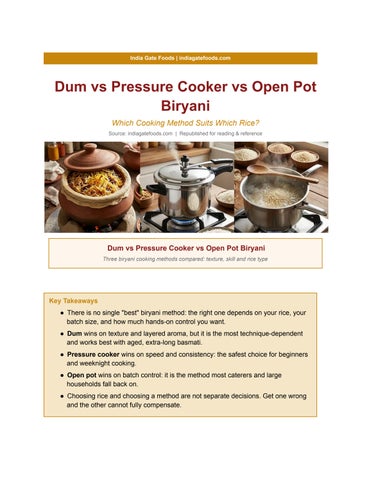
Dum vs Pressure Cooker vs Open Pot Biryani Three biryani cooking methods compared: texture, skill and rice type
Key Takeaways ● There is no single "best" biryani method: the right one depends on your rice, your batch size, and how much hands-on control you want. ● Dum wins on texture and layered aroma, but it is the most technique-dependent and works best with aged, extra-long basmati. ● Pressure cooker wins on speed and consistency: the safest choice for beginners and weeknight cooking. ● Open pot wins on batch control: it is the method most caterers and large households fall back on. ● Choosing rice and choosing a method are not separate decisions. Get one wrong and the other cannot fully compensate.
Most people pick a biryani method out of habit, not out of fit. They use whatever pot they already own, or whatever their mother used, and then blame the rice when it does not turn out right. The method and the rice have to work together: an aged, extra-long basmati that is built for a long, slow dum will behave very differently in a rushed pressure-cooker cycle, and vice versa. This India Gate Foods guide breaks down what each method actually does to the grain, so you can match the technique to the rice you are holding rather than fighting it.
1. What's the Real Difference Between Dum, Pressure Cooker, and Open Pot Biryani?
Three Biryani Cooking Methods Dum, pressure cooker and open pot: how heat and moisture differ by method
The three methods differ mainly in how heat and moisture reach the rice. Dum uses sealed, indirect steam over a long, low-heat cook, which is why it produces the most separated, aromatic grains. Pressure cooker uses trapped steam under pressure for a fast, high-moisture cook, which is efficient but less forgiving. An open pot uses direct, uncovered heat with excess water that gets drained off, giving you the most visual control over doneness.
Method
Texture Result
Skill Level
Best Rice
Best For
Dum
Long, separated grains; layered aroma
High: timing and heat control matter
Aged extra-long basmati
Special-occasion and festive biryani
Pressure Cooker
Softer, more uniform grains
Low to moderate: forgiving if whistle count is right
Basmati or seeraga samba, at a reduced ratio
Weeknight meals, small batches
Open Pot
Grain-by-grain control if drained on time
Moderate: needs active attention
Any well-aged variety, especially in bulk
Large batches and catering-style cooking
None of these differences are about one method being more "authentic" than another. Dum happens to be the traditional approach because, before pressure cookers existed, slow indirect heat was the only way to get long-grain rice to hold its shape. Pressure cookers and open pots are adaptations for speed and volume, and both can produce excellent biryani when matched to the right rice and used correctly.
2. When Should You Use the Dum Method?
Dum Biryani Method Sealed pot, slow steam-finish: the classic approach for festive and special-occasion biryani
Dum is the right call when texture and aroma matter more than speed: typically for guests, festivals, or any meal where the biryani is the centrepiece rather than a side. It rewards patience and aged rice, and punishes rushing. Dum works by par-boiling the rice separately to roughly 70-80% doneness, layering it over the meat or vegetable base, sealing the pot (traditionally with dough, though a tight lid and a heavy weight work fine at home), and finishing everything on very low heat so the rice completes
cooking in trapped steam rather than direct water contact. That steam-finish is what gives dum biryani its long, distinct grains and its layered smell when the lid comes off.
Quick Steps for the Dum Method 1. Par-boil rice separately until it is about 70-80% cooked, firm at the centre when you press a grain between your fingers. 2. Layer the par-boiled rice over the cooked meat, vegetable, or gravy base in a heavy-bottomed pot. 3. Seal the pot tightly (dough seal or a tight lid with a heavy object on top) to trap the steam. 4. Cook on very low heat for 20-25 minutes, then rest, covered, for 10 minutes before opening.
Key Tip: The biggest risk with dum is heat control, not the sealing itself. Home stoves rarely hold as gentle a flame as a professional setup. If the rice at the bottom of the pot has come out gummy or stuck together, that usually points to dum heat being too high.
3. When Should You Use a Pressure Cooker?
Pressure Cooker Biryani Method Fast, consistent results: the beginner-friendly approach for weeknight biryani
A pressure cooker is the right choice for weeknight biryani, first-time cooks, and anyone who wants a consistent result without babysitting the stove. It trades some of the layered texture of dum for speed and predictability. The trapped steam in a pressure cooker cooks rice faster than either dum or open pot, which means the ratio has to be tighter and the whistle count has to be watched closely. Too many
whistles on high flame is the single most common reason pressure-cooker biryani turns mushy: the rice simply overcooks before the pressure has a chance to release.
Quick Steps for the Pressure Cooker Method 1. Use a slightly reduced ratio (around 1:2, rice to water) compared with open pot cooking. 2. Layer rice over the meat or vegetable base as you would for dum, then seal the cooker. 3. Cook on low flame for 1-2 whistles only, not the higher counts used for plain rice. 4. Let the pressure release naturally: do not force it before opening the lid.
Key Tip: Natural release matters more than most recipes admit. Rice keeps cooking gently in residual steam even after the flame is off, and forcing an early release interrupts that finishing stage unevenly, which is part of why pressure-cooker biryani can come out mushy in patches.
4. When Should You Use the Open Pot Method?
Open Pot Biryani Method Visual control at scale: the go-to method for large batches and catering-style cooking
Open pot is the method to reach for when you are cooking in bulk: weddings, large family gatherings, or catering-style batches where visual control over doneness matters more than hands-off convenience. Because the rice cooks in a large volume of excess water rather than a fixed ratio, you can literally watch it and pull it the moment it hits the right stage. That is a real advantage at scale, where a pressure cooker's fixed whistle count becomes unreliable once quantities double or triple. The tradeoff is that an open pot demands active attention: walk away for too long and the draining window closes fast.
Quick Steps for the Open Pot Method 1. Bring a large excess of water to a rolling boil: there is no fixed rice-to-water ratio here. 2. Add soaked rice and cook uncovered, checking texture every couple of minutes after the halfway point. 3. Drain the moment the rice reaches roughly 70-80% doneness: firm centre, no chalky bite. 4. Layer the drained rice immediately for dum, or finish it directly if serving open-pot style.
Key Tip: The main failure mode with an open pot is timing, not technique. Waterlogged, overcooked rice almost always means the draining happened a few minutes too late. Once rice passes that 70-80% mark, there is no method that reliably rescues it before it turns to mush during the final cook.
5. Which Rice Works Best With Each Method?
India Gate Foods Aged Basmati Rice Aged extra-long basmati: matched to dum, pressure cooker and open pot methods
Rice and method are not independent choices: the grain has to be able to survive the specific way each method applies heat. Aged extra-long basmati holds its structure through dum's long steam-finish because ageing reduces surface moisture and firms up the starch. Fresher, less-aged rice tends to break down under that same slow heat, which is part of why ageing matters more for dum than for the faster methods. Pressure cooker is more forgiving of rice choice because the cook time is short: both basmati and seeraga samba work well, provided the ratio is adjusted down for the shorter grain. Open
pot is the most flexible of the three: because you control the draining point directly, almost any well-aged long-grain variety performs reasonably, which is exactly why it is the default choice for large-batch cooking where consistency across a huge pot matters more than fine texture.
Method
Recommended Rice
Why It Fits
Dum
Aged extra-long basmati
Firm starch structure survives a long, slow steam-finish without breaking down
Pressure Cooker
Basmati or seeraga samba (reduced ratio)
Short cook time is forgiving of both grain types if the ratio is tightened
Open Pot
Any well-aged long-grain variety, in bulk
Manual draining control compensates for less predictable grain behaviour at scale
6. Which Method Should You Actually Choose? The honest answer is: match the method to the occasion, not to a general idea of which one is "better." Here is a simple way to decide.
● Everyday meal, cooking for 2-4: Use the pressure cooker. Speed and consistency matter more than layered texture on a weeknight. ● Weekend cooking with time to spare: Use dum. This is where aged basmati like India Gate Foods pays off most, since the long steam-finish is exactly what the ageing was meant for. ● Special occasion or hosting guests: Dum, if you have the time and a rice that can hold up to it. If you are short on time, a well-executed pressure cooker batch will still beat a rushed, poorly sealed dum attempt. ● Large batch or catering-style cooking: Use an open pot. The manual draining control scales far more reliably than whistle counts once quantities go up.
For the best result: match method to occasion first, then choose rice to match the method. Everyday weeknight : Pressure Cooker | Weekend with time : Dum | Large batch : Open Pot If you are still unsure after matching occasion to method, the next question is usually about the dum vs pressure cooker vs open pot rice-to-water ratio for whichever method you land on, since getting the ratio wrong will undo the benefit of choosing the right method in the first place.
India Gate Foods Biryani Basmati Rice Aged extra-long basmati: designed for dum, consistent in pressure cooker and open pot
Frequently Asked Questions Q: Is dum biryani always better than pressure cooker biryani?
Not universally: dum produces better texture and aroma when it is done well, but a rushed or poorly sealed dum attempt can turn out worse than a well-timed pressure cooker batch. "Better" depends on execution, not just method.
Q: Can I get a dum-style texture using a pressure cooker?
You can get close by using a very short pressure cycle (1 whistle on low flame) followed by a longer rest off the heat, which mimics some of dum's slow steam-finish, though it will not fully replicate the layered aroma of a true sealed dum.
Q: How many whistles for biryani rice in a pressure cooker?
One to two whistles on low flame is standard for basmati biryani. More than that, especially on high heat, tends to overcook the rice before the pressure has released naturally.
Q: Is the open pot method safe for beginners?
It is manageable for beginners but requires more attention than a pressure cooker, since you need to check the rice by feel every couple of minutes near the end and drain it at the right moment rather than relying on a timer alone.
Q: Does the cooking method affect biryani's aroma?
Yes. Dum's sealed, low-heat steam-finish traps aromatics from the spices and rice inside the pot, which is why dum biryani typically has a stronger, more layered smell when the lid is first opened compared with pressure cooker or open pot versions.
Q: Which method uses the least water?
Pressure cooker uses the least, since it relies on a fixed, relatively tight ratio (around 1:2) rather than the large excess water used in open pot cooking, which is drained off after par-boiling.
Originally published by India Gate Foods (KRBL Limited) | indiagatefoods.com Click any image link to view the original image or page on the India Gate Foods website.